Cambridge A Level Business Studies (for final examination in 2015) 9707 — 2015 Oct/Nov Paper 3 · Variant 1
9707/31/O/N/15
The question paper and its mark scheme, free to read here and free to download. This is Cambridge’s own paper, exactly as it was sat.
Question paper8 pages


Mark scheme9 pages
Answers below. Sit the paper first if you are practising.
Paper as text
Question paper, page 1
This document consists of 6 printed pages and 2 blank pages. DC (NF/SG) 106732/1 © UCLES 2015 [Turn over Cambridge International Examinations Cambridge International Advanced Subsidiary and Advanced Level * 2 4 8 0 4 2 3 6 6 1 * BUSINESS STUDIES 9707/31 Paper 3 October/November 2015 CASE STUDY 3 hours Additional Materials: Answer Booklet/Paper READ THESE INSTRUCTIONS FIRST If you have been given an Answer Booklet, follow the instructions on the front cover of the Booklet. Write your Centre number, candidate number and name on all the work you hand in. Write in dark blue or black pen. You may use an HB pencil for any diagrams, graphs or rough working. Do not use staples, paper clips, glue or correction fluid. DO NOT WRITE IN ANY BARCODES. Section A Answer all questions. Section B Answer one question. You are advised to spend 40 minutes on Section B. The businesses described in this question paper are entirely fictitious. At the end of the examination, fasten all your work securely together. The number of marks is given in brackets [ ] at the end of each question or part question.
Question paper, page 2
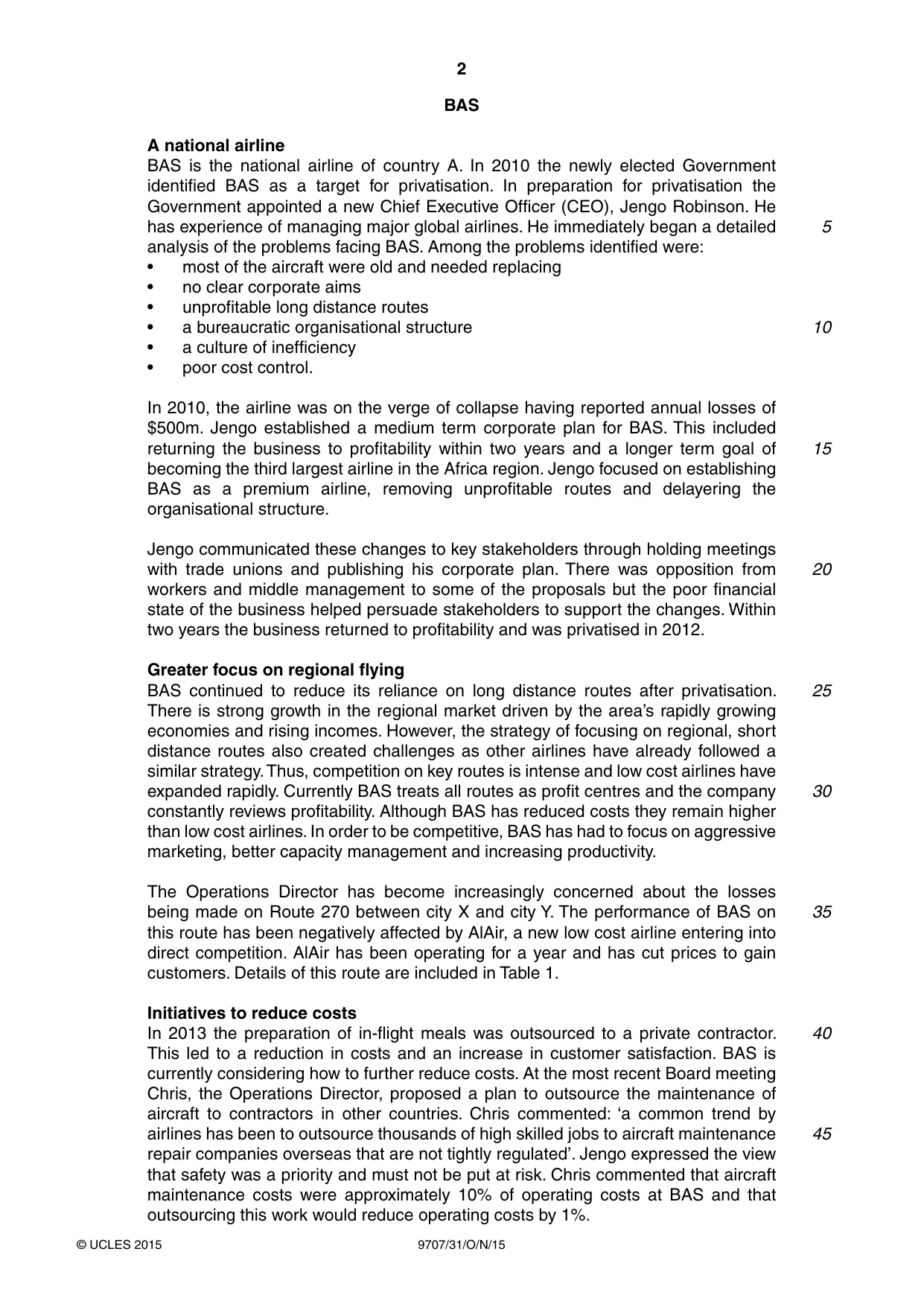
2 9707/31/O/N/15 © UCLES 2015 BAS A national airline BAS is the national airline of country A. In 2010 the newly elected Government identified BAS as a target for privatisation. In preparation for privatisation the Government appointed a new Chief Executive Officer (CEO), Jengo Robinson. He has experience of managing major global airlines. He immediately began a detailed analysis of the problems facing BAS. Among the problems identified were: • most of the aircraft were old and needed replacing • no clear corporate aims • unprofitable long distance routes • a bureaucratic organisational structure • a culture of inefficiency • poor cost control. In 2010, the airline was on the verge of collapse having reported annual losses of $500m. Jengo established a medium term corporate plan for BAS. This included returning the business to profitability within two years and a longer term goal of becoming the third largest airline in the Africa region. Jengo focused on establishing BAS as a premium airline, removing unprofitable routes and delayering the organisational structure. Jengo communicated these changes to key stakeholders through holding meetings with trade unions and publishing his corporate plan. There was opposition from workers and middle management to some of the proposals but the poor financial state of the business helped persuade stakeholders to support the changes. Within two years the business returned to profitability and was privatised in 2012. Greater focus on regional flying BAS continued to reduce its reliance on long distance routes after privatisation. There is strong growth in the regional market driven by the area’s rapidly growing economies and rising incomes. However, the strategy of focusing on regional, short distance routes also created challenges as other airlines have already followed a similar strategy. Thus, competition on key routes is intense and low cost airlines have expanded rapidly. Currently BAS treats all routes as profit centres and the company constantly reviews profitability. Although BAS has reduced costs they remain higher than low cost airlines. In order to be competitive, BAS has had to focus on aggressive marketing, better capacity management and increasing productivity. The Operations Director has become increasingly concerned about the losses being made on Route 270 between city X and city Y. The performance of BAS on this route has been negatively affected by AlAir, a new low cost airline entering into direct competition. AlAir has been operating for a year and has cut prices to gain customers. Details of this route are included in Table 1. Initiatives to reduce costs In 2013 the preparation of in-flight meals was outsourced to a private contractor. This led to a reduction in costs and an increase in customer satisfaction. BAS is currently considering how to further reduce costs. At the most recent Board meeting Chris, the Operations Director, proposed a plan to outsource the maintenance of aircraft to contractors in other countries. Chris commented: ‘a common trend by airlines has been to outsource thousands of high skilled jobs to aircraft maintenance repair companies overseas that are not tightly regulated’. Jengo expressed the view that safety was a priority and must not be put at risk. Chris commented that aircraft maintenance costs were approximately 10% of operating costs at BAS and that outsourcing this work would reduce operating costs by 1%. 5 10 15 20 25 30 35 40 45
Question paper, page 3
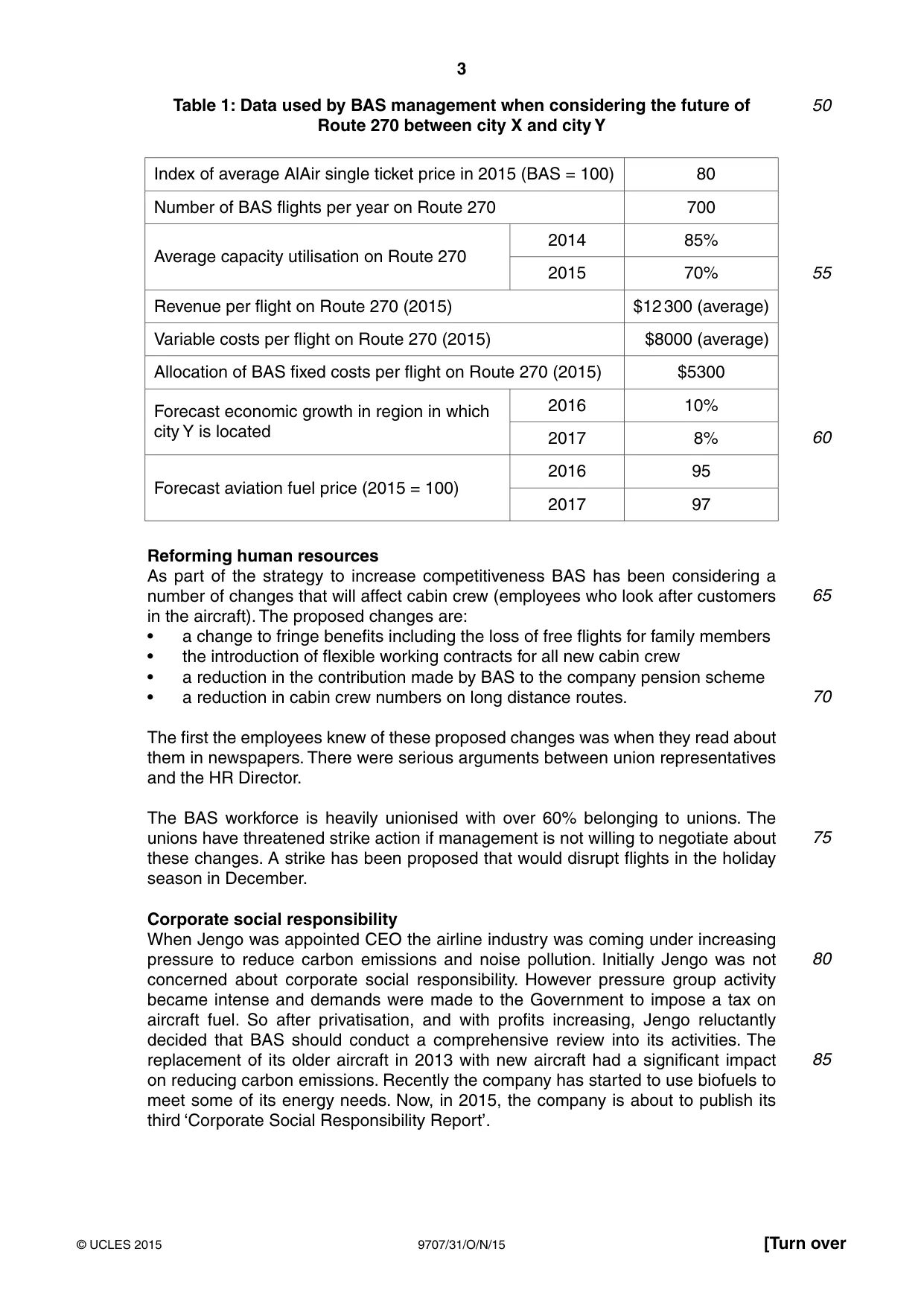
3 9707/31/O/N/15 © UCLES 2015 [Turn over Table 1: Data used by BAS management when considering the future of Route 270 between city X and city Y Index of average AlAir single ticket price in 2015 (BAS = 100) 80 Number of BAS flights per year on Route 270 700 Average capacity utilisation on Route 270 2014 85% 2015 70% Revenue per flight on Route 270 (2015) $12 300 (average) Variable costs per flight on Route 270 (2015) $8000 (average) Allocation of BAS fixed costs per flight on Route 270 (2015) $5300 Forecast economic growth in region in which city Y is located 2016 10% 2017 8% Forecast aviation fuel price (2015 = 100) 2016 95 2017 97 Reforming human resources As part of the strategy to increase competitiveness BAS has been considering a number of changes that will affect cabin crew (employees who look after customers in the aircraft). The proposed changes are: • a change to fringe benefits including the loss of free flights for family members • the introduction of flexible working contracts for all new cabin crew • a reduction in the contribution made by BAS to the company pension scheme • a reduction in cabin crew numbers on long distance routes. The first the employees knew of these proposed changes was when they read about them in newspapers. There were serious arguments between union representatives and the HR Director. The BAS workforce is heavily unionised with over 60% belonging to unions. The unions have threatened strike action if management is not willing to negotiate about these changes. A strike has been proposed that would disrupt flights in the holiday season in December. Corporate social responsibility When Jengo was appointed CEO the airline industry was coming under increasing pressure to reduce carbon emissions and noise pollution. Initially Jengo was not concerned about corporate social responsibility. However pressure group activity became intense and demands were made to the Government to impose a tax on aircraft fuel. So after privatisation, and with profits increasing, Jengo reluctantly decided that BAS should conduct a comprehensive review into its activities. The replacement of its older aircraft in 2013 with new aircraft had a significant impact on reducing carbon emissions. Recently the company has started to use biofuels to meet some of its energy needs. Now, in 2015, the company is about to publish its third ‘Corporate Social Responsibility Report’. 50 55 60 65 70 75 80 85
Question paper, page 4
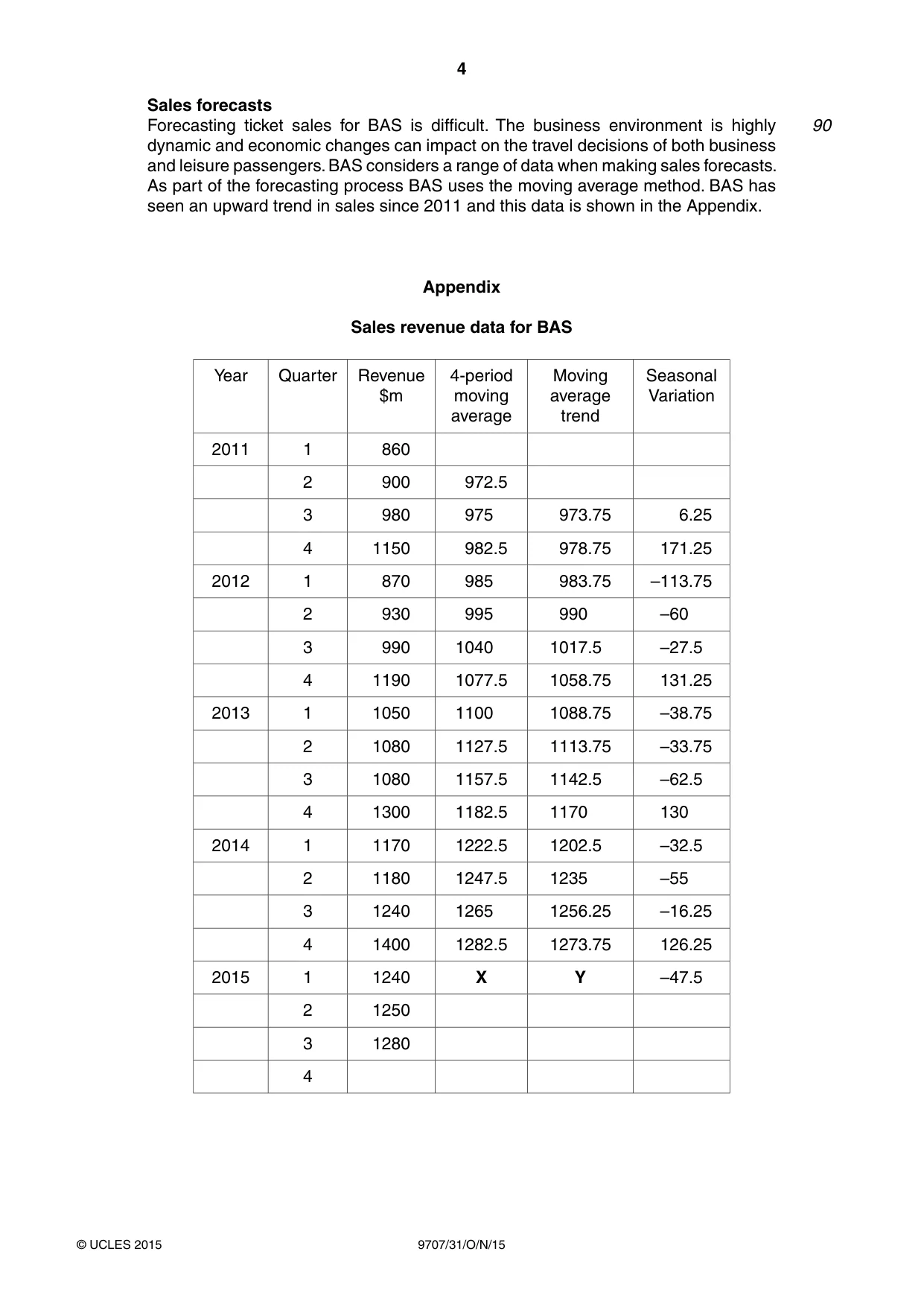
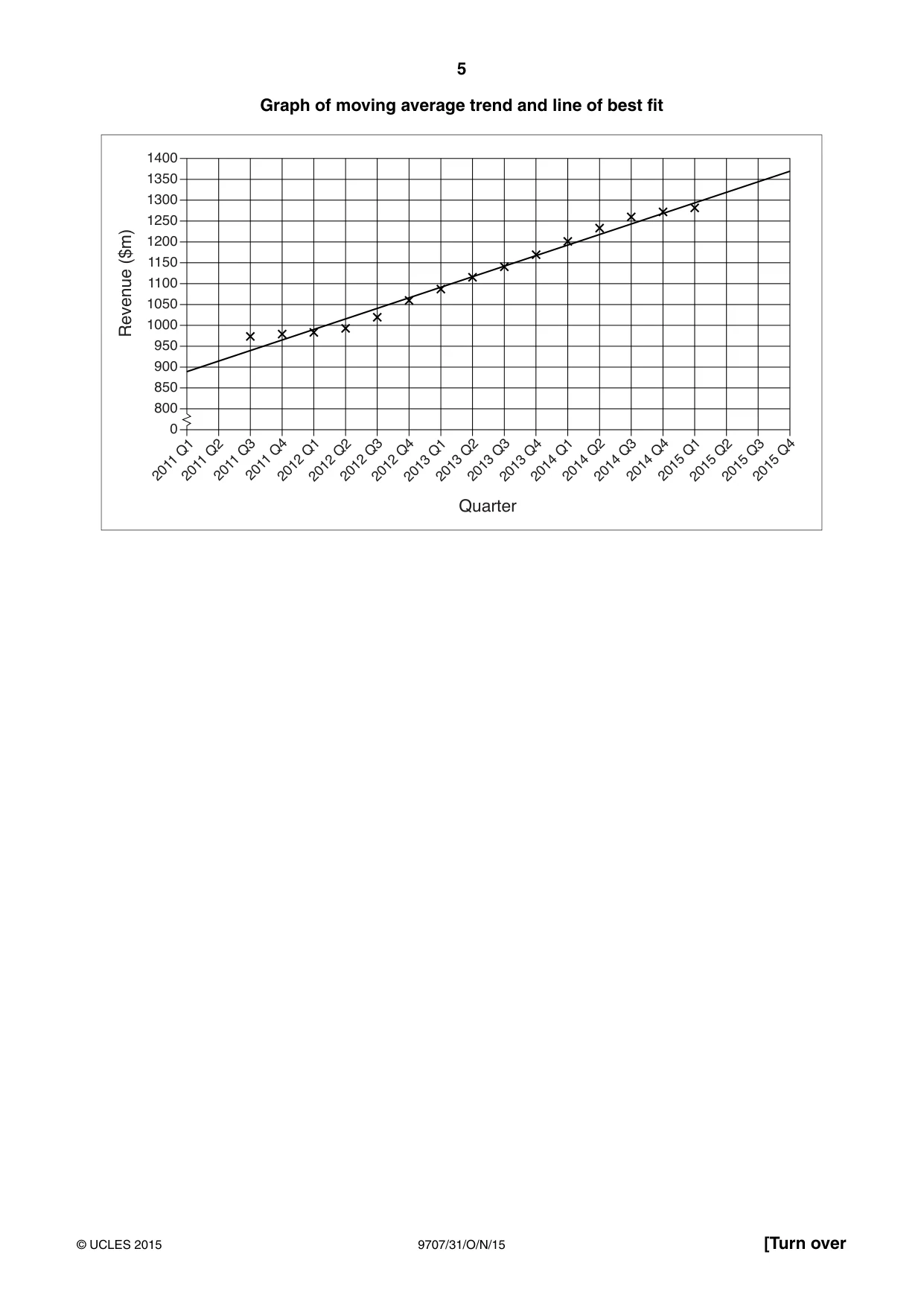
4 9707/31/O/N/15 © UCLES 2015 Sales forecasts Forecasting ticket sales for BAS is difficult. The business environment is highly dynamic and economic changes can impact on the travel decisions of both business and leisure passengers. BAS considers a range of data when making sales forecasts. As part of the forecasting process BAS uses the moving average method. BAS has seen an upward trend in sales since 2011 and this data is shown in the Appendix. Appendix Sales revenue data for BAS Year Quarter Revenue $m 4-period moving average Moving average trend Seasonal Variation 2011 1 860 2 900 972.5 3 980 975 973.75 6.25 4 1150 982.5 978.75 171.25 2012 1 870 985 983.75 –113.75 2 930 995 990 –60 3 990 1040 1017.5 –27.5 4 1190 1077.5 1058.75 131.25 2013 1 1050 1100 1088.75 –38.75 2 1080 1127.5 1113.75 –33.75 3 1080 1157.5 1142.5 –62.5 4 1300 1182.5 1170 130 2014 1 1170 1222.5 1202.5 –32.5 2 1180 1247.5 1235 –55 3 1240 1265 1256.25 –16.25 4 1400 1282.5 1273.75 126.25 2015 1 1240 X Y –47.5 2 1250 3 1280 4 90
Question paper, page 5
5 9707/31/O/N/15 © UCLES 2015 [Turn over Graph of moving average trend and line of best fit 2011 Q1 2011 Q2 2011 Q3 2011 Q4 2012 Q1 2012 Q2 2012 Q3 2012 Q4 2013 Q1 2013 Q2 2013 Q3 2013 Q4 2014 Q1 2014 Q2 2014 Q3 2014 Q4 2015 Q1 2015 Q2 2015 Q3 2015 Q4 1400 1350 1300 1250 1200 1150 1100 1050 1000 950 900 850 800 0 Revenue ($m) Quarter
Question paper, page 6
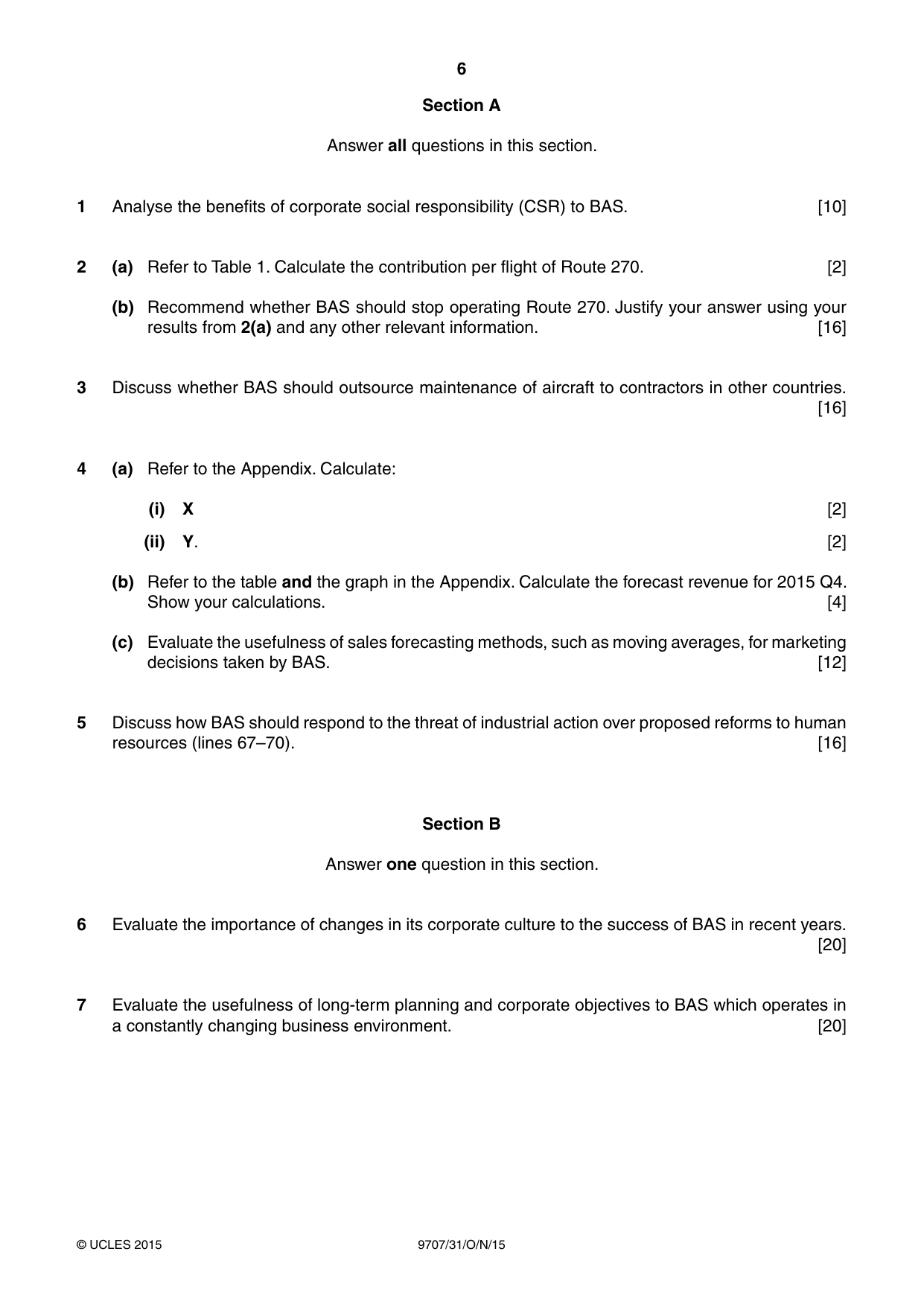
6 9707/31/O/N/15 © UCLES 2015 Section A Answer all questions in this section. 1 Analyse the benefits of corporate social responsibility (CSR) to BAS. [10] 2 (a) Refer to Table 1. Calculate the contribution per flight of Route 270. [2] (b) Recommend whether BAS should stop operating Route 270. Justify your answer using your results from 2(a) and any other relevant information. [16] 3 Discuss whether BAS should outsource maintenance of aircraft to contractors in other countries. [16] 4 (a) Refer to the Appendix. Calculate: (i) X [2] (ii) Y. [2] (b) Refer to the table and the graph in the Appendix. Calculate the forecast revenue for 2015 Q4. Show your calculations. [4] (c) Evaluate the usefulness of sales forecasting methods, such as moving averages, for marketing decisions taken by BAS. [12] 5 Discuss how BAS should respond to the threat of industrial action over proposed reforms to human resources (lines 67–70). [16] Section B Answer one question in this section. 6 Evaluate the importance of changes in its corporate culture to the success of BAS in recent years. [20] 7 Evaluate the usefulness of long-term planning and corporate objectives to BAS which operates in a constantly changing business environment. [20]
Question paper, page 7
7 9707/31/O/N/15 © UCLES 2015 BLANK PAGE
Question paper, page 8
8 9707/31/O/N/15 © UCLES 2015 BLANK PAGE Permission to reproduce items where third-party owned material protected by copyright is included has been sought and cleared where possible. Every reasonable effort has been made by the publisher (UCLES) to trace copyright holders, but if any items requiring clearance have unwittingly been included, the publisher will be pleased to make amends at the earliest possible opportunity. To avoid the issue of disclosure of answer-related information to candidates, all copyright acknowledgements are reproduced online in the Cambridge International Examinations Copyright Acknowledgements Booklet. This is produced for each series of examinations and is freely available to download at www.cie.org.uk after the live examination series. Cambridge International Examinations is part of the Cambridge Assessment Group. Cambridge Assessment is the brand name of University of Cambridge Local Examinations Syndicate (UCLES), which is itself a department of the University of Cambridge.
Mark scheme, page 1
® IGCSE is the registered trademark of Cambridge International Examinations. CAMBRIDGE INTERNATIONAL EXAMINATIONS Cambridge International Advanced Level MARK SCHEME for the October/November 2015 series 9707 BUSINESS STUDIES 9707/31 Paper 3 (Case Study), maximum raw mark 100 This mark scheme is published as an aid to teachers and candidates, to indicate the requirements of the examination. It shows the basis on which Examiners were instructed to award marks. It does not indicate the details of the discussions that took place at an Examiners’ meeting before marking began, which would have considered the acceptability of alternative answers. Mark schemes should be read in conjunction with the question paper and the Principal Examiner Report for Teachers. Cambridge will not enter into discussions about these mark schemes. Cambridge is publishing the mark schemes for the October/November 2015 series for most Cambridge IGCSE®, Cambridge International A and AS Level components and some Cambridge O Level components.
Mark scheme, page 2
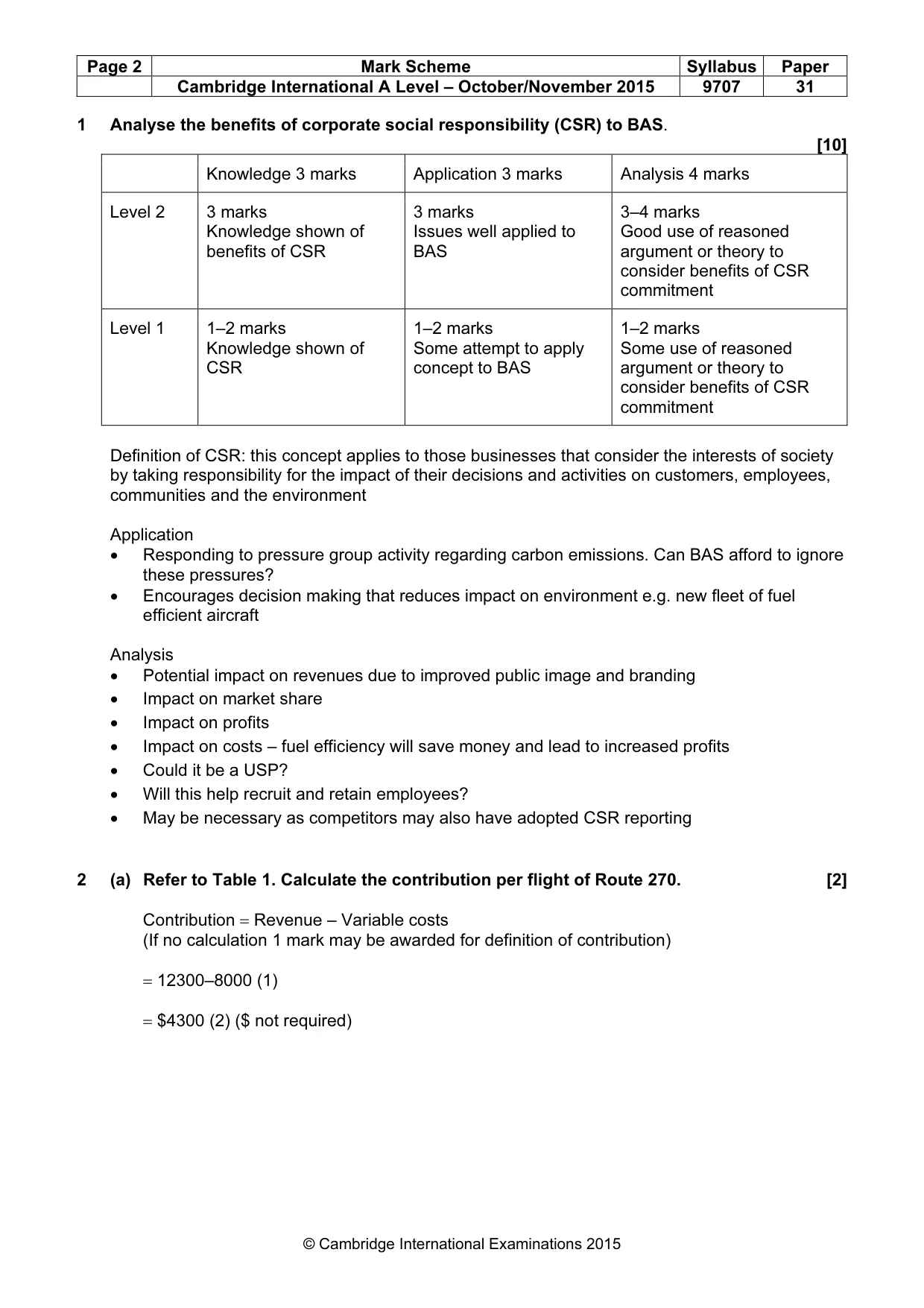
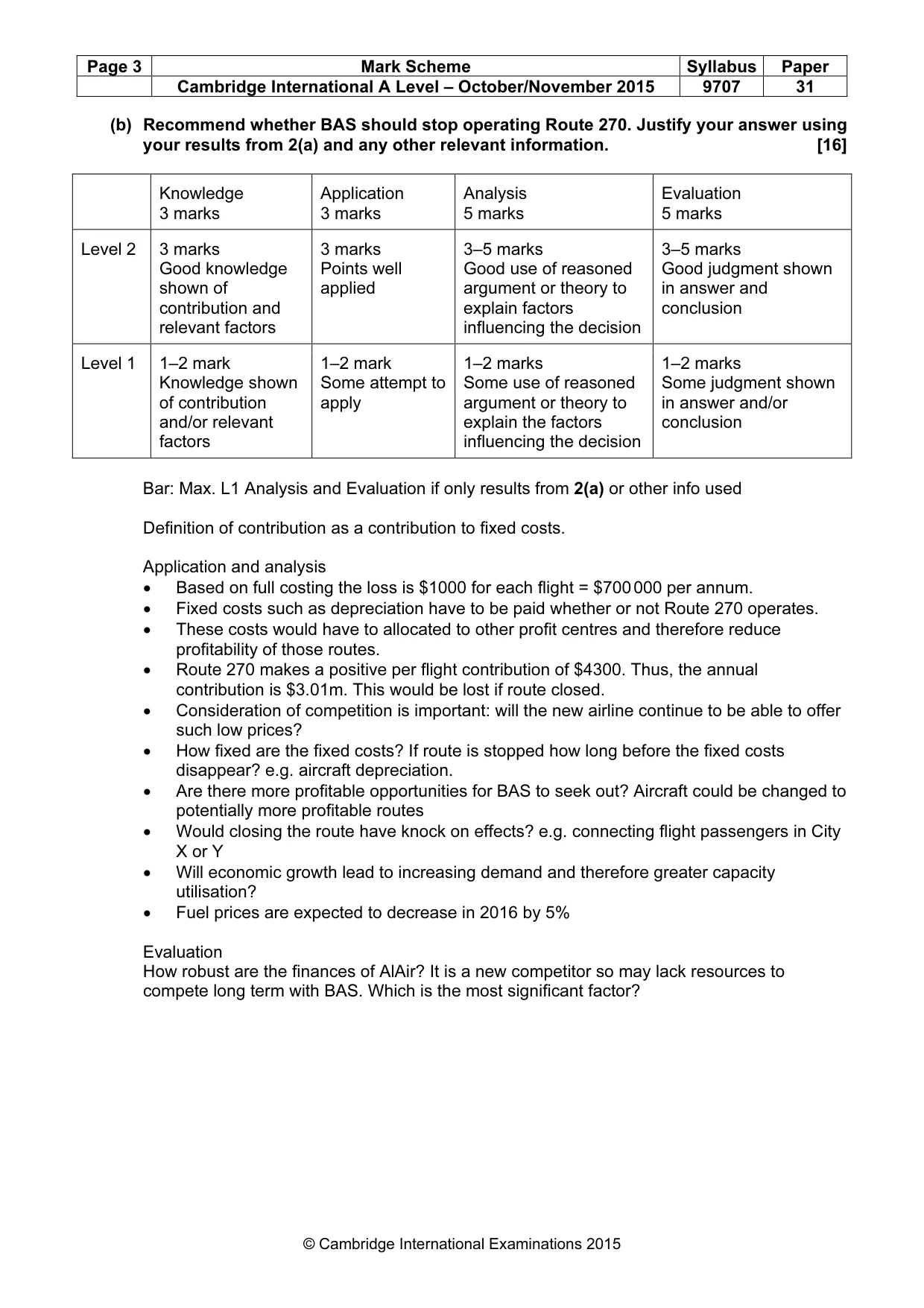
Page 2 Mark Scheme Syllabus Paper Cambridge International A Level – October/November 2015 9707 31 © Cambridge International Examinations 2015 1 Analyse the benefits of corporate social responsibility (CSR) to BAS. [10] Knowledge 3 marks Application 3 marks Analysis 4 marks Level 2 3 marks Knowledge shown of benefits of CSR 3 marks Issues well applied to BAS 3–4 marks Good use of reasoned argument or theory to consider benefits of CSR commitment Level 1 1–2 marks Knowledge shown of CSR 1–2 marks Some attempt to apply concept to BAS 1–2 marks Some use of reasoned argument or theory to consider benefits of CSR commitment Definition of CSR: this concept applies to those businesses that consider the interests of society by taking responsibility for the impact of their decisions and activities on customers, employees, communities and the environment Application • Responding to pressure group activity regarding carbon emissions. Can BAS afford to ignore these pressures? • Encourages decision making that reduces impact on environment e.g. new fleet of fuel efficient aircraft Analysis • Potential impact on revenues due to improved public image and branding • Impact on market share • Impact on profits • Impact on costs – fuel efficiency will save money and lead to increased profits • Could it be a USP? • Will this help recruit and retain employees? • May be necessary as competitors may also have adopted CSR reporting 2 (a) Refer to Table 1. Calculate the contribution per flight of Route 270. [2] Contribution = Revenue – Variable costs (If no calculation 1 mark may be awarded for definition of contribution) = 12300–8000 (1) = $4300 (2) ($ not required)
Mark scheme, page 3
Page 3 Mark Scheme Syllabus Paper Cambridge International A Level – October/November 2015 9707 31 © Cambridge International Examinations 2015 (b) Recommend whether BAS should stop operating Route 270. Justify your answer using your results from 2(a) and any other relevant information. [16] Knowledge 3 marks Application 3 marks Analysis 5 marks Evaluation 5 marks Level 2 3 marks Good knowledge shown of contribution and relevant factors 3 marks Points well applied 3–5 marks Good use of reasoned argument or theory to explain factors influencing the decision 3–5 marks Good judgment shown in answer and conclusion Level 1 1–2 mark Knowledge shown of contribution and/or relevant factors 1–2 mark Some attempt to apply 1–2 marks Some use of reasoned argument or theory to explain the factors influencing the decision 1–2 marks Some judgment shown in answer and/or conclusion Bar: Max. L1 Analysis and Evaluation if only results from 2(a) or other info used Definition of contribution as a contribution to fixed costs. Application and analysis • Based on full costing the loss is $1000 for each flight = $700 000 per annum. • Fixed costs such as depreciation have to be paid whether or not Route 270 operates. • These costs would have to allocated to other profit centres and therefore reduce profitability of those routes. • Route 270 makes a positive per flight contribution of $4300. Thus, the annual contribution is $3.01m. This would be lost if route closed. • Consideration of competition is important: will the new airline continue to be able to offer such low prices? • How fixed are the fixed costs? If route is stopped how long before the fixed costs disappear? e.g. aircraft depreciation. • Are there more profitable opportunities for BAS to seek out? Aircraft could be changed to potentially more profitable routes • Would closing the route have knock on effects? e.g. connecting flight passengers in City X or Y • Will economic growth lead to increasing demand and therefore greater capacity utilisation? • Fuel prices are expected to decrease in 2016 by 5% Evaluation How robust are the finances of AlAir? It is a new competitor so may lack resources to compete long term with BAS. Which is the most significant factor?
Mark scheme, page 4
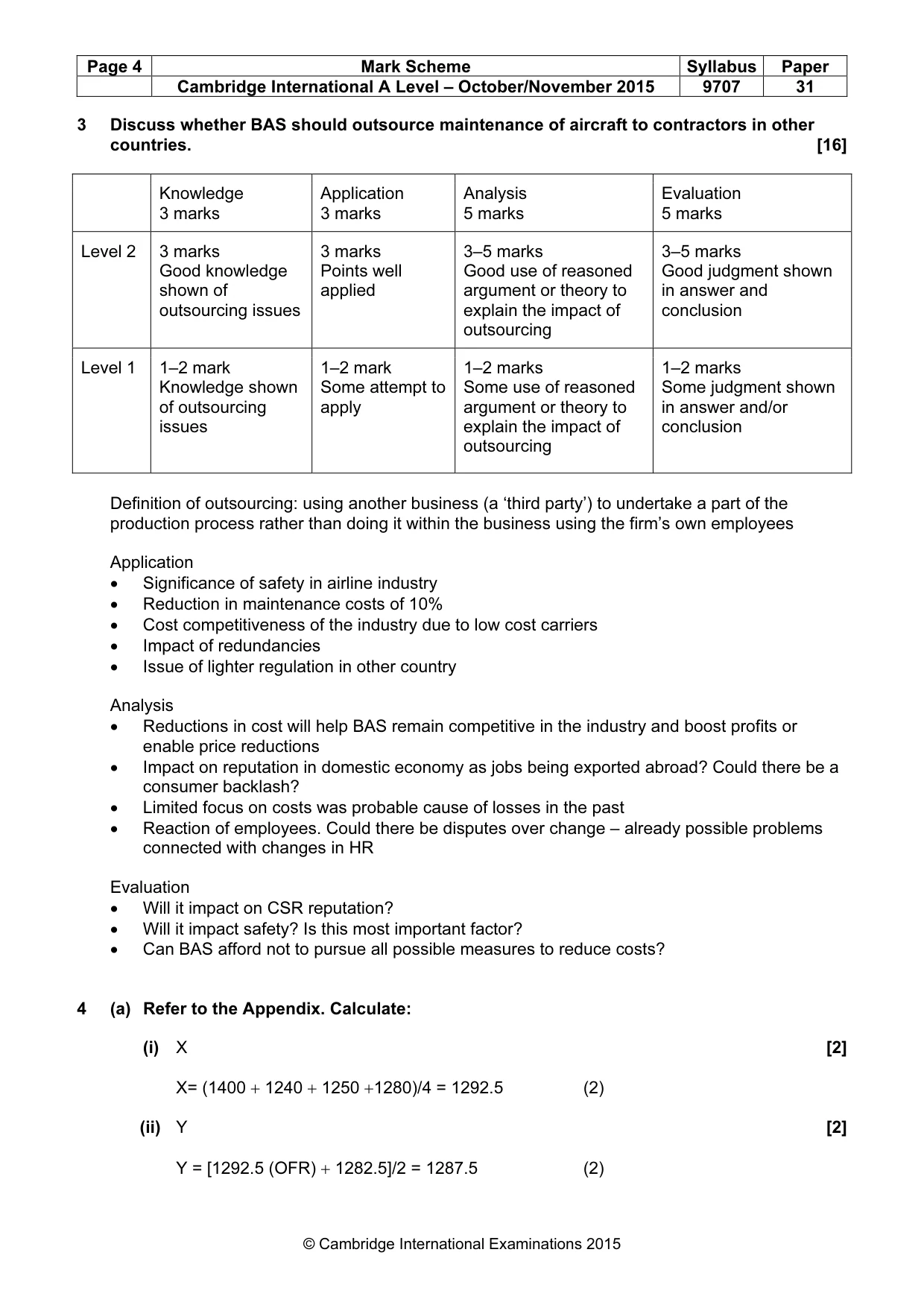
Page 4 Mark Scheme Syllabus Paper Cambridge International A Level – October/November 2015 9707 31 © Cambridge International Examinations 2015 3 Discuss whether BAS should outsource maintenance of aircraft to contractors in other countries. [16] Knowledge 3 marks Application 3 marks Analysis 5 marks Evaluation 5 marks Level 2 3 marks Good knowledge shown of outsourcing issues 3 marks Points well applied 3–5 marks Good use of reasoned argument or theory to explain the impact of outsourcing 3–5 marks Good judgment shown in answer and conclusion Level 1 1–2 mark Knowledge shown of outsourcing issues 1–2 mark Some attempt to apply 1–2 marks Some use of reasoned argument or theory to explain the impact of outsourcing 1–2 marks Some judgment shown in answer and/or conclusion Definition of outsourcing: using another business (a ‘third party’) to undertake a part of the production process rather than doing it within the business using the firm’s own employees Application • Significance of safety in airline industry • Reduction in maintenance costs of 10% • Cost competitiveness of the industry due to low cost carriers • Impact of redundancies • Issue of lighter regulation in other country Analysis • Reductions in cost will help BAS remain competitive in the industry and boost profits or enable price reductions • Impact on reputation in domestic economy as jobs being exported abroad? Could there be a consumer backlash? • Limited focus on costs was probable cause of losses in the past • Reaction of employees. Could there be disputes over change – already possible problems connected with changes in HR Evaluation • Will it impact on CSR reputation? • Will it impact safety? Is this most important factor? • Can BAS afford not to pursue all possible measures to reduce costs? 4 (a) Refer to the Appendix. Calculate: (i) X [2] X= (1400 + 1240 + 1250 +1280)/4 = 1292.5 (2) (ii) Y [2] Y = [1292.5 (OFR) + 1282.5]/2 = 1287.5 (2)
Mark scheme, page 5
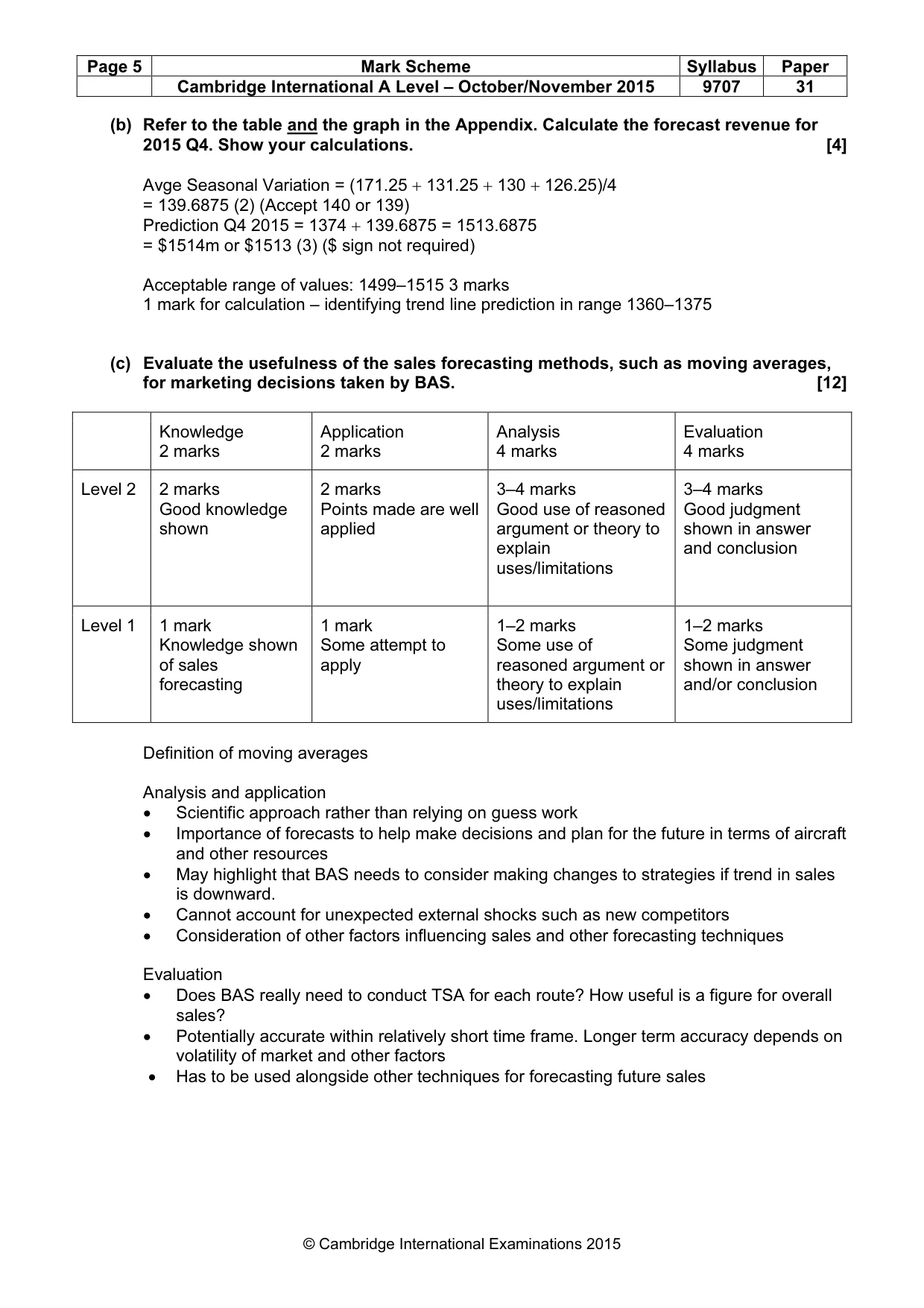
Page 5 Mark Scheme Syllabus Paper Cambridge International A Level – October/November 2015 9707 31 © Cambridge International Examinations 2015 (b) Refer to the table and the graph in the Appendix. Calculate the forecast revenue for 2015 Q4. Show your calculations. [4] Avge Seasonal Variation = (171.25 + 131.25 + 130 + 126.25)/4 = 139.6875 (2) (Accept 140 or 139) Prediction Q4 2015 = 1374 + 139.6875 = 1513.6875 = $1514m or $1513 (3) ($ sign not required) Acceptable range of values: 1499–1515 3 marks 1 mark for calculation – identifying trend line prediction in range 1360–1375 (c) Evaluate the usefulness of the sales forecasting methods, such as moving averages, for marketing decisions taken by BAS. [12] Knowledge 2 marks Application 2 marks Analysis 4 marks Evaluation 4 marks Level 2 2 marks Good knowledge shown 2 marks Points made are well applied 3–4 marks Good use of reasoned argument or theory to explain uses/limitations 3–4 marks Good judgment shown in answer and conclusion Level 1 1 mark Knowledge shown of sales forecasting 1 mark Some attempt to apply 1–2 marks Some use of reasoned argument or theory to explain uses/limitations 1–2 marks Some judgment shown in answer and/or conclusion Definition of moving averages Analysis and application • Scientific approach rather than relying on guess work • Importance of forecasts to help make decisions and plan for the future in terms of aircraft and other resources • May highlight that BAS needs to consider making changes to strategies if trend in sales is downward. • Cannot account for unexpected external shocks such as new competitors • Consideration of other factors influencing sales and other forecasting techniques Evaluation • Does BAS really need to conduct TSA for each route? How useful is a figure for overall sales? • Potentially accurate within relatively short time frame. Longer term accuracy depends on volatility of market and other factors • Has to be used alongside other techniques for forecasting future sales
Mark scheme, page 6
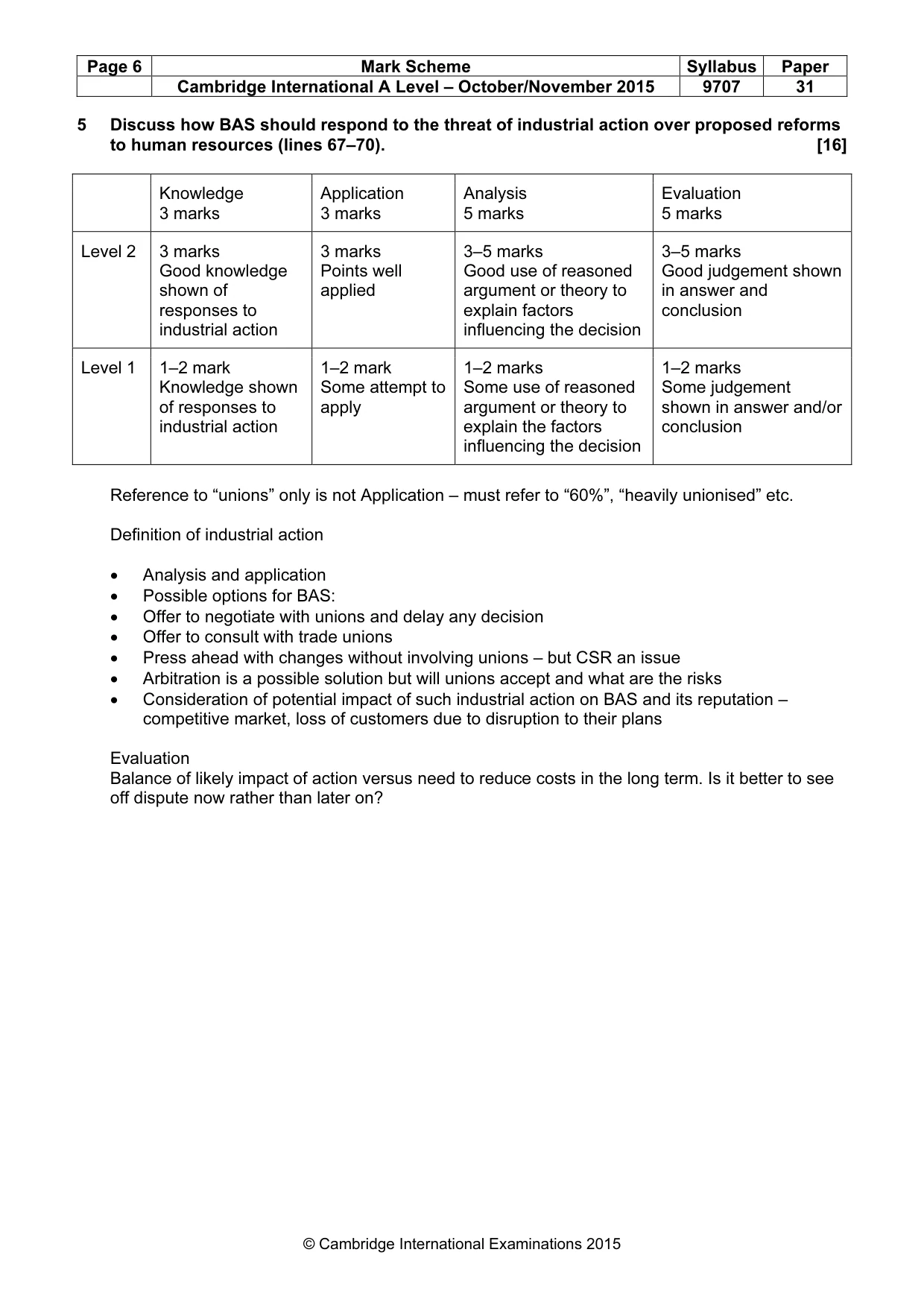
Page 6 Mark Scheme Syllabus Paper Cambridge International A Level – October/November 2015 9707 31 © Cambridge International Examinations 2015 5 Discuss how BAS should respond to the threat of industrial action over proposed reforms to human resources (lines 67–70). [16] Knowledge 3 marks Application 3 marks Analysis 5 marks Evaluation 5 marks Level 2 3 marks Good knowledge shown of responses to industrial action 3 marks Points well applied 3–5 marks Good use of reasoned argument or theory to explain factors influencing the decision 3–5 marks Good judgement shown in answer and conclusion Level 1 1–2 mark Knowledge shown of responses to industrial action 1–2 mark Some attempt to apply 1–2 marks Some use of reasoned argument or theory to explain the factors influencing the decision 1–2 marks Some judgement shown in answer and/or conclusion Reference to “unions” only is not Application – must refer to “60%”, “heavily unionised” etc. Definition of industrial action • Analysis and application • Possible options for BAS: • Offer to negotiate with unions and delay any decision • Offer to consult with trade unions • Press ahead with changes without involving unions – but CSR an issue • Arbitration is a possible solution but will unions accept and what are the risks • Consideration of potential impact of such industrial action on BAS and its reputation – competitive market, loss of customers due to disruption to their plans Evaluation Balance of likely impact of action versus need to reduce costs in the long term. Is it better to see off dispute now rather than later on?
Mark scheme, page 7
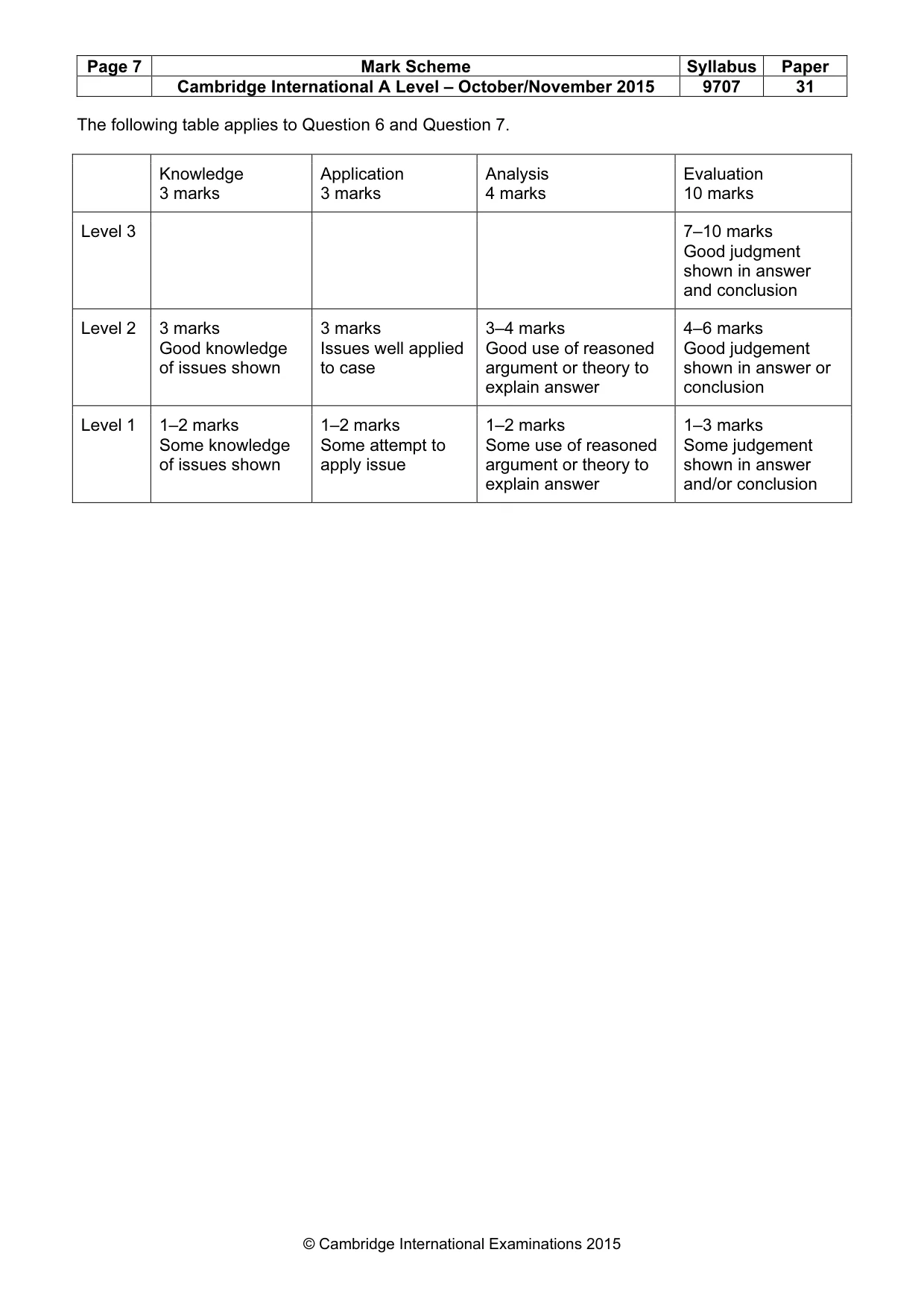
Page 7 Mark Scheme Syllabus Paper Cambridge International A Level – October/November 2015 9707 31 © Cambridge International Examinations 2015 The following table applies to Question 6 and Question 7. Knowledge 3 marks Application 3 marks Analysis 4 marks Evaluation 10 marks Level 3 7–10 marks Good judgment shown in answer and conclusion Level 2 3 marks Good knowledge of issues shown 3 marks Issues well applied to case 3–4 marks Good use of reasoned argument or theory to explain answer 4–6 marks Good judgement shown in answer or conclusion Level 1 1–2 marks Some knowledge of issues shown 1–2 marks Some attempt to apply issue 1–2 marks Some use of reasoned argument or theory to explain answer 1–3 marks Some judgement shown in answer and/or conclusion
Mark scheme, page 8
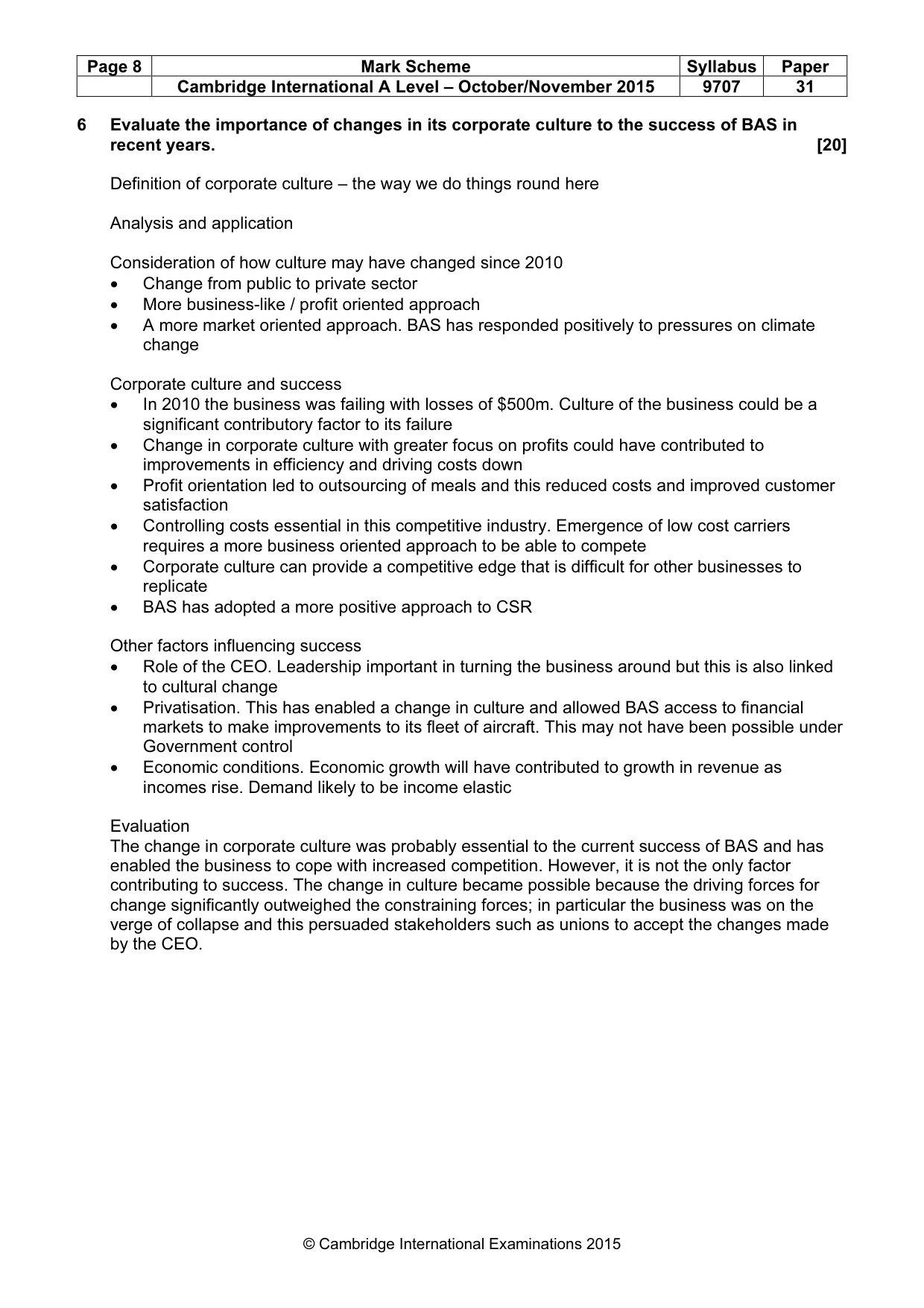
Page 8 Mark Scheme Syllabus Paper Cambridge International A Level – October/November 2015 9707 31 © Cambridge International Examinations 2015 6 Evaluate the importance of changes in its corporate culture to the success of BAS in recent years. [20] Definition of corporate culture – the way we do things round here Analysis and application Consideration of how culture may have changed since 2010 • Change from public to private sector • More business-like / profit oriented approach • A more market oriented approach. BAS has responded positively to pressures on climate change Corporate culture and success • In 2010 the business was failing with losses of $500m. Culture of the business could be a significant contributory factor to its failure • Change in corporate culture with greater focus on profits could have contributed to improvements in efficiency and driving costs down • Profit orientation led to outsourcing of meals and this reduced costs and improved customer satisfaction • Controlling costs essential in this competitive industry. Emergence of low cost carriers requires a more business oriented approach to be able to compete • Corporate culture can provide a competitive edge that is difficult for other businesses to replicate • BAS has adopted a more positive approach to CSR Other factors influencing success • Role of the CEO. Leadership important in turning the business around but this is also linked to cultural change • Privatisation. This has enabled a change in culture and allowed BAS access to financial markets to make improvements to its fleet of aircraft. This may not have been possible under Government control • Economic conditions. Economic growth will have contributed to growth in revenue as incomes rise. Demand likely to be income elastic Evaluation The change in corporate culture was probably essential to the current success of BAS and has enabled the business to cope with increased competition. However, it is not the only factor contributing to success. The change in culture became possible because the driving forces for change significantly outweighed the constraining forces; in particular the business was on the verge of collapse and this persuaded stakeholders such as unions to accept the changes made by the CEO.
Mark scheme, page 9
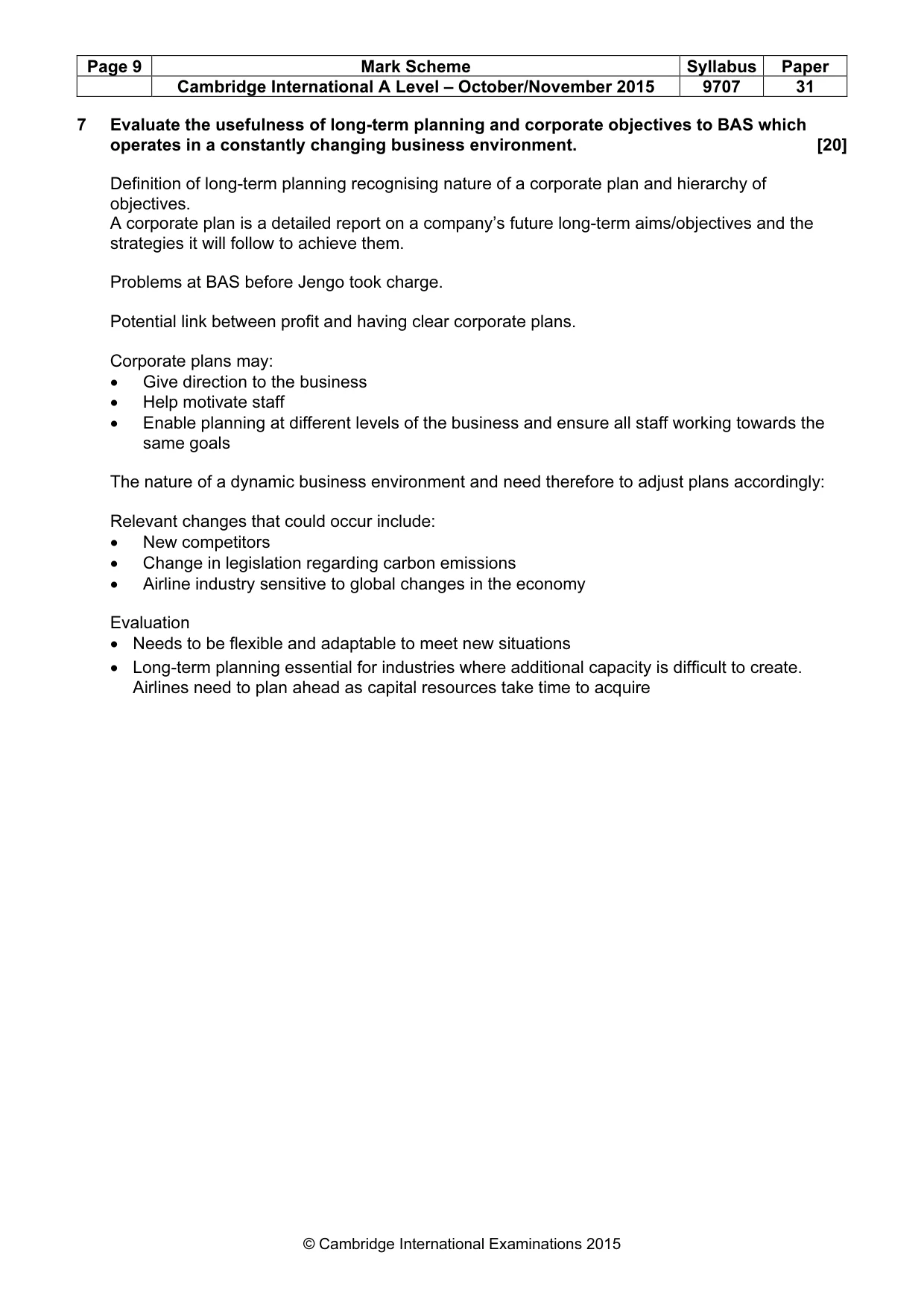
Page 9 Mark Scheme Syllabus Paper Cambridge International A Level – October/November 2015 9707 31 © Cambridge International Examinations 2015 7 Evaluate the usefulness of long-term planning and corporate objectives to BAS which operates in a constantly changing business environment. [20] Definition of long-term planning recognising nature of a corporate plan and hierarchy of objectives. A corporate plan is a detailed report on a company’s future long-term aims/objectives and the strategies it will follow to achieve them. Problems at BAS before Jengo took charge. Potential link between profit and having clear corporate plans. Corporate plans may: • Give direction to the business • Help motivate staff • Enable planning at different levels of the business and ensure all staff working towards the same goals The nature of a dynamic business environment and need therefore to adjust plans accordingly: Relevant changes that could occur include: • New competitors • Change in legislation regarding carbon emissions • Airline industry sensitive to global changes in the economy Evaluation • Needs to be flexible and adaptable to meet new situations • Long-term planning essential for industries where additional capacity is difficult to create. Airlines need to plan ahead as capital resources take time to acquire