Cambridge A Level Business Studies (for final examination in 2015) 9707 — 2015 May/June Paper 3 · Variant 2
9707/32/M/J/15 · 7 questions · 100 marks · ≈113 min
The question paper and its mark scheme, free to read here and free to download. This is Cambridge’s own paper, exactly as it was sat.
Question paper8 pages



Mark scheme9 pages
Answers below. Sit the paper first if you are practising.
Questions as text
Q1 · Analyse the benefits and limitations to MF of the level of delegation given to farm…
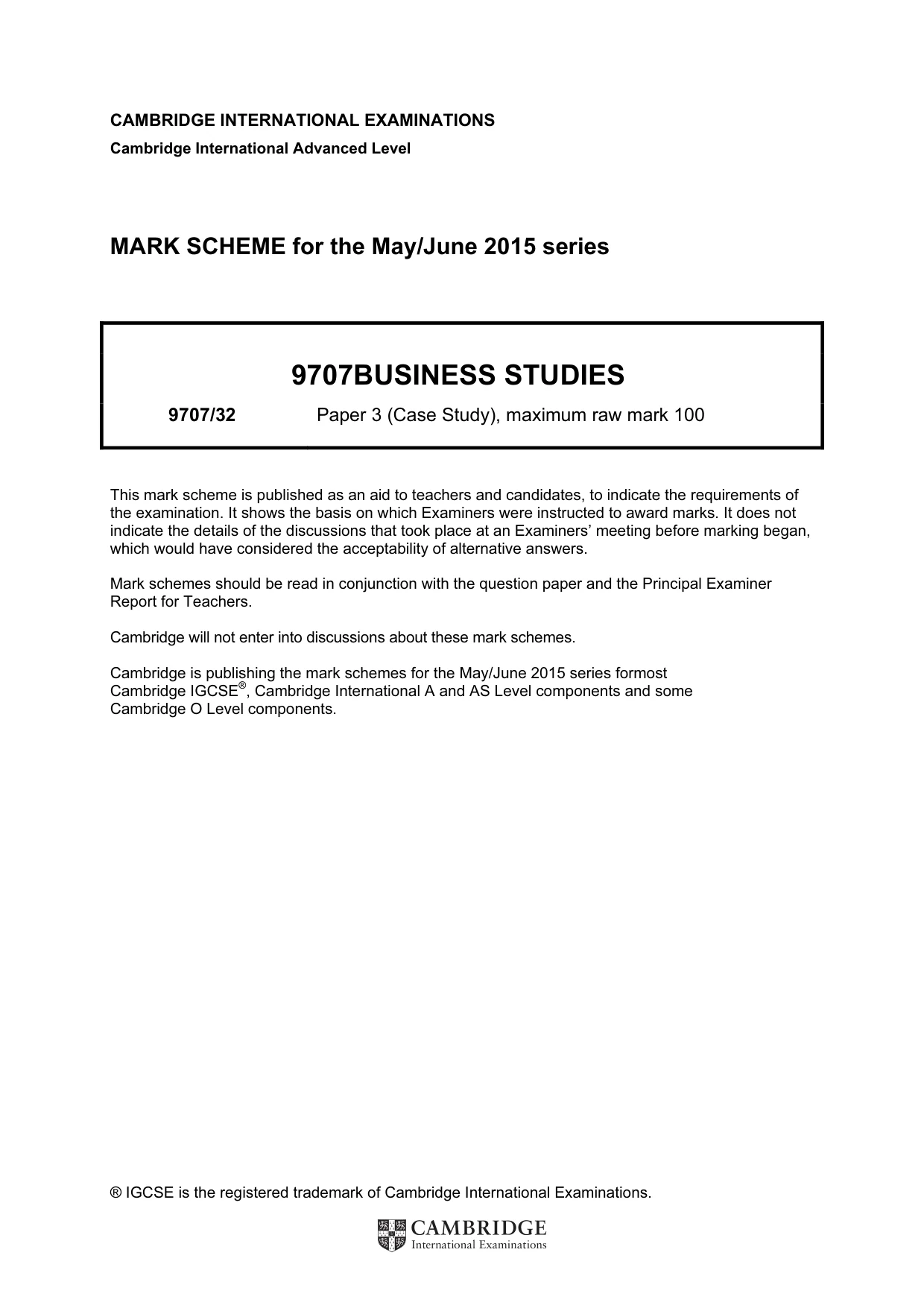
1 Analyse the benefits and limitations to MF of the level of delegation given to farm managers. [10]
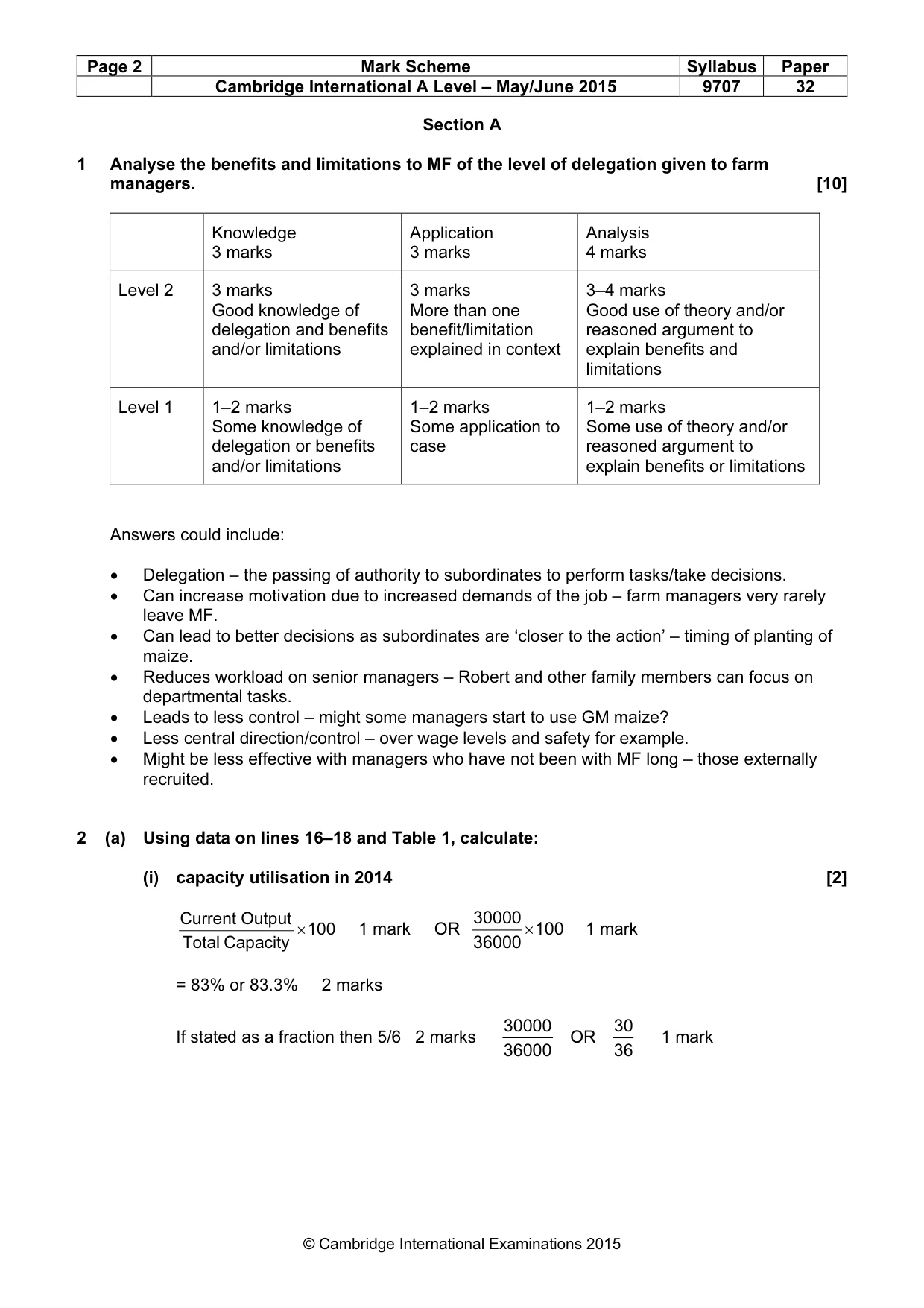
Mark scheme: 1 Analyse the benefits and limitations to MF of the level of delegation given to farm managers. [10] Knowledge Application Analysis 3 marks 3 marks 4 marks Level 2 3 marks 3 marks 3–4 marks Good knowledge of More than one Good use of theory and/or delegation and benefits benefit/limitation reasoned argument to and/or limitations explained in context explain benefits and limitations Level 1 1–2 marks 1–2 marks 1–2 marks Some knowledge of Some application to Some use of theory and/or delegation or benefits case reasoned argument to and/or limitations explain benefits or limitations Answers could include: • Delegation – the passing of authority to subordinates to perform tasks/take decisions. • Can increase motivation due to increased demands of the job – farm managers very rarely leave MF. • Can lead to better decisions as subordinates are ‘closer to the action’ – timing of planting of maize. • Reduces workload on senior managers – Robert and other family members can focus on departmental tasks. • Leads to less control – might some managers start to use GM maize? • Less central direction/control – over wage levels and safety for example. • Might be less effective with managers who have not been with MF long – those externally recruited.
Q2 · Using data on lines 16–18 and Table 1, calculate: (a) (i) capacity utilisation in 2014…
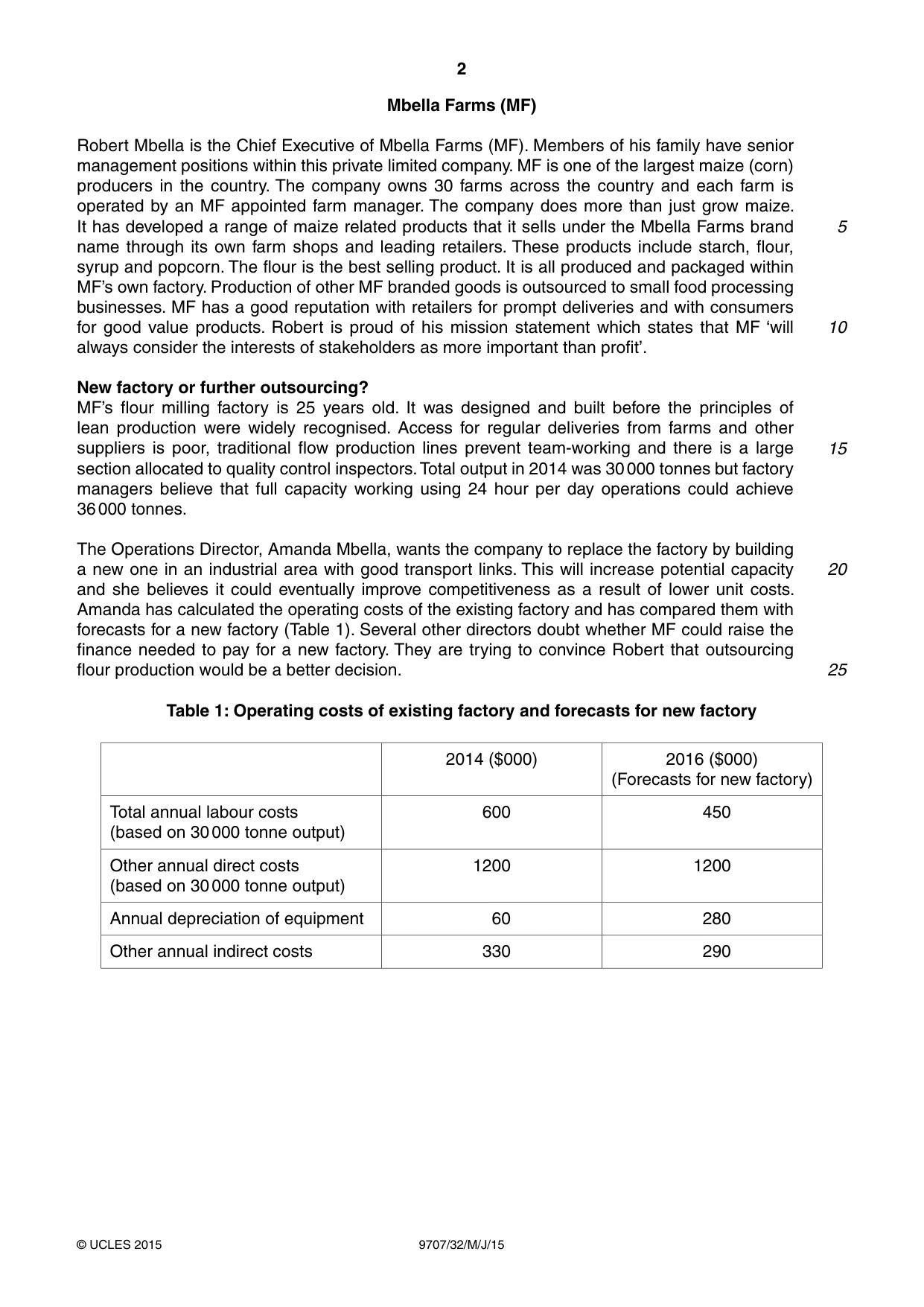
2 Using data on lines 16–18 and Table 1, calculate: (a) (i) capacity utilisation in 2014 [2] (ii) the difference, at an output of 30 000 tonnes of flour, between the average cost per tonne in 2014 and the forecasted average cost per tonne in 2016. [4] (b) Using your results to 2(a) and other information, recommend whether MF should build the new factory. Justify your answer. [12]
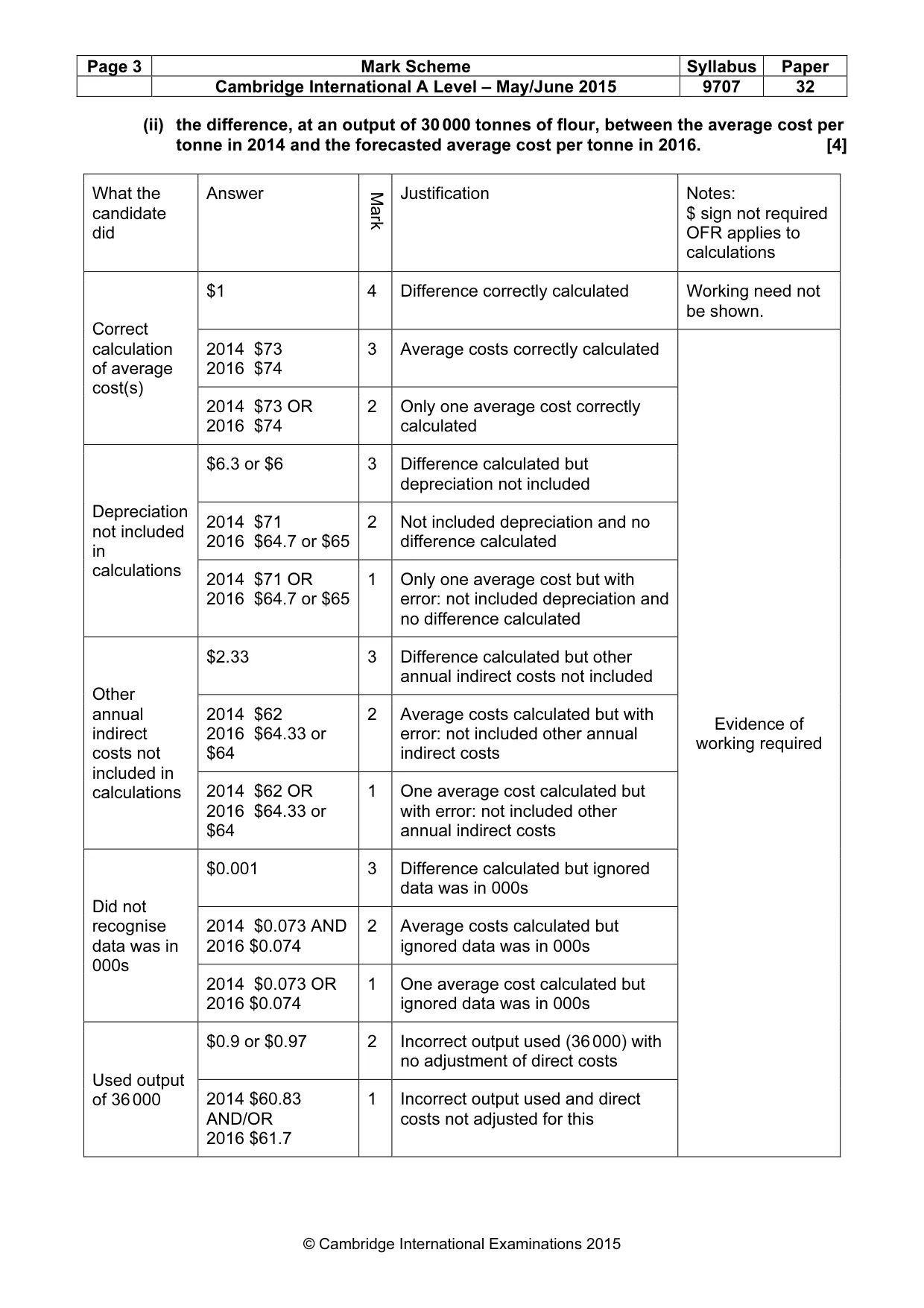
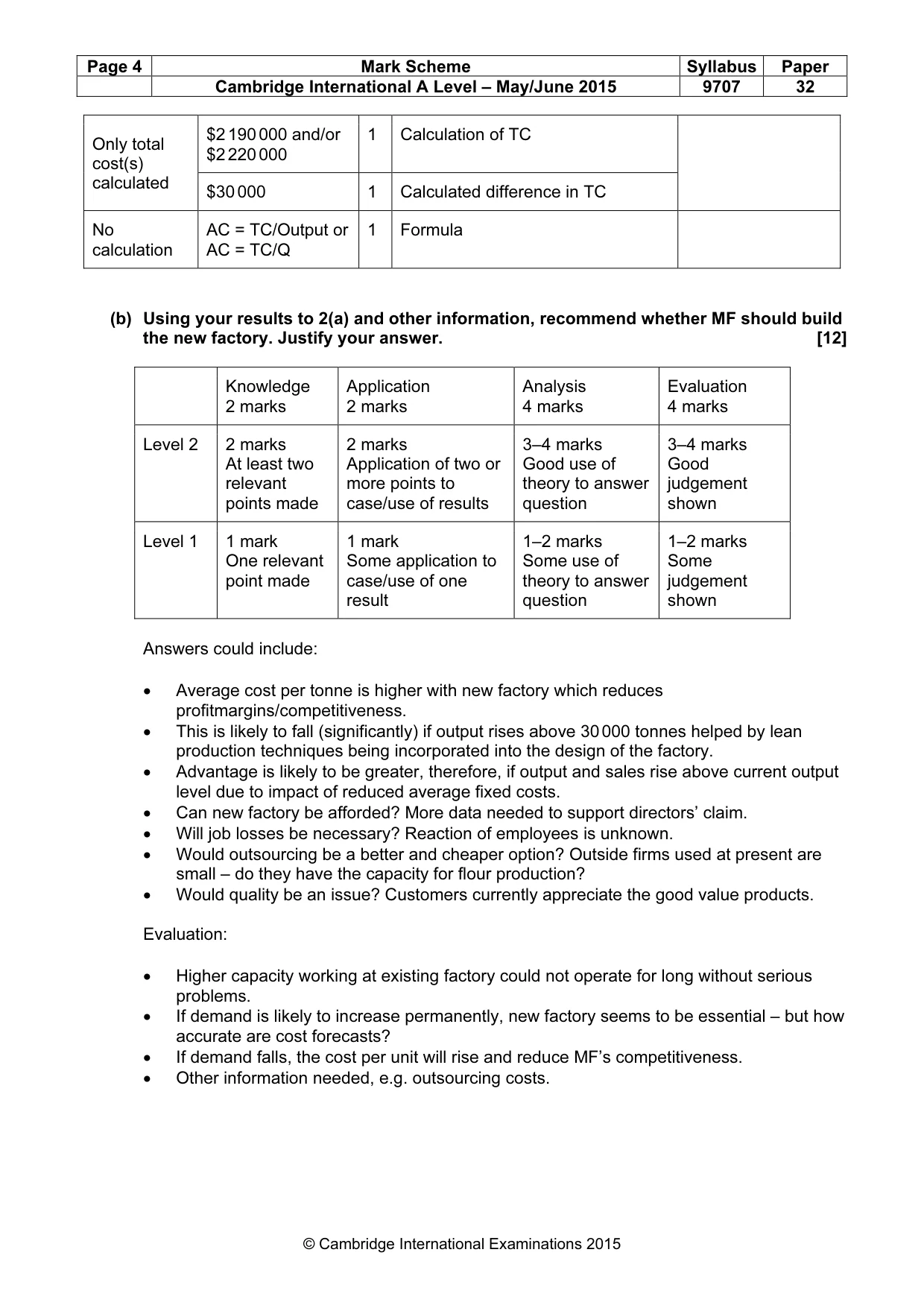
Mark scheme: 2 (a) Using data on lines 16–18 and Table 1, calculate: (i) capacity utilisation in 2014 [2] Current Output 30000 × 100 1 mark OR × 100 1 mark Total Capacity 36000 = 83% or 83.3% 2 marks 30000 30 If stated as a fraction then 5/6 2 marks OR 1 mark 36000 36 (ii) the difference, at an output of 30 000 tonnes of flour, between the average cost per tonne in 2014 and the forecasted average cost per tonne in 2016. [4] What the Answer Justification Notes: candidate $ sign not required Mark did OFR applies to calculations $1 4 Difference correctly calculated Working need not be shown. Correct calculation 2014 $73 3 Average costs correctly calculated of average 2016 $74 cost(s) 2014 $73 OR 2 Only one average cost correctly 2016 $74 calculated $6.3 or $6 3 Difference calculated but depreciation not included Depreciation 2014 $71 2 Not included depreciation and no not included 2016 $64.7 or $65 difference calculated in calculations 2014 $71 OR 1 Only one average cost but with 2016 $64.7 or $65 error: not included depreciation and no difference calculated $2.33 3 Difference calculated but other annual indirect costs not included Other annual 2014 $62 2 Average costs calculated but with Evidence of indirect 2016 $64.33 or error: not included other annual working required costs not $64 indirect costs included in calculations 2014 $62 OR 1 One average cost calculated but 2016 $64.33 or with error: not included other $64 annual indirect costs $0.001 3 Difference calculated but ignored data was in 000s Did not recognise 2014 $0.073 AND 2 Average costs calculated but data was in 2016 $0.074 ignored data was in 000s 000s 2014 $0.073 OR 1 One average cost calculated but 2016 $0.074 ignored data was in 000s $0.9 or $0.97 2 Incorrect output used (36 000) with no adjustment of direct costs Used output of 36 000 2014 $60.83 1 Incorrect output used and direct AND/OR costs not adjusted for this 2016 $61.7 $2 190 000 and/or 1 Calculation of TC Only total $2 220 000 cost(s) calculated $30 000 1 Calculated difference in TC No AC = TC/Output or 1 Formula calculation AC = TC/Q (b) Using your results to 2(a) and other information, recommend whether MF should build the new factory. Justify your answer. [12] Knowledge Application Analysis Evaluation 2 marks 2 marks 4 marks 4 marks Level 2 2 marks 2 marks 3–4 marks 3–4 marks At least two Application of two or Good use of Good relevant more points to theory to answer judgement points made case/use of results question shown Level 1 1 mark 1 mark 1–2 marks 1–2 marks One relevant Some application to Some use of Some point made case/use of one theory to answer judgement result question shown Answers could include: • Average cost per tonne is higher with new factory which reduces profitmargins/competitiveness. • This is likely to fall (significantly) if output rises above 30 000 tonnes helped by lean production techniques being incorporated into the design of the factory. • Advantage is likely to be greater, therefore, if output and sales rise above current output level due to impact of reduced average fixed costs. • Can new factory be afforded? More data needed to support directors’ claim. • Will job losses be necessary? Reaction of employees is unknown. • Would outsourcing be a better and cheaper option? Outside firms used at present are small – do they have the capacity for flour production? • Would quality be an issue? Customers currently appreciate the good value products. Evaluation: • Higher capacity working at existing factory could not operate for long without serious problems. • If demand is likely to increase permanently, new factory seems to be essential – but how accurate are cost forecasts? • If demand falls, the cost per unit will rise and reduce MF’s competitiveness. • Other information needed, e.g. outsourcing costs.
Q3 · To what extent will a marketing plan ensure that the new ‘Maize Crunchies’ product is…
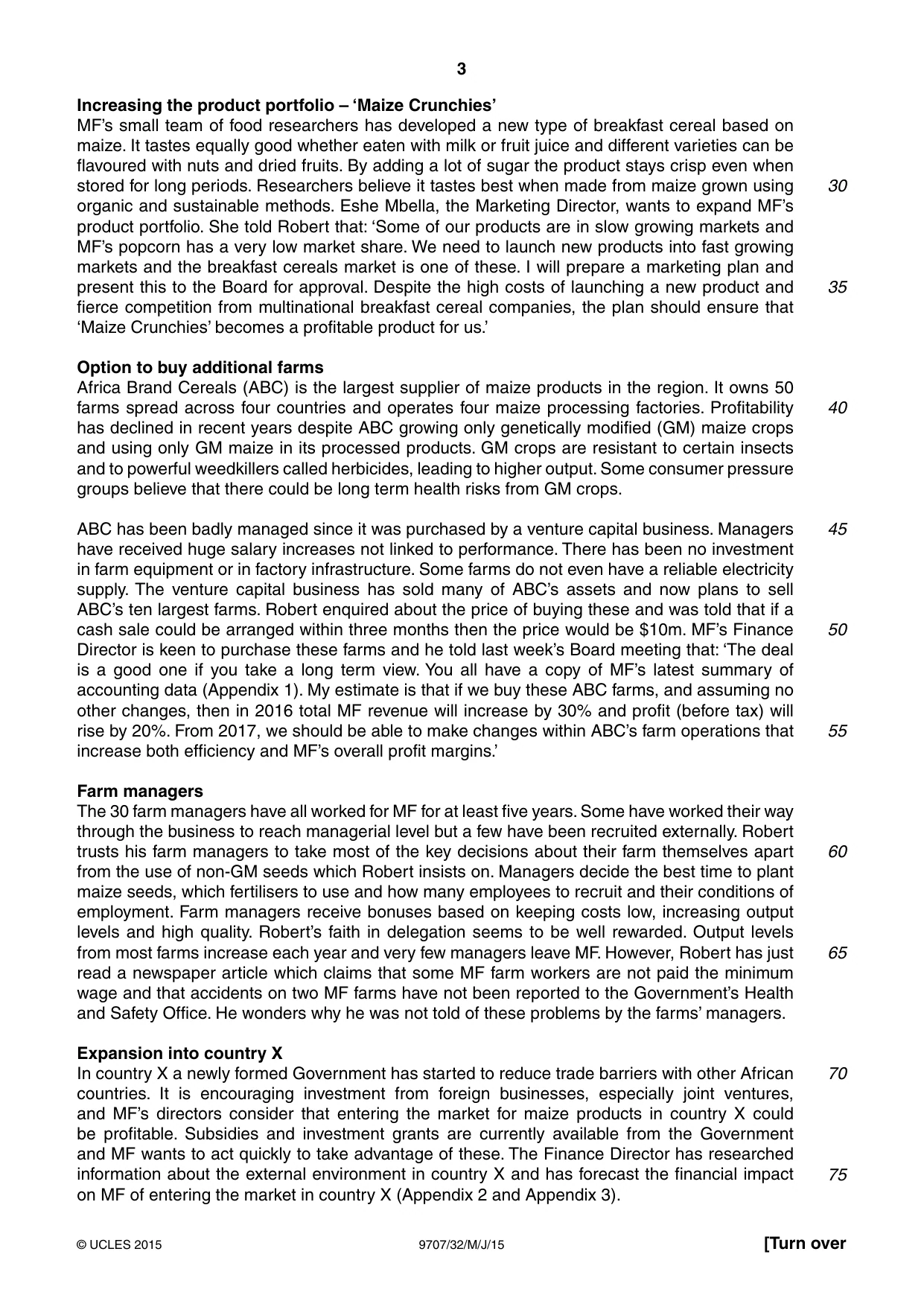
3 To what extent will a marketing plan ensure that the new ‘Maize Crunchies’ product is profitable? [14]
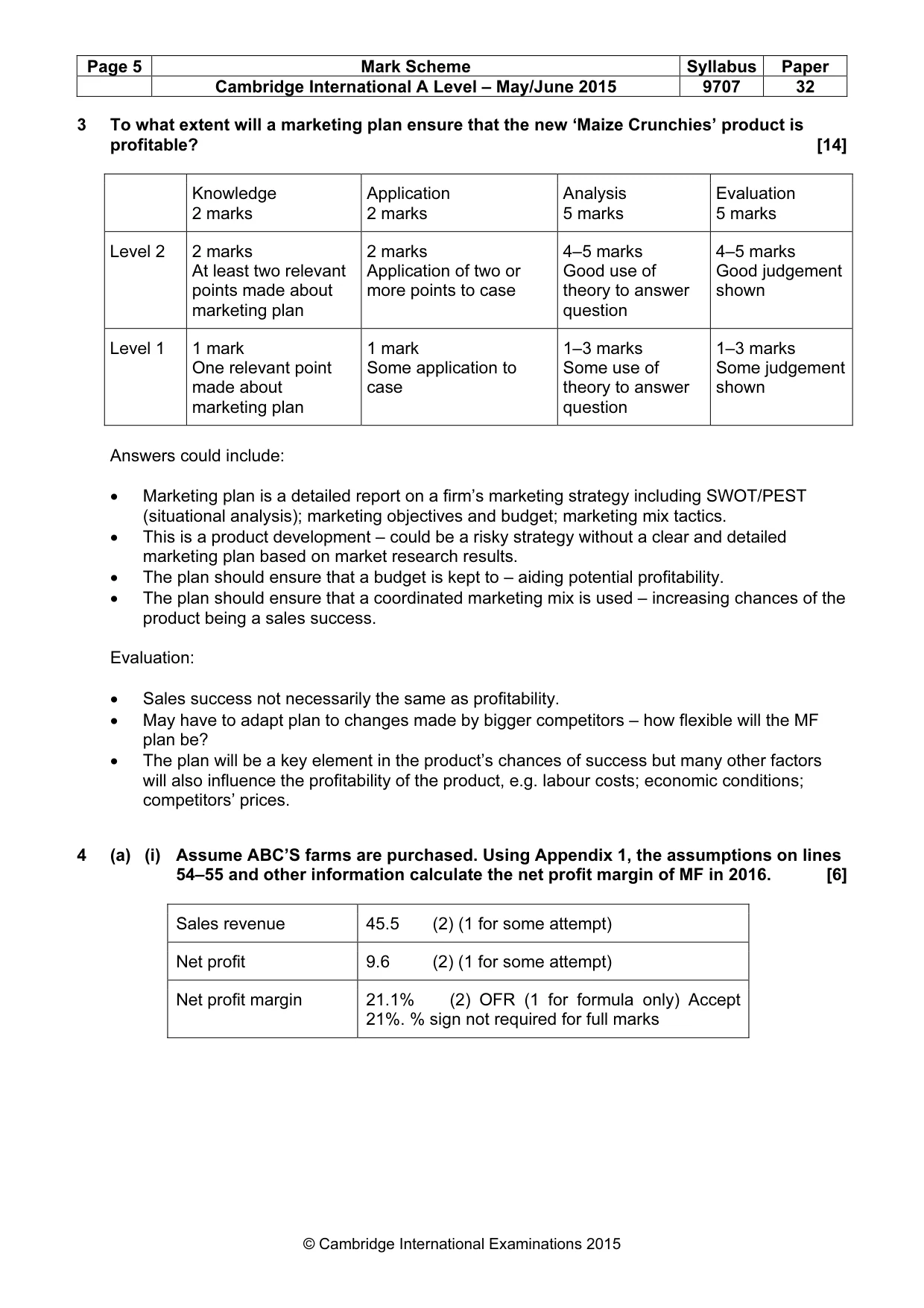
Mark scheme: 3 To what extent will a marketing plan ensure that the new ‘Maize Crunchies’ product is profitable? [14] Knowledge Application Analysis Evaluation 2 marks 2 marks 5 marks 5 marks Level 2 2 marks 2 marks 4–5 marks 4–5 marks At least two relevant Application of two or Good use of Good judgement points made about more points to case theory to answer shown marketing plan question Level 1 1 mark 1 mark 1–3 marks 1–3 marks One relevant point Some application to Some use of Some judgement made about case theory to answer shown marketing plan question Answers could include: • Marketing plan is a detailed report on a firm’s marketing strategy including SWOT/PEST (situational analysis); marketing objectives and budget; marketing mix tactics. • This is a product development – could be a risky strategy without a clear and detailed marketing plan based on market research results. • The plan should ensure that a budget is kept to – aiding potential profitability. • The plan should ensure that a coordinated marketing mix is used – increasing chances of the product being a sales success. Evaluation: • Sales success not necessarily the same as profitability. • May have to adapt plan to changes made by bigger competitors – how flexible will the MF plan be? • The plan will be a key element in the product’s chances of success but many other factors will also influence the profitability of the product, e.g. labour costs; economic conditions; competitors’ prices.
Q4 · Assume ABC’s farms are purchased
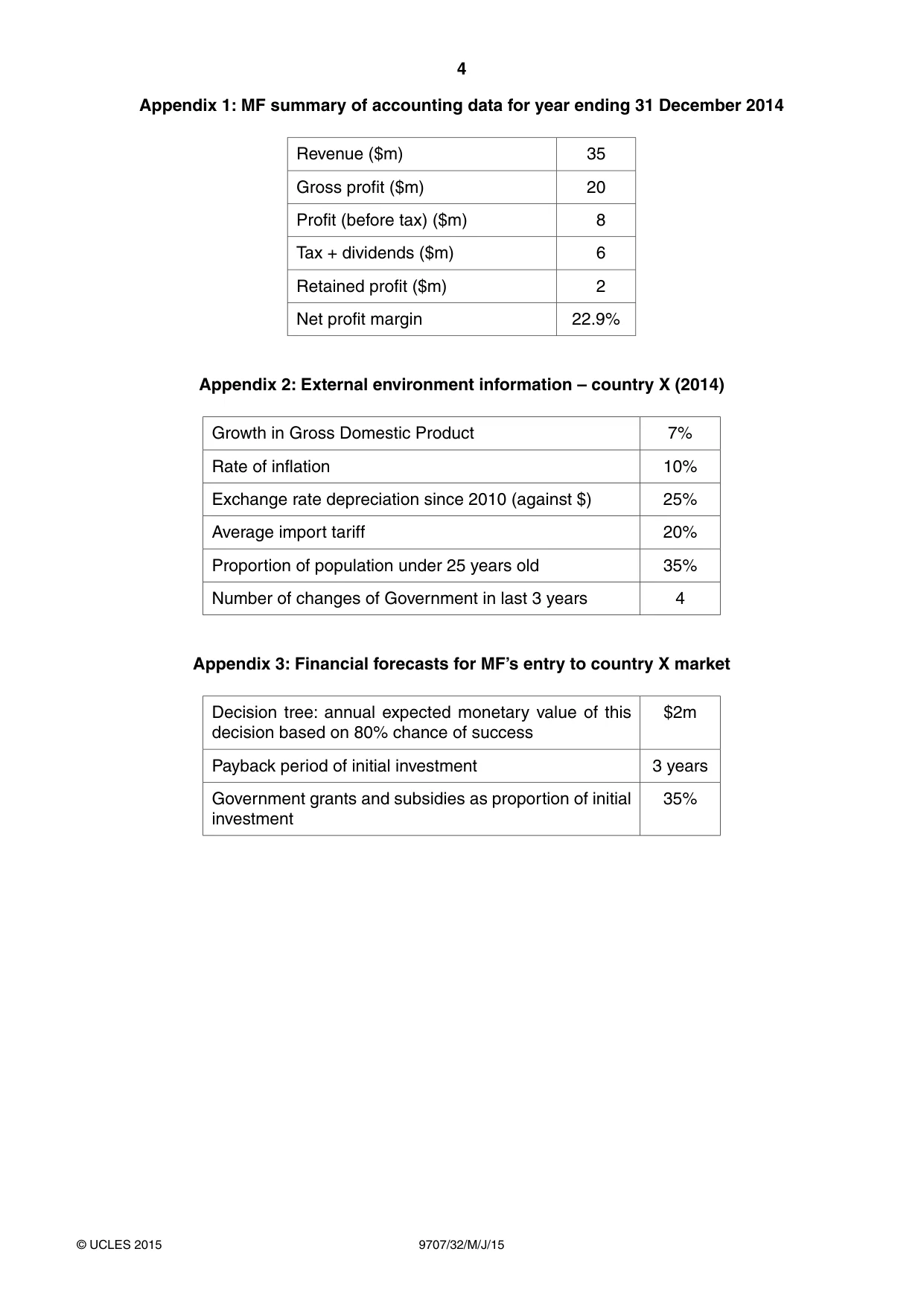
4 (a) (i) Assume ABC’s farms are purchased. Using Appendix 1, the assumptions on lines 54–55 and other information calculate the net profit margin of MF in 2016. [6] (ii) Briefly assess one way in which MF’s net profit margin could be increased. [4] (b) Discuss the problems that MF might experience if it buys the ten ABC farms. [14]
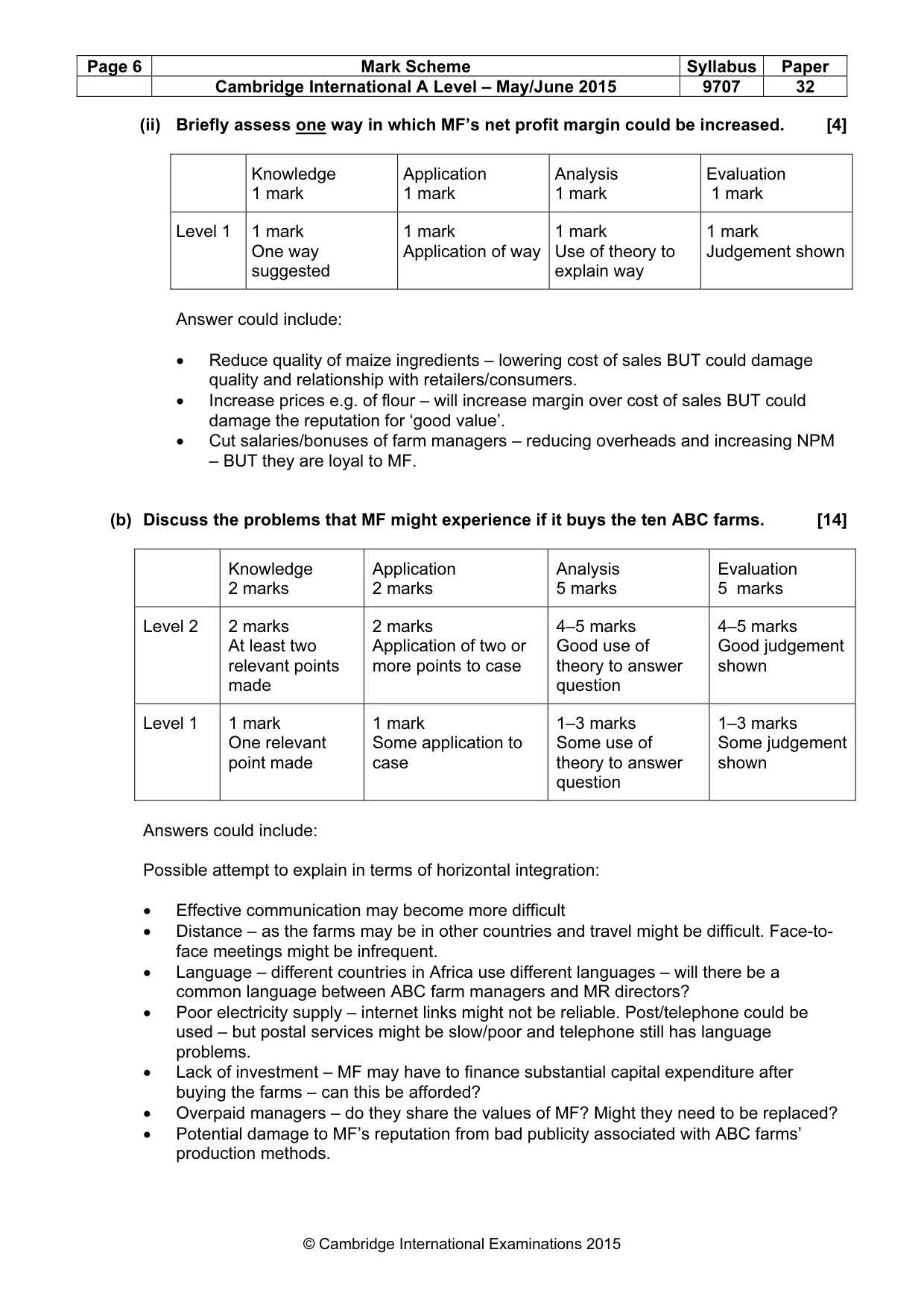
Mark scheme: 4 (a) (i) Assume ABC’S farms are purchased. Using Appendix 1, the assumptions on lines 54–55 and other information calculate the net profit margin of MF in 2016. [6] Sales revenue 45.5 (2) (1 for some attempt) Net profit 9.6 (2) (1 for some attempt) Net profit margin 21.1% (2) OFR (1 for formula only) Accept 21%. % sign not required for full marks (ii) Briefly assess one way in which MF’s net profit margin could be increased. [4] Knowledge Application Analysis Evaluation 1 mark 1 mark 1 mark 1 mark Level 1 1 mark 1 mark 1 mark 1 mark One way Application of way Use of theory to Judgement shown suggested explain way Answer could include: • Reduce quality of maize ingredients – lowering cost of sales BUT could damage quality and relationship with retailers/consumers. • Increase prices e.g. of flour – will increase margin over cost of sales BUT could damage the reputation for ‘good value’. • Cut salaries/bonuses of farm managers – reducing overheads and increasing NPM – BUT they are loyal to MF. (b) Discuss the problems that MF might experience if it buys the ten ABC farms. [14] Knowledge Application Analysis Evaluation 2 marks 2 marks 5 marks 5 marks Level 2 2 marks 2 marks 4–5 marks 4–5 marks At least two Application of two or Good use of Good judgement relevant points more points to case theory to answer shown made question Level 1 1 mark 1 mark 1–3 marks 1–3 marks One relevant Some application to Some use of Some judgement point made case theory to answer shown question Answers could include: Possible attempt to explain in terms of horizontal integration: • Effective communication may become more difficult • Distance – as the farms may be in other countries and travel might be difficult. Face-to- face meetings might be infrequent. • Language – different countries in Africa use different languages – will there be a common language between ABC farm managers and MR directors? • Poor electricity supply – internet links might not be reliable. Post/telephone could be used – but postal services might be slow/poor and telephone still has language problems. • Lack of investment – MF may have to finance substantial capital expenditure after buying the farms – can this be afforded? • Overpaid managers – do they share the values of MF? Might they need to be replaced? • Potential damage to MF’s reputation from bad publicity associated with ABC farms’ production methods. Evaluation: • Depends on where farms are located and the quality of maize produced. • Could bad publicity caused by ABC’s production methods damage shareholder value in MF? • Is MF management able to manage a much bigger business and will synergy result? Potential for culture clashes? • How much would a reliable electricity/internet link cost?
Q5 · Discuss whether MF should ‘always consider the interests of stakeholders as more…
5 Discuss whether MF should ‘always consider the interests of stakeholders as more important than profit’ (line 11). [14]
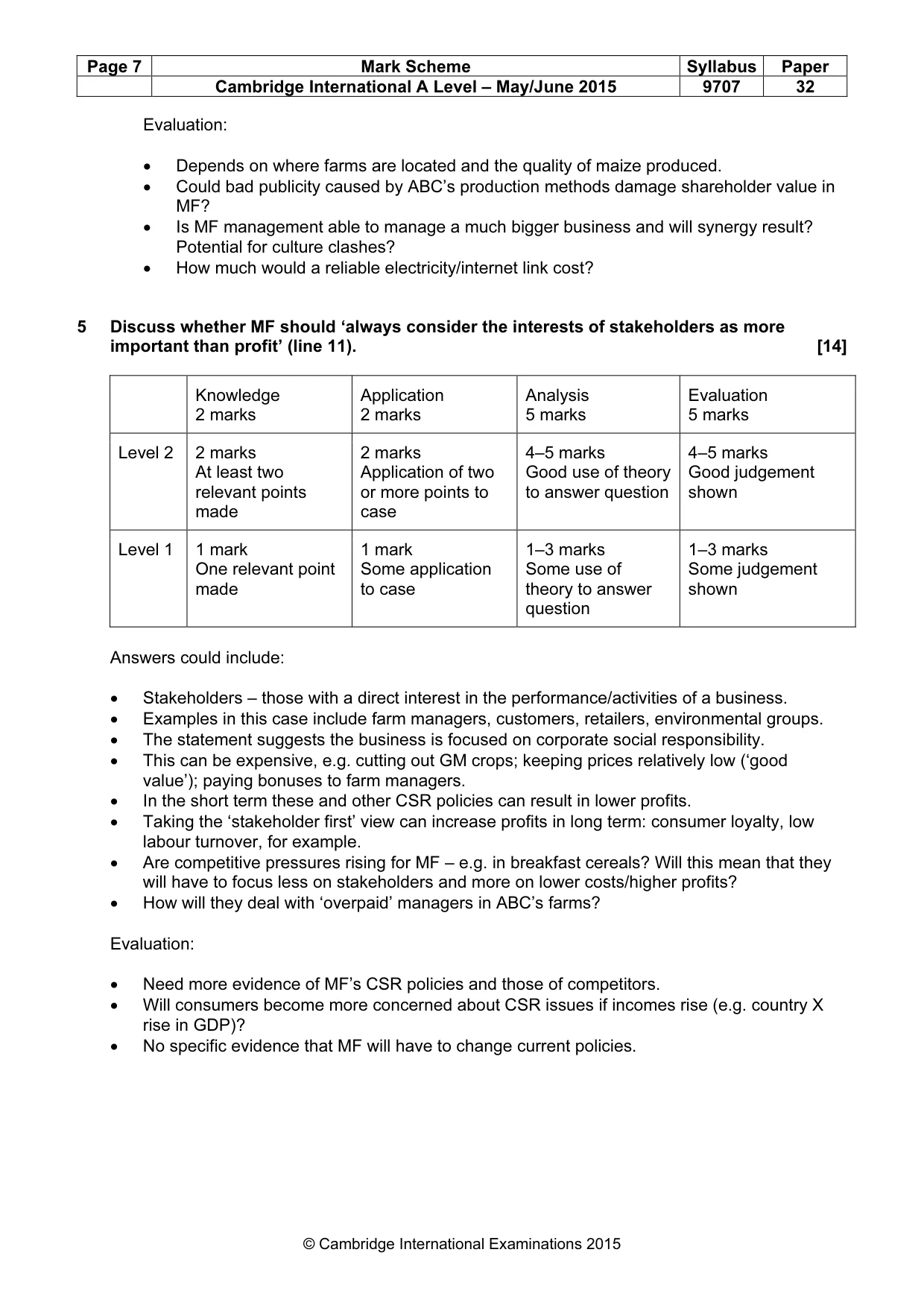
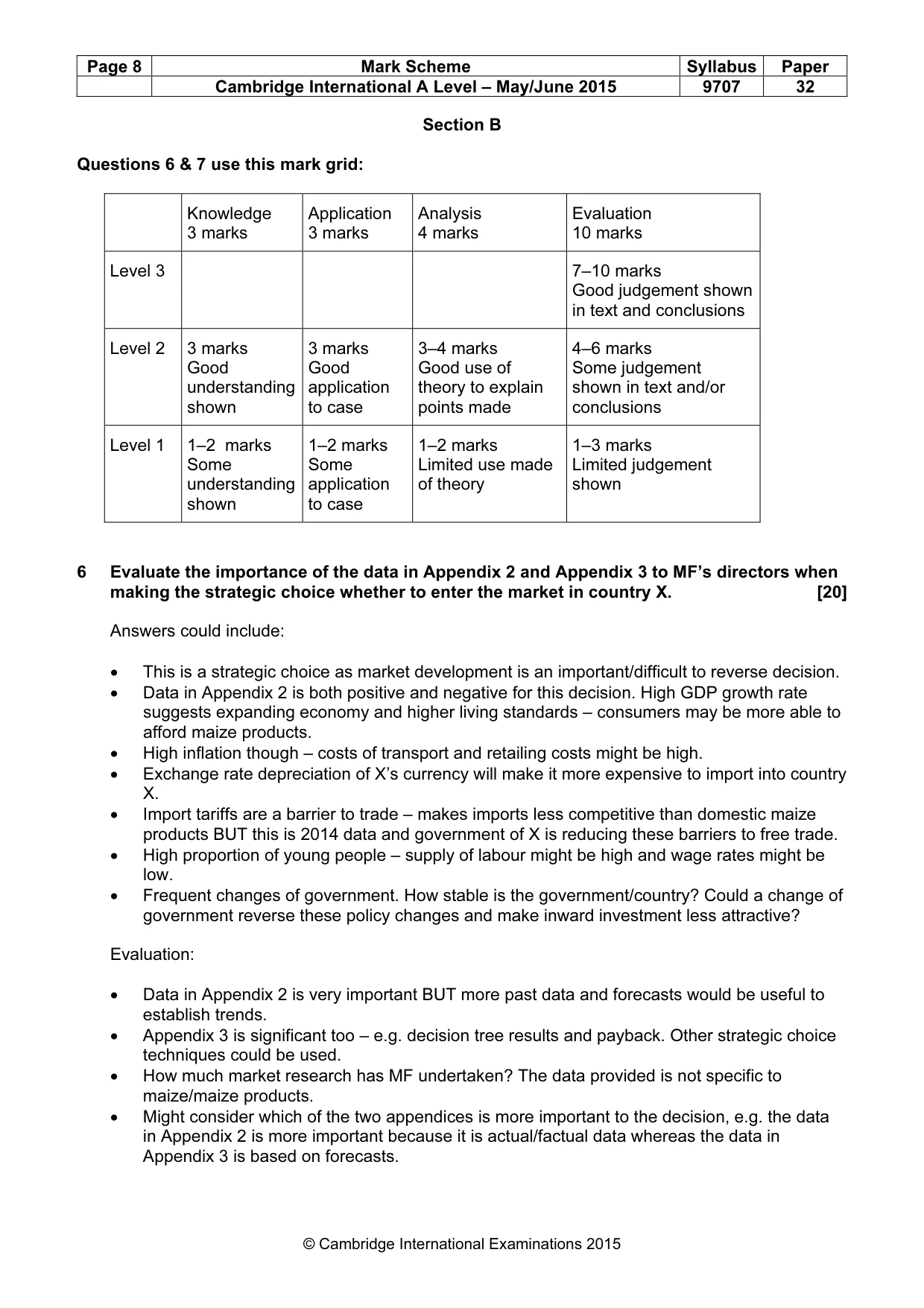
Mark scheme: 5 Discuss whether MF should ‘always consider the interests of stakeholders as more important than profit’ (line 11). [14] Knowledge Application Analysis Evaluation 2 marks 2 marks 5 marks 5 marks Level 2 2 marks 2 marks 4–5 marks 4–5 marks At least two Application of two Good use of theory Good judgement relevant points or more points to to answer question shown made case Level 1 1 mark 1 mark 1–3 marks 1–3 marks One relevant point Some application Some use of Some judgement made to case theory to answer shown question Answers could include: • Stakeholders – those with a direct interest in the performance/activities of a business. • Examples in this case include farm managers, customers, retailers, environmental groups. • The statement suggests the business is focused on corporate social responsibility. • This can be expensive, e.g. cutting out GM crops; keeping prices relatively low (‘good value’); paying bonuses to farm managers. • In the short term these and other CSR policies can result in lower profits. • Taking the ‘stakeholder first’ view can increase profits in long term: consumer loyalty, low labour turnover, for example. • Are competitive pressures rising for MF – e.g. in breakfast cereals? Will this mean that they will have to focus less on stakeholders and more on lower costs/higher profits? • How will they deal with ‘overpaid’ managers in ABC’s farms? Evaluation: • Need more evidence of MF’s CSR policies and those of competitors. • Will consumers become more concerned about CSR issues if incomes rise (e.g. country X rise in GDP)? • No specific evidence that MF will have to change current policies. Section B Questions 6 & 7 use this mark grid: Knowledge Application Analysis Evaluation 3 marks 3 marks 4 marks 10 marks Level 3 7–10 marks Good judgement shown in text and conclusions Level 2 3 marks 3 marks 3–4 marks 4–6 marks Good Good Good use of Some judgement understanding application theory to explain shown in text and/or shown to case points made conclusions Level 1 1–2 marks 1–2 marks 1–2 marks 1–3 marks Some Some Limited use made Limited judgement understanding application of theory shown shown to case
Q6 · Evaluate the importance of the data in Appendix 2 and Appendix 3 to MF’s directors when…
6 Evaluate the importance of the data in Appendix 2 and Appendix 3 to MF’s directors when making the strategic choice whether to enter the market in country X. [20]
Mark scheme: 6 Evaluate the importance of the data in Appendix 2 and Appendix 3 to MF’s directors when making the strategic choice whether to enter the market in country X. [20] Answers could include: • This is a strategic choice as market development is an important/difficult to reverse decision. • Data in Appendix 2 is both positive and negative for this decision. High GDP growth rate suggests expanding economy and higher living standards – consumers may be more able to afford maize products. • High inflation though – costs of transport and retailing costs might be high. • Exchange rate depreciation of X’s currency will make it more expensive to import into country X. • Import tariffs are a barrier to trade – makes imports less competitive than domestic maize products BUT this is 2014 data and government of X is reducing these barriers to free trade. • High proportion of young people – supply of labour might be high and wage rates might be low. • Frequent changes of government. How stable is the government/country? Could a change of government reverse these policy changes and make inward investment less attractive? Evaluation: • Data in Appendix 2 is very important BUT more past data and forecasts would be useful to establish trends. • Appendix 3 is significant too – e.g. decision tree results and payback. Other strategic choice techniques could be used. • How much market research has MF undertaken? The data provided is not specific to maize/maize products. • Might consider which of the two appendices is more important to the decision, e.g. the data in Appendix 2 is more important because it is actual/factual data whereas the data in Appendix 3 is based on forecasts.
Q7 · Discuss how the strategy of entering the market in country X could be effectively…
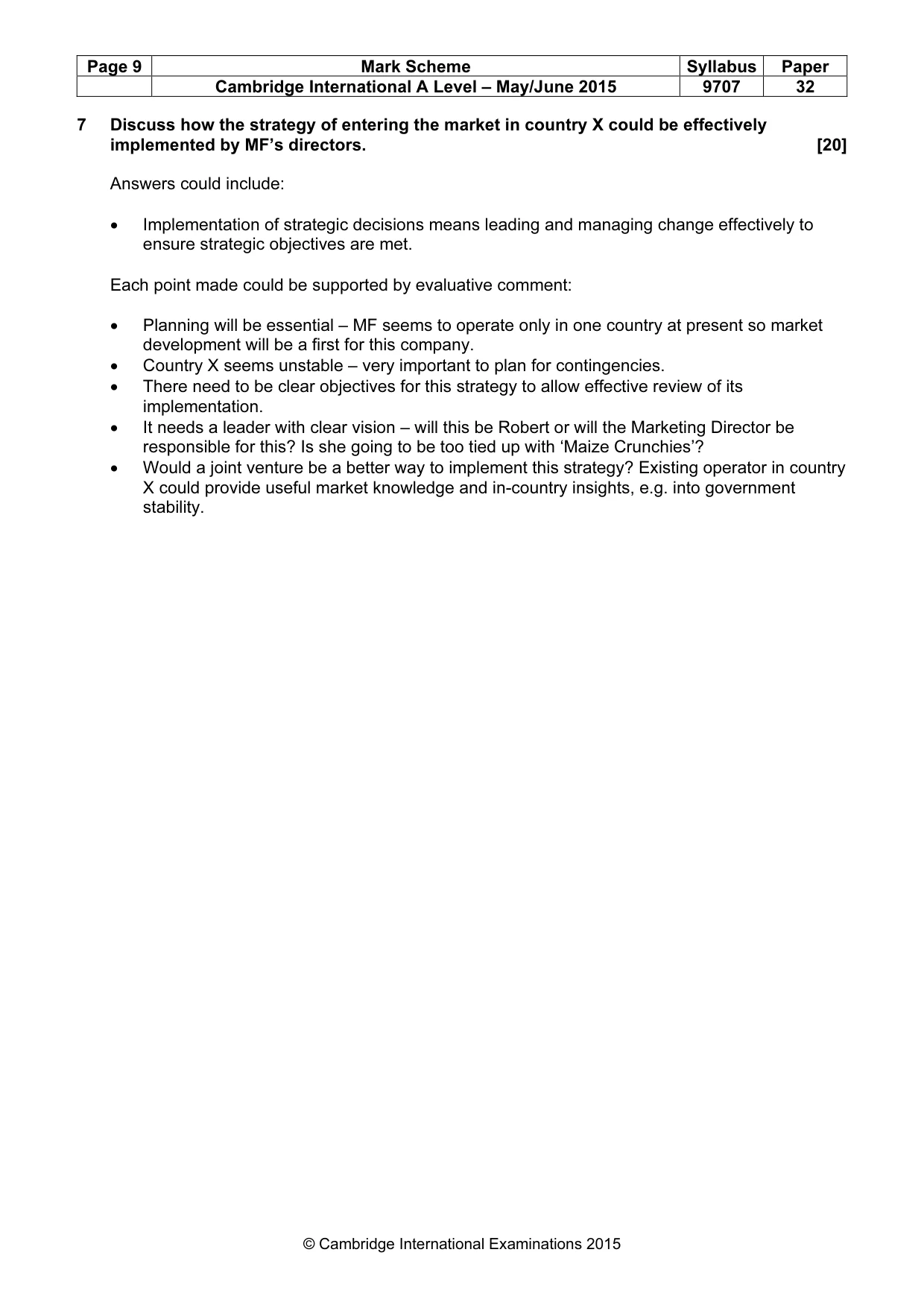
7 Discuss how the strategy of entering the market in country X could be effectively implemented by MF’s directors. [20]
Mark scheme: 7 Discuss how the strategy of entering the market in country X could be effectively implemented by MF’s directors. [20] Answers could include: • Implementation of strategic decisions means leading and managing change effectively to ensure strategic objectives are met. Each point made could be supported by evaluative comment: • Planning will be essential – MF seems to operate only in one country at present so market development will be a first for this company. • Country X seems unstable – very important to plan for contingencies. • There need to be clear objectives for this strategy to allow effective review of its implementation. • It needs a leader with clear vision – will this be Robert or will the Marketing Director be responsible for this? Is she going to be too tied up with ‘Maize Crunchies’? • Would a joint venture be a better way to implement this strategy? Existing operator in country X could provide useful market knowledge and in-country insights, e.g. into government stability.
What you needed in this session
Cambridge’s own grade thresholds for 2015 May/June, Paper 3 · Variant 2. A higher threshold means an easier paper — the bar moves with how the cohort did.