Cambridge A Level Business Studies (for final examination in 2015) 9707 — 2014 Oct/Nov Paper 3 · Variant 2
9707/32/O/N/14 · 7 questions · 100 marks · ≈113 min
The question paper and its mark scheme, free to read here and free to download. This is Cambridge’s own paper, exactly as it was sat.
Question paper8 pages
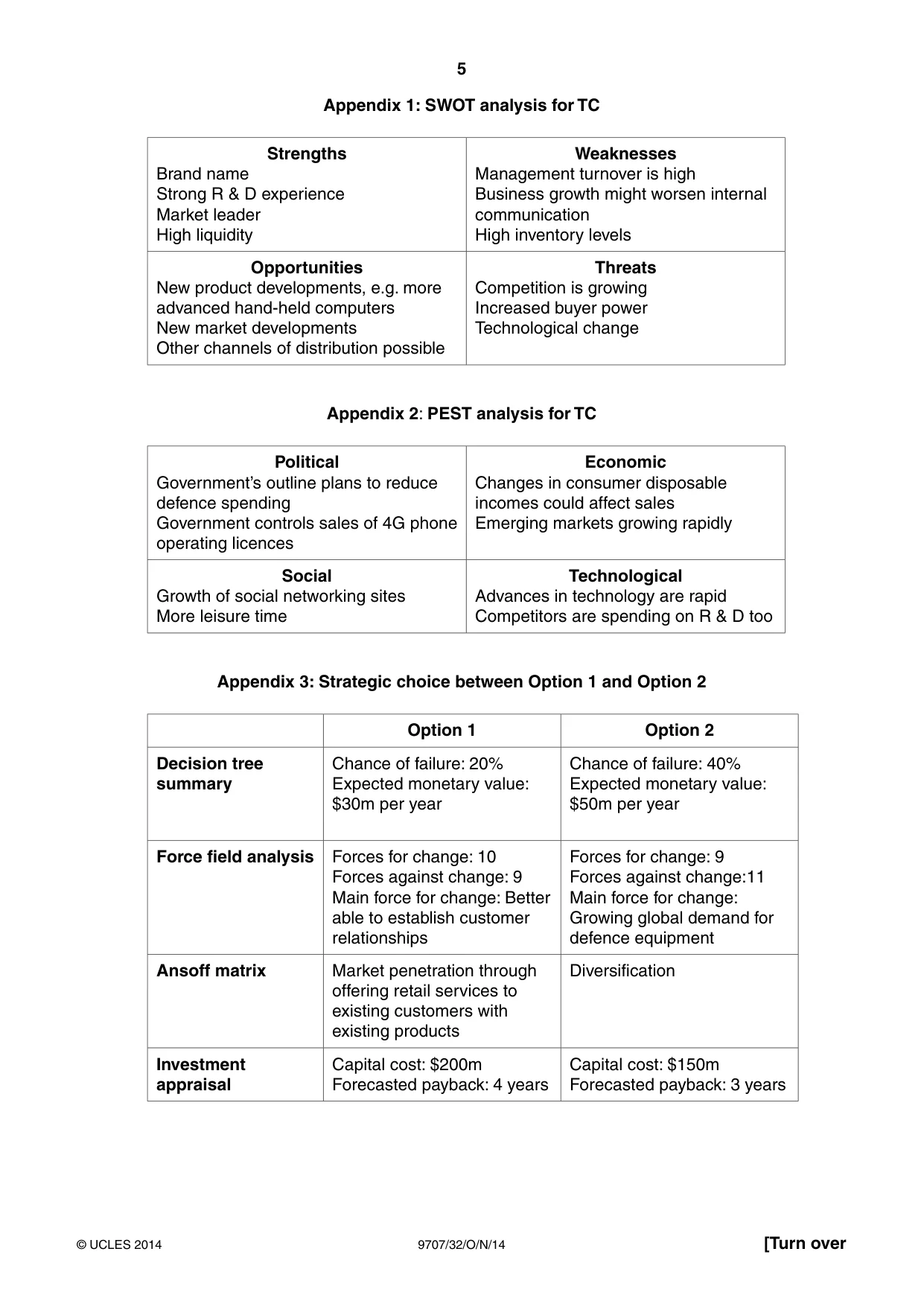
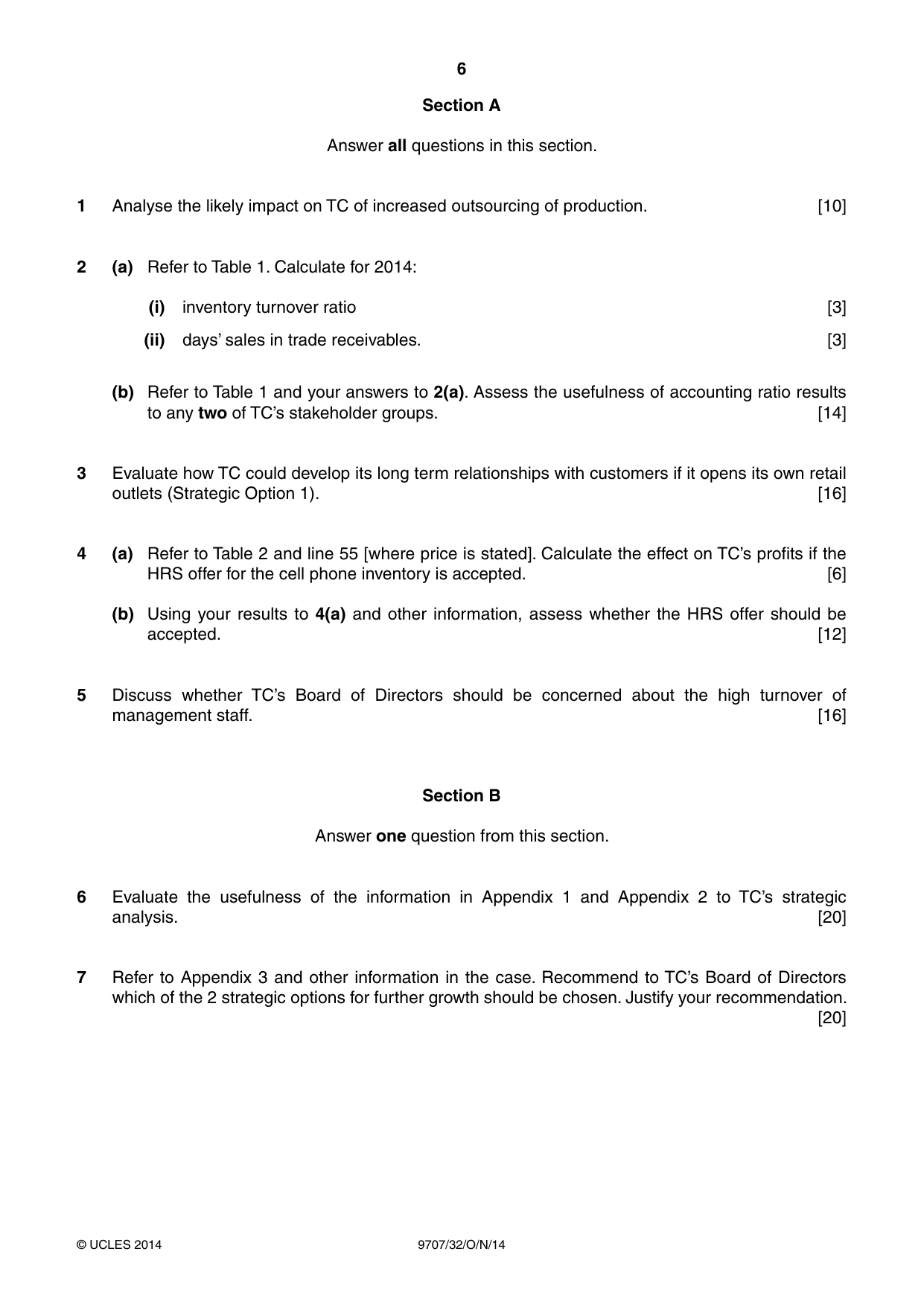


Mark scheme9 pages
Answers below. Sit the paper first if you are practising.
Questions as text
Q1 · Analyse the likely impact on TC of increased outsourcing of production
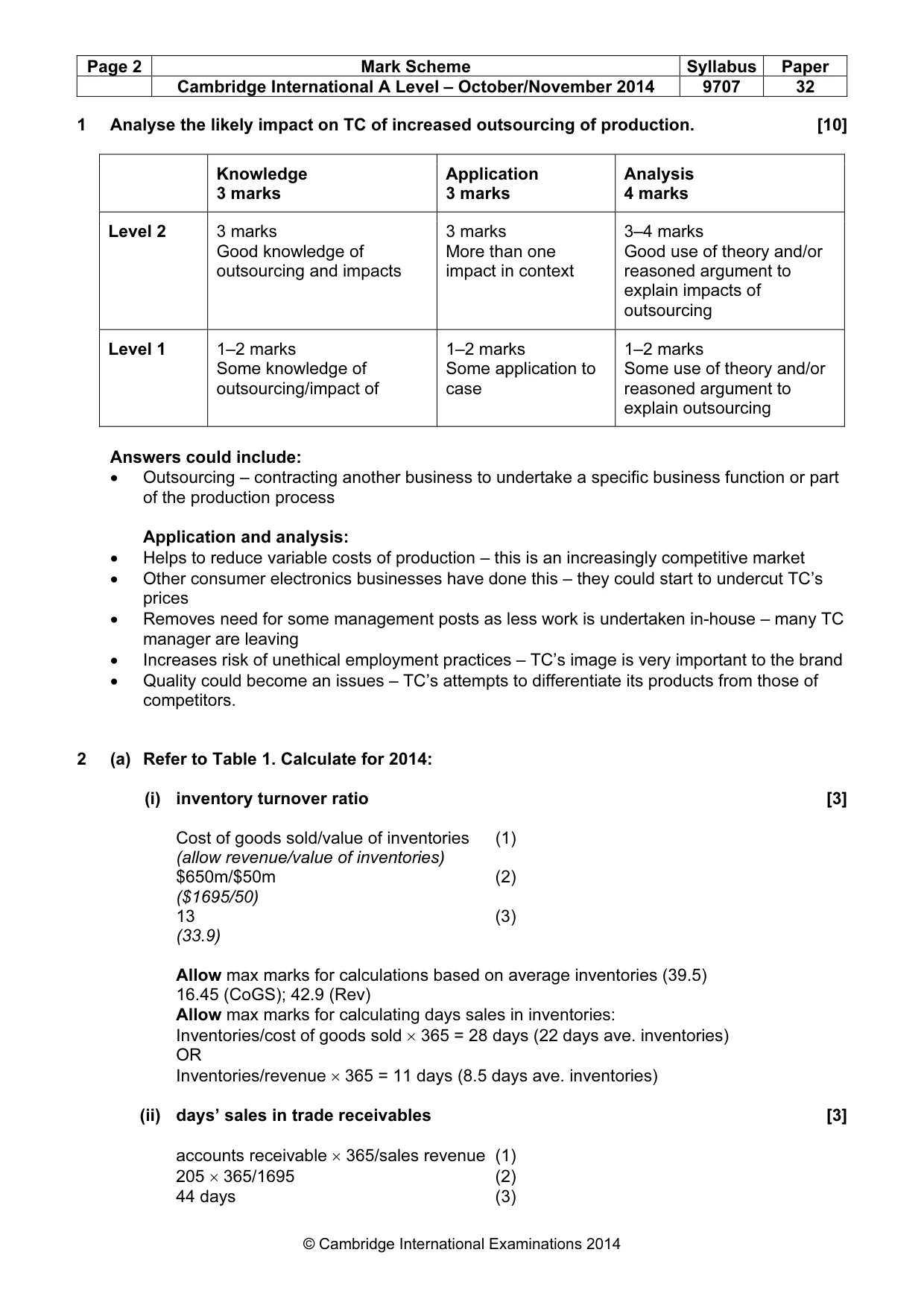
1 Analyse the likely impact on TC of increased outsourcing of production. [10]
Mark scheme: 1 Analyse the likely impact on TC of increased outsourcing of production. [10] Knowledge Application Analysis 3 marks 3 marks 4 marks Level 2 3 marks 3 marks 3–4 marks Good knowledge of More than one Good use of theory and/or outsourcing and impacts impact in context reasoned argument to explain impacts of outsourcing Level 1 1–2 marks 1–2 marks 1–2 marks Some knowledge of Some application to Some use of theory and/or outsourcing/impact of case reasoned argument to explain outsourcing Answers could include: • Outsourcing – contracting another business to undertake a specific business function or part of the production process Application and analysis: • Helps to reduce variable costs of production – this is an increasingly competitive market • Other consumer electronics businesses have done this – they could start to undercut TC’s prices • Removes need for some management posts as less work is undertaken in-house – many TC manager are leaving • Increases risk of unethical employment practices – TC’s image is very important to the brand • Quality could become an issues – TC’s attempts to differentiate its products from those of competitors.
Q2 · Refer to Table 1
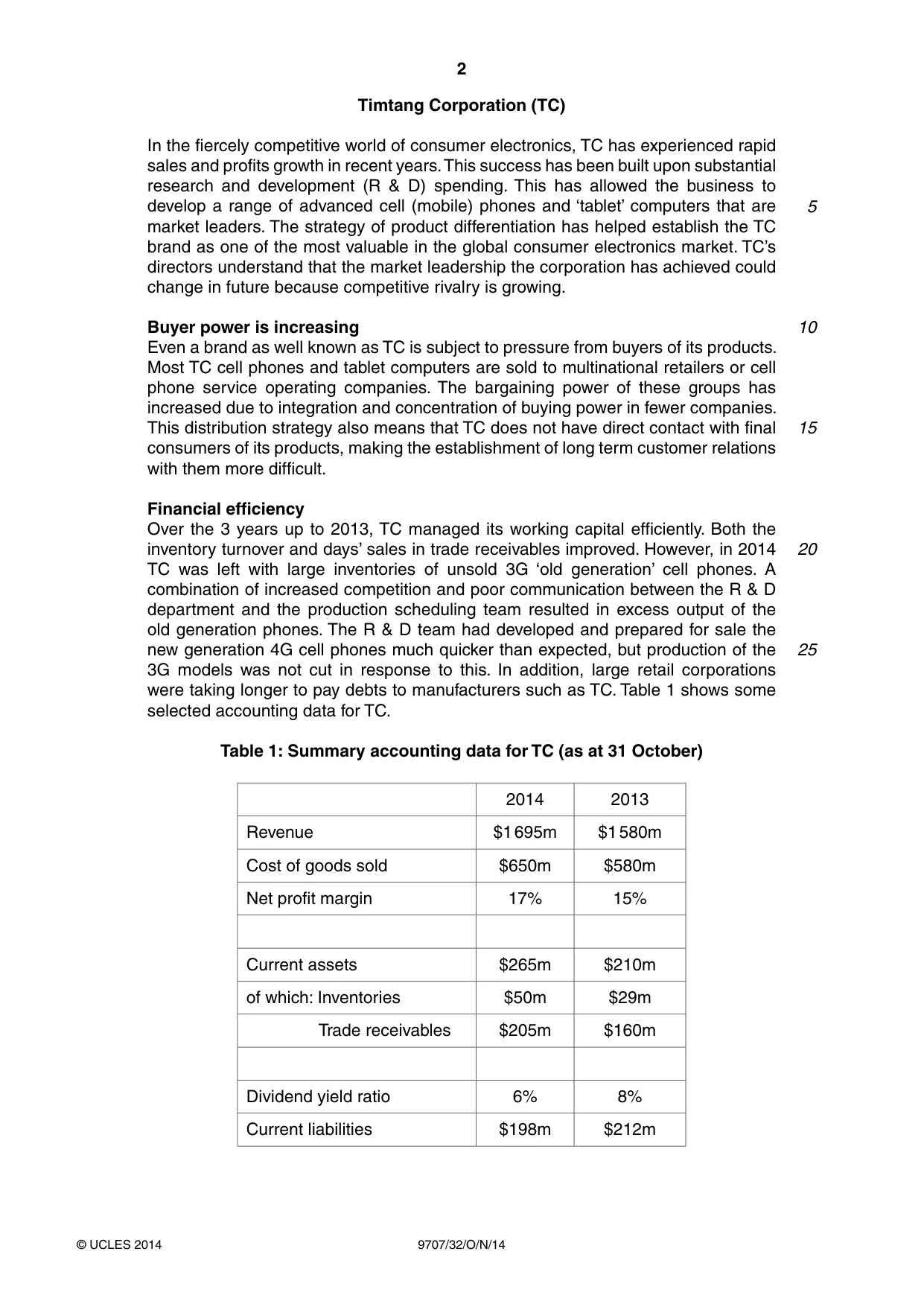
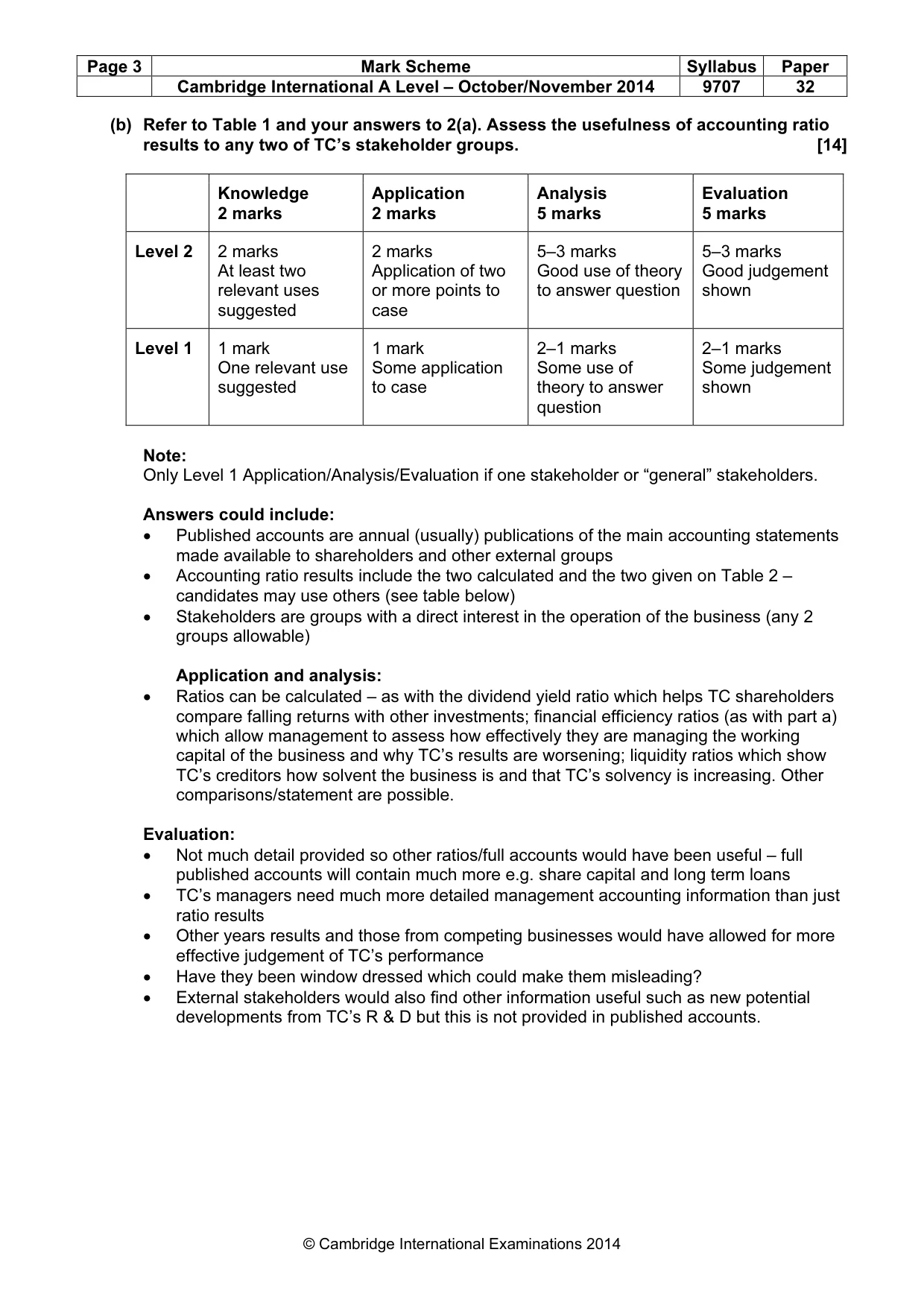
2 (a) Refer to Table 1. Calculate for 2014: (i) inventory turnover ratio [3] (ii) days’ sales in trade receivables. [3] (b) Refer to Table 1 and your answers to 2(a). Assess the usefulness of accounting ratio results to any two of TC’s stakeholder groups. [14]
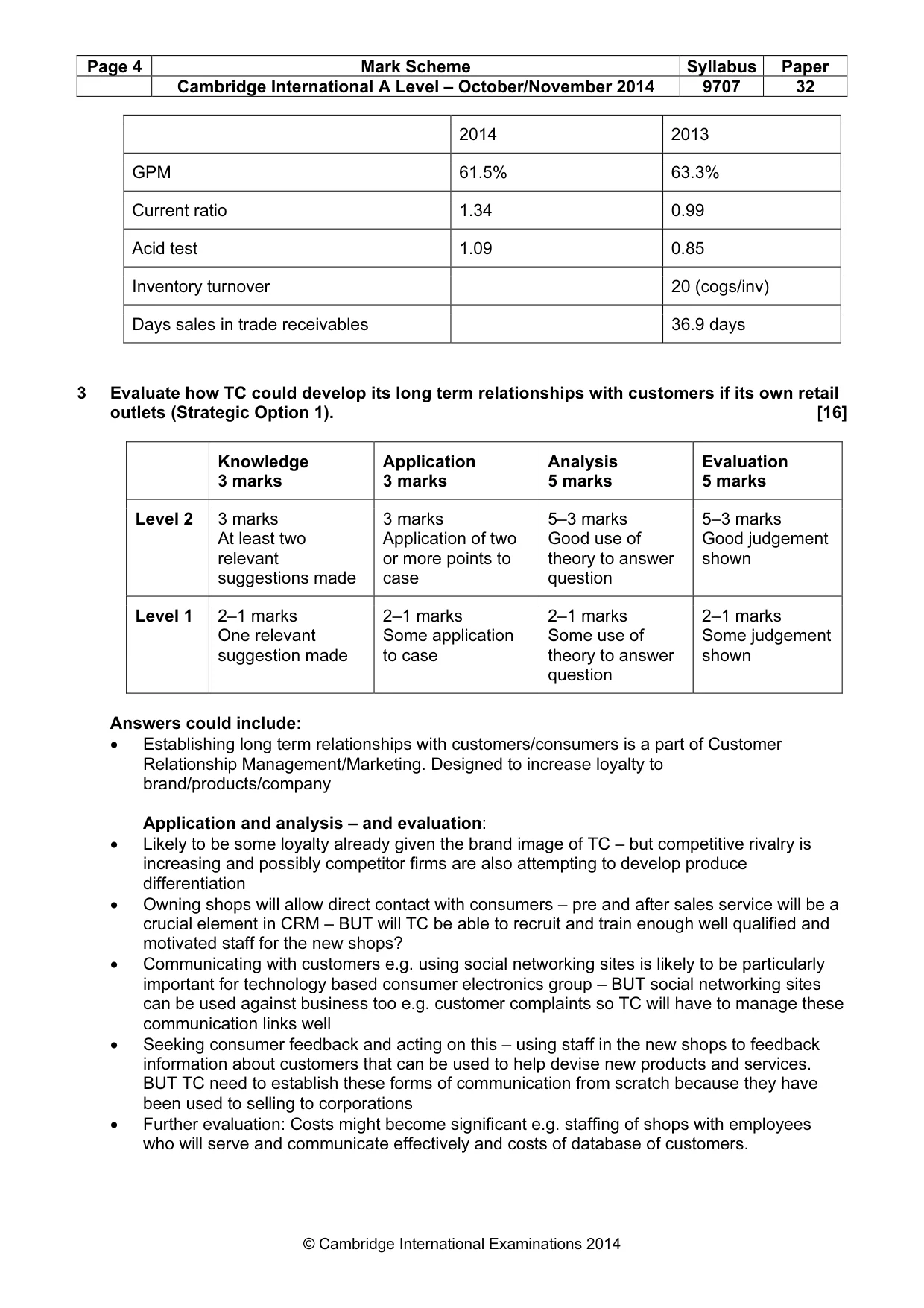
Mark scheme: 2 (a) Refer to Table 1. Calculate for 2014: (i) inventory turnover ratio [3] Cost of goods sold/value of inventories (1) (allow revenue/value of inventories) $650m/$50m (2) ($1695/50) 13 (3) (33.9) Allow max marks for calculations based on average inventories (39.5) 16.45 (CoGS); 42.9 (Rev) Allow max marks for calculating days sales in inventories: Inventories/cost of goods sold × 365 = 28 days (22 days ave. inventories) OR Inventories/revenue × 365 = 11 days (8.5 days ave. inventories) (ii) days’ sales in trade receivables [3] accounts receivable × 365/sales revenue (1) 205 × 365/1695 (2) 44 days (3) (b) Refer to Table 1 and your answers to 2(a). Assess the usefulness of accounting ratio results to any two of TC’s stakeholder groups. [14] Knowledge Application Analysis Evaluation 2 marks 2 marks 5 marks 5 marks Level 2 2 marks 2 marks 5–3 marks 5–3 marks At least two Application of two Good use of theory Good judgement relevant uses or more points to to answer question shown suggested case Level 1 1 mark 1 mark 2–1 marks 2–1 marks One relevant use Some application Some use of Some judgement suggested to case theory to answer shown question Note: Only Level 1 Application/Analysis/Evaluation if one stakeholder or “general” stakeholders. Answers could include: • Published accounts are annual (usually) publications of the main accounting statements made available to shareholders and other external groups • Accounting ratio results include the two calculated and the two given on Table 2 – candidates may use others (see table below) • Stakeholders are groups with a direct interest in the operation of the business (any 2 groups allowable) Application and analysis: • Ratios can be calculated – as with the dividend yield ratio which helps TC shareholders compare falling returns with other investments; financial efficiency ratios (as with part a) which allow management to assess how effectively they are managing the working capital of the business and why TC’s results are worsening; liquidity ratios which show TC’s creditors how solvent the business is and that TC’s solvency is increasing. Other comparisons/statement are possible. Evaluation: • Not much detail provided so other ratios/full accounts would have been useful – full published accounts will contain much more e.g. share capital and long term loans • TC’s managers need much more detailed management accounting information than just ratio results • Other years results and those from competing businesses would have allowed for more effective judgement of TC’s performance • Have they been window dressed which could make them misleading? • External stakeholders would also find other information useful such as new potential developments from TC’s R & D but this is not provided in published accounts. 2014 2013 GPM 61.5% 63.3% Current ratio 1.34 0.99 Acid test 1.09 0.85 Inventory turnover 20 (cogs/inv) Days sales in trade receivables 36.9 days
Q3 · Evaluate how TC could develop its long term relationships with customers if it opens its…
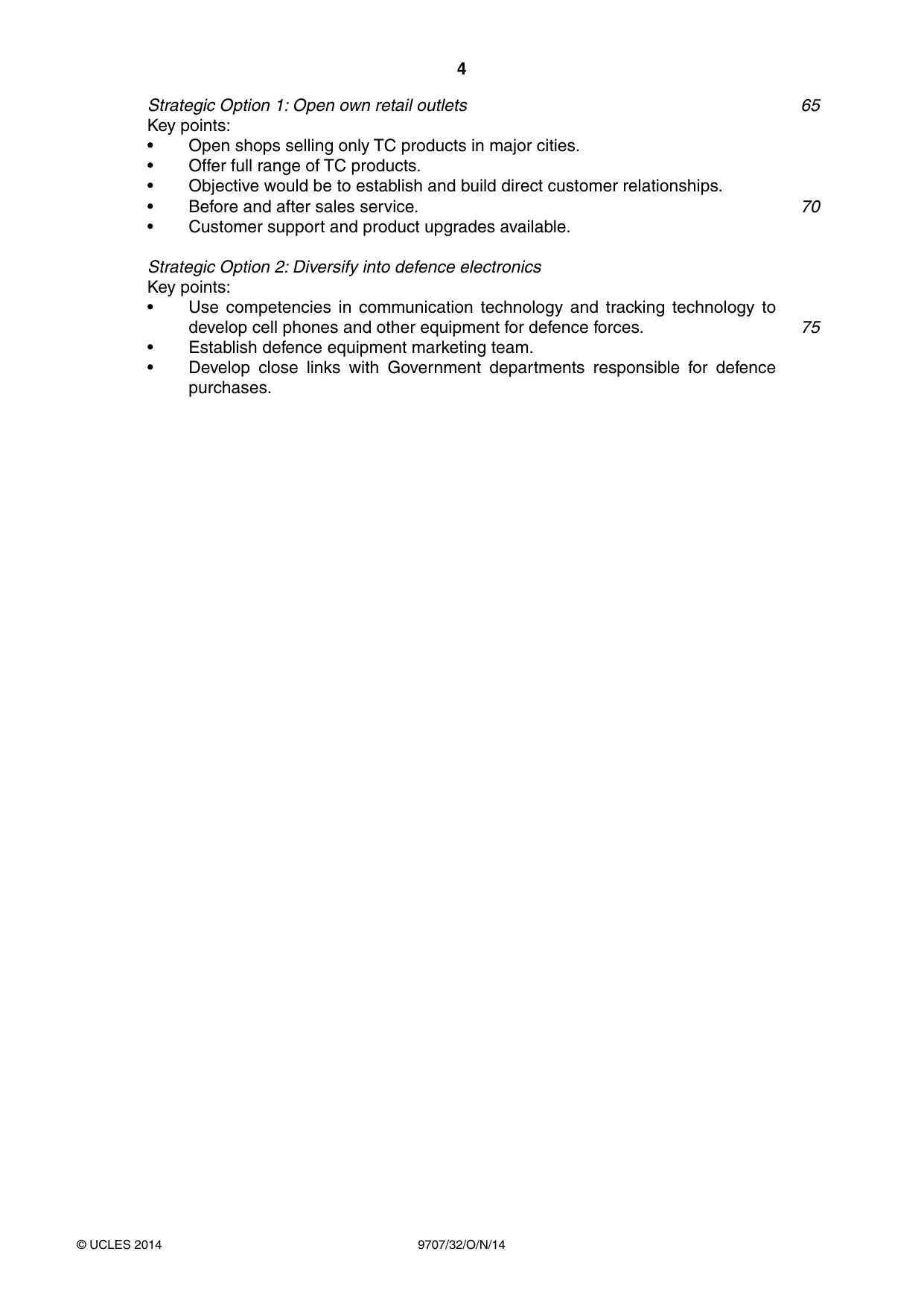
3 Evaluate how TC could develop its long term relationships with customers if it opens its own retail outlets (Strategic Option 1). [16]
Mark scheme: 3 Evaluate how TC could develop its long term relationships with customers if its own retail outlets (Strategic Option 1). [16] Knowledge Application Analysis Evaluation 3 marks 3 marks 5 marks 5 marks Level 2 3 marks 3 marks 5–3 marks 5–3 marks At least two Application of two Good use of Good judgement relevant or more points to theory to answer shown suggestions made case question Level 1 2–1 marks 2–1 marks 2–1 marks 2–1 marks One relevant Some application Some use of Some judgement suggestion made to case theory to answer shown question Answers could include: • Establishing long term relationships with customers/consumers is a part of Customer Relationship Management/Marketing. Designed to increase loyalty to brand/products/company Application and analysis – and evaluation: • Likely to be some loyalty already given the brand image of TC – but competitive rivalry is increasing and possibly competitor firms are also attempting to develop produce differentiation • Owning shops will allow direct contact with consumers – pre and after sales service will be a crucial element in CRM – BUT will TC be able to recruit and train enough well qualified and motivated staff for the new shops? • Communicating with customers e.g. using social networking sites is likely to be particularly important for technology based consumer electronics group – BUT social networking sites can be used against business too e.g. customer complaints so TC will have to manage these communication links well • Seeking consumer feedback and acting on this – using staff in the new shops to feedback information about customers that can be used to help devise new products and services. BUT TC need to establish these forms of communication from scratch because they have been used to selling to corporations • Further evaluation: Costs might become significant e.g. staffing of shops with employees who will serve and communicate effectively and costs of database of customers.
Q4 · Refer to Table 2 and line 55 [where price is stated]
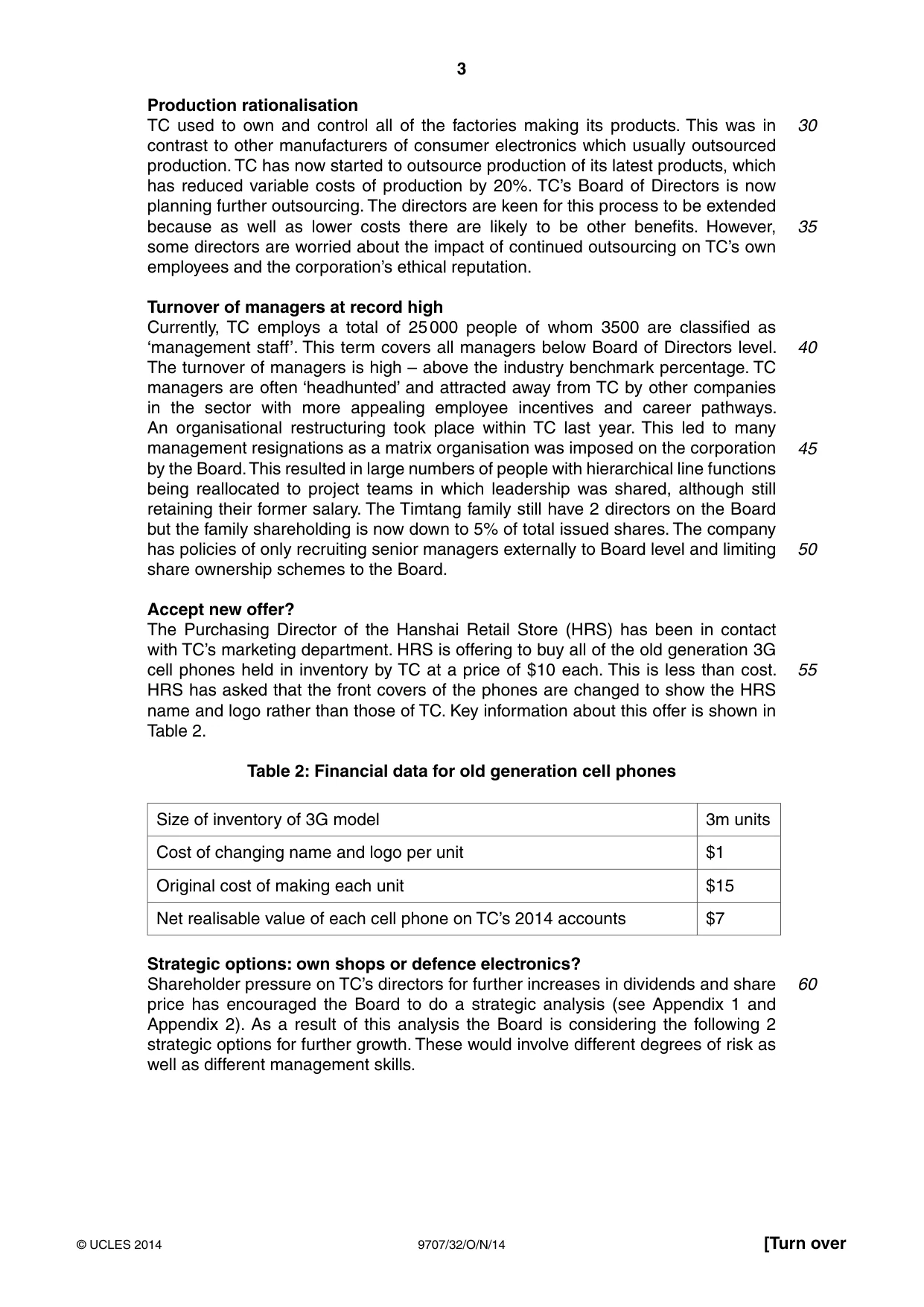
4 (a) Refer to Table 2 and line 55 [where price is stated]. Calculate the effect on TC’s profits if the HRS offer for the cell phone inventory is accepted. [6] (b) Using your results to 4(a) and other information, assess whether the HRS offer should be accepted. [12]
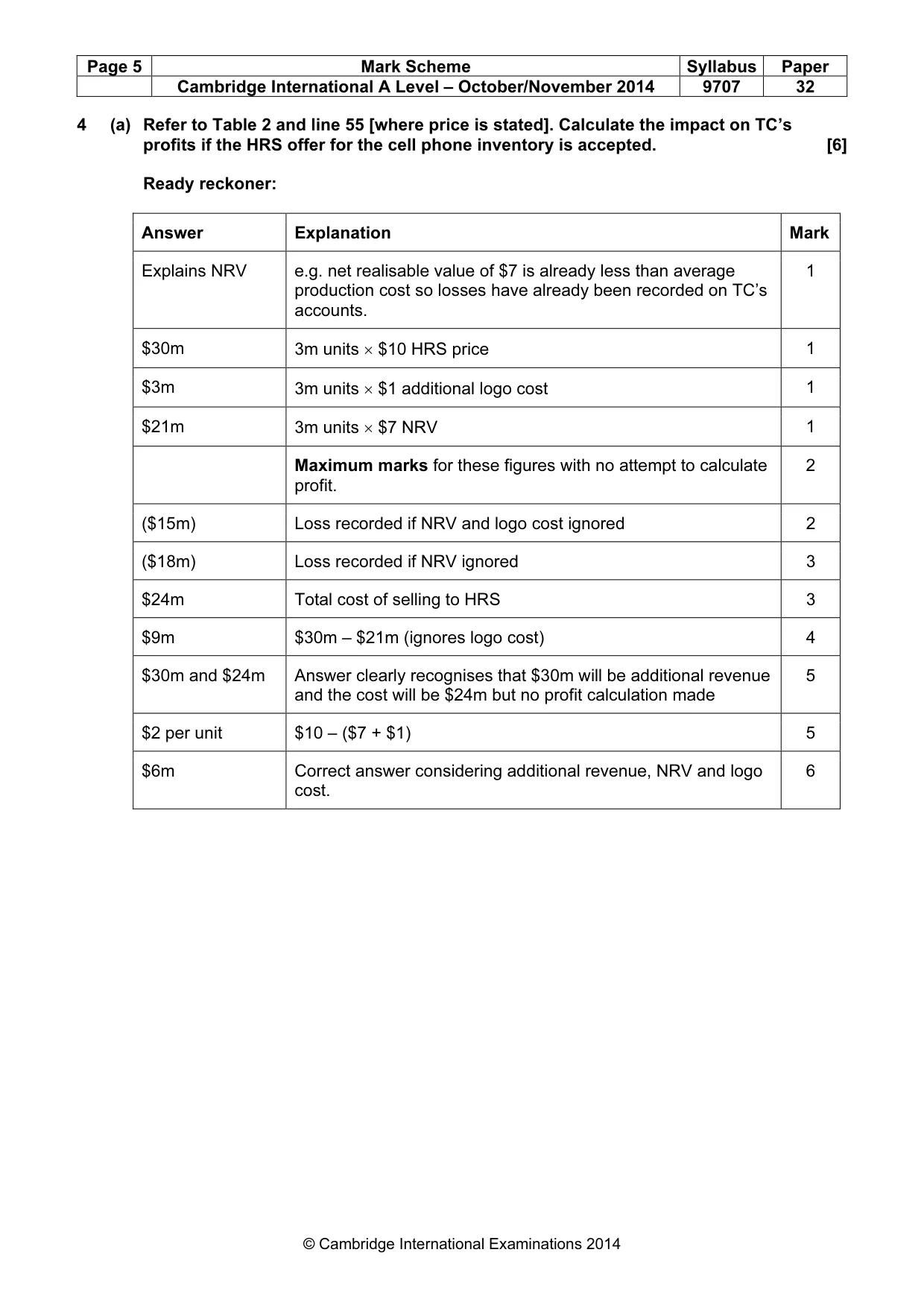
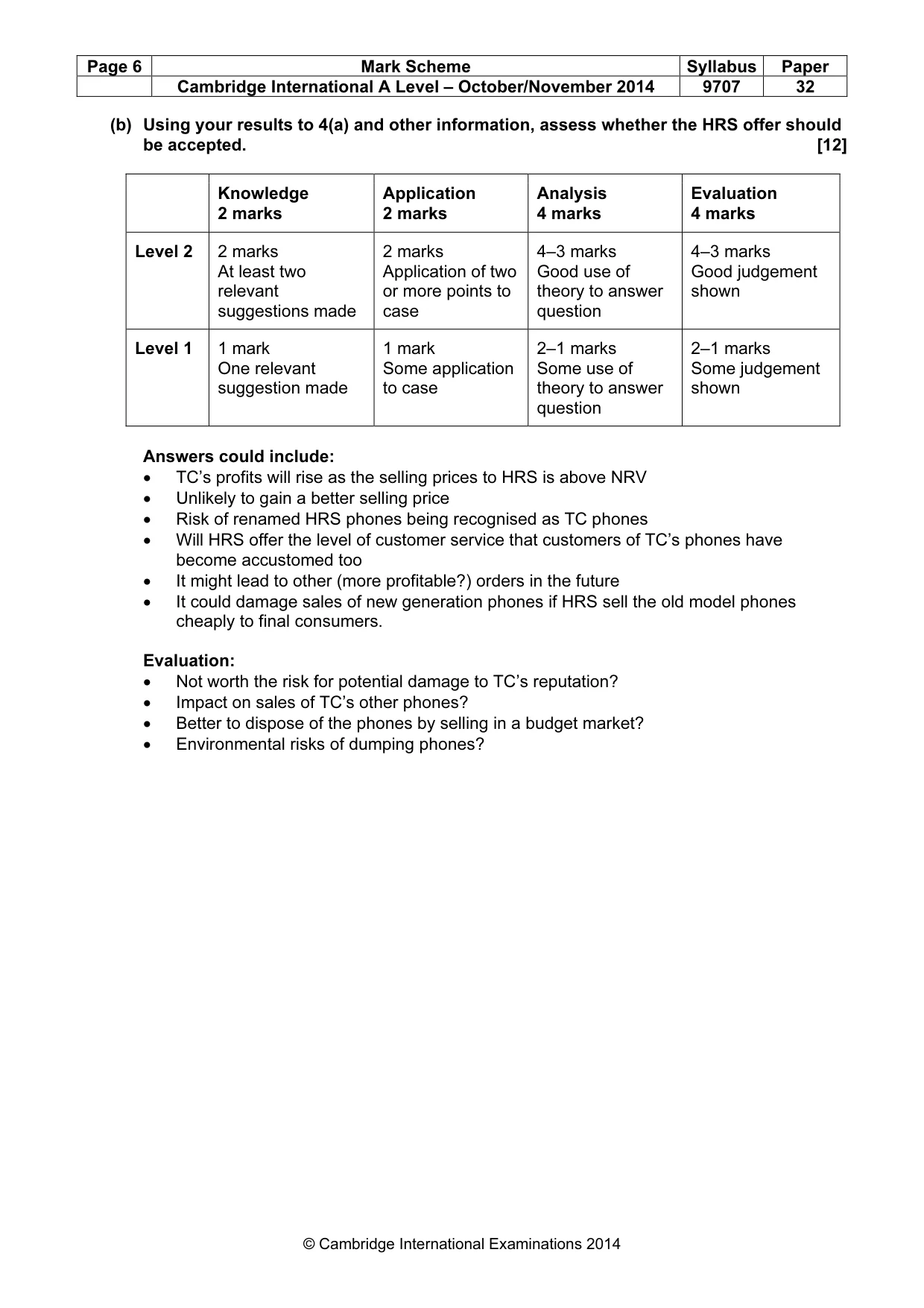
Mark scheme: 4 (a) Refer to Table 2 and line 55 [where price is stated]. Calculate the impact on TC’s profits if the HRS offer for the cell phone inventory is accepted. [6] Ready reckoner: Answer Explanation Mark Explains NRV e.g. net realisable value of $7 is already less than average 1 production cost so losses have already been recorded on TC’s accounts. $30m 3m units × $10 HRS price 1 $3m 3m units × $1 additional logo cost 1 $21m 3m units × $7 NRV 1 Maximum marks for these figures with no attempt to calculate 2 profit. ($15m) Loss recorded if NRV and logo cost ignored 2 ($18m) Loss recorded if NRV ignored 3 $24m Total cost of selling to HRS 3 $9m $30m – $21m (ignores logo cost) 4 $30m and $24m Answer clearly recognises that $30m will be additional revenue 5 and the cost will be $24m but no profit calculation made $2 per unit $10 – ($7 + $1) 5 $6m Correct answer considering additional revenue, NRV and logo 6 cost. (b) Using your results to 4(a) and other information, assess whether the HRS offer should be accepted. [12] Knowledge Application Analysis Evaluation 2 marks 2 marks 4 marks 4 marks Level 2 2 marks 2 marks 4–3 marks 4–3 marks At least two Application of two Good use of Good judgement relevant or more points to theory to answer shown suggestions made case question Level 1 1 mark 1 mark 2–1 marks 2–1 marks One relevant Some application Some use of Some judgement suggestion made to case theory to answer shown question Answers could include: • TC’s profits will rise as the selling prices to HRS is above NRV • Unlikely to gain a better selling price • Risk of renamed HRS phones being recognised as TC phones • Will HRS offer the level of customer service that customers of TC’s phones have become accustomed too • It might lead to other (more profitable?) orders in the future • It could damage sales of new generation phones if HRS sell the old model phones cheaply to final consumers. Evaluation: • Not worth the risk for potential damage to TC’s reputation? • Impact on sales of TC’s other phones? • Better to dispose of the phones by selling in a budget market? • Environmental risks of dumping phones?
Q5 · Discuss whether TC’s Board of Directors should be concerned about the high turnover of…
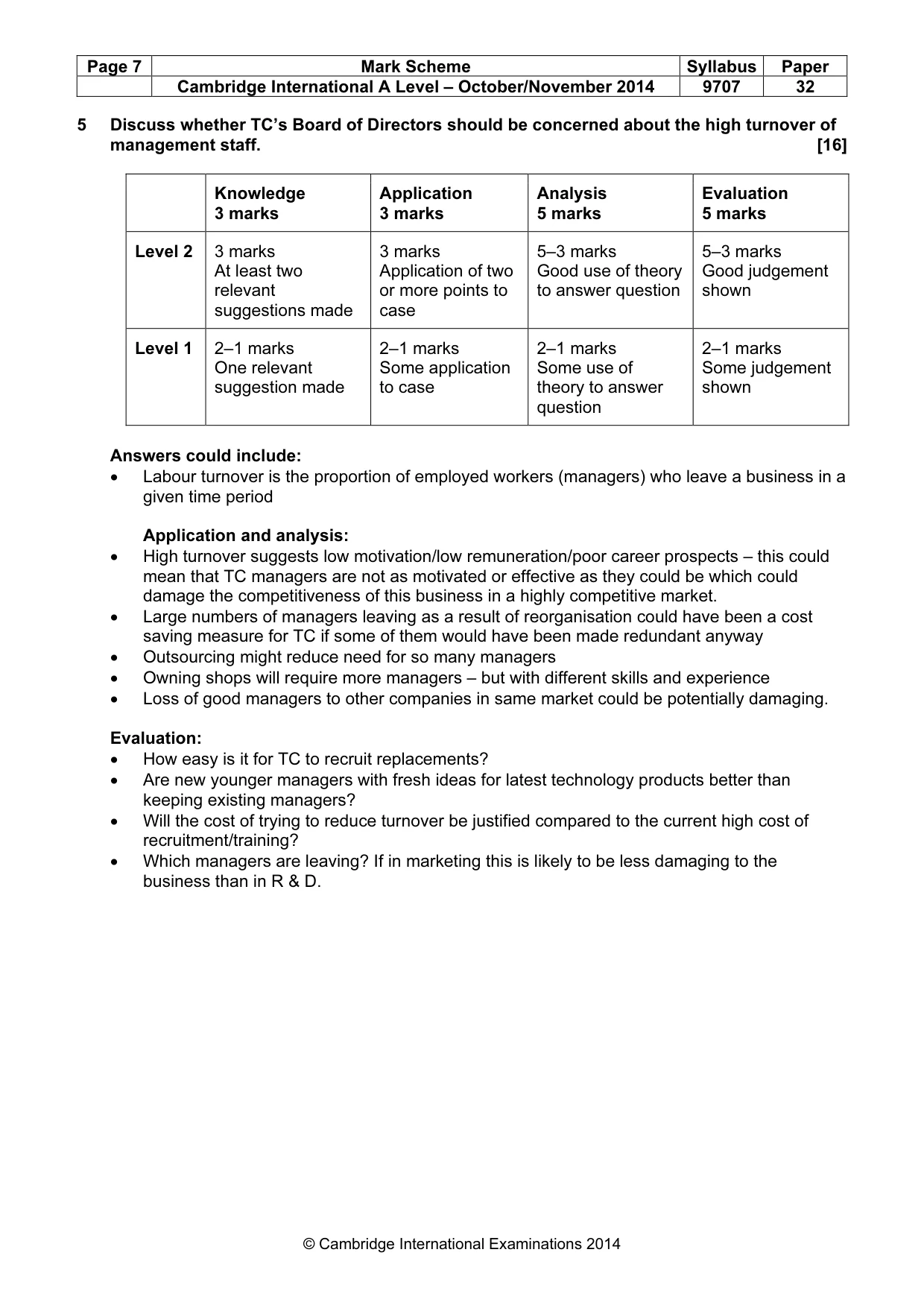
5 Discuss whether TC’s Board of Directors should be concerned about the high turnover of management staff. [16]
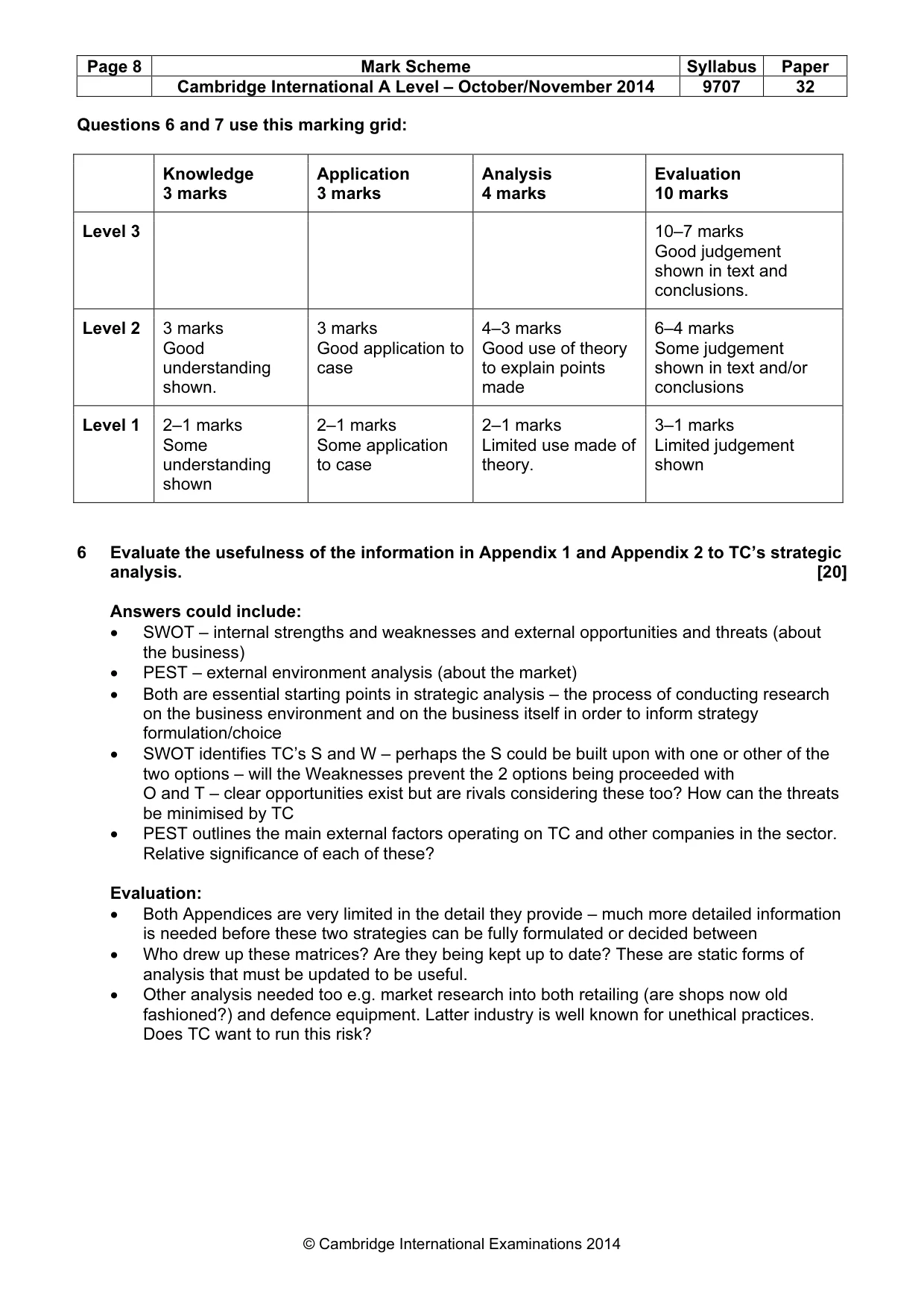
Mark scheme: 5 Discuss whether TC’s Board of Directors should be concerned about the high turnover of management staff. [16] Knowledge Application Analysis Evaluation 3 marks 3 marks 5 marks 5 marks Level 2 3 marks 3 marks 5–3 marks 5–3 marks At least two Application of two Good use of theory Good judgement relevant or more points to to answer question shown suggestions made case Level 1 2–1 marks 2–1 marks 2–1 marks 2–1 marks One relevant Some application Some use of Some judgement suggestion made to case theory to answer shown question Answers could include: • Labour turnover is the proportion of employed workers (managers) who leave a business in a given time period Application and analysis: • High turnover suggests low motivation/low remuneration/poor career prospects – this could mean that TC managers are not as motivated or effective as they could be which could damage the competitiveness of this business in a highly competitive market. • Large numbers of managers leaving as a result of reorganisation could have been a cost saving measure for TC if some of them would have been made redundant anyway • Outsourcing might reduce need for so many managers • Owning shops will require more managers – but with different skills and experience • Loss of good managers to other companies in same market could be potentially damaging. Evaluation: • How easy is it for TC to recruit replacements? • Are new younger managers with fresh ideas for latest technology products better than keeping existing managers? • Will the cost of trying to reduce turnover be justified compared to the current high cost of recruitment/training? • Which managers are leaving? If in marketing this is likely to be less damaging to the business than in R & D. Questions 6 and 7 use this marking grid: Knowledge Application Analysis Evaluation 3 marks 3 marks 4 marks 10 marks Level 3 10–7 marks Good judgement shown in text and conclusions. Level 2 3 marks 3 marks 4–3 marks 6–4 marks Good Good application to Good use of theory Some judgement understanding case to explain points shown in text and/or shown. made conclusions Level 1 2–1 marks 2–1 marks 2–1 marks 3–1 marks Some Some application Limited use made of Limited judgement understanding to case theory. shown shown
Q6 · Evaluate the usefulness of the information in Appendix 1 and Appendix 2 to TC’s strategic…
6 Evaluate the usefulness of the information in Appendix 1 and Appendix 2 to TC’s strategic analysis. [20]
Mark scheme: 6 Evaluate the usefulness of the information in Appendix 1 and Appendix 2 to TC’s strategic analysis. [20] Answers could include: • SWOT – internal strengths and weaknesses and external opportunities and threats (about the business) • PEST – external environment analysis (about the market) • Both are essential starting points in strategic analysis – the process of conducting research on the business environment and on the business itself in order to inform strategy formulation/choice • SWOT identifies TC’s S and W – perhaps the S could be built upon with one or other of the two options – will the Weaknesses prevent the 2 options being proceeded with O and T – clear opportunities exist but are rivals considering these too? How can the threats be minimised by TC • PEST outlines the main external factors operating on TC and other companies in the sector. Relative significance of each of these? Evaluation: • Both Appendices are very limited in the detail they provide – much more detailed information is needed before these two strategies can be fully formulated or decided between • Who drew up these matrices? Are they being kept up to date? These are static forms of analysis that must be updated to be useful. • Other analysis needed too e.g. market research into both retailing (are shops now old fashioned?) and defence equipment. Latter industry is well known for unethical practices. Does TC want to run this risk?
Q7 · Refer to Appendix 3 and other information in the case
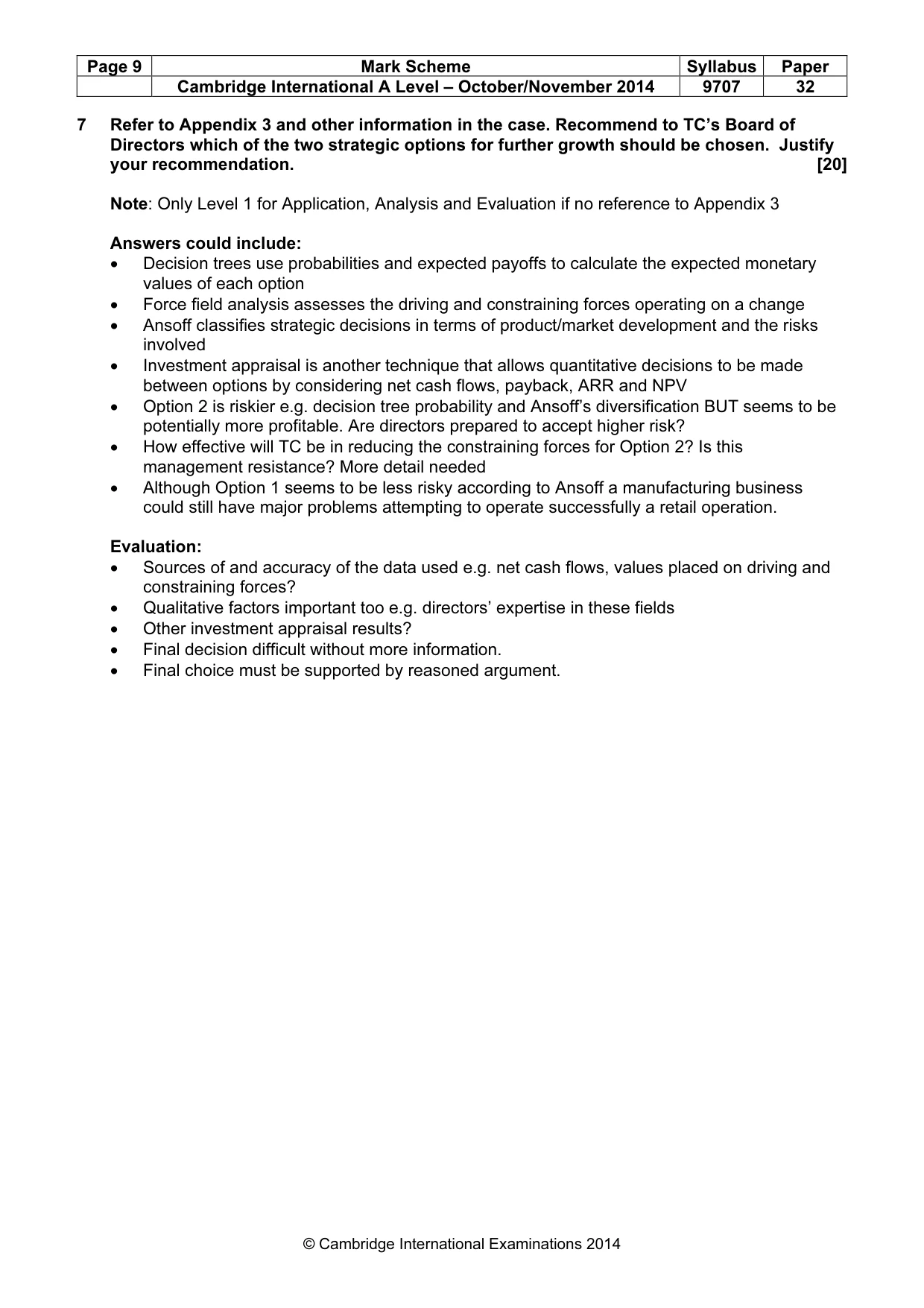
7 Refer to Appendix 3 and other information in the case. Recommend to TC’s Board of Directors which of the 2 strategic options for further growth should be chosen. Justify your recommendation. [20]
Mark scheme: 7 Refer to Appendix 3 and other information in the case. Recommend to TC’s Board of Directors which of the two strategic options for further growth should be chosen. Justify your recommendation. [20] Note: Only Level 1 for Application, Analysis and Evaluation if no reference to Appendix 3 Answers could include: • Decision trees use probabilities and expected payoffs to calculate the expected monetary values of each option • Force field analysis assesses the driving and constraining forces operating on a change • Ansoff classifies strategic decisions in terms of product/market development and the risks involved • Investment appraisal is another technique that allows quantitative decisions to be made between options by considering net cash flows, payback, ARR and NPV • Option 2 is riskier e.g. decision tree probability and Ansoff’s diversification BUT seems to be potentially more profitable. Are directors prepared to accept higher risk? • How effective will TC be in reducing the constraining forces for Option 2? Is this management resistance? More detail needed • Although Option 1 seems to be less risky according to Ansoff a manufacturing business could still have major problems attempting to operate successfully a retail operation. Evaluation: • Sources of and accuracy of the data used e.g. net cash flows, values placed on driving and constraining forces? • Qualitative factors important too e.g. directors’ expertise in these fields • Other investment appraisal results? • Final decision difficult without more information. • Final choice must be supported by reasoned argument.
What you needed in this session
Cambridge’s own grade thresholds for 2014 Oct/Nov, Paper 3 · Variant 2. A higher threshold means an easier paper — the bar moves with how the cohort did.