Cambridge A Level Business Studies (for final examination in 2015) 9707 — 2015 Oct/Nov Paper 3 · Variant 3
9707/33/O/N/15 · 7 questions · 120 marks · ≈135 min
The question paper and its mark scheme, free to read here and free to download. This is Cambridge’s own paper, exactly as it was sat.
Question paper8 pages



Mark scheme9 pages
Answers below. Sit the paper first if you are practising.

Questions as text
Q1 · Analyse the likely effects on FFF of a depreciation in the exchange rate of country A’s…
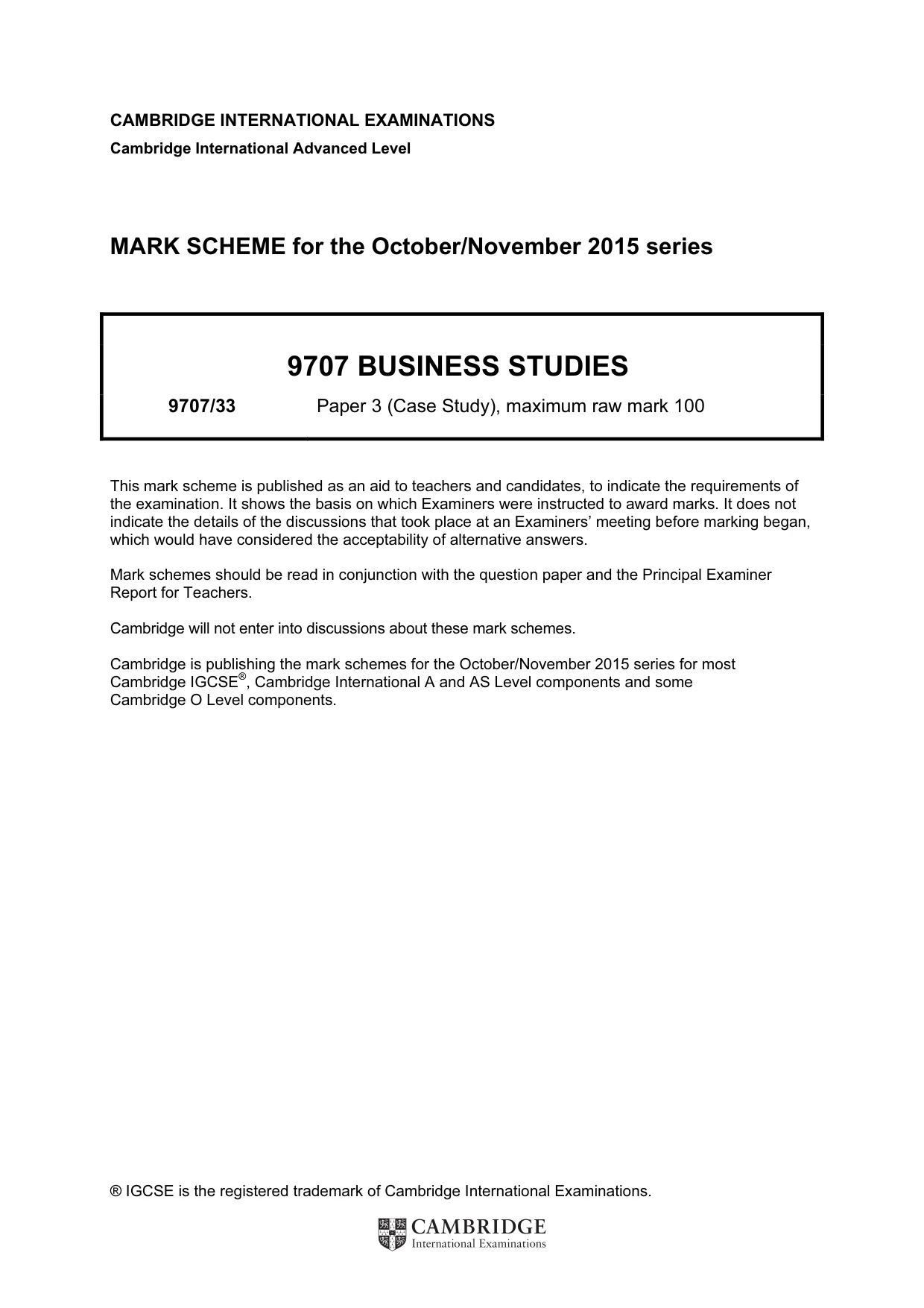
1 Analyse the likely effects on FFF of a depreciation in the exchange rate of country A’s currency. [10]
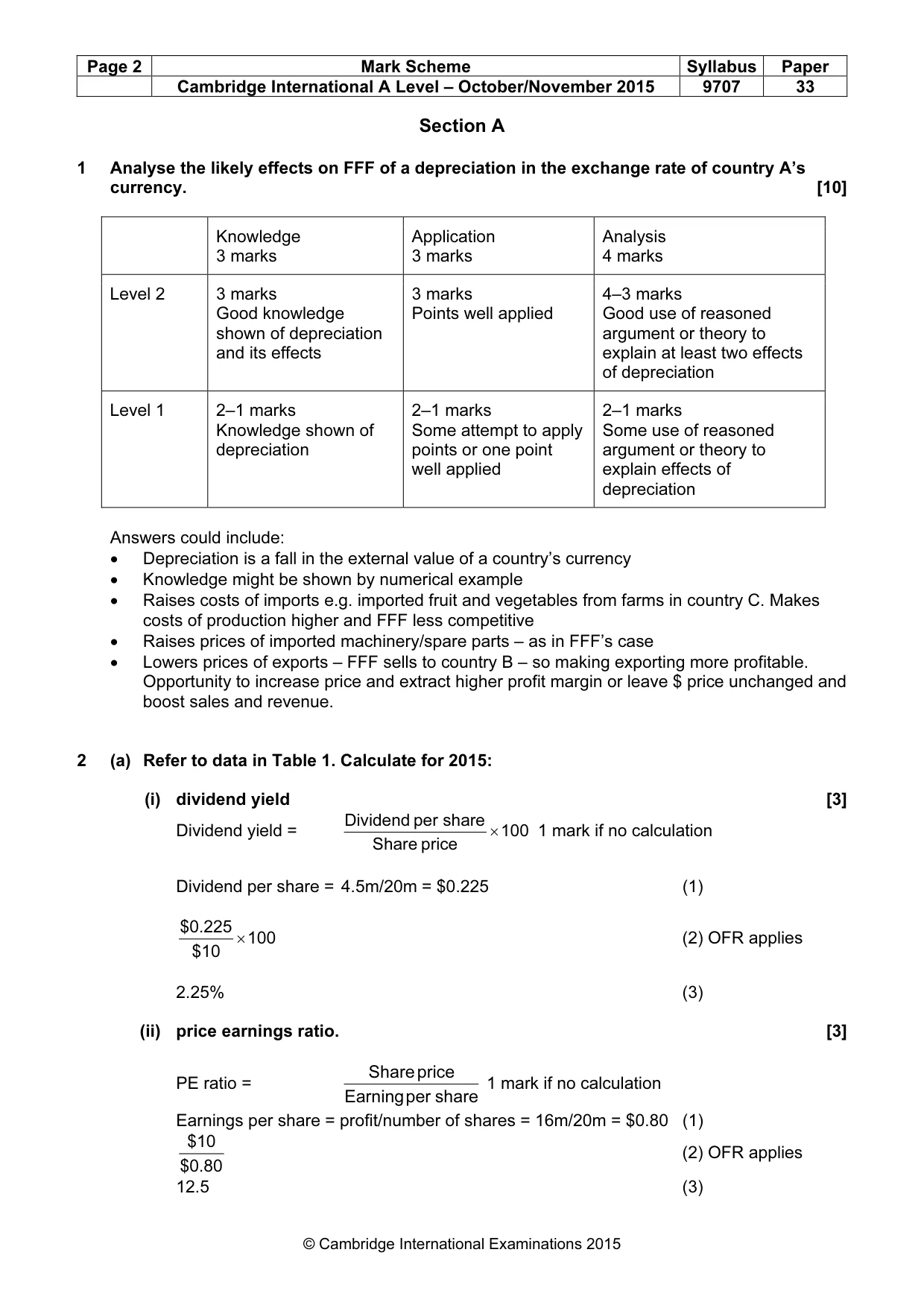
Mark scheme: 1 Analyse the likely effects on FFF of a depreciation in the exchange rate of country A’s currency. [10] Knowledge Application Analysis 3 marks 3 marks 4 marks Level 2 3 marks 3 marks 4–3 marks Good knowledge Points well applied Good use of reasoned shown of depreciation argument or theory to and its effects explain at least two effects of depreciation Level 1 2–1 marks 2–1 marks 2–1 marks Knowledge shown of Some attempt to apply Some use of reasoned depreciation points or one point argument or theory to well applied explain effects of depreciation Answers could include: • Depreciation is a fall in the external value of a country’s currency • Knowledge might be shown by numerical example • Raises costs of imports e.g. imported fruit and vegetables from farms in country C. Makes costs of production higher and FFF less competitive • Raises prices of imported machinery/spare parts – as in FFF’s case • Lowers prices of exports – FFF sells to country B – so making exporting more profitable. Opportunity to increase price and extract higher profit margin or leave $ price unchanged and boost sales and revenue.
Q2 · Refer to data in Table 1
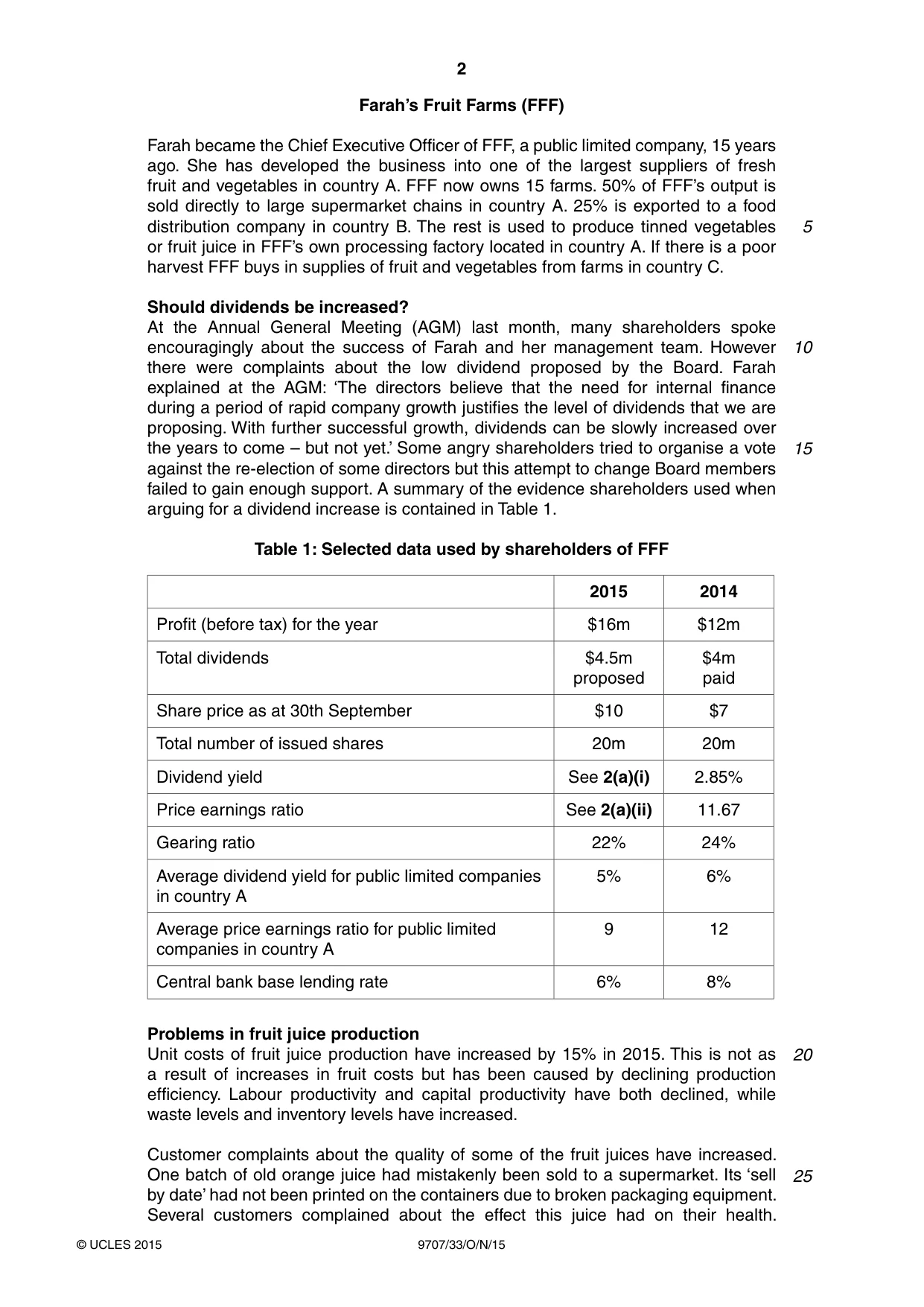
2 (a) Refer to data in Table 1. Calculate for 2015: (i) dividend yield [3] (ii) price earnings ratio. [3] (b) Using your results from (a) and other information, advise FFF’s shareholders whether to sell or keep their shares in FFF. [10]
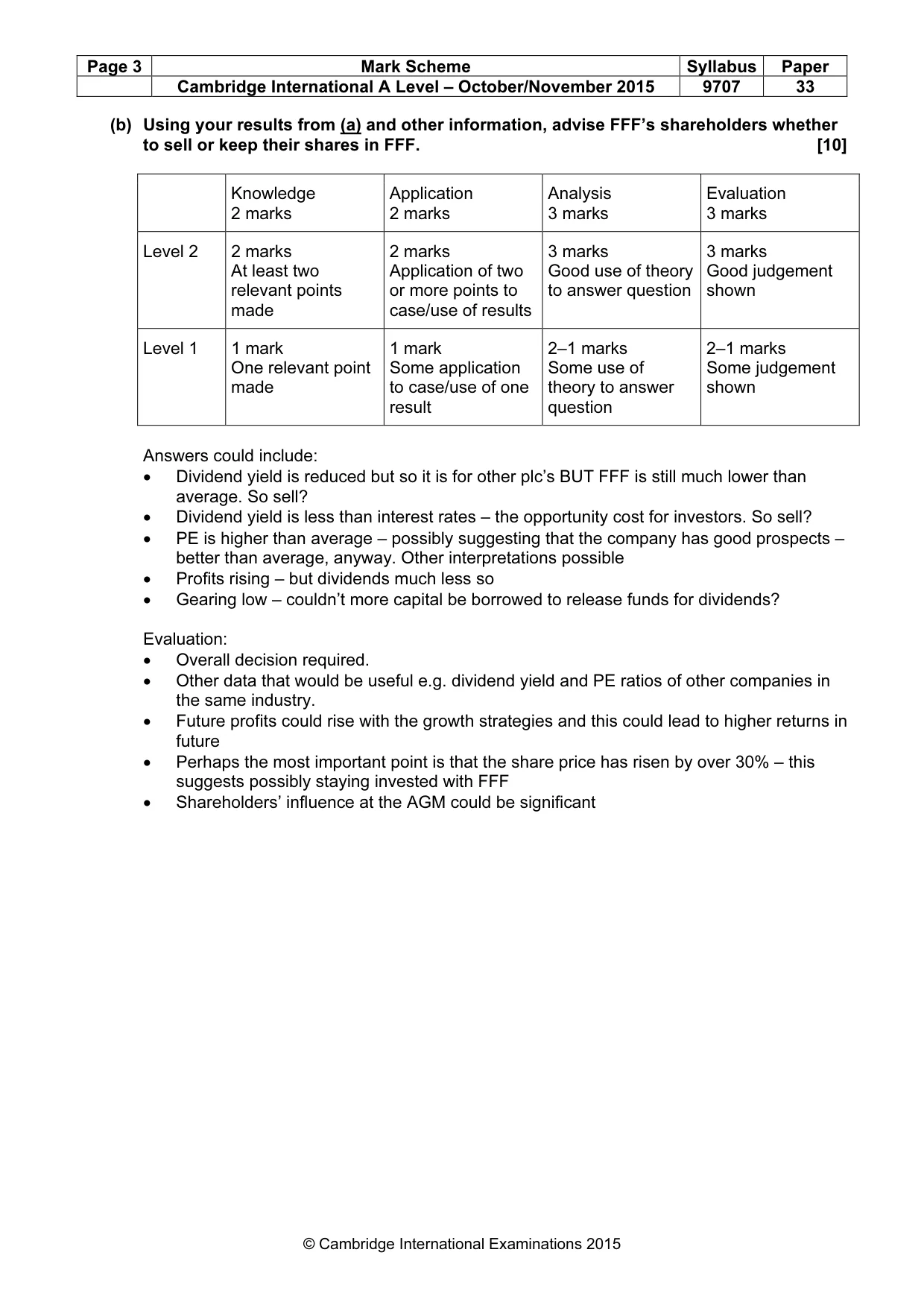
Mark scheme: 2 (a) Refer to data in Table 1. Calculate for 2015: (i) dividend yield [3] Dividend per share Dividend yield = × 100 1 mark if no calculation Share price Dividend per share = 4.5m/20m = $0.225 (1) $0.225 × 100 (2) OFR applies $10 2.25% (3) (ii) price earnings ratio. [3] Share price PE ratio = 1 mark if no calculation Earning per share Earnings per share = profit/number of shares = 16m/20m = $0.80 (1) $10 (2) OFR applies $0.80 12.5 (3) (b) Using your results from (a) and other information, advise FFF’s shareholders whether to sell or keep their shares in FFF. [10] Knowledge Application Analysis Evaluation 2 marks 2 marks 3 marks 3 marks Level 2 2 marks 2 marks 3 marks 3 marks At least two Application of two Good use of theory Good judgement relevant points or more points to to answer question shown made case/use of results Level 1 1 mark 1 mark 2–1 marks 2–1 marks One relevant point Some application Some use of Some judgement made to case/use of one theory to answer shown result question Answers could include: • Dividend yield is reduced but so it is for other plc’s BUT FFF is still much lower than average. So sell? • Dividend yield is less than interest rates – the opportunity cost for investors. So sell? • PE is higher than average – possibly suggesting that the company has good prospects – better than average, anyway. Other interpretations possible • Profits rising – but dividends much less so • Gearing low – couldn’t more capital be borrowed to release funds for dividends? Evaluation: • Overall decision required. • Other data that would be useful e.g. dividend yield and PE ratios of other companies in the same industry. • Future profits could rise with the growth strategies and this could lead to higher returns in future • Perhaps the most important point is that the share price has risen by over 30% – this suggests possibly staying invested with FFF • Shareholders’ influence at the AGM could be significant
Q3 · Evaluate the extent to which you agree with the Operations Director that: ‘All of FFF’s…
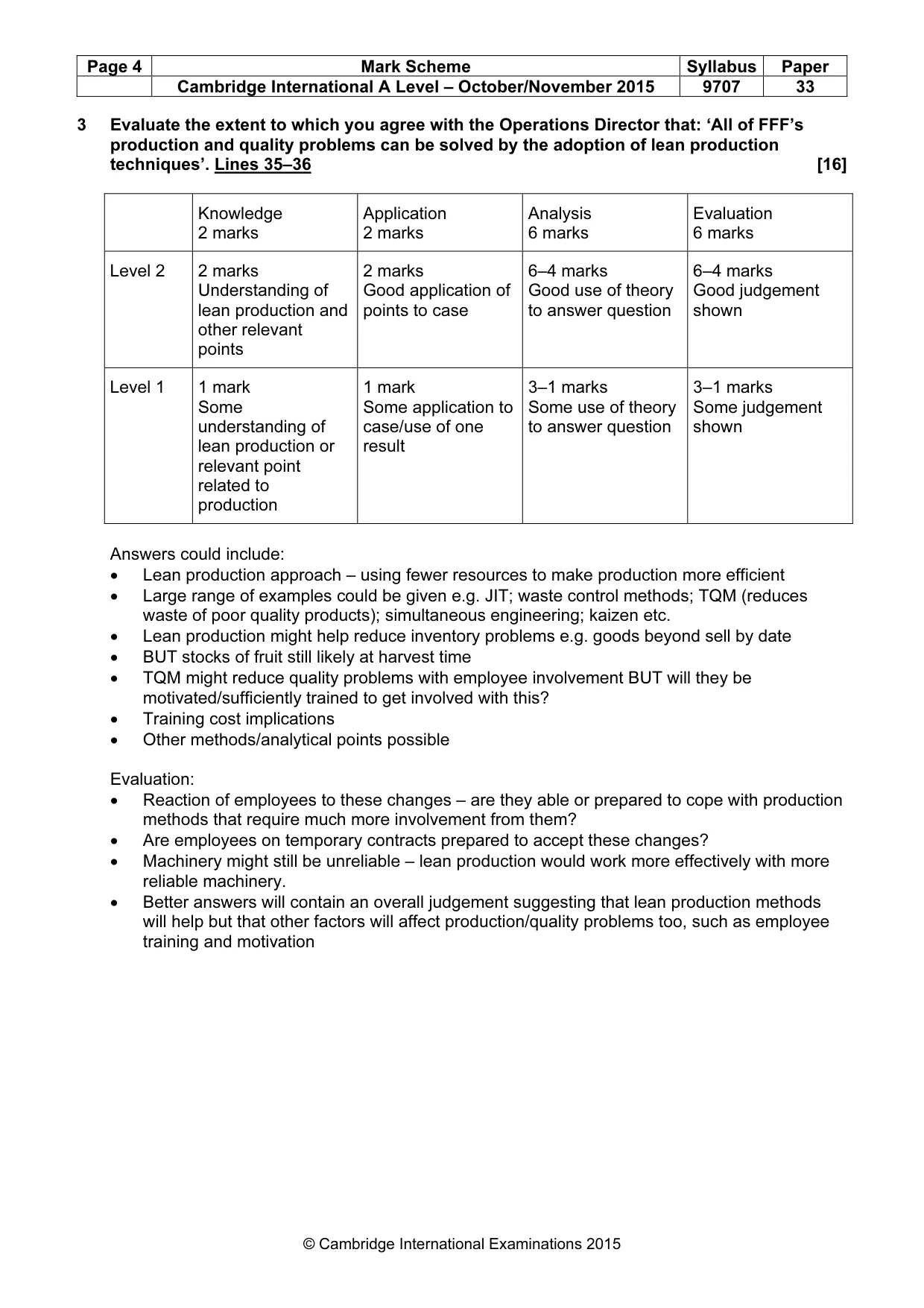
3 Evaluate the extent to which you agree with the Operations Director that: ‘All of FFF’s production and quality problems can be solved by the adoption of lean production techniques’. (Lines 35–36.) [16]
Mark scheme: 3 Evaluate the extent to which you agree with the Operations Director that: ‘All of FFF’s production and quality problems can be solved by the adoption of lean production techniques’. Lines 35–36 [16] Knowledge Application Analysis Evaluation 2 marks 2 marks 6 marks 6 marks Level 2 2 marks 2 marks 6–4 marks 6–4 marks Understanding of Good application of Good use of theory Good judgement lean production and points to case to answer question shown other relevant points Level 1 1 mark 1 mark 3–1 marks 3–1 marks Some Some application to Some use of theory Some judgement understanding of case/use of one to answer question shown lean production or result relevant point related to production Answers could include: • Lean production approach – using fewer resources to make production more efficient • Large range of examples could be given e.g. JIT; waste control methods; TQM (reduces waste of poor quality products); simultaneous engineering; kaizen etc. • Lean production might help reduce inventory problems e.g. goods beyond sell by date • BUT stocks of fruit still likely at harvest time • TQM might reduce quality problems with employee involvement BUT will they be motivated/sufficiently trained to get involved with this? • Training cost implications • Other methods/analytical points possible Evaluation: • Reaction of employees to these changes – are they able or prepared to cope with production methods that require much more involvement from them? • Are employees on temporary contracts prepared to accept these changes? • Machinery might still be unreliable – lean production would work more effectively with more reliable machinery. • Better answers will contain an overall judgement suggesting that lean production methods will help but that other factors will affect production/quality problems too, such as employee training and motivation
Q4 · Calculate the effect on FFF’s annual profit if the decision was made to accept the…
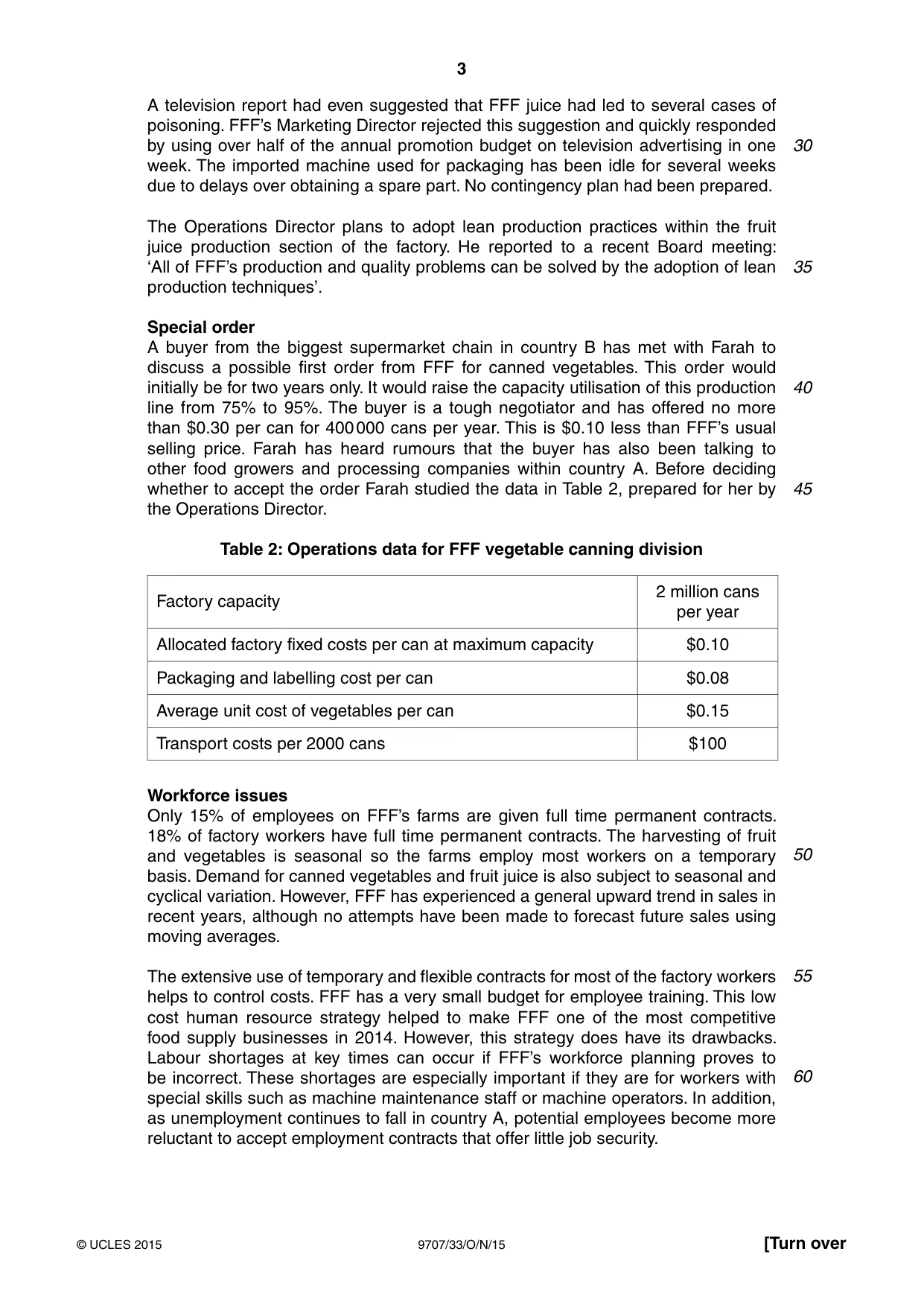
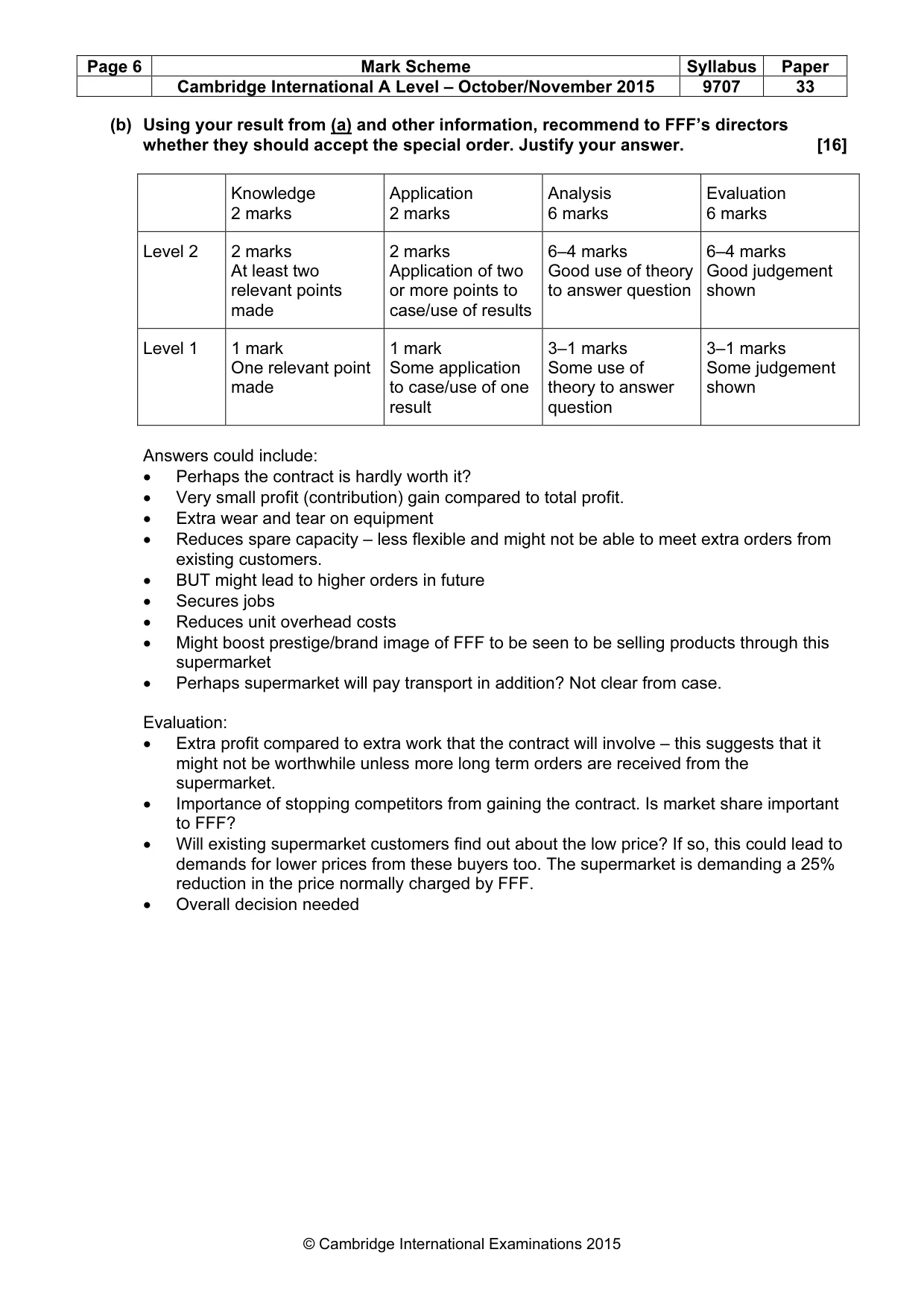
4 (a) Calculate the effect on FFF’s annual profit if the decision was made to accept the special order from the supermarket chain in country B. [6] (b) Using your result from (a) and other information, recommend to FFF’s directors whether they should accept the special order. Justify your answer. [16]
Mark scheme: 4 (a) Calculate the effect on FFF’s annual profit if the decision was made to accept the special order from the supermarket chain in country B. [6] Additional profit is same as contribution from the order. Fixed costs should be ignored. Impact on profits is to increase them by: Some attempt at calculation (1) Contribution = Total Revenue – Direct costs (1) Revenue = 400 000 × $0.30 = $120 000 (1) Transport costs per can = 100/2000 = $0.05 (1) Direct costs = 0.08 + 0.15 + 0.05 = $0.28 (1) Less direct costs $0.28 × 400 000 = $112 000 (1) Extra profit = $0.02 × 400 000 = $8000 6 marks Per unit approach: $0.30 – $0.28 = $0.02 $0.02 × 400 000 = $8000 (6) If FC included –$0.08 (4) x 400 000 = –$32 000 (loss) (5 as one error) (b) Using your result from (a) and other information, recommend to FFF’s directors whether they should accept the special order. Justify your answer. [16] Knowledge Application Analysis Evaluation 2 marks 2 marks 6 marks 6 marks Level 2 2 marks 2 marks 6–4 marks 6–4 marks At least two Application of two Good use of theory Good judgement relevant points or more points to to answer question shown made case/use of results Level 1 1 mark 1 mark 3–1 marks 3–1 marks One relevant point Some application Some use of Some judgement made to case/use of one theory to answer shown result question Answers could include: • Perhaps the contract is hardly worth it? • Very small profit (contribution) gain compared to total profit. • Extra wear and tear on equipment • Reduces spare capacity – less flexible and might not be able to meet extra orders from existing customers. • BUT might lead to higher orders in future • Secures jobs • Reduces unit overhead costs • Might boost prestige/brand image of FFF to be seen to be selling products through this supermarket • Perhaps supermarket will pay transport in addition? Not clear from case. Evaluation: • Extra profit compared to extra work that the contract will involve – this suggests that it might not be worthwhile unless more long term orders are received from the supermarket. • Importance of stopping competitors from gaining the contract. Is market share important to FFF? • Will existing supermarket customers find out about the low price? If so, this could lead to demands for lower prices from these buyers too. The supermarket is demanding a 25% reduction in the price normally charged by FFF. • Overall decision needed
Q5 · Assess the extent to which the use of sales forecasting might improve the effectiveness…
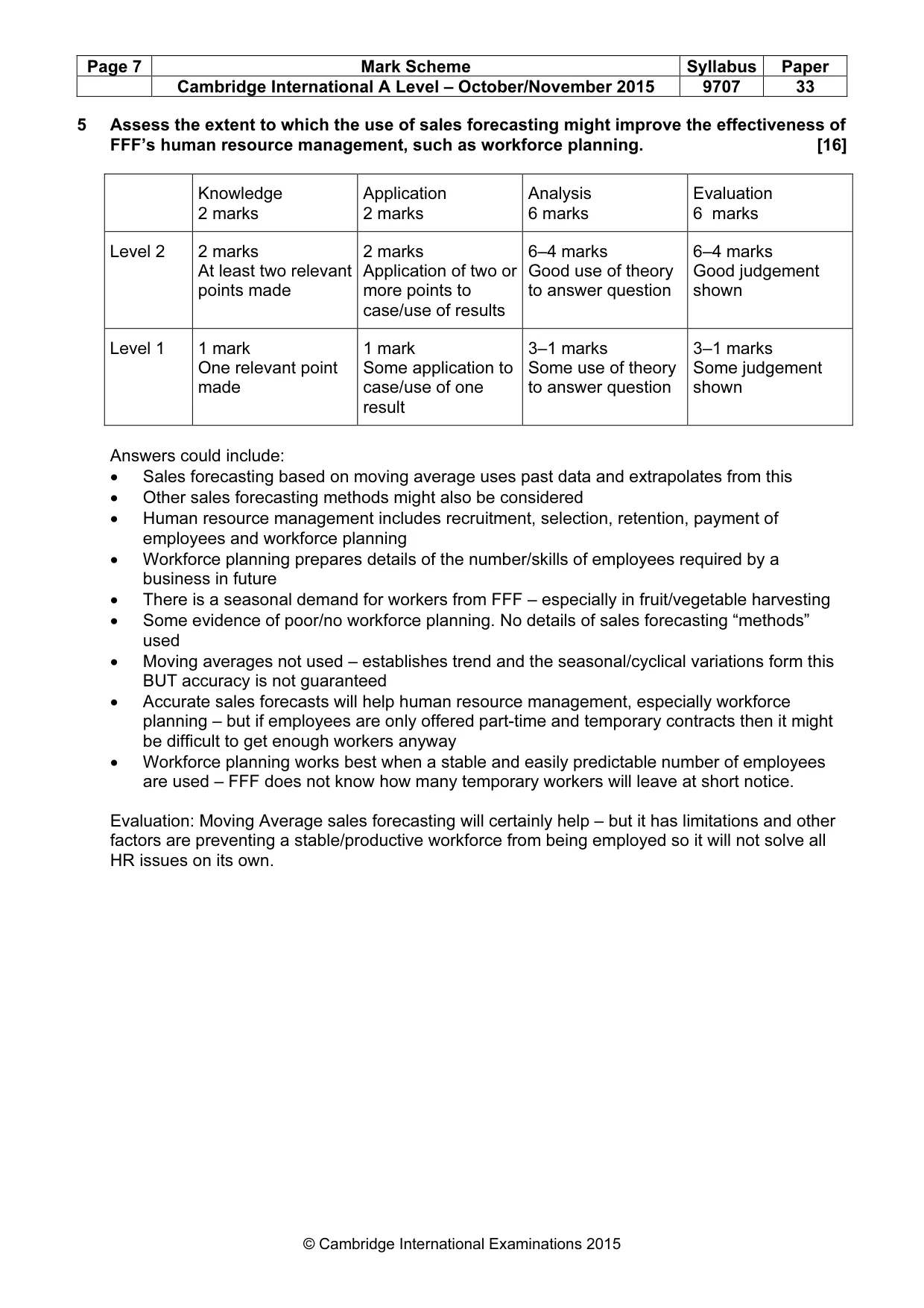
5 Assess the extent to which the use of sales forecasting might improve the effectiveness of FFF’s human resource management, such as workforce planning. [16]
Mark scheme: 5 Assess the extent to which the use of sales forecasting might improve the effectiveness of FFF’s human resource management, such as workforce planning. [16] Knowledge Application Analysis Evaluation 2 marks 2 marks 6 marks 6 marks Level 2 2 marks 2 marks 6–4 marks 6–4 marks At least two relevant Application of two or Good use of theory Good judgement points made more points to to answer question shown case/use of results Level 1 1 mark 1 mark 3–1 marks 3–1 marks One relevant point Some application to Some use of theory Some judgement made case/use of one to answer question shown result Answers could include: • Sales forecasting based on moving average uses past data and extrapolates from this • Other sales forecasting methods might also be considered • Human resource management includes recruitment, selection, retention, payment of employees and workforce planning • Workforce planning prepares details of the number/skills of employees required by a business in future • There is a seasonal demand for workers from FFF – especially in fruit/vegetable harvesting • Some evidence of poor/no workforce planning. No details of sales forecasting “methods” used • Moving averages not used – establishes trend and the seasonal/cyclical variations form this BUT accuracy is not guaranteed • Accurate sales forecasts will help human resource management, especially workforce planning – but if employees are only offered part-time and temporary contracts then it might be difficult to get enough workers anyway • Workforce planning works best when a stable and easily predictable number of employees are used – FFF does not know how many temporary workers will leave at short notice. Evaluation: Moving Average sales forecasting will certainly help – but it has limitations and other factors are preventing a stable/productive workforce from being employed so it will not solve all HR issues on its own. Questions 6 and 7 use this assessment grid: Knowledge Application Analysis Evaluation 3 marks 3 marks 4 marks 10 marks Level 3 10–7 marks Good judgement shown in text and conclusions Level 2 3 marks 3 marks 4–3 marks 6–4 marks Good Good application to Good use of theory Some judgement understanding case to explain points shown in text and/or shown made conclusions Level 1 2–1 marks 2–1 marks 2–1 marks 3–1 marks Some Some application to Limited use made of Limited judgement understanding case theory. shown shown
Q6 · Using Appendix 1, Appendix 2 and other information, recommend to the Board of FFF whether…
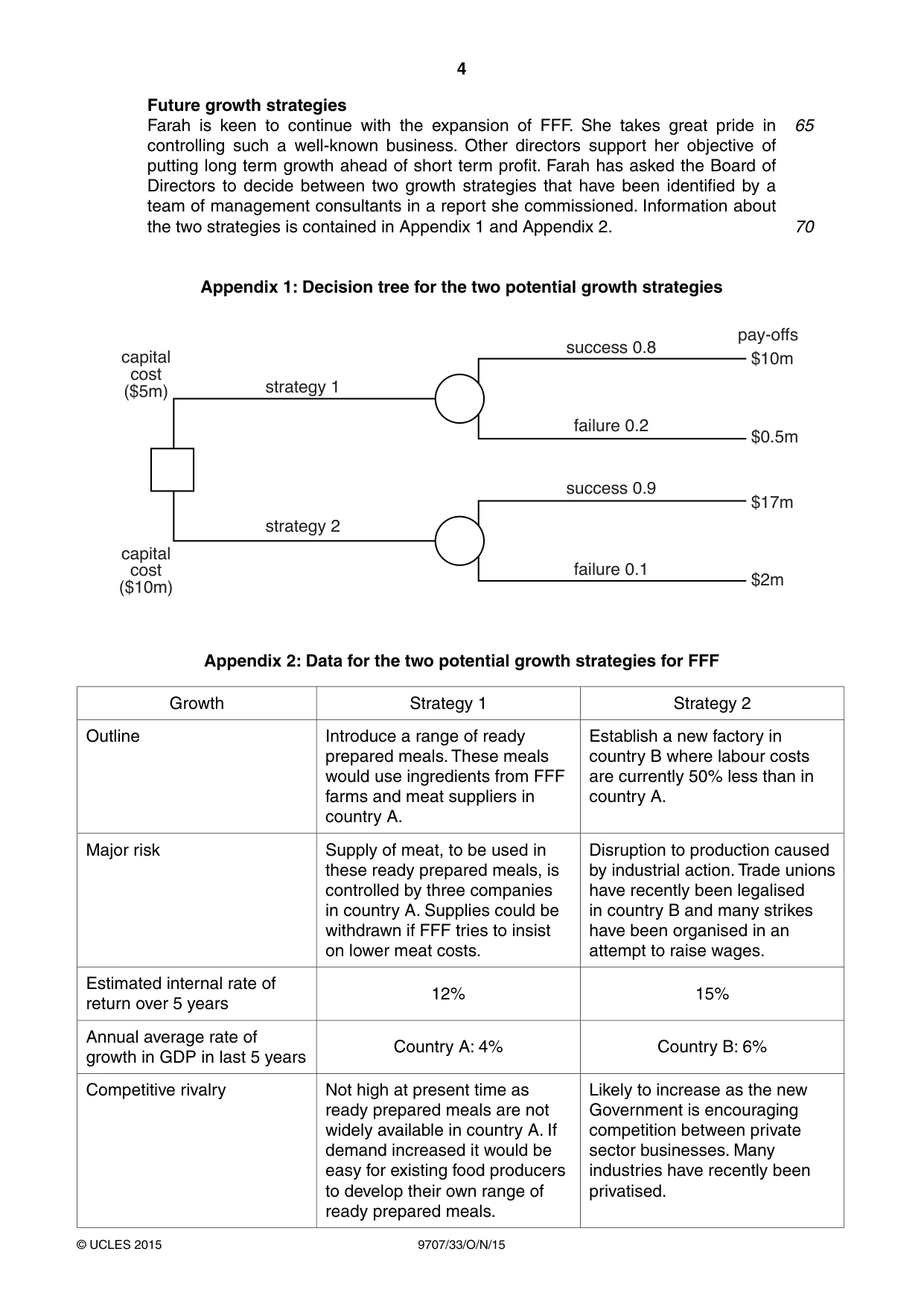
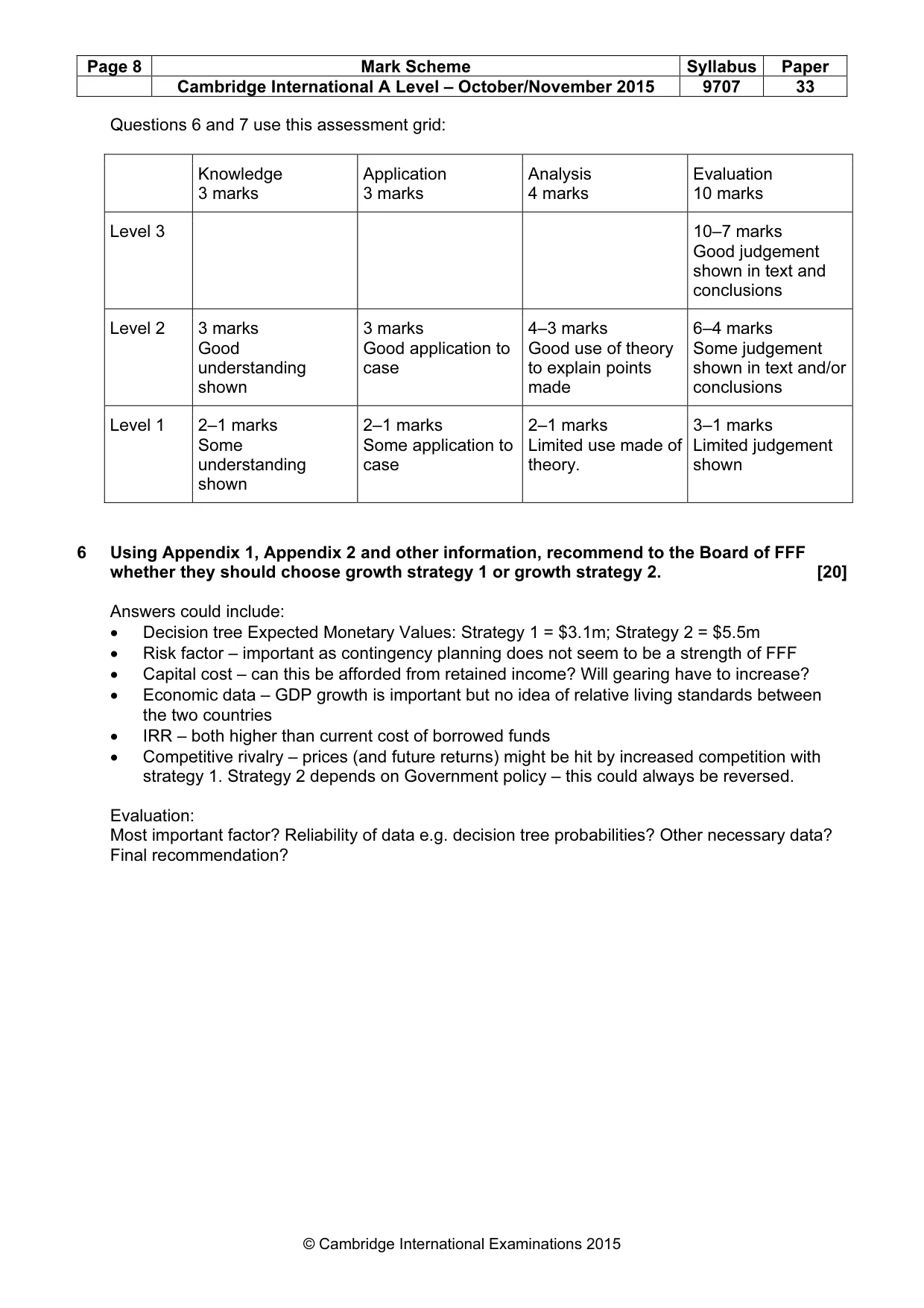
6 Using Appendix 1, Appendix 2 and other information, recommend to the Board of FFF whether they should choose growth strategy 1 or growth strategy 2. [20]
Mark scheme: 6 Using Appendix 1, Appendix 2 and other information, recommend to the Board of FFF whether they should choose growth strategy 1 or growth strategy 2. [20] Answers could include: • Decision tree Expected Monetary Values: Strategy 1 = $3.1m; Strategy 2 = $5.5m • Risk factor – important as contingency planning does not seem to be a strength of FFF • Capital cost – can this be afforded from retained income? Will gearing have to increase? • Economic data – GDP growth is important but no idea of relative living standards between the two countries • IRR – both higher than current cost of borrowed funds • Competitive rivalry – prices (and future returns) might be hit by increased competition with strategy 1. Strategy 2 depends on Government policy – this could always be reversed. Evaluation: Most important factor? Reliability of data e.g. decision tree probabilities? Other necessary data? Final recommendation?
Q7 · Evaluate the extent to which contingency planning might help FFF achieve its long term…
7 Evaluate the extent to which contingency planning might help FFF achieve its long term growth objective. [20]
Mark scheme: 7 Evaluate the extent to which contingency planning might help FFF achieve its long term growth objective. [20] Answers could include: • Contingency planning: preparing for future emergencies – “continuity planning” • FFF do not seem to give this high priority e.g. reaction of Marketing manager and lack of alternative plans following breakdown of machine • Both growth strategies have potential risks that could affect the continuity of the strategy and its long term success • Consultant’s report has identified main risk – but there might be others. Has FFF thought of these and prepared for them? • Is FFF prepared for the risks identified? How could they prepare for each of these? • Problems with contingency planning e.g. cost of resources; training; needs updating Evaluation: FFF could be lucky without contingency planning and no major events occur; if major risks did occur then not having a contingency plan could be very serious indeed; not having a contingency plan in these circumstances could certainly hold back growth plans. But how much should FFF spend on contingency planning? Balancing risk against cost of preparing for it?