Cambridge A Level Business Studies (for final examination in 2015) 9707 — 2014 Oct/Nov Paper 3 · Variant 1
9707/31/O/N/14 · 100 marks · ≈113 min
The question paper and its mark scheme, free to read here and free to download. This is Cambridge’s own paper, exactly as it was sat.
Question paper8 pages



Mark scheme9 pages
Answers below. Sit the paper first if you are practising.
Paper as text
Question paper, page 1
This document consists of 5 printed pages and 3 blank pages. DC (RCL (KM)) 83138/3 © UCLES 2014 [Turn over Cambridge International Examinations Cambridge International Advanced Level * 9 7 9 4 3 9 8 6 3 0 * BUSINESS STUDIES 9707/31 Paper 3 October/November 2014 CASE STUDY 3 hours Additional Materials: Answer Booklet/Paper READ THESE INSTRUCTIONS FIRST If you have been given an Answer Booklet, follow the instructions on the front cover of the Booklet. Write your Centre number, candidate number and name on all the work you hand in. Write in dark blue or black pen. You may use an HB pencil for any diagrams, graphs or rough working. Do not use staples, paper clips, glue or correction fluid. DO NOT WRITE IN ANY BARCODES. Section A Answer all questions. Section B Answer one question. You are advised to spend 40 minutes on Section B. The businesses described in this question paper are entirely fictitious. At the end of the examination, fasten all your work securely together. The number of marks is given in brackets [ ] at the end of each question or part question.
Question paper, page 2
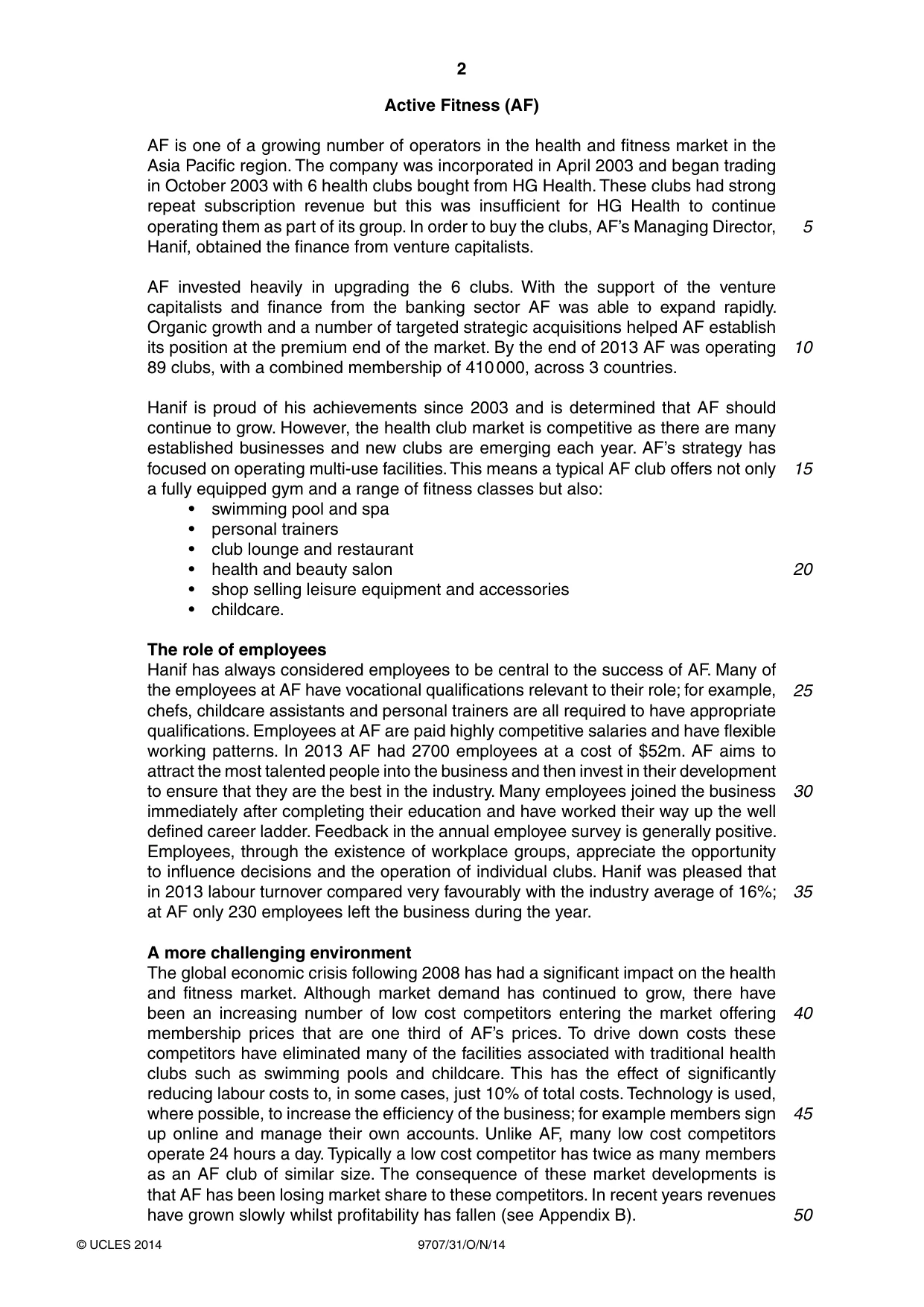
2 9707/31/O/N/14 © UCLES 2014 Active Fitness (AF) AF is one of a growing number of operators in the health and fitness market in the Asia Pacific region. The company was incorporated in April 2003 and began trading in October 2003 with 6 health clubs bought from HG Health. These clubs had strong repeat subscription revenue but this was insufficient for HG Health to continue operating them as part of its group. In order to buy the clubs, AF’s Managing Director, Hanif, obtained the finance from venture capitalists. AF invested heavily in upgrading the 6 clubs. With the support of the venture capitalists and finance from the banking sector AF was able to expand rapidly. Organic growth and a number of targeted strategic acquisitions helped AF establish its position at the premium end of the market. By the end of 2013 AF was operating 89 clubs, with a combined membership of 410 000, across 3 countries. Hanif is proud of his achievements since 2003 and is determined that AF should continue to grow. However, the health club market is competitive as there are many established businesses and new clubs are emerging each year. AF’s strategy has focused on operating multi-use facilities. This means a typical AF club offers not only a fully equipped gym and a range of fitness classes but also: • swimming pool and spa • personal trainers • club lounge and restaurant • health and beauty salon • shop selling leisure equipment and accessories • childcare. The role of employees Hanif has always considered employees to be central to the success of AF. Many of the employees at AF have vocational qualifications relevant to their role; for example, chefs, childcare assistants and personal trainers are all required to have appropriate qualifications. Employees at AF are paid highly competitive salaries and have flexible working patterns. In 2013 AF had 2700 employees at a cost of $52m. AF aims to attract the most talented people into the business and then invest in their development to ensure that they are the best in the industry. Many employees joined the business immediately after completing their education and have worked their way up the well defined career ladder. Feedback in the annual employee survey is generally positive. Employees, through the existence of workplace groups, appreciate the opportunity to influence decisions and the operation of individual clubs. Hanif was pleased that in 2013 labour turnover compared very favourably with the industry average of 16%; at AF only 230 employees left the business during the year. A more challenging environment The global economic crisis following 2008 has had a significant impact on the health and fitness market. Although market demand has continued to grow, there have been an increasing number of low cost competitors entering the market offering membership prices that are one third of AF’s prices. To drive down costs these competitors have eliminated many of the facilities associated with traditional health clubs such as swimming pools and childcare. This has the effect of significantly reducing labour costs to, in some cases, just 10% of total costs. Technology is used, where possible, to increase the efficiency of the business; for example members sign up online and manage their own accounts. Unlike AF, many low cost competitors operate 24 hours a day. Typically a low cost competitor has twice as many members as an AF club of similar size. The consequence of these market developments is that AF has been losing market share to these competitors. In recent years revenues have grown slowly whilst profitability has fallen (see Appendix B). 5 10 15 20 25 30 35 40 45 50
Question paper, page 3
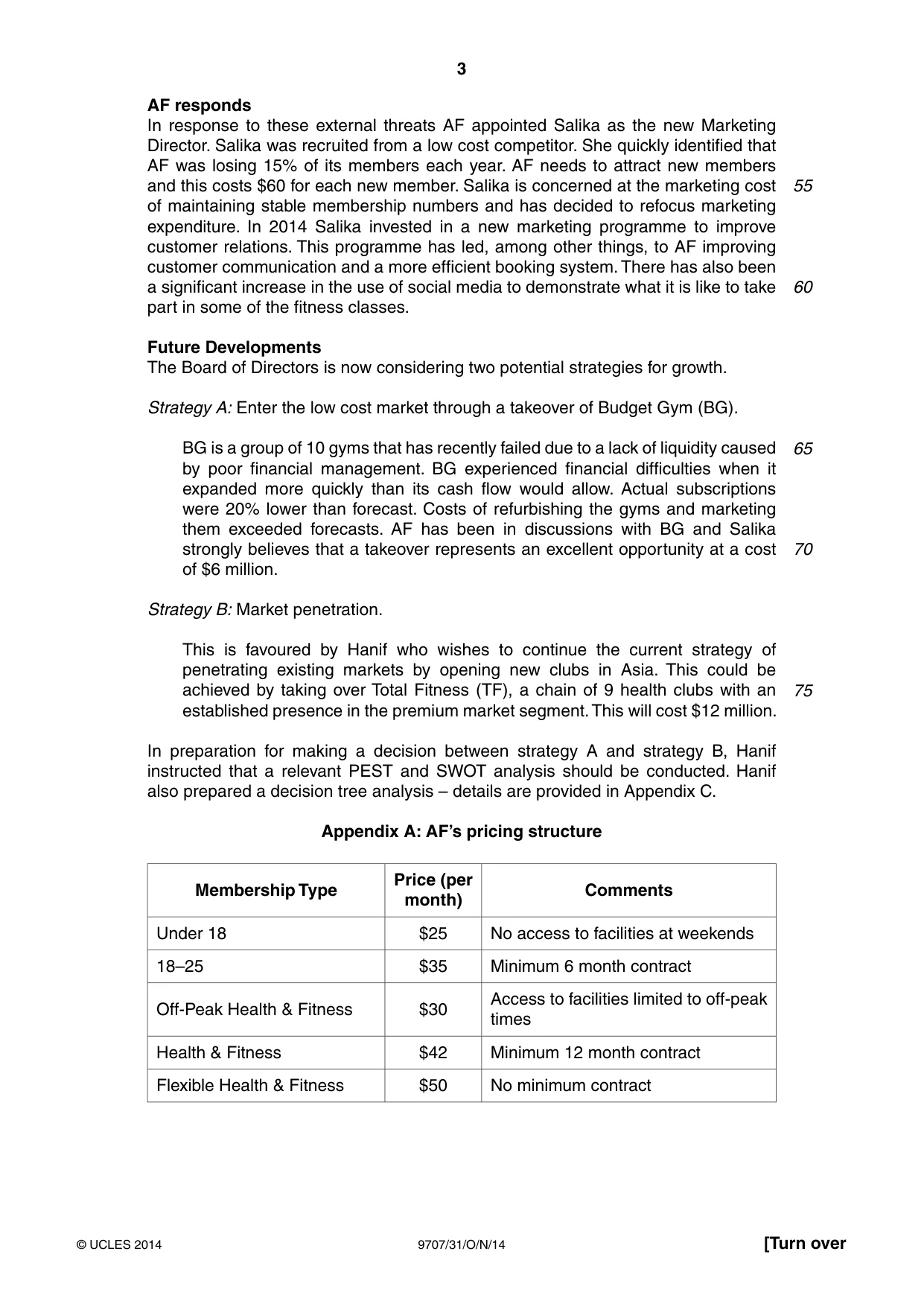
3 9707/31/O/N/14 © UCLES 2014 [Turn over AF responds In response to these external threats AF appointed Salika as the new Marketing Director. Salika was recruited from a low cost competitor. She quickly identified that AF was losing 15% of its members each year. AF needs to attract new members and this costs $60 for each new member. Salika is concerned at the marketing cost of maintaining stable membership numbers and has decided to refocus marketing expenditure. In 2014 Salika invested in a new marketing programme to improve customer relations. This programme has led, among other things, to AF improving customer communication and a more efficient booking system. There has also been a significant increase in the use of social media to demonstrate what it is like to take part in some of the fitness classes. Future Developments The Board of Directors is now considering two potential strategies for growth. Strategy A: Enter the low cost market through a takeover of Budget Gym (BG). BG is a group of 10 gyms that has recently failed due to a lack of liquidity caused by poor financial management. BG experienced financial difficulties when it expanded more quickly than its cash flow would allow. Actual subscriptions were 20% lower than forecast. Costs of refurbishing the gyms and marketing them exceeded forecasts. AF has been in discussions with BG and Salika strongly believes that a takeover represents an excellent opportunity at a cost of $6 million. Strategy B: Market penetration. This is favoured by Hanif who wishes to continue the current strategy of penetrating existing markets by opening new clubs in Asia. This could be achieved by taking over Total Fitness (TF), a chain of 9 health clubs with an established presence in the premium market segment. This will cost $12 million. In preparation for making a decision between strategy A and strategy B, Hanif instructed that a relevant PEST and SWOT analysis should be conducted. Hanif also prepared a decision tree analysis – details are provided in Appendix C. Appendix A: AF’s pricing structure Membership Type Price (per month) Comments Under 18 $25 No access to facilities at weekends 18–25 $35 Minimum 6 month contract Off-Peak Health & Fitness $30 Access to facilities limited to off-peak times Health & Fitness $42 Minimum 12 month contract Flexible Health & Fitness $50 No minimum contract 55 60 65 70 75
Question paper, page 4
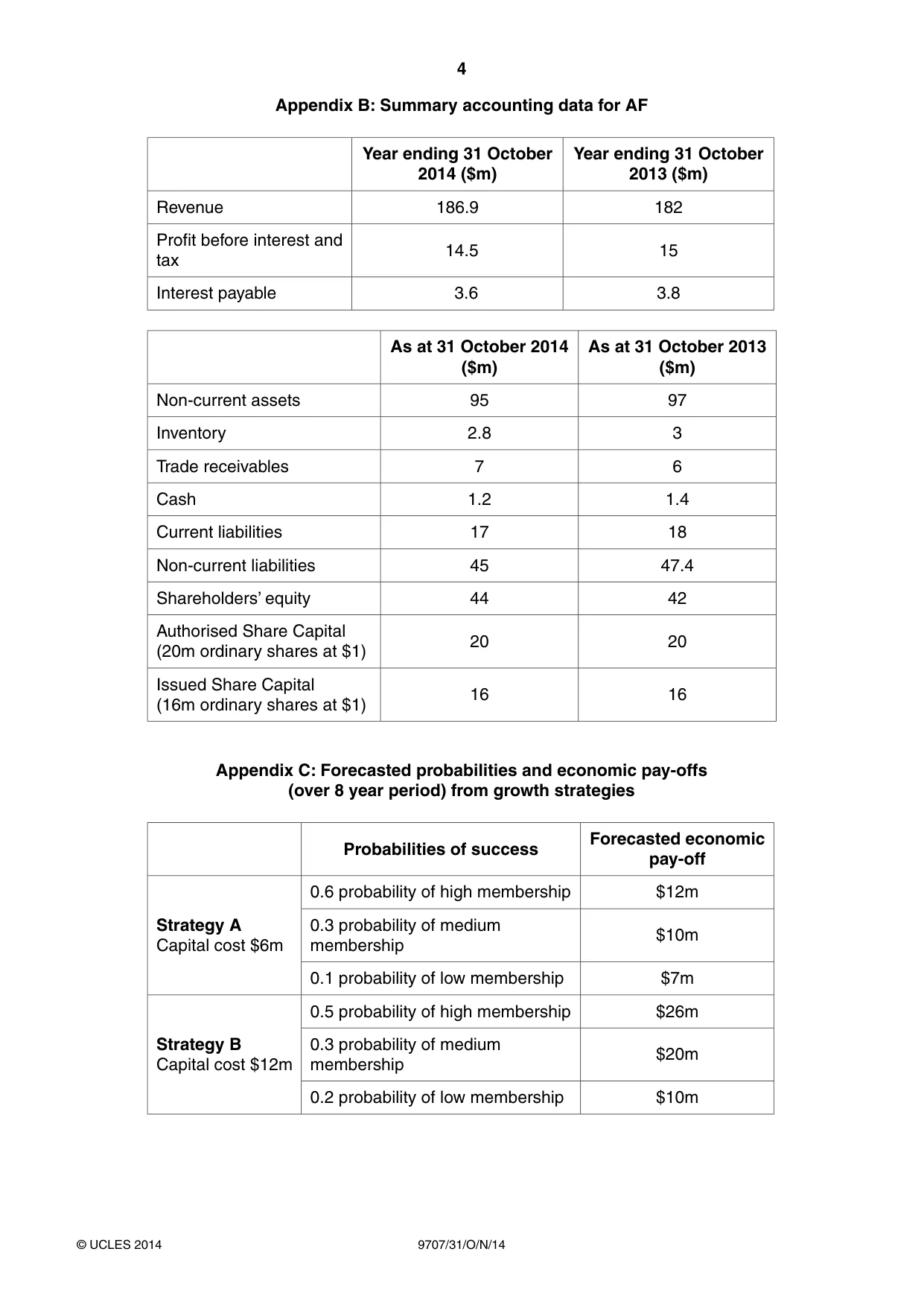
4 9707/31/O/N/14 © UCLES 2014 Appendix B: Summary accounting data for AF Year ending 31 October 2014 ($m) Year ending 31 October 2013 ($m) Revenue 186.9 182 Profit before interest and tax 14.5 15 Interest payable 3.6 3.8 As at 31 October 2014 ($m) As at 31 October 2013 ($m) Non-current assets 95 97 Inventory 2.8 3 Trade receivables 7 6 Cash 1.2 1.4 Current liabilities 17 18 Non-current liabilities 45 47.4 Shareholders’ equity 44 42 Authorised Share Capital (20m ordinary shares at $1) 20 20 Issued Share Capital (16m ordinary shares at $1) 16 16 Appendix C: Forecasted probabilities and economic pay-offs (over 8 year period) from growth strategies Probabilities of success Forecasted economic pay-off Strategy A Capital cost $6m 0.6 probability of high membership $12m 0.3 probability of medium membership $10m 0.1 probability of low membership $7m Strategy B Capital cost $12m 0.5 probability of high membership $26m 0.3 probability of medium membership $20m 0.2 probability of low membership $10m
Question paper, page 5
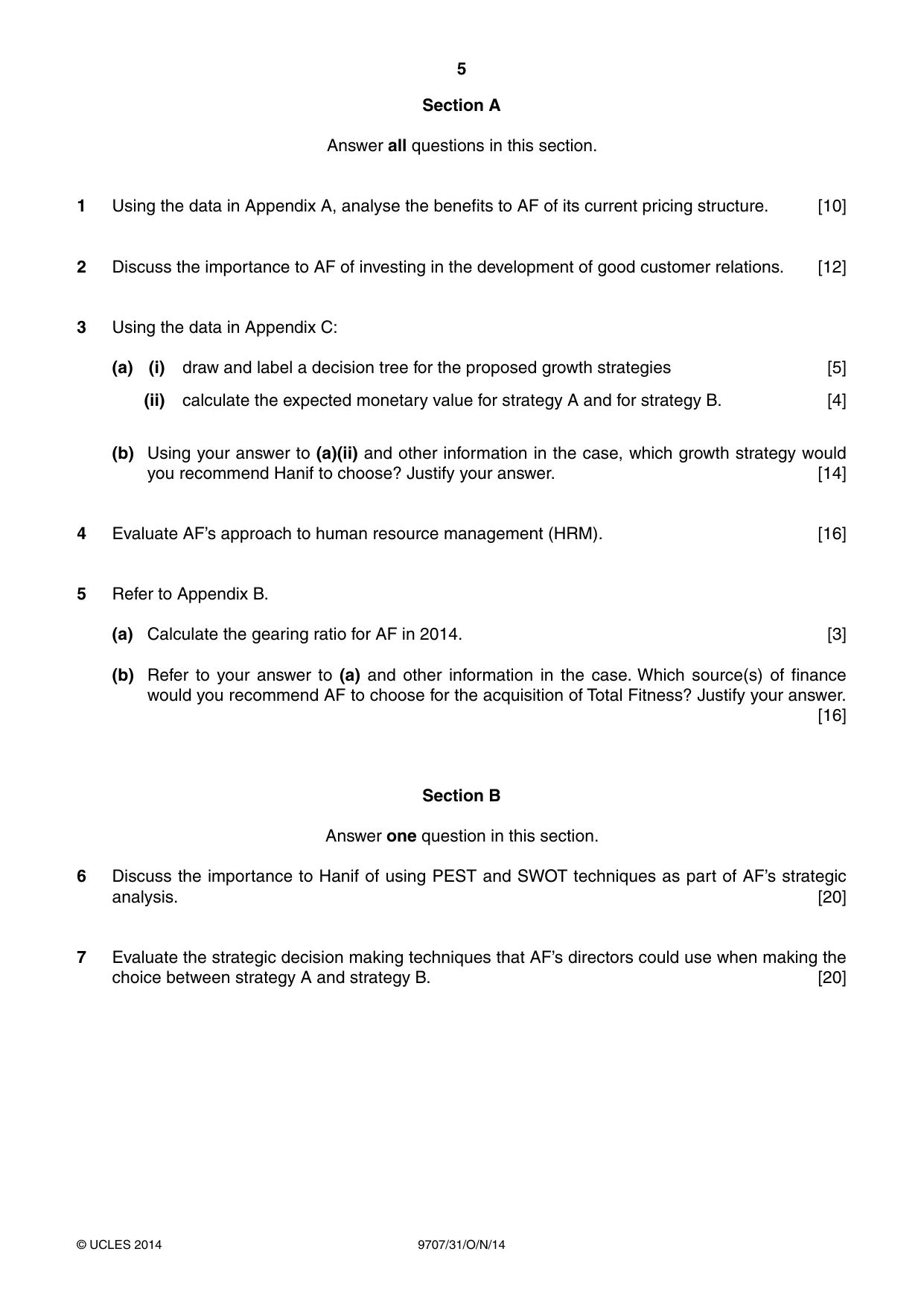
5 9707/31/O/N/14 © UCLES 2014 Section A Answer all questions in this section. 1 Using the data in Appendix A, analyse the benefits to AF of its current pricing structure. [10] 2 Discuss the importance to AF of investing in the development of good customer relations. [12] 3 Using the data in Appendix C: (a) (i) draw and label a decision tree for the proposed growth strategies [5] (ii) calculate the expected monetary value for strategy A and for strategy B. [4] (b) Using your answer to (a)(ii) and other information in the case, which growth strategy would you recommend Hanif to choose? Justify your answer. [14] 4 Evaluate AF’s approach to human resource management (HRM). [16] 5 Refer to Appendix B. (a) Calculate the gearing ratio for AF in 2014. [3] (b) Refer to your answer to (a) and other information in the case. Which source(s) of finance would you recommend AF to choose for the acquisition of Total Fitness? Justify your answer. [16] Section B Answer one question in this section. 6 Discuss the importance to Hanif of using PEST and SWOT techniques as part of AF’s strategic analysis. [20] 7 Evaluate the strategic decision making techniques that AF’s directors could use when making the choice between strategy A and strategy B. [20]
Question paper, page 6
6 9707/31/O/N/14 © UCLES 2014 BLANK PAGE
Question paper, page 7
7 9707/31/O/N/14 © UCLES 2014 BLANK PAGE
Question paper, page 8
8 9707/31/O/N/14 © UCLES 2014 Permission to reproduce items where third-party owned material protected by copyright is included has been sought and cleared where possible. Every reasonable effort has been made by the publisher (UCLES) to trace copyright holders, but if any items requiring clearance have unwittingly been included, the publisher will be pleased to make amends at the earliest possible opportunity. Cambridge International Examinations is part of the Cambridge Assessment Group. Cambridge Assessment is the brand name of University of Cambridge Local Examinations Syndicate (UCLES), which is itself a department of the University of Cambridge. BLANK PAGE
Mark scheme, page 1
® IGCSE is the registered trademark of Cambridge International Examinations. CAMBRIDGE INTERNATIONAL EXAMINATIONS Cambridge International Advanced Level MARK SCHEME for the October/November 2014 series 9707 BUSINESS STUDIES 9707/31 Paper 3 (Business Studies), maximum raw mark 100 This mark scheme is published as an aid to teachers and candidates, to indicate the requirements of the examination. It shows the basis on which Examiners were instructed to award marks. It does not indicate the details of the discussions that took place at an Examiners’ meeting before marking began, which would have considered the acceptability of alternative answers. Mark schemes should be read in conjunction with the question paper and the Principal Examiner Report for Teachers. Cambridge will not enter into discussions about these mark schemes. Cambridge is publishing the mark schemes for the October/November 2014 series for most Cambridge IGCSE®, Cambridge International A and AS Level components and some Cambridge O Level components.
Mark scheme, page 2
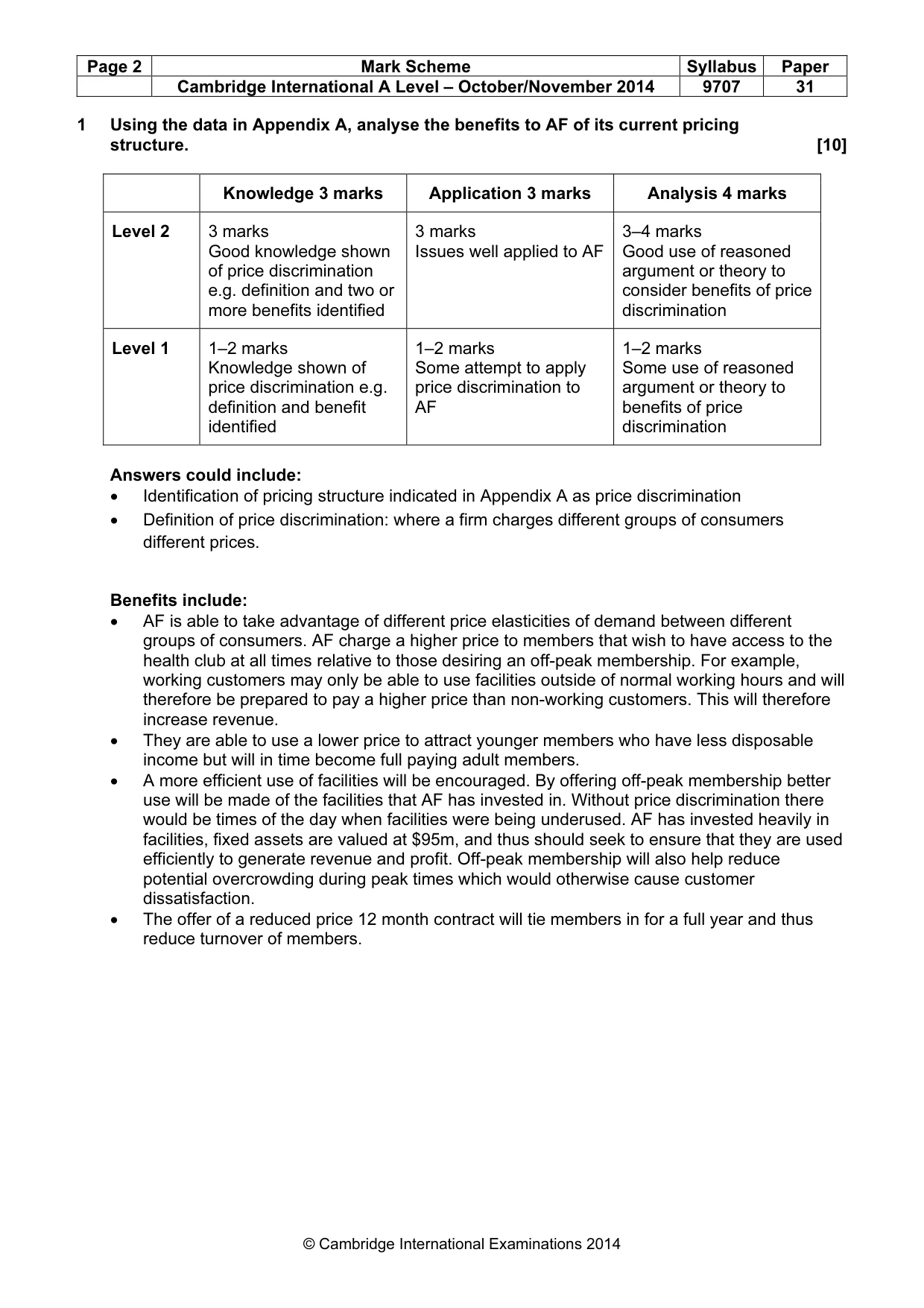
Page 2 Mark Scheme Syllabus Paper Cambridge International A Level – October/November 2014 9707 31 © Cambridge International Examinations 2014 1 Using the data in Appendix A, analyse the benefits to AF of its current pricing structure. [10] Knowledge 3 marks Application 3 marks Analysis 4 marks Level 2 3 marks Good knowledge shown of price discrimination e.g. definition and two or more benefits identified 3 marks Issues well applied to AF 3–4 marks Good use of reasoned argument or theory to consider benefits of price discrimination Level 1 1–2 marks Knowledge shown of price discrimination e.g. definition and benefit identified 1–2 marks Some attempt to apply price discrimination to AF 1–2 marks Some use of reasoned argument or theory to benefits of price discrimination Answers could include: • Identification of pricing structure indicated in Appendix A as price discrimination • Definition of price discrimination: where a firm charges different groups of consumers different prices. Benefits include: • AF is able to take advantage of different price elasticities of demand between different groups of consumers. AF charge a higher price to members that wish to have access to the health club at all times relative to those desiring an off-peak membership. For example, working customers may only be able to use facilities outside of normal working hours and will therefore be prepared to pay a higher price than non-working customers. This will therefore increase revenue. • They are able to use a lower price to attract younger members who have less disposable income but will in time become full paying adult members. • A more efficient use of facilities will be encouraged. By offering off-peak membership better use will be made of the facilities that AF has invested in. Without price discrimination there would be times of the day when facilities were being underused. AF has invested heavily in facilities, fixed assets are valued at $95m, and thus should seek to ensure that they are used efficiently to generate revenue and profit. Off-peak membership will also help reduce potential overcrowding during peak times which would otherwise cause customer dissatisfaction. • The offer of a reduced price 12 month contract will tie members in for a full year and thus reduce turnover of members.
Mark scheme, page 3
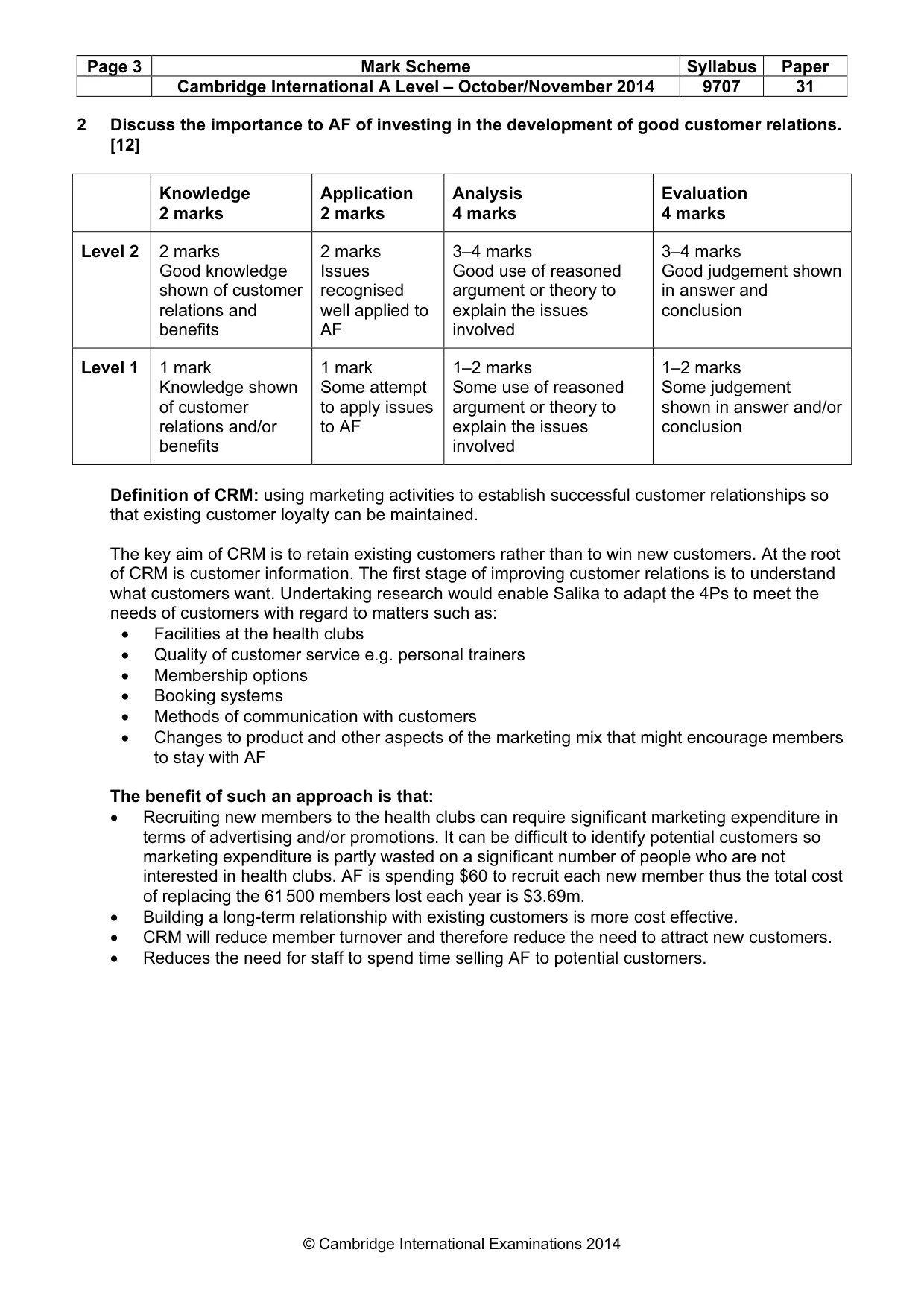
Page 3 Mark Scheme Syllabus Paper Cambridge International A Level – October/November 2014 9707 31 © Cambridge International Examinations 2014 2 Discuss the importance to AF of investing in the development of good customer relations. [12] Knowledge 2 marks Application 2 marks Analysis 4 marks Evaluation 4 marks Level 2 2 marks Good knowledge shown of customer relations and benefits 2 marks Issues recognised well applied to AF 3–4 marks Good use of reasoned argument or theory to explain the issues involved 3–4 marks Good judgement shown in answer and conclusion Level 1 1 mark Knowledge shown of customer relations and/or benefits 1 mark Some attempt to apply issues to AF 1–2 marks Some use of reasoned argument or theory to explain the issues involved 1–2 marks Some judgement shown in answer and/or conclusion Definition of CRM: using marketing activities to establish successful customer relationships so that existing customer loyalty can be maintained. The key aim of CRM is to retain existing customers rather than to win new customers. At the root of CRM is customer information. The first stage of improving customer relations is to understand what customers want. Undertaking research would enable Salika to adapt the 4Ps to meet the needs of customers with regard to matters such as: • Facilities at the health clubs • Quality of customer service e.g. personal trainers • Membership options • Booking systems • Methods of communication with customers • Changes to product and other aspects of the marketing mix that might encourage members to stay with AF The benefit of such an approach is that: • Recruiting new members to the health clubs can require significant marketing expenditure in terms of advertising and/or promotions. It can be difficult to identify potential customers so marketing expenditure is partly wasted on a significant number of people who are not interested in health clubs. AF is spending $60 to recruit each new member thus the total cost of replacing the 61 500 members lost each year is $3.69m. • Building a long-term relationship with existing customers is more cost effective. • CRM will reduce member turnover and therefore reduce the need to attract new customers. • Reduces the need for staff to spend time selling AF to potential customers.
Mark scheme, page 4
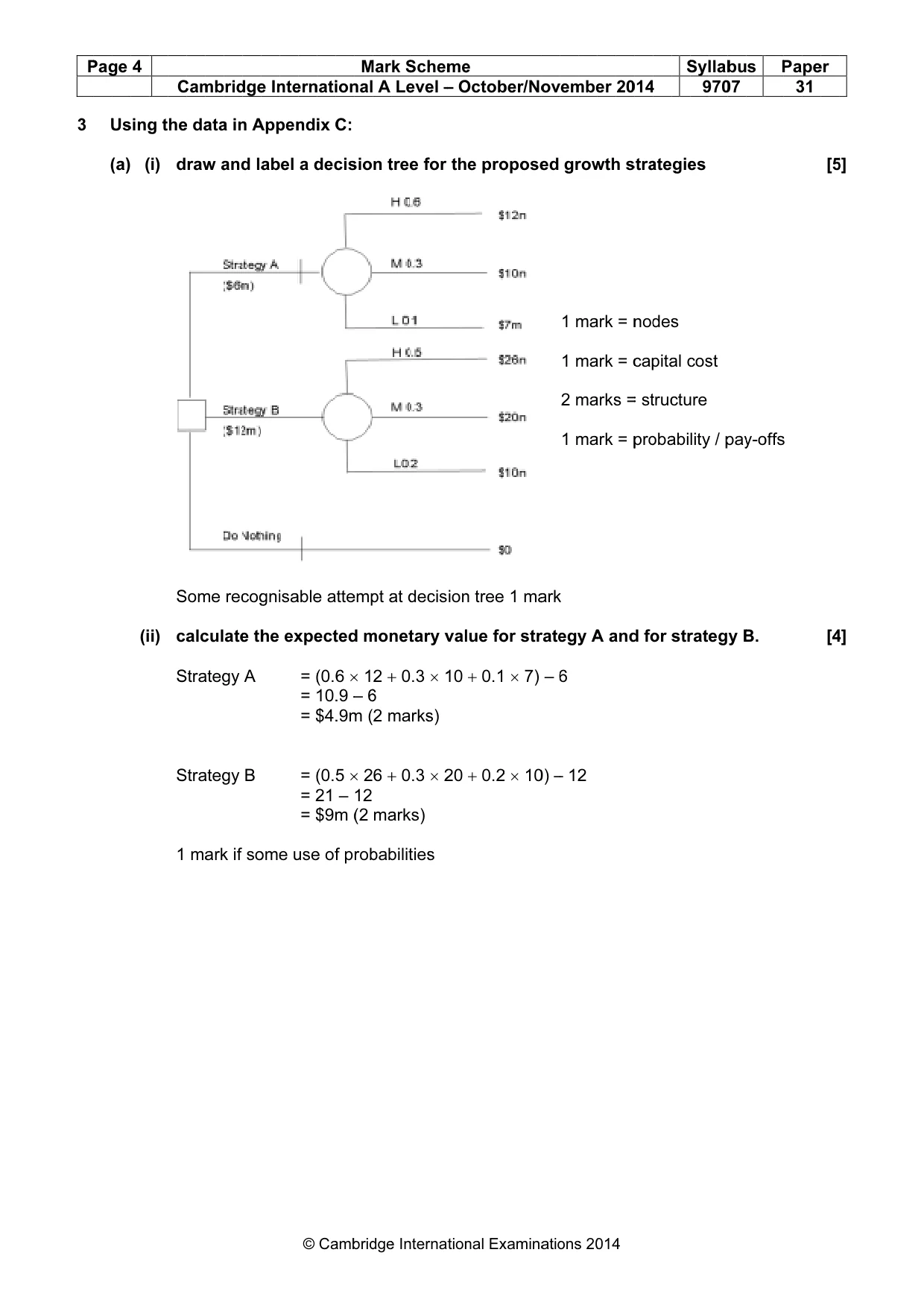
P 3 Pag U ( ge Us (a) 4 sing ( (i g t (i) i) C he d S ca S S 1 Cam e da raw om alc tra tra ma mb ata w a me cul ateg ateg ark rid a in and rec ate gy gy k if dge n A d la cog e th A B so e In App ab gni he ome nte pen el isa ex e u ern © ndi a d able xpe = ( = 1 = $ = ( = 2 = $ use nati Ca ix C dec e a ect (0.6 10. $4. (0.5 21 $9m e of ion amb C: cis tte ted 6 × .9 – .9m 5 × – m ( f p M nal brid sio emp d m × 1 – 6 m ( × 2 12 (2 rob Mar A dge n t pt a mon 2 + 6 2 m 6 + ma bab k S Le e In tree at d net + 0 ma + 0 ark bilit Sch eve nter e f dec tar .3 rks .3 ks) ties hem el – rnat for cis ry v × 1 s) × 2 s me – O tion th ion val 10 20 e Oct nal e p n tr lue + 0 + 0 tob Ex pro ree e fo 0.1 0.2 ber xam opo 1 or s × 2 × r/No mina ose ma str 7) 10 ov atio ed ark rate – 6 0) – vem ons gr 1 m 1 m 2 m 1 m k egy 6 – 12 mbe s 20 row ma ma ma ma y A 2 er 014 wth ark ark arks ark A a 20 4 h s = n = c s = = p and 014 stra nod cap = st pro d fo 4 ate des pita truc oba or s S gie s al c ctu abi str Syl 9 es cos ure lity rate llab 970 st y / p eg bu 07 pay y B s y-o B. P offs Pa 3 s pe 31 er [5 [4 5] 4]
Mark scheme, page 5
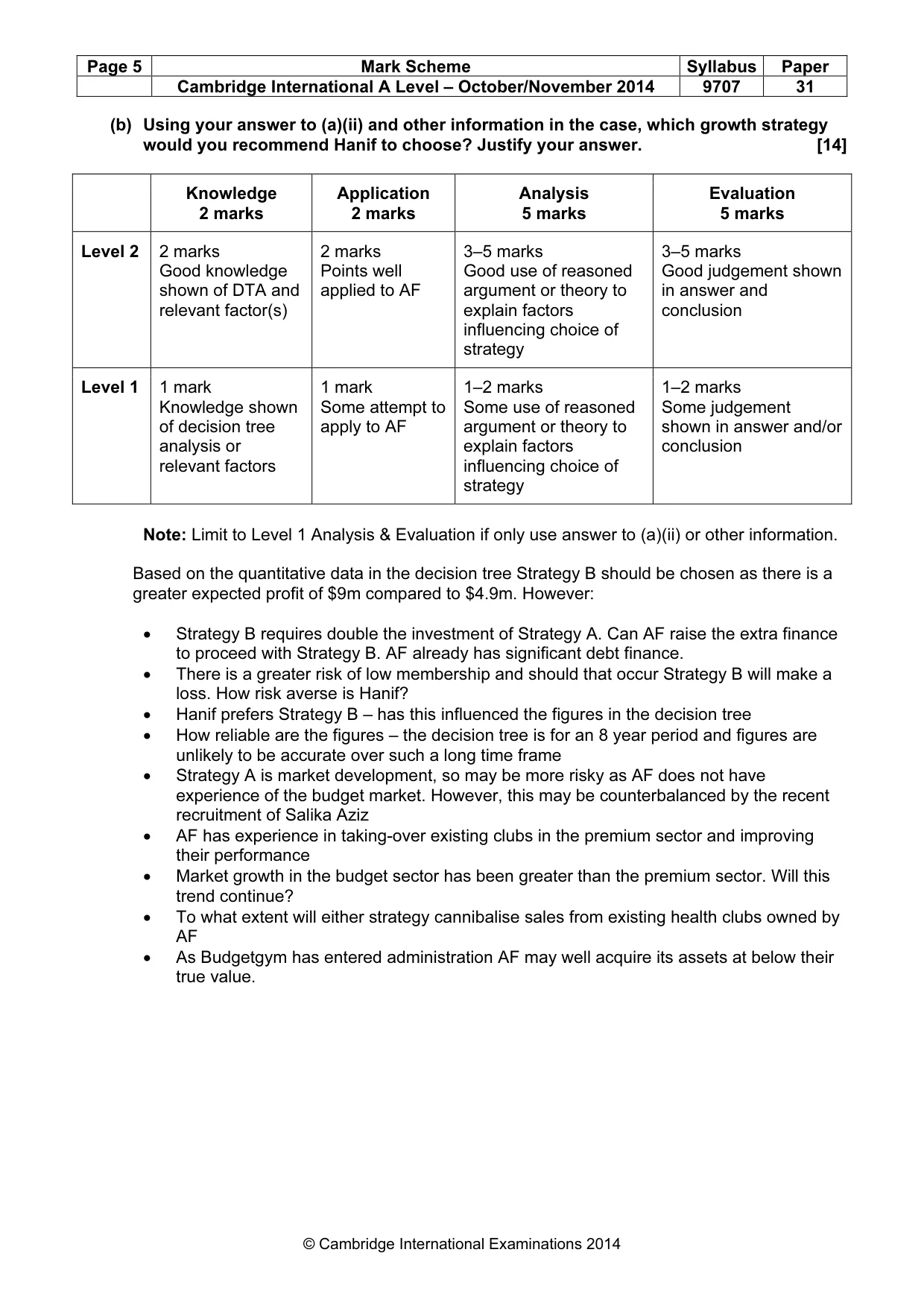
Page 5 Mark Scheme Syllabus Paper Cambridge International A Level – October/November 2014 9707 31 © Cambridge International Examinations 2014 (b) Using your answer to (a)(ii) and other information in the case, which growth strategy would you recommend Hanif to choose? Justify your answer. [14] Knowledge 2 marks Application 2 marks Analysis 5 marks Evaluation 5 marks Level 2 2 marks Good knowledge shown of DTA and relevant factor(s) 2 marks Points well applied to AF 3–5 marks Good use of reasoned argument or theory to explain factors influencing choice of strategy 3–5 marks Good judgement shown in answer and conclusion Level 1 1 mark Knowledge shown of decision tree analysis or relevant factors 1 mark Some attempt to apply to AF 1–2 marks Some use of reasoned argument or theory to explain factors influencing choice of strategy 1–2 marks Some judgement shown in answer and/or conclusion Note: Limit to Level 1 Analysis & Evaluation if only use answer to (a)(ii) or other information. Based on the quantitative data in the decision tree Strategy B should be chosen as there is a greater expected profit of $9m compared to $4.9m. However: • Strategy B requires double the investment of Strategy A. Can AF raise the extra finance to proceed with Strategy B. AF already has significant debt finance. • There is a greater risk of low membership and should that occur Strategy B will make a loss. How risk averse is Hanif? • Hanif prefers Strategy B – has this influenced the figures in the decision tree • How reliable are the figures – the decision tree is for an 8 year period and figures are unlikely to be accurate over such a long time frame • Strategy A is market development, so may be more risky as AF does not have experience of the budget market. However, this may be counterbalanced by the recent recruitment of Salika Aziz • AF has experience in taking-over existing clubs in the premium sector and improving their performance • Market growth in the budget sector has been greater than the premium sector. Will this trend continue? • To what extent will either strategy cannibalise sales from existing health clubs owned by AF • As Budgetgym has entered administration AF may well acquire its assets at below their true value.
Mark scheme, page 6
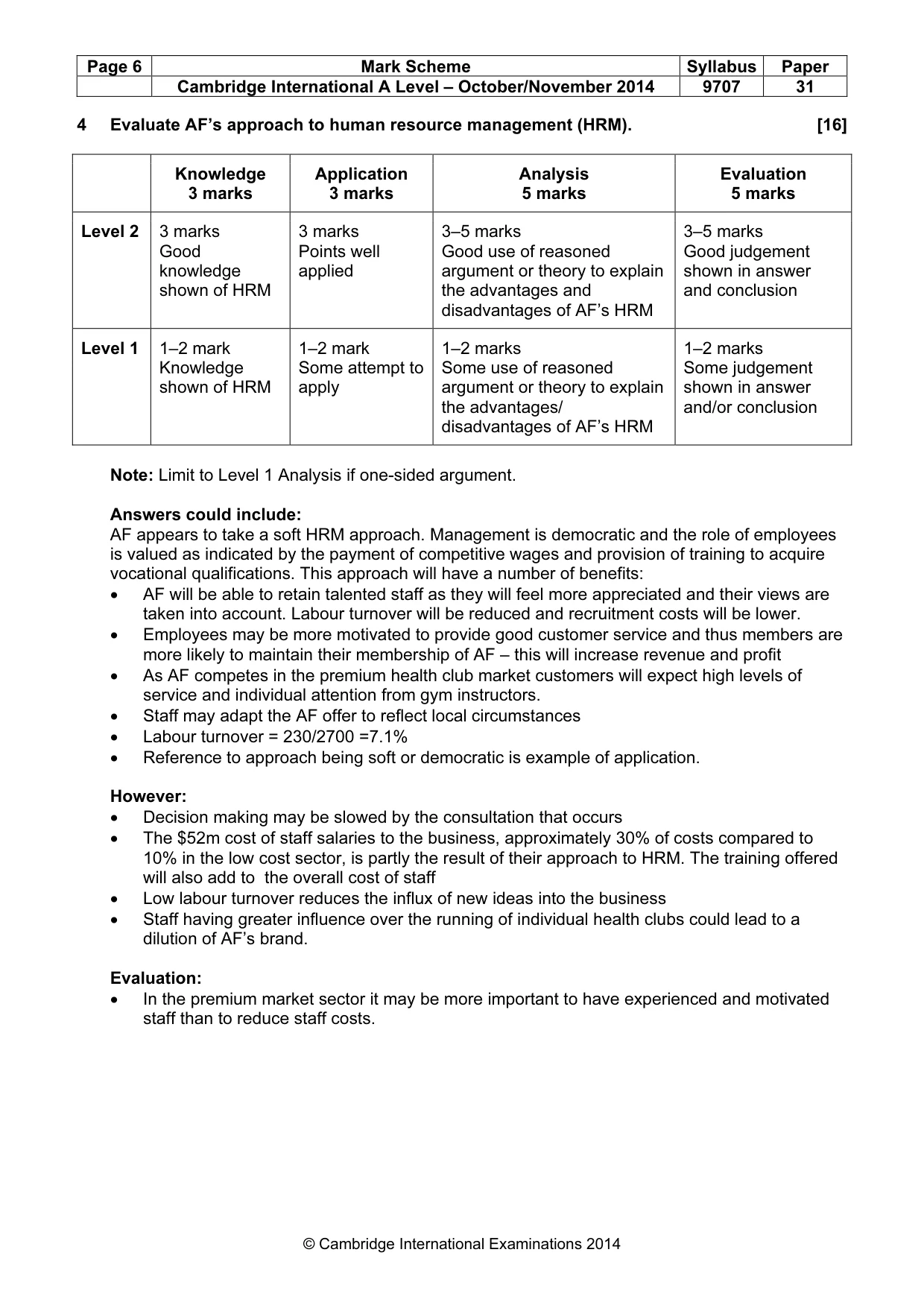
Page 6 Mark Scheme Syllabus Paper Cambridge International A Level – October/November 2014 9707 31 © Cambridge International Examinations 2014 4 Evaluate AF’s approach to human resource management (HRM). [16] Knowledge 3 marks Application 3 marks Analysis 5 marks Evaluation 5 marks Level 2 3 marks Good knowledge shown of HRM 3 marks Points well applied 3–5 marks Good use of reasoned argument or theory to explain the advantages and disadvantages of AF’s HRM 3–5 marks Good judgement shown in answer and conclusion Level 1 1–2 mark Knowledge shown of HRM 1–2 mark Some attempt to apply 1–2 marks Some use of reasoned argument or theory to explain the advantages/ disadvantages of AF’s HRM 1–2 marks Some judgement shown in answer and/or conclusion Note: Limit to Level 1 Analysis if one-sided argument. Answers could include: AF appears to take a soft HRM approach. Management is democratic and the role of employees is valued as indicated by the payment of competitive wages and provision of training to acquire vocational qualifications. This approach will have a number of benefits: • AF will be able to retain talented staff as they will feel more appreciated and their views are taken into account. Labour turnover will be reduced and recruitment costs will be lower. • Employees may be more motivated to provide good customer service and thus members are more likely to maintain their membership of AF – this will increase revenue and profit • As AF competes in the premium health club market customers will expect high levels of service and individual attention from gym instructors. • Staff may adapt the AF offer to reflect local circumstances • Labour turnover = 230/2700 =7.1% • Reference to approach being soft or democratic is example of application. However: • Decision making may be slowed by the consultation that occurs • The $52m cost of staff salaries to the business, approximately 30% of costs compared to 10% in the low cost sector, is partly the result of their approach to HRM. The training offered will also add to the overall cost of staff • Low labour turnover reduces the influx of new ideas into the business • Staff having greater influence over the running of individual health clubs could lead to a dilution of AF’s brand. Evaluation: • In the premium market sector it may be more important to have experienced and motivated staff than to reduce staff costs.
Mark scheme, page 7
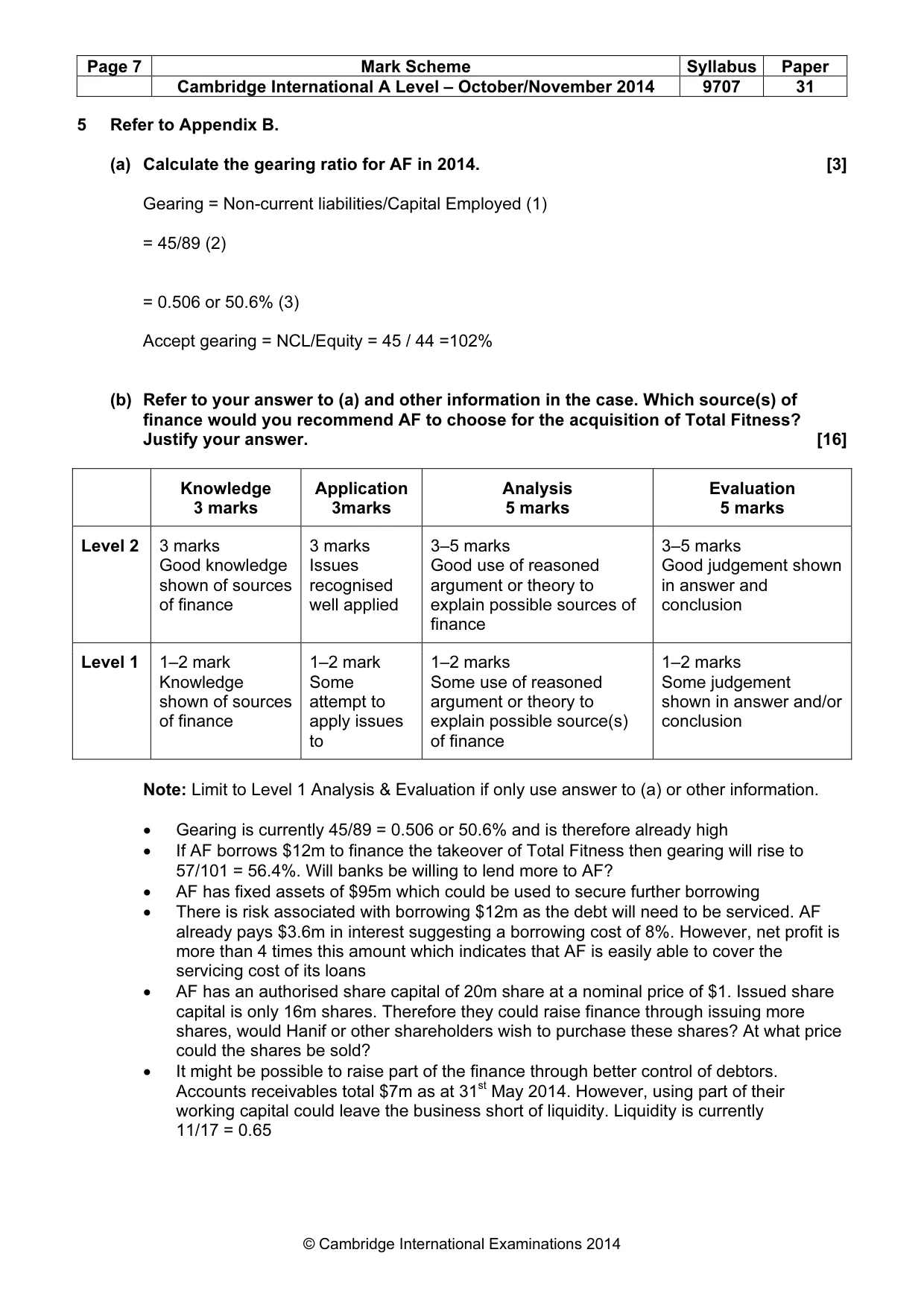
Page 7 Mark Scheme Syllabus Paper Cambridge International A Level – October/November 2014 9707 31 © Cambridge International Examinations 2014 5 Refer to Appendix B. (a) Calculate the gearing ratio for AF in 2014. [3] Gearing = Non-current liabilities/Capital Employed (1) = 45/89 (2) = 0.506 or 50.6% (3) Accept gearing = NCL/Equity = 45 / 44 =102% (b) Refer to your answer to (a) and other information in the case. Which source(s) of finance would you recommend AF to choose for the acquisition of Total Fitness? Justify your answer. [16] Knowledge 3 marks Application 3marks Analysis 5 marks Evaluation 5 marks Level 2 3 marks Good knowledge shown of sources of finance 3 marks Issues recognised well applied 3–5 marks Good use of reasoned argument or theory to explain possible sources of finance 3–5 marks Good judgement shown in answer and conclusion Level 1 1–2 mark Knowledge shown of sources of finance 1–2 mark Some attempt to apply issues to 1–2 marks Some use of reasoned argument or theory to explain possible source(s) of finance 1–2 marks Some judgement shown in answer and/or conclusion Note: Limit to Level 1 Analysis & Evaluation if only use answer to (a) or other information. • Gearing is currently 45/89 = 0.506 or 50.6% and is therefore already high • If AF borrows $12m to finance the takeover of Total Fitness then gearing will rise to 57/101 = 56.4%. Will banks be willing to lend more to AF? • AF has fixed assets of $95m which could be used to secure further borrowing • There is risk associated with borrowing $12m as the debt will need to be serviced. AF already pays $3.6m in interest suggesting a borrowing cost of 8%. However, net profit is more than 4 times this amount which indicates that AF is easily able to cover the servicing cost of its loans • AF has an authorised share capital of 20m share at a nominal price of $1. Issued share capital is only 16m shares. Therefore they could raise finance through issuing more shares, would Hanif or other shareholders wish to purchase these shares? At what price could the shares be sold? • It might be possible to raise part of the finance through better control of debtors. Accounts receivables total $7m as at 31st May 2014. However, using part of their working capital could leave the business short of liquidity. Liquidity is currently 11/17 = 0.65
Mark scheme, page 8
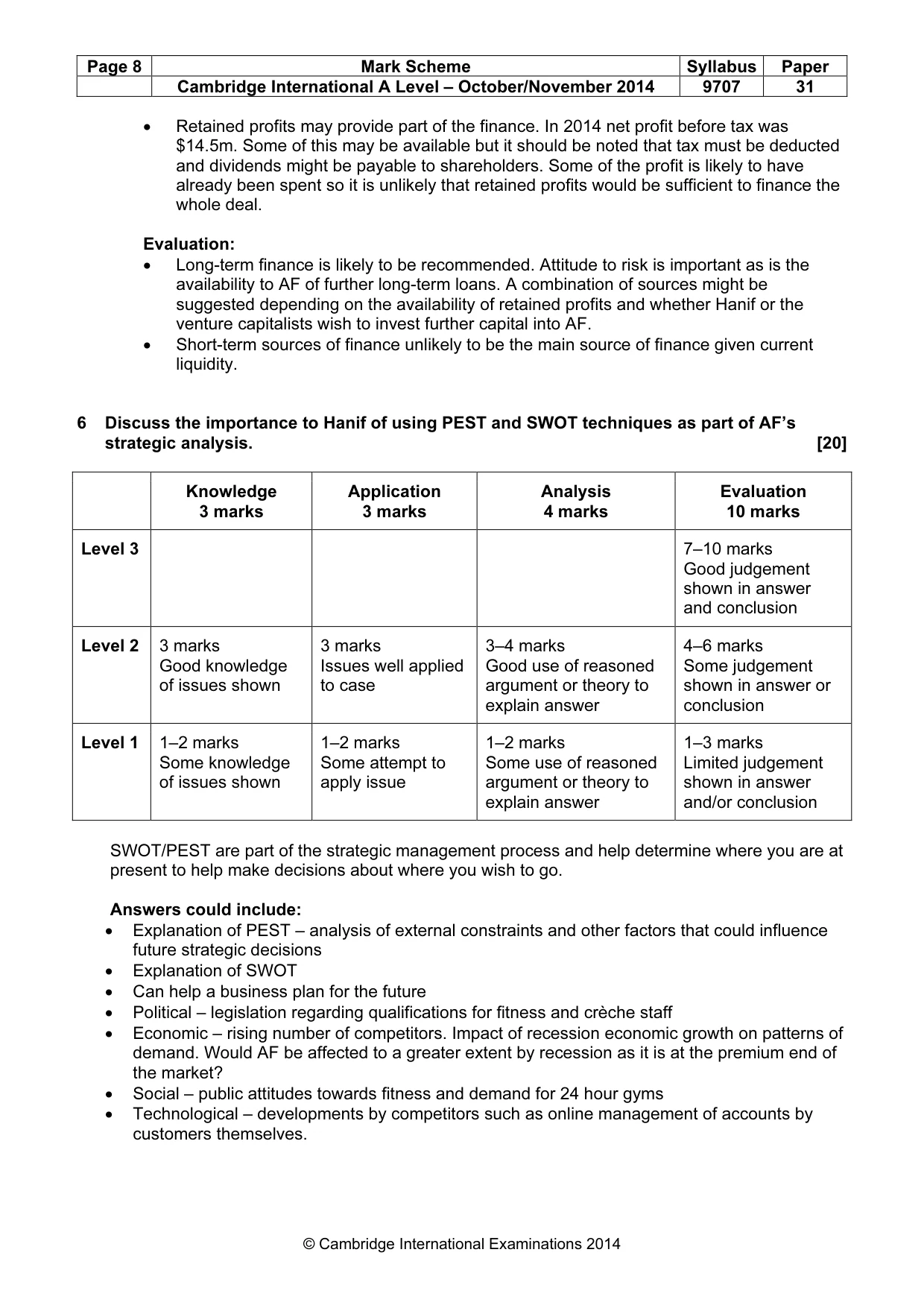
Page 8 Mark Scheme Syllabus Paper Cambridge International A Level – October/November 2014 9707 31 © Cambridge International Examinations 2014 • Retained profits may provide part of the finance. In 2014 net profit before tax was $14.5m. Some of this may be available but it should be noted that tax must be deducted and dividends might be payable to shareholders. Some of the profit is likely to have already been spent so it is unlikely that retained profits would be sufficient to finance the whole deal. Evaluation: • Long-term finance is likely to be recommended. Attitude to risk is important as is the availability to AF of further long-term loans. A combination of sources might be suggested depending on the availability of retained profits and whether Hanif or the venture capitalists wish to invest further capital into AF. • Short-term sources of finance unlikely to be the main source of finance given current liquidity. 6 Discuss the importance to Hanif of using PEST and SWOT techniques as part of AF’s strategic analysis. [20] Knowledge 3 marks Application 3 marks Analysis 4 marks Evaluation 10 marks Level 3 7–10 marks Good judgement shown in answer and conclusion Level 2 3 marks Good knowledge of issues shown 3 marks Issues well applied to case 3–4 marks Good use of reasoned argument or theory to explain answer 4–6 marks Some judgement shown in answer or conclusion Level 1 1–2 marks Some knowledge of issues shown 1–2 marks Some attempt to apply issue 1–2 marks Some use of reasoned argument or theory to explain answer 1–3 marks Limited judgement shown in answer and/or conclusion SWOT/PEST are part of the strategic management process and help determine where you are at present to help make decisions about where you wish to go. Answers could include: • Explanation of PEST – analysis of external constraints and other factors that could influence future strategic decisions • Explanation of SWOT • Can help a business plan for the future • Political – legislation regarding qualifications for fitness and crèche staff • Economic – rising number of competitors. Impact of recession economic growth on patterns of demand. Would AF be affected to a greater extent by recession as it is at the premium end of the market? • Social – public attitudes towards fitness and demand for 24 hour gyms • Technological – developments by competitors such as online management of accounts by customers themselves.
Mark scheme, page 9
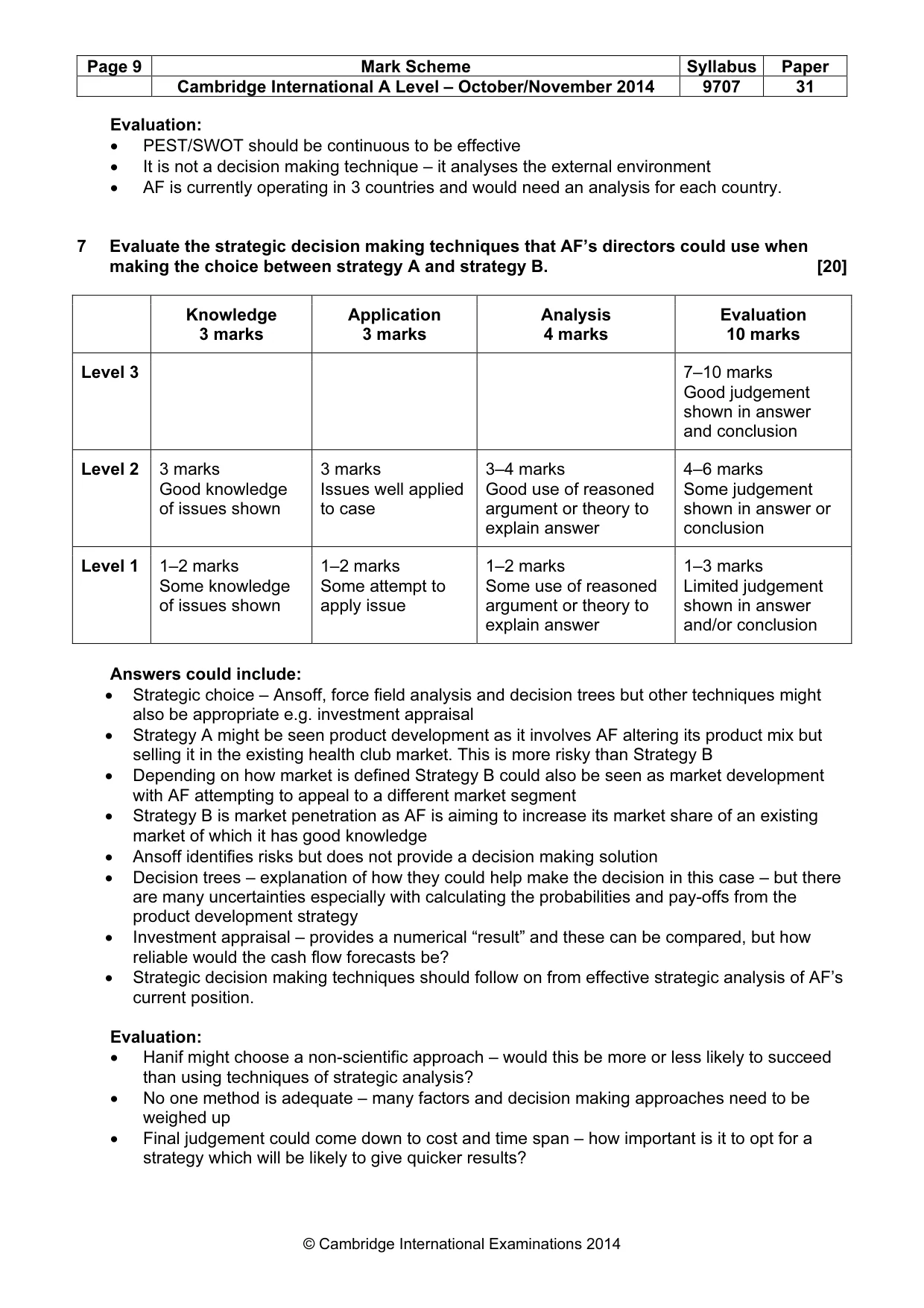
Page 9 Mark Scheme Syllabus Paper Cambridge International A Level – October/November 2014 9707 31 © Cambridge International Examinations 2014 Evaluation: • PEST/SWOT should be continuous to be effective • It is not a decision making technique – it analyses the external environment • AF is currently operating in 3 countries and would need an analysis for each country. 7 Evaluate the strategic decision making techniques that AF’s directors could use when making the choice between strategy A and strategy B. [20] Knowledge 3 marks Application 3 marks Analysis 4 marks Evaluation 10 marks Level 3 7–10 marks Good judgement shown in answer and conclusion Level 2 3 marks Good knowledge of issues shown 3 marks Issues well applied to case 3–4 marks Good use of reasoned argument or theory to explain answer 4–6 marks Some judgement shown in answer or conclusion Level 1 1–2 marks Some knowledge of issues shown 1–2 marks Some attempt to apply issue 1–2 marks Some use of reasoned argument or theory to explain answer 1–3 marks Limited judgement shown in answer and/or conclusion Answers could include: • Strategic choice – Ansoff, force field analysis and decision trees but other techniques might also be appropriate e.g. investment appraisal • Strategy A might be seen product development as it involves AF altering its product mix but selling it in the existing health club market. This is more risky than Strategy B • Depending on how market is defined Strategy B could also be seen as market development with AF attempting to appeal to a different market segment • Strategy B is market penetration as AF is aiming to increase its market share of an existing market of which it has good knowledge • Ansoff identifies risks but does not provide a decision making solution • Decision trees – explanation of how they could help make the decision in this case – but there are many uncertainties especially with calculating the probabilities and pay-offs from the product development strategy • Investment appraisal – provides a numerical “result” and these can be compared, but how reliable would the cash flow forecasts be? • Strategic decision making techniques should follow on from effective strategic analysis of AF’s current position. Evaluation: • Hanif might choose a non-scientific approach – would this be more or less likely to succeed than using techniques of strategic analysis? • No one method is adequate – many factors and decision making approaches need to be weighed up • Final judgement could come down to cost and time span – how important is it to opt for a strategy which will be likely to give quicker results?
What you needed in this session
Cambridge’s own grade thresholds for 2014 Oct/Nov, Paper 3 · Variant 1. A higher threshold means an easier paper — the bar moves with how the cohort did.