Cambridge A Level Business Studies (for final examination in 2015) 9707 — 2015 May/June Paper 3 · Variant 1
9707/31/M/J/15 · 7 questions · 100 marks · ≈113 min
The question paper and its mark scheme, free to read here and free to download. This is Cambridge’s own paper, exactly as it was sat.
Question paper8 pages



Mark scheme9 pages
Answers below. Sit the paper first if you are practising.
Questions as text
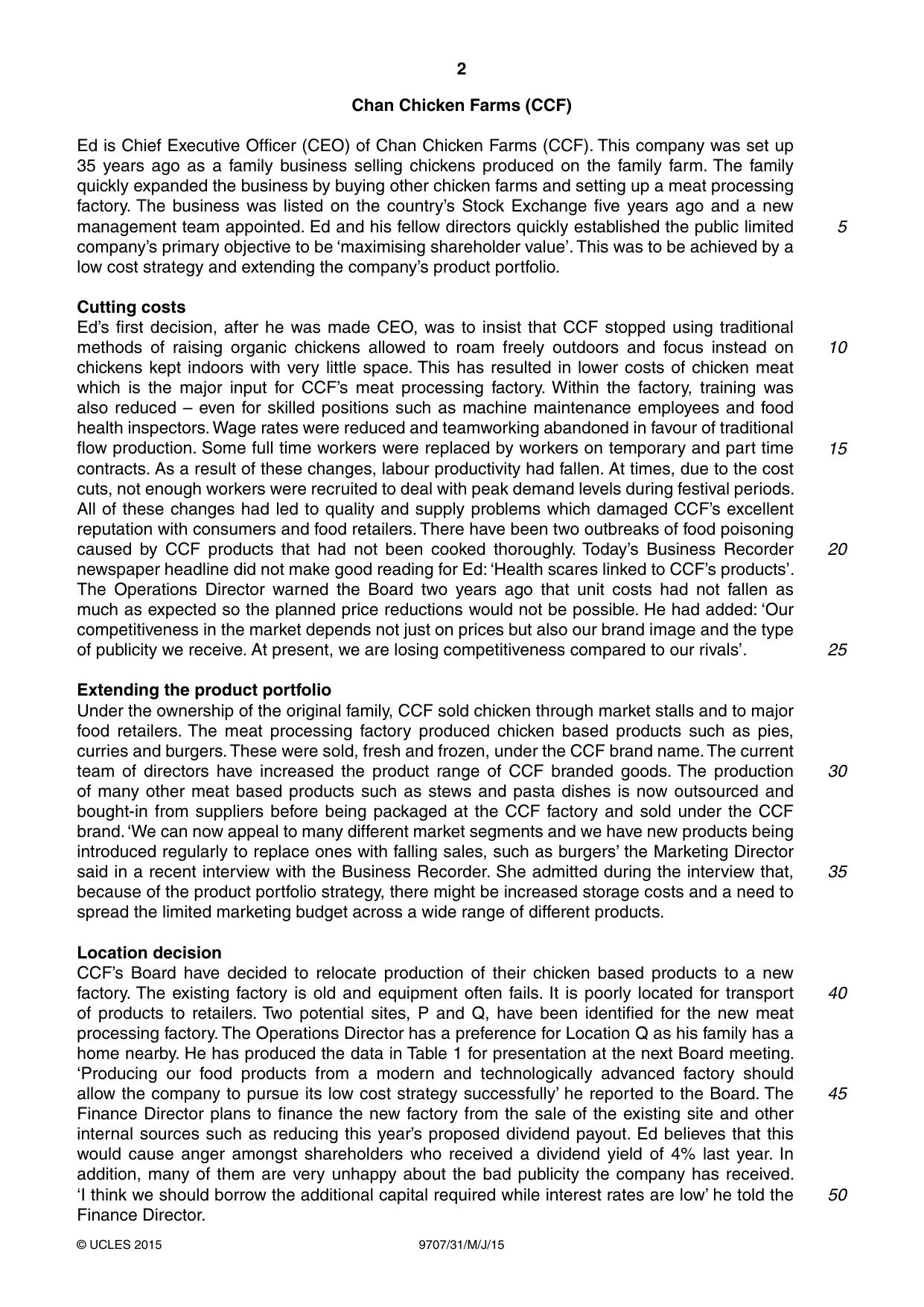
Q1 · Analyse the benefits and limitations to CCF of an extensive product portfolio
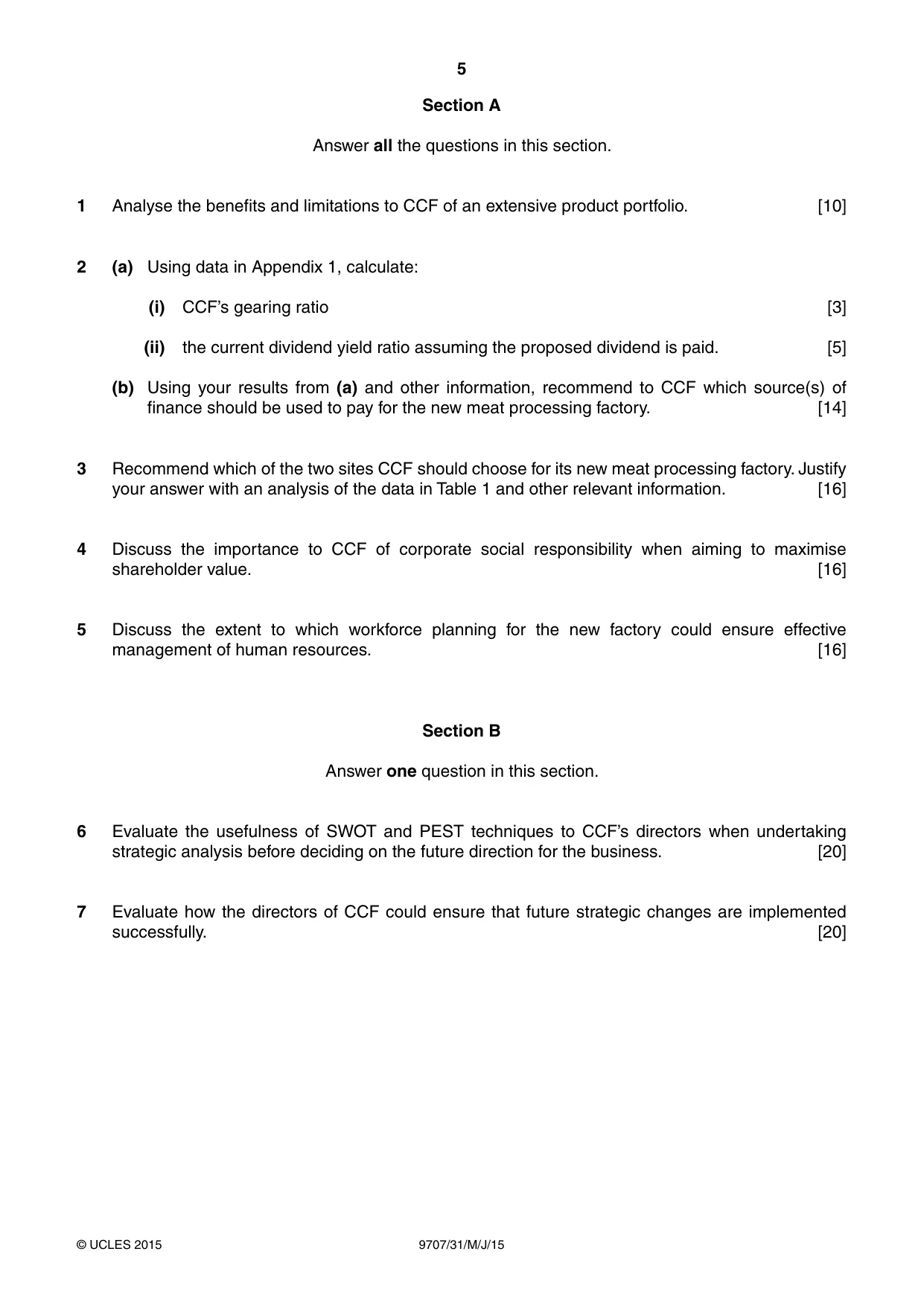
1 Analyse the benefits and limitations to CCF of an extensive product portfolio. [10]
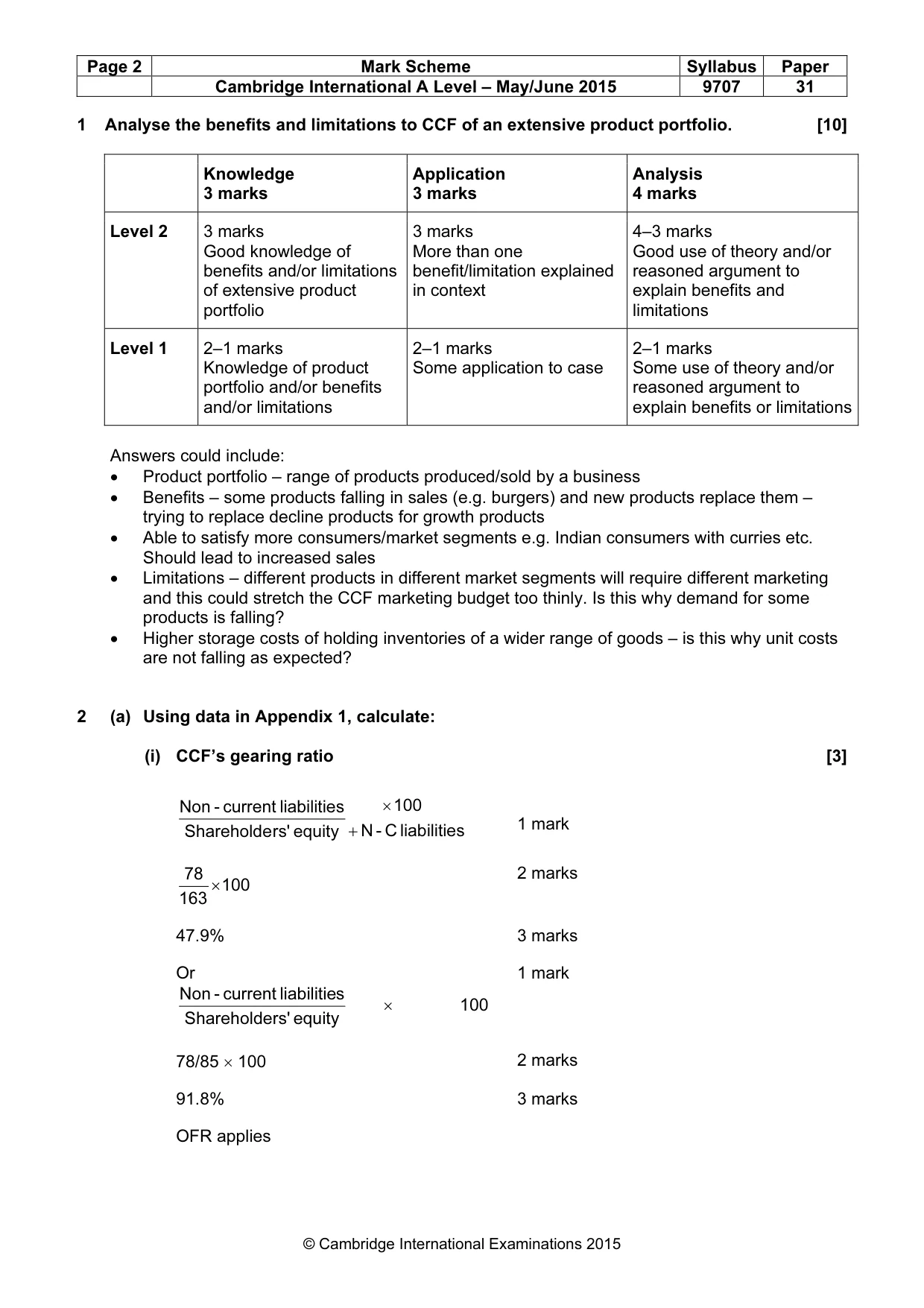
Mark scheme: 1 Analyse the benefits and limitations to CCF of an extensive product portfolio. [10] Knowledge Application Analysis 3 marks 3 marks 4 marks Level 2 3 marks 3 marks 4–3 marks Good knowledge of More than one Good use of theory and/or benefits and/or limitations benefit/limitation explained reasoned argument to of extensive product in context explain benefits and portfolio limitations Level 1 2–1 marks 2–1 marks 2–1 marks Knowledge of product Some application to case Some use of theory and/or portfolio and/or benefits reasoned argument to and/or limitations explain benefits or limitations Answers could include: • Product portfolio – range of products produced/sold by a business • Benefits – some products falling in sales (e.g. burgers) and new products replace them – trying to replace decline products for growth products • Able to satisfy more consumers/market segments e.g. Indian consumers with curries etc. Should lead to increased sales • Limitations – different products in different market segments will require different marketing and this could stretch the CCF marketing budget too thinly. Is this why demand for some products is falling? • Higher storage costs of holding inventories of a wider range of goods – is this why unit costs are not falling as expected?
Q2 · Using data in Appendix 1, calculate: (i) CCF’s gearing ratio [3] (ii) the current…
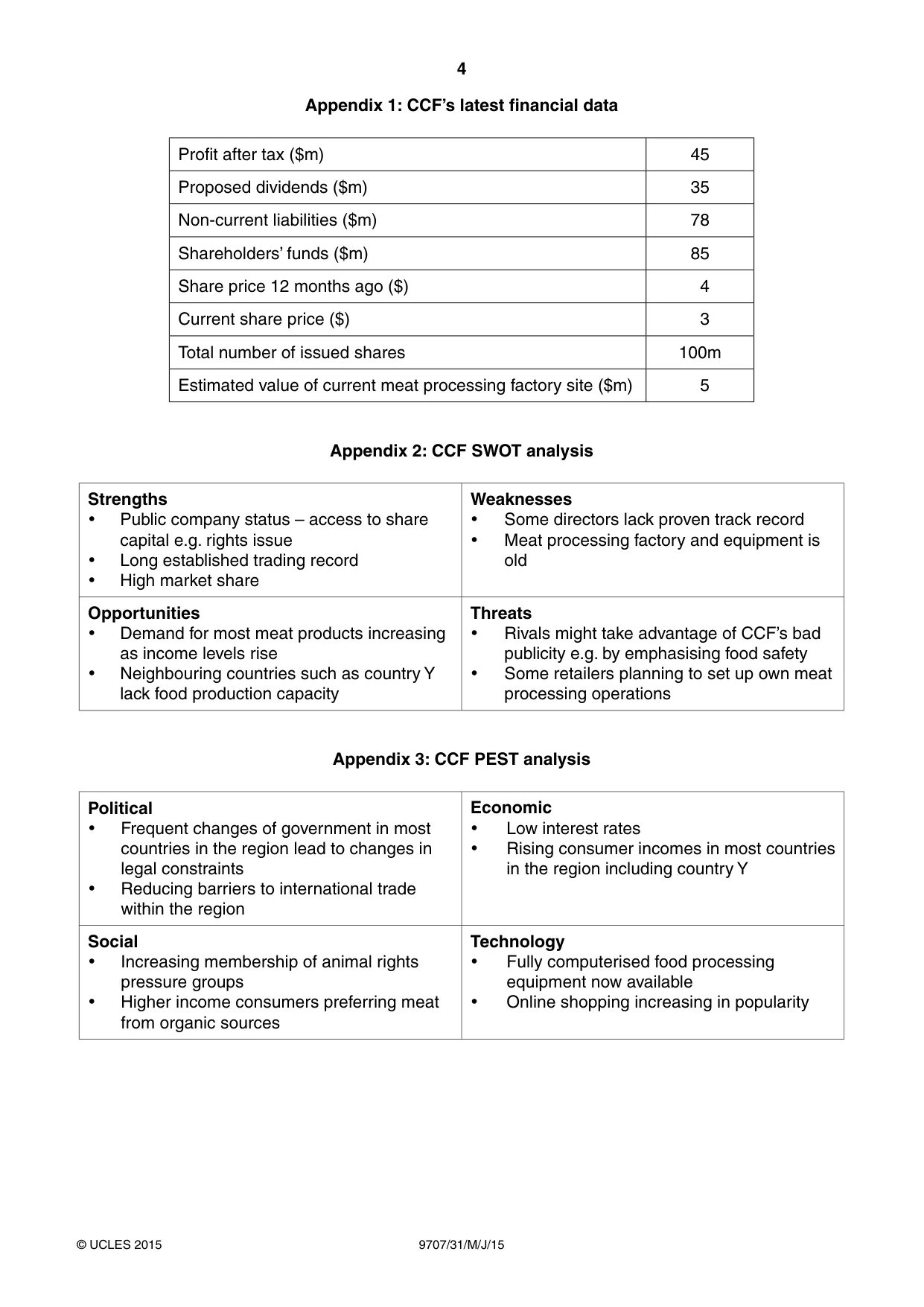
2 (a) Using data in Appendix 1, calculate: (i) CCF’s gearing ratio [3] (ii) the current dividend yield ratio assuming the proposed dividend is paid. [5] (b) Using your results from (a) and other information, recommend to CCF which source(s) of finance should be used to pay for the new meat processing factory. [14]
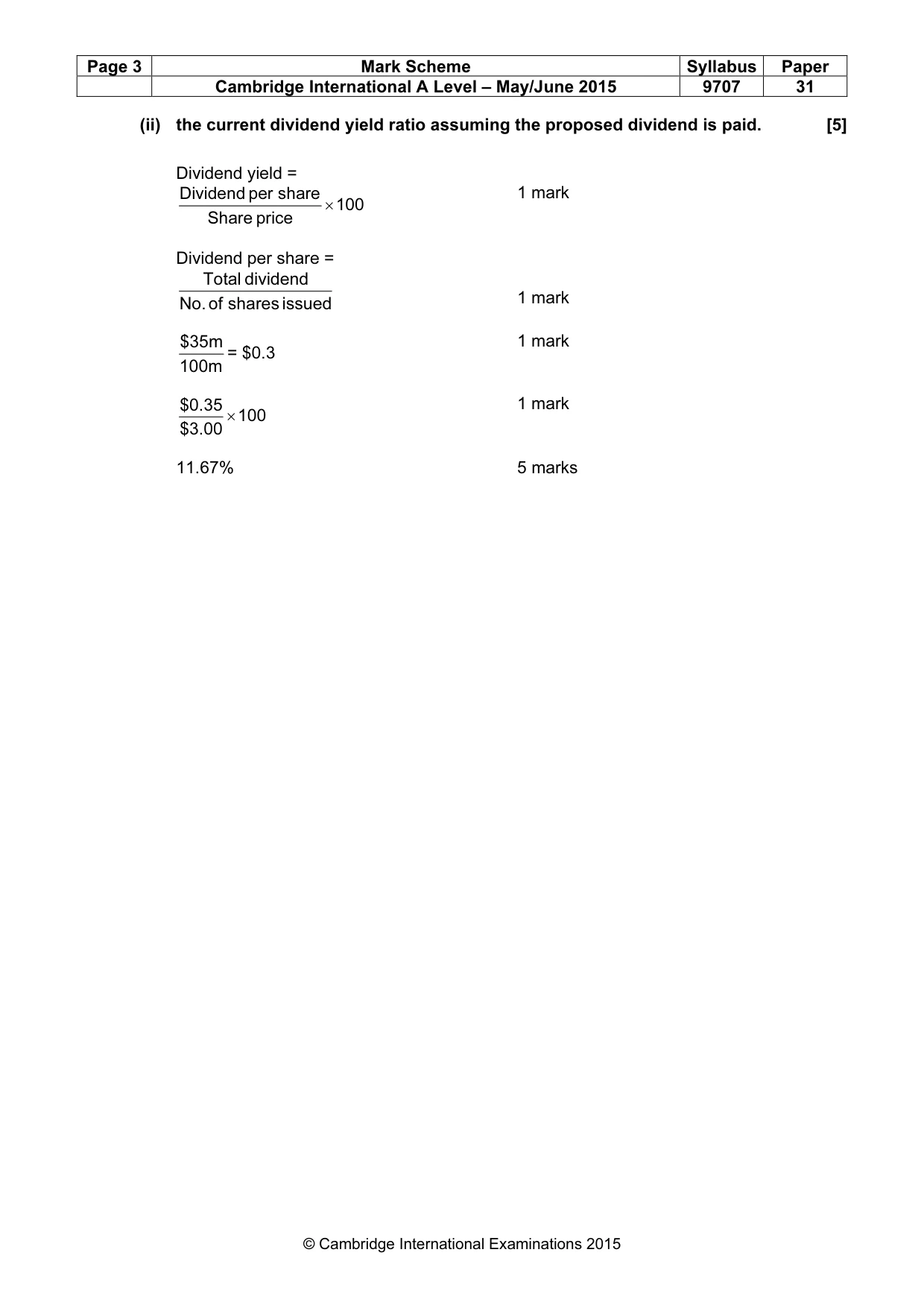
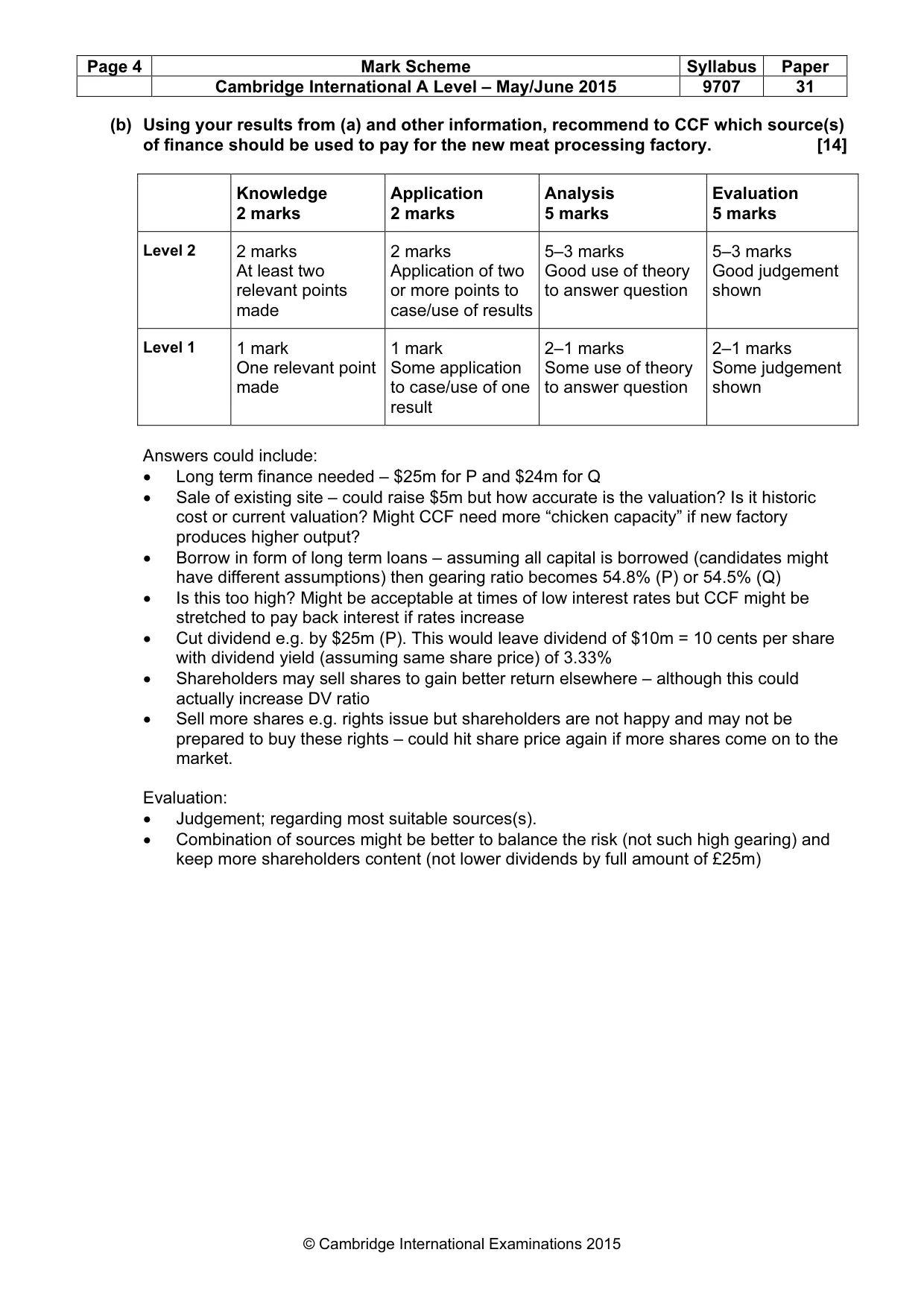
Mark scheme: 2 (a) Using data in Appendix 1, calculate: (i) CCF’s gearing ratio [3] Non - current liabilitie s × 100 Shareholde rs' equity + N - C liabilitie s 1 mark 78 2 marks × 100 163 47.9% 3 marks Or 1 mark Non - current liabilities × 100 Shareholde rs' equity 78/85 × 100 2 marks 91.8% 3 marks OFR applies (ii) the current dividend yield ratio assuming the proposed dividend is paid. [5] Dividend yield = Dividend per share 1 mark × 100 Share price Dividend per share = Total dividend No. of shares issued 1 mark $35m 1 mark = $0.3 100m $0.35 1 mark × 100 $3.00 11.67% 5 marks (b) Using your results from (a) and other information, recommend to CCF which source(s) of finance should be used to pay for the new meat processing factory. [14] Knowledge Application Analysis Evaluation 2 marks 2 marks 5 marks 5 marks Level 2 2 marks 2 marks 5–3 marks 5–3 marks At least two Application of two Good use of theory Good judgement relevant points or more points to to answer question shown made case/use of results Level 1 1 mark 1 mark 2–1 marks 2–1 marks One relevant point Some application Some use of theory Some judgement made to case/use of one to answer question shown result Answers could include: • Long term finance needed – $25m for P and $24m for Q • Sale of existing site – could raise $5m but how accurate is the valuation? Is it historic cost or current valuation? Might CCF need more “chicken capacity” if new factory produces higher output? • Borrow in form of long term loans – assuming all capital is borrowed (candidates might have different assumptions) then gearing ratio becomes 54.8% (P) or 54.5% (Q) • Is this too high? Might be acceptable at times of low interest rates but CCF might be stretched to pay back interest if rates increase • Cut dividend e.g. by $25m (P). This would leave dividend of $10m = 10 cents per share with dividend yield (assuming same share price) of 3.33% • Shareholders may sell shares to gain better return elsewhere – although this could actually increase DV ratio • Sell more shares e.g. rights issue but shareholders are not happy and may not be prepared to buy these rights – could hit share price again if more shares come on to the market. Evaluation: • Judgement; regarding most suitable sources(s). • Combination of sources might be better to balance the risk (not such high gearing) and keep more shareholders content (not lower dividends by full amount of £25m)
Q3 · Recommend which of the two sites CCF should choose for its new meat processing factory
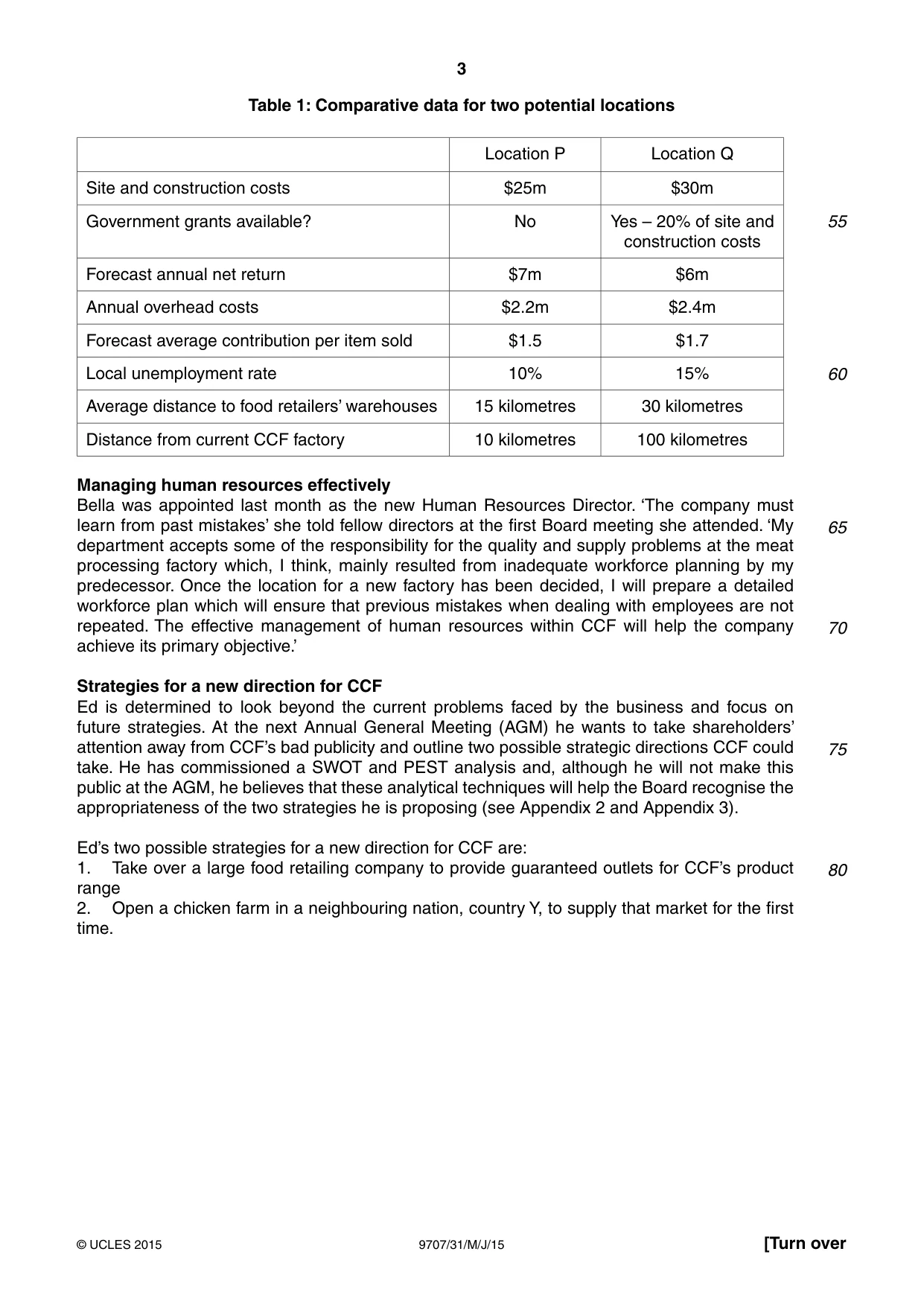
3 Recommend which of the two sites CCF should choose for its new meat processing factory. Justify your answer with an analysis of the data in Table 1 and other relevant information. [16]
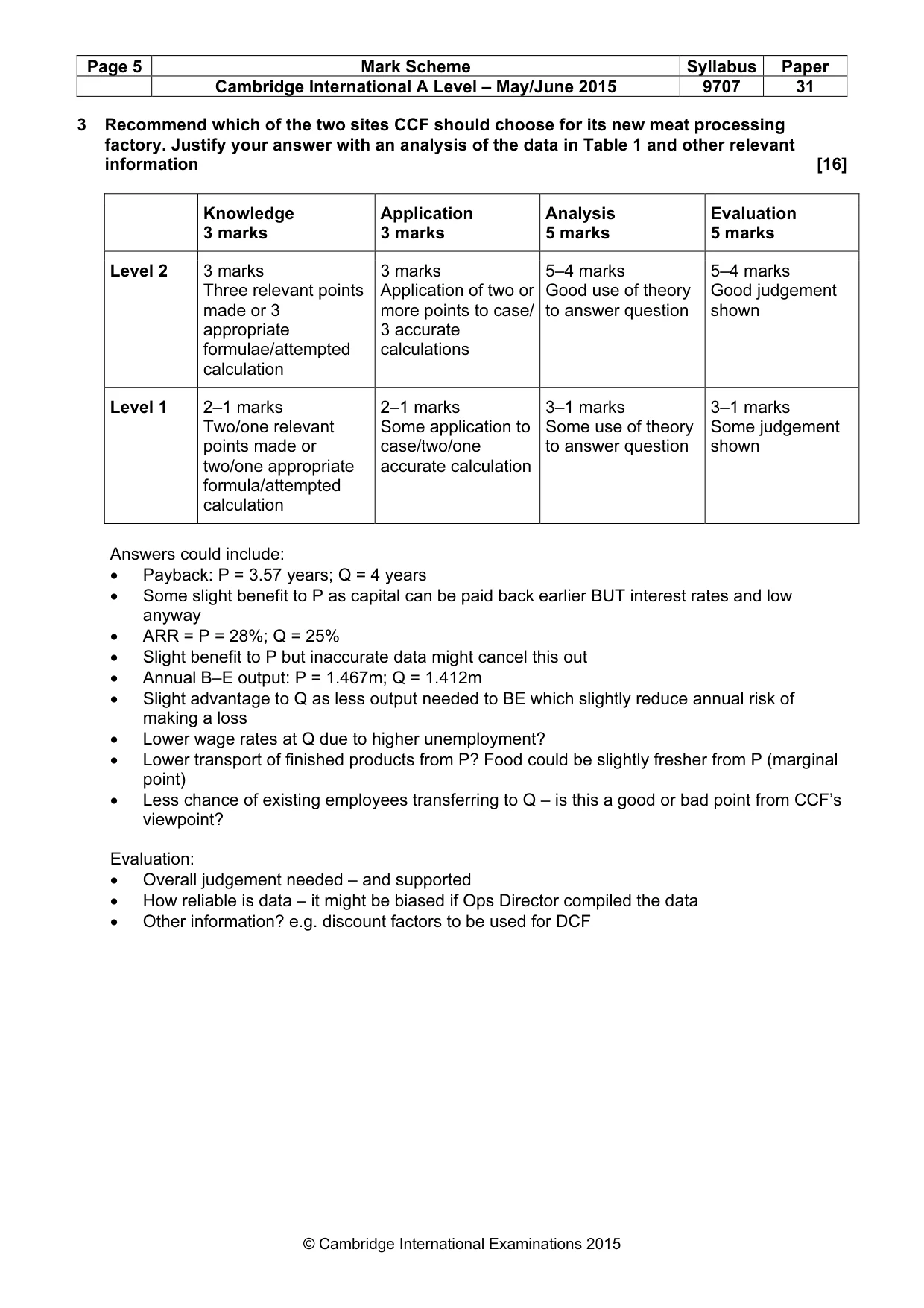
Mark scheme: 3 Recommend which of the two sites CCF should choose for its new meat processing factory. Justify your answer with an analysis of the data in Table 1 and other relevant information [16] Knowledge Application Analysis Evaluation 3 marks 3 marks 5 marks 5 marks Level 2 3 marks 3 marks 5–4 marks 5–4 marks Three relevant points Application of two or Good use of theory Good judgement made or 3 more points to case/ to answer question shown appropriate 3 accurate formulae/attempted calculations calculation Level 1 2–1 marks 2–1 marks 3–1 marks 3–1 marks Two/one relevant Some application to Some use of theory Some judgement points made or case/two/one to answer question shown two/one appropriate accurate calculation formula/attempted calculation Answers could include: • Payback: P = 3.57 years; Q = 4 years • Some slight benefit to P as capital can be paid back earlier BUT interest rates and low anyway • ARR = P = 28%; Q = 25% • Slight benefit to P but inaccurate data might cancel this out • Annual B–E output: P = 1.467m; Q = 1.412m • Slight advantage to Q as less output needed to BE which slightly reduce annual risk of making a loss • Lower wage rates at Q due to higher unemployment? • Lower transport of finished products from P? Food could be slightly fresher from P (marginal point) • Less chance of existing employees transferring to Q – is this a good or bad point from CCF’s viewpoint? Evaluation: • Overall judgement needed – and supported • How reliable is data – it might be biased if Ops Director compiled the data • Other information? e.g. discount factors to be used for DCF
Q4 · Discuss the importance to CCF of corporate social responsibility when aiming to maximise…
4 Discuss the importance to CCF of corporate social responsibility when aiming to maximise shareholder value. [16]
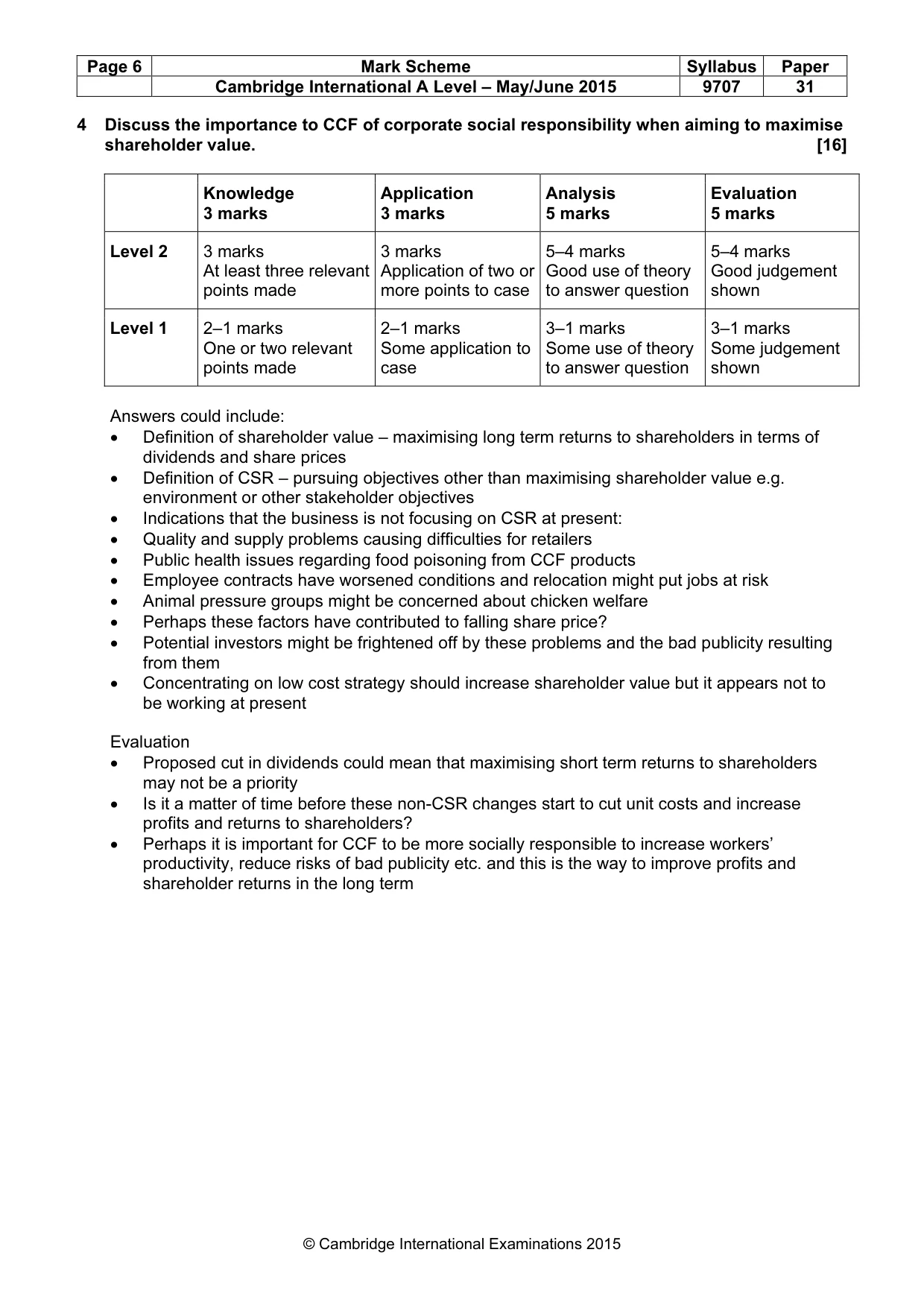
Mark scheme: 4 Discuss the importance to CCF of corporate social responsibility when aiming to maximise shareholder value. [16] Knowledge Application Analysis Evaluation 3 marks 3 marks 5 marks 5 marks Level 2 3 marks 3 marks 5–4 marks 5–4 marks At least three relevant Application of two or Good use of theory Good judgement points made more points to case to answer question shown Level 1 2–1 marks 2–1 marks 3–1 marks 3–1 marks One or two relevant Some application to Some use of theory Some judgement points made case to answer question shown Answers could include: • Definition of shareholder value – maximising long term returns to shareholders in terms of dividends and share prices • Definition of CSR – pursuing objectives other than maximising shareholder value e.g. environment or other stakeholder objectives • Indications that the business is not focusing on CSR at present: • Quality and supply problems causing difficulties for retailers • Public health issues regarding food poisoning from CCF products • Employee contracts have worsened conditions and relocation might put jobs at risk • Animal pressure groups might be concerned about chicken welfare • Perhaps these factors have contributed to falling share price? • Potential investors might be frightened off by these problems and the bad publicity resulting from them • Concentrating on low cost strategy should increase shareholder value but it appears not to be working at present Evaluation • Proposed cut in dividends could mean that maximising short term returns to shareholders may not be a priority • Is it a matter of time before these non-CSR changes start to cut unit costs and increase profits and returns to shareholders? • Perhaps it is important for CCF to be more socially responsible to increase workers’ productivity, reduce risks of bad publicity etc. and this is the way to improve profits and shareholder returns in the long term
Q5 · Discuss the extent to which workforce planning for the new factory could ensure effective…
5 Discuss the extent to which workforce planning for the new factory could ensure effective management of human resources. [16]
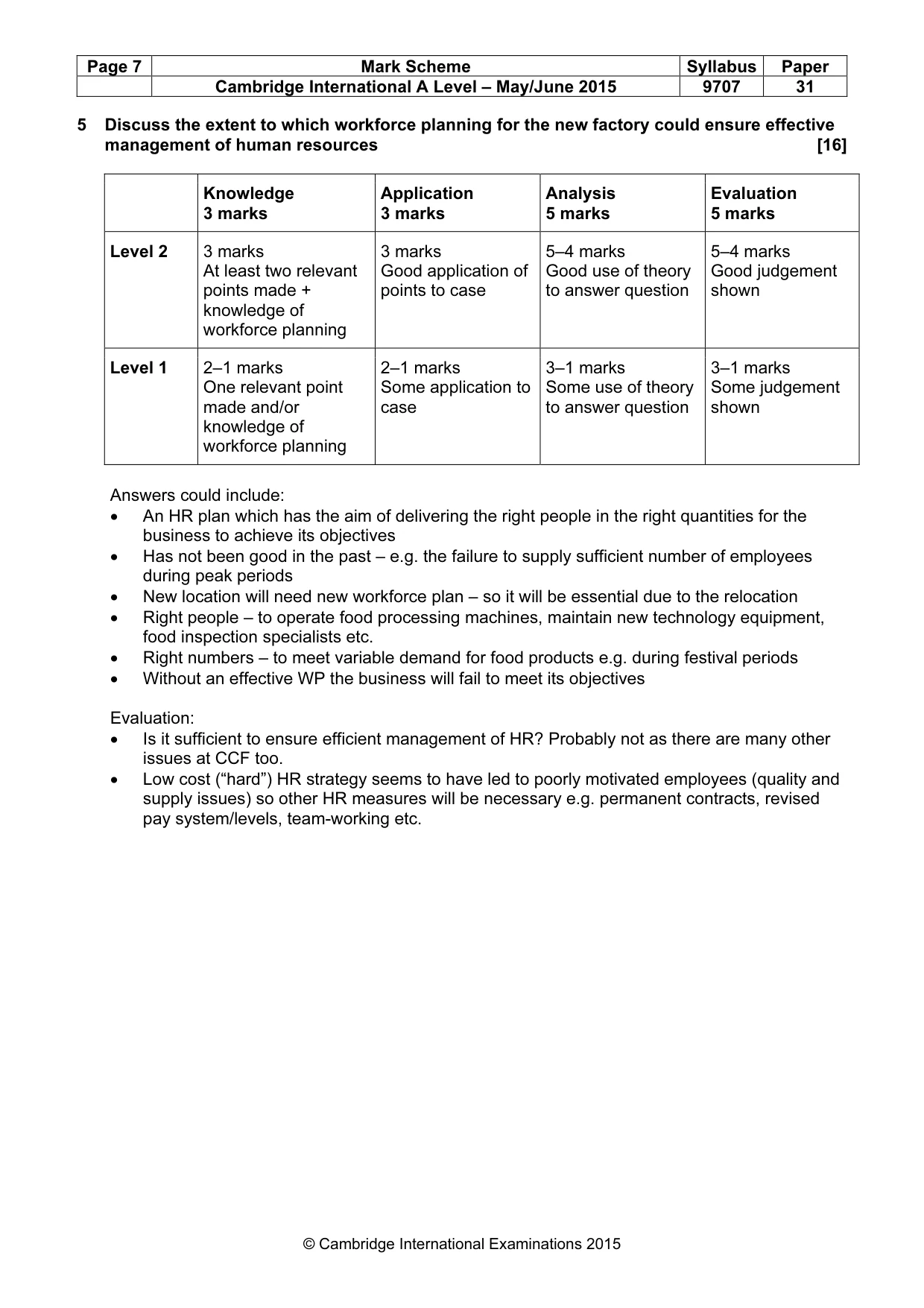
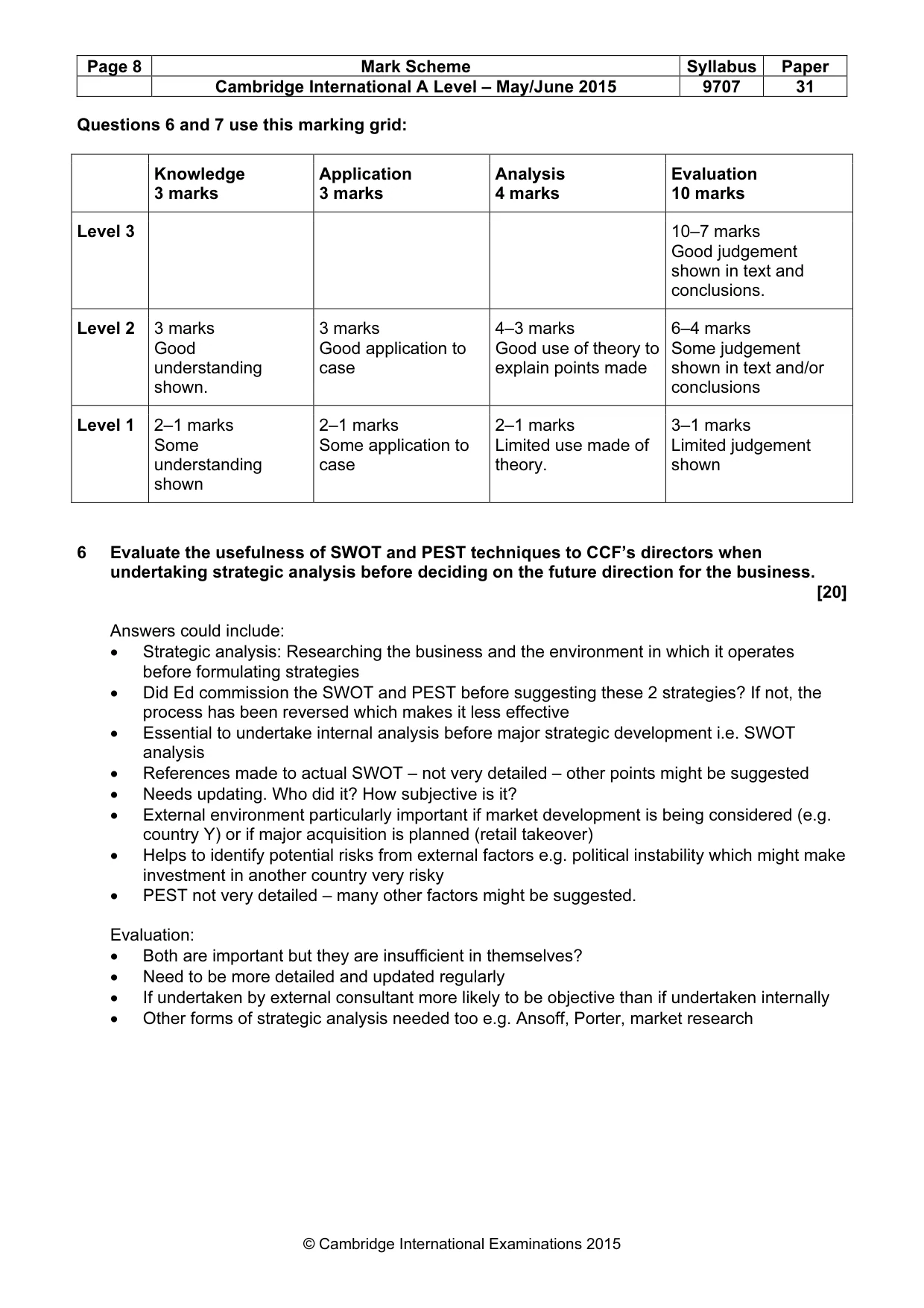
Mark scheme: 5 Discuss the extent to which workforce planning for the new factory could ensure effective management of human resources [16] Knowledge Application Analysis Evaluation 3 marks 3 marks 5 marks 5 marks Level 2 3 marks 3 marks 5–4 marks 5–4 marks At least two relevant Good application of Good use of theory Good judgement points made + points to case to answer question shown knowledge of workforce planning Level 1 2–1 marks 2–1 marks 3–1 marks 3–1 marks One relevant point Some application to Some use of theory Some judgement made and/or case to answer question shown knowledge of workforce planning Answers could include: • An HR plan which has the aim of delivering the right people in the right quantities for the business to achieve its objectives • Has not been good in the past – e.g. the failure to supply sufficient number of employees during peak periods • New location will need new workforce plan – so it will be essential due to the relocation • Right people – to operate food processing machines, maintain new technology equipment, food inspection specialists etc. • Right numbers – to meet variable demand for food products e.g. during festival periods • Without an effective WP the business will fail to meet its objectives Evaluation: • Is it sufficient to ensure efficient management of HR? Probably not as there are many other issues at CCF too. • Low cost (“hard”) HR strategy seems to have led to poorly motivated employees (quality and supply issues) so other HR measures will be necessary e.g. permanent contracts, revised pay system/levels, team-working etc. Questions 6 and 7 use this marking grid: Knowledge Application Analysis Evaluation 3 marks 3 marks 4 marks 10 marks Level 3 10–7 marks Good judgement shown in text and conclusions. Level 2 3 marks 3 marks 4–3 marks 6–4 marks Good Good application to Good use of theory to Some judgement understanding case explain points made shown in text and/or shown. conclusions Level 1 2–1 marks 2–1 marks 2–1 marks 3–1 marks Some Some application to Limited use made of Limited judgement understanding case theory. shown shown
Q6 · Evaluate the usefulness of SWOT and PEST techniques to CCF’s directors when undertaking…
6 Evaluate the usefulness of SWOT and PEST techniques to CCF’s directors when undertaking strategic analysis before deciding on the future direction for the business. [20]
Mark scheme: 6 Evaluate the usefulness of SWOT and PEST techniques to CCF’s directors when undertaking strategic analysis before deciding on the future direction for the business. [20] Answers could include: • Strategic analysis: Researching the business and the environment in which it operates before formulating strategies • Did Ed commission the SWOT and PEST before suggesting these 2 strategies? If not, the process has been reversed which makes it less effective • Essential to undertake internal analysis before major strategic development i.e. SWOT analysis • References made to actual SWOT – not very detailed – other points might be suggested • Needs updating. Who did it? How subjective is it? • External environment particularly important if market development is being considered (e.g. country Y) or if major acquisition is planned (retail takeover) • Helps to identify potential risks from external factors e.g. political instability which might make investment in another country very risky • PEST not very detailed – many other factors might be suggested. Evaluation: • Both are important but they are insufficient in themselves? • Need to be more detailed and updated regularly • If undertaken by external consultant more likely to be objective than if undertaken internally • Other forms of strategic analysis needed too e.g. Ansoff, Porter, market research
Q7 · Evaluate how the directors of CCF could ensure that future strategic changes are…
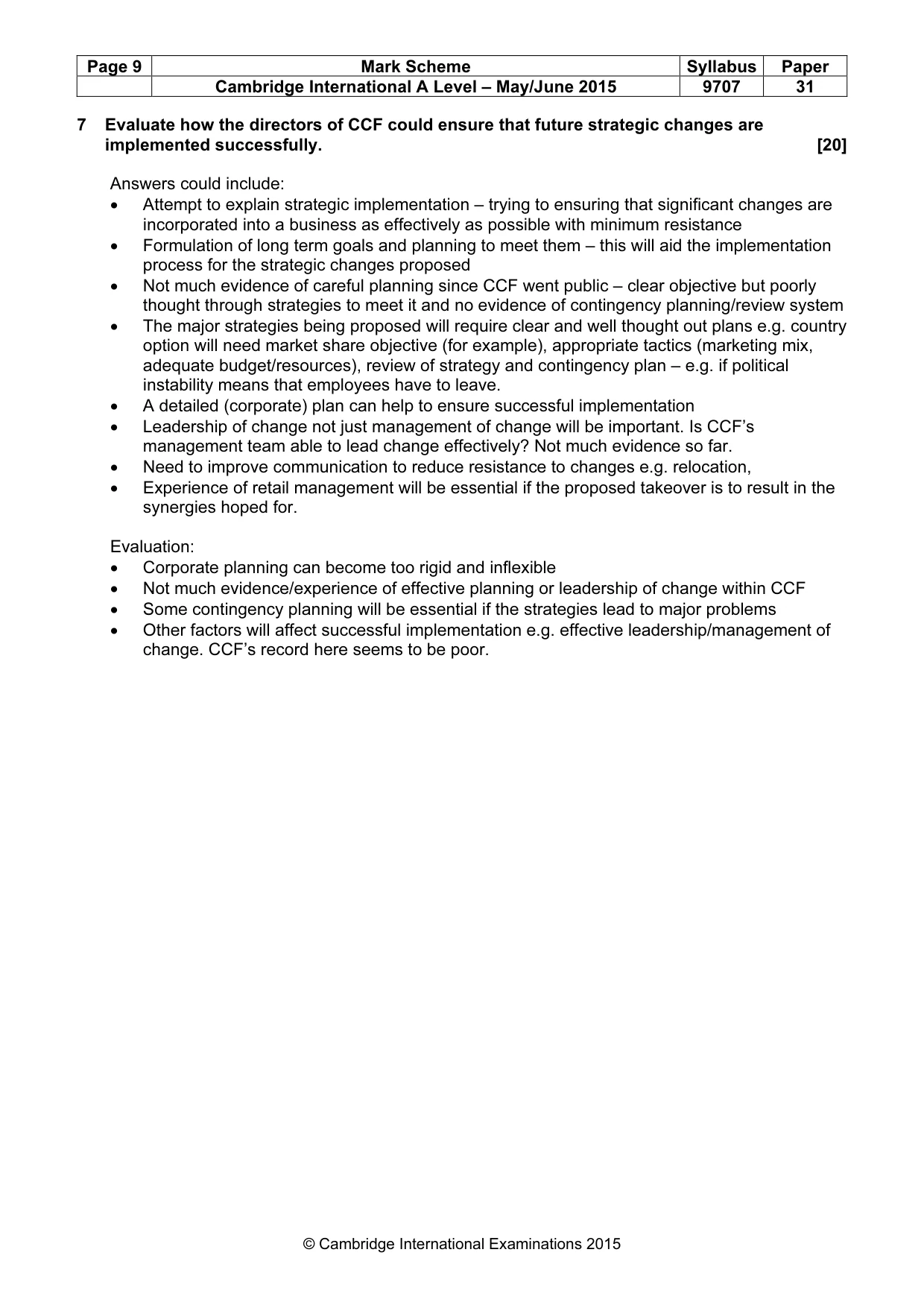
7 Evaluate how the directors of CCF could ensure that future strategic changes are implemented successfully. [20]
Mark scheme: 7 Evaluate how the directors of CCF could ensure that future strategic changes are implemented successfully. [20] Answers could include: • Attempt to explain strategic implementation – trying to ensuring that significant changes are incorporated into a business as effectively as possible with minimum resistance • Formulation of long term goals and planning to meet them – this will aid the implementation process for the strategic changes proposed • Not much evidence of careful planning since CCF went public – clear objective but poorly thought through strategies to meet it and no evidence of contingency planning/review system • The major strategies being proposed will require clear and well thought out plans e.g. country option will need market share objective (for example), appropriate tactics (marketing mix, adequate budget/resources), review of strategy and contingency plan – e.g. if political instability means that employees have to leave. • A detailed (corporate) plan can help to ensure successful implementation • Leadership of change not just management of change will be important. Is CCF’s management team able to lead change effectively? Not much evidence so far. • Need to improve communication to reduce resistance to changes e.g. relocation, • Experience of retail management will be essential if the proposed takeover is to result in the synergies hoped for. Evaluation: • Corporate planning can become too rigid and inflexible • Not much evidence/experience of effective planning or leadership of change within CCF • Some contingency planning will be essential if the strategies lead to major problems • Other factors will affect successful implementation e.g. effective leadership/management of change. CCF’s record here seems to be poor.
What you needed in this session
Cambridge’s own grade thresholds for 2015 May/June, Paper 3 · Variant 1. A higher threshold means an easier paper — the bar moves with how the cohort did.