Cambridge A Level Business Studies (for final examination in 2015) 9707 — 2015 Oct/Nov Paper 2 · Variant 3
9707/23/O/N/15 · 2 questions · 60 marks · ≈68 min
The question paper and its mark scheme, free to read here and free to download. This is Cambridge’s own paper, exactly as it was sat.
Question paper4 pages

Mark scheme7 pages
Answers below. Sit the paper first if you are practising.
Questions as text
Q1 · Classic Cushions (CC) CC is a sole trader business started by Bernice Green six years ago
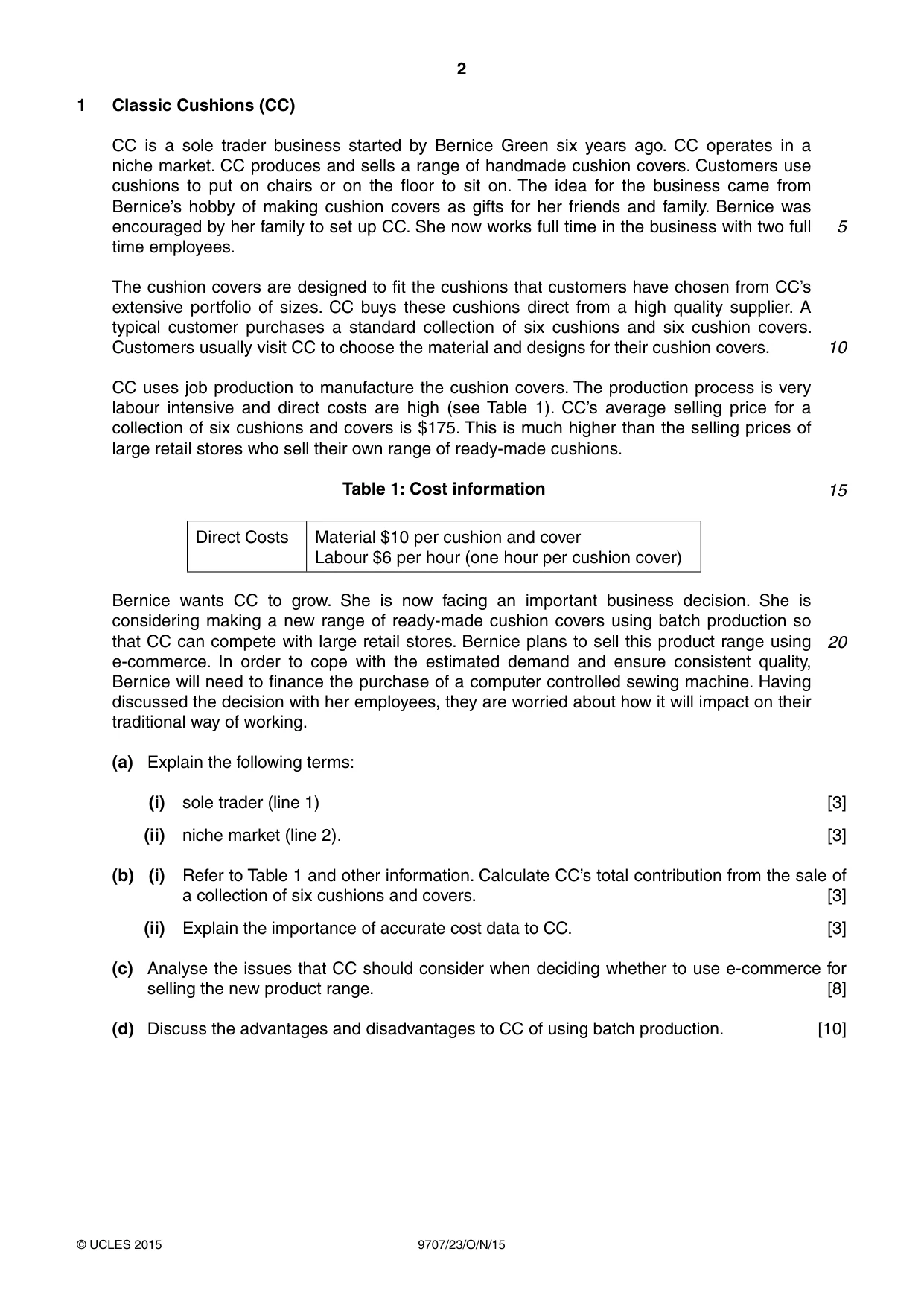
1 Classic Cushions (CC) CC is a sole trader business started by Bernice Green six years ago. CC operates in a niche market. CC produces and sells a range of handmade cushion covers. Customers use cushions to put on chairs or on the floor to sit on. The idea for the business came from Bernice’s hobby of making cushion covers as gifts for her friends and family. Bernice was encouraged by her family to set up CC. She now works full time in the business with two full 5 time employees. The cushion covers are designed to fit the cushions that customers have chosen from CC’s extensive portfolio of sizes. CC buys these cushions direct from a high quality supplier. A typical customer purchases a standard collection of six cushions and six cushion covers. Customers usually visit CC to choose the material and designs for their cushion covers. 10 CC uses job production to manufacture the cushion covers. The production process is very labour intensive and direct costs are high (see Table 1). CC’s average selling price for a collection of six cushions and covers is $175. This is much higher than the selling prices of large retail stores who sell their own range of ready-made cushions. Table 1: Cost information 15 Direct Costs Material $10 per cushion and cover Labour $6 per hour (one hour per cushion cover) Bernice wants CC to grow. She is now facing an important business decision. She is considering making a new range of ready-made cushion covers using batch production so that CC can compete with large retail stores. Bernice plans to sell this product range using 20 e-commerce. In order to cope with the estimated demand and ensure consistent quality, Bernice will need to finance the purchase of a computer controlled sewing machine. Having discussed the decision with her employees, they are worried about how it will impact on their traditional way of working. (a) Explain the following terms: (i) sole trader (line 1) [3] (ii) niche market (line 2). [3] (b) (i) Refer to Table 1 and other information. Calculate CC’s total contribution from the sale of a collection of six cushions and covers. [3] (ii) Explain the importance of accurate cost data to CC. [3] (c) Analyse the issues that CC should consider when deciding whether to use e-commerce for selling the new product range. [8] (d) Discuss the advantages and disadvantages to CC of using batch production. [10]
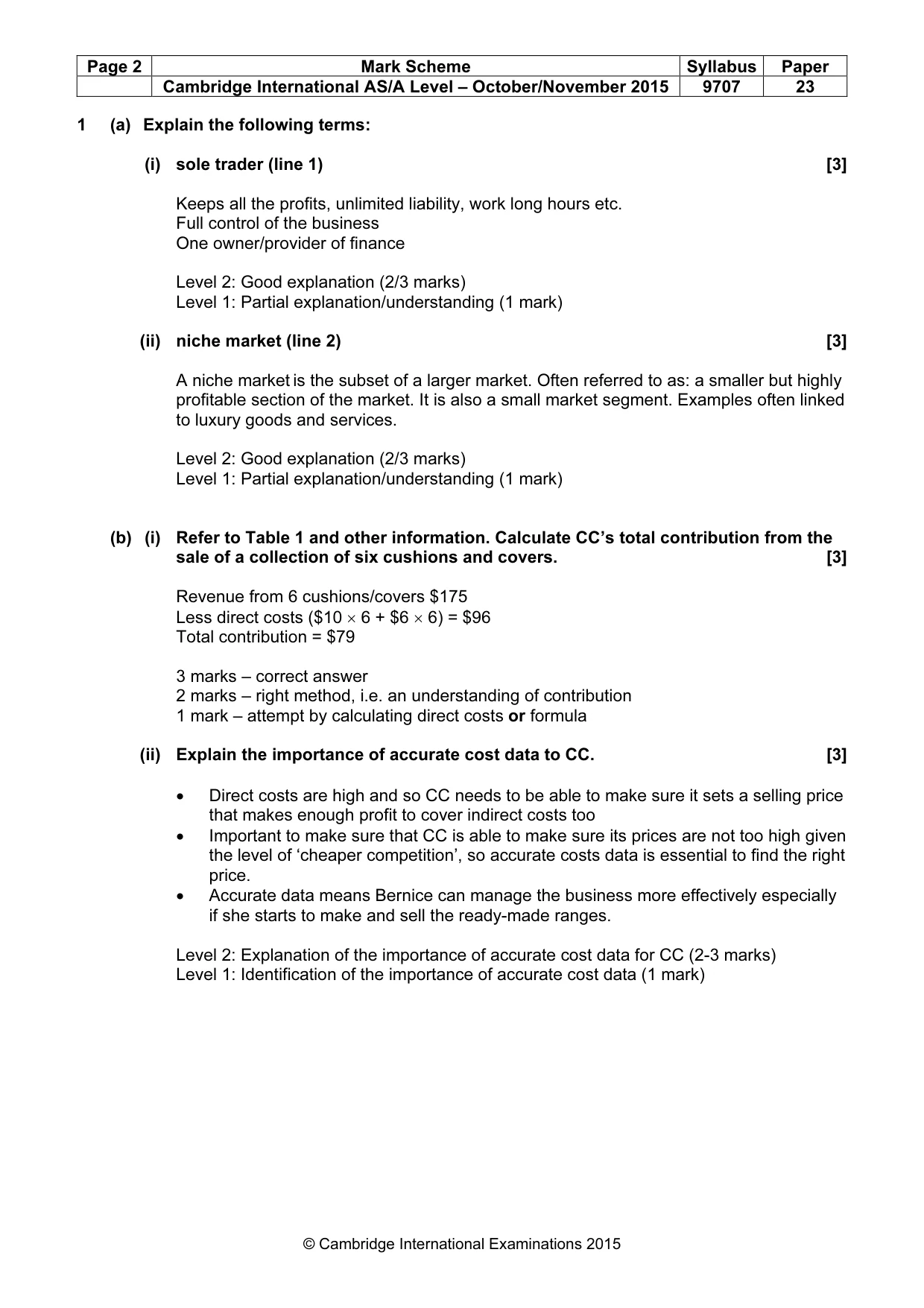
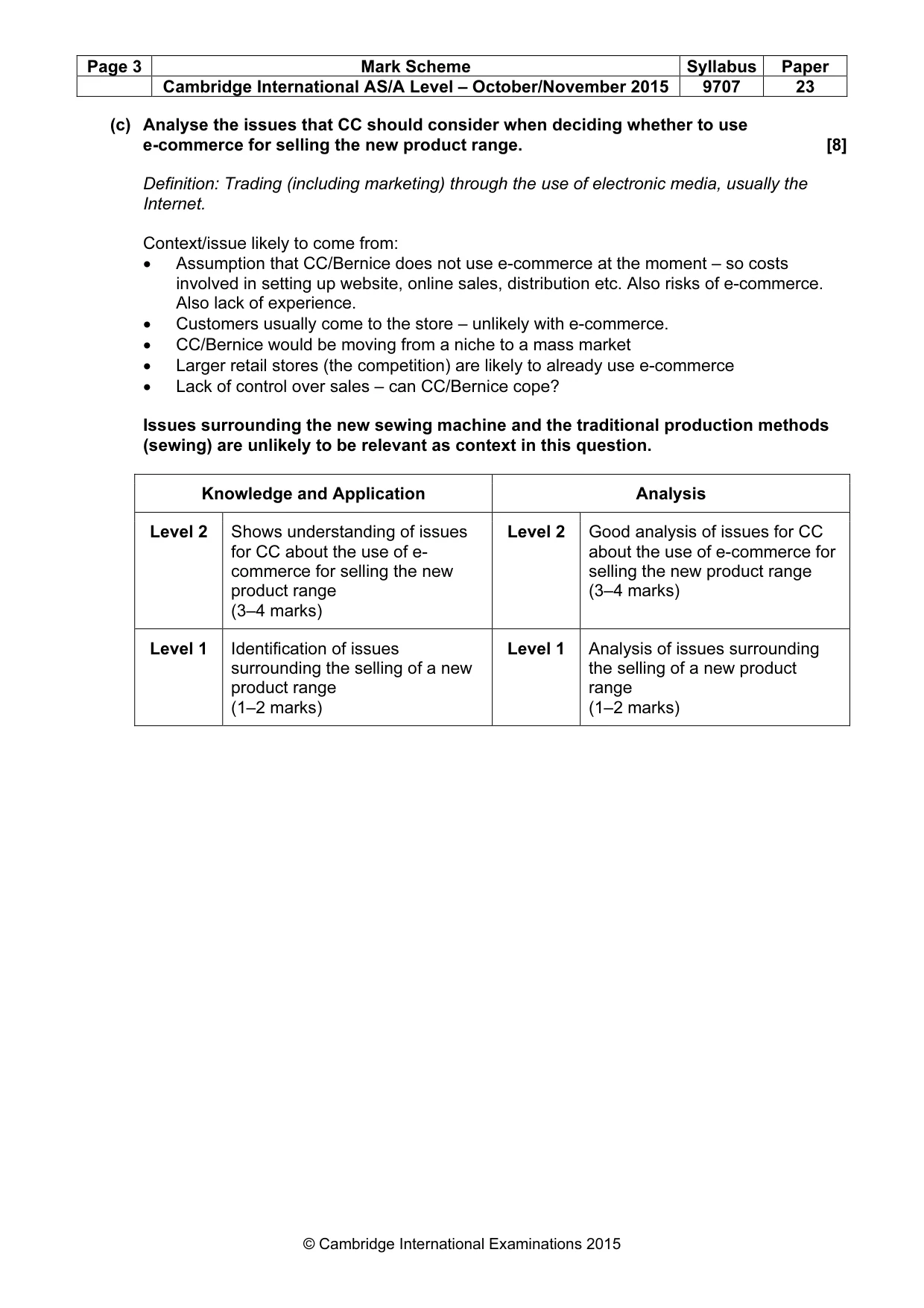
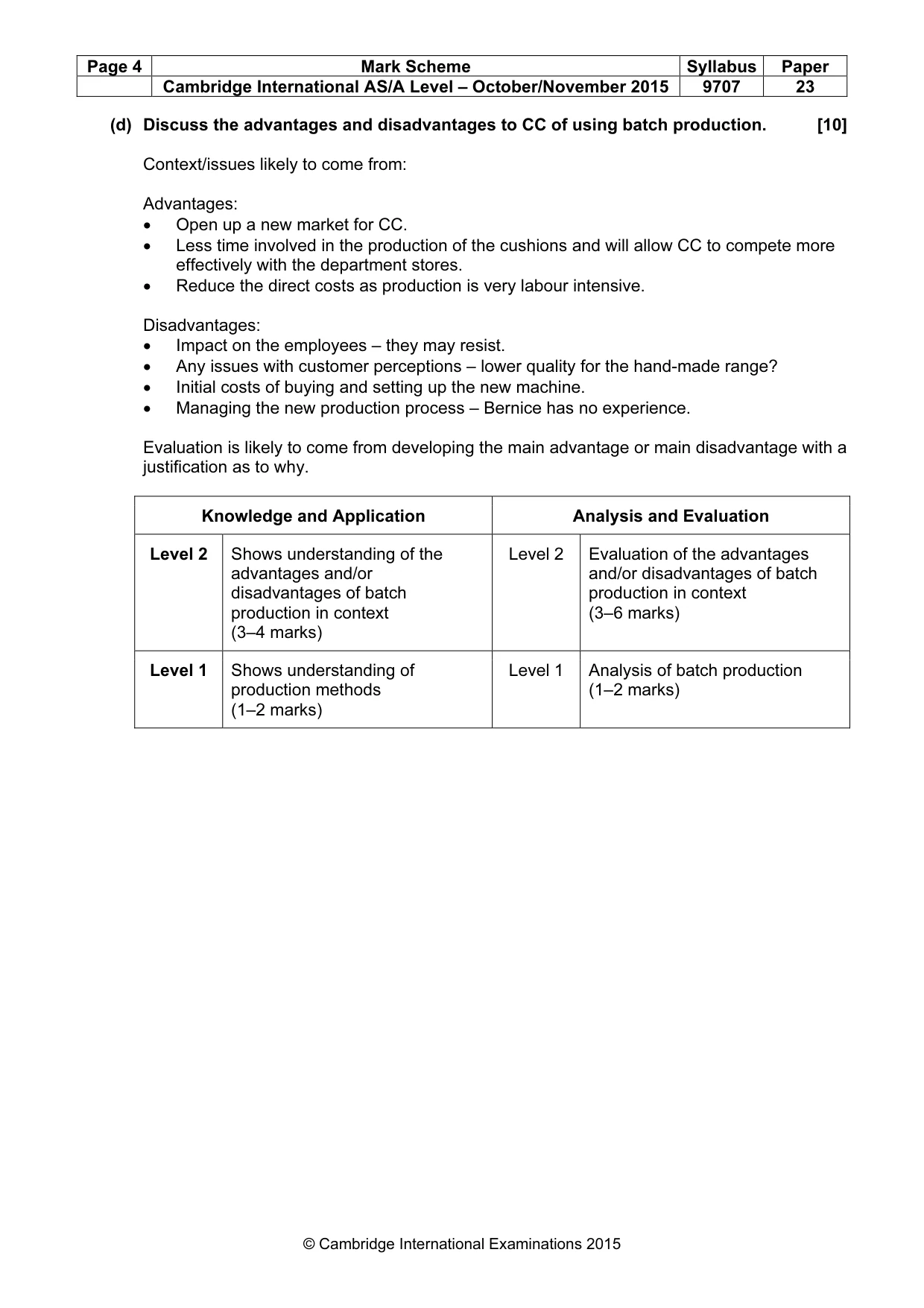
Mark scheme: 1 (a) Explain the following terms: (i) sole trader (line 1) [3] Keeps all the profits, unlimited liability, work long hours etc. Full control of the business One owner/provider of finance Level 2: Good explanation (2/3 marks) Level 1: Partial explanation/understanding (1 mark) (ii) niche market (line 2) [3] A niche market is the subset of a larger market. Often referred to as: a smaller but highly profitable section of the market. It is also a small market segment. Examples often linked to luxury goods and services. Level 2: Good explanation (2/3 marks) Level 1: Partial explanation/understanding (1 mark) (b) (i) Refer to Table 1 and other information. Calculate CC’s total contribution from the sale of a collection of six cushions and covers. [3] Revenue from 6 cushions/covers $175 Less direct costs ($10 × 6 + $6 × 6) = $96 Total contribution = $79 3 marks – correct answer 2 marks – right method, i.e. an understanding of contribution 1 mark – attempt by calculating direct costs or formula (ii) Explain the importance of accurate cost data to CC. [3] • Direct costs are high and so CC needs to be able to make sure it sets a selling price that makes enough profit to cover indirect costs too • Important to make sure that CC is able to make sure its prices are not too high given the level of ‘cheaper competition’, so accurate costs data is essential to find the right price. • Accurate data means Bernice can manage the business more effectively especially if she starts to make and sell the ready-made ranges. Level 2: Explanation of the importance of accurate cost data for CC (2-3 marks) Level 1: Identification of the importance of accurate cost data (1 mark) (c) Analyse the issues that CC should consider when deciding whether to use e-commerce for selling the new product range. [8] Definition: Trading (including marketing) through the use of electronic media, usually the Internet. Context/issue likely to come from: • Assumption that CC/Bernice does not use e-commerce at the moment – so costs involved in setting up website, online sales, distribution etc. Also risks of e-commerce. Also lack of experience. • Customers usually come to the store – unlikely with e-commerce. • CC/Bernice would be moving from a niche to a mass market • Larger retail stores (the competition) are likely to already use e-commerce • Lack of control over sales – can CC/Bernice cope? Issues surrounding the new sewing machine and the traditional production methods (sewing) are unlikely to be relevant as context in this question. Knowledge and Application Analysis Level 2 Shows understanding of issues Level 2 Good analysis of issues for CC for CC about the use of e- about the use of e-commerce for commerce for selling the new selling the new product range product range (3–4 marks) (3–4 marks) Level 1 Identification of issues Level 1 Analysis of issues surrounding surrounding the selling of a new the selling of a new product product range range (1–2 marks) (1–2 marks) (d) Discuss the advantages and disadvantages to CC of using batch production. [10] Context/issues likely to come from: Advantages: • Open up a new market for CC. • Less time involved in the production of the cushions and will allow CC to compete more effectively with the department stores. • Reduce the direct costs as production is very labour intensive. Disadvantages: • Impact on the employees – they may resist. • Any issues with customer perceptions – lower quality for the hand-made range? • Initial costs of buying and setting up the new machine. • Managing the new production process – Bernice has no experience. Evaluation is likely to come from developing the main advantage or main disadvantage with a justification as to why. Knowledge and Application Analysis and Evaluation Level 2 Shows understanding of the Level 2 Evaluation of the advantages advantages and/or and/or disadvantages of batch disadvantages of batch production in context production in context (3–6 marks) (3–4 marks) Level 1 Shows understanding of Level 1 Analysis of batch production production methods (1–2 marks) (1–2 marks)
Q2 · Wonderful Windows (WW) WW is a private limited company that produces and sells a range of…
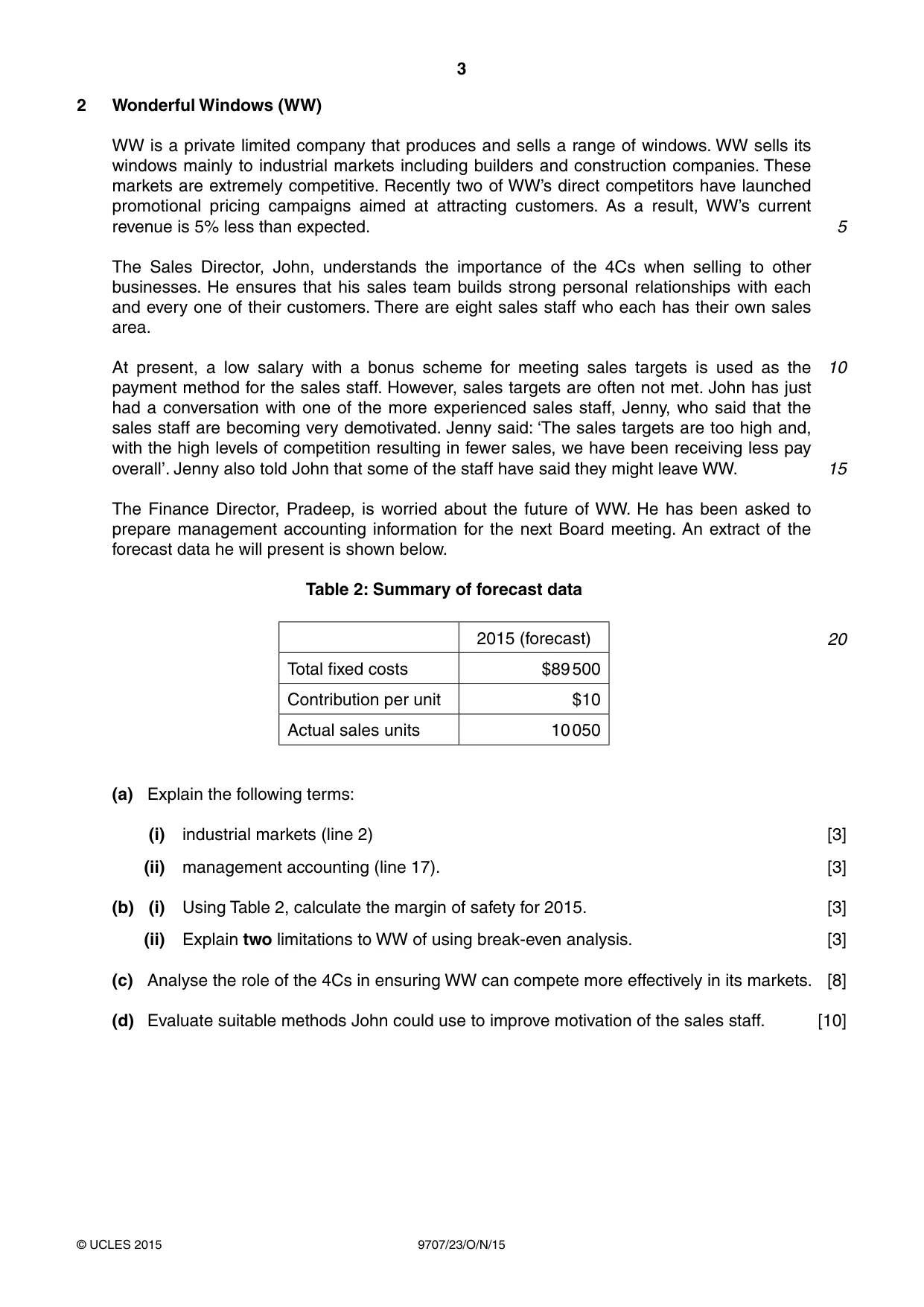
2 Wonderful Windows (WW) WW is a private limited company that produces and sells a range of windows. WW sells its windows mainly to industrial markets including builders and construction companies. These markets are extremely competitive. Recently two of WW’s direct competitors have launched promotional pricing campaigns aimed at attracting customers. As a result, WW’s current revenue is 5% less than expected. 5 The Sales Director, John, understands the importance of the 4Cs when selling to other businesses. He ensures that his sales team builds strong personal relationships with each and every one of their customers. There are eight sales staff who each has their own sales area. At present, a low salary with a bonus scheme for meeting sales targets is used as the 10 payment method for the sales staff. However, sales targets are often not met. John has just had a conversation with one of the more experienced sales staff, Jenny, who said that the sales staff are becoming very demotivated. Jenny said: ‘The sales targets are too high and, with the high levels of competition resulting in fewer sales, we have been receiving less pay overall’. Jenny also told John that some of the staff have said they might leave WW. 15 The Finance Director, Pradeep, is worried about the future of WW. He has been asked to prepare management accounting information for the next Board meeting. An extract of the forecast data he will present is shown below. Table 2: Summary of forecast data 2015 (forecast) 20 Total fixed costs $89 500 Contribution per unit $10 Actual sales units 10 050 (a) Explain the following terms: (i) industrial markets (line 2) [3] (ii) management accounting (line 17). [3] (b) (i) Using Table 2, calculate the margin of safety for 2015. [3] (ii) Explain two limitations to WW of using break-even analysis. [3] (c) Analyse the role of the 4Cs in ensuring WW can compete more effectively in its markets. [8] (d) Evaluate suitable methods John could use to improve motivation of the sales staff. [10]
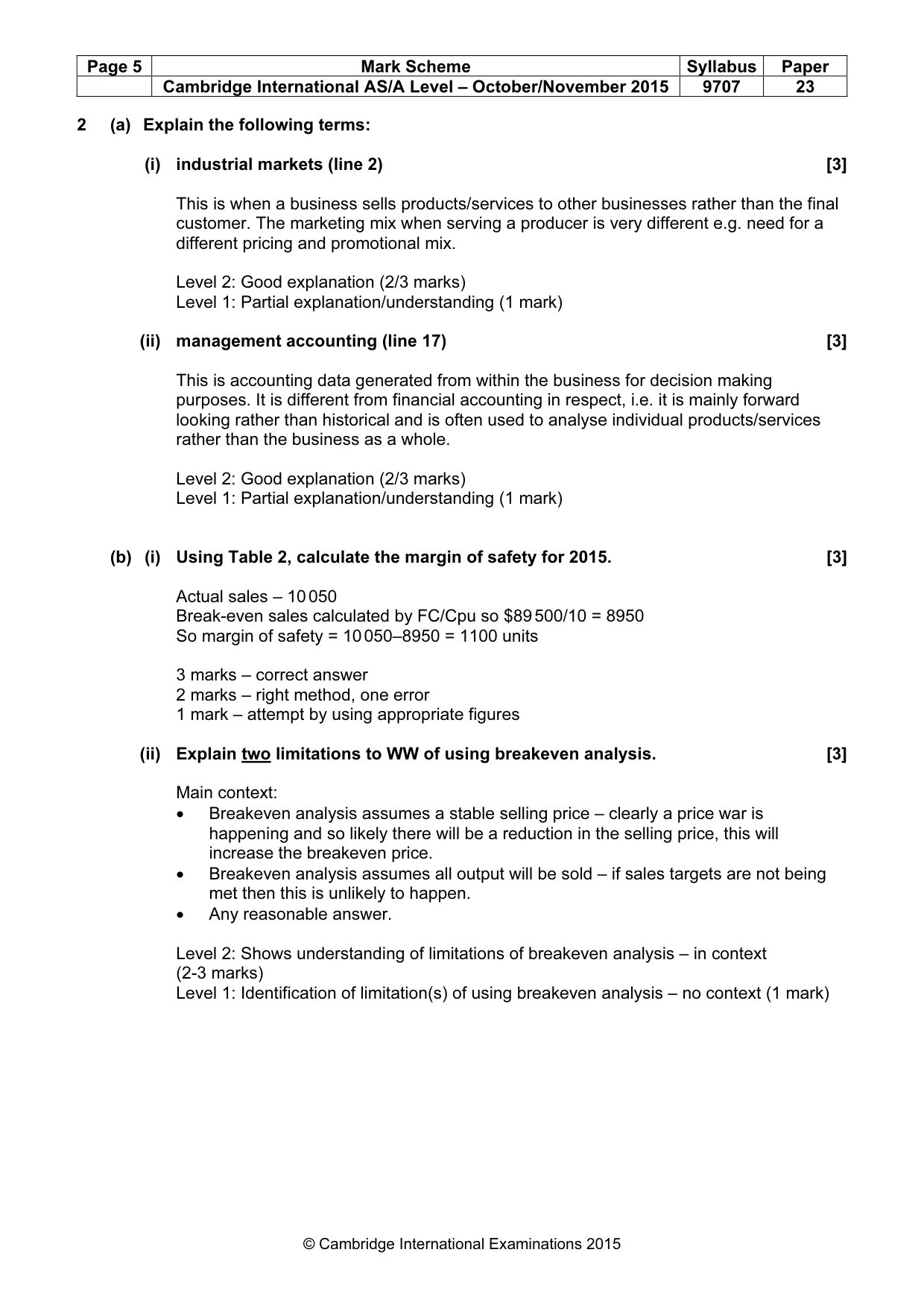
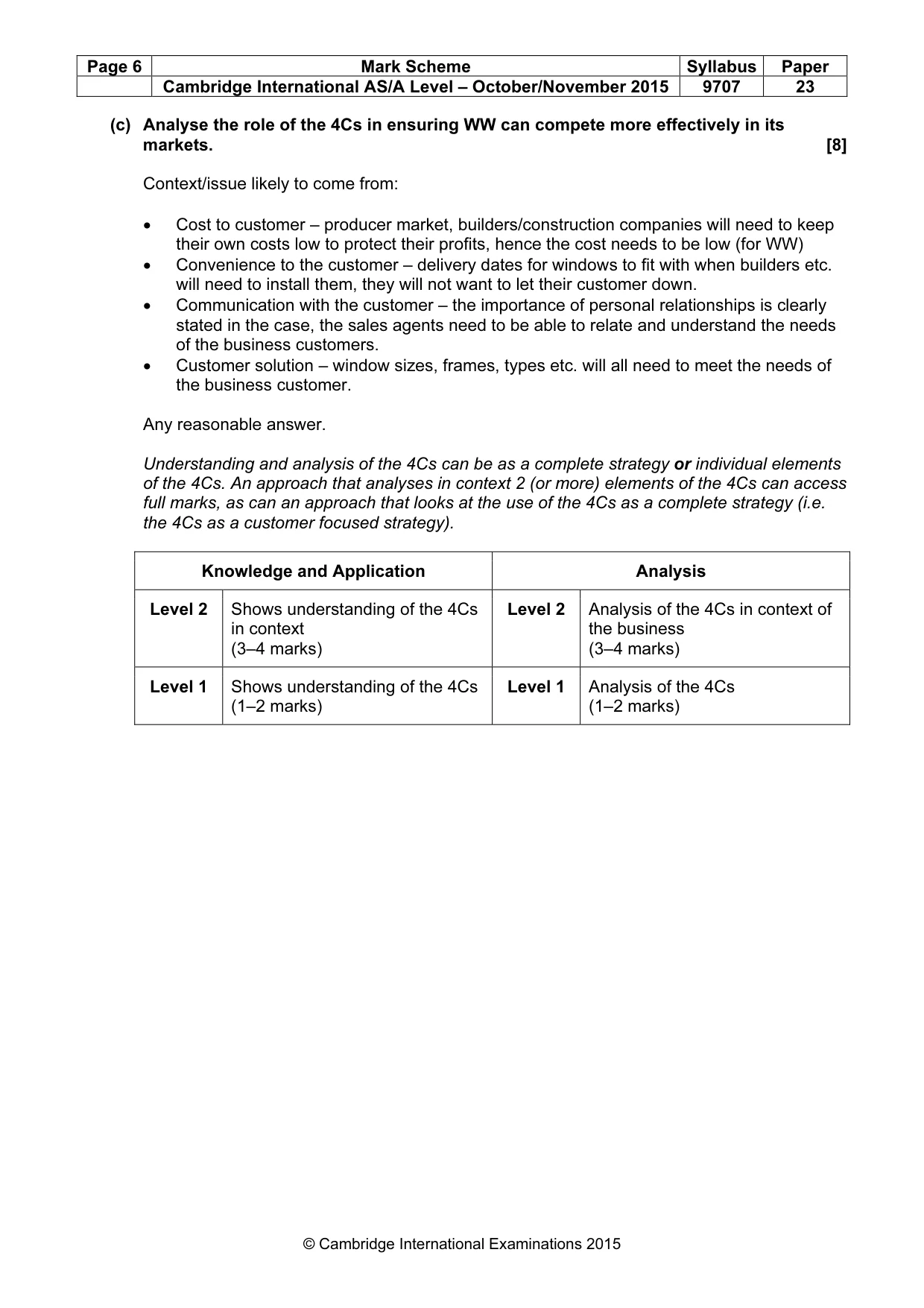
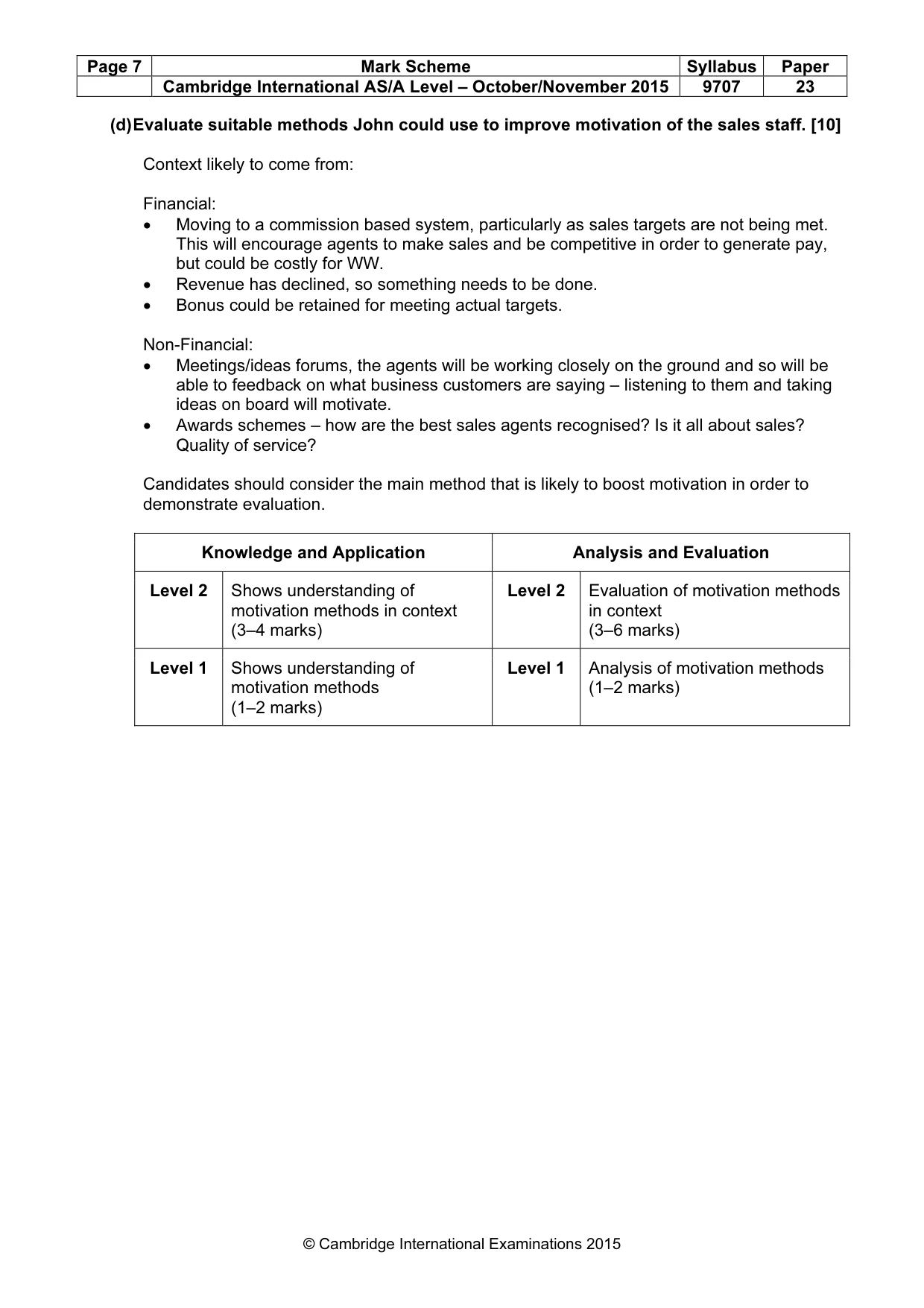
Mark scheme: 2 (a) Explain the following terms: (i) industrial markets (line 2) [3] This is when a business sells products/services to other businesses rather than the final customer. The marketing mix when serving a producer is very different e.g. need for a different pricing and promotional mix. Level 2: Good explanation (2/3 marks) Level 1: Partial explanation/understanding (1 mark) (ii) management accounting (line 17) [3] This is accounting data generated from within the business for decision making purposes. It is different from financial accounting in respect, i.e. it is mainly forward looking rather than historical and is often used to analyse individual products/services rather than the business as a whole. Level 2: Good explanation (2/3 marks) Level 1: Partial explanation/understanding (1 mark) (b) (i) Using Table 2, calculate the margin of safety for 2015. [3] Actual sales – 10 050 Break-even sales calculated by FC/Cpu so $89 500/10 = 8950 So margin of safety = 10 050–8950 = 1100 units 3 marks – correct answer 2 marks – right method, one error 1 mark – attempt by using appropriate figures (ii) Explain two limitations to WW of using breakeven analysis. [3] Main context: • Breakeven analysis assumes a stable selling price – clearly a price war is happening and so likely there will be a reduction in the selling price, this will increase the breakeven price. • Breakeven analysis assumes all output will be sold – if sales targets are not being met then this is unlikely to happen. • Any reasonable answer. Level 2: Shows understanding of limitations of breakeven analysis – in context (2-3 marks) Level 1: Identification of limitation(s) of using breakeven analysis – no context (1 mark) (c) Analyse the role of the 4Cs in ensuring WW can compete more effectively in its markets. [8] Context/issue likely to come from: • Cost to customer – producer market, builders/construction companies will need to keep their own costs low to protect their profits, hence the cost needs to be low (for WW) • Convenience to the customer – delivery dates for windows to fit with when builders etc. will need to install them, they will not want to let their customer down. • Communication with the customer – the importance of personal relationships is clearly stated in the case, the sales agents need to be able to relate and understand the needs of the business customers. • Customer solution – window sizes, frames, types etc. will all need to meet the needs of the business customer. Any reasonable answer. Understanding and analysis of the 4Cs can be as a complete strategy or individual elements of the 4Cs. An approach that analyses in context 2 (or more) elements of the 4Cs can access full marks, as can an approach that looks at the use of the 4Cs as a complete strategy (i.e. the 4Cs as a customer focused strategy). Knowledge and Application Analysis Level 2 Shows understanding of the 4Cs Level 2 Analysis of the 4Cs in context of in context the business (3–4 marks) (3–4 marks) Level 1 Shows understanding of the 4Cs Level 1 Analysis of the 4Cs (1–2 marks) (1–2 marks) (d) Evaluate suitable methods John could use to improve motivation of the sales staff. [10] Context likely to come from: Financial: • Moving to a commission based system, particularly as sales targets are not being met. This will encourage agents to make sales and be competitive in order to generate pay, but could be costly for WW. • Revenue has declined, so something needs to be done. • Bonus could be retained for meeting actual targets. Non-Financial: • Meetings/ideas forums, the agents will be working closely on the ground and so will be able to feedback on what business customers are saying – listening to them and taking ideas on board will motivate. • Awards schemes – how are the best sales agents recognised? Is it all about sales? Quality of service? Candidates should consider the main method that is likely to boost motivation in order to demonstrate evaluation. Knowledge and Application Analysis and Evaluation Level 2 Shows understanding of Level 2 Evaluation of motivation methods motivation methods in context in context (3–4 marks) (3–6 marks) Level 1 Shows understanding of Level 1 Analysis of motivation methods motivation methods (1–2 marks) (1–2 marks)