Cambridge A Level Business Studies (for final examination in 2015) 9707 — 2015 May/June Paper 2 · Variant 3
9707/23/M/J/15 · 2 questions · 60 marks · ≈68 min
The question paper and its mark scheme, free to read here and free to download. This is Cambridge’s own paper, exactly as it was sat.
Question paper4 pages
Mark scheme9 pages
Answers below. Sit the paper first if you are practising.
Questions as text
Q1 · Enterprise Electricals (EE) EE is a private limited company
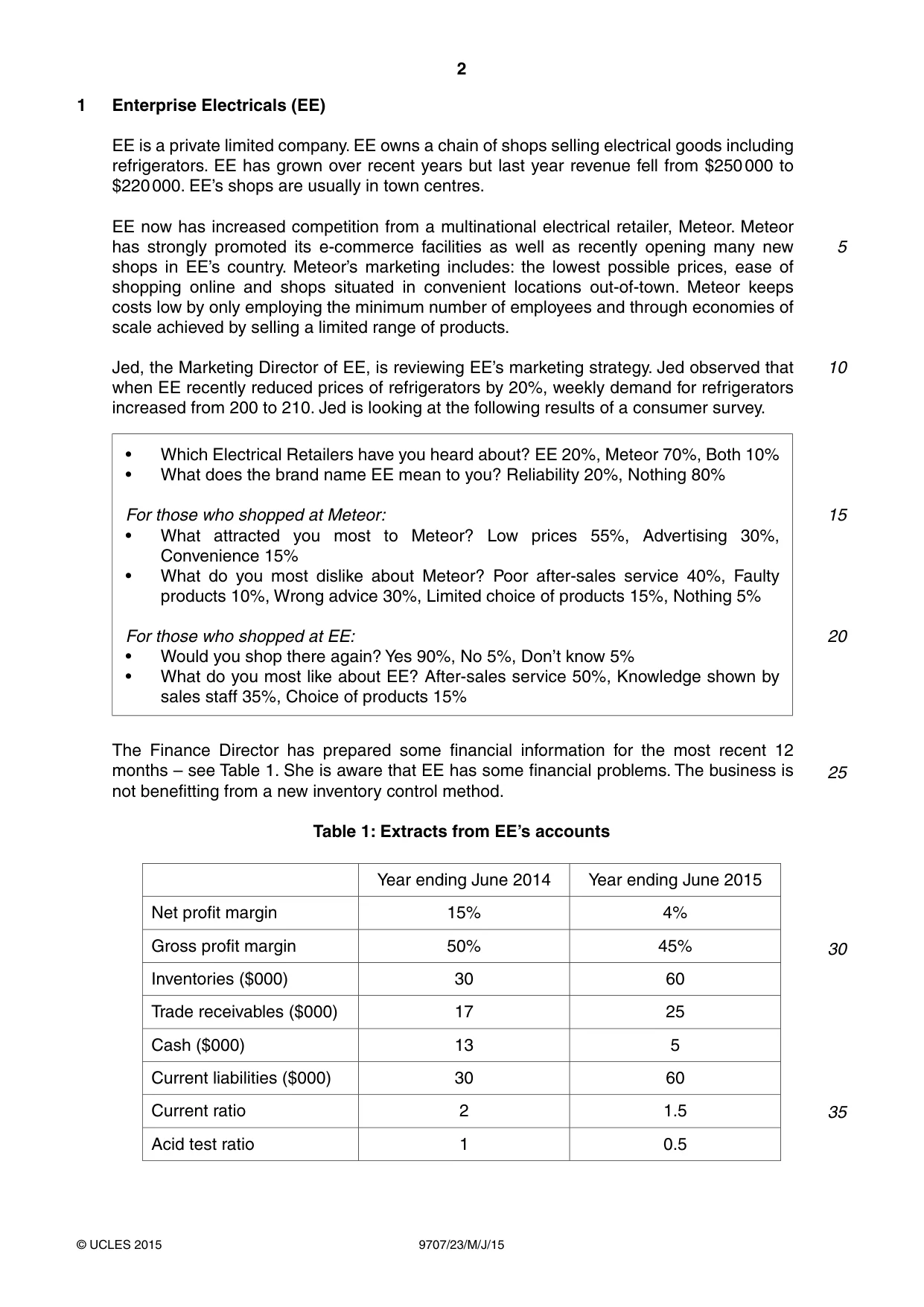
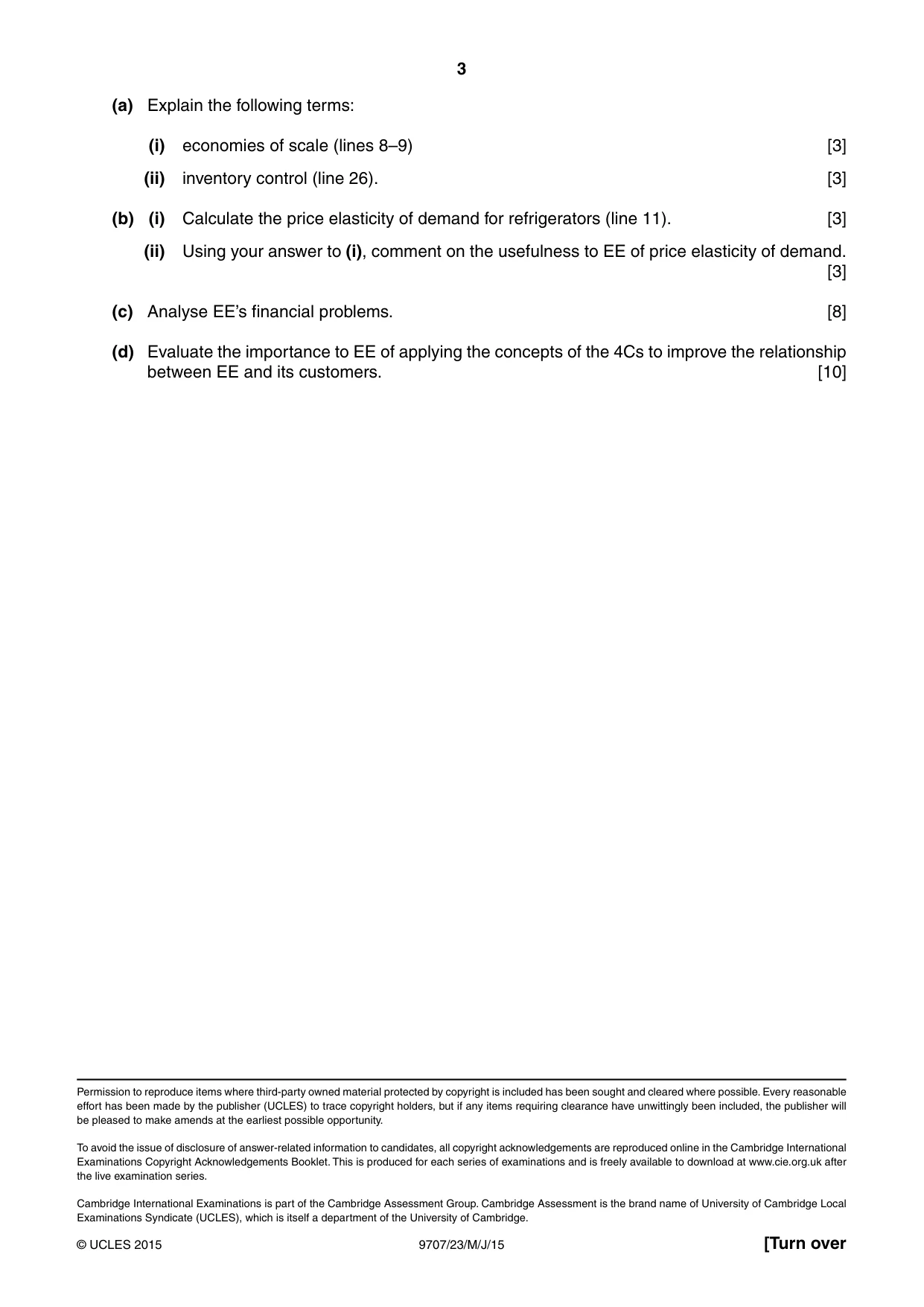
1 Enterprise Electricals (EE) EE is a private limited company. EE owns a chain of shops selling electrical goods including refrigerators. EE has grown over recent years but last year revenue fell from $250 000 to $220 000. EE’s shops are usually in town centres. EE now has increased competition from a multinational electrical retailer, Meteor. Meteor has strongly promoted its e-commerce facilities as well as recently opening many new 5 shops in EE’s country. Meteor’s marketing includes: the lowest possible prices, ease of shopping online and shops situated in convenient locations out-of-town. Meteor keeps costs low by only employing the minimum number of employees and through economies of scale achieved by selling a limited range of products. Jed, the Marketing Director of EE, is reviewing EE’s marketing strategy. Jed observed that 10 when EE recently reduced prices of refrigerators by 20%, weekly demand for refrigerators increased from 200 to 210. Jed is looking at the following results of a consumer survey. • Which Electrical Retailers have you heard about? EE 20%, Meteor 70%, Both 10% • What does the brand name EE mean to you? Reliability 20%, Nothing 80% For those who shopped at Meteor: 15 • What attracted you most to Meteor? Low prices 55%, Advertising 30%, Convenience 15% • What do you most dislike about Meteor? Poor after-sales service 40%, Faulty products 10%, Wrong advice 30%, Limited choice of products 15%, Nothing 5% For those who shopped at EE: 20 • Would you shop there again? Yes 90%, No 5%, Don’t know 5% • What do you most like about EE? After-sales service 50%, Knowledge shown by sales staff 35%, Choice of products 15% The Finance Director has prepared some financial information for the most recent 12 months – see Table 1. She is aware that EE has some financial problems. The business is 25 not benefitting from a new inventory control method. Table 1: Extracts from EE’s accounts Year ending June 2014 Year ending June 2015 Net profit margin 15% 4% Gross profit margin 50% 45% 30 Inventories ($000) 30 60 Trade receivables ($000) 17 25 Cash ($000) 13 5 Current liabilities ($000) 30 60 Current ratio 2 1.5 35 Acid test ratio 1 0.5 (a) Explain the following terms: (i) economies of scale (lines 8–9) [3] (ii) inventory control (line 26). [3] (b) (i) Calculate the price elasticity of demand for refrigerators (line 11). [3] (ii) Using your answer to (i), comment on the usefulness to EE of price elasticity of demand. [3] (c) Analyse EE’s financial problems. [8] (d) Evaluate the importance to EE of applying the concepts of the 4Cs to improve the relationship between EE and its customers. [10]
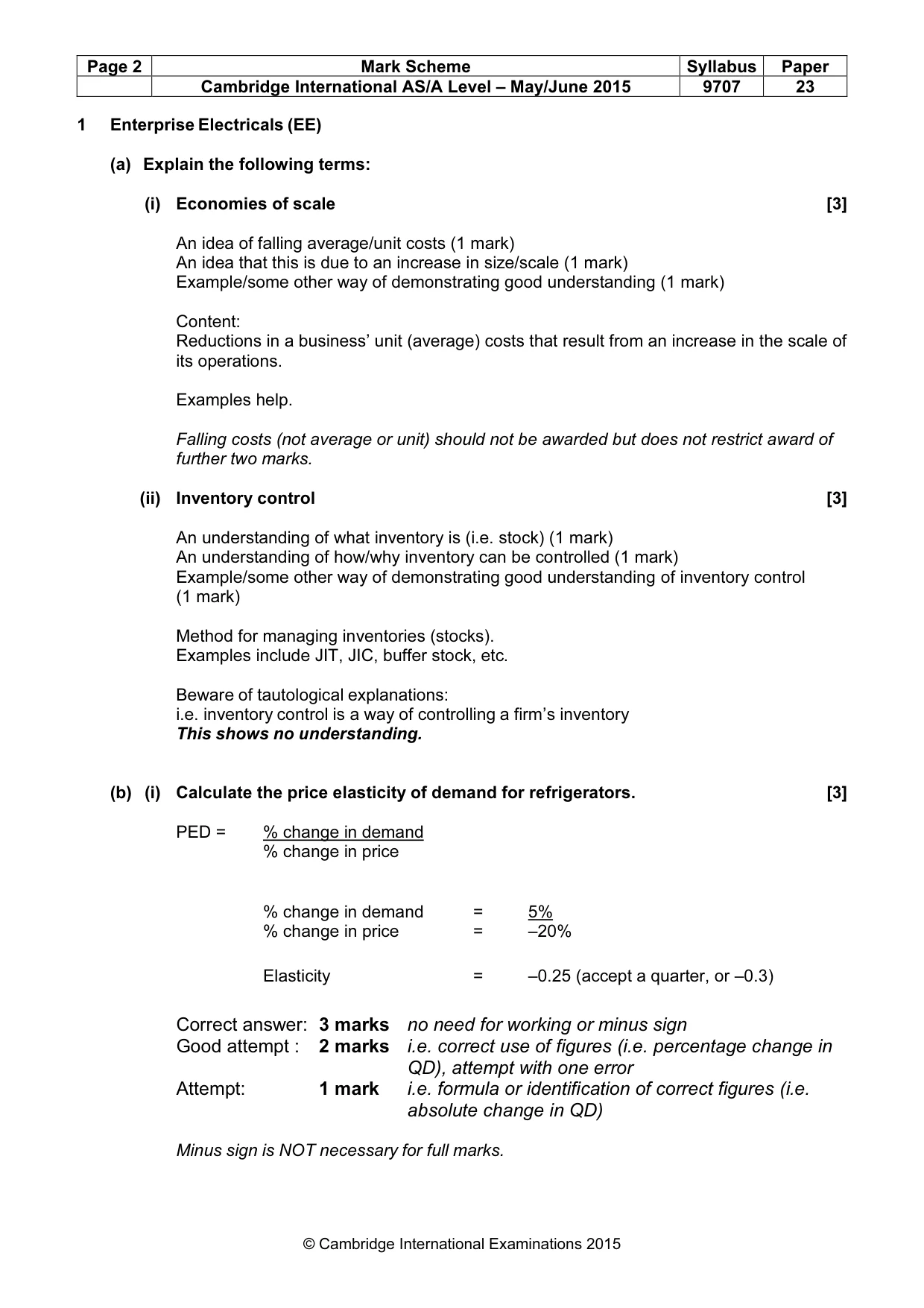
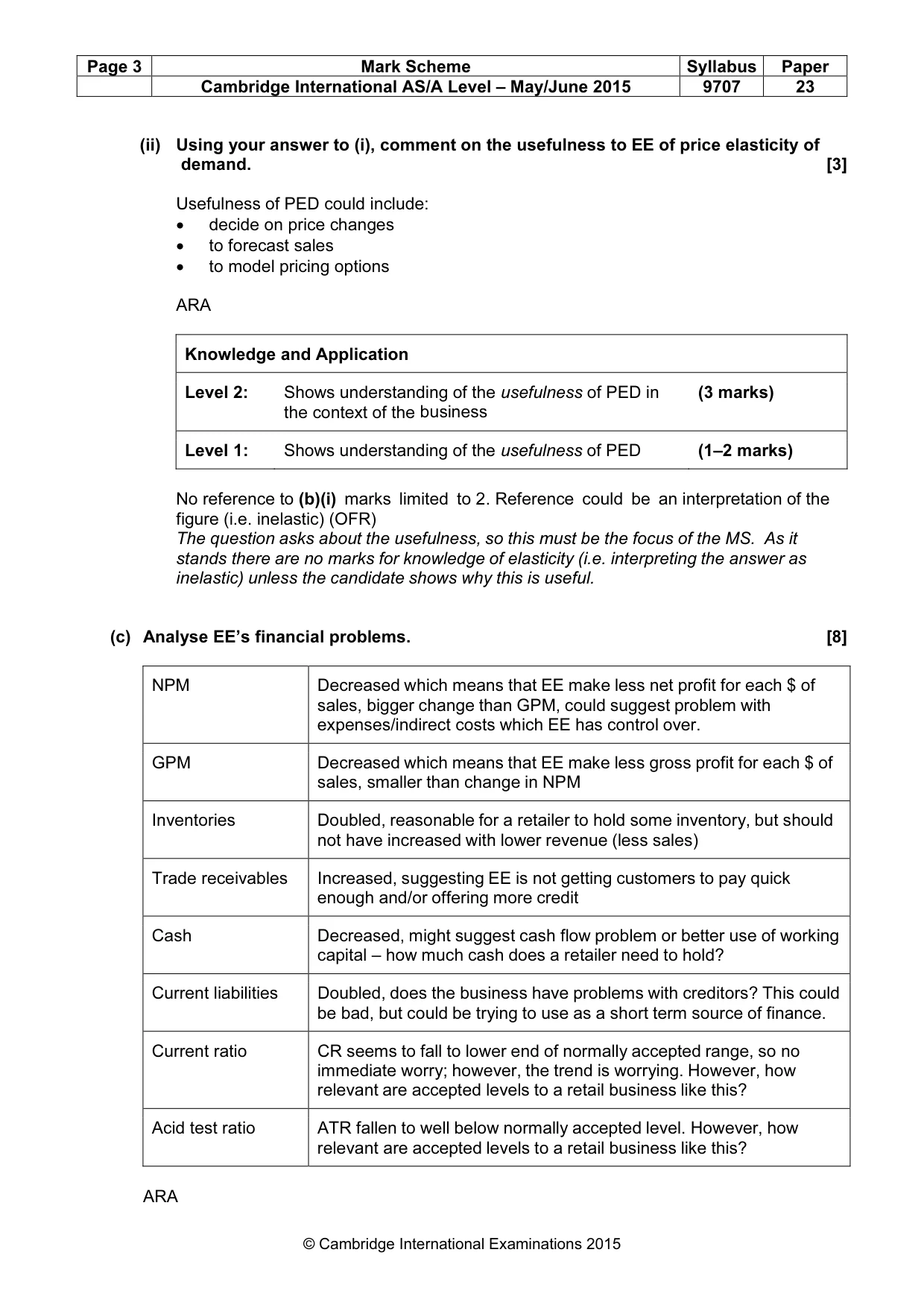
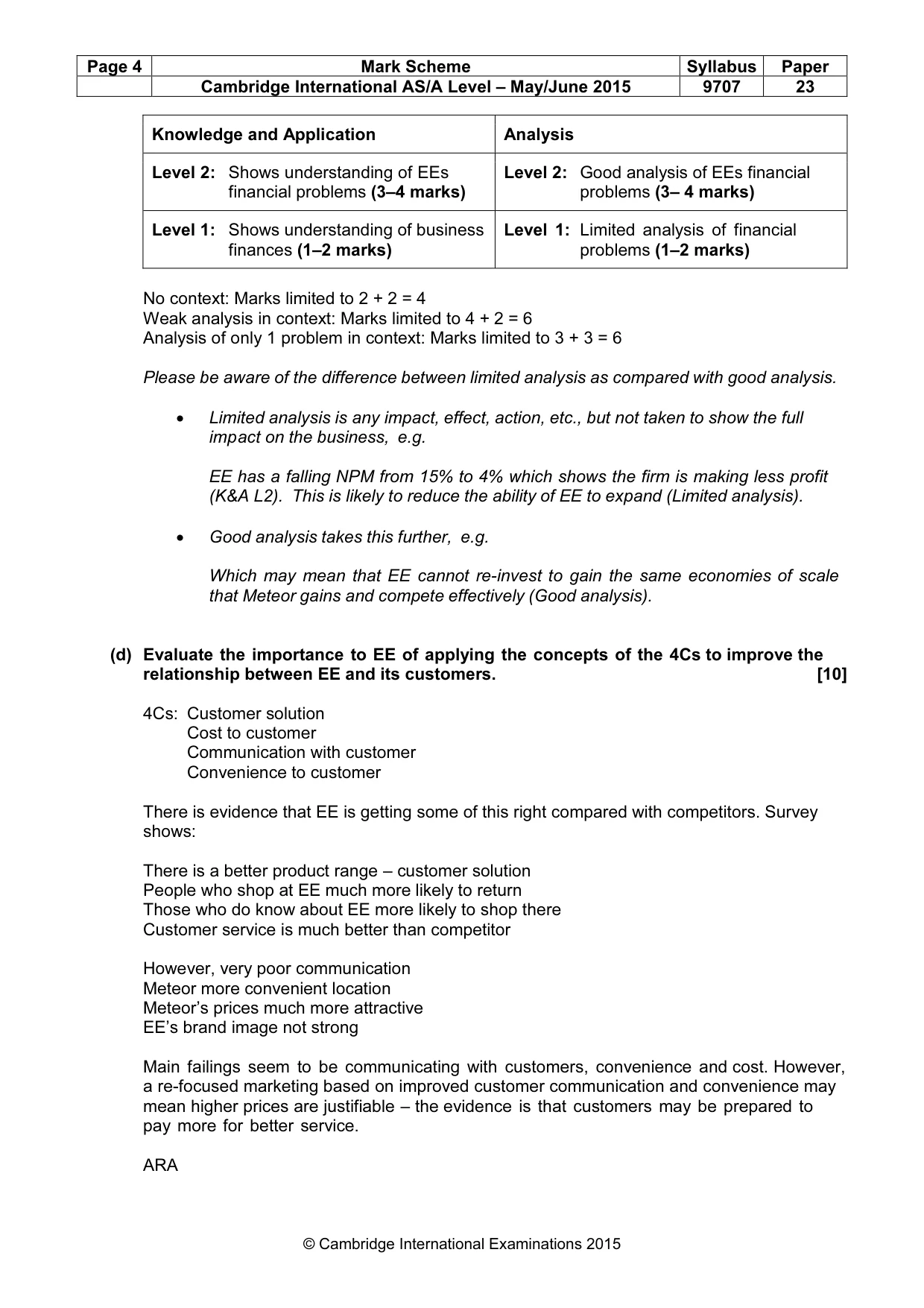
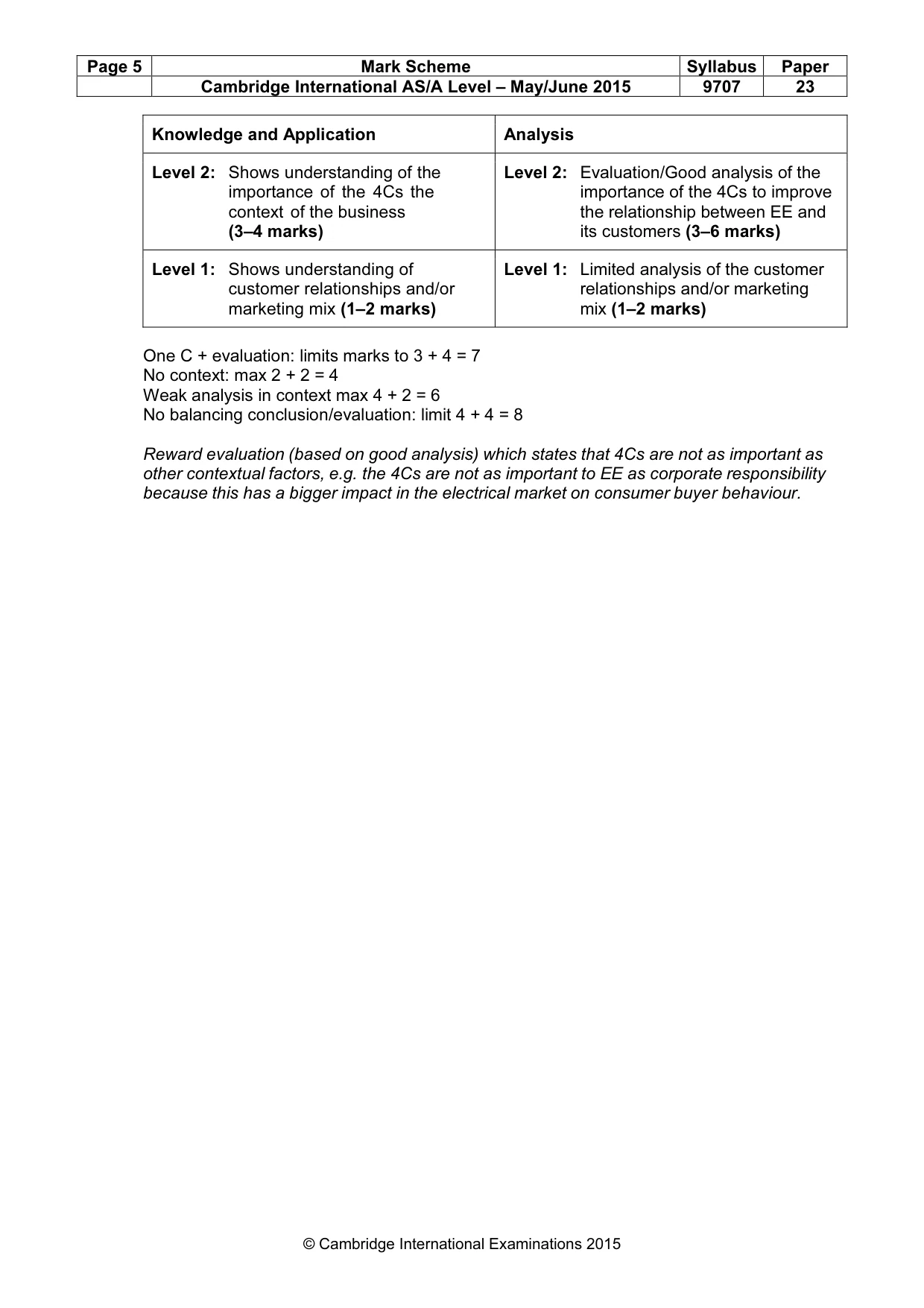
Mark scheme: 1 Enterprise Electricals (EE) (a) Explain the following terms: (i) Economies of scale [3] An idea of falling average/unit costs (1 mark) An idea that this is due to an increase in size/scale (1 mark) Example/some other way of demonstrating good understanding (1 mark) Content: Reductions in a business’ unit (average) costs that result from an increase in the scale of its operations. Examples help. Falling costs (not average or unit) should not be awarded but does not restrict award of further two marks. (ii) Inventory control [3] An understanding of what inventory is (i.e. stock) (1 mark) An understanding of how/why inventory can be controlled (1 mark) Example/some other way of demonstrating good understanding of inventory control (1 mark) Method for managing inventories (stocks). Examples include JIT, JIC, buffer stock, etc. Beware of tautological explanations: i.e. inventory control is a way of controlling a firm’s inventory This shows no understanding. (b) (i) Calculate the price elasticity of demand for refrigerators. [3] PED = % change in demand % change in price % change in demand = 5% % change in price = –20% Elasticity = –0.25 (accept a quarter, or –0.3) Correct answer: 3 marks no need for working or minus sign Good attempt : 2 marks i.e. correct use of figures (i.e. percentage change in QD), attempt with one error Attempt: 1 mark i.e. formula or identification of correct figures (i.e. absolute change in QD) Minus sign is NOT necessary for full marks. (ii) Using your answer to (i), comment on the usefulness to EE of price elasticity of demand. [3] Usefulness of PED could include: • decide on price changes • to forecast sales • to model pricing options ARA Knowledge and Application Level 2: Shows understanding of the usefulness of PED in (3 marks) the context of the business Level 1: Shows understanding of the usefulness of PED (1–2 marks) No reference to (b)(i) marks limited to 2. Reference could be an interpretation of the figure (i.e. inelastic) (OFR) The question asks about the usefulness, so this must be the focus of the MS. As it stands there are no marks for knowledge of elasticity (i.e. interpreting the answer as inelastic) unless the candidate shows why this is useful. (c) Analyse EE’s financial problems. [8] NPM Decreased which means that EE make less net profit for each $ of sales, bigger change than GPM, could suggest problem with expenses/indirect costs which EE has control over. GPM Decreased which means that EE make less gross profit for each $ of sales, smaller than change in NPM Inventories Doubled, reasonable for a retailer to hold some inventory, but should not have increased with lower revenue (less sales) Trade receivables Increased, suggesting EE is not getting customers to pay quick enough and/or offering more credit Cash Decreased, might suggest cash flow problem or better use of working capital – how much cash does a retailer need to hold? Current liabilities Doubled, does the business have problems with creditors? This could be bad, but could be trying to use as a short term source of finance. Current ratio CR seems to fall to lower end of normally accepted range, so no immediate worry; however, the trend is worrying. However, how relevant are accepted levels to a retail business like this? Acid test ratio ATR fallen to well below normally accepted level. However, how relevant are accepted levels to a retail business like this? ARA Knowledge and Application Analysis Level 2: Shows understanding of EEs Level 2: Good analysis of EEs financial financial problems (3–4 marks) problems (3– 4 marks) Level 1: Shows understanding of business Level 1: Limited analysis of financial finances (1–2 marks) problems (1–2 marks) No context: Marks limited to 2 + 2 = 4 Weak analysis in context: Marks limited to 4 + 2 = 6 Analysis of only 1 problem in context: Marks limited to 3 + 3 = 6 Please be aware of the difference between limited analysis as compared with good analysis. • Limited analysis is any impact, effect, action, etc., but not taken to show the full impact on the business, e.g. EE has a falling NPM from 15% to 4% which shows the firm is making less profit (K&A L2). This is likely to reduce the ability of EE to expand (Limited analysis). • Good analysis takes this further, e.g. Which may mean that EE cannot re-invest to gain the same economies of scale that Meteor gains and compete effectively (Good analysis). (d) Evaluate the importance to EE of applying the concepts of the 4Cs to improve the relationship between EE and its customers. [10] 4Cs: Customer solution Cost to customer Communication with customer Convenience to customer There is evidence that EE is getting some of this right compared with competitors. Survey shows: There is a better product range – customer solution People who shop at EE much more likely to return Those who do know about EE more likely to shop there Customer service is much better than competitor However, very poor communication Meteor more convenient location Meteor’s prices much more attractive EE’s brand image not strong Main failings seem to be communicating with customers, convenience and cost. However, a re-focused marketing based on improved customer communication and convenience may mean higher prices are justifiable – the evidence is that customers may be prepared to pay more for better service. ARA Knowledge and Application Analysis Level 2: Shows understanding of the Level 2: Evaluation/Good analysis of the importance of the 4Cs the importance of the 4Cs to improve context of the business the relationship between EE and (3–4 marks) its customers (3–6 marks) Level 1: Shows understanding of Level 1: Limited analysis of the customer customer relationships and/or relationships and/or marketing marketing mix (1–2 marks) mix (1–2 marks) One C + evaluation: limits marks to 3 + 4 = 7 No context: max 2 + 2 = 4 Weak analysis in context max 4 + 2 = 6 No balancing conclusion/evaluation: limit 4 + 4 = 8 Reward evaluation (based on good analysis) which states that 4Cs are not as important as other contextual factors, e.g. the 4Cs are not as important to EE as corporate responsibility because this has a bigger impact in the electrical market on consumer buyer behaviour.
Q2 · Frank’s Farm (FF) Frank is a sole trader and he owns FF
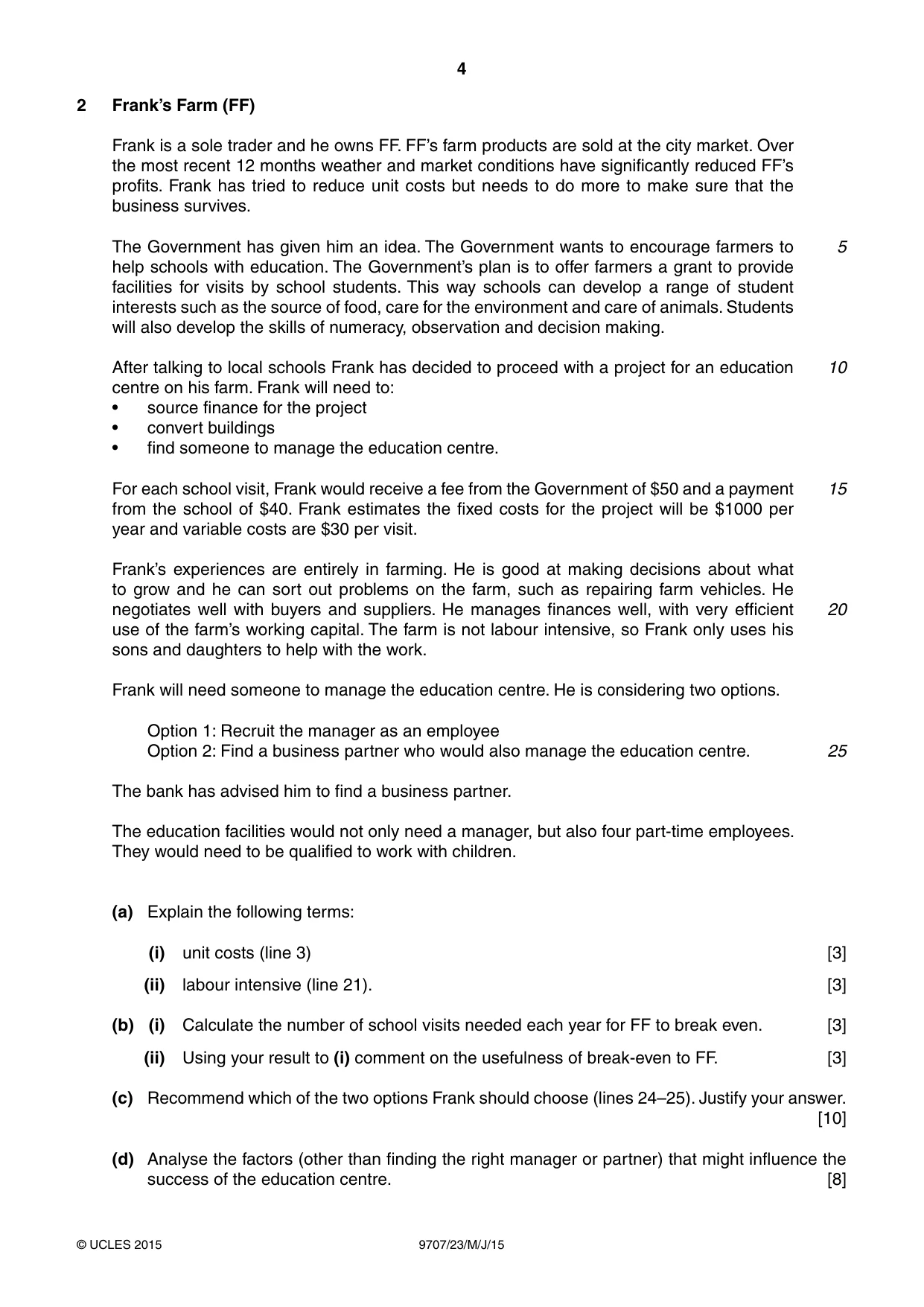
2 Frank’s Farm (FF) Frank is a sole trader and he owns FF. FF’s farm products are sold at the city market. Over the most recent 12 months weather and market conditions have significantly reduced FF’s profits. Frank has tried to reduce unit costs but needs to do more to make sure that the business survives. The Government has given him an idea. The Government wants to encourage farmers to 5 help schools with education. The Government’s plan is to offer farmers a grant to provide facilities for visits by school students. This way schools can develop a range of student interests such as the source of food, care for the environment and care of animals. Students will also develop the skills of numeracy, observation and decision making. After talking to local schools Frank has decided to proceed with a project for an education 10 centre on his farm. Frank will need to: • source finance for the project • convert buildings • find someone to manage the education centre. For each school visit, Frank would receive a fee from the Government of $50 and a payment 15 from the school of $40. Frank estimates the fixed costs for the project will be $1000 per year and variable costs are $30 per visit. Frank’s experiences are entirely in farming. He is good at making decisions about what to grow and he can sort out problems on the farm, such as repairing farm vehicles. He negotiates well with buyers and suppliers. He manages finances well, with very efficient 20 use of the farm’s working capital. The farm is not labour intensive, so Frank only uses his sons and daughters to help with the work. Frank will need someone to manage the education centre. He is considering two options. Option 1: Recruit the manager as an employee Option 2: Find a business partner who would also manage the education centre. 25 The bank has advised him to find a business partner. The education facilities would not only need a manager, but also four part-time employees. They would need to be qualified to work with children. (a) Explain the following terms: (i) unit costs (line 3) [3] (ii) labour intensive (line 21). [3] (b) (i) Calculate the number of school visits needed each year for FF to break even. [3] (ii) Using your result to (i) comment on the usefulness of break-even to FF. [3] (c) Recommend which of the two options Frank should choose (lines 24–25). Justify your answer. [10] (d) Analyse the factors (other than finding the right manager or partner) that might influence the success of the education centre. [8]
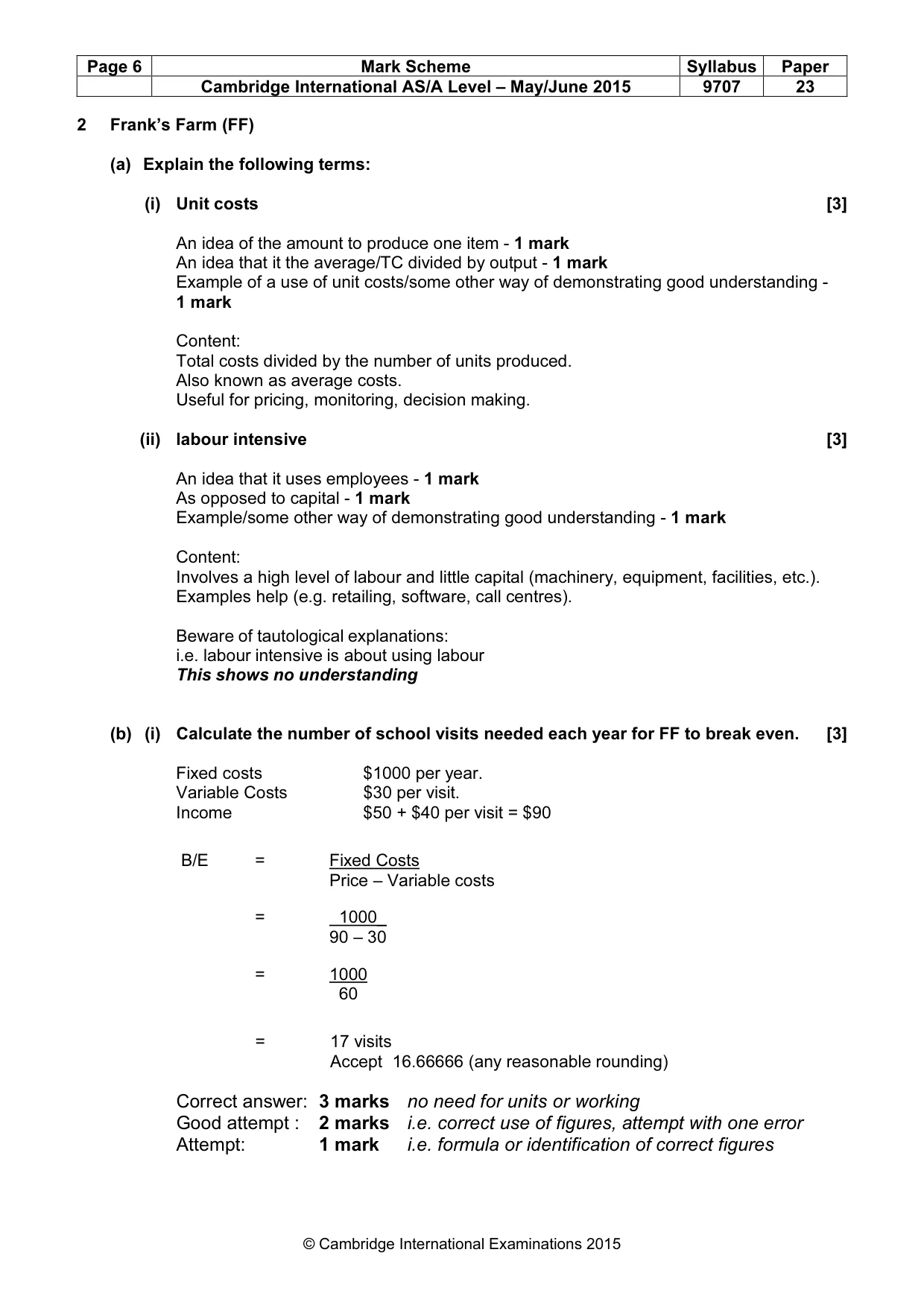
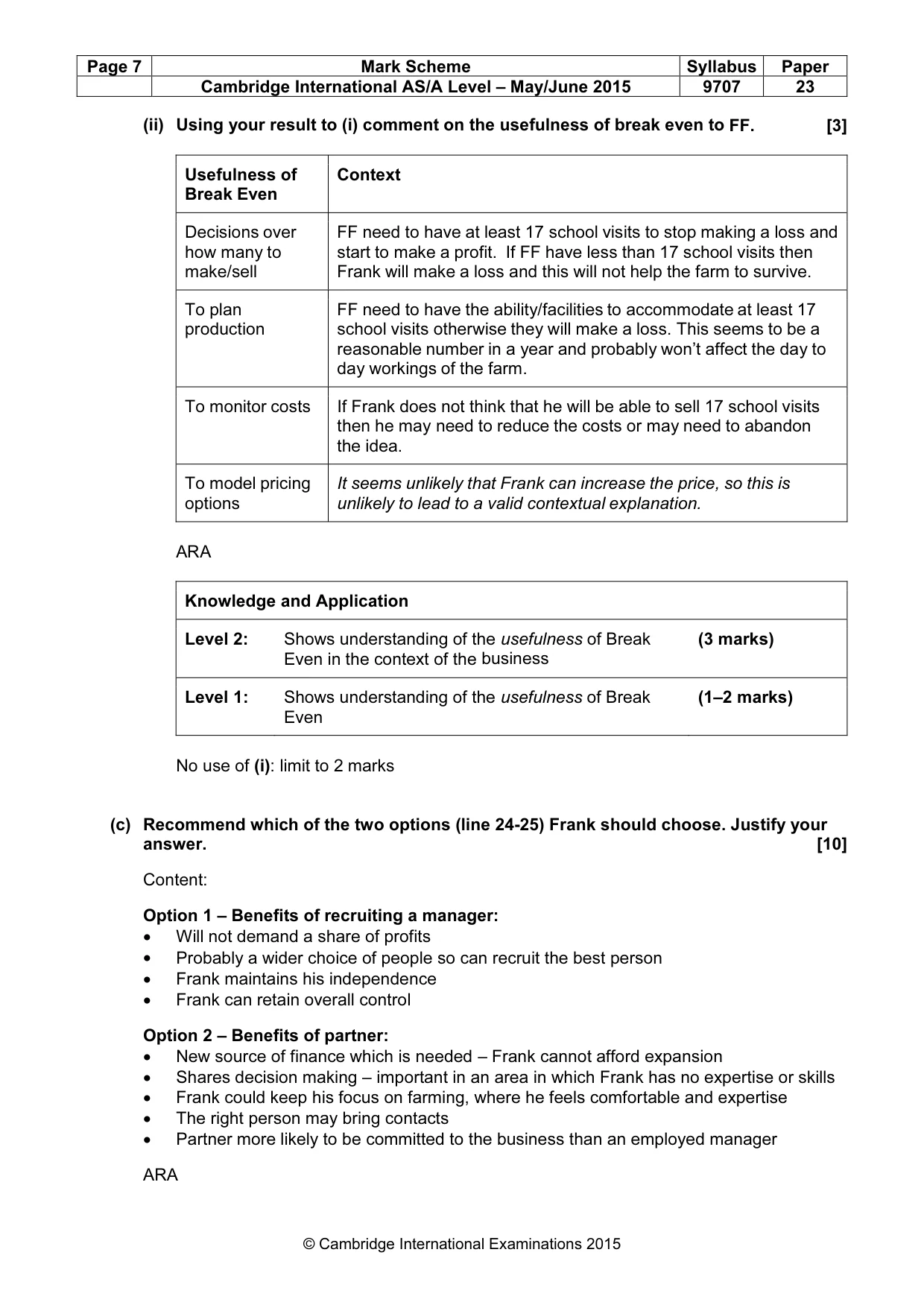
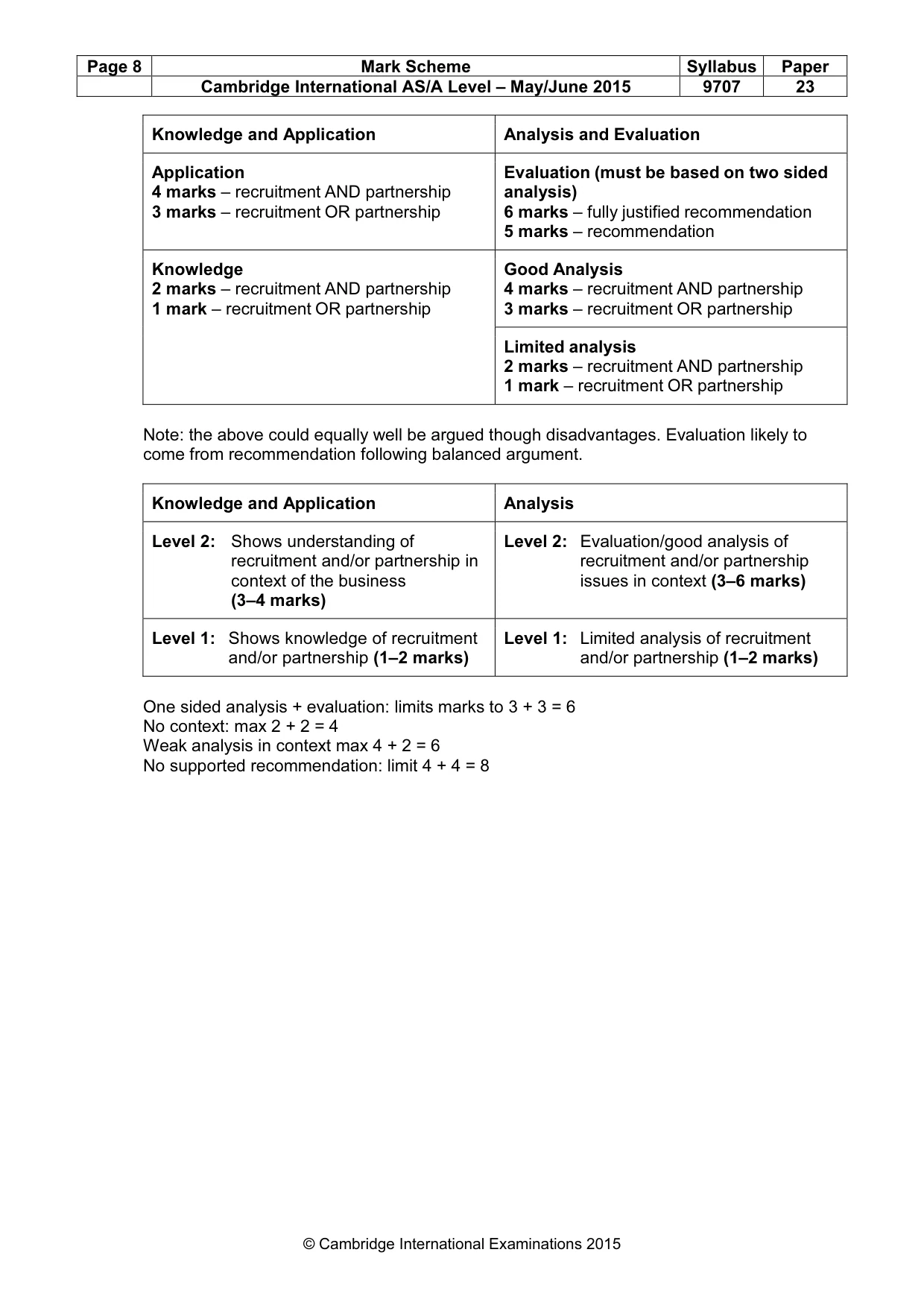
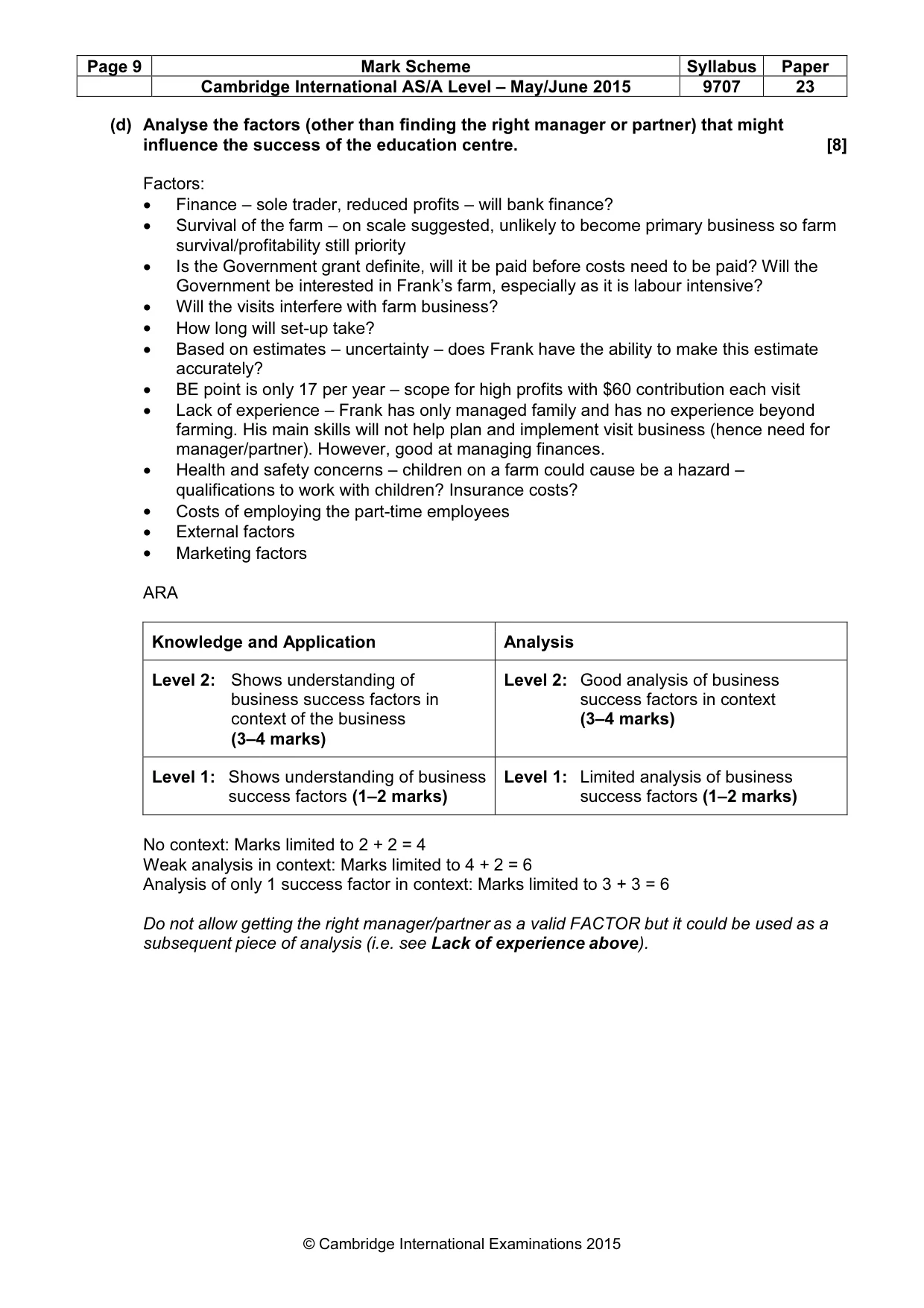
Mark scheme: 2 Frank’s Farm (FF) (a) Explain the following terms: (i) Unit costs [3] An idea of the amount to produce one item - 1 mark An idea that it the average/TC divided by output - 1 mark Example of a use of unit costs/some other way of demonstrating good understanding - 1 mark Content: Total costs divided by the number of units produced. Also known as average costs. Useful for pricing, monitoring, decision making. (ii) labour intensive [3] An idea that it uses employees - 1 mark As opposed to capital - 1 mark Example/some other way of demonstrating good understanding - 1 mark Content: Involves a high level of labour and little capital (machinery, equipment, facilities, etc.). Examples help (e.g. retailing, software, call centres). Beware of tautological explanations: i.e. labour intensive is about using labour This shows no understanding (b) (i) Calculate the number of school visits needed each year for FF to break even. [3] Fixed costs $1000 per year. Variable Costs $30 per visit. Income $50 + $40 per visit = $90 B/E = Fixed Costs Price – Variable costs = 1000_ 90 – 30 = 1000 60 = 17 visits Accept 16.66666 (any reasonable rounding) Correct answer: 3 marks no need for units or working Good attempt : 2 marks i.e. correct use of figures, attempt with one error Attempt: 1 mark i.e. formula or identification of correct figures (ii) Using your result to (i) comment on the usefulness of break even to FF. [3] Usefulness of Context Break Even Decisions over FF need to have at least 17 school visits to stop making a loss and how many to start to make a profit. If FF have less than 17 school visits then make/sell Frank will make a loss and this will not help the farm to survive. To plan FF need to have the ability/facilities to accommodate at least 17 production school visits otherwise they will make a loss. This seems to be a reasonable number in a year and probably won’t affect the day to day workings of the farm. To monitor costs If Frank does not think that he will be able to sell 17 school visits then he may need to reduce the costs or may need to abandon the idea. To model pricing It seems unlikely that Frank can increase the price, so this is options unlikely to lead to a valid contextual explanation. ARA Knowledge and Application Level 2: Shows understanding of the usefulness of Break (3 marks) Even in the context of the business Level 1: Shows understanding of the usefulness of Break (1–2 marks) Even No use of (i): limit to 2 marks (c) Recommend which of the two options (line 24-25) Frank should choose. Justify your answer. [10] Content: Option 1 – Benefits of recruiting a manager: • Will not demand a share of profits • Probably a wider choice of people so can recruit the best person • Frank maintains his independence • Frank can retain overall control Option 2 – Benefits of partner: • New source of finance which is needed – Frank cannot afford expansion • Shares decision making – important in an area in which Frank has no expertise or skills • Frank could keep his focus on farming, where he feels comfortable and expertise • The right person may bring contacts • Partner more likely to be committed to the business than an employed manager ARA Knowledge and Application Analysis and Evaluation Application Evaluation (must be based on two sided 4 marks – recruitment AND partnership analysis) 3 marks – recruitment OR partnership 6 marks – fully justified recommendation 5 marks – recommendation Knowledge Good Analysis 2 marks – recruitment AND partnership 4 marks – recruitment AND partnership 1 mark – recruitment OR partnership 3 marks – recruitment OR partnership Limited analysis 2 marks – recruitment AND partnership 1 mark – recruitment OR partnership Note: the above could equally well be argued though disadvantages. Evaluation likely to come from recommendation following balanced argument. Knowledge and Application Analysis Level 2: Shows understanding of Level 2: Evaluation/good analysis of recruitment and/or partnership in recruitment and/or partnership context of the business issues in context (3–6 marks) (3–4 marks) Level 1: Shows knowledge of recruitment Level 1: Limited analysis of recruitment and/or partnership (1–2 marks) and/or partnership (1–2 marks) One sided analysis + evaluation: limits marks to 3 + 3 = 6 No context: max 2 + 2 = 4 Weak analysis in context max 4 + 2 = 6 No supported recommendation: limit 4 + 4 = 8 (d) Analyse the factors (other than finding the right manager or partner) that might influence the success of the education centre. [8] Factors: • Finance – sole trader, reduced profits – will bank finance? • Survival of the farm – on scale suggested, unlikely to become primary business so farm survival/profitability still priority • Is the Government grant definite, will it be paid before costs need to be paid? Will the Government be interested in Frank’s farm, especially as it is labour intensive? • Will the visits interfere with farm business? • How long will set-up take? • Based on estimates – uncertainty – does Frank have the ability to make this estimate accurately? • BE point is only 17 per year – scope for high profits with $60 contribution each visit • Lack of experience – Frank has only managed family and has no experience beyond farming. His main skills will not help plan and implement visit business (hence need for manager/partner). However, good at managing finances. • Health and safety concerns – children on a farm could cause be a hazard – qualifications to work with children? Insurance costs? • Costs of employing the part-time employees • External factors • Marketing factors ARA Knowledge and Application Analysis Level 2: Shows understanding of Level 2: Good analysis of business business success factors in success factors in context context of the business (3–4 marks) (3–4 marks) Level 1: Shows understanding of business Level 1: Limited analysis of business success factors (1–2 marks) success factors (1–2 marks) No context: Marks limited to 2 + 2 = 4 Weak analysis in context: Marks limited to 4 + 2 = 6 Analysis of only 1 success factor in context: Marks limited to 3 + 3 = 6 Do not allow getting the right manager/partner as a valid FACTOR but it could be used as a subsequent piece of analysis (i.e. see Lack of experience above).
What you needed in this session
Cambridge’s own grade thresholds for 2015 May/June, Paper 2 · Variant 3. A higher threshold means an easier paper — the bar moves with how the cohort did.