Cambridge A Level Business Studies (for final examination in 2015) 9707 — 2015 Oct/Nov Paper 2 · Variant 2
9707/22/O/N/15 · 2 questions · 57 marks · ≈64 min
The question paper and its mark scheme, free to read here and free to download. This is Cambridge’s own paper, exactly as it was sat.
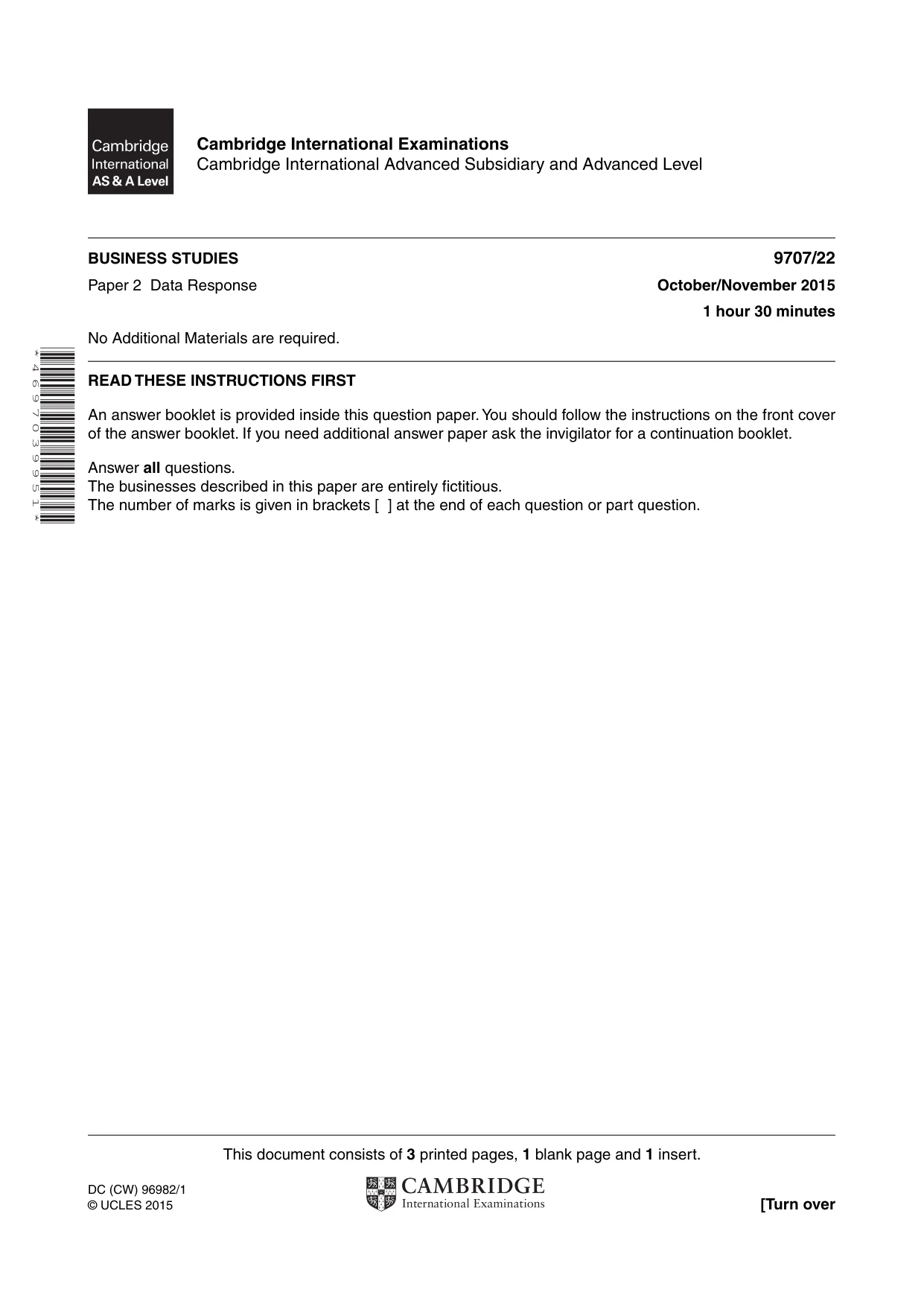
Question paper4 pages

Mark scheme8 pages
Answers below. Sit the paper first if you are practising.
Questions as text
Q1 · Popular Presents (PP) PP is a new business idea that is being developed by Jack Jones, an…
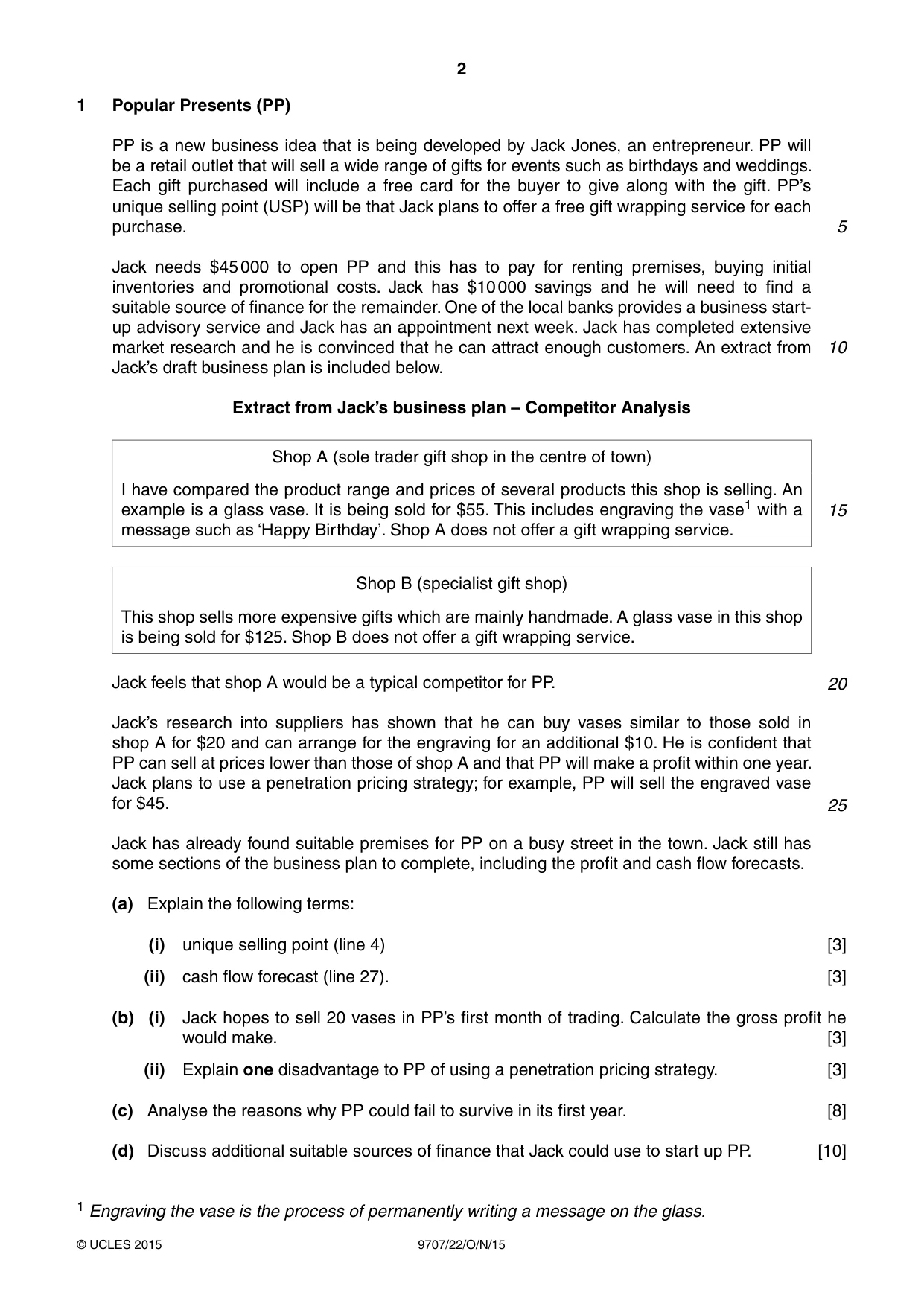
1 Popular Presents (PP) PP is a new business idea that is being developed by Jack Jones, an entrepreneur. PP will be a retail outlet that will sell a wide range of gifts for events such as birthdays and weddings. Each gift purchased will include a free card for the buyer to give along with the gift. PP’s unique selling point (USP) will be that Jack plans to offer a free gift wrapping service for each purchase. 5 Jack needs $45 000 to open PP and this has to pay for renting premises, buying initial inventories and promotional costs. Jack has $10 000 savings and he will need to find a suitable source of finance for the remainder. One of the local banks provides a business start- up advisory service and Jack has an appointment next week. Jack has completed extensive market research and he is convinced that he can attract enough customers. An extract from 10 Jack’s draft business plan is included below. Extract from Jack’s business plan – Competitor Analysis Shop A (sole trader gift shop in the centre of town) I have compared the product range and prices of several products this shop is selling. An example is a glass vase. It is being sold for $55. This includes engraving the vase1 with a 15 message such as ‘Happy Birthday’. Shop A does not offer a gift wrapping service. Shop B (specialist gift shop) This shop sells more expensive gifts which are mainly handmade. A glass vase in this shop is being sold for $125. Shop B does not offer a gift wrapping service. Jack feels that shop A would be a typical competitor for PP. 20 Jack’s research into suppliers has shown that he can buy vases similar to those sold in shop A for $20 and can arrange for the engraving for an additional $10. He is confident that PP can sell at prices lower than those of shop A and that PP will make a profit within one year. Jack plans to use a penetration pricing strategy; for example, PP will sell the engraved vase for $45. 25 Jack has already found suitable premises for PP on a busy street in the town. Jack still has some sections of the business plan to complete, including the profit and cash flow forecasts. (a) Explain the following terms: (i) unique selling point (line 4) [3] (ii) cash flow forecast (line 27). [3] (b) (i) Jack hopes to sell 20 vases in PP’s first month of trading. Calculate the gross profit he would make. [3] (ii) Explain one disadvantage to PP of using a penetration pricing strategy. [3] (c) Analyse the reasons why PP could fail to survive in its first year. [8] (d) Discuss additional suitable sources of finance that Jack could use to start up PP. [10] 1 Engraving the vase is the process of permanently writing a message on the glass.
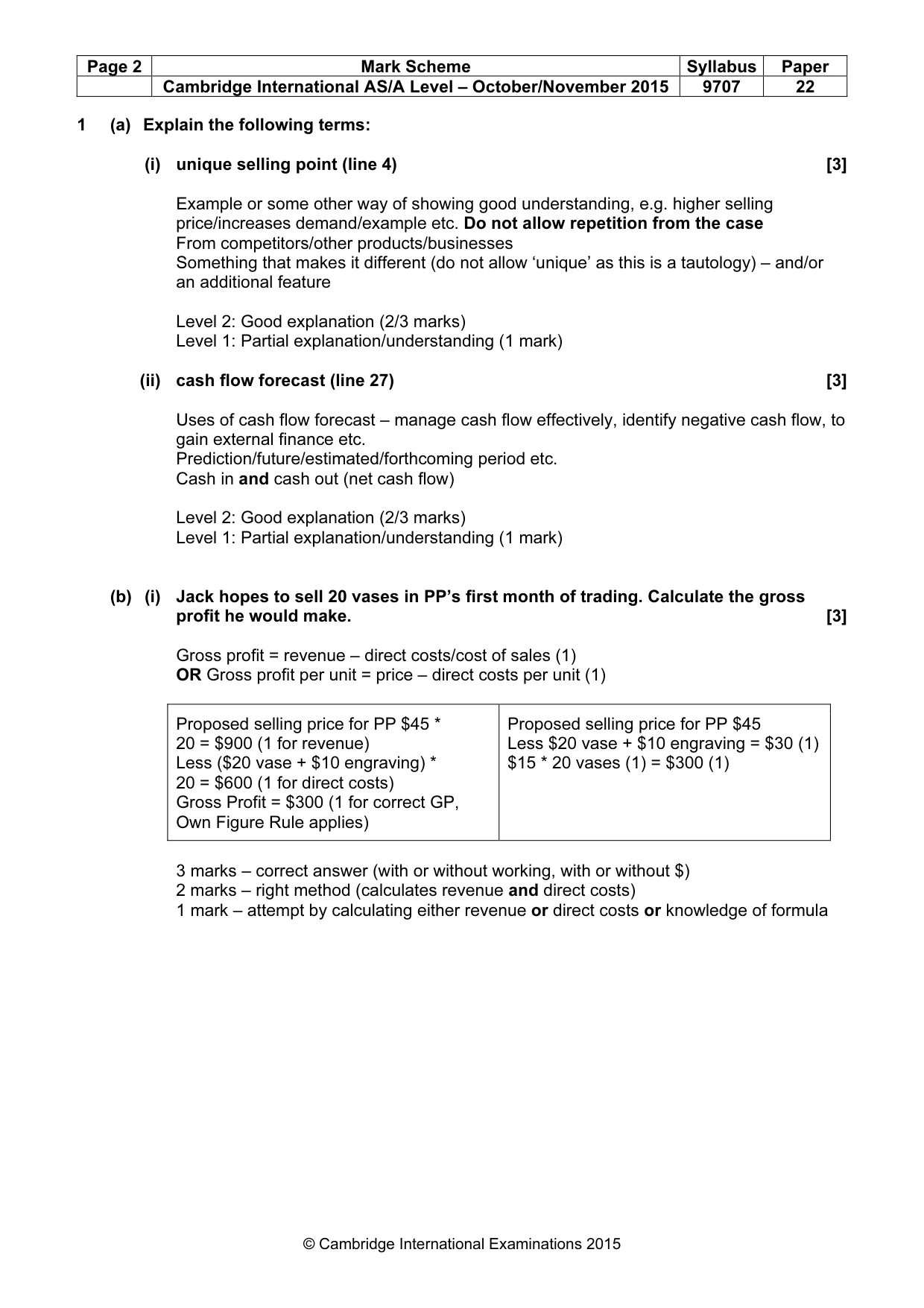
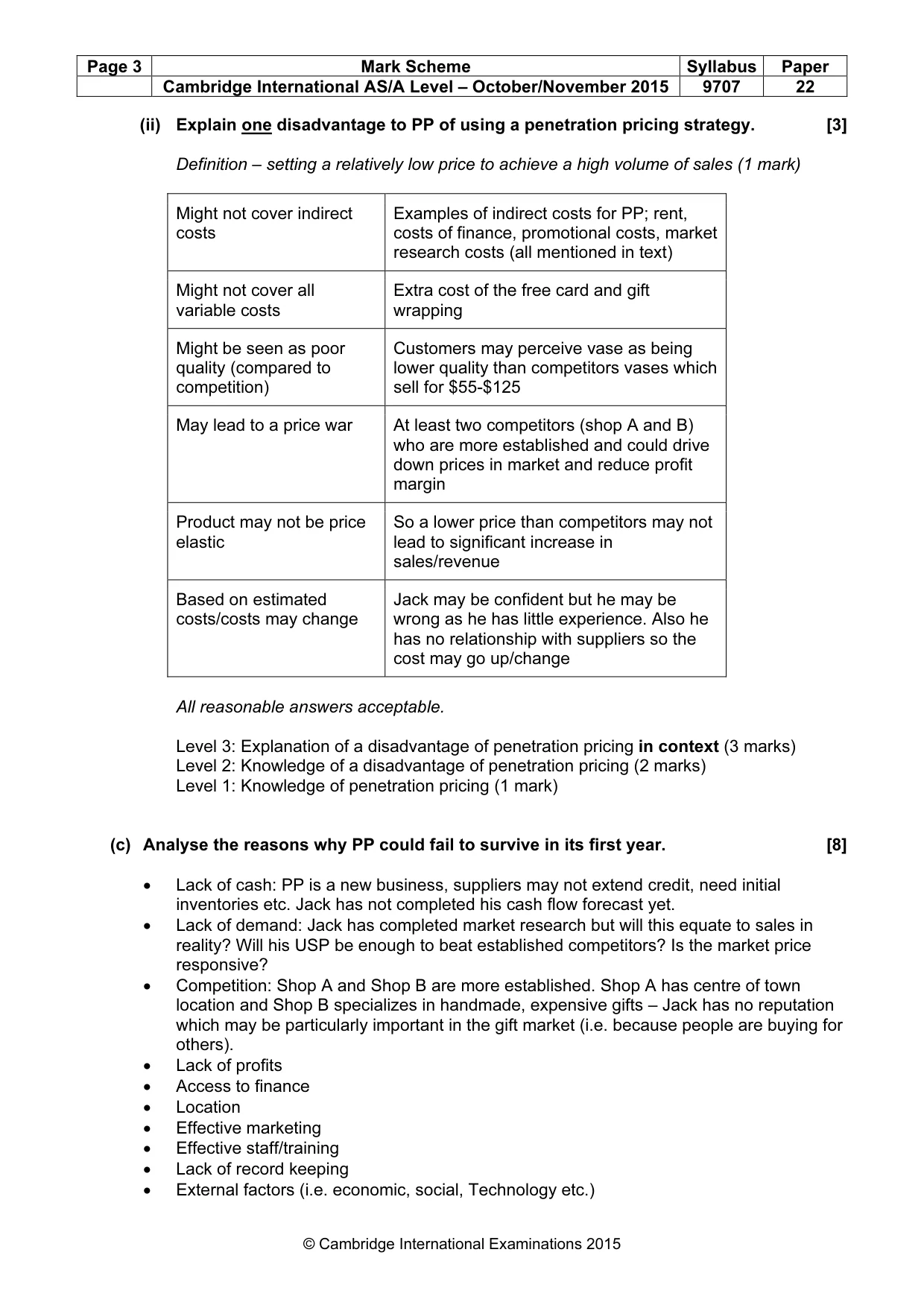
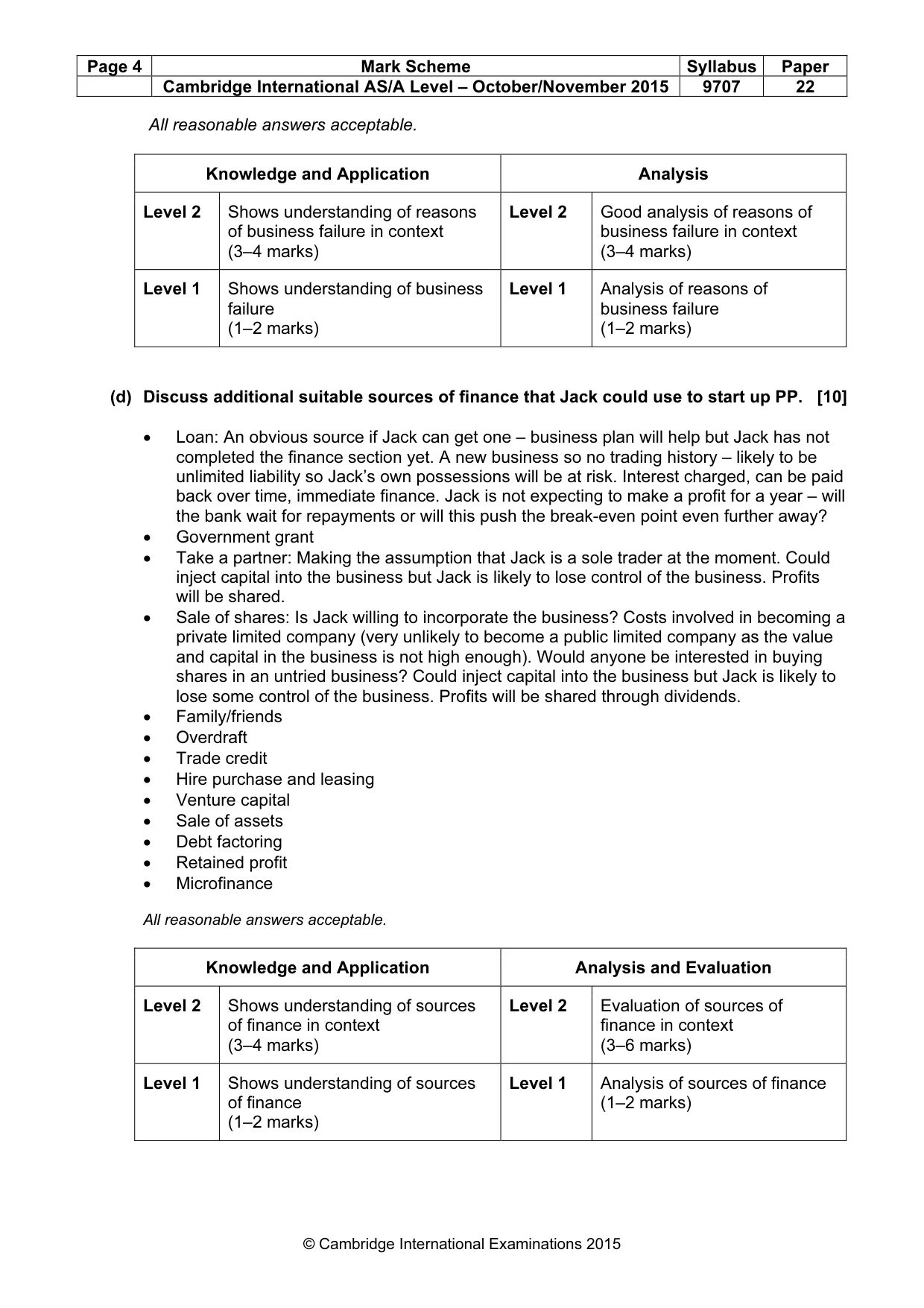
Mark scheme: 1 (a) Explain the following terms: (i) unique selling point (line 4) [3] Example or some other way of showing good understanding, e.g. higher selling price/increases demand/example etc. Do not allow repetition from the case From competitors/other products/businesses Something that makes it different (do not allow ‘unique’ as this is a tautology) – and/or an additional feature Level 2: Good explanation (2/3 marks) Level 1: Partial explanation/understanding (1 mark) (ii) cash flow forecast (line 27) [3] Uses of cash flow forecast – manage cash flow effectively, identify negative cash flow, to gain external finance etc. Prediction/future/estimated/forthcoming period etc. Cash in and cash out (net cash flow) Level 2: Good explanation (2/3 marks) Level 1: Partial explanation/understanding (1 mark) (b) (i) Jack hopes to sell 20 vases in PP’s first month of trading. Calculate the gross profit he would make. [3] Gross profit = revenue – direct costs/cost of sales (1) OR Gross profit per unit = price – direct costs per unit (1) Proposed selling price for PP $45 * Proposed selling price for PP $45 20 = $900 (1 for revenue) Less $20 vase + $10 engraving = $30 (1) Less ($20 vase + $10 engraving) * $15 * 20 vases (1) = $300 (1) 20 = $600 (1 for direct costs) Gross Profit = $300 (1 for correct GP, Own Figure Rule applies) 3 marks – correct answer (with or without working, with or without $) 2 marks – right method (calculates revenue and direct costs) 1 mark – attempt by calculating either revenue or direct costs or knowledge of formula (ii) Explain one disadvantage to PP of using a penetration pricing strategy. [3] Definition – setting a relatively low price to achieve a high volume of sales (1 mark) Might not cover indirect Examples of indirect costs for PP; rent, costs costs of finance, promotional costs, market research costs (all mentioned in text) Might not cover all Extra cost of the free card and gift variable costs wrapping Might be seen as poor Customers may perceive vase as being quality (compared to lower quality than competitors vases which competition) sell for $55-$125 May lead to a price war At least two competitors (shop A and B) who are more established and could drive down prices in market and reduce profit margin Product may not be price So a lower price than competitors may not elastic lead to significant increase in sales/revenue Based on estimated Jack may be confident but he may be costs/costs may change wrong as he has little experience. Also he has no relationship with suppliers so the cost may go up/change All reasonable answers acceptable. Level 3: Explanation of a disadvantage of penetration pricing in context (3 marks) Level 2: Knowledge of a disadvantage of penetration pricing (2 marks) Level 1: Knowledge of penetration pricing (1 mark) (c) Analyse the reasons why PP could fail to survive in its first year. [8] • Lack of cash: PP is a new business, suppliers may not extend credit, need initial inventories etc. Jack has not completed his cash flow forecast yet. • Lack of demand: Jack has completed market research but will this equate to sales in reality? Will his USP be enough to beat established competitors? Is the market price responsive? • Competition: Shop A and Shop B are more established. Shop A has centre of town location and Shop B specializes in handmade, expensive gifts – Jack has no reputation which may be particularly important in the gift market (i.e. because people are buying for others). • Lack of profits • Access to finance • Location • Effective marketing • Effective staff/training • Lack of record keeping • External factors (i.e. economic, social, Technology etc.) All reasonable answers acceptable. Knowledge and Application Analysis Level 2 Shows understanding of reasons Level 2 Good analysis of reasons of of business failure in context business failure in context (3–4 marks) (3–4 marks) Level 1 Shows understanding of business Level 1 Analysis of reasons of failure business failure (1–2 marks) (1–2 marks) (d) Discuss additional suitable sources of finance that Jack could use to start up PP. [10] • Loan: An obvious source if Jack can get one – business plan will help but Jack has not completed the finance section yet. A new business so no trading history – likely to be unlimited liability so Jack’s own possessions will be at risk. Interest charged, can be paid back over time, immediate finance. Jack is not expecting to make a profit for a year – will the bank wait for repayments or will this push the break-even point even further away? • Government grant • Take a partner: Making the assumption that Jack is a sole trader at the moment. Could inject capital into the business but Jack is likely to lose control of the business. Profits will be shared. • Sale of shares: Is Jack willing to incorporate the business? Costs involved in becoming a private limited company (very unlikely to become a public limited company as the value and capital in the business is not high enough). Would anyone be interested in buying shares in an untried business? Could inject capital into the business but Jack is likely to lose some control of the business. Profits will be shared through dividends. • Family/friends • Overdraft • Trade credit • Hire purchase and leasing • Venture capital • Sale of assets • Debt factoring • Retained profit • Microfinance All reasonable answers acceptable. Knowledge and Application Analysis and Evaluation Level 2 Shows understanding of sources Level 2 Evaluation of sources of of finance in context finance in context (3–4 marks) (3–6 marks) Level 1 Shows understanding of sources Level 1 Analysis of sources of finance of finance (1–2 marks) (1–2 marks)
Q2 · Kitchen Quality Appliances (KQA) KQA is a public limited company that has capital…
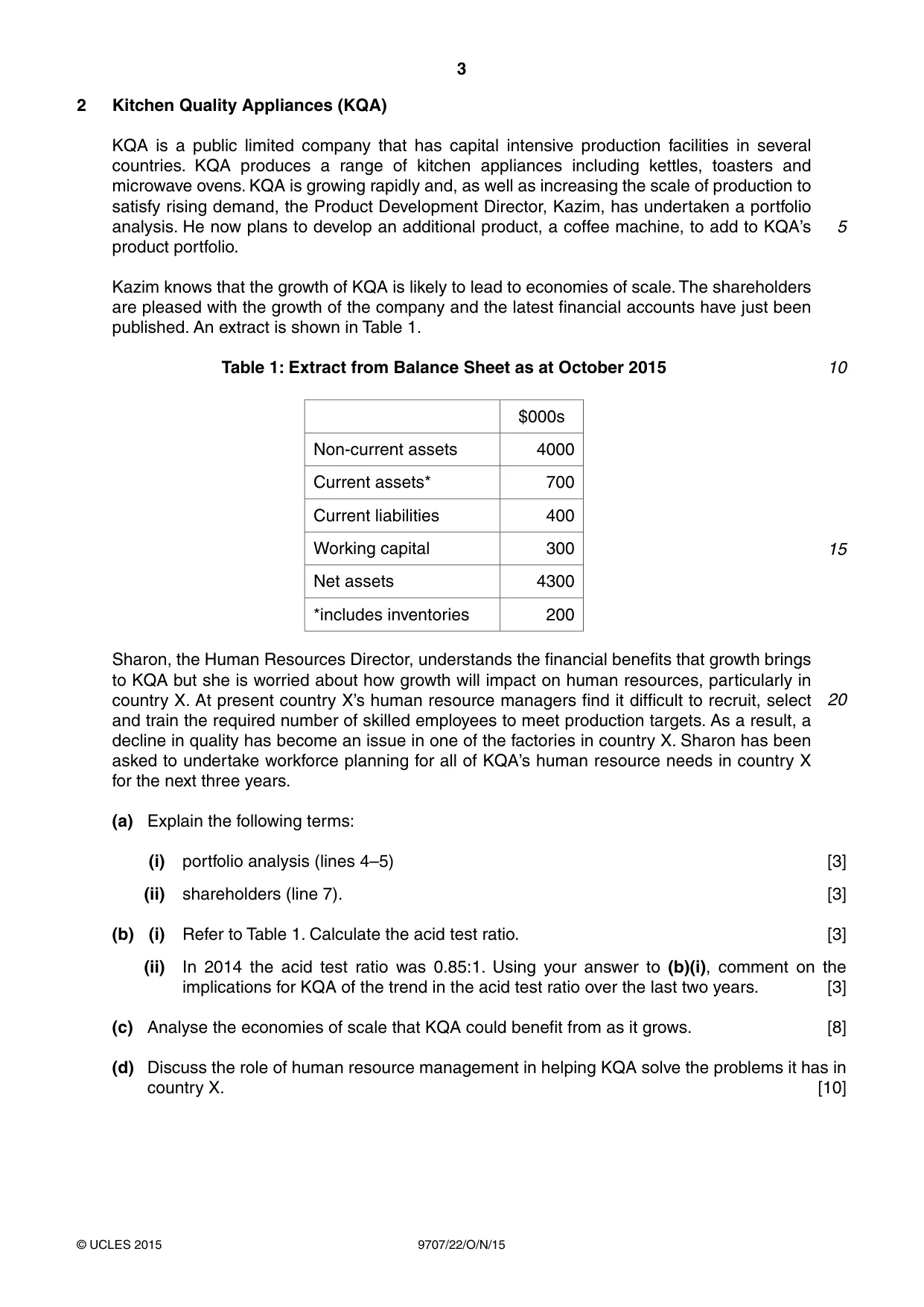
2 Kitchen Quality Appliances (KQA) KQA is a public limited company that has capital intensive production facilities in several countries. KQA produces a range of kitchen appliances including kettles, toasters and microwave ovens. KQA is growing rapidly and, as well as increasing the scale of production to satisfy rising demand, the Product Development Director, Kazim, has undertaken a portfolio analysis. He now plans to develop an additional product, a coffee machine, to add to KQA’s 5 product portfolio. Kazim knows that the growth of KQA is likely to lead to economies of scale. The shareholders are pleased with the growth of the company and the latest financial accounts have just been published. An extract is shown in Table 1. Table 1: Extract from Balance Sheet as at October 2015 10 $000s Non-current assets 4000 Current assets* 700 Current liabilities 400 Working capital 300 15 Net assets 4300 *includes inventories 200 Sharon, the Human Resources Director, understands the financial benefits that growth brings to KQA but she is worried about how growth will impact on human resources, particularly in country X. At present country X’s human resource managers find it difficult to recruit, select 20 and train the required number of skilled employees to meet production targets. As a result, a decline in quality has become an issue in one of the factories in country X. Sharon has been asked to undertake workforce planning for all of KQA’s human resource needs in country X for the next three years. (a) Explain the following terms: (i) portfolio analysis (lines 4–5) [3] (ii) shareholders (line 7). [3] (b) (i) Refer to Table 1. Calculate the acid test ratio. [3] (ii) In 2014 the acid test ratio was 0.85:1. Using your answer to (b)(i), comment on the implications for KQA of the trend in the acid test ratio over the last two years. [3] (c) Analyse the economies of scale that KQA could benefit from as it grows. [8] (d) Discuss the role of human resource management in helping KQA solve the problems it has in country X. [10]
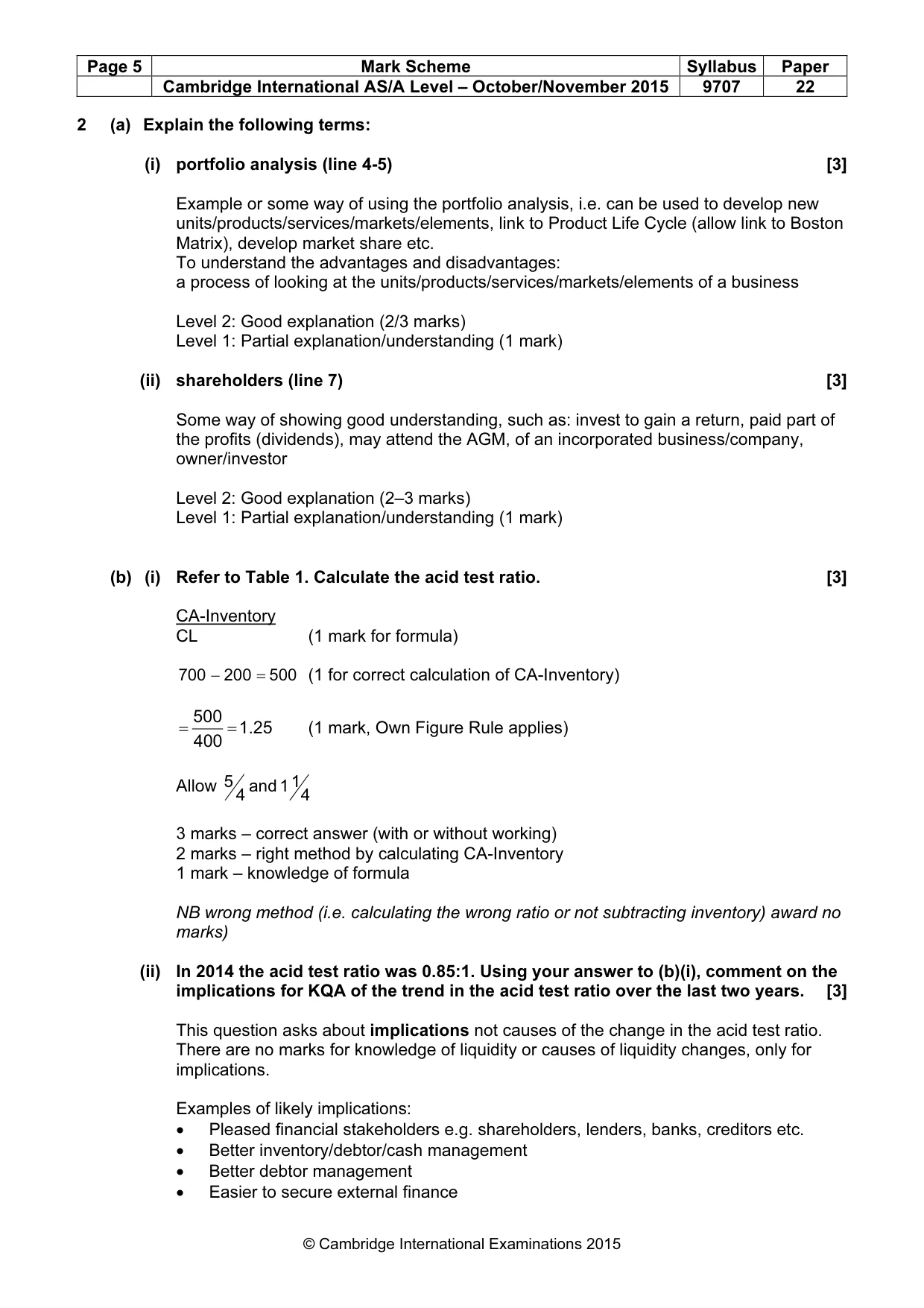
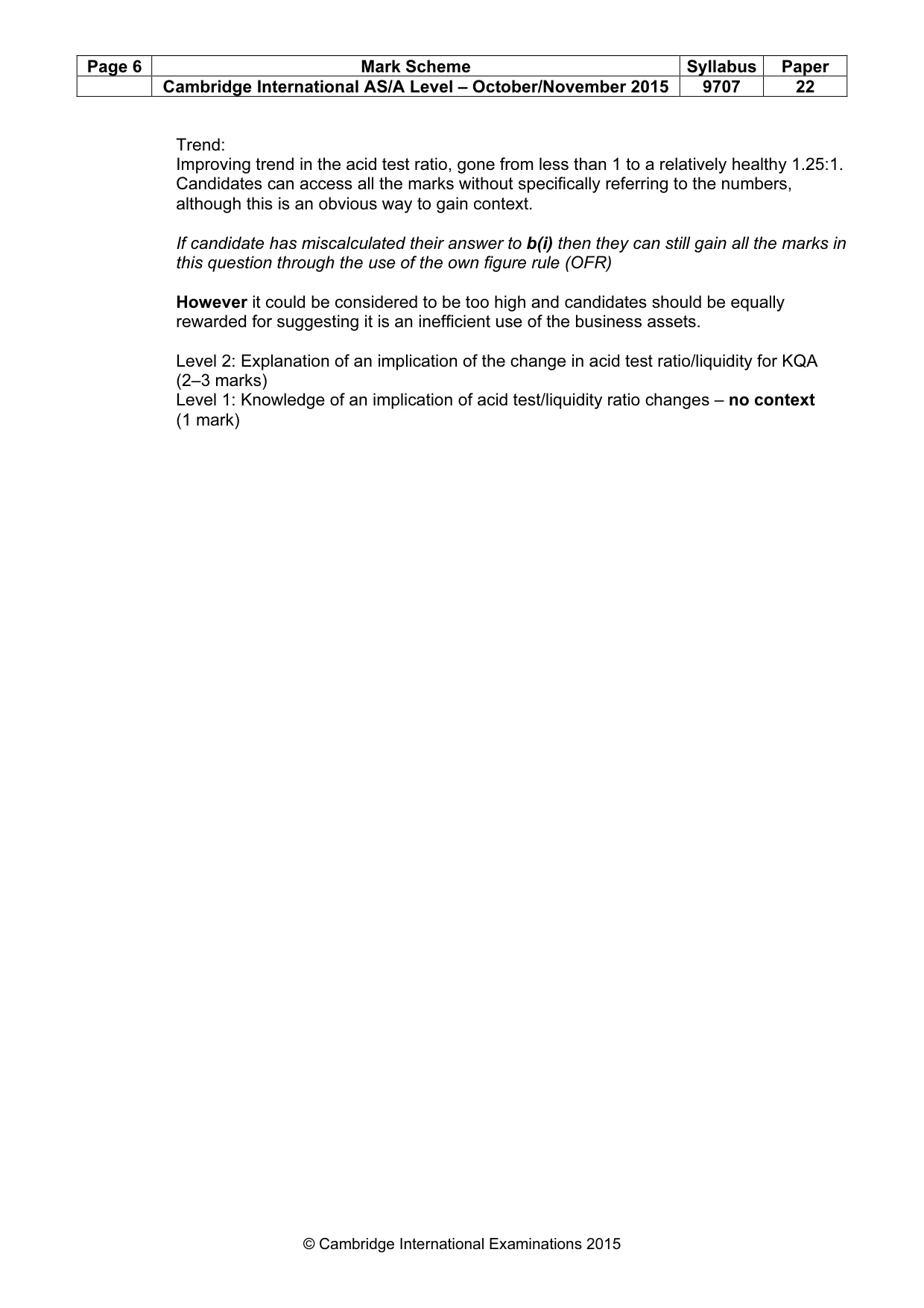
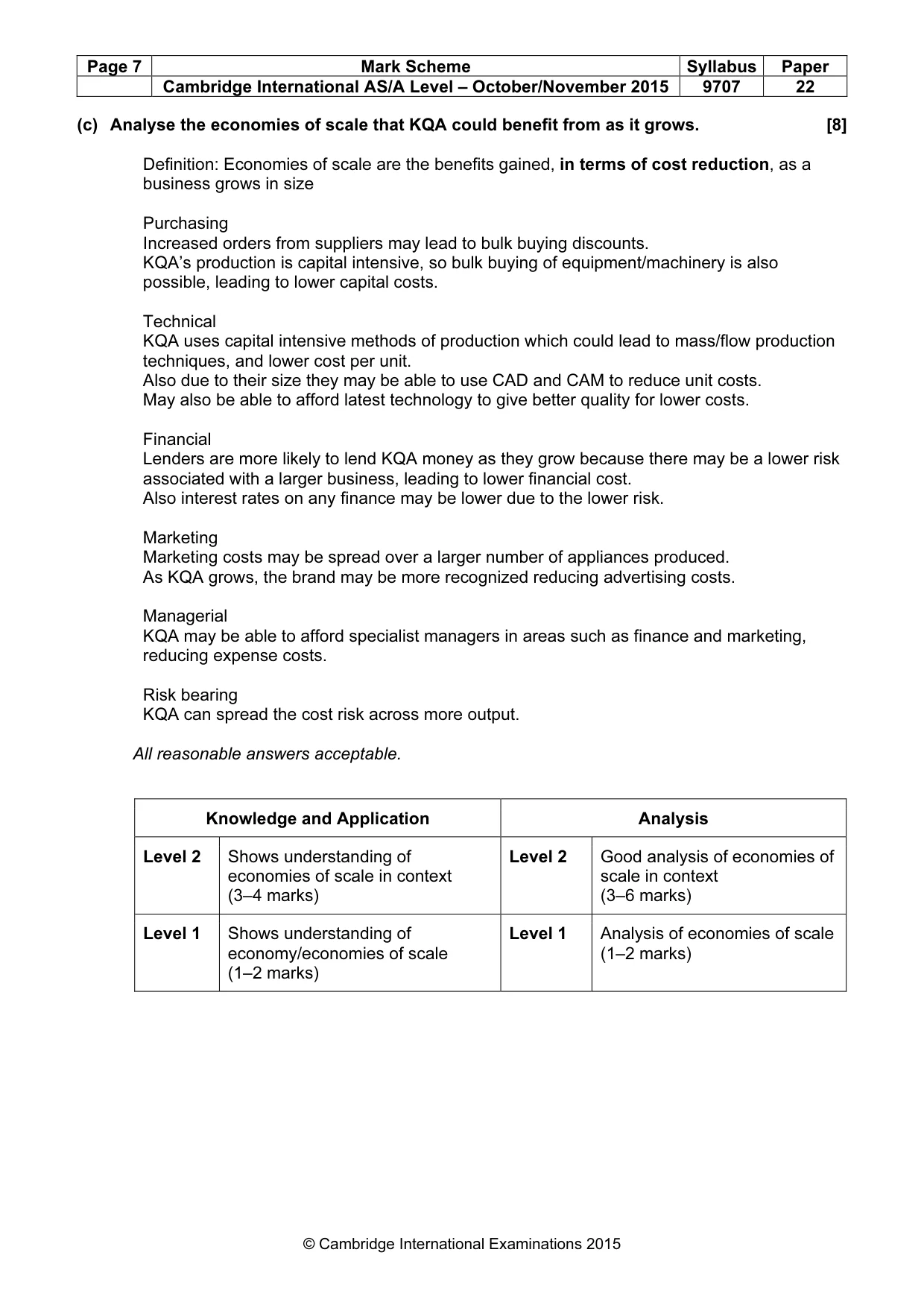
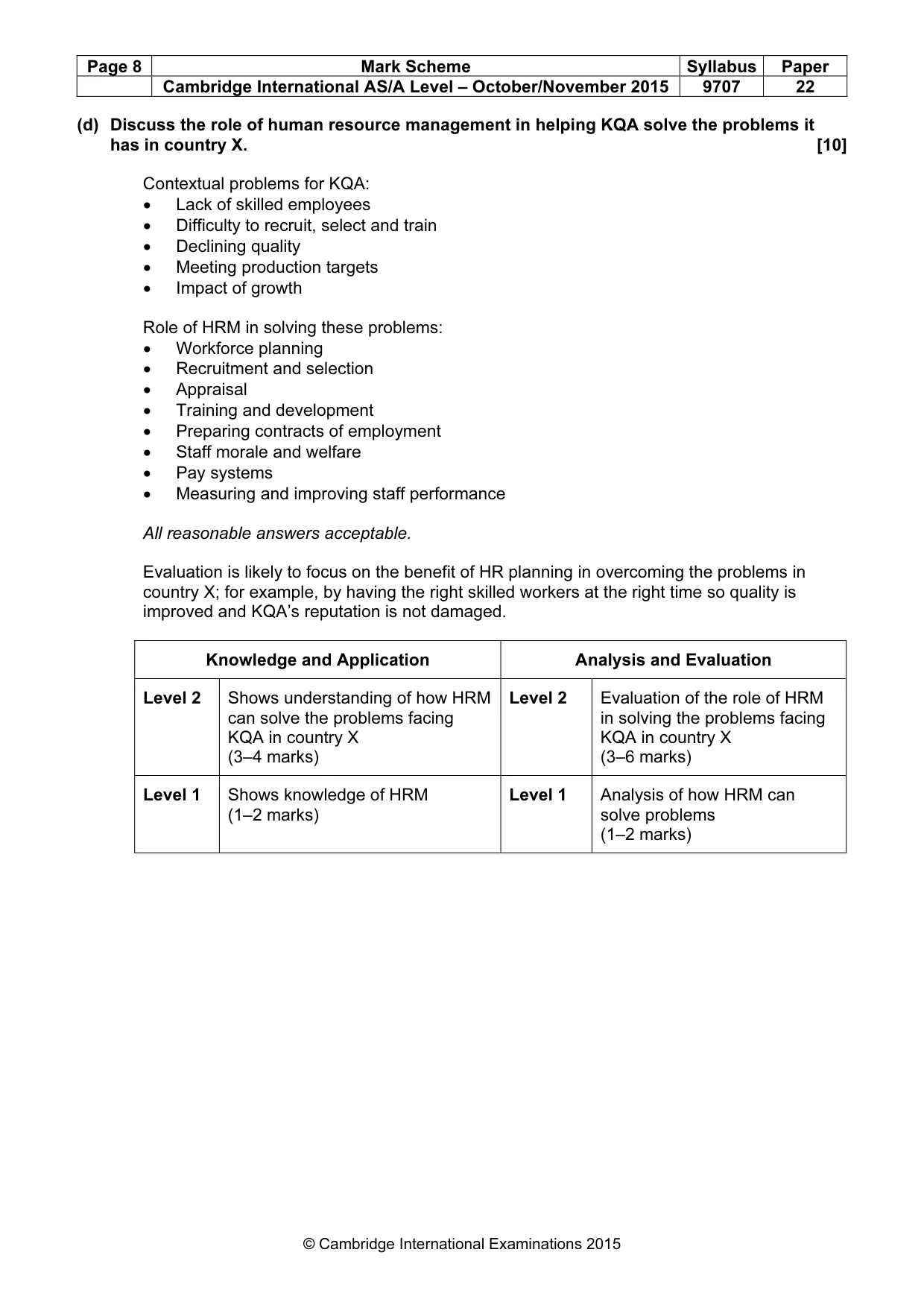
Mark scheme: 2 (a) Explain the following terms: (i) portfolio analysis (line 4-5) [3] Example or some way of using the portfolio analysis, i.e. can be used to develop new units/products/services/markets/elements, link to Product Life Cycle (allow link to Boston Matrix), develop market share etc. To understand the advantages and disadvantages: a process of looking at the units/products/services/markets/elements of a business Level 2: Good explanation (2/3 marks) Level 1: Partial explanation/understanding (1 mark) (ii) shareholders (line 7) [3] Some way of showing good understanding, such as: invest to gain a return, paid part of the profits (dividends), may attend the AGM, of an incorporated business/company, owner/investor Level 2: Good explanation (2–3 marks) Level 1: Partial explanation/understanding (1 mark) (b) (i) Refer to Table 1. Calculate the acid test ratio. [3] CA-Inventory CL (1 mark for formula) 700 − 200 = 500 (1 for correct calculation of CA-Inventory) 500 = = 1.25 (1 mark, Own Figure Rule applies) 400 5 and 1 1 Allow 4 4 3 marks – correct answer (with or without working) 2 marks – right method by calculating CA-Inventory 1 mark – knowledge of formula NB wrong method (i.e. calculating the wrong ratio or not subtracting inventory) award no marks) (ii) In 2014 the acid test ratio was 0.85:1. Using your answer to (b)(i), comment on the implications for KQA of the trend in the acid test ratio over the last two years. [3] This question asks about implications not causes of the change in the acid test ratio. There are no marks for knowledge of liquidity or causes of liquidity changes, only for implications. Examples of likely implications: • Pleased financial stakeholders e.g. shareholders, lenders, banks, creditors etc. • Better inventory/debtor/cash management • Better debtor management • Easier to secure external finance Trend: Improving trend in the acid test ratio, gone from less than 1 to a relatively healthy 1.25:1. Candidates can access all the marks without specifically referring to the numbers, although this is an obvious way to gain context. If candidate has miscalculated their answer to b(i) then they can still gain all the marks in this question through the use of the own figure rule (OFR) However it could be considered to be too high and candidates should be equally rewarded for suggesting it is an inefficient use of the business assets. Level 2: Explanation of an implication of the change in acid test ratio/liquidity for KQA (2–3 marks) Level 1: Knowledge of an implication of acid test/liquidity ratio changes – no context (1 mark) (c) Analyse the economies of scale that KQA could benefit from as it grows. [8] Definition: Economies of scale are the benefits gained, in terms of cost reduction, as a business grows in size Purchasing Increased orders from suppliers may lead to bulk buying discounts. KQA’s production is capital intensive, so bulk buying of equipment/machinery is also possible, leading to lower capital costs. Technical KQA uses capital intensive methods of production which could lead to mass/flow production techniques, and lower cost per unit. Also due to their size they may be able to use CAD and CAM to reduce unit costs. May also be able to afford latest technology to give better quality for lower costs. Financial Lenders are more likely to lend KQA money as they grow because there may be a lower risk associated with a larger business, leading to lower financial cost. Also interest rates on any finance may be lower due to the lower risk. Marketing Marketing costs may be spread over a larger number of appliances produced. As KQA grows, the brand may be more recognized reducing advertising costs. Managerial KQA may be able to afford specialist managers in areas such as finance and marketing, reducing expense costs. Risk bearing KQA can spread the cost risk across more output. All reasonable answers acceptable. Knowledge and Application Analysis Level 2 Shows understanding of Level 2 Good analysis of economies of economies of scale in context scale in context (3–4 marks) (3–6 marks) Level 1 Shows understanding of Level 1 Analysis of economies of scale economy/economies of scale (1–2 marks) (1–2 marks) (d) Discuss the role of human resource management in helping KQA solve the problems it has in country X. [10] Contextual problems for KQA: • Lack of skilled employees • Difficulty to recruit, select and train • Declining quality • Meeting production targets • Impact of growth Role of HRM in solving these problems: • Workforce planning • Recruitment and selection • Appraisal • Training and development • Preparing contracts of employment • Staff morale and welfare • Pay systems • Measuring and improving staff performance All reasonable answers acceptable. Evaluation is likely to focus on the benefit of HR planning in overcoming the problems in country X; for example, by having the right skilled workers at the right time so quality is improved and KQA’s reputation is not damaged. Knowledge and Application Analysis and Evaluation Level 2 Shows understanding of how HRM Level 2 Evaluation of the role of HRM can solve the problems facing in solving the problems facing KQA in country X KQA in country X (3–4 marks) (3–6 marks) Level 1 Shows knowledge of HRM Level 1 Analysis of how HRM can (1–2 marks) solve problems (1–2 marks)