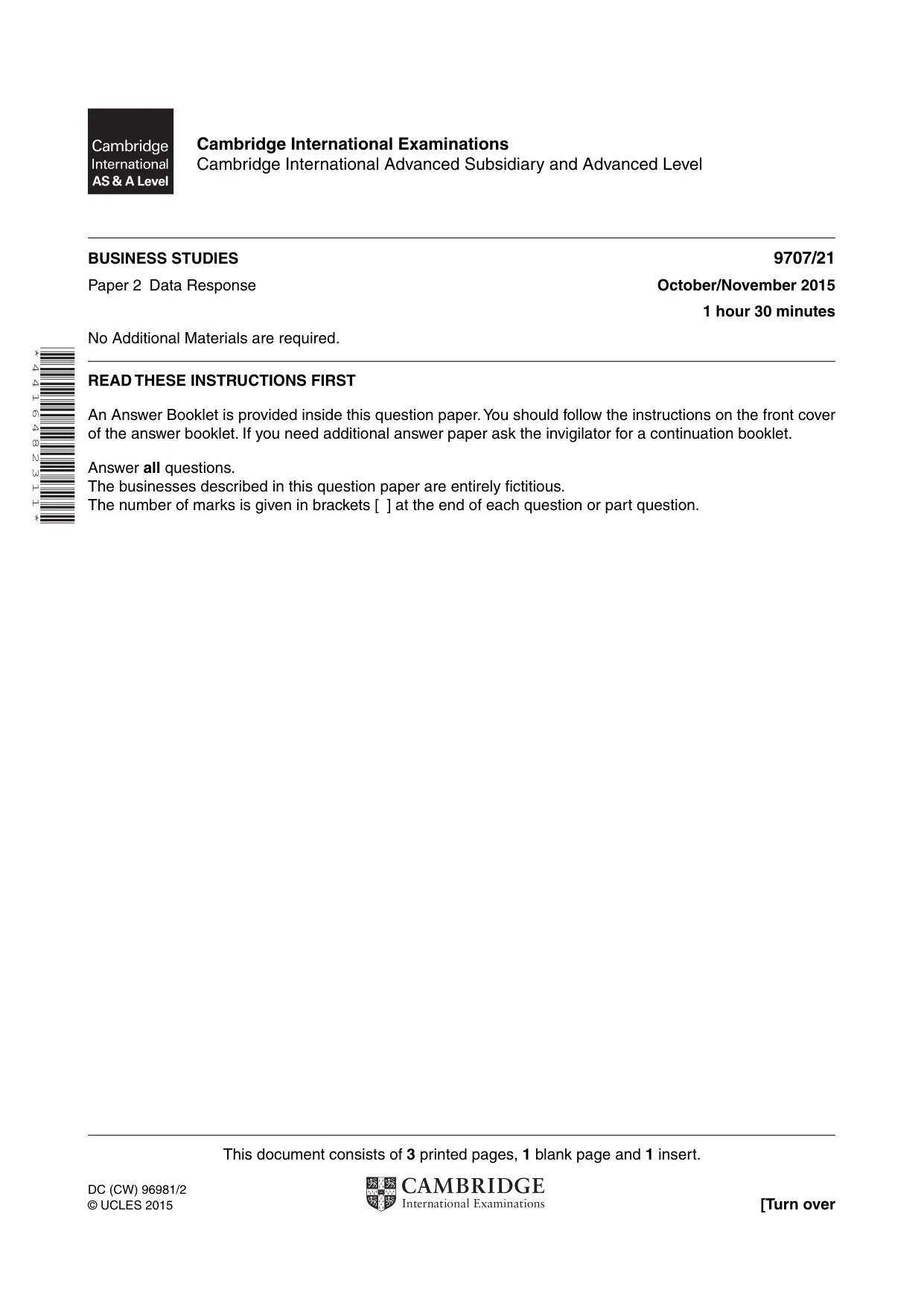
Cambridge A Level Business Studies (for final examination in 2015) 9707 — 2015 Oct/Nov Paper 2 · Variant 1
9707/21/O/N/15 · 2 questions · 60 marks · ≈68 min
The question paper and its mark scheme, free to read here and free to download. This is Cambridge’s own paper, exactly as it was sat.
Question paper4 pages

Mark scheme8 pages
Answers below. Sit the paper first if you are practising.
Questions as text
Q1 · Pet Care (PC) PC is a private limited company
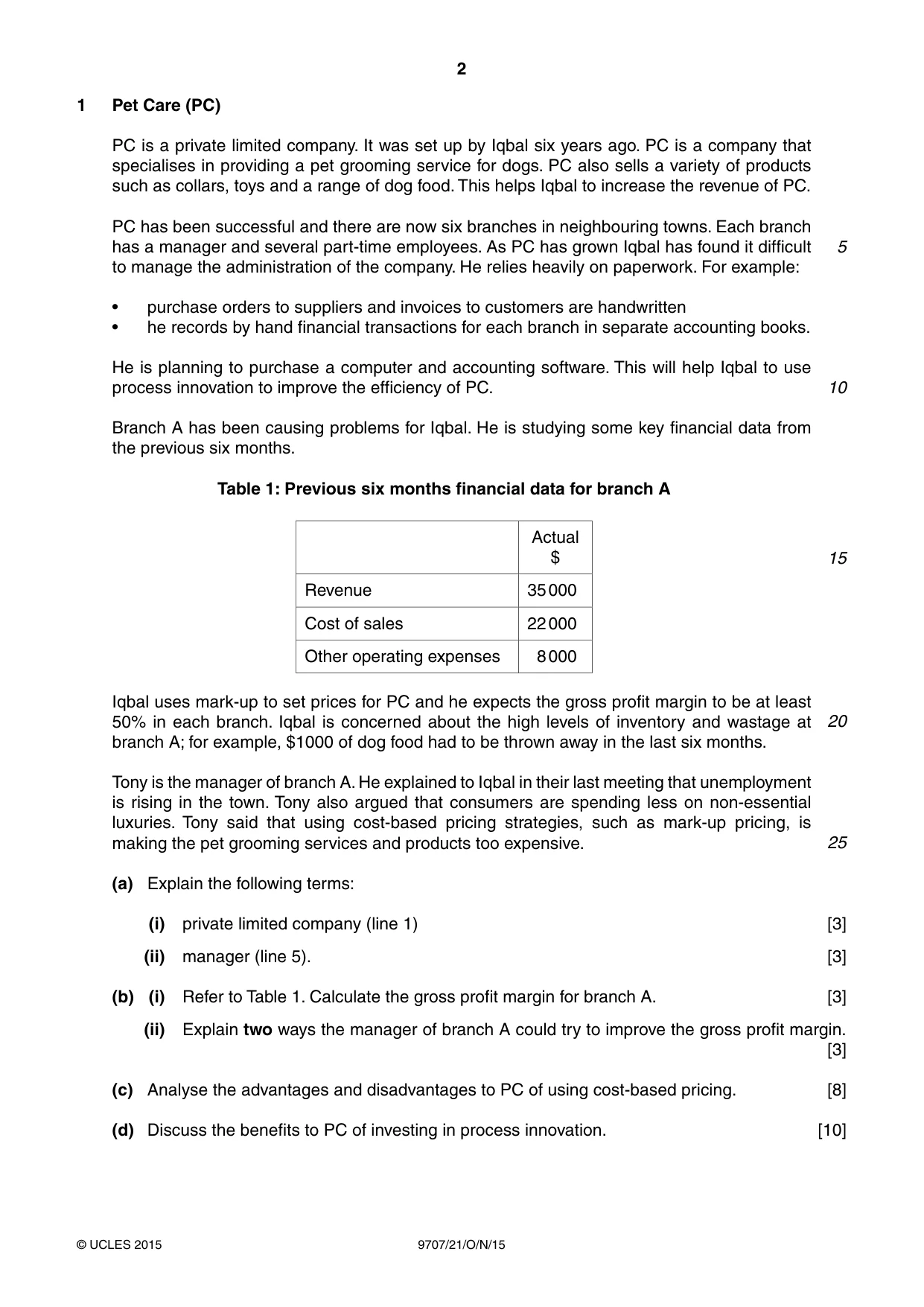
1 Pet Care (PC) PC is a private limited company. It was set up by Iqbal six years ago. PC is a company that specialises in providing a pet grooming service for dogs. PC also sells a variety of products such as collars, toys and a range of dog food. This helps Iqbal to increase the revenue of PC. PC has been successful and there are now six branches in neighbouring towns. Each branch has a manager and several part-time employees. As PC has grown Iqbal has found it difficult 5 to manage the administration of the company. He relies heavily on paperwork. For example: • purchase orders to suppliers and invoices to customers are handwritten • he records by hand financial transactions for each branch in separate accounting books. He is planning to purchase a computer and accounting software. This will help Iqbal to use process innovation to improve the efficiency of PC. 10 Branch A has been causing problems for Iqbal. He is studying some key financial data from the previous six months. Table 1: Previous six months financial data for branch A Actual $ 15 Revenue 35 000 Cost of sales 22 000 Other operating expenses 8 000 Iqbal uses mark-up to set prices for PC and he expects the gross profit margin to be at least 50% in each branch. Iqbal is concerned about the high levels of inventory and wastage at 20 branch A; for example, $1000 of dog food had to be thrown away in the last six months. Tony is the manager of branch A. He explained to Iqbal in their last meeting that unemployment is rising in the town. Tony also argued that consumers are spending less on non-essential luxuries. Tony said that using cost-based pricing strategies, such as mark-up pricing, is making the pet grooming services and products too expensive. 25 (a) Explain the following terms: (i) private limited company (line 1) [3] (ii) manager (line 5). [3] (b) (i) Refer to Table 1. Calculate the gross profit margin for branch A. [3] (ii) Explain two ways the manager of branch A could try to improve the gross profit margin. [3] (c) Analyse the advantages and disadvantages to PC of using cost-based pricing. [8] (d) Discuss the benefits to PC of investing in process innovation. [10]
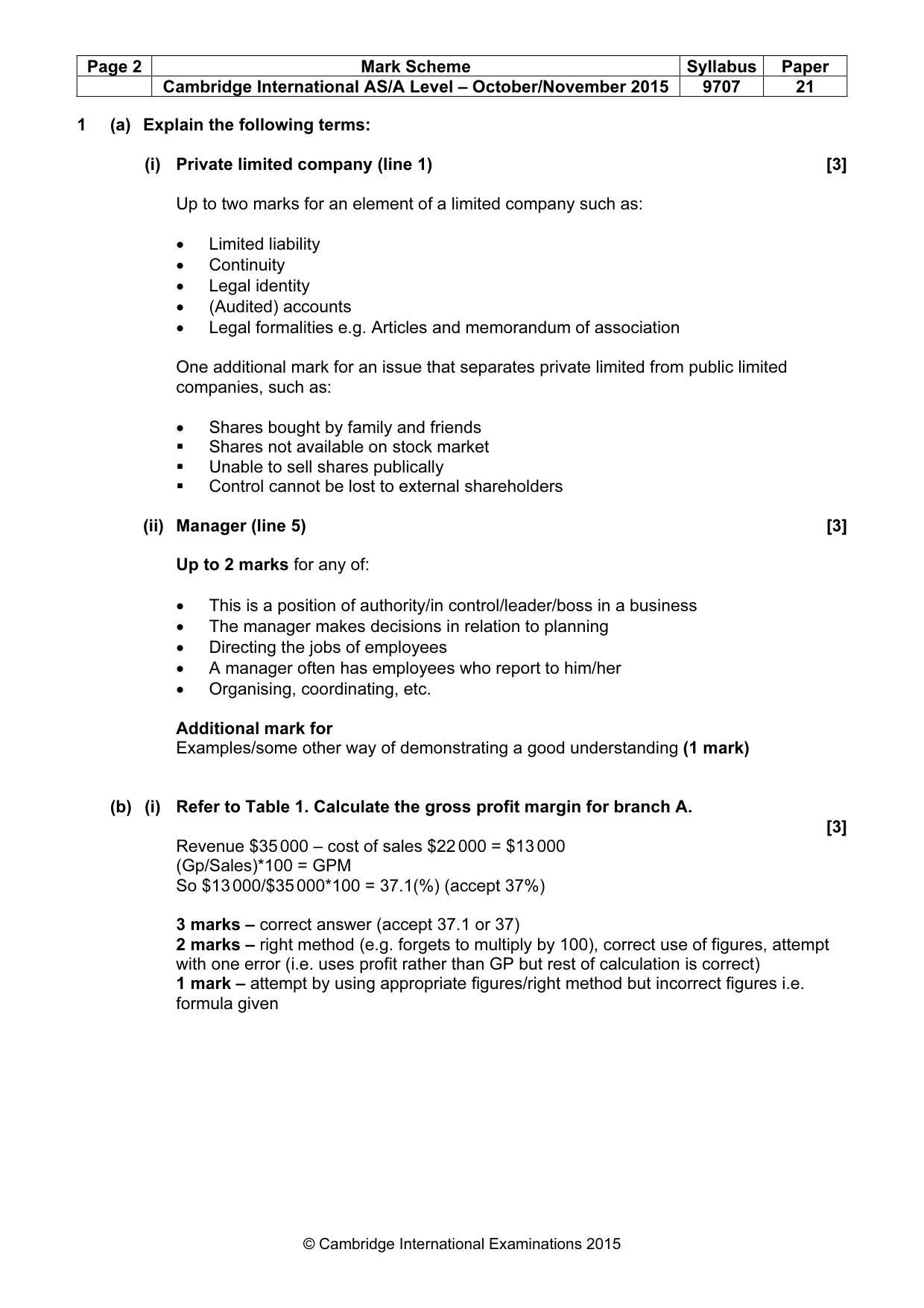
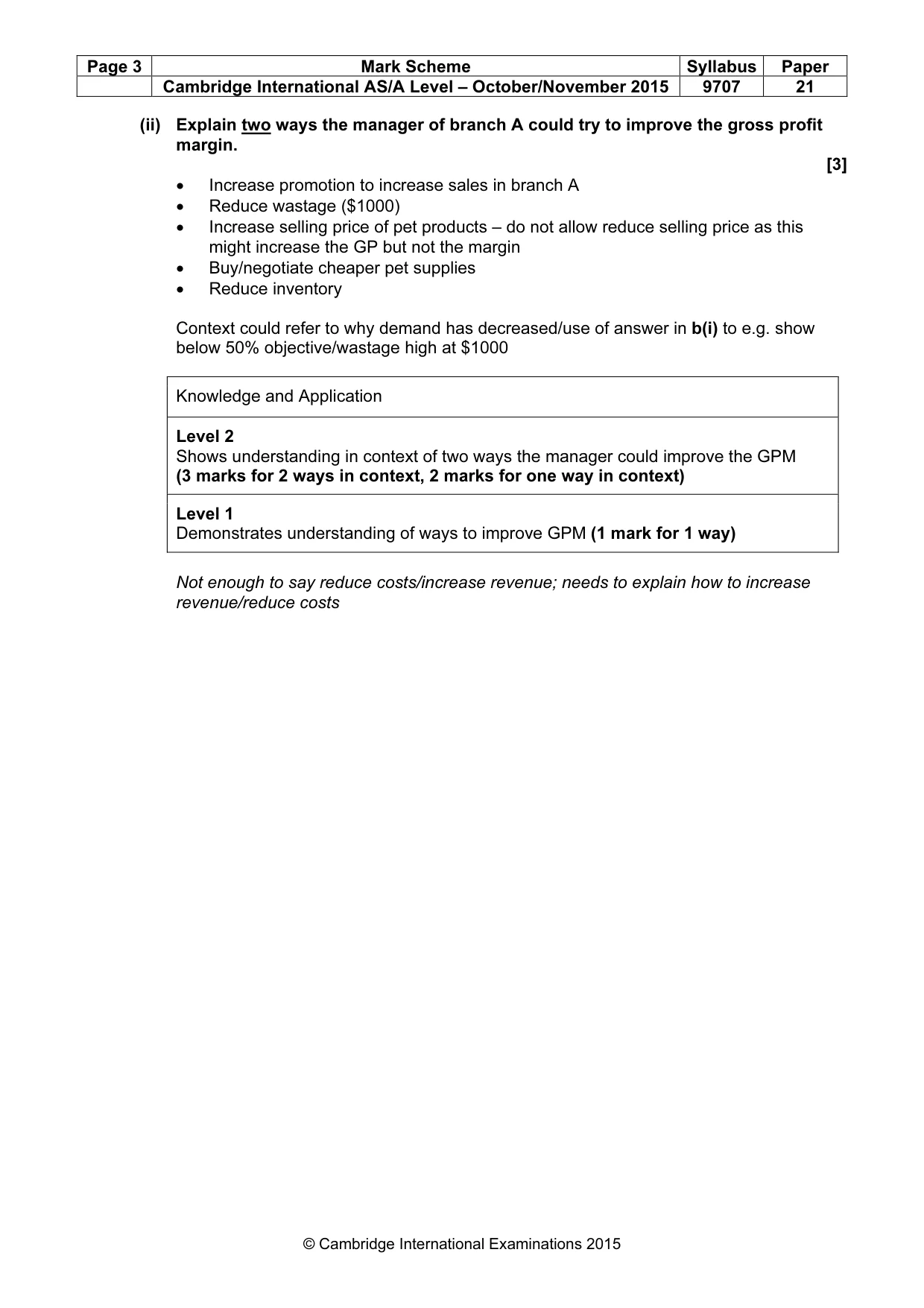
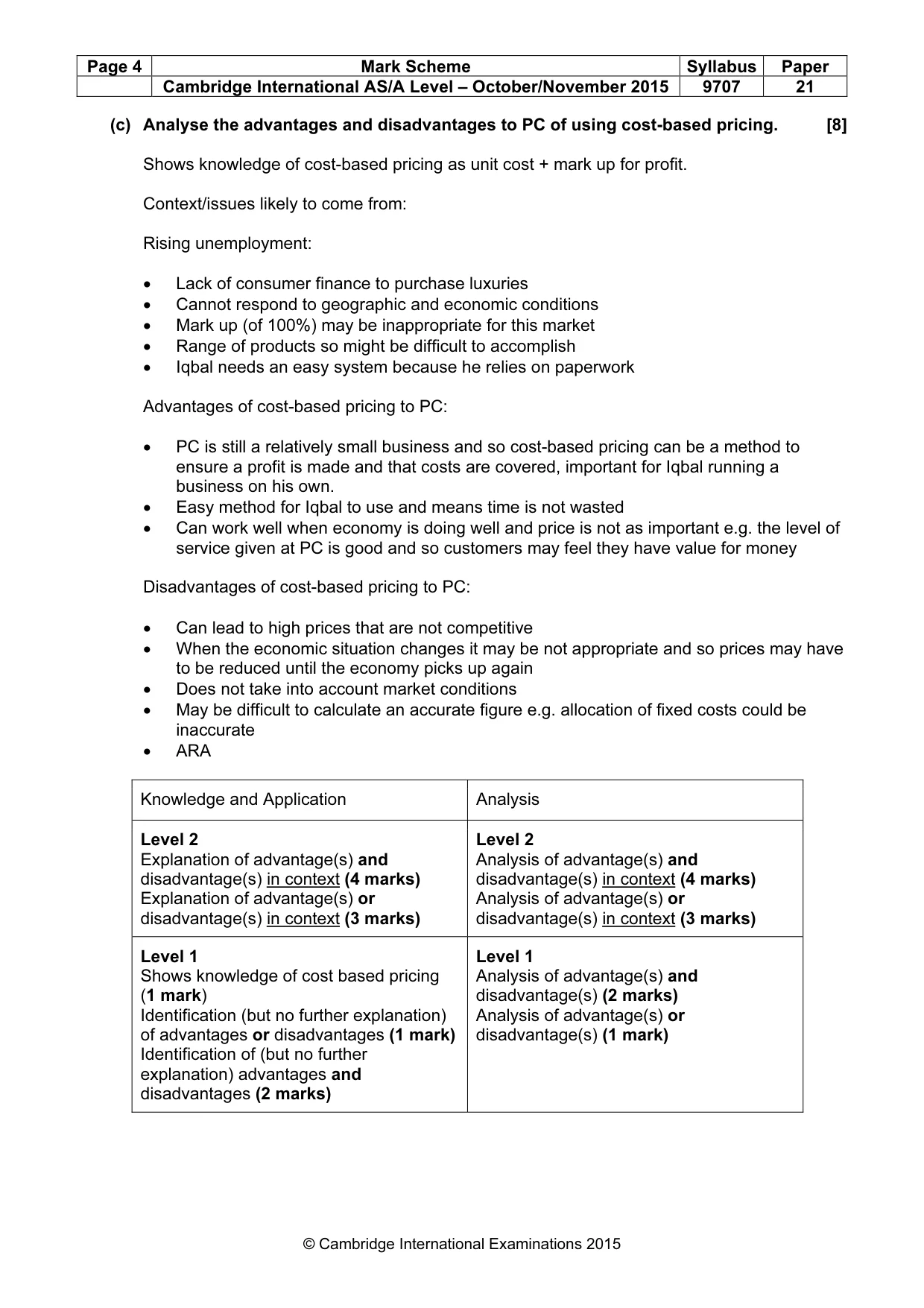
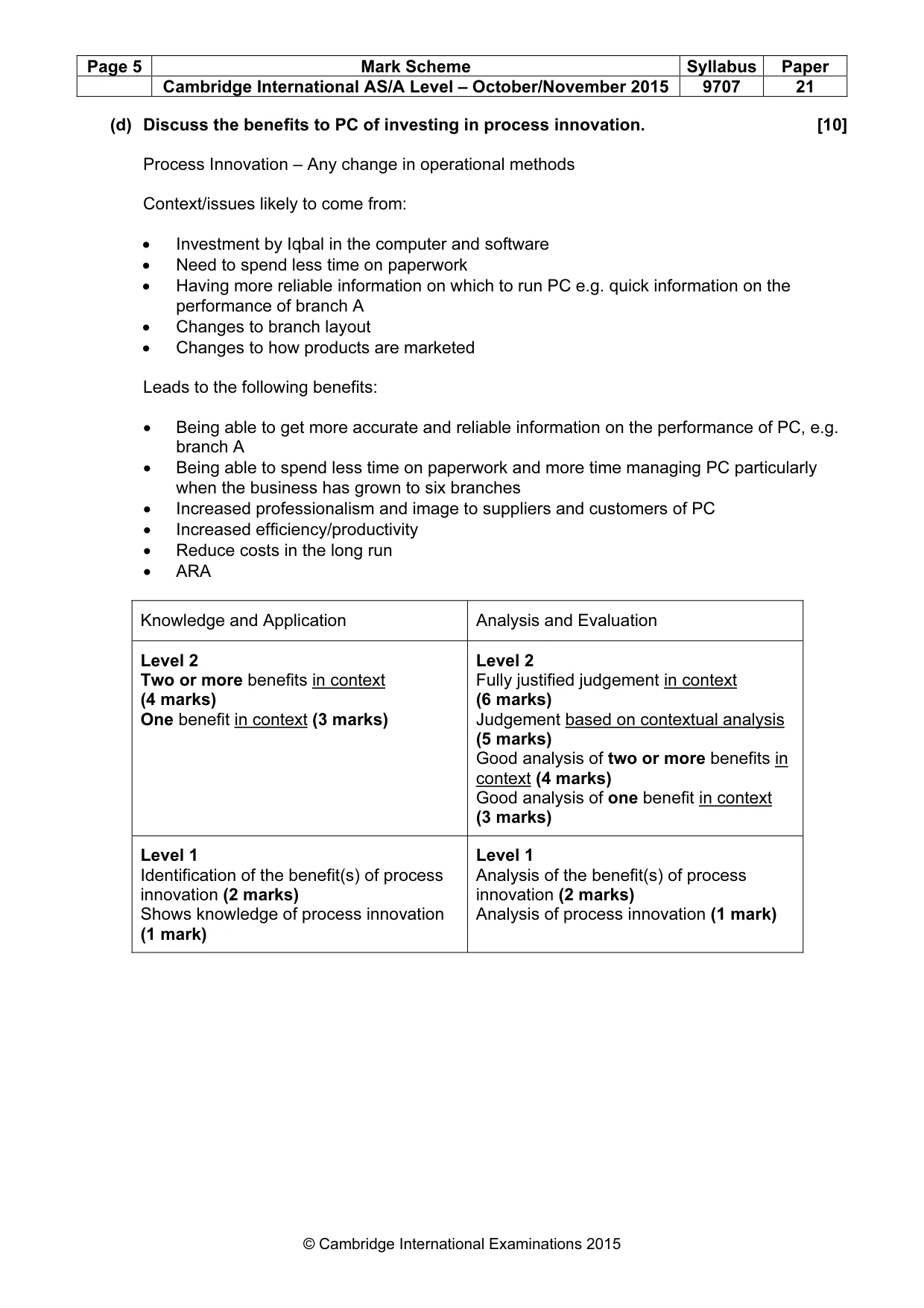
Mark scheme: 1 (a) Explain the following terms: (i) Private limited company (line 1) [3] Up to two marks for an element of a limited company such as: • Limited liability • Continuity • Legal identity • (Audited) accounts • Legal formalities e.g. Articles and memorandum of association One additional mark for an issue that separates private limited from public limited companies, such as: • Shares bought by family and friends Shares not available on stock market Unable to sell shares publically Control cannot be lost to external shareholders (ii) Manager (line 5) [3] Up to 2 marks for any of: • This is a position of authority/in control/leader/boss in a business • The manager makes decisions in relation to planning • Directing the jobs of employees • A manager often has employees who report to him/her • Organising, coordinating, etc. Additional mark for Examples/some other way of demonstrating a good understanding (1 mark) (b) (i) Refer to Table 1. Calculate the gross profit margin for branch A. [3] Revenue $35 000 – cost of sales $22 000 = $13 000 (Gp/Sales)*100 = GPM So $13 000/$35 000*100 = 37.1(%) (accept 37%) 3 marks – correct answer (accept 37.1 or 37) 2 marks – right method (e.g. forgets to multiply by 100), correct use of figures, attempt with one error (i.e. uses profit rather than GP but rest of calculation is correct) 1 mark – attempt by using appropriate figures/right method but incorrect figures i.e. formula given (ii) Explain two ways the manager of branch A could try to improve the gross profit margin. [3] • Increase promotion to increase sales in branch A • Reduce wastage ($1000) • Increase selling price of pet products – do not allow reduce selling price as this might increase the GP but not the margin • Buy/negotiate cheaper pet supplies • Reduce inventory Context could refer to why demand has decreased/use of answer in b(i) to e.g. show below 50% objective/wastage high at $1000 Knowledge and Application Level 2 Shows understanding in context of two ways the manager could improve the GPM (3 marks for 2 ways in context, 2 marks for one way in context) Level 1 Demonstrates understanding of ways to improve GPM (1 mark for 1 way) Not enough to say reduce costs/increase revenue; needs to explain how to increase revenue/reduce costs (c) Analyse the advantages and disadvantages to PC of using cost-based pricing. [8] Shows knowledge of cost-based pricing as unit cost + mark up for profit. Context/issues likely to come from: Rising unemployment: • Lack of consumer finance to purchase luxuries • Cannot respond to geographic and economic conditions • Mark up (of 100%) may be inappropriate for this market • Range of products so might be difficult to accomplish • Iqbal needs an easy system because he relies on paperwork Advantages of cost-based pricing to PC: • PC is still a relatively small business and so cost-based pricing can be a method to ensure a profit is made and that costs are covered, important for Iqbal running a business on his own. • Easy method for Iqbal to use and means time is not wasted • Can work well when economy is doing well and price is not as important e.g. the level of service given at PC is good and so customers may feel they have value for money Disadvantages of cost-based pricing to PC: • Can lead to high prices that are not competitive • When the economic situation changes it may be not appropriate and so prices may have to be reduced until the economy picks up again • Does not take into account market conditions • May be difficult to calculate an accurate figure e.g. allocation of fixed costs could be inaccurate • ARA Knowledge and Application Analysis Level 2 Level 2 Explanation of advantage(s) and Analysis of advantage(s) and disadvantage(s) in context (4 marks) disadvantage(s) in context (4 marks) Explanation of advantage(s) or Analysis of advantage(s) or disadvantage(s) in context (3 marks) disadvantage(s) in context (3 marks) Level 1 Level 1 Shows knowledge of cost based pricing Analysis of advantage(s) and (1 mark) disadvantage(s) (2 marks) Identification (but no further explanation) Analysis of advantage(s) or of advantages or disadvantages (1 mark) disadvantage(s) (1 mark) Identification of (but no further explanation) advantages and disadvantages (2 marks) (d) Discuss the benefits to PC of investing in process innovation. [10] Process Innovation – Any change in operational methods Context/issues likely to come from: • Investment by Iqbal in the computer and software • Need to spend less time on paperwork • Having more reliable information on which to run PC e.g. quick information on the performance of branch A • Changes to branch layout • Changes to how products are marketed Leads to the following benefits: • Being able to get more accurate and reliable information on the performance of PC, e.g. branch A • Being able to spend less time on paperwork and more time managing PC particularly when the business has grown to six branches • Increased professionalism and image to suppliers and customers of PC • Increased efficiency/productivity • Reduce costs in the long run • ARA Knowledge and Application Analysis and Evaluation Level 2 Level 2 Two or more benefits in context Fully justified judgement in context (4 marks) (6 marks) One benefit in context (3 marks) Judgement based on contextual analysis (5 marks) Good analysis of two or more benefits in context (4 marks) Good analysis of one benefit in context (3 marks) Level 1 Level 1 Identification of the benefit(s) of process Analysis of the benefit(s) of process innovation (2 marks) innovation (2 marks) Shows knowledge of process innovation Analysis of process innovation (1 mark) (1 mark)
Q2 · Cooper Manufacturing (CM) CM is a public limited company which manufactures a range of…
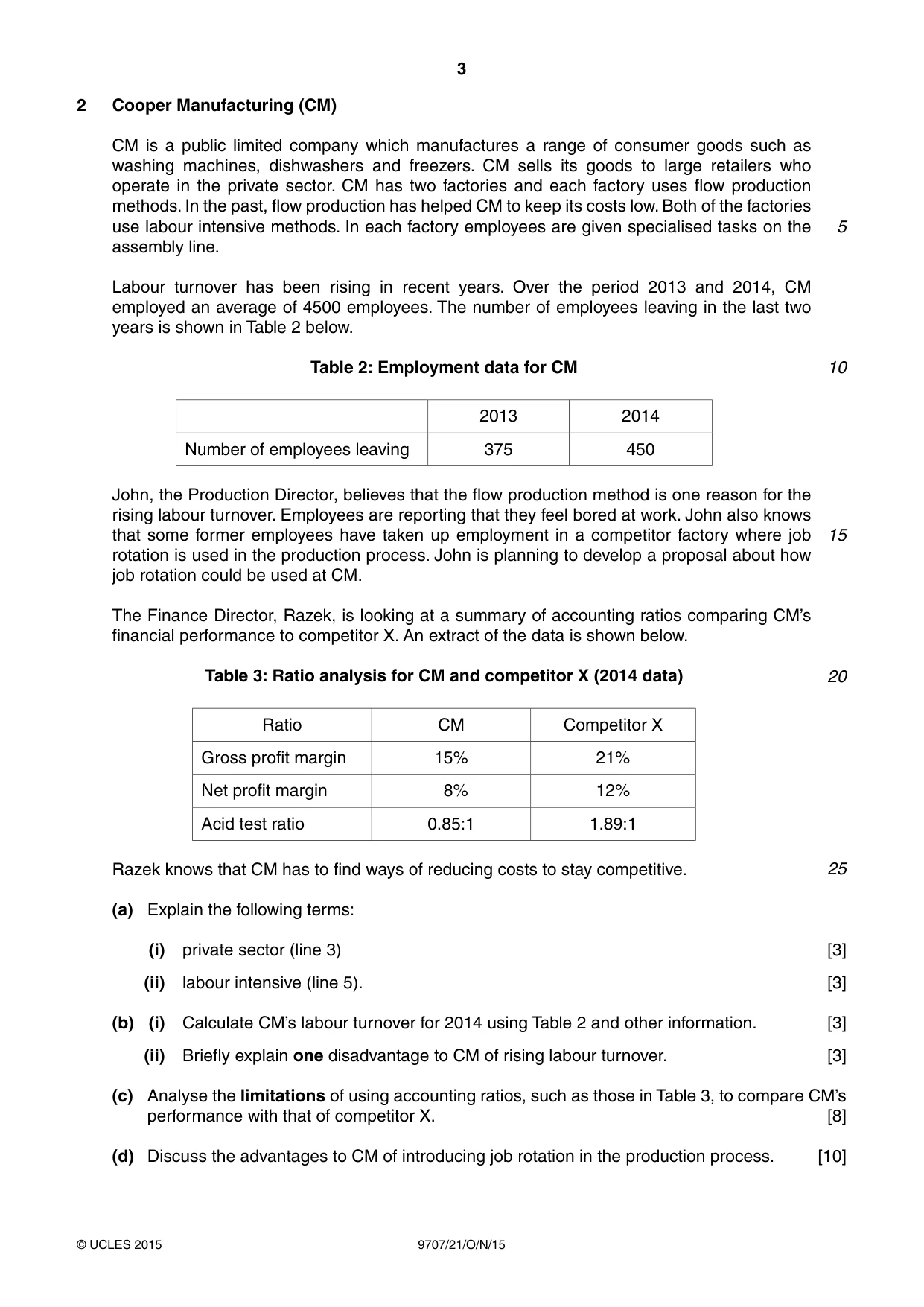
2 Cooper Manufacturing (CM) CM is a public limited company which manufactures a range of consumer goods such as washing machines, dishwashers and freezers. CM sells its goods to large retailers who operate in the private sector. CM has two factories and each factory uses flow production methods. In the past, flow production has helped CM to keep its costs low. Both of the factories use labour intensive methods. In each factory employees are given specialised tasks on the 5 assembly line. Labour turnover has been rising in recent years. Over the period 2013 and 2014, CM employed an average of 4500 employees. The number of employees leaving in the last two years is shown in Table 2 below. Table 2: Employment data for CM 10 2013 2014 Number of employees leaving 375 450 John, the Production Director, believes that the flow production method is one reason for the rising labour turnover. Employees are reporting that they feel bored at work. John also knows that some former employees have taken up employment in a competitor factory where job 15 rotation is used in the production process. John is planning to develop a proposal about how job rotation could be used at CM. The Finance Director, Razek, is looking at a summary of accounting ratios comparing CM’s financial performance to competitor X. An extract of the data is shown below. Table 3: Ratio analysis for CM and competitor X (2014 data) 20 Ratio CM Competitor X Gross profit margin 15% 21% Net profit margin 8% 12% Acid test ratio 0.85:1 1.89:1 Razek knows that CM has to find ways of reducing costs to stay competitive. 25 (a) Explain the following terms: (i) private sector (line 3) [3] (ii) labour intensive (line 5). [3] (b) (i) Calculate CM’s labour turnover for 2014 using Table 2 and other information. [3] (ii) Briefly explain one disadvantage to CM of rising labour turnover. [3] (c) Analyse the limitations of using accounting ratios, such as those in Table 3, to compare CM’s performance with that of competitor X. [8] (d) Discuss the advantages to CM of introducing job rotation in the production process. [10]
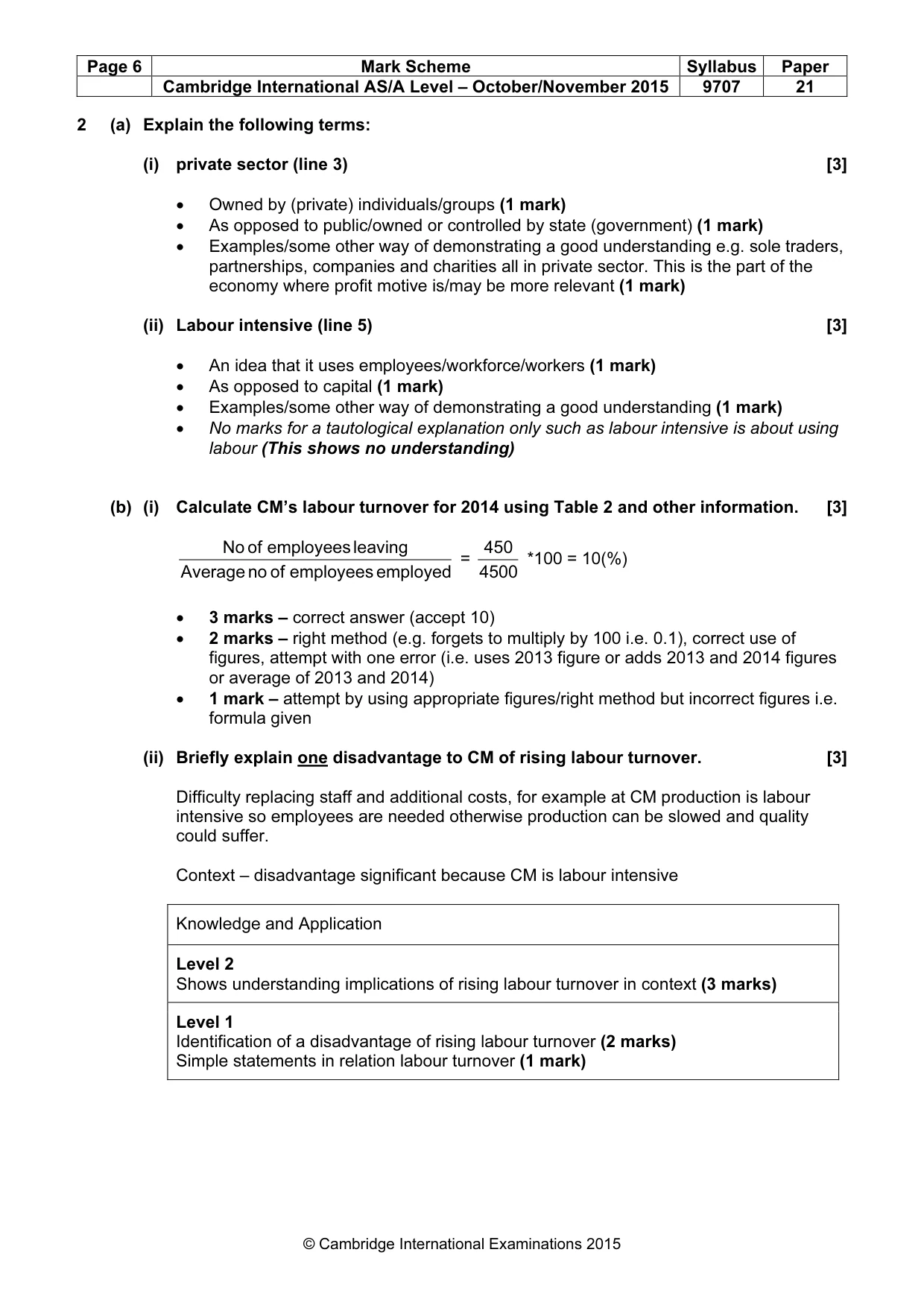
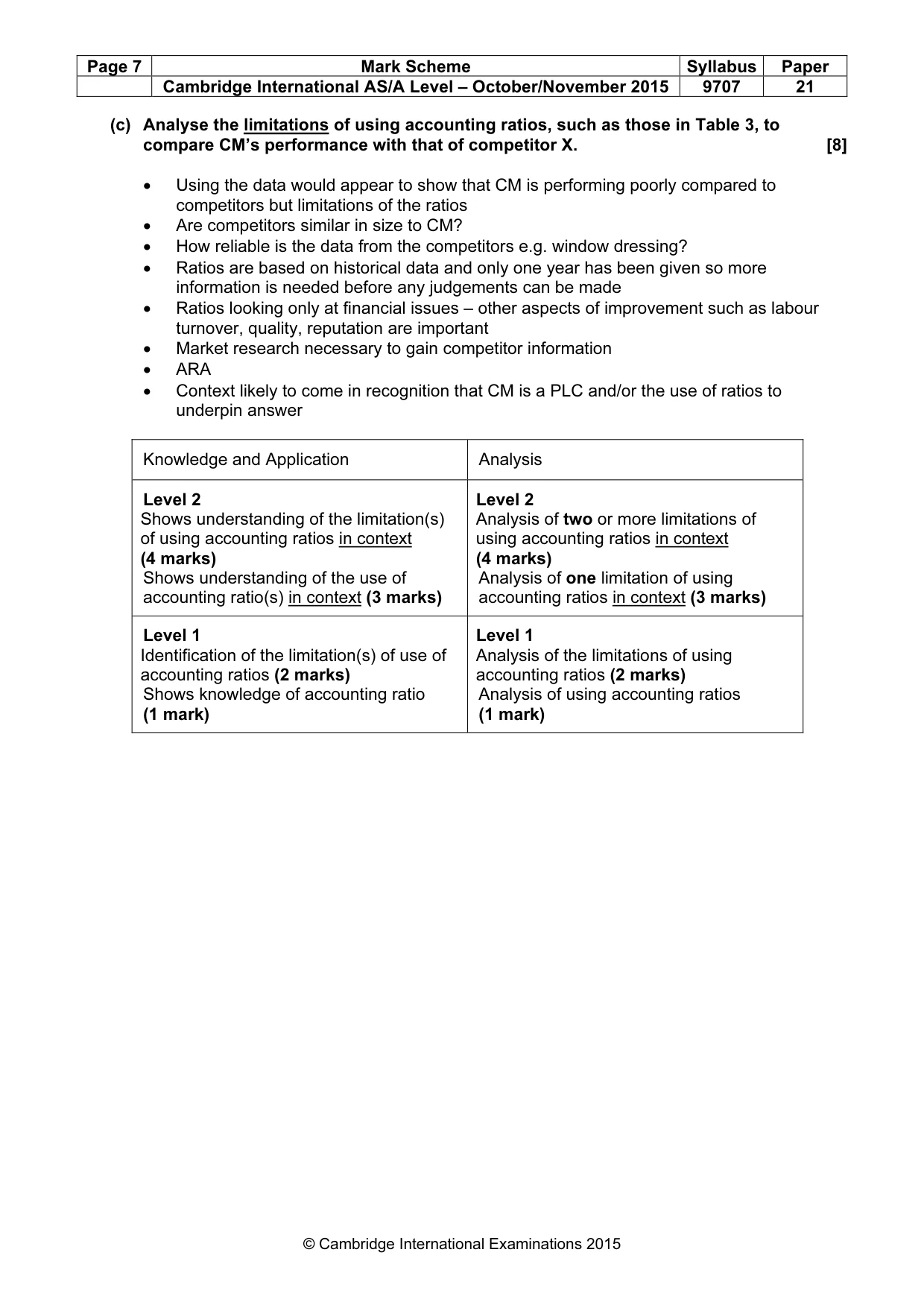
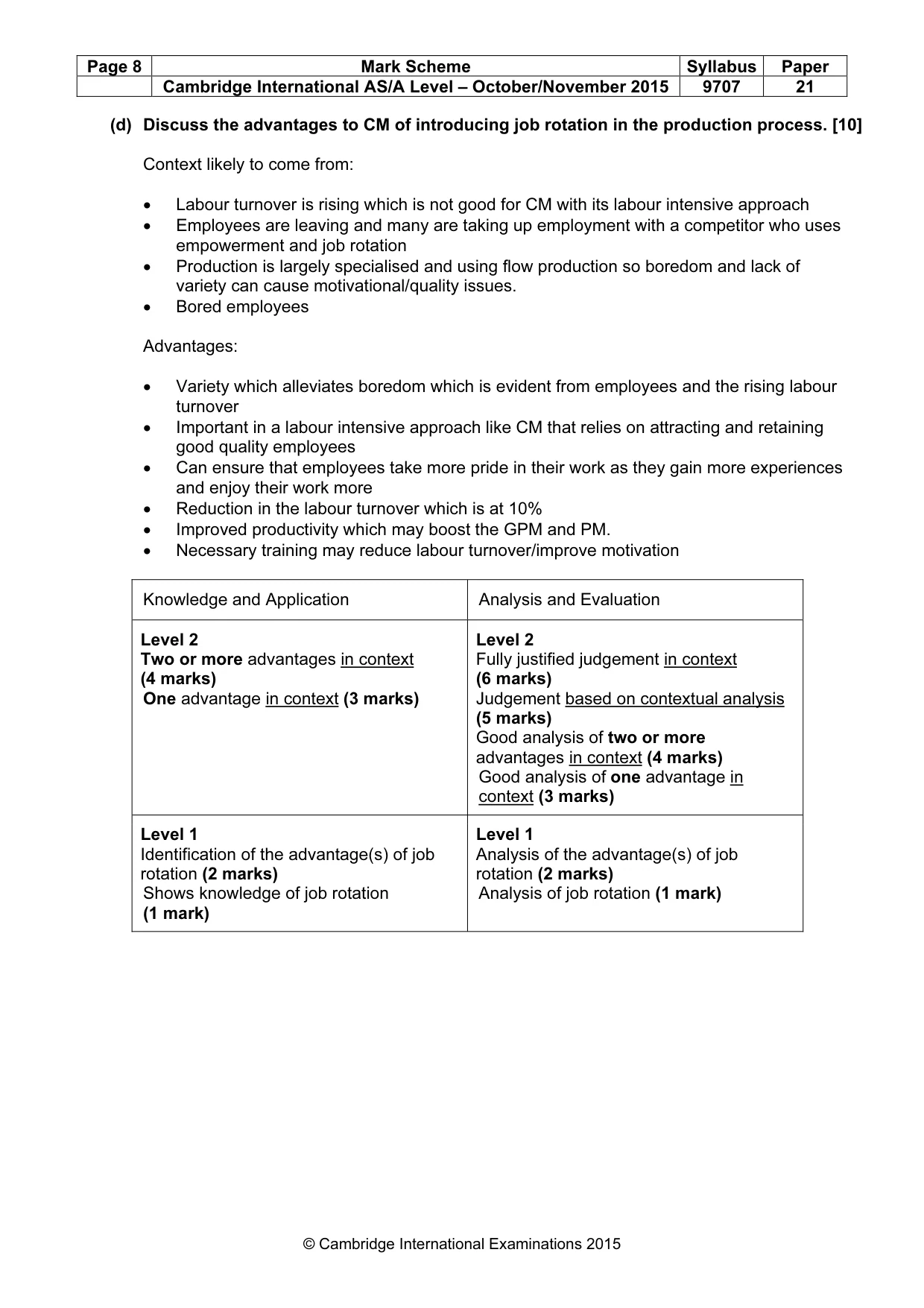
Mark scheme: 2 (a) Explain the following terms: (i) private sector (line 3) [3] • Owned by (private) individuals/groups (1 mark) • As opposed to public/owned or controlled by state (government) (1 mark) • Examples/some other way of demonstrating a good understanding e.g. sole traders, partnerships, companies and charities all in private sector. This is the part of the economy where profit motive is/may be more relevant (1 mark) (ii) Labour intensive (line 5) [3] • An idea that it uses employees/workforce/workers (1 mark) • As opposed to capital (1 mark) • Examples/some other way of demonstrating a good understanding (1 mark) • No marks for a tautological explanation only such as labour intensive is about using labour (This shows no understanding) (b) (i) Calculate CM’s labour turnover for 2014 using Table 2 and other information. [3] No of employees leaving 450 = *100 = 10(%) Average no of employees employed 4500 • 3 marks – correct answer (accept 10) • 2 marks – right method (e.g. forgets to multiply by 100 i.e. 0.1), correct use of figures, attempt with one error (i.e. uses 2013 figure or adds 2013 and 2014 figures or average of 2013 and 2014) • 1 mark – attempt by using appropriate figures/right method but incorrect figures i.e. formula given (ii) Briefly explain one disadvantage to CM of rising labour turnover. [3] Difficulty replacing staff and additional costs, for example at CM production is labour intensive so employees are needed otherwise production can be slowed and quality could suffer. Context – disadvantage significant because CM is labour intensive Knowledge and Application Level 2 Shows understanding implications of rising labour turnover in context (3 marks) Level 1 Identification of a disadvantage of rising labour turnover (2 marks) Simple statements in relation labour turnover (1 mark) (c) Analyse the limitations of using accounting ratios, such as those in Table 3, to compare CM’s performance with that of competitor X. [8] • Using the data would appear to show that CM is performing poorly compared to competitors but limitations of the ratios • Are competitors similar in size to CM? • How reliable is the data from the competitors e.g. window dressing? • Ratios are based on historical data and only one year has been given so more information is needed before any judgements can be made • Ratios looking only at financial issues – other aspects of improvement such as labour turnover, quality, reputation are important • Market research necessary to gain competitor information • ARA • Context likely to come in recognition that CM is a PLC and/or the use of ratios to underpin answer Knowledge and Application Analysis Level 2 Level 2 Shows understanding of the limitation(s) Analysis of two or more limitations of of using accounting ratios in context using accounting ratios in context (4 marks) (4 marks) Shows understanding of the use of Analysis of one limitation of using accounting ratio(s) in context (3 marks) accounting ratios in context (3 marks) Level 1 Level 1 Identification of the limitation(s) of use of Analysis of the limitations of using accounting ratios (2 marks) accounting ratios (2 marks) Shows knowledge of accounting ratio Analysis of using accounting ratios (1 mark) (1 mark) (d) Discuss the advantages to CM of introducing job rotation in the production process. [10] Context likely to come from: • Labour turnover is rising which is not good for CM with its labour intensive approach • Employees are leaving and many are taking up employment with a competitor who uses empowerment and job rotation • Production is largely specialised and using flow production so boredom and lack of variety can cause motivational/quality issues. • Bored employees Advantages: • Variety which alleviates boredom which is evident from employees and the rising labour turnover • Important in a labour intensive approach like CM that relies on attracting and retaining good quality employees • Can ensure that employees take more pride in their work as they gain more experiences and enjoy their work more • Reduction in the labour turnover which is at 10% • Improved productivity which may boost the GPM and PM. • Necessary training may reduce labour turnover/improve motivation Knowledge and Application Analysis and Evaluation Level 2 Level 2 Two or more advantages in context Fully justified judgement in context (4 marks) (6 marks) One advantage in context (3 marks) Judgement based on contextual analysis (5 marks) Good analysis of two or more advantages in context (4 marks) Good analysis of one advantage in context (3 marks) Level 1 Level 1 Identification of the advantage(s) of job Analysis of the advantage(s) of job rotation (2 marks) rotation (2 marks) Shows knowledge of job rotation Analysis of job rotation (1 mark) (1 mark)