Cambridge A Level Business Studies (for final examination in 2015) 9707 — 2015 May/June Paper 2 · Variant 1
9707/21/M/J/15 · 2 questions · 60 marks · ≈68 min
The question paper and its mark scheme, free to read here and free to download. This is Cambridge’s own paper, exactly as it was sat.
Question paper8 pages


Mark scheme9 pages
Answers below. Sit the paper first if you are practising.
Questions as text
Q1 · Best Books (BB) BB is a private limited company
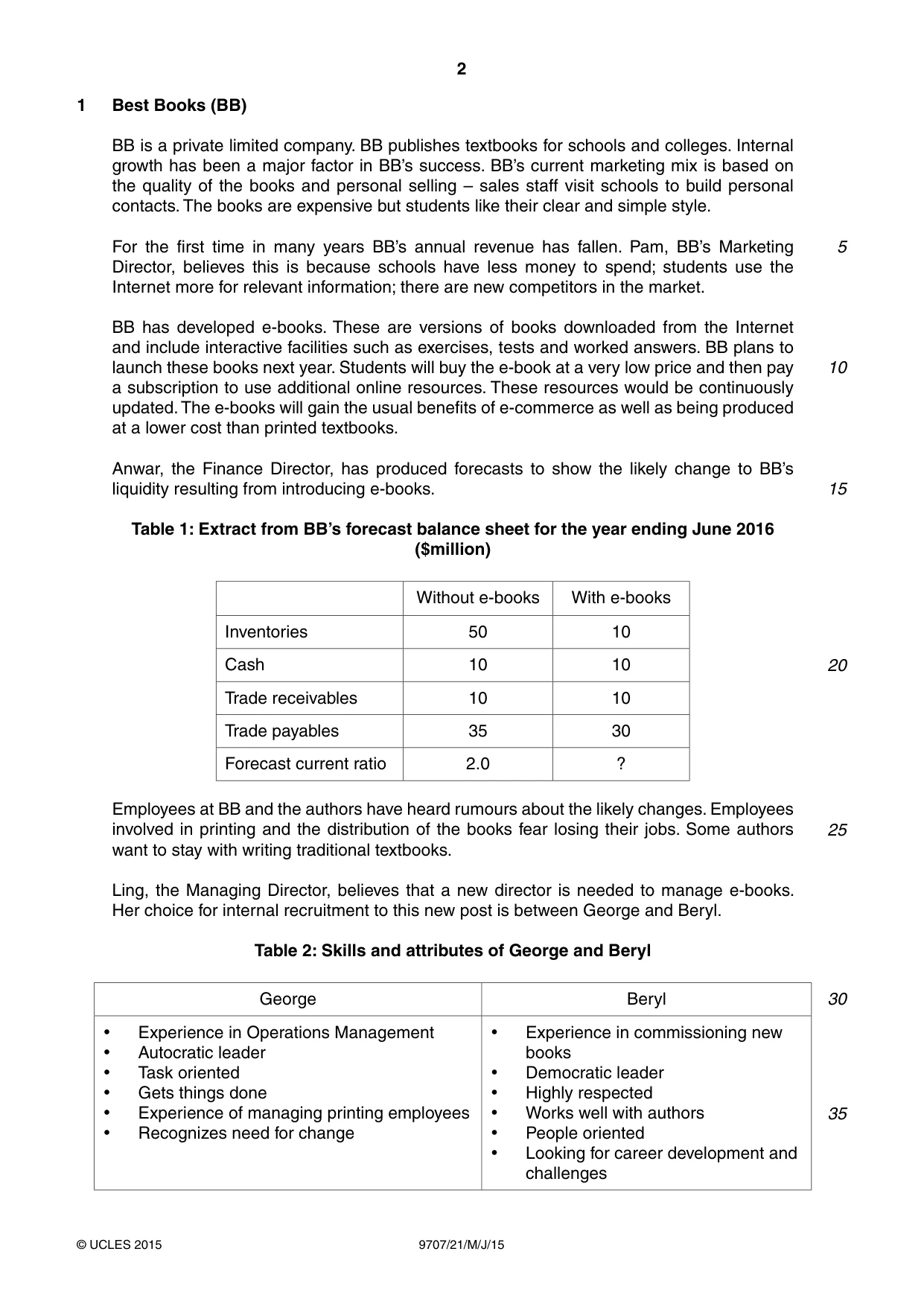
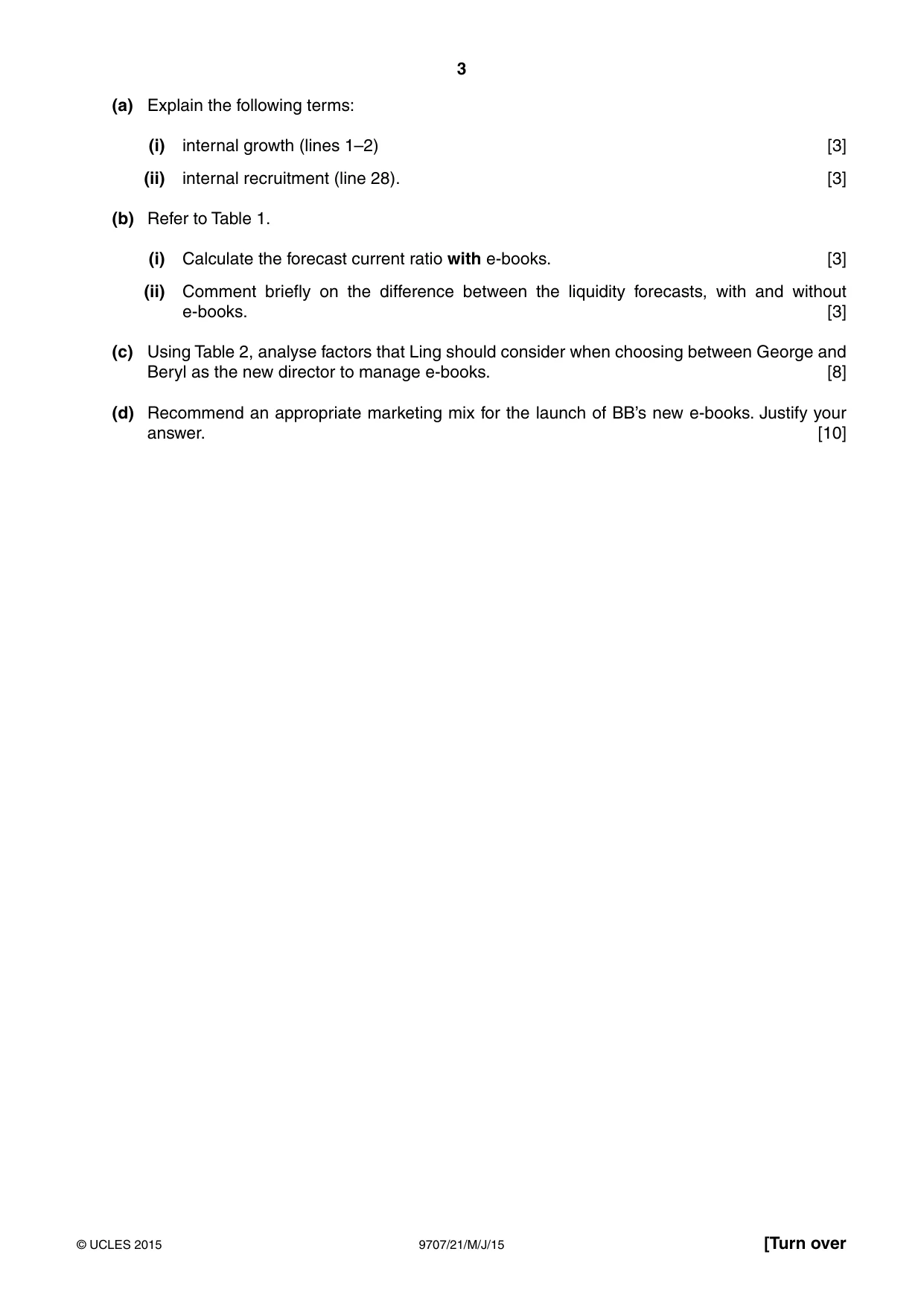
1 Best Books (BB) BB is a private limited company. BB publishes textbooks for schools and colleges. Internal growth has been a major factor in BB’s success. BB’s current marketing mix is based on the quality of the books and personal selling – sales staff visit schools to build personal contacts. The books are expensive but students like their clear and simple style. For the first time in many years BB’s annual revenue has fallen. Pam, BB’s Marketing 5 Director, believes this is because schools have less money to spend; students use the Internet more for relevant information; there are new competitors in the market. BB has developed e-books. These are versions of books downloaded from the Internet and include interactive facilities such as exercises, tests and worked answers. BB plans to launch these books next year. Students will buy the e-book at a very low price and then pay 10 a subscription to use additional online resources. These resources would be continuously updated. The e-books will gain the usual benefits of e-commerce as well as being produced at a lower cost than printed textbooks. Anwar, the Finance Director, has produced forecasts to show the likely change to BB’s liquidity resulting from introducing e-books. 15 Table 1: Extract from BB’s forecast balance sheet for the year ending June 2016 ($million) Without e-books With e-books Inventories 50 10 Cash 10 10 20 Trade receivables 10 10 Trade payables 35 30 Forecast current ratio 2.0 ? Employees at BB and the authors have heard rumours about the likely changes. Employees involved in printing and the distribution of the books fear losing their jobs. Some authors 25 want to stay with writing traditional textbooks. Ling, the Managing Director, believes that a new director is needed to manage e-books. Her choice for internal recruitment to this new post is between George and Beryl. Table 2: Skills and attributes of George and Beryl George Beryl 30 • Experience in Operations Management • Experience in commissioning new • Autocratic leader books • Task oriented • Democratic leader • Gets things done • Highly respected • Experience of managing printing employees • Works well with authors 35 • Recognizes need for change • People oriented • Looking for career development and challenges (a) Explain the following terms: (i) internal growth (lines 1–2) [3] (ii) internal recruitment (line 28). [3] (b) Refer to Table 1. (i) Calculate the forecast current ratio with e-books. [3] (ii) Comment briefly on the difference between the liquidity forecasts, with and without e-books. [3] (c) Using Table 2, analyse factors that Ling should consider when choosing between George and Beryl as the new director to manage e-books. [8] (d) Recommend an appropriate marketing mix for the launch of BB’s new e-books. Justify your answer. [10]
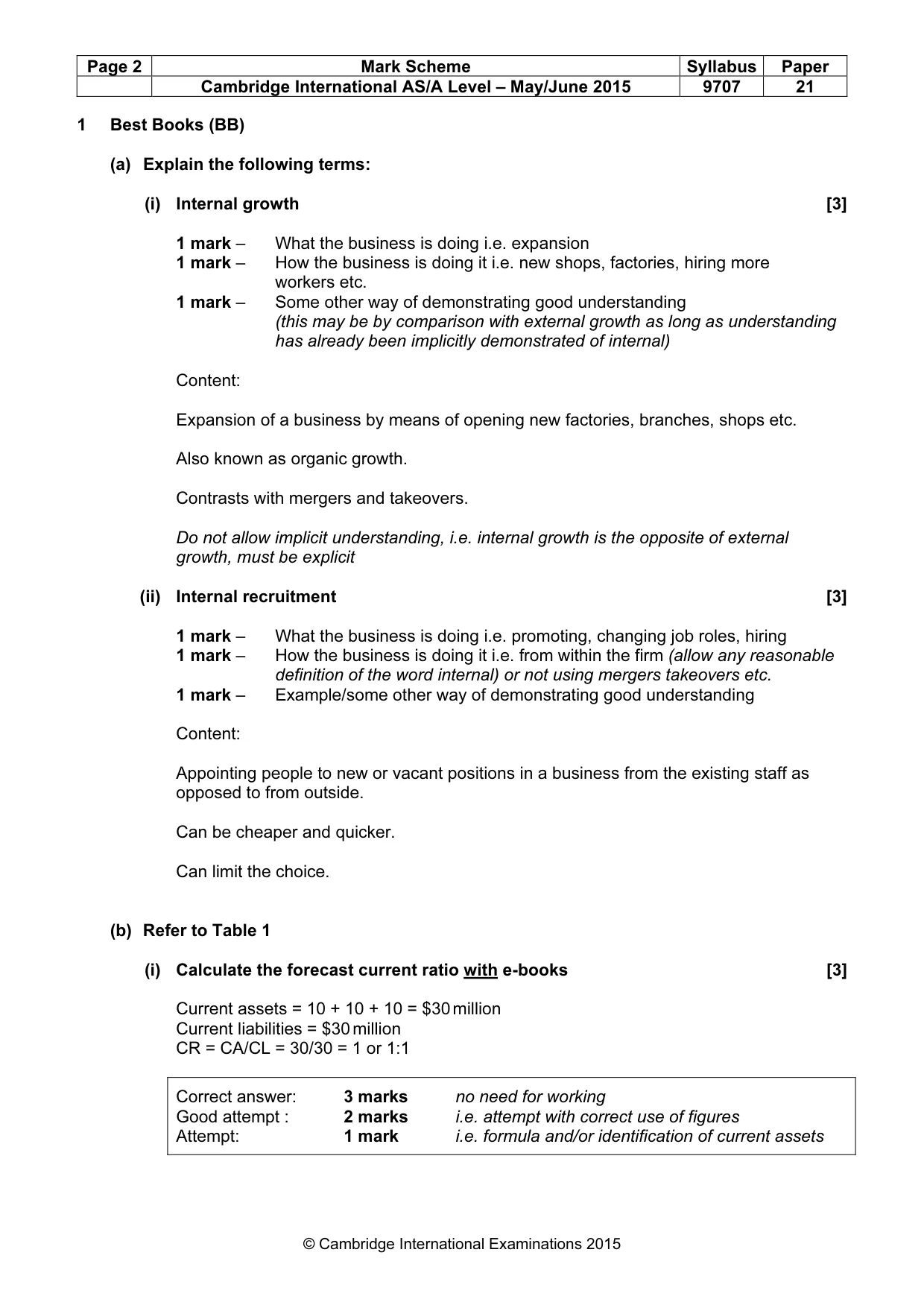
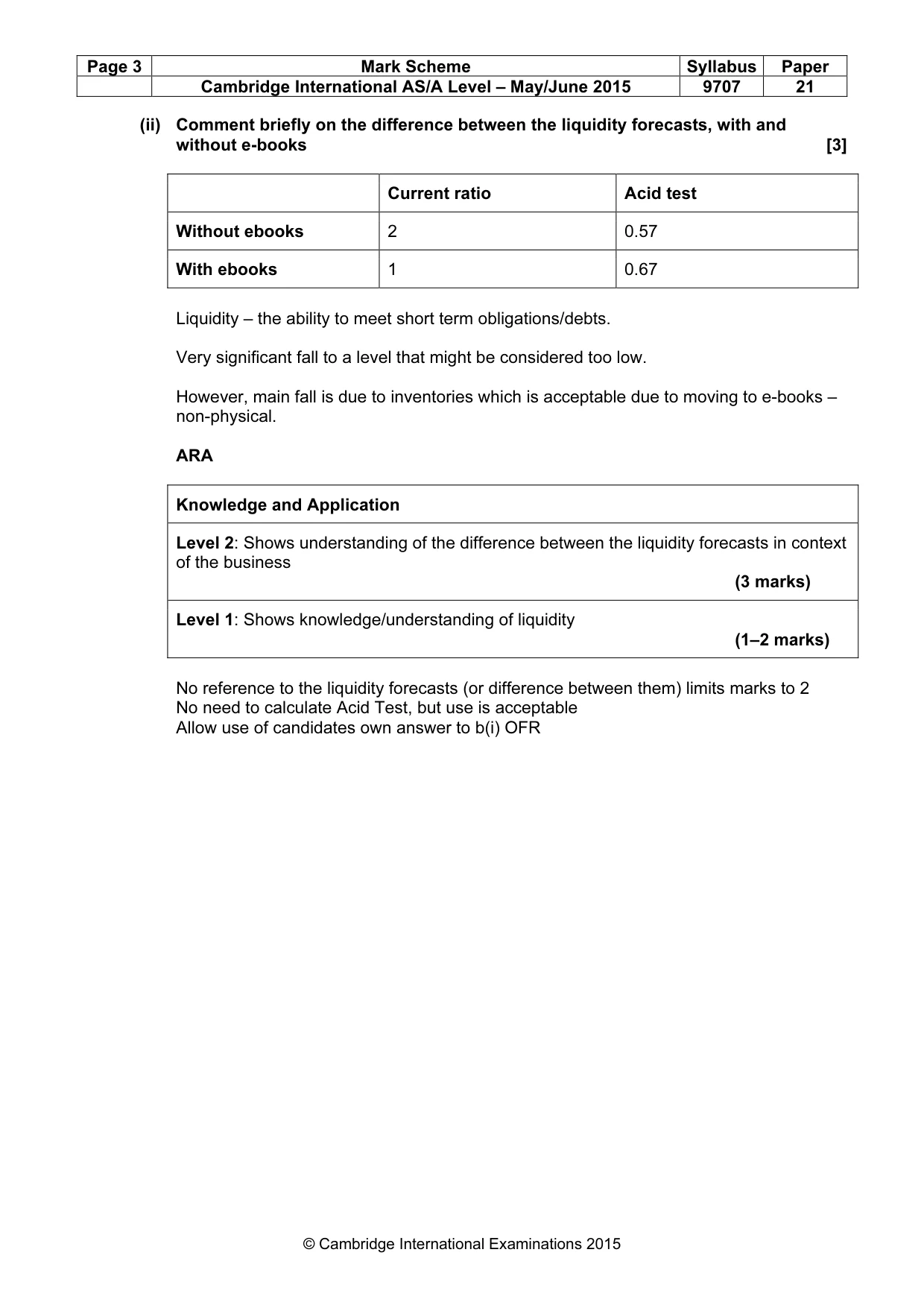
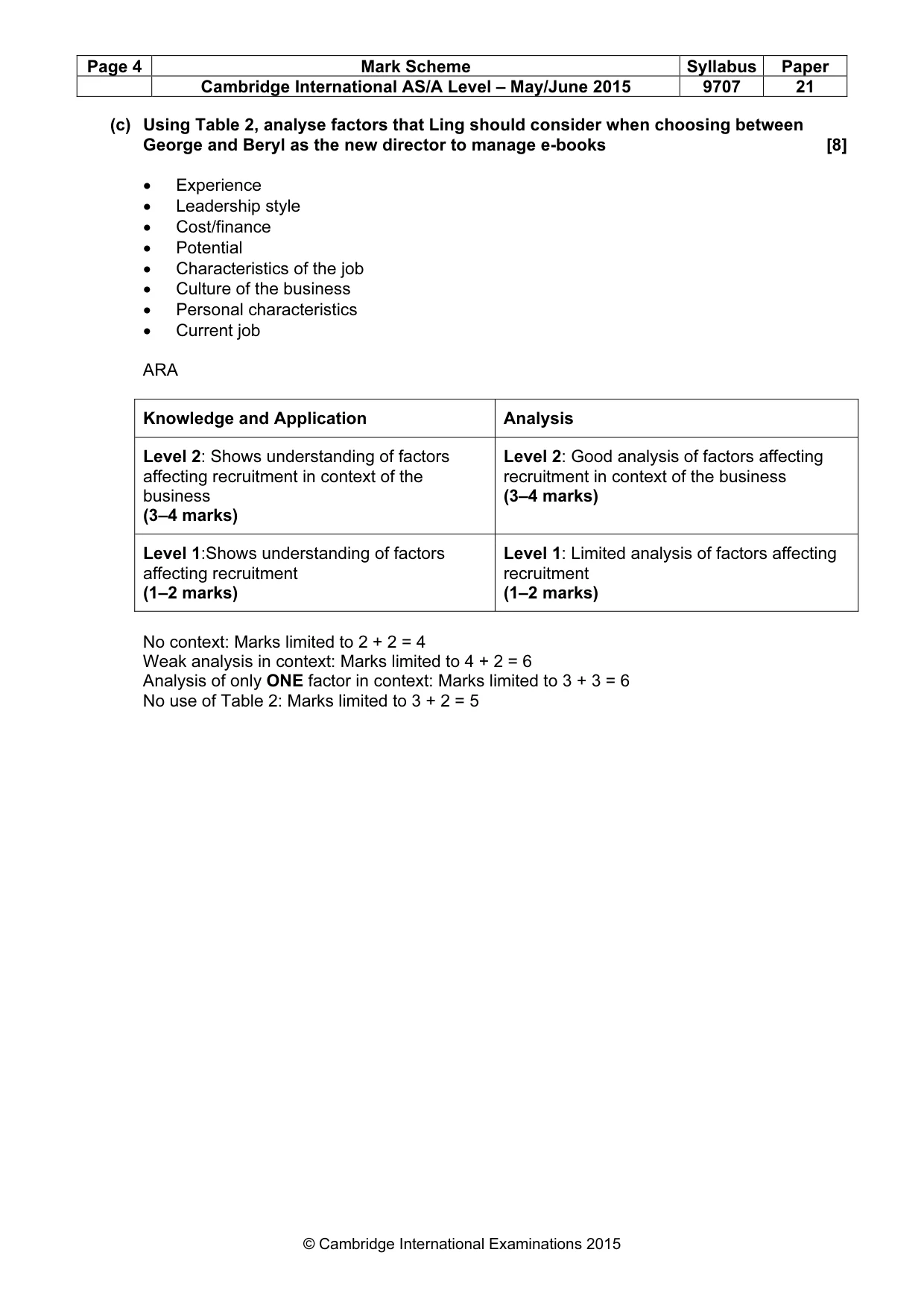
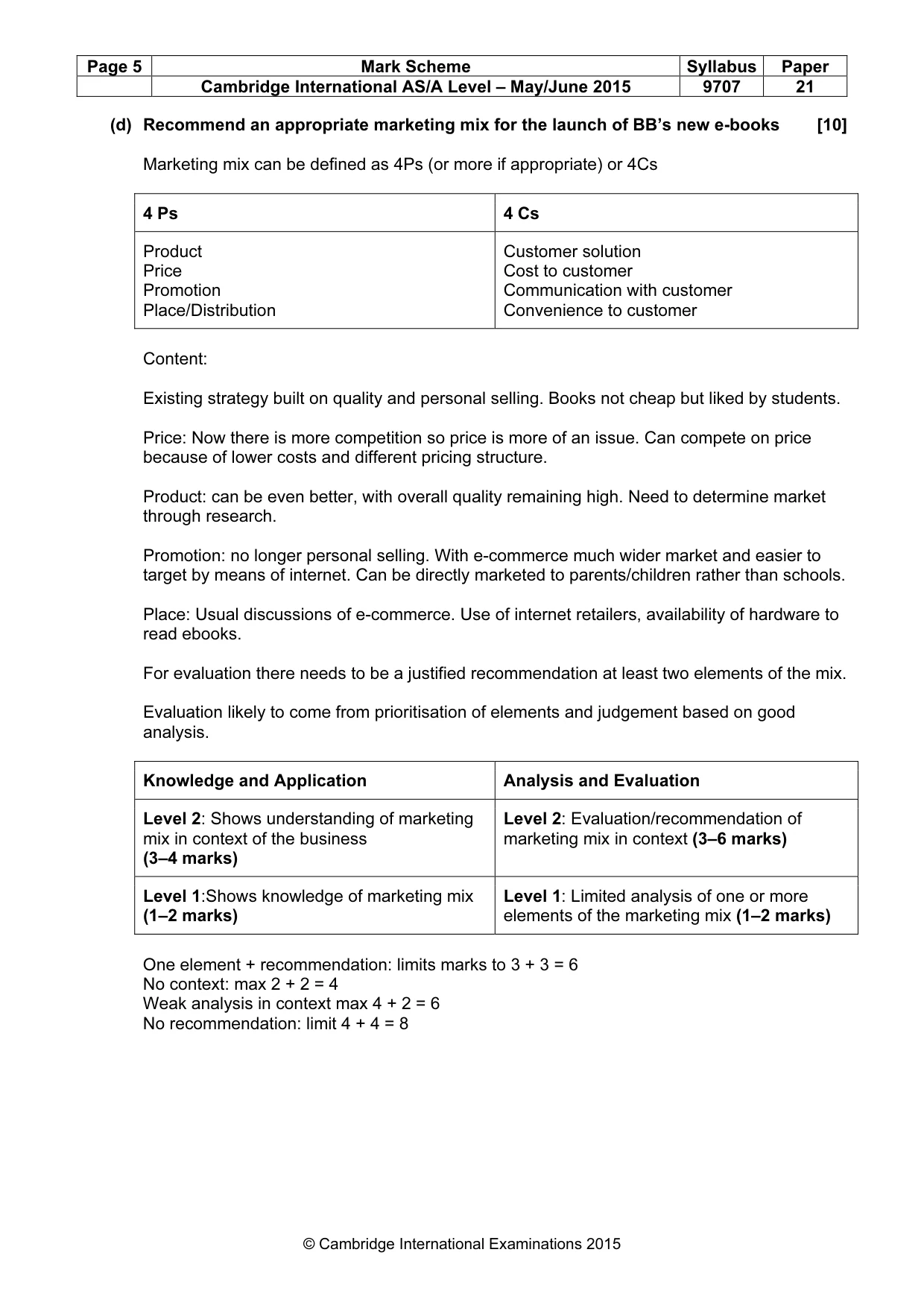
Mark scheme: 1 Best Books (BB) (a) Explain the following terms: (i) Internal growth [3] 1 mark – What the business is doing i.e. expansion 1 mark – How the business is doing it i.e. new shops, factories, hiring more workers etc. 1 mark – Some other way of demonstrating good understanding (this may be by comparison with external growth as long as understanding has already been implicitly demonstrated of internal) Content: Expansion of a business by means of opening new factories, branches, shops etc. Also known as organic growth. Contrasts with mergers and takeovers. Do not allow implicit understanding, i.e. internal growth is the opposite of external growth, must be explicit (ii) Internal recruitment [3] 1 mark – What the business is doing i.e. promoting, changing job roles, hiring 1 mark – How the business is doing it i.e. from within the firm (allow any reasonable definition of the word internal) or not using mergers takeovers etc. 1 mark – Example/some other way of demonstrating good understanding Content: Appointing people to new or vacant positions in a business from the existing staff as opposed to from outside. Can be cheaper and quicker. Can limit the choice. (b) Refer to Table 1 (i) Calculate the forecast current ratio with e-books [3] Current assets = 10 + 10 + 10 = $30 million Current liabilities = $30 million CR = CA/CL = 30/30 = 1 or 1:1 Correct answer: 3 marks no need for working Good attempt : 2 marks i.e. attempt with correct use of figures Attempt: 1 mark i.e. formula and/or identification of current assets (ii) Comment briefly on the difference between the liquidity forecasts, with and without e-books [3] Current ratio Acid test Without ebooks 2 0.57 With ebooks 1 0.67 Liquidity – the ability to meet short term obligations/debts. Very significant fall to a level that might be considered too low. However, main fall is due to inventories which is acceptable due to moving to e-books – non-physical. ARA Knowledge and Application Level 2: Shows understanding of the difference between the liquidity forecasts in context of the business (3 marks) Level 1: Shows knowledge/understanding of liquidity (1–2 marks) No reference to the liquidity forecasts (or difference between them) limits marks to 2 No need to calculate Acid Test, but use is acceptable Allow use of candidates own answer to b(i) OFR (c) Using Table 2, analyse factors that Ling should consider when choosing between George and Beryl as the new director to manage e-books [8] • Experience • Leadership style • Cost/finance • Potential • Characteristics of the job • Culture of the business • Personal characteristics • Current job ARA Knowledge and Application Analysis Level 2: Shows understanding of factors Level 2: Good analysis of factors affecting affecting recruitment in context of the recruitment in context of the business business (3–4 marks) (3–4 marks) Level 1:Shows understanding of factors Level 1: Limited analysis of factors affecting affecting recruitment recruitment (1–2 marks) (1–2 marks) No context: Marks limited to 2 + 2 = 4 Weak analysis in context: Marks limited to 4 + 2 = 6 Analysis of only ONE factor in context: Marks limited to 3 + 3 = 6 No use of Table 2: Marks limited to 3 + 2 = 5 (d) Recommend an appropriate marketing mix for the launch of BB’s new e-books [10] Marketing mix can be defined as 4Ps (or more if appropriate) or 4Cs 4 Ps 4 Cs Product Customer solution Price Cost to customer Promotion Communication with customer Place/Distribution Convenience to customer Content: Existing strategy built on quality and personal selling. Books not cheap but liked by students. Price: Now there is more competition so price is more of an issue. Can compete on price because of lower costs and different pricing structure. Product: can be even better, with overall quality remaining high. Need to determine market through research. Promotion: no longer personal selling. With e-commerce much wider market and easier to target by means of internet. Can be directly marketed to parents/children rather than schools. Place: Usual discussions of e-commerce. Use of internet retailers, availability of hardware to read ebooks. For evaluation there needs to be a justified recommendation at least two elements of the mix. Evaluation likely to come from prioritisation of elements and judgement based on good analysis. Knowledge and Application Analysis and Evaluation Level 2: Shows understanding of marketing Level 2: Evaluation/recommendation of mix in context of the business marketing mix in context (3–6 marks) (3–4 marks) Level 1:Shows knowledge of marketing mix Level 1: Limited analysis of one or more (1–2 marks) elements of the marketing mix (1–2 marks) One element + recommendation: limits marks to 3 + 3 = 6 No context: max 2 + 2 = 4 Weak analysis in context max 4 + 2 = 6 No recommendation: limit 4 + 4 = 8
Q2 · Tangerine Tablets (TT) TT is a public limited company
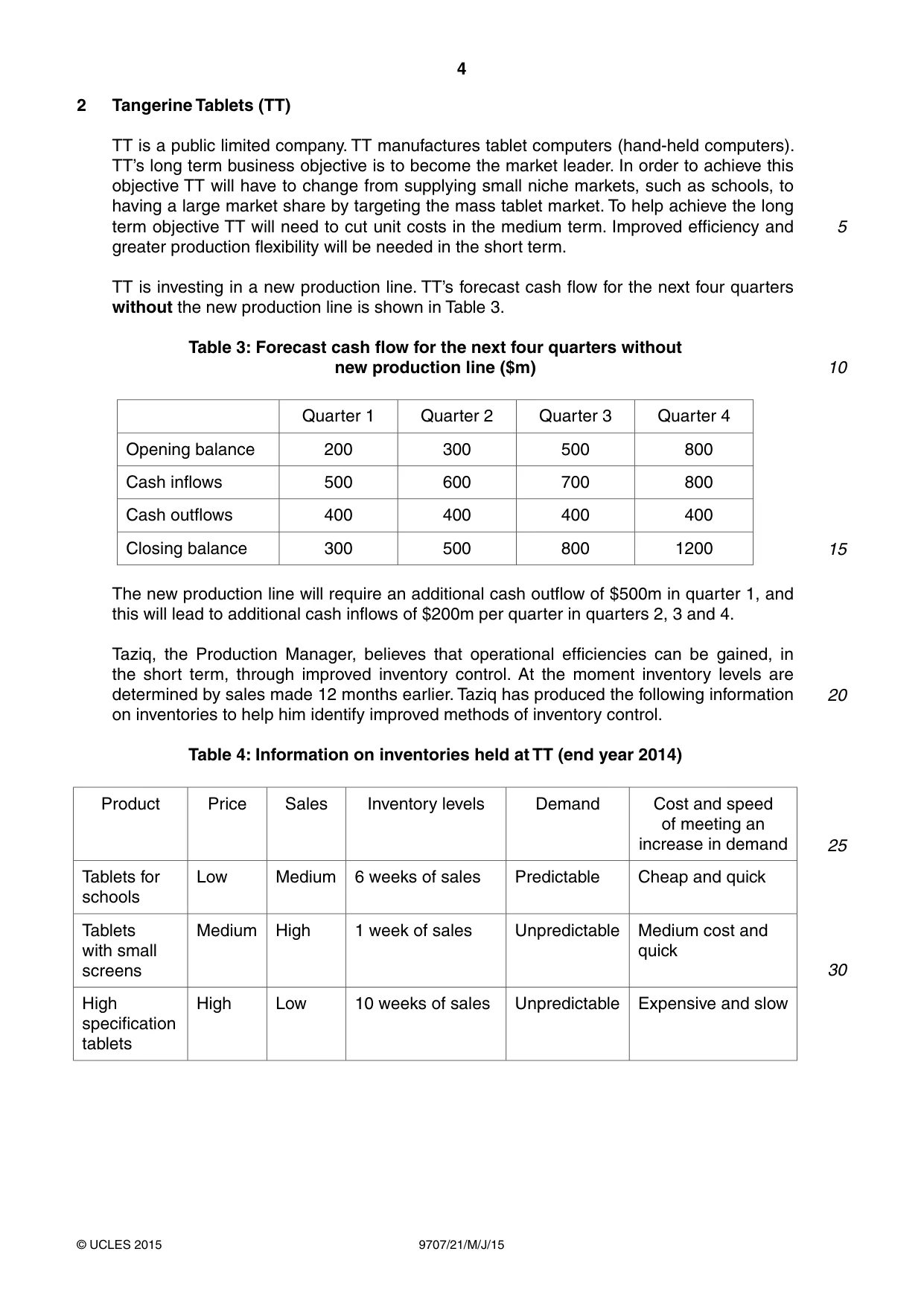
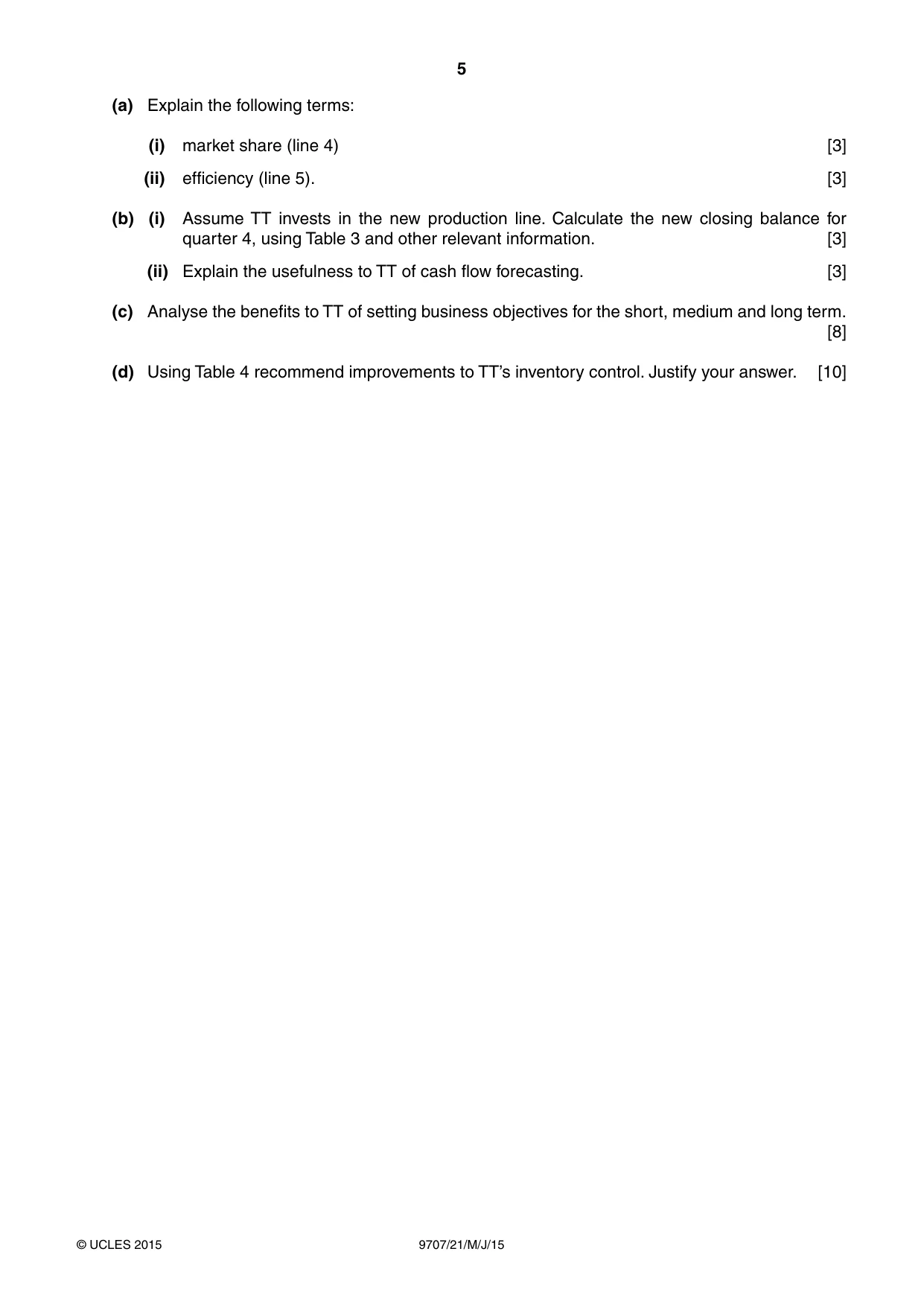
2 Tangerine Tablets (TT) TT is a public limited company. TT manufactures tablet computers (hand-held computers). TT’s long term business objective is to become the market leader. In order to achieve this objective TT will have to change from supplying small niche markets, such as schools, to having a large market share by targeting the mass tablet market. To help achieve the long term objective TT will need to cut unit costs in the medium term. Improved efficiency and 5 greater production flexibility will be needed in the short term. TT is investing in a new production line. TT’s forecast cash flow for the next four quarters without the new production line is shown in Table 3. Table 3: Forecast cash flow for the next four quarters without new production line ($m) 10 Quarter 1 Quarter 2 Quarter 3 Quarter 4 Opening balance 200 300 500 800 Cash inflows 500 600 700 800 Cash outflows 400 400 400 400 Closing balance 300 500 800 1200 15 The new production line will require an additional cash outflow of $500m in quarter 1, and this will lead to additional cash inflows of $200m per quarter in quarters 2, 3 and 4. Taziq, the Production Manager, believes that operational efficiencies can be gained, in the short term, through improved inventory control. At the moment inventory levels are determined by sales made 12 months earlier. Taziq has produced the following information 20 on inventories to help him identify improved methods of inventory control. Table 4: Information on inventories held at TT (end year 2014) Product Price Sales Inventory levels Demand Cost and speed of meeting an increase in demand 25 Tablets for Low Medium 6 weeks of sales Predictable Cheap and quick schools Tablets Medium High 1 week of sales Unpredictable Medium cost and with small quick screens 30 High High Low 10 weeks of sales Unpredictable Expensive and slow specification tablets (a) Explain the following terms: (i) market share (line 4) [3] (ii) efficiency (line 5). [3] (b) (i) Assume TT invests in the new production line. Calculate the new closing balance for quarter 4, using Table 3 and other relevant information. [3] (ii) Explain the usefulness to TT of cash flow forecasting. [3] (c) Analyse the benefits to TT of setting business objectives for the short, medium and long term. [8] (d) Using Table 4 recommend improvements to TT’s inventory control. Justify your answer. [10]
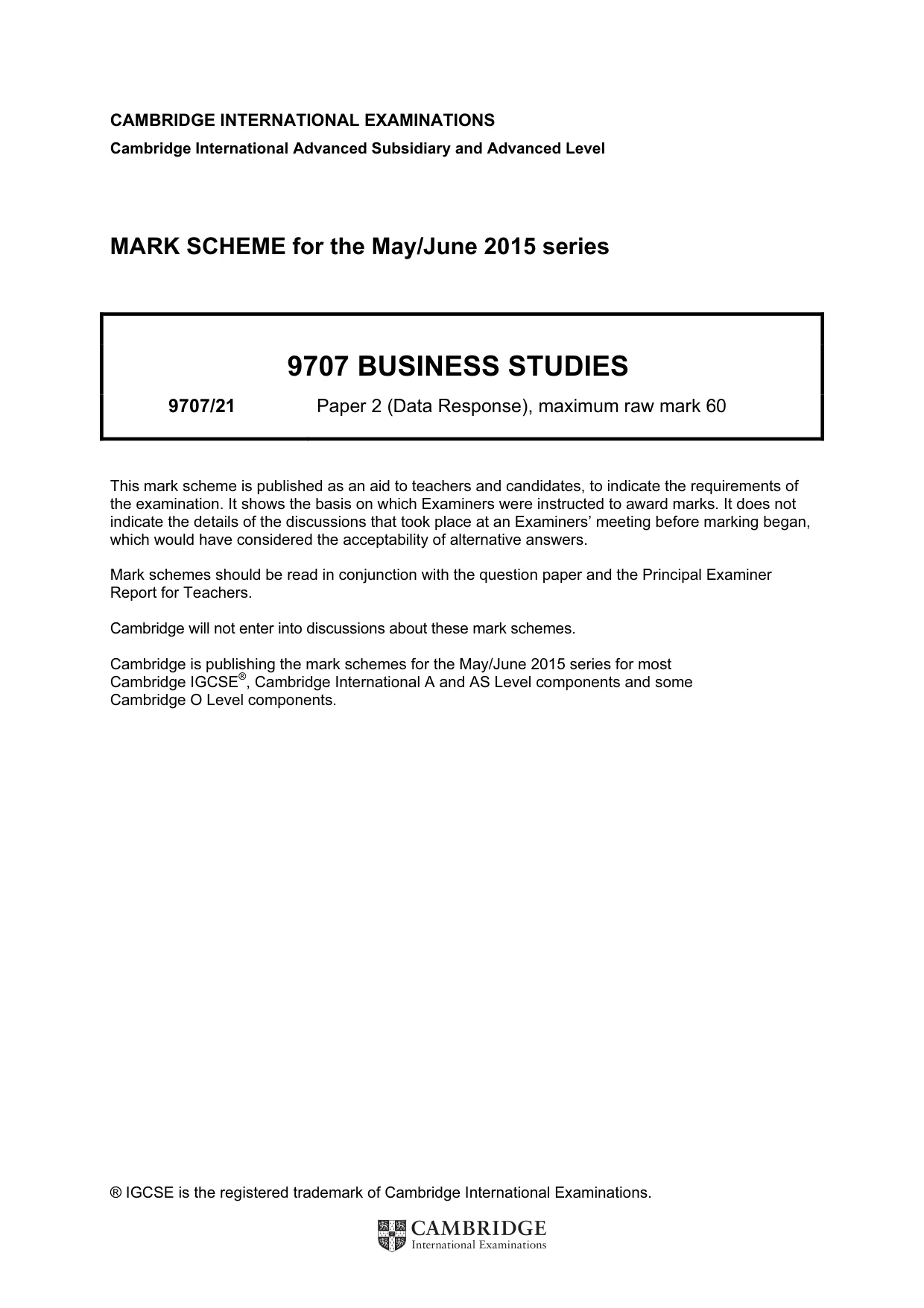
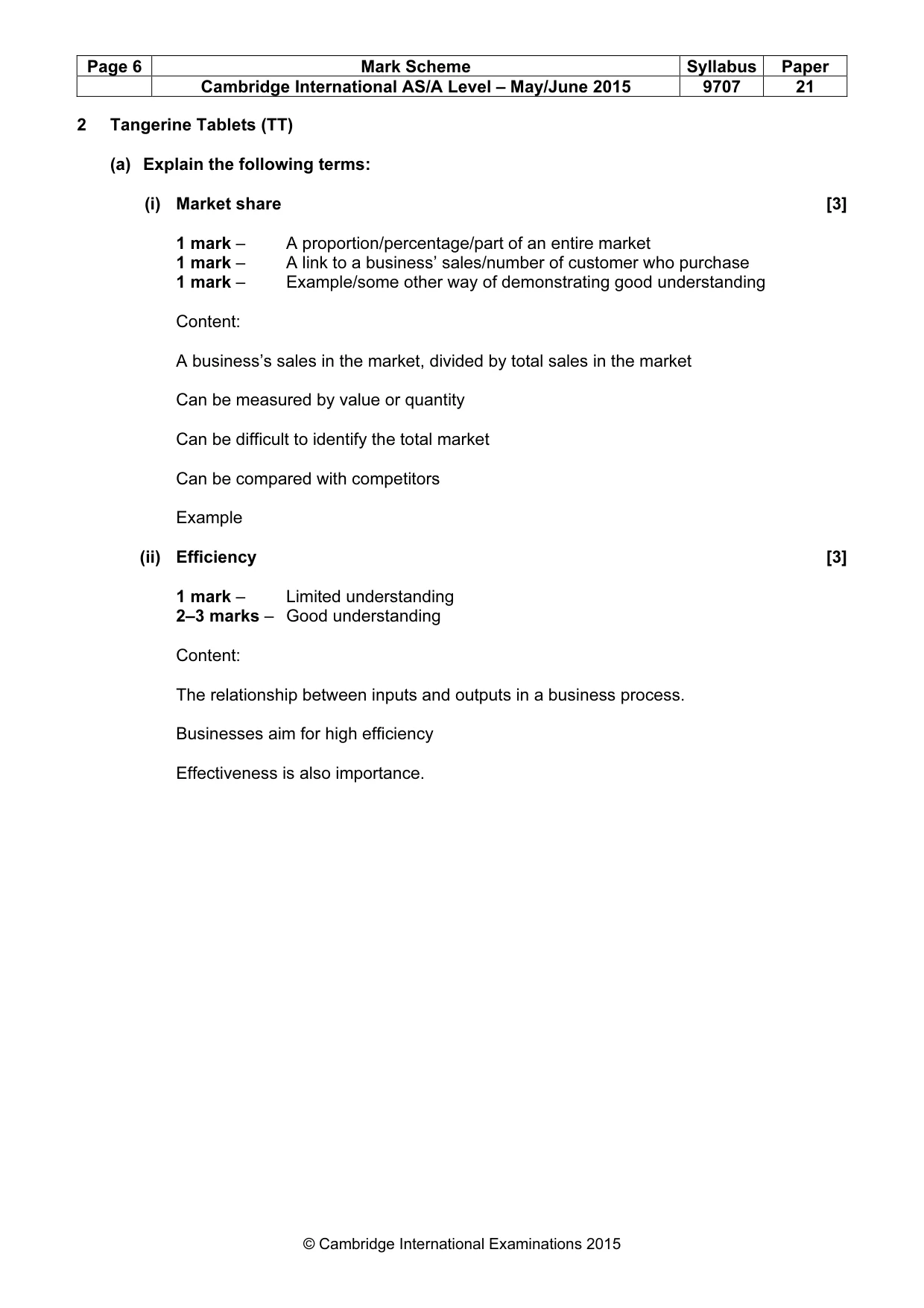
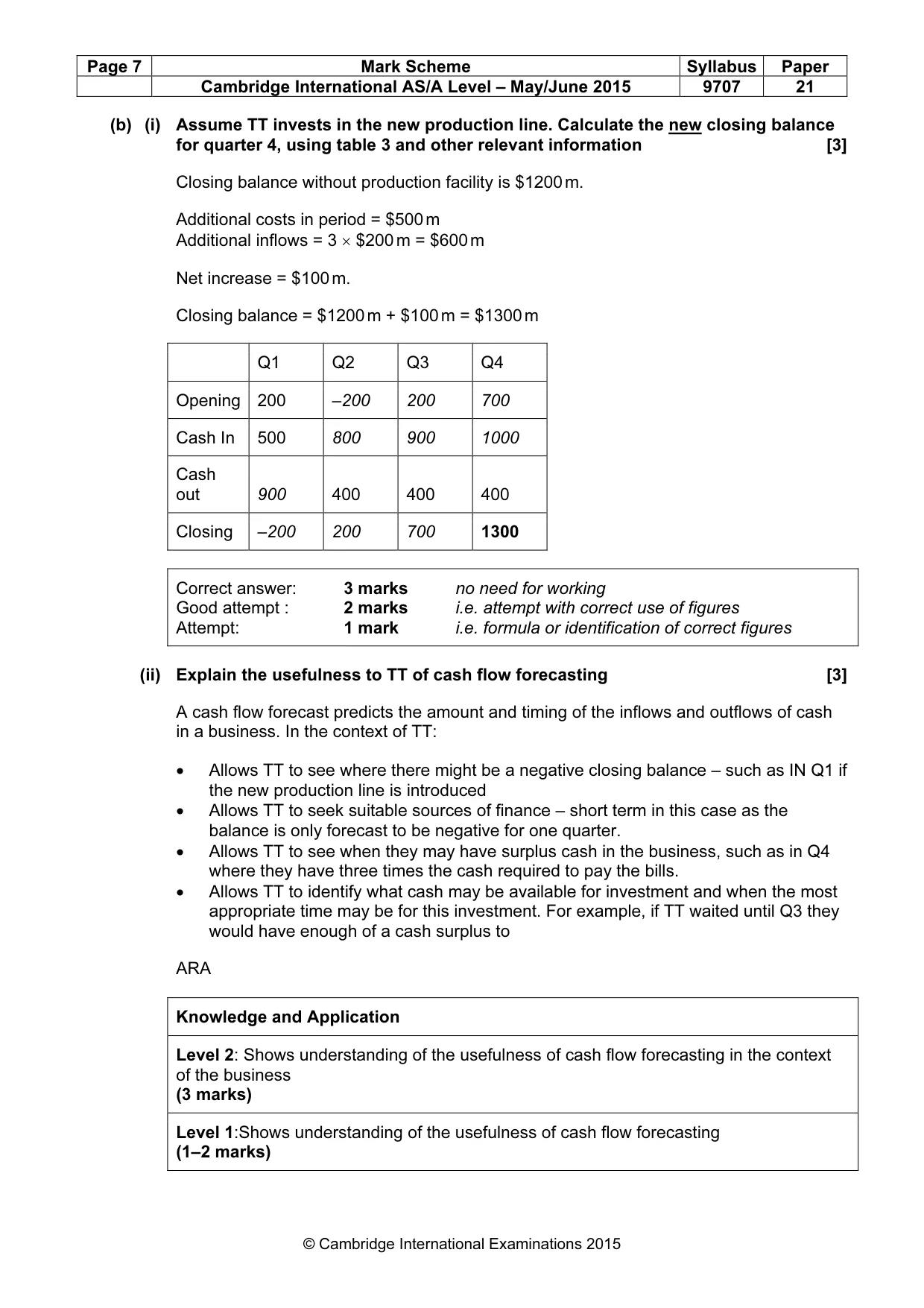
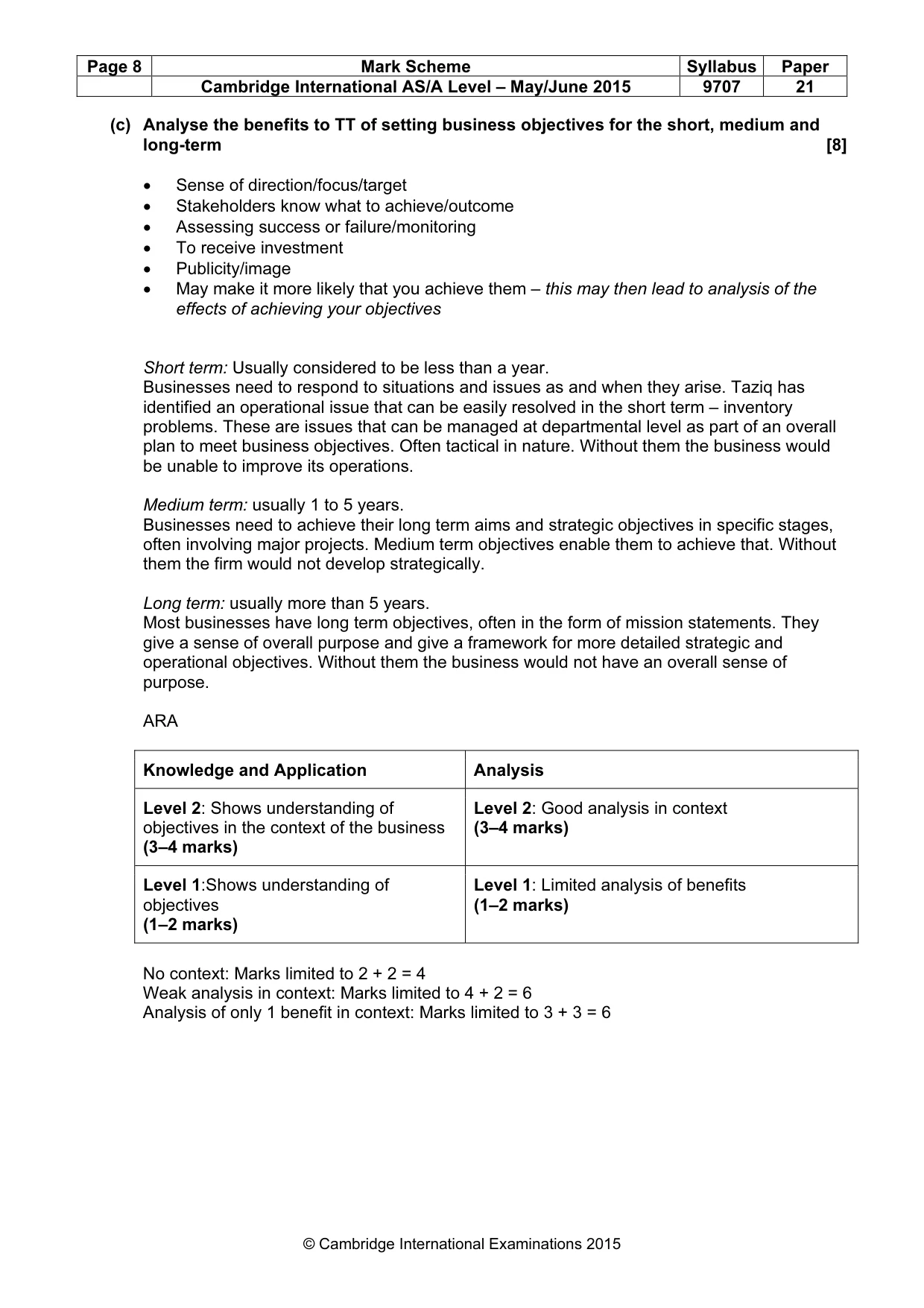
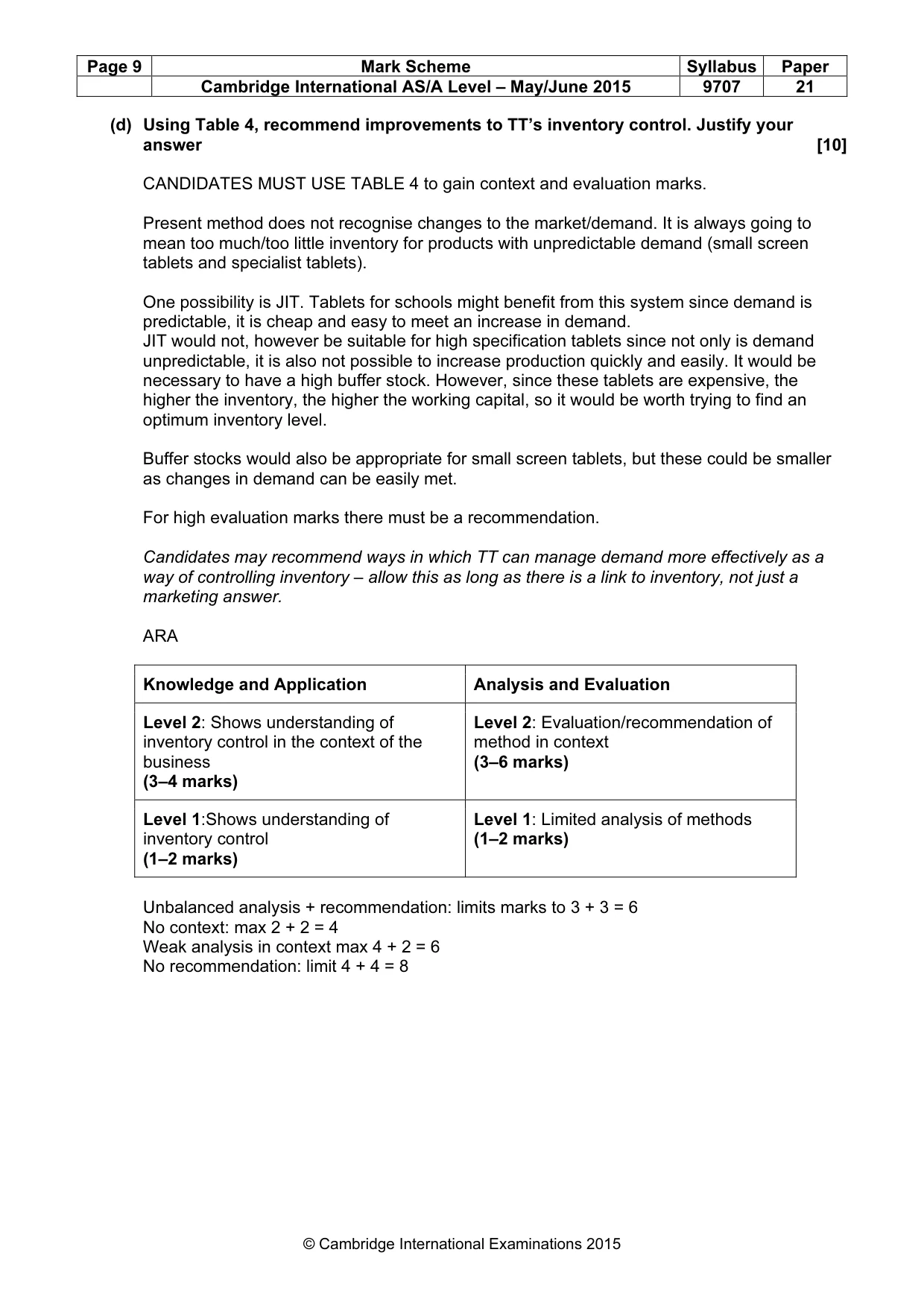
Mark scheme: 2 Tangerine Tablets (TT) (a) Explain the following terms: (i) Market share [3] 1 mark – A proportion/percentage/part of an entire market 1 mark – A link to a business’ sales/number of customer who purchase 1 mark – Example/some other way of demonstrating good understanding Content: A business’s sales in the market, divided by total sales in the market Can be measured by value or quantity Can be difficult to identify the total market Can be compared with competitors Example (ii) Efficiency [3] 1 mark – Limited understanding 2–3 marks – Good understanding Content: The relationship between inputs and outputs in a business process. Businesses aim for high efficiency Effectiveness is also importance. (b) (i) Assume TT invests in the new production line. Calculate the new closing balance for quarter 4, using table 3 and other relevant information [3] Closing balance without production facility is $1200 m. Additional costs in period = $500 m Additional inflows = 3 × $200 m = $600 m Net increase = $100 m. Closing balance = $1200 m + $100 m = $1300 m Q1 Q2 Q3 Q4 Opening 200 –200 200 700 Cash In 500 800 900 1000 Cash out 900 400 400 400 Closing –200 200 700 1300 Correct answer: 3 marks no need for working Good attempt : 2 marks i.e. attempt with correct use of figures Attempt: 1 mark i.e. formula or identification of correct figures (ii) Explain the usefulness to TT of cash flow forecasting [3] A cash flow forecast predicts the amount and timing of the inflows and outflows of cash in a business. In the context of TT: • Allows TT to see where there might be a negative closing balance – such as IN Q1 if the new production line is introduced • Allows TT to seek suitable sources of finance – short term in this case as the balance is only forecast to be negative for one quarter. • Allows TT to see when they may have surplus cash in the business, such as in Q4 where they have three times the cash required to pay the bills. • Allows TT to identify what cash may be available for investment and when the most appropriate time may be for this investment. For example, if TT waited until Q3 they would have enough of a cash surplus to ARA Knowledge and Application Level 2: Shows understanding of the usefulness of cash flow forecasting in the context of the business (3 marks) Level 1:Shows understanding of the usefulness of cash flow forecasting (1–2 marks) (c) Analyse the benefits to TT of setting business objectives for the short, medium and long-term [8] • Sense of direction/focus/target • Stakeholders know what to achieve/outcome • Assessing success or failure/monitoring • To receive investment • Publicity/image • May make it more likely that you achieve them – this may then lead to analysis of the effects of achieving your objectives Short term: Usually considered to be less than a year. Businesses need to respond to situations and issues as and when they arise. Taziq has identified an operational issue that can be easily resolved in the short term – inventory problems. These are issues that can be managed at departmental level as part of an overall plan to meet business objectives. Often tactical in nature. Without them the business would be unable to improve its operations. Medium term: usually 1 to 5 years. Businesses need to achieve their long term aims and strategic objectives in specific stages, often involving major projects. Medium term objectives enable them to achieve that. Without them the firm would not develop strategically. Long term: usually more than 5 years. Most businesses have long term objectives, often in the form of mission statements. They give a sense of overall purpose and give a framework for more detailed strategic and operational objectives. Without them the business would not have an overall sense of purpose. ARA Knowledge and Application Analysis Level 2: Shows understanding of Level 2: Good analysis in context objectives in the context of the business (3–4 marks) (3–4 marks) Level 1:Shows understanding of Level 1: Limited analysis of benefits objectives (1–2 marks) (1–2 marks) No context: Marks limited to 2 + 2 = 4 Weak analysis in context: Marks limited to 4 + 2 = 6 Analysis of only 1 benefit in context: Marks limited to 3 + 3 = 6 (d) Using Table 4, recommend improvements to TT’s inventory control. Justify your answer [10] CANDIDATES MUST USE TABLE 4 to gain context and evaluation marks. Present method does not recognise changes to the market/demand. It is always going to mean too much/too little inventory for products with unpredictable demand (small screen tablets and specialist tablets). One possibility is JIT. Tablets for schools might benefit from this system since demand is predictable, it is cheap and easy to meet an increase in demand. JIT would not, however be suitable for high specification tablets since not only is demand unpredictable, it is also not possible to increase production quickly and easily. It would be necessary to have a high buffer stock. However, since these tablets are expensive, the higher the inventory, the higher the working capital, so it would be worth trying to find an optimum inventory level. Buffer stocks would also be appropriate for small screen tablets, but these could be smaller as changes in demand can be easily met. For high evaluation marks there must be a recommendation. Candidates may recommend ways in which TT can manage demand more effectively as a way of controlling inventory – allow this as long as there is a link to inventory, not just a marketing answer. ARA Knowledge and Application Analysis and Evaluation Level 2: Shows understanding of Level 2: Evaluation/recommendation of inventory control in the context of the method in context business (3–6 marks) (3–4 marks) Level 1:Shows understanding of Level 1: Limited analysis of methods inventory control (1–2 marks) (1–2 marks) Unbalanced analysis + recommendation: limits marks to 3 + 3 = 6 No context: max 2 + 2 = 4 Weak analysis in context max 4 + 2 = 6 No recommendation: limit 4 + 4 = 8
What you needed in this session
Cambridge’s own grade thresholds for 2015 May/June, Paper 2 · Variant 1. A higher threshold means an easier paper — the bar moves with how the cohort did.