Cambridge A Level Business Studies (for final examination in 2015) 9707 — 2014 Oct/Nov Paper 2 · Variant 1
9707/21/O/N/14 · 2 questions · 60 marks · ≈68 min
The question paper and its mark scheme, free to read here and free to download. This is Cambridge’s own paper, exactly as it was sat.
Question paper4 pages

Mark scheme7 pages
Answers below. Sit the paper first if you are practising.
Questions as text
Q1 · Classic Cars (CC) CC is a large public limited company that manufactures a range of cars…
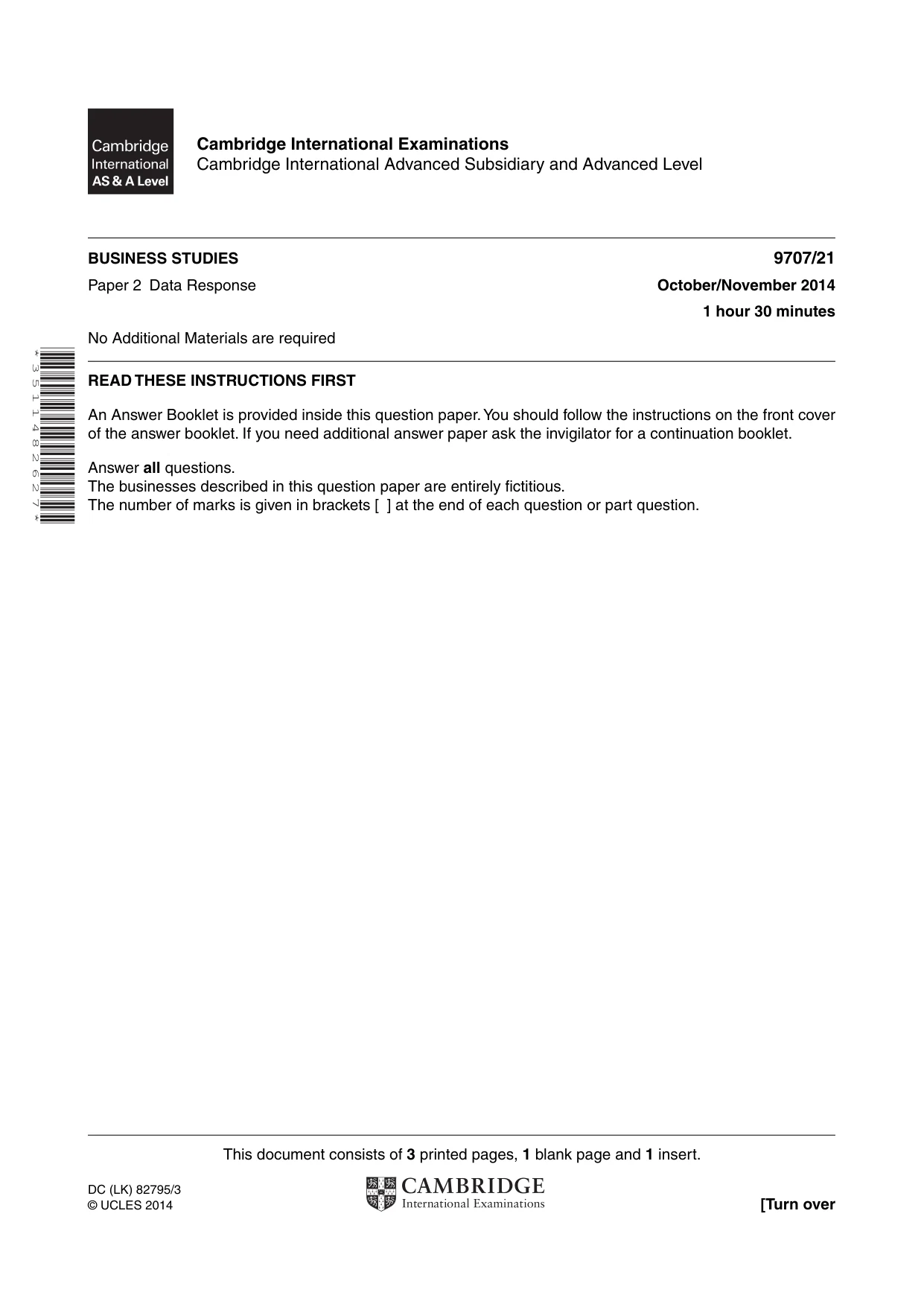
1 Classic Cars (CC) CC is a large public limited company that manufactures a range of cars which it sells through its own retail outlets. Each car is developed to meet the needs of a specific target market. Production takes place in several large factories using flow production methods. James is the Managing Director and he has been studying the revenue and profit data shown in Table 1. Table 1: Revenue and profit data for CC 5 2011 2012 2013 Annual revenue ($ billion) 450 515 595 Profit (before tax) for the year 14 24 35 ($ billion) Net profit margin 3.11% 4.66% X 10 James believes that the success of CC depends on the following 2 key factors. • Being price competitive – mainly achieved through a business objective of keeping costs low. • High level of investment in research and development to ensure that CC produces modern and technologically advanced cars. 15 James is working with Bilal, Director of Research and Development, to plan the investment of an additional $500m in developing a new car. This will be aimed at the family market. James also needs to meet with the Marketing Director to develop a pricing strategy for the new car. He will then present his overall plans to the Board of Directors at the next meeting. Kevin, the Human Resources Director, knows that labour turnover has increased from 5% to 20 7% in the last 2 years. This has been caused by low rises in wages and salaries and a poor range of perks (fringe benefits) for employees. Kevin wants CC to concentrate more on triple bottom line targets and not just profit. (a) Explain the following terms: (i) flow production (line 3) [3] (ii) triple bottom line (line 22). [3] (b) (i) Calculate the value of X in Table 1. [2] (ii) Briefly explain two reasons for the trend in CC’s net profit margin. [4] (c) Analyse the disadvantages to CC of the increase in labour turnover. [8] (d) Discuss a suitable pricing strategy that could be used by CC when launching its new car. [10]
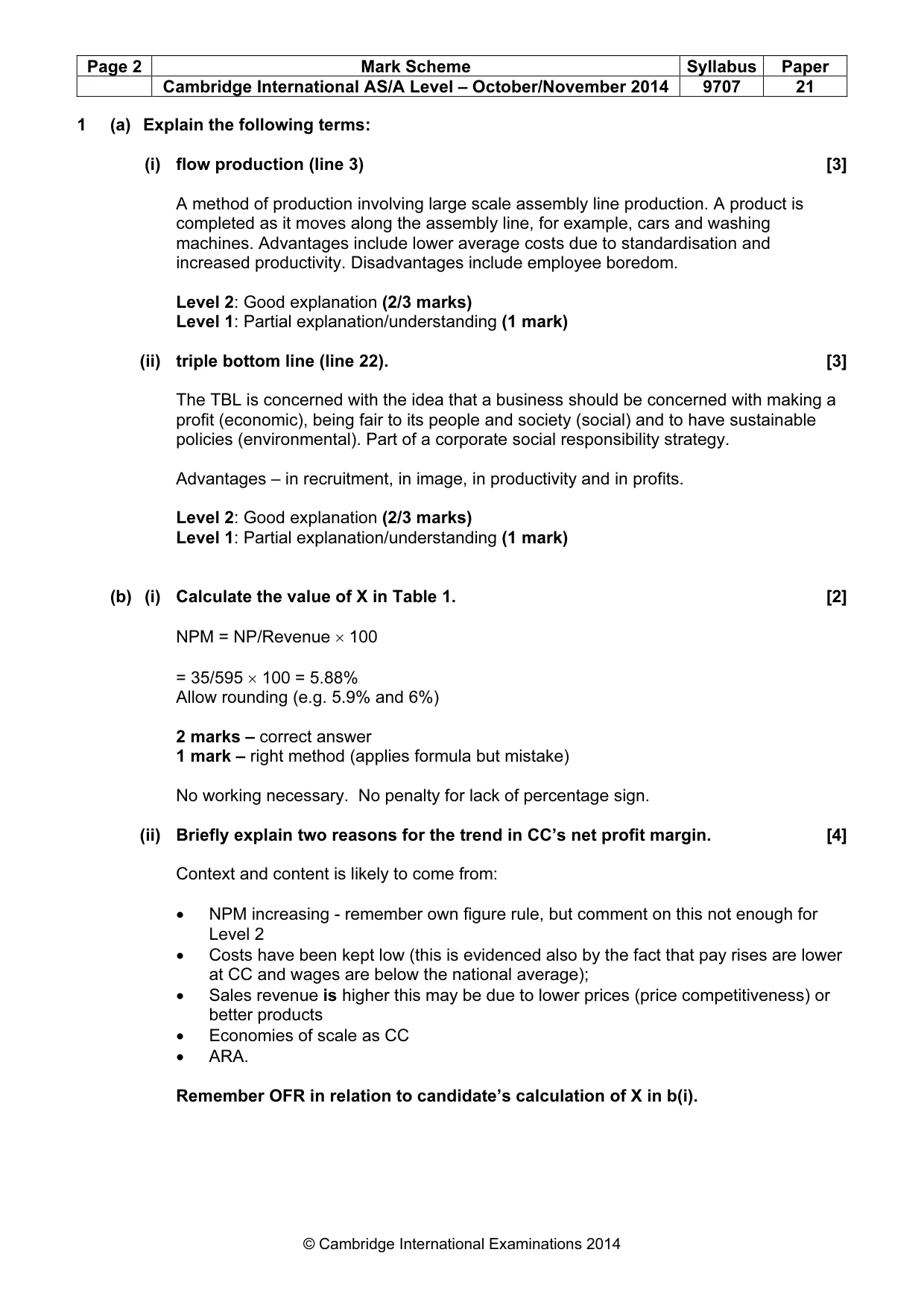
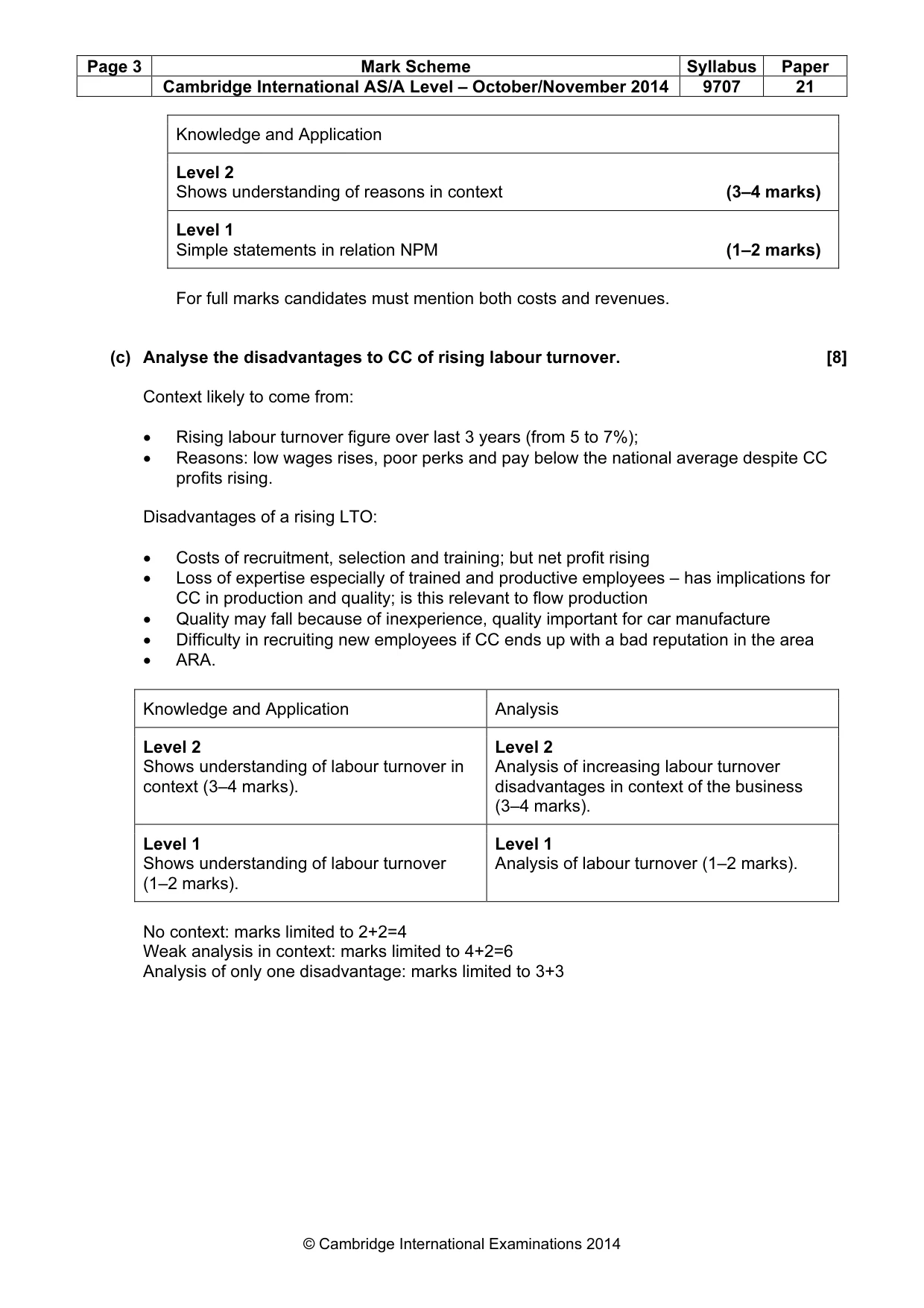
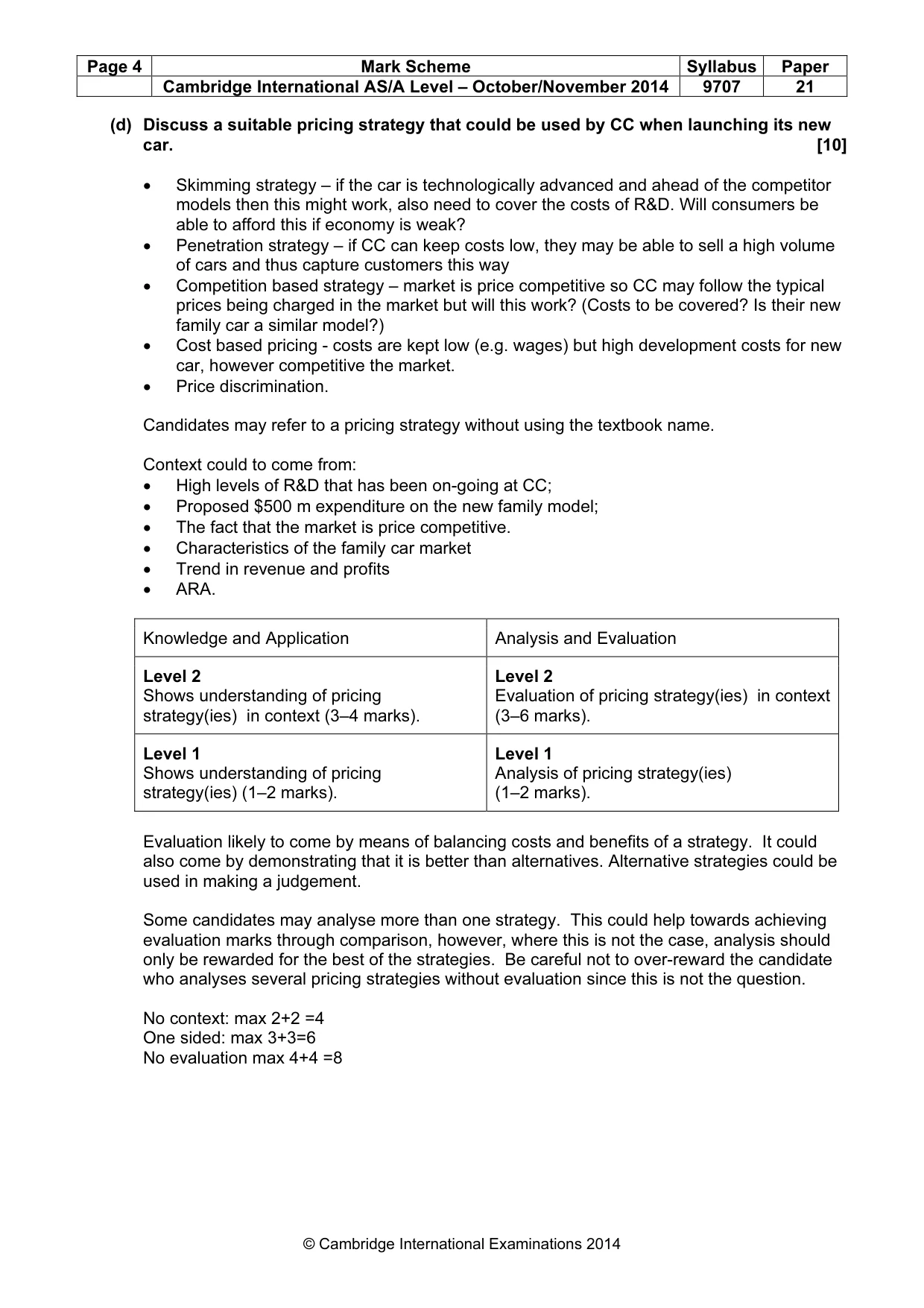
Mark scheme: 1 (a) Explain the following terms: (i) flow production (line 3) [3] A method of production involving large scale assembly line production. A product is completed as it moves along the assembly line, for example, cars and washing machines. Advantages include lower average costs due to standardisation and increased productivity. Disadvantages include employee boredom. Level 2: Good explanation (2/3 marks) Level 1: Partial explanation/understanding (1 mark) (ii) triple bottom line (line 22). [3] The TBL is concerned with the idea that a business should be concerned with making a profit (economic), being fair to its people and society (social) and to have sustainable policies (environmental). Part of a corporate social responsibility strategy. Advantages – in recruitment, in image, in productivity and in profits. Level 2: Good explanation (2/3 marks) Level 1: Partial explanation/understanding (1 mark) (b) (i) Calculate the value of X in Table 1. [2] NPM = NP/Revenue × 100 = 35/595 × 100 = 5.88% Allow rounding (e.g. 5.9% and 6%) 2 marks – correct answer 1 mark – right method (applies formula but mistake) No working necessary. No penalty for lack of percentage sign. (ii) Briefly explain two reasons for the trend in CC’s net profit margin. [4] Context and content is likely to come from: • NPM increasing - remember own figure rule, but comment on this not enough for Level 2 • Costs have been kept low (this is evidenced also by the fact that pay rises are lower at CC and wages are below the national average); • Sales revenue is higher this may be due to lower prices (price competitiveness) or better products • Economies of scale as CC • ARA. Remember OFR in relation to candidate’s calculation of X in b(i). Knowledge and Application Level 2 Shows understanding of reasons in context (3–4 marks) Level 1 Simple statements in relation NPM (1–2 marks) For full marks candidates must mention both costs and revenues. (c) Analyse the disadvantages to CC of rising labour turnover. [8] Context likely to come from: • Rising labour turnover figure over last 3 years (from 5 to 7%); • Reasons: low wages rises, poor perks and pay below the national average despite CC profits rising. Disadvantages of a rising LTO: • Costs of recruitment, selection and training; but net profit rising • Loss of expertise especially of trained and productive employees – has implications for CC in production and quality; is this relevant to flow production • Quality may fall because of inexperience, quality important for car manufacture • Difficulty in recruiting new employees if CC ends up with a bad reputation in the area • ARA. Knowledge and Application Analysis Level 2 Level 2 Shows understanding of labour turnover in Analysis of increasing labour turnover context (3–4 marks). disadvantages in context of the business (3–4 marks). Level 1 Level 1 Shows understanding of labour turnover Analysis of labour turnover (1–2 marks). (1–2 marks). No context: marks limited to 2+2=4 Weak analysis in context: marks limited to 4+2=6 Analysis of only one disadvantage: marks limited to 3+3 (d) Discuss a suitable pricing strategy that could be used by CC when launching its new car. [10] • Skimming strategy – if the car is technologically advanced and ahead of the competitor models then this might work, also need to cover the costs of R&D. Will consumers be able to afford this if economy is weak? • Penetration strategy – if CC can keep costs low, they may be able to sell a high volume of cars and thus capture customers this way • Competition based strategy – market is price competitive so CC may follow the typical prices being charged in the market but will this work? (Costs to be covered? Is their new family car a similar model?) • Cost based pricing - costs are kept low (e.g. wages) but high development costs for new car, however competitive the market. • Price discrimination. Candidates may refer to a pricing strategy without using the textbook name. Context could to come from: • High levels of R&D that has been on-going at CC; • Proposed $500 m expenditure on the new family model; • The fact that the market is price competitive. • Characteristics of the family car market • Trend in revenue and profits • ARA. Knowledge and Application Analysis and Evaluation Level 2 Level 2 Shows understanding of pricing Evaluation of pricing strategy(ies) in context strategy(ies) in context (3–4 marks). (3–6 marks). Level 1 Level 1 Shows understanding of pricing Analysis of pricing strategy(ies) strategy(ies) (1–2 marks). (1–2 marks). Evaluation likely to come by means of balancing costs and benefits of a strategy. It could also come by demonstrating that it is better than alternatives. Alternative strategies could be used in making a judgement. Some candidates may analyse more than one strategy. This could help towards achieving evaluation marks through comparison, however, where this is not the case, analysis should only be rewarded for the best of the strategies. Be careful not to over-reward the candidate who analyses several pricing strategies without evaluation since this is not the question. No context: max 2+2 =4 One sided: max 3+3=6 No evaluation max 4+4 =8
Q2 · Blooming Flowers (BF) Fiona has opened a new shop in a busy town centre
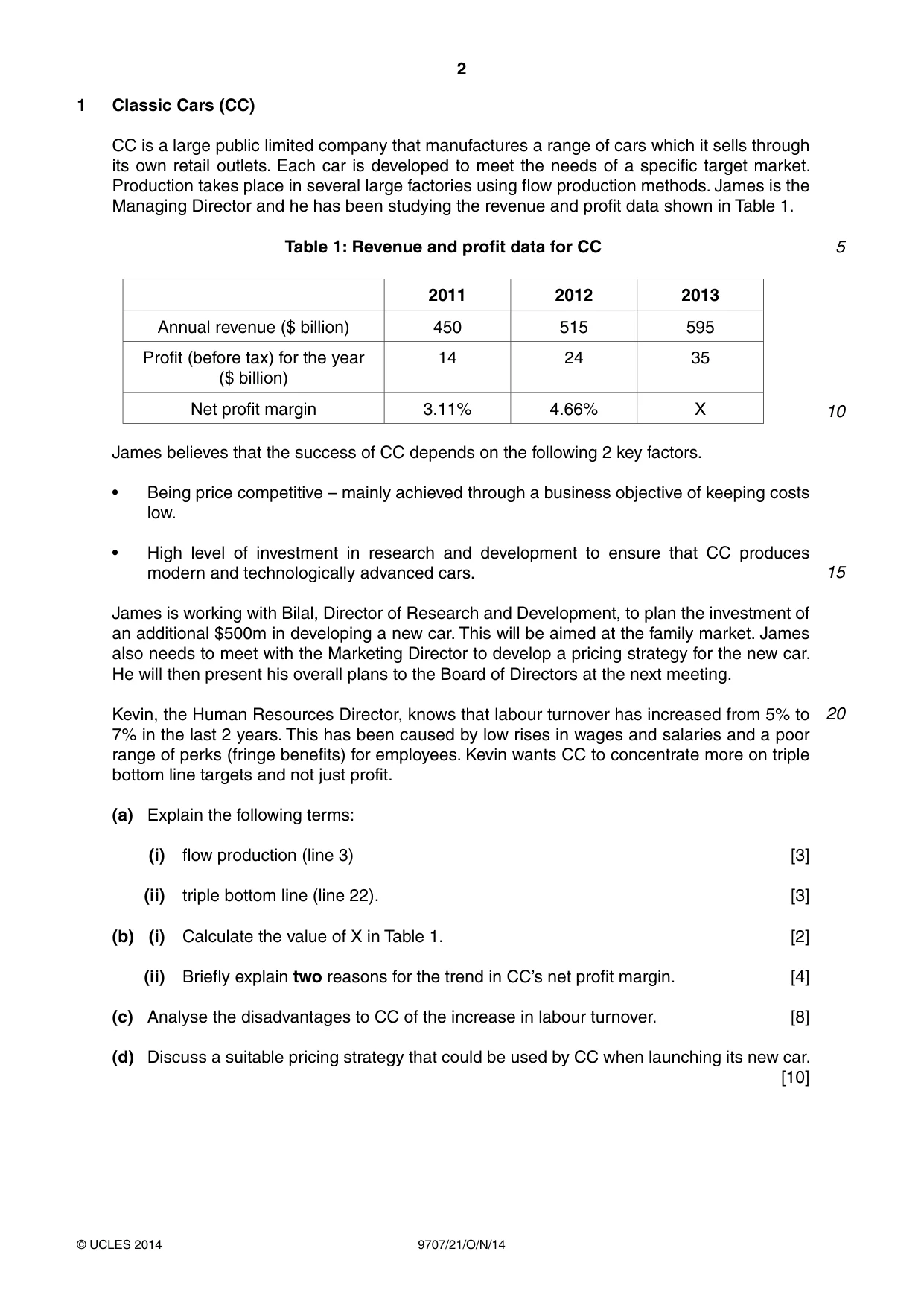
2 Blooming Flowers (BF) Fiona has opened a new shop in a busy town centre. It is part of a franchise agreement between Fiona (franchisee) and Blooming Flowers (franchisor). Each franchise retails a range of flowers, as well as standard and made-to-order floral displays. Typically, in each BF franchise 90% of revenue is from consumer markets and 10% from selling to local businesses. The cost to set up the franchise, including a BF branded delivery vehicle, was $20 000. Fiona 5 financed this with the $15 000 redundancy payment from her previous job and $5000 of her personal savings. Fiona has to pay 4% of her quarterly revenue to BF (this 4% payment is called a ‘royalty’). In return Fiona receives marketing support and business advice from one of BF’s regional managers. The regional manager helped Fiona prepare the draft cash flow forecast that is shown below in Table 2. Fiona will soon have a meeting with the regional 10 manager to discuss methods of promoting the new shop. Table 2: Cash flow forecast, first 6 months of trading ($000) Month 1 Month 2 Month 3 Month 4 Month 5 Month 6 Cash in: Cash invested 20 0 0 0 0 0 15 Revenue 8 7 10 9 8 11 Cash out: Initial set up costs 20 0 0 0 0 0 Royalty 0 0 0 1 0 0 Employee costs 3 3 3 3 3 3 20 Purchases 3 3 3 3 3 3 Other payments 4 3 4 3 3 3 Opening Balance 0 –2 –4 –4 –5 –6 Closing Balance –2 –4 –4 –5 –6 –4 In preparation for the opening of the new shop, Fiona has successfully completed a 25 qualification in flower retailing at her local college. Fiona is aware of recent reports in the media that unemployment in the local area has started to rise. Consumers are expected to reduce their spending on luxury products. (a) Explain the following terms: (i) consumer markets (line 4) [3] (ii) managers (line 9). [3] (b) (i) Fiona has set a promotional budget based on 5% of revenue. Using Table 2, calculate Fiona’s promotion budget for the first 6 months of trading. [2] (ii) Explain two suitable promotion methods that Fiona could use for her new shop. [4] (c) Analyse the benefits to Fiona from preparing the cash flow forecast shown in Table 2. [8] (d) Evaluate the advantages and disadvantages to Fiona of entering into a franchise agreement
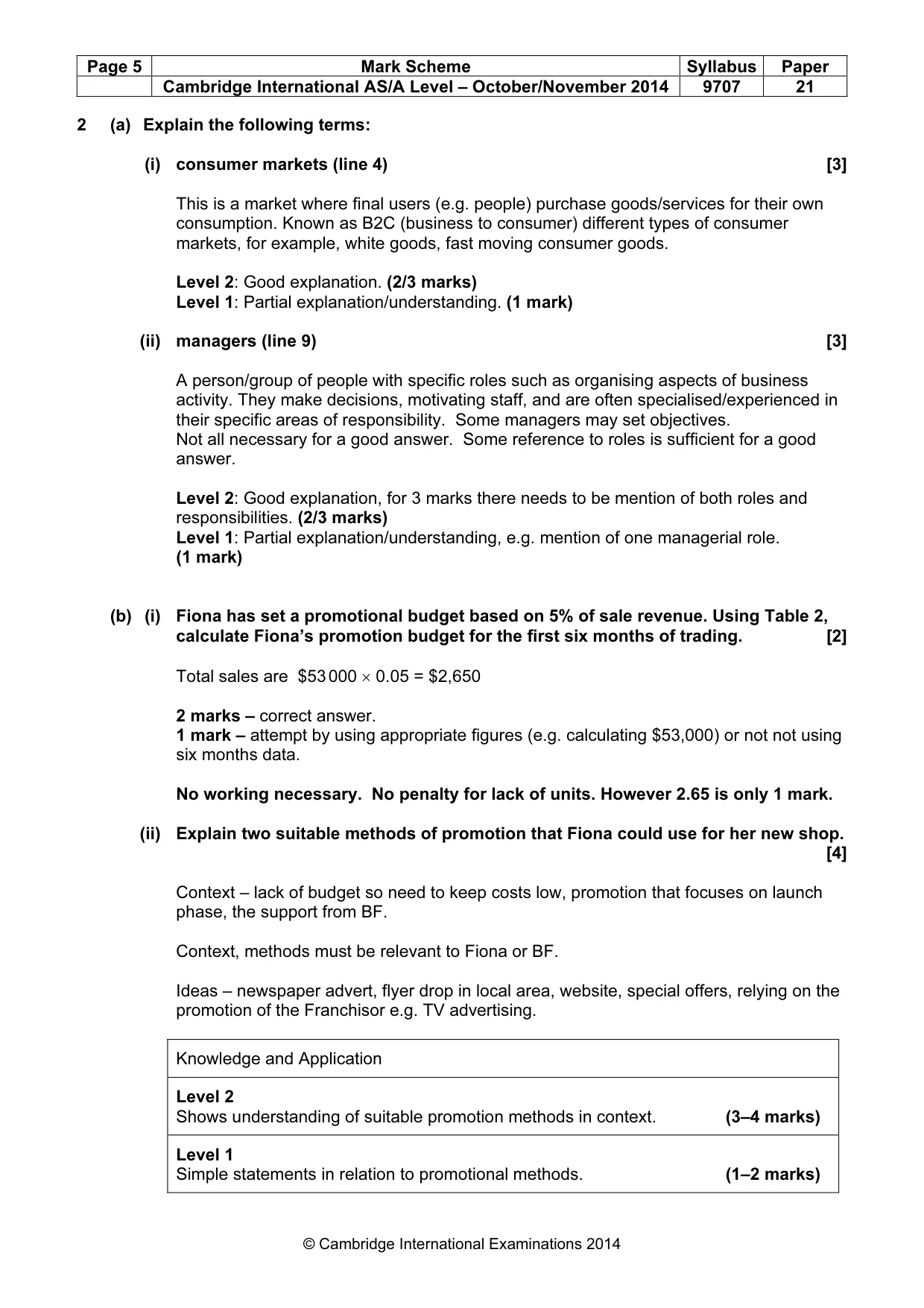
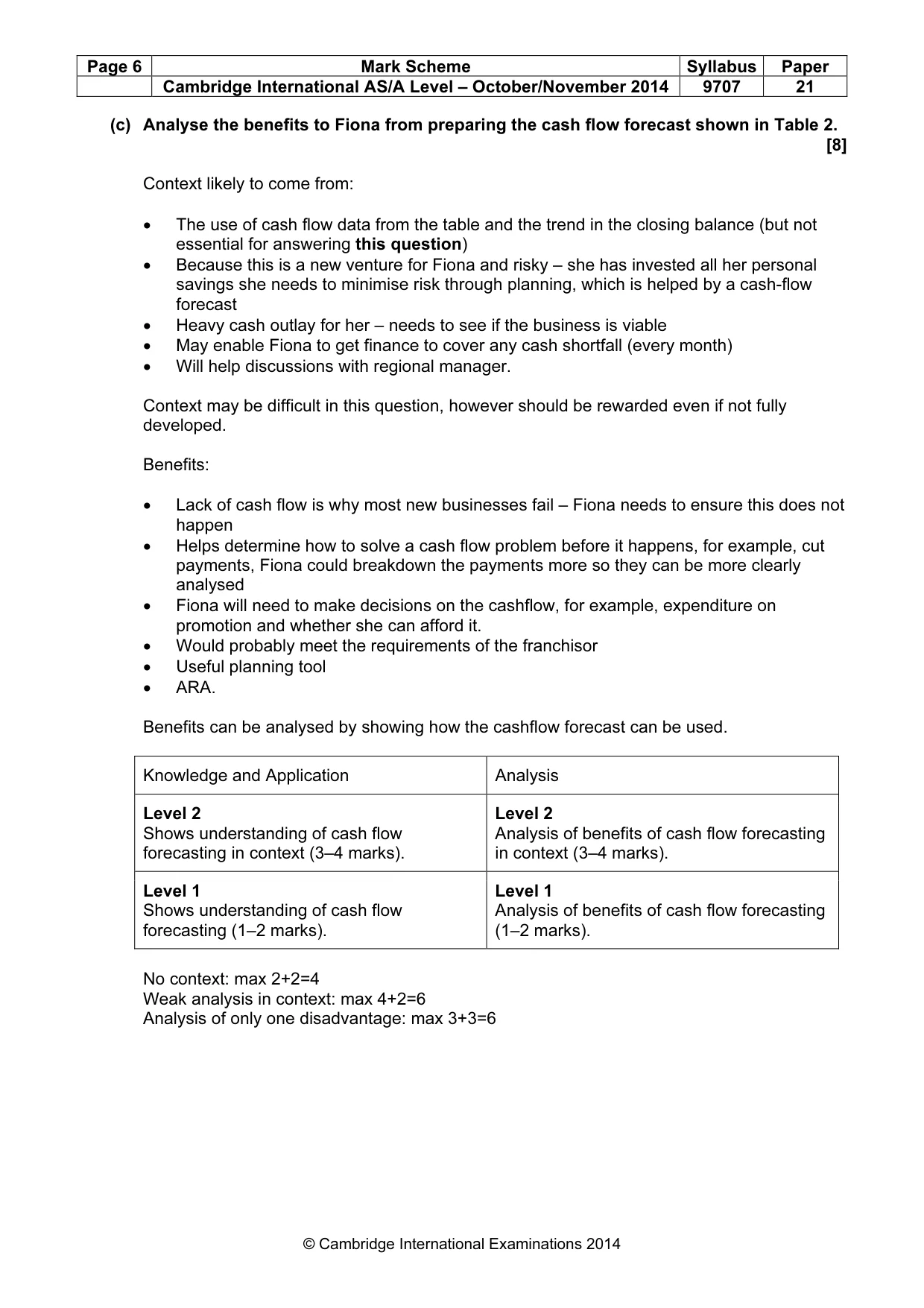
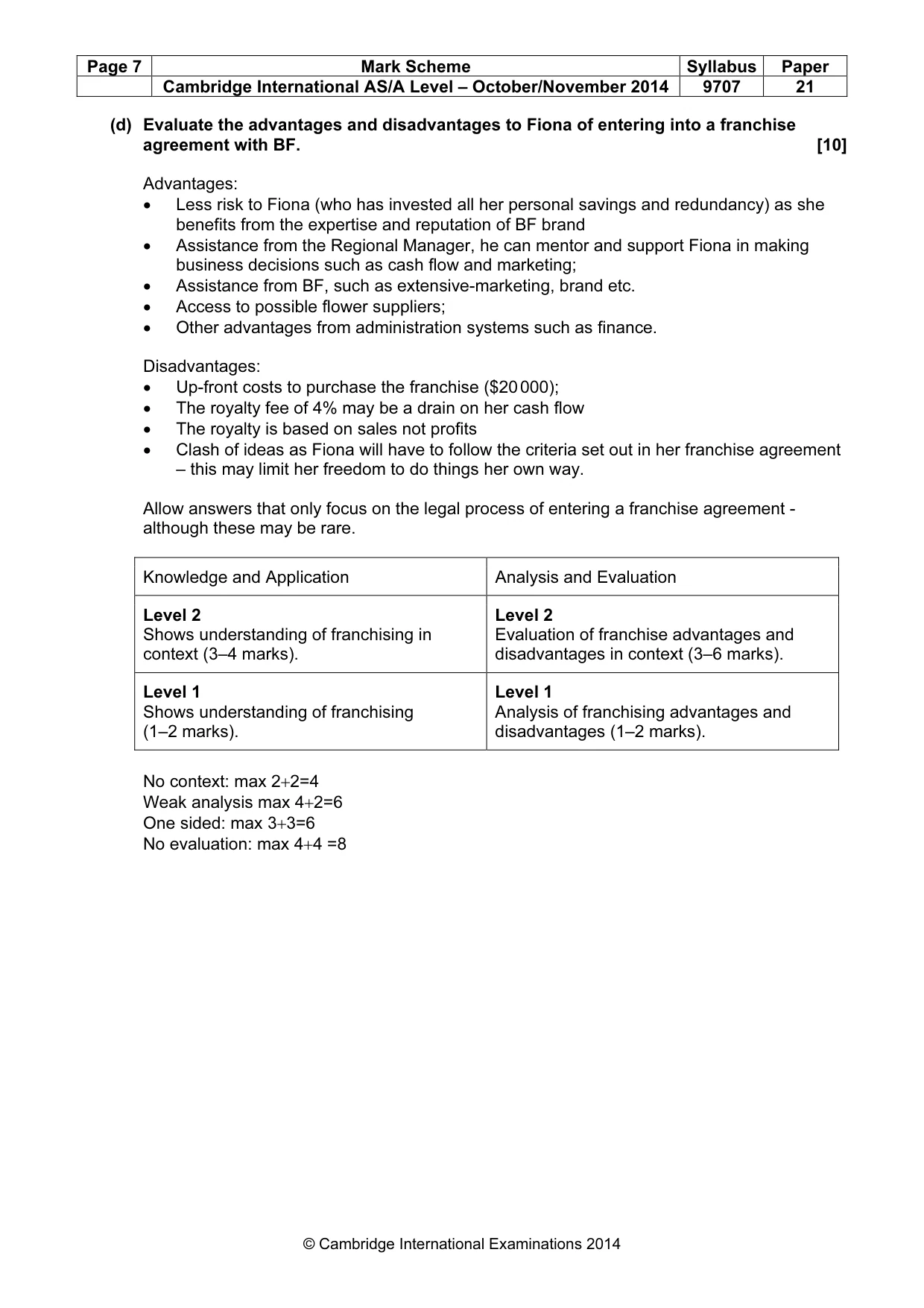
Mark scheme: 2 (a) Explain the following terms: (i) consumer markets (line 4) [3] This is a market where final users (e.g. people) purchase goods/services for their own consumption. Known as B2C (business to consumer) different types of consumer markets, for example, white goods, fast moving consumer goods. Level 2: Good explanation. (2/3 marks) Level 1: Partial explanation/understanding. (1 mark) (ii) managers (line 9) [3] A person/group of people with specific roles such as organising aspects of business activity. They make decisions, motivating staff, and are often specialised/experienced in their specific areas of responsibility. Some managers may set objectives. Not all necessary for a good answer. Some reference to roles is sufficient for a good answer. Level 2: Good explanation, for 3 marks there needs to be mention of both roles and responsibilities. (2/3 marks) Level 1: Partial explanation/understanding, e.g. mention of one managerial role. (1 mark) (b) (i) Fiona has set a promotional budget based on 5% of sale revenue. Using Table 2, calculate Fiona’s promotion budget for the first six months of trading. [2] Total sales are $53 000 × 0.05 = $2,650 2 marks – correct answer. 1 mark – attempt by using appropriate figures (e.g. calculating $53,000) or not not using six months data. No working necessary. No penalty for lack of units. However 2.65 is only 1 mark. (ii) Explain two suitable methods of promotion that Fiona could use for her new shop. [4] Context – lack of budget so need to keep costs low, promotion that focuses on launch phase, the support from BF. Context, methods must be relevant to Fiona or BF. Ideas – newspaper advert, flyer drop in local area, website, special offers, relying on the promotion of the Franchisor e.g. TV advertising. Knowledge and Application Level 2 Shows understanding of suitable promotion methods in context. (3–4 marks) Level 1 Simple statements in relation to promotional methods. (1–2 marks) (c) Analyse the benefits to Fiona from preparing the cash flow forecast shown in Table 2. [8] Context likely to come from: • The use of cash flow data from the table and the trend in the closing balance (but not essential for answering this question) • Because this is a new venture for Fiona and risky – she has invested all her personal savings she needs to minimise risk through planning, which is helped by a cash-flow forecast • Heavy cash outlay for her – needs to see if the business is viable • May enable Fiona to get finance to cover any cash shortfall (every month) • Will help discussions with regional manager. Context may be difficult in this question, however should be rewarded even if not fully developed. Benefits: • Lack of cash flow is why most new businesses fail – Fiona needs to ensure this does not happen • Helps determine how to solve a cash flow problem before it happens, for example, cut payments, Fiona could breakdown the payments more so they can be more clearly analysed • Fiona will need to make decisions on the cashflow, for example, expenditure on promotion and whether she can afford it. • Would probably meet the requirements of the franchisor • Useful planning tool • ARA. Benefits can be analysed by showing how the cashflow forecast can be used. Knowledge and Application Analysis Level 2 Level 2 Shows understanding of cash flow Analysis of benefits of cash flow forecasting forecasting in context (3–4 marks). in context (3–4 marks). Level 1 Level 1 Shows understanding of cash flow Analysis of benefits of cash flow forecasting forecasting (1–2 marks). (1–2 marks). No context: max 2+2=4 Weak analysis in context: max 4+2=6 Analysis of only one disadvantage: max 3+3=6 (d) Evaluate the advantages and disadvantages to Fiona of entering into a franchise agreement with BF. [10] Advantages: • Less risk to Fiona (who has invested all her personal savings and redundancy) as she benefits from the expertise and reputation of BF brand • Assistance from the Regional Manager, he can mentor and support Fiona in making business decisions such as cash flow and marketing; • Assistance from BF, such as extensive-marketing, brand etc. • Access to possible flower suppliers; • Other advantages from administration systems such as finance. Disadvantages: • Up-front costs to purchase the franchise ($20 000); • The royalty fee of 4% may be a drain on her cash flow • The royalty is based on sales not profits • Clash of ideas as Fiona will have to follow the criteria set out in her franchise agreement – this may limit her freedom to do things her own way. Allow answers that only focus on the legal process of entering a franchise agreement - although these may be rare. Knowledge and Application Analysis and Evaluation Level 2 Level 2 Shows understanding of franchising in Evaluation of franchise advantages and context (3–4 marks). disadvantages in context (3–6 marks). Level 1 Level 1 Shows understanding of franchising Analysis of franchising advantages and (1–2 marks). disadvantages (1–2 marks). No context: max 2+2=4 Weak analysis max 4+2=6 One sided: max 3+3=6 No evaluation: max 4+4 =8
What you needed in this session
Cambridge’s own grade thresholds for 2014 Oct/Nov, Paper 2 · Variant 1. A higher threshold means an easier paper — the bar moves with how the cohort did.