Cambridge A Level Business Studies (for final examination in 2015) 9707 — 2014 May/June Paper 2 · Variant 1
9707/21/M/J/14 · 2 questions · 60 marks · ≈68 min
The question paper and its mark scheme, free to read here and free to download. This is Cambridge’s own paper, exactly as it was sat.
Question paper4 pages
Mark scheme5 pages
Answers below. Sit the paper first if you are practising.
Questions as text
Q1 · Super View (SV) SV manufactures large flatscreens (televisions) for use at music concerts…
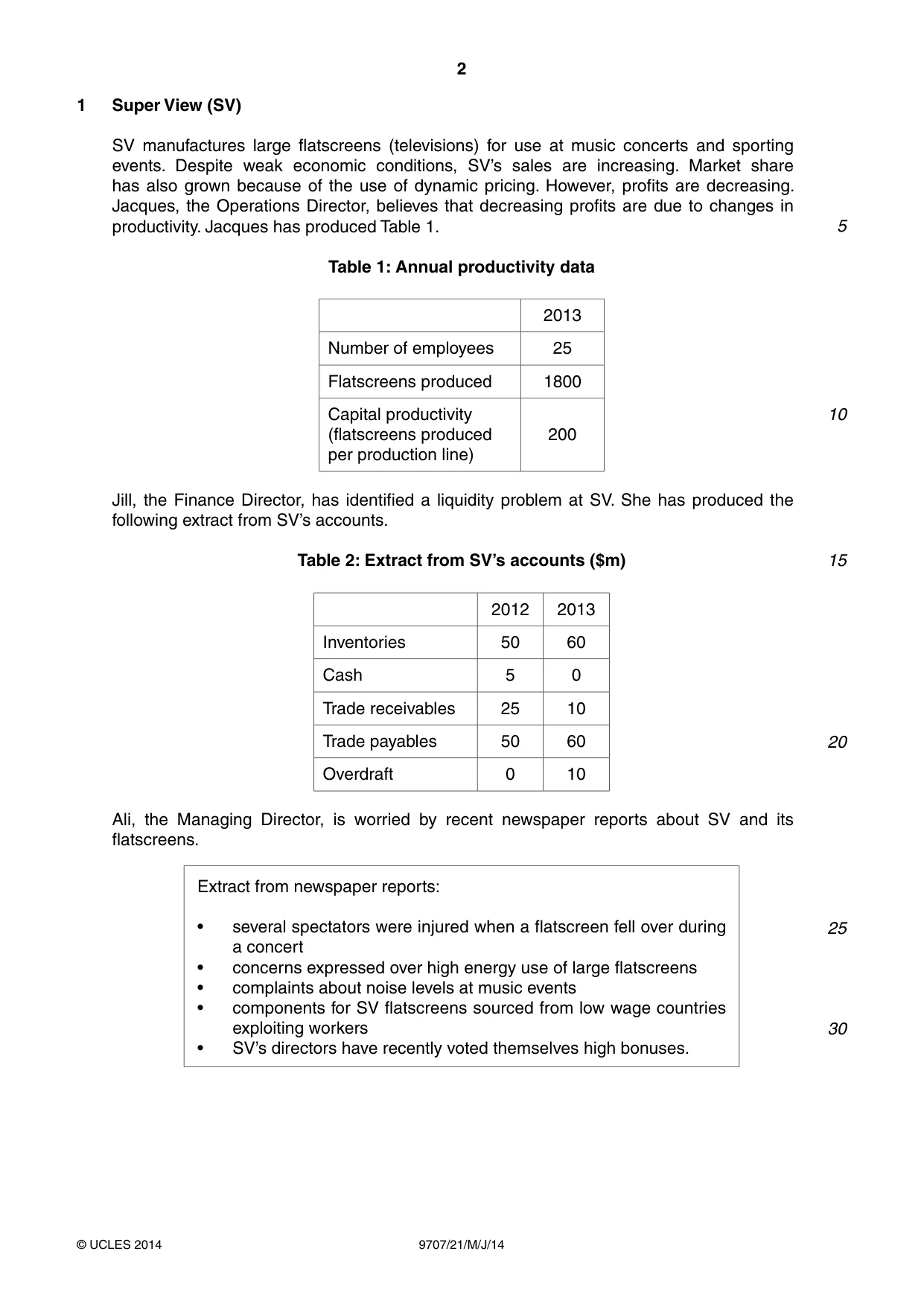
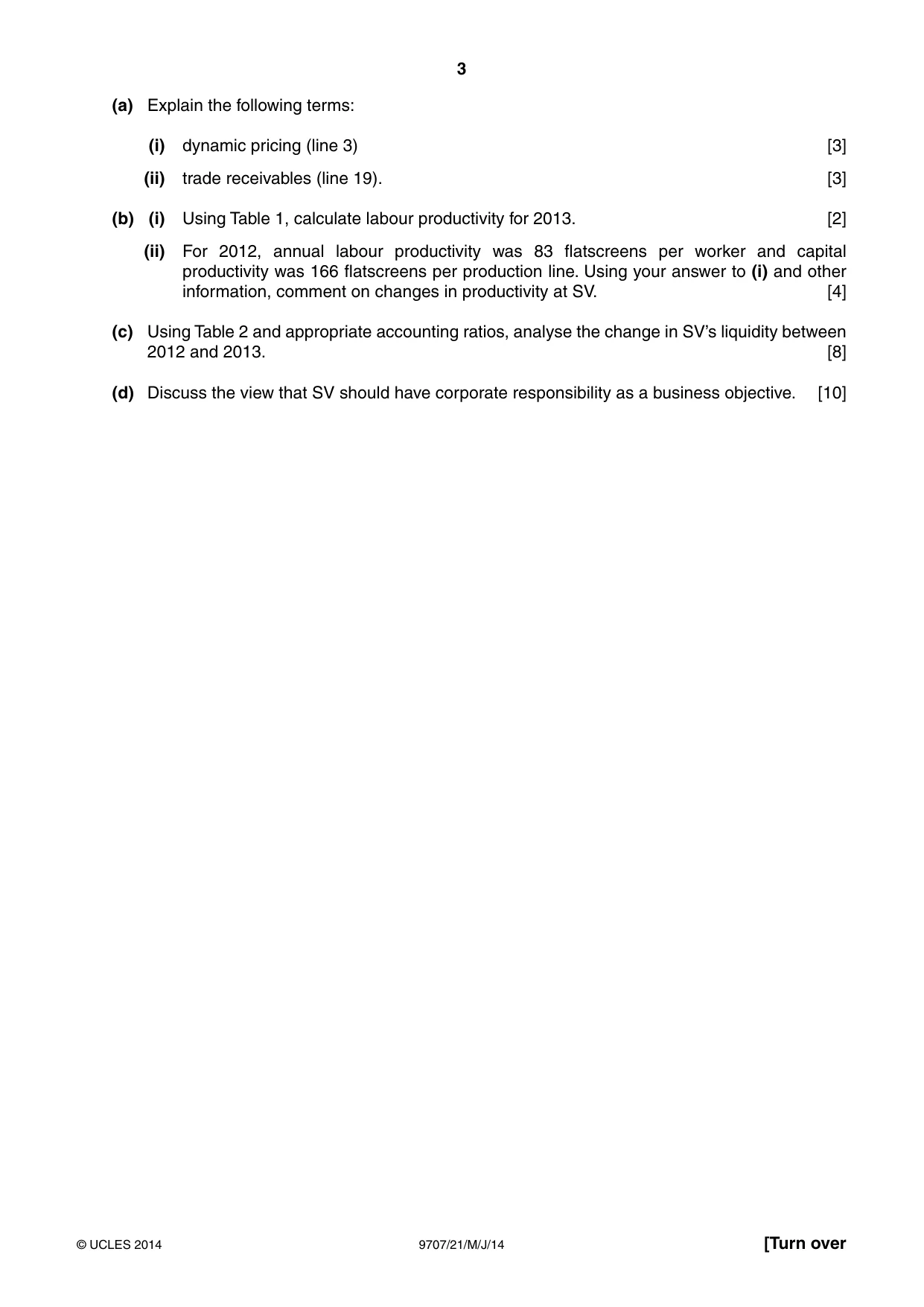
1 Super View (SV) SV manufactures large flatscreens (televisions) for use at music concerts and sporting events. Despite weak economic conditions, SV’s sales are increasing. Market share has also grown because of the use of dynamic pricing. However, profits are decreasing. Jacques, the Operations Director, believes that decreasing profits are due to changes in productivity. Jacques has produced Table 1. 5 Table 1: Annual productivity data 2013 Number of employees 25 Flatscreens produced 1800 Capital productivity 10 (flatscreens produced 200 per production line) Jill, the Finance Director, has identified a liquidity problem at SV. She has produced the following extract from SV’s accounts. Table 2: Extract from SV’s accounts ($m) 15 2012 2013 Inventories 50 60 Cash 5 0 Trade receivables 25 10 Trade payables 50 60 20 Overdraft 0 10 Ali, the Managing Director, is worried by recent newspaper reports about SV and its flatscreens. Extract from newspaper reports: • several spectators were injured when a flatscreen fell over during 25 a concert • concerns expressed over high energy use of large flatscreens • complaints about noise levels at music events • components for SV flatscreens sourced from low wage countries exploiting workers 30 • SV’s directors have recently voted themselves high bonuses. (a) Explain the following terms: (i) dynamic pricing (line 3) [3] (ii) trade receivables (line 19). [3] (b) (i) Using Table 1, calculate labour productivity for 2013. [2] (ii) For 2012, annual labour productivity was 83 flatscreens per worker and capital productivity was 166 flatscreens per production line. Using your answer to (i) and other information, comment on changes in productivity at SV. [4] (c) Using Table 2 and appropriate accounting ratios, analyse the change in SV’s liquidity between 2012 and 2013. [8] (d) Discuss the view that SV should have corporate responsibility as a business objective. [10]
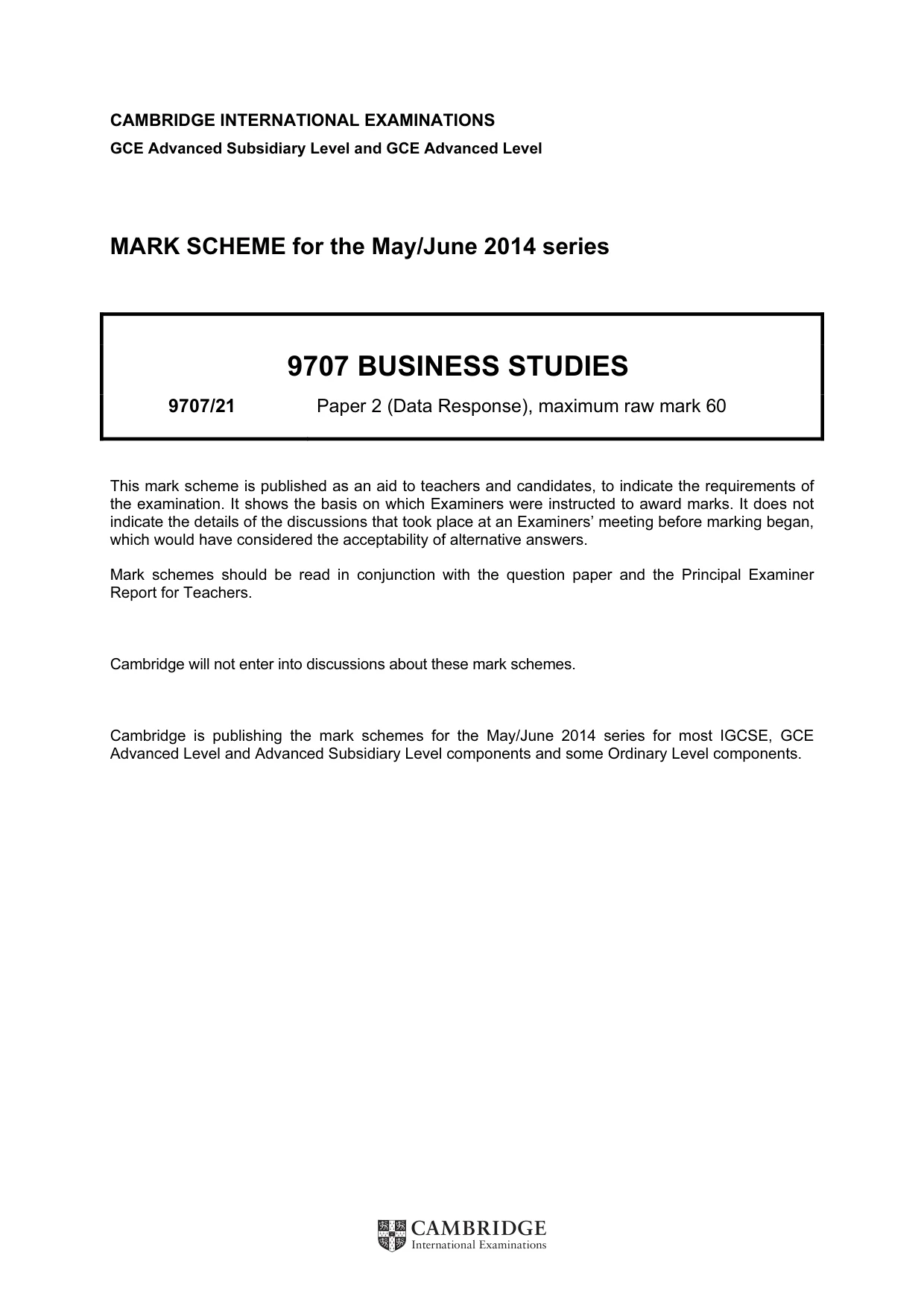
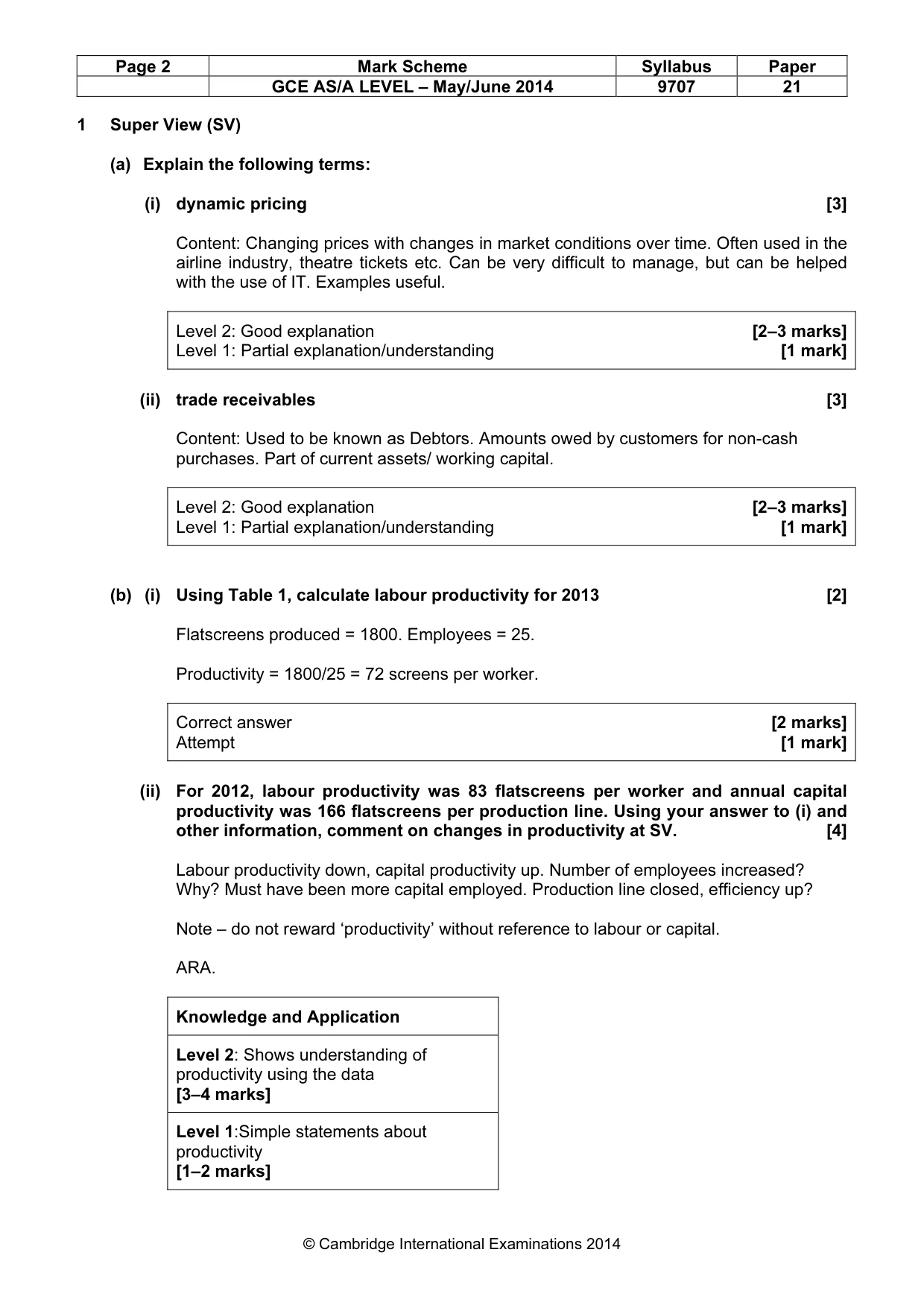
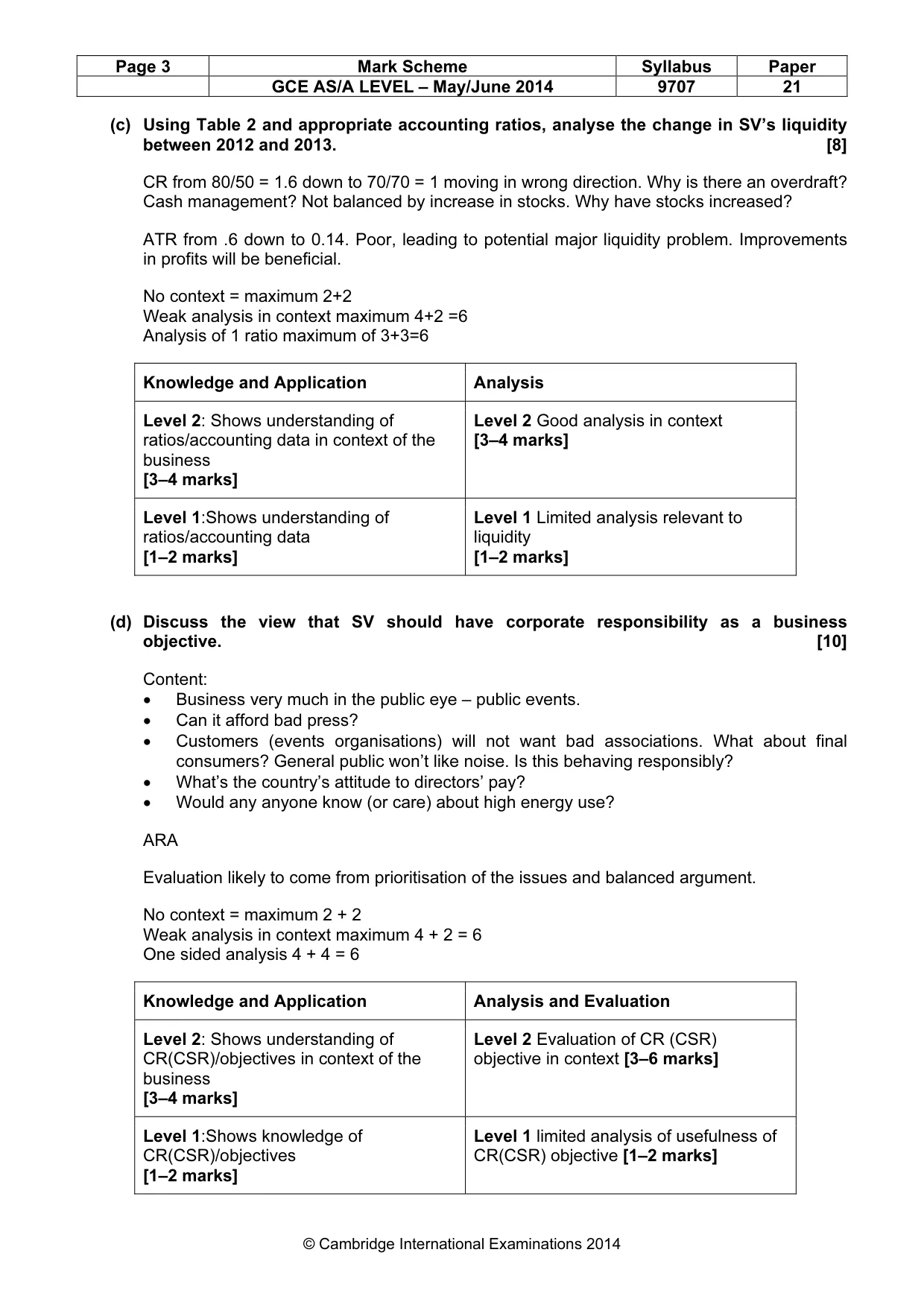
Mark scheme: 1 Super View (SV) (a) Explain the following terms: (i) dynamic pricing [3] Content: Changing prices with changes in market conditions over time. Often used in the airline industry, theatre tickets etc. Can be very difficult to manage, but can be helped with the use of IT. Examples useful. Level 2: Good explanation [2–3 marks] Level 1: Partial explanation/understanding [1 mark] (ii) trade receivables [3] Content: Used to be known as Debtors. Amounts owed by customers for non-cash purchases. Part of current assets/ working capital. Level 2: Good explanation [2–3 marks] Level 1: Partial explanation/understanding [1 mark] (b) (i) Using Table 1, calculate labour productivity for 2013 [2] Flatscreens produced = 1800. Employees = 25. Productivity = 1800/25 = 72 screens per worker. Correct answer [2 marks] Attempt [1 mark] (ii) For 2012, labour productivity was 83 flatscreens per worker and annual capital productivity was 166 flatscreens per production line. Using your answer to (i) and other information, comment on changes in productivity at SV. [4] Labour productivity down, capital productivity up. Number of employees increased? Why? Must have been more capital employed. Production line closed, efficiency up? Note – do not reward ‘productivity’ without reference to labour or capital. ARA. Knowledge and Application Level 2: Shows understanding of productivity using the data [3–4 marks] Level 1:Simple statements about productivity [1–2 marks] GCE AS/A LEVEL – May/June 2014 9707 21 (c) Using Table 2 and appropriate accounting ratios, analyse the change in SV’s liquidity between 2012 and 2013. [8] CR from 80/50 = 1.6 down to 70/70 = 1 moving in wrong direction. Why is there an overdraft? Cash management? Not balanced by increase in stocks. Why have stocks increased? ATR from .6 down to 0.14. Poor, leading to potential major liquidity problem. Improvements in profits will be beneficial. No context = maximum 2+2 Weak analysis in context maximum 4+2 =6 Analysis of 1 ratio maximum of 3+3=6 Knowledge and Application Analysis Level 2: Shows understanding of Level 2 Good analysis in context ratios/accounting data in context of the [3–4 marks] business [3–4 marks] Level 1:Shows understanding of Level 1 Limited analysis relevant to ratios/accounting data liquidity [1–2 marks] [1–2 marks] (d) Discuss the view that SV should have corporate responsibility as a business objective. [10] Content: • Business very much in the public eye – public events. • Can it afford bad press? • Customers (events organisations) will not want bad associations. What about final consumers? General public won’t like noise. Is this behaving responsibly? • What’s the country’s attitude to directors’ pay? • Would any anyone know (or care) about high energy use? ARA Evaluation likely to come from prioritisation of the issues and balanced argument. No context = maximum 2 + 2 Weak analysis in context maximum 4 + 2 = 6 One sided analysis 4 + 4 = 6 Knowledge and Application Analysis and Evaluation Level 2: Shows understanding of Level 2 Evaluation of CR (CSR) CR(CSR)/objectives in context of the objective in context [3–6 marks] business [3–4 marks] Level 1:Shows knowledge of Level 1 limited analysis of usefulness of CR(CSR)/objectives CR(CSR) objective [1–2 marks] [1–2 marks] GCE AS/A LEVEL – May/June 2014 9707 21
Q2 · Top Quality Supermarkets (TQ) TQ is a public limited company
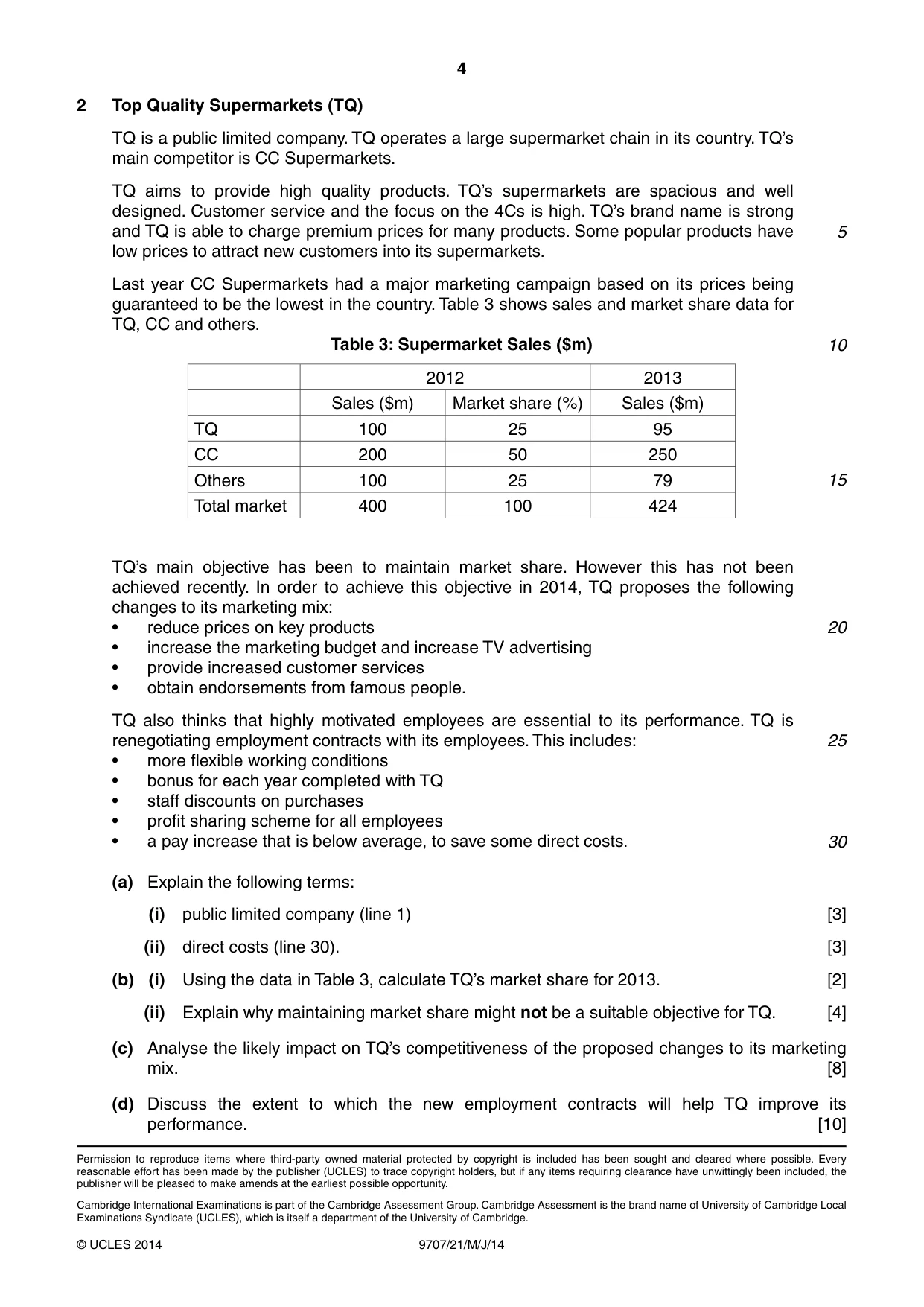
2 Top Quality Supermarkets (TQ) TQ is a public limited company. TQ operates a large supermarket chain in its country. TQ’s main competitor is CC Supermarkets. TQ aims to provide high quality products. TQ’s supermarkets are spacious and well designed. Customer service and the focus on the 4Cs is high. TQ’s brand name is strong and TQ is able to charge premium prices for many products. Some popular products have 5 low prices to attract new customers into its supermarkets. Last year CC Supermarkets had a major marketing campaign based on its prices being guaranteed to be the lowest in the country. Table 3 shows sales and market share data for TQ, CC and others. Table 3: Supermarket Sales ($m) 10 2012 2013 Sales ($m) Market share (%) Sales ($m) TQ 100 25 95 CC 200 50 250 Others 100 25 79 15 Total market 400 100 424 TQ’s main objective has been to maintain market share. However this has not been achieved recently. In order to achieve this objective in 2014, TQ proposes the following changes to its marketing mix: • reduce prices on key products 20 • increase the marketing budget and increase TV advertising • provide increased customer services • obtain endorsements from famous people. TQ also thinks that highly motivated employees are essential to its performance. TQ is renegotiating employment contracts with its employees. This includes: 25 • more flexible working conditions • bonus for each year completed with TQ • staff discounts on purchases • profit sharing scheme for all employees • a pay increase that is below average, to save some direct costs. 30 (a) Explain the following terms: (i) public limited company (line 1) [3] (ii) direct costs (line 30). [3] (b) (i) Using the data in Table 3, calculate TQ’s market share for 2013. [2] (ii) Explain why maintaining market share might not be a suitable objective for TQ. [4] (c) Analyse the likely impact on TQ’s competitiveness of the proposed changes to its marketing mix. [8] (d) Discuss the extent to which the new employment contracts will help TQ improve its performance. [10]
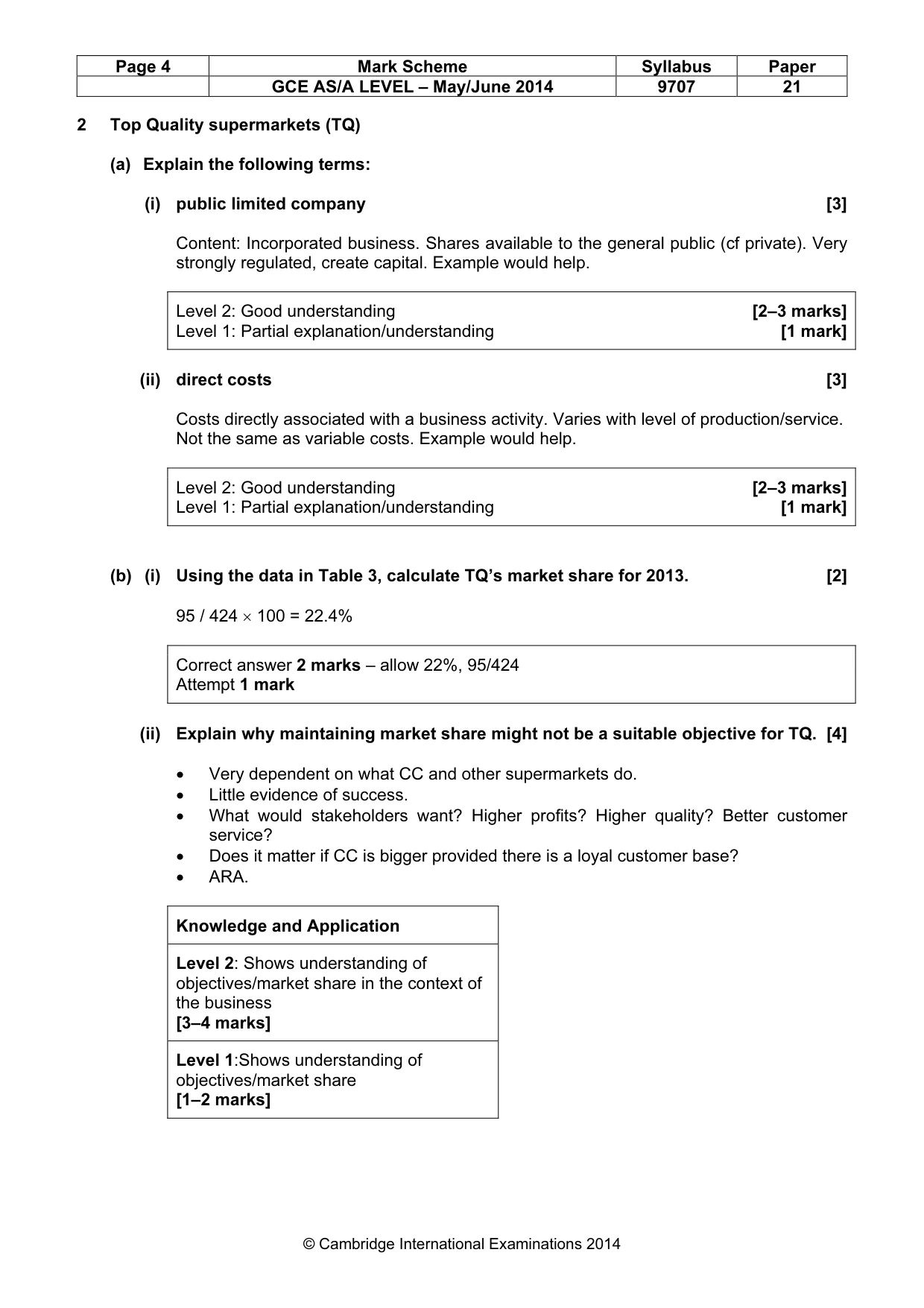
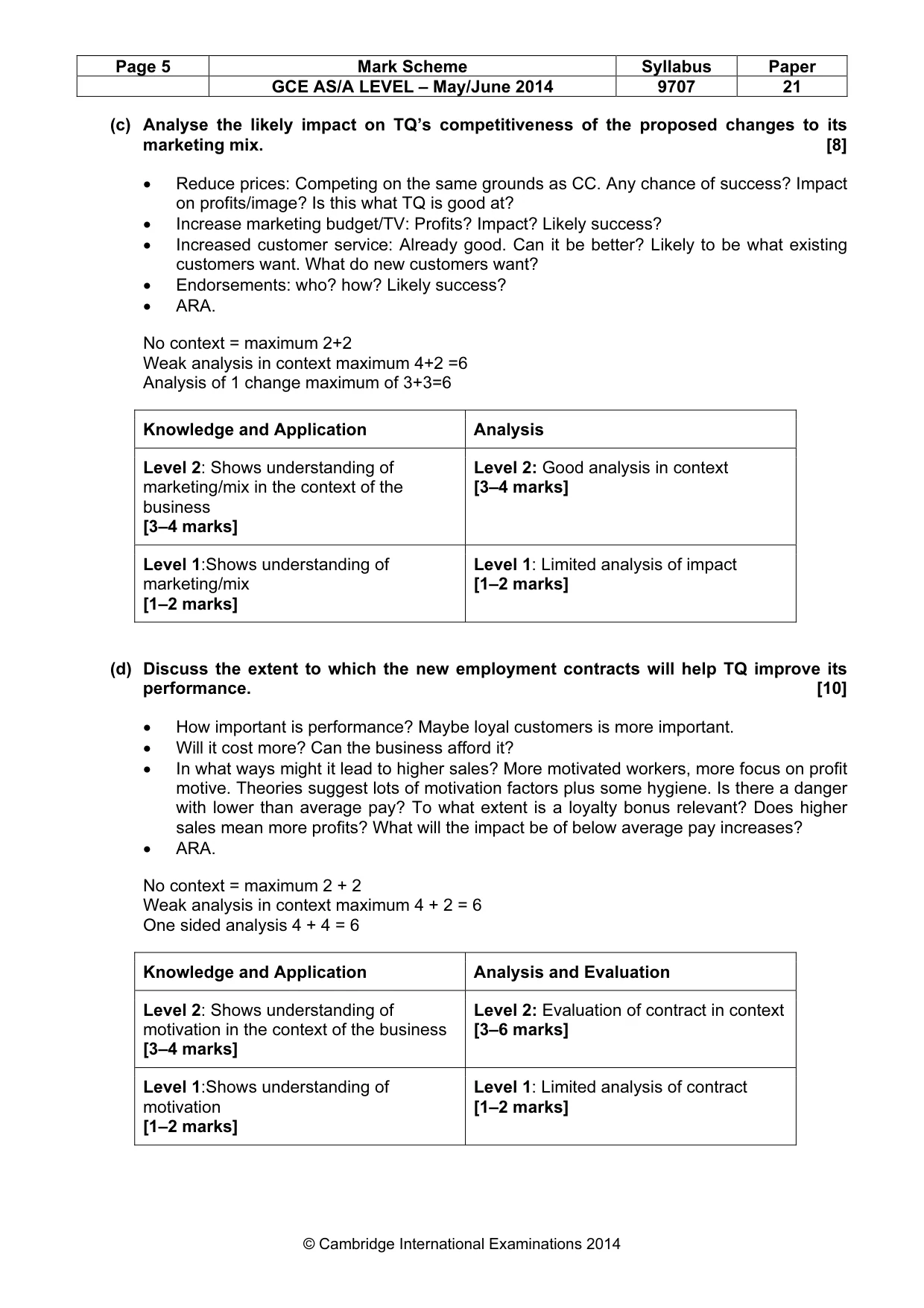
Mark scheme: 2 Top Quality supermarkets (TQ) (a) Explain the following terms: (i) public limited company [3] Content: Incorporated business. Shares available to the general public (cf private). Very strongly regulated, create capital. Example would help. Level 2: Good understanding [2–3 marks] Level 1: Partial explanation/understanding [1 mark] (ii) direct costs [3] Costs directly associated with a business activity. Varies with level of production/service. Not the same as variable costs. Example would help. Level 2: Good understanding [2–3 marks] Level 1: Partial explanation/understanding [1 mark] (b) (i) Using the data in Table 3, calculate TQ’s market share for 2013. [2] 95 / 424 × 100 = 22.4% Correct answer 2 marks – allow 22%, 95/424 Attempt 1 mark (ii) Explain why maintaining market share might not be a suitable objective for TQ. [4] • Very dependent on what CC and other supermarkets do. • Little evidence of success. • What would stakeholders want? Higher profits? Higher quality? Better customer service? • Does it matter if CC is bigger provided there is a loyal customer base? • ARA. Knowledge and Application Level 2: Shows understanding of objectives/market share in the context of the business [3–4 marks] Level 1:Shows understanding of objectives/market share [1–2 marks] GCE AS/A LEVEL – May/June 2014 9707 21 (c) Analyse the likely impact on TQ’s competitiveness of the proposed changes to its marketing mix. [8] • Reduce prices: Competing on the same grounds as CC. Any chance of success? Impact on profits/image? Is this what TQ is good at? • Increase marketing budget/TV: Profits? Impact? Likely success? • Increased customer service: Already good. Can it be better? Likely to be what existing customers want. What do new customers want? • Endorsements: who? how? Likely success? • ARA. No context = maximum 2+2 Weak analysis in context maximum 4+2 =6 Analysis of 1 change maximum of 3+3=6 Knowledge and Application Analysis Level 2: Shows understanding of Level 2: Good analysis in context marketing/mix in the context of the [3–4 marks] business [3–4 marks] Level 1:Shows understanding of Level 1: Limited analysis of impact marketing/mix [1–2 marks] [1–2 marks] (d) Discuss the extent to which the new employment contracts will help TQ improve its performance. [10] • How important is performance? Maybe loyal customers is more important. • Will it cost more? Can the business afford it? • In what ways might it lead to higher sales? More motivated workers, more focus on profit motive. Theories suggest lots of motivation factors plus some hygiene. Is there a danger with lower than average pay? To what extent is a loyalty bonus relevant? Does higher sales mean more profits? What will the impact be of below average pay increases? • ARA. No context = maximum 2 + 2 Weak analysis in context maximum 4 + 2 = 6 One sided analysis 4 + 4 = 6 Knowledge and Application Analysis and Evaluation Level 2: Shows understanding of Level 2: Evaluation of contract in context motivation in the context of the business [3–6 marks] [3–4 marks] Level 1:Shows understanding of Level 1: Limited analysis of contract motivation [1–2 marks] [1–2 marks]
What you needed in this session
Cambridge’s own grade thresholds for 2014 May/June, Paper 2 · Variant 1. A higher threshold means an easier paper — the bar moves with how the cohort did.