Cambridge A Level Business Studies (for final examination in 2015) 9707 — 2015 Oct/Nov Paper 1 · Variant 2
9707/12/O/N/15
The question paper and its mark scheme, free to read here and free to download. This is Cambridge’s own paper, exactly as it was sat.
Question paper4 pages


Mark scheme7 pages
Answers below. Sit the paper first if you are practising.
Paper as text
Question paper, page 1
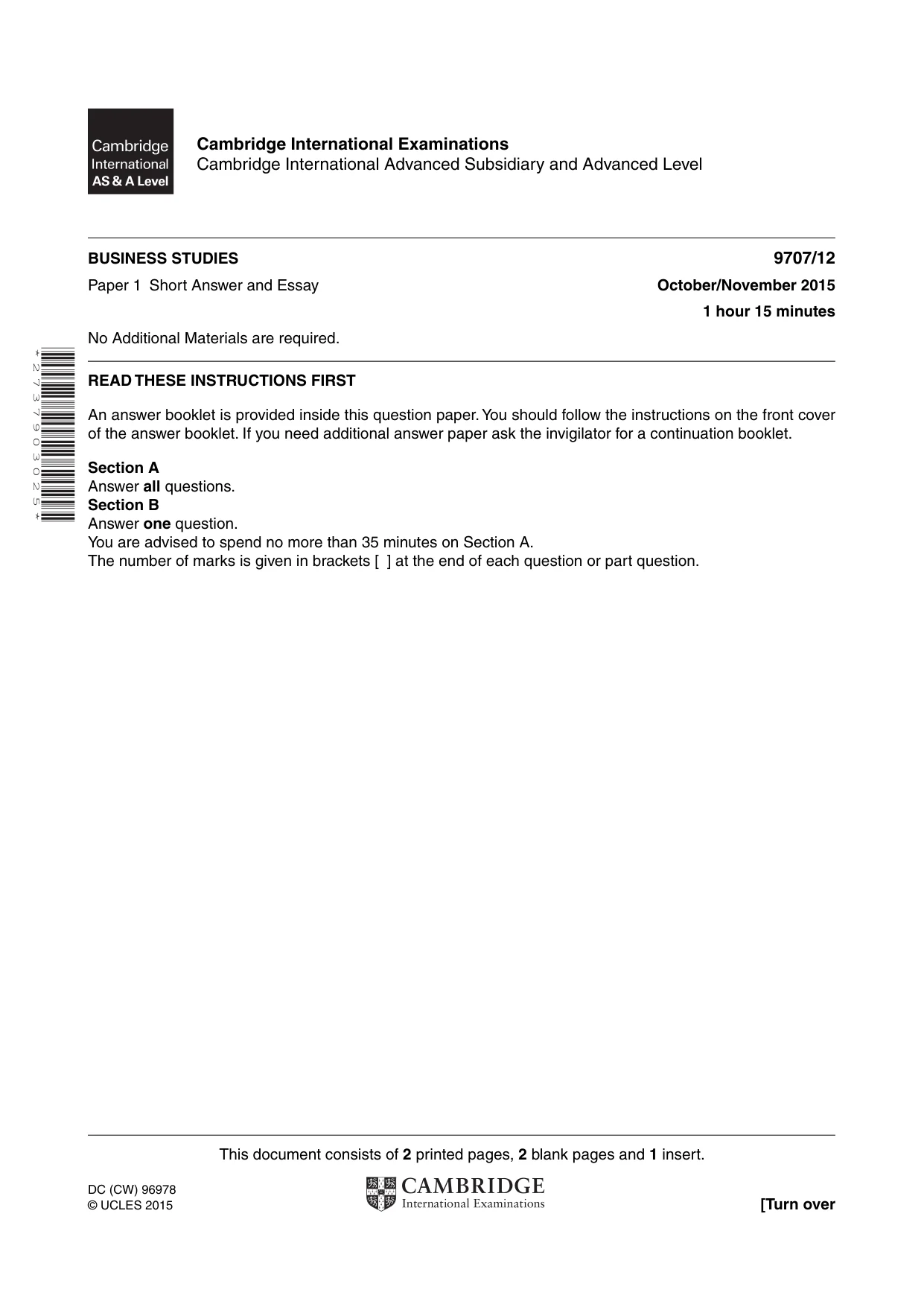
This document consists of 2 printed pages, 2 blank pages and 1 insert. DC (CW) 96978 © UCLES 2015 [Turn over Cambridge International Examinations Cambridge International Advanced Subsidiary and Advanced Level * 2 7 3 7 9 0 3 0 2 5 * BUSINESS STUDIES 9707/12 Paper 1 Short Answer and Essay October/November 2015 1 hour 15 minutes No Additional Materials are required. READ THESE INSTRUCTIONS FIRST An answer booklet is provided inside this question paper. You should follow the instructions on the front cover of the answer booklet. If you need additional answer paper ask the invigilator for a continuation booklet. Section A Answer all questions. Section B Answer one question. You are advised to spend no more than 35 minutes on Section A. The number of marks is given in brackets [ ] at the end of each question or part question.
Question paper, page 2
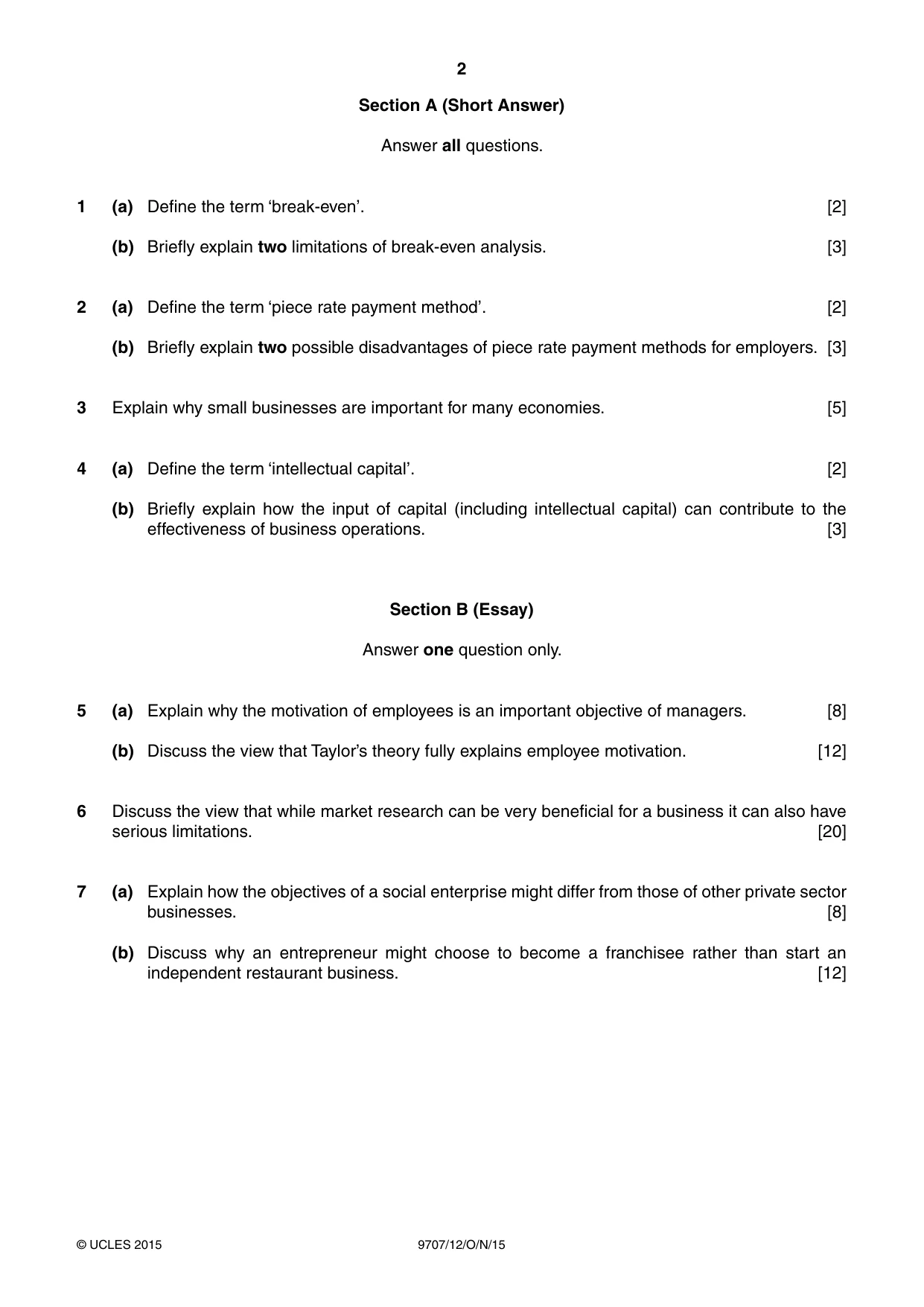
2 9707/12/O/N/15 © UCLES 2015 Section A (Short Answer) Answer all questions. 1 (a) Define the term ‘break-even’. [2] (b) Briefly explain two limitations of break-even analysis. [3] 2 (a) Define the term ‘piece rate payment method’. [2] (b) Briefly explain two possible disadvantages of piece rate payment methods for employers. [3] 3 Explain why small businesses are important for many economies. [5] 4 (a) Define the term ‘intellectual capital’. [2] (b) Briefly explain how the input of capital (including intellectual capital) can contribute to the effectiveness of business operations. [3] Section B (Essay) Answer one question only. 5 (a) Explain why the motivation of employees is an important objective of managers. [8] (b) Discuss the view that Taylor’s theory fully explains employee motivation. [12] 6 Discuss the view that while market research can be very beneficial for a business it can also have serious limitations. [20] 7 (a) Explain how the objectives of a social enterprise might differ from those of other private sector businesses. [8] (b) Discuss why an entrepreneur might choose to become a franchisee rather than start an independent restaurant business. [12]
Question paper, page 3
3 9707/12/O/N/15 © UCLES 2015 BLANK PAGE
Question paper, page 4
4 9707/12/O/N/15 © UCLES 2015 BLANK PAGE Permission to reproduce items where third-party owned material protected by copyright is included has been sought and cleared where possible. Every reasonable effort has been made by the publisher (UCLES) to trace copyright holders, but if any items requiring clearance have unwittingly been included, the publisher will be pleased to make amends at the earliest possible opportunity. To avoid the issue of disclosure of answer-related information to candidates, all copyright acknowledgements are reproduced online in the Cambridge International Examinations Copyright Acknowledgements Booklet. This is produced for each series of examinations and is freely available to download at www.cie.org.uk after the live examination series. Cambridge International Examinations is part of the Cambridge Assessment Group. Cambridge Assessment is the brand name of University of Cambridge Local Examinations Syndicate (UCLES), which is itself a department of the University of Cambridge.
Mark scheme, page 1
® IGCSE is the registered trademark of Cambridge International Examinations. CAMBRIDGE INTERNATIONAL EXAMINATIONS Cambridge International Advanced Subsidiary and Advanced Level MARK SCHEME for the October/November 2015 series 9707 BUSINESS STUDIES 9707/12 Paper 1 (Short Answer/Essay), maximum raw mark 40 This mark scheme is published as an aid to teachers and candidates, to indicate the requirements of the examination. It shows the basis on which Examiners were instructed to award marks. It does not indicate the details of the discussions that took place at an Examiners’ meeting before marking began, which would have considered the acceptability of alternative answers. Mark schemes should be read in conjunction with the question paper and the Principal Examiner Report for Teachers. Cambridge will not enter into discussions about these mark schemes. Cambridge is publishing the mark schemes for the October/November 2015 series for most Cambridge IGCSE®, Cambridge International A and AS Level components and some Cambridge O Level components.
Mark scheme, page 2
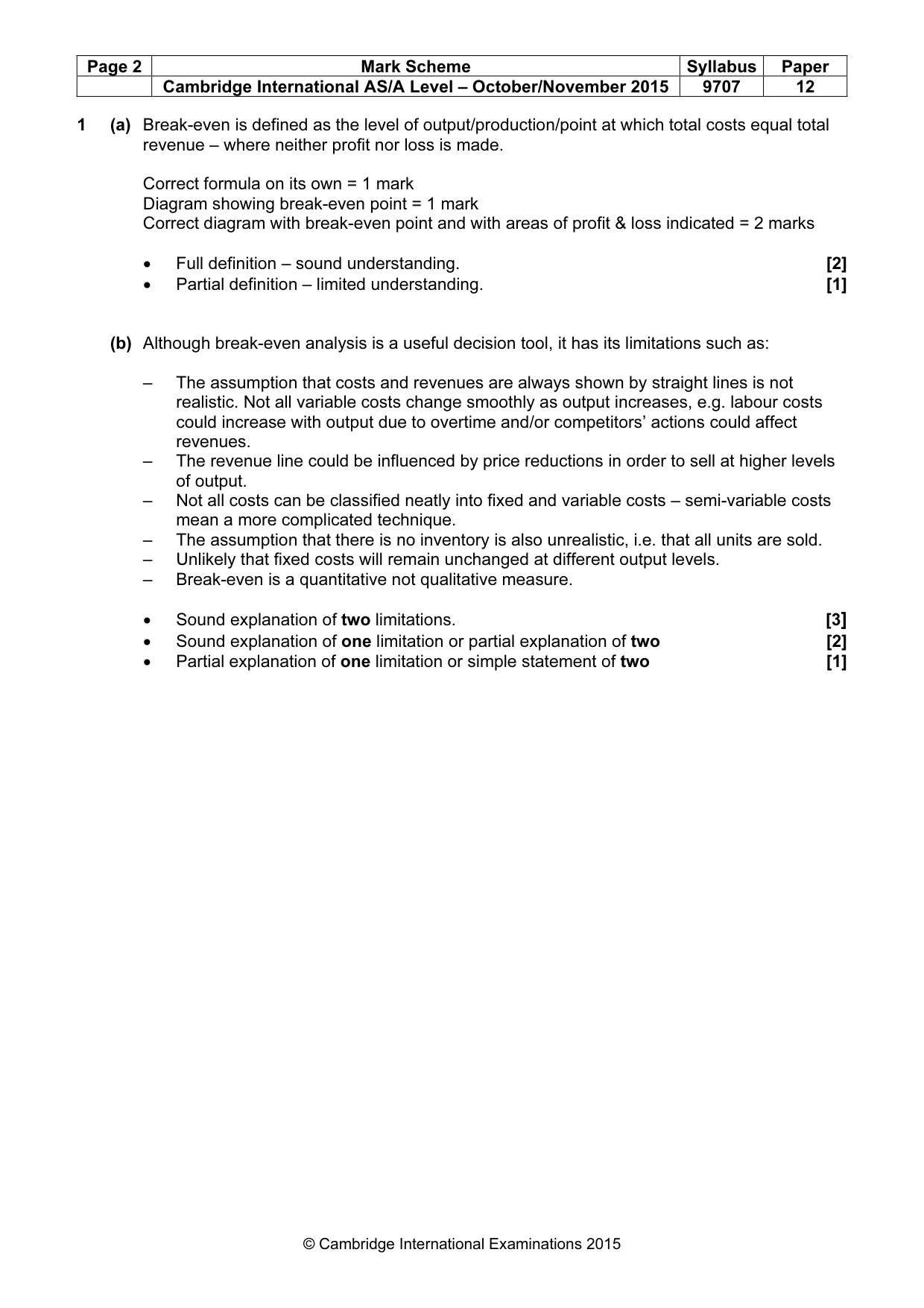
Page 2 Mark Scheme Syllabus Paper Cambridge International AS/A Level – October/November 2015 9707 12 © Cambridge International Examinations 2015 1 (a) Break-even is defined as the level of output/production/point at which total costs equal total revenue – where neither profit nor loss is made. Correct formula on its own = 1 mark Diagram showing break-even point = 1 mark Correct diagram with break-even point and with areas of profit & loss indicated = 2 marks • Full definition – sound understanding. [2] • Partial definition – limited understanding. [1] (b) Although break-even analysis is a useful decision tool, it has its limitations such as: – The assumption that costs and revenues are always shown by straight lines is not realistic. Not all variable costs change smoothly as output increases, e.g. labour costs could increase with output due to overtime and/or competitors’ actions could affect revenues. – The revenue line could be influenced by price reductions in order to sell at higher levels of output. – Not all costs can be classified neatly into fixed and variable costs – semi-variable costs mean a more complicated technique. – The assumption that there is no inventory is also unrealistic, i.e. that all units are sold. – Unlikely that fixed costs will remain unchanged at different output levels. – Break-even is a quantitative not qualitative measure. • Sound explanation of two limitations. [3] • Sound explanation of one limitation or partial explanation of two [2] • Partial explanation of one limitation or simple statement of two [1]
Mark scheme, page 3
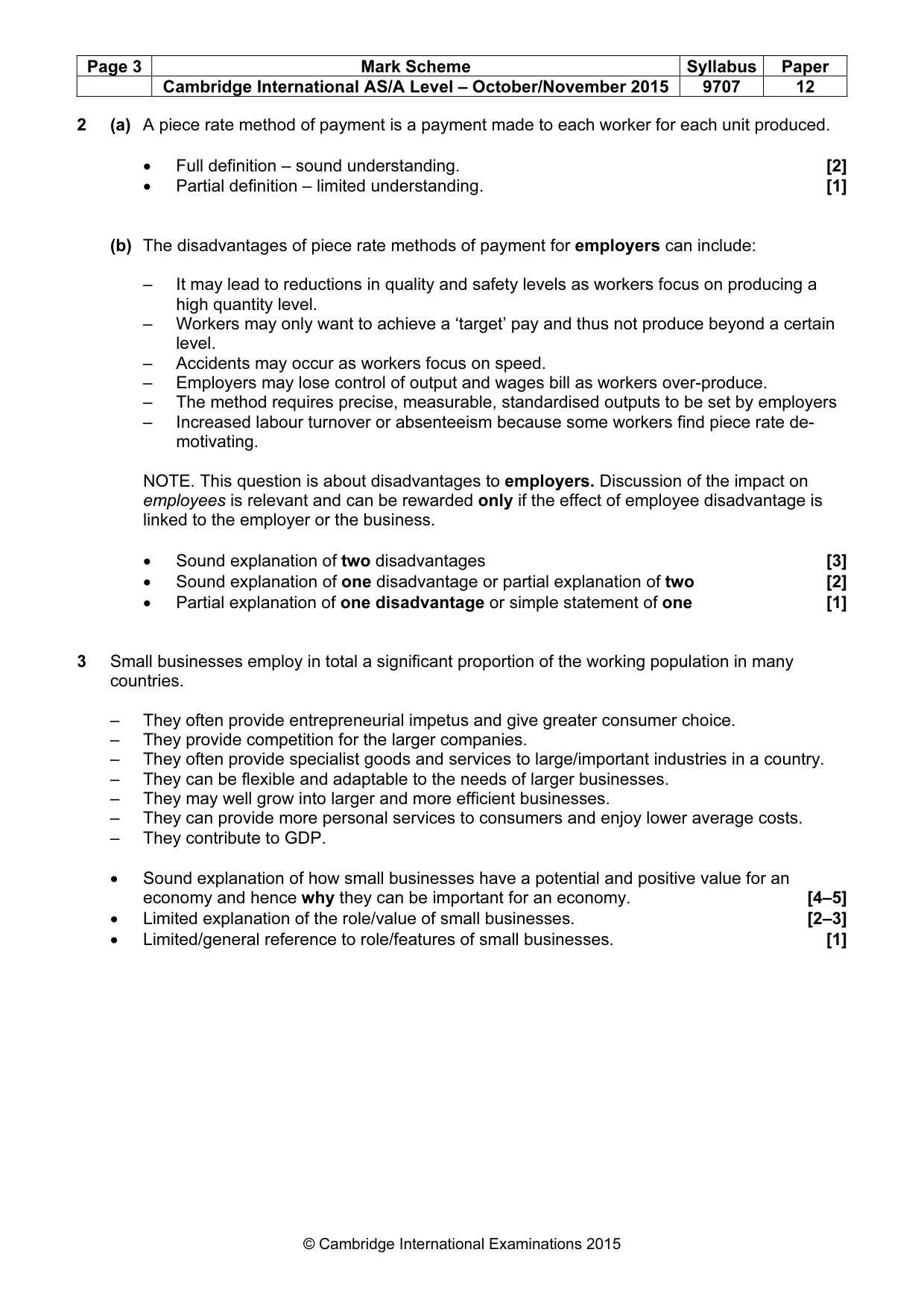
Page 3 Mark Scheme Syllabus Paper Cambridge International AS/A Level – October/November 2015 9707 12 © Cambridge International Examinations 2015 2 (a) A piece rate method of payment is a payment made to each worker for each unit produced. • Full definition – sound understanding. [2] • Partial definition – limited understanding. [1] (b) The disadvantages of piece rate methods of payment for employers can include: – It may lead to reductions in quality and safety levels as workers focus on producing a high quantity level. – Workers may only want to achieve a ‘target’ pay and thus not produce beyond a certain level. – Accidents may occur as workers focus on speed. – Employers may lose control of output and wages bill as workers over-produce. – The method requires precise, measurable, standardised outputs to be set by employers – Increased labour turnover or absenteeism because some workers find piece rate de- motivating. NOTE. This question is about disadvantages to employers. Discussion of the impact on employees is relevant and can be rewarded only if the effect of employee disadvantage is linked to the employer or the business. • Sound explanation of two disadvantages [3] • Sound explanation of one disadvantage or partial explanation of two [2] • Partial explanation of one disadvantage or simple statement of one [1] 3 Small businesses employ in total a significant proportion of the working population in many countries. – They often provide entrepreneurial impetus and give greater consumer choice. – They provide competition for the larger companies. – They often provide specialist goods and services to large/important industries in a country. – They can be flexible and adaptable to the needs of larger businesses. – They may well grow into larger and more efficient businesses. – They can provide more personal services to consumers and enjoy lower average costs. – They contribute to GDP. • Sound explanation of how small businesses have a potential and positive value for an economy and hence why they can be important for an economy. [4–5] • Limited explanation of the role/value of small businesses. [2–3] • Limited/general reference to role/features of small businesses. [1]
Mark scheme, page 4
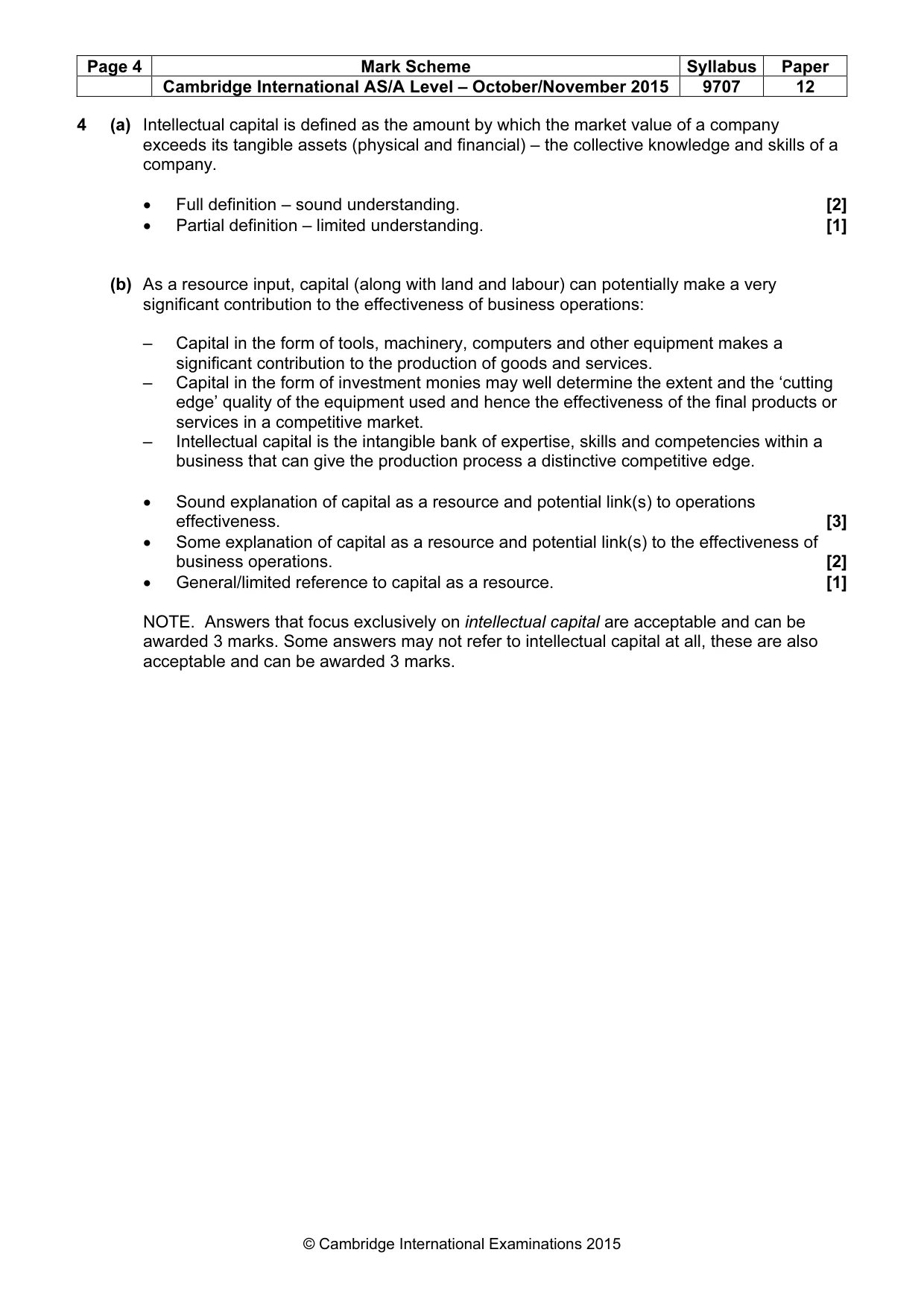
Page 4 Mark Scheme Syllabus Paper Cambridge International AS/A Level – October/November 2015 9707 12 © Cambridge International Examinations 2015 4 (a) Intellectual capital is defined as the amount by which the market value of a company exceeds its tangible assets (physical and financial) – the collective knowledge and skills of a company. • Full definition – sound understanding. [2] • Partial definition – limited understanding. [1] (b) As a resource input, capital (along with land and labour) can potentially make a very significant contribution to the effectiveness of business operations: – Capital in the form of tools, machinery, computers and other equipment makes a significant contribution to the production of goods and services. – Capital in the form of investment monies may well determine the extent and the ‘cutting edge’ quality of the equipment used and hence the effectiveness of the final products or services in a competitive market. – Intellectual capital is the intangible bank of expertise, skills and competencies within a business that can give the production process a distinctive competitive edge. • Sound explanation of capital as a resource and potential link(s) to operations effectiveness. [3] • Some explanation of capital as a resource and potential link(s) to the effectiveness of business operations. [2] • General/limited reference to capital as a resource. [1] NOTE. Answers that focus exclusively on intellectual capital are acceptable and can be awarded 3 marks. Some answers may not refer to intellectual capital at all, these are also acceptable and can be awarded 3 marks.
Mark scheme, page 5
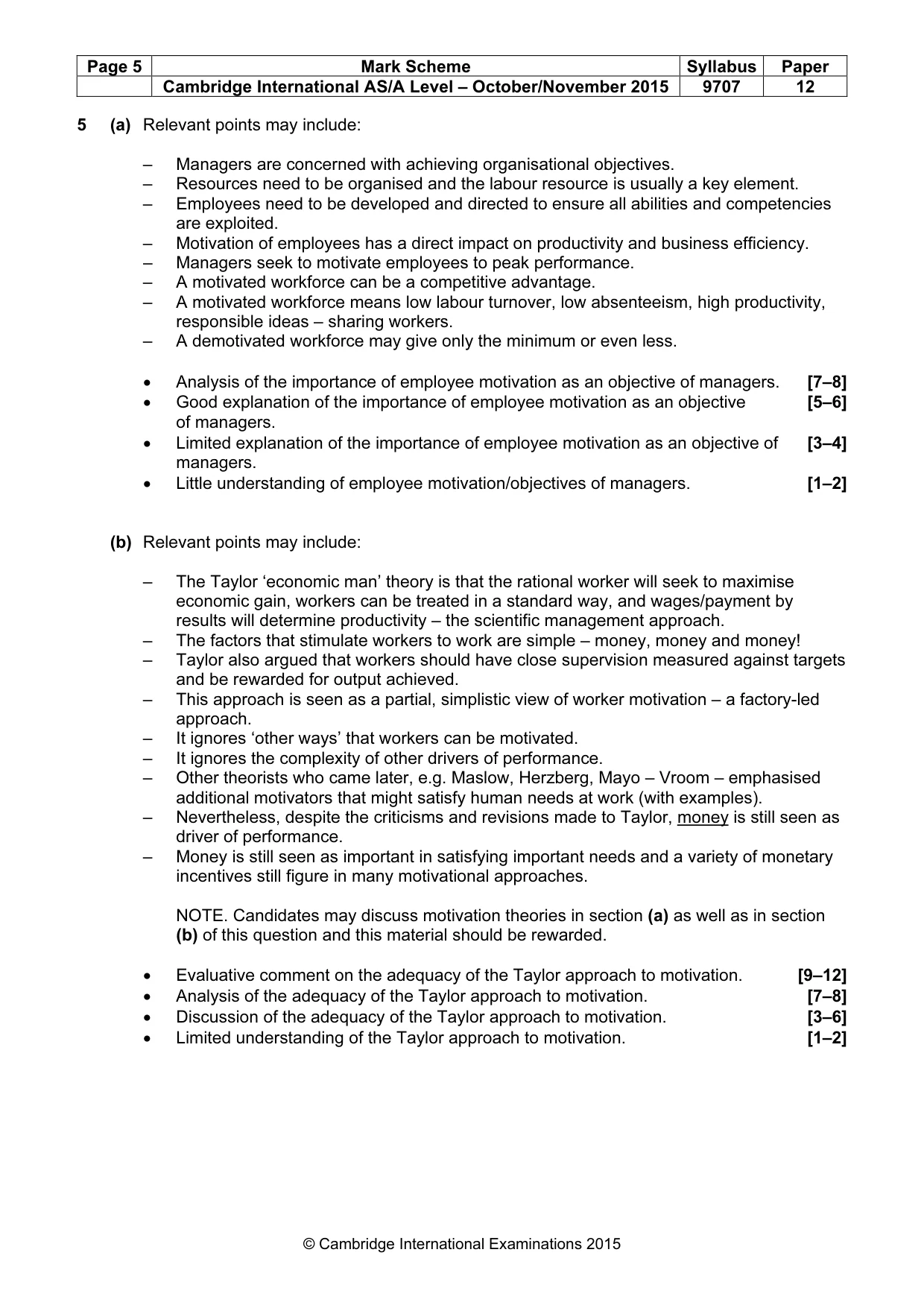
Page 5 Mark Scheme Syllabus Paper Cambridge International AS/A Level – October/November 2015 9707 12 © Cambridge International Examinations 2015 5 (a) Relevant points may include: – Managers are concerned with achieving organisational objectives. – Resources need to be organised and the labour resource is usually a key element. – Employees need to be developed and directed to ensure all abilities and competencies are exploited. – Motivation of employees has a direct impact on productivity and business efficiency. – Managers seek to motivate employees to peak performance. – A motivated workforce can be a competitive advantage. – A motivated workforce means low labour turnover, low absenteeism, high productivity, responsible ideas – sharing workers. – A demotivated workforce may give only the minimum or even less. • Analysis of the importance of employee motivation as an objective of managers. [7–8] • Good explanation of the importance of employee motivation as an objective [5–6] of managers. • Limited explanation of the importance of employee motivation as an objective of [3–4] managers. • Little understanding of employee motivation/objectives of managers. [1–2] (b) Relevant points may include: – The Taylor ‘economic man’ theory is that the rational worker will seek to maximise economic gain, workers can be treated in a standard way, and wages/payment by results will determine productivity – the scientific management approach. – The factors that stimulate workers to work are simple – money, money and money! – Taylor also argued that workers should have close supervision measured against targets and be rewarded for output achieved. – This approach is seen as a partial, simplistic view of worker motivation – a factory-led approach. – It ignores ‘other ways’ that workers can be motivated. – It ignores the complexity of other drivers of performance. – Other theorists who came later, e.g. Maslow, Herzberg, Mayo – Vroom – emphasised additional motivators that might satisfy human needs at work (with examples). – Nevertheless, despite the criticisms and revisions made to Taylor, money is still seen as driver of performance. – Money is still seen as important in satisfying important needs and a variety of monetary incentives still figure in many motivational approaches. NOTE. Candidates may discuss motivation theories in section (a) as well as in section (b) of this question and this material should be rewarded. • Evaluative comment on the adequacy of the Taylor approach to motivation. [9–12] • Analysis of the adequacy of the Taylor approach to motivation. [7–8] • Discussion of the adequacy of the Taylor approach to motivation. [3–6] • Limited understanding of the Taylor approach to motivation. [1–2]
Mark scheme, page 6
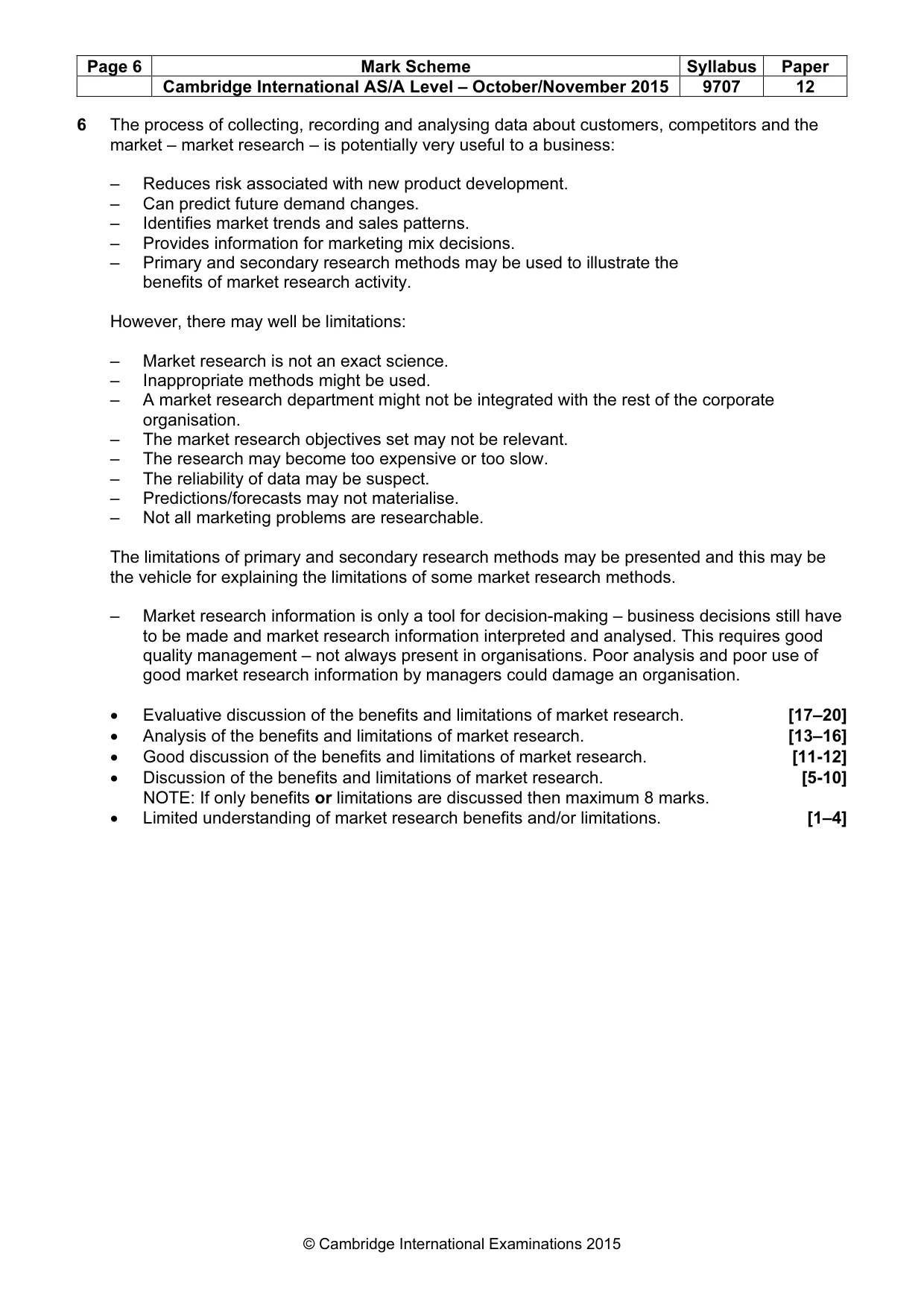
Page 6 Mark Scheme Syllabus Paper Cambridge International AS/A Level – October/November 2015 9707 12 © Cambridge International Examinations 2015 6 The process of collecting, recording and analysing data about customers, competitors and the market – market research – is potentially very useful to a business: – Reduces risk associated with new product development. – Can predict future demand changes. – Identifies market trends and sales patterns. – Provides information for marketing mix decisions. – Primary and secondary research methods may be used to illustrate the benefits of market research activity. However, there may well be limitations: – Market research is not an exact science. – Inappropriate methods might be used. – A market research department might not be integrated with the rest of the corporate organisation. – The market research objectives set may not be relevant. – The research may become too expensive or too slow. – The reliability of data may be suspect. – Predictions/forecasts may not materialise. – Not all marketing problems are researchable. The limitations of primary and secondary research methods may be presented and this may be the vehicle for explaining the limitations of some market research methods. – Market research information is only a tool for decision-making – business decisions still have to be made and market research information interpreted and analysed. This requires good quality management – not always present in organisations. Poor analysis and poor use of good market research information by managers could damage an organisation. • Evaluative discussion of the benefits and limitations of market research. [17–20] • Analysis of the benefits and limitations of market research. [13–16] • Good discussion of the benefits and limitations of market research. [11-12] • Discussion of the benefits and limitations of market research. [5-10] NOTE: If only benefits or limitations are discussed then maximum 8 marks. • Limited understanding of market research benefits and/or limitations. [1–4]
Mark scheme, page 7
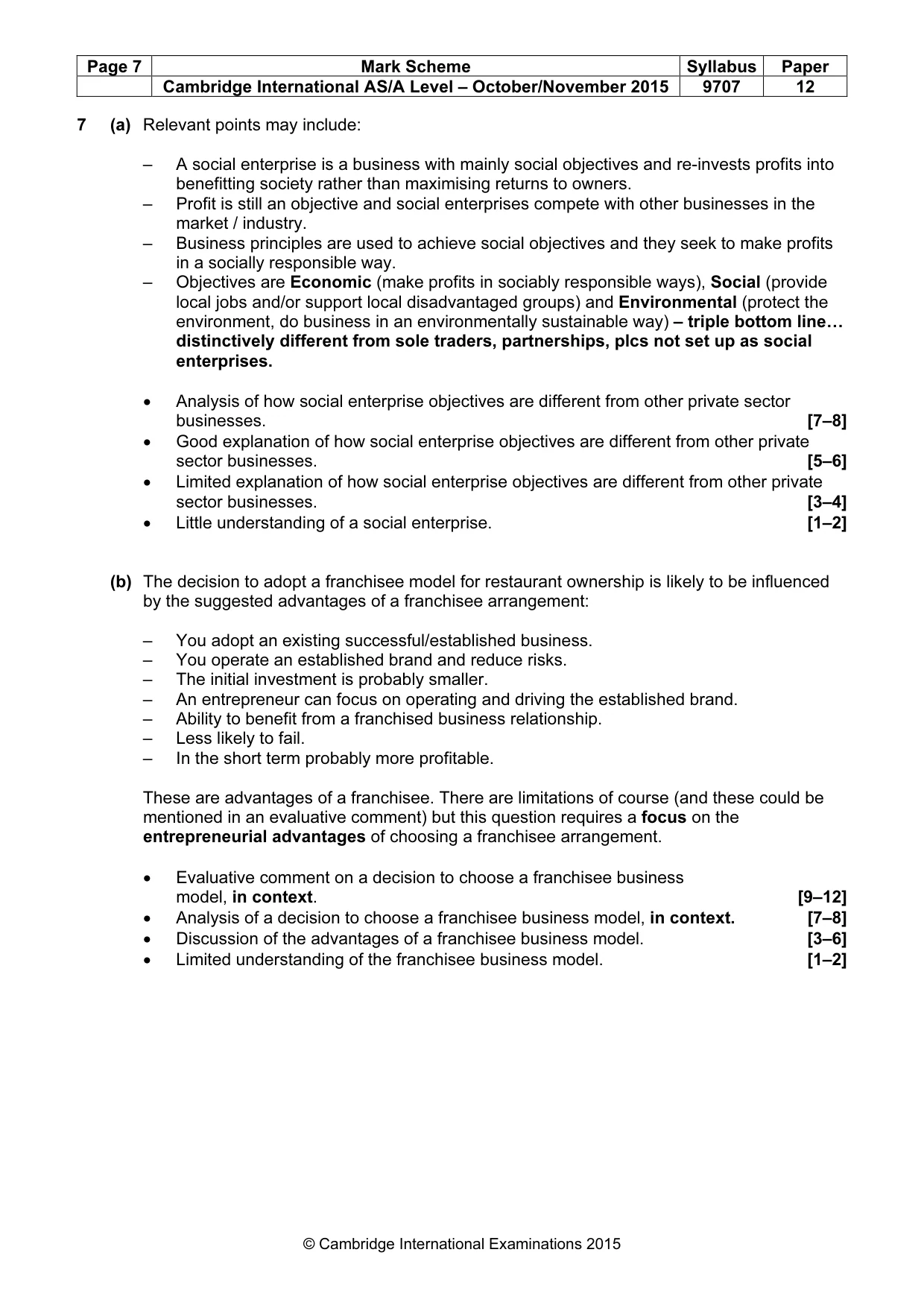
Page 7 Mark Scheme Syllabus Paper Cambridge International AS/A Level – October/November 2015 9707 12 © Cambridge International Examinations 2015 7 (a) Relevant points may include: – A social enterprise is a business with mainly social objectives and re-invests profits into benefitting society rather than maximising returns to owners. – Profit is still an objective and social enterprises compete with other businesses in the market / industry. – Business principles are used to achieve social objectives and they seek to make profits in a socially responsible way. – Objectives are Economic (make profits in sociably responsible ways), Social (provide local jobs and/or support local disadvantaged groups) and Environmental (protect the environment, do business in an environmentally sustainable way) – triple bottom line… distinctively different from sole traders, partnerships, plcs not set up as social enterprises. • Analysis of how social enterprise objectives are different from other private sector businesses. [7–8] • Good explanation of how social enterprise objectives are different from other private sector businesses. [5–6] • Limited explanation of how social enterprise objectives are different from other private sector businesses. [3–4] • Little understanding of a social enterprise. [1–2] (b) The decision to adopt a franchisee model for restaurant ownership is likely to be influenced by the suggested advantages of a franchisee arrangement: – You adopt an existing successful/established business. – You operate an established brand and reduce risks. – The initial investment is probably smaller. – An entrepreneur can focus on operating and driving the established brand. – Ability to benefit from a franchised business relationship. – Less likely to fail. – In the short term probably more profitable. These are advantages of a franchisee. There are limitations of course (and these could be mentioned in an evaluative comment) but this question requires a focus on the entrepreneurial advantages of choosing a franchisee arrangement. • Evaluative comment on a decision to choose a franchisee business model, in context. [9–12] • Analysis of a decision to choose a franchisee business model, in context. [7–8] • Discussion of the advantages of a franchisee business model. [3–6] • Limited understanding of the franchisee business model. [1–2]