Cambridge A Level Business Studies (for final examination in 2015) 9707 — 2015 Oct/Nov Paper 1 · Variant 3
9707/13/O/N/15
The question paper and its mark scheme, free to read here and free to download. This is Cambridge’s own paper, exactly as it was sat.
Question paper4 pages


Mark scheme6 pages
Answers below. Sit the paper first if you are practising.
Paper as text
Question paper, page 1
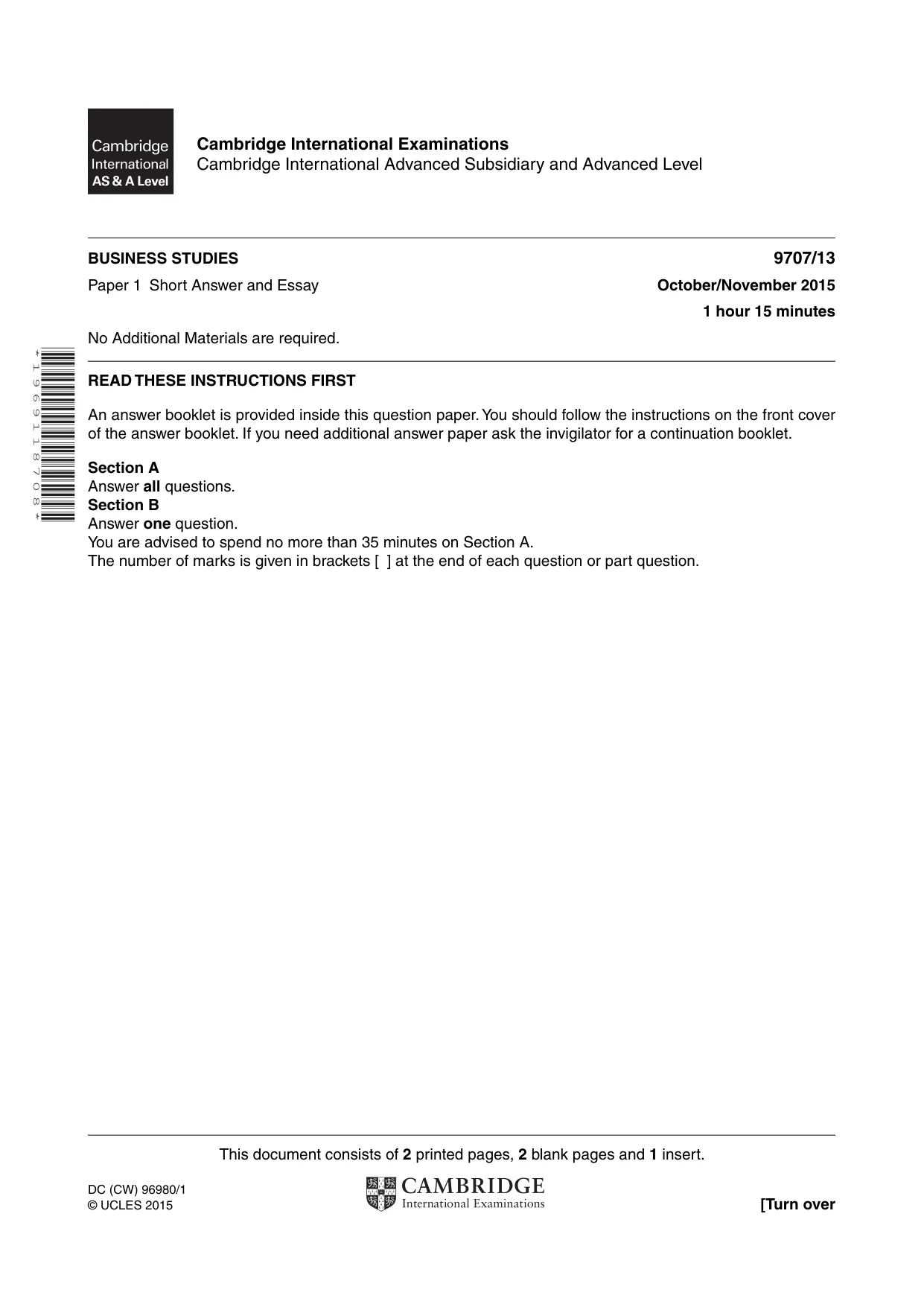
This document consists of 2 printed pages, 2 blank pages and 1 insert. DC (CW) 96980/1 © UCLES 2015 [Turn over Cambridge International Examinations Cambridge International Advanced Subsidiary and Advanced Level * 1 9 6 9 1 1 8 7 0 8 * BUSINESS STUDIES 9707/13 Paper 1 Short Answer and Essay October/November 2015 1 hour 15 minutes No Additional Materials are required. READ THESE INSTRUCTIONS FIRST An answer booklet is provided inside this question paper. You should follow the instructions on the front cover of the answer booklet. If you need additional answer paper ask the invigilator for a continuation booklet. Section A Answer all questions. Section B Answer one question. You are advised to spend no more than 35 minutes on Section A. The number of marks is given in brackets [ ] at the end of each question or part question.
Question paper, page 2
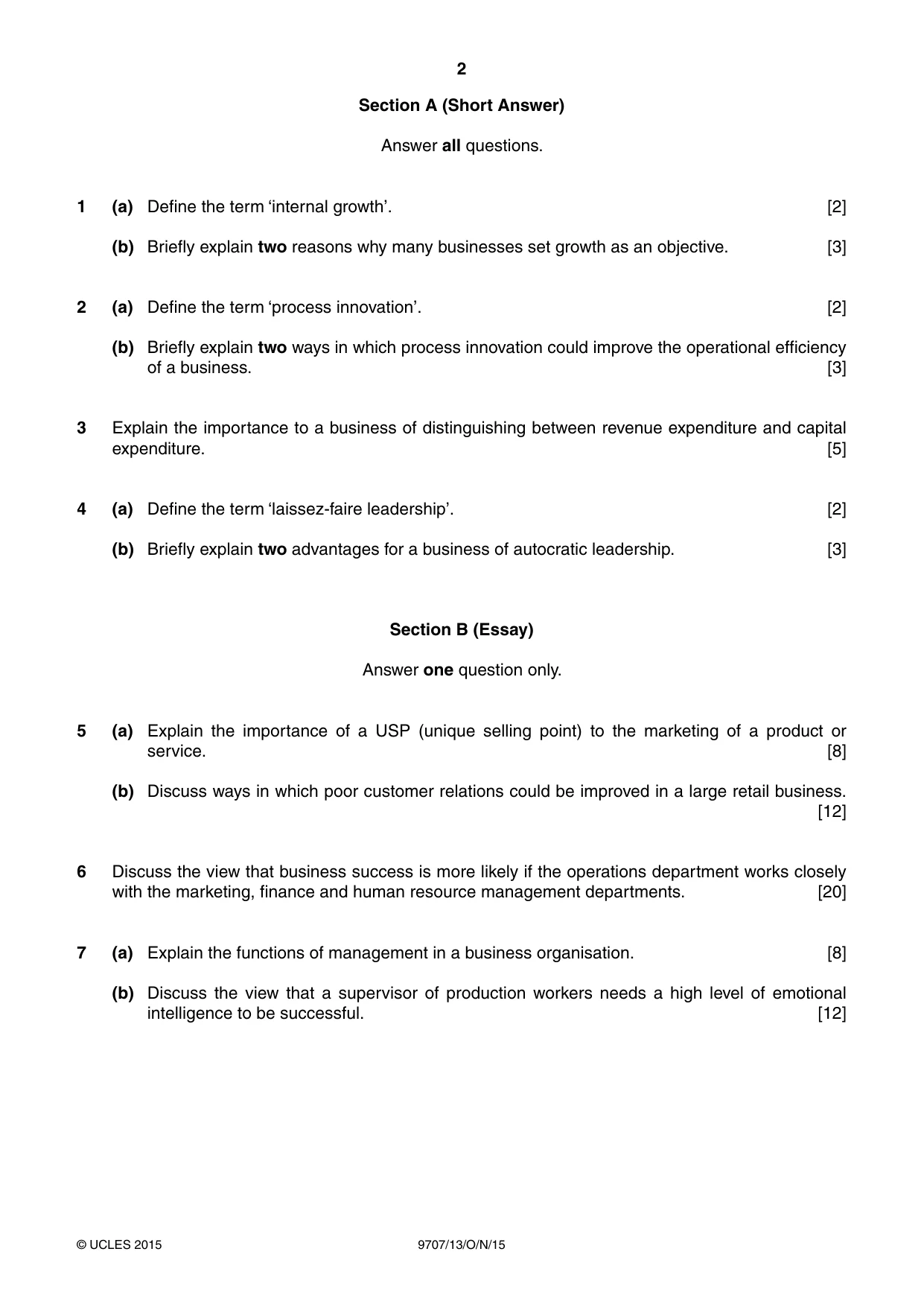
2 9707/13/O/N/15 © UCLES 2015 Section A (Short Answer) Answer all questions. 1 (a) Define the term ‘internal growth’. [2] (b) Briefly explain two reasons why many businesses set growth as an objective. [3] 2 (a) Define the term ‘process innovation’. [2] (b) Briefly explain two ways in which process innovation could improve the operational efficiency of a business. [3] 3 Explain the importance to a business of distinguishing between revenue expenditure and capital expenditure. [5] 4 (a) Define the term ‘laissez-faire leadership’. [2] (b) Briefly explain two advantages for a business of autocratic leadership. [3] Section B (Essay) Answer one question only. 5 (a) Explain the importance of a USP (unique selling point) to the marketing of a product or service. [8] (b) Discuss ways in which poor customer relations could be improved in a large retail business. [12] 6 Discuss the view that business success is more likely if the operations department works closely with the marketing, finance and human resource management departments. [20] 7 (a) Explain the functions of management in a business organisation. [8] (b) Discuss the view that a supervisor of production workers needs a high level of emotional intelligence to be successful. [12]
Question paper, page 3
3 9707/13/O/N/15 © UCLES 2015 BLANK PAGE
Question paper, page 4
4 9707/13/O/N/15 © UCLES 2015 BLANK PAGE Permission to reproduce items where third-party owned material protected by copyright is included has been sought and cleared where possible. Every reasonable effort has been made by the publisher (UCLES) to trace copyright holders, but if any items requiring clearance have unwittingly been included, the publisher will be pleased to make amends at the earliest possible opportunity. To avoid the issue of disclosure of answer-related information to candidates, all copyright acknowledgements are reproduced online in the Cambridge International Examinations Copyright Acknowledgements Booklet. This is produced for each series of examinations and is freely available to download at www.cie.org.uk after the live examination series. Cambridge International Examinations is part of the Cambridge Assessment Group. Cambridge Assessment is the brand name of University of Cambridge Local Examinations Syndicate (UCLES), which is itself a department of the University of Cambridge.
Mark scheme, page 1
® IGCSE is the registered trademark of Cambridge International Examinations. CAMBRIDGE INTERNATIONAL EXAMINATIONS Cambridge International Advanced Subsidiary and Advanced Level MARK SCHEME for the October/November 2015 series 9707 BUSINESS STUDIES 9707/13 Paper 1 (Short Answer/Essay), maximum raw mark 40 This mark scheme is published as an aid to teachers and candidates, to indicate the requirements of the examination. It shows the basis on which Examiners were instructed to award marks. It does not indicate the details of the discussions that took place at an Examiners’ meeting before marking began, which would have considered the acceptability of alternative answers. Mark schemes should be read in conjunction with the question paper and the Principal Examiner Report for Teachers. Cambridge will not enter into discussions about these mark schemes. Cambridge is publishing the mark schemes for the October/November 2015 series for most Cambridge IGCSE®, Cambridge International A and AS Level components and some Cambridge O Level components.
Mark scheme, page 2
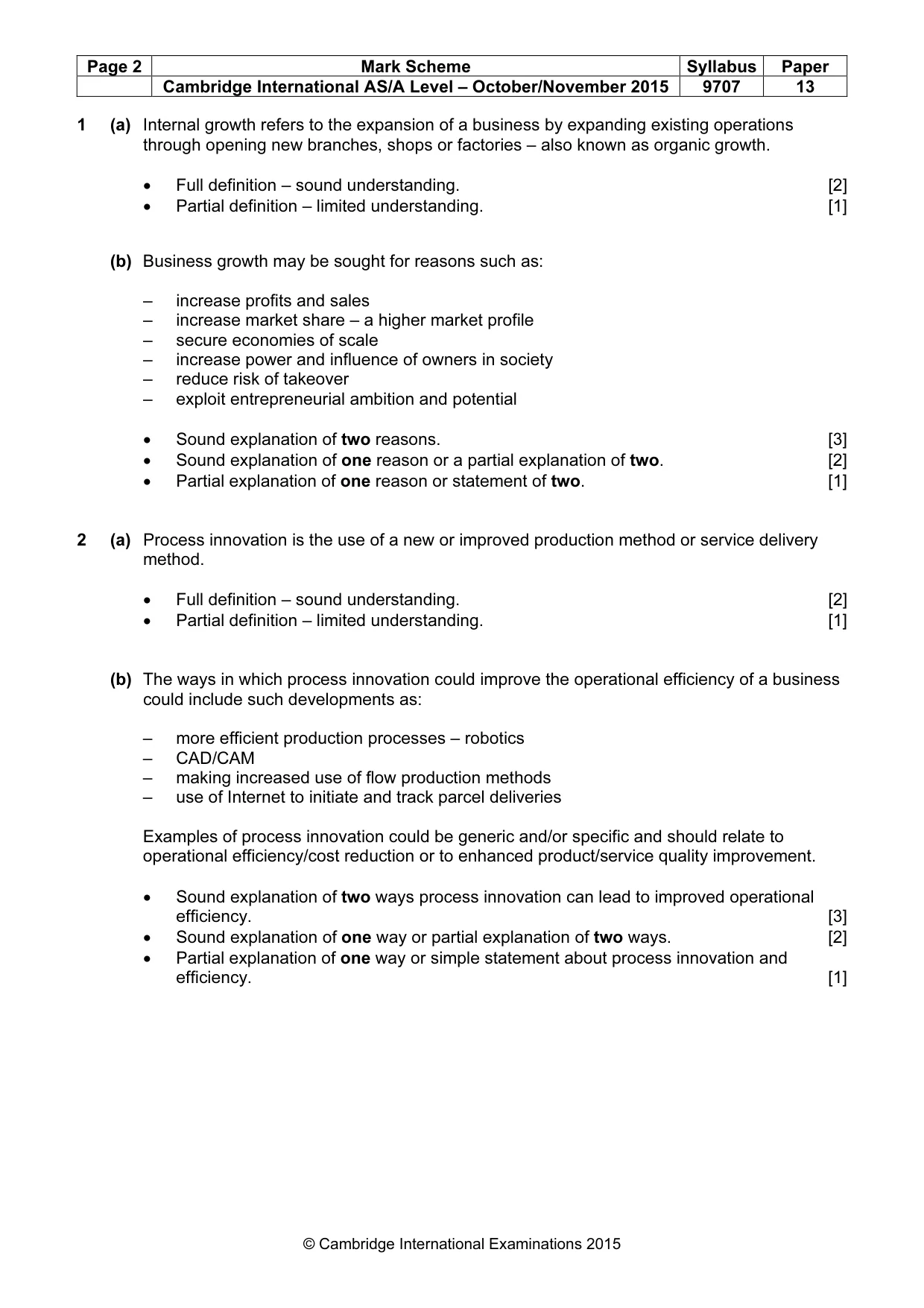
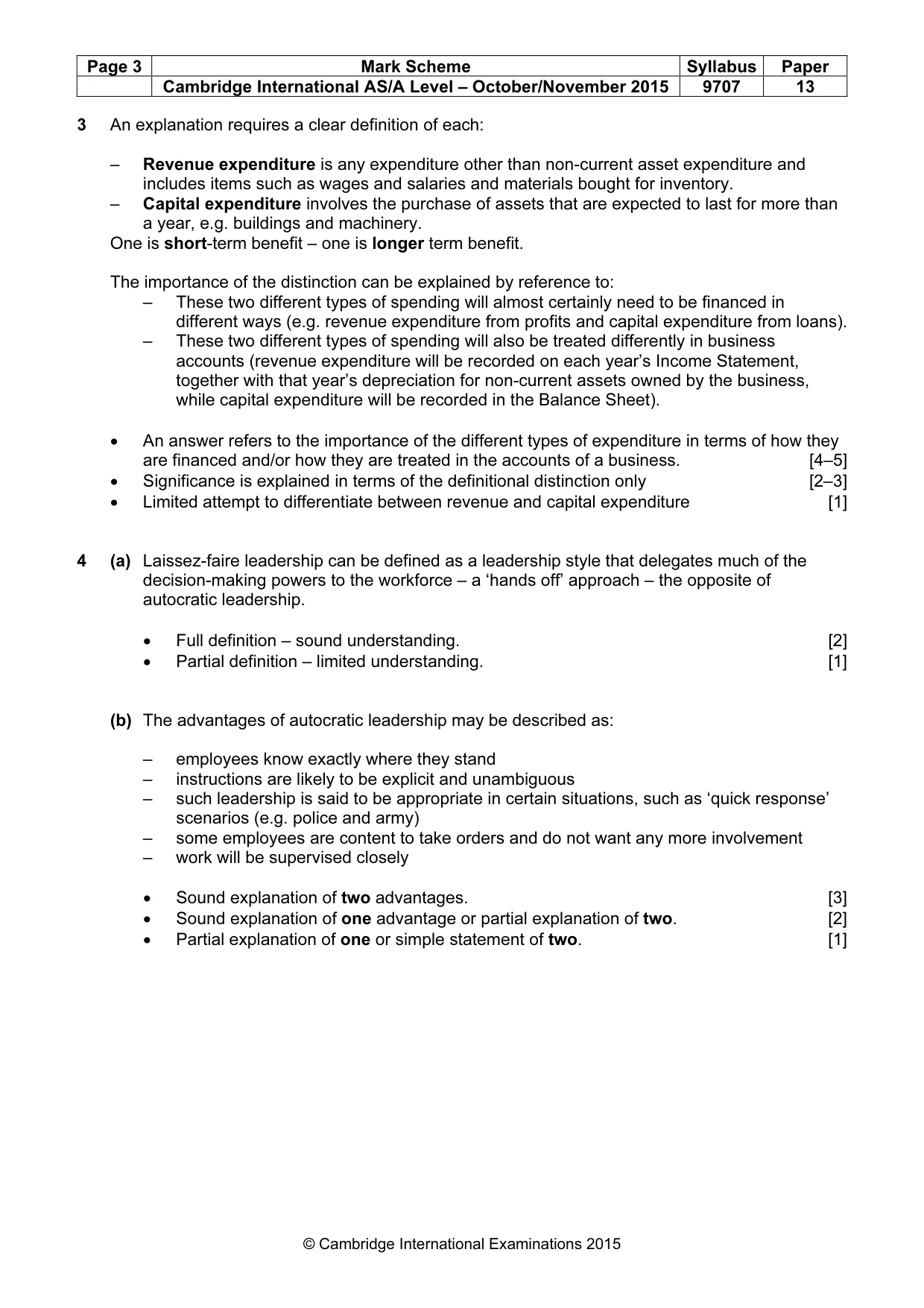
Page 2 Mark Scheme Syllabus Paper Cambridge International AS/A Level – October/November 2015 9707 13 © Cambridge International Examinations 2015 1 (a) Internal growth refers to the expansion of a business by expanding existing operations through opening new branches, shops or factories – also known as organic growth. • Full definition – sound understanding. [2] • Partial definition – limited understanding. [1] (b) Business growth may be sought for reasons such as: – increase profits and sales – increase market share – a higher market profile – secure economies of scale – increase power and influence of owners in society – reduce risk of takeover – exploit entrepreneurial ambition and potential • Sound explanation of two reasons. [3] • Sound explanation of one reason or a partial explanation of two. [2] • Partial explanation of one reason or statement of two. [1] 2 (a) Process innovation is the use of a new or improved production method or service delivery method. • Full definition – sound understanding. [2] • Partial definition – limited understanding. [1] (b) The ways in which process innovation could improve the operational efficiency of a business could include such developments as: – more efficient production processes – robotics – CAD/CAM – making increased use of flow production methods – use of Internet to initiate and track parcel deliveries Examples of process innovation could be generic and/or specific and should relate to operational efficiency/cost reduction or to enhanced product/service quality improvement. • Sound explanation of two ways process innovation can lead to improved operational efficiency. [3] • Sound explanation of one way or partial explanation of two ways. [2] • Partial explanation of one way or simple statement about process innovation and efficiency. [1]
Mark scheme, page 3
Page 3 Mark Scheme Syllabus Paper Cambridge International AS/A Level – October/November 2015 9707 13 © Cambridge International Examinations 2015 3 An explanation requires a clear definition of each: – Revenue expenditure is any expenditure other than non-current asset expenditure and includes items such as wages and salaries and materials bought for inventory. – Capital expenditure involves the purchase of assets that are expected to last for more than a year, e.g. buildings and machinery. One is short-term benefit – one is longer term benefit. The importance of the distinction can be explained by reference to: – These two different types of spending will almost certainly need to be financed in different ways (e.g. revenue expenditure from profits and capital expenditure from loans). – These two different types of spending will also be treated differently in business accounts (revenue expenditure will be recorded on each year’s Income Statement, together with that year’s depreciation for non-current assets owned by the business, while capital expenditure will be recorded in the Balance Sheet). • An answer refers to the importance of the different types of expenditure in terms of how they are financed and/or how they are treated in the accounts of a business. [4–5] • Significance is explained in terms of the definitional distinction only [2–3] • Limited attempt to differentiate between revenue and capital expenditure [1] 4 (a) Laissez-faire leadership can be defined as a leadership style that delegates much of the decision-making powers to the workforce – a ‘hands off’ approach – the opposite of autocratic leadership. • Full definition – sound understanding. [2] • Partial definition – limited understanding. [1] (b) The advantages of autocratic leadership may be described as: – employees know exactly where they stand – instructions are likely to be explicit and unambiguous – such leadership is said to be appropriate in certain situations, such as ‘quick response’ scenarios (e.g. police and army) – some employees are content to take orders and do not want any more involvement – work will be supervised closely • Sound explanation of two advantages. [3] • Sound explanation of one advantage or partial explanation of two. [2] • Partial explanation of one or simple statement of two. [1]
Mark scheme, page 4
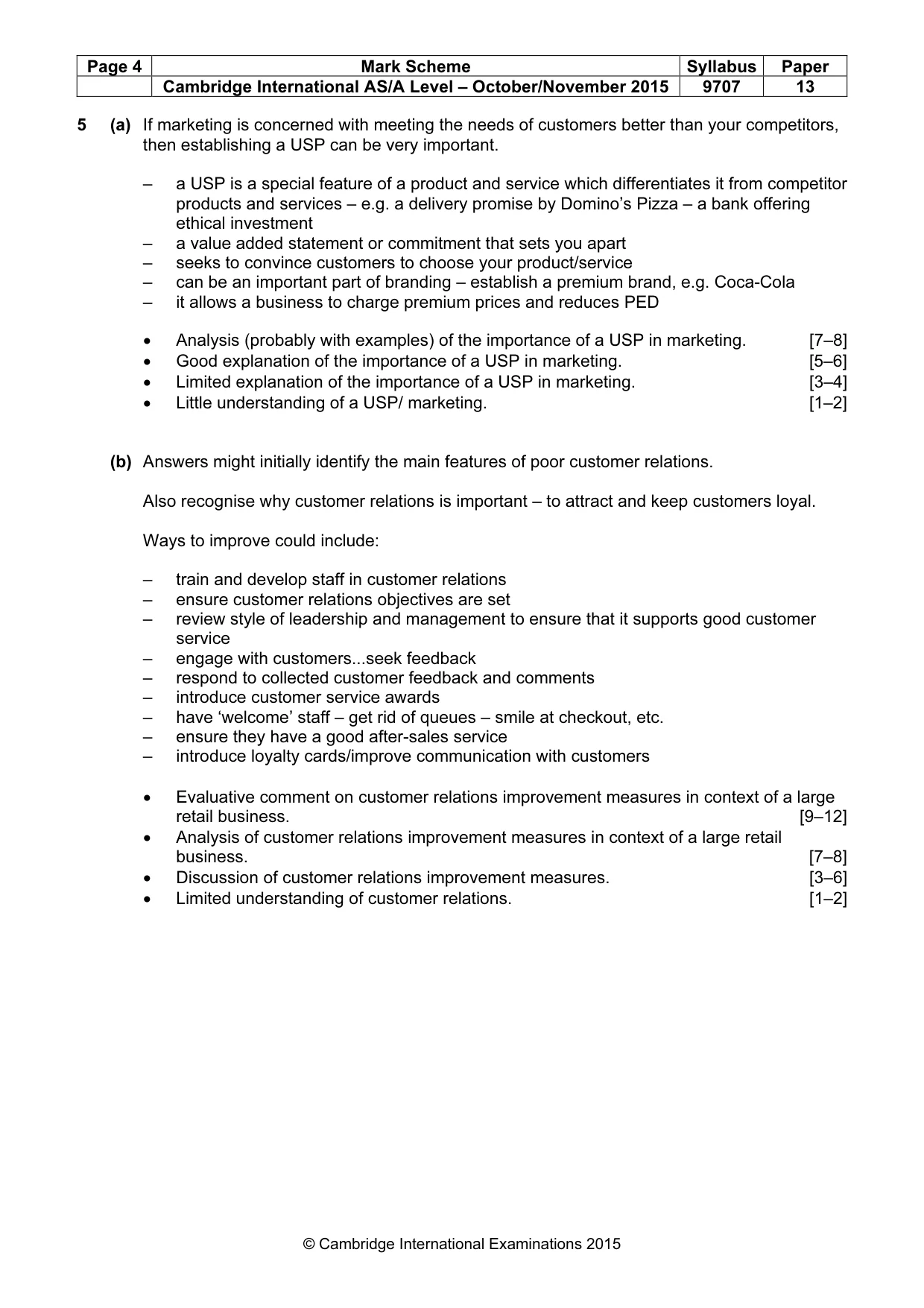
Page 4 Mark Scheme Syllabus Paper Cambridge International AS/A Level – October/November 2015 9707 13 © Cambridge International Examinations 2015 5 (a) If marketing is concerned with meeting the needs of customers better than your competitors, then establishing a USP can be very important. – a USP is a special feature of a product and service which differentiates it from competitor products and services – e.g. a delivery promise by Domino’s Pizza – a bank offering ethical investment – a value added statement or commitment that sets you apart – seeks to convince customers to choose your product/service – can be an important part of branding – establish a premium brand, e.g. Coca-Cola – it allows a business to charge premium prices and reduces PED • Analysis (probably with examples) of the importance of a USP in marketing. [7–8] • Good explanation of the importance of a USP in marketing. [5–6] • Limited explanation of the importance of a USP in marketing. [3–4] • Little understanding of a USP/ marketing. [1–2] (b) Answers might initially identify the main features of poor customer relations. Also recognise why customer relations is important – to attract and keep customers loyal. Ways to improve could include: – train and develop staff in customer relations – ensure customer relations objectives are set – review style of leadership and management to ensure that it supports good customer service – engage with customers...seek feedback – respond to collected customer feedback and comments – introduce customer service awards – have ‘welcome’ staff – get rid of queues – smile at checkout, etc. – ensure they have a good after-sales service – introduce loyalty cards/improve communication with customers • Evaluative comment on customer relations improvement measures in context of a large retail business. [9–12] • Analysis of customer relations improvement measures in context of a large retail business. [7–8] • Discussion of customer relations improvement measures. [3–6] • Limited understanding of customer relations. [1–2]
Mark scheme, page 5
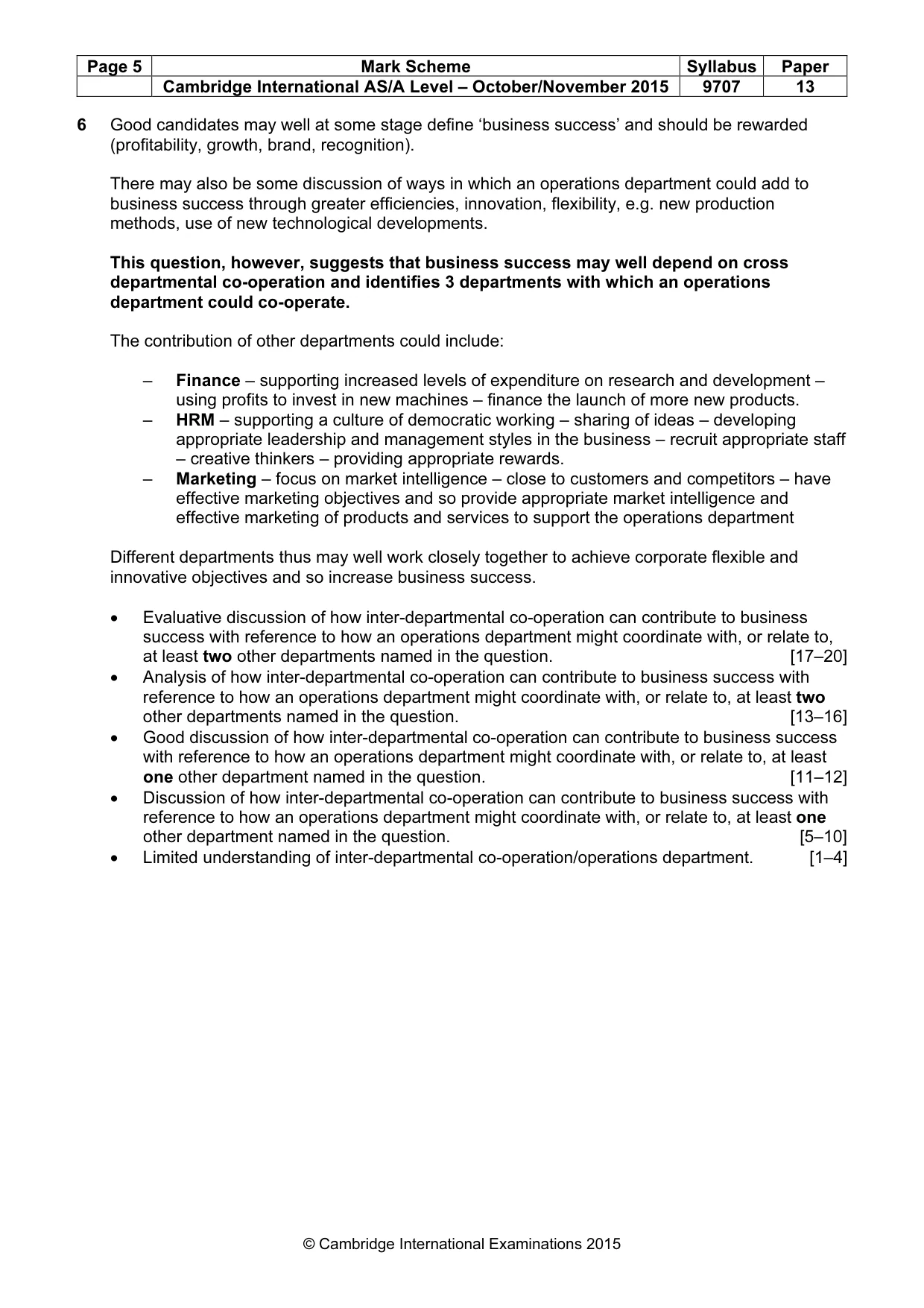
Page 5 Mark Scheme Syllabus Paper Cambridge International AS/A Level – October/November 2015 9707 13 © Cambridge International Examinations 2015 6 Good candidates may well at some stage define ‘business success’ and should be rewarded (profitability, growth, brand, recognition). There may also be some discussion of ways in which an operations department could add to business success through greater efficiencies, innovation, flexibility, e.g. new production methods, use of new technological developments. This question, however, suggests that business success may well depend on cross departmental co-operation and identifies 3 departments with which an operations department could co-operate. The contribution of other departments could include: – Finance – supporting increased levels of expenditure on research and development – using profits to invest in new machines – finance the launch of more new products. – HRM – supporting a culture of democratic working – sharing of ideas – developing appropriate leadership and management styles in the business – recruit appropriate staff – creative thinkers – providing appropriate rewards. – Marketing – focus on market intelligence – close to customers and competitors – have effective marketing objectives and so provide appropriate market intelligence and effective marketing of products and services to support the operations department Different departments thus may well work closely together to achieve corporate flexible and innovative objectives and so increase business success. • Evaluative discussion of how inter-departmental co-operation can contribute to business success with reference to how an operations department might coordinate with, or relate to, at least two other departments named in the question. [17–20] • Analysis of how inter-departmental co-operation can contribute to business success with reference to how an operations department might coordinate with, or relate to, at least two other departments named in the question. [13–16] • Good discussion of how inter-departmental co-operation can contribute to business success with reference to how an operations department might coordinate with, or relate to, at least one other department named in the question. [11–12] • Discussion of how inter-departmental co-operation can contribute to business success with reference to how an operations department might coordinate with, or relate to, at least one other department named in the question. [5–10] • Limited understanding of inter-departmental co-operation/operations department. [1–4]
Mark scheme, page 6
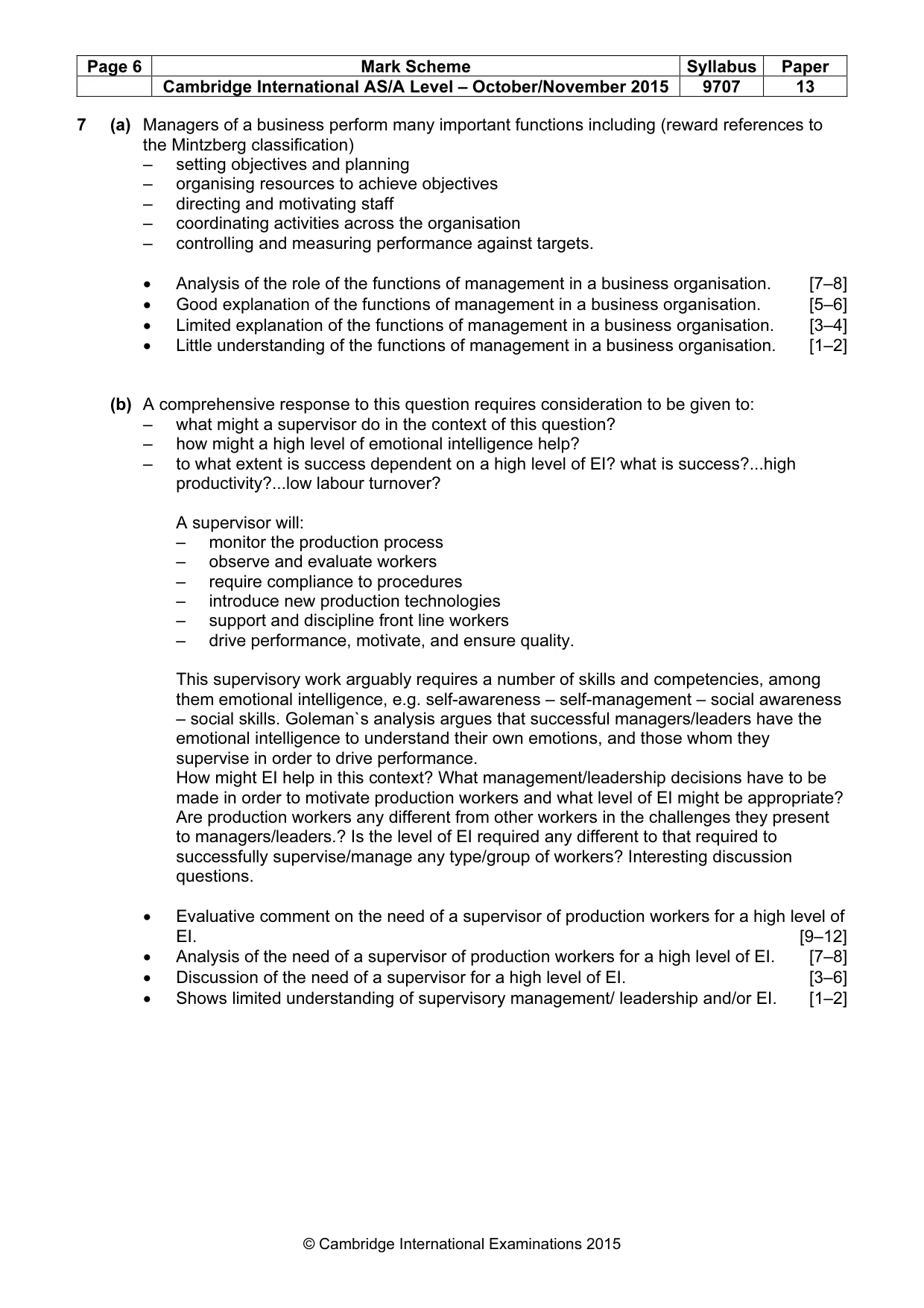
Page 6 Mark Scheme Syllabus Paper Cambridge International AS/A Level – October/November 2015 9707 13 © Cambridge International Examinations 2015 7 (a) Managers of a business perform many important functions including (reward references to the Mintzberg classification) – setting objectives and planning – organising resources to achieve objectives – directing and motivating staff – coordinating activities across the organisation – controlling and measuring performance against targets. • Analysis of the role of the functions of management in a business organisation. [7–8] • Good explanation of the functions of management in a business organisation. [5–6] • Limited explanation of the functions of management in a business organisation. [3–4] • Little understanding of the functions of management in a business organisation. [1–2] (b) A comprehensive response to this question requires consideration to be given to: – what might a supervisor do in the context of this question? – how might a high level of emotional intelligence help? – to what extent is success dependent on a high level of EI? what is success?...high productivity?...low labour turnover? A supervisor will: – monitor the production process – observe and evaluate workers – require compliance to procedures – introduce new production technologies – support and discipline front line workers – drive performance, motivate, and ensure quality. This supervisory work arguably requires a number of skills and competencies, among them emotional intelligence, e.g. self-awareness – self-management – social awareness – social skills. Goleman`s analysis argues that successful managers/leaders have the emotional intelligence to understand their own emotions, and those whom they supervise in order to drive performance. How might EI help in this context? What management/leadership decisions have to be made in order to motivate production workers and what level of EI might be appropriate? Are production workers any different from other workers in the challenges they present to managers/leaders.? Is the level of EI required any different to that required to successfully supervise/manage any type/group of workers? Interesting discussion questions. • Evaluative comment on the need of a supervisor of production workers for a high level of EI. [9–12] • Analysis of the need of a supervisor of production workers for a high level of EI. [7–8] • Discussion of the need of a supervisor for a high level of EI. [3–6] • Shows limited understanding of supervisory management/ leadership and/or EI. [1–2]