Cambridge A Level Business Studies (for final examination in 2015) 9707 — 2014 Oct/Nov Paper 1 · Variant 2
9707/12/O/N/14 · 40 marks · ≈45 min
The question paper and its mark scheme, free to read here and free to download. This is Cambridge’s own paper, exactly as it was sat.
Question paper4 pages


Mark scheme6 pages
Answers below. Sit the paper first if you are practising.
Paper as text
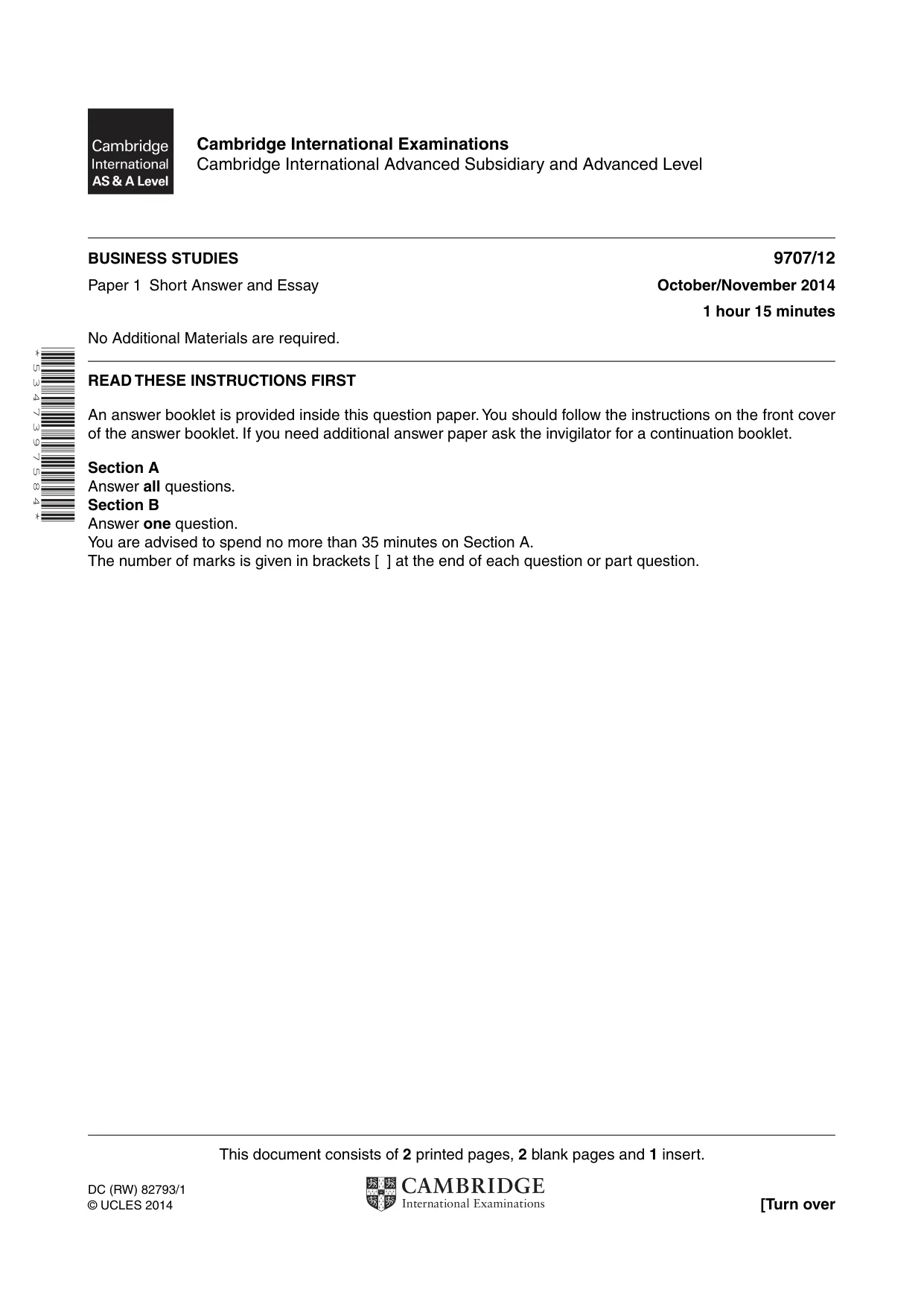
Question paper, page 1
This document consists of 2 printed pages, 2 blank pages and 1 insert. DC (RW) 82793/1 © UCLES 2014 [Turn over Cambridge International Examinations Cambridge International Advanced Subsidiary and Advanced Level * 5 3 4 7 3 9 7 5 8 4 * BUSINESS STUDIES 9707/12 Paper 1 Short Answer and Essay October/November 2014 1 hour 15 minutes No Additional Materials are required. READ THESE INSTRUCTIONS FIRST An answer booklet is provided inside this question paper. You should follow the instructions on the front cover of the answer booklet. If you need additional answer paper ask the invigilator for a continuation booklet. Section A Answer all questions. Section B Answer one question. You are advised to spend no more than 35 minutes on Section A. The number of marks is given in brackets [ ] at the end of each question or part question.
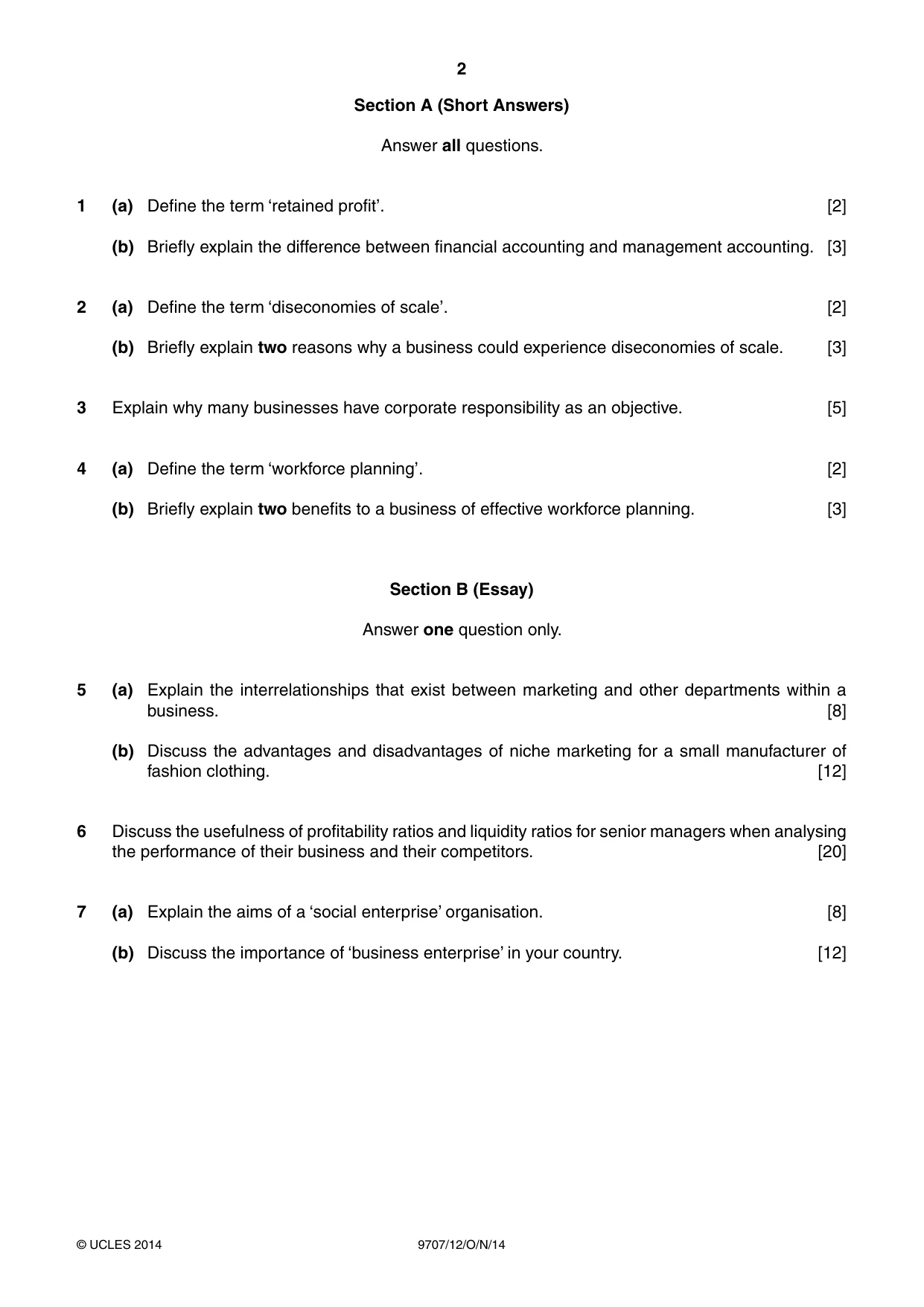
Question paper, page 2
2 9707/12/O/N/14 © UCLES 2014 Section A (Short Answers) Answer all questions. 1 (a) Define the term ‘retained profit’. [2] (b) Briefly explain the difference between financial accounting and management accounting. [3] 2 (a) Define the term ‘diseconomies of scale’. [2] (b) Briefly explain two reasons why a business could experience diseconomies of scale. [3] 3 Explain why many businesses have corporate responsibility as an objective. [5] 4 (a) Define the term ‘workforce planning’. [2] (b) Briefly explain two benefits to a business of effective workforce planning. [3] Section B (Essay) Answer one question only. 5 (a) Explain the interrelationships that exist between marketing and other departments within a business. [8] (b) Discuss the advantages and disadvantages of niche marketing for a small manufacturer of fashion clothing. [12] 6 Discuss the usefulness of profitability ratios and liquidity ratios for senior managers when analysing the performance of their business and their competitors. [20] 7 (a) Explain the aims of a ‘social enterprise’ organisation. [8] (b) Discuss the importance of ‘business enterprise’ in your country. [12]
Question paper, page 3
3 9707/12/O/N/14 © UCLES 2014 BLANK PAGE
Question paper, page 4
4 9707/12/O/N/14 © UCLES 2014 Permission to reproduce items where third-party owned material protected by copyright is included has been sought and cleared where possible. Every reasonable effort has been made by the publisher (UCLES) to trace copyright holders, but if any items requiring clearance have unwittingly been included, the publisher will be pleased to make amends at the earliest possible opportunity. Cambridge International Examinations is part of the Cambridge Assessment Group. Cambridge Assessment is the brand name of University of Cambridge Local Examinations Syndicate (UCLES), which is itself a department of the University of Cambridge. BLANK PAGE
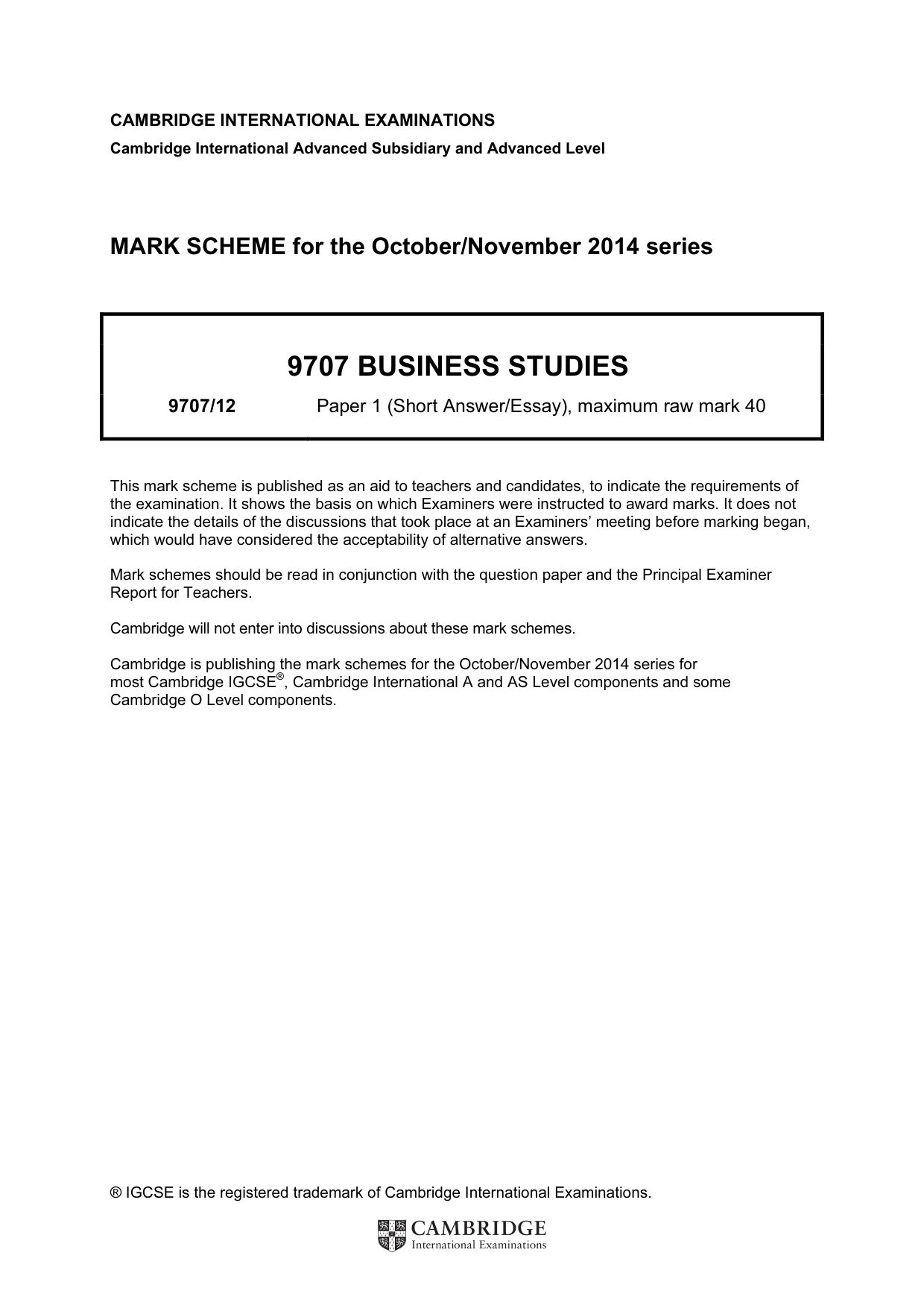
Mark scheme, page 1
® IGCSE is the registered trademark of Cambridge International Examinations. CAMBRIDGE INTERNATIONAL EXAMINATIONS Cambridge International Advanced Subsidiary and Advanced Level MARK SCHEME for the October/November 2014 series 9707 BUSINESS STUDIES 9707/12 Paper 1 (Short Answer/Essay), maximum raw mark 40 This mark scheme is published as an aid to teachers and candidates, to indicate the requirements of the examination. It shows the basis on which Examiners were instructed to award marks. It does not indicate the details of the discussions that took place at an Examiners’ meeting before marking began, which would have considered the acceptability of alternative answers. Mark schemes should be read in conjunction with the question paper and the Principal Examiner Report for Teachers. Cambridge will not enter into discussions about these mark schemes. Cambridge is publishing the mark schemes for the October/November 2014 series for most Cambridge IGCSE®, Cambridge International A and AS Level components and some Cambridge O Level components.
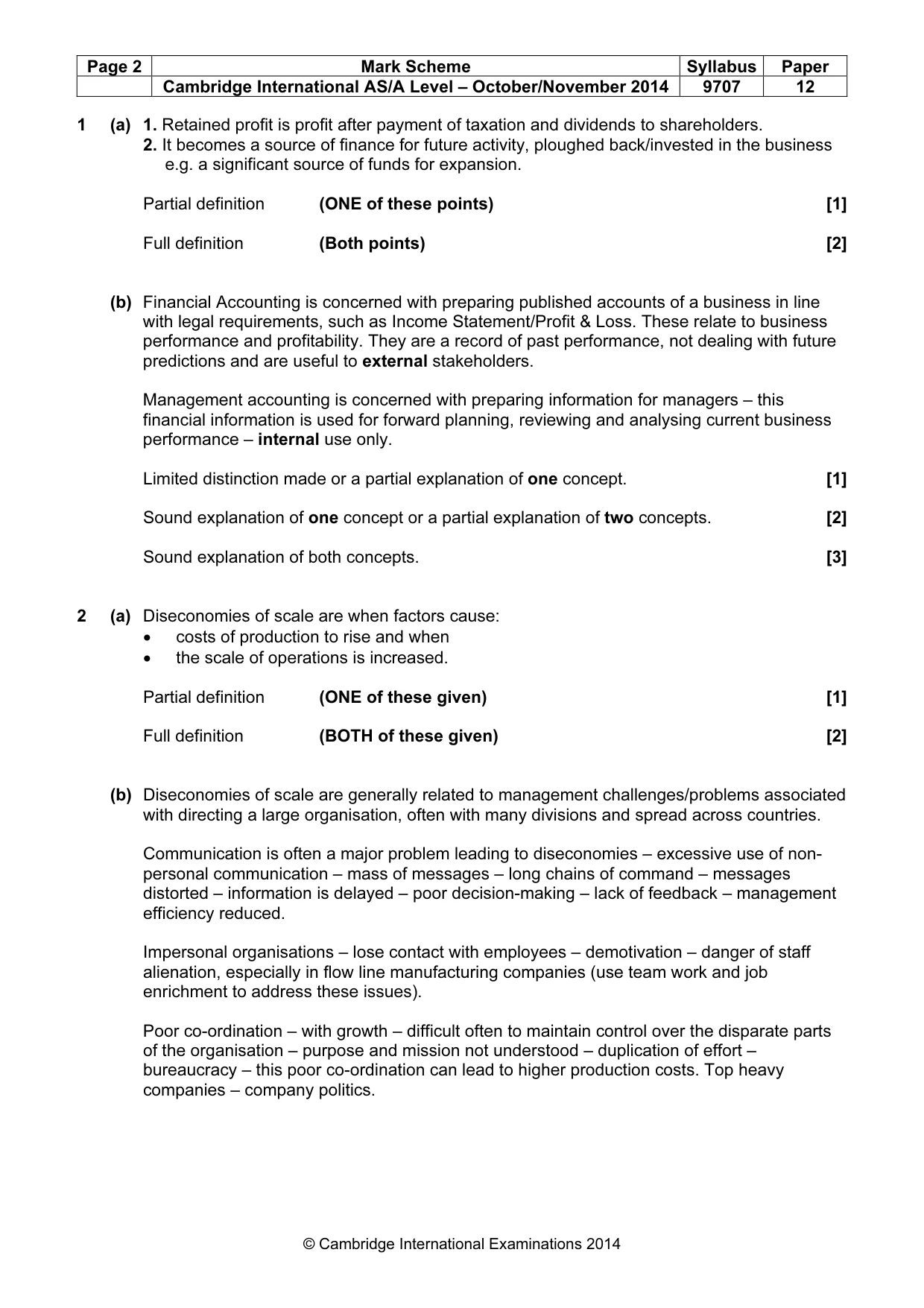
Mark scheme, page 2
Page 2 Mark Scheme Syllabus Paper Cambridge International AS/A Level – October/November 2014 9707 12 © Cambridge International Examinations 2014 1 (a) 1. Retained profit is profit after payment of taxation and dividends to shareholders. 2. It becomes a source of finance for future activity, ploughed back/invested in the business e.g. a significant source of funds for expansion. Partial definition (ONE of these points) [1] Full definition (Both points) [2] (b) Financial Accounting is concerned with preparing published accounts of a business in line with legal requirements, such as Income Statement/Profit & Loss. These relate to business performance and profitability. They are a record of past performance, not dealing with future predictions and are useful to external stakeholders. Management accounting is concerned with preparing information for managers – this financial information is used for forward planning, reviewing and analysing current business performance – internal use only. Limited distinction made or a partial explanation of one concept. [1] Sound explanation of one concept or a partial explanation of two concepts. [2] Sound explanation of both concepts. [3] 2 (a) Diseconomies of scale are when factors cause: • costs of production to rise and when • the scale of operations is increased. Partial definition (ONE of these given) [1] Full definition (BOTH of these given) [2] (b) Diseconomies of scale are generally related to management challenges/problems associated with directing a large organisation, often with many divisions and spread across countries. Communication is often a major problem leading to diseconomies – excessive use of non- personal communication – mass of messages – long chains of command – messages distorted – information is delayed – poor decision-making – lack of feedback – management efficiency reduced. Impersonal organisations – lose contact with employees – demotivation – danger of staff alienation, especially in flow line manufacturing companies (use team work and job enrichment to address these issues). Poor co-ordination – with growth – difficult often to maintain control over the disparate parts of the organisation – purpose and mission not understood – duplication of effort – bureaucracy – this poor co-ordination can lead to higher production costs. Top heavy companies – company politics.
Mark scheme, page 3
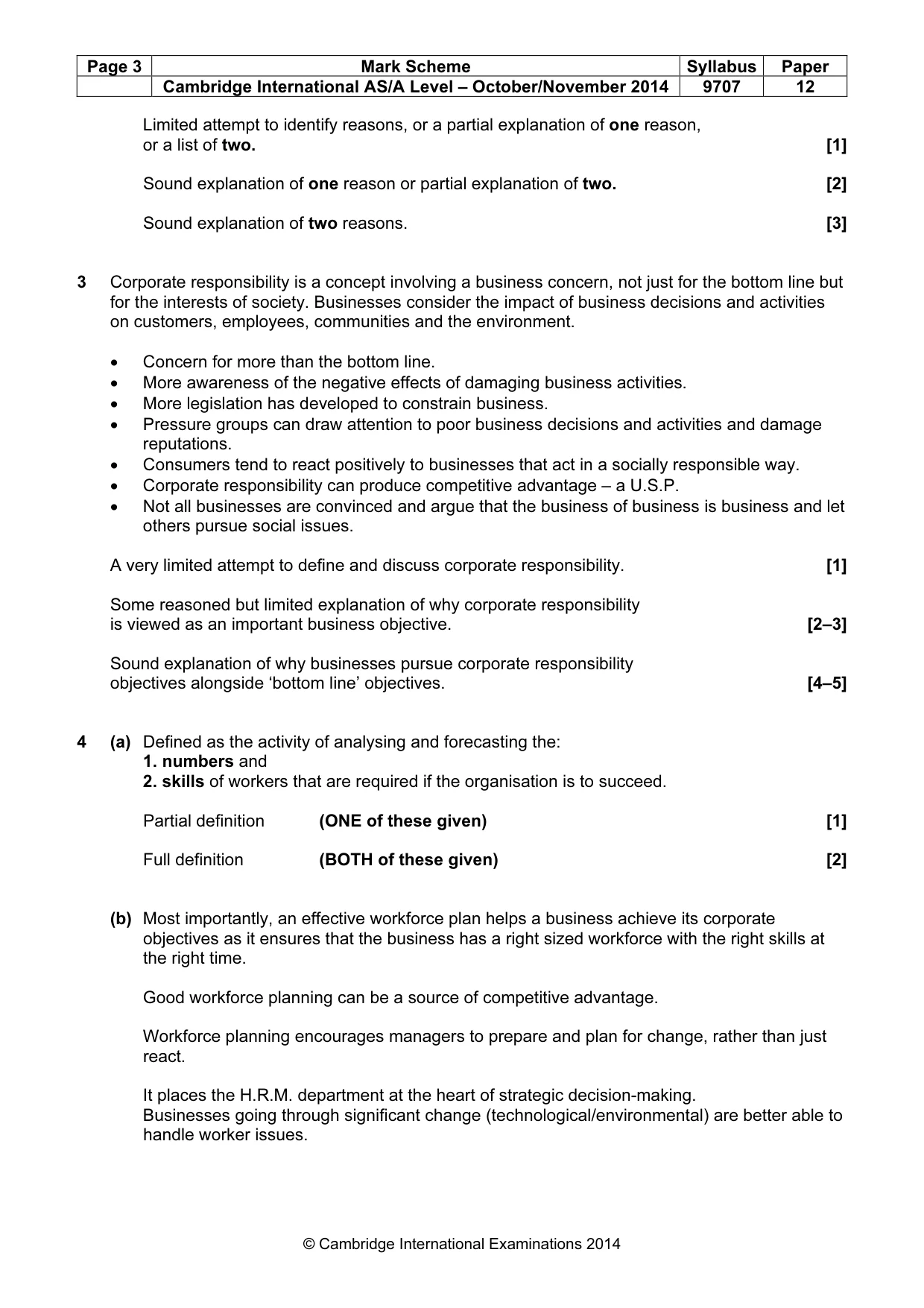
Page 3 Mark Scheme Syllabus Paper Cambridge International AS/A Level – October/November 2014 9707 12 © Cambridge International Examinations 2014 Limited attempt to identify reasons, or a partial explanation of one reason, or a list of two. [1] Sound explanation of one reason or partial explanation of two. [2] Sound explanation of two reasons. [3] 3 Corporate responsibility is a concept involving a business concern, not just for the bottom line but for the interests of society. Businesses consider the impact of business decisions and activities on customers, employees, communities and the environment. • Concern for more than the bottom line. • More awareness of the negative effects of damaging business activities. • More legislation has developed to constrain business. • Pressure groups can draw attention to poor business decisions and activities and damage reputations. • Consumers tend to react positively to businesses that act in a socially responsible way. • Corporate responsibility can produce competitive advantage – a U.S.P. • Not all businesses are convinced and argue that the business of business is business and let others pursue social issues. A very limited attempt to define and discuss corporate responsibility. [1] Some reasoned but limited explanation of why corporate responsibility is viewed as an important business objective. [2–3] Sound explanation of why businesses pursue corporate responsibility objectives alongside ‘bottom line’ objectives. [4–5] 4 (a) Defined as the activity of analysing and forecasting the: 1. numbers and 2. skills of workers that are required if the organisation is to succeed. Partial definition (ONE of these given) [1] Full definition (BOTH of these given) [2] (b) Most importantly, an effective workforce plan helps a business achieve its corporate objectives as it ensures that the business has a right sized workforce with the right skills at the right time. Good workforce planning can be a source of competitive advantage. Workforce planning encourages managers to prepare and plan for change, rather than just react. It places the H.R.M. department at the heart of strategic decision-making. Businesses going through significant change (technological/environmental) are better able to handle worker issues.
Mark scheme, page 4
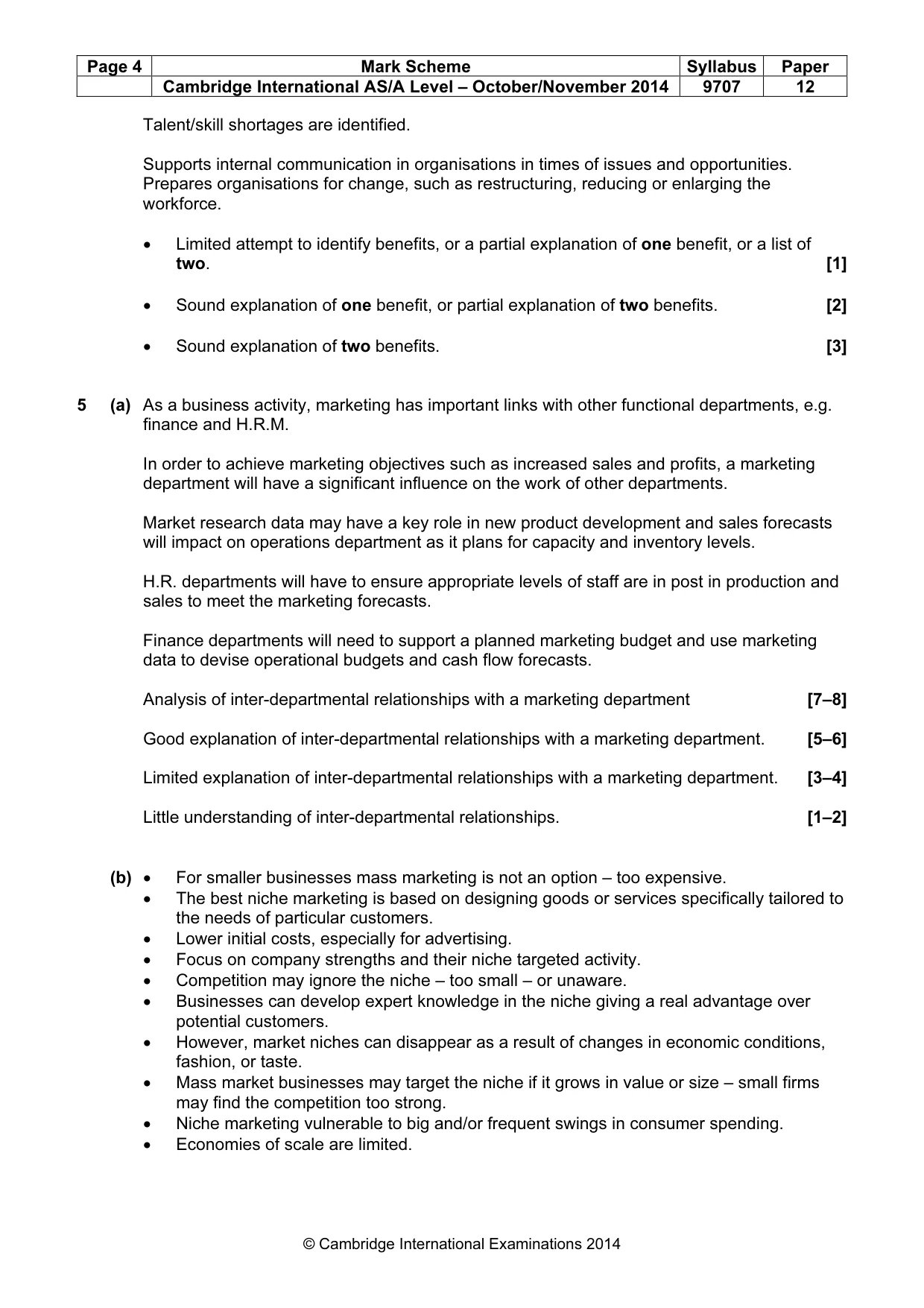
Page 4 Mark Scheme Syllabus Paper Cambridge International AS/A Level – October/November 2014 9707 12 © Cambridge International Examinations 2014 Talent/skill shortages are identified. Supports internal communication in organisations in times of issues and opportunities. Prepares organisations for change, such as restructuring, reducing or enlarging the workforce. • Limited attempt to identify benefits, or a partial explanation of one benefit, or a list of two. [1] • Sound explanation of one benefit, or partial explanation of two benefits. [2] • Sound explanation of two benefits. [3] 5 (a) As a business activity, marketing has important links with other functional departments, e.g. finance and H.R.M. In order to achieve marketing objectives such as increased sales and profits, a marketing department will have a significant influence on the work of other departments. Market research data may have a key role in new product development and sales forecasts will impact on operations department as it plans for capacity and inventory levels. H.R. departments will have to ensure appropriate levels of staff are in post in production and sales to meet the marketing forecasts. Finance departments will need to support a planned marketing budget and use marketing data to devise operational budgets and cash flow forecasts. Analysis of inter-departmental relationships with a marketing department [7–8] Good explanation of inter-departmental relationships with a marketing department. [5–6] Limited explanation of inter-departmental relationships with a marketing department. [3–4] Little understanding of inter-departmental relationships. [1–2] (b) • For smaller businesses mass marketing is not an option – too expensive. • The best niche marketing is based on designing goods or services specifically tailored to the needs of particular customers. • Lower initial costs, especially for advertising. • Focus on company strengths and their niche targeted activity. • Competition may ignore the niche – too small – or unaware. • Businesses can develop expert knowledge in the niche giving a real advantage over potential customers. • However, market niches can disappear as a result of changes in economic conditions, fashion, or taste. • Mass market businesses may target the niche if it grows in value or size – small firms may find the competition too strong. • Niche marketing vulnerable to big and/or frequent swings in consumer spending. • Economies of scale are limited.
Mark scheme, page 5
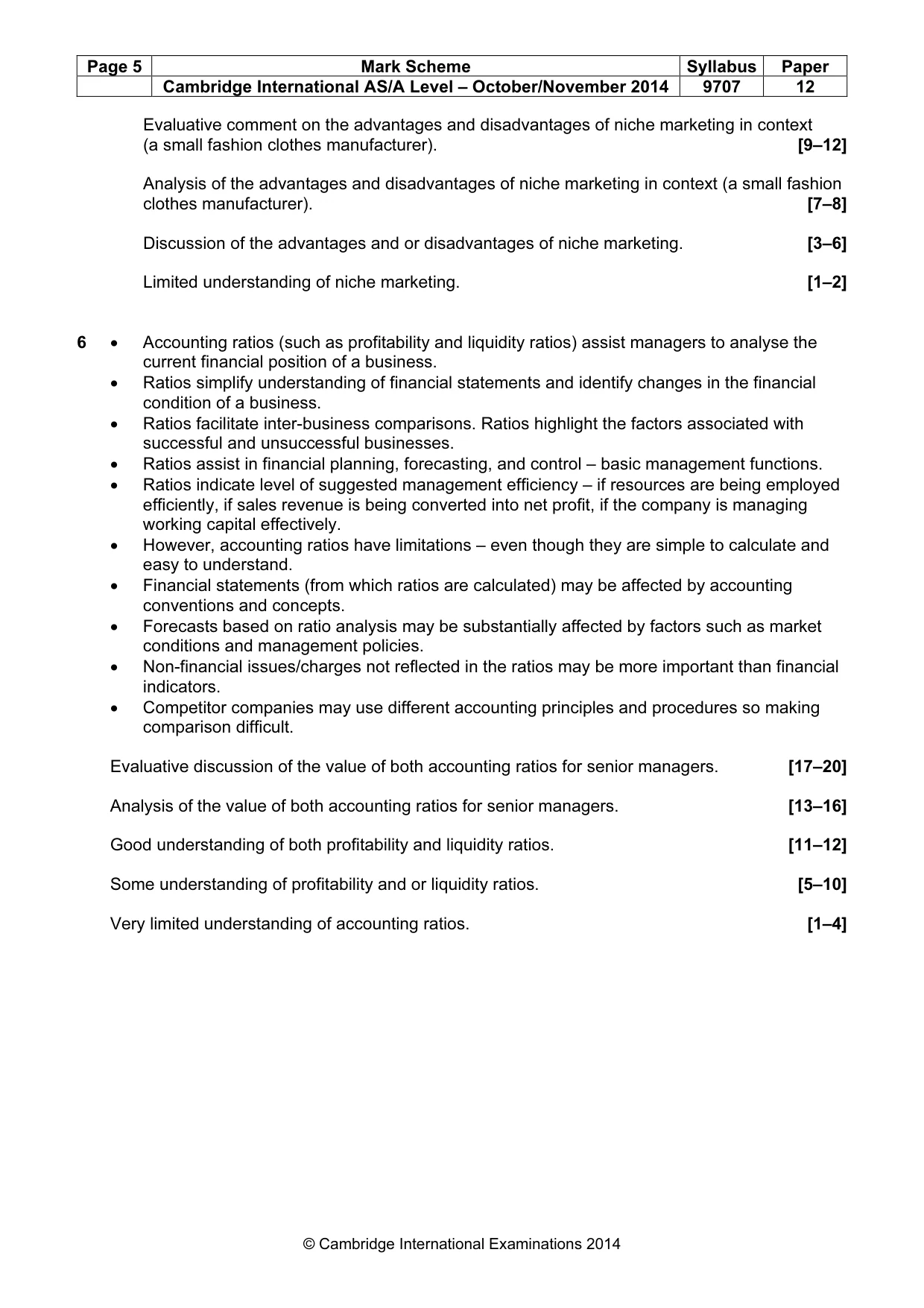
Page 5 Mark Scheme Syllabus Paper Cambridge International AS/A Level – October/November 2014 9707 12 © Cambridge International Examinations 2014 Evaluative comment on the advantages and disadvantages of niche marketing in context (a small fashion clothes manufacturer). [9–12] Analysis of the advantages and disadvantages of niche marketing in context (a small fashion clothes manufacturer). [7–8] Discussion of the advantages and or disadvantages of niche marketing. [3–6] Limited understanding of niche marketing. [1–2] 6 • Accounting ratios (such as profitability and liquidity ratios) assist managers to analyse the current financial position of a business. • Ratios simplify understanding of financial statements and identify changes in the financial condition of a business. • Ratios facilitate inter-business comparisons. Ratios highlight the factors associated with successful and unsuccessful businesses. • Ratios assist in financial planning, forecasting, and control – basic management functions. • Ratios indicate level of suggested management efficiency – if resources are being employed efficiently, if sales revenue is being converted into net profit, if the company is managing working capital effectively. • However, accounting ratios have limitations – even though they are simple to calculate and easy to understand. • Financial statements (from which ratios are calculated) may be affected by accounting conventions and concepts. • Forecasts based on ratio analysis may be substantially affected by factors such as market conditions and management policies. • Non-financial issues/charges not reflected in the ratios may be more important than financial indicators. • Competitor companies may use different accounting principles and procedures so making comparison difficult. Evaluative discussion of the value of both accounting ratios for senior managers. [17–20] Analysis of the value of both accounting ratios for senior managers. [13–16] Good understanding of both profitability and liquidity ratios. [11–12] Some understanding of profitability and or liquidity ratios. [5–10] Very limited understanding of accounting ratios. [1–4]
Mark scheme, page 6
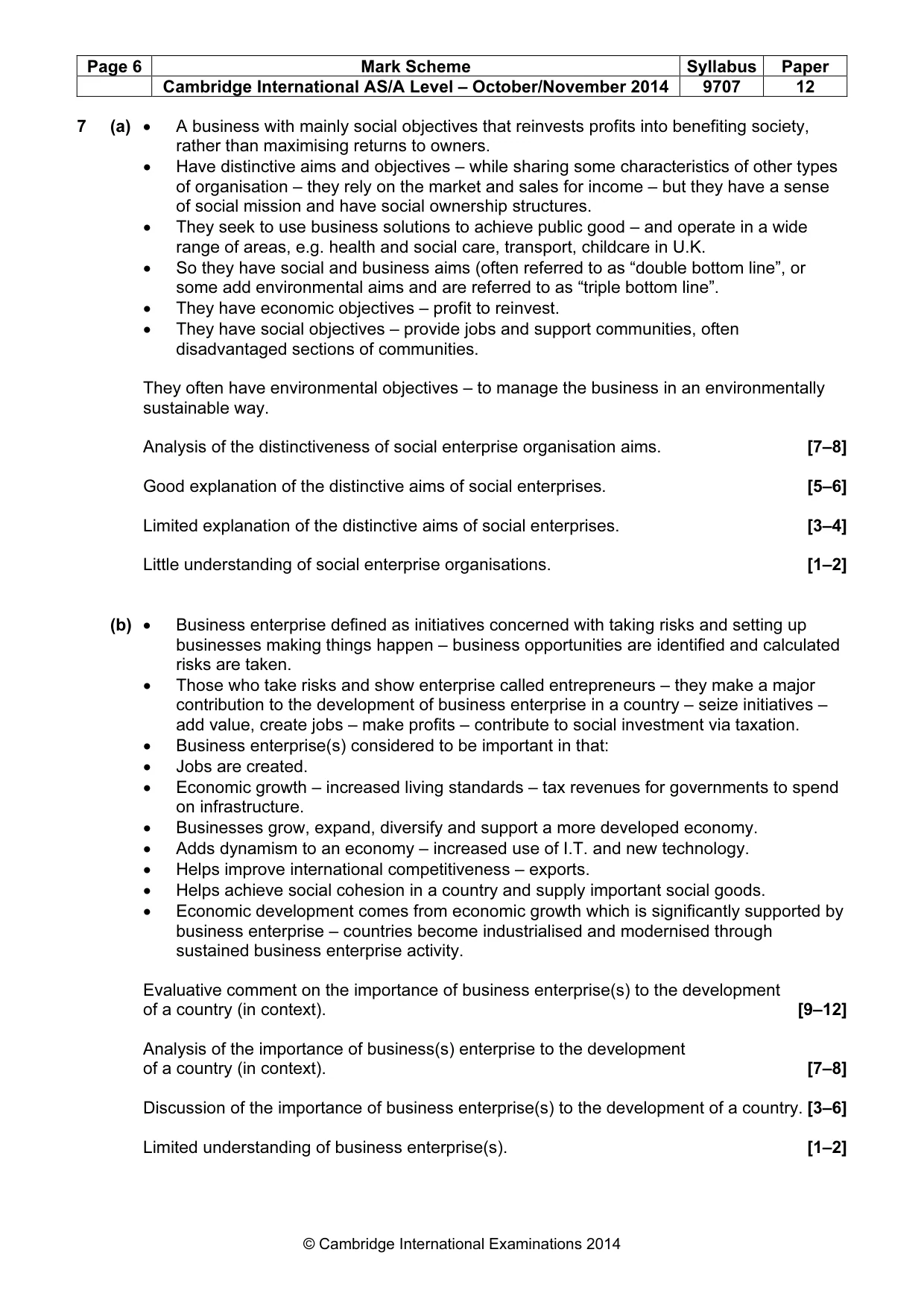
Page 6 Mark Scheme Syllabus Paper Cambridge International AS/A Level – October/November 2014 9707 12 © Cambridge International Examinations 2014 7 (a) • A business with mainly social objectives that reinvests profits into benefiting society, rather than maximising returns to owners. • Have distinctive aims and objectives – while sharing some characteristics of other types of organisation – they rely on the market and sales for income – but they have a sense of social mission and have social ownership structures. • They seek to use business solutions to achieve public good – and operate in a wide range of areas, e.g. health and social care, transport, childcare in U.K. • So they have social and business aims (often referred to as “double bottom line”, or some add environmental aims and are referred to as “triple bottom line”. • They have economic objectives – profit to reinvest. • They have social objectives – provide jobs and support communities, often disadvantaged sections of communities. They often have environmental objectives – to manage the business in an environmentally sustainable way. Analysis of the distinctiveness of social enterprise organisation aims. [7–8] Good explanation of the distinctive aims of social enterprises. [5–6] Limited explanation of the distinctive aims of social enterprises. [3–4] Little understanding of social enterprise organisations. [1–2] (b) • Business enterprise defined as initiatives concerned with taking risks and setting up businesses making things happen – business opportunities are identified and calculated risks are taken. • Those who take risks and show enterprise called entrepreneurs – they make a major contribution to the development of business enterprise in a country – seize initiatives – add value, create jobs – make profits – contribute to social investment via taxation. • Business enterprise(s) considered to be important in that: • Jobs are created. • Economic growth – increased living standards – tax revenues for governments to spend on infrastructure. • Businesses grow, expand, diversify and support a more developed economy. • Adds dynamism to an economy – increased use of I.T. and new technology. • Helps improve international competitiveness – exports. • Helps achieve social cohesion in a country and supply important social goods. • Economic development comes from economic growth which is significantly supported by business enterprise – countries become industrialised and modernised through sustained business enterprise activity. Evaluative comment on the importance of business enterprise(s) to the development of a country (in context). [9–12] Analysis of the importance of business(s) enterprise to the development of a country (in context). [7–8] Discussion of the importance of business enterprise(s) to the development of a country. [3–6] Limited understanding of business enterprise(s). [1–2]
What you needed in this session
Cambridge’s own grade thresholds for 2014 Oct/Nov, Paper 1 · Variant 2. A higher threshold means an easier paper — the bar moves with how the cohort did.