Cambridge A Level Business Studies (for final examination in 2015) 9707 — 2014 May/June Paper 1 · Variant 2
9707/12/M/J/14 · 40 marks · ≈45 min
The question paper and its mark scheme, free to read here and free to download. This is Cambridge’s own paper, exactly as it was sat.
Question paper4 pages


Mark scheme6 pages
Answers below. Sit the paper first if you are practising.
Paper as text
Question paper, page 1
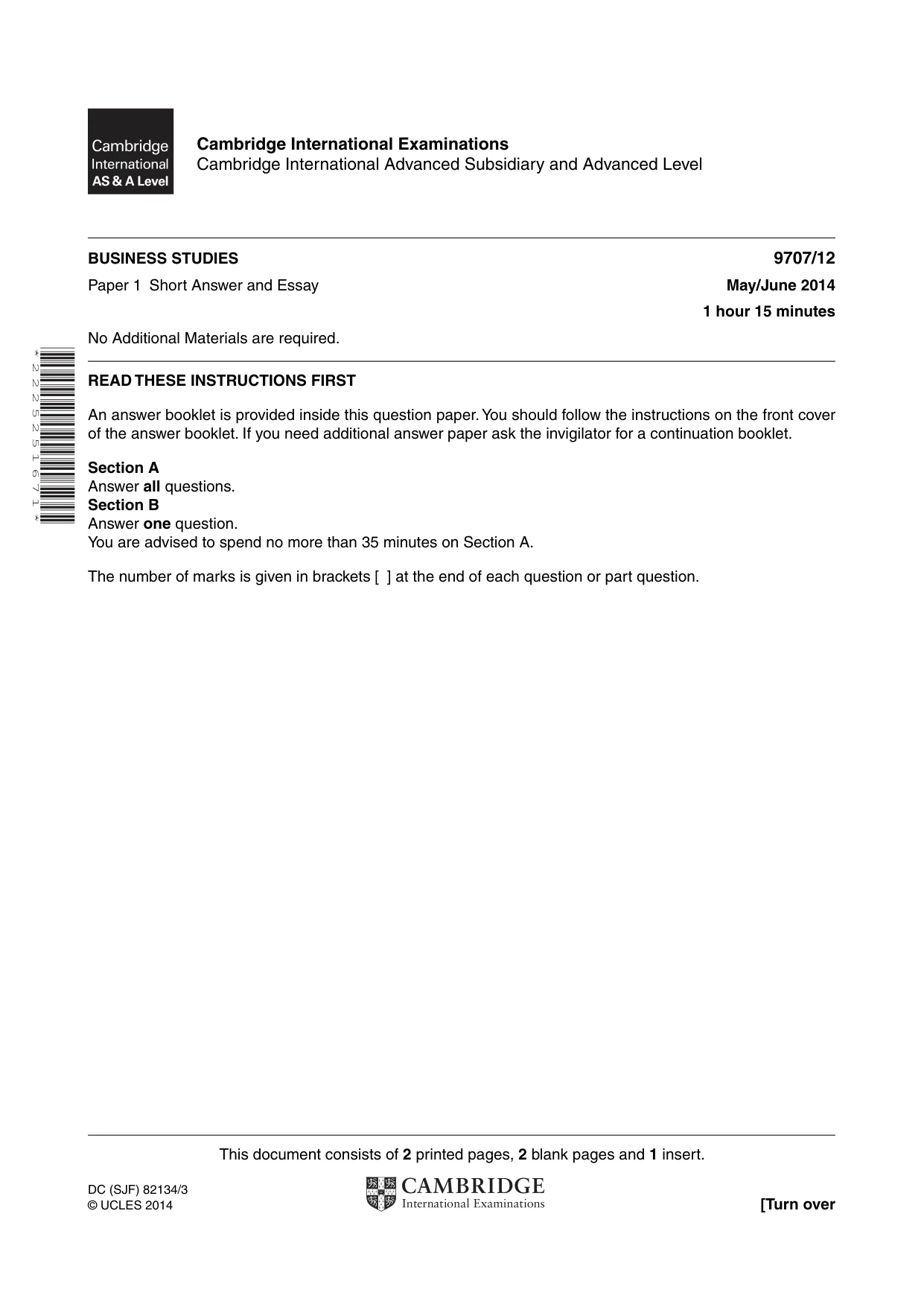
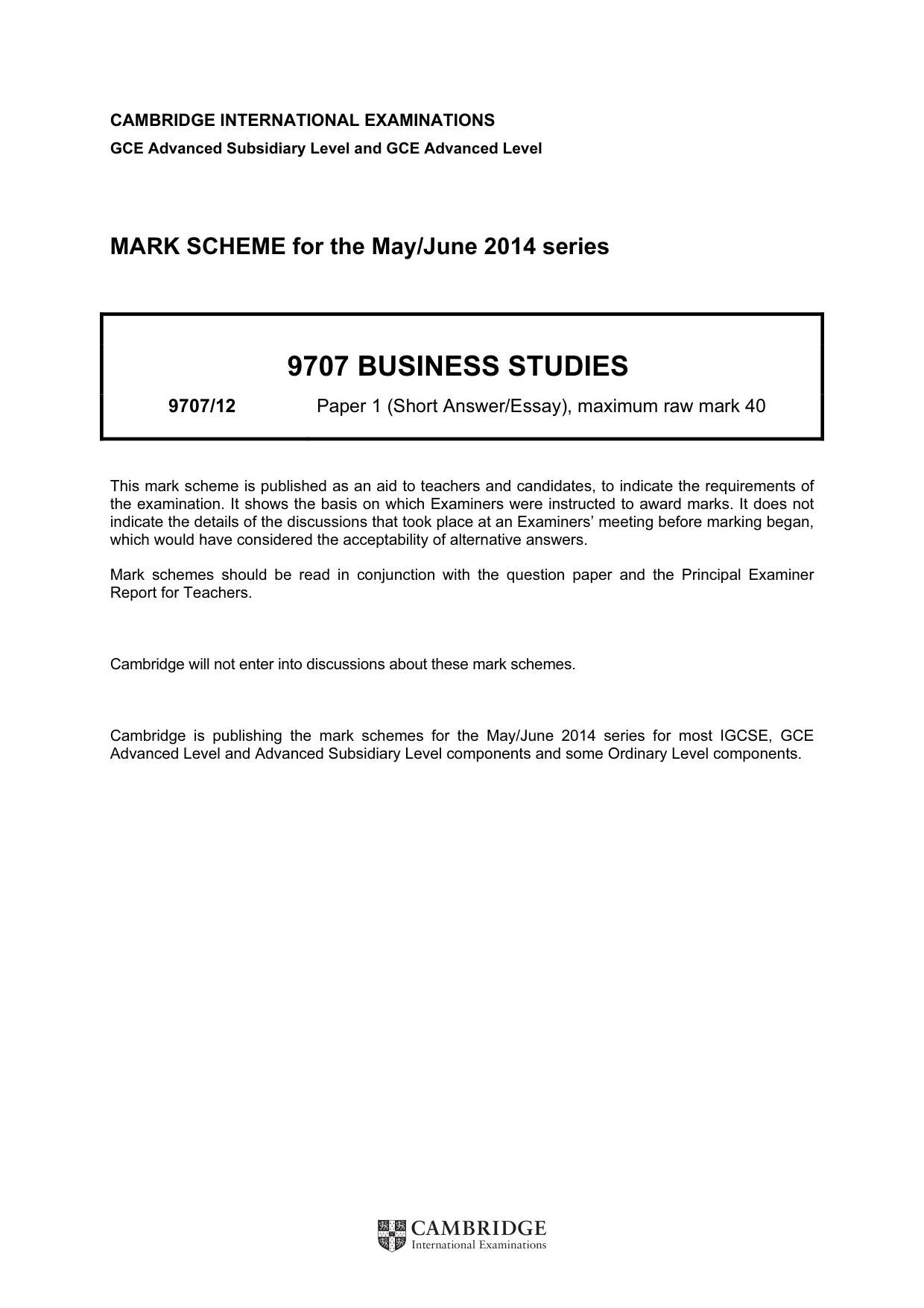
This document consists of 2 printed pages, 2 blank pages and 1 insert. DC (SJF) 82134/3 © UCLES 2014 [Turn over Cambridge International Examinations Cambridge International Advanced Subsidiary and Advanced Level * 2 2 2 5 2 5 1 6 7 1 * BUSINESS STUDIES 9707/12 Paper 1 Short Answer and Essay May/June 2014 1 hour 15 minutes No Additional Materials are required. READ THESE INSTRUCTIONS FIRST An answer booklet is provided inside this question paper. You should follow the instructions on the front cover of the answer booklet. If you need additional answer paper ask the invigilator for a continuation booklet. Section A Answer all questions. Section B Answer one question. You are advised to spend no more than 35 minutes on Section A. The number of marks is given in brackets [ ] at the end of each question or part question.
Question paper, page 2
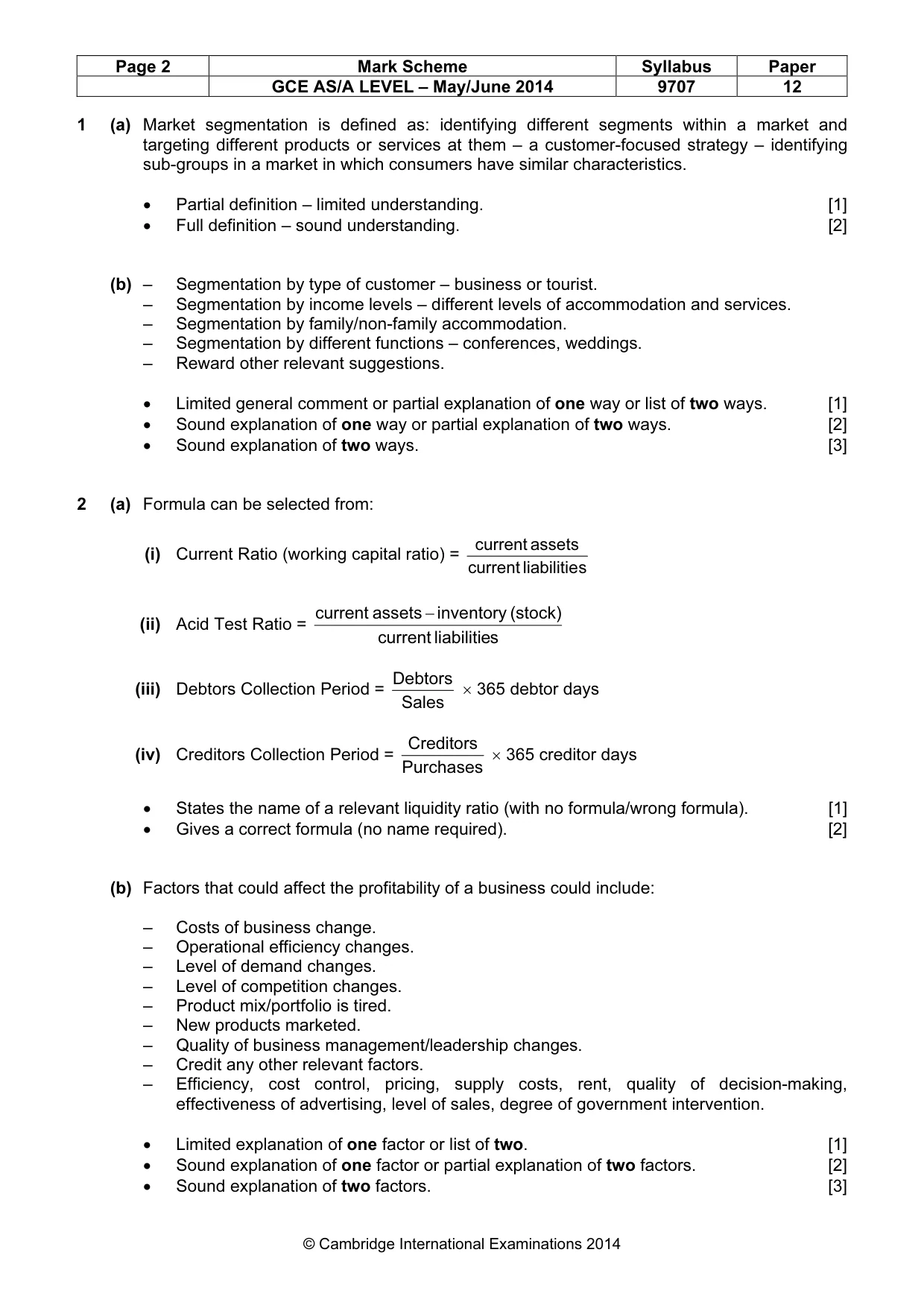
2 9707/12/M/J/14 © UCLES 2014 Section A (Short Answer) Answer all questions. 1 (a) Define the term ‘market segmentation’. [2] (b) Briefly explain two ways a hotel could segment the market for hotel accommodation. [3] 2 (a) State the formula for one accounting ratio that could be used to measure the liquidity of a business. [2] (b) Briefly explain two factors that could affect the profitability of a business. [3] 3 Explain why the objectives of a business could change over time. [5] 4 (a) Define the term ‘value added’. [2] (b) Briefly explain two ways operations management could contribute to the success of a business. [3] Section B (Essay) Answer one question only. 5 (a) Explain the differences between McGregor’s ‘Theory X’ and ‘Theory Y’. [8] (b) Discuss the benefits of team working for production workers and managers. [12] 6 Discuss how a cell (mobile) phone manufacturer could assess the effectiveness of its market research expenditure. [20] 7 (a) Explain how the effectiveness of the operations management function can be influenced by human resource management. [8] (b) Discuss how the actions of competitors could influence the operations management decisions of a car manufacturer. [12]
Question paper, page 3
3 9707/12/M/J/14 © UCLES 2014 BLANK PAGE
Question paper, page 4
4 9707/12/M/J/14 © UCLES 2014 Permission to reproduce items where third-party owned material protected by copyright is included has been sought and cleared where possible. Every reasonable effort has been made by the publisher (UCLES) to trace copyright holders, but if any items requiring clearance have unwittingly been included, the publisher will be pleased to make amends at the earliest possible opportunity. Cambridge International Examinations is part of the Cambridge Assessment Group. Cambridge Assessment is the brand name of University of Cambridge Local Examinations Syndicate (UCLES), which is itself a department of the University of Cambridge. BLANK PAGE
Mark scheme, page 1
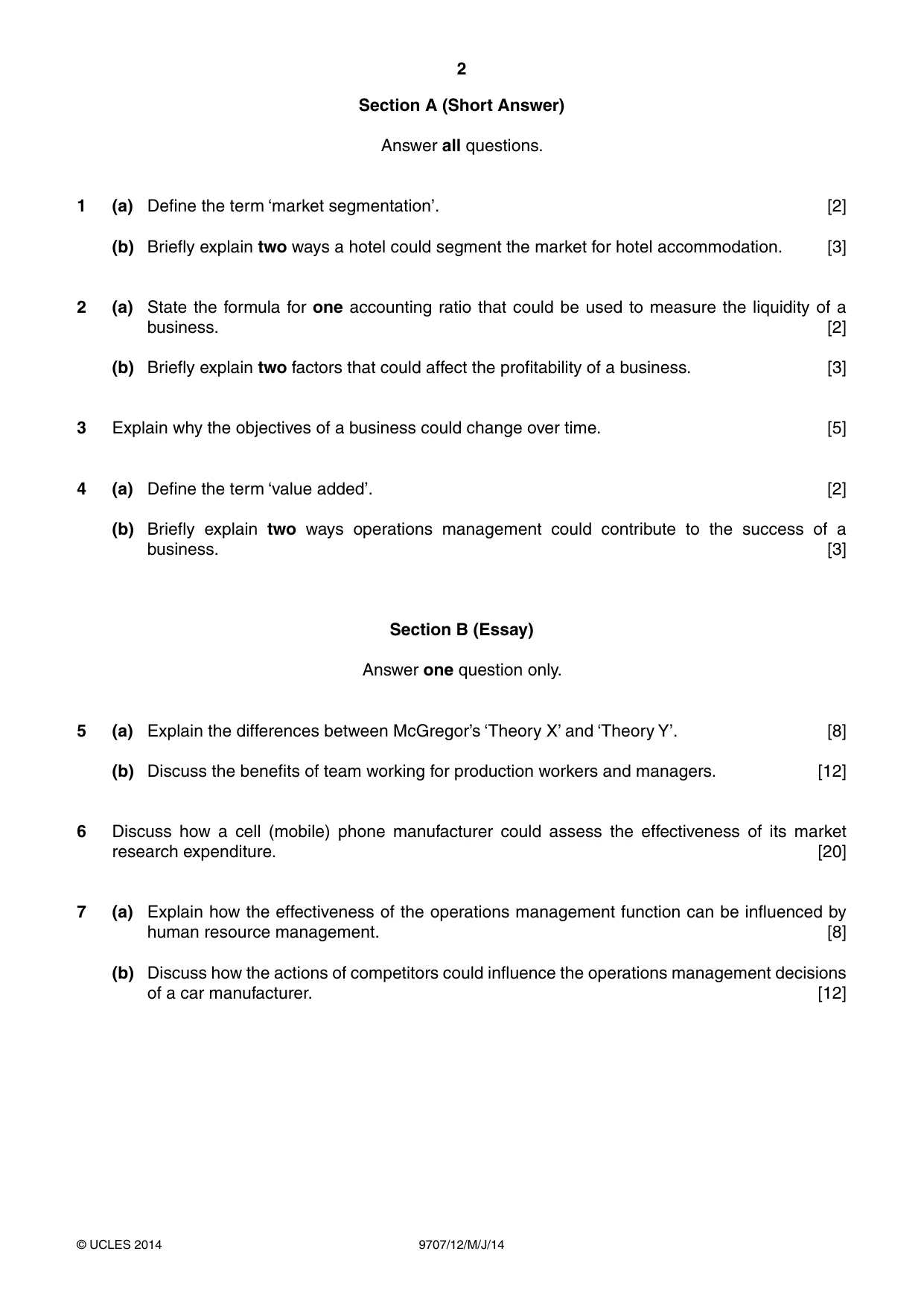
CAMBRIDGE INTERNATIONAL EXAMINATIONS GCE Advanced Subsidiary Level and GCE Advanced Level MARK SCHEME for the May/June 2014 series 9707 BUSINESS STUDIES 9707/12 Paper 1 (Short Answer/Essay), maximum raw mark 40 This mark scheme is published as an aid to teachers and candidates, to indicate the requirements of the examination. It shows the basis on which Examiners were instructed to award marks. It does not indicate the details of the discussions that took place at an Examiners’ meeting before marking began, which would have considered the acceptability of alternative answers. Mark schemes should be read in conjunction with the question paper and the Principal Examiner Report for Teachers. Cambridge will not enter into discussions about these mark schemes. Cambridge is publishing the mark schemes for the May/June 2014 series for most IGCSE, GCE Advanced Level and Advanced Subsidiary Level components and some Ordinary Level components.
Mark scheme, page 2
Page 2 Mark Scheme Syllabus Paper GCE AS/A LEVEL – May/June 2014 9707 12 © Cambridge International Examinations 2014 1 (a) Market segmentation is defined as: identifying different segments within a market and targeting different products or services at them – a customer-focused strategy – identifying sub-groups in a market in which consumers have similar characteristics. • Partial definition – limited understanding. [1] • Full definition – sound understanding. [2] (b) – Segmentation by type of customer – business or tourist. – Segmentation by income levels – different levels of accommodation and services. – Segmentation by family/non-family accommodation. – Segmentation by different functions – conferences, weddings. – Reward other relevant suggestions. • Limited general comment or partial explanation of one way or list of two ways. [1] • Sound explanation of one way or partial explanation of two ways. [2] • Sound explanation of two ways. [3] 2 (a) Formula can be selected from: (i) Current Ratio (working capital ratio) = s liabilitie current assets current (ii) Acid Test Ratio = s liabilitie current (stock) inventory assets current − (iii) Debtors Collection Period = Sales Debtors × 365 debtor days (iv) Creditors Collection Period = Purchases Creditors × 365 creditor days • States the name of a relevant liquidity ratio (with no formula/wrong formula). [1] • Gives a correct formula (no name required). [2] (b) Factors that could affect the profitability of a business could include: – Costs of business change. – Operational efficiency changes. – Level of demand changes. – Level of competition changes. – Product mix/portfolio is tired. – New products marketed. – Quality of business management/leadership changes. – Credit any other relevant factors. – Efficiency, cost control, pricing, supply costs, rent, quality of decision-making, effectiveness of advertising, level of sales, degree of government intervention. • Limited explanation of one factor or list of two. [1] • Sound explanation of one factor or partial explanation of two factors. [2] • Sound explanation of two factors. [3]
Mark scheme, page 3
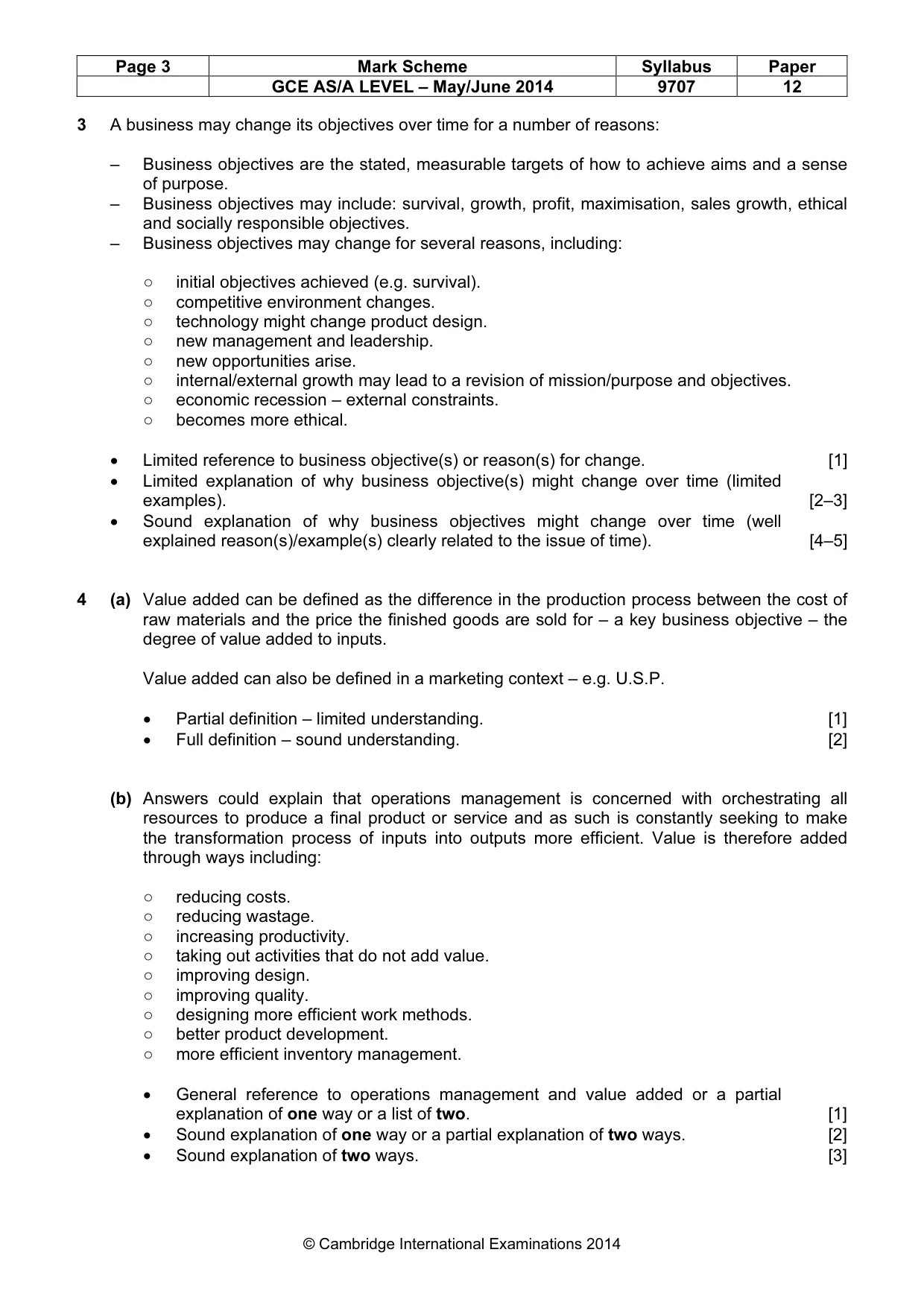
Page 3 Mark Scheme Syllabus Paper GCE AS/A LEVEL – May/June 2014 9707 12 © Cambridge International Examinations 2014 3 A business may change its objectives over time for a number of reasons: – Business objectives are the stated, measurable targets of how to achieve aims and a sense of purpose. – Business objectives may include: survival, growth, profit, maximisation, sales growth, ethical and socially responsible objectives. – Business objectives may change for several reasons, including: ○ initial objectives achieved (e.g. survival). ○ competitive environment changes. ○ technology might change product design. ○ new management and leadership. ○ new opportunities arise. ○ internal/external growth may lead to a revision of mission/purpose and objectives. ○ economic recession – external constraints. ○ becomes more ethical. • Limited reference to business objective(s) or reason(s) for change. [1] • Limited explanation of why business objective(s) might change over time (limited examples). [2–3] • Sound explanation of why business objectives might change over time (well explained reason(s)/example(s) clearly related to the issue of time). [4–5] 4 (a) Value added can be defined as the difference in the production process between the cost of raw materials and the price the finished goods are sold for – a key business objective – the degree of value added to inputs. Value added can also be defined in a marketing context – e.g. U.S.P. • Partial definition – limited understanding. [1] • Full definition – sound understanding. [2] (b) Answers could explain that operations management is concerned with orchestrating all resources to produce a final product or service and as such is constantly seeking to make the transformation process of inputs into outputs more efficient. Value is therefore added through ways including: ○ reducing costs. ○ reducing wastage. ○ increasing productivity. ○ taking out activities that do not add value. ○ improving design. ○ improving quality. ○ designing more efficient work methods. ○ better product development. ○ more efficient inventory management. • General reference to operations management and value added or a partial explanation of one way or a list of two. [1] • Sound explanation of one way or a partial explanation of two ways. [2] • Sound explanation of two ways. [3]
Mark scheme, page 4
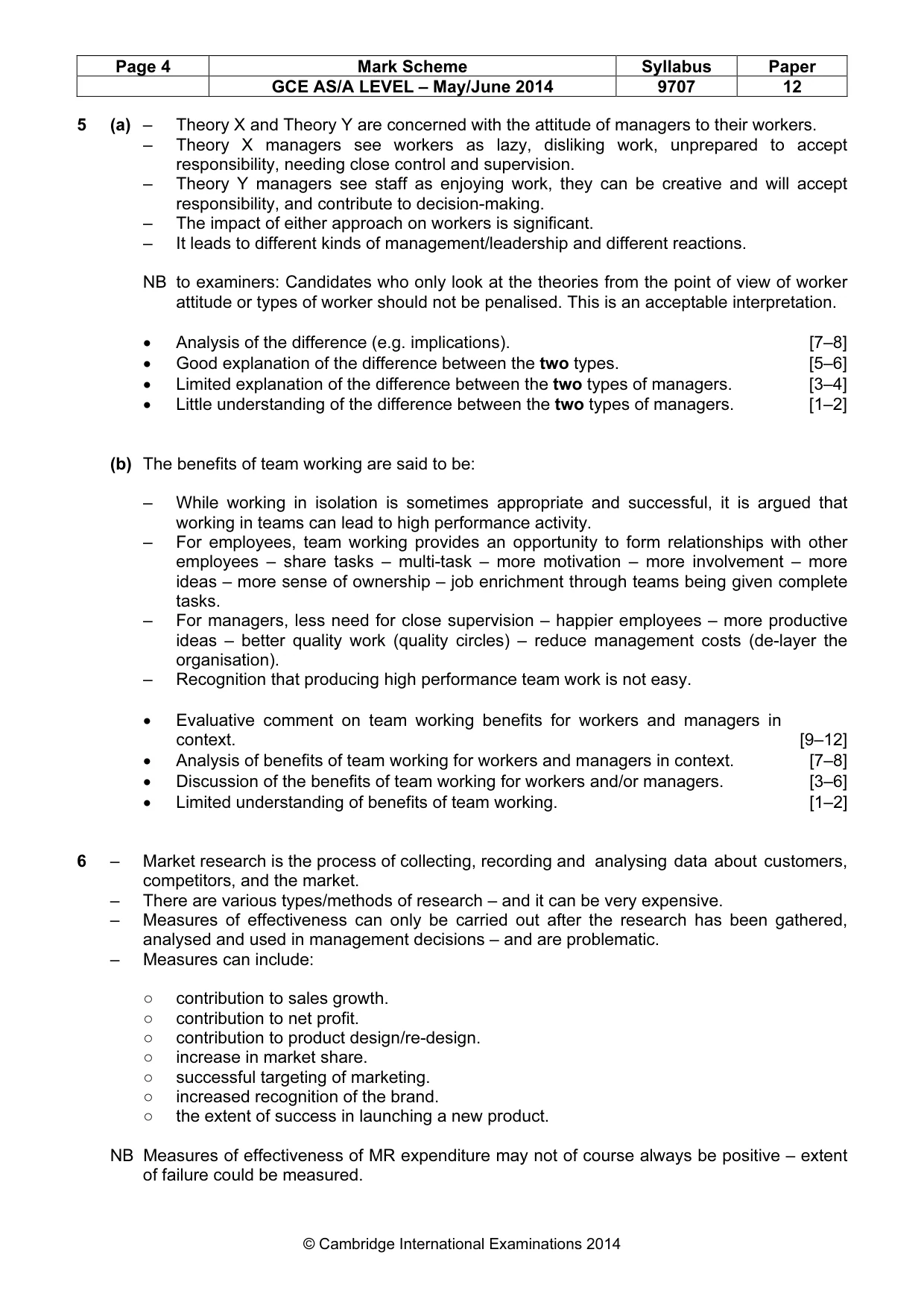
Page 4 Mark Scheme Syllabus Paper GCE AS/A LEVEL – May/June 2014 9707 12 © Cambridge International Examinations 2014 5 (a) – Theory X and Theory Y are concerned with the attitude of managers to their workers. – Theory X managers see workers as lazy, disliking work, unprepared to accept responsibility, needing close control and supervision. – Theory Y managers see staff as enjoying work, they can be creative and will accept responsibility, and contribute to decision-making. – The impact of either approach on workers is significant. – It leads to different kinds of management/leadership and different reactions. NB to examiners: Candidates who only look at the theories from the point of view of worker attitude or types of worker should not be penalised. This is an acceptable interpretation. • Analysis of the difference (e.g. implications). [7–8] • Good explanation of the difference between the two types. [5–6] • Limited explanation of the difference between the two types of managers. [3–4] • Little understanding of the difference between the two types of managers. [1–2] (b) The benefits of team working are said to be: – While working in isolation is sometimes appropriate and successful, it is argued that working in teams can lead to high performance activity. – For employees, team working provides an opportunity to form relationships with other employees – share tasks – multi-task – more motivation – more involvement – more ideas – more sense of ownership – job enrichment through teams being given complete tasks. – For managers, less need for close supervision – happier employees – more productive ideas – better quality work (quality circles) – reduce management costs (de-layer the organisation). – Recognition that producing high performance team work is not easy. • Evaluative comment on team working benefits for workers and managers in context. [9–12] • Analysis of benefits of team working for workers and managers in context. [7–8] • Discussion of the benefits of team working for workers and/or managers. [3–6] • Limited understanding of benefits of team working. [1–2] 6 – Market research is the process of collecting, recording and analysing data about customers, competitors, and the market. – There are various types/methods of research – and it can be very expensive. – Measures of effectiveness can only be carried out after the research has been gathered, analysed and used in management decisions – and are problematic. – Measures can include: ○ contribution to sales growth. ○ contribution to net profit. ○ contribution to product design/re-design. ○ increase in market share. ○ successful targeting of marketing. ○ increased recognition of the brand. ○ the extent of success in launching a new product. NB Measures of effectiveness of MR expenditure may not of course always be positive – extent of failure could be measured.
Mark scheme, page 5
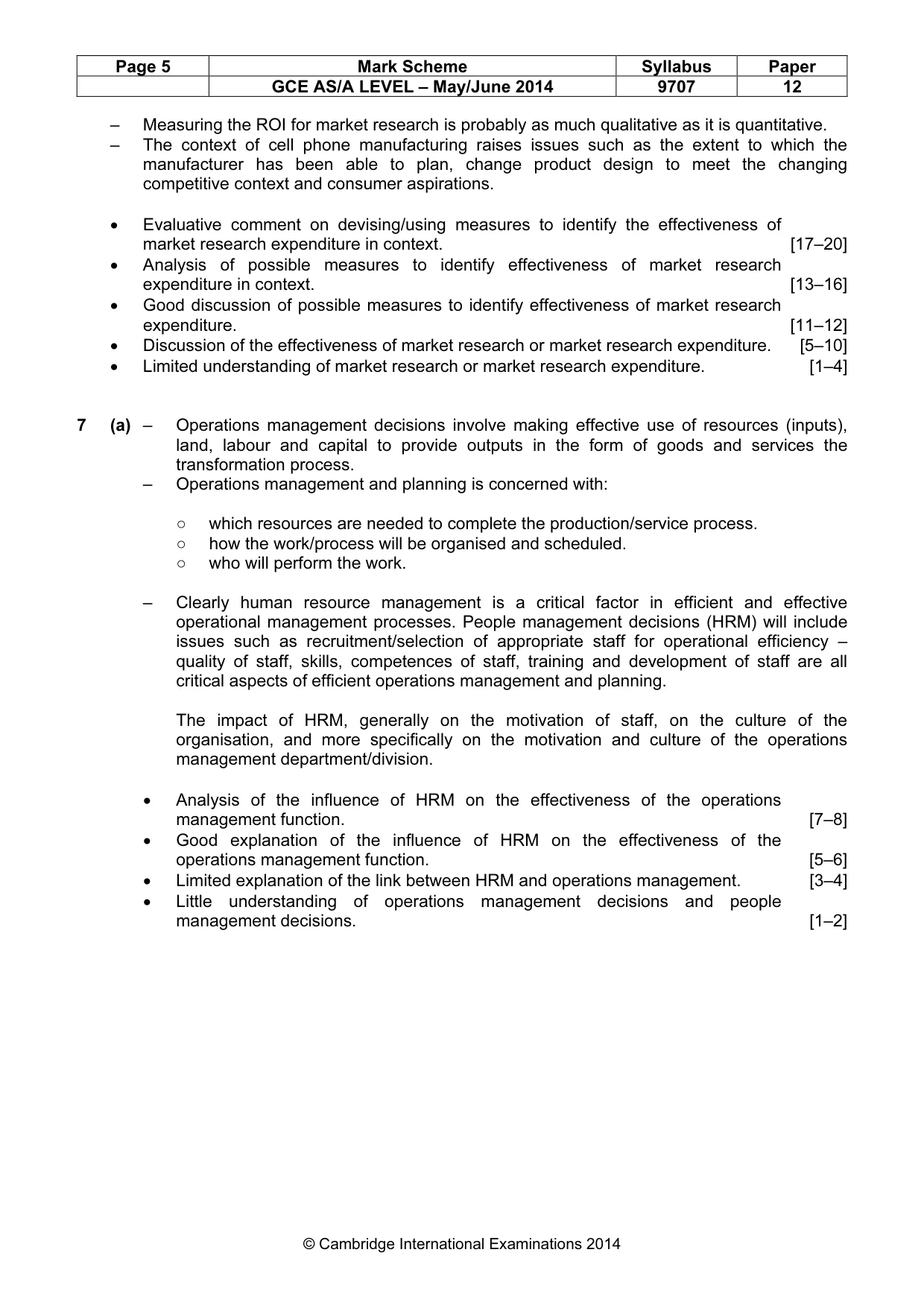
Page 5 Mark Scheme Syllabus Paper GCE AS/A LEVEL – May/June 2014 9707 12 © Cambridge International Examinations 2014 – Measuring the ROI for market research is probably as much qualitative as it is quantitative. – The context of cell phone manufacturing raises issues such as the extent to which the manufacturer has been able to plan, change product design to meet the changing competitive context and consumer aspirations. • Evaluative comment on devising/using measures to identify the effectiveness of market research expenditure in context. [17–20] • Analysis of possible measures to identify effectiveness of market research expenditure in context. [13–16] • Good discussion of possible measures to identify effectiveness of market research expenditure. [11–12] • Discussion of the effectiveness of market research or market research expenditure. [5–10] • Limited understanding of market research or market research expenditure. [1–4] 7 (a) – Operations management decisions involve making effective use of resources (inputs), land, labour and capital to provide outputs in the form of goods and services the transformation process. – Operations management and planning is concerned with: ○ which resources are needed to complete the production/service process. ○ how the work/process will be organised and scheduled. ○ who will perform the work. – Clearly human resource management is a critical factor in efficient and effective operational management processes. People management decisions (HRM) will include issues such as recruitment/selection of appropriate staff for operational efficiency – quality of staff, skills, competences of staff, training and development of staff are all critical aspects of efficient operations management and planning. The impact of HRM, generally on the motivation of staff, on the culture of the organisation, and more specifically on the motivation and culture of the operations management department/division. • Analysis of the influence of HRM on the effectiveness of the operations management function. [7–8] • Good explanation of the influence of HRM on the effectiveness of the operations management function. [5–6] • Limited explanation of the link between HRM and operations management. [3–4] • Little understanding of operations management decisions and people management decisions. [1–2]
Mark scheme, page 6
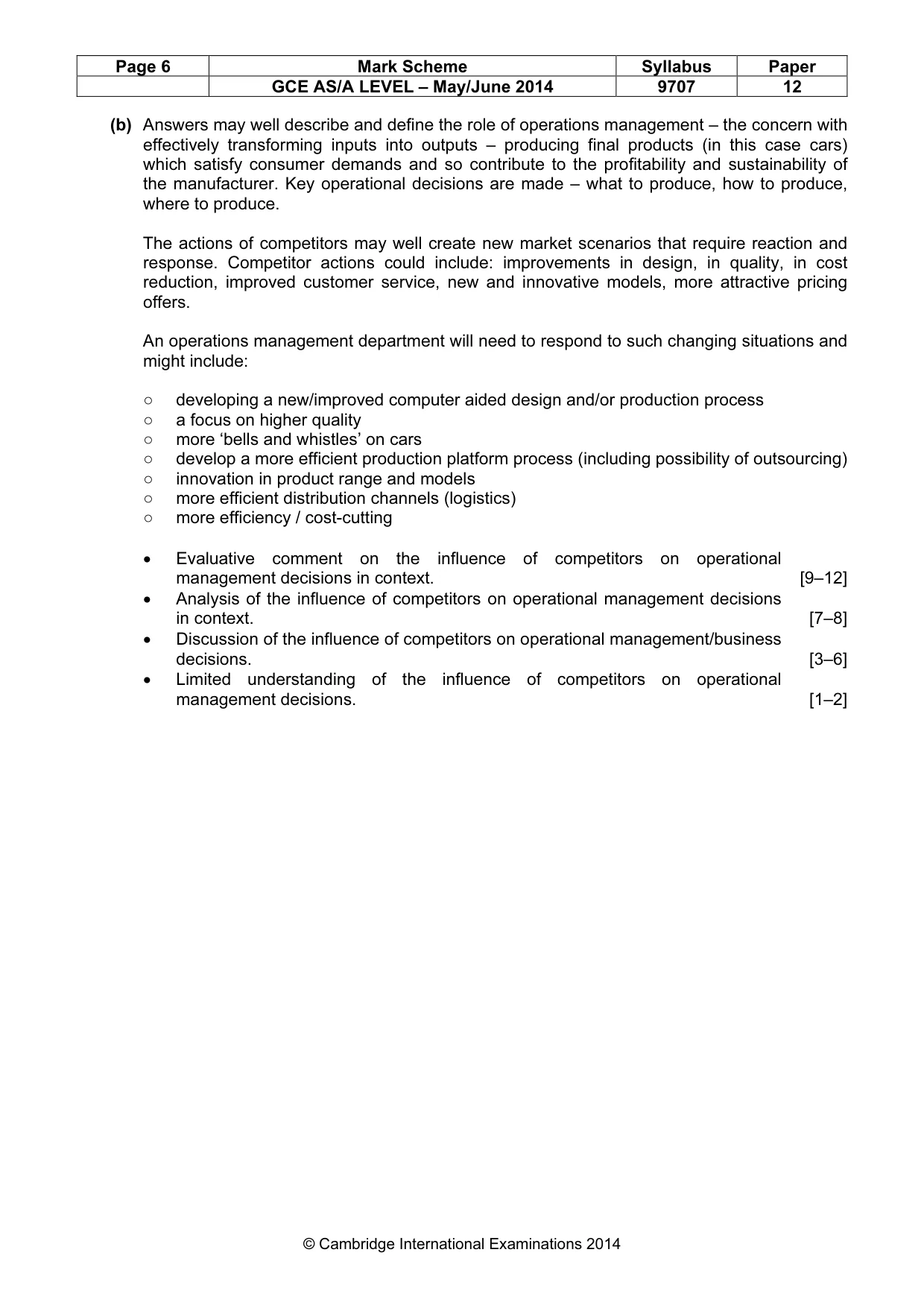
Page 6 Mark Scheme Syllabus Paper GCE AS/A LEVEL – May/June 2014 9707 12 © Cambridge International Examinations 2014 (b) Answers may well describe and define the role of operations management – the concern with effectively transforming inputs into outputs – producing final products (in this case cars) which satisfy consumer demands and so contribute to the profitability and sustainability of the manufacturer. Key operational decisions are made – what to produce, how to produce, where to produce. The actions of competitors may well create new market scenarios that require reaction and response. Competitor actions could include: improvements in design, in quality, in cost reduction, improved customer service, new and innovative models, more attractive pricing offers. An operations management department will need to respond to such changing situations and might include: ○ developing a new/improved computer aided design and/or production process ○ a focus on higher quality ○ more ‘bells and whistles’ on cars ○ develop a more efficient production platform process (including possibility of outsourcing) ○ innovation in product range and models ○ more efficient distribution channels (logistics) ○ more efficiency / cost-cutting • Evaluative comment on the influence of competitors on operational management decisions in context. [9–12] • Analysis of the influence of competitors on operational management decisions in context. [7–8] • Discussion of the influence of competitors on operational management/business decisions. [3–6] • Limited understanding of the influence of competitors on operational management decisions. [1–2]
What you needed in this session
Cambridge’s own grade thresholds for 2014 May/June, Paper 1 · Variant 2. A higher threshold means an easier paper — the bar moves with how the cohort did.