Cambridge A Level Business Studies (for final examination in 2015) 9707 — 2015 May/June Paper 1 · Variant 2
9707/12/M/J/15 · 40 marks · ≈45 min
The question paper and its mark scheme, free to read here and free to download. This is Cambridge’s own paper, exactly as it was sat.
Question paper4 pages


Mark scheme8 pages
Answers below. Sit the paper first if you are practising.
Paper as text
Question paper, page 1
This document consists of 2 printed pages, 2 blank pages and 1 insert. DC (LK) 101237 © UCLES 2015 [Turn over Cambridge International Examinations Cambridge International Advanced Subsidiary and Advanced Level * 2 9 1 8 9 6 3 7 7 0 * BUSINESS STUDIES 9707/12 Paper 1 Short Answer and Essay May/June 2015 1 hour 15 minutes No Additional Materials are required. READ THESE INSTRUCTIONS FIRST An answer booklet is provided inside this question paper. You should follow the instructions on the front cover of the answer booklet. If you need additional answer paper ask the invigilator for a continuation booklet. Section A Answer all questions. Section B Answer one question. You are advised to spend no more than 35 minutes on Section A. The number of marks is given in brackets [ ] at the end of each question or part question.
Question paper, page 2
2 9707/12/M/J/15 © UCLES 2015 Section A (Short Answer) Answer all questions. 1 (a) Define the term ‘social enterprise’. [2] (b) Briefly explain two ways in which the objectives of a social enterprise might be similar to those of other types of business. [3] 2 (a) Define the term ‘emotional intelligence’. [2] (b) Briefly explain two of Goleman’s emotional intelligence competencies. [3] 3 Explain how a business could improve its cash flow. [5] 4 (a) Define the term ‘diseconomies of scale’. [2] (b) Briefly explain two causes of managerial diseconomies of scale. [3] Section B (Essay) Answer one question only. 5 (a) Explain how information in the income statement of a public limited company is useful for potential investors. [8] (b) Discuss the usefulness of accounting ratios for assessing business performance. [12] 6 Discuss the view that product differentiation is the most important activity of the marketing department of a motor car manufacturer. [20] 7 (a) Explain why it is important for a business to have an effective system of recruitment and selection. [8] (b) Discuss why a school might decide to recruit a new head teacher externally, rather than by internal promotion. [12]
Question paper, page 3
3 9707/12/M/J/15 © UCLES 2015 BLANK PAGE
Question paper, page 4
4 9707/12/M/J/15 © UCLES 2015 Permission to reproduce items where third-party owned material protected by copyright is included has been sought and cleared where possible. Every reasonable effort has been made by the publisher (UCLES) to trace copyright holders, but if any items requiring clearance have unwittingly been included, the publisher will be pleased to make amends at the earliest possible opportunity. To avoid the issue of disclosure of answer-related information to candidates, all copyright acknowledgements are reproduced online in the Cambridge International Examinations Copyright Acknowledgements Booklet. This is produced for each series of examinations and is freely available to download at www.cie.org.uk after the live examination series. Cambridge International Examinations is part of the Cambridge Assessment Group. Cambridge Assessment is the brand name of University of Cambridge Local Examinations Syndicate (UCLES), which is itself a department of the University of Cambridge. BLANK PAGE
Mark scheme, page 1
® IGCSE is the registered trademark of Cambridge International Examinations. CAMBRIDGE INTERNATIONAL EXAMINATIONS Cambridge International Advanced Subsidiary and Advanced Level MARK SCHEME for the May/June 2015 series 9707 BUSINESS STUDIES 9707/12 Paper 1 (Short Answer/Essay), maximum raw mark 40 This mark scheme is published as an aid to teachers and candidates, to indicate the requirements of the examination. It shows the basis on which Examiners were instructed to award marks. It does not indicate the details of the discussions that took place at an Examiners’ meeting before marking began, which would have considered the acceptability of alternative answers. Mark schemes should be read in conjunction with the question paper and the Principal Examiner Report for Teachers. Cambridge will not enter into discussions about these mark schemes. Cambridge is publishing the mark schemes for the May/June 2015 series for most Cambridge IGCSE®, Cambridge International A and AS Level components and some Cambridge O Level components.
Mark scheme, page 2
Page 2 Mark Scheme Syllabus Paper Cambridge International AS/A Level – May/June 2015 9707 12 © Cambridge International Examinations 2015 1 (a) A social enterprise has been defined as a business with primarily social objectives whose surpluses are reinvested in the business or the community, rather than providing profits for shareholders or owners. • Full definition – sound understanding [2] • Partial definition – limited understanding [1] (b) Although a social enterprise is a business that has specific social objectives and is not solely in pursuit of profit, it still shares some common features with other types of businesses such as: – It is a business that seeks to make a surplus/profit – It is concerned with being efficient and effective. – It will likely face competition from other businesses in the same market or industry. – It uses business principles and processes to achieve its objectives. – It will have concerns for its workforce – It will aim to deliver quality goods and services. – It is of course committed to social/environmental responsibility as can be other businesses. • Sound explanation of TWO similarities. [3] • Sound explanation of ONE similarity or partial explanation of TWO. [2] • Partial explanation of ONE similarity or simple statement of TWO. [1]
Mark scheme, page 3
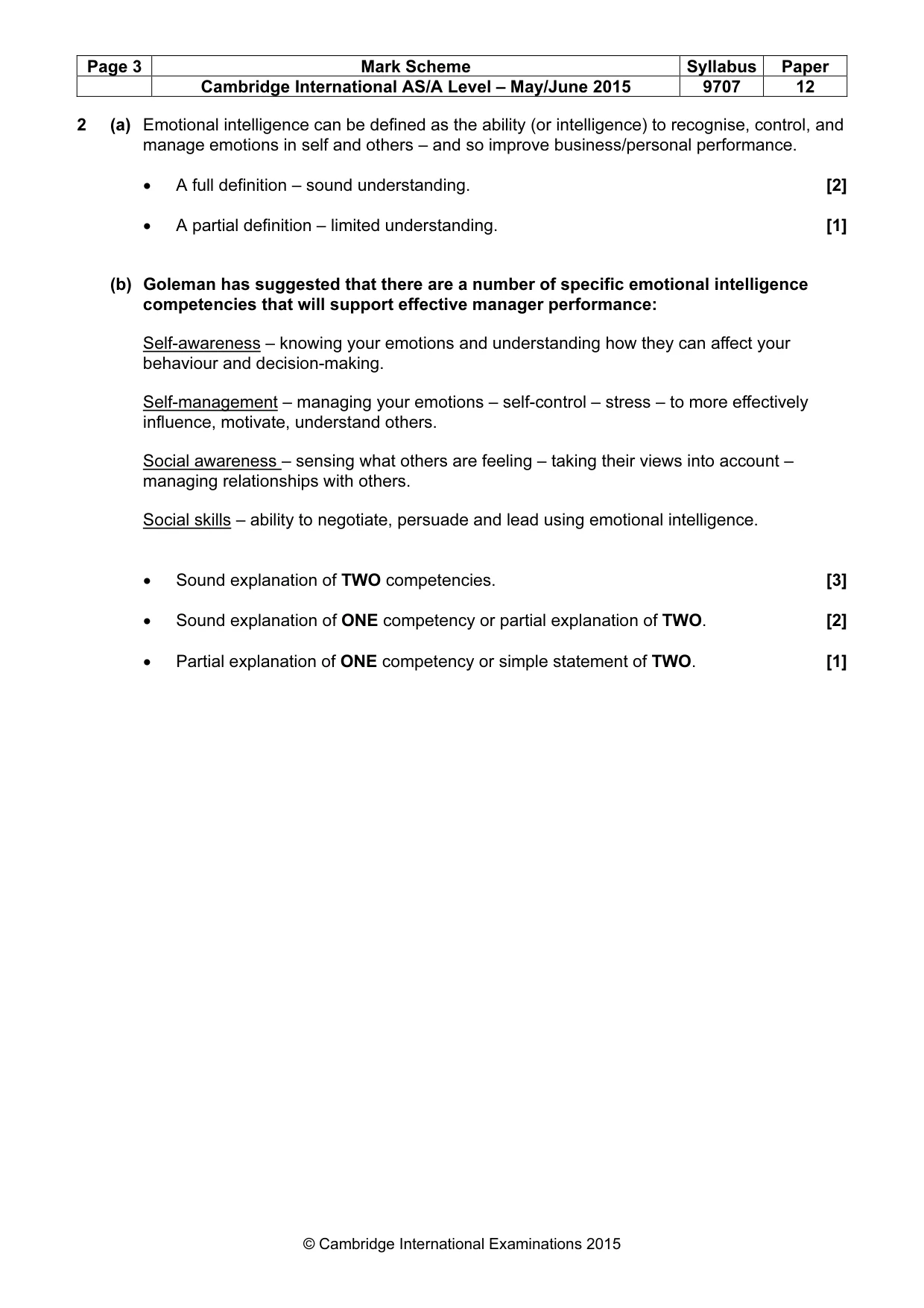
Page 3 Mark Scheme Syllabus Paper Cambridge International AS/A Level – May/June 2015 9707 12 © Cambridge International Examinations 2015 2 (a) Emotional intelligence can be defined as the ability (or intelligence) to recognise, control, and manage emotions in self and others – and so improve business/personal performance. • A full definition – sound understanding. [2] • A partial definition – limited understanding. [1] (b) Goleman has suggested that there are a number of specific emotional intelligence competencies that will support effective manager performance: Self-awareness – knowing your emotions and understanding how they can affect your behaviour and decision-making. Self-management – managing your emotions – self-control – stress – to more effectively influence, motivate, understand others. Social awareness – sensing what others are feeling – taking their views into account – managing relationships with others. Social skills – ability to negotiate, persuade and lead using emotional intelligence. • Sound explanation of TWO competencies. [3] • Sound explanation of ONE competency or partial explanation of TWO. [2] • Partial explanation of ONE competency or simple statement of TWO. [1]
Mark scheme, page 4
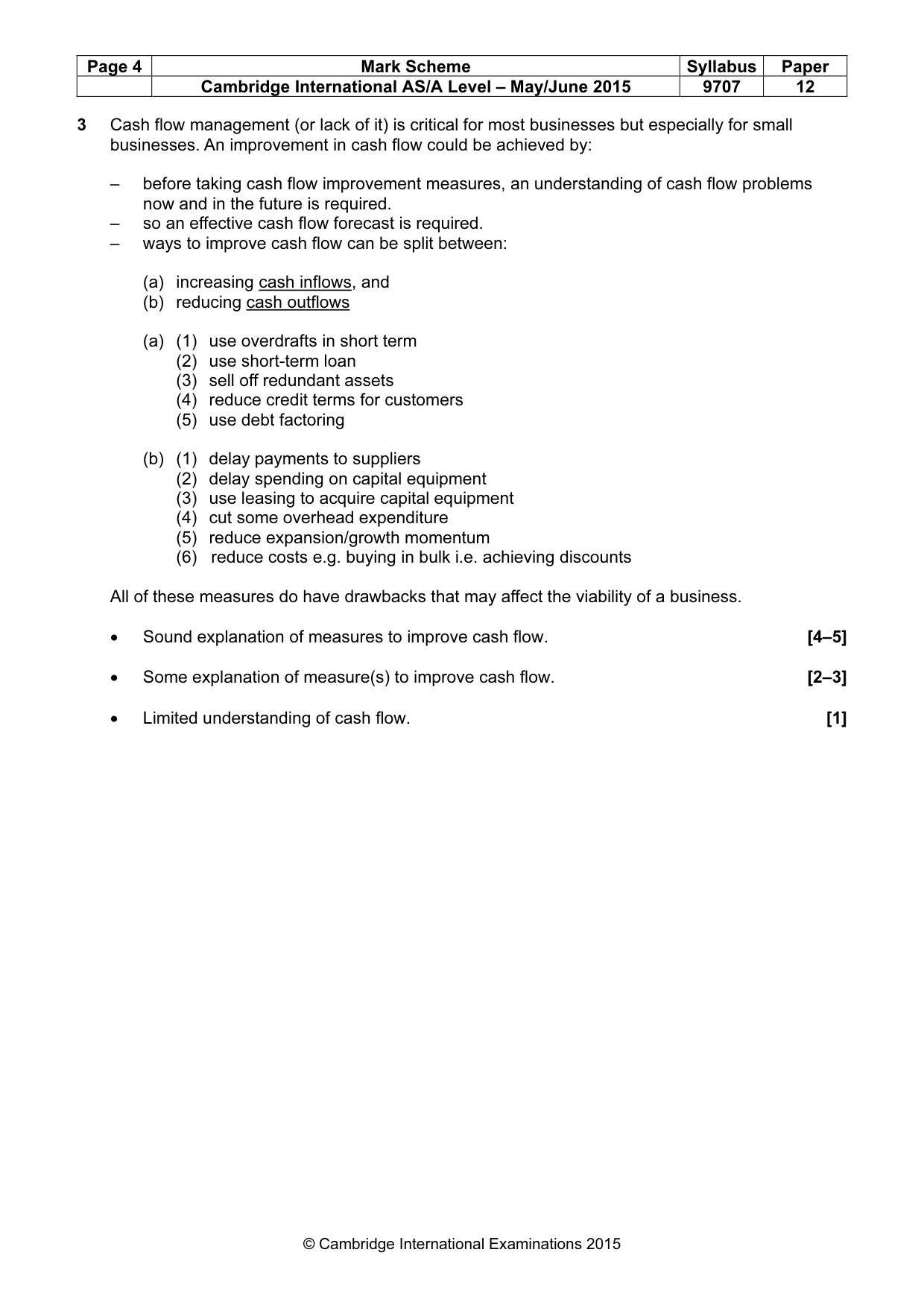
Page 4 Mark Scheme Syllabus Paper Cambridge International AS/A Level – May/June 2015 9707 12 © Cambridge International Examinations 2015 3 Cash flow management (or lack of it) is critical for most businesses but especially for small businesses. An improvement in cash flow could be achieved by: – before taking cash flow improvement measures, an understanding of cash flow problems now and in the future is required. – so an effective cash flow forecast is required. – ways to improve cash flow can be split between: (a) increasing cash inflows, and (b) reducing cash outflows (a) (1) use overdrafts in short term (2) use short-term loan (3) sell off redundant assets (4) reduce credit terms for customers (5) use debt factoring (b) (1) delay payments to suppliers (2) delay spending on capital equipment (3) use leasing to acquire capital equipment (4) cut some overhead expenditure (5) reduce expansion/growth momentum (6) reduce costs e.g. buying in bulk i.e. achieving discounts All of these measures do have drawbacks that may affect the viability of a business. • Sound explanation of measures to improve cash flow. [4–5] • Some explanation of measure(s) to improve cash flow. [2–3] • Limited understanding of cash flow. [1]
Mark scheme, page 5
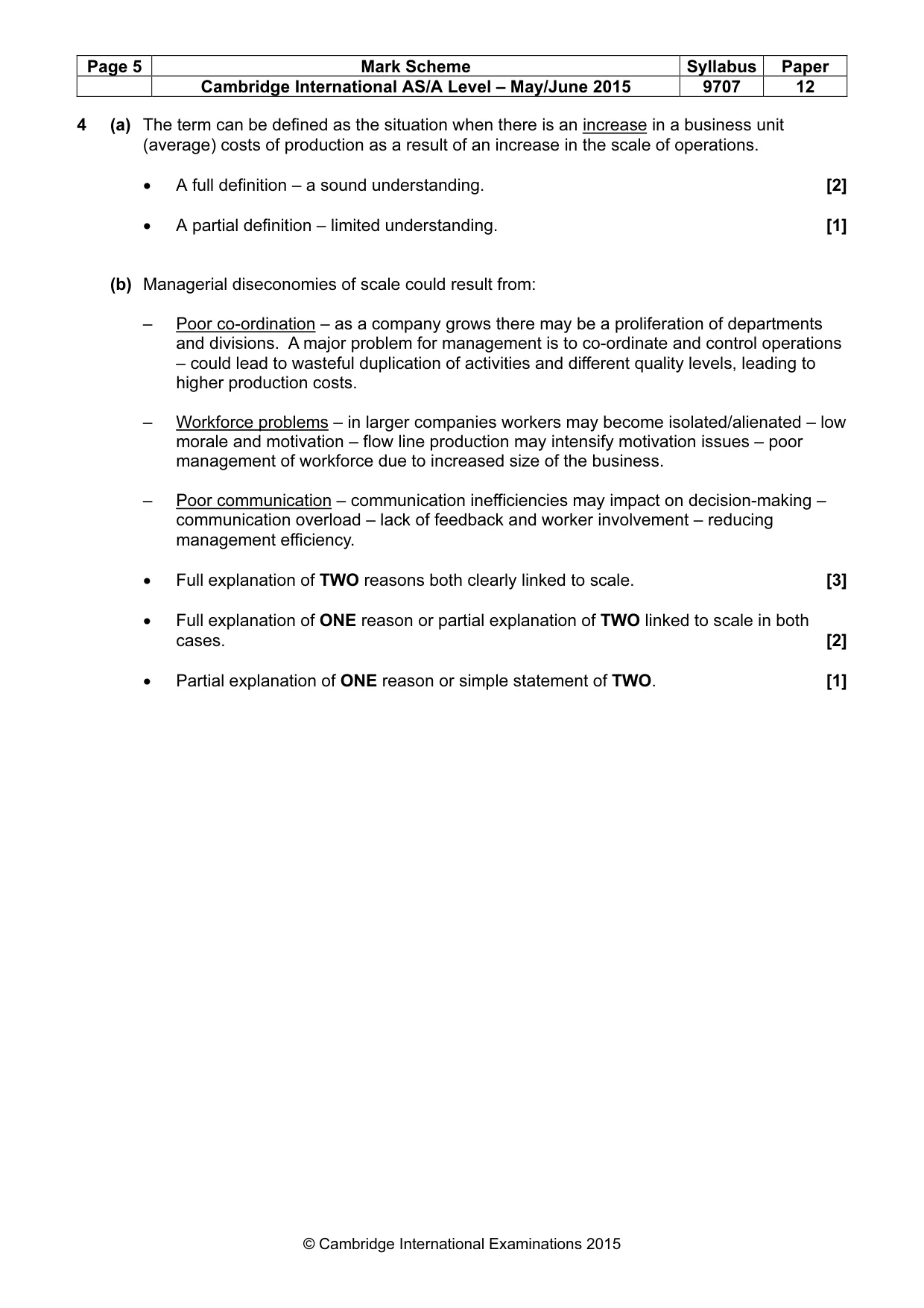
Page 5 Mark Scheme Syllabus Paper Cambridge International AS/A Level – May/June 2015 9707 12 © Cambridge International Examinations 2015 4 (a) The term can be defined as the situation when there is an increase in a business unit (average) costs of production as a result of an increase in the scale of operations. • A full definition – a sound understanding. [2] • A partial definition – limited understanding. [1] (b) Managerial diseconomies of scale could result from: – Poor co-ordination – as a company grows there may be a proliferation of departments and divisions. A major problem for management is to co-ordinate and control operations – could lead to wasteful duplication of activities and different quality levels, leading to higher production costs. – Workforce problems – in larger companies workers may become isolated/alienated – low morale and motivation – flow line production may intensify motivation issues – poor management of workforce due to increased size of the business. – Poor communication – communication inefficiencies may impact on decision-making – communication overload – lack of feedback and worker involvement – reducing management efficiency. • Full explanation of TWO reasons both clearly linked to scale. [3] • Full explanation of ONE reason or partial explanation of TWO linked to scale in both cases. [2] • Partial explanation of ONE reason or simple statement of TWO. [1]
Mark scheme, page 6
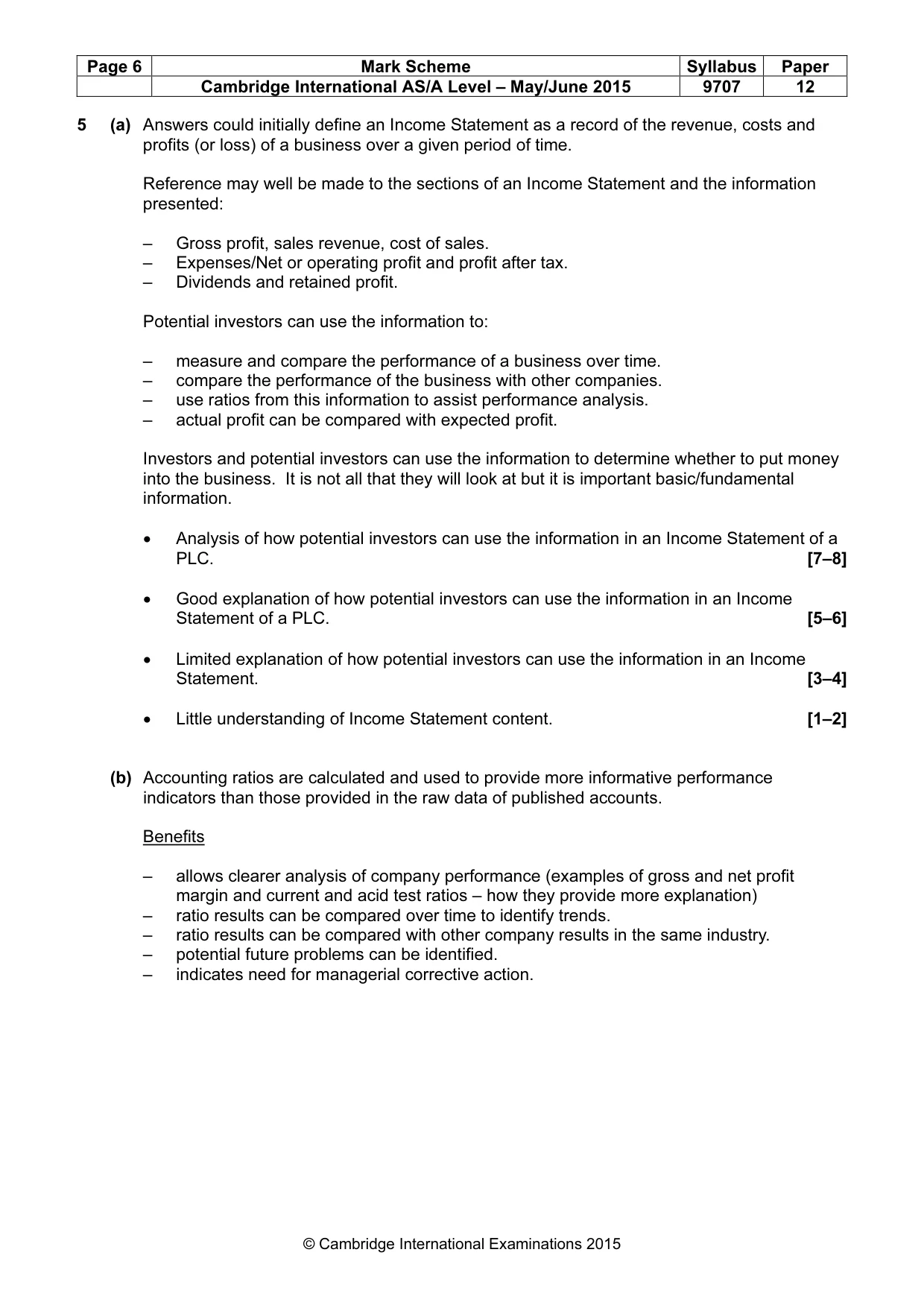
Page 6 Mark Scheme Syllabus Paper Cambridge International AS/A Level – May/June 2015 9707 12 © Cambridge International Examinations 2015 5 (a) Answers could initially define an Income Statement as a record of the revenue, costs and profits (or loss) of a business over a given period of time. Reference may well be made to the sections of an Income Statement and the information presented: – Gross profit, sales revenue, cost of sales. – Expenses/Net or operating profit and profit after tax. – Dividends and retained profit. Potential investors can use the information to: – measure and compare the performance of a business over time. – compare the performance of the business with other companies. – use ratios from this information to assist performance analysis. – actual profit can be compared with expected profit. Investors and potential investors can use the information to determine whether to put money into the business. It is not all that they will look at but it is important basic/fundamental information. • Analysis of how potential investors can use the information in an Income Statement of a PLC. [7–8] • Good explanation of how potential investors can use the information in an Income Statement of a PLC. [5–6] • Limited explanation of how potential investors can use the information in an Income Statement. [3–4] • Little understanding of Income Statement content. [1–2] (b) Accounting ratios are calculated and used to provide more informative performance indicators than those provided in the raw data of published accounts. Benefits – allows clearer analysis of company performance (examples of gross and net profit margin and current and acid test ratios – how they provide more explanation) – ratio results can be compared over time to identify trends. – ratio results can be compared with other company results in the same industry. – potential future problems can be identified. – indicates need for managerial corrective action.
Mark scheme, page 7
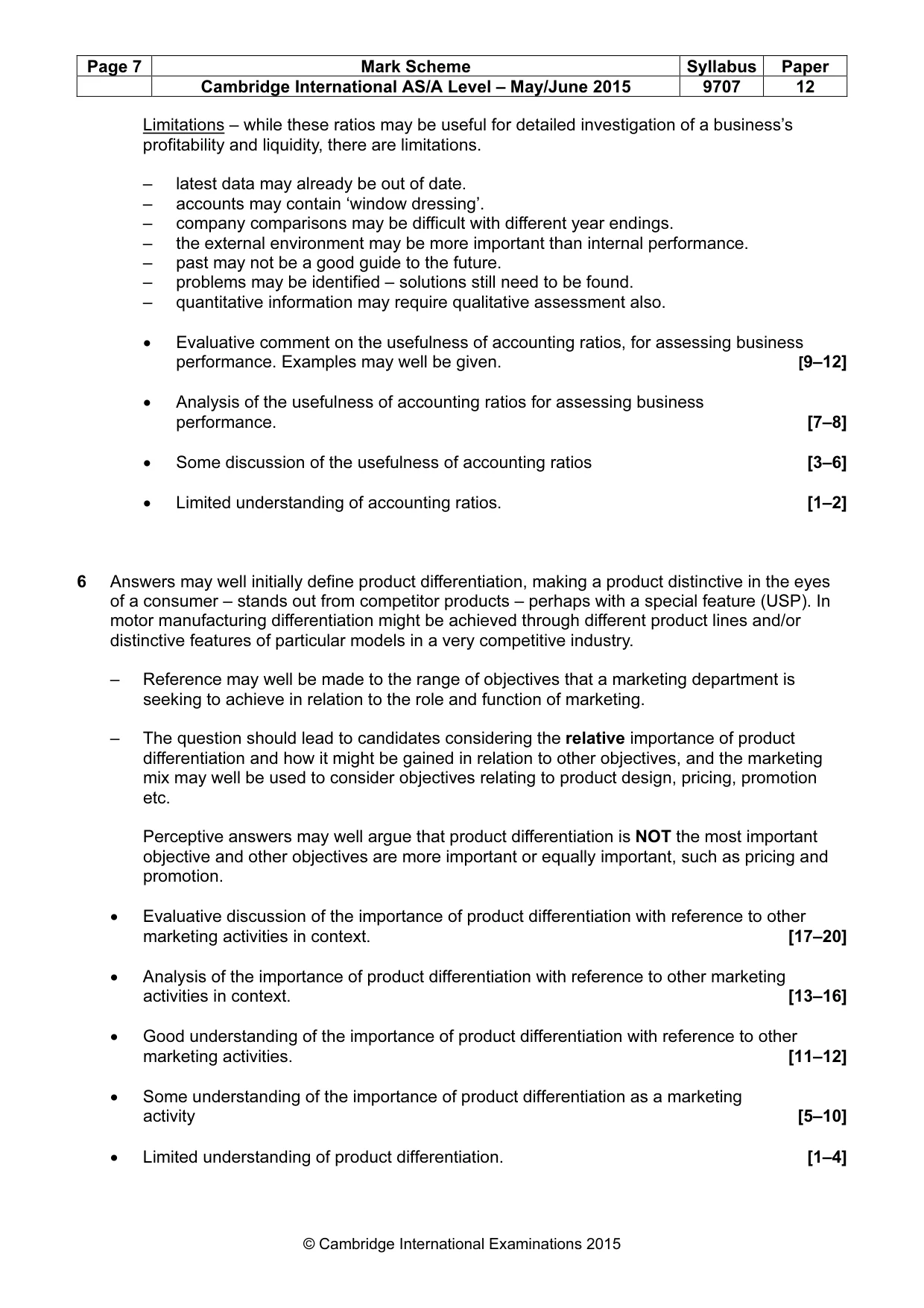
Page 7 Mark Scheme Syllabus Paper Cambridge International AS/A Level – May/June 2015 9707 12 © Cambridge International Examinations 2015 Limitations – while these ratios may be useful for detailed investigation of a business’s profitability and liquidity, there are limitations. – latest data may already be out of date. – accounts may contain ‘window dressing’. – company comparisons may be difficult with different year endings. – the external environment may be more important than internal performance. – past may not be a good guide to the future. – problems may be identified – solutions still need to be found. – quantitative information may require qualitative assessment also. • Evaluative comment on the usefulness of accounting ratios, for assessing business performance. Examples may well be given. [9–12] • Analysis of the usefulness of accounting ratios for assessing business performance. [7–8] • Some discussion of the usefulness of accounting ratios [3–6] • Limited understanding of accounting ratios. [1–2] 6 Answers may well initially define product differentiation, making a product distinctive in the eyes of a consumer – stands out from competitor products – perhaps with a special feature (USP). In motor manufacturing differentiation might be achieved through different product lines and/or distinctive features of particular models in a very competitive industry. – Reference may well be made to the range of objectives that a marketing department is seeking to achieve in relation to the role and function of marketing. – The question should lead to candidates considering the relative importance of product differentiation and how it might be gained in relation to other objectives, and the marketing mix may well be used to consider objectives relating to product design, pricing, promotion etc. Perceptive answers may well argue that product differentiation is NOT the most important objective and other objectives are more important or equally important, such as pricing and promotion. • Evaluative discussion of the importance of product differentiation with reference to other marketing activities in context. [17–20] • Analysis of the importance of product differentiation with reference to other marketing activities in context. [13–16] • Good understanding of the importance of product differentiation with reference to other marketing activities. [11–12] • Some understanding of the importance of product differentiation as a marketing activity [5–10] • Limited understanding of product differentiation. [1–4]
Mark scheme, page 8
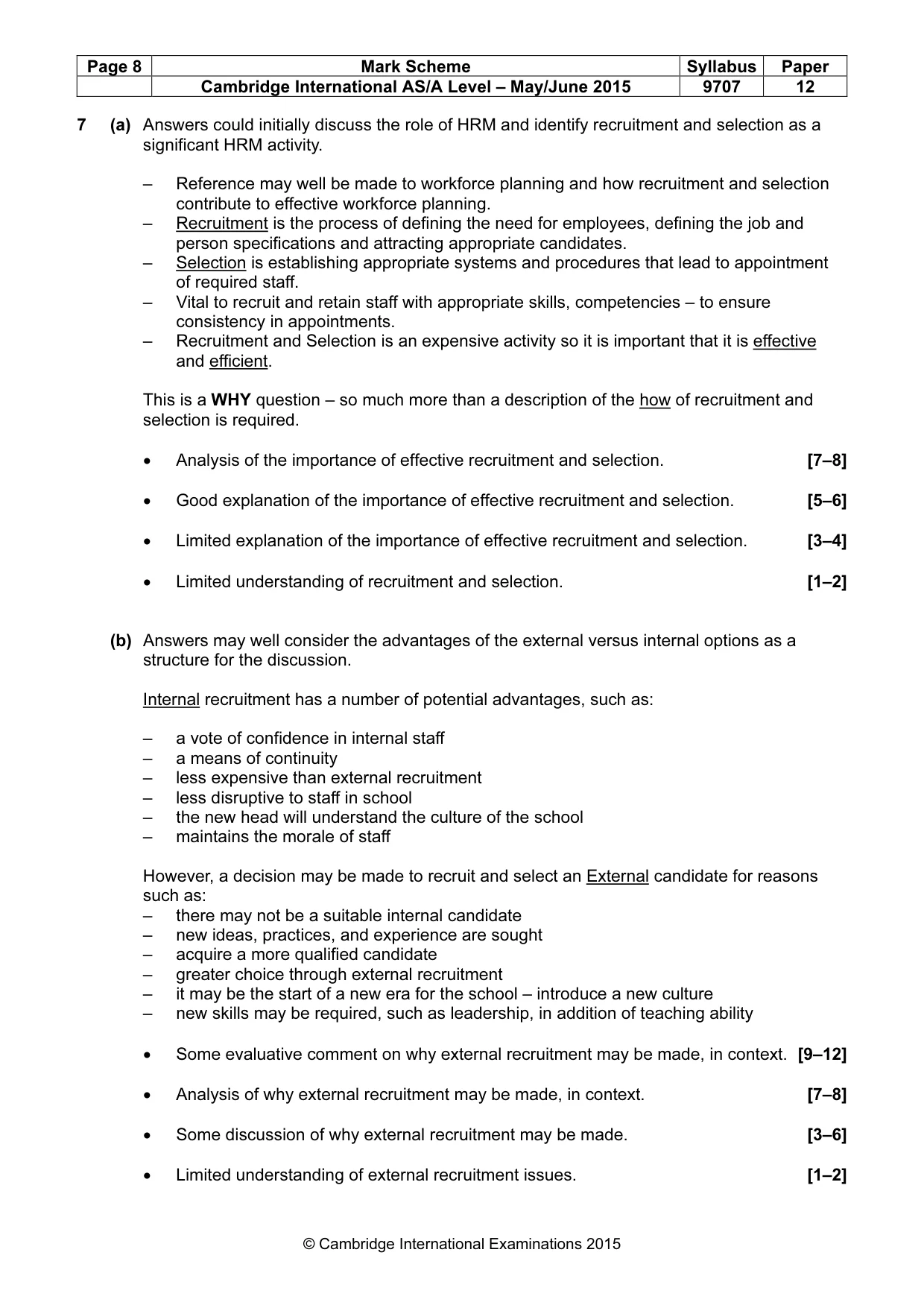
Page 8 Mark Scheme Syllabus Paper Cambridge International AS/A Level – May/June 2015 9707 12 © Cambridge International Examinations 2015 7 (a) Answers could initially discuss the role of HRM and identify recruitment and selection as a significant HRM activity. – Reference may well be made to workforce planning and how recruitment and selection contribute to effective workforce planning. – Recruitment is the process of defining the need for employees, defining the job and person specifications and attracting appropriate candidates. – Selection is establishing appropriate systems and procedures that lead to appointment of required staff. – Vital to recruit and retain staff with appropriate skills, competencies – to ensure consistency in appointments. – Recruitment and Selection is an expensive activity so it is important that it is effective and efficient. This is a WHY question – so much more than a description of the how of recruitment and selection is required. • Analysis of the importance of effective recruitment and selection. [7–8] • Good explanation of the importance of effective recruitment and selection. [5–6] • Limited explanation of the importance of effective recruitment and selection. [3–4] • Limited understanding of recruitment and selection. [1–2] (b) Answers may well consider the advantages of the external versus internal options as a structure for the discussion. Internal recruitment has a number of potential advantages, such as: – a vote of confidence in internal staff – a means of continuity – less expensive than external recruitment – less disruptive to staff in school – the new head will understand the culture of the school – maintains the morale of staff However, a decision may be made to recruit and select an External candidate for reasons such as: – there may not be a suitable internal candidate – new ideas, practices, and experience are sought – acquire a more qualified candidate – greater choice through external recruitment – it may be the start of a new era for the school – introduce a new culture – new skills may be required, such as leadership, in addition of teaching ability • Some evaluative comment on why external recruitment may be made, in context. [9–12] • Analysis of why external recruitment may be made, in context. [7–8] • Some discussion of why external recruitment may be made. [3–6] • Limited understanding of external recruitment issues. [1–2]
What you needed in this session
Cambridge’s own grade thresholds for 2015 May/June, Paper 1 · Variant 2. A higher threshold means an easier paper — the bar moves with how the cohort did.