Cambridge A Level Business Studies (for final examination in 2015) 9707 — 2015 Oct/Nov Paper 1 · Variant 1
9707/11/O/N/15
The question paper and its mark scheme, free to read here and free to download. This is Cambridge’s own paper, exactly as it was sat.
Question paper4 pages


Mark scheme6 pages
Answers below. Sit the paper first if you are practising.
Paper as text
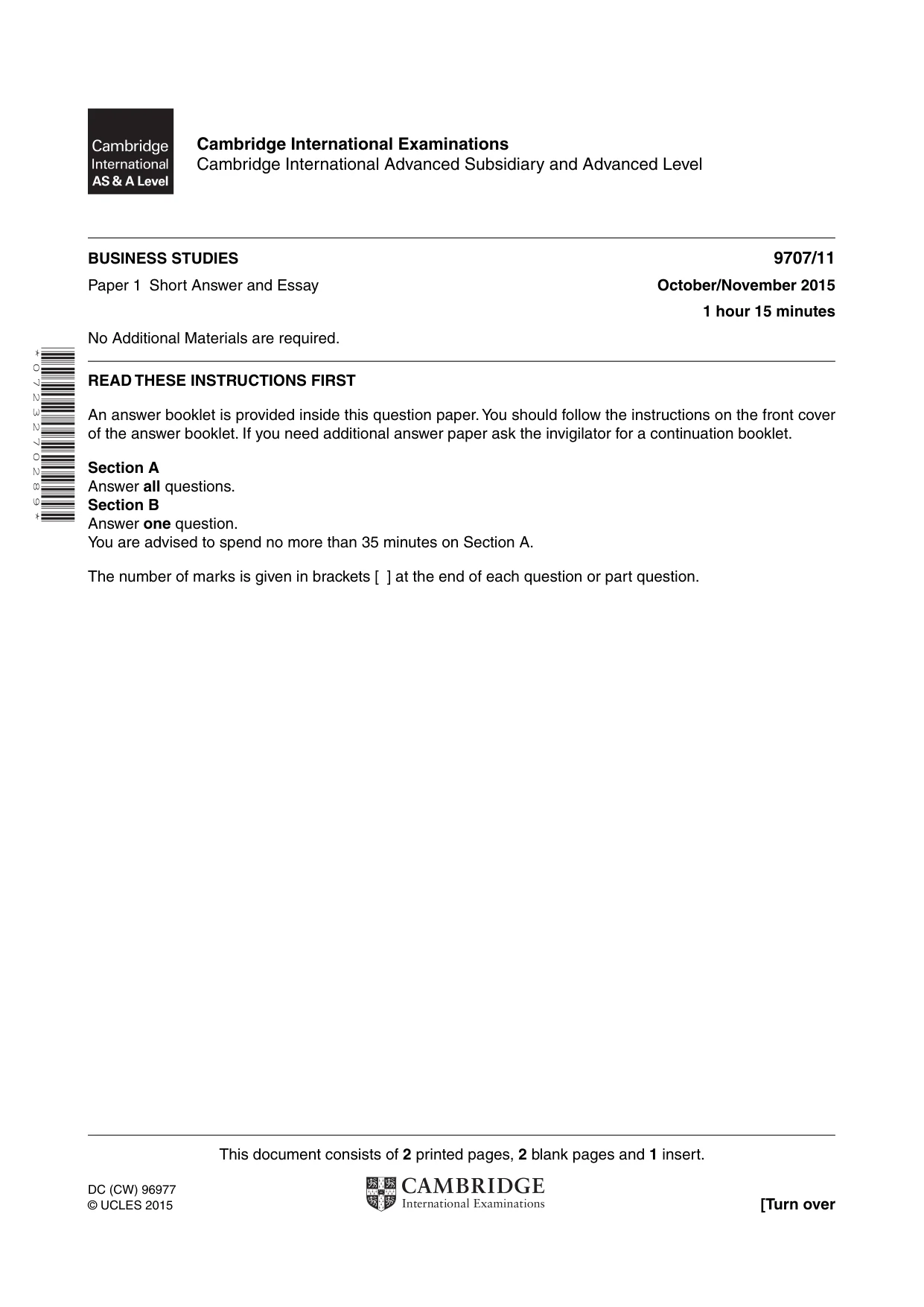
Question paper, page 1
This document consists of 2 printed pages, 2 blank pages and 1 insert. DC (CW) 96977 © UCLES 2015 [Turn over Cambridge International Examinations Cambridge International Advanced Subsidiary and Advanced Level * 0 7 2 3 2 7 0 2 8 9 * BUSINESS STUDIES 9707/11 Paper 1 Short Answer and Essay October/November 2015 1 hour 15 minutes No Additional Materials are required. READ THESE INSTRUCTIONS FIRST An answer booklet is provided inside this question paper. You should follow the instructions on the front cover of the answer booklet. If you need additional answer paper ask the invigilator for a continuation booklet. Section A Answer all questions. Section B Answer one question. You are advised to spend no more than 35 minutes on Section A. The number of marks is given in brackets [ ] at the end of each question or part question.
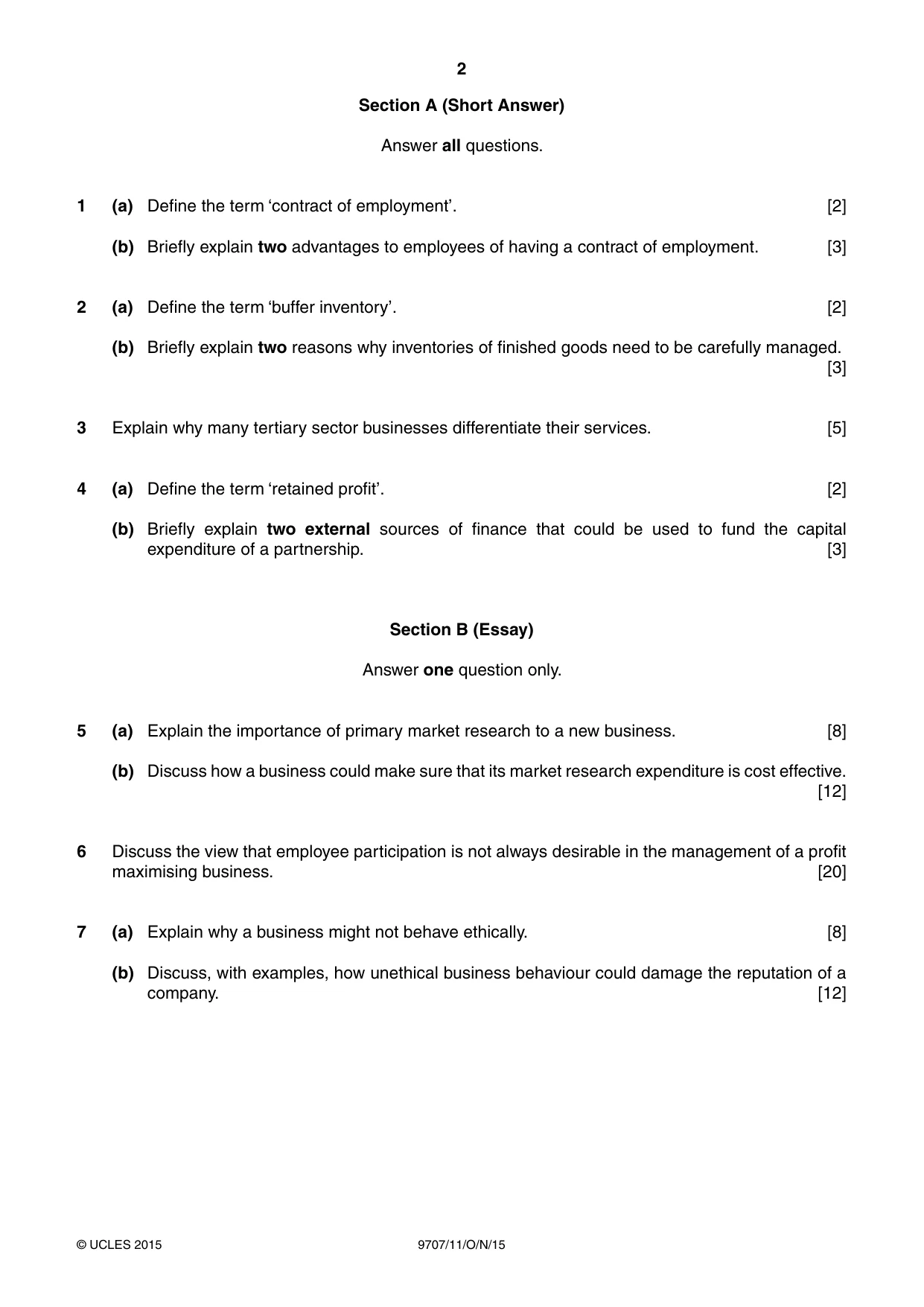
Question paper, page 2
2 9707/11/O/N/15 © UCLES 2015 Section A (Short Answer) Answer all questions. 1 (a) Define the term ‘contract of employment’. [2] (b) Briefly explain two advantages to employees of having a contract of employment. [3] 2 (a) Define the term ‘buffer inventory’. [2] (b) Briefly explain two reasons why inventories of finished goods need to be carefully managed. [3] 3 Explain why many tertiary sector businesses differentiate their services. [5] 4 (a) Define the term ‘retained profit’. [2] (b) Briefly explain two external sources of finance that could be used to fund the capital expenditure of a partnership. [3] Section B (Essay) Answer one question only. 5 (a) Explain the importance of primary market research to a new business. [8] (b) Discuss how a business could make sure that its market research expenditure is cost effective. [12] 6 Discuss the view that employee participation is not always desirable in the management of a profit maximising business. [20] 7 (a) Explain why a business might not behave ethically. [8] (b) Discuss, with examples, how unethical business behaviour could damage the reputation of a company. [12]
Question paper, page 3
3 9707/11/O/N/15 © UCLES 2015 BLANK PAGE
Question paper, page 4
4 9707/11/O/N/15 © UCLES 2015 BLANK PAGE Permission to reproduce items where third-party owned material protected by copyright is included has been sought and cleared where possible. Every reasonable effort has been made by the publisher (UCLES) to trace copyright holders, but if any items requiring clearance have unwittingly been included, the publisher will be pleased to make amends at the earliest possible opportunity. To avoid the issue of disclosure of answer-related information to candidates, all copyright acknowledgements are reproduced online in the Cambridge International Examinations Copyright Acknowledgements Booklet. This is produced for each series of examinations and is freely available to download at www.cie.org.uk after the live examination series. Cambridge International Examinations is part of the Cambridge Assessment Group. Cambridge Assessment is the brand name of University of Cambridge Local Examinations Syndicate (UCLES), which is itself a department of the University of Cambridge.
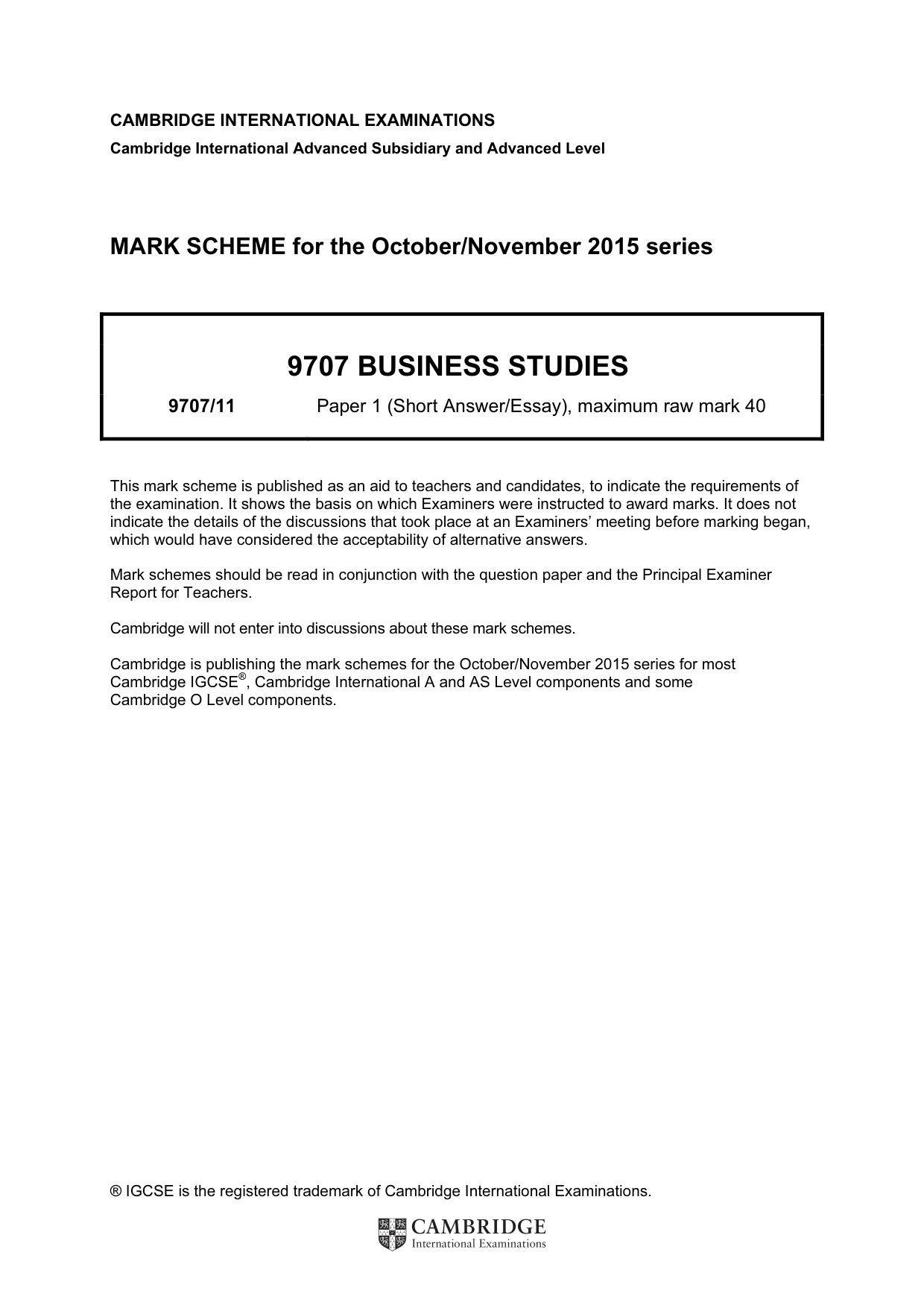
Mark scheme, page 1
® IGCSE is the registered trademark of Cambridge International Examinations. CAMBRIDGE INTERNATIONAL EXAMINATIONS Cambridge International Advanced Subsidiary and Advanced Level MARK SCHEME for the October/November 2015 series 9707 BUSINESS STUDIES 9707/11 Paper 1 (Short Answer/Essay), maximum raw mark 40 This mark scheme is published as an aid to teachers and candidates, to indicate the requirements of the examination. It shows the basis on which Examiners were instructed to award marks. It does not indicate the details of the discussions that took place at an Examiners’ meeting before marking began, which would have considered the acceptability of alternative answers. Mark schemes should be read in conjunction with the question paper and the Principal Examiner Report for Teachers. Cambridge will not enter into discussions about these mark schemes. Cambridge is publishing the mark schemes for the October/November 2015 series for most Cambridge IGCSE®, Cambridge International A and AS Level components and some Cambridge O Level components.
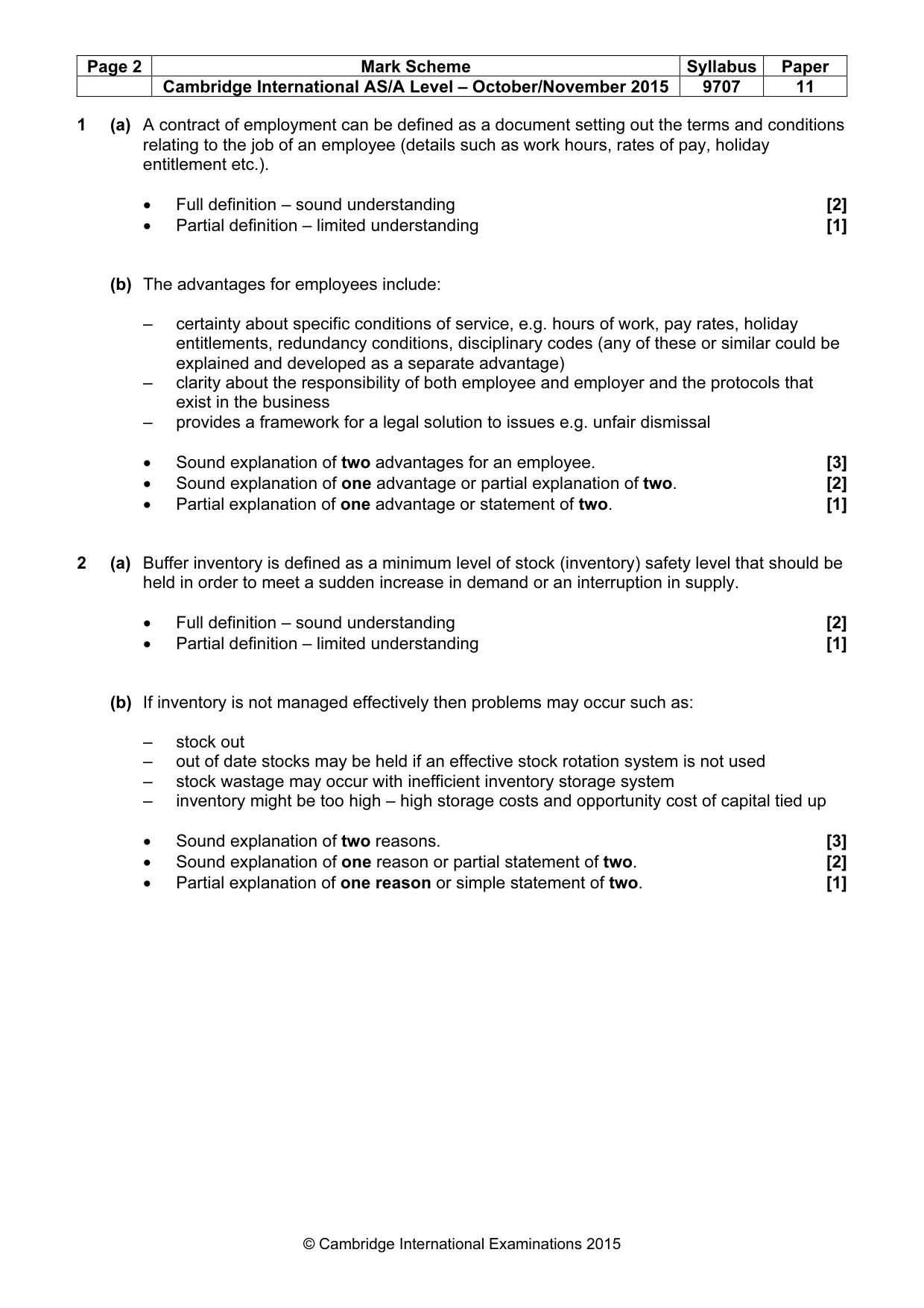
Mark scheme, page 2
Page 2 Mark Scheme Syllabus Paper Cambridge International AS/A Level – October/November 2015 9707 11 © Cambridge International Examinations 2015 1 (a) A contract of employment can be defined as a document setting out the terms and conditions relating to the job of an employee (details such as work hours, rates of pay, holiday entitlement etc.). • Full definition – sound understanding [2] • Partial definition – limited understanding [1] (b) The advantages for employees include: – certainty about specific conditions of service, e.g. hours of work, pay rates, holiday entitlements, redundancy conditions, disciplinary codes (any of these or similar could be explained and developed as a separate advantage) – clarity about the responsibility of both employee and employer and the protocols that exist in the business – provides a framework for a legal solution to issues e.g. unfair dismissal • Sound explanation of two advantages for an employee. [3] • Sound explanation of one advantage or partial explanation of two. [2] • Partial explanation of one advantage or statement of two. [1] 2 (a) Buffer inventory is defined as a minimum level of stock (inventory) safety level that should be held in order to meet a sudden increase in demand or an interruption in supply. • Full definition – sound understanding [2] • Partial definition – limited understanding [1] (b) If inventory is not managed effectively then problems may occur such as: – stock out – out of date stocks may be held if an effective stock rotation system is not used – stock wastage may occur with inefficient inventory storage system – inventory might be too high – high storage costs and opportunity cost of capital tied up • Sound explanation of two reasons. [3] • Sound explanation of one reason or partial statement of two. [2] • Partial explanation of one reason or simple statement of two. [1]
Mark scheme, page 3
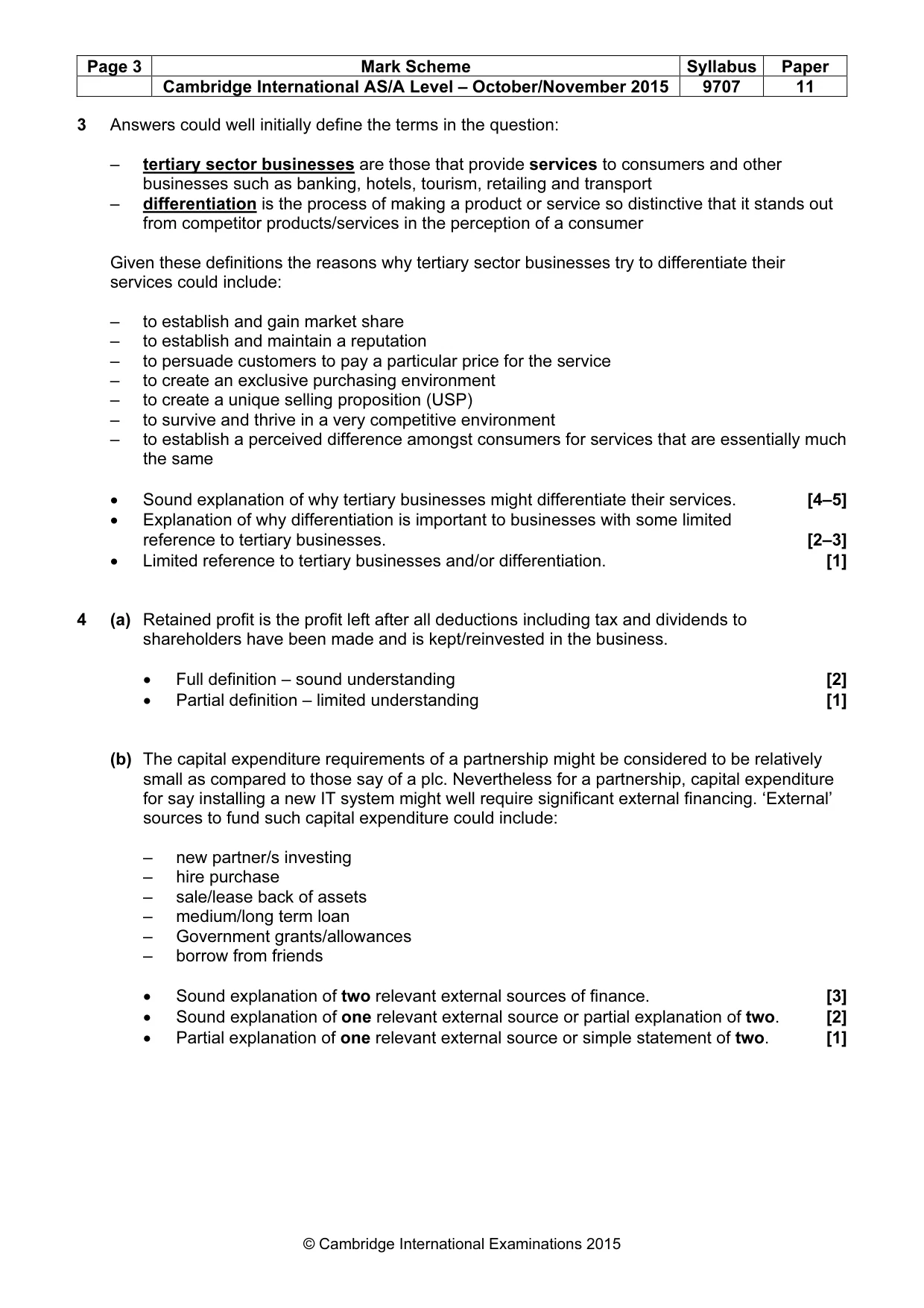
Page 3 Mark Scheme Syllabus Paper Cambridge International AS/A Level – October/November 2015 9707 11 © Cambridge International Examinations 2015 3 Answers could well initially define the terms in the question: – tertiary sector businesses are those that provide services to consumers and other businesses such as banking, hotels, tourism, retailing and transport – differentiation is the process of making a product or service so distinctive that it stands out from competitor products/services in the perception of a consumer Given these definitions the reasons why tertiary sector businesses try to differentiate their services could include: – to establish and gain market share – to establish and maintain a reputation – to persuade customers to pay a particular price for the service – to create an exclusive purchasing environment – to create a unique selling proposition (USP) – to survive and thrive in a very competitive environment – to establish a perceived difference amongst consumers for services that are essentially much the same • Sound explanation of why tertiary businesses might differentiate their services. [4–5] • Explanation of why differentiation is important to businesses with some limited reference to tertiary businesses. [2–3] • Limited reference to tertiary businesses and/or differentiation. [1] 4 (a) Retained profit is the profit left after all deductions including tax and dividends to shareholders have been made and is kept/reinvested in the business. • Full definition – sound understanding [2] • Partial definition – limited understanding [1] (b) The capital expenditure requirements of a partnership might be considered to be relatively small as compared to those say of a plc. Nevertheless for a partnership, capital expenditure for say installing a new IT system might well require significant external financing. ‘External’ sources to fund such capital expenditure could include: – new partner/s investing – hire purchase – sale/lease back of assets – medium/long term loan – Government grants/allowances – borrow from friends • Sound explanation of two relevant external sources of finance. [3] • Sound explanation of one relevant external source or partial explanation of two. [2] • Partial explanation of one relevant external source or simple statement of two. [1]
Mark scheme, page 4
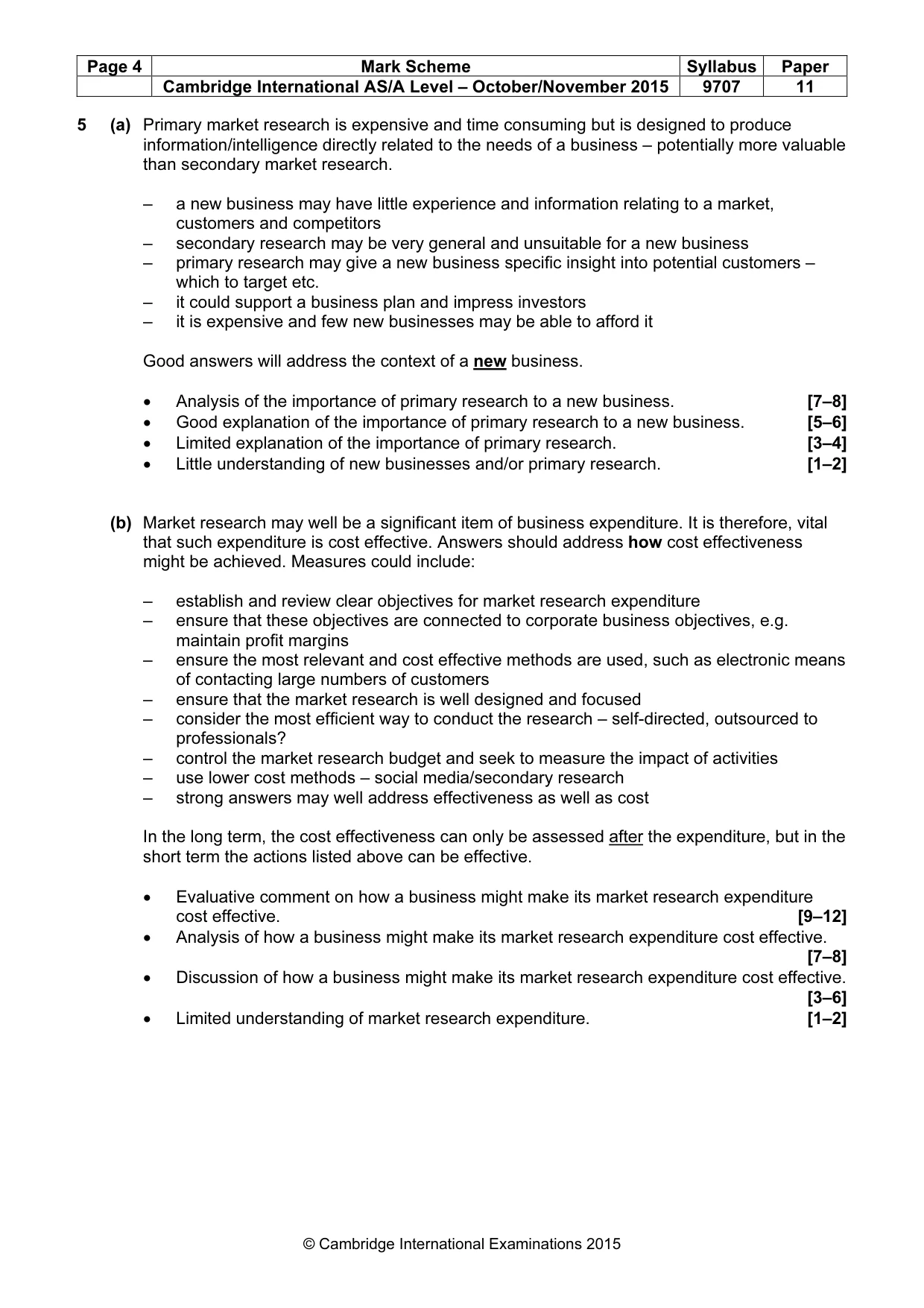
Page 4 Mark Scheme Syllabus Paper Cambridge International AS/A Level – October/November 2015 9707 11 © Cambridge International Examinations 2015 5 (a) Primary market research is expensive and time consuming but is designed to produce information/intelligence directly related to the needs of a business – potentially more valuable than secondary market research. – a new business may have little experience and information relating to a market, customers and competitors – secondary research may be very general and unsuitable for a new business – primary research may give a new business specific insight into potential customers – which to target etc. – it could support a business plan and impress investors – it is expensive and few new businesses may be able to afford it Good answers will address the context of a new business. • Analysis of the importance of primary research to a new business. [7–8] • Good explanation of the importance of primary research to a new business. [5–6] • Limited explanation of the importance of primary research. [3–4] • Little understanding of new businesses and/or primary research. [1–2] (b) Market research may well be a significant item of business expenditure. It is therefore, vital that such expenditure is cost effective. Answers should address how cost effectiveness might be achieved. Measures could include: – establish and review clear objectives for market research expenditure – ensure that these objectives are connected to corporate business objectives, e.g. maintain profit margins – ensure the most relevant and cost effective methods are used, such as electronic means of contacting large numbers of customers – ensure that the market research is well designed and focused – consider the most efficient way to conduct the research – self-directed, outsourced to professionals? – control the market research budget and seek to measure the impact of activities – use lower cost methods – social media/secondary research – strong answers may well address effectiveness as well as cost In the long term, the cost effectiveness can only be assessed after the expenditure, but in the short term the actions listed above can be effective. • Evaluative comment on how a business might make its market research expenditure cost effective. [9–12] • Analysis of how a business might make its market research expenditure cost effective. [7–8] • Discussion of how a business might make its market research expenditure cost effective. [3–6] • Limited understanding of market research expenditure. [1–2]
Mark scheme, page 5
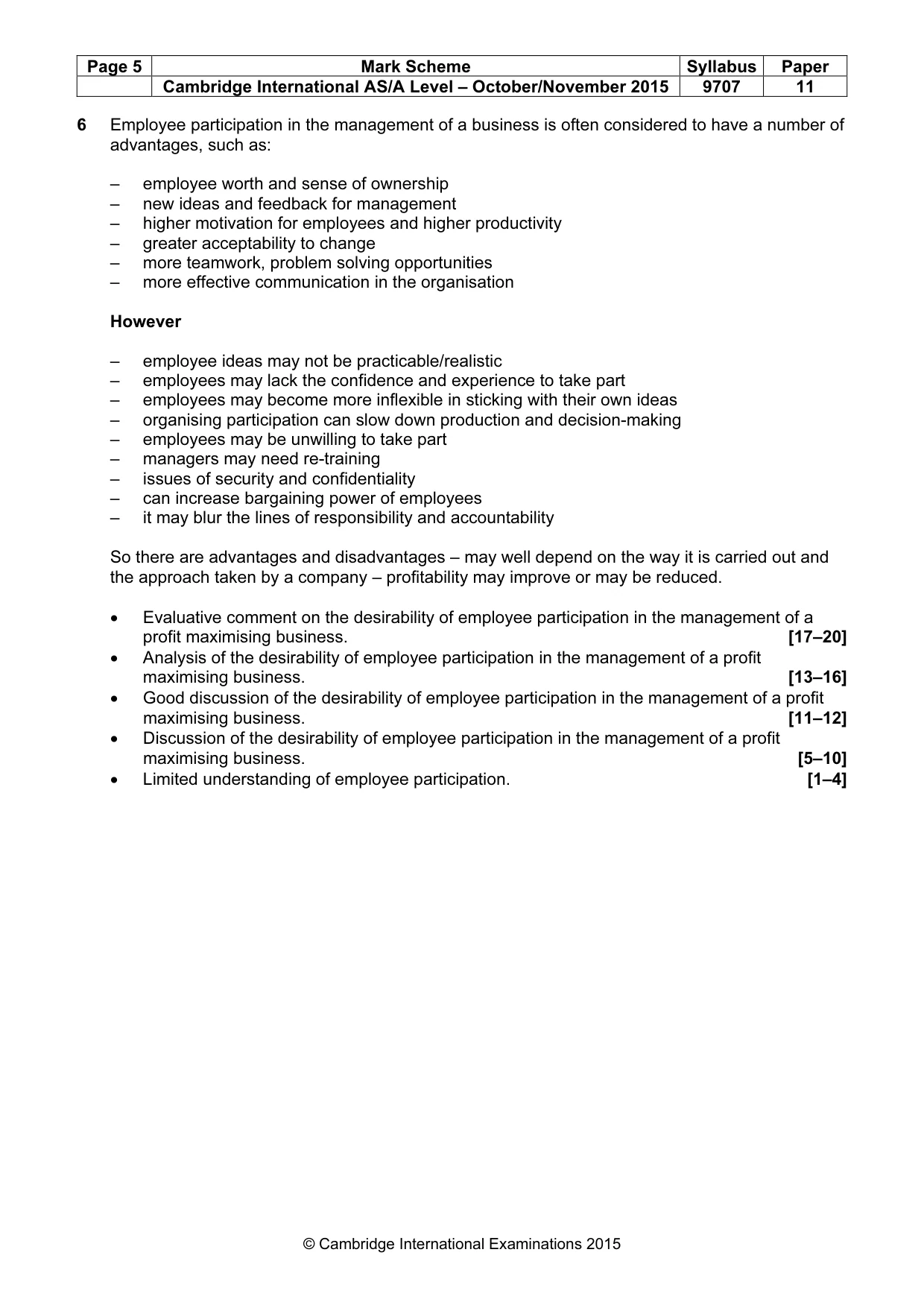
Page 5 Mark Scheme Syllabus Paper Cambridge International AS/A Level – October/November 2015 9707 11 © Cambridge International Examinations 2015 6 Employee participation in the management of a business is often considered to have a number of advantages, such as: – employee worth and sense of ownership – new ideas and feedback for management – higher motivation for employees and higher productivity – greater acceptability to change – more teamwork, problem solving opportunities – more effective communication in the organisation However – employee ideas may not be practicable/realistic – employees may lack the confidence and experience to take part – employees may become more inflexible in sticking with their own ideas – organising participation can slow down production and decision-making – employees may be unwilling to take part – managers may need re-training – issues of security and confidentiality – can increase bargaining power of employees – it may blur the lines of responsibility and accountability So there are advantages and disadvantages – may well depend on the way it is carried out and the approach taken by a company – profitability may improve or may be reduced. • Evaluative comment on the desirability of employee participation in the management of a profit maximising business. [17–20] • Analysis of the desirability of employee participation in the management of a profit maximising business. [13–16] • Good discussion of the desirability of employee participation in the management of a profit maximising business. [11–12] • Discussion of the desirability of employee participation in the management of a profit maximising business. [5–10] • Limited understanding of employee participation. [1–4]
Mark scheme, page 6
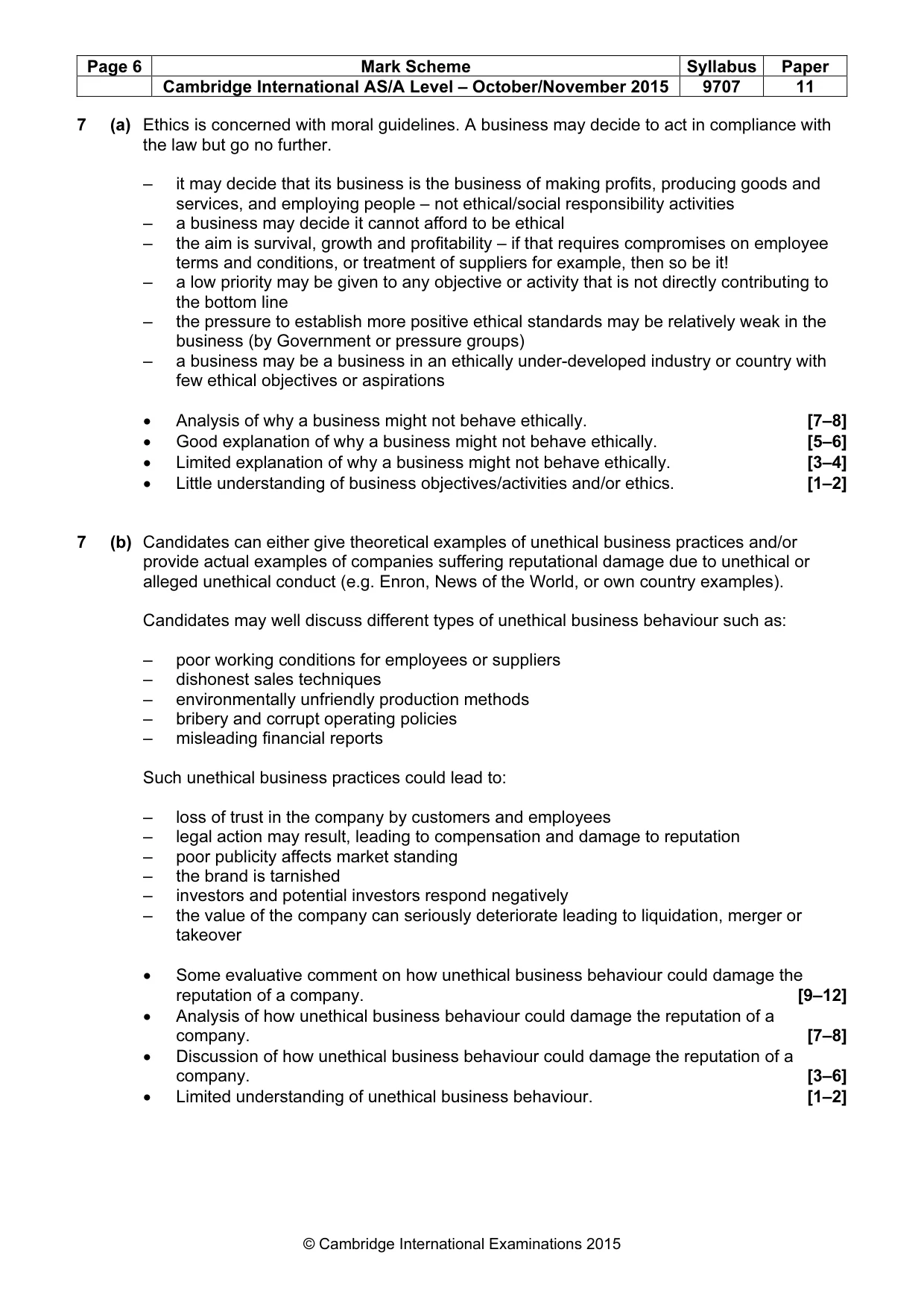
Page 6 Mark Scheme Syllabus Paper Cambridge International AS/A Level – October/November 2015 9707 11 © Cambridge International Examinations 2015 7 (a) Ethics is concerned with moral guidelines. A business may decide to act in compliance with the law but go no further. – it may decide that its business is the business of making profits, producing goods and services, and employing people – not ethical/social responsibility activities – a business may decide it cannot afford to be ethical – the aim is survival, growth and profitability – if that requires compromises on employee terms and conditions, or treatment of suppliers for example, then so be it! – a low priority may be given to any objective or activity that is not directly contributing to the bottom line – the pressure to establish more positive ethical standards may be relatively weak in the business (by Government or pressure groups) – a business may be a business in an ethically under-developed industry or country with few ethical objectives or aspirations • Analysis of why a business might not behave ethically. [7–8] • Good explanation of why a business might not behave ethically. [5–6] • Limited explanation of why a business might not behave ethically. [3–4] • Little understanding of business objectives/activities and/or ethics. [1–2] 7 (b) Candidates can either give theoretical examples of unethical business practices and/or provide actual examples of companies suffering reputational damage due to unethical or alleged unethical conduct (e.g. Enron, News of the World, or own country examples). Candidates may well discuss different types of unethical business behaviour such as: – poor working conditions for employees or suppliers – dishonest sales techniques – environmentally unfriendly production methods – bribery and corrupt operating policies – misleading financial reports Such unethical business practices could lead to: – loss of trust in the company by customers and employees – legal action may result, leading to compensation and damage to reputation – poor publicity affects market standing – the brand is tarnished – investors and potential investors respond negatively – the value of the company can seriously deteriorate leading to liquidation, merger or takeover • Some evaluative comment on how unethical business behaviour could damage the reputation of a company. [9–12] • Analysis of how unethical business behaviour could damage the reputation of a company. [7–8] • Discussion of how unethical business behaviour could damage the reputation of a company. [3–6] • Limited understanding of unethical business behaviour. [1–2]