Cambridge A Level Business Studies (for final examination in 2015) 9707 — 2014 Oct/Nov Paper 3 · Variant 3
9707/33/O/N/14 · 100 marks · ≈113 min
The question paper and its mark scheme, free to read here and free to download. This is Cambridge’s own paper, exactly as it was sat.
Question paper8 pages


Mark scheme11 pages
Answers below. Sit the paper first if you are practising.
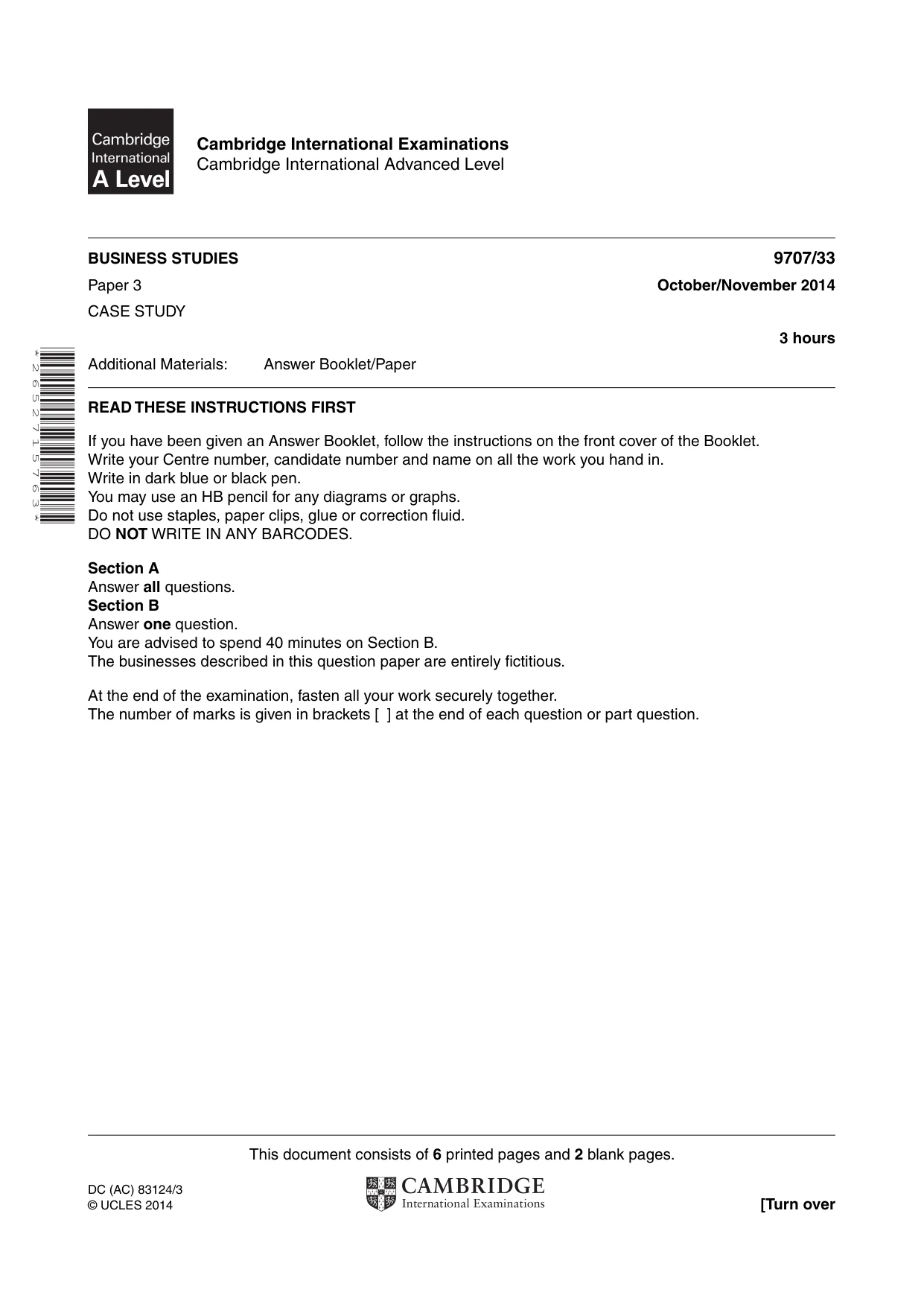
Paper as text
Question paper, page 1
This document consists of 6 printed pages and 2 blank pages. DC (AC) 83124/3 © UCLES 2014 [Turn over Cambridge International Examinations Cambridge International Advanced Level * 2 6 5 2 7 1 5 7 6 3 * BUSINESS STUDIES 9707/33 Paper 3 October/November 2014 CASE STUDY 3 hours Additional Materials: Answer Booklet/Paper READ THESE INSTRUCTIONS FIRST If you have been given an Answer Booklet, follow the instructions on the front cover of the Booklet. Write your Centre number, candidate number and name on all the work you hand in. Write in dark blue or black pen. You may use an HB pencil for any diagrams or graphs. Do not use staples, paper clips, glue or correction fluid. DO NOT WRITE IN ANY BARCODES. Section A Answer all questions. Section B Answer one question. You are advised to spend 40 minutes on Section B. The businesses described in this question paper are entirely fictitious. At the end of the examination, fasten all your work securely together. The number of marks is given in brackets [ ] at the end of each question or part question.
Question paper, page 2
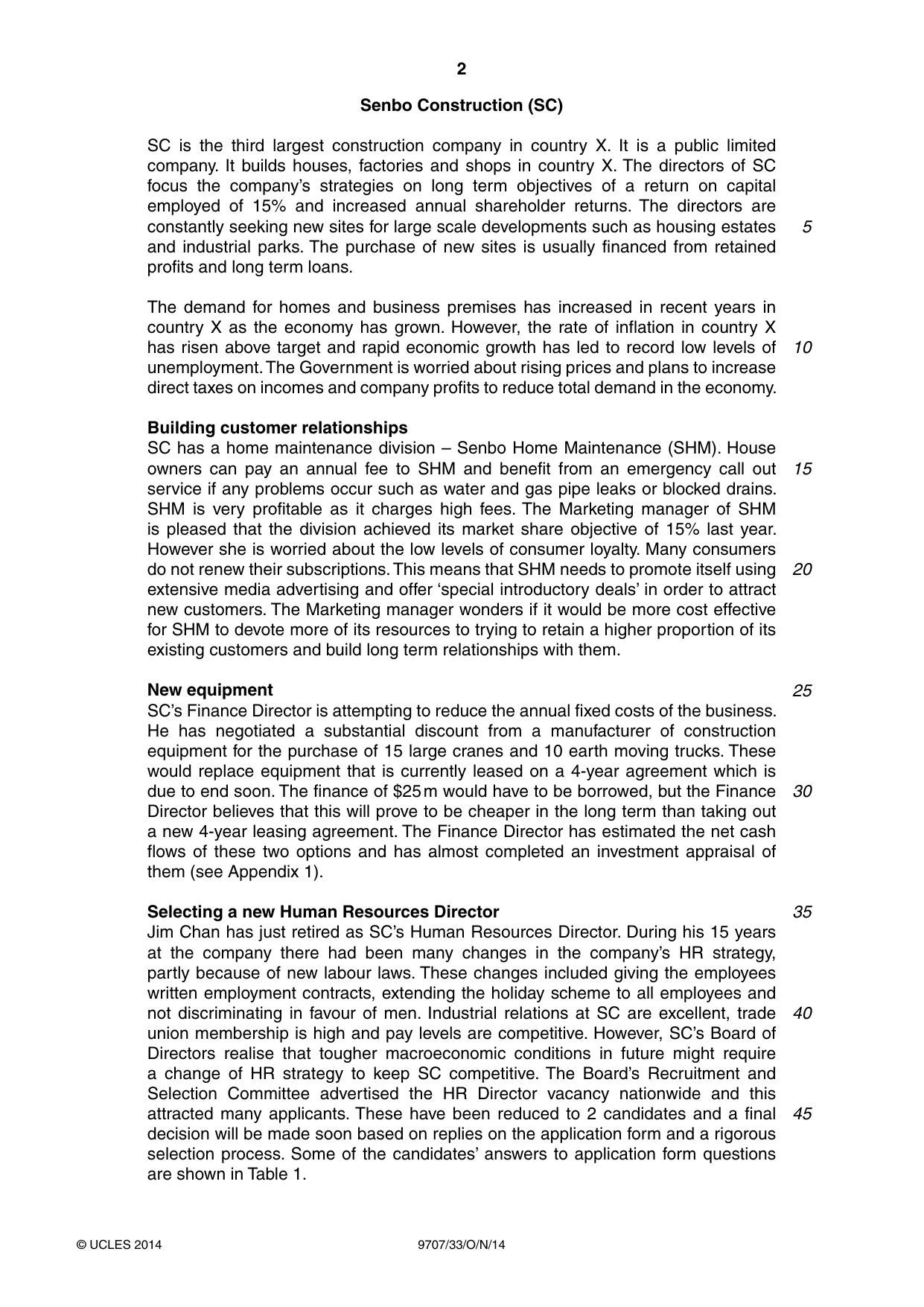
2 9707/33/O/N/14 © UCLES 2014 Senbo Construction (SC) SC is the third largest construction company in country X. It is a public limited company. It builds houses, factories and shops in country X. The directors of SC focus the company’s strategies on long term objectives of a return on capital employed of 15% and increased annual shareholder returns. The directors are constantly seeking new sites for large scale developments such as housing estates and industrial parks. The purchase of new sites is usually financed from retained profits and long term loans. The demand for homes and business premises has increased in recent years in country X as the economy has grown. However, the rate of inflation in country X has risen above target and rapid economic growth has led to record low levels of unemployment. The Government is worried about rising prices and plans to increase direct taxes on incomes and company profits to reduce total demand in the economy. Building customer relationships SC has a home maintenance division – Senbo Home Maintenance (SHM). House owners can pay an annual fee to SHM and benefit from an emergency call out service if any problems occur such as water and gas pipe leaks or blocked drains. SHM is very profitable as it charges high fees. The Marketing manager of SHM is pleased that the division achieved its market share objective of 15% last year. However she is worried about the low levels of consumer loyalty. Many consumers do not renew their subscriptions. This means that SHM needs to promote itself using extensive media advertising and offer ‘special introductory deals’ in order to attract new customers. The Marketing manager wonders if it would be more cost effective for SHM to devote more of its resources to trying to retain a higher proportion of its existing customers and build long term relationships with them. New equipment SC’s Finance Director is attempting to reduce the annual fixed costs of the business. He has negotiated a substantial discount from a manufacturer of construction equipment for the purchase of 15 large cranes and 10 earth moving trucks. These would replace equipment that is currently leased on a 4-year agreement which is due to end soon. The finance of $25 m would have to be borrowed, but the Finance Director believes that this will prove to be cheaper in the long term than taking out a new 4-year leasing agreement. The Finance Director has estimated the net cash flows of these two options and has almost completed an investment appraisal of them (see Appendix 1). Selecting a new Human Resources Director Jim Chan has just retired as SC’s Human Resources Director. During his 15 years at the company there had been many changes in the company’s HR strategy, partly because of new labour laws. These changes included giving the employees written employment contracts, extending the holiday scheme to all employees and not discriminating in favour of men. Industrial relations at SC are excellent, trade union membership is high and pay levels are competitive. However, SC’s Board of Directors realise that tougher macroeconomic conditions in future might require a change of HR strategy to keep SC competitive. The Board’s Recruitment and Selection Committee advertised the HR Director vacancy nationwide and this attracted many applicants. These have been reduced to 2 candidates and a final decision will be made soon based on replies on the application form and a rigorous selection process. Some of the candidates’ answers to application form questions are shown in Table 1. 5 10 15 20 25 30 35 40 45
Question paper, page 3
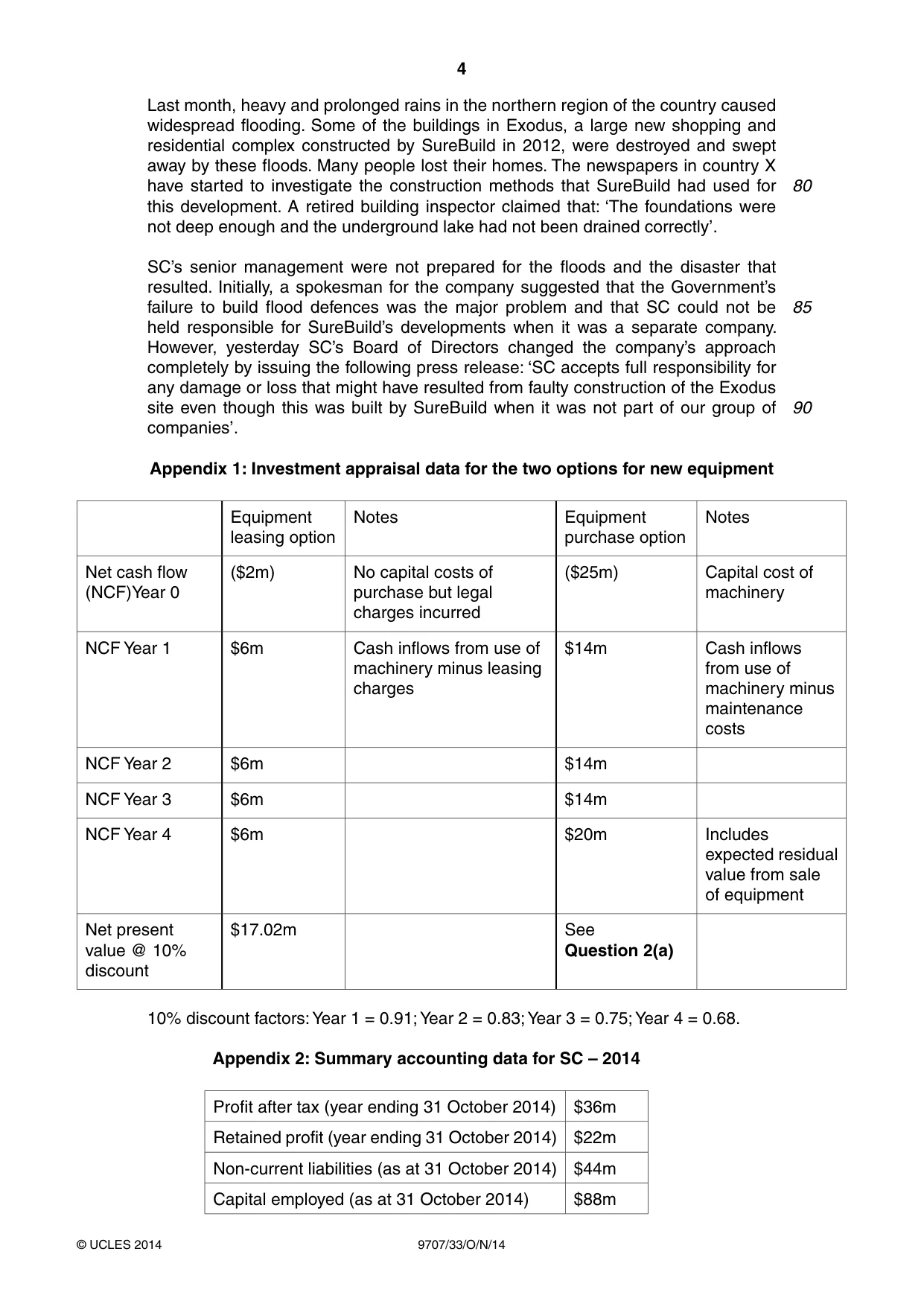
3 9707/33/O/N/14 © UCLES 2014 [Turn over 50 55 60 65 70 75 Table 1: Summary of candidates’ answers to questions on application form for post of HR Director Questions Candidate C’s answers Candidate D’s answers Education qualifications University degree in Human Resource Management. Two university degrees: Business Management; Accounting and Finance. Previous experience 15 years with current employer – major retailer. First post – HR assistant. Current post – senior HR manager. Varied experience in several posts. 3 years with current employer – small construction business. Current post – HR Director. What is your main strategic focus in Human Resources? To develop employees and offer them challenging roles so they can all contribute fully to the success of the business. To manage employee costs effectively so that the financial targets of the business can be achieved. Current salary $35 000 $29 000 Foreign country experience None. Yes – several years ago I worked in country Y with a multinational mining company. Alternative growth strategies SC’s directors are planning to expand the business further. They are considering 2 strategic options. One is based in country X, where SC currently operates, and the other in country Y. Option A: Use a vacant site owned by SC in country X to build a hotel and country club. This would be owned and operated by a new SC division. The key features of this strategy are: • first attempt at managing a development after construction, SC have always sold sites they have developed • according to a preliminary critical path analysis, conducted by SC’s Operations Director, it could be completed within 1 year; this is likely to be 9 months quicker than Option B. Option B: Purchase a vacant site in country Y and develop a luxury housing estate by forming a joint venture with a building firm in that country. The key features of this strategy are: • first time SC will have operated in another country • first time SC will have formed a joint venture • country Y has high average incomes, its economy is expanding rapidly and interest rates are low. Flood disaster At the end of 2013, SC purchased a privately owned construction business called SureBuild. This company’s reputation was not as good as SC’s but it owned many sites with potential for development. SureBuild has been accused by pressure groups of using contaminated and polluted former factory sites for building houses. If true, this would have put the new house owners’ health at risk. SureBuild has always rejected this criticism. Although SC owns SureBuild, the integration of the business and its employees into the SC organisation is not yet complete.
Question paper, page 4
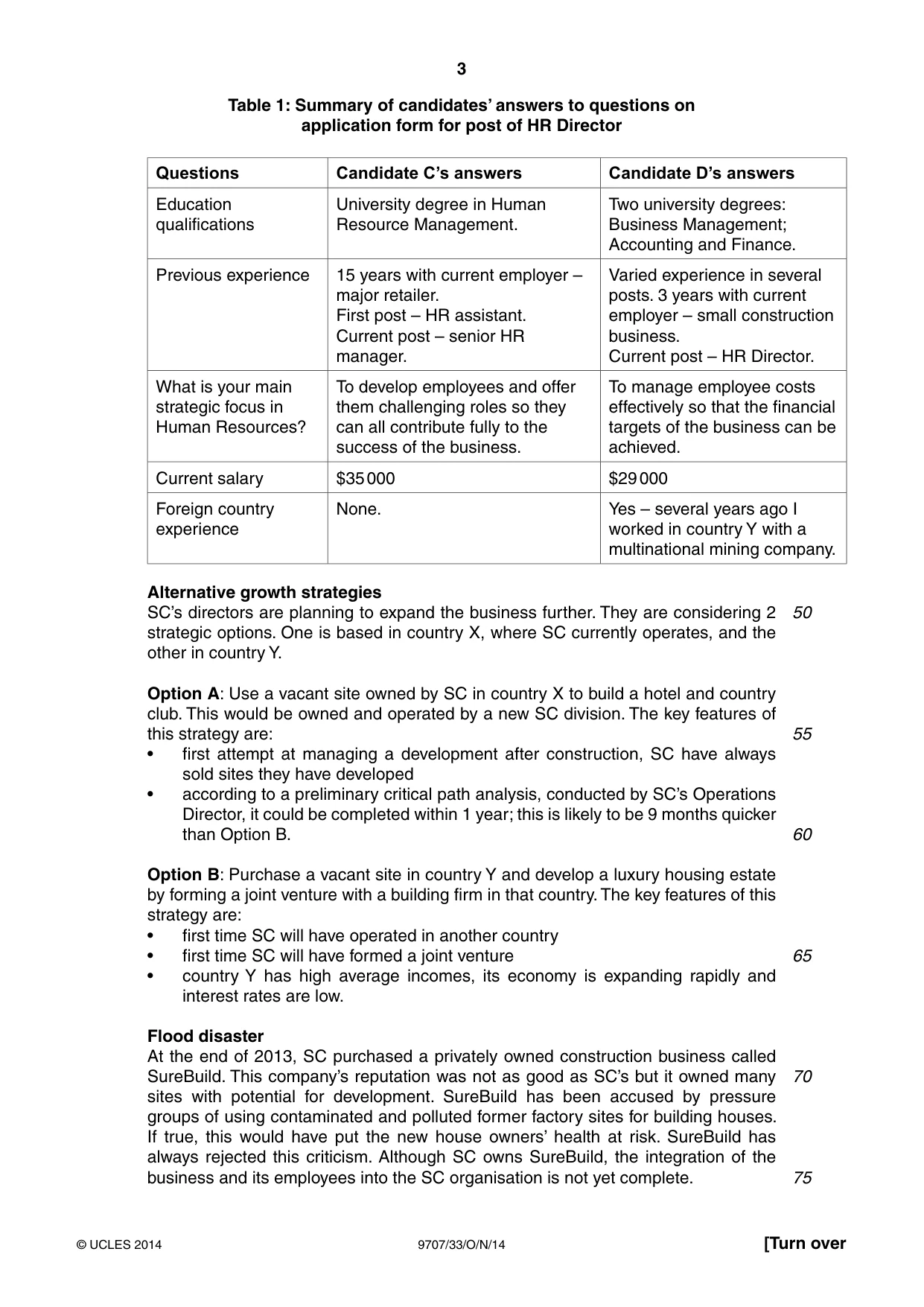
4 9707/33/O/N/14 © UCLES 2014 Last month, heavy and prolonged rains in the northern region of the country caused widespread flooding. Some of the buildings in Exodus, a large new shopping and residential complex constructed by SureBuild in 2012, were destroyed and swept away by these floods. Many people lost their homes. The newspapers in country X have started to investigate the construction methods that SureBuild had used for this development. A retired building inspector claimed that: ‘The foundations were not deep enough and the underground lake had not been drained correctly’. SC’s senior management were not prepared for the floods and the disaster that resulted. Initially, a spokesman for the company suggested that the Government’s failure to build flood defences was the major problem and that SC could not be held responsible for SureBuild’s developments when it was a separate company. However, yesterday SC’s Board of Directors changed the company’s approach completely by issuing the following press release: ‘SC accepts full responsibility for any damage or loss that might have resulted from faulty construction of the Exodus site even though this was built by SureBuild when it was not part of our group of companies’. Appendix 1: Investment appraisal data for the two options for new equipment Equipment leasing option Notes Equipment purchase option Notes Net cash flow (NCF)Year 0 ($2m) No capital costs of purchase but legal charges incurred ($25m) Capital cost of machinery NCF Year 1 $6m Cash inflows from use of machinery minus leasing charges $14m Cash inflows from use of machinery minus maintenance costs NCF Year 2 $6m $14m NCF Year 3 $6m $14m NCF Year 4 $6m $20m Includes expected residual value from sale of equipment Net present value @ 10% discount $17.02m See Question 2(a) 10% discount factors: Year 1 = 0.91; Year 2 = 0.83; Year 3 = 0.75; Year 4 = 0.68. Appendix 2: Summary accounting data for SC – 2014 Profit after tax (year ending 31 October 2014) $36m Retained profit (year ending 31 October 2014) $22m Non-current liabilities (as at 31 October 2014) $44m Capital employed (as at 31 October 2014) $88m 80 85 90
Question paper, page 5
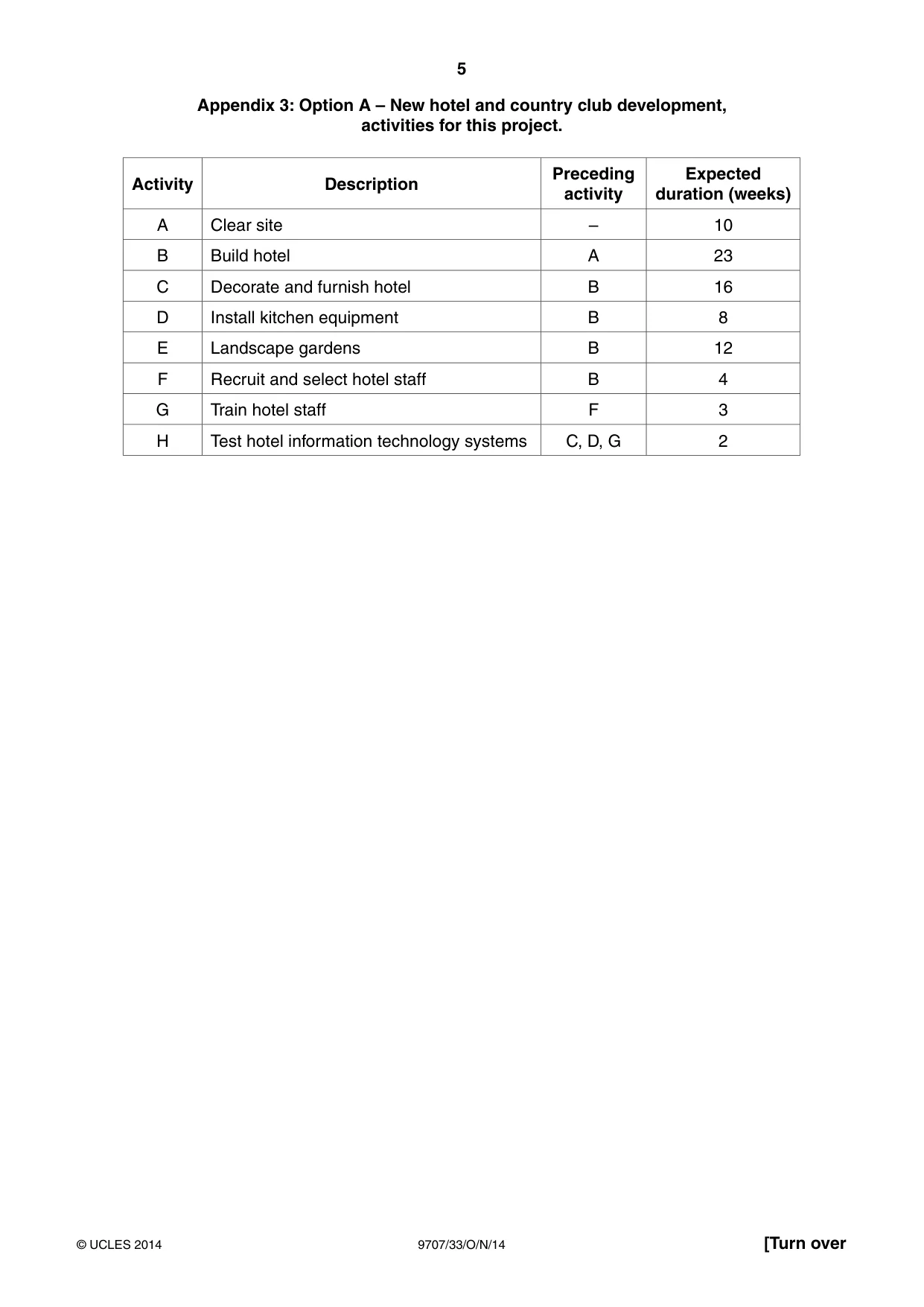
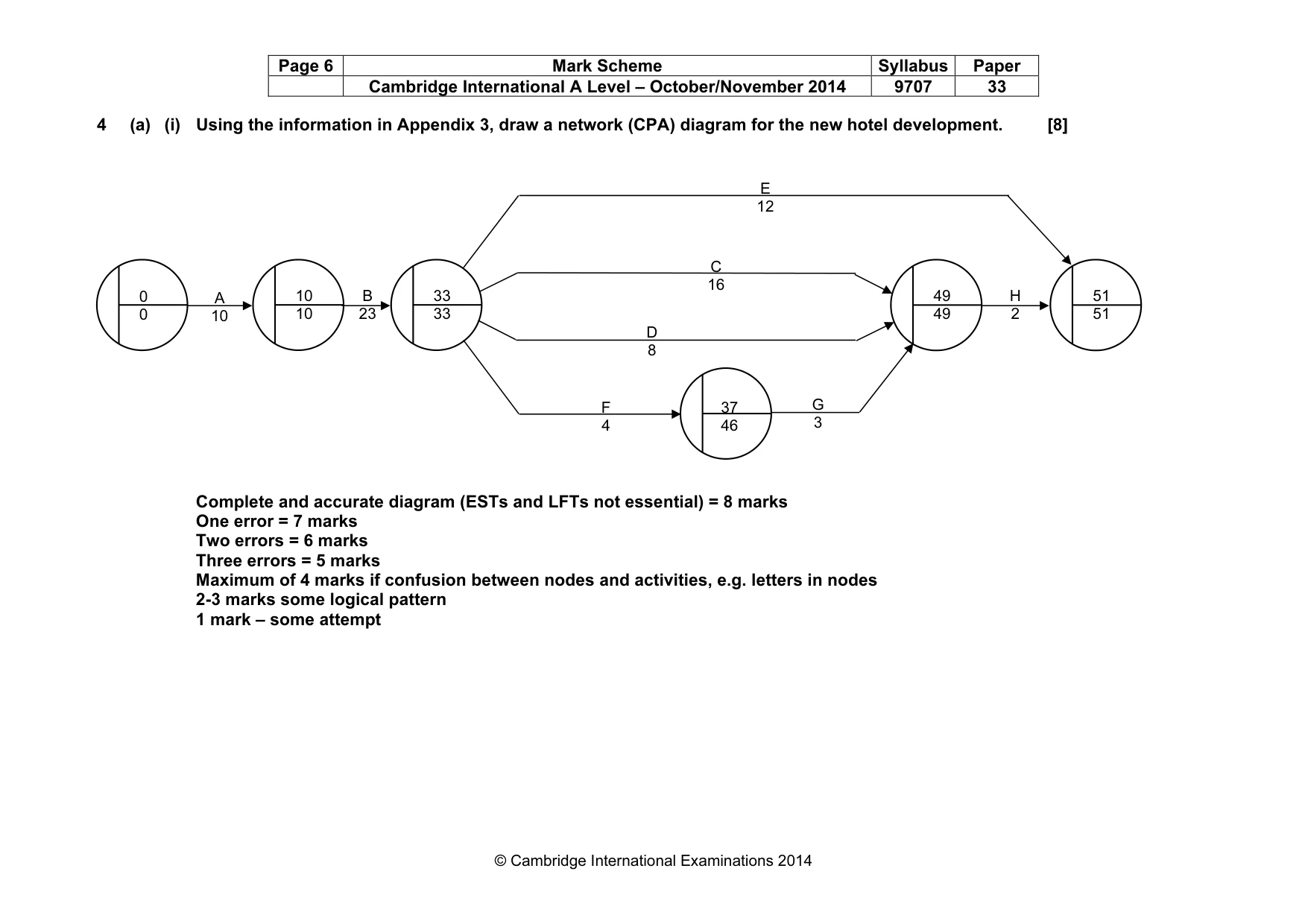
5 9707/33/O/N/14 © UCLES 2014 [Turn over Appendix 3: Option A – New hotel and country club development, activities for this project. Activity Description Preceding activity Expected duration (weeks) A Clear site – 10 B Build hotel A 23 C Decorate and furnish hotel B 16 D Install kitchen equipment B 8 E Landscape gardens B 12 F Recruit and select hotel staff B 4 G Train hotel staff F 3 H Test hotel information technology systems C, D, G 2
Question paper, page 6
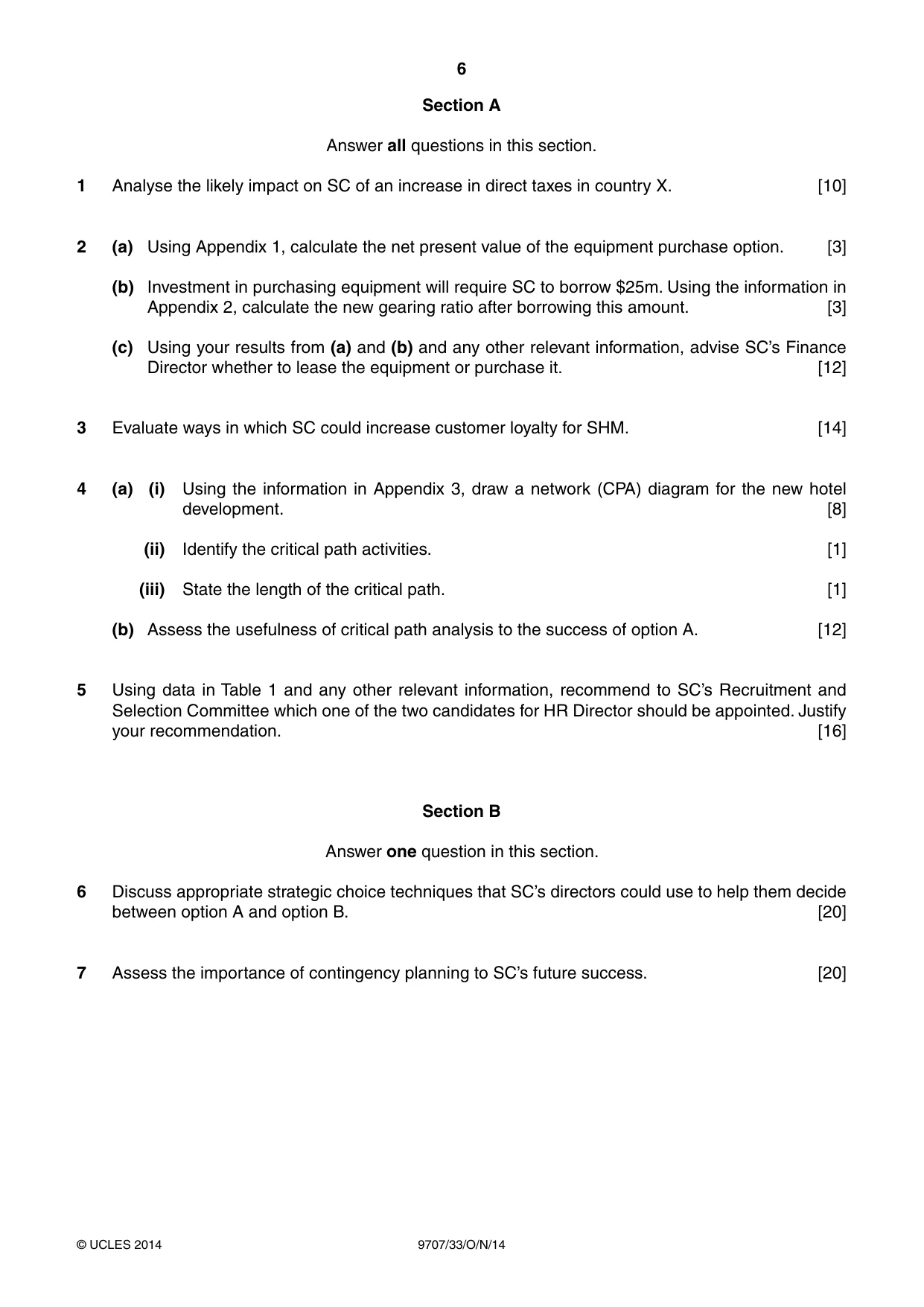
6 9707/33/O/N/14 © UCLES 2014 Section A Answer all questions in this section. 1 Analyse the likely impact on SC of an increase in direct taxes in country X. [10] 2 (a) Using Appendix 1, calculate the net present value of the equipment purchase option. [3] (b) Investment in purchasing equipment will require SC to borrow $25m. Using the information in Appendix 2, calculate the new gearing ratio after borrowing this amount. [3] (c) Using your results from (a) and (b) and any other relevant information, advise SC’s Finance Director whether to lease the equipment or purchase it. [12] 3 Evaluate ways in which SC could increase customer loyalty for SHM. [14] 4 (a) (i) Using the information in Appendix 3, draw a network (CPA) diagram for the new hotel development. [8] (ii) Identify the critical path activities. [1] (iii) State the length of the critical path. [1] (b) Assess the usefulness of critical path analysis to the success of option A. [12] 5 Using data in Table 1 and any other relevant information, recommend to SC’s Recruitment and Selection Committee which one of the two candidates for HR Director should be appointed. Justify your recommendation. [16] Section B Answer one question in this section. 6 Discuss appropriate strategic choice techniques that SC’s directors could use to help them decide between option A and option B. [20] 7 Assess the importance of contingency planning to SC’s future success. [20]
Question paper, page 7
7 9707/33/O/N/14 © UCLES 2014 BLANK PAGE
Question paper, page 8
8 9707/33/O/N/14 © UCLES 2014 Permission to reproduce items where third-party owned material protected by copyright is included has been sought and cleared where possible. Every reasonable effort has been made by the publisher (UCLES) to trace copyright holders, but if any items requiring clearance have unwittingly been included, the publisher will be pleased to make amends at the earliest possible opportunity. Cambridge International Examinations is part of the Cambridge Assessment Group. Cambridge Assessment is the brand name of University of Cambridge Local Examinations Syndicate (UCLES), which is itself a department of the University of Cambridge. BLANK PAGE
Mark scheme, page 1
® IGCSE is the registered trademark of Cambridge International Examinations. CAMBRIDGE INTERNATIONAL EXAMINATIONS Cambridge International Advanced Level MARK SCHEME for the October/November 2014 series 9707 BUSINESS STUDIES 9707/33 Paper 3 (Case Study), maximum raw mark 100 This mark scheme is published as an aid to teachers and candidates, to indicate the requirements of the examination. It shows the basis on which Examiners were instructed to award marks. It does not indicate the details of the discussions that took place at an Examiners’ meeting before marking began, which would have considered the acceptability of alternative answers. Mark schemes should be read in conjunction with the question paper and the Principal Examiner Report for Teachers. Cambridge will not enter into discussions about these mark schemes. Cambridge is publishing the mark schemes for the October/November 2014 series for most Cambridge IGCSE®, Cambridge International A and AS Level components and some Cambridge O Level components.
Mark scheme, page 2
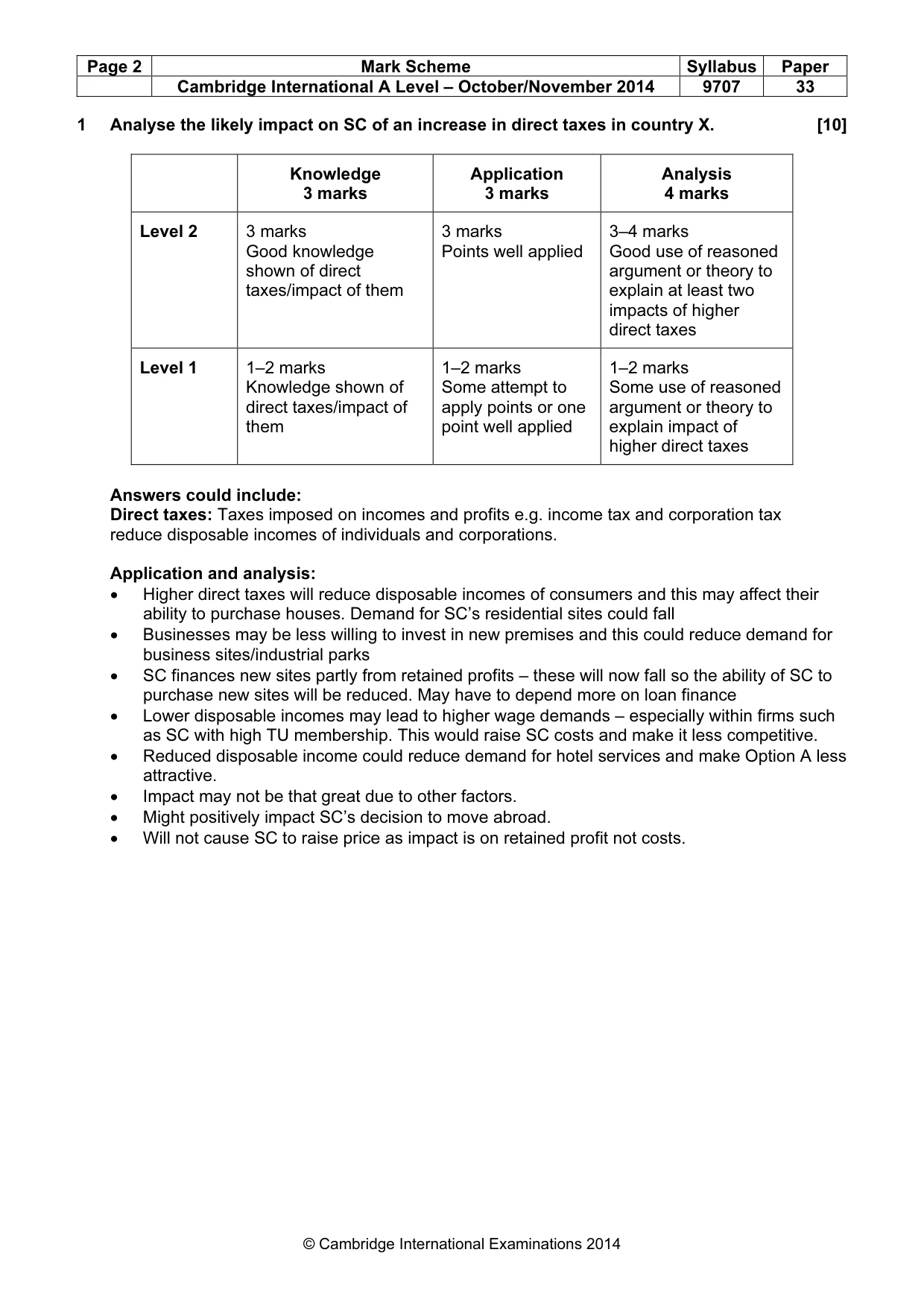
Page 2 Mark Scheme Syllabus Paper Cambridge International A Level – October/November 2014 9707 33 © Cambridge International Examinations 2014 1 Analyse the likely impact on SC of an increase in direct taxes in country X. [10] Knowledge 3 marks Application 3 marks Analysis 4 marks Level 2 3 marks Good knowledge shown of direct taxes/impact of them 3 marks Points well applied 3–4 marks Good use of reasoned argument or theory to explain at least two impacts of higher direct taxes Level 1 1–2 marks Knowledge shown of direct taxes/impact of them 1–2 marks Some attempt to apply points or one point well applied 1–2 marks Some use of reasoned argument or theory to explain impact of higher direct taxes Answers could include: Direct taxes: Taxes imposed on incomes and profits e.g. income tax and corporation tax reduce disposable incomes of individuals and corporations. Application and analysis: • Higher direct taxes will reduce disposable incomes of consumers and this may affect their ability to purchase houses. Demand for SC’s residential sites could fall • Businesses may be less willing to invest in new premises and this could reduce demand for business sites/industrial parks • SC finances new sites partly from retained profits – these will now fall so the ability of SC to purchase new sites will be reduced. May have to depend more on loan finance • Lower disposable incomes may lead to higher wage demands – especially within firms such as SC with high TU membership. This would raise SC costs and make it less competitive. • Reduced disposable income could reduce demand for hotel services and make Option A less attractive. • Impact may not be that great due to other factors. • Might positively impact SC’s decision to move abroad. • Will not cause SC to raise price as impact is on retained profit not costs.
Mark scheme, page 3
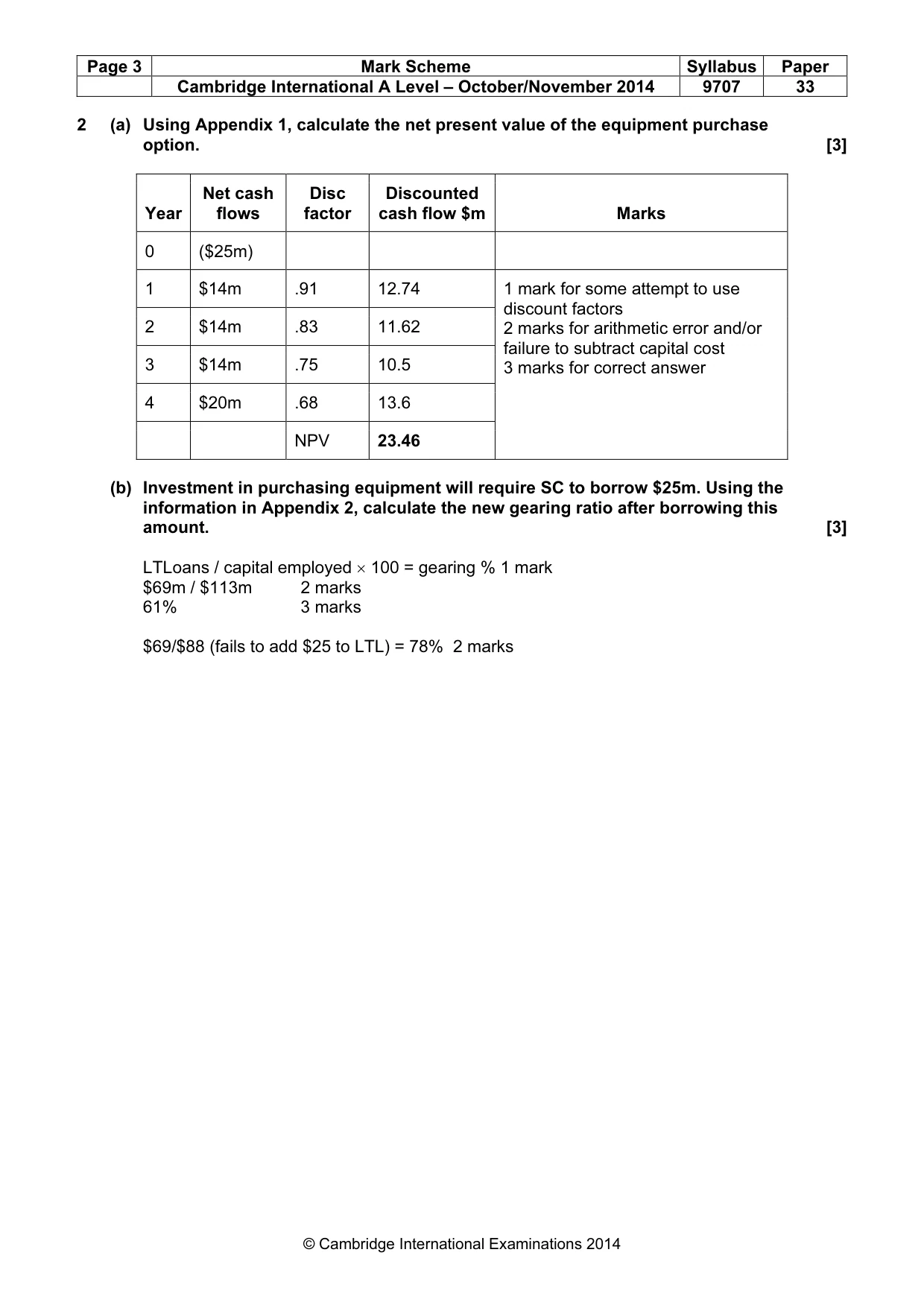
Page 3 Mark Scheme Syllabus Paper Cambridge International A Level – October/November 2014 9707 33 © Cambridge International Examinations 2014 2 (a) Using Appendix 1, calculate the net present value of the equipment purchase option. [3] Year Net cash flows Disc factor Discounted cash flow $m Marks 0 ($25m) 1 $14m .91 12.74 1 mark for some attempt to use discount factors 2 marks for arithmetic error and/or failure to subtract capital cost 3 marks for correct answer 2 $14m .83 11.62 3 $14m .75 10.5 4 $20m .68 13.6 NPV 23.46 (b) Investment in purchasing equipment will require SC to borrow $25m. Using the information in Appendix 2, calculate the new gearing ratio after borrowing this amount. [3] LTLoans / capital employed × 100 = gearing % 1 mark $69m / $113m 2 marks 61% 3 marks $69/$88 (fails to add $25 to LTL) = 78% 2 marks
Mark scheme, page 4
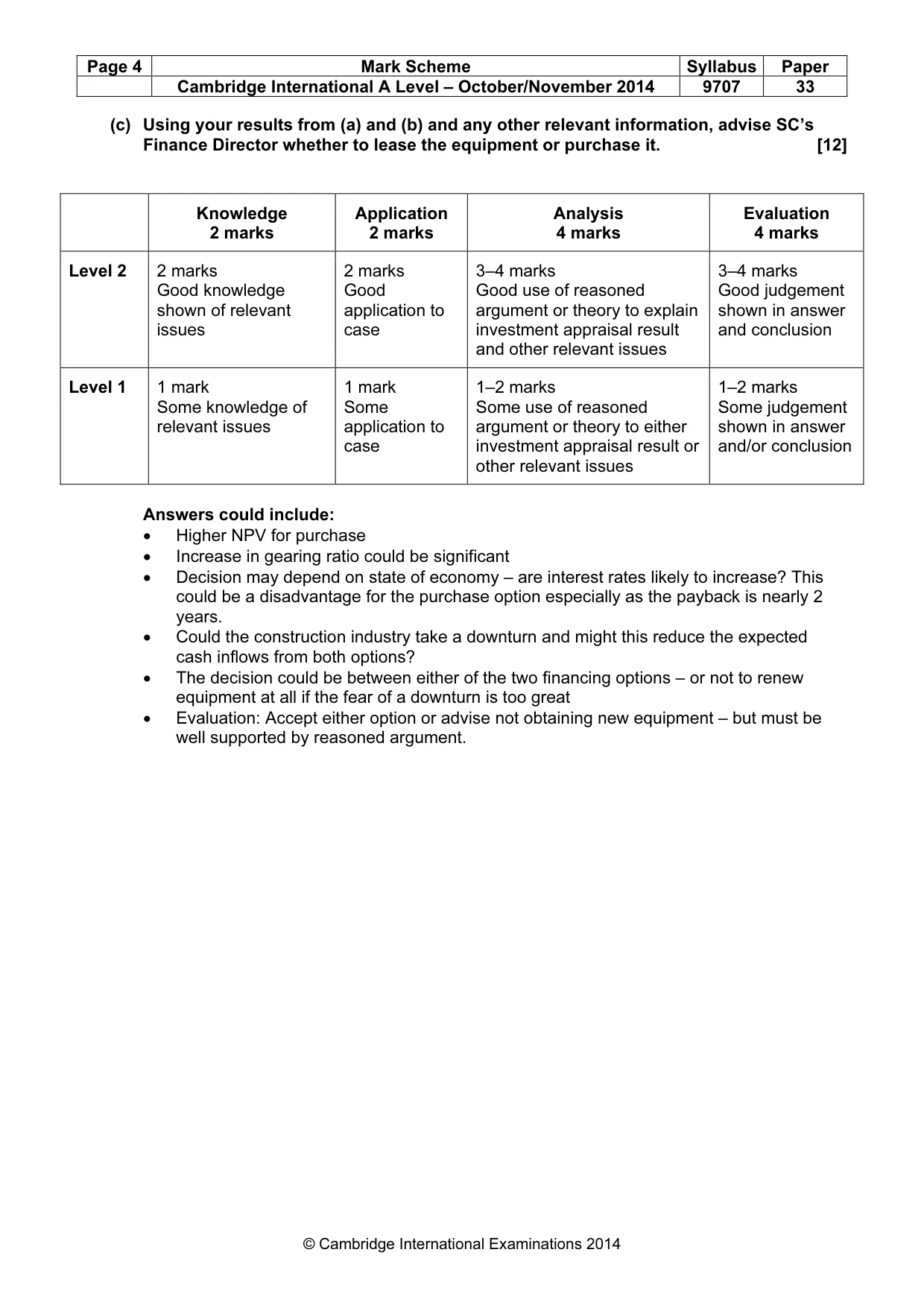
Page 4 Mark Scheme Syllabus Paper Cambridge International A Level – October/November 2014 9707 33 © Cambridge International Examinations 2014 (c) Using your results from (a) and (b) and any other relevant information, advise SC’s Finance Director whether to lease the equipment or purchase it. [12] Knowledge 2 marks Application 2 marks Analysis 4 marks Evaluation 4 marks Level 2 2 marks Good knowledge shown of relevant issues 2 marks Good application to case 3–4 marks Good use of reasoned argument or theory to explain investment appraisal result and other relevant issues 3–4 marks Good judgement shown in answer and conclusion Level 1 1 mark Some knowledge of relevant issues 1 mark Some application to case 1–2 marks Some use of reasoned argument or theory to either investment appraisal result or other relevant issues 1–2 marks Some judgement shown in answer and/or conclusion Answers could include: • Higher NPV for purchase • Increase in gearing ratio could be significant • Decision may depend on state of economy – are interest rates likely to increase? This could be a disadvantage for the purchase option especially as the payback is nearly 2 years. • Could the construction industry take a downturn and might this reduce the expected cash inflows from both options? • The decision could be between either of the two financing options – or not to renew equipment at all if the fear of a downturn is too great • Evaluation: Accept either option or advise not obtaining new equipment – but must be well supported by reasoned argument.
Mark scheme, page 5
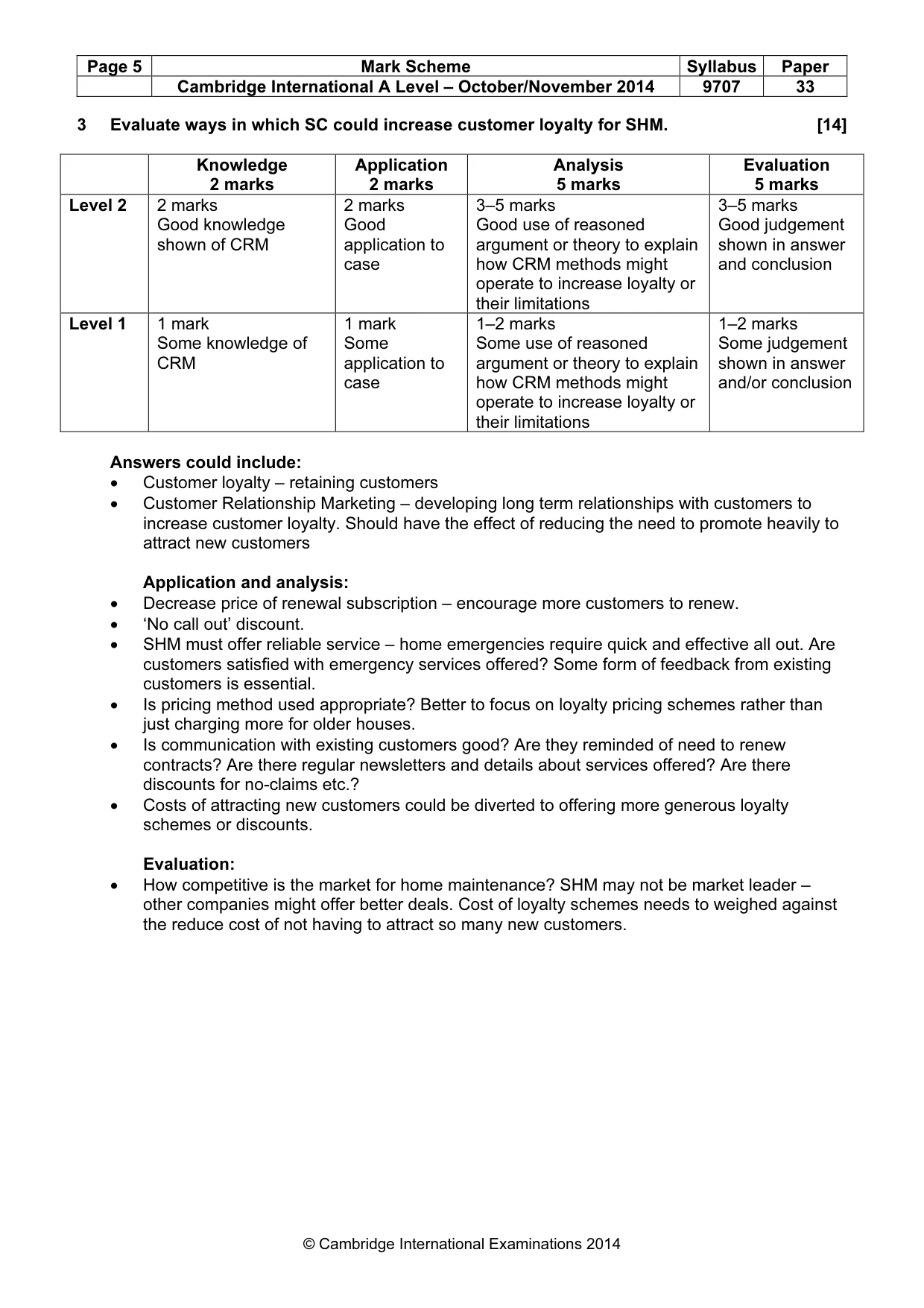
Page 5 Mark Scheme Syllabus Paper Cambridge International A Level – October/November 2014 9707 33 © Cambridge International Examinations 2014 3 Evaluate ways in which SC could increase customer loyalty for SHM. [14] Knowledge 2 marks Application 2 marks Analysis 5 marks Evaluation 5 marks Level 2 2 marks Good knowledge shown of CRM 2 marks Good application to case 3–5 marks Good use of reasoned argument or theory to explain how CRM methods might operate to increase loyalty or their limitations 3–5 marks Good judgement shown in answer and conclusion Level 1 1 mark Some knowledge of CRM 1 mark Some application to case 1–2 marks Some use of reasoned argument or theory to explain how CRM methods might operate to increase loyalty or their limitations 1–2 marks Some judgement shown in answer and/or conclusion Answers could include: • Customer loyalty – retaining customers • Customer Relationship Marketing – developing long term relationships with customers to increase customer loyalty. Should have the effect of reducing the need to promote heavily to attract new customers Application and analysis: • Decrease price of renewal subscription – encourage more customers to renew. • ‘No call out’ discount. • SHM must offer reliable service – home emergencies require quick and effective all out. Are customers satisfied with emergency services offered? Some form of feedback from existing customers is essential. • Is pricing method used appropriate? Better to focus on loyalty pricing schemes rather than just charging more for older houses. • Is communication with existing customers good? Are they reminded of need to renew contracts? Are there regular newsletters and details about services offered? Are there discounts for no-claims etc.? • Costs of attracting new customers could be diverted to offering more generous loyalty schemes or discounts. Evaluation: • How competitive is the market for home maintenance? SHM may not be market leader – other companies might offer better deals. Cost of loyalty schemes needs to weighed against the reduce cost of not having to attract so many new customers.
Mark scheme, page 6
Page 6 Mark Scheme Syllabus Paper Cambridge International A Level – October/November 2014 9707 33 © Cambridge International Examinations 2014 4 (a) (i) Using the information in Appendix 3, draw a network (CPA) diagram for the new hotel development. [8] Complete and accurate diagram (ESTs and LFTs not essential) = 8 marks One error = 7 marks Two errors = 6 marks Three errors = 5 marks Maximum of 4 marks if confusion between nodes and activities, e.g. letters in nodes 2-3 marks some logical pattern 1 mark – some attempt G 3 A 10 B 23 C 16 D 8 E 12 F 4 H 2 0 0 51 51 33 33 10 10 37 46 49 49
Mark scheme, page 7
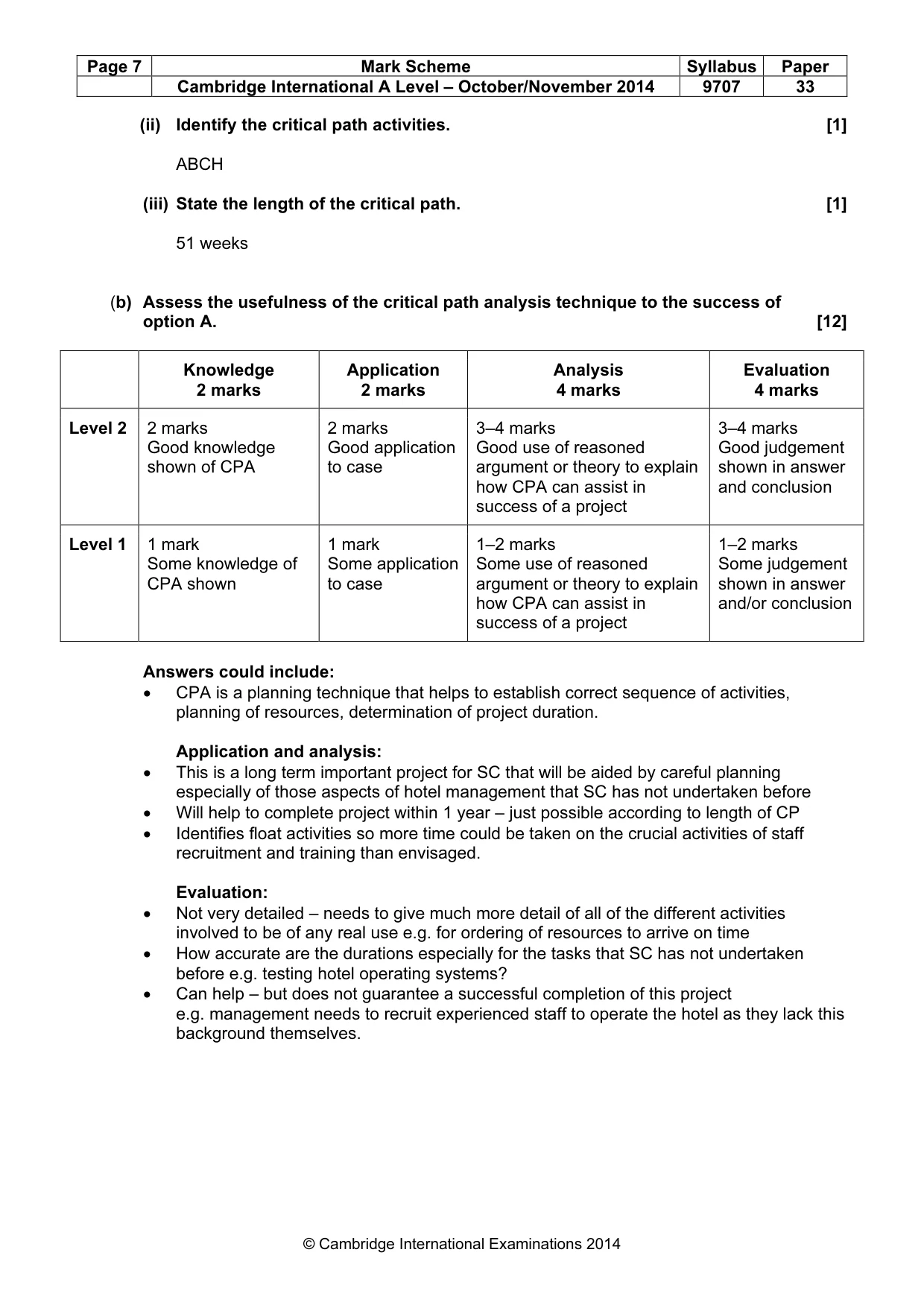
Page 7 Mark Scheme Syllabus Paper Cambridge International A Level – October/November 2014 9707 33 © Cambridge International Examinations 2014 (ii) Identify the critical path activities. [1] ABCH (iii) State the length of the critical path. [1] 51 weeks (b) Assess the usefulness of the critical path analysis technique to the success of option A. [12] Knowledge 2 marks Application 2 marks Analysis 4 marks Evaluation 4 marks Level 2 2 marks Good knowledge shown of CPA 2 marks Good application to case 3–4 marks Good use of reasoned argument or theory to explain how CPA can assist in success of a project 3–4 marks Good judgement shown in answer and conclusion Level 1 1 mark Some knowledge of CPA shown 1 mark Some application to case 1–2 marks Some use of reasoned argument or theory to explain how CPA can assist in success of a project 1–2 marks Some judgement shown in answer and/or conclusion Answers could include: • CPA is a planning technique that helps to establish correct sequence of activities, planning of resources, determination of project duration. Application and analysis: • This is a long term important project for SC that will be aided by careful planning especially of those aspects of hotel management that SC has not undertaken before • Will help to complete project within 1 year – just possible according to length of CP • Identifies float activities so more time could be taken on the crucial activities of staff recruitment and training than envisaged. Evaluation: • Not very detailed – needs to give much more detail of all of the different activities involved to be of any real use e.g. for ordering of resources to arrive on time • How accurate are the durations especially for the tasks that SC has not undertaken before e.g. testing hotel operating systems? • Can help – but does not guarantee a successful completion of this project e.g. management needs to recruit experienced staff to operate the hotel as they lack this background themselves.
Mark scheme, page 8
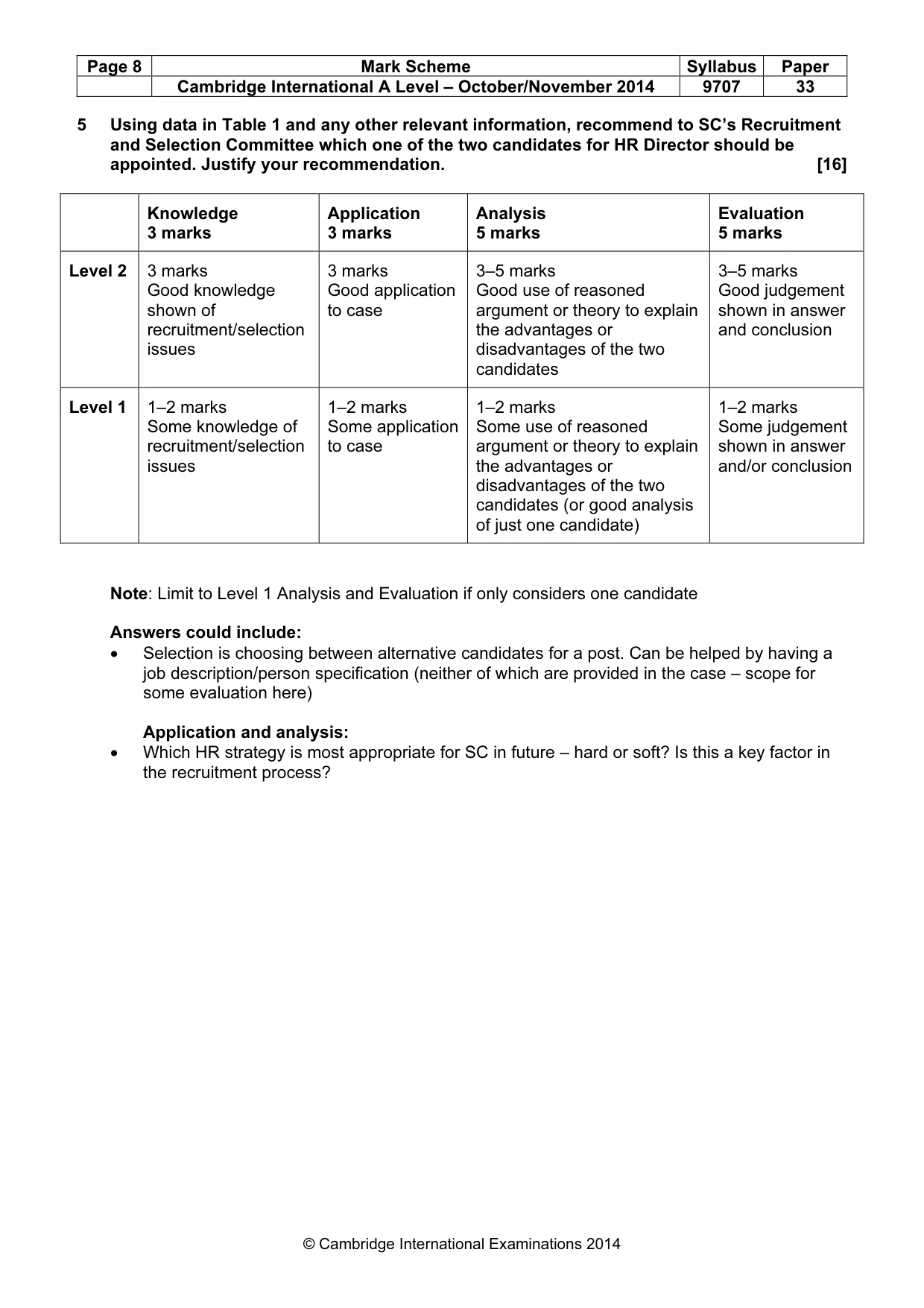
Page 8 Mark Scheme Syllabus Paper Cambridge International A Level – October/November 2014 9707 33 © Cambridge International Examinations 2014 5 Using data in Table 1 and any other relevant information, recommend to SC’s Recruitment and Selection Committee which one of the two candidates for HR Director should be appointed. Justify your recommendation. [16] Knowledge 3 marks Application 3 marks Analysis 5 marks Evaluation 5 marks Level 2 3 marks Good knowledge shown of recruitment/selection issues 3 marks Good application to case 3–5 marks Good use of reasoned argument or theory to explain the advantages or disadvantages of the two candidates 3–5 marks Good judgement shown in answer and conclusion Level 1 1–2 marks Some knowledge of recruitment/selection issues 1–2 marks Some application to case 1–2 marks Some use of reasoned argument or theory to explain the advantages or disadvantages of the two candidates (or good analysis of just one candidate) 1–2 marks Some judgement shown in answer and/or conclusion Note: Limit to Level 1 Analysis and Evaluation if only considers one candidate Answers could include: • Selection is choosing between alternative candidates for a post. Can be helped by having a job description/person specification (neither of which are provided in the case – scope for some evaluation here) Application and analysis: • Which HR strategy is most appropriate for SC in future – hard or soft? Is this a key factor in the recruitment process?
Mark scheme, page 9
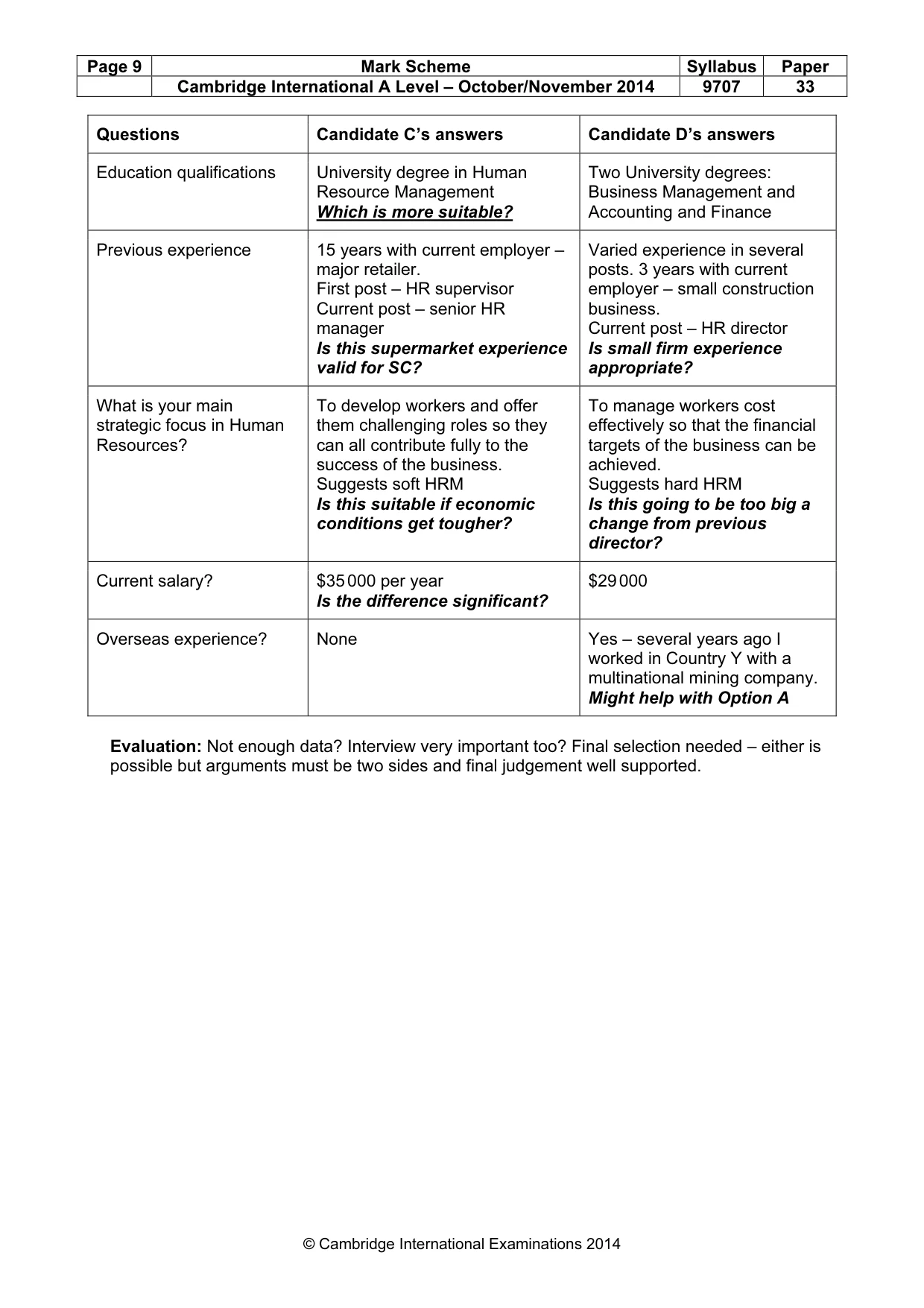
Page 9 Mark Scheme Syllabus Paper Cambridge International A Level – October/November 2014 9707 33 © Cambridge International Examinations 2014 Questions Candidate C’s answers Candidate D’s answers Education qualifications University degree in Human Resource Management Which is more suitable? Two University degrees: Business Management and Accounting and Finance Previous experience 15 years with current employer – major retailer. First post – HR supervisor Current post – senior HR manager Is this supermarket experience valid for SC? Varied experience in several posts. 3 years with current employer – small construction business. Current post – HR director Is small firm experience appropriate? What is your main strategic focus in Human Resources? To develop workers and offer them challenging roles so they can all contribute fully to the success of the business. Suggests soft HRM Is this suitable if economic conditions get tougher? To manage workers cost effectively so that the financial targets of the business can be achieved. Suggests hard HRM Is this going to be too big a change from previous director? Current salary? $35 000 per year Is the difference significant? $29 000 Overseas experience? None Yes – several years ago I worked in Country Y with a multinational mining company. Might help with Option A Evaluation: Not enough data? Interview very important too? Final selection needed – either is possible but arguments must be two sides and final judgement well supported.
Mark scheme, page 10
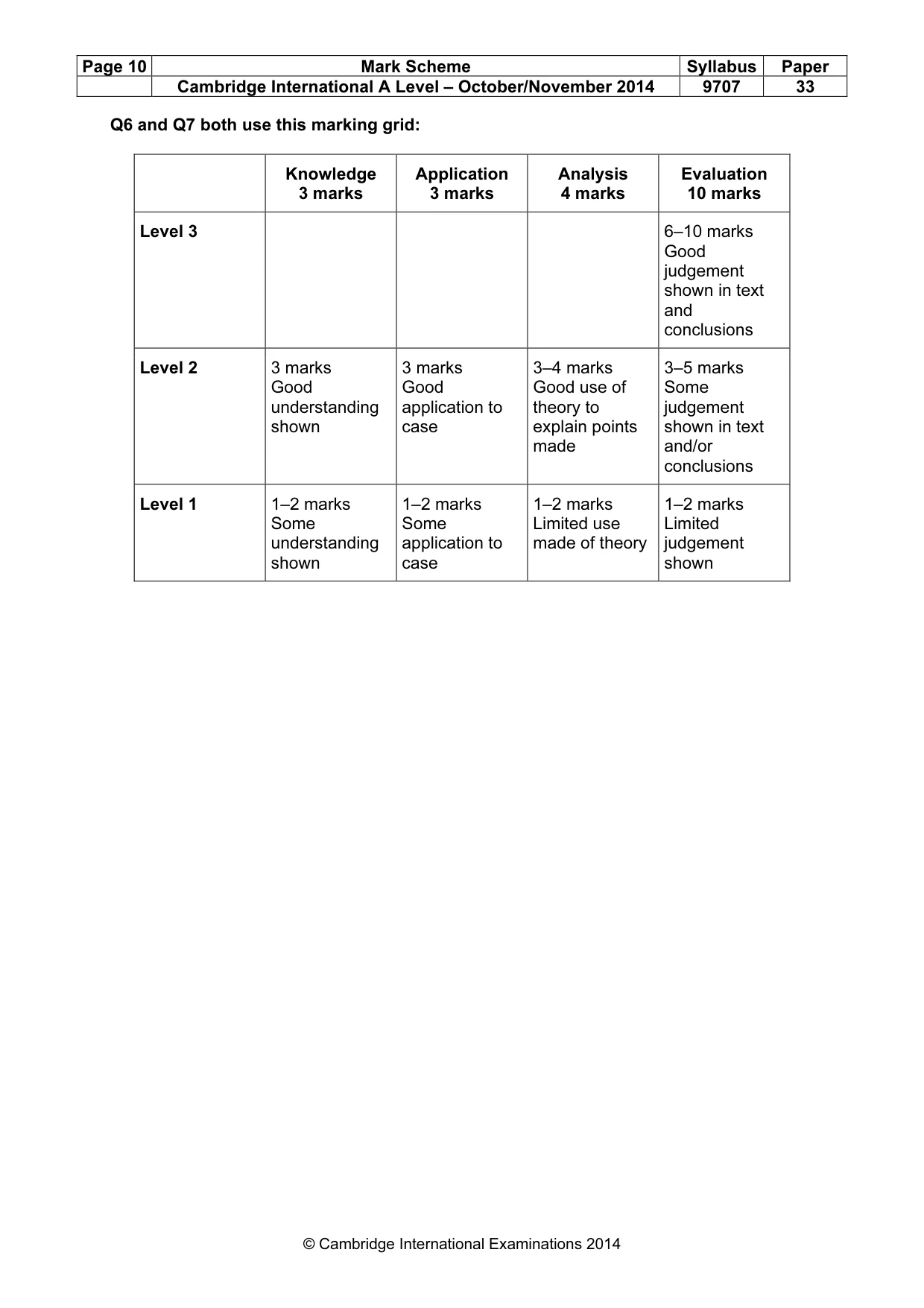
Page 10 Mark Scheme Syllabus Paper Cambridge International A Level – October/November 2014 9707 33 © Cambridge International Examinations 2014 Q6 and Q7 both use this marking grid: Knowledge 3 marks Application 3 marks Analysis 4 marks Evaluation 10 marks Level 3 6–10 marks Good judgement shown in text and conclusions Level 2 3 marks Good understanding shown 3 marks Good application to case 3–4 marks Good use of theory to explain points made 3–5 marks Some judgement shown in text and/or conclusions Level 1 1–2 marks Some understanding shown 1–2 marks Some application to case 1–2 marks Limited use made of theory 1–2 marks Limited judgement shown
Mark scheme, page 11
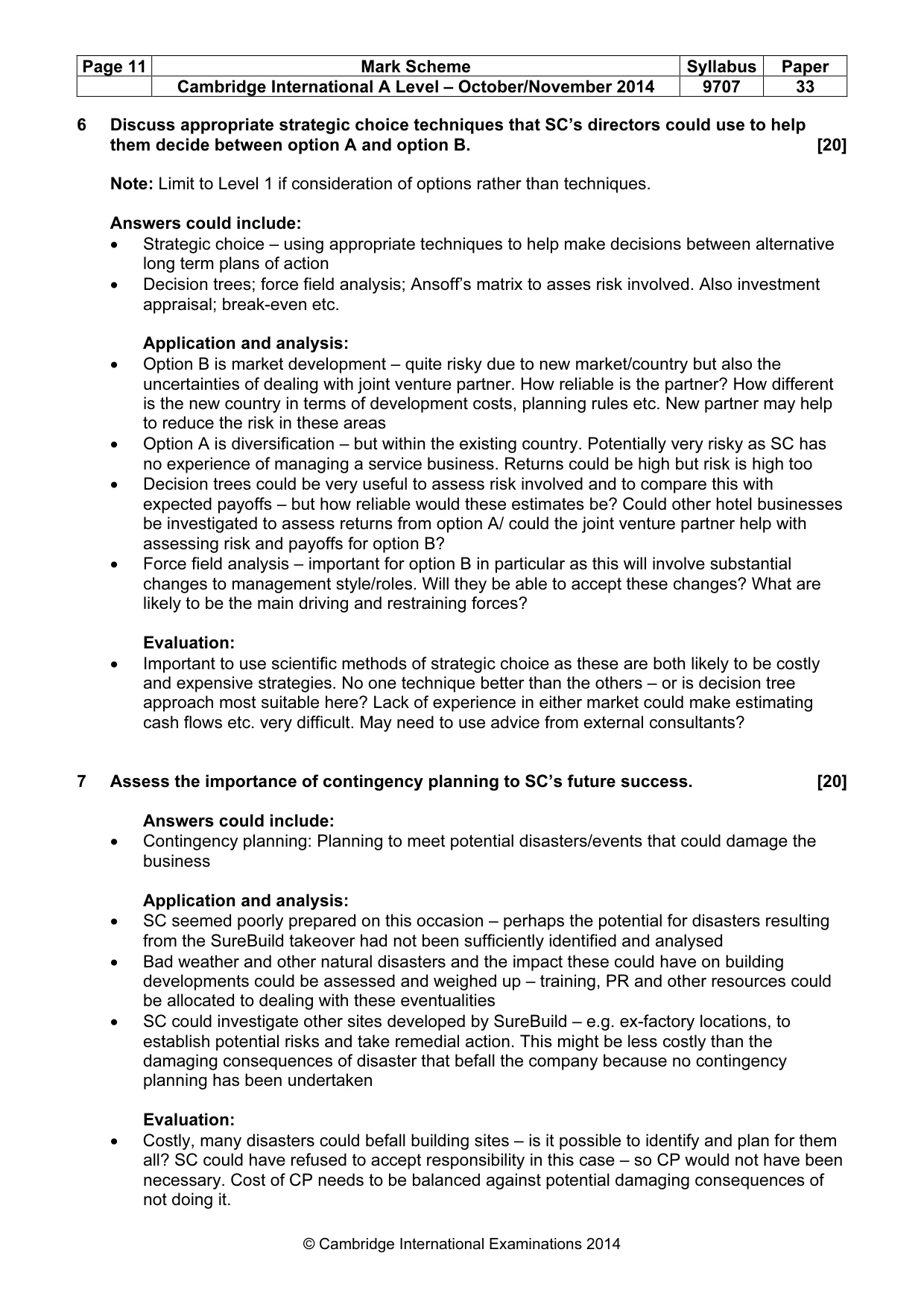
Page 11 Mark Scheme Syllabus Paper Cambridge International A Level – October/November 2014 9707 33 © Cambridge International Examinations 2014 6 Discuss appropriate strategic choice techniques that SC’s directors could use to help them decide between option A and option B. [20] Note: Limit to Level 1 if consideration of options rather than techniques. Answers could include: • Strategic choice – using appropriate techniques to help make decisions between alternative long term plans of action • Decision trees; force field analysis; Ansoff’s matrix to asses risk involved. Also investment appraisal; break-even etc. Application and analysis: • Option B is market development – quite risky due to new market/country but also the uncertainties of dealing with joint venture partner. How reliable is the partner? How different is the new country in terms of development costs, planning rules etc. New partner may help to reduce the risk in these areas • Option A is diversification – but within the existing country. Potentially very risky as SC has no experience of managing a service business. Returns could be high but risk is high too • Decision trees could be very useful to assess risk involved and to compare this with expected payoffs – but how reliable would these estimates be? Could other hotel businesses be investigated to assess returns from option A/ could the joint venture partner help with assessing risk and payoffs for option B? • Force field analysis – important for option B in particular as this will involve substantial changes to management style/roles. Will they be able to accept these changes? What are likely to be the main driving and restraining forces? Evaluation: • Important to use scientific methods of strategic choice as these are both likely to be costly and expensive strategies. No one technique better than the others – or is decision tree approach most suitable here? Lack of experience in either market could make estimating cash flows etc. very difficult. May need to use advice from external consultants? 7 Assess the importance of contingency planning to SC’s future success. [20] Answers could include: • Contingency planning: Planning to meet potential disasters/events that could damage the business Application and analysis: • SC seemed poorly prepared on this occasion – perhaps the potential for disasters resulting from the SureBuild takeover had not been sufficiently identified and analysed • Bad weather and other natural disasters and the impact these could have on building developments could be assessed and weighed up – training, PR and other resources could be allocated to dealing with these eventualities • SC could investigate other sites developed by SureBuild – e.g. ex-factory locations, to establish potential risks and take remedial action. This might be less costly than the damaging consequences of disaster that befall the company because no contingency planning has been undertaken Evaluation: • Costly, many disasters could befall building sites – is it possible to identify and plan for them all? SC could have refused to accept responsibility in this case – so CP would not have been necessary. Cost of CP needs to be balanced against potential damaging consequences of not doing it.
What you needed in this session
Cambridge’s own grade thresholds for 2014 Oct/Nov, Paper 3 · Variant 3. A higher threshold means an easier paper — the bar moves with how the cohort did.