Cambridge A Level Business Studies (for final examination in 2015) 9707 — 2014 Oct/Nov Paper 2 · Variant 2
9707/22/O/N/14 · 2 questions · 60 marks · ≈68 min
The question paper and its mark scheme, free to read here and free to download. This is Cambridge’s own paper, exactly as it was sat.
Question paper4 pages

Mark scheme7 pages
Answers below. Sit the paper first if you are practising.
Questions as text
Q1 · Best Bakery (BB) Paul and Tariq are in partnership together and they own 6 bakeries in…
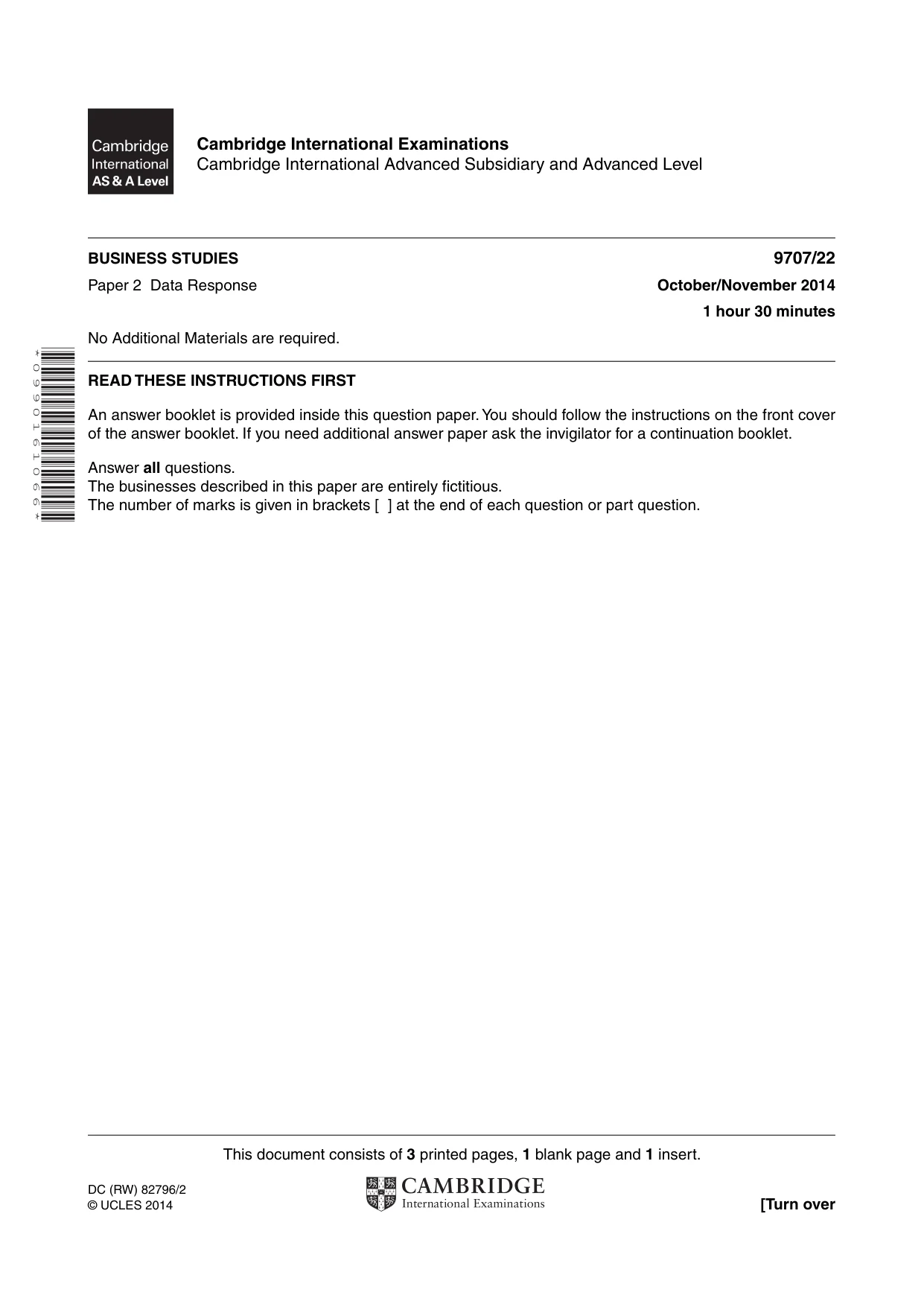
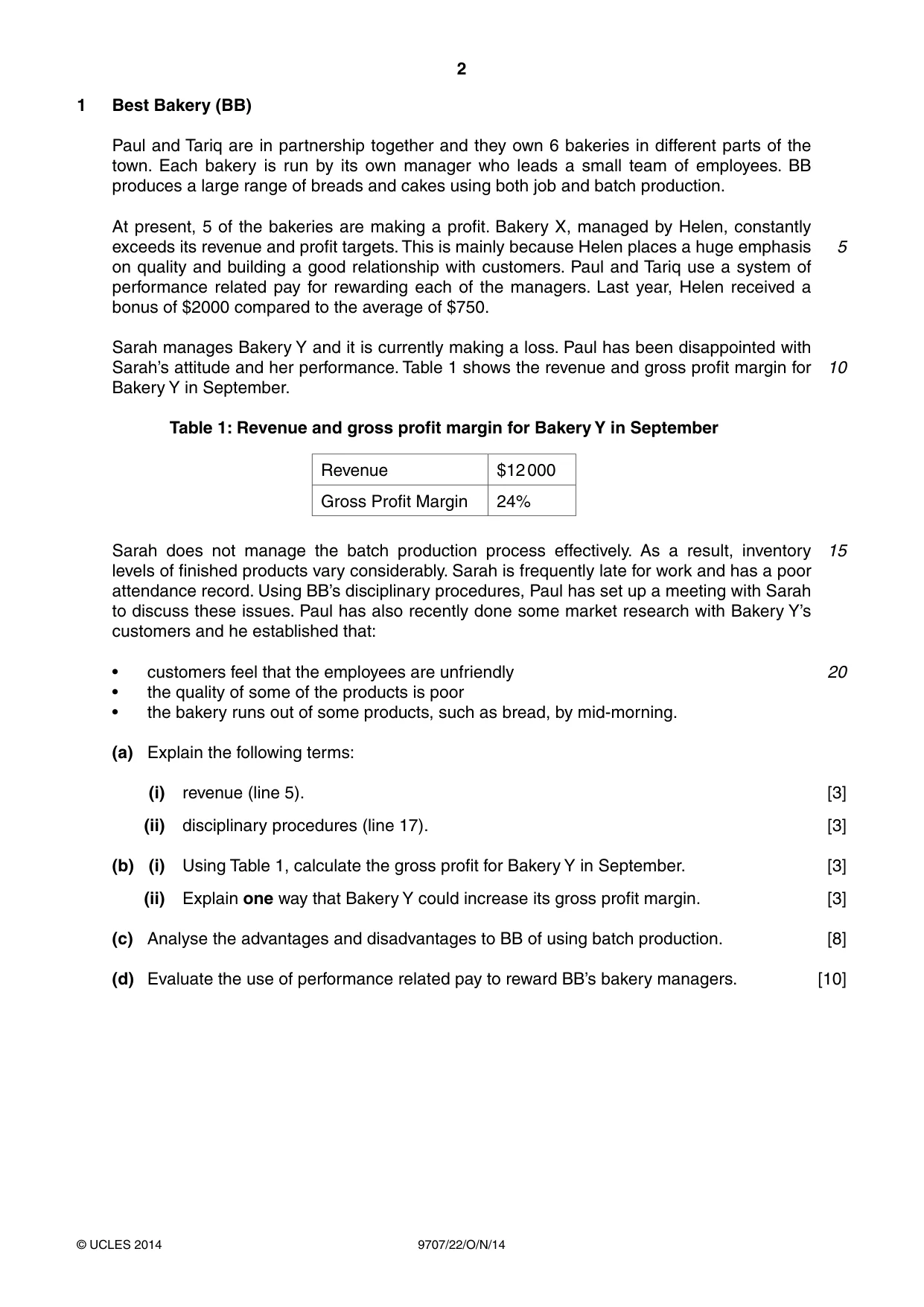
1 Best Bakery (BB) Paul and Tariq are in partnership together and they own 6 bakeries in different parts of the town. Each bakery is run by its own manager who leads a small team of employees. BB produces a large range of breads and cakes using both job and batch production. At present, 5 of the bakeries are making a profit. Bakery X, managed by Helen, constantly exceeds its revenue and profit targets. This is mainly because Helen places a huge emphasis 5 on quality and building a good relationship with customers. Paul and Tariq use a system of performance related pay for rewarding each of the managers. Last year, Helen received a bonus of $2000 compared to the average of $750. Sarah manages Bakery Y and it is currently making a loss. Paul has been disappointed with Sarah’s attitude and her performance. Table 1 shows the revenue and gross profit margin for 10 Bakery Y in September. Table 1: Revenue and gross profit margin for Bakery Y in September Revenue $12 000 Gross Profit Margin 24% Sarah does not manage the batch production process effectively. As a result, inventory 15 levels of finished products vary considerably. Sarah is frequently late for work and has a poor attendance record. Using BB’s disciplinary procedures, Paul has set up a meeting with Sarah to discuss these issues. Paul has also recently done some market research with Bakery Y’s customers and he established that: • customers feel that the employees are unfriendly 20 • the quality of some of the products is poor • the bakery runs out of some products, such as bread, by mid-morning. (a) Explain the following terms: (i) revenue (line 5). [3] (ii) disciplinary procedures (line 17). [3] (b) (i) Using Table 1, calculate the gross profit for Bakery Y in September. [3] (ii) Explain one way that Bakery Y could increase its gross profit margin. [3] (c) Analyse the advantages and disadvantages to BB of using batch production. [8] (d) Evaluate the use of performance related pay to reward BB’s bakery managers. [10]
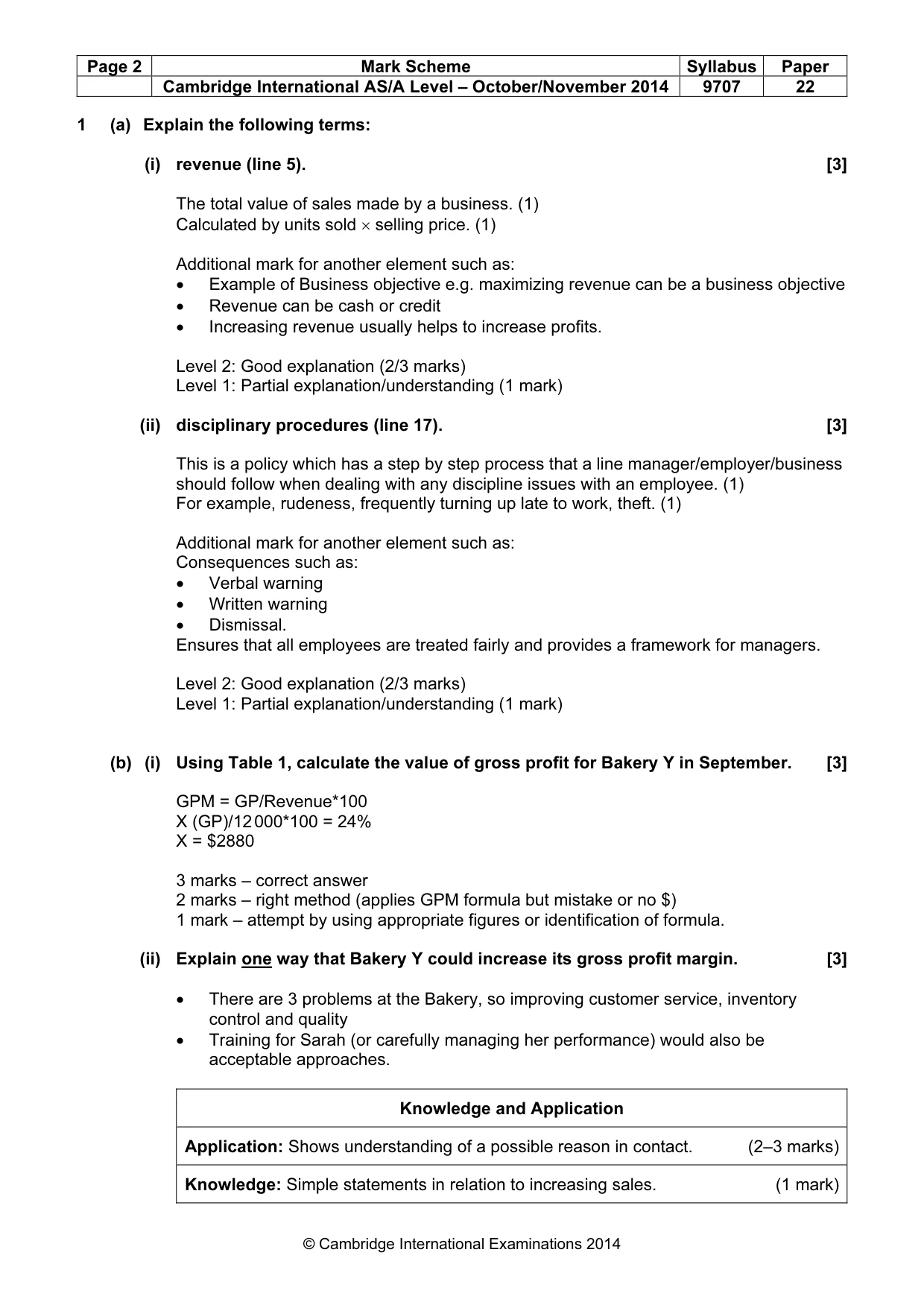
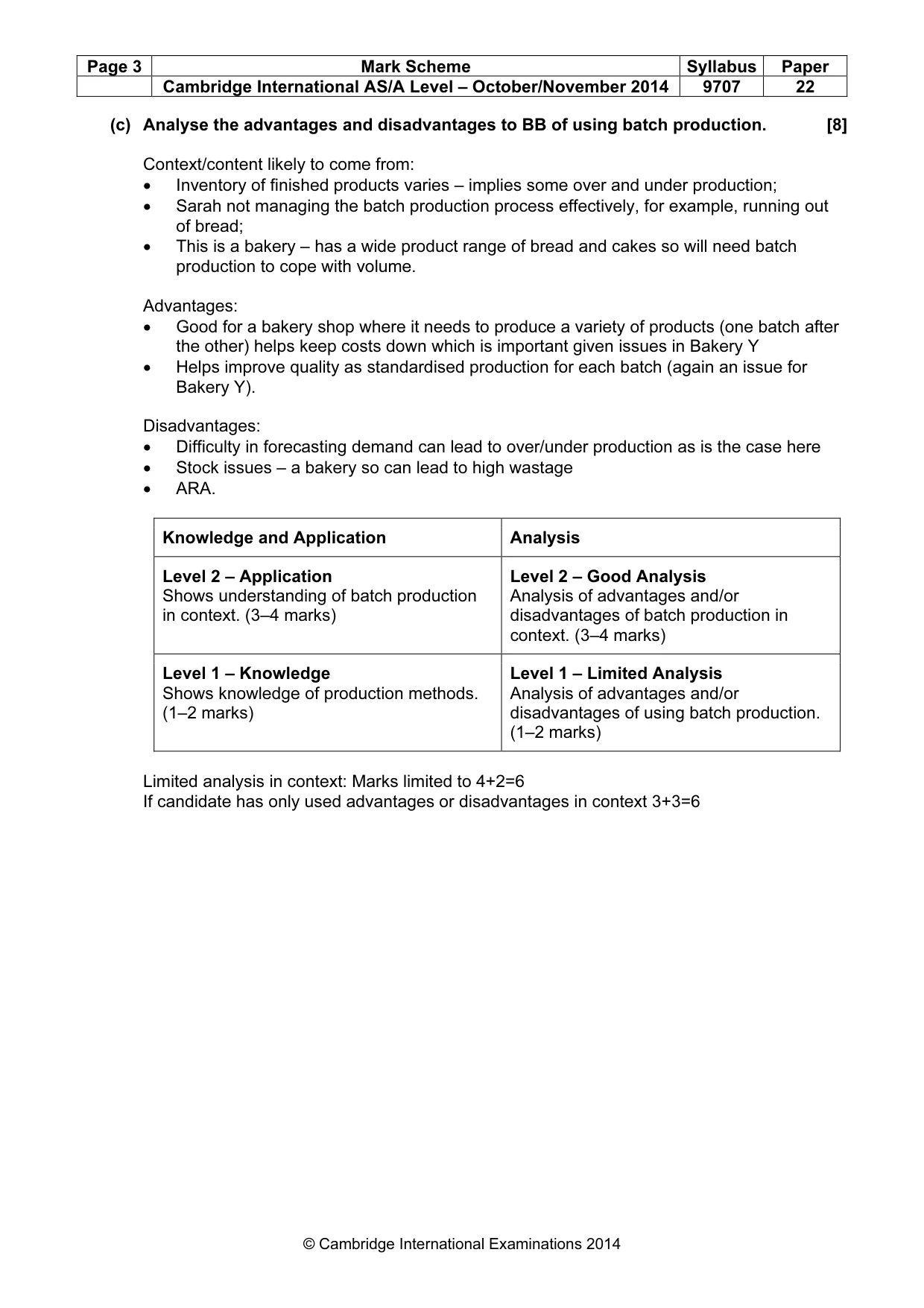
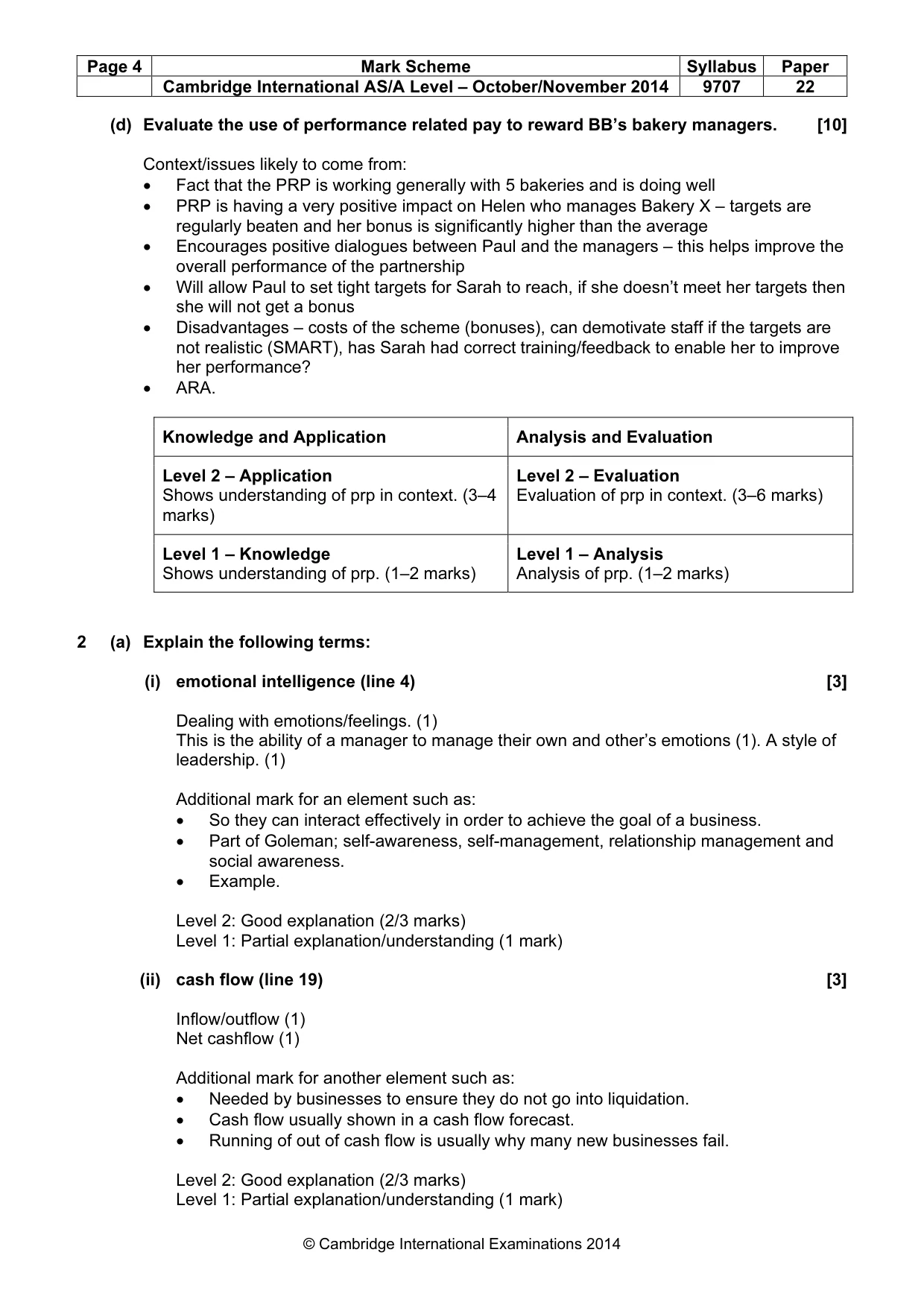
Mark scheme: 1 (a) Explain the following terms: (i) revenue (line 5). [3] The total value of sales made by a business. (1) Calculated by units sold × selling price. (1) Additional mark for another element such as: • Example of Business objective e.g. maximizing revenue can be a business objective • Revenue can be cash or credit • Increasing revenue usually helps to increase profits. Level 2: Good explanation (2/3 marks) Level 1: Partial explanation/understanding (1 mark) (ii) disciplinary procedures (line 17). [3] This is a policy which has a step by step process that a line manager/employer/business should follow when dealing with any discipline issues with an employee. (1) For example, rudeness, frequently turning up late to work, theft. (1) Additional mark for another element such as: Consequences such as: • Verbal warning • Written warning • Dismissal. Ensures that all employees are treated fairly and provides a framework for managers. Level 2: Good explanation (2/3 marks) Level 1: Partial explanation/understanding (1 mark) (b) (i) Using Table 1, calculate the value of gross profit for Bakery Y in September. [3] GPM = GP/Revenue*100 X (GP)/12 000*100 = 24% X = $2880 3 marks – correct answer 2 marks – right method (applies GPM formula but mistake or no $) 1 mark – attempt by using appropriate figures or identification of formula. (ii) Explain one way that Bakery Y could increase its gross profit margin. [3] • There are 3 problems at the Bakery, so improving customer service, inventory control and quality • Training for Sarah (or carefully managing her performance) would also be acceptable approaches. Knowledge and Application Application: Shows understanding of a possible reason in contact. (2–3 marks) Knowledge: Simple statements in relation to increasing sales. (1 mark) (c) Analyse the advantages and disadvantages to BB of using batch production. [8] Context/content likely to come from: • Inventory of finished products varies – implies some over and under production; • Sarah not managing the batch production process effectively, for example, running out of bread; • This is a bakery – has a wide product range of bread and cakes so will need batch production to cope with volume. Advantages: • Good for a bakery shop where it needs to produce a variety of products (one batch after the other) helps keep costs down which is important given issues in Bakery Y • Helps improve quality as standardised production for each batch (again an issue for Bakery Y). Disadvantages: • Difficulty in forecasting demand can lead to over/under production as is the case here • Stock issues – a bakery so can lead to high wastage • ARA. Knowledge and Application Analysis Level 2 – Application Level 2 – Good Analysis Shows understanding of batch production Analysis of advantages and/or in context. (3–4 marks) disadvantages of batch production in context. (3–4 marks) Level 1 – Knowledge Level 1 – Limited Analysis Shows knowledge of production methods. Analysis of advantages and/or (1–2 marks) disadvantages of using batch production. (1–2 marks) Limited analysis in context: Marks limited to 4+2=6 If candidate has only used advantages or disadvantages in context 3+3=6 (d) Evaluate the use of performance related pay to reward BB’s bakery managers. [10] Context/issues likely to come from: • Fact that the PRP is working generally with 5 bakeries and is doing well • PRP is having a very positive impact on Helen who manages Bakery X – targets are regularly beaten and her bonus is significantly higher than the average • Encourages positive dialogues between Paul and the managers – this helps improve the overall performance of the partnership • Will allow Paul to set tight targets for Sarah to reach, if she doesn’t meet her targets then she will not get a bonus • Disadvantages – costs of the scheme (bonuses), can demotivate staff if the targets are not realistic (SMART), has Sarah had correct training/feedback to enable her to improve her performance? • ARA. Knowledge and Application Analysis and Evaluation Level 2 – Application Level 2 – Evaluation Shows understanding of prp in context. (3–4 Evaluation of prp in context. (3–6 marks) marks) Level 1 – Knowledge Level 1 – Analysis Shows understanding of prp. (1–2 marks) Analysis of prp. (1–2 marks)
Q2 · Helping The Children (HTC) HTC is a charity in country X
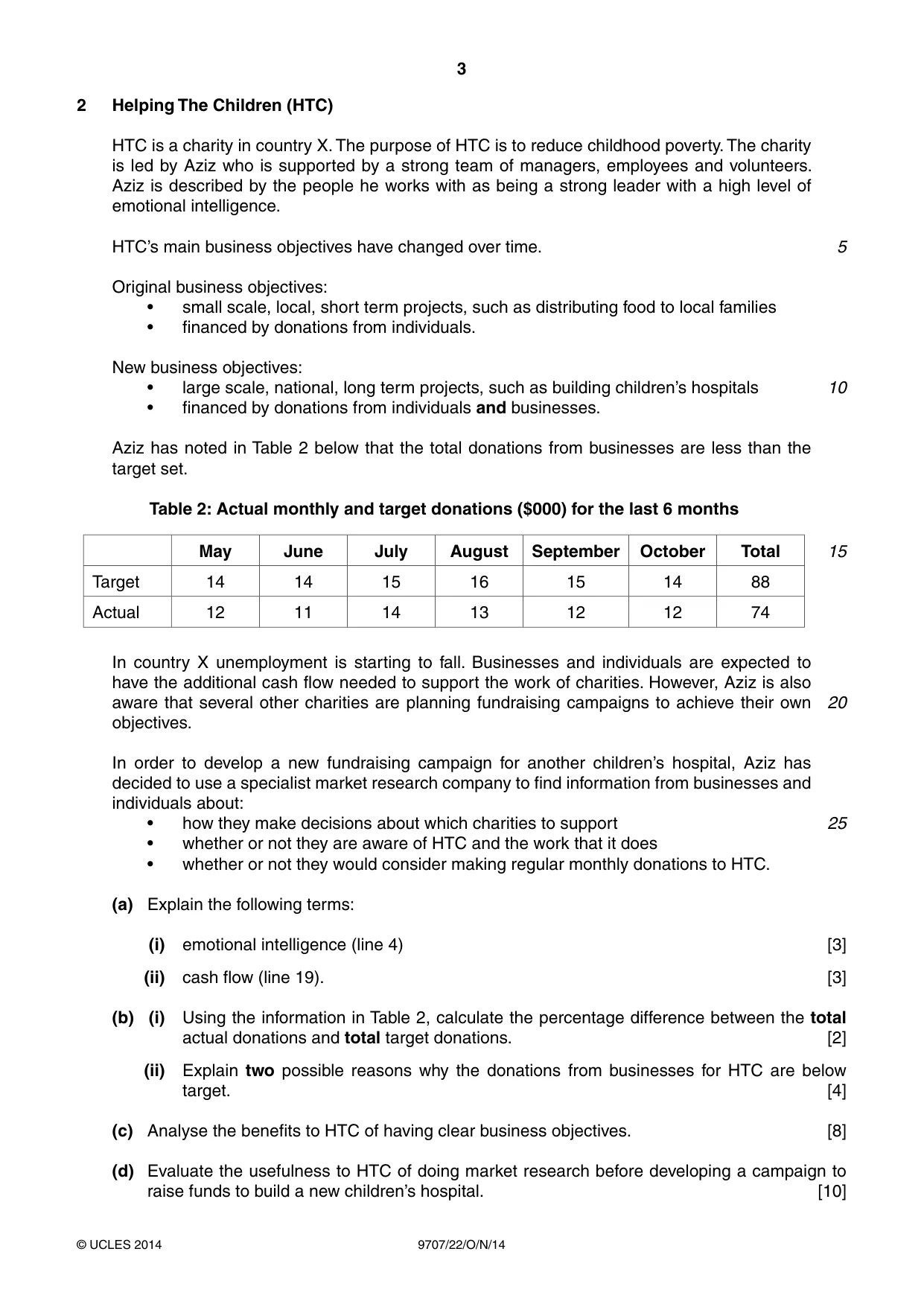
2 Helping The Children (HTC) HTC is a charity in country X. The purpose of HTC is to reduce childhood poverty. The charity is led by Aziz who is supported by a strong team of managers, employees and volunteers. Aziz is described by the people he works with as being a strong leader with a high level of emotional intelligence. HTC’s main business objectives have changed over time. 5 Original business objectives: • small scale, local, short term projects, such as distributing food to local families • financed by donations from individuals. New business objectives: • large scale, national, long term projects, such as building children’s hospitals 10 • financed by donations from individuals and businesses. Aziz has noted in Table 2 below that the total donations from businesses are less than the target set. Table 2: Actual monthly and target donations ($000) for the last 6 months May June July August September October Total 15 Target 14 14 15 16 15 14 88 Actual 12 11 14 13 12 12 74 In country X unemployment is starting to fall. Businesses and individuals are expected to have the additional cash flow needed to support the work of charities. However, Aziz is also aware that several other charities are planning fundraising campaigns to achieve their own 20 objectives. In order to develop a new fundraising campaign for another children’s hospital, Aziz has decided to use a specialist market research company to find information from businesses and individuals about: • how they make decisions about which charities to support 25 • whether or not they are aware of HTC and the work that it does • whether or not they would consider making regular monthly donations to HTC. (a) Explain the following terms: (i) emotional intelligence (line 4) [3] (ii) cash flow (line 19). [3] (b) (i) Using the information in Table 2, calculate the percentage difference between the total actual donations and total target donations. [2] (ii) Explain two possible reasons why the donations from businesses for HTC are below target. [4] (c) Analyse the benefits to HTC of having clear business objectives. [8] (d) Evaluate the usefulness to HTC of doing market research before developing a campaign to raise funds to build a new children’s hospital. [10]
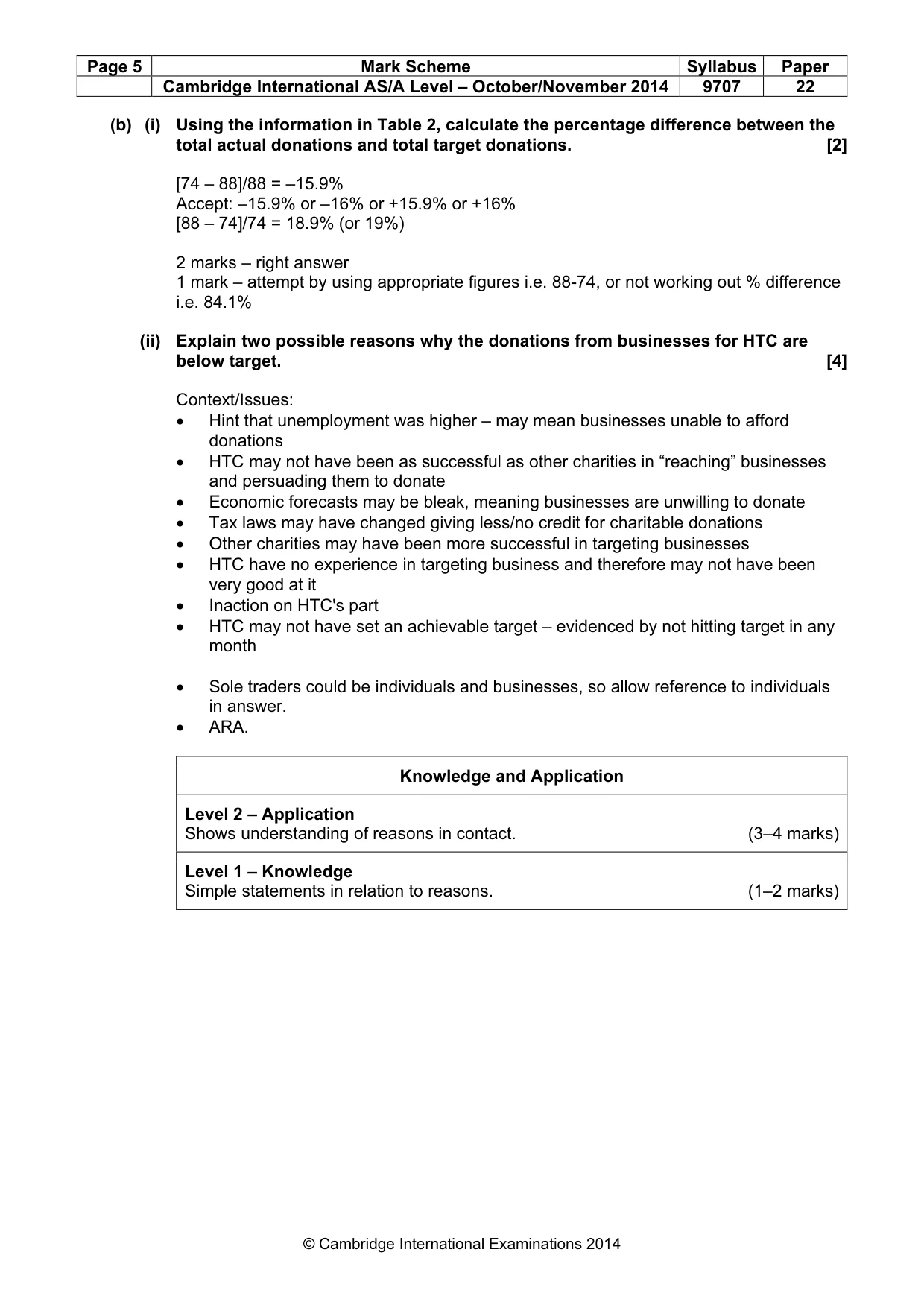
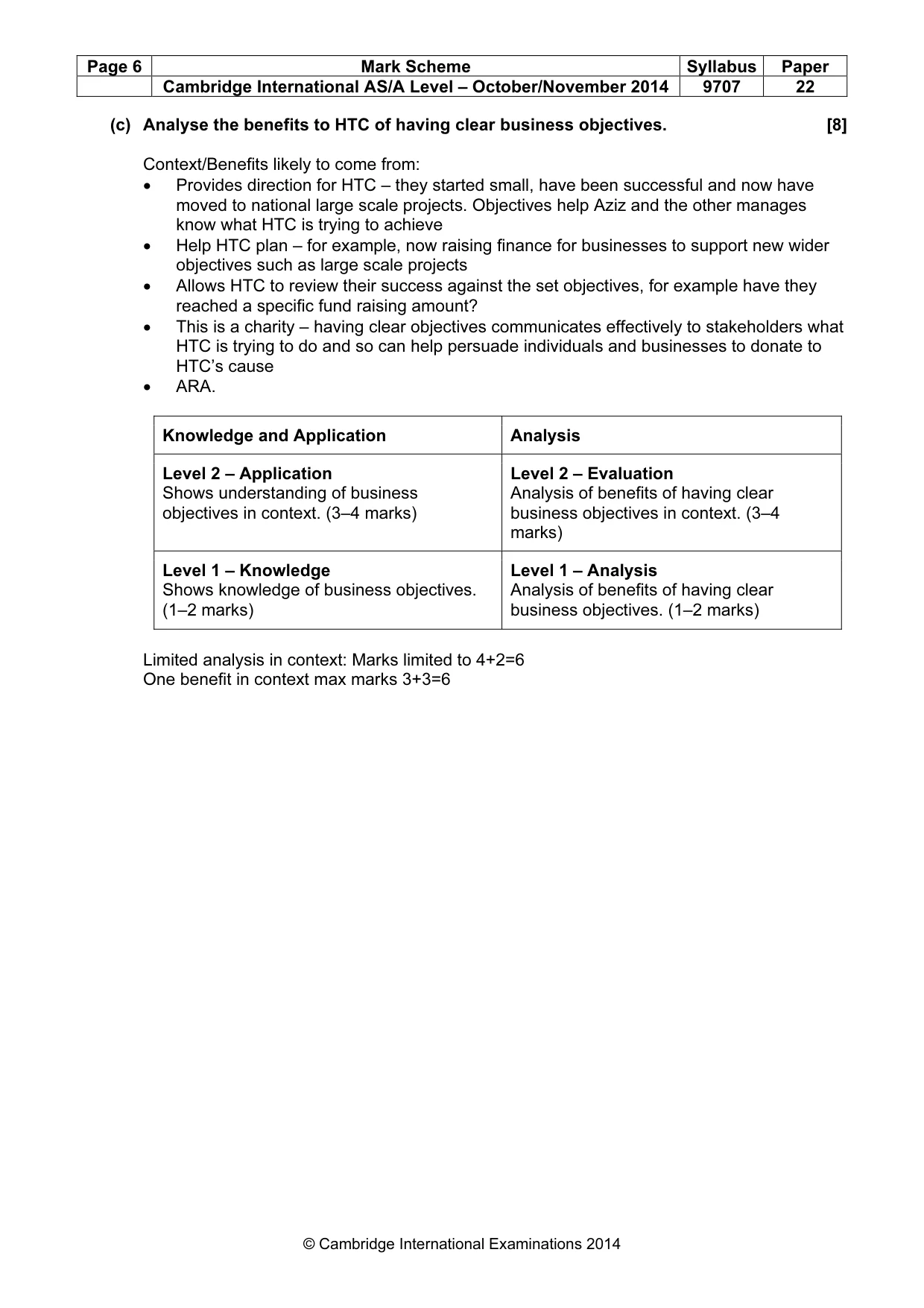
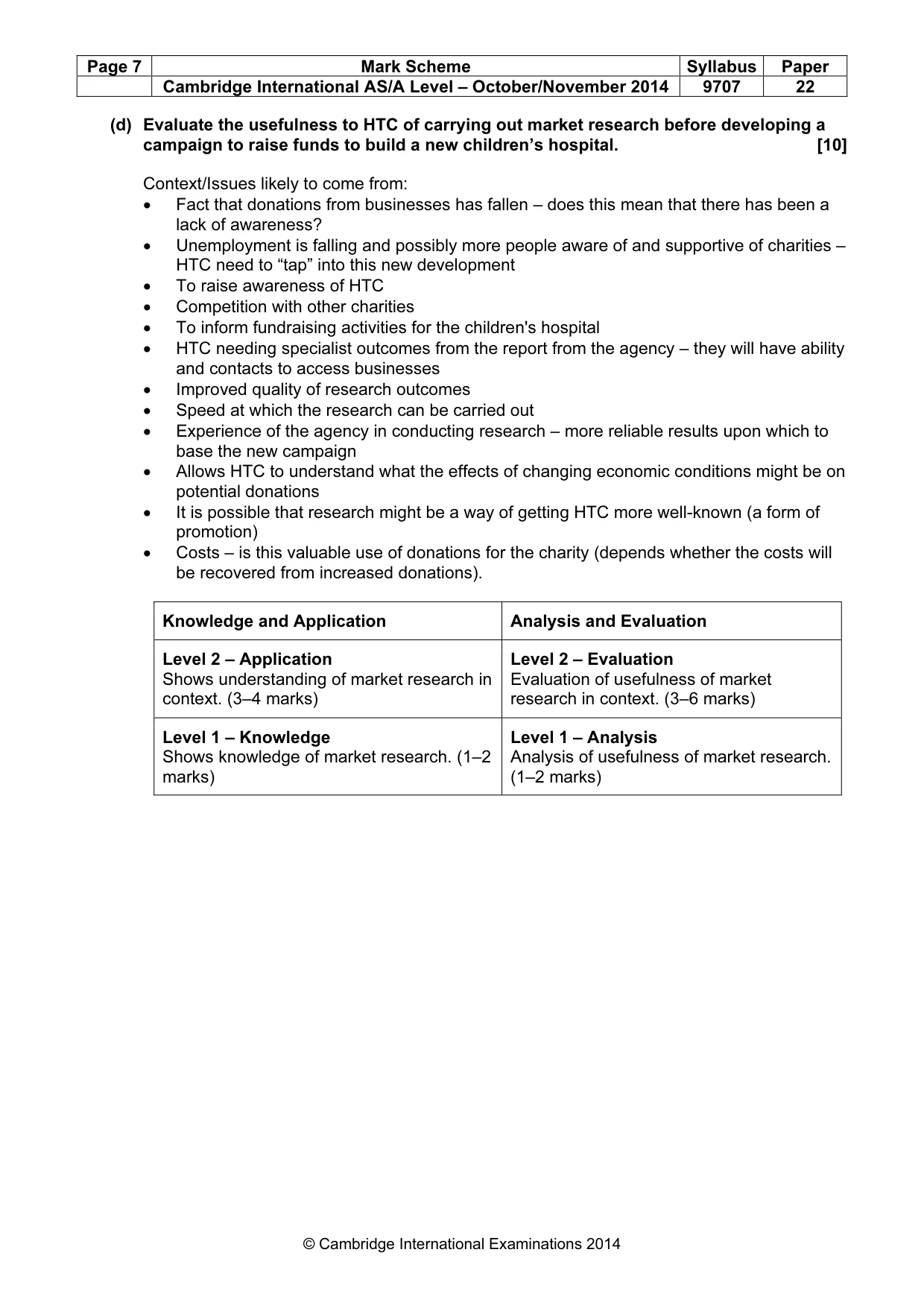
Mark scheme: 2 (a) Explain the following terms: (i) emotional intelligence (line 4) [3] Dealing with emotions/feelings. (1) This is the ability of a manager to manage their own and other’s emotions (1). A style of leadership. (1) Additional mark for an element such as: • So they can interact effectively in order to achieve the goal of a business. • Part of Goleman; self-awareness, self-management, relationship management and social awareness. • Example. Level 2: Good explanation (2/3 marks) Level 1: Partial explanation/understanding (1 mark) (ii) cash flow (line 19) [3] Inflow/outflow (1) Net cashflow (1) Additional mark for another element such as: • Needed by businesses to ensure they do not go into liquidation. • Cash flow usually shown in a cash flow forecast. • Running of out of cash flow is usually why many new businesses fail. Level 2: Good explanation (2/3 marks) Level 1: Partial explanation/understanding (1 mark) (b) (i) Using the information in Table 2, calculate the percentage difference between the total actual donations and total target donations. [2] [74 – 88]/88 = –15.9% Accept: –15.9% or –16% or +15.9% or +16% [88 – 74]/74 = 18.9% (or 19%) 2 marks – right answer 1 mark – attempt by using appropriate figures i.e. 88-74, or not working out % difference i.e. 84.1% (ii) Explain two possible reasons why the donations from businesses for HTC are below target. [4] Context/Issues: • Hint that unemployment was higher – may mean businesses unable to afford donations • HTC may not have been as successful as other charities in “reaching” businesses and persuading them to donate • Economic forecasts may be bleak, meaning businesses are unwilling to donate • Tax laws may have changed giving less/no credit for charitable donations • Other charities may have been more successful in targeting businesses • HTC have no experience in targeting business and therefore may not have been very good at it • Inaction on HTC's part • HTC may not have set an achievable target – evidenced by not hitting target in any month • Sole traders could be individuals and businesses, so allow reference to individuals in answer. • ARA. Knowledge and Application Level 2 – Application Shows understanding of reasons in contact. (3–4 marks) Level 1 – Knowledge Simple statements in relation to reasons. (1–2 marks) (c) Analyse the benefits to HTC of having clear business objectives. [8] Context/Benefits likely to come from: • Provides direction for HTC – they started small, have been successful and now have moved to national large scale projects. Objectives help Aziz and the other manages know what HTC is trying to achieve • Help HTC plan – for example, now raising finance for businesses to support new wider objectives such as large scale projects • Allows HTC to review their success against the set objectives, for example have they reached a specific fund raising amount? • This is a charity – having clear objectives communicates effectively to stakeholders what HTC is trying to do and so can help persuade individuals and businesses to donate to HTC’s cause • ARA. Knowledge and Application Analysis Level 2 – Application Level 2 – Evaluation Shows understanding of business Analysis of benefits of having clear objectives in context. (3–4 marks) business objectives in context. (3–4 marks) Level 1 – Knowledge Level 1 – Analysis Shows knowledge of business objectives. Analysis of benefits of having clear (1–2 marks) business objectives. (1–2 marks) Limited analysis in context: Marks limited to 4+2=6 One benefit in context max marks 3+3=6 (d) Evaluate the usefulness to HTC of carrying out market research before developing a campaign to raise funds to build a new children’s hospital. [10] Context/Issues likely to come from: • Fact that donations from businesses has fallen – does this mean that there has been a lack of awareness? • Unemployment is falling and possibly more people aware of and supportive of charities – HTC need to “tap” into this new development • To raise awareness of HTC • Competition with other charities • To inform fundraising activities for the children's hospital • HTC needing specialist outcomes from the report from the agency – they will have ability and contacts to access businesses • Improved quality of research outcomes • Speed at which the research can be carried out • Experience of the agency in conducting research – more reliable results upon which to base the new campaign • Allows HTC to understand what the effects of changing economic conditions might be on potential donations • It is possible that research might be a way of getting HTC more well-known (a form of promotion) • Costs – is this valuable use of donations for the charity (depends whether the costs will be recovered from increased donations). Knowledge and Application Analysis and Evaluation Level 2 – Application Level 2 – Evaluation Shows understanding of market research in Evaluation of usefulness of market context. (3–4 marks) research in context. (3–6 marks) Level 1 – Knowledge Level 1 – Analysis Shows knowledge of market research. (1–2 Analysis of usefulness of market research. marks) (1–2 marks)
What you needed in this session
Cambridge’s own grade thresholds for 2014 Oct/Nov, Paper 2 · Variant 2. A higher threshold means an easier paper — the bar moves with how the cohort did.