Cambridge A Level Business Studies (for final examination in 2015) 9707 — 2014 May/June Paper 3 · Variant 3
9707/33/M/J/14 · 100 marks · ≈113 min
The question paper and its mark scheme, free to read here and free to download. This is Cambridge’s own paper, exactly as it was sat.
Question paper8 pages


Mark scheme11 pages
Answers below. Sit the paper first if you are practising.
Paper as text
Question paper, page 1
This document consists of 6 printed pages and 2 blank pages. DC (RCL (KM)) 82883/3 © UCLES 2014 [Turn over Cambridge International Examinations Cambridge International Advanced Level * 6 7 2 0 8 6 7 8 8 4 * BUSINESS STUDIES 9707/33 Paper 3 May/June 2014 CASE STUDY 3 hours Additional Materials: Answer Booklet/Paper READ THESE INSTRUCTIONS FIRST If you have been given an Answer Booklet, follow the instructions on the front cover of the Booklet. Write your Centre number, candidate number and name on all the work you hand in. Write in dark blue or black pen. You may use an HB pencil for any diagrams or graphs. Do not use staples, paper clips, glue or correction fluid. DO NOT WRITE IN ANY BARCODES. Section A Answer all questions. Section B Answer one question. The businesses described in this question paper are entirely fictitious. You are advised to spend 40 minutes on Section B. At the end of the examination, fasten all your work securely together. The number of marks is given in brackets [ ] at the end of each question or part question.
Question paper, page 2
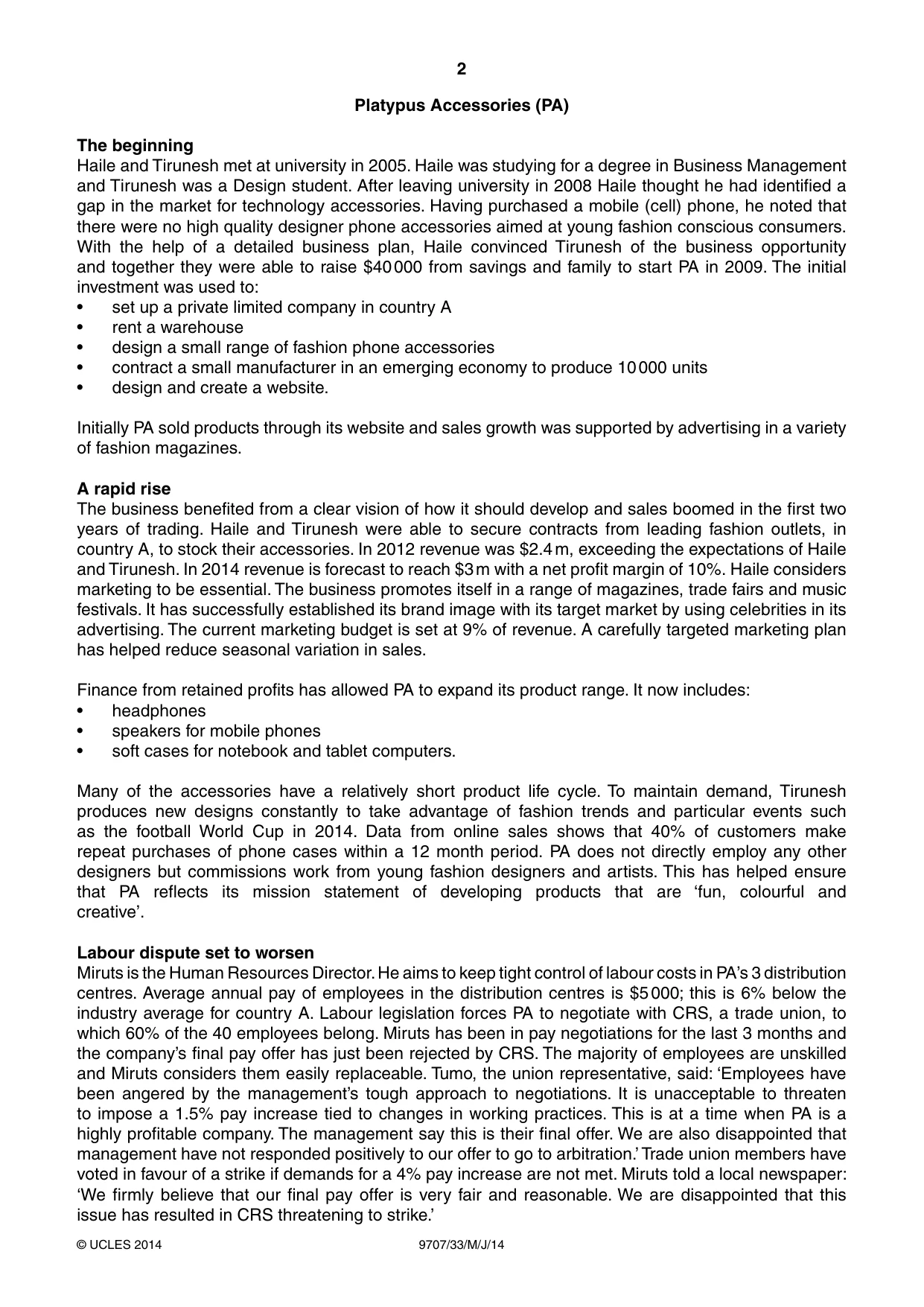
2 9707/33/M/J/14 © UCLES 2014 Platypus Accessories (PA) The beginning Haile and Tirunesh met at university in 2005. Haile was studying for a degree in Business Management and Tirunesh was a Design student. After leaving university in 2008 Haile thought he had identified a gap in the market for technology accessories. Having purchased a mobile (cell) phone, he noted that there were no high quality designer phone accessories aimed at young fashion conscious consumers. With the help of a detailed business plan, Haile convinced Tirunesh of the business opportunity and together they were able to raise $40 000 from savings and family to start PA in 2009. The initial investment was used to: • set up a private limited company in country A • rent a warehouse • design a small range of fashion phone accessories • contract a small manufacturer in an emerging economy to produce 10 000 units • design and create a website. Initially PA sold products through its website and sales growth was supported by advertising in a variety of fashion magazines. A rapid rise The business benefited from a clear vision of how it should develop and sales boomed in the first two years of trading. Haile and Tirunesh were able to secure contracts from leading fashion outlets, in country A, to stock their accessories. In 2012 revenue was $2.4 m, exceeding the expectations of Haile and Tirunesh. In 2014 revenue is forecast to reach $3 m with a net profit margin of 10%. Haile considers marketing to be essential. The business promotes itself in a range of magazines, trade fairs and music festivals. It has successfully established its brand image with its target market by using celebrities in its advertising. The current marketing budget is set at 9% of revenue. A carefully targeted marketing plan has helped reduce seasonal variation in sales. Finance from retained profits has allowed PA to expand its product range. It now includes: • headphones • speakers for mobile phones • soft cases for notebook and tablet computers. Many of the accessories have a relatively short product life cycle. To maintain demand, Tirunesh produces new designs constantly to take advantage of fashion trends and particular events such as the football World Cup in 2014. Data from online sales shows that 40% of customers make repeat purchases of phone cases within a 12 month period. PA does not directly employ any other designers but commissions work from young fashion designers and artists. This has helped ensure that PA reflects its mission statement of developing products that are ‘fun, colourful and creative’. Labour dispute set to worsen Miruts is the Human Resources Director. He aims to keep tight control of labour costs in PA’s 3 distribution centres. Average annual pay of employees in the distribution centres is $5 000; this is 6% below the industry average for country A. Labour legislation forces PA to negotiate with CRS, a trade union, to which 60% of the 40 employees belong. Miruts has been in pay negotiations for the last 3 months and the company’s final pay offer has just been rejected by CRS. The majority of employees are unskilled and Miruts considers them easily replaceable. Tumo, the union representative, said: ‘Employees have been angered by the management’s tough approach to negotiations. It is unacceptable to threaten to impose a 1.5% pay increase tied to changes in working practices. This is at a time when PA is a highly profitable company. The management say this is their final offer. We are also disappointed that management have not responded positively to our offer to go to arbitration.’ Trade union members have voted in favour of a strike if demands for a 4% pay increase are not met. Miruts told a local newspaper: ‘We firmly believe that our final pay offer is very fair and reasonable. We are disappointed that this issue has resulted in CRS threatening to strike.’
Question paper, page 3
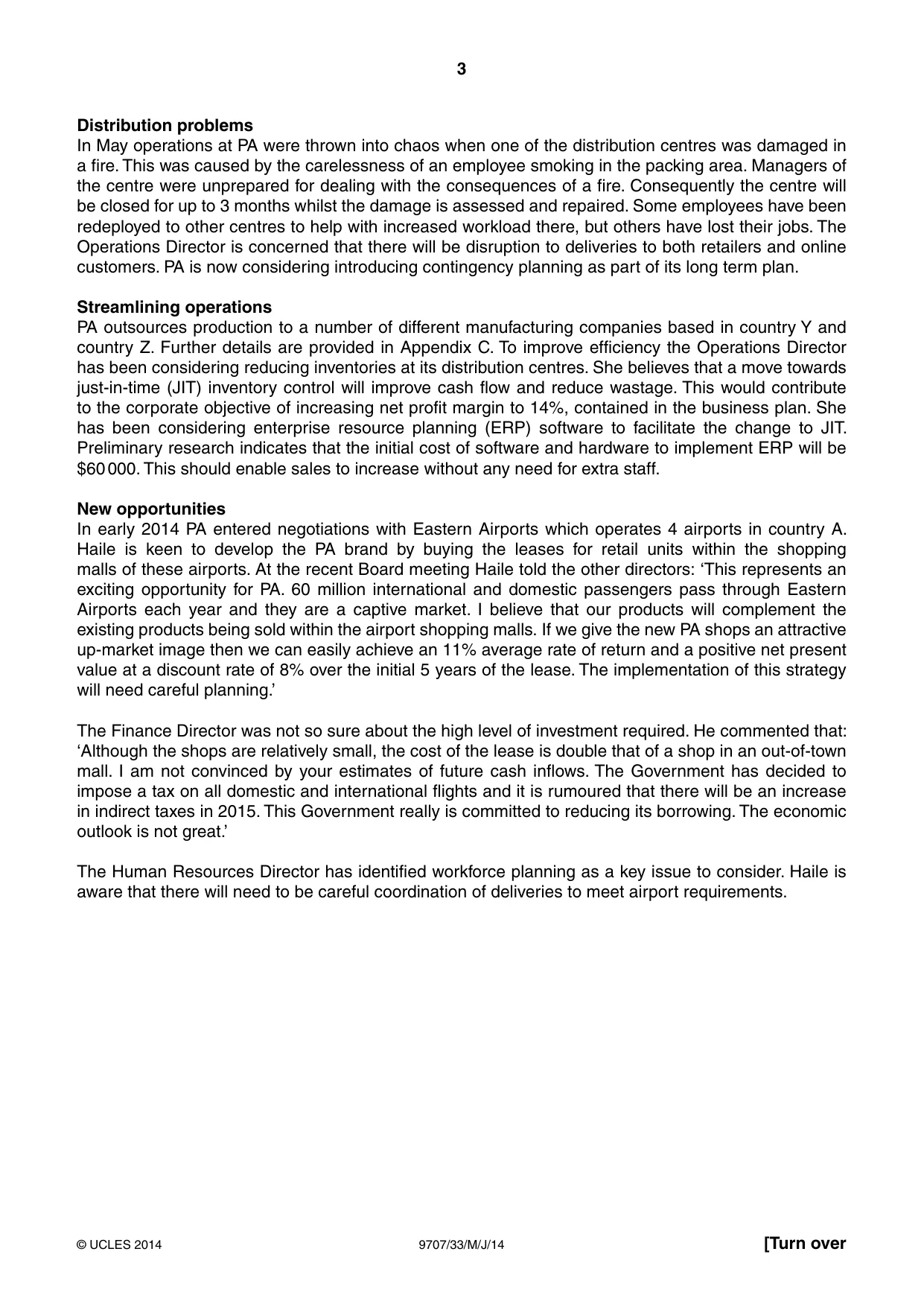
3 9707/33/M/J/14 © UCLES 2014 [Turn over Distribution problems In May operations at PA were thrown into chaos when one of the distribution centres was damaged in a fire. This was caused by the carelessness of an employee smoking in the packing area. Managers of the centre were unprepared for dealing with the consequences of a fire. Consequently the centre will be closed for up to 3 months whilst the damage is assessed and repaired. Some employees have been redeployed to other centres to help with increased workload there, but others have lost their jobs. The Operations Director is concerned that there will be disruption to deliveries to both retailers and online customers. PA is now considering introducing contingency planning as part of its long term plan. Streamlining operations PA outsources production to a number of different manufacturing companies based in country Y and country Z. Further details are provided in Appendix C. To improve efficiency the Operations Director has been considering reducing inventories at its distribution centres. She believes that a move towards just-in-time (JIT) inventory control will improve cash flow and reduce wastage. This would contribute to the corporate objective of increasing net profit margin to 14%, contained in the business plan. She has been considering enterprise resource planning (ERP) software to facilitate the change to JIT. Preliminary research indicates that the initial cost of software and hardware to implement ERP will be $60 000. This should enable sales to increase without any need for extra staff. New opportunities In early 2014 PA entered negotiations with Eastern Airports which operates 4 airports in country A. Haile is keen to develop the PA brand by buying the leases for retail units within the shopping malls of these airports. At the recent Board meeting Haile told the other directors: ‘This represents an exciting opportunity for PA. 60 million international and domestic passengers pass through Eastern Airports each year and they are a captive market. I believe that our products will complement the existing products being sold within the airport shopping malls. If we give the new PA shops an attractive up-market image then we can easily achieve an 11% average rate of return and a positive net present value at a discount rate of 8% over the initial 5 years of the lease. The implementation of this strategy will need careful planning.’ The Finance Director was not so sure about the high level of investment required. He commented that: ‘Although the shops are relatively small, the cost of the lease is double that of a shop in an out-of-town mall. I am not convinced by your estimates of future cash inflows. The Government has decided to impose a tax on all domestic and international flights and it is rumoured that there will be an increase in indirect taxes in 2015. This Government really is committed to reducing its borrowing. The economic outlook is not great.’ The Human Resources Director has identified workforce planning as a key issue to consider. Haile is aware that there will need to be careful coordination of deliveries to meet airport requirements.
Question paper, page 4
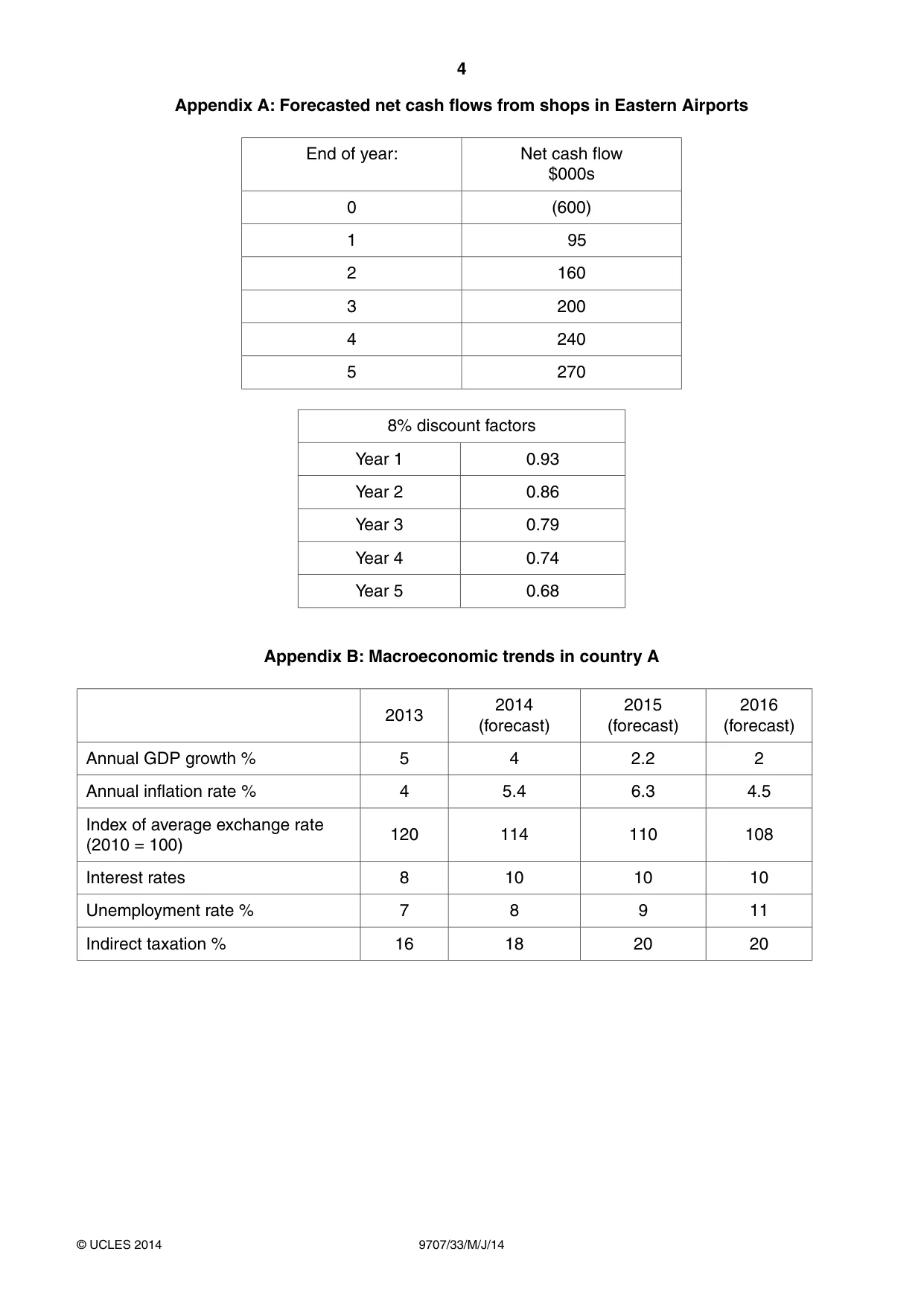
4 9707/33/M/J/14 © UCLES 2014 Appendix A: Forecasted net cash flows from shops in Eastern Airports End of year: Net cash flow $000s 0 (600) 1 95 2 160 3 200 4 240 5 270 8% discount factors Year 1 0.93 Year 2 0.86 Year 3 0.79 Year 4 0.74 Year 5 0.68 Appendix B: Macroeconomic trends in country A 2013 2014 (forecast) 2015 (forecast) 2016 (forecast) Annual GDP growth % 5 4 2.2 2 Annual inflation rate % 4 5.4 6.3 4.5 Index of average exchange rate (2010 = 100) 120 114 110 108 Interest rates 8 10 10 10 Unemployment rate % 7 8 9 11 Indirect taxation % 16 18 20 20
Question paper, page 5
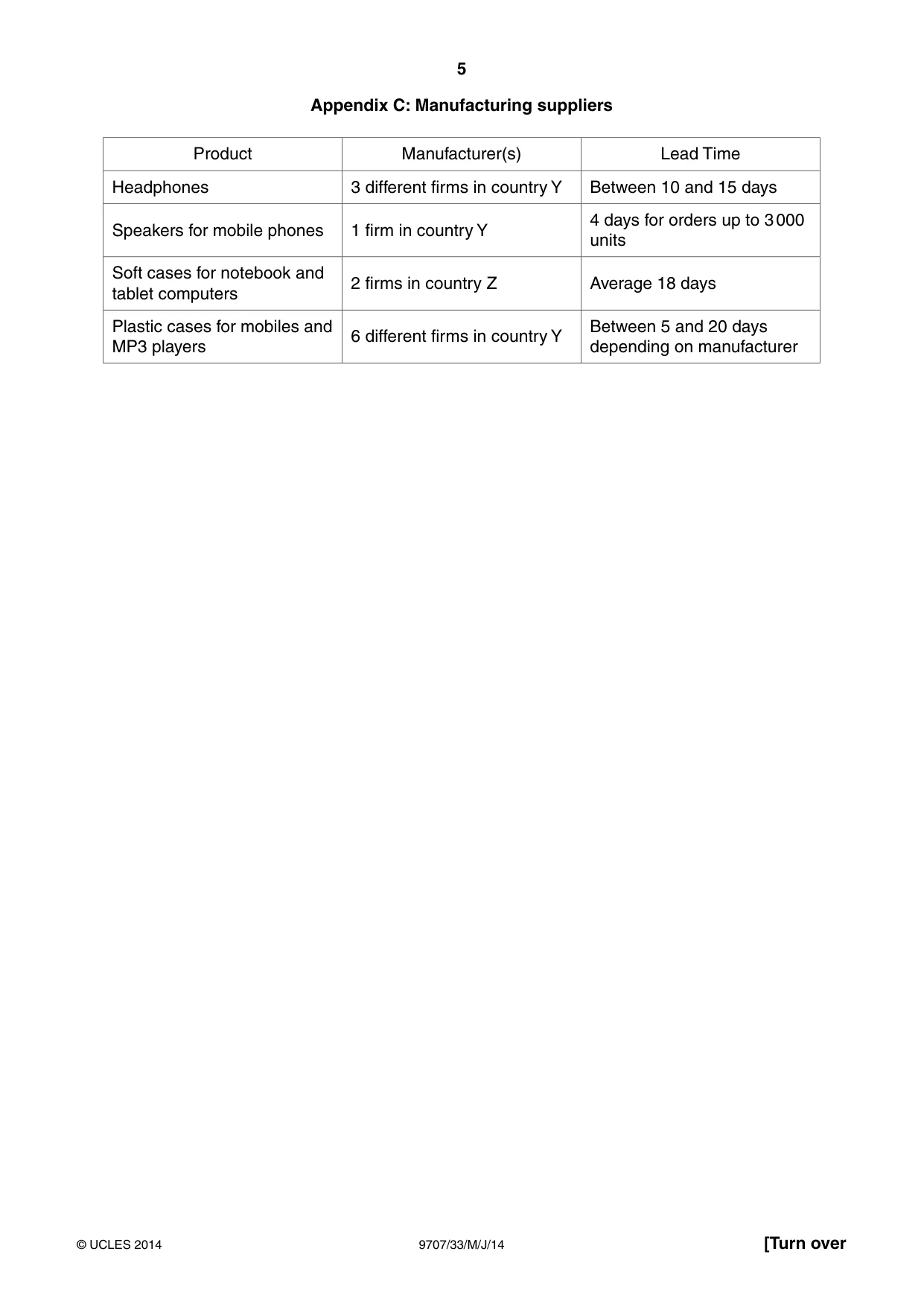
5 9707/33/M/J/14 © UCLES 2014 [Turn over Appendix C: Manufacturing suppliers Product Manufacturer(s) Lead Time Headphones 3 different firms in country Y Between 10 and 15 days Speakers for mobile phones 1 firm in country Y 4 days for orders up to 3 000 units Soft cases for notebook and tablet computers 2 firms in country Z Average 18 days Plastic cases for mobiles and MP3 players 6 different firms in country Y Between 5 and 20 days depending on manufacturer
Question paper, page 6
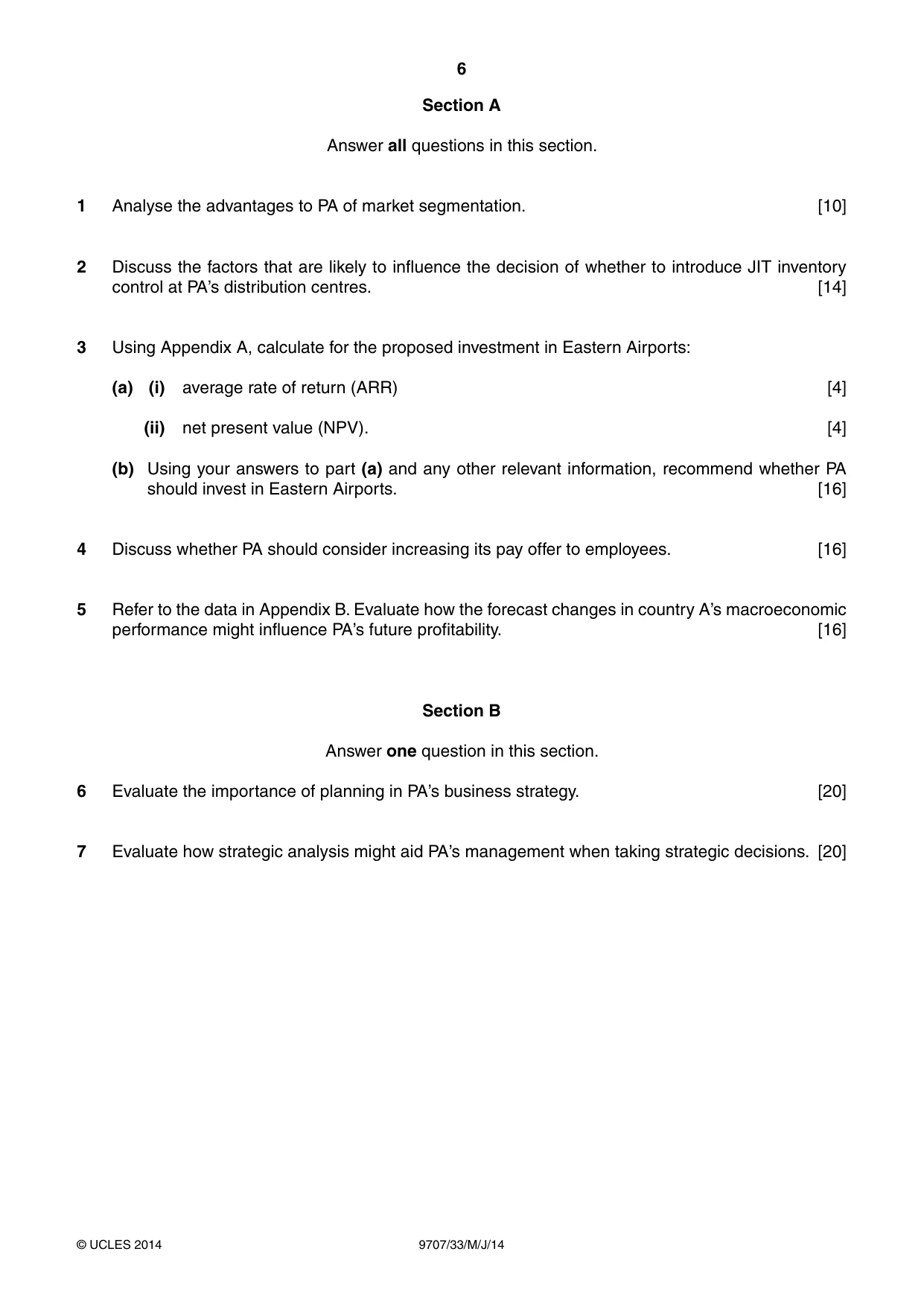
6 9707/33/M/J/14 © UCLES 2014 Section A Answer all questions in this section. 1 Analyse the advantages to PA of market segmentation. [10] 2 Discuss the factors that are likely to influence the decision of whether to introduce JIT inventory control at PA’s distribution centres. [14] 3 Using Appendix A, calculate for the proposed investment in Eastern Airports: (a) (i) average rate of return (ARR) [4] (ii) net present value (NPV). [4] (b) Using your answers to part (a) and any other relevant information, recommend whether PA should invest in Eastern Airports. [16] 4 Discuss whether PA should consider increasing its pay offer to employees. [16] 5 Refer to the data in Appendix B. Evaluate how the forecast changes in country A’s macroeconomic performance might influence PA’s future profitability. [16] Section B Answer one question in this section. 6 Evaluate the importance of planning in PA’s business strategy. [20] 7 Evaluate how strategic analysis might aid PA’s management when taking strategic decisions. [20]
Question paper, page 7
7 9707/33/M/J/14 © UCLES 2014 BLANK PAGE
Question paper, page 8
8 9707/33/M/J/14 © UCLES 2014 Permission to reproduce items where third-party owned material protected by copyright is included has been sought and cleared where possible. Every reasonable effort has been made by the publisher (UCLES) to trace copyright holders, but if any items requiring clearance have unwittingly been included, the publisher will be pleased to make amends at the earliest possible opportunity. Cambridge International Examinations is part of the Cambridge Assessment Group. Cambridge Assessment is the brand name of University of Cambridge Local Examinations Syndicate (UCLES), which is itself a department of the University of Cambridge. BLANK PAGE
Mark scheme, page 1
CAMBRIDGE INTERNATIONAL EXAMINATIONS GCE Advanced Level MARK SCHEME for the May/June 2014 series 9707 BUSINESS STUDIES 9707/33 Paper 3 (Case Study), maximum raw mark 100 This mark scheme is published as an aid to teachers and candidates, to indicate the requirements of the examination. It shows the basis on which Examiners were instructed to award marks. It does not indicate the details of the discussions that took place at an Examiners’ meeting before marking began, which would have considered the acceptability of alternative answers. Mark schemes should be read in conjunction with the question paper and the Principal Examiner Report for Teachers. Cambridge will not enter into discussions about these mark schemes. Cambridge is publishing the mark schemes for the May/June 2014 series for most IGCSE, GCE Advanced Level and Advanced Subsidiary Level components and some Ordinary Level components.
Mark scheme, page 2
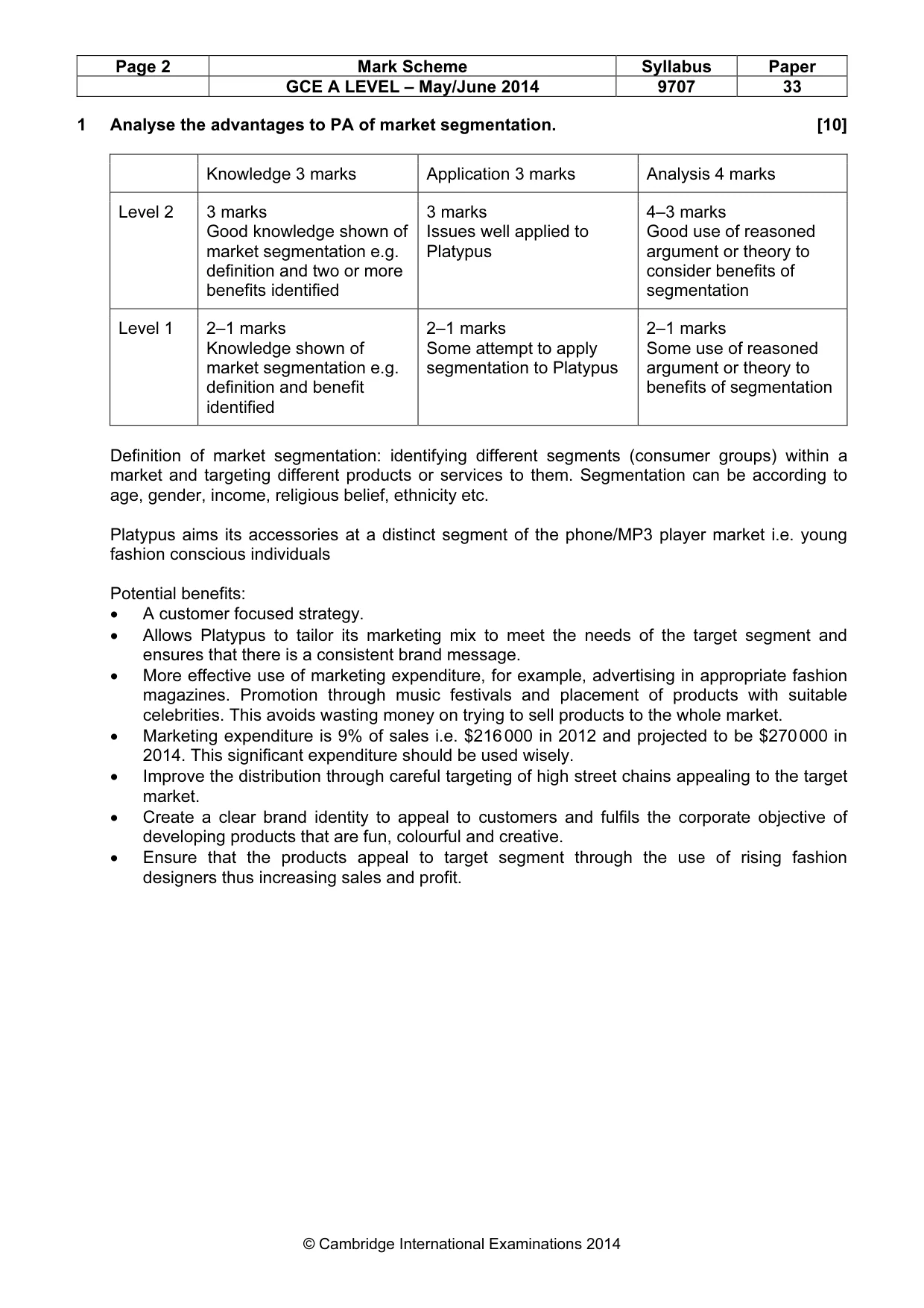
Page 2 Mark Scheme Syllabus Paper GCE A LEVEL – May/June 2014 9707 33 © Cambridge International Examinations 2014 1 Analyse the advantages to PA of market segmentation. [10] Knowledge 3 marks Application 3 marks Analysis 4 marks Level 2 3 marks Good knowledge shown of market segmentation e.g. definition and two or more benefits identified 3 marks Issues well applied to Platypus 4–3 marks Good use of reasoned argument or theory to consider benefits of segmentation Level 1 2–1 marks Knowledge shown of market segmentation e.g. definition and benefit identified 2–1 marks Some attempt to apply segmentation to Platypus 2–1 marks Some use of reasoned argument or theory to benefits of segmentation Definition of market segmentation: identifying different segments (consumer groups) within a market and targeting different products or services to them. Segmentation can be according to age, gender, income, religious belief, ethnicity etc. Platypus aims its accessories at a distinct segment of the phone/MP3 player market i.e. young fashion conscious individuals Potential benefits: • A customer focused strategy. • Allows Platypus to tailor its marketing mix to meet the needs of the target segment and ensures that there is a consistent brand message. • More effective use of marketing expenditure, for example, advertising in appropriate fashion magazines. Promotion through music festivals and placement of products with suitable celebrities. This avoids wasting money on trying to sell products to the whole market. • Marketing expenditure is 9% of sales i.e. $216 000 in 2012 and projected to be $270 000 in 2014. This significant expenditure should be used wisely. • Improve the distribution through careful targeting of high street chains appealing to the target market. • Create a clear brand identity to appeal to customers and fulfils the corporate objective of developing products that are fun, colourful and creative. • Ensure that the products appeal to target segment through the use of rising fashion designers thus increasing sales and profit.
Mark scheme, page 3
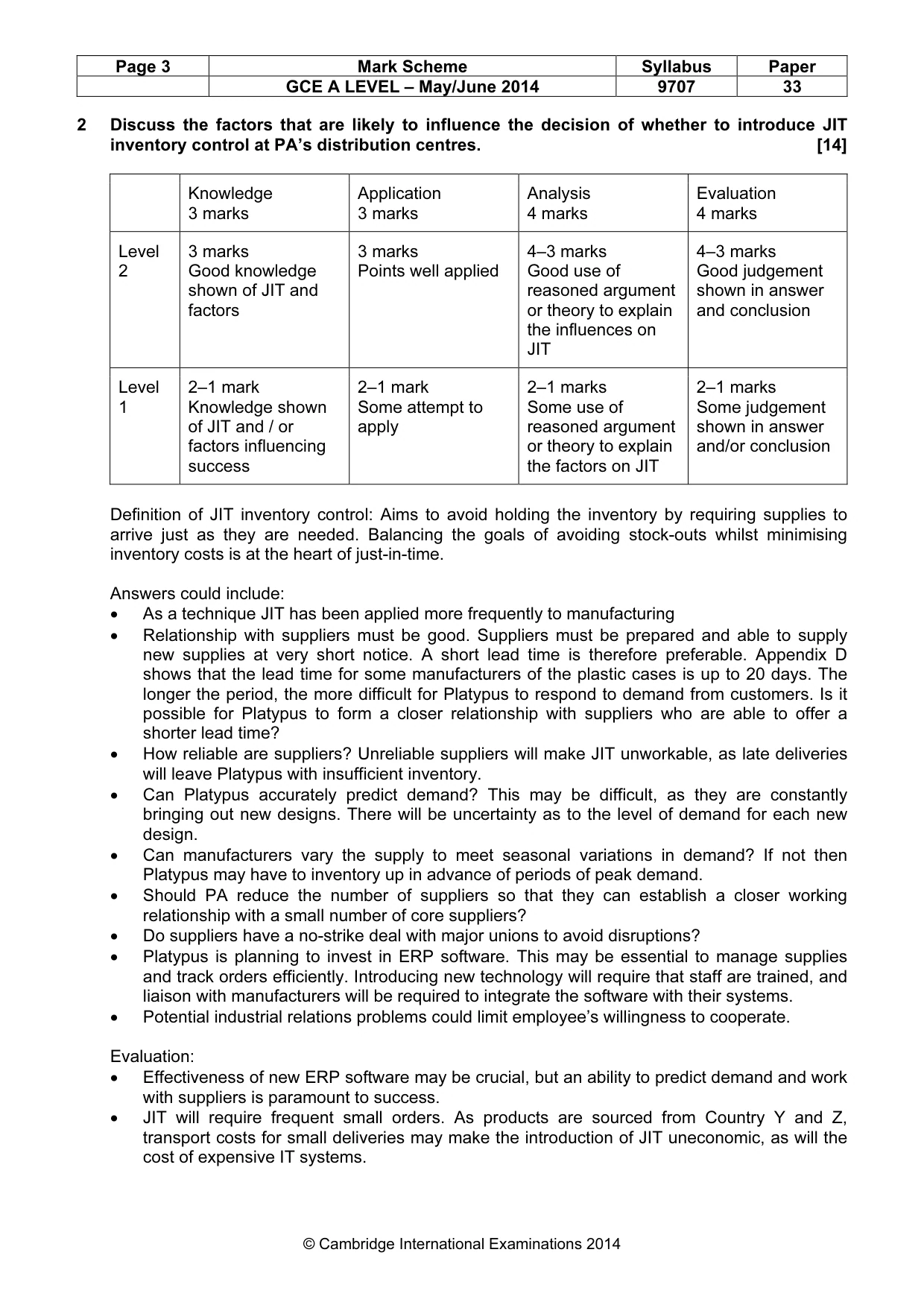
Page 3 Mark Scheme Syllabus Paper GCE A LEVEL – May/June 2014 9707 33 © Cambridge International Examinations 2014 2 Discuss the factors that are likely to influence the decision of whether to introduce JIT inventory control at PA’s distribution centres. [14] Knowledge 3 marks Application 3 marks Analysis 4 marks Evaluation 4 marks Level 2 3 marks Good knowledge shown of JIT and factors 3 marks Points well applied 4–3 marks Good use of reasoned argument or theory to explain the influences on JIT 4–3 marks Good judgement shown in answer and conclusion Level 1 2–1 mark Knowledge shown of JIT and / or factors influencing success 2–1 mark Some attempt to apply 2–1 marks Some use of reasoned argument or theory to explain the factors on JIT 2–1 marks Some judgement shown in answer and/or conclusion Definition of JIT inventory control: Aims to avoid holding the inventory by requiring supplies to arrive just as they are needed. Balancing the goals of avoiding stock-outs whilst minimising inventory costs is at the heart of just-in-time. Answers could include: • As a technique JIT has been applied more frequently to manufacturing • Relationship with suppliers must be good. Suppliers must be prepared and able to supply new supplies at very short notice. A short lead time is therefore preferable. Appendix D shows that the lead time for some manufacturers of the plastic cases is up to 20 days. The longer the period, the more difficult for Platypus to respond to demand from customers. Is it possible for Platypus to form a closer relationship with suppliers who are able to offer a shorter lead time? • How reliable are suppliers? Unreliable suppliers will make JIT unworkable, as late deliveries will leave Platypus with insufficient inventory. • Can Platypus accurately predict demand? This may be difficult, as they are constantly bringing out new designs. There will be uncertainty as to the level of demand for each new design. • Can manufacturers vary the supply to meet seasonal variations in demand? If not then Platypus may have to inventory up in advance of periods of peak demand. • Should PA reduce the number of suppliers so that they can establish a closer working relationship with a small number of core suppliers? • Do suppliers have a no-strike deal with major unions to avoid disruptions? • Platypus is planning to invest in ERP software. This may be essential to manage supplies and track orders efficiently. Introducing new technology will require that staff are trained, and liaison with manufacturers will be required to integrate the software with their systems. • Potential industrial relations problems could limit employee’s willingness to cooperate. Evaluation: • Effectiveness of new ERP software may be crucial, but an ability to predict demand and work with suppliers is paramount to success. • JIT will require frequent small orders. As products are sourced from Country Y and Z, transport costs for small deliveries may make the introduction of JIT uneconomic, as will the cost of expensive IT systems.
Mark scheme, page 4
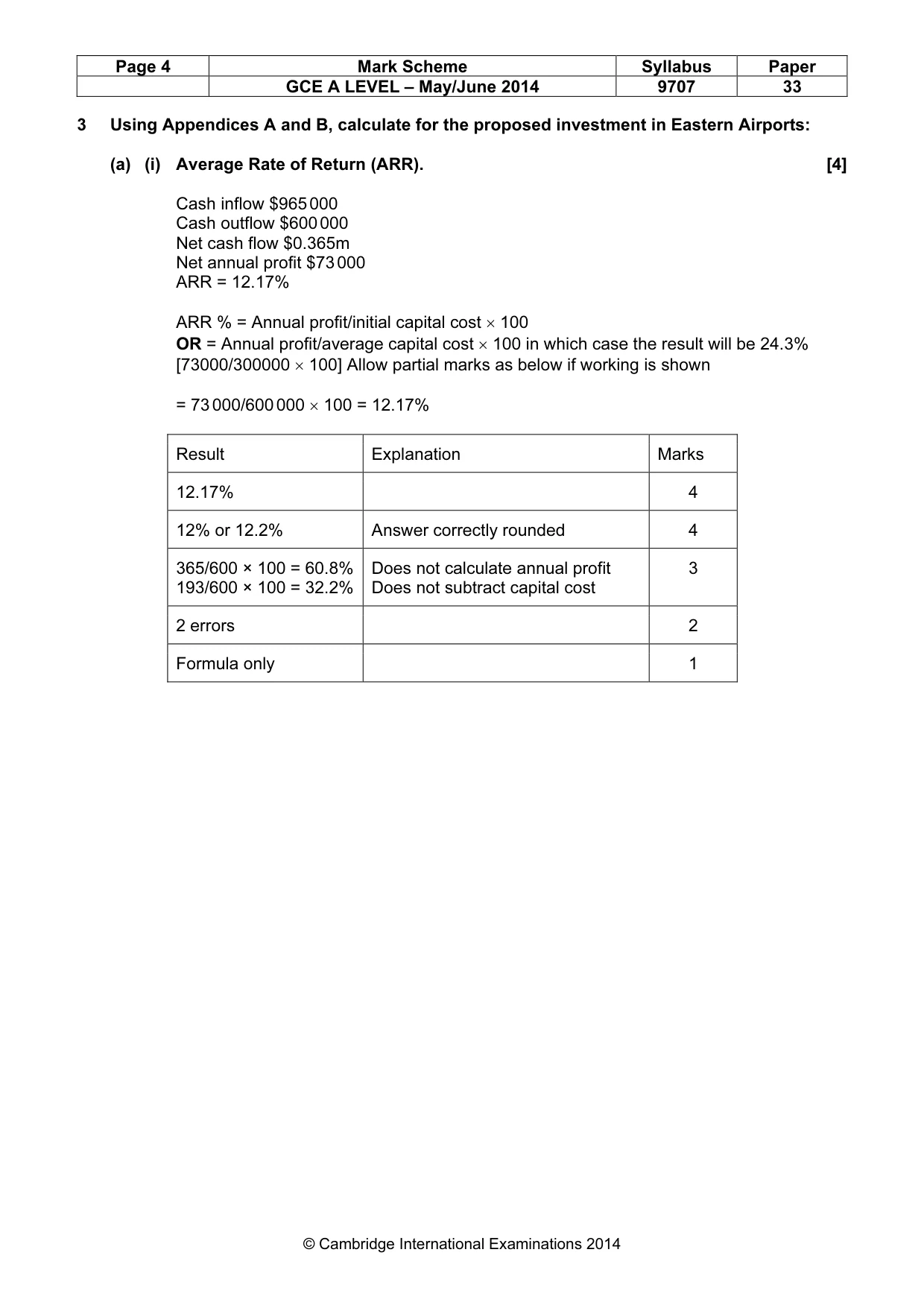
Page 4 Mark Scheme Syllabus Paper GCE A LEVEL – May/June 2014 9707 33 © Cambridge International Examinations 2014 3 Using Appendices A and B, calculate for the proposed investment in Eastern Airports: (a) (i) Average Rate of Return (ARR). [4] Cash inflow $965 000 Cash outflow $600 000 Net cash flow $0.365m Net annual profit $73 000 ARR = 12.17% ARR % = Annual profit/initial capital cost × 100 OR = Annual profit/average capital cost × 100 in which case the result will be 24.3% [73000/300000 × 100] Allow partial marks as below if working is shown = 73 000/600 000 × 100 = 12.17% Result Explanation Marks 12.17% 4 12% or 12.2% Answer correctly rounded 4 365/600 × 100 = 60.8% 193/600 × 100 = 32.2% Does not calculate annual profit Does not subtract capital cost 3 2 errors 2 Formula only 1
Mark scheme, page 5
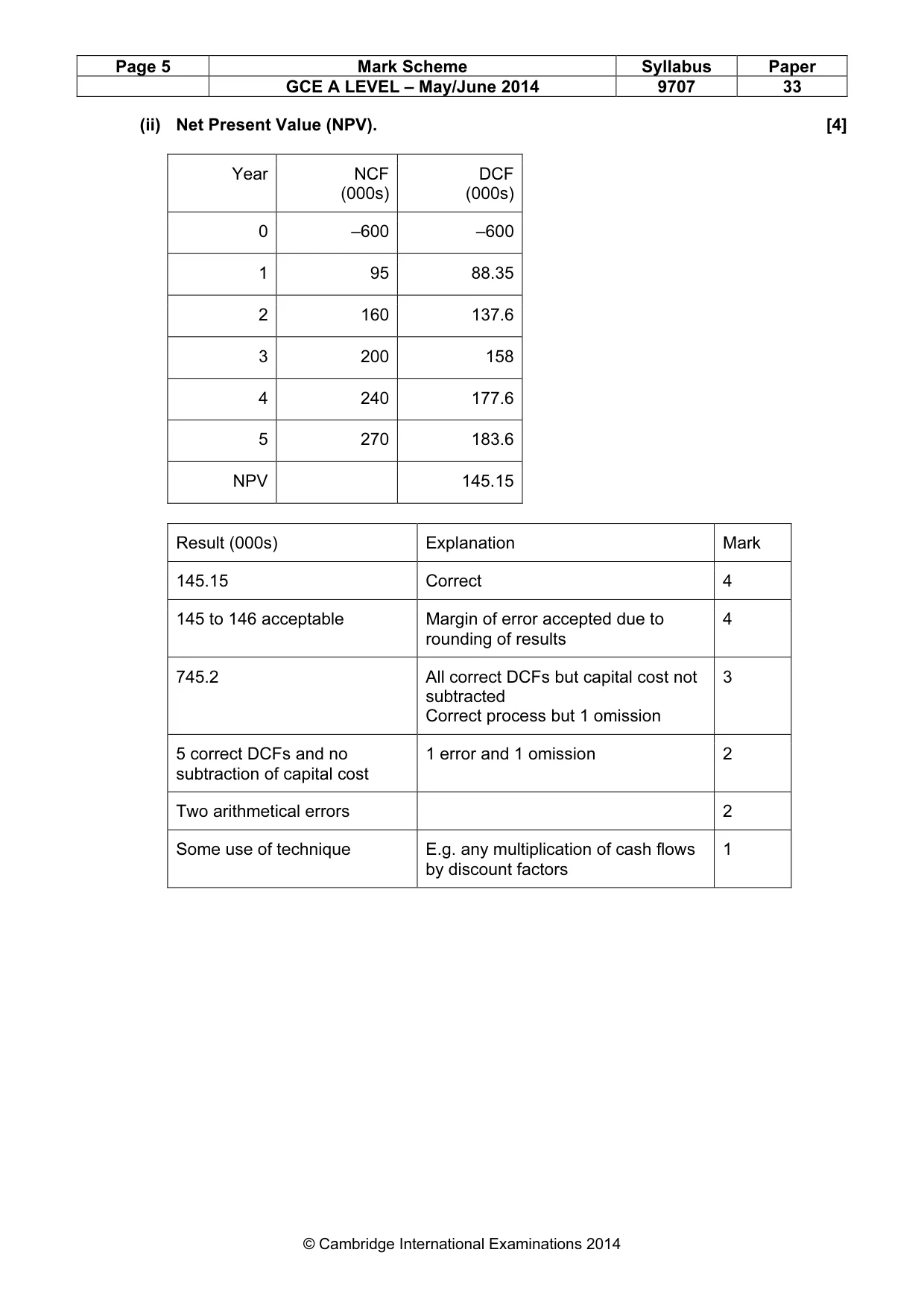
Page 5 Mark Scheme Syllabus Paper GCE A LEVEL – May/June 2014 9707 33 © Cambridge International Examinations 2014 (ii) Net Present Value (NPV). [4] Year NCF (000s) DCF (000s) 0 –600 –600 1 95 88.35 2 160 137.6 3 200 158 4 240 177.6 5 270 183.6 NPV 145.15 Result (000s) Explanation Mark 145.15 Correct 4 145 to 146 acceptable Margin of error accepted due to rounding of results 4 745.2 All correct DCFs but capital cost not subtracted Correct process but 1 omission 3 5 correct DCFs and no subtraction of capital cost 1 error and 1 omission 2 Two arithmetical errors 2 Some use of technique E.g. any multiplication of cash flows by discount factors 1
Mark scheme, page 6
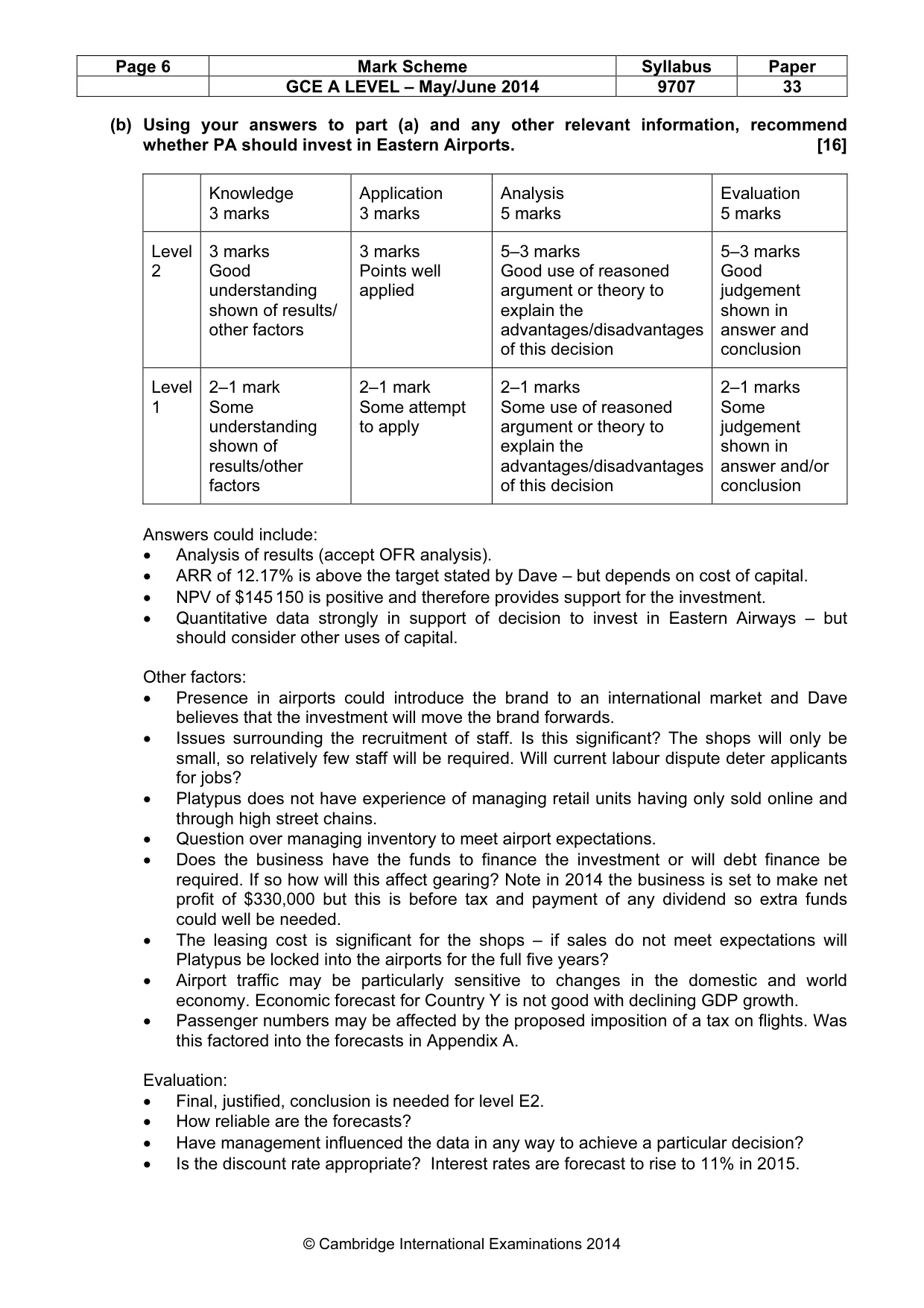
Page 6 Mark Scheme Syllabus Paper GCE A LEVEL – May/June 2014 9707 33 © Cambridge International Examinations 2014 (b) Using your answers to part (a) and any other relevant information, recommend whether PA should invest in Eastern Airports. [16] Knowledge 3 marks Application 3 marks Analysis 5 marks Evaluation 5 marks Level 2 3 marks Good understanding shown of results/ other factors 3 marks Points well applied 5–3 marks Good use of reasoned argument or theory to explain the advantages/disadvantages of this decision 5–3 marks Good judgement shown in answer and conclusion Level 1 2–1 mark Some understanding shown of results/other factors 2–1 mark Some attempt to apply 2–1 marks Some use of reasoned argument or theory to explain the advantages/disadvantages of this decision 2–1 marks Some judgement shown in answer and/or conclusion Answers could include: • Analysis of results (accept OFR analysis). • ARR of 12.17% is above the target stated by Dave – but depends on cost of capital. • NPV of $145 150 is positive and therefore provides support for the investment. • Quantitative data strongly in support of decision to invest in Eastern Airways – but should consider other uses of capital. Other factors: • Presence in airports could introduce the brand to an international market and Dave believes that the investment will move the brand forwards. • Issues surrounding the recruitment of staff. Is this significant? The shops will only be small, so relatively few staff will be required. Will current labour dispute deter applicants for jobs? • Platypus does not have experience of managing retail units having only sold online and through high street chains. • Question over managing inventory to meet airport expectations. • Does the business have the funds to finance the investment or will debt finance be required. If so how will this affect gearing? Note in 2014 the business is set to make net profit of $330,000 but this is before tax and payment of any dividend so extra funds could well be needed. • The leasing cost is significant for the shops – if sales do not meet expectations will Platypus be locked into the airports for the full five years? • Airport traffic may be particularly sensitive to changes in the domestic and world economy. Economic forecast for Country Y is not good with declining GDP growth. • Passenger numbers may be affected by the proposed imposition of a tax on flights. Was this factored into the forecasts in Appendix A. Evaluation: • Final, justified, conclusion is needed for level E2. • How reliable are the forecasts? • Have management influenced the data in any way to achieve a particular decision? • Is the discount rate appropriate? Interest rates are forecast to rise to 11% in 2015.
Mark scheme, page 7
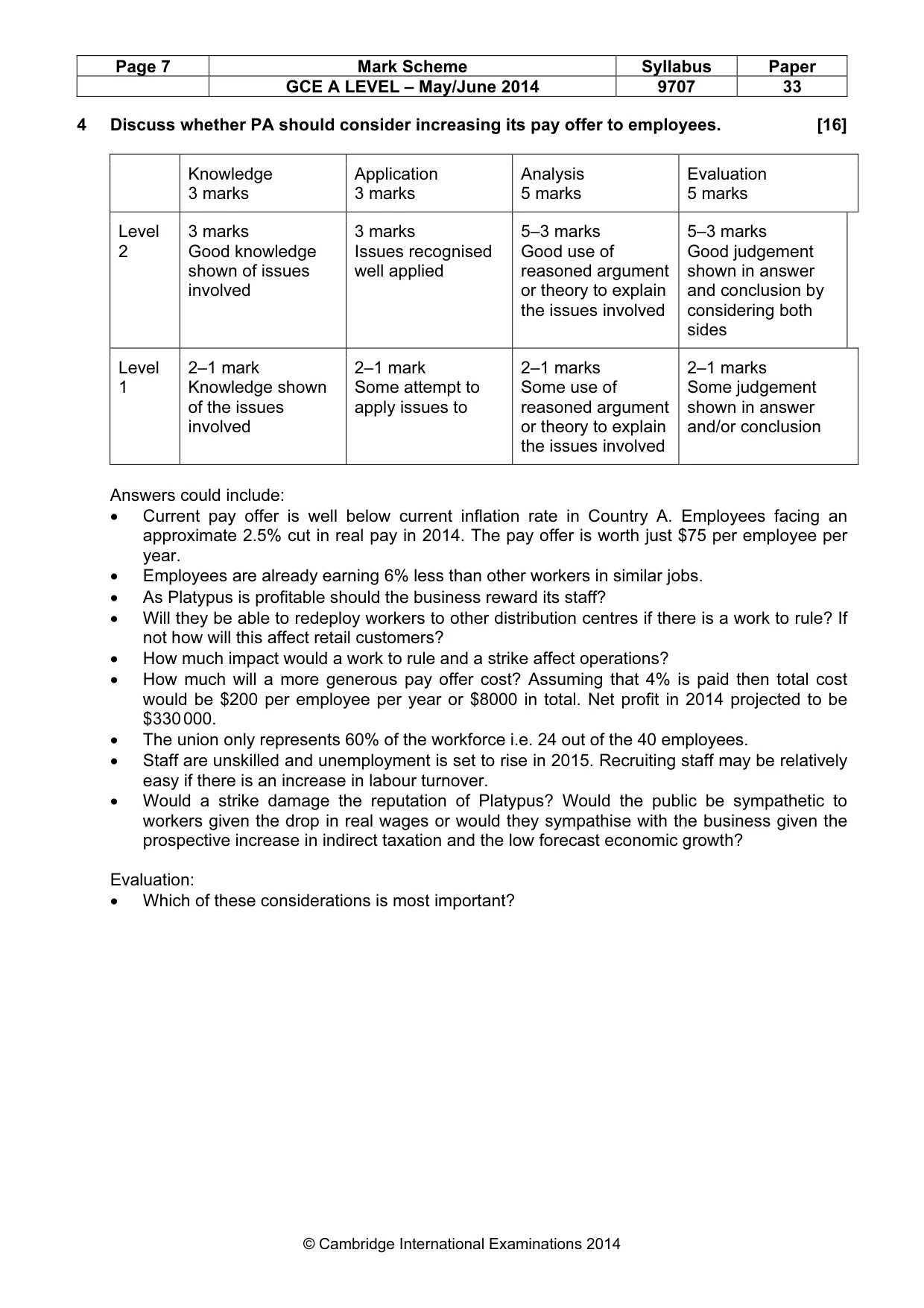
Page 7 Mark Scheme Syllabus Paper GCE A LEVEL – May/June 2014 9707 33 © Cambridge International Examinations 2014 4 Discuss whether PA should consider increasing its pay offer to employees. [16] Knowledge 3 marks Application 3 marks Analysis 5 marks Evaluation 5 marks Level 2 3 marks Good knowledge shown of issues involved 3 marks Issues recognised well applied 5–3 marks Good use of reasoned argument or theory to explain the issues involved 5–3 marks Good judgement shown in answer and conclusion by considering both sides Level 1 2–1 mark Knowledge shown of the issues involved 2–1 mark Some attempt to apply issues to 2–1 marks Some use of reasoned argument or theory to explain the issues involved 2–1 marks Some judgement shown in answer and/or conclusion Answers could include: • Current pay offer is well below current inflation rate in Country A. Employees facing an approximate 2.5% cut in real pay in 2014. The pay offer is worth just $75 per employee per year. • Employees are already earning 6% less than other workers in similar jobs. • As Platypus is profitable should the business reward its staff? • Will they be able to redeploy workers to other distribution centres if there is a work to rule? If not how will this affect retail customers? • How much impact would a work to rule and a strike affect operations? • How much will a more generous pay offer cost? Assuming that 4% is paid then total cost would be $200 per employee per year or $8000 in total. Net profit in 2014 projected to be $330 000. • The union only represents 60% of the workforce i.e. 24 out of the 40 employees. • Staff are unskilled and unemployment is set to rise in 2015. Recruiting staff may be relatively easy if there is an increase in labour turnover. • Would a strike damage the reputation of Platypus? Would the public be sympathetic to workers given the drop in real wages or would they sympathise with the business given the prospective increase in indirect taxation and the low forecast economic growth? Evaluation: • Which of these considerations is most important?
Mark scheme, page 8
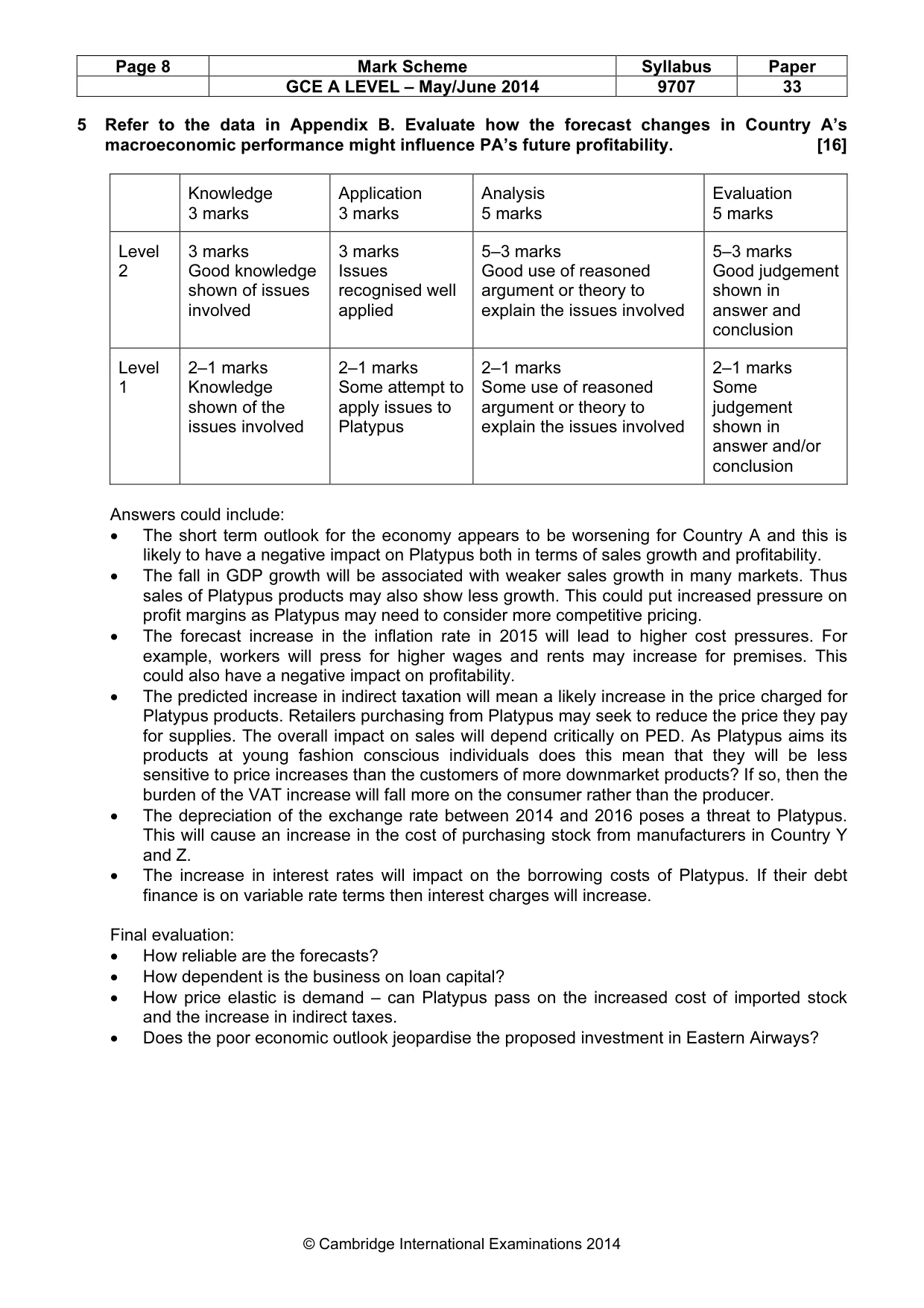
Page 8 Mark Scheme Syllabus Paper GCE A LEVEL – May/June 2014 9707 33 © Cambridge International Examinations 2014 5 Refer to the data in Appendix B. Evaluate how the forecast changes in Country A’s macroeconomic performance might influence PA’s future profitability. [16] Knowledge 3 marks Application 3 marks Analysis 5 marks Evaluation 5 marks Level 2 3 marks Good knowledge shown of issues involved 3 marks Issues recognised well applied 5–3 marks Good use of reasoned argument or theory to explain the issues involved 5–3 marks Good judgement shown in answer and conclusion Level 1 2–1 marks Knowledge shown of the issues involved 2–1 marks Some attempt to apply issues to Platypus 2–1 marks Some use of reasoned argument or theory to explain the issues involved 2–1 marks Some judgement shown in answer and/or conclusion Answers could include: • The short term outlook for the economy appears to be worsening for Country A and this is likely to have a negative impact on Platypus both in terms of sales growth and profitability. • The fall in GDP growth will be associated with weaker sales growth in many markets. Thus sales of Platypus products may also show less growth. This could put increased pressure on profit margins as Platypus may need to consider more competitive pricing. • The forecast increase in the inflation rate in 2015 will lead to higher cost pressures. For example, workers will press for higher wages and rents may increase for premises. This could also have a negative impact on profitability. • The predicted increase in indirect taxation will mean a likely increase in the price charged for Platypus products. Retailers purchasing from Platypus may seek to reduce the price they pay for supplies. The overall impact on sales will depend critically on PED. As Platypus aims its products at young fashion conscious individuals does this mean that they will be less sensitive to price increases than the customers of more downmarket products? If so, then the burden of the VAT increase will fall more on the consumer rather than the producer. • The depreciation of the exchange rate between 2014 and 2016 poses a threat to Platypus. This will cause an increase in the cost of purchasing stock from manufacturers in Country Y and Z. • The increase in interest rates will impact on the borrowing costs of Platypus. If their debt finance is on variable rate terms then interest charges will increase. Final evaluation: • How reliable are the forecasts? • How dependent is the business on loan capital? • How price elastic is demand – can Platypus pass on the increased cost of imported stock and the increase in indirect taxes. • Does the poor economic outlook jeopardise the proposed investment in Eastern Airways?
Mark scheme, page 9
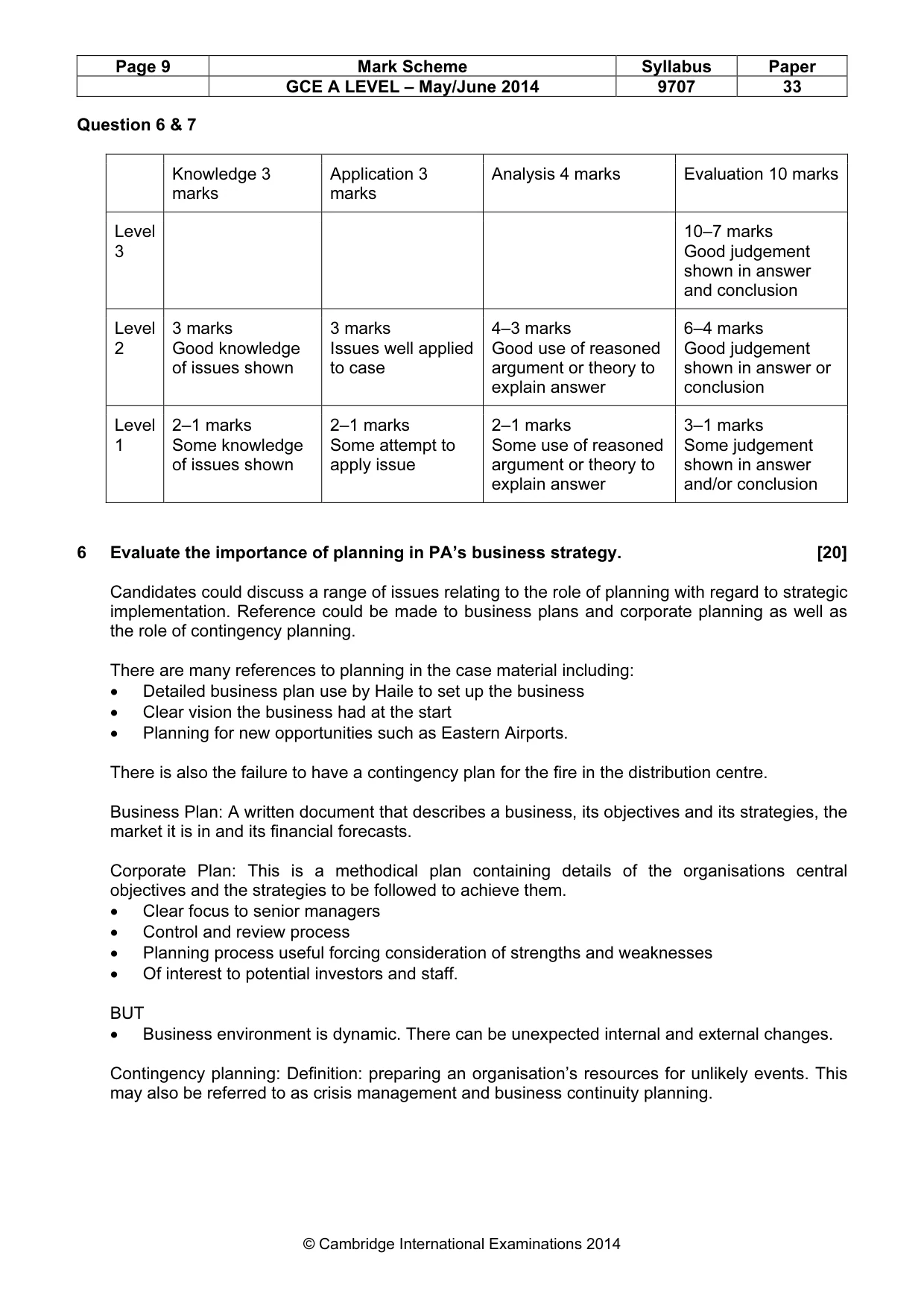
Page 9 Mark Scheme Syllabus Paper GCE A LEVEL – May/June 2014 9707 33 © Cambridge International Examinations 2014 Question 6 & 7 Knowledge 3 marks Application 3 marks Analysis 4 marks Evaluation 10 marks Level 3 10–7 marks Good judgement shown in answer and conclusion Level 2 3 marks Good knowledge of issues shown 3 marks Issues well applied to case 4–3 marks Good use of reasoned argument or theory to explain answer 6–4 marks Good judgement shown in answer or conclusion Level 1 2–1 marks Some knowledge of issues shown 2–1 marks Some attempt to apply issue 2–1 marks Some use of reasoned argument or theory to explain answer 3–1 marks Some judgement shown in answer and/or conclusion 6 Evaluate the importance of planning in PA’s business strategy. [20] Candidates could discuss a range of issues relating to the role of planning with regard to strategic implementation. Reference could be made to business plans and corporate planning as well as the role of contingency planning. There are many references to planning in the case material including: • Detailed business plan use by Haile to set up the business • Clear vision the business had at the start • Planning for new opportunities such as Eastern Airports. There is also the failure to have a contingency plan for the fire in the distribution centre. Business Plan: A written document that describes a business, its objectives and its strategies, the market it is in and its financial forecasts. Corporate Plan: This is a methodical plan containing details of the organisations central objectives and the strategies to be followed to achieve them. • Clear focus to senior managers • Control and review process • Planning process useful forcing consideration of strengths and weaknesses • Of interest to potential investors and staff. BUT • Business environment is dynamic. There can be unexpected internal and external changes. Contingency planning: Definition: preparing an organisation’s resources for unlikely events. This may also be referred to as crisis management and business continuity planning.
Mark scheme, page 10
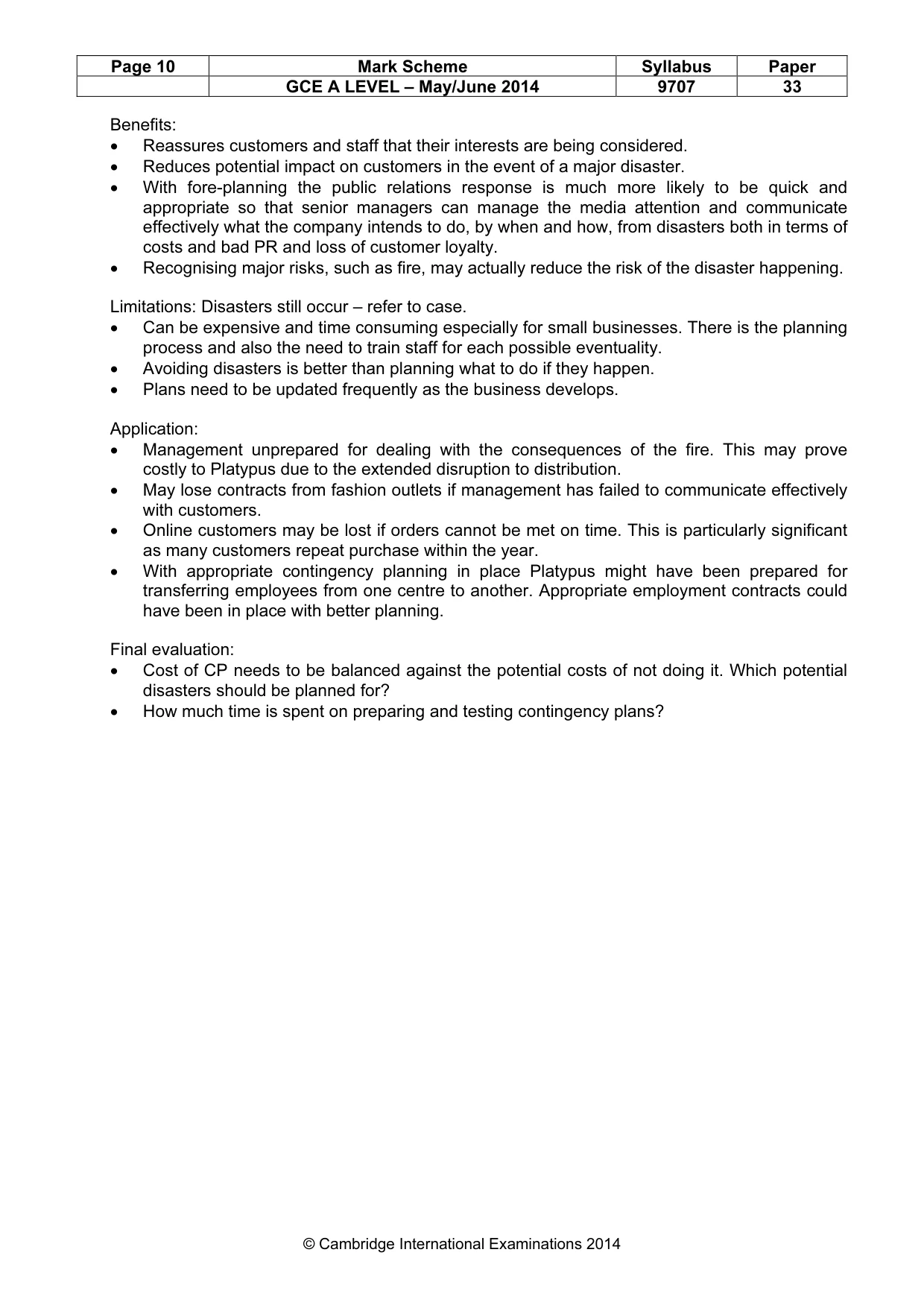
Page 10 Mark Scheme Syllabus Paper GCE A LEVEL – May/June 2014 9707 33 © Cambridge International Examinations 2014 Benefits: • Reassures customers and staff that their interests are being considered. • Reduces potential impact on customers in the event of a major disaster. • With fore-planning the public relations response is much more likely to be quick and appropriate so that senior managers can manage the media attention and communicate effectively what the company intends to do, by when and how, from disasters both in terms of costs and bad PR and loss of customer loyalty. • Recognising major risks, such as fire, may actually reduce the risk of the disaster happening. Limitations: Disasters still occur – refer to case. • Can be expensive and time consuming especially for small businesses. There is the planning process and also the need to train staff for each possible eventuality. • Avoiding disasters is better than planning what to do if they happen. • Plans need to be updated frequently as the business develops. Application: • Management unprepared for dealing with the consequences of the fire. This may prove costly to Platypus due to the extended disruption to distribution. • May lose contracts from fashion outlets if management has failed to communicate effectively with customers. • Online customers may be lost if orders cannot be met on time. This is particularly significant as many customers repeat purchase within the year. • With appropriate contingency planning in place Platypus might have been prepared for transferring employees from one centre to another. Appropriate employment contracts could have been in place with better planning. Final evaluation: • Cost of CP needs to be balanced against the potential costs of not doing it. Which potential disasters should be planned for? • How much time is spent on preparing and testing contingency plans?
Mark scheme, page 11
Page 11 Mark Scheme Syllabus Paper GCE A LEVEL – May/June 2014 9707 33 © Cambridge International Examinations 2014 7 Evaluate how strategic analysis might aid PA’s management when taking strategic decisions. [20] Definition of strategic analysis: This is the first step in the strategic management process and involves research into the business environment within which the organisation operates, and into the organisation itself. Strategic analysis helps to shape future strategies. Answers could include: • SWOT – this will help match the firm’s resources and strengths to the competitive environment within which it operates thus helping to select strategies. Does Platypus have the necessary strengths to proceed with the Eastern Airways investment. • PEST – the strategic analysis of a firm’s macro-environment. This helps determine the likely chances of a business strategy being successful. Considering the economic environment will be important in deciding whether to proceed with the Eastern Airways investment. Will changes in government policy with regard to taxation lessen the chances of success? For Platypus social changes may be an important influence as these will influence fashion. Platypus will also have to respond to technological developments in computing and mobile telephony. • Boston Matrix may be useful in reviewing the product portfolio offered by Platypus and help make decisions about divestment. • Porter’s 5 Forces analysis; could this be used to help Platypus establish competitive advantage over rivals? For example by analysing current markets it may help identify different segments of the market that are less competitive. • What are the core competencies of Platypus? Does Platypus have a core competence in design that could be further developed to produce a larger number of end products. There should be discussion of more than one form of strategic analysis for award of full marks. Evaluation: • Subjective nature of any analysis is a significant problem with strategic analysis. Managers can therefore influence the content of the analysis to provide support for predetermined course of action. • These approaches provide a snapshot of the business and will need to be constantly updated.
What you needed in this session
Cambridge’s own grade thresholds for 2014 May/June, Paper 3 · Variant 3. A higher threshold means an easier paper — the bar moves with how the cohort did.