Cambridge A Level Business Studies (for final examination in 2015) 9707 — 2014 May/June Paper 2 · Variant 2
9707/22/M/J/14 · 2 questions · 60 marks · ≈68 min
The question paper and its mark scheme, free to read here and free to download. This is Cambridge’s own paper, exactly as it was sat.
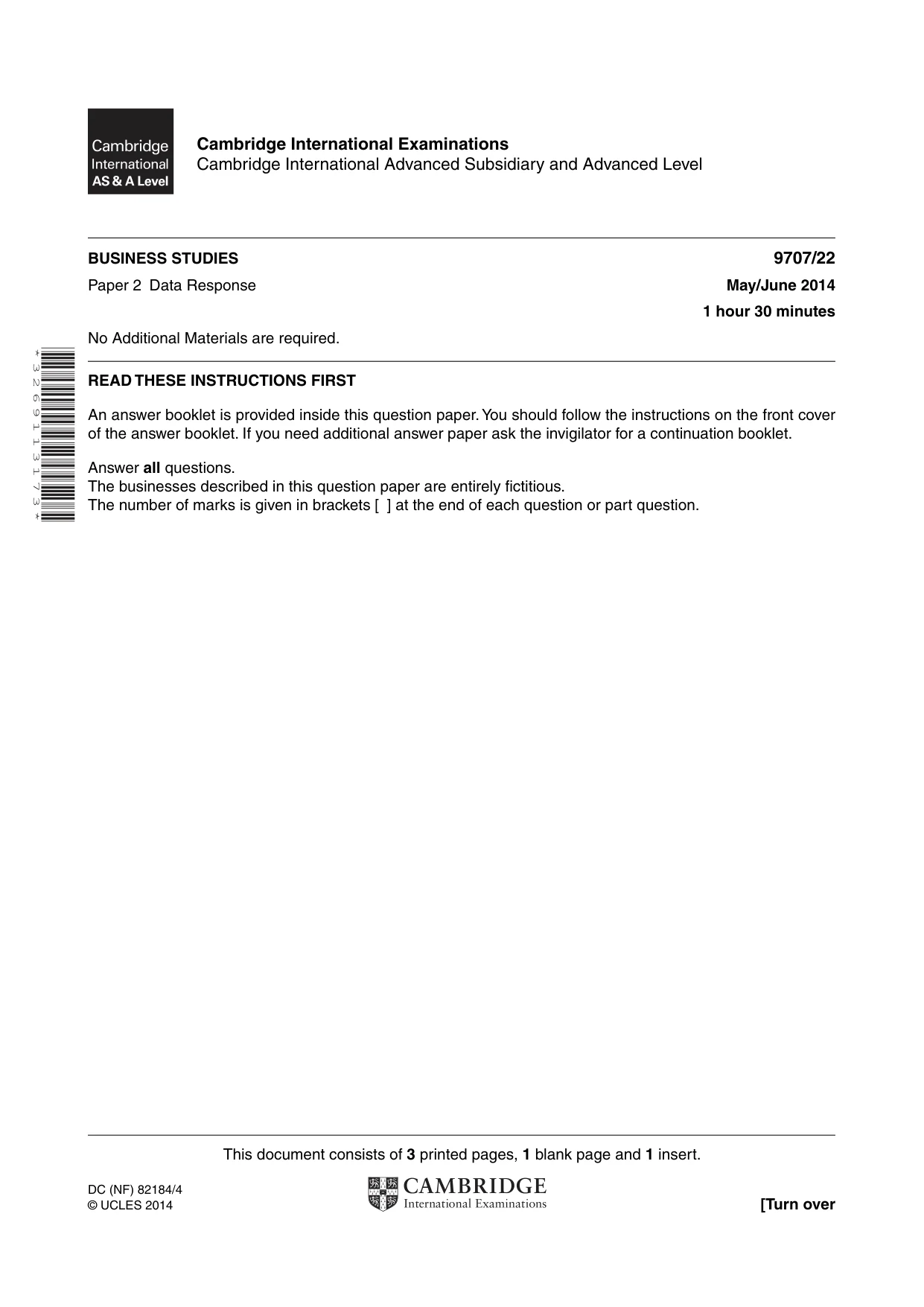
Question paper4 pages

Mark scheme7 pages
Answers below. Sit the paper first if you are practising.
Questions as text
Q1 · Let’s Make Music (LMM) LMM is a private limited company
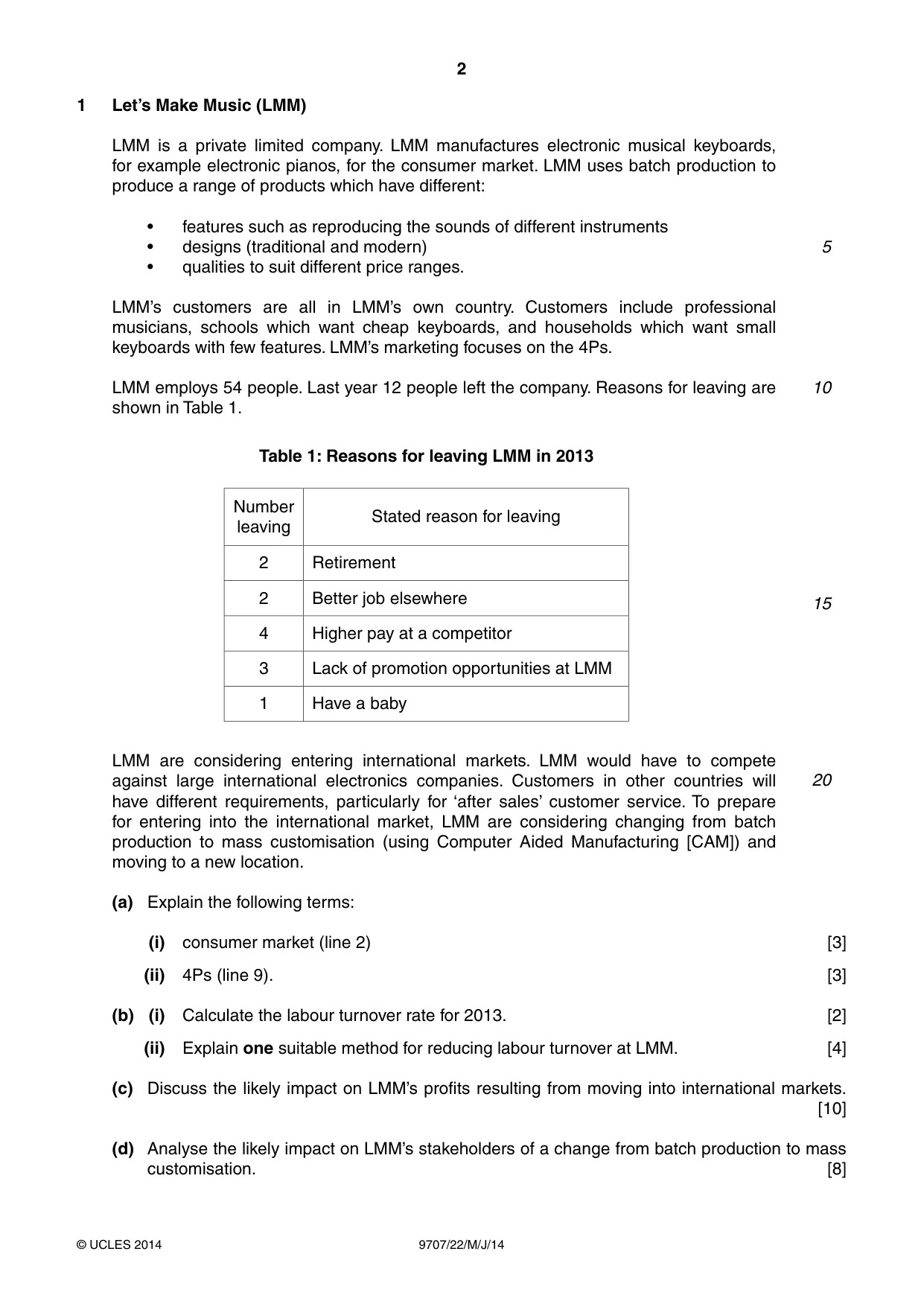
1 Let’s Make Music (LMM) LMM is a private limited company. LMM manufactures electronic musical keyboards, for example electronic pianos, for the consumer market. LMM uses batch production to produce a range of products which have different: • features such as reproducing the sounds of different instruments • designs (traditional and modern) 5 • qualities to suit different price ranges. LMM’s customers are all in LMM’s own country. Customers include professional musicians, schools which want cheap keyboards, and households which want small keyboards with few features. LMM’s marketing focuses on the 4Ps. LMM employs 54 people. Last year 12 people left the company. Reasons for leaving are 10 shown in Table 1. Table 1: Reasons for leaving LMM in 2013 Number Stated reason for leaving leaving 2 Retirement 2 Better job elsewhere 15 4 Higher pay at a competitor 3 Lack of promotion opportunities at LMM 1 Have a baby LMM are considering entering international markets. LMM would have to compete against large international electronics companies. Customers in other countries will 20 have different requirements, particularly for ‘after sales’ customer service. To prepare for entering into the international market, LMM are considering changing from batch production to mass customisation (using Computer Aided Manufacturing [CAM]) and moving to a new location. (a) Explain the following terms: (i) consumer market (line 2) [3] (ii) 4Ps (line 9). [3] (b) (i) Calculate the labour turnover rate for 2013. [2] (ii) Explain one suitable method for reducing labour turnover at LMM. [4] (c) Discuss the likely impact on LMM’s profits resulting from moving into international markets. [10] (d) Analyse the likely impact on LMM’s stakeholders of a change from batch production to mass customisation. [8]
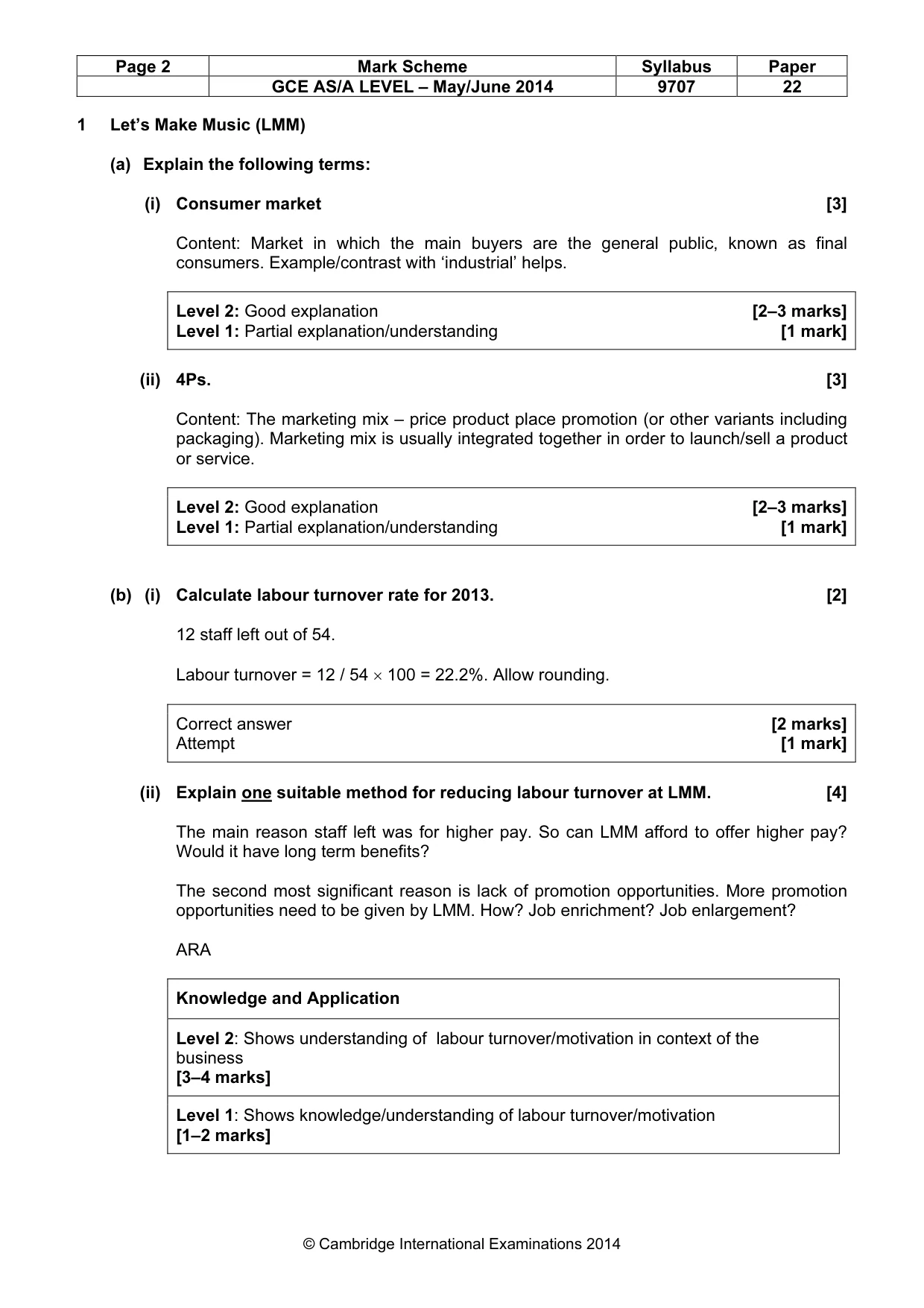
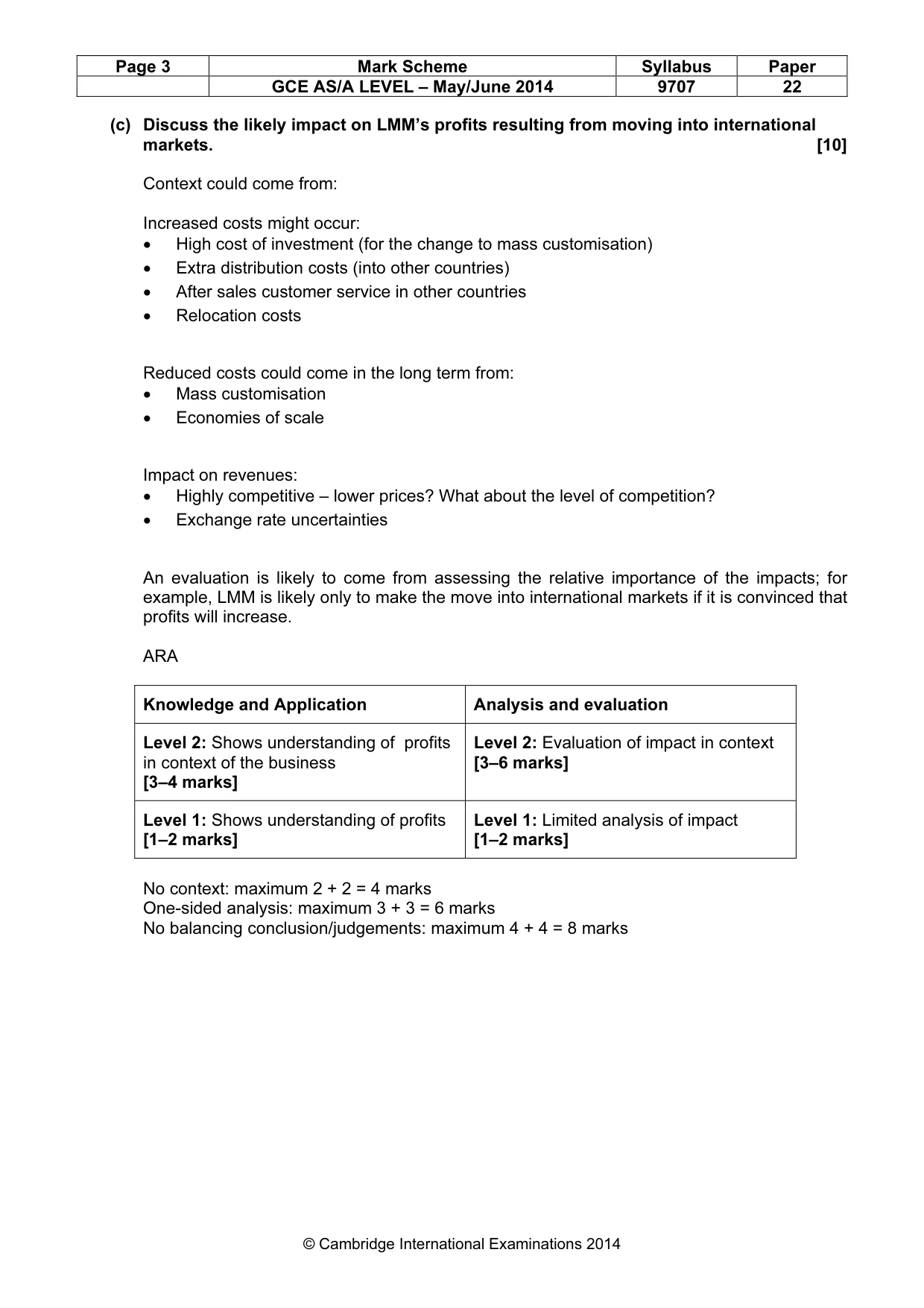
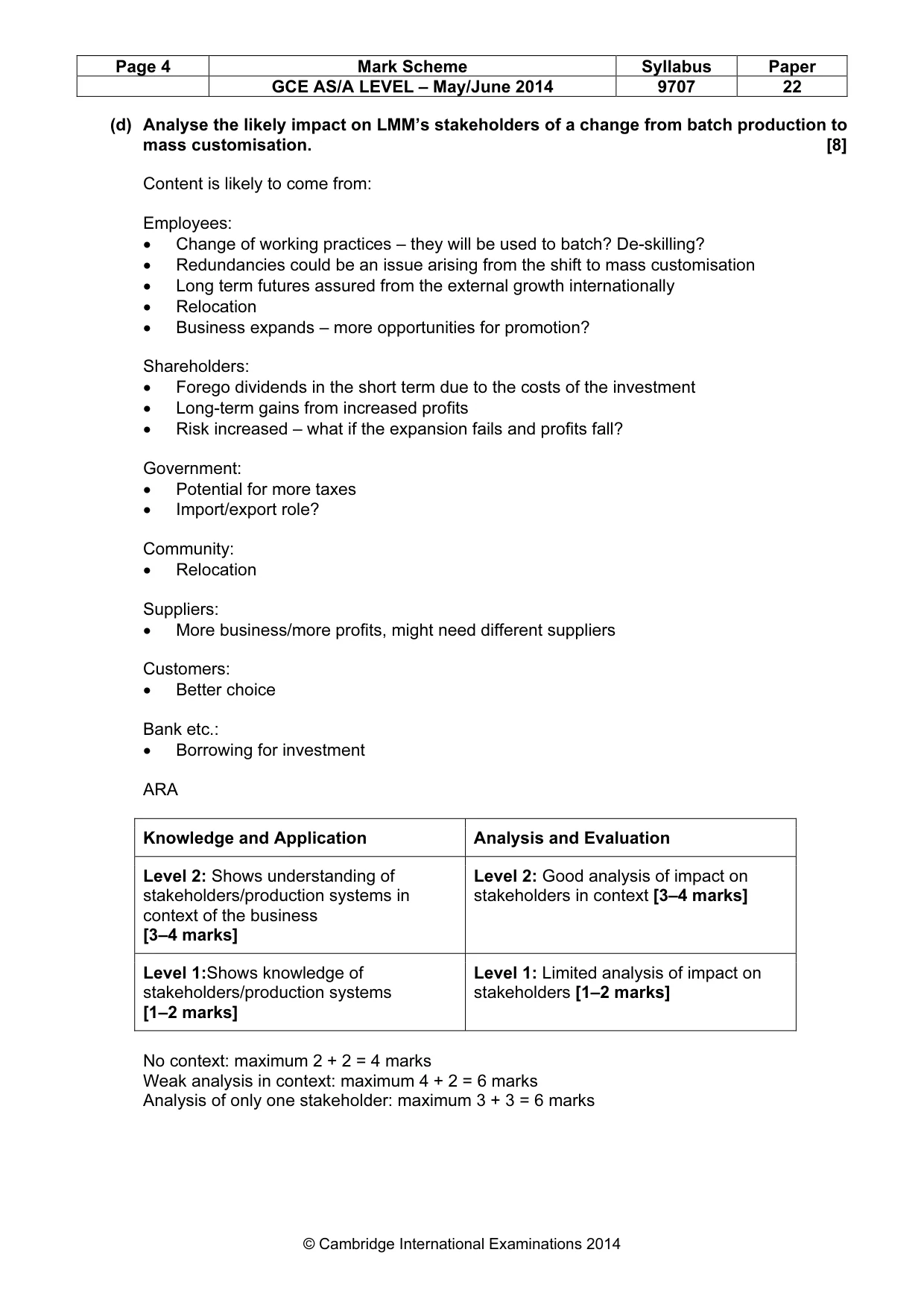
Mark scheme: 1 Let’s Make Music (LMM) (a) Explain the following terms: (i) Consumer market [3] Content: Market in which the main buyers are the general public, known as final consumers. Example/contrast with ‘industrial’ helps. Level 2: Good explanation [2–3 marks] Level 1: Partial explanation/understanding [1 mark] (ii) 4Ps. [3] Content: The marketing mix – price product place promotion (or other variants including packaging). Marketing mix is usually integrated together in order to launch/sell a product or service. Level 2: Good explanation [2–3 marks] Level 1: Partial explanation/understanding [1 mark] (b) (i) Calculate labour turnover rate for 2013. [2] 12 staff left out of 54. Labour turnover = 12 / 54 × 100 = 22.2%. Allow rounding. Correct answer [2 marks] Attempt [1 mark] (ii) Explain one suitable method for reducing labour turnover at LMM. [4] The main reason staff left was for higher pay. So can LMM afford to offer higher pay? Would it have long term benefits? The second most significant reason is lack of promotion opportunities. More promotion opportunities need to be given by LMM. How? Job enrichment? Job enlargement? ARA Knowledge and Application Level 2: Shows understanding of labour turnover/motivation in context of the business [3–4 marks] Level 1: Shows knowledge/understanding of labour turnover/motivation [1–2 marks] GCE AS/A LEVEL – May/June 2014 9707 22 (c) Discuss the likely impact on LMM’s profits resulting from moving into international markets. [10] Context could come from: Increased costs might occur: • High cost of investment (for the change to mass customisation) • Extra distribution costs (into other countries) • After sales customer service in other countries • Relocation costs Reduced costs could come in the long term from: • Mass customisation • Economies of scale Impact on revenues: • Highly competitive – lower prices? What about the level of competition? • Exchange rate uncertainties An evaluation is likely to come from assessing the relative importance of the impacts; for example, LMM is likely only to make the move into international markets if it is convinced that profits will increase. ARA Knowledge and Application Analysis and evaluation Level 2: Shows understanding of profits Level 2: Evaluation of impact in context in context of the business [3–6 marks] [3–4 marks] Level 1: Shows understanding of profits Level 1: Limited analysis of impact [1–2 marks] [1–2 marks] No context: maximum 2 + 2 = 4 marks One-sided analysis: maximum 3 + 3 = 6 marks No balancing conclusion/judgements: maximum 4 + 4 = 8 marks GCE AS/A LEVEL – May/June 2014 9707 22 (d) Analyse the likely impact on LMM’s stakeholders of a change from batch production to mass customisation. [8] Content is likely to come from: Employees: • Change of working practices – they will be used to batch? De-skilling? • Redundancies could be an issue arising from the shift to mass customisation • Long term futures assured from the external growth internationally • Relocation • Business expands – more opportunities for promotion? Shareholders: • Forego dividends in the short term due to the costs of the investment • Long-term gains from increased profits • Risk increased – what if the expansion fails and profits fall? Government: • Potential for more taxes • Import/export role? Community: • Relocation Suppliers: • More business/more profits, might need different suppliers Customers: • Better choice Bank etc.: • Borrowing for investment ARA Knowledge and Application Analysis and Evaluation Level 2: Shows understanding of Level 2: Good analysis of impact on stakeholders/production systems in stakeholders in context [3–4 marks] context of the business [3–4 marks] Level 1:Shows knowledge of Level 1: Limited analysis of impact on stakeholders/production systems stakeholders [1–2 marks] [1–2 marks] No context: maximum 2 + 2 = 4 marks Weak analysis in context: maximum 4 + 2 = 6 marks Analysis of only one stakeholder: maximum 3 + 3 = 6 marks GCE AS/A LEVEL – May/June 2014 9707 22
Q2 · Great Gifts (GG) GG is a co-operative owned by its workers
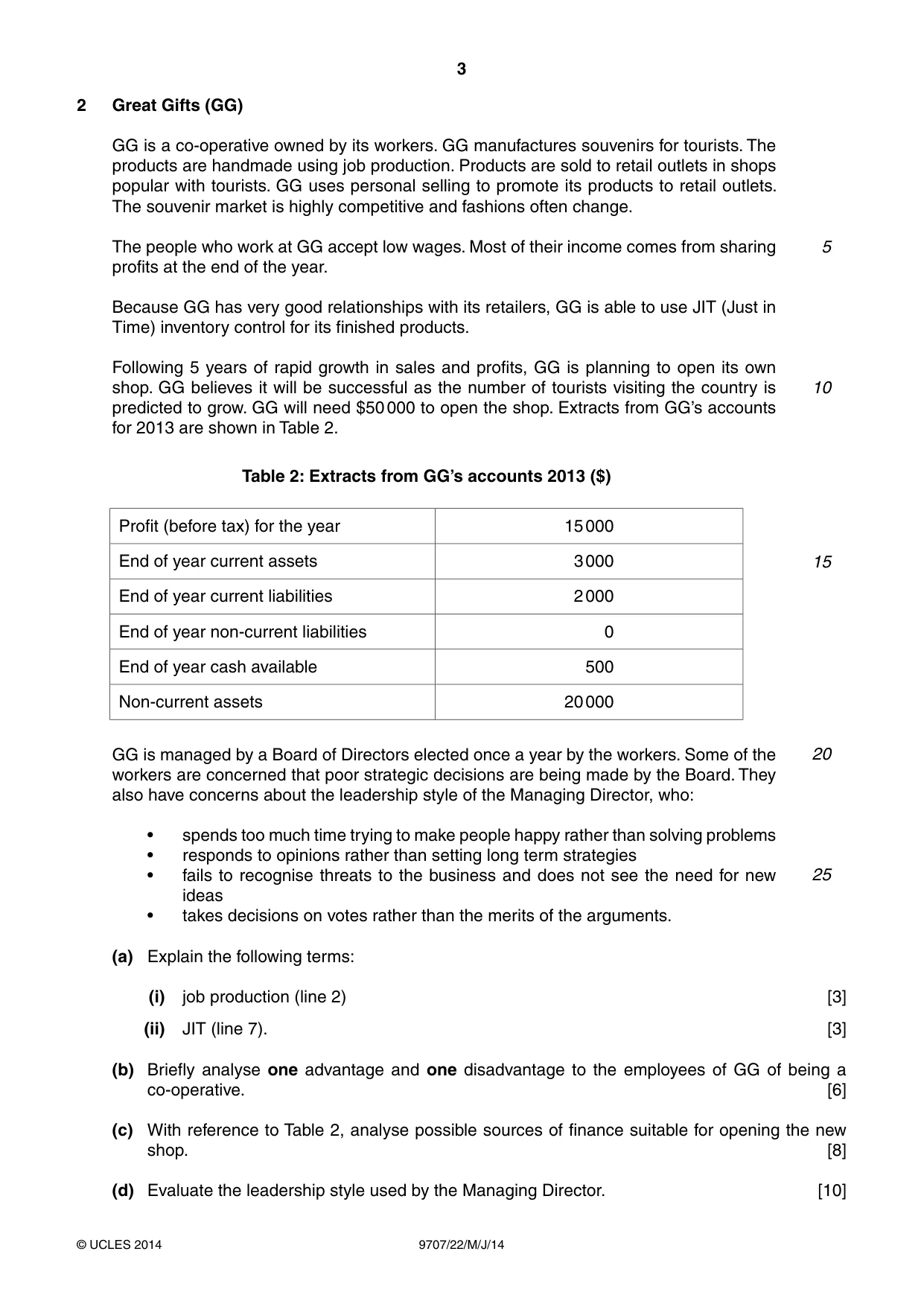
2 Great Gifts (GG) GG is a co-operative owned by its workers. GG manufactures souvenirs for tourists. The products are handmade using job production. Products are sold to retail outlets in shops popular with tourists. GG uses personal selling to promote its products to retail outlets. The souvenir market is highly competitive and fashions often change. The people who work at GG accept low wages. Most of their income comes from sharing 5 profits at the end of the year. Because GG has very good relationships with its retailers, GG is able to use JIT (Just in Time) inventory control for its finished products. Following 5 years of rapid growth in sales and profi ts, GG is planning to open its own shop. GG believes it will be successful as the number of tourists visiting the country is 10 predicted to grow. GG will need $50 000 to open the shop. Extracts from GG’s accounts for 2013 are shown in Table 2. Table 2: Extracts from GG’s accounts 2013 ($) Profit (before tax) for the year 15 000 End of year current assets 3 000 15 End of year current liabilities 2 000 End of year non-current liabilities 0 End of year cash available 500 Non-current assets 20 000 GG is managed by a Board of Directors elected once a year by the workers. Some of the 20 workers are concerned that poor strategic decisions are being made by the Board. They also have concerns about the leadership style of the Managing Director, who: • spends too much time trying to make people happy rather than solving problems • responds to opinions rather than setting long term strategies • fails to recognise threats to the business and does not see the need for new 25 ideas • takes decisions on votes rather than the merits of the arguments. (a) Explain the following terms: (i) job production (line 2) [3] (ii) JIT (line 7). [3] (b) Briefly analyse one advantage and one disadvantage to the employees of GG of being a co-operative. [6] (c) With reference to Table 2, analyse possible sources of finance suitable for opening the new shop. [8] (d) Evaluate the leadership style used by the Managing Director. [10]
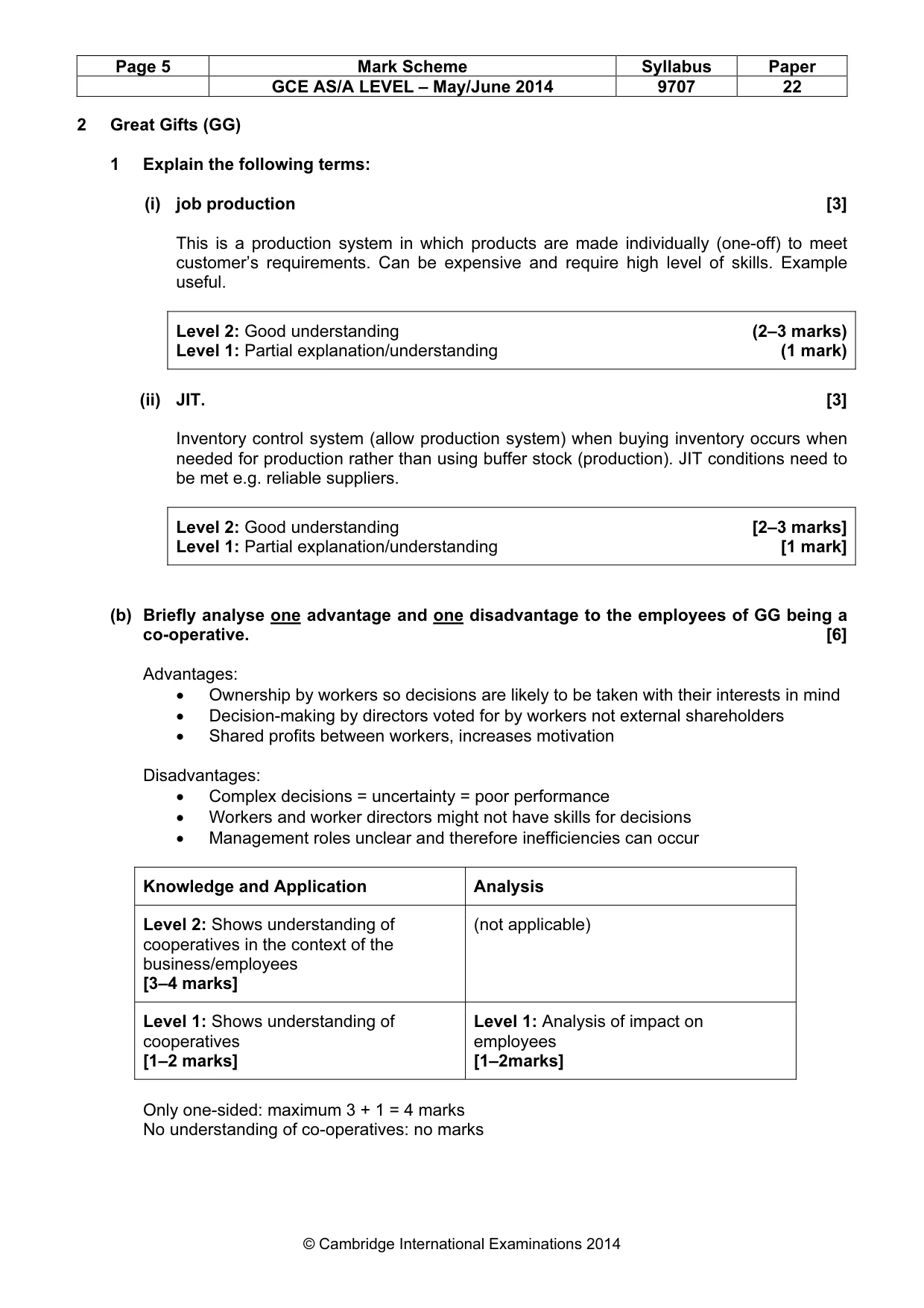
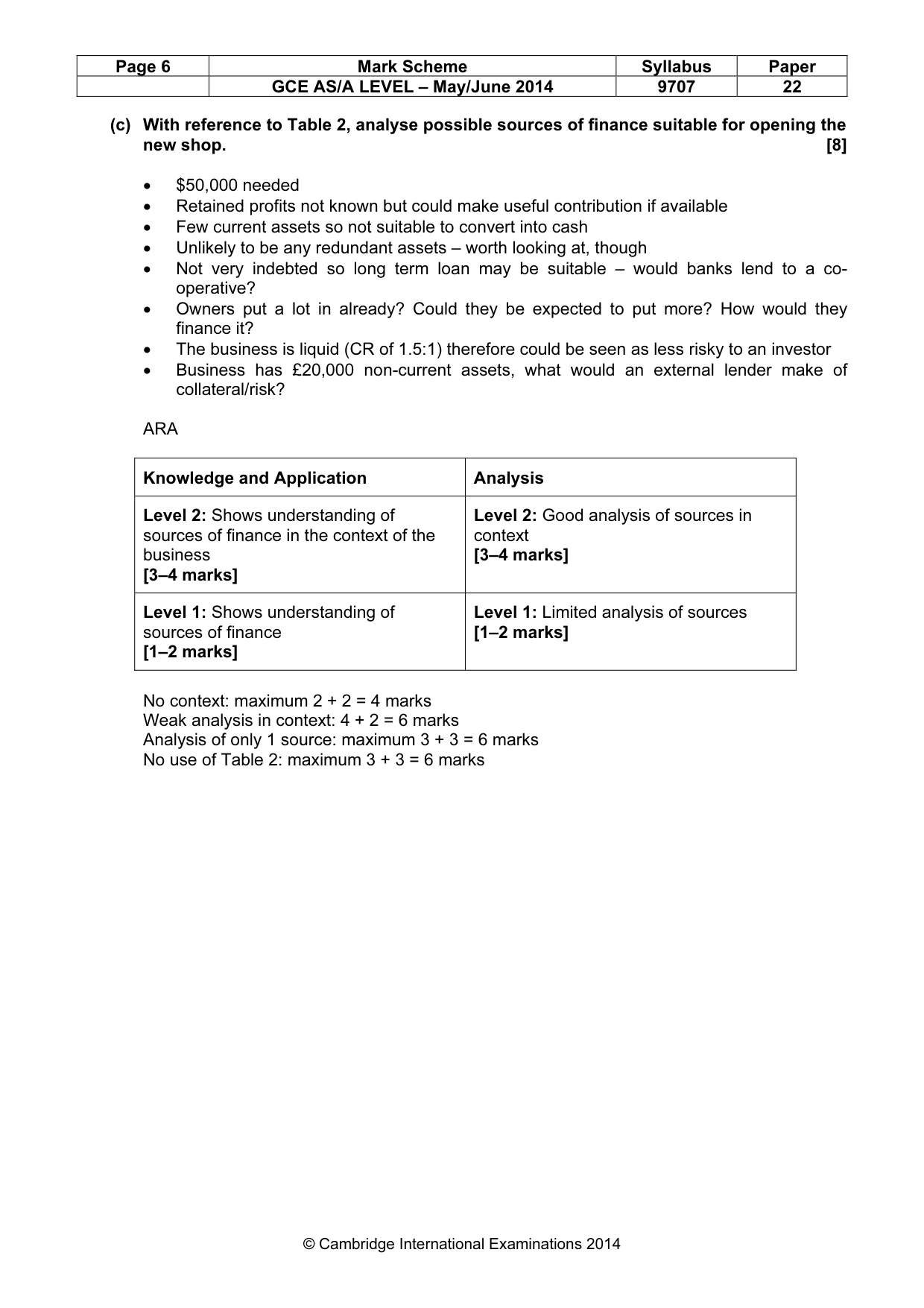
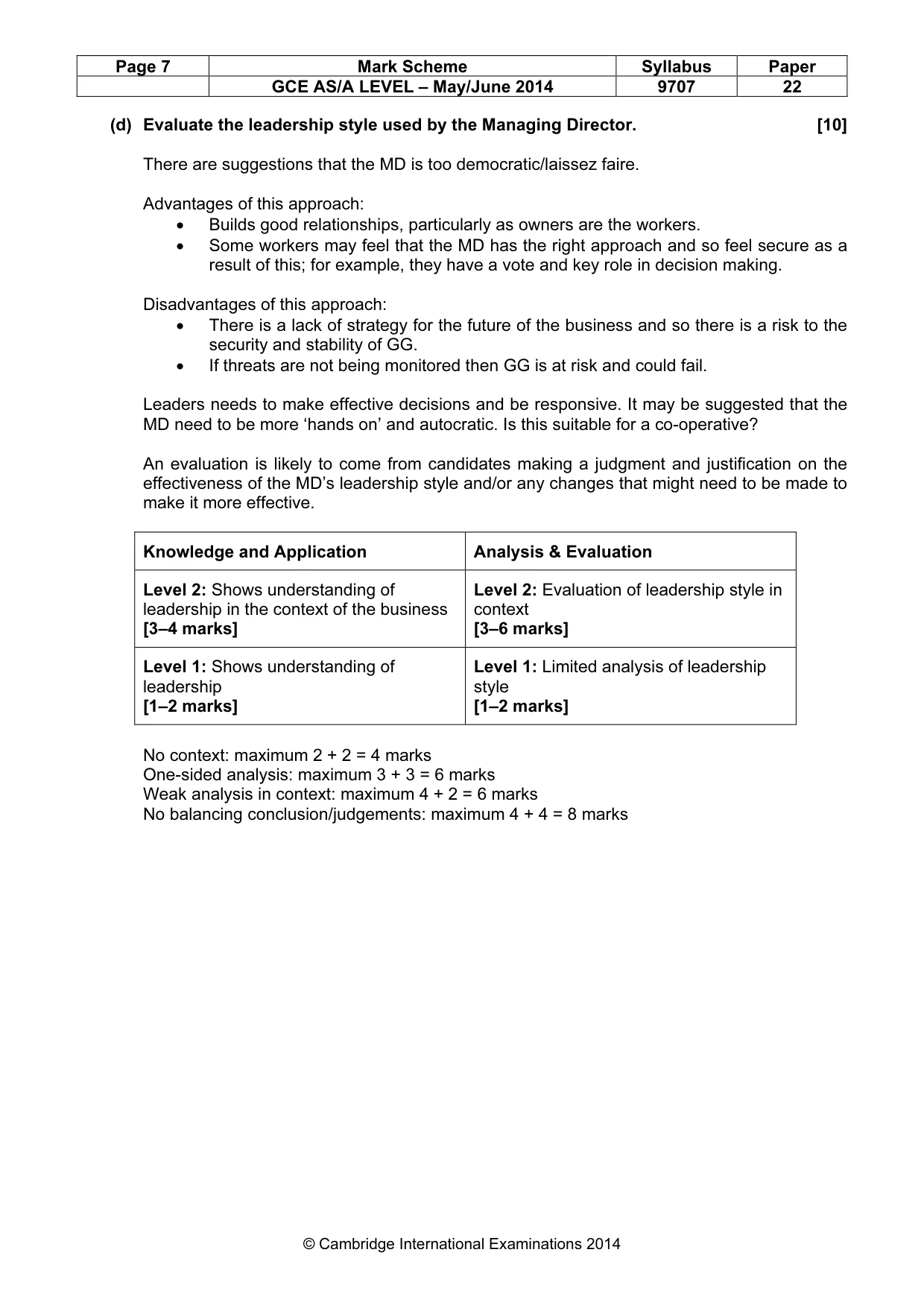
Mark scheme: 2 Great Gifts (GG) 1 Explain the following terms: (i) job production [3] This is a production system in which products are made individually (one-off) to meet customer’s requirements. Can be expensive and require high level of skills. Example useful. Level 2: Good understanding (2–3 marks) Level 1: Partial explanation/understanding (1 mark) (ii) JIT. [3] Inventory control system (allow production system) when buying inventory occurs when needed for production rather than using buffer stock (production). JIT conditions need to be met e.g. reliable suppliers. Level 2: Good understanding [2–3 marks] Level 1: Partial explanation/understanding [1 mark] (b) Briefly analyse one advantage and one disadvantage to the employees of GG being a co-operative. [6] Advantages: • Ownership by workers so decisions are likely to be taken with their interests in mind • Decision-making by directors voted for by workers not external shareholders • Shared profits between workers, increases motivation Disadvantages: • Complex decisions = uncertainty = poor performance • Workers and worker directors might not have skills for decisions • Management roles unclear and therefore inefficiencies can occur Knowledge and Application Analysis Level 2: Shows understanding of (not applicable) cooperatives in the context of the business/employees [3–4 marks] Level 1: Shows understanding of Level 1: Analysis of impact on cooperatives employees [1–2 marks] [1–2marks] Only one-sided: maximum 3 + 1 = 4 marks No understanding of co-operatives: no marks GCE AS/A LEVEL – May/June 2014 9707 22 (c) With reference to Table 2, analyse possible sources of finance suitable for opening the new shop. [8] • $50,000 needed • Retained profits not known but could make useful contribution if available • Few current assets so not suitable to convert into cash • Unlikely to be any redundant assets – worth looking at, though • Not very indebted so long term loan may be suitable – would banks lend to a co- operative? • Owners put a lot in already? Could they be expected to put more? How would they finance it? • The business is liquid (CR of 1.5:1) therefore could be seen as less risky to an investor • Business has £20,000 non-current assets, what would an external lender make of collateral/risk? ARA Knowledge and Application Analysis Level 2: Shows understanding of Level 2: Good analysis of sources in sources of finance in the context of the context business [3–4 marks] [3–4 marks] Level 1: Shows understanding of Level 1: Limited analysis of sources sources of finance [1–2 marks] [1–2 marks] No context: maximum 2 + 2 = 4 marks Weak analysis in context: 4 + 2 = 6 marks Analysis of only 1 source: maximum 3 + 3 = 6 marks No use of Table 2: maximum 3 + 3 = 6 marks GCE AS/A LEVEL – May/June 2014 9707 22 (d) Evaluate the leadership style used by the Managing Director. [10] There are suggestions that the MD is too democratic/laissez faire. Advantages of this approach: • Builds good relationships, particularly as owners are the workers. • Some workers may feel that the MD has the right approach and so feel secure as a result of this; for example, they have a vote and key role in decision making. Disadvantages of this approach: • There is a lack of strategy for the future of the business and so there is a risk to the security and stability of GG. • If threats are not being monitored then GG is at risk and could fail. Leaders needs to make effective decisions and be responsive. It may be suggested that the MD need to be more ‘hands on’ and autocratic. Is this suitable for a co-operative? An evaluation is likely to come from candidates making a judgment and justification on the effectiveness of the MD’s leadership style and/or any changes that might need to be made to make it more effective. Knowledge and Application Analysis & Evaluation Level 2: Shows understanding of Level 2: Evaluation of leadership style in leadership in the context of the business context [3–4 marks] [3–6 marks] Level 1: Shows understanding of Level 1: Limited analysis of leadership leadership style [1–2 marks] [1–2 marks] No context: maximum 2 + 2 = 4 marks One-sided analysis: maximum 3 + 3 = 6 marks Weak analysis in context: maximum 4 + 2 = 6 marks No balancing conclusion/judgements: maximum 4 + 4 = 8 marks
What you needed in this session
Cambridge’s own grade thresholds for 2014 May/June, Paper 2 · Variant 2. A higher threshold means an easier paper — the bar moves with how the cohort did.