Cambridge A Level Business (for first examination in 2016) 9609 — 2023 Oct/Nov Paper 2 · Variant 2
9609/22/O/N/23 · 2 questions · 60 marks · ≈68 min
The question paper and its mark scheme, free to read here and free to download. This is Cambridge’s own paper, exactly as it was sat.
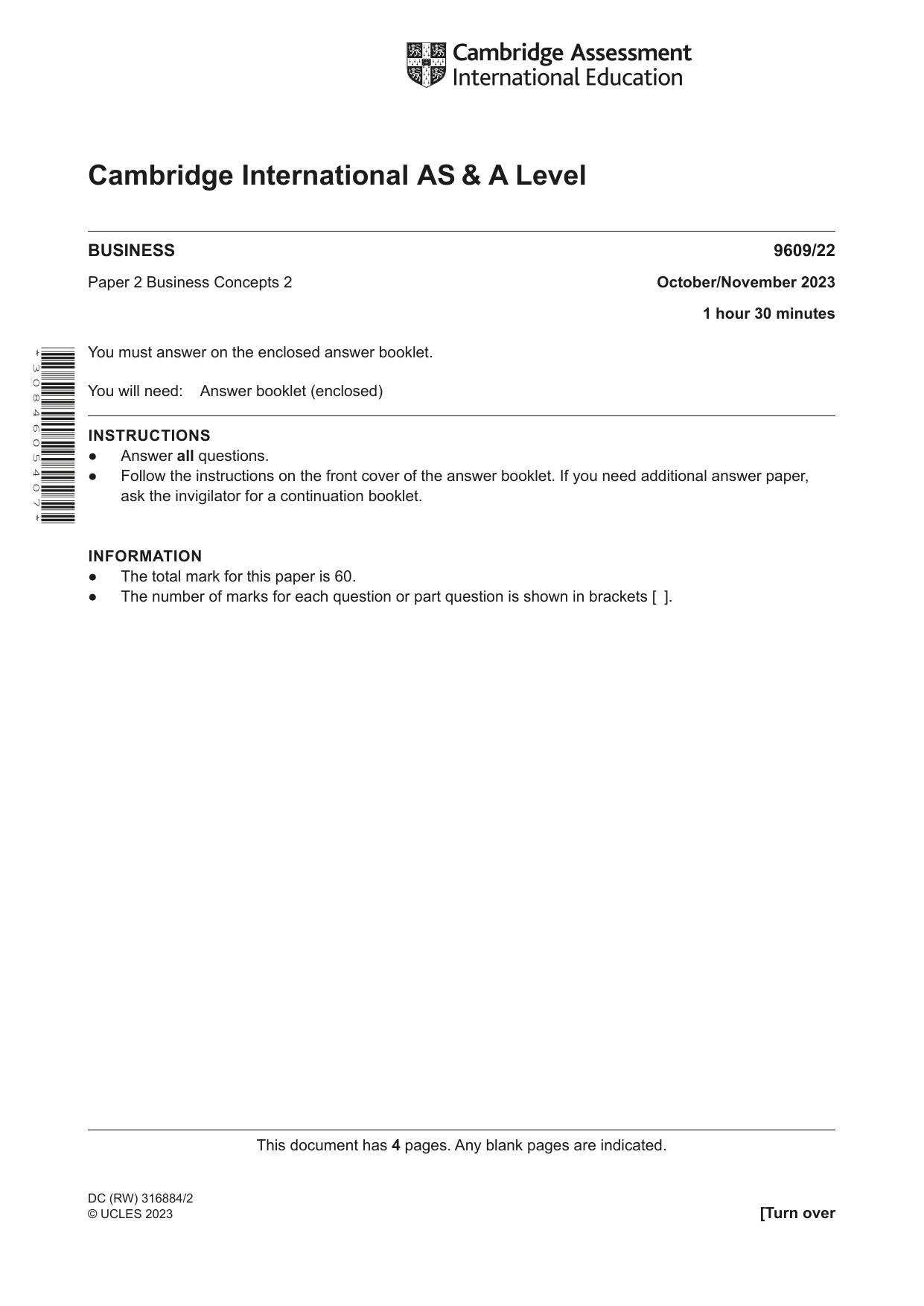
Question paper4 pages

Mark scheme38 pages
Answers below. Sit the paper first if you are practising.
Questions as text
Q1 · Gold Theme Park (GT) Gold Park was a mine where gold was extracted until 2012
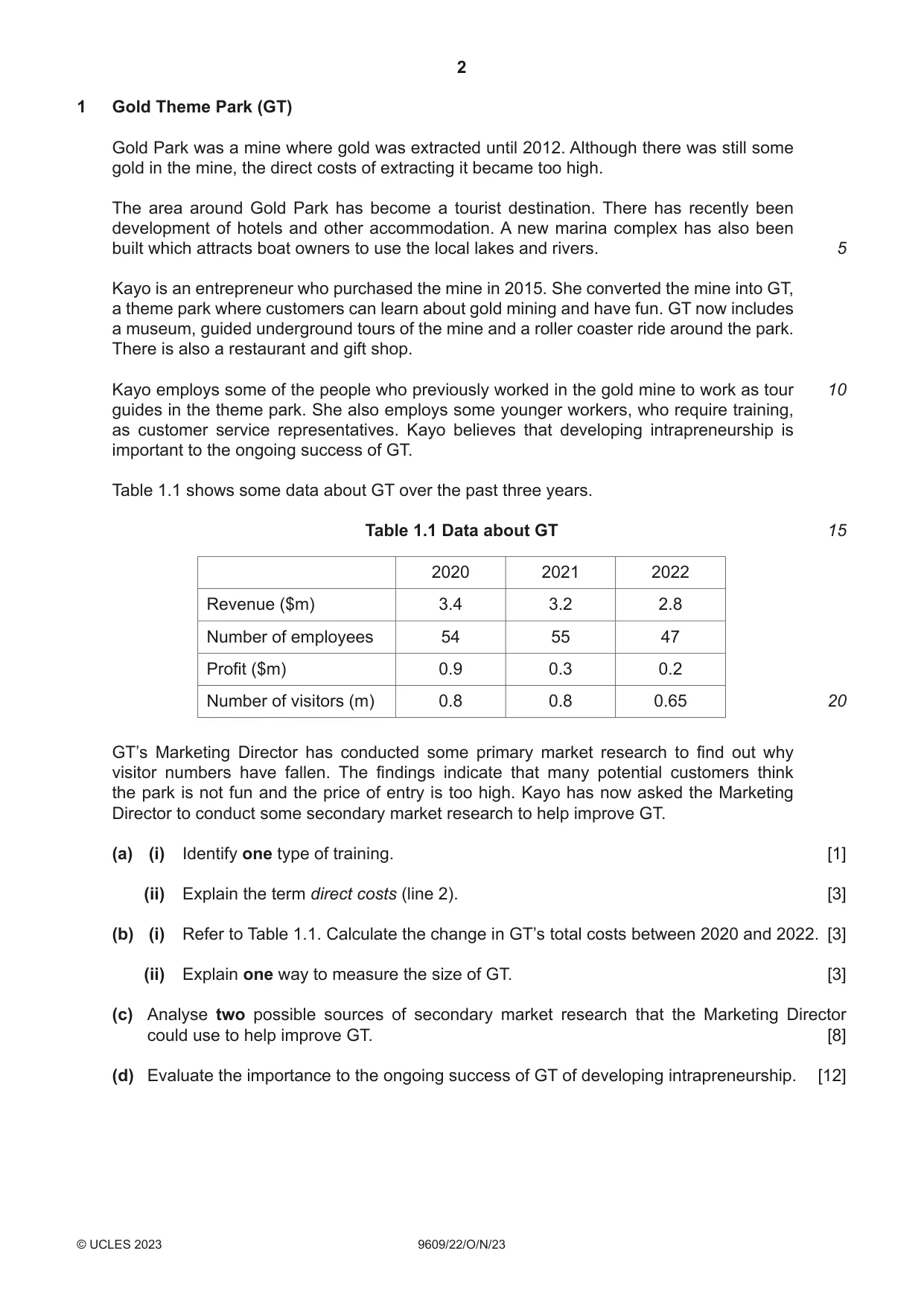
1 Gold Theme Park (GT) Gold Park was a mine where gold was extracted until 2012. Although there was still some gold in the mine, the direct costs of extracting it became too high. The area around Gold Park has become a tourist destination. There has recently been development of hotels and other accommodation. A new marina complex has also been built which attracts boat owners to use the local lakes and rivers. 5 Kayo is an entrepreneur who purchased the mine in 2015. She converted the mine into GT, a theme park where customers can learn about gold mining and have fun. GT now includes a museum, guided underground tours of the mine and a roller coaster ride around the park. There is also a restaurant and gift shop. Kayo employs some of the people who previously worked in the gold mine to work as tour 10 guides in the theme park. She also employs some younger workers, who require training, as customer service representatives. Kayo believes that developing intrapreneurship is important to the ongoing success of GT. Table 1.1 shows some data about GT over the past three years. Table 1.1 Data about GT 15 2020 2021 2022 Revenue ($m) 3.4 3.2 2.8 Number of employees 54 55 47 Profit ($m) 0.9 0.3 0.2 Number of visitors (m) 0.8 0.8 0.65 20 GT’s Marketing Director has conducted some primary market research to find out why visitor numbers have fallen. The findings indicate that many potential customers think the park is not fun and the price of entry is too high. Kayo has now asked the Marketing Director to conduct some secondary market research to help improve GT. (a) (i) Identify one type of training. [1] (ii) Explain the term direct costs (line 2). [3] (b) (i) Refer to Table 1.1. Calculate the change in GT’s total costs between 2020 and 2022. [3] (ii) Explain one way to measure the size of GT. [3] (c) Analyse two possible sources of secondary market research that the Marketing Director could use to help improve GT. [8] (d) Evaluate the importance to the ongoing success of GT of developing intrapreneurship. [12]
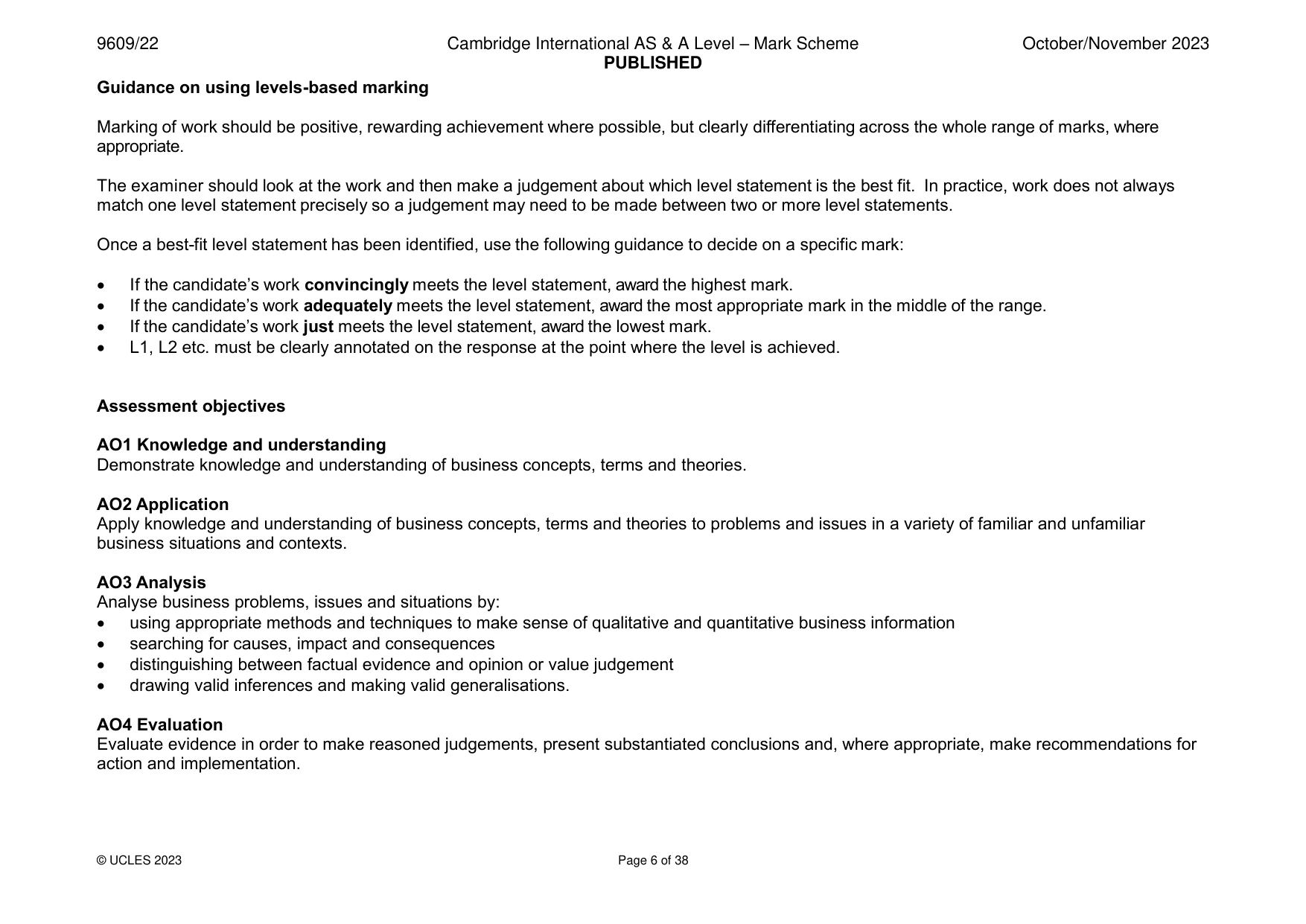
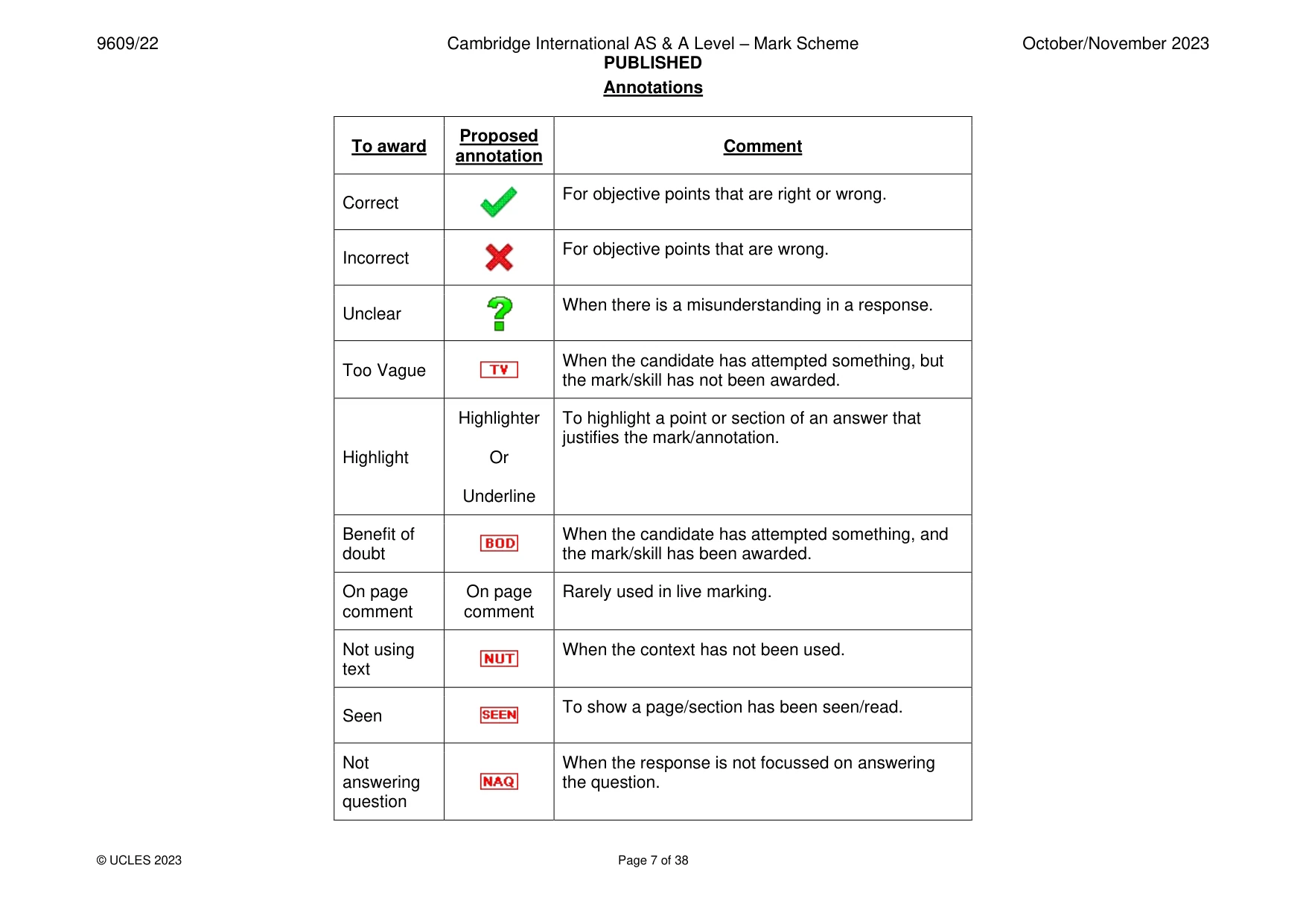
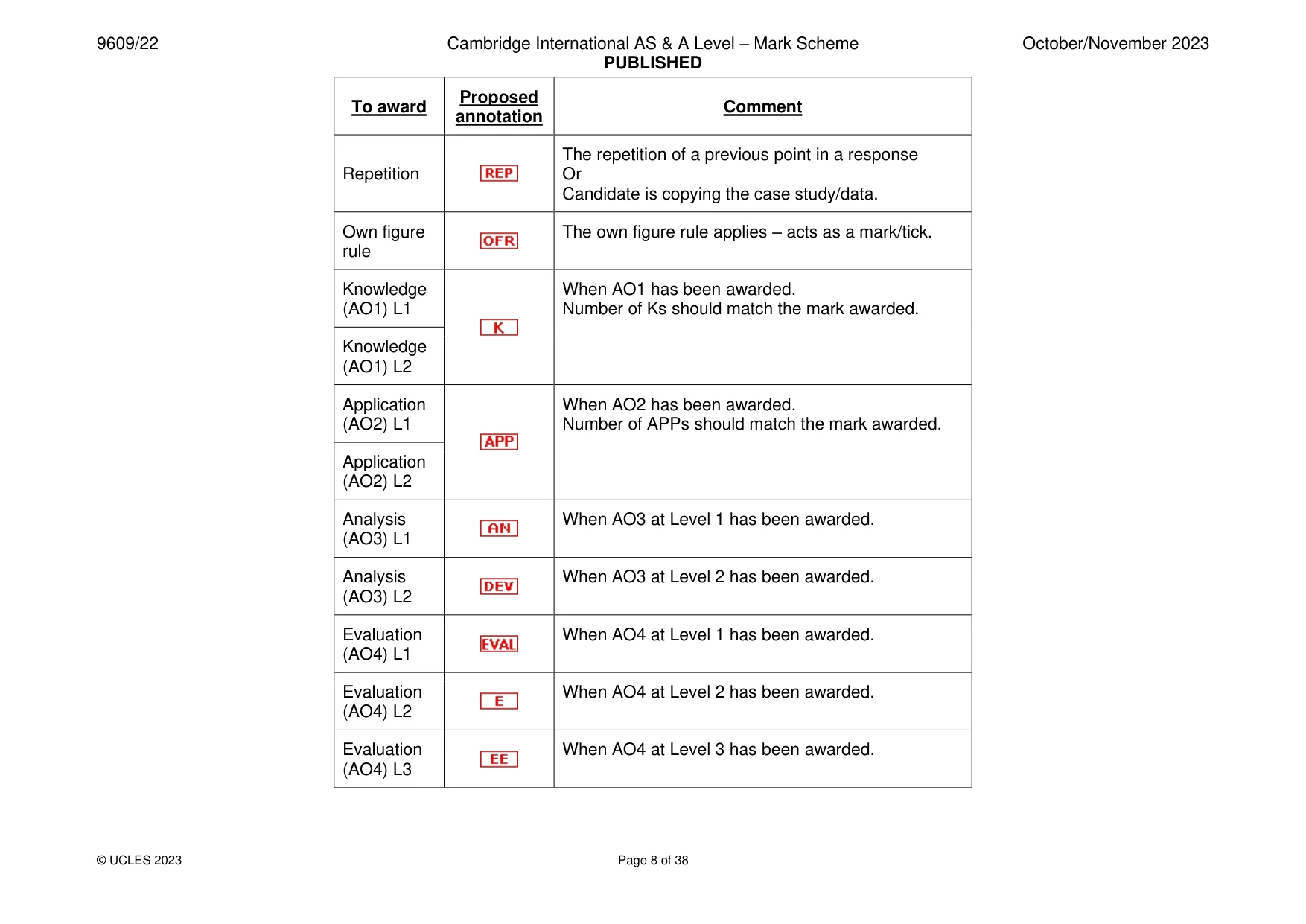
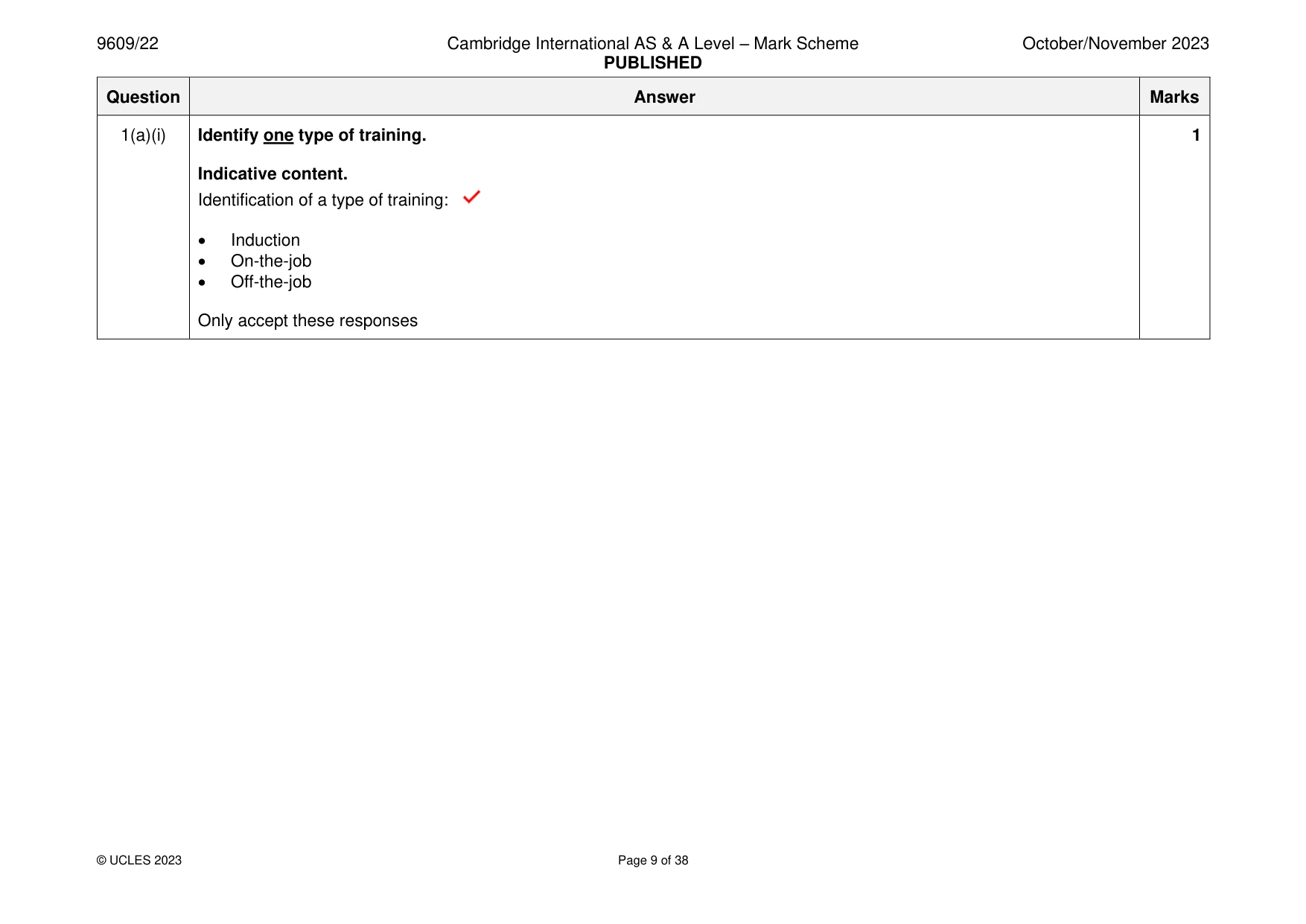
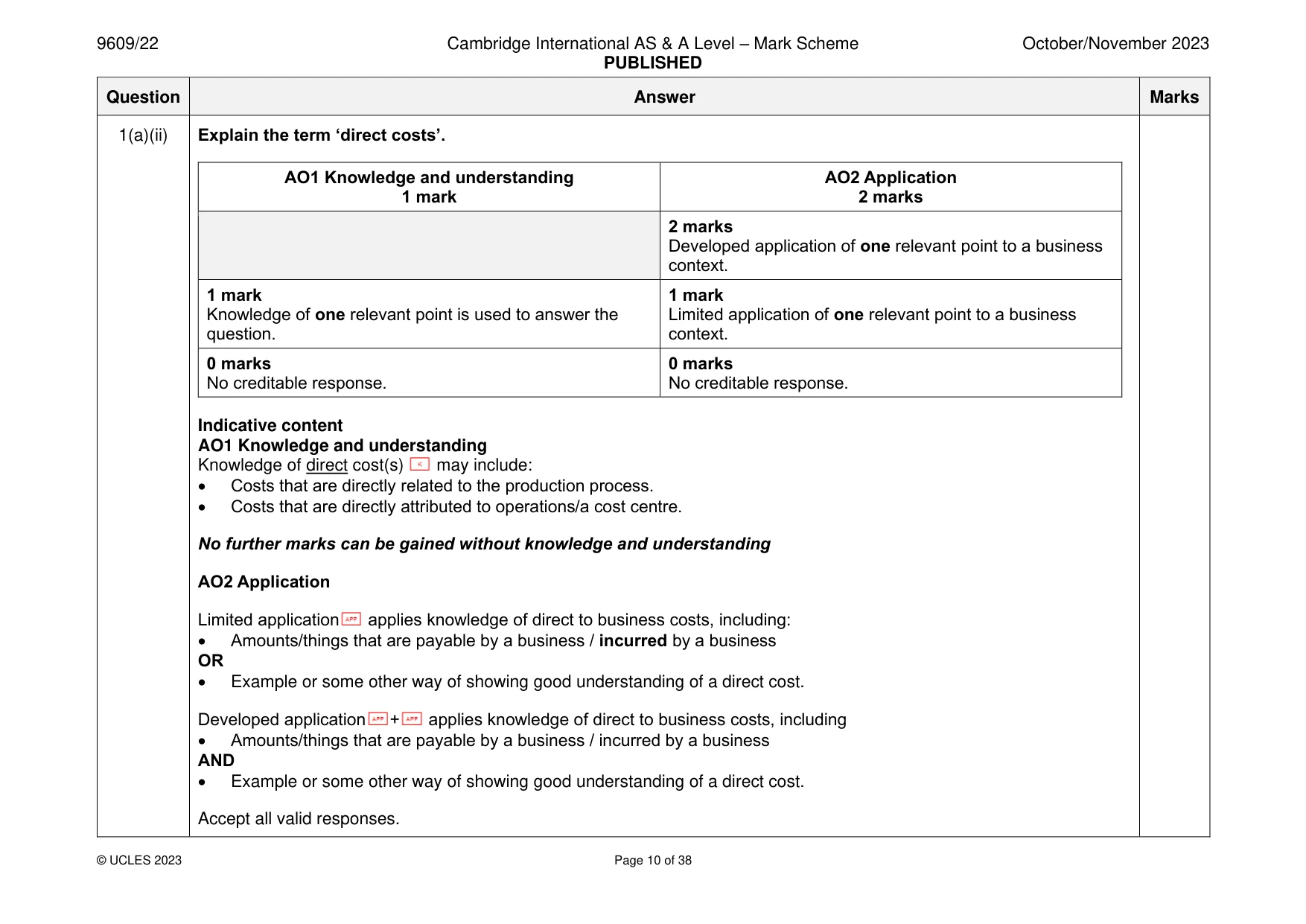
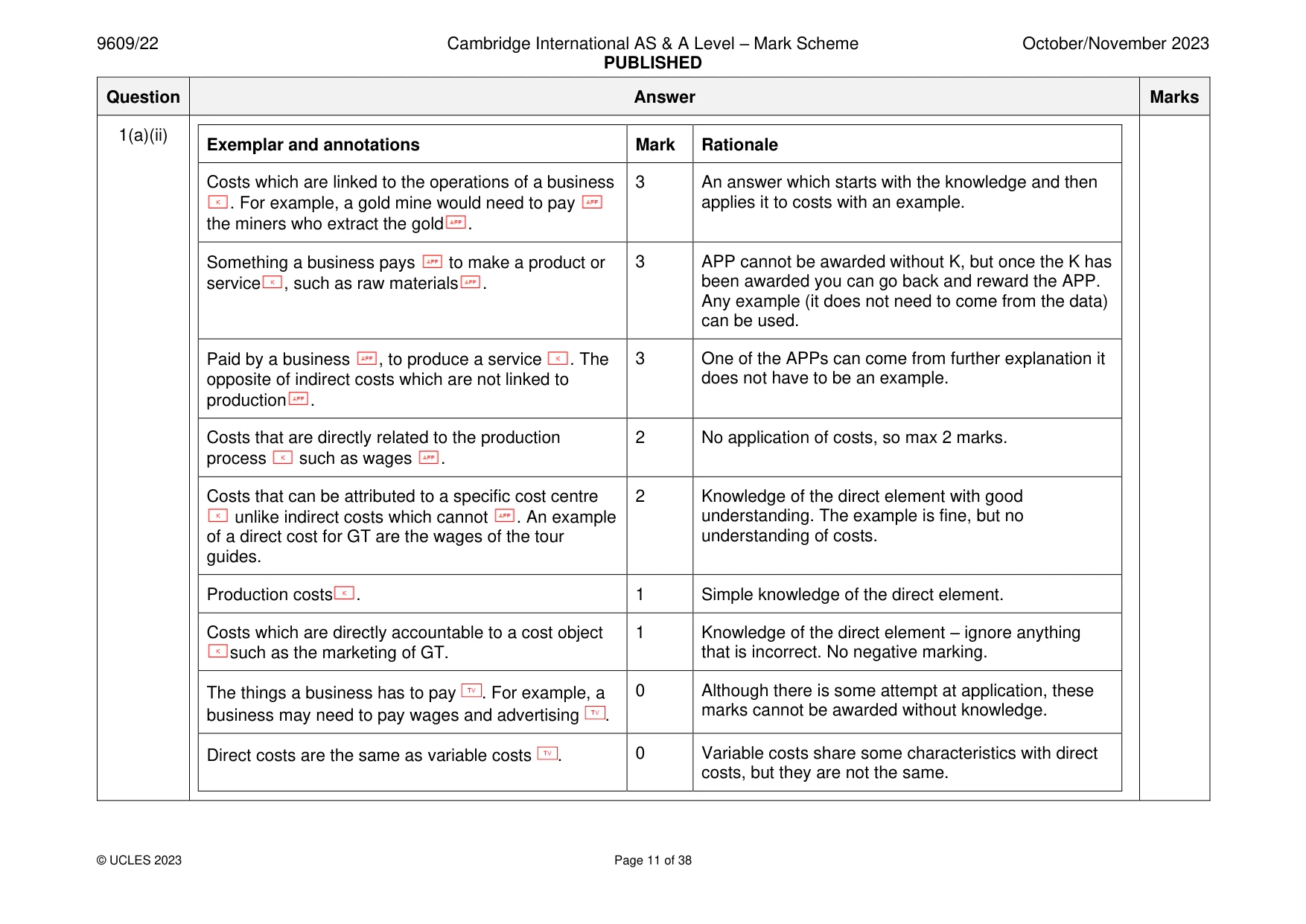
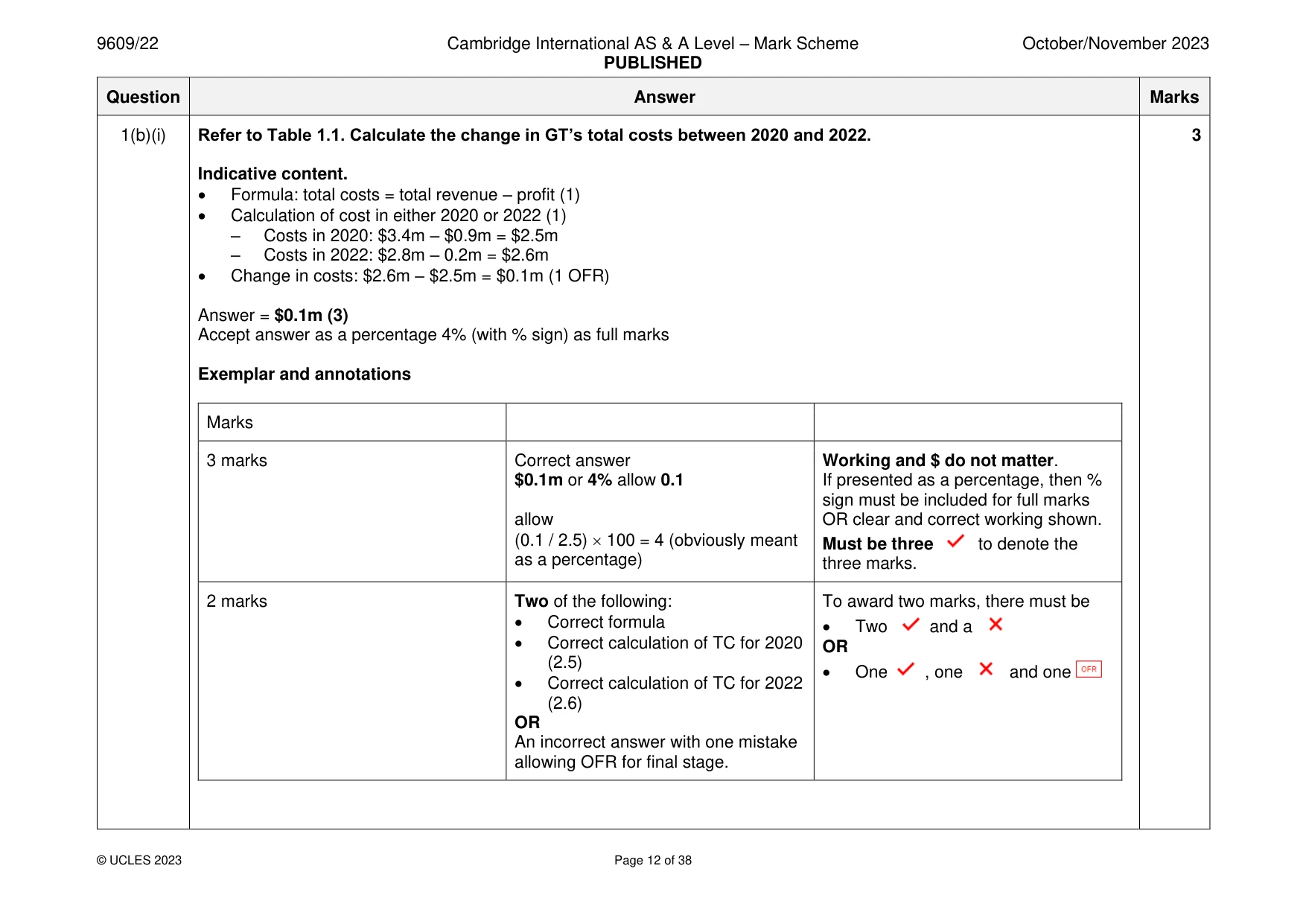
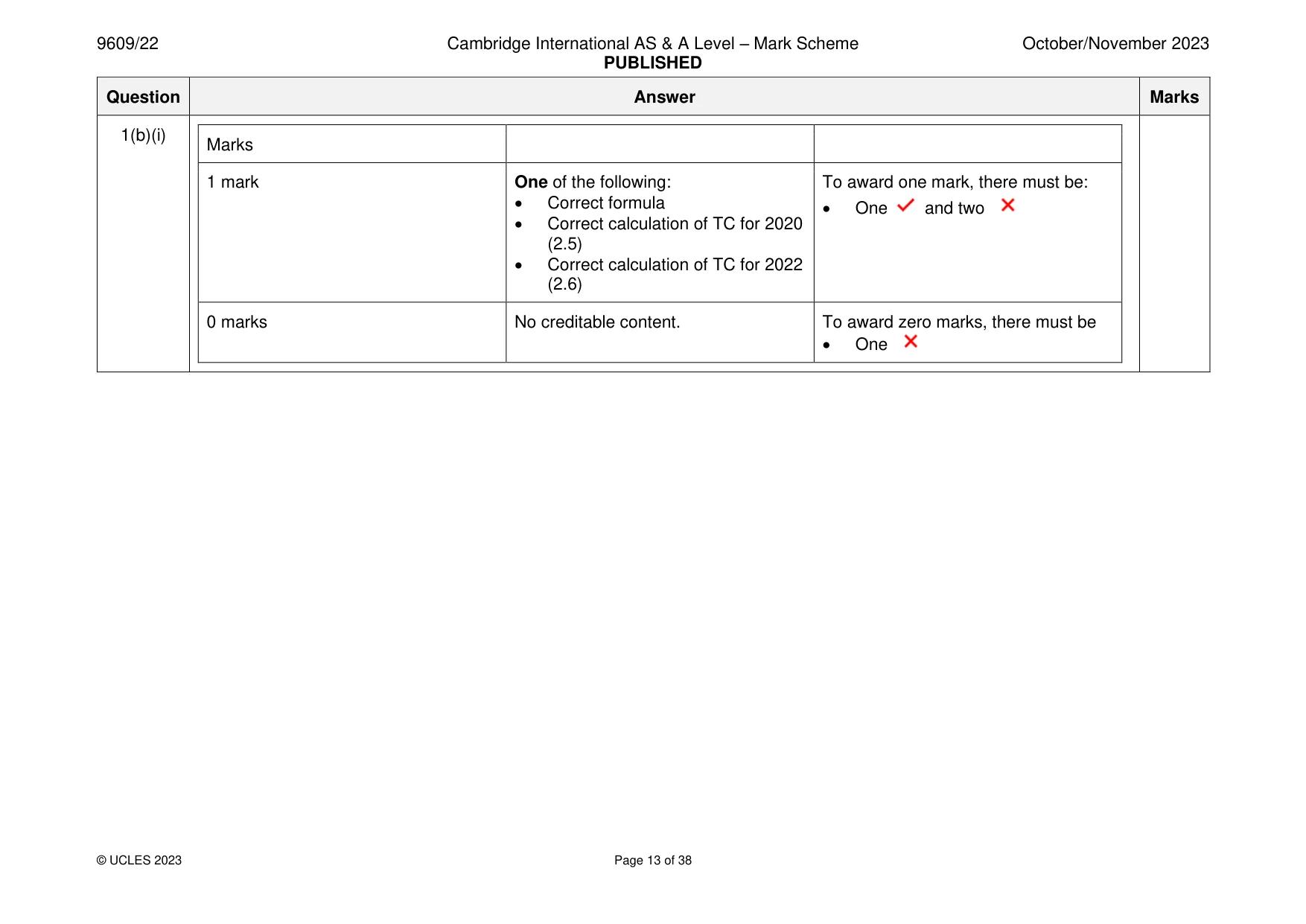
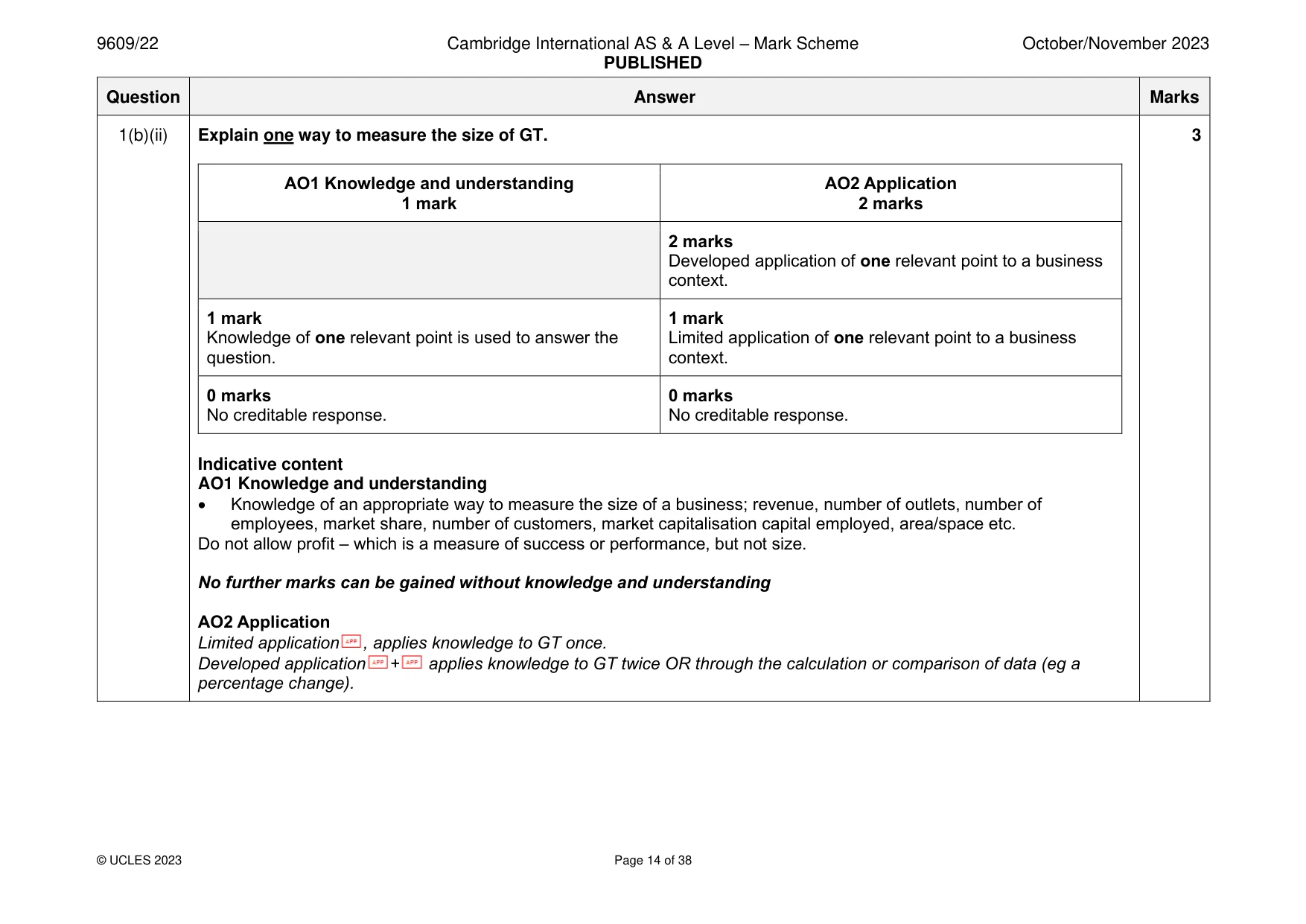
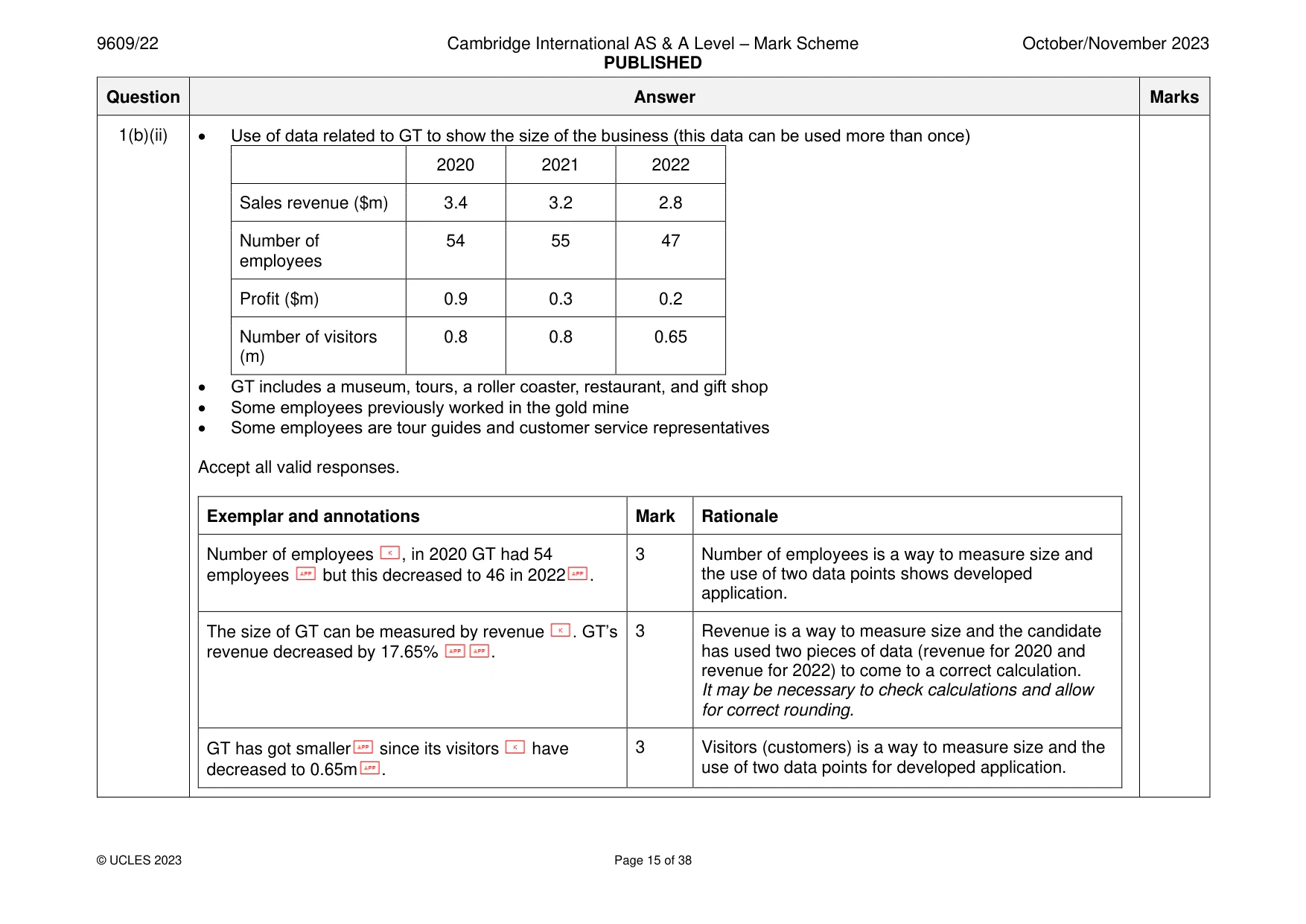
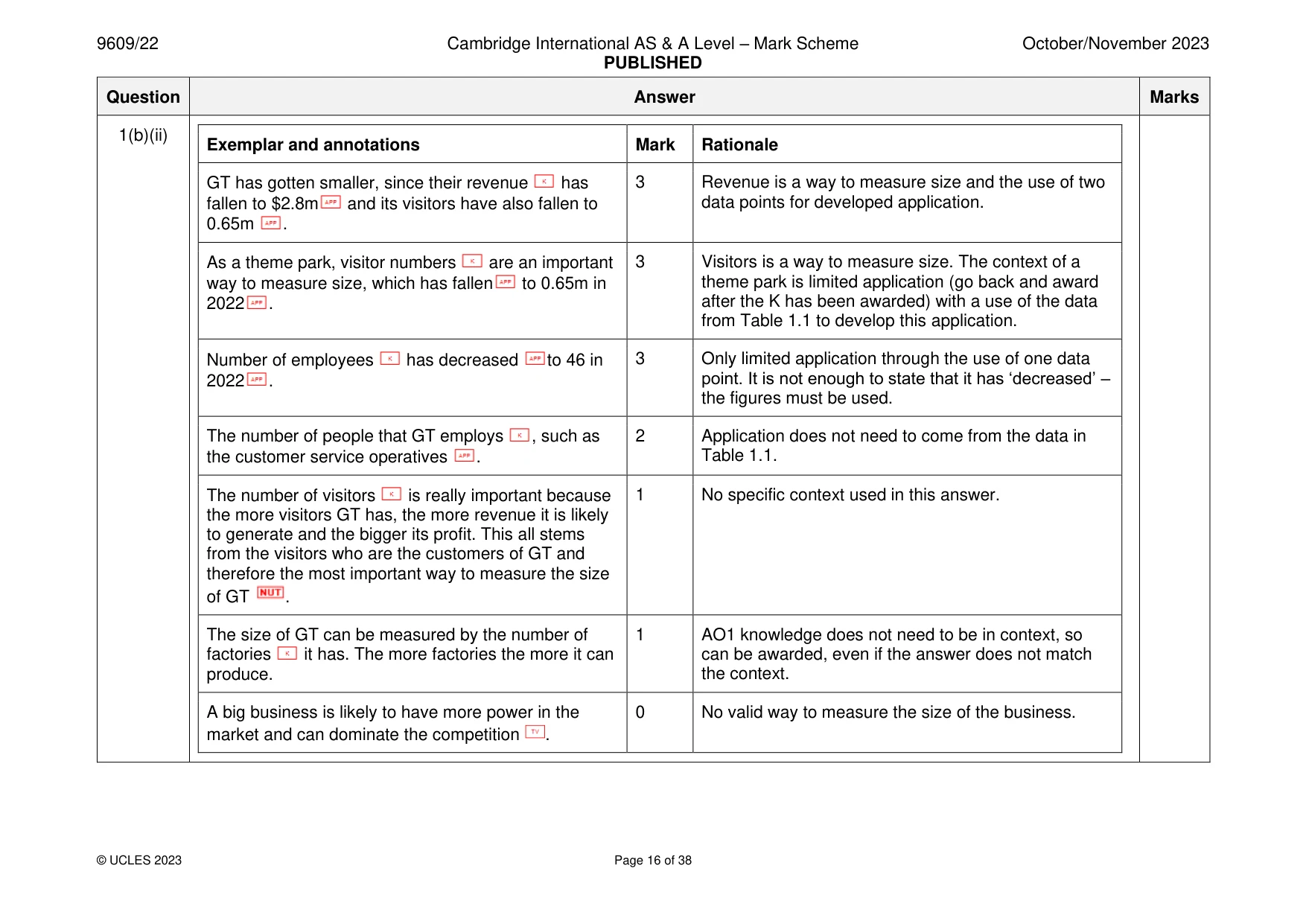
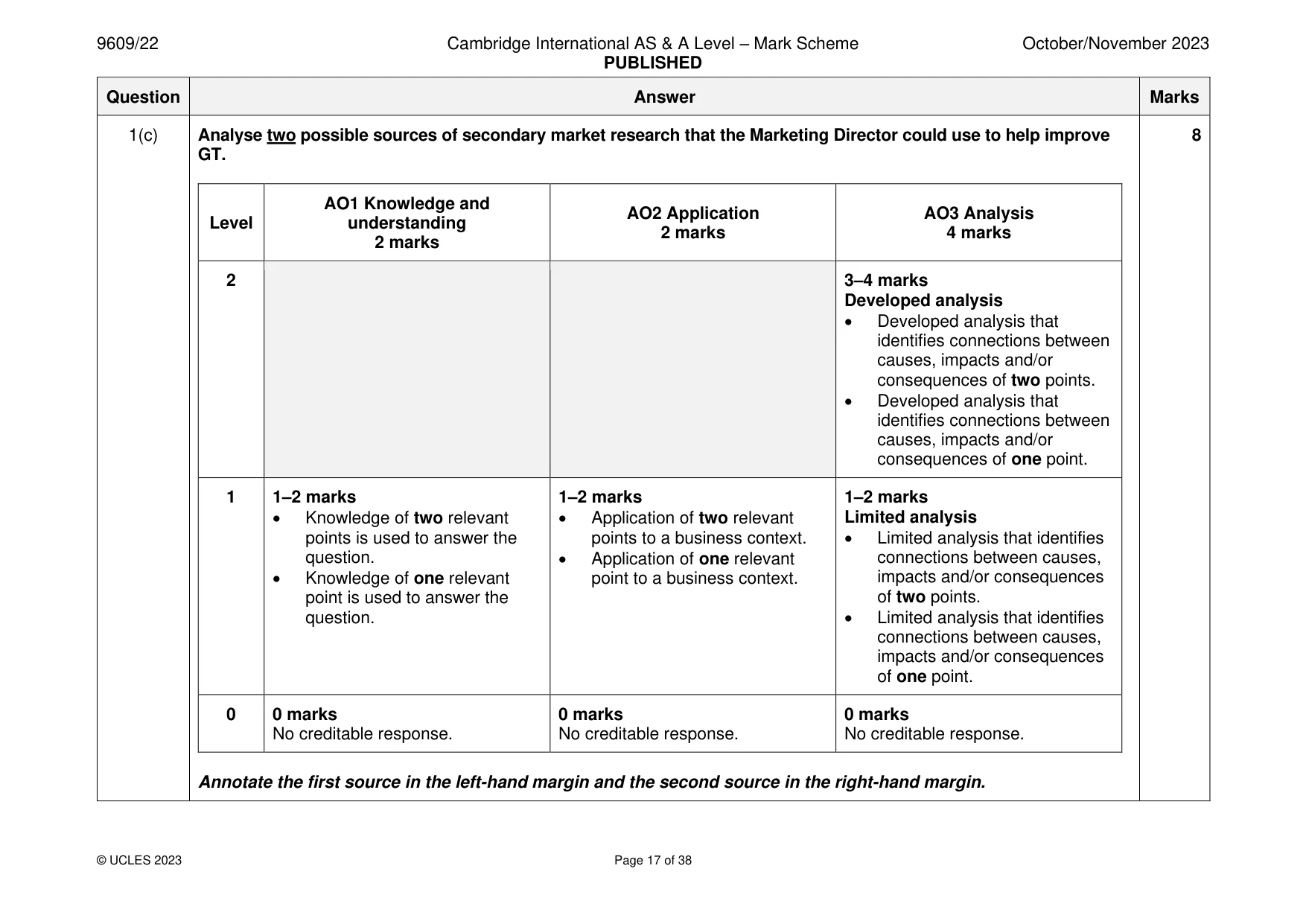
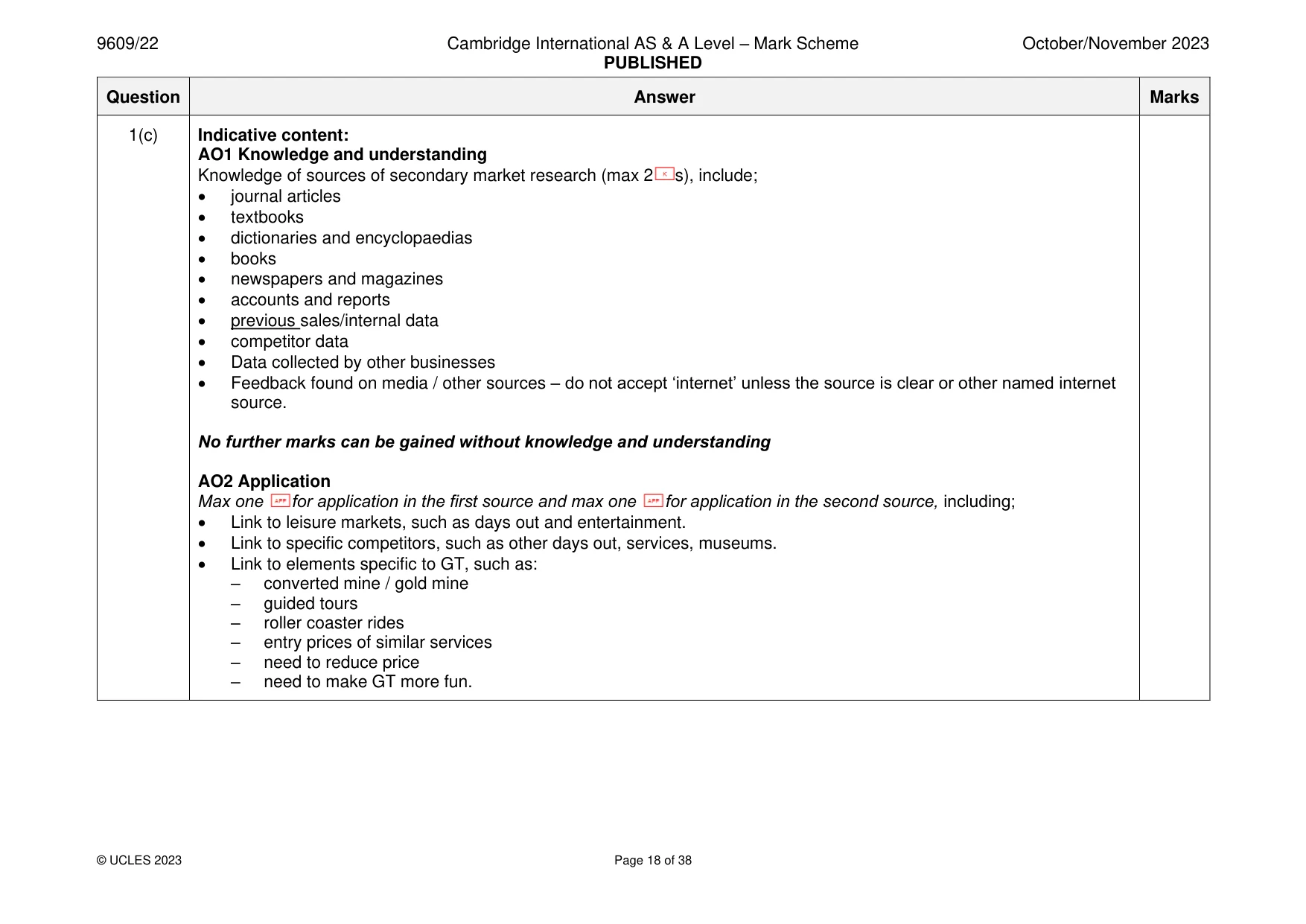
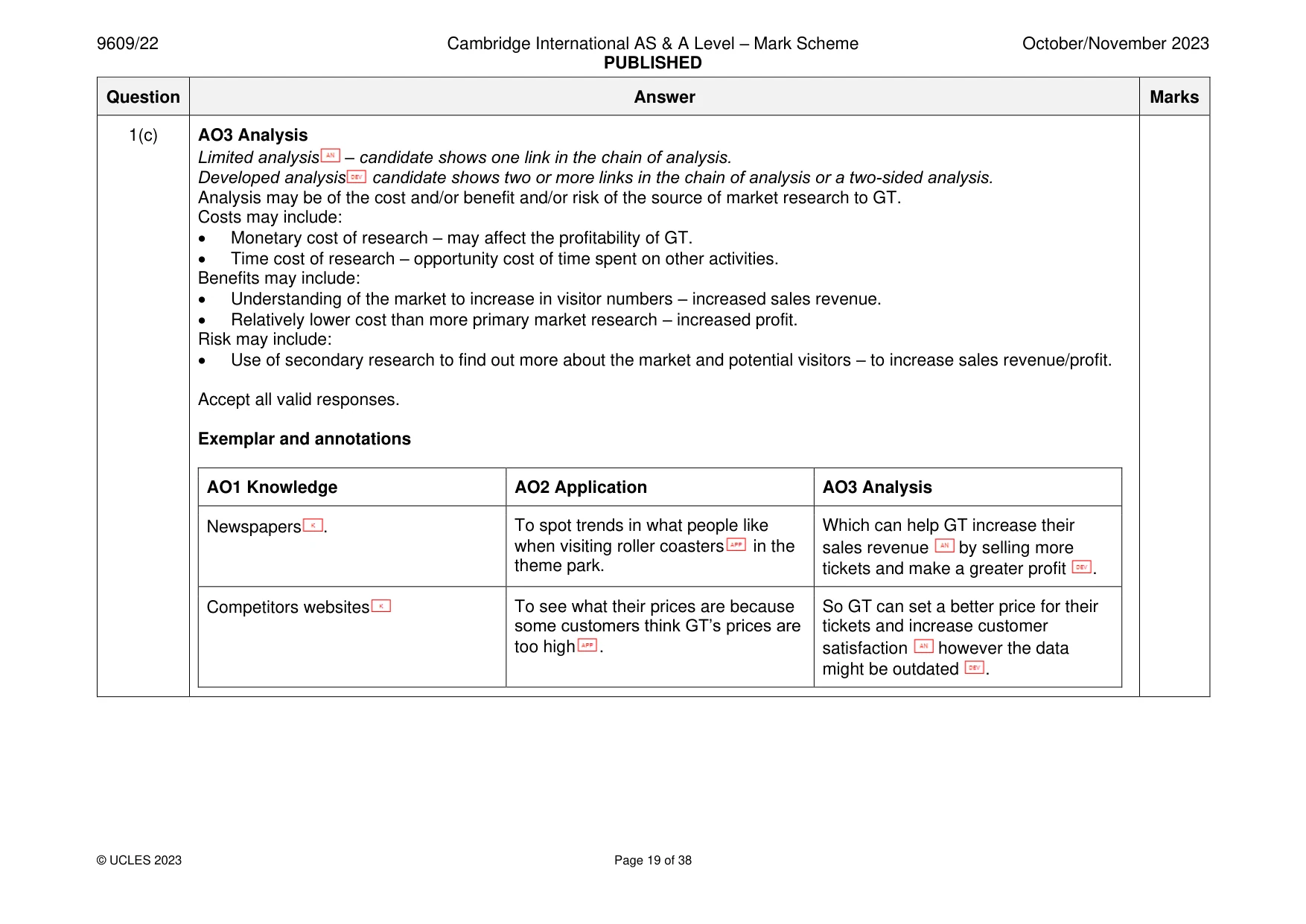
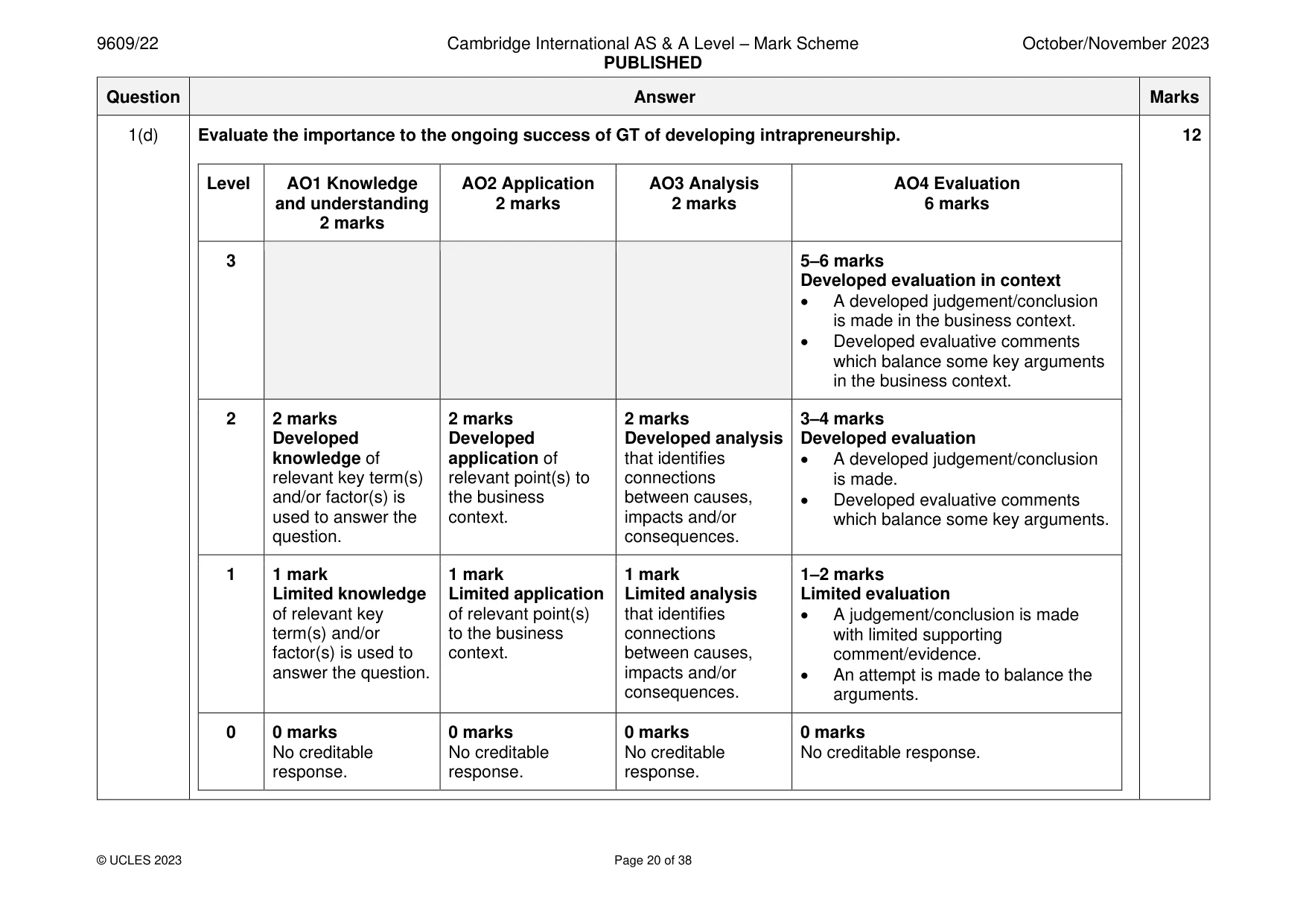
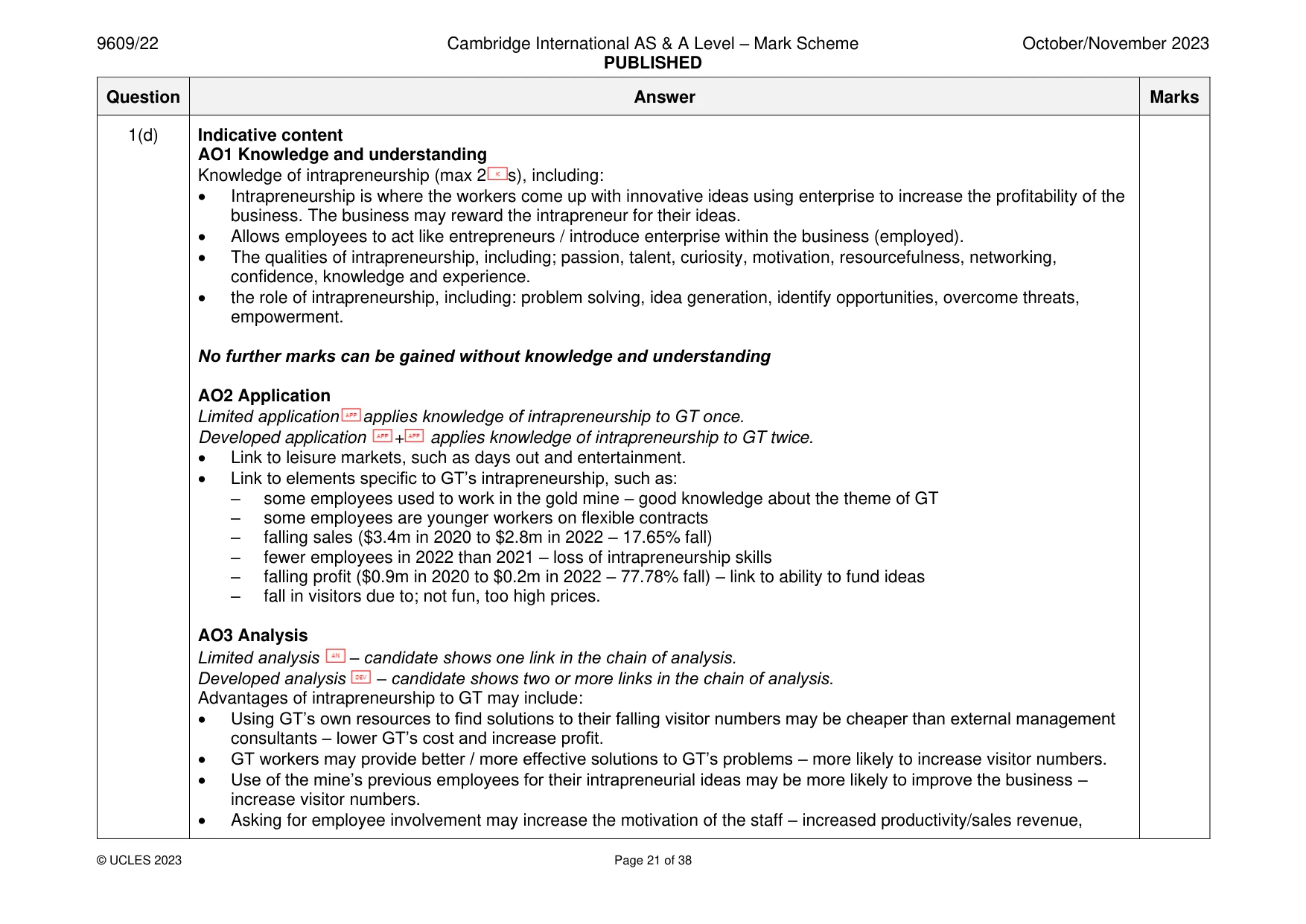
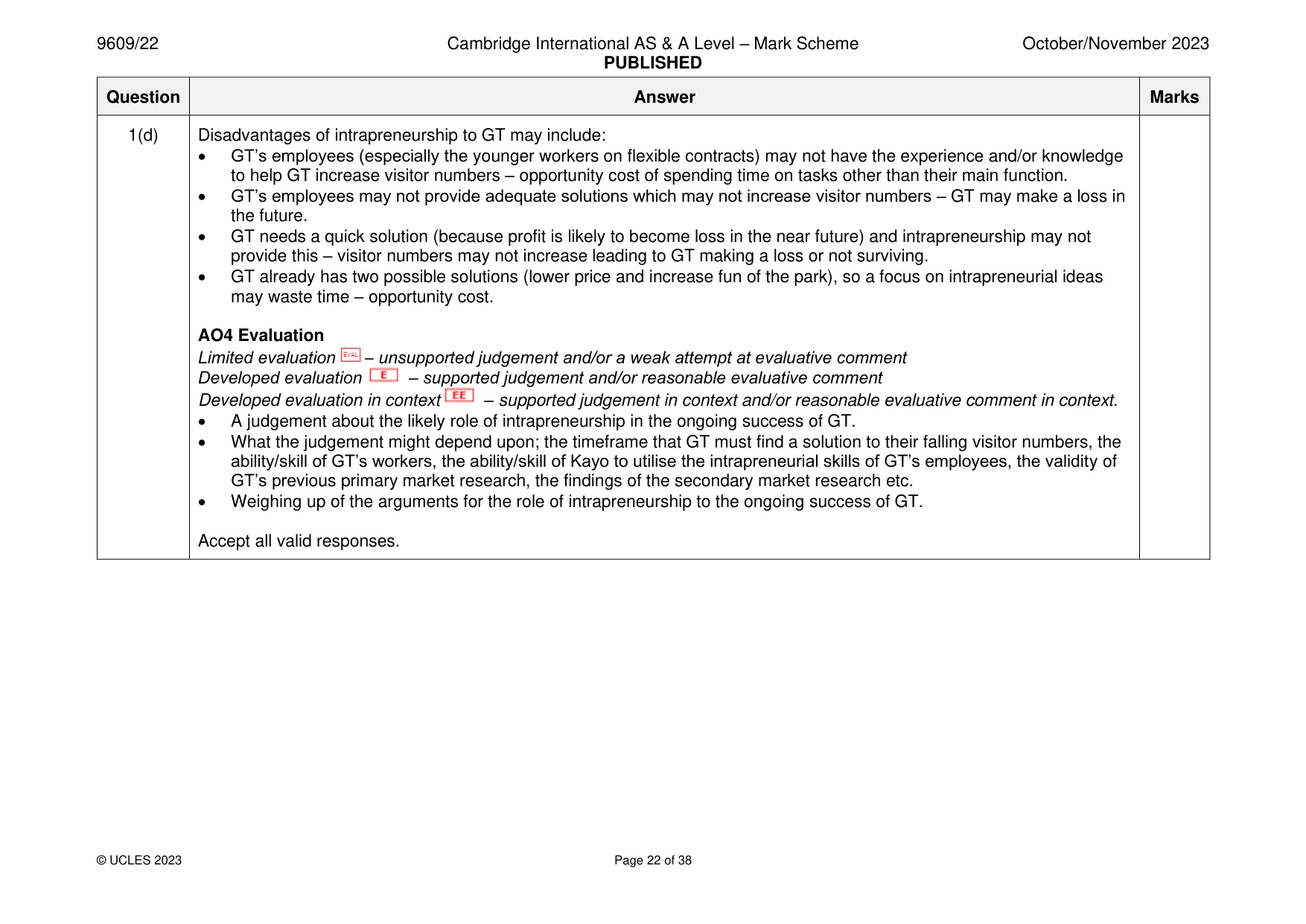
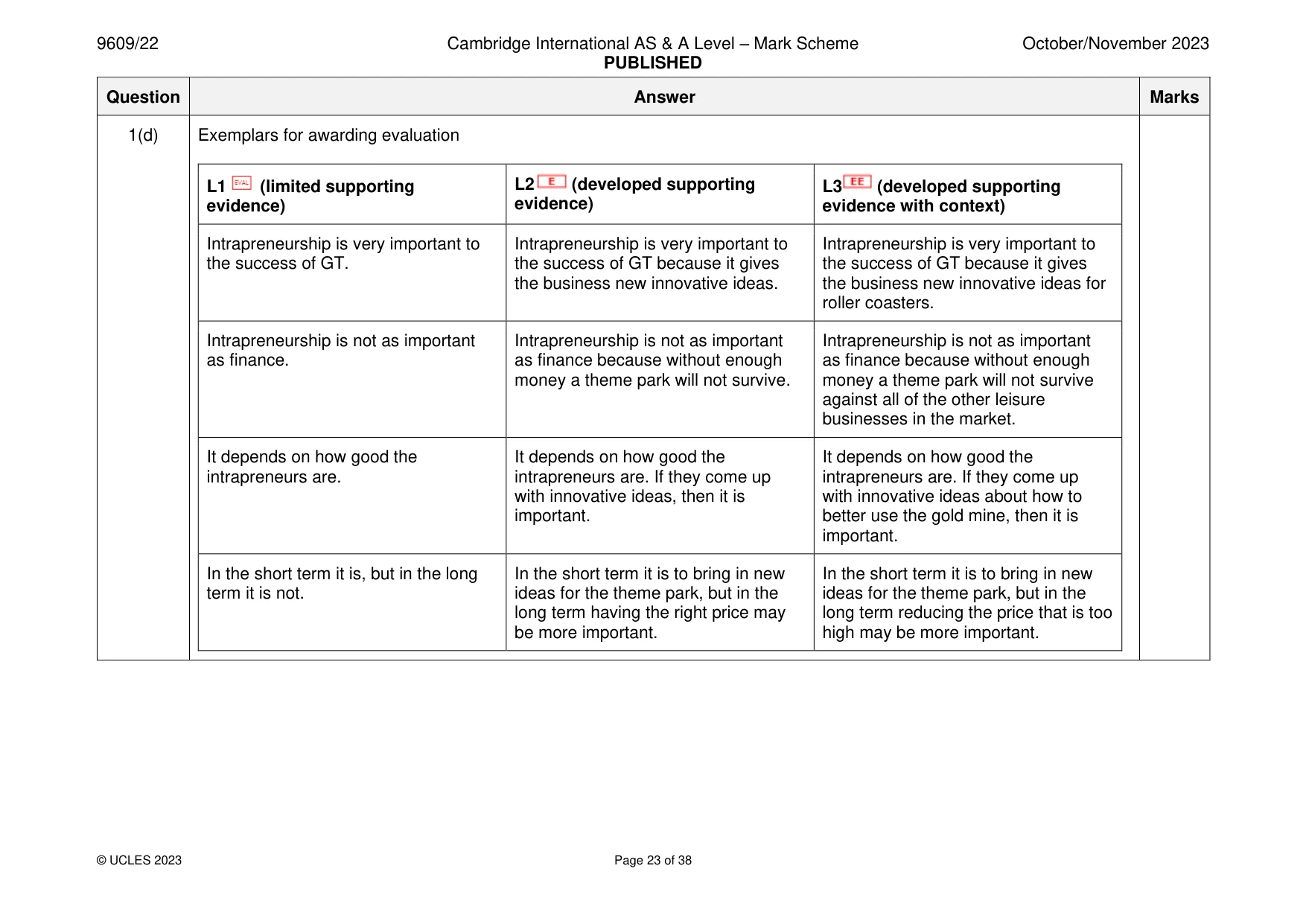
Mark scheme: Question Answer Marks 1(a)(i) Identify one type of training. 1 Indicative content. Identification of a type of training: • Induction • On-the-job • Off-the-job Only accept these responses 1(a)(ii) Explain the term ‘direct costs’. AO1 Knowledge and understanding AO2 Application 1 mark 2 marks 2 marks Developed application of one relevant point to a business context. 1 mark 1 mark Knowledge of one relevant point is used to answer the Limited application of one relevant point to a business question. context. 0 marks 0 marks No creditable response. No creditable response. Indicative content AO1 Knowledge and understanding Knowledge of direct cost(s) may include: • Costs that are directly related to the production process. • Costs that are directly attributed to operations/a cost centre. No further marks can be gained without knowledge and understanding AO2 Application Limited application applies knowledge of direct to business costs, including: • Amounts/things that are payable by a business / incurred by a business OR • Example or some other way of showing good understanding of a direct cost. Developed application + applies knowledge of direct to business costs, including • Amounts/things that are payable by a business / incurred by a business AND • Example or some other way of showing good understanding of a direct cost. Accept all valid responses. 1(a)(ii) Exemplar and annotations Mark Rationale Costs which are linked to the operations of a business 3 An answer which starts with the knowledge and then . For example, a gold mine would need to pay applies it to costs with an example. the miners who extract the gold . Something a business pays to make a product or 3 APP cannot be awarded without K, but once the K has service , such as raw materials . been awarded you can go back and reward the APP. Any example (it does not need to come from the data) can be used. Paid by a business , to produce a service . The 3 One of the APPs can come from further explanation it opposite of indirect costs which are not linked to does not have to be an example. production . Costs that are directly related to the production 2 No application of costs, so max 2 marks. process such as wages . Costs that can be attributed to a specific cost centre 2 Knowledge of the direct element with good unlike indirect costs which cannot . An example understanding. The example is fine, but no of a direct cost for GT are the wages of the tour understanding of costs. guides. Production costs . 1 Simple knowledge of the direct element. Costs which are directly accountable to a cost object 1 Knowledge of the direct element – ignore anything such as the marketing of GT. that is incorrect. No negative marking. The things a business has to pay . For example, a 0 Although there is some attempt at application, these marks cannot be awarded without knowledge. business may need to pay wages and advertising . Direct costs are the same as variable costs . 0 Variable costs share some characteristics with direct costs, but they are not the same. 1(b)(i) Refer to Table 1.1. Calculate the change in GT’s total costs between 2020 and 2022. 3 Indicative content. • Formula: total costs = total revenue – profit (1) • Calculation of cost in either 2020 or 2022 (1) – Costs in 2020: $3.4m – $0.9m = $2.5m – Costs in 2022: $2.8m – 0.2m = $2.6m • Change in costs: $2.6m – $2.5m = $0.1m (1 OFR) Answer = $0.1m (3) Accept answer as a percentage 4% (with % sign) as full marks Exemplar and annotations Marks 3 marks Correct answer Working and $ do not matter. $0.1m or 4% allow 0.1 If presented as a percentage, then % sign must be included for full marks allow OR clear and correct working shown. (0.1 / 2.5) 100 = 4 (obviously meant Must be three to denote the as a percentage) three marks. 2 marks Two of the following: To award two marks, there must be • Correct formula • Two and a • Correct calculation of TC for 2020 OR (2.5) • One , one and one • Correct calculation of TC for 2022 (2.6) OR An incorrect answer with one mistake allowing OFR for final stage. 1(b)(i) Marks 1 mark One of the following: To award one mark, there must be: • Correct formula • One and two • Correct calculation of TC for 2020 (2.5) • Correct calculation of TC for 2022 (2.6) 0 marks No creditable content. To award zero marks, there must be • One 1(b)(ii) Explain one way to measure the size of GT. 3 AO1 Knowledge and understanding AO2 Application 1 mark 2 marks 2 marks Developed application of one relevant point to a business context. 1 mark 1 mark Knowledge of one relevant point is used to answer the Limited application of one relevant point to a business question. context. 0 marks 0 marks No creditable response. No creditable response. Indicative content AO1 Knowledge and understanding • Knowledge of an appropriate way to measure the size of a business; revenue, number of outlets, number of employees, market share, number of customers, market capitalisation capital employed, area/space etc. Do not allow profit – which is a measure of success or performance, but not size. No further marks can be gained without knowledge and understanding AO2 Application Limited application , applies knowledge to GT once. Developed application + applies knowledge to GT twice OR through the calculation or comparison of data (eg a percentage change). 1(b)(ii) • Use of data related to GT to show the size of the business (this data can be used more than once) 2020 2021 2022 Sales revenue ($m) 3.4 3.2 2.8 Number of 54 55 47 employees Profit ($m) 0.9 0.3 0.2 Number of visitors 0.8 0.8 0.65 (m) • GT includes a museum, tours, a roller coaster, restaurant, and gift shop • Some employees previously worked in the gold mine • Some employees are tour guides and customer service representatives Accept all valid responses. Exemplar and annotations Mark Rationale Number of employees , in 2020 GT had 54 3 Number of employees is a way to measure size and employees but this decreased to 46 in 2022 . the use of two data points shows developed application. The size of GT can be measured by revenue . GT’s 3 Revenue is a way to measure size and the candidate revenue decreased by 17.65% . has used two pieces of data (revenue for 2020 and revenue for 2022) to come to a correct calculation. It may be necessary to check calculations and allow for correct rounding. GT has got smaller since its visitors have 3 Visitors (customers) is a way to measure size and the decreased to 0.65m . use of two data points for developed application. 1(b)(ii) Exemplar and annotations Mark Rationale GT has gotten smaller, since their revenue has 3 Revenue is a way to measure size and the use of two fallen to $2.8m and its visitors have also fallen to data points for developed application. 0.65m . As a theme park, visitor numbers are an important 3 Visitors is a way to measure size. The context of a way to measure size, which has fallen to 0.65m in theme park is limited application (go back and award 2022 . after the K has been awarded) with a use of the data from Table 1.1 to develop this application. Number of employees has decreased to 46 in 3 Only limited application through the use of one data 2022 . point. It is not enough to state that it has ‘decreased’ – the figures must be used. The number of people that GT employs , such as 2 Application does not need to come from the data in the customer service operatives . Table 1.1. The number of visitors is really important because 1 No specific context used in this answer. the more visitors GT has, the more revenue it is likely to generate and the bigger its profit. This all stems from the visitors who are the customers of GT and therefore the most important way to measure the size of GT . The size of GT can be measured by the number of 1 AO1 knowledge does not need to be in context, so factories it has. The more factories the more it can can be awarded, even if the answer does not match produce. the context. A big business is likely to have more power in the 0 No valid way to measure the size of the business. market and can dominate the competition . 1(c) Analyse two possible sources of secondary market research that the Marketing Director could use to help improve 8 GT. AO1 Knowledge and AO2 Application AO3 Analysis Level understanding 2 marks 4 marks 2 marks 2 3–4 marks Developed analysis • Developed analysis that identifies connections between causes, impacts and/or consequences of two points. • Developed analysis that identifies connections between causes, impacts and/or consequences of one point. 1 1–2 marks 1–2 marks 1–2 marks • Knowledge of two relevant • Application of two relevant Limited analysis points is used to answer the points to a business context. • Limited analysis that identifies question. • Application of one relevant connections between causes, • Knowledge of one relevant point to a business context. impacts and/or consequences point is used to answer the of two points. question. • Limited analysis that identifies connections between causes, impacts and/or consequences of one point. 0 0 marks 0 marks 0 marks No creditable response. No creditable response. No creditable response. Annotate the first source in the left-hand margin and the second source in the right-hand margin. 1(c) Indicative content: AO1 Knowledge and understanding Knowledge of sources of secondary market research (max 2 s), include; • journal articles • textbooks • dictionaries and encyclopaedias • books • newspapers and magazines • accounts and reports • previous sales/internal data • competitor data • Data collected by other businesses • Feedback found on media / other sources – do not accept ‘internet’ unless the source is clear or other named internet source. No further marks can be gained without knowledge and understanding AO2 Application Max one for application in the first source and max one for application in the second source, including; • Link to leisure markets, such as days out and entertainment. • Link to specific competitors, such as other days out, services, museums. • Link to elements specific to GT, such as: – converted mine / gold mine – guided tours – roller coaster rides – entry prices of similar services – need to reduce price – need to make GT more fun. 1(c) AO3 Analysis Limited analysis – candidate shows one link in the chain of analysis. Developed analysis candidate shows two or more links in the chain of analysis or a two-sided analysis. Analysis may be of the cost and/or benefit and/or risk of the source of market research to GT. Costs may include: • Monetary cost of research – may affect the profitability of GT. • Time cost of research – opportunity cost of time spent on other activities. Benefits may include: • Understanding of the market to increase in visitor numbers – increased sales revenue. • Relatively lower cost than more primary market research – increased profit. Risk may include: • Use of secondary research to find out more about the market and potential visitors – to increase sales revenue/profit. Accept all valid responses. Exemplar and annotations AO1 Knowledge AO2 Application AO3 Analysis Newspapers . To spot trends in what people like Which can help GT increase their when visiting roller coasters in the sales revenue by selling more theme park. tickets and make a greater profit . Competitors websites To see what their prices are because So GT can set a better price for their some customers think GT’s prices are tickets and increase customer too high . satisfaction however the data might be outdated . 1(d) Evaluate the importance to the ongoing success of GT of developing intrapreneurship. 12 Level AO1 Knowledge AO2 Application AO3 Analysis AO4 Evaluation and understanding 2 marks 2 marks 6 marks 2 marks 3 5–6 marks Developed evaluation in context • A developed judgement/conclusion is made in the business context. • Developed evaluative comments which balance some key arguments in the business context. 2 2 marks 2 marks 2 marks 3–4 marks Developed Developed Developed analysis Developed evaluation knowledge of application of that identifies • A developed judgement/conclusion relevant key term(s) relevant point(s) to connections is made. and/or factor(s) is the business between causes, • Developed evaluative comments used to answer the context. impacts and/or which balance some key arguments. question. consequences. 1 1 mark 1 mark 1 mark 1–2 marks Limited knowledge Limited application Limited analysis Limited evaluation of relevant key of relevant point(s) that identifies • A judgement/conclusion is made term(s) and/or to the business connections with limited supporting factor(s) is used to context. between causes, comment/evidence. answer the question. impacts and/or • An attempt is made to balance the consequences. arguments. 0 0 marks 0 marks 0 marks 0 marks No creditable No creditable No creditable No creditable response. response. response. response. 1(d) Indicative content AO1 Knowledge and understanding Knowledge of intrapreneurship (max 2 s), including: • Intrapreneurship is where the workers come up with innovative ideas using enterprise to increase the profitability of the business. The business may reward the intrapreneur for their ideas. • Allows employees to act like entrepreneurs / introduce enterprise within the business (employed). • The qualities of intrapreneurship, including; passion, talent, curiosity, motivation, resourcefulness, networking, confidence, knowledge and experience. • the role of intrapreneurship, including: problem solving, idea generation, identify opportunities, overcome threats, empowerment. No further marks can be gained without knowledge and understanding AO2 Application Limited application applies knowledge of intrapreneurship to GT once. Developed application + applies knowledge of intrapreneurship to GT twice. • Link to leisure markets, such as days out and entertainment. • Link to elements specific to GT’s intrapreneurship, such as: – some employees used to work in the gold mine – good knowledge about the theme of GT – some employees are younger workers on flexible contracts – falling sales ($3.4m in 2020 to $2.8m in 2022 – 17.65% fall) – fewer employees in 2022 than 2021 – loss of intrapreneurship skills – falling profit ($0.9m in 2020 to $0.2m in 2022 – 77.78% fall) – link to ability to fund ideas – fall in visitors due to; not fun, too high prices. AO3 Analysis Limited analysis – candidate shows one link in the chain of analysis. Developed analysis – candidate shows two or more links in the chain of analysis. Advantages of intrapreneurship to GT may include: • Using GT’s own resources to find solutions to their falling visitor numbers may be cheaper than external management consultants – lower GT’s cost and increase profit. • GT workers may provide better / more effective solutions to GT’s problems – more likely to increase visitor numbers. • Use of the mine’s previous employees for their intrapreneurial ideas may be more likely to improve the business – increase visitor numbers. • Asking for employee involvement may increase the motivation of the staff – increased productivity/sales revenue, 1(d) Disadvantages of intrapreneurship to GT may include: • GT’s employees (especially the younger workers on flexible contracts) may not have the experience and/or knowledge to help GT increase visitor numbers – opportunity cost of spending time on tasks other than their main function. • GT’s employees may not provide adequate solutions which may not increase visitor numbers – GT may make a loss in the future. • GT needs a quick solution (because profit is likely to become loss in the near future) and intrapreneurship may not provide this – visitor numbers may not increase leading to GT making a loss or not surviving. • GT already has two possible solutions (lower price and increase fun of the park), so a focus on intrapreneurial ideas may waste time – opportunity cost. AO4 Evaluation Limited evaluation – unsupported judgement and/or a weak attempt at evaluative comment Developed evaluation – supported judgement and/or reasonable evaluative comment Developed evaluation in context – supported judgement in context and/or reasonable evaluative comment in context. • A judgement about the likely role of intrapreneurship in the ongoing success of GT. • What the judgement might depend upon; the timeframe that GT must find a solution to their falling visitor numbers, the ability/skill of GT’s workers, the ability/skill of Kayo to utilise the intrapreneurial skills of GT’s employees, the validity of GT’s previous primary market research, the findings of the secondary market research etc. • Weighing up of the arguments for the role of intrapreneurship to the ongoing success of GT. Accept all valid responses. 1(d) Exemplars for awarding evaluation L1 (limited supporting L2 (developed supporting L3 (developed supporting evidence) evidence) evidence with context) Intrapreneurship is very important to Intrapreneurship is very important to Intrapreneurship is very important to the success of GT. the success of GT because it gives the success of GT because it gives the business new innovative ideas. the business new innovative ideas for roller coasters. Intrapreneurship is not as important Intrapreneurship is not as important Intrapreneurship is not as important as finance. as finance because without enough as finance because without enough money a theme park will not survive. money a theme park will not survive against all of the other leisure businesses in the market. It depends on how good the It depends on how good the It depends on how good the intrapreneurs are. intrapreneurs are. If they come up intrapreneurs are. If they come up with innovative ideas, then it is with innovative ideas about how to important. better use the gold mine, then it is important. In the short term it is, but in the long In the short term it is to bring in new In the short term it is to bring in new term it is not. ideas for the theme park, but in the ideas for the theme park, but in the long term having the right price may long term reducing the price that is too be more important. high may be more important.
Q2 · Bear Bears (BB) BB is a business partnership owned by Sade and Chika
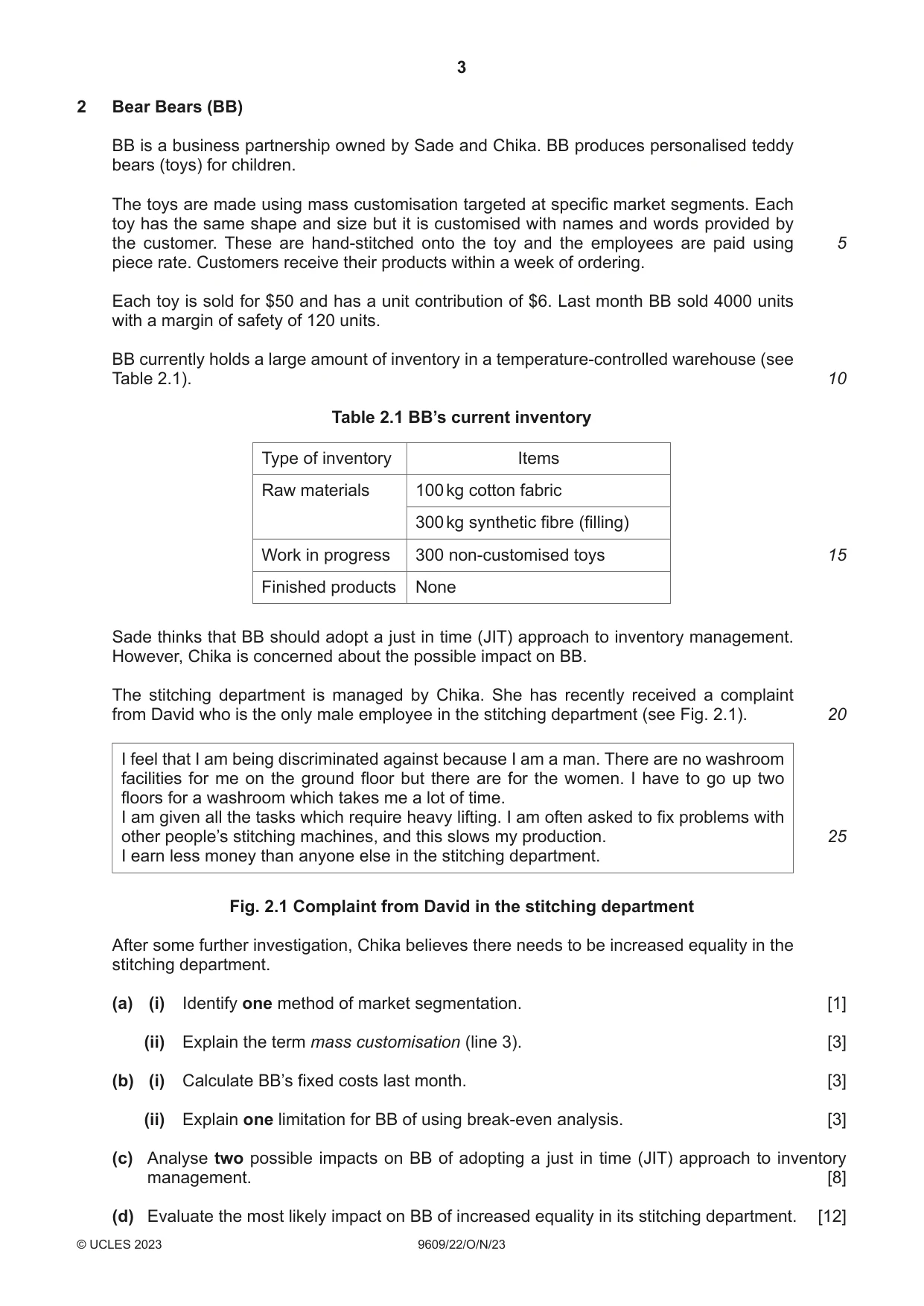
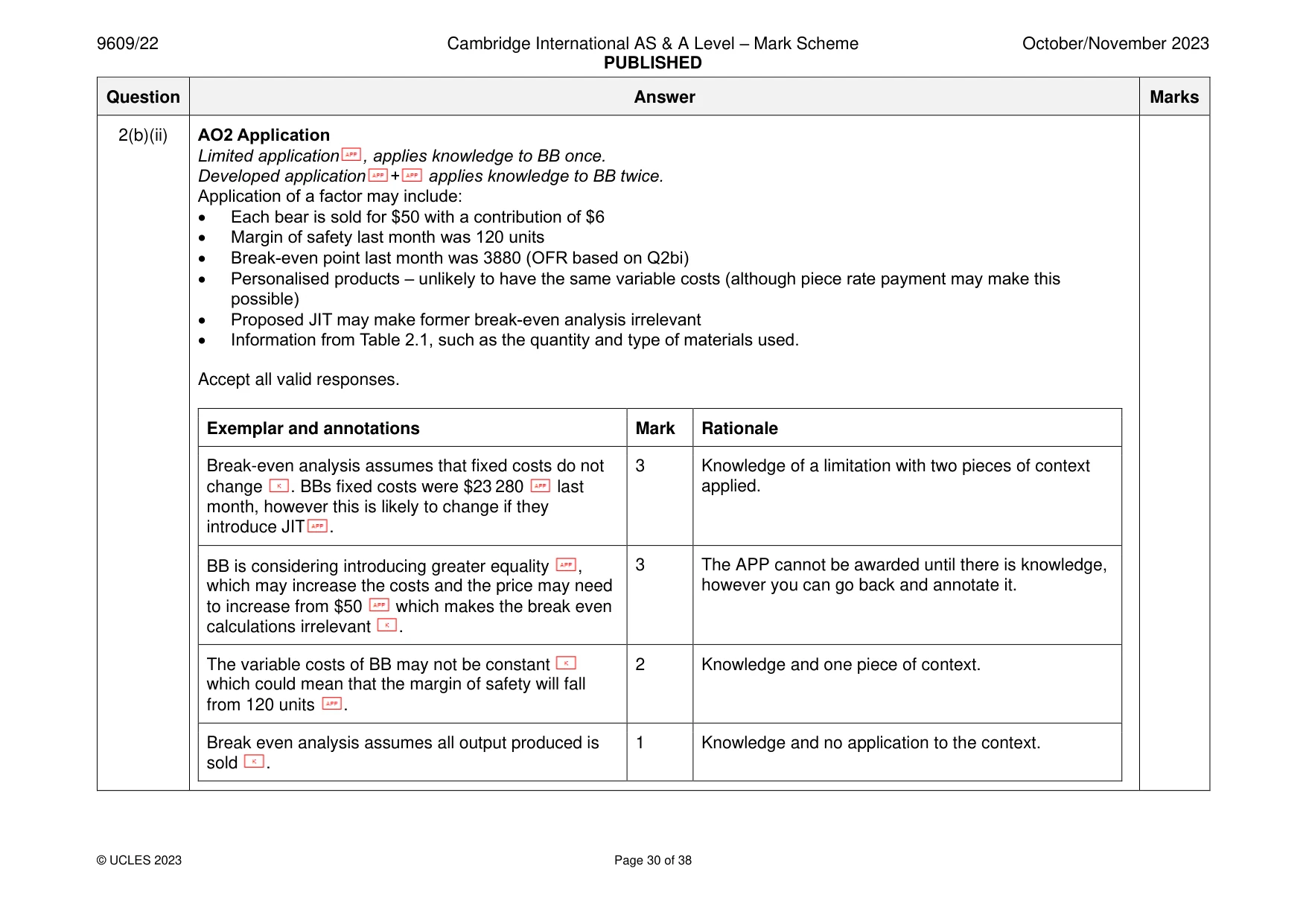
2 Bear Bears (BB) BB is a business partnership owned by Sade and Chika. BB produces personalised teddy bears (toys) for children. The toys are made using mass customisation targeted at specific market segments. Each toy has the same shape and size but it is customised with names and words provided by the customer. These are hand‑stitched onto the toy and the employees are paid using 5 piece rate. Customers receive their products within a week of ordering. Each toy is sold for $50 and has a unit contribution of $6. Last month BB sold 4000 units with a margin of safety of 120 units. BB currently holds a large amount of inventory in a temperature‑controlled warehouse (see Table 2.1). 10 Table 2.1 BB’s current inventory Type of inventory Items Raw materials 100 kg cotton fabric 300 kg synthetic fibre (filling) Work in progress 300 non‑customised toys 15 Finished products None Sade thinks that BB should adopt a just in time (JIT) approach to inventory management. However, Chika is concerned about the possible impact on BB. The stitching department is managed by Chika. She has recently received a complaint from David who is the only male employee in the stitching department (see Fig. 2.1). 20 I feel that I am being discriminated against because I am a man. There are no washroom facilities for me on the ground floor but there are for the women. I have to go up two floors for a washroom which takes me a lot of time. I am given all the tasks which require heavy lifting. I am often asked to fix problems with other people’s stitching machines, and this slows my production. 25 I earn less money than anyone else in the stitching department. Fig. 2.1 Complaint from David in the stitching department After some further investigation, Chika believes there needs to be increased equality in the stitching department. (a) (i) Identify one method of market segmentation. [1] (ii) Explain the term mass customisation (line 3). [3] (b) (i) Calculate BB’s fixed costs last month. [3] (ii) Explain one limitation for BB of using break‑even analysis. [3] (c) Analyse two possible impacts on BB of adopting a just in time (JIT) approach to inventory management. [8]
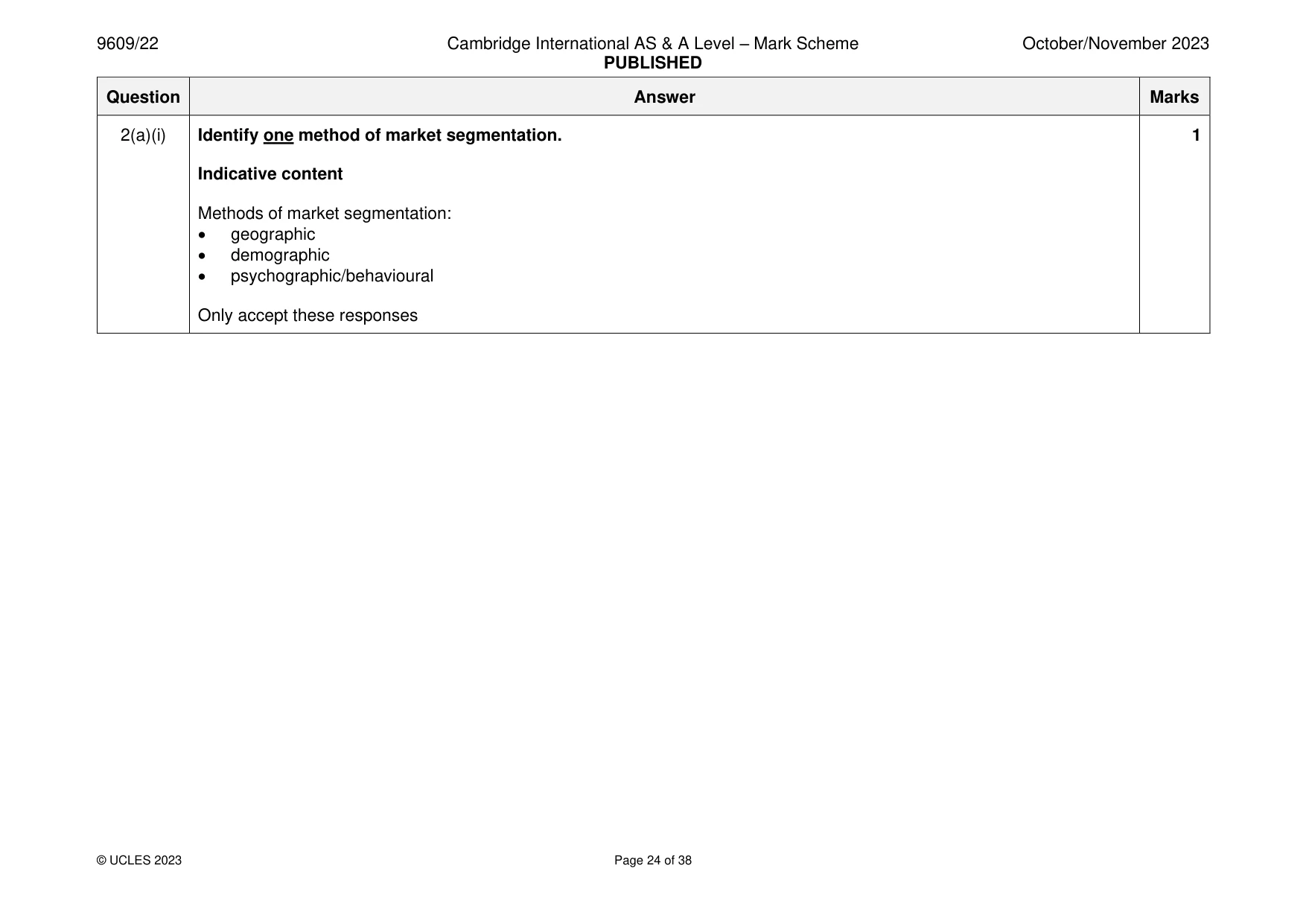
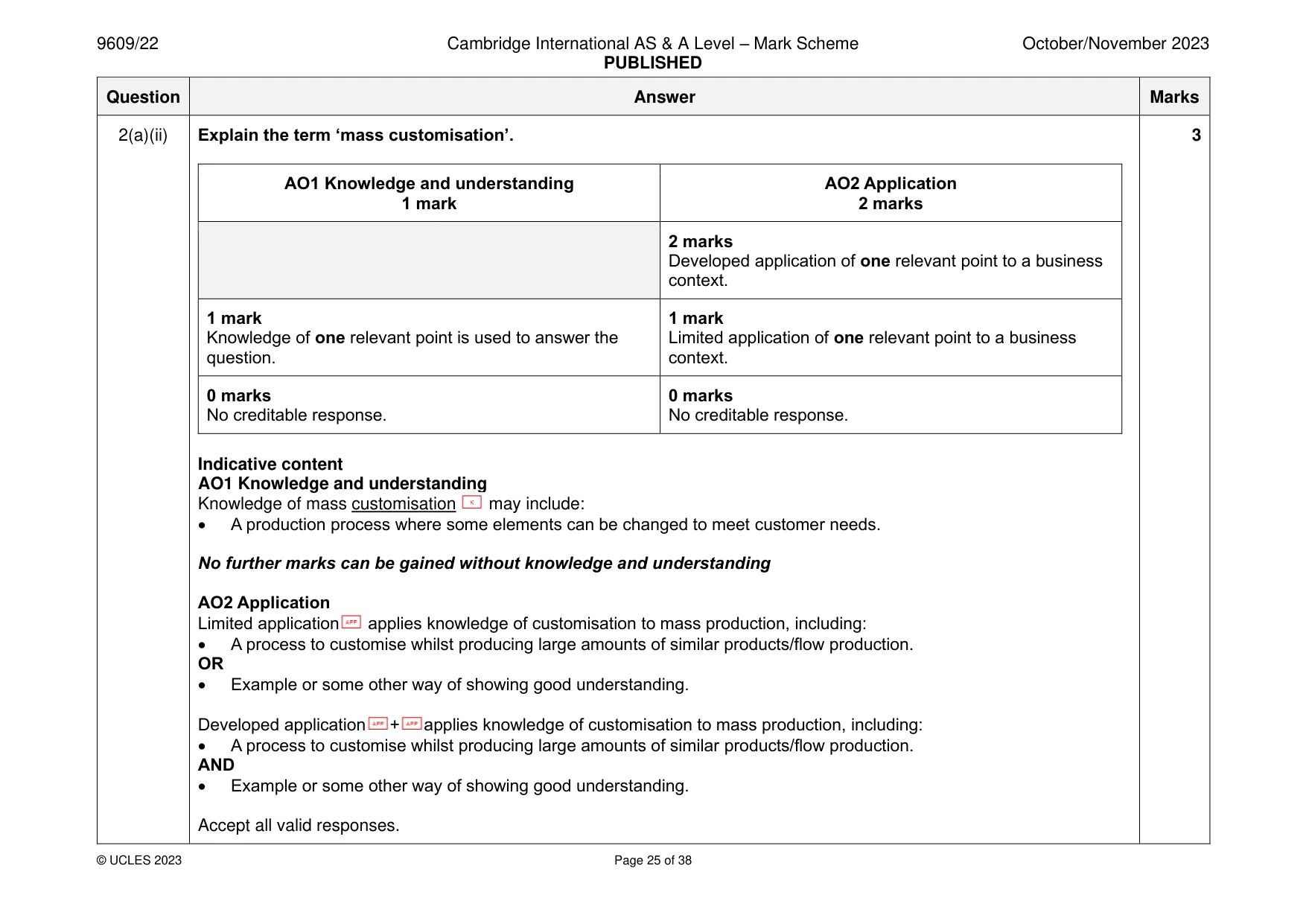
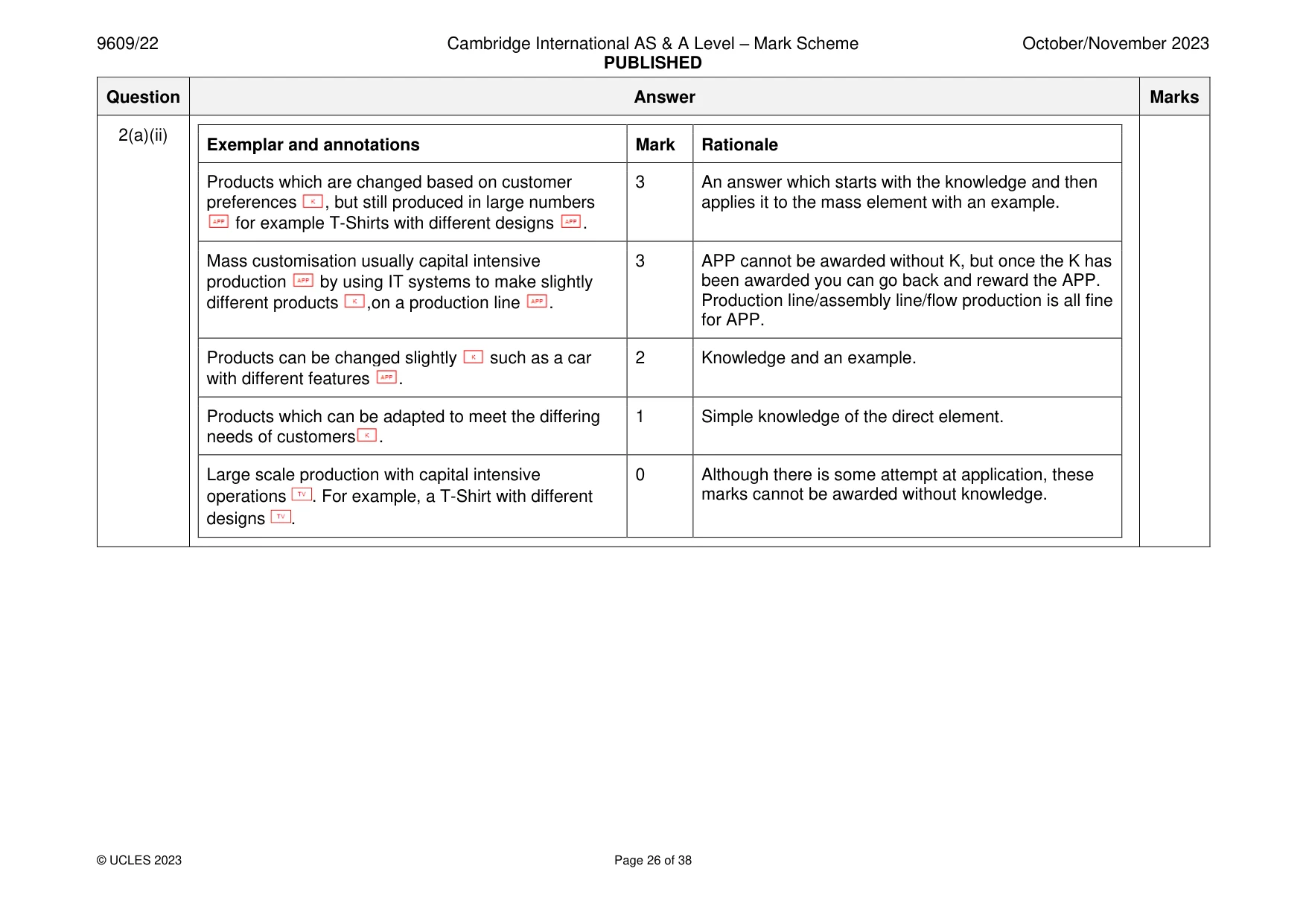
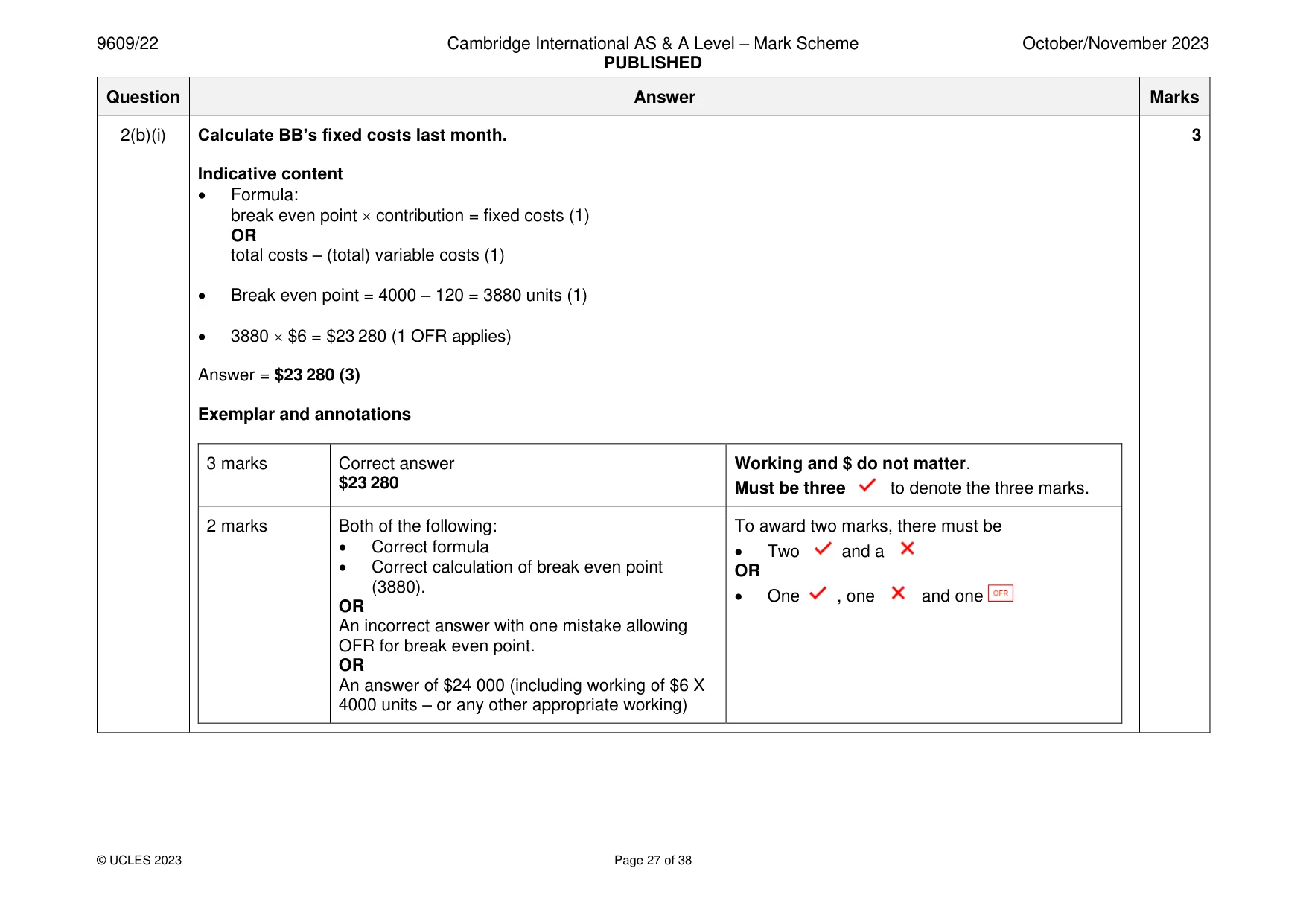
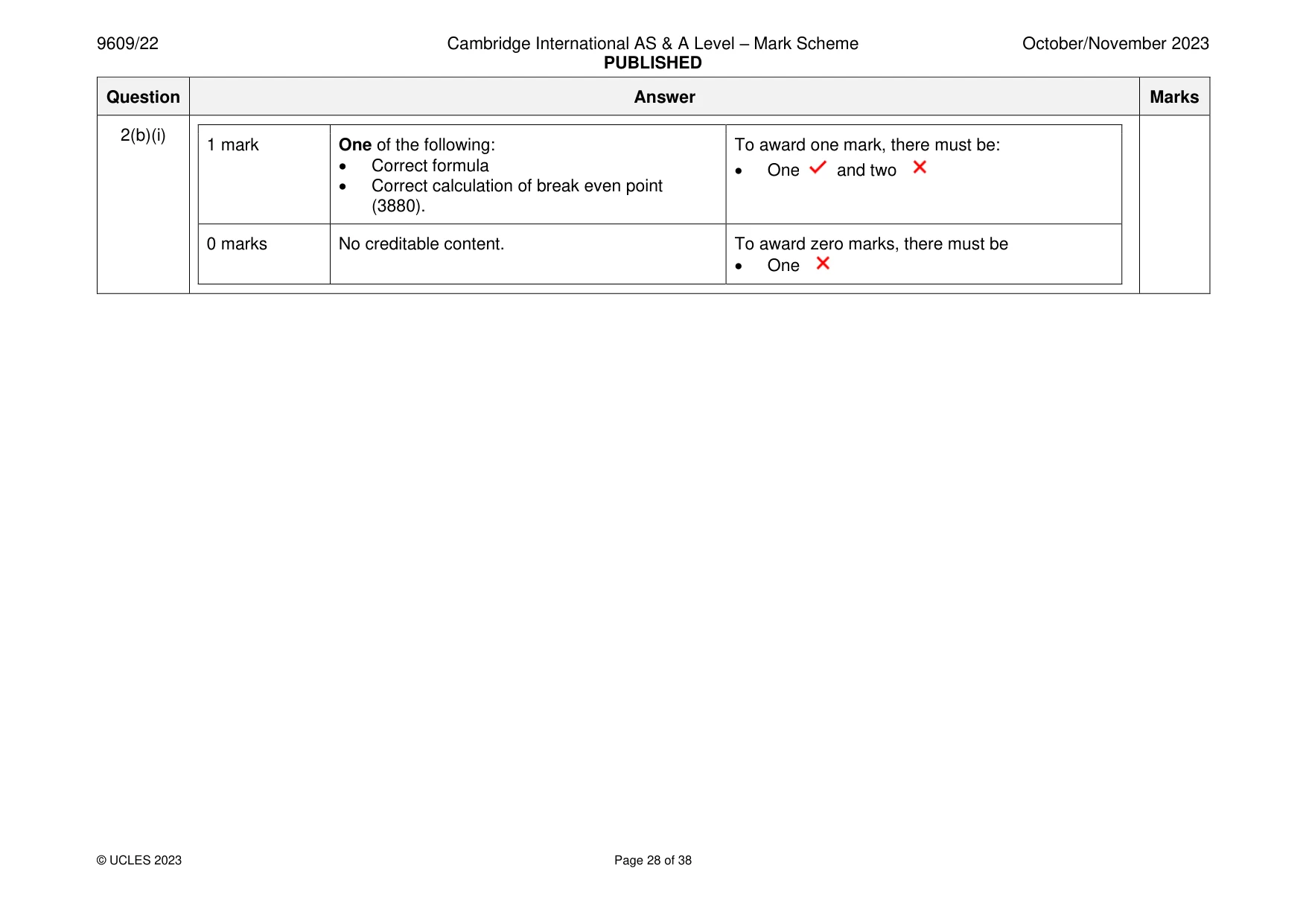
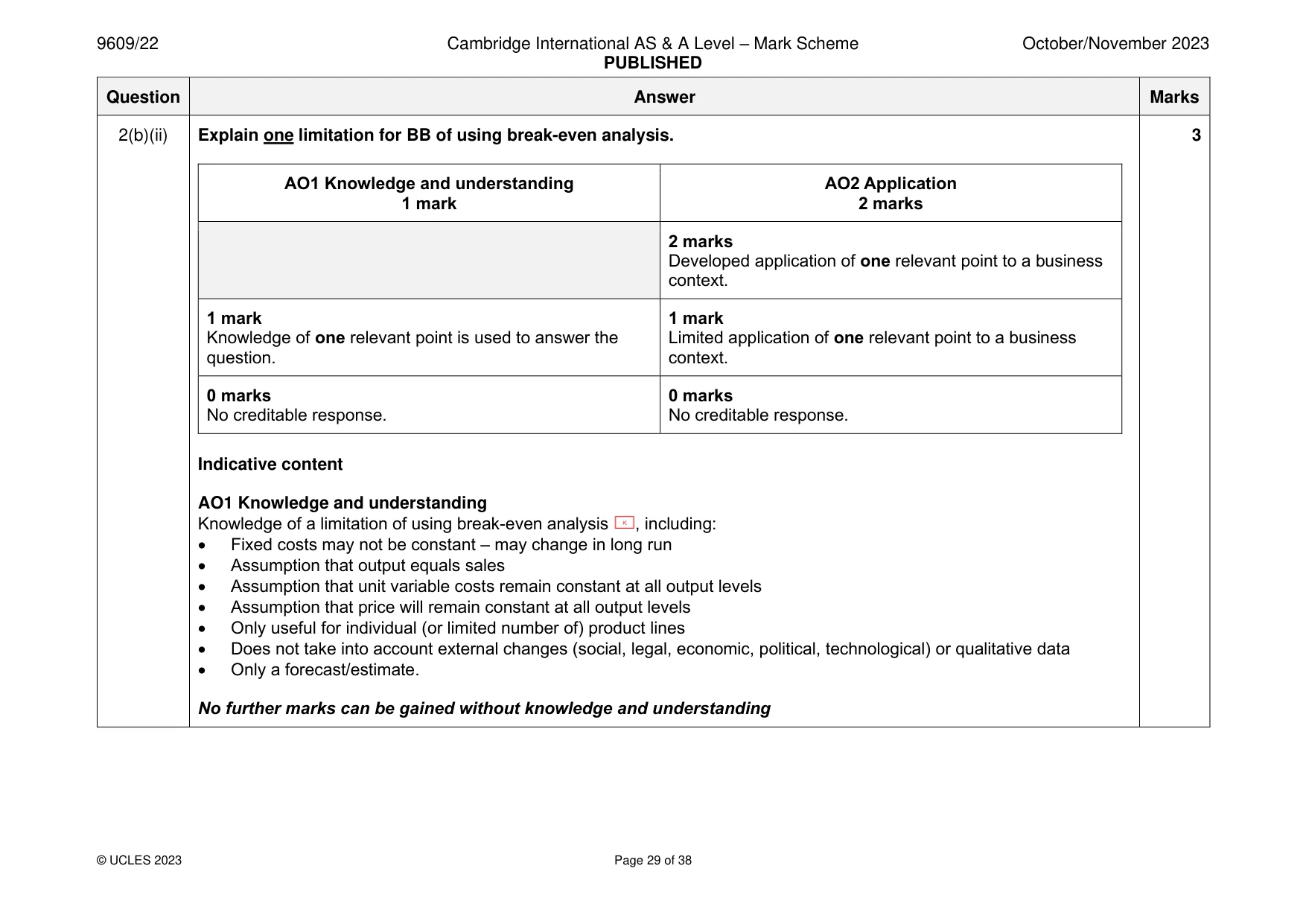
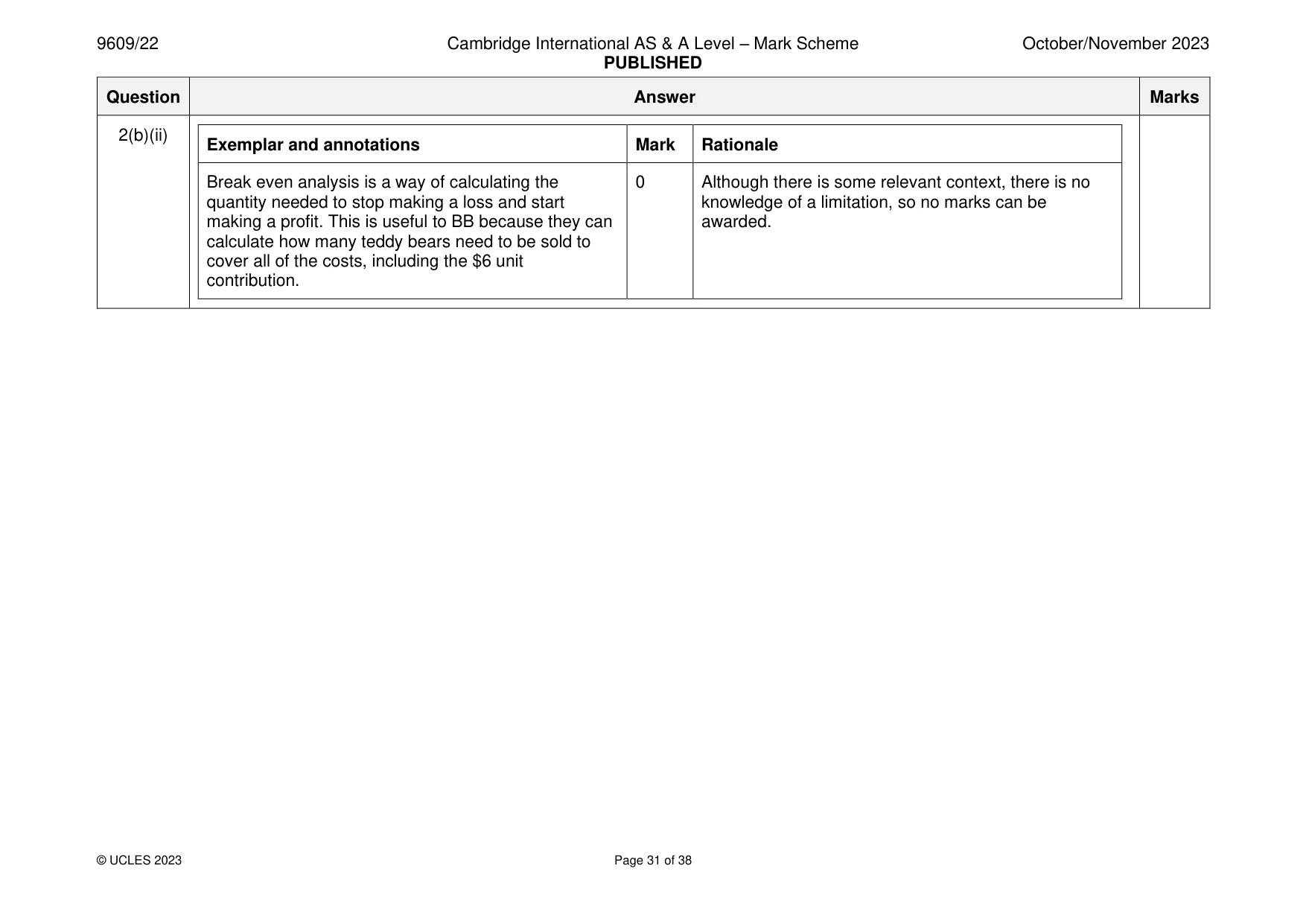
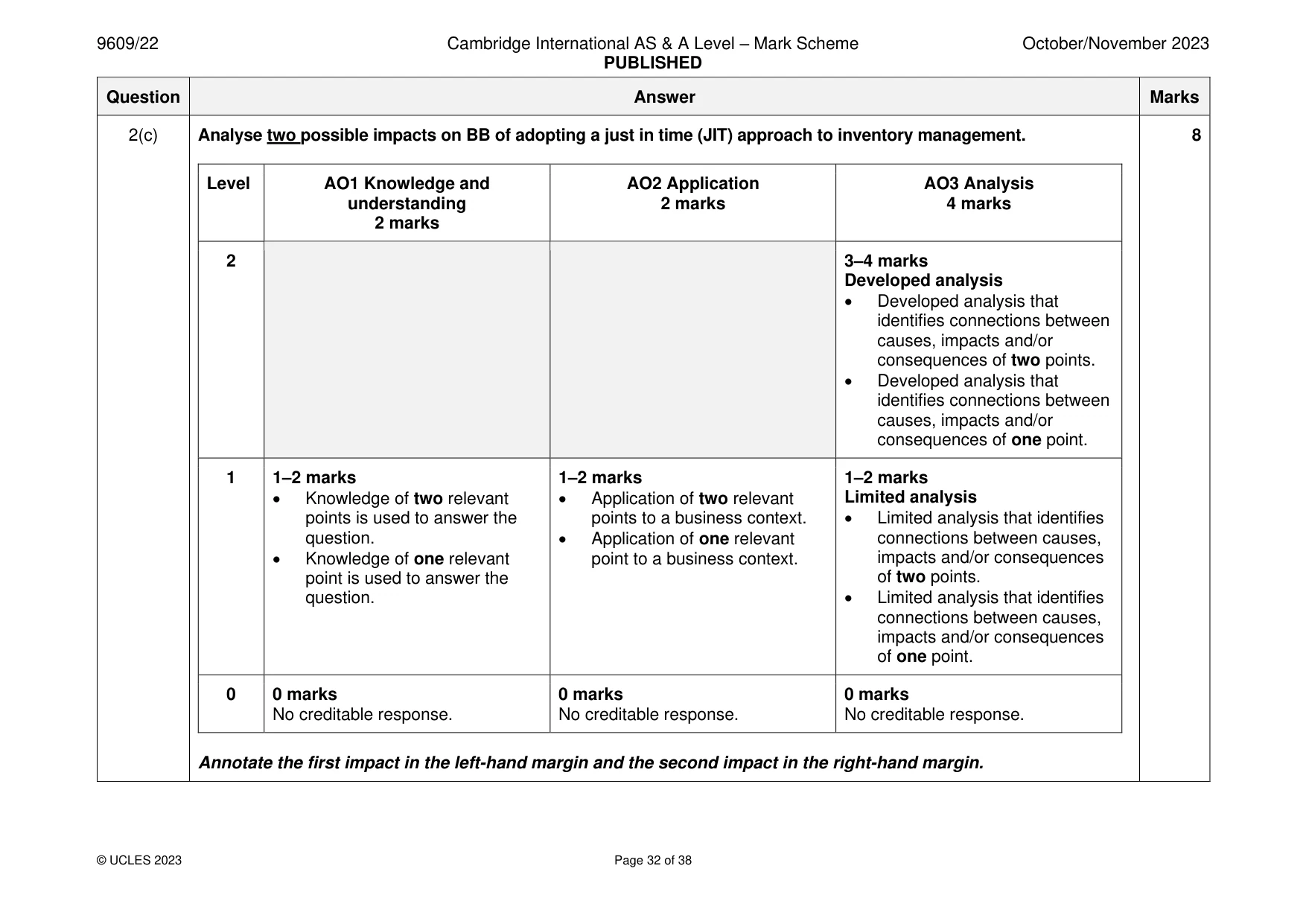
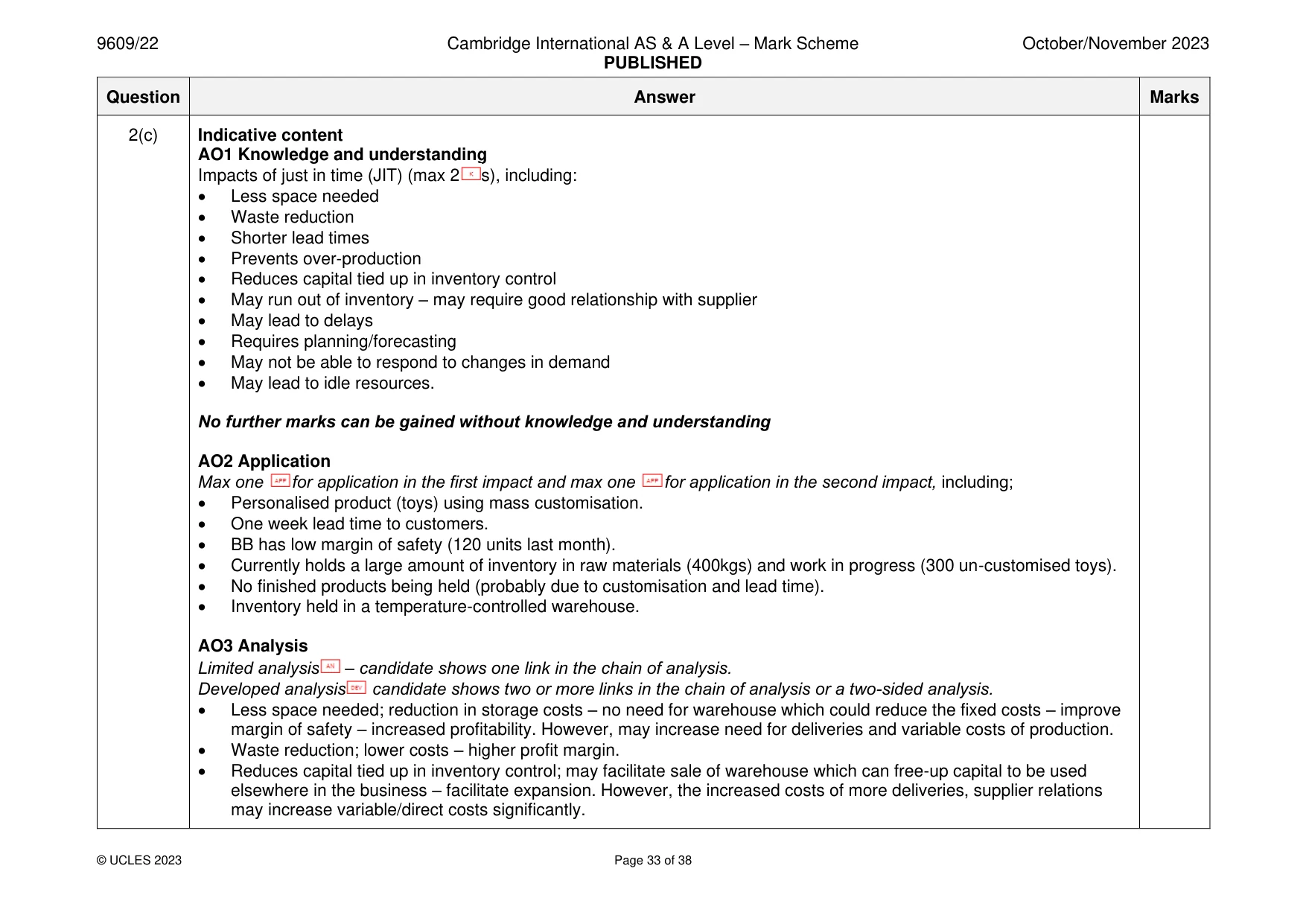
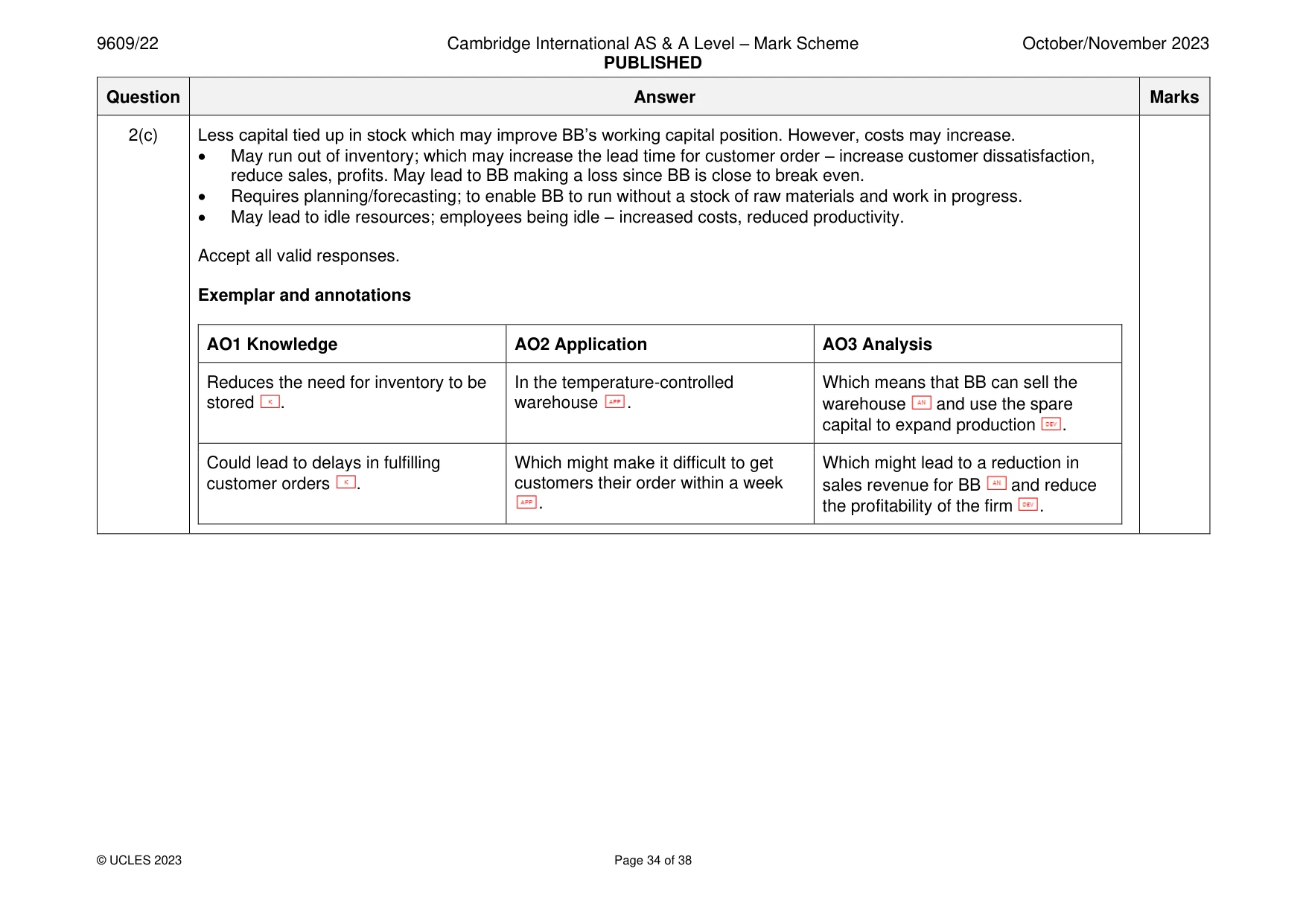
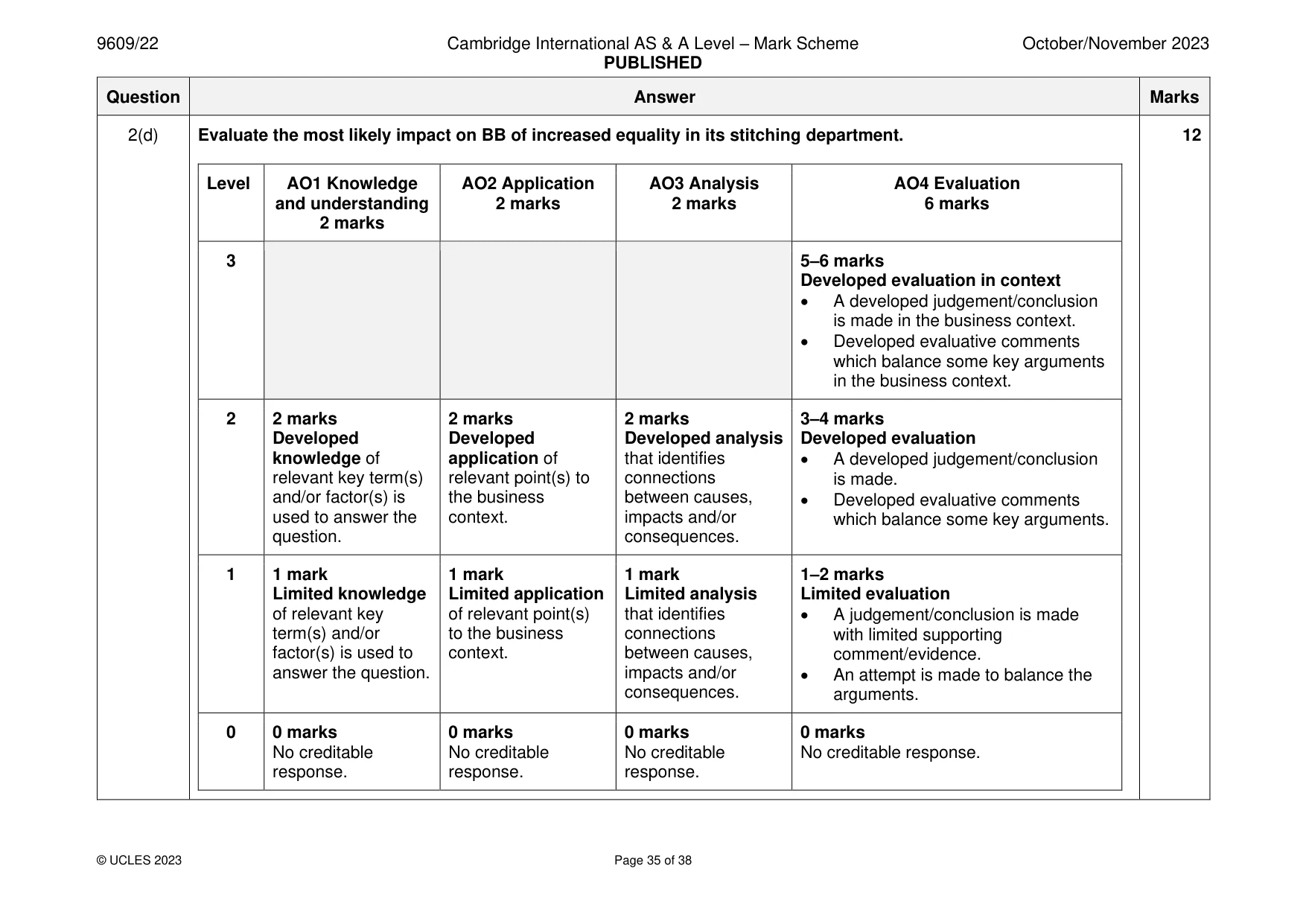
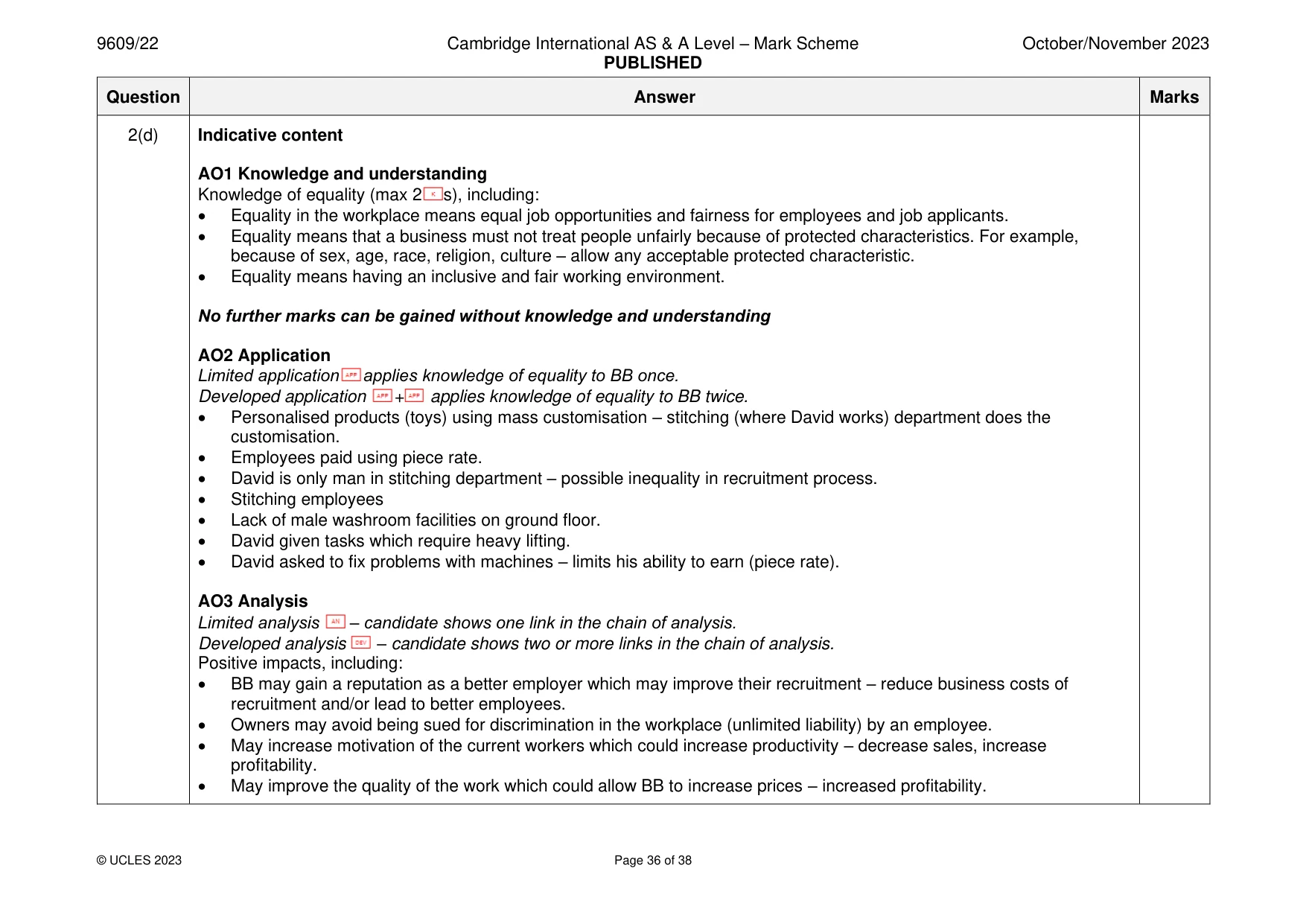
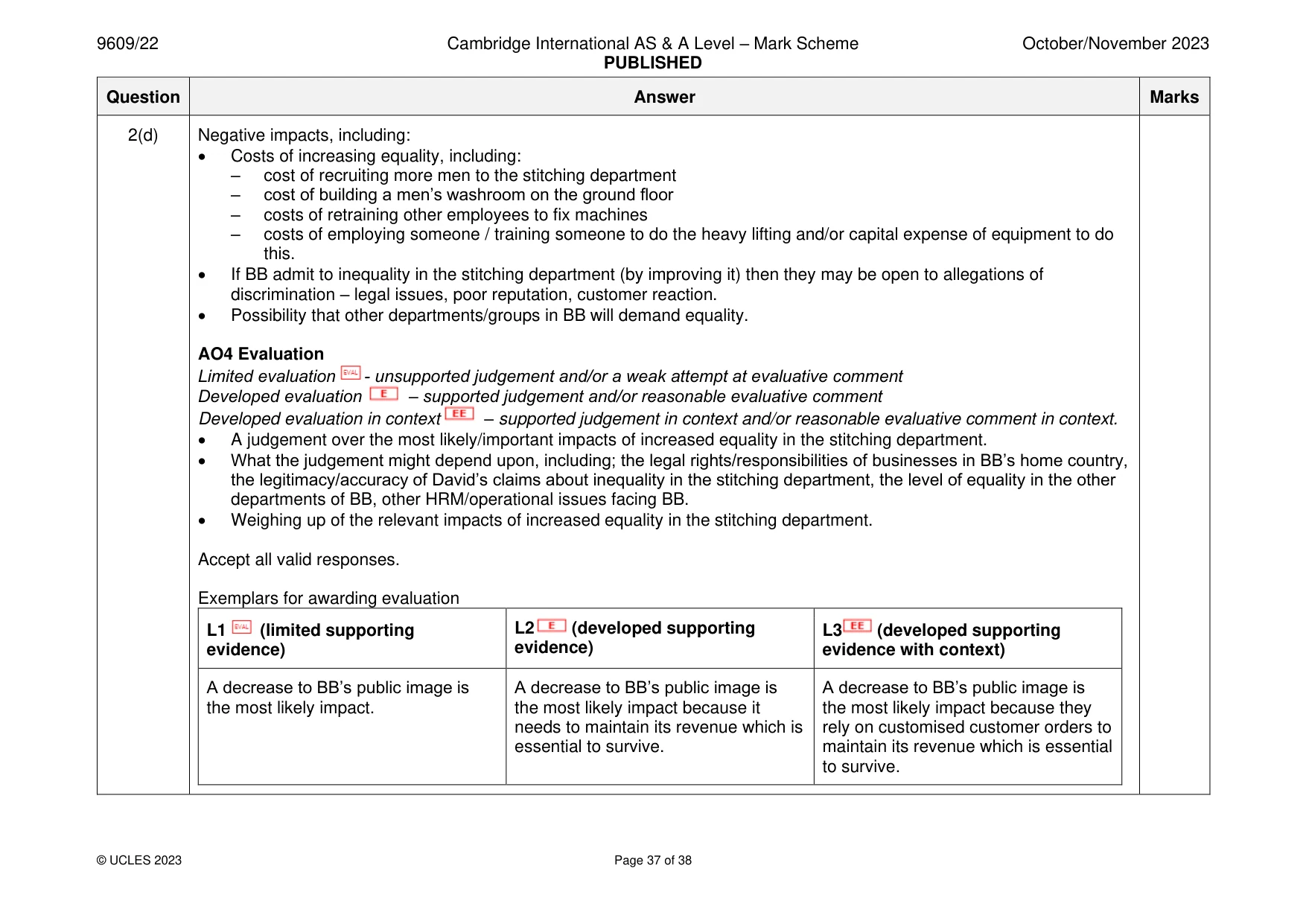
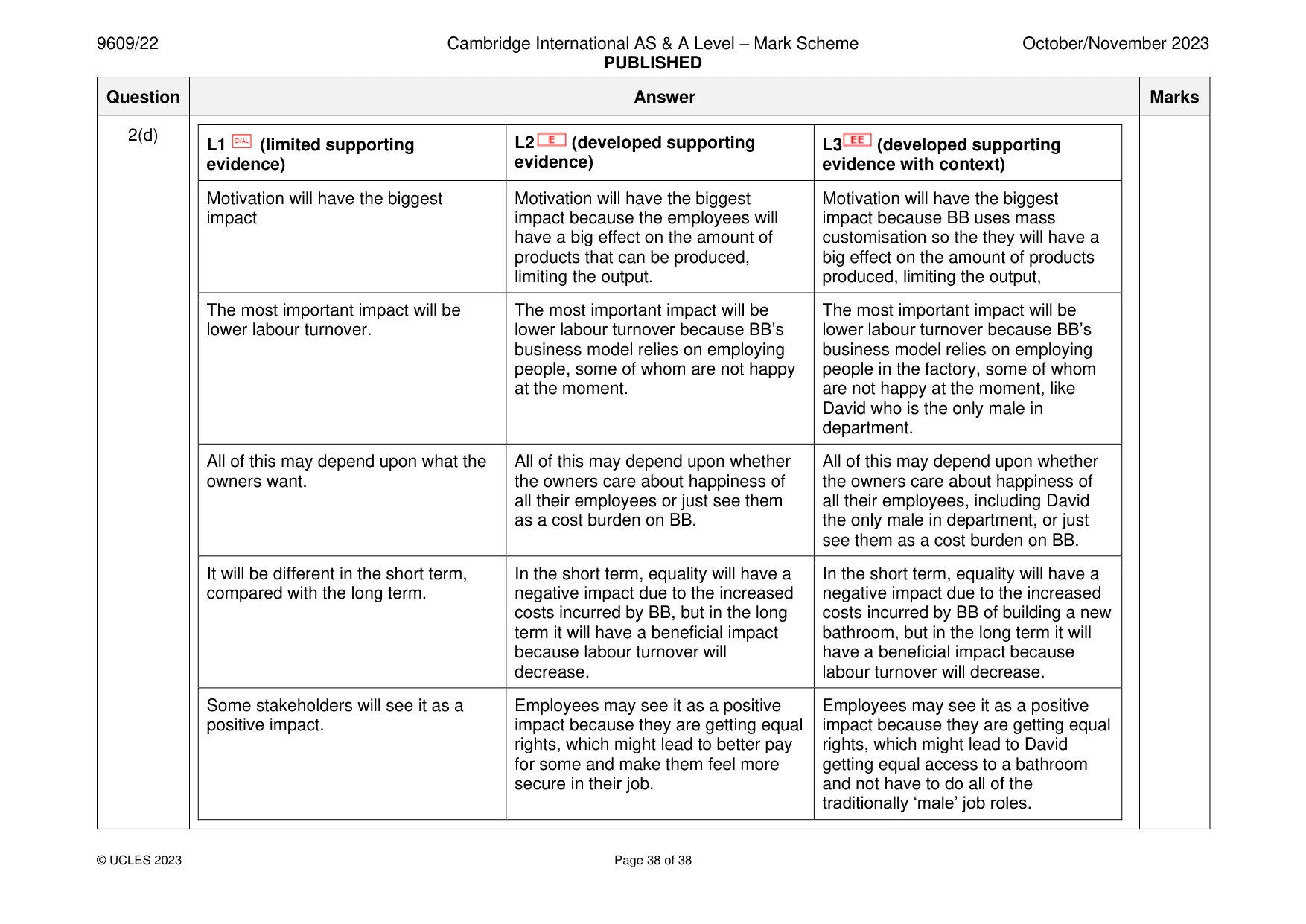
Mark scheme: 2(a)(i) Identify one method of market segmentation. 1 Indicative content Methods of market segmentation: • geographic • demographic • psychographic/behavioural Only accept these responses 2(a)(ii) Explain the term ‘mass customisation’. 3 AO1 Knowledge and understanding AO2 Application 1 mark 2 marks 2 marks Developed application of one relevant point to a business context. 1 mark 1 mark Knowledge of one relevant point is used to answer the Limited application of one relevant point to a business question. context. 0 marks 0 marks No creditable response. No creditable response. Indicative content AO1 Knowledge and understanding Knowledge of mass customisation may include: • A production process where some elements can be changed to meet customer needs. No further marks can be gained without knowledge and understanding AO2 Application Limited application applies knowledge of customisation to mass production, including: • A process to customise whilst producing large amounts of similar products/flow production. OR • Example or some other way of showing good understanding. Developed application + applies knowledge of customisation to mass production, including: • A process to customise whilst producing large amounts of similar products/flow production. AND • Example or some other way of showing good understanding. Accept all valid responses. 2(a)(ii) Exemplar and annotations Mark Rationale Products which are changed based on customer 3 An answer which starts with the knowledge and then preferences , but still produced in large numbers applies it to the mass element with an example. for example T-Shirts with different designs . Mass customisation usually capital intensive 3 APP cannot be awarded without K, but once the K has production by using IT systems to make slightly been awarded you can go back and reward the APP. different products ,on a production line . Production line/assembly line/flow production is all fine for APP. Products can be changed slightly such as a car 2 Knowledge and an example. with different features . Products which can be adapted to meet the differing 1 Simple knowledge of the direct element. needs of customers . Large scale production with capital intensive 0 Although there is some attempt at application, these operations . For example, a T-Shirt with different marks cannot be awarded without knowledge. designs . 2(b)(i) Calculate BB’s fixed costs last month. 3 Indicative content • Formula: break even point contribution = fixed costs (1) OR total costs – (total) variable costs (1) • Break even point = 4000 – 120 = 3880 units (1) • 3880 $6 = $23 280 (1 OFR applies) Answer = $23 280 (3) Exemplar and annotations 3 marks Correct answer Working and $ do not matter. $23 280 Must be three to denote the three marks. 2 marks Both of the following: To award two marks, there must be • Correct formula • Two and a • Correct calculation of break even point OR (3880). • One , one and one OR An incorrect answer with one mistake allowing OFR for break even point. OR An answer of $24 000 (including working of $6 X 4000 units – or any other appropriate working) 2(b)(i) 1 mark One of the following: To award one mark, there must be: • Correct formula • One and two • Correct calculation of break even point (3880). 0 marks No creditable content. To award zero marks, there must be • One 2(b)(ii) Explain one limitation for BB of using break-even analysis. 3 AO1 Knowledge and understanding AO2 Application 1 mark 2 marks 2 marks Developed application of one relevant point to a business context. 1 mark 1 mark Knowledge of one relevant point is used to answer the Limited application of one relevant point to a business question. context. 0 marks 0 marks No creditable response. No creditable response. Indicative content AO1 Knowledge and understanding Knowledge of a limitation of using break-even analysis , including: • Fixed costs may not be constant – may change in long run • Assumption that output equals sales • Assumption that unit variable costs remain constant at all output levels • Assumption that price will remain constant at all output levels • Only useful for individual (or limited number of) product lines • Does not take into account external changes (social, legal, economic, political, technological) or qualitative data • Only a forecast/estimate. No further marks can be gained without knowledge and understanding 2(b)(ii) AO2 Application Limited application , applies knowledge to BB once. Developed application + applies knowledge to BB twice. Application of a factor may include: • Each bear is sold for $50 with a contribution of $6 • Margin of safety last month was 120 units • Break-even point last month was 3880 (OFR based on Q2bi) • Personalised products – unlikely to have the same variable costs (although piece rate payment may make this possible) • Proposed JIT may make former break-even analysis irrelevant • Information from Table 2.1, such as the quantity and type of materials used. Accept all valid responses. Exemplar and annotations Mark Rationale Break-even analysis assumes that fixed costs do not 3 Knowledge of a limitation with two pieces of context change . BBs fixed costs were $23 280 last applied. month, however this is likely to change if they introduce JIT . BB is considering introducing greater equality , 3 The APP cannot be awarded until there is knowledge, which may increase the costs and the price may need however you can go back and annotate it. to increase from $50 which makes the break even calculations irrelevant . The variable costs of BB may not be constant 2 Knowledge and one piece of context. which could mean that the margin of safety will fall from 120 units . Break even analysis assumes all output produced is 1 Knowledge and no application to the context. sold . 2(b)(ii) Exemplar and annotations Mark Rationale Break even analysis is a way of calculating the 0 Although there is some relevant context, there is no quantity needed to stop making a loss and start knowledge of a limitation, so no marks can be making a profit. This is useful to BB because they can awarded. calculate how many teddy bears need to be sold to cover all of the costs, including the $6 unit contribution. 2(c) Analyse two possible impacts on BB of adopting a just in time (JIT) approach to inventory management. 8 Level AO1 Knowledge and AO2 Application AO3 Analysis understanding 2 marks 4 marks 2 marks 2 3–4 marks Developed analysis • Developed analysis that identifies connections between causes, impacts and/or consequences of two points. • Developed analysis that identifies connections between causes, impacts and/or consequences of one point. 1 1–2 marks 1–2 marks 1–2 marks • Knowledge of two relevant • Application of two relevant Limited analysis points is used to answer the points to a business context. • Limited analysis that identifies question. • Application of one relevant connections between causes, • Knowledge of one relevant point to a business context. impacts and/or consequences point is used to answer the of two points. question. • Limited analysis that identifies connections between causes, impacts and/or consequences of one point. 0 0 marks 0 marks 0 marks No creditable response. No creditable response. No creditable response. Annotate the first impact in the left-hand margin and the second impact in the right-hand margin. 2(c) Indicative content AO1 Knowledge and understanding Impacts of just in time (JIT) (max 2 s), including: • Less space needed • Waste reduction • Shorter lead times • Prevents over-production • Reduces capital tied up in inventory control • May run out of inventory – may require good relationship with supplier • May lead to delays • Requires planning/forecasting • May not be able to respond to changes in demand • May lead to idle resources. No further marks can be gained without knowledge and understanding AO2 Application Max one for application in the first impact and max one for application in the second impact, including; • Personalised product (toys) using mass customisation. • One week lead time to customers. • BB has low margin of safety (120 units last month). • Currently holds a large amount of inventory in raw materials (400kgs) and work in progress (300 un-customised toys). • No finished products being held (probably due to customisation and lead time). • Inventory held in a temperature-controlled warehouse. AO3 Analysis Limited analysis – candidate shows one link in the chain of analysis. Developed analysis candidate shows two or more links in the chain of analysis or a two-sided analysis. • Less space needed; reduction in storage costs – no need for warehouse which could reduce the fixed costs – improve margin of safety – increased profitability. However, may increase need for deliveries and variable costs of production. • Waste reduction; lower costs – higher profit margin. • Reduces capital tied up in inventory control; may facilitate sale of warehouse which can free-up capital to be used elsewhere in the business – facilitate expansion. However, the increased costs of more deliveries, supplier relations may increase variable/direct costs significantly. 2(c) Less capital tied up in stock which may improve BB’s working capital position. However, costs may increase. • May run out of inventory; which may increase the lead time for customer order – increase customer dissatisfaction, reduce sales, profits. May lead to BB making a loss since BB is close to break even. • Requires planning/forecasting; to enable BB to run without a stock of raw materials and work in progress. • May lead to idle resources; employees being idle – increased costs, reduced productivity. Accept all valid responses. Exemplar and annotations AO1 Knowledge AO2 Application AO3 Analysis Reduces the need for inventory to be In the temperature-controlled Which means that BB can sell the stored . warehouse . warehouse and use the spare capital to expand production . Could lead to delays in fulfilling Which might make it difficult to get Which might lead to a reduction in customer orders . customers their order within a week sales revenue for BB and reduce . the profitability of the firm . 2(d) Evaluate the most likely impact on BB of increased equality in its stitching department. 12 Level AO1 Knowledge AO2 Application AO3 Analysis AO4 Evaluation and understanding 2 marks 2 marks 6 marks 2 marks 3 5–6 marks Developed evaluation in context • A developed judgement/conclusion is made in the business context. • Developed evaluative comments which balance some key arguments in the business context. 2 2 marks 2 marks 2 marks 3–4 marks Developed Developed Developed analysis Developed evaluation knowledge of application of that identifies • A developed judgement/conclusion relevant key term(s) relevant point(s) to connections is made. and/or factor(s) is the business between causes, • Developed evaluative comments used to answer the context. impacts and/or which balance some key arguments. question. consequences. 1 1 mark 1 mark 1 mark 1–2 marks Limited knowledge Limited application Limited analysis Limited evaluation of relevant key of relevant point(s) that identifies • A judgement/conclusion is made term(s) and/or to the business connections with limited supporting factor(s) is used to context. between causes, comment/evidence. answer the question. impacts and/or • An attempt is made to balance the consequences. arguments. 0 0 marks 0 marks 0 marks 0 marks No creditable No creditable No creditable No creditable response. response. response. response. 2(d) Indicative content AO1 Knowledge and understanding Knowledge of equality (max 2 s), including: • Equality in the workplace means equal job opportunities and fairness for employees and job applicants. • Equality means that a business must not treat people unfairly because of protected characteristics. For example, because of sex, age, race, religion, culture – allow any acceptable protected characteristic. • Equality means having an inclusive and fair working environment. No further marks can be gained without knowledge and understanding AO2 Application Limited application applies knowledge of equality to BB once. Developed application + applies knowledge of equality to BB twice. • Personalised products (toys) using mass customisation – stitching (where David works) department does the customisation. • Employees paid using piece rate. • David is only man in stitching department – possible inequality in recruitment process. • Stitching employees • Lack of male washroom facilities on ground floor. • David given tasks which require heavy lifting. • David asked to fix problems with machines – limits his ability to earn (piece rate). AO3 Analysis Limited analysis – candidate shows one link in the chain of analysis. Developed analysis – candidate shows two or more links in the chain of analysis. Positive impacts, including: • BB may gain a reputation as a better employer which may improve their recruitment – reduce business costs of recruitment and/or lead to better employees. • Owners may avoid being sued for discrimination in the workplace (unlimited liability) by an employee. • May increase motivation of the current workers which could increase productivity – decrease sales, increase profitability. • May improve the quality of the work which could allow BB to increase prices – increased profitability. 2(d) Negative impacts, including: • Costs of increasing equality, including: – cost of recruiting more men to the stitching department – cost of building a men’s washroom on the ground floor – costs of retraining other employees to fix machines – costs of employing someone / training someone to do the heavy lifting and/or capital expense of equipment to do this. • If BB admit to inequality in the stitching department (by improving it) then they may be open to allegations of discrimination – legal issues, poor reputation, customer reaction. • Possibility that other departments/groups in BB will demand equality. AO4 Evaluation Limited evaluation - unsupported judgement and/or a weak attempt at evaluative comment Developed evaluation – supported judgement and/or reasonable evaluative comment Developed evaluation in context – supported judgement in context and/or reasonable evaluative comment in context. • A judgement over the most likely/important impacts of increased equality in the stitching department. • What the judgement might depend upon, including; the legal rights/responsibilities of businesses in BB’s home country, the legitimacy/accuracy of David’s claims about inequality in the stitching department, the level of equality in the other departments of BB, other HRM/operational issues facing BB. • Weighing up of the relevant impacts of increased equality in the stitching department. Accept all valid responses. Exemplars for awarding evaluation L1 (limited supporting L2 (developed supporting L3 (developed supporting evidence) evidence) evidence with context) A decrease to BB’s public image is A decrease to BB’s public image is A decrease to BB’s public image is the most likely impact. the most likely impact because it the most likely impact because they needs to maintain its revenue which is rely on customised customer orders to essential to survive. maintain its revenue which is essential to survive. 2(d) L1 (limited supporting L2 (developed supporting L3 (developed supporting evidence) evidence) evidence with context) Motivation will have the biggest Motivation will have the biggest Motivation will have the biggest impact impact because the employees will impact because BB uses mass have a big effect on the amount of customisation so the they will have a products that can be produced, big effect on the amount of products limiting the output. produced, limiting the output, The most important impact will be The most important impact will be The most important impact will be lower labour turnover. lower labour turnover because BB’s lower labour turnover because BB’s business model relies on employing business model relies on employing people, some of whom are not happy people in the factory, some of whom at the moment. are not happy at the moment, like David who is the only male in department. All of this may depend upon what the All of this may depend upon whether All of this may depend upon whether owners want. the owners care about happiness of the owners care about happiness of all their employees or just see them all their employees, including David as a cost burden on BB. the only male in department, or just see them as a cost burden on BB. It will be different in the short term, In the short term, equality will have a In the short term, equality will have a compared with the long term. negative impact due to the increased negative impact due to the increased costs incurred by BB, but in the long costs incurred by BB of building a new term it will have a beneficial impact bathroom, but in the long term it will because labour turnover will have a beneficial impact because decrease. labour turnover will decrease. Some stakeholders will see it as a Employees may see it as a positive Employees may see it as a positive positive impact. impact because they are getting equal impact because they are getting equal rights, which might lead to better pay rights, which might lead to David for some and make them feel more getting equal access to a bathroom secure in their job. and not have to do all of the traditionally ‘male’ job roles.
What was in this paper
The subtopics covered by these 2 questions, and how many questions each got. Open one in a new tab to see every Cambridge question on it.
What you needed in this session
Cambridge’s own grade thresholds for 2023 Oct/Nov, Paper 2 · Variant 2. A higher threshold means an easier paper — the bar moves with how the cohort did.