Cambridge A Level Business (for first examination in 2016) 9609 — 2022 Feb/March Paper 2 · Variant 2
9609/22/F/M/22 · 2 questions · 60 marks · ≈68 min
The question paper and its mark scheme, free to read here and free to download. This is Cambridge’s own paper, exactly as it was sat.
Question paper4 pages

Mark scheme24 pages
Answers below. Sit the paper first if you are practising.

Questions as text
Q1 · Rehana Recycles (RR) Rehana is very environmentally aware
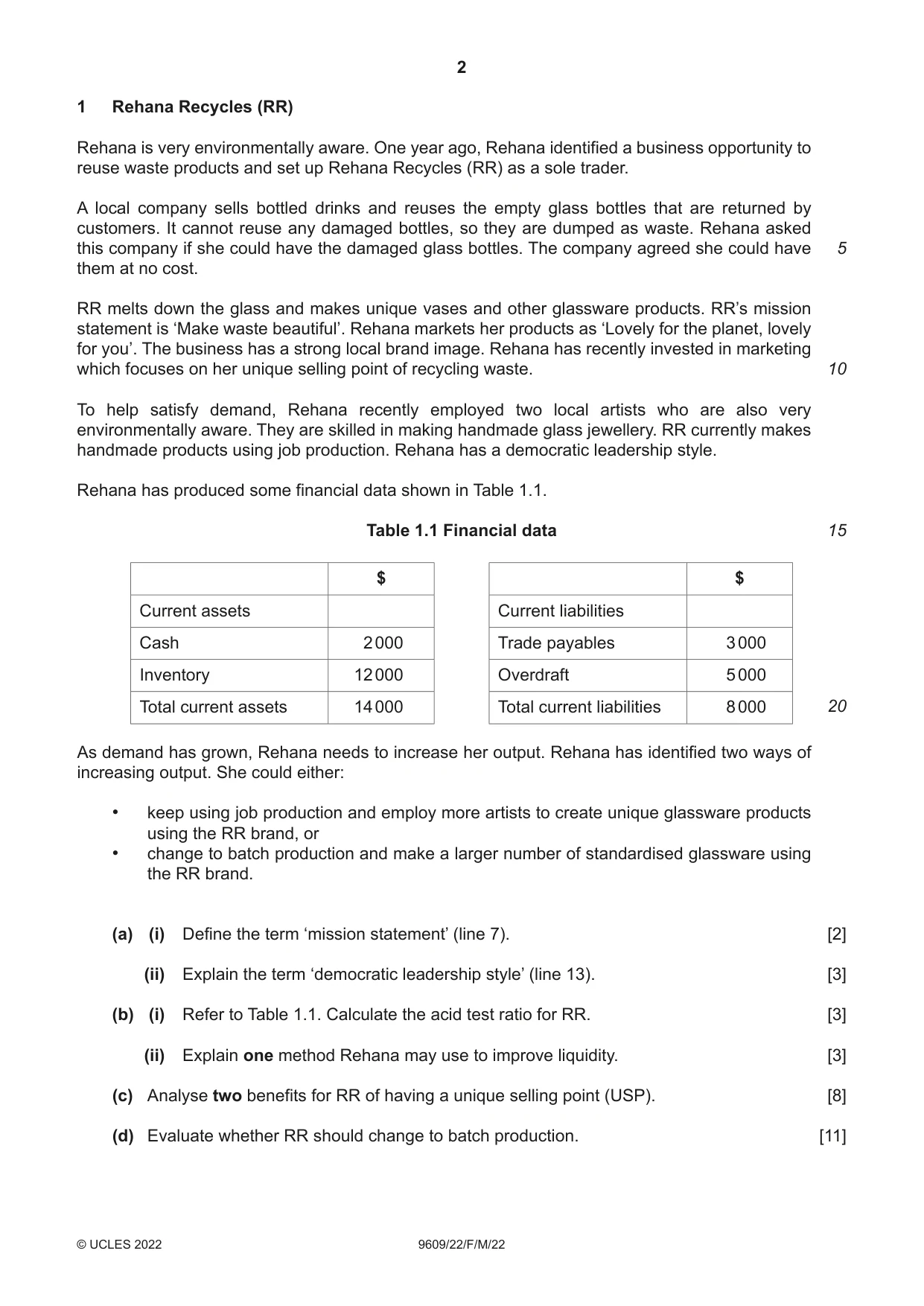
1 Rehana Recycles (RR) Rehana is very environmentally aware. One year ago, Rehana identified a business opportunity to reuse waste products and set up Rehana Recycles (RR) as a sole trader. A local company sells bottled drinks and reuses the empty glass bottles that are returned by customers. It cannot reuse any damaged bottles, so they are dumped as waste. Rehana asked this company if she could have the damaged glass bottles. The company agreed she could have 5 them at no cost. RR melts down the glass and makes unique vases and other glassware products. RR’s mission statement is ‘Make waste beautiful’. Rehana markets her products as ‘Lovely for the planet, lovely for you’. The business has a strong local brand image. Rehana has recently invested in marketing which focuses on her unique selling point of recycling waste. 10 To help satisfy demand, Rehana recently employed two local artists who are also very environmentally aware. They are skilled in making handmade glass jewellery. RR currently makes handmade products using job production. Rehana has a democratic leadership style. Rehana has produced some financial data shown in Table 1.1. Table 1.1 Financial data 15 $ $ Current assets Current liabilities Cash 2 000 Trade payables 3 000 Inventory 12 000 Overdraft 5 000 Total current assets 14 000 Total current liabilities 8 000 20 As demand has grown, Rehana needs to increase her output. Rehana has identified two ways of increasing output. She could either: • keep using job production and employ more artists to create unique glassware products using the RR brand, or • change to batch production and make a larger number of standardised glassware using the RR brand. (a) (i) Define the term ‘mission statement’ (line 7). [2] (ii) Explain the term ‘democratic leadership style’ (line 13). [3] (b) (i) Refer to Table 1.1. Calculate the acid test ratio for RR. [3] (ii) Explain one method Rehana may use to improve liquidity. [3] (c) Analyse two benefits for RR of having a unique selling point (USP). [8] (d) Evaluate whether RR should change to batch production. [11]
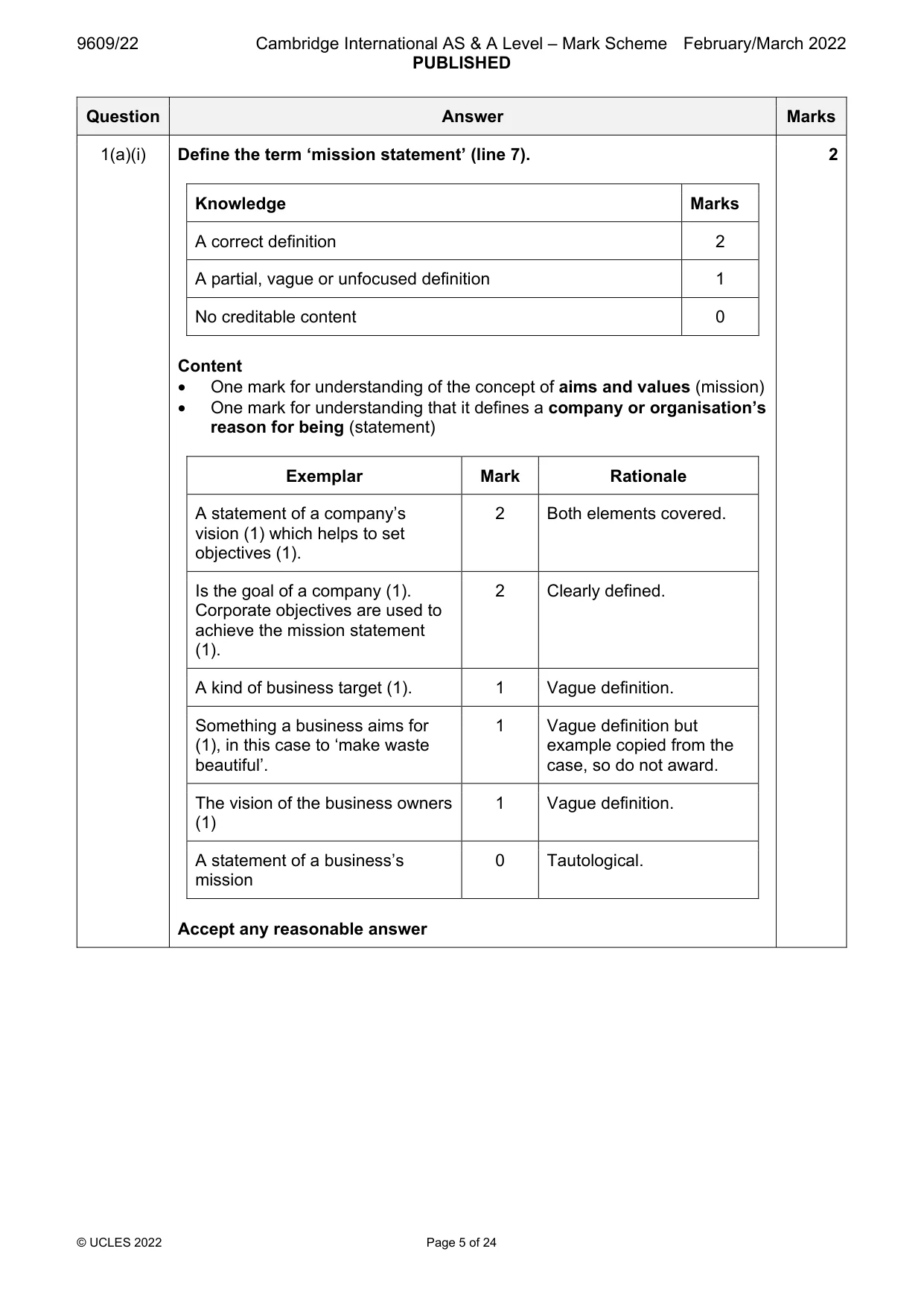
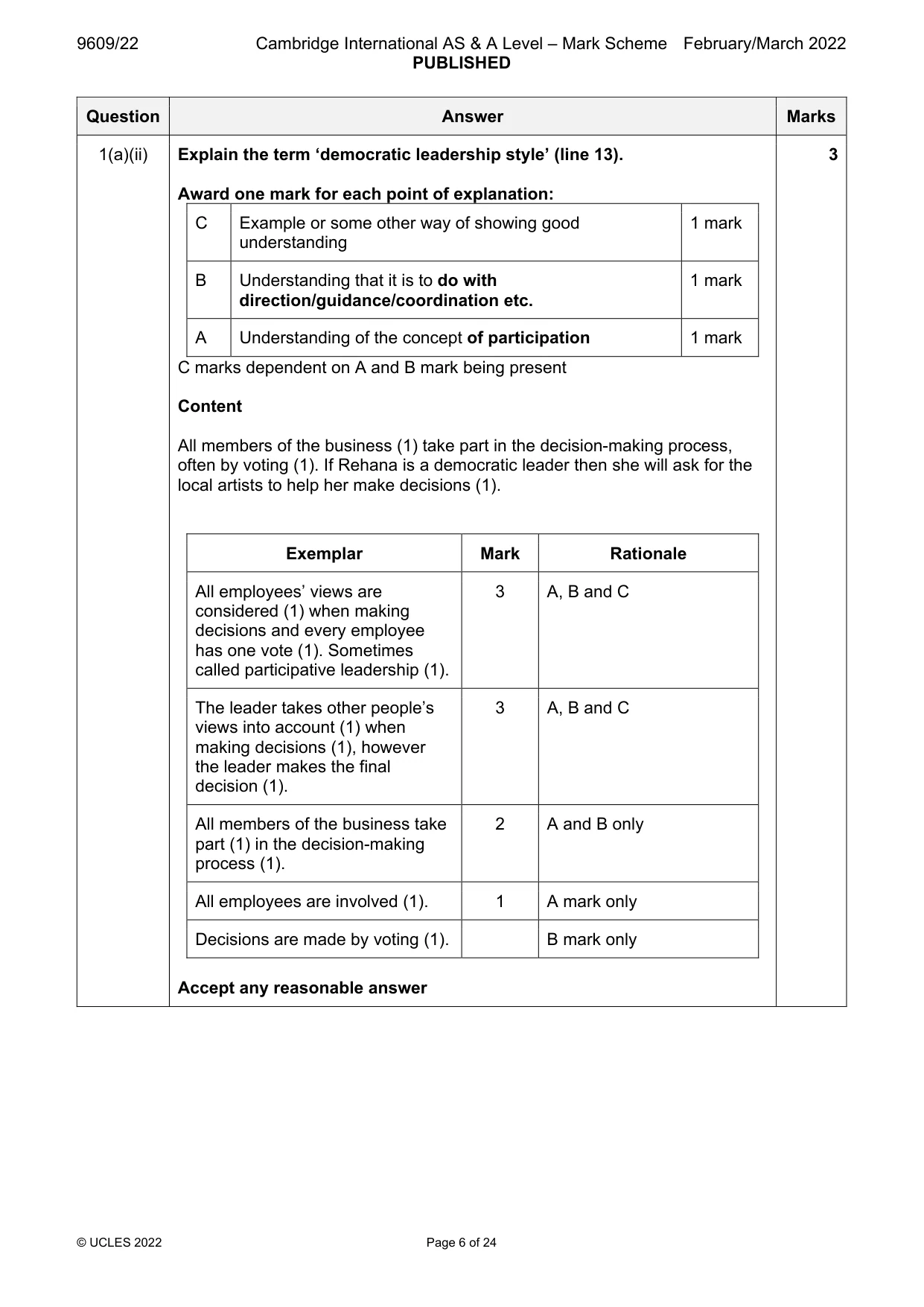
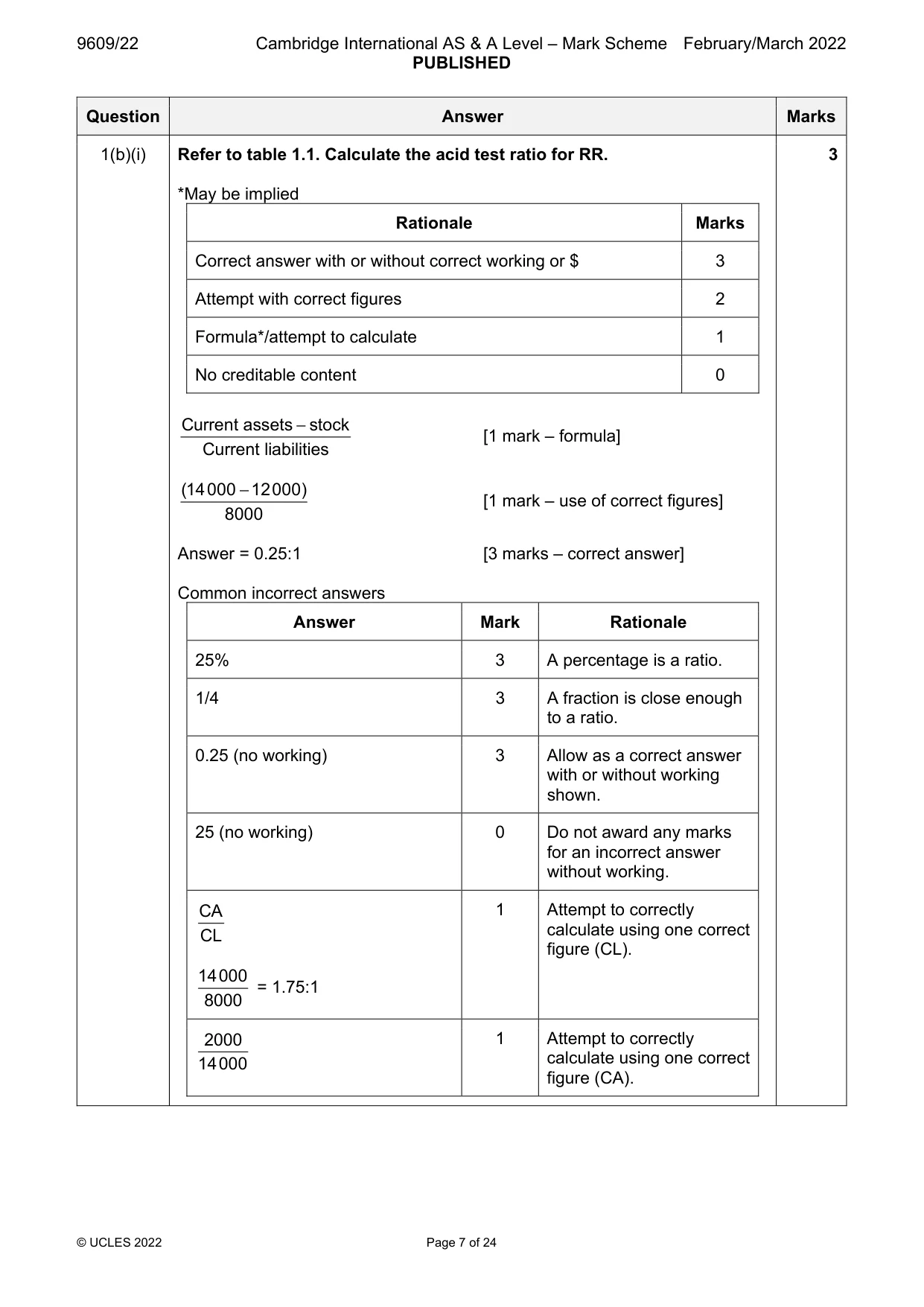
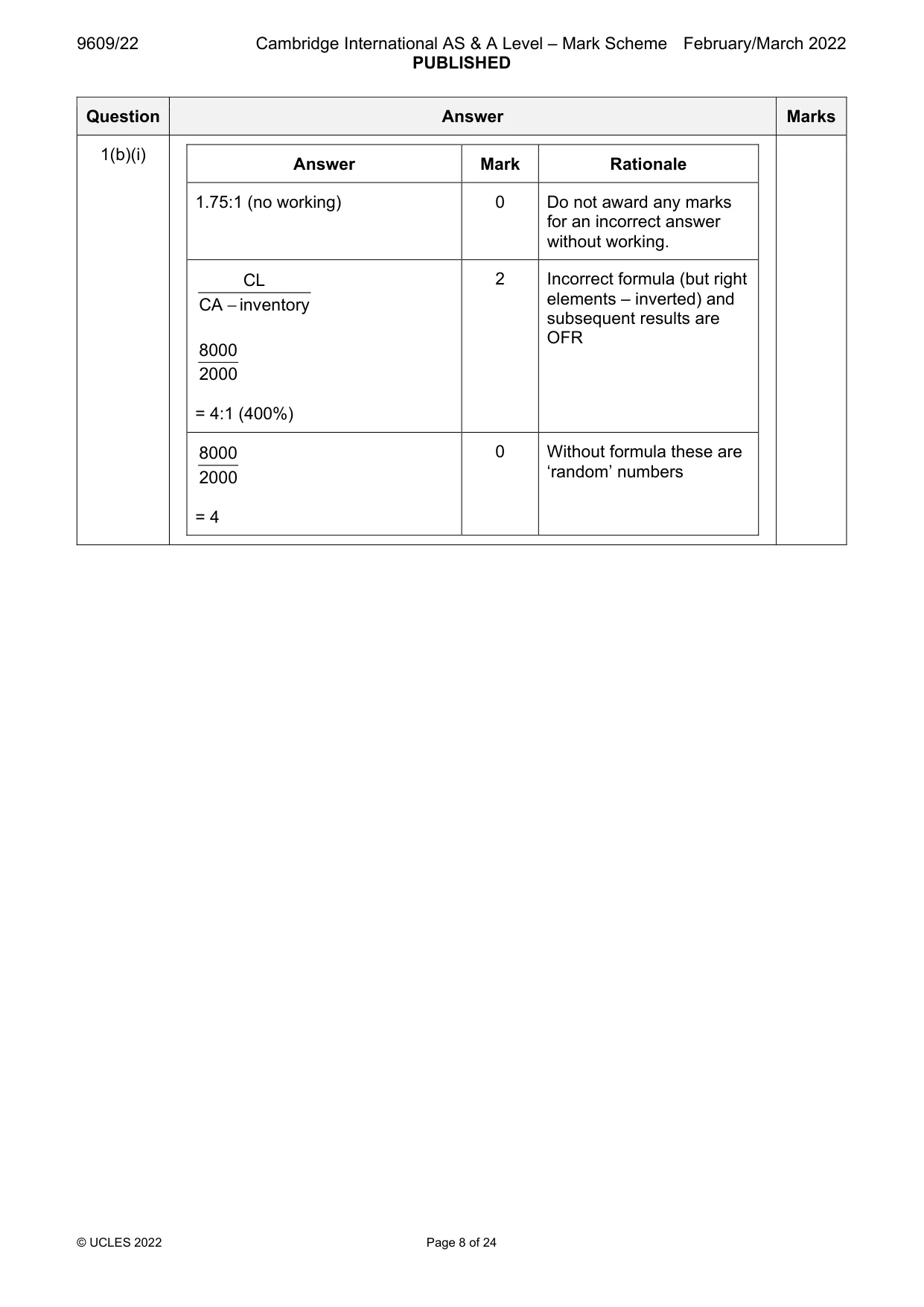
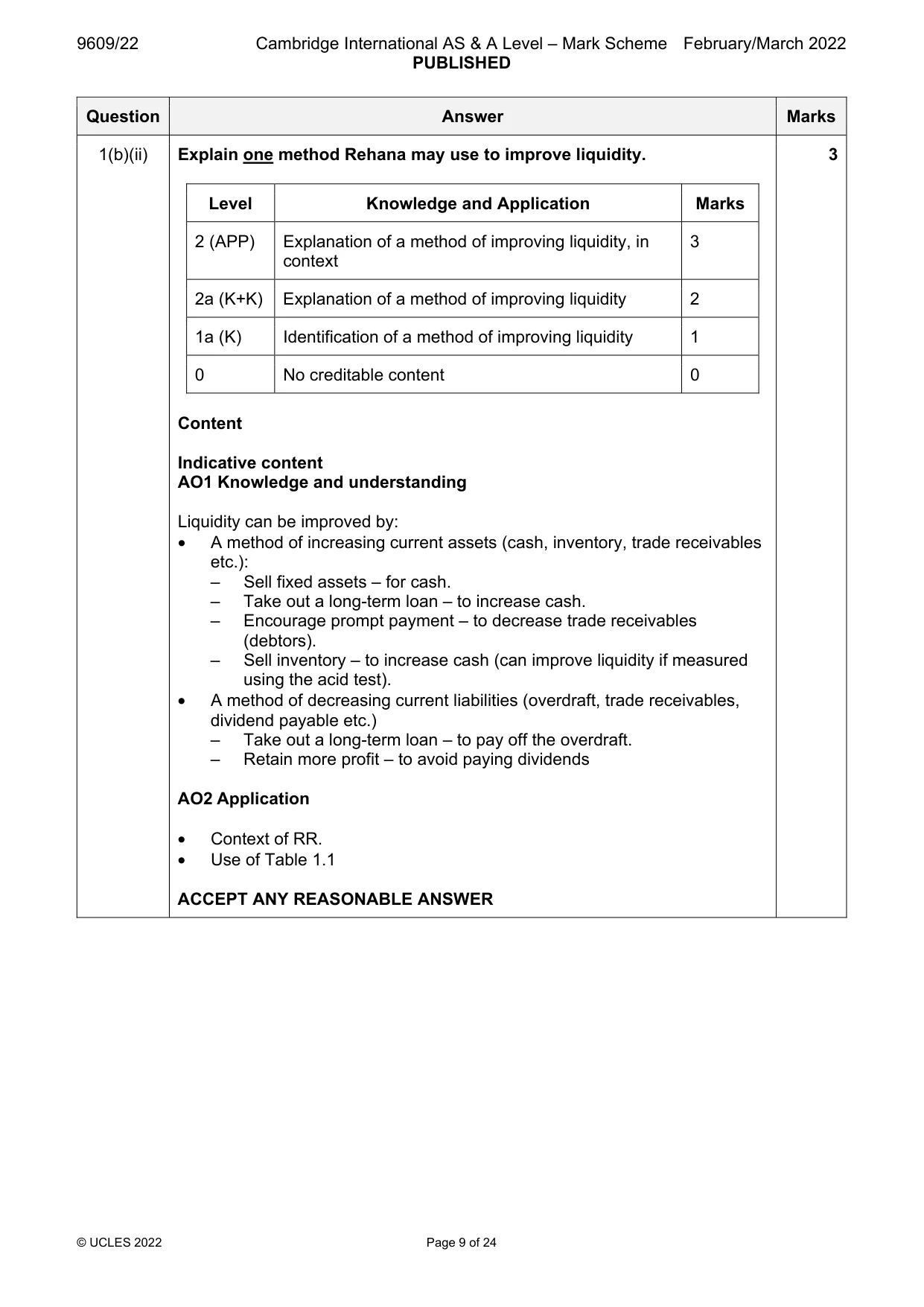
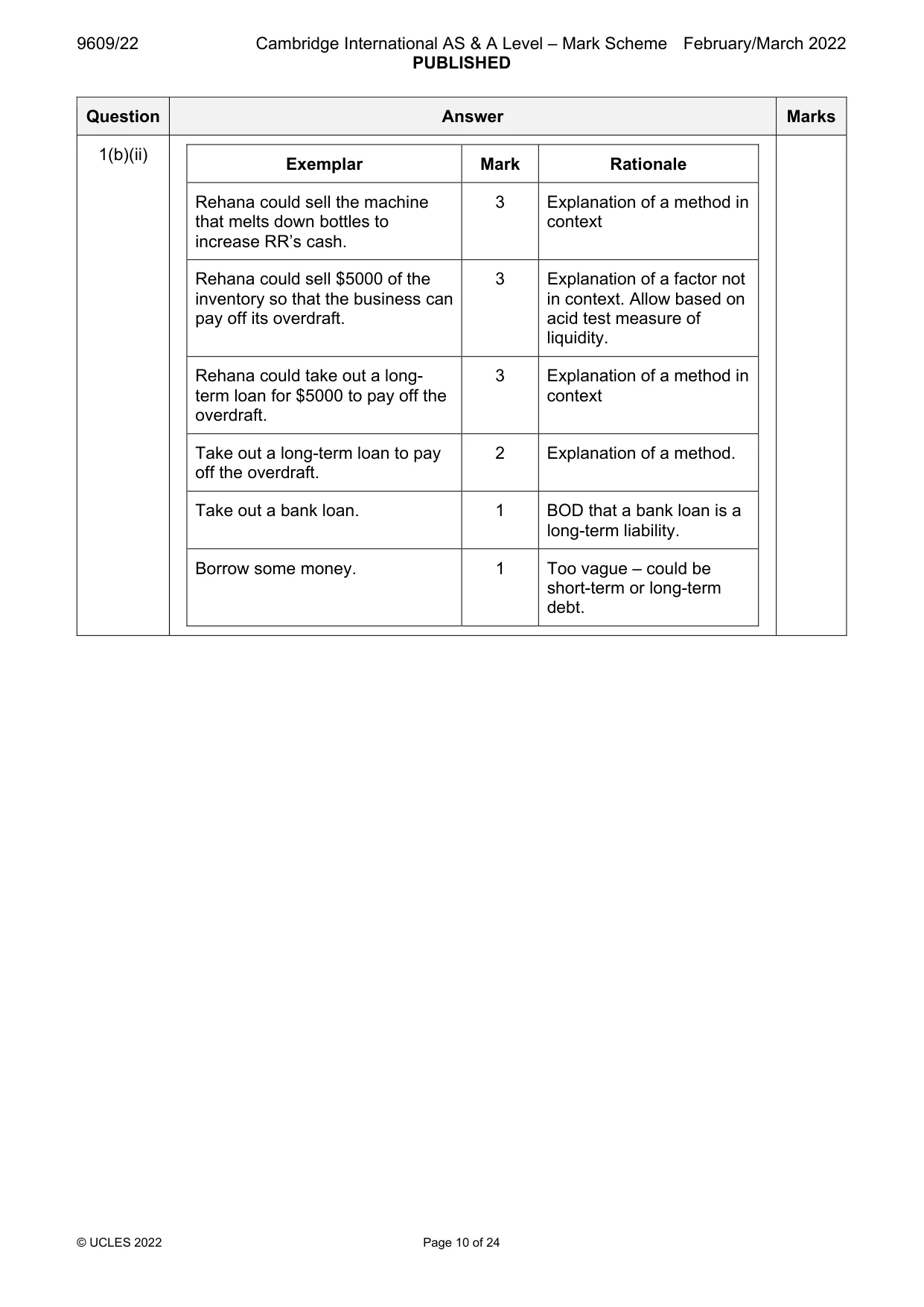
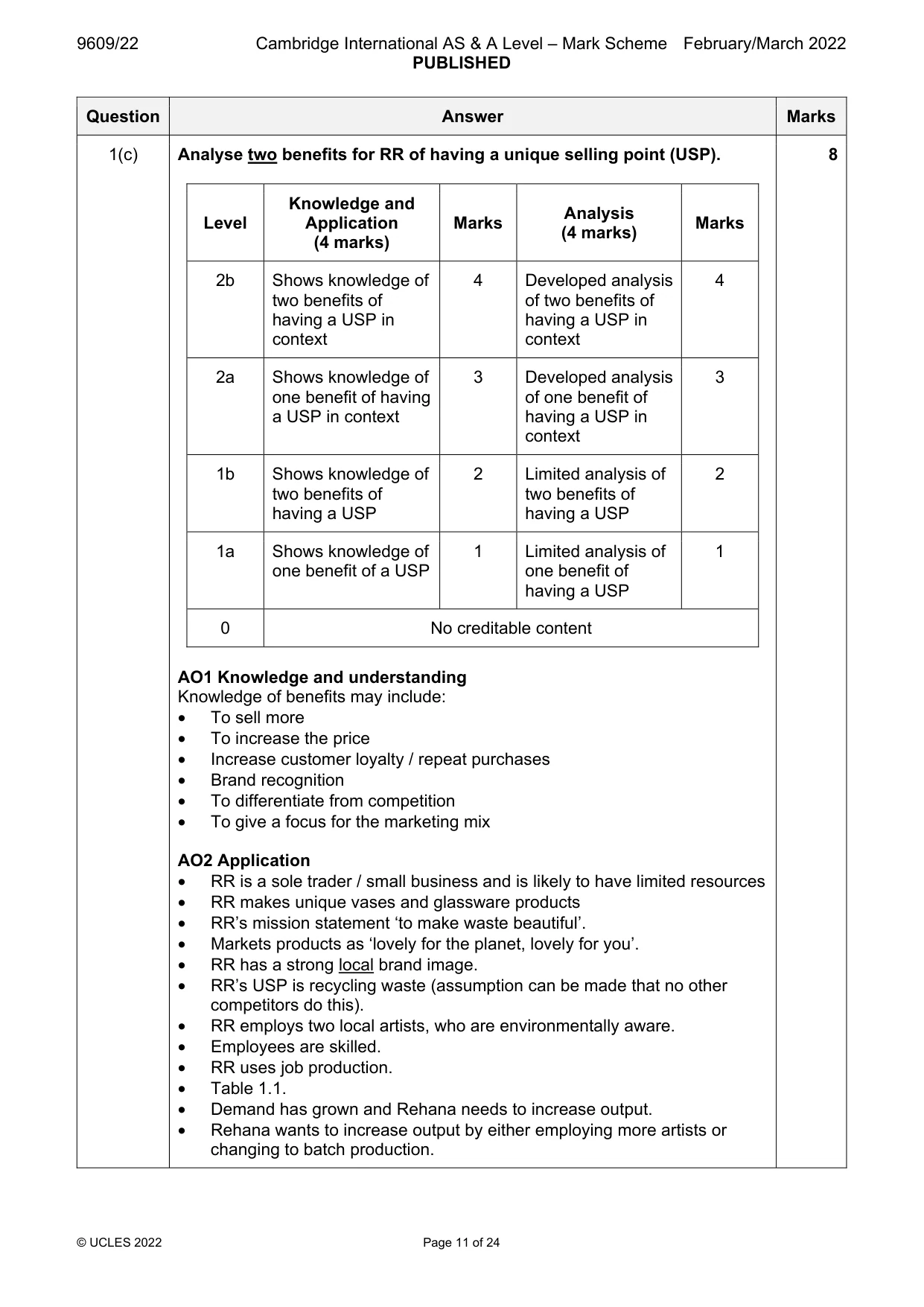
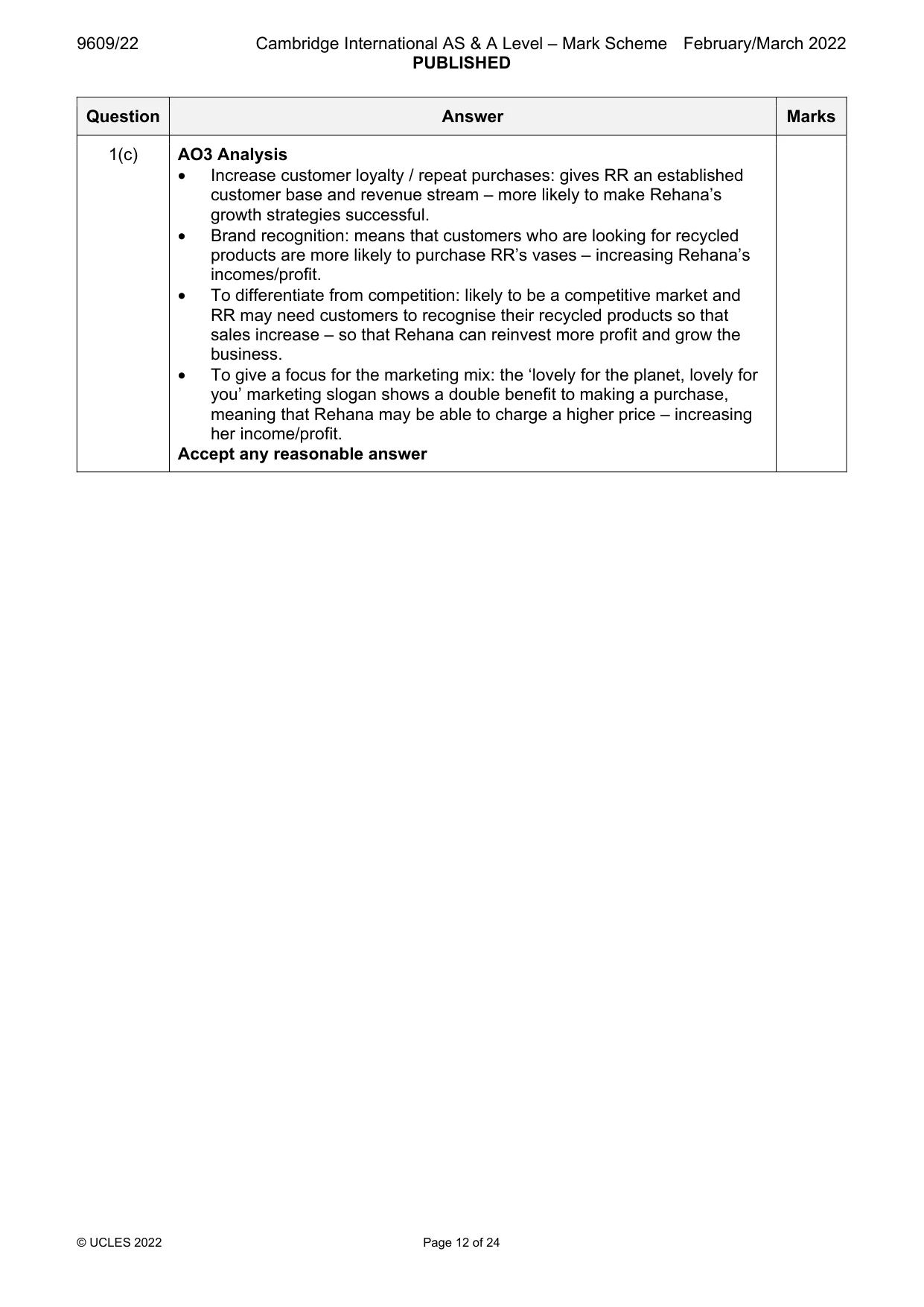
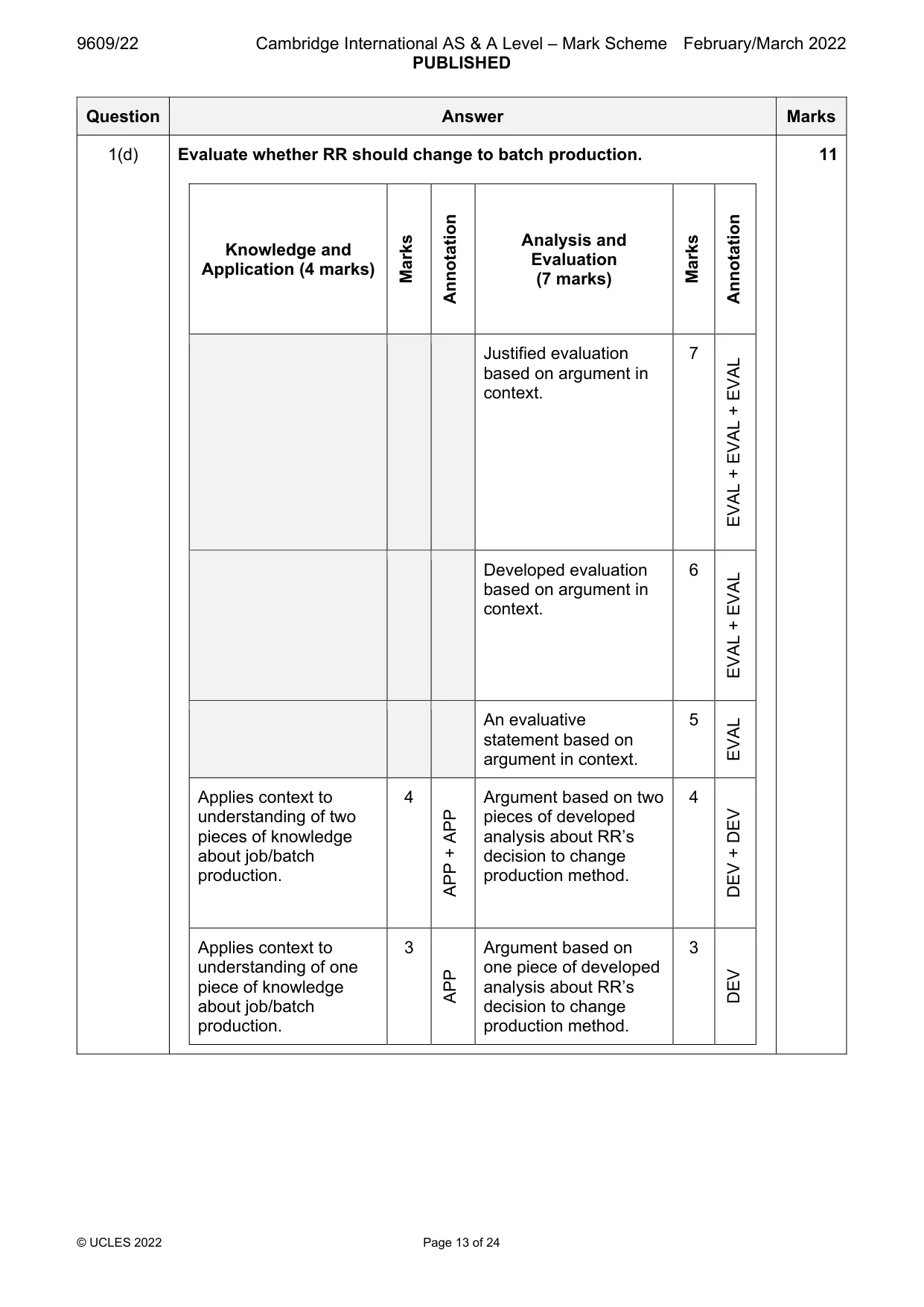
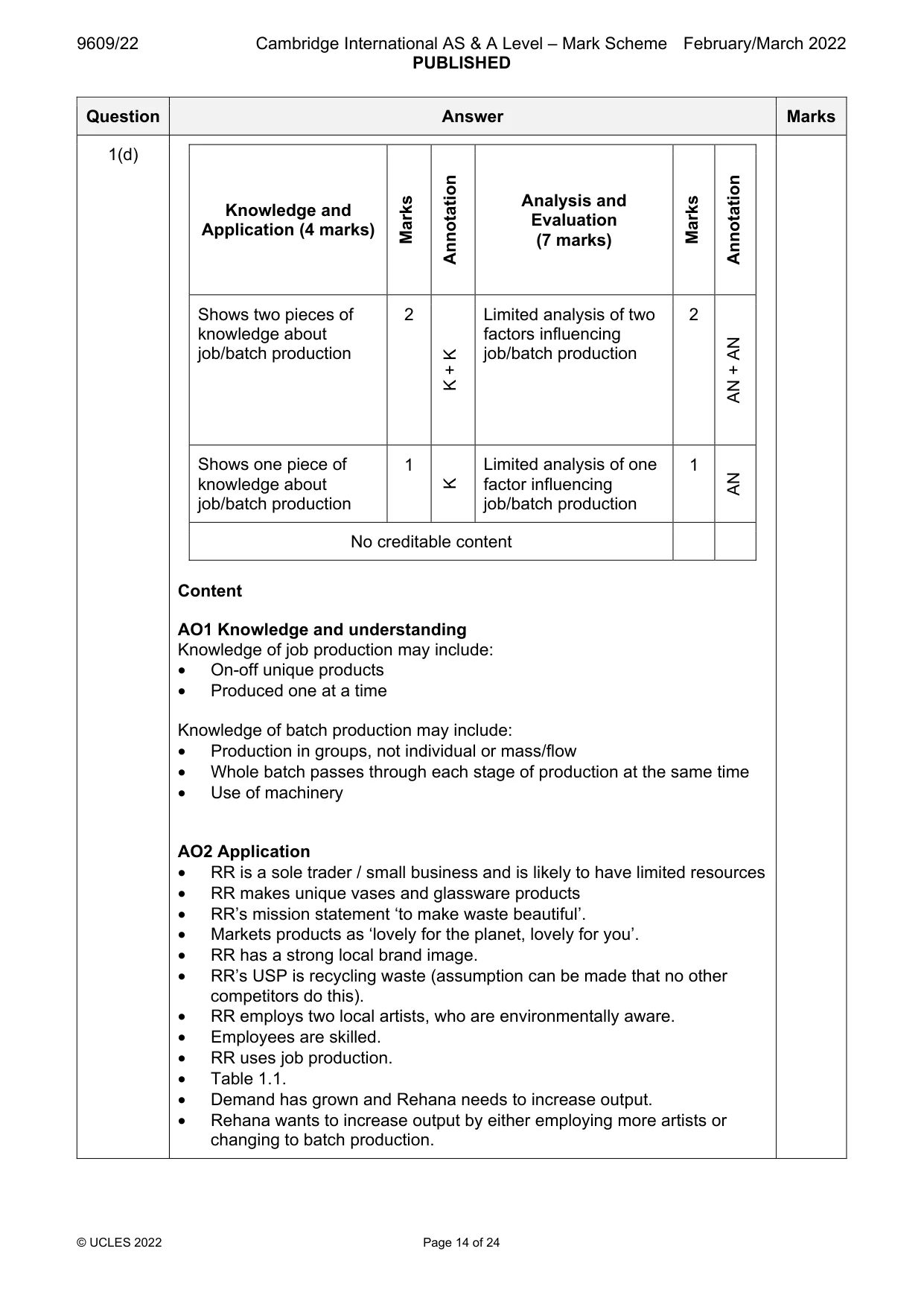
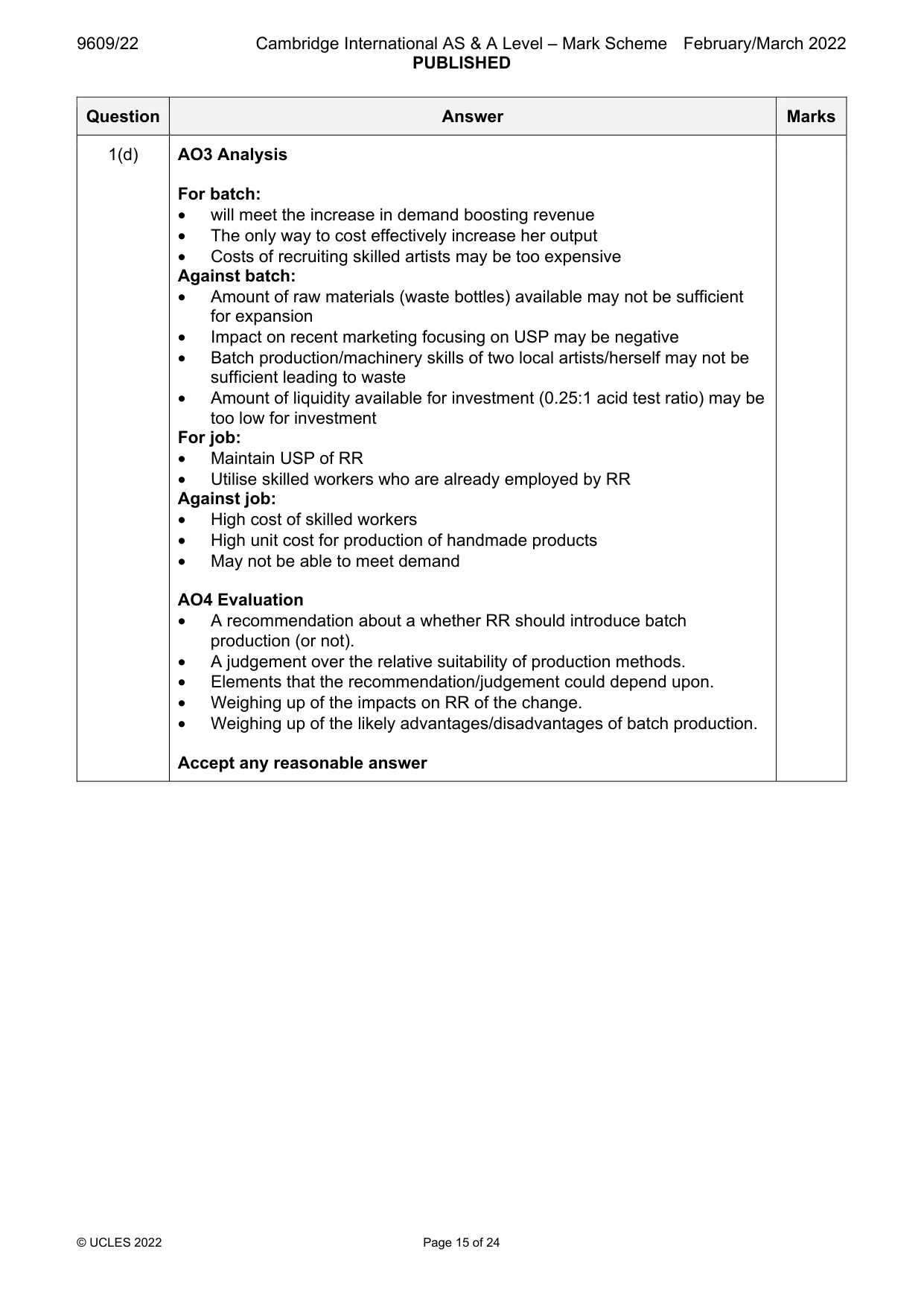
Mark scheme: Question Answer Marks 1(a)(i) Define the term ‘mission statement’ (line 7). 2 Knowledge Marks A correct definition 2 A partial, vague or unfocused definition 1 No creditable content 0 Content • One mark for understanding of the concept of aims and values (mission) • One mark for understanding that it defines a company or organisation’s reason for being (statement) Exemplar Mark Rationale A statement of a company’s 2 Both elements covered. vision (1) which helps to set objectives (1). Is the goal of a company (1). 2 Clearly defined. Corporate objectives are used to achieve the mission statement (1). A kind of business target (1). 1 Vague definition. Something a business aims for 1 Vague definition but (1), in this case to ‘make waste example copied from the beautiful’. case, so do not award. The vision of the business owners 1 Vague definition. (1) A statement of a business’s 0 Tautological. mission Accept any reasonable answer 1(a)(ii) Explain the term ‘democratic leadership style’ (line 13). 3 Award one mark for each point of explanation: C Example or some other way of showing good 1 mark understanding B Understanding that it is to do with 1 mark direction/guidance/coordination etc. A Understanding of the concept of participation 1 mark C marks dependent on A and B mark being present Content All members of the business (1) take part in the decision-making process, often by voting (1). If Rehana is a democratic leader then she will ask for the local artists to help her make decisions (1). Exemplar Mark Rationale All employees’ views are 3 A, B and C considered (1) when making decisions and every employee has one vote (1). Sometimes called participative leadership (1). The leader takes other people’s 3 A, B and C views into account (1) when making decisions (1), however the leader makes the final decision (1). All members of the business take 2 A and B only part (1) in the decision-making process (1). All employees are involved (1). 1 A mark only Decisions are made by voting (1). B mark only Accept any reasonable answer 1(b)(i) Refer to table 1.1. Calculate the acid test ratio for RR. 3 *May be implied Rationale Marks Correct answer with or without correct working or $ 3 Attempt with correct figures 2 Formula*/attempt to calculate 1 No creditable content 0 Current assets − stock [1 mark – formula] Current liabilities (14000 − 12000) [1 mark – use of correct figures] 8000 Answer = 0.25:1 [3 marks – correct answer] Common incorrect answers Answer Mark Rationale 25% 3 A percentage is a ratio. 1/4 3 A fraction is close enough to a ratio. 0.25 (no working) 3 Allow as a correct answer with or without working shown. 25 (no working) 0 Do not award any marks for an incorrect answer without working. CA 1 Attempt to correctly calculate using one correct CL figure (CL). 14000 = 1.75:1 8000 2000 1 Attempt to correctly calculate using one correct 14000 figure (CA). 1(b)(i) Answer Mark Rationale 1.75:1 (no working) 0 Do not award any marks for an incorrect answer without working. CL 2 Incorrect formula (but right elements – inverted) and CA − inventory subsequent results are OFR 8000 2000 = 4:1 (400%) 8000 0 Without formula these are ‘random’ numbers 2000 = 4 1(b)(ii) Explain one method Rehana may use to improve liquidity. 3 Level Knowledge and Application Marks 2 (APP) Explanation of a method of improving liquidity, in 3 context 2a (K+K) Explanation of a method of improving liquidity 2 1a (K) Identification of a method of improving liquidity 1 0 No creditable content 0 Content Indicative content AO1 Knowledge and understanding Liquidity can be improved by: • A method of increasing current assets (cash, inventory, trade receivables etc.): – Sell fixed assets – for cash. – Take out a long-term loan – to increase cash. – Encourage prompt payment – to decrease trade receivables (debtors). – Sell inventory – to increase cash (can improve liquidity if measured using the acid test). • A method of decreasing current liabilities (overdraft, trade receivables, dividend payable etc.) – Take out a long-term loan – to pay off the overdraft. – Retain more profit – to avoid paying dividends AO2 Application • Context of RR. • Use of Table 1.1 ACCEPT ANY REASONABLE ANSWER 1(b)(ii) Exemplar Mark Rationale Rehana could sell the machine 3 Explanation of a method in that melts down bottles to context increase RR’s cash. Rehana could sell $5000 of the 3 Explanation of a factor not inventory so that the business can in context. Allow based on pay off its overdraft. acid test measure of liquidity. Rehana could take out a long- 3 Explanation of a method in term loan for $5000 to pay off the context overdraft. Take out a long-term loan to pay 2 Explanation of a method. off the overdraft. Take out a bank loan. 1 BOD that a bank loan is a long-term liability. Borrow some money. 1 Too vague – could be short-term or long-term debt. 1(c) Analyse two benefits for RR of having a unique selling point (USP). 8 Knowledge and Analysis Level Application Marks Marks (4 marks) (4 marks) 2b Shows knowledge of 4 Developed analysis 4 two benefits of of two benefits of having a USP in having a USP in context context 2a Shows knowledge of 3 Developed analysis 3 one benefit of having of one benefit of a USP in context having a USP in context 1b Shows knowledge of 2 Limited analysis of 2 two benefits of two benefits of having a USP having a USP 1a Shows knowledge of 1 Limited analysis of 1 one benefit of a USP one benefit of having a USP 0 No creditable content AO1 Knowledge and understanding Knowledge of benefits may include: • To sell more • To increase the price • Increase customer loyalty / repeat purchases • Brand recognition • To differentiate from competition • To give a focus for the marketing mix AO2 Application • RR is a sole trader / small business and is likely to have limited resources • RR makes unique vases and glassware products • RR’s mission statement ‘to make waste beautiful’. • Markets products as ‘lovely for the planet, lovely for you’. • RR has a strong local brand image. • RR’s USP is recycling waste (assumption can be made that no other competitors do this). • RR employs two local artists, who are environmentally aware. • Employees are skilled. • RR uses job production. • Table 1.1. • Demand has grown and Rehana needs to increase output. • Rehana wants to increase output by either employing more artists or changing to batch production. 1(c) AO3 Analysis • Increase customer loyalty / repeat purchases: gives RR an established customer base and revenue stream – more likely to make Rehana’s growth strategies successful. • Brand recognition: means that customers who are looking for recycled products are more likely to purchase RR’s vases – increasing Rehana’s incomes/profit. • To differentiate from competition: likely to be a competitive market and RR may need customers to recognise their recycled products so that sales increase – so that Rehana can reinvest more profit and grow the business. • To give a focus for the marketing mix: the ‘lovely for the planet, lovely for you’ marketing slogan shows a double benefit to making a purchase, meaning that Rehana may be able to charge a higher price – increasing her income/profit. Accept any reasonable answer 1(d) Evaluate whether RR should change to batch production. 11 Analysis and Knowledge and Evaluation Application (4 marks) Marks Marks (7 marks) Annotation Annotation Justified evaluation 7 based on argument in context. EVAL + EVAL + EVAL Developed evaluation 6 based on argument in context. EVAL + EVAL An evaluative 5 statement based on EVAL argument in context. Applies context to 4 Argument based on two 4 understanding pieces of knowledge of two APP piecesanalysisofaboutdevelopedRR’s DEV about job/batch + decision to change + production. APP production method. DEV Applies context to 3 Argument based on 3 understanding of one one piece of developed piece of knowledge analysis about RR’s APP DEV about job/batch decision to change production. production method. 1(d) Analysis and Knowledge and Evaluation Application (4 marks) Marks Marks (7 marks) Annotation Annotation Shows two pieces of 2 Limited analysis of two 2 knowledge about factors influencing job/batch production K job/batch production AN + + K AN Shows one piece of 1 Limited analysis of one 1 knowledge about K factor influencing AN job/batch production job/batch production No creditable content Content AO1 Knowledge and understanding Knowledge of job production may include: • On-off unique products • Produced one at a time Knowledge of batch production may include: • Production in groups, not individual or mass/flow • Whole batch passes through each stage of production at the same time • Use of machinery AO2 Application • RR is a sole trader / small business and is likely to have limited resources • RR makes unique vases and glassware products • RR’s mission statement ‘to make waste beautiful’. • Markets products as ‘lovely for the planet, lovely for you’. • RR has a strong local brand image. • RR’s USP is recycling waste (assumption can be made that no other competitors do this). • RR employs two local artists, who are environmentally aware. • Employees are skilled. • RR uses job production. • Table 1.1. • Demand has grown and Rehana needs to increase output. • Rehana wants to increase output by either employing more artists or changing to batch production. 1(d) AO3 Analysis For batch: • will meet the increase in demand boosting revenue • The only way to cost effectively increase her output • Costs of recruiting skilled artists may be too expensive Against batch: • Amount of raw materials (waste bottles) available may not be sufficient for expansion • Impact on recent marketing focusing on USP may be negative • Batch production/machinery skills of two local artists/herself may not be sufficient leading to waste • Amount of liquidity available for investment (0.25:1 acid test ratio) may be too low for investment For job: • Maintain USP of RR • Utilise skilled workers who are already employed by RR Against job: • High cost of skilled workers • High unit cost for production of handmade products • May not be able to meet demand AO4 Evaluation • A recommendation about a whether RR should introduce batch production (or not). • A judgement over the relative suitability of production methods. • Elements that the recommendation/judgement could depend upon. • Weighing up of the impacts on RR of the change. • Weighing up of the likely advantages/disadvantages of batch production. Accept any reasonable answer
Q2 · Benjamin’s Beds (BB) Benjamin’s Beds (BB) is a large manufacturer of beds and has a…
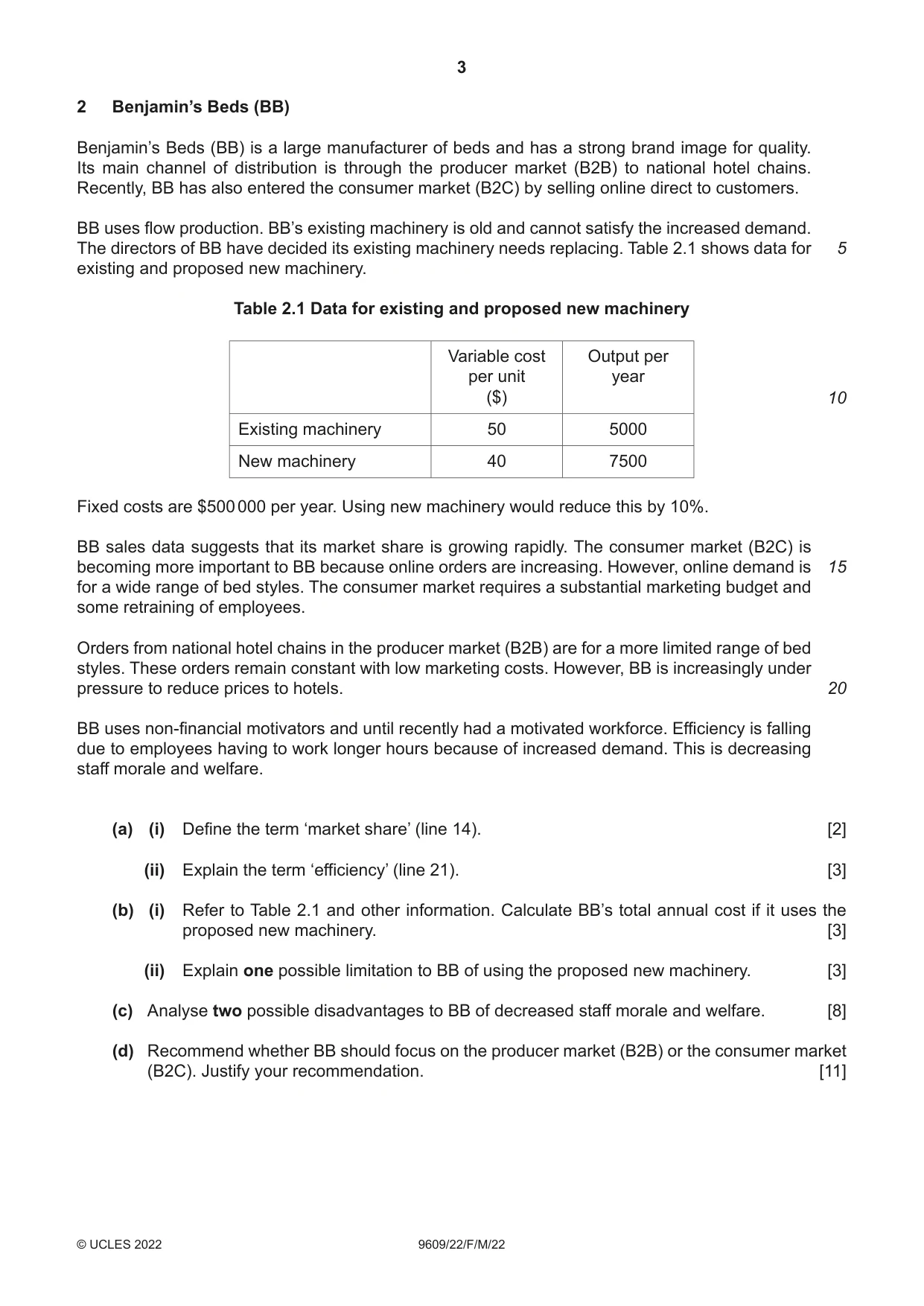
2 Benjamin’s Beds (BB) Benjamin’s Beds (BB) is a large manufacturer of beds and has a strong brand image for quality. Its main channel of distribution is through the producer market (B2B) to national hotel chains. Recently, BB has also entered the consumer market (B2C) by selling online direct to customers. BB uses flow production. BB’s existing machinery is old and cannot satisfy the increased demand. The directors of BB have decided its existing machinery needs replacing. Table 2.1 shows data for 5 existing and proposed new machinery. Table 2.1 Data for existing and proposed new machinery Variable cost Output per per unit year ($) 10 Existing machinery 50 5000 New machinery 40 7500 Fixed costs are $500 000 per year. Using new machinery would reduce this by 10%. BB sales data suggests that its market share is growing rapidly. The consumer market (B2C) is becoming more important to BB because online orders are increasing. However, online demand is 15 for a wide range of bed styles. The consumer market requires a substantial marketing budget and some retraining of employees. Orders from national hotel chains in the producer market (B2B) are for a more limited range of bed styles. These orders remain constant with low marketing costs. However, BB is increasingly under pressure to reduce prices to hotels. 20 BB uses non-financial motivators and until recently had a motivated workforce. Efficiency is falling due to employees having to work longer hours because of increased demand. This is decreasing staff morale and welfare. (a) (i) Define the term ‘market share’ (line 14). [2] (ii) Explain the term ‘efficiency’ (line 21). [3] (b) (i) Refer to Table 2.1 and other information. Calculate BB’s total annual cost if it uses the proposed new machinery. [3] (ii) Explain one possible limitation to BB of using the proposed new machinery. [3] (c) Analyse two possible disadvantages to BB of decreased staff morale and welfare. [8] (d) Recommend whether BB should focus on the producer market (B2B) or the consumer market (B2C). Justify your recommendation. [11]
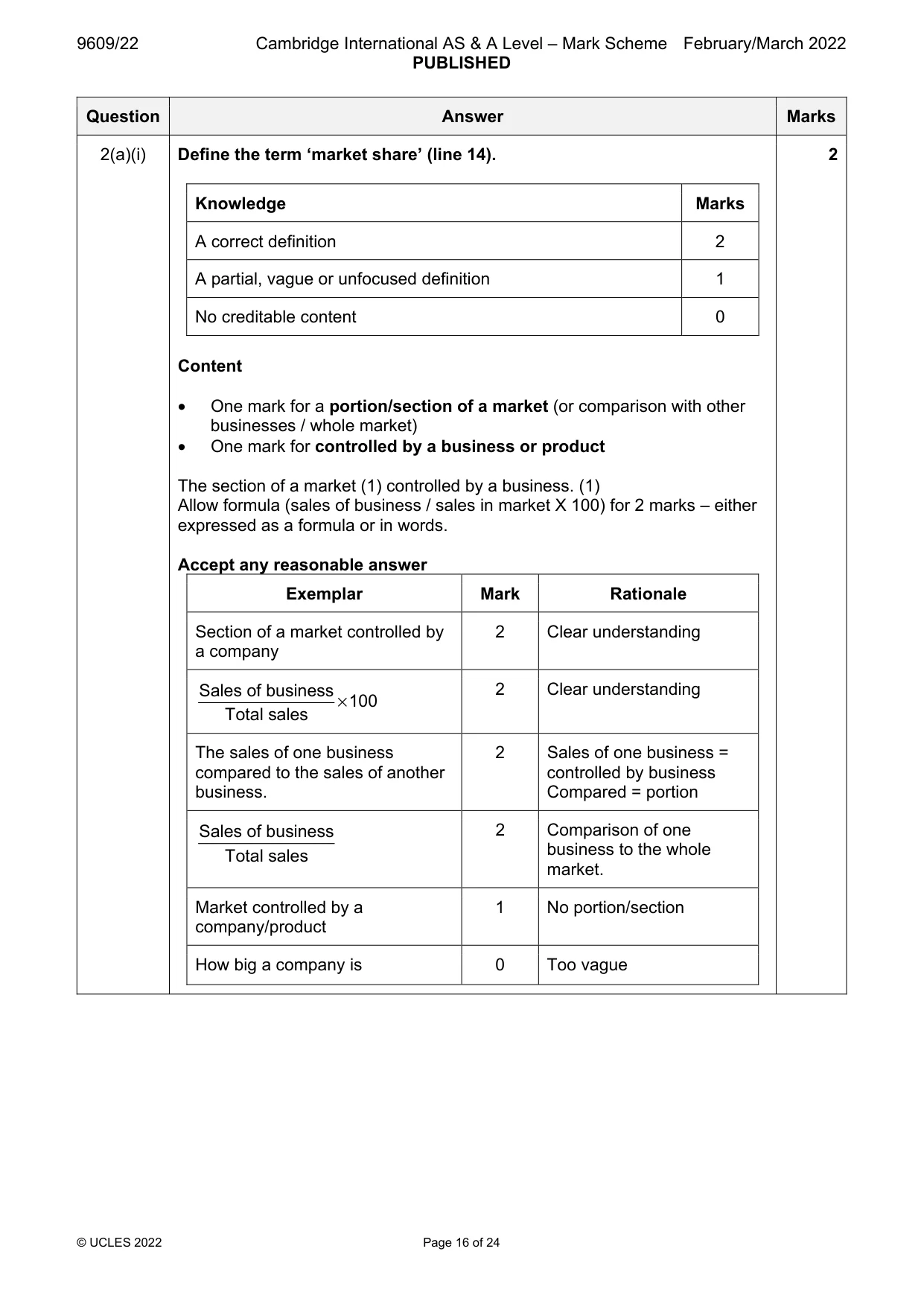
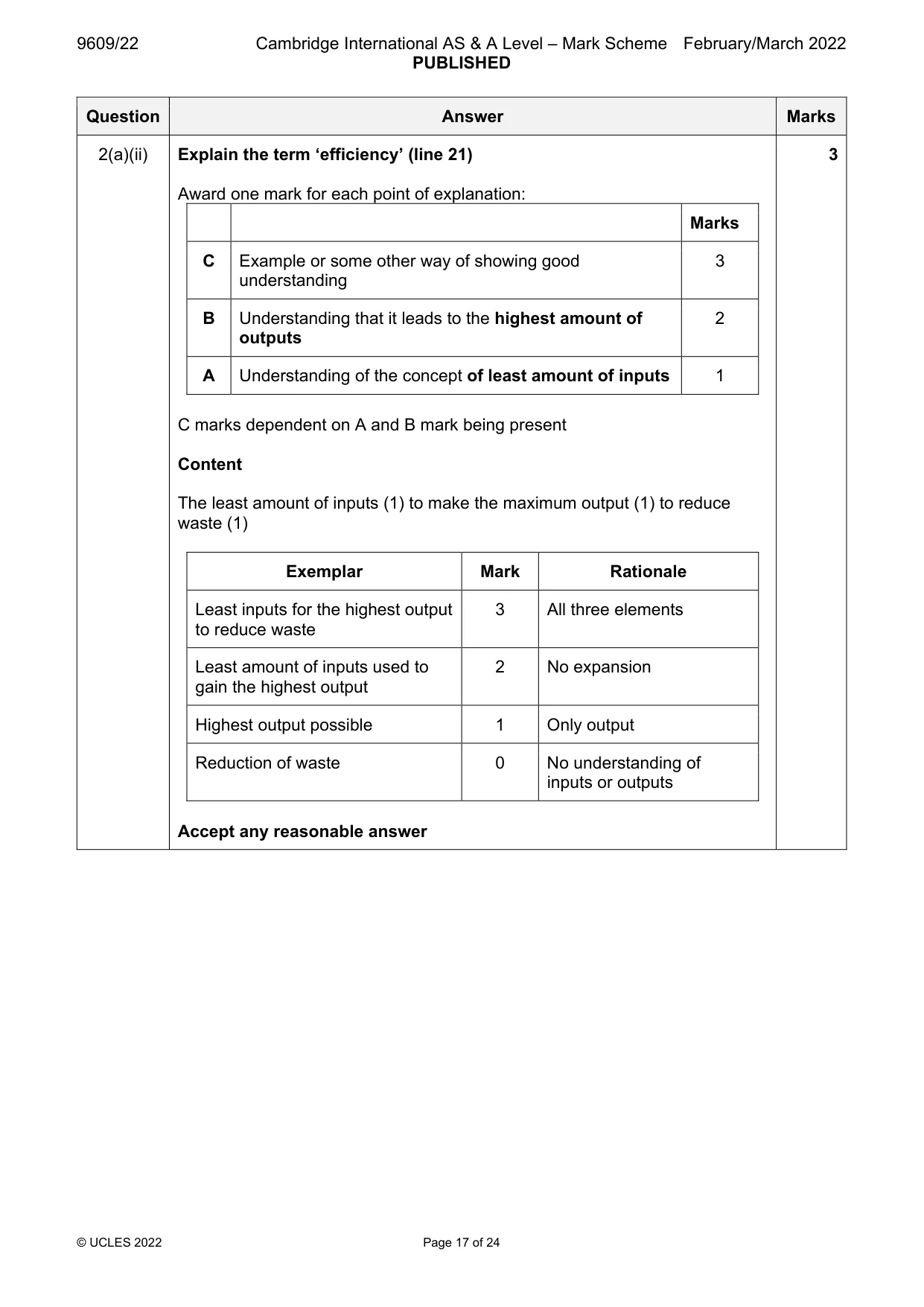
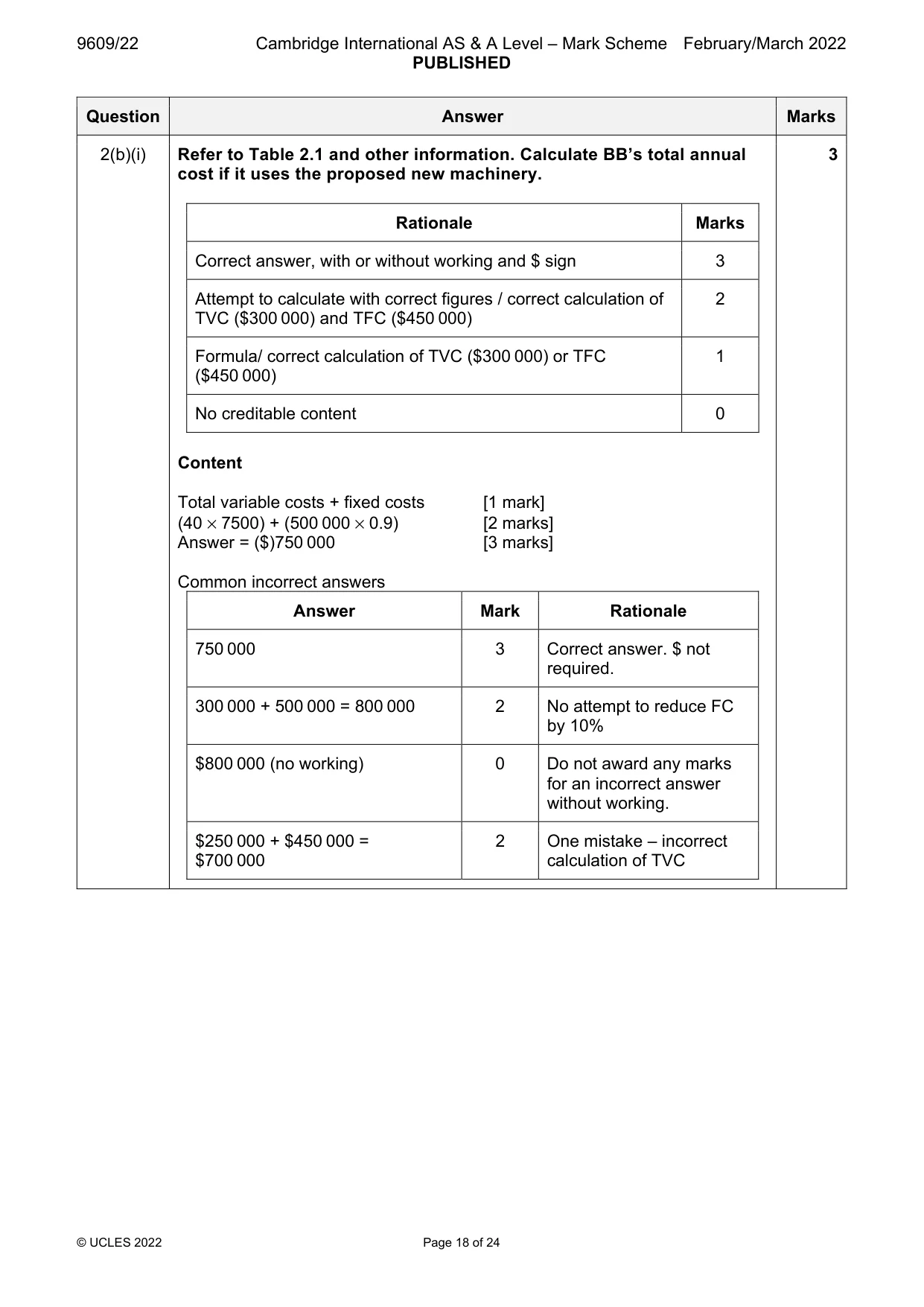
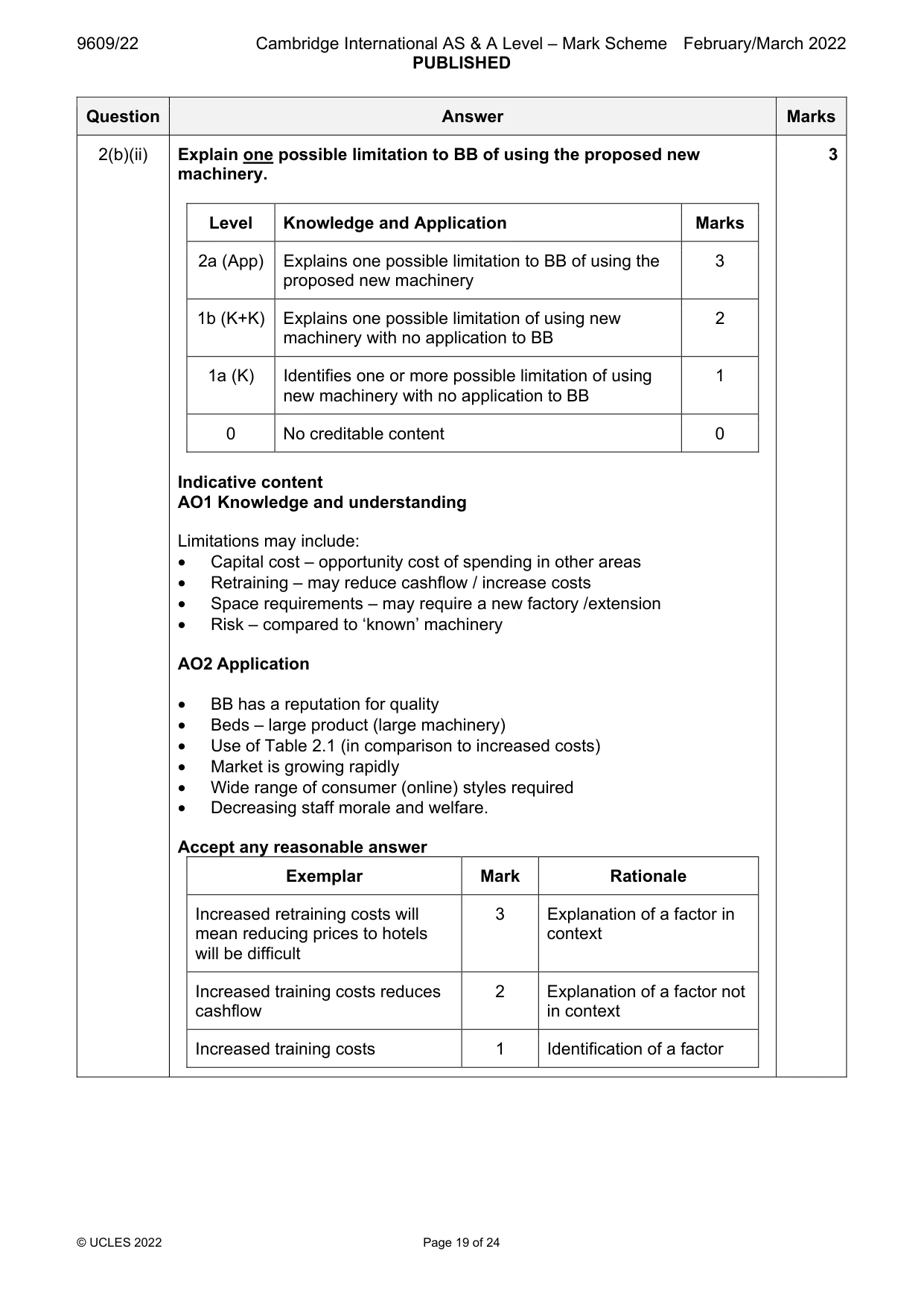
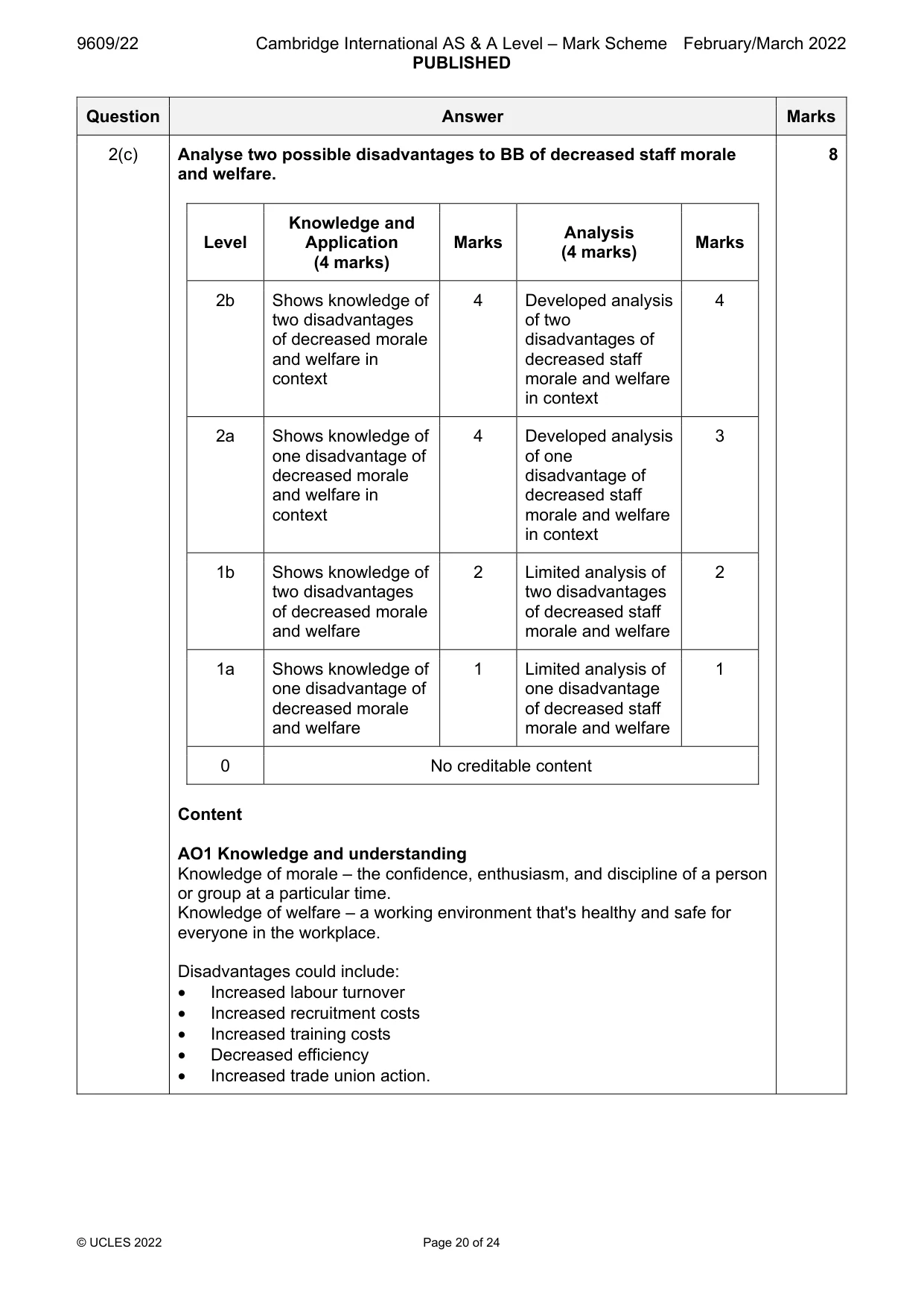
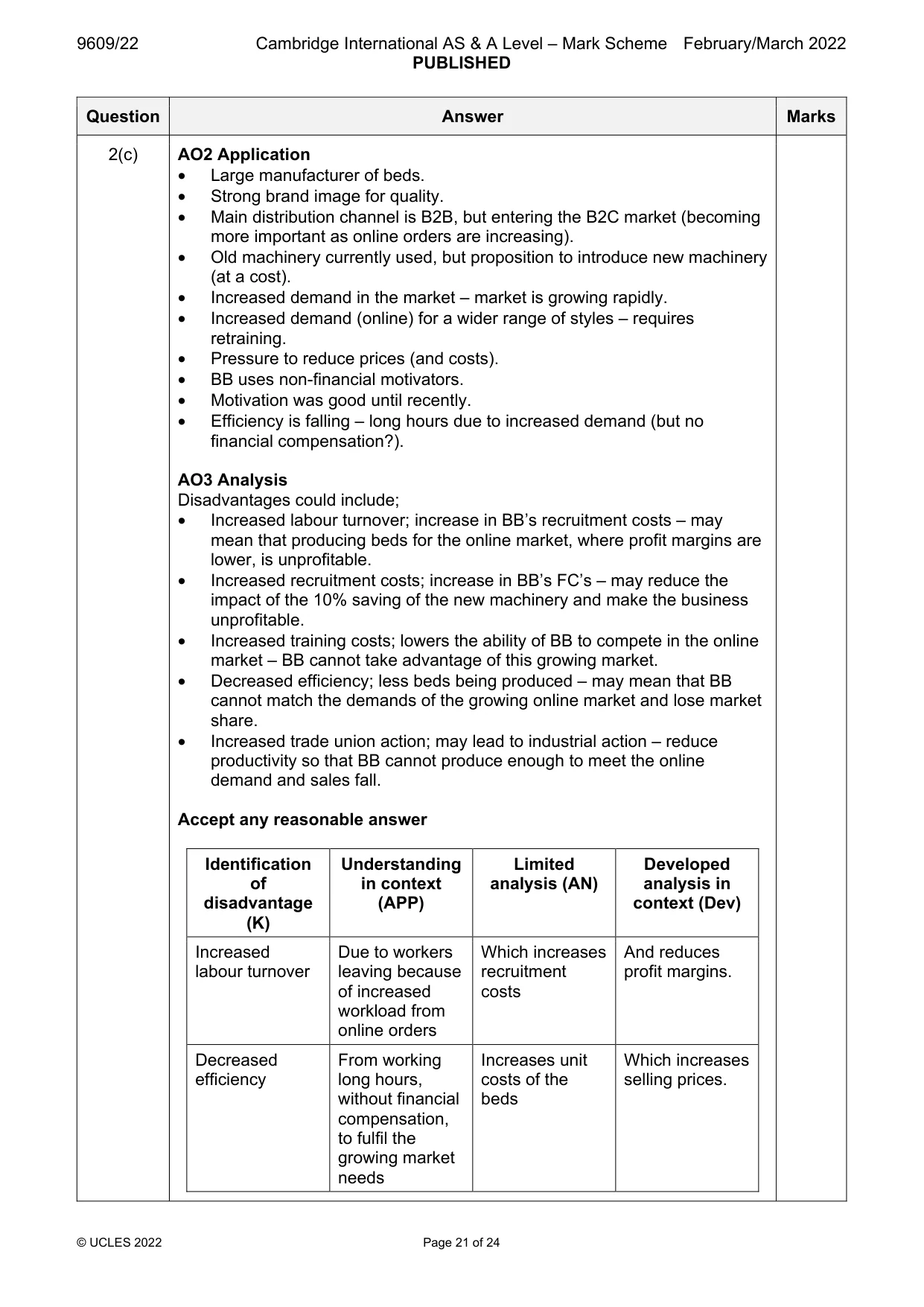
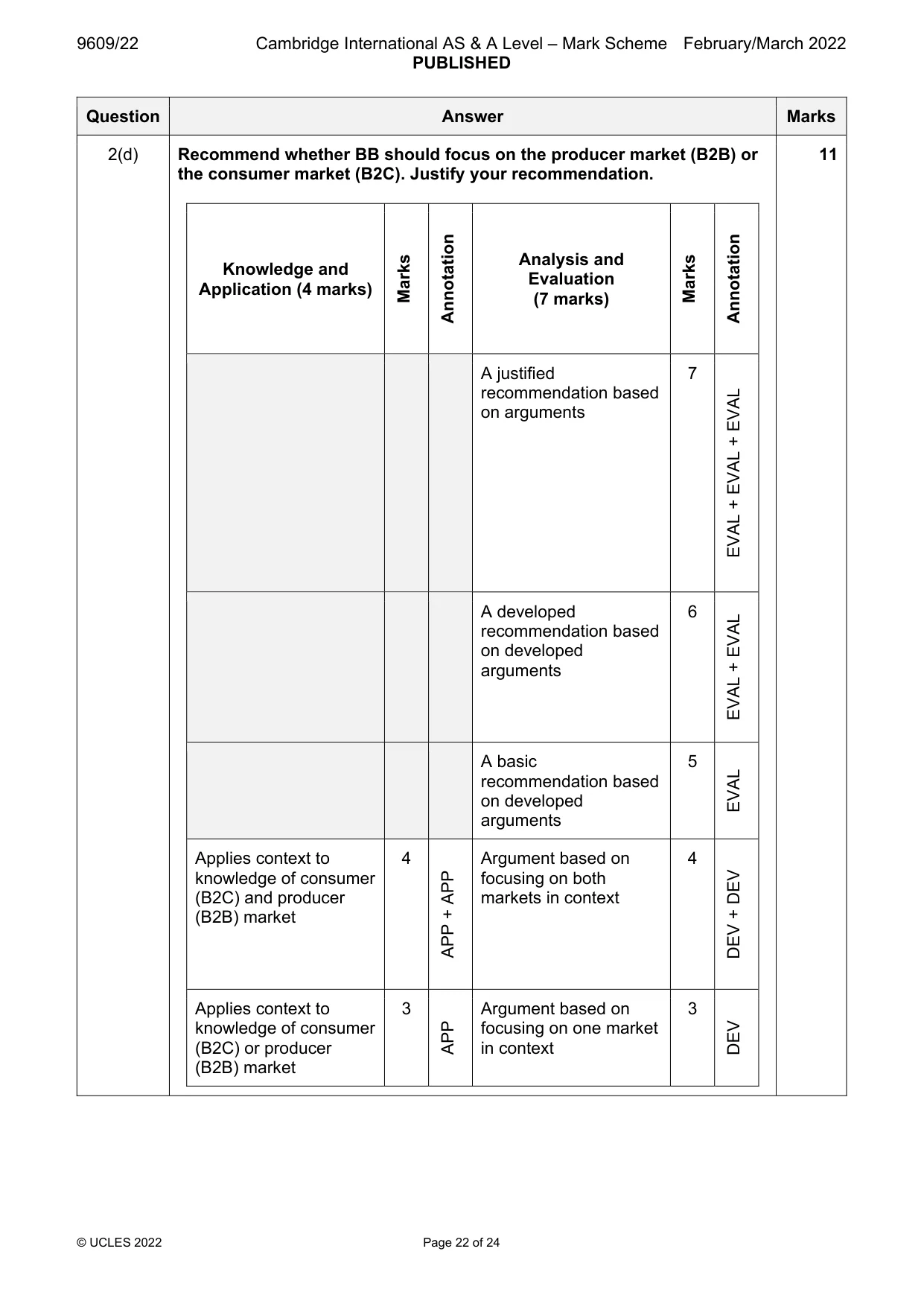
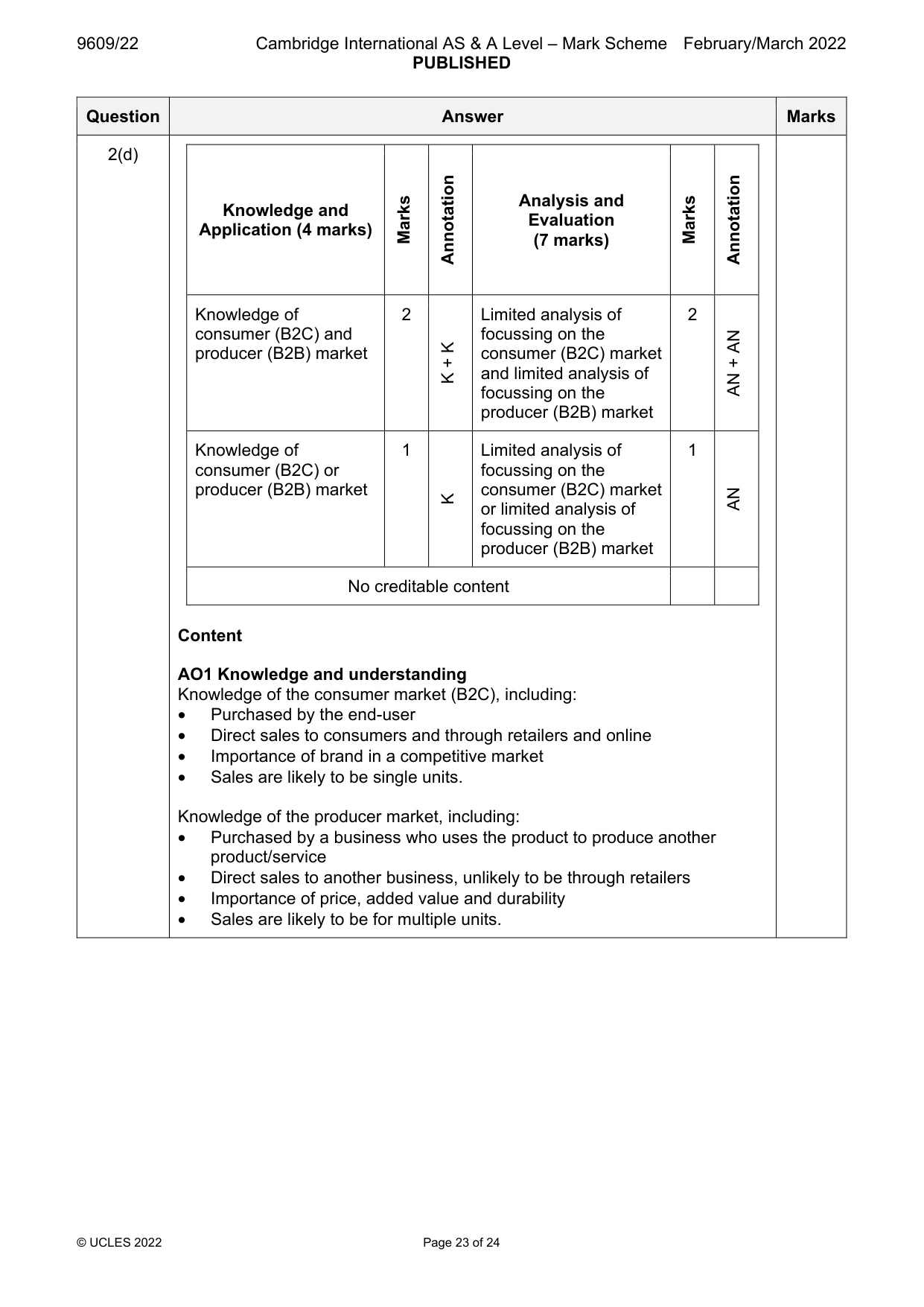
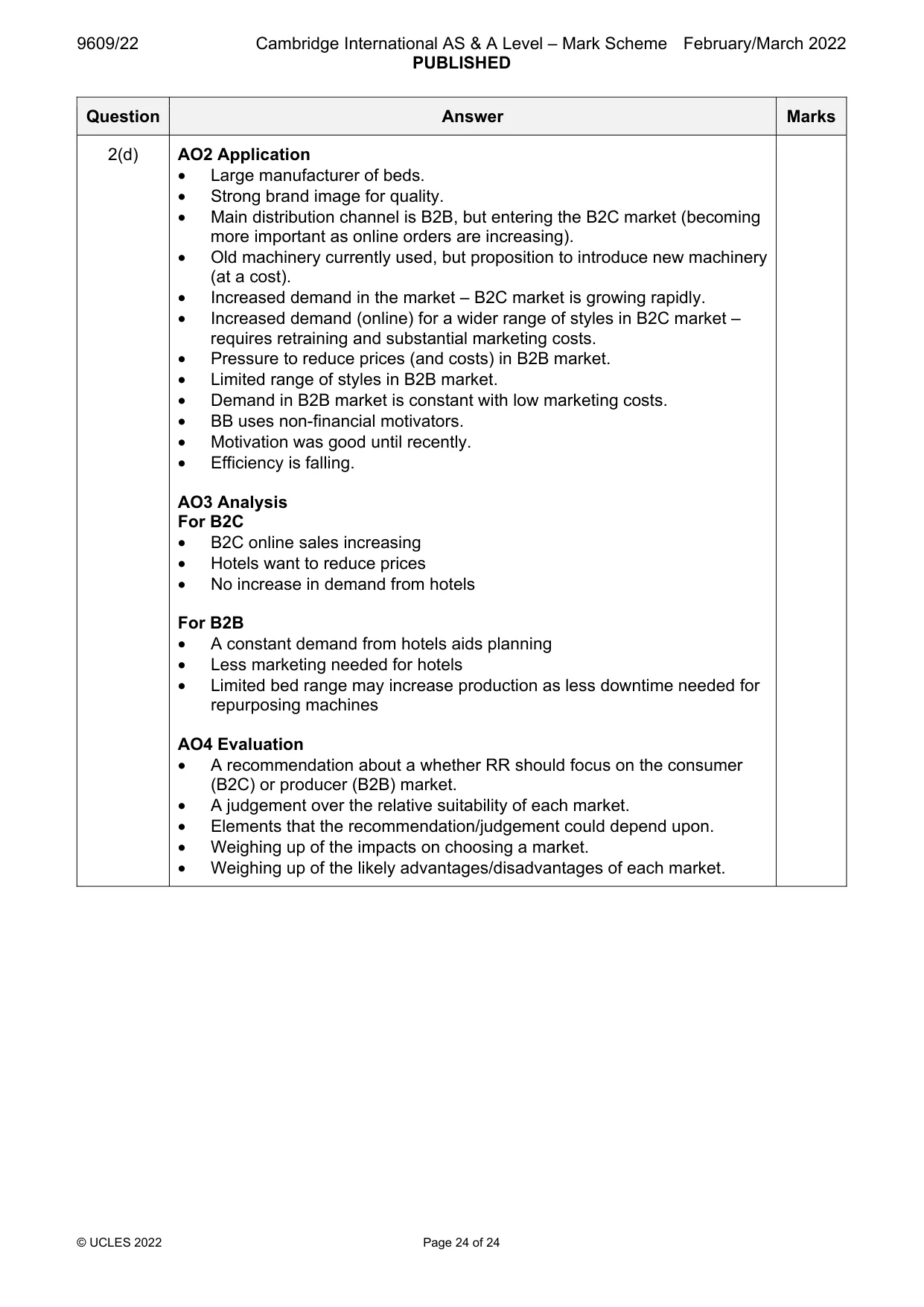
Mark scheme: 2(a)(i) Define the term ‘market share’ (line 14). 2 Knowledge Marks A correct definition 2 A partial, vague or unfocused definition 1 No creditable content 0 Content • One mark for a portion/section of a market (or comparison with other businesses / whole market) • One mark for controlled by a business or product The section of a market (1) controlled by a business. (1) Allow formula (sales of business / sales in market X 100) for 2 marks – either expressed as a formula or in words. Accept any reasonable answer Exemplar Mark Rationale Section of a market controlled by 2 Clear understanding a company Sales of business 2 Clear understanding × 100 Total sales The sales of one business 2 Sales of one business = compared to the sales of another controlled by business business. Compared = portion Sales of business 2 Comparison of one business to the whole Total sales market. Market controlled by a 1 No portion/section company/product How big a company is 0 Too vague 2(a)(ii) Explain the term ‘efficiency’ (line 21) 3 Award one mark for each point of explanation: Marks C Example or some other way of showing good 3 understanding B Understanding that it leads to the highest amount of 2 outputs A Understanding of the concept of least amount of inputs 1 C marks dependent on A and B mark being present Content The least amount of inputs (1) to make the maximum output (1) to reduce waste (1) Exemplar Mark Rationale Least inputs for the highest output 3 All three elements to reduce waste Least amount of inputs used to 2 No expansion gain the highest output Highest output possible 1 Only output Reduction of waste 0 No understanding of inputs or outputs Accept any reasonable answer 2(b)(i) Refer to Table 2.1 and other information. Calculate BB’s total annual 3 cost if it uses the proposed new machinery. Rationale Marks Correct answer, with or without working and $ sign 3 Attempt to calculate with correct figures / correct calculation of 2 TVC ($300 000) and TFC ($450 000) Formula/ correct calculation of TVC ($300 000) or TFC 1 ($450 000) No creditable content 0 Content Total variable costs + fixed costs [1 mark] (40 × 7500) + (500 000 × 0.9) [2 marks] Answer = ($)750 000 [3 marks] Common incorrect answers Answer Mark Rationale 750 000 3 Correct answer. $ not required. 300 000 + 500 000 = 800 000 2 No attempt to reduce FC by 10% $800 000 (no working) 0 Do not award any marks for an incorrect answer without working. $250 000 + $450 000 = 2 One mistake – incorrect $700 000 calculation of TVC 2(b)(ii) Explain one possible limitation to BB of using the proposed new 3 machinery. Level Knowledge and Application Marks 2a (App) Explains one possible limitation to BB of using the 3 proposed new machinery 1b (K+K) Explains one possible limitation of using new 2 machinery with no application to BB 1a (K) Identifies one or more possible limitation of using 1 new machinery with no application to BB 0 No creditable content 0 Indicative content AO1 Knowledge and understanding Limitations may include: • Capital cost – opportunity cost of spending in other areas • Retraining – may reduce cashflow / increase costs • Space requirements – may require a new factory /extension • Risk – compared to ‘known’ machinery AO2 Application • BB has a reputation for quality • Beds – large product (large machinery) • Use of Table 2.1 (in comparison to increased costs) • Market is growing rapidly • Wide range of consumer (online) styles required • Decreasing staff morale and welfare. Accept any reasonable answer Exemplar Mark Rationale Increased retraining costs will 3 Explanation of a factor in mean reducing prices to hotels context will be difficult Increased training costs reduces 2 Explanation of a factor not cashflow in context Increased training costs 1 Identification of a factor 2(c) Analyse two possible disadvantages to BB of decreased staff morale 8 and welfare. Knowledge and Analysis Level Application Marks Marks (4 marks) (4 marks) 2b Shows knowledge of 4 Developed analysis 4 two disadvantages of two of decreased morale disadvantages of and welfare in decreased staff context morale and welfare in context 2a Shows knowledge of 4 Developed analysis 3 one disadvantage of of one decreased morale disadvantage of and welfare in decreased staff context morale and welfare in context 1b Shows knowledge of 2 Limited analysis of 2 two disadvantages two disadvantages of decreased morale of decreased staff and welfare morale and welfare 1a Shows knowledge of 1 Limited analysis of 1 one disadvantage of one disadvantage decreased morale of decreased staff and welfare morale and welfare 0 No creditable content Content AO1 Knowledge and understanding Knowledge of morale – the confidence, enthusiasm, and discipline of a person or group at a particular time. Knowledge of welfare – a working environment that's healthy and safe for everyone in the workplace. Disadvantages could include: • Increased labour turnover • Increased recruitment costs • Increased training costs • Decreased efficiency • Increased trade union action. 2(c) AO2 Application • Large manufacturer of beds. • Strong brand image for quality. • Main distribution channel is B2B, but entering the B2C market (becoming more important as online orders are increasing). • Old machinery currently used, but proposition to introduce new machinery (at a cost). • Increased demand in the market – market is growing rapidly. • Increased demand (online) for a wider range of styles – requires retraining. • Pressure to reduce prices (and costs). • BB uses non-financial motivators. • Motivation was good until recently. • Efficiency is falling – long hours due to increased demand (but no financial compensation?). AO3 Analysis Disadvantages could include; • Increased labour turnover; increase in BB’s recruitment costs – may mean that producing beds for the online market, where profit margins are lower, is unprofitable. • Increased recruitment costs; increase in BB’s FC’s – may reduce the impact of the 10% saving of the new machinery and make the business unprofitable. • Increased training costs; lowers the ability of BB to compete in the online market – BB cannot take advantage of this growing market. • Decreased efficiency; less beds being produced – may mean that BB cannot match the demands of the growing online market and lose market share. • Increased trade union action; may lead to industrial action – reduce productivity so that BB cannot produce enough to meet the online demand and sales fall. Accept any reasonable answer Identification Understanding Limited Developed of in context analysis (AN) analysis in disadvantage (APP) context (Dev) (K) Increased Due to workers Which increases And reduces labour turnover leaving because recruitment profit margins. of increased costs workload from online orders Decreased From working Increases unit Which increases efficiency long hours, costs of the selling prices. without financial beds compensation, to fulfil the growing market needs 2(d) Recommend whether BB should focus on the producer market (B2B) or 11 the consumer market (B2C). Justify your recommendation. Analysis and Knowledge and Evaluation Application (4 marks) Marks Marks (7 marks) Annotation Annotation A justified 7 recommendation based on arguments EVAL + EVAL + EVAL A developed 6 recommendation based on developed EVAL arguments + EVAL A basic 5 recommendation based on developed EVAL arguments Applies context to 4 Argument based on 4 knowledge (B2C) and producer of consumer APP focusingmarkets inoncontextboth DEV (B2B) market + + APP DEV Applies context to 3 Argument based on 3 knowledge (B2C) or producer of consumer APP focusingin contexton one market DEV (B2B) market 2(d) Analysis and Knowledge and Evaluation Application (4 marks) Marks Marks (7 marks) Annotation Annotation Knowledge of 2 Limited analysis of 2 consumer (B2C) and focussing on the K AN producer (B2B) market consumer (B2C) market + + K and limited analysis of AN focussing on the producer (B2B) market Knowledge of 1 Limited analysis of 1 consumer (B2C) or focussing on the producer (B2B) market consumer (B2C) market K AN or limited analysis of focussing on the producer (B2B) market No creditable content Content AO1 Knowledge and understanding Knowledge of the consumer market (B2C), including: • Purchased by the end-user • Direct sales to consumers and through retailers and online • Importance of brand in a competitive market • Sales are likely to be single units. Knowledge of the producer market, including: • Purchased by a business who uses the product to produce another product/service • Direct sales to another business, unlikely to be through retailers • Importance of price, added value and durability • Sales are likely to be for multiple units. 2(d) AO2 Application • Large manufacturer of beds. • Strong brand image for quality. • Main distribution channel is B2B, but entering the B2C market (becoming more important as online orders are increasing). • Old machinery currently used, but proposition to introduce new machinery (at a cost). • Increased demand in the market – B2C market is growing rapidly. • Increased demand (online) for a wider range of styles in B2C market – requires retraining and substantial marketing costs. • Pressure to reduce prices (and costs) in B2B market. • Limited range of styles in B2B market. • Demand in B2B market is constant with low marketing costs. • BB uses non-financial motivators. • Motivation was good until recently. • Efficiency is falling. AO3 Analysis For B2C • B2C online sales increasing • Hotels want to reduce prices • No increase in demand from hotels For B2B • A constant demand from hotels aids planning • Less marketing needed for hotels • Limited bed range may increase production as less downtime needed for repurposing machines AO4 Evaluation • A recommendation about a whether RR should focus on the consumer (B2C) or producer (B2B) market. • A judgement over the relative suitability of each market. • Elements that the recommendation/judgement could depend upon. • Weighing up of the impacts on choosing a market. • Weighing up of the likely advantages/disadvantages of each market.
What was in this paper
The subtopics covered by these 2 questions, and how many questions each got. Open one in a new tab to see every Cambridge question on it.
What you needed in this session
Cambridge’s own grade thresholds for 2022 Feb/March, Paper 2 · Variant 2. A higher threshold means an easier paper — the bar moves with how the cohort did.