Cambridge A Level Business (for first examination in 2016) 9609 — 2021 Oct/Nov Paper 1 · Variant 2
9609/12/O/N/21 · 40 marks · ≈45 min
The question paper and its mark scheme, free to read here and free to download. This is Cambridge’s own paper, exactly as it was sat.
Question paper4 pages


Mark scheme16 pages
Answers below. Sit the paper first if you are practising.

Paper as text
Question paper, page 1
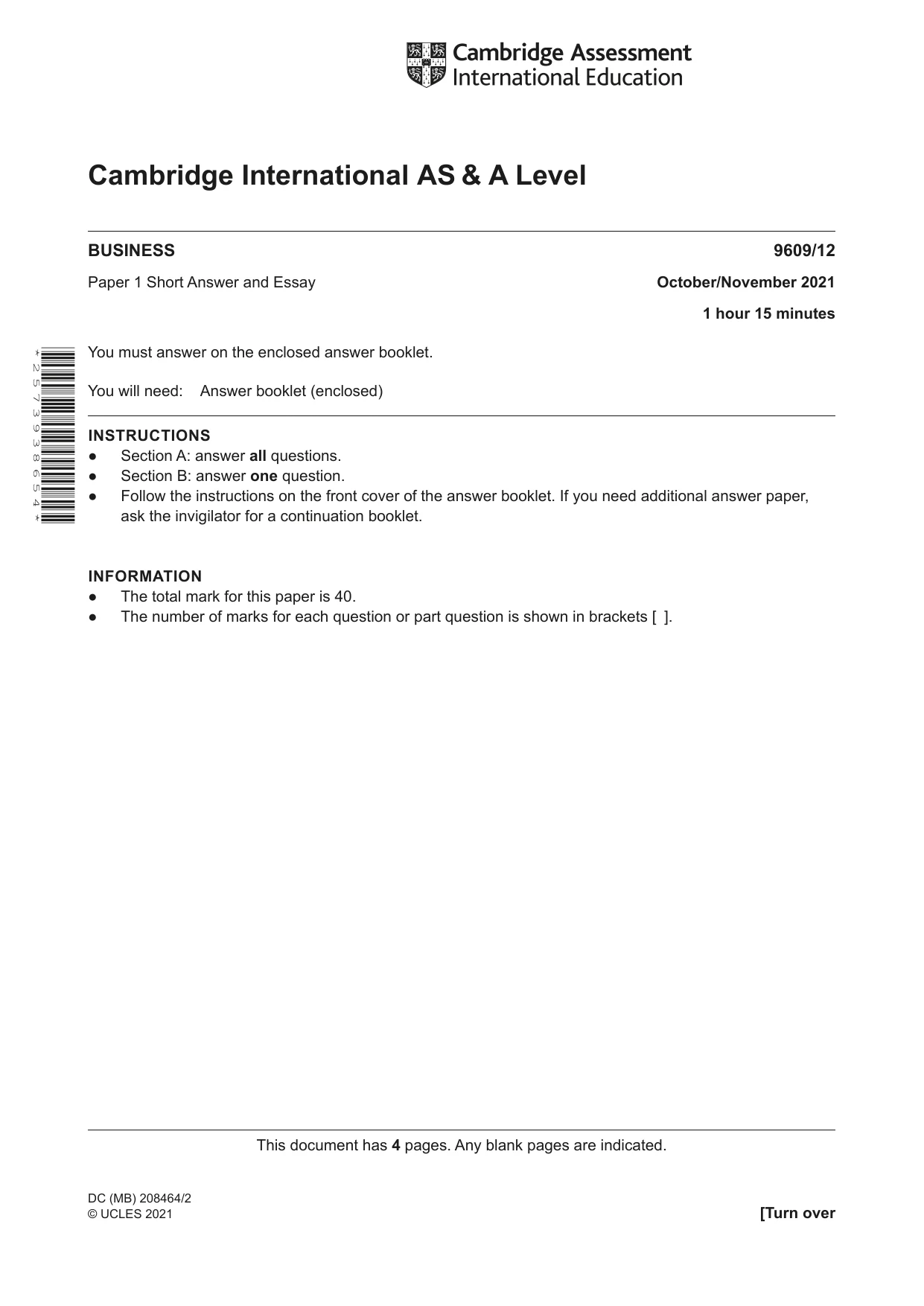
This document has 4 pages. Any blank pages are indicated. Cambridge International AS & A Level BUSINESS 9609/12 Paper 1 Short Answer and Essay October/November 2021 1 hour 15 minutes You must answer on the enclosed answer booklet. You will need: Answer booklet (enclosed) INSTRUCTIONS ● Section A: answer all questions. ● Section B: answer one question. ● Follow the instructions on the front cover of the answer booklet. If you need additional answer paper, ask the invigilator for a continuation booklet. INFORMATION ● The total mark for this paper is 40. ● The number of marks for each question or part question is shown in brackets [ ]. DC (MB) 208464/2 © UCLES 2021 [Turn over * 2 5 7 3 9 3 8 6 5 4 *
Question paper, page 2
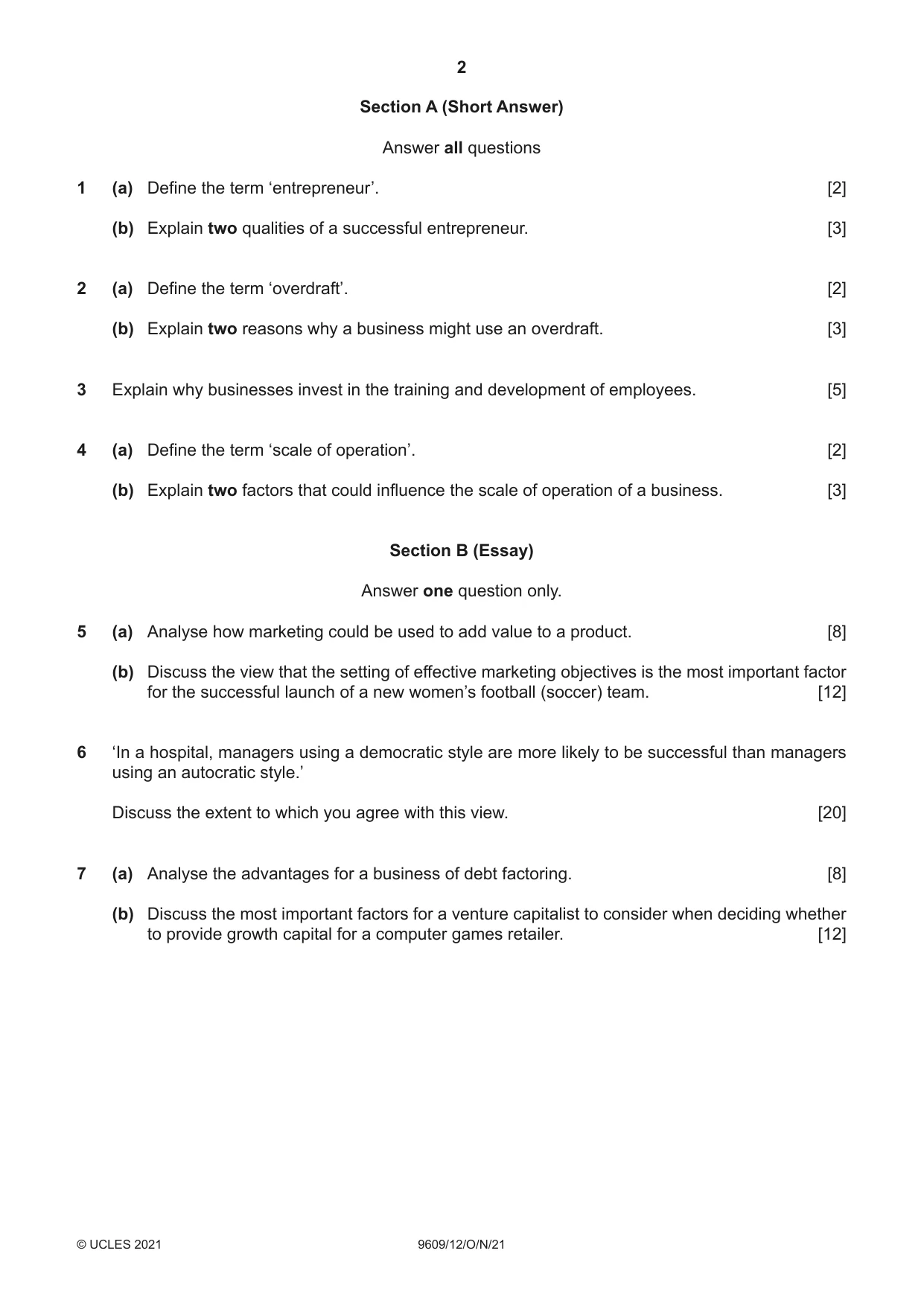
2 9609/12/O/N/21 © UCLES 2021 Section A (Short Answer) Answer all questions 1 (a) Define the term ‘entrepreneur’. [2] (b) Explain two qualities of a successful entrepreneur. [3] 2 (a) Define the term ‘overdraft’. [2] (b) Explain two reasons why a business might use an overdraft. [3] 3 Explain why businesses invest in the training and development of employees. [5] 4 (a) Define the term ‘scale of operation’. [2] (b) Explain two factors that could influence the scale of operation of a business. [3] Section B (Essay) Answer one question only. 5 (a) Analyse how marketing could be used to add value to a product. [8] (b) Discuss the view that the setting of effective marketing objectives is the most important factor for the successful launch of a new women’s football (soccer) team. [12] 6 ‘In a hospital, managers using a democratic style are more likely to be successful than managers using an autocratic style.’ Discuss the extent to which you agree with this view. [20] 7 (a) Analyse the advantages for a business of debt factoring. [8] (b) Discuss the most important factors for a venture capitalist to consider when deciding whether to provide growth capital for a computer games retailer. [12]
Question paper, page 3
3 9609/12/O/N/21 © UCLES 2021 BLANK PAGE
Question paper, page 4
4 9609/12/O/N/21 © UCLES 2021 Permission to reproduce items where third-party owned material protected by copyright is included has been sought and cleared where possible. Every reasonable effort has been made by the publisher (UCLES) to trace copyright holders, but if any items requiring clearance have unwittingly been included, the publisher will be pleased to make amends at the earliest possible opportunity. To avoid the issue of disclosure of answer-related information to candidates, all copyright acknowledgements are reproduced online in the Cambridge Assessment International Education Copyright Acknowledgements Booklet. This is produced for each series of examinations and is freely available to download at www.cambridgeinternational.org after the live examination series. Cambridge Assessment International Education is part of the Cambridge Assessment Group. Cambridge Assessment is the brand name of the University of Cambridge Local Examinations Syndicate (UCLES), which itself is a department of the University of Cambridge. BLANK PAGE
Mark scheme, page 1
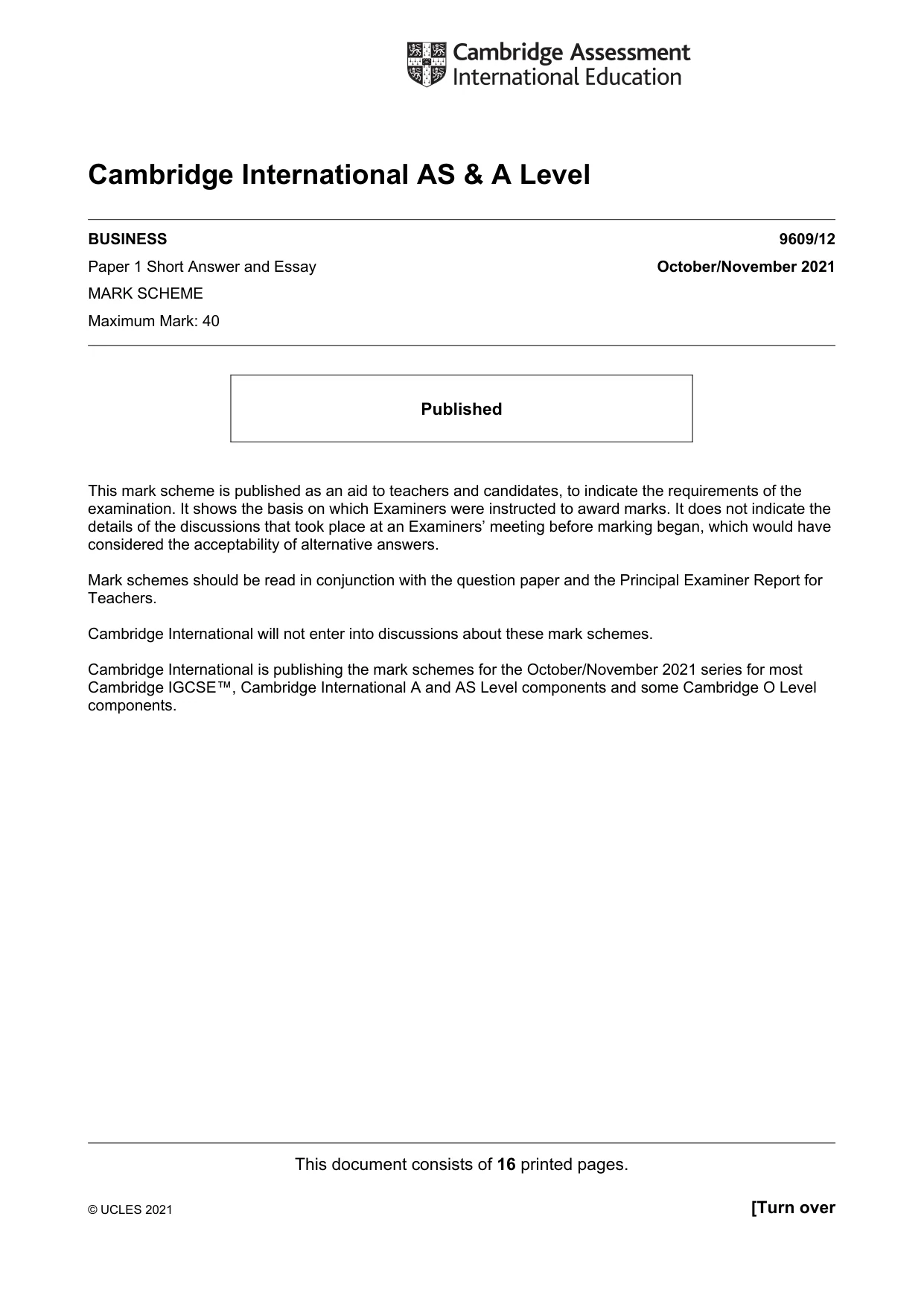
This document consists of 16 printed pages. © UCLES 2021 [Turn over Cambridge International AS & A Level BUSINESS 9609/12 Paper 1 Short Answer and Essay October/November 2021 MARK SCHEME Maximum Mark: 40 Published This mark scheme is published as an aid to teachers and candidates, to indicate the requirements of the examination. It shows the basis on which Examiners were instructed to award marks. It does not indicate the details of the discussions that took place at an Examiners’ meeting before marking began, which would have considered the acceptability of alternative answers. Mark schemes should be read in conjunction with the question paper and the Principal Examiner Report for Teachers. Cambridge International will not enter into discussions about these mark schemes. Cambridge International is publishing the mark schemes for the October/November 2021 series for most Cambridge IGCSE™, Cambridge International A and AS Level components and some Cambridge O Level components.
Mark scheme, page 2
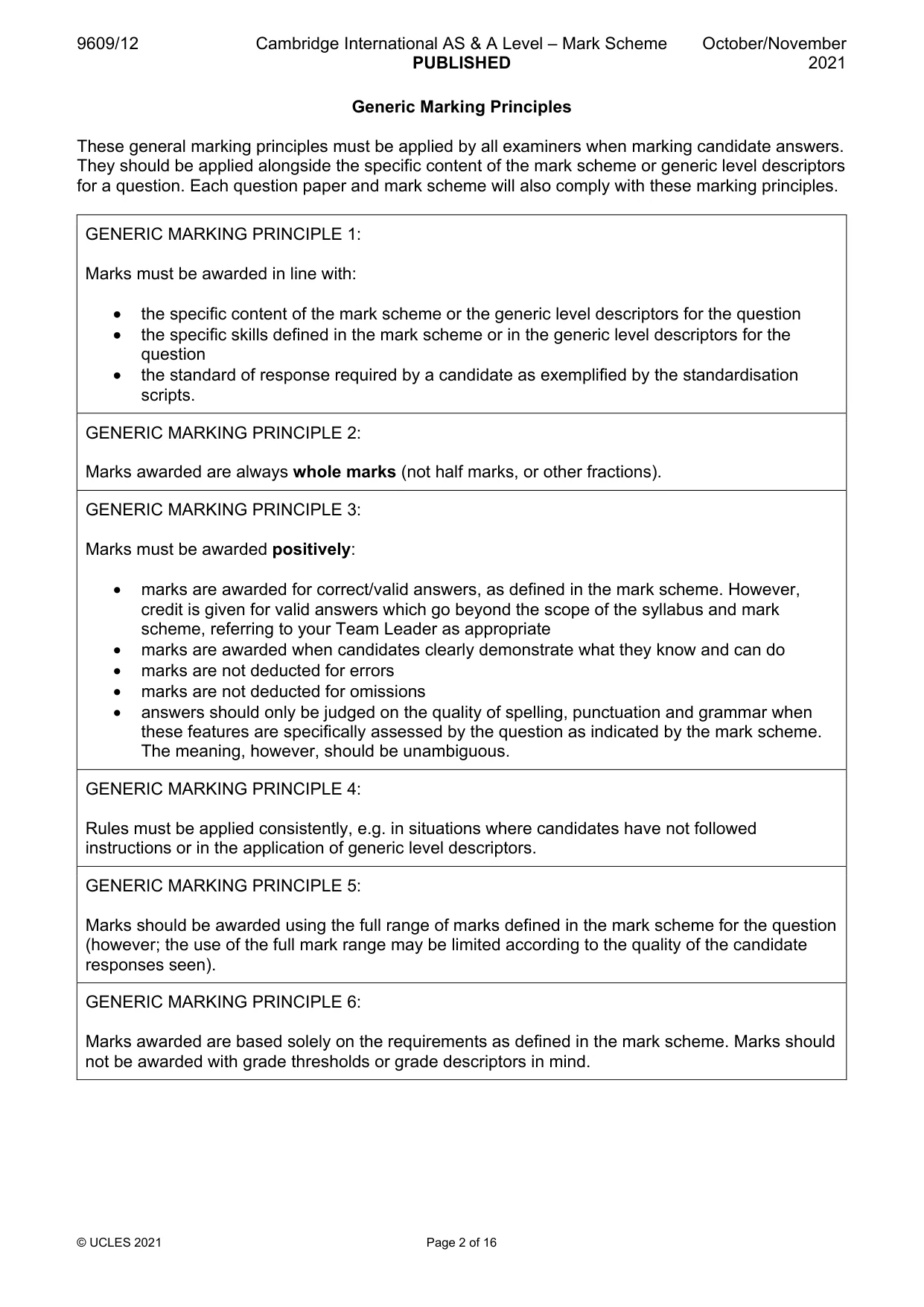
9609/12 Cambridge International AS & A Level – Mark Scheme PUBLISHED October/November 2021 © UCLES 2021 Page 2 of 16 Generic Marking Principles These general marking principles must be applied by all examiners when marking candidate answers. They should be applied alongside the specific content of the mark scheme or generic level descriptors for a question. Each question paper and mark scheme will also comply with these marking principles. GENERIC MARKING PRINCIPLE 1: Marks must be awarded in line with: • the specific content of the mark scheme or the generic level descriptors for the question • the specific skills defined in the mark scheme or in the generic level descriptors for the question • the standard of response required by a candidate as exemplified by the standardisation scripts. GENERIC MARKING PRINCIPLE 2: Marks awarded are always whole marks (not half marks, or other fractions). GENERIC MARKING PRINCIPLE 3: Marks must be awarded positively: • marks are awarded for correct/valid answers, as defined in the mark scheme. However, credit is given for valid answers which go beyond the scope of the syllabus and mark scheme, referring to your Team Leader as appropriate • marks are awarded when candidates clearly demonstrate what they know and can do • marks are not deducted for errors • marks are not deducted for omissions • answers should only be judged on the quality of spelling, punctuation and grammar when these features are specifically assessed by the question as indicated by the mark scheme. The meaning, however, should be unambiguous. GENERIC MARKING PRINCIPLE 4: Rules must be applied consistently, e.g. in situations where candidates have not followed instructions or in the application of generic level descriptors. GENERIC MARKING PRINCIPLE 5: Marks should be awarded using the full range of marks defined in the mark scheme for the question (however; the use of the full mark range may be limited according to the quality of the candidate responses seen). GENERIC MARKING PRINCIPLE 6: Marks awarded are based solely on the requirements as defined in the mark scheme. Marks should not be awarded with grade thresholds or grade descriptors in mind.
Mark scheme, page 3
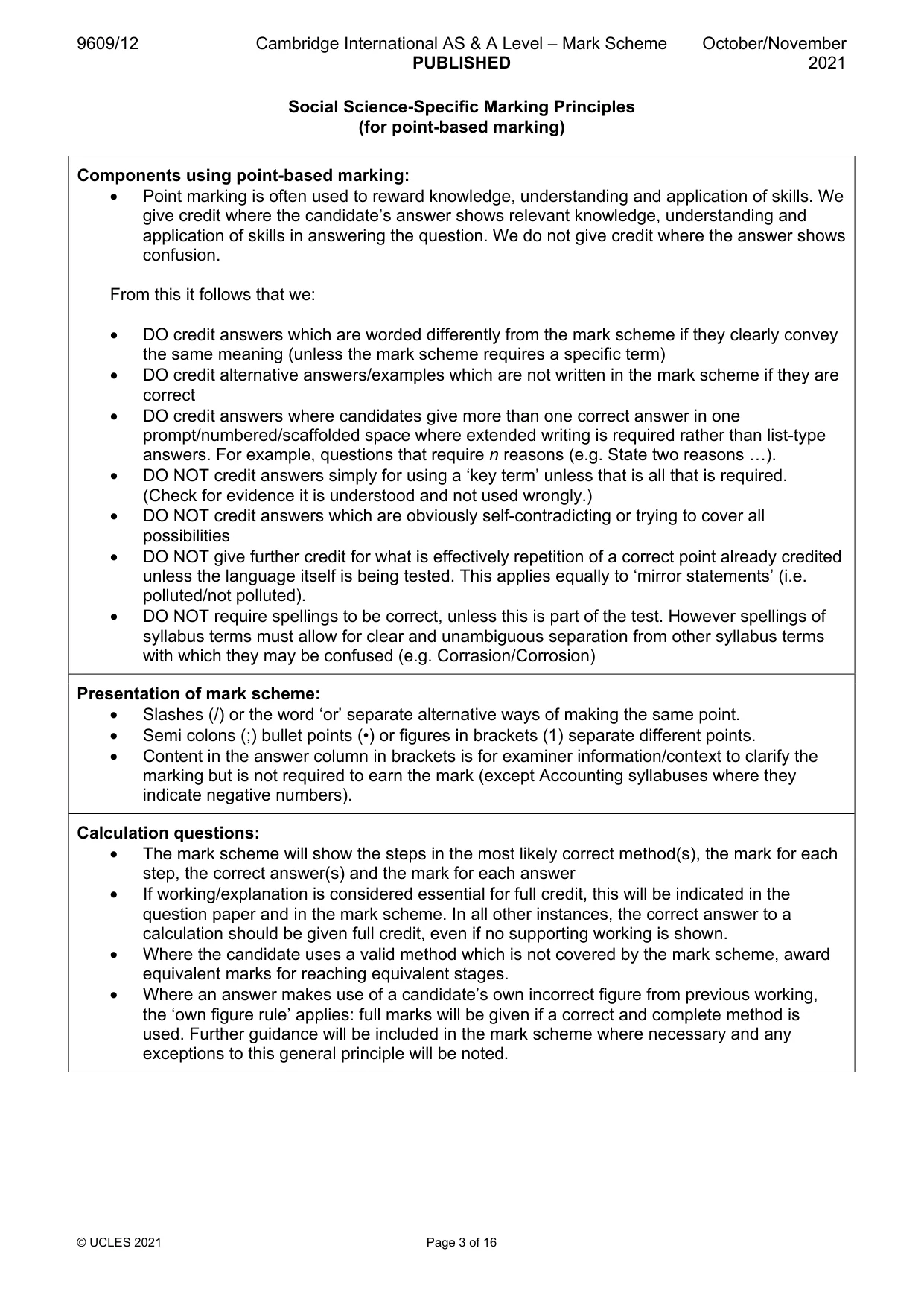
9609/12 Cambridge International AS & A Level – Mark Scheme PUBLISHED October/November 2021 © UCLES 2021 Page 3 of 16 Social Science-Specific Marking Principles (for point-based marking) Components using point-based marking: • Point marking is often used to reward knowledge, understanding and application of skills. We give credit where the candidate’s answer shows relevant knowledge, understanding and application of skills in answering the question. We do not give credit where the answer shows confusion. From this it follows that we: • DO credit answers which are worded differently from the mark scheme if they clearly convey the same meaning (unless the mark scheme requires a specific term) • DO credit alternative answers/examples which are not written in the mark scheme if they are correct • DO credit answers where candidates give more than one correct answer in one prompt/numbered/scaffolded space where extended writing is required rather than list-type answers. For example, questions that require n reasons (e.g. State two reasons …). • DO NOT credit answers simply for using a ‘key term’ unless that is all that is required. (Check for evidence it is understood and not used wrongly.) • DO NOT credit answers which are obviously self-contradicting or trying to cover all possibilities • DO NOT give further credit for what is effectively repetition of a correct point already credited unless the language itself is being tested. This applies equally to ‘mirror statements’ (i.e. polluted/not polluted). • DO NOT require spellings to be correct, unless this is part of the test. However spellings of syllabus terms must allow for clear and unambiguous separation from other syllabus terms with which they may be confused (e.g. Corrasion/Corrosion) Presentation of mark scheme: • Slashes (/) or the word ‘or’ separate alternative ways of making the same point. • Semi colons (;) bullet points (•) or figures in brackets (1) separate different points. • Content in the answer column in brackets is for examiner information/context to clarify the marking but is not required to earn the mark (except Accounting syllabuses where they indicate negative numbers). Calculation questions: • The mark scheme will show the steps in the most likely correct method(s), the mark for each step, the correct answer(s) and the mark for each answer • If working/explanation is considered essential for full credit, this will be indicated in the question paper and in the mark scheme. In all other instances, the correct answer to a calculation should be given full credit, even if no supporting working is shown. • Where the candidate uses a valid method which is not covered by the mark scheme, award equivalent marks for reaching equivalent stages. • Where an answer makes use of a candidate’s own incorrect figure from previous working, the ‘own figure rule’ applies: full marks will be given if a correct and complete method is used. Further guidance will be included in the mark scheme where necessary and any exceptions to this general principle will be noted.
Mark scheme, page 4
9609/12 Cambridge International AS & A Level – Mark Scheme PUBLISHED October/November 2021 © UCLES 2021 Page 4 of 16 Annotation: • For point marking, ticks can be used to indicate correct answers and crosses can be used to indicate wrong answers. There is no direct relationship between ticks and marks. Ticks have no defined meaning for levels of response marking. • For levels of response marking, the level awarded should be annotated on the script. • Other annotations will be used by examiners as agreed during standardisation, and the meaning will be understood by all examiners who marked that paper.
Mark scheme, page 5
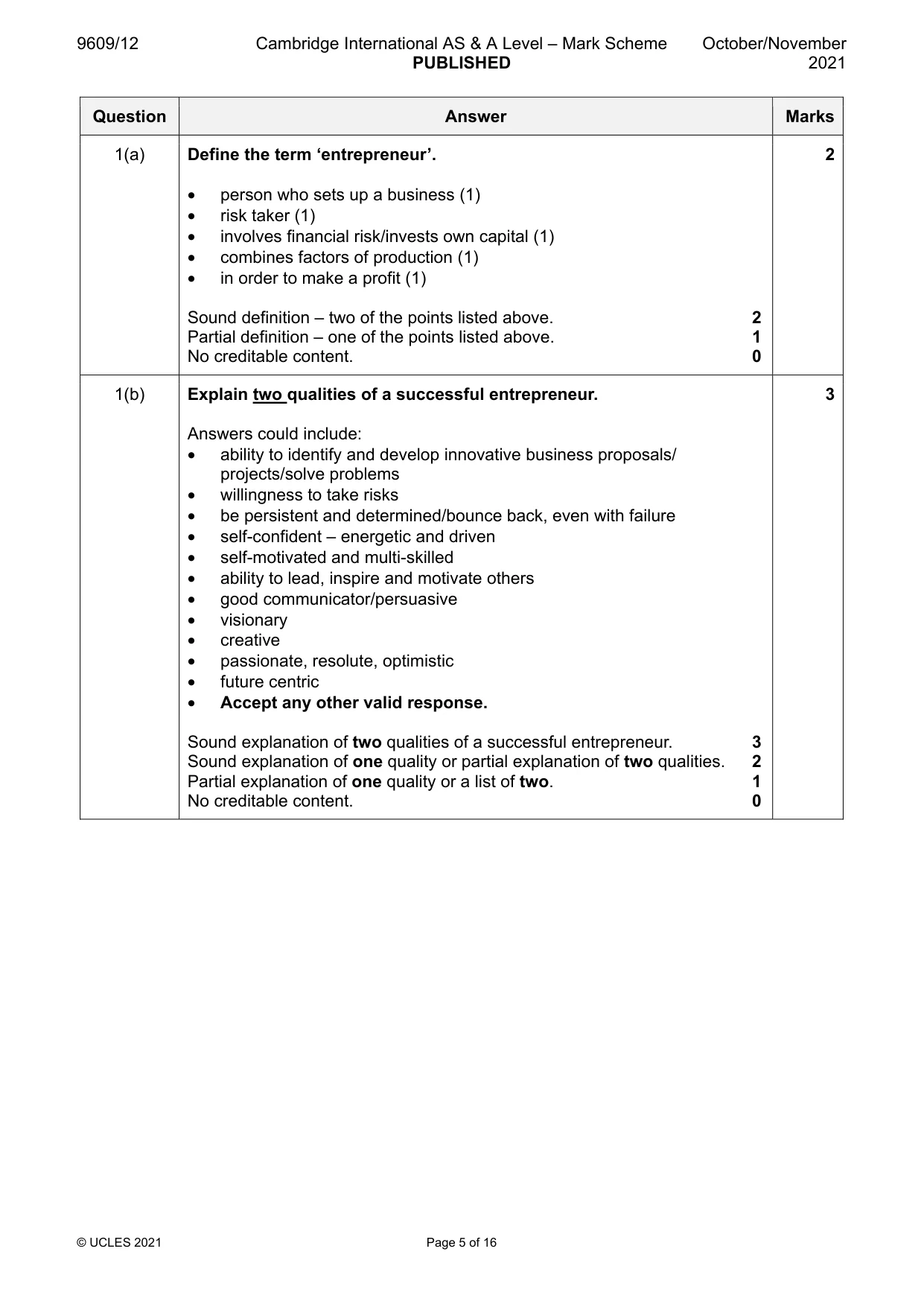
9609/12 Cambridge International AS & A Level – Mark Scheme PUBLISHED October/November 2021 © UCLES 2021 Page 5 of 16 Question Answer Marks 1(a) Define the term ‘entrepreneur’. • person who sets up a business (1) • risk taker (1) • involves financial risk/invests own capital (1) • combines factors of production (1) • in order to make a profit (1) Sound definition – two of the points listed above. 2 Partial definition – one of the points listed above. 1 No creditable content. 0 2 1(b) Explain two qualities of a successful entrepreneur. Answers could include: • ability to identify and develop innovative business proposals/ projects/solve problems • willingness to take risks • be persistent and determined/bounce back, even with failure • self-confident – energetic and driven • self-motivated and multi-skilled • ability to lead, inspire and motivate others • good communicator/persuasive • visionary • creative • passionate, resolute, optimistic • future centric • Accept any other valid response. Sound explanation of two qualities of a successful entrepreneur. 3 Sound explanation of one quality or partial explanation of two qualities. 2 Partial explanation of one quality or a list of two. 1 No creditable content. 0 3
Mark scheme, page 6
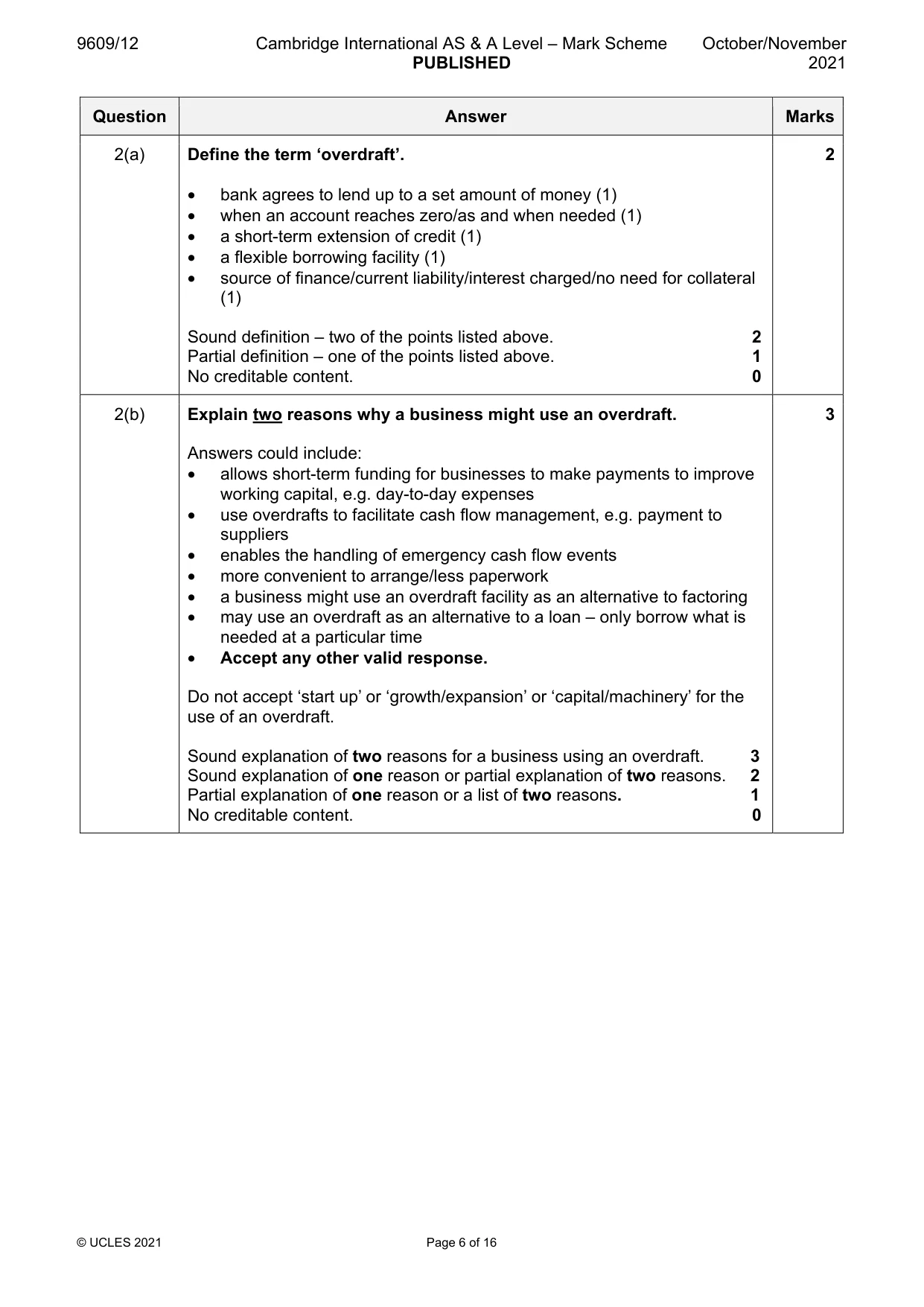
9609/12 Cambridge International AS & A Level – Mark Scheme PUBLISHED October/November 2021 © UCLES 2021 Page 6 of 16 Question Answer Marks 2(a) Define the term ‘overdraft’. • bank agrees to lend up to a set amount of money (1) • when an account reaches zero/as and when needed (1) • a short-term extension of credit (1) • a flexible borrowing facility (1) • source of finance/current liability/interest charged/no need for collateral (1) Sound definition – two of the points listed above. 2 Partial definition – one of the points listed above. 1 No creditable content. 0 2 2(b) Explain two reasons why a business might use an overdraft. Answers could include: • allows short-term funding for businesses to make payments to improve working capital, e.g. day-to-day expenses • use overdrafts to facilitate cash flow management, e.g. payment to suppliers • enables the handling of emergency cash flow events • more convenient to arrange/less paperwork • a business might use an overdraft facility as an alternative to factoring • may use an overdraft as an alternative to a loan – only borrow what is needed at a particular time • Accept any other valid response. Do not accept ‘start up’ or ‘growth/expansion’ or ‘capital/machinery’ for the use of an overdraft. Sound explanation of two reasons for a business using an overdraft. 3 Sound explanation of one reason or partial explanation of two reasons. 2 Partial explanation of one reason or a list of two reasons. 1 No creditable content. 0 3
Mark scheme, page 7
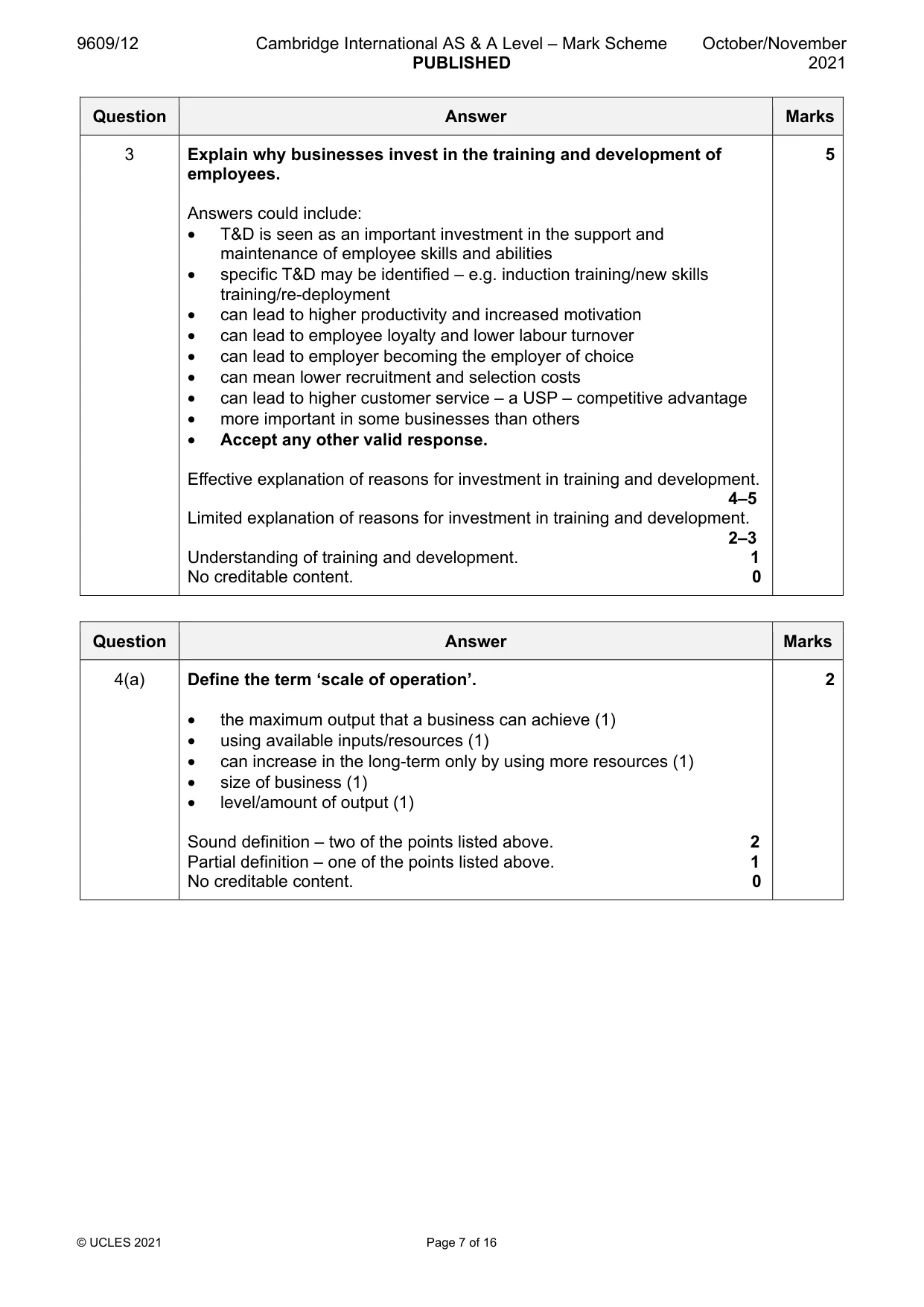
9609/12 Cambridge International AS & A Level – Mark Scheme PUBLISHED October/November 2021 © UCLES 2021 Page 7 of 16 Question Answer Marks 3 Explain why businesses invest in the training and development of employees. Answers could include: • T&D is seen as an important investment in the support and maintenance of employee skills and abilities • specific T&D may be identified – e.g. induction training/new skills training/re-deployment • can lead to higher productivity and increased motivation • can lead to employee loyalty and lower labour turnover • can lead to employer becoming the employer of choice • can mean lower recruitment and selection costs • can lead to higher customer service – a USP – competitive advantage • more important in some businesses than others • Accept any other valid response. Effective explanation of reasons for investment in training and development. 4–5 Limited explanation of reasons for investment in training and development. 2–3 Understanding of training and development. 1 No creditable content. 0 5 Question Answer Marks 4(a) Define the term ‘scale of operation’. • the maximum output that a business can achieve (1) • using available inputs/resources (1) • can increase in the long-term only by using more resources (1) • size of business (1) • level/amount of output (1) Sound definition – two of the points listed above. 2 Partial definition – one of the points listed above. 1 No creditable content. 0 2
Mark scheme, page 8
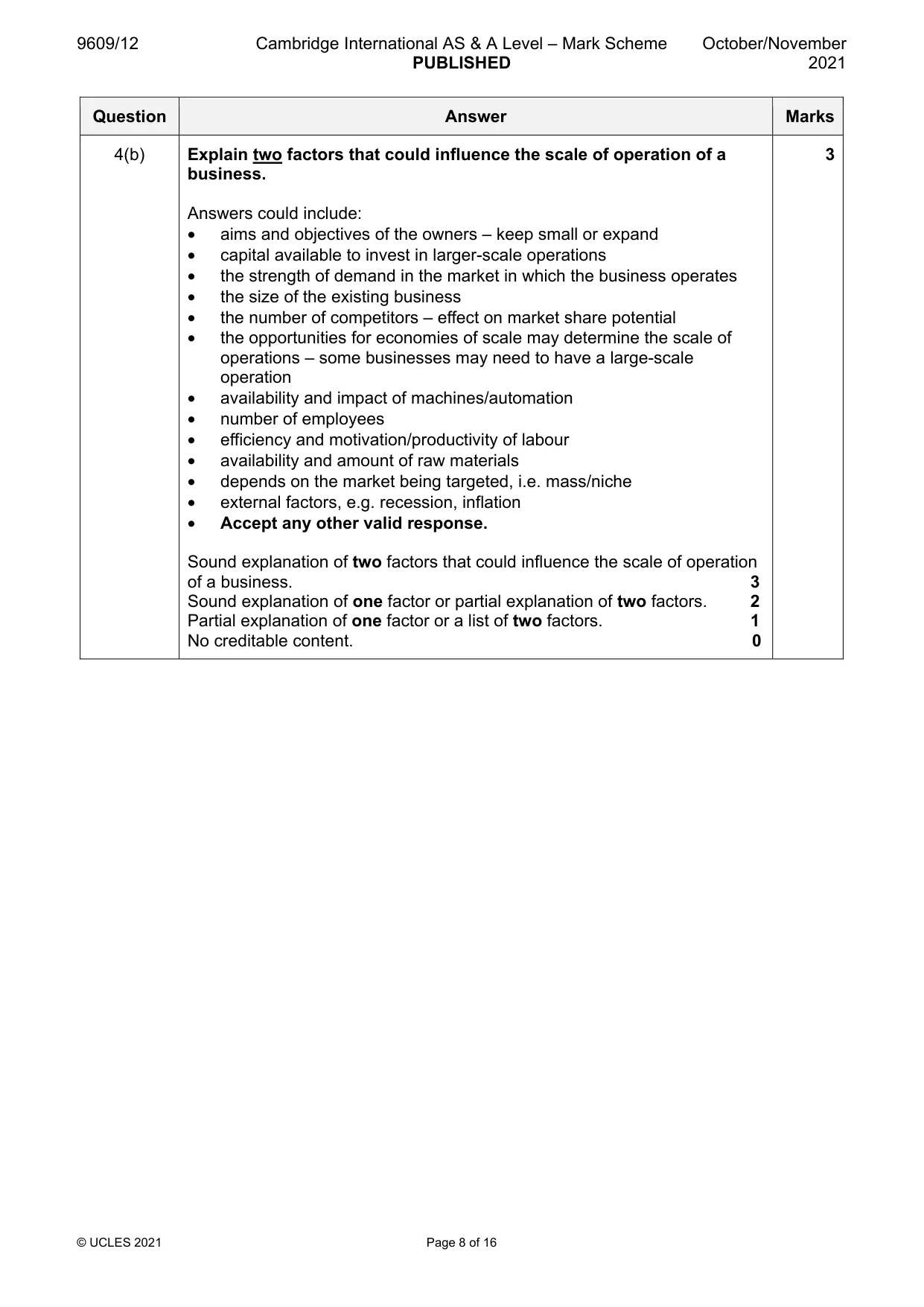
9609/12 Cambridge International AS & A Level – Mark Scheme PUBLISHED October/November 2021 © UCLES 2021 Page 8 of 16 Question Answer Marks 4(b) Explain two factors that could influence the scale of operation of a business. Answers could include: • aims and objectives of the owners – keep small or expand • capital available to invest in larger-scale operations • the strength of demand in the market in which the business operates • the size of the existing business • the number of competitors – effect on market share potential • the opportunities for economies of scale may determine the scale of operations – some businesses may need to have a large-scale operation • availability and impact of machines/automation • number of employees • efficiency and motivation/productivity of labour • availability and amount of raw materials • depends on the market being targeted, i.e. mass/niche • external factors, e.g. recession, inflation • Accept any other valid response. Sound explanation of two factors that could influence the scale of operation of a business. 3 Sound explanation of one factor or partial explanation of two factors. 2 Partial explanation of one factor or a list of two factors. 1 No creditable content. 0 3
Mark scheme, page 9
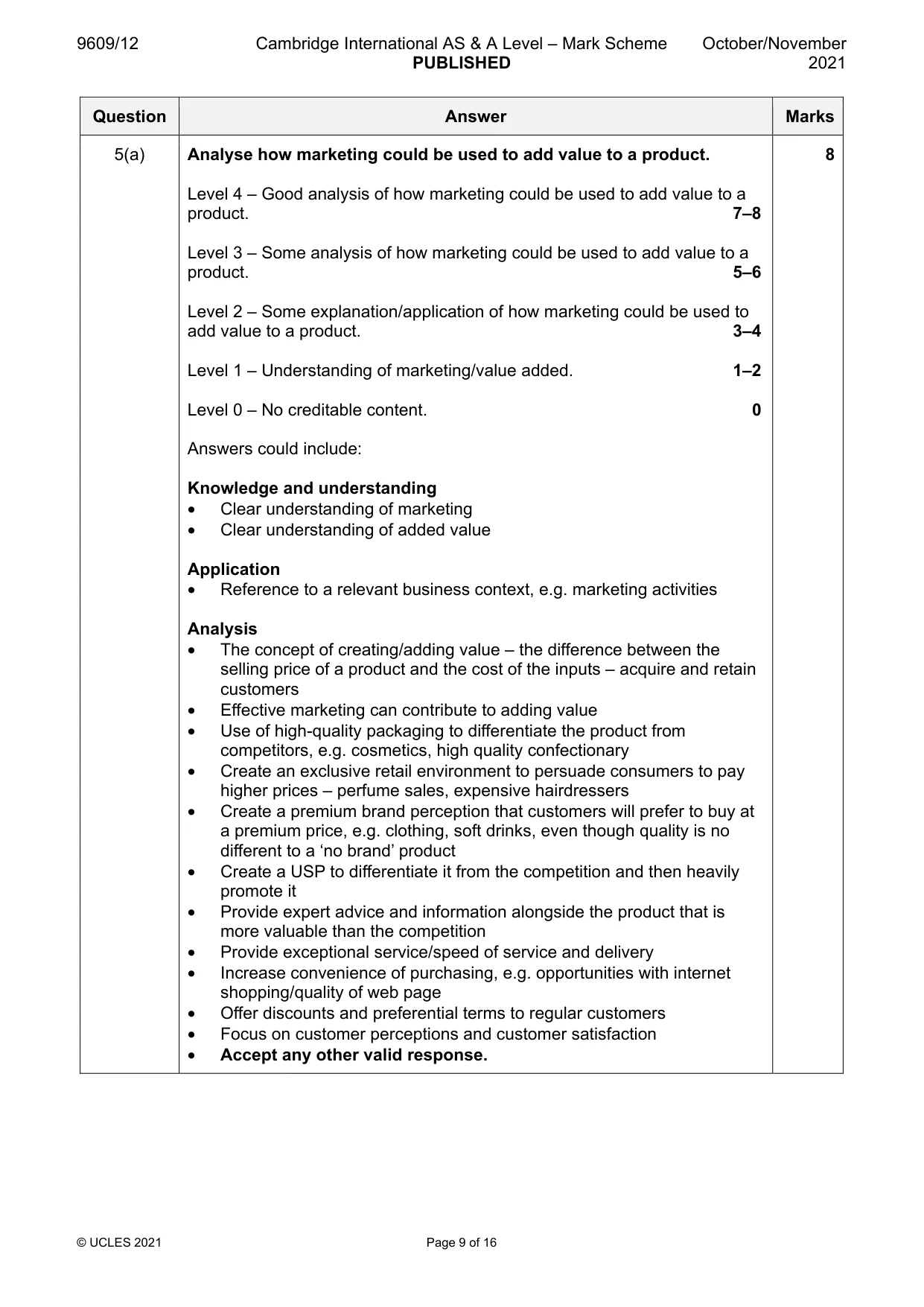
9609/12 Cambridge International AS & A Level – Mark Scheme PUBLISHED October/November 2021 © UCLES 2021 Page 9 of 16 Question Answer Marks 5(a) Analyse how marketing could be used to add value to a product. Level 4 – Good analysis of how marketing could be used to add value to a product. 7–8 Level 3 – Some analysis of how marketing could be used to add value to a product. 5–6 Level 2 – Some explanation/application of how marketing could be used to add value to a product. 3–4 Level 1 – Understanding of marketing/value added. 1–2 Level 0 – No creditable content. 0 Answers could include: Knowledge and understanding • Clear understanding of marketing • Clear understanding of added value Application • Reference to a relevant business context, e.g. marketing activities Analysis • The concept of creating/adding value – the difference between the selling price of a product and the cost of the inputs – acquire and retain customers • Effective marketing can contribute to adding value • Use of high-quality packaging to differentiate the product from competitors, e.g. cosmetics, high quality confectionary • Create an exclusive retail environment to persuade consumers to pay higher prices – perfume sales, expensive hairdressers • Create a premium brand perception that customers will prefer to buy at a premium price, e.g. clothing, soft drinks, even though quality is no different to a ‘no brand’ product • Create a USP to differentiate it from the competition and then heavily promote it • Provide expert advice and information alongside the product that is more valuable than the competition • Provide exceptional service/speed of service and delivery • Increase convenience of purchasing, e.g. opportunities with internet shopping/quality of web page • Offer discounts and preferential terms to regular customers • Focus on customer perceptions and customer satisfaction • Accept any other valid response. 8
Mark scheme, page 10
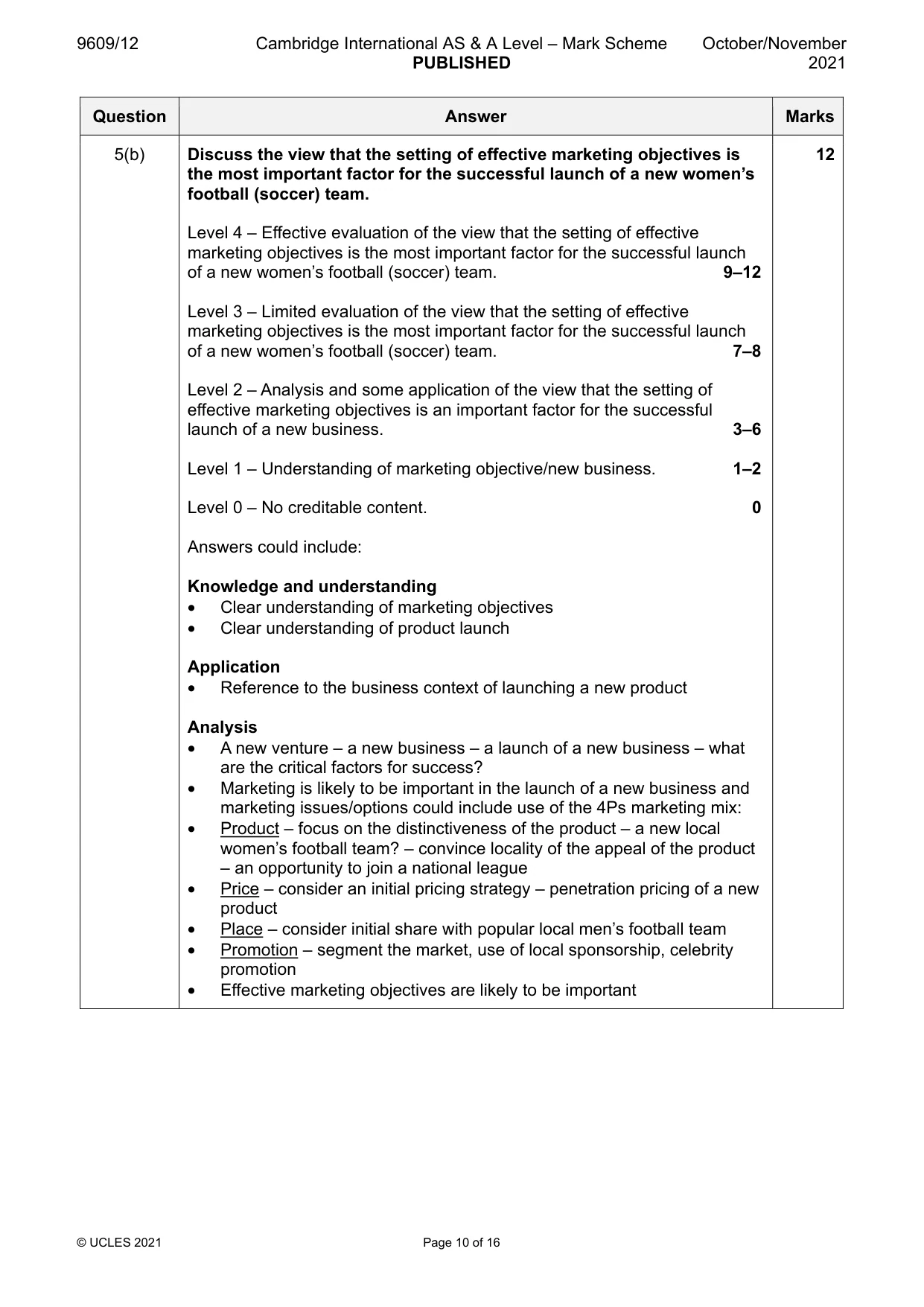
9609/12 Cambridge International AS & A Level – Mark Scheme PUBLISHED October/November 2021 © UCLES 2021 Page 10 of 16 Question Answer Marks 5(b) Discuss the view that the setting of effective marketing objectives is the most important factor for the successful launch of a new women’s football (soccer) team. Level 4 – Effective evaluation of the view that the setting of effective marketing objectives is the most important factor for the successful launch of a new women’s football (soccer) team. 9–12 Level 3 – Limited evaluation of the view that the setting of effective marketing objectives is the most important factor for the successful launch of a new women’s football (soccer) team. 7–8 Level 2 – Analysis and some application of the view that the setting of effective marketing objectives is an important factor for the successful launch of a new business. 3–6 Level 1 – Understanding of marketing objective/new business. 1–2 Level 0 – No creditable content. 0 Answers could include: Knowledge and understanding • Clear understanding of marketing objectives • Clear understanding of product launch Application • Reference to the business context of launching a new product Analysis • A new venture – a new business – a launch of a new business – what are the critical factors for success? • Marketing is likely to be important in the launch of a new business and marketing issues/options could include use of the 4Ps marketing mix: • Product – focus on the distinctiveness of the product – a new local women’s football team? – convince locality of the appeal of the product – an opportunity to join a national league • Price – consider an initial pricing strategy – penetration pricing of a new product • Place – consider initial share with popular local men’s football team • Promotion – segment the market, use of local sponsorship, celebrity promotion • Effective marketing objectives are likely to be important 12
Mark scheme, page 11
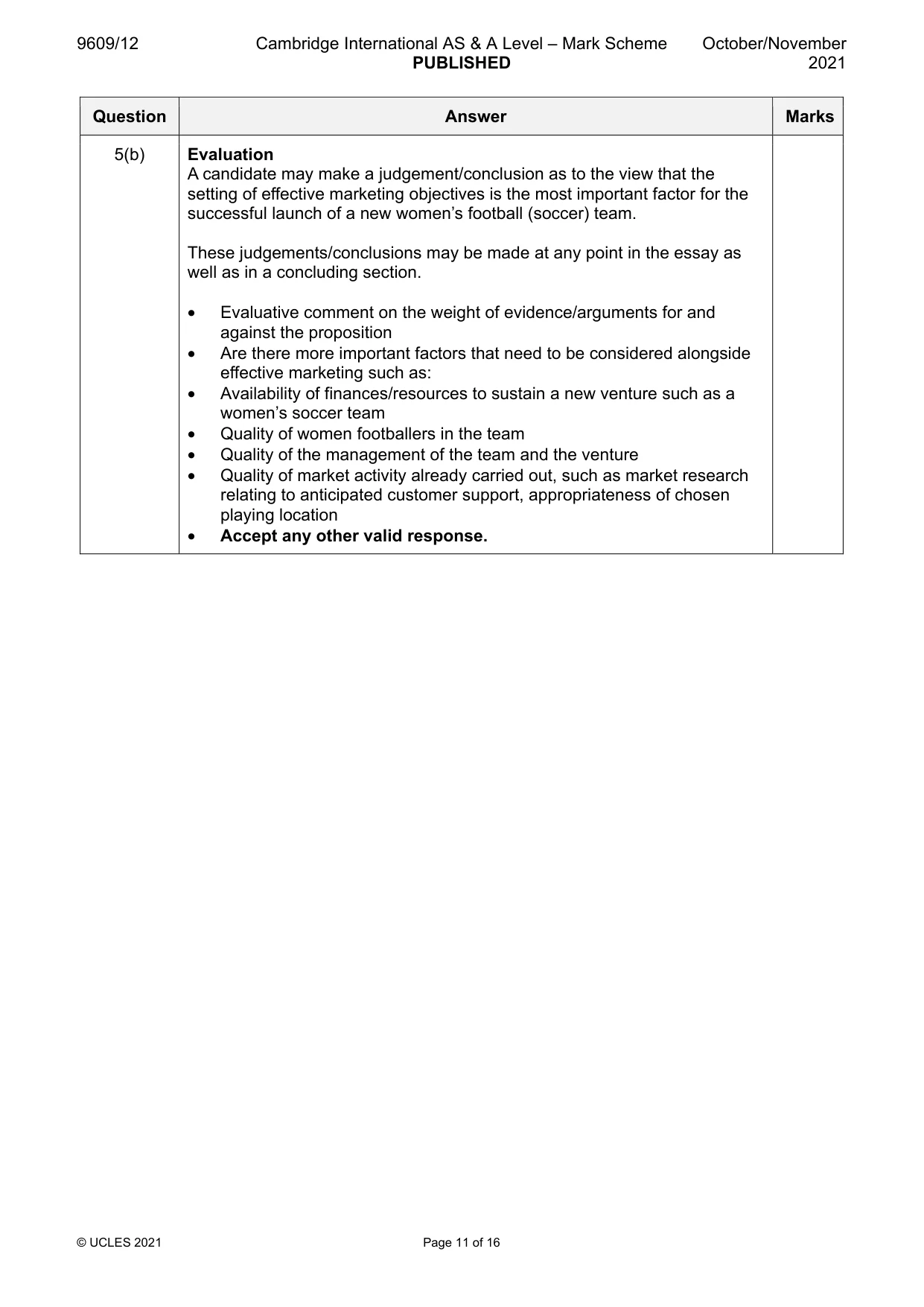
9609/12 Cambridge International AS & A Level – Mark Scheme PUBLISHED October/November 2021 © UCLES 2021 Page 11 of 16 Question Answer Marks 5(b) Evaluation A candidate may make a judgement/conclusion as to the view that the setting of effective marketing objectives is the most important factor for the successful launch of a new women’s football (soccer) team. These judgements/conclusions may be made at any point in the essay as well as in a concluding section. • Evaluative comment on the weight of evidence/arguments for and against the proposition • Are there more important factors that need to be considered alongside effective marketing such as: • Availability of finances/resources to sustain a new venture such as a women’s soccer team • Quality of women footballers in the team • Quality of the management of the team and the venture • Quality of market activity already carried out, such as market research relating to anticipated customer support, appropriateness of chosen playing location • Accept any other valid response.
Mark scheme, page 12
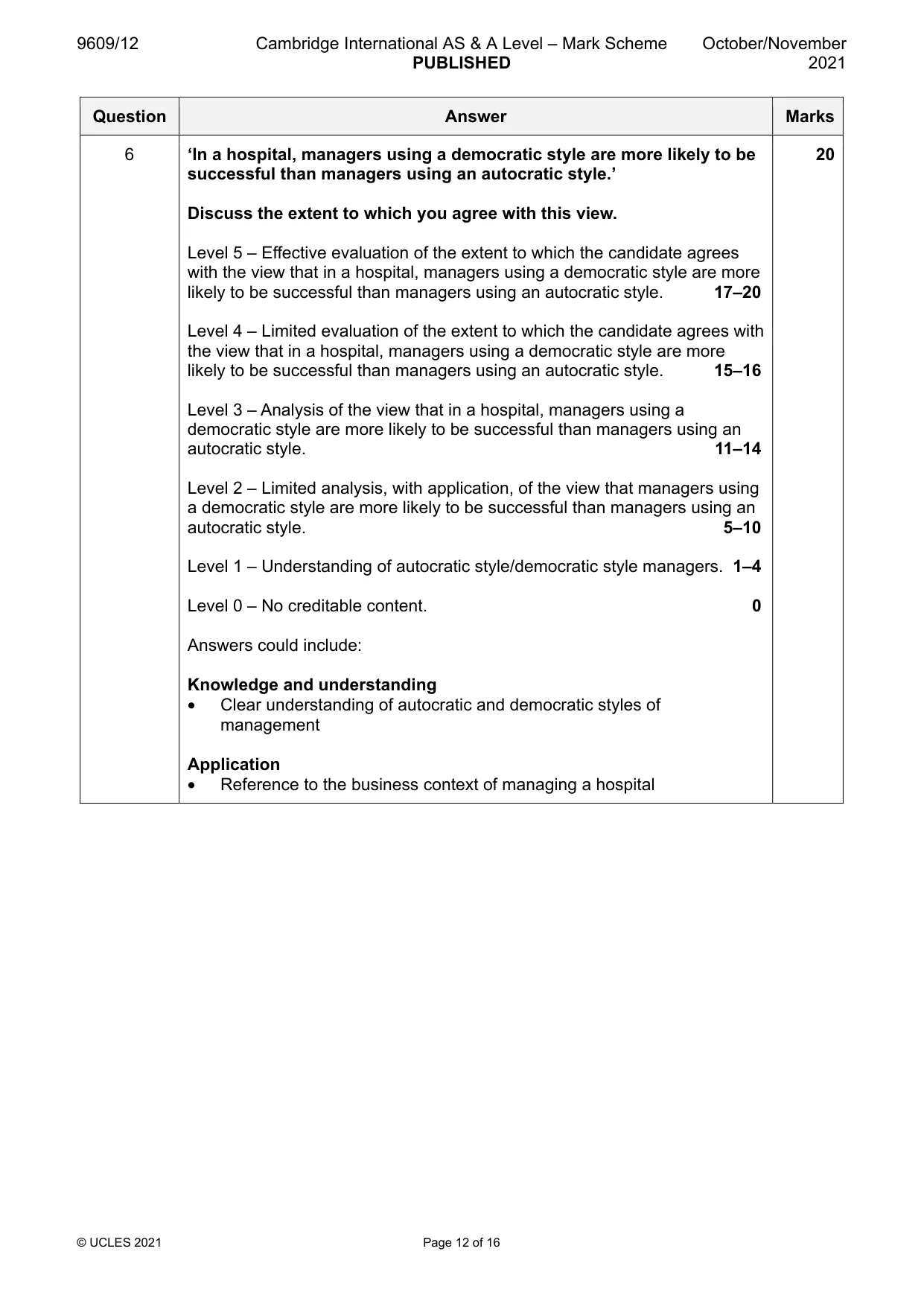
9609/12 Cambridge International AS & A Level – Mark Scheme PUBLISHED October/November 2021 © UCLES 2021 Page 12 of 16 Question Answer Marks 6 ‘In a hospital, managers using a democratic style are more likely to be successful than managers using an autocratic style.’ Discuss the extent to which you agree with this view. Level 5 – Effective evaluation of the extent to which the candidate agrees with the view that in a hospital, managers using a democratic style are more likely to be successful than managers using an autocratic style. 17–20 Level 4 – Limited evaluation of the extent to which the candidate agrees with the view that in a hospital, managers using a democratic style are more likely to be successful than managers using an autocratic style. 15–16 Level 3 – Analysis of the view that in a hospital, managers using a democratic style are more likely to be successful than managers using an autocratic style. 11–14 Level 2 – Limited analysis, with application, of the view that managers using a democratic style are more likely to be successful than managers using an autocratic style. 5–10 Level 1 – Understanding of autocratic style/democratic style managers. 1–4 Level 0 – No creditable content. 0 Answers could include: Knowledge and understanding • Clear understanding of autocratic and democratic styles of management Application • Reference to the business context of managing a hospital 20
Mark scheme, page 13
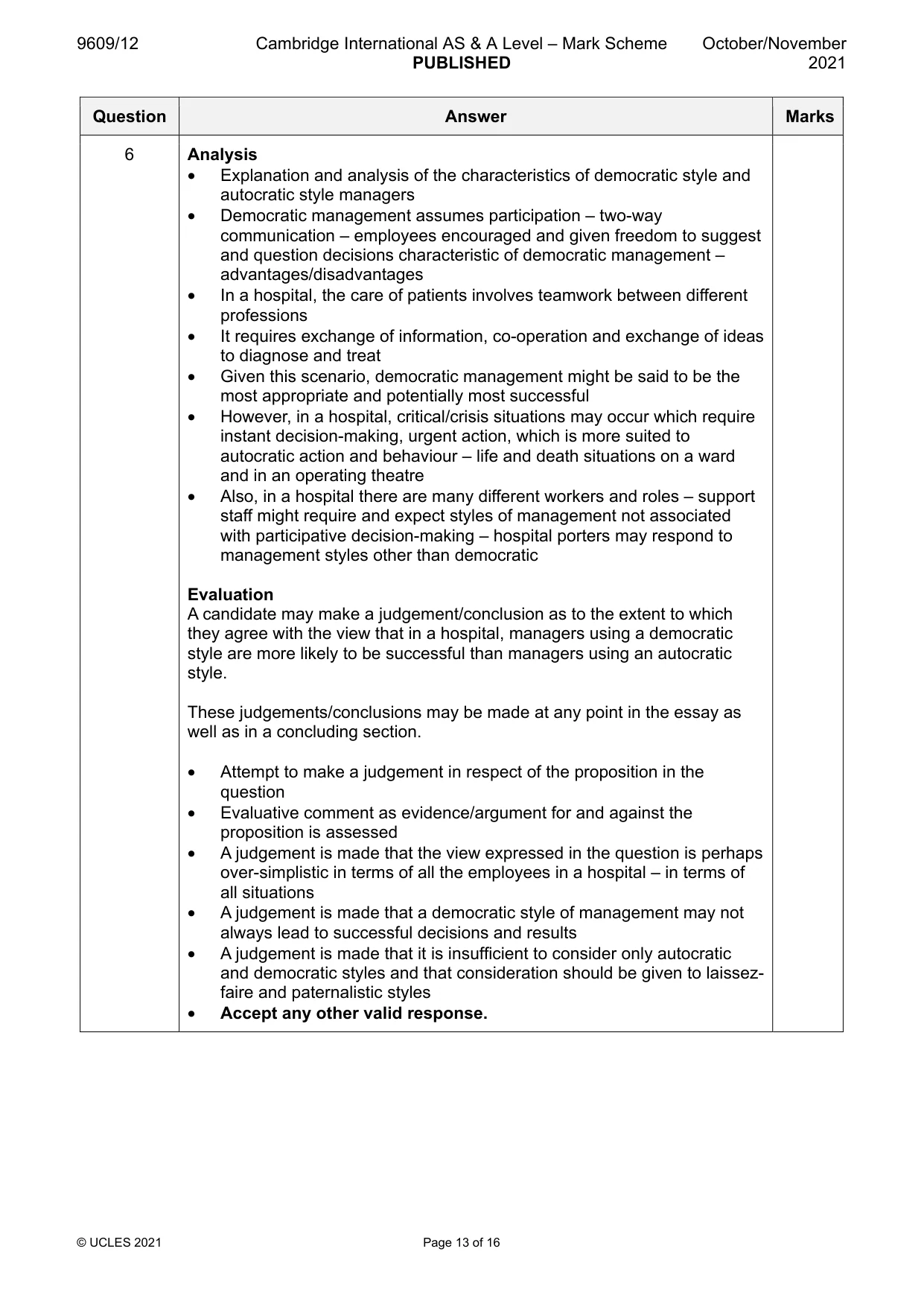
9609/12 Cambridge International AS & A Level – Mark Scheme PUBLISHED October/November 2021 © UCLES 2021 Page 13 of 16 Question Answer Marks 6 Analysis • Explanation and analysis of the characteristics of democratic style and autocratic style managers • Democratic management assumes participation – two-way communication – employees encouraged and given freedom to suggest and question decisions characteristic of democratic management – advantages/disadvantages • In a hospital, the care of patients involves teamwork between different professions • It requires exchange of information, co-operation and exchange of ideas to diagnose and treat • Given this scenario, democratic management might be said to be the most appropriate and potentially most successful • However, in a hospital, critical/crisis situations may occur which require instant decision-making, urgent action, which is more suited to autocratic action and behaviour – life and death situations on a ward and in an operating theatre • Also, in a hospital there are many different workers and roles – support staff might require and expect styles of management not associated with participative decision-making – hospital porters may respond to management styles other than democratic Evaluation A candidate may make a judgement/conclusion as to the extent to which they agree with the view that in a hospital, managers using a democratic style are more likely to be successful than managers using an autocratic style. These judgements/conclusions may be made at any point in the essay as well as in a concluding section. • Attempt to make a judgement in respect of the proposition in the question • Evaluative comment as evidence/argument for and against the proposition is assessed • A judgement is made that the view expressed in the question is perhaps over-simplistic in terms of all the employees in a hospital – in terms of all situations • A judgement is made that a democratic style of management may not always lead to successful decisions and results • A judgement is made that it is insufficient to consider only autocratic and democratic styles and that consideration should be given to laissez- faire and paternalistic styles • Accept any other valid response.
Mark scheme, page 14
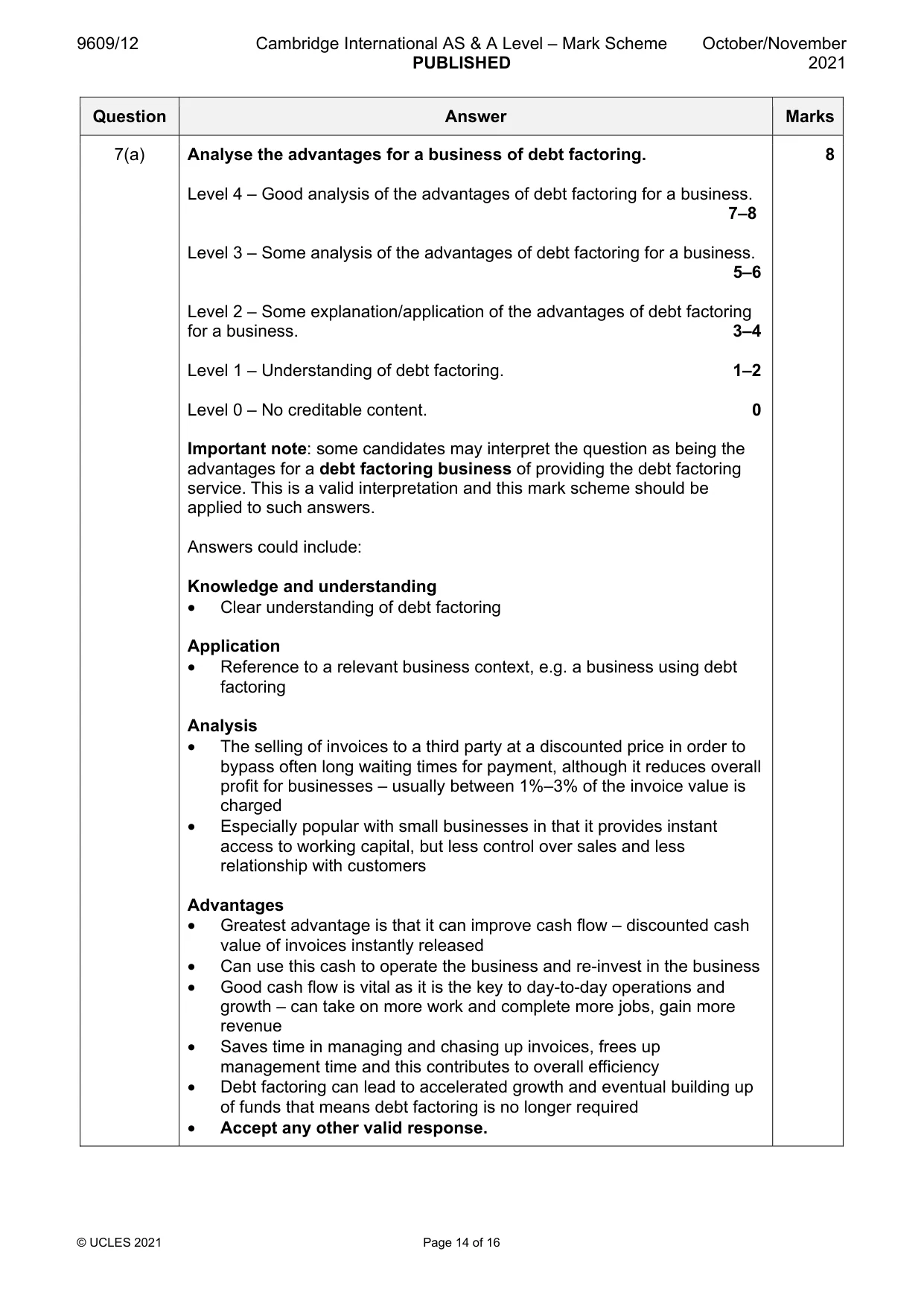
9609/12 Cambridge International AS & A Level – Mark Scheme PUBLISHED October/November 2021 © UCLES 2021 Page 14 of 16 Question Answer Marks 7(a) Analyse the advantages for a business of debt factoring. Level 4 – Good analysis of the advantages of debt factoring for a business. 7–8 Level 3 – Some analysis of the advantages of debt factoring for a business. 5–6 Level 2 – Some explanation/application of the advantages of debt factoring for a business. 3–4 Level 1 – Understanding of debt factoring. 1–2 Level 0 – No creditable content. 0 Important note: some candidates may interpret the question as being the advantages for a debt factoring business of providing the debt factoring service. This is a valid interpretation and this mark scheme should be applied to such answers. Answers could include: Knowledge and understanding • Clear understanding of debt factoring Application • Reference to a relevant business context, e.g. a business using debt factoring Analysis • The selling of invoices to a third party at a discounted price in order to bypass often long waiting times for payment, although it reduces overall profit for businesses – usually between 1%–3% of the invoice value is charged • Especially popular with small businesses in that it provides instant access to working capital, but less control over sales and less relationship with customers Advantages • Greatest advantage is that it can improve cash flow – discounted cash value of invoices instantly released • Can use this cash to operate the business and re-invest in the business • Good cash flow is vital as it is the key to day-to-day operations and growth – can take on more work and complete more jobs, gain more revenue • Saves time in managing and chasing up invoices, frees up management time and this contributes to overall efficiency • Debt factoring can lead to accelerated growth and eventual building up of funds that means debt factoring is no longer required • Accept any other valid response. 8
Mark scheme, page 15
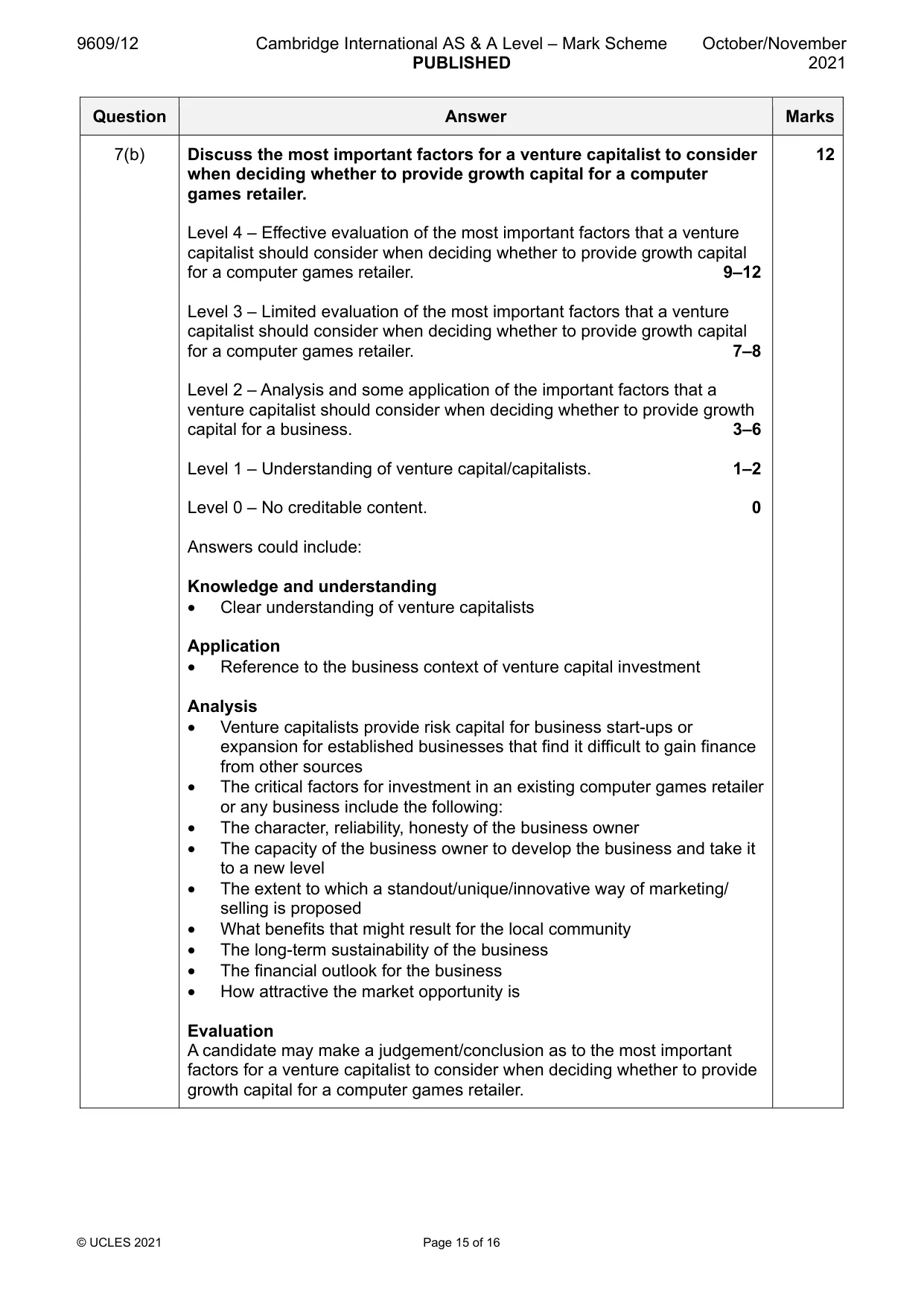
9609/12 Cambridge International AS & A Level – Mark Scheme PUBLISHED October/November 2021 © UCLES 2021 Page 15 of 16 Question Answer Marks 7(b) Discuss the most important factors for a venture capitalist to consider when deciding whether to provide growth capital for a computer games retailer. Level 4 – Effective evaluation of the most important factors that a venture capitalist should consider when deciding whether to provide growth capital for a computer games retailer. 9–12 Level 3 – Limited evaluation of the most important factors that a venture capitalist should consider when deciding whether to provide growth capital for a computer games retailer. 7–8 Level 2 – Analysis and some application of the important factors that a venture capitalist should consider when deciding whether to provide growth capital for a business. 3–6 Level 1 – Understanding of venture capital/capitalists. 1–2 Level 0 – No creditable content. 0 Answers could include: Knowledge and understanding • Clear understanding of venture capitalists Application • Reference to the business context of venture capital investment Analysis • Venture capitalists provide risk capital for business start-ups or expansion for established businesses that find it difficult to gain finance from other sources • The critical factors for investment in an existing computer games retailer or any business include the following: • The character, reliability, honesty of the business owner • The capacity of the business owner to develop the business and take it to a new level • The extent to which a standout/unique/innovative way of marketing/ selling is proposed • What benefits that might result for the local community • The long-term sustainability of the business • The financial outlook for the business • How attractive the market opportunity is Evaluation A candidate may make a judgement/conclusion as to the most important factors for a venture capitalist to consider when deciding whether to provide growth capital for a computer games retailer. 12
Mark scheme, page 16
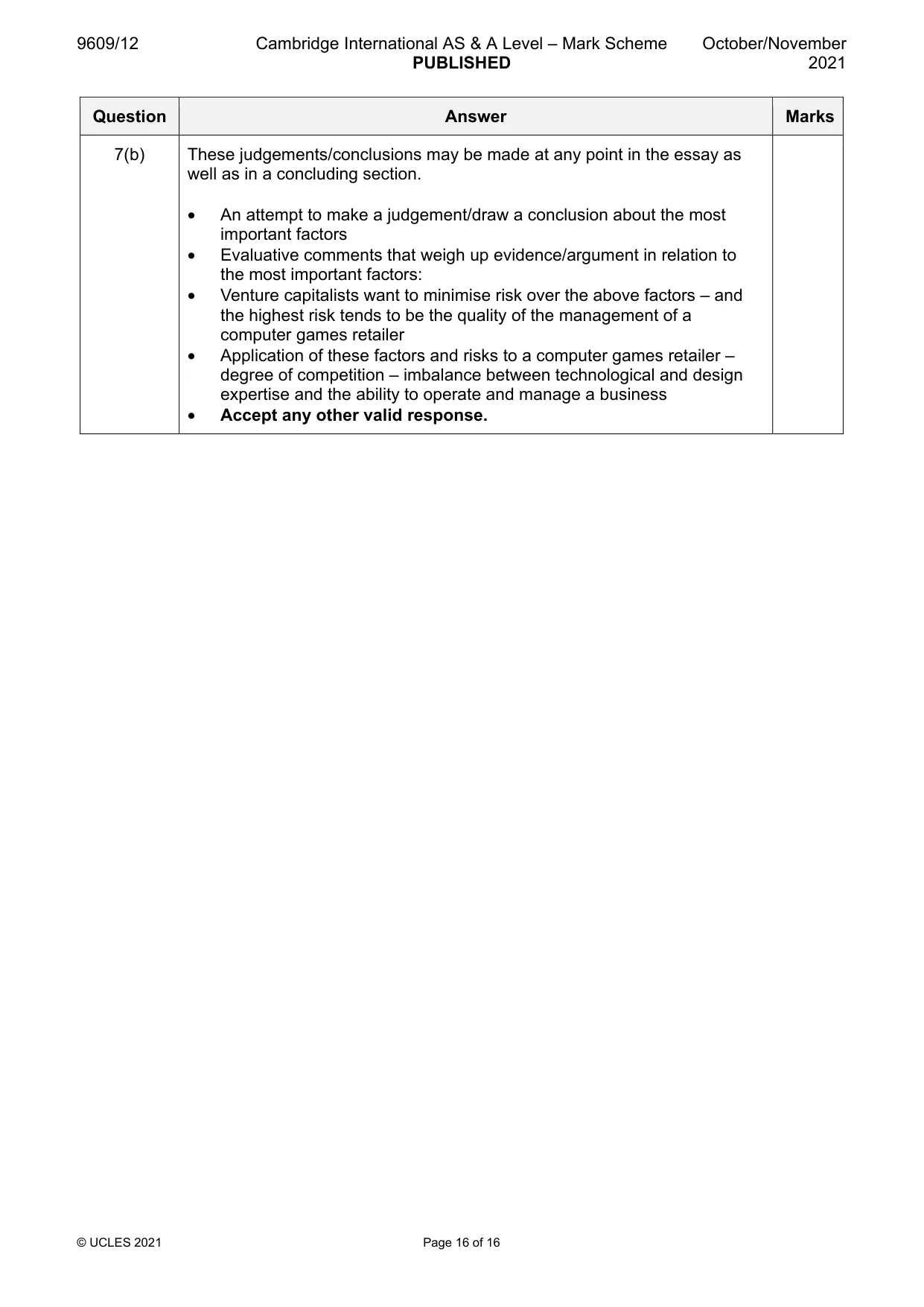
9609/12 Cambridge International AS & A Level – Mark Scheme PUBLISHED October/November 2021 © UCLES 2021 Page 16 of 16 Question Answer Marks 7(b) These judgements/conclusions may be made at any point in the essay as well as in a concluding section. • An attempt to make a judgement/draw a conclusion about the most important factors • Evaluative comments that weigh up evidence/argument in relation to the most important factors: • Venture capitalists want to minimise risk over the above factors – and the highest risk tends to be the quality of the management of a computer games retailer • Application of these factors and risks to a computer games retailer – degree of competition – imbalance between technological and design expertise and the ability to operate and manage a business • Accept any other valid response.
What you needed in this session
Cambridge’s own grade thresholds for 2021 Oct/Nov, Paper 1 · Variant 2. A higher threshold means an easier paper — the bar moves with how the cohort did.