Cambridge A Level Business (for first examination in 2016) 9609 — 2024 Feb/March Paper 1 · Variant 2
9609/12/F/M/24 · 40 marks · ≈45 min
The question paper and its mark scheme, free to read here and free to download. This is Cambridge’s own paper, exactly as it was sat.
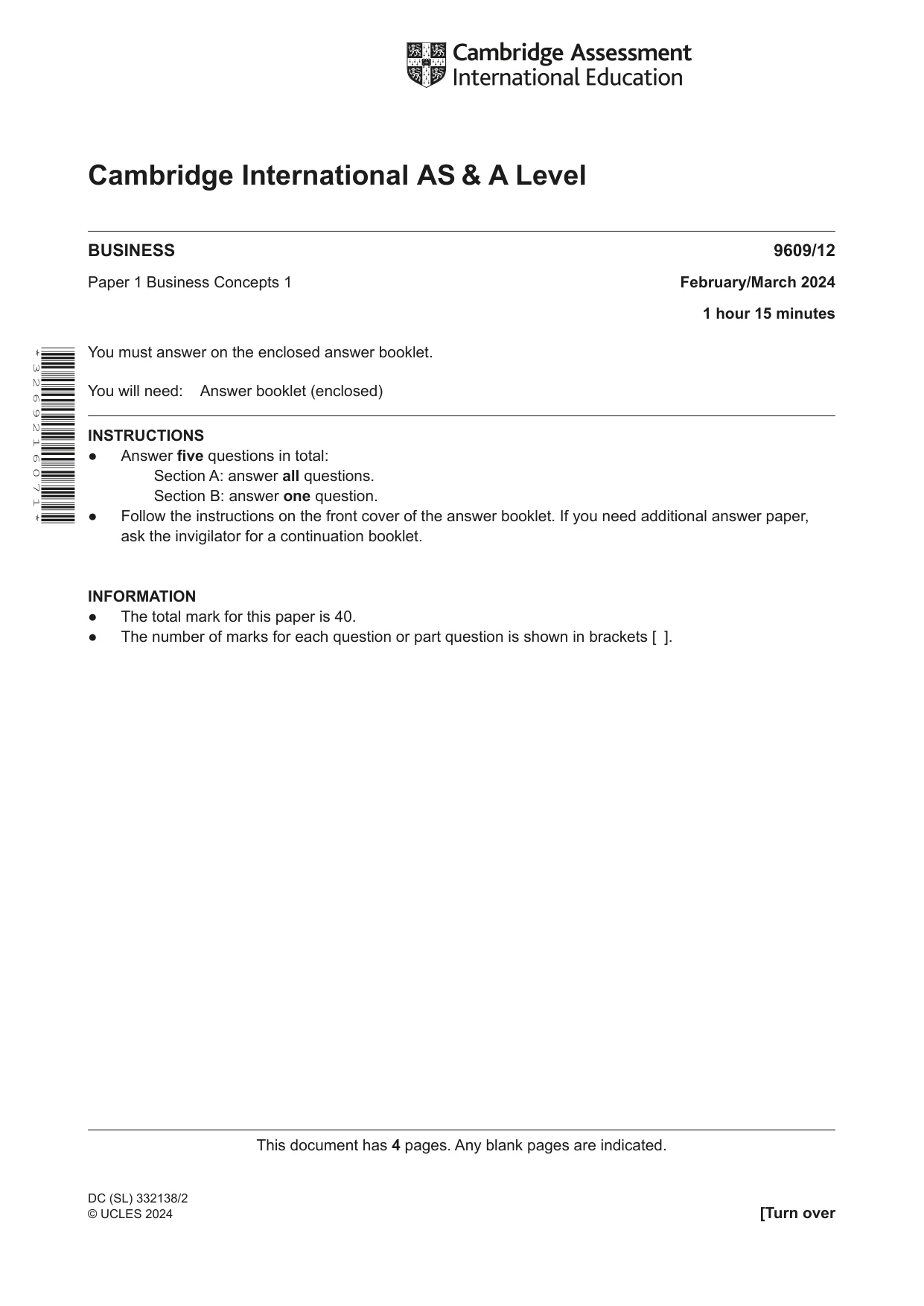
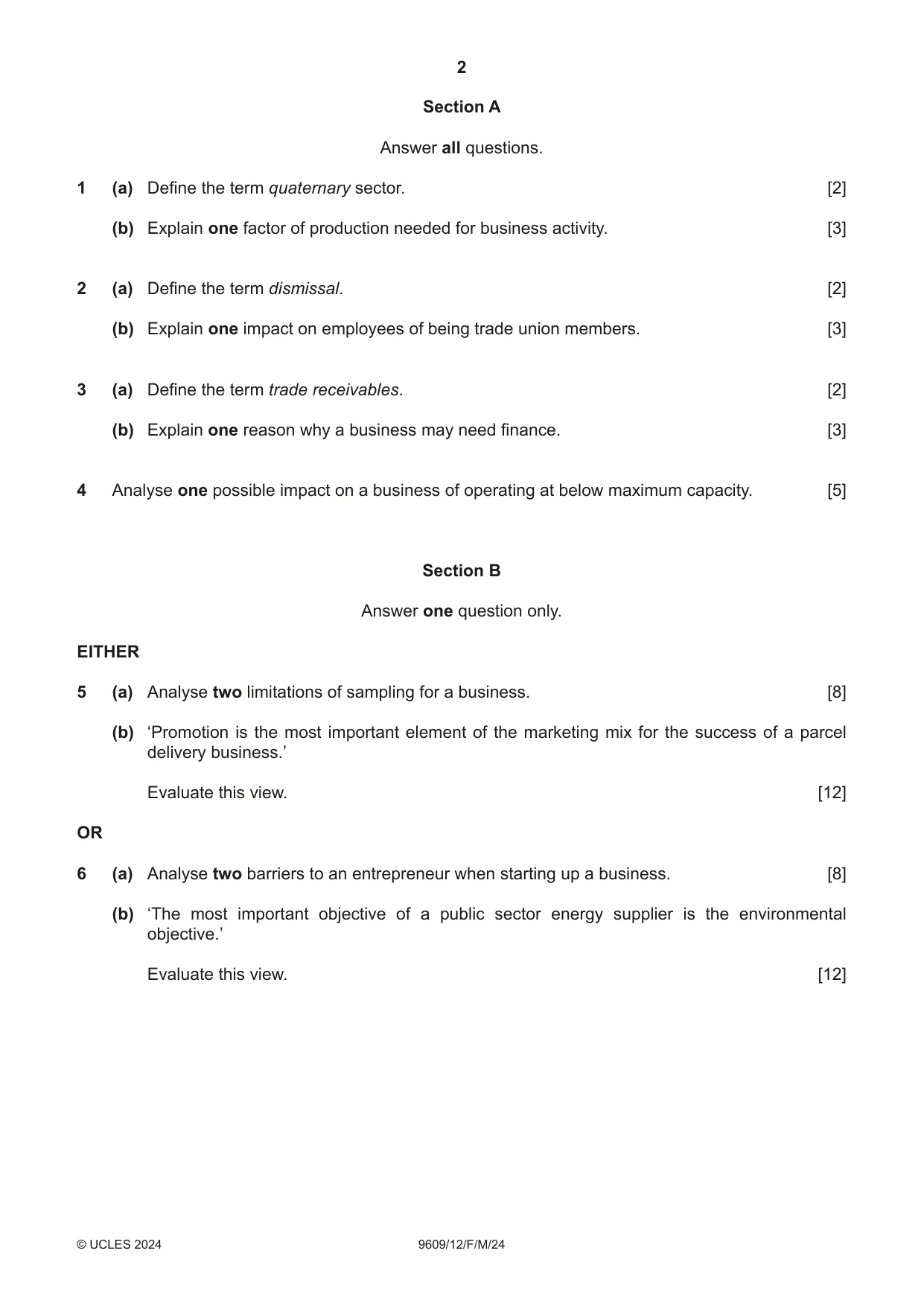
Question paper4 pages


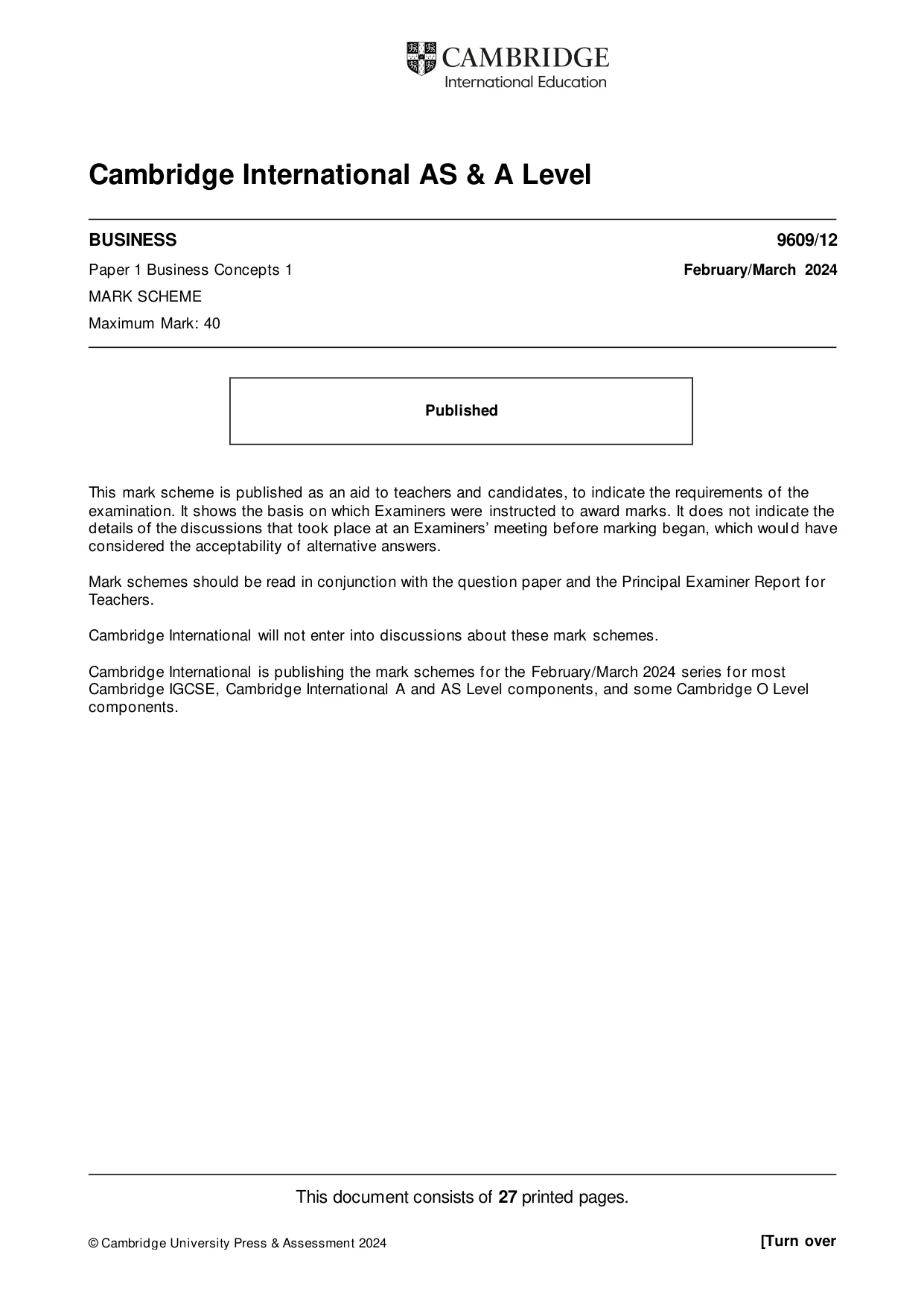
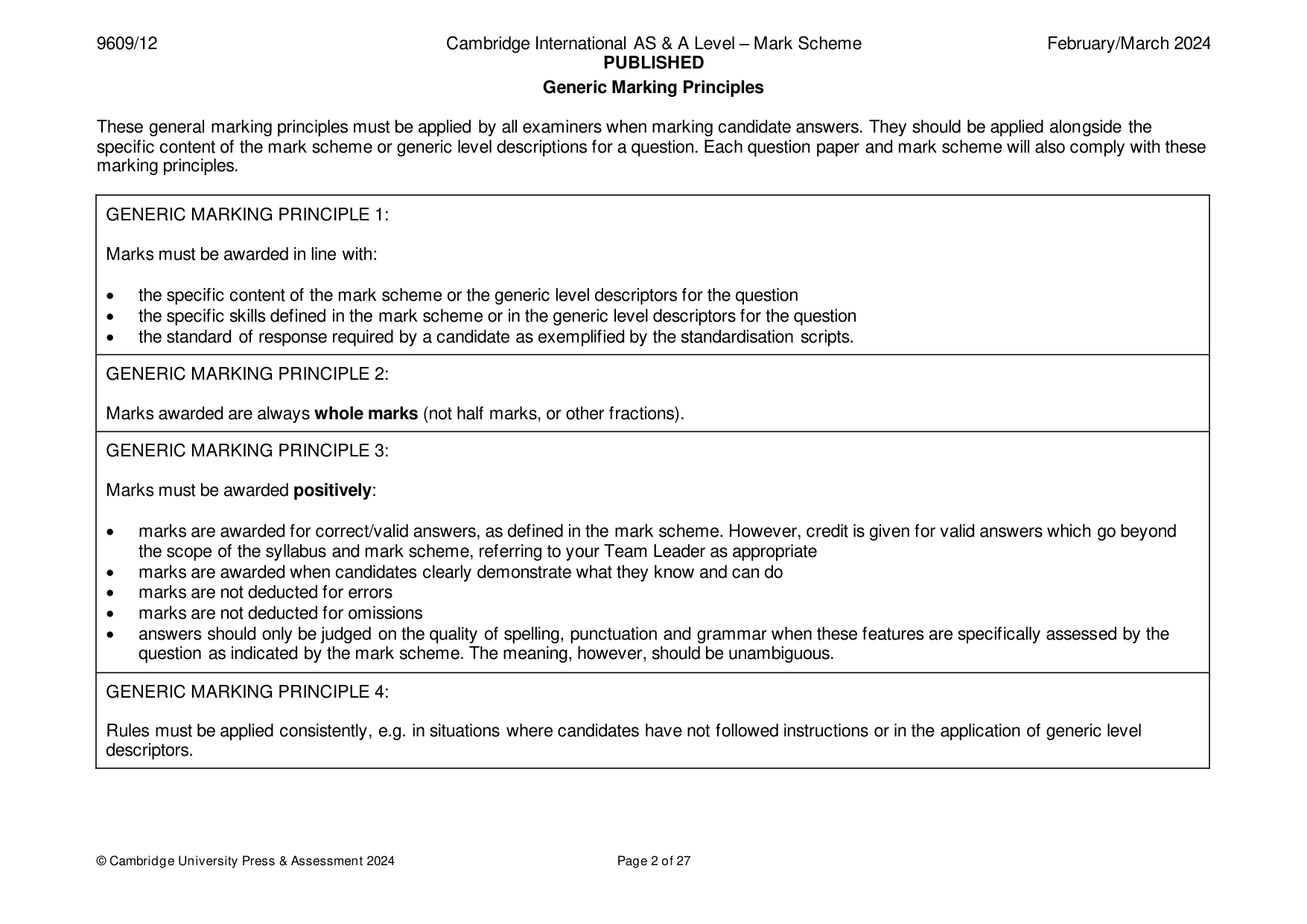
Mark scheme27 pages
Answers below. Sit the paper first if you are practising.
Paper as text
Question paper, page 1
This document has 4 pages. Any blank pages are indicated. [Turn over Cambridge International AS & A Level BUSINESS 9609/12 Paper 1 Business Concepts 1 February/March 2024 1 hour 15 minutes You must answer on the enclosed answer booklet. You will need: Answer booklet (enclosed) INSTRUCTIONS ● Answer five questions in total: Section A: answer all questions. Section B: answer one question. ● Follow the instructions on the front cover of the answer booklet. If you need additional answer paper, ask the invigilator for a continuation booklet. INFORMATION ● The total mark for this paper is 40. ● The number of marks for each question or part question is shown in brackets [ ]. * 3 2 6 9 2 1 6 0 7 1 * DC (SL) 332138/2 © UCLES 2024
Question paper, page 2
2 9609/12/F/M/24 © UCLES 2024 Section A Answer all questions. 1 (a) Define the term quaternary sector. [2] (b) Explain one factor of production needed for business activity. [3] 2 (a) Define the term dismissal. [2] (b) Explain one impact on employees of being trade union members. [3] 3 (a) Define the term trade receivables. [2] (b) Explain one reason why a business may need finance. [3] 4 Analyse one possible impact on a business of operating at below maximum capacity. [5] Section B Answer one question only. EITHER 5 (a) Analyse two limitations of sampling for a business. [8] (b) ‘Promotion is the most important element of the marketing mix for the success of a parcel delivery business.’ Evaluate this view. [12] OR 6 (a) Analyse two barriers to an entrepreneur when starting up a business. [8] (b) ‘The most important objective of a public sector energy supplier is the environmental objective.’ Evaluate this view. [12]
Question paper, page 3
3 9609/12/F/M/24 © UCLES 2024 BLANK PAGE
Question paper, page 4
4 9609/12/F/M/24 © UCLES 2024 Permission to reproduce items where third-party owned material protected by copyright is included has been sought and cleared where possible. Every reasonable effort has been made by the publisher (UCLES) to trace copyright holders, but if any items requiring clearance have unwittingly been included, the publisher will be pleased to make amends at the earliest possible opportunity. To avoid the issue of disclosure of answer-related information to candidates, all copyright acknowledgements are reproduced online in the Cambridge Assessment International Education Copyright Acknowledgements Booklet. This is produced for each series of examinations and is freely available to download at www.cambridgeinternational.org after the live examination series. Cambridge Assessment International Education is part of Cambridge Assessment. Cambridge Assessment is the brand name of the University of Cambridge Local Examinations Syndicate (UCLES), which is a department of the University of Cambridge. BLANK PAGE
Mark scheme, page 1
This document consists of 27 printed pages. © Cambridge University Press & Assessment 2024 [Turn over Cambridge International AS & A Level BUSINESS 9609/12 Paper 1 Business Concepts 1 February/March 2024 MARK SCHEME Maximum Mark: 40 Published This mark scheme is published as an aid to teachers and candidates, to indicate the requirements of the examination. It shows the basis on which Examiners were instructed to award marks. It does not indicate the details of the discussions that took place at an Examiners’ meeting before marking began, which would have considered the acceptability of alternative answers. Mark schemes should be read in conjunction with the question paper and the Principal Examiner Report for Teachers. Cambridge International will not enter into discussions about these mark schemes. Cambridge International is publishing the mark schemes for the February/March 2024 series for most Cambridge IGCSE, Cambridge International A and AS Level components, and some Cambridge O Level components.
Mark scheme, page 2
9609/12 Cambridge International AS & A Level – Mark Scheme PUBLISHED February/March 2024 © Cambridge University Press & Assessment 2024 Page 2 of 27 Generic Marking Principles These general marking principles must be applied by all examiners when marking candidate answers. They should be applied alongside the specific content of the mark scheme or generic level descriptions for a question. Each question paper and mark scheme will also comply with these marking principles. GENERIC MARKING PRINCIPLE 1: Marks must be awarded in line with: • the specific content of the mark scheme or the generic level descriptors for the question • the specific skills defined in the mark scheme or in the generic level descriptors for the question • the standard of response required by a candidate as exemplified by the standardisation scripts. GENERIC MARKING PRINCIPLE 2: Marks awarded are always whole marks (not half marks, or other fractions). GENERIC MARKING PRINCIPLE 3: Marks must be awarded positively: • marks are awarded for correct/valid answers, as defined in the mark scheme. However, credit is given for valid answers which go beyond the scope of the syllabus and mark scheme, referring to your Team Leader as appropriate • marks are awarded when candidates clearly demonstrate what they know and can do • marks are not deducted for errors • marks are not deducted for omissions • answers should only be judged on the quality of spelling, punctuation and grammar when these features are specifically assessed by the question as indicated by the mark scheme. The meaning, however, should be unambiguous. GENERIC MARKING PRINCIPLE 4: Rules must be applied consistently, e.g. in situations where candidates have not followed instructions or in the application of generic level descriptors.
Mark scheme, page 3
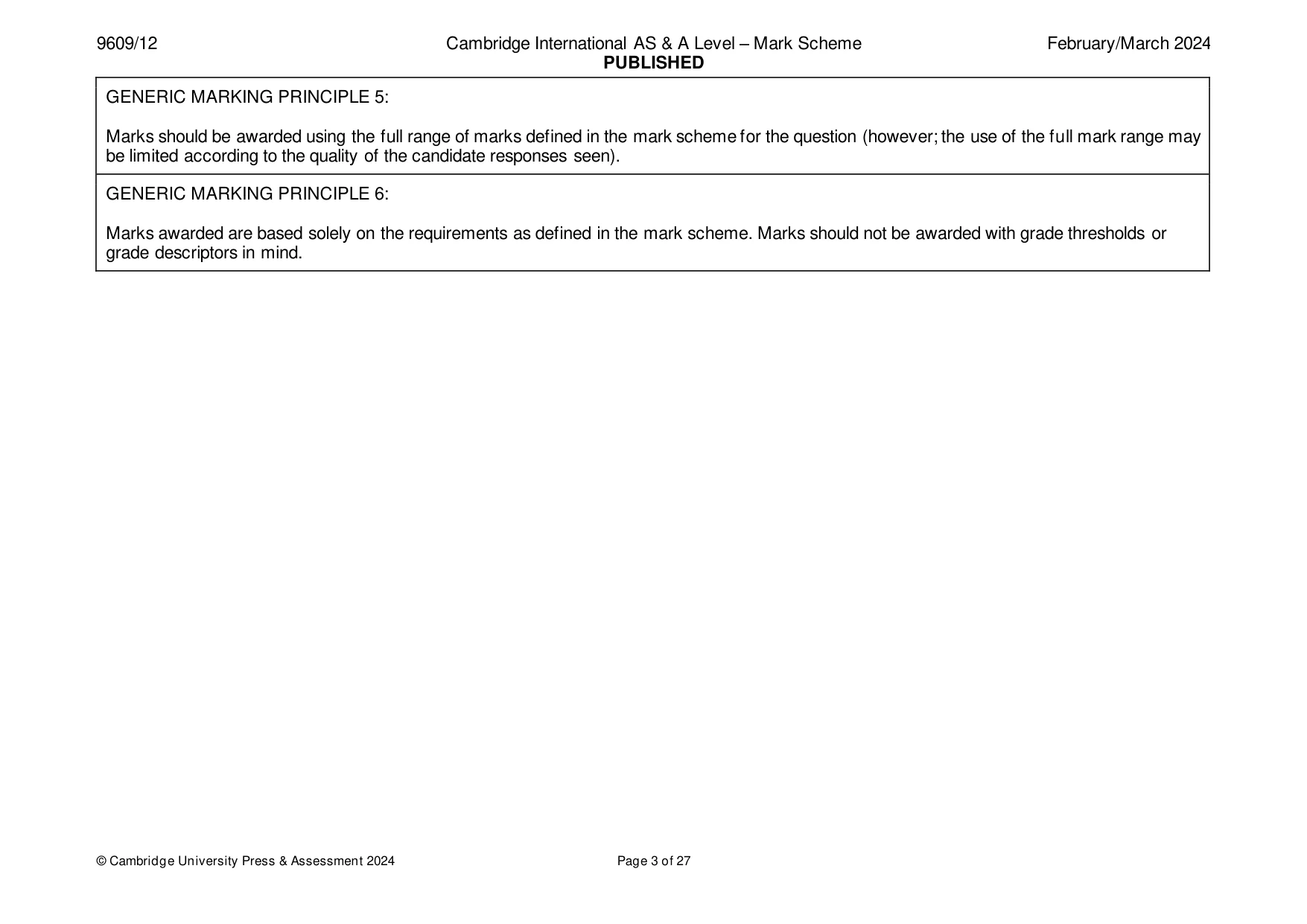
9609/12 Cambridge International AS & A Level – Mark Scheme PUBLISHED February/March 2024 © Cambridge University Press & Assessment 2024 Page 3 of 27 GENERIC MARKING PRINCIPLE 5: Marks should be awarded using the full range of marks defined in the mark scheme for the question (however; the use of the full mark range may be limited according to the quality of the candidate responses seen). GENERIC MARKING PRINCIPLE 6: Marks awarded are based solely on the requirements as defined in the mark scheme. Marks should not be awarded with grade thresholds or grade descriptors in mind.
Mark scheme, page 4
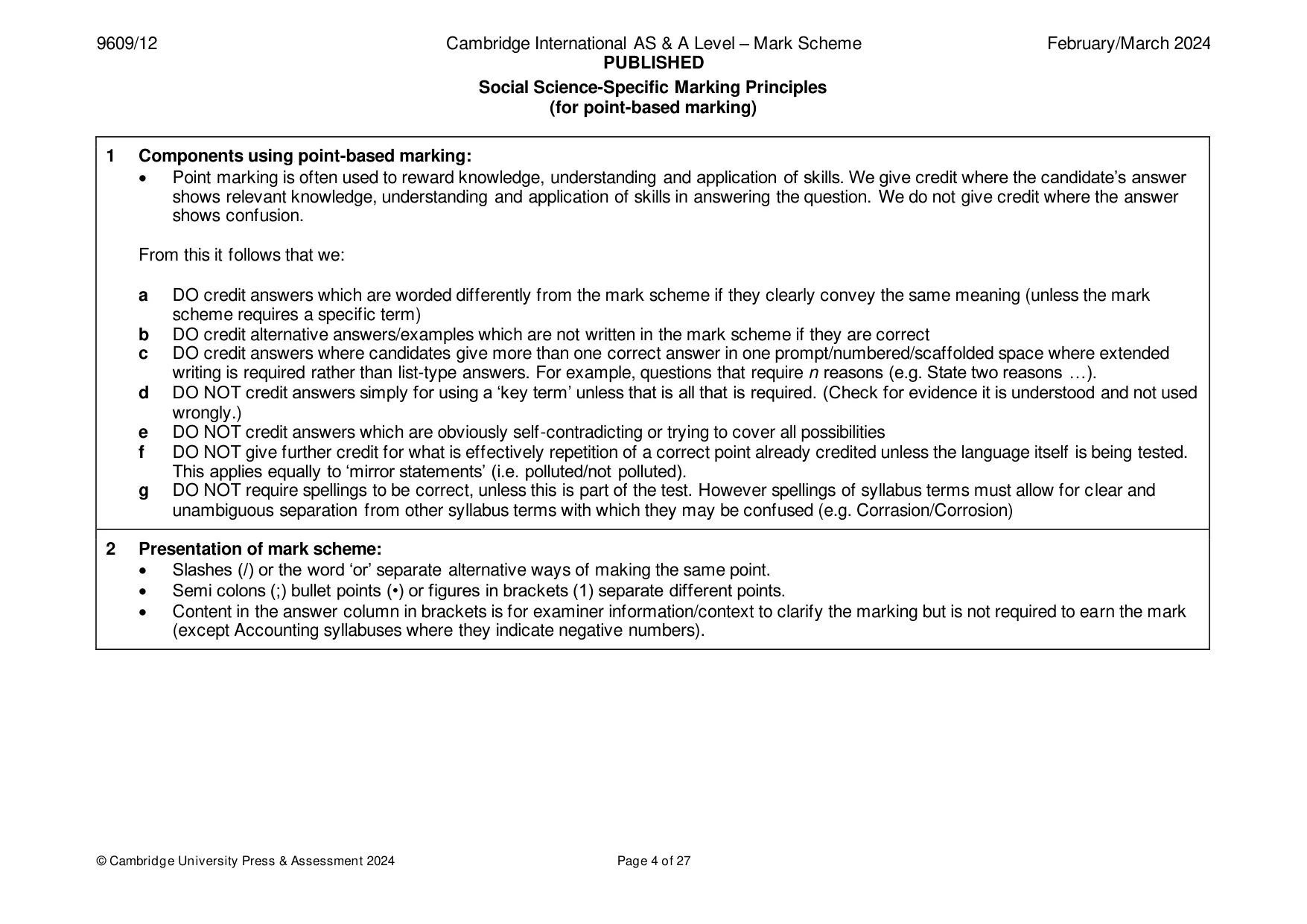
9609/12 Cambridge International AS & A Level – Mark Scheme PUBLISHED February/March 2024 © Cambridge University Press & Assessment 2024 Page 4 of 27 Social Science-Specific Marking Principles (for point-based marking) 1 Components using point-based marking: • Point marking is often used to reward knowledge, understanding and application of skills. We give credit where the candidate’s answer shows relevant knowledge, understanding and application of skills in answering the question. We do not give credit where the answer shows confusion. From this it follows that we: a DO credit answers which are worded differently from the mark scheme if they clearly convey the same meaning (unless the mark scheme requires a specific term) b DO credit alternative answers/examples which are not written in the mark scheme if they are correct c DO credit answers where candidates give more than one correct answer in one prompt/numbered/scaffolded space where extended writing is required rather than list-type answers. For example, questions that require n reasons (e.g. State two reasons …). d DO NOT credit answers simply for using a ‘key term’ unless that is all that is required. (Check for evidence it is understood and not used wrongly.) e DO NOT credit answers which are obviously self-contradicting or trying to cover all possibilities f DO NOT give further credit for what is effectively repetition of a correct point already credited unless the language itself is being tested. This applies equally to ‘mirror statements’ (i.e. polluted/not polluted). g DO NOT require spellings to be correct, unless this is part of the test. However spellings of syllabus terms must allow for clear and unambiguous separation from other syllabus terms with which they may be confused (e.g. Corrasion/Corrosion) 2 Presentation of mark scheme: • Slashes (/) or the word ‘or’ separate alternative ways of making the same point. • Semi colons (;) bullet points (•) or figures in brackets (1) separate different points. • Content in the answer column in brackets is for examiner information/context to clarify the marking but is not required to earn the mark (except Accounting syllabuses where they indicate negative numbers).
Mark scheme, page 5
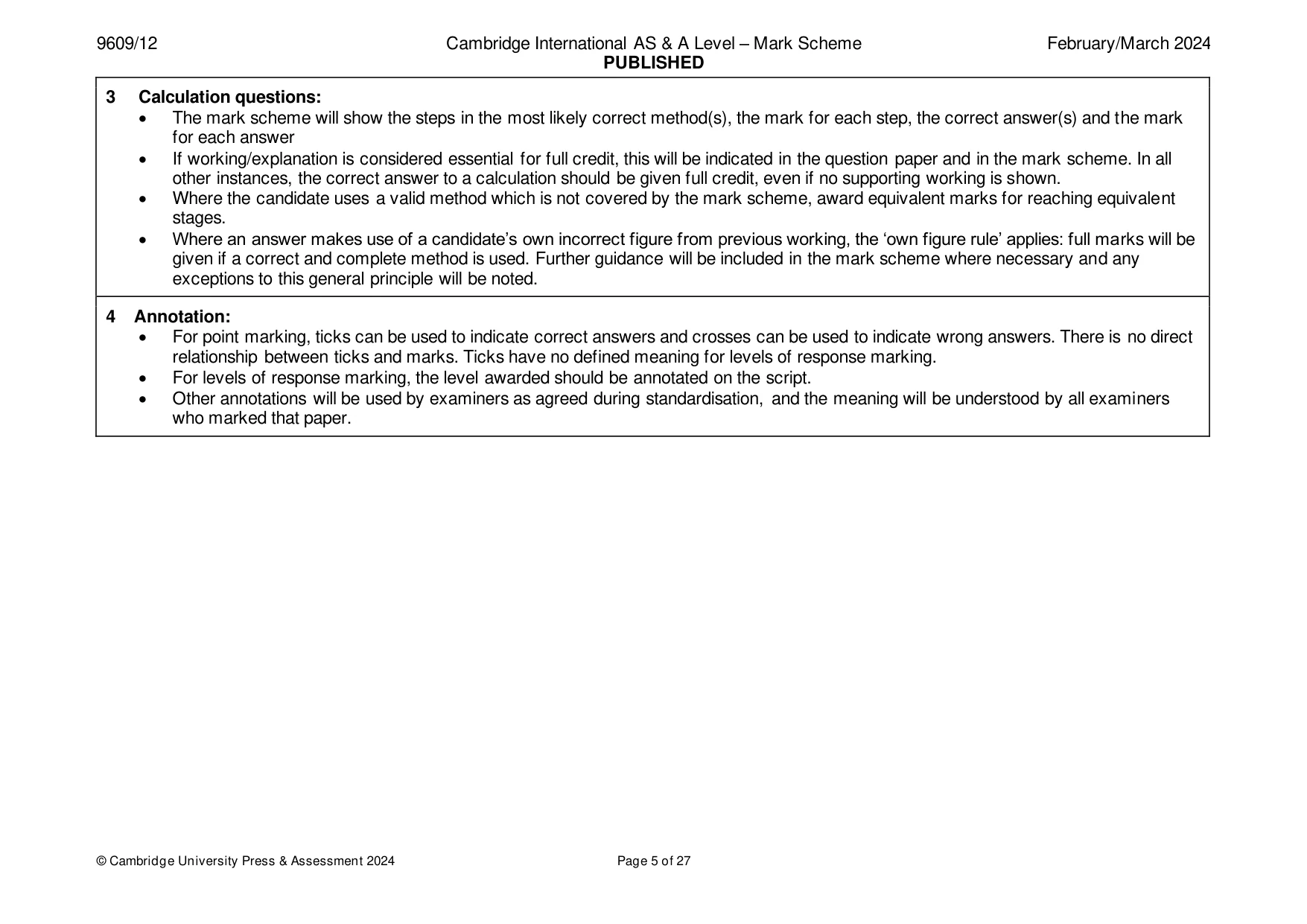
9609/12 Cambridge International AS & A Level – Mark Scheme PUBLISHED February/March 2024 © Cambridge University Press & Assessment 2024 Page 5 of 27 3 Calculation questions: • The mark scheme will show the steps in the most likely correct method(s), the mark for each step, the correct answer(s) and the mark for each answer • If working/explanation is considered essential for full credit, this will be indicated in the question paper and in the mark scheme. In all other instances, the correct answer to a calculation should be given full credit, even if no supporting working is shown. • Where the candidate uses a valid method which is not covered by the mark scheme, award equivalent marks for reaching equivalent stages. • Where an answer makes use of a candidate’s own incorrect figure from previous working, the ‘own figure rule’ applies: full marks will be given if a correct and complete method is used. Further guidance will be included in the mark scheme where necessary and any exceptions to this general principle will be noted. 4 Annotation: • For point marking, ticks can be used to indicate correct answers and crosses can be used to indicate wrong answers. There is no direct relationship between ticks and marks. Ticks have no defined meaning for levels of response marking. • For levels of response marking, the level awarded should be annotated on the script. • Other annotations will be used by examiners as agreed during standardisation, and the meaning will be understood by all examiners who marked that paper.
Mark scheme, page 6
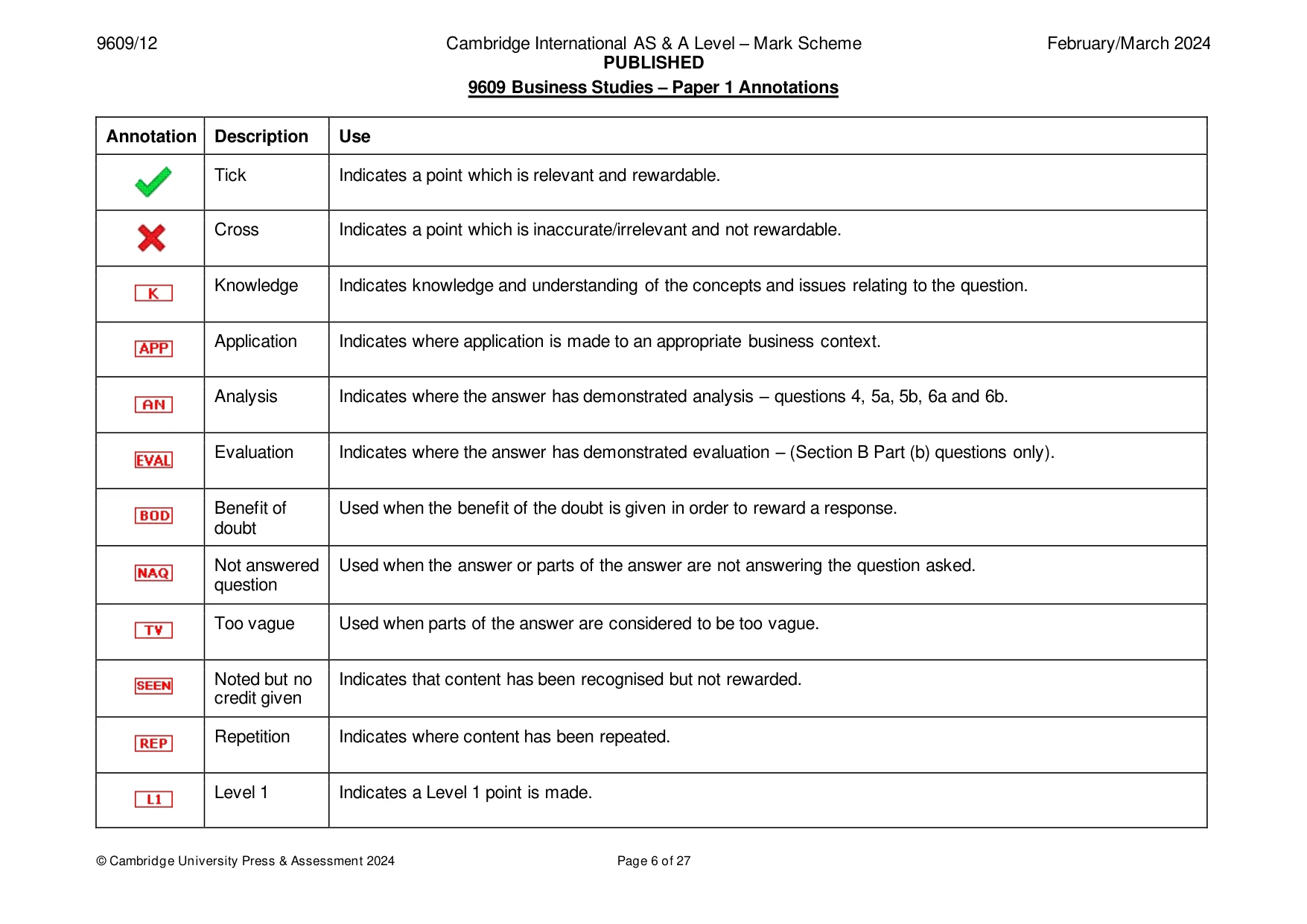
9609/12 Cambridge International AS & A Level – Mark Scheme PUBLISHED February/March 2024 © Cambridge University Press & Assessment 2024 Page 6 of 27 9609 Business Studies – Paper 1 Annotations Annotation Description Use Tick Indicates a point which is relevant and rewardable. Cross Indicates a point which is inaccurate/irrelevant and not rewardable. Knowledge Indicates knowledge and understanding of the concepts and issues relating to the question. Application Indicates where application is made to an appropriate business context. Analysis Indicates where the answer has demonstrated analysis – questions 4, 5a, 5b, 6a and 6b. Evaluation Indicates where the answer has demonstrated evaluation – (Section B Part (b) questions only). Benefit of doubt Used when the benefit of the doubt is given in order to reward a response. Not answered question Used when the answer or parts of the answer are not answering the question asked. Too vague Used when parts of the answer are considered to be too vague. Noted but no credit given Indicates that content has been recognised but not rewarded. Repetition Indicates where content has been repeated. Level 1 Indicates a Level 1 point is made.
Mark scheme, page 7
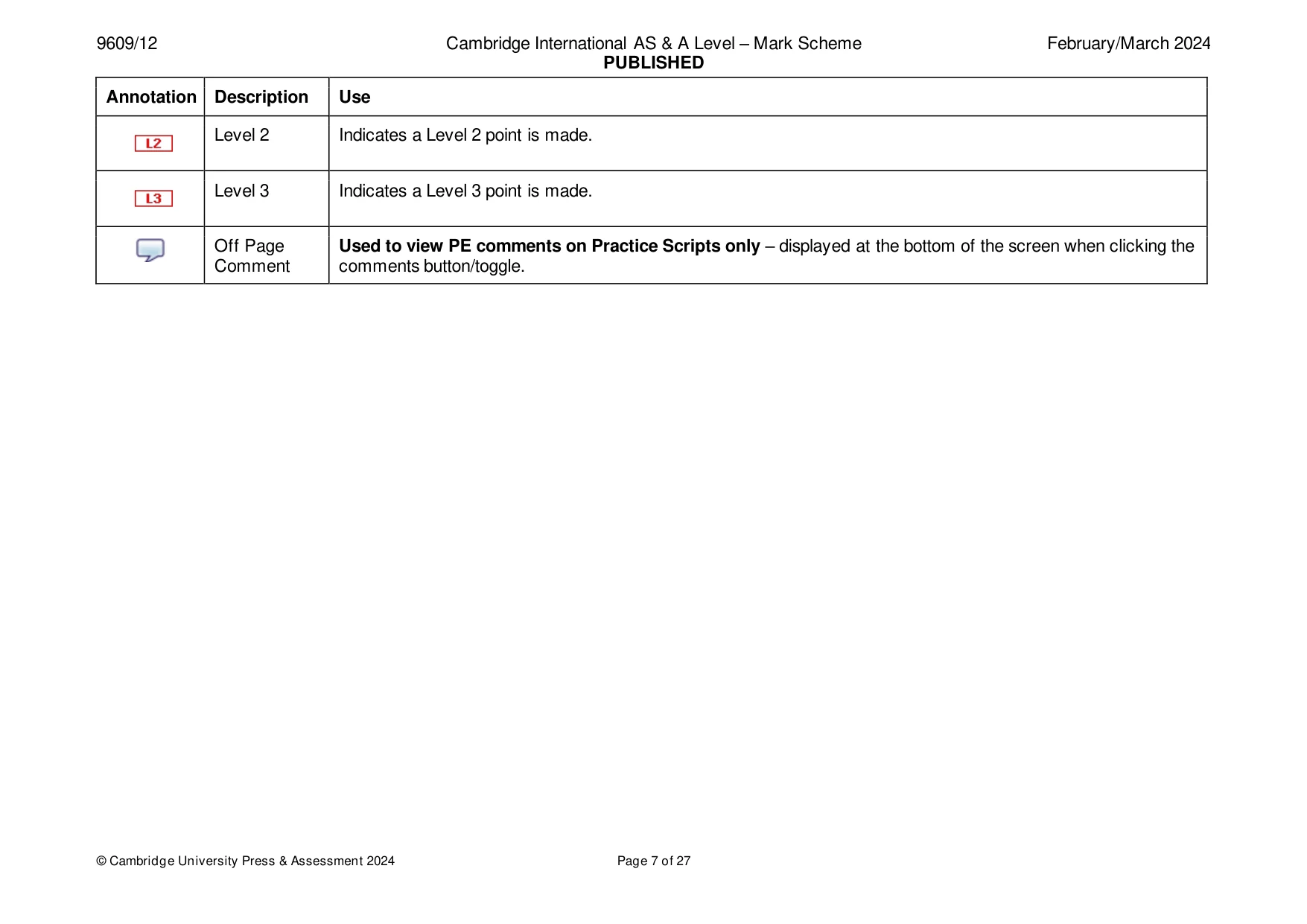
9609/12 Cambridge International AS & A Level – Mark Scheme PUBLISHED February/March 2024 © Cambridge University Press & Assessment 2024 Page 7 of 27 Annotation Description Use Level 2 Indicates a Level 2 point is made. Level 3 Indicates a Level 3 point is made. Off Page Comment Used to view PE comments on Practice Scripts only – displayed at the bottom of the screen when clicking the comments button/toggle.
Mark scheme, page 8
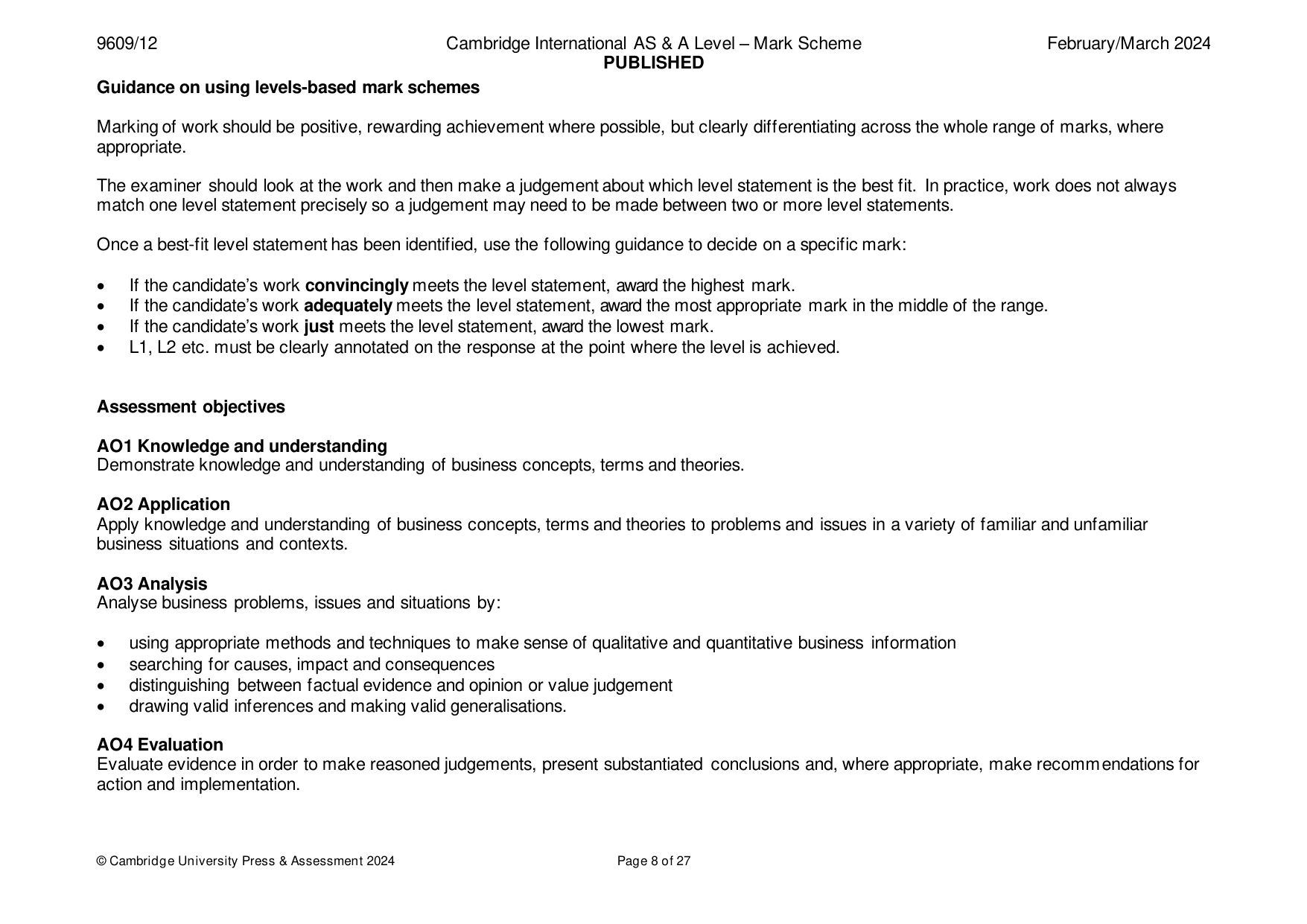
9609/12 Cambridge International AS & A Level – Mark Scheme PUBLISHED February/March 2024 © Cambridge University Press & Assessment 2024 Page 8 of 27 Guidance on using levels-based mark schemes Marking of work should be positive, rewarding achievement where possible, but clearly differentiating across the whole range of marks, where appropriate. The examiner should look at the work and then make a judgement about which level statement is the best fit. In practice, work does not always match one level statement precisely so a judgement may need to be made between two or more level statements. Once a best-fit level statement has been identified, use the following guidance to decide on a specific mark: • If the candidate’s work convincingly meets the level statement, award the highest mark. • If the candidate’s work adequately meets the level statement, award the most appropriate mark in the middle of the range. • If the candidate’s work just meets the level statement, award the lowest mark. • L1, L2 etc. must be clearly annotated on the response at the point where the level is achieved. Assessment objectives AO1 Knowledge and understanding Demonstrate knowledge and understanding of business concepts, terms and theories. AO2 Application Apply knowledge and understanding of business concepts, terms and theories to problems and issues in a variety of familiar and unfamiliar business situations and contexts. AO3 Analysis Analyse business problems, issues and situations by: • using appropriate methods and techniques to make sense of qualitative and quantitative business information • searching for causes, impact and consequences • distinguishing between factual evidence and opinion or value judgement • drawing valid inferences and making valid generalisations. AO4 Evaluation Evaluate evidence in order to make reasoned judgements, present substantiated conclusions and, where appropriate, make recommendations for action and implementation.
Mark scheme, page 9
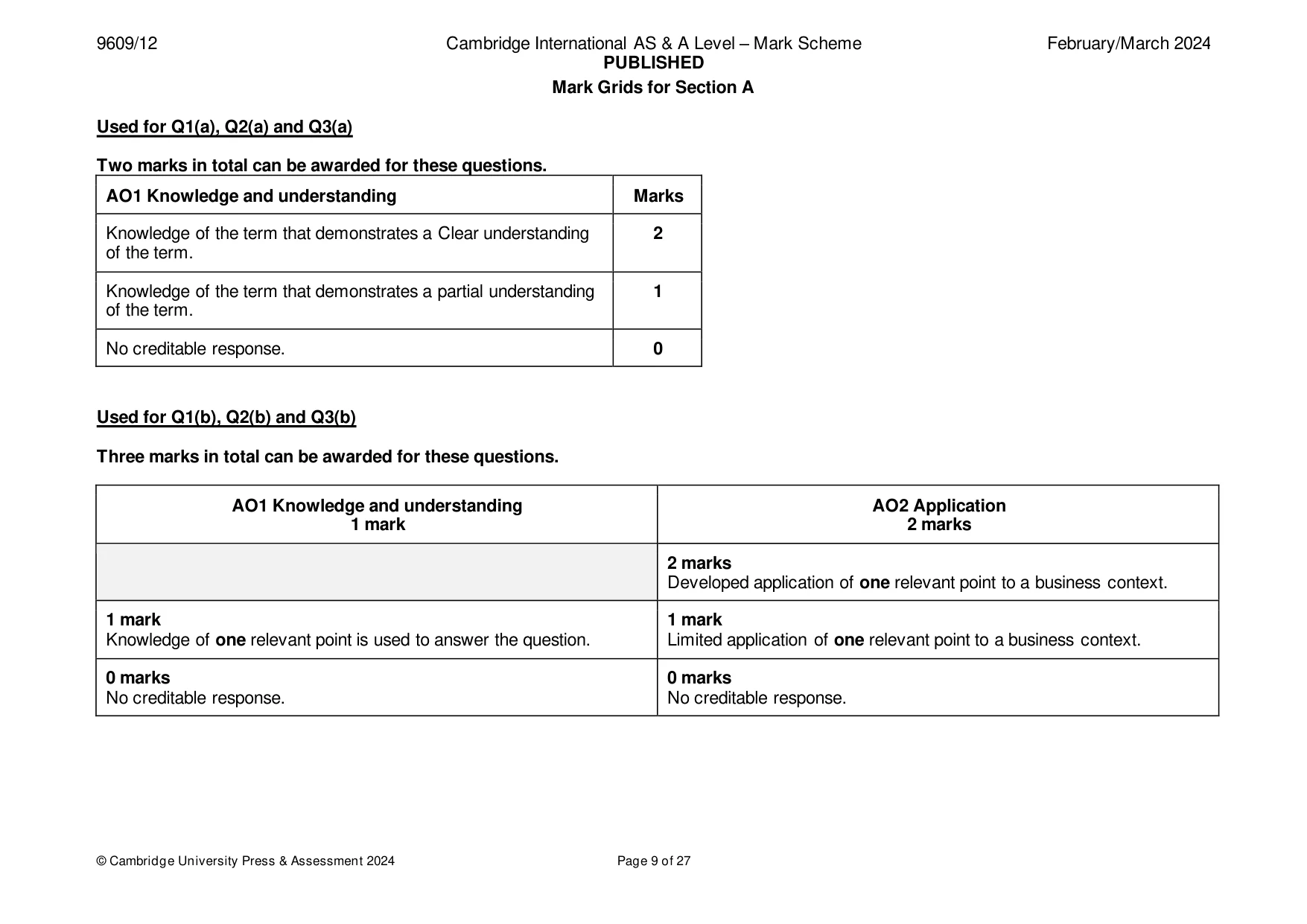
9609/12 Cambridge International AS & A Level – Mark Scheme PUBLISHED February/March 2024 © Cambridge University Press & Assessment 2024 Page 9 of 27 Mark Grids for Section A Used for Q1(a), Q2(a) and Q3(a) Two marks in total can be awarded for these questions. AO1 Knowledge and understanding Marks Knowledge of the term that demonstrates a Clear understanding of the term. 2 Knowledge of the term that demonstrates a partial understanding of the term. 1 No creditable response. 0 Used for Q1(b), Q2(b) and Q3(b) Three marks in total can be awarded for these questions. AO1 Knowledge and understanding 1 mark AO2 Application 2 marks 2 marks Developed application of one relevant point to a business context. 1 mark Knowledge of one relevant point is used to answer the question. 1 mark Limited application of one relevant point to a business context. 0 marks No creditable response. 0 marks No creditable response.
Mark scheme, page 10
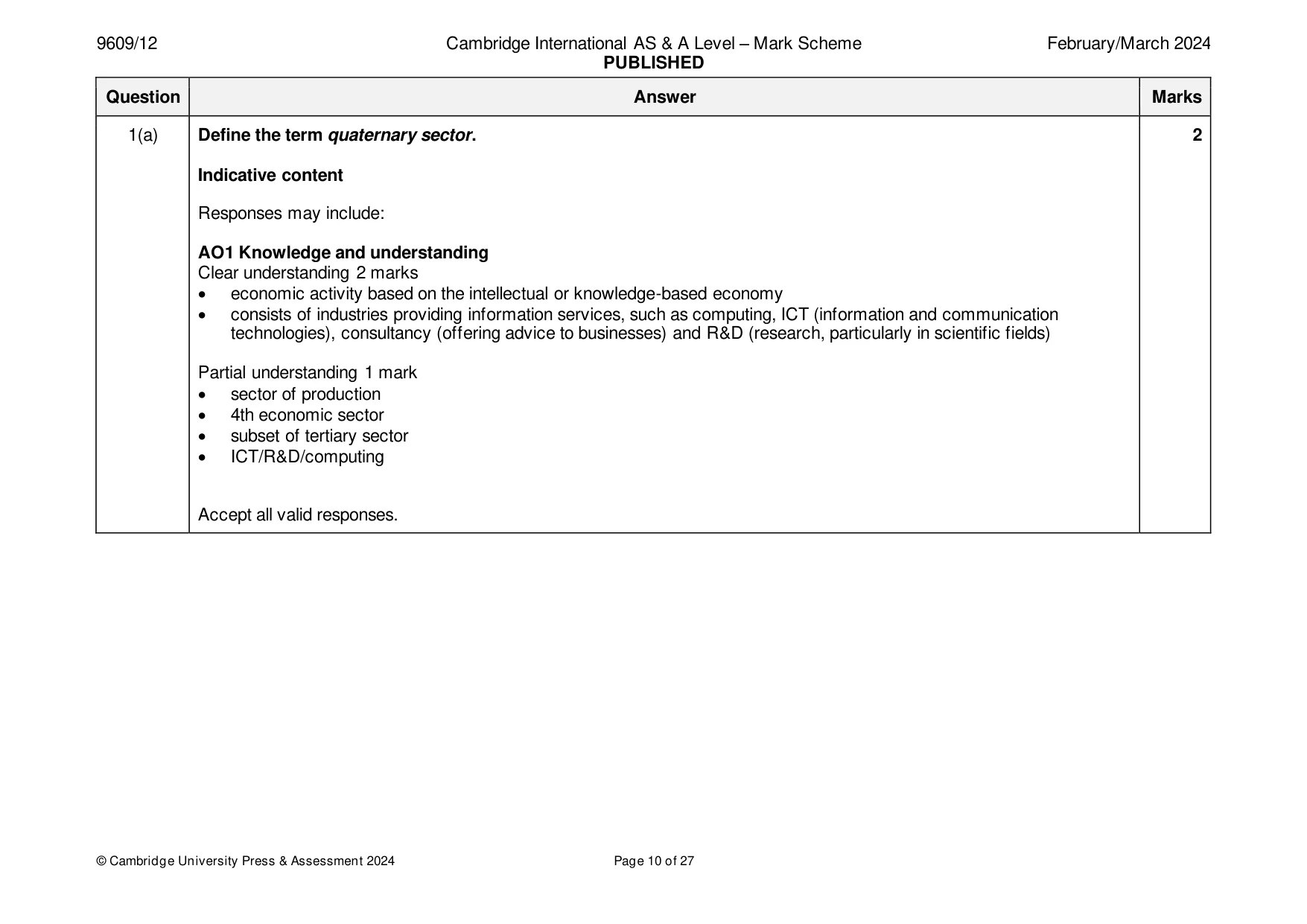
9609/12 Cambridge International AS & A Level – Mark Scheme PUBLISHED February/March 2024 © Cambridge University Press & Assessment 2024 Page 10 of 27 Question Answer Marks 1(a) Define the term quaternary sector. Indicative content Responses may include: AO1 Knowledge and understanding Clear understanding 2 marks • economic activity based on the intellectual or knowledge-based economy • consists of industries providing information services, such as computing, ICT (information and communication technologies), consultancy (offering advice to businesses) and R&D (research, particularly in scientific fields) Partial understanding 1 mark • sector of production • 4th economic sector • subset of tertiary sector • ICT/R&D/computing Accept all valid responses. 2
Mark scheme, page 11
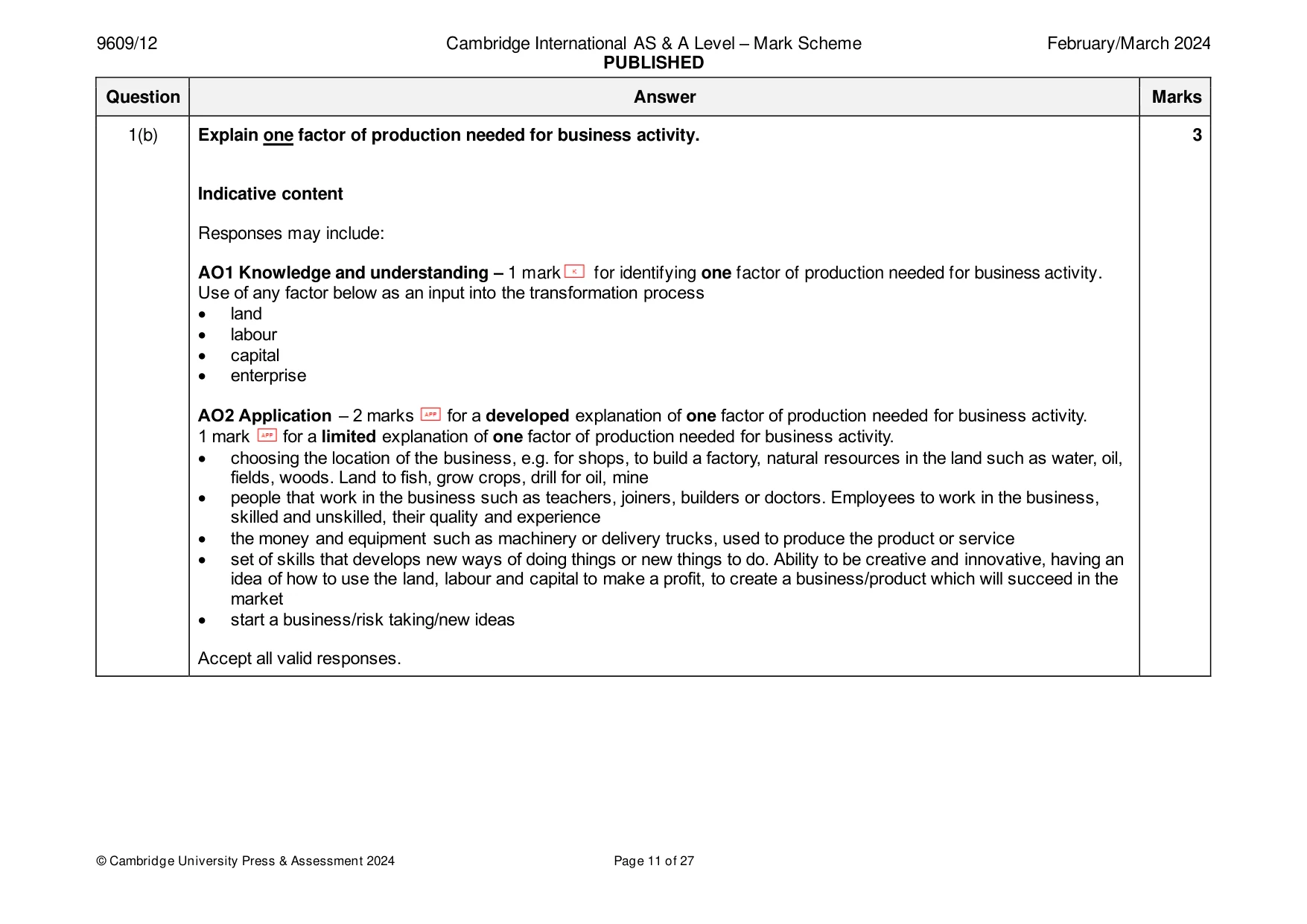
9609/12 Cambridge International AS & A Level – Mark Scheme PUBLISHED February/March 2024 © Cambridge University Press & Assessment 2024 Page 11 of 27 Question Answer Marks 1(b) Explain one factor of production needed for business activity. Indicative content Responses may include: AO1 Knowledge and understanding – 1 mark for identifying one factor of production needed for business activity. Use of any factor below as an input into the transformation process • land • labour • capital • enterprise AO2 Application – 2 marks for a developed explanation of one factor of production needed for business activity. 1 mark for a limited explanation of one factor of production needed for business activity. • choosing the location of the business, e.g. for shops, to build a factory, natural resources in the land such as water, oil, fields, woods. Land to fish, grow crops, drill for oil, mine • people that work in the business such as teachers, joiners, builders or doctors. Employees to work in the business, skilled and unskilled, their quality and experience • the money and equipment such as machinery or delivery trucks, used to produce the product or service • set of skills that develops new ways of doing things or new things to do. Ability to be creative and innovative, having an idea of how to use the land, labour and capital to make a profit, to create a business/product which will succeed in the market • start a business/risk taking/new ideas Accept all valid responses. 3
Mark scheme, page 12
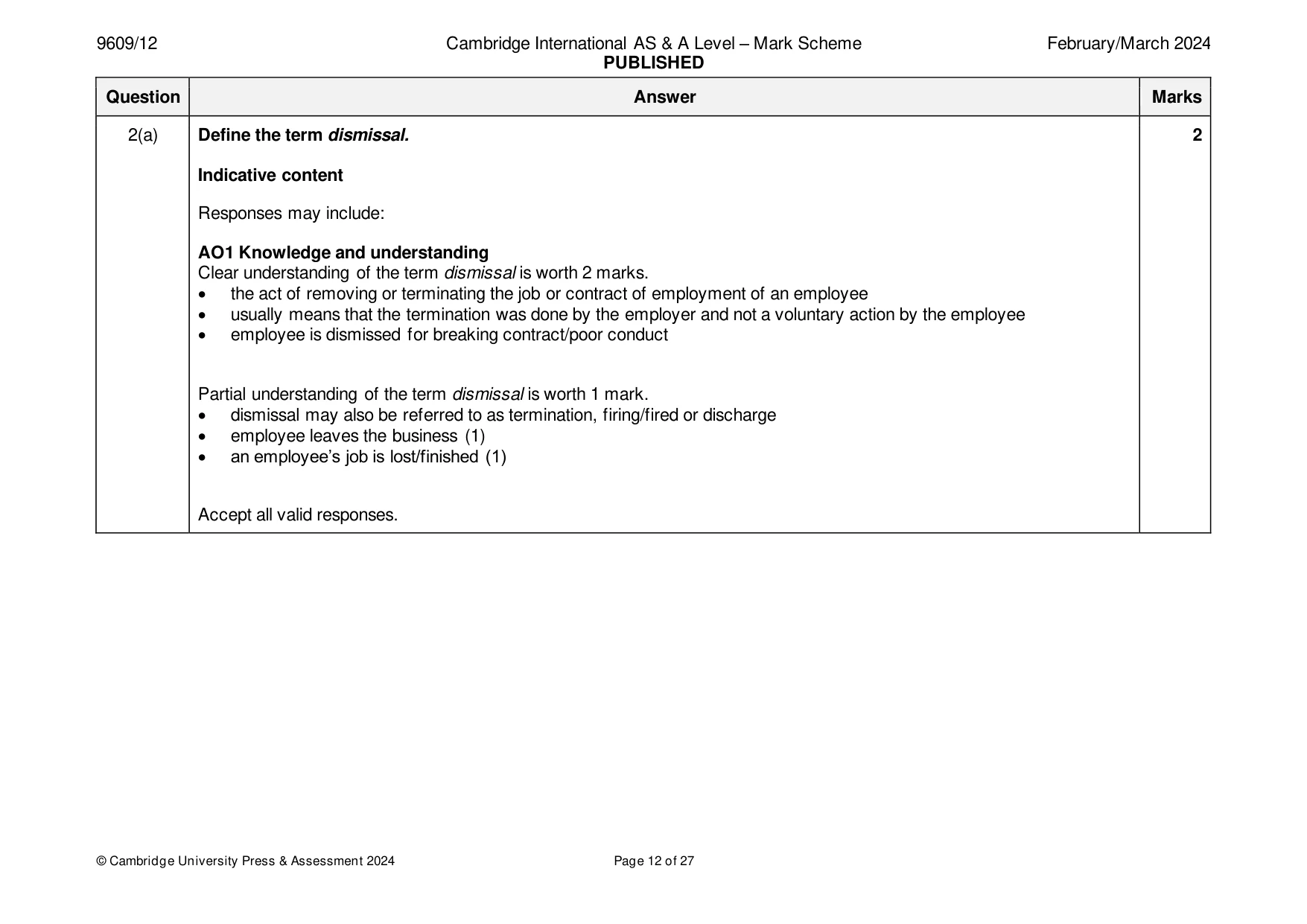
9609/12 Cambridge International AS & A Level – Mark Scheme PUBLISHED February/March 2024 © Cambridge University Press & Assessment 2024 Page 12 of 27 Question Answer Marks 2(a) Define the term dismissal. Indicative content Responses may include: AO1 Knowledge and understanding Clear understanding of the term dismissal is worth 2 marks. • the act of removing or terminating the job or contract of employment of an employee • usually means that the termination was done by the employer and not a voluntary action by the employee • employee is dismissed for breaking contract/poor conduct Partial understanding of the term dismissal is worth 1 mark. • dismissal may also be referred to as termination, firing/fired or discharge • employee leaves the business (1) • an employee’s job is lost/finished (1) Accept all valid responses. 2
Mark scheme, page 13
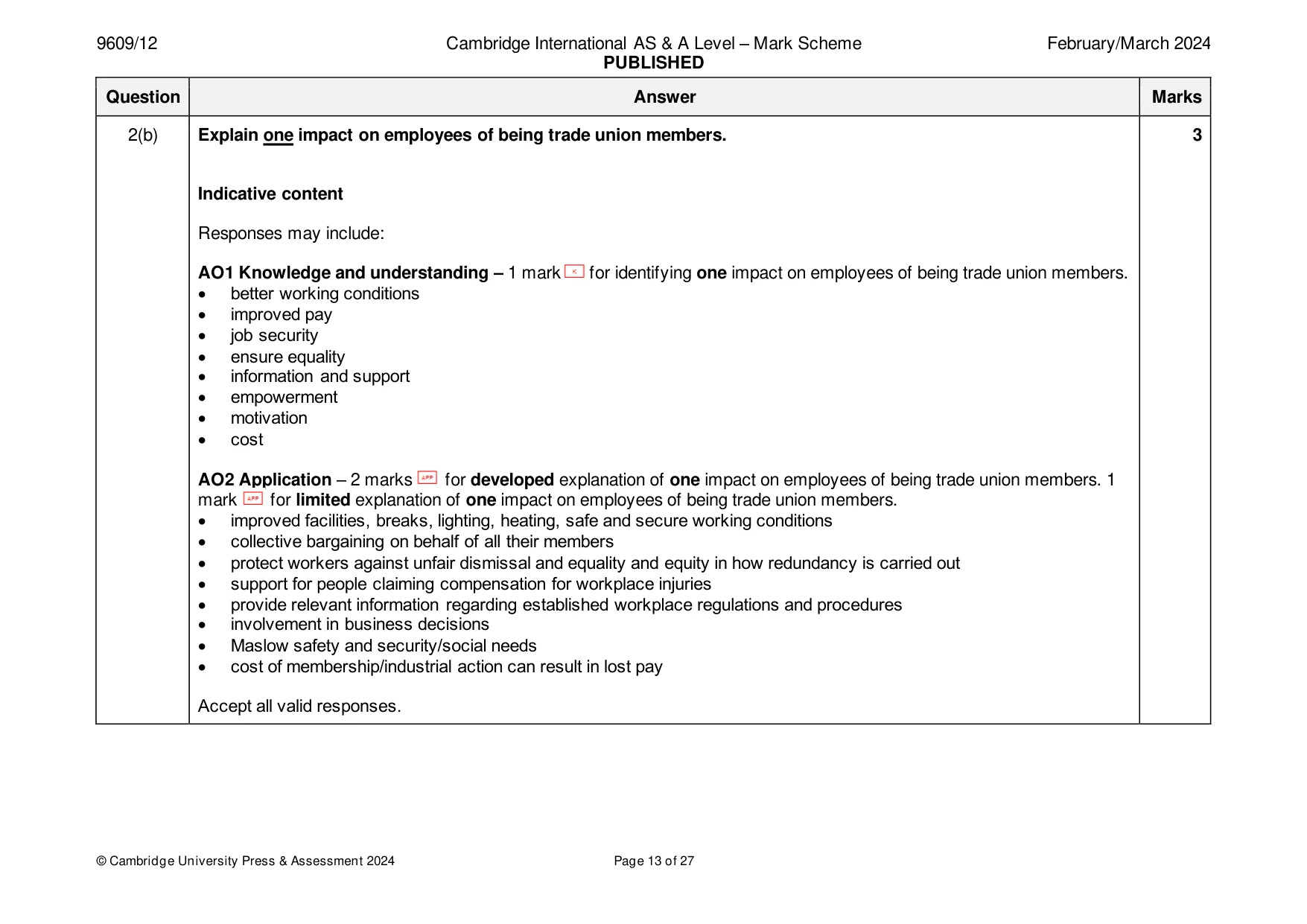
9609/12 Cambridge International AS & A Level – Mark Scheme PUBLISHED February/March 2024 © Cambridge University Press & Assessment 2024 Page 13 of 27 Question Answer Marks 2(b) Explain one impact on employees of being trade union members. Indicative content Responses may include: AO1 Knowledge and understanding – 1 mark for identifying one impact on employees of being trade union members. • better working conditions • improved pay • job security • ensure equality • information and support • empowerment • motivation • cost AO2 Application – 2 marks for developed explanation of one impact on employees of being trade union members. 1 mark for limited explanation of one impact on employees of being trade union members. • improved facilities, breaks, lighting, heating, safe and secure working conditions • collective bargaining on behalf of all their members • protect workers against unfair dismissal and equality and equity in how redundancy is carried out • support for people claiming compensation for workplace injuries • provide relevant information regarding established workplace regulations and procedures • involvement in business decisions • Maslow safety and security/social needs • cost of membership/industrial action can result in lost pay Accept all valid responses. 3
Mark scheme, page 14
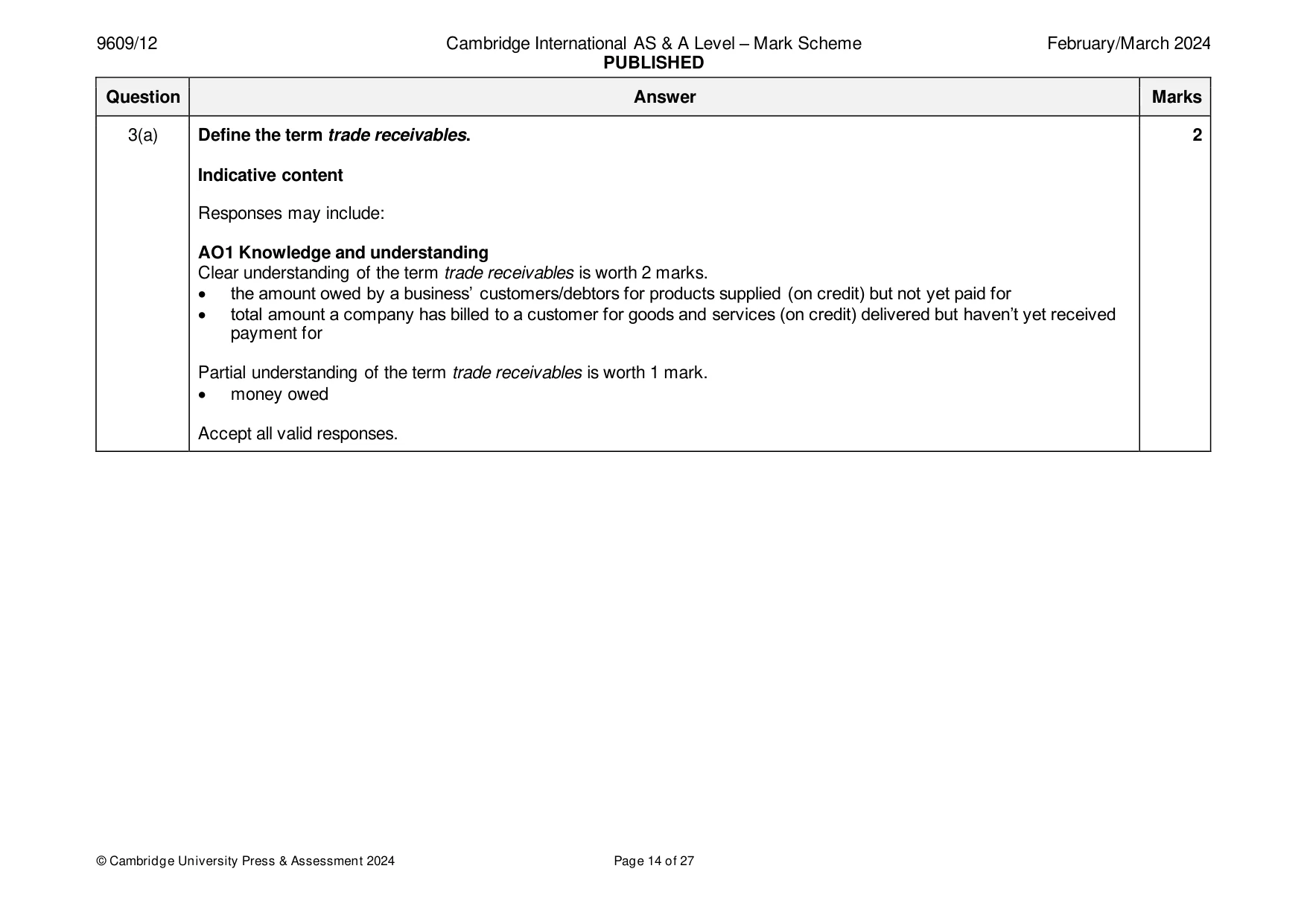
9609/12 Cambridge International AS & A Level – Mark Scheme PUBLISHED February/March 2024 © Cambridge University Press & Assessment 2024 Page 14 of 27 Question Answer Marks 3(a) Define the term trade receivables. Indicative content Responses may include: AO1 Knowledge and understanding Clear understanding of the term trade receivables is worth 2 marks. • the amount owed by a business’ customers/debtors for products supplied (on credit) but not yet paid for • total amount a company has billed to a customer for goods and services (on credit) delivered but haven’t yet received payment for Partial understanding of the term trade receivables is worth 1 mark. • money owed Accept all valid responses. 2
Mark scheme, page 15
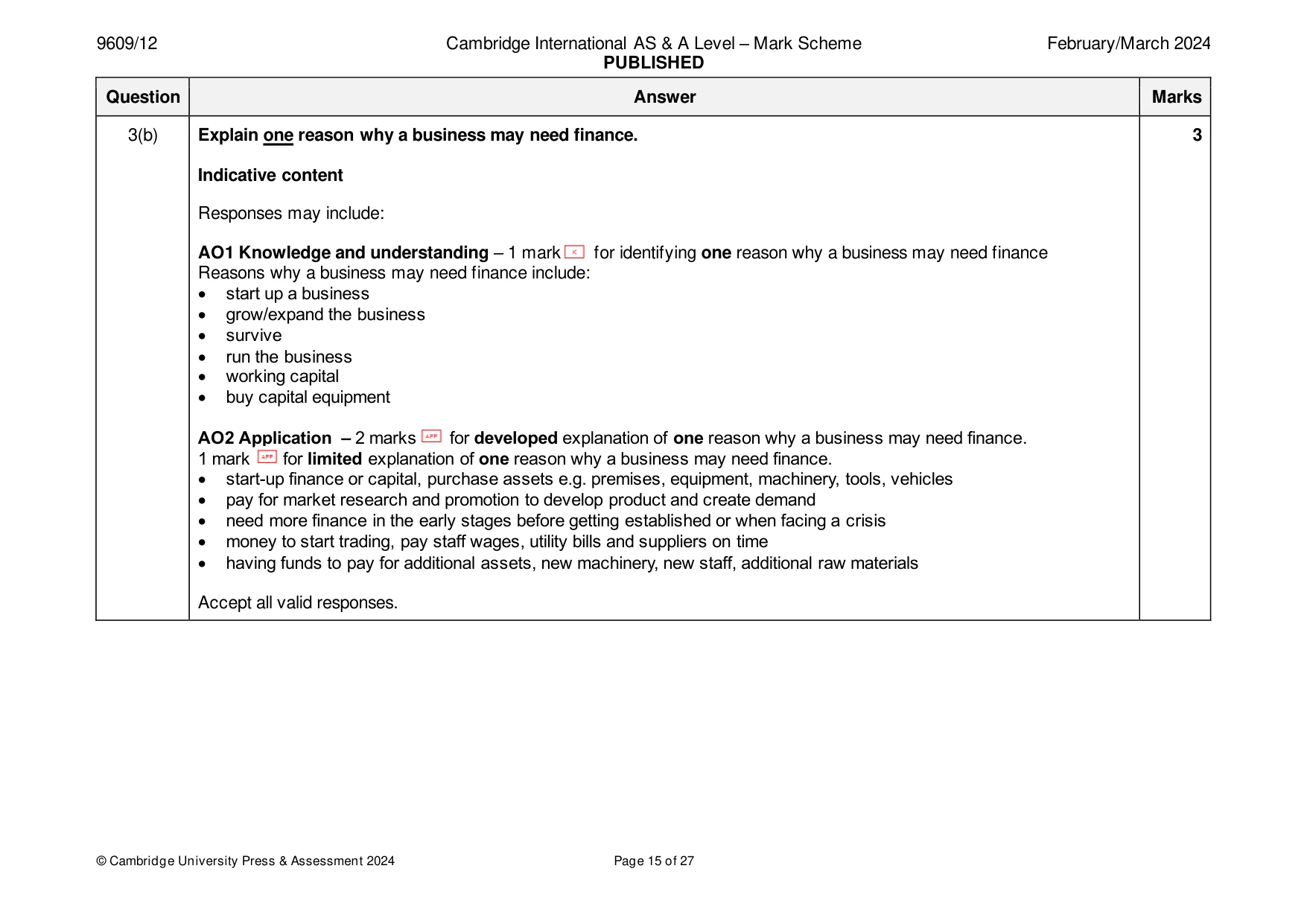
9609/12 Cambridge International AS & A Level – Mark Scheme PUBLISHED February/March 2024 © Cambridge University Press & Assessment 2024 Page 15 of 27 Question Answer Marks 3(b) Explain one reason why a business may need finance. Indicative content Responses may include: AO1 Knowledge and understanding – 1 mark for identifying one reason why a business may need finance Reasons why a business may need finance include: • start up a business • grow/expand the business • survive • run the business • working capital • buy capital equipment AO2 Application – 2 marks for developed explanation of one reason why a business may need finance. 1 mark for limited explanation of one reason why a business may need finance. • start-up finance or capital, purchase assets e.g. premises, equipment, machinery, tools, vehicles • pay for market research and promotion to develop product and create demand • need more finance in the early stages before getting established or when facing a crisis • money to start trading, pay staff wages, utility bills and suppliers on time • having funds to pay for additional assets, new machinery, new staff, additional raw materials Accept all valid responses. 3
Mark scheme, page 16
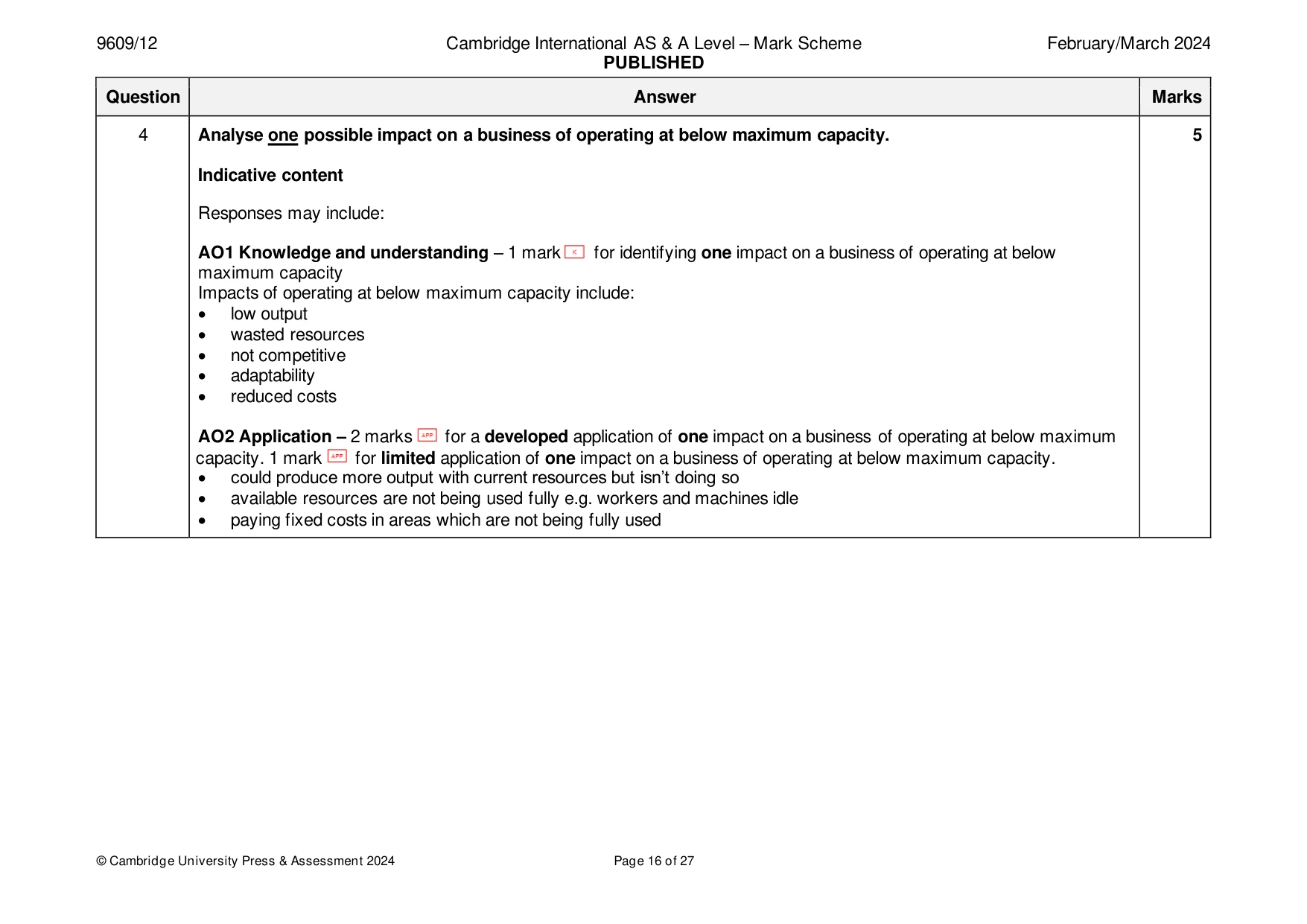
9609/12 Cambridge International AS & A Level – Mark Scheme PUBLISHED February/March 2024 © Cambridge University Press & Assessment 2024 Page 16 of 27 Question Answer Marks 4 Analyse one possible impact on a business of operating at below maximum capacity. Indicative content Responses may include: AO1 Knowledge and understanding – 1 mark for identifying one impact on a business of operating at below maximum capacity Impacts of operating at below maximum capacity include: • low output • wasted resources • not competitive • adaptability • reduced costs AO2 Application – 2 marks for a developed application of one impact on a business of operating at below maximum capacity. 1 mark for limited application of one impact on a business of operating at below maximum capacity. • could produce more output with current resources but isn’t doing so • available resources are not being used fully e.g. workers and machines idle • paying fixed costs in areas which are not being fully used 5
Mark scheme, page 17
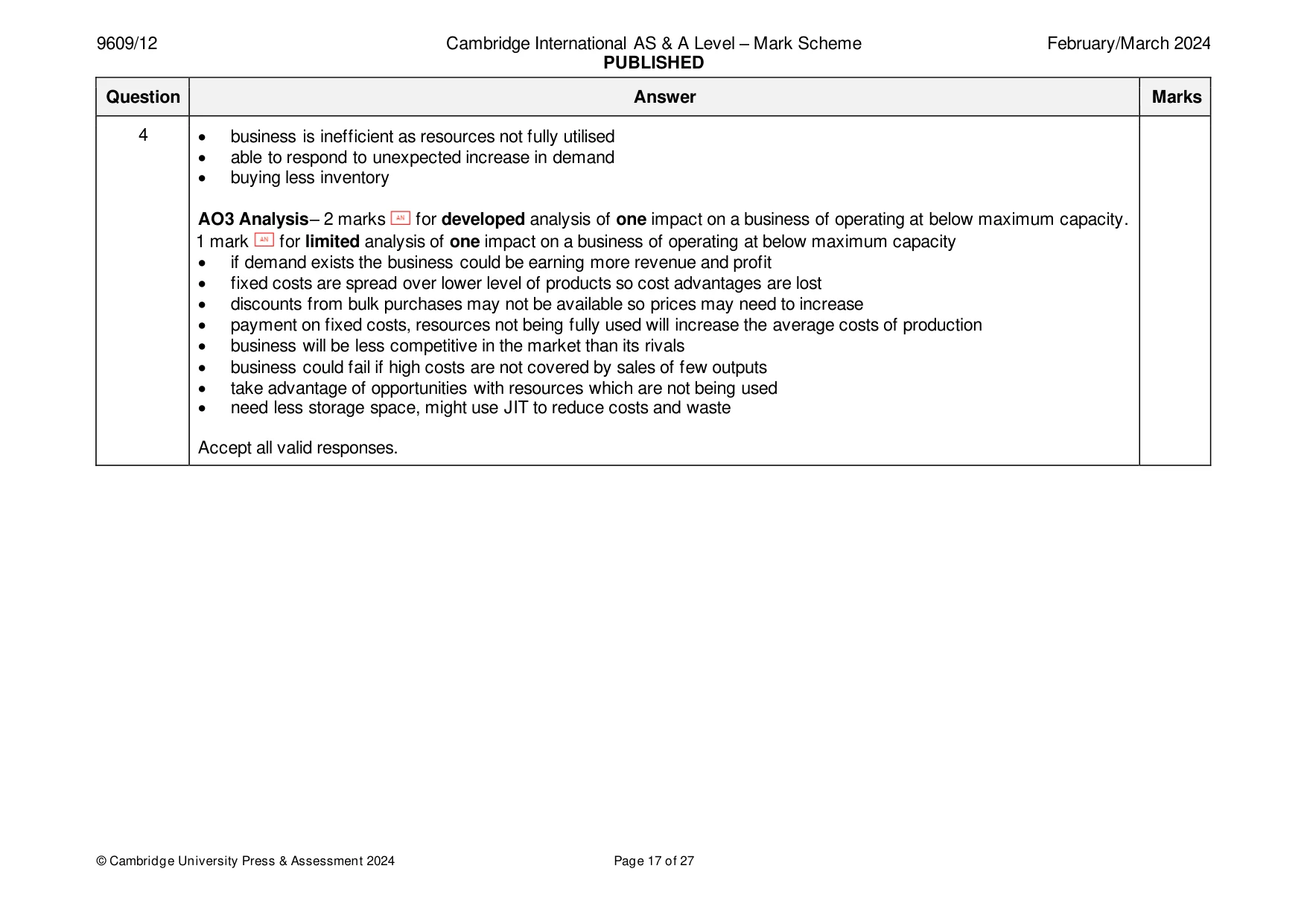
9609/12 Cambridge International AS & A Level – Mark Scheme PUBLISHED February/March 2024 © Cambridge University Press & Assessment 2024 Page 17 of 27 Question Answer Marks 4 • business is inefficient as resources not fully utilised • able to respond to unexpected increase in demand • buying less inventory AO3 Analysis – 2 marks for developed analysis of one impact on a business of operating at below maximum capacity. 1 mark for limited analysis of one impact on a business of operating at below maximum capacity • if demand exists the business could be earning more revenue and profit • fixed costs are spread over lower level of products so cost advantages are lost • discounts from bulk purchases may not be available so prices may need to increase • payment on fixed costs, resources not being fully used will increase the average costs of production • business will be less competitive in the market than its rivals • business could fail if high costs are not covered by sales of few outputs • take advantage of opportunities with resources which are not being used • need less storage space, might use JIT to reduce costs and waste Accept all valid responses.
Mark scheme, page 18
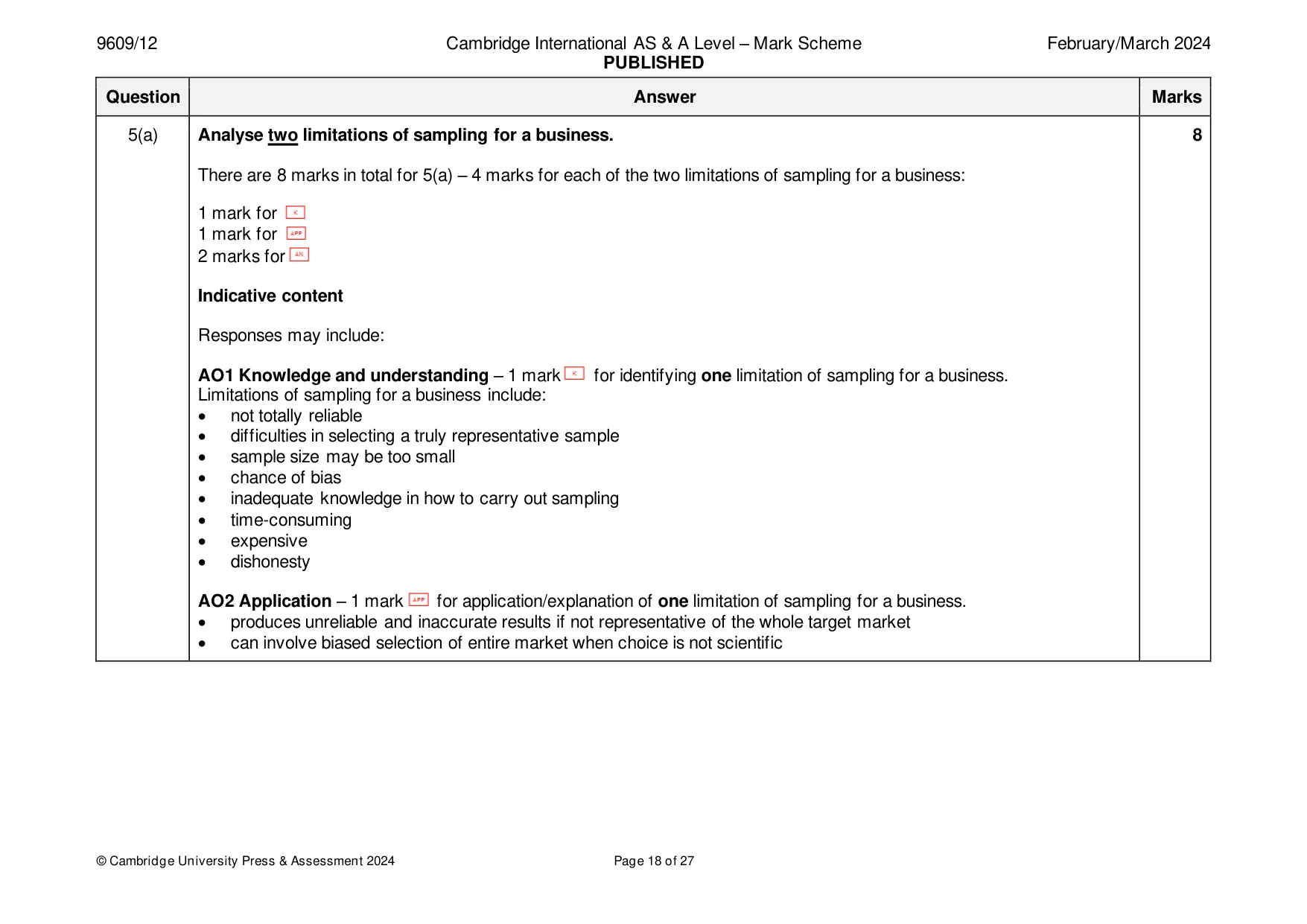
9609/12 Cambridge International AS & A Level – Mark Scheme PUBLISHED February/March 2024 © Cambridge University Press & Assessment 2024 Page 18 of 27 Question Answer Marks 5(a) Analyse two limitations of sampling for a business. There are 8 marks in total for 5(a) – 4 marks for each of the two limitations of sampling for a business: 1 mark for 1 mark for 2 marks for Indicative content Responses may include: AO1 Knowledge and understanding – 1 mark for identifying one limitation of sampling for a business. Limitations of sampling for a business include: • not totally reliable • difficulties in selecting a truly representative sample • sample size may be too small • chance of bias • inadequate knowledge in how to carry out sampling • time-consuming • expensive • dishonesty AO2 Application – 1 mark for application/explanation of one limitation of sampling for a business. • produces unreliable and inaccurate results if not representative of the whole target market • can involve biased selection of entire market when choice is not scientific 8
Mark scheme, page 19
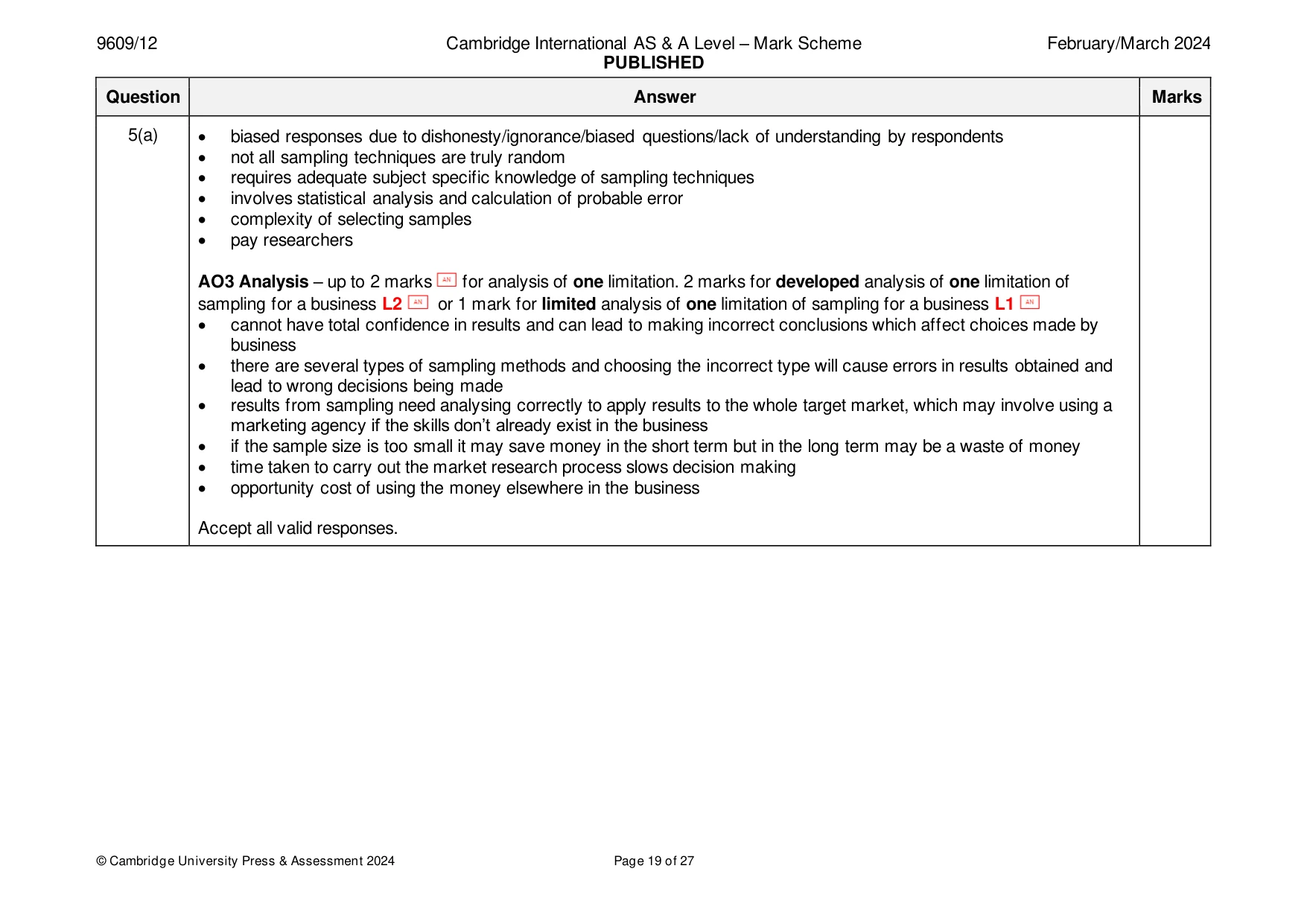
9609/12 Cambridge International AS & A Level – Mark Scheme PUBLISHED February/March 2024 © Cambridge University Press & Assessment 2024 Page 19 of 27 Question Answer Marks 5(a) • biased responses due to dishonesty/ignorance/biased questions/lack of understanding by respondents • not all sampling techniques are truly random • requires adequate subject specific knowledge of sampling techniques • involves statistical analysis and calculation of probable error • complexity of selecting samples • pay researchers AO3 Analysis – up to 2 marks for analysis of one limitation. 2 marks for developed analysis of one limitation of sampling for a business L2 or 1 mark for limited analysis of one limitation of sampling for a business L1 • cannot have total confidence in results and can lead to making incorrect conclusions which affect choices made by business • there are several types of sampling methods and choosing the incorrect type will cause errors in results obtained and lead to wrong decisions being made • results from sampling need analysing correctly to apply results to the whole target market, which may involve using a marketing agency if the skills don’t already exist in the business • if the sample size is too small it may save money in the short term but in the long term may be a waste of money • time taken to carry out the market research process slows decision making • opportunity cost of using the money elsewhere in the business Accept all valid responses.
Mark scheme, page 20
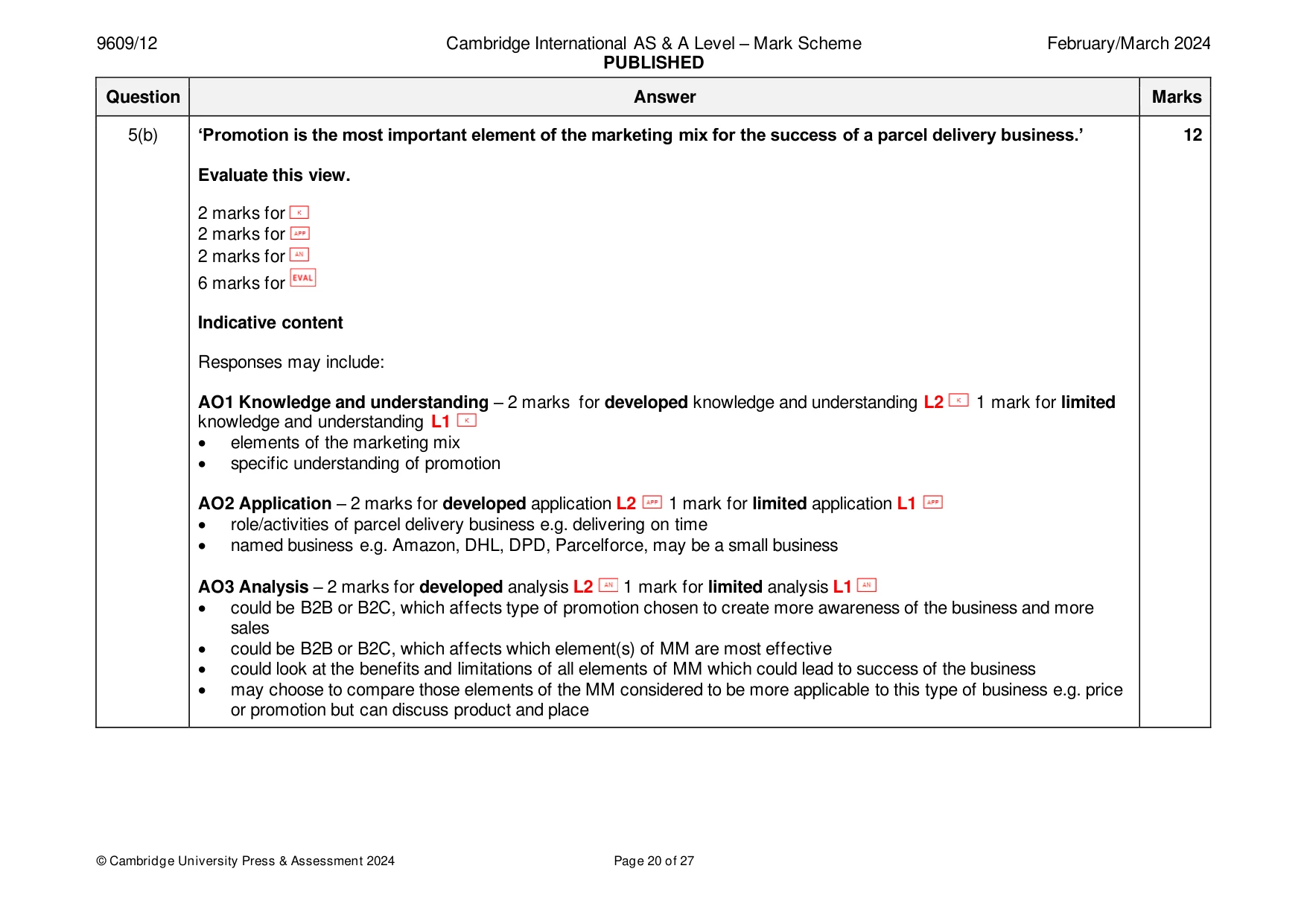
9609/12 Cambridge International AS & A Level – Mark Scheme PUBLISHED February/March 2024 © Cambridge University Press & Assessment 2024 Page 20 of 27 Question Answer Marks 5(b) ‘Promotion is the most important element of the marketing mix for the success of a parcel delivery business.’ Evaluate this view. 2 marks for 2 marks for 2 marks for 6 marks for Indicative content Responses may include: AO1 Knowledge and understanding – 2 marks for developed knowledge and understanding L2 1 mark for limited knowledge and understanding L1 • elements of the marketing mix • specific understanding of promotion AO2 Application – 2 marks for developed application L2 1 mark for limited application L1 • role/activities of parcel delivery business e.g. delivering on time • named business e.g. Amazon, DHL, DPD, Parcelforce, may be a small business AO3 Analysis – 2 marks for developed analysis L2 1 mark for limited analysis L1 • could be B2B or B2C, which affects type of promotion chosen to create more awareness of the business and more sales • could be B2B or B2C, which affects which element(s) of MM are most effective • could look at the benefits and limitations of all elements of MM which could lead to success of the business • may choose to compare those elements of the MM considered to be more applicable to this type of business e.g. price or promotion but can discuss product and place 12
Mark scheme, page 21
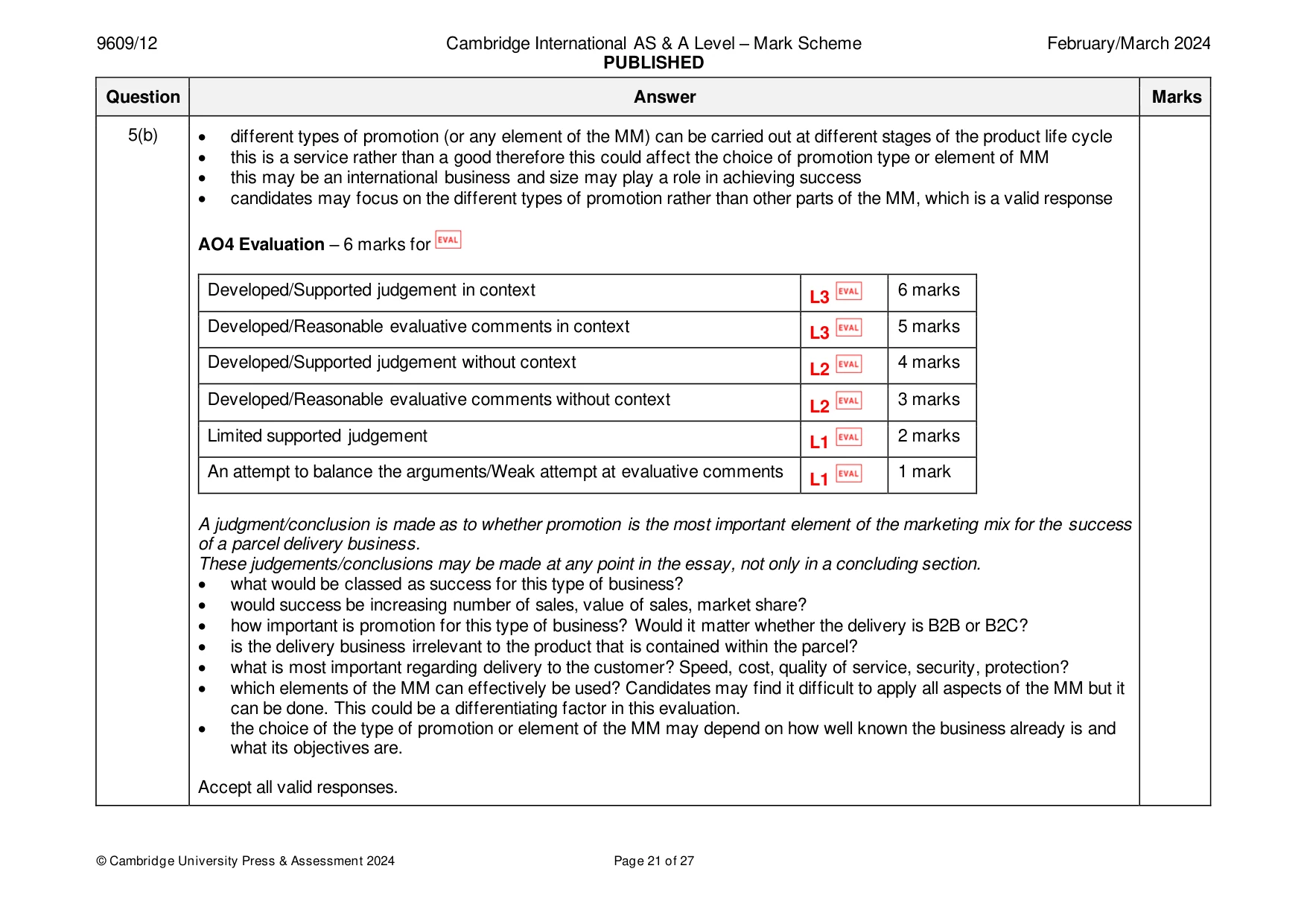
9609/12 Cambridge International AS & A Level – Mark Scheme PUBLISHED February/March 2024 © Cambridge University Press & Assessment 2024 Page 21 of 27 Question Answer Marks 5(b) • different types of promotion (or any element of the MM) can be carried out at different stages of the product life cycle • this is a service rather than a good therefore this could affect the choice of promotion type or element of MM • this may be an international business and size may play a role in achieving success • candidates may focus on the different types of promotion rather than other parts of the MM, which is a valid response AO4 Evaluation – 6 marks for Developed/Supported judgement in context L3 6 marks Developed/Reasonable evaluative comments in context L3 5 marks Developed/Supported judgement without context L2 4 marks Developed/Reasonable evaluative comments without context L2 3 marks Limited supported judgement L1 2 marks An attempt to balance the arguments/Weak attempt at evaluative comments L1 1 mark A judgment/conclusion is made as to whether promotion is the most important element of the marketing mix for the success of a parcel delivery business. These judgements/conclusions may be made at any point in the essay, not only in a concluding section. • what would be classed as success for this type of business? • would success be increasing number of sales, value of sales, market share? • how important is promotion for this type of business? Would it matter whether the delivery is B2B or B2C? • is the delivery business irrelevant to the product that is contained within the parcel? • what is most important regarding delivery to the customer? Speed, cost, quality of service, security, protection? • which elements of the MM can effectively be used? Candidates may find it difficult to apply all aspects of the MM but it can be done. This could be a differentiating factor in this evaluation. • the choice of the type of promotion or element of the MM may depend on how well known the business already is and what its objectives are. Accept all valid responses.
Mark scheme, page 22
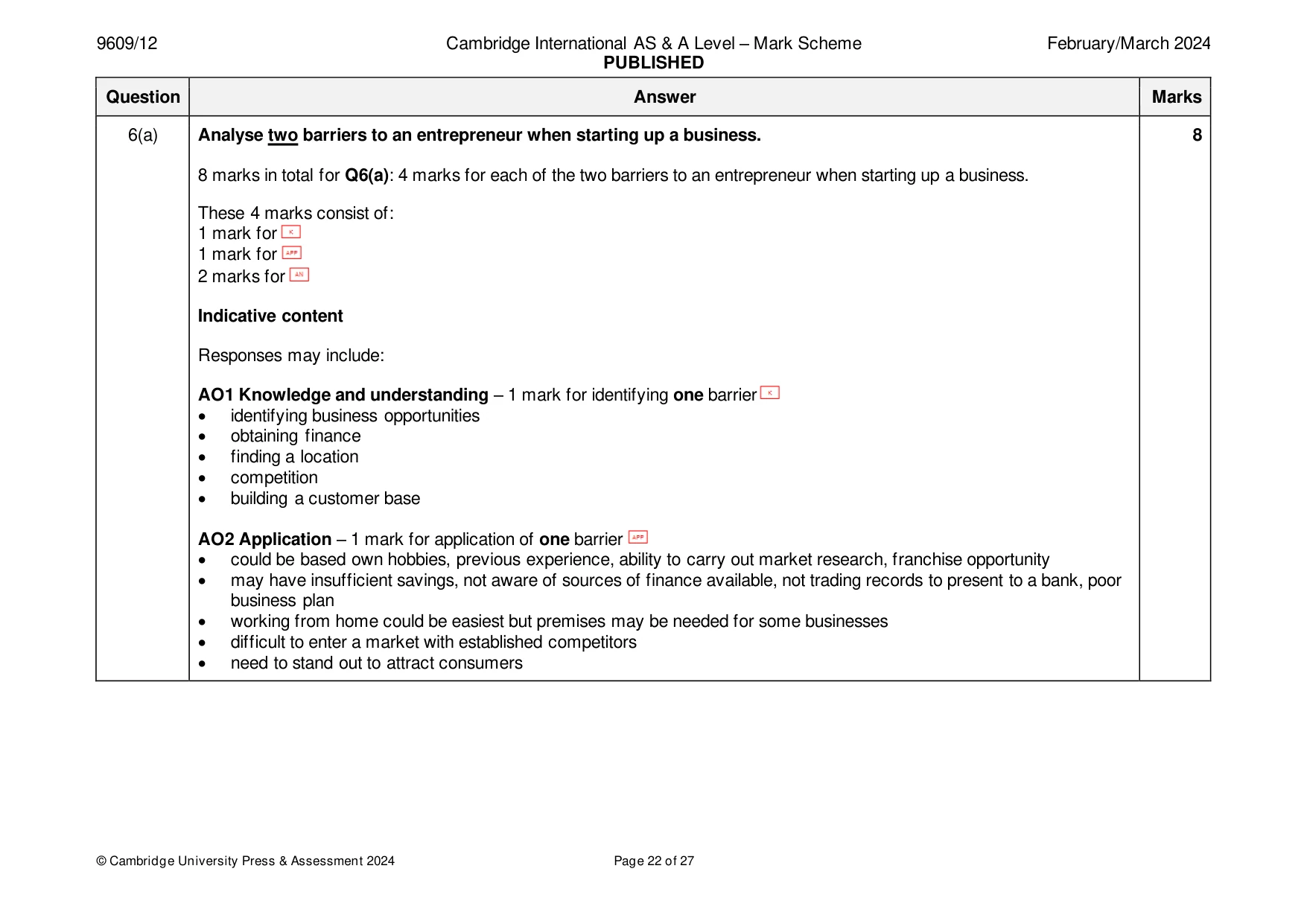
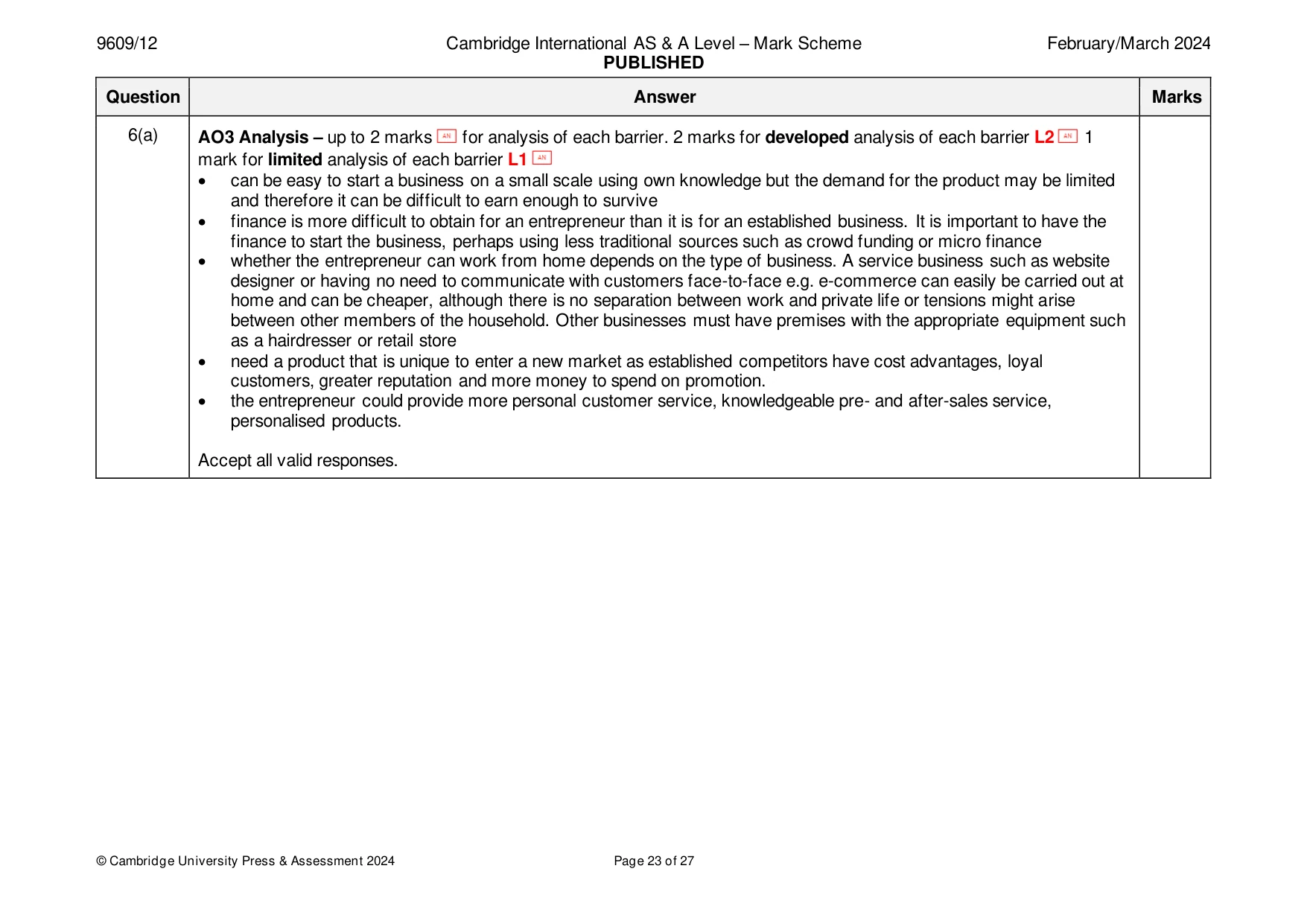
9609/12 Cambridge International AS & A Level – Mark Scheme PUBLISHED February/March 2024 © Cambridge University Press & Assessment 2024 Page 22 of 27 Question Answer Marks 6(a) Analyse two barriers to an entrepreneur when starting up a business. 8 marks in total for Q6(a): 4 marks for each of the two barriers to an entrepreneur when starting up a business. These 4 marks consist of: 1 mark for 1 mark for 2 marks for Indicative content Responses may include: AO1 Knowledge and understanding – 1 mark for identifying one barrier • identifying business opportunities • obtaining finance • finding a location • competition • building a customer base AO2 Application – 1 mark for application of one barrier • could be based own hobbies, previous experience, ability to carry out market research, franchise opportunity • may have insufficient savings, not aware of sources of finance available, not trading records to present to a bank, poor business plan • working from home could be easiest but premises may be needed for some businesses • difficult to enter a market with established competitors • need to stand out to attract consumers 8
Mark scheme, page 23
9609/12 Cambridge International AS & A Level – Mark Scheme PUBLISHED February/March 2024 © Cambridge University Press & Assessment 2024 Page 23 of 27 Question Answer Marks 6(a) AO3 Analysis – up to 2 marks for analysis of each barrier. 2 marks for developed analysis of each barrier L2 1 mark for limited analysis of each barrier L1 • can be easy to start a business on a small scale using own knowledge but the demand for the product may be limited and therefore it can be difficult to earn enough to survive • finance is more difficult to obtain for an entrepreneur than it is for an established business. It is important to have the finance to start the business, perhaps using less traditional sources such as crowd funding or micro finance • whether the entrepreneur can work from home depends on the type of business. A service business such as website designer or having no need to communicate with customers face-to-face e.g. e-commerce can easily be carried out at home and can be cheaper, although there is no separation between work and private life or tensions might arise between other members of the household. Other businesses must have premises with the appropriate equipment such as a hairdresser or retail store • need a product that is unique to enter a new market as established competitors have cost advantages, loyal customers, greater reputation and more money to spend on promotion. • the entrepreneur could provide more personal customer service, knowledgeable pre- and after-sales service, personalised products. Accept all valid responses.
Mark scheme, page 24
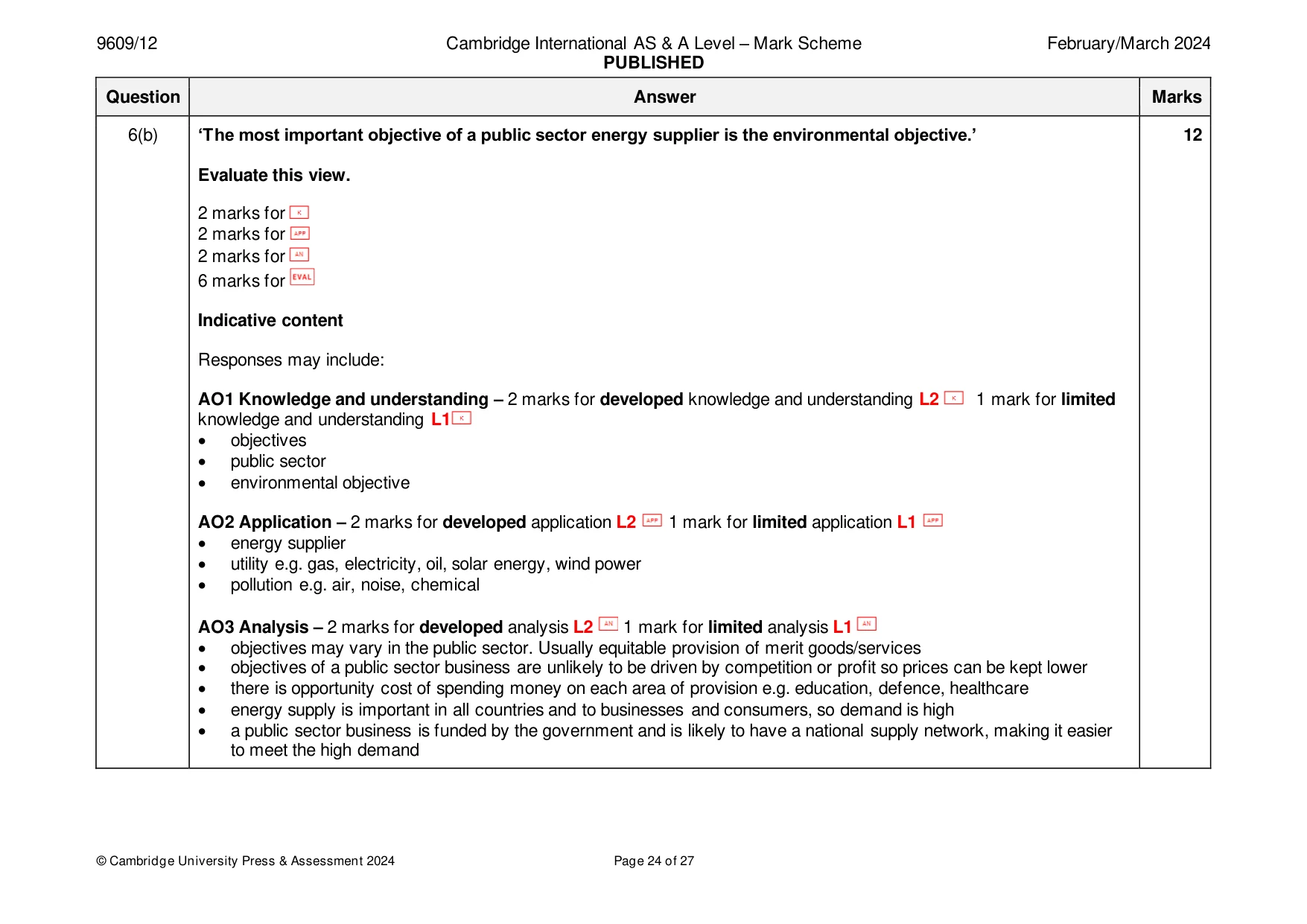
9609/12 Cambridge International AS & A Level – Mark Scheme PUBLISHED February/March 2024 © Cambridge University Press & Assessment 2024 Page 24 of 27 Question Answer Marks 6(b) ‘The most important objective of a public sector energy supplier is the environmental objective.’ Evaluate this view. 2 marks for 2 marks for 2 marks for 6 marks for Indicative content Responses may include: AO1 Knowledge and understanding – 2 marks for developed knowledge and understanding L2 1 mark for limited knowledge and understanding L1 • objectives • public sector • environmental objective AO2 Application – 2 marks for developed application L2 1 mark for limited application L1 • energy supplier • utility e.g. gas, electricity, oil, solar energy, wind power • pollution e.g. air, noise, chemical AO3 Analysis – 2 marks for developed analysis L2 1 mark for limited analysis L1 • objectives may vary in the public sector. Usually equitable provision of merit goods/services • objectives of a public sector business are unlikely to be driven by competition or profit so prices can be kept lower • there is opportunity cost of spending money on each area of provision e.g. education, defence, healthcare • energy supply is important in all countries and to businesses and consumers, so demand is high • a public sector business is funded by the government and is likely to have a national supply network, making it easier to meet the high demand 12
Mark scheme, page 25
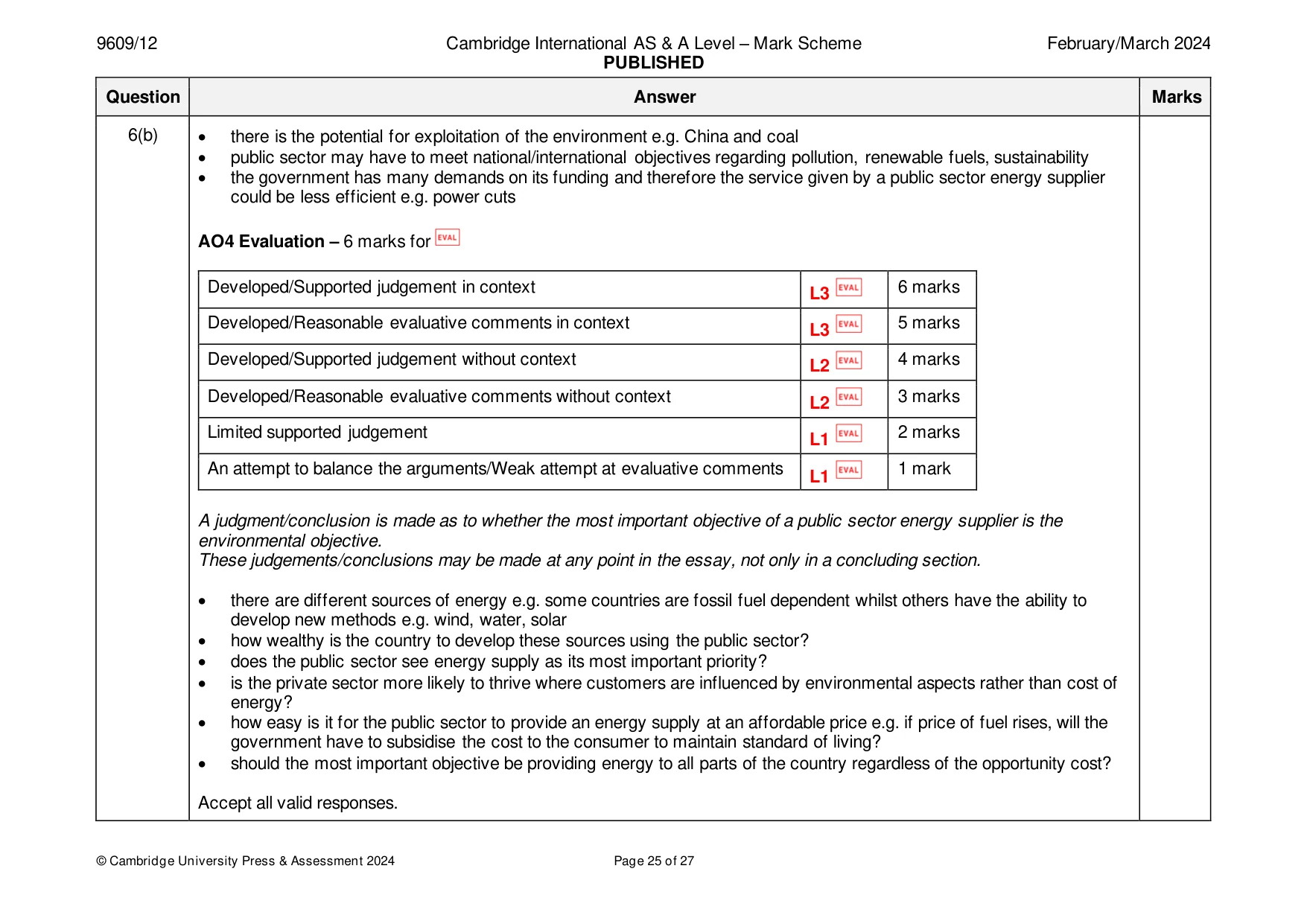
9609/12 Cambridge International AS & A Level – Mark Scheme PUBLISHED February/March 2024 © Cambridge University Press & Assessment 2024 Page 25 of 27 Question Answer Marks 6(b) • there is the potential for exploitation of the environment e.g. China and coal • public sector may have to meet national/international objectives regarding pollution, renewable fuels, sustainability • the government has many demands on its funding and therefore the service given by a public sector energy supplier could be less efficient e.g. power cuts AO4 Evaluation – 6 marks for Developed/Supported judgement in context L3 6 marks Developed/Reasonable evaluative comments in context L3 5 marks Developed/Supported judgement without context L2 4 marks Developed/Reasonable evaluative comments without context L2 3 marks Limited supported judgement L1 2 marks An attempt to balance the arguments/Weak attempt at evaluative comments L1 1 mark A judgment/conclusion is made as to whether the most important objective of a public sector energy supplier is the environmental objective. These judgements/conclusions may be made at any point in the essay, not only in a concluding section. • there are different sources of energy e.g. some countries are fossil fuel dependent whilst others have the ability to develop new methods e.g. wind, water, solar • how wealthy is the country to develop these sources using the public sector? • does the public sector see energy supply as its most important priority? • is the private sector more likely to thrive where customers are influenced by environmental aspects rather than cost of energy? • how easy is it for the public sector to provide an energy supply at an affordable price e.g. if price of fuel rises, will the government have to subsidise the cost to the consumer to maintain standard of living? • should the most important objective be providing energy to all parts of the country regardless of the opportunity cost? Accept all valid responses.
Mark scheme, page 26
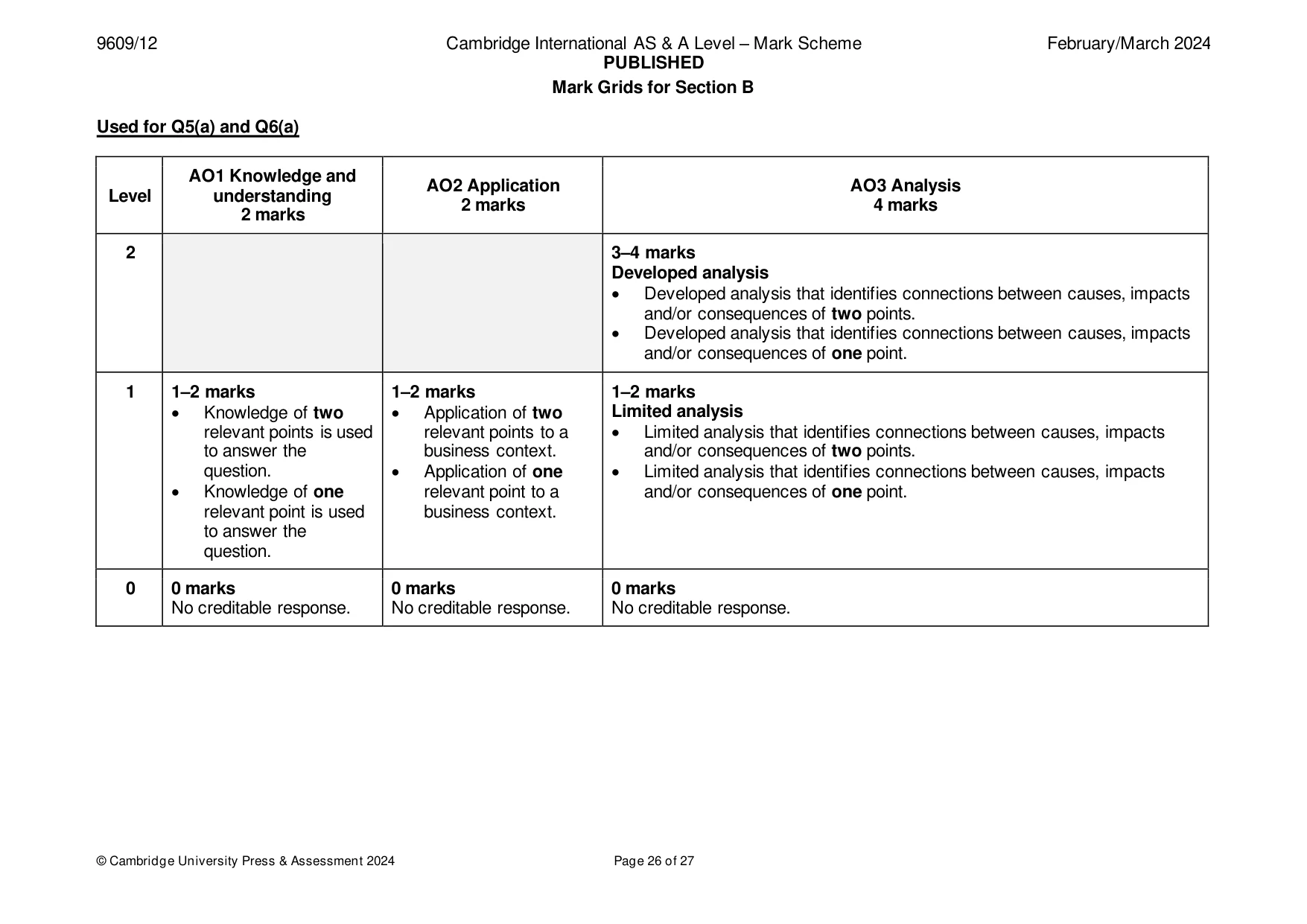
9609/12 Cambridge International AS & A Level – Mark Scheme PUBLISHED February/March 2024 © Cambridge University Press & Assessment 2024 Page 26 of 27 Mark Grids for Section B Used for Q5(a) and Q6(a) Level AO1 Knowledge and understanding 2 marks AO2 Application 2 marks AO3 Analysis 4 marks 2 3–4 marks Developed analysis • Developed analysis that identifies connections between causes, impacts and/or consequences of two points. • Developed analysis that identifies connections between causes, impacts and/or consequences of one point. 1 1–2 marks • Knowledge of two relevant points is used to answer the question. • Knowledge of one relevant point is used to answer the question. 1–2 marks • Application of two relevant points to a business context. • Application of one relevant point to a business context. 1–2 marks Limited analysis • Limited analysis that identifies connections between causes, impacts and/or consequences of two points. • Limited analysis that identifies connections between causes, impacts and/or consequences of one point. 0 0 marks No creditable response. 0 marks No creditable response. 0 marks No creditable response.
Mark scheme, page 27
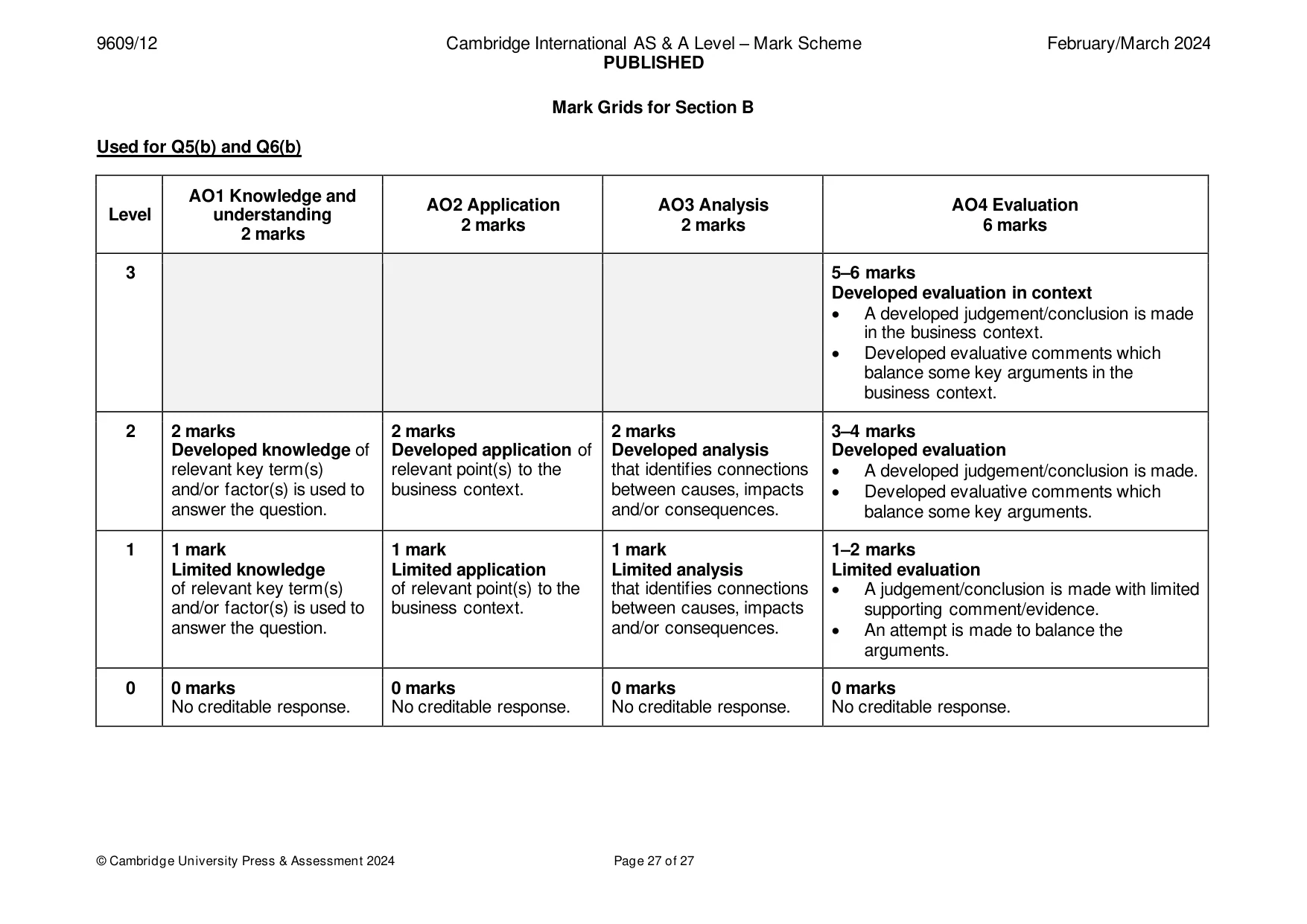
9609/12 Cambridge International AS & A Level – Mark Scheme PUBLISHED February/March 2024 © Cambridge University Press & Assessment 2024 Page 27 of 27 Mark Grids for Section B Used for Q5(b) and Q6(b) Level AO1 Knowledge and understanding 2 marks AO2 Application 2 marks AO3 Analysis 2 marks AO4 Evaluation 6 marks 3 5–6 marks Developed evaluation in context • A developed judgement/conclusion is made in the business context. • Developed evaluative comments which balance some key arguments in the business context. 2 2 marks Developed knowledge of relevant key term(s) and/or factor(s) is used to answer the question. 2 marks Developed application of relevant point(s) to the business context. 2 marks Developed analysis that identifies connections between causes, impacts and/or consequences. 3–4 marks Developed evaluation • A developed judgement/conclusion is made. • Developed evaluative comments which balance some key arguments. 1 1 mark Limited knowledge of relevant key term(s) and/or factor(s) is used to answer the question. 1 mark Limited application of relevant point(s) to the business context. 1 mark Limited analysis that identifies connections between causes, impacts and/or consequences. 1–2 marks Limited evaluation • A judgement/conclusion is made with limited supporting comment/evidence. • An attempt is made to balance the arguments. 0 0 marks No creditable response. 0 marks No creditable response. 0 marks No creditable response. 0 marks No creditable response.
What you needed in this session
Cambridge’s own grade thresholds for 2024 Feb/March, Paper 1 · Variant 2. A higher threshold means an easier paper — the bar moves with how the cohort did.