Cambridge A Level Business (for first examination in 2016) 9609 — 2025 Oct/Nov Paper 1 · Variant 2
9609/12/O/N/25 · 40 marks · ≈45 min
The question paper and its mark scheme, free to read here and free to download. This is Cambridge’s own paper, exactly as it was sat.
Question paper4 pages


Mark scheme28 pages
Answers below. Sit the paper first if you are practising.
Paper as text
Question paper, page 1
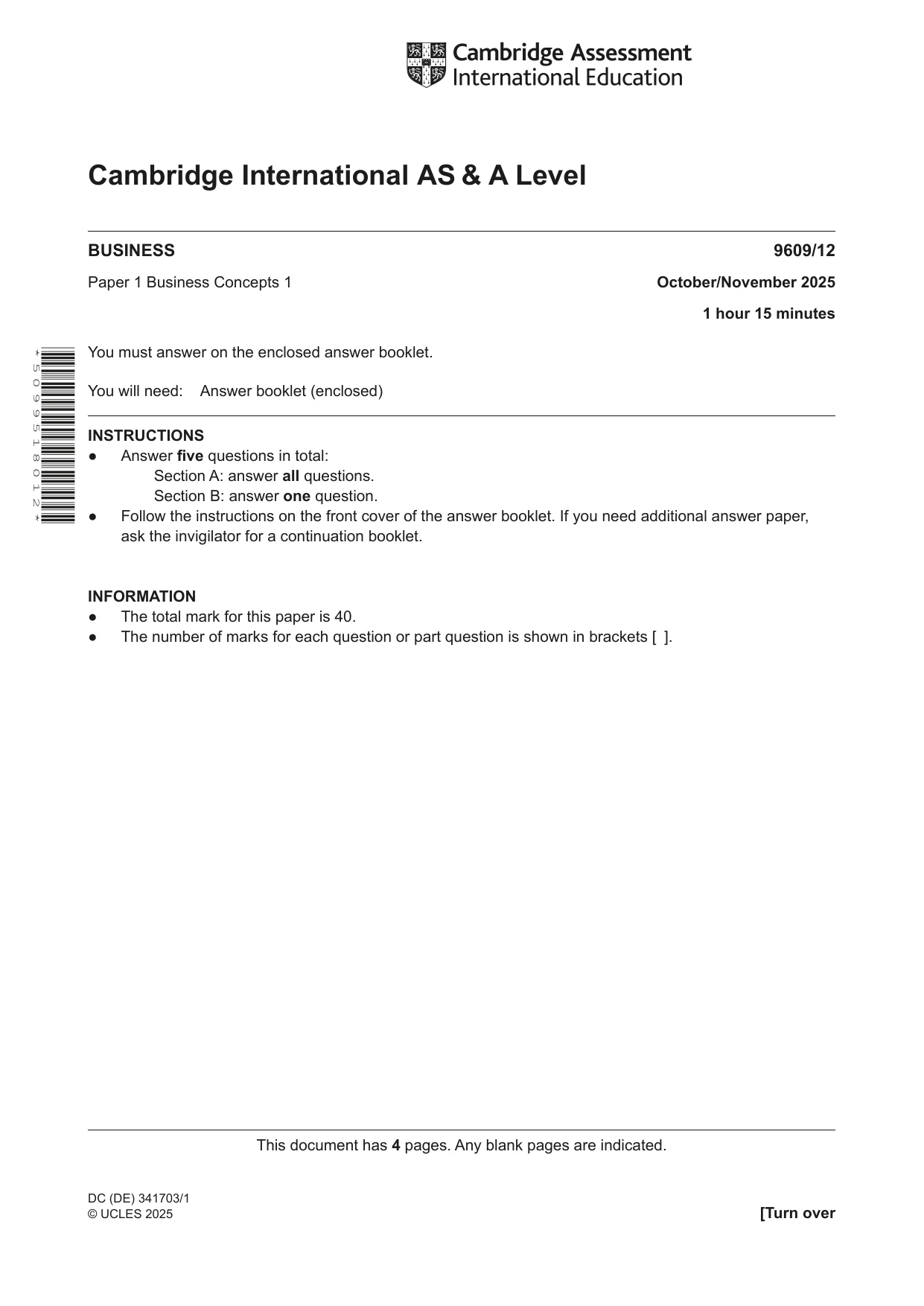
This document has 4 pages. Any blank pages are indicated. [Turn over Cambridge International AS & A Level * 5 0 9 9 5 1 8 0 1 2 * BUSINESS 9609/12 Paper 1 Business Concepts 1 October/November 2025 1 hour 15 minutes You must answer on the enclosed answer booklet. You will need: Answer booklet (enclosed) INSTRUCTIONS ● Answer five questions in total: Section A: answer all questions. Section B: answer one question. ● Follow the instructions on the front cover of the answer booklet. If you need additional answer paper, ask the invigilator for a continuation booklet. INFORMATION ● The total mark for this paper is 40. ● The number of marks for each question or part question is shown in brackets [ ]. DC (DE) 341703/1 © UCLES 2025
Question paper, page 2
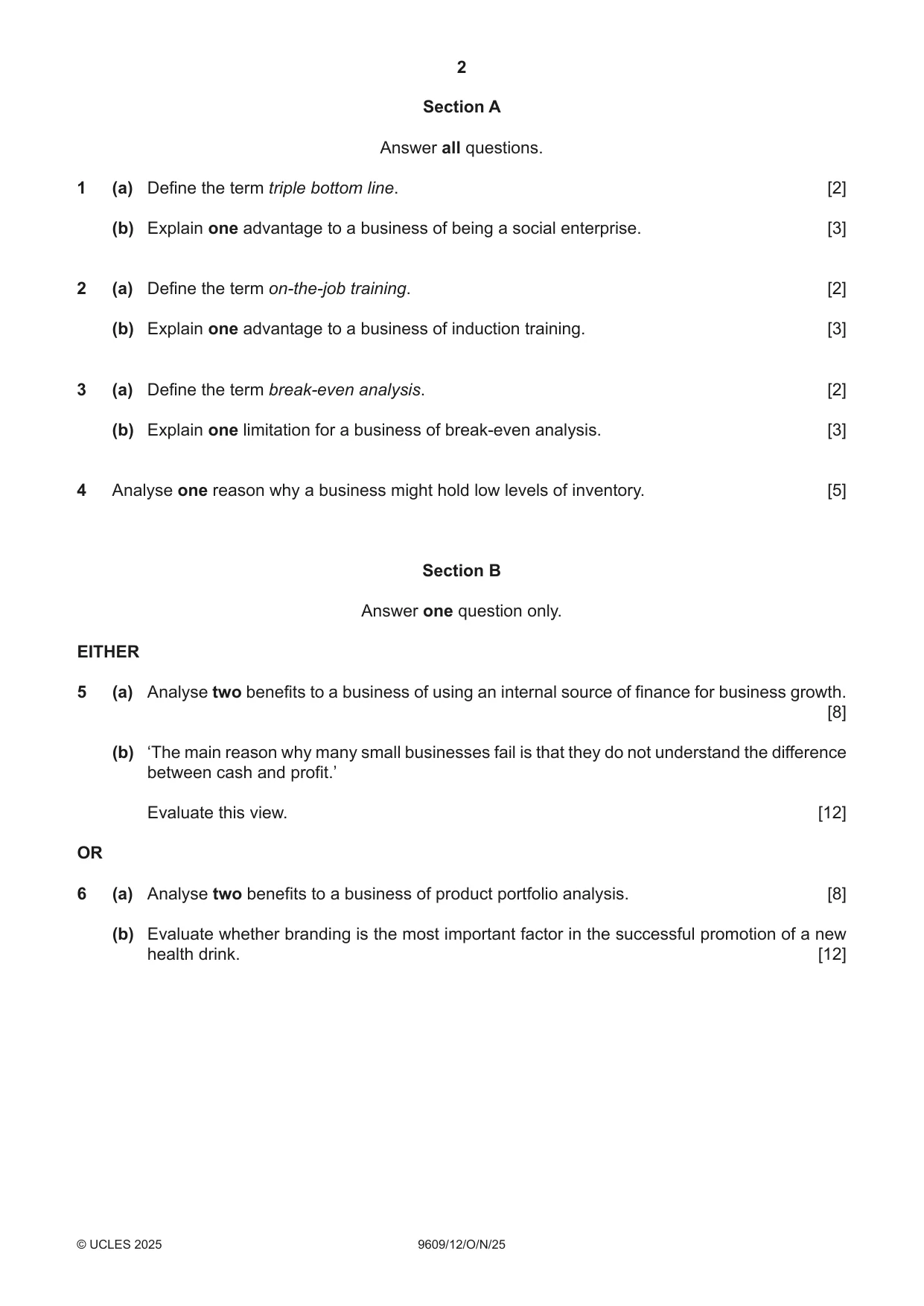
2 9609/12/O/N/25 © UCLES 2025 Section A Answer all questions. 1 (a) Define the term triple bottom line. [2] (b) Explain one advantage to a business of being a social enterprise. [3] 2 (a) Define the term on-the-job training. [2] (b) Explain one advantage to a business of induction training. [3] 3 (a) Define the term break-even analysis. [2] (b) Explain one limitation for a business of break-even analysis. [3] 4 Analyse one reason why a business might hold low levels of inventory. [5] Section B Answer one question only. EITHER 5 (a) Analyse two benefits to a business of using an internal source of finance for business growth. [8] (b) ‘The main reason why many small businesses fail is that they do not understand the difference between cash and profit.’ Evaluate this view. [12] OR 6 (a) Analyse two benefits to a business of product portfolio analysis. [8] (b) Evaluate whether branding is the most important factor in the successful promotion of a new health drink. [12]
Question paper, page 3
3 9609/12/O/N/25 © UCLES 2025 BLANK PAGE
Question paper, page 4
4 9609/12/O/N/25 © UCLES 2025 Permission to reproduce items where third-party owned material protected by copyright is included has been sought and cleared where possible. Every reasonable effort has been made by the publisher (UCLES) to trace copyright holders, but if any items requiring clearance have unwittingly been included, the publisher will be pleased to make amends at the earliest possible opportunity. To avoid the issue of disclosure of answer-related information to candidates, all copyright acknowledgements are reproduced online in the Cambridge Assessment International Education Copyright Acknowledgements Booklet. This is produced for each series of examinations and is freely available to download at www.cambridgeinternational.org after the live examination series. Cambridge Assessment International Education is part of Cambridge Assessment. Cambridge Assessment is the brand name of the University of Cambridge Local Examinations Syndicate (UCLES), which is a department of the University of Cambridge. BLANK PAGE
Mark scheme, page 1
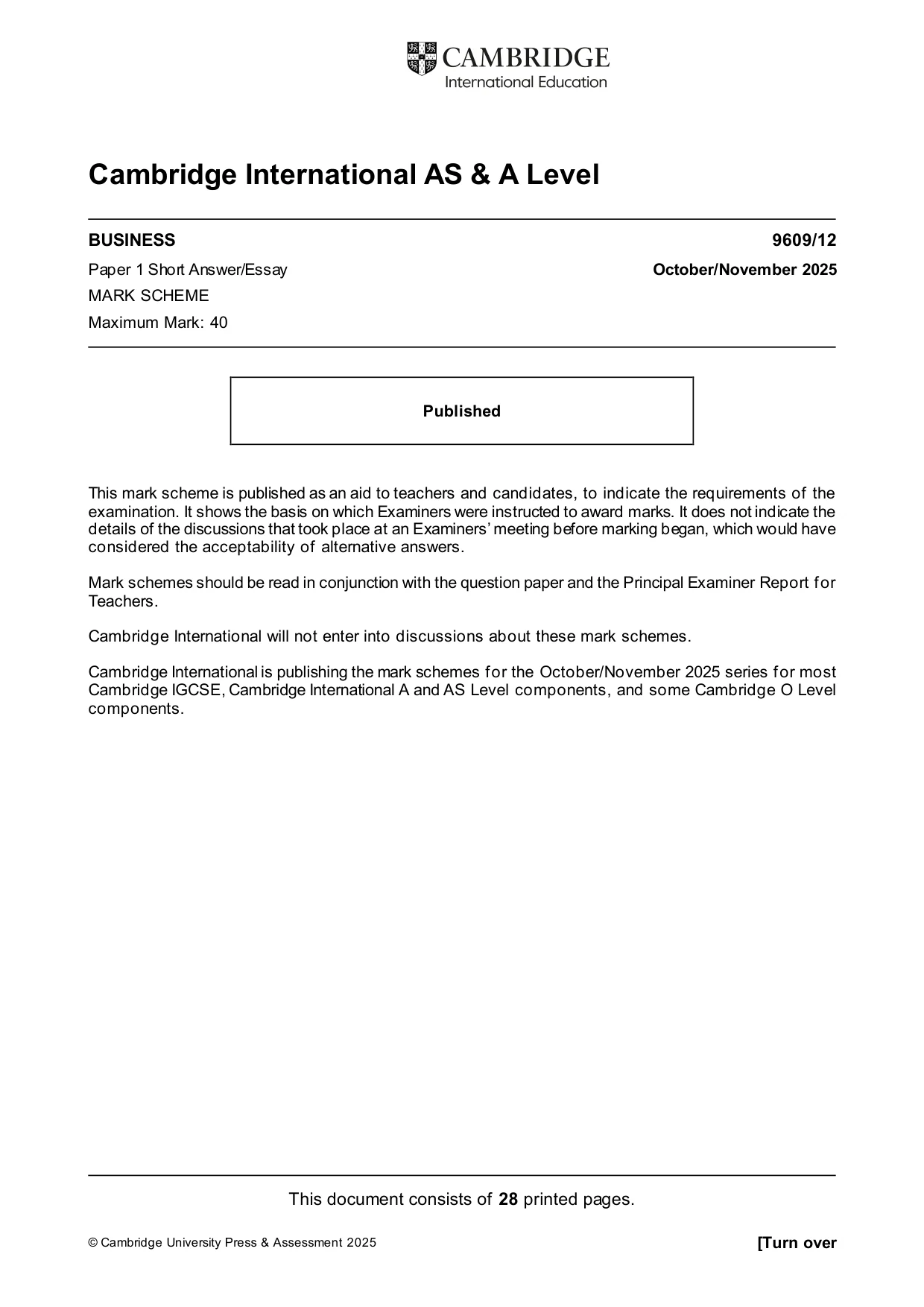
This document consists of 28 printed pages. © Cambridge University Press & Assessment 2025 [Turn over Cambridge International AS & A Level BUSINESS 9609/12 Paper 1 Short Answer/Essay October/November 2025 MARK SCHEME Maximum Mark: 40 Published This mark scheme is published as an aid to teachers and candidates, to indicate the requirements of the examination. It shows the basis on which Examiners were instructed to award marks. It does not indicate the details of the discussions that took place at an Examiners’ meeting before marking began, which would have considered the acceptability of alternative answers. Mark schemes should be read in conjunction with the question paper and the Principal Examiner Report for Teachers. Cambridge International will not enter into discussions about these mark schemes. Cambridge International is publishing the mark schemes for the October/November 2025 series for most Cambridge IGCSE, Cambridge International A and AS Level components, and some Cambridge O Level components.
Mark scheme, page 2
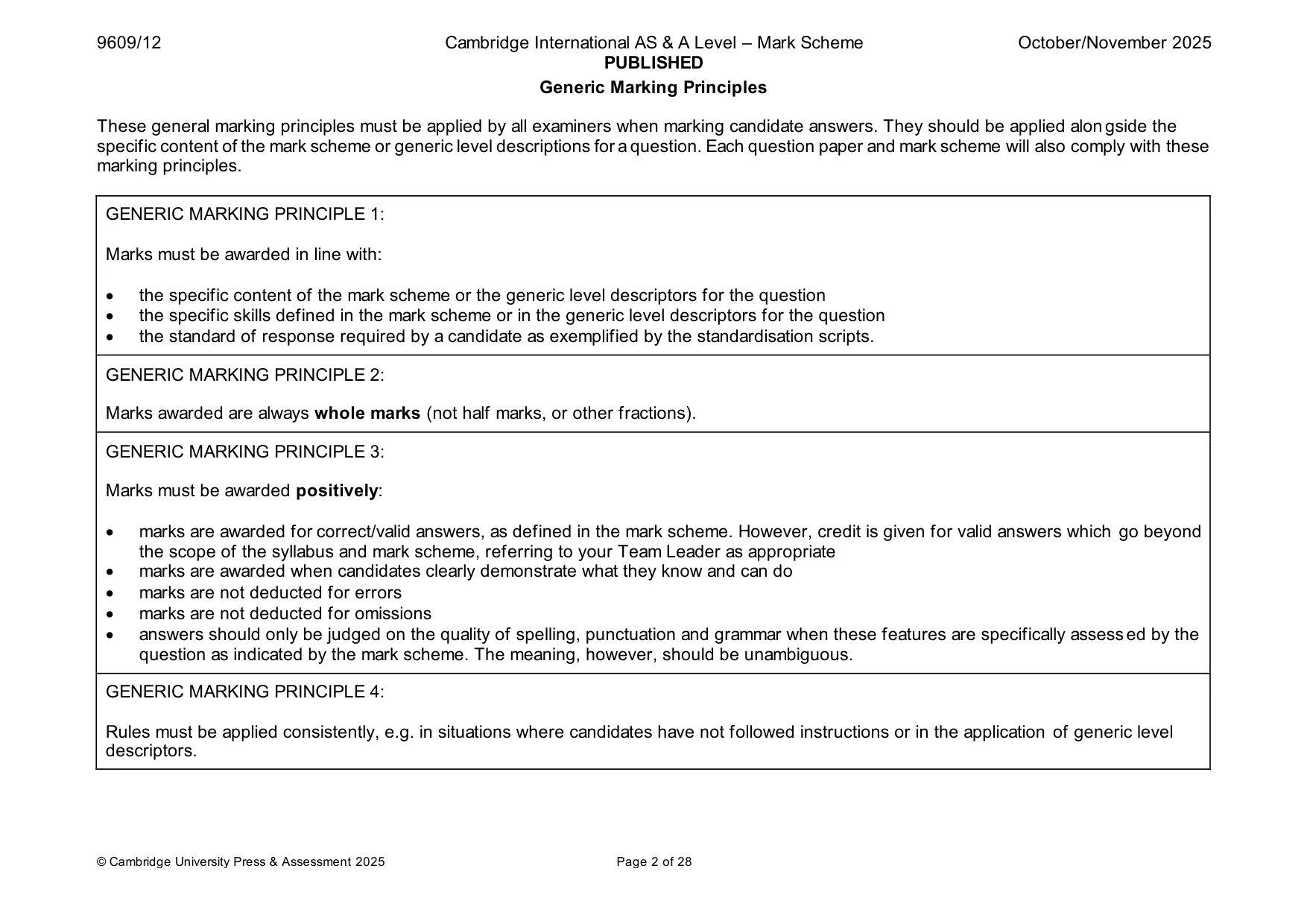
9609/12 Cambridge International AS & A Level – Mark Scheme PUBLISHED October/November 2025 © Cambridge University Press & Assessment 2025 Page 2 of 28 Generic Marking Principles These general marking principles must be applied by all examiners when marking candidate answers. They should be applied alon gside the specific content of the mark scheme or generic level descriptions for a question. Each question paper and mark scheme will also comply with these marking principles. GENERIC MARKING PRINCIPLE 1: Marks must be awarded in line with: • the specific content of the mark scheme or the generic level descriptors for the question • the specific skills defined in the mark scheme or in the generic level descriptors for the question • the standard of response required by a candidate as exemplified by the standardisation scripts. GENERIC MARKING PRINCIPLE 2: Marks awarded are always whole marks (not half marks, or other fractions). GENERIC MARKING PRINCIPLE 3: Marks must be awarded positively: • marks are awarded for correct/valid answers, as defined in the mark scheme. However, credit is given for valid answers which go beyond the scope of the syllabus and mark scheme, referring to your Team Leader as appropriate • marks are awarded when candidates clearly demonstrate what they know and can do • marks are not deducted for errors • marks are not deducted for omissions • answers should only be judged on the quality of spelling, punctuation and grammar when these features are specifically assessed by the question as indicated by the mark scheme. The meaning, however, should be unambiguous. GENERIC MARKING PRINCIPLE 4: Rules must be applied consistently, e.g. in situations where candidates have not followed instructions or in the application of generic level descriptors.
Mark scheme, page 3
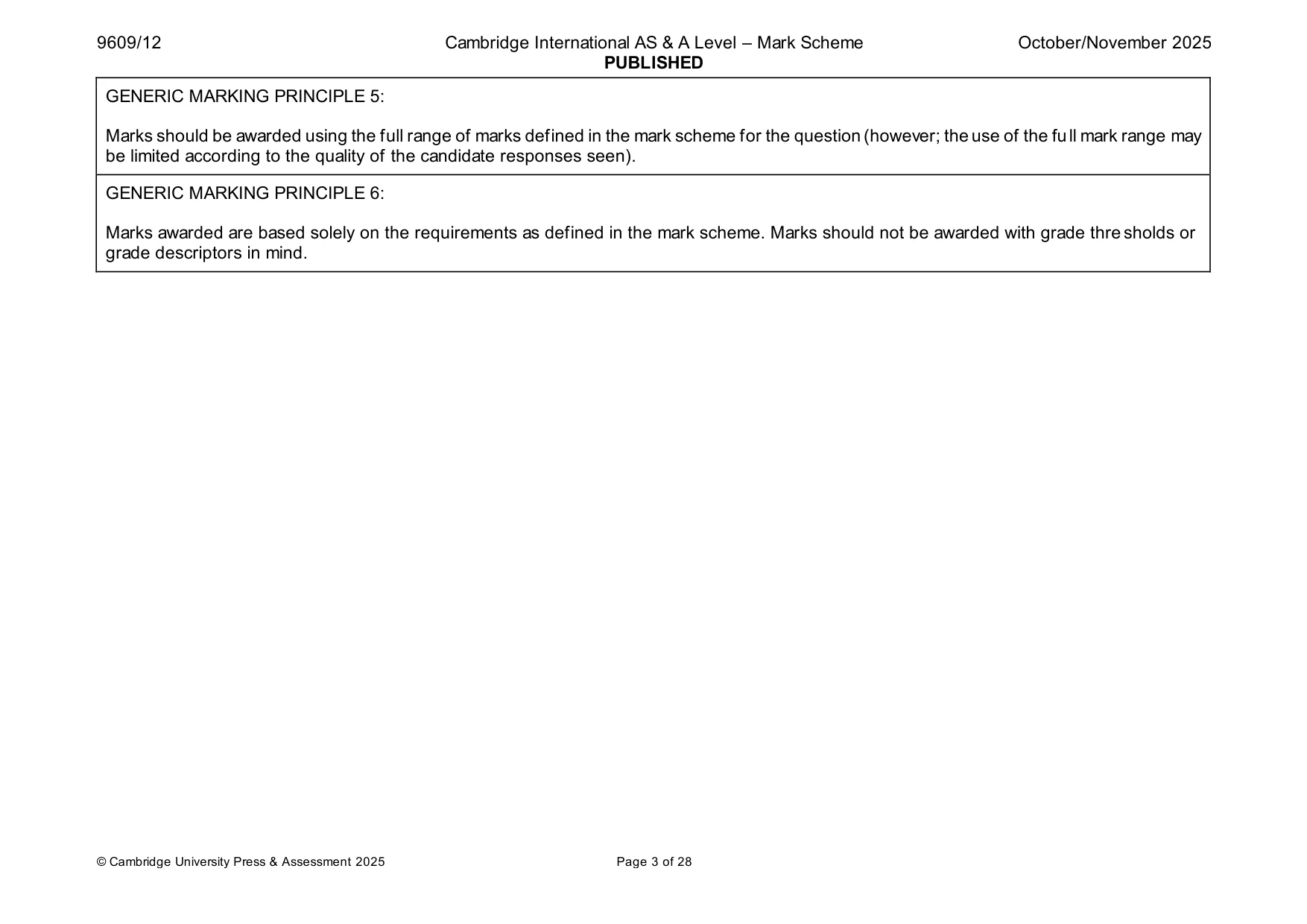
9609/12 Cambridge International AS & A Level – Mark Scheme PUBLISHED October/November 2025 © Cambridge University Press & Assessment 2025 Page 3 of 28 GENERIC MARKING PRINCIPLE 5: Marks should be awarded using the full range of marks defined in the mark scheme for the question (however; the use of the full mark range may be limited according to the quality of the candidate responses seen). GENERIC MARKING PRINCIPLE 6: Marks awarded are based solely on the requirements as defined in the mark scheme. Marks should not be awarded with grade thre sholds or grade descriptors in mind.
Mark scheme, page 4
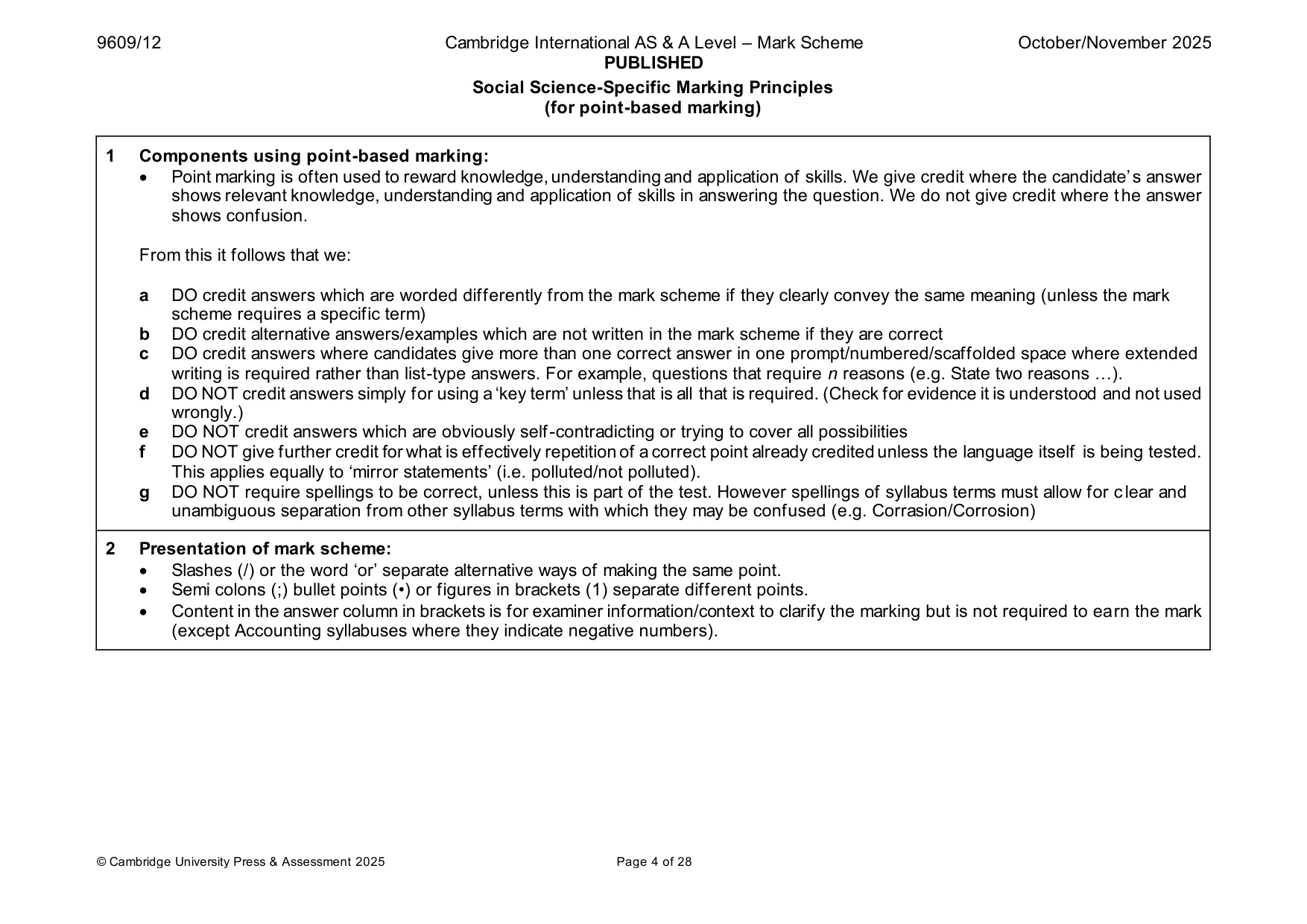
9609/12 Cambridge International AS & A Level – Mark Scheme PUBLISHED October/November 2025 © Cambridge University Press & Assessment 2025 Page 4 of 28 Social Science-Specific Marking Principles (for point-based marking) 1 Components using point-based marking: • Point marking is often used to reward knowledge, understanding and application of skills. We give credit where the candidate’s answer shows relevant knowledge, understanding and application of skills in answering the question. We do not give credit where the answer shows confusion. From this it follows that we: a DO credit answers which are worded differently from the mark scheme if they clearly convey the same meaning (unless the mark scheme requires a specific term) b DO credit alternative answers/examples which are not written in the mark scheme if they are correct c DO credit answers where candidates give more than one correct answer in one prompt/numbered/scaffolded space where extended writing is required rather than list-type answers. For example, questions that require n reasons (e.g. State two reasons …). d DO NOT credit answers simply for using a ‘key term’ unless that is all that is required. (Check for evidence it is understood and not used wrongly.) e DO NOT credit answers which are obviously self-contradicting or trying to cover all possibilities f DO NOT give further credit for what is effectively repetition of a correct point already credited unless the language itself is being tested. This applies equally to ‘mirror statements’ (i.e. polluted/not polluted). g DO NOT require spellings to be correct, unless this is part of the test. However spellings of syllabus terms must allow for clear and unambiguous separation from other syllabus terms with which they may be confused (e.g. Corrasion/Corrosion) 2 Presentation of mark scheme: • Slashes (/) or the word ‘or’ separate alternative ways of making the same point. • Semi colons (;) bullet points (•) or figures in brackets (1) separate different points. • Content in the answer column in brackets is for examiner information/context to clarify the marking but is not required to earn the mark (except Accounting syllabuses where they indicate negative numbers).
Mark scheme, page 5
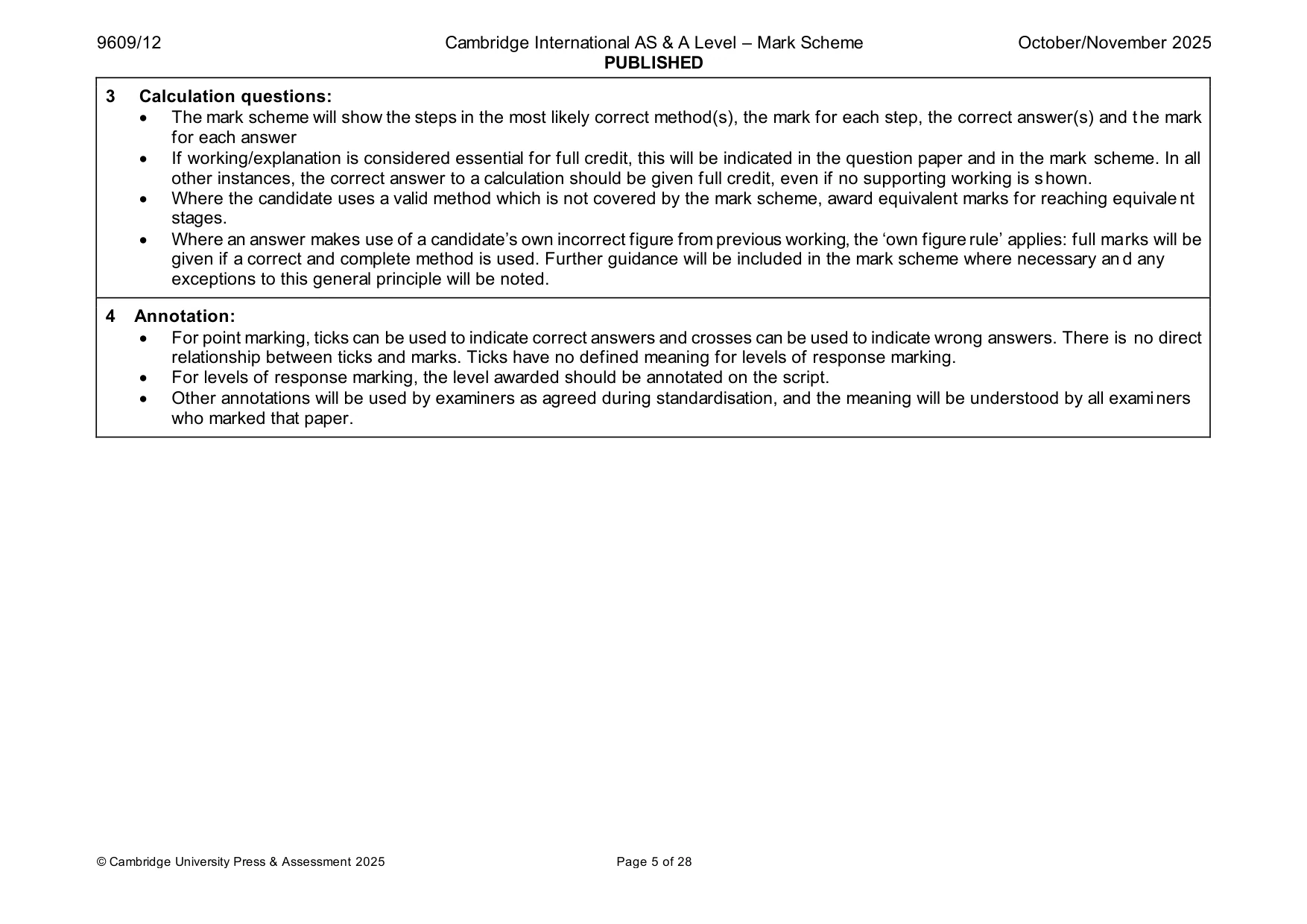
9609/12 Cambridge International AS & A Level – Mark Scheme PUBLISHED October/November 2025 © Cambridge University Press & Assessment 2025 Page 5 of 28 3 Calculation questions: • The mark scheme will show the steps in the most likely correct method(s), the mark for each step, the correct answer(s) and the mark for each answer • If working/explanation is considered essential for full credit, this will be indicated in the question paper and in the mark scheme. In all other instances, the correct answer to a calculation should be given full credit, even if no supporting working is shown. • Where the candidate uses a valid method which is not covered by the mark scheme, award equivalent marks for reaching equivale nt stages. • Where an answer makes use of a candidate’s own incorrect figure from previous working, the ‘own figure rule’ applies: full marks will be given if a correct and complete method is used. Further guidance will be included in the mark scheme where necessary an d any exceptions to this general principle will be noted. 4 Annotation: • For point marking, ticks can be used to indicate correct answers and crosses can be used to indicate wrong answers. There is no direct relationship between ticks and marks. Ticks have no defined meaning for levels of response marking. • For levels of response marking, the level awarded should be annotated on the script. • Other annotations will be used by examiners as agreed during standardisation, and the meaning will be understood by all examiners who marked that paper.
Mark scheme, page 6
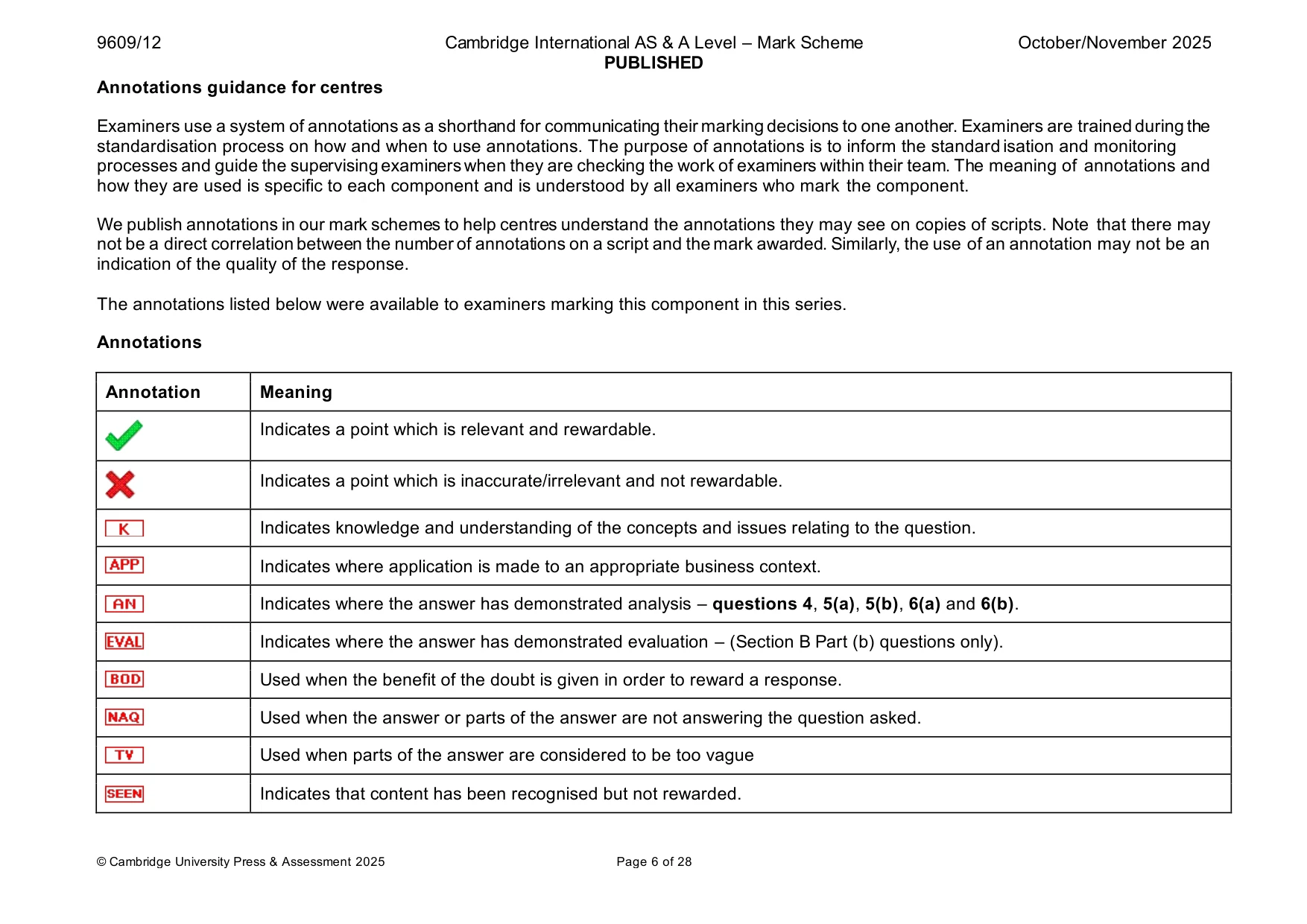
9609/12 Cambridge International AS & A Level – Mark Scheme PUBLISHED October/November 2025 © Cambridge University Press & Assessment 2025 Page 6 of 28 Annotations guidance for centres Examiners use a system of annotations as a shorthand for communicating their marking decisions to one another. Examiners are trained during the standardisation process on how and when to use annotations. The purpose of annotations is to inform the standard isation and monitoring processes and guide the supervising examiners when they are checking the work of examiners within their team. The meaning of annotations and how they are used is specific to each component and is understood by all examiners who mark the component. We publish annotations in our mark schemes to help centres understand the annotations they may see on copies of scripts. Note that there may not be a direct correlation between the number of annotations on a script and the mark awarded. Similarly, the use of an annotation may not be an indication of the quality of the response. The annotations listed below were available to examiners marking this component in this series. Annotations Annotation Meaning Indicates a point which is relevant and rewardable. Indicates a point which is inaccurate/irrelevant and not rewardable. Indicates knowledge and understanding of the concepts and issues relating to the question. Indicates where application is made to an appropriate business context. Indicates where the answer has demonstrated analysis – questions 4, 5(a), 5(b), 6(a) and 6(b). Indicates where the answer has demonstrated evaluation – (Section B Part (b) questions only). Used when the benefit of the doubt is given in order to reward a response. Used when the answer or parts of the answer are not answering the question asked. Used when parts of the answer are considered to be too vague Indicates that content has been recognised but not rewarded.
Mark scheme, page 7
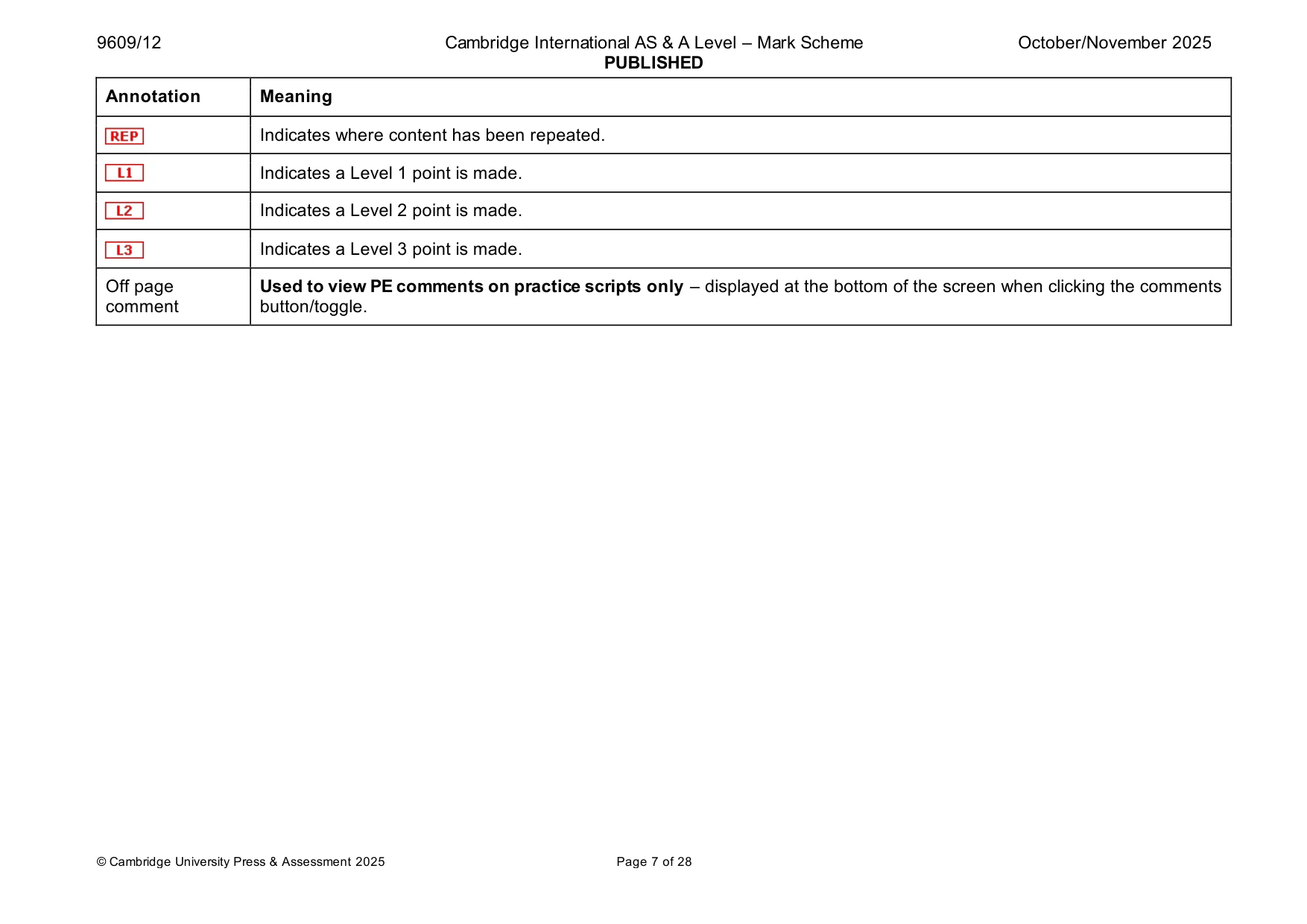
9609/12 Cambridge International AS & A Level – Mark Scheme PUBLISHED October/November 2025 © Cambridge University Press & Assessment 2025 Page 7 of 28 Annotation Meaning Indicates where content has been repeated. Indicates a Level 1 point is made. Indicates a Level 2 point is made. Indicates a Level 3 point is made. Off page comment Used to view PE comments on practice scripts only – displayed at the bottom of the screen when clicking the comments button/toggle.
Mark scheme, page 8
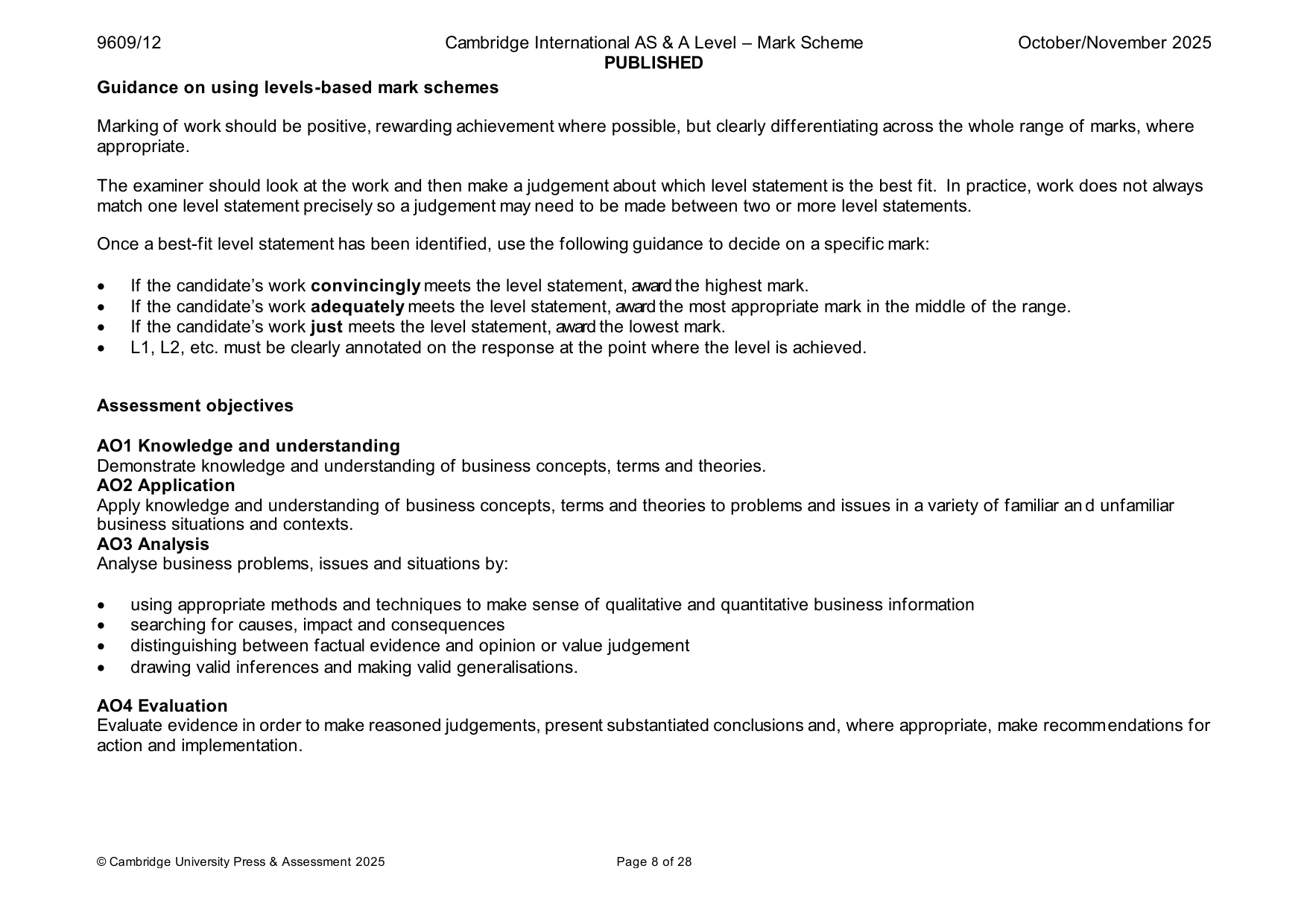
9609/12 Cambridge International AS & A Level – Mark Scheme PUBLISHED October/November 2025 © Cambridge University Press & Assessment 2025 Page 8 of 28 Guidance on using levels-based mark schemes Marking of work should be positive, rewarding achievement where possible, but clearly differentiating across the whole range of marks, where appropriate. The examiner should look at the work and then make a judgement about which level statement is the best fit. In practice, work does not always match one level statement precisely so a judgement may need to be made between two or more level statements. Once a best-fit level statement has been identified, use the following guidance to decide on a specific mark: • If the candidate’s work convincingly meets the level statement, award the highest mark. • If the candidate’s work adequately meets the level statement, award the most appropriate mark in the middle of the range. • If the candidate’s work just meets the level statement, award the lowest mark. • L1, L2, etc. must be clearly annotated on the response at the point where the level is achieved. Assessment objectives AO1 Knowledge and understanding Demonstrate knowledge and understanding of business concepts, terms and theories. AO2 Application Apply knowledge and understanding of business concepts, terms and theories to problems and issues in a variety of familiar an d unfamiliar business situations and contexts. AO3 Analysis Analyse business problems, issues and situations by: • using appropriate methods and techniques to make sense of qualitative and quantitative business information • searching for causes, impact and consequences • distinguishing between factual evidence and opinion or value judgement • drawing valid inferences and making valid generalisations. AO4 Evaluation Evaluate evidence in order to make reasoned judgements, present substantiated conclusions and, where appropriate, make recommendations for action and implementation.
Mark scheme, page 9
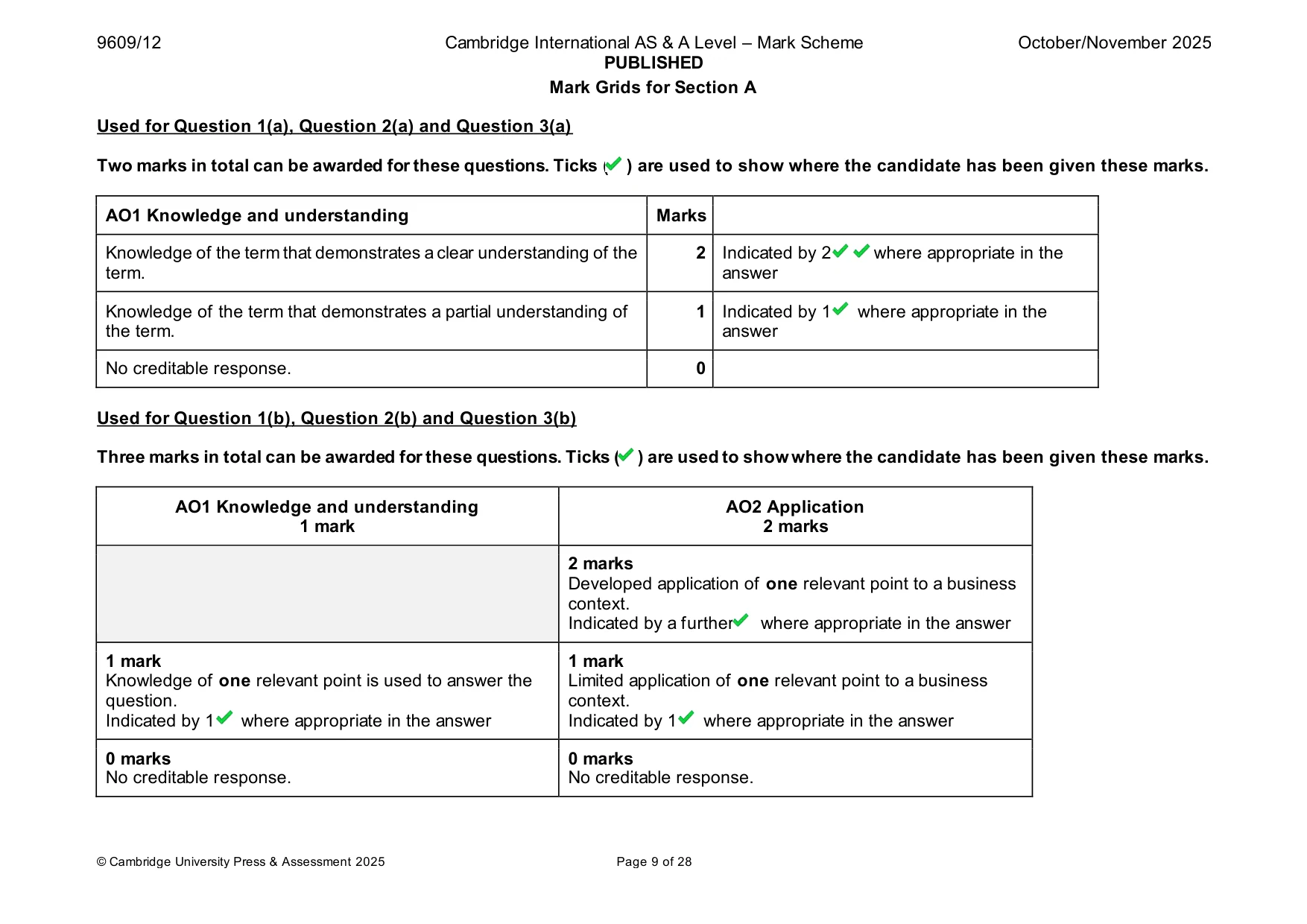
9609/12 Cambridge International AS & A Level – Mark Scheme PUBLISHED October/November 2025 © Cambridge University Press & Assessment 2025 Page 9 of 28 Mark Grids for Section A Used for Question 1(a), Question 2(a) and Question 3(a) Two marks in total can be awarded for these questions. Ticks ( ) are used to show where the candidate has been given these marks. AO1 Knowledge and understanding Marks Knowledge of the term that demonstrates a clear understanding of the term. 2 Indicated by 2 where appropriate in the answer Knowledge of the term that demonstrates a partial understanding of the term. 1 Indicated by 1 where appropriate in the answer No creditable response. 0 Used for Question 1(b), Question 2(b) and Question 3(b) Three marks in total can be awarded for these questions. Ticks ( ) are used to show where the candidate has been given these marks. AO1 Knowledge and understanding 1 mark AO2 Application 2 marks 2 marks Developed application of one relevant point to a business context. Indicated by a further where appropriate in the answer 1 mark Knowledge of one relevant point is used to answer the question. Indicated by 1 where appropriate in the answer 1 mark Limited application of one relevant point to a business context. Indicated by 1 where appropriate in the answer 0 marks No creditable response. 0 marks No creditable response.
Mark scheme, page 10
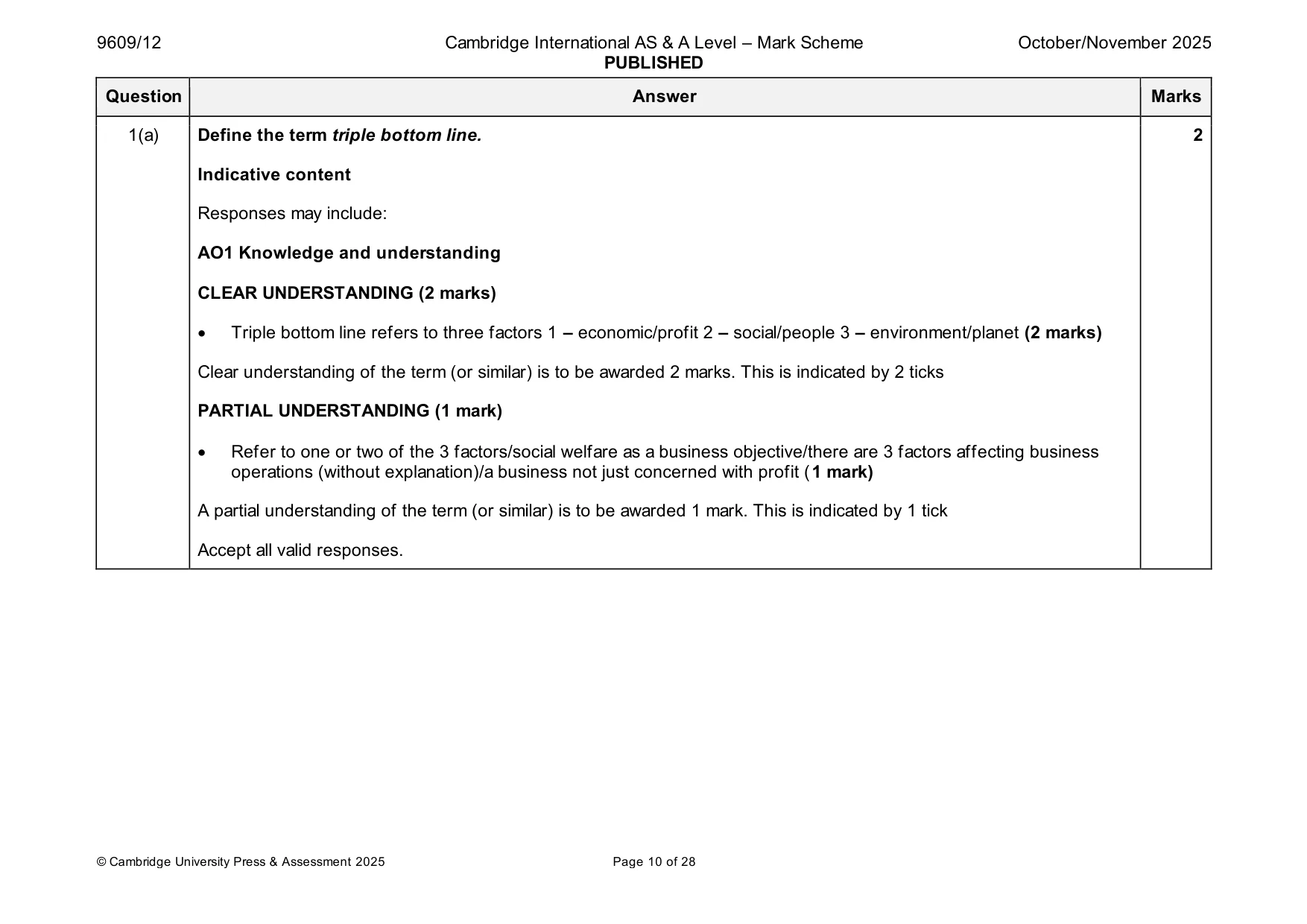
9609/12 Cambridge International AS & A Level – Mark Scheme PUBLISHED October/November 2025 © Cambridge University Press & Assessment 2025 Page 10 of 28 Question Answer Marks 1(a) Define the term triple bottom line. Indicative content Responses may include: AO1 Knowledge and understanding CLEAR UNDERSTANDING (2 marks) • Triple bottom line refers to three factors 1 – economic/profit 2 – social/people 3 – environment/planet (2 marks) Clear understanding of the term (or similar) is to be awarded 2 marks. This is indicated by 2 ticks PARTIAL UNDERSTANDING (1 mark) • Refer to one or two of the 3 factors/social welfare as a business objective/there are 3 factors affecting business operations (without explanation)/a business not just concerned with profit (1 mark) A partial understanding of the term (or similar) is to be awarded 1 mark. This is indicated by 1 tick Accept all valid responses. 2
Mark scheme, page 11
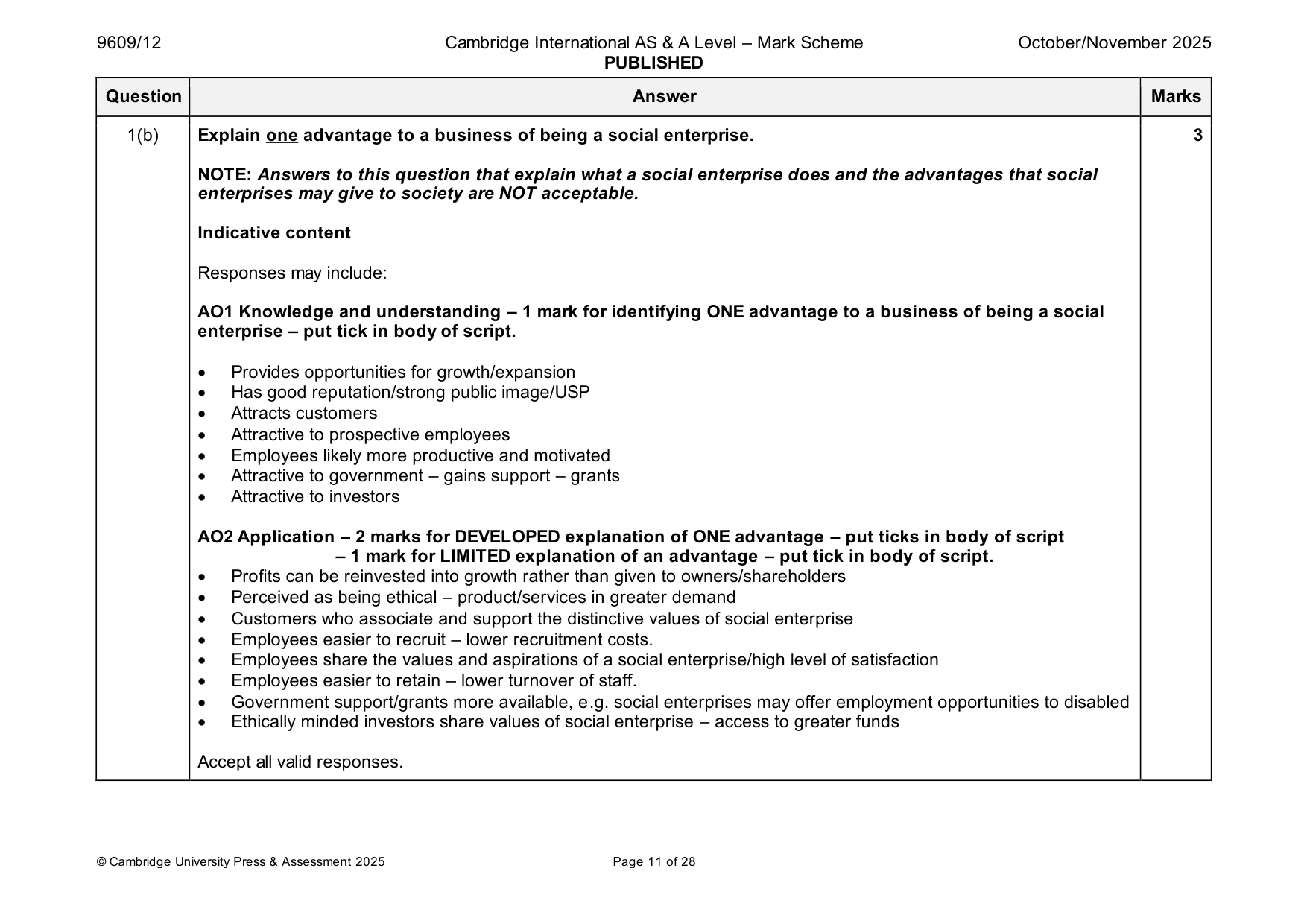
9609/12 Cambridge International AS & A Level – Mark Scheme PUBLISHED October/November 2025 © Cambridge University Press & Assessment 2025 Page 11 of 28 Question Answer Marks 1(b) Explain one advantage to a business of being a social enterprise. NOTE: Answers to this question that explain what a social enterprise does and the advantages that social enterprises may give to society are NOT acceptable. Indicative content Responses may include: AO1 Knowledge and understanding – 1 mark for identifying ONE advantage to a business of being a social enterprise – put tick in body of script. • Provides opportunities for growth/expansion • Has good reputation/strong public image/USP • Attracts customers • Attractive to prospective employees • Employees likely more productive and motivated • Attractive to government – gains support – grants • Attractive to investors AO2 Application – 2 marks for DEVELOPED explanation of ONE advantage – put ticks in body of script – 1 mark for LIMITED explanation of an advantage – put tick in body of script. • Profits can be reinvested into growth rather than given to owners/shareholders • Perceived as being ethical – product/services in greater demand • Customers who associate and support the distinctive values of social enterprise • Employees easier to recruit – lower recruitment costs. • Employees share the values and aspirations of a social enterprise/high level of satisfaction • Employees easier to retain – lower turnover of staff. • Government support/grants more available, e.g. social enterprises may offer employment opportunities to disabled • Ethically minded investors share values of social enterprise – access to greater funds Accept all valid responses. 3
Mark scheme, page 12
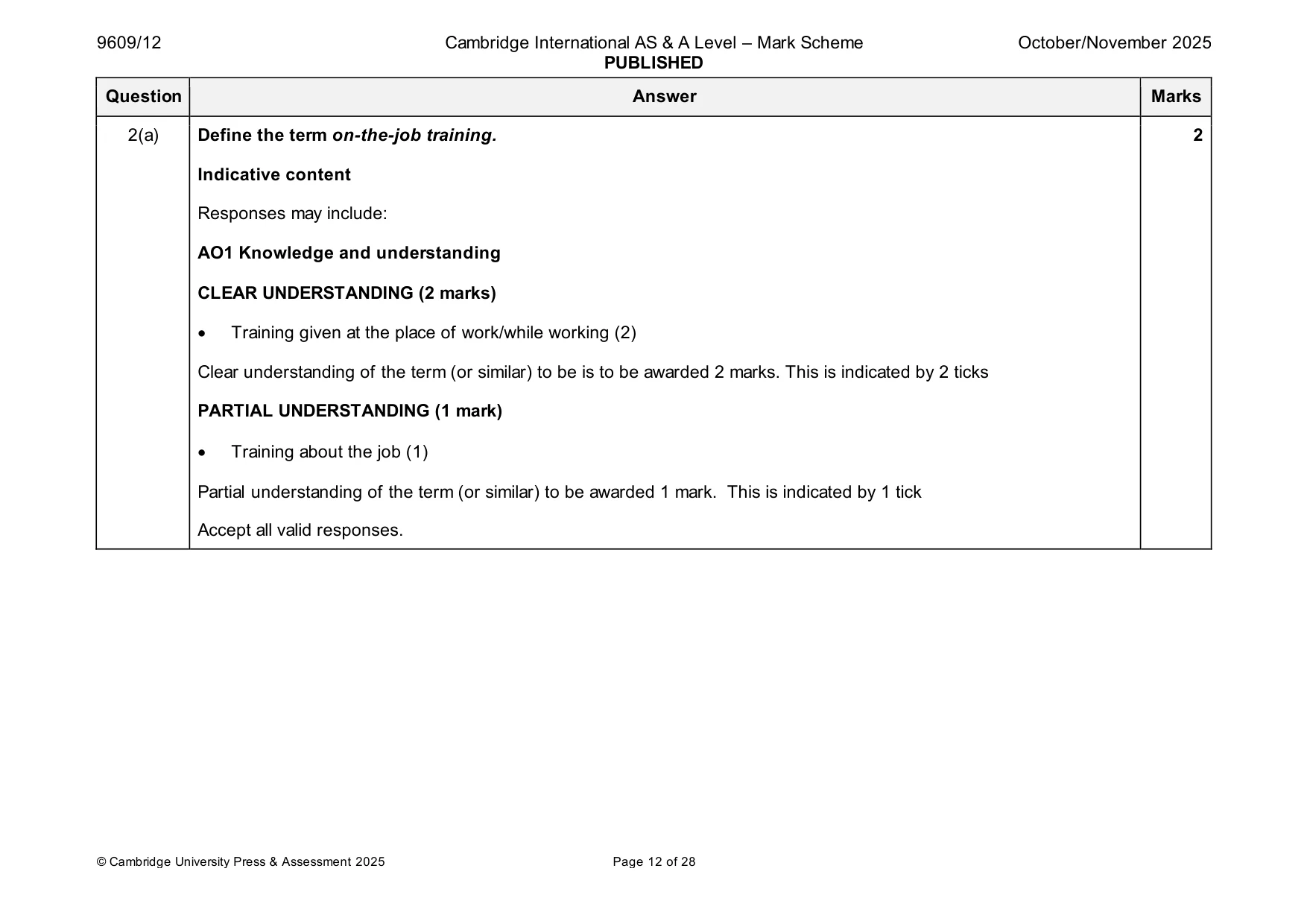
9609/12 Cambridge International AS & A Level – Mark Scheme PUBLISHED October/November 2025 © Cambridge University Press & Assessment 2025 Page 12 of 28 Question Answer Marks 2(a) Define the term on-the-job training. Indicative content Responses may include: AO1 Knowledge and understanding CLEAR UNDERSTANDING (2 marks) • Training given at the place of work/while working (2) Clear understanding of the term (or similar) to be is to be awarded 2 marks. This is indicated by 2 ticks PARTIAL UNDERSTANDING (1 mark) • Training about the job (1) Partial understanding of the term (or similar) to be awarded 1 mark. This is indicated by 1 tick Accept all valid responses. 2
Mark scheme, page 13
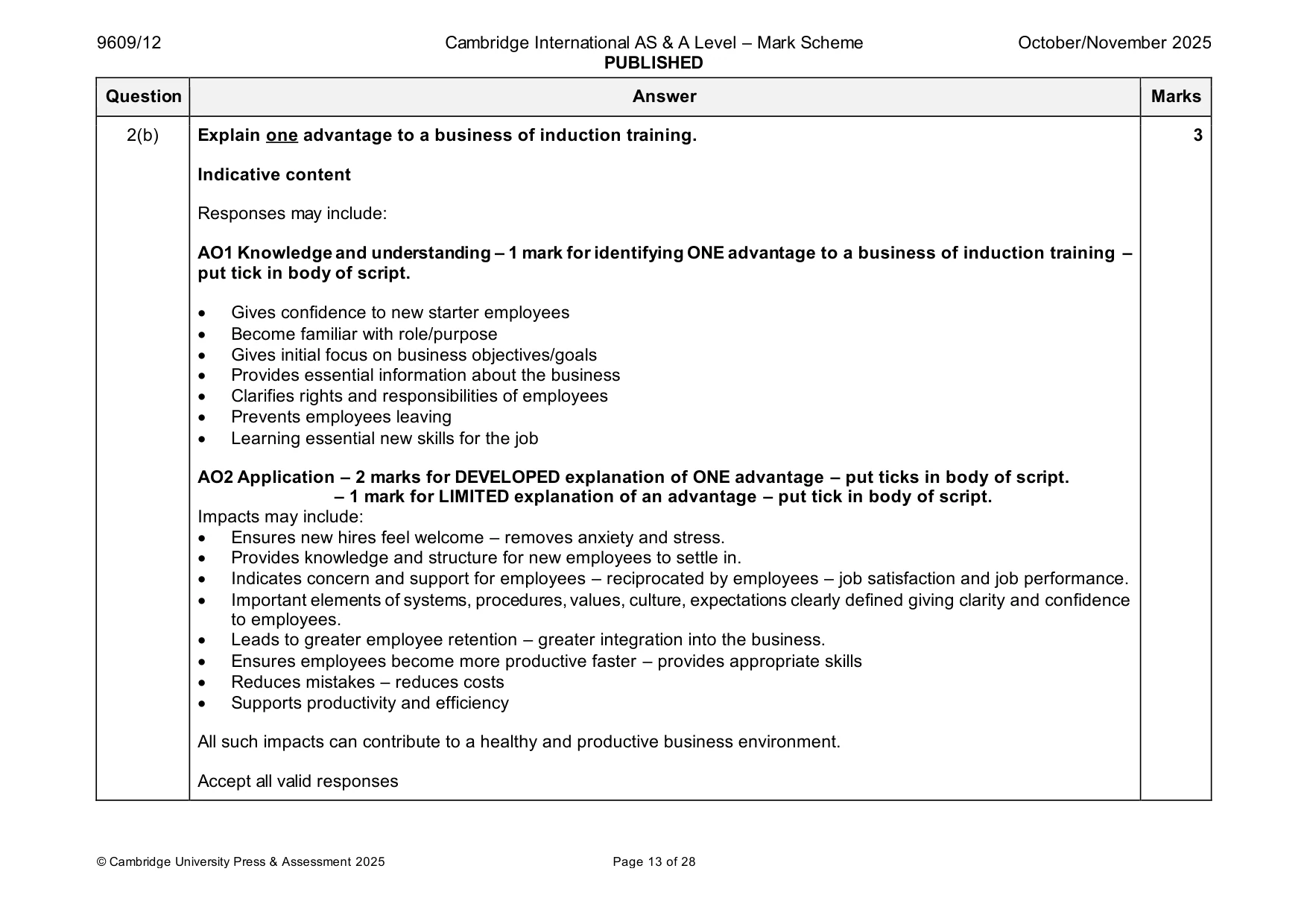
9609/12 Cambridge International AS & A Level – Mark Scheme PUBLISHED October/November 2025 © Cambridge University Press & Assessment 2025 Page 13 of 28 Question Answer Marks 2(b) Explain one advantage to a business of induction training. Indicative content Responses may include: AO1 Knowledge and understanding – 1 mark for identifying ONE advantage to a business of induction training – put tick in body of script. • Gives confidence to new starter employees • Become familiar with role/purpose • Gives initial focus on business objectives/goals • Provides essential information about the business • Clarifies rights and responsibilities of employees • Prevents employees leaving • Learning essential new skills for the job AO2 Application – 2 marks for DEVELOPED explanation of ONE advantage – put ticks in body of script. – 1 mark for LIMITED explanation of an advantage – put tick in body of script. Impacts may include: • Ensures new hires feel welcome – removes anxiety and stress. • Provides knowledge and structure for new employees to settle in. • Indicates concern and support for employees – reciprocated by employees – job satisfaction and job performance. • Important elements of systems, procedures, values, culture, expectations clearly defined giving clarity and confidence to employees. • Leads to greater employee retention – greater integration into the business. • Ensures employees become more productive faster – provides appropriate skills • Reduces mistakes – reduces costs • Supports productivity and efficiency All such impacts can contribute to a healthy and productive business environment. Accept all valid responses 3
Mark scheme, page 14
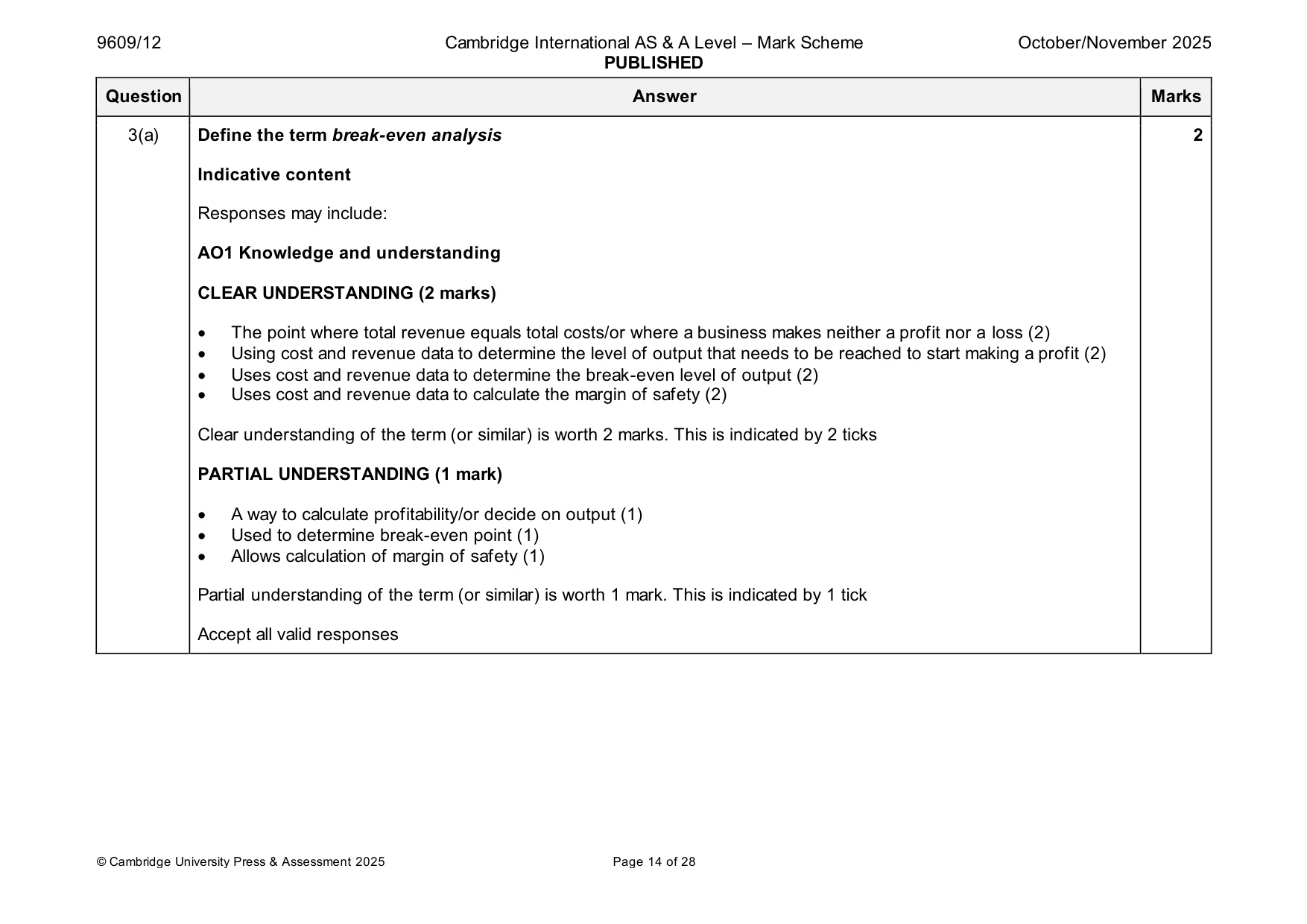
9609/12 Cambridge International AS & A Level – Mark Scheme PUBLISHED October/November 2025 © Cambridge University Press & Assessment 2025 Page 14 of 28 Question Answer Marks 3(a) Define the term break-even analysis Indicative content Responses may include: AO1 Knowledge and understanding CLEAR UNDERSTANDING (2 marks) • The point where total revenue equals total costs/or where a business makes neither a profit nor a loss (2) • Using cost and revenue data to determine the level of output that needs to be reached to start making a profit (2) • Uses cost and revenue data to determine the break-even level of output (2) • Uses cost and revenue data to calculate the margin of safety (2) Clear understanding of the term (or similar) is worth 2 marks. This is indicated by 2 ticks PARTIAL UNDERSTANDING (1 mark) • A way to calculate profitability/or decide on output (1) • Used to determine break-even point (1) • Allows calculation of margin of safety (1) Partial understanding of the term (or similar) is worth 1 mark. This is indicated by 1 tick Accept all valid responses 2
Mark scheme, page 15
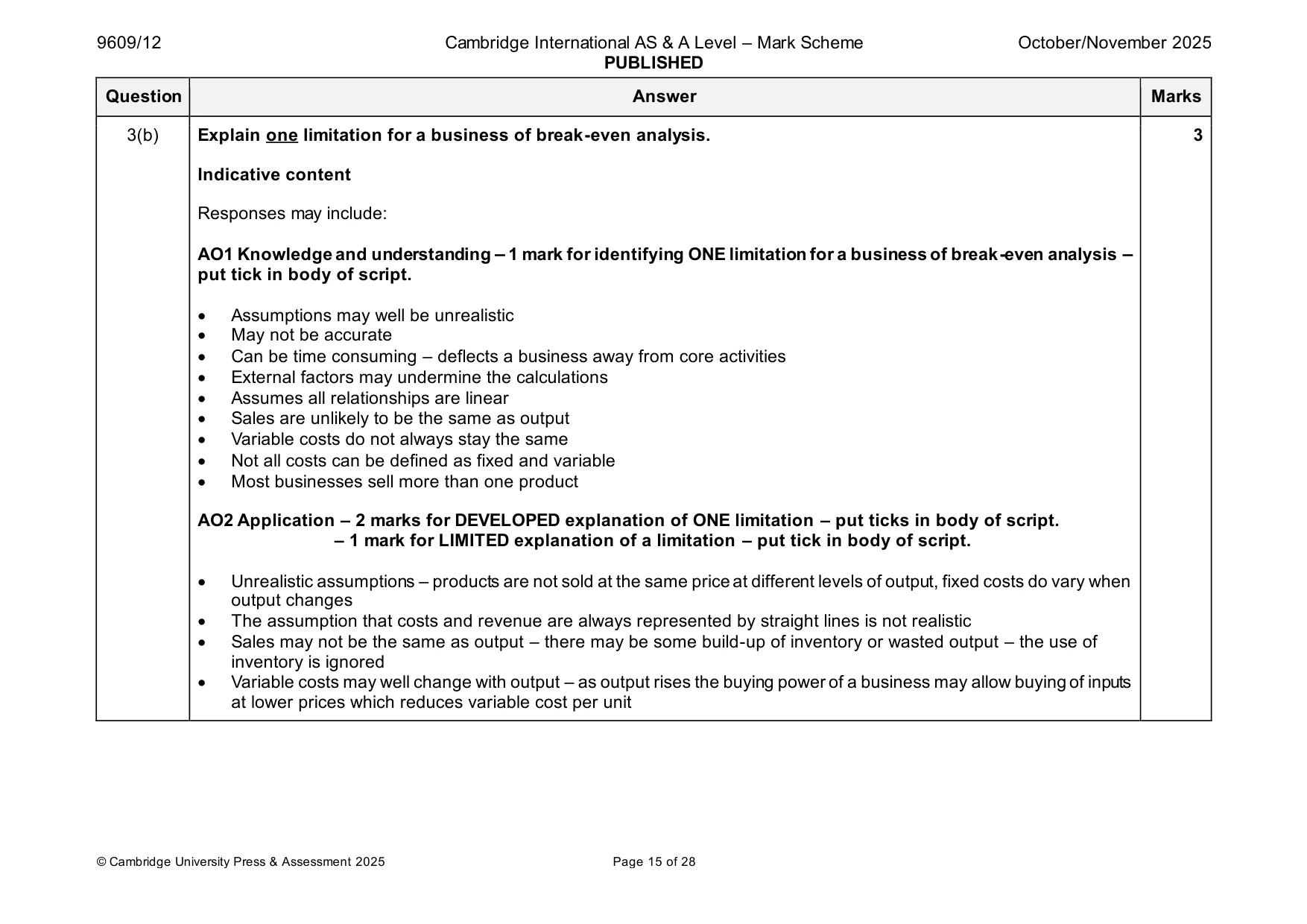
9609/12 Cambridge International AS & A Level – Mark Scheme PUBLISHED October/November 2025 © Cambridge University Press & Assessment 2025 Page 15 of 28 Question Answer Marks 3(b) Explain one limitation for a business of break-even analysis. Indicative content Responses may include: AO1 Knowledge and understanding – 1 mark for identifying ONE limitation for a business of break-even analysis – put tick in body of script. • Assumptions may well be unrealistic • May not be accurate • Can be time consuming – deflects a business away from core activities • External factors may undermine the calculations • Assumes all relationships are linear • Sales are unlikely to be the same as output • Variable costs do not always stay the same • Not all costs can be defined as fixed and variable • Most businesses sell more than one product AO2 Application – 2 marks for DEVELOPED explanation of ONE limitation – put ticks in body of script. – 1 mark for LIMITED explanation of a limitation – put tick in body of script. • Unrealistic assumptions – products are not sold at the same price at different levels of output, fixed costs do vary when output changes • The assumption that costs and revenue are always represented by straight lines is not realistic • Sales may not be the same as output – there may be some build-up of inventory or wasted output – the use of inventory is ignored • Variable costs may well change with output – as output rises the buying power of a business may allow buying of inputs at lower prices which reduces variable cost per unit 3
Mark scheme, page 16
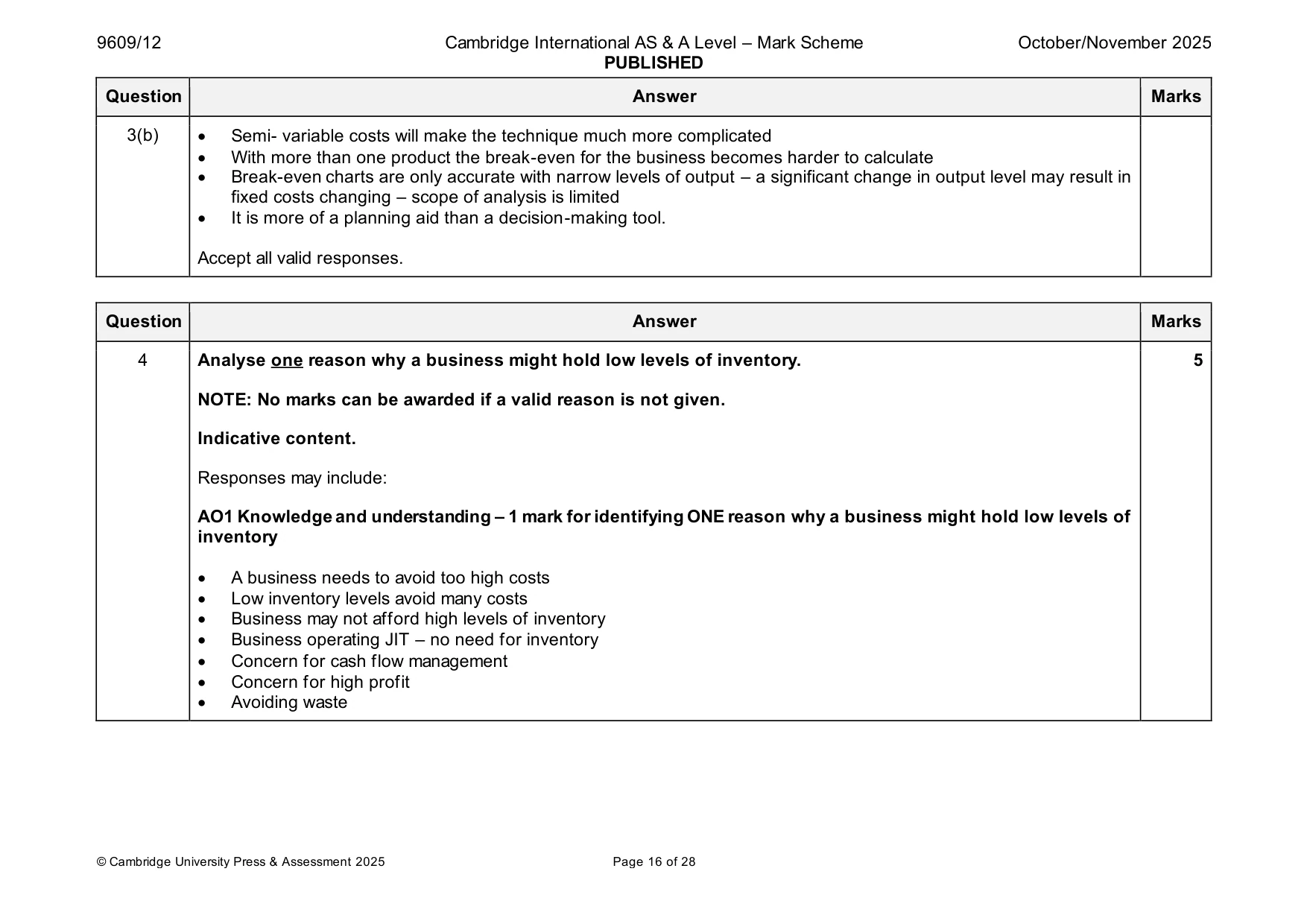
9609/12 Cambridge International AS & A Level – Mark Scheme PUBLISHED October/November 2025 © Cambridge University Press & Assessment 2025 Page 16 of 28 Question Answer Marks 3(b) • Semi- variable costs will make the technique much more complicated • With more than one product the break-even for the business becomes harder to calculate • Break-even charts are only accurate with narrow levels of output – a significant change in output level may result in fixed costs changing – scope of analysis is limited • It is more of a planning aid than a decision-making tool. Accept all valid responses. Question Answer Marks 4 Analyse one reason why a business might hold low levels of inventory. NOTE: No marks can be awarded if a valid reason is not given. Indicative content. Responses may include: AO1 Knowledge and understanding – 1 mark for identifying ONE reason why a business might hold low levels of inventory • A business needs to avoid too high costs • Low inventory levels avoid many costs • Business may not afford high levels of inventory • Business operating JIT – no need for inventory • Concern for cash flow management • Concern for high profit • Avoiding waste 5
Mark scheme, page 17
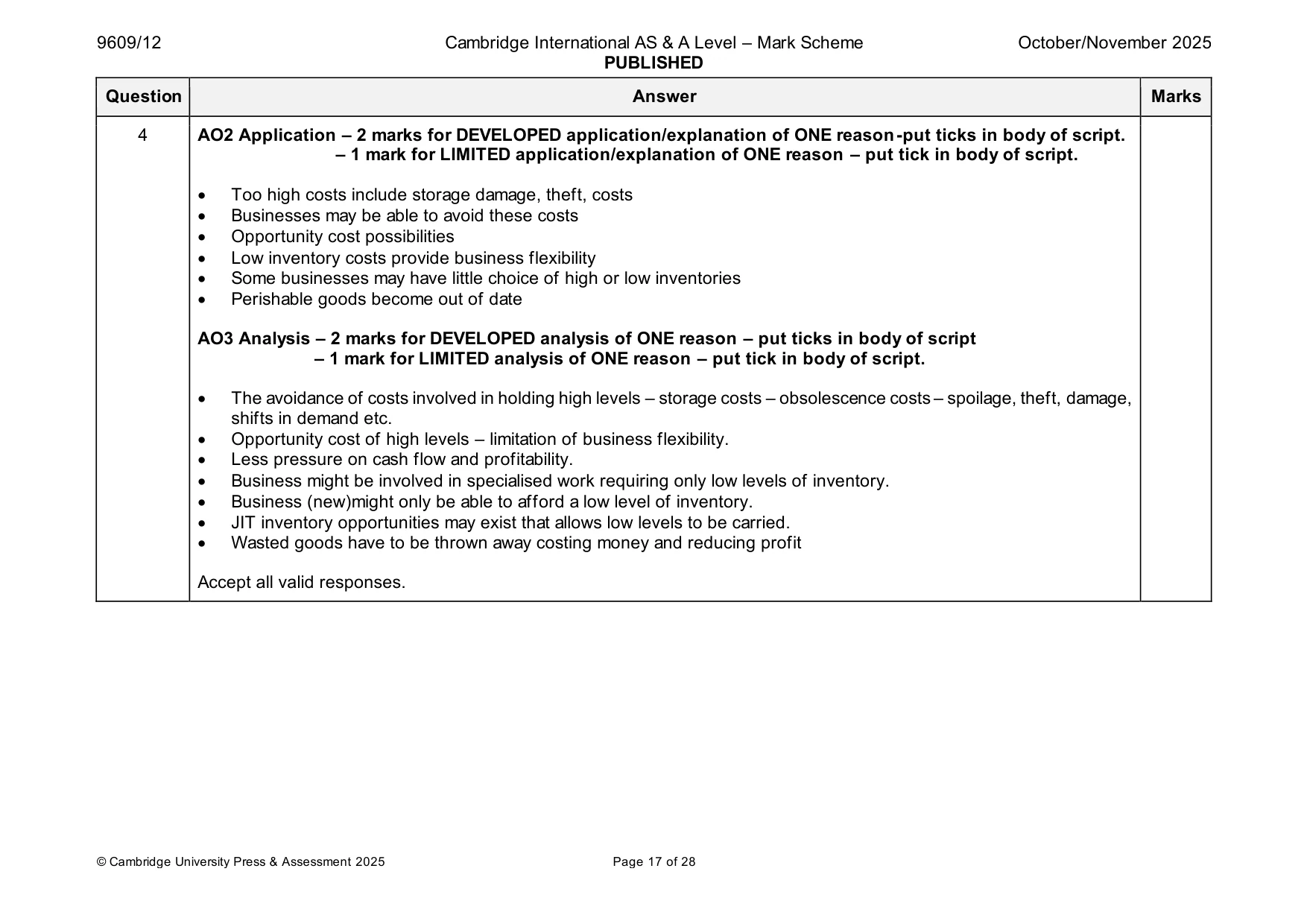
9609/12 Cambridge International AS & A Level – Mark Scheme PUBLISHED October/November 2025 © Cambridge University Press & Assessment 2025 Page 17 of 28 Question Answer Marks 4 AO2 Application – 2 marks for DEVELOPED application/explanation of ONE reason-put ticks in body of script. – 1 mark for LIMITED application/explanation of ONE reason – put tick in body of script. • Too high costs include storage damage, theft, costs • Businesses may be able to avoid these costs • Opportunity cost possibilities • Low inventory costs provide business flexibility • Some businesses may have little choice of high or low inventories • Perishable goods become out of date AO3 Analysis – 2 marks for DEVELOPED analysis of ONE reason – put ticks in body of script – 1 mark for LIMITED analysis of ONE reason – put tick in body of script. • The avoidance of costs involved in holding high levels – storage costs – obsolescence costs – spoilage, theft, damage, shifts in demand etc. • Opportunity cost of high levels – limitation of business flexibility. • Less pressure on cash flow and profitability. • Business might be involved in specialised work requiring only low levels of inventory. • Business (new)might only be able to afford a low level of inventory. • JIT inventory opportunities may exist that allows low levels to be carried. • Wasted goods have to be thrown away costing money and reducing profit Accept all valid responses.
Mark scheme, page 18
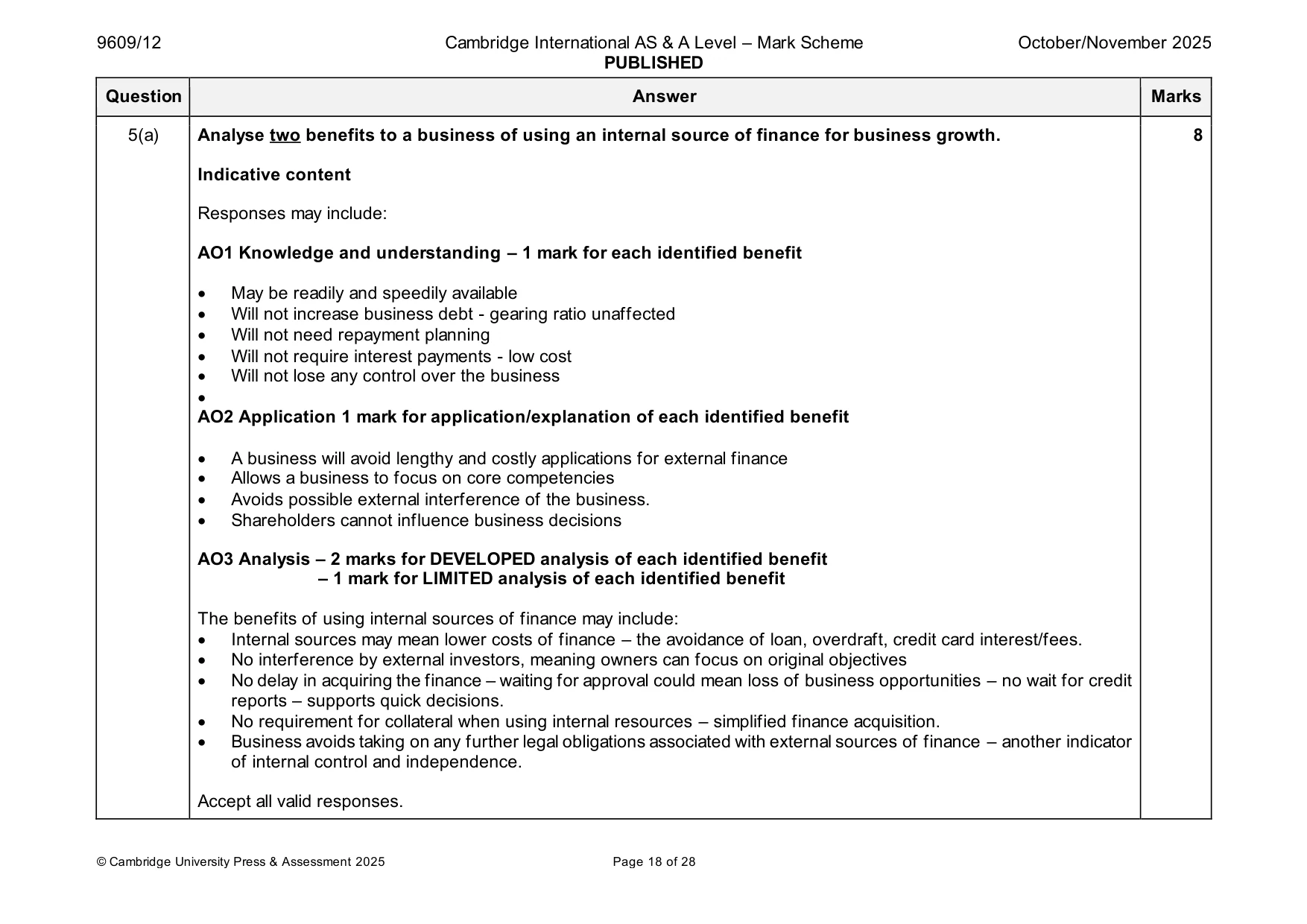
9609/12 Cambridge International AS & A Level – Mark Scheme PUBLISHED October/November 2025 © Cambridge University Press & Assessment 2025 Page 18 of 28 Question Answer Marks 5(a) Analyse two benefits to a business of using an internal source of finance for business growth. Indicative content Responses may include: AO1 Knowledge and understanding – 1 mark for each identified benefit • May be readily and speedily available • Will not increase business debt - gearing ratio unaffected • Will not need repayment planning • Will not require interest payments - low cost • Will not lose any control over the business • AO2 Application 1 mark for application/explanation of each identified benefit • A business will avoid lengthy and costly applications for external finance • Allows a business to focus on core competencies • Avoids possible external interference of the business. • Shareholders cannot influence business decisions AO3 Analysis – 2 marks for DEVELOPED analysis of each identified benefit – 1 mark for LIMITED analysis of each identified benefit The benefits of using internal sources of finance may include: • Internal sources may mean lower costs of finance – the avoidance of loan, overdraft, credit card interest/fees. • No interference by external investors, meaning owners can focus on original objectives • No delay in acquiring the finance – waiting for approval could mean loss of business opportunities – no wait for credit reports – supports quick decisions. • No requirement for collateral when using internal resources – simplified finance acquisition. • Business avoids taking on any further legal obligations associated with external sources of finance – another indicator of internal control and independence. Accept all valid responses. 8
Mark scheme, page 19
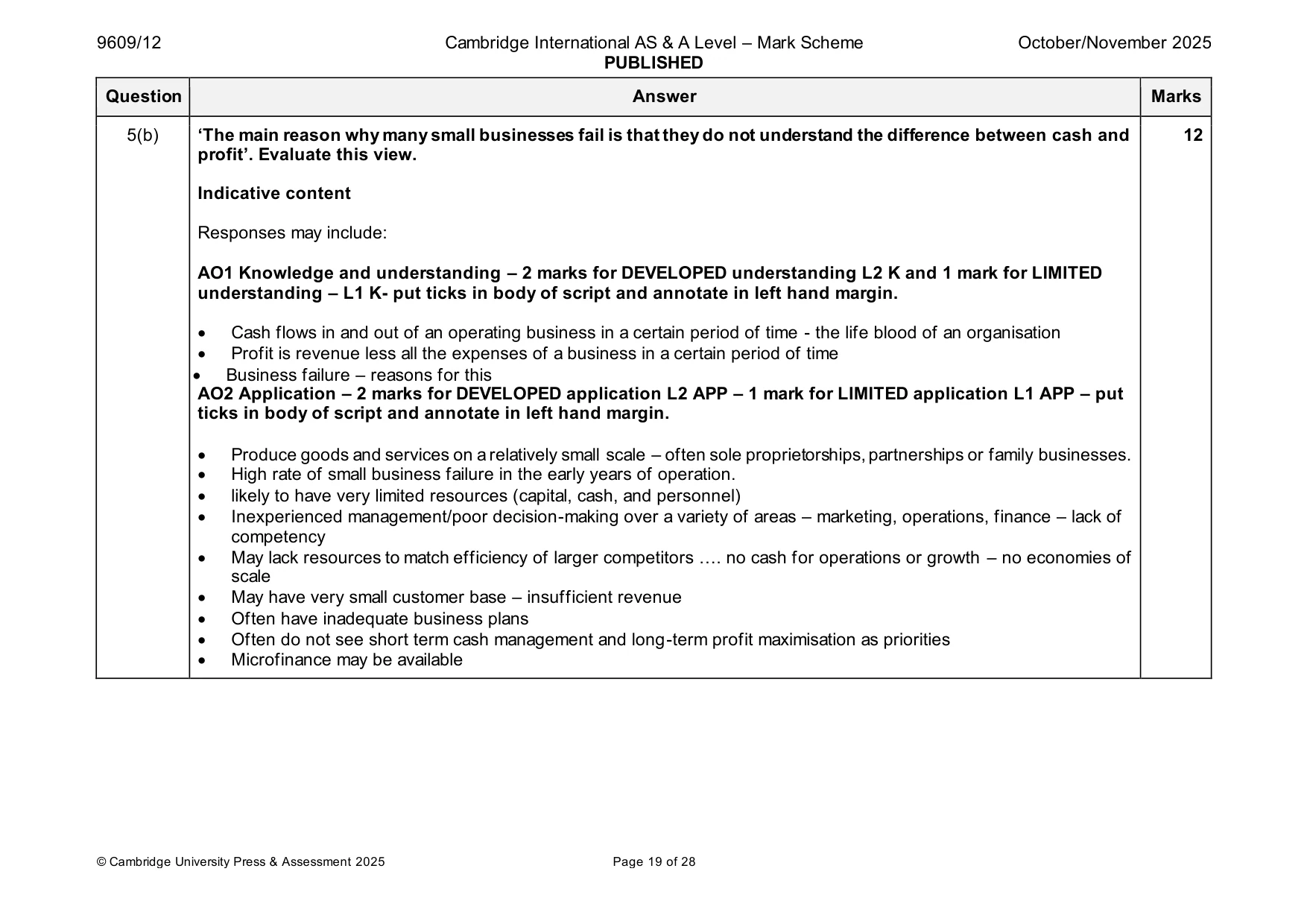
9609/12 Cambridge International AS & A Level – Mark Scheme PUBLISHED October/November 2025 © Cambridge University Press & Assessment 2025 Page 19 of 28 Question Answer Marks 5(b) ‘The main reason why many small businesses fail is that they do not understand the difference between cash and profit’. Evaluate this view. Indicative content Responses may include: AO1 Knowledge and understanding – 2 marks for DEVELOPED understanding L2 K and 1 mark for LIMITED understanding – L1 K- put ticks in body of script and annotate in left hand margin. • Cash flows in and out of an operating business in a certain period of time - the life blood of an organisation • Profit is revenue less all the expenses of a business in a certain period of time • Business failure – reasons for this AO2 Application – 2 marks for DEVELOPED application L2 APP – 1 mark for LIMITED application L1 APP – put ticks in body of script and annotate in left hand margin. • Produce goods and services on a relatively small scale – often sole proprietorships, partnerships or family businesses. • High rate of small business failure in the early years of operation. • likely to have very limited resources (capital, cash, and personnel) • Inexperienced management/poor decision-making over a variety of areas – marketing, operations, finance – lack of competency • May lack resources to match efficiency of larger competitors …. no cash for operations or growth – no economies of scale • May have very small customer base – insufficient revenue • Often have inadequate business plans • Often do not see short term cash management and long-term profit maximisation as priorities • Microfinance may be available 12
Mark scheme, page 20
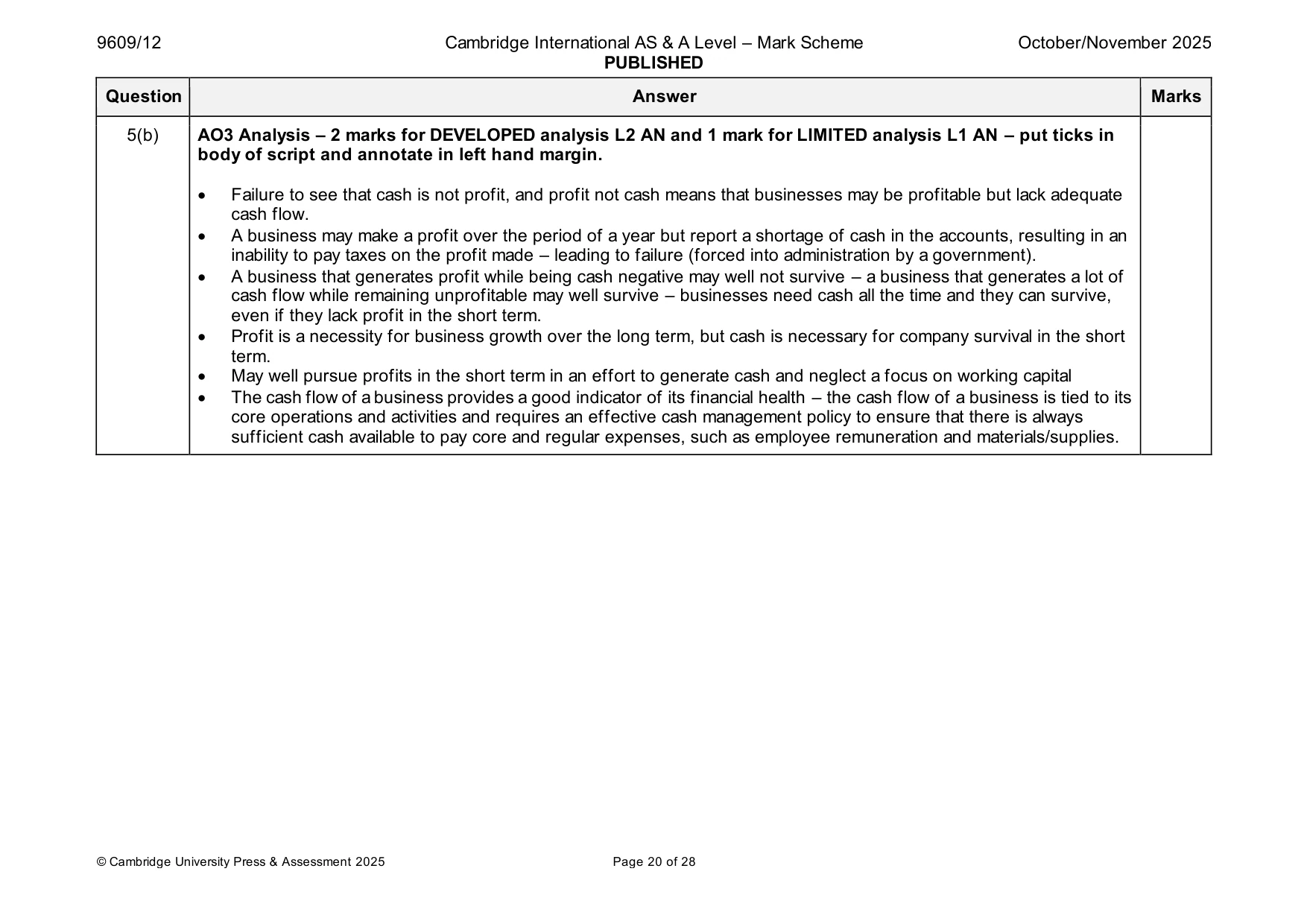
9609/12 Cambridge International AS & A Level – Mark Scheme PUBLISHED October/November 2025 © Cambridge University Press & Assessment 2025 Page 20 of 28 Question Answer Marks 5(b) AO3 Analysis – 2 marks for DEVELOPED analysis L2 AN and 1 mark for LIMITED analysis L1 AN – put ticks in body of script and annotate in left hand margin. • Failure to see that cash is not profit, and profit not cash means that businesses may be profitable but lack adequate cash flow. • A business may make a profit over the period of a year but report a shortage of cash in the accounts, resulting in an inability to pay taxes on the profit made – leading to failure (forced into administration by a government). • A business that generates profit while being cash negative may well not survive – a business that generates a lot of cash flow while remaining unprofitable may well survive – businesses need cash all the time and they can survive, even if they lack profit in the short term. • Profit is a necessity for business growth over the long term, but cash is necessary for company survival in the short term. • May well pursue profits in the short term in an effort to generate cash and neglect a focus on working capital • The cash flow of a business provides a good indicator of its financial health – the cash flow of a business is tied to its core operations and activities and requires an effective cash management policy to ensure that there is always sufficient cash available to pay core and regular expenses, such as employee remuneration and materials/supplies.
Mark scheme, page 21
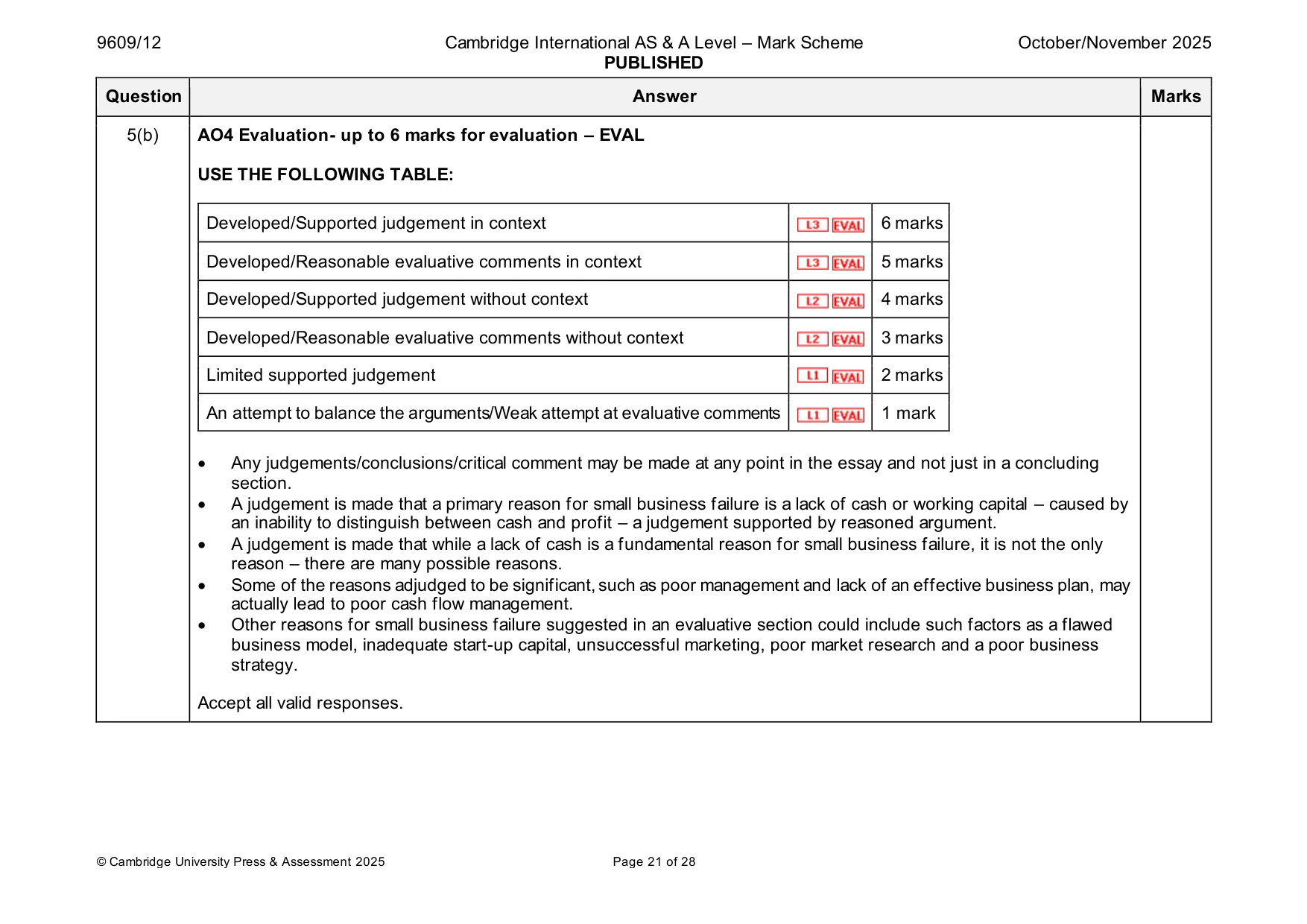
9609/12 Cambridge International AS & A Level – Mark Scheme PUBLISHED October/November 2025 © Cambridge University Press & Assessment 2025 Page 21 of 28 Question Answer Marks 5(b) AO4 Evaluation- up to 6 marks for evaluation – EVAL USE THE FOLLOWING TABLE: Developed/Supported judgement in context 6 marks Developed/Reasonable evaluative comments in context 5 marks Developed/Supported judgement without context 4 marks Developed/Reasonable evaluative comments without context 3 marks Limited supported judgement 2 marks An attempt to balance the arguments/Weak attempt at evaluative comments 1 mark • Any judgements/conclusions/critical comment may be made at any point in the essay and not just in a concluding section. • A judgement is made that a primary reason for small business failure is a lack of cash or working capital – caused by an inability to distinguish between cash and profit – a judgement supported by reasoned argument. • A judgement is made that while a lack of cash is a fundamental reason for small business failure, it is not the only reason – there are many possible reasons. • Some of the reasons adjudged to be significant, such as poor management and lack of an effective business plan, may actually lead to poor cash flow management. • Other reasons for small business failure suggested in an evaluative section could include such factors as a flawed business model, inadequate start-up capital, unsuccessful marketing, poor market research and a poor business strategy. Accept all valid responses.
Mark scheme, page 22
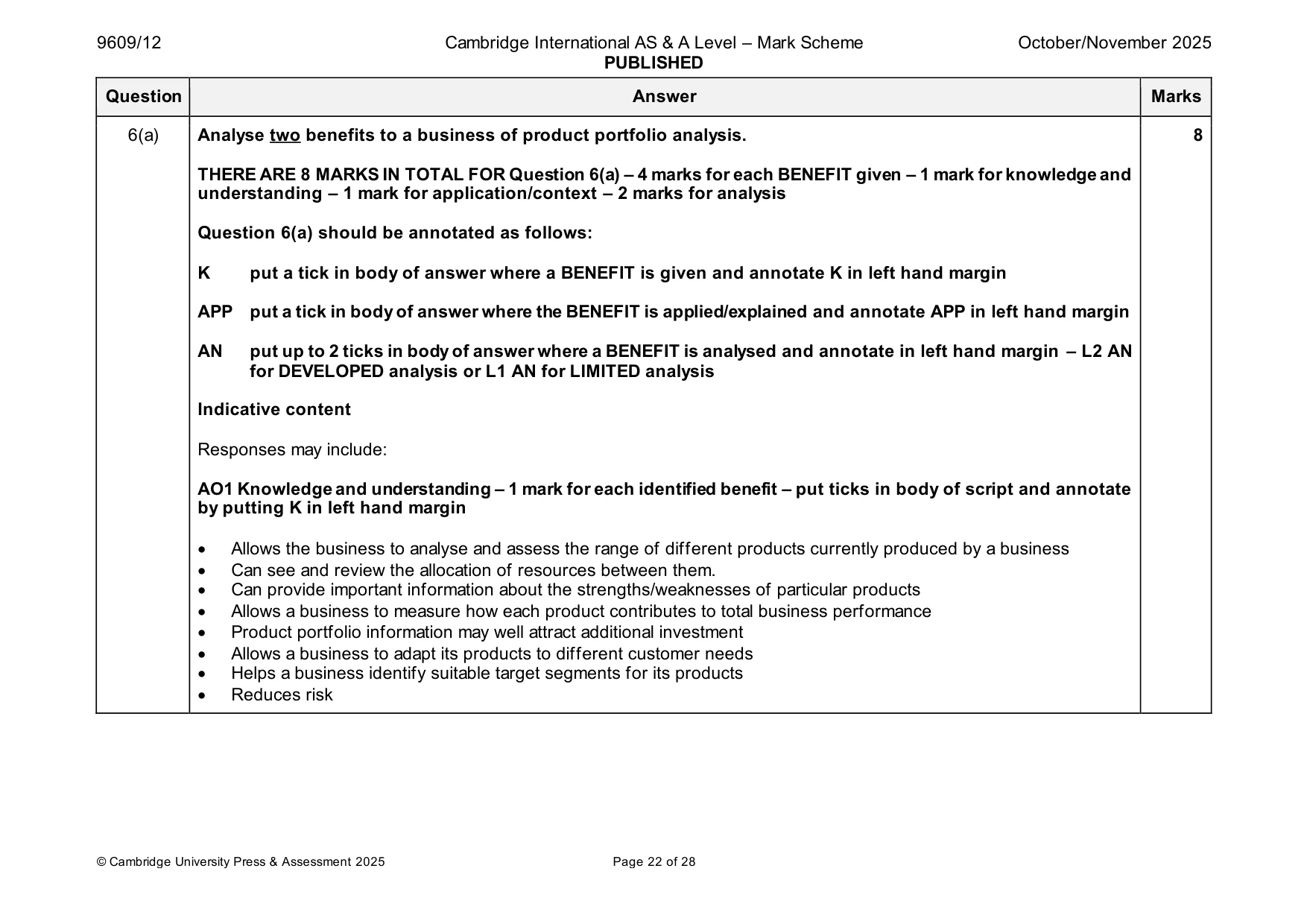
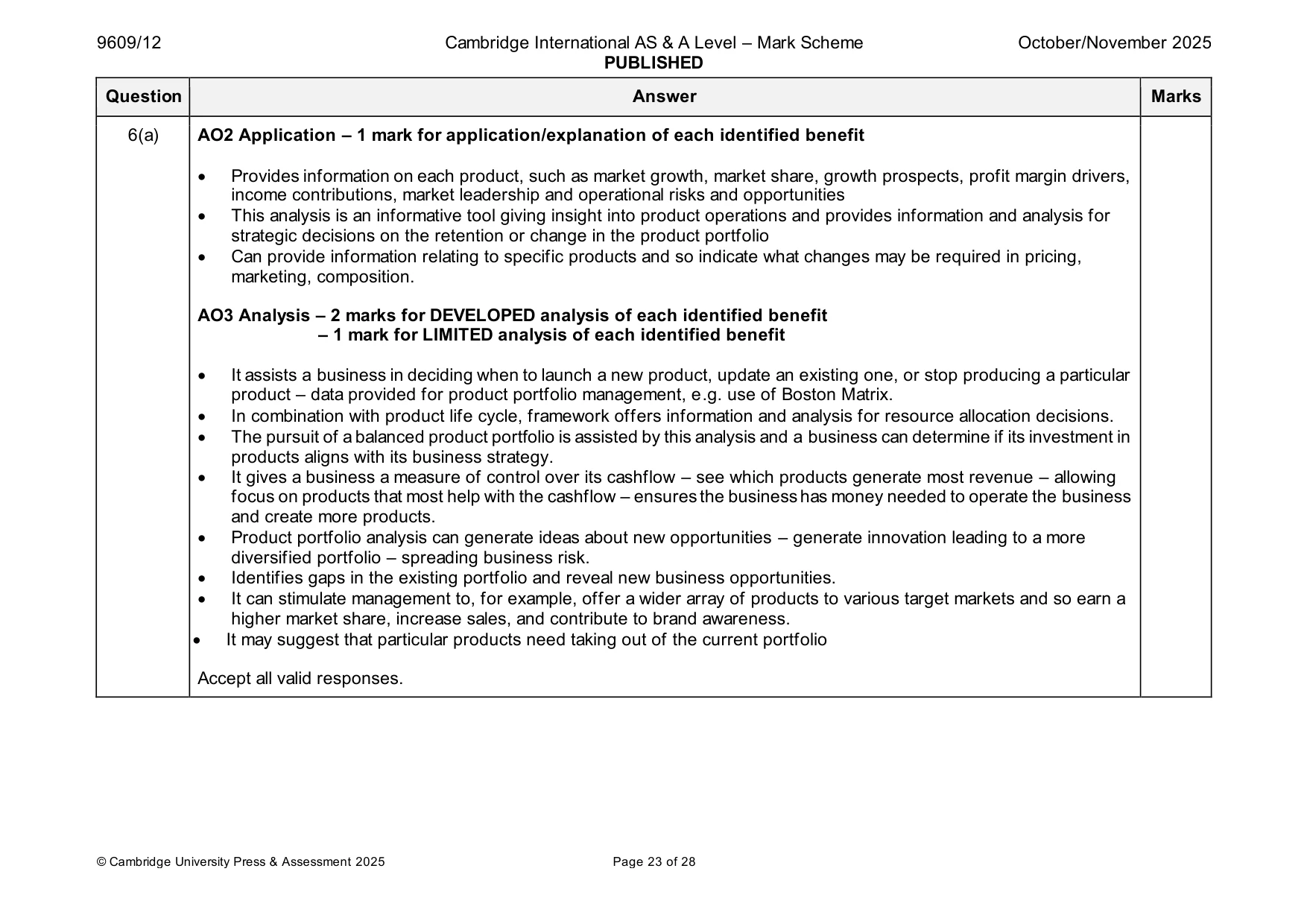
9609/12 Cambridge International AS & A Level – Mark Scheme PUBLISHED October/November 2025 © Cambridge University Press & Assessment 2025 Page 22 of 28 Question Answer Marks 6(a) Analyse two benefits to a business of product portfolio analysis. THERE ARE 8 MARKS IN TOTAL FOR Question 6(a) – 4 marks for each BENEFIT given – 1 mark for knowledge and understanding – 1 mark for application/context – 2 marks for analysis Question 6(a) should be annotated as follows: K put a tick in body of answer where a BENEFIT is given and annotate K in left hand margin APP put a tick in body of answer where the BENEFIT is applied/explained and annotate APP in left hand margin AN put up to 2 ticks in body of answer where a BENEFIT is analysed and annotate in left hand margin – L2 AN for DEVELOPED analysis or L1 AN for LIMITED analysis Indicative content Responses may include: AO1 Knowledge and understanding – 1 mark for each identified benefit – put ticks in body of script and annotate by putting K in left hand margin • Allows the business to analyse and assess the range of different products currently produced by a business • Can see and review the allocation of resources between them. • Can provide important information about the strengths/weaknesses of particular products • Allows a business to measure how each product contributes to total business performance • Product portfolio information may well attract additional investment • Allows a business to adapt its products to different customer needs • Helps a business identify suitable target segments for its products • Reduces risk 8
Mark scheme, page 23
9609/12 Cambridge International AS & A Level – Mark Scheme PUBLISHED October/November 2025 © Cambridge University Press & Assessment 2025 Page 23 of 28 Question Answer Marks 6(a) AO2 Application – 1 mark for application/explanation of each identified benefit • Provides information on each product, such as market growth, market share, growth prospects, profit margin drivers, income contributions, market leadership and operational risks and opportunities • This analysis is an informative tool giving insight into product operations and provides information and analysis for strategic decisions on the retention or change in the product portfolio • Can provide information relating to specific products and so indicate what changes may be required in pricing, marketing, composition. AO3 Analysis – 2 marks for DEVELOPED analysis of each identified benefit – 1 mark for LIMITED analysis of each identified benefit • It assists a business in deciding when to launch a new product, update an existing one, or stop producing a particular product – data provided for product portfolio management, e.g. use of Boston Matrix. • In combination with product life cycle, framework offers information and analysis for resource allocation decisions. • The pursuit of a balanced product portfolio is assisted by this analysis and a business can determine if its investment in products aligns with its business strategy. • It gives a business a measure of control over its cashflow – see which products generate most revenue – allowing focus on products that most help with the cashflow – ensures the business has money needed to operate the business and create more products. • Product portfolio analysis can generate ideas about new opportunities – generate innovation leading to a more diversified portfolio – spreading business risk. • Identifies gaps in the existing portfolio and reveal new business opportunities. • It can stimulate management to, for example, offer a wider array of products to various target markets and so earn a higher market share, increase sales, and contribute to brand awareness. • It may suggest that particular products need taking out of the current portfolio Accept all valid responses.
Mark scheme, page 24
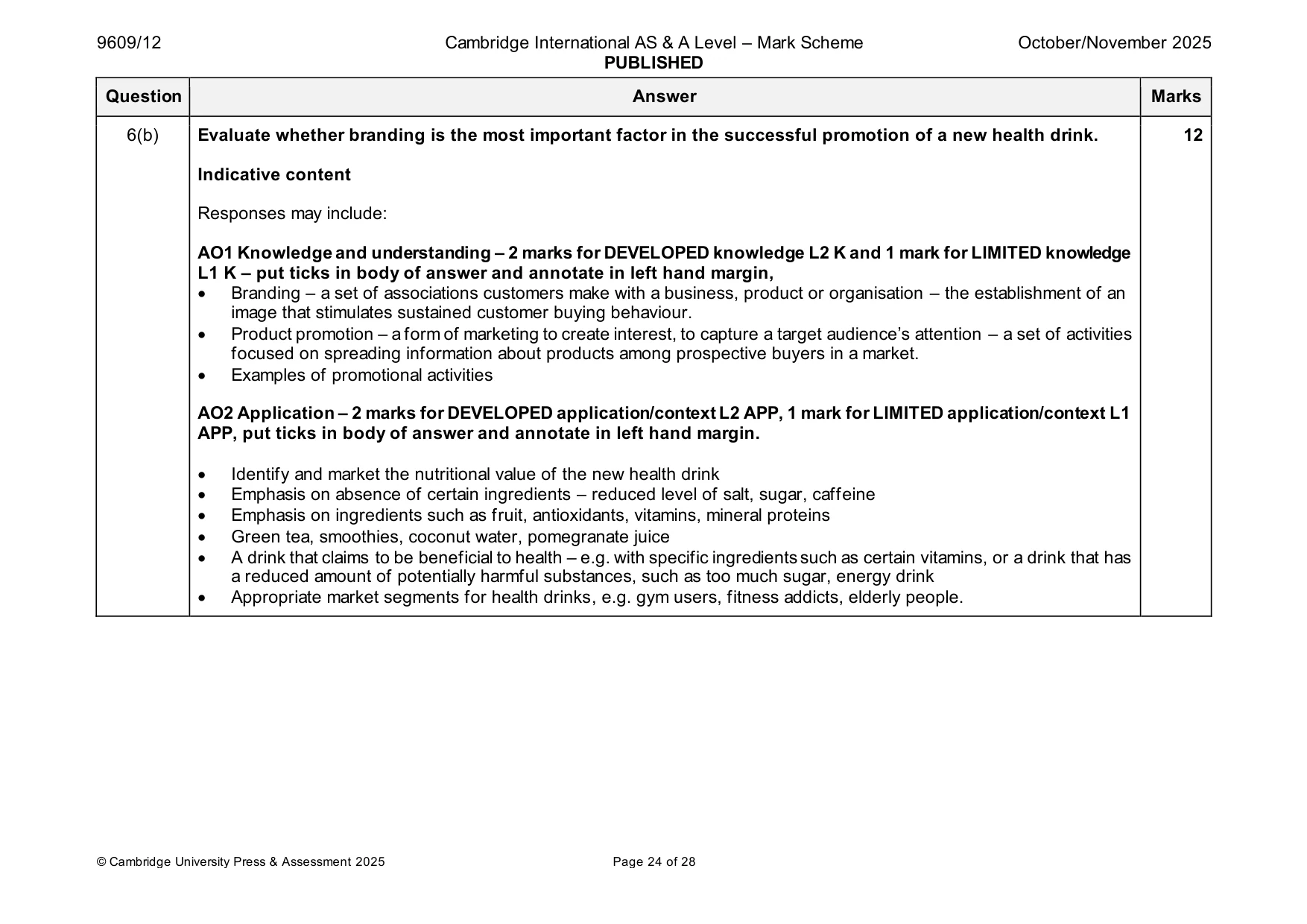
9609/12 Cambridge International AS & A Level – Mark Scheme PUBLISHED October/November 2025 © Cambridge University Press & Assessment 2025 Page 24 of 28 Question Answer Marks 6(b) Evaluate whether branding is the most important factor in the successful promotion of a new health drink. Indicative content Responses may include: AO1 Knowledge and understanding – 2 marks for DEVELOPED knowledge L2 K and 1 mark for LIMITED knowledge L1 K – put ticks in body of answer and annotate in left hand margin, • Branding – a set of associations customers make with a business, product or organisation – the establishment of an image that stimulates sustained customer buying behaviour. • Product promotion – a form of marketing to create interest, to capture a target audience’s attention – a set of activities focused on spreading information about products among prospective buyers in a market. • Examples of promotional activities AO2 Application – 2 marks for DEVELOPED application/context L2 APP, 1 mark for LIMITED application/context L1 APP, put ticks in body of answer and annotate in left hand margin. • Identify and market the nutritional value of the new health drink • Emphasis on absence of certain ingredients – reduced level of salt, sugar, caffeine • Emphasis on ingredients such as fruit, antioxidants, vitamins, mineral proteins • Green tea, smoothies, coconut water, pomegranate juice • A drink that claims to be beneficial to health – e.g. with specific ingredients such as certain vitamins, or a drink that has a reduced amount of potentially harmful substances, such as too much sugar, energy drink • Appropriate market segments for health drinks, e.g. gym users, fitness addicts, elderly people. 12
Mark scheme, page 25
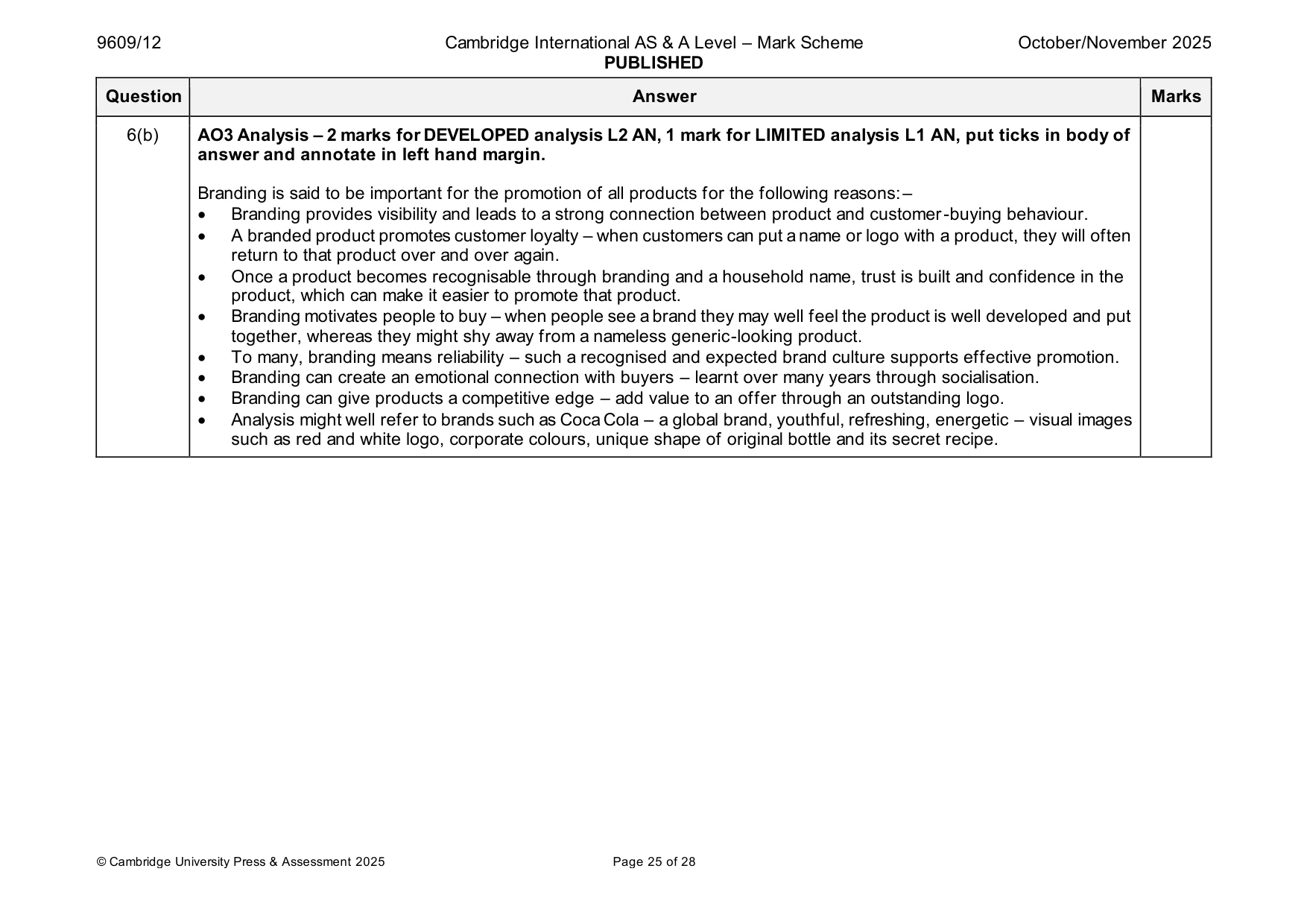
9609/12 Cambridge International AS & A Level – Mark Scheme PUBLISHED October/November 2025 © Cambridge University Press & Assessment 2025 Page 25 of 28 Question Answer Marks 6(b) AO3 Analysis – 2 marks for DEVELOPED analysis L2 AN, 1 mark for LIMITED analysis L1 AN, put ticks in body of answer and annotate in left hand margin. Branding is said to be important for the promotion of all products for the following reasons:– • Branding provides visibility and leads to a strong connection between product and customer-buying behaviour. • A branded product promotes customer loyalty – when customers can put a name or logo with a product, they will often return to that product over and over again. • Once a product becomes recognisable through branding and a household name, trust is built and confidence in the product, which can make it easier to promote that product. • Branding motivates people to buy – when people see a brand they may well feel the product is well developed and put together, whereas they might shy away from a nameless generic-looking product. • To many, branding means reliability – such a recognised and expected brand culture supports effective promotion. • Branding can create an emotional connection with buyers – learnt over many years through socialisation. • Branding can give products a competitive edge – add value to an offer through an outstanding logo. • Analysis might well refer to brands such as Coca Cola – a global brand, youthful, refreshing, energetic – visual images such as red and white logo, corporate colours, unique shape of original bottle and its secret recipe.
Mark scheme, page 26
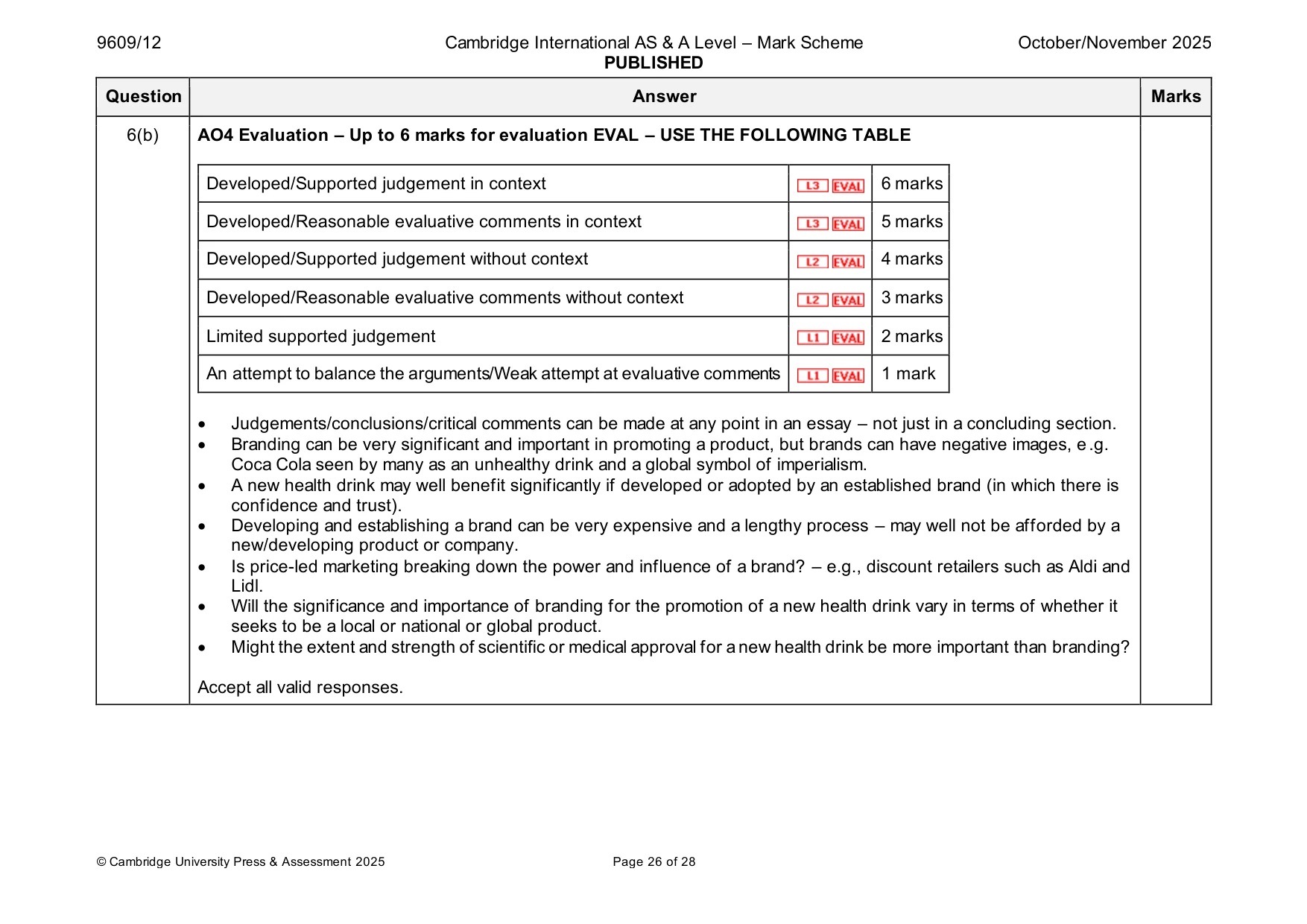
9609/12 Cambridge International AS & A Level – Mark Scheme PUBLISHED October/November 2025 © Cambridge University Press & Assessment 2025 Page 26 of 28 Question Answer Marks 6(b) AO4 Evaluation – Up to 6 marks for evaluation EVAL – USE THE FOLLOWING TABLE Developed/Supported judgement in context 6 marks Developed/Reasonable evaluative comments in context 5 marks Developed/Supported judgement without context 4 marks Developed/Reasonable evaluative comments without context 3 marks Limited supported judgement 2 marks An attempt to balance the arguments/Weak attempt at evaluative comments 1 mark • Judgements/conclusions/critical comments can be made at any point in an essay – not just in a concluding section. • Branding can be very significant and important in promoting a product, but brands can have negative images, e.g. Coca Cola seen by many as an unhealthy drink and a global symbol of imperialism. • A new health drink may well benefit significantly if developed or adopted by an established brand (in which there is confidence and trust). • Developing and establishing a brand can be very expensive and a lengthy process – may well not be afforded by a new/developing product or company. • Is price-led marketing breaking down the power and influence of a brand? – e.g., discount retailers such as Aldi and Lidl. • Will the significance and importance of branding for the promotion of a new health drink vary in terms of whether it seeks to be a local or national or global product. • Might the extent and strength of scientific or medical approval for a new health drink be more important than branding? Accept all valid responses.
Mark scheme, page 27
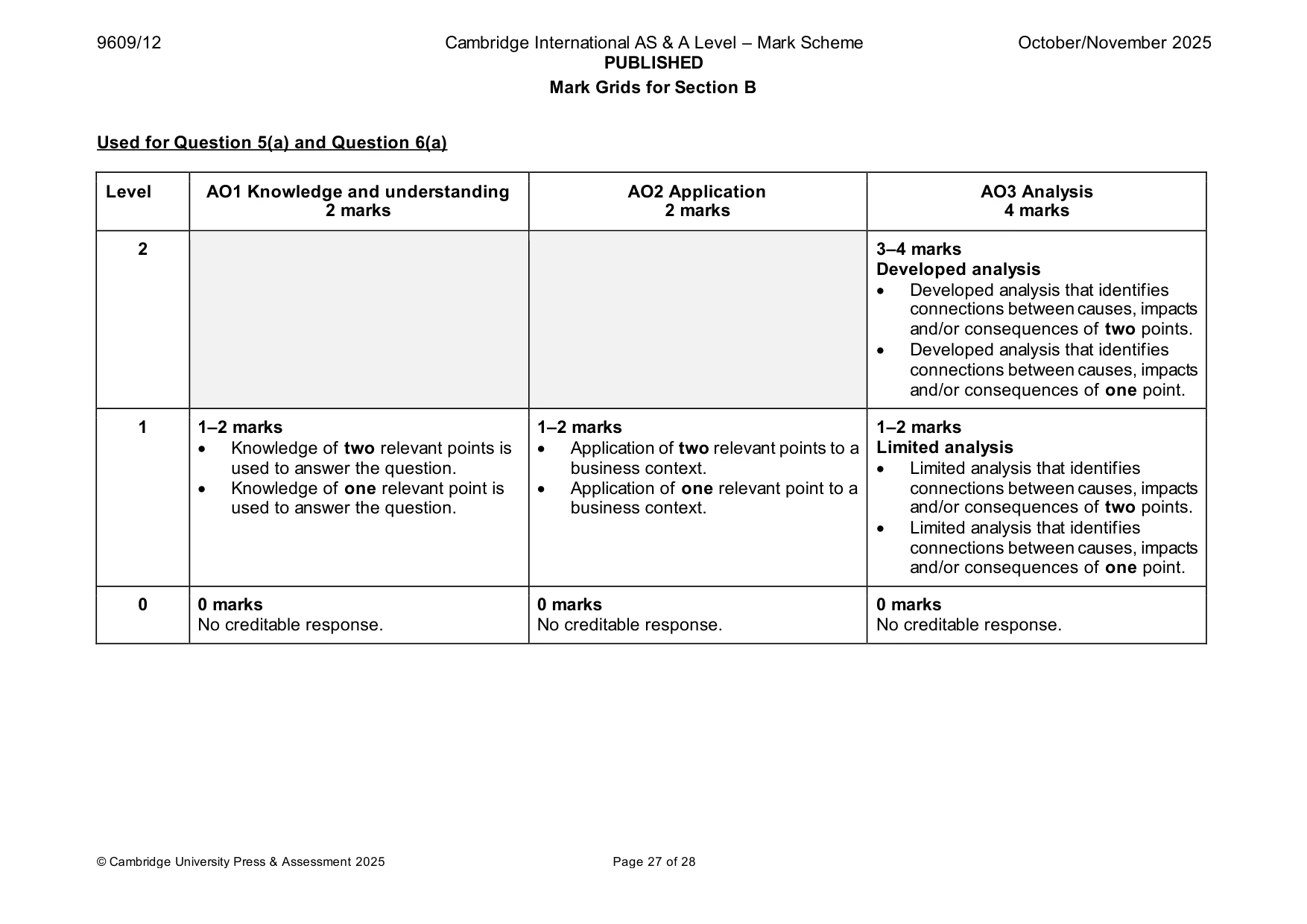
9609/12 Cambridge International AS & A Level – Mark Scheme PUBLISHED October/November 2025 © Cambridge University Press & Assessment 2025 Page 27 of 28 Mark Grids for Section B Used for Question 5(a) and Question 6(a) Level AO1 Knowledge and understanding 2 marks AO2 Application 2 marks AO3 Analysis 4 marks 2 3–4 marks Developed analysis • Developed analysis that identifies connections between causes, impacts and/or consequences of two points. • Developed analysis that identifies connections between causes, impacts and/or consequences of one point. 1 1–2 marks • Knowledge of two relevant points is used to answer the question. • Knowledge of one relevant point is used to answer the question. 1–2 marks • Application of two relevant points to a business context. • Application of one relevant point to a business context. 1–2 marks Limited analysis • Limited analysis that identifies connections between causes, impacts and/or consequences of two points. • Limited analysis that identifies connections between causes, impacts and/or consequences of one point. 0 0 marks No creditable response. 0 marks No creditable response. 0 marks No creditable response.
Mark scheme, page 28
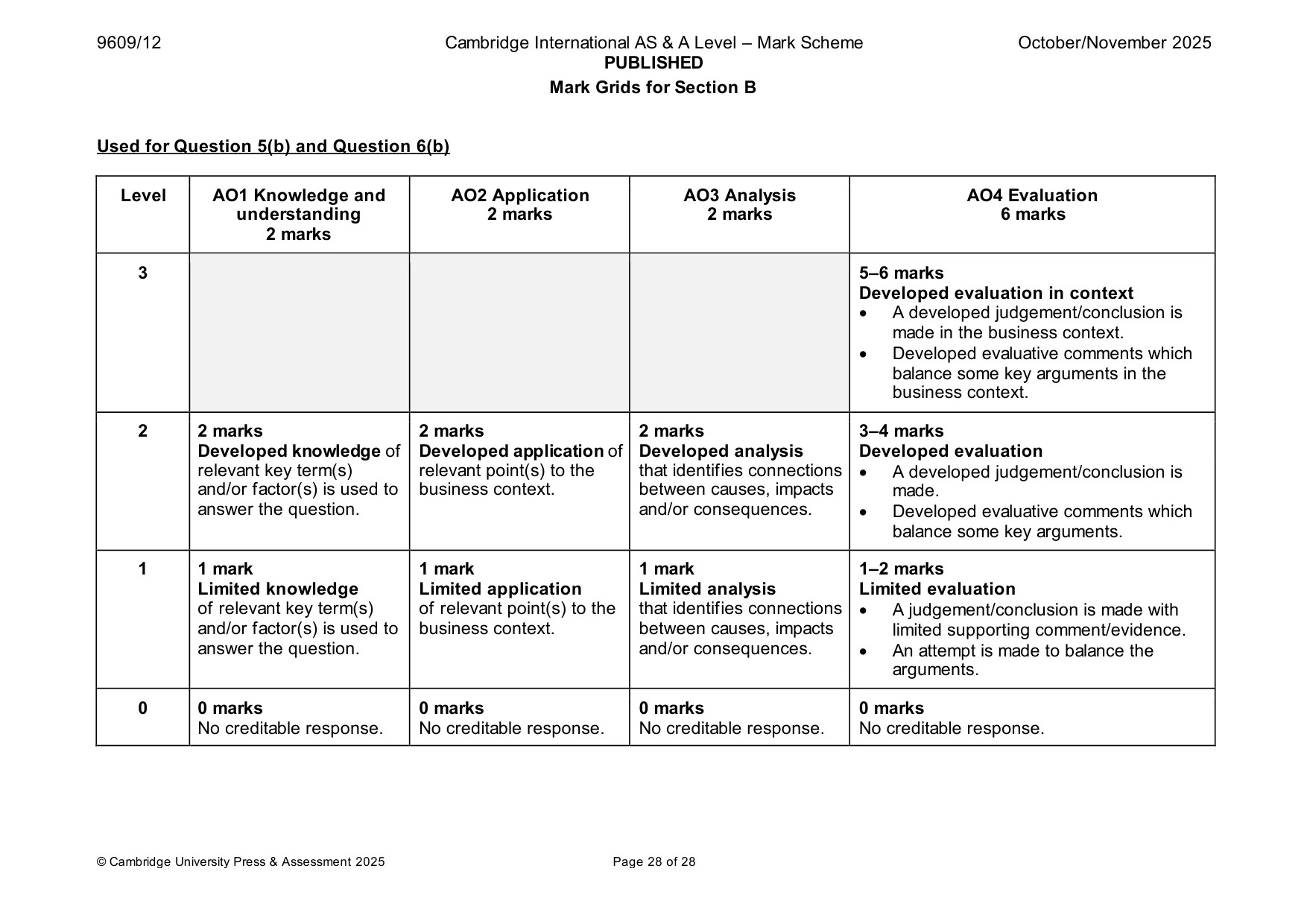
9609/12 Cambridge International AS & A Level – Mark Scheme PUBLISHED October/November 2025 © Cambridge University Press & Assessment 2025 Page 28 of 28 Mark Grids for Section B Used for Question 5(b) and Question 6(b) Level AO1 Knowledge and understanding 2 marks AO2 Application 2 marks AO3 Analysis 2 marks AO4 Evaluation 6 marks 3 5–6 marks Developed evaluation in context • A developed judgement/conclusion is made in the business context. • Developed evaluative comments which balance some key arguments in the business context. 2 2 marks Developed knowledge of relevant key term(s) and/or factor(s) is used to answer the question. 2 marks Developed application of relevant point(s) to the business context. 2 marks Developed analysis that identifies connections between causes, impacts and/or consequences. 3–4 marks Developed evaluation • A developed judgement/conclusion is made. • Developed evaluative comments which balance some key arguments. 1 1 mark Limited knowledge of relevant key term(s) and/or factor(s) is used to answer the question. 1 mark Limited application of relevant point(s) to the business context. 1 mark Limited analysis that identifies connections between causes, impacts and/or consequences. 1–2 marks Limited evaluation • A judgement/conclusion is made with limited supporting comment/evidence. • An attempt is made to balance the arguments. 0 0 marks No creditable response. 0 marks No creditable response. 0 marks No creditable response. 0 marks No creditable response.
What you needed in this session
Cambridge’s own grade thresholds for 2025 Oct/Nov, Paper 1 · Variant 2. A higher threshold means an easier paper — the bar moves with how the cohort did.