Cambridge A Level Business (for first examination in 2016) 9609 — 2021 Oct/Nov Paper 1 · Variant 3
9609/13/O/N/21 · 40 marks · ≈45 min
The question paper and its mark scheme, free to read here and free to download. This is Cambridge’s own paper, exactly as it was sat.
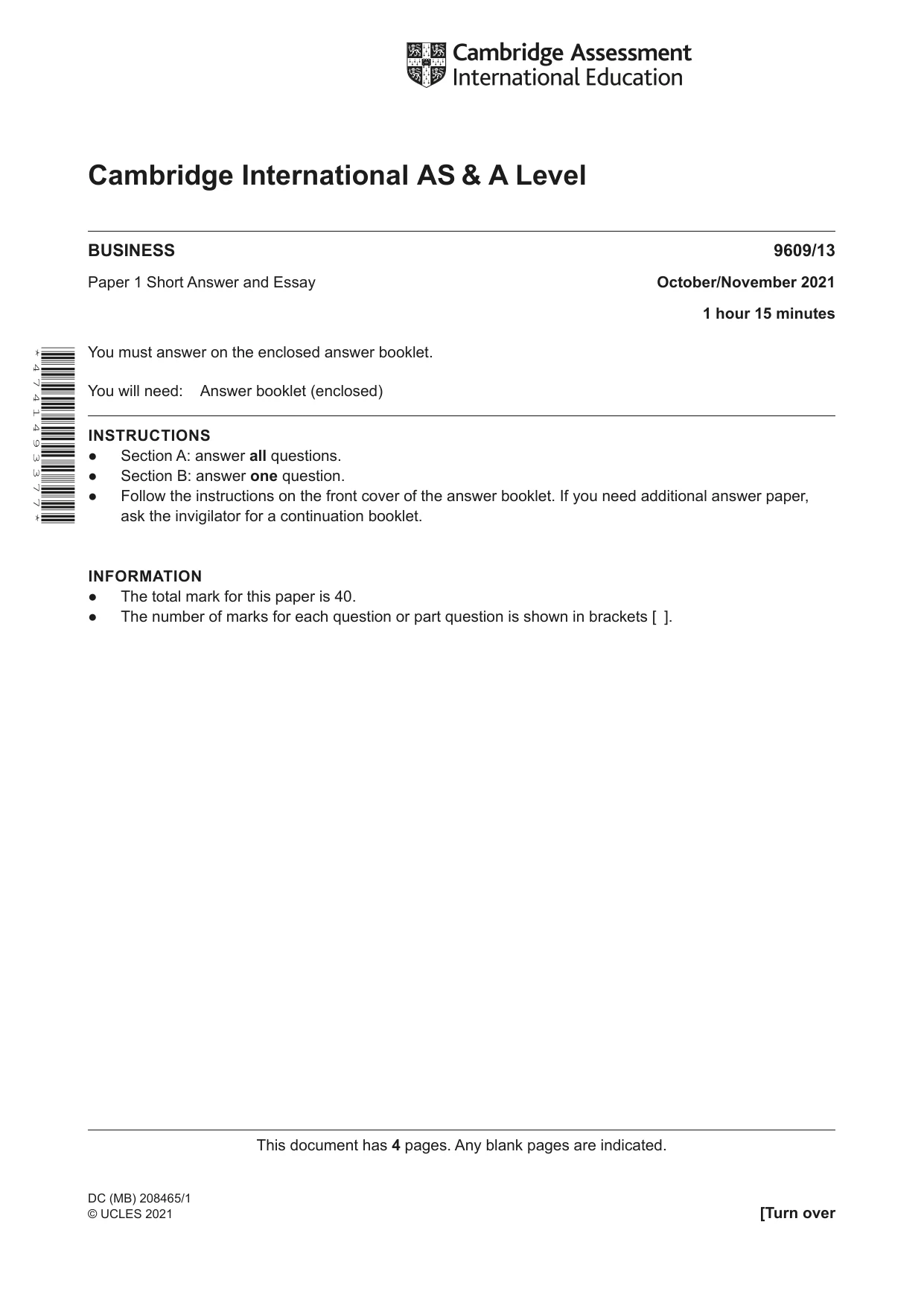
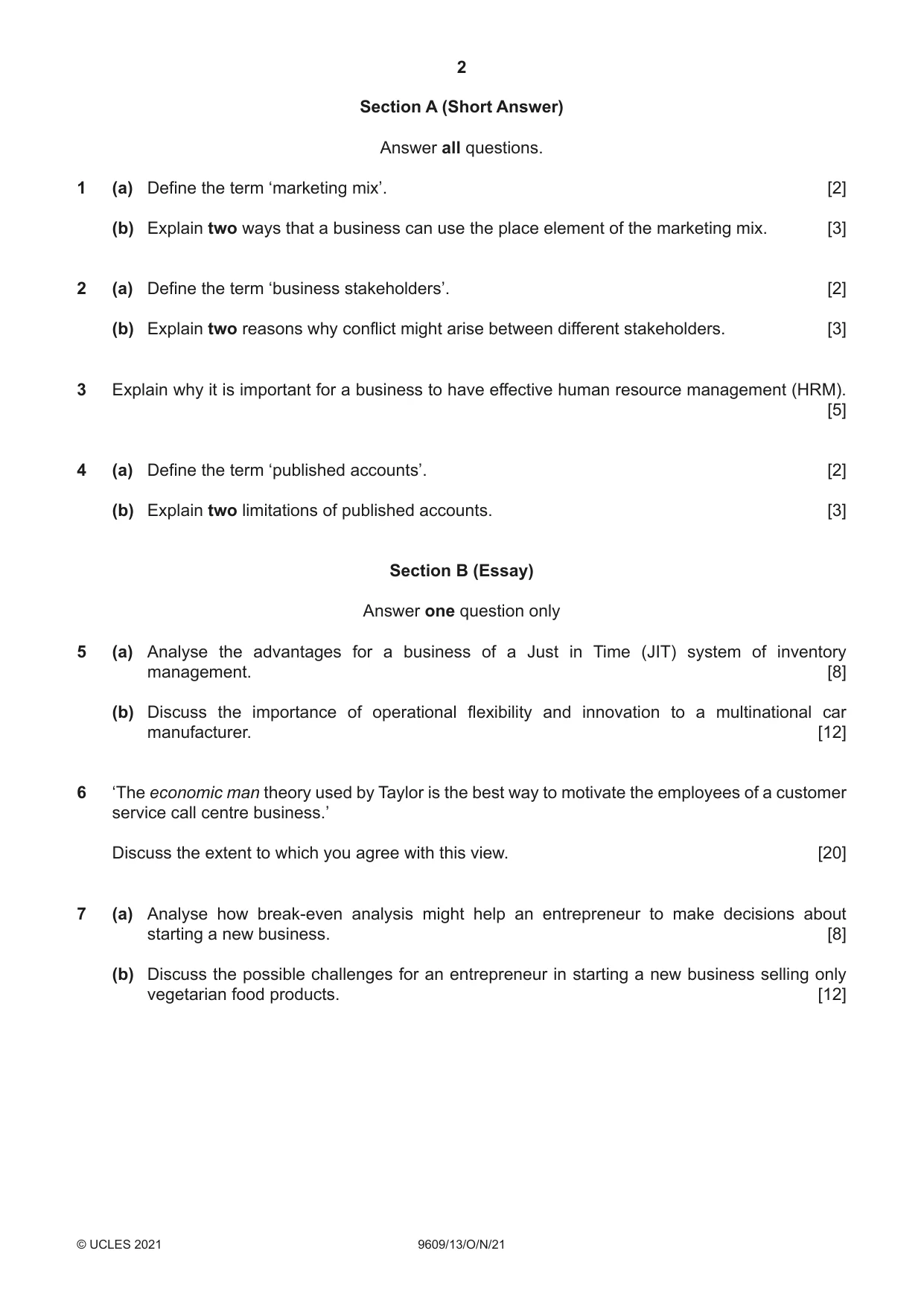
Question paper4 pages


Mark scheme16 pages
Answers below. Sit the paper first if you are practising.

Paper as text
Question paper, page 1
This document has 4 pages. Any blank pages are indicated. Cambridge International AS & A Level BUSINESS 9609/13 Paper 1 Short Answer and Essay October/November 2021 1 hour 15 minutes You must answer on the enclosed answer booklet. You will need: Answer booklet (enclosed) INSTRUCTIONS ● Section A: answer all questions. ● Section B: answer one question. ● Follow the instructions on the front cover of the answer booklet. If you need additional answer paper, ask the invigilator for a continuation booklet. INFORMATION ● The total mark for this paper is 40. ● The number of marks for each question or part question is shown in brackets [ ]. * 4 7 4 1 4 9 3 3 7 7 * DC (MB) 208465/1 © UCLES 2021 [Turn over
Question paper, page 2
2 9609/13/O/N/21 © UCLES 2021 Section A (Short Answer) Answer all questions. 1 (a) Define the term ‘marketing mix’. [2] (b) Explain two ways that a business can use the place element of the marketing mix. [3] 2 (a) Define the term ‘business stakeholders’. [2] (b) Explain two reasons why conflict might arise between different stakeholders. [3] 3 Explain why it is important for a business to have effective human resource management (HRM). [5] 4 (a) Define the term ‘published accounts’. [2] (b) Explain two limitations of published accounts. [3] Section B (Essay) Answer one question only 5 (a) Analyse the advantages for a business of a Just in Time (JIT) system of inventory management. [8] (b) Discuss the importance of operational flexibility and innovation to a multinational car manufacturer. [12] 6 ‘The economic man theory used by Taylor is the best way to motivate the employees of a customer service call centre business.’ Discuss the extent to which you agree with this view. [20] 7 (a) Analyse how break-even analysis might help an entrepreneur to make decisions about starting a new business. [8] (b) Discuss the possible challenges for an entrepreneur in starting a new business selling only vegetarian food products. [12]
Question paper, page 3
3 9609/13/O/N/21 © UCLES 2021 BLANK PAGE
Question paper, page 4
4 9609/13/O/N/21 © UCLES 2021 Permission to reproduce items where third-party owned material protected by copyright is included has been sought and cleared where possible. Every reasonable effort has been made by the publisher (UCLES) to trace copyright holders, but if any items requiring clearance have unwittingly been included, the publisher will be pleased to make amends at the earliest possible opportunity. To avoid the issue of disclosure of answer-related information to candidates, all copyright acknowledgements are reproduced online in the Cambridge Assessment International Education Copyright Acknowledgements Booklet. This is produced for each series of examinations and is freely available to download at www.cambridgeinternational.org after the live examination series. Cambridge Assessment International Education is part of the Cambridge Assessment Group. Cambridge Assessment is the brand name of the University of Cambridge Local Examinations Syndicate (UCLES), which itself is a department of the University of Cambridge. BLANK PAGE
Mark scheme, page 1
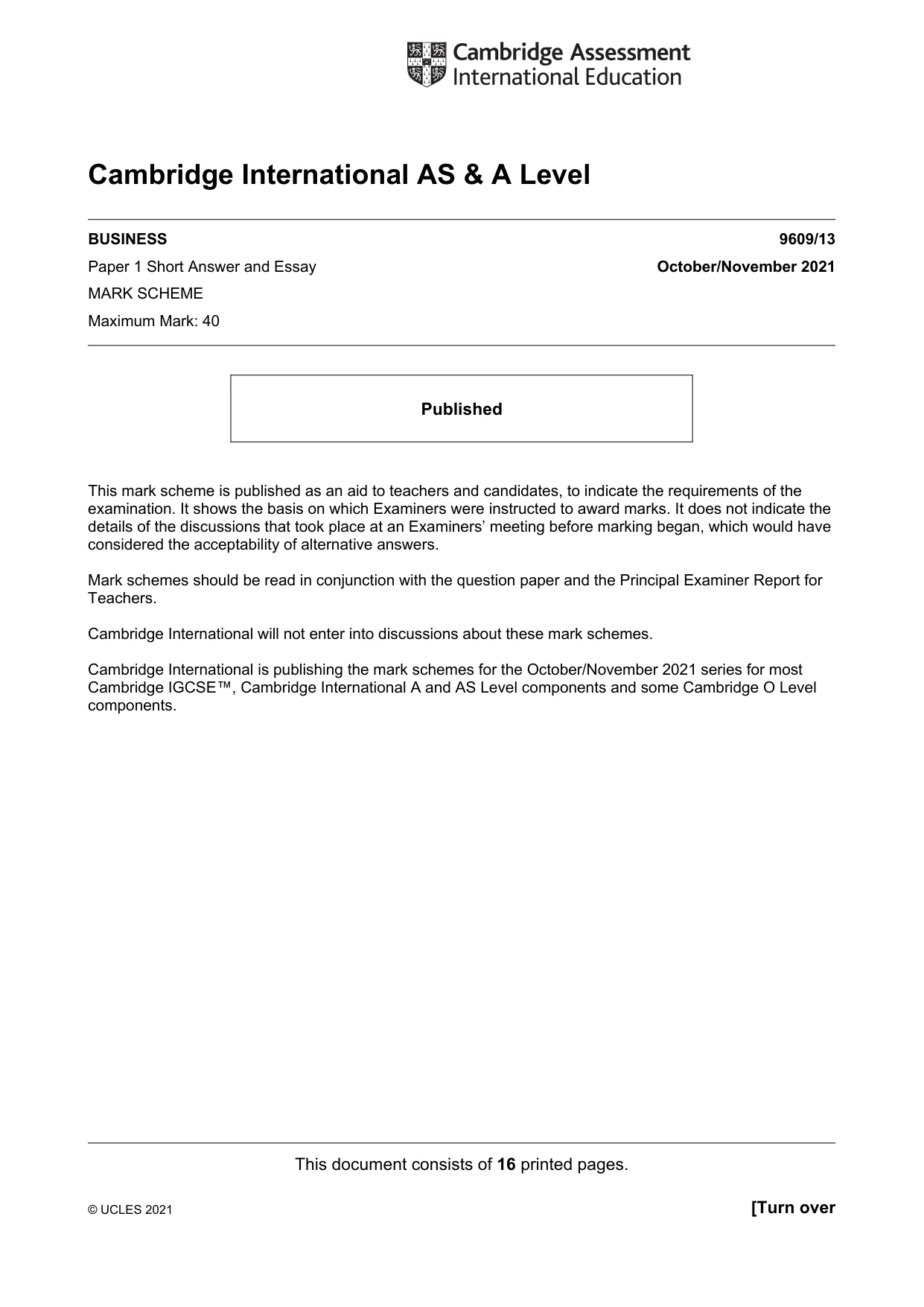
This document consists of 16 printed pages. © UCLES 2021 [Turn over Cambridge International AS & A Level BUSINESS 9609/13 Paper 1 Short Answer and Essay October/November 2021 MARK SCHEME Maximum Mark: 40 Published This mark scheme is published as an aid to teachers and candidates, to indicate the requirements of the examination. It shows the basis on which Examiners were instructed to award marks. It does not indicate the details of the discussions that took place at an Examiners’ meeting before marking began, which would have considered the acceptability of alternative answers. Mark schemes should be read in conjunction with the question paper and the Principal Examiner Report for Teachers. Cambridge International will not enter into discussions about these mark schemes. Cambridge International is publishing the mark schemes for the October/November 2021 series for most Cambridge IGCSE™, Cambridge International A and AS Level components and some Cambridge O Level components.
Mark scheme, page 2
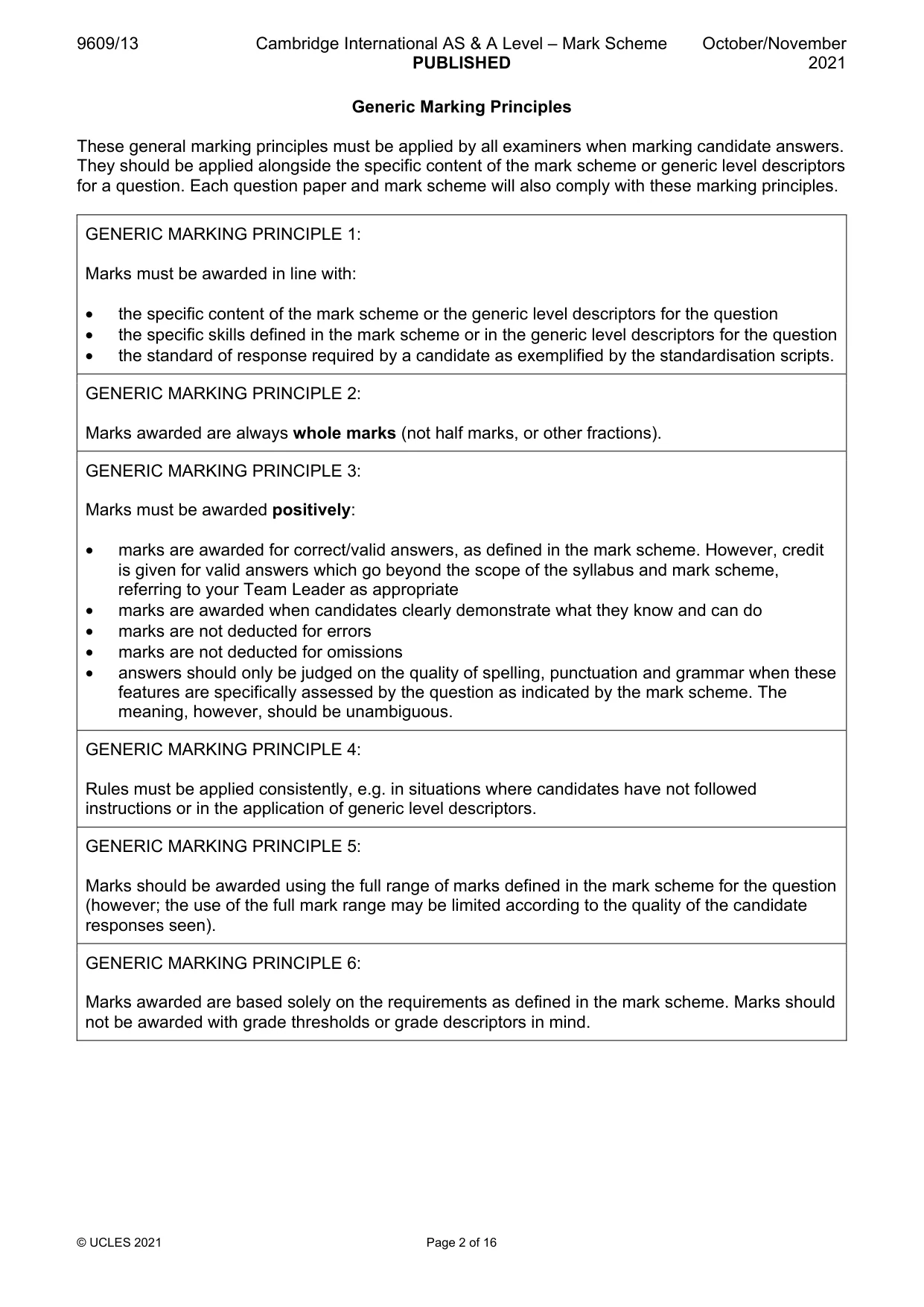
9609/13 Cambridge International AS & A Level – Mark Scheme PUBLISHED October/November 2021 © UCLES 2021 Page 2 of 16 Generic Marking Principles These general marking principles must be applied by all examiners when marking candidate answers. They should be applied alongside the specific content of the mark scheme or generic level descriptors for a question. Each question paper and mark scheme will also comply with these marking principles. GENERIC MARKING PRINCIPLE 1: Marks must be awarded in line with: • the specific content of the mark scheme or the generic level descriptors for the question • the specific skills defined in the mark scheme or in the generic level descriptors for the question • the standard of response required by a candidate as exemplified by the standardisation scripts. GENERIC MARKING PRINCIPLE 2: Marks awarded are always whole marks (not half marks, or other fractions). GENERIC MARKING PRINCIPLE 3: Marks must be awarded positively: • marks are awarded for correct/valid answers, as defined in the mark scheme. However, credit is given for valid answers which go beyond the scope of the syllabus and mark scheme, referring to your Team Leader as appropriate • marks are awarded when candidates clearly demonstrate what they know and can do • marks are not deducted for errors • marks are not deducted for omissions • answers should only be judged on the quality of spelling, punctuation and grammar when these features are specifically assessed by the question as indicated by the mark scheme. The meaning, however, should be unambiguous. GENERIC MARKING PRINCIPLE 4: Rules must be applied consistently, e.g. in situations where candidates have not followed instructions or in the application of generic level descriptors. GENERIC MARKING PRINCIPLE 5: Marks should be awarded using the full range of marks defined in the mark scheme for the question (however; the use of the full mark range may be limited according to the quality of the candidate responses seen). GENERIC MARKING PRINCIPLE 6: Marks awarded are based solely on the requirements as defined in the mark scheme. Marks should not be awarded with grade thresholds or grade descriptors in mind.
Mark scheme, page 3
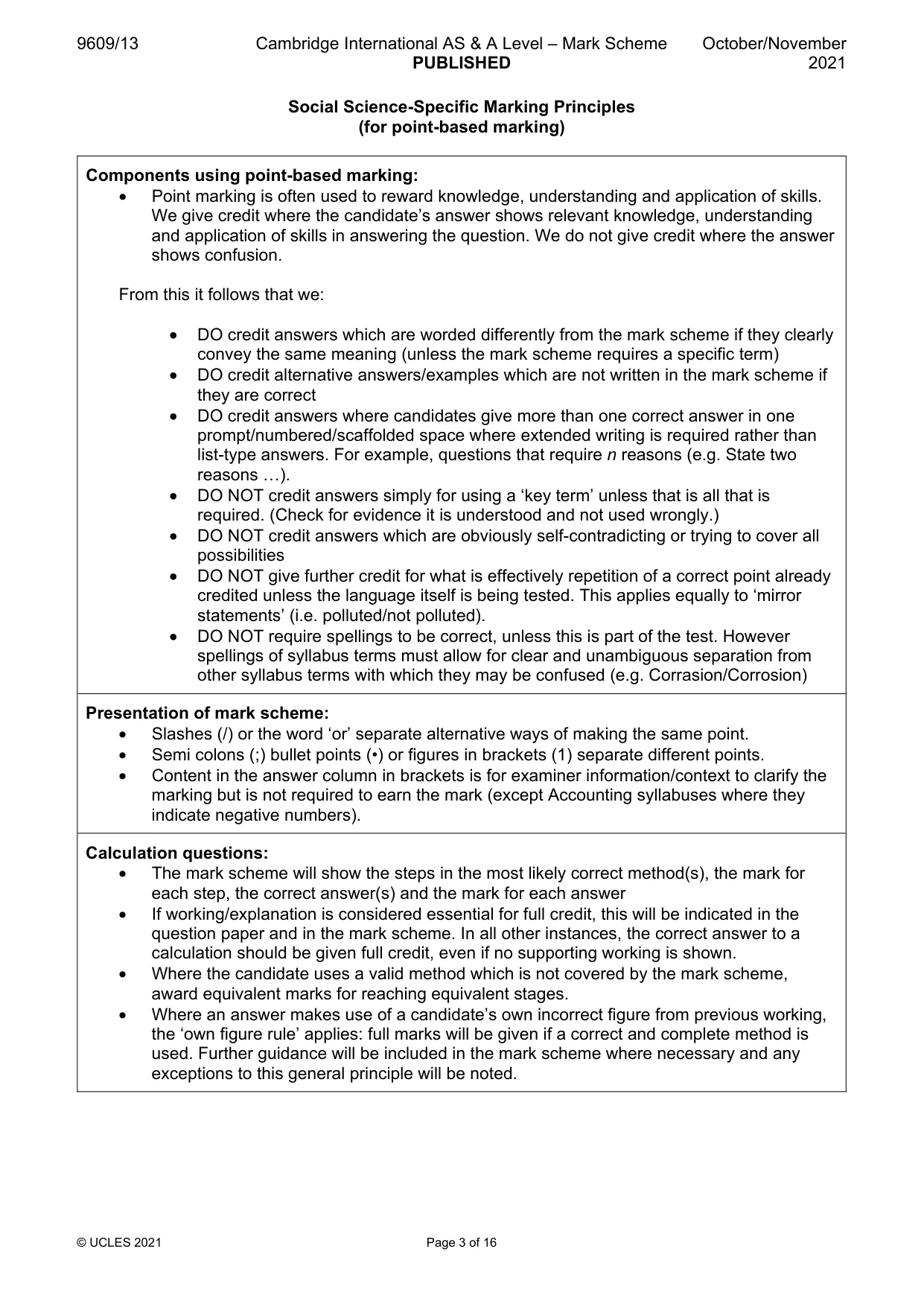
9609/13 Cambridge International AS & A Level – Mark Scheme PUBLISHED October/November 2021 © UCLES 2021 Page 3 of 16 Social Science-Specific Marking Principles (for point-based marking) Components using point-based marking: • Point marking is often used to reward knowledge, understanding and application of skills. We give credit where the candidate’s answer shows relevant knowledge, understanding and application of skills in answering the question. We do not give credit where the answer shows confusion. From this it follows that we: • DO credit answers which are worded differently from the mark scheme if they clearly convey the same meaning (unless the mark scheme requires a specific term) • DO credit alternative answers/examples which are not written in the mark scheme if they are correct • DO credit answers where candidates give more than one correct answer in one prompt/numbered/scaffolded space where extended writing is required rather than list-type answers. For example, questions that require n reasons (e.g. State two reasons …). • DO NOT credit answers simply for using a ‘key term’ unless that is all that is required. (Check for evidence it is understood and not used wrongly.) • DO NOT credit answers which are obviously self-contradicting or trying to cover all possibilities • DO NOT give further credit for what is effectively repetition of a correct point already credited unless the language itself is being tested. This applies equally to ‘mirror statements’ (i.e. polluted/not polluted). • DO NOT require spellings to be correct, unless this is part of the test. However spellings of syllabus terms must allow for clear and unambiguous separation from other syllabus terms with which they may be confused (e.g. Corrasion/Corrosion) Presentation of mark scheme: • Slashes (/) or the word ‘or’ separate alternative ways of making the same point. • Semi colons (;) bullet points (•) or figures in brackets (1) separate different points. • Content in the answer column in brackets is for examiner information/context to clarify the marking but is not required to earn the mark (except Accounting syllabuses where they indicate negative numbers). Calculation questions: • The mark scheme will show the steps in the most likely correct method(s), the mark for each step, the correct answer(s) and the mark for each answer • If working/explanation is considered essential for full credit, this will be indicated in the question paper and in the mark scheme. In all other instances, the correct answer to a calculation should be given full credit, even if no supporting working is shown. • Where the candidate uses a valid method which is not covered by the mark scheme, award equivalent marks for reaching equivalent stages. • Where an answer makes use of a candidate’s own incorrect figure from previous working, the ‘own figure rule’ applies: full marks will be given if a correct and complete method is used. Further guidance will be included in the mark scheme where necessary and any exceptions to this general principle will be noted.
Mark scheme, page 4
9609/13 Cambridge International AS & A Level – Mark Scheme PUBLISHED October/November 2021 © UCLES 2021 Page 4 of 16 Annotation: • For point marking, ticks can be used to indicate correct answers and crosses can be used to indicate wrong answers. There is no direct relationship between ticks and marks. Ticks have no defined meaning for levels of response marking. • For levels of response marking, the level awarded should be annotated on the script. • Other annotations will be used by examiners as agreed during standardisation, and the meaning will be understood by all examiners who marked that paper.
Mark scheme, page 5
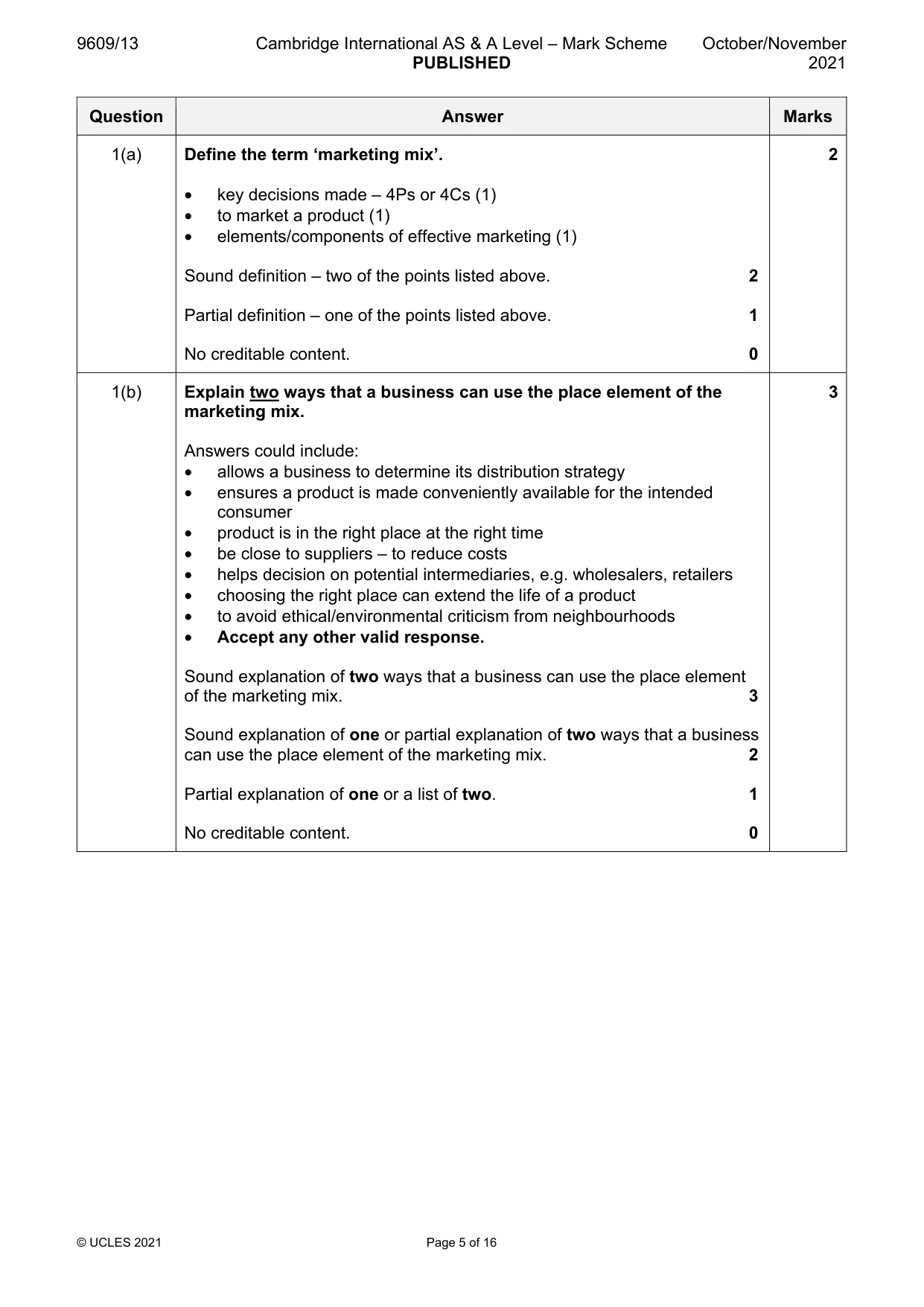
9609/13 Cambridge International AS & A Level – Mark Scheme PUBLISHED October/November 2021 © UCLES 2021 Page 5 of 16 Question Answer Marks 1(a) Define the term ‘marketing mix’. • key decisions made – 4Ps or 4Cs (1) • to market a product (1) • elements/components of effective marketing (1) Sound definition – two of the points listed above. 2 Partial definition – one of the points listed above. 1 No creditable content. 0 2 1(b) Explain two ways that a business can use the place element of the marketing mix. Answers could include: • allows a business to determine its distribution strategy • ensures a product is made conveniently available for the intended consumer • product is in the right place at the right time • be close to suppliers – to reduce costs • helps decision on potential intermediaries, e.g. wholesalers, retailers • choosing the right place can extend the life of a product • to avoid ethical/environmental criticism from neighbourhoods • Accept any other valid response. Sound explanation of two ways that a business can use the place element of the marketing mix. 3 Sound explanation of one or partial explanation of two ways that a business can use the place element of the marketing mix. 2 Partial explanation of one or a list of two. 1 No creditable content. 0 3
Mark scheme, page 6
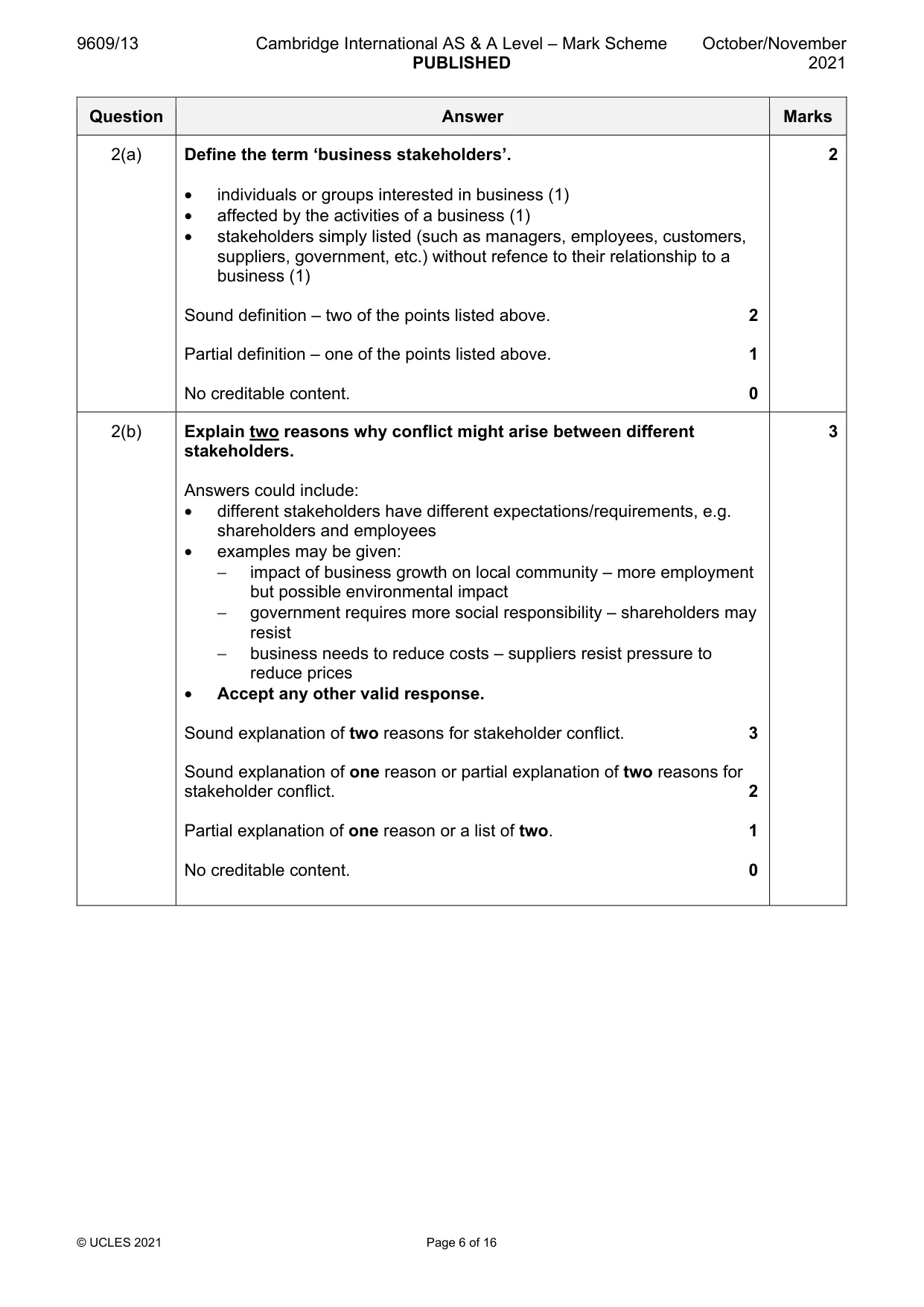
9609/13 Cambridge International AS & A Level – Mark Scheme PUBLISHED October/November 2021 © UCLES 2021 Page 6 of 16 Question Answer Marks 2(a) Define the term ‘business stakeholders’. • individuals or groups interested in business (1) • affected by the activities of a business (1) • stakeholders simply listed (such as managers, employees, customers, suppliers, government, etc.) without refence to their relationship to a business (1) Sound definition – two of the points listed above. 2 Partial definition – one of the points listed above. 1 No creditable content. 0 2 2(b) Explain two reasons why conflict might arise between different stakeholders. Answers could include: • different stakeholders have different expectations/requirements, e.g. shareholders and employees • examples may be given: − impact of business growth on local community – more employment but possible environmental impact − government requires more social responsibility – shareholders may resist − business needs to reduce costs – suppliers resist pressure to reduce prices • Accept any other valid response. Sound explanation of two reasons for stakeholder conflict. 3 Sound explanation of one reason or partial explanation of two reasons for stakeholder conflict. 2 Partial explanation of one reason or a list of two. 1 No creditable content. 0 3
Mark scheme, page 7
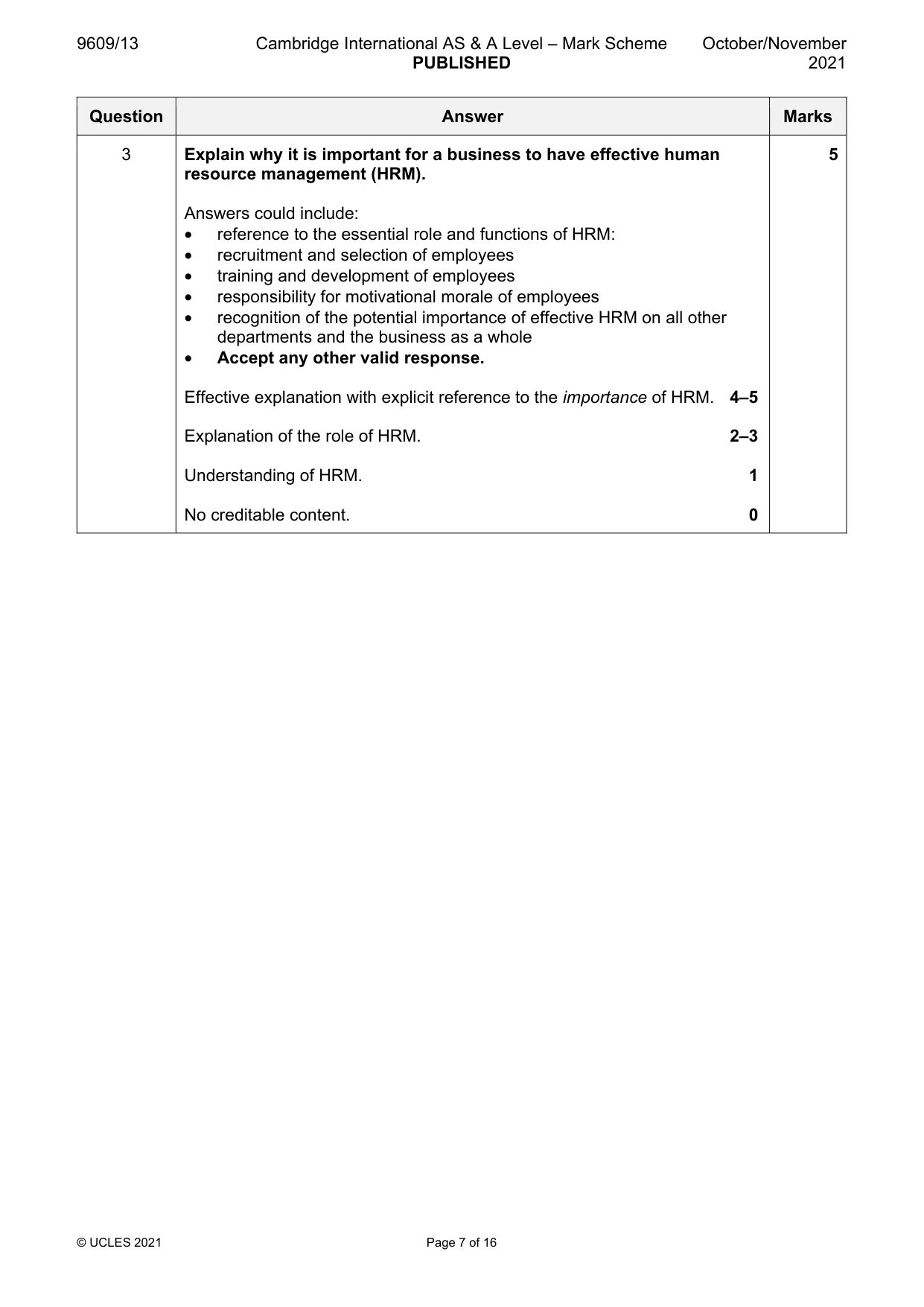
9609/13 Cambridge International AS & A Level – Mark Scheme PUBLISHED October/November 2021 © UCLES 2021 Page 7 of 16 Question Answer Marks 3 Explain why it is important for a business to have effective human resource management (HRM). Answers could include: • reference to the essential role and functions of HRM: • recruitment and selection of employees • training and development of employees • responsibility for motivational morale of employees • recognition of the potential importance of effective HRM on all other departments and the business as a whole • Accept any other valid response. Effective explanation with explicit reference to the importance of HRM. 4–5 Explanation of the role of HRM. 2–3 Understanding of HRM. 1 No creditable content. 0 5
Mark scheme, page 8
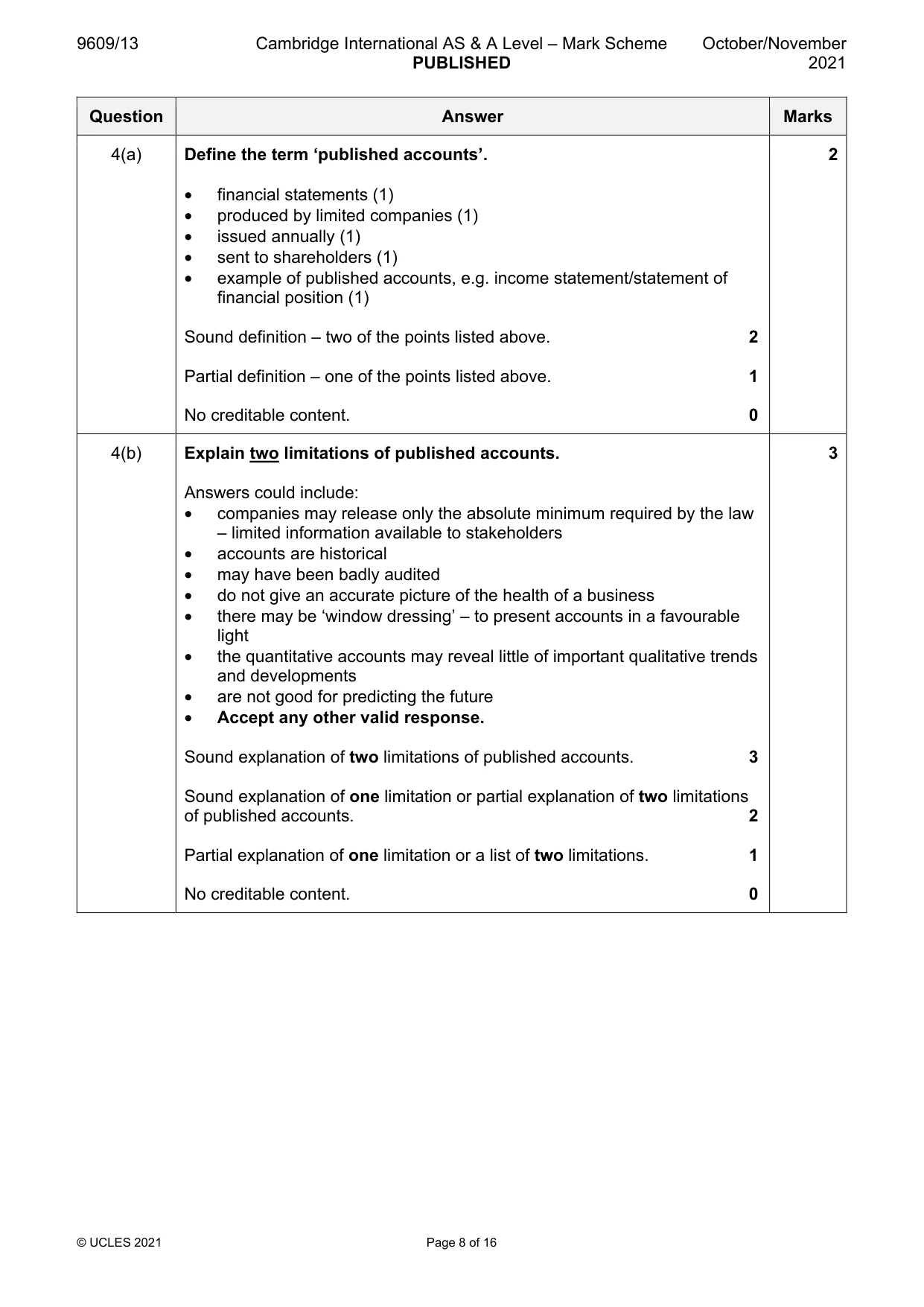
9609/13 Cambridge International AS & A Level – Mark Scheme PUBLISHED October/November 2021 © UCLES 2021 Page 8 of 16 Question Answer Marks 4(a) Define the term ‘published accounts’. • financial statements (1) • produced by limited companies (1) • issued annually (1) • sent to shareholders (1) • example of published accounts, e.g. income statement/statement of financial position (1) Sound definition – two of the points listed above. 2 Partial definition – one of the points listed above. 1 No creditable content. 0 2 4(b) Explain two limitations of published accounts. Answers could include: • companies may release only the absolute minimum required by the law – limited information available to stakeholders • accounts are historical • may have been badly audited • do not give an accurate picture of the health of a business • there may be ‘window dressing’ – to present accounts in a favourable light • the quantitative accounts may reveal little of important qualitative trends and developments • are not good for predicting the future • Accept any other valid response. Sound explanation of two limitations of published accounts. 3 Sound explanation of one limitation or partial explanation of two limitations of published accounts. 2 Partial explanation of one limitation or a list of two limitations. 1 No creditable content. 0 3
Mark scheme, page 9
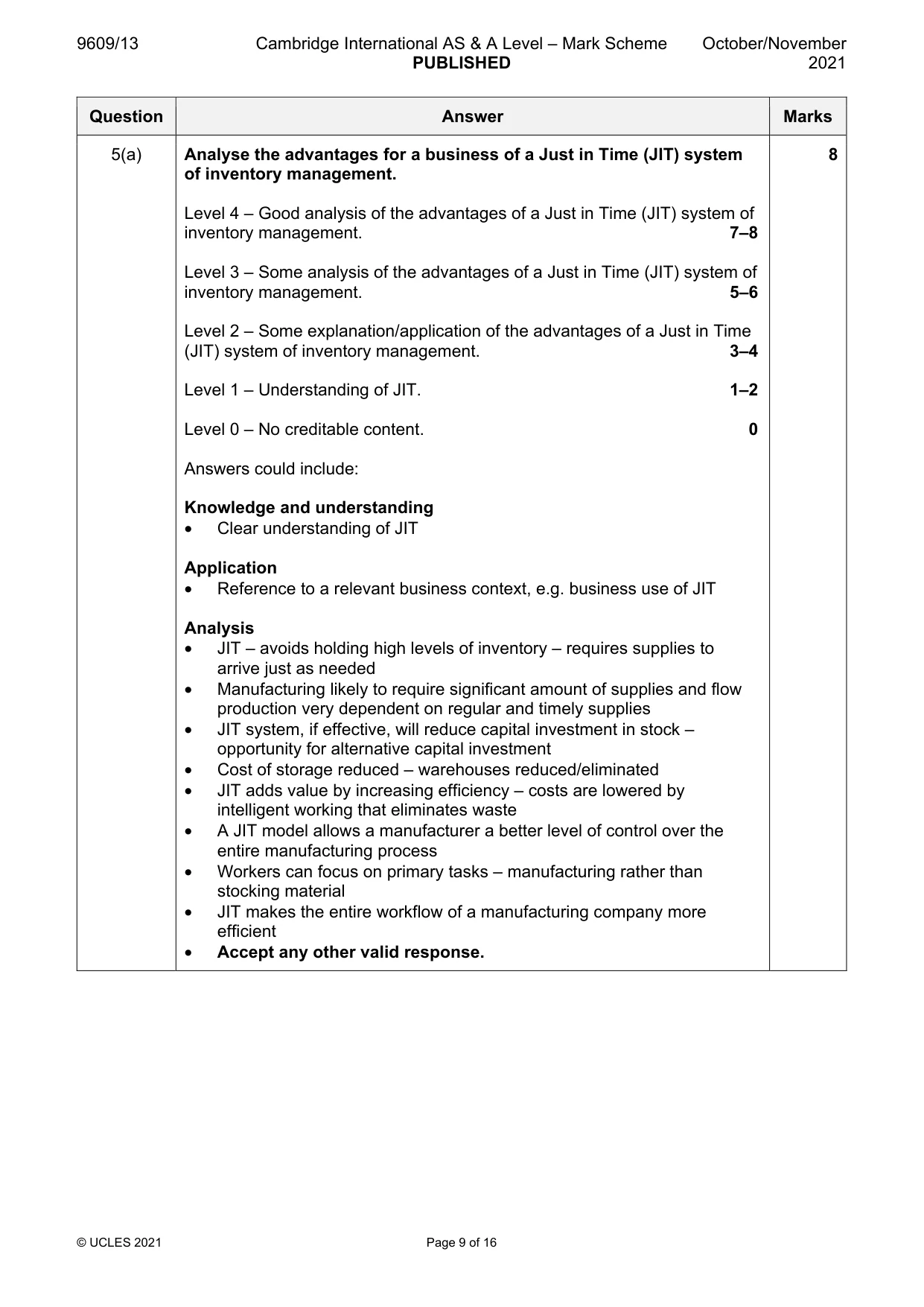
9609/13 Cambridge International AS & A Level – Mark Scheme PUBLISHED October/November 2021 © UCLES 2021 Page 9 of 16 Question Answer Marks 5(a) Analyse the advantages for a business of a Just in Time (JIT) system of inventory management. Level 4 – Good analysis of the advantages of a Just in Time (JIT) system of inventory management. 7–8 Level 3 – Some analysis of the advantages of a Just in Time (JIT) system of inventory management. 5–6 Level 2 – Some explanation/application of the advantages of a Just in Time (JIT) system of inventory management. 3–4 Level 1 – Understanding of JIT. 1–2 Level 0 – No creditable content. 0 Answers could include: Knowledge and understanding • Clear understanding of JIT Application • Reference to a relevant business context, e.g. business use of JIT Analysis • JIT – avoids holding high levels of inventory – requires supplies to arrive just as needed • Manufacturing likely to require significant amount of supplies and flow production very dependent on regular and timely supplies • JIT system, if effective, will reduce capital investment in stock – opportunity for alternative capital investment • Cost of storage reduced – warehouses reduced/eliminated • JIT adds value by increasing efficiency – costs are lowered by intelligent working that eliminates waste • A JIT model allows a manufacturer a better level of control over the entire manufacturing process • Workers can focus on primary tasks – manufacturing rather than stocking material • JIT makes the entire workflow of a manufacturing company more efficient • Accept any other valid response. 8
Mark scheme, page 10
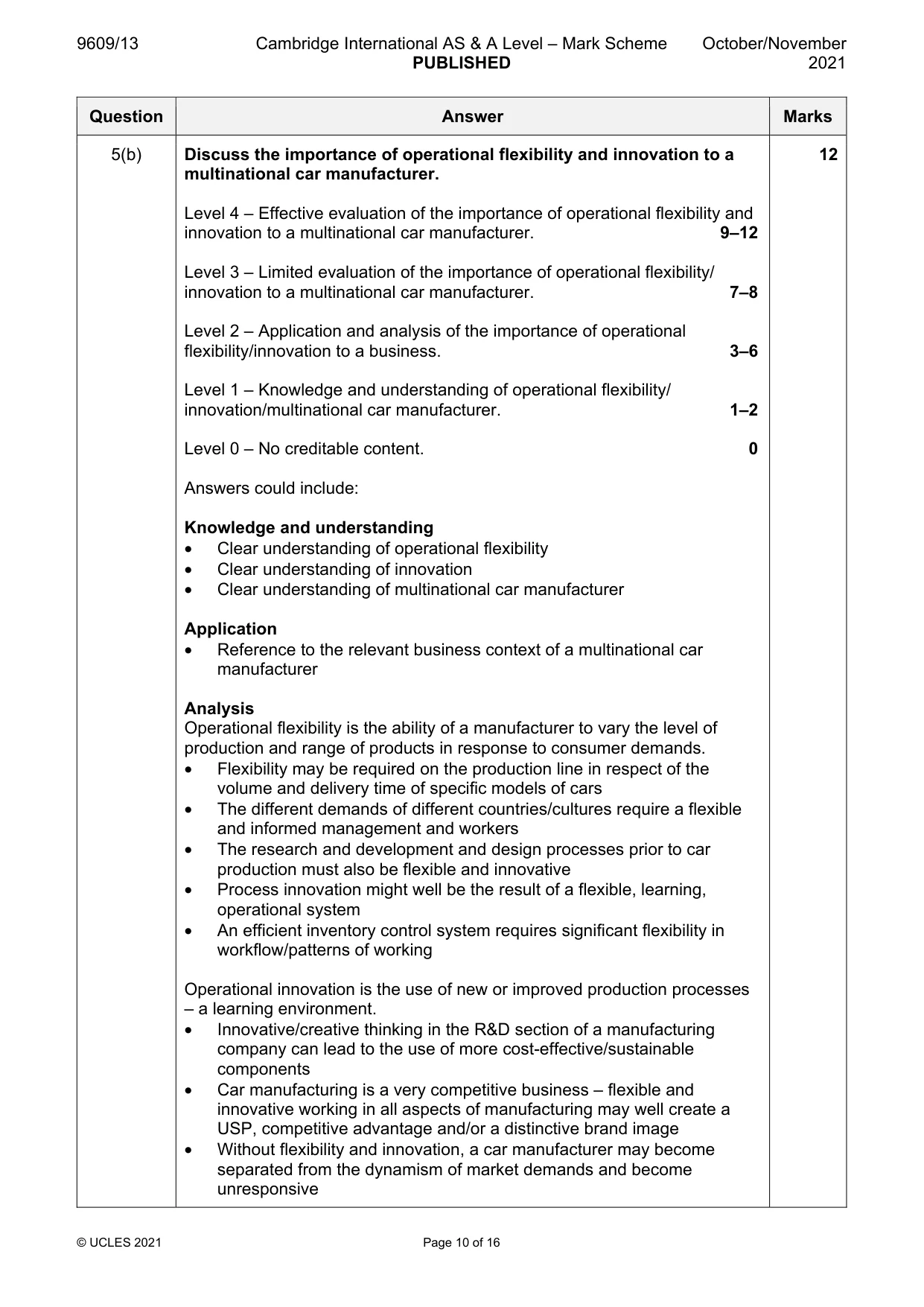
9609/13 Cambridge International AS & A Level – Mark Scheme PUBLISHED October/November 2021 © UCLES 2021 Page 10 of 16 Question Answer Marks 5(b) Discuss the importance of operational flexibility and innovation to a multinational car manufacturer. Level 4 – Effective evaluation of the importance of operational flexibility and innovation to a multinational car manufacturer. 9–12 Level 3 – Limited evaluation of the importance of operational flexibility/ innovation to a multinational car manufacturer. 7–8 Level 2 – Application and analysis of the importance of operational flexibility/innovation to a business. 3–6 Level 1 – Knowledge and understanding of operational flexibility/ innovation/multinational car manufacturer. 1–2 Level 0 – No creditable content. 0 Answers could include: Knowledge and understanding • Clear understanding of operational flexibility • Clear understanding of innovation • Clear understanding of multinational car manufacturer Application • Reference to the relevant business context of a multinational car manufacturer Analysis Operational flexibility is the ability of a manufacturer to vary the level of production and range of products in response to consumer demands. • Flexibility may be required on the production line in respect of the volume and delivery time of specific models of cars • The different demands of different countries/cultures require a flexible and informed management and workers • The research and development and design processes prior to car production must also be flexible and innovative • Process innovation might well be the result of a flexible, learning, operational system • An efficient inventory control system requires significant flexibility in workflow/patterns of working Operational innovation is the use of new or improved production processes – a learning environment. • Innovative/creative thinking in the R&D section of a manufacturing company can lead to the use of more cost-effective/sustainable components • Car manufacturing is a very competitive business – flexible and innovative working in all aspects of manufacturing may well create a USP, competitive advantage and/or a distinctive brand image • Without flexibility and innovation, a car manufacturer may become separated from the dynamism of market demands and become unresponsive 12
Mark scheme, page 11
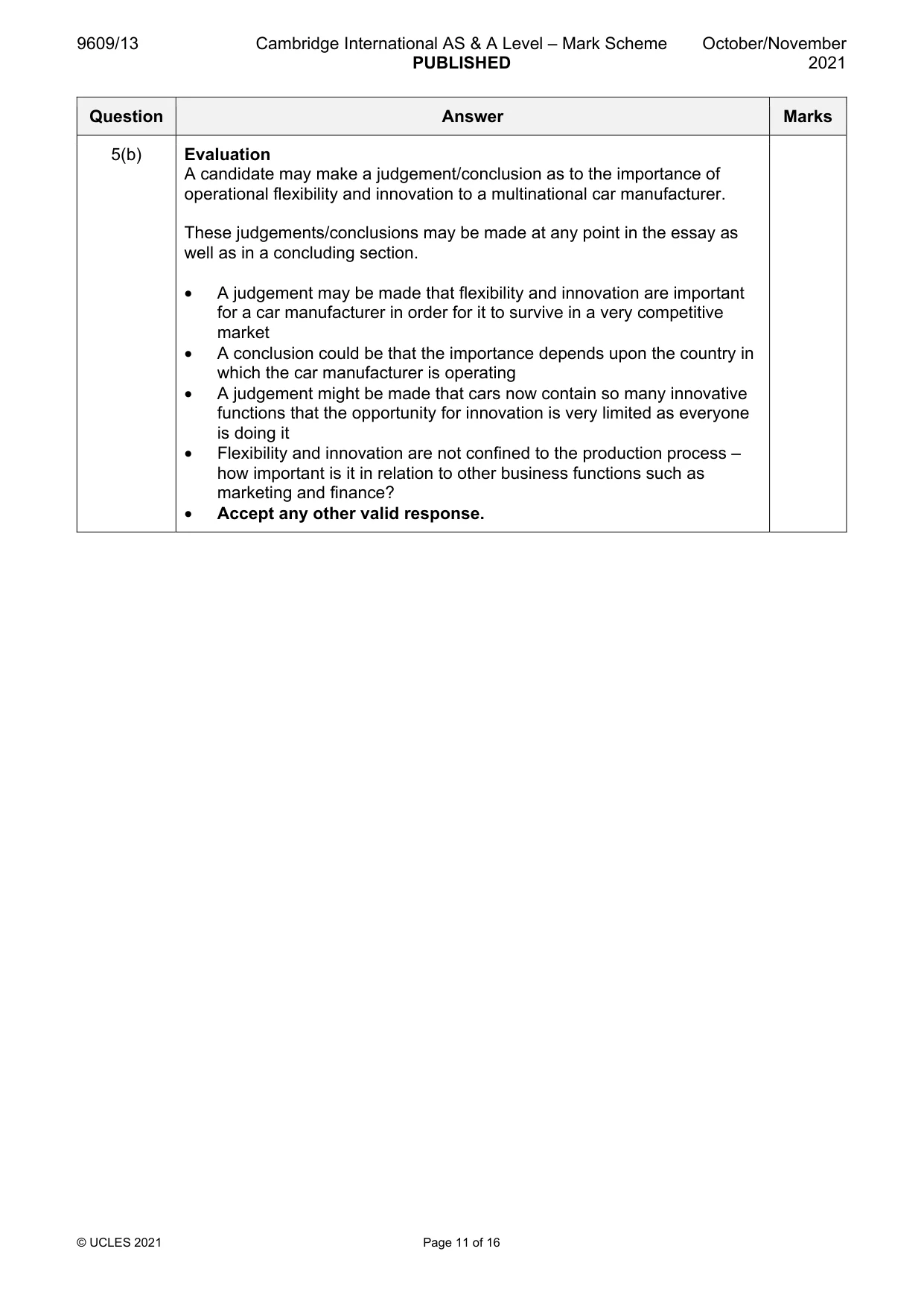
9609/13 Cambridge International AS & A Level – Mark Scheme PUBLISHED October/November 2021 © UCLES 2021 Page 11 of 16 Question Answer Marks 5(b) Evaluation A candidate may make a judgement/conclusion as to the importance of operational flexibility and innovation to a multinational car manufacturer. These judgements/conclusions may be made at any point in the essay as well as in a concluding section. • A judgement may be made that flexibility and innovation are important for a car manufacturer in order for it to survive in a very competitive market • A conclusion could be that the importance depends upon the country in which the car manufacturer is operating • A judgement might be made that cars now contain so many innovative functions that the opportunity for innovation is very limited as everyone is doing it • Flexibility and innovation are not confined to the production process – how important is it in relation to other business functions such as marketing and finance? • Accept any other valid response.
Mark scheme, page 12
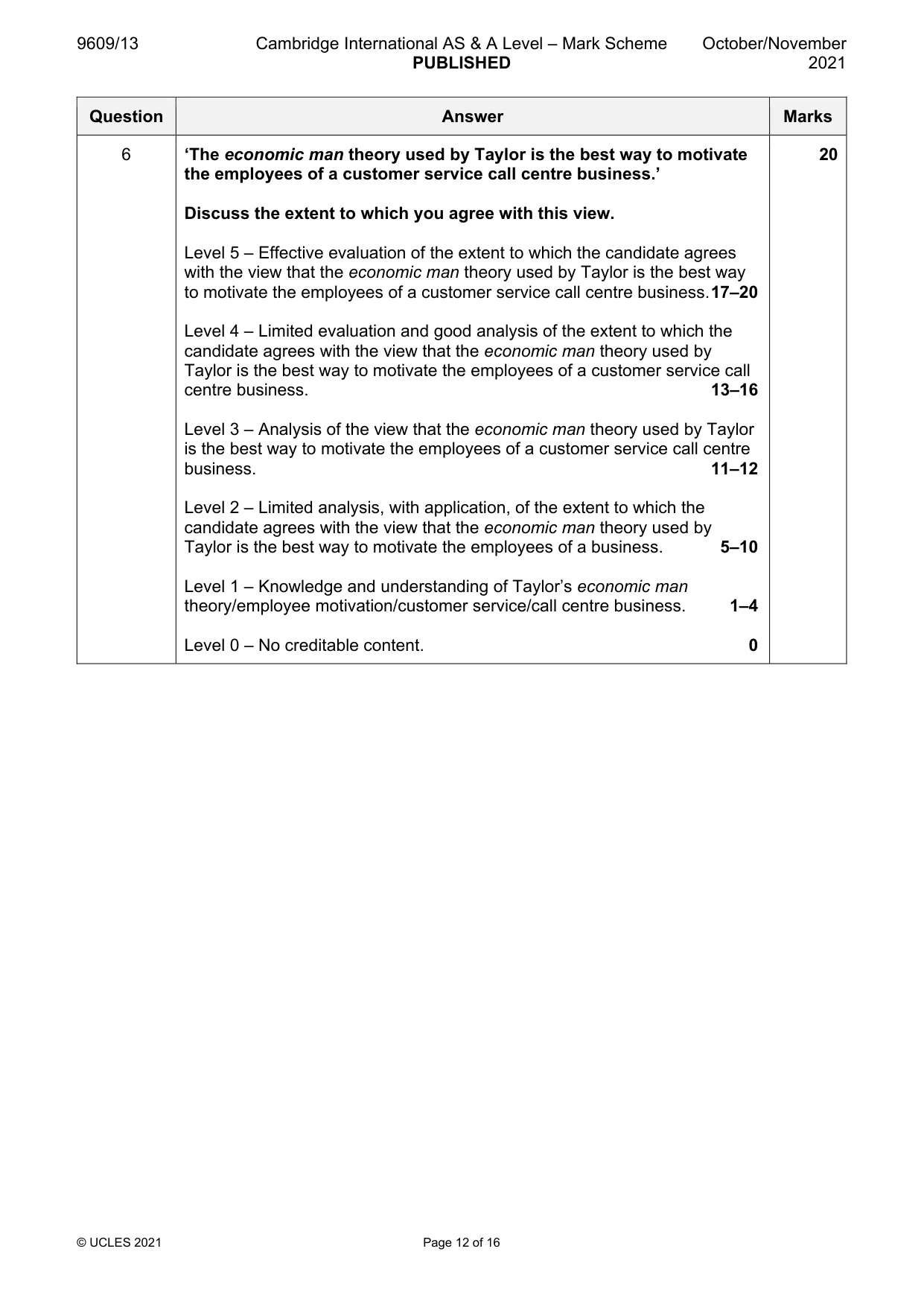
9609/13 Cambridge International AS & A Level – Mark Scheme PUBLISHED October/November 2021 © UCLES 2021 Page 12 of 16 Question Answer Marks 6 ‘The economic man theory used by Taylor is the best way to motivate the employees of a customer service call centre business.’ Discuss the extent to which you agree with this view. Level 5 – Effective evaluation of the extent to which the candidate agrees with the view that the economic man theory used by Taylor is the best way to motivate the employees of a customer service call centre business. 17–20 Level 4 – Limited evaluation and good analysis of the extent to which the candidate agrees with the view that the economic man theory used by Taylor is the best way to motivate the employees of a customer service call centre business. 13–16 Level 3 – Analysis of the view that the economic man theory used by Taylor is the best way to motivate the employees of a customer service call centre business. 11–12 Level 2 – Limited analysis, with application, of the extent to which the candidate agrees with the view that the economic man theory used by Taylor is the best way to motivate the employees of a business. 5–10 Level 1 – Knowledge and understanding of Taylor’s economic man theory/employee motivation/customer service/call centre business. 1–4 Level 0 – No creditable content. 0 20
Mark scheme, page 13
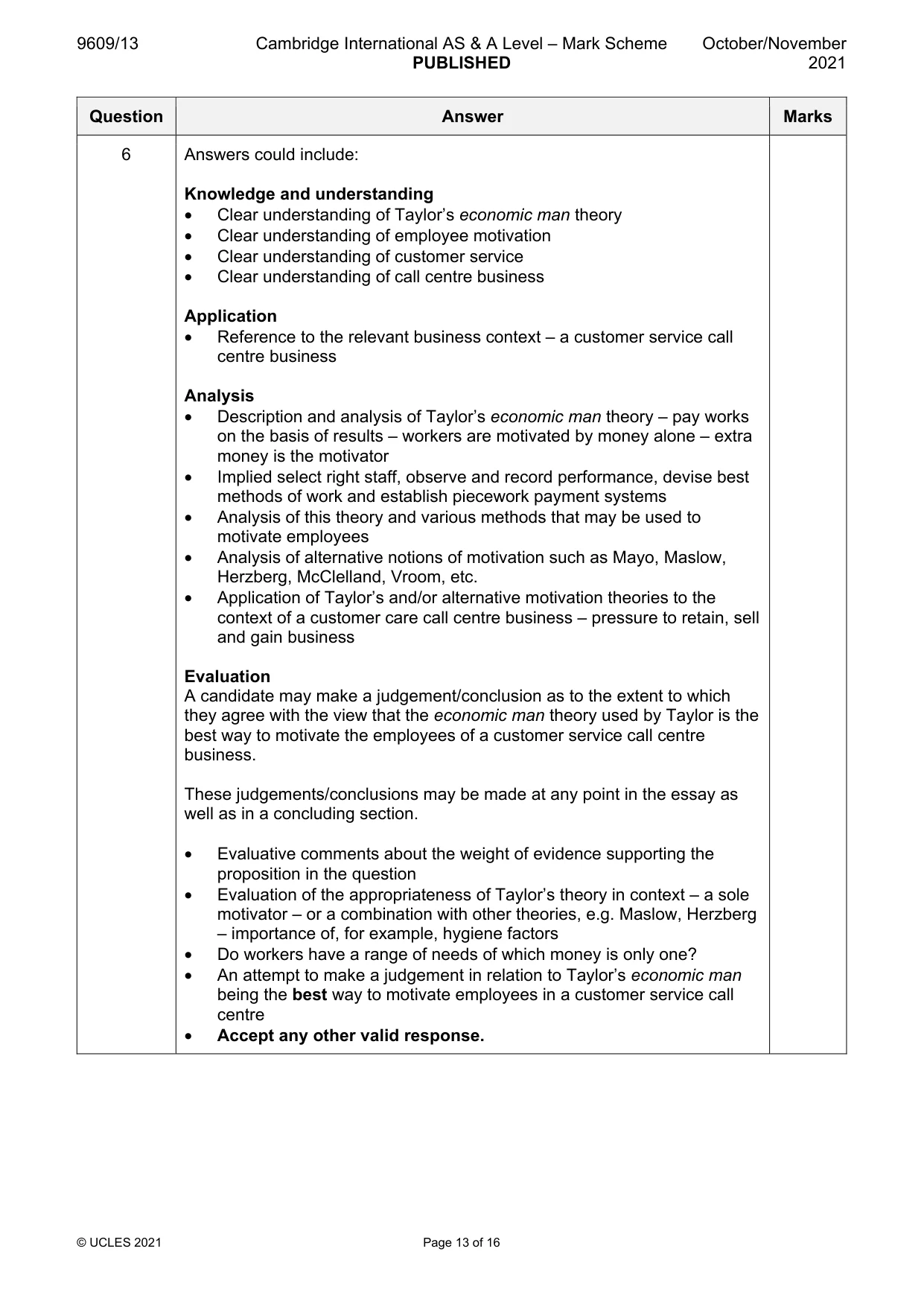
9609/13 Cambridge International AS & A Level – Mark Scheme PUBLISHED October/November 2021 © UCLES 2021 Page 13 of 16 Question Answer Marks 6 Answers could include: Knowledge and understanding • Clear understanding of Taylor’s economic man theory • Clear understanding of employee motivation • Clear understanding of customer service • Clear understanding of call centre business Application • Reference to the relevant business context – a customer service call centre business Analysis • Description and analysis of Taylor’s economic man theory – pay works on the basis of results – workers are motivated by money alone – extra money is the motivator • Implied select right staff, observe and record performance, devise best methods of work and establish piecework payment systems • Analysis of this theory and various methods that may be used to motivate employees • Analysis of alternative notions of motivation such as Mayo, Maslow, Herzberg, McClelland, Vroom, etc. • Application of Taylor’s and/or alternative motivation theories to the context of a customer care call centre business – pressure to retain, sell and gain business Evaluation A candidate may make a judgement/conclusion as to the extent to which they agree with the view that the economic man theory used by Taylor is the best way to motivate the employees of a customer service call centre business. These judgements/conclusions may be made at any point in the essay as well as in a concluding section. • Evaluative comments about the weight of evidence supporting the proposition in the question • Evaluation of the appropriateness of Taylor’s theory in context – a sole motivator – or a combination with other theories, e.g. Maslow, Herzberg – importance of, for example, hygiene factors • Do workers have a range of needs of which money is only one? • An attempt to make a judgement in relation to Taylor’s economic man being the best way to motivate employees in a customer service call centre • Accept any other valid response.
Mark scheme, page 14
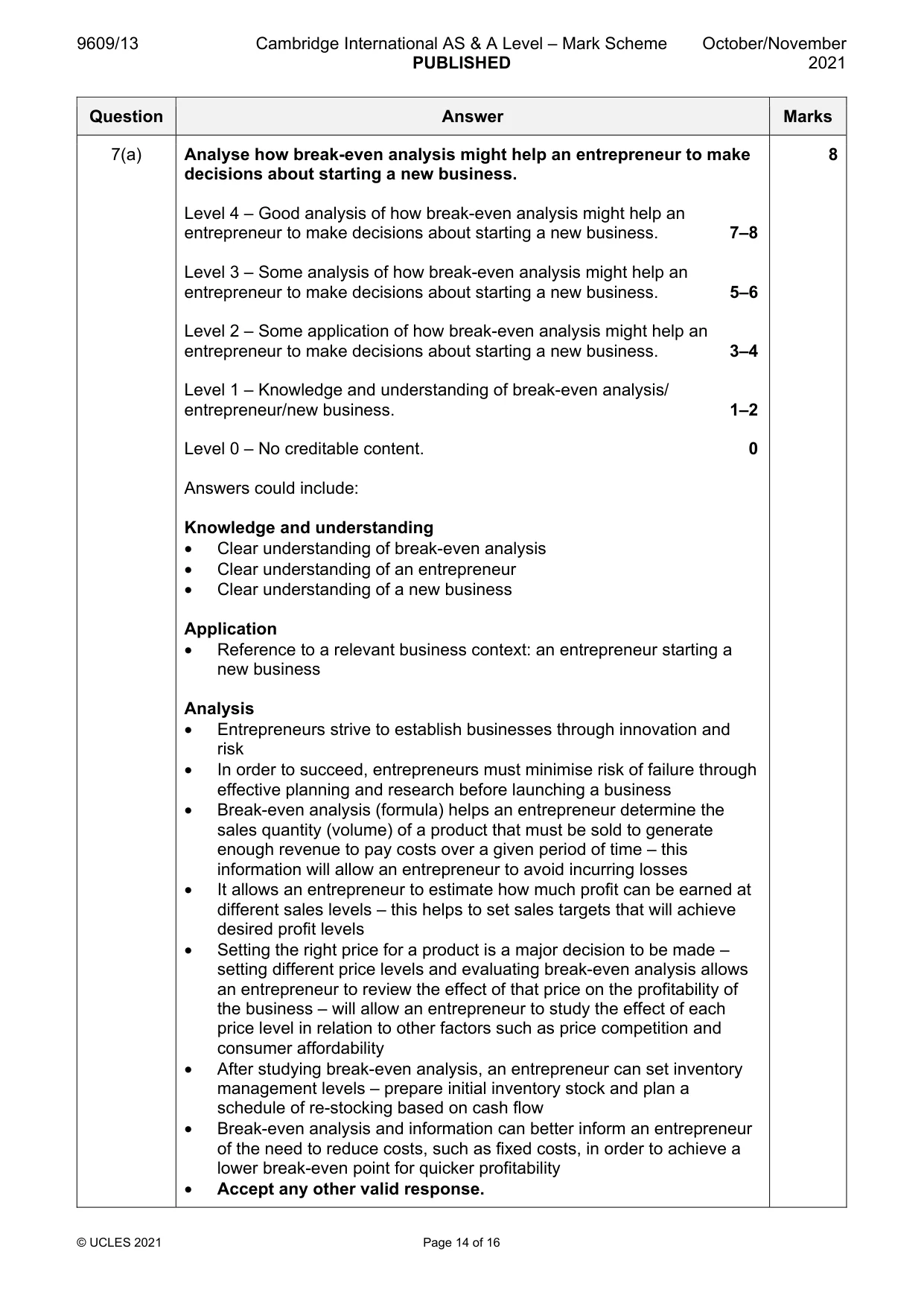
9609/13 Cambridge International AS & A Level – Mark Scheme PUBLISHED October/November 2021 © UCLES 2021 Page 14 of 16 Question Answer Marks 7(a) Analyse how break-even analysis might help an entrepreneur to make decisions about starting a new business. Level 4 – Good analysis of how break-even analysis might help an entrepreneur to make decisions about starting a new business. 7–8 Level 3 – Some analysis of how break-even analysis might help an entrepreneur to make decisions about starting a new business. 5–6 Level 2 – Some application of how break-even analysis might help an entrepreneur to make decisions about starting a new business. 3–4 Level 1 – Knowledge and understanding of break-even analysis/ entrepreneur/new business. 1–2 Level 0 – No creditable content. 0 Answers could include: Knowledge and understanding • Clear understanding of break-even analysis • Clear understanding of an entrepreneur • Clear understanding of a new business Application • Reference to a relevant business context: an entrepreneur starting a new business Analysis • Entrepreneurs strive to establish businesses through innovation and risk • In order to succeed, entrepreneurs must minimise risk of failure through effective planning and research before launching a business • Break-even analysis (formula) helps an entrepreneur determine the sales quantity (volume) of a product that must be sold to generate enough revenue to pay costs over a given period of time – this information will allow an entrepreneur to avoid incurring losses • It allows an entrepreneur to estimate how much profit can be earned at different sales levels – this helps to set sales targets that will achieve desired profit levels • Setting the right price for a product is a major decision to be made – setting different price levels and evaluating break-even analysis allows an entrepreneur to review the effect of that price on the profitability of the business – will allow an entrepreneur to study the effect of each price level in relation to other factors such as price competition and consumer affordability • After studying break-even analysis, an entrepreneur can set inventory management levels – prepare initial inventory stock and plan a schedule of re-stocking based on cash flow • Break-even analysis and information can better inform an entrepreneur of the need to reduce costs, such as fixed costs, in order to achieve a lower break-even point for quicker profitability • Accept any other valid response. 8
Mark scheme, page 15
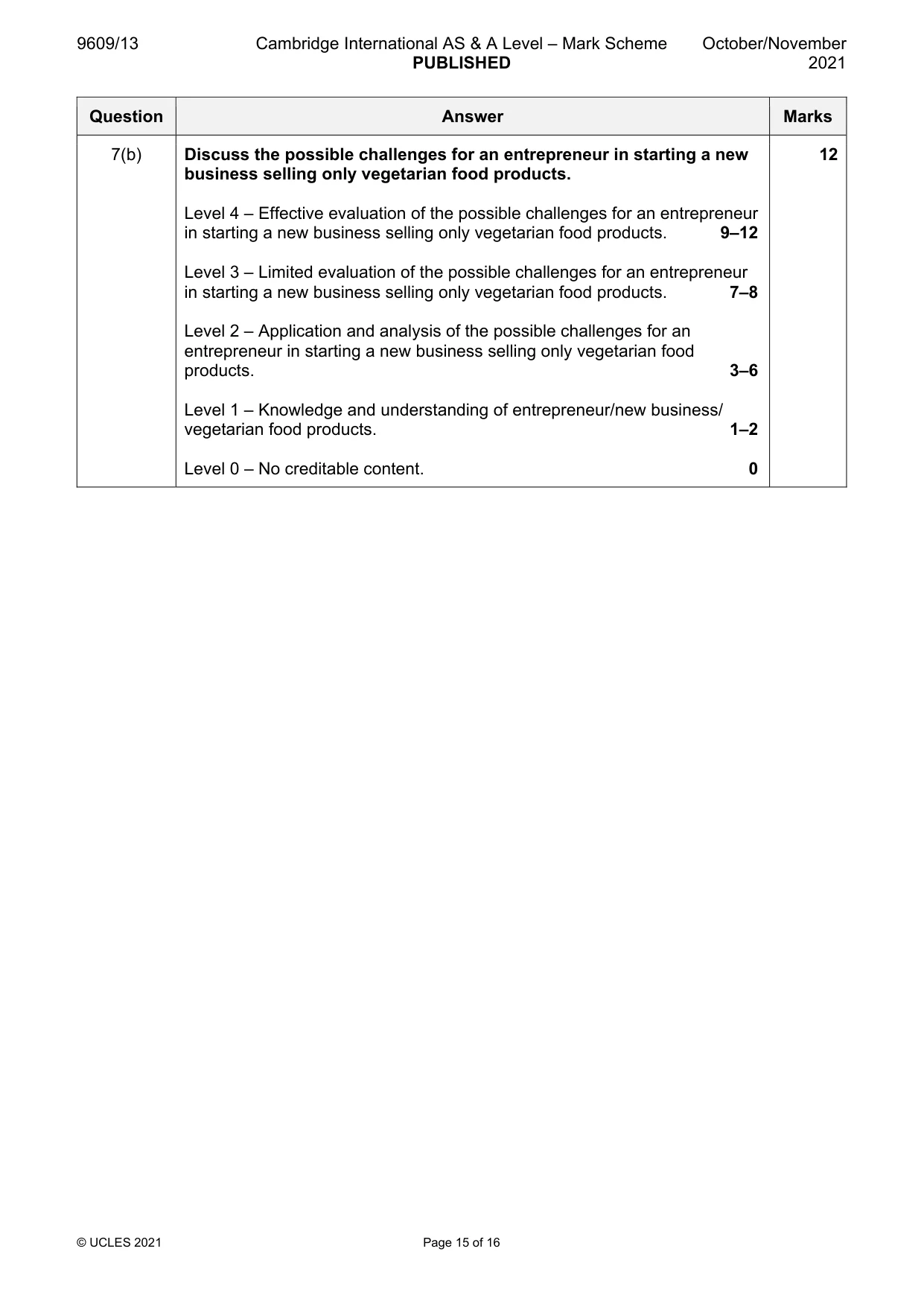
9609/13 Cambridge International AS & A Level – Mark Scheme PUBLISHED October/November 2021 © UCLES 2021 Page 15 of 16 Question Answer Marks 7(b) Discuss the possible challenges for an entrepreneur in starting a new business selling only vegetarian food products. Level 4 – Effective evaluation of the possible challenges for an entrepreneur in starting a new business selling only vegetarian food products. 9–12 Level 3 – Limited evaluation of the possible challenges for an entrepreneur in starting a new business selling only vegetarian food products. 7–8 Level 2 – Application and analysis of the possible challenges for an entrepreneur in starting a new business selling only vegetarian food products. 3–6 Level 1 – Knowledge and understanding of entrepreneur/new business/ vegetarian food products. 1–2 Level 0 – No creditable content. 0 12
Mark scheme, page 16
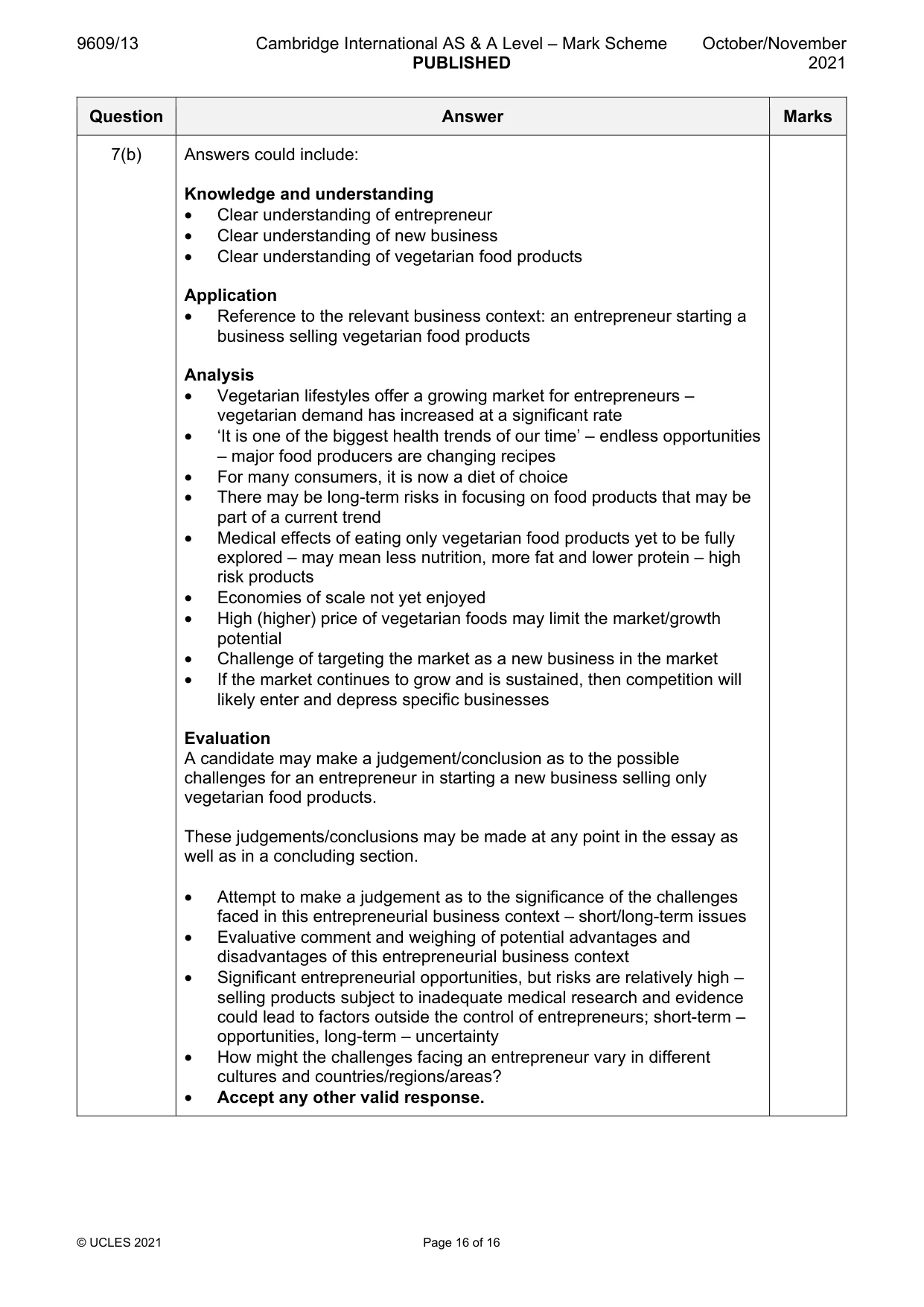
9609/13 Cambridge International AS & A Level – Mark Scheme PUBLISHED October/November 2021 © UCLES 2021 Page 16 of 16 Question Answer Marks 7(b) Answers could include: Knowledge and understanding • Clear understanding of entrepreneur • Clear understanding of new business • Clear understanding of vegetarian food products Application • Reference to the relevant business context: an entrepreneur starting a business selling vegetarian food products Analysis • Vegetarian lifestyles offer a growing market for entrepreneurs – vegetarian demand has increased at a significant rate • ‘It is one of the biggest health trends of our time’ – endless opportunities – major food producers are changing recipes • For many consumers, it is now a diet of choice • There may be long-term risks in focusing on food products that may be part of a current trend • Medical effects of eating only vegetarian food products yet to be fully explored – may mean less nutrition, more fat and lower protein – high risk products • Economies of scale not yet enjoyed • High (higher) price of vegetarian foods may limit the market/growth potential • Challenge of targeting the market as a new business in the market • If the market continues to grow and is sustained, then competition will likely enter and depress specific businesses Evaluation A candidate may make a judgement/conclusion as to the possible challenges for an entrepreneur in starting a new business selling only vegetarian food products. These judgements/conclusions may be made at any point in the essay as well as in a concluding section. • Attempt to make a judgement as to the significance of the challenges faced in this entrepreneurial business context – short/long-term issues • Evaluative comment and weighing of potential advantages and disadvantages of this entrepreneurial business context • Significant entrepreneurial opportunities, but risks are relatively high – selling products subject to inadequate medical research and evidence could lead to factors outside the control of entrepreneurs; short-term – opportunities, long-term – uncertainty • How might the challenges facing an entrepreneur vary in different cultures and countries/regions/areas? • Accept any other valid response.
What you needed in this session
Cambridge’s own grade thresholds for 2021 Oct/Nov, Paper 1 · Variant 3. A higher threshold means an easier paper — the bar moves with how the cohort did.