Cambridge A Level Business (for first examination in 2016) 9609 — 2021 Oct/Nov Paper 1 · Variant 1
9609/11/O/N/21 · 40 marks · ≈45 min
The question paper and its mark scheme, free to read here and free to download. This is Cambridge’s own paper, exactly as it was sat.
Question paper4 pages


Mark scheme16 pages
Answers below. Sit the paper first if you are practising.

Paper as text
Question paper, page 1
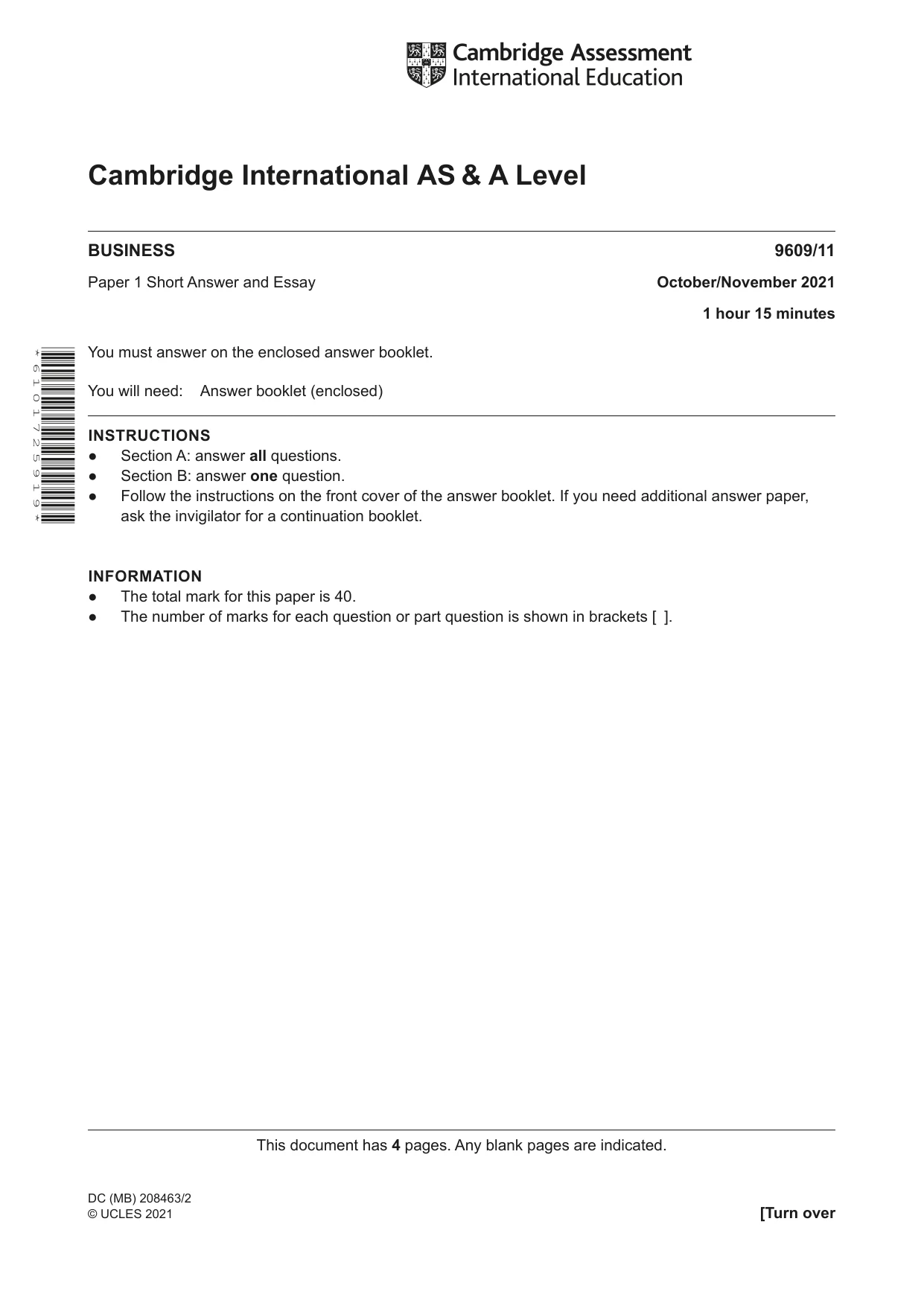
This document has 4 pages. Any blank pages are indicated. Cambridge International AS & A Level BUSINESS 9609/11 Paper 1 Short Answer and Essay October/November 2021 1 hour 15 minutes You must answer on the enclosed answer booklet. You will need: Answer booklet (enclosed) INSTRUCTIONS ● Section A: answer all questions. ● Section B: answer one question. ● Follow the instructions on the front cover of the answer booklet. If you need additional answer paper, ask the invigilator for a continuation booklet. INFORMATION ● The total mark for this paper is 40. ● The number of marks for each question or part question is shown in brackets [ ]. DC (MB) 208463/2 © UCLES 2021 [Turn over * 6 1 0 1 7 2 5 9 1 9 *
Question paper, page 2
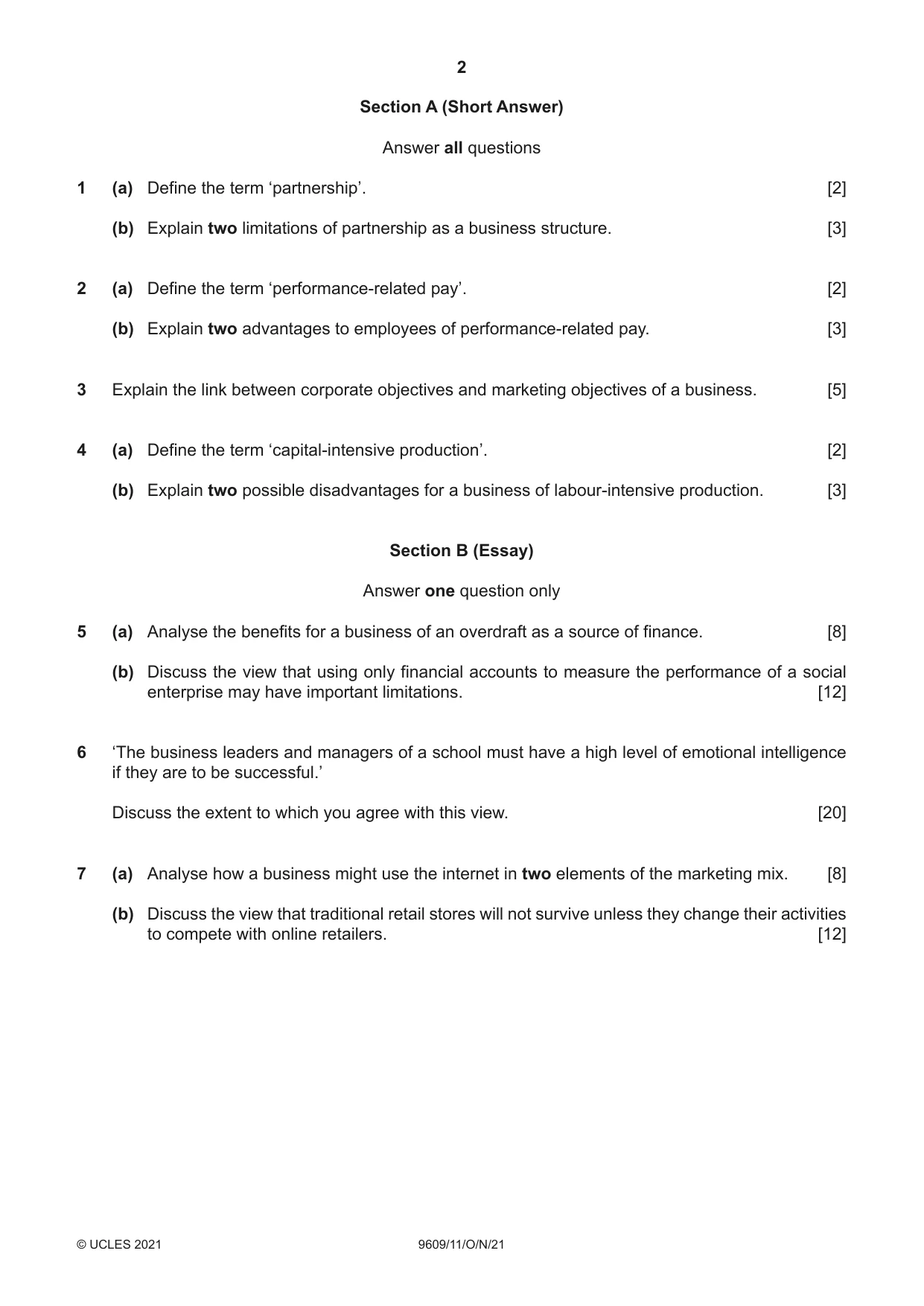
2 9609/11/O/N/21 © UCLES 2021 Section A (Short Answer) Answer all questions 1 (a) Define the term ‘partnership’. [2] (b) Explain two limitations of partnership as a business structure. [3] 2 (a) Define the term ‘performance-related pay’. [2] (b) Explain two advantages to employees of performance-related pay. [3] 3 Explain the link between corporate objectives and marketing objectives of a business. [5] 4 (a) Define the term ‘capital-intensive production’. [2] (b) Explain two possible disadvantages for a business of labour-intensive production. [3] Section B (Essay) Answer one question only 5 (a) Analyse the benefits for a business of an overdraft as a source of finance. [8] (b) Discuss the view that using only financial accounts to measure the performance of a social enterprise may have important limitations. [12] 6 ‘The business leaders and managers of a school must have a high level of emotional intelligence if they are to be successful.’ Discuss the extent to which you agree with this view. [20] 7 (a) Analyse how a business might use the internet in two elements of the marketing mix. [8] (b) Discuss the view that traditional retail stores will not survive unless they change their activities to compete with online retailers. [12]
Question paper, page 3
3 9609/11/O/N/21 © UCLES 2021 BLANK PAGE
Question paper, page 4
4 9609/11/O/N/21 © UCLES 2021 Permission to reproduce items where third-party owned material protected by copyright is included has been sought and cleared where possible. Every reasonable effort has been made by the publisher (UCLES) to trace copyright holders, but if any items requiring clearance have unwittingly been included, the publisher will be pleased to make amends at the earliest possible opportunity. To avoid the issue of disclosure of answer-related information to candidates, all copyright acknowledgements are reproduced online in the Cambridge Assessment International Education Copyright Acknowledgements Booklet. This is produced for each series of examinations and is freely available to download at www.cambridgeinternational.org after the live examination series. Cambridge Assessment International Education is part of the Cambridge Assessment Group. Cambridge Assessment is the brand name of the University of Cambridge Local Examinations Syndicate (UCLES), which itself is a department of the University of Cambridge. BLANK PAGE
Mark scheme, page 1
This document consists of 16 printed pages. © UCLES 2021 [Turn over Cambridge International AS & A Level BUSINESS 9609/11 Paper 1 Short Answer and Essay October/November 2021 MARK SCHEME Maximum Mark: 40 Published This mark scheme is published as an aid to teachers and candidates, to indicate the requirements of the examination. It shows the basis on which Examiners were instructed to award marks. It does not indicate the details of the discussions that took place at an Examiners’ meeting before marking began, which would have considered the acceptability of alternative answers. Mark schemes should be read in conjunction with the question paper and the Principal Examiner Report for Teachers. Cambridge International will not enter into discussions about these mark schemes. Cambridge International is publishing the mark schemes for the October/November 2021 series for most Cambridge IGCSE™, Cambridge International A and AS Level components and some Cambridge O Level components.
Mark scheme, page 2
9609/11 Cambridge International AS & A Level – Mark Scheme PUBLISHED October/November 2021 © UCLES 2021 Page 2 of 16 Generic Marking Principles These general marking principles must be applied by all examiners when marking candidate answers. They should be applied alongside the specific content of the mark scheme or generic level descriptors for a question. Each question paper and mark scheme will also comply with these marking principles. GENERIC MARKING PRINCIPLE 1: Marks must be awarded in line with: • the specific content of the mark scheme or the generic level descriptors for the question • the specific skills defined in the mark scheme or in the generic level descriptors for the question • the standard of response required by a candidate as exemplified by the standardisation scripts. GENERIC MARKING PRINCIPLE 2: Marks awarded are always whole marks (not half marks, or other fractions). GENERIC MARKING PRINCIPLE 3: Marks must be awarded positively: • marks are awarded for correct/valid answers, as defined in the mark scheme. However, credit is given for valid answers which go beyond the scope of the syllabus and mark scheme, referring to your Team Leader as appropriate • marks are awarded when candidates clearly demonstrate what they know and can do • marks are not deducted for errors • marks are not deducted for omissions • answers should only be judged on the quality of spelling, punctuation and grammar when these features are specifically assessed by the question as indicated by the mark scheme. The meaning, however, should be unambiguous. GENERIC MARKING PRINCIPLE 4: Rules must be applied consistently, e.g. in situations where candidates have not followed instructions or in the application of generic level descriptors. GENERIC MARKING PRINCIPLE 5: Marks should be awarded using the full range of marks defined in the mark scheme for the question (however; the use of the full mark range may be limited according to the quality of the candidate responses seen). GENERIC MARKING PRINCIPLE 6: Marks awarded are based solely on the requirements as defined in the mark scheme. Marks should not be awarded with grade thresholds or grade descriptors in mind.
Mark scheme, page 3
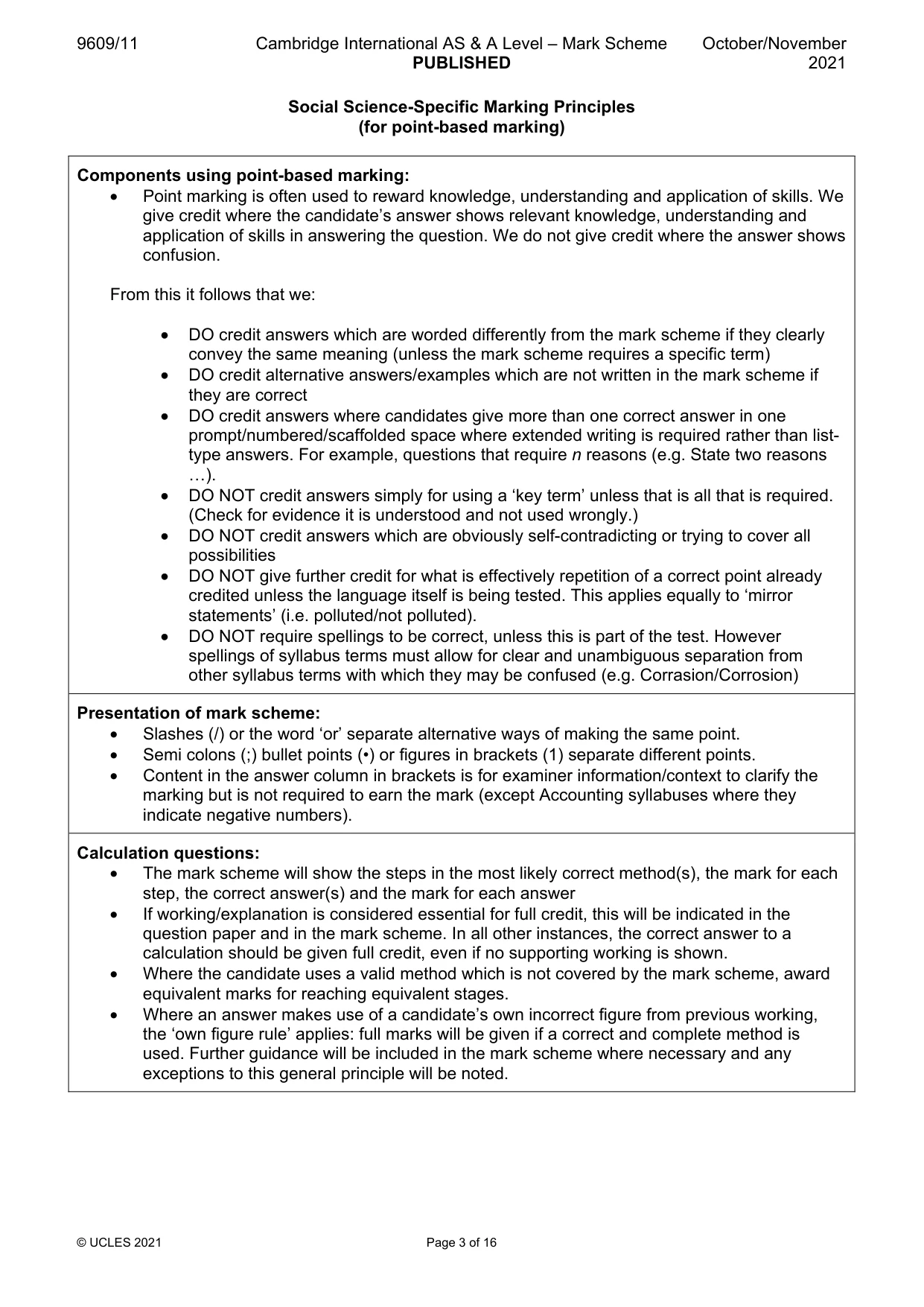
9609/11 Cambridge International AS & A Level – Mark Scheme PUBLISHED October/November 2021 © UCLES 2021 Page 3 of 16 Social Science-Specific Marking Principles (for point-based marking) Components using point-based marking: • Point marking is often used to reward knowledge, understanding and application of skills. We give credit where the candidate’s answer shows relevant knowledge, understanding and application of skills in answering the question. We do not give credit where the answer shows confusion. From this it follows that we: • DO credit answers which are worded differently from the mark scheme if they clearly convey the same meaning (unless the mark scheme requires a specific term) • DO credit alternative answers/examples which are not written in the mark scheme if they are correct • DO credit answers where candidates give more than one correct answer in one prompt/numbered/scaffolded space where extended writing is required rather than list- type answers. For example, questions that require n reasons (e.g. State two reasons …). • DO NOT credit answers simply for using a ‘key term’ unless that is all that is required. (Check for evidence it is understood and not used wrongly.) • DO NOT credit answers which are obviously self-contradicting or trying to cover all possibilities • DO NOT give further credit for what is effectively repetition of a correct point already credited unless the language itself is being tested. This applies equally to ‘mirror statements’ (i.e. polluted/not polluted). • DO NOT require spellings to be correct, unless this is part of the test. However spellings of syllabus terms must allow for clear and unambiguous separation from other syllabus terms with which they may be confused (e.g. Corrasion/Corrosion) Presentation of mark scheme: • Slashes (/) or the word ‘or’ separate alternative ways of making the same point. • Semi colons (;) bullet points (•) or figures in brackets (1) separate different points. • Content in the answer column in brackets is for examiner information/context to clarify the marking but is not required to earn the mark (except Accounting syllabuses where they indicate negative numbers). Calculation questions: • The mark scheme will show the steps in the most likely correct method(s), the mark for each step, the correct answer(s) and the mark for each answer • If working/explanation is considered essential for full credit, this will be indicated in the question paper and in the mark scheme. In all other instances, the correct answer to a calculation should be given full credit, even if no supporting working is shown. • Where the candidate uses a valid method which is not covered by the mark scheme, award equivalent marks for reaching equivalent stages. • Where an answer makes use of a candidate’s own incorrect figure from previous working, the ‘own figure rule’ applies: full marks will be given if a correct and complete method is used. Further guidance will be included in the mark scheme where necessary and any exceptions to this general principle will be noted.
Mark scheme, page 4
9609/11 Cambridge International AS & A Level – Mark Scheme PUBLISHED October/November 2021 © UCLES 2021 Page 4 of 16 Annotation: • For point marking, ticks can be used to indicate correct answers and crosses can be used to indicate wrong answers. There is no direct relationship between ticks and marks. Ticks have no defined meaning for levels of response marking. • For levels of response marking, the level awarded should be annotated on the script. • Other annotations will be used by examiners as agreed during standardisation, and the meaning will be understood by all examiners who marked that paper.
Mark scheme, page 5
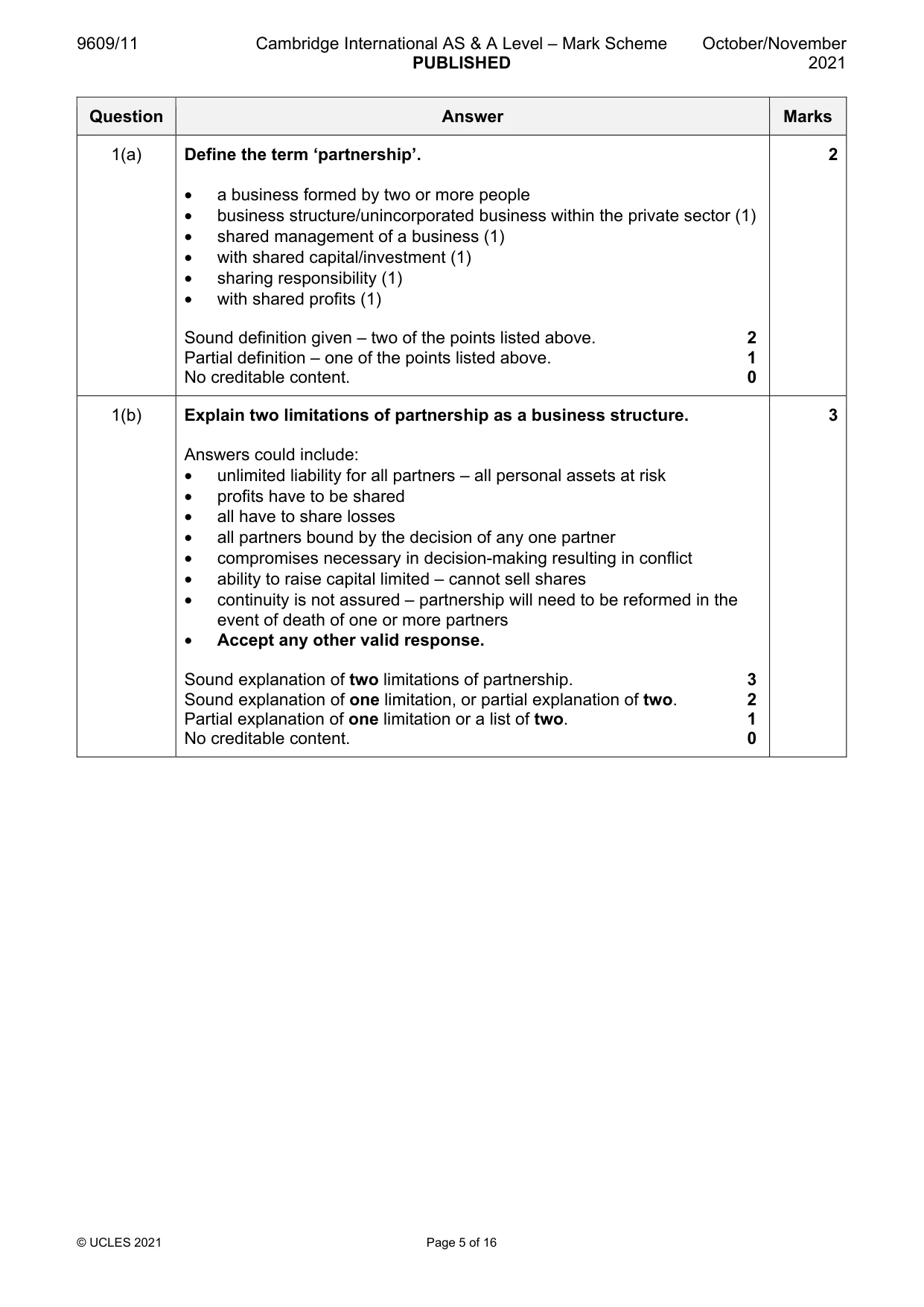
9609/11 Cambridge International AS & A Level – Mark Scheme PUBLISHED October/November 2021 © UCLES 2021 Page 5 of 16 Question Answer Marks 1(a) Define the term ‘partnership’. • a business formed by two or more people • business structure/unincorporated business within the private sector (1) • shared management of a business (1) • with shared capital/investment (1) • sharing responsibility (1) • with shared profits (1) Sound definition given – two of the points listed above. 2 Partial definition – one of the points listed above. 1 No creditable content. 0 2 1(b) Explain two limitations of partnership as a business structure. Answers could include: • unlimited liability for all partners – all personal assets at risk • profits have to be shared • all have to share losses • all partners bound by the decision of any one partner • compromises necessary in decision-making resulting in conflict • ability to raise capital limited – cannot sell shares • continuity is not assured – partnership will need to be reformed in the event of death of one or more partners • Accept any other valid response. Sound explanation of two limitations of partnership. 3 Sound explanation of one limitation, or partial explanation of two. 2 Partial explanation of one limitation or a list of two. 1 No creditable content. 0 3
Mark scheme, page 6
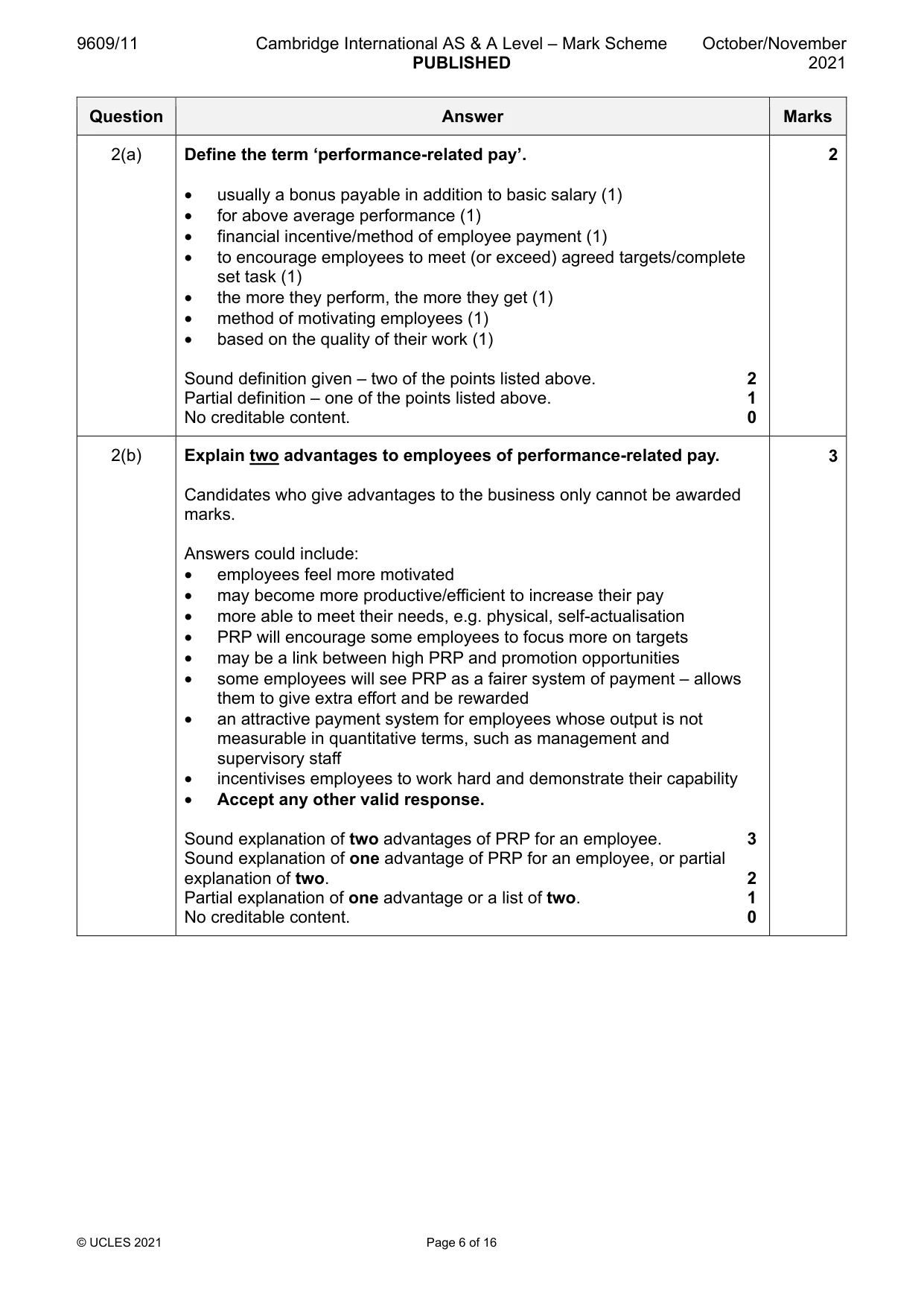
9609/11 Cambridge International AS & A Level – Mark Scheme PUBLISHED October/November 2021 © UCLES 2021 Page 6 of 16 Question Answer Marks 2(a) Define the term ‘performance-related pay’. • usually a bonus payable in addition to basic salary (1) • for above average performance (1) • financial incentive/method of employee payment (1) • to encourage employees to meet (or exceed) agreed targets/complete set task (1) • the more they perform, the more they get (1) • method of motivating employees (1) • based on the quality of their work (1) Sound definition given – two of the points listed above. 2 Partial definition – one of the points listed above. 1 No creditable content. 0 2 2(b) Explain two advantages to employees of performance-related pay. Candidates who give advantages to the business only cannot be awarded marks. Answers could include: • employees feel more motivated • may become more productive/efficient to increase their pay • more able to meet their needs, e.g. physical, self-actualisation • PRP will encourage some employees to focus more on targets • may be a link between high PRP and promotion opportunities • some employees will see PRP as a fairer system of payment – allows them to give extra effort and be rewarded • an attractive payment system for employees whose output is not measurable in quantitative terms, such as management and supervisory staff • incentivises employees to work hard and demonstrate their capability • Accept any other valid response. Sound explanation of two advantages of PRP for an employee. 3 Sound explanation of one advantage of PRP for an employee, or partial explanation of two. 2 Partial explanation of one advantage or a list of two. 1 No creditable content. 0 3
Mark scheme, page 7
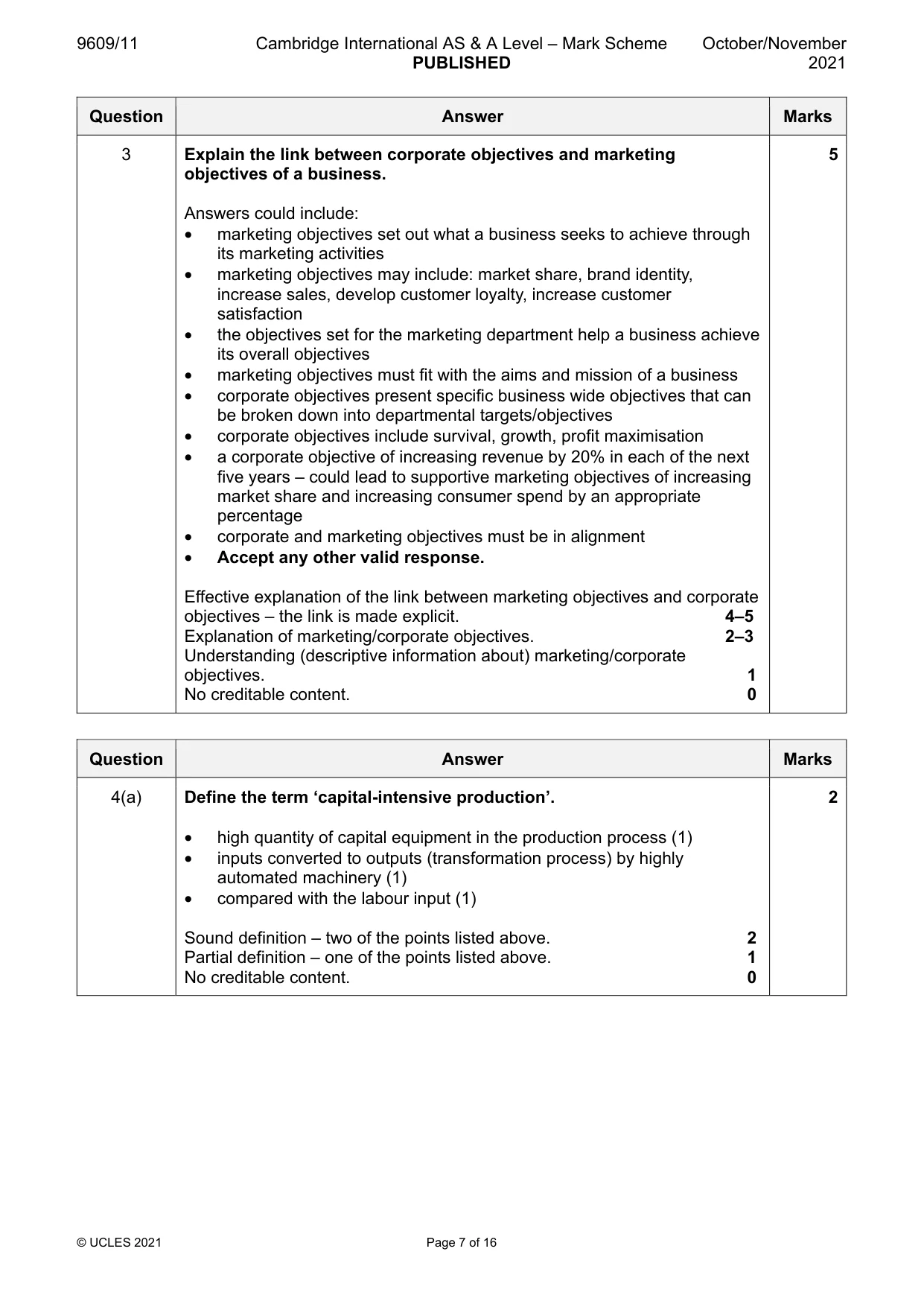
9609/11 Cambridge International AS & A Level – Mark Scheme PUBLISHED October/November 2021 © UCLES 2021 Page 7 of 16 Question Answer Marks 3 Explain the link between corporate objectives and marketing objectives of a business. Answers could include: • marketing objectives set out what a business seeks to achieve through its marketing activities • marketing objectives may include: market share, brand identity, increase sales, develop customer loyalty, increase customer satisfaction • the objectives set for the marketing department help a business achieve its overall objectives • marketing objectives must fit with the aims and mission of a business • corporate objectives present specific business wide objectives that can be broken down into departmental targets/objectives • corporate objectives include survival, growth, profit maximisation • a corporate objective of increasing revenue by 20% in each of the next five years – could lead to supportive marketing objectives of increasing market share and increasing consumer spend by an appropriate percentage • corporate and marketing objectives must be in alignment • Accept any other valid response. Effective explanation of the link between marketing objectives and corporate objectives – the link is made explicit. 4–5 Explanation of marketing/corporate objectives. 2–3 Understanding (descriptive information about) marketing/corporate objectives. 1 No creditable content. 0 5 Question Answer Marks 4(a) Define the term ‘capital-intensive production’. • high quantity of capital equipment in the production process (1) • inputs converted to outputs (transformation process) by highly automated machinery (1) • compared with the labour input (1) Sound definition – two of the points listed above. 2 Partial definition – one of the points listed above. 1 No creditable content. 0 2
Mark scheme, page 8
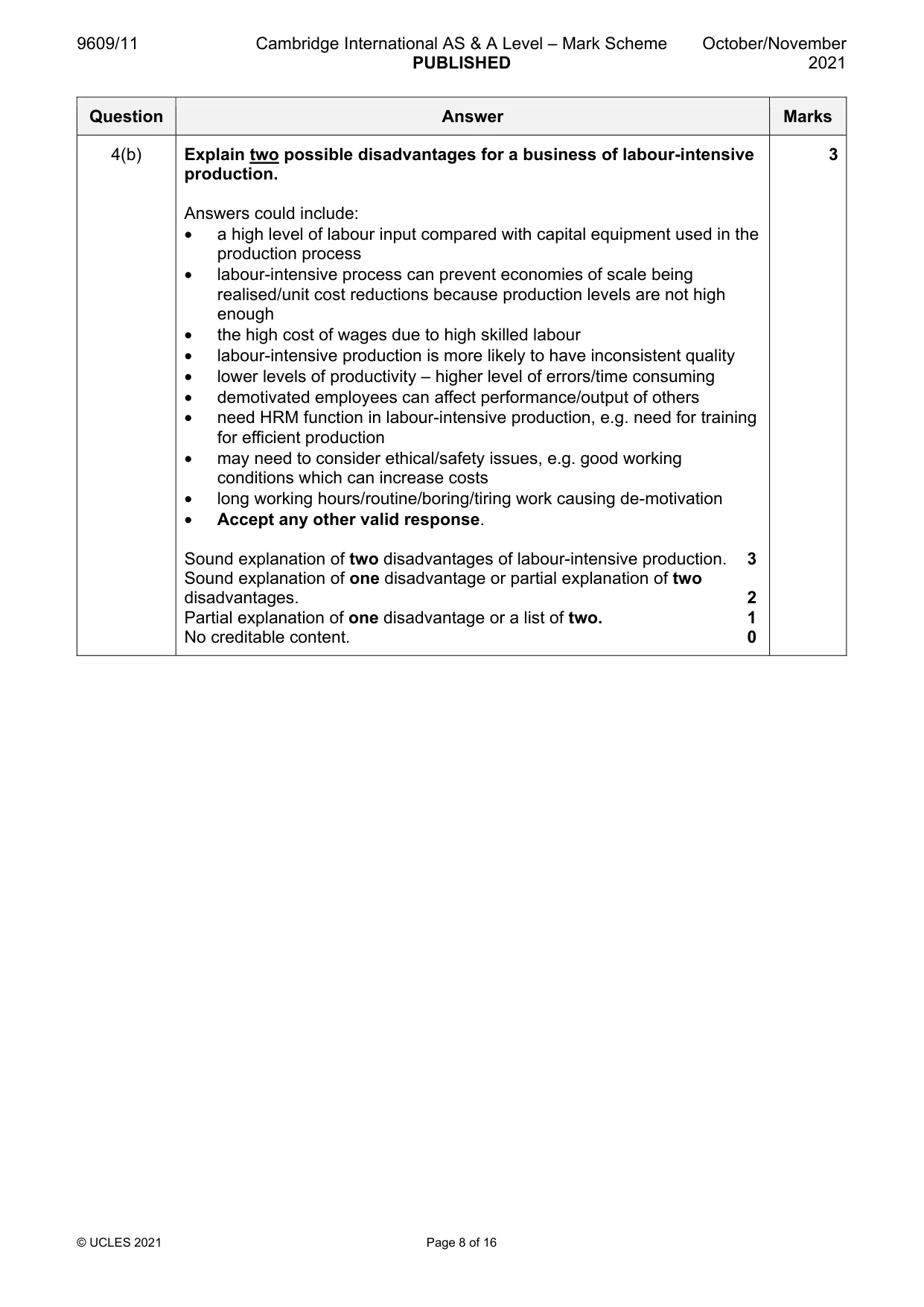
9609/11 Cambridge International AS & A Level – Mark Scheme PUBLISHED October/November 2021 © UCLES 2021 Page 8 of 16 Question Answer Marks 4(b) Explain two possible disadvantages for a business of labour-intensive production. Answers could include: • a high level of labour input compared with capital equipment used in the production process • labour-intensive process can prevent economies of scale being realised/unit cost reductions because production levels are not high enough • the high cost of wages due to high skilled labour • labour-intensive production is more likely to have inconsistent quality • lower levels of productivity – higher level of errors/time consuming • demotivated employees can affect performance/output of others • need HRM function in labour-intensive production, e.g. need for training for efficient production • may need to consider ethical/safety issues, e.g. good working conditions which can increase costs • long working hours/routine/boring/tiring work causing de-motivation • Accept any other valid response. Sound explanation of two disadvantages of labour-intensive production. 3 Sound explanation of one disadvantage or partial explanation of two disadvantages. 2 Partial explanation of one disadvantage or a list of two. 1 No creditable content. 0 3
Mark scheme, page 9
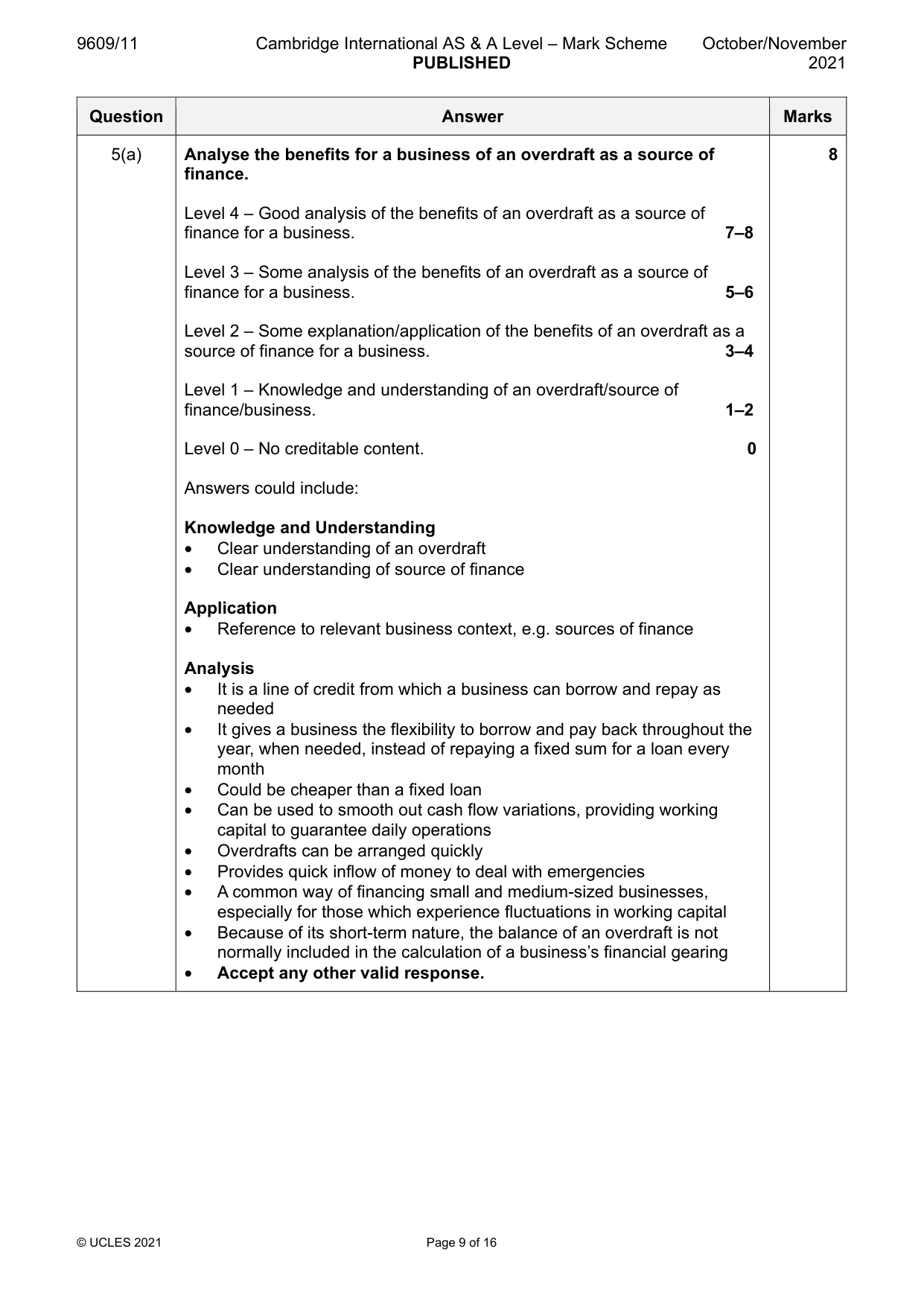
9609/11 Cambridge International AS & A Level – Mark Scheme PUBLISHED October/November 2021 © UCLES 2021 Page 9 of 16 Question Answer Marks 5(a) Analyse the benefits for a business of an overdraft as a source of finance. Level 4 – Good analysis of the benefits of an overdraft as a source of finance for a business. 7–8 Level 3 – Some analysis of the benefits of an overdraft as a source of finance for a business. 5–6 Level 2 – Some explanation/application of the benefits of an overdraft as a source of finance for a business. 3–4 Level 1 – Knowledge and understanding of an overdraft/source of finance/business. 1–2 Level 0 – No creditable content. 0 Answers could include: Knowledge and Understanding • Clear understanding of an overdraft • Clear understanding of source of finance Application • Reference to relevant business context, e.g. sources of finance Analysis • It is a line of credit from which a business can borrow and repay as needed • It gives a business the flexibility to borrow and pay back throughout the year, when needed, instead of repaying a fixed sum for a loan every month • Could be cheaper than a fixed loan • Can be used to smooth out cash flow variations, providing working capital to guarantee daily operations • Overdrafts can be arranged quickly • Provides quick inflow of money to deal with emergencies • A common way of financing small and medium-sized businesses, especially for those which experience fluctuations in working capital • Because of its short-term nature, the balance of an overdraft is not normally included in the calculation of a business’s financial gearing • Accept any other valid response. 8
Mark scheme, page 10
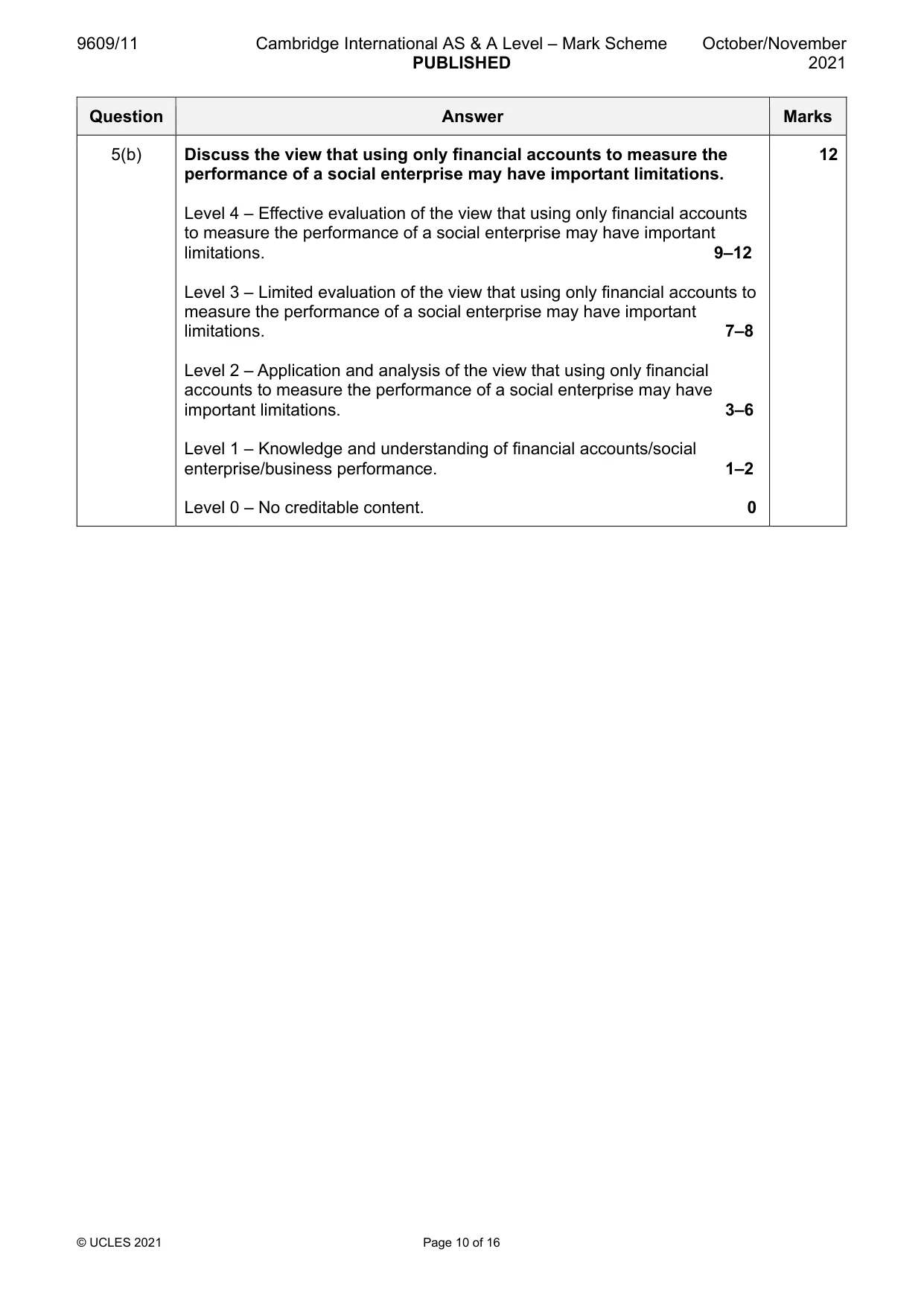
9609/11 Cambridge International AS & A Level – Mark Scheme PUBLISHED October/November 2021 © UCLES 2021 Page 10 of 16 Question Answer Marks 5(b) Discuss the view that using only financial accounts to measure the performance of a social enterprise may have important limitations. Level 4 – Effective evaluation of the view that using only financial accounts to measure the performance of a social enterprise may have important limitations. 9–12 Level 3 – Limited evaluation of the view that using only financial accounts to measure the performance of a social enterprise may have important limitations. 7–8 Level 2 – Application and analysis of the view that using only financial accounts to measure the performance of a social enterprise may have important limitations. 3–6 Level 1 – Knowledge and understanding of financial accounts/social enterprise/business performance. 1–2 Level 0 – No creditable content. 0 12
Mark scheme, page 11
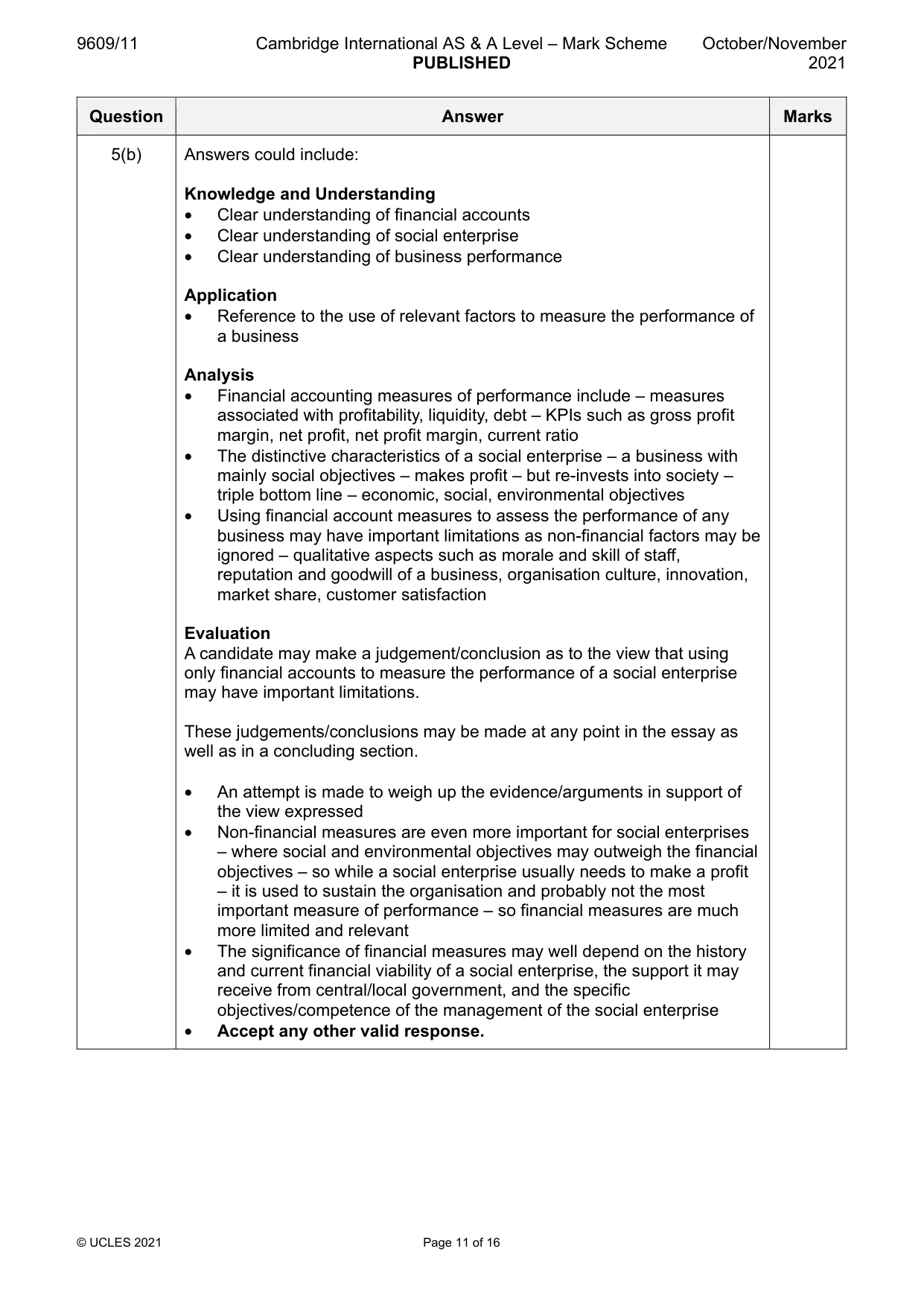
9609/11 Cambridge International AS & A Level – Mark Scheme PUBLISHED October/November 2021 © UCLES 2021 Page 11 of 16 Question Answer Marks 5(b) Answers could include: Knowledge and Understanding • Clear understanding of financial accounts • Clear understanding of social enterprise • Clear understanding of business performance Application • Reference to the use of relevant factors to measure the performance of a business Analysis • Financial accounting measures of performance include – measures associated with profitability, liquidity, debt – KPIs such as gross profit margin, net profit, net profit margin, current ratio • The distinctive characteristics of a social enterprise – a business with mainly social objectives – makes profit – but re-invests into society – triple bottom line – economic, social, environmental objectives • Using financial account measures to assess the performance of any business may have important limitations as non-financial factors may be ignored – qualitative aspects such as morale and skill of staff, reputation and goodwill of a business, organisation culture, innovation, market share, customer satisfaction Evaluation A candidate may make a judgement/conclusion as to the view that using only financial accounts to measure the performance of a social enterprise may have important limitations. These judgements/conclusions may be made at any point in the essay as well as in a concluding section. • An attempt is made to weigh up the evidence/arguments in support of the view expressed • Non-financial measures are even more important for social enterprises – where social and environmental objectives may outweigh the financial objectives – so while a social enterprise usually needs to make a profit – it is used to sustain the organisation and probably not the most important measure of performance – so financial measures are much more limited and relevant • The significance of financial measures may well depend on the history and current financial viability of a social enterprise, the support it may receive from central/local government, and the specific objectives/competence of the management of the social enterprise • Accept any other valid response.
Mark scheme, page 12
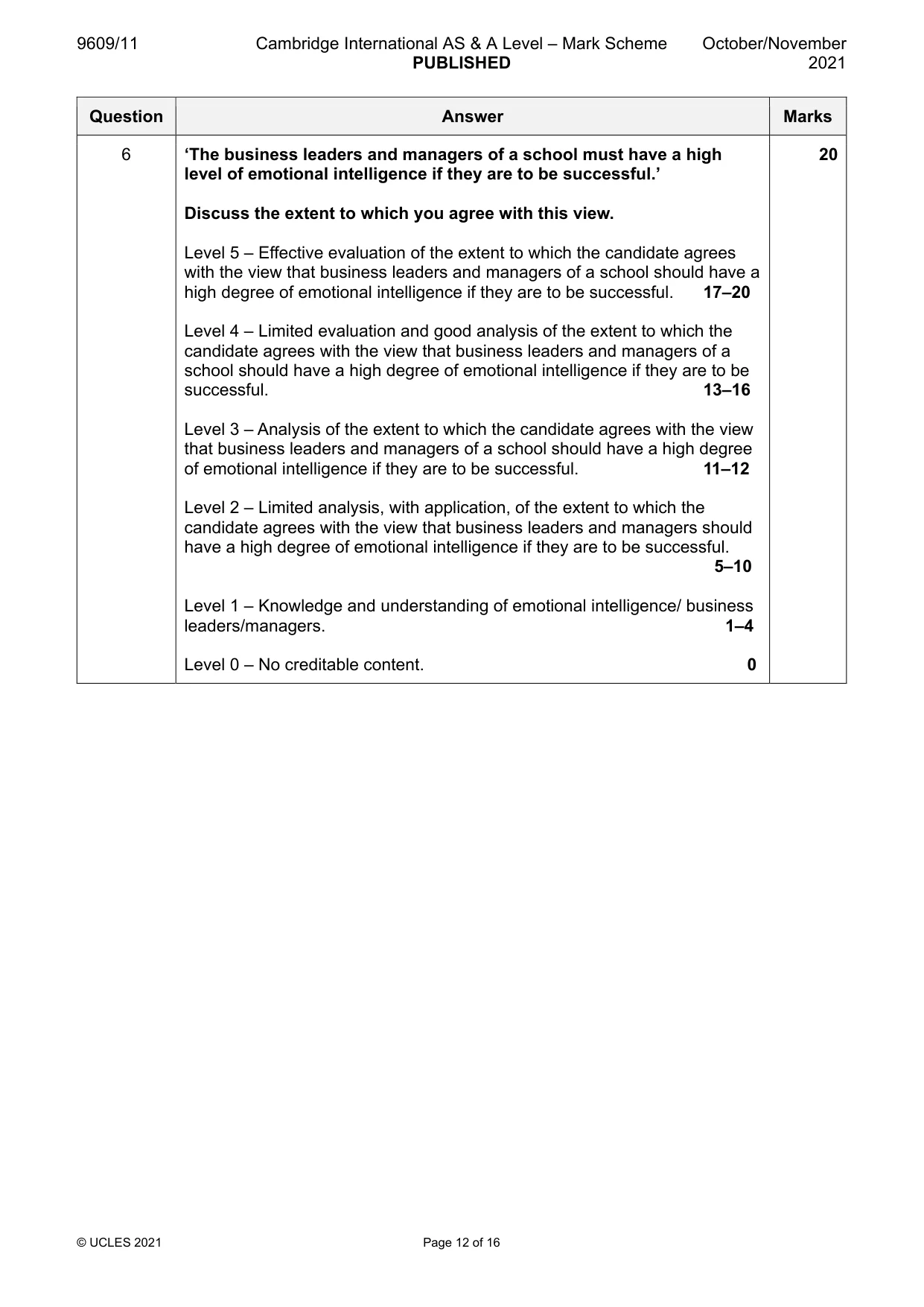
9609/11 Cambridge International AS & A Level – Mark Scheme PUBLISHED October/November 2021 © UCLES 2021 Page 12 of 16 Question Answer Marks 6 ‘The business leaders and managers of a school must have a high level of emotional intelligence if they are to be successful.’ Discuss the extent to which you agree with this view. Level 5 – Effective evaluation of the extent to which the candidate agrees with the view that business leaders and managers of a school should have a high degree of emotional intelligence if they are to be successful. 17–20 Level 4 – Limited evaluation and good analysis of the extent to which the candidate agrees with the view that business leaders and managers of a school should have a high degree of emotional intelligence if they are to be successful. 13–16 Level 3 – Analysis of the extent to which the candidate agrees with the view that business leaders and managers of a school should have a high degree of emotional intelligence if they are to be successful. 11–12 Level 2 – Limited analysis, with application, of the extent to which the candidate agrees with the view that business leaders and managers should have a high degree of emotional intelligence if they are to be successful. 5–10 Level 1 – Knowledge and understanding of emotional intelligence/ business leaders/managers. 1–4 Level 0 – No creditable content. 0 20
Mark scheme, page 13
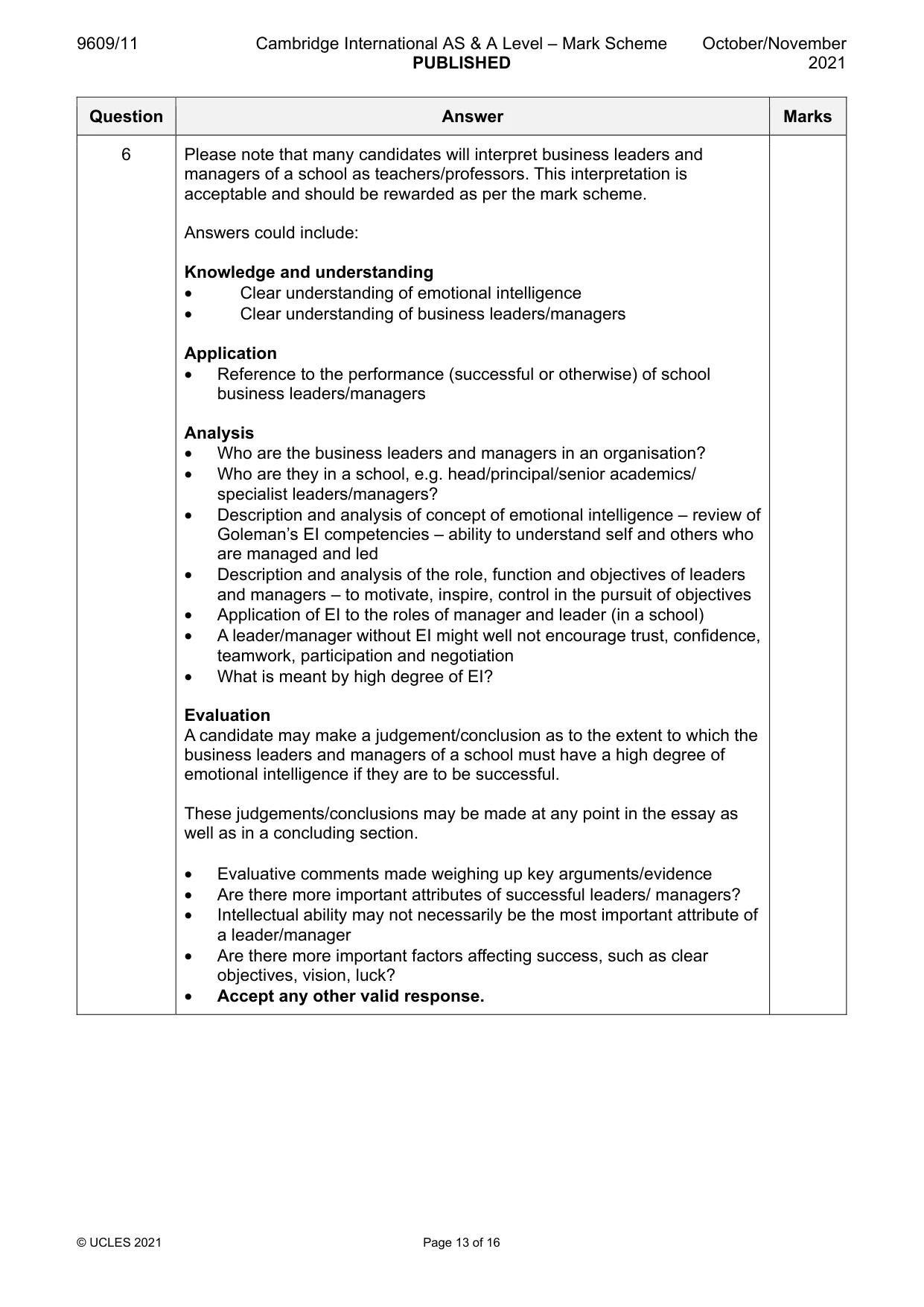
9609/11 Cambridge International AS & A Level – Mark Scheme PUBLISHED October/November 2021 © UCLES 2021 Page 13 of 16 Question Answer Marks 6 Please note that many candidates will interpret business leaders and managers of a school as teachers/professors. This interpretation is acceptable and should be rewarded as per the mark scheme. Answers could include: Knowledge and understanding • Clear understanding of emotional intelligence • Clear understanding of business leaders/managers Application • Reference to the performance (successful or otherwise) of school business leaders/managers Analysis • Who are the business leaders and managers in an organisation? • Who are they in a school, e.g. head/principal/senior academics/ specialist leaders/managers? • Description and analysis of concept of emotional intelligence – review of Goleman’s EI competencies – ability to understand self and others who are managed and led • Description and analysis of the role, function and objectives of leaders and managers – to motivate, inspire, control in the pursuit of objectives • Application of EI to the roles of manager and leader (in a school) • A leader/manager without EI might well not encourage trust, confidence, teamwork, participation and negotiation • What is meant by high degree of EI? Evaluation A candidate may make a judgement/conclusion as to the extent to which the business leaders and managers of a school must have a high degree of emotional intelligence if they are to be successful. These judgements/conclusions may be made at any point in the essay as well as in a concluding section. • Evaluative comments made weighing up key arguments/evidence • Are there more important attributes of successful leaders/ managers? • Intellectual ability may not necessarily be the most important attribute of a leader/manager • Are there more important factors affecting success, such as clear objectives, vision, luck? • Accept any other valid response.
Mark scheme, page 14
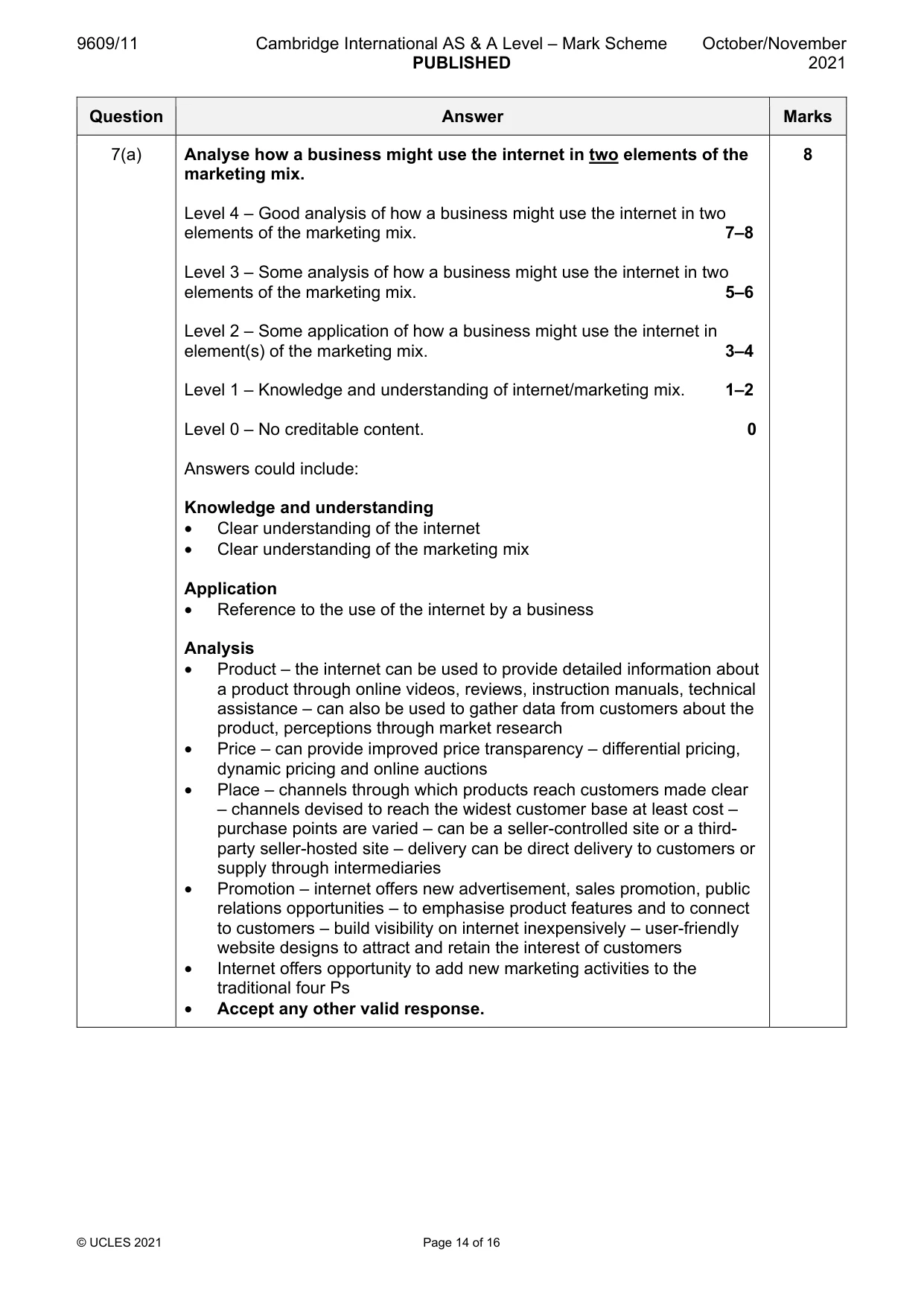
9609/11 Cambridge International AS & A Level – Mark Scheme PUBLISHED October/November 2021 © UCLES 2021 Page 14 of 16 Question Answer Marks 7(a) Analyse how a business might use the internet in two elements of the marketing mix. Level 4 – Good analysis of how a business might use the internet in two elements of the marketing mix. 7–8 Level 3 – Some analysis of how a business might use the internet in two elements of the marketing mix. 5–6 Level 2 – Some application of how a business might use the internet in element(s) of the marketing mix. 3–4 Level 1 – Knowledge and understanding of internet/marketing mix. 1–2 Level 0 – No creditable content. 0 Answers could include: Knowledge and understanding • Clear understanding of the internet • Clear understanding of the marketing mix Application • Reference to the use of the internet by a business Analysis • Product – the internet can be used to provide detailed information about a product through online videos, reviews, instruction manuals, technical assistance – can also be used to gather data from customers about the product, perceptions through market research • Price – can provide improved price transparency – differential pricing, dynamic pricing and online auctions • Place – channels through which products reach customers made clear – channels devised to reach the widest customer base at least cost – purchase points are varied – can be a seller-controlled site or a third- party seller-hosted site – delivery can be direct delivery to customers or supply through intermediaries • Promotion – internet offers new advertisement, sales promotion, public relations opportunities – to emphasise product features and to connect to customers – build visibility on internet inexpensively – user-friendly website designs to attract and retain the interest of customers • Internet offers opportunity to add new marketing activities to the traditional four Ps • Accept any other valid response. 8
Mark scheme, page 15
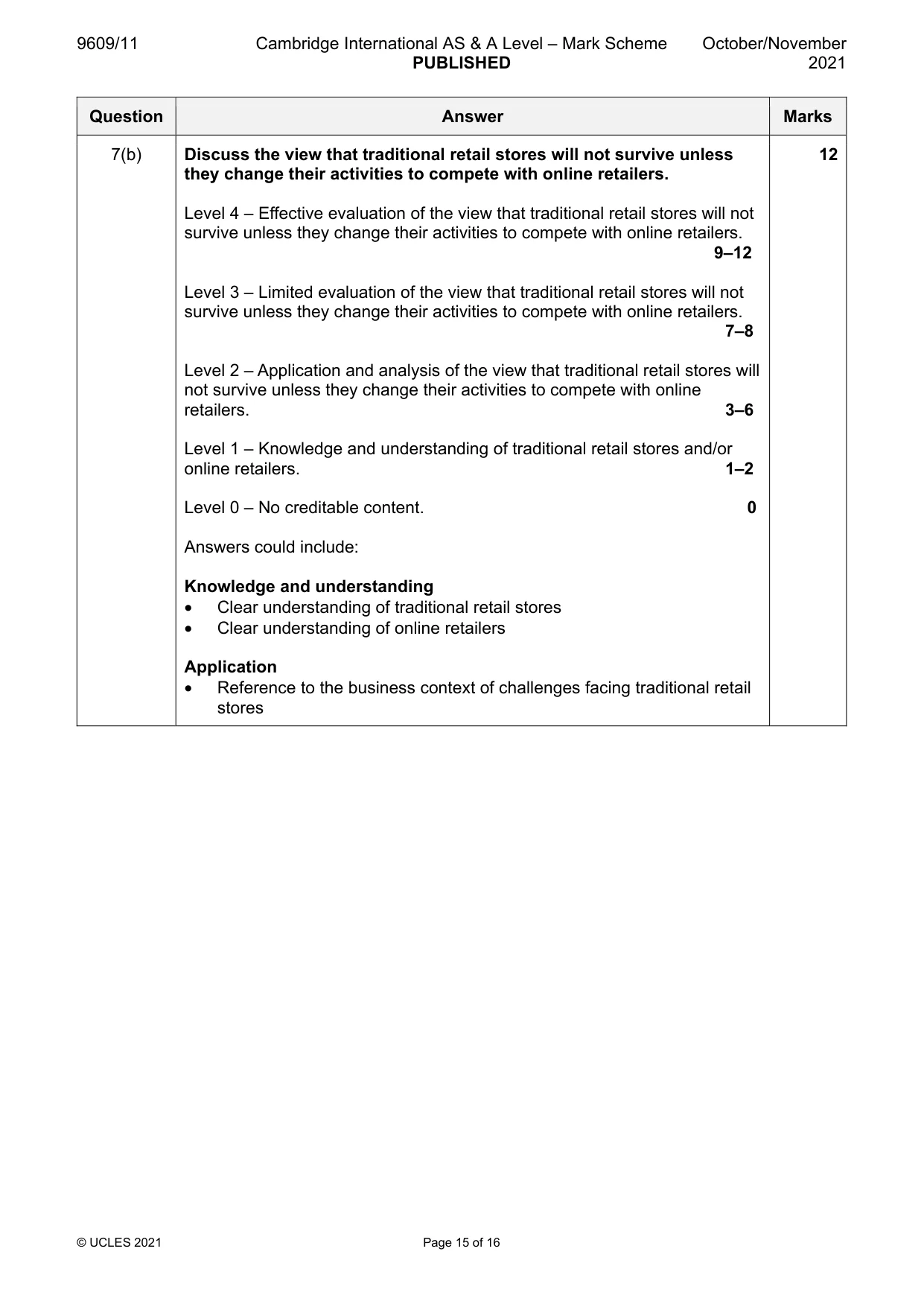
9609/11 Cambridge International AS & A Level – Mark Scheme PUBLISHED October/November 2021 © UCLES 2021 Page 15 of 16 Question Answer Marks 7(b) Discuss the view that traditional retail stores will not survive unless they change their activities to compete with online retailers. Level 4 – Effective evaluation of the view that traditional retail stores will not survive unless they change their activities to compete with online retailers. 9–12 Level 3 – Limited evaluation of the view that traditional retail stores will not survive unless they change their activities to compete with online retailers. 7–8 Level 2 – Application and analysis of the view that traditional retail stores will not survive unless they change their activities to compete with online retailers. 3–6 Level 1 – Knowledge and understanding of traditional retail stores and/or online retailers. 1–2 Level 0 – No creditable content. 0 Answers could include: Knowledge and understanding • Clear understanding of traditional retail stores • Clear understanding of online retailers Application • Reference to the business context of challenges facing traditional retail stores 12
Mark scheme, page 16
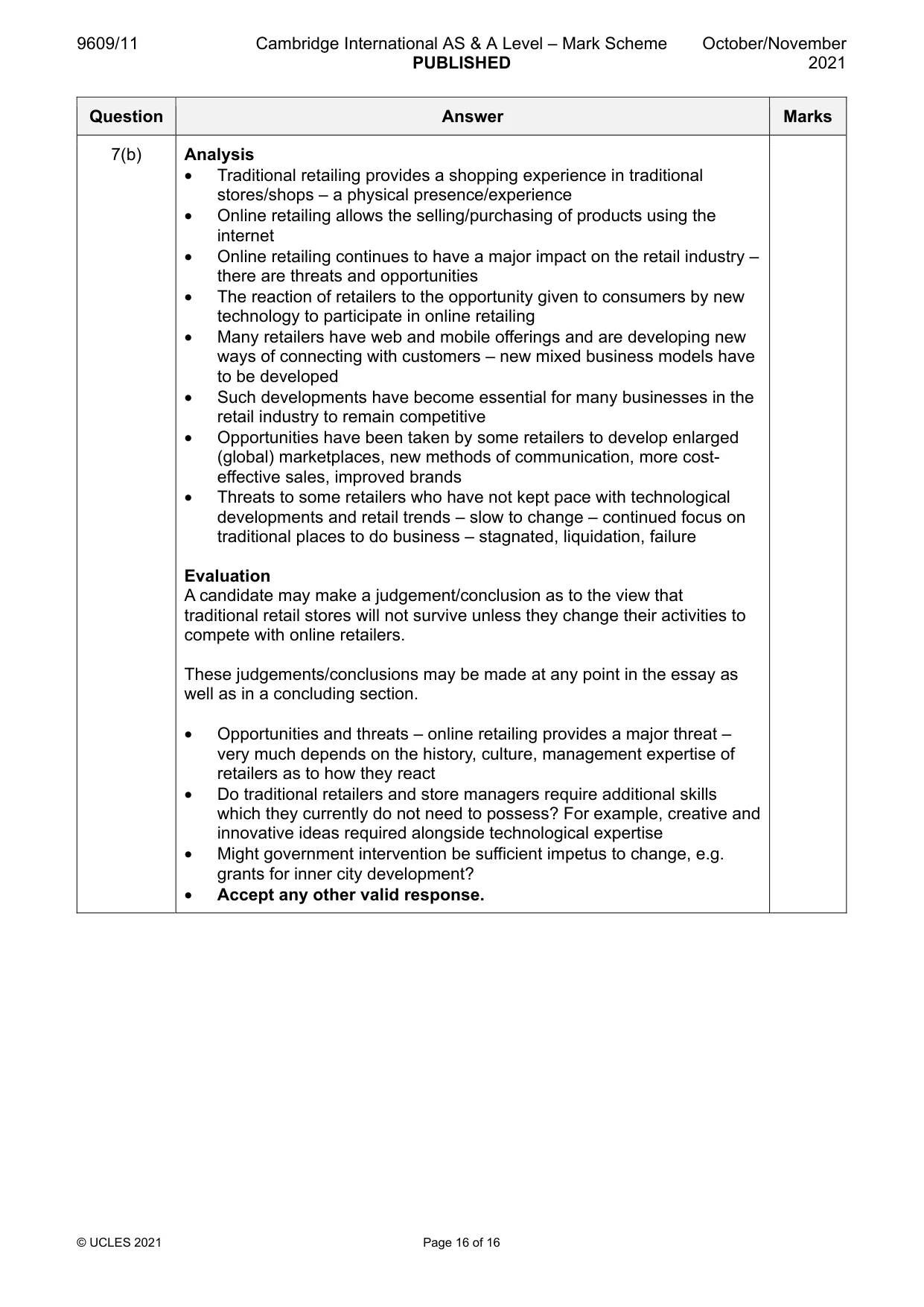
9609/11 Cambridge International AS & A Level – Mark Scheme PUBLISHED October/November 2021 © UCLES 2021 Page 16 of 16 Question Answer Marks 7(b) Analysis • Traditional retailing provides a shopping experience in traditional stores/shops – a physical presence/experience • Online retailing allows the selling/purchasing of products using the internet • Online retailing continues to have a major impact on the retail industry – there are threats and opportunities • The reaction of retailers to the opportunity given to consumers by new technology to participate in online retailing • Many retailers have web and mobile offerings and are developing new ways of connecting with customers – new mixed business models have to be developed • Such developments have become essential for many businesses in the retail industry to remain competitive • Opportunities have been taken by some retailers to develop enlarged (global) marketplaces, new methods of communication, more cost- effective sales, improved brands • Threats to some retailers who have not kept pace with technological developments and retail trends – slow to change – continued focus on traditional places to do business – stagnated, liquidation, failure Evaluation A candidate may make a judgement/conclusion as to the view that traditional retail stores will not survive unless they change their activities to compete with online retailers. These judgements/conclusions may be made at any point in the essay as well as in a concluding section. • Opportunities and threats – online retailing provides a major threat – very much depends on the history, culture, management expertise of retailers as to how they react • Do traditional retailers and store managers require additional skills which they currently do not need to possess? For example, creative and innovative ideas required alongside technological expertise • Might government intervention be sufficient impetus to change, e.g. grants for inner city development? • Accept any other valid response.
What you needed in this session
Cambridge’s own grade thresholds for 2021 Oct/Nov, Paper 1 · Variant 1. A higher threshold means an easier paper — the bar moves with how the cohort did.