Cambridge A Level Business (for first examination in 2016) 9609 — 2025 May/June Paper 1 · Variant 2
9609/12/M/J/25 · 40 marks · ≈45 min
The question paper and its mark scheme, free to read here and free to download. This is Cambridge’s own paper, exactly as it was sat.
Question paper4 pages



Mark scheme31 pages
Answers below. Sit the paper first if you are practising.
Paper as text
Question paper, page 1
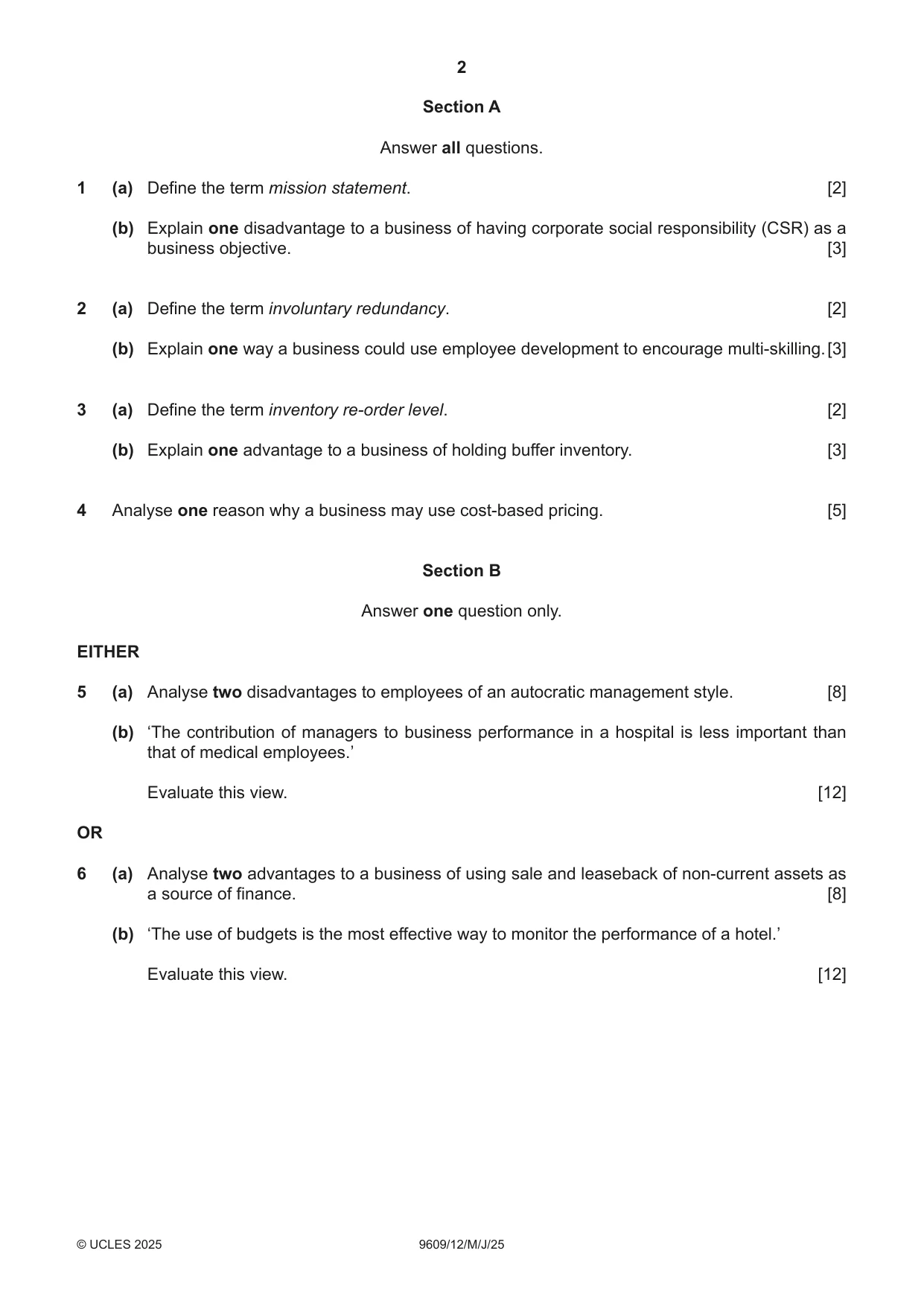
This document has 4 pages. Any blank pages are indicated. [Turn over Cambridge International AS & A Level BUSINESS 9609/12 Paper 1 Business Concepts 1 May/June 2025 1 hour 15 minutes You must answer on the enclosed answer booklet. You will need: Answer booklet (enclosed) INSTRUCTIONS ● Answer five questions in total: Section A: answer all questions. Section B: answer one question. ● Follow the instructions on the front cover of the answer booklet. If you need additional answer paper, ask the invigilator for a continuation booklet. INFORMATION ● The total mark for this paper is 40. ● The number of marks for each question or part question is shown in brackets [ ]. * 4 7 1 6 6 0 1 7 6 2 * DC (SL) 341764/1 © UCLES 2025
Question paper, page 2
2 9609/12/M/J/25 © UCLES 2025 Section A Answer all questions. 1 (a) Define the term mission statement. [2] (b) Explain one disadvantage to a business of having corporate social responsibility (CSR) as a business objective. [3] 2 (a) Define the term involuntary redundancy. [2] (b) Explain one way a business could use employee development to encourage multi-skilling. [3] 3 (a) Define the term inventory re-order level. [2] (b) Explain one advantage to a business of holding buffer inventory. [3] 4 Analyse one reason why a business may use cost-based pricing. [5] Section B Answer one question only. EITHER 5 (a) Analyse two disadvantages to employees of an autocratic management style. [8] (b) ‘The contribution of managers to business performance in a hospital is less important than that of medical employees.’ Evaluate this view. [12] OR 6 (a) Analyse two advantages to a business of using sale and leaseback of non-current assets as a source of finance. [8] (b) ‘The use of budgets is the most effective way to monitor the performance of a hotel.’ Evaluate this view. [12]
Question paper, page 3
3 9609/12/M/J/25 © UCLES 2025 BLANK PAGE
Question paper, page 4
4 9609/12/M/J/25 © UCLES 2025 Permission to reproduce items where third-party owned material protected by copyright is included has been sought and cleared where possible. Every reasonable effort has been made by the publisher (UCLES) to trace copyright holders, but if any items requiring clearance have unwittingly been included, the publisher will be pleased to make amends at the earliest possible opportunity. To avoid the issue of disclosure of answer-related information to candidates, all copyright acknowledgements are reproduced online in the Cambridge Assessment International Education Copyright Acknowledgements Booklet. This is produced for each series of examinations and is freely available to download at www.cambridgeinternational.org after the live examination series. Cambridge Assessment International Education is part of Cambridge Assessment. Cambridge Assessment is the brand name of the University of Cambridge Local Examinations Syndicate (UCLES), which is a department of the University of Cambridge. BLANK PAGE
Mark scheme, page 1
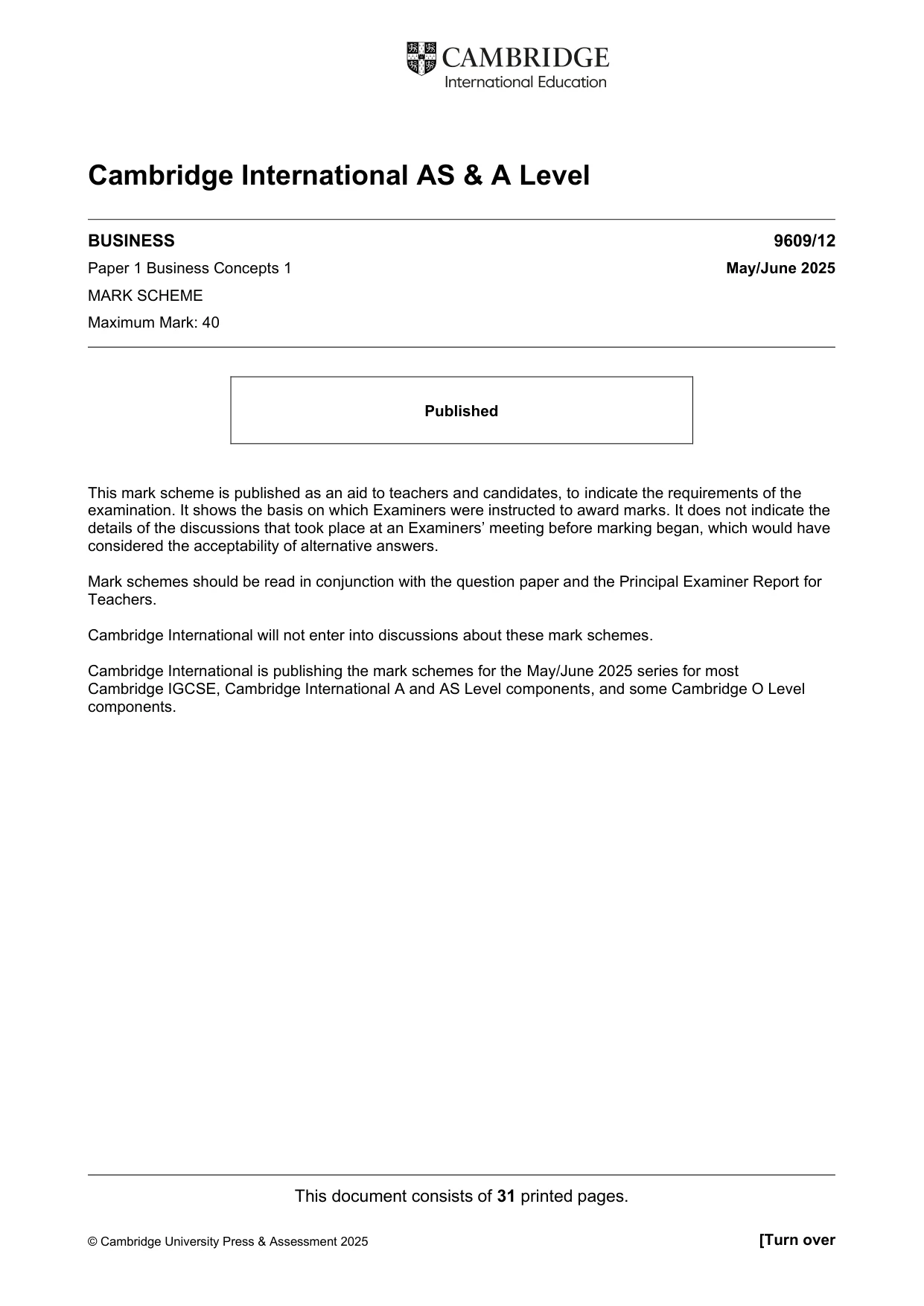
This document consists of 31 printed pages. © Cambridge University Press & Assessment 2025 [Turn over Cambridge International AS & A Level BUSINESS 9609/12 Paper 1 Business Concepts 1 May/June 2025 MARK SCHEME Maximum Mark: 40 Published This mark scheme is published as an aid to teachers and candidates, to indicate the requirements of the examination. It shows the basis on which Examiners were instructed to award marks. It does not indicate the details of the discussions that took place at an Examiners’ meeting before marking began, which would have considered the acceptability of alternative answers. Mark schemes should be read in conjunction with the question paper and the Principal Examiner Report for Teachers. Cambridge International will not enter into discussions about these mark schemes. Cambridge International is publishing the mark schemes for the May/June 2025 series for most Cambridge IGCSE, Cambridge International A and AS Level components, and some Cambridge O Level components.
Mark scheme, page 2
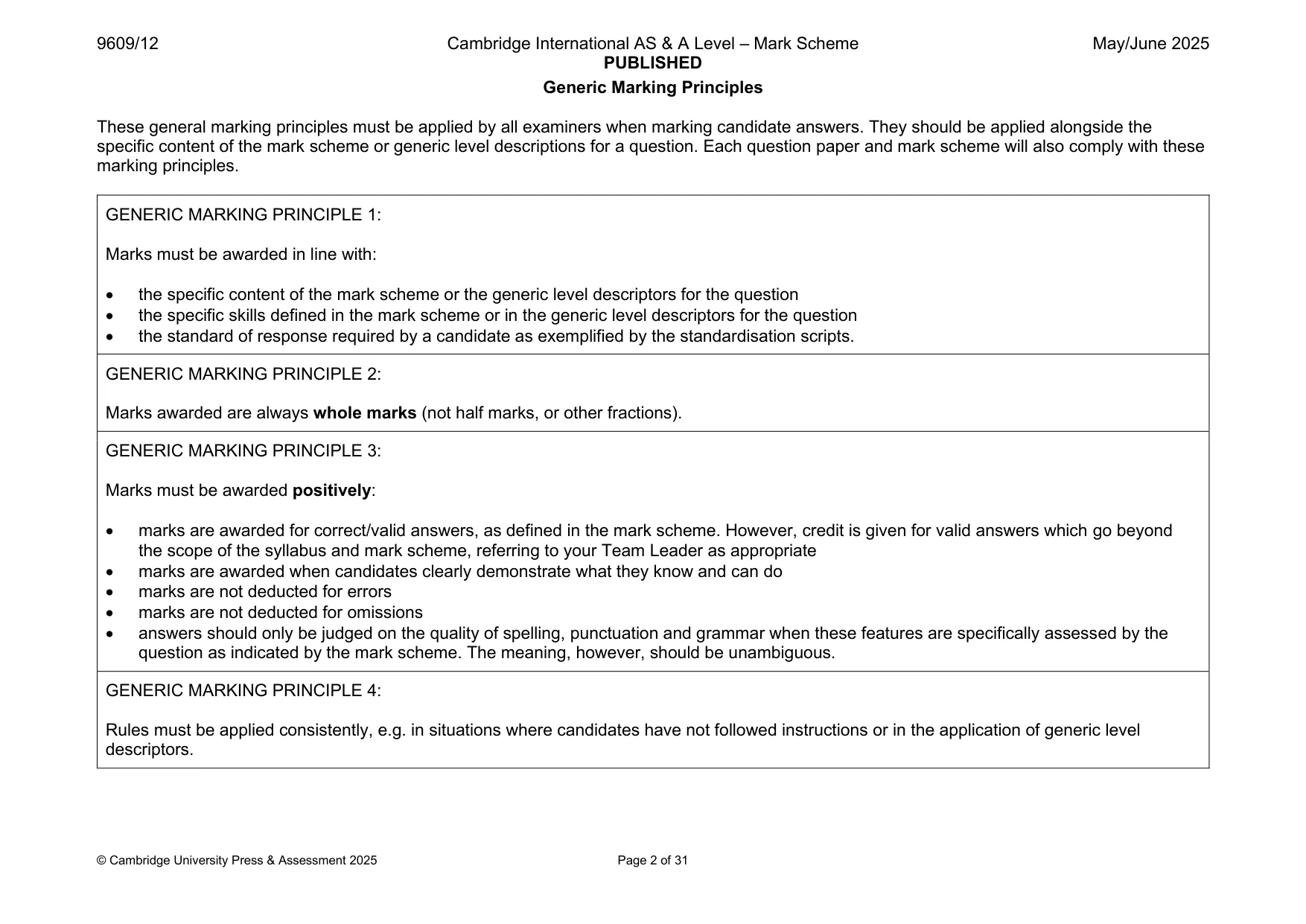
9609/12 Cambridge International AS & A Level – Mark Scheme PUBLISHED May/June 2025 © Cambridge University Press & Assessment 2025 Page 2 of 31 Generic Marking Principles These general marking principles must be applied by all examiners when marking candidate answers. They should be applied alongside the specific content of the mark scheme or generic level descriptions for a question. Each question paper and mark scheme will also comply with these marking principles. GENERIC MARKING PRINCIPLE 1: Marks must be awarded in line with: • the specific content of the mark scheme or the generic level descriptors for the question • the specific skills defined in the mark scheme or in the generic level descriptors for the question • the standard of response required by a candidate as exemplified by the standardisation scripts. GENERIC MARKING PRINCIPLE 2: Marks awarded are always whole marks (not half marks, or other fractions). GENERIC MARKING PRINCIPLE 3: Marks must be awarded positively: • marks are awarded for correct/valid answers, as defined in the mark scheme. However, credit is given for valid answers which go beyond the scope of the syllabus and mark scheme, referring to your Team Leader as appropriate • marks are awarded when candidates clearly demonstrate what they know and can do • marks are not deducted for errors • marks are not deducted for omissions • answers should only be judged on the quality of spelling, punctuation and grammar when these features are specifically assessed by the question as indicated by the mark scheme. The meaning, however, should be unambiguous. GENERIC MARKING PRINCIPLE 4: Rules must be applied consistently, e.g. in situations where candidates have not followed instructions or in the application of generic level descriptors.
Mark scheme, page 3
9609/12 Cambridge International AS & A Level – Mark Scheme PUBLISHED May/June 2025 © Cambridge University Press & Assessment 2025 Page 3 of 31 GENERIC MARKING PRINCIPLE 5: Marks should be awarded using the full range of marks defined in the mark scheme for the question (however; the use of the full mark range may be limited according to the quality of the candidate responses seen). GENERIC MARKING PRINCIPLE 6: Marks awarded are based solely on the requirements as defined in the mark scheme. Marks should not be awarded with grade thresholds or grade descriptors in mind.
Mark scheme, page 4
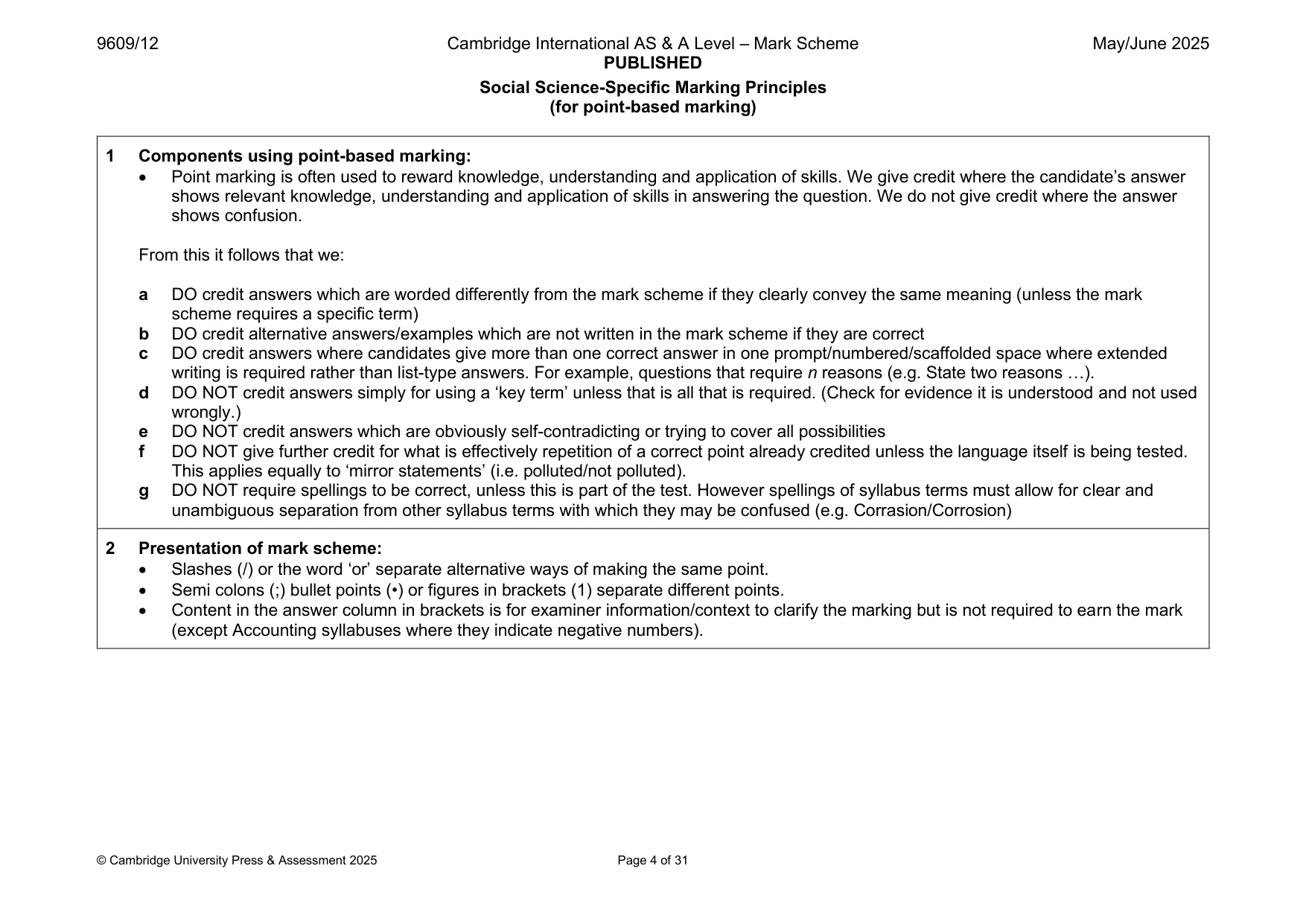
9609/12 Cambridge International AS & A Level – Mark Scheme PUBLISHED May/June 2025 © Cambridge University Press & Assessment 2025 Page 4 of 31 Social Science-Specific Marking Principles (for point-based marking) 1 Components using point-based marking: • Point marking is often used to reward knowledge, understanding and application of skills. We give credit where the candidate’s answer shows relevant knowledge, understanding and application of skills in answering the question. We do not give credit where the answer shows confusion. From this it follows that we: a DO credit answers which are worded differently from the mark scheme if they clearly convey the same meaning (unless the mark scheme requires a specific term) b DO credit alternative answers/examples which are not written in the mark scheme if they are correct c DO credit answers where candidates give more than one correct answer in one prompt/numbered/scaffolded space where extended writing is required rather than list-type answers. For example, questions that require n reasons (e.g. State two reasons …). d DO NOT credit answers simply for using a ‘key term’ unless that is all that is required. (Check for evidence it is understood and not used wrongly.) e DO NOT credit answers which are obviously self-contradicting or trying to cover all possibilities f DO NOT give further credit for what is effectively repetition of a correct point already credited unless the language itself is being tested. This applies equally to ‘mirror statements’ (i.e. polluted/not polluted). g DO NOT require spellings to be correct, unless this is part of the test. However spellings of syllabus terms must allow for clear and unambiguous separation from other syllabus terms with which they may be confused (e.g. Corrasion/Corrosion) 2 Presentation of mark scheme: • Slashes (/) or the word ‘or’ separate alternative ways of making the same point. • Semi colons (;) bullet points (•) or figures in brackets (1) separate different points. • Content in the answer column in brackets is for examiner information/context to clarify the marking but is not required to earn the mark (except Accounting syllabuses where they indicate negative numbers).
Mark scheme, page 5
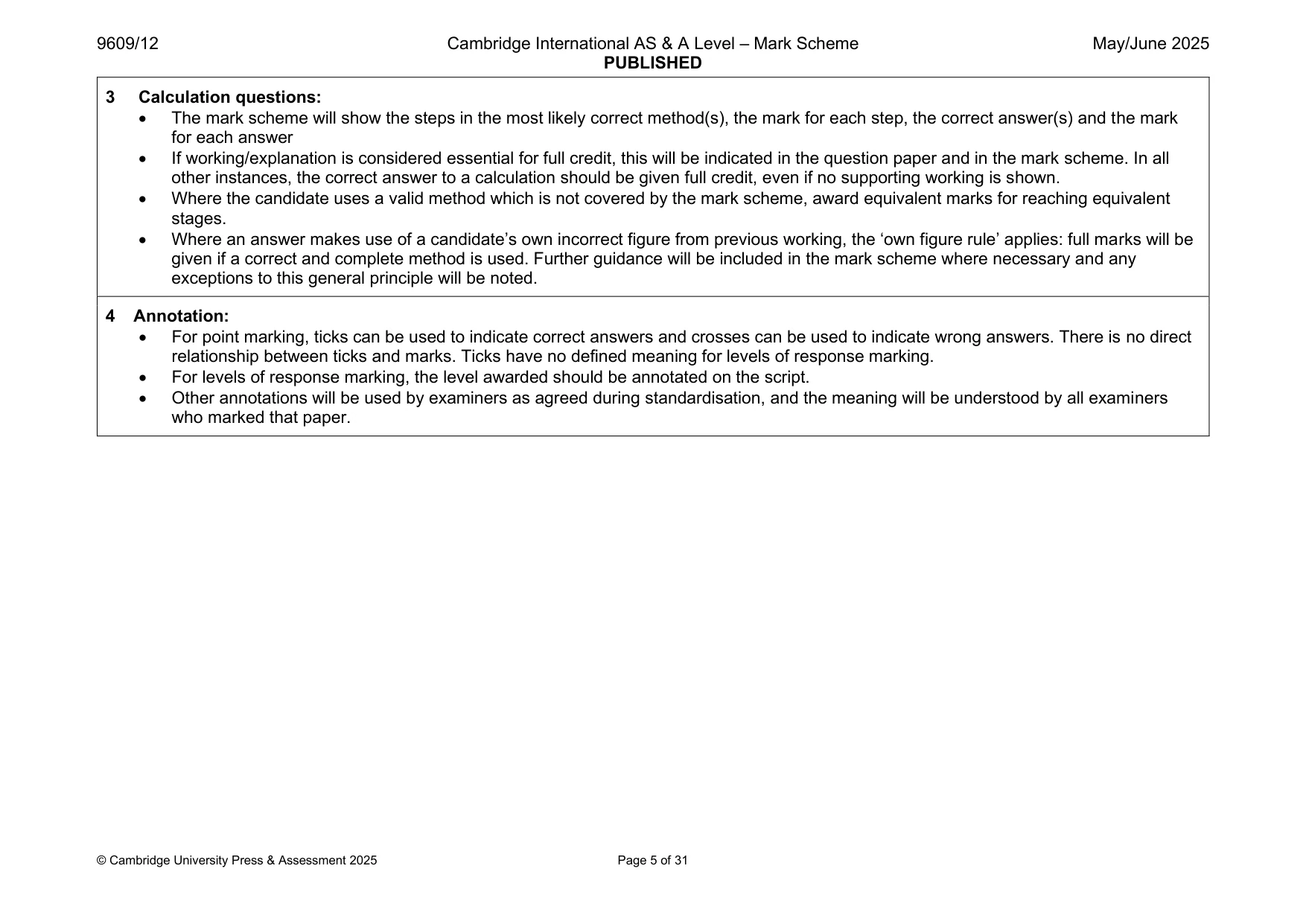
9609/12 Cambridge International AS & A Level – Mark Scheme PUBLISHED May/June 2025 © Cambridge University Press & Assessment 2025 Page 5 of 31 3 Calculation questions: • The mark scheme will show the steps in the most likely correct method(s), the mark for each step, the correct answer(s) and the mark for each answer • If working/explanation is considered essential for full credit, this will be indicated in the question paper and in the mark scheme. In all other instances, the correct answer to a calculation should be given full credit, even if no supporting working is shown. • Where the candidate uses a valid method which is not covered by the mark scheme, award equivalent marks for reaching equivalent stages. • Where an answer makes use of a candidate’s own incorrect figure from previous working, the ‘own figure rule’ applies: full marks will be given if a correct and complete method is used. Further guidance will be included in the mark scheme where necessary and any exceptions to this general principle will be noted. 4 Annotation: • For point marking, ticks can be used to indicate correct answers and crosses can be used to indicate wrong answers. There is no direct relationship between ticks and marks. Ticks have no defined meaning for levels of response marking. • For levels of response marking, the level awarded should be annotated on the script. • Other annotations will be used by examiners as agreed during standardisation, and the meaning will be understood by all examiners who marked that paper.
Mark scheme, page 6
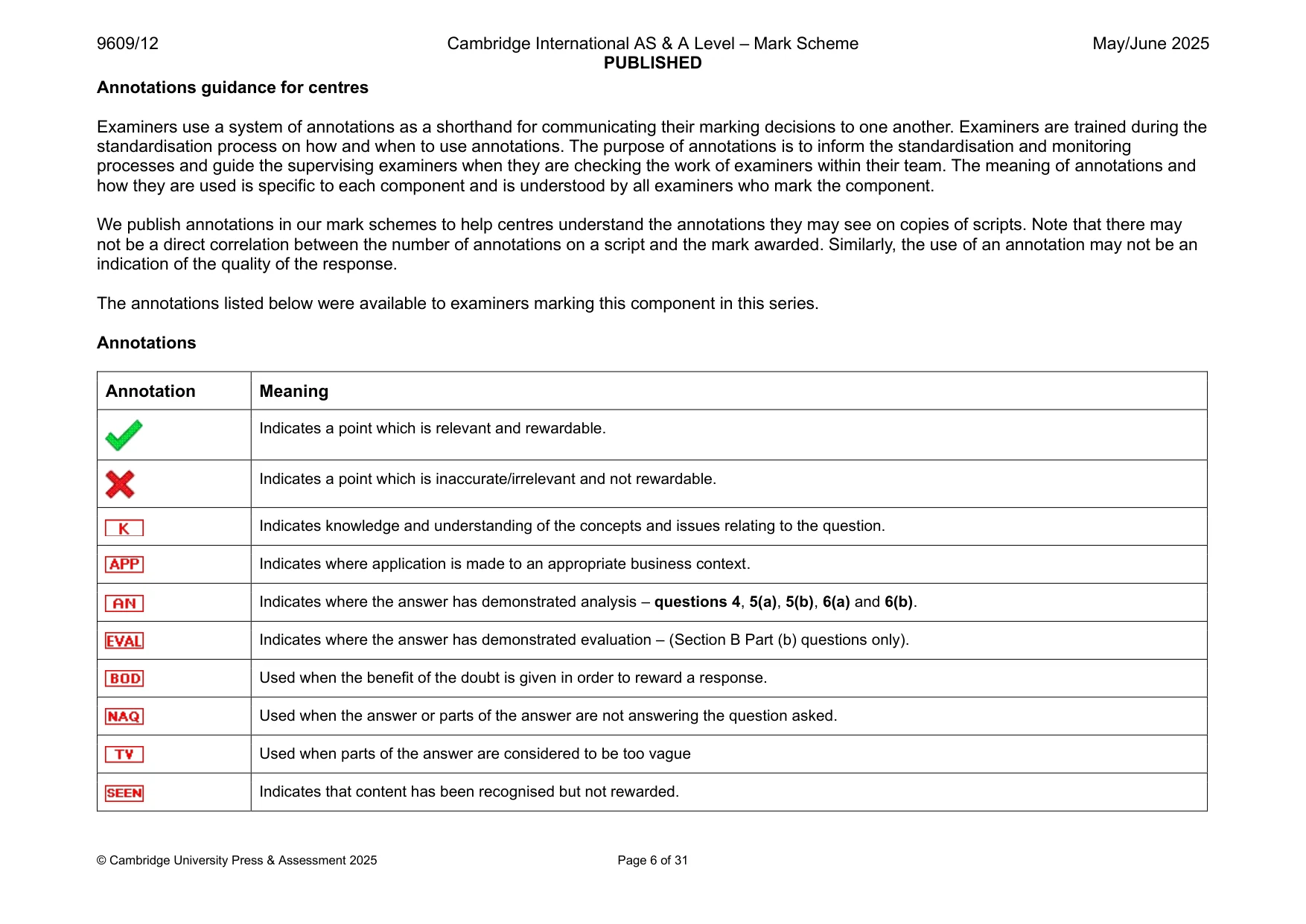
9609/12 Cambridge International AS & A Level – Mark Scheme PUBLISHED May/June 2025 © Cambridge University Press & Assessment 2025 Page 6 of 31 Annotations guidance for centres Examiners use a system of annotations as a shorthand for communicating their marking decisions to one another. Examiners are trained during the standardisation process on how and when to use annotations. The purpose of annotations is to inform the standardisation and monitoring processes and guide the supervising examiners when they are checking the work of examiners within their team. The meaning of annotations and how they are used is specific to each component and is understood by all examiners who mark the component. We publish annotations in our mark schemes to help centres understand the annotations they may see on copies of scripts. Note that there may not be a direct correlation between the number of annotations on a script and the mark awarded. Similarly, the use of an annotation may not be an indication of the quality of the response. The annotations listed below were available to examiners marking this component in this series. Annotations Annotation Meaning Indicates a point which is relevant and rewardable. Indicates a point which is inaccurate/irrelevant and not rewardable. Indicates knowledge and understanding of the concepts and issues relating to the question. Indicates where application is made to an appropriate business context. Indicates where the answer has demonstrated analysis – questions 4, 5(a), 5(b), 6(a) and 6(b). Indicates where the answer has demonstrated evaluation – (Section B Part (b) questions only). Used when the benefit of the doubt is given in order to reward a response. Used when the answer or parts of the answer are not answering the question asked. Used when parts of the answer are considered to be too vague Indicates that content has been recognised but not rewarded.
Mark scheme, page 7
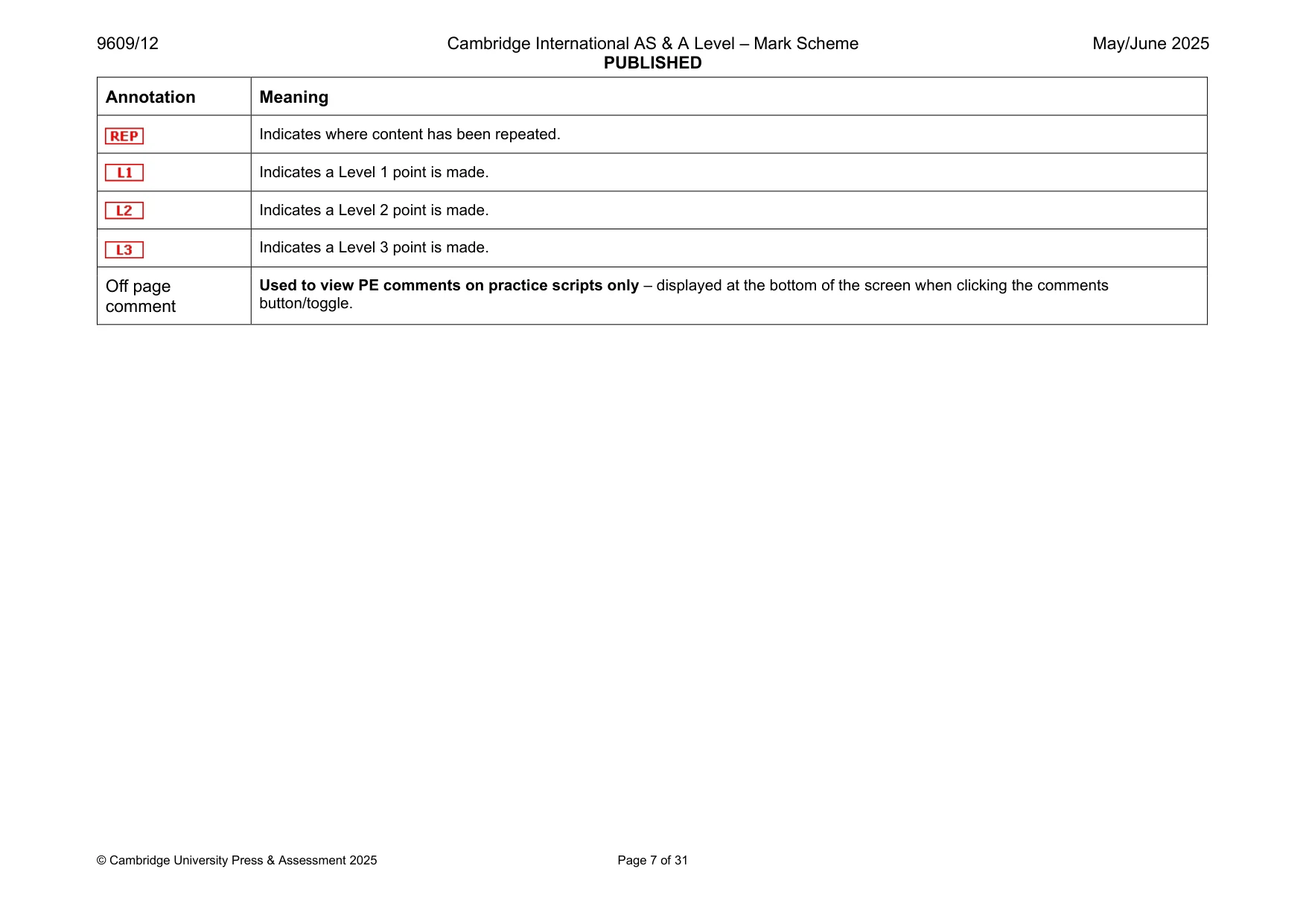
9609/12 Cambridge International AS & A Level – Mark Scheme PUBLISHED May/June 2025 © Cambridge University Press & Assessment 2025 Page 7 of 31 Annotation Meaning Indicates where content has been repeated. Indicates a Level 1 point is made. Indicates a Level 2 point is made. Indicates a Level 3 point is made. Off page comment Used to view PE comments on practice scripts only – displayed at the bottom of the screen when clicking the comments button/toggle.
Mark scheme, page 8
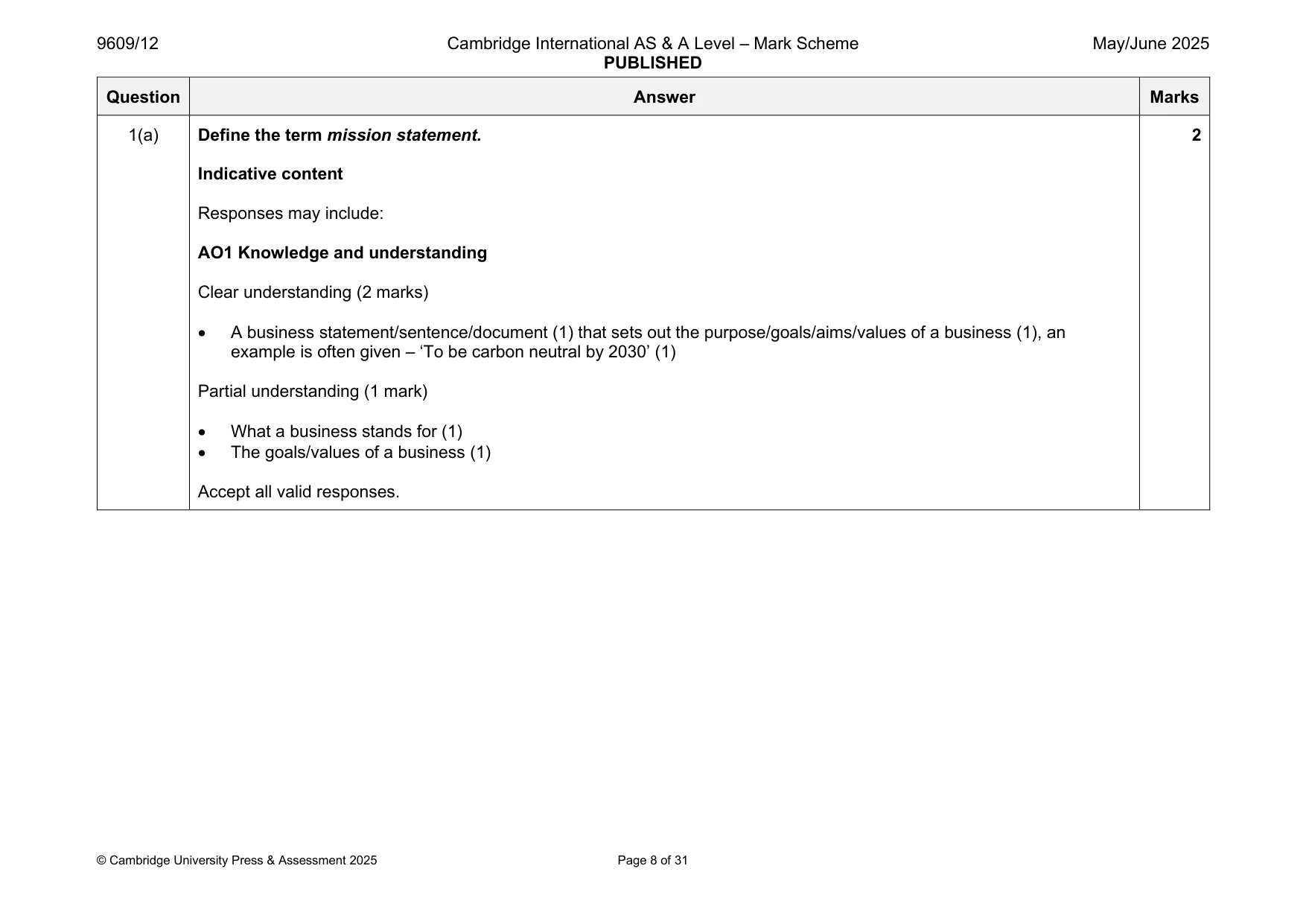
9609/12 Cambridge International AS & A Level – Mark Scheme PUBLISHED May/June 2025 © Cambridge University Press & Assessment 2025 Page 8 of 31 Question Answer Marks 1(a) Define the term mission statement. Indicative content Responses may include: AO1 Knowledge and understanding Clear understanding (2 marks) • A business statement/sentence/document (1) that sets out the purpose/goals/aims/values of a business (1), an example is often given – ‘To be carbon neutral by 2030’ (1) Partial understanding (1 mark) • What a business stands for (1) • The goals/values of a business (1) Accept all valid responses. 2
Mark scheme, page 9
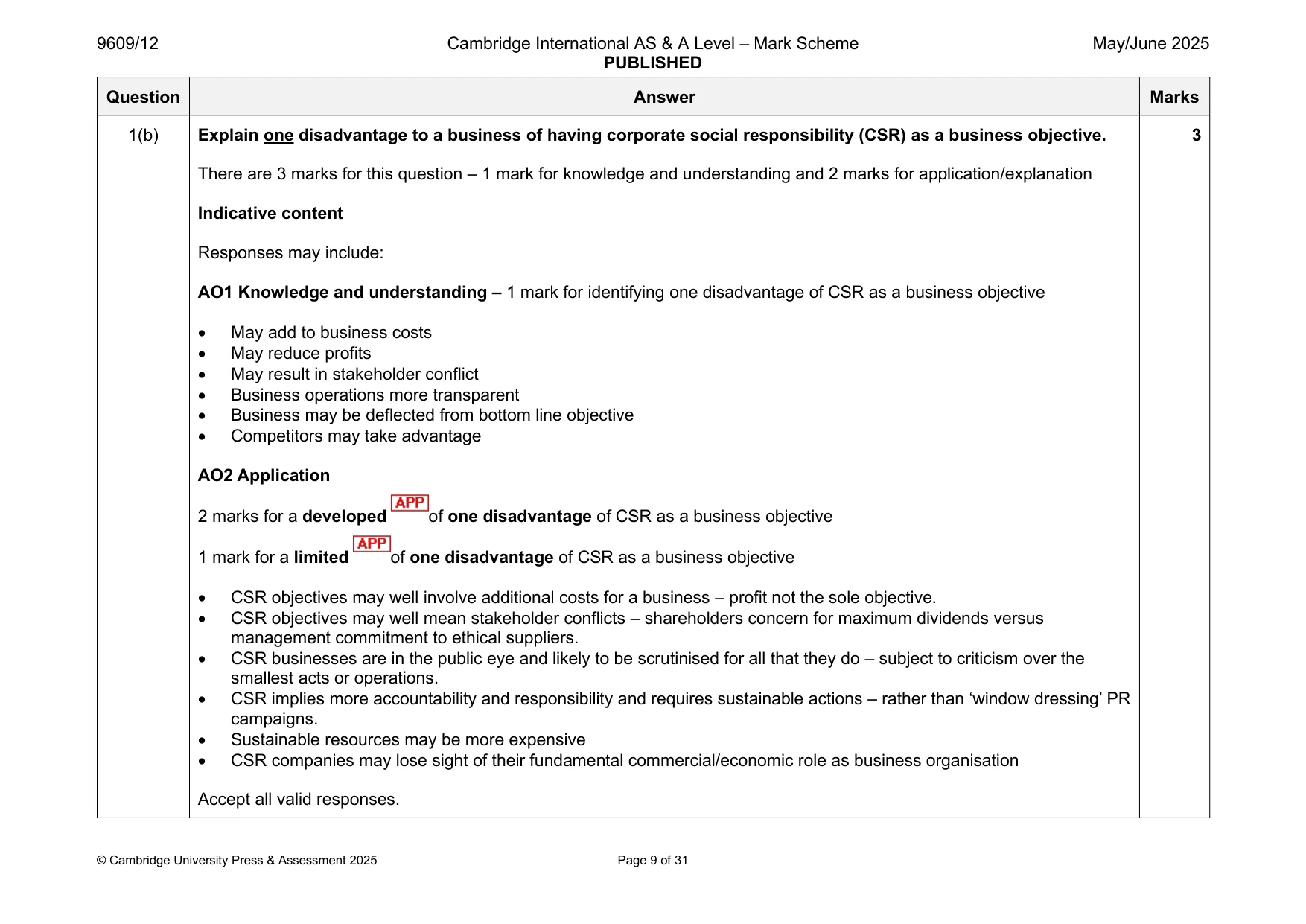
9609/12 Cambridge International AS & A Level – Mark Scheme PUBLISHED May/June 2025 © Cambridge University Press & Assessment 2025 Page 9 of 31 Question Answer Marks 1(b) Explain one disadvantage to a business of having corporate social responsibility (CSR) as a business objective. There are 3 marks for this question – 1 mark for knowledge and understanding and 2 marks for application/explanation Indicative content Responses may include: AO1 Knowledge and understanding – 1 mark for identifying one disadvantage of CSR as a business objective • May add to business costs • May reduce profits • May result in stakeholder conflict • Business operations more transparent • Business may be deflected from bottom line objective • Competitors may take advantage AO2 Application 2 marks for a developed of one disadvantage of CSR as a business objective 1 mark for a limited of one disadvantage of CSR as a business objective • CSR objectives may well involve additional costs for a business – profit not the sole objective. • CSR objectives may well mean stakeholder conflicts – shareholders concern for maximum dividends versus management commitment to ethical suppliers. • CSR businesses are in the public eye and likely to be scrutinised for all that they do – subject to criticism over the smallest acts or operations. • CSR implies more accountability and responsibility and requires sustainable actions – rather than ‘window dressing’ PR campaigns. • Sustainable resources may be more expensive • CSR companies may lose sight of their fundamental commercial/economic role as business organisation Accept all valid responses. 3
Mark scheme, page 10
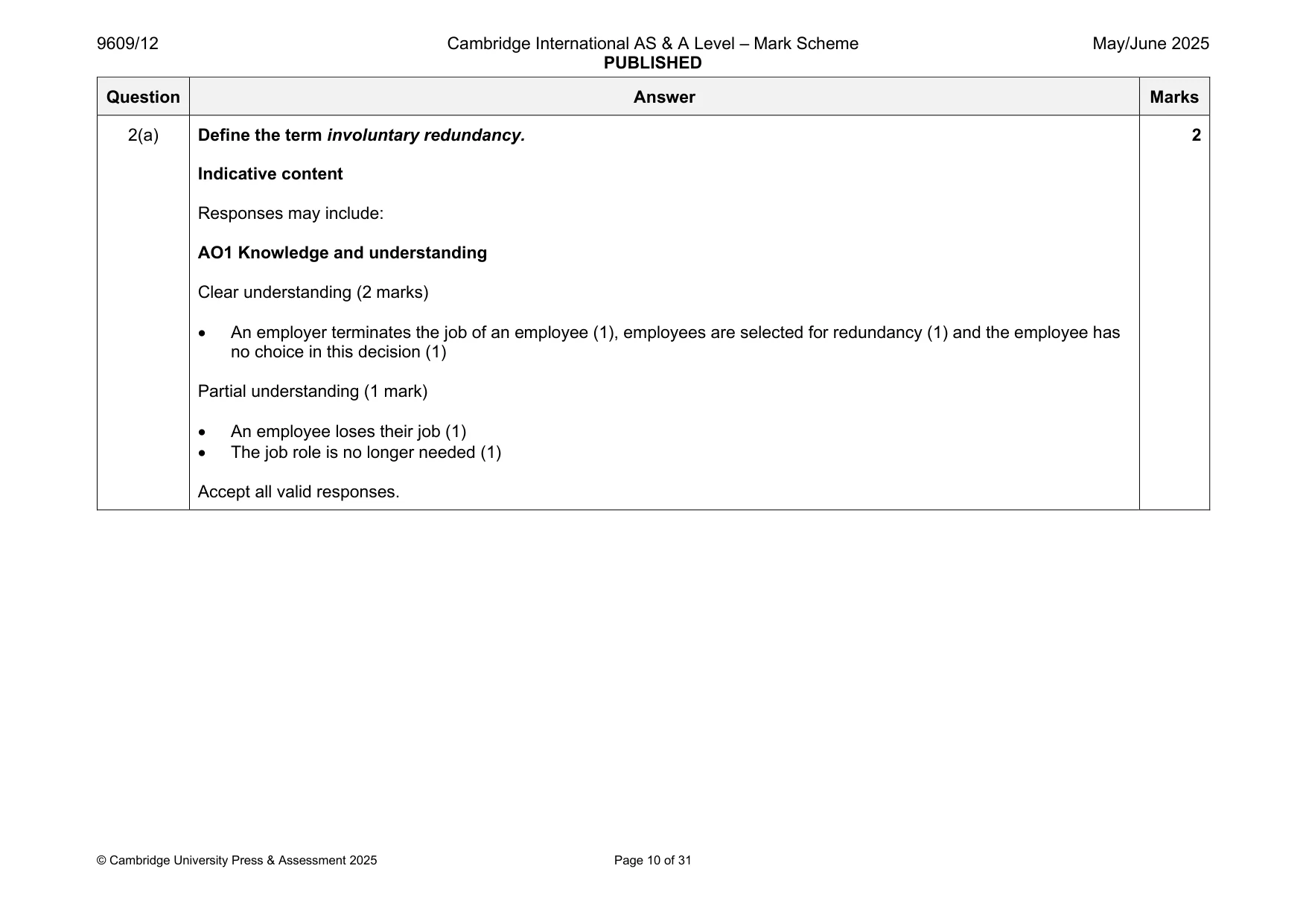
9609/12 Cambridge International AS & A Level – Mark Scheme PUBLISHED May/June 2025 © Cambridge University Press & Assessment 2025 Page 10 of 31 Question Answer Marks 2(a) Define the term involuntary redundancy. Indicative content Responses may include: AO1 Knowledge and understanding Clear understanding (2 marks) • An employer terminates the job of an employee (1), employees are selected for redundancy (1) and the employee has no choice in this decision (1) Partial understanding (1 mark) • An employee loses their job (1) • The job role is no longer needed (1) Accept all valid responses. 2
Mark scheme, page 11
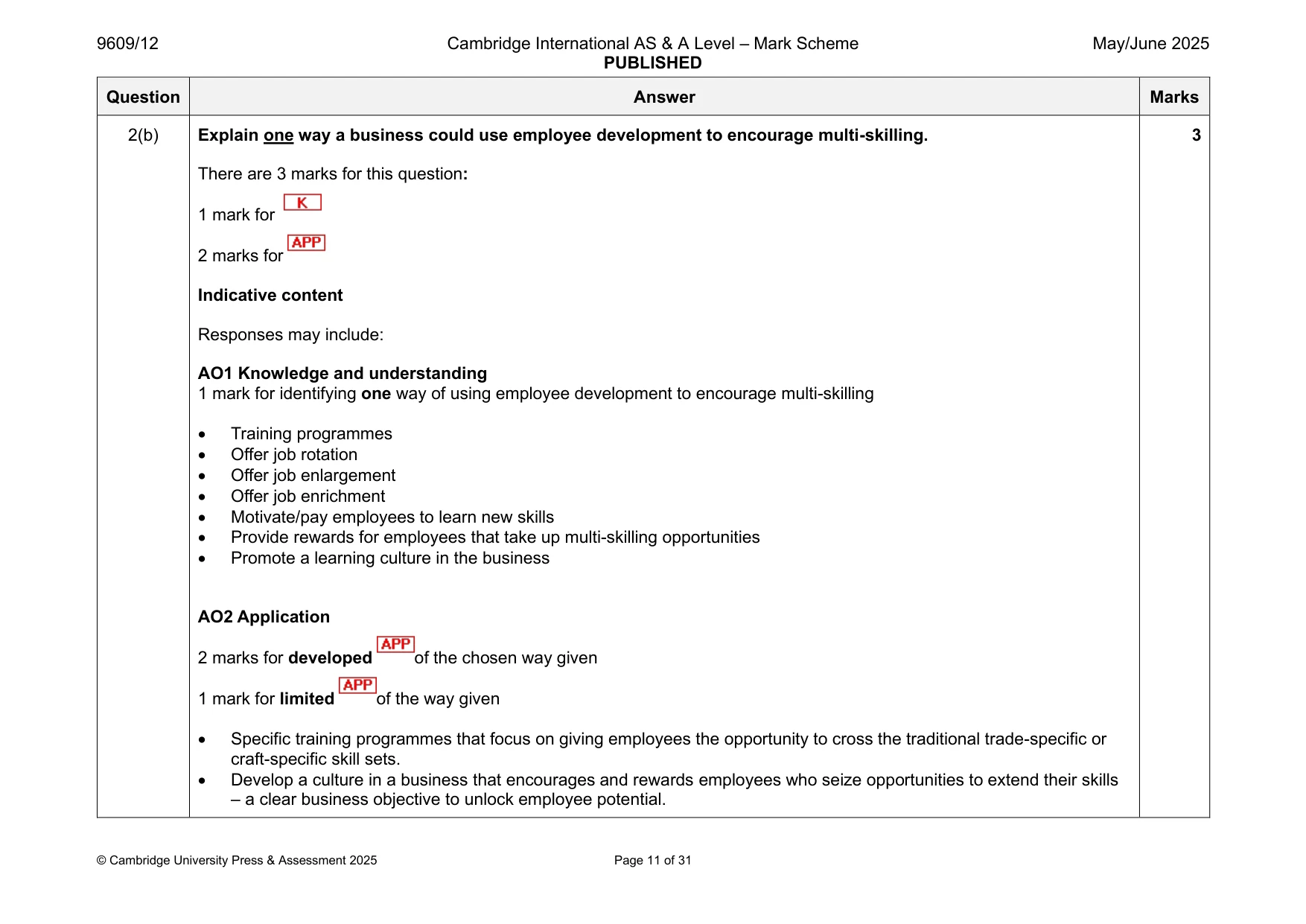
9609/12 Cambridge International AS & A Level – Mark Scheme PUBLISHED May/June 2025 © Cambridge University Press & Assessment 2025 Page 11 of 31 Question Answer Marks 2(b) Explain one way a business could use employee development to encourage multi-skilling. There are 3 marks for this question: 1 mark for 2 marks for Indicative content Responses may include: AO1 Knowledge and understanding 1 mark for identifying one way of using employee development to encourage multi-skilling • Training programmes • Offer job rotation • Offer job enlargement • Offer job enrichment • Motivate/pay employees to learn new skills • Provide rewards for employees that take up multi-skilling opportunities • Promote a learning culture in the business AO2 Application 2 marks for developed of the chosen way given 1 mark for limited of the way given • Specific training programmes that focus on giving employees the opportunity to cross the traditional trade-specific or craft-specific skill sets. • Develop a culture in a business that encourages and rewards employees who seize opportunities to extend their skills – a clear business objective to unlock employee potential. 3
Mark scheme, page 12
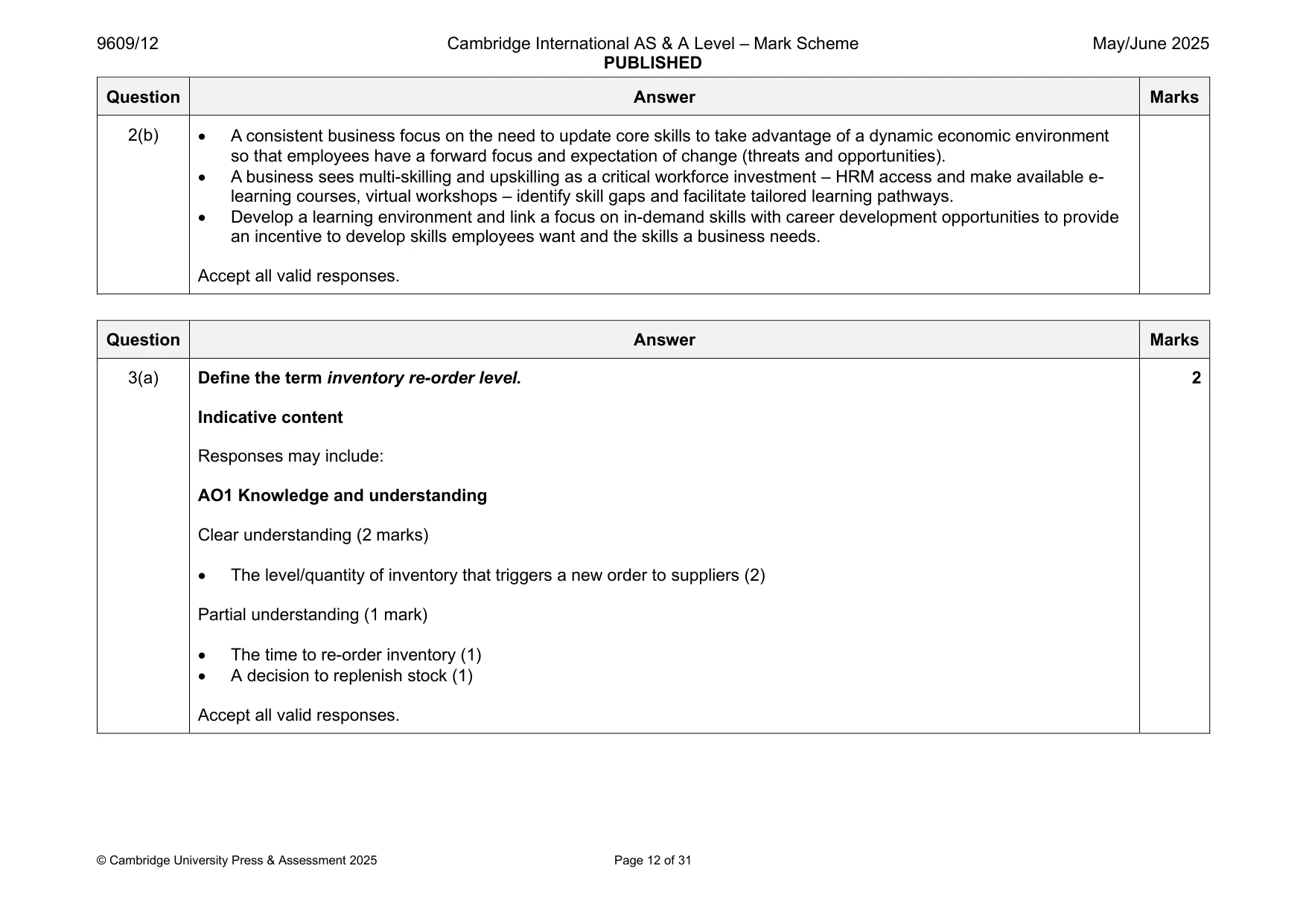
9609/12 Cambridge International AS & A Level – Mark Scheme PUBLISHED May/June 2025 © Cambridge University Press & Assessment 2025 Page 12 of 31 Question Answer Marks 2(b) • A consistent business focus on the need to update core skills to take advantage of a dynamic economic environment so that employees have a forward focus and expectation of change (threats and opportunities). • A business sees multi-skilling and upskilling as a critical workforce investment – HRM access and make available e- learning courses, virtual workshops – identify skill gaps and facilitate tailored learning pathways. • Develop a learning environment and link a focus on in-demand skills with career development opportunities to provide an incentive to develop skills employees want and the skills a business needs. Accept all valid responses. Question Answer Marks 3(a) Define the term inventory re-order level. Indicative content Responses may include: AO1 Knowledge and understanding Clear understanding (2 marks) • The level/quantity of inventory that triggers a new order to suppliers (2) Partial understanding (1 mark) • The time to re-order inventory (1) • A decision to replenish stock (1) Accept all valid responses. 2
Mark scheme, page 13
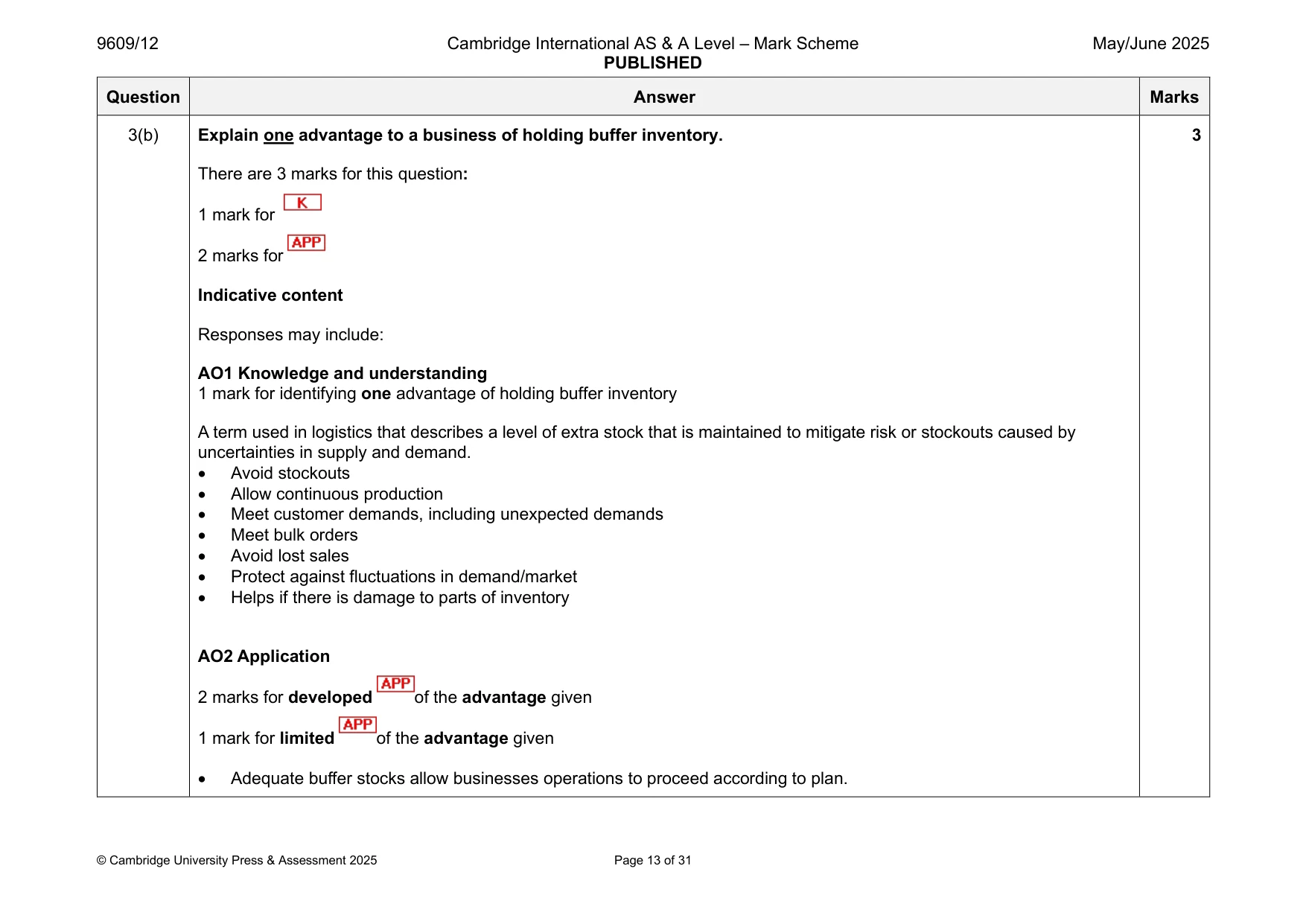
9609/12 Cambridge International AS & A Level – Mark Scheme PUBLISHED May/June 2025 © Cambridge University Press & Assessment 2025 Page 13 of 31 Question Answer Marks 3(b) Explain one advantage to a business of holding buffer inventory. There are 3 marks for this question: 1 mark for 2 marks for Indicative content Responses may include: AO1 Knowledge and understanding 1 mark for identifying one advantage of holding buffer inventory A term used in logistics that describes a level of extra stock that is maintained to mitigate risk or stockouts caused by uncertainties in supply and demand. • Avoid stockouts • Allow continuous production • Meet customer demands, including unexpected demands • Meet bulk orders • Avoid lost sales • Protect against fluctuations in demand/market • Helps if there is damage to parts of inventory AO2 Application 2 marks for developed of the advantage given 1 mark for limited of the advantage given • Adequate buffer stocks allow businesses operations to proceed according to plan. 3
Mark scheme, page 14
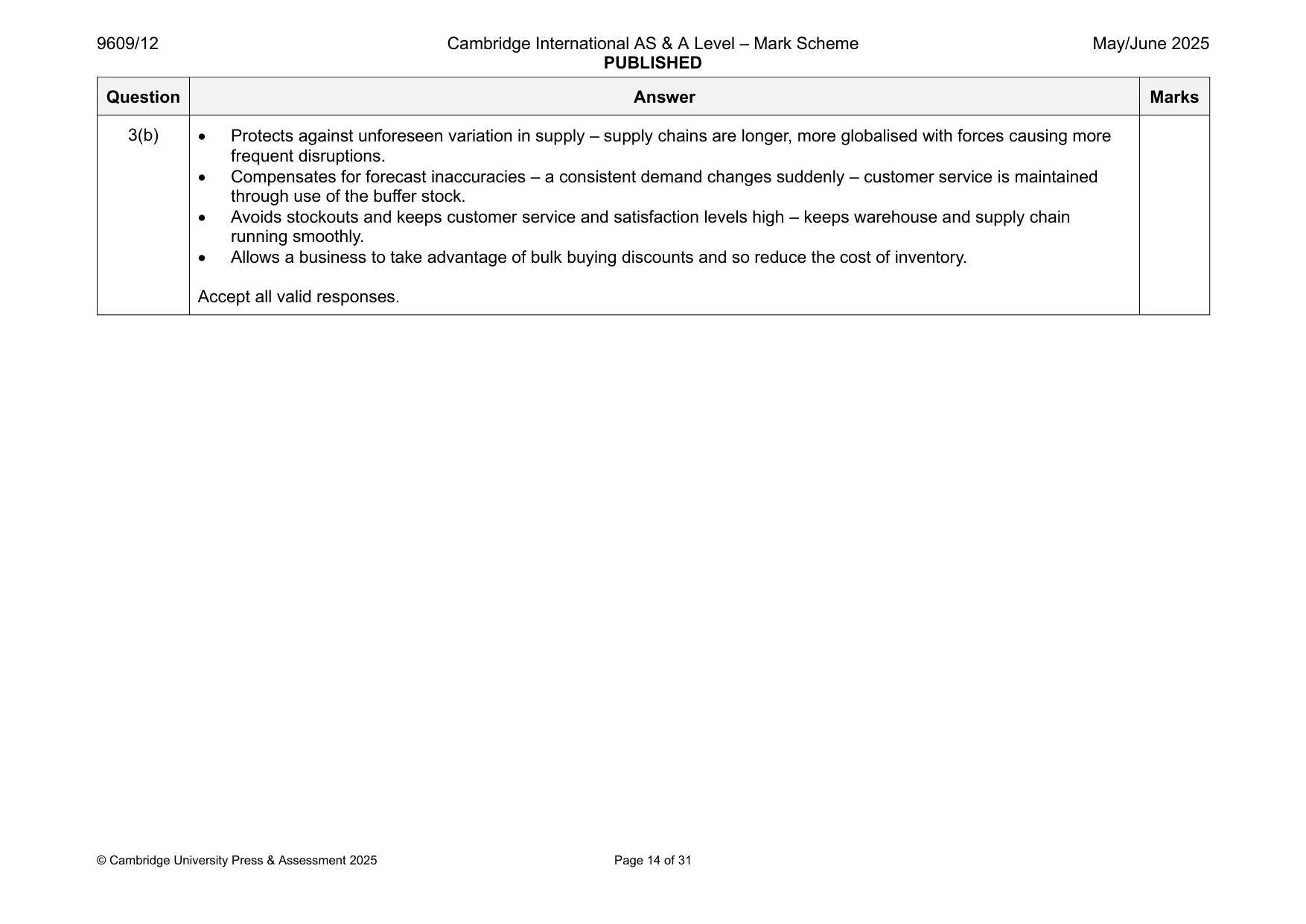
9609/12 Cambridge International AS & A Level – Mark Scheme PUBLISHED May/June 2025 © Cambridge University Press & Assessment 2025 Page 14 of 31 Question Answer Marks 3(b) • Protects against unforeseen variation in supply – supply chains are longer, more globalised with forces causing more frequent disruptions. • Compensates for forecast inaccuracies – a consistent demand changes suddenly – customer service is maintained through use of the buffer stock. • Avoids stockouts and keeps customer service and satisfaction levels high – keeps warehouse and supply chain running smoothly. • Allows a business to take advantage of bulk buying discounts and so reduce the cost of inventory. Accept all valid responses.
Mark scheme, page 15
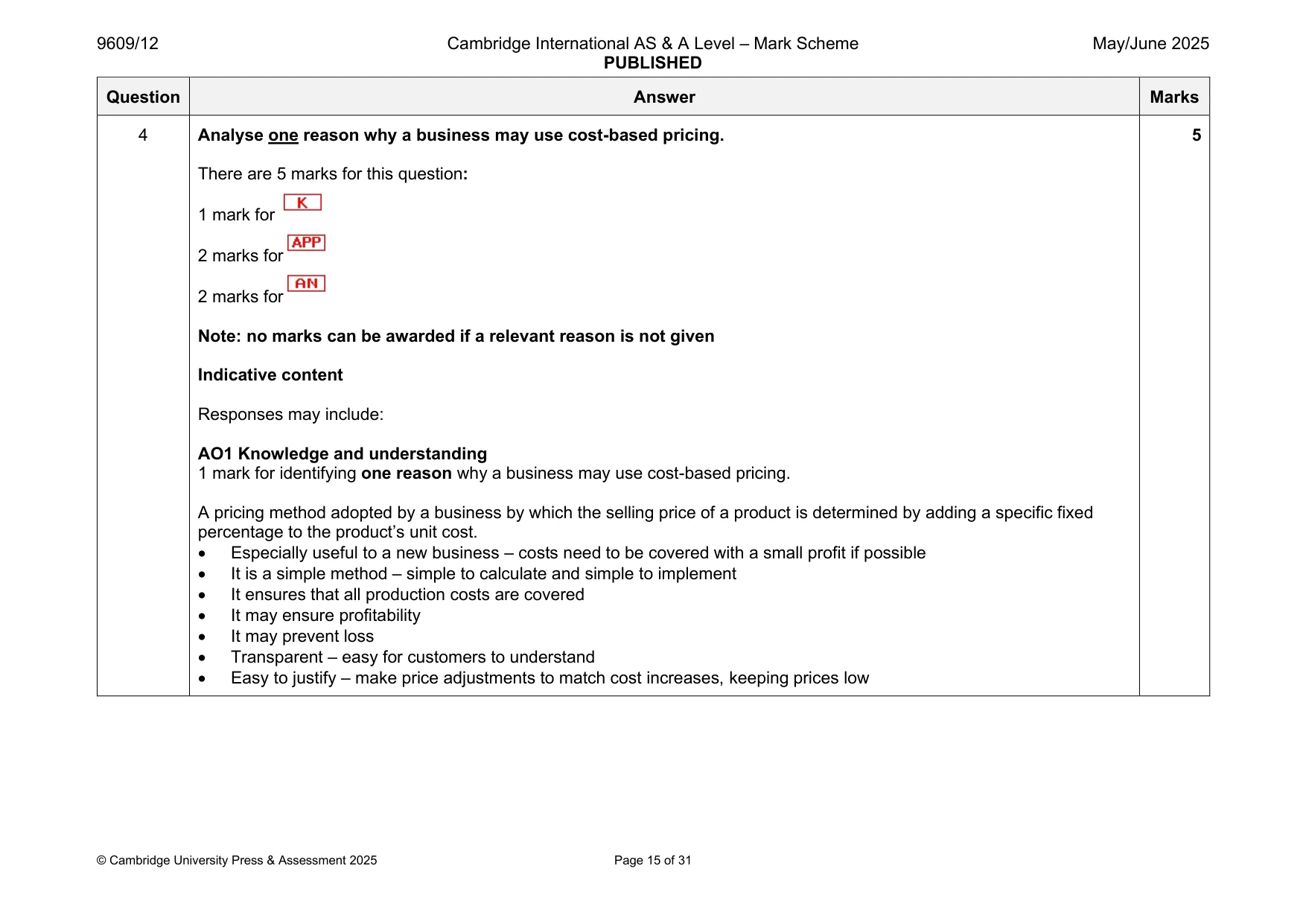
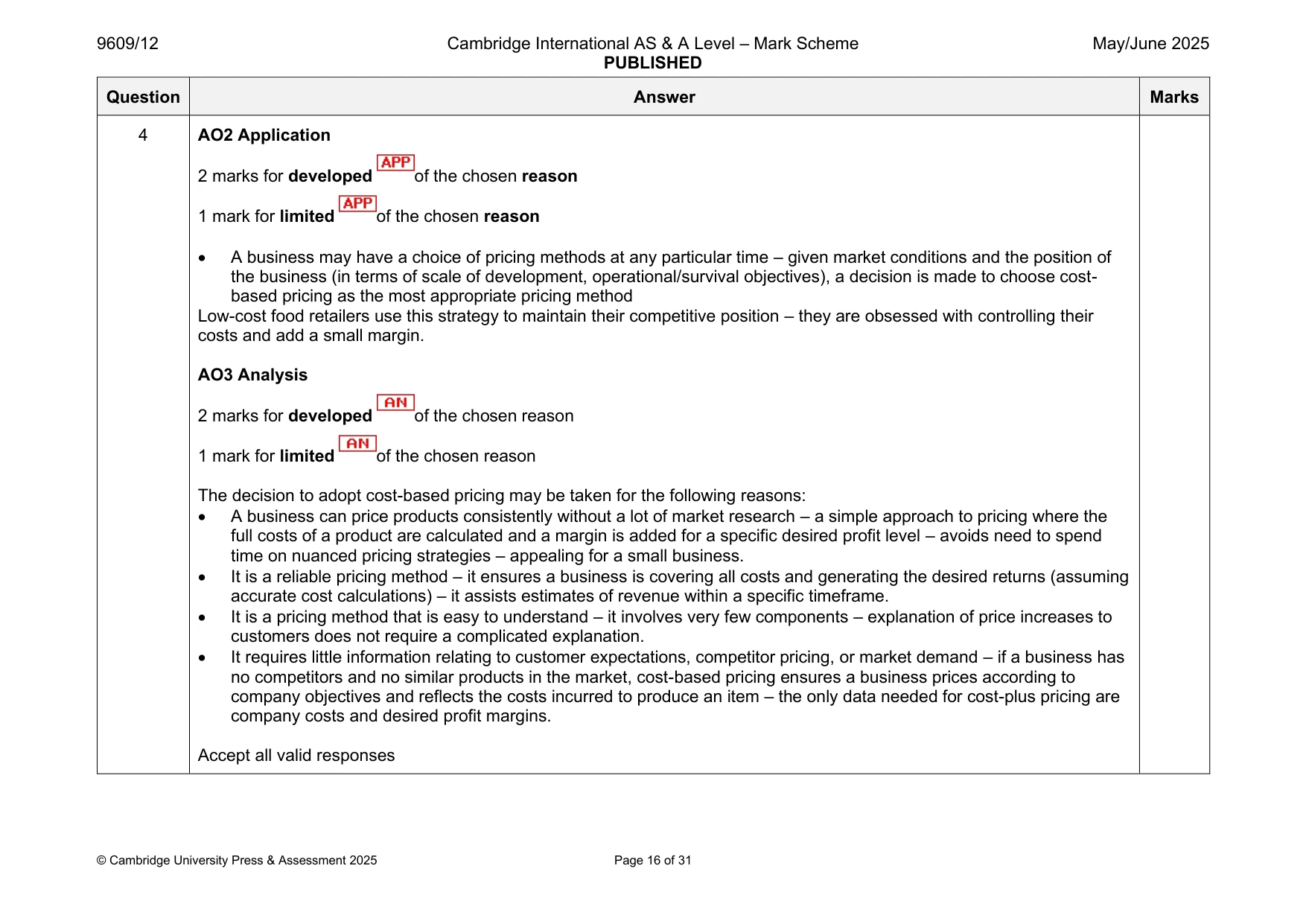
9609/12 Cambridge International AS & A Level – Mark Scheme PUBLISHED May/June 2025 © Cambridge University Press & Assessment 2025 Page 15 of 31 Question Answer Marks 4 Analyse one reason why a business may use cost-based pricing. There are 5 marks for this question: 1 mark for 2 marks for 2 marks for Note: no marks can be awarded if a relevant reason is not given Indicative content Responses may include: AO1 Knowledge and understanding 1 mark for identifying one reason why a business may use cost-based pricing. A pricing method adopted by a business by which the selling price of a product is determined by adding a specific fixed percentage to the product’s unit cost. • Especially useful to a new business – costs need to be covered with a small profit if possible • It is a simple method – simple to calculate and simple to implement • It ensures that all production costs are covered • It may ensure profitability • It may prevent loss • Transparent – easy for customers to understand • Easy to justify – make price adjustments to match cost increases, keeping prices low 5
Mark scheme, page 16
9609/12 Cambridge International AS & A Level – Mark Scheme PUBLISHED May/June 2025 © Cambridge University Press & Assessment 2025 Page 16 of 31 Question Answer Marks 4 AO2 Application 2 marks for developed of the chosen reason 1 mark for limited of the chosen reason • A business may have a choice of pricing methods at any particular time – given market conditions and the position of the business (in terms of scale of development, operational/survival objectives), a decision is made to choose cost- based pricing as the most appropriate pricing method Low-cost food retailers use this strategy to maintain their competitive position – they are obsessed with controlling their costs and add a small margin. AO3 Analysis 2 marks for developed of the chosen reason 1 mark for limited of the chosen reason The decision to adopt cost-based pricing may be taken for the following reasons: • A business can price products consistently without a lot of market research – a simple approach to pricing where the full costs of a product are calculated and a margin is added for a specific desired profit level – avoids need to spend time on nuanced pricing strategies – appealing for a small business. • It is a reliable pricing method – it ensures a business is covering all costs and generating the desired returns (assuming accurate cost calculations) – it assists estimates of revenue within a specific timeframe. • It is a pricing method that is easy to understand – it involves very few components – explanation of price increases to customers does not require a complicated explanation. • It requires little information relating to customer expectations, competitor pricing, or market demand – if a business has no competitors and no similar products in the market, cost-based pricing ensures a business prices according to company objectives and reflects the costs incurred to produce an item – the only data needed for cost-plus pricing are company costs and desired profit margins. Accept all valid responses
Mark scheme, page 17
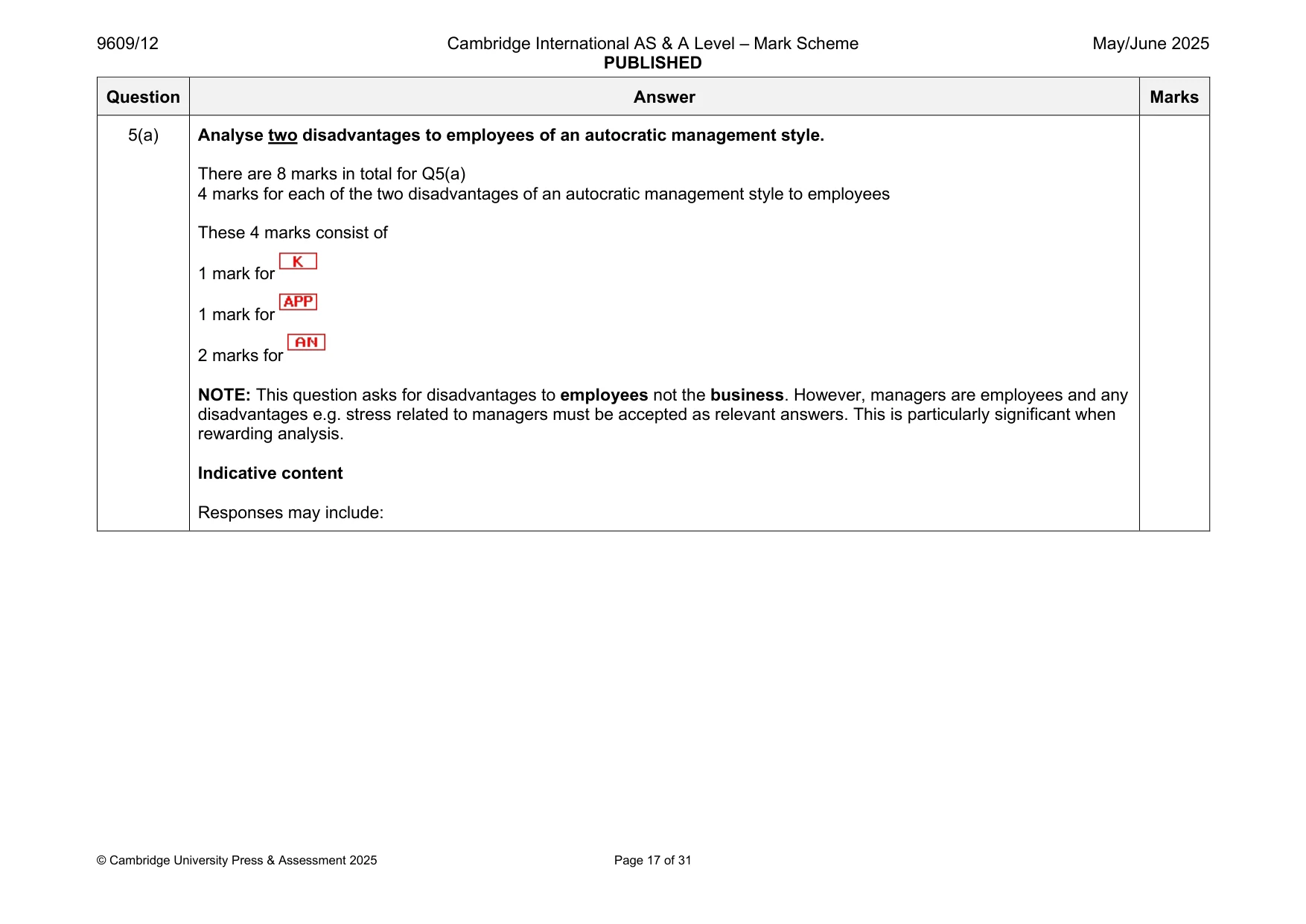
9609/12 Cambridge International AS & A Level – Mark Scheme PUBLISHED May/June 2025 © Cambridge University Press & Assessment 2025 Page 17 of 31 Question Answer Marks 5(a) Analyse two disadvantages to employees of an autocratic management style. There are 8 marks in total for Q5(a) 4 marks for each of the two disadvantages of an autocratic management style to employees These 4 marks consist of 1 mark for 1 mark for 2 marks for NOTE: This question asks for disadvantages to employees not the business. However, managers are employees and any disadvantages e.g. stress related to managers must be accepted as relevant answers. This is particularly significant when rewarding analysis. Indicative content Responses may include:
Mark scheme, page 18
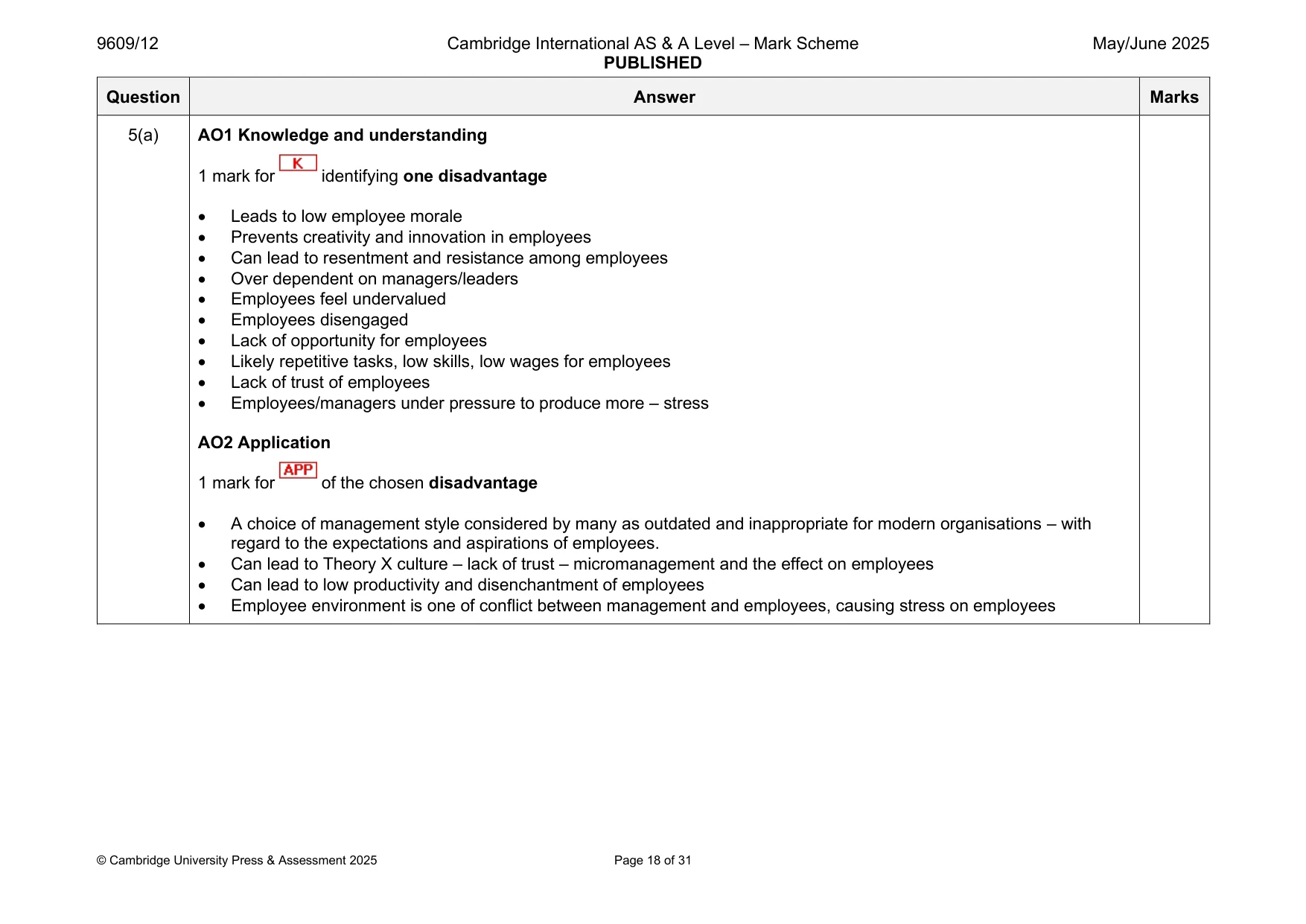
9609/12 Cambridge International AS & A Level – Mark Scheme PUBLISHED May/June 2025 © Cambridge University Press & Assessment 2025 Page 18 of 31 Question Answer Marks 5(a) AO1 Knowledge and understanding 1 mark for identifying one disadvantage • Leads to low employee morale • Prevents creativity and innovation in employees • Can lead to resentment and resistance among employees • Over dependent on managers/leaders • Employees feel undervalued • Employees disengaged • Lack of opportunity for employees • Likely repetitive tasks, low skills, low wages for employees • Lack of trust of employees • Employees/managers under pressure to produce more – stress AO2 Application 1 mark for of the chosen disadvantage • A choice of management style considered by many as outdated and inappropriate for modern organisations – with regard to the expectations and aspirations of employees. • Can lead to Theory X culture – lack of trust – micromanagement and the effect on employees • Can lead to low productivity and disenchantment of employees • Employee environment is one of conflict between management and employees, causing stress on employees
Mark scheme, page 19
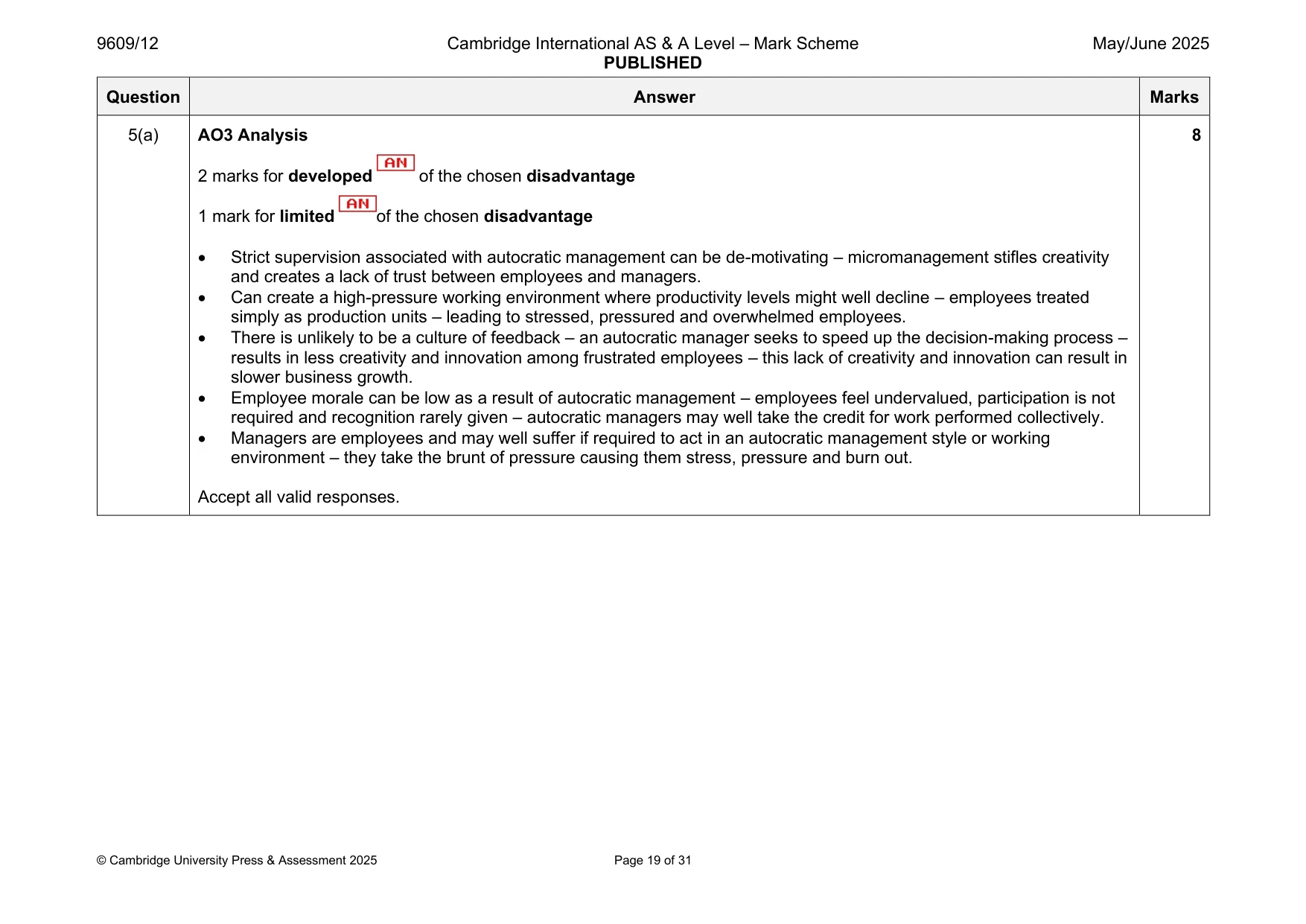
9609/12 Cambridge International AS & A Level – Mark Scheme PUBLISHED May/June 2025 © Cambridge University Press & Assessment 2025 Page 19 of 31 Question Answer Marks 5(a) AO3 Analysis 2 marks for developed of the chosen disadvantage 1 mark for limited of the chosen disadvantage • Strict supervision associated with autocratic management can be de-motivating – micromanagement stifles creativity and creates a lack of trust between employees and managers. • Can create a high-pressure working environment where productivity levels might well decline – employees treated simply as production units – leading to stressed, pressured and overwhelmed employees. • There is unlikely to be a culture of feedback – an autocratic manager seeks to speed up the decision-making process – results in less creativity and innovation among frustrated employees – this lack of creativity and innovation can result in slower business growth. • Employee morale can be low as a result of autocratic management – employees feel undervalued, participation is not required and recognition rarely given – autocratic managers may well take the credit for work performed collectively. • Managers are employees and may well suffer if required to act in an autocratic management style or working environment – they take the brunt of pressure causing them stress, pressure and burn out. Accept all valid responses. 8
Mark scheme, page 20
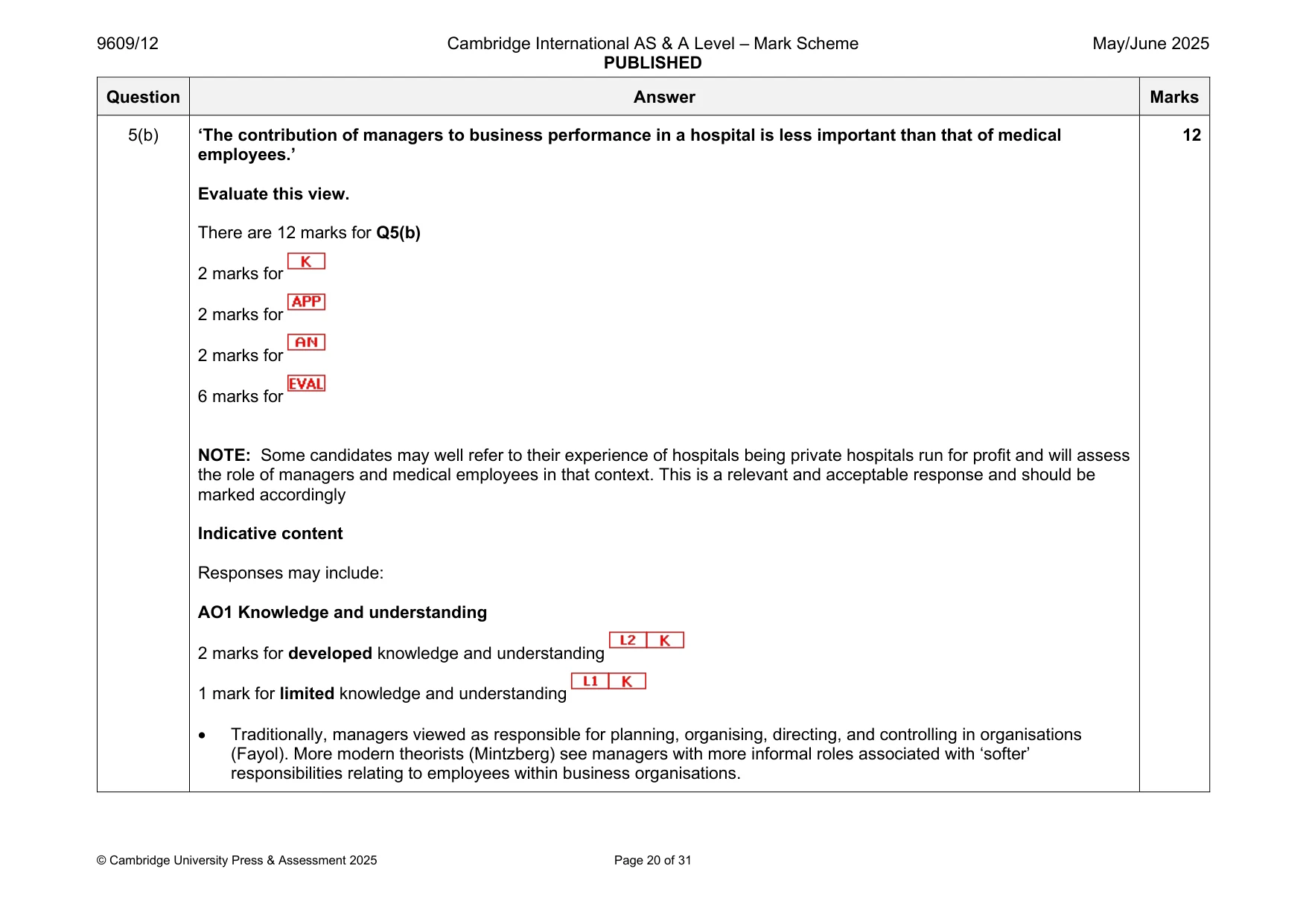
9609/12 Cambridge International AS & A Level – Mark Scheme PUBLISHED May/June 2025 © Cambridge University Press & Assessment 2025 Page 20 of 31 Question Answer Marks 5(b) ‘The contribution of managers to business performance in a hospital is less important than that of medical employees.’ Evaluate this view. There are 12 marks for Q5(b) 2 marks for 2 marks for 2 marks for 6 marks for NOTE: Some candidates may well refer to their experience of hospitals being private hospitals run for profit and will assess the role of managers and medical employees in that context. This is a relevant and acceptable response and should be marked accordingly Indicative content Responses may include: AO1 Knowledge and understanding 2 marks for developed knowledge and understanding 1 mark for limited knowledge and understanding • Traditionally, managers viewed as responsible for planning, organising, directing, and controlling in organisations (Fayol). More modern theorists (Mintzberg) see managers with more informal roles associated with ‘softer’ responsibilities relating to employees within business organisations. 12
Mark scheme, page 21
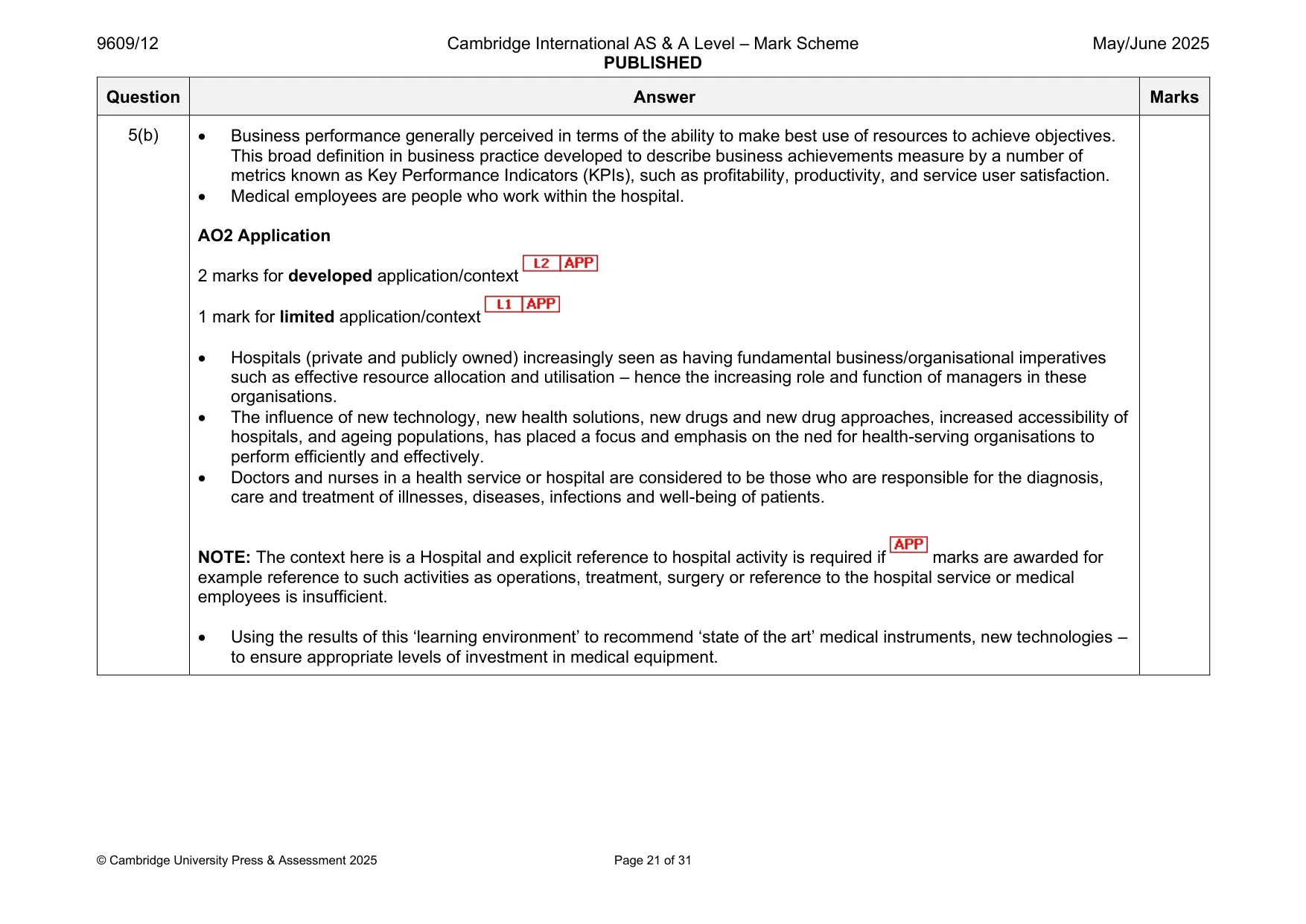
9609/12 Cambridge International AS & A Level – Mark Scheme PUBLISHED May/June 2025 © Cambridge University Press & Assessment 2025 Page 21 of 31 Question Answer Marks 5(b) • Business performance generally perceived in terms of the ability to make best use of resources to achieve objectives. This broad definition in business practice developed to describe business achievements measure by a number of metrics known as Key Performance Indicators (KPIs), such as profitability, productivity, and service user satisfaction. • Medical employees are people who work within the hospital. AO2 Application 2 marks for developed application/context 1 mark for limited application/context • Hospitals (private and publicly owned) increasingly seen as having fundamental business/organisational imperatives such as effective resource allocation and utilisation – hence the increasing role and function of managers in these organisations. • The influence of new technology, new health solutions, new drugs and new drug approaches, increased accessibility of hospitals, and ageing populations, has placed a focus and emphasis on the ned for health-serving organisations to perform efficiently and effectively. • Doctors and nurses in a health service or hospital are considered to be those who are responsible for the diagnosis, care and treatment of illnesses, diseases, infections and well-being of patients. NOTE: The context here is a Hospital and explicit reference to hospital activity is required if marks are awarded for example reference to such activities as operations, treatment, surgery or reference to the hospital service or medical employees is insufficient. • Using the results of this ‘learning environment’ to recommend ‘state of the art’ medical instruments, new technologies – to ensure appropriate levels of investment in medical equipment.
Mark scheme, page 22
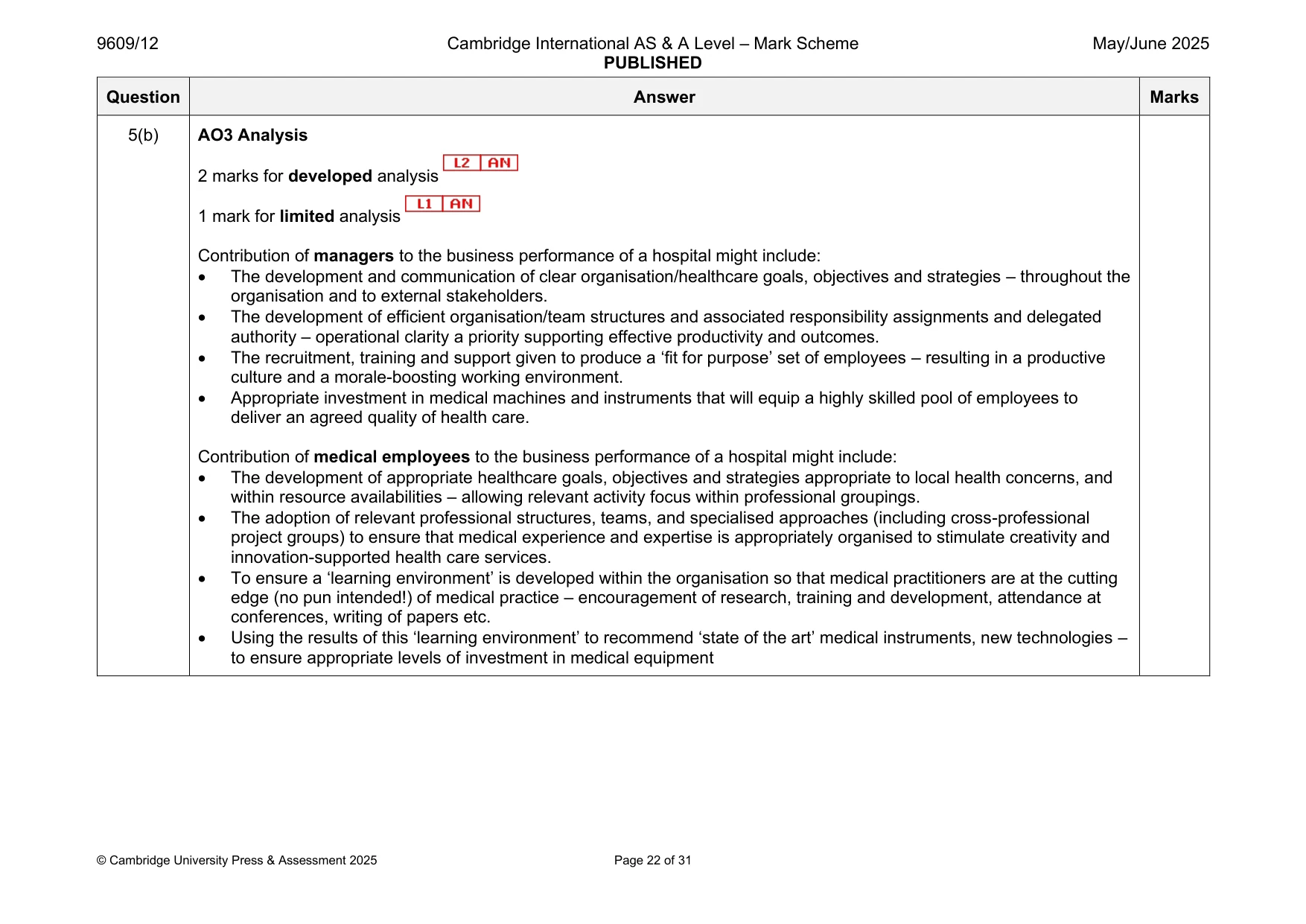
9609/12 Cambridge International AS & A Level – Mark Scheme PUBLISHED May/June 2025 © Cambridge University Press & Assessment 2025 Page 22 of 31 Question Answer Marks 5(b) AO3 Analysis 2 marks for developed analysis 1 mark for limited analysis Contribution of managers to the business performance of a hospital might include: • The development and communication of clear organisation/healthcare goals, objectives and strategies – throughout the organisation and to external stakeholders. • The development of efficient organisation/team structures and associated responsibility assignments and delegated authority – operational clarity a priority supporting effective productivity and outcomes. • The recruitment, training and support given to produce a ‘fit for purpose’ set of employees – resulting in a productive culture and a morale-boosting working environment. • Appropriate investment in medical machines and instruments that will equip a highly skilled pool of employees to deliver an agreed quality of health care. Contribution of medical employees to the business performance of a hospital might include: • The development of appropriate healthcare goals, objectives and strategies appropriate to local health concerns, and within resource availabilities – allowing relevant activity focus within professional groupings. • The adoption of relevant professional structures, teams, and specialised approaches (including cross-professional project groups) to ensure that medical experience and expertise is appropriately organised to stimulate creativity and innovation-supported health care services. • To ensure a ‘learning environment’ is developed within the organisation so that medical practitioners are at the cutting edge (no pun intended!) of medical practice – encouragement of research, training and development, attendance at conferences, writing of papers etc. • Using the results of this ‘learning environment’ to recommend ‘state of the art’ medical instruments, new technologies – to ensure appropriate levels of investment in medical equipment
Mark scheme, page 23
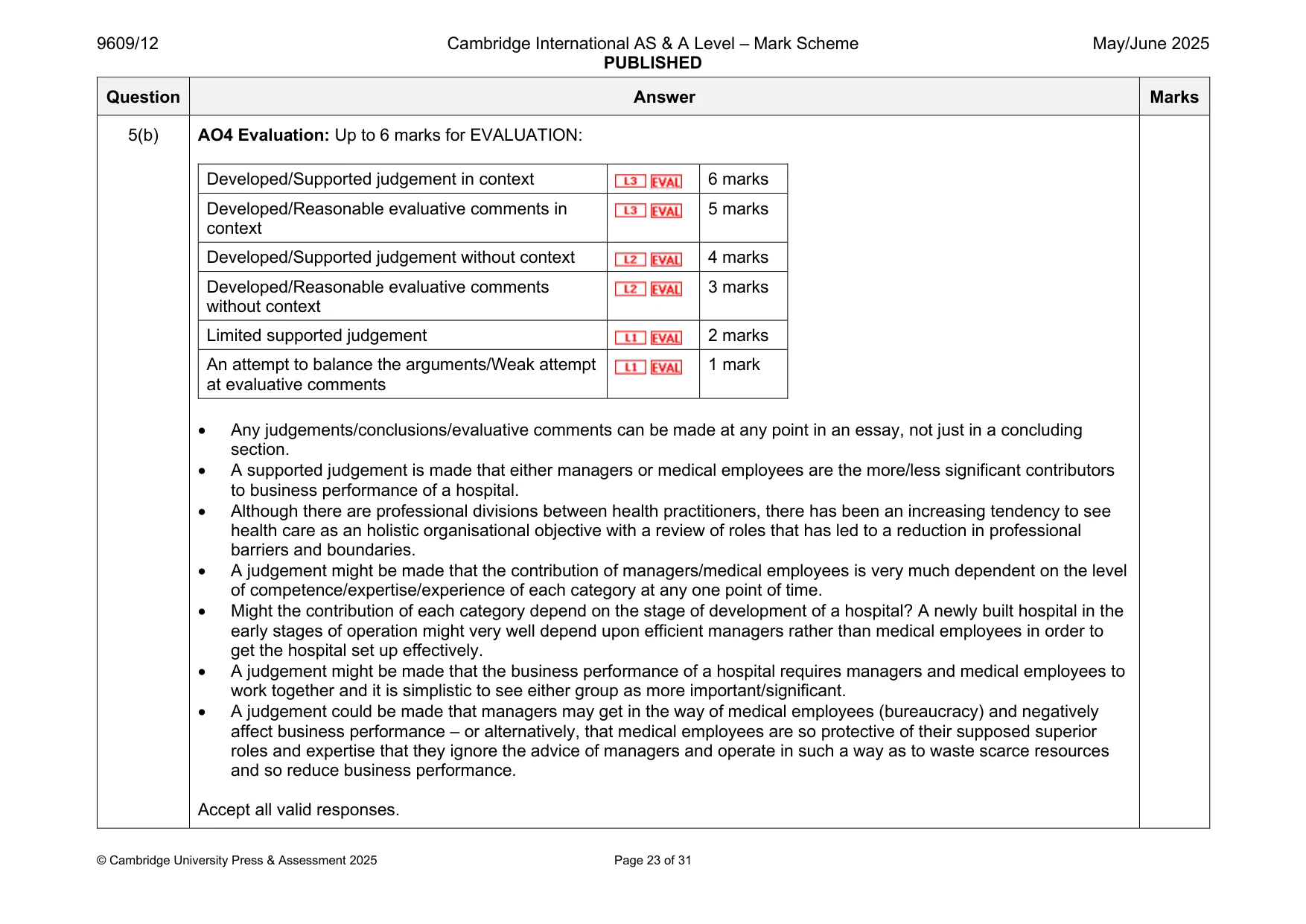
9609/12 Cambridge International AS & A Level – Mark Scheme PUBLISHED May/June 2025 © Cambridge University Press & Assessment 2025 Page 23 of 31 Question Answer Marks 5(b) AO4 Evaluation: Up to 6 marks for EVALUATION: Developed/Supported judgement in context 6 marks Developed/Reasonable evaluative comments in context 5 marks Developed/Supported judgement without context 4 marks Developed/Reasonable evaluative comments without context 3 marks Limited supported judgement 2 marks An attempt to balance the arguments/Weak attempt at evaluative comments 1 mark • Any judgements/conclusions/evaluative comments can be made at any point in an essay, not just in a concluding section. • A supported judgement is made that either managers or medical employees are the more/less significant contributors to business performance of a hospital. • Although there are professional divisions between health practitioners, there has been an increasing tendency to see health care as an holistic organisational objective with a review of roles that has led to a reduction in professional barriers and boundaries. • A judgement might be made that the contribution of managers/medical employees is very much dependent on the level of competence/expertise/experience of each category at any one point of time. • Might the contribution of each category depend on the stage of development of a hospital? A newly built hospital in the early stages of operation might very well depend upon efficient managers rather than medical employees in order to get the hospital set up effectively. • A judgement might be made that the business performance of a hospital requires managers and medical employees to work together and it is simplistic to see either group as more important/significant. • A judgement could be made that managers may get in the way of medical employees (bureaucracy) and negatively affect business performance – or alternatively, that medical employees are so protective of their supposed superior roles and expertise that they ignore the advice of managers and operate in such a way as to waste scarce resources and so reduce business performance. Accept all valid responses.
Mark scheme, page 24
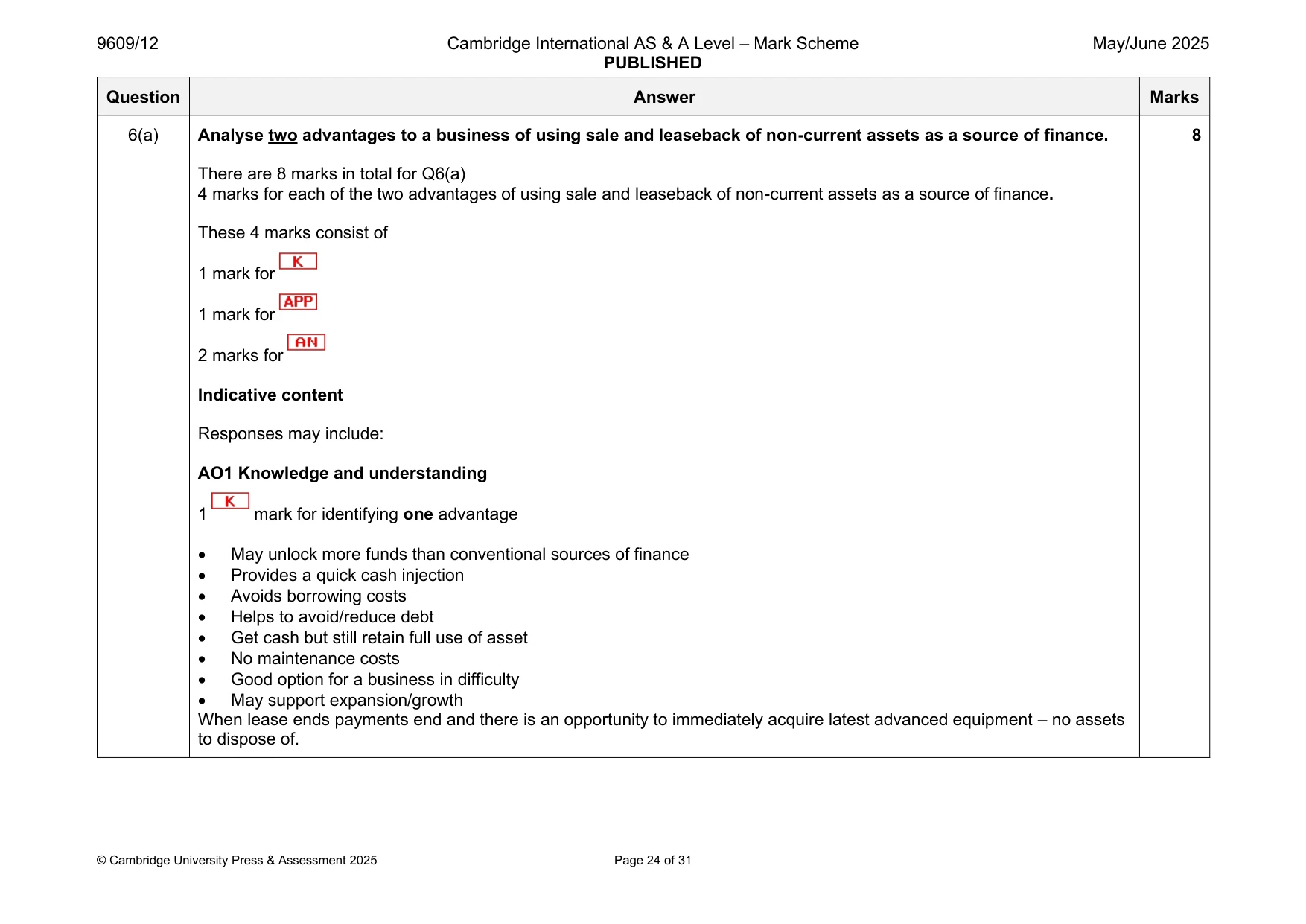
9609/12 Cambridge International AS & A Level – Mark Scheme PUBLISHED May/June 2025 © Cambridge University Press & Assessment 2025 Page 24 of 31 Question Answer Marks 6(a) Analyse two advantages to a business of using sale and leaseback of non-current assets as a source of finance. There are 8 marks in total for Q6(a) 4 marks for each of the two advantages of using sale and leaseback of non-current assets as a source of finance. These 4 marks consist of 1 mark for 1 mark for 2 marks for Indicative content Responses may include: AO1 Knowledge and understanding 1 mark for identifying one advantage • May unlock more funds than conventional sources of finance • Provides a quick cash injection • Avoids borrowing costs • Helps to avoid/reduce debt • Get cash but still retain full use of asset • No maintenance costs • Good option for a business in difficulty • May support expansion/growth When lease ends payments end and there is an opportunity to immediately acquire latest advanced equipment – no assets to dispose of. 8
Mark scheme, page 25
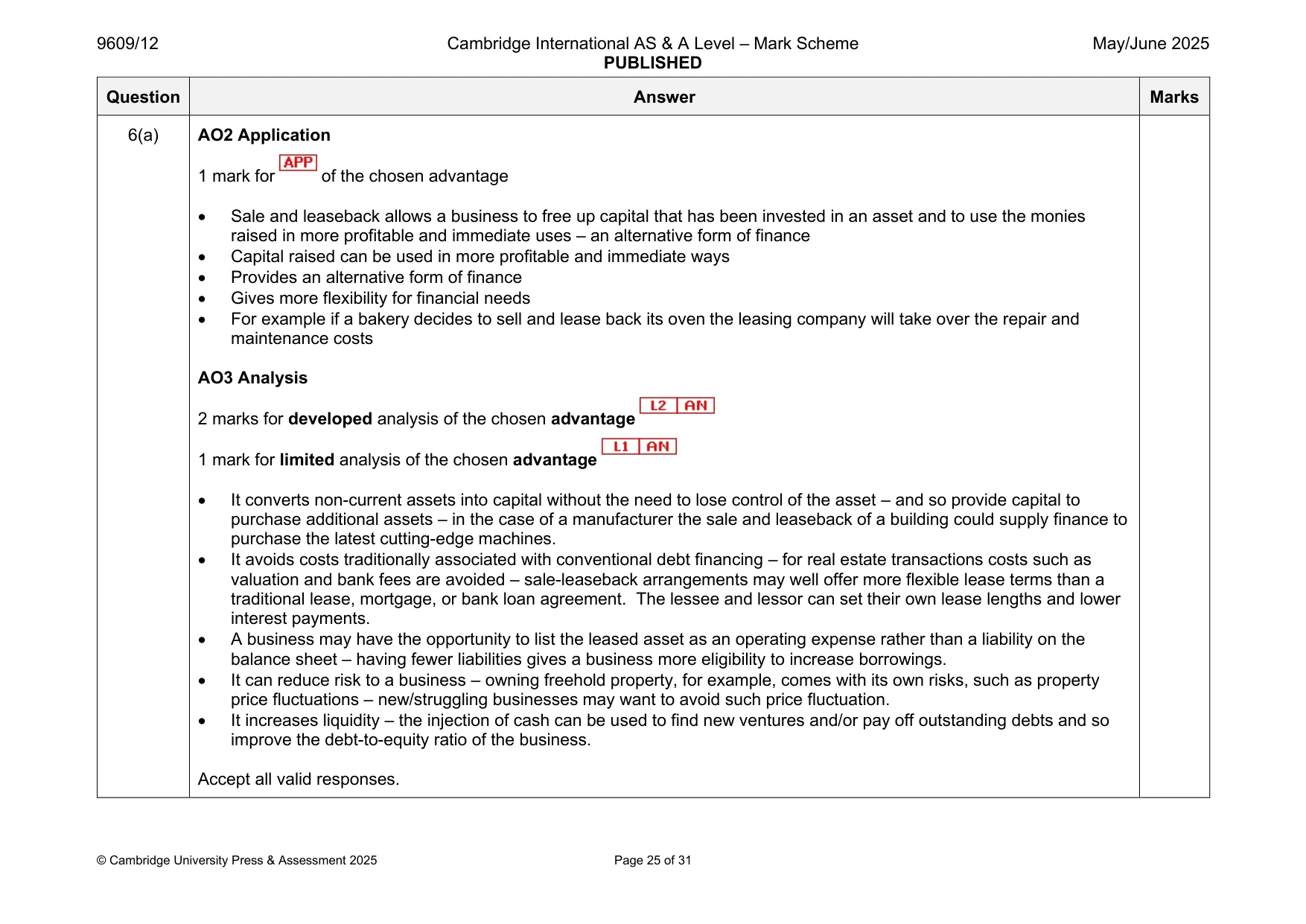
9609/12 Cambridge International AS & A Level – Mark Scheme PUBLISHED May/June 2025 © Cambridge University Press & Assessment 2025 Page 25 of 31 Question Answer Marks 6(a) AO2 Application 1 mark for of the chosen advantage • Sale and leaseback allows a business to free up capital that has been invested in an asset and to use the monies raised in more profitable and immediate uses – an alternative form of finance • Capital raised can be used in more profitable and immediate ways • Provides an alternative form of finance • Gives more flexibility for financial needs • For example if a bakery decides to sell and lease back its oven the leasing company will take over the repair and maintenance costs AO3 Analysis 2 marks for developed analysis of the chosen advantage 1 mark for limited analysis of the chosen advantage • It converts non-current assets into capital without the need to lose control of the asset – and so provide capital to purchase additional assets – in the case of a manufacturer the sale and leaseback of a building could supply finance to purchase the latest cutting-edge machines. • It avoids costs traditionally associated with conventional debt financing – for real estate transactions costs such as valuation and bank fees are avoided – sale-leaseback arrangements may well offer more flexible lease terms than a traditional lease, mortgage, or bank loan agreement. The lessee and lessor can set their own lease lengths and lower interest payments. • A business may have the opportunity to list the leased asset as an operating expense rather than a liability on the balance sheet – having fewer liabilities gives a business more eligibility to increase borrowings. • It can reduce risk to a business – owning freehold property, for example, comes with its own risks, such as property price fluctuations – new/struggling businesses may want to avoid such price fluctuation. • It increases liquidity – the injection of cash can be used to find new ventures and/or pay off outstanding debts and so improve the debt-to-equity ratio of the business. Accept all valid responses.
Mark scheme, page 26
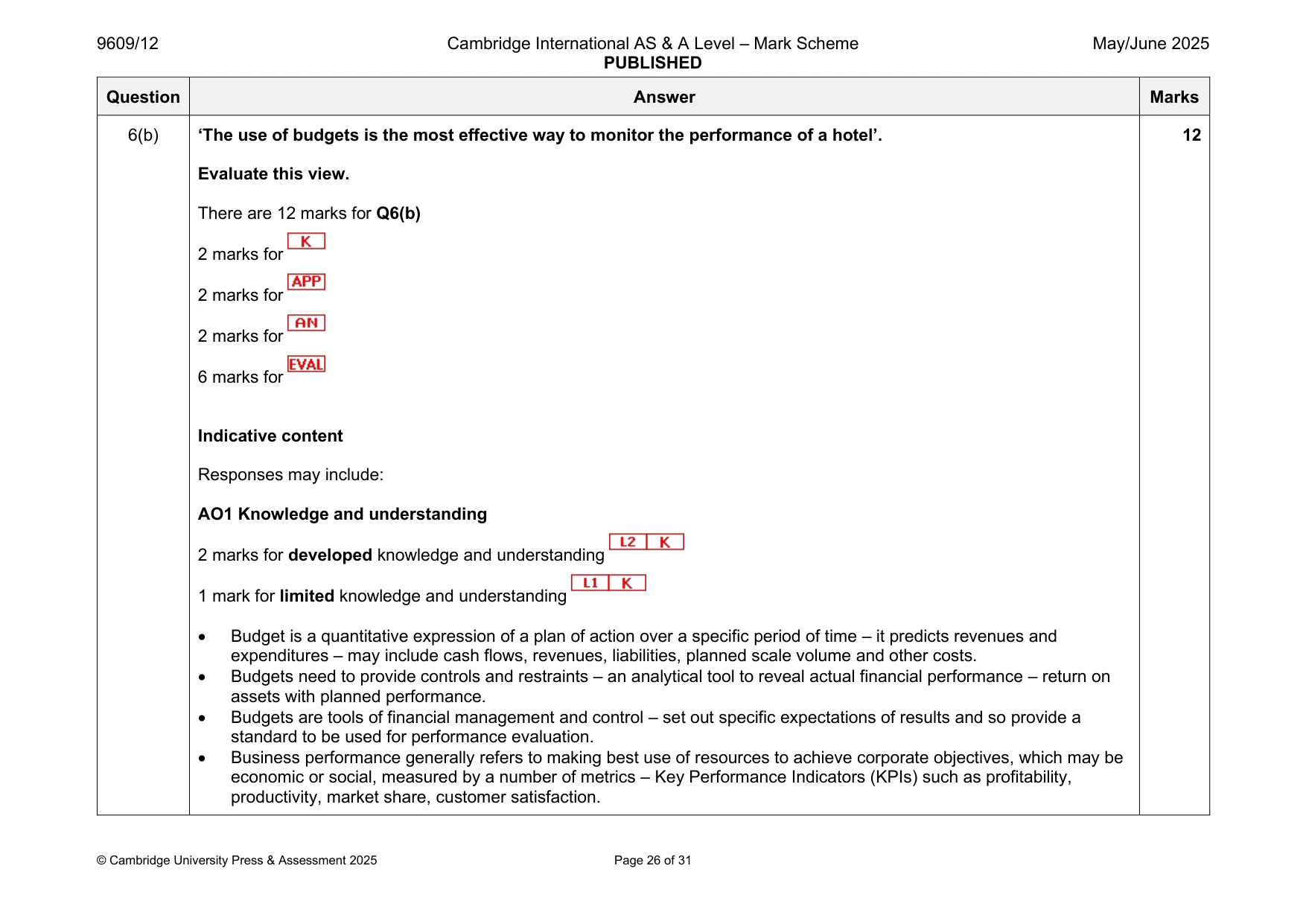
9609/12 Cambridge International AS & A Level – Mark Scheme PUBLISHED May/June 2025 © Cambridge University Press & Assessment 2025 Page 26 of 31 Question Answer Marks 6(b) ‘The use of budgets is the most effective way to monitor the performance of a hotel’. Evaluate this view. There are 12 marks for Q6(b) 2 marks for 2 marks for 2 marks for 6 marks for Indicative content Responses may include: AO1 Knowledge and understanding 2 marks for developed knowledge and understanding 1 mark for limited knowledge and understanding • Budget is a quantitative expression of a plan of action over a specific period of time – it predicts revenues and expenditures – may include cash flows, revenues, liabilities, planned scale volume and other costs. • Budgets need to provide controls and restraints – an analytical tool to reveal actual financial performance – return on assets with planned performance. • Budgets are tools of financial management and control – set out specific expectations of results and so provide a standard to be used for performance evaluation. • Business performance generally refers to making best use of resources to achieve corporate objectives, which may be economic or social, measured by a number of metrics – Key Performance Indicators (KPIs) such as profitability, productivity, market share, customer satisfaction. 12
Mark scheme, page 27
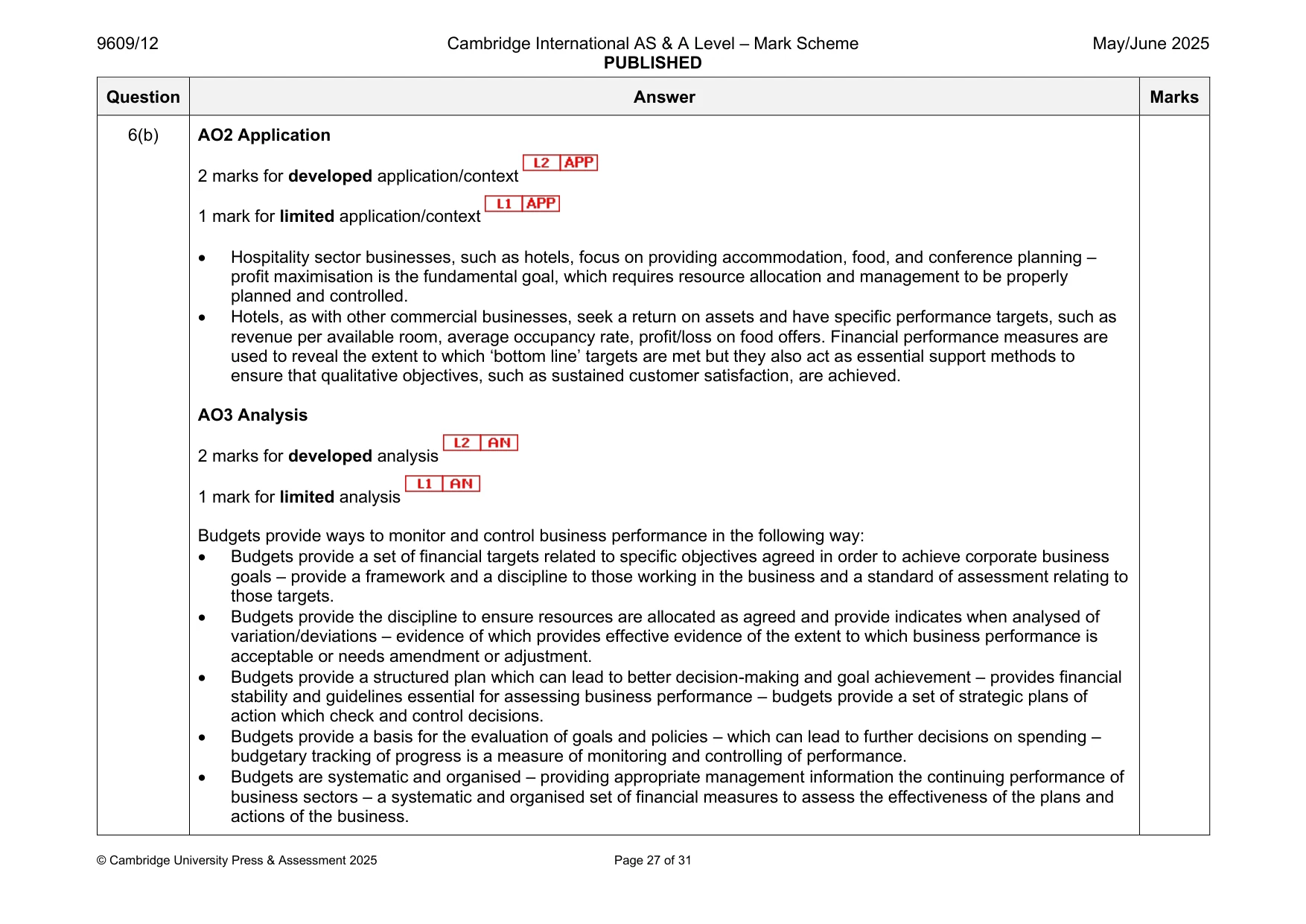
9609/12 Cambridge International AS & A Level – Mark Scheme PUBLISHED May/June 2025 © Cambridge University Press & Assessment 2025 Page 27 of 31 Question Answer Marks 6(b) AO2 Application 2 marks for developed application/context 1 mark for limited application/context • Hospitality sector businesses, such as hotels, focus on providing accommodation, food, and conference planning – profit maximisation is the fundamental goal, which requires resource allocation and management to be properly planned and controlled. • Hotels, as with other commercial businesses, seek a return on assets and have specific performance targets, such as revenue per available room, average occupancy rate, profit/loss on food offers. Financial performance measures are used to reveal the extent to which ‘bottom line’ targets are met but they also act as essential support methods to ensure that qualitative objectives, such as sustained customer satisfaction, are achieved. AO3 Analysis 2 marks for developed analysis 1 mark for limited analysis Budgets provide ways to monitor and control business performance in the following way: • Budgets provide a set of financial targets related to specific objectives agreed in order to achieve corporate business goals – provide a framework and a discipline to those working in the business and a standard of assessment relating to those targets. • Budgets provide the discipline to ensure resources are allocated as agreed and provide indicates when analysed of variation/deviations – evidence of which provides effective evidence of the extent to which business performance is acceptable or needs amendment or adjustment. • Budgets provide a structured plan which can lead to better decision-making and goal achievement – provides financial stability and guidelines essential for assessing business performance – budgets provide a set of strategic plans of action which check and control decisions. • Budgets provide a basis for the evaluation of goals and policies – which can lead to further decisions on spending – budgetary tracking of progress is a measure of monitoring and controlling of performance. • Budgets are systematic and organised – providing appropriate management information the continuing performance of business sectors – a systematic and organised set of financial measures to assess the effectiveness of the plans and actions of the business.
Mark scheme, page 28
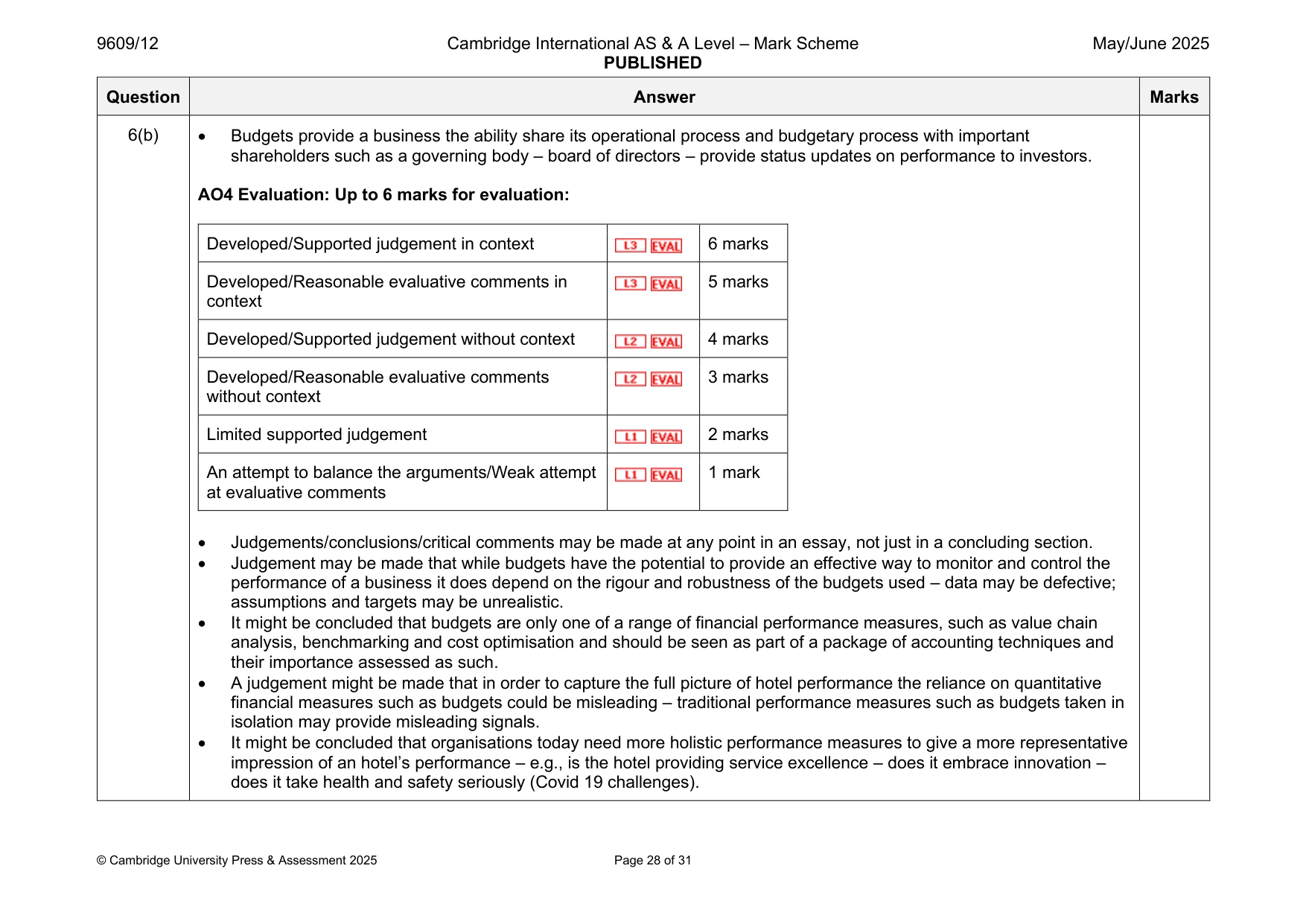
9609/12 Cambridge International AS & A Level – Mark Scheme PUBLISHED May/June 2025 © Cambridge University Press & Assessment 2025 Page 28 of 31 Question Answer Marks 6(b) • Budgets provide a business the ability share its operational process and budgetary process with important shareholders such as a governing body – board of directors – provide status updates on performance to investors. AO4 Evaluation: Up to 6 marks for evaluation: Developed/Supported judgement in context 6 marks Developed/Reasonable evaluative comments in context 5 marks Developed/Supported judgement without context 4 marks Developed/Reasonable evaluative comments without context 3 marks Limited supported judgement 2 marks An attempt to balance the arguments/Weak attempt at evaluative comments 1 mark • Judgements/conclusions/critical comments may be made at any point in an essay, not just in a concluding section. • Judgement may be made that while budgets have the potential to provide an effective way to monitor and control the performance of a business it does depend on the rigour and robustness of the budgets used – data may be defective; assumptions and targets may be unrealistic. • It might be concluded that budgets are only one of a range of financial performance measures, such as value chain analysis, benchmarking and cost optimisation and should be seen as part of a package of accounting techniques and their importance assessed as such. • A judgement might be made that in order to capture the full picture of hotel performance the reliance on quantitative financial measures such as budgets could be misleading – traditional performance measures such as budgets taken in isolation may provide misleading signals. • It might be concluded that organisations today need more holistic performance measures to give a more representative impression of an hotel’s performance – e.g., is the hotel providing service excellence – does it embrace innovation – does it take health and safety seriously (Covid 19 challenges).
Mark scheme, page 29
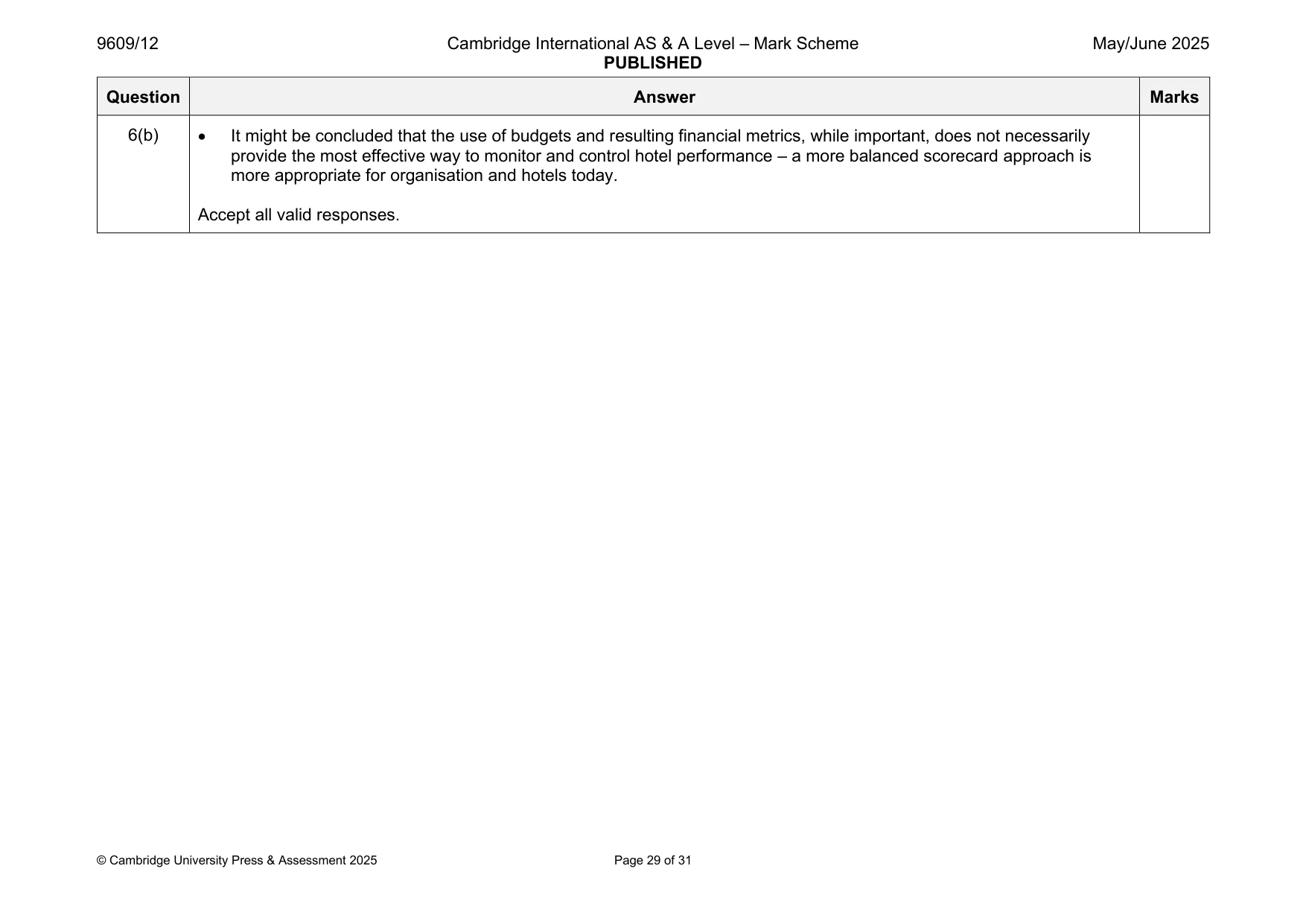
9609/12 Cambridge International AS & A Level – Mark Scheme PUBLISHED May/June 2025 © Cambridge University Press & Assessment 2025 Page 29 of 31 Question Answer Marks 6(b) • It might be concluded that the use of budgets and resulting financial metrics, while important, does not necessarily provide the most effective way to monitor and control hotel performance – a more balanced scorecard approach is more appropriate for organisation and hotels today. Accept all valid responses.
Mark scheme, page 30
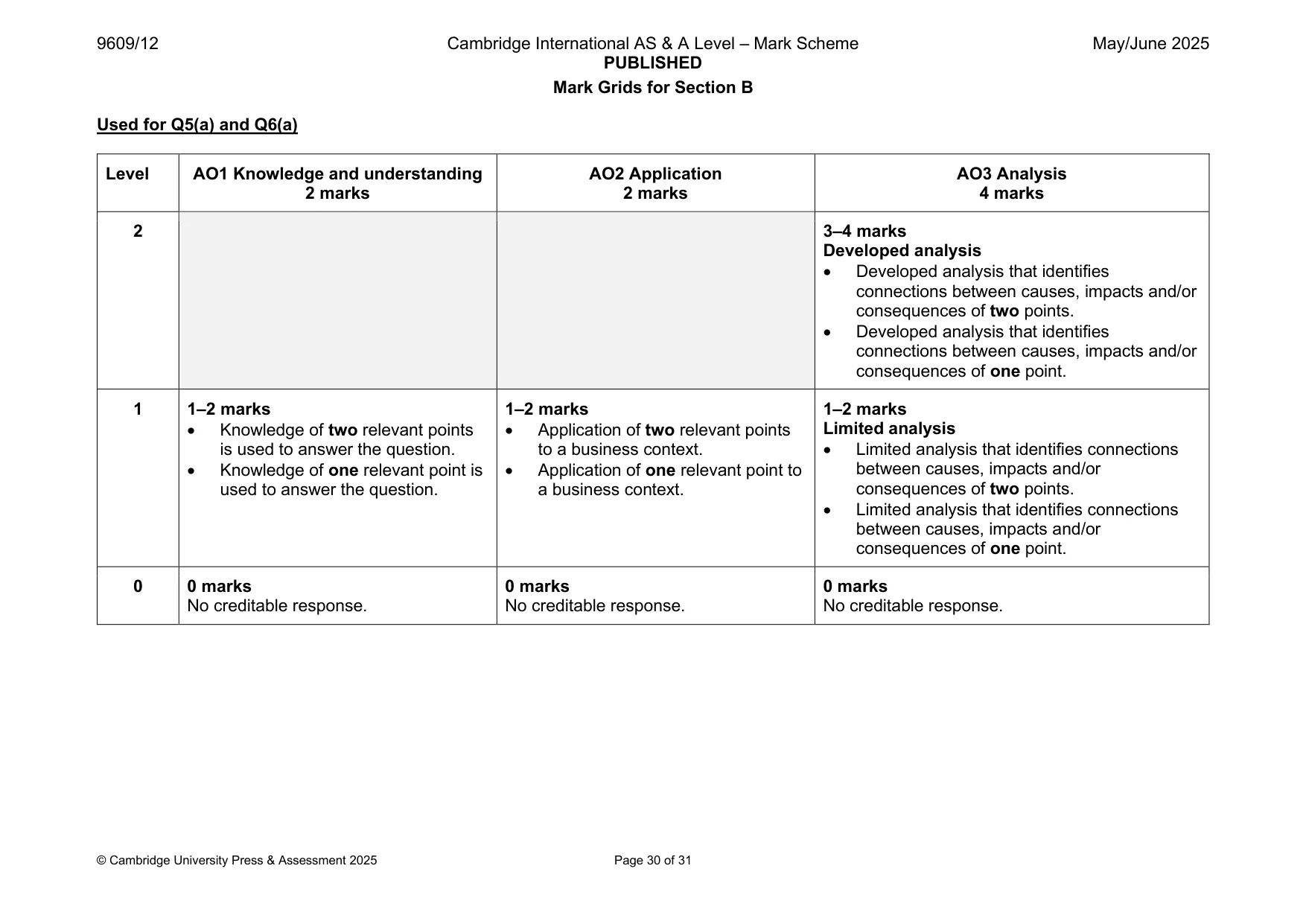
9609/12 Cambridge International AS & A Level – Mark Scheme PUBLISHED May/June 2025 © Cambridge University Press & Assessment 2025 Page 30 of 31 Mark Grids for Section B Used for Q5(a) and Q6(a) Level AO1 Knowledge and understanding 2 marks AO2 Application 2 marks AO3 Analysis 4 marks 2 3–4 marks Developed analysis • Developed analysis that identifies connections between causes, impacts and/or consequences of two points. • Developed analysis that identifies connections between causes, impacts and/or consequences of one point. 1 1–2 marks • Knowledge of two relevant points is used to answer the question. • Knowledge of one relevant point is used to answer the question. 1–2 marks • Application of two relevant points to a business context. • Application of one relevant point to a business context. 1–2 marks Limited analysis • Limited analysis that identifies connections between causes, impacts and/or consequences of two points. • Limited analysis that identifies connections between causes, impacts and/or consequences of one point. 0 0 marks No creditable response. 0 marks No creditable response. 0 marks No creditable response.
Mark scheme, page 31
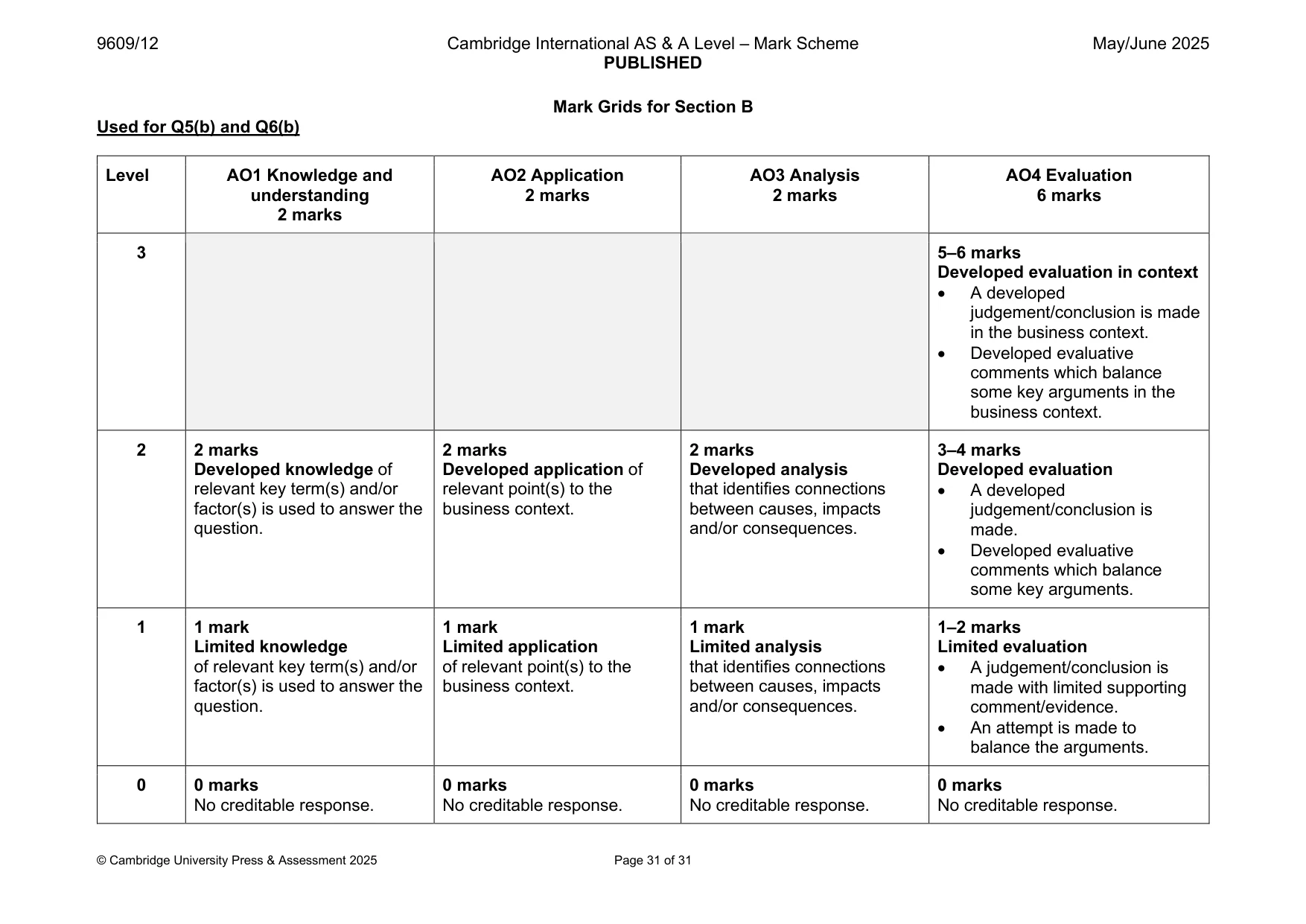
9609/12 Cambridge International AS & A Level – Mark Scheme PUBLISHED May/June 2025 © Cambridge University Press & Assessment 2025 Page 31 of 31 Mark Grids for Section B Used for Q5(b) and Q6(b) Level AO1 Knowledge and understanding 2 marks AO2 Application 2 marks AO3 Analysis 2 marks AO4 Evaluation 6 marks 3 5–6 marks Developed evaluation in context • A developed judgement/conclusion is made in the business context. • Developed evaluative comments which balance some key arguments in the business context. 2 2 marks Developed knowledge of relevant key term(s) and/or factor(s) is used to answer the question. 2 marks Developed application of relevant point(s) to the business context. 2 marks Developed analysis that identifies connections between causes, impacts and/or consequences. 3–4 marks Developed evaluation • A developed judgement/conclusion is made. • Developed evaluative comments which balance some key arguments. 1 1 mark Limited knowledge of relevant key term(s) and/or factor(s) is used to answer the question. 1 mark Limited application of relevant point(s) to the business context. 1 mark Limited analysis that identifies connections between causes, impacts and/or consequences. 1–2 marks Limited evaluation • A judgement/conclusion is made with limited supporting comment/evidence. • An attempt is made to balance the arguments. 0 0 marks No creditable response. 0 marks No creditable response. 0 marks No creditable response. 0 marks No creditable response.
What you needed in this session
Cambridge’s own grade thresholds for 2025 May/June, Paper 1 · Variant 2. A higher threshold means an easier paper — the bar moves with how the cohort did.