Cambridge A Level Business (for first examination in 2016) 9609 — 2025 May/June Paper 1 · Variant 1
9609/11/M/J/25 · 40 marks · ≈45 min
The question paper and its mark scheme, free to read here and free to download. This is Cambridge’s own paper, exactly as it was sat.
Question paper4 pages


Mark scheme35 pages
Answers below. Sit the paper first if you are practising.
Paper as text
Question paper, page 1
This document has 4 pages. Any blank pages are indicated. [Turn over Cambridge International AS & A Level * 5 5 1 1 6 5 7 1 7 8 * BUSINESS 9609/11 Paper 1 Business Concepts 1 May/June 2025 1 hour 15 minutes You must answer on the enclosed answer booklet. You will need: Answer booklet (enclosed) INSTRUCTIONS ● Answer five questions in total: Section A: answer all questions. Section B: answer one question. ● Follow the instructions on the front cover of the answer booklet. If you need additional answer paper, ask the invigilator for a continuation booklet. INFORMATION ● The total mark for this paper is 40. ● The number of marks for each question or part question is shown in brackets [ ]. DC (DE) 341665/1 © UCLES 2025
Question paper, page 2
2 9609/11/M/J/25 © UCLES 2025 Section A Answer all questions. 1 (a) Define the term job enrichment. [2] (b) Explain one disadvantage to a business of using empowerment to motivate employees. [3] 2 (a) Define the term price discrimination. [2] (b) Explain one disadvantage to a business of using competitive pricing. [3] 3 (a) Define the term capital intensive operations. [2] (b) Explain one limitation to a business of labour intensive operations. [3] 4 Analyse one way a business might fail as a consequence of lack of finance. [5] Section B Answer one question only. EITHER 5 (a) Analyse two ways business enterprise can help the development of a country. [8] (b) ‘Intrapreneurship is the most important factor that will ensure the success of a computer entertainment business.’ Evaluate this view. [12] OR 6 (a) Analyse two ways international markets may present different challenges to a business than national markets. [8] (b) Evaluate whether customer relationship marketing (CRM) is suitable for all small businesses. [12]
Question paper, page 3
3 9609/11/M/J/25 © UCLES 2025 BLANK PAGE
Question paper, page 4
4 9609/11/M/J/25 © UCLES 2025 Permission to reproduce items where third-party owned material protected by copyright is included has been sought and cleared where possible. Every reasonable effort has been made by the publisher (UCLES) to trace copyright holders, but if any items requiring clearance have unwittingly been included, the publisher will be pleased to make amends at the earliest possible opportunity. To avoid the issue of disclosure of answer-related information to candidates, all copyright acknowledgements are reproduced online in the Cambridge Assessment International Education Copyright Acknowledgements Booklet. This is produced for each series of examinations and is freely available to download at www.cambridgeinternational.org after the live examination series. Cambridge Assessment International Education is part of Cambridge Assessment. Cambridge Assessment is the brand name of the University of Cambridge Local Examinations Syndicate (UCLES), which is a department of the University of Cambridge. BLANK PAGE
Mark scheme, page 1
This document consists of 35 printed pages. © Cambridge University Press & Assessment 2025 [Turn over Cambridge International AS & A Level BUSINESS 9609/11 Paper 1 Business Concepts 1 May/June 2025 MARK SCHEME Maximum Mark: 40 Published This mark scheme is published as an aid to teachers and candidates, to indicate the requirements of the examination. It shows the basis on which Examiners were instructed to award marks. It does not indicate the details of the discussions that took place at an Examiners’ meeting before marking began, which would have considered the acceptability of alternative answers. Mark schemes should be read in conjunction with the question paper and the Principal Examiner Report for Teachers. Cambridge International will not enter into discussions about these mark schemes. Cambridge International is publishing the mark schemes for the May/June 2025 series for most Cambridge IGCSE, Cambridge International A and AS Level components, and some Cambridge O Level components.
Mark scheme, page 2
9609/11 Cambridge International AS & A Level – Mark Scheme PUBLISHED May/June 2025 © Cambridge University Press & Assessment 2025 Page 2 of 35 Generic Marking Principles These general marking principles must be applied by all examiners when marking candidate answers. They should be applied alongside the specific content of the mark scheme or generic level descriptions for a question. Each question paper and mark scheme will also comply with these marking principles. GENERIC MARKING PRINCIPLE 1: Marks must be awarded in line with: • the specific content of the mark scheme or the generic level descriptors for the question • the specific skills defined in the mark scheme or in the generic level descriptors for the question • the standard of response required by a candidate as exemplified by the standardisation scripts. GENERIC MARKING PRINCIPLE 2: Marks awarded are always whole marks (not half marks, or other fractions). GENERIC MARKING PRINCIPLE 3: Marks must be awarded positively: • marks are awarded for correct/valid answers, as defined in the mark scheme. However, credit is given for valid answers which go beyond the scope of the syllabus and mark scheme, referring to your Team Leader as appropriate • marks are awarded when candidates clearly demonstrate what they know and can do • marks are not deducted for errors • marks are not deducted for omissions • answers should only be judged on the quality of spelling, punctuation and grammar when these features are specifically assessed by the question as indicated by the mark scheme. The meaning, however, should be unambiguous. GENERIC MARKING PRINCIPLE 4: Rules must be applied consistently, e.g. in situations where candidates have not followed instructions or in the application of generic level descriptors.
Mark scheme, page 3
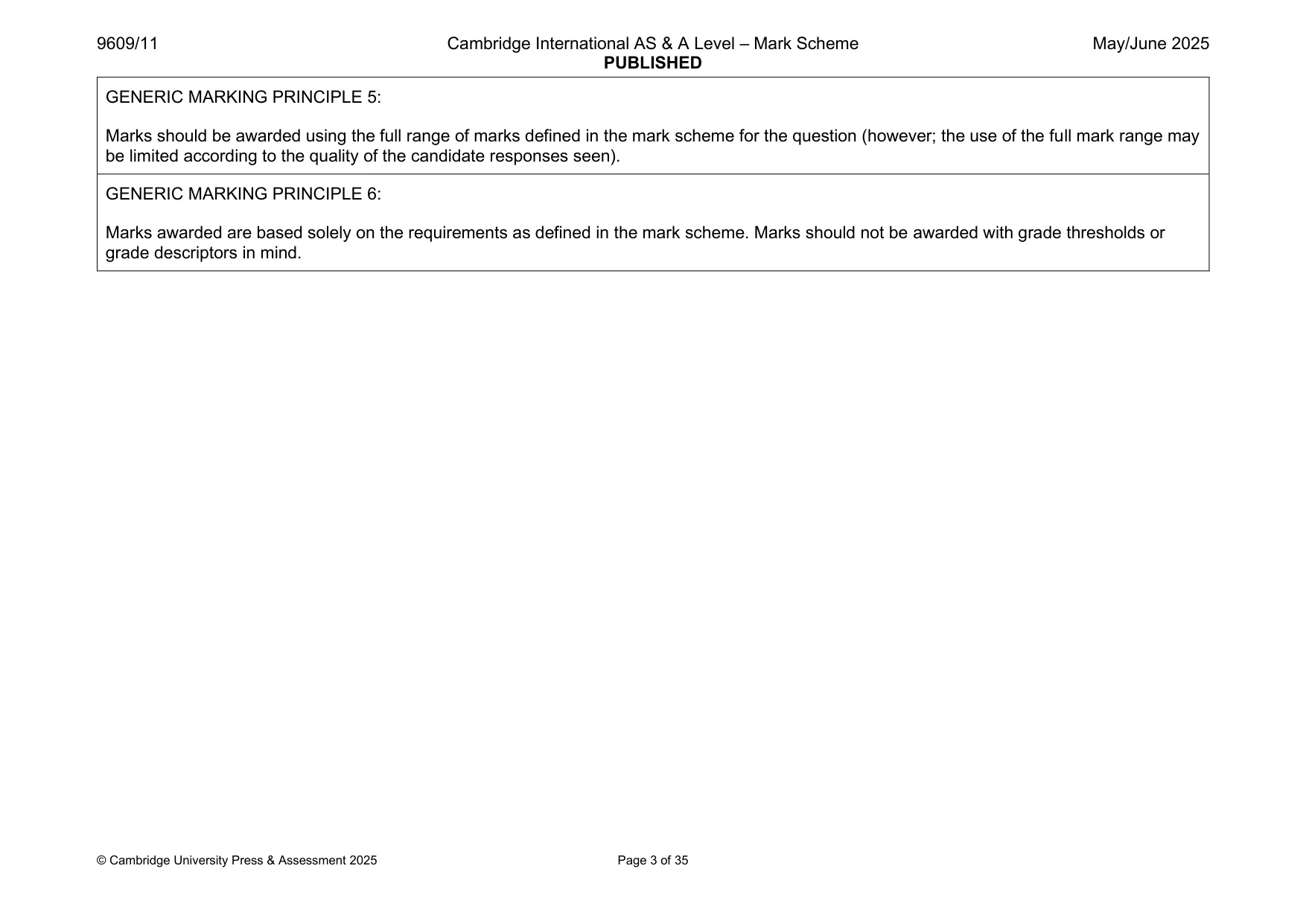
9609/11 Cambridge International AS & A Level – Mark Scheme PUBLISHED May/June 2025 © Cambridge University Press & Assessment 2025 Page 3 of 35 GENERIC MARKING PRINCIPLE 5: Marks should be awarded using the full range of marks defined in the mark scheme for the question (however; the use of the full mark range may be limited according to the quality of the candidate responses seen). GENERIC MARKING PRINCIPLE 6: Marks awarded are based solely on the requirements as defined in the mark scheme. Marks should not be awarded with grade thresholds or grade descriptors in mind.
Mark scheme, page 4
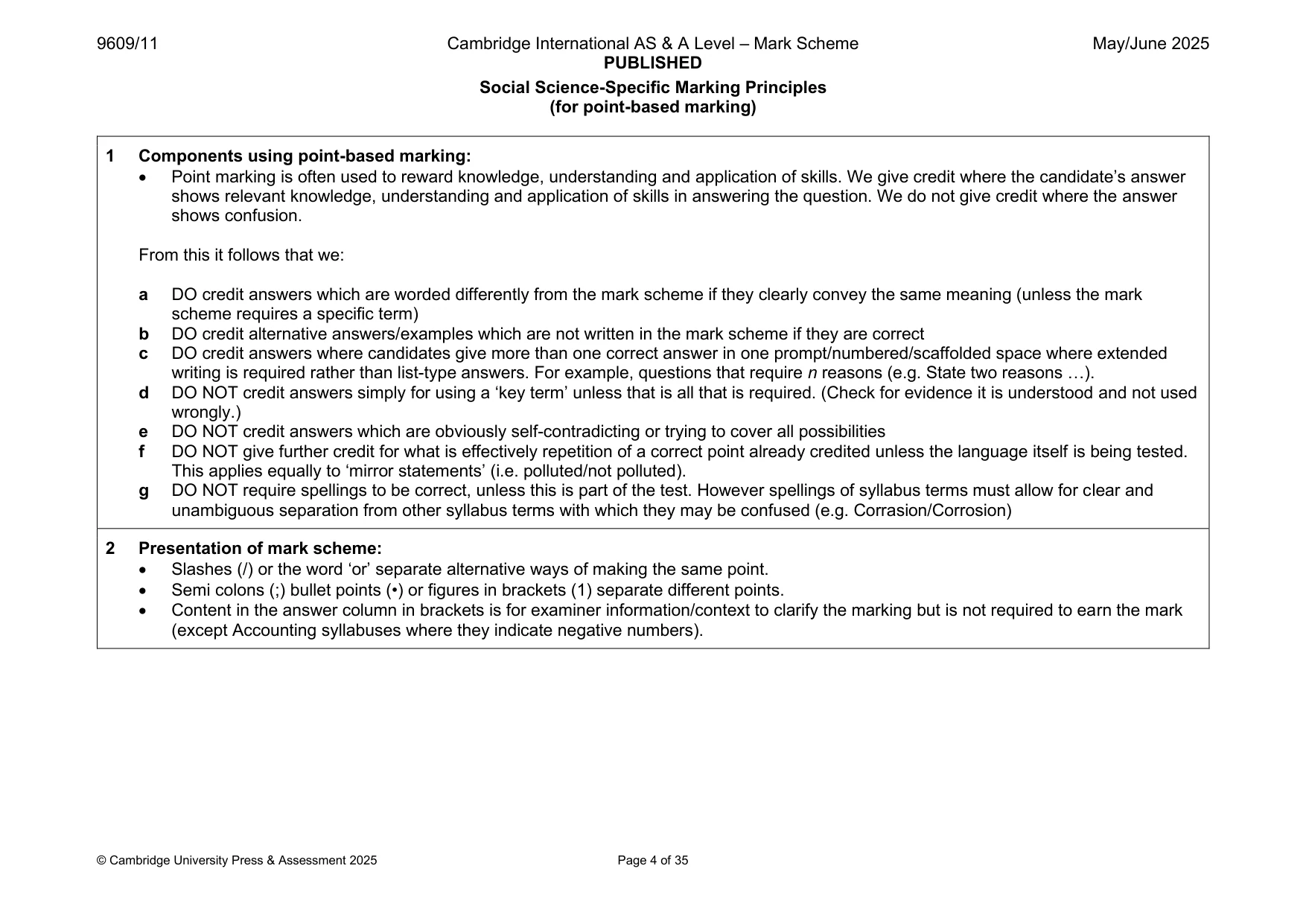
9609/11 Cambridge International AS & A Level – Mark Scheme PUBLISHED May/June 2025 © Cambridge University Press & Assessment 2025 Page 4 of 35 Social Science-Specific Marking Principles (for point-based marking) 1 Components using point-based marking: • Point marking is often used to reward knowledge, understanding and application of skills. We give credit where the candidate’s answer shows relevant knowledge, understanding and application of skills in answering the question. We do not give credit where the answer shows confusion. From this it follows that we: a DO credit answers which are worded differently from the mark scheme if they clearly convey the same meaning (unless the mark scheme requires a specific term) b DO credit alternative answers/examples which are not written in the mark scheme if they are correct c DO credit answers where candidates give more than one correct answer in one prompt/numbered/scaffolded space where extended writing is required rather than list-type answers. For example, questions that require n reasons (e.g. State two reasons …). d DO NOT credit answers simply for using a ‘key term’ unless that is all that is required. (Check for evidence it is understood and not used wrongly.) e DO NOT credit answers which are obviously self-contradicting or trying to cover all possibilities f DO NOT give further credit for what is effectively repetition of a correct point already credited unless the language itself is being tested. This applies equally to ‘mirror statements’ (i.e. polluted/not polluted). g DO NOT require spellings to be correct, unless this is part of the test. However spellings of syllabus terms must allow for clear and unambiguous separation from other syllabus terms with which they may be confused (e.g. Corrasion/Corrosion) 2 Presentation of mark scheme: • Slashes (/) or the word ‘or’ separate alternative ways of making the same point. • Semi colons (;) bullet points (•) or figures in brackets (1) separate different points. • Content in the answer column in brackets is for examiner information/context to clarify the marking but is not required to earn the mark (except Accounting syllabuses where they indicate negative numbers).
Mark scheme, page 5
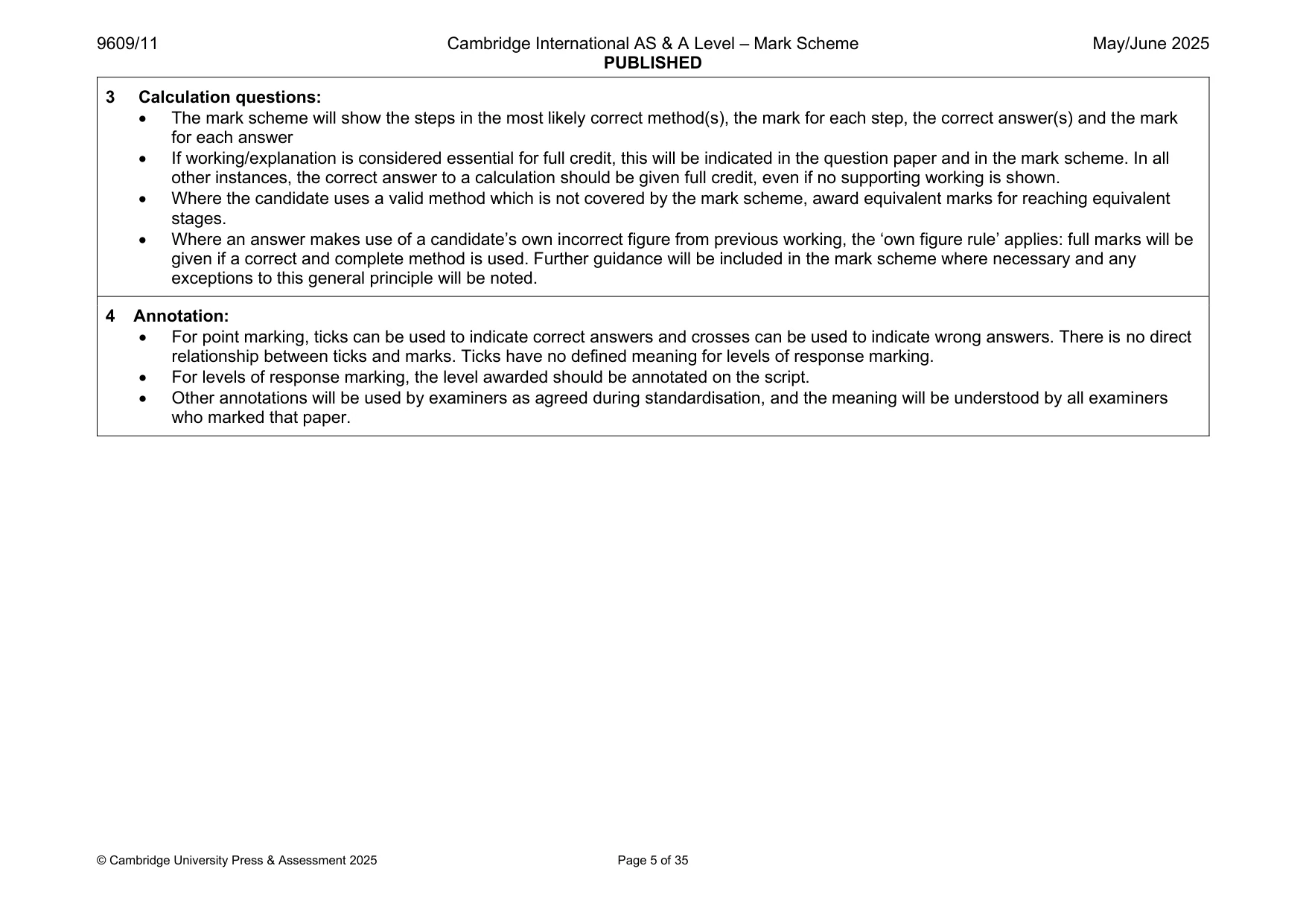
9609/11 Cambridge International AS & A Level – Mark Scheme PUBLISHED May/June 2025 © Cambridge University Press & Assessment 2025 Page 5 of 35 3 Calculation questions: • The mark scheme will show the steps in the most likely correct method(s), the mark for each step, the correct answer(s) and the mark for each answer • If working/explanation is considered essential for full credit, this will be indicated in the question paper and in the mark scheme. In all other instances, the correct answer to a calculation should be given full credit, even if no supporting working is shown. • Where the candidate uses a valid method which is not covered by the mark scheme, award equivalent marks for reaching equivalent stages. • Where an answer makes use of a candidate’s own incorrect figure from previous working, the ‘own figure rule’ applies: full marks will be given if a correct and complete method is used. Further guidance will be included in the mark scheme where necessary and any exceptions to this general principle will be noted. 4 Annotation: • For point marking, ticks can be used to indicate correct answers and crosses can be used to indicate wrong answers. There is no direct relationship between ticks and marks. Ticks have no defined meaning for levels of response marking. • For levels of response marking, the level awarded should be annotated on the script. • Other annotations will be used by examiners as agreed during standardisation, and the meaning will be understood by all examiners who marked that paper.
Mark scheme, page 6
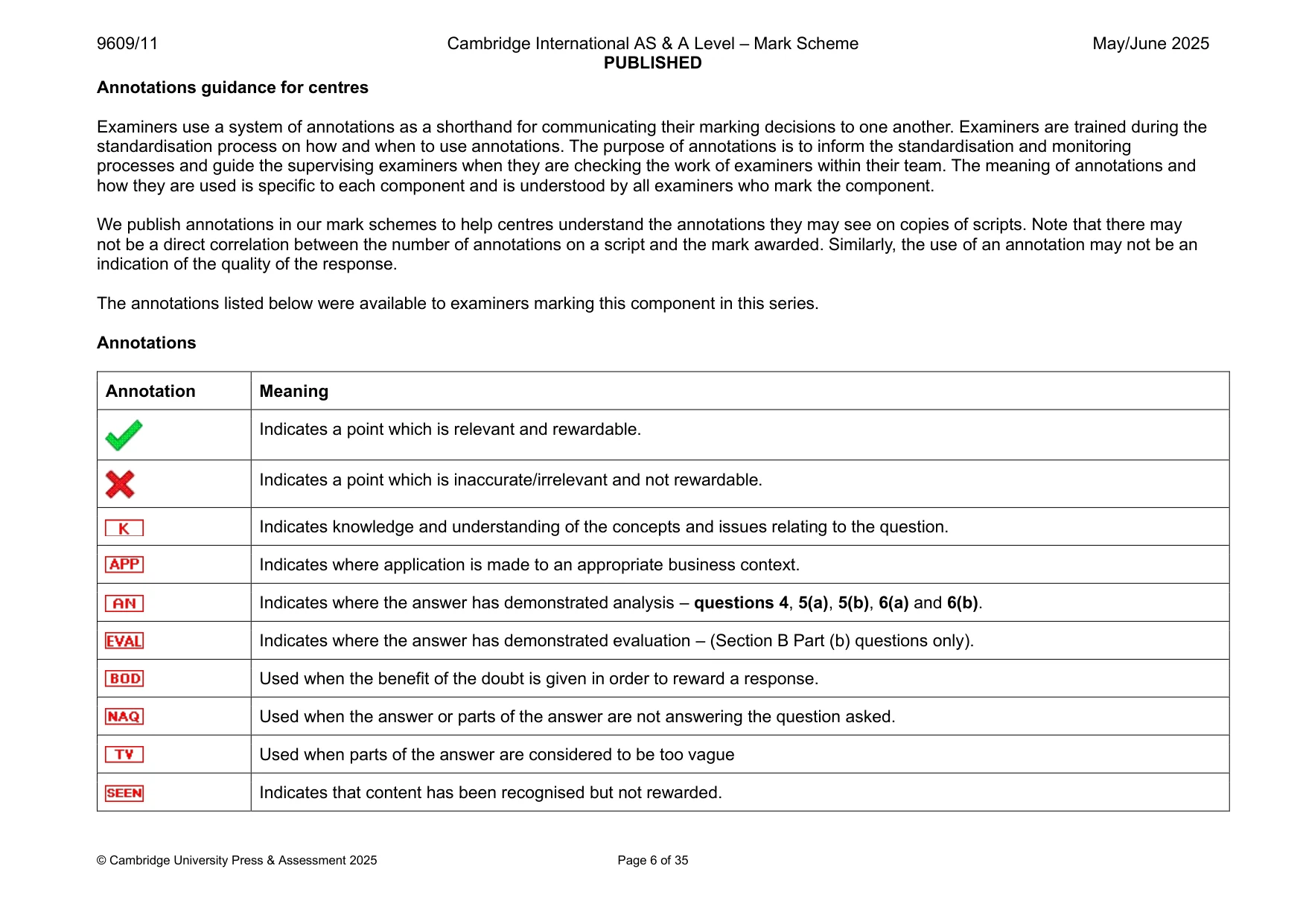
9609/11 Cambridge International AS & A Level – Mark Scheme PUBLISHED May/June 2025 © Cambridge University Press & Assessment 2025 Page 6 of 35 Annotations guidance for centres Examiners use a system of annotations as a shorthand for communicating their marking decisions to one another. Examiners are trained during the standardisation process on how and when to use annotations. The purpose of annotations is to inform the standardisation and monitoring processes and guide the supervising examiners when they are checking the work of examiners within their team. The meaning of annotations and how they are used is specific to each component and is understood by all examiners who mark the component. We publish annotations in our mark schemes to help centres understand the annotations they may see on copies of scripts. Note that there may not be a direct correlation between the number of annotations on a script and the mark awarded. Similarly, the use of an annotation may not be an indication of the quality of the response. The annotations listed below were available to examiners marking this component in this series. Annotations Annotation Meaning Indicates a point which is relevant and rewardable. Indicates a point which is inaccurate/irrelevant and not rewardable. Indicates knowledge and understanding of the concepts and issues relating to the question. Indicates where application is made to an appropriate business context. Indicates where the answer has demonstrated analysis – questions 4, 5(a), 5(b), 6(a) and 6(b). Indicates where the answer has demonstrated evaluation – (Section B Part (b) questions only). Used when the benefit of the doubt is given in order to reward a response. Used when the answer or parts of the answer are not answering the question asked. Used when parts of the answer are considered to be too vague Indicates that content has been recognised but not rewarded.
Mark scheme, page 7
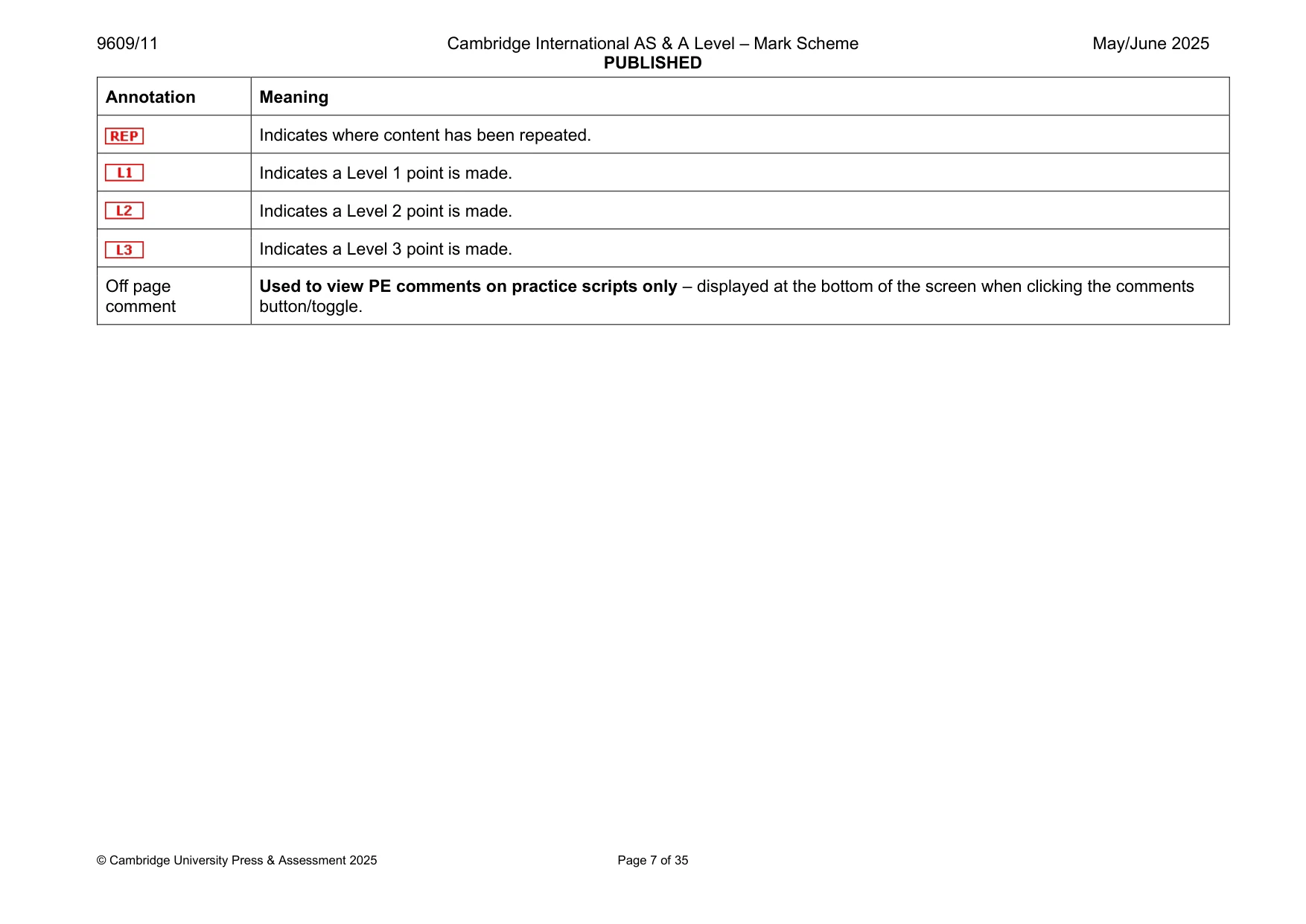
9609/11 Cambridge International AS & A Level – Mark Scheme PUBLISHED May/June 2025 © Cambridge University Press & Assessment 2025 Page 7 of 35 Annotation Meaning Indicates where content has been repeated. Indicates a Level 1 point is made. Indicates a Level 2 point is made. Indicates a Level 3 point is made. Off page comment Used to view PE comments on practice scripts only – displayed at the bottom of the screen when clicking the comments button/toggle.
Mark scheme, page 8
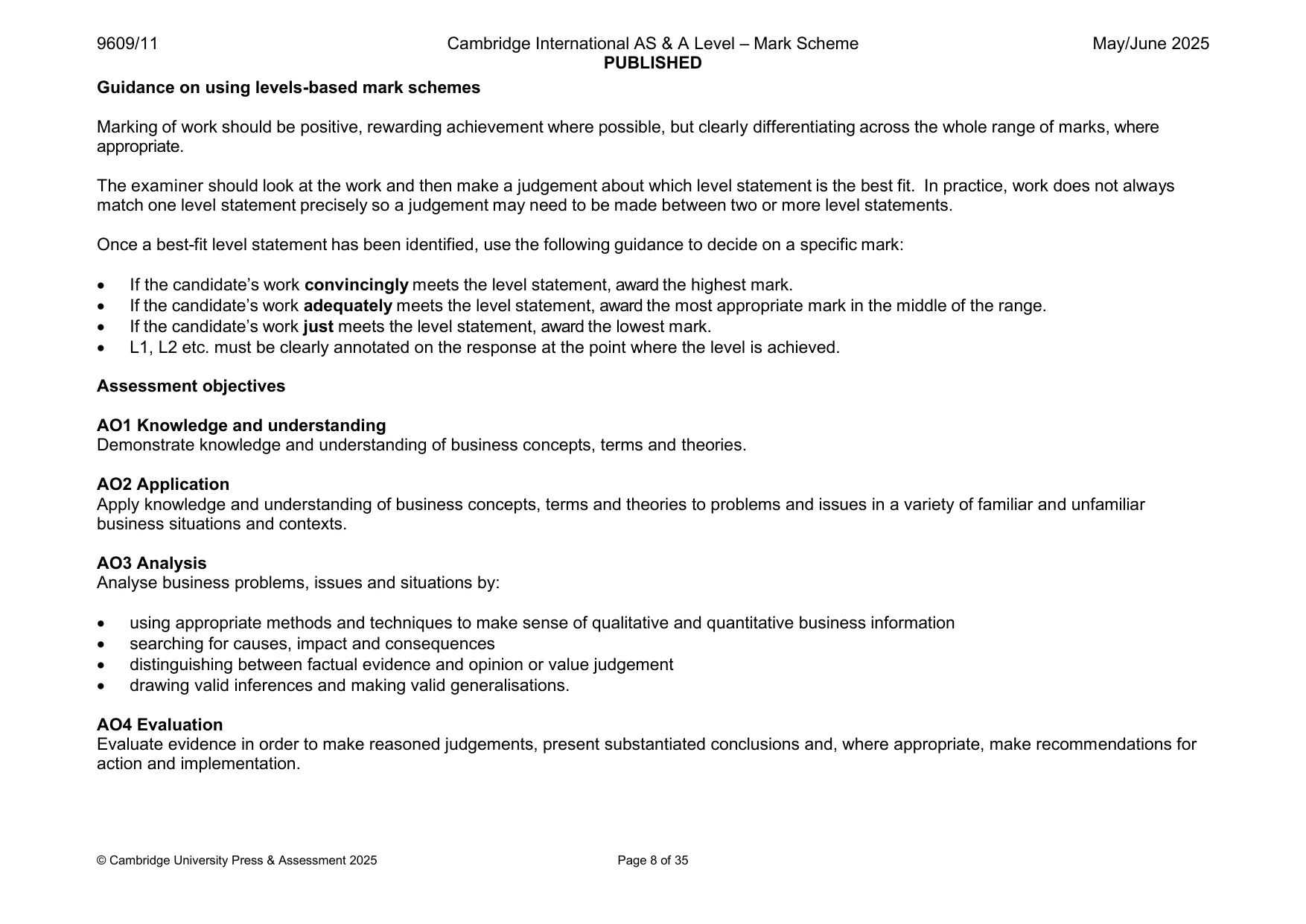
9609/11 Cambridge International AS & A Level – Mark Scheme PUBLISHED May/June 2025 © Cambridge University Press & Assessment 2025 Page 8 of 35 Guidance on using levels-based mark schemes Marking of work should be positive, rewarding achievement where possible, but clearly differentiating across the whole range of marks, where appropriate. The examiner should look at the work and then make a judgement about which level statement is the best fit. In practice, work does not always match one level statement precisely so a judgement may need to be made between two or more level statements. Once a best-fit level statement has been identified, use the following guidance to decide on a specific mark: • If the candidate’s work convincingly meets the level statement, award the highest mark. • If the candidate’s work adequately meets the level statement, award the most appropriate mark in the middle of the range. • If the candidate’s work just meets the level statement, award the lowest mark. • L1, L2 etc. must be clearly annotated on the response at the point where the level is achieved. Assessment objectives AO1 Knowledge and understanding Demonstrate knowledge and understanding of business concepts, terms and theories. AO2 Application Apply knowledge and understanding of business concepts, terms and theories to problems and issues in a variety of familiar and unfamiliar business situations and contexts. AO3 Analysis Analyse business problems, issues and situations by: • using appropriate methods and techniques to make sense of qualitative and quantitative business information • searching for causes, impact and consequences • distinguishing between factual evidence and opinion or value judgement • drawing valid inferences and making valid generalisations. AO4 Evaluation Evaluate evidence in order to make reasoned judgements, present substantiated conclusions and, where appropriate, make recommendations for action and implementation.
Mark scheme, page 9
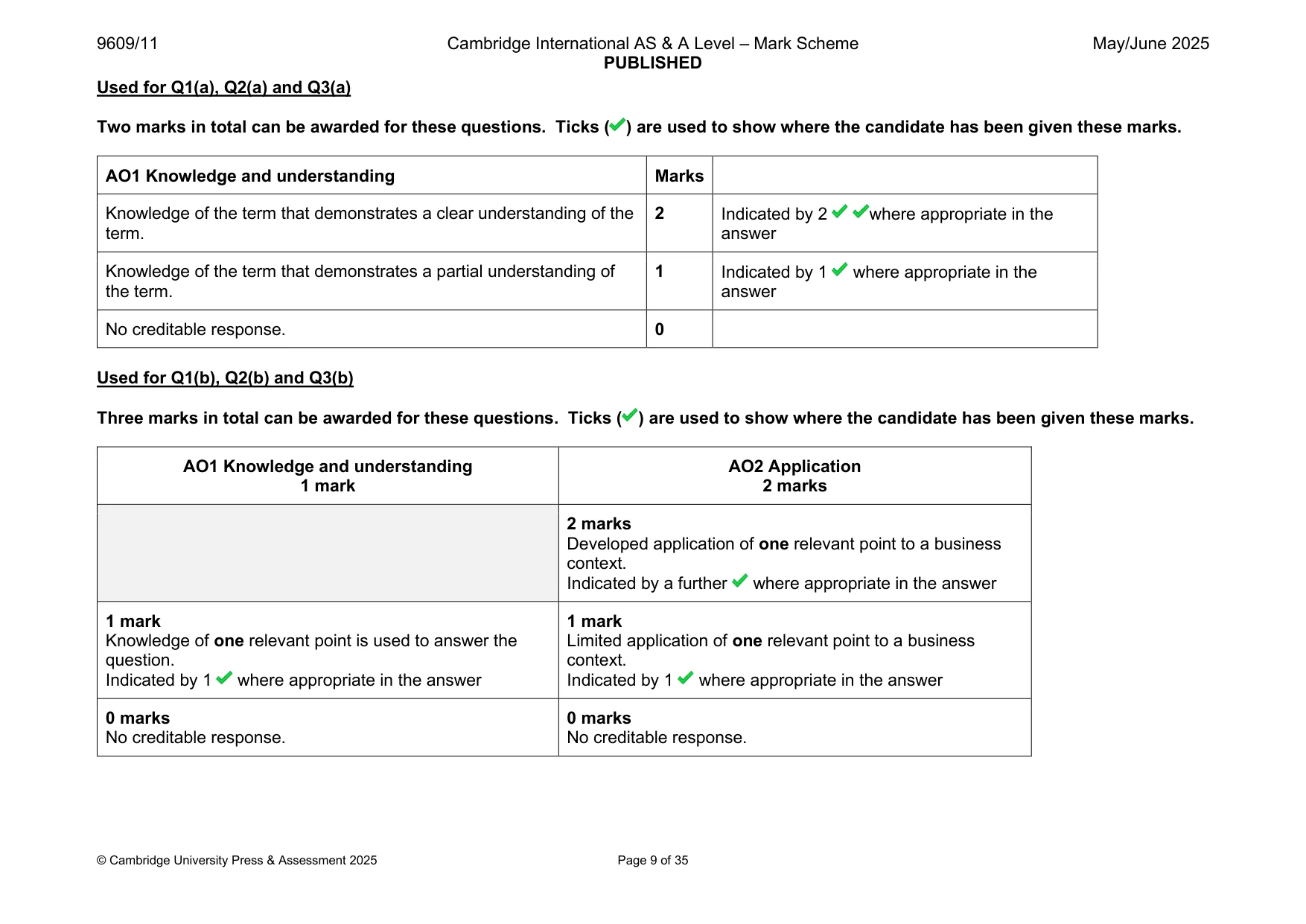
9609/11 Cambridge International AS & A Level – Mark Scheme PUBLISHED May/June 2025 © Cambridge University Press & Assessment 2025 Page 9 of 35 Used for Q1(a), Q2(a) and Q3(a) Two marks in total can be awarded for these questions. Ticks ( ) are used to show where the candidate has been given these marks. AO1 Knowledge and understanding Marks Knowledge of the term that demonstrates a clear understanding of the term. 2 Indicated by 2 where appropriate in the answer Knowledge of the term that demonstrates a partial understanding of the term. 1 Indicated by 1 where appropriate in the answer No creditable response. 0 Used for Q1(b), Q2(b) and Q3(b) Three marks in total can be awarded for these questions. Ticks ( ) are used to show where the candidate has been given these marks. AO1 Knowledge and understanding 1 mark AO2 Application 2 marks 2 marks Developed application of one relevant point to a business context. Indicated by a further where appropriate in the answer 1 mark Knowledge of one relevant point is used to answer the question. Indicated by 1 where appropriate in the answer 1 mark Limited application of one relevant point to a business context. Indicated by 1 where appropriate in the answer 0 marks No creditable response. 0 marks No creditable response.
Mark scheme, page 10
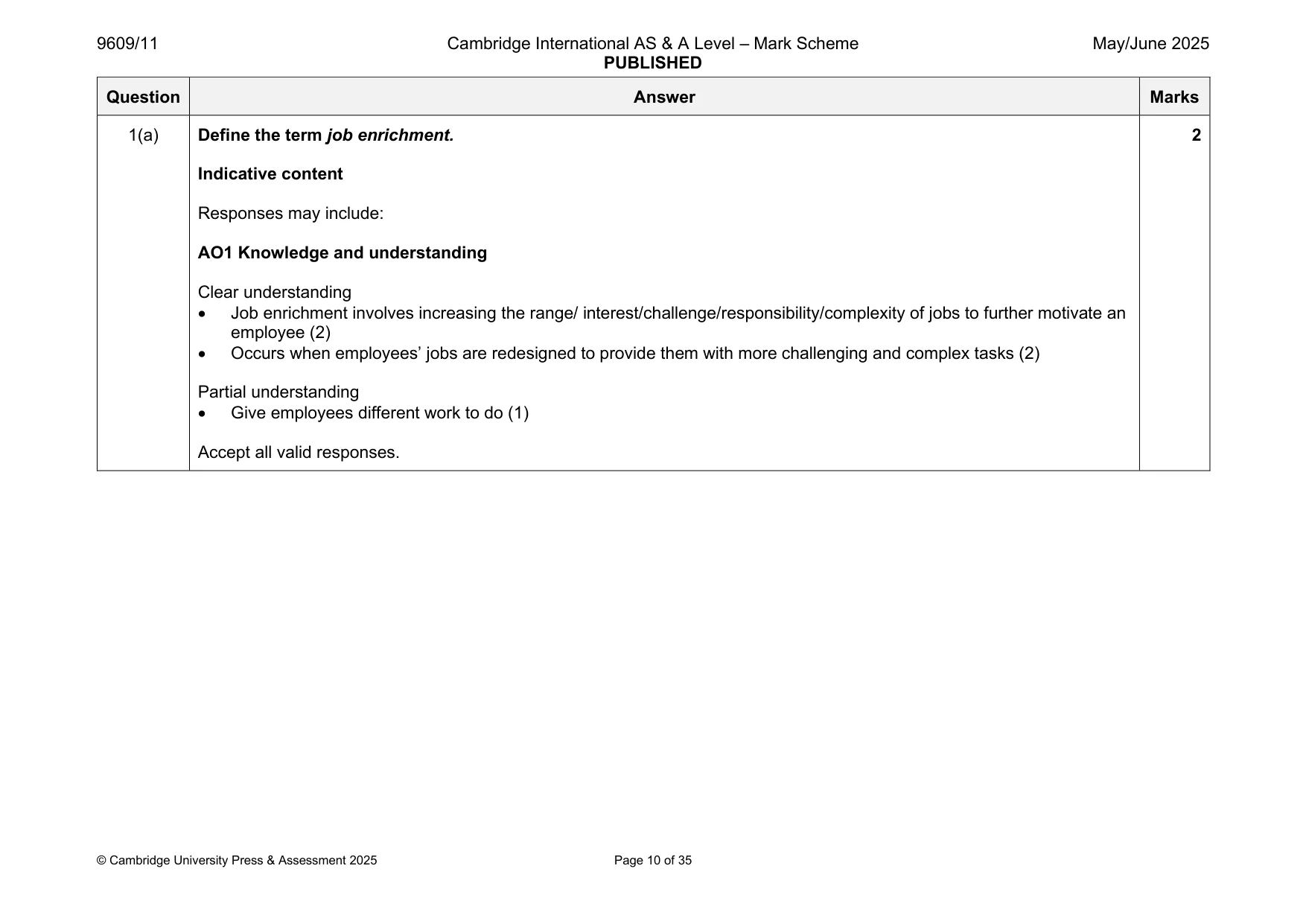
9609/11 Cambridge International AS & A Level – Mark Scheme PUBLISHED May/June 2025 © Cambridge University Press & Assessment 2025 Page 10 of 35 Question Answer Marks 1(a) Define the term job enrichment. Indicative content Responses may include: AO1 Knowledge and understanding Clear understanding • Job enrichment involves increasing the range/ interest/challenge/responsibility/complexity of jobs to further motivate an employee (2) • Occurs when employees’ jobs are redesigned to provide them with more challenging and complex tasks (2) Partial understanding • Give employees different work to do (1) Accept all valid responses. 2
Mark scheme, page 11
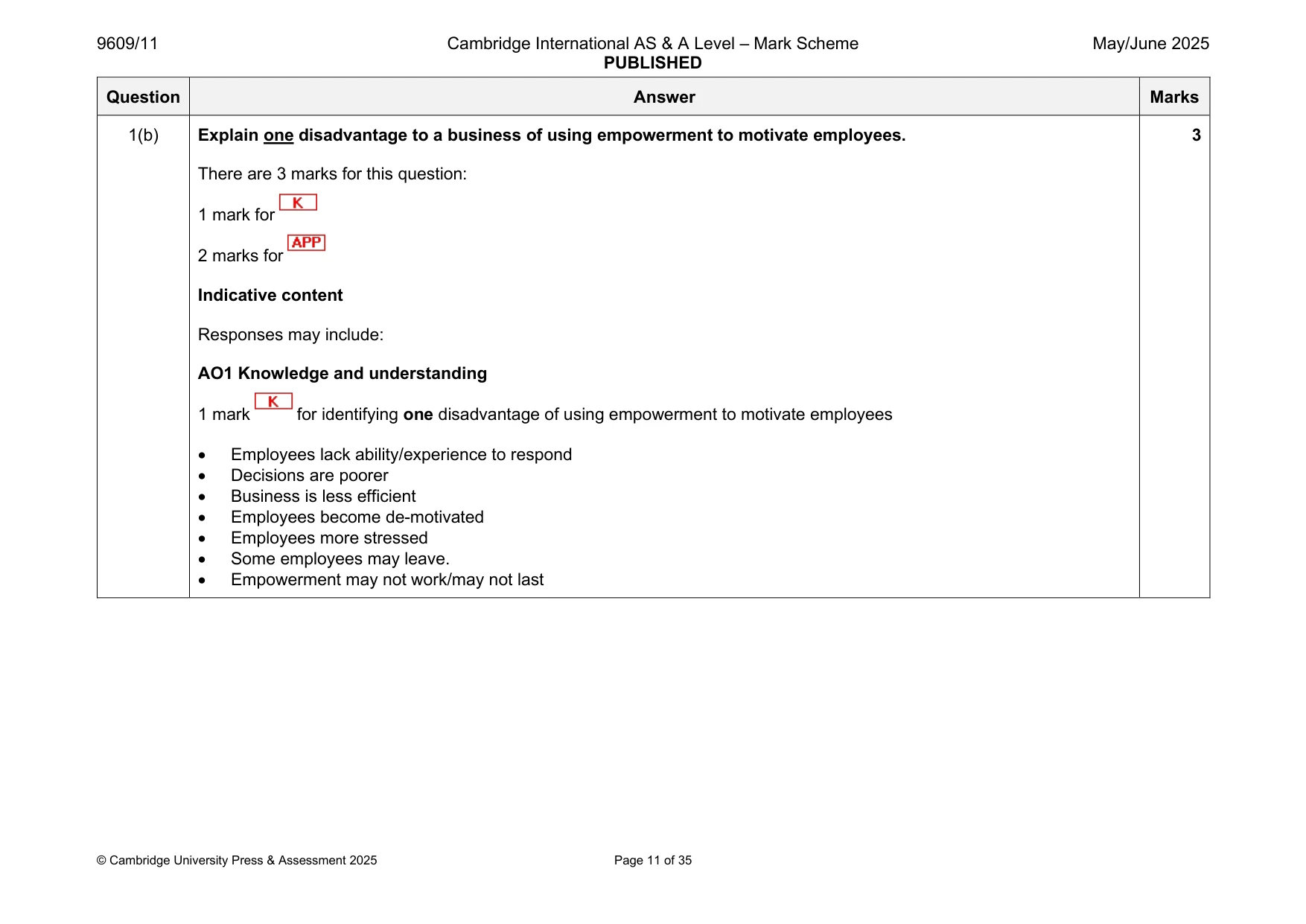
9609/11 Cambridge International AS & A Level – Mark Scheme PUBLISHED May/June 2025 © Cambridge University Press & Assessment 2025 Page 11 of 35 Question Answer Marks 1(b) Explain one disadvantage to a business of using empowerment to motivate employees. There are 3 marks for this question: 1 mark for 2 marks for Indicative content Responses may include: AO1 Knowledge and understanding 1 mark for identifying one disadvantage of using empowerment to motivate employees • Employees lack ability/experience to respond • Decisions are poorer • Business is less efficient • Employees become de-motivated • Employees more stressed • Some employees may leave. • Empowerment may not work/may not last 3
Mark scheme, page 12
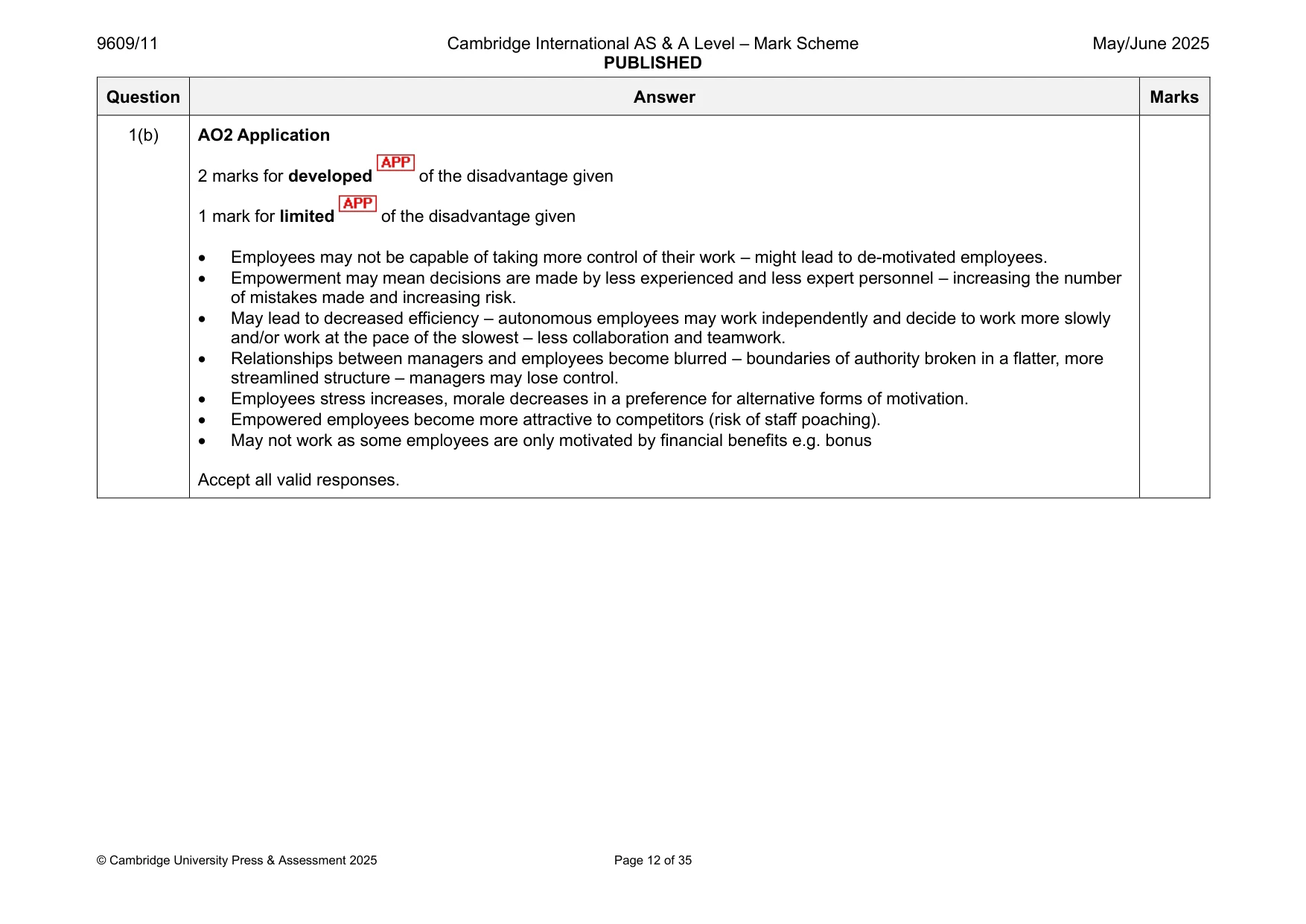
9609/11 Cambridge International AS & A Level – Mark Scheme PUBLISHED May/June 2025 © Cambridge University Press & Assessment 2025 Page 12 of 35 Question Answer Marks 1(b) AO2 Application 2 marks for developed of the disadvantage given 1 mark for limited of the disadvantage given • Employees may not be capable of taking more control of their work – might lead to de-motivated employees. • Empowerment may mean decisions are made by less experienced and less expert personnel – increasing the number of mistakes made and increasing risk. • May lead to decreased efficiency – autonomous employees may work independently and decide to work more slowly and/or work at the pace of the slowest – less collaboration and teamwork. • Relationships between managers and employees become blurred – boundaries of authority broken in a flatter, more streamlined structure – managers may lose control. • Employees stress increases, morale decreases in a preference for alternative forms of motivation. • Empowered employees become more attractive to competitors (risk of staff poaching). • May not work as some employees are only motivated by financial benefits e.g. bonus Accept all valid responses.
Mark scheme, page 13
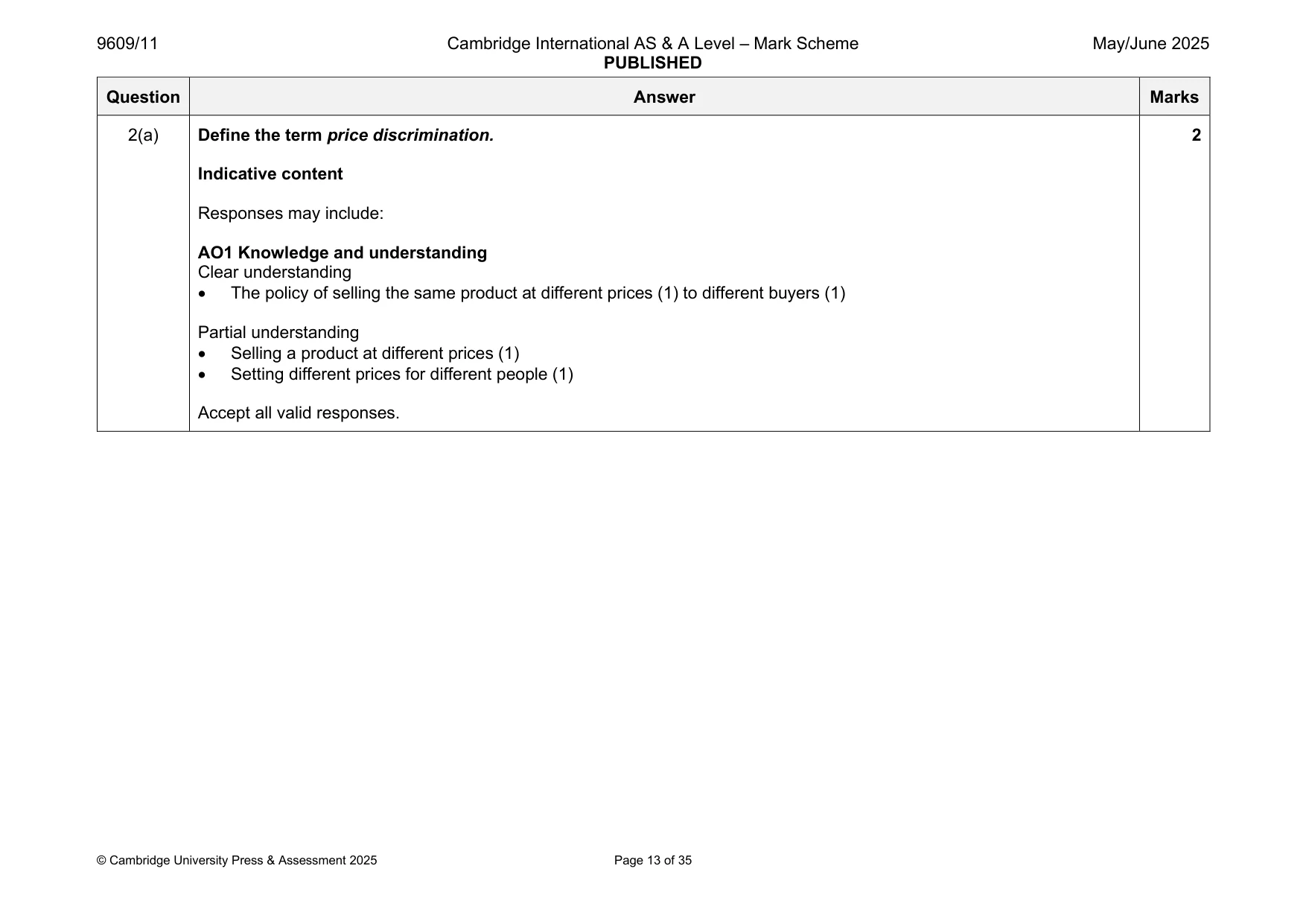
9609/11 Cambridge International AS & A Level – Mark Scheme PUBLISHED May/June 2025 © Cambridge University Press & Assessment 2025 Page 13 of 35 Question Answer Marks 2(a) Define the term price discrimination. Indicative content Responses may include: AO1 Knowledge and understanding Clear understanding • The policy of selling the same product at different prices (1) to different buyers (1) Partial understanding • Selling a product at different prices (1) • Setting different prices for different people (1) Accept all valid responses. 2
Mark scheme, page 14
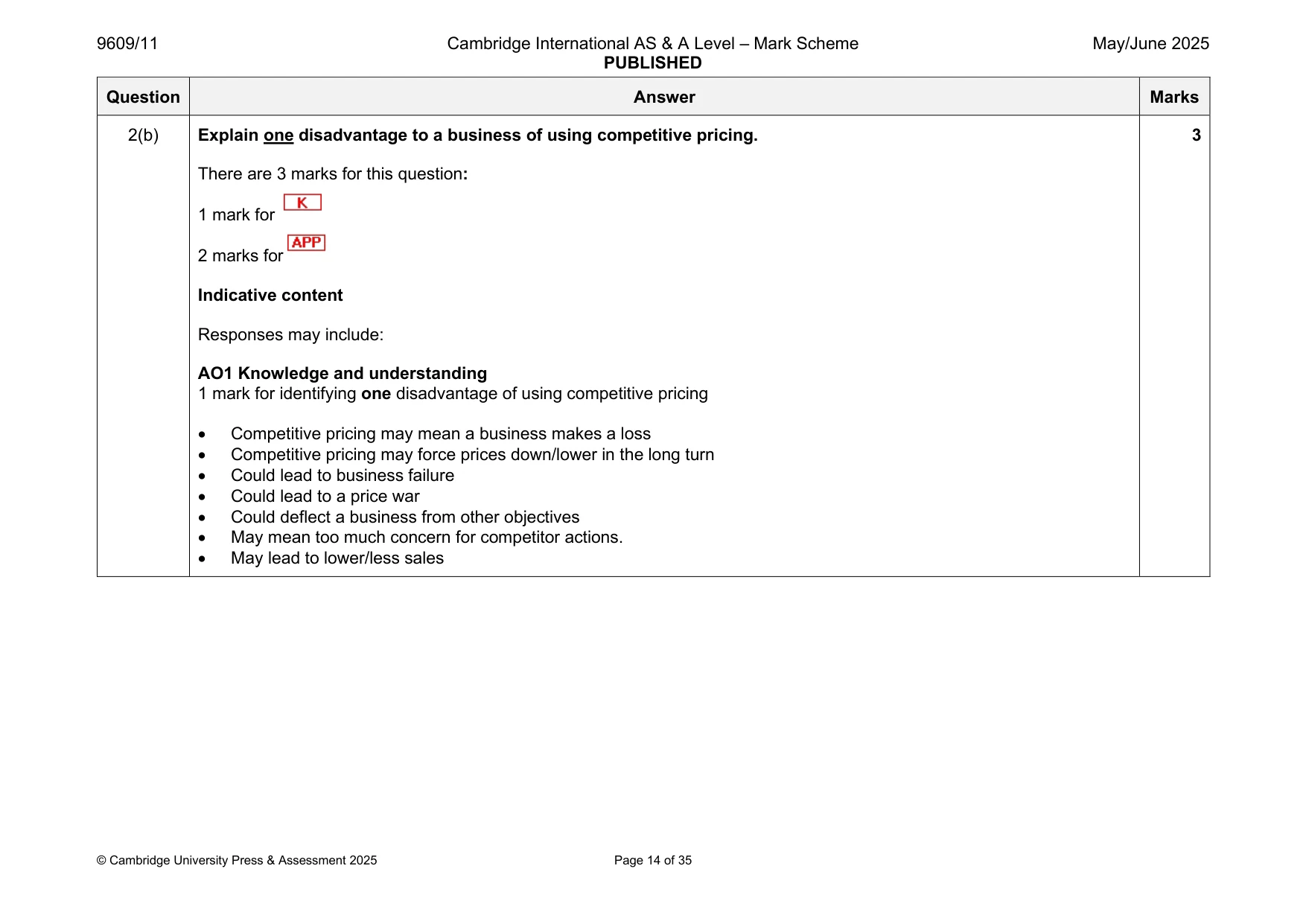
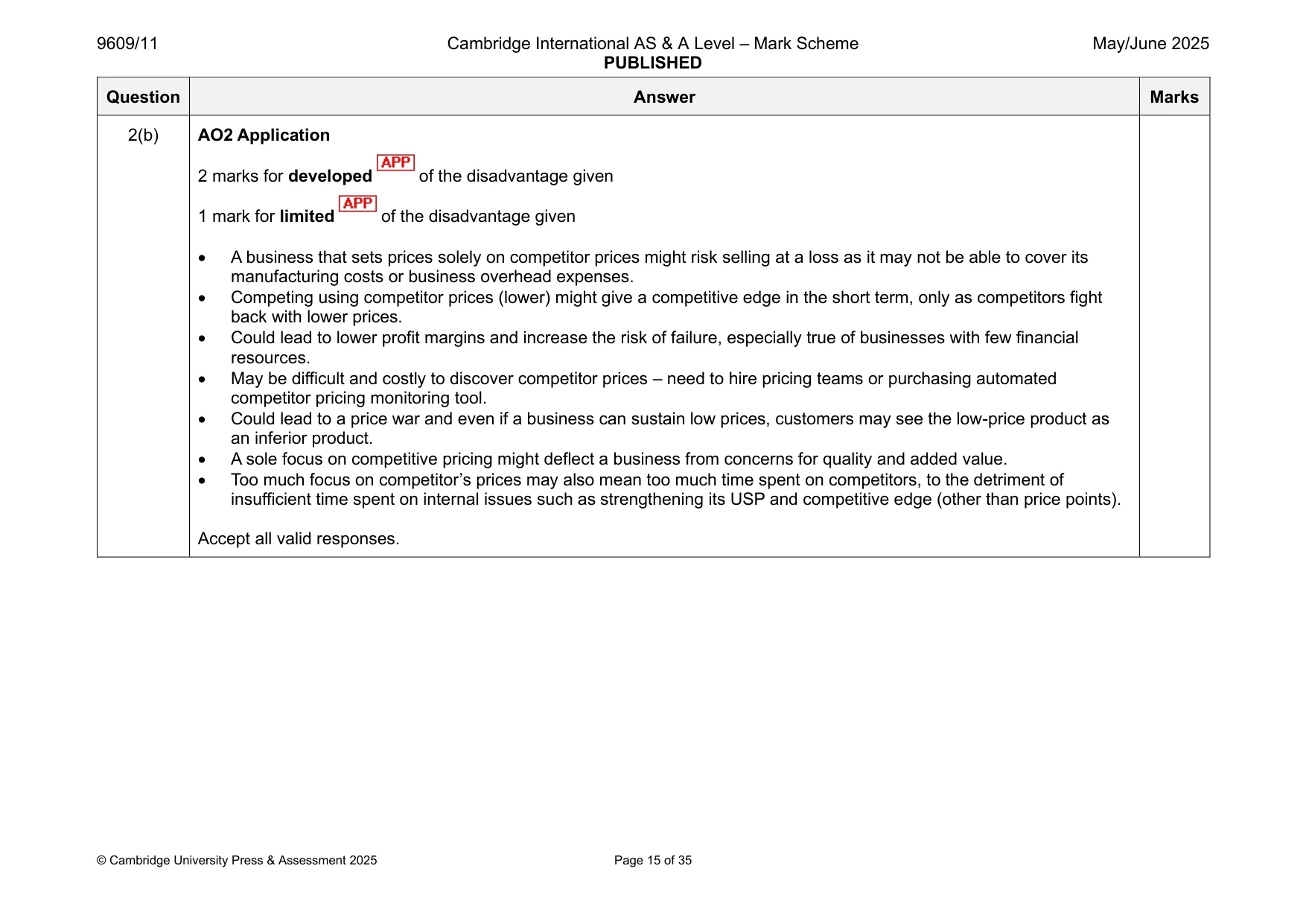
9609/11 Cambridge International AS & A Level – Mark Scheme PUBLISHED May/June 2025 © Cambridge University Press & Assessment 2025 Page 14 of 35 Question Answer Marks 2(b) Explain one disadvantage to a business of using competitive pricing. There are 3 marks for this question: 1 mark for 2 marks for Indicative content Responses may include: AO1 Knowledge and understanding 1 mark for identifying one disadvantage of using competitive pricing • Competitive pricing may mean a business makes a loss • Competitive pricing may force prices down/lower in the long turn • Could lead to business failure • Could lead to a price war • Could deflect a business from other objectives • May mean too much concern for competitor actions. • May lead to lower/less sales 3
Mark scheme, page 15
9609/11 Cambridge International AS & A Level – Mark Scheme PUBLISHED May/June 2025 © Cambridge University Press & Assessment 2025 Page 15 of 35 Question Answer Marks 2(b) AO2 Application 2 marks for developed of the disadvantage given 1 mark for limited of the disadvantage given • A business that sets prices solely on competitor prices might risk selling at a loss as it may not be able to cover its manufacturing costs or business overhead expenses. • Competing using competitor prices (lower) might give a competitive edge in the short term, only as competitors fight back with lower prices. • Could lead to lower profit margins and increase the risk of failure, especially true of businesses with few financial resources. • May be difficult and costly to discover competitor prices – need to hire pricing teams or purchasing automated competitor pricing monitoring tool. • Could lead to a price war and even if a business can sustain low prices, customers may see the low-price product as an inferior product. • A sole focus on competitive pricing might deflect a business from concerns for quality and added value. • Too much focus on competitor’s prices may also mean too much time spent on competitors, to the detriment of insufficient time spent on internal issues such as strengthening its USP and competitive edge (other than price points). Accept all valid responses.
Mark scheme, page 16
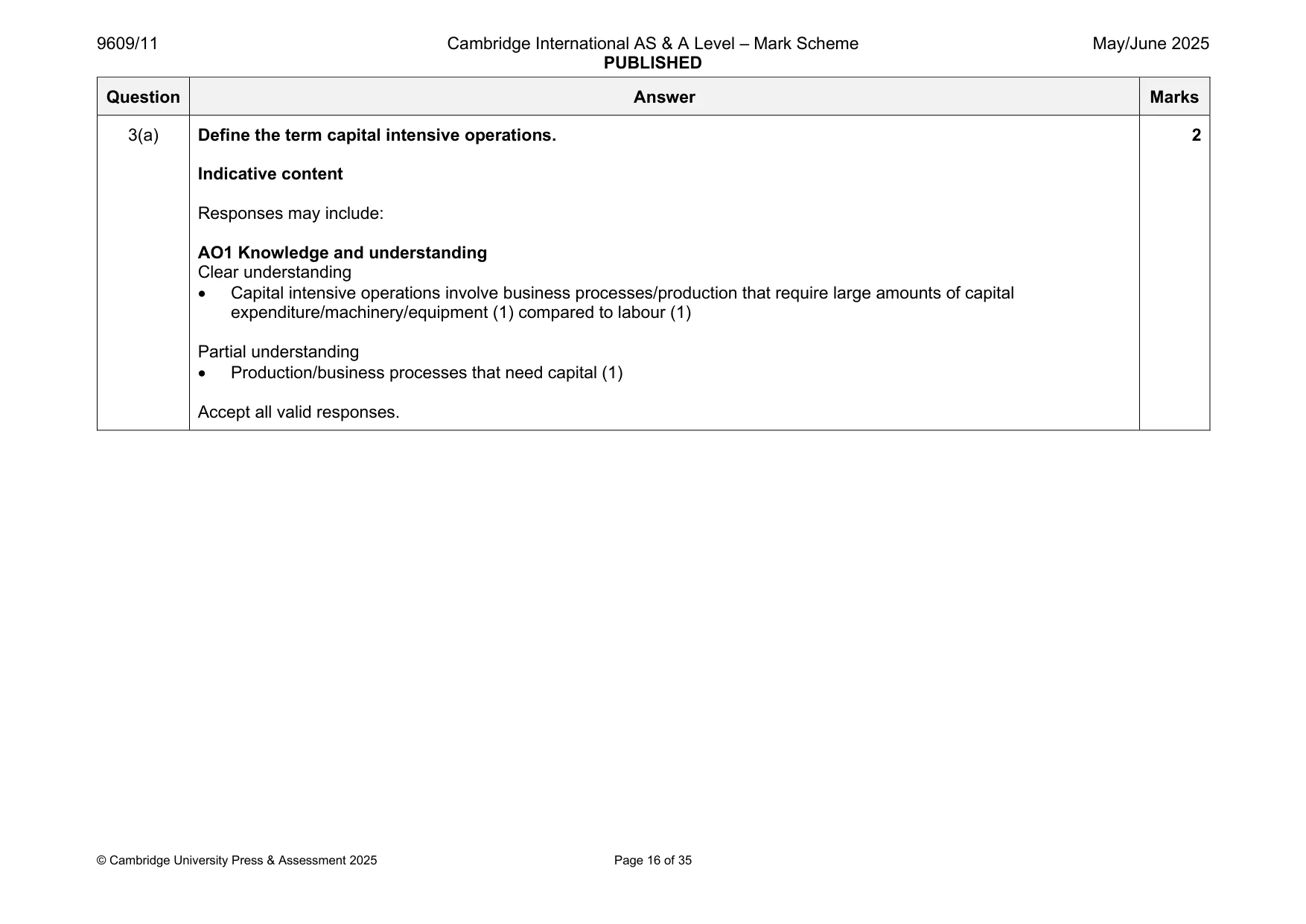
9609/11 Cambridge International AS & A Level – Mark Scheme PUBLISHED May/June 2025 © Cambridge University Press & Assessment 2025 Page 16 of 35 Question Answer Marks 3(a) Define the term capital intensive operations. Indicative content Responses may include: AO1 Knowledge and understanding Clear understanding • Capital intensive operations involve business processes/production that require large amounts of capital expenditure/machinery/equipment (1) compared to labour (1) Partial understanding • Production/business processes that need capital (1) Accept all valid responses. 2
Mark scheme, page 17
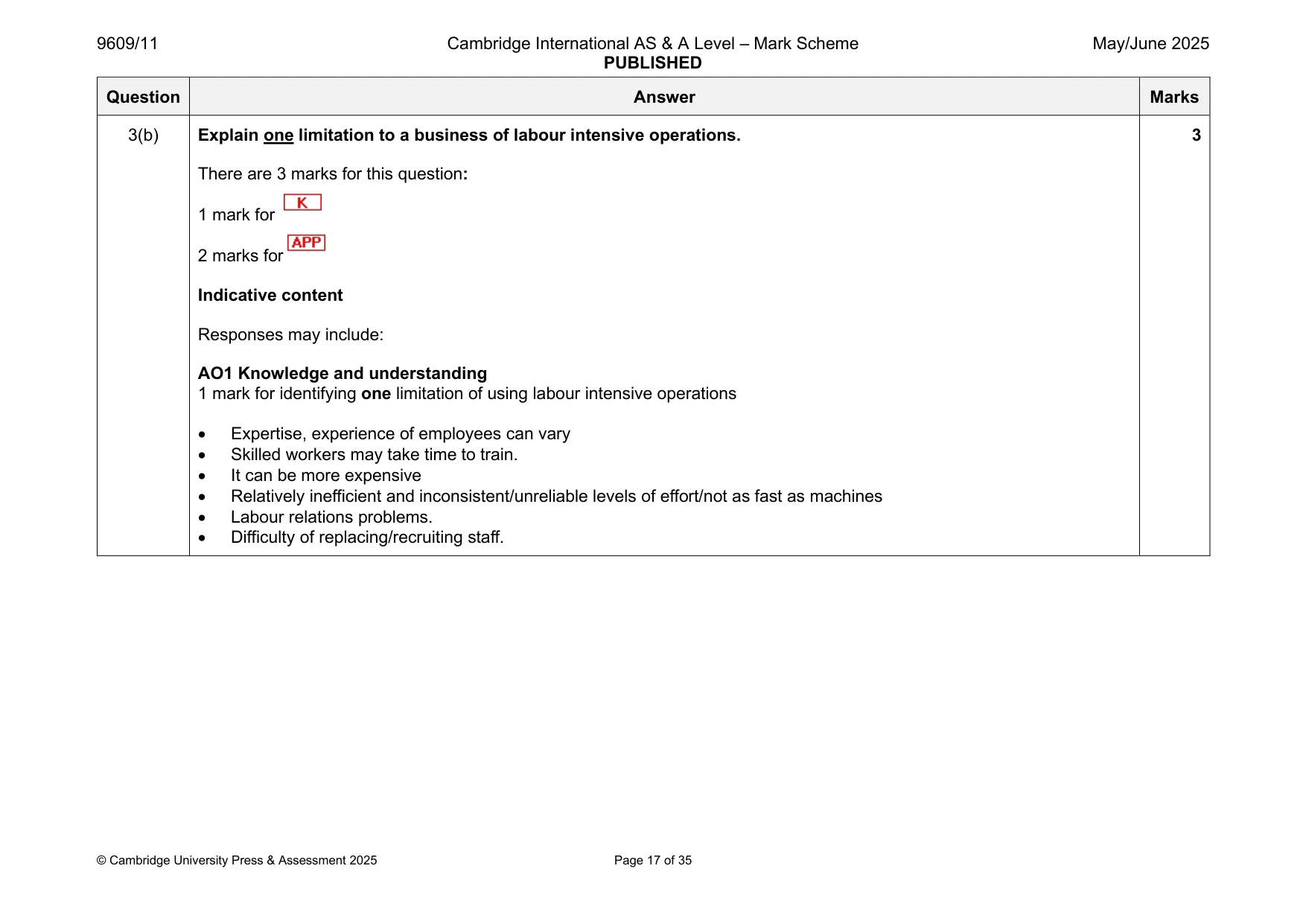
9609/11 Cambridge International AS & A Level – Mark Scheme PUBLISHED May/June 2025 © Cambridge University Press & Assessment 2025 Page 17 of 35 Question Answer Marks 3(b) Explain one limitation to a business of labour intensive operations. There are 3 marks for this question: 1 mark for 2 marks for Indicative content Responses may include: AO1 Knowledge and understanding 1 mark for identifying one limitation of using labour intensive operations • Expertise, experience of employees can vary • Skilled workers may take time to train. • It can be more expensive • Relatively inefficient and inconsistent/unreliable levels of effort/not as fast as machines • Labour relations problems. • Difficulty of replacing/recruiting staff. 3
Mark scheme, page 18
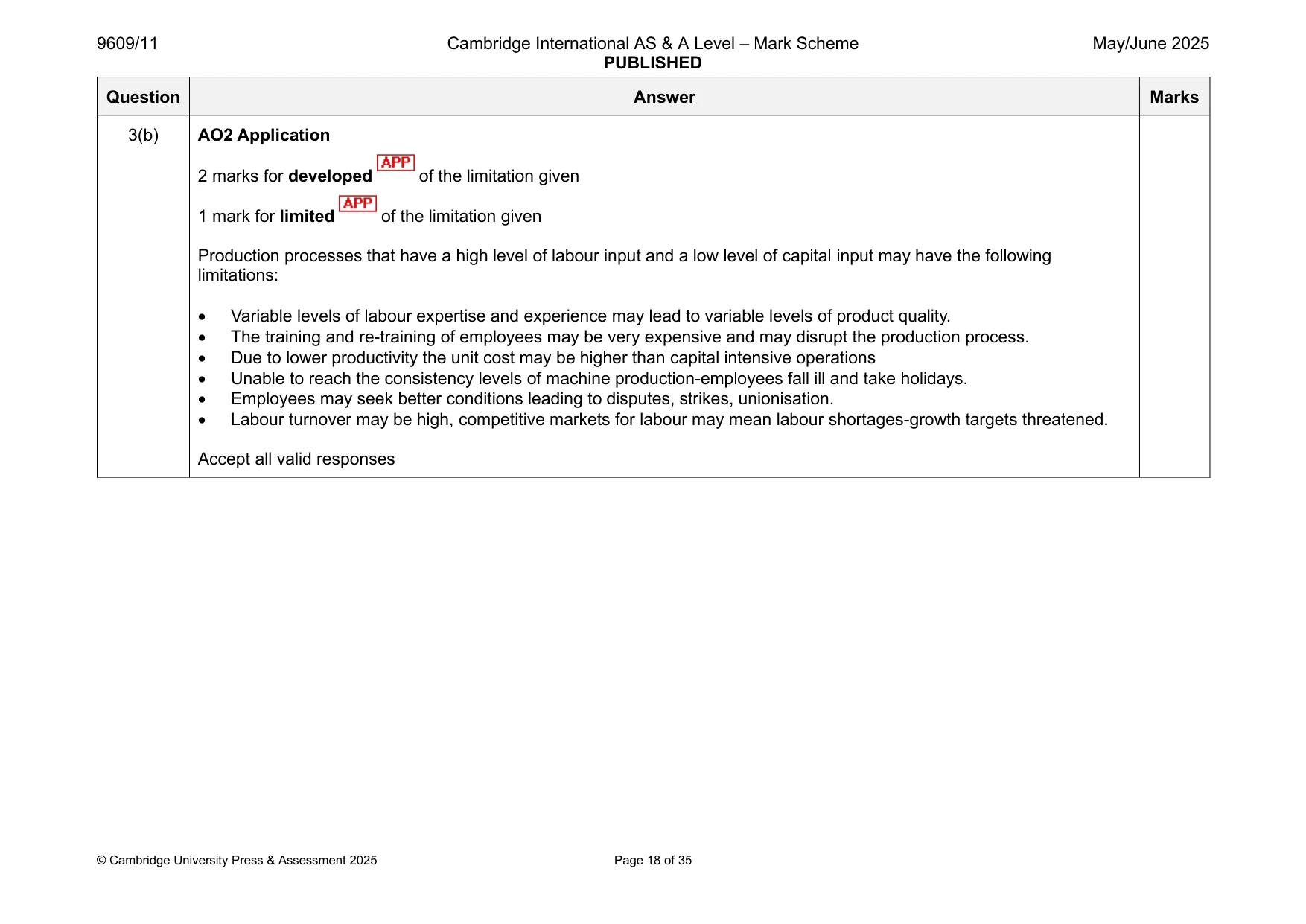
9609/11 Cambridge International AS & A Level – Mark Scheme PUBLISHED May/June 2025 © Cambridge University Press & Assessment 2025 Page 18 of 35 Question Answer Marks 3(b) AO2 Application 2 marks for developed of the limitation given 1 mark for limited of the limitation given Production processes that have a high level of labour input and a low level of capital input may have the following limitations: • Variable levels of labour expertise and experience may lead to variable levels of product quality. • The training and re-training of employees may be very expensive and may disrupt the production process. • Due to lower productivity the unit cost may be higher than capital intensive operations • Unable to reach the consistency levels of machine production-employees fall ill and take holidays. • Employees may seek better conditions leading to disputes, strikes, unionisation. • Labour turnover may be high, competitive markets for labour may mean labour shortages-growth targets threatened. Accept all valid responses
Mark scheme, page 19
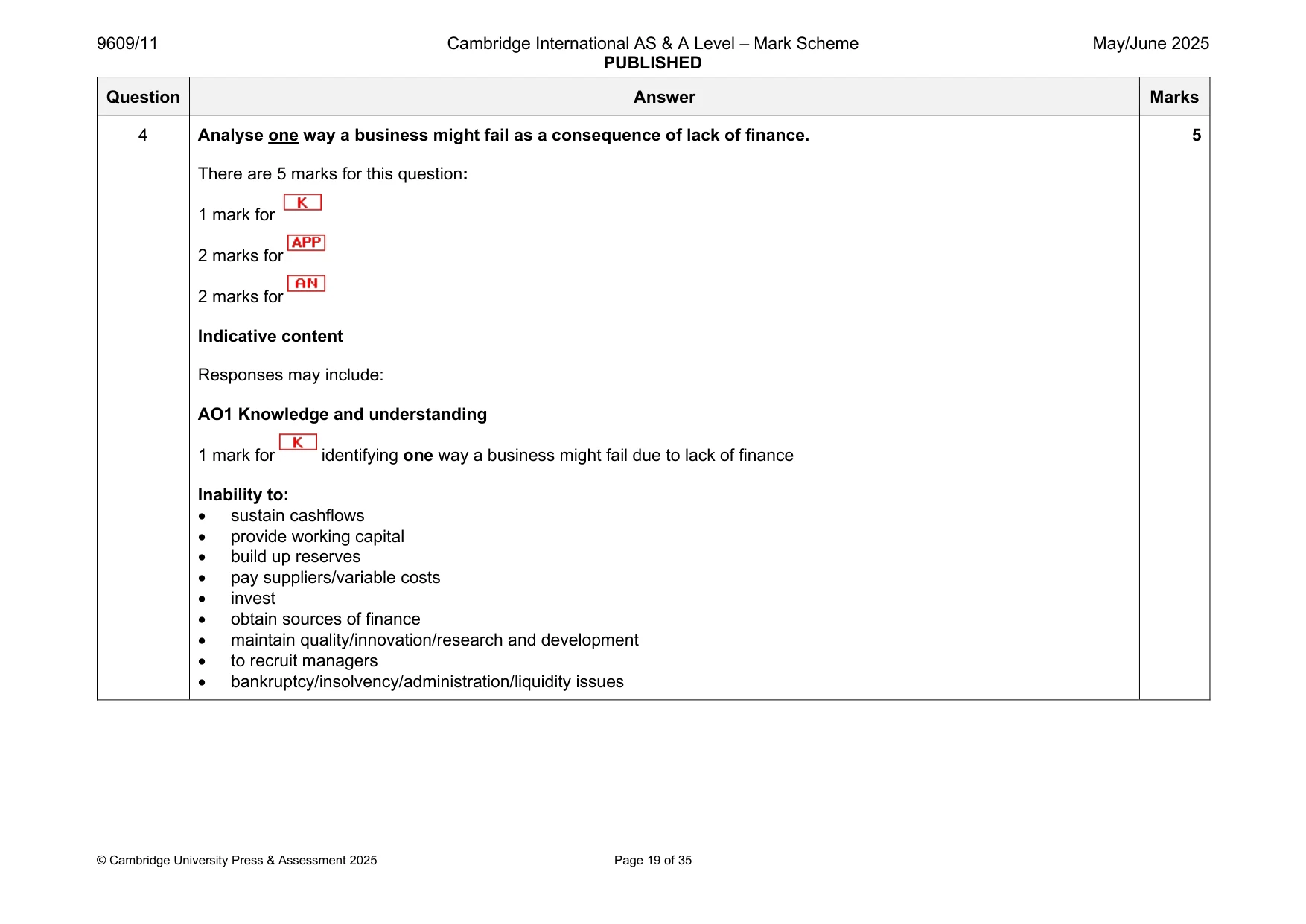
9609/11 Cambridge International AS & A Level – Mark Scheme PUBLISHED May/June 2025 © Cambridge University Press & Assessment 2025 Page 19 of 35 Question Answer Marks 4 Analyse one way a business might fail as a consequence of lack of finance. There are 5 marks for this question: 1 mark for 2 marks for 2 marks for Indicative content Responses may include: AO1 Knowledge and understanding 1 mark for identifying one way a business might fail due to lack of finance Inability to: • sustain cashflows • provide working capital • build up reserves • pay suppliers/variable costs • invest • obtain sources of finance • maintain quality/innovation/research and development • to recruit managers • bankruptcy/insolvency/administration/liquidity issues 5
Mark scheme, page 20
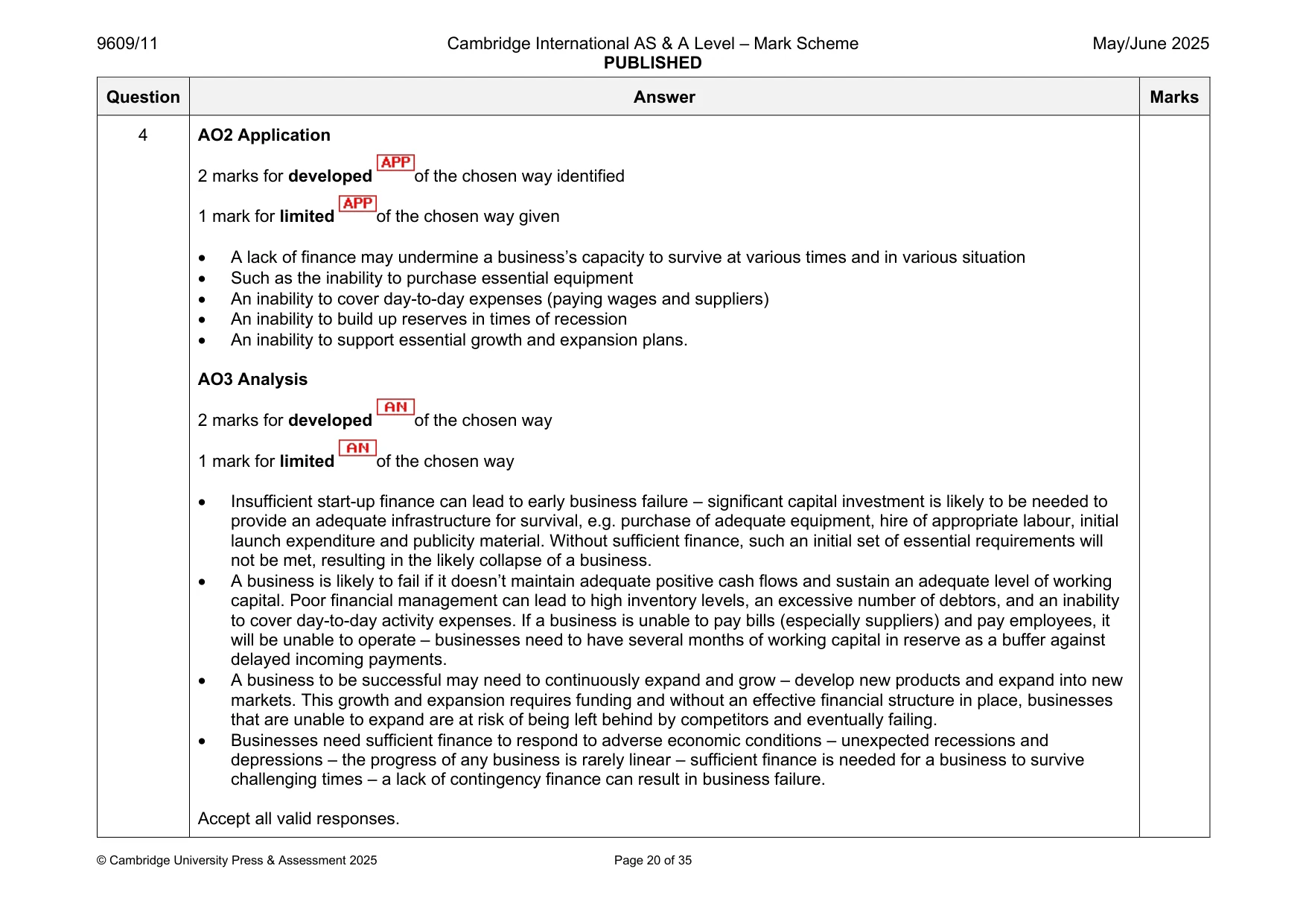
9609/11 Cambridge International AS & A Level – Mark Scheme PUBLISHED May/June 2025 © Cambridge University Press & Assessment 2025 Page 20 of 35 Question Answer Marks 4 AO2 Application 2 marks for developed of the chosen way identified 1 mark for limited of the chosen way given • A lack of finance may undermine a business’s capacity to survive at various times and in various situation • Such as the inability to purchase essential equipment • An inability to cover day-to-day expenses (paying wages and suppliers) • An inability to build up reserves in times of recession • An inability to support essential growth and expansion plans. AO3 Analysis 2 marks for developed of the chosen way 1 mark for limited of the chosen way • Insufficient start-up finance can lead to early business failure – significant capital investment is likely to be needed to provide an adequate infrastructure for survival, e.g. purchase of adequate equipment, hire of appropriate labour, initial launch expenditure and publicity material. Without sufficient finance, such an initial set of essential requirements will not be met, resulting in the likely collapse of a business. • A business is likely to fail if it doesn’t maintain adequate positive cash flows and sustain an adequate level of working capital. Poor financial management can lead to high inventory levels, an excessive number of debtors, and an inability to cover day-to-day activity expenses. If a business is unable to pay bills (especially suppliers) and pay employees, it will be unable to operate – businesses need to have several months of working capital in reserve as a buffer against delayed incoming payments. • A business to be successful may need to continuously expand and grow – develop new products and expand into new markets. This growth and expansion requires funding and without an effective financial structure in place, businesses that are unable to expand are at risk of being left behind by competitors and eventually failing. • Businesses need sufficient finance to respond to adverse economic conditions – unexpected recessions and depressions – the progress of any business is rarely linear – sufficient finance is needed for a business to survive challenging times – a lack of contingency finance can result in business failure. Accept all valid responses.
Mark scheme, page 21
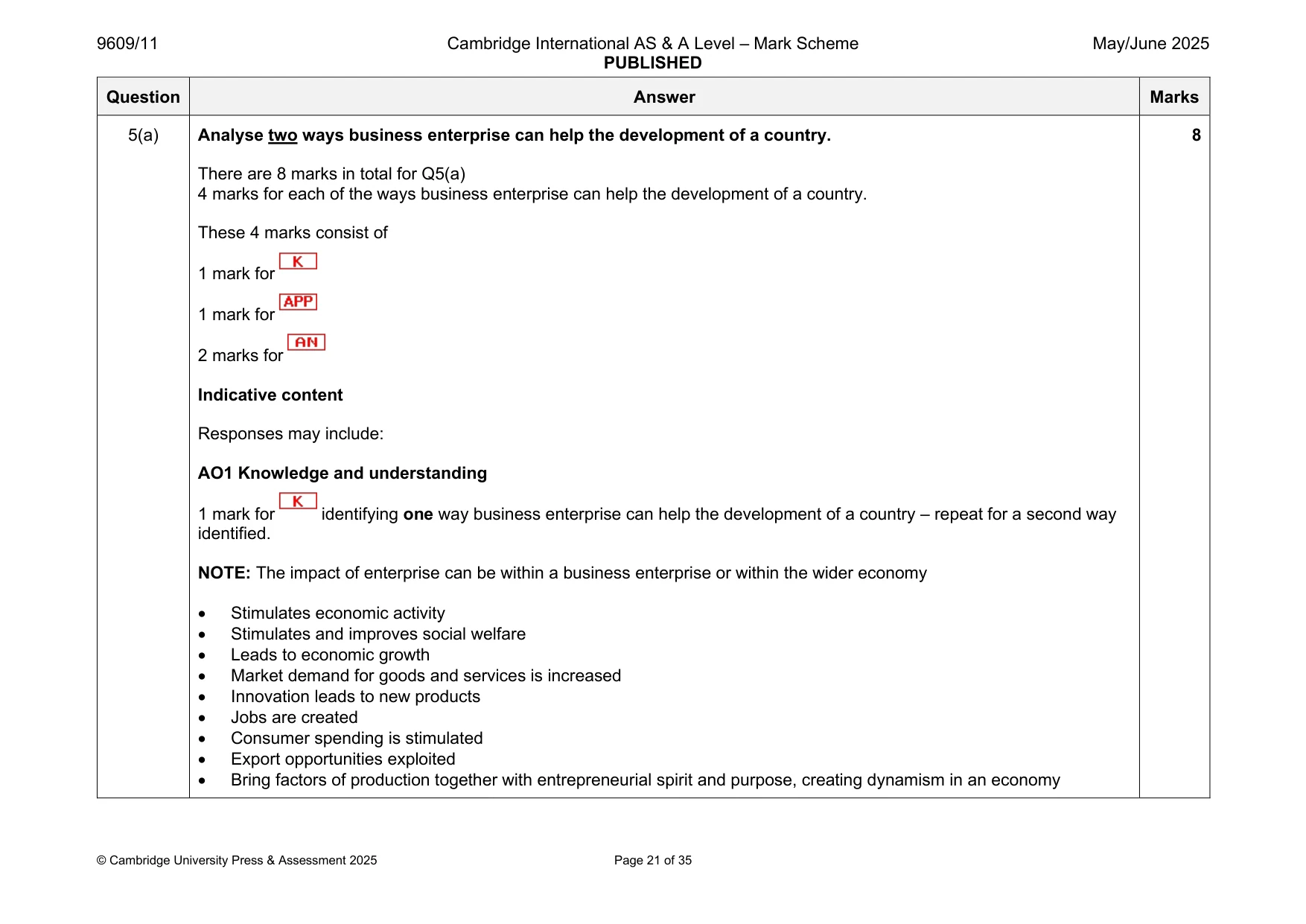
9609/11 Cambridge International AS & A Level – Mark Scheme PUBLISHED May/June 2025 © Cambridge University Press & Assessment 2025 Page 21 of 35 Question Answer Marks 5(a) Analyse two ways business enterprise can help the development of a country. There are 8 marks in total for Q5(a) 4 marks for each of the ways business enterprise can help the development of a country. These 4 marks consist of 1 mark for 1 mark for 2 marks for Indicative content Responses may include: AO1 Knowledge and understanding 1 mark for identifying one way business enterprise can help the development of a country – repeat for a second way identified. NOTE: The impact of enterprise can be within a business enterprise or within the wider economy • Stimulates economic activity • Stimulates and improves social welfare • Leads to economic growth • Market demand for goods and services is increased • Innovation leads to new products • Jobs are created • Consumer spending is stimulated • Export opportunities exploited • Bring factors of production together with entrepreneurial spirit and purpose, creating dynamism in an economy 8
Mark scheme, page 22
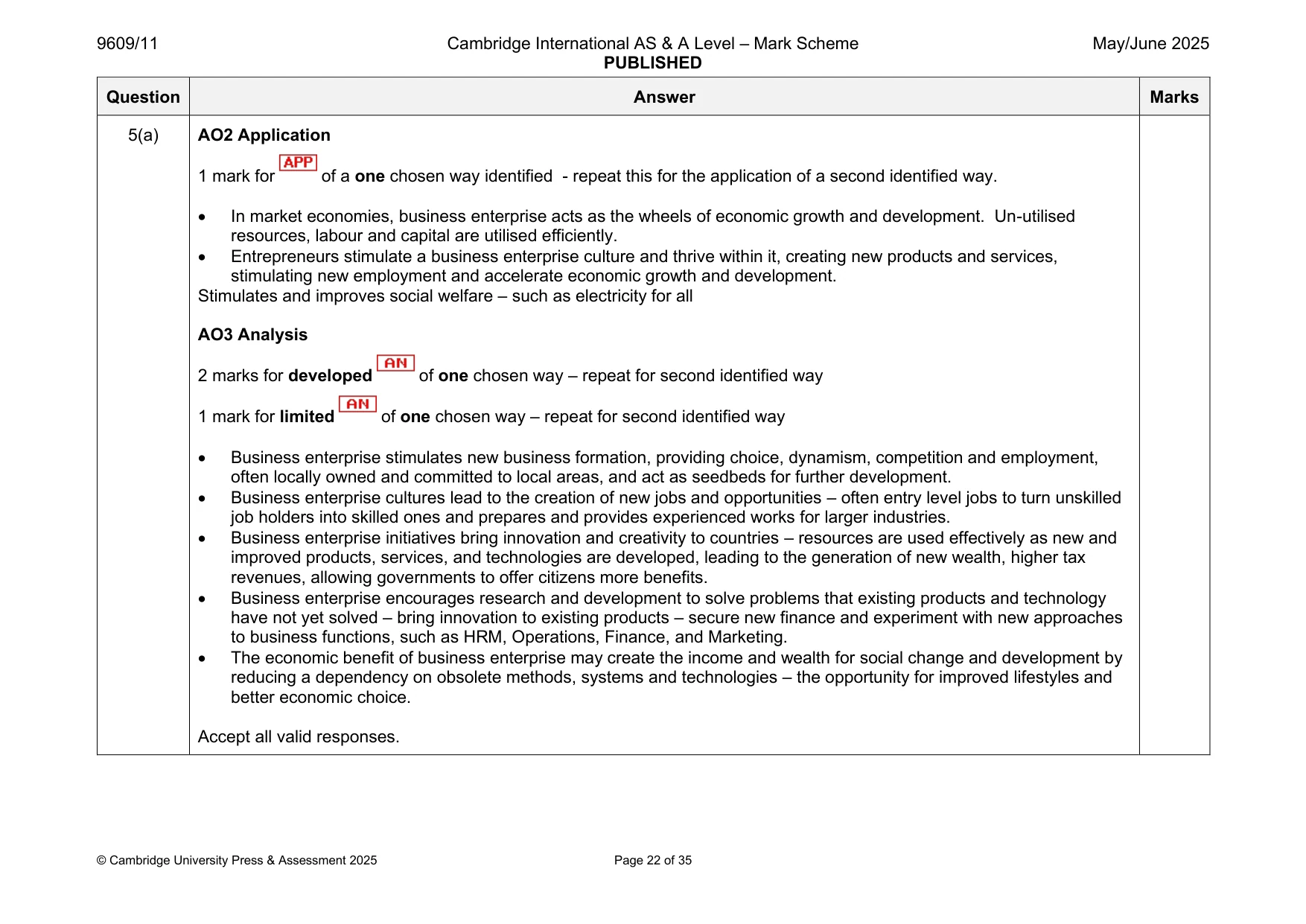
9609/11 Cambridge International AS & A Level – Mark Scheme PUBLISHED May/June 2025 © Cambridge University Press & Assessment 2025 Page 22 of 35 Question Answer Marks 5(a) AO2 Application 1 mark for of a one chosen way identified - repeat this for the application of a second identified way. • In market economies, business enterprise acts as the wheels of economic growth and development. Un-utilised resources, labour and capital are utilised efficiently. • Entrepreneurs stimulate a business enterprise culture and thrive within it, creating new products and services, stimulating new employment and accelerate economic growth and development. Stimulates and improves social welfare – such as electricity for all AO3 Analysis 2 marks for developed of one chosen way – repeat for second identified way 1 mark for limited of one chosen way – repeat for second identified way • Business enterprise stimulates new business formation, providing choice, dynamism, competition and employment, often locally owned and committed to local areas, and act as seedbeds for further development. • Business enterprise cultures lead to the creation of new jobs and opportunities – often entry level jobs to turn unskilled job holders into skilled ones and prepares and provides experienced works for larger industries. • Business enterprise initiatives bring innovation and creativity to countries – resources are used effectively as new and improved products, services, and technologies are developed, leading to the generation of new wealth, higher tax revenues, allowing governments to offer citizens more benefits. • Business enterprise encourages research and development to solve problems that existing products and technology have not yet solved – bring innovation to existing products – secure new finance and experiment with new approaches to business functions, such as HRM, Operations, Finance, and Marketing. • The economic benefit of business enterprise may create the income and wealth for social change and development by reducing a dependency on obsolete methods, systems and technologies – the opportunity for improved lifestyles and better economic choice. Accept all valid responses.
Mark scheme, page 23
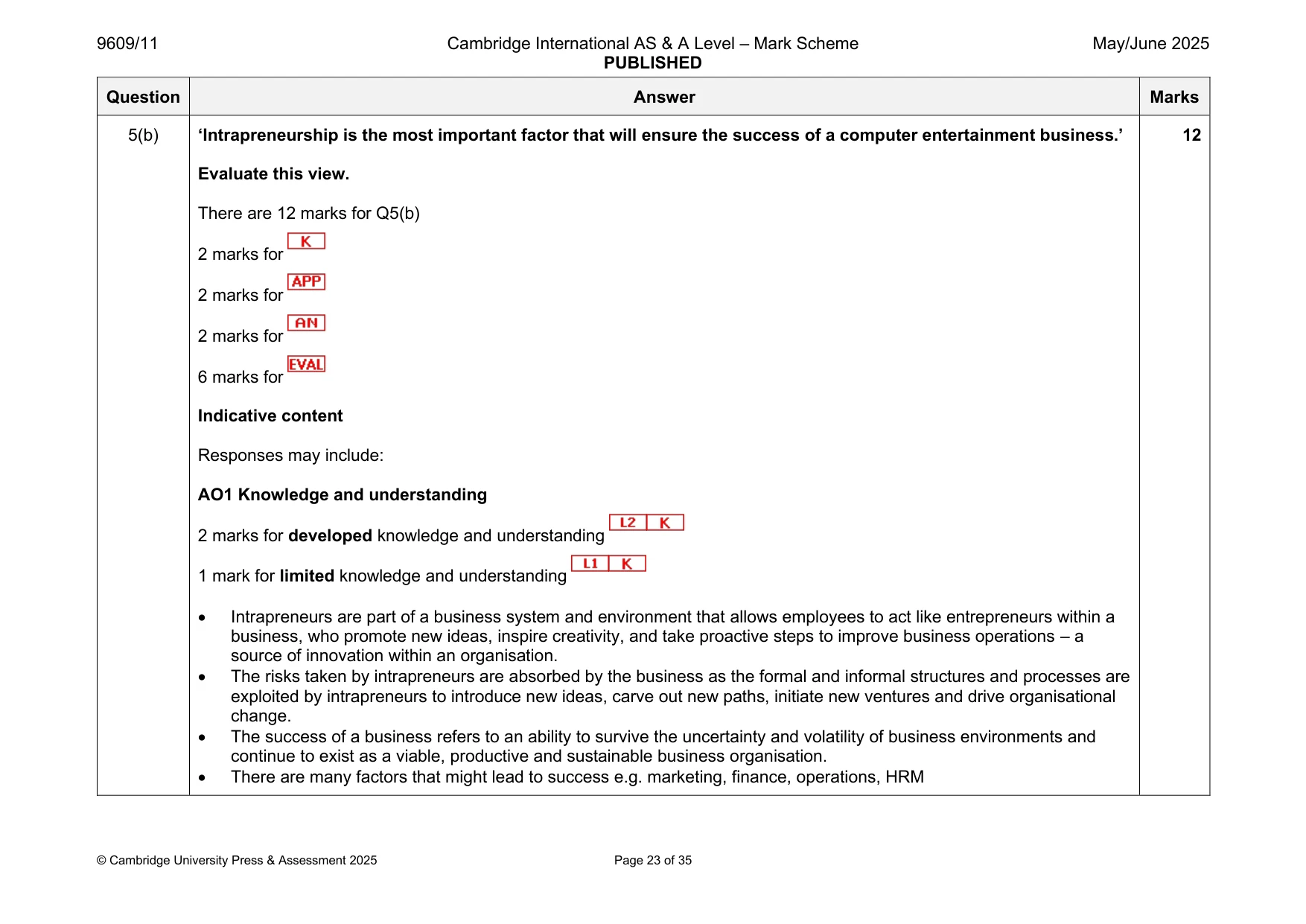
9609/11 Cambridge International AS & A Level – Mark Scheme PUBLISHED May/June 2025 © Cambridge University Press & Assessment 2025 Page 23 of 35 Question Answer Marks 5(b) ‘Intrapreneurship is the most important factor that will ensure the success of a computer entertainment business.’ Evaluate this view. There are 12 marks for Q5(b) 2 marks for 2 marks for 2 marks for 6 marks for Indicative content Responses may include: AO1 Knowledge and understanding 2 marks for developed knowledge and understanding 1 mark for limited knowledge and understanding • Intrapreneurs are part of a business system and environment that allows employees to act like entrepreneurs within a business, who promote new ideas, inspire creativity, and take proactive steps to improve business operations – a source of innovation within an organisation. • The risks taken by intrapreneurs are absorbed by the business as the formal and informal structures and processes are exploited by intrapreneurs to introduce new ideas, carve out new paths, initiate new ventures and drive organisational change. • The success of a business refers to an ability to survive the uncertainty and volatility of business environments and continue to exist as a viable, productive and sustainable business organisation. • There are many factors that might lead to success e.g. marketing, finance, operations, HRM 12
Mark scheme, page 24
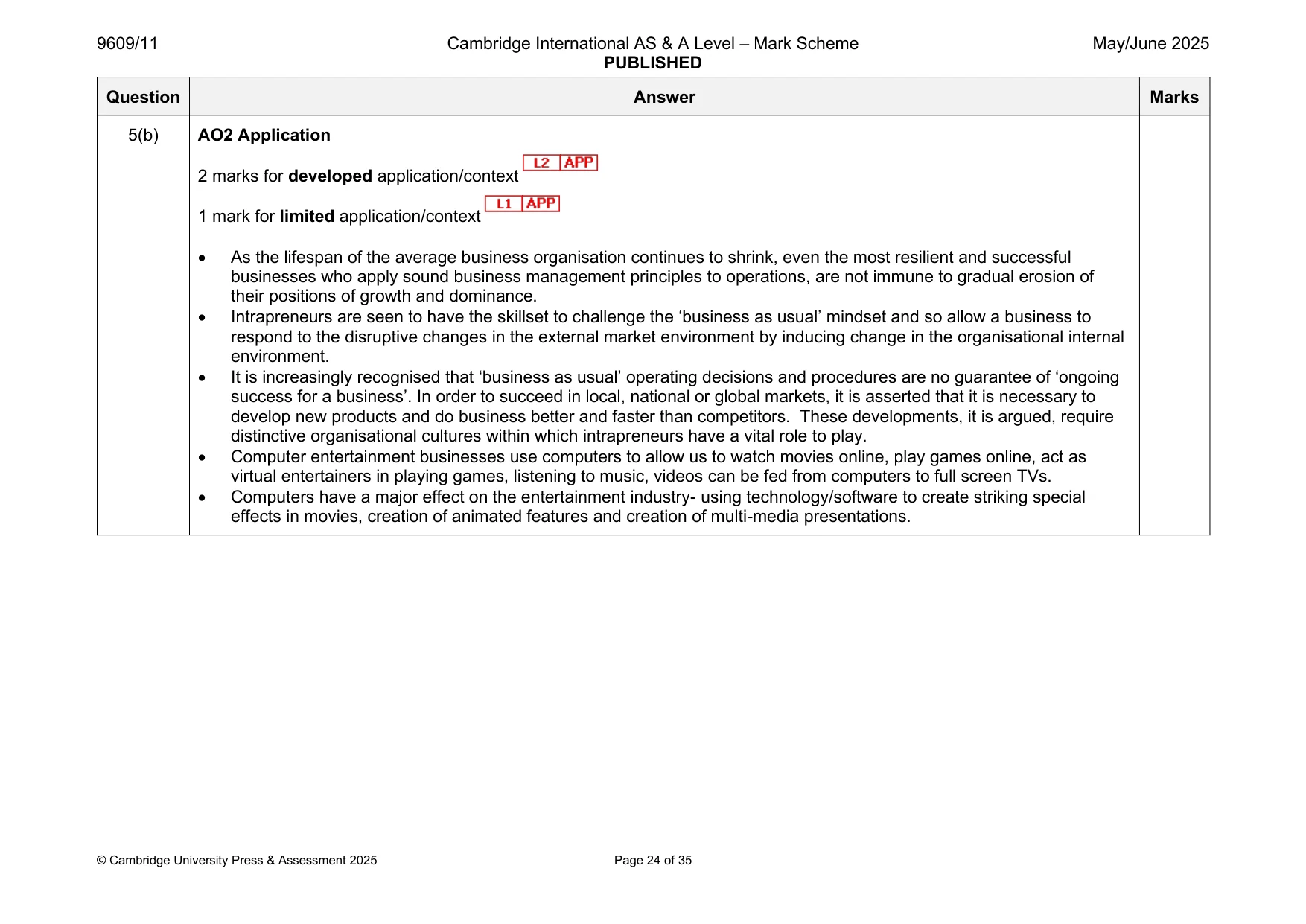
9609/11 Cambridge International AS & A Level – Mark Scheme PUBLISHED May/June 2025 © Cambridge University Press & Assessment 2025 Page 24 of 35 Question Answer Marks 5(b) AO2 Application 2 marks for developed application/context 1 mark for limited application/context • As the lifespan of the average business organisation continues to shrink, even the most resilient and successful businesses who apply sound business management principles to operations, are not immune to gradual erosion of their positions of growth and dominance. • Intrapreneurs are seen to have the skillset to challenge the ‘business as usual’ mindset and so allow a business to respond to the disruptive changes in the external market environment by inducing change in the organisational internal environment. • It is increasingly recognised that ‘business as usual’ operating decisions and procedures are no guarantee of ‘ongoing success for a business’. In order to succeed in local, national or global markets, it is asserted that it is necessary to develop new products and do business better and faster than competitors. These developments, it is argued, require distinctive organisational cultures within which intrapreneurs have a vital role to play. • Computer entertainment businesses use computers to allow us to watch movies online, play games online, act as virtual entertainers in playing games, listening to music, videos can be fed from computers to full screen TVs. • Computers have a major effect on the entertainment industry- using technology/software to create striking special effects in movies, creation of animated features and creation of multi-media presentations.
Mark scheme, page 25
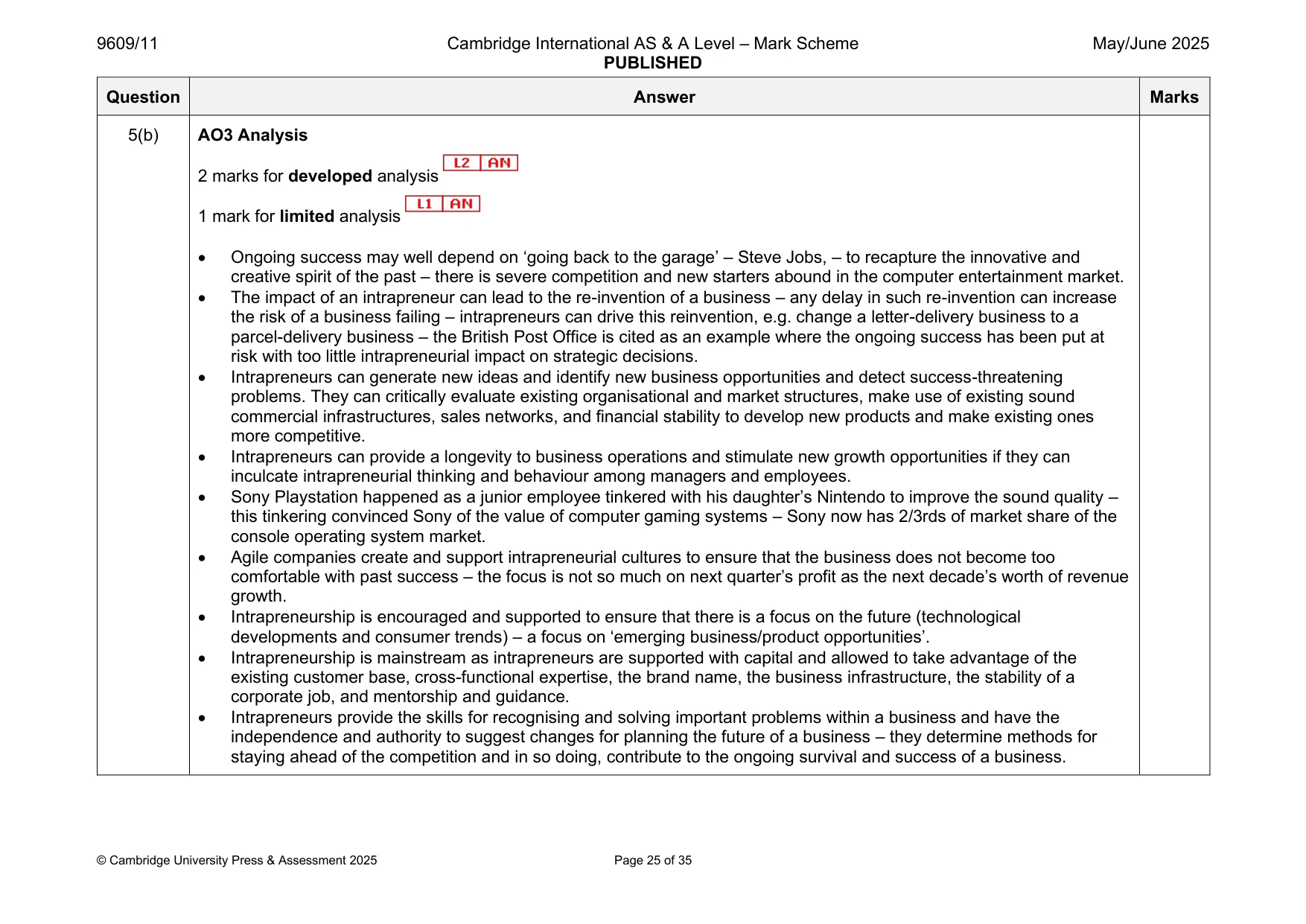
9609/11 Cambridge International AS & A Level – Mark Scheme PUBLISHED May/June 2025 © Cambridge University Press & Assessment 2025 Page 25 of 35 Question Answer Marks 5(b) AO3 Analysis 2 marks for developed analysis 1 mark for limited analysis • Ongoing success may well depend on ‘going back to the garage’ – Steve Jobs, – to recapture the innovative and creative spirit of the past – there is severe competition and new starters abound in the computer entertainment market. • The impact of an intrapreneur can lead to the re-invention of a business – any delay in such re-invention can increase the risk of a business failing – intrapreneurs can drive this reinvention, e.g. change a letter-delivery business to a parcel-delivery business – the British Post Office is cited as an example where the ongoing success has been put at risk with too little intrapreneurial impact on strategic decisions. • Intrapreneurs can generate new ideas and identify new business opportunities and detect success-threatening problems. They can critically evaluate existing organisational and market structures, make use of existing sound commercial infrastructures, sales networks, and financial stability to develop new products and make existing ones more competitive. • Intrapreneurs can provide a longevity to business operations and stimulate new growth opportunities if they can inculcate intrapreneurial thinking and behaviour among managers and employees. • Sony Playstation happened as a junior employee tinkered with his daughter’s Nintendo to improve the sound quality – this tinkering convinced Sony of the value of computer gaming systems – Sony now has 2/3rds of market share of the console operating system market. • Agile companies create and support intrapreneurial cultures to ensure that the business does not become too comfortable with past success – the focus is not so much on next quarter’s profit as the next decade’s worth of revenue growth. • Intrapreneurship is encouraged and supported to ensure that there is a focus on the future (technological developments and consumer trends) – a focus on ‘emerging business/product opportunities’. • Intrapreneurship is mainstream as intrapreneurs are supported with capital and allowed to take advantage of the existing customer base, cross-functional expertise, the brand name, the business infrastructure, the stability of a corporate job, and mentorship and guidance. • Intrapreneurs provide the skills for recognising and solving important problems within a business and have the independence and authority to suggest changes for planning the future of a business – they determine methods for staying ahead of the competition and in so doing, contribute to the ongoing survival and success of a business.
Mark scheme, page 26
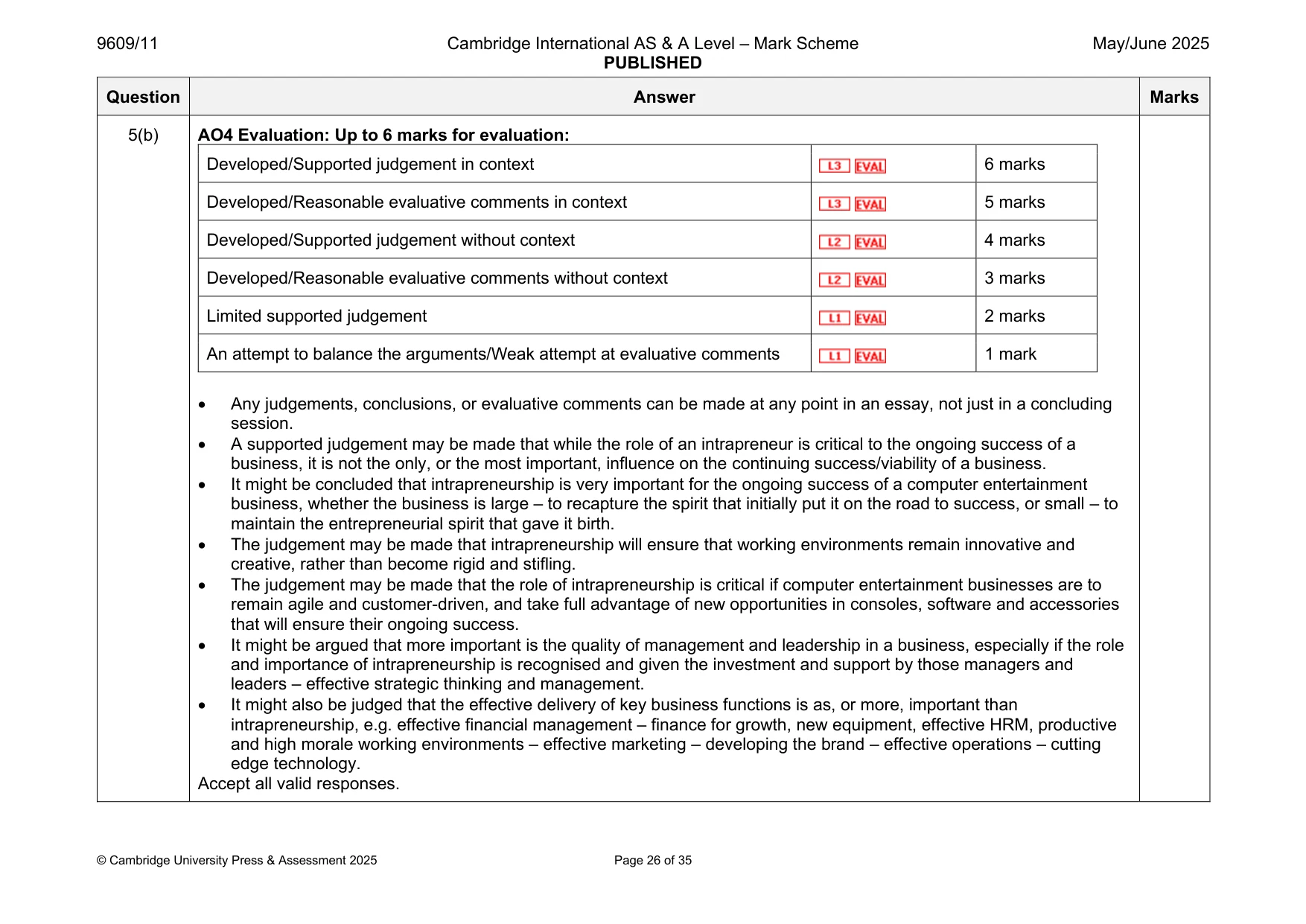
9609/11 Cambridge International AS & A Level – Mark Scheme PUBLISHED May/June 2025 © Cambridge University Press & Assessment 2025 Page 26 of 35 Question Answer Marks 5(b) AO4 Evaluation: Up to 6 marks for evaluation: Developed/Supported judgement in context 6 marks Developed/Reasonable evaluative comments in context 5 marks Developed/Supported judgement without context 4 marks Developed/Reasonable evaluative comments without context 3 marks Limited supported judgement 2 marks An attempt to balance the arguments/Weak attempt at evaluative comments 1 mark • Any judgements, conclusions, or evaluative comments can be made at any point in an essay, not just in a concluding session. • A supported judgement may be made that while the role of an intrapreneur is critical to the ongoing success of a business, it is not the only, or the most important, influence on the continuing success/viability of a business. • It might be concluded that intrapreneurship is very important for the ongoing success of a computer entertainment business, whether the business is large – to recapture the spirit that initially put it on the road to success, or small – to maintain the entrepreneurial spirit that gave it birth. • The judgement may be made that intrapreneurship will ensure that working environments remain innovative and creative, rather than become rigid and stifling. • The judgement may be made that the role of intrapreneurship is critical if computer entertainment businesses are to remain agile and customer-driven, and take full advantage of new opportunities in consoles, software and accessories that will ensure their ongoing success. • It might be argued that more important is the quality of management and leadership in a business, especially if the role and importance of intrapreneurship is recognised and given the investment and support by those managers and leaders – effective strategic thinking and management. • It might also be judged that the effective delivery of key business functions is as, or more, important than intrapreneurship, e.g. effective financial management – finance for growth, new equipment, effective HRM, productive and high morale working environments – effective marketing – developing the brand – effective operations – cutting edge technology. Accept all valid responses.
Mark scheme, page 27
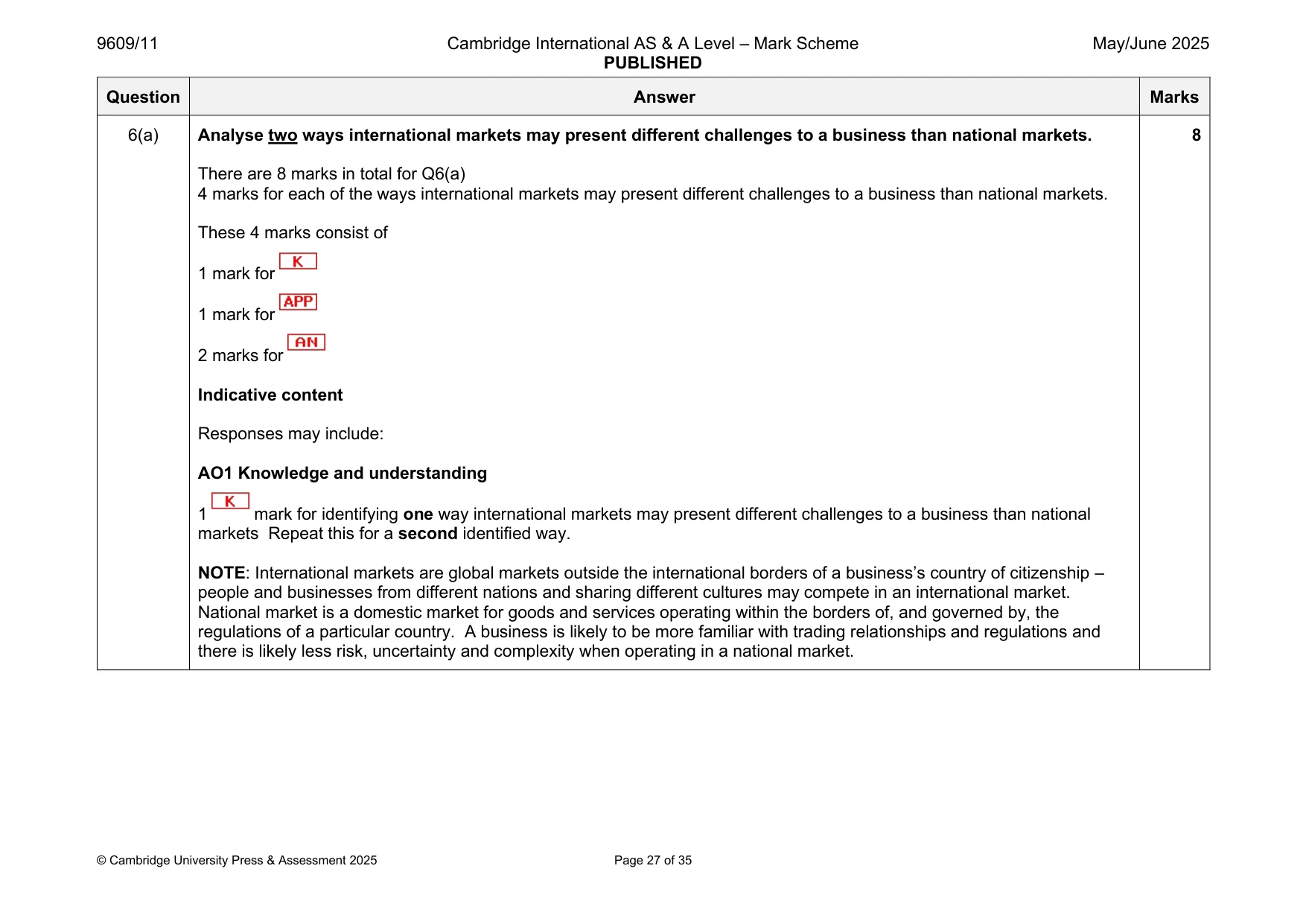
9609/11 Cambridge International AS & A Level – Mark Scheme PUBLISHED May/June 2025 © Cambridge University Press & Assessment 2025 Page 27 of 35 Question Answer Marks 6(a) Analyse two ways international markets may present different challenges to a business than national markets. There are 8 marks in total for Q6(a) 4 marks for each of the ways international markets may present different challenges to a business than national markets. These 4 marks consist of 1 mark for 1 mark for 2 marks for Indicative content Responses may include: AO1 Knowledge and understanding 1 mark for identifying one way international markets may present different challenges to a business than national markets Repeat this for a second identified way. NOTE: International markets are global markets outside the international borders of a business’s country of citizenship – people and businesses from different nations and sharing different cultures may compete in an international market. National market is a domestic market for goods and services operating within the borders of, and governed by, the regulations of a particular country. A business is likely to be more familiar with trading relationships and regulations and there is likely less risk, uncertainty and complexity when operating in a national market. 8
Mark scheme, page 28
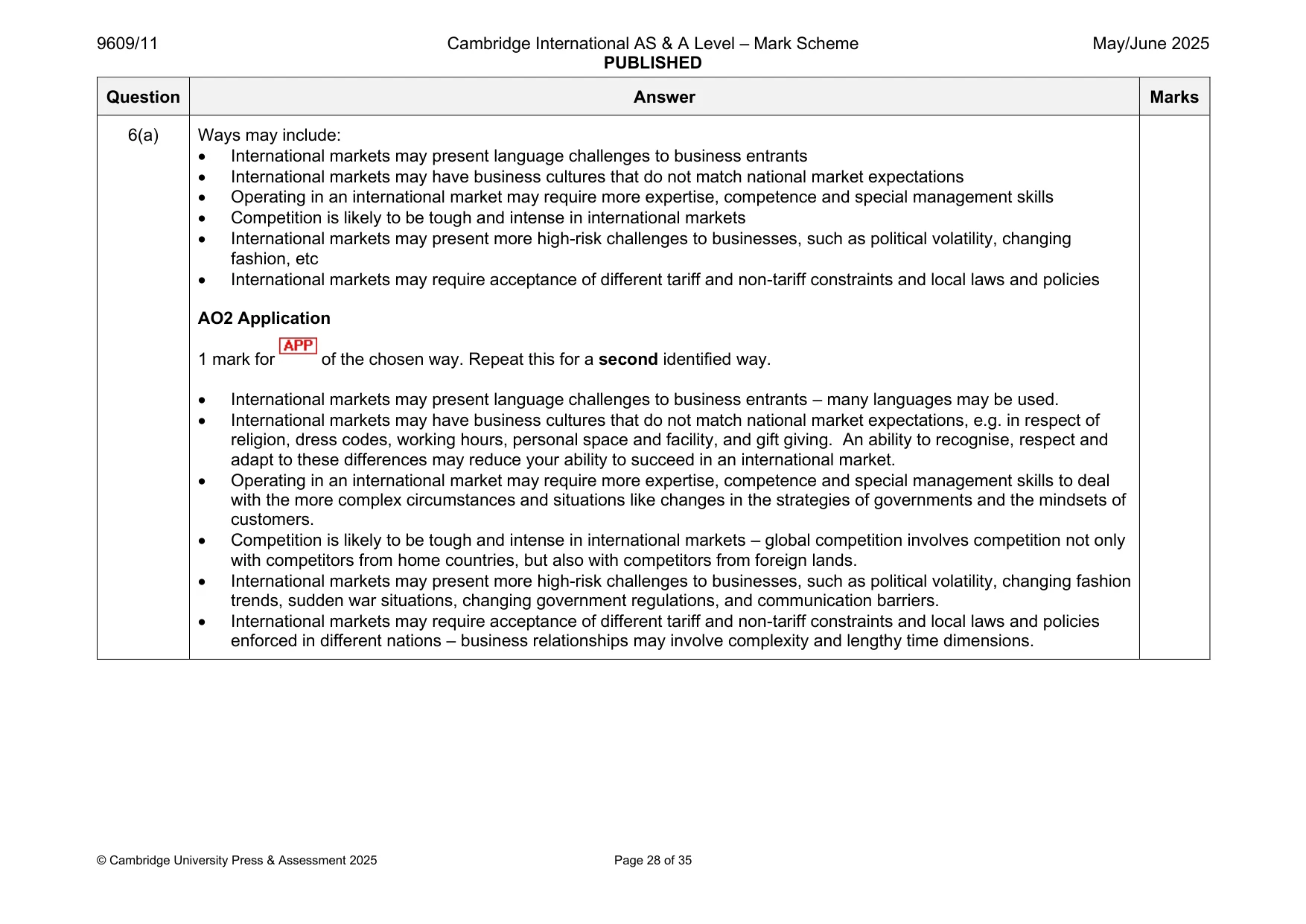
9609/11 Cambridge International AS & A Level – Mark Scheme PUBLISHED May/June 2025 © Cambridge University Press & Assessment 2025 Page 28 of 35 Question Answer Marks 6(a) Ways may include: • International markets may present language challenges to business entrants • International markets may have business cultures that do not match national market expectations • Operating in an international market may require more expertise, competence and special management skills • Competition is likely to be tough and intense in international markets • International markets may present more high-risk challenges to businesses, such as political volatility, changing fashion, etc • International markets may require acceptance of different tariff and non-tariff constraints and local laws and policies AO2 Application 1 mark for of the chosen way. Repeat this for a second identified way. • International markets may present language challenges to business entrants – many languages may be used. • International markets may have business cultures that do not match national market expectations, e.g. in respect of religion, dress codes, working hours, personal space and facility, and gift giving. An ability to recognise, respect and adapt to these differences may reduce your ability to succeed in an international market. • Operating in an international market may require more expertise, competence and special management skills to deal with the more complex circumstances and situations like changes in the strategies of governments and the mindsets of customers. • Competition is likely to be tough and intense in international markets – global competition involves competition not only with competitors from home countries, but also with competitors from foreign lands. • International markets may present more high-risk challenges to businesses, such as political volatility, changing fashion trends, sudden war situations, changing government regulations, and communication barriers. • International markets may require acceptance of different tariff and non-tariff constraints and local laws and policies enforced in different nations – business relationships may involve complexity and lengthy time dimensions.
Mark scheme, page 29
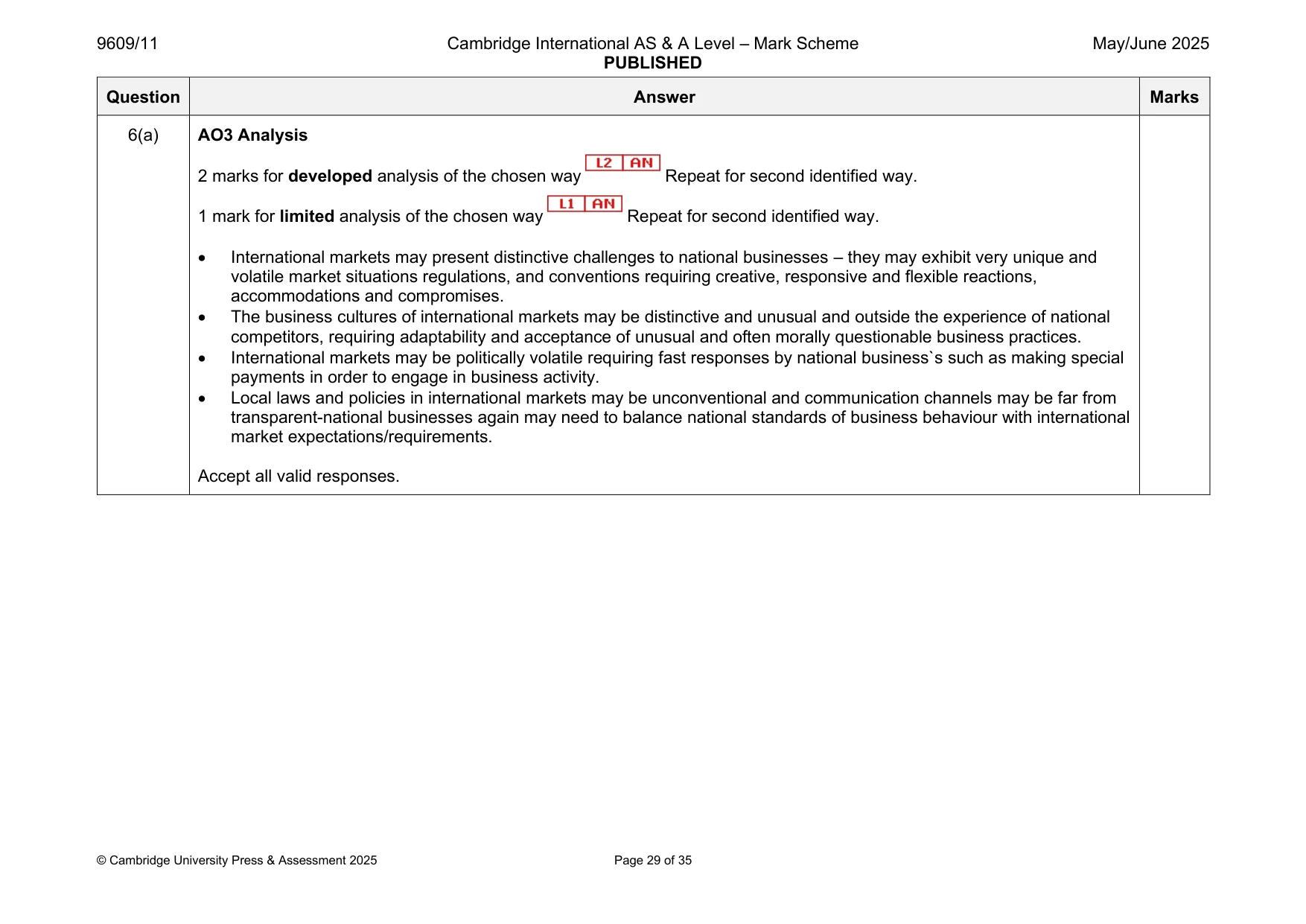
9609/11 Cambridge International AS & A Level – Mark Scheme PUBLISHED May/June 2025 © Cambridge University Press & Assessment 2025 Page 29 of 35 Question Answer Marks 6(a) AO3 Analysis 2 marks for developed analysis of the chosen way Repeat for second identified way. 1 mark for limited analysis of the chosen way Repeat for second identified way. • International markets may present distinctive challenges to national businesses – they may exhibit very unique and volatile market situations regulations, and conventions requiring creative, responsive and flexible reactions, accommodations and compromises. • The business cultures of international markets may be distinctive and unusual and outside the experience of national competitors, requiring adaptability and acceptance of unusual and often morally questionable business practices. • International markets may be politically volatile requiring fast responses by national business`s such as making special payments in order to engage in business activity. • Local laws and policies in international markets may be unconventional and communication channels may be far from transparent-national businesses again may need to balance national standards of business behaviour with international market expectations/requirements. Accept all valid responses.
Mark scheme, page 30
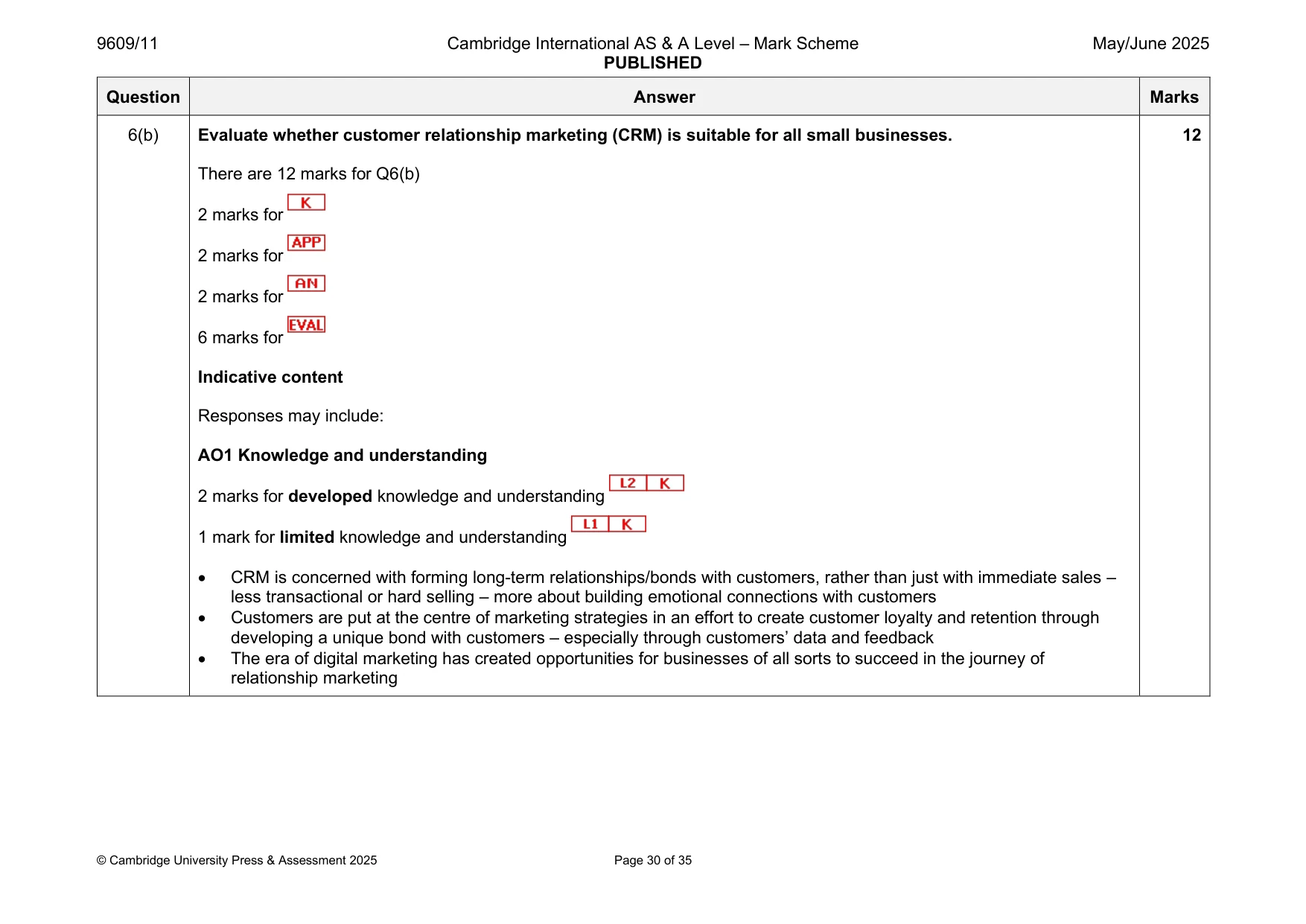
9609/11 Cambridge International AS & A Level – Mark Scheme PUBLISHED May/June 2025 © Cambridge University Press & Assessment 2025 Page 30 of 35 Question Answer Marks 6(b) Evaluate whether customer relationship marketing (CRM) is suitable for all small businesses. There are 12 marks for Q6(b) 2 marks for 2 marks for 2 marks for 6 marks for Indicative content Responses may include: AO1 Knowledge and understanding 2 marks for developed knowledge and understanding 1 mark for limited knowledge and understanding • CRM is concerned with forming long-term relationships/bonds with customers, rather than just with immediate sales – less transactional or hard selling – more about building emotional connections with customers • Customers are put at the centre of marketing strategies in an effort to create customer loyalty and retention through developing a unique bond with customers – especially through customers’ data and feedback • The era of digital marketing has created opportunities for businesses of all sorts to succeed in the journey of relationship marketing 12
Mark scheme, page 31
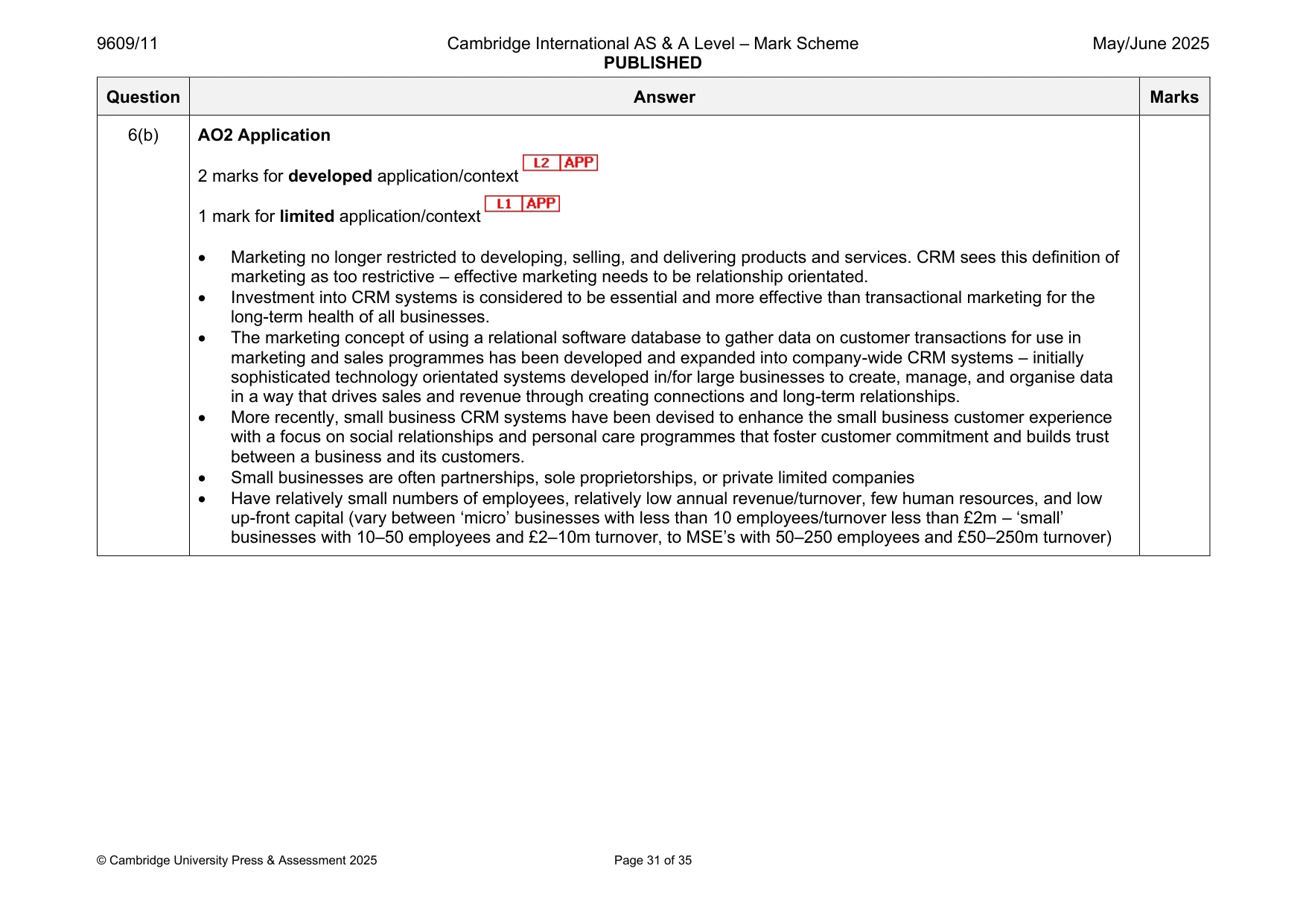
9609/11 Cambridge International AS & A Level – Mark Scheme PUBLISHED May/June 2025 © Cambridge University Press & Assessment 2025 Page 31 of 35 Question Answer Marks 6(b) AO2 Application 2 marks for developed application/context 1 mark for limited application/context • Marketing no longer restricted to developing, selling, and delivering products and services. CRM sees this definition of marketing as too restrictive – effective marketing needs to be relationship orientated. • Investment into CRM systems is considered to be essential and more effective than transactional marketing for the long-term health of all businesses. • The marketing concept of using a relational software database to gather data on customer transactions for use in marketing and sales programmes has been developed and expanded into company-wide CRM systems – initially sophisticated technology orientated systems developed in/for large businesses to create, manage, and organise data in a way that drives sales and revenue through creating connections and long-term relationships. • More recently, small business CRM systems have been devised to enhance the small business customer experience with a focus on social relationships and personal care programmes that foster customer commitment and builds trust between a business and its customers. • Small businesses are often partnerships, sole proprietorships, or private limited companies • Have relatively small numbers of employees, relatively low annual revenue/turnover, few human resources, and low up-front capital (vary between ‘micro’ businesses with less than 10 employees/turnover less than £2m – ‘small’ businesses with 10–50 employees and £2–10m turnover, to MSE’s with 50–250 employees and £50–250m turnover)
Mark scheme, page 32
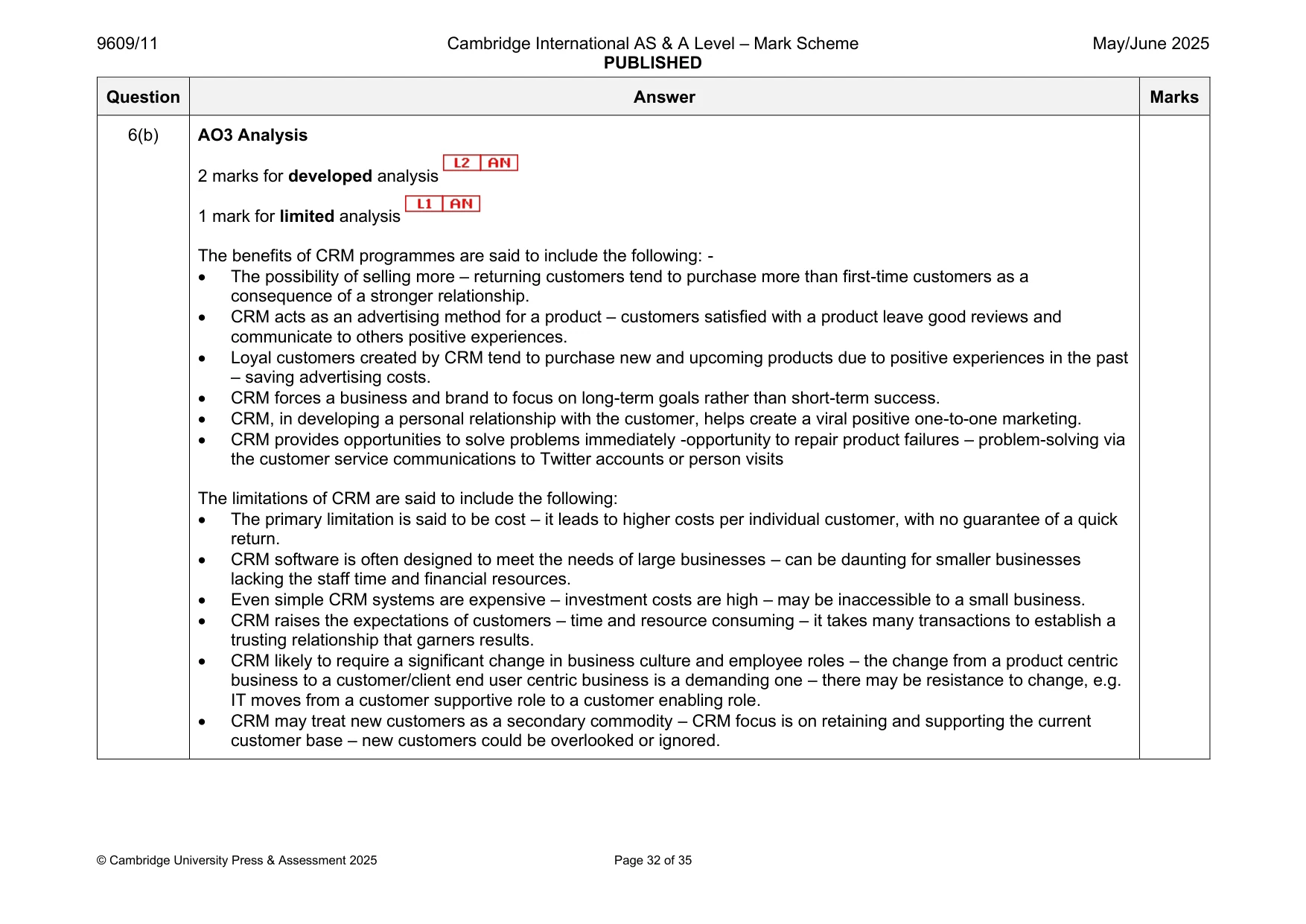
9609/11 Cambridge International AS & A Level – Mark Scheme PUBLISHED May/June 2025 © Cambridge University Press & Assessment 2025 Page 32 of 35 Question Answer Marks 6(b) AO3 Analysis 2 marks for developed analysis 1 mark for limited analysis The benefits of CRM programmes are said to include the following: - • The possibility of selling more – returning customers tend to purchase more than first-time customers as a consequence of a stronger relationship. • CRM acts as an advertising method for a product – customers satisfied with a product leave good reviews and communicate to others positive experiences. • Loyal customers created by CRM tend to purchase new and upcoming products due to positive experiences in the past – saving advertising costs. • CRM forces a business and brand to focus on long-term goals rather than short-term success. • CRM, in developing a personal relationship with the customer, helps create a viral positive one-to-one marketing. • CRM provides opportunities to solve problems immediately -opportunity to repair product failures – problem-solving via the customer service communications to Twitter accounts or person visits The limitations of CRM are said to include the following: • The primary limitation is said to be cost – it leads to higher costs per individual customer, with no guarantee of a quick return. • CRM software is often designed to meet the needs of large businesses – can be daunting for smaller businesses lacking the staff time and financial resources. • Even simple CRM systems are expensive – investment costs are high – may be inaccessible to a small business. • CRM raises the expectations of customers – time and resource consuming – it takes many transactions to establish a trusting relationship that garners results. • CRM likely to require a significant change in business culture and employee roles – the change from a product centric business to a customer/client end user centric business is a demanding one – there may be resistance to change, e.g. IT moves from a customer supportive role to a customer enabling role. • CRM may treat new customers as a secondary commodity – CRM focus is on retaining and supporting the current customer base – new customers could be overlooked or ignored.
Mark scheme, page 33
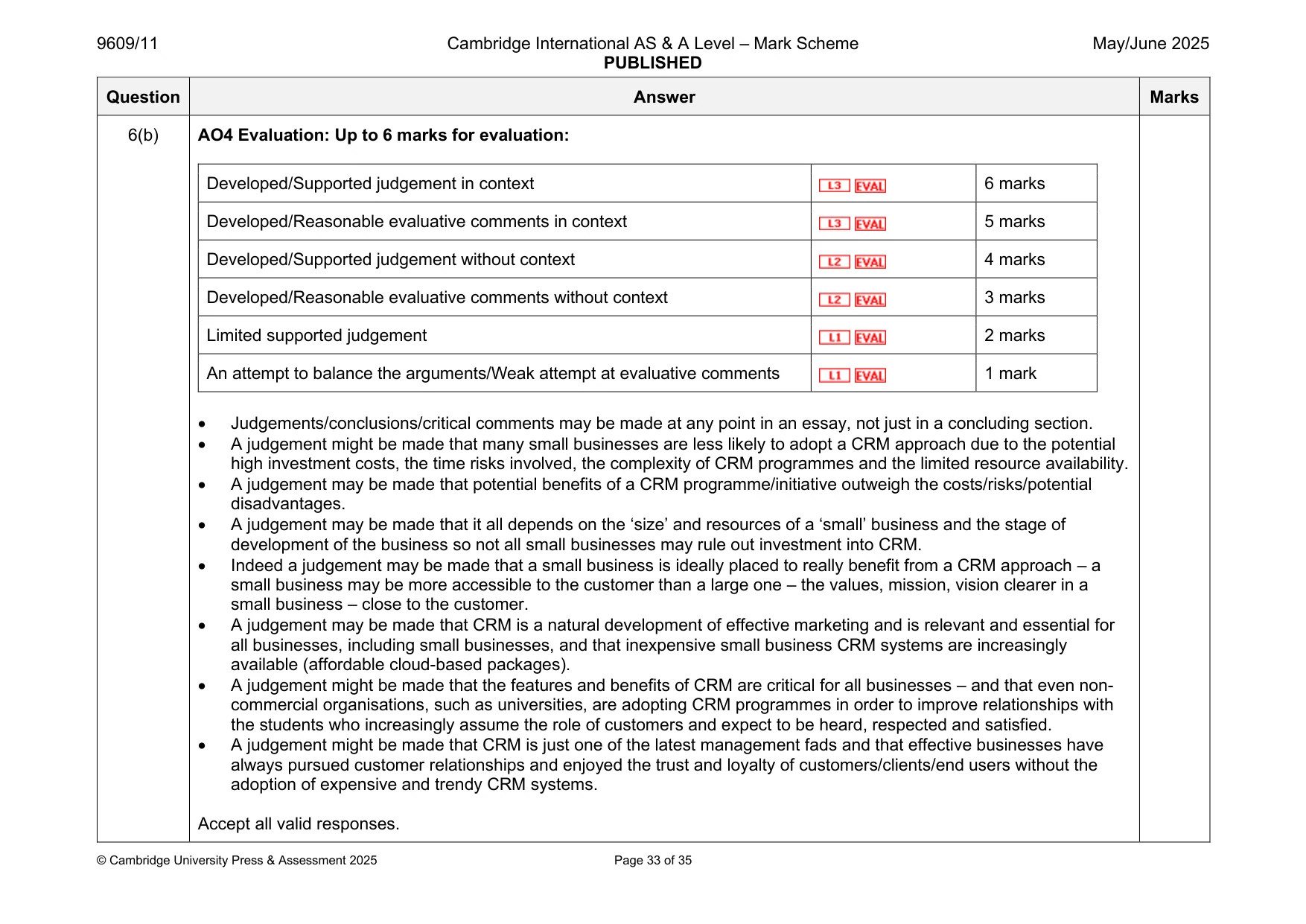
9609/11 Cambridge International AS & A Level – Mark Scheme PUBLISHED May/June 2025 © Cambridge University Press & Assessment 2025 Page 33 of 35 Question Answer Marks 6(b) AO4 Evaluation: Up to 6 marks for evaluation: Developed/Supported judgement in context 6 marks Developed/Reasonable evaluative comments in context 5 marks Developed/Supported judgement without context 4 marks Developed/Reasonable evaluative comments without context 3 marks Limited supported judgement 2 marks An attempt to balance the arguments/Weak attempt at evaluative comments 1 mark • Judgements/conclusions/critical comments may be made at any point in an essay, not just in a concluding section. • A judgement might be made that many small businesses are less likely to adopt a CRM approach due to the potential high investment costs, the time risks involved, the complexity of CRM programmes and the limited resource availability. • A judgement may be made that potential benefits of a CRM programme/initiative outweigh the costs/risks/potential disadvantages. • A judgement may be made that it all depends on the ‘size’ and resources of a ‘small’ business and the stage of development of the business so not all small businesses may rule out investment into CRM. • Indeed a judgement may be made that a small business is ideally placed to really benefit from a CRM approach – a small business may be more accessible to the customer than a large one – the values, mission, vision clearer in a small business – close to the customer. • A judgement may be made that CRM is a natural development of effective marketing and is relevant and essential for all businesses, including small businesses, and that inexpensive small business CRM systems are increasingly available (affordable cloud-based packages). • A judgement might be made that the features and benefits of CRM are critical for all businesses – and that even non- commercial organisations, such as universities, are adopting CRM programmes in order to improve relationships with the students who increasingly assume the role of customers and expect to be heard, respected and satisfied. • A judgement might be made that CRM is just one of the latest management fads and that effective businesses have always pursued customer relationships and enjoyed the trust and loyalty of customers/clients/end users without the adoption of expensive and trendy CRM systems. Accept all valid responses.
Mark scheme, page 34
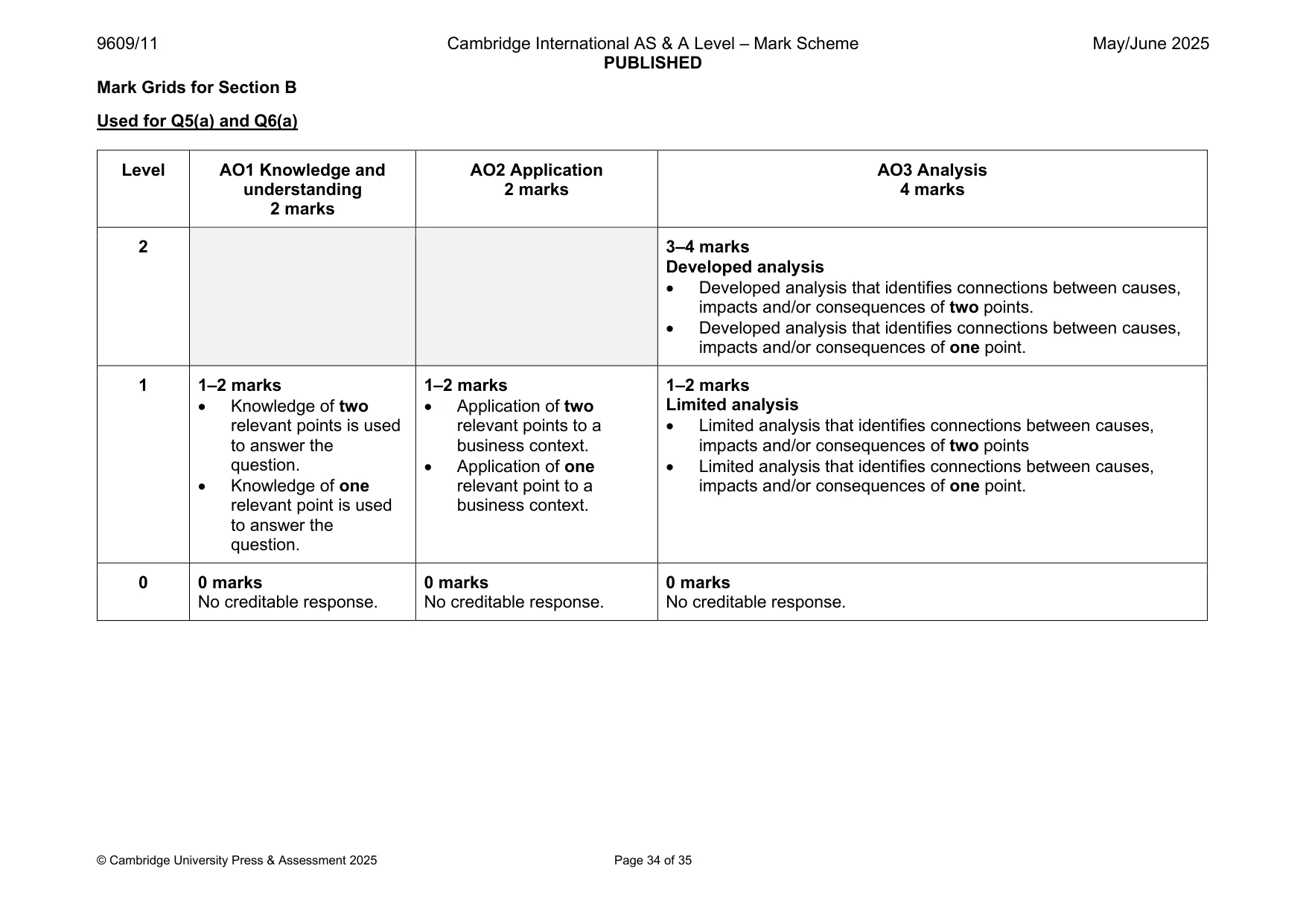
9609/11 Cambridge International AS & A Level – Mark Scheme PUBLISHED May/June 2025 © Cambridge University Press & Assessment 2025 Page 34 of 35 Mark Grids for Section B Used for Q5(a) and Q6(a) Level AO1 Knowledge and understanding 2 marks AO2 Application 2 marks AO3 Analysis 4 marks 2 3–4 marks Developed analysis • Developed analysis that identifies connections between causes, impacts and/or consequences of two points. • Developed analysis that identifies connections between causes, impacts and/or consequences of one point. 1 1–2 marks • Knowledge of two relevant points is used to answer the question. • Knowledge of one relevant point is used to answer the question. 1–2 marks • Application of two relevant points to a business context. • Application of one relevant point to a business context. 1–2 marks Limited analysis • Limited analysis that identifies connections between causes, impacts and/or consequences of two points • Limited analysis that identifies connections between causes, impacts and/or consequences of one point. 0 0 marks No creditable response. 0 marks No creditable response. 0 marks No creditable response.
Mark scheme, page 35
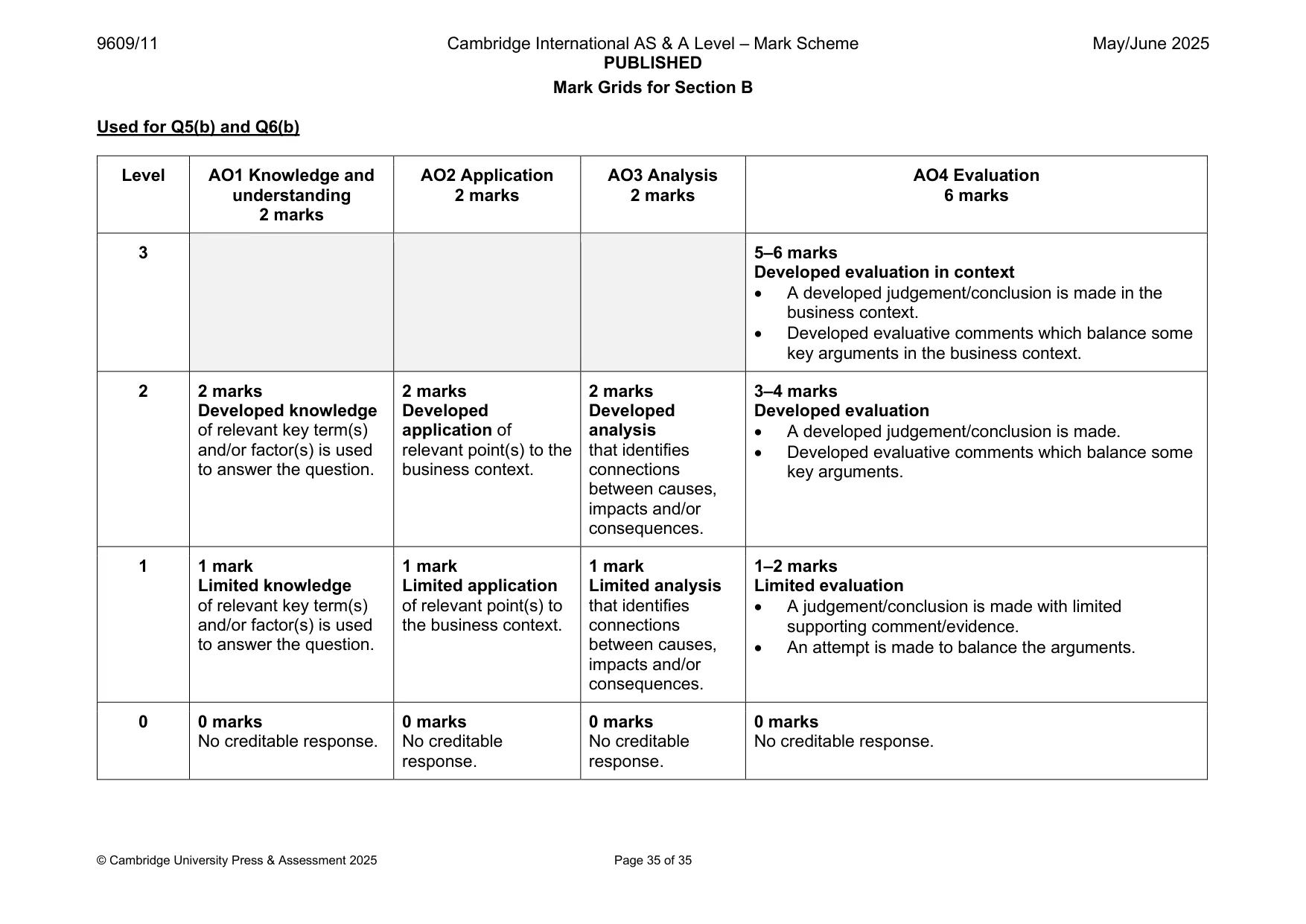
9609/11 Cambridge International AS & A Level – Mark Scheme PUBLISHED May/June 2025 © Cambridge University Press & Assessment 2025 Page 35 of 35 Mark Grids for Section B Used for Q5(b) and Q6(b) Level AO1 Knowledge and understanding 2 marks AO2 Application 2 marks AO3 Analysis 2 marks AO4 Evaluation 6 marks 3 5–6 marks Developed evaluation in context • A developed judgement/conclusion is made in the business context. • Developed evaluative comments which balance some key arguments in the business context. 2 2 marks Developed knowledge of relevant key term(s) and/or factor(s) is used to answer the question. 2 marks Developed application of relevant point(s) to the business context. 2 marks Developed analysis that identifies connections between causes, impacts and/or consequences. 3–4 marks Developed evaluation • A developed judgement/conclusion is made. • Developed evaluative comments which balance some key arguments. 1 1 mark Limited knowledge of relevant key term(s) and/or factor(s) is used to answer the question. 1 mark Limited application of relevant point(s) to the business context. 1 mark Limited analysis that identifies connections between causes, impacts and/or consequences. 1–2 marks Limited evaluation • A judgement/conclusion is made with limited supporting comment/evidence. • An attempt is made to balance the arguments. 0 0 marks No creditable response. 0 marks No creditable response. 0 marks No creditable response. 0 marks No creditable response.
What you needed in this session
Cambridge’s own grade thresholds for 2025 May/June, Paper 1 · Variant 1. A higher threshold means an easier paper — the bar moves with how the cohort did.