Cambridge A Level Business (for first examination in 2016) 9609 — 2024 Oct/Nov Paper 1 · Variant 1
9609/11/O/N/24 · 40 marks · ≈45 min
The question paper and its mark scheme, free to read here and free to download. This is Cambridge’s own paper, exactly as it was sat.
Question paper4 pages


Mark scheme29 pages
Answers below. Sit the paper first if you are practising.
Paper as text
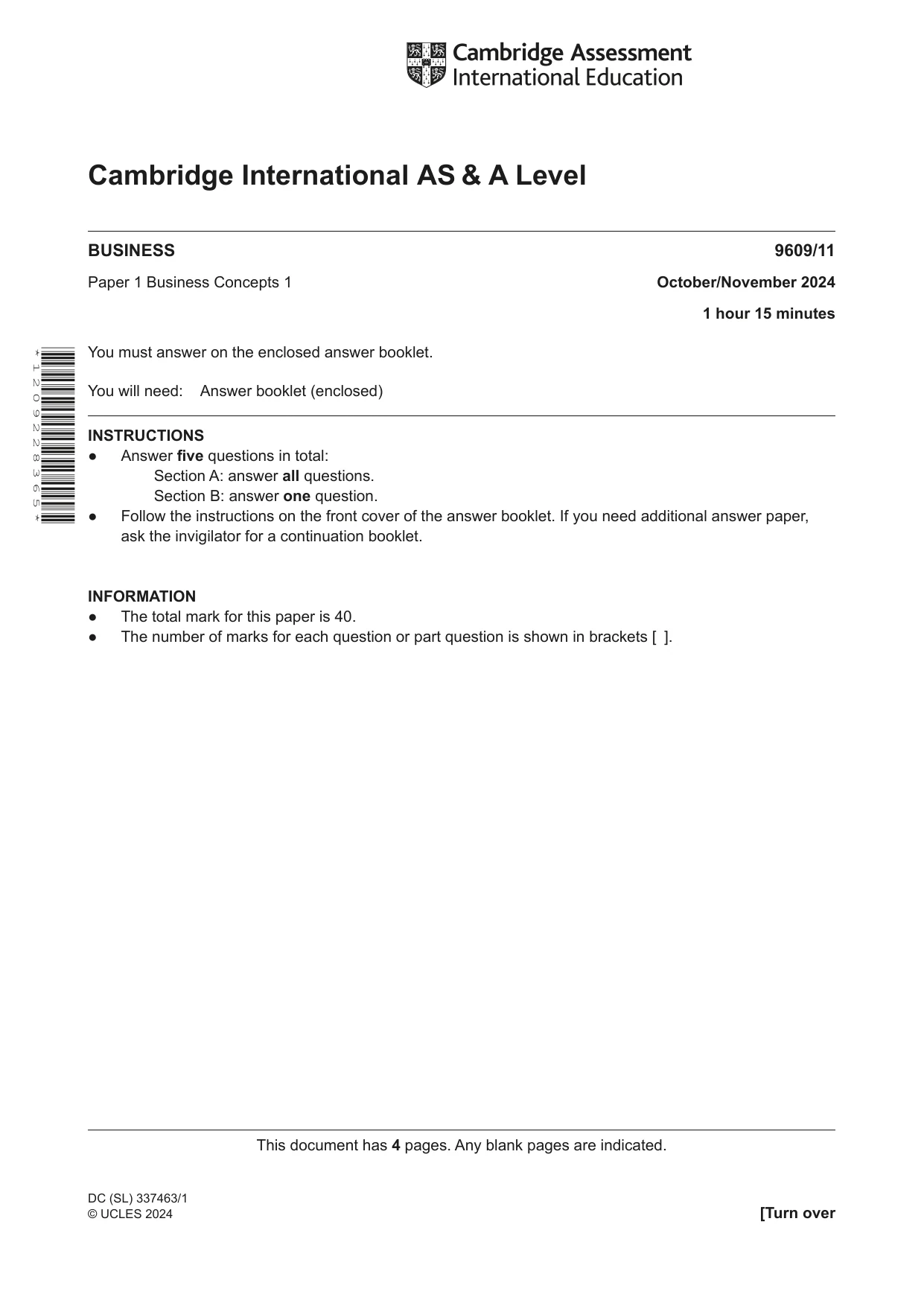
Question paper, page 1
This document has 4 pages. Any blank pages are indicated. [Turn over Cambridge International AS & A Level BUSINESS 9609/11 Paper 1 Business Concepts 1 October/November 2024 1 hour 15 minutes You must answer on the enclosed answer booklet. You will need: Answer booklet (enclosed) INSTRUCTIONS ● Answer five questions in total: Section A: answer all questions. Section B: answer one question. ● Follow the instructions on the front cover of the answer booklet. If you need additional answer paper, ask the invigilator for a continuation booklet. INFORMATION ● The total mark for this paper is 40. ● The number of marks for each question or part question is shown in brackets [ ]. * 1 2 0 9 2 2 8 3 6 5 * DC (SL) 337463/1 © UCLES 2024
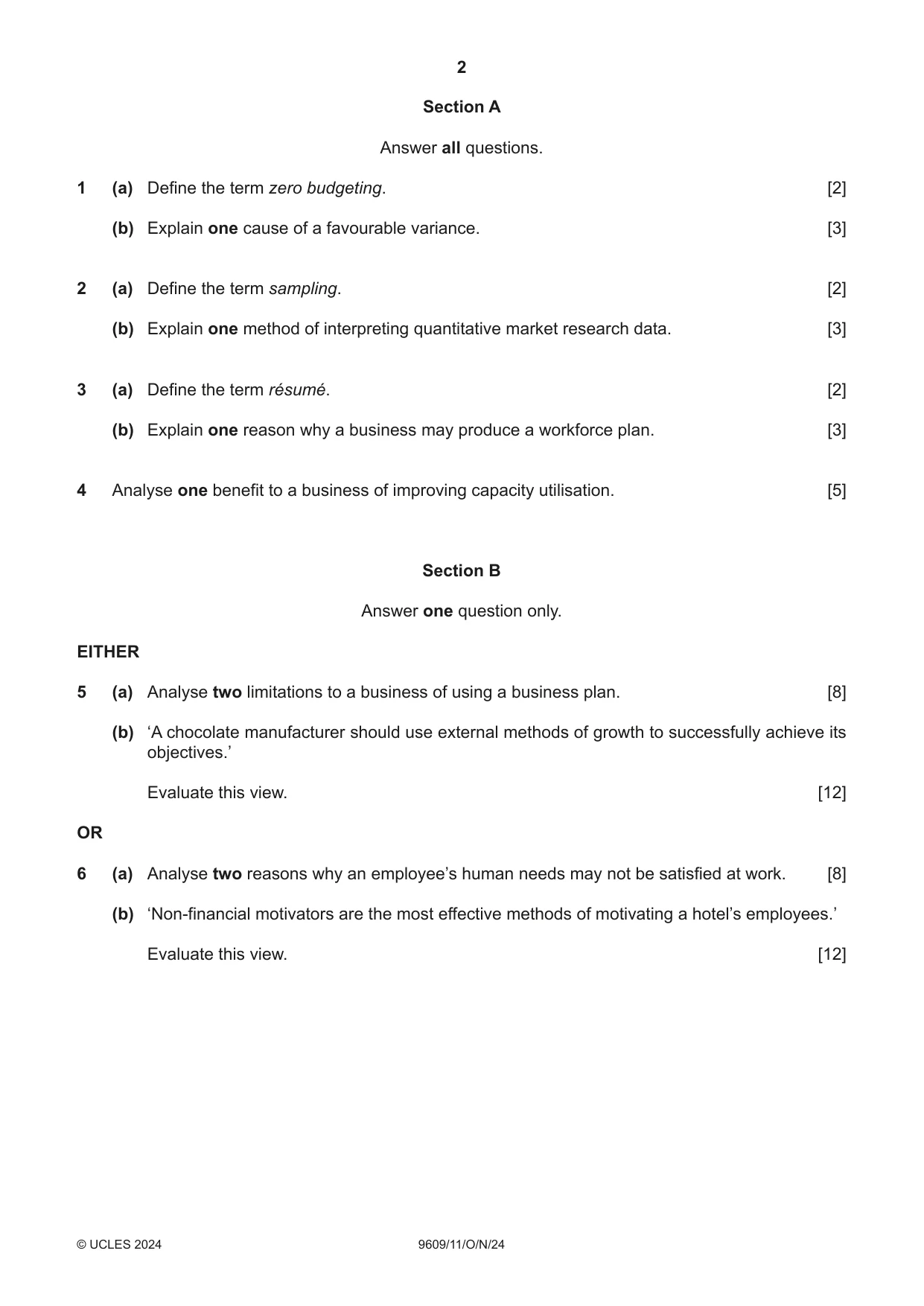
Question paper, page 2
2 9609/11/O/N/24 © UCLES 2024 Section A Answer all questions. 1 (a) Define the term zero budgeting. [2] (b) Explain one cause of a favourable variance. [3] 2 (a) Define the term sampling. [2] (b) Explain one method of interpreting quantitative market research data. [3] 3 (a) Define the term résumé. [2] (b) Explain one reason why a business may produce a workforce plan. [3] 4 Analyse one benefit to a business of improving capacity utilisation. [5] Section B Answer one question only. EITHER 5 (a) Analyse two limitations to a business of using a business plan. [8] (b) ‘A chocolate manufacturer should use external methods of growth to successfully achieve its objectives.’ Evaluate this view. [12] OR 6 (a) Analyse two reasons why an employee’s human needs may not be satisfied at work. [8] (b) ‘Non‑financial motivators are the most effective methods of motivating a hotel’s employees.’ Evaluate this view. [12]
Question paper, page 3
3 9609/11/O/N/24 © UCLES 2024 BLANK PAGE
Question paper, page 4
4 9609/11/O/N/24 © UCLES 2024 Permission to reproduce items where third‑party owned material protected by copyright is included has been sought and cleared where possible. Every reasonable effort has been made by the publisher (UCLES) to trace copyright holders, but if any items requiring clearance have unwittingly been included, the publisher will be pleased to make amends at the earliest possible opportunity. To avoid the issue of disclosure of answer‑related information to candidates, all copyright acknowledgements are reproduced online in the Cambridge Assessment International Education Copyright Acknowledgements Booklet. This is produced for each series of examinations and is freely available to download at www.cambridgeinternational.org after the live examination series. Cambridge Assessment International Education is part of Cambridge Assessment. Cambridge Assessment is the brand name of the University of Cambridge Local Examinations Syndicate (UCLES), which is a department of the University of Cambridge. BLANK PAGE
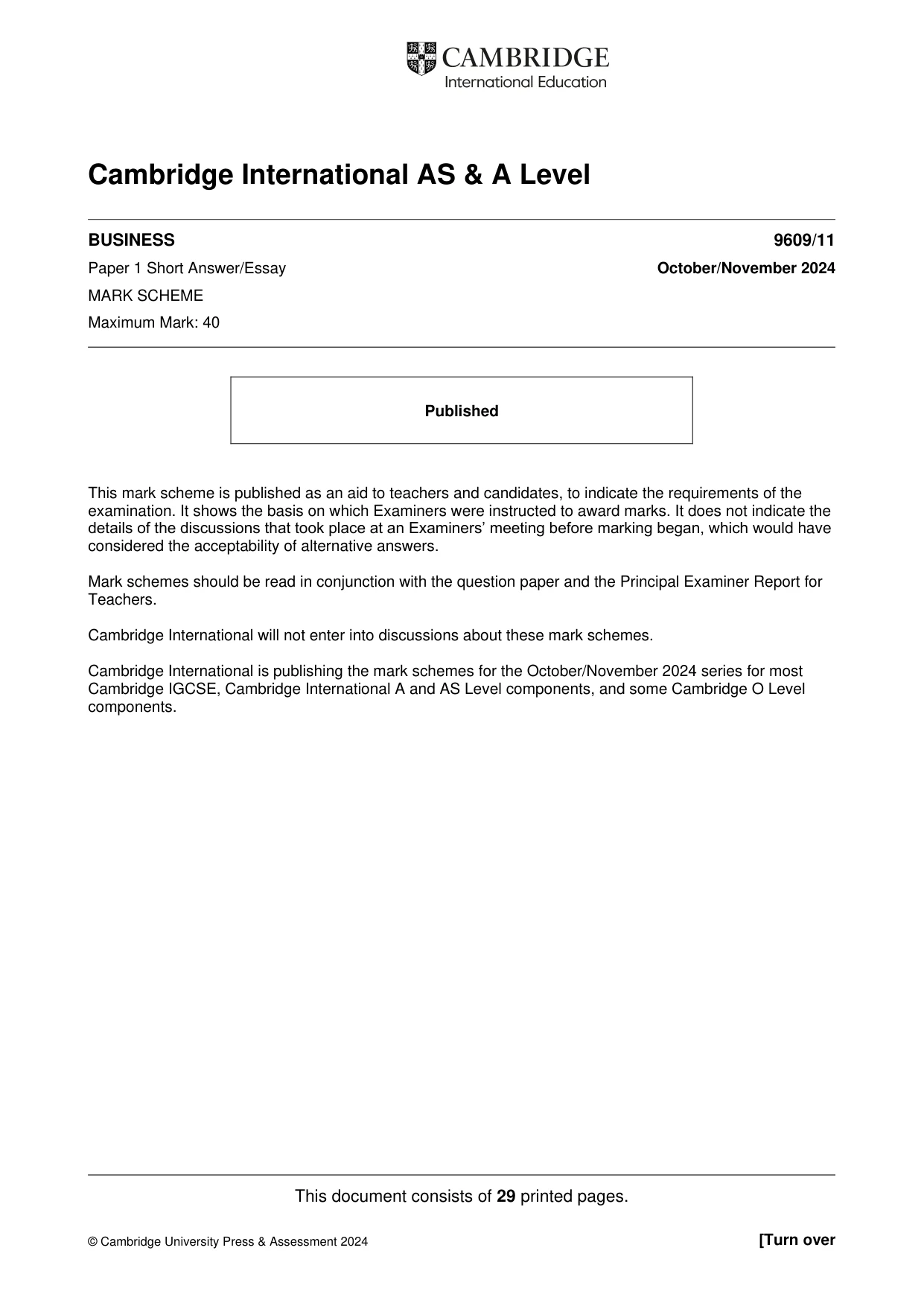
Mark scheme, page 1
This document consists of 29 printed pages. © Cambridge University Press & Assessment 2024 [Turn over Cambridge International AS & A Level BUSINESS 9609/11 Paper 1 Short Answer/Essay October/November 2024 MARK SCHEME Maximum Mark: 40 Published This mark scheme is published as an aid to teachers and candidates, to indicate the requirements of the examination. It shows the basis on which Examiners were instructed to award marks. It does not indicate the details of the discussions that took place at an Examiners’ meeting before marking began, which would have considered the acceptability of alternative answers. Mark schemes should be read in conjunction with the question paper and the Principal Examiner Report for Teachers. Cambridge International will not enter into discussions about these mark schemes. Cambridge International is publishing the mark schemes for the October/November 2024 series for most Cambridge IGCSE, Cambridge International A and AS Level components, and some Cambridge O Level components.
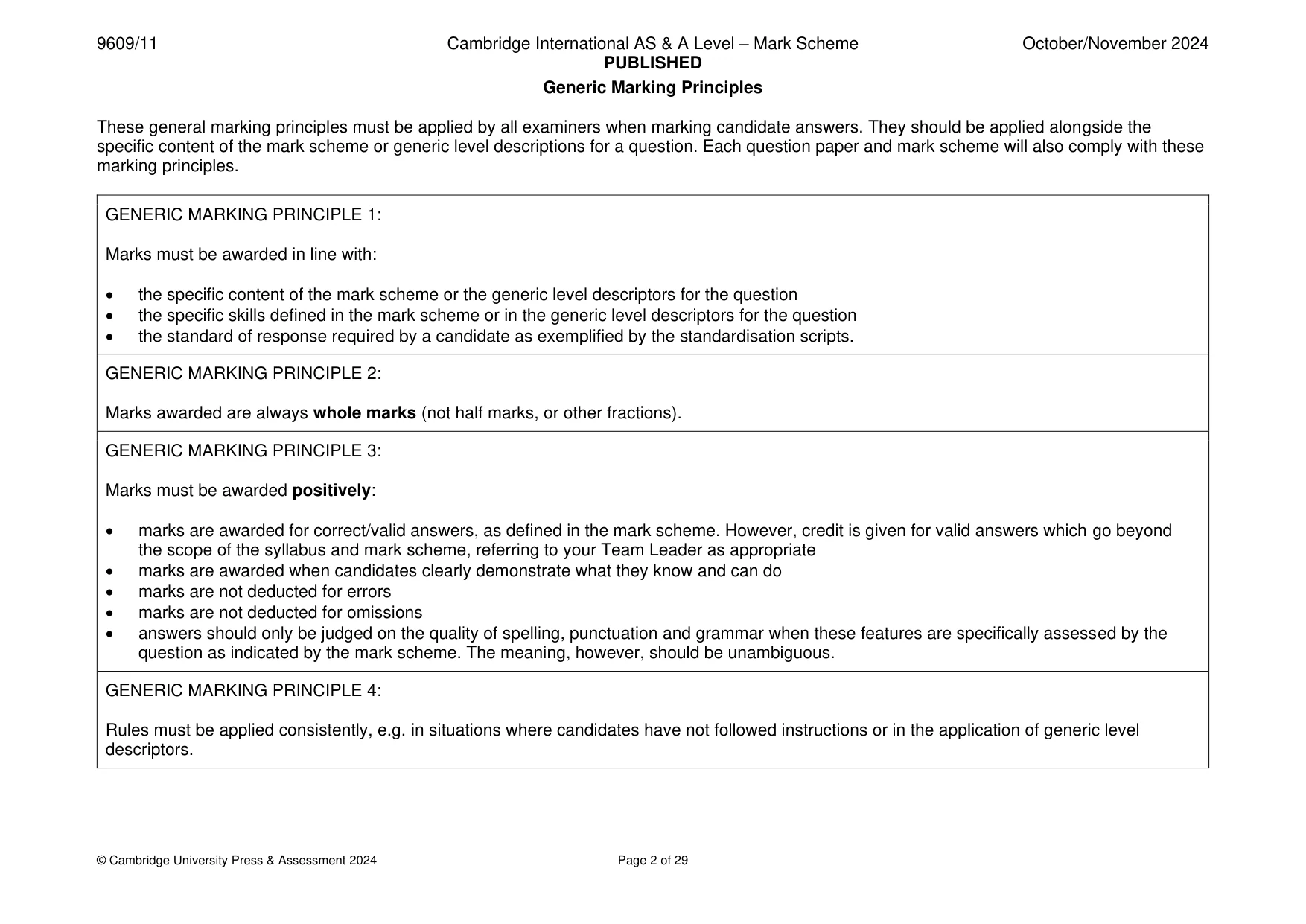
Mark scheme, page 2
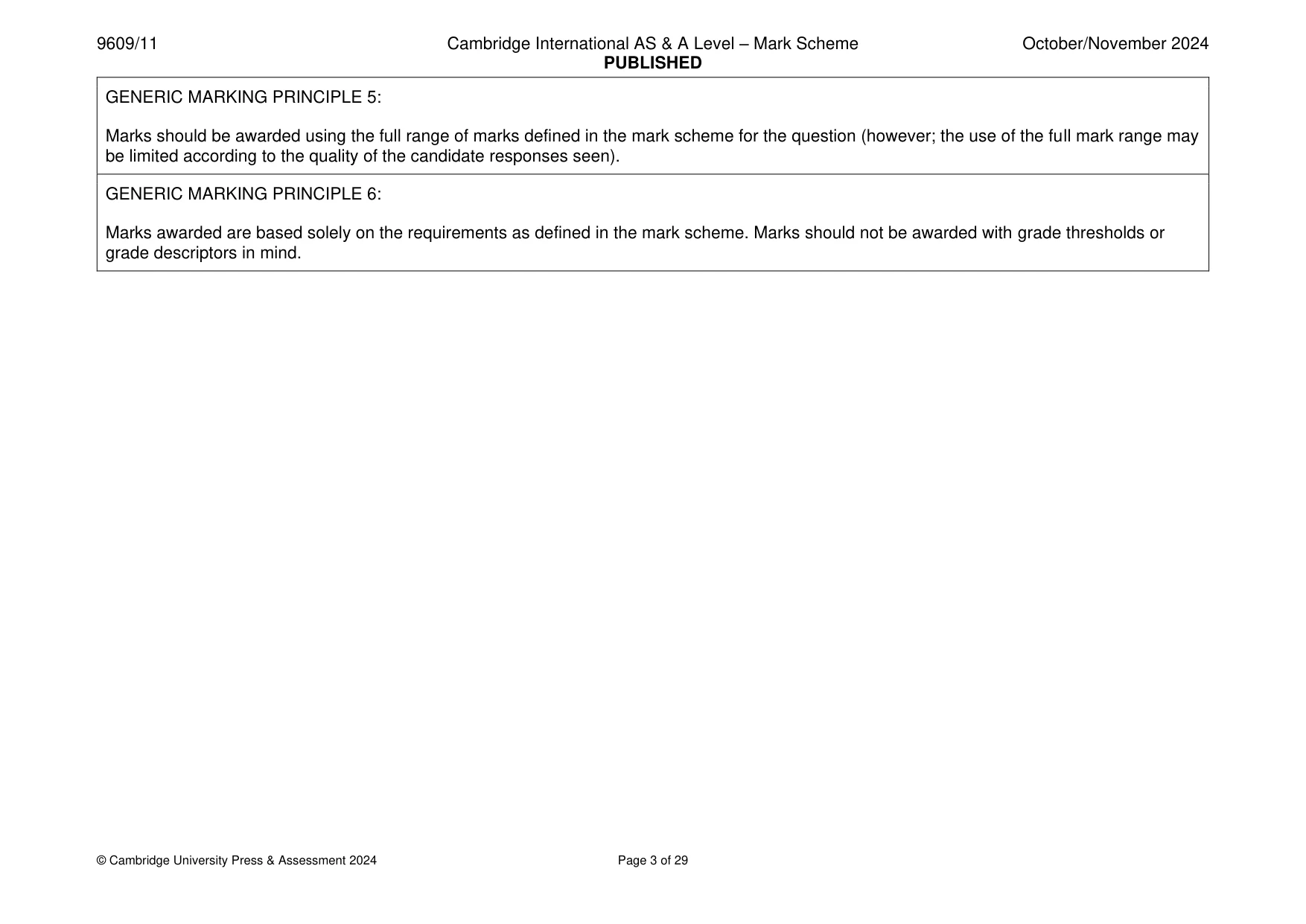
9609/11 Cambridge International AS & A Level – Mark Scheme PUBLISHED October/November 2024 © Cambridge University Press & Assessment 2024 Page 2 of 29 Generic Marking Principles These general marking principles must be applied by all examiners when marking candidate answers. They should be applied alongside the specific content of the mark scheme or generic level descriptions for a question. Each question paper and mark scheme will also comply with these marking principles. GENERIC MARKING PRINCIPLE 1: Marks must be awarded in line with: • the specific content of the mark scheme or the generic level descriptors for the question • the specific skills defined in the mark scheme or in the generic level descriptors for the question • the standard of response required by a candidate as exemplified by the standardisation scripts. GENERIC MARKING PRINCIPLE 2: Marks awarded are always whole marks (not half marks, or other fractions). GENERIC MARKING PRINCIPLE 3: Marks must be awarded positively: • marks are awarded for correct/valid answers, as defined in the mark scheme. However, credit is given for valid answers which go beyond the scope of the syllabus and mark scheme, referring to your Team Leader as appropriate • marks are awarded when candidates clearly demonstrate what they know and can do • marks are not deducted for errors • marks are not deducted for omissions • answers should only be judged on the quality of spelling, punctuation and grammar when these features are specifically assessed by the question as indicated by the mark scheme. The meaning, however, should be unambiguous. GENERIC MARKING PRINCIPLE 4: Rules must be applied consistently, e.g. in situations where candidates have not followed instructions or in the application of generic level descriptors.
Mark scheme, page 3
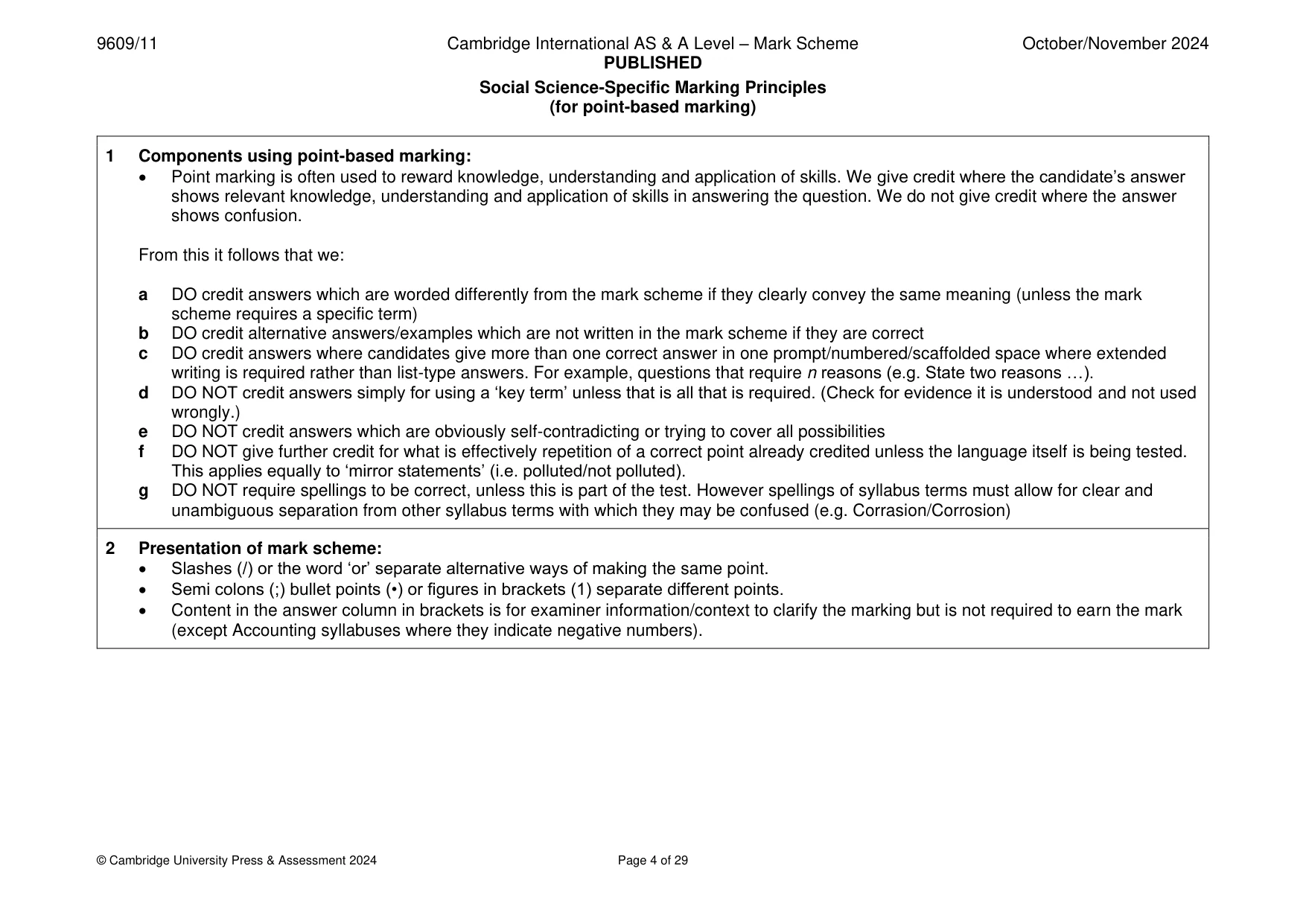
9609/11 Cambridge International AS & A Level – Mark Scheme PUBLISHED October/November 2024 © Cambridge University Press & Assessment 2024 Page 3 of 29 GENERIC MARKING PRINCIPLE 5: Marks should be awarded using the full range of marks defined in the mark scheme for the question (however; the use of the full mark range may be limited according to the quality of the candidate responses seen). GENERIC MARKING PRINCIPLE 6: Marks awarded are based solely on the requirements as defined in the mark scheme. Marks should not be awarded with grade thresholds or grade descriptors in mind.
Mark scheme, page 4
9609/11 Cambridge International AS & A Level – Mark Scheme PUBLISHED October/November 2024 © Cambridge University Press & Assessment 2024 Page 4 of 29 Social Science-Specific Marking Principles (for point-based marking) 1 Components using point-based marking: • Point marking is often used to reward knowledge, understanding and application of skills. We give credit where the candidate’s answer shows relevant knowledge, understanding and application of skills in answering the question. We do not give credit where the answer shows confusion. From this it follows that we: a DO credit answers which are worded differently from the mark scheme if they clearly convey the same meaning (unless the mark scheme requires a specific term) b DO credit alternative answers/examples which are not written in the mark scheme if they are correct c DO credit answers where candidates give more than one correct answer in one prompt/numbered/scaffolded space where extended writing is required rather than list-type answers. For example, questions that require n reasons (e.g. State two reasons …). d DO NOT credit answers simply for using a ‘key term’ unless that is all that is required. (Check for evidence it is understood and not used wrongly.) e DO NOT credit answers which are obviously self-contradicting or trying to cover all possibilities f DO NOT give further credit for what is effectively repetition of a correct point already credited unless the language itself is being tested. This applies equally to ‘mirror statements’ (i.e. polluted/not polluted). g DO NOT require spellings to be correct, unless this is part of the test. However spellings of syllabus terms must allow for clear and unambiguous separation from other syllabus terms with which they may be confused (e.g. Corrasion/Corrosion) 2 Presentation of mark scheme: • Slashes (/) or the word ‘or’ separate alternative ways of making the same point. • Semi colons (;) bullet points (•) or figures in brackets (1) separate different points. • Content in the answer column in brackets is for examiner information/context to clarify the marking but is not required to earn the mark (except Accounting syllabuses where they indicate negative numbers).
Mark scheme, page 5
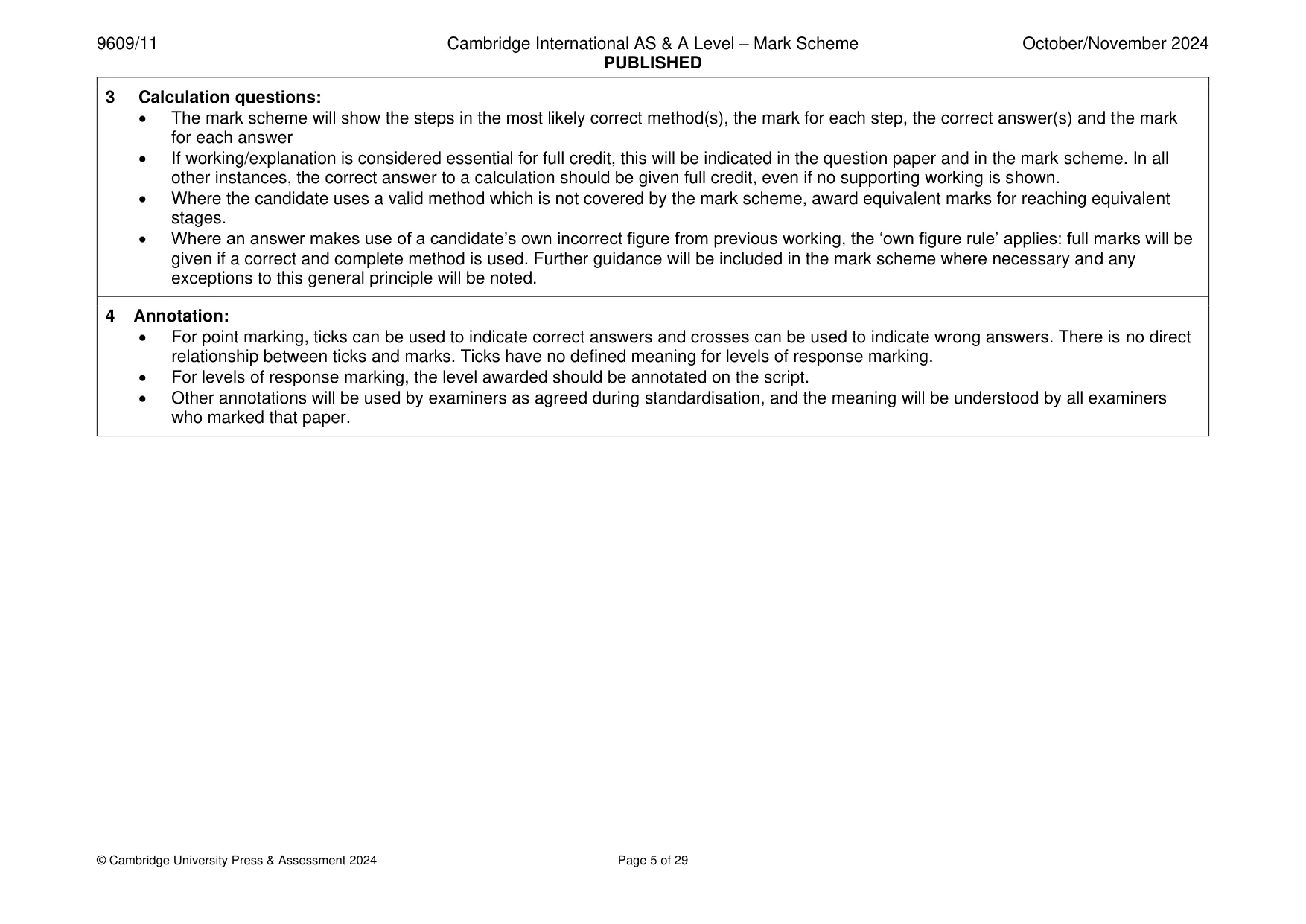
9609/11 Cambridge International AS & A Level – Mark Scheme PUBLISHED October/November 2024 © Cambridge University Press & Assessment 2024 Page 5 of 29 3 Calculation questions: • The mark scheme will show the steps in the most likely correct method(s), the mark for each step, the correct answer(s) and the mark for each answer • If working/explanation is considered essential for full credit, this will be indicated in the question paper and in the mark scheme. In all other instances, the correct answer to a calculation should be given full credit, even if no supporting working is shown. • Where the candidate uses a valid method which is not covered by the mark scheme, award equivalent marks for reaching equivalent stages. • Where an answer makes use of a candidate’s own incorrect figure from previous working, the ‘own figure rule’ applies: full marks will be given if a correct and complete method is used. Further guidance will be included in the mark scheme where necessary and any exceptions to this general principle will be noted. 4 Annotation: • For point marking, ticks can be used to indicate correct answers and crosses can be used to indicate wrong answers. There is no direct relationship between ticks and marks. Ticks have no defined meaning for levels of response marking. • For levels of response marking, the level awarded should be annotated on the script. • Other annotations will be used by examiners as agreed during standardisation, and the meaning will be understood by all examiners who marked that paper.
Mark scheme, page 6
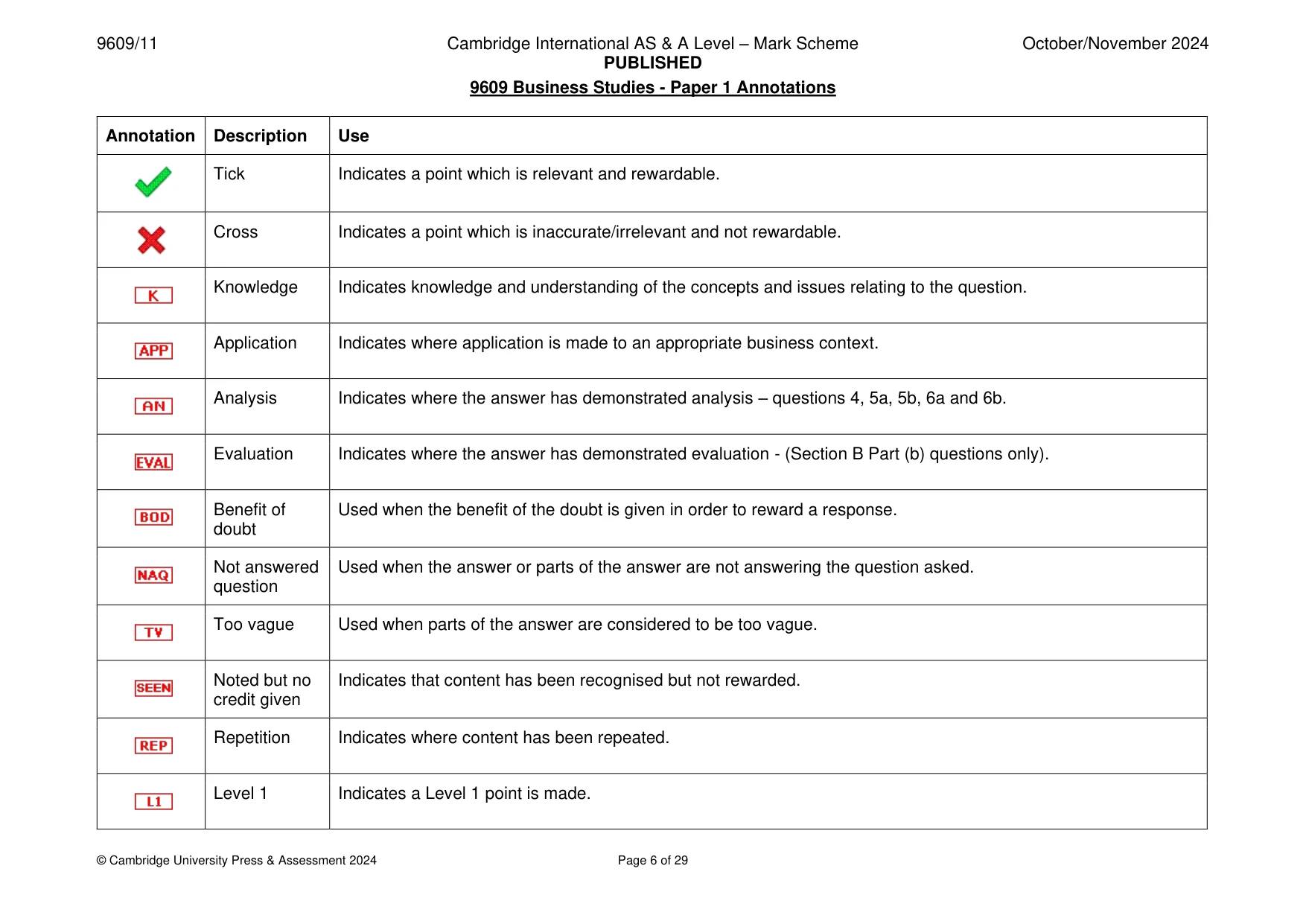
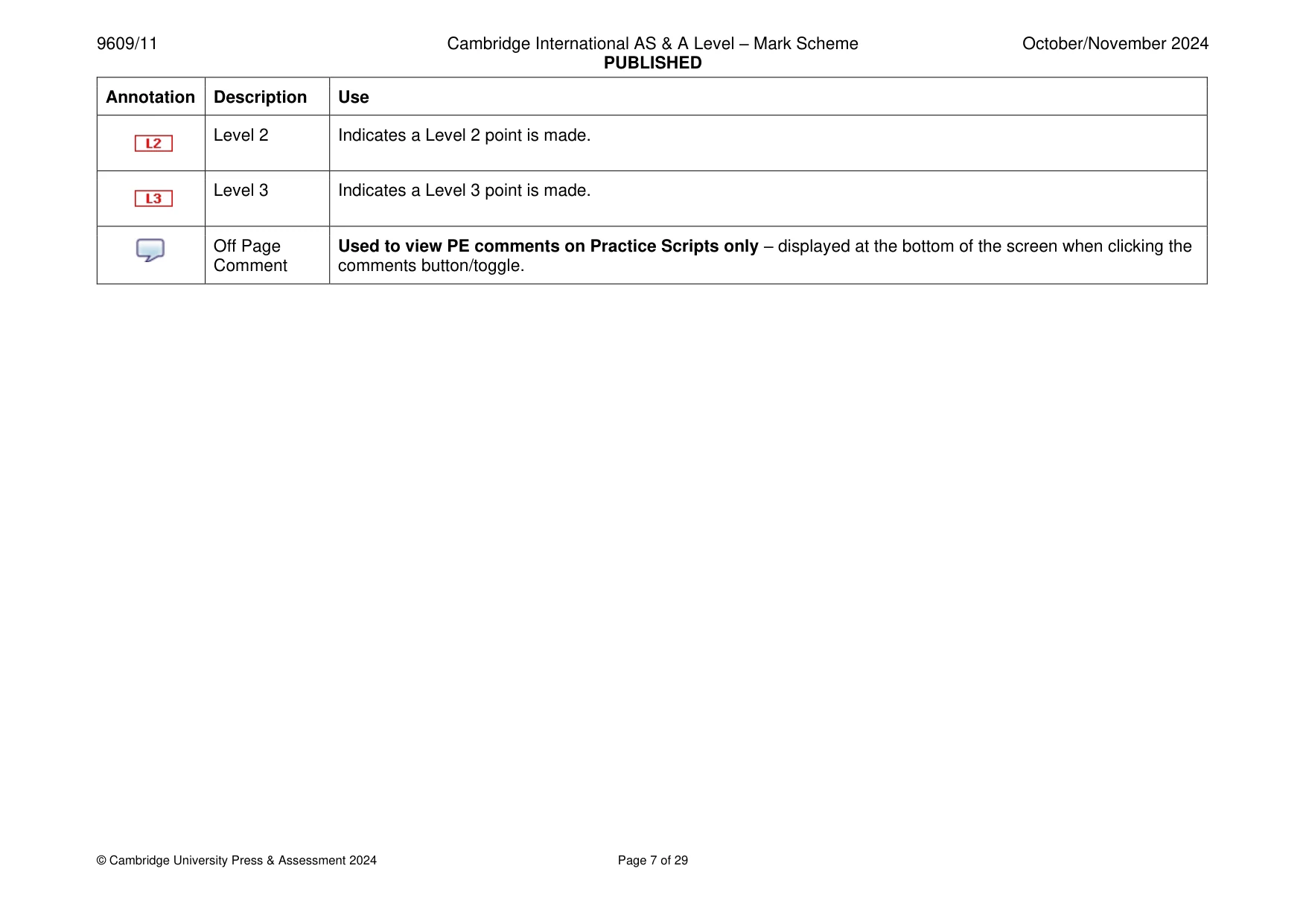
9609/11 Cambridge International AS & A Level – Mark Scheme PUBLISHED October/November 2024 © Cambridge University Press & Assessment 2024 Page 6 of 29 9609 Business Studies - Paper 1 Annotations Annotation Description Use Tick Indicates a point which is relevant and rewardable. Cross Indicates a point which is inaccurate/irrelevant and not rewardable. Knowledge Indicates knowledge and understanding of the concepts and issues relating to the question. Application Indicates where application is made to an appropriate business context. Analysis Indicates where the answer has demonstrated analysis – questions 4, 5a, 5b, 6a and 6b. Evaluation Indicates where the answer has demonstrated evaluation - (Section B Part (b) questions only). Benefit of doubt Used when the benefit of the doubt is given in order to reward a response. Not answered question Used when the answer or parts of the answer are not answering the question asked. Too vague Used when parts of the answer are considered to be too vague. Noted but no credit given Indicates that content has been recognised but not rewarded. Repetition Indicates where content has been repeated. Level 1 Indicates a Level 1 point is made.
Mark scheme, page 7
9609/11 Cambridge International AS & A Level – Mark Scheme PUBLISHED October/November 2024 © Cambridge University Press & Assessment 2024 Page 7 of 29 Annotation Description Use Level 2 Indicates a Level 2 point is made. Level 3 Indicates a Level 3 point is made. Off Page Comment Used to view PE comments on Practice Scripts only – displayed at the bottom of the screen when clicking the comments button/toggle.
Mark scheme, page 8
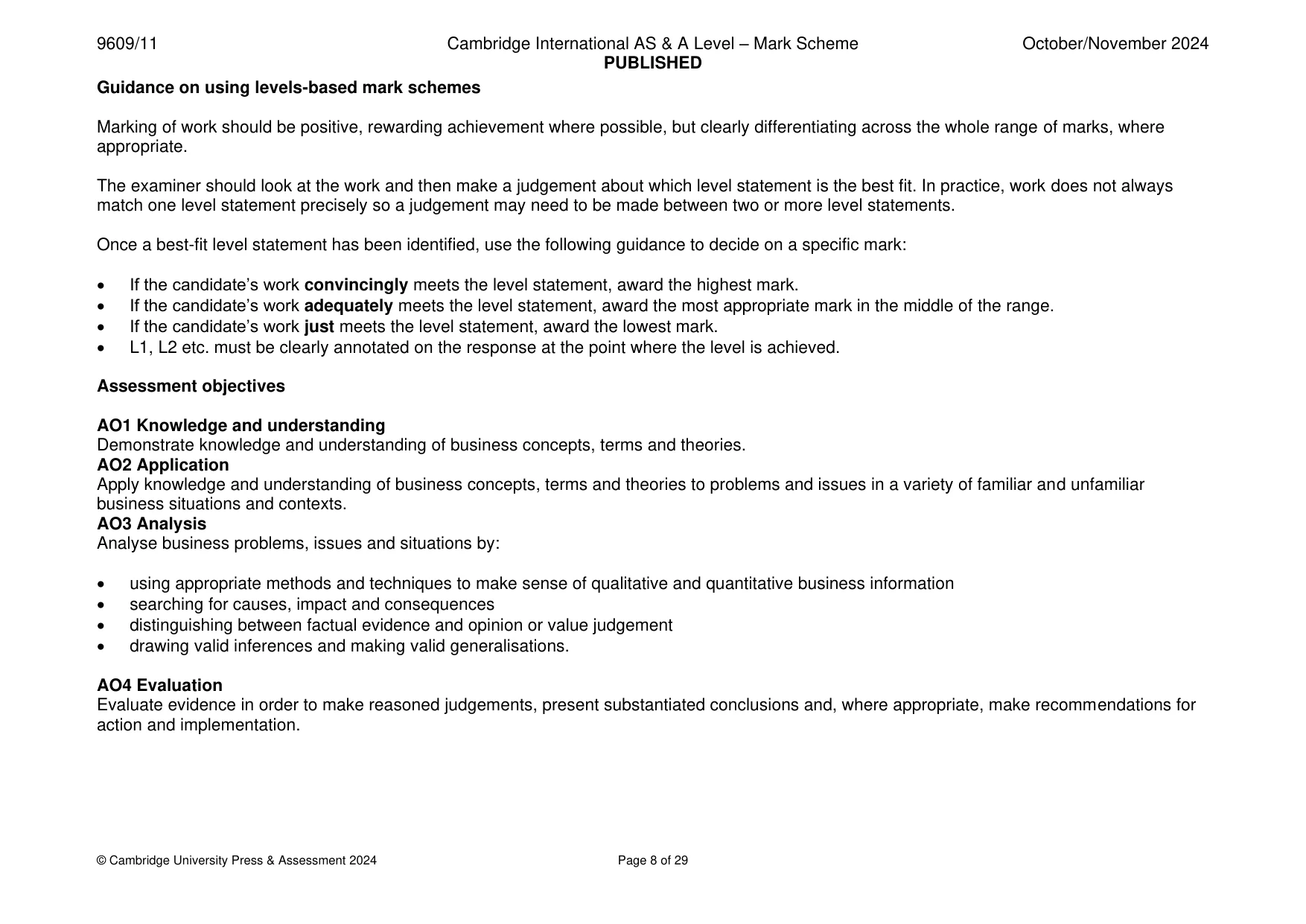
9609/11 Cambridge International AS & A Level – Mark Scheme PUBLISHED October/November 2024 © Cambridge University Press & Assessment 2024 Page 8 of 29 Guidance on using levels-based mark schemes Marking of work should be positive, rewarding achievement where possible, but clearly differentiating across the whole range of marks, where appropriate. The examiner should look at the work and then make a judgement about which level statement is the best fit. In practice, work does not always match one level statement precisely so a judgement may need to be made between two or more level statements. Once a best-fit level statement has been identified, use the following guidance to decide on a specific mark: • If the candidate’s work convincingly meets the level statement, award the highest mark. • If the candidate’s work adequately meets the level statement, award the most appropriate mark in the middle of the range. • If the candidate’s work just meets the level statement, award the lowest mark. • L1, L2 etc. must be clearly annotated on the response at the point where the level is achieved. Assessment objectives AO1 Knowledge and understanding Demonstrate knowledge and understanding of business concepts, terms and theories. AO2 Application Apply knowledge and understanding of business concepts, terms and theories to problems and issues in a variety of familiar and unfamiliar business situations and contexts. AO3 Analysis Analyse business problems, issues and situations by: • using appropriate methods and techniques to make sense of qualitative and quantitative business information • searching for causes, impact and consequences • distinguishing between factual evidence and opinion or value judgement • drawing valid inferences and making valid generalisations. AO4 Evaluation Evaluate evidence in order to make reasoned judgements, present substantiated conclusions and, where appropriate, make recommendations for action and implementation.
Mark scheme, page 9
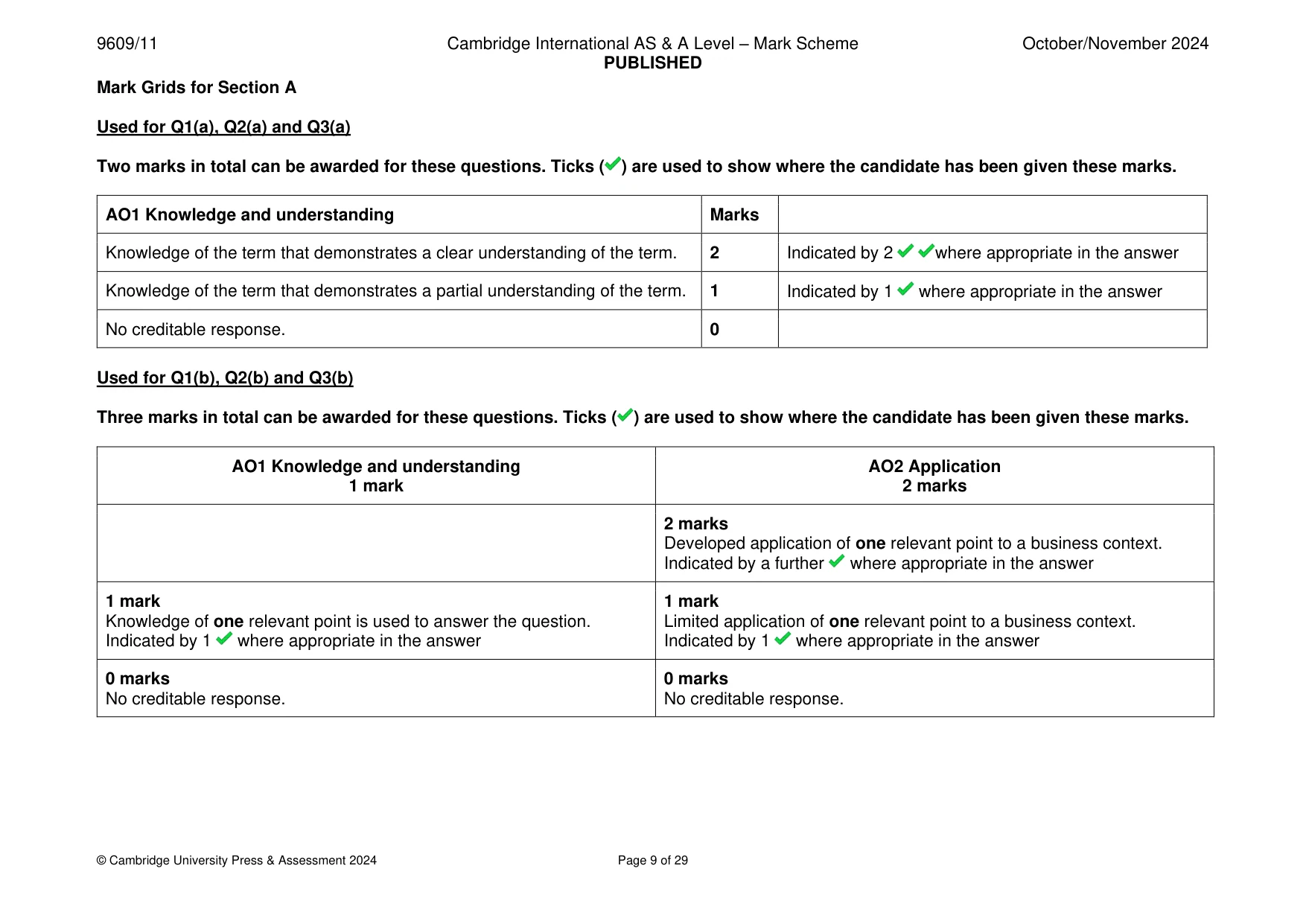
9609/11 Cambridge International AS & A Level – Mark Scheme PUBLISHED October/November 2024 © Cambridge University Press & Assessment 2024 Page 9 of 29 Mark Grids for Section A Used for Q1(a), Q2(a) and Q3(a) Two marks in total can be awarded for these questions. Ticks ( ) are used to show where the candidate has been given these marks. AO1 Knowledge and understanding Marks Knowledge of the term that demonstrates a clear understanding of the term. 2 Indicated by 2 where appropriate in the answer Knowledge of the term that demonstrates a partial understanding of the term. 1 Indicated by 1 where appropriate in the answer No creditable response. 0 Used for Q1(b), Q2(b) and Q3(b) Three marks in total can be awarded for these questions. Ticks ( ) are used to show where the candidate has been given these marks. AO1 Knowledge and understanding 1 mark AO2 Application 2 marks 2 marks Developed application of one relevant point to a business context. Indicated by a further where appropriate in the answer 1 mark Knowledge of one relevant point is used to answer the question. Indicated by 1 where appropriate in the answer 1 mark Limited application of one relevant point to a business context. Indicated by 1 where appropriate in the answer 0 marks No creditable response. 0 marks No creditable response.
Mark scheme, page 10
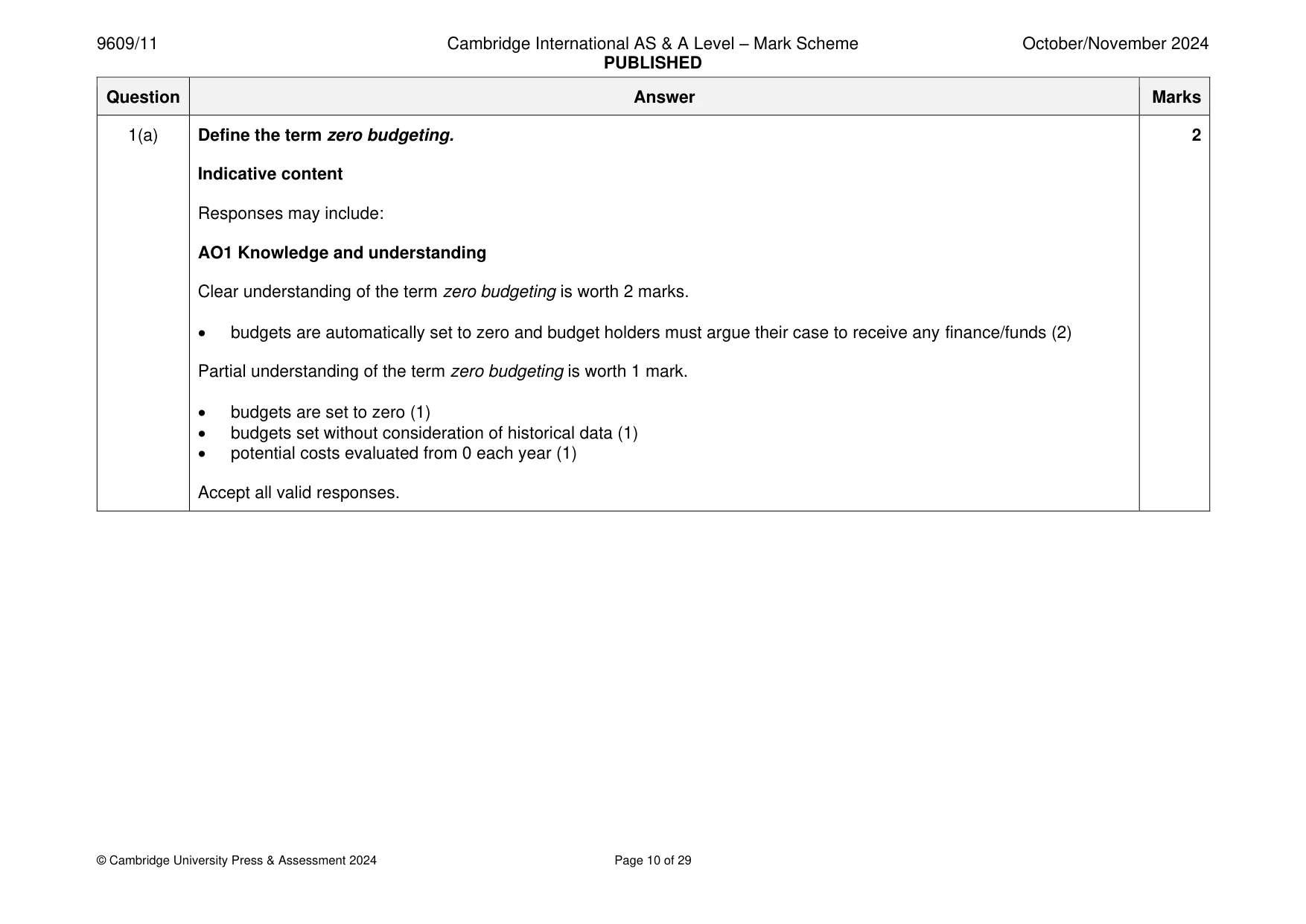
9609/11 Cambridge International AS & A Level – Mark Scheme PUBLISHED October/November 2024 © Cambridge University Press & Assessment 2024 Page 10 of 29 Question Answer Marks 1(a) Define the term zero budgeting. Indicative content Responses may include: AO1 Knowledge and understanding Clear understanding of the term zero budgeting is worth 2 marks. • budgets are automatically set to zero and budget holders must argue their case to receive any finance/funds (2) Partial understanding of the term zero budgeting is worth 1 mark. • budgets are set to zero (1) • budgets set without consideration of historical data (1) • potential costs evaluated from 0 each year (1) Accept all valid responses. 2
Mark scheme, page 11
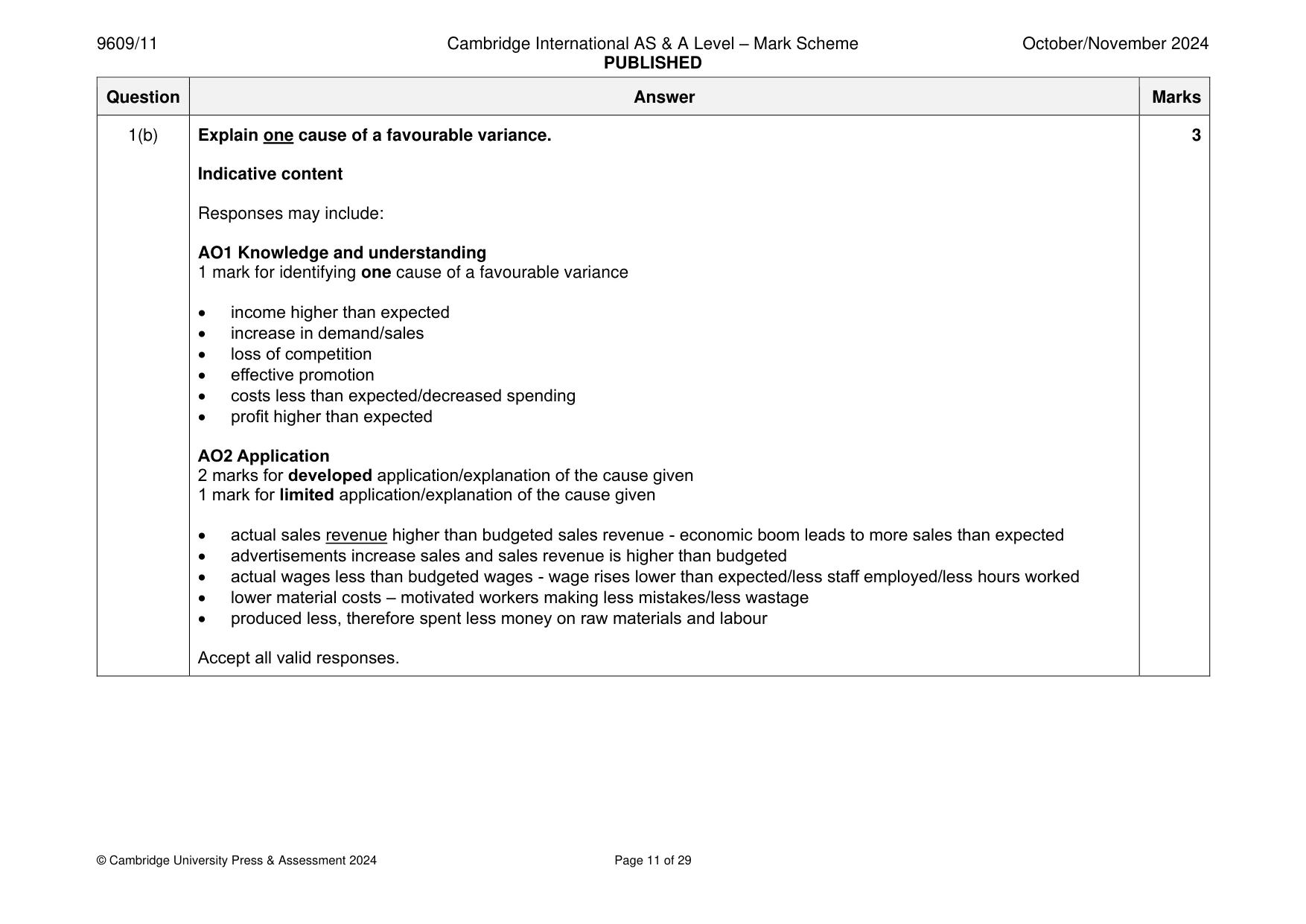
9609/11 Cambridge International AS & A Level – Mark Scheme PUBLISHED October/November 2024 © Cambridge University Press & Assessment 2024 Page 11 of 29 Question Answer Marks 1(b) Explain one cause of a favourable variance. Indicative content Responses may include: AO1 Knowledge and understanding 1 mark for identifying one cause of a favourable variance • income higher than expected • increase in demand/sales • loss of competition • effective promotion • costs less than expected/decreased spending • profit higher than expected AO2 Application 2 marks for developed application/explanation of the cause given 1 mark for limited application/explanation of the cause given • actual sales revenue higher than budgeted sales revenue - economic boom leads to more sales than expected • advertisements increase sales and sales revenue is higher than budgeted • actual wages less than budgeted wages - wage rises lower than expected/less staff employed/less hours worked • lower material costs – motivated workers making less mistakes/less wastage • produced less, therefore spent less money on raw materials and labour Accept all valid responses. 3
Mark scheme, page 12
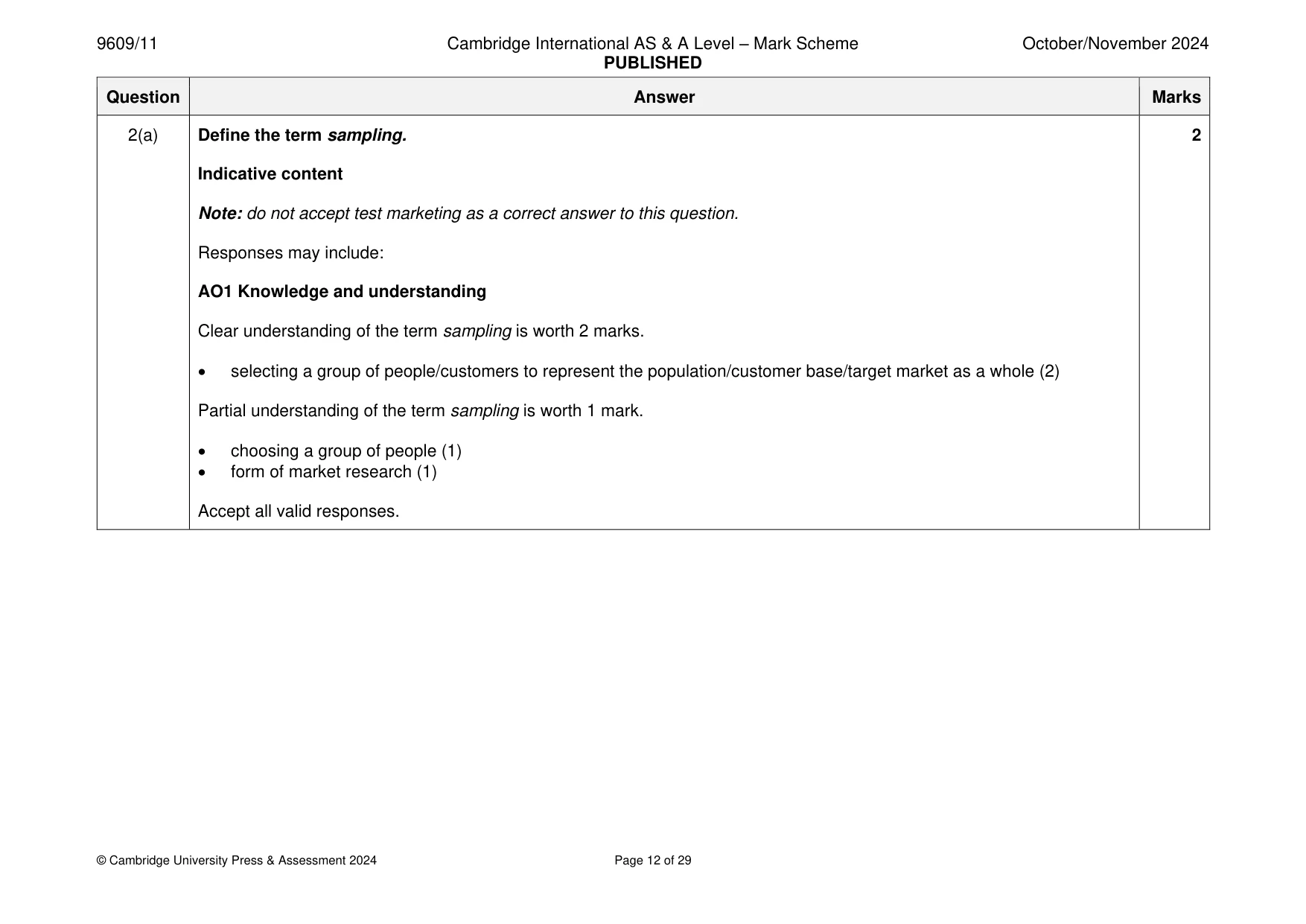
9609/11 Cambridge International AS & A Level – Mark Scheme PUBLISHED October/November 2024 © Cambridge University Press & Assessment 2024 Page 12 of 29 Question Answer Marks 2(a) Define the term sampling. Indicative content Note: do not accept test marketing as a correct answer to this question. Responses may include: AO1 Knowledge and understanding Clear understanding of the term sampling is worth 2 marks. • selecting a group of people/customers to represent the population/customer base/target market as a whole (2) Partial understanding of the term sampling is worth 1 mark. • choosing a group of people (1) • form of market research (1) Accept all valid responses. 2
Mark scheme, page 13
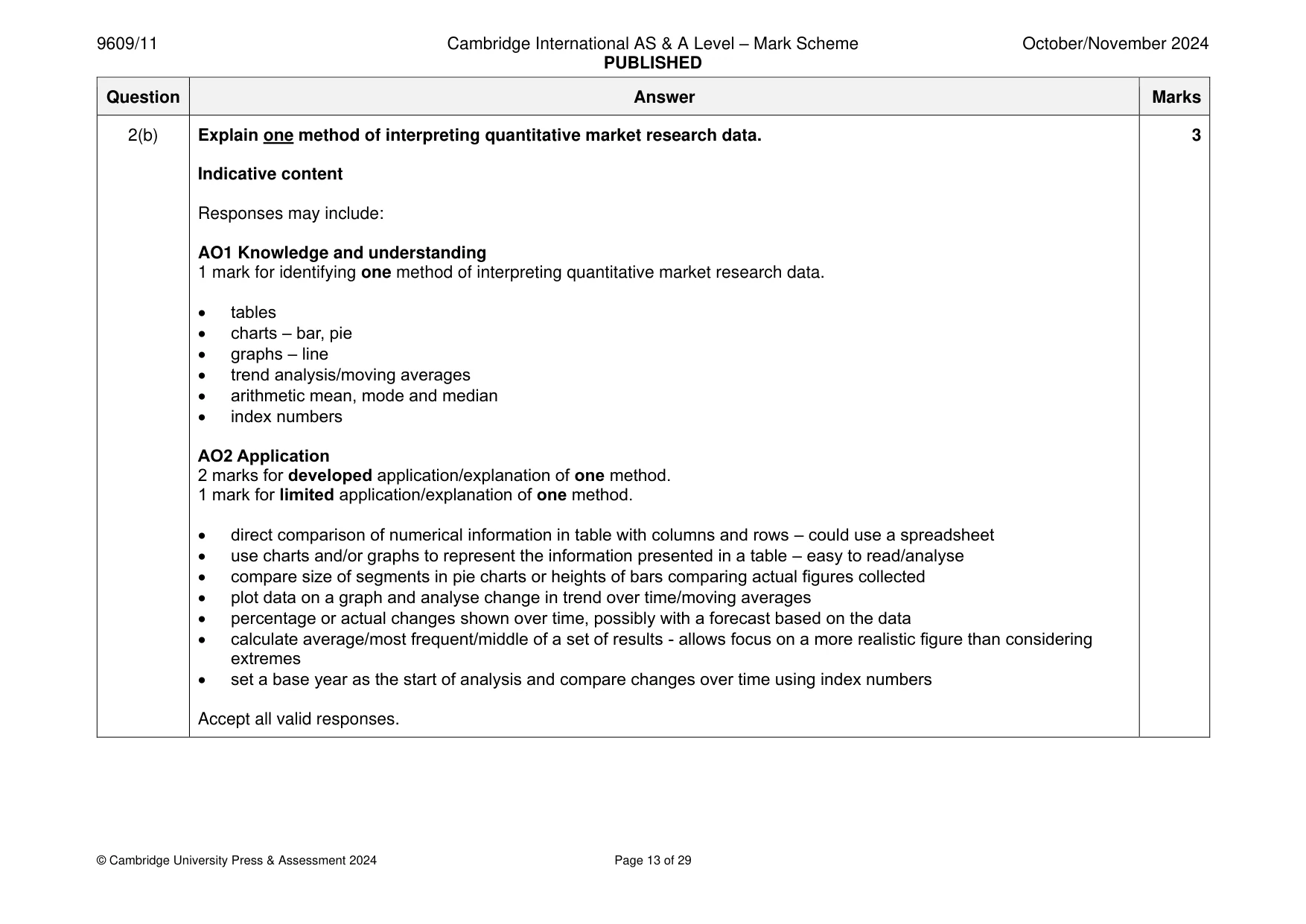
9609/11 Cambridge International AS & A Level – Mark Scheme PUBLISHED October/November 2024 © Cambridge University Press & Assessment 2024 Page 13 of 29 Question Answer Marks 2(b) Explain one method of interpreting quantitative market research data. Indicative content Responses may include: AO1 Knowledge and understanding 1 mark for identifying one method of interpreting quantitative market research data. • tables • charts – bar, pie • graphs – line • trend analysis/moving averages • arithmetic mean, mode and median • index numbers AO2 Application 2 marks for developed application/explanation of one method. 1 mark for limited application/explanation of one method. • direct comparison of numerical information in table with columns and rows – could use a spreadsheet • use charts and/or graphs to represent the information presented in a table – easy to read/analyse • compare size of segments in pie charts or heights of bars comparing actual figures collected • plot data on a graph and analyse change in trend over time/moving averages • percentage or actual changes shown over time, possibly with a forecast based on the data • calculate average/most frequent/middle of a set of results - allows focus on a more realistic figure than considering extremes • set a base year as the start of analysis and compare changes over time using index numbers Accept all valid responses. 3
Mark scheme, page 14
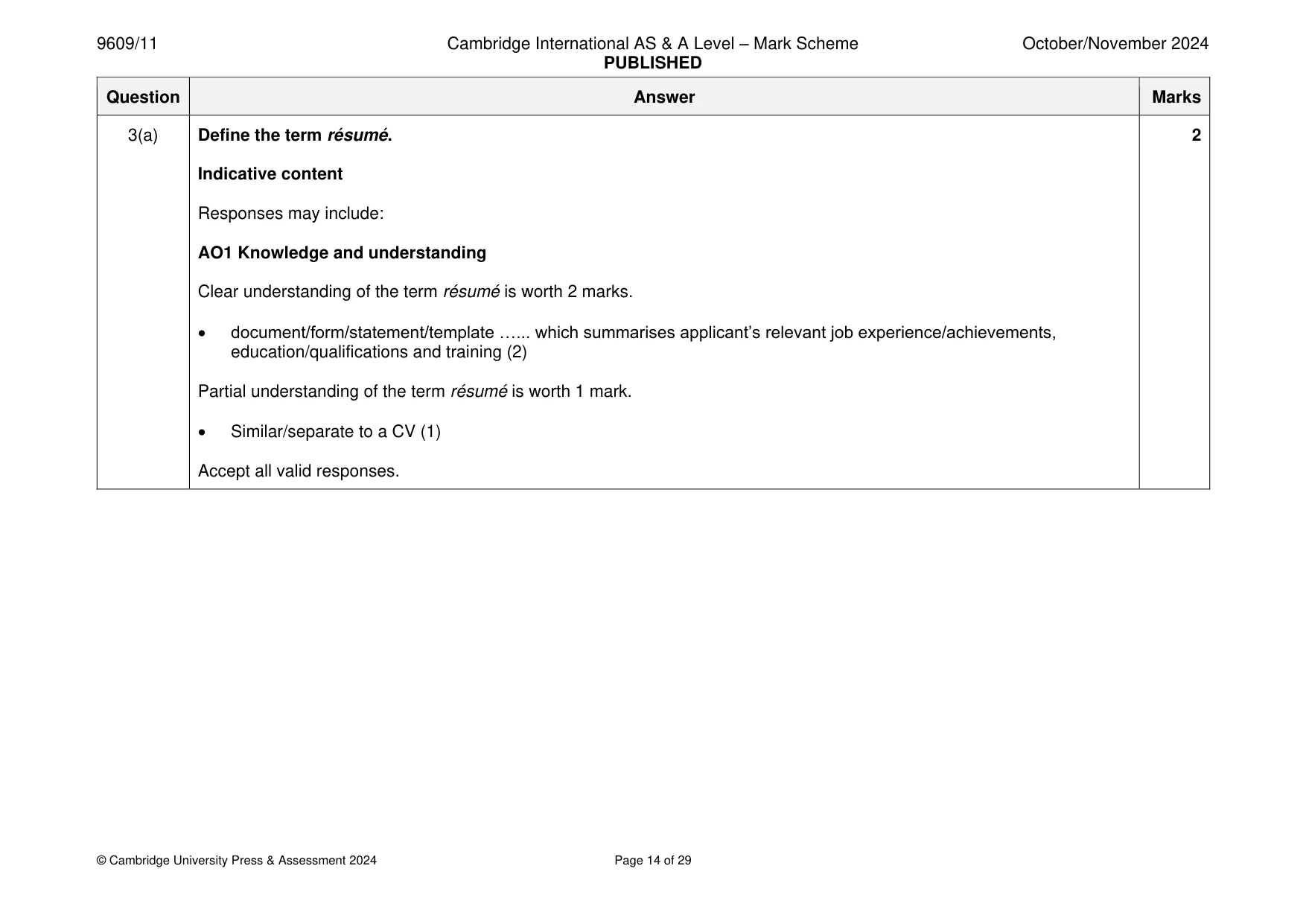
9609/11 Cambridge International AS & A Level – Mark Scheme PUBLISHED October/November 2024 © Cambridge University Press & Assessment 2024 Page 14 of 29 Question Answer Marks 3(a) Define the term résumé. Indicative content Responses may include: AO1 Knowledge and understanding Clear understanding of the term résumé is worth 2 marks. • document/form/statement/template …... which summarises applicant’s relevant job experience/achievements, education/qualifications and training (2) Partial understanding of the term résumé is worth 1 mark. • Similar/separate to a CV (1) Accept all valid responses. 2
Mark scheme, page 15
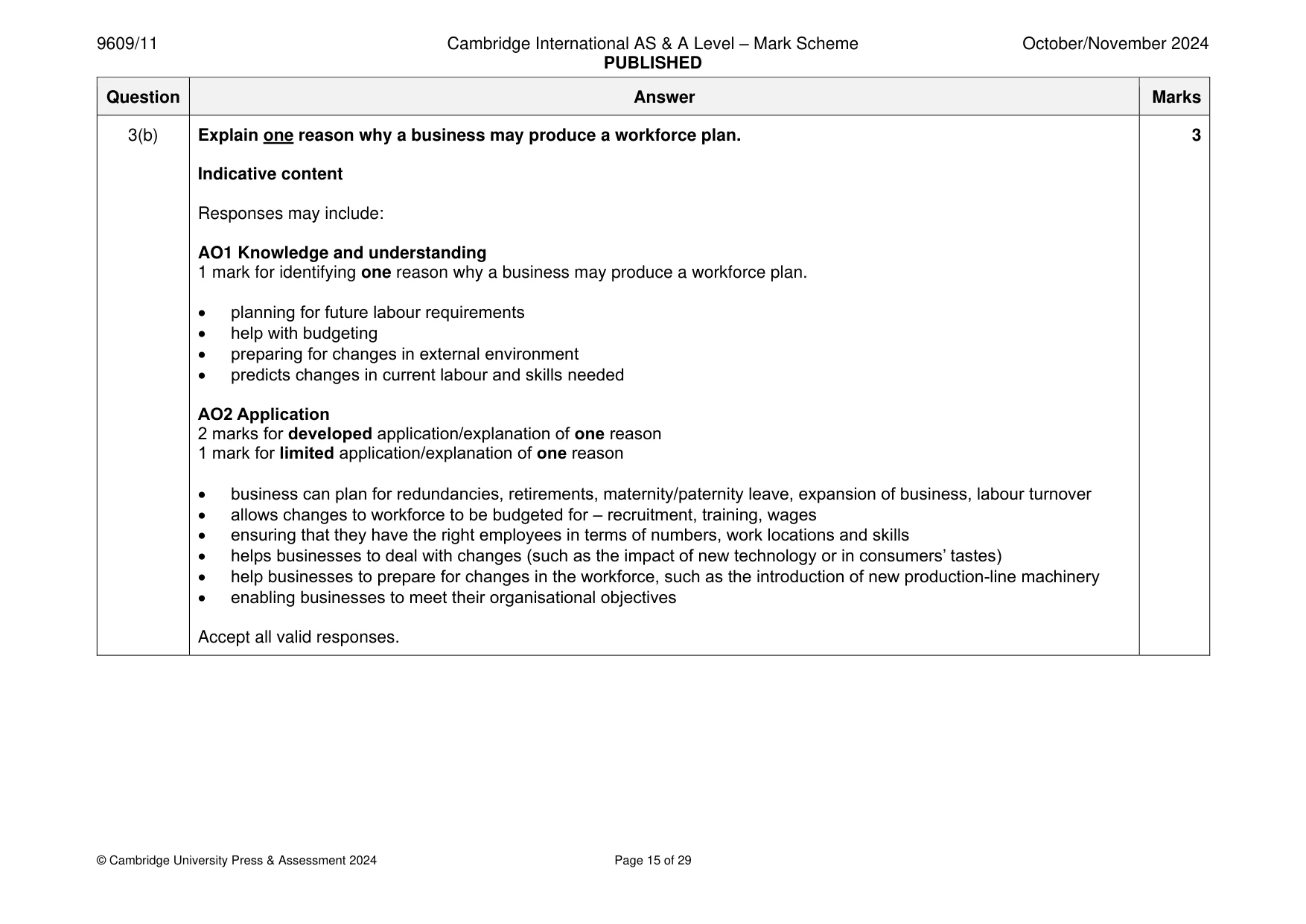
9609/11 Cambridge International AS & A Level – Mark Scheme PUBLISHED October/November 2024 © Cambridge University Press & Assessment 2024 Page 15 of 29 Question Answer Marks 3(b) Explain one reason why a business may produce a workforce plan. Indicative content Responses may include: AO1 Knowledge and understanding 1 mark for identifying one reason why a business may produce a workforce plan. • planning for future labour requirements • help with budgeting • preparing for changes in external environment • predicts changes in current labour and skills needed AO2 Application 2 marks for developed application/explanation of one reason 1 mark for limited application/explanation of one reason • business can plan for redundancies, retirements, maternity/paternity leave, expansion of business, labour turnover • allows changes to workforce to be budgeted for – recruitment, training, wages • ensuring that they have the right employees in terms of numbers, work locations and skills • helps businesses to deal with changes (such as the impact of new technology or in consumers’ tastes) • help businesses to prepare for changes in the workforce, such as the introduction of new production-line machinery • enabling businesses to meet their organisational objectives Accept all valid responses. 3
Mark scheme, page 16
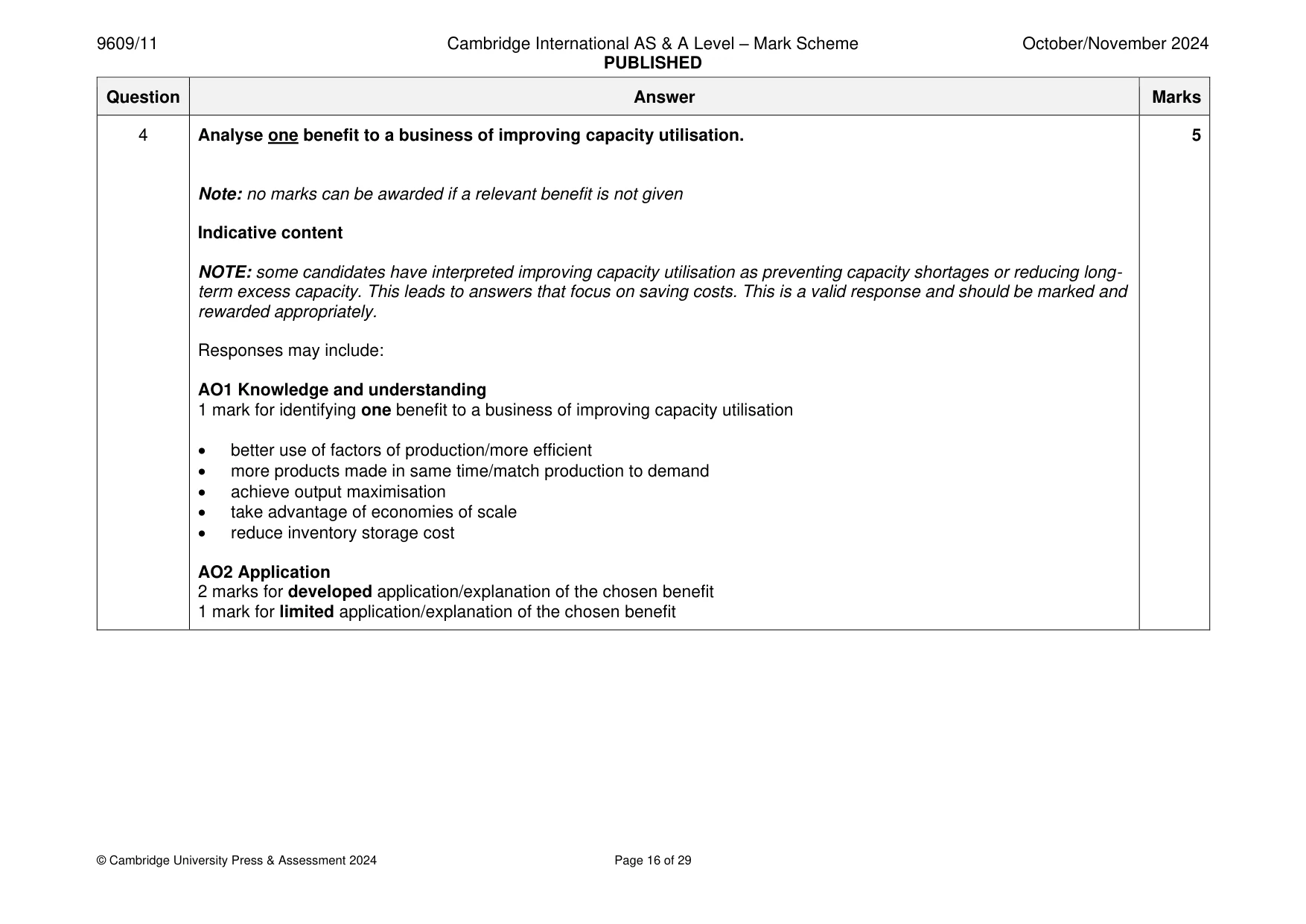
9609/11 Cambridge International AS & A Level – Mark Scheme PUBLISHED October/November 2024 © Cambridge University Press & Assessment 2024 Page 16 of 29 Question Answer Marks 4 Analyse one benefit to a business of improving capacity utilisation. Note: no marks can be awarded if a relevant benefit is not given Indicative content NOTE: some candidates have interpreted improving capacity utilisation as preventing capacity shortages or reducing long- term excess capacity. This leads to answers that focus on saving costs. This is a valid response and should be marked and rewarded appropriately. Responses may include: AO1 Knowledge and understanding 1 mark for identifying one benefit to a business of improving capacity utilisation • better use of factors of production/more efficient • more products made in same time/match production to demand • achieve output maximisation • take advantage of economies of scale • reduce inventory storage cost AO2 Application 2 marks for developed application/explanation of the chosen benefit 1 mark for limited application/explanation of the chosen benefit 5
Mark scheme, page 17
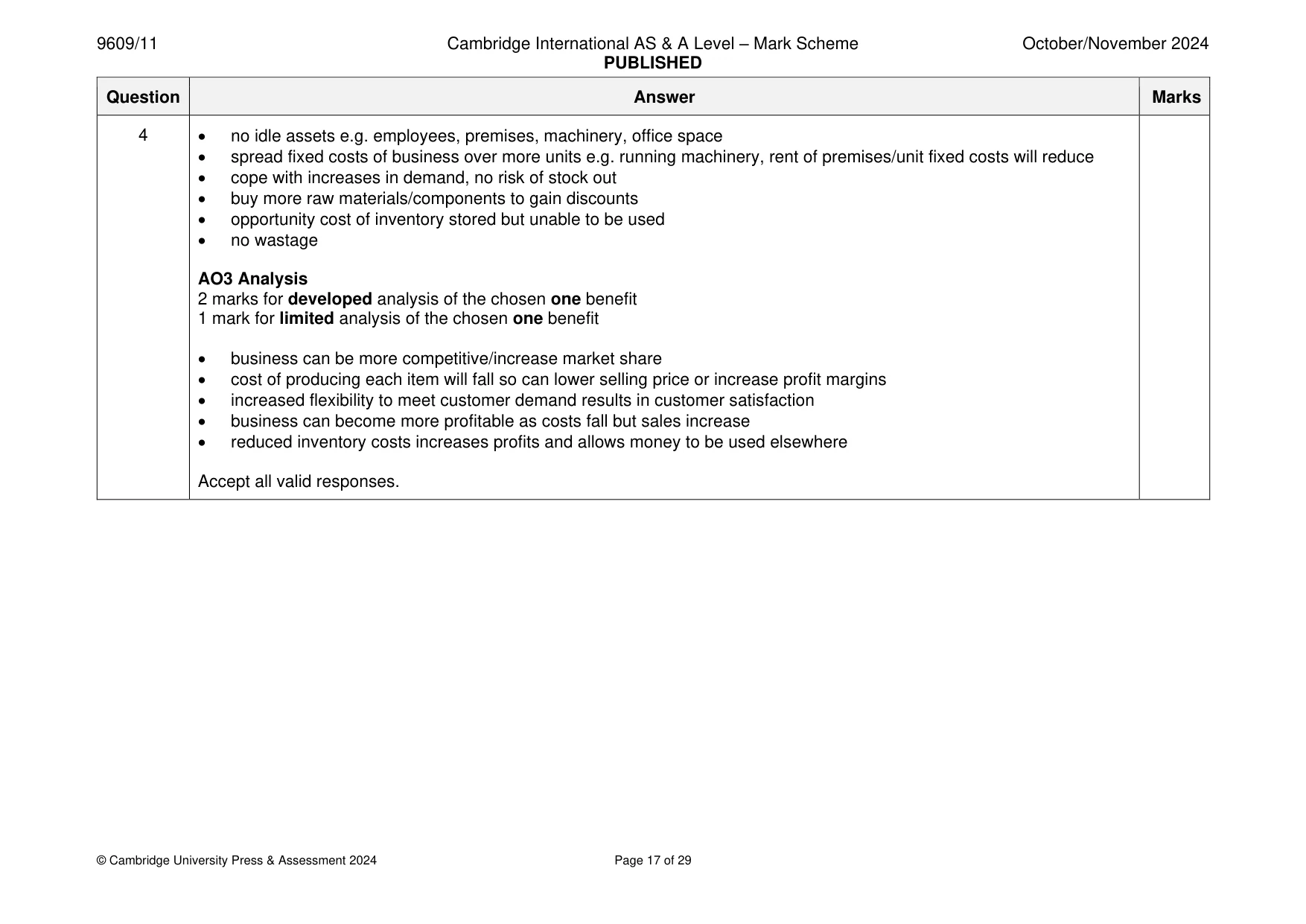
9609/11 Cambridge International AS & A Level – Mark Scheme PUBLISHED October/November 2024 © Cambridge University Press & Assessment 2024 Page 17 of 29 Question Answer Marks 4 • no idle assets e.g. employees, premises, machinery, office space • spread fixed costs of business over more units e.g. running machinery, rent of premises/unit fixed costs will reduce • cope with increases in demand, no risk of stock out • buy more raw materials/components to gain discounts • opportunity cost of inventory stored but unable to be used • no wastage AO3 Analysis 2 marks for developed analysis of the chosen one benefit 1 mark for limited analysis of the chosen one benefit • business can be more competitive/increase market share • cost of producing each item will fall so can lower selling price or increase profit margins • increased flexibility to meet customer demand results in customer satisfaction • business can become more profitable as costs fall but sales increase • reduced inventory costs increases profits and allows money to be used elsewhere Accept all valid responses.
Mark scheme, page 18
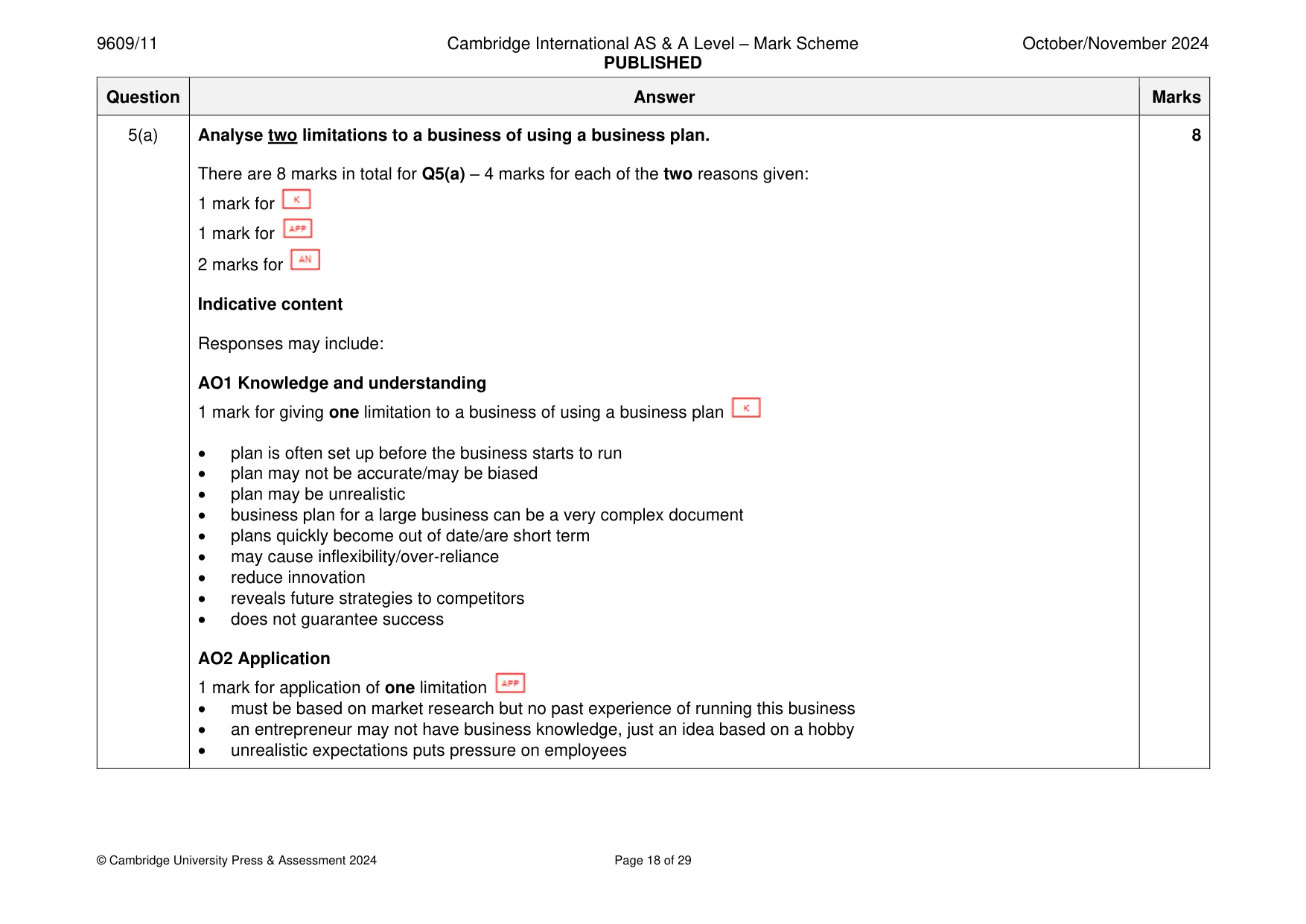
9609/11 Cambridge International AS & A Level – Mark Scheme PUBLISHED October/November 2024 © Cambridge University Press & Assessment 2024 Page 18 of 29 Question Answer Marks 5(a) Analyse two limitations to a business of using a business plan. There are 8 marks in total for Q5(a) – 4 marks for each of the two reasons given: 1 mark for 1 mark for 2 marks for Indicative content Responses may include: AO1 Knowledge and understanding 1 mark for giving one limitation to a business of using a business plan • plan is often set up before the business starts to run • plan may not be accurate/may be biased • plan may be unrealistic • business plan for a large business can be a very complex document • plans quickly become out of date/are short term • may cause inflexibility/over-reliance • reduce innovation • reveals future strategies to competitors • does not guarantee success AO2 Application 1 mark for application of one limitation • must be based on market research but no past experience of running this business • an entrepreneur may not have business knowledge, just an idea based on a hobby • unrealistic expectations puts pressure on employees 8
Mark scheme, page 19
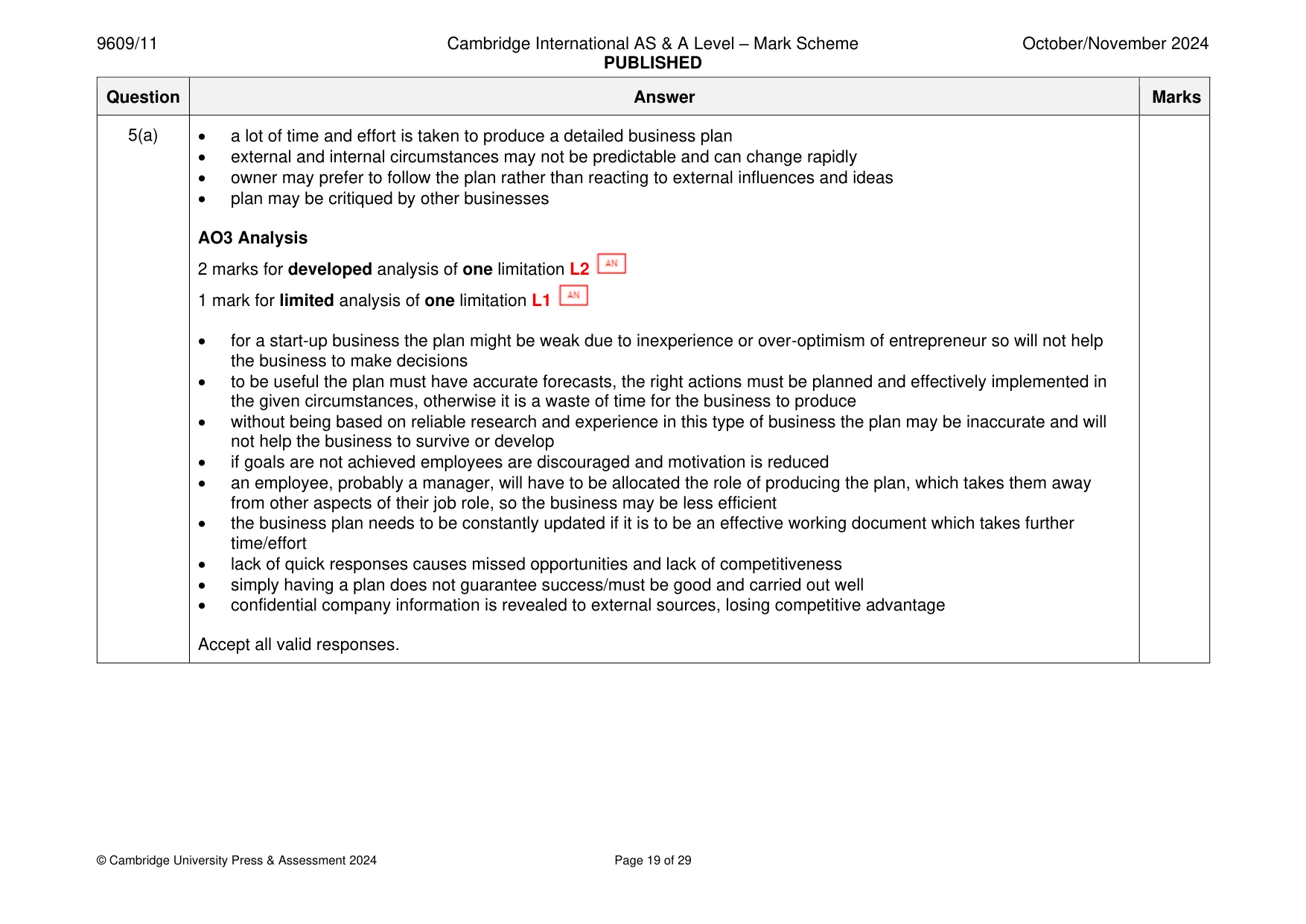
9609/11 Cambridge International AS & A Level – Mark Scheme PUBLISHED October/November 2024 © Cambridge University Press & Assessment 2024 Page 19 of 29 Question Answer Marks 5(a) • a lot of time and effort is taken to produce a detailed business plan • external and internal circumstances may not be predictable and can change rapidly • owner may prefer to follow the plan rather than reacting to external influences and ideas • plan may be critiqued by other businesses AO3 Analysis 2 marks for developed analysis of one limitation L2 1 mark for limited analysis of one limitation L1 • for a start-up business the plan might be weak due to inexperience or over-optimism of entrepreneur so will not help the business to make decisions • to be useful the plan must have accurate forecasts, the right actions must be planned and effectively implemented in the given circumstances, otherwise it is a waste of time for the business to produce • without being based on reliable research and experience in this type of business the plan may be inaccurate and will not help the business to survive or develop • if goals are not achieved employees are discouraged and motivation is reduced • an employee, probably a manager, will have to be allocated the role of producing the plan, which takes them away from other aspects of their job role, so the business may be less efficient • the business plan needs to be constantly updated if it is to be an effective working document which takes further time/effort • lack of quick responses causes missed opportunities and lack of competitiveness • simply having a plan does not guarantee success/must be good and carried out well • confidential company information is revealed to external sources, losing competitive advantage Accept all valid responses.
Mark scheme, page 20
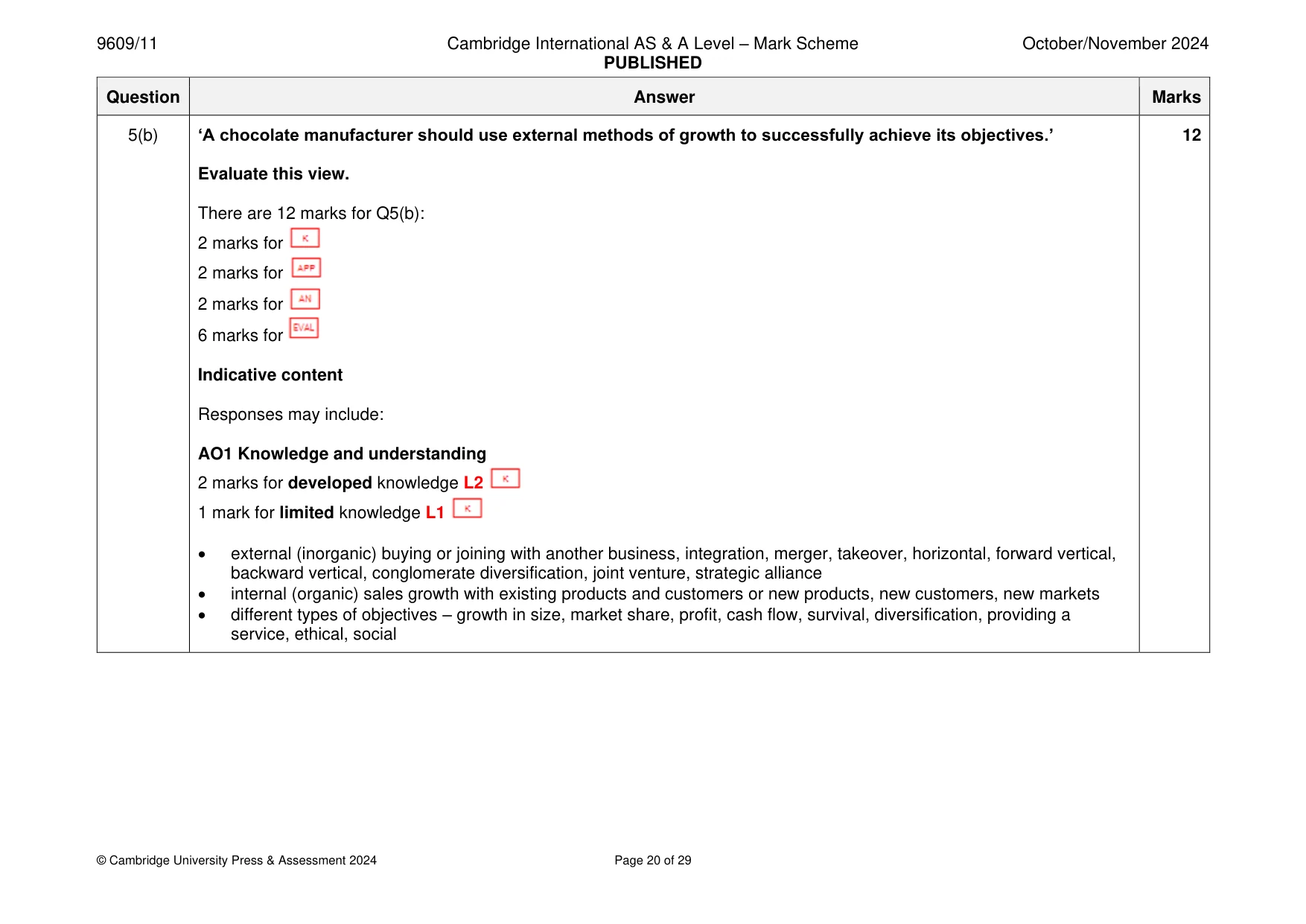
9609/11 Cambridge International AS & A Level – Mark Scheme PUBLISHED October/November 2024 © Cambridge University Press & Assessment 2024 Page 20 of 29 Question Answer Marks 5(b) ‘A chocolate manufacturer should use external methods of growth to successfully achieve its objectives.’ Evaluate this view. There are 12 marks for Q5(b): 2 marks for 2 marks for 2 marks for 6 marks for Indicative content Responses may include: AO1 Knowledge and understanding 2 marks for developed knowledge L2 1 mark for limited knowledge L1 • external (inorganic) buying or joining with another business, integration, merger, takeover, horizontal, forward vertical, backward vertical, conglomerate diversification, joint venture, strategic alliance • internal (organic) sales growth with existing products and customers or new products, new customers, new markets • different types of objectives – growth in size, market share, profit, cash flow, survival, diversification, providing a service, ethical, social 12
Mark scheme, page 21
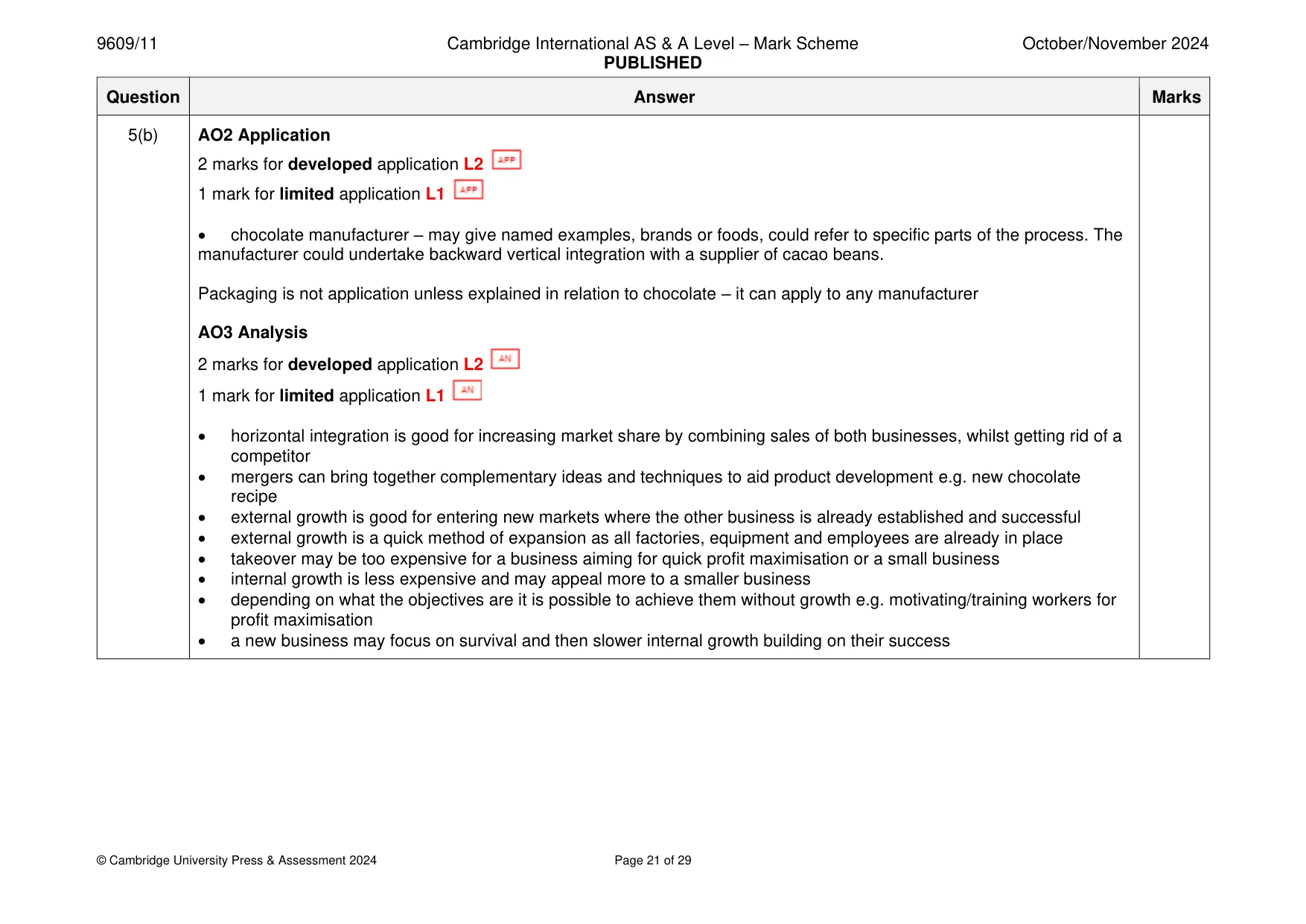
9609/11 Cambridge International AS & A Level – Mark Scheme PUBLISHED October/November 2024 © Cambridge University Press & Assessment 2024 Page 21 of 29 Question Answer Marks 5(b) AO2 Application 2 marks for developed application L2 1 mark for limited application L1 • chocolate manufacturer – may give named examples, brands or foods, could refer to specific parts of the process. The manufacturer could undertake backward vertical integration with a supplier of cacao beans. Packaging is not application unless explained in relation to chocolate – it can apply to any manufacturer AO3 Analysis 2 marks for developed application L2 1 mark for limited application L1 • horizontal integration is good for increasing market share by combining sales of both businesses, whilst getting rid of a competitor • mergers can bring together complementary ideas and techniques to aid product development e.g. new chocolate recipe • external growth is good for entering new markets where the other business is already established and successful • external growth is a quick method of expansion as all factories, equipment and employees are already in place • takeover may be too expensive for a business aiming for quick profit maximisation or a small business • internal growth is less expensive and may appeal more to a smaller business • depending on what the objectives are it is possible to achieve them without growth e.g. motivating/training workers for profit maximisation • a new business may focus on survival and then slower internal growth building on their success
Mark scheme, page 22
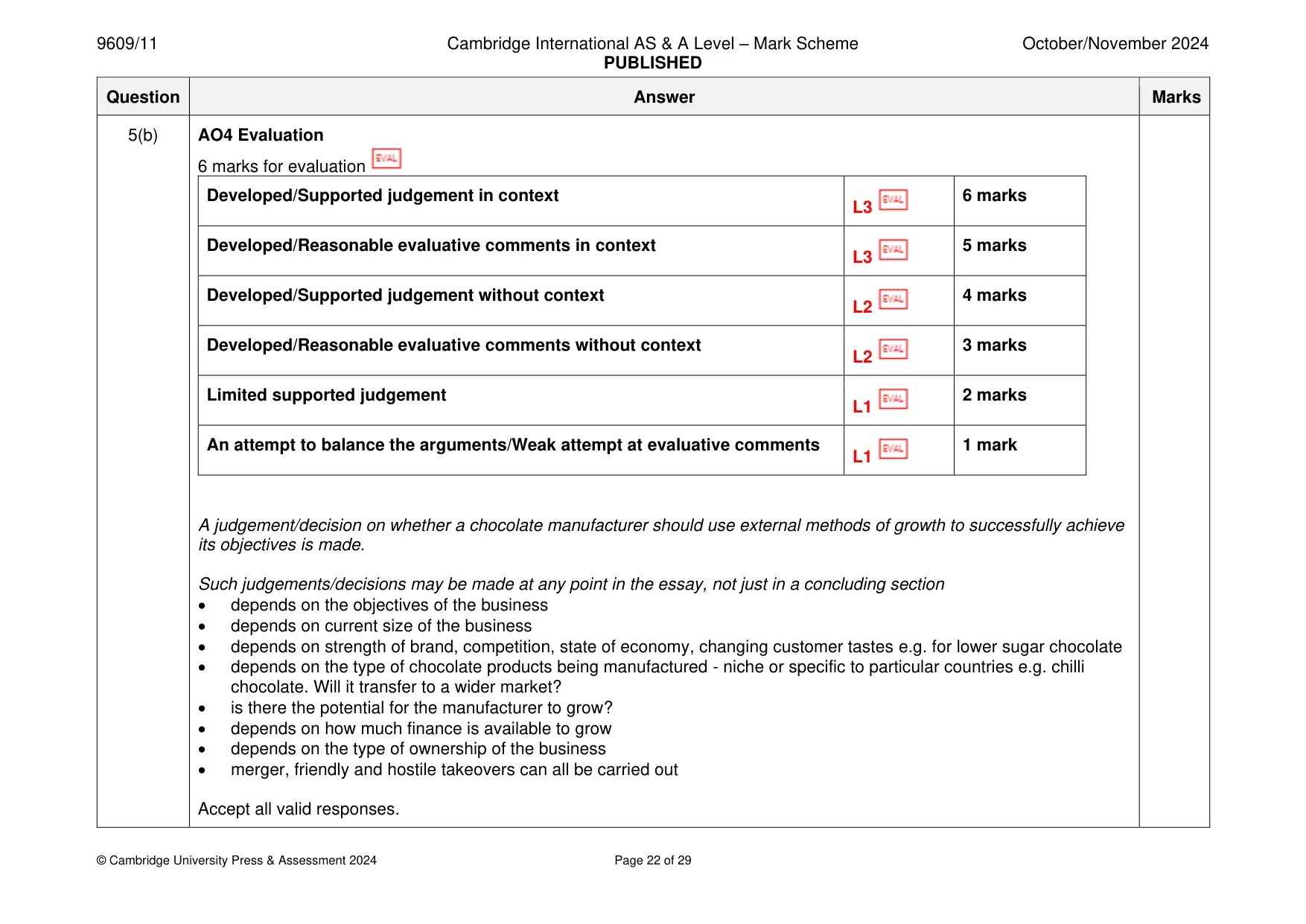
9609/11 Cambridge International AS & A Level – Mark Scheme PUBLISHED October/November 2024 © Cambridge University Press & Assessment 2024 Page 22 of 29 Question Answer Marks 5(b) AO4 Evaluation 6 marks for evaluation Developed/Supported judgement in context L3 6 marks Developed/Reasonable evaluative comments in context L3 5 marks Developed/Supported judgement without context L2 4 marks Developed/Reasonable evaluative comments without context L2 3 marks Limited supported judgement L1 2 marks An attempt to balance the arguments/Weak attempt at evaluative comments L1 1 mark A judgement/decision on whether a chocolate manufacturer should use external methods of growth to successfully achieve its objectives is made. Such judgements/decisions may be made at any point in the essay, not just in a concluding section • depends on the objectives of the business • depends on current size of the business • depends on strength of brand, competition, state of economy, changing customer tastes e.g. for lower sugar chocolate • depends on the type of chocolate products being manufactured - niche or specific to particular countries e.g. chilli chocolate. Will it transfer to a wider market? • is there the potential for the manufacturer to grow? • depends on how much finance is available to grow • depends on the type of ownership of the business • merger, friendly and hostile takeovers can all be carried out Accept all valid responses.
Mark scheme, page 23
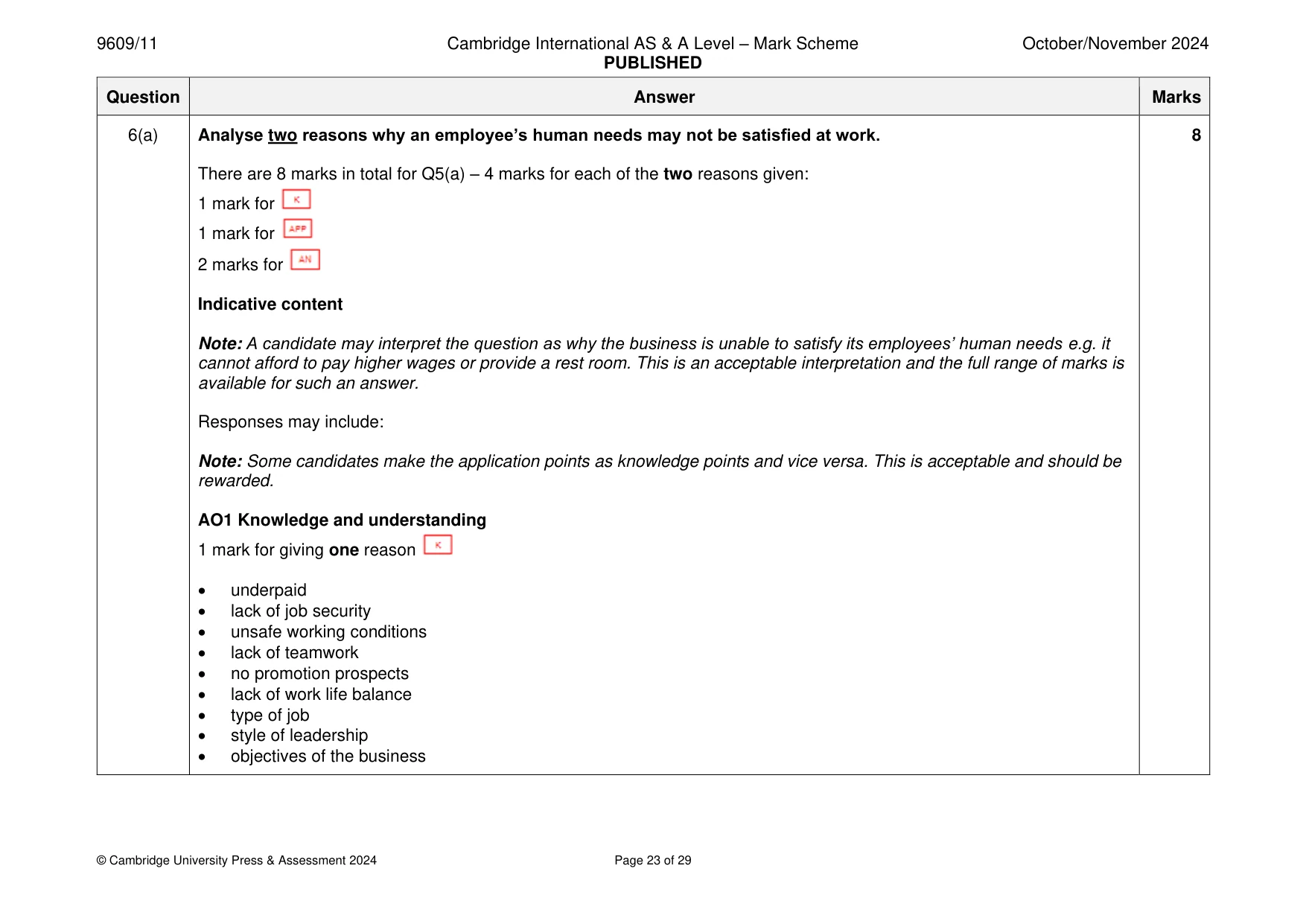
9609/11 Cambridge International AS & A Level – Mark Scheme PUBLISHED October/November 2024 © Cambridge University Press & Assessment 2024 Page 23 of 29 Question Answer Marks 6(a) Analyse two reasons why an employee’s human needs may not be satisfied at work. There are 8 marks in total for Q5(a) – 4 marks for each of the two reasons given: 1 mark for 1 mark for 2 marks for Indicative content Note: A candidate may interpret the question as why the business is unable to satisfy its employees’ human needs e.g. it cannot afford to pay higher wages or provide a rest room. This is an acceptable interpretation and the full range of marks is available for such an answer. Responses may include: Note: Some candidates make the application points as knowledge points and vice versa. This is acceptable and should be rewarded. AO1 Knowledge and understanding 1 mark for giving one reason • underpaid • lack of job security • unsafe working conditions • lack of teamwork • no promotion prospects • lack of work life balance • type of job • style of leadership • objectives of the business 8
Mark scheme, page 24
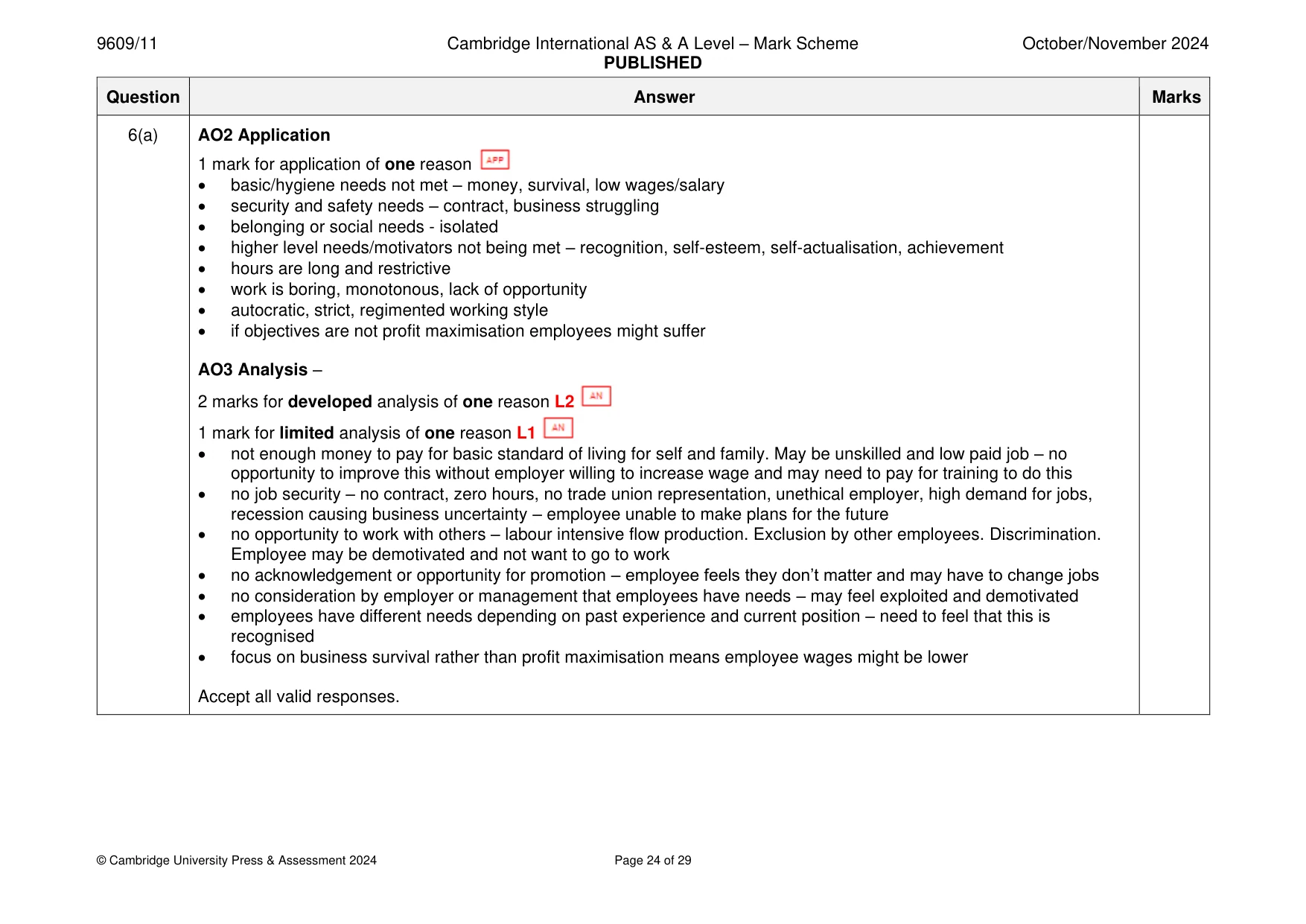
9609/11 Cambridge International AS & A Level – Mark Scheme PUBLISHED October/November 2024 © Cambridge University Press & Assessment 2024 Page 24 of 29 Question Answer Marks 6(a) AO2 Application 1 mark for application of one reason • basic/hygiene needs not met – money, survival, low wages/salary • security and safety needs – contract, business struggling • belonging or social needs - isolated • higher level needs/motivators not being met – recognition, self-esteem, self-actualisation, achievement • hours are long and restrictive • work is boring, monotonous, lack of opportunity • autocratic, strict, regimented working style • if objectives are not profit maximisation employees might suffer AO3 Analysis – 2 marks for developed analysis of one reason L2 1 mark for limited analysis of one reason L1 • not enough money to pay for basic standard of living for self and family. May be unskilled and low paid job – no opportunity to improve this without employer willing to increase wage and may need to pay for training to do this • no job security – no contract, zero hours, no trade union representation, unethical employer, high demand for jobs, recession causing business uncertainty – employee unable to make plans for the future • no opportunity to work with others – labour intensive flow production. Exclusion by other employees. Discrimination. Employee may be demotivated and not want to go to work • no acknowledgement or opportunity for promotion – employee feels they don’t matter and may have to change jobs • no consideration by employer or management that employees have needs – may feel exploited and demotivated • employees have different needs depending on past experience and current position – need to feel that this is recognised • focus on business survival rather than profit maximisation means employee wages might be lower Accept all valid responses.
Mark scheme, page 25
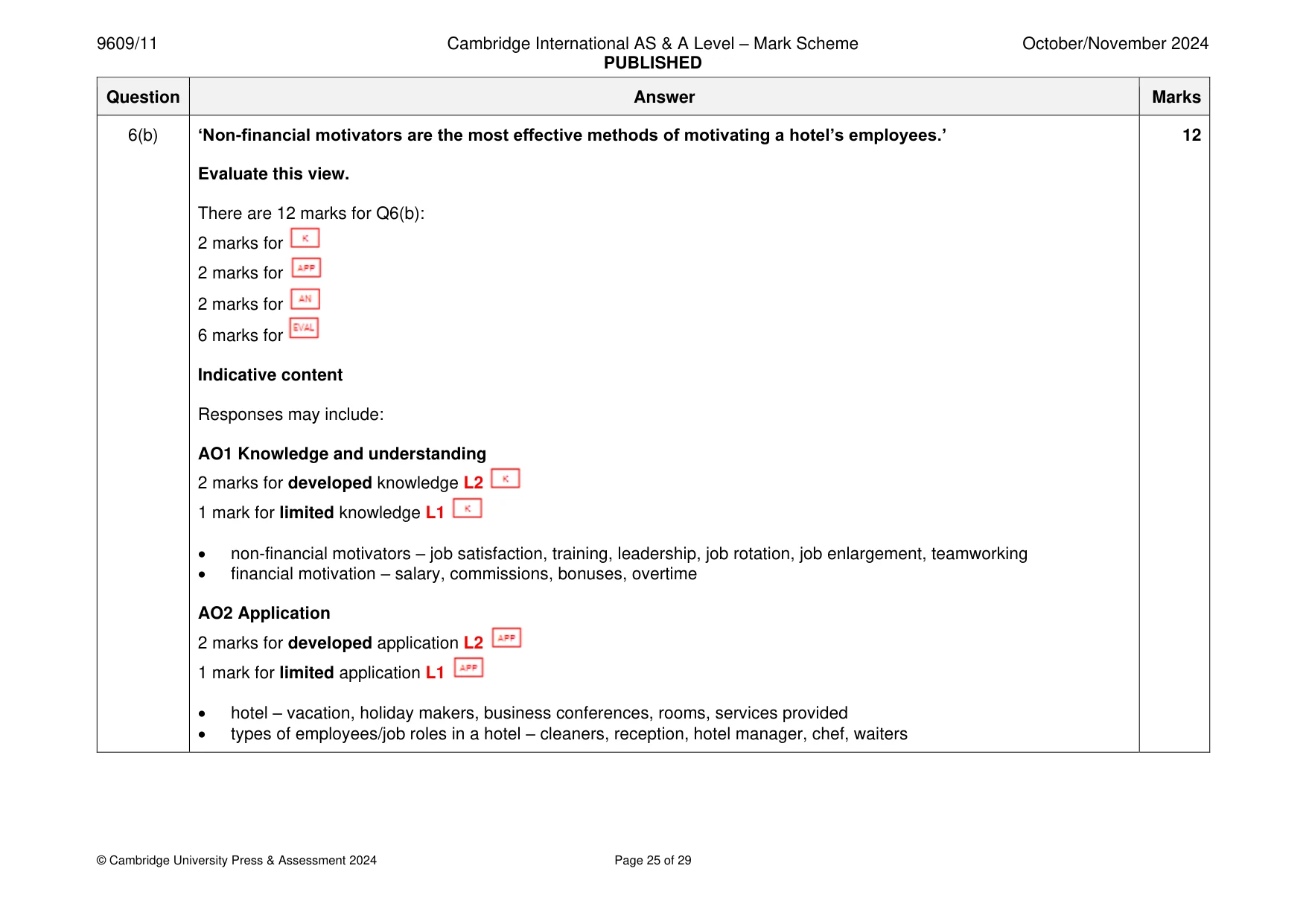
9609/11 Cambridge International AS & A Level – Mark Scheme PUBLISHED October/November 2024 © Cambridge University Press & Assessment 2024 Page 25 of 29 Question Answer Marks 6(b) ‘Non-financial motivators are the most effective methods of motivating a hotel’s employees.’ Evaluate this view. There are 12 marks for Q6(b): 2 marks for 2 marks for 2 marks for 6 marks for Indicative content Responses may include: AO1 Knowledge and understanding 2 marks for developed knowledge L2 1 mark for limited knowledge L1 • non-financial motivators – job satisfaction, training, leadership, job rotation, job enlargement, teamworking • financial motivation – salary, commissions, bonuses, overtime AO2 Application 2 marks for developed application L2 1 mark for limited application L1 • hotel – vacation, holiday makers, business conferences, rooms, services provided • types of employees/job roles in a hotel – cleaners, reception, hotel manager, chef, waiters 12
Mark scheme, page 26
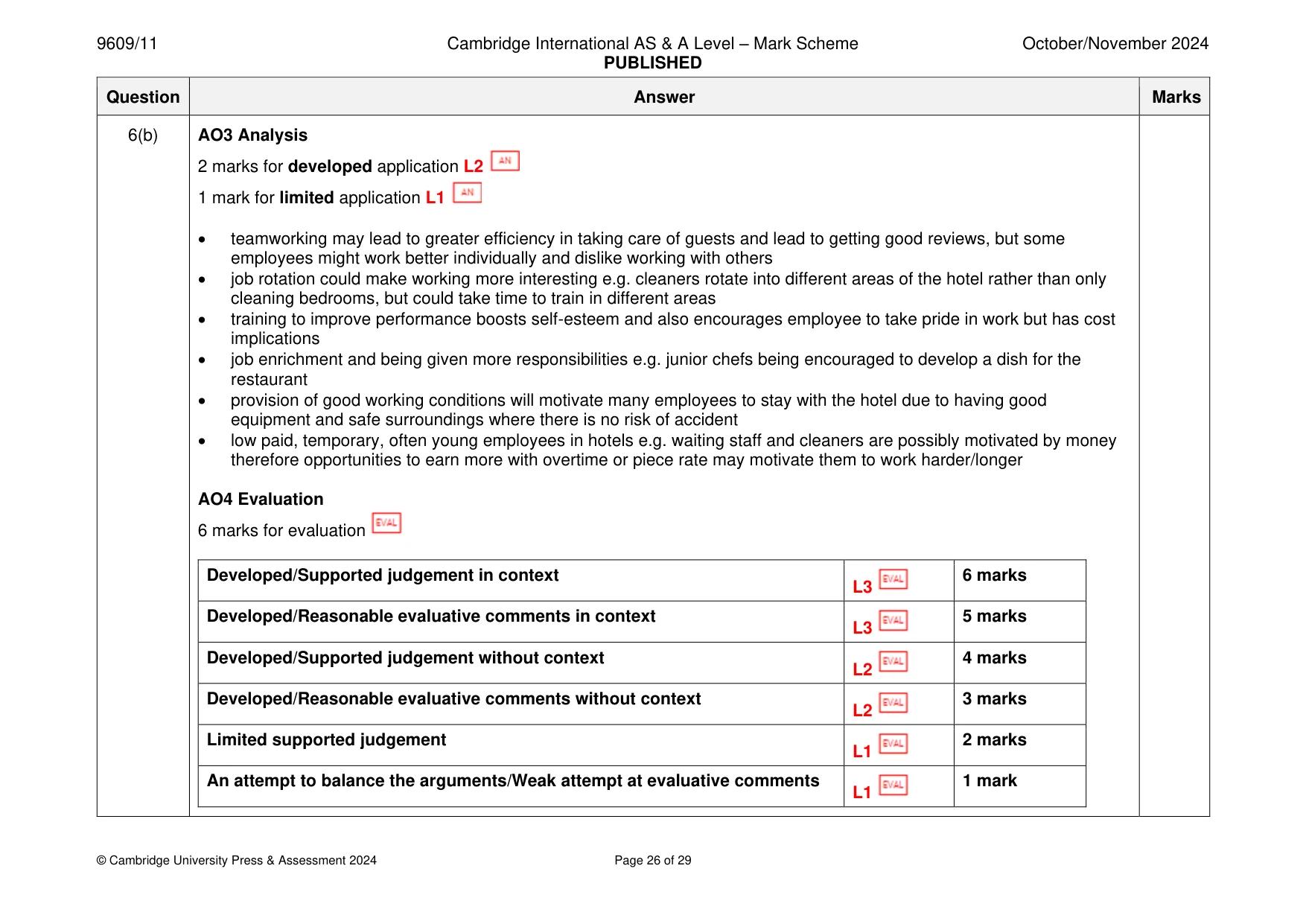
9609/11 Cambridge International AS & A Level – Mark Scheme PUBLISHED October/November 2024 © Cambridge University Press & Assessment 2024 Page 26 of 29 Question Answer Marks 6(b) AO3 Analysis 2 marks for developed application L2 1 mark for limited application L1 • teamworking may lead to greater efficiency in taking care of guests and lead to getting good reviews, but some employees might work better individually and dislike working with others • job rotation could make working more interesting e.g. cleaners rotate into different areas of the hotel rather than only cleaning bedrooms, but could take time to train in different areas • training to improve performance boosts self-esteem and also encourages employee to take pride in work but has cost implications • job enrichment and being given more responsibilities e.g. junior chefs being encouraged to develop a dish for the restaurant • provision of good working conditions will motivate many employees to stay with the hotel due to having good equipment and safe surroundings where there is no risk of accident • low paid, temporary, often young employees in hotels e.g. waiting staff and cleaners are possibly motivated by money therefore opportunities to earn more with overtime or piece rate may motivate them to work harder/longer AO4 Evaluation 6 marks for evaluation Developed/Supported judgement in context L3 6 marks Developed/Reasonable evaluative comments in context L3 5 marks Developed/Supported judgement without context L2 4 marks Developed/Reasonable evaluative comments without context L2 3 marks Limited supported judgement L1 2 marks An attempt to balance the arguments/Weak attempt at evaluative comments L1 1 mark
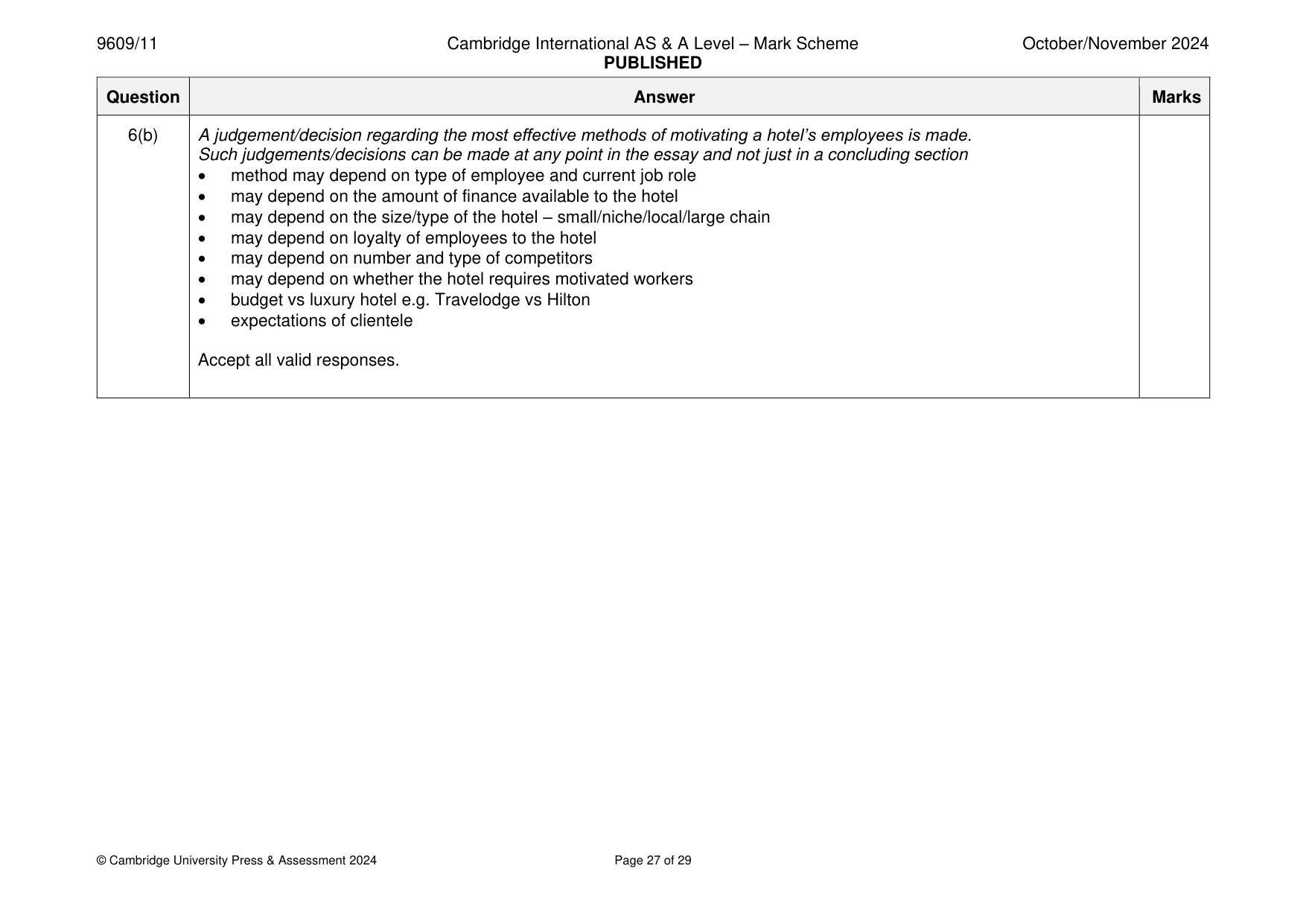
Mark scheme, page 27
9609/11 Cambridge International AS & A Level – Mark Scheme PUBLISHED October/November 2024 © Cambridge University Press & Assessment 2024 Page 27 of 29 Question Answer Marks 6(b) A judgement/decision regarding the most effective methods of motivating a hotel’s employees is made. Such judgements/decisions can be made at any point in the essay and not just in a concluding section • method may depend on type of employee and current job role • may depend on the amount of finance available to the hotel • may depend on the size/type of the hotel – small/niche/local/large chain • may depend on loyalty of employees to the hotel • may depend on number and type of competitors • may depend on whether the hotel requires motivated workers • budget vs luxury hotel e.g. Travelodge vs Hilton • expectations of clientele Accept all valid responses.
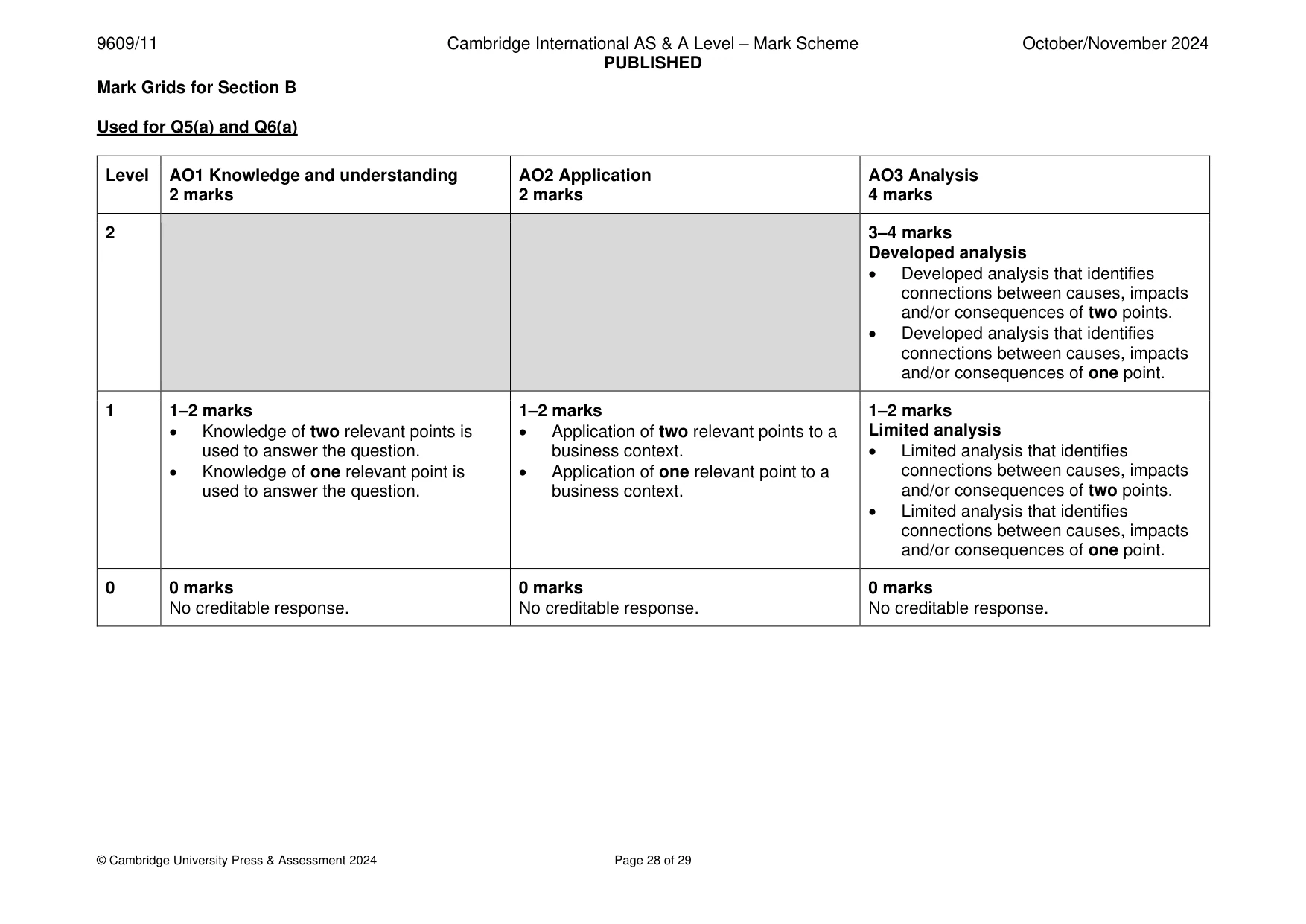
Mark scheme, page 28
9609/11 Cambridge International AS & A Level – Mark Scheme PUBLISHED October/November 2024 © Cambridge University Press & Assessment 2024 Page 28 of 29 Mark Grids for Section B Used for Q5(a) and Q6(a) Level AO1 Knowledge and understanding 2 marks AO2 Application 2 marks AO3 Analysis 4 marks 2 3–4 marks Developed analysis • Developed analysis that identifies connections between causes, impacts and/or consequences of two points. • Developed analysis that identifies connections between causes, impacts and/or consequences of one point. 1 1–2 marks • Knowledge of two relevant points is used to answer the question. • Knowledge of one relevant point is used to answer the question. 1–2 marks • Application of two relevant points to a business context. • Application of one relevant point to a business context. 1–2 marks Limited analysis • Limited analysis that identifies connections between causes, impacts and/or consequences of two points. • Limited analysis that identifies connections between causes, impacts and/or consequences of one point. 0 0 marks No creditable response. 0 marks No creditable response. 0 marks No creditable response.
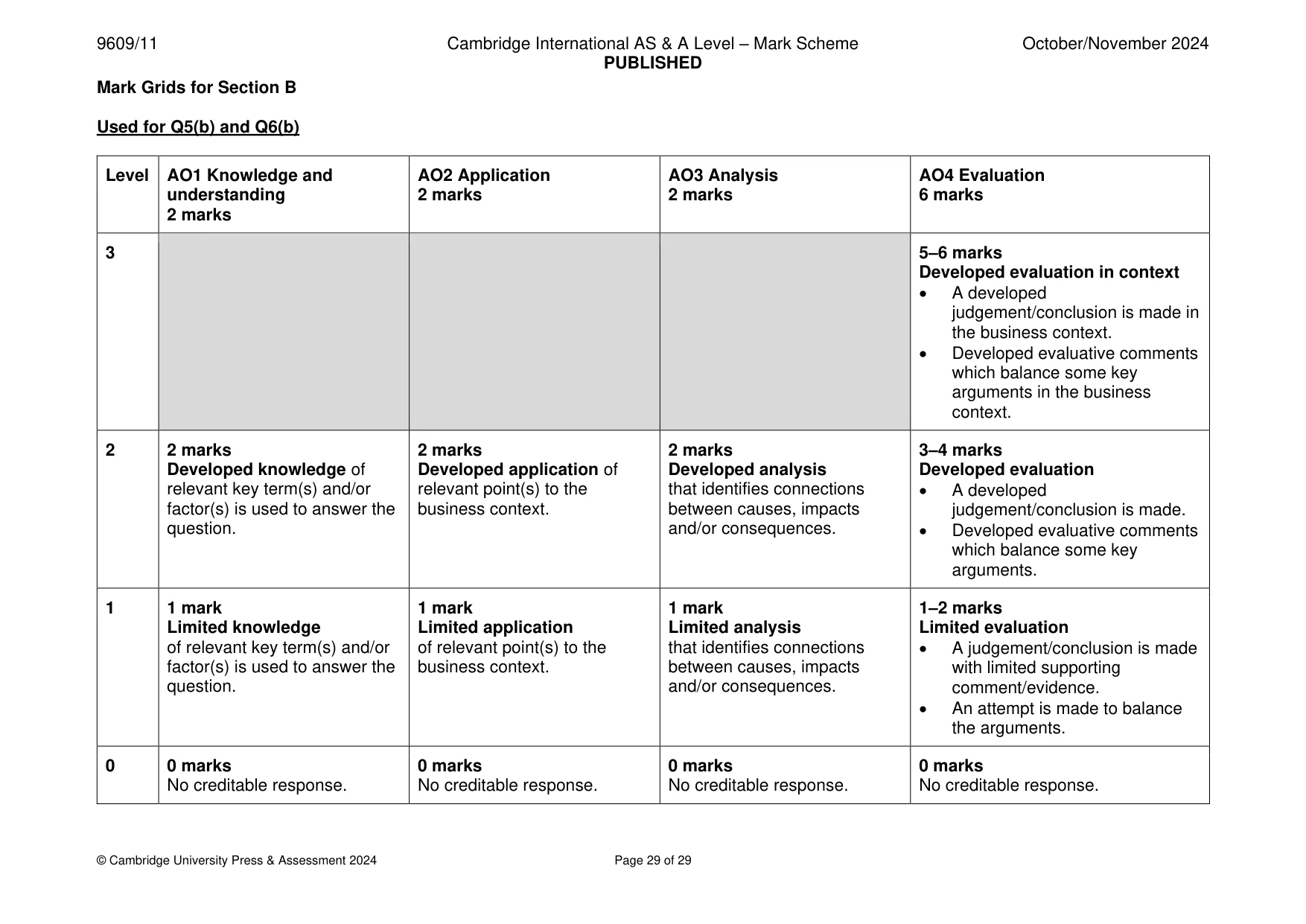
Mark scheme, page 29
9609/11 Cambridge International AS & A Level – Mark Scheme PUBLISHED October/November 2024 © Cambridge University Press & Assessment 2024 Page 29 of 29 Mark Grids for Section B Used for Q5(b) and Q6(b) Level AO1 Knowledge and understanding 2 marks AO2 Application 2 marks AO3 Analysis 2 marks AO4 Evaluation 6 marks 3 5–6 marks Developed evaluation in context • A developed judgement/conclusion is made in the business context. • Developed evaluative comments which balance some key arguments in the business context. 2 2 marks Developed knowledge of relevant key term(s) and/or factor(s) is used to answer the question. 2 marks Developed application of relevant point(s) to the business context. 2 marks Developed analysis that identifies connections between causes, impacts and/or consequences. 3–4 marks Developed evaluation • A developed judgement/conclusion is made. • Developed evaluative comments which balance some key arguments. 1 1 mark Limited knowledge of relevant key term(s) and/or factor(s) is used to answer the question. 1 mark Limited application of relevant point(s) to the business context. 1 mark Limited analysis that identifies connections between causes, impacts and/or consequences. 1–2 marks Limited evaluation • A judgement/conclusion is made with limited supporting comment/evidence. • An attempt is made to balance the arguments. 0 0 marks No creditable response. 0 marks No creditable response. 0 marks No creditable response. 0 marks No creditable response.
What you needed in this session
Cambridge’s own grade thresholds for 2024 Oct/Nov, Paper 1 · Variant 1. A higher threshold means an easier paper — the bar moves with how the cohort did.