Cambridge A Level Business (for first examination in 2016) 9609 — 2023 May/June Paper 1 · Variant 1
9609/11/M/J/23 · 40 marks · ≈45 min
The question paper and its mark scheme, free to read here and free to download. This is Cambridge’s own paper, exactly as it was sat.
Question paper4 pages



Mark scheme32 pages
Answers below. Sit the paper first if you are practising.

Paper as text
Question paper, page 1
This document has 4 pages. Any blank pages are indicated. [Turn over Cambridge International AS & A Level BUSINESS 9609/11 Paper 1 Business Concepts 1 May/June 2023 1 hour 15 minutes You must answer on the enclosed answer booklet. You will need: Answer booklet (enclosed) INSTRUCTIONS ● Answer five questions in total: Section A: answer all questions. Section B: answer one question. ● Follow the instructions on the front cover of the answer booklet. If you need additional answer paper, ask the invigilator for a continuation booklet. INFORMATION ● The total mark for this paper is 40. ● The number of marks for each question or part question is shown in brackets [ ]. * 1 8 1 5 7 1 8 6 7 1 * DC (CJ) 316202 © UCLES 2023
Question paper, page 2
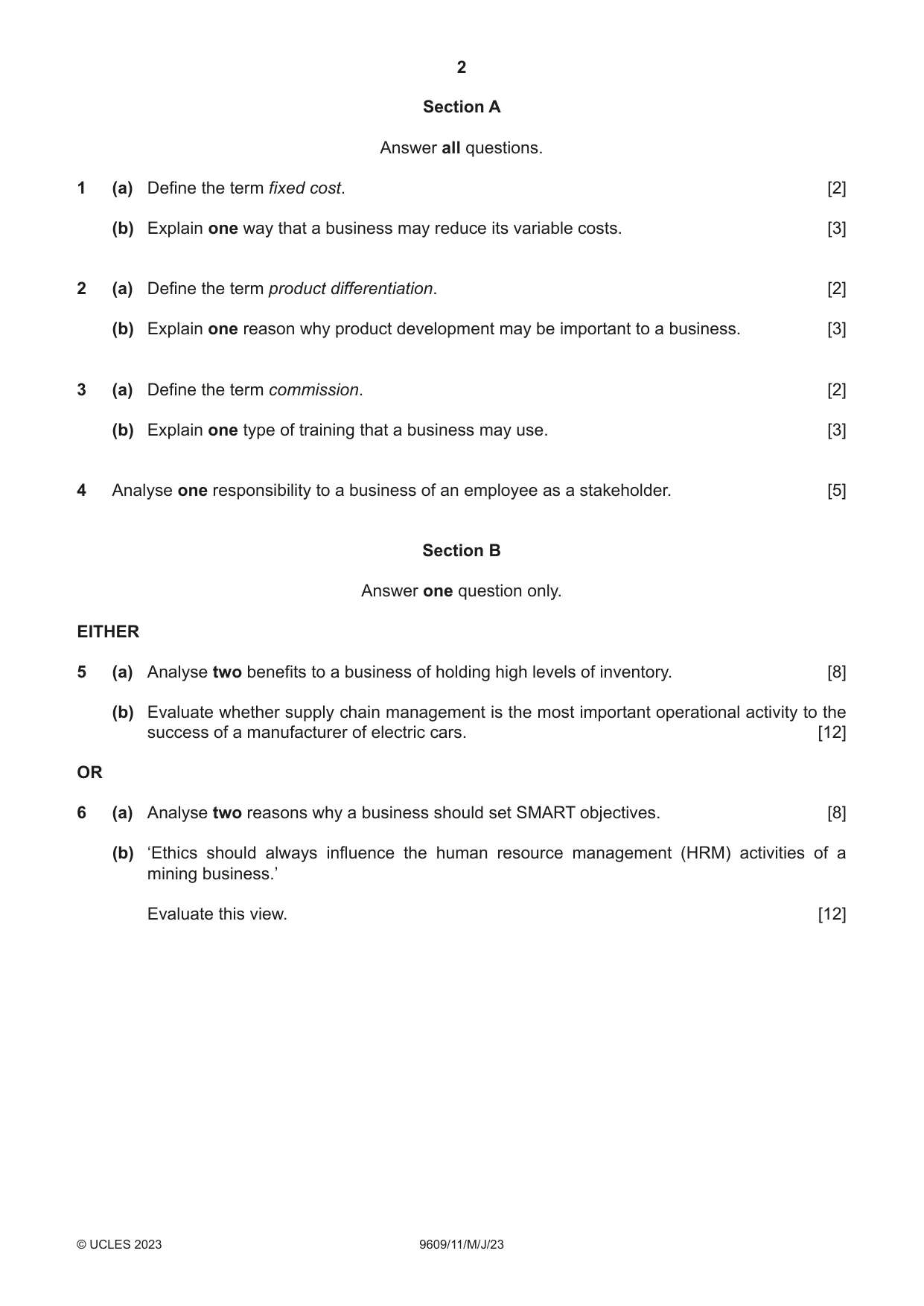
2 9609/11/M/J/23 © UCLES 2023 Section A Answer all questions. 1 (a) Define the term fixed cost. [2] (b) Explain one way that a business may reduce its variable costs. [3] 2 (a) Define the term product differentiation. [2] (b) Explain one reason why product development may be important to a business. [3] 3 (a) Define the term commission. [2] (b) Explain one type of training that a business may use. [3] 4 Analyse one responsibility to a business of an employee as a stakeholder. [5] Section B Answer one question only. EITHER 5 (a) Analyse two benefits to a business of holding high levels of inventory. [8] (b) Evaluate whether supply chain management is the most important operational activity to the success of a manufacturer of electric cars. [12] OR 6 (a) Analyse two reasons why a business should set SMART objectives. [8] (b) ‘Ethics should always influence the human resource management (HRM) activities of a mining business.’ Evaluate this view. [12]
Question paper, page 3
3 9609/11/M/J/23 © UCLES 2023 BLANK PAGE
Question paper, page 4
4 9609/11/M/J/23 © UCLES 2023 Permission to reproduce items where third-party owned material protected by copyright is included has been sought and cleared where possible. Every reasonable effort has been made by the publisher (UCLES) to trace copyright holders, but if any items requiring clearance have unwittingly been included, the publisher will be pleased to make amends at the earliest possible opportunity. To avoid the issue of disclosure of answer-related information to candidates, all copyright acknowledgements are reproduced online in the Cambridge Assessment International Education Copyright Acknowledgements Booklet. This is produced for each series of examinations and is freely available to download at www.cambridgeinternational.org after the live examination series. Cambridge Assessment International Education is part of Cambridge Assessment. Cambridge Assessment is the brand name of the University of Cambridge Local Examinations Syndicate (UCLES), which is a department of the University of Cambridge. BLANK PAGE
Mark scheme, page 1
This document consists of 32 printed pages. © UCLES 2023 [Turn over Cambridge International AS & A Level BUSINESS 9609/11 Paper 1 Business Concepts 1 May/June 2023 MARK SCHEME Maximum Mark: 40 Published This mark scheme is published as an aid to teachers and candidates, to indicate the requirements of the examination. It shows the basis on which Examiners were instructed to award marks. It does not indicate the details of the discussions that took place at an Examiners’ meeting before marking began, which would have considered the acceptability of alternative answers. Mark schemes should be read in conjunction with the question paper and the Principal Examiner Report for Teachers. Cambridge International will not enter into discussions about these mark schemes. Cambridge International is publishing the mark schemes for the May/June 2023 series for most Cambridge IGCSE, Cambridge International A and AS Level and Cambridge Pre-U components, and some Cambridge O Level components.
Mark scheme, page 2
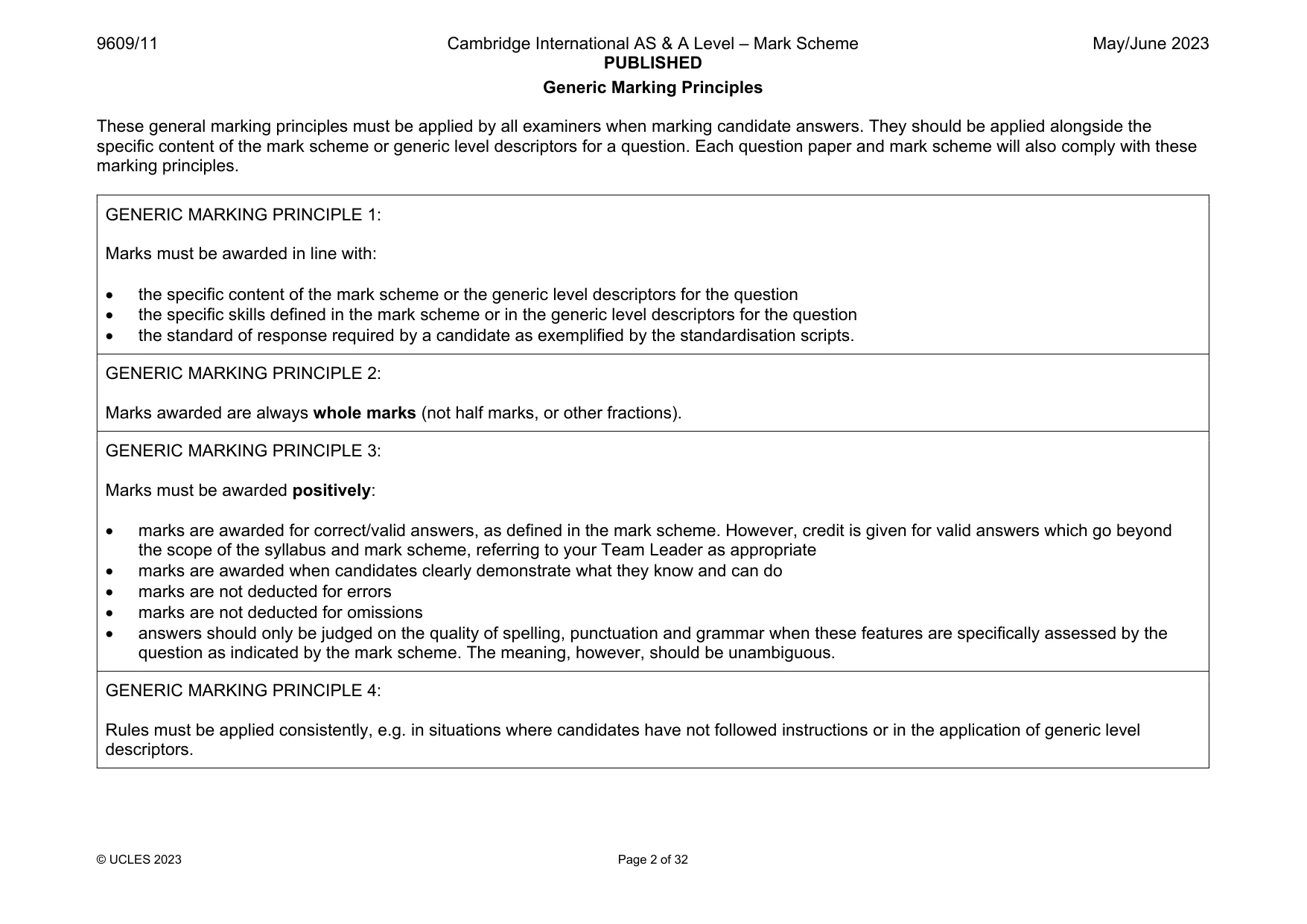
9609/11 Cambridge International AS & A Level – Mark Scheme PUBLISHED May/June 2023 © UCLES 2023 Page 2 of 32 Generic Marking Principles These general marking principles must be applied by all examiners when marking candidate answers. They should be applied alongside the specific content of the mark scheme or generic level descriptors for a question. Each question paper and mark scheme will also comply with these marking principles. GENERIC MARKING PRINCIPLE 1: Marks must be awarded in line with: the specific content of the mark scheme or the generic level descriptors for the question the specific skills defined in the mark scheme or in the generic level descriptors for the question the standard of response required by a candidate as exemplified by the standardisation scripts. GENERIC MARKING PRINCIPLE 2: Marks awarded are always whole marks (not half marks, or other fractions). GENERIC MARKING PRINCIPLE 3: Marks must be awarded positively: marks are awarded for correct/valid answers, as defined in the mark scheme. However, credit is given for valid answers which go beyond the scope of the syllabus and mark scheme, referring to your Team Leader as appropriate marks are awarded when candidates clearly demonstrate what they know and can do marks are not deducted for errors marks are not deducted for omissions answers should only be judged on the quality of spelling, punctuation and grammar when these features are specifically assessed by the question as indicated by the mark scheme. The meaning, however, should be unambiguous. GENERIC MARKING PRINCIPLE 4: Rules must be applied consistently, e.g. in situations where candidates have not followed instructions or in the application of generic level descriptors.
Mark scheme, page 3
9609/11 Cambridge International AS & A Level – Mark Scheme PUBLISHED May/June 2023 © UCLES 2023 Page 3 of 32 GENERIC MARKING PRINCIPLE 5: Marks should be awarded using the full range of marks defined in the mark scheme for the question (however; the use of the full mark range may be limited according to the quality of the candidate responses seen). GENERIC MARKING PRINCIPLE 6: Marks awarded are based solely on the requirements as defined in the mark scheme. Marks should not be awarded with grade thresholds or grade descriptors in mind.
Mark scheme, page 4
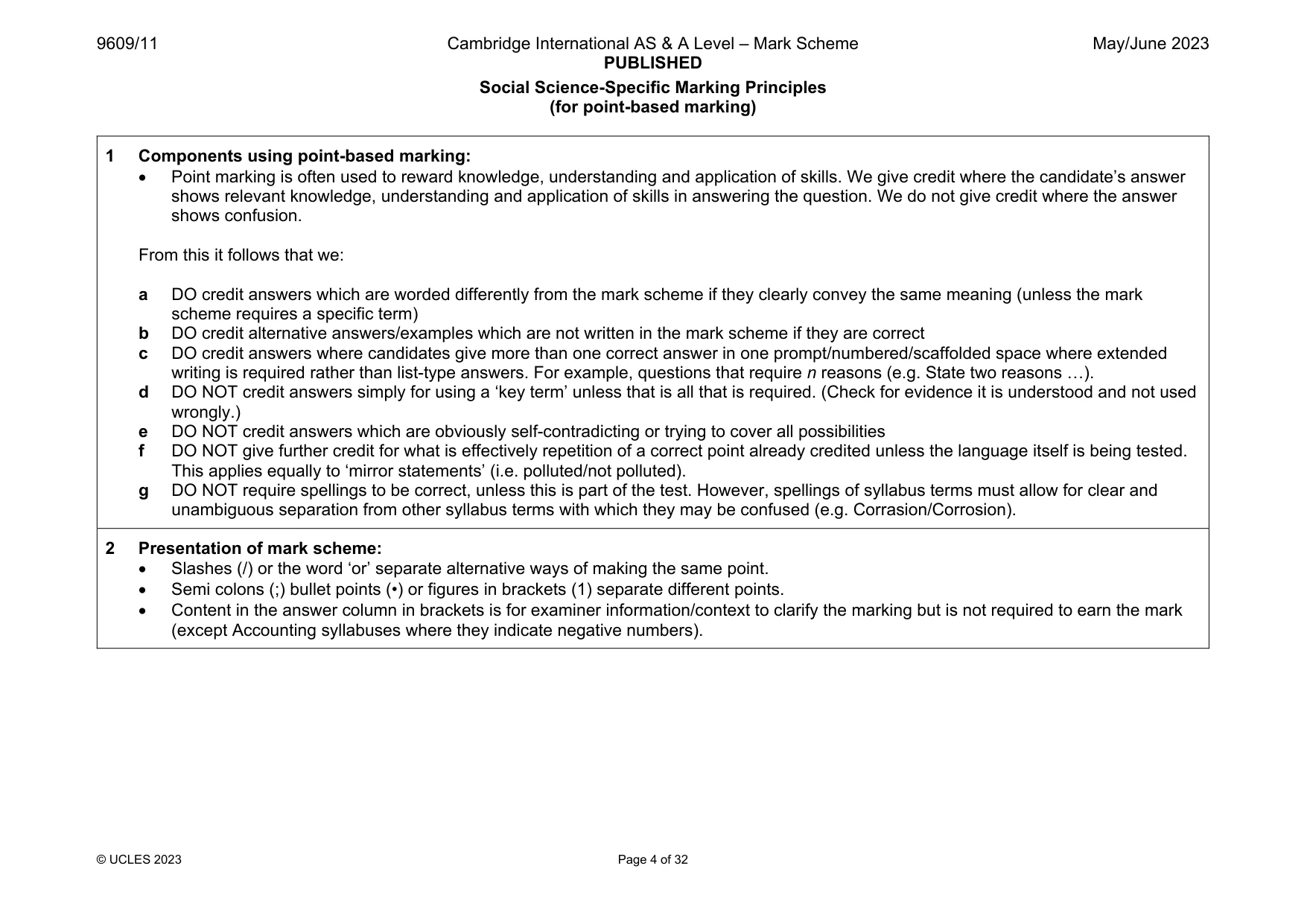
9609/11 Cambridge International AS & A Level – Mark Scheme PUBLISHED May/June 2023 © UCLES 2023 Page 4 of 32 Social Science-Specific Marking Principles (for point-based marking) 1 Components using point-based marking: Point marking is often used to reward knowledge, understanding and application of skills. We give credit where the candidate’s answer shows relevant knowledge, understanding and application of skills in answering the question. We do not give credit where the answer shows confusion. From this it follows that we: a DO credit answers which are worded differently from the mark scheme if they clearly convey the same meaning (unless the mark scheme requires a specific term) b DO credit alternative answers/examples which are not written in the mark scheme if they are correct c DO credit answers where candidates give more than one correct answer in one prompt/numbered/scaffolded space where extended writing is required rather than list-type answers. For example, questions that require n reasons (e.g. State two reasons …). d DO NOT credit answers simply for using a ‘key term’ unless that is all that is required. (Check for evidence it is understood and not used wrongly.) e DO NOT credit answers which are obviously self-contradicting or trying to cover all possibilities f DO NOT give further credit for what is effectively repetition of a correct point already credited unless the language itself is being tested. This applies equally to ‘mirror statements’ (i.e. polluted/not polluted). g DO NOT require spellings to be correct, unless this is part of the test. However, spellings of syllabus terms must allow for clear and unambiguous separation from other syllabus terms with which they may be confused (e.g. Corrasion/Corrosion). 2 Presentation of mark scheme: Slashes (/) or the word ‘or’ separate alternative ways of making the same point. Semi colons (;) bullet points (•) or figures in brackets (1) separate different points. Content in the answer column in brackets is for examiner information/context to clarify the marking but is not required to earn the mark (except Accounting syllabuses where they indicate negative numbers).
Mark scheme, page 5
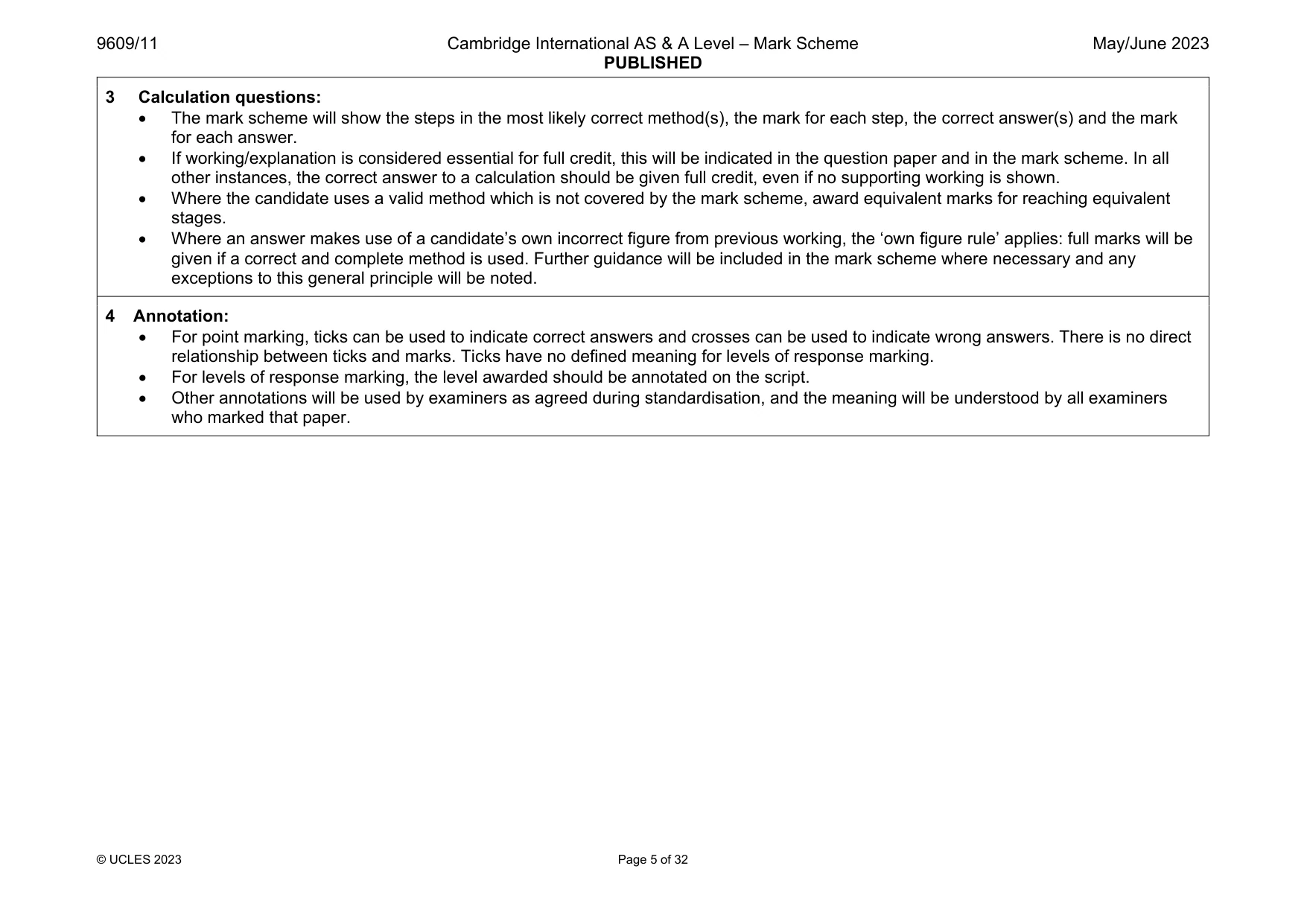
9609/11 Cambridge International AS & A Level – Mark Scheme PUBLISHED May/June 2023 © UCLES 2023 Page 5 of 32 3 Calculation questions: The mark scheme will show the steps in the most likely correct method(s), the mark for each step, the correct answer(s) and the mark for each answer. If working/explanation is considered essential for full credit, this will be indicated in the question paper and in the mark scheme. In all other instances, the correct answer to a calculation should be given full credit, even if no supporting working is shown. Where the candidate uses a valid method which is not covered by the mark scheme, award equivalent marks for reaching equivalent stages. Where an answer makes use of a candidate’s own incorrect figure from previous working, the ‘own figure rule’ applies: full marks will be given if a correct and complete method is used. Further guidance will be included in the mark scheme where necessary and any exceptions to this general principle will be noted. 4 Annotation: For point marking, ticks can be used to indicate correct answers and crosses can be used to indicate wrong answers. There is no direct relationship between ticks and marks. Ticks have no defined meaning for levels of response marking. For levels of response marking, the level awarded should be annotated on the script. Other annotations will be used by examiners as agreed during standardisation, and the meaning will be understood by all examiners who marked that paper.
Mark scheme, page 6
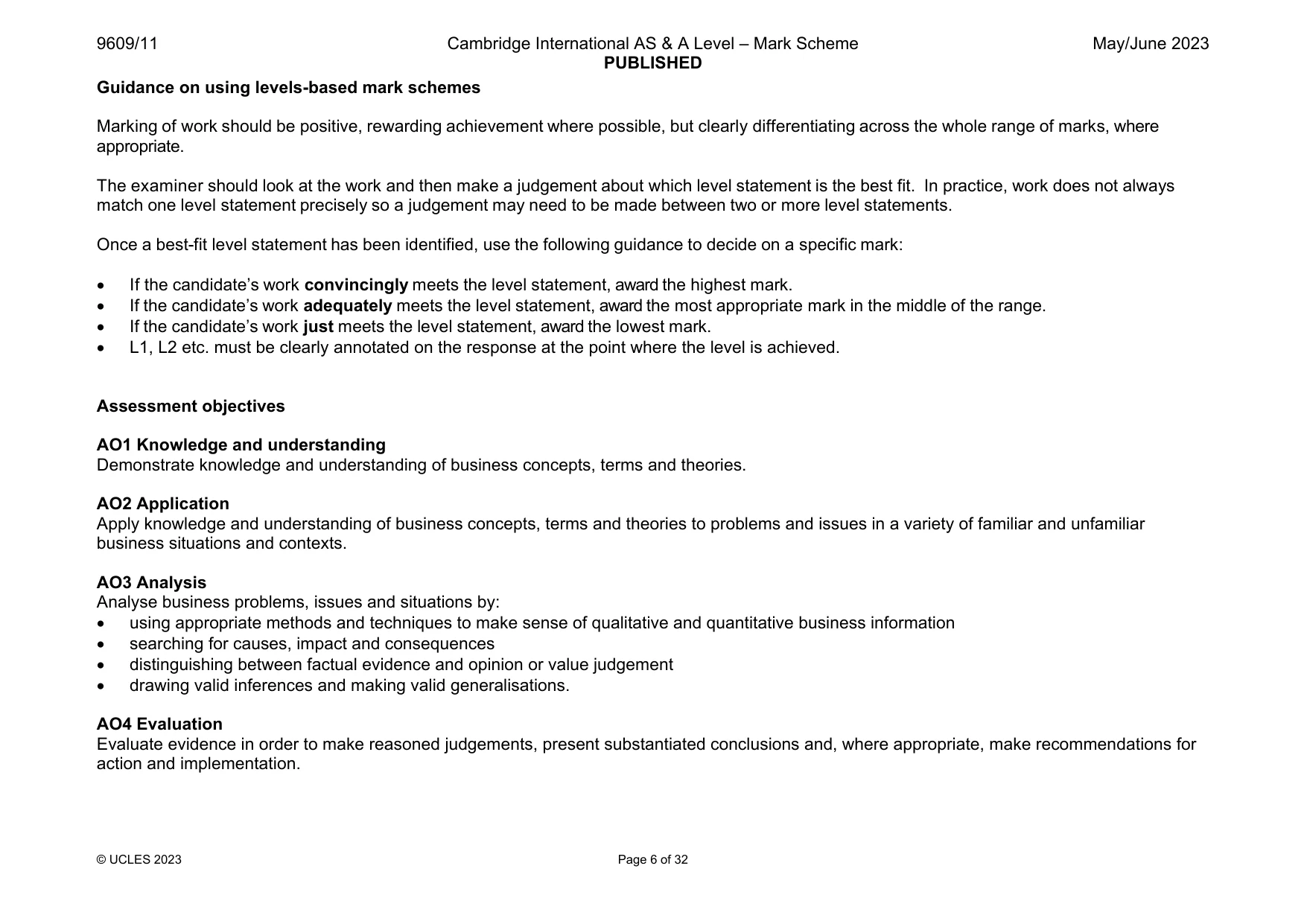
9609/11 Cambridge International AS & A Level – Mark Scheme PUBLISHED May/June 2023 © UCLES 2023 Page 6 of 32 Guidance on using levels-based mark schemes Marking of work should be positive, rewarding achievement where possible, but clearly differentiating across the whole range of marks, where appropriate. The examiner should look at the work and then make a judgement about which level statement is the best fit. In practice, work does not always match one level statement precisely so a judgement may need to be made between two or more level statements. Once a best-fit level statement has been identified, use the following guidance to decide on a specific mark: If the candidate’s work convincingly meets the level statement, award the highest mark. If the candidate’s work adequately meets the level statement, award the most appropriate mark in the middle of the range. If the candidate’s work just meets the level statement, award the lowest mark. L1, L2 etc. must be clearly annotated on the response at the point where the level is achieved. Assessment objectives AO1 Knowledge and understanding Demonstrate knowledge and understanding of business concepts, terms and theories. AO2 Application Apply knowledge and understanding of business concepts, terms and theories to problems and issues in a variety of familiar and unfamiliar business situations and contexts. AO3 Analysis Analyse business problems, issues and situations by: using appropriate methods and techniques to make sense of qualitative and quantitative business information searching for causes, impact and consequences distinguishing between factual evidence and opinion or value judgement drawing valid inferences and making valid generalisations. AO4 Evaluation Evaluate evidence in order to make reasoned judgements, present substantiated conclusions and, where appropriate, make recommendations for action and implementation.
Mark scheme, page 7
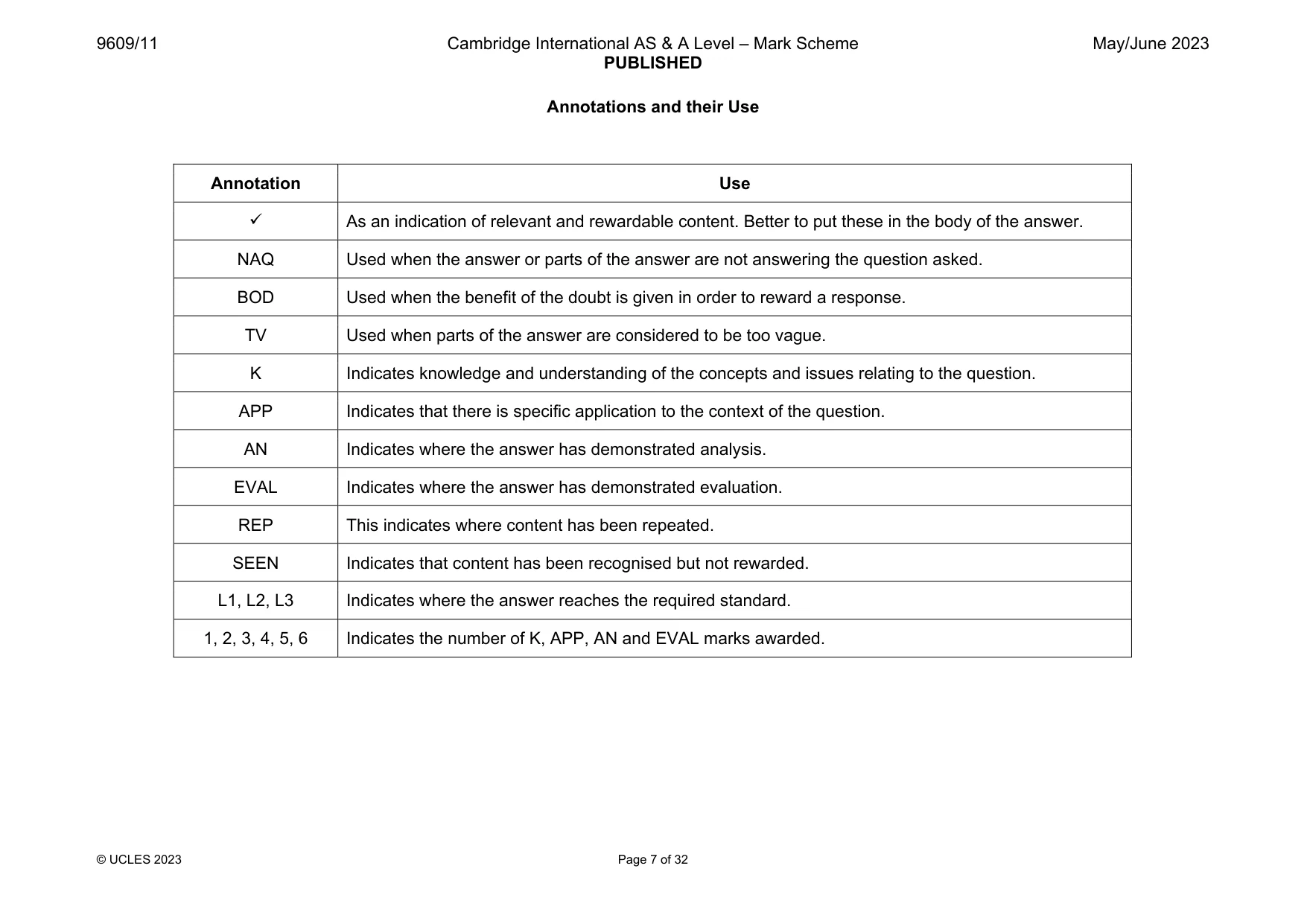
9609/11 Cambridge International AS & A Level – Mark Scheme PUBLISHED May/June 2023 © UCLES 2023 Page 7 of 32 Annotations and their Use Annotation Use As an indication of relevant and rewardable content. Better to put these in the body of the answer. NAQ Used when the answer or parts of the answer are not answering the question asked. BOD Used when the benefit of the doubt is given in order to reward a response. TV Used when parts of the answer are considered to be too vague. K Indicates knowledge and understanding of the concepts and issues relating to the question. APP Indicates that there is specific application to the context of the question. AN Indicates where the answer has demonstrated analysis. EVAL Indicates where the answer has demonstrated evaluation. REP This indicates where content has been repeated. SEEN Indicates that content has been recognised but not rewarded. L1, L2, L3 Indicates where the answer reaches the required standard. 1, 2, 3, 4, 5, 6 Indicates the number of K, APP, AN and EVAL marks awarded.
Mark scheme, page 8
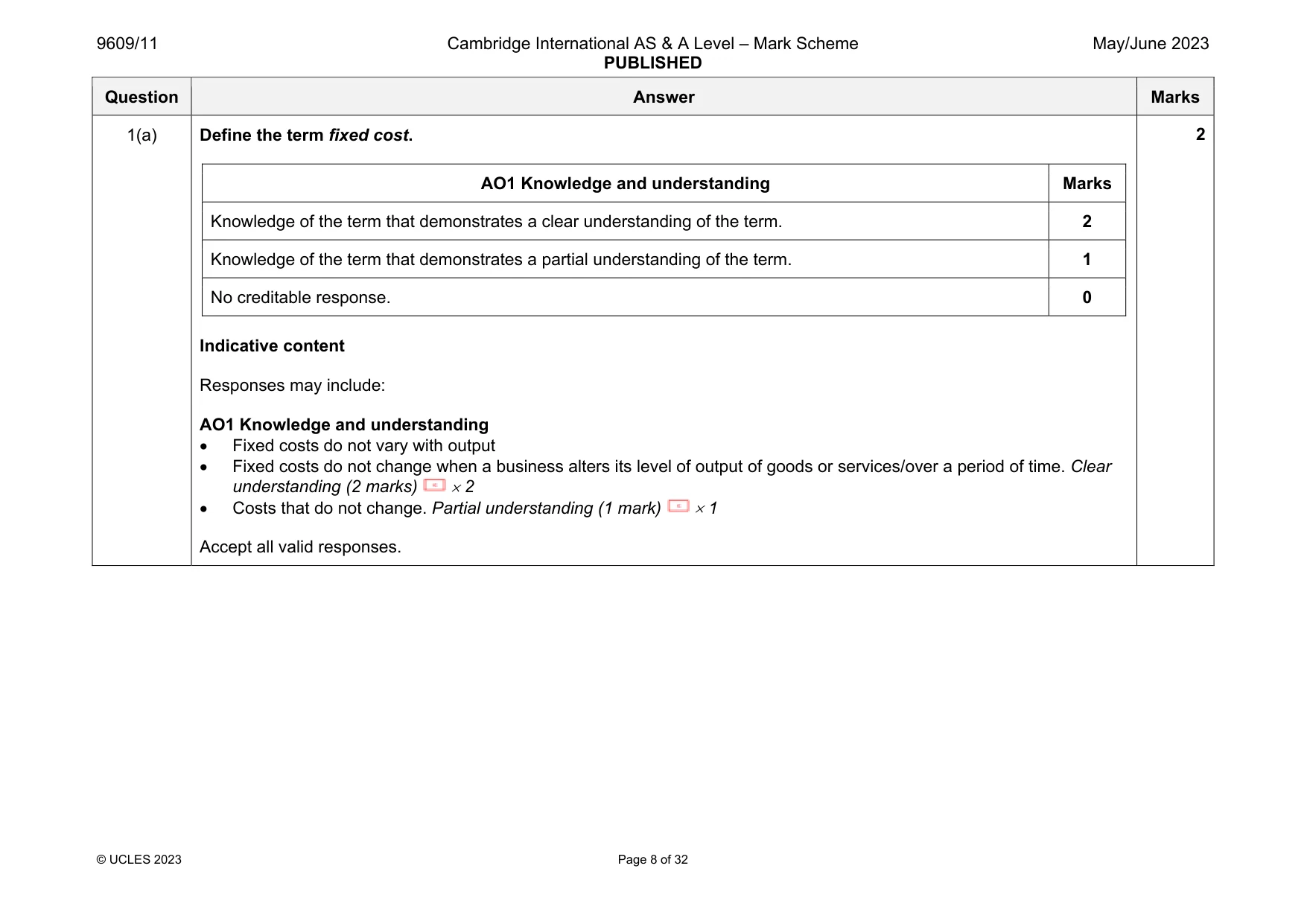
9609/11 Cambridge International AS & A Level – Mark Scheme PUBLISHED May/June 2023 © UCLES 2023 Page 8 of 32 Question Answer Marks 1(a) Define the term fixed cost. AO1 Knowledge and understanding Marks Knowledge of the term that demonstrates a clear understanding of the term. 2 Knowledge of the term that demonstrates a partial understanding of the term. 1 No creditable response. 0 Indicative content Responses may include: AO1 Knowledge and understanding Fixed costs do not vary with output Fixed costs do not change when a business alters its level of output of goods or services/over a period of time. Clear understanding (2 marks) 2 Costs that do not change. Partial understanding (1 mark) 1 Accept all valid responses. 2
Mark scheme, page 9
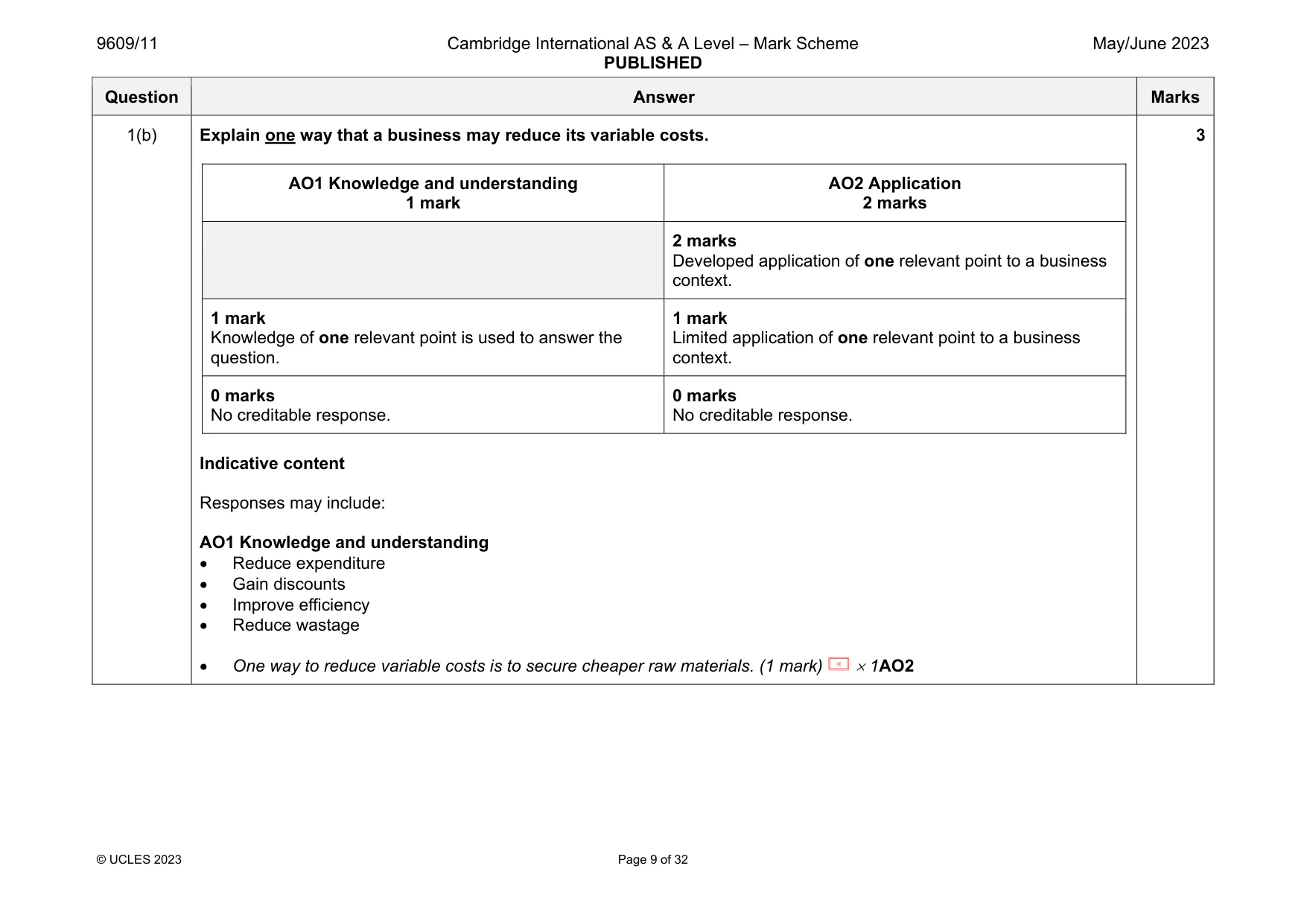
9609/11 Cambridge International AS & A Level – Mark Scheme PUBLISHED May/June 2023 © UCLES 2023 Page 9 of 32 Question Answer Marks 1(b) Explain one way that a business may reduce its variable costs. AO1 Knowledge and understanding 1 mark AO2 Application 2 marks 2 marks Developed application of one relevant point to a business context. 1 mark Knowledge of one relevant point is used to answer the question. 1 mark Limited application of one relevant point to a business context. 0 marks No creditable response. 0 marks No creditable response. Indicative content Responses may include: AO1 Knowledge and understanding Reduce expenditure Gain discounts Improve efficiency Reduce wastage One way to reduce variable costs is to secure cheaper raw materials. (1 mark) 1AO2 3
Mark scheme, page 10
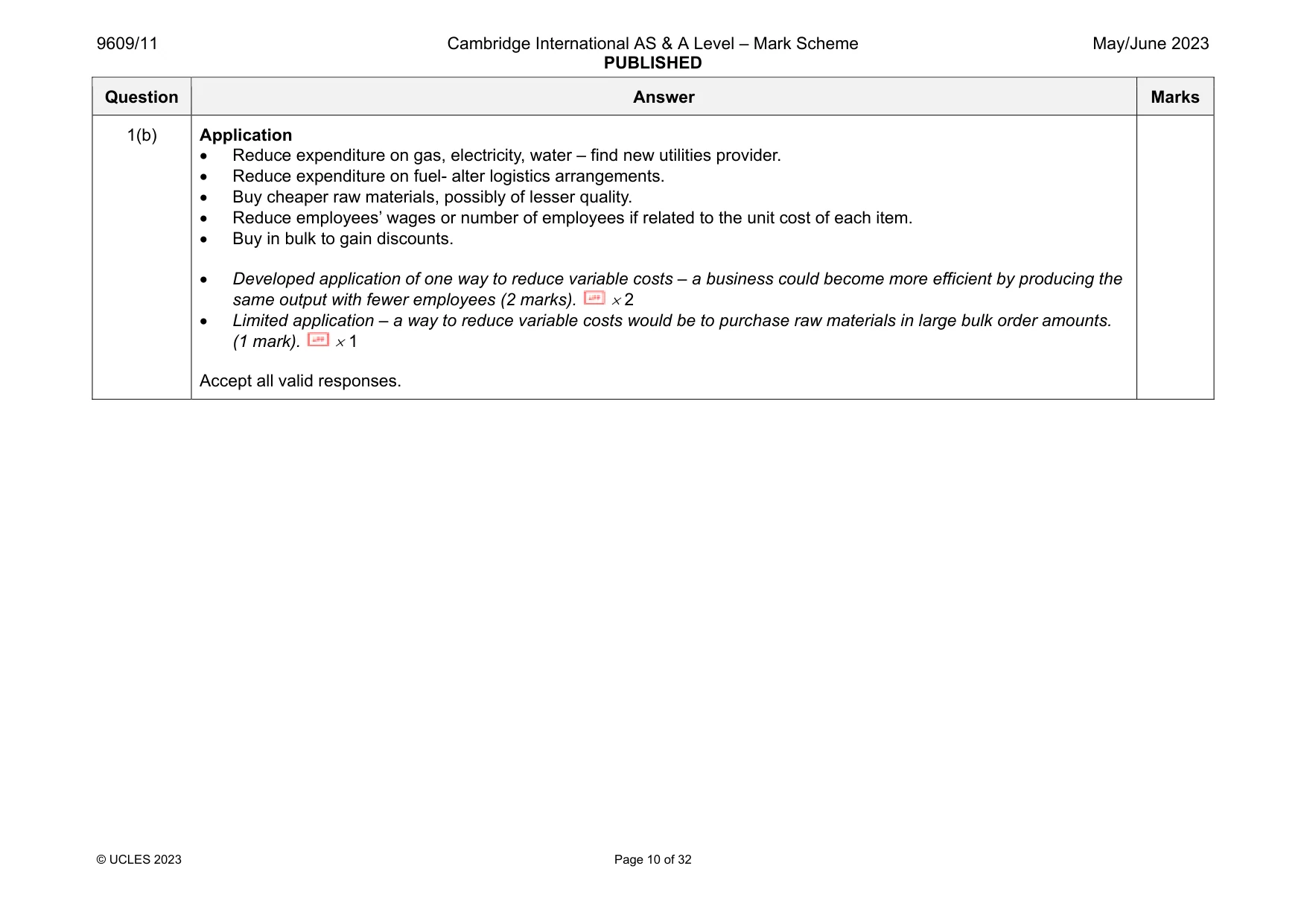
9609/11 Cambridge International AS & A Level – Mark Scheme PUBLISHED May/June 2023 © UCLES 2023 Page 10 of 32 Question Answer Marks 1(b) Application Reduce expenditure on gas, electricity, water – find new utilities provider. Reduce expenditure on fuel- alter logistics arrangements. Buy cheaper raw materials, possibly of lesser quality. Reduce employees’ wages or number of employees if related to the unit cost of each item. Buy in bulk to gain discounts. Developed application of one way to reduce variable costs – a business could become more efficient by producing the same output with fewer employees (2 marks). 2 Limited application – a way to reduce variable costs would be to purchase raw materials in large bulk order amounts. (1 mark). 1 Accept all valid responses.
Mark scheme, page 11
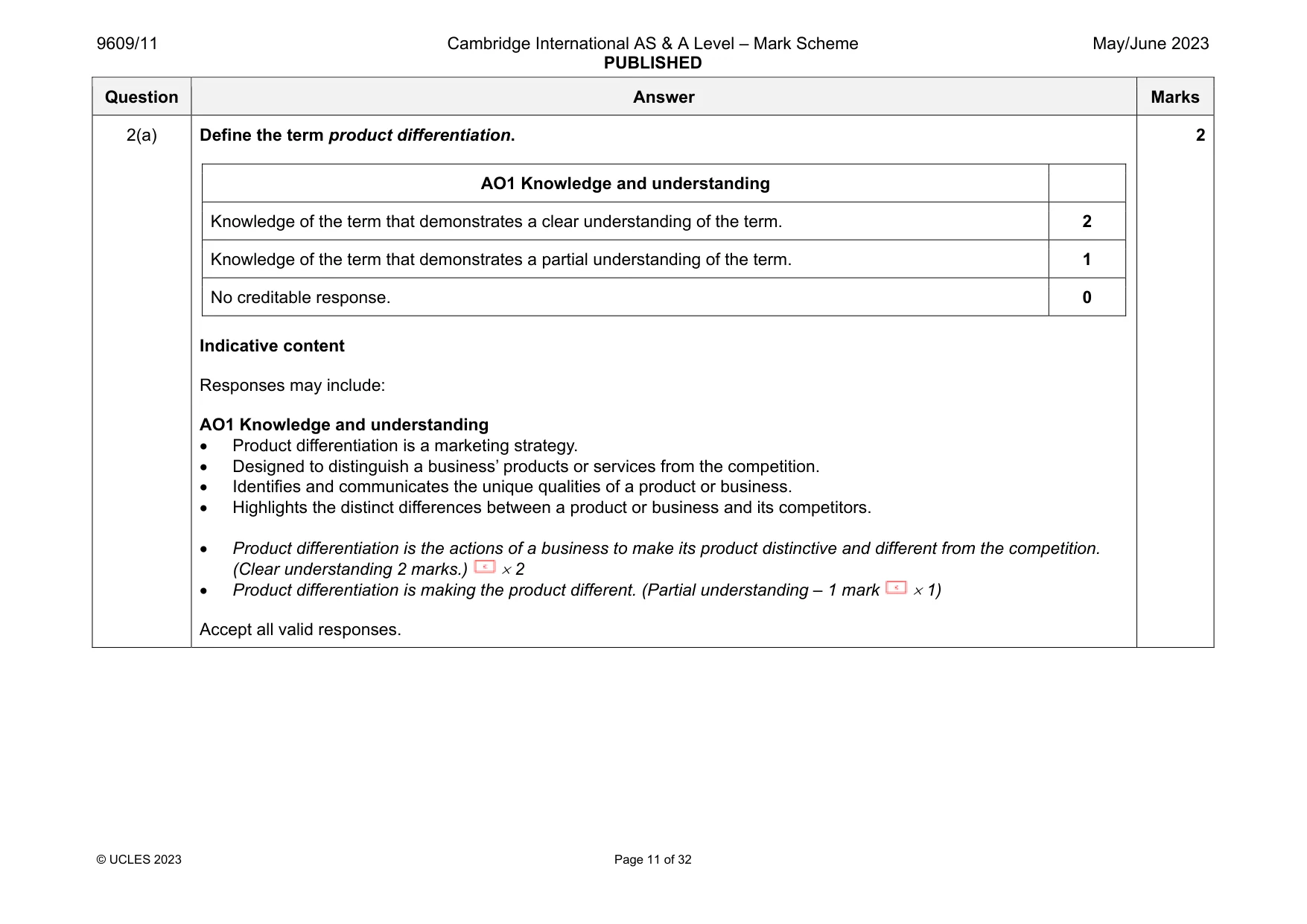
9609/11 Cambridge International AS & A Level – Mark Scheme PUBLISHED May/June 2023 © UCLES 2023 Page 11 of 32 Question Answer Marks 2(a) Define the term product differentiation. AO1 Knowledge and understanding Knowledge of the term that demonstrates a clear understanding of the term. 2 Knowledge of the term that demonstrates a partial understanding of the term. 1 No creditable response. 0 Indicative content Responses may include: AO1 Knowledge and understanding Product differentiation is a marketing strategy. Designed to distinguish a business’ products or services from the competition. Identifies and communicates the unique qualities of a product or business. Highlights the distinct differences between a product or business and its competitors. Product differentiation is the actions of a business to make its product distinctive and different from the competition. (Clear understanding 2 marks.) 2 Product differentiation is making the product different. (Partial understanding – 1 mark 1) Accept all valid responses. 2
Mark scheme, page 12
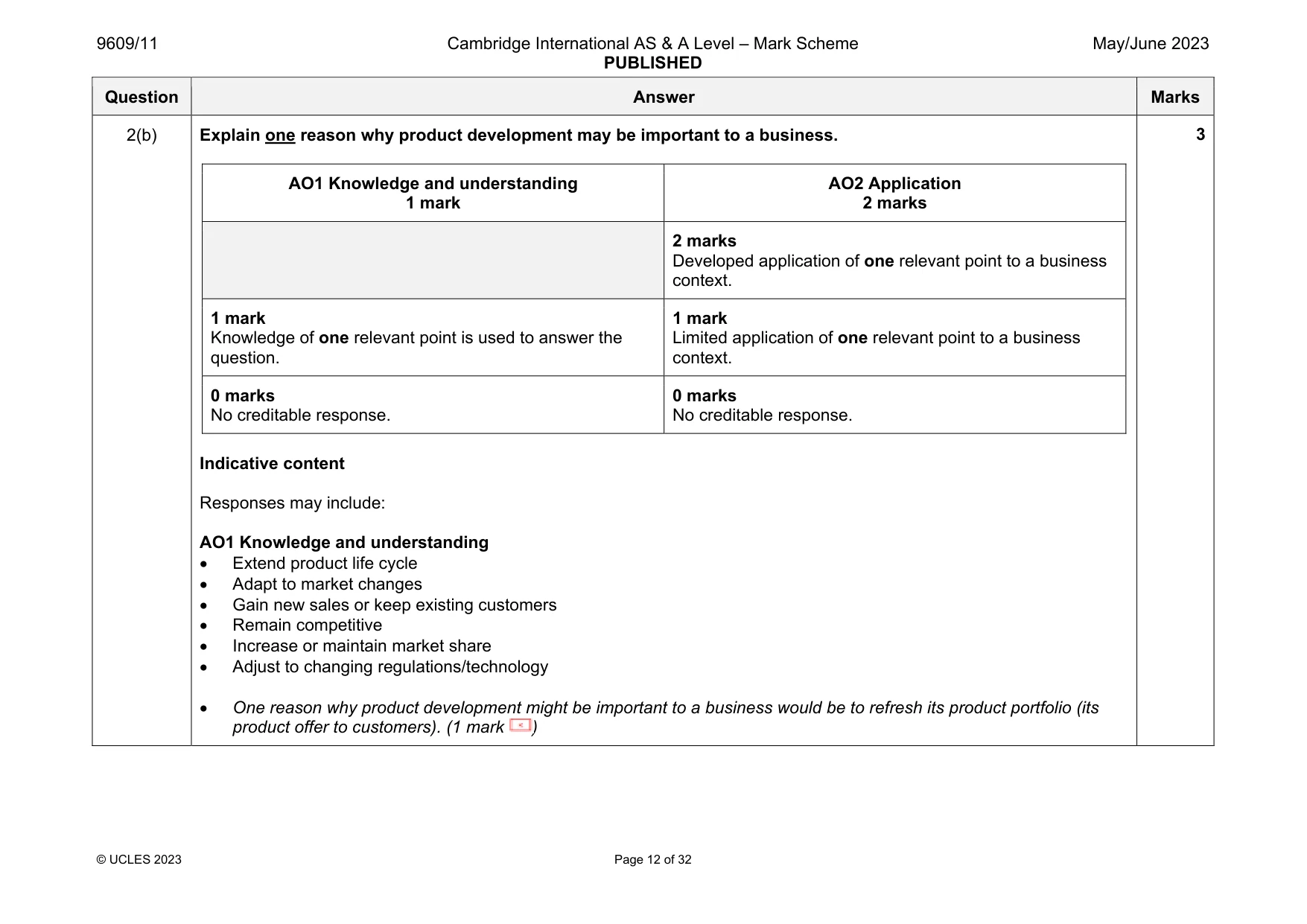
9609/11 Cambridge International AS & A Level – Mark Scheme PUBLISHED May/June 2023 © UCLES 2023 Page 12 of 32 Question Answer Marks 2(b) Explain one reason why product development may be important to a business. AO1 Knowledge and understanding 1 mark AO2 Application 2 marks 2 marks Developed application of one relevant point to a business context. 1 mark Knowledge of one relevant point is used to answer the question. 1 mark Limited application of one relevant point to a business context. 0 marks No creditable response. 0 marks No creditable response. Indicative content Responses may include: AO1 Knowledge and understanding Extend product life cycle Adapt to market changes Gain new sales or keep existing customers Remain competitive Increase or maintain market share Adjust to changing regulations/technology One reason why product development might be important to a business would be to refresh its product portfolio (its product offer to customers). (1 mark ) 3
Mark scheme, page 13
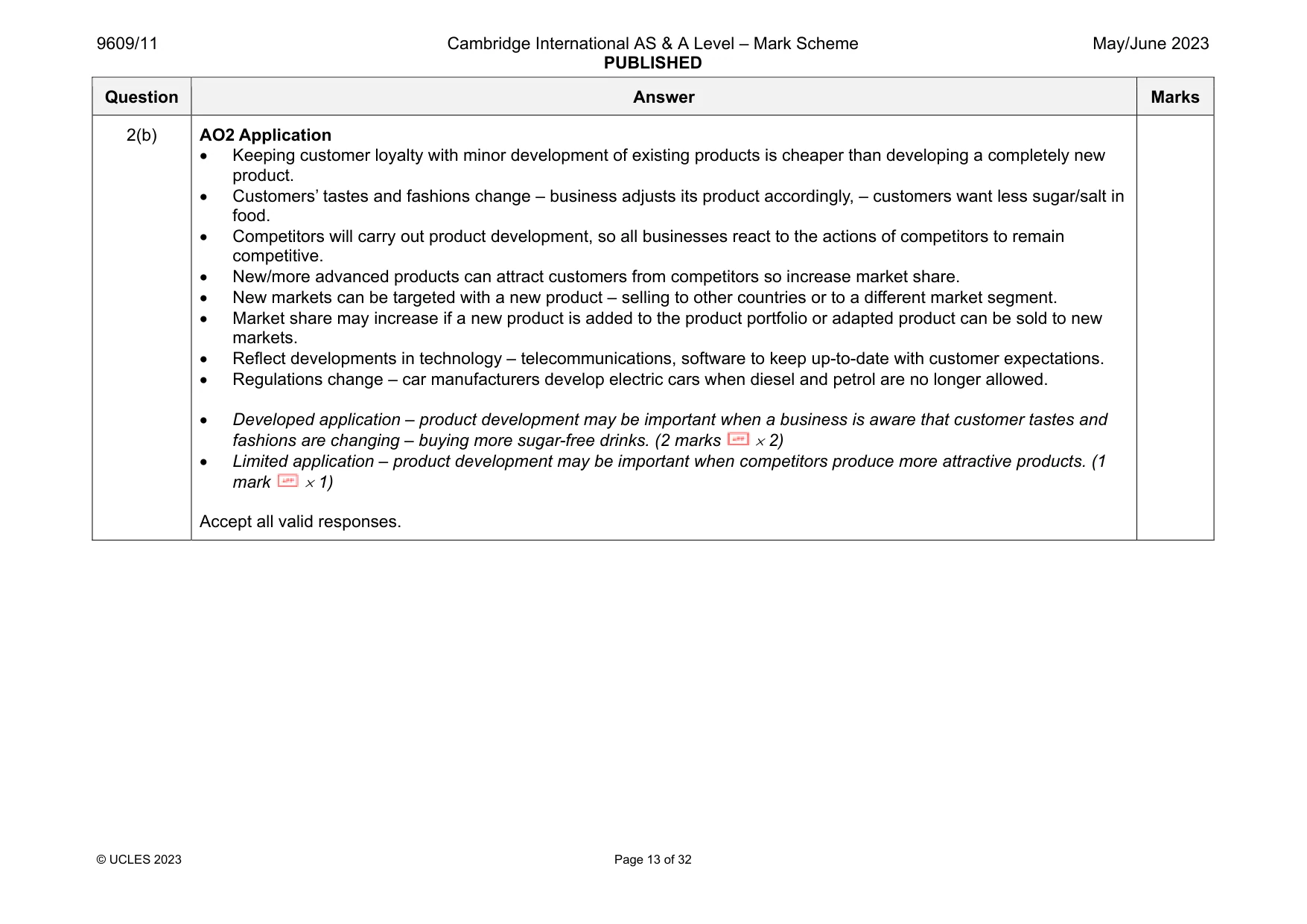
9609/11 Cambridge International AS & A Level – Mark Scheme PUBLISHED May/June 2023 © UCLES 2023 Page 13 of 32 Question Answer Marks 2(b) AO2 Application Keeping customer loyalty with minor development of existing products is cheaper than developing a completely new product. Customers’ tastes and fashions change – business adjusts its product accordingly, – customers want less sugar/salt in food. Competitors will carry out product development, so all businesses react to the actions of competitors to remain competitive. New/more advanced products can attract customers from competitors so increase market share. New markets can be targeted with a new product – selling to other countries or to a different market segment. Market share may increase if a new product is added to the product portfolio or adapted product can be sold to new markets. Reflect developments in technology – telecommunications, software to keep up-to-date with customer expectations. Regulations change – car manufacturers develop electric cars when diesel and petrol are no longer allowed. Developed application – product development may be important when a business is aware that customer tastes and fashions are changing – buying more sugar-free drinks. (2 marks 2) Limited application – product development may be important when competitors produce more attractive products. (1 mark 1) Accept all valid responses.
Mark scheme, page 14
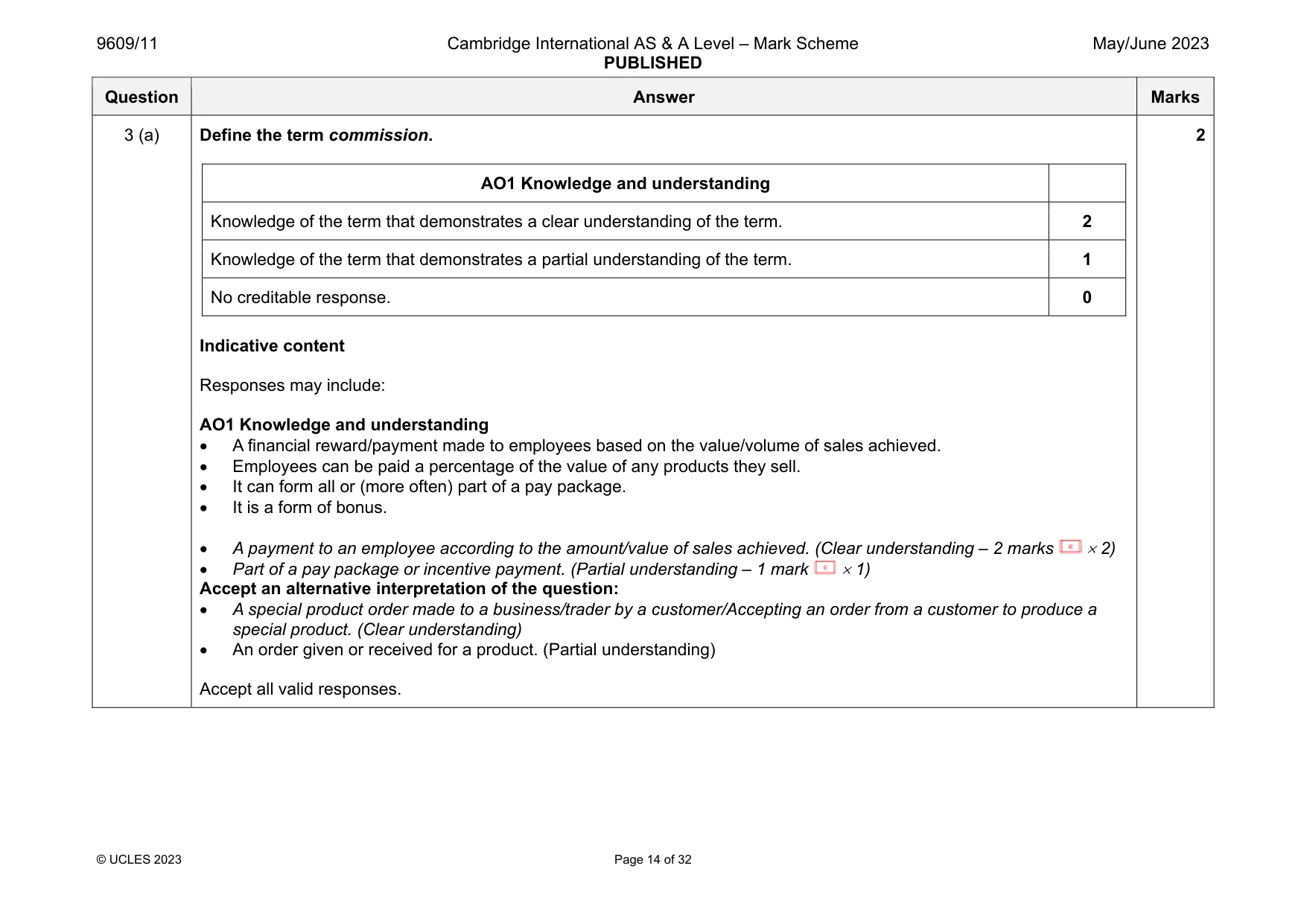
9609/11 Cambridge International AS & A Level – Mark Scheme PUBLISHED May/June 2023 © UCLES 2023 Page 14 of 32 Question Answer Marks 3 (a) Define the term commission. AO1 Knowledge and understanding Knowledge of the term that demonstrates a clear understanding of the term. 2 Knowledge of the term that demonstrates a partial understanding of the term. 1 No creditable response. 0 Indicative content Responses may include: AO1 Knowledge and understanding A financial reward/payment made to employees based on the value/volume of sales achieved. Employees can be paid a percentage of the value of any products they sell. It can form all or (more often) part of a pay package. It is a form of bonus. A payment to an employee according to the amount/value of sales achieved. (Clear understanding – 2 marks 2) Part of a pay package or incentive payment. (Partial understanding – 1 mark 1) Accept an alternative interpretation of the question: A special product order made to a business/trader by a customer/Accepting an order from a customer to produce a special product. (Clear understanding) An order given or received for a product. (Partial understanding) Accept all valid responses. 2
Mark scheme, page 15
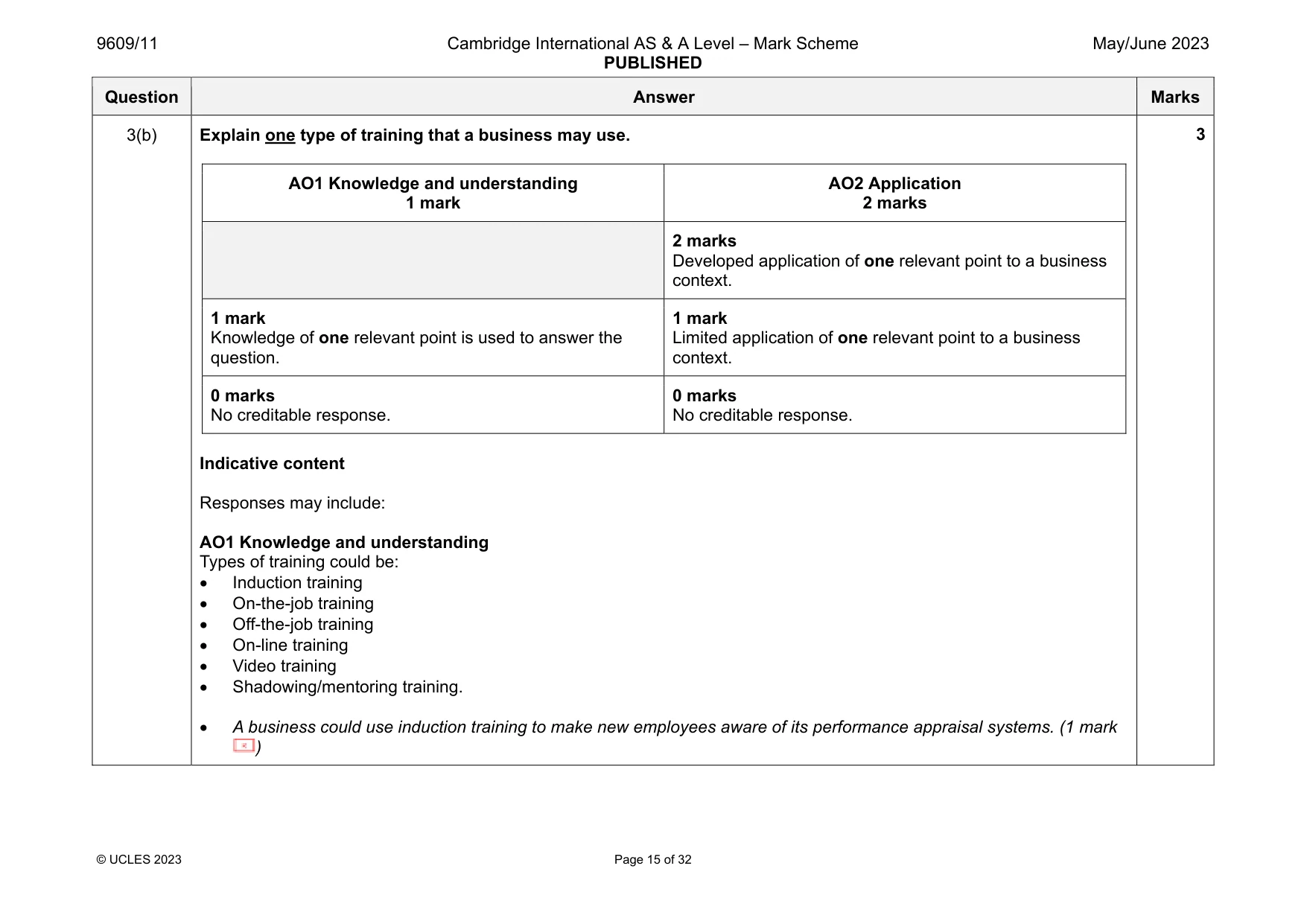
9609/11 Cambridge International AS & A Level – Mark Scheme PUBLISHED May/June 2023 © UCLES 2023 Page 15 of 32 Question Answer Marks 3(b) Explain one type of training that a business may use. AO1 Knowledge and understanding 1 mark AO2 Application 2 marks 2 marks Developed application of one relevant point to a business context. 1 mark Knowledge of one relevant point is used to answer the question. 1 mark Limited application of one relevant point to a business context. 0 marks No creditable response. 0 marks No creditable response. Indicative content Responses may include: AO1 Knowledge and understanding Types of training could be: Induction training On-the-job training Off-the-job training On-line training Video training Shadowing/mentoring training. A business could use induction training to make new employees aware of its performance appraisal systems. (1 mark ) 3
Mark scheme, page 16
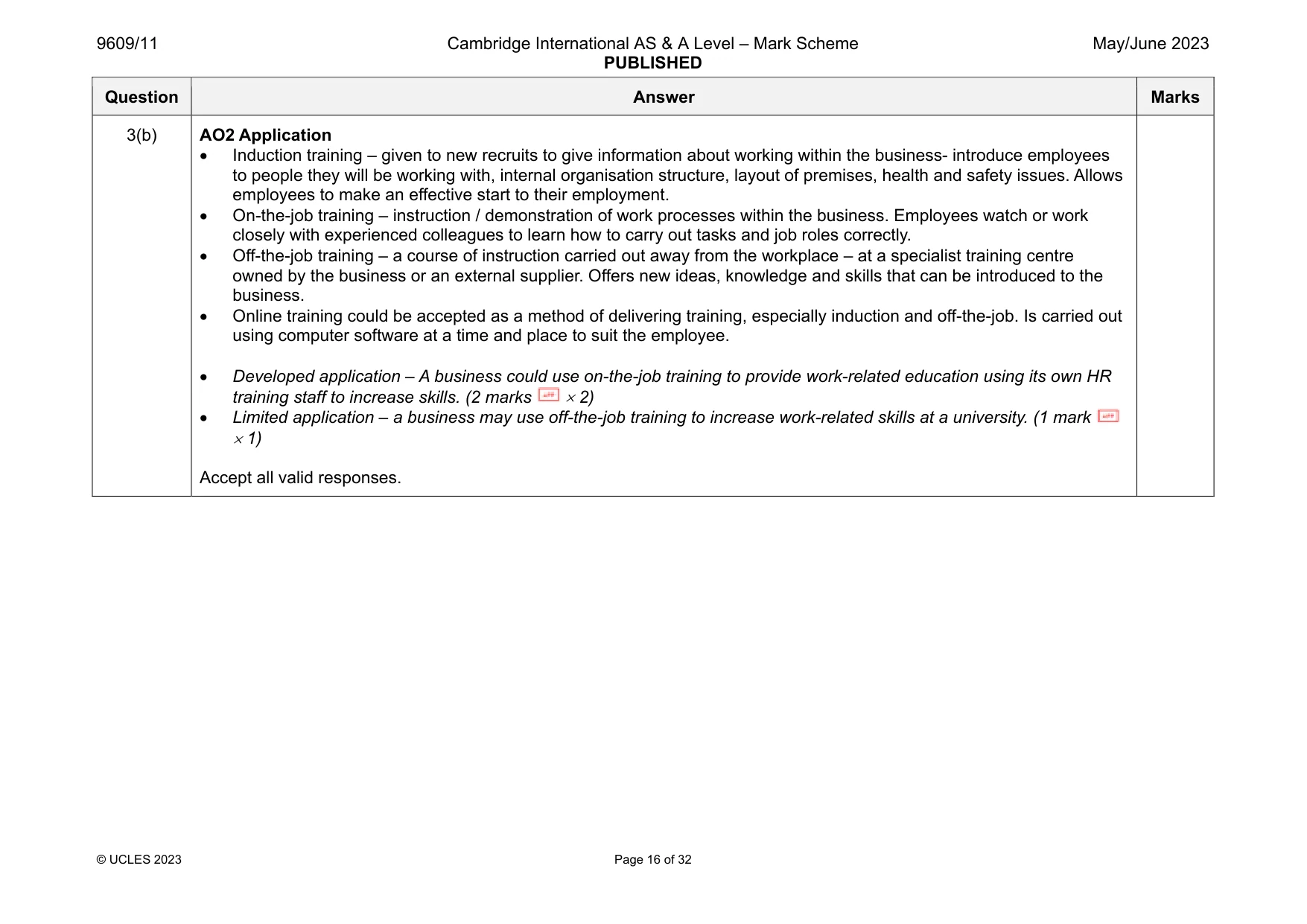
9609/11 Cambridge International AS & A Level – Mark Scheme PUBLISHED May/June 2023 © UCLES 2023 Page 16 of 32 Question Answer Marks 3(b) AO2 Application Induction training – given to new recruits to give information about working within the business- introduce employees to people they will be working with, internal organisation structure, layout of premises, health and safety issues. Allows employees to make an effective start to their employment. On-the-job training – instruction / demonstration of work processes within the business. Employees watch or work closely with experienced colleagues to learn how to carry out tasks and job roles correctly. Off-the-job training – a course of instruction carried out away from the workplace – at a specialist training centre owned by the business or an external supplier. Offers new ideas, knowledge and skills that can be introduced to the business. Online training could be accepted as a method of delivering training, especially induction and off-the-job. Is carried out using computer software at a time and place to suit the employee. Developed application – A business could use on-the-job training to provide work-related education using its own HR training staff to increase skills. (2 marks 2) Limited application – a business may use off-the-job training to increase work-related skills at a university. (1 mark 1) Accept all valid responses.
Mark scheme, page 17
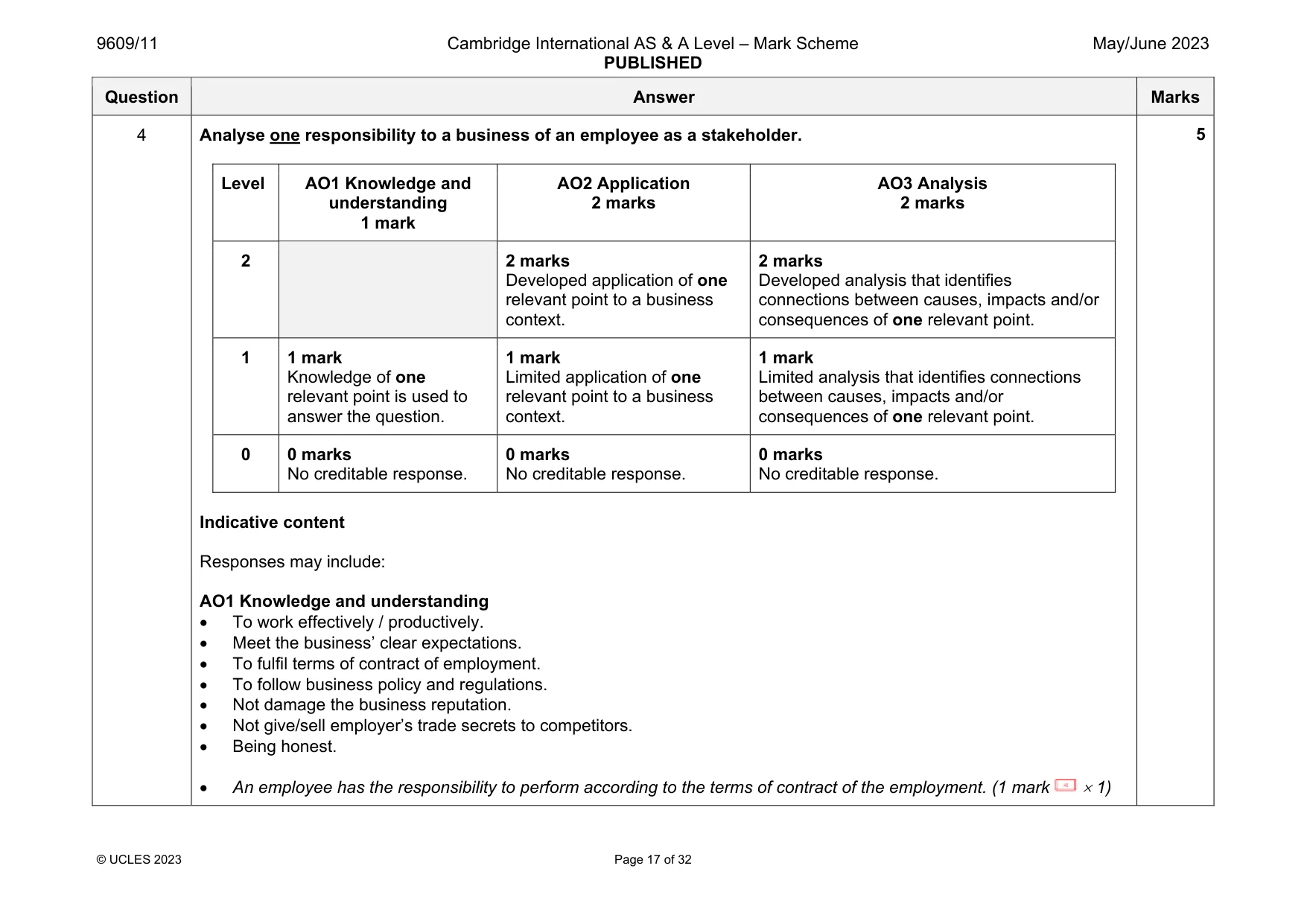
9609/11 Cambridge International AS & A Level – Mark Scheme PUBLISHED May/June 2023 © UCLES 2023 Page 17 of 32 Question Answer Marks 4 Analyse one responsibility to a business of an employee as a stakeholder. Level AO1 Knowledge and understanding 1 mark AO2 Application 2 marks AO3 Analysis 2 marks 2 2 marks Developed application of one relevant point to a business context. 2 marks Developed analysis that identifies connections between causes, impacts and/or consequences of one relevant point. 1 1 mark Knowledge of one relevant point is used to answer the question. 1 mark Limited application of one relevant point to a business context. 1 mark Limited analysis that identifies connections between causes, impacts and/or consequences of one relevant point. 0 0 marks No creditable response. 0 marks No creditable response. 0 marks No creditable response. Indicative content Responses may include: AO1 Knowledge and understanding To work effectively / productively. Meet the business’ clear expectations. To fulfil terms of contract of employment. To follow business policy and regulations. Not damage the business reputation. Not give/sell employer’s trade secrets to competitors. Being honest. An employee has the responsibility to perform according to the terms of contract of the employment. (1 mark 1) 5
Mark scheme, page 18
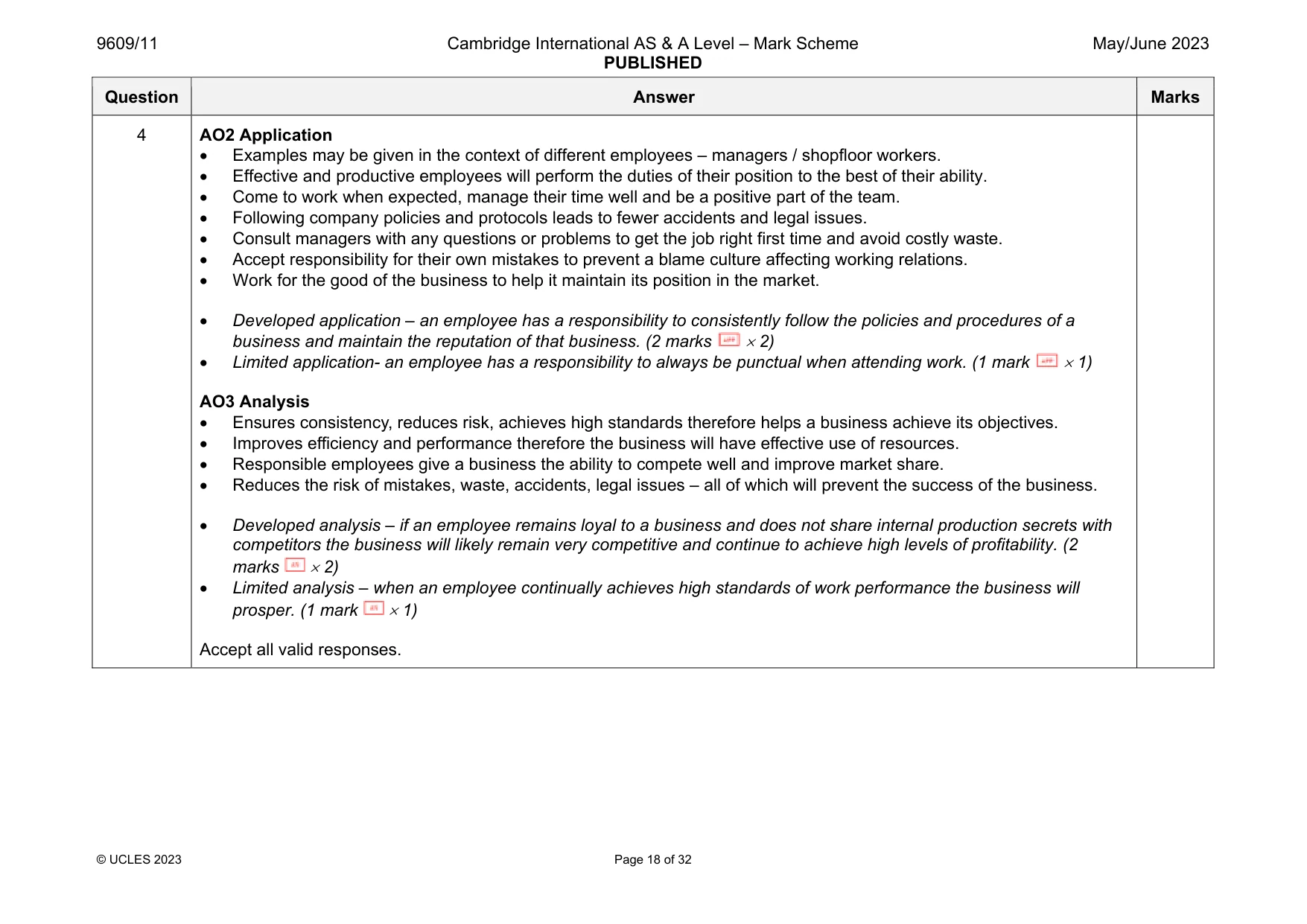
9609/11 Cambridge International AS & A Level – Mark Scheme PUBLISHED May/June 2023 © UCLES 2023 Page 18 of 32 Question Answer Marks 4 AO2 Application Examples may be given in the context of different employees – managers / shopfloor workers. Effective and productive employees will perform the duties of their position to the best of their ability. Come to work when expected, manage their time well and be a positive part of the team. Following company policies and protocols leads to fewer accidents and legal issues. Consult managers with any questions or problems to get the job right first time and avoid costly waste. Accept responsibility for their own mistakes to prevent a blame culture affecting working relations. Work for the good of the business to help it maintain its position in the market. Developed application – an employee has a responsibility to consistently follow the policies and procedures of a business and maintain the reputation of that business. (2 marks 2) Limited application- an employee has a responsibility to always be punctual when attending work. (1 mark 1) AO3 Analysis Ensures consistency, reduces risk, achieves high standards therefore helps a business achieve its objectives. Improves efficiency and performance therefore the business will have effective use of resources. Responsible employees give a business the ability to compete well and improve market share. Reduces the risk of mistakes, waste, accidents, legal issues – all of which will prevent the success of the business. Developed analysis – if an employee remains loyal to a business and does not share internal production secrets with competitors the business will likely remain very competitive and continue to achieve high levels of profitability. (2 marks 2) Limited analysis – when an employee continually achieves high standards of work performance the business will prosper. (1 mark 1) Accept all valid responses.
Mark scheme, page 19
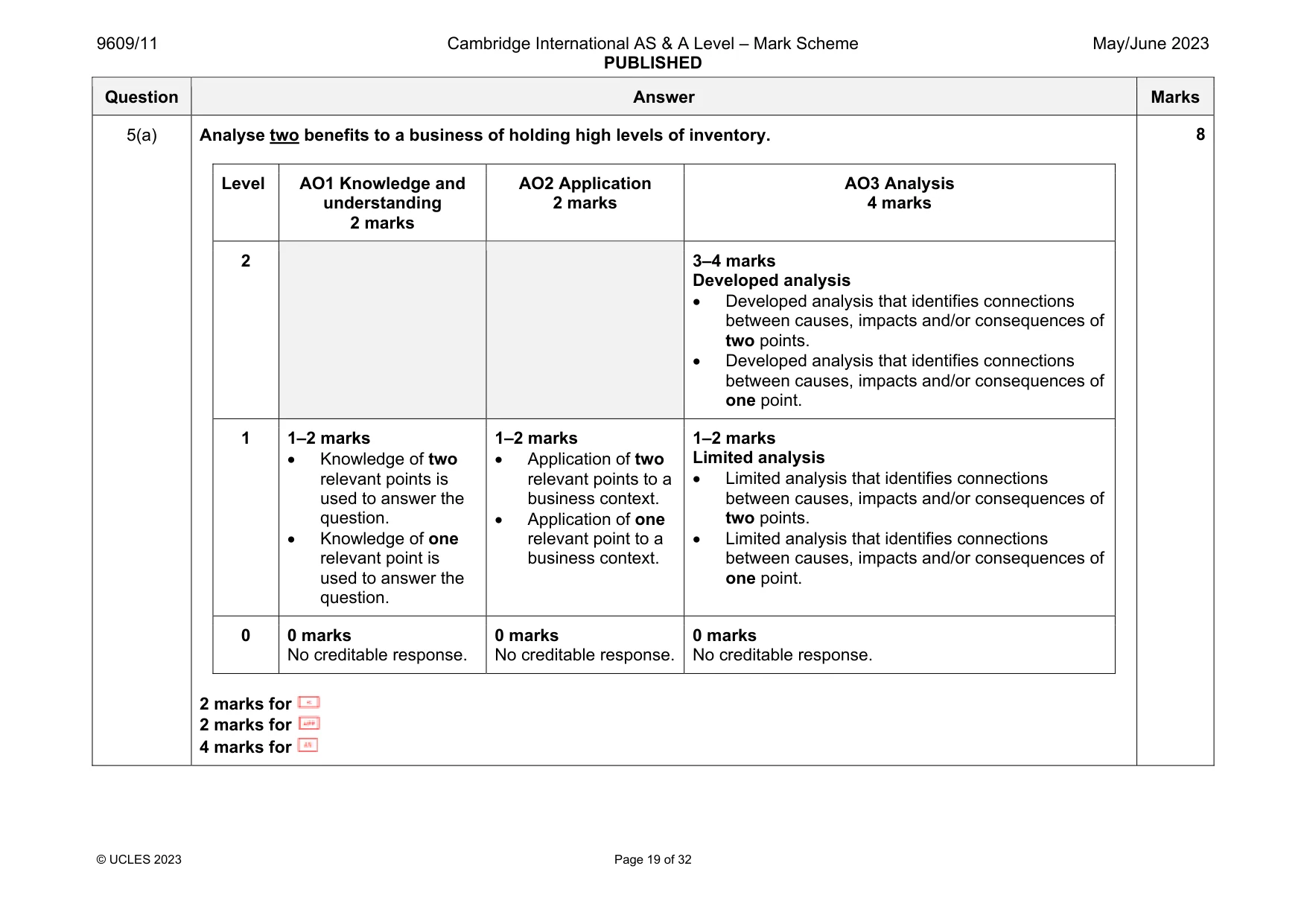
9609/11 Cambridge International AS & A Level – Mark Scheme PUBLISHED May/June 2023 © UCLES 2023 Page 19 of 32 Question Answer Marks 5(a) Analyse two benefits to a business of holding high levels of inventory. Level AO1 Knowledge and understanding 2 marks AO2 Application 2 marks AO3 Analysis 4 marks 2 3–4 marks Developed analysis Developed analysis that identifies connections between causes, impacts and/or consequences of two points. Developed analysis that identifies connections between causes, impacts and/or consequences of one point. 1 1–2 marks Knowledge of two relevant points is used to answer the question. Knowledge of one relevant point is used to answer the question. 1–2 marks Application of two relevant points to a business context. Application of one relevant point to a business context. 1–2 marks Limited analysis Limited analysis that identifies connections between causes, impacts and/or consequences of two points. Limited analysis that identifies connections between causes, impacts and/or consequences of one point. 0 0 marks No creditable response. 0 marks No creditable response. 0 marks No creditable response. 2 marks for 2 marks for 4 marks for 8
Mark scheme, page 20
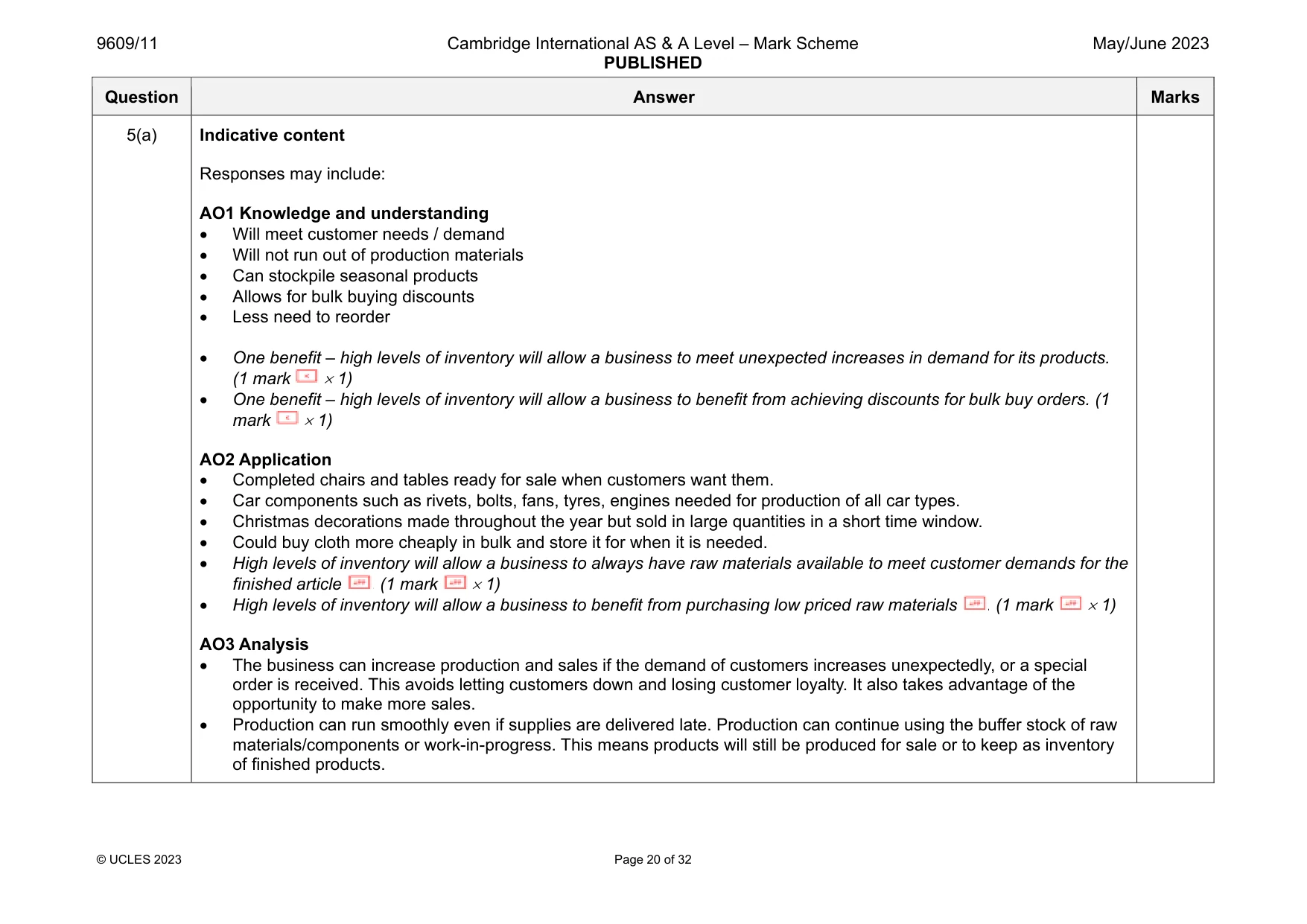
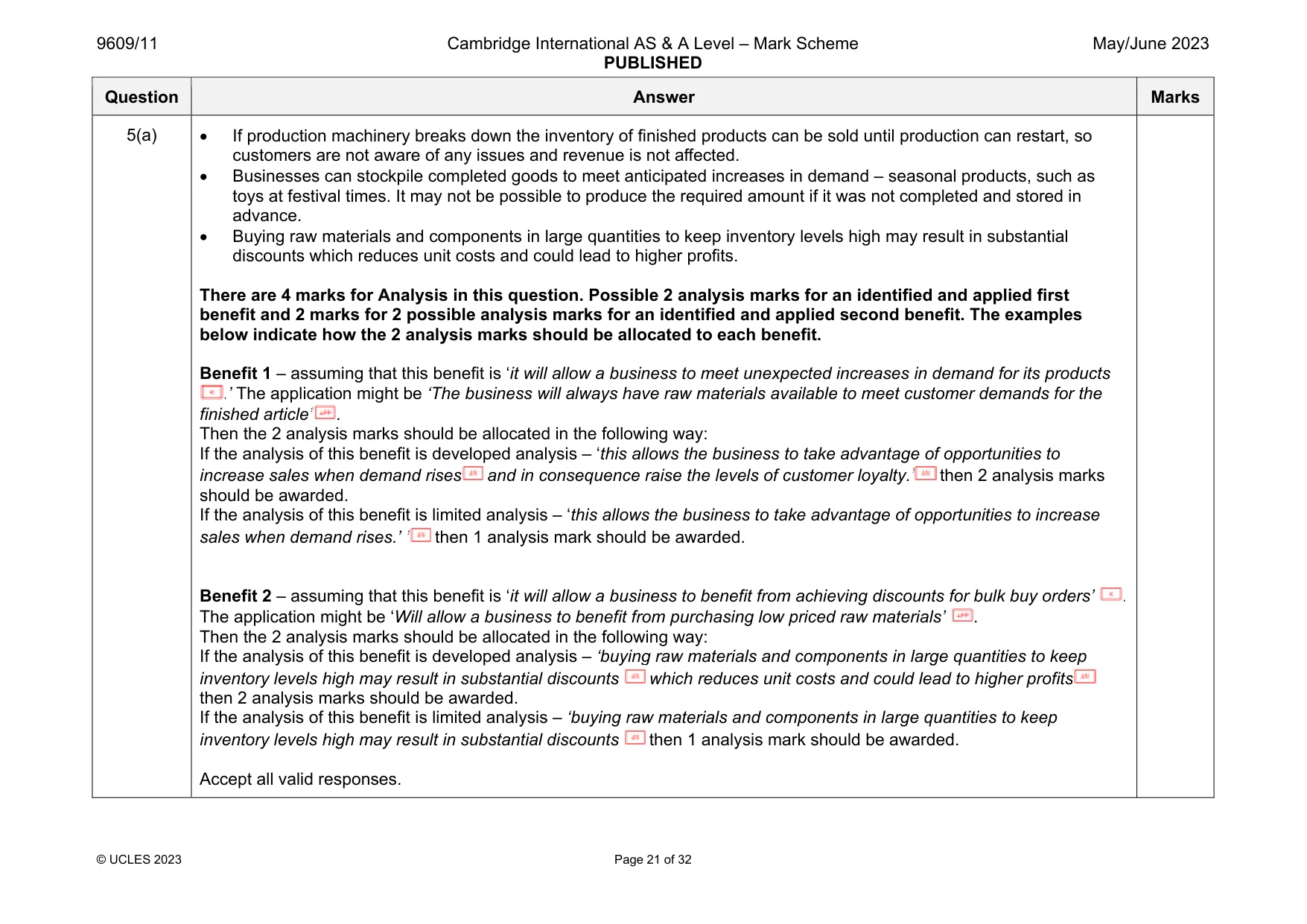
9609/11 Cambridge International AS & A Level – Mark Scheme PUBLISHED May/June 2023 © UCLES 2023 Page 20 of 32 Question Answer Marks 5(a) Indicative content Responses may include: AO1 Knowledge and understanding Will meet customer needs / demand Will not run out of production materials Can stockpile seasonal products Allows for bulk buying discounts Less need to reorder One benefit – high levels of inventory will allow a business to meet unexpected increases in demand for its products. (1 mark 1) One benefit – high levels of inventory will allow a business to benefit from achieving discounts for bulk buy orders. (1 mark 1) AO2 Application Completed chairs and tables ready for sale when customers want them. Car components such as rivets, bolts, fans, tyres, engines needed for production of all car types. Christmas decorations made throughout the year but sold in large quantities in a short time window. Could buy cloth more cheaply in bulk and store it for when it is needed. High levels of inventory will allow a business to always have raw materials available to meet customer demands for the finished article . (1 mark 1) High levels of inventory will allow a business to benefit from purchasing low priced raw materials . (1 mark 1) AO3 Analysis The business can increase production and sales if the demand of customers increases unexpectedly, or a special order is received. This avoids letting customers down and losing customer loyalty. It also takes advantage of the opportunity to make more sales. Production can run smoothly even if supplies are delivered late. Production can continue using the buffer stock of raw materials/components or work-in-progress. This means products will still be produced for sale or to keep as inventory of finished products.
Mark scheme, page 21
9609/11 Cambridge International AS & A Level – Mark Scheme PUBLISHED May/June 2023 © UCLES 2023 Page 21 of 32 Question Answer Marks 5(a) If production machinery breaks down the inventory of finished products can be sold until production can restart, so customers are not aware of any issues and revenue is not affected. Businesses can stockpile completed goods to meet anticipated increases in demand – seasonal products, such as toys at festival times. It may not be possible to produce the required amount if it was not completed and stored in advance. Buying raw materials and components in large quantities to keep inventory levels high may result in substantial discounts which reduces unit costs and could lead to higher profits. There are 4 marks for Analysis in this question. Possible 2 analysis marks for an identified and applied first benefit and 2 marks for 2 possible analysis marks for an identified and applied second benefit. The examples below indicate how the 2 analysis marks should be allocated to each benefit. Benefit 1 – assuming that this benefit is ‘it will allow a business to meet unexpected increases in demand for its products .’ The application might be ‘The business will always have raw materials available to meet customer demands for the finished article’ . Then the 2 analysis marks should be allocated in the following way: If the analysis of this benefit is developed analysis – ‘this allows the business to take advantage of opportunities to increase sales when demand rises and in consequence raise the levels of customer loyalty.’ then 2 analysis marks should be awarded. If the analysis of this benefit is limited analysis – ‘this allows the business to take advantage of opportunities to increase sales when demand rises.’ ’ then 1 analysis mark should be awarded. Benefit 2 – assuming that this benefit is ‘it will allow a business to benefit from achieving discounts for bulk buy orders’ . The application might be ‘Will allow a business to benefit from purchasing low priced raw materials’ . Then the 2 analysis marks should be allocated in the following way: If the analysis of this benefit is developed analysis – ‘buying raw materials and components in large quantities to keep inventory levels high may result in substantial discounts which reduces unit costs and could lead to higher profits then 2 analysis marks should be awarded. If the analysis of this benefit is limited analysis – ‘buying raw materials and components in large quantities to keep inventory levels high may result in substantial discounts then 1 analysis mark should be awarded. Accept all valid responses.
Mark scheme, page 22
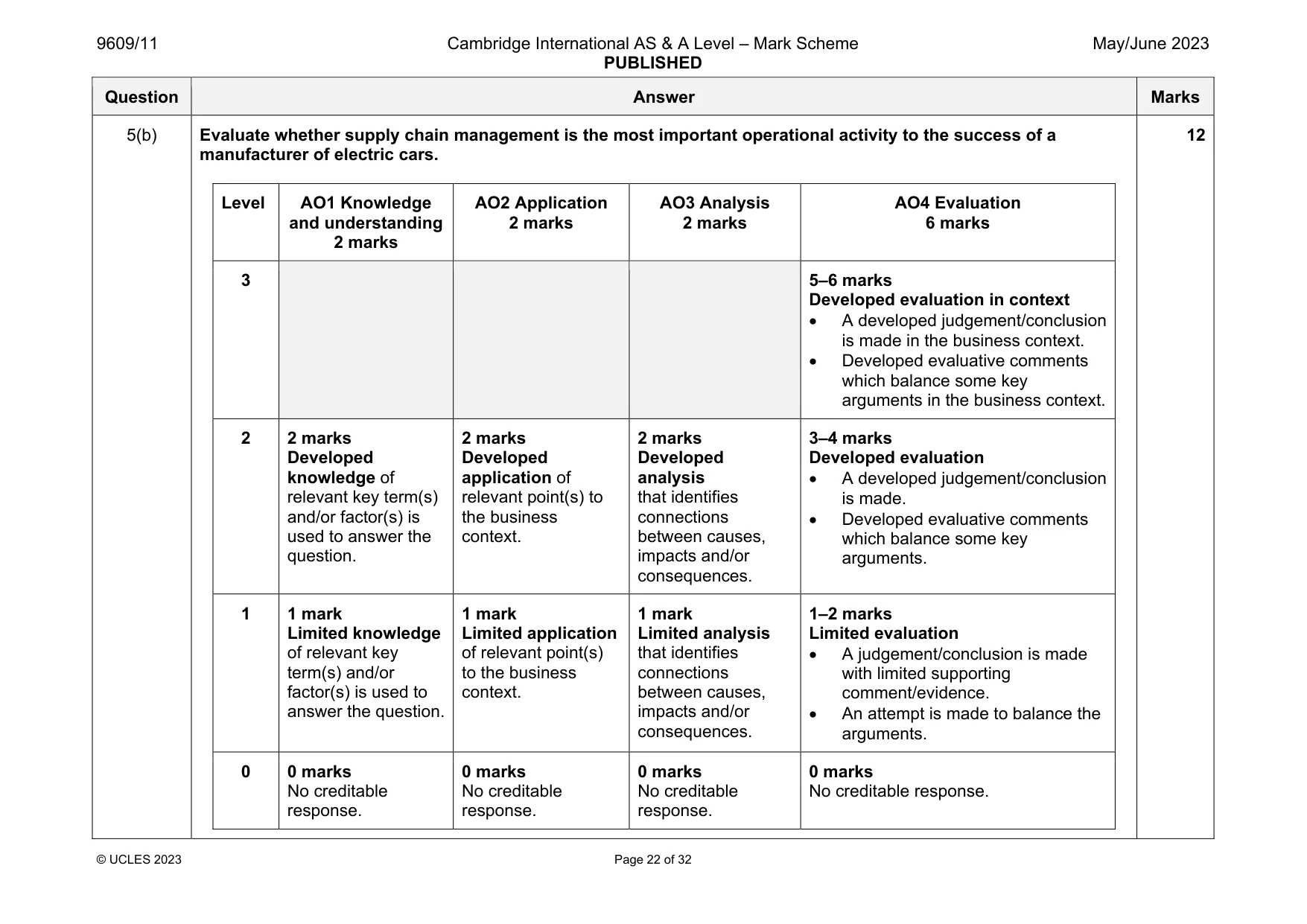
9609/11 Cambridge International AS & A Level – Mark Scheme PUBLISHED May/June 2023 © UCLES 2023 Page 22 of 32 Question Answer Marks 5(b) Evaluate whether supply chain management is the most important operational activity to the success of a manufacturer of electric cars. Level AO1 Knowledge and understanding 2 marks AO2 Application 2 marks AO3 Analysis 2 marks AO4 Evaluation 6 marks 3 5–6 marks Developed evaluation in context A developed judgement/conclusion is made in the business context. Developed evaluative comments which balance some key arguments in the business context. 2 2 marks Developed knowledge of relevant key term(s) and/or factor(s) is used to answer the question. 2 marks Developed application of relevant point(s) to the business context. 2 marks Developed analysis that identifies connections between causes, impacts and/or consequences. 3–4 marks Developed evaluation A developed judgement/conclusion is made. Developed evaluative comments which balance some key arguments. 1 1 mark Limited knowledge of relevant key term(s) and/or factor(s) is used to answer the question. 1 mark Limited application of relevant point(s) to the business context. 1 mark Limited analysis that identifies connections between causes, impacts and/or consequences. 1–2 marks Limited evaluation A judgement/conclusion is made with limited supporting comment/evidence. An attempt is made to balance the arguments. 0 0 marks No creditable response. 0 marks No creditable response. 0 marks No creditable response. 0 marks No creditable response. 12
Mark scheme, page 23
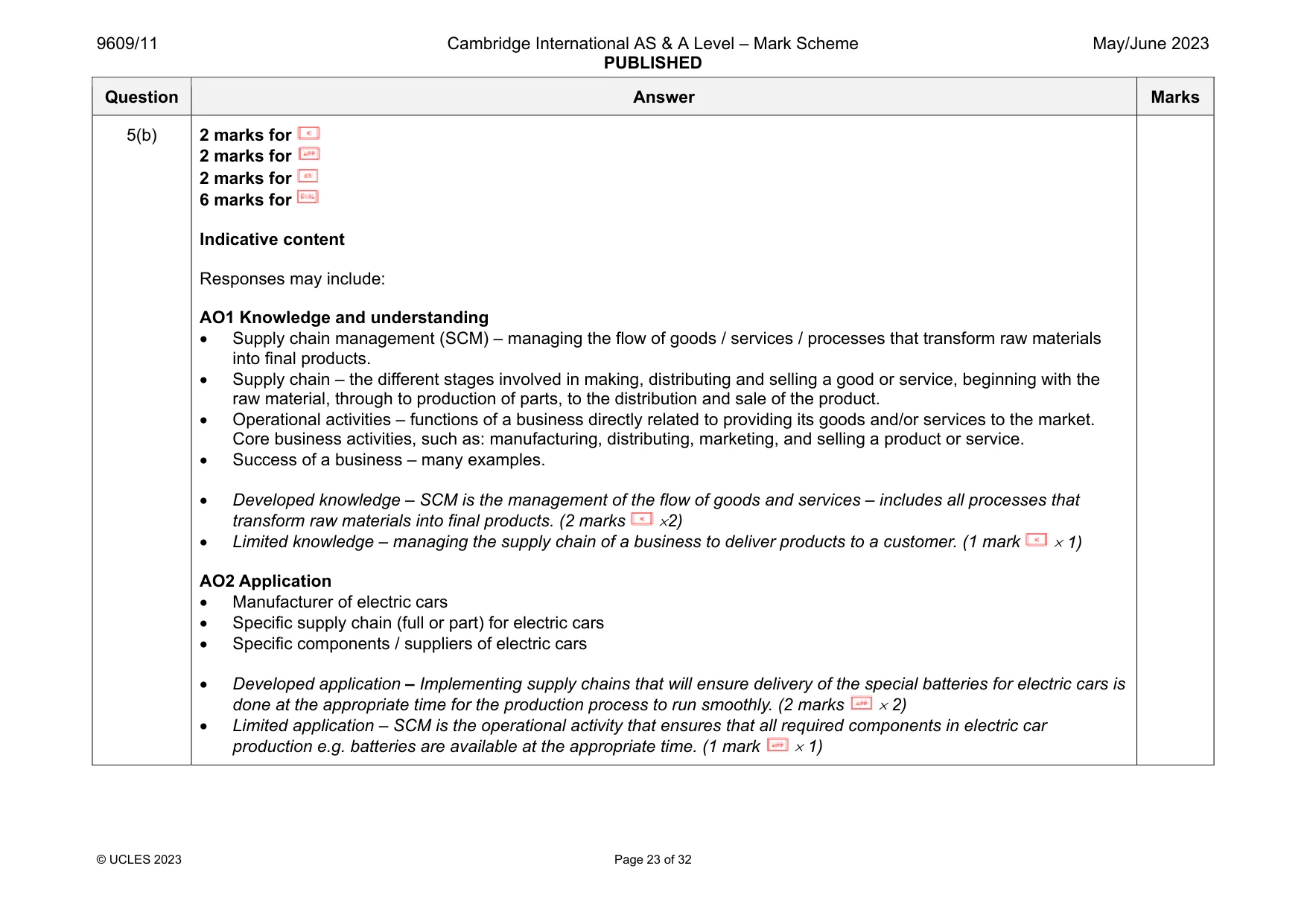
9609/11 Cambridge International AS & A Level – Mark Scheme PUBLISHED May/June 2023 © UCLES 2023 Page 23 of 32 Question Answer Marks 5(b) 2 marks for 2 marks for 2 marks for 6 marks for Indicative content Responses may include: AO1 Knowledge and understanding Supply chain management (SCM) – managing the flow of goods / services / processes that transform raw materials into final products. Supply chain – the different stages involved in making, distributing and selling a good or service, beginning with the raw material, through to production of parts, to the distribution and sale of the product. Operational activities – functions of a business directly related to providing its goods and/or services to the market. Core business activities, such as: manufacturing, distributing, marketing, and selling a product or service. Success of a business – many examples. Developed knowledge – SCM is the management of the flow of goods and services – includes all processes that transform raw materials into final products. (2 marks 2) Limited knowledge – managing the supply chain of a business to deliver products to a customer. (1 mark 1) AO2 Application Manufacturer of electric cars Specific supply chain (full or part) for electric cars Specific components / suppliers of electric cars Developed application – Implementing supply chains that will ensure delivery of the special batteries for electric cars is done at the appropriate time for the production process to run smoothly. (2 marks 2) Limited application – SCM is the operational activity that ensures that all required components in electric car production e.g. batteries are available at the appropriate time. (1 mark 1)
Mark scheme, page 24
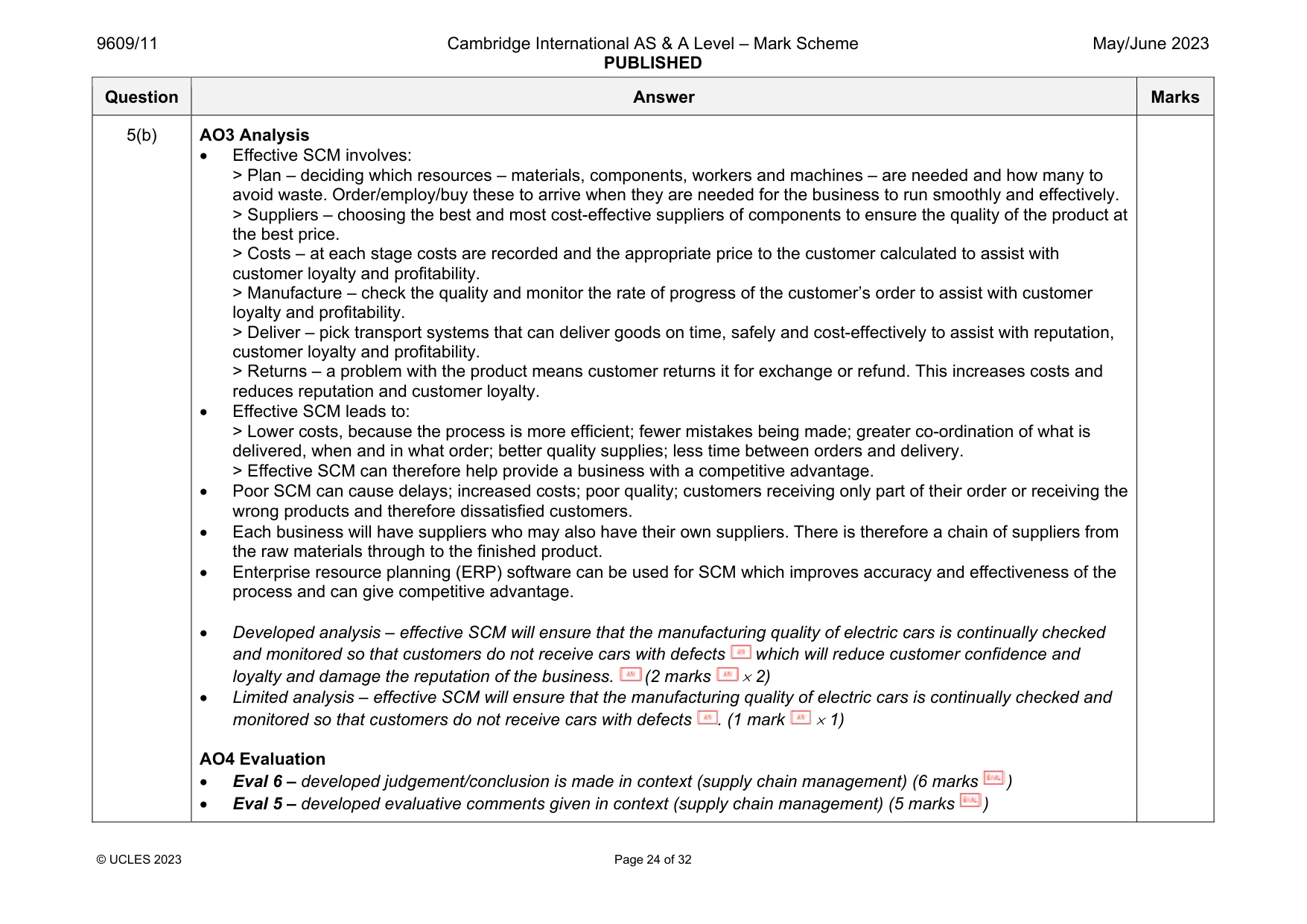
9609/11 Cambridge International AS & A Level – Mark Scheme PUBLISHED May/June 2023 © UCLES 2023 Page 24 of 32 Question Answer Marks 5(b) AO3 Analysis Effective SCM involves: > Plan – deciding which resources – materials, components, workers and machines – are needed and how many to avoid waste. Order/employ/buy these to arrive when they are needed for the business to run smoothly and effectively. > Suppliers – choosing the best and most cost-effective suppliers of components to ensure the quality of the product at the best price. > Costs – at each stage costs are recorded and the appropriate price to the customer calculated to assist with customer loyalty and profitability. > Manufacture – check the quality and monitor the rate of progress of the customer’s order to assist with customer loyalty and profitability. > Deliver – pick transport systems that can deliver goods on time, safely and cost-effectively to assist with reputation, customer loyalty and profitability. > Returns – a problem with the product means customer returns it for exchange or refund. This increases costs and reduces reputation and customer loyalty. Effective SCM leads to: > Lower costs, because the process is more efficient; fewer mistakes being made; greater co-ordination of what is delivered, when and in what order; better quality supplies; less time between orders and delivery. > Effective SCM can therefore help provide a business with a competitive advantage. Poor SCM can cause delays; increased costs; poor quality; customers receiving only part of their order or receiving the wrong products and therefore dissatisfied customers. Each business will have suppliers who may also have their own suppliers. There is therefore a chain of suppliers from the raw materials through to the finished product. Enterprise resource planning (ERP) software can be used for SCM which improves accuracy and effectiveness of the process and can give competitive advantage. Developed analysis – effective SCM will ensure that the manufacturing quality of electric cars is continually checked and monitored so that customers do not receive cars with defects which will reduce customer confidence and loyalty and damage the reputation of the business. (2 marks 2) Limited analysis – effective SCM will ensure that the manufacturing quality of electric cars is continually checked and monitored so that customers do not receive cars with defects . (1 mark 1) AO4 Evaluation Eval 6 – developed judgement/conclusion is made in context (supply chain management) (6 marks ) Eval 5 – developed evaluative comments given in context (supply chain management) (5 marks )
Mark scheme, page 25
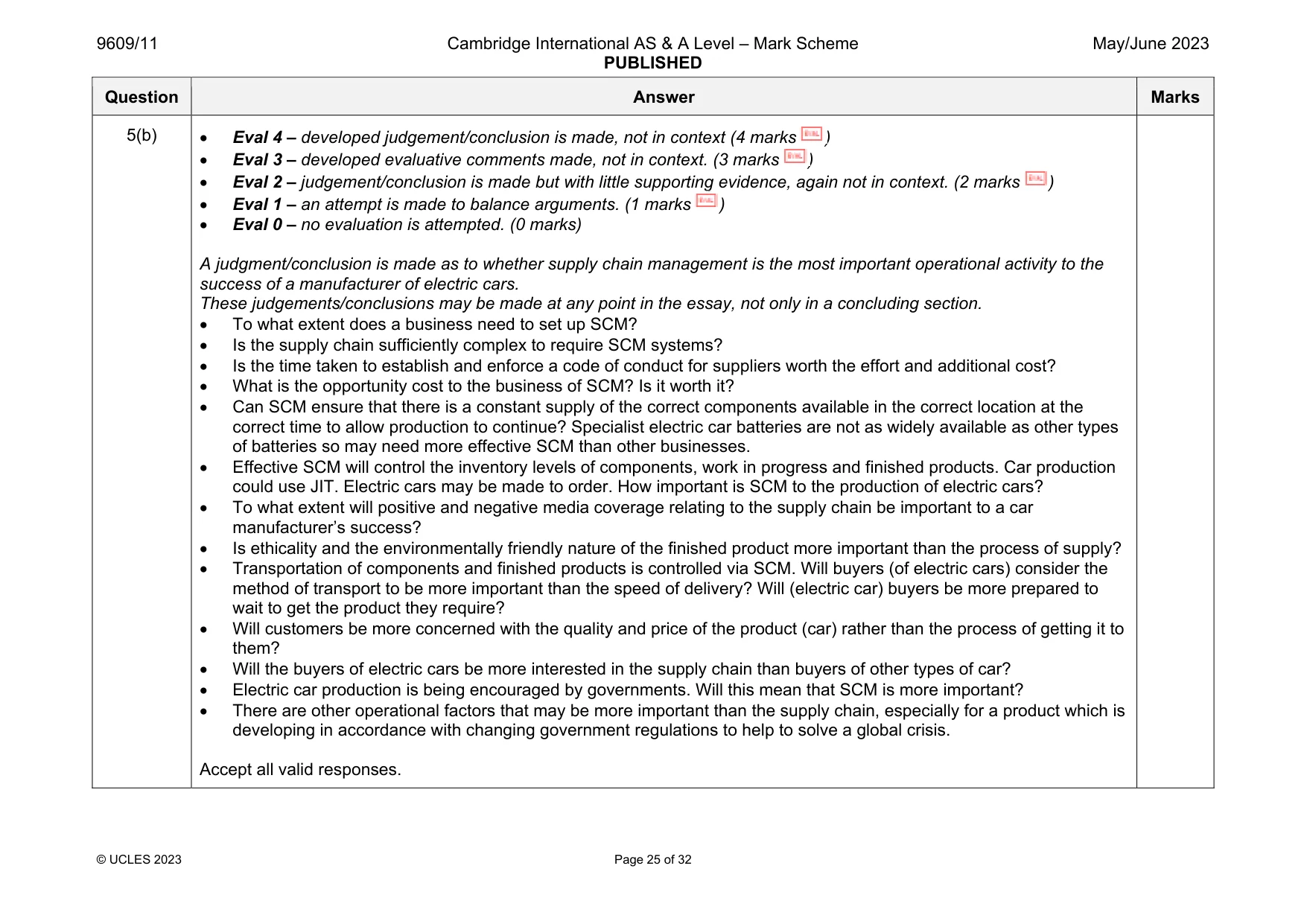
9609/11 Cambridge International AS & A Level – Mark Scheme PUBLISHED May/June 2023 © UCLES 2023 Page 25 of 32 Question Answer Marks 5(b) Eval 4 – developed judgement/conclusion is made, not in context (4 marks ) Eval 3 – developed evaluative comments made, not in context. (3 marks ) Eval 2 – judgement/conclusion is made but with little supporting evidence, again not in context. (2 marks ) Eval 1 – an attempt is made to balance arguments. (1 marks ) Eval 0 – no evaluation is attempted. (0 marks) A judgment/conclusion is made as to whether supply chain management is the most important operational activity to the success of a manufacturer of electric cars. These judgements/conclusions may be made at any point in the essay, not only in a concluding section. To what extent does a business need to set up SCM? Is the supply chain sufficiently complex to require SCM systems? Is the time taken to establish and enforce a code of conduct for suppliers worth the effort and additional cost? What is the opportunity cost to the business of SCM? Is it worth it? Can SCM ensure that there is a constant supply of the correct components available in the correct location at the correct time to allow production to continue? Specialist electric car batteries are not as widely available as other types of batteries so may need more effective SCM than other businesses. Effective SCM will control the inventory levels of components, work in progress and finished products. Car production could use JIT. Electric cars may be made to order. How important is SCM to the production of electric cars? To what extent will positive and negative media coverage relating to the supply chain be important to a car manufacturer’s success? Is ethicality and the environmentally friendly nature of the finished product more important than the process of supply? Transportation of components and finished products is controlled via SCM. Will buyers (of electric cars) consider the method of transport to be more important than the speed of delivery? Will (electric car) buyers be more prepared to wait to get the product they require? Will customers be more concerned with the quality and price of the product (car) rather than the process of getting it to them? Will the buyers of electric cars be more interested in the supply chain than buyers of other types of car? Electric car production is being encouraged by governments. Will this mean that SCM is more important? There are other operational factors that may be more important than the supply chain, especially for a product which is developing in accordance with changing government regulations to help to solve a global crisis. Accept all valid responses.
Mark scheme, page 26
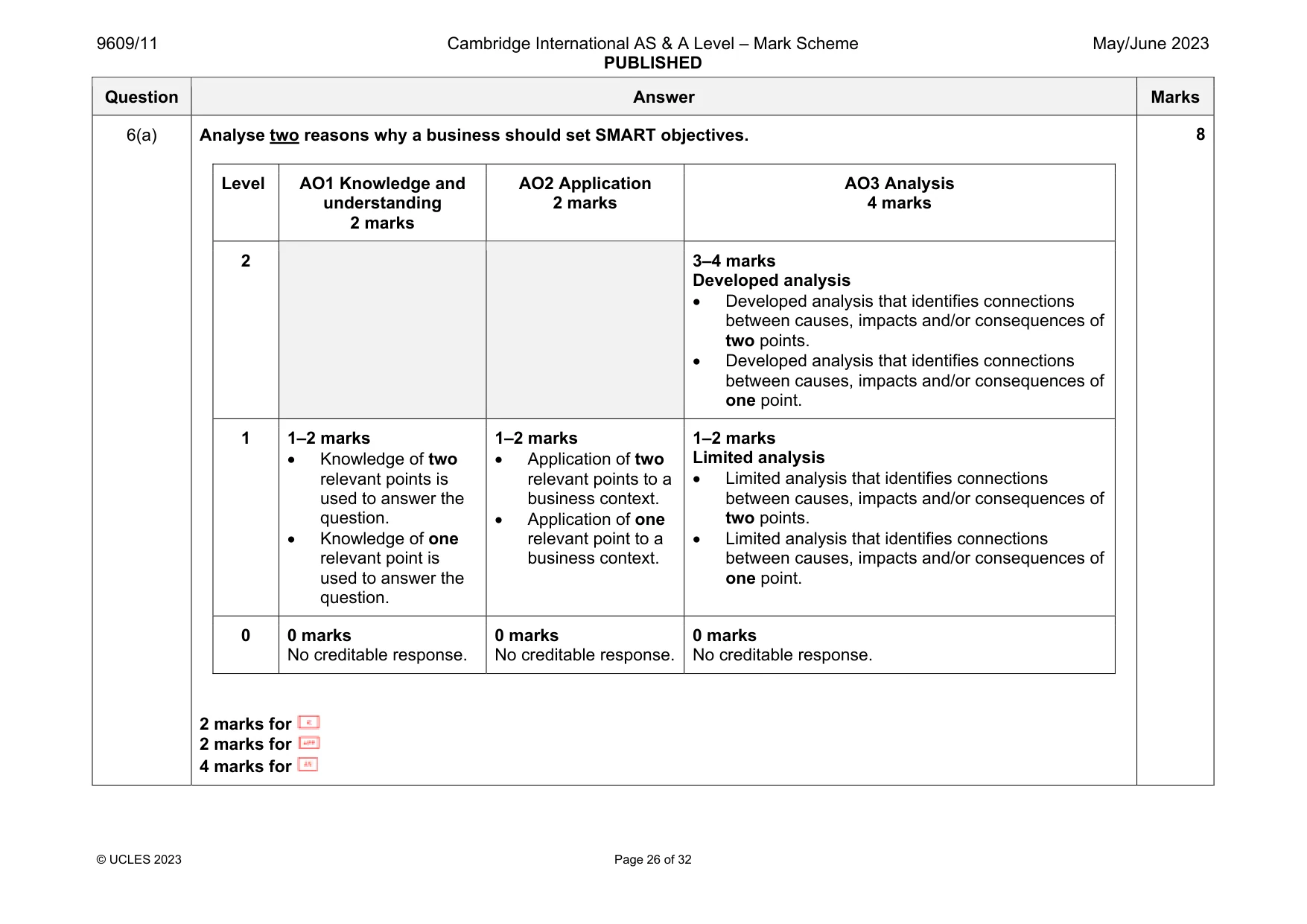
9609/11 Cambridge International AS & A Level – Mark Scheme PUBLISHED May/June 2023 © UCLES 2023 Page 26 of 32 Question Answer Marks 6(a) Analyse two reasons why a business should set SMART objectives. Level AO1 Knowledge and understanding 2 marks AO2 Application 2 marks AO3 Analysis 4 marks 2 3–4 marks Developed analysis Developed analysis that identifies connections between causes, impacts and/or consequences of two points. Developed analysis that identifies connections between causes, impacts and/or consequences of one point. 1 1–2 marks Knowledge of two relevant points is used to answer the question. Knowledge of one relevant point is used to answer the question. 1–2 marks Application of two relevant points to a business context. Application of one relevant point to a business context. 1–2 marks Limited analysis Limited analysis that identifies connections between causes, impacts and/or consequences of two points. Limited analysis that identifies connections between causes, impacts and/or consequences of one point. 0 0 marks No creditable response. 0 marks No creditable response. 0 marks No creditable response. 2 marks for 2 marks for 4 marks for 8
Mark scheme, page 27
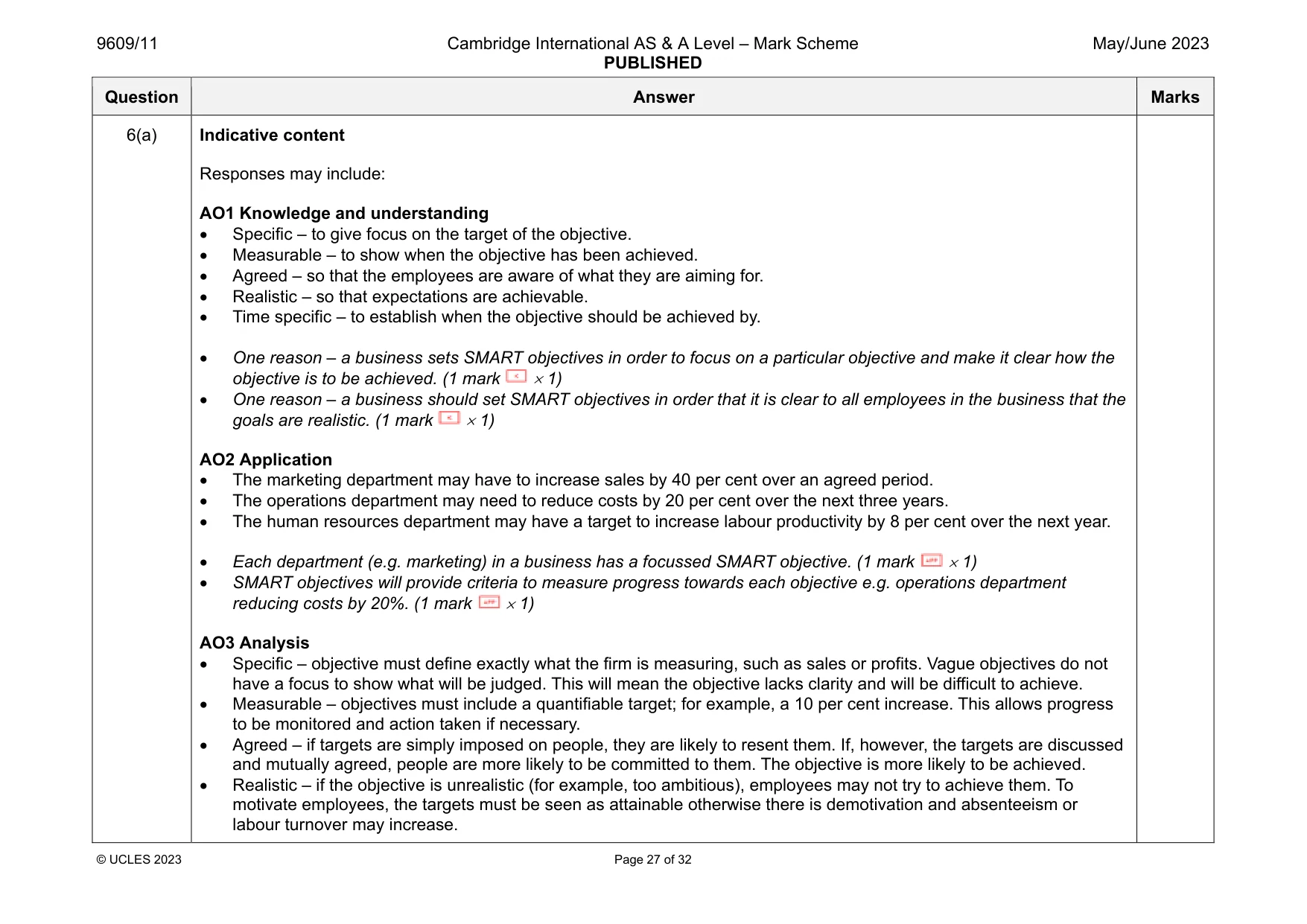
9609/11 Cambridge International AS & A Level – Mark Scheme PUBLISHED May/June 2023 © UCLES 2023 Page 27 of 32 Question Answer Marks 6(a) Indicative content Responses may include: AO1 Knowledge and understanding Specific – to give focus on the target of the objective. Measurable – to show when the objective has been achieved. Agreed – so that the employees are aware of what they are aiming for. Realistic – so that expectations are achievable. Time specific – to establish when the objective should be achieved by. One reason – a business sets SMART objectives in order to focus on a particular objective and make it clear how the objective is to be achieved. (1 mark 1) One reason – a business should set SMART objectives in order that it is clear to all employees in the business that the goals are realistic. (1 mark 1) AO2 Application The marketing department may have to increase sales by 40 per cent over an agreed period. The operations department may need to reduce costs by 20 per cent over the next three years. The human resources department may have a target to increase labour productivity by 8 per cent over the next year. Each department (e.g. marketing) in a business has a focussed SMART objective. (1 mark 1) SMART objectives will provide criteria to measure progress towards each objective e.g. operations department reducing costs by 20%. (1 mark 1) AO3 Analysis Specific – objective must define exactly what the firm is measuring, such as sales or profits. Vague objectives do not have a focus to show what will be judged. This will mean the objective lacks clarity and will be difficult to achieve. Measurable – objectives must include a quantifiable target; for example, a 10 per cent increase. This allows progress to be monitored and action taken if necessary. Agreed – if targets are simply imposed on people, they are likely to resent them. If, however, the targets are discussed and mutually agreed, people are more likely to be committed to them. The objective is more likely to be achieved. Realistic – if the objective is unrealistic (for example, too ambitious), employees may not try to achieve them. To motivate employees, the targets must be seen as attainable otherwise there is demotivation and absenteeism or labour turnover may increase.
Mark scheme, page 28
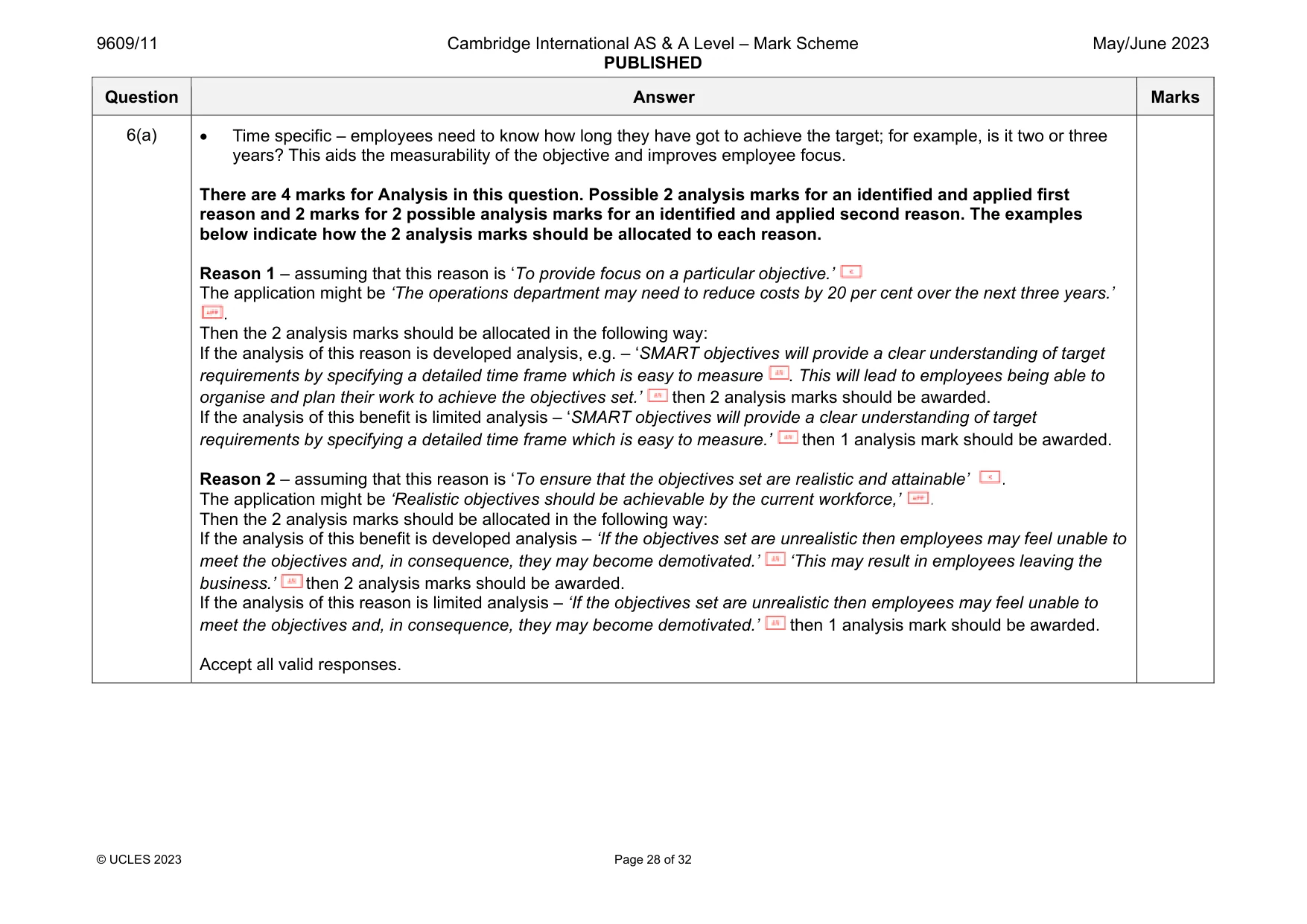
9609/11 Cambridge International AS & A Level – Mark Scheme PUBLISHED May/June 2023 © UCLES 2023 Page 28 of 32 Question Answer Marks 6(a) Time specific – employees need to know how long they have got to achieve the target; for example, is it two or three years? This aids the measurability of the objective and improves employee focus. There are 4 marks for Analysis in this question. Possible 2 analysis marks for an identified and applied first reason and 2 marks for 2 possible analysis marks for an identified and applied second reason. The examples below indicate how the 2 analysis marks should be allocated to each reason. Reason 1 – assuming that this reason is ‘To provide focus on a particular objective.’ The application might be ‘The operations department may need to reduce costs by 20 per cent over the next three years.’ . Then the 2 analysis marks should be allocated in the following way: If the analysis of this reason is developed analysis, e.g. – ‘SMART objectives will provide a clear understanding of target requirements by specifying a detailed time frame which is easy to measure . This will lead to employees being able to organise and plan their work to achieve the objectives set.’ then 2 analysis marks should be awarded. If the analysis of this benefit is limited analysis – ‘SMART objectives will provide a clear understanding of target requirements by specifying a detailed time frame which is easy to measure.’ then 1 analysis mark should be awarded. Reason 2 – assuming that this reason is ‘To ensure that the objectives set are realistic and attainable’ . The application might be ‘Realistic objectives should be achievable by the current workforce,’ . Then the 2 analysis marks should be allocated in the following way: If the analysis of this benefit is developed analysis – ‘If the objectives set are unrealistic then employees may feel unable to meet the objectives and, in consequence, they may become demotivated.’ ‘This may result in employees leaving the business.’ then 2 analysis marks should be awarded. If the analysis of this reason is limited analysis – ‘If the objectives set are unrealistic then employees may feel unable to meet the objectives and, in consequence, they may become demotivated.’ then 1 analysis mark should be awarded. Accept all valid responses.
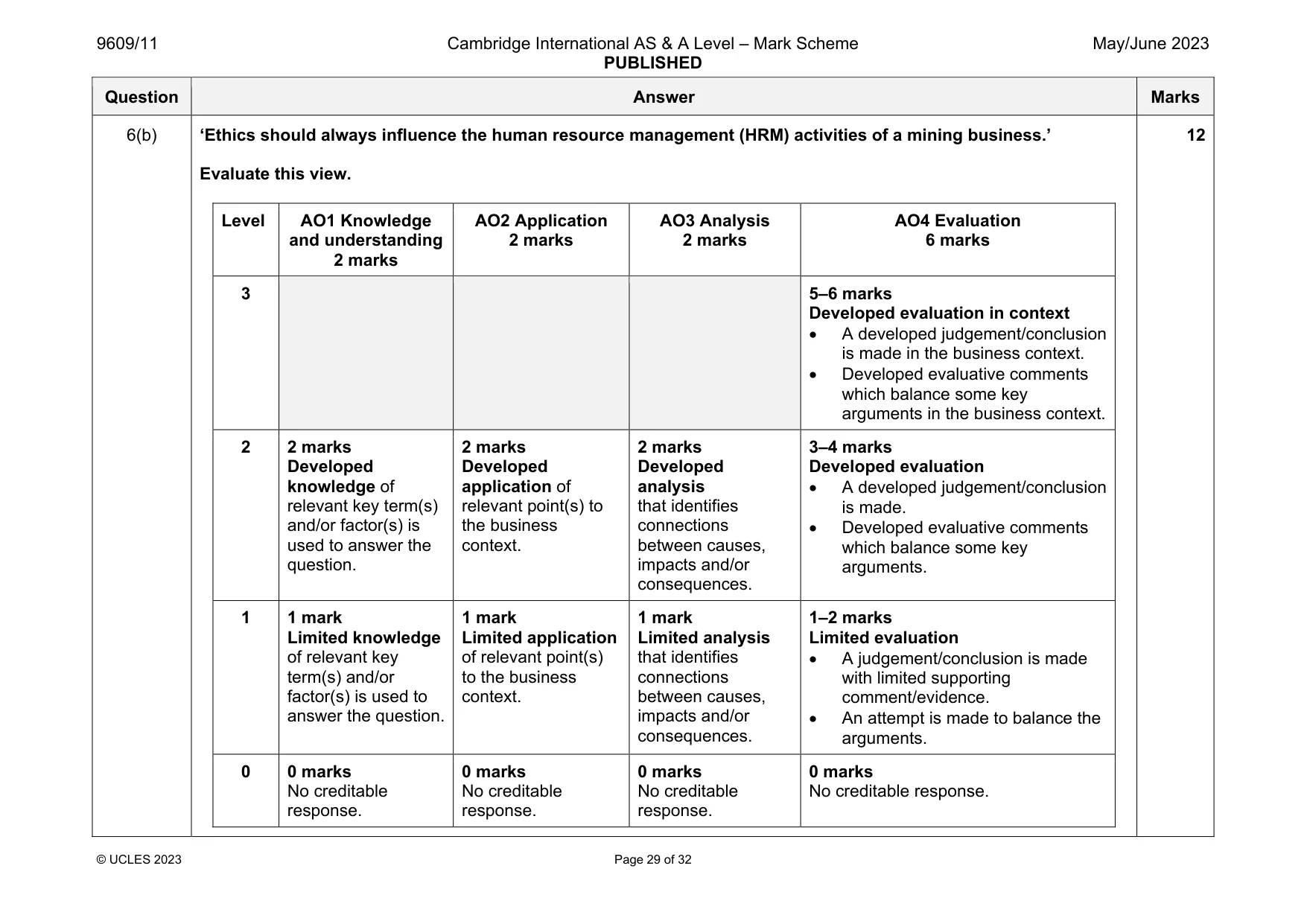
Mark scheme, page 29
9609/11 Cambridge International AS & A Level – Mark Scheme PUBLISHED May/June 2023 © UCLES 2023 Page 29 of 32 Question Answer Marks 6(b) ‘Ethics should always influence the human resource management (HRM) activities of a mining business.’ Evaluate this view. Level AO1 Knowledge and understanding 2 marks AO2 Application 2 marks AO3 Analysis 2 marks AO4 Evaluation 6 marks 3 5–6 marks Developed evaluation in context A developed judgement/conclusion is made in the business context. Developed evaluative comments which balance some key arguments in the business context. 2 2 marks Developed knowledge of relevant key term(s) and/or factor(s) is used to answer the question. 2 marks Developed application of relevant point(s) to the business context. 2 marks Developed analysis that identifies connections between causes, impacts and/or consequences. 3–4 marks Developed evaluation A developed judgement/conclusion is made. Developed evaluative comments which balance some key arguments. 1 1 mark Limited knowledge of relevant key term(s) and/or factor(s) is used to answer the question. 1 mark Limited application of relevant point(s) to the business context. 1 mark Limited analysis that identifies connections between causes, impacts and/or consequences. 1–2 marks Limited evaluation A judgement/conclusion is made with limited supporting comment/evidence. An attempt is made to balance the arguments. 0 0 marks No creditable response. 0 marks No creditable response. 0 marks No creditable response. 0 marks No creditable response. 12
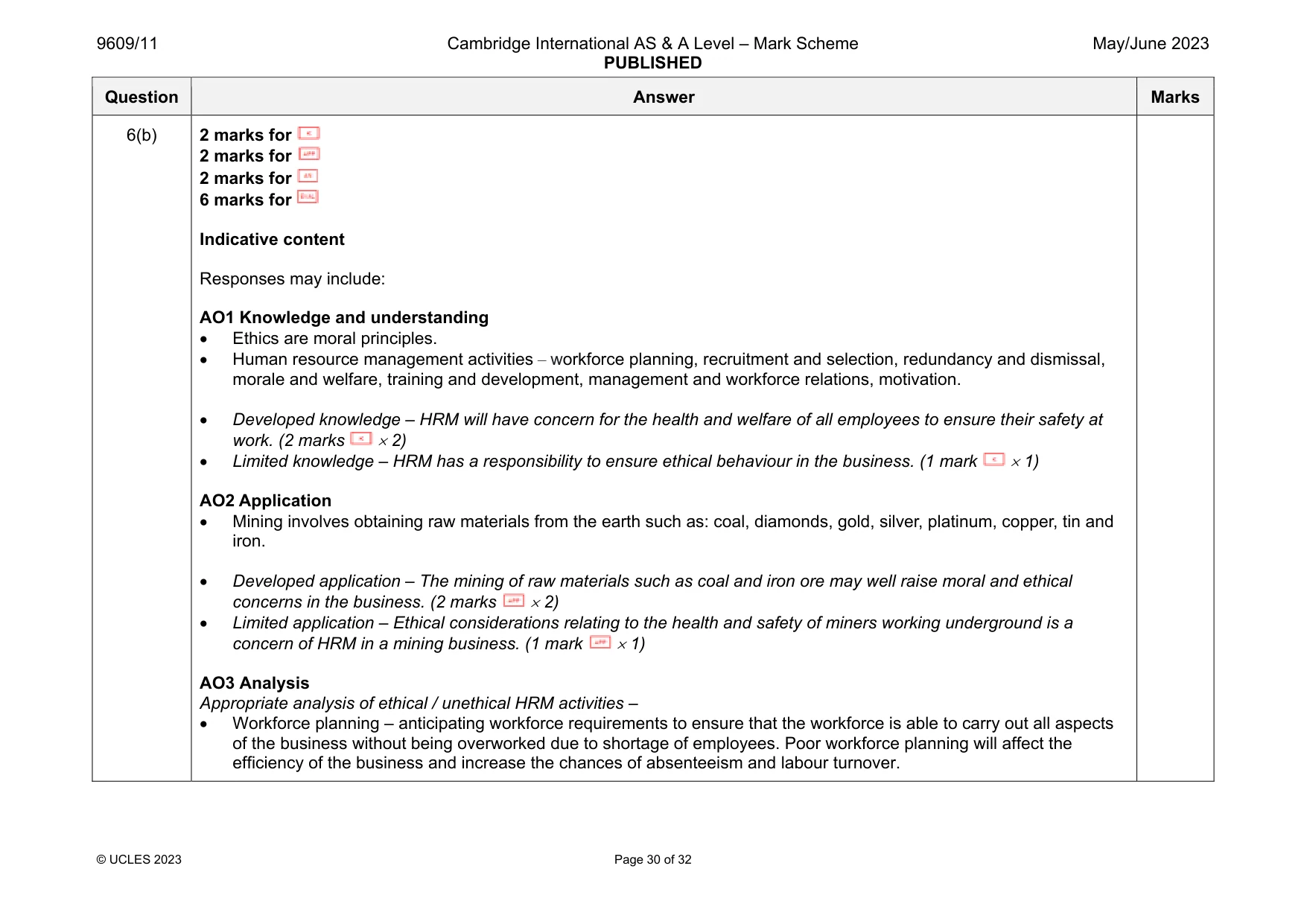
Mark scheme, page 30
9609/11 Cambridge International AS & A Level – Mark Scheme PUBLISHED May/June 2023 © UCLES 2023 Page 30 of 32 Question Answer Marks 6(b) 2 marks for 2 marks for 2 marks for 6 marks for Indicative content Responses may include: AO1 Knowledge and understanding Ethics are moral principles. Human resource management activities – workforce planning, recruitment and selection, redundancy and dismissal, morale and welfare, training and development, management and workforce relations, motivation. Developed knowledge – HRM will have concern for the health and welfare of all employees to ensure their safety at work. (2 marks 2) Limited knowledge – HRM has a responsibility to ensure ethical behaviour in the business. (1 mark 1) AO2 Application Mining involves obtaining raw materials from the earth such as: coal, diamonds, gold, silver, platinum, copper, tin and iron. Developed application – The mining of raw materials such as coal and iron ore may well raise moral and ethical concerns in the business. (2 marks 2) Limited application – Ethical considerations relating to the health and safety of miners working underground is a concern of HRM in a mining business. (1 mark 1) AO3 Analysis Appropriate analysis of ethical / unethical HRM activities – Workforce planning – anticipating workforce requirements to ensure that the workforce is able to carry out all aspects of the business without being overworked due to shortage of employees. Poor workforce planning will affect the efficiency of the business and increase the chances of absenteeism and labour turnover.
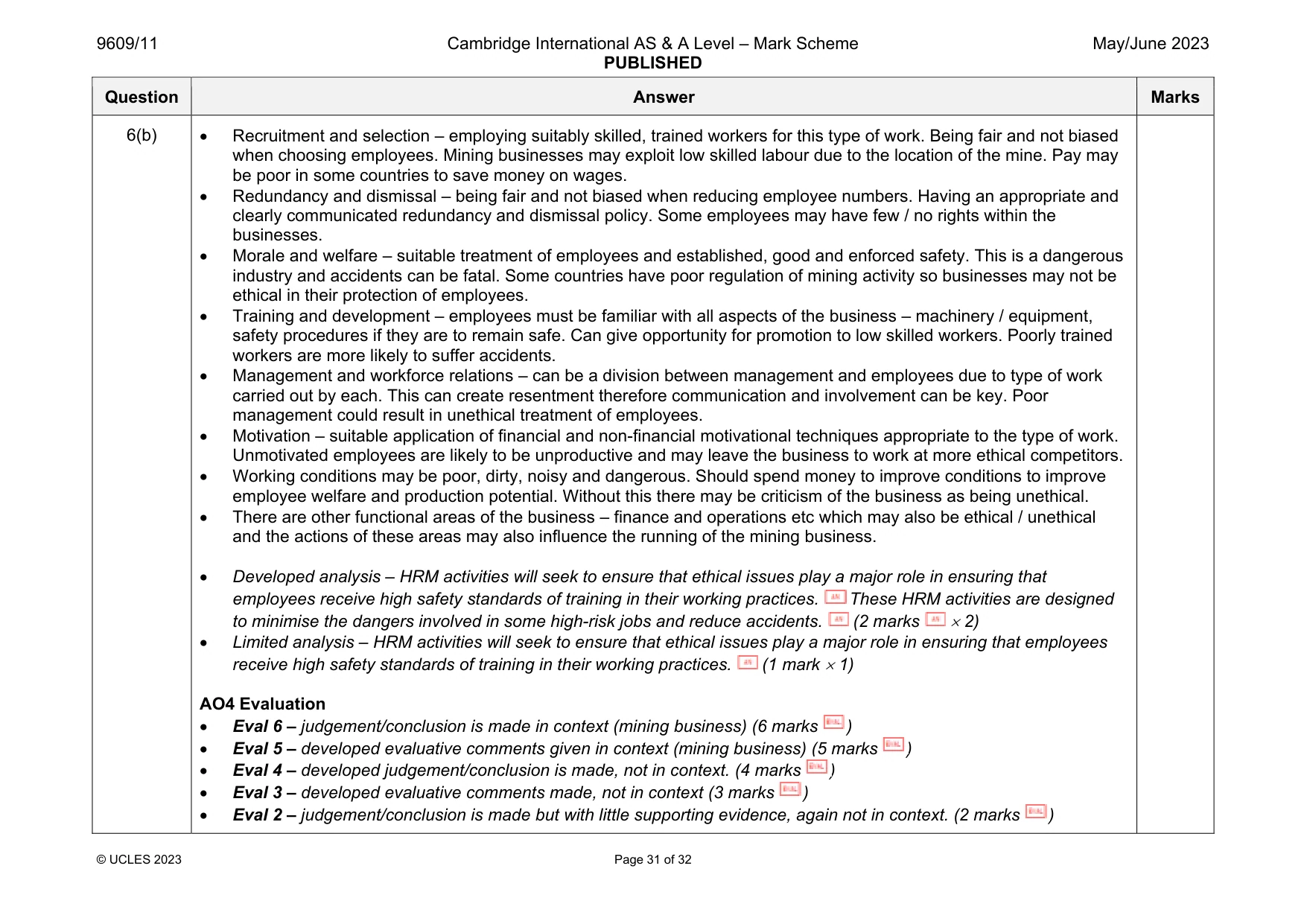
Mark scheme, page 31
9609/11 Cambridge International AS & A Level – Mark Scheme PUBLISHED May/June 2023 © UCLES 2023 Page 31 of 32 Question Answer Marks 6(b) Recruitment and selection – employing suitably skilled, trained workers for this type of work. Being fair and not biased when choosing employees. Mining businesses may exploit low skilled labour due to the location of the mine. Pay may be poor in some countries to save money on wages. Redundancy and dismissal – being fair and not biased when reducing employee numbers. Having an appropriate and clearly communicated redundancy and dismissal policy. Some employees may have few / no rights within the businesses. Morale and welfare – suitable treatment of employees and established, good and enforced safety. This is a dangerous industry and accidents can be fatal. Some countries have poor regulation of mining activity so businesses may not be ethical in their protection of employees. Training and development – employees must be familiar with all aspects of the business – machinery / equipment, safety procedures if they are to remain safe. Can give opportunity for promotion to low skilled workers. Poorly trained workers are more likely to suffer accidents. Management and workforce relations – can be a division between management and employees due to type of work carried out by each. This can create resentment therefore communication and involvement can be key. Poor management could result in unethical treatment of employees. Motivation – suitable application of financial and non-financial motivational techniques appropriate to the type of work. Unmotivated employees are likely to be unproductive and may leave the business to work at more ethical competitors. Working conditions may be poor, dirty, noisy and dangerous. Should spend money to improve conditions to improve employee welfare and production potential. Without this there may be criticism of the business as being unethical. There are other functional areas of the business – finance and operations etc which may also be ethical / unethical and the actions of these areas may also influence the running of the mining business. Developed analysis – HRM activities will seek to ensure that ethical issues play a major role in ensuring that employees receive high safety standards of training in their working practices. These HRM activities are designed to minimise the dangers involved in some high-risk jobs and reduce accidents. (2 marks 2) Limited analysis – HRM activities will seek to ensure that ethical issues play a major role in ensuring that employees receive high safety standards of training in their working practices. (1 mark 1) AO4 Evaluation Eval 6 – judgement/conclusion is made in context (mining business) (6 marks ) Eval 5 – developed evaluative comments given in context (mining business) (5 marks ) Eval 4 – developed judgement/conclusion is made, not in context. (4 marks ) Eval 3 – developed evaluative comments made, not in context (3 marks ) Eval 2 – judgement/conclusion is made but with little supporting evidence, again not in context. (2 marks )
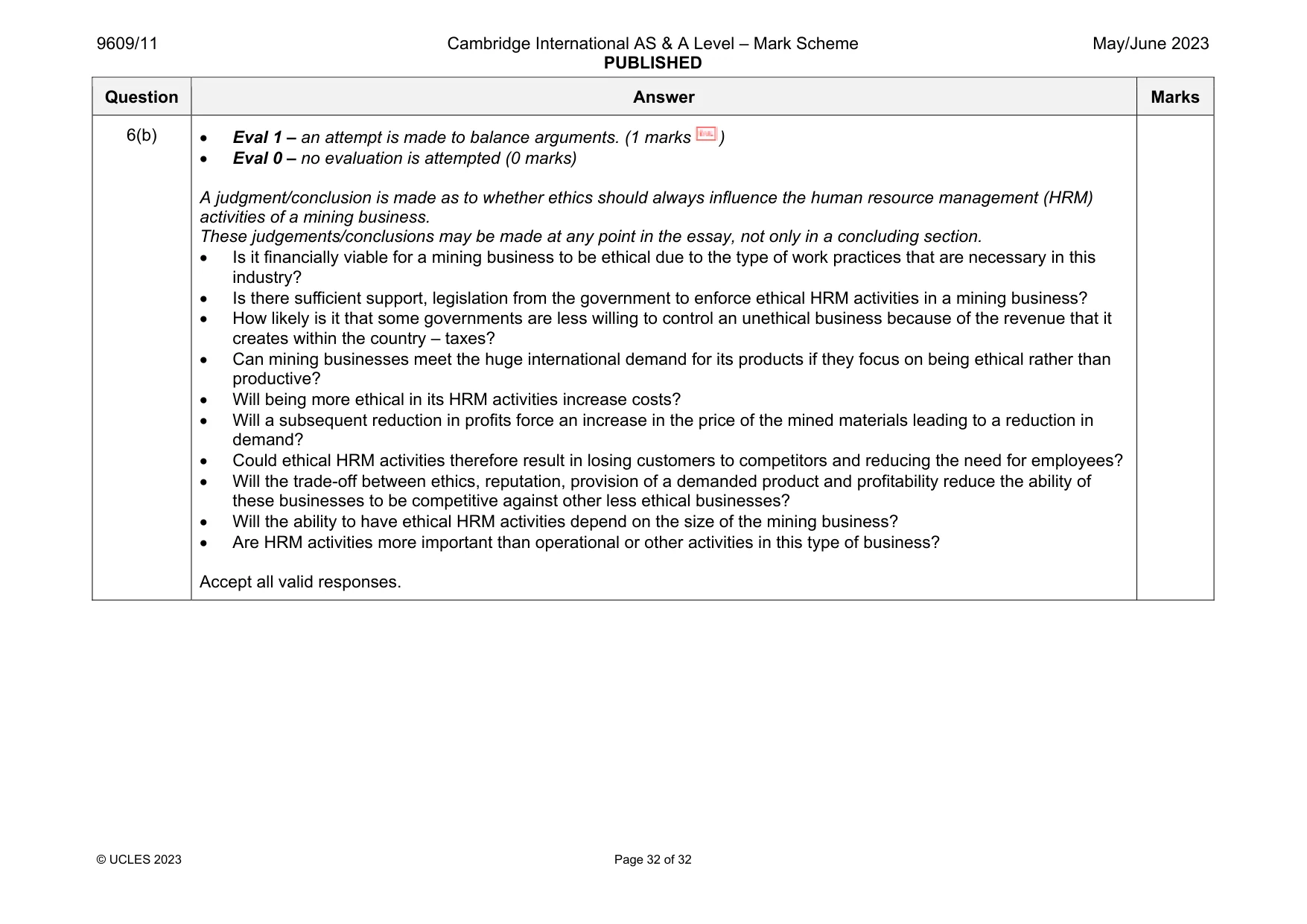
Mark scheme, page 32
9609/11 Cambridge International AS & A Level – Mark Scheme PUBLISHED May/June 2023 © UCLES 2023 Page 32 of 32 Question Answer Marks 6(b) Eval 1 – an attempt is made to balance arguments. (1 marks ) Eval 0 – no evaluation is attempted (0 marks) A judgment/conclusion is made as to whether ethics should always influence the human resource management (HRM) activities of a mining business. These judgements/conclusions may be made at any point in the essay, not only in a concluding section. Is it financially viable for a mining business to be ethical due to the type of work practices that are necessary in this industry? Is there sufficient support, legislation from the government to enforce ethical HRM activities in a mining business? How likely is it that some governments are less willing to control an unethical business because of the revenue that it creates within the country – taxes? Can mining businesses meet the huge international demand for its products if they focus on being ethical rather than productive? Will being more ethical in its HRM activities increase costs? Will a subsequent reduction in profits force an increase in the price of the mined materials leading to a reduction in demand? Could ethical HRM activities therefore result in losing customers to competitors and reducing the need for employees? Will the trade-off between ethics, reputation, provision of a demanded product and profitability reduce the ability of these businesses to be competitive against other less ethical businesses? Will the ability to have ethical HRM activities depend on the size of the mining business? Are HRM activities more important than operational or other activities in this type of business? Accept all valid responses.
What you needed in this session
Cambridge’s own grade thresholds for 2023 May/June, Paper 1 · Variant 1. A higher threshold means an easier paper — the bar moves with how the cohort did.