Cambridge A Level Business (for first examination in 2016) 9609 — 2021 Feb/March Paper 2 · Variant 2
9609/22/F/M/21 · 2 questions · 60 marks · ≈68 min
The question paper and its mark scheme, free to read here and free to download. This is Cambridge’s own paper, exactly as it was sat.
Question paper4 pages

Mark scheme16 pages
Answers below. Sit the paper first if you are practising.
Questions as text
Q1 · Flora’s Fitness (FF) Flora is a self employed personal trainer and she trades as Flora’s…
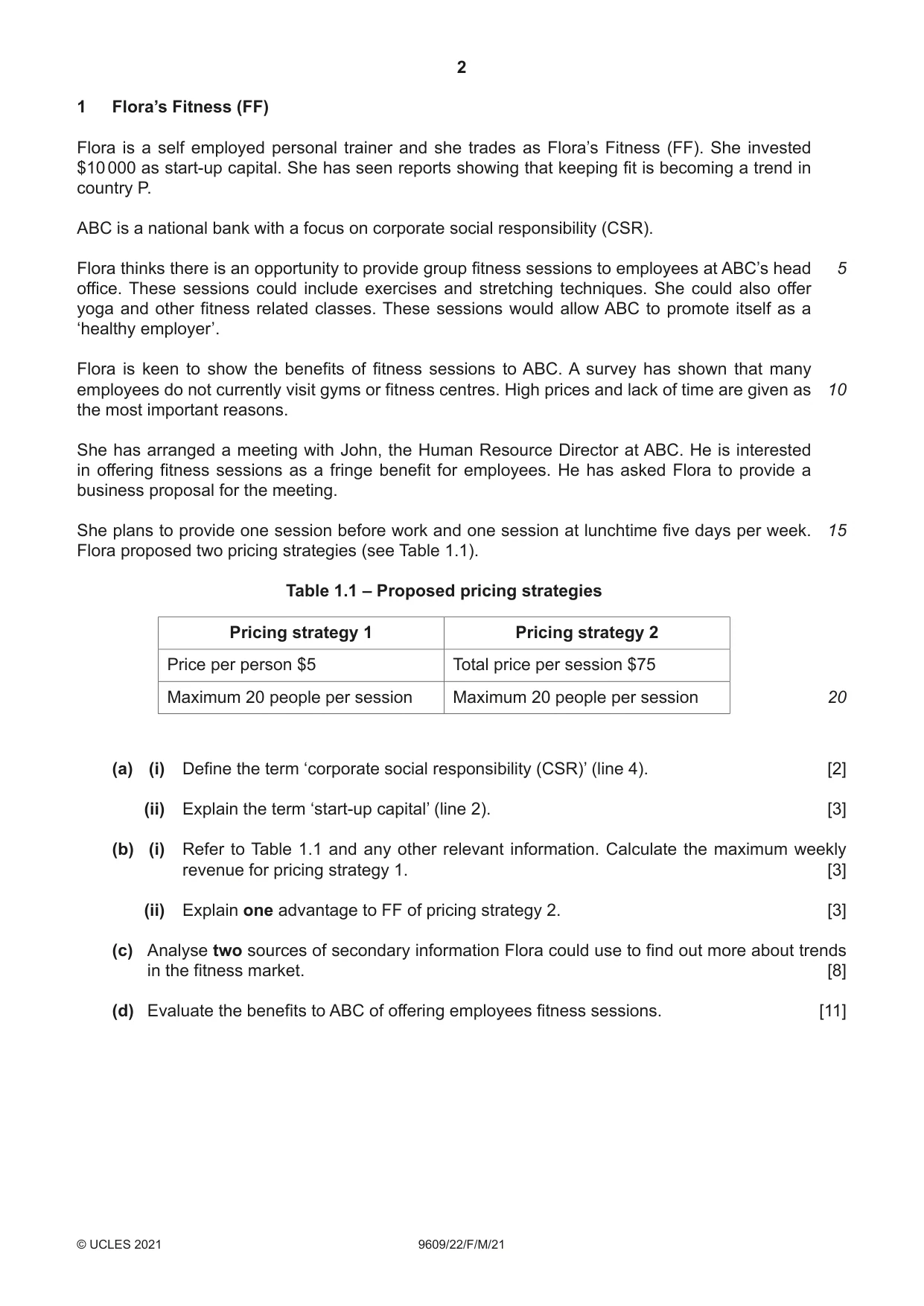
1 Flora’s Fitness (FF) Flora is a self employed personal trainer and she trades as Flora’s Fitness (FF). She invested $10 000 as start‑up capital. She has seen reports showing that keeping fit is becoming a trend in country P. ABC is a national bank with a focus on corporate social responsibility (CSR). Flora thinks there is an opportunity to provide group fitness sessions to employees at ABC’s head 5 office. These sessions could include exercises and stretching techniques. She could also offer yoga and other fitness related classes. These sessions would allow ABC to promote itself as a ‘healthy employer’. Flora is keen to show the benefits of fitness sessions to ABC. A survey has shown that many employees do not currently visit gyms or fitness centres. High prices and lack of time are given as 10 the most important reasons. She has arranged a meeting with John, the Human Resource Director at ABC. He is interested in offering fitness sessions as a fringe benefit for employees. He has asked Flora to provide a business proposal for the meeting. She plans to provide one session before work and one session at lunchtime five days per week. 15 Flora proposed two pricing strategies (see Table 1.1). Table 1.1 – Proposed pricing strategies Pricing strategy 1 Pricing strategy 2 Price per person $5 Total price per session $75 Maximum 20 people per session Maximum 20 people per session 20 (a) (i) Define the term ‘corporate social responsibility (CSR)’ (line 4). [2] (ii) Explain the term ‘start‑up capital’ (line 2). [3] (b) (i) Refer to Table 1.1 and any other relevant information. Calculate the maximum weekly revenue for pricing strategy 1. [3] (ii) Explain one advantage to FF of pricing strategy 2. [3] (c) Analyse two sources of secondary information Flora could use to find out more about trends in the fitness market. [8] (d) Evaluate the benefits to ABC of offering employees fitness sessions. [11]
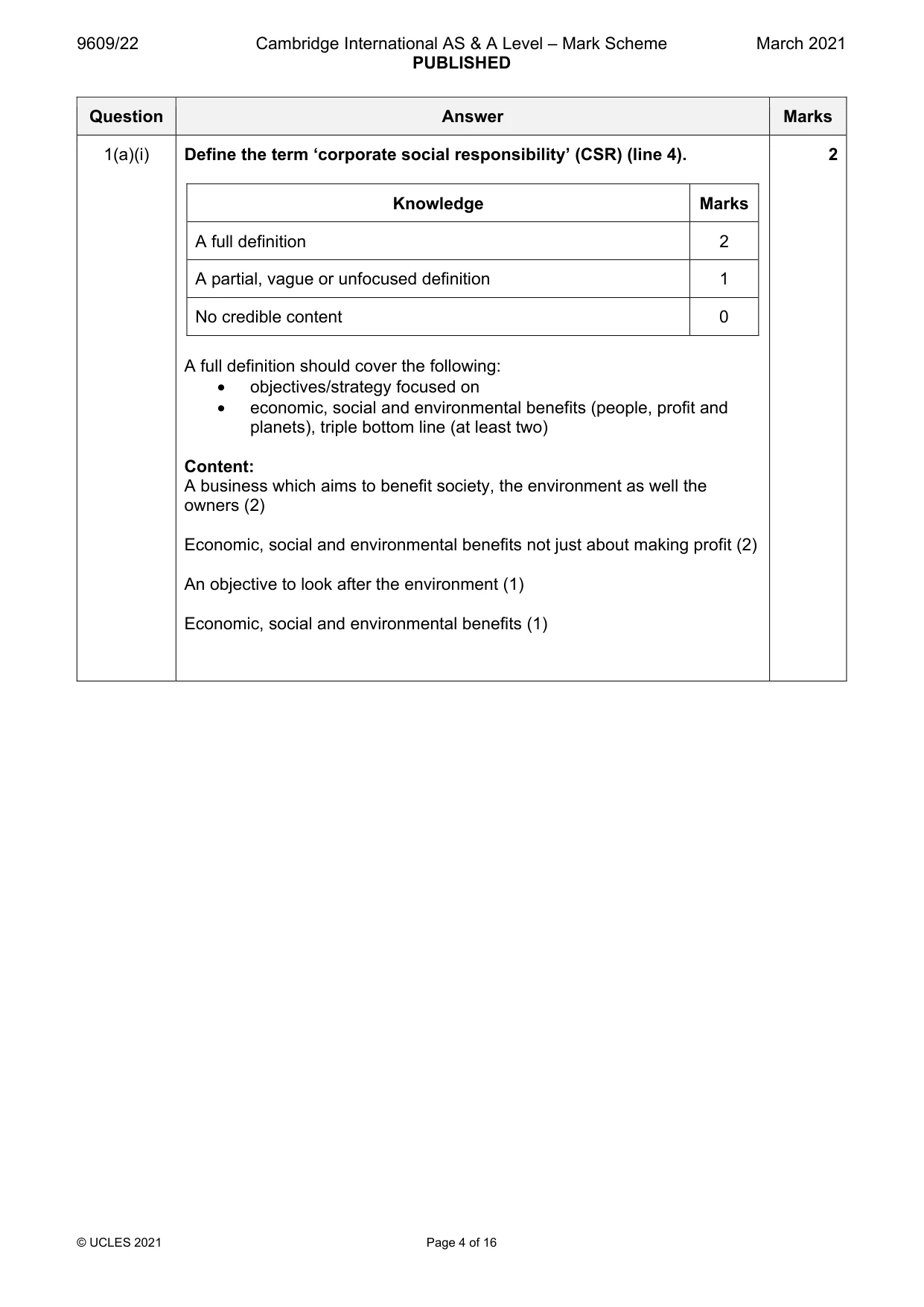
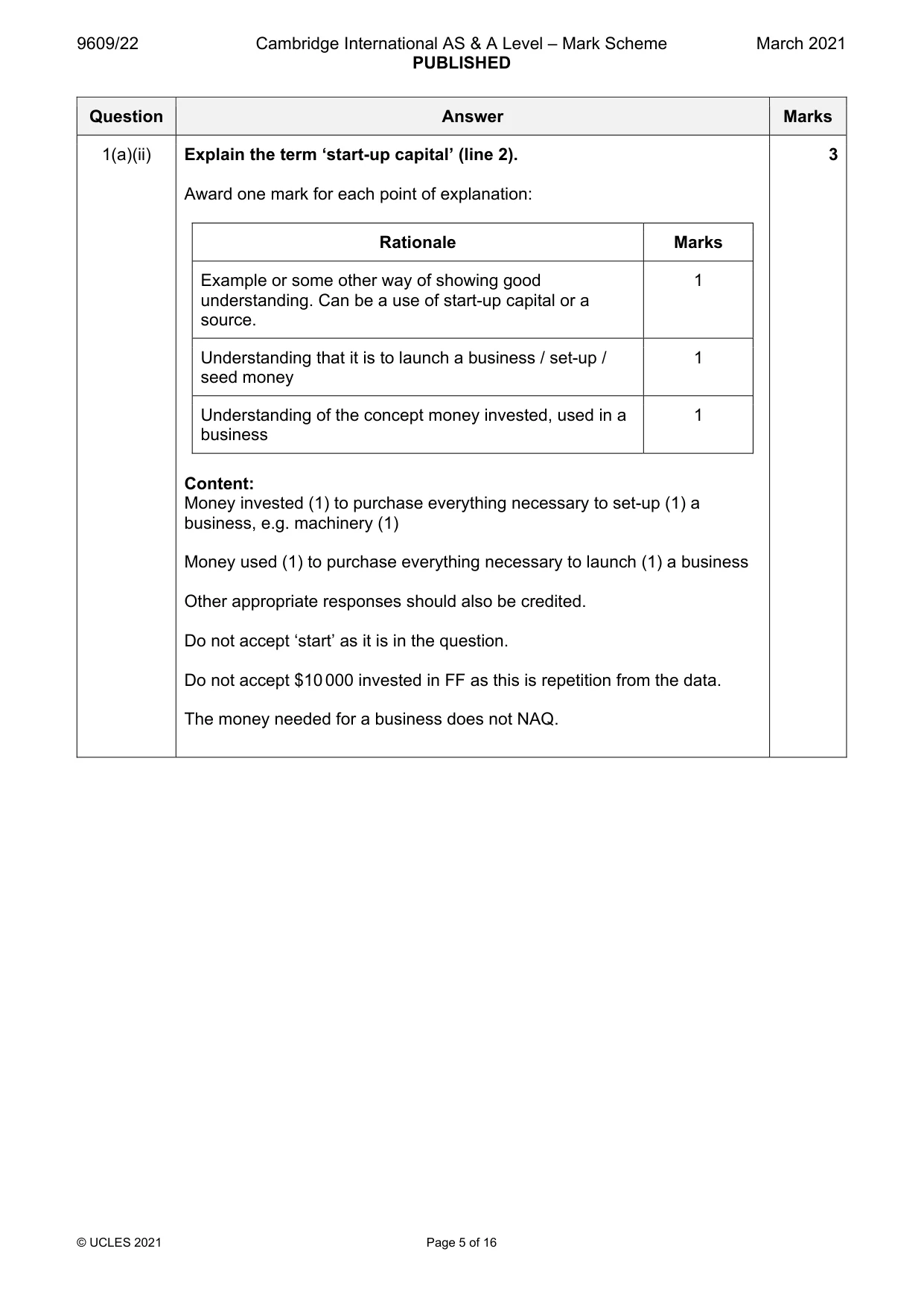
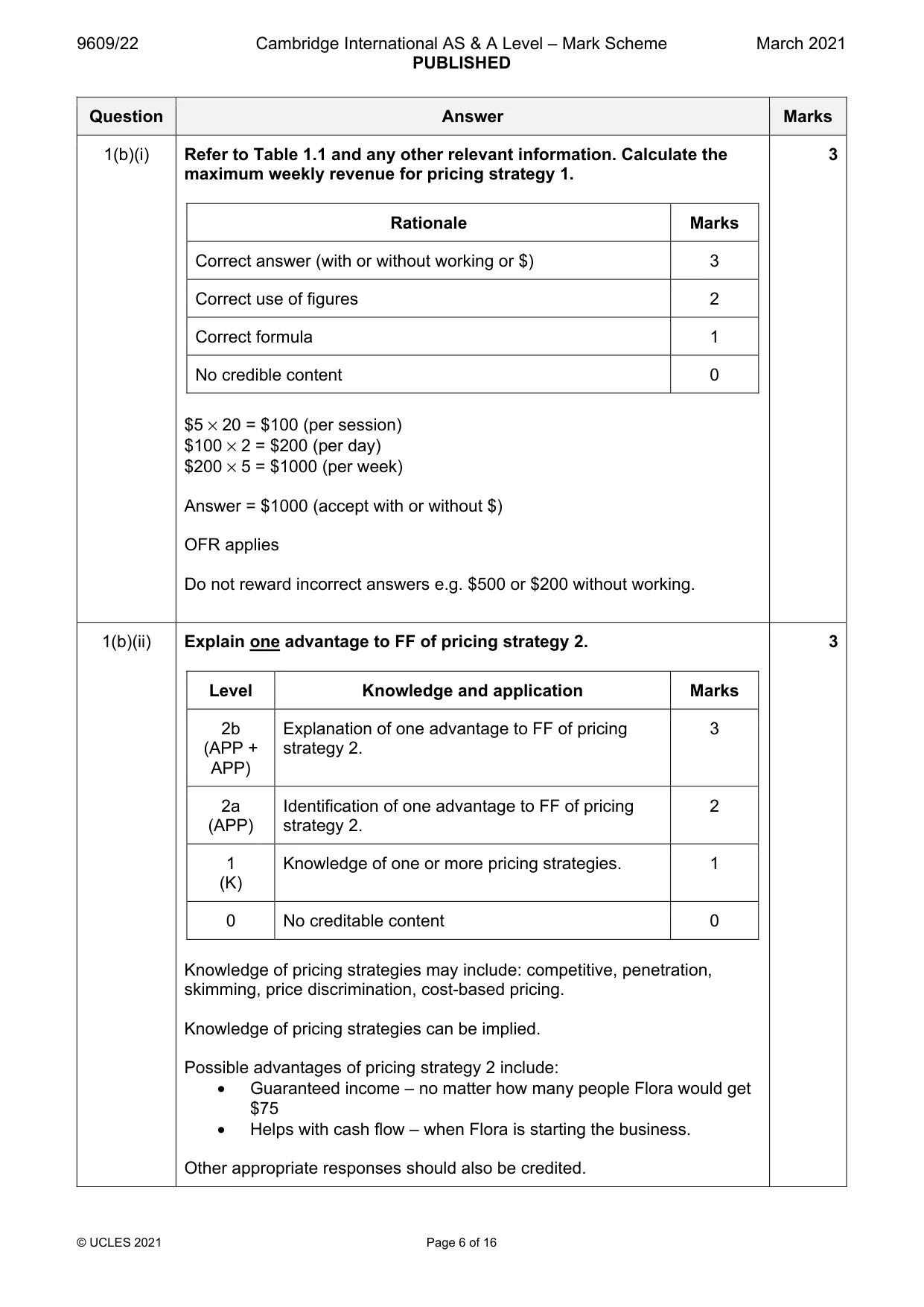
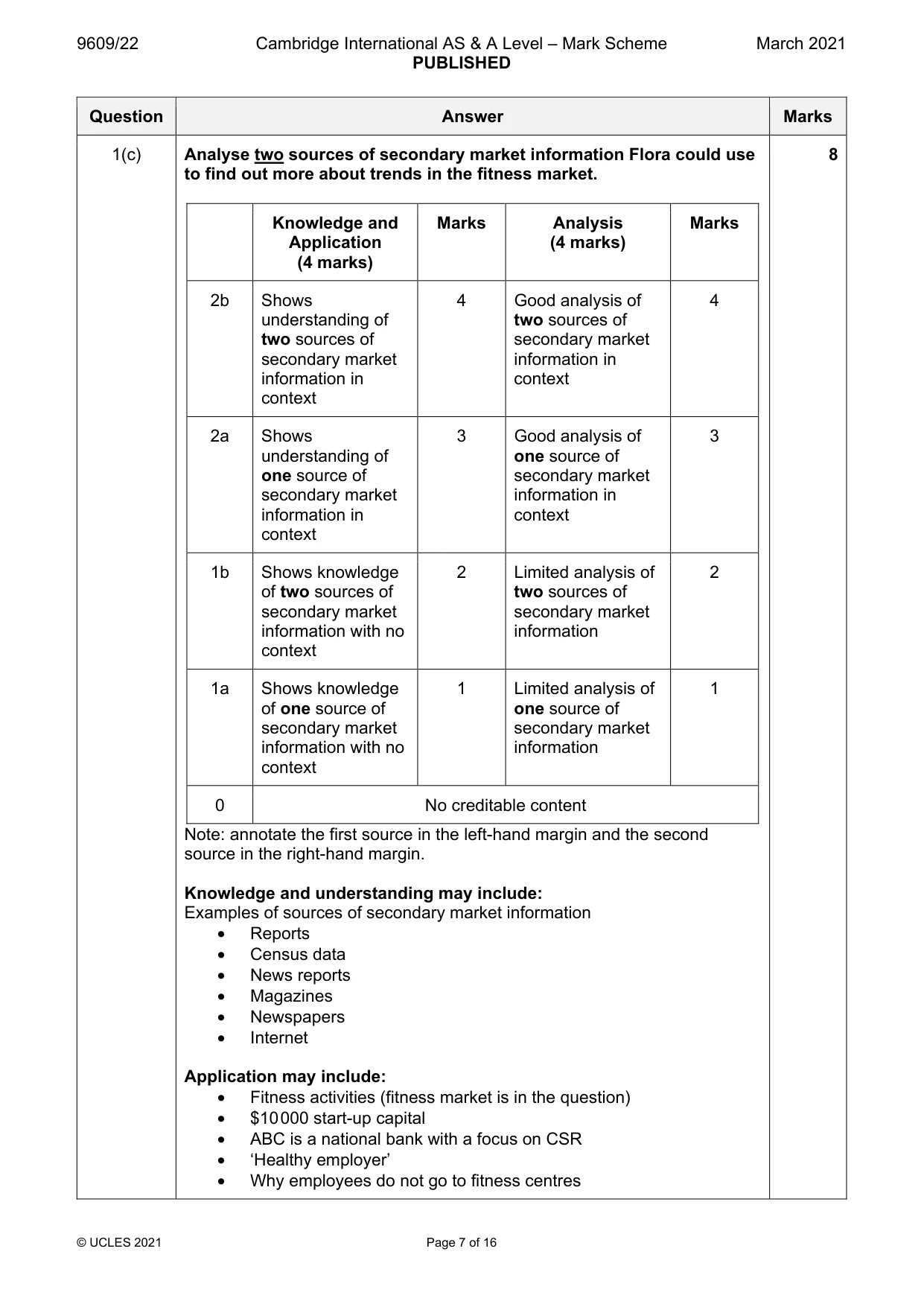
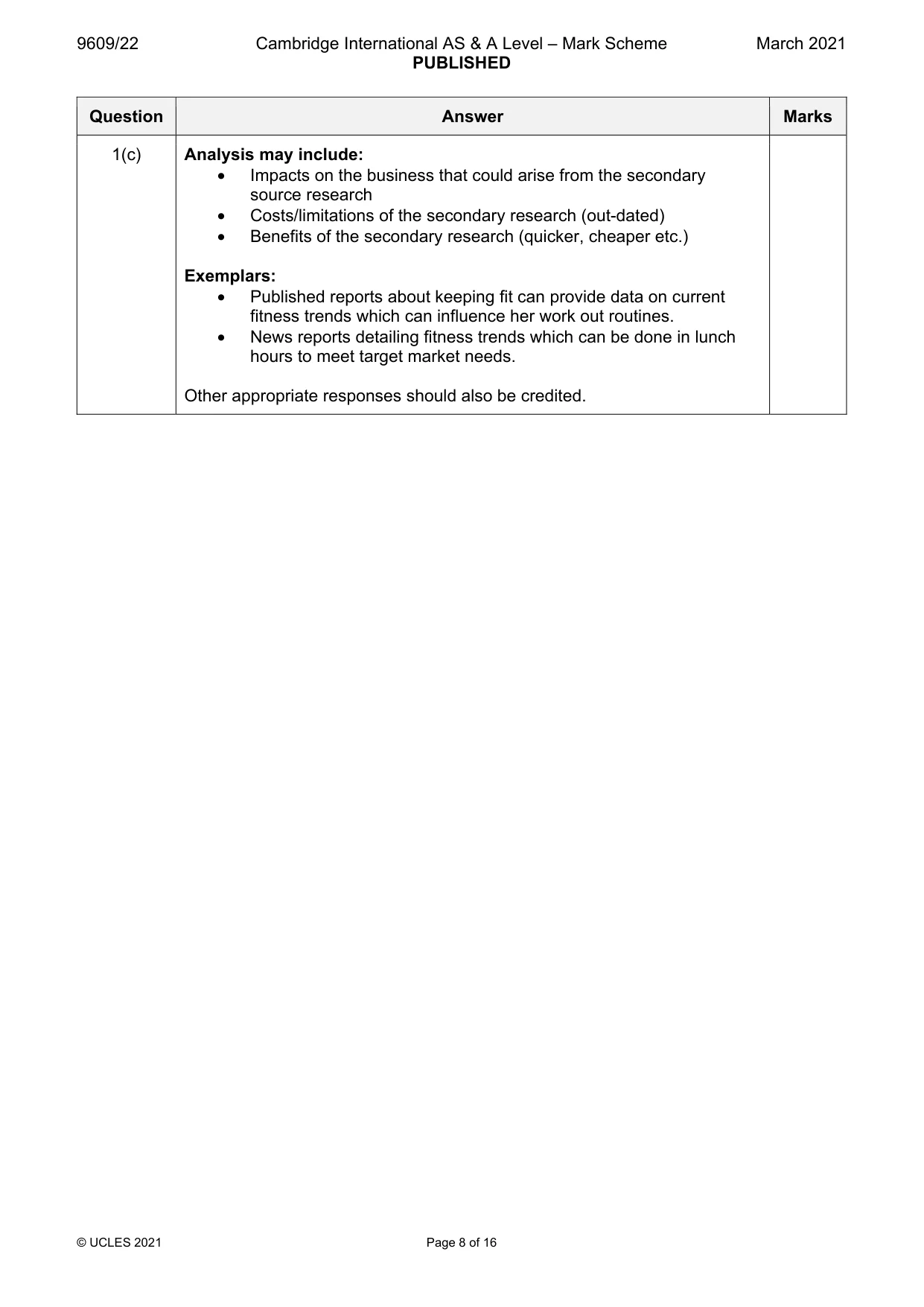
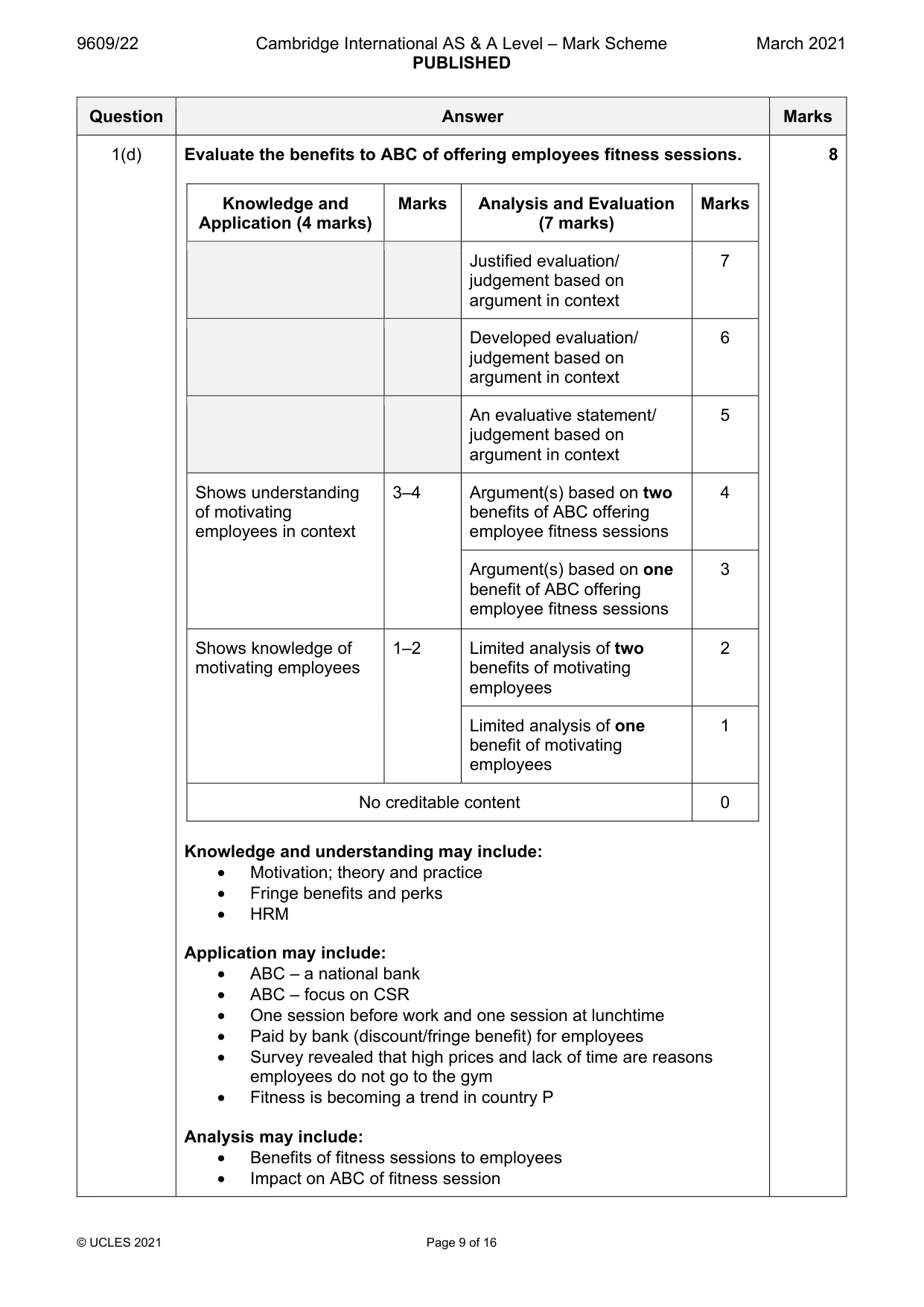
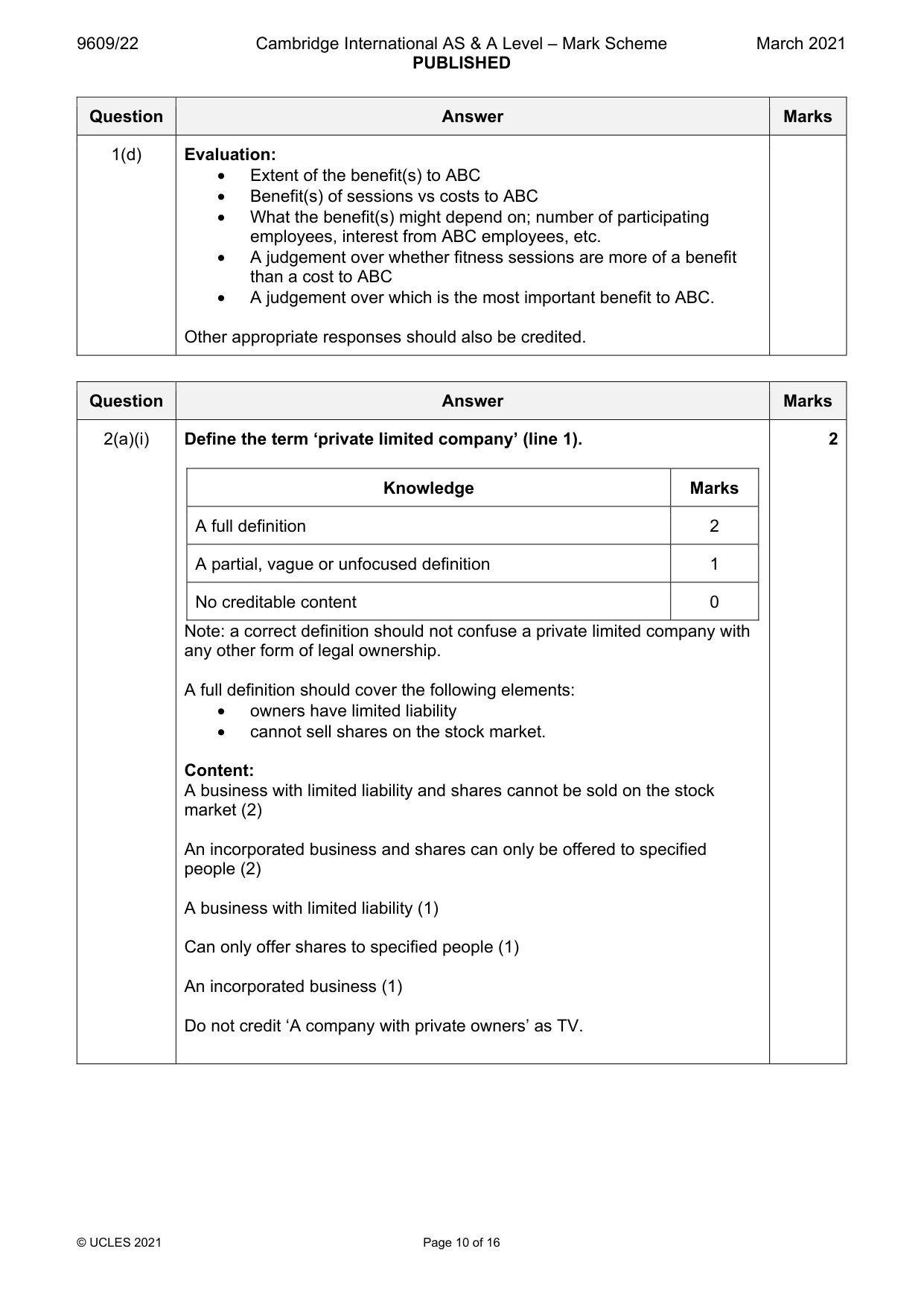
Mark scheme: Question Answer Marks 1(a)(i) Define the term ‘corporate social responsibility’ (CSR) (line 4). 2 Knowledge Marks A full definition 2 A partial, vague or unfocused definition 1 No credible content 0 A full definition should cover the following: • objectives/strategy focused on • economic, social and environmental benefits (people, profit and planets), triple bottom line (at least two) Content: A business which aims to benefit society, the environment as well the owners (2) Economic, social and environmental benefits not just about making profit (2) An objective to look after the environment (1) Economic, social and environmental benefits (1) 1(a)(ii) Explain the term ‘start-up capital’ (line 2). 3 Award one mark for each point of explanation: Rationale Marks Example or some other way of showing good 1 understanding. Can be a use of start-up capital or a source. Understanding that it is to launch a business / set-up / 1 seed money Understanding of the concept money invested, used in a 1 business Content: Money invested (1) to purchase everything necessary to set-up (1) a business, e.g. machinery (1) Money used (1) to purchase everything necessary to launch (1) a business Other appropriate responses should also be credited. Do not accept ‘start’ as it is in the question. Do not accept $10 000 invested in FF as this is repetition from the data. The money needed for a business does not NAQ. 1(b)(i) Refer to Table 1.1 and any other relevant information. Calculate the 3 maximum weekly revenue for pricing strategy 1. Rationale Marks Correct answer (with or without working or $) 3 Correct use of figures 2 Correct formula 1 No credible content 0 $5 × 20 = $100 (per session) $100 × 2 = $200 (per day) $200 × 5 = $1000 (per week) Answer = $1000 (accept with or without $) OFR applies Do not reward incorrect answers e.g. $500 or $200 without working. 1(b)(ii) Explain one advantage to FF of pricing strategy 2. 3 Level Knowledge and application Marks 2b Explanation of one advantage to FF of pricing 3 (APP + strategy 2. APP) 2a Identification of one advantage to FF of pricing 2 (APP) strategy 2. 1 Knowledge of one or more pricing strategies. 1 (K) 0 No creditable content 0 Knowledge of pricing strategies may include: competitive, penetration, skimming, price discrimination, cost-based pricing. Knowledge of pricing strategies can be implied. Possible advantages of pricing strategy 2 include: • Guaranteed income – no matter how many people Flora would get $75 • Helps with cash flow – when Flora is starting the business. Other appropriate responses should also be credited. 1(c) Analyse two sources of secondary market information Flora could use 8 to find out more about trends in the fitness market. Knowledge and Marks Analysis Marks Application (4 marks) (4 marks) 2b Shows 4 Good analysis of 4 understanding of two sources of two sources of secondary market secondary market information in information in context context 2a Shows 3 Good analysis of 3 understanding of one source of one source of secondary market secondary market information in information in context context 1b Shows knowledge 2 Limited analysis of 2 of two sources of two sources of secondary market secondary market information with no information context 1a Shows knowledge 1 Limited analysis of 1 of one source of one source of secondary market secondary market information with no information context 0 No creditable content Note: annotate the first source in the left-hand margin and the second source in the right-hand margin. Knowledge and understanding may include: Examples of sources of secondary market information • Reports • Census data • News reports • Magazines • Newspapers • Internet Application may include: • Fitness activities (fitness market is in the question) • $10 000 start-up capital • ABC is a national bank with a focus on CSR • ‘Healthy employer’ • Why employees do not go to fitness centres 1(c) Analysis may include: • Impacts on the business that could arise from the secondary source research • Costs/limitations of the secondary research (out-dated) • Benefits of the secondary research (quicker, cheaper etc.) Exemplars: • Published reports about keeping fit can provide data on current fitness trends which can influence her work out routines. • News reports detailing fitness trends which can be done in lunch hours to meet target market needs. Other appropriate responses should also be credited. 1(d) Evaluate the benefits to ABC of offering employees fitness sessions. 8 Knowledge and Marks Analysis and Evaluation Marks Application (4 marks) (7 marks) Justified evaluation/ 7 judgement based on argument in context Developed evaluation/ 6 judgement based on argument in context An evaluative statement/ 5 judgement based on argument in context Shows understanding 3–4 Argument(s) based on two 4 of motivating benefits of ABC offering employees in context employee fitness sessions Argument(s) based on one 3 benefit of ABC offering employee fitness sessions Shows knowledge of 1–2 Limited analysis of two 2 motivating employees benefits of motivating employees Limited analysis of one 1 benefit of motivating employees No creditable content 0 Knowledge and understanding may include: • Motivation; theory and practice • Fringe benefits and perks • HRM Application may include: • ABC – a national bank • ABC – focus on CSR • One session before work and one session at lunchtime • Paid by bank (discount/fringe benefit) for employees • Survey revealed that high prices and lack of time are reasons employees do not go to the gym • Fitness is becoming a trend in country P Analysis may include: • Benefits of fitness sessions to employees • Impact on ABC of fitness session 1(d) Evaluation: • Extent of the benefit(s) to ABC • Benefit(s) of sessions vs costs to ABC • What the benefit(s) might depend on; number of participating employees, interest from ABC employees, etc. • A judgement over whether fitness sessions are more of a benefit than a cost to ABC • A judgement over which is the most important benefit to ABC. Other appropriate responses should also be credited.
Q2 · Free Burgers (FB) FB is a private limited company that produces premium meat‑free burgers
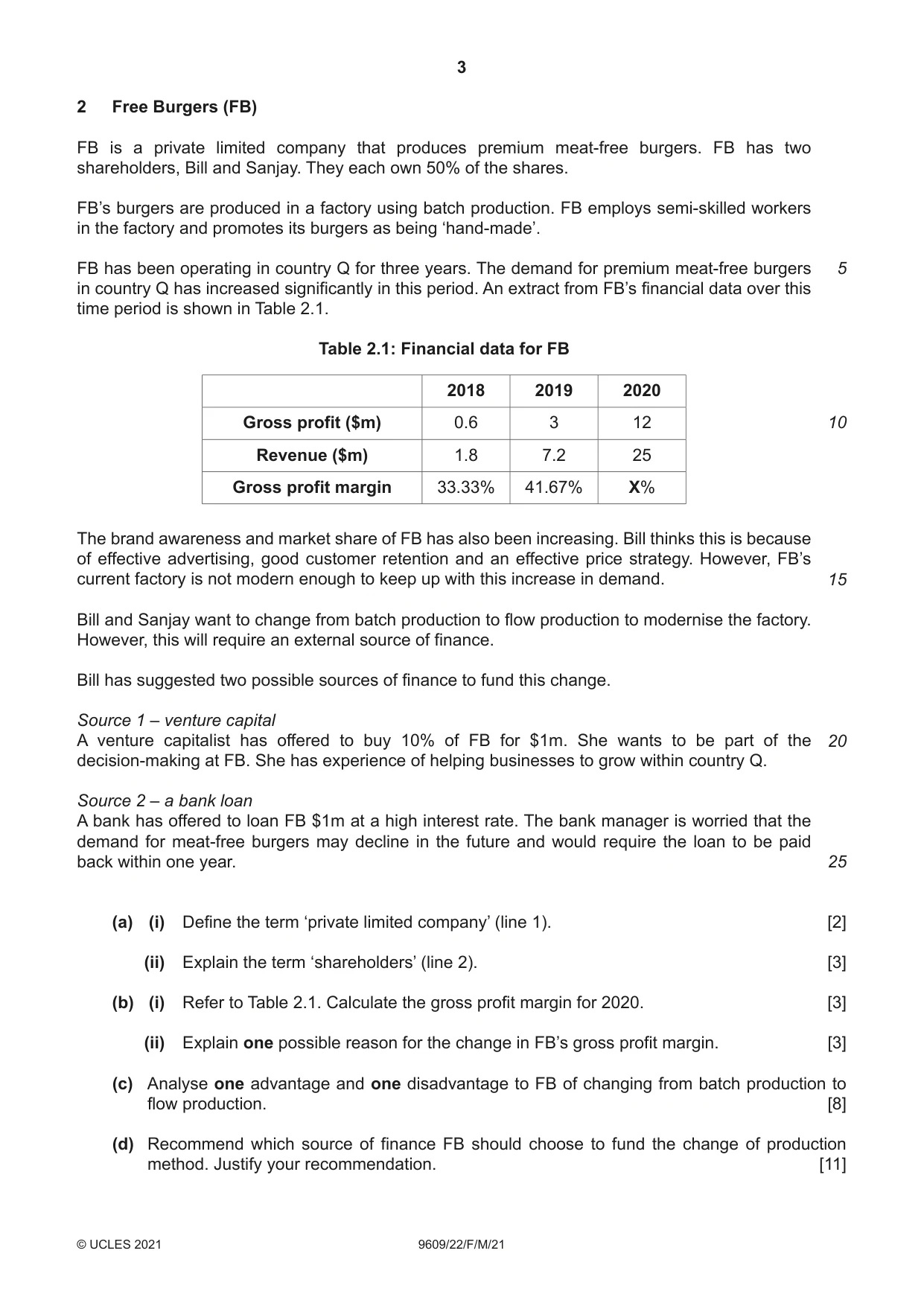
2 Free Burgers (FB) FB is a private limited company that produces premium meat‑free burgers. FB has two shareholders, Bill and Sanjay. They each own 50% of the shares. FB’s burgers are produced in a factory using batch production. FB employs semi‑skilled workers in the factory and promotes its burgers as being ‘hand‑made’. FB has been operating in country Q for three years. The demand for premium meat‑free burgers 5 in country Q has increased significantly in this period. An extract from FB’s financial data over this time period is shown in Table 2.1. Table 2.1: Financial data for FB 2018 2019 2020 Gross profit ($m) 0.6 3 12 10 Revenue ($m) 1.8 7.2 25 Gross profit margin 33.33% 41.67% X% The brand awareness and market share of FB has also been increasing. Bill thinks this is because of effective advertising, good customer retention and an effective price strategy. However, FB’s current factory is not modern enough to keep up with this increase in demand. 15 Bill and Sanjay want to change from batch production to flow production to modernise the factory. However, this will require an external source of finance. Bill has suggested two possible sources of finance to fund this change. Source 1 – venture capital A venture capitalist has offered to buy 10% of FB for $1m. She wants to be part of the 20 decision‑making at FB. She has experience of helping businesses to grow within country Q. Source 2 – a bank loan A bank has offered to loan FB $1m at a high interest rate. The bank manager is worried that the demand for meat‑free burgers may decline in the future and would require the loan to be paid back within one year. 25 (a) (i) Define the term ‘private limited company’ (line 1). [2] (ii) Explain the term ‘shareholders’ (line 2). [3] (b) (i) Refer to Table 2.1. Calculate the gross profit margin for 2020. [3] (ii) Explain one possible reason for the change in FB’s gross profit margin. [3] (c) Analyse one advantage and one disadvantage to FB of changing from batch production to flow production. [8] (d) Recommend which source of finance FB should choose to fund the change of production method. Justify your recommendation. [11]
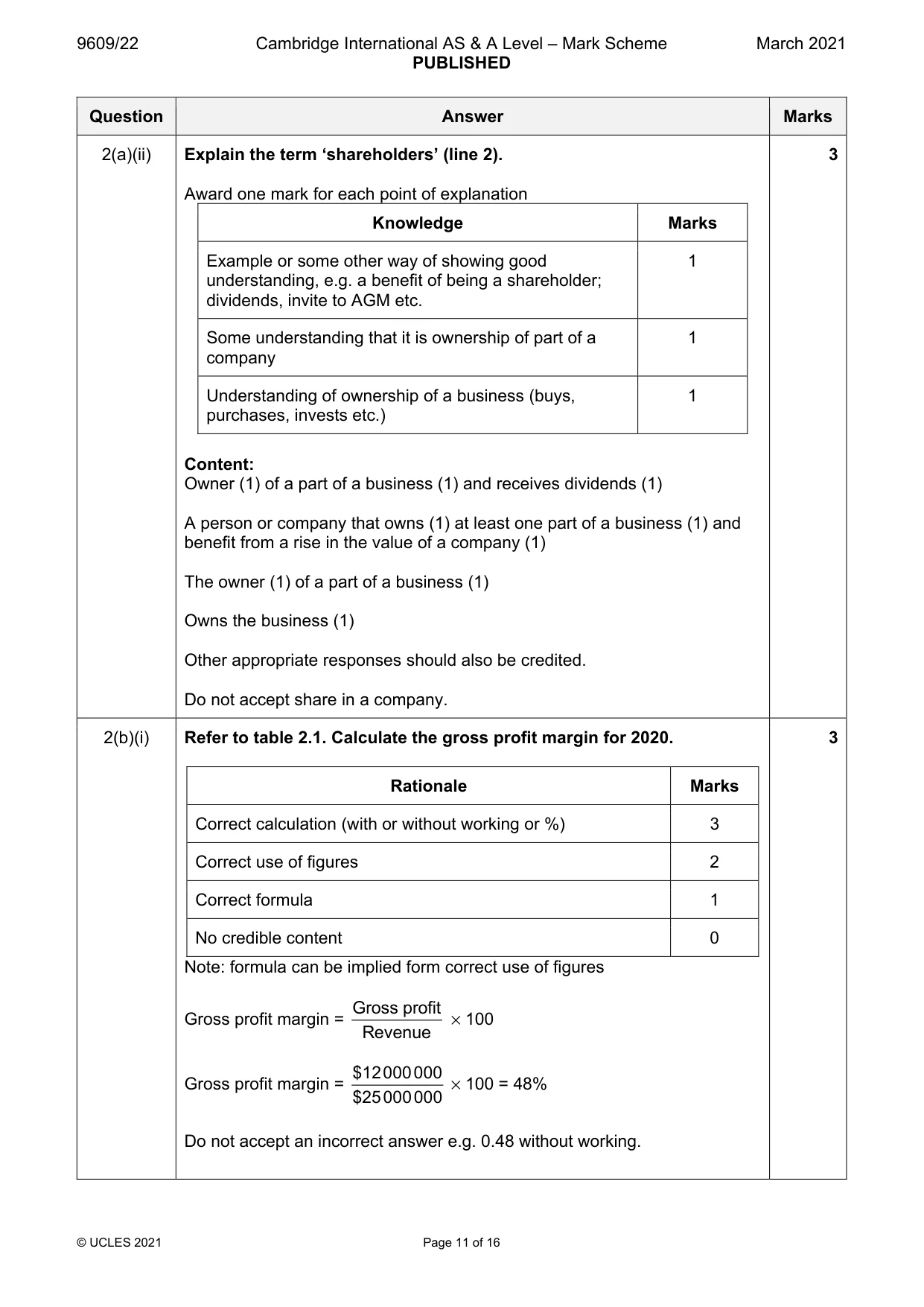
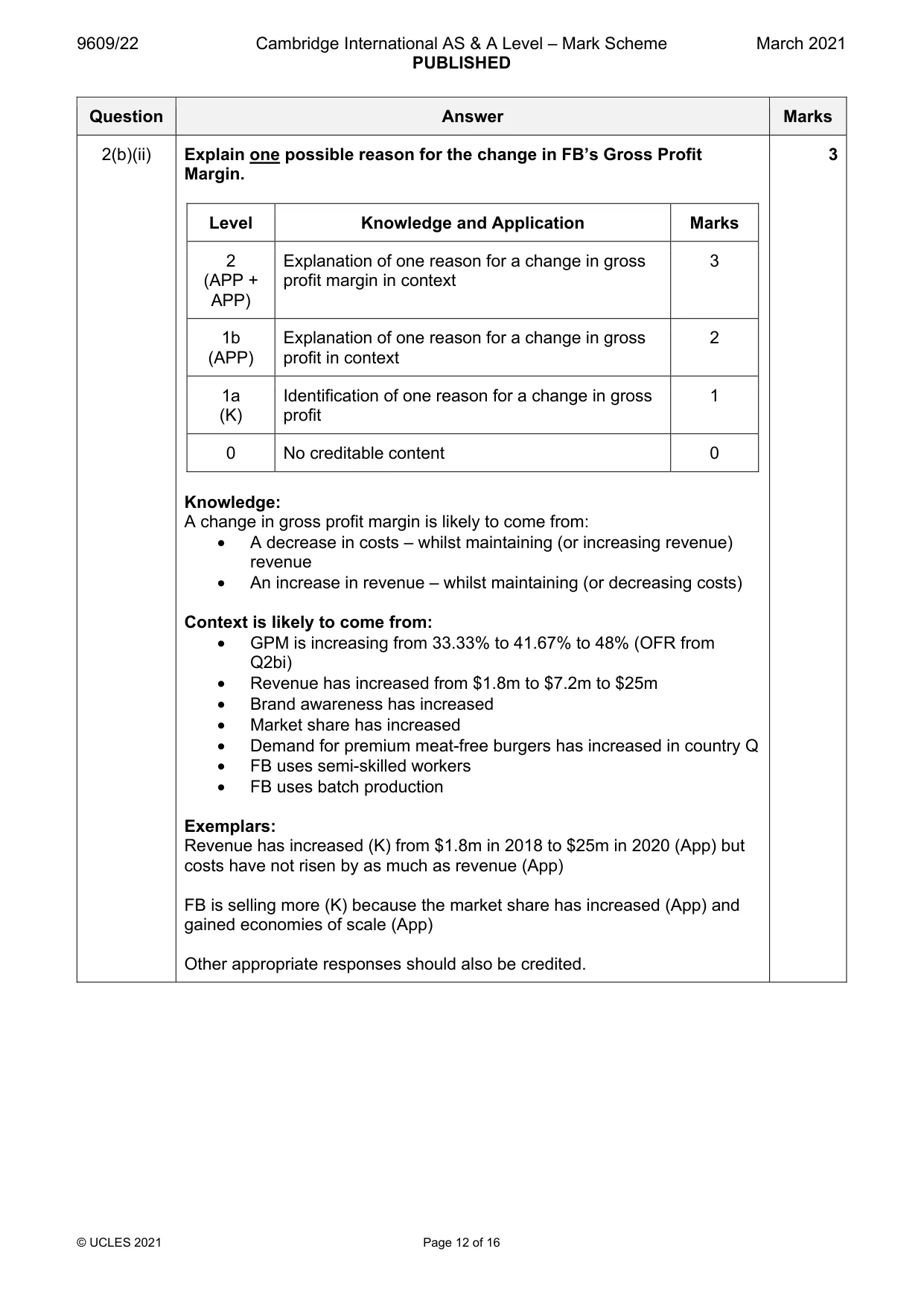
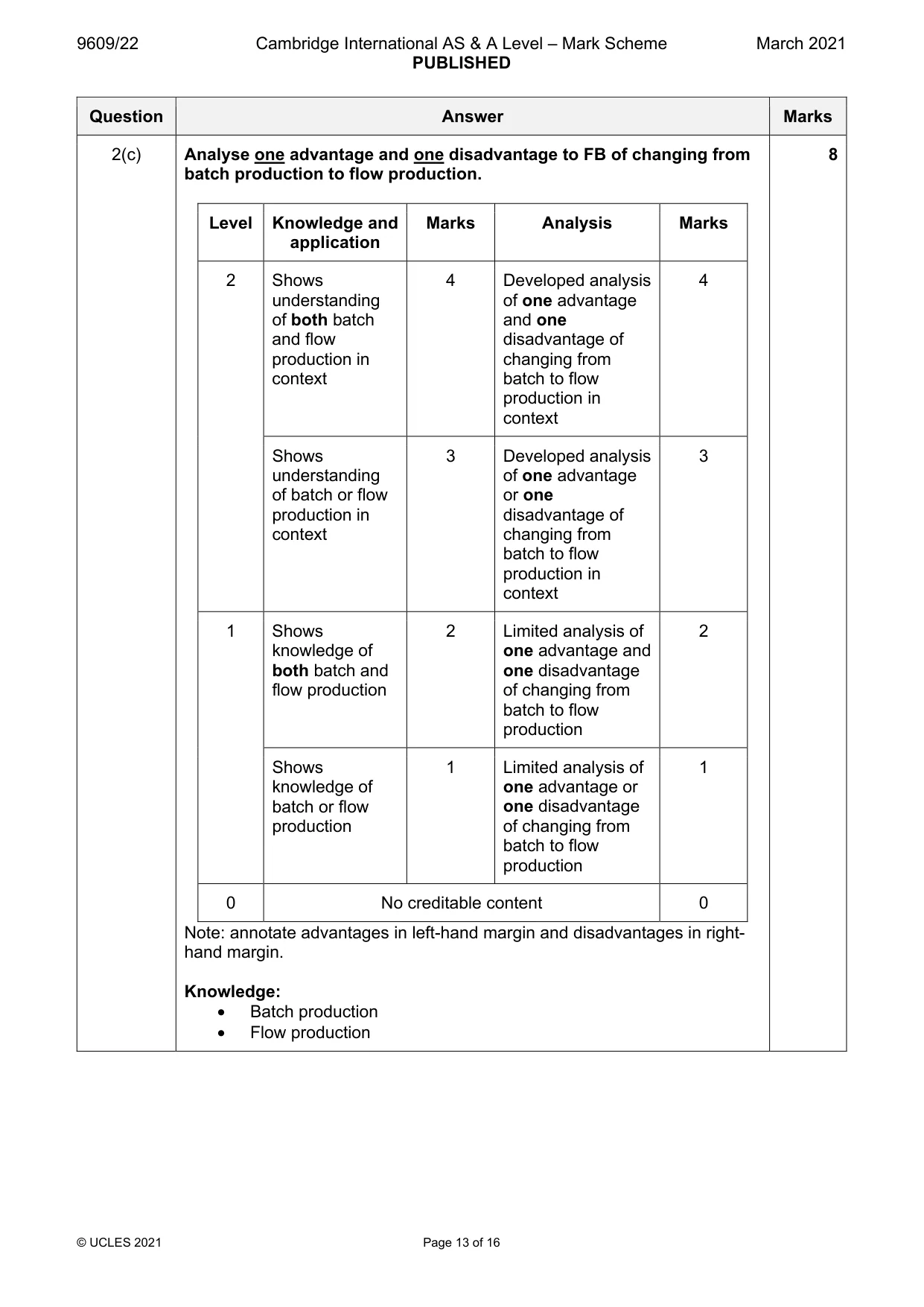
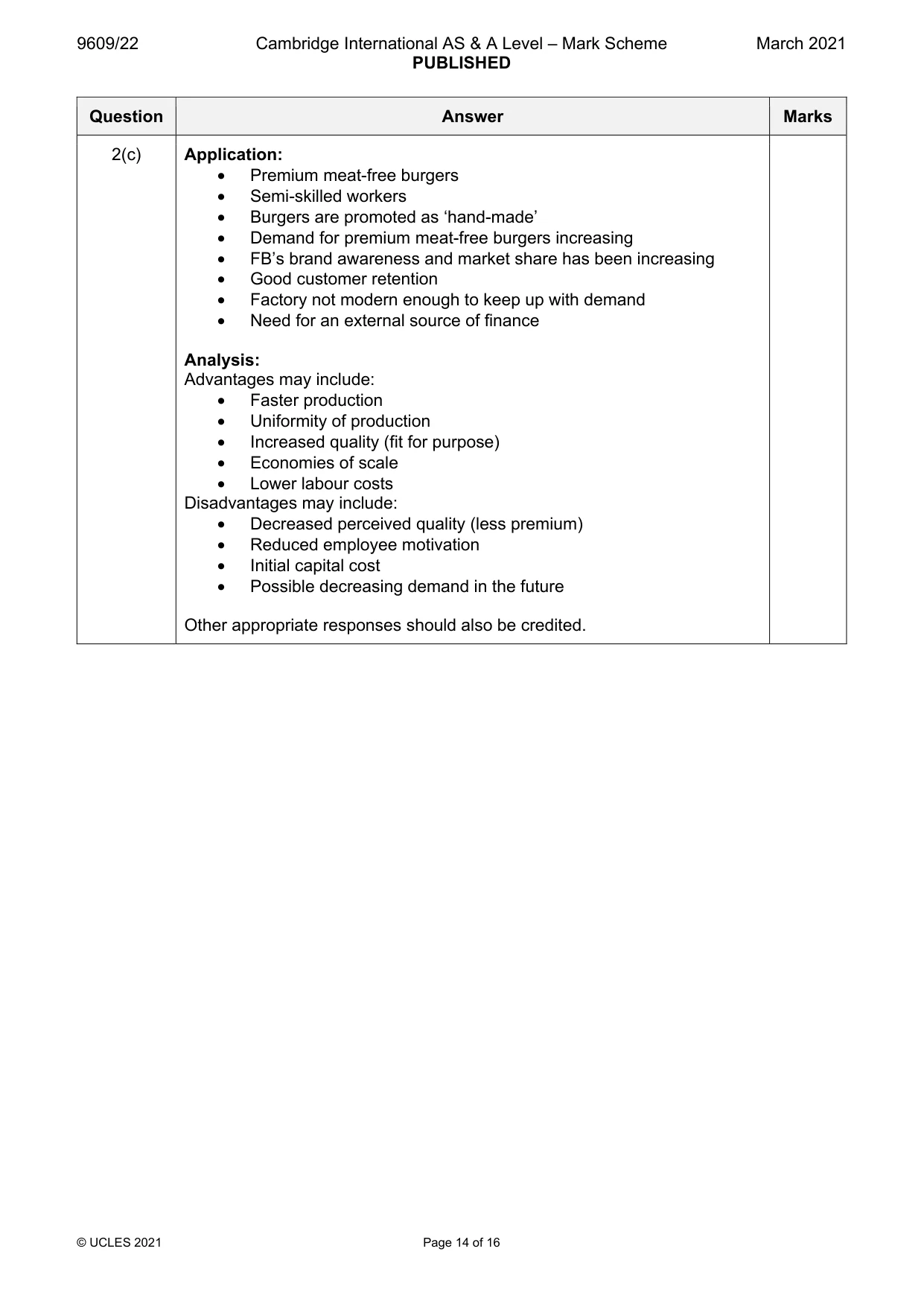
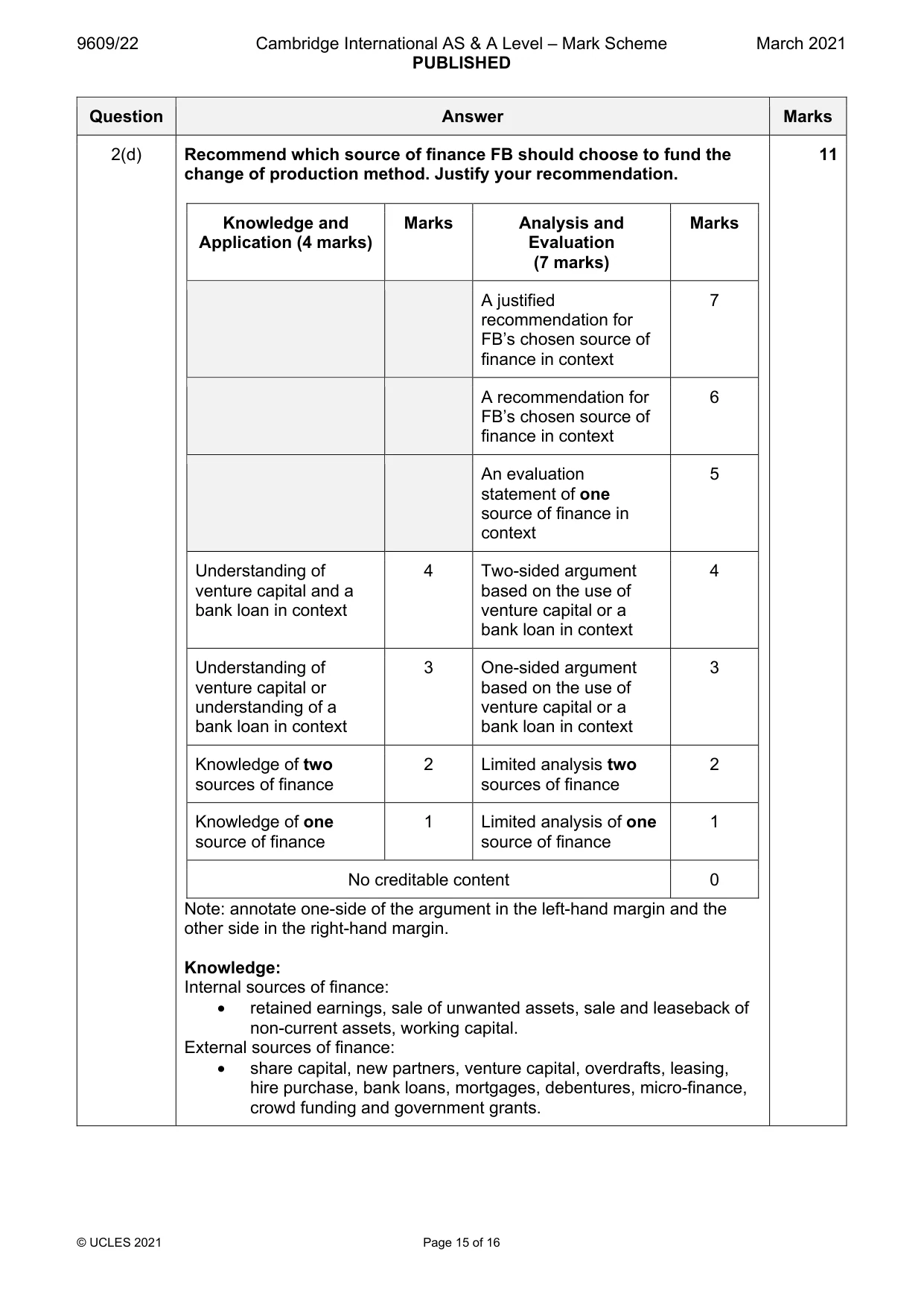
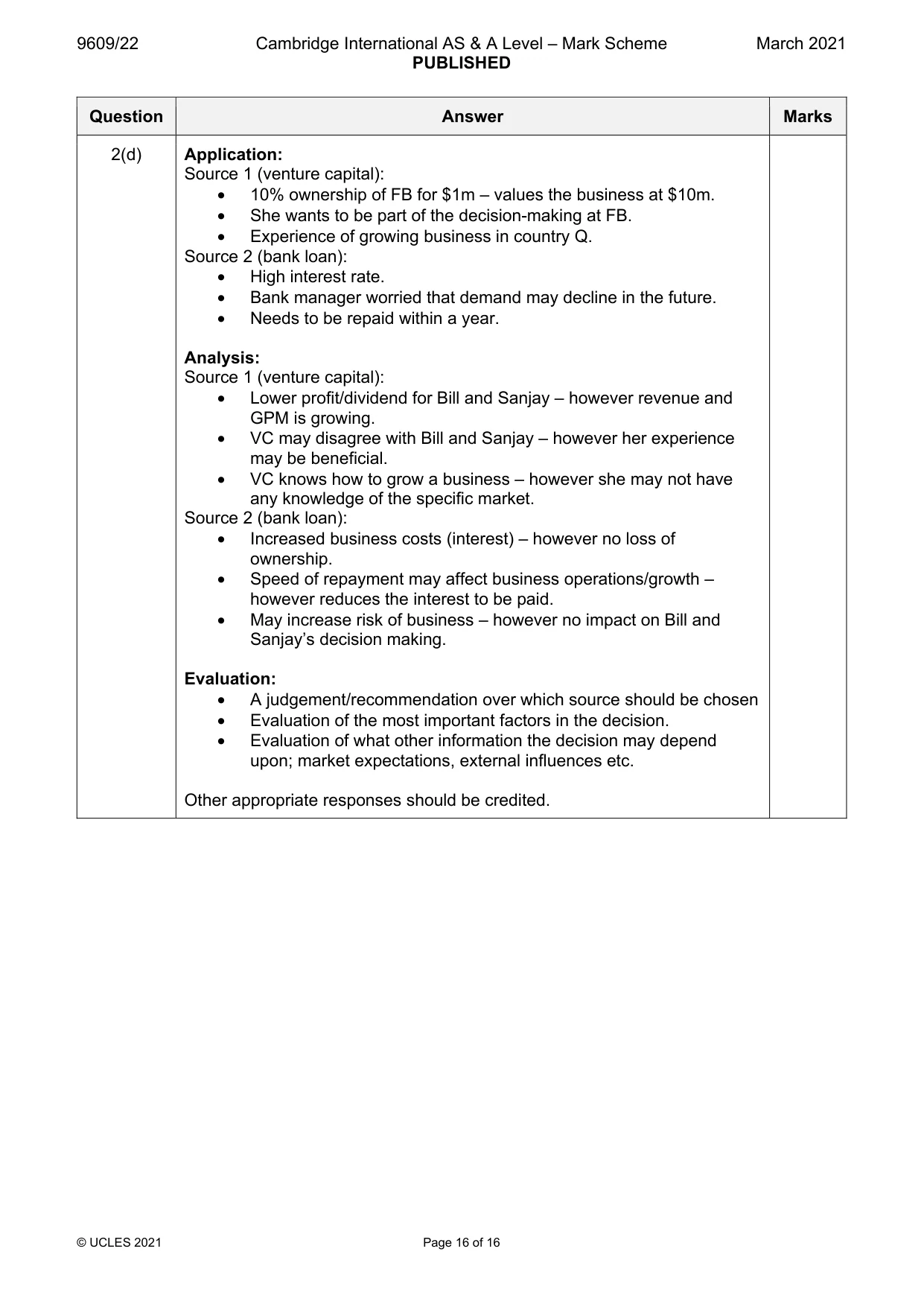
Mark scheme: 2(a)(i) Define the term ‘private limited company’ (line 1). 2 Knowledge Marks A full definition 2 A partial, vague or unfocused definition 1 No creditable content 0 Note: a correct definition should not confuse a private limited company with any other form of legal ownership. A full definition should cover the following elements: • owners have limited liability • cannot sell shares on the stock market. Content: A business with limited liability and shares cannot be sold on the stock market (2) An incorporated business and shares can only be offered to specified people (2) A business with limited liability (1) Can only offer shares to specified people (1) An incorporated business (1) Do not credit ‘A company with private owners’ as TV. 2(a)(ii) Explain the term ‘shareholders’ (line 2). 3 Award one mark for each point of explanation Knowledge Marks Example or some other way of showing good 1 understanding, e.g. a benefit of being a shareholder; dividends, invite to AGM etc. Some understanding that it is ownership of part of a 1 company Understanding of ownership of a business (buys, 1 purchases, invests etc.) Content: Owner (1) of a part of a business (1) and receives dividends (1) A person or company that owns (1) at least one part of a business (1) and benefit from a rise in the value of a company (1) The owner (1) of a part of a business (1) Owns the business (1) Other appropriate responses should also be credited. Do not accept share in a company. 2(b)(i) Refer to table 2.1. Calculate the gross profit margin for 2020. 3 Rationale Marks Correct calculation (with or without working or %) 3 Correct use of figures 2 Correct formula 1 No credible content 0 Note: formula can be implied form correct use of figures Gross profit Gross profit margin = × 100 Revenue $12000000 Gross profit margin = × 100 = 48% $25000000 Do not accept an incorrect answer e.g. 0.48 without working. 2(b)(ii) Explain one possible reason for the change in FB’s Gross Profit 3 Margin. Level Knowledge and Application Marks 2 Explanation of one reason for a change in gross 3 (APP + profit margin in context APP) 1b Explanation of one reason for a change in gross 2 (APP) profit in context 1a Identification of one reason for a change in gross 1 (K) profit 0 No creditable content 0 Knowledge: A change in gross profit margin is likely to come from: • A decrease in costs – whilst maintaining (or increasing revenue) revenue • An increase in revenue – whilst maintaining (or decreasing costs) Context is likely to come from: • GPM is increasing from 33.33% to 41.67% to 48% (OFR from Q2bi) • Revenue has increased from $1.8m to $7.2m to $25m • Brand awareness has increased • Market share has increased • Demand for premium meat-free burgers has increased in country Q • FB uses semi-skilled workers • FB uses batch production Exemplars: Revenue has increased (K) from $1.8m in 2018 to $25m in 2020 (App) but costs have not risen by as much as revenue (App) FB is selling more (K) because the market share has increased (App) and gained economies of scale (App) Other appropriate responses should also be credited. 2(c) Analyse one advantage and one disadvantage to FB of changing from 8 batch production to flow production. Level Knowledge and Marks Analysis Marks application 2 Shows 4 Developed analysis 4 understanding of one advantage of both batch and one and flow disadvantage of production in changing from context batch to flow production in context Shows 3 Developed analysis 3 understanding of one advantage of batch or flow or one production in disadvantage of context changing from batch to flow production in context 1 Shows 2 Limited analysis of 2 knowledge of one advantage and both batch and one disadvantage flow production of changing from batch to flow production Shows 1 Limited analysis of 1 knowledge of one advantage or batch or flow one disadvantage production of changing from batch to flow production 0 No creditable content 0 Note: annotate advantages in left-hand margin and disadvantages in right- hand margin. Knowledge: • Batch production • Flow production 2(c) Application: • Premium meat-free burgers • Semi-skilled workers • Burgers are promoted as ‘hand-made’ • Demand for premium meat-free burgers increasing • FB’s brand awareness and market share has been increasing • Good customer retention • Factory not modern enough to keep up with demand • Need for an external source of finance Analysis: Advantages may include: • Faster production • Uniformity of production • Increased quality (fit for purpose) • Economies of scale • Lower labour costs Disadvantages may include: • Decreased perceived quality (less premium) • Reduced employee motivation • Initial capital cost • Possible decreasing demand in the future Other appropriate responses should also be credited. 2(d) Recommend which source of finance FB should choose to fund the 11 change of production method. Justify your recommendation. Knowledge and Marks Analysis and Marks Application (4 marks) Evaluation (7 marks) A justified 7 recommendation for FB’s chosen source of finance in context A recommendation for 6 FB’s chosen source of finance in context An evaluation 5 statement of one source of finance in context Understanding of 4 Two-sided argument 4 venture capital and a based on the use of bank loan in context venture capital or a bank loan in context Understanding of 3 One-sided argument 3 venture capital or based on the use of understanding of a venture capital or a bank loan in context bank loan in context Knowledge of two 2 Limited analysis two 2 sources of finance sources of finance Knowledge of one 1 Limited analysis of one 1 source of finance source of finance No creditable content 0 Note: annotate one-side of the argument in the left-hand margin and the other side in the right-hand margin. Knowledge: Internal sources of finance: • retained earnings, sale of unwanted assets, sale and leaseback of non-current assets, working capital. External sources of finance: • share capital, new partners, venture capital, overdrafts, leasing, hire purchase, bank loans, mortgages, debentures, micro-finance, crowd funding and government grants. 2(d) Application: Source 1 (venture capital): • 10% ownership of FB for $1m – values the business at $10m. • She wants to be part of the decision-making at FB. • Experience of growing business in country Q. Source 2 (bank loan): • High interest rate. • Bank manager worried that demand may decline in the future. • Needs to be repaid within a year. Analysis: Source 1 (venture capital): • Lower profit/dividend for Bill and Sanjay – however revenue and GPM is growing. • VC may disagree with Bill and Sanjay – however her experience may be beneficial. • VC knows how to grow a business – however she may not have any knowledge of the specific market. Source 2 (bank loan): • Increased business costs (interest) – however no loss of ownership. • Speed of repayment may affect business operations/growth – however reduces the interest to be paid. • May increase risk of business – however no impact on Bill and Sanjay’s decision making. Evaluation: • A judgement/recommendation over which source should be chosen • Evaluation of the most important factors in the decision. • Evaluation of what other information the decision may depend upon; market expectations, external influences etc. Other appropriate responses should be credited.
What was in this paper
The subtopics covered by these 2 questions, and how many questions each got. Open one in a new tab to see every Cambridge question on it.
What you needed in this session
Cambridge’s own grade thresholds for 2021 Feb/March, Paper 2 · Variant 2. A higher threshold means an easier paper — the bar moves with how the cohort did.