Cambridge A Level Business (for first examination in 2016) 9609 — 2020 Oct/Nov Paper 1 · Variant 2
9609/12/O/N/20 · 40 marks · ≈45 min
The question paper and its mark scheme, free to read here and free to download. This is Cambridge’s own paper, exactly as it was sat.
Question paper4 pages


Mark scheme15 pages
Answers below. Sit the paper first if you are practising.
Paper as text
Question paper, page 1
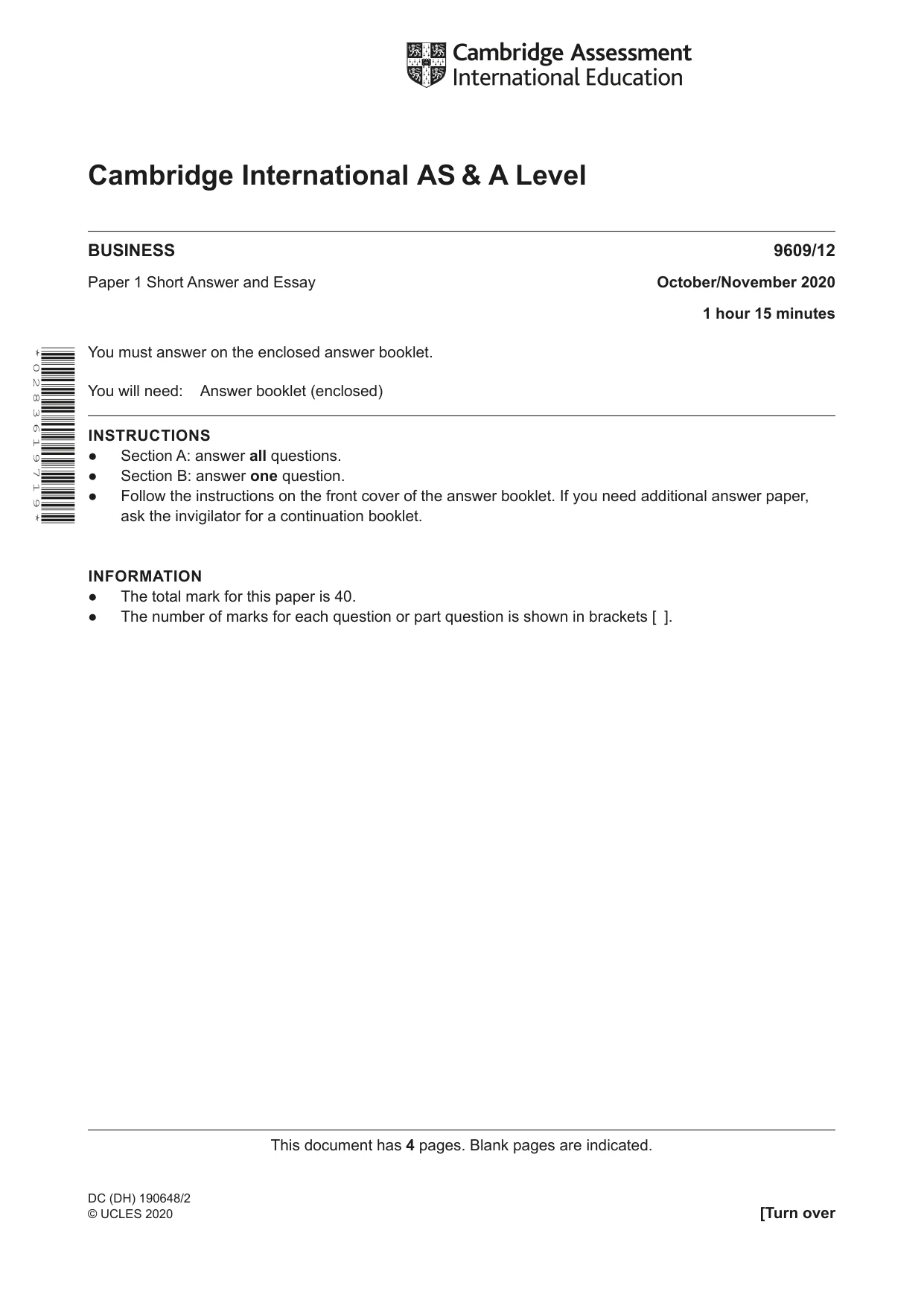
Cambridge International AS & A Level This document has 4 pages. Blank pages are indicated. DC (DH) 190648/2 © UCLES 2020 [Turn over * 0 2 8 3 6 1 9 7 1 9 * BUSINESS 9609/12 Paper 1 Short Answer and Essay October/November 2020 1 hour 15 minutes You must answer on the enclosed answer booklet. You will need: Answer booklet (enclosed) INSTRUCTIONS ● Section A: answer all questions. ● Section B: answer one question. ● Follow the instructions on the front cover of the answer booklet. If you need additional answer paper, ask the invigilator for a continuation booklet. INFORMATION ● The total mark for this paper is 40. ● The number of marks for each question or part question is shown in brackets [ ].
Question paper, page 2
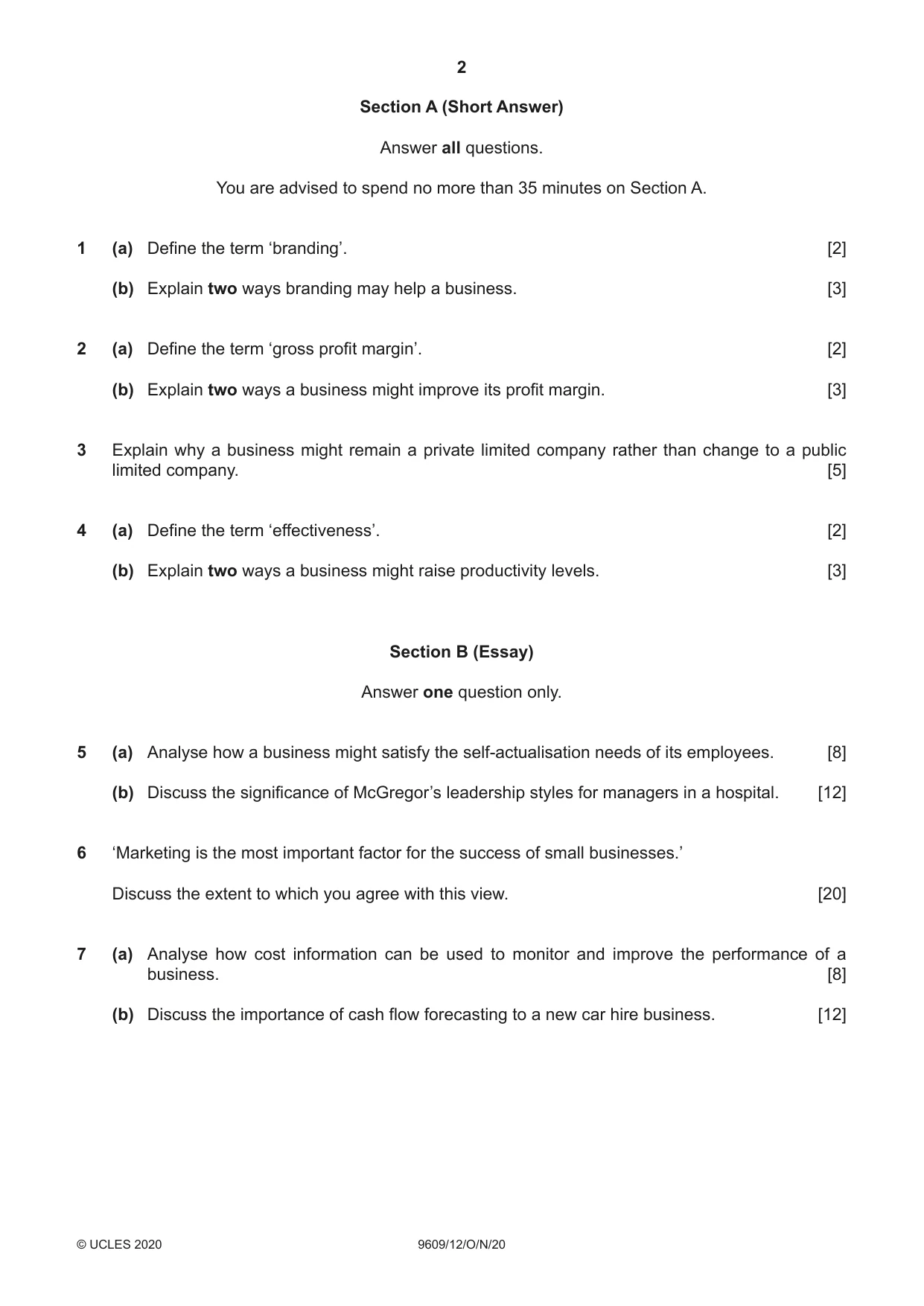
2 9609/12/O/N/20 © UCLES 2020 Section A (Short Answer) Answer all questions. You are advised to spend no more than 35 minutes on Section A. 1 (a) Define the term ‘branding’. [2] (b) Explain two ways branding may help a business. [3] 2 (a) Define the term ‘gross profit margin’. [2] (b) Explain two ways a business might improve its profit margin. [3] 3 Explain why a business might remain a private limited company rather than change to a public limited company. [5] 4 (a) Define the term ‘effectiveness’. [2] (b) Explain two ways a business might raise productivity levels. [3] Section B (Essay) Answer one question only. 5 (a) Analyse how a business might satisfy the self-actualisation needs of its employees. [8] (b) Discuss the significance of McGregor’s leadership styles for managers in a hospital. [12] 6 ‘Marketing is the most important factor for the success of small businesses.’ Discuss the extent to which you agree with this view. [20] 7 (a) Analyse how cost information can be used to monitor and improve the performance of a business. [8] (b) Discuss the importance of cash flow forecasting to a new car hire business. [12]
Question paper, page 3
3 9609/12/O/N/20 © UCLES 2020 BLANK PAGE
Question paper, page 4
4 9609/12/O/N/20 © UCLES 2020 BLANK PAGE Permission to reproduce items where third-party owned material protected by copyright is included has been sought and cleared where possible. Every reasonable effort has been made by the publisher (UCLES) to trace copyright holders, but if any items requiring clearance have unwittingly been included, the publisher will be pleased to make amends at the earliest possible opportunity. To avoid the issue of disclosure of answer-related information to candidates, all copyright acknowledgements are reproduced online in the Cambridge Assessment International Education Copyright Acknowledgements Booklet. This is produced for each series of examinations and is freely available to download at www.cambridgeinternational.org after the live examination series. Cambridge Assessment International Education is part of the Cambridge Assessment Group. Cambridge Assessment is the brand name of the University of Cambridge Local Examinations Syndicate (UCLES), which itself is a department of the University of Cambridge.
Mark scheme, page 1
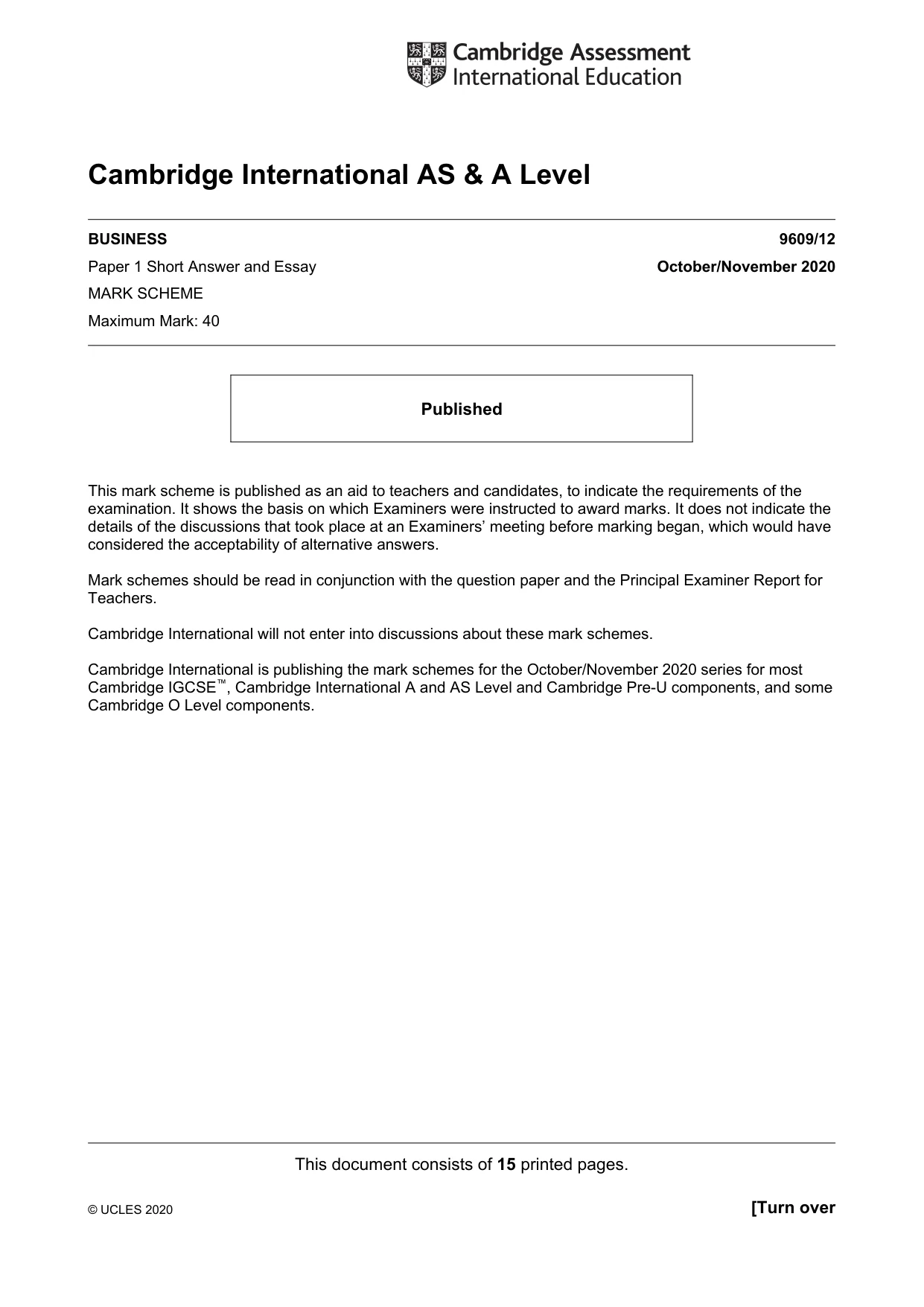
This document consists of 15 printed pages. © UCLES 2020 [Turn over Cambridge International AS & A Level BUSINESS 9609/12 Paper 1 Short Answer and Essay October/November 2020 MARK SCHEME Maximum Mark: 40 Published This mark scheme is published as an aid to teachers and candidates, to indicate the requirements of the examination. It shows the basis on which Examiners were instructed to award marks. It does not indicate the details of the discussions that took place at an Examiners’ meeting before marking began, which would have considered the acceptability of alternative answers. Mark schemes should be read in conjunction with the question paper and the Principal Examiner Report for Teachers. Cambridge International will not enter into discussions about these mark schemes. Cambridge International is publishing the mark schemes for the October/November 2020 series for most Cambridge IGCSE™, Cambridge International A and AS Level and Cambridge Pre-U components, and some Cambridge O Level components.
Mark scheme, page 2
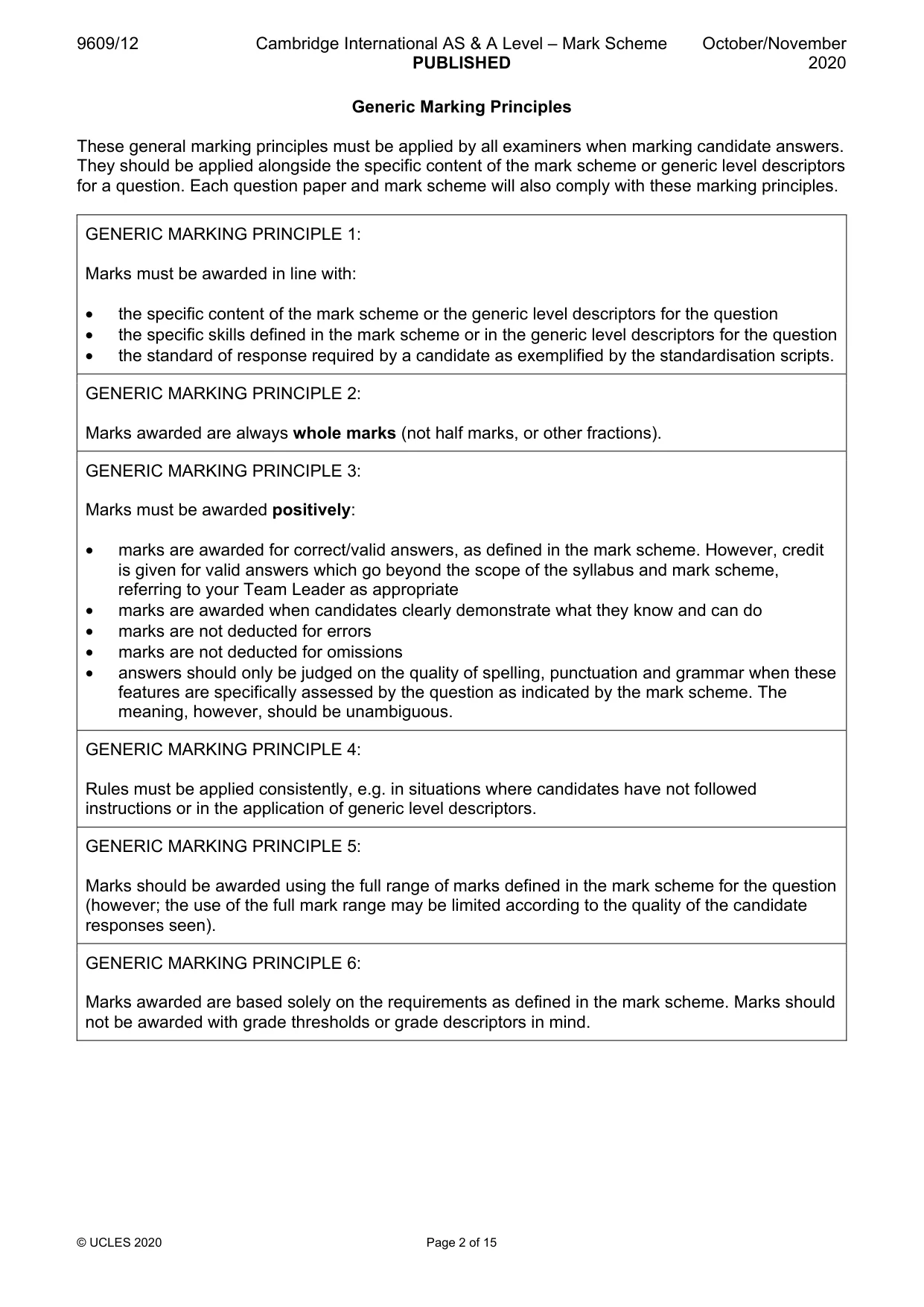
9609/12 Cambridge International AS & A Level – Mark Scheme PUBLISHED October/November 2020 © UCLES 2020 Page 2 of 15 Generic Marking Principles These general marking principles must be applied by all examiners when marking candidate answers. They should be applied alongside the specific content of the mark scheme or generic level descriptors for a question. Each question paper and mark scheme will also comply with these marking principles. GENERIC MARKING PRINCIPLE 1: Marks must be awarded in line with: • the specific content of the mark scheme or the generic level descriptors for the question • the specific skills defined in the mark scheme or in the generic level descriptors for the question • the standard of response required by a candidate as exemplified by the standardisation scripts. GENERIC MARKING PRINCIPLE 2: Marks awarded are always whole marks (not half marks, or other fractions). GENERIC MARKING PRINCIPLE 3: Marks must be awarded positively: • marks are awarded for correct/valid answers, as defined in the mark scheme. However, credit is given for valid answers which go beyond the scope of the syllabus and mark scheme, referring to your Team Leader as appropriate • marks are awarded when candidates clearly demonstrate what they know and can do • marks are not deducted for errors • marks are not deducted for omissions • answers should only be judged on the quality of spelling, punctuation and grammar when these features are specifically assessed by the question as indicated by the mark scheme. The meaning, however, should be unambiguous. GENERIC MARKING PRINCIPLE 4: Rules must be applied consistently, e.g. in situations where candidates have not followed instructions or in the application of generic level descriptors. GENERIC MARKING PRINCIPLE 5: Marks should be awarded using the full range of marks defined in the mark scheme for the question (however; the use of the full mark range may be limited according to the quality of the candidate responses seen). GENERIC MARKING PRINCIPLE 6: Marks awarded are based solely on the requirements as defined in the mark scheme. Marks should not be awarded with grade thresholds or grade descriptors in mind.
Mark scheme, page 3
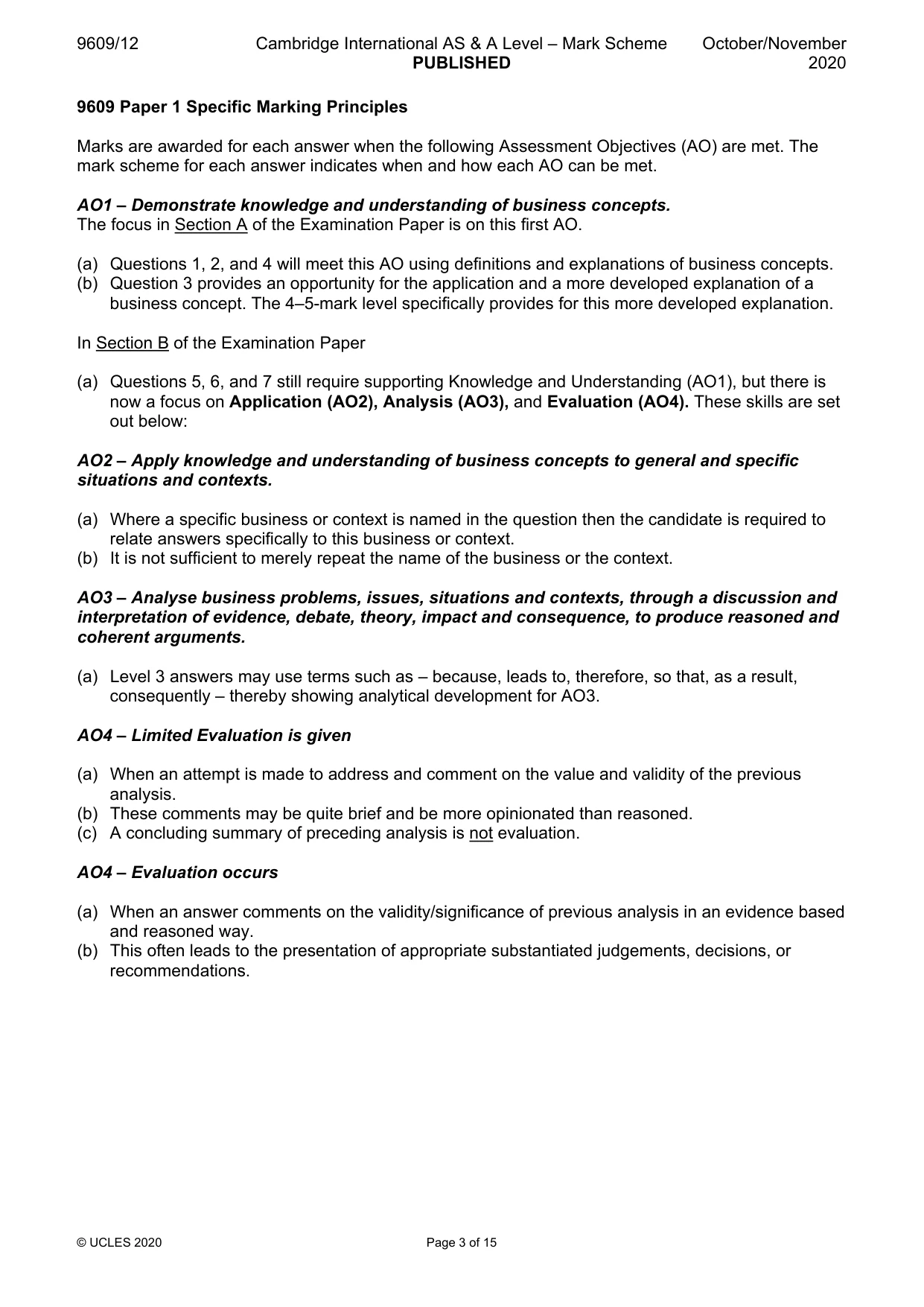
9609/12 Cambridge International AS & A Level – Mark Scheme PUBLISHED October/November 2020 © UCLES 2020 Page 3 of 15 9609 Paper 1 Specific Marking Principles Marks are awarded for each answer when the following Assessment Objectives (AO) are met. The mark scheme for each answer indicates when and how each AO can be met. AO1 – Demonstrate knowledge and understanding of business concepts. The focus in Section A of the Examination Paper is on this first AO. (a) Questions 1, 2, and 4 will meet this AO using definitions and explanations of business concepts. (b) Question 3 provides an opportunity for the application and a more developed explanation of a business concept. The 4–5-mark level specifically provides for this more developed explanation. In Section B of the Examination Paper (a) Questions 5, 6, and 7 still require supporting Knowledge and Understanding (AO1), but there is now a focus on Application (AO2), Analysis (AO3), and Evaluation (AO4). These skills are set out below: AO2 – Apply knowledge and understanding of business concepts to general and specific situations and contexts. (a) Where a specific business or context is named in the question then the candidate is required to relate answers specifically to this business or context. (b) It is not sufficient to merely repeat the name of the business or the context. AO3 – Analyse business problems, issues, situations and contexts, through a discussion and interpretation of evidence, debate, theory, impact and consequence, to produce reasoned and coherent arguments. (a) Level 3 answers may use terms such as – because, leads to, therefore, so that, as a result, consequently – thereby showing analytical development for AO3. AO4 – Limited Evaluation is given (a) When an attempt is made to address and comment on the value and validity of the previous analysis. (b) These comments may be quite brief and be more opinionated than reasoned. (c) A concluding summary of preceding analysis is not evaluation. AO4 – Evaluation occurs (a) When an answer comments on the validity/significance of previous analysis in an evidence based and reasoned way. (b) This often leads to the presentation of appropriate substantiated judgements, decisions, or recommendations.
Mark scheme, page 4
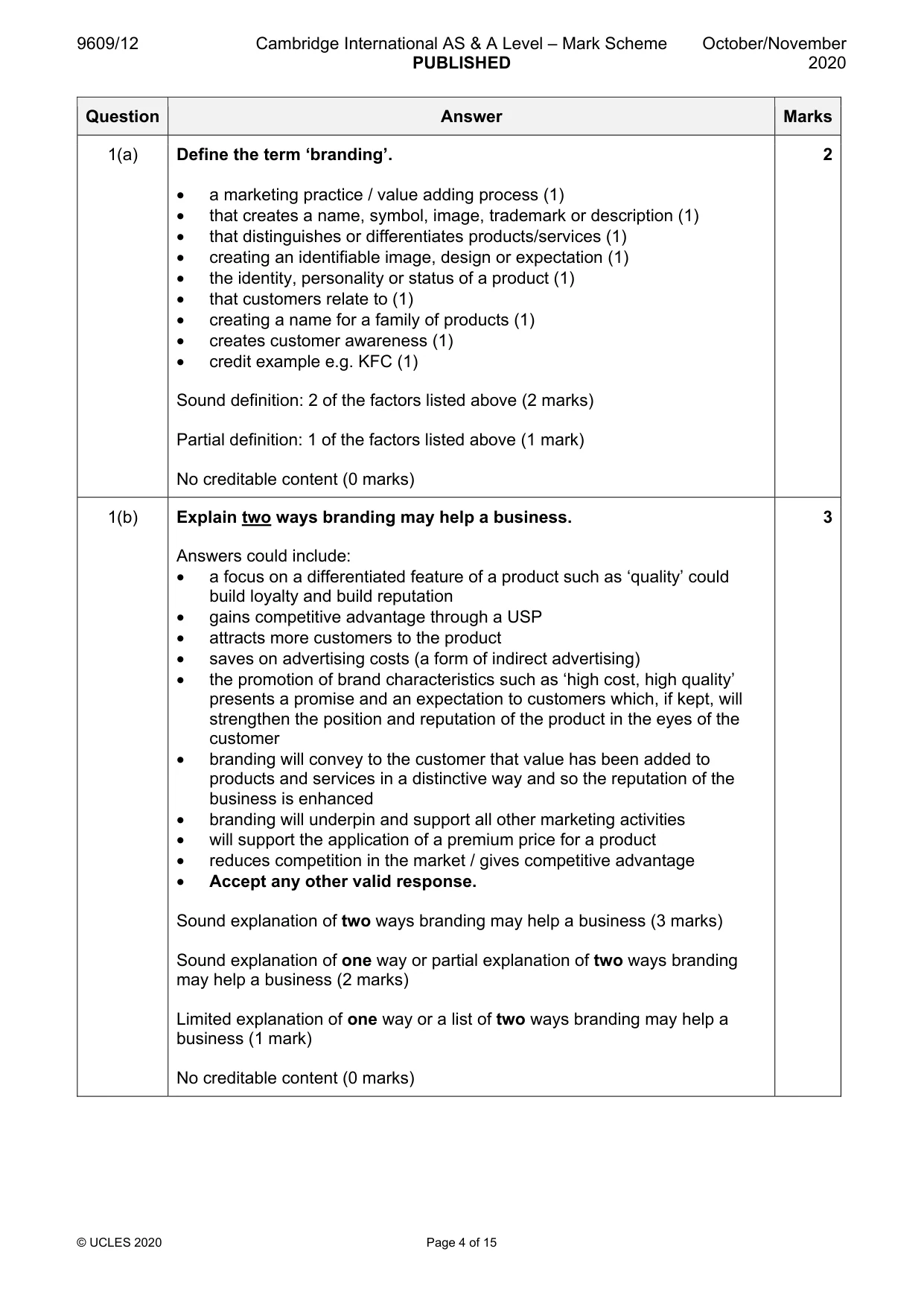
9609/12 Cambridge International AS & A Level – Mark Scheme PUBLISHED October/November 2020 © UCLES 2020 Page 4 of 15 Question Answer Marks 1(a) Define the term ‘branding’. • a marketing practice / value adding process (1) • that creates a name, symbol, image, trademark or description (1) • that distinguishes or differentiates products/services (1) • creating an identifiable image, design or expectation (1) • the identity, personality or status of a product (1) • that customers relate to (1) • creating a name for a family of products (1) • creates customer awareness (1) • credit example e.g. KFC (1) Sound definition: 2 of the factors listed above (2 marks) Partial definition: 1 of the factors listed above (1 mark) No creditable content (0 marks) 2 1(b) Explain two ways branding may help a business. Answers could include: • a focus on a differentiated feature of a product such as ‘quality’ could build loyalty and build reputation • gains competitive advantage through a USP • attracts more customers to the product • saves on advertising costs (a form of indirect advertising) • the promotion of brand characteristics such as ‘high cost, high quality’ presents a promise and an expectation to customers which, if kept, will strengthen the position and reputation of the product in the eyes of the customer • branding will convey to the customer that value has been added to products and services in a distinctive way and so the reputation of the business is enhanced • branding will underpin and support all other marketing activities • will support the application of a premium price for a product • reduces competition in the market / gives competitive advantage • Accept any other valid response. Sound explanation of two ways branding may help a business (3 marks) Sound explanation of one way or partial explanation of two ways branding may help a business (2 marks) Limited explanation of one way or a list of two ways branding may help a business (1 mark) No creditable content (0 marks) 3
Mark scheme, page 5
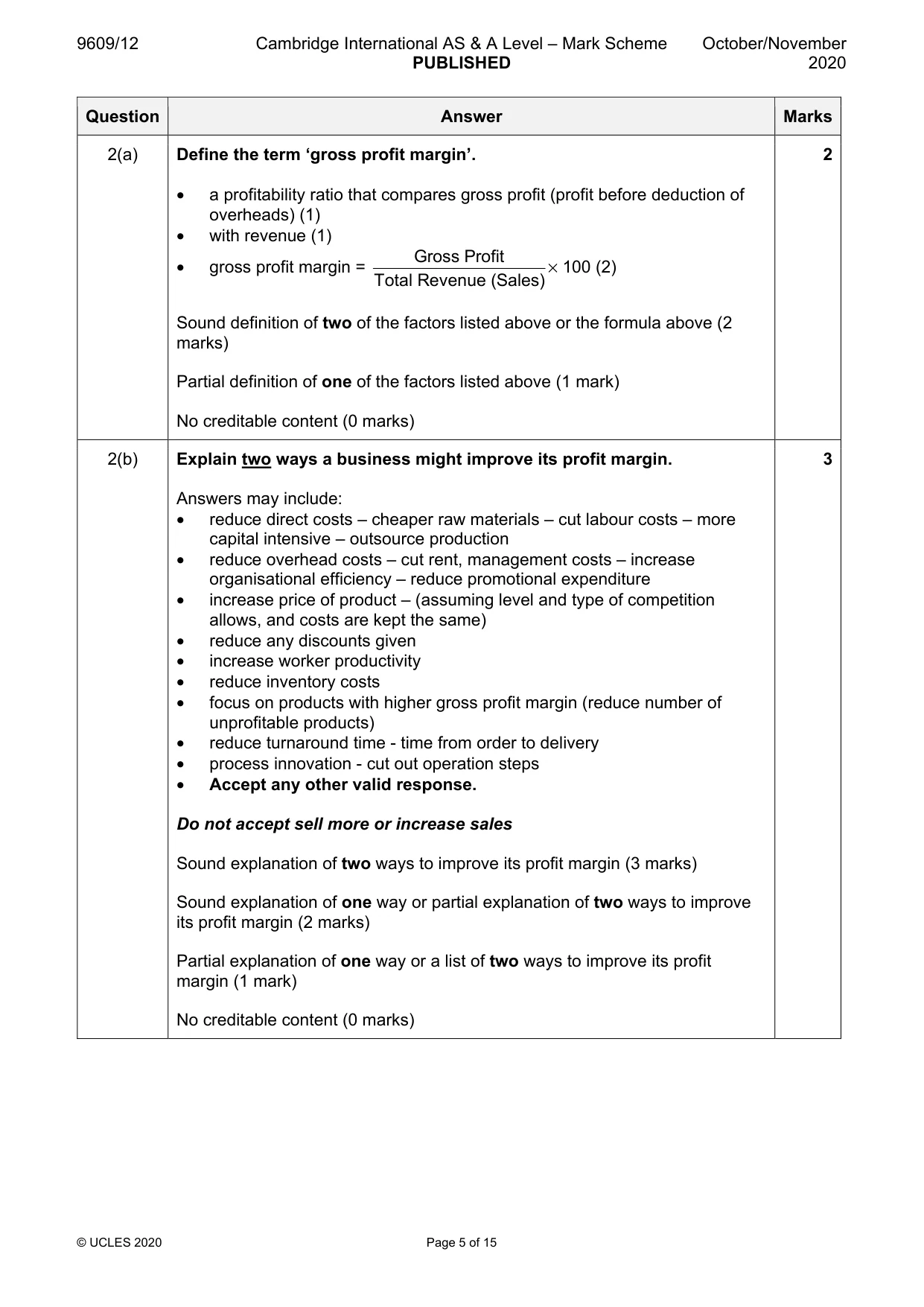
9609/12 Cambridge International AS & A Level – Mark Scheme PUBLISHED October/November 2020 © UCLES 2020 Page 5 of 15 Question Answer Marks 2(a) Define the term ‘gross profit margin’. • a profitability ratio that compares gross profit (profit before deduction of overheads) (1) • with revenue (1) • gross profit margin = Gross Profit Total Revenue (Sales) × 100 (2) Sound definition of two of the factors listed above or the formula above (2 marks) Partial definition of one of the factors listed above (1 mark) No creditable content (0 marks) 2 2(b) Explain two ways a business might improve its profit margin. Answers may include: • reduce direct costs – cheaper raw materials – cut labour costs – more capital intensive – outsource production • reduce overhead costs – cut rent, management costs – increase organisational efficiency – reduce promotional expenditure • increase price of product – (assuming level and type of competition allows, and costs are kept the same) • reduce any discounts given • increase worker productivity • reduce inventory costs • focus on products with higher gross profit margin (reduce number of unprofitable products) • reduce turnaround time - time from order to delivery • process innovation - cut out operation steps • Accept any other valid response. Do not accept sell more or increase sales Sound explanation of two ways to improve its profit margin (3 marks) Sound explanation of one way or partial explanation of two ways to improve its profit margin (2 marks) Partial explanation of one way or a list of two ways to improve its profit margin (1 mark) No creditable content (0 marks) 3
Mark scheme, page 6
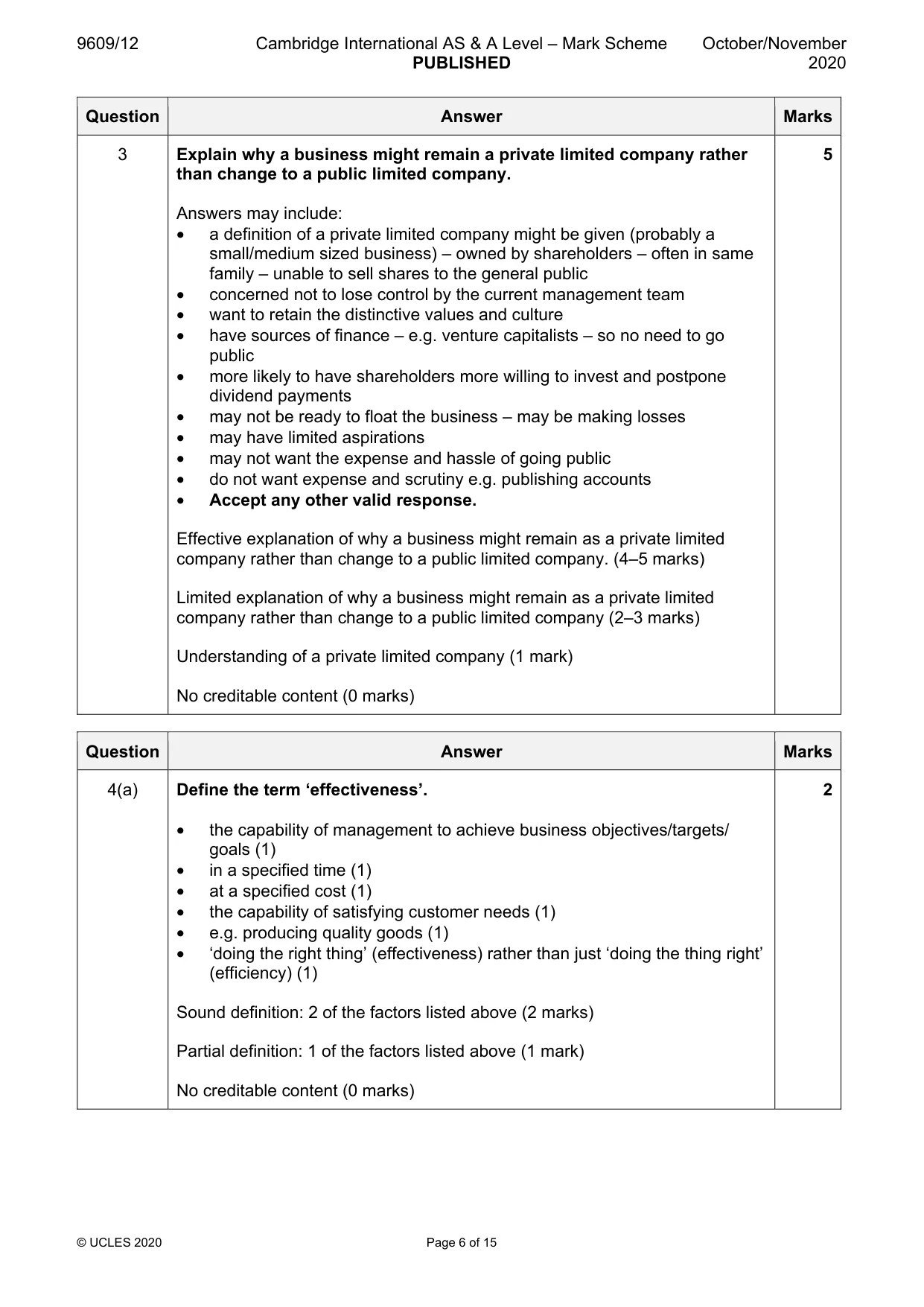
9609/12 Cambridge International AS & A Level – Mark Scheme PUBLISHED October/November 2020 © UCLES 2020 Page 6 of 15 Question Answer Marks 3 Explain why a business might remain a private limited company rather than change to a public limited company. Answers may include: • a definition of a private limited company might be given (probably a small/medium sized business) – owned by shareholders – often in same family – unable to sell shares to the general public • concerned not to lose control by the current management team • want to retain the distinctive values and culture • have sources of finance – e.g. venture capitalists – so no need to go public • more likely to have shareholders more willing to invest and postpone dividend payments • may not be ready to float the business – may be making losses • may have limited aspirations • may not want the expense and hassle of going public • do not want expense and scrutiny e.g. publishing accounts • Accept any other valid response. Effective explanation of why a business might remain as a private limited company rather than change to a public limited company. (4–5 marks) Limited explanation of why a business might remain as a private limited company rather than change to a public limited company (2–3 marks) Understanding of a private limited company (1 mark) No creditable content (0 marks) 5 Question Answer Marks 4(a) Define the term ‘effectiveness’. • the capability of management to achieve business objectives/targets/ goals (1) • in a specified time (1) • at a specified cost (1) • the capability of satisfying customer needs (1) • e.g. producing quality goods (1) • ‘doing the right thing’ (effectiveness) rather than just ‘doing the thing right’ (efficiency) (1) Sound definition: 2 of the factors listed above (2 marks) Partial definition: 1 of the factors listed above (1 mark) No creditable content (0 marks) 2
Mark scheme, page 7
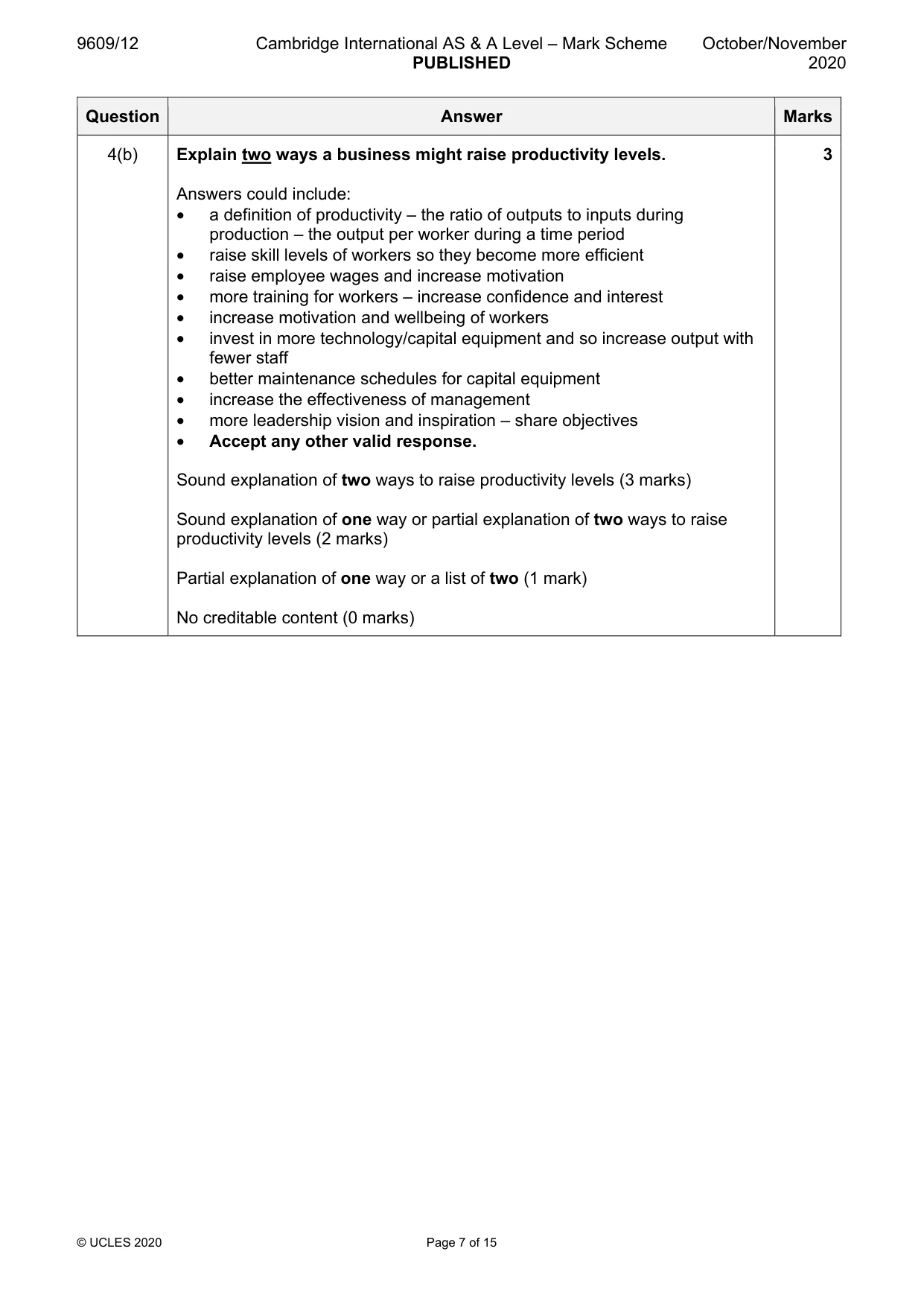
9609/12 Cambridge International AS & A Level – Mark Scheme PUBLISHED October/November 2020 © UCLES 2020 Page 7 of 15 Question Answer Marks 4(b) Explain two ways a business might raise productivity levels. Answers could include: • a definition of productivity – the ratio of outputs to inputs during production – the output per worker during a time period • raise skill levels of workers so they become more efficient • raise employee wages and increase motivation • more training for workers – increase confidence and interest • increase motivation and wellbeing of workers • invest in more technology/capital equipment and so increase output with fewer staff • better maintenance schedules for capital equipment • increase the effectiveness of management • more leadership vision and inspiration – share objectives • Accept any other valid response. Sound explanation of two ways to raise productivity levels (3 marks) Sound explanation of one way or partial explanation of two ways to raise productivity levels (2 marks) Partial explanation of one way or a list of two (1 mark) No creditable content (0 marks) 3
Mark scheme, page 8
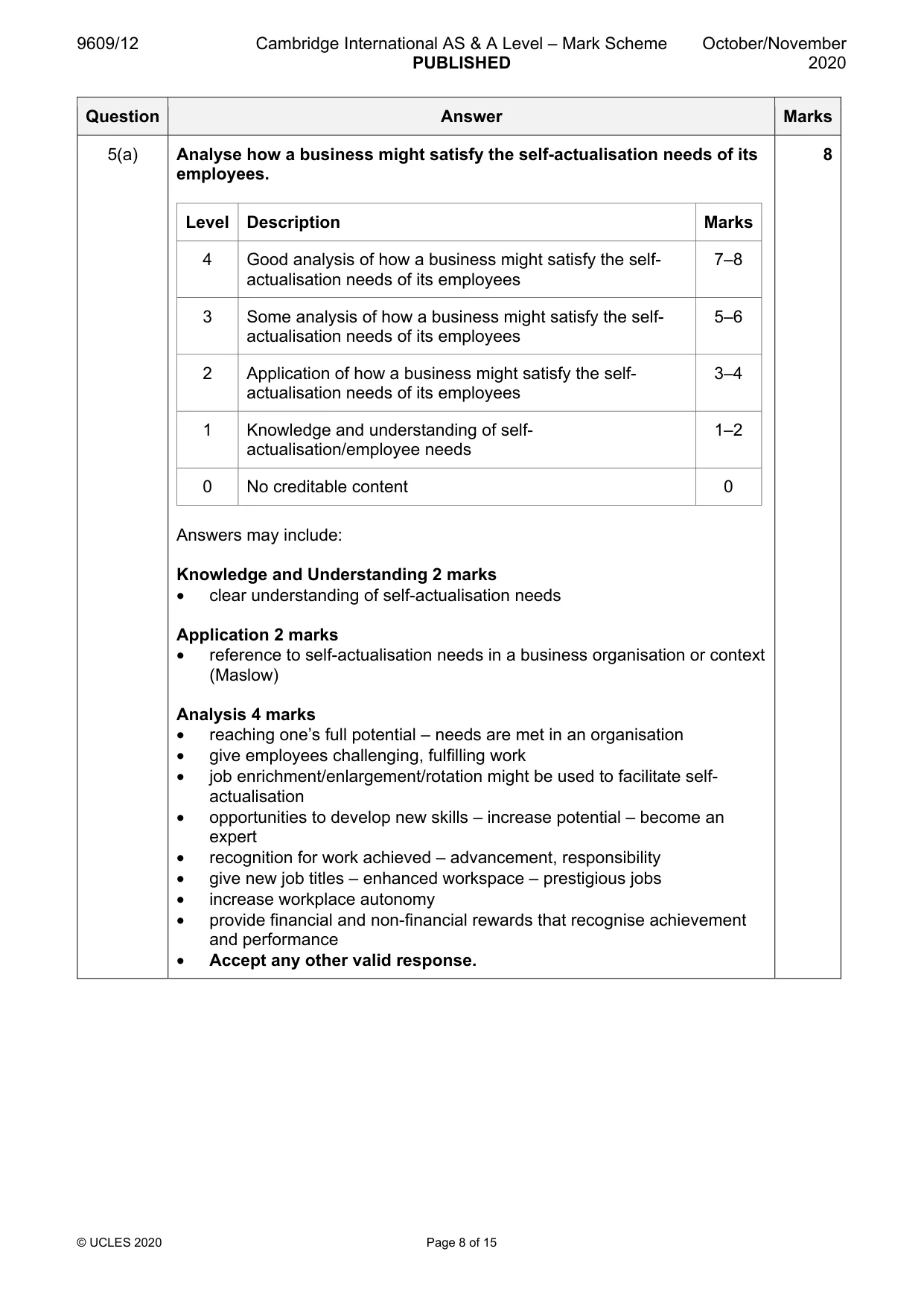
9609/12 Cambridge International AS & A Level – Mark Scheme PUBLISHED October/November 2020 © UCLES 2020 Page 8 of 15 Question Answer Marks 5(a) Analyse how a business might satisfy the self-actualisation needs of its employees. Level Description Marks 4 Good analysis of how a business might satisfy the self- actualisation needs of its employees 7–8 3 Some analysis of how a business might satisfy the self- actualisation needs of its employees 5–6 2 Application of how a business might satisfy the self- actualisation needs of its employees 3–4 1 Knowledge and understanding of self- actualisation/employee needs 1–2 0 No creditable content 0 Answers may include: Knowledge and Understanding 2 marks • clear understanding of self-actualisation needs Application 2 marks • reference to self-actualisation needs in a business organisation or context (Maslow) Analysis 4 marks • reaching one’s full potential – needs are met in an organisation • give employees challenging, fulfilling work • job enrichment/enlargement/rotation might be used to facilitate self- actualisation • opportunities to develop new skills – increase potential – become an expert • recognition for work achieved – advancement, responsibility • give new job titles – enhanced workspace – prestigious jobs • increase workplace autonomy • provide financial and non-financial rewards that recognise achievement and performance • Accept any other valid response. 8
Mark scheme, page 9
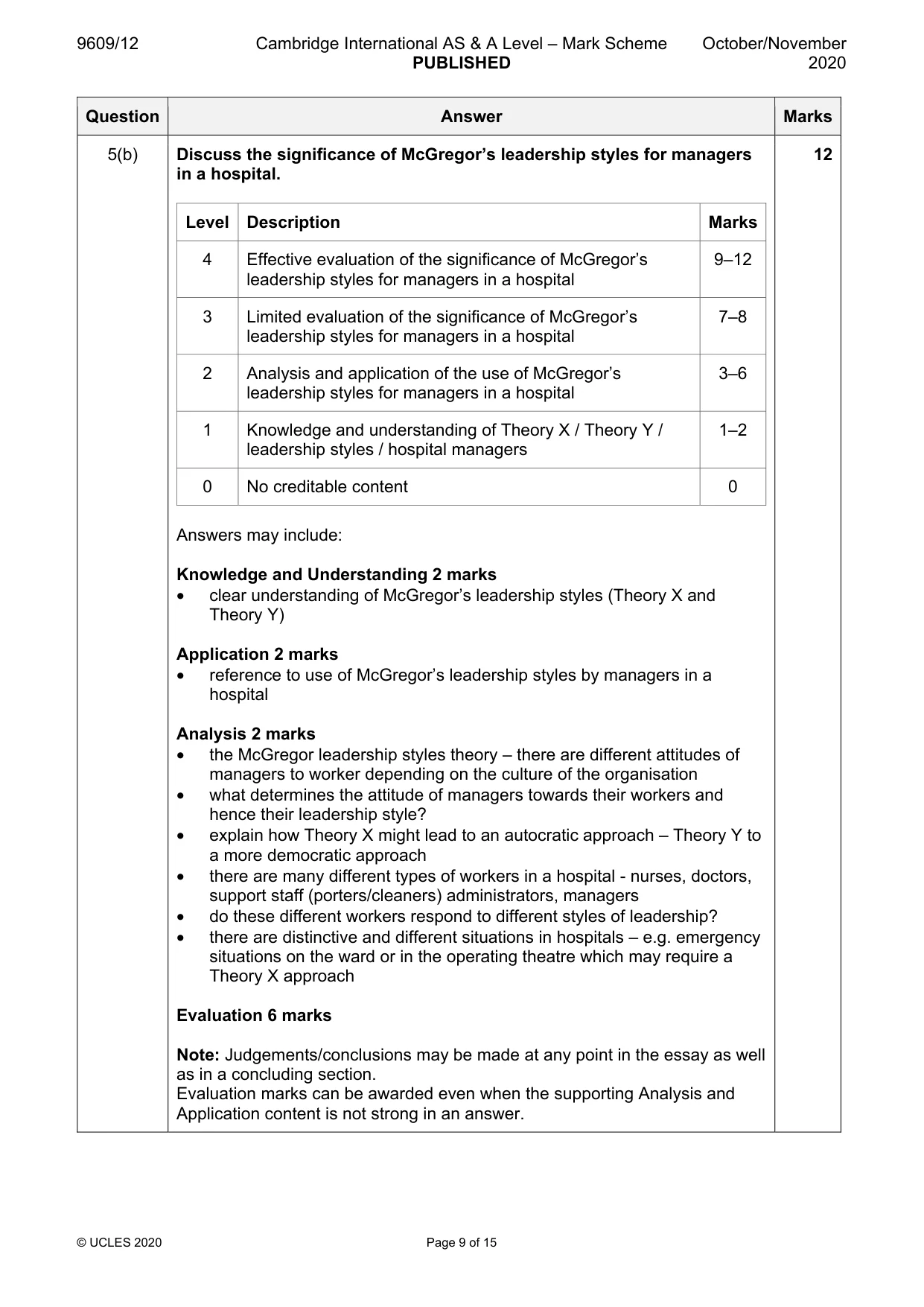
9609/12 Cambridge International AS & A Level – Mark Scheme PUBLISHED October/November 2020 © UCLES 2020 Page 9 of 15 Question Answer Marks 5(b) Discuss the significance of McGregor’s leadership styles for managers in a hospital. Level Description Marks 4 Effective evaluation of the significance of McGregor’s leadership styles for managers in a hospital 9–12 3 Limited evaluation of the significance of McGregor’s leadership styles for managers in a hospital 7–8 2 Analysis and application of the use of McGregor’s leadership styles for managers in a hospital 3–6 1 Knowledge and understanding of Theory X / Theory Y / leadership styles / hospital managers 1–2 0 No creditable content 0 Answers may include: Knowledge and Understanding 2 marks • clear understanding of McGregor’s leadership styles (Theory X and Theory Y) Application 2 marks • reference to use of McGregor’s leadership styles by managers in a hospital Analysis 2 marks • the McGregor leadership styles theory – there are different attitudes of managers to worker depending on the culture of the organisation • what determines the attitude of managers towards their workers and hence their leadership style? • explain how Theory X might lead to an autocratic approach – Theory Y to a more democratic approach • there are many different types of workers in a hospital - nurses, doctors, support staff (porters/cleaners) administrators, managers • do these different workers respond to different styles of leadership? • there are distinctive and different situations in hospitals – e.g. emergency situations on the ward or in the operating theatre which may require a Theory X approach Evaluation 6 marks Note: Judgements/conclusions may be made at any point in the essay as well as in a concluding section. Evaluation marks can be awarded even when the supporting Analysis and Application content is not strong in an answer. 12
Mark scheme, page 10
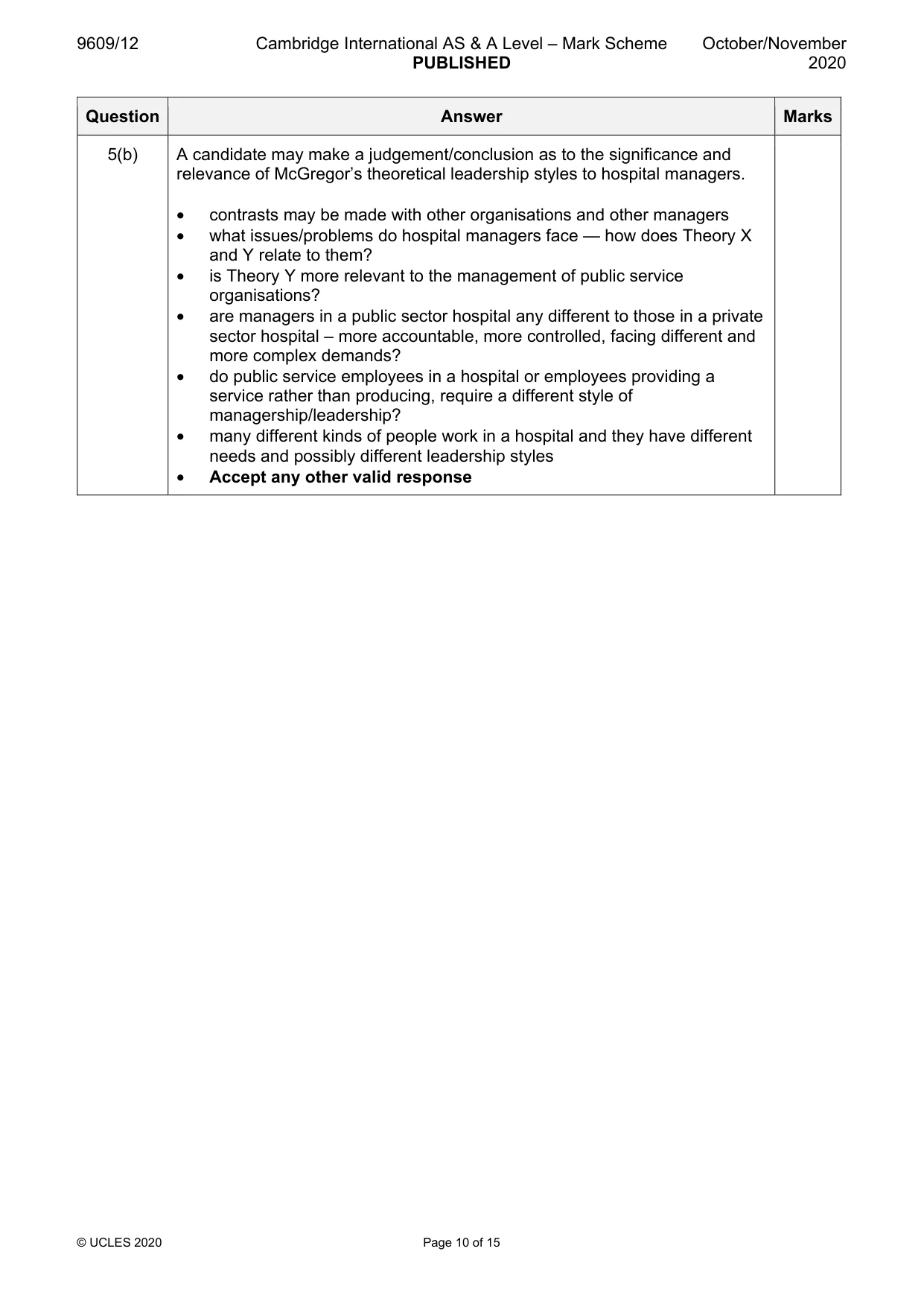
9609/12 Cambridge International AS & A Level – Mark Scheme PUBLISHED October/November 2020 © UCLES 2020 Page 10 of 15 Question Answer Marks 5(b) A candidate may make a judgement/conclusion as to the significance and relevance of McGregor’s theoretical leadership styles to hospital managers. • contrasts may be made with other organisations and other managers • what issues/problems do hospital managers face — how does Theory X and Y relate to them? • is Theory Y more relevant to the management of public service organisations? • are managers in a public sector hospital any different to those in a private sector hospital – more accountable, more controlled, facing different and more complex demands? • do public service employees in a hospital or employees providing a service rather than producing, require a different style of managership/leadership? • many different kinds of people work in a hospital and they have different needs and possibly different leadership styles • Accept any other valid response
Mark scheme, page 11
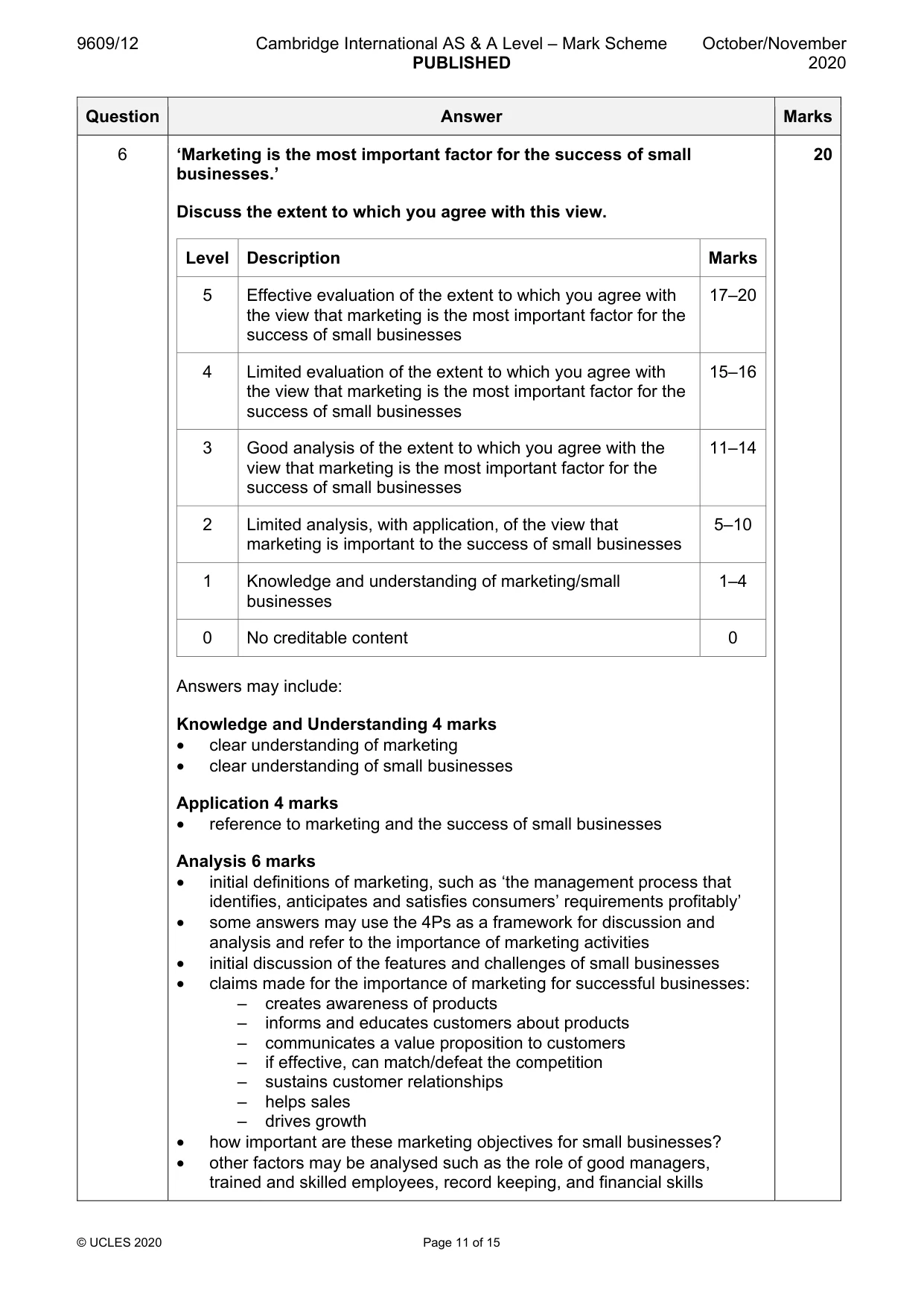
9609/12 Cambridge International AS & A Level – Mark Scheme PUBLISHED October/November 2020 © UCLES 2020 Page 11 of 15 Question Answer Marks 6 ‘Marketing is the most important factor for the success of small businesses.’ Discuss the extent to which you agree with this view. Level Description Marks 5 Effective evaluation of the extent to which you agree with the view that marketing is the most important factor for the success of small businesses 17–20 4 Limited evaluation of the extent to which you agree with the view that marketing is the most important factor for the success of small businesses 15–16 3 Good analysis of the extent to which you agree with the view that marketing is the most important factor for the success of small businesses 11–14 2 Limited analysis, with application, of the view that marketing is important to the success of small businesses 5–10 1 Knowledge and understanding of marketing/small businesses 1–4 0 No creditable content 0 Answers may include: Knowledge and Understanding 4 marks • clear understanding of marketing • clear understanding of small businesses Application 4 marks • reference to marketing and the success of small businesses Analysis 6 marks • initial definitions of marketing, such as ‘the management process that identifies, anticipates and satisfies consumers’ requirements profitably’ • some answers may use the 4Ps as a framework for discussion and analysis and refer to the importance of marketing activities • initial discussion of the features and challenges of small businesses • claims made for the importance of marketing for successful businesses: – creates awareness of products – informs and educates customers about products – communicates a value proposition to customers – if effective, can match/defeat the competition – sustains customer relationships – helps sales – drives growth • how important are these marketing objectives for small businesses? • other factors may be analysed such as the role of good managers, trained and skilled employees, record keeping, and financial skills 20
Mark scheme, page 12
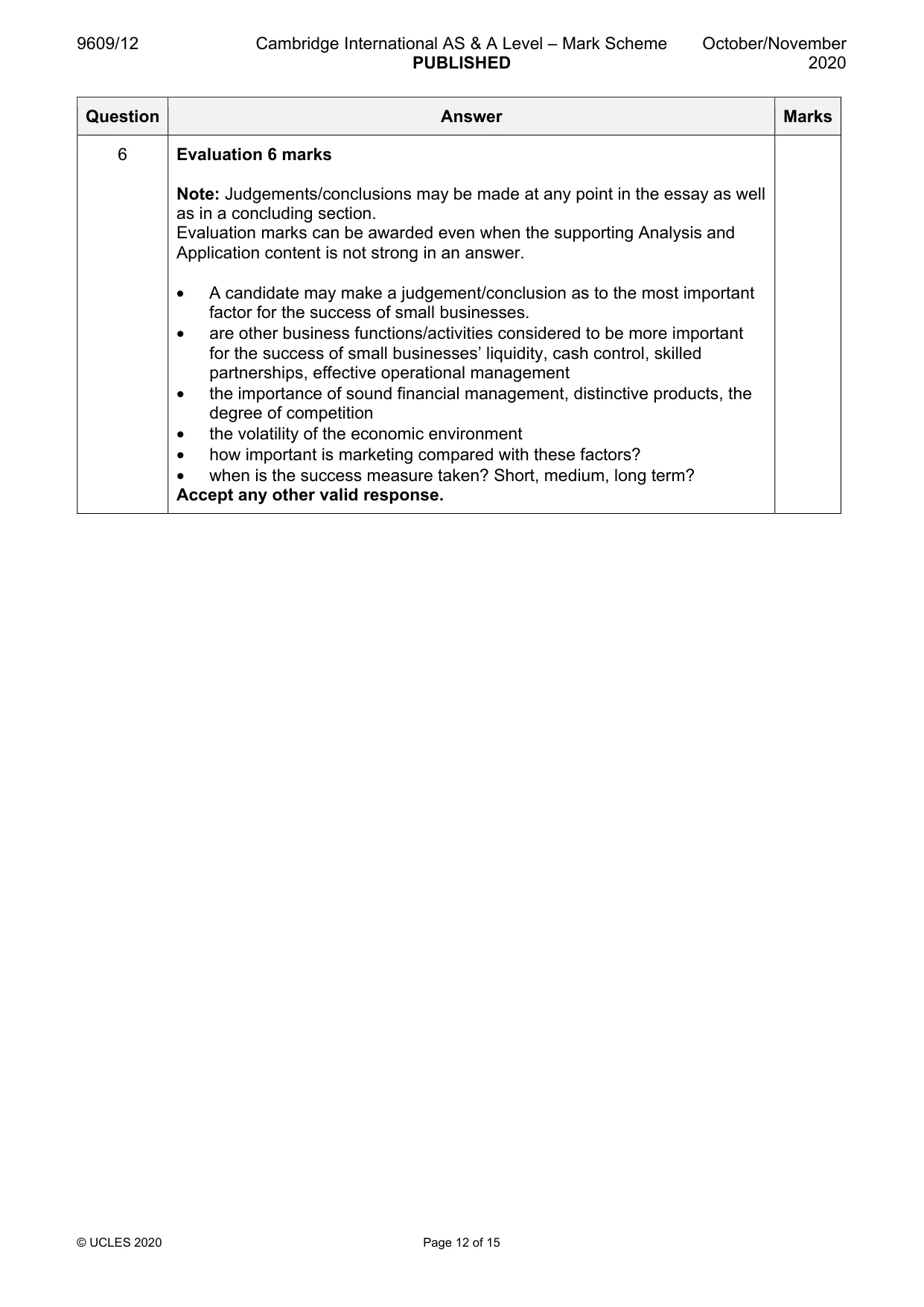
9609/12 Cambridge International AS & A Level – Mark Scheme PUBLISHED October/November 2020 © UCLES 2020 Page 12 of 15 Question Answer Marks 6 Evaluation 6 marks Note: Judgements/conclusions may be made at any point in the essay as well as in a concluding section. Evaluation marks can be awarded even when the supporting Analysis and Application content is not strong in an answer. • A candidate may make a judgement/conclusion as to the most important factor for the success of small businesses. • are other business functions/activities considered to be more important for the success of small businesses’ liquidity, cash control, skilled partnerships, effective operational management • the importance of sound financial management, distinctive products, the degree of competition • the volatility of the economic environment • how important is marketing compared with these factors? • when is the success measure taken? Short, medium, long term? Accept any other valid response.
Mark scheme, page 13
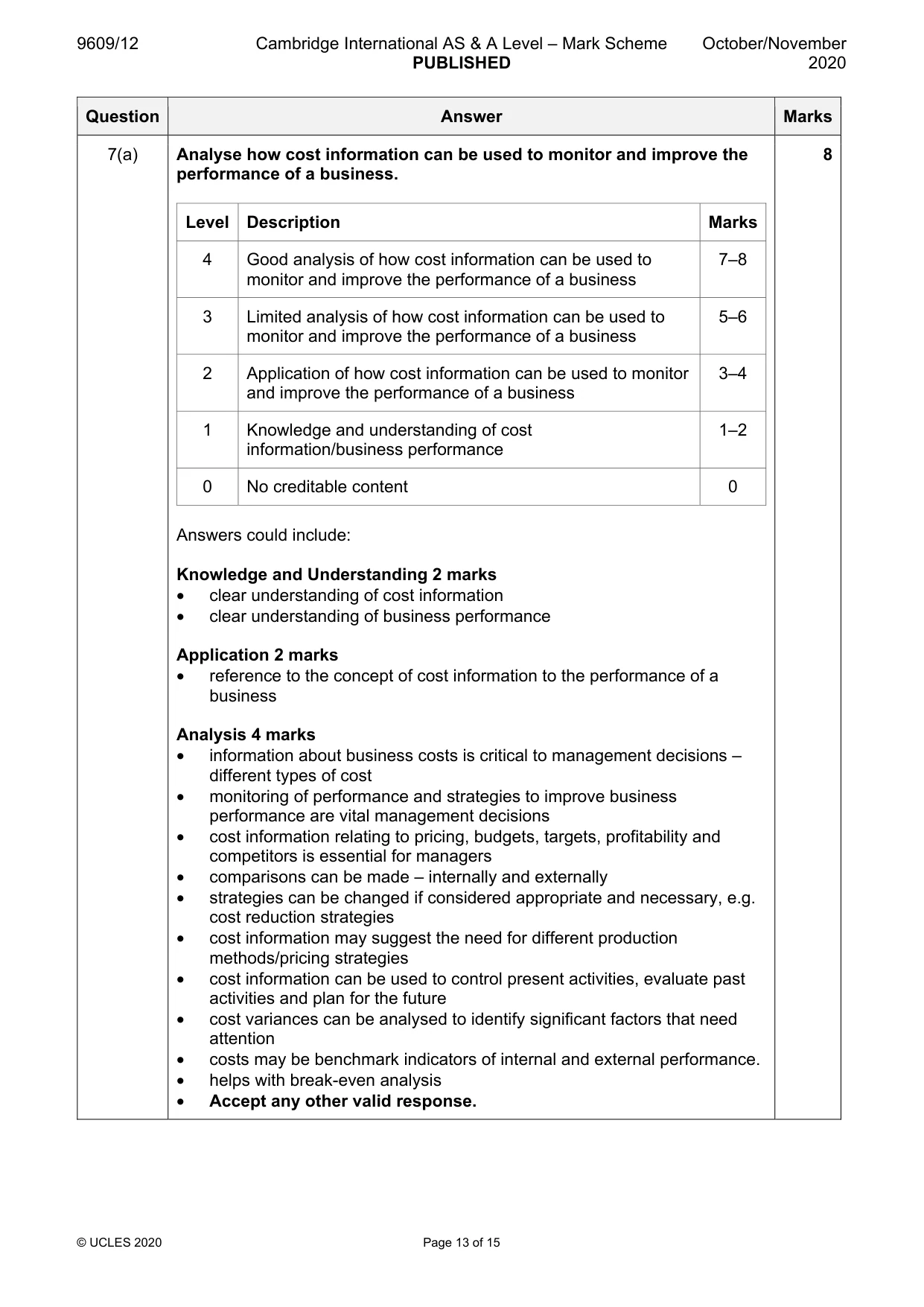
9609/12 Cambridge International AS & A Level – Mark Scheme PUBLISHED October/November 2020 © UCLES 2020 Page 13 of 15 Question Answer Marks 7(a) Analyse how cost information can be used to monitor and improve the performance of a business. Level Description Marks 4 Good analysis of how cost information can be used to monitor and improve the performance of a business 7–8 3 Limited analysis of how cost information can be used to monitor and improve the performance of a business 5–6 2 Application of how cost information can be used to monitor and improve the performance of a business 3–4 1 Knowledge and understanding of cost information/business performance 1–2 0 No creditable content 0 Answers could include: Knowledge and Understanding 2 marks • clear understanding of cost information • clear understanding of business performance Application 2 marks • reference to the concept of cost information to the performance of a business Analysis 4 marks • information about business costs is critical to management decisions – different types of cost • monitoring of performance and strategies to improve business performance are vital management decisions • cost information relating to pricing, budgets, targets, profitability and competitors is essential for managers • comparisons can be made – internally and externally • strategies can be changed if considered appropriate and necessary, e.g. cost reduction strategies • cost information may suggest the need for different production methods/pricing strategies • cost information can be used to control present activities, evaluate past activities and plan for the future • cost variances can be analysed to identify significant factors that need attention • costs may be benchmark indicators of internal and external performance. • helps with break-even analysis • Accept any other valid response. 8
Mark scheme, page 14
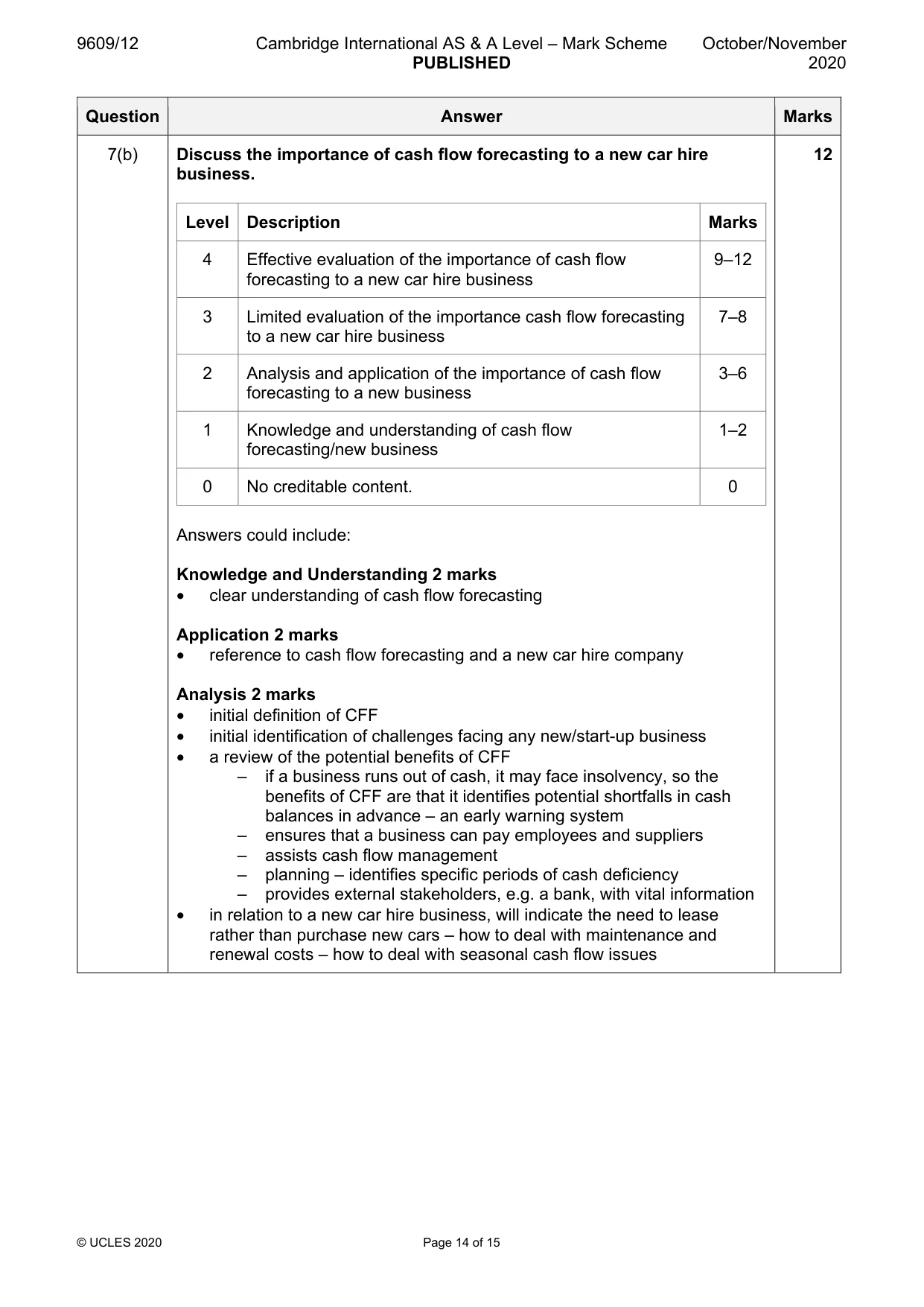
9609/12 Cambridge International AS & A Level – Mark Scheme PUBLISHED October/November 2020 © UCLES 2020 Page 14 of 15 Question Answer Marks 7(b) Discuss the importance of cash flow forecasting to a new car hire business. Level Description Marks 4 Effective evaluation of the importance of cash flow forecasting to a new car hire business 9–12 3 Limited evaluation of the importance cash flow forecasting to a new car hire business 7–8 2 Analysis and application of the importance of cash flow forecasting to a new business 3–6 1 Knowledge and understanding of cash flow forecasting/new business 1–2 0 No creditable content. 0 Answers could include: Knowledge and Understanding 2 marks • clear understanding of cash flow forecasting Application 2 marks • reference to cash flow forecasting and a new car hire company Analysis 2 marks • initial definition of CFF • initial identification of challenges facing any new/start-up business • a review of the potential benefits of CFF – if a business runs out of cash, it may face insolvency, so the benefits of CFF are that it identifies potential shortfalls in cash balances in advance – an early warning system – ensures that a business can pay employees and suppliers – assists cash flow management – planning – identifies specific periods of cash deficiency – provides external stakeholders, e.g. a bank, with vital information • in relation to a new car hire business, will indicate the need to lease rather than purchase new cars – how to deal with maintenance and renewal costs – how to deal with seasonal cash flow issues 12
Mark scheme, page 15
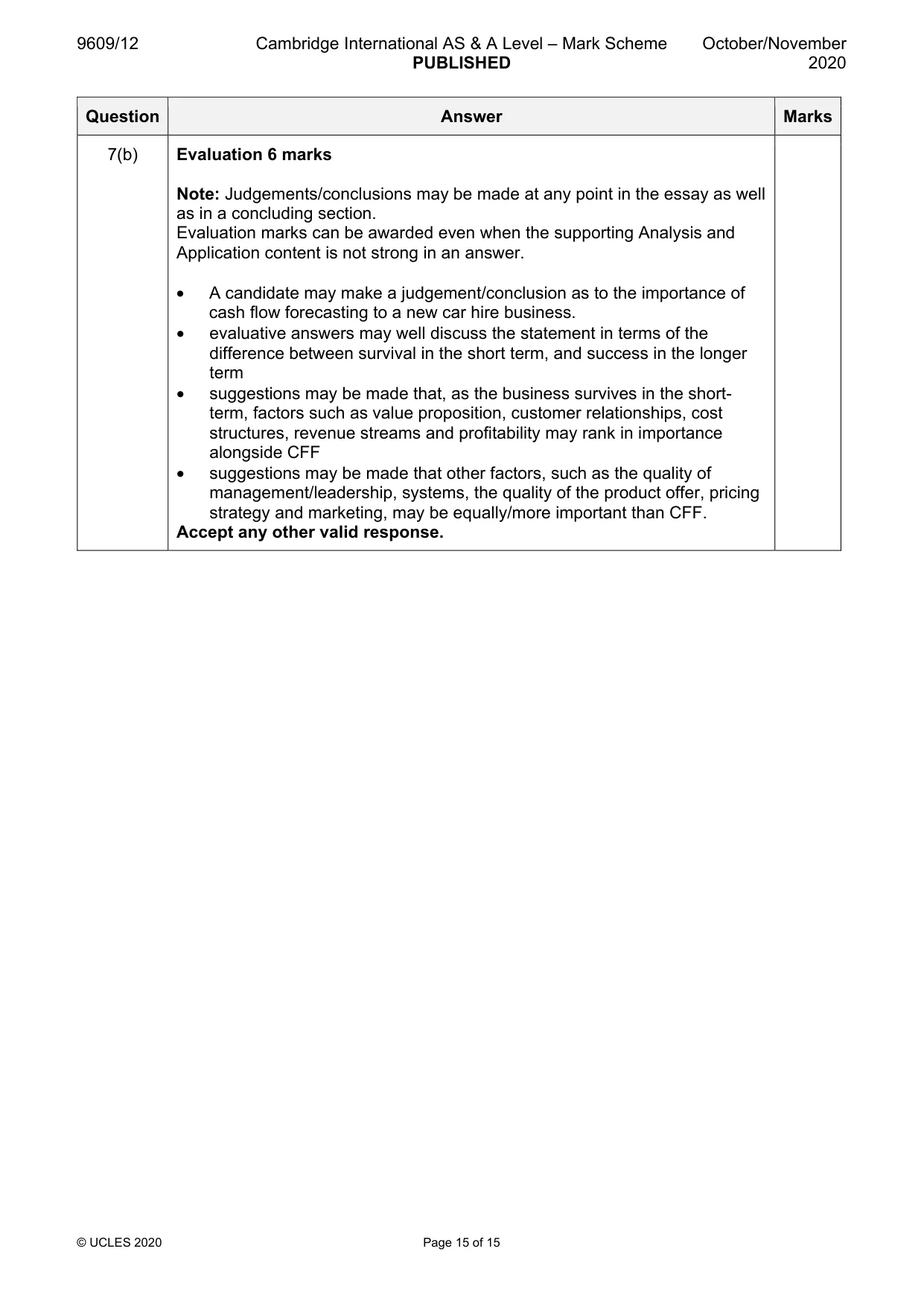
9609/12 Cambridge International AS & A Level – Mark Scheme PUBLISHED October/November 2020 © UCLES 2020 Page 15 of 15 Question Answer Marks 7(b) Evaluation 6 marks Note: Judgements/conclusions may be made at any point in the essay as well as in a concluding section. Evaluation marks can be awarded even when the supporting Analysis and Application content is not strong in an answer. • A candidate may make a judgement/conclusion as to the importance of cash flow forecasting to a new car hire business. • evaluative answers may well discuss the statement in terms of the difference between survival in the short term, and success in the longer term • suggestions may be made that, as the business survives in the short- term, factors such as value proposition, customer relationships, cost structures, revenue streams and profitability may rank in importance alongside CFF • suggestions may be made that other factors, such as the quality of management/leadership, systems, the quality of the product offer, pricing strategy and marketing, may be equally/more important than CFF. Accept any other valid response.
What you needed in this session
Cambridge’s own grade thresholds for 2020 Oct/Nov, Paper 1 · Variant 2. A higher threshold means an easier paper — the bar moves with how the cohort did.