Cambridge A Level Business (for first examination in 2016) 9609 — 2020 Oct/Nov Paper 1 · Variant 1
9609/11/O/N/20 · 40 marks · ≈45 min
The question paper and its mark scheme, free to read here and free to download. This is Cambridge’s own paper, exactly as it was sat.
Question paper4 pages


Mark scheme16 pages
Answers below. Sit the paper first if you are practising.
Paper as text
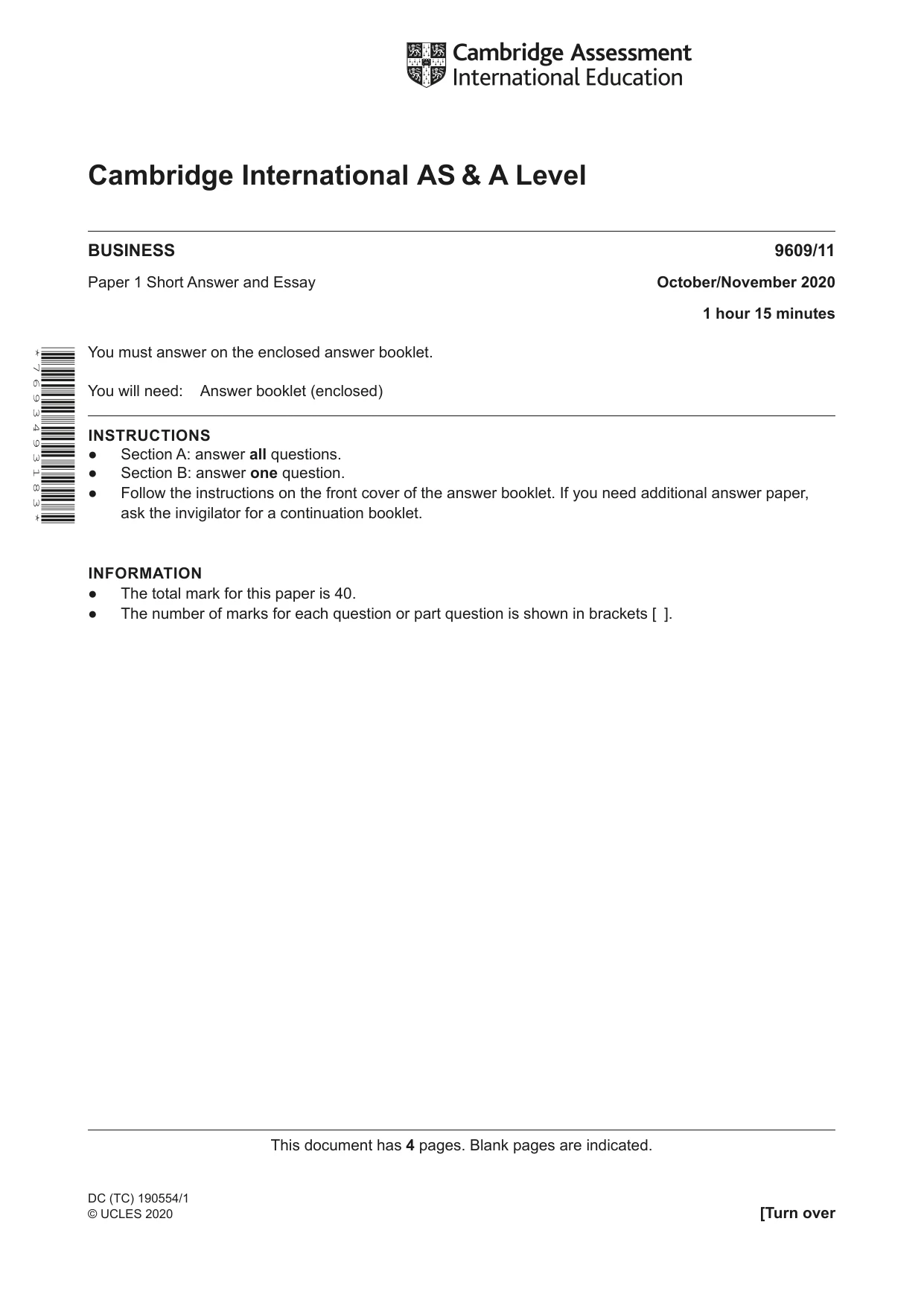
Question paper, page 1
Cambridge International AS & A Level This document has 4 pages. Blank pages are indicated. DC (TC) 190554/1 © UCLES 2020 [Turn over * 7 6 9 3 4 9 3 1 8 3 * BUSINESS 9609/11 Paper 1 Short Answer and Essay October/November 2020 1 hour 15 minutes You must answer on the enclosed answer booklet. You will need: Answer booklet (enclosed) INSTRUCTIONS ● Section A: answer all questions. ● Section B: answer one question. ● Follow the instructions on the front cover of the answer booklet. If you need additional answer paper, ask the invigilator for a continuation booklet. INFORMATION ● The total mark for this paper is 40. ● The number of marks for each question or part question is shown in brackets [ ].
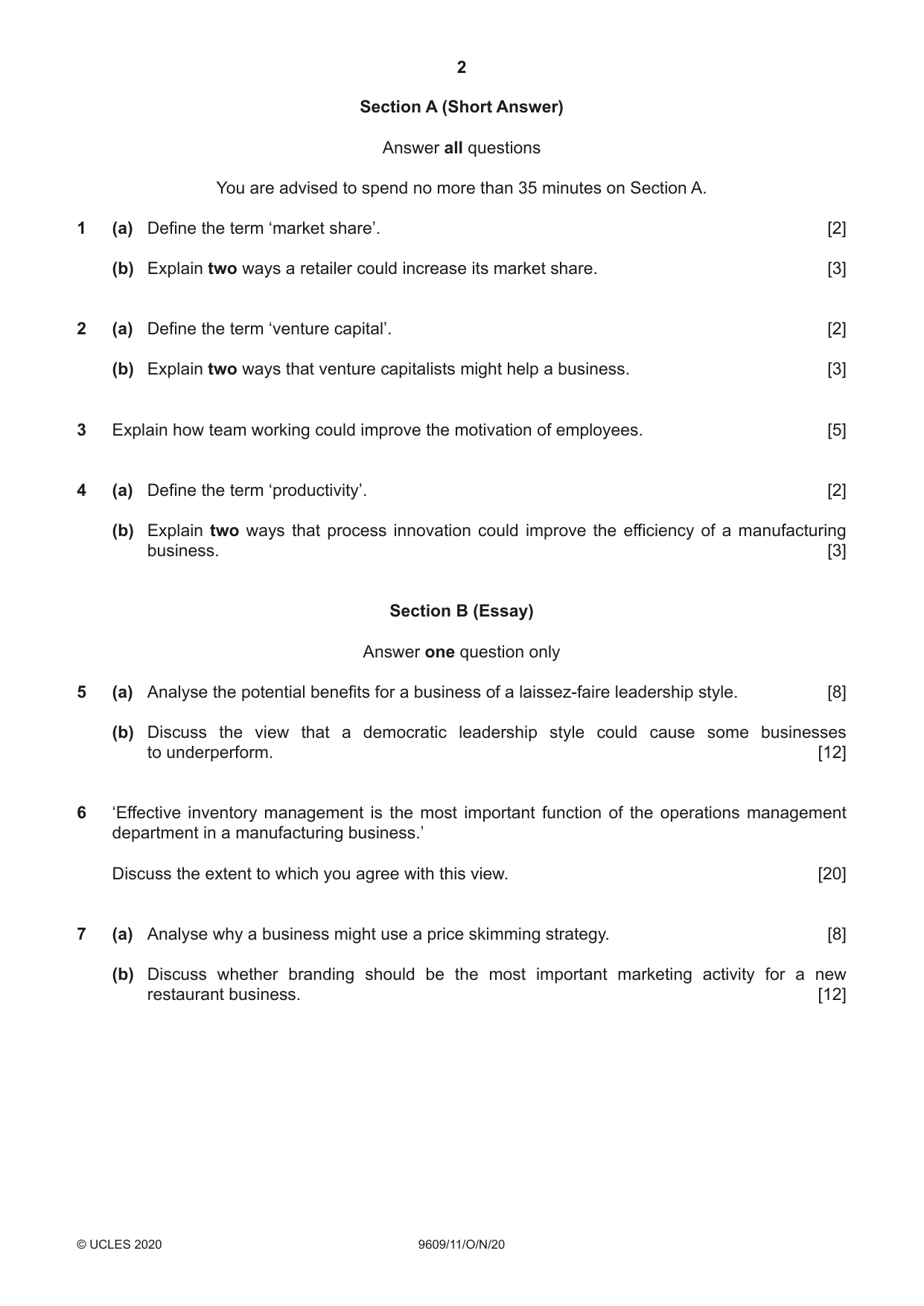
Question paper, page 2
2 9609/11/O/N/20 © UCLES 2020 Section A (Short Answer) Answer all questions You are advised to spend no more than 35 minutes on Section A. 1 (a) Define the term ‘market share’. [2] (b) Explain two ways a retailer could increase its market share. [3] 2 (a) Define the term ‘venture capital’. [2] (b) Explain two ways that venture capitalists might help a business. [3] 3 Explain how team working could improve the motivation of employees. [5] 4 (a) Define the term ‘productivity’. [2] (b) Explain two ways that process innovation could improve the efficiency of a manufacturing business. [3] Section B (Essay) Answer one question only 5 (a) Analyse the potential benefits for a business of a laissez-faire leadership style. [8] (b) Discuss the view that a democratic leadership style could cause some businesses to underperform. [12] 6 ‘Effective inventory management is the most important function of the operations management department in a manufacturing business.’ Discuss the extent to which you agree with this view. [20] 7 (a) Analyse why a business might use a price skimming strategy. [8] (b) Discuss whether branding should be the most important marketing activity for a new restaurant business. [12]
Question paper, page 3
3 9609/11/O/N/20 © UCLES 2020 BLANK PAGE
Question paper, page 4
4 9609/11/O/N/20 © UCLES 2020 Permission to reproduce items where third-party owned material protected by copyright is included has been sought and cleared where possible. Every reasonable effort has been made by the publisher (UCLES) to trace copyright holders, but if any items requiring clearance have unwittingly been included, the publisher will be pleased to make amends at the earliest possible opportunity. To avoid the issue of disclosure of answer-related information to candidates, all copyright acknowledgements are reproduced online in the Cambridge Assessment International Education Copyright Acknowledgements Booklet. This is produced for each series of examinations and is freely available to download at www.cambridgeinternational.org after the live examination series. Cambridge Assessment International Education is part of the Cambridge Assessment Group. Cambridge Assessment is the brand name of the University of Cambridge Local Examinations Syndicate (UCLES), which itself is a department of the University of Cambridge. BLANK PAGE
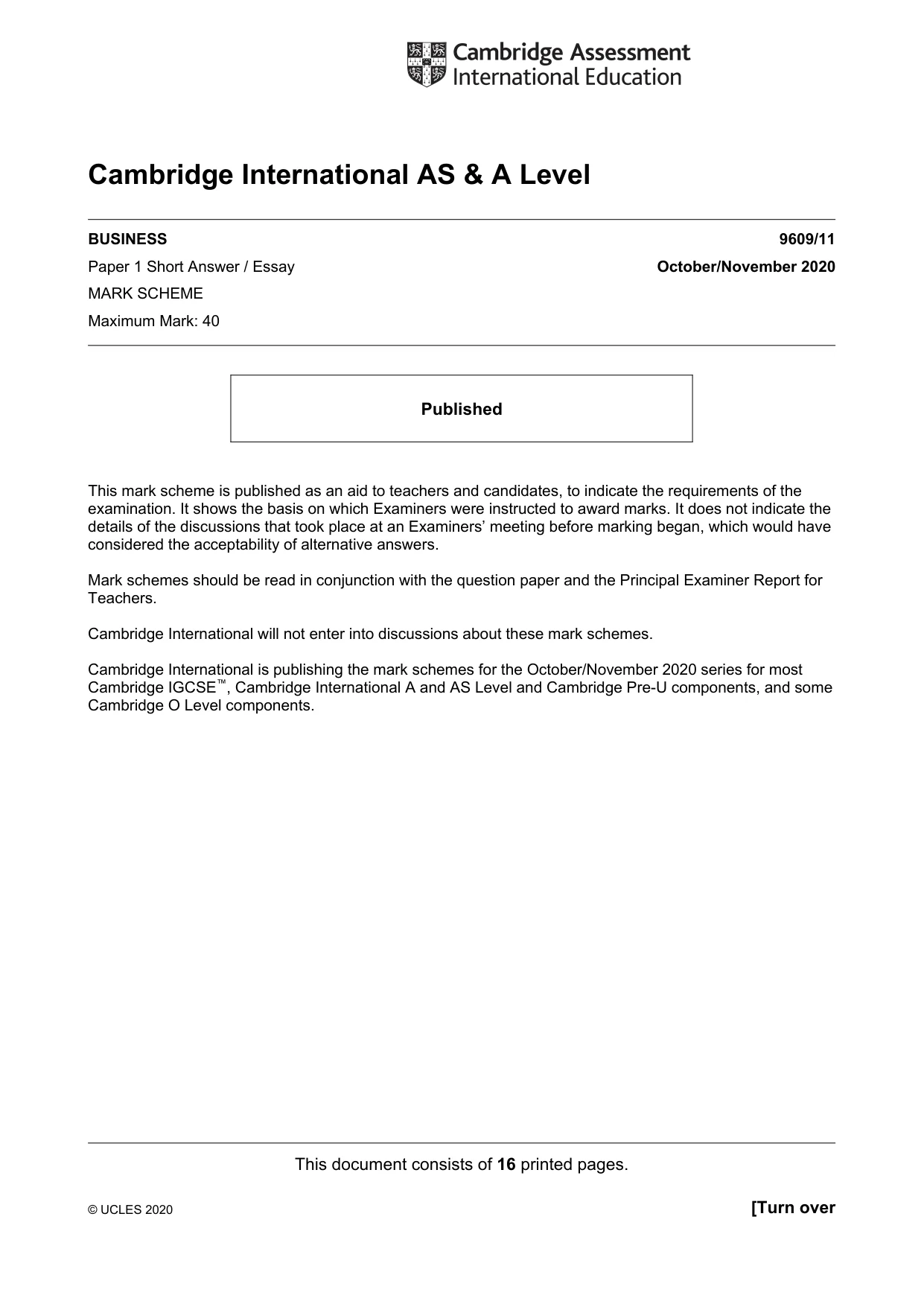
Mark scheme, page 1
This document consists of 16 printed pages. © UCLES 2020 [Turn over Cambridge International AS & A Level BUSINESS 9609/11 Paper 1 Short Answer / Essay October/November 2020 MARK SCHEME Maximum Mark: 40 Published This mark scheme is published as an aid to teachers and candidates, to indicate the requirements of the examination. It shows the basis on which Examiners were instructed to award marks. It does not indicate the details of the discussions that took place at an Examiners’ meeting before marking began, which would have considered the acceptability of alternative answers. Mark schemes should be read in conjunction with the question paper and the Principal Examiner Report for Teachers. Cambridge International will not enter into discussions about these mark schemes. Cambridge International is publishing the mark schemes for the October/November 2020 series for most Cambridge IGCSE™, Cambridge International A and AS Level and Cambridge Pre-U components, and some Cambridge O Level components.
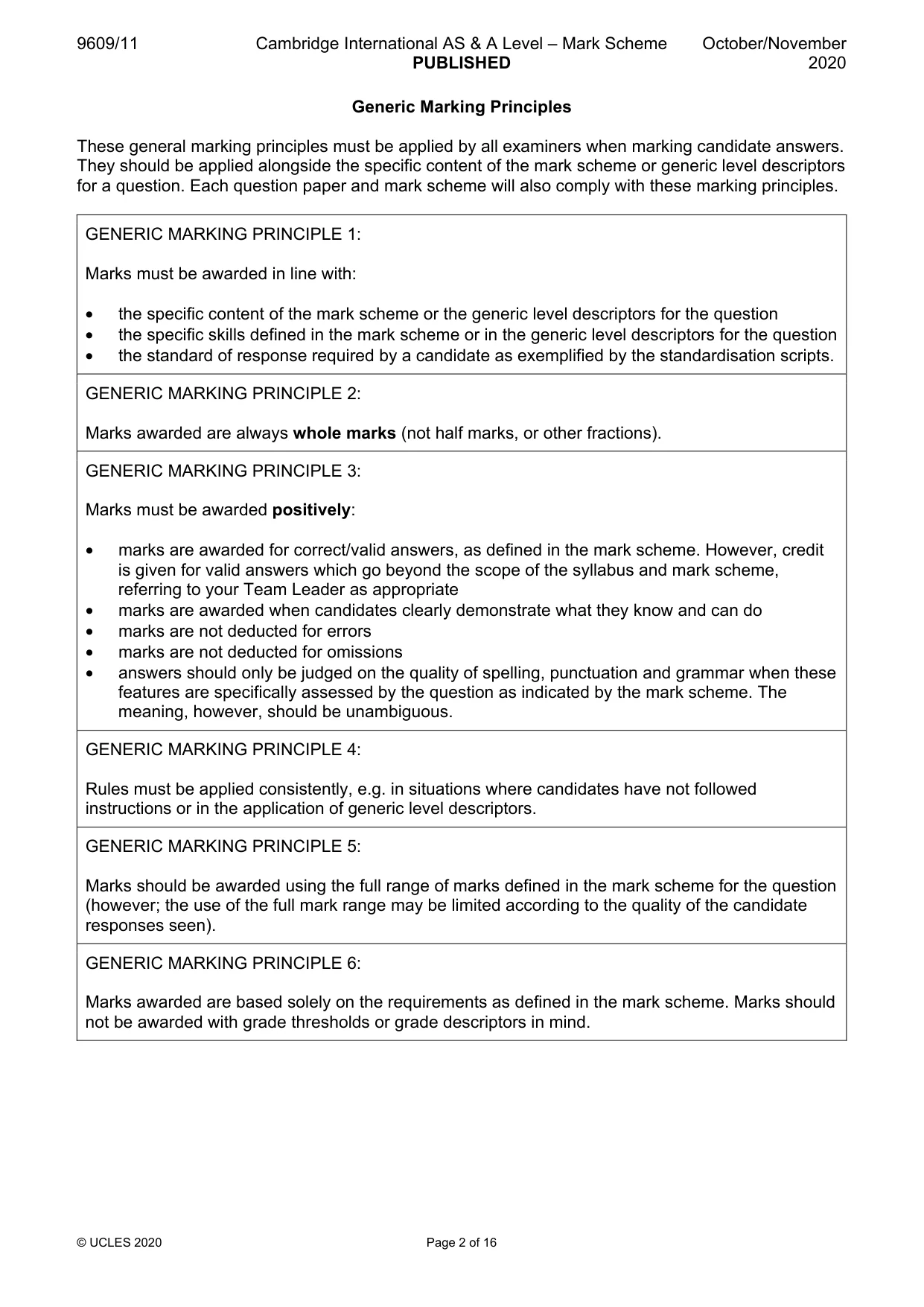
Mark scheme, page 2
9609/11 Cambridge International AS & A Level – Mark Scheme PUBLISHED October/November 2020 © UCLES 2020 Page 2 of 16 Generic Marking Principles These general marking principles must be applied by all examiners when marking candidate answers. They should be applied alongside the specific content of the mark scheme or generic level descriptors for a question. Each question paper and mark scheme will also comply with these marking principles. GENERIC MARKING PRINCIPLE 1: Marks must be awarded in line with: • the specific content of the mark scheme or the generic level descriptors for the question • the specific skills defined in the mark scheme or in the generic level descriptors for the question • the standard of response required by a candidate as exemplified by the standardisation scripts. GENERIC MARKING PRINCIPLE 2: Marks awarded are always whole marks (not half marks, or other fractions). GENERIC MARKING PRINCIPLE 3: Marks must be awarded positively: • marks are awarded for correct/valid answers, as defined in the mark scheme. However, credit is given for valid answers which go beyond the scope of the syllabus and mark scheme, referring to your Team Leader as appropriate • marks are awarded when candidates clearly demonstrate what they know and can do • marks are not deducted for errors • marks are not deducted for omissions • answers should only be judged on the quality of spelling, punctuation and grammar when these features are specifically assessed by the question as indicated by the mark scheme. The meaning, however, should be unambiguous. GENERIC MARKING PRINCIPLE 4: Rules must be applied consistently, e.g. in situations where candidates have not followed instructions or in the application of generic level descriptors. GENERIC MARKING PRINCIPLE 5: Marks should be awarded using the full range of marks defined in the mark scheme for the question (however; the use of the full mark range may be limited according to the quality of the candidate responses seen). GENERIC MARKING PRINCIPLE 6: Marks awarded are based solely on the requirements as defined in the mark scheme. Marks should not be awarded with grade thresholds or grade descriptors in mind.
Mark scheme, page 3
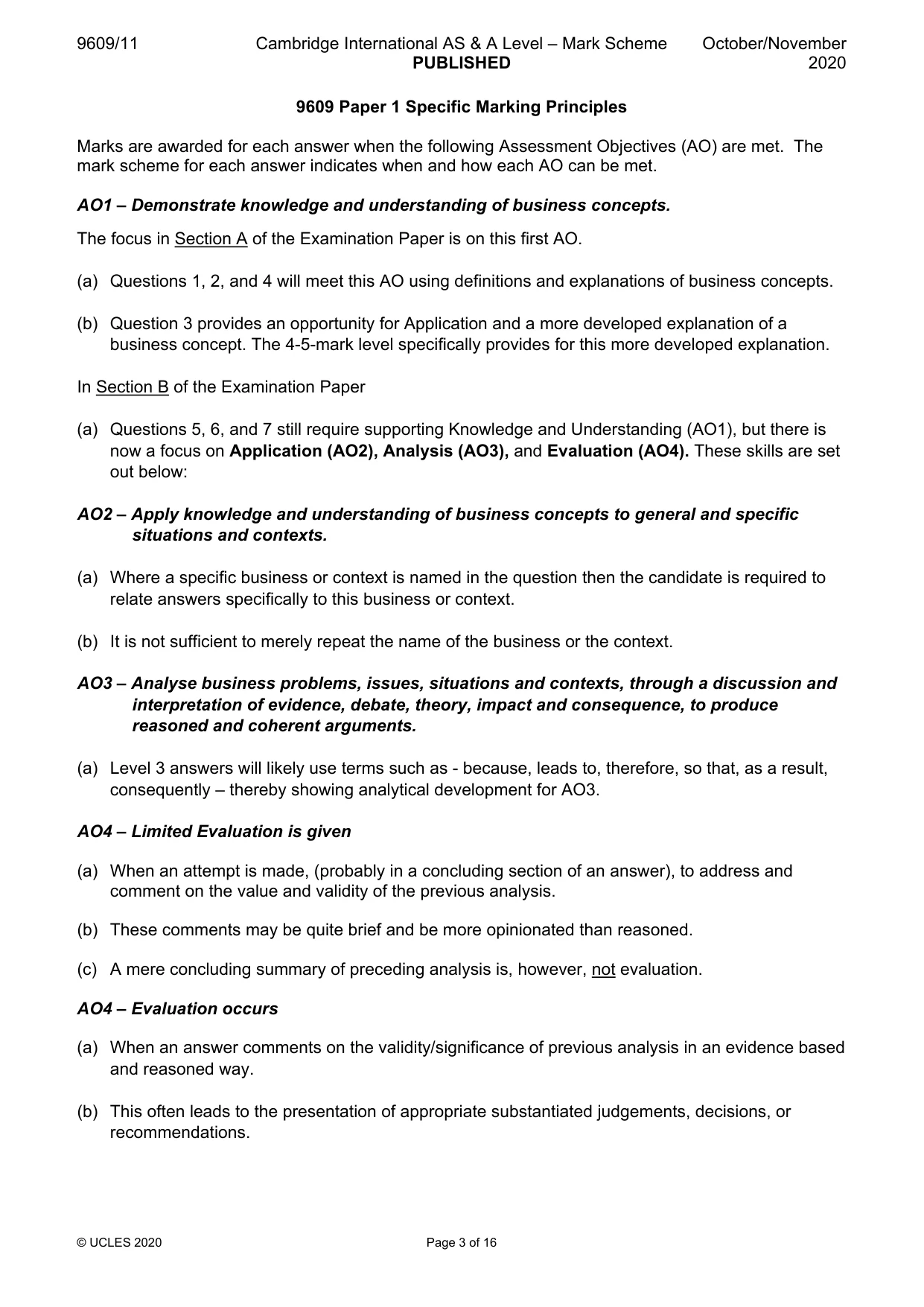
9609/11 Cambridge International AS & A Level – Mark Scheme PUBLISHED October/November 2020 © UCLES 2020 Page 3 of 16 9609 Paper 1 Specific Marking Principles Marks are awarded for each answer when the following Assessment Objectives (AO) are met. The mark scheme for each answer indicates when and how each AO can be met. AO1 – Demonstrate knowledge and understanding of business concepts. The focus in Section A of the Examination Paper is on this first AO. (a) Questions 1, 2, and 4 will meet this AO using definitions and explanations of business concepts. (b) Question 3 provides an opportunity for Application and a more developed explanation of a business concept. The 4-5-mark level specifically provides for this more developed explanation. In Section B of the Examination Paper (a) Questions 5, 6, and 7 still require supporting Knowledge and Understanding (AO1), but there is now a focus on Application (AO2), Analysis (AO3), and Evaluation (AO4). These skills are set out below: AO2 – Apply knowledge and understanding of business concepts to general and specific situations and contexts. (a) Where a specific business or context is named in the question then the candidate is required to relate answers specifically to this business or context. (b) It is not sufficient to merely repeat the name of the business or the context. AO3 – Analyse business problems, issues, situations and contexts, through a discussion and interpretation of evidence, debate, theory, impact and consequence, to produce reasoned and coherent arguments. (a) Level 3 answers will likely use terms such as - because, leads to, therefore, so that, as a result, consequently – thereby showing analytical development for AO3. AO4 – Limited Evaluation is given (a) When an attempt is made, (probably in a concluding section of an answer), to address and comment on the value and validity of the previous analysis. (b) These comments may be quite brief and be more opinionated than reasoned. (c) A mere concluding summary of preceding analysis is, however, not evaluation. AO4 – Evaluation occurs (a) When an answer comments on the validity/significance of previous analysis in an evidence based and reasoned way. (b) This often leads to the presentation of appropriate substantiated judgements, decisions, or recommendations.
Mark scheme, page 4
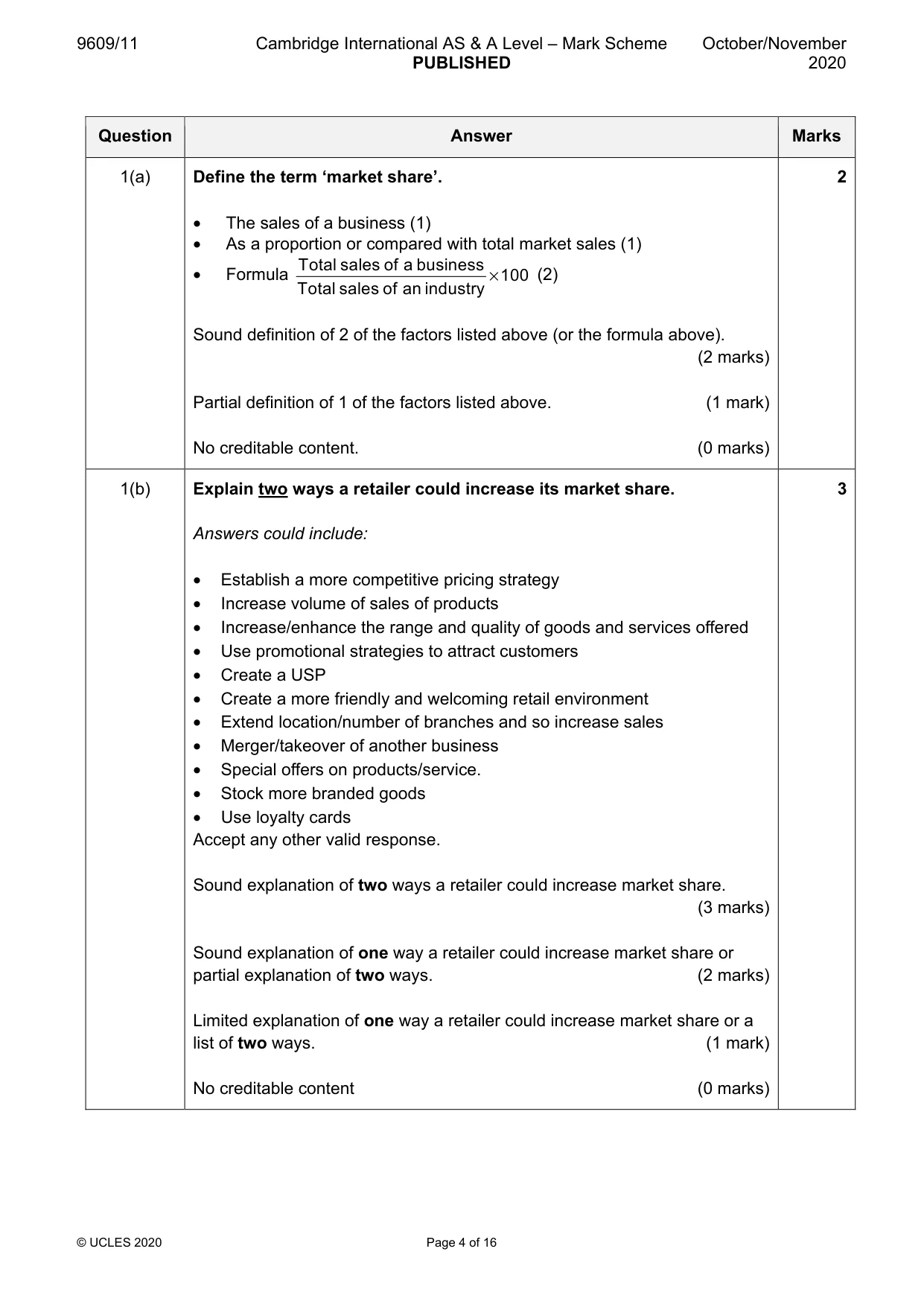
9609/11 Cambridge International AS & A Level – Mark Scheme PUBLISHED October/November 2020 © UCLES 2020 Page 4 of 16 Question Answer Marks 1(a) Define the term ‘market share’. • The sales of a business (1) • As a proportion or compared with total market sales (1) • Formula × Total sales of a business 100 Total sales of an industry (2) Sound definition of 2 of the factors listed above (or the formula above). (2 marks) Partial definition of 1 of the factors listed above. (1 mark) No creditable content. (0 marks) 2 1(b) Explain two ways a retailer could increase its market share. Answers could include: • Establish a more competitive pricing strategy • Increase volume of sales of products • Increase/enhance the range and quality of goods and services offered • Use promotional strategies to attract customers • Create a USP • Create a more friendly and welcoming retail environment • Extend location/number of branches and so increase sales • Merger/takeover of another business • Special offers on products/service. • Stock more branded goods • Use loyalty cards Accept any other valid response. Sound explanation of two ways a retailer could increase market share. (3 marks) Sound explanation of one way a retailer could increase market share or partial explanation of two ways. (2 marks) Limited explanation of one way a retailer could increase market share or a list of two ways. (1 mark) No creditable content (0 marks) 3
Mark scheme, page 5
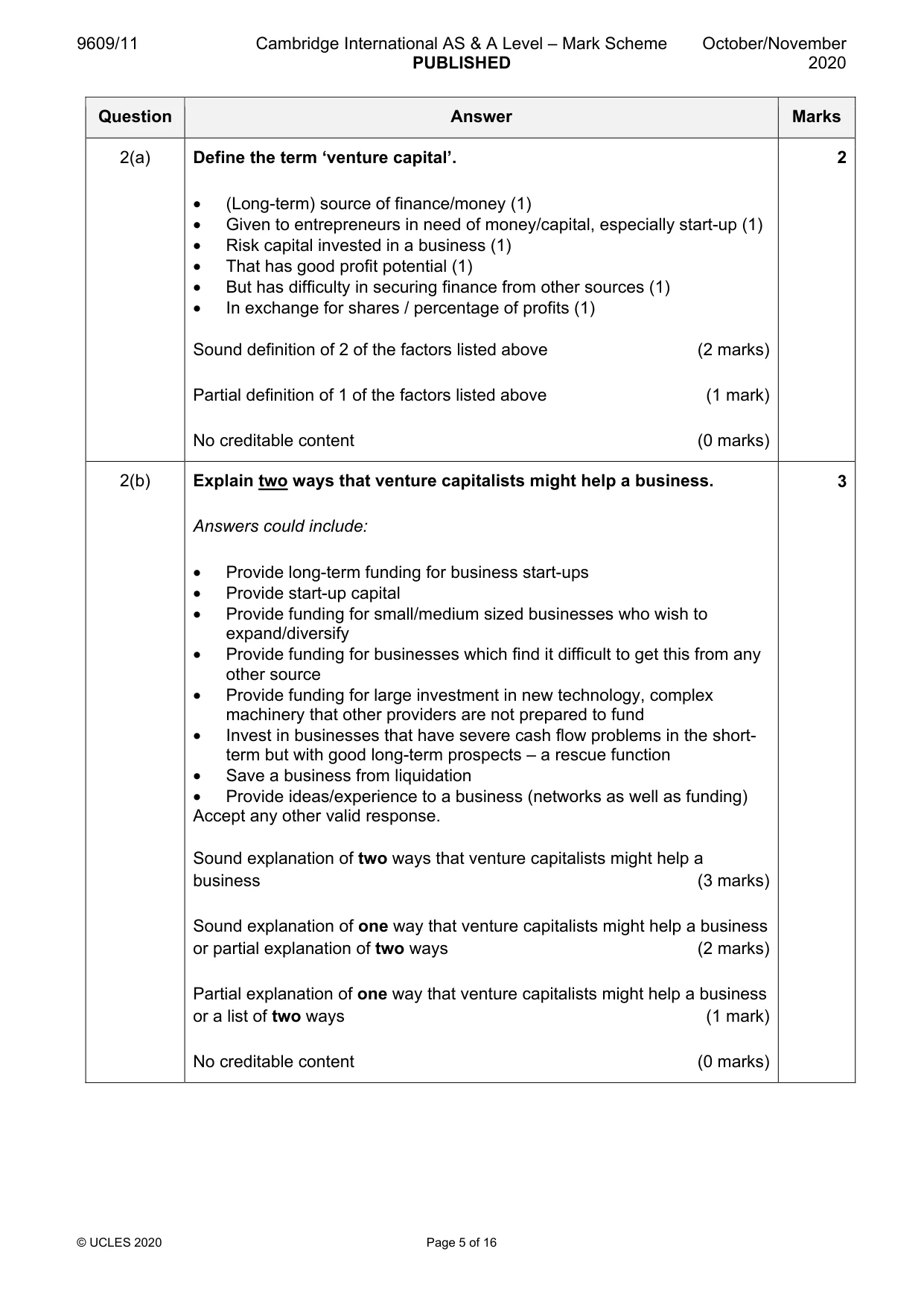
9609/11 Cambridge International AS & A Level – Mark Scheme PUBLISHED October/November 2020 © UCLES 2020 Page 5 of 16 Question Answer Marks 2(a) Define the term ‘venture capital’. • (Long-term) source of finance/money (1) • Given to entrepreneurs in need of money/capital, especially start-up (1) • Risk capital invested in a business (1) • That has good profit potential (1) • But has difficulty in securing finance from other sources (1) • In exchange for shares / percentage of profits (1) Sound definition of 2 of the factors listed above (2 marks) Partial definition of 1 of the factors listed above (1 mark) No creditable content (0 marks) 2 2(b) Explain two ways that venture capitalists might help a business. Answers could include: • Provide long-term funding for business start-ups • Provide start-up capital • Provide funding for small/medium sized businesses who wish to expand/diversify • Provide funding for businesses which find it difficult to get this from any other source • Provide funding for large investment in new technology, complex machinery that other providers are not prepared to fund • Invest in businesses that have severe cash flow problems in the short- term but with good long-term prospects – a rescue function • Save a business from liquidation • Provide ideas/experience to a business (networks as well as funding) Accept any other valid response. Sound explanation of two ways that venture capitalists might help a business (3 marks) Sound explanation of one way that venture capitalists might help a business or partial explanation of two ways (2 marks) Partial explanation of one way that venture capitalists might help a business or a list of two ways (1 mark) No creditable content (0 marks) 3
Mark scheme, page 6
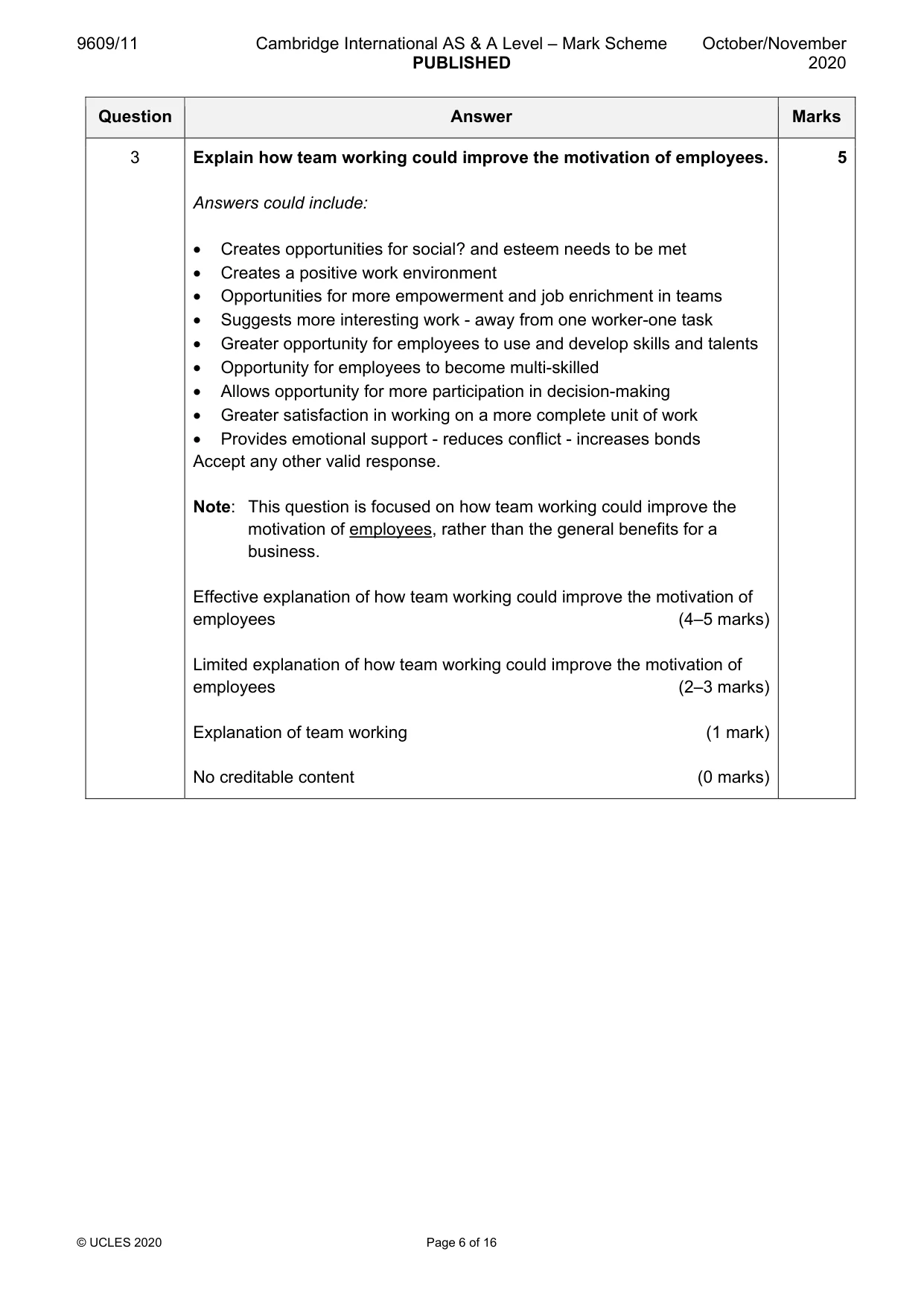
9609/11 Cambridge International AS & A Level – Mark Scheme PUBLISHED October/November 2020 © UCLES 2020 Page 6 of 16 Question Answer Marks 3 Explain how team working could improve the motivation of employees. Answers could include: • Creates opportunities for social? and esteem needs to be met • Creates a positive work environment • Opportunities for more empowerment and job enrichment in teams • Suggests more interesting work - away from one worker-one task • Greater opportunity for employees to use and develop skills and talents • Opportunity for employees to become multi-skilled • Allows opportunity for more participation in decision-making • Greater satisfaction in working on a more complete unit of work • Provides emotional support - reduces conflict - increases bonds Accept any other valid response. Note: This question is focused on how team working could improve the motivation of employees, rather than the general benefits for a business. Effective explanation of how team working could improve the motivation of employees (4–5 marks) Limited explanation of how team working could improve the motivation of employees (2–3 marks) Explanation of team working (1 mark) No creditable content (0 marks) 5
Mark scheme, page 7
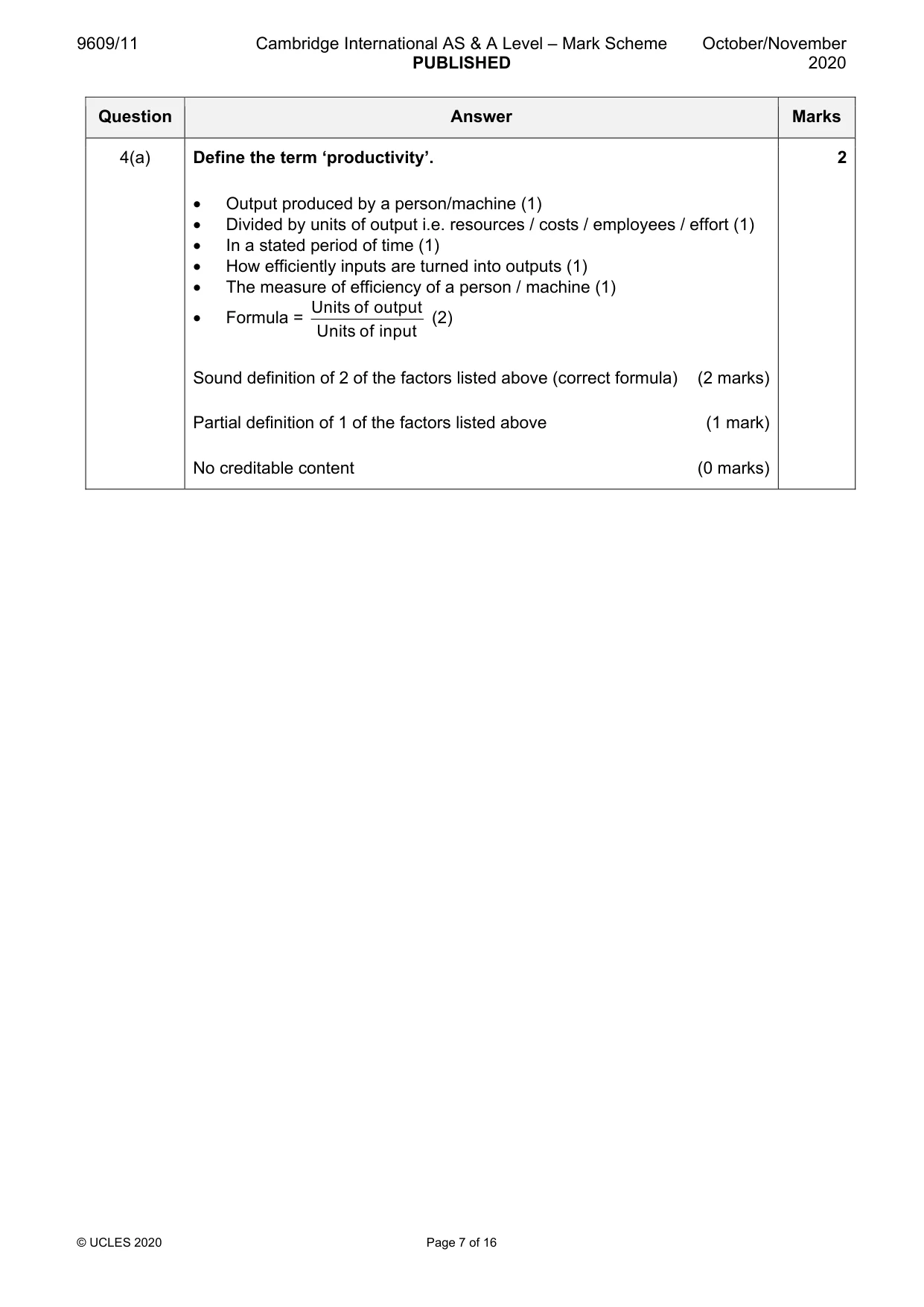
9609/11 Cambridge International AS & A Level – Mark Scheme PUBLISHED October/November 2020 © UCLES 2020 Page 7 of 16 Question Answer Marks 4(a) Define the term ‘productivity’. • Output produced by a person/machine (1) • Divided by units of output i.e. resources / costs / employees / effort (1) • In a stated period of time (1) • How efficiently inputs are turned into outputs (1) • The measure of efficiency of a person / machine (1) • Formula = Units of output Units of input (2) Sound definition of 2 of the factors listed above (correct formula) (2 marks) Partial definition of 1 of the factors listed above (1 mark) No creditable content (0 marks) 2
Mark scheme, page 8
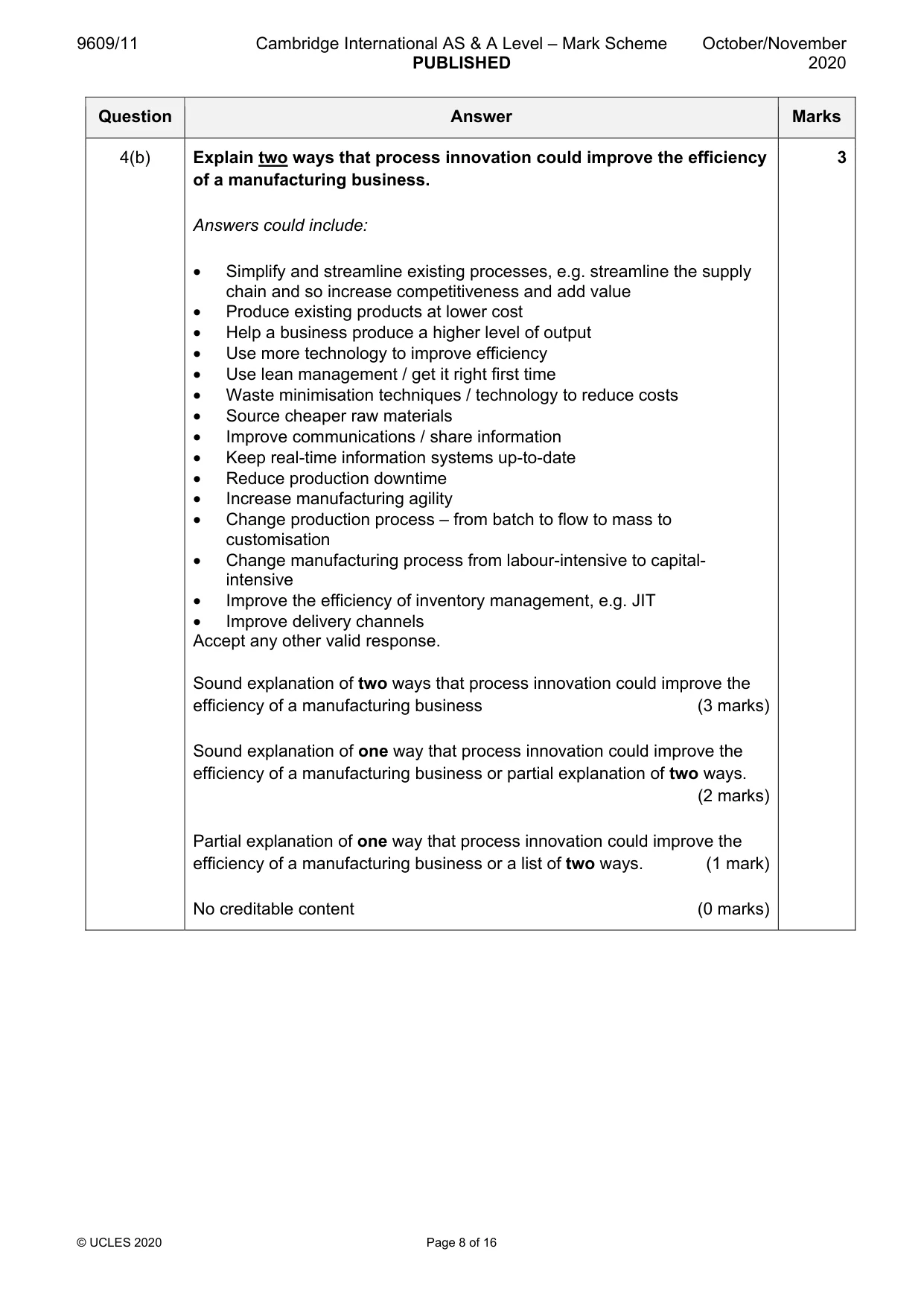
9609/11 Cambridge International AS & A Level – Mark Scheme PUBLISHED October/November 2020 © UCLES 2020 Page 8 of 16 Question Answer Marks 4(b) Explain two ways that process innovation could improve the efficiency of a manufacturing business. Answers could include: • Simplify and streamline existing processes, e.g. streamline the supply chain and so increase competitiveness and add value • Produce existing products at lower cost • Help a business produce a higher level of output • Use more technology to improve efficiency • Use lean management / get it right first time • Waste minimisation techniques / technology to reduce costs • Source cheaper raw materials • Improve communications / share information • Keep real-time information systems up-to-date • Reduce production downtime • Increase manufacturing agility • Change production process – from batch to flow to mass to customisation • Change manufacturing process from labour-intensive to capital- intensive • Improve the efficiency of inventory management, e.g. JIT • Improve delivery channels Accept any other valid response. Sound explanation of two ways that process innovation could improve the efficiency of a manufacturing business (3 marks) Sound explanation of one way that process innovation could improve the efficiency of a manufacturing business or partial explanation of two ways. (2 marks) Partial explanation of one way that process innovation could improve the efficiency of a manufacturing business or a list of two ways. (1 mark) No creditable content (0 marks) 3
Mark scheme, page 9
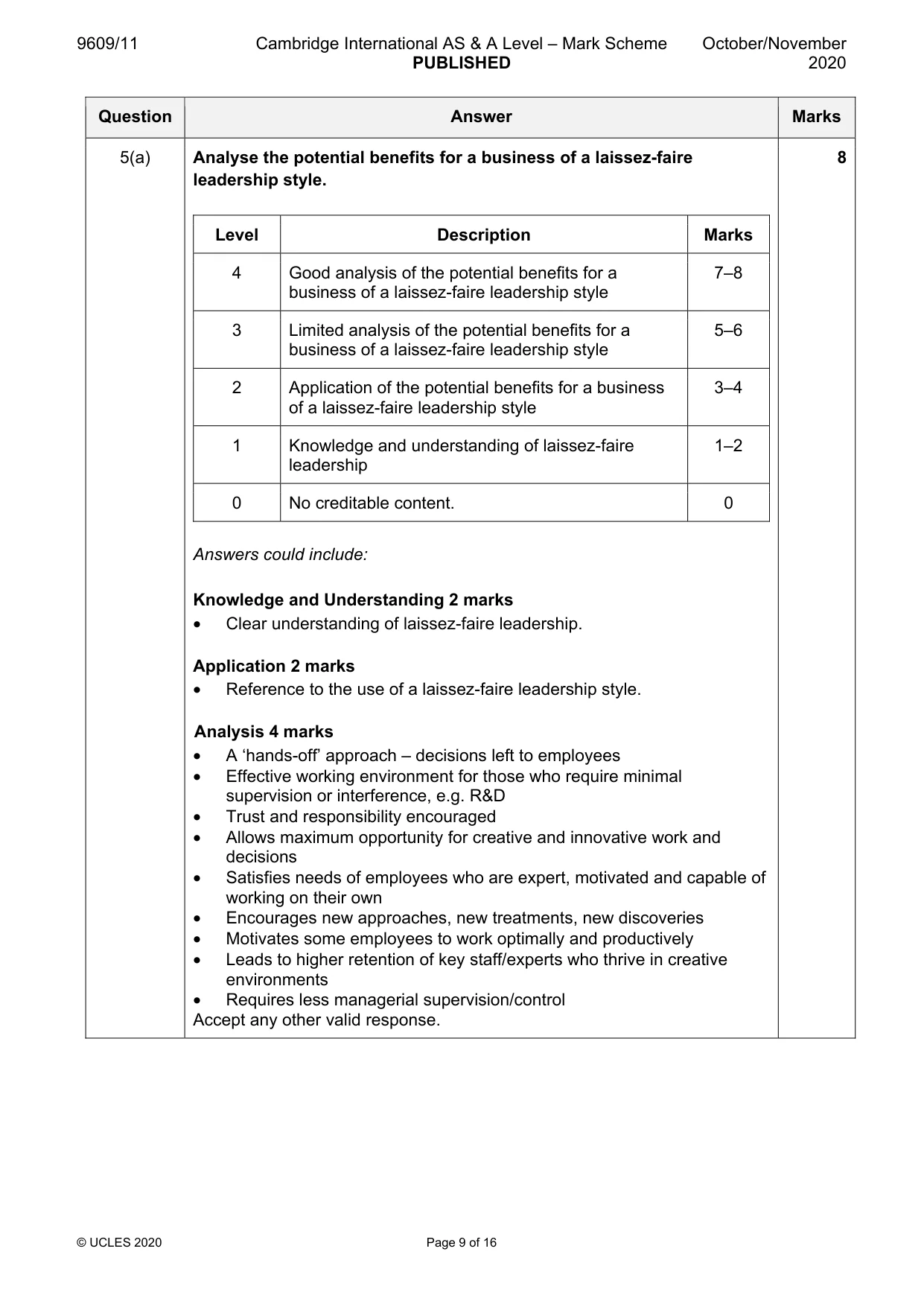
9609/11 Cambridge International AS & A Level – Mark Scheme PUBLISHED October/November 2020 © UCLES 2020 Page 9 of 16 Question Answer Marks 5(a) Analyse the potential benefits for a business of a laissez-faire leadership style. Level Description Marks 4 Good analysis of the potential benefits for a business of a laissez-faire leadership style 7–8 3 Limited analysis of the potential benefits for a business of a laissez-faire leadership style 5–6 2 Application of the potential benefits for a business of a laissez-faire leadership style 3–4 1 Knowledge and understanding of laissez-faire leadership 1–2 0 No creditable content. 0 Answers could include: Knowledge and Understanding 2 marks • Clear understanding of laissez-faire leadership. Application 2 marks • Reference to the use of a laissez-faire leadership style. Analysis 4 marks • A ‘hands-off’ approach – decisions left to employees • Effective working environment for those who require minimal supervision or interference, e.g. R&D • Trust and responsibility encouraged • Allows maximum opportunity for creative and innovative work and decisions • Satisfies needs of employees who are expert, motivated and capable of working on their own • Encourages new approaches, new treatments, new discoveries • Motivates some employees to work optimally and productively • Leads to higher retention of key staff/experts who thrive in creative environments • Requires less managerial supervision/control Accept any other valid response. 8
Mark scheme, page 10
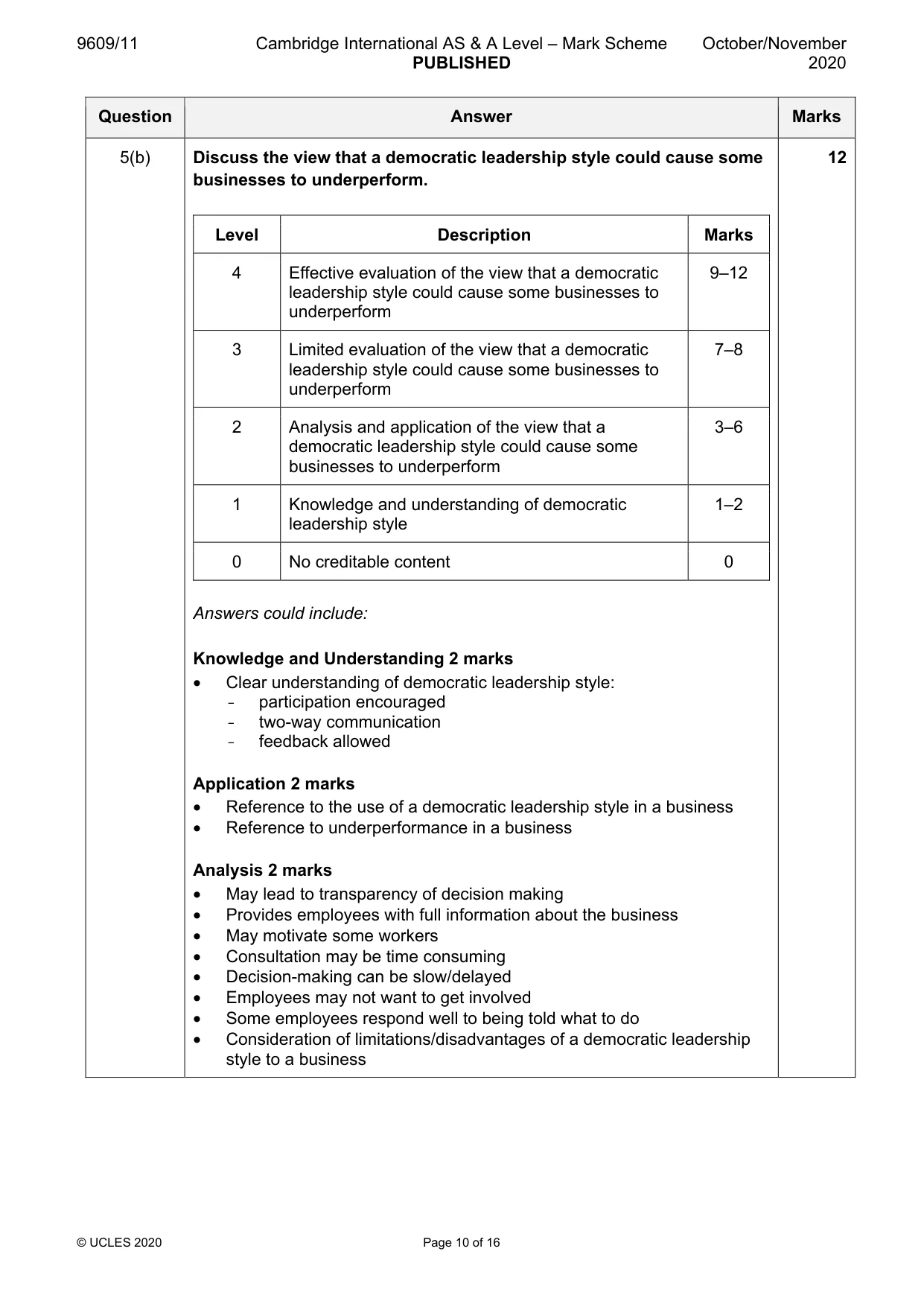
9609/11 Cambridge International AS & A Level – Mark Scheme PUBLISHED October/November 2020 © UCLES 2020 Page 10 of 16 Question Answer Marks 5(b) Discuss the view that a democratic leadership style could cause some businesses to underperform. Level Description Marks 4 Effective evaluation of the view that a democratic leadership style could cause some businesses to underperform 9–12 3 Limited evaluation of the view that a democratic leadership style could cause some businesses to underperform 7–8 2 Analysis and application of the view that a democratic leadership style could cause some businesses to underperform 3–6 1 Knowledge and understanding of democratic leadership style 1–2 0 No creditable content 0 Answers could include: Knowledge and Understanding 2 marks • Clear understanding of democratic leadership style: - participation encouraged - two-way communication - feedback allowed Application 2 marks • Reference to the use of a democratic leadership style in a business • Reference to underperformance in a business Analysis 2 marks • May lead to transparency of decision making • Provides employees with full information about the business • May motivate some workers • Consultation may be time consuming • Decision-making can be slow/delayed • Employees may not want to get involved • Some employees respond well to being told what to do • Consideration of limitations/disadvantages of a democratic leadership style to a business 12
Mark scheme, page 11
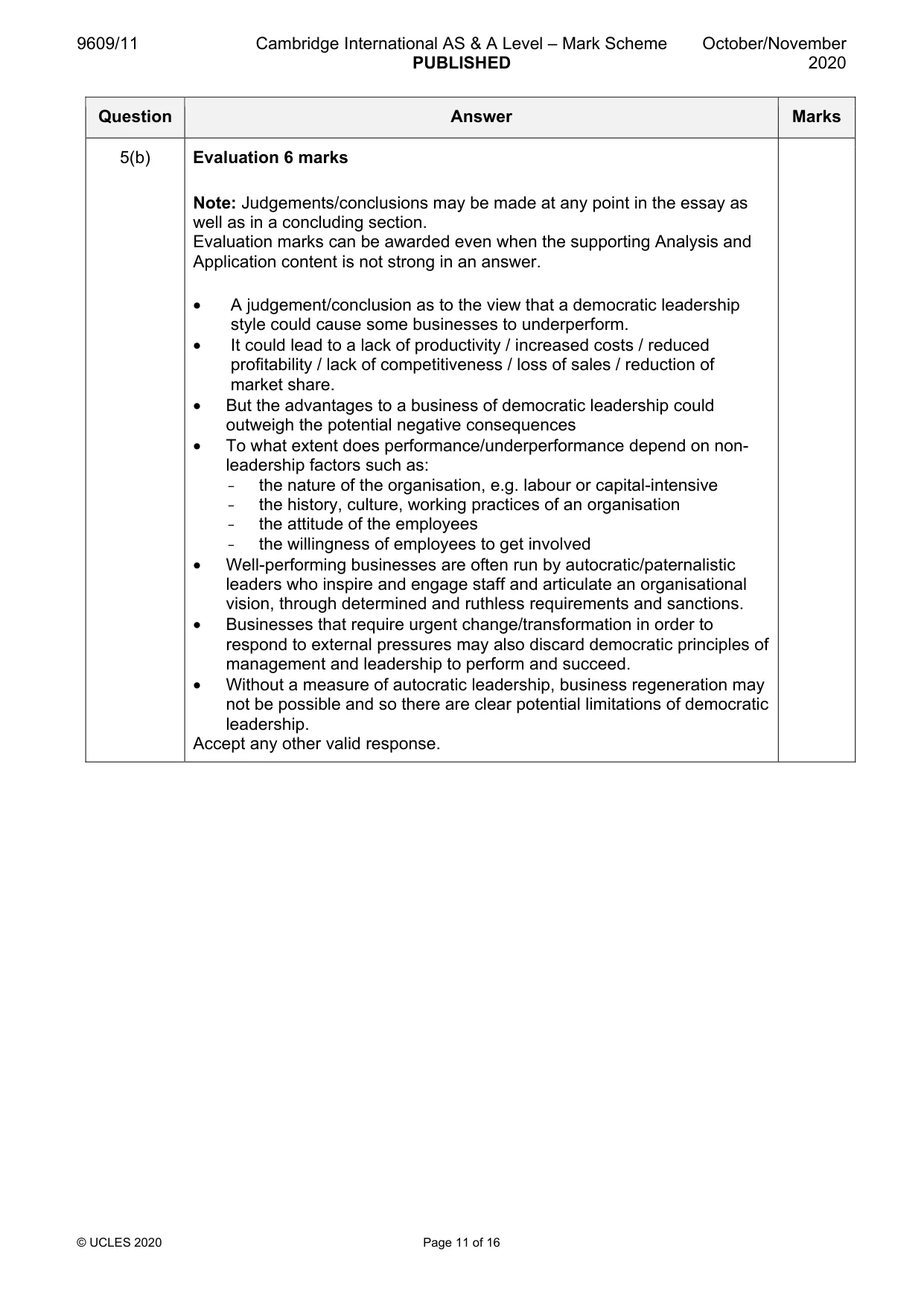
9609/11 Cambridge International AS & A Level – Mark Scheme PUBLISHED October/November 2020 © UCLES 2020 Page 11 of 16 Question Answer Marks 5(b) Evaluation 6 marks Note: Judgements/conclusions may be made at any point in the essay as well as in a concluding section. Evaluation marks can be awarded even when the supporting Analysis and Application content is not strong in an answer. • A judgement/conclusion as to the view that a democratic leadership style could cause some businesses to underperform. • It could lead to a lack of productivity / increased costs / reduced profitability / lack of competitiveness / loss of sales / reduction of market share. • But the advantages to a business of democratic leadership could outweigh the potential negative consequences • To what extent does performance/underperformance depend on non- leadership factors such as: - the nature of the organisation, e.g. labour or capital-intensive - the history, culture, working practices of an organisation - the attitude of the employees - the willingness of employees to get involved • Well-performing businesses are often run by autocratic/paternalistic leaders who inspire and engage staff and articulate an organisational vision, through determined and ruthless requirements and sanctions. • Businesses that require urgent change/transformation in order to respond to external pressures may also discard democratic principles of management and leadership to perform and succeed. • Without a measure of autocratic leadership, business regeneration may not be possible and so there are clear potential limitations of democratic leadership. Accept any other valid response.
Mark scheme, page 12
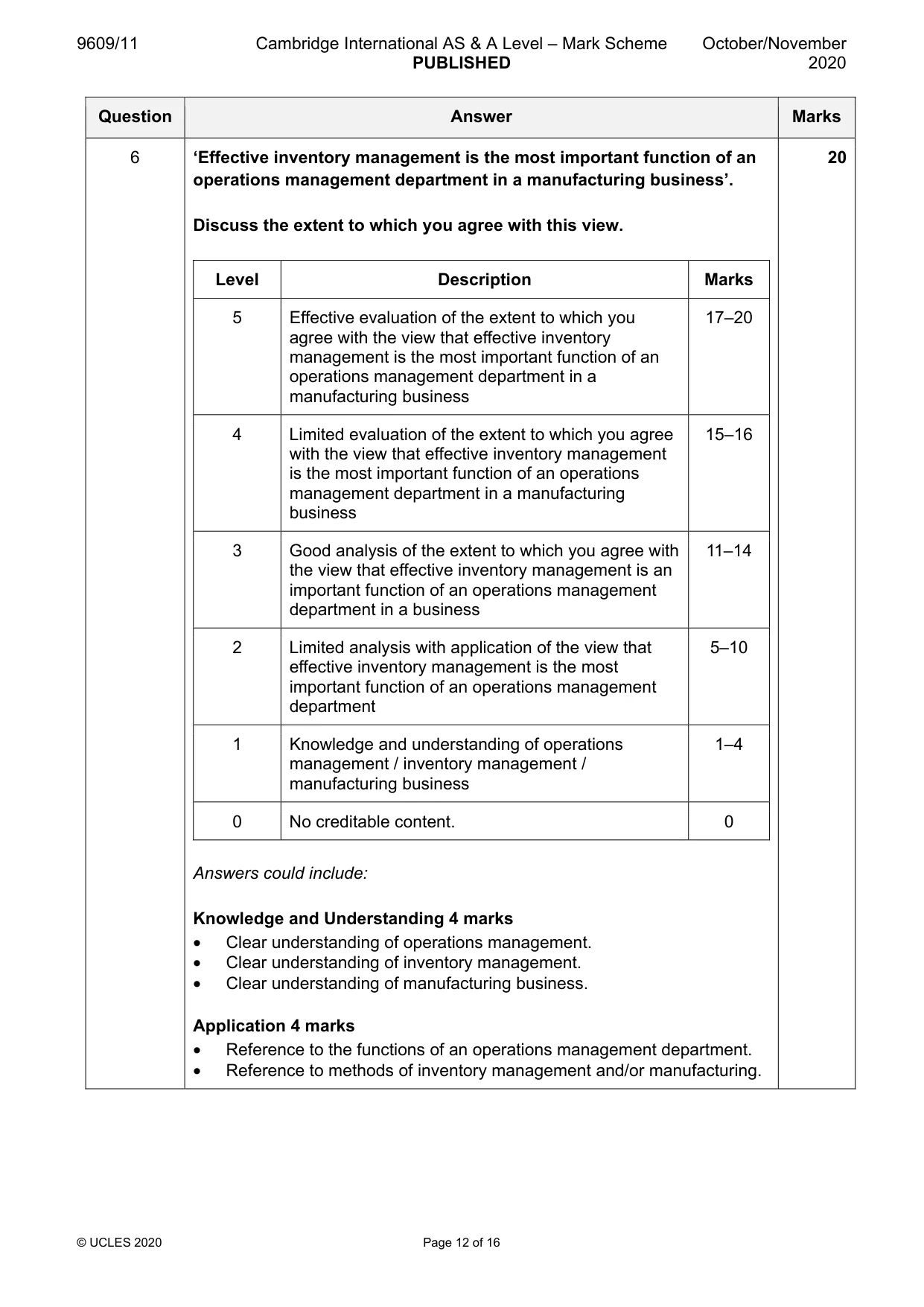
9609/11 Cambridge International AS & A Level – Mark Scheme PUBLISHED October/November 2020 © UCLES 2020 Page 12 of 16 Question Answer Marks 6 ‘Effective inventory management is the most important function of an operations management department in a manufacturing business’. Discuss the extent to which you agree with this view. Level Description Marks 5 Effective evaluation of the extent to which you agree with the view that effective inventory management is the most important function of an operations management department in a manufacturing business 17–20 4 Limited evaluation of the extent to which you agree with the view that effective inventory management is the most important function of an operations management department in a manufacturing business 15–16 3 Good analysis of the extent to which you agree with the view that effective inventory management is an important function of an operations management department in a business 11–14 2 Limited analysis with application of the view that effective inventory management is the most important function of an operations management department 5–10 1 Knowledge and understanding of operations management / inventory management / manufacturing business 1–4 0 No creditable content. 0 Answers could include: Knowledge and Understanding 4 marks • Clear understanding of operations management. • Clear understanding of inventory management. • Clear understanding of manufacturing business. Application 4 marks • Reference to the functions of an operations management department. • Reference to methods of inventory management and/or manufacturing. 20
Mark scheme, page 13
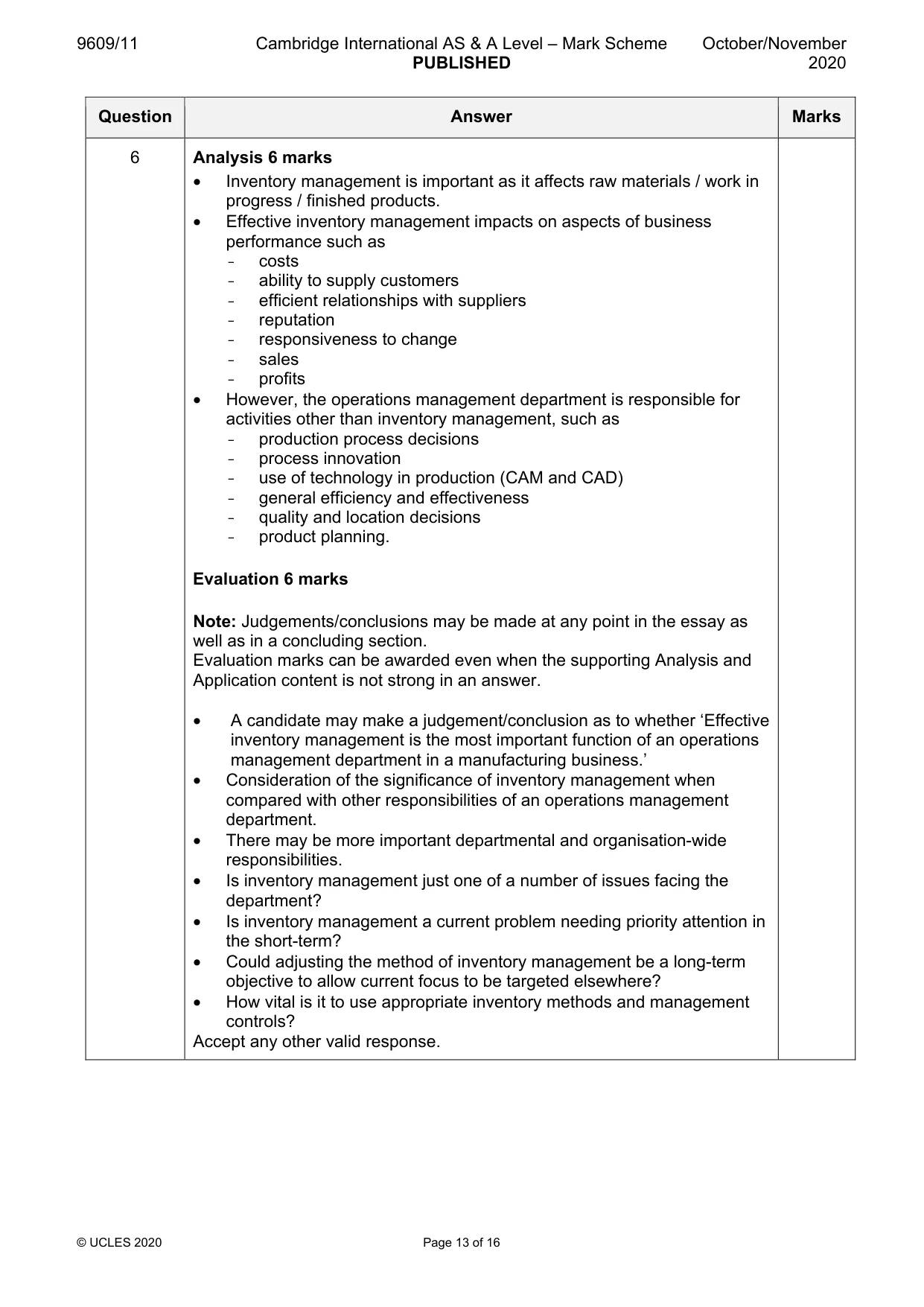
9609/11 Cambridge International AS & A Level – Mark Scheme PUBLISHED October/November 2020 © UCLES 2020 Page 13 of 16 Question Answer Marks 6 Analysis 6 marks • Inventory management is important as it affects raw materials / work in progress / finished products. • Effective inventory management impacts on aspects of business performance such as - costs - ability to supply customers - efficient relationships with suppliers - reputation - responsiveness to change - sales - profits • However, the operations management department is responsible for activities other than inventory management, such as - production process decisions - process innovation - use of technology in production (CAM and CAD) - general efficiency and effectiveness - quality and location decisions - product planning. Evaluation 6 marks Note: Judgements/conclusions may be made at any point in the essay as well as in a concluding section. Evaluation marks can be awarded even when the supporting Analysis and Application content is not strong in an answer. • A candidate may make a judgement/conclusion as to whether ‘Effective inventory management is the most important function of an operations management department in a manufacturing business.’ • Consideration of the significance of inventory management when compared with other responsibilities of an operations management department. • There may be more important departmental and organisation-wide responsibilities. • Is inventory management just one of a number of issues facing the department? • Is inventory management a current problem needing priority attention in the short-term? • Could adjusting the method of inventory management be a long-term objective to allow current focus to be targeted elsewhere? • How vital is it to use appropriate inventory methods and management controls? Accept any other valid response.
Mark scheme, page 14
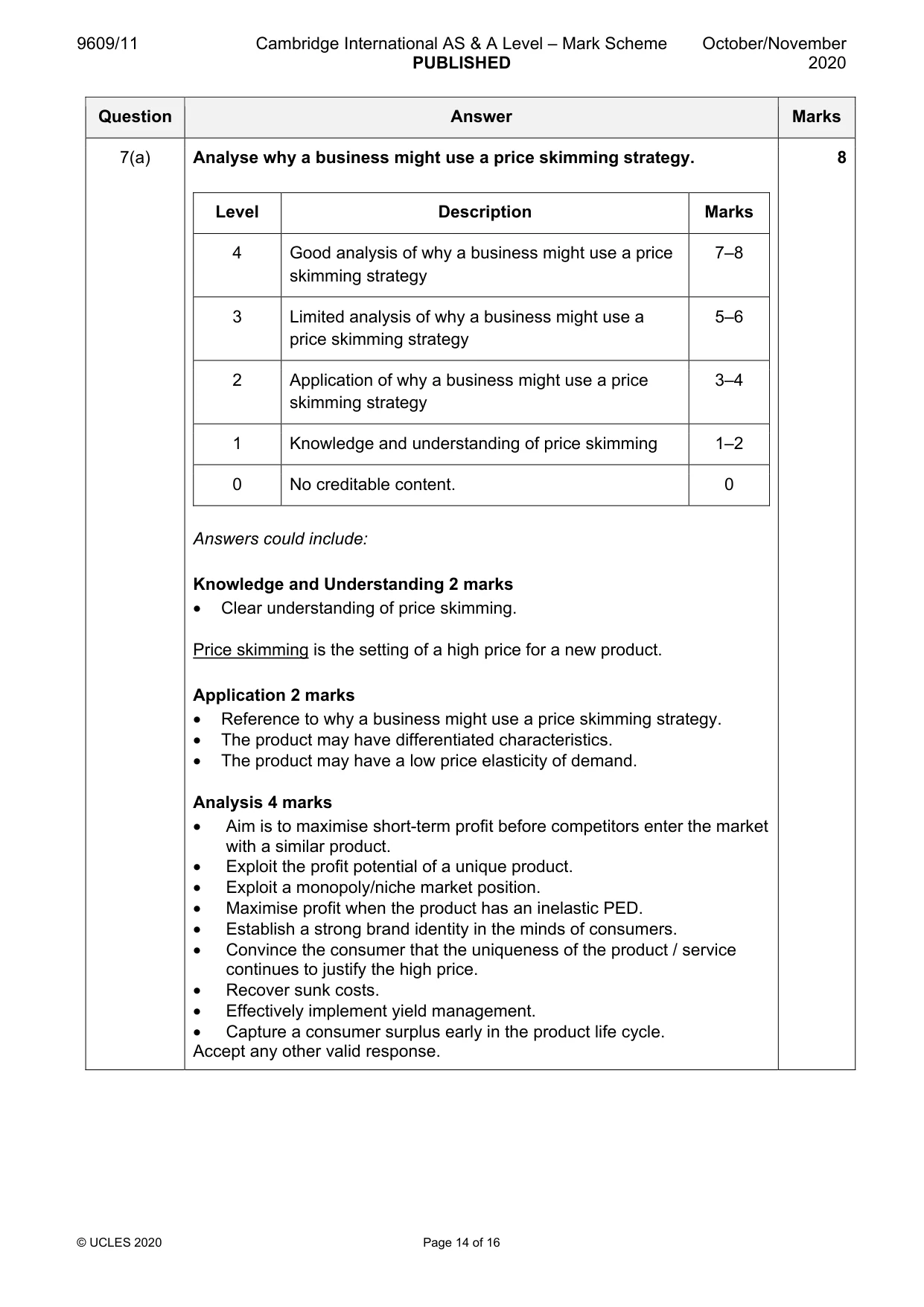
9609/11 Cambridge International AS & A Level – Mark Scheme PUBLISHED October/November 2020 © UCLES 2020 Page 14 of 16 Question Answer Marks 7(a) Analyse why a business might use a price skimming strategy. Level Description Marks 4 Good analysis of why a business might use a price skimming strategy 7–8 3 Limited analysis of why a business might use a price skimming strategy 5–6 2 Application of why a business might use a price skimming strategy 3–4 1 Knowledge and understanding of price skimming 1–2 0 No creditable content. 0 Answers could include: Knowledge and Understanding 2 marks • Clear understanding of price skimming. Price skimming is the setting of a high price for a new product. Application 2 marks • Reference to why a business might use a price skimming strategy. • The product may have differentiated characteristics. • The product may have a low price elasticity of demand. Analysis 4 marks • Aim is to maximise short-term profit before competitors enter the market with a similar product. • Exploit the profit potential of a unique product. • Exploit a monopoly/niche market position. • Maximise profit when the product has an inelastic PED. • Establish a strong brand identity in the minds of consumers. • Convince the consumer that the uniqueness of the product / service continues to justify the high price. • Recover sunk costs. • Effectively implement yield management. • Capture a consumer surplus early in the product life cycle. Accept any other valid response. 8
Mark scheme, page 15
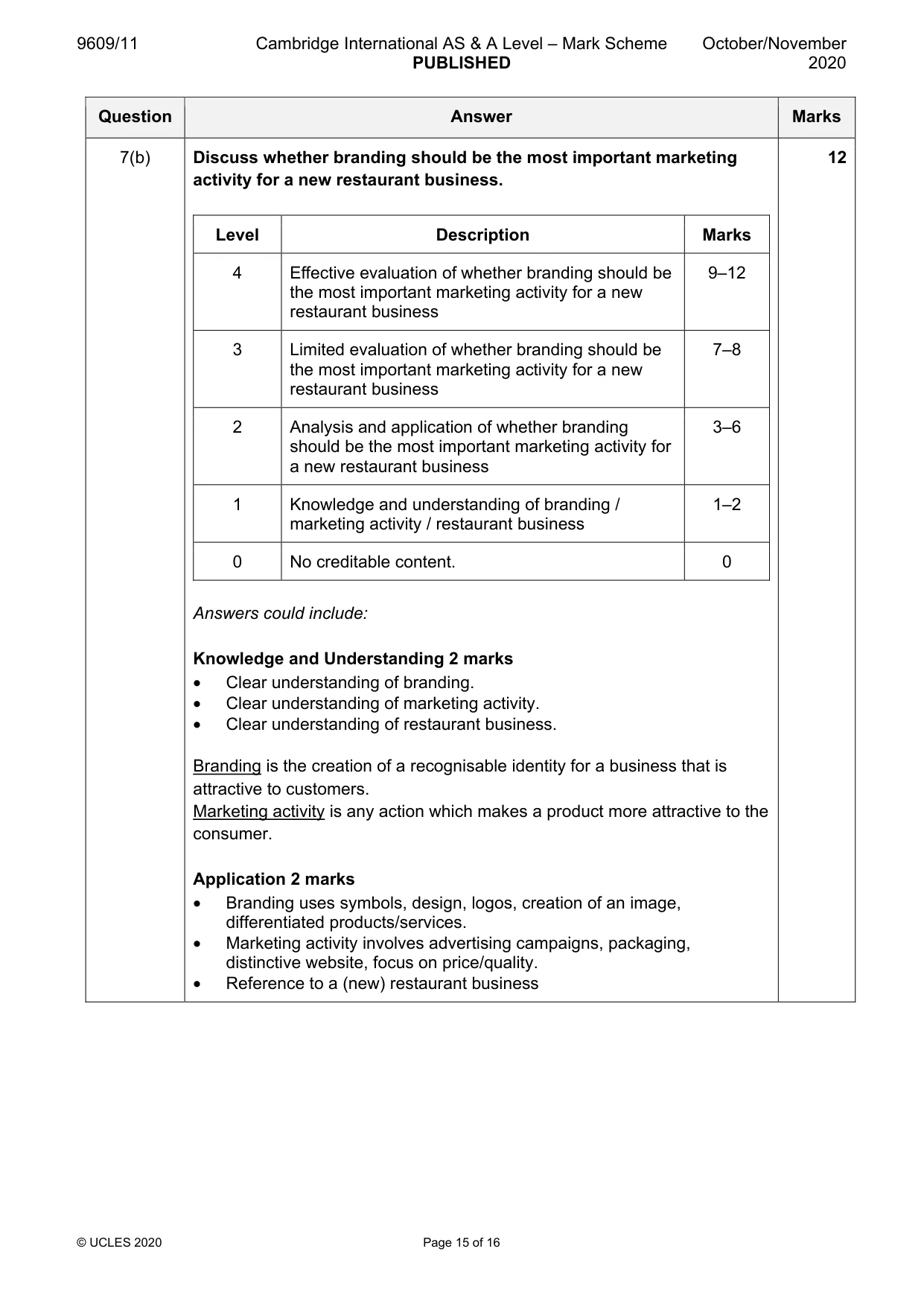
9609/11 Cambridge International AS & A Level – Mark Scheme PUBLISHED October/November 2020 © UCLES 2020 Page 15 of 16 Question Answer Marks 7(b) Discuss whether branding should be the most important marketing activity for a new restaurant business. Level Description Marks 4 Effective evaluation of whether branding should be the most important marketing activity for a new restaurant business 9–12 3 Limited evaluation of whether branding should be the most important marketing activity for a new restaurant business 7–8 2 Analysis and application of whether branding should be the most important marketing activity for a new restaurant business 3–6 1 Knowledge and understanding of branding / marketing activity / restaurant business 1–2 0 No creditable content. 0 Answers could include: Knowledge and Understanding 2 marks • Clear understanding of branding. • Clear understanding of marketing activity. • Clear understanding of restaurant business. Branding is the creation of a recognisable identity for a business that is attractive to customers. Marketing activity is any action which makes a product more attractive to the consumer. Application 2 marks • Branding uses symbols, design, logos, creation of an image, differentiated products/services. • Marketing activity involves advertising campaigns, packaging, distinctive website, focus on price/quality. • Reference to a (new) restaurant business 12
Mark scheme, page 16
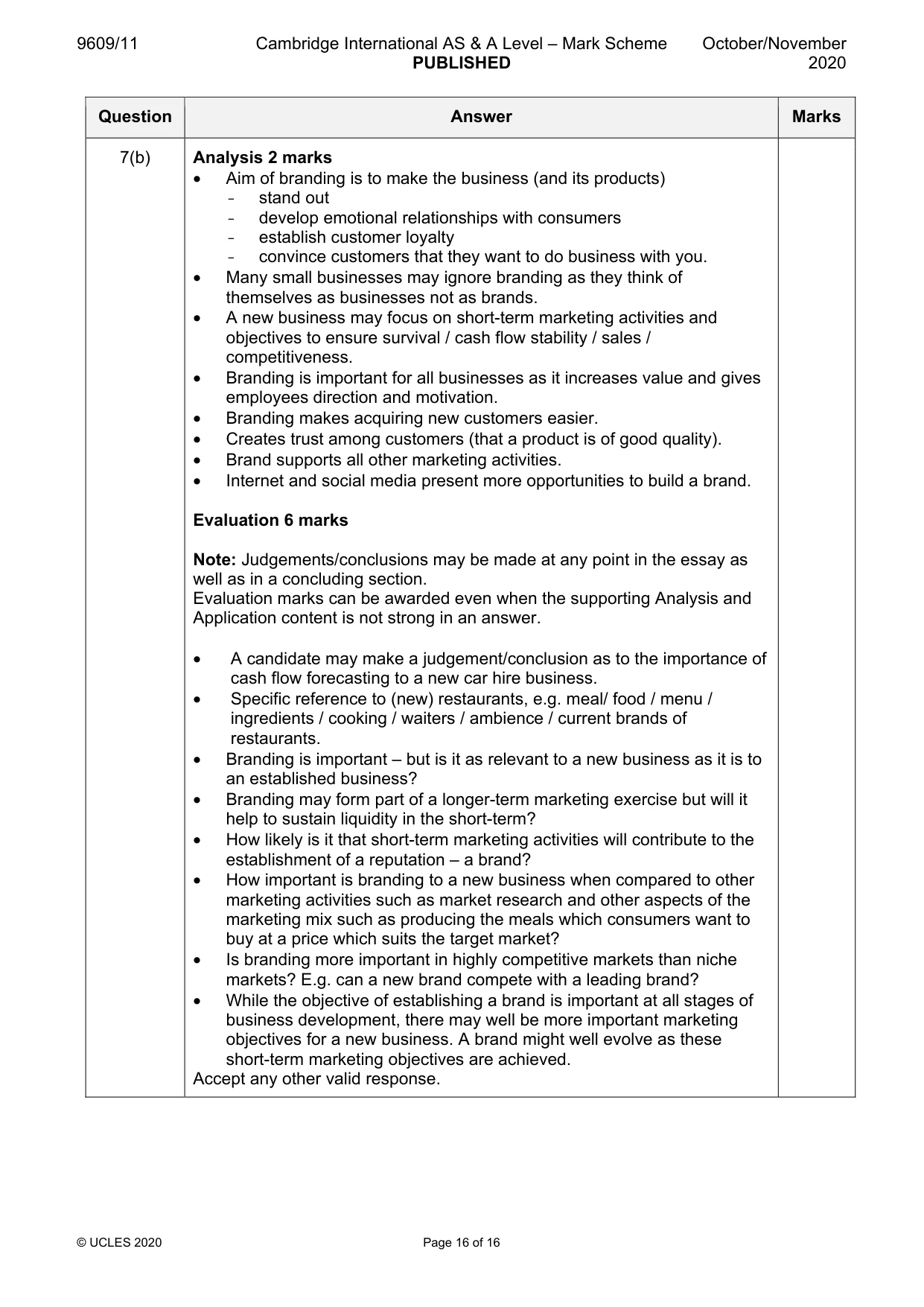
9609/11 Cambridge International AS & A Level – Mark Scheme PUBLISHED October/November 2020 © UCLES 2020 Page 16 of 16 Question Answer Marks 7(b) Analysis 2 marks • Aim of branding is to make the business (and its products) - stand out - develop emotional relationships with consumers - establish customer loyalty - convince customers that they want to do business with you. • Many small businesses may ignore branding as they think of themselves as businesses not as brands. • A new business may focus on short-term marketing activities and objectives to ensure survival / cash flow stability / sales / competitiveness. • Branding is important for all businesses as it increases value and gives employees direction and motivation. • Branding makes acquiring new customers easier. • Creates trust among customers (that a product is of good quality). • Brand supports all other marketing activities. • Internet and social media present more opportunities to build a brand. Evaluation 6 marks Note: Judgements/conclusions may be made at any point in the essay as well as in a concluding section. Evaluation marks can be awarded even when the supporting Analysis and Application content is not strong in an answer. • A candidate may make a judgement/conclusion as to the importance of cash flow forecasting to a new car hire business. • Specific reference to (new) restaurants, e.g. meal/ food / menu / ingredients / cooking / waiters / ambience / current brands of restaurants. • Branding is important – but is it as relevant to a new business as it is to an established business? • Branding may form part of a longer-term marketing exercise but will it help to sustain liquidity in the short-term? • How likely is it that short-term marketing activities will contribute to the establishment of a reputation – a brand? • How important is branding to a new business when compared to other marketing activities such as market research and other aspects of the marketing mix such as producing the meals which consumers want to buy at a price which suits the target market? • Is branding more important in highly competitive markets than niche markets? E.g. can a new brand compete with a leading brand? • While the objective of establishing a brand is important at all stages of business development, there may well be more important marketing objectives for a new business. A brand might well evolve as these short-term marketing objectives are achieved. Accept any other valid response.
What you needed in this session
Cambridge’s own grade thresholds for 2020 Oct/Nov, Paper 1 · Variant 1. A higher threshold means an easier paper — the bar moves with how the cohort did.