Cambridge A Level Business (for first examination in 2016) 9609 — 2020 Oct/Nov Paper 1 · Variant 3
9609/13/O/N/20 · 40 marks · ≈45 min
The question paper and its mark scheme, free to read here and free to download. This is Cambridge’s own paper, exactly as it was sat.
Question paper4 pages



Mark scheme15 pages
Answers below. Sit the paper first if you are practising.


Paper as text
Question paper, page 1
Cambridge International AS & A Level This document has 4 pages. Blank pages are indicated. DC (DH) 191612/1 © UCLES 2020 [Turn over * 6 5 4 4 4 6 3 4 3 2 * BUSINESS 9609/13 Paper 1 Short Answer and Essay October/November 2020 1 hour 15 minutes You must answer on the enclosed answer booklet. You will need: Answer booklet (enclosed) INSTRUCTIONS ● Section A: answer all questions. ● Section B: answer one question. ● Follow the instructions on the front cover of the answer booklet. If you need additional answer paper, ask the invigilator for a continuation booklet. INFORMATION ● The total mark for this paper is 40. ● The number of marks for each question or part question is shown in brackets [ ].
Question paper, page 2
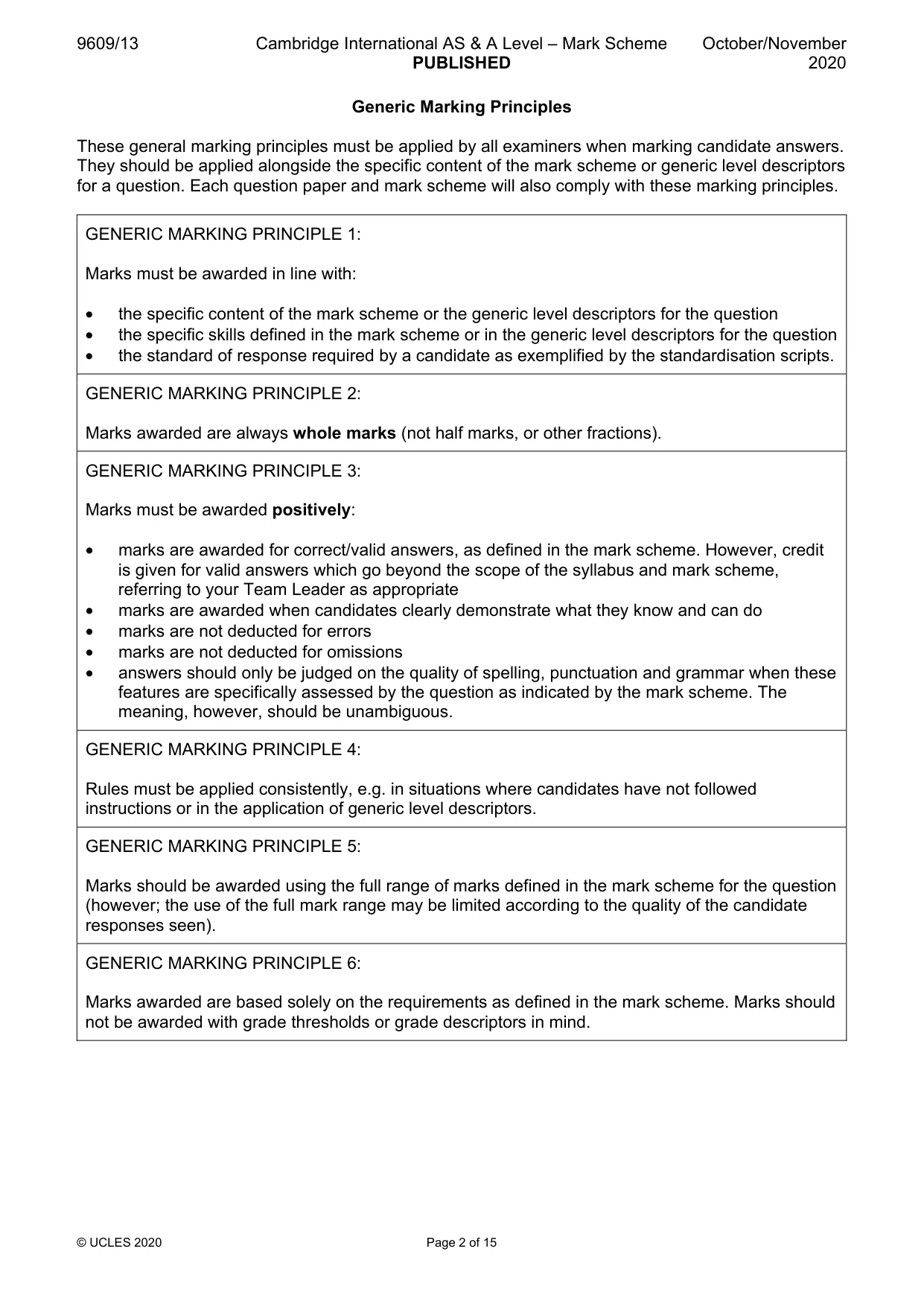
2 9609/13/O/N/20 © UCLES 2020 Section A (Short Answer) Answer all questions. You are advised to spend no more than 35 minutes on Section A. 1 (a) Define the term ‘market research’. [2] (b) Explain two advantages to a business of using primary (field) market research data. [3] 2 (a) Define the term ‘liquidity ratio’. [2] (b) Explain two limitations of using accounting ratios. [3] 3 Explain why emotional intelligence is an important quality of an effective business leader. [5] 4 (a) Define the term ‘intellectual capital’. [2] (b) Explain two functions of an operations management department. [3] Section B (Essay) Answer one question only. 5 (a) Analyse the benefits to a business of introducing computer aided design (CAD). [8] (b) Discuss the view that it is more important for a manufacturer of bicycles to be effective than it is to be efficient. [12] 6 ‘Limited investment in employee training and development in a primary sector business will lead to poor business performance.’ Discuss the extent to which you agree with this view. [20] 7 (a) Analyse why mission statements are important to many businesses. [8] (b) Discuss why the shareholders of a public limited company might not support corporate social responsibility (CSR) as a business objective. [12]
Question paper, page 3
3 9609/13/O/N/20 © UCLES 2020 BLANK PAGE
Question paper, page 4
4 9609/13/O/N/20 © UCLES 2020 Permission to reproduce items where third-party owned material protected by copyright is included has been sought and cleared where possible. Every reasonable effort has been made by the publisher (UCLES) to trace copyright holders, but if any items requiring clearance have unwittingly been included, the publisher will be pleased to make amends at the earliest possible opportunity. To avoid the issue of disclosure of answer-related information to candidates, all copyright acknowledgements are reproduced online in the Cambridge Assessment International Education Copyright Acknowledgements Booklet. This is produced for each series of examinations and is freely available to download at www.cambridgeinternational.org after the live examination series. Cambridge Assessment International Education is part of the Cambridge Assessment Group. Cambridge Assessment is the brand name of the University of Cambridge Local Examinations Syndicate (UCLES), which itself is a department of the University of Cambridge. BLANK PAGE
Mark scheme, page 1
This document consists of 15 printed pages. © UCLES 2020 [Turn over Cambridge International AS & A Level BUSINESS 9609/13 Paper 1 Short Answer and Essay October/November 2020 MARK SCHEME Maximum Mark: 40 Published This mark scheme is published as an aid to teachers and candidates, to indicate the requirements of the examination. It shows the basis on which Examiners were instructed to award marks. It does not indicate the details of the discussions that took place at an Examiners’ meeting before marking began, which would have considered the acceptability of alternative answers. Mark schemes should be read in conjunction with the question paper and the Principal Examiner Report for Teachers. Cambridge International will not enter into discussions about these mark schemes. Cambridge International is publishing the mark schemes for the October/November 2020 series for most Cambridge IGCSE™, Cambridge International A and AS Level and Cambridge Pre-U components, and some Cambridge O Level components.
Mark scheme, page 2
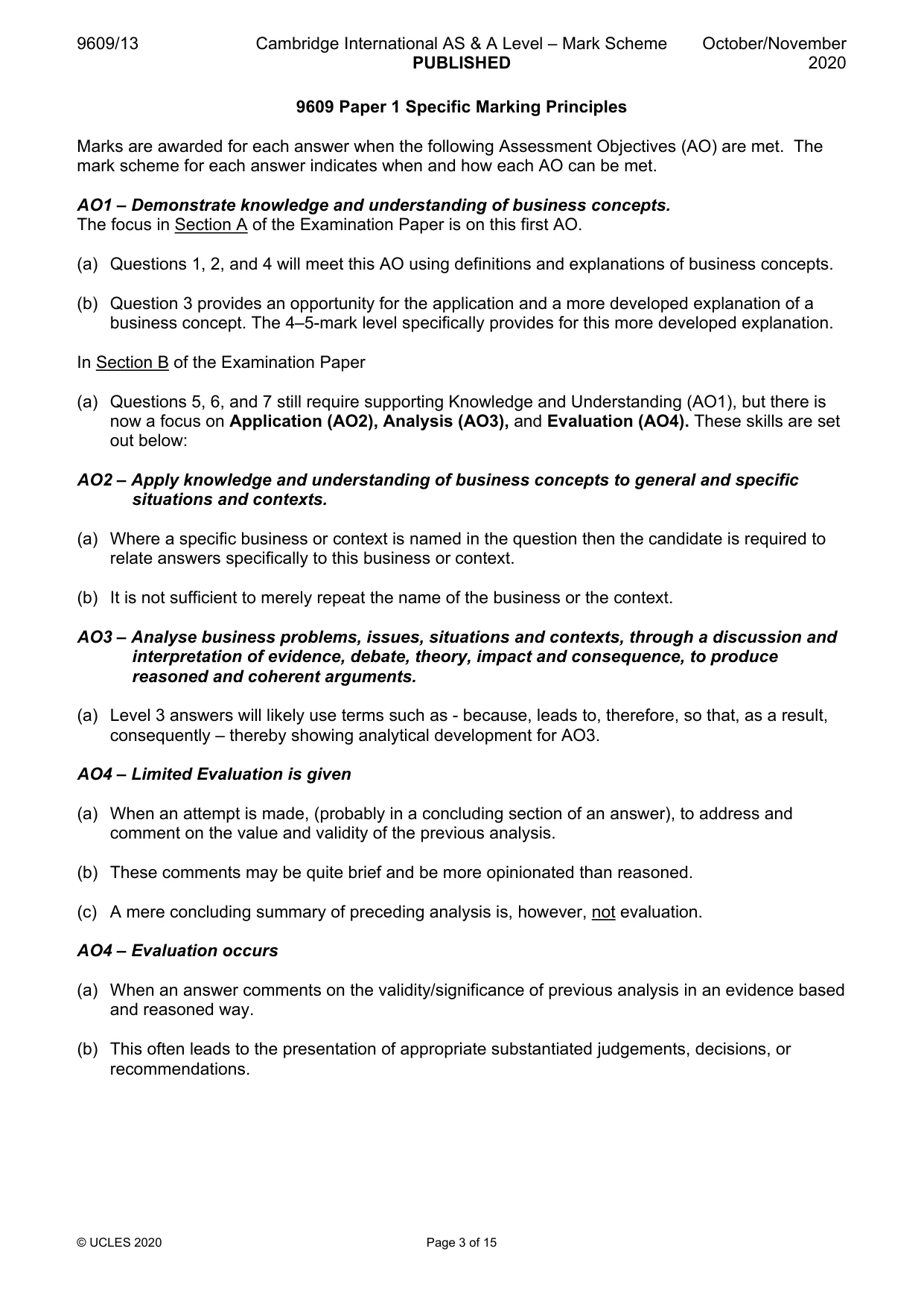
9609/13 Cambridge International AS & A Level – Mark Scheme PUBLISHED October/November 2020 © UCLES 2020 Page 2 of 15 Generic Marking Principles These general marking principles must be applied by all examiners when marking candidate answers. They should be applied alongside the specific content of the mark scheme or generic level descriptors for a question. Each question paper and mark scheme will also comply with these marking principles. GENERIC MARKING PRINCIPLE 1: Marks must be awarded in line with: • the specific content of the mark scheme or the generic level descriptors for the question • the specific skills defined in the mark scheme or in the generic level descriptors for the question • the standard of response required by a candidate as exemplified by the standardisation scripts. GENERIC MARKING PRINCIPLE 2: Marks awarded are always whole marks (not half marks, or other fractions). GENERIC MARKING PRINCIPLE 3: Marks must be awarded positively: • marks are awarded for correct/valid answers, as defined in the mark scheme. However, credit is given for valid answers which go beyond the scope of the syllabus and mark scheme, referring to your Team Leader as appropriate • marks are awarded when candidates clearly demonstrate what they know and can do • marks are not deducted for errors • marks are not deducted for omissions • answers should only be judged on the quality of spelling, punctuation and grammar when these features are specifically assessed by the question as indicated by the mark scheme. The meaning, however, should be unambiguous. GENERIC MARKING PRINCIPLE 4: Rules must be applied consistently, e.g. in situations where candidates have not followed instructions or in the application of generic level descriptors. GENERIC MARKING PRINCIPLE 5: Marks should be awarded using the full range of marks defined in the mark scheme for the question (however; the use of the full mark range may be limited according to the quality of the candidate responses seen). GENERIC MARKING PRINCIPLE 6: Marks awarded are based solely on the requirements as defined in the mark scheme. Marks should not be awarded with grade thresholds or grade descriptors in mind.
Mark scheme, page 3
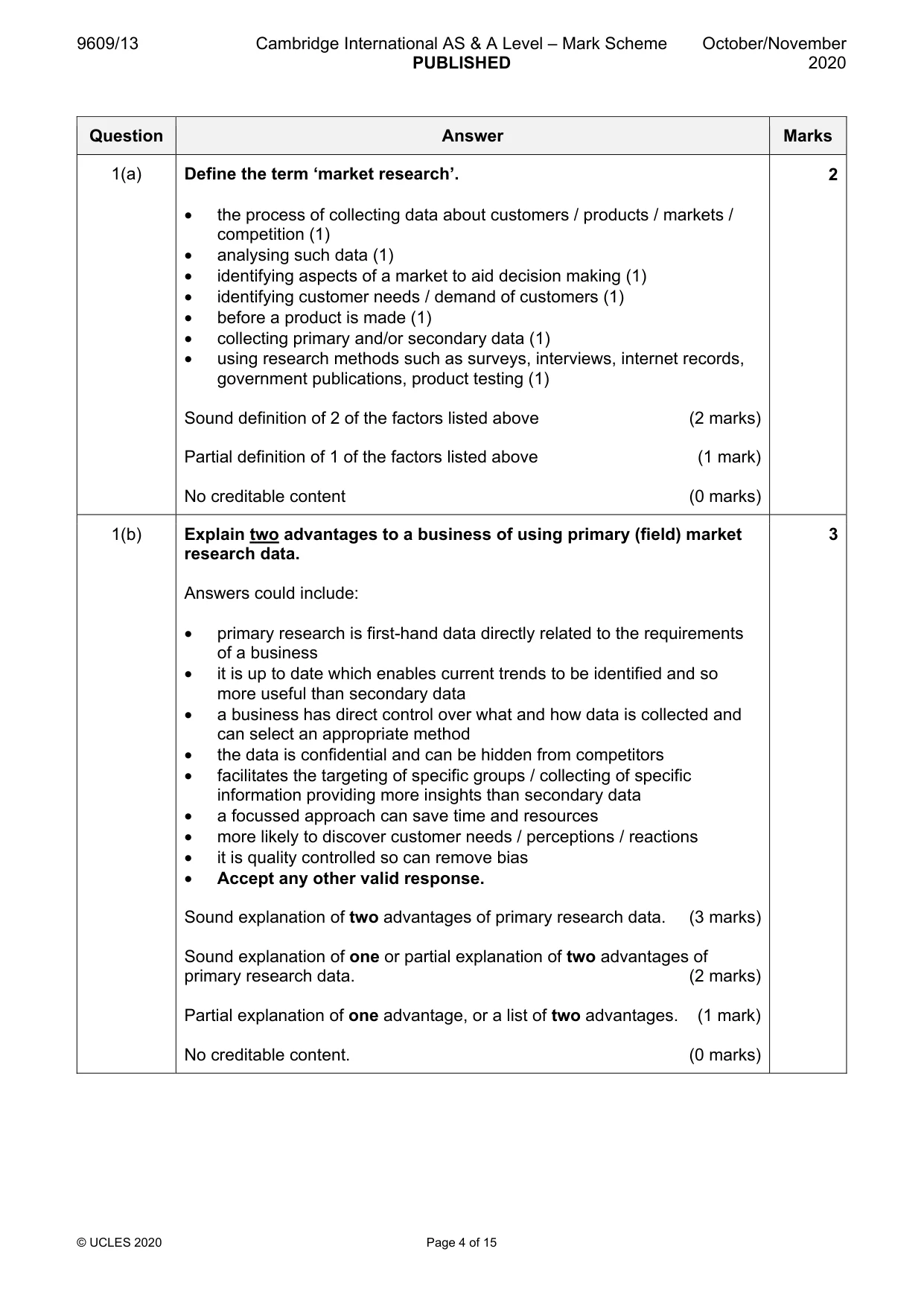
9609/13 Cambridge International AS & A Level – Mark Scheme PUBLISHED October/November 2020 © UCLES 2020 Page 3 of 15 9609 Paper 1 Specific Marking Principles Marks are awarded for each answer when the following Assessment Objectives (AO) are met. The mark scheme for each answer indicates when and how each AO can be met. AO1 – Demonstrate knowledge and understanding of business concepts. The focus in Section A of the Examination Paper is on this first AO. (a) Questions 1, 2, and 4 will meet this AO using definitions and explanations of business concepts. (b) Question 3 provides an opportunity for the application and a more developed explanation of a business concept. The 4–5-mark level specifically provides for this more developed explanation. In Section B of the Examination Paper (a) Questions 5, 6, and 7 still require supporting Knowledge and Understanding (AO1), but there is now a focus on Application (AO2), Analysis (AO3), and Evaluation (AO4). These skills are set out below: AO2 – Apply knowledge and understanding of business concepts to general and specific situations and contexts. (a) Where a specific business or context is named in the question then the candidate is required to relate answers specifically to this business or context. (b) It is not sufficient to merely repeat the name of the business or the context. AO3 – Analyse business problems, issues, situations and contexts, through a discussion and interpretation of evidence, debate, theory, impact and consequence, to produce reasoned and coherent arguments. (a) Level 3 answers will likely use terms such as - because, leads to, therefore, so that, as a result, consequently – thereby showing analytical development for AO3. AO4 – Limited Evaluation is given (a) When an attempt is made, (probably in a concluding section of an answer), to address and comment on the value and validity of the previous analysis. (b) These comments may be quite brief and be more opinionated than reasoned. (c) A mere concluding summary of preceding analysis is, however, not evaluation. AO4 – Evaluation occurs (a) When an answer comments on the validity/significance of previous analysis in an evidence based and reasoned way. (b) This often leads to the presentation of appropriate substantiated judgements, decisions, or recommendations.
Mark scheme, page 4
9609/13 Cambridge International AS & A Level – Mark Scheme PUBLISHED October/November 2020 © UCLES 2020 Page 4 of 15 Question Answer Marks 1(a) Define the term ‘market research’. • the process of collecting data about customers / products / markets / competition (1) • analysing such data (1) • identifying aspects of a market to aid decision making (1) • identifying customer needs / demand of customers (1) • before a product is made (1) • collecting primary and/or secondary data (1) • using research methods such as surveys, interviews, internet records, government publications, product testing (1) Sound definition of 2 of the factors listed above (2 marks) Partial definition of 1 of the factors listed above (1 mark) No creditable content (0 marks) 2 1(b) Explain two advantages to a business of using primary (field) market research data. Answers could include: • primary research is first-hand data directly related to the requirements of a business • it is up to date which enables current trends to be identified and so more useful than secondary data • a business has direct control over what and how data is collected and can select an appropriate method • the data is confidential and can be hidden from competitors • facilitates the targeting of specific groups / collecting of specific information providing more insights than secondary data • a focussed approach can save time and resources • more likely to discover customer needs / perceptions / reactions • it is quality controlled so can remove bias • Accept any other valid response. Sound explanation of two advantages of primary research data. (3 marks) Sound explanation of one or partial explanation of two advantages of primary research data. (2 marks) Partial explanation of one advantage, or a list of two advantages. (1 mark) No creditable content. (0 marks) 3
Mark scheme, page 5
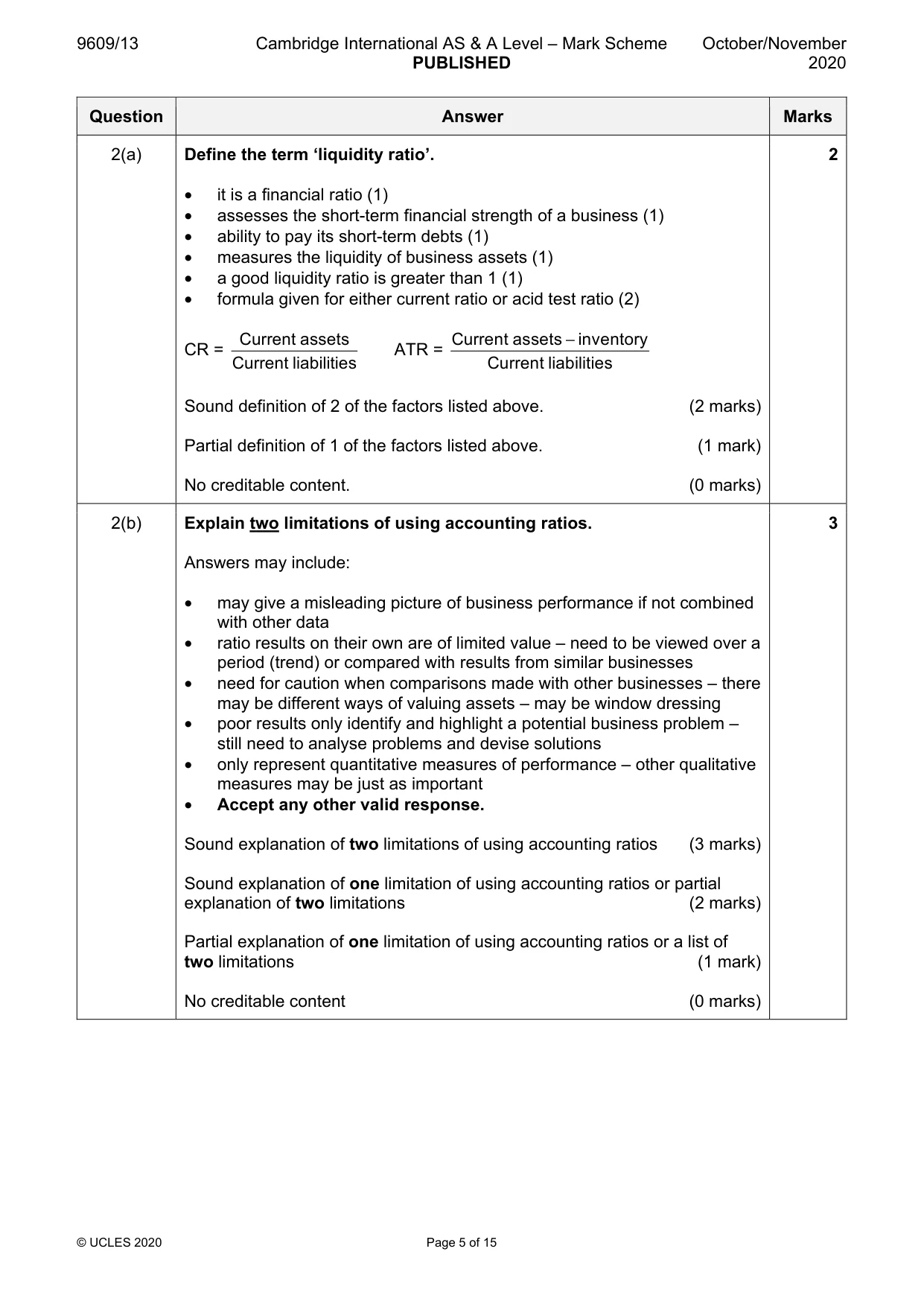
9609/13 Cambridge International AS & A Level – Mark Scheme PUBLISHED October/November 2020 © UCLES 2020 Page 5 of 15 Question Answer Marks 2(a) Define the term ‘liquidity ratio’. • it is a financial ratio (1) • assesses the short-term financial strength of a business (1) • ability to pay its short-term debts (1) • measures the liquidity of business assets (1) • a good liquidity ratio is greater than 1 (1) • formula given for either current ratio or acid test ratio (2) CR = Current assets Current liabilities ATR = − Current assets inventory Current liabilities Sound definition of 2 of the factors listed above. (2 marks) Partial definition of 1 of the factors listed above. (1 mark) No creditable content. (0 marks) 2 2(b) Explain two limitations of using accounting ratios. Answers may include: • may give a misleading picture of business performance if not combined with other data • ratio results on their own are of limited value – need to be viewed over a period (trend) or compared with results from similar businesses • need for caution when comparisons made with other businesses – there may be different ways of valuing assets – may be window dressing • poor results only identify and highlight a potential business problem – still need to analyse problems and devise solutions • only represent quantitative measures of performance – other qualitative measures may be just as important • Accept any other valid response. Sound explanation of two limitations of using accounting ratios (3 marks) Sound explanation of one limitation of using accounting ratios or partial explanation of two limitations (2 marks) Partial explanation of one limitation of using accounting ratios or a list of two limitations (1 mark) No creditable content (0 marks) 3
Mark scheme, page 6
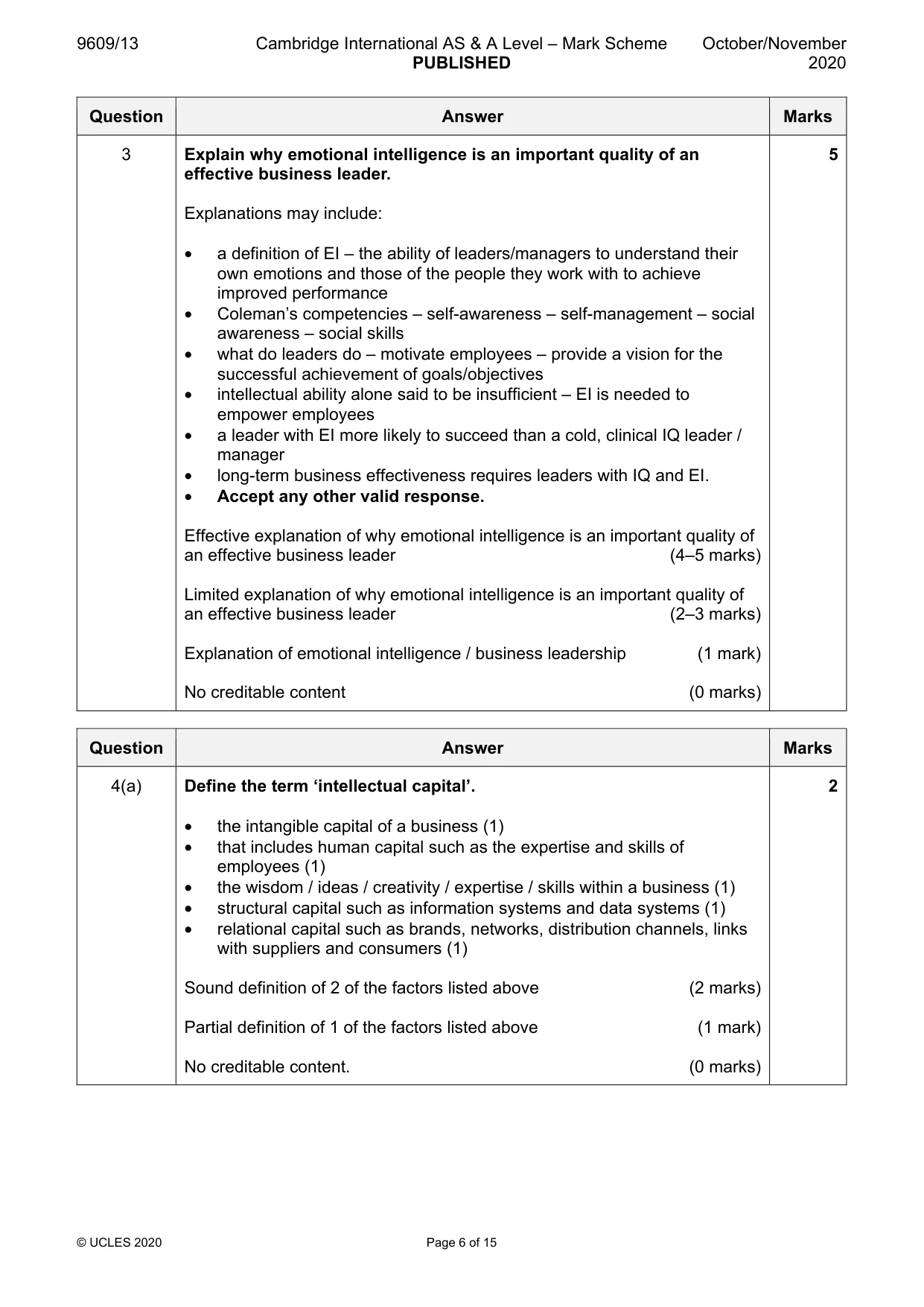
9609/13 Cambridge International AS & A Level – Mark Scheme PUBLISHED October/November 2020 © UCLES 2020 Page 6 of 15 Question Answer Marks 3 Explain why emotional intelligence is an important quality of an effective business leader. Explanations may include: • a definition of EI – the ability of leaders/managers to understand their own emotions and those of the people they work with to achieve improved performance • Coleman’s competencies – self-awareness – self-management – social awareness – social skills • what do leaders do – motivate employees – provide a vision for the successful achievement of goals/objectives • intellectual ability alone said to be insufficient – EI is needed to empower employees • a leader with EI more likely to succeed than a cold, clinical IQ leader / manager • long-term business effectiveness requires leaders with IQ and EI. • Accept any other valid response. Effective explanation of why emotional intelligence is an important quality of an effective business leader (4–5 marks) Limited explanation of why emotional intelligence is an important quality of an effective business leader (2–3 marks) Explanation of emotional intelligence / business leadership (1 mark) No creditable content (0 marks) 5 Question Answer Marks 4(a) Define the term ‘intellectual capital’. • the intangible capital of a business (1) • that includes human capital such as the expertise and skills of employees (1) • the wisdom / ideas / creativity / expertise / skills within a business (1) • structural capital such as information systems and data systems (1) • relational capital such as brands, networks, distribution channels, links with suppliers and consumers (1) Sound definition of 2 of the factors listed above (2 marks) Partial definition of 1 of the factors listed above (1 mark) No creditable content. (0 marks) 2
Mark scheme, page 7
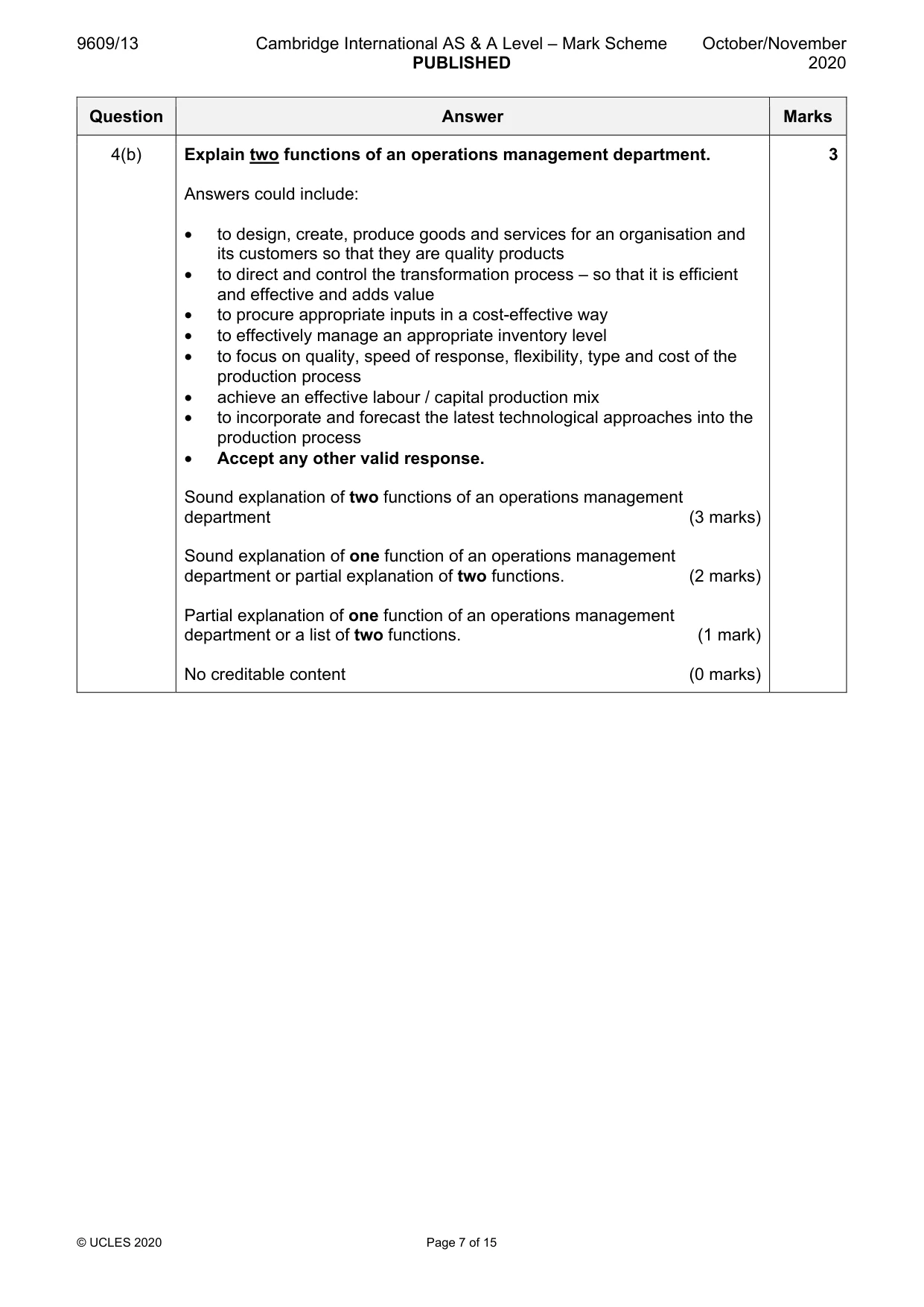
9609/13 Cambridge International AS & A Level – Mark Scheme PUBLISHED October/November 2020 © UCLES 2020 Page 7 of 15 Question Answer Marks 4(b) Explain two functions of an operations management department. Answers could include: • to design, create, produce goods and services for an organisation and its customers so that they are quality products • to direct and control the transformation process – so that it is efficient and effective and adds value • to procure appropriate inputs in a cost-effective way • to effectively manage an appropriate inventory level • to focus on quality, speed of response, flexibility, type and cost of the production process • achieve an effective labour / capital production mix • to incorporate and forecast the latest technological approaches into the production process • Accept any other valid response. Sound explanation of two functions of an operations management department (3 marks) Sound explanation of one function of an operations management department or partial explanation of two functions. (2 marks) Partial explanation of one function of an operations management department or a list of two functions. (1 mark) No creditable content (0 marks) 3
Mark scheme, page 8
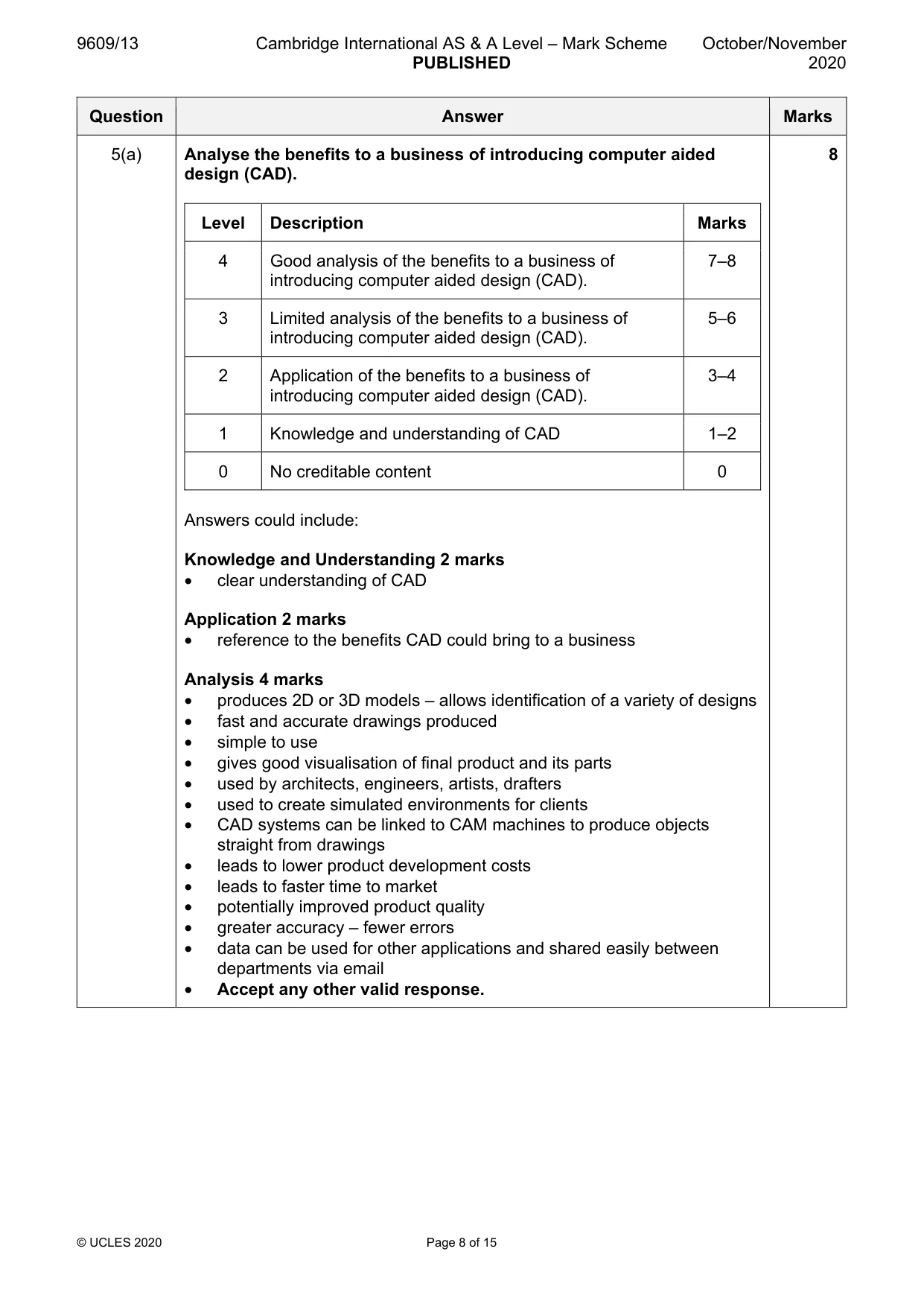
9609/13 Cambridge International AS & A Level – Mark Scheme PUBLISHED October/November 2020 © UCLES 2020 Page 8 of 15 Question Answer Marks 5(a) Analyse the benefits to a business of introducing computer aided design (CAD). Level Description Marks 4 Good analysis of the benefits to a business of introducing computer aided design (CAD). 7–8 3 Limited analysis of the benefits to a business of introducing computer aided design (CAD). 5–6 2 Application of the benefits to a business of introducing computer aided design (CAD). 3–4 1 Knowledge and understanding of CAD 1–2 0 No creditable content 0 Answers could include: Knowledge and Understanding 2 marks • clear understanding of CAD Application 2 marks • reference to the benefits CAD could bring to a business Analysis 4 marks • produces 2D or 3D models – allows identification of a variety of designs • fast and accurate drawings produced • simple to use • gives good visualisation of final product and its parts • used by architects, engineers, artists, drafters • used to create simulated environments for clients • CAD systems can be linked to CAM machines to produce objects straight from drawings • leads to lower product development costs • leads to faster time to market • potentially improved product quality • greater accuracy – fewer errors • data can be used for other applications and shared easily between departments via email • Accept any other valid response. 8
Mark scheme, page 9
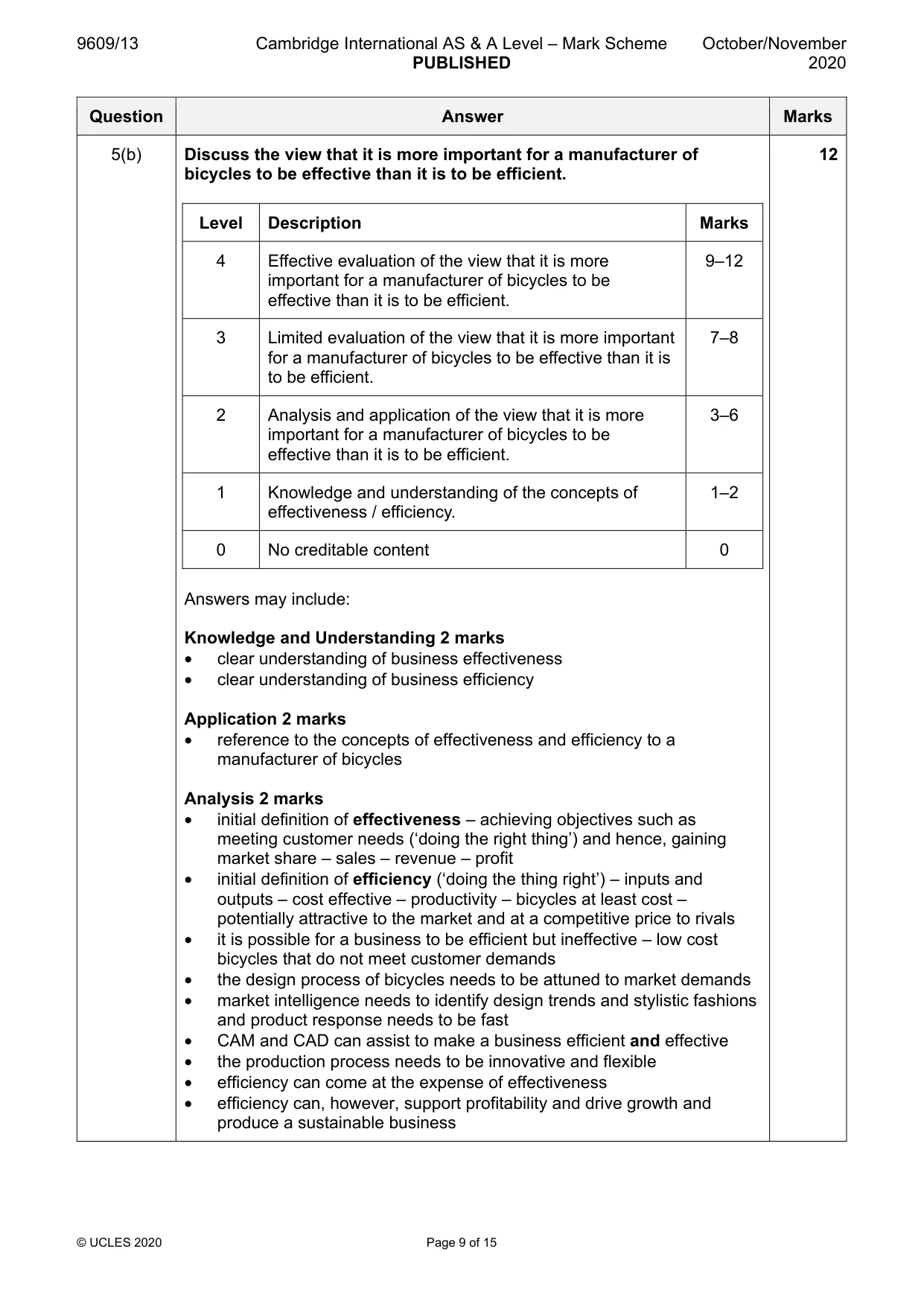
9609/13 Cambridge International AS & A Level – Mark Scheme PUBLISHED October/November 2020 © UCLES 2020 Page 9 of 15 Question Answer Marks 5(b) Discuss the view that it is more important for a manufacturer of bicycles to be effective than it is to be efficient. Level Description Marks 4 Effective evaluation of the view that it is more important for a manufacturer of bicycles to be effective than it is to be efficient. 9–12 3 Limited evaluation of the view that it is more important for a manufacturer of bicycles to be effective than it is to be efficient. 7–8 2 Analysis and application of the view that it is more important for a manufacturer of bicycles to be effective than it is to be efficient. 3–6 1 Knowledge and understanding of the concepts of effectiveness / efficiency. 1–2 0 No creditable content 0 Answers may include: Knowledge and Understanding 2 marks • clear understanding of business effectiveness • clear understanding of business efficiency Application 2 marks • reference to the concepts of effectiveness and efficiency to a manufacturer of bicycles Analysis 2 marks • initial definition of effectiveness – achieving objectives such as meeting customer needs (‘doing the right thing’) and hence, gaining market share – sales – revenue – profit • initial definition of efficiency (‘doing the thing right’) – inputs and outputs – cost effective – productivity – bicycles at least cost – potentially attractive to the market and at a competitive price to rivals • it is possible for a business to be efficient but ineffective – low cost bicycles that do not meet customer demands • the design process of bicycles needs to be attuned to market demands • market intelligence needs to identify design trends and stylistic fashions and product response needs to be fast • CAM and CAD can assist to make a business efficient and effective • the production process needs to be innovative and flexible • efficiency can come at the expense of effectiveness • efficiency can, however, support profitability and drive growth and produce a sustainable business 12
Mark scheme, page 10
9609/13 Cambridge International AS & A Level – Mark Scheme PUBLISHED October/November 2020 © UCLES 2020 Page 10 of 15 Question Answer Marks 5(b) Evaluation 6 marks A candidate may make a judgement/conclusion as to the view that it is more important for a manufacturer of bicycles to be effective than it is to be efficient. These judgements/conclusions may be made at any point in the essay as well as in a concluding section. Evidence is presented and analysed. • a business needs to be both efficient and effective – satisfy customer demands at a profit – not produce what the customer wants at a loss or produce what the customer does not want • a business needs to reach a balance between efficiency and effectiveness – there may well be a trade-off at different times in the product life cycle. • Accept any other valid response.
Mark scheme, page 11
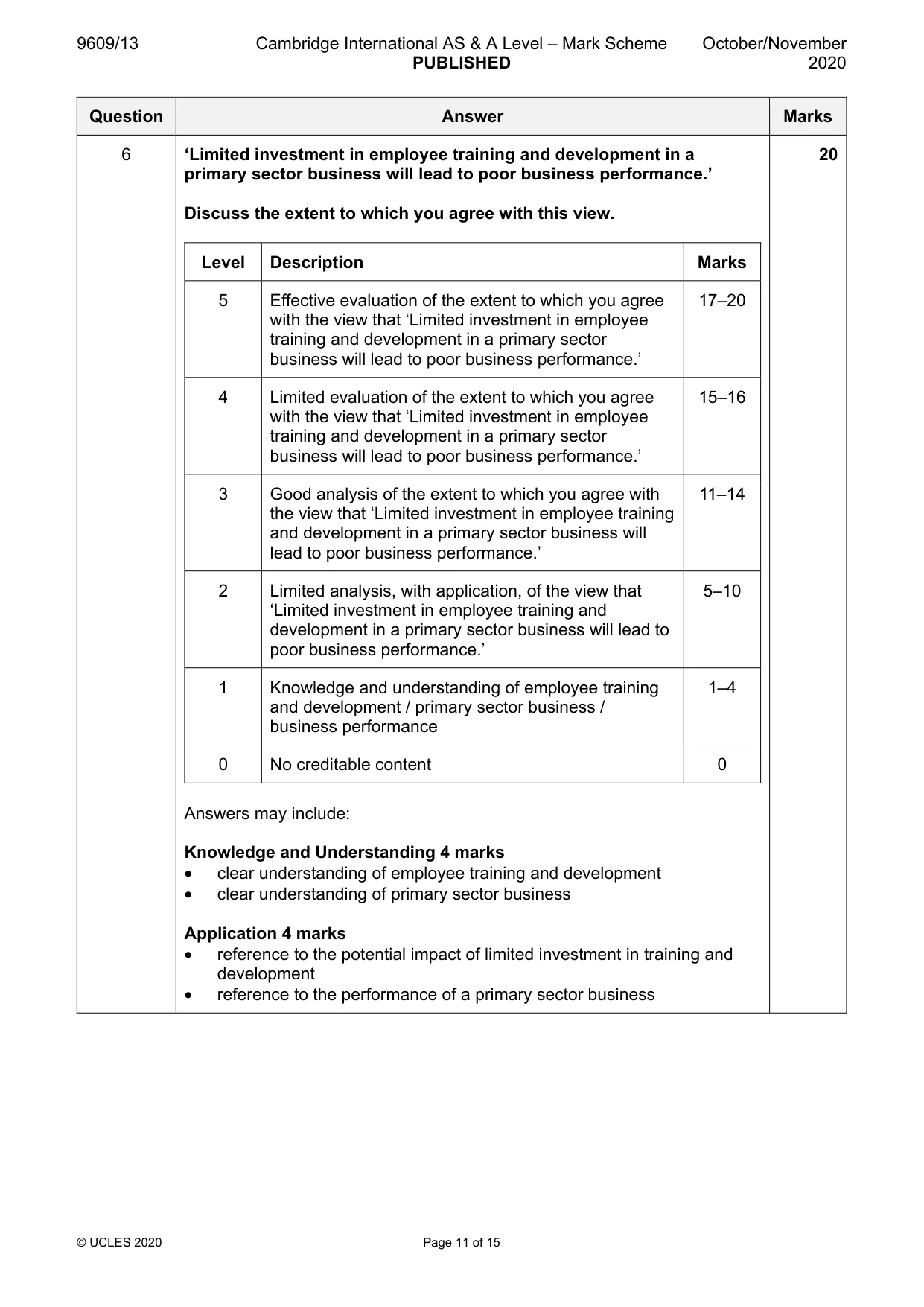
9609/13 Cambridge International AS & A Level – Mark Scheme PUBLISHED October/November 2020 © UCLES 2020 Page 11 of 15 Question Answer Marks 6 ‘Limited investment in employee training and development in a primary sector business will lead to poor business performance.’ Discuss the extent to which you agree with this view. Level Description Marks 5 Effective evaluation of the extent to which you agree with the view that ‘Limited investment in employee training and development in a primary sector business will lead to poor business performance.’ 17–20 4 Limited evaluation of the extent to which you agree with the view that ‘Limited investment in employee training and development in a primary sector business will lead to poor business performance.’ 15–16 3 Good analysis of the extent to which you agree with the view that ‘Limited investment in employee training and development in a primary sector business will lead to poor business performance.’ 11–14 2 Limited analysis, with application, of the view that ‘Limited investment in employee training and development in a primary sector business will lead to poor business performance.’ 5–10 1 Knowledge and understanding of employee training and development / primary sector business / business performance 1–4 0 No creditable content 0 Answers may include: Knowledge and Understanding 4 marks • clear understanding of employee training and development • clear understanding of primary sector business Application 4 marks • reference to the potential impact of limited investment in training and development • reference to the performance of a primary sector business 20
Mark scheme, page 12
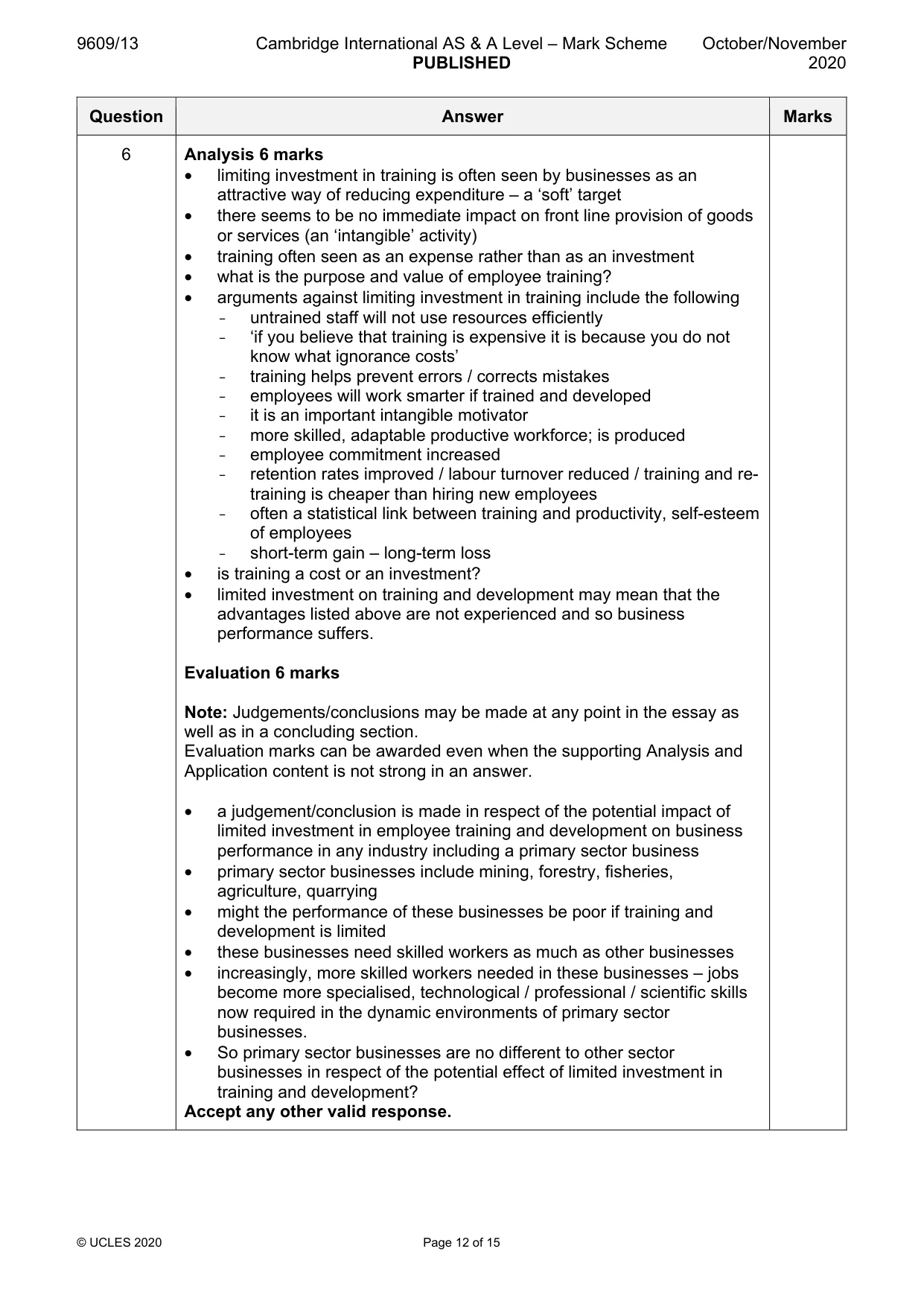
9609/13 Cambridge International AS & A Level – Mark Scheme PUBLISHED October/November 2020 © UCLES 2020 Page 12 of 15 Question Answer Marks 6 Analysis 6 marks • limiting investment in training is often seen by businesses as an attractive way of reducing expenditure – a ‘soft’ target • there seems to be no immediate impact on front line provision of goods or services (an ‘intangible’ activity) • training often seen as an expense rather than as an investment • what is the purpose and value of employee training? • arguments against limiting investment in training include the following - untrained staff will not use resources efficiently - ‘if you believe that training is expensive it is because you do not know what ignorance costs’ - training helps prevent errors / corrects mistakes - employees will work smarter if trained and developed - it is an important intangible motivator - more skilled, adaptable productive workforce; is produced - employee commitment increased - retention rates improved / labour turnover reduced / training and re- training is cheaper than hiring new employees - often a statistical link between training and productivity, self-esteem of employees - short-term gain – long-term loss • is training a cost or an investment? • limited investment on training and development may mean that the advantages listed above are not experienced and so business performance suffers. Evaluation 6 marks Note: Judgements/conclusions may be made at any point in the essay as well as in a concluding section. Evaluation marks can be awarded even when the supporting Analysis and Application content is not strong in an answer. • a judgement/conclusion is made in respect of the potential impact of limited investment in employee training and development on business performance in any industry including a primary sector business • primary sector businesses include mining, forestry, fisheries, agriculture, quarrying • might the performance of these businesses be poor if training and development is limited • these businesses need skilled workers as much as other businesses • increasingly, more skilled workers needed in these businesses – jobs become more specialised, technological / professional / scientific skills now required in the dynamic environments of primary sector businesses. • So primary sector businesses are no different to other sector businesses in respect of the potential effect of limited investment in training and development? Accept any other valid response.
Mark scheme, page 13
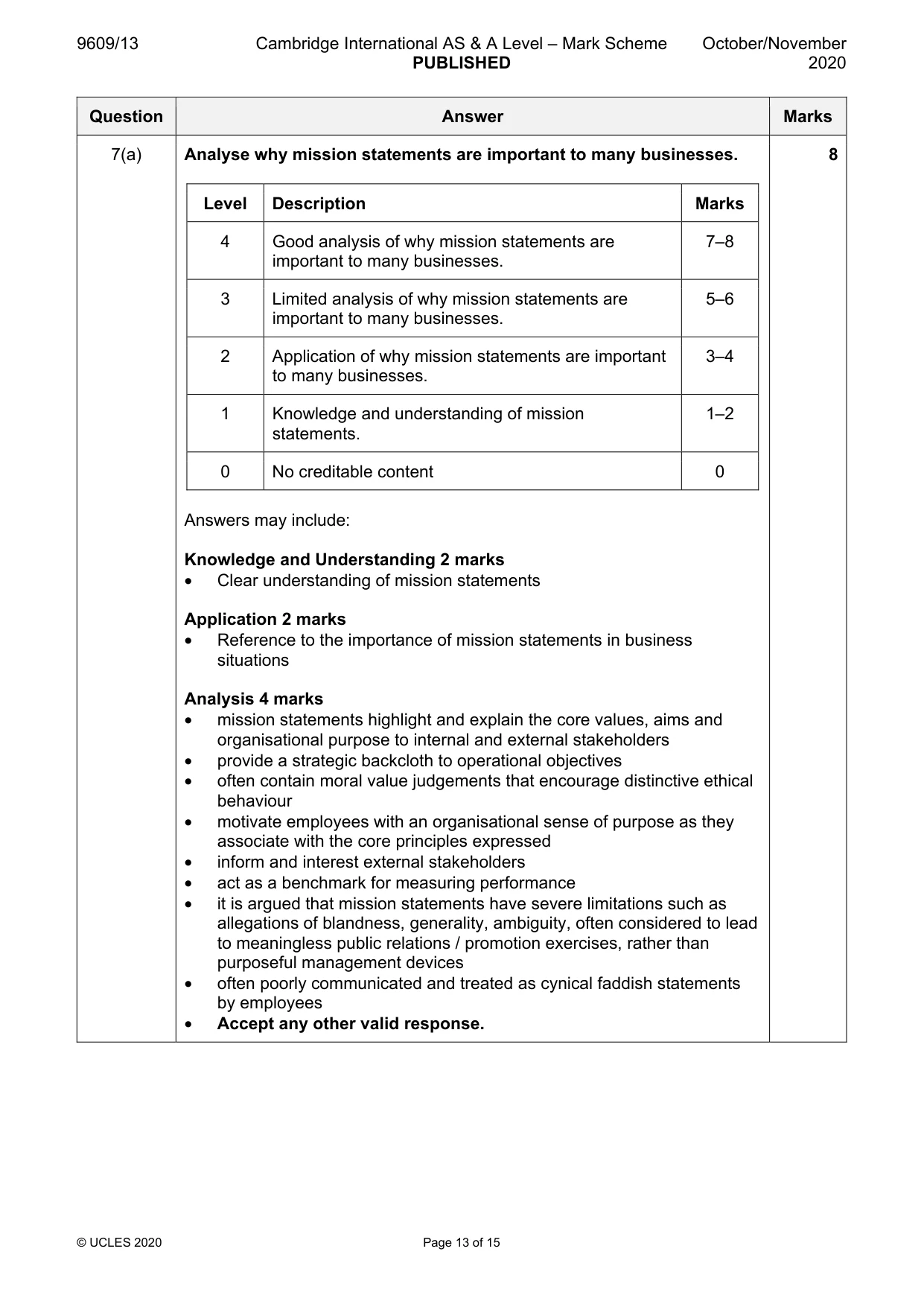
9609/13 Cambridge International AS & A Level – Mark Scheme PUBLISHED October/November 2020 © UCLES 2020 Page 13 of 15 Question Answer Marks 7(a) Analyse why mission statements are important to many businesses. Level Description Marks 4 Good analysis of why mission statements are important to many businesses. 7–8 3 Limited analysis of why mission statements are important to many businesses. 5–6 2 Application of why mission statements are important to many businesses. 3–4 1 Knowledge and understanding of mission statements. 1–2 0 No creditable content 0 Answers may include: Knowledge and Understanding 2 marks • Clear understanding of mission statements Application 2 marks • Reference to the importance of mission statements in business situations Analysis 4 marks • mission statements highlight and explain the core values, aims and organisational purpose to internal and external stakeholders • provide a strategic backcloth to operational objectives • often contain moral value judgements that encourage distinctive ethical behaviour • motivate employees with an organisational sense of purpose as they associate with the core principles expressed • inform and interest external stakeholders • act as a benchmark for measuring performance • it is argued that mission statements have severe limitations such as allegations of blandness, generality, ambiguity, often considered to lead to meaningless public relations / promotion exercises, rather than purposeful management devices • often poorly communicated and treated as cynical faddish statements by employees • Accept any other valid response. 8
Mark scheme, page 14
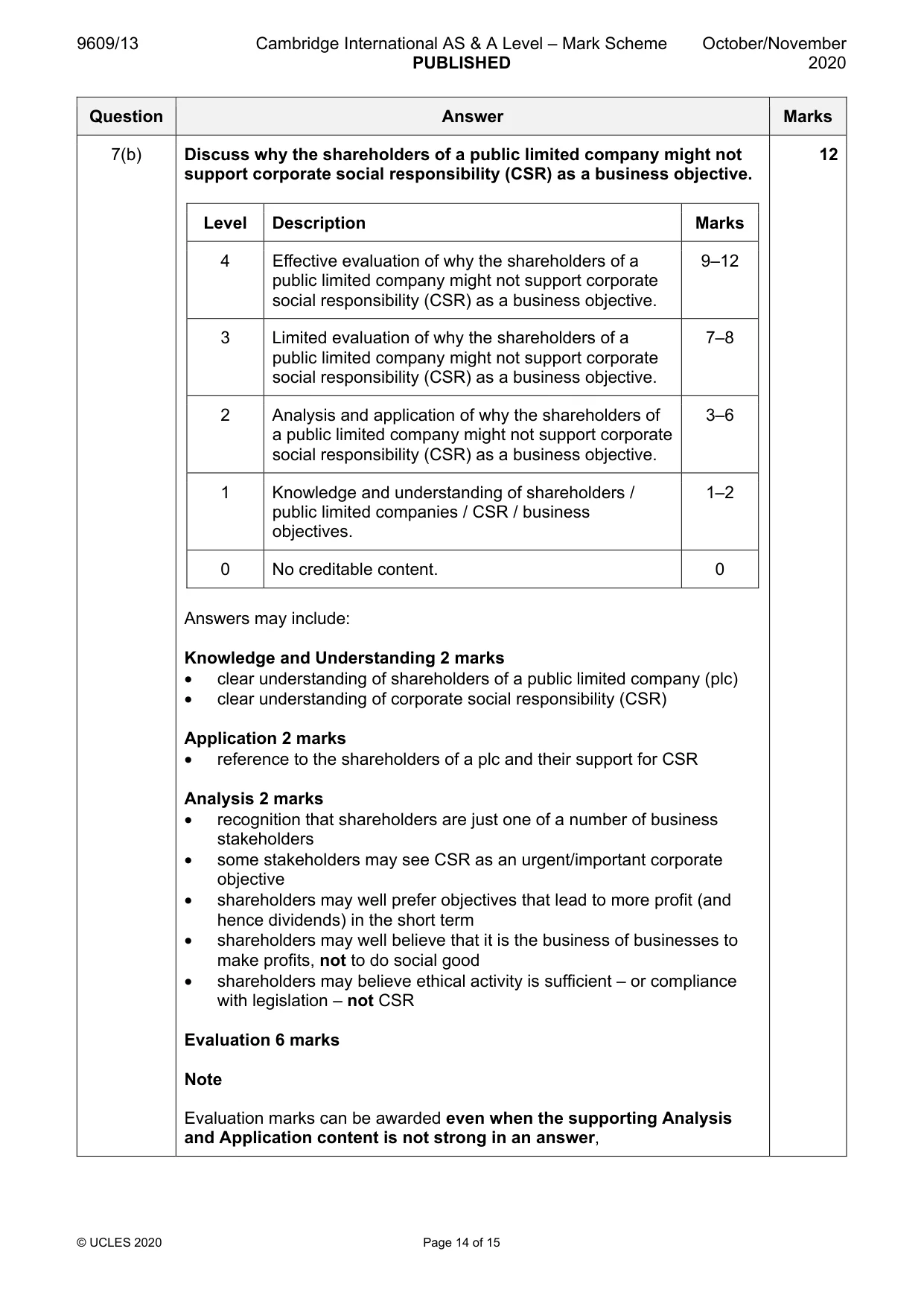
9609/13 Cambridge International AS & A Level – Mark Scheme PUBLISHED October/November 2020 © UCLES 2020 Page 14 of 15 Question Answer Marks 7(b) Discuss why the shareholders of a public limited company might not support corporate social responsibility (CSR) as a business objective. Level Description Marks 4 Effective evaluation of why the shareholders of a public limited company might not support corporate social responsibility (CSR) as a business objective. 9–12 3 Limited evaluation of why the shareholders of a public limited company might not support corporate social responsibility (CSR) as a business objective. 7–8 2 Analysis and application of why the shareholders of a public limited company might not support corporate social responsibility (CSR) as a business objective. 3–6 1 Knowledge and understanding of shareholders / public limited companies / CSR / business objectives. 1–2 0 No creditable content. 0 Answers may include: Knowledge and Understanding 2 marks • clear understanding of shareholders of a public limited company (plc) • clear understanding of corporate social responsibility (CSR) Application 2 marks • reference to the shareholders of a plc and their support for CSR Analysis 2 marks • recognition that shareholders are just one of a number of business stakeholders • some stakeholders may see CSR as an urgent/important corporate objective • shareholders may well prefer objectives that lead to more profit (and hence dividends) in the short term • shareholders may well believe that it is the business of businesses to make profits, not to do social good • shareholders may believe ethical activity is sufficient – or compliance with legislation – not CSR Evaluation 6 marks Note Evaluation marks can be awarded even when the supporting Analysis and Application content is not strong in an answer, 12
Mark scheme, page 15
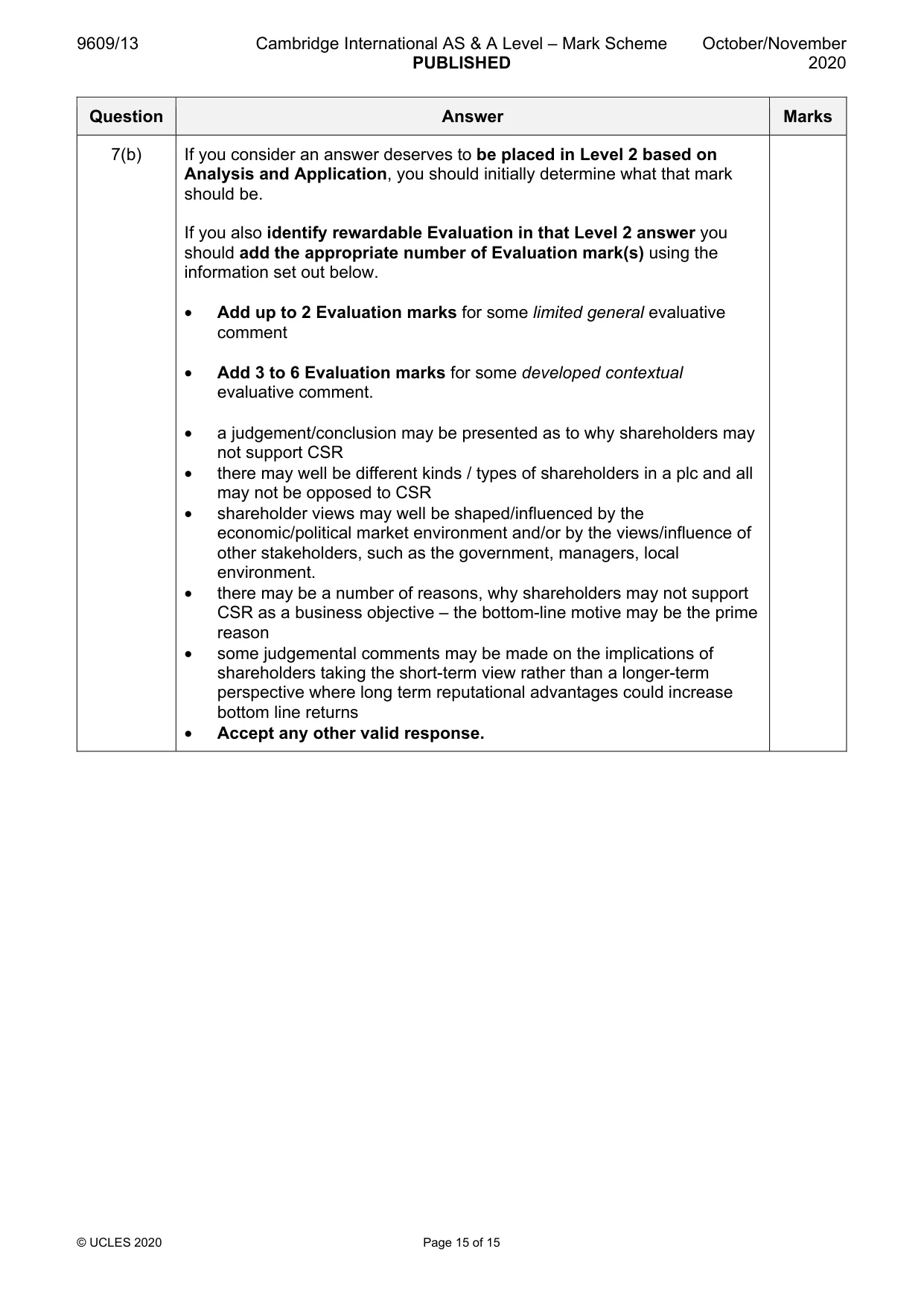
9609/13 Cambridge International AS & A Level – Mark Scheme PUBLISHED October/November 2020 © UCLES 2020 Page 15 of 15 Question Answer Marks 7(b) If you consider an answer deserves to be placed in Level 2 based on Analysis and Application, you should initially determine what that mark should be. If you also identify rewardable Evaluation in that Level 2 answer you should add the appropriate number of Evaluation mark(s) using the information set out below. • Add up to 2 Evaluation marks for some limited general evaluative comment • Add 3 to 6 Evaluation marks for some developed contextual evaluative comment. • a judgement/conclusion may be presented as to why shareholders may not support CSR • there may well be different kinds / types of shareholders in a plc and all may not be opposed to CSR • shareholder views may well be shaped/influenced by the economic/political market environment and/or by the views/influence of other stakeholders, such as the government, managers, local environment. • there may be a number of reasons, why shareholders may not support CSR as a business objective – the bottom-line motive may be the prime reason • some judgemental comments may be made on the implications of shareholders taking the short-term view rather than a longer-term perspective where long term reputational advantages could increase bottom line returns • Accept any other valid response.
What you needed in this session
Cambridge’s own grade thresholds for 2020 Oct/Nov, Paper 1 · Variant 3. A higher threshold means an easier paper — the bar moves with how the cohort did.