Cambridge A Level Business (for first examination in 2016) 9609 — 2020 May/June Paper 2 · Variant 2
9609/22/M/J/20 · 2 questions · 60 marks · ≈68 min
The question paper and its mark scheme, free to read here and free to download. This is Cambridge’s own paper, exactly as it was sat.
Question paper8 pages



Mark scheme11 pages
Answers below. Sit the paper first if you are practising.
Questions as text
Q1 · The Shop (TS) Thomas worked for 30 years as a manager of a factory
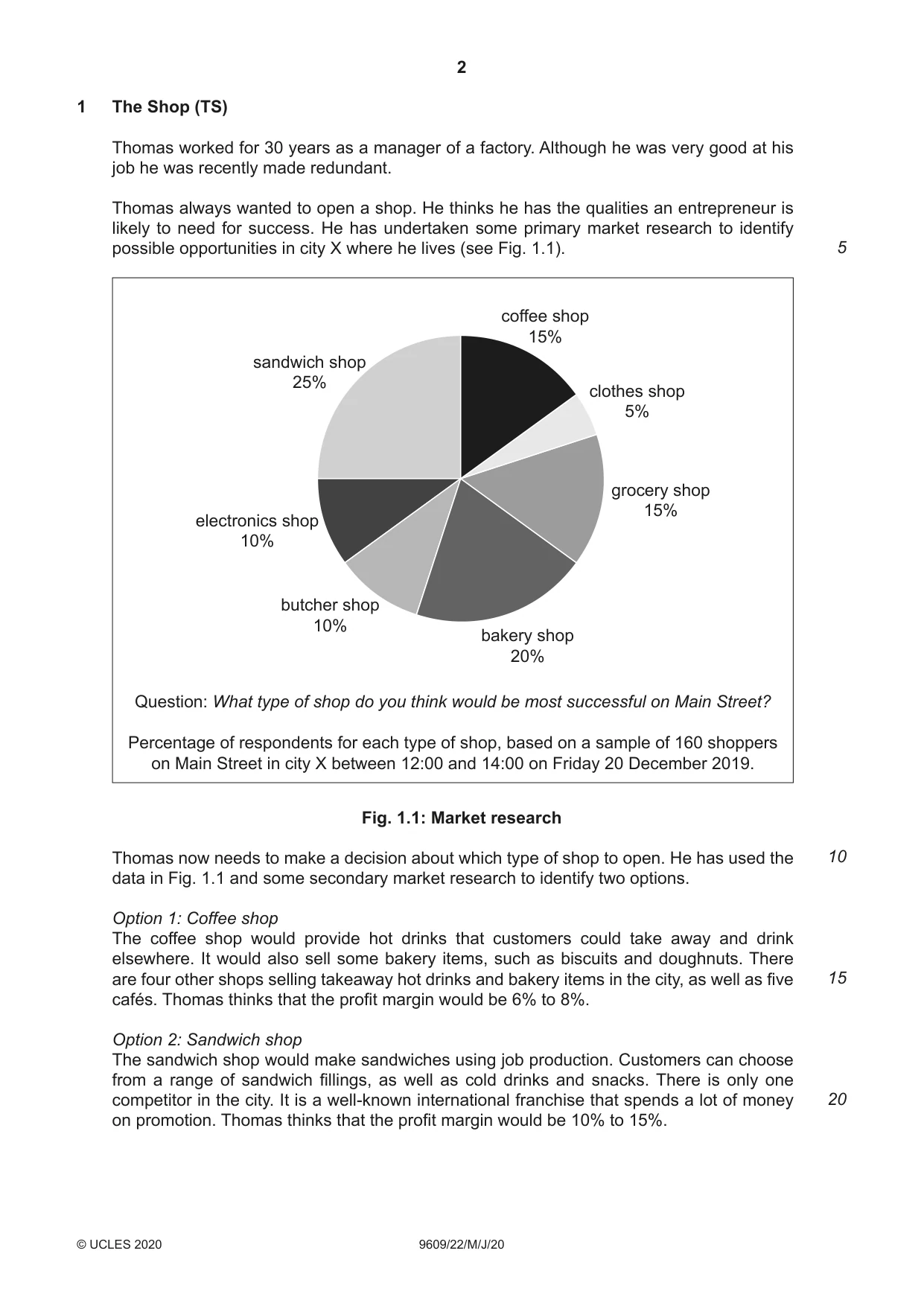
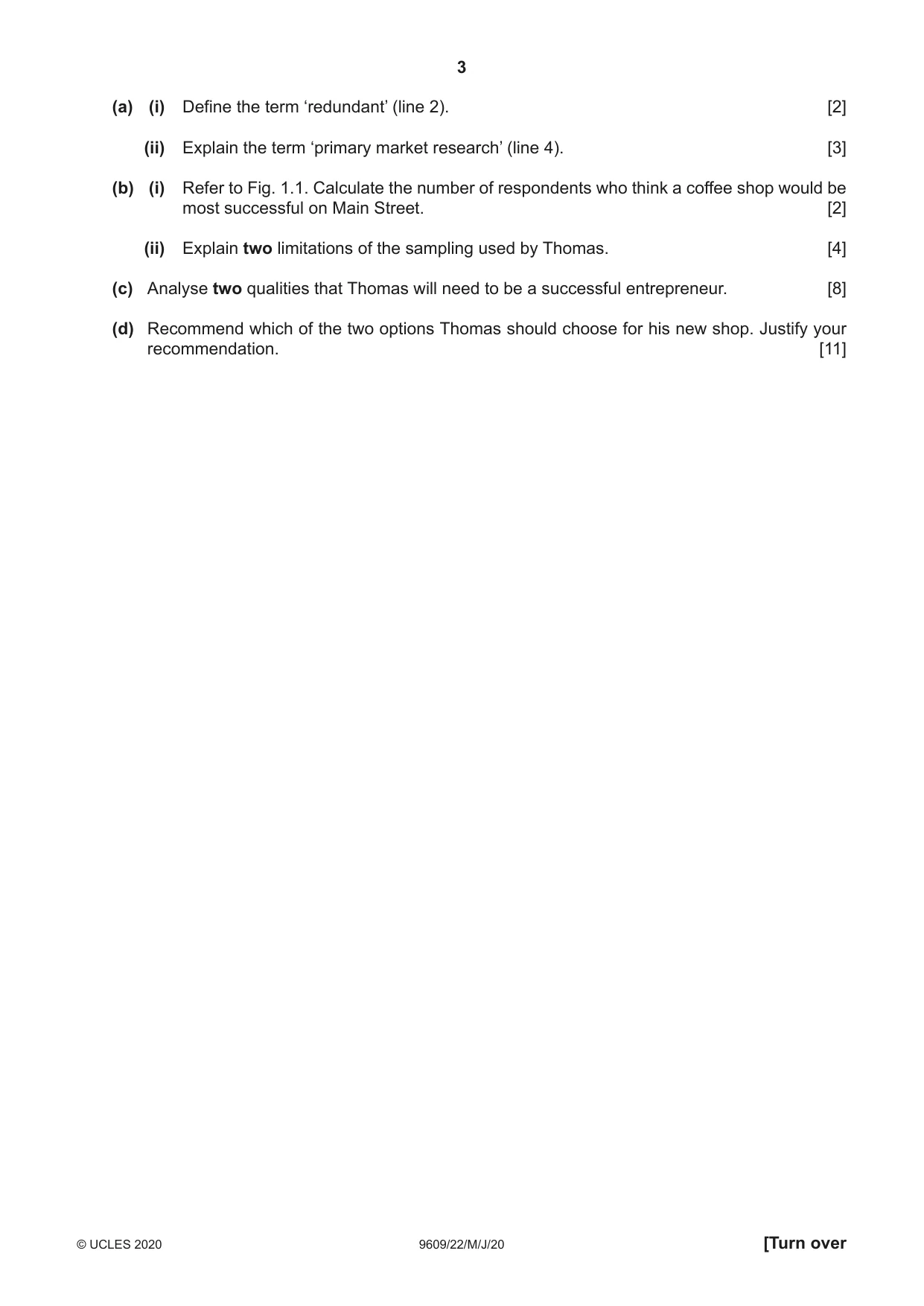
1 The Shop (TS) Thomas worked for 30 years as a manager of a factory. Although he was very good at his job he was recently made redundant. Thomas always wanted to open a shop. He thinks he has the qualities an entrepreneur is likely to need for success. He has undertaken some primary market research to identify possible opportunities in city X where he lives (see Fig. 1.1). 5 coffee shop 15% sandwich shop 25% clothes shop 5% grocery shop 15% electronics shop 10% butcher shop 10% bakery shop 20% Question: What type of shop do you think would be most successful on Main Street? Percentage of respondents for each type of shop, based on a sample of 160 shoppers on Main Street in city X between 12:00 and 14:00 on Friday 20 December 2019. Fig. 1.1: Market research Thomas now needs to make a decision about which type of shop to open. He has used the 10 data in Fig. 1.1 and some secondary market research to identify two options. Option 1: Coffee shop The coffee shop would provide hot drinks that customers could take away and drink elsewhere. It would also sell some bakery items, such as biscuits and doughnuts. There are four other shops selling takeaway hot drinks and bakery items in the city, as well as five 15 cafés. Thomas thinks that the profit margin would be 6% to 8%. Option 2: Sandwich shop The sandwich shop would make sandwiches using job production. Customers can choose from a range of sandwich fillings, as well as cold drinks and snacks. There is only one competitor in the city. It is a well-known international franchise that spends a lot of money 20 on promotion. Thomas thinks that the profit margin would be 10% to 15%. (a) (i) Define the term ‘redundant’ (line 2). [2] (ii) Explain the term ‘primary market research’ (line 4). [3] (b) (i) Refer to Fig. 1.1. Calculate the number of respondents who think a coffee shop would be most successful on Main Street. [2] (ii) Explain two limitations of the sampling used by Thomas. [4] (c) Analyse two qualities that Thomas will need to be a successful entrepreneur. [8] (d) Recommend which of the two options Thomas should choose for his new shop. Justify your recommendation. [11]
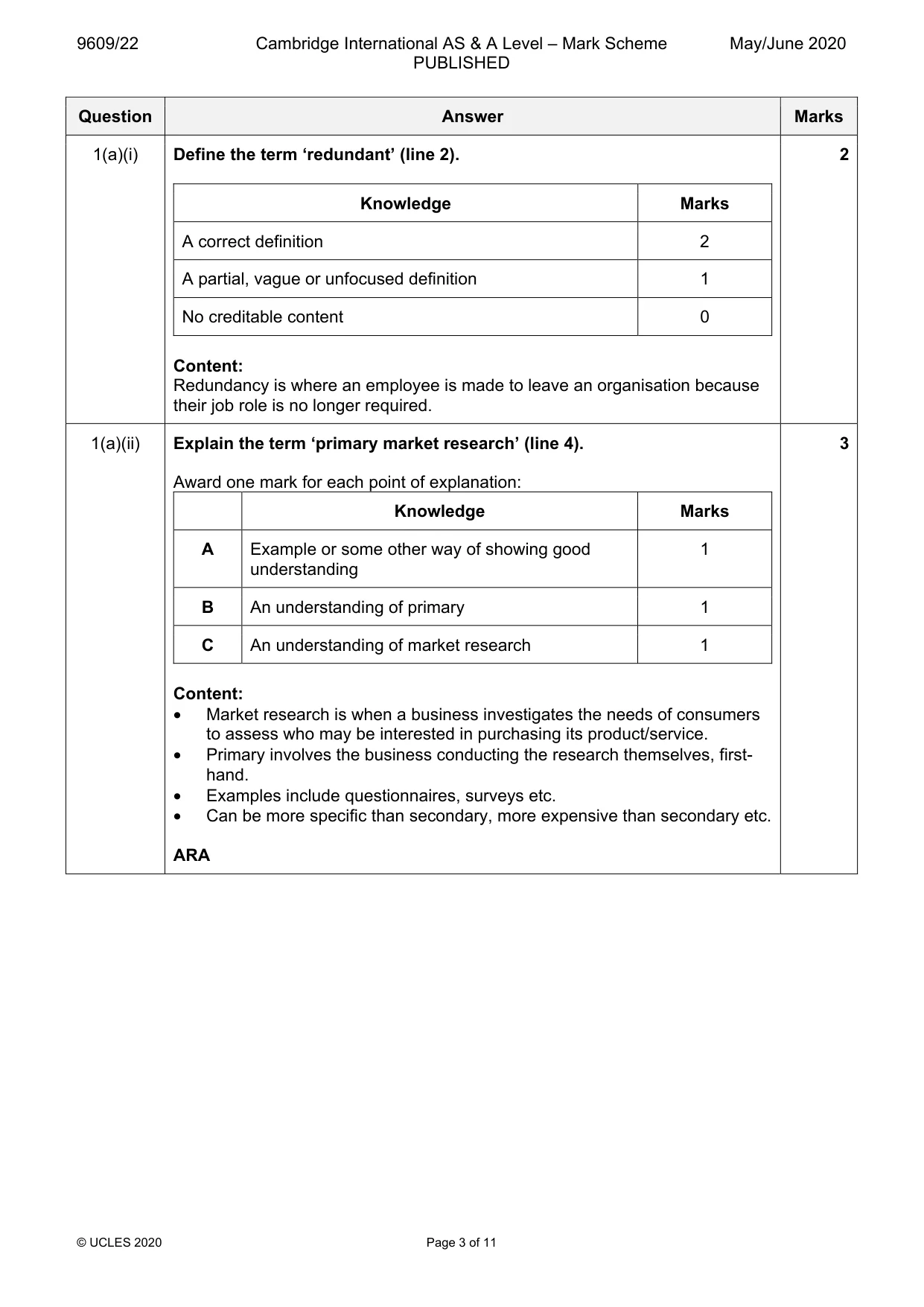
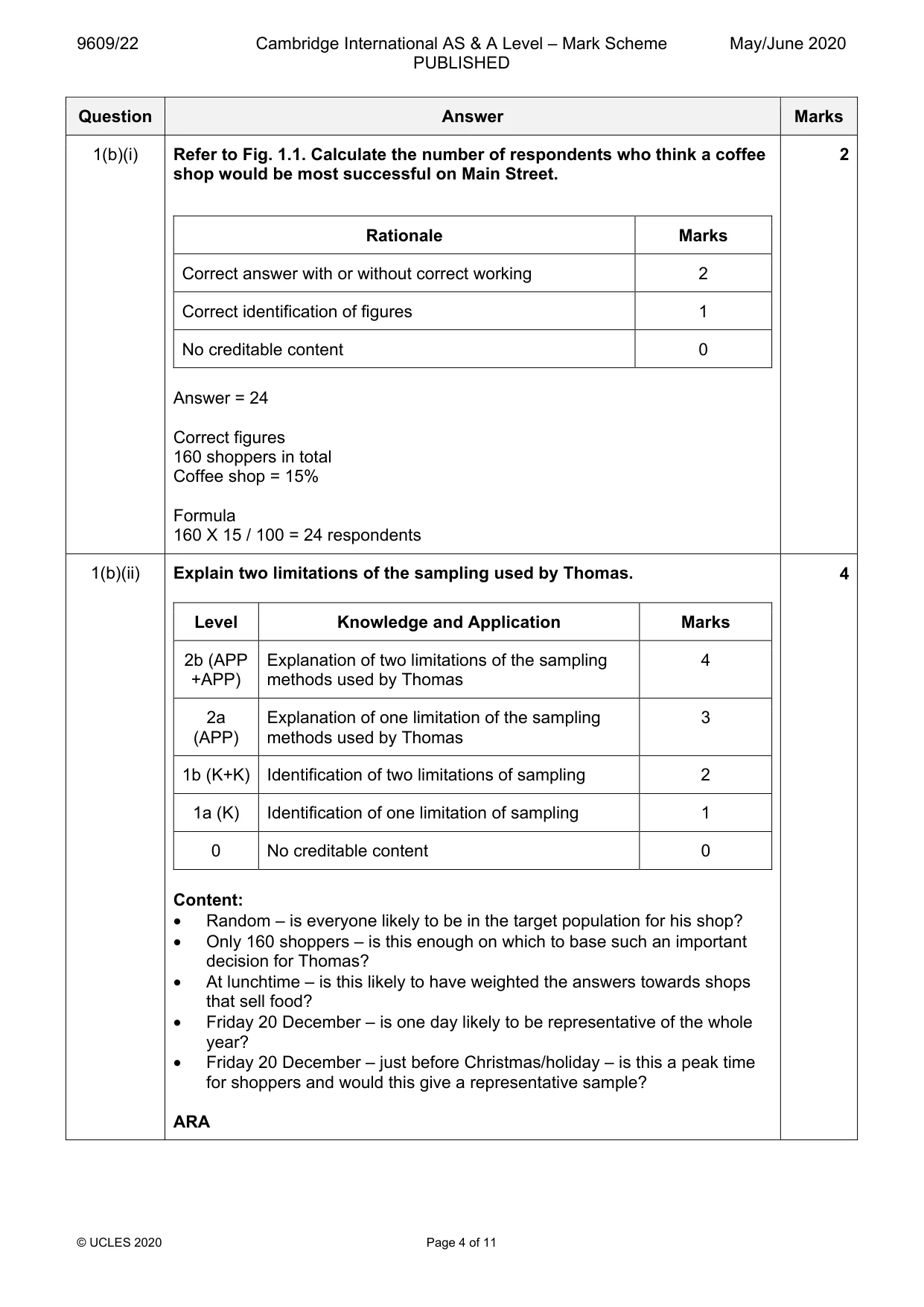
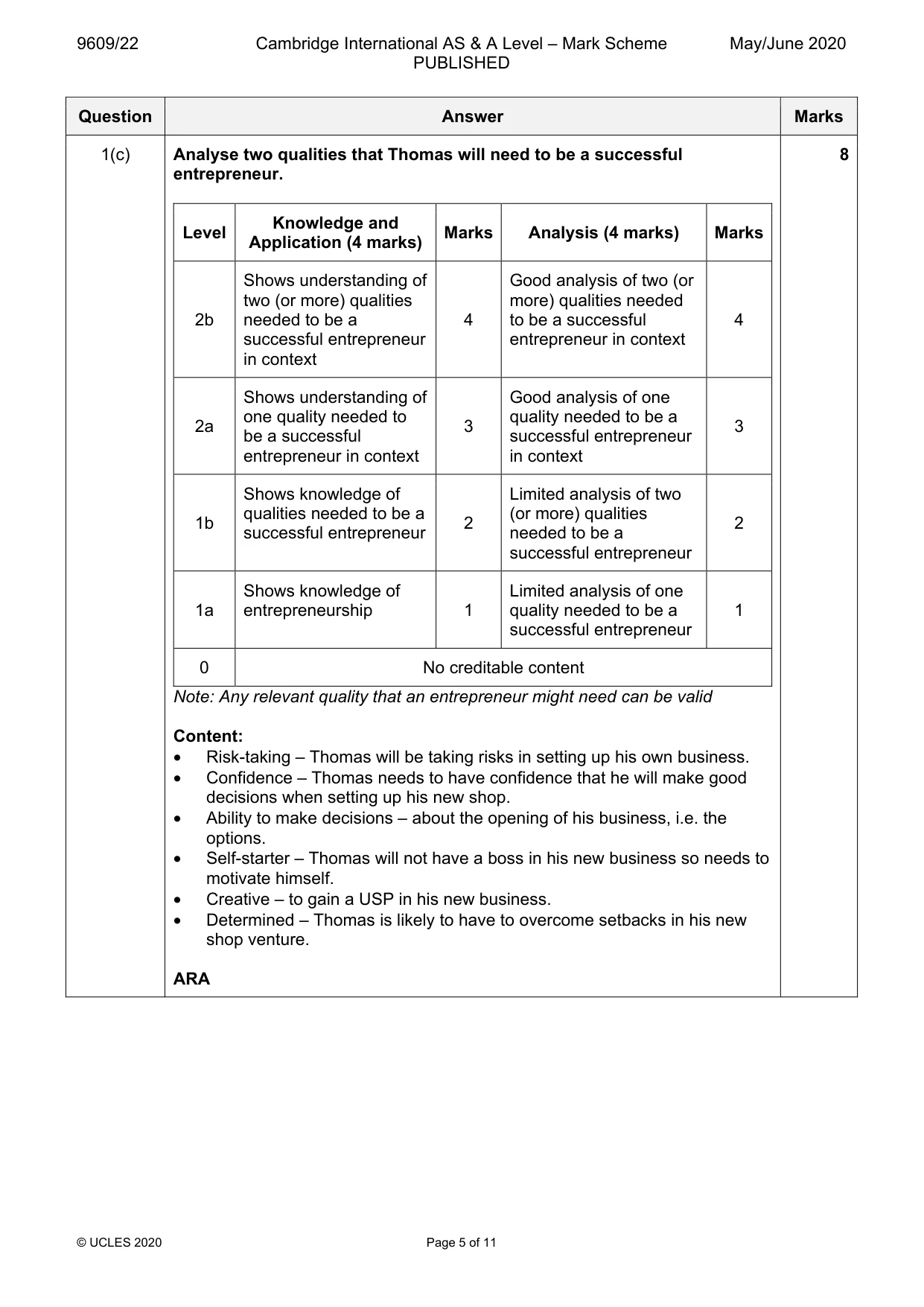
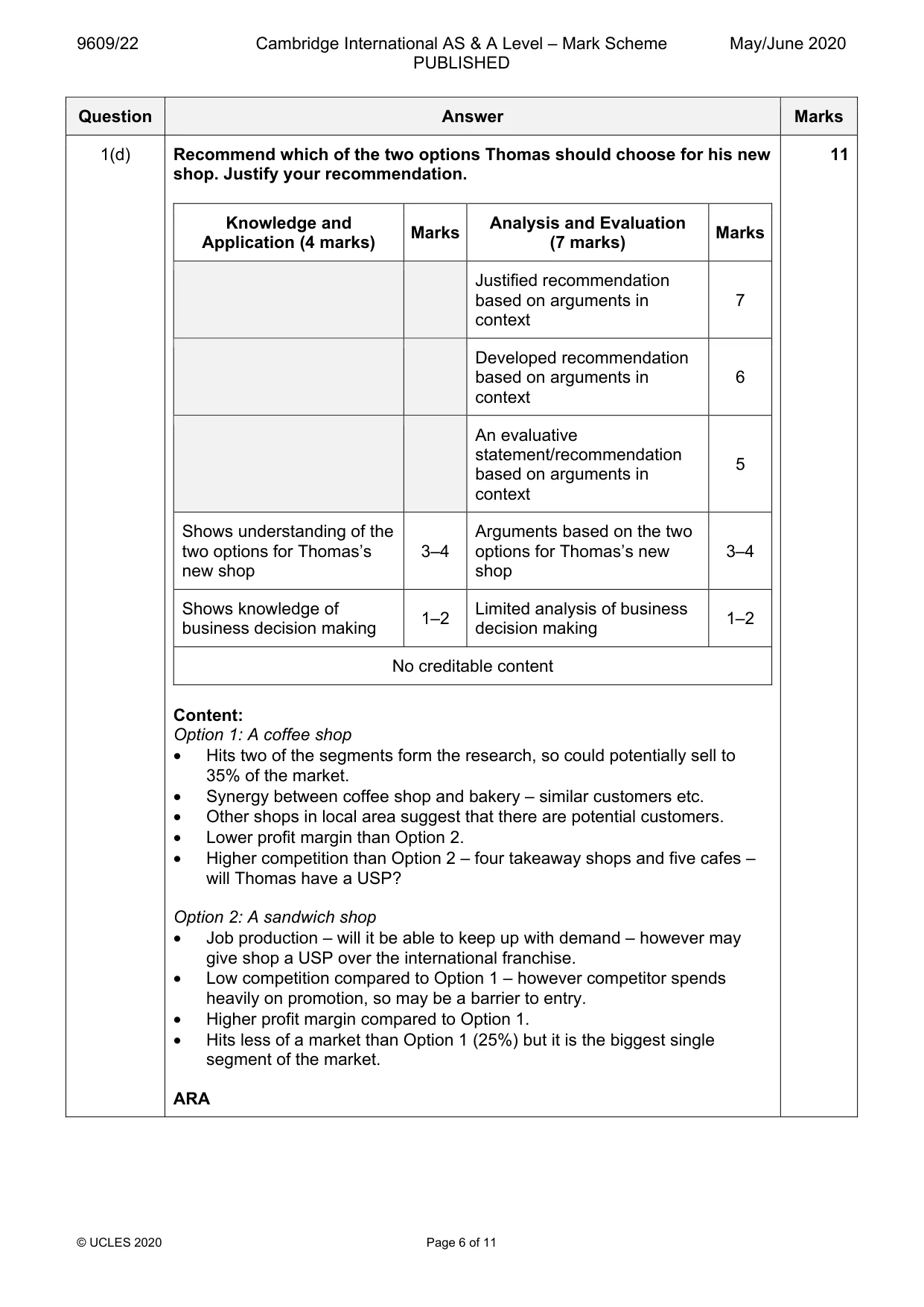
Mark scheme: Question Answer Marks 1(a)(i) Define the term ‘redundant’ (line 2). 2 Knowledge Marks A correct definition 2 A partial, vague or unfocused definition 1 No creditable content 0 Content: Redundancy is where an employee is made to leave an organisation because their job role is no longer required. 1(a)(ii) Explain the term ‘primary market research’ (line 4). 3 Award one mark for each point of explanation: Knowledge Marks A Example or some other way of showing good 1 understanding B An understanding of primary 1 C An understanding of market research 1 Content: • Market research is when a business investigates the needs of consumers to assess who may be interested in purchasing its product/service. • Primary involves the business conducting the research themselves, first- hand. • Examples include questionnaires, surveys etc. • Can be more specific than secondary, more expensive than secondary etc. ARA 1(b)(i) Refer to Fig. 1.1. Calculate the number of respondents who think a coffee 2 shop would be most successful on Main Street. Rationale Marks Correct answer with or without correct working 2 Correct identification of figures 1 No creditable content 0 Answer = 24 Correct figures 160 shoppers in total Coffee shop = 15% Formula 160 X 15 / 100 = 24 respondents 1(b)(ii) Explain two limitations of the sampling used by Thomas. 4 Level Knowledge and Application Marks 2b (APP Explanation of two limitations of the sampling 4 +APP) methods used by Thomas 2a Explanation of one limitation of the sampling 3 (APP) methods used by Thomas 1b (K+K) Identification of two limitations of sampling 2 1a (K) Identification of one limitation of sampling 1 0 No creditable content 0 Content: • Random – is everyone likely to be in the target population for his shop? • Only 160 shoppers – is this enough on which to base such an important decision for Thomas? • At lunchtime – is this likely to have weighted the answers towards shops that sell food? • Friday 20 December – is one day likely to be representative of the whole year? • Friday 20 December – just before Christmas/holiday – is this a peak time for shoppers and would this give a representative sample? ARA 1(c) Analyse two qualities that Thomas will need to be a successful 8 entrepreneur. Knowledge and Level Marks Analysis (4 marks) Marks Application (4 marks) Shows understanding of Good analysis of two (or two (or more) qualities more) qualities needed 2b needed to be a 4 to be a successful 4 successful entrepreneur entrepreneur in context in context Shows understanding of Good analysis of one one quality needed to quality needed to be a 2a 3 3 be a successful successful entrepreneur entrepreneur in context in context Shows knowledge of Limited analysis of two qualities needed to be a (or more) qualities 1b 2 2 successful entrepreneur needed to be a successful entrepreneur Shows knowledge of Limited analysis of one 1a entrepreneurship 1 quality needed to be a 1 successful entrepreneur 0 No creditable content Note: Any relevant quality that an entrepreneur might need can be valid Content: • Risk-taking – Thomas will be taking risks in setting up his own business. • Confidence – Thomas needs to have confidence that he will make good decisions when setting up his new shop. • Ability to make decisions – about the opening of his business, i.e. the options. • Self-starter – Thomas will not have a boss in his new business so needs to motivate himself. • Creative – to gain a USP in his new business. • Determined – Thomas is likely to have to overcome setbacks in his new shop venture. ARA 1(d) Recommend which of the two options Thomas should choose for his new 11 shop. Justify your recommendation. Knowledge and Analysis and Evaluation Marks Marks Application (4 marks) (7 marks) Justified recommendation based on arguments in 7 context Developed recommendation based on arguments in 6 context An evaluative statement/recommendation 5 based on arguments in context Shows understanding of the Arguments based on the two two options for Thomas’s 3–4 options for Thomas’s new 3–4 new shop shop Shows knowledge of Limited analysis of business 1–2 1–2 business decision making decision making No creditable content Content: Option 1: A coffee shop • Hits two of the segments form the research, so could potentially sell to 35% of the market. • Synergy between coffee shop and bakery – similar customers etc. • Other shops in local area suggest that there are potential customers. • Lower profit margin than Option 2. • Higher competition than Option 2 – four takeaway shops and five cafes – will Thomas have a USP? Option 2: A sandwich shop • Job production – will it be able to keep up with demand – however may give shop a USP over the international franchise. • Low competition compared to Option 1 – however competitor spends heavily on promotion, so may be a barrier to entry. • Higher profit margin compared to Option 1. • Hits less of a market than Option 1 (25%) but it is the biggest single segment of the market. ARA
Q2 · Market Solution (MS) MS is a public limited company in the tertiary sector
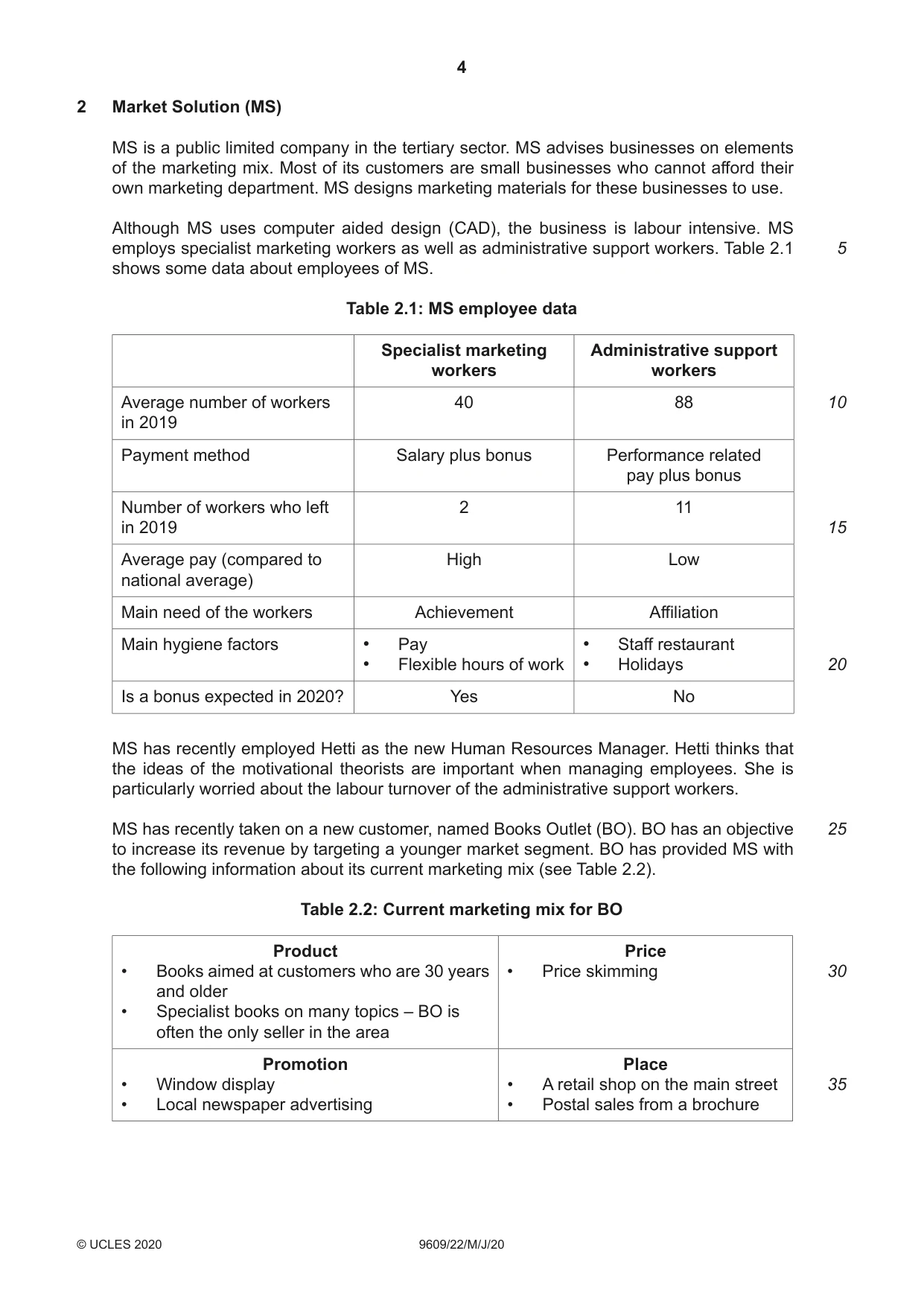
2 Market Solution (MS) MS is a public limited company in the tertiary sector. MS advises businesses on elements of the marketing mix. Most of its customers are small businesses who cannot afford their own marketing department. MS designs marketing materials for these businesses to use. Although MS uses computer aided design (CAD), the business is labour intensive. MS employs specialist marketing workers as well as administrative support workers. Table 2.1 5 shows some data about employees of MS. Table 2.1: MS employee data Specialist marketing Administrative support workers workers Average number of workers 40 88 10 in 2019 Payment method Salary plus bonus Performance related pay plus bonus Number of workers who left 2 11 in 2019 15 Average pay (compared to High Low national average) Main need of the workers Achievement Affiliation Main hygiene factors • Pay • Staff restaurant • Flexible hours of work • Holidays 20 Is a bonus expected in 2020? Yes No MS has recently employed Hetti as the new Human Resources Manager. Hetti thinks that the ideas of the motivational theorists are important when managing employees. She is particularly worried about the labour turnover of the administrative support workers. MS has recently taken on a new customer, named Books Outlet (BO). BO has an objective 25 to increase its revenue by targeting a younger market segment. BO has provided MS with the following information about its current marketing mix (see Table 2.2). Table 2.2: Current marketing mix for BO Product Price • Books aimed at customers who are 30 years • Price skimming 30 and older • Specialist books on many topics – BO is often the only seller in the area Promotion Place • Window display • A retail shop on the main street 35 • Local newspaper advertising • Postal sales from a brochure (a) (i) Define the term ‘tertiary sector’ (line 1). [2] (ii) Explain the term ‘performance related pay’ (lines 12–13). [3] (b) (i) Refer to Table 2.1. Calculate the difference between the labour turnover of the specialist marketing workers and the labour turnover of the administrative support workers. [4] (ii) Analyse how Hetti could use the ideas of two motivational theorists to reduce the labour turnover of the administrative support workers. [8] (c) Explain one possible advantage to MS of being labour intensive. [2] (d) BO has an objective to increase its revenue by targeting a younger market segment (lines 25–26). Recommend how BO should change its marketing mix to achieve this objective. Justify your recommendation. [11]
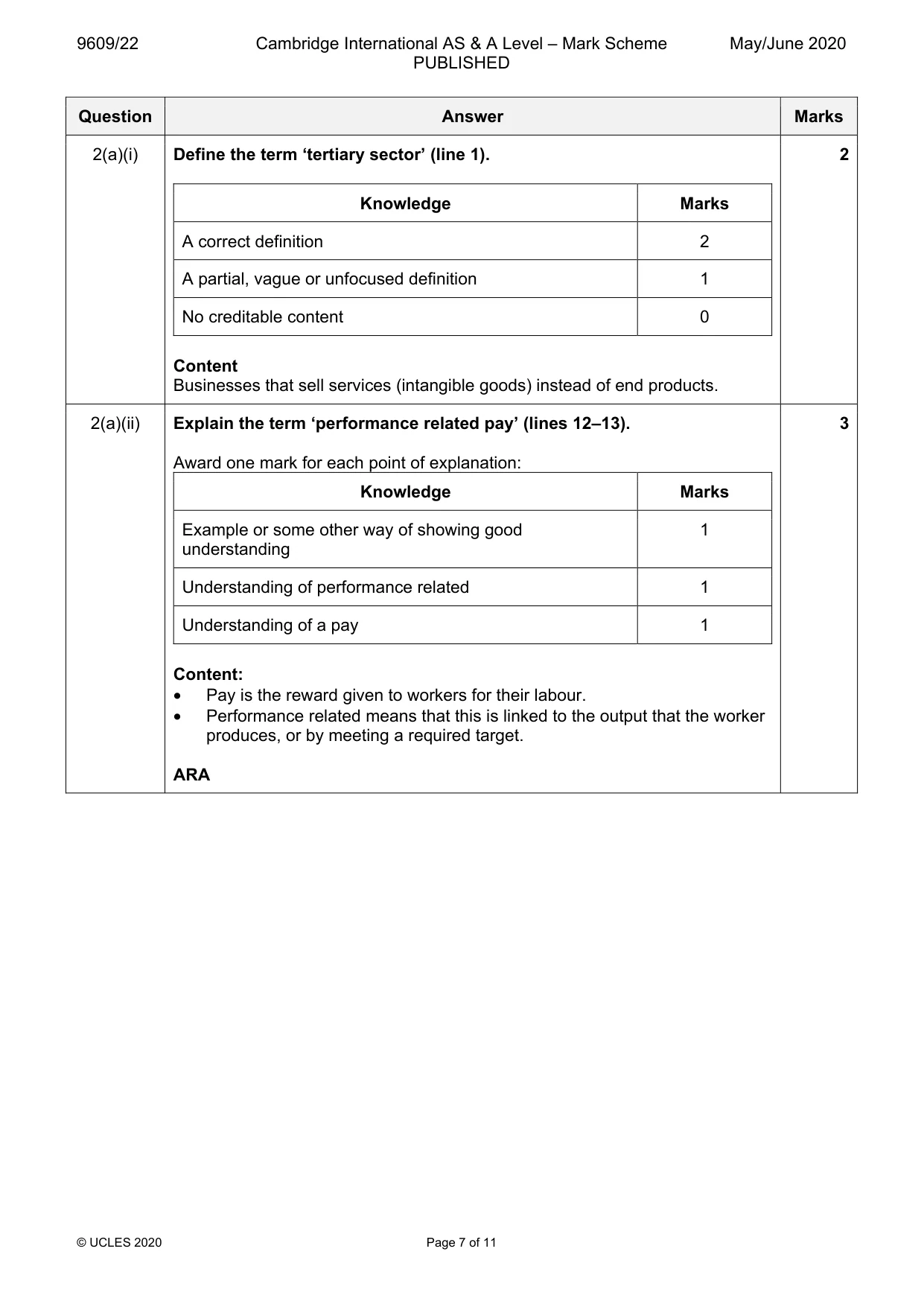
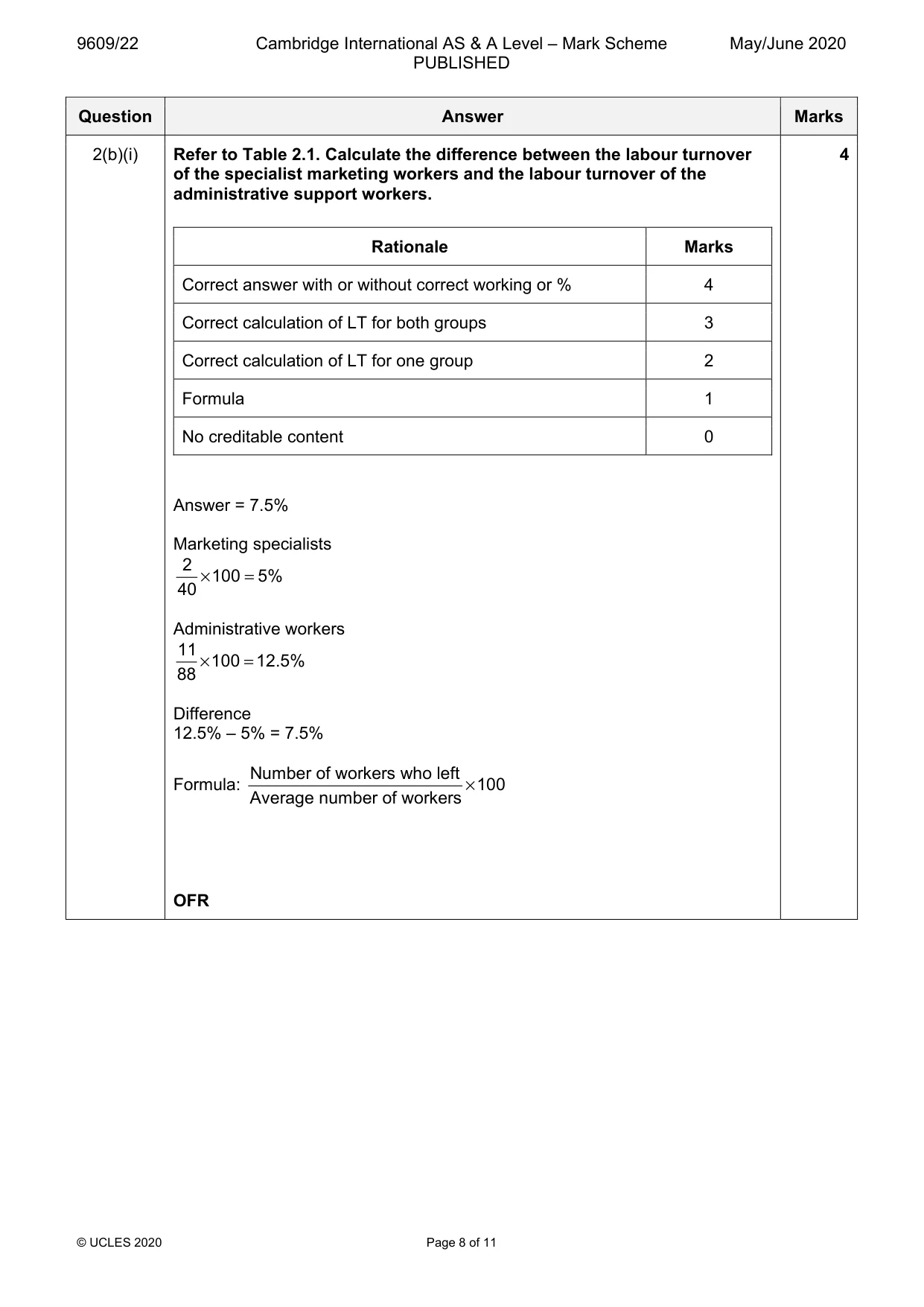
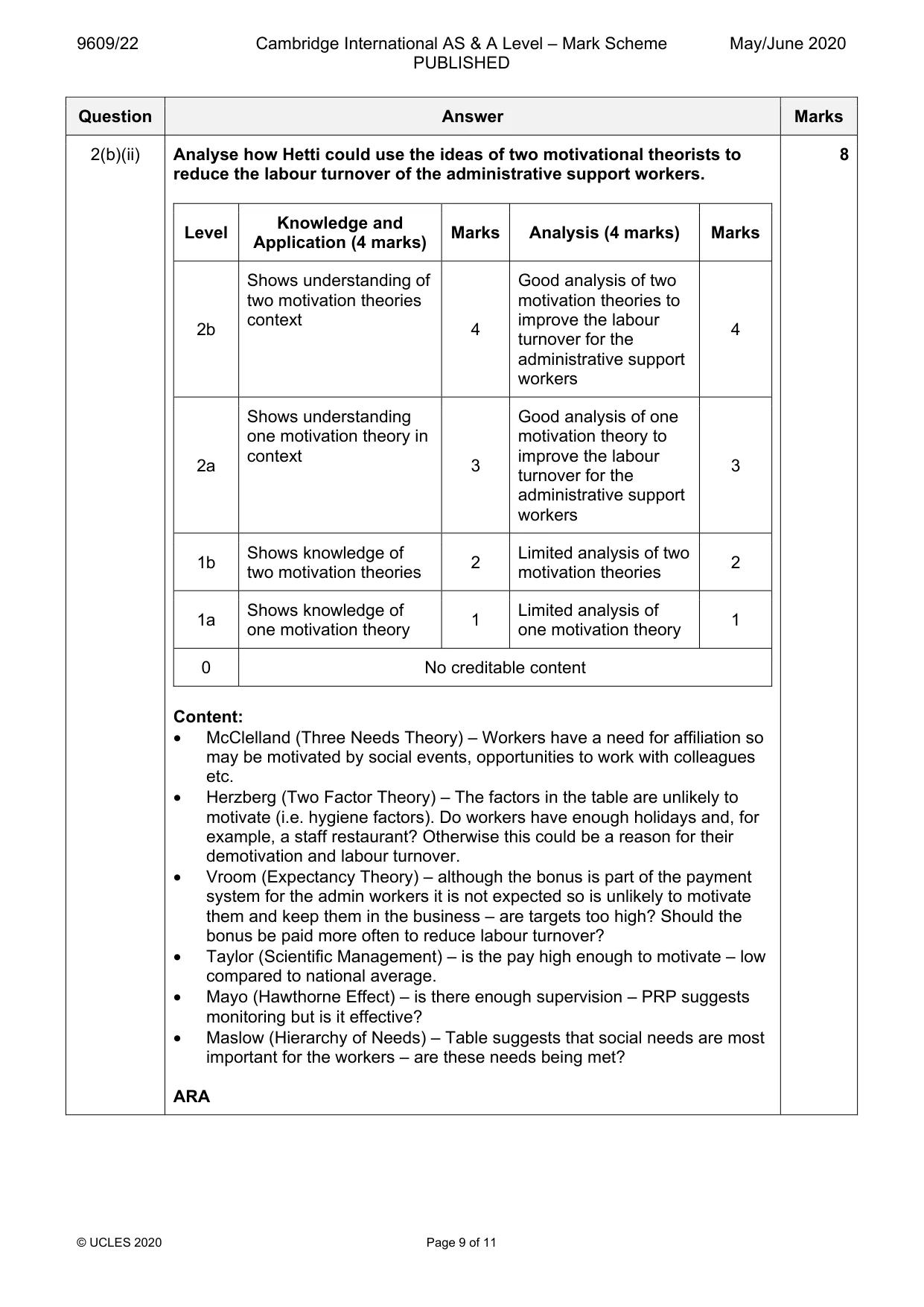
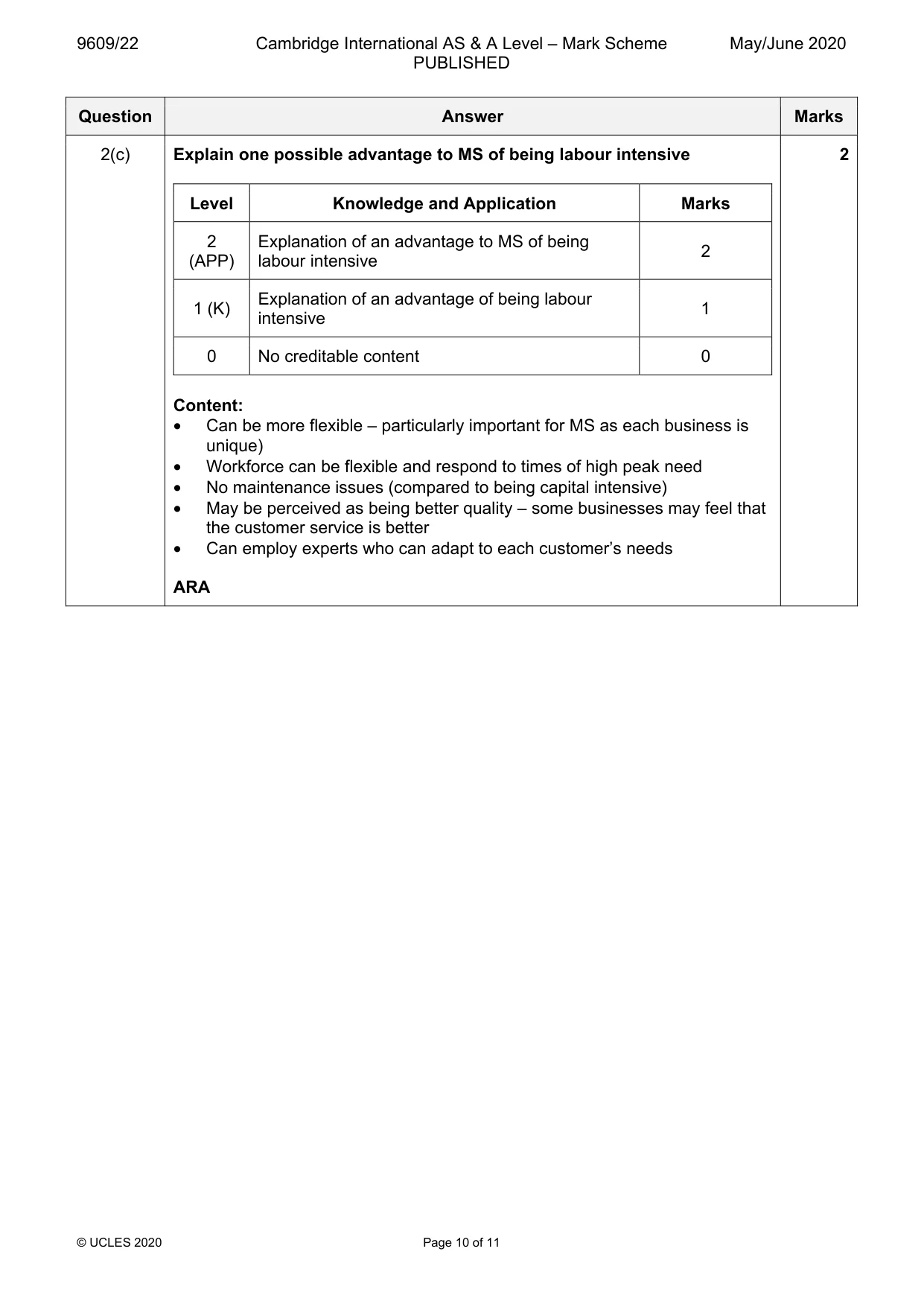
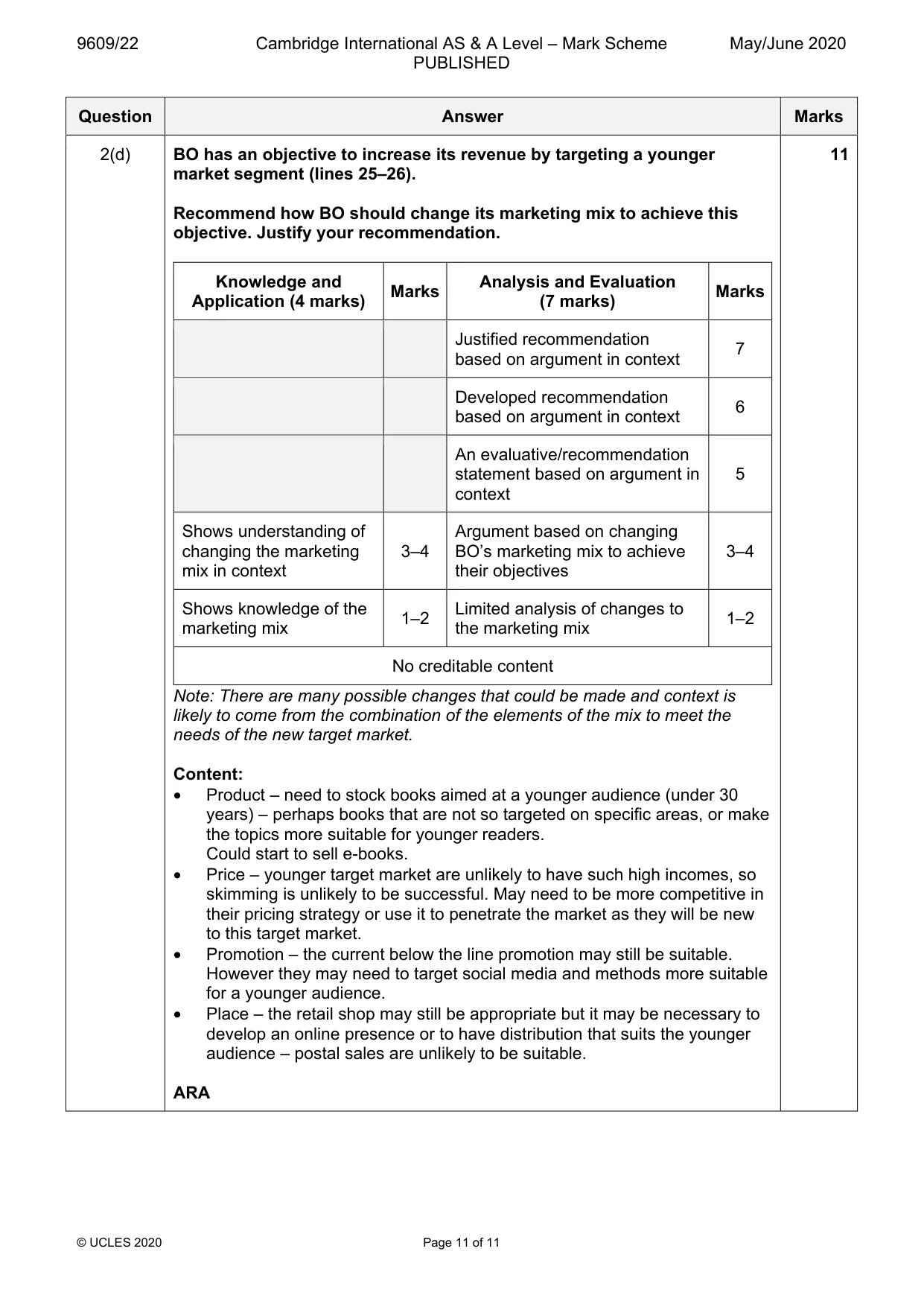
Mark scheme: 2(a)(i) Define the term ‘tertiary sector’ (line 1). 2 Knowledge Marks A correct definition 2 A partial, vague or unfocused definition 1 No creditable content 0 Content Businesses that sell services (intangible goods) instead of end products. 2(a)(ii) Explain the term ‘performance related pay’ (lines 12–13). 3 Award one mark for each point of explanation: Knowledge Marks Example or some other way of showing good 1 understanding Understanding of performance related 1 Understanding of a pay 1 Content: • Pay is the reward given to workers for their labour. • Performance related means that this is linked to the output that the worker produces, or by meeting a required target. ARA 2(b)(i) Refer to Table 2.1. Calculate the difference between the labour turnover 4 of the specialist marketing workers and the labour turnover of the administrative support workers. Rationale Marks Correct answer with or without correct working or % 4 Correct calculation of LT for both groups 3 Correct calculation of LT for one group 2 Formula 1 No creditable content 0 Answer = 7.5% Marketing specialists 2 × 100 = 5% 40 Administrative workers 11 × 100 = 12.5% 88 Difference 12.5% – 5% = 7.5% Number of workers who left Formula: × 100 Average number of workers OFR 2(b)(ii) Analyse how Hetti could use the ideas of two motivational theorists to 8 reduce the labour turnover of the administrative support workers. Knowledge and Level Marks Analysis (4 marks) Marks Application (4 marks) Shows understanding of Good analysis of two two motivation theories motivation theories to context improve the labour 2b 4 4 turnover for the administrative support workers Shows understanding Good analysis of one one motivation theory in motivation theory to context improve the labour 2a 3 3 turnover for the administrative support workers Shows knowledge of Limited analysis of two 1b 2 2 two motivation theories motivation theories Shows knowledge of Limited analysis of 1a 1 1 one motivation theory one motivation theory 0 No creditable content Content: • McClelland (Three Needs Theory) – Workers have a need for affiliation so may be motivated by social events, opportunities to work with colleagues etc. • Herzberg (Two Factor Theory) – The factors in the table are unlikely to motivate (i.e. hygiene factors). Do workers have enough holidays and, for example, a staff restaurant? Otherwise this could be a reason for their demotivation and labour turnover. • Vroom (Expectancy Theory) – although the bonus is part of the payment system for the admin workers it is not expected so is unlikely to motivate them and keep them in the business – are targets too high? Should the bonus be paid more often to reduce labour turnover? • Taylor (Scientific Management) – is the pay high enough to motivate – low compared to national average. • Mayo (Hawthorne Effect) – is there enough supervision – PRP suggests monitoring but is it effective? • Maslow (Hierarchy of Needs) – Table suggests that social needs are most important for the workers – are these needs being met? ARA 2(c) Explain one possible advantage to MS of being labour intensive 2 Level Knowledge and Application Marks 2 Explanation of an advantage to MS of being 2 (APP) labour intensive Explanation of an advantage of being labour 1 (K) 1 intensive 0 No creditable content 0 Content: • Can be more flexible – particularly important for MS as each business is unique) • Workforce can be flexible and respond to times of high peak need • No maintenance issues (compared to being capital intensive) • May be perceived as being better quality – some businesses may feel that the customer service is better • Can employ experts who can adapt to each customer’s needs ARA 2(d) BO has an objective to increase its revenue by targeting a younger 11 market segment (lines 25–26). Recommend how BO should change its marketing mix to achieve this objective. Justify your recommendation. Knowledge and Analysis and Evaluation Marks Marks Application (4 marks) (7 marks) Justified recommendation 7 based on argument in context Developed recommendation 6 based on argument in context An evaluative/recommendation statement based on argument in 5 context Shows understanding of Argument based on changing changing the marketing 3–4 BO’s marketing mix to achieve 3–4 mix in context their objectives Shows knowledge of the Limited analysis of changes to 1–2 1–2 marketing mix the marketing mix No creditable content Note: There are many possible changes that could be made and context is likely to come from the combination of the elements of the mix to meet the needs of the new target market. Content: • Product – need to stock books aimed at a younger audience (under 30 years) – perhaps books that are not so targeted on specific areas, or make the topics more suitable for younger readers. Could start to sell e-books. • Price – younger target market are unlikely to have such high incomes, so skimming is unlikely to be successful. May need to be more competitive in their pricing strategy or use it to penetrate the market as they will be new to this target market. • Promotion – the current below the line promotion may still be suitable. However they may need to target social media and methods more suitable for a younger audience. • Place – the retail shop may still be appropriate but it may be necessary to develop an online presence or to have distribution that suits the younger audience – postal sales are unlikely to be suitable. ARA
What was in this paper
The subtopics covered by these 2 questions, and how many questions each got. Open one in a new tab to see every Cambridge question on it.