Cambridge A Level Business (for first examination in 2016) 9609 — 2020 May/June Paper 1 · Variant 2
9609/12/M/J/20
The question paper and its mark scheme, free to read here and free to download. This is Cambridge’s own paper, exactly as it was sat.
Question paper4 pages


Mark scheme13 pages
Answers below. Sit the paper first if you are practising.

Paper as text
Question paper, page 1
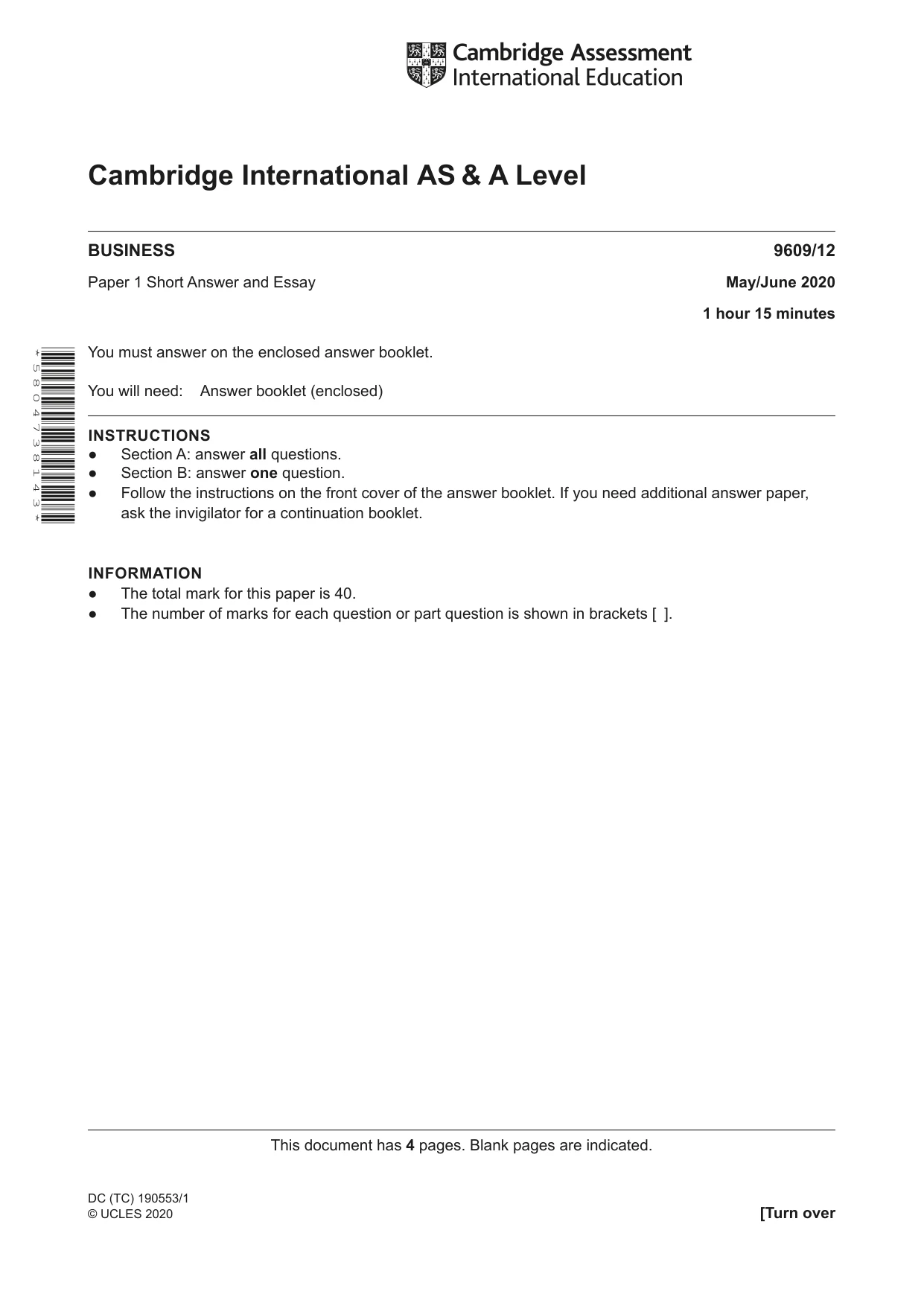
Cambridge International AS & A Level This document has 4 pages. Blank pages are indicated. DC (TC) 190553/1 © UCLES 2020 [Turn over * 5 8 0 4 7 3 8 1 4 3 * BUSINESS 9609/12 Paper 1 Short Answer and Essay May/June 2020 1 hour 15 minutes You must answer on the enclosed answer booklet. You will need: Answer booklet (enclosed) INSTRUCTIONS ● Section A: answer all questions. ● Section B: answer one question. ● Follow the instructions on the front cover of the answer booklet. If you need additional answer paper, ask the invigilator for a continuation booklet. INFORMATION ● The total mark for this paper is 40. ● The number of marks for each question or part question is shown in brackets [ ].
Question paper, page 2
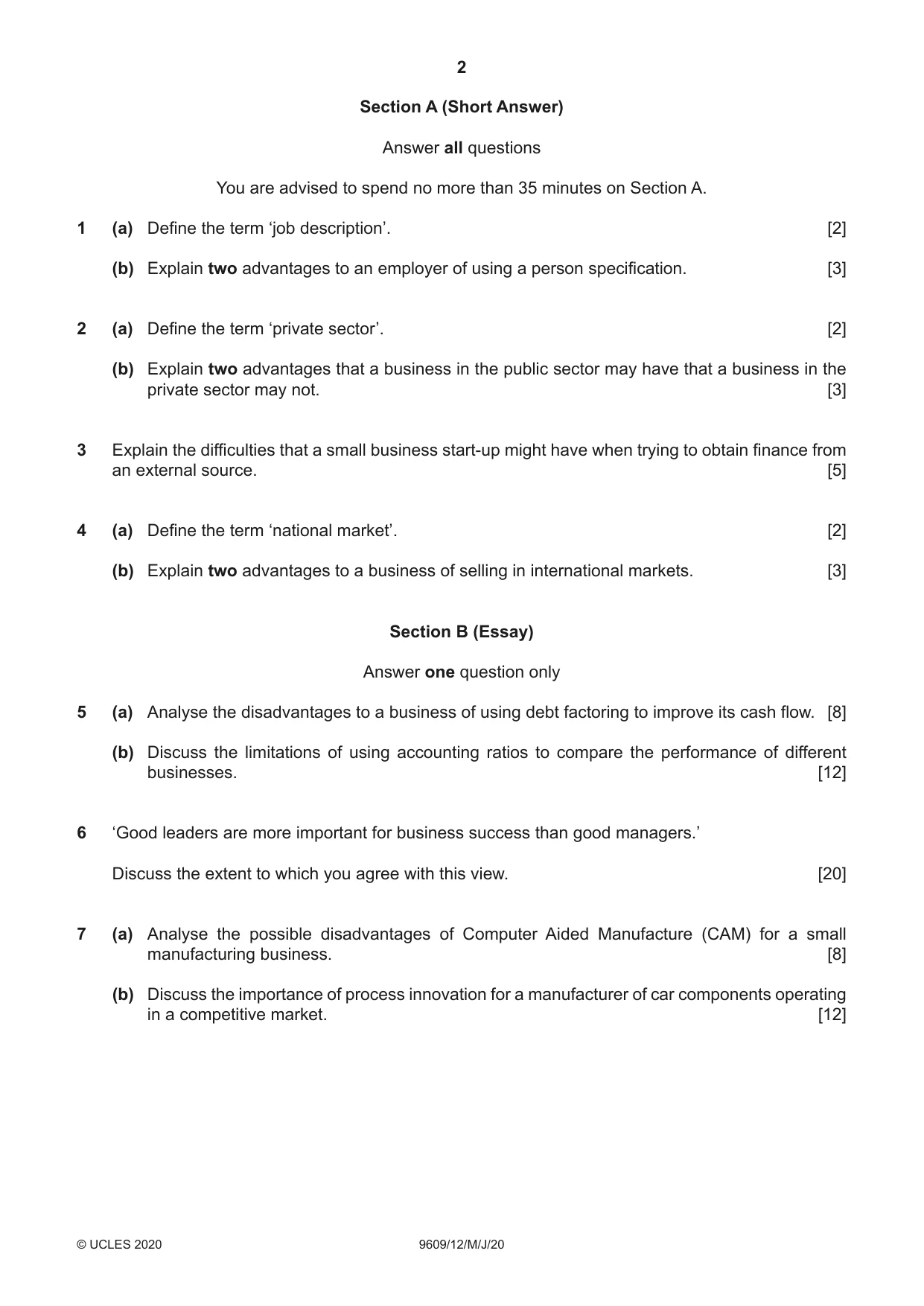
2 9609/12/M/J/20 © UCLES 2020 Section A (Short Answer) Answer all questions You are advised to spend no more than 35 minutes on Section A. 1 (a) Define the term ‘job description’. [2] (b) Explain two advantages to an employer of using a person specification. [3] 2 (a) Define the term ‘private sector’. [2] (b) Explain two advantages that a business in the public sector may have that a business in the private sector may not. [3] 3 Explain the difficulties that a small business start-up might have when trying to obtain finance from an external source. [5] 4 (a) Define the term ‘national market’. [2] (b) Explain two advantages to a business of selling in international markets. [3] Section B (Essay) Answer one question only 5 (a) Analyse the disadvantages to a business of using debt factoring to improve its cash flow. [8] (b) Discuss the limitations of using accounting ratios to compare the performance of different businesses. [12] 6 ‘Good leaders are more important for business success than good managers.’ Discuss the extent to which you agree with this view. [20] 7 (a) Analyse the possible disadvantages of Computer Aided Manufacture (CAM) for a small manufacturing business. [8] (b) Discuss the importance of process innovation for a manufacturer of car components operating in a competitive market. [12]
Question paper, page 3
3 9609/12/M/J/20 © UCLES 2020 BLANK PAGE
Question paper, page 4
4 9609/12/M/J/20 © UCLES 2020 Permission to reproduce items where third-party owned material protected by copyright is included has been sought and cleared where possible. Every reasonable effort has been made by the publisher (UCLES) to trace copyright holders, but if any items requiring clearance have unwittingly been included, the publisher will be pleased to make amends at the earliest possible opportunity. To avoid the issue of disclosure of answer-related information to candidates, all copyright acknowledgements are reproduced online in the Cambridge Assessment International Education Copyright Acknowledgements Booklet. This is produced for each series of examinations and is freely available to download at www.cambridgeinternational.org after the live examination series. Cambridge Assessment International Education is part of the Cambridge Assessment Group. Cambridge Assessment is the brand name of the University of Cambridge Local Examinations Syndicate (UCLES), which itself is a department of the University of Cambridge. BLANK PAGE
Mark scheme, page 1
This document consists of 13 printed pages. © UCLES 2020 [Turn over Cambridge International AS & A Level BUSINESS 9609/12 Paper 1 Short Answer and Essay May/June 2020 MARK SCHEME Maximum Mark: 40 Published Students did not sit exam papers in the June 2020 series due to the Covid-19 global pandemic. This mark scheme is published to support teachers and students and should be read together with the question paper. It shows the requirements of the exam. The answer column of the mark scheme shows the proposed basis on which Examiners would award marks for this exam. Where appropriate, this column also provides the most likely acceptable alternative responses expected from students. Examiners usually review the mark scheme after they have seen student responses and update the mark scheme if appropriate. In the June series, Examiners were unable to consider the acceptability of alternative responses, as there were no student responses to consider. Mark schemes should usually be read together with the Principal Examiner Report for Teachers. However, because students did not sit exam papers, there is no Principal Examiner Report for Teachers for the June 2020 series. Cambridge International will not enter into discussions about these mark schemes. Cambridge International is publishing the mark schemes for the June 2020 series for most Cambridge IGCSE™ and Cambridge International A & AS Level components, and some Cambridge O Level components.
Mark scheme, page 2
9609/12 Cambridge International AS & A Level – Mark Scheme PUBLISHED May/June 2020 © UCLES 2020 Page 2 of 13 Generic Marking Principles These general marking principles must be applied by all examiners when marking candidate answers. They should be applied alongside the specific content of the mark scheme or generic level descriptors for a question. Each question paper and mark scheme will also comply with these marking principles. GENERIC MARKING PRINCIPLE 1: Marks must be awarded in line with: • the specific content of the mark scheme or the generic level descriptors for the question • the specific skills defined in the mark scheme or in the generic level descriptors for the question • the standard of response required by a candidate as exemplified by the standardisation scripts. GENERIC MARKING PRINCIPLE 2: Marks awarded are always whole marks (not half marks, or other fractions). GENERIC MARKING PRINCIPLE 3: Marks must be awarded positively: • marks are awarded for correct/valid answers, as defined in the mark scheme. However, credit is given for valid answers which go beyond the scope of the syllabus and mark scheme, referring to your Team Leader as appropriate • marks are awarded when candidates clearly demonstrate what they know and can do • marks are not deducted for errors • marks are not deducted for omissions • answers should only be judged on the quality of spelling, punctuation and grammar when these features are specifically assessed by the question as indicated by the mark scheme. The meaning, however, should be unambiguous. GENERIC MARKING PRINCIPLE 4: Rules must be applied consistently e.g. in situations where candidates have not followed instructions or in the application of generic level descriptors. GENERIC MARKING PRINCIPLE 5: Marks should be awarded using the full range of marks defined in the mark scheme for the question (however; the use of the full mark range may be limited according to the quality of the candidate responses seen). GENERIC MARKING PRINCIPLE 6: Marks awarded are based solely on the requirements as defined in the mark scheme. Marks should not be awarded with grade thresholds or grade descriptors in mind.
Mark scheme, page 3
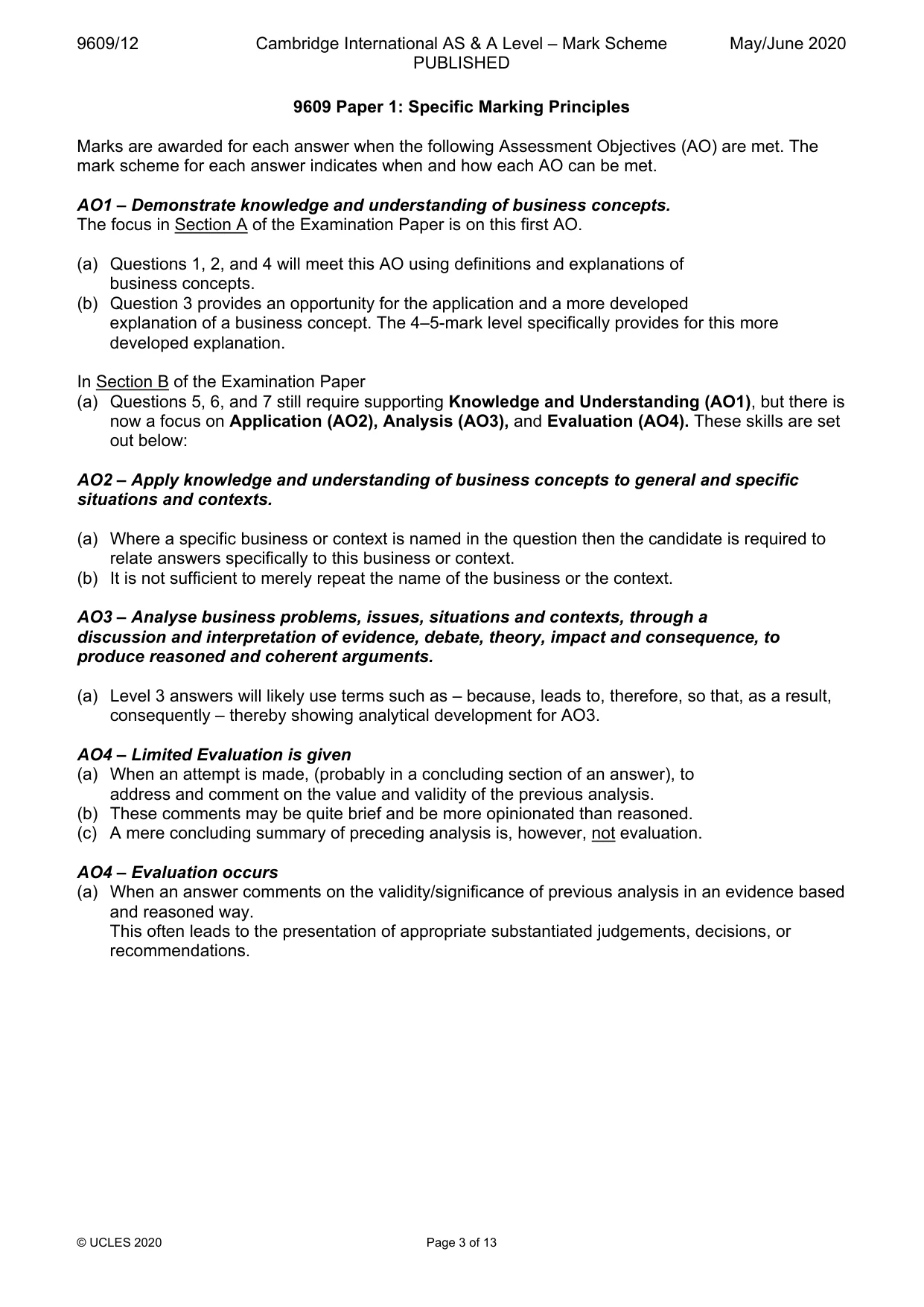
9609/12 Cambridge International AS & A Level – Mark Scheme PUBLISHED May/June 2020 © UCLES 2020 Page 3 of 13 9609 Paper 1: Specific Marking Principles Marks are awarded for each answer when the following Assessment Objectives (AO) are met. The mark scheme for each answer indicates when and how each AO can be met. AO1 – Demonstrate knowledge and understanding of business concepts. The focus in Section A of the Examination Paper is on this first AO. (a) Questions 1, 2, and 4 will meet this AO using definitions and explanations of business concepts. (b) Question 3 provides an opportunity for the application and a more developed explanation of a business concept. The 4–5-mark level specifically provides for this more developed explanation. In Section B of the Examination Paper (a) Questions 5, 6, and 7 still require supporting Knowledge and Understanding (AO1), but there is now a focus on Application (AO2), Analysis (AO3), and Evaluation (AO4). These skills are set out below: AO2 – Apply knowledge and understanding of business concepts to general and specific situations and contexts. (a) Where a specific business or context is named in the question then the candidate is required to relate answers specifically to this business or context. (b) It is not sufficient to merely repeat the name of the business or the context. AO3 – Analyse business problems, issues, situations and contexts, through a discussion and interpretation of evidence, debate, theory, impact and consequence, to produce reasoned and coherent arguments. (a) Level 3 answers will likely use terms such as – because, leads to, therefore, so that, as a result, consequently – thereby showing analytical development for AO3. AO4 – Limited Evaluation is given (a) When an attempt is made, (probably in a concluding section of an answer), to address and comment on the value and validity of the previous analysis. (b) These comments may be quite brief and be more opinionated than reasoned. (c) A mere concluding summary of preceding analysis is, however, not evaluation. AO4 – Evaluation occurs (a) When an answer comments on the validity/significance of previous analysis in an evidence based and reasoned way. This often leads to the presentation of appropriate substantiated judgements, decisions, or recommendations.
Mark scheme, page 4
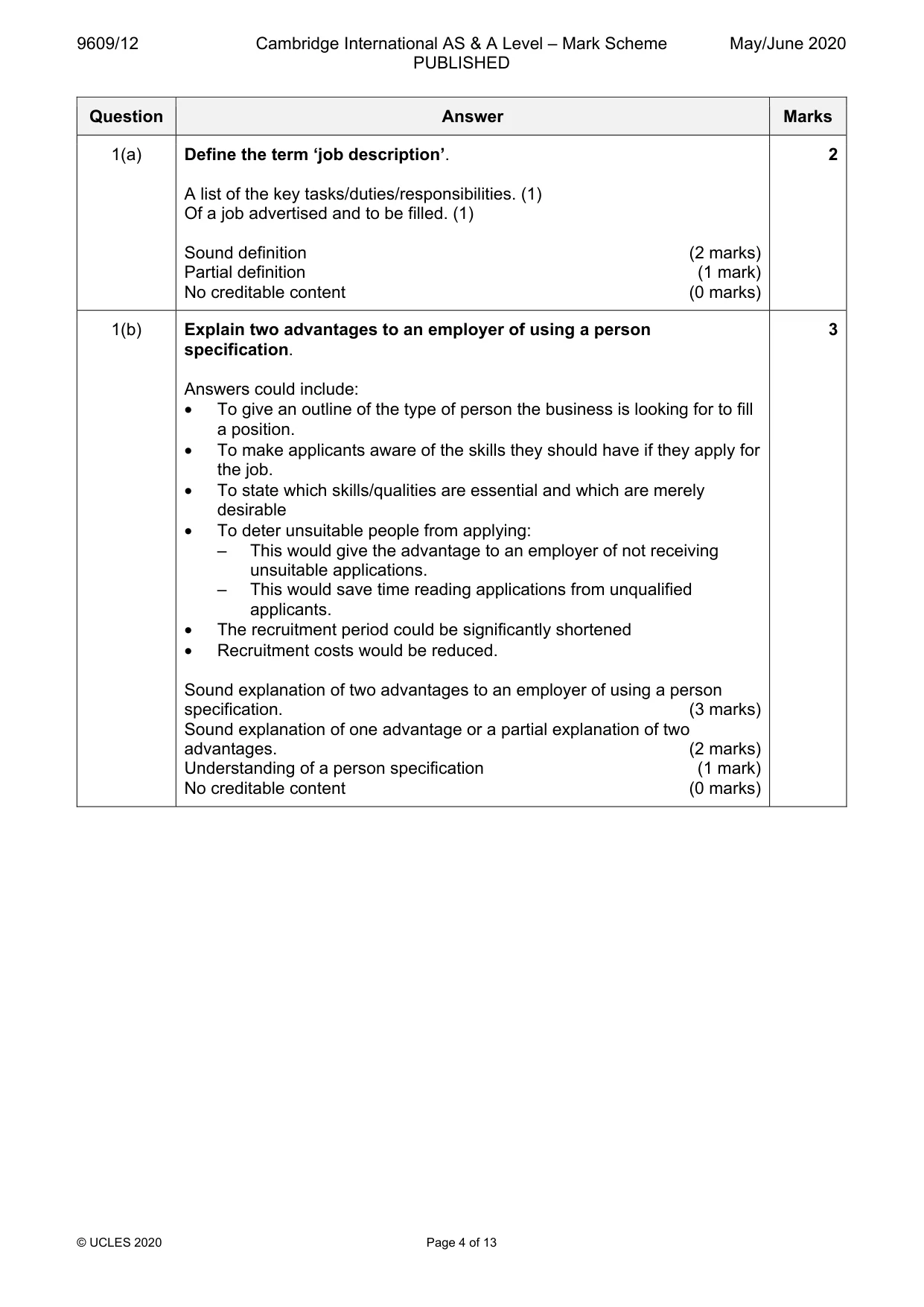
9609/12 Cambridge International AS & A Level – Mark Scheme PUBLISHED May/June 2020 © UCLES 2020 Page 4 of 13 Question Answer Marks 1(a) Define the term ‘job description’. A list of the key tasks/duties/responsibilities. (1) Of a job advertised and to be filled. (1) Sound definition (2 marks) Partial definition (1 mark) No creditable content (0 marks) 2 1(b) Explain two advantages to an employer of using a person specification. Answers could include: • To give an outline of the type of person the business is looking for to fill a position. • To make applicants aware of the skills they should have if they apply for the job. • To state which skills/qualities are essential and which are merely desirable • To deter unsuitable people from applying: – This would give the advantage to an employer of not receiving unsuitable applications. – This would save time reading applications from unqualified applicants. • The recruitment period could be significantly shortened • Recruitment costs would be reduced. Sound explanation of two advantages to an employer of using a person specification. (3 marks) Sound explanation of one advantage or a partial explanation of two advantages. (2 marks) Understanding of a person specification (1 mark) No creditable content (0 marks) 3
Mark scheme, page 5
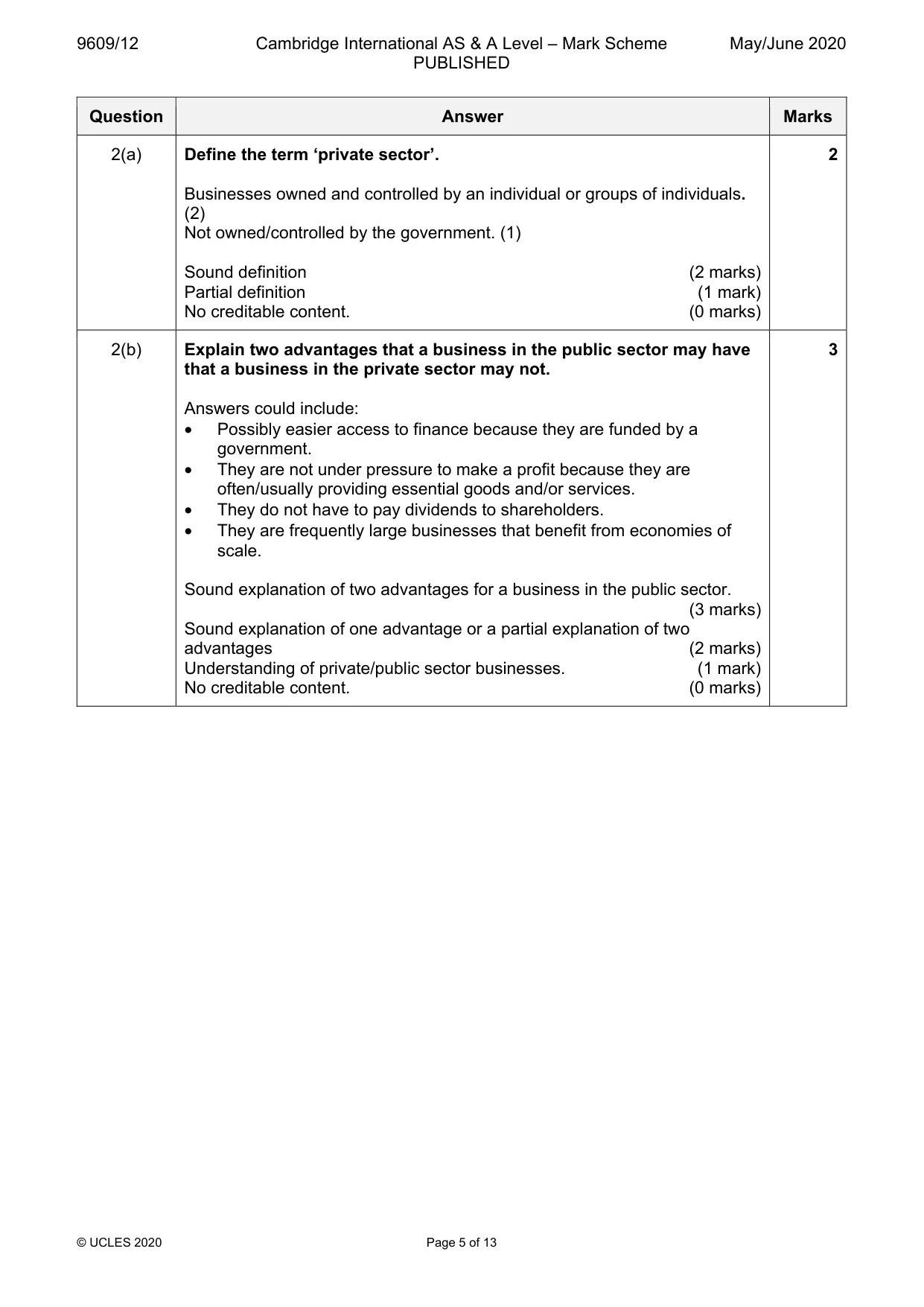
9609/12 Cambridge International AS & A Level – Mark Scheme PUBLISHED May/June 2020 © UCLES 2020 Page 5 of 13 Question Answer Marks 2(a) Define the term ‘private sector’. Businesses owned and controlled by an individual or groups of individuals. (2) Not owned/controlled by the government. (1) Sound definition (2 marks) Partial definition (1 mark) No creditable content. (0 marks) 2 2(b) Explain two advantages that a business in the public sector may have that a business in the private sector may not. Answers could include: • Possibly easier access to finance because they are funded by a government. • They are not under pressure to make a profit because they are often/usually providing essential goods and/or services. • They do not have to pay dividends to shareholders. • They are frequently large businesses that benefit from economies of scale. Sound explanation of two advantages for a business in the public sector. (3 marks) Sound explanation of one advantage or a partial explanation of two advantages (2 marks) Understanding of private/public sector businesses. (1 mark) No creditable content. (0 marks) 3
Mark scheme, page 6
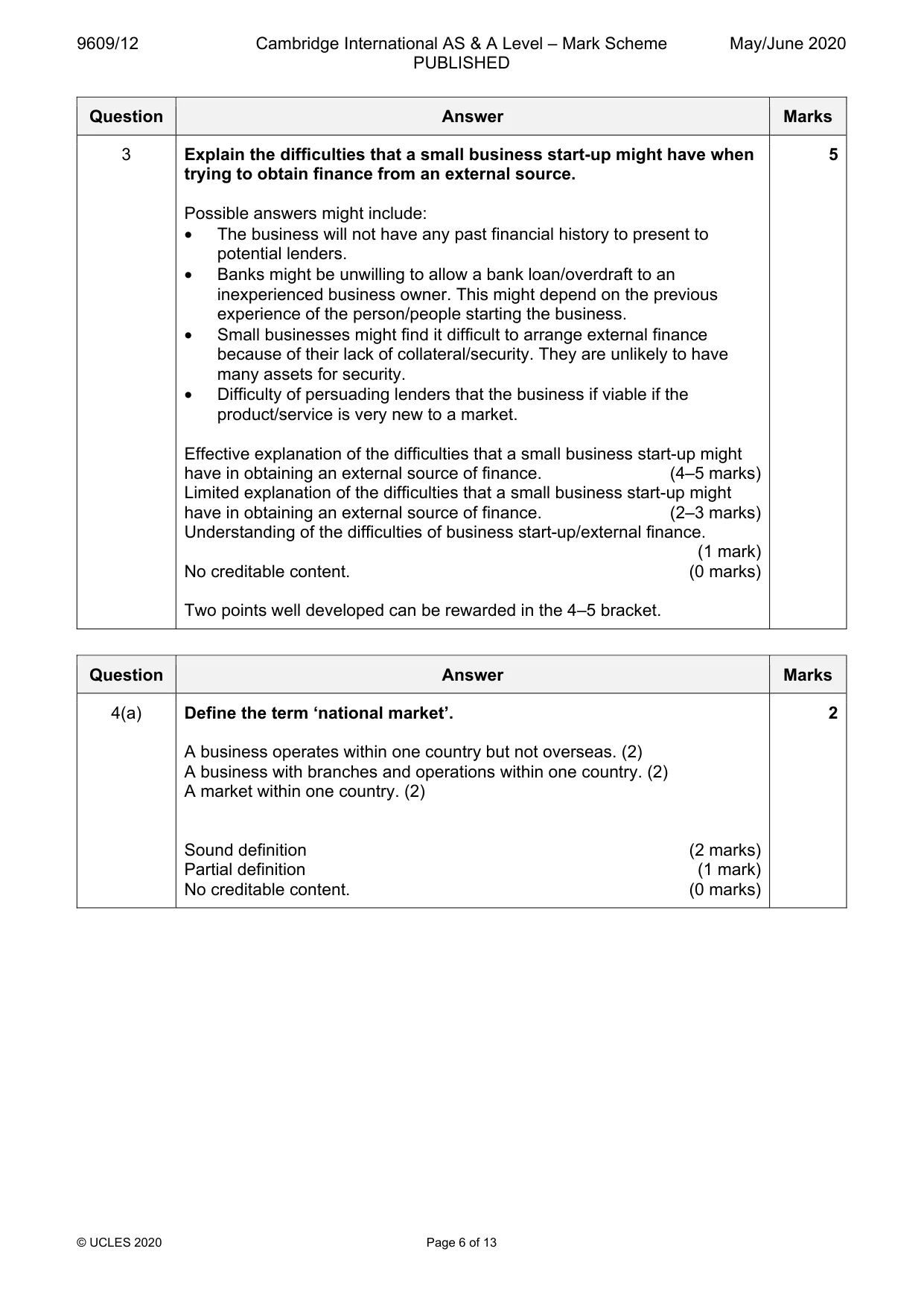
9609/12 Cambridge International AS & A Level – Mark Scheme PUBLISHED May/June 2020 © UCLES 2020 Page 6 of 13 Question Answer Marks 3 Explain the difficulties that a small business start-up might have when trying to obtain finance from an external source. Possible answers might include: • The business will not have any past financial history to present to potential lenders. • Banks might be unwilling to allow a bank loan/overdraft to an inexperienced business owner. This might depend on the previous experience of the person/people starting the business. • Small businesses might find it difficult to arrange external finance because of their lack of collateral/security. They are unlikely to have many assets for security. • Difficulty of persuading lenders that the business if viable if the product/service is very new to a market. Effective explanation of the difficulties that a small business start-up might have in obtaining an external source of finance. (4–5 marks) Limited explanation of the difficulties that a small business start-up might have in obtaining an external source of finance. (2–3 marks) Understanding of the difficulties of business start-up/external finance. (1 mark) No creditable content. (0 marks) Two points well developed can be rewarded in the 4–5 bracket. 5 Question Answer Marks 4(a) Define the term ‘national market’. A business operates within one country but not overseas. (2) A business with branches and operations within one country. (2) A market within one country. (2) Sound definition (2 marks) Partial definition (1 mark) No creditable content. (0 marks) 2
Mark scheme, page 7
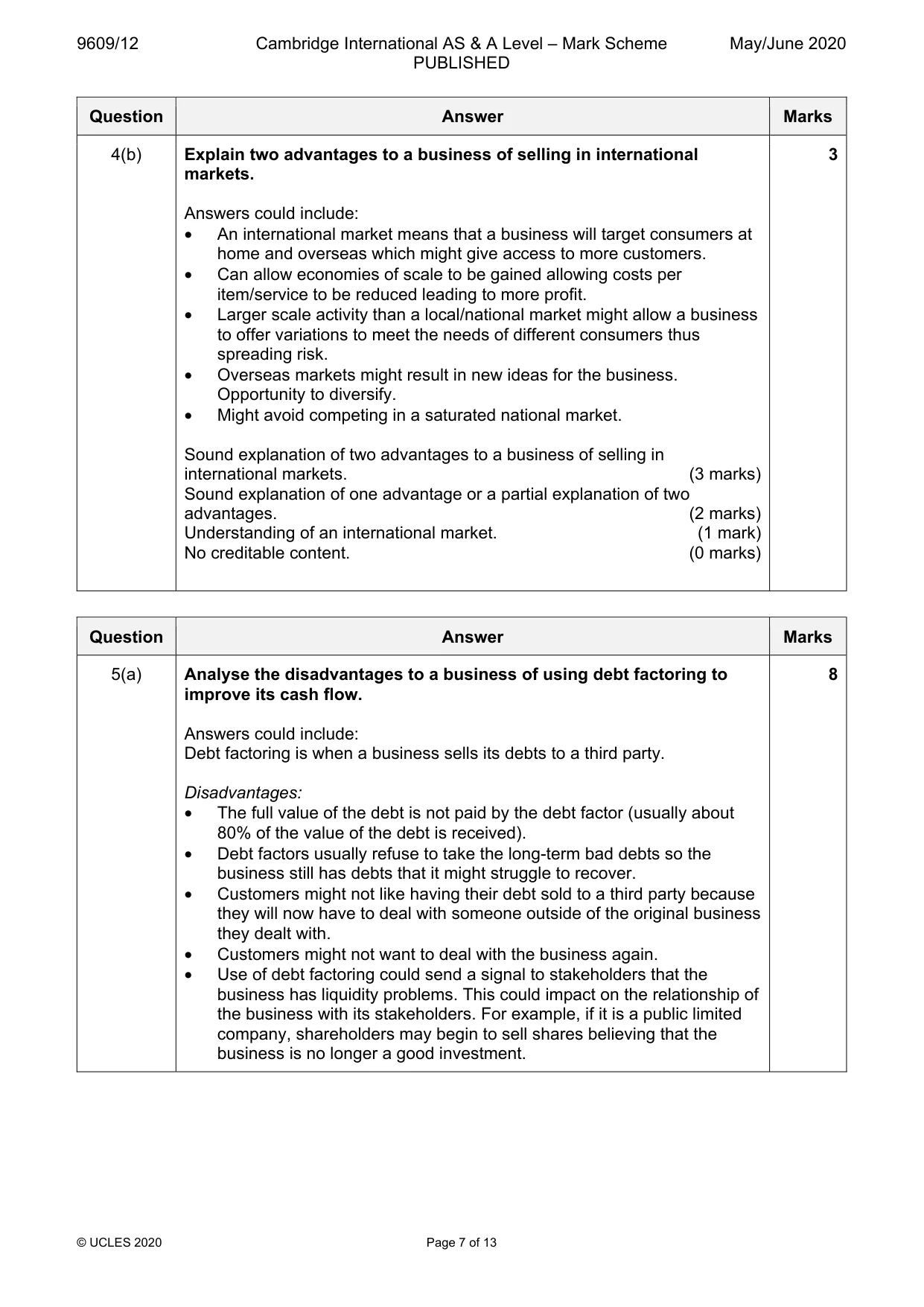
9609/12 Cambridge International AS & A Level – Mark Scheme PUBLISHED May/June 2020 © UCLES 2020 Page 7 of 13 Question Answer Marks 4(b) Explain two advantages to a business of selling in international markets. Answers could include: • An international market means that a business will target consumers at home and overseas which might give access to more customers. • Can allow economies of scale to be gained allowing costs per item/service to be reduced leading to more profit. • Larger scale activity than a local/national market might allow a business to offer variations to meet the needs of different consumers thus spreading risk. • Overseas markets might result in new ideas for the business. Opportunity to diversify. • Might avoid competing in a saturated national market. Sound explanation of two advantages to a business of selling in international markets. (3 marks) Sound explanation of one advantage or a partial explanation of two advantages. (2 marks) Understanding of an international market. (1 mark) No creditable content. (0 marks) 3 Question Answer Marks 5(a) Analyse the disadvantages to a business of using debt factoring to improve its cash flow. Answers could include: Debt factoring is when a business sells its debts to a third party. Disadvantages: • The full value of the debt is not paid by the debt factor (usually about 80% of the value of the debt is received). • Debt factors usually refuse to take the long-term bad debts so the business still has debts that it might struggle to recover. • Customers might not like having their debt sold to a third party because they will now have to deal with someone outside of the original business they dealt with. • Customers might not want to deal with the business again. • Use of debt factoring could send a signal to stakeholders that the business has liquidity problems. This could impact on the relationship of the business with its stakeholders. For example, if it is a public limited company, shareholders may begin to sell shares believing that the business is no longer a good investment. 8
Mark scheme, page 8
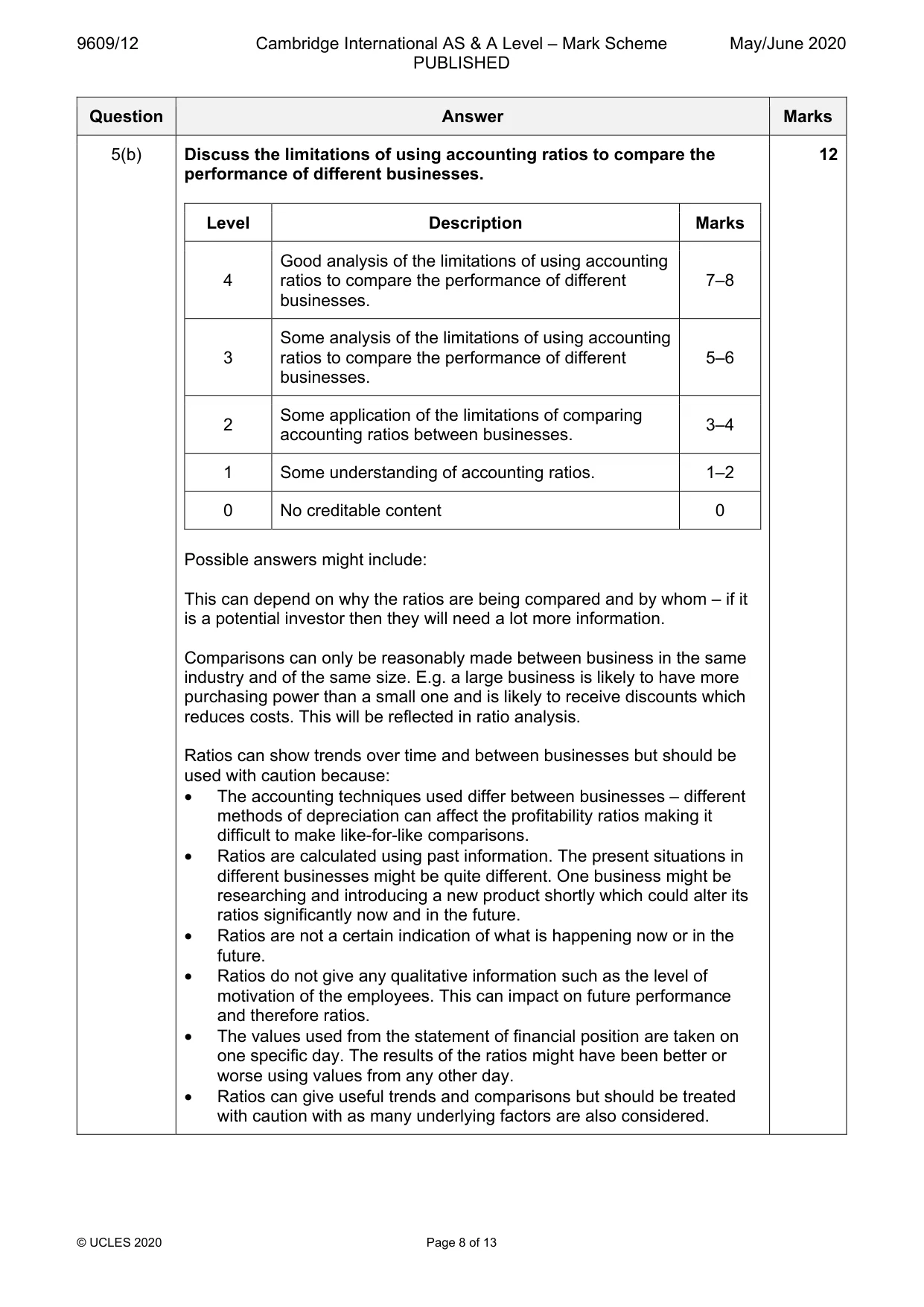
9609/12 Cambridge International AS & A Level – Mark Scheme PUBLISHED May/June 2020 © UCLES 2020 Page 8 of 13 Question Answer Marks 5(b) Discuss the limitations of using accounting ratios to compare the performance of different businesses. Level Description Marks 4 Good analysis of the limitations of using accounting ratios to compare the performance of different businesses. 7–8 3 Some analysis of the limitations of using accounting ratios to compare the performance of different businesses. 5–6 2 Some application of the limitations of comparing accounting ratios between businesses. 3–4 1 Some understanding of accounting ratios. 1–2 0 No creditable content 0 Possible answers might include: This can depend on why the ratios are being compared and by whom – if it is a potential investor then they will need a lot more information. Comparisons can only be reasonably made between business in the same industry and of the same size. E.g. a large business is likely to have more purchasing power than a small one and is likely to receive discounts which reduces costs. This will be reflected in ratio analysis. Ratios can show trends over time and between businesses but should be used with caution because: • The accounting techniques used differ between businesses – different methods of depreciation can affect the profitability ratios making it difficult to make like-for-like comparisons. • Ratios are calculated using past information. The present situations in different businesses might be quite different. One business might be researching and introducing a new product shortly which could alter its ratios significantly now and in the future. • Ratios are not a certain indication of what is happening now or in the future. • Ratios do not give any qualitative information such as the level of motivation of the employees. This can impact on future performance and therefore ratios. • The values used from the statement of financial position are taken on one specific day. The results of the ratios might have been better or worse using values from any other day. • Ratios can give useful trends and comparisons but should be treated with caution with as many underlying factors are also considered. 12
Mark scheme, page 9
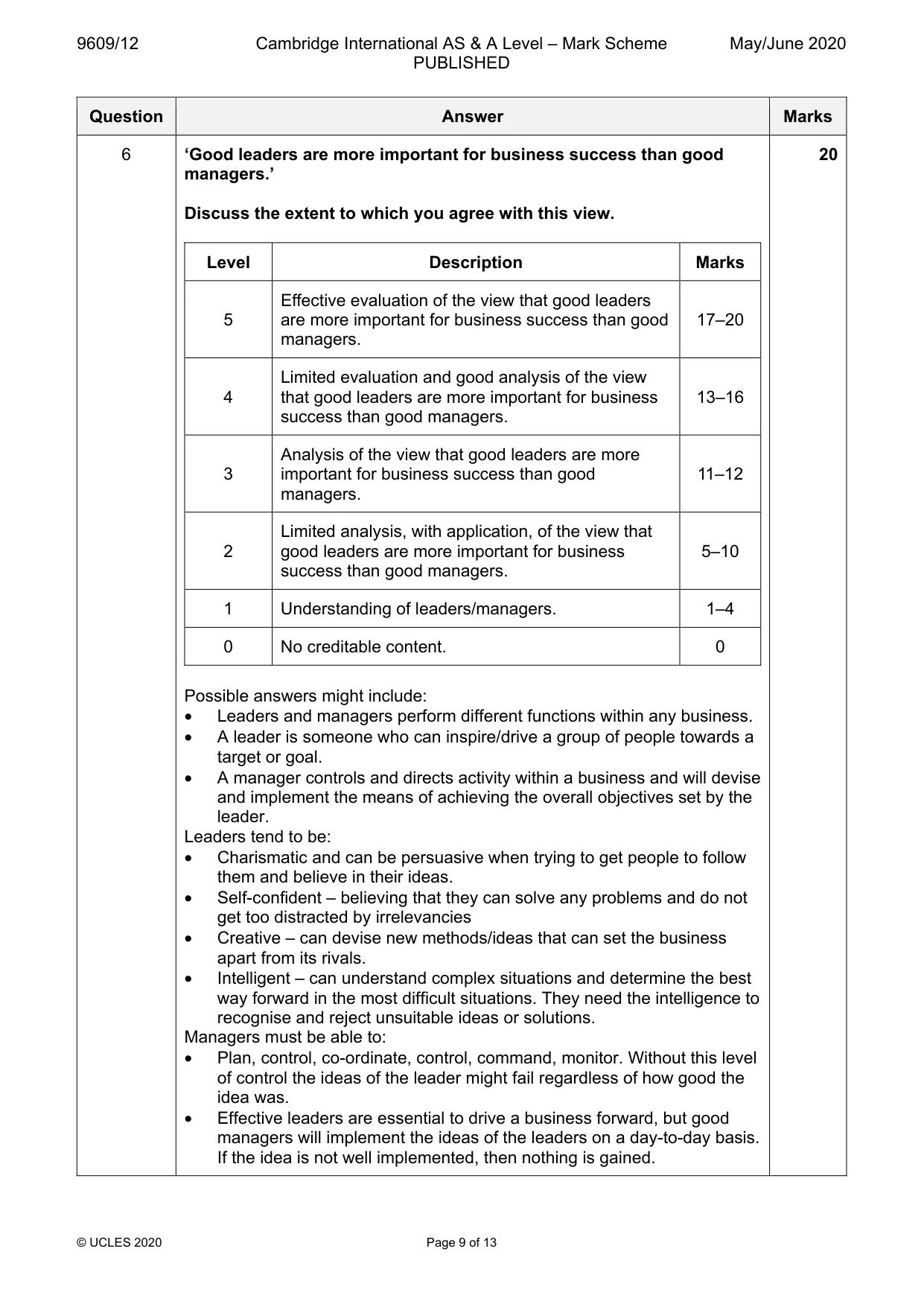
9609/12 Cambridge International AS & A Level – Mark Scheme PUBLISHED May/June 2020 © UCLES 2020 Page 9 of 13 Question Answer Marks 6 ‘Good leaders are more important for business success than good managers.’ Discuss the extent to which you agree with this view. Level Description Marks 5 Effective evaluation of the view that good leaders are more important for business success than good managers. 17–20 4 Limited evaluation and good analysis of the view that good leaders are more important for business success than good managers. 13–16 3 Analysis of the view that good leaders are more important for business success than good managers. 11–12 2 Limited analysis, with application, of the view that good leaders are more important for business success than good managers. 5–10 1 Understanding of leaders/managers. 1–4 0 No creditable content. 0 Possible answers might include: • Leaders and managers perform different functions within any business. • A leader is someone who can inspire/drive a group of people towards a target or goal. • A manager controls and directs activity within a business and will devise and implement the means of achieving the overall objectives set by the leader. Leaders tend to be: • Charismatic and can be persuasive when trying to get people to follow them and believe in their ideas. • Self-confident – believing that they can solve any problems and do not get too distracted by irrelevancies • Creative – can devise new methods/ideas that can set the business apart from its rivals. • Intelligent – can understand complex situations and determine the best way forward in the most difficult situations. They need the intelligence to recognise and reject unsuitable ideas or solutions. Managers must be able to: • Plan, control, co-ordinate, control, command, monitor. Without this level of control the ideas of the leader might fail regardless of how good the idea was. • Effective leaders are essential to drive a business forward, but good managers will implement the ideas of the leaders on a day-to-day basis. If the idea is not well implemented, then nothing is gained. 20
Mark scheme, page 10
9609/12 Cambridge International AS & A Level – Mark Scheme PUBLISHED May/June 2020 © UCLES 2020 Page 10 of 13 Question Answer Marks 6 • However, not all leaders are good! Some leaders refuse to listen to the advice of those around them and might try to drive the business in a wrong direction. • In such cases even the best managers might not be able to rescue the business. • Even the best leaders need good managers to help them achieve their objectives. • Candidates could equally argue strongly for either leaders or managers, rather than a more balanced approach.
Mark scheme, page 11
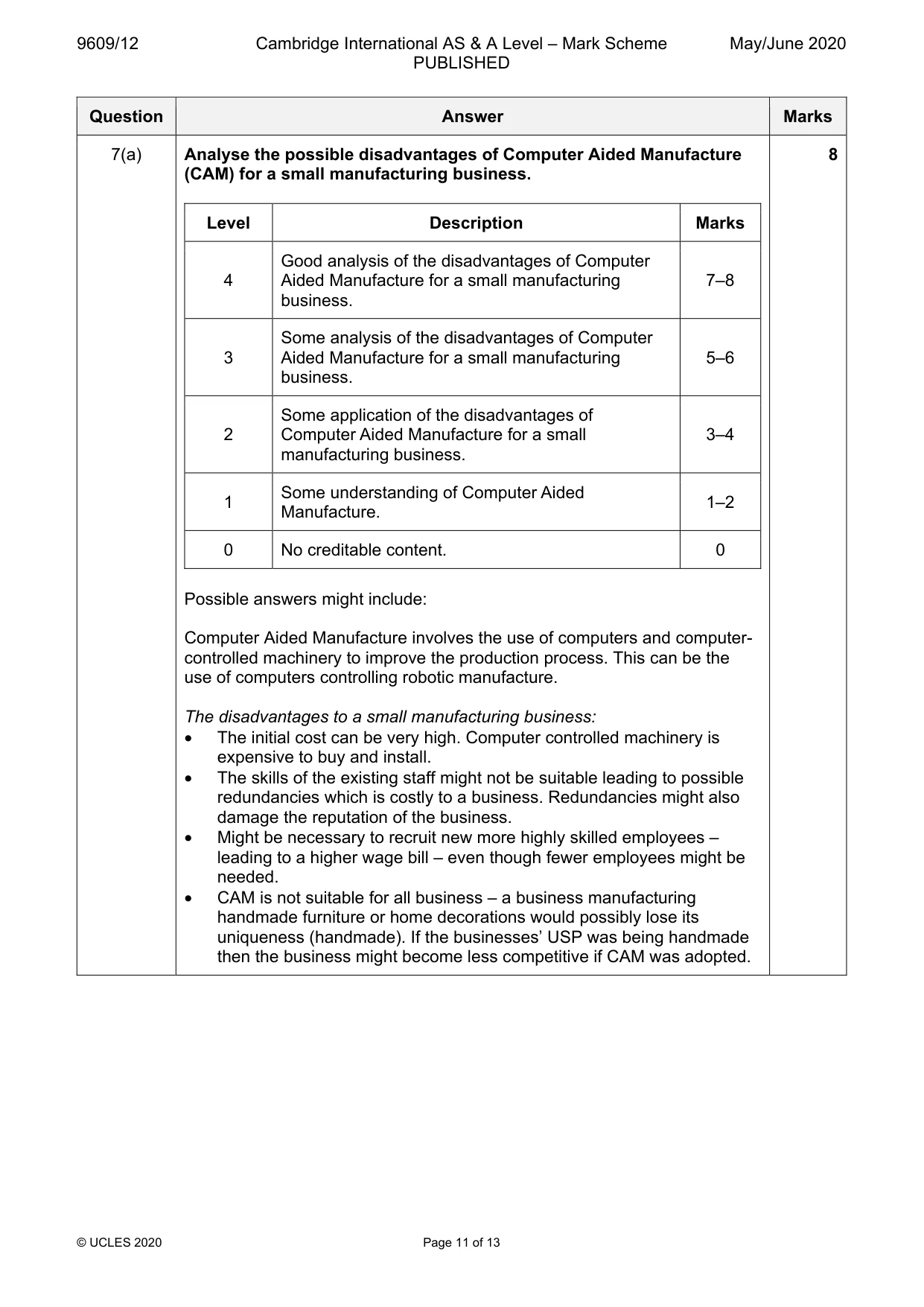
9609/12 Cambridge International AS & A Level – Mark Scheme PUBLISHED May/June 2020 © UCLES 2020 Page 11 of 13 Question Answer Marks 7(a) Analyse the possible disadvantages of Computer Aided Manufacture (CAM) for a small manufacturing business. Level Description Marks 4 Good analysis of the disadvantages of Computer Aided Manufacture for a small manufacturing business. 7–8 3 Some analysis of the disadvantages of Computer Aided Manufacture for a small manufacturing business. 5–6 2 Some application of the disadvantages of Computer Aided Manufacture for a small manufacturing business. 3–4 1 Some understanding of Computer Aided Manufacture. 1–2 0 No creditable content. 0 Possible answers might include: Computer Aided Manufacture involves the use of computers and computer- controlled machinery to improve the production process. This can be the use of computers controlling robotic manufacture. The disadvantages to a small manufacturing business: • The initial cost can be very high. Computer controlled machinery is expensive to buy and install. • The skills of the existing staff might not be suitable leading to possible redundancies which is costly to a business. Redundancies might also damage the reputation of the business. • Might be necessary to recruit new more highly skilled employees – leading to a higher wage bill – even though fewer employees might be needed. • CAM is not suitable for all business – a business manufacturing handmade furniture or home decorations would possibly lose its uniqueness (handmade). If the businesses’ USP was being handmade then the business might become less competitive if CAM was adopted. 8
Mark scheme, page 12
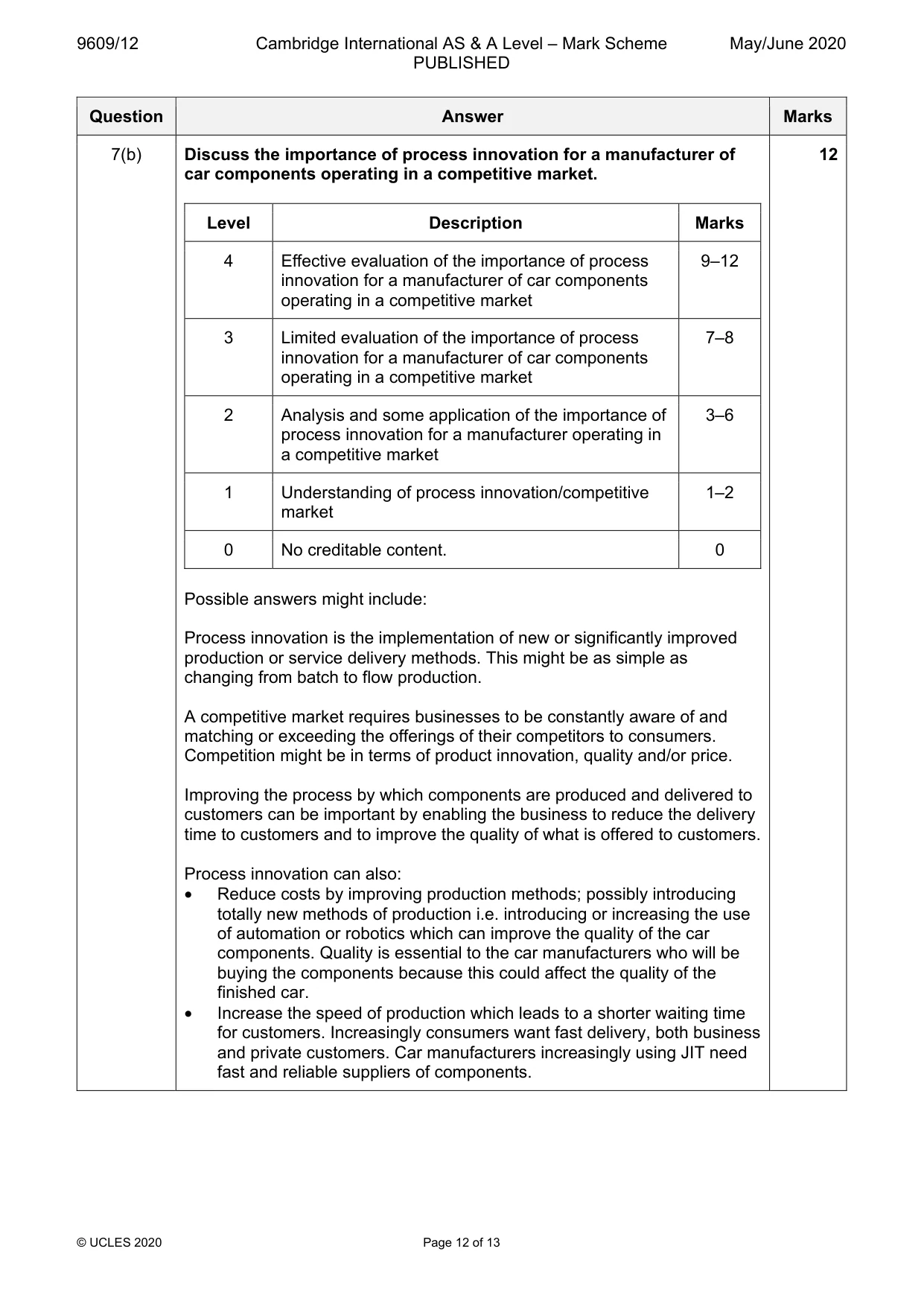
9609/12 Cambridge International AS & A Level – Mark Scheme PUBLISHED May/June 2020 © UCLES 2020 Page 12 of 13 Question Answer Marks 7(b) Discuss the importance of process innovation for a manufacturer of car components operating in a competitive market. Level Description Marks 4 Effective evaluation of the importance of process innovation for a manufacturer of car components operating in a competitive market 9–12 3 Limited evaluation of the importance of process innovation for a manufacturer of car components operating in a competitive market 7–8 2 Analysis and some application of the importance of process innovation for a manufacturer operating in a competitive market 3–6 1 Understanding of process innovation/competitive market 1–2 0 No creditable content. 0 Possible answers might include: Process innovation is the implementation of new or significantly improved production or service delivery methods. This might be as simple as changing from batch to flow production. A competitive market requires businesses to be constantly aware of and matching or exceeding the offerings of their competitors to consumers. Competition might be in terms of product innovation, quality and/or price. Improving the process by which components are produced and delivered to customers can be important by enabling the business to reduce the delivery time to customers and to improve the quality of what is offered to customers. Process innovation can also: • Reduce costs by improving production methods; possibly introducing totally new methods of production i.e. introducing or increasing the use of automation or robotics which can improve the quality of the car components. Quality is essential to the car manufacturers who will be buying the components because this could affect the quality of the finished car. • Increase the speed of production which leads to a shorter waiting time for customers. Increasingly consumers want fast delivery, both business and private customers. Car manufacturers increasingly using JIT need fast and reliable suppliers of components. 12
Mark scheme, page 13
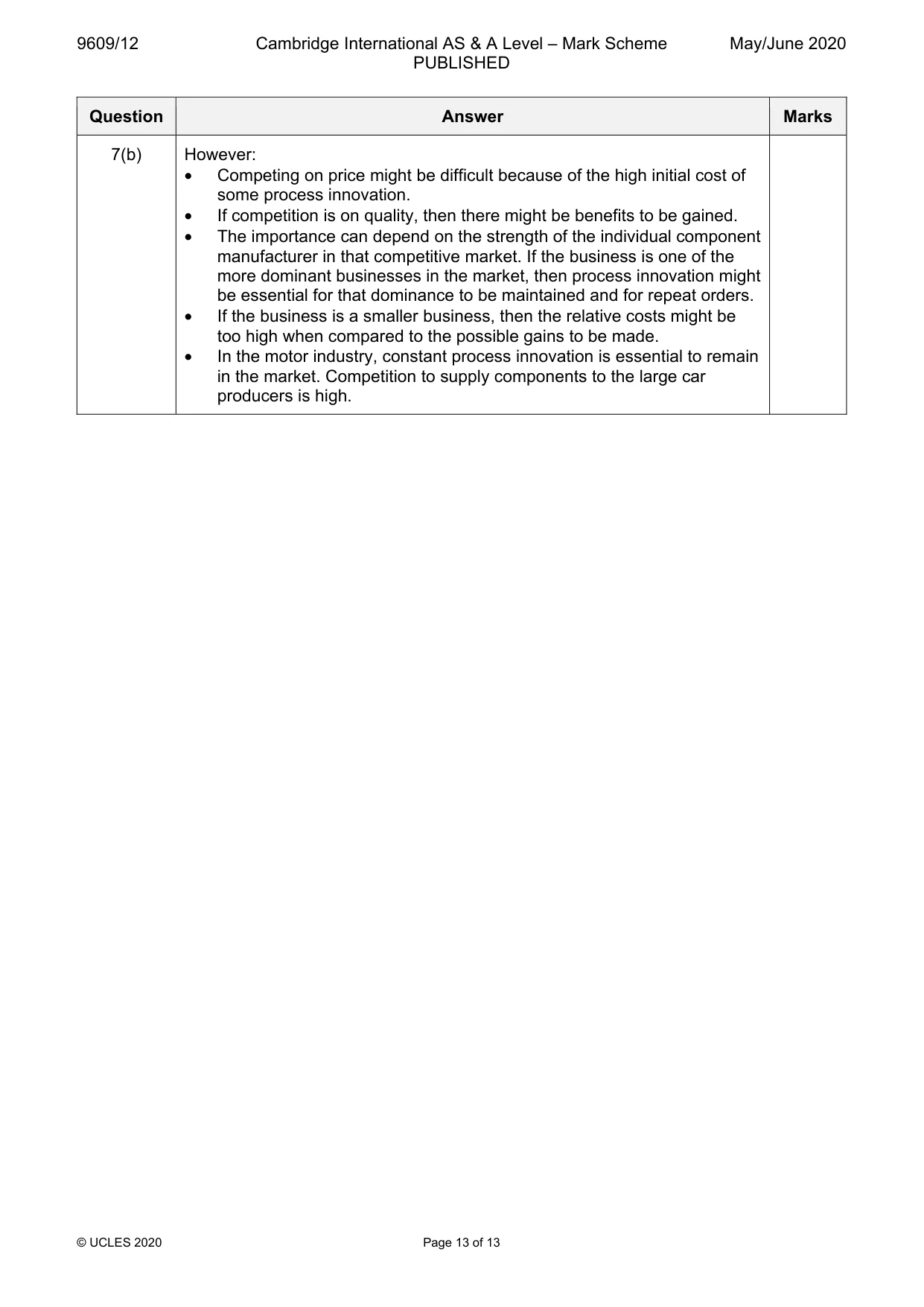
9609/12 Cambridge International AS & A Level – Mark Scheme PUBLISHED May/June 2020 © UCLES 2020 Page 13 of 13 Question Answer Marks 7(b) However: • Competing on price might be difficult because of the high initial cost of some process innovation. • If competition is on quality, then there might be benefits to be gained. • The importance can depend on the strength of the individual component manufacturer in that competitive market. If the business is one of the more dominant businesses in the market, then process innovation might be essential for that dominance to be maintained and for repeat orders. • If the business is a smaller business, then the relative costs might be too high when compared to the possible gains to be made. • In the motor industry, constant process innovation is essential to remain in the market. Competition to supply components to the large car producers is high.