Cambridge A Level Business (for first examination in 2016) 9609 — 2020 May/June Paper 1 · Variant 1
9609/11/M/J/20
The question paper and its mark scheme, free to read here and free to download. This is Cambridge’s own paper, exactly as it was sat.
Question paper4 pages


Mark scheme14 pages
Answers below. Sit the paper first if you are practising.

Paper as text
Question paper, page 1
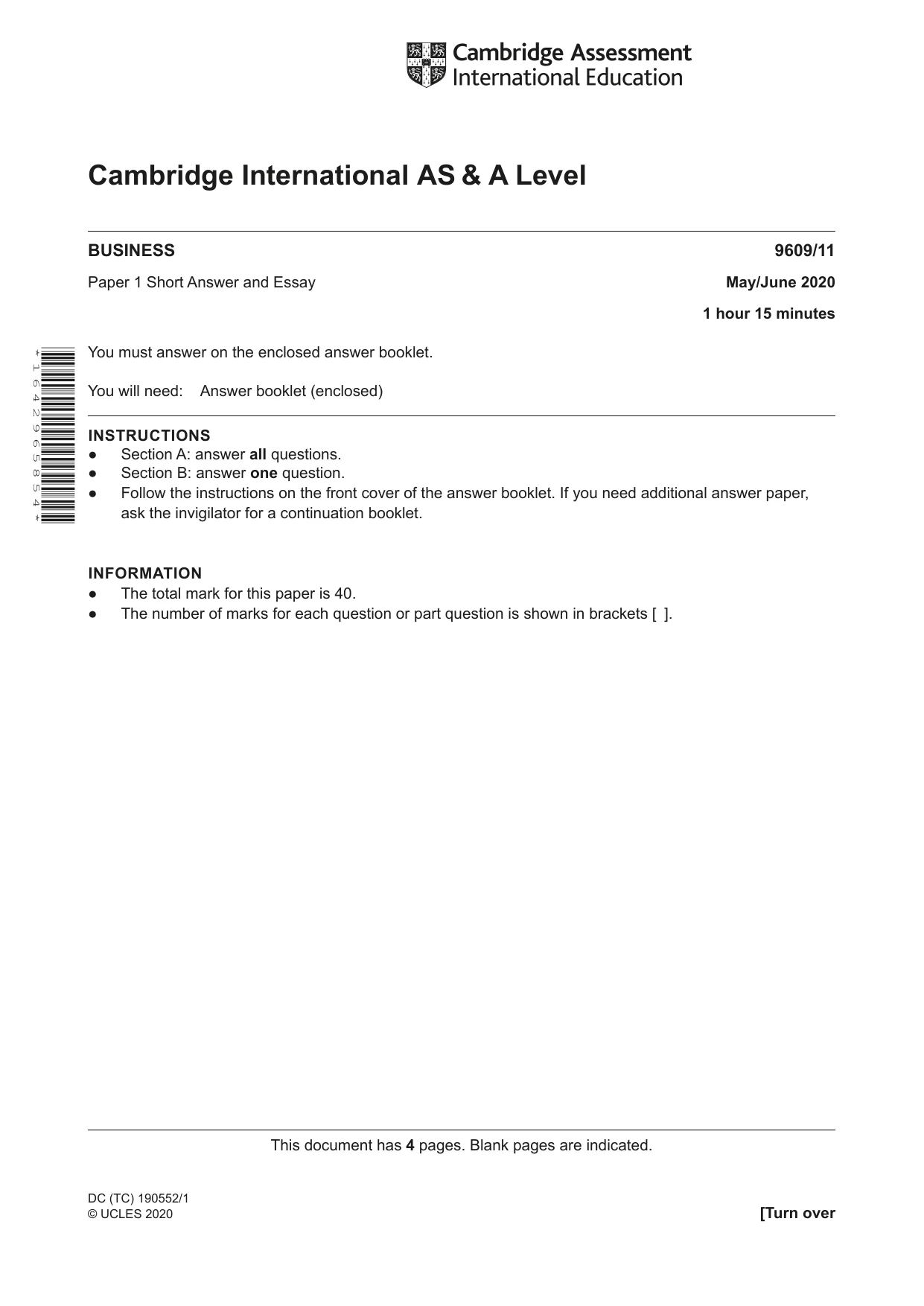
Cambridge International AS & A Level * 1 6 4 2 9 6 5 8 5 4 * This document has 4 pages. Blank pages are indicated. DC (TC) 190552/1 © UCLES 2020 [Turn over BUSINESS 9609/11 Paper 1 Short Answer and Essay May/June 2020 1 hour 15 minutes You must answer on the enclosed answer booklet. You will need: Answer booklet (enclosed) INSTRUCTIONS ● Section A: answer all questions. ● Section B: answer one question. ● Follow the instructions on the front cover of the answer booklet. If you need additional answer paper, ask the invigilator for a continuation booklet. INFORMATION ● The total mark for this paper is 40. ● The number of marks for each question or part question is shown in brackets [ ].
Question paper, page 2
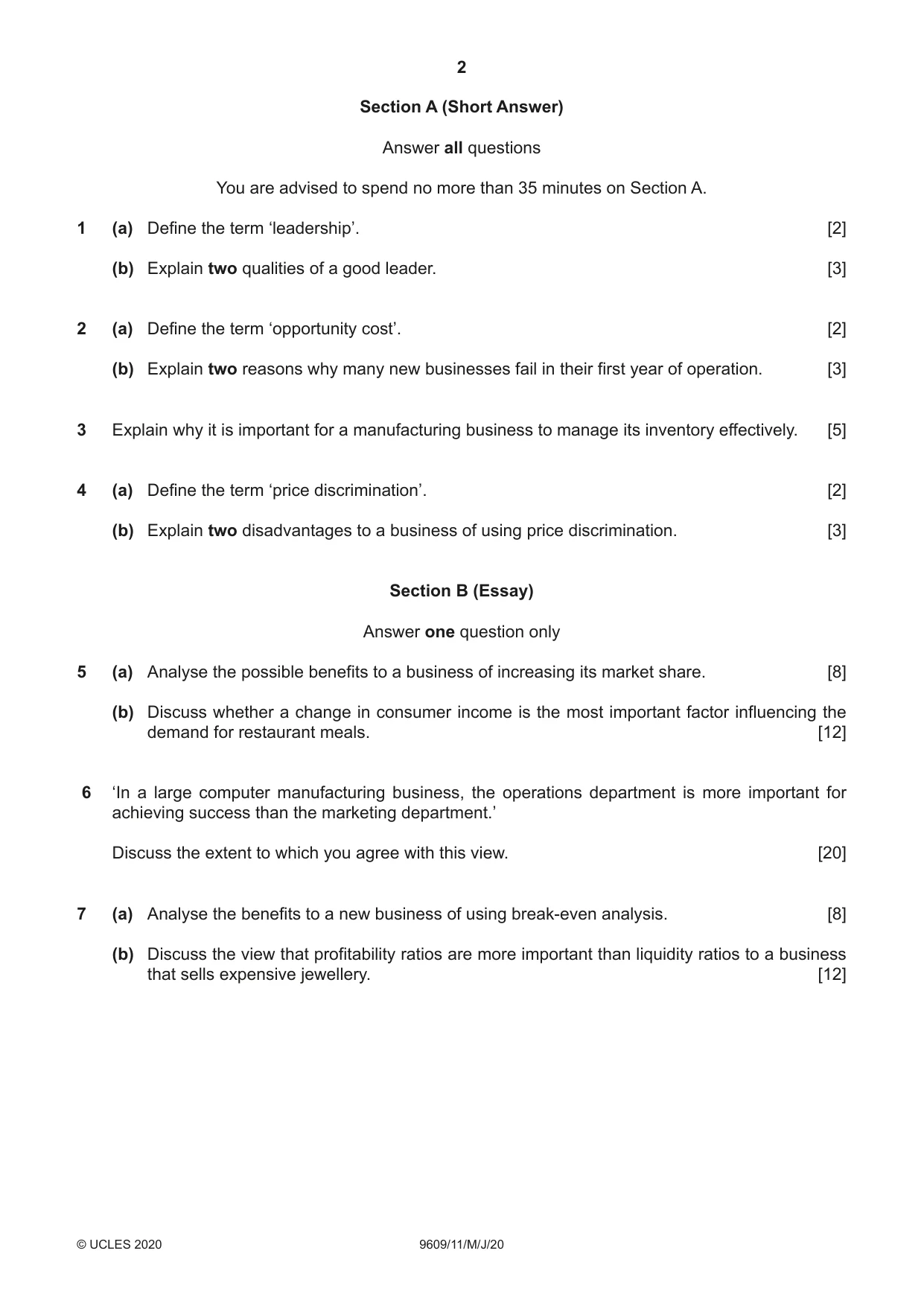
2 9609/11/M/J/20 © UCLES 2020 Section A (Short Answer) Answer all questions You are advised to spend no more than 35 minutes on Section A. 1 (a) Define the term ‘leadership’. [2] (b) Explain two qualities of a good leader. [3] 2 (a) Define the term ‘opportunity cost’. [2] (b) Explain two reasons why many new businesses fail in their first year of operation. [3] 3 Explain why it is important for a manufacturing business to manage its inventory effectively. [5] 4 (a) Define the term ‘price discrimination’. [2] (b) Explain two disadvantages to a business of using price discrimination. [3] Section B (Essay) Answer one question only 5 (a) Analyse the possible benefits to a business of increasing its market share. [8] (b) Discuss whether a change in consumer income is the most important factor influencing the demand for restaurant meals. [12] 6 ‘In a large computer manufacturing business, the operations department is more important for achieving success than the marketing department.’ Discuss the extent to which you agree with this view. [20] 7 (a) Analyse the benefits to a new business of using break-even analysis. [8] (b) Discuss the view that profitability ratios are more important than liquidity ratios to a business that sells expensive jewellery. [12]
Question paper, page 3
3 9609/11/M/J/20 © UCLES 2020 BLANK PAGE
Question paper, page 4
4 9609/11/M/J/20 © UCLES 2020 Permission to reproduce items where third-party owned material protected by copyright is included has been sought and cleared where possible. Every reasonable effort has been made by the publisher (UCLES) to trace copyright holders, but if any items requiring clearance have unwittingly been included, the publisher will be pleased to make amends at the earliest possible opportunity. To avoid the issue of disclosure of answer-related information to candidates, all copyright acknowledgements are reproduced online in the Cambridge Assessment International Education Copyright Acknowledgements Booklet. This is produced for each series of examinations and is freely available to download at www.cambridgeinternational.org after the live examination series. Cambridge Assessment International Education is part of the Cambridge Assessment Group. Cambridge Assessment is the brand name of the University of Cambridge Local Examinations Syndicate (UCLES), which itself is a department of the University of Cambridge. BLANK PAGE
Mark scheme, page 1
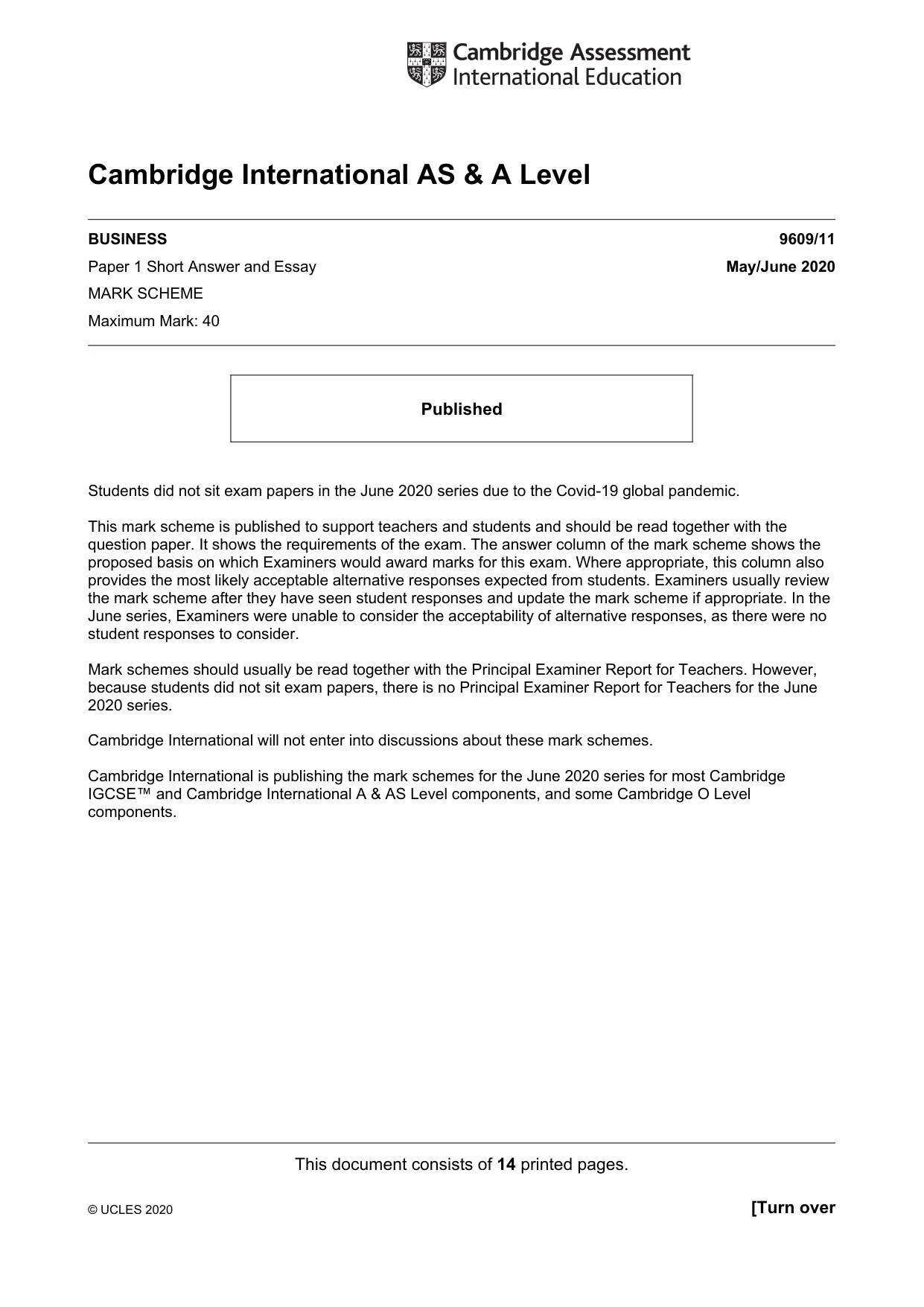
This document consists of 14 printed pages. © UCLES 2020 [Turn over Cambridge International AS & A Level BUSINESS 9609/11 Paper 1 Short Answer and Essay May/June 2020 MARK SCHEME Maximum Mark: 40 Published Students did not sit exam papers in the June 2020 series due to the Covid-19 global pandemic. This mark scheme is published to support teachers and students and should be read together with the question paper. It shows the requirements of the exam. The answer column of the mark scheme shows the proposed basis on which Examiners would award marks for this exam. Where appropriate, this column also provides the most likely acceptable alternative responses expected from students. Examiners usually review the mark scheme after they have seen student responses and update the mark scheme if appropriate. In the June series, Examiners were unable to consider the acceptability of alternative responses, as there were no student responses to consider. Mark schemes should usually be read together with the Principal Examiner Report for Teachers. However, because students did not sit exam papers, there is no Principal Examiner Report for Teachers for the June 2020 series. Cambridge International will not enter into discussions about these mark schemes. Cambridge International is publishing the mark schemes for the June 2020 series for most Cambridge IGCSE™ and Cambridge International A & AS Level components, and some Cambridge O Level components.
Mark scheme, page 2
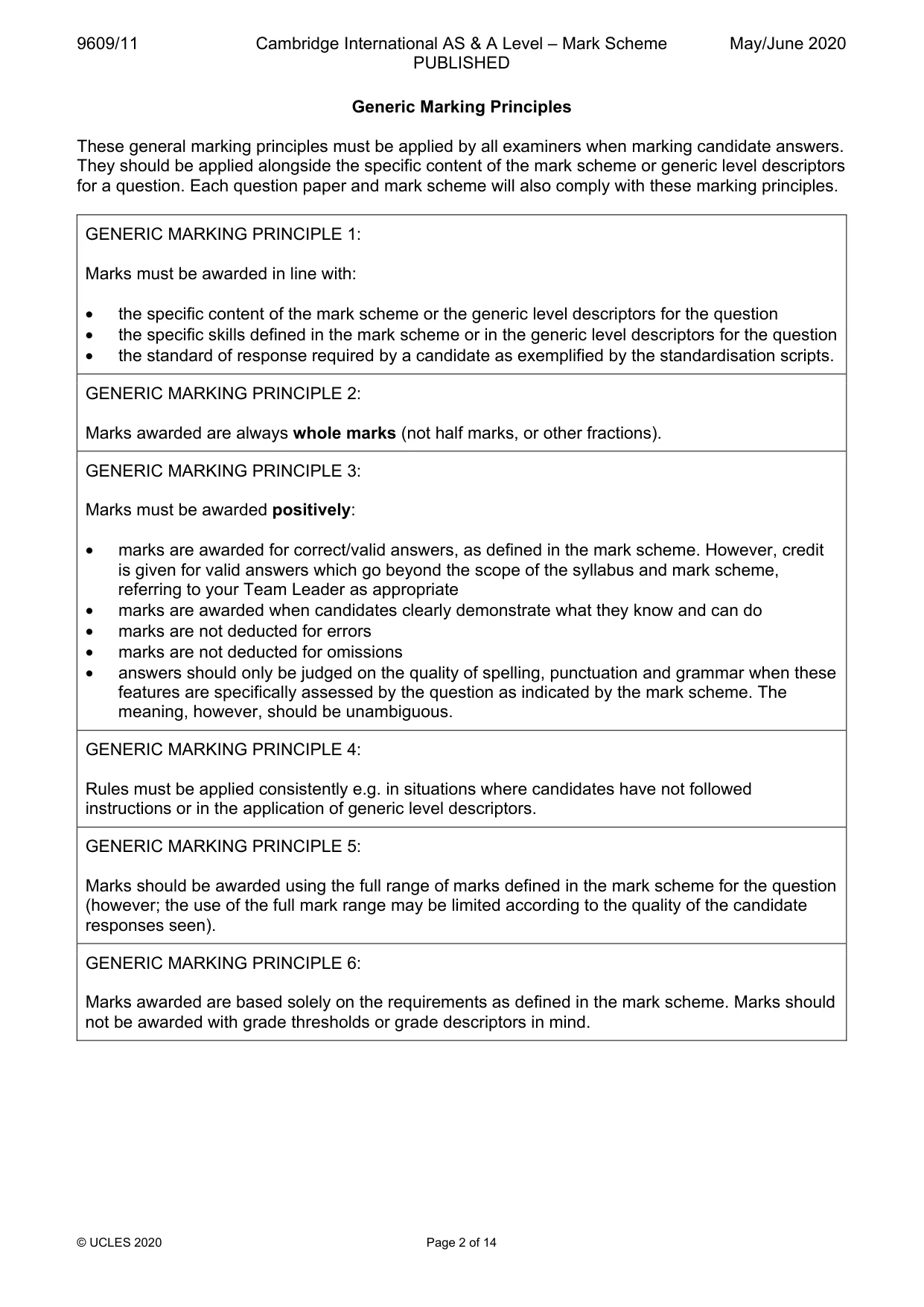
9609/11 Cambridge International AS & A Level – Mark Scheme PUBLISHED May/June 2020 © UCLES 2020 Page 2 of 14 Generic Marking Principles These general marking principles must be applied by all examiners when marking candidate answers. They should be applied alongside the specific content of the mark scheme or generic level descriptors for a question. Each question paper and mark scheme will also comply with these marking principles. GENERIC MARKING PRINCIPLE 1: Marks must be awarded in line with: • the specific content of the mark scheme or the generic level descriptors for the question • the specific skills defined in the mark scheme or in the generic level descriptors for the question • the standard of response required by a candidate as exemplified by the standardisation scripts. GENERIC MARKING PRINCIPLE 2: Marks awarded are always whole marks (not half marks, or other fractions). GENERIC MARKING PRINCIPLE 3: Marks must be awarded positively: • marks are awarded for correct/valid answers, as defined in the mark scheme. However, credit is given for valid answers which go beyond the scope of the syllabus and mark scheme, referring to your Team Leader as appropriate • marks are awarded when candidates clearly demonstrate what they know and can do • marks are not deducted for errors • marks are not deducted for omissions • answers should only be judged on the quality of spelling, punctuation and grammar when these features are specifically assessed by the question as indicated by the mark scheme. The meaning, however, should be unambiguous. GENERIC MARKING PRINCIPLE 4: Rules must be applied consistently e.g. in situations where candidates have not followed instructions or in the application of generic level descriptors. GENERIC MARKING PRINCIPLE 5: Marks should be awarded using the full range of marks defined in the mark scheme for the question (however; the use of the full mark range may be limited according to the quality of the candidate responses seen). GENERIC MARKING PRINCIPLE 6: Marks awarded are based solely on the requirements as defined in the mark scheme. Marks should not be awarded with grade thresholds or grade descriptors in mind.
Mark scheme, page 3
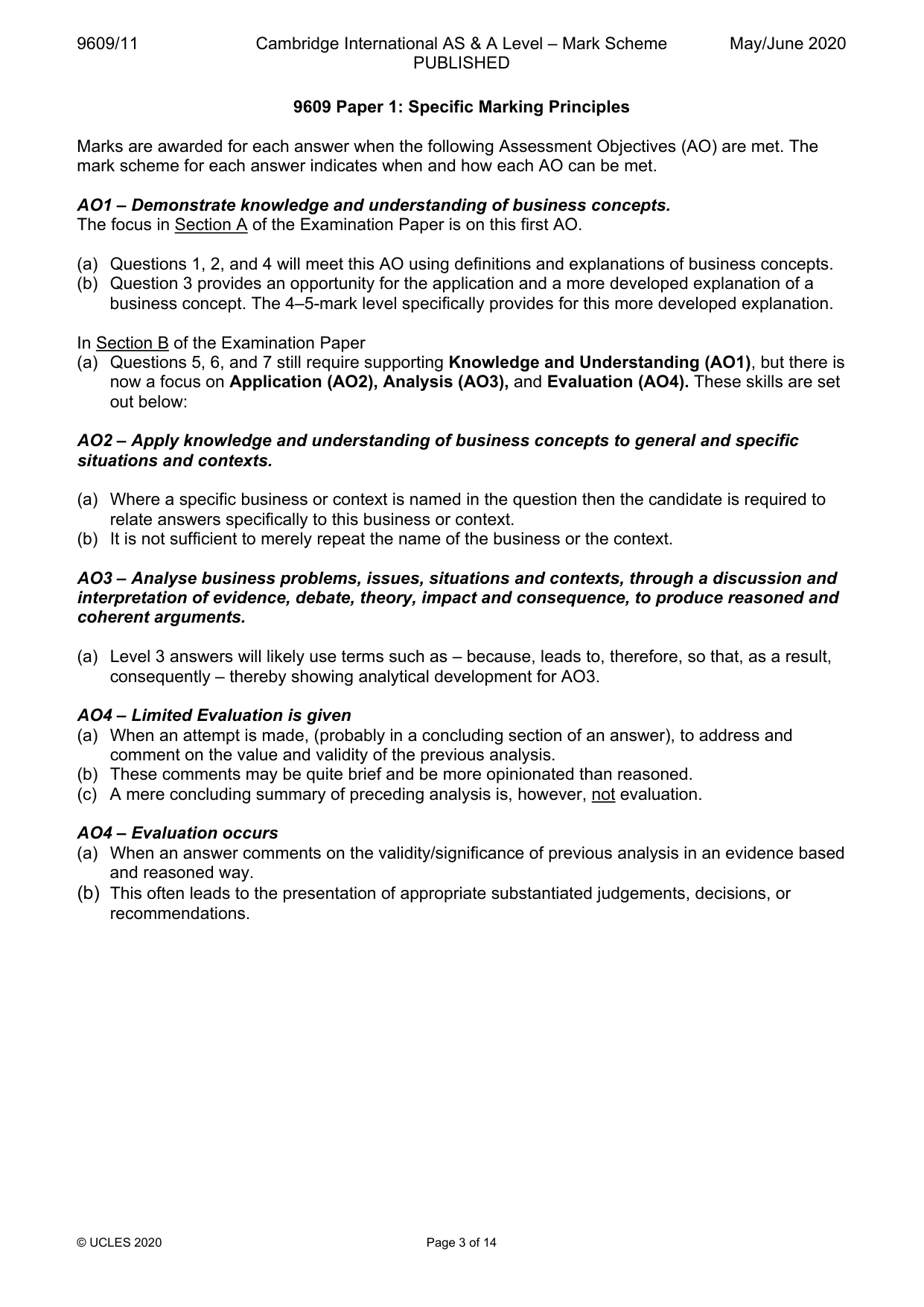
9609/11 Cambridge International AS & A Level – Mark Scheme PUBLISHED May/June 2020 © UCLES 2020 Page 3 of 14 9609 Paper 1: Specific Marking Principles Marks are awarded for each answer when the following Assessment Objectives (AO) are met. The mark scheme for each answer indicates when and how each AO can be met. AO1 – Demonstrate knowledge and understanding of business concepts. The focus in Section A of the Examination Paper is on this first AO. (a) Questions 1, 2, and 4 will meet this AO using definitions and explanations of business concepts. (b) Question 3 provides an opportunity for the application and a more developed explanation of a business concept. The 4–5-mark level specifically provides for this more developed explanation. In Section B of the Examination Paper (a) Questions 5, 6, and 7 still require supporting Knowledge and Understanding (AO1), but there is now a focus on Application (AO2), Analysis (AO3), and Evaluation (AO4). These skills are set out below: AO2 – Apply knowledge and understanding of business concepts to general and specific situations and contexts. (a) Where a specific business or context is named in the question then the candidate is required to relate answers specifically to this business or context. (b) It is not sufficient to merely repeat the name of the business or the context. AO3 – Analyse business problems, issues, situations and contexts, through a discussion and interpretation of evidence, debate, theory, impact and consequence, to produce reasoned and coherent arguments. (a) Level 3 answers will likely use terms such as – because, leads to, therefore, so that, as a result, consequently – thereby showing analytical development for AO3. AO4 – Limited Evaluation is given (a) When an attempt is made, (probably in a concluding section of an answer), to address and comment on the value and validity of the previous analysis. (b) These comments may be quite brief and be more opinionated than reasoned. (c) A mere concluding summary of preceding analysis is, however, not evaluation. AO4 – Evaluation occurs (a) When an answer comments on the validity/significance of previous analysis in an evidence based and reasoned way. (b) This often leads to the presentation of appropriate substantiated judgements, decisions, or recommendations.
Mark scheme, page 4
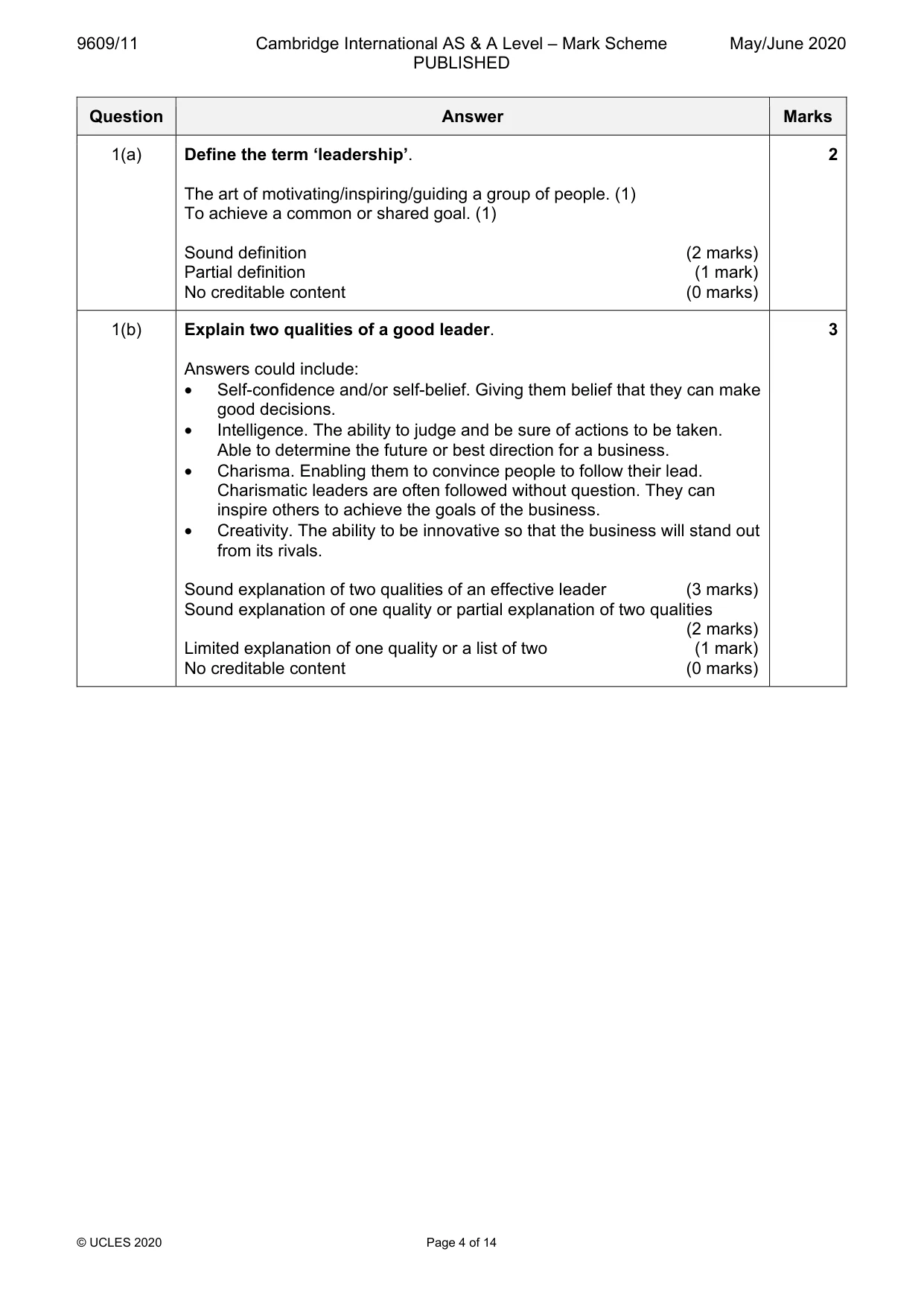
9609/11 Cambridge International AS & A Level – Mark Scheme PUBLISHED May/June 2020 © UCLES 2020 Page 4 of 14 Question Answer Marks 1(a) Define the term ‘leadership’. The art of motivating/inspiring/guiding a group of people. (1) To achieve a common or shared goal. (1) Sound definition (2 marks) Partial definition (1 mark) No creditable content (0 marks) 2 1(b) Explain two qualities of a good leader. Answers could include: • Self-confidence and/or self-belief. Giving them belief that they can make good decisions. • Intelligence. The ability to judge and be sure of actions to be taken. Able to determine the future or best direction for a business. • Charisma. Enabling them to convince people to follow their lead. Charismatic leaders are often followed without question. They can inspire others to achieve the goals of the business. • Creativity. The ability to be innovative so that the business will stand out from its rivals. Sound explanation of two qualities of an effective leader (3 marks) Sound explanation of one quality or partial explanation of two qualities (2 marks) Limited explanation of one quality or a list of two (1 mark) No creditable content (0 marks) 3
Mark scheme, page 5
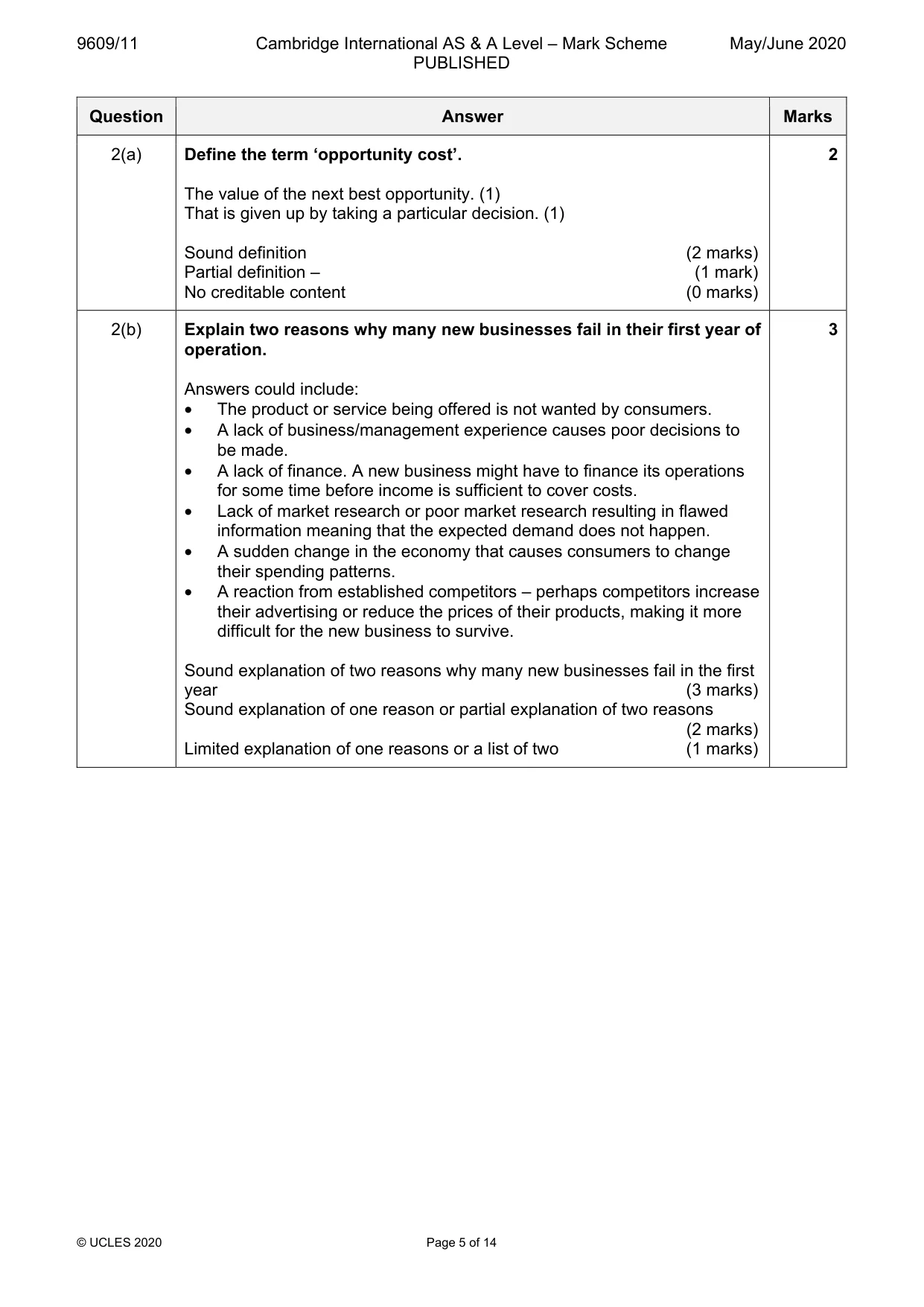
9609/11 Cambridge International AS & A Level – Mark Scheme PUBLISHED May/June 2020 © UCLES 2020 Page 5 of 14 Question Answer Marks 2(a) Define the term ‘opportunity cost’. The value of the next best opportunity. (1) That is given up by taking a particular decision. (1) Sound definition (2 marks) Partial definition – (1 mark) No creditable content (0 marks) 2 2(b) Explain two reasons why many new businesses fail in their first year of operation. Answers could include: • The product or service being offered is not wanted by consumers. • A lack of business/management experience causes poor decisions to be made. • A lack of finance. A new business might have to finance its operations for some time before income is sufficient to cover costs. • Lack of market research or poor market research resulting in flawed information meaning that the expected demand does not happen. • A sudden change in the economy that causes consumers to change their spending patterns. • A reaction from established competitors – perhaps competitors increase their advertising or reduce the prices of their products, making it more difficult for the new business to survive. Sound explanation of two reasons why many new businesses fail in the first year (3 marks) Sound explanation of one reason or partial explanation of two reasons (2 marks) Limited explanation of one reasons or a list of two (1 marks) 3
Mark scheme, page 6
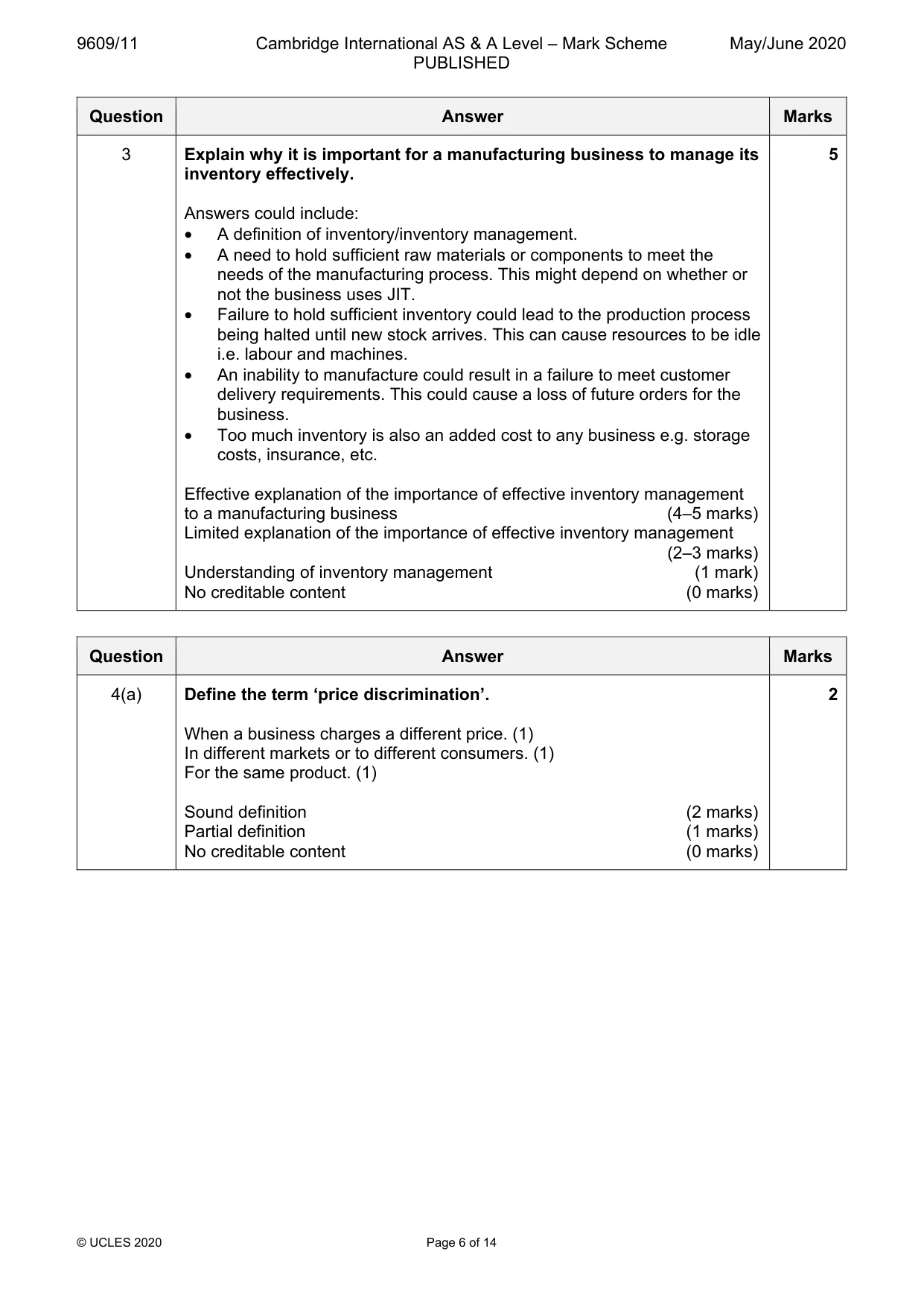
9609/11 Cambridge International AS & A Level – Mark Scheme PUBLISHED May/June 2020 © UCLES 2020 Page 6 of 14 Question Answer Marks 3 Explain why it is important for a manufacturing business to manage its inventory effectively. Answers could include: • A definition of inventory/inventory management. • A need to hold sufficient raw materials or components to meet the needs of the manufacturing process. This might depend on whether or not the business uses JIT. • Failure to hold sufficient inventory could lead to the production process being halted until new stock arrives. This can cause resources to be idle i.e. labour and machines. • An inability to manufacture could result in a failure to meet customer delivery requirements. This could cause a loss of future orders for the business. • Too much inventory is also an added cost to any business e.g. storage costs, insurance, etc. Effective explanation of the importance of effective inventory management to a manufacturing business (4–5 marks) Limited explanation of the importance of effective inventory management (2–3 marks) Understanding of inventory management (1 mark) No creditable content (0 marks) 5 Question Answer Marks 4(a) Define the term ‘price discrimination’. When a business charges a different price. (1) In different markets or to different consumers. (1) For the same product. (1) Sound definition (2 marks) Partial definition (1 marks) No creditable content (0 marks) 2
Mark scheme, page 7
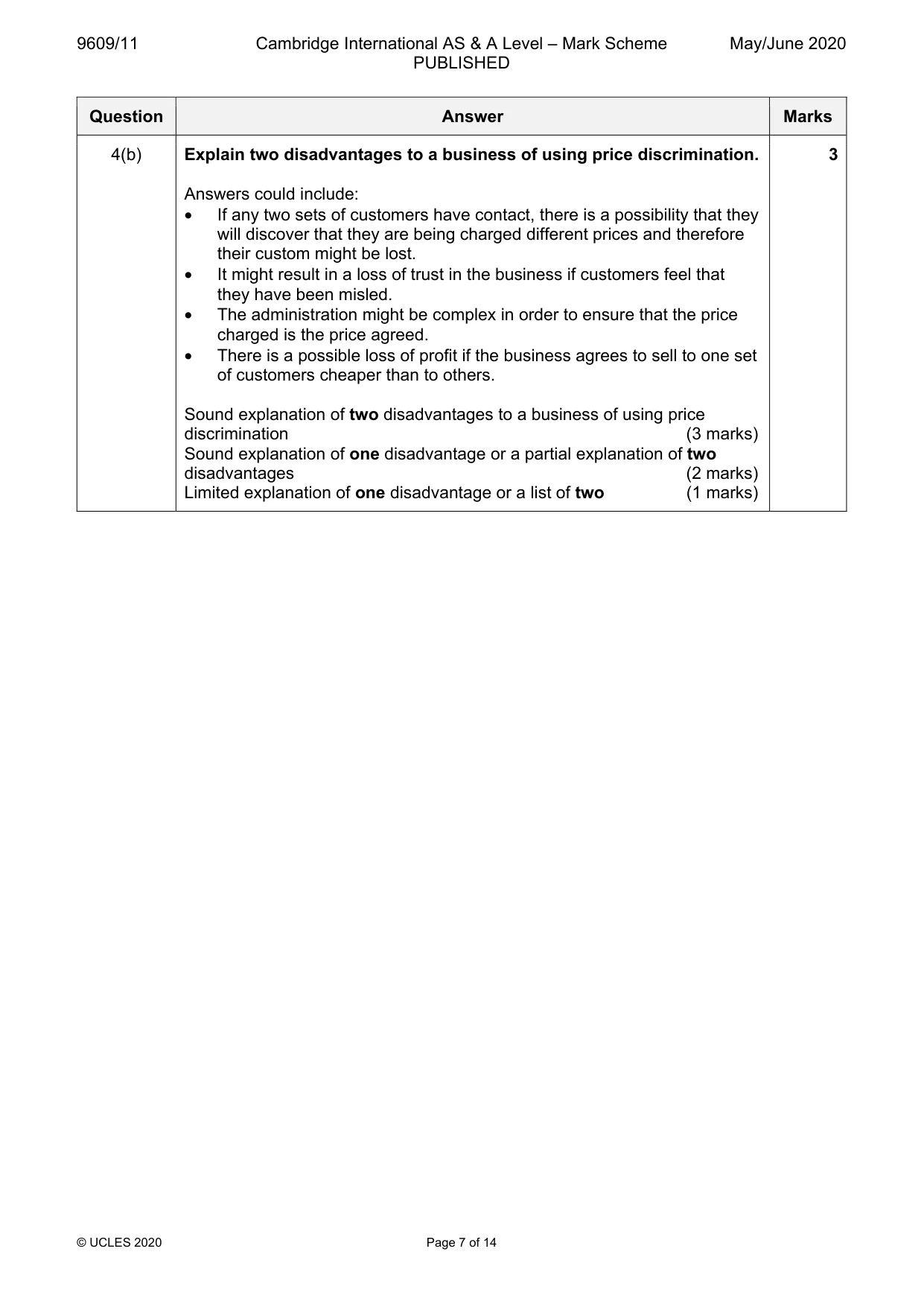
9609/11 Cambridge International AS & A Level – Mark Scheme PUBLISHED May/June 2020 © UCLES 2020 Page 7 of 14 Question Answer Marks 4(b) Explain two disadvantages to a business of using price discrimination. Answers could include: • If any two sets of customers have contact, there is a possibility that they will discover that they are being charged different prices and therefore their custom might be lost. • It might result in a loss of trust in the business if customers feel that they have been misled. • The administration might be complex in order to ensure that the price charged is the price agreed. • There is a possible loss of profit if the business agrees to sell to one set of customers cheaper than to others. Sound explanation of two disadvantages to a business of using price discrimination (3 marks) Sound explanation of one disadvantage or a partial explanation of two disadvantages (2 marks) Limited explanation of one disadvantage or a list of two (1 marks) 3
Mark scheme, page 8
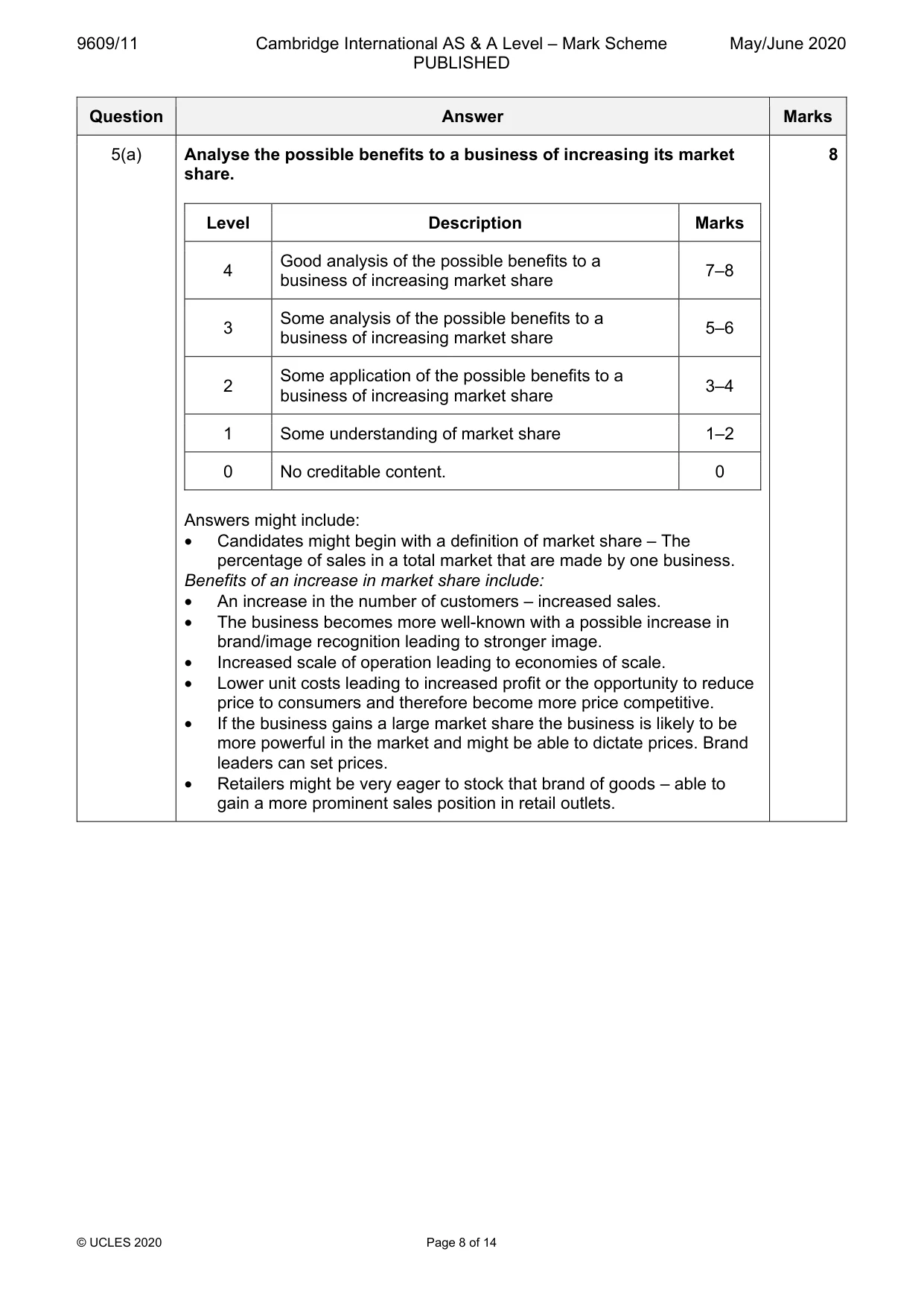
9609/11 Cambridge International AS & A Level – Mark Scheme PUBLISHED May/June 2020 © UCLES 2020 Page 8 of 14 Question Answer Marks 5(a) Analyse the possible benefits to a business of increasing its market share. Level Description Marks 4 Good analysis of the possible benefits to a business of increasing market share 7–8 3 Some analysis of the possible benefits to a business of increasing market share 5–6 2 Some application of the possible benefits to a business of increasing market share 3–4 1 Some understanding of market share 1–2 0 No creditable content. 0 Answers might include: • Candidates might begin with a definition of market share – The percentage of sales in a total market that are made by one business. Benefits of an increase in market share include: • An increase in the number of customers – increased sales. • The business becomes more well-known with a possible increase in brand/image recognition leading to stronger image. • Increased scale of operation leading to economies of scale. • Lower unit costs leading to increased profit or the opportunity to reduce price to consumers and therefore become more price competitive. • If the business gains a large market share the business is likely to be more powerful in the market and might be able to dictate prices. Brand leaders can set prices. • Retailers might be very eager to stock that brand of goods – able to gain a more prominent sales position in retail outlets. 8
Mark scheme, page 9
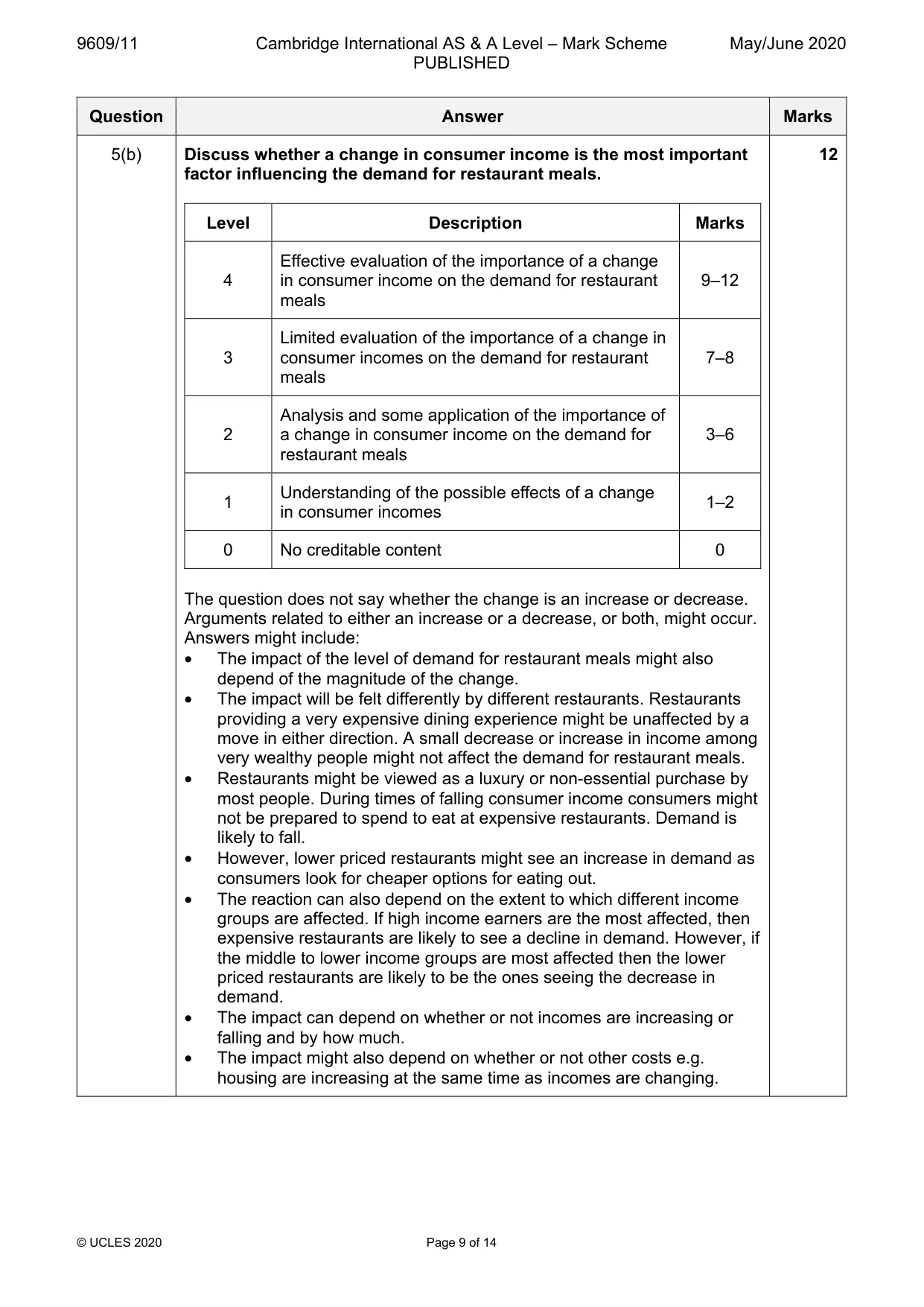
9609/11 Cambridge International AS & A Level – Mark Scheme PUBLISHED May/June 2020 © UCLES 2020 Page 9 of 14 Question Answer Marks 5(b) Discuss whether a change in consumer income is the most important factor influencing the demand for restaurant meals. Level Description Marks 4 Effective evaluation of the importance of a change in consumer income on the demand for restaurant meals 9–12 3 Limited evaluation of the importance of a change in consumer incomes on the demand for restaurant meals 7–8 2 Analysis and some application of the importance of a change in consumer income on the demand for restaurant meals 3–6 1 Understanding of the possible effects of a change in consumer incomes 1–2 0 No creditable content 0 The question does not say whether the change is an increase or decrease. Arguments related to either an increase or a decrease, or both, might occur. Answers might include: • The impact of the level of demand for restaurant meals might also depend of the magnitude of the change. • The impact will be felt differently by different restaurants. Restaurants providing a very expensive dining experience might be unaffected by a move in either direction. A small decrease or increase in income among very wealthy people might not affect the demand for restaurant meals. • Restaurants might be viewed as a luxury or non-essential purchase by most people. During times of falling consumer income consumers might not be prepared to spend to eat at expensive restaurants. Demand is likely to fall. • However, lower priced restaurants might see an increase in demand as consumers look for cheaper options for eating out. • The reaction can also depend on the extent to which different income groups are affected. If high income earners are the most affected, then expensive restaurants are likely to see a decline in demand. However, if the middle to lower income groups are most affected then the lower priced restaurants are likely to be the ones seeing the decrease in demand. • The impact can depend on whether or not incomes are increasing or falling and by how much. • The impact might also depend on whether or not other costs e.g. housing are increasing at the same time as incomes are changing. 12
Mark scheme, page 10
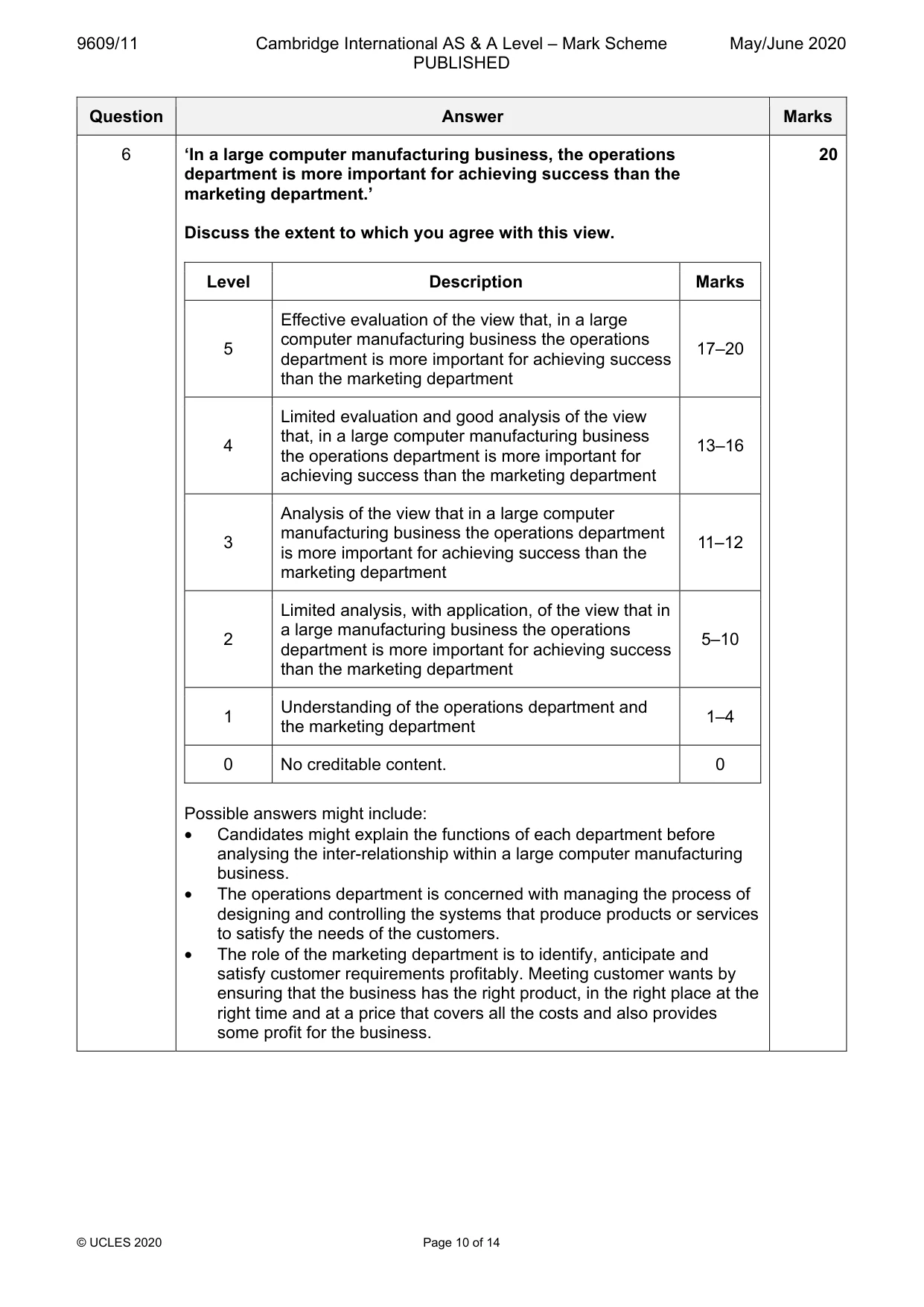
9609/11 Cambridge International AS & A Level – Mark Scheme PUBLISHED May/June 2020 © UCLES 2020 Page 10 of 14 Question Answer Marks 6 ‘In a large computer manufacturing business, the operations department is more important for achieving success than the marketing department.’ Discuss the extent to which you agree with this view. Level Description Marks 5 Effective evaluation of the view that, in a large computer manufacturing business the operations department is more important for achieving success than the marketing department 17–20 4 Limited evaluation and good analysis of the view that, in a large computer manufacturing business the operations department is more important for achieving success than the marketing department 13–16 3 Analysis of the view that in a large computer manufacturing business the operations department is more important for achieving success than the marketing department 11–12 2 Limited analysis, with application, of the view that in a large manufacturing business the operations department is more important for achieving success than the marketing department 5–10 1 Understanding of the operations department and the marketing department 1–4 0 No creditable content. 0 Possible answers might include: • Candidates might explain the functions of each department before analysing the inter-relationship within a large computer manufacturing business. • The operations department is concerned with managing the process of designing and controlling the systems that produce products or services to satisfy the needs of the customers. • The role of the marketing department is to identify, anticipate and satisfy customer requirements profitably. Meeting customer wants by ensuring that the business has the right product, in the right place at the right time and at a price that covers all the costs and also provides some profit for the business. 20
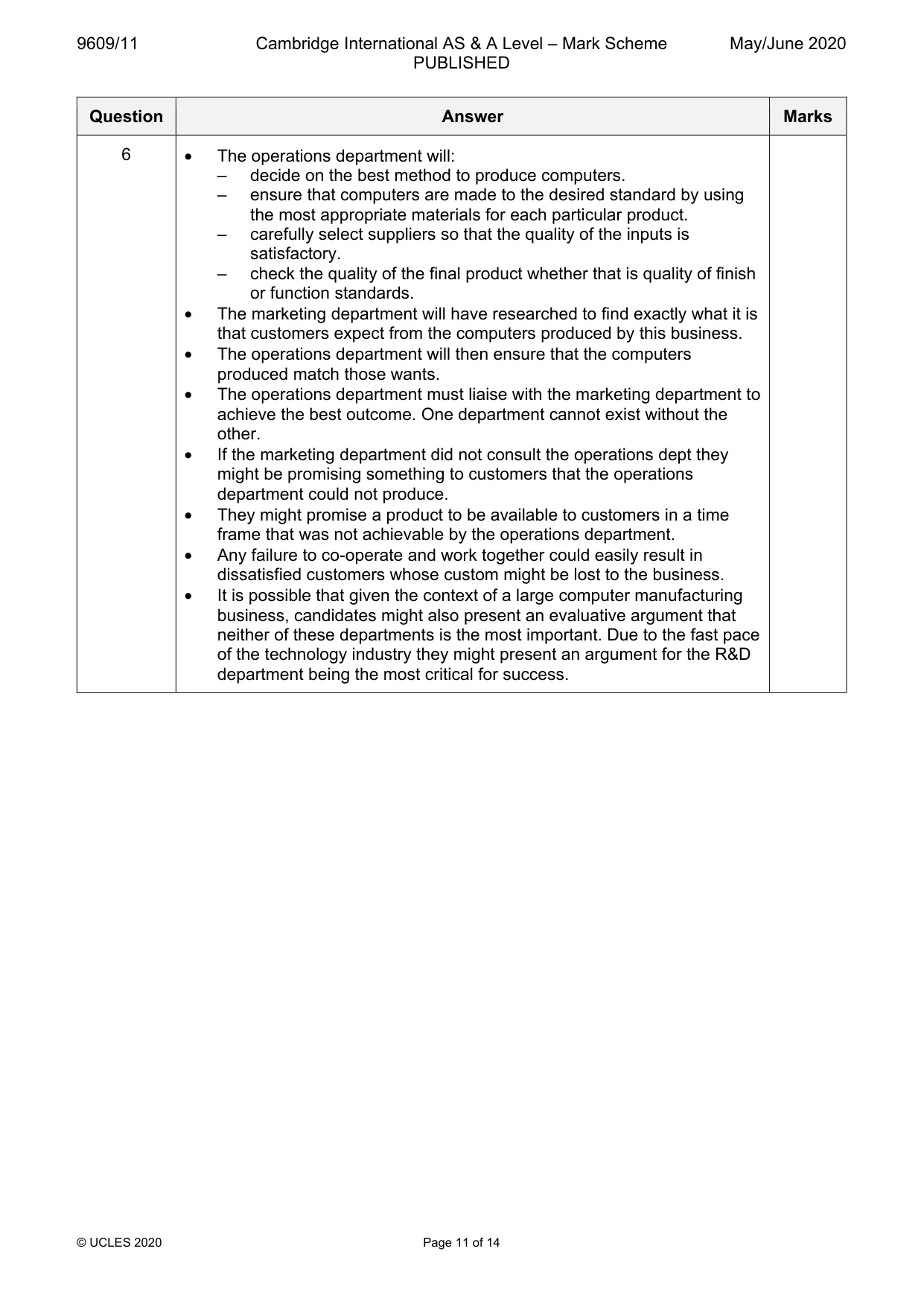
Mark scheme, page 11
9609/11 Cambridge International AS & A Level – Mark Scheme PUBLISHED May/June 2020 © UCLES 2020 Page 11 of 14 Question Answer Marks 6 • The operations department will: – decide on the best method to produce computers. – ensure that computers are made to the desired standard by using the most appropriate materials for each particular product. – carefully select suppliers so that the quality of the inputs is satisfactory. – check the quality of the final product whether that is quality of finish or function standards. • The marketing department will have researched to find exactly what it is that customers expect from the computers produced by this business. • The operations department will then ensure that the computers produced match those wants. • The operations department must liaise with the marketing department to achieve the best outcome. One department cannot exist without the other. • If the marketing department did not consult the operations dept they might be promising something to customers that the operations department could not produce. • They might promise a product to be available to customers in a time frame that was not achievable by the operations department. • Any failure to co-operate and work together could easily result in dissatisfied customers whose custom might be lost to the business. • It is possible that given the context of a large computer manufacturing business, candidates might also present an evaluative argument that neither of these departments is the most important. Due to the fast pace of the technology industry they might present an argument for the R&D department being the most critical for success.
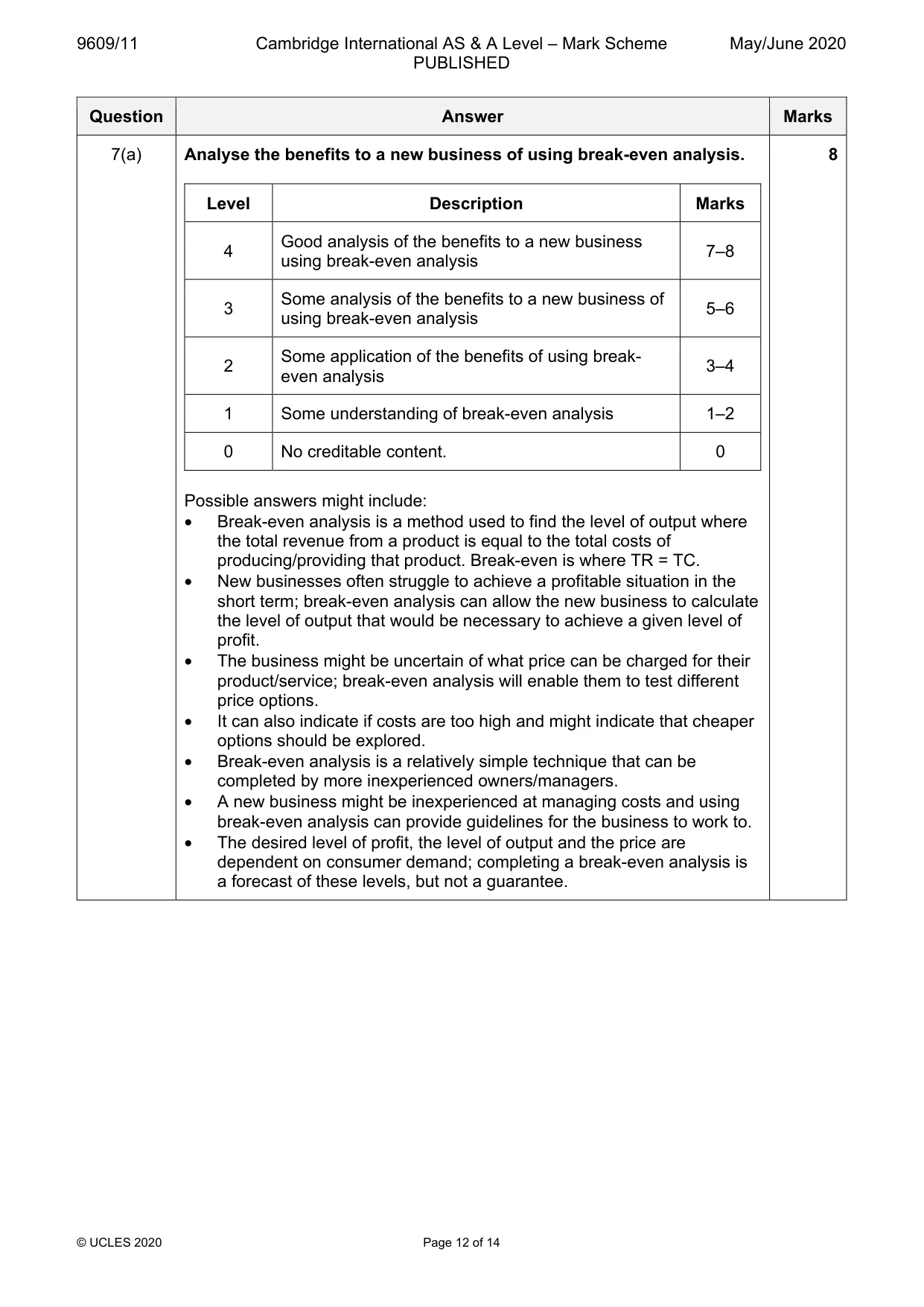
Mark scheme, page 12
9609/11 Cambridge International AS & A Level – Mark Scheme PUBLISHED May/June 2020 © UCLES 2020 Page 12 of 14 Question Answer Marks 7(a) Analyse the benefits to a new business of using break-even analysis. Level Description Marks 4 Good analysis of the benefits to a new business using break-even analysis 7–8 3 Some analysis of the benefits to a new business of using break-even analysis 5–6 2 Some application of the benefits of using break- even analysis 3–4 1 Some understanding of break-even analysis 1–2 0 No creditable content. 0 Possible answers might include: • Break-even analysis is a method used to find the level of output where the total revenue from a product is equal to the total costs of producing/providing that product. Break-even is where TR = TC. • New businesses often struggle to achieve a profitable situation in the short term; break-even analysis can allow the new business to calculate the level of output that would be necessary to achieve a given level of profit. • The business might be uncertain of what price can be charged for their product/service; break-even analysis will enable them to test different price options. • It can also indicate if costs are too high and might indicate that cheaper options should be explored. • Break-even analysis is a relatively simple technique that can be completed by more inexperienced owners/managers. • A new business might be inexperienced at managing costs and using break-even analysis can provide guidelines for the business to work to. • The desired level of profit, the level of output and the price are dependent on consumer demand; completing a break-even analysis is a forecast of these levels, but not a guarantee. 8
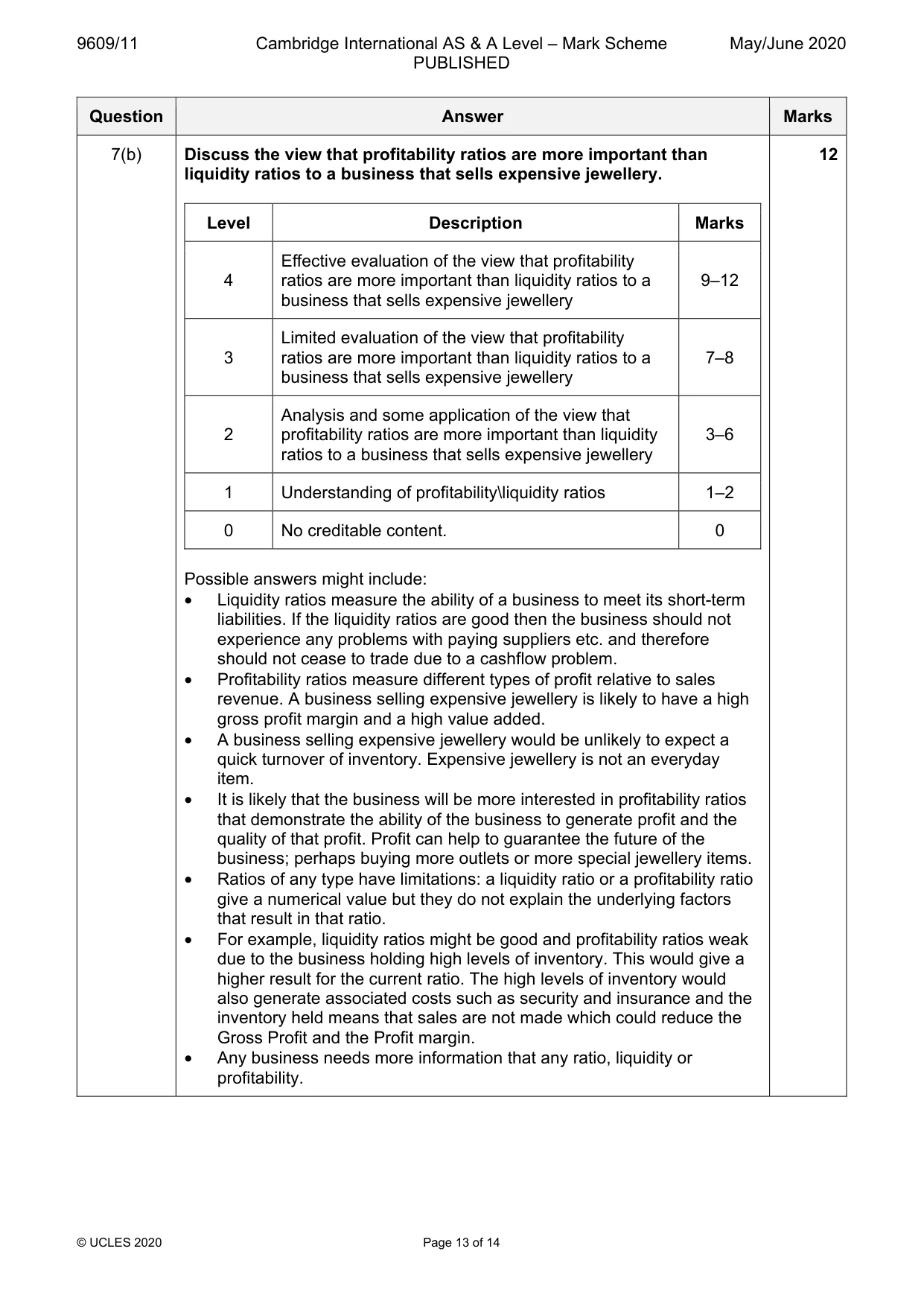
Mark scheme, page 13
9609/11 Cambridge International AS & A Level – Mark Scheme PUBLISHED May/June 2020 © UCLES 2020 Page 13 of 14 Question Answer Marks 7(b) Discuss the view that profitability ratios are more important than liquidity ratios to a business that sells expensive jewellery. Level Description Marks 4 Effective evaluation of the view that profitability ratios are more important than liquidity ratios to a business that sells expensive jewellery 9–12 3 Limited evaluation of the view that profitability ratios are more important than liquidity ratios to a business that sells expensive jewellery 7–8 2 Analysis and some application of the view that profitability ratios are more important than liquidity ratios to a business that sells expensive jewellery 3–6 1 Understanding of profitability\liquidity ratios 1–2 0 No creditable content. 0 Possible answers might include: • Liquidity ratios measure the ability of a business to meet its short-term liabilities. If the liquidity ratios are good then the business should not experience any problems with paying suppliers etc. and therefore should not cease to trade due to a cashflow problem. • Profitability ratios measure different types of profit relative to sales revenue. A business selling expensive jewellery is likely to have a high gross profit margin and a high value added. • A business selling expensive jewellery would be unlikely to expect a quick turnover of inventory. Expensive jewellery is not an everyday item. • It is likely that the business will be more interested in profitability ratios that demonstrate the ability of the business to generate profit and the quality of that profit. Profit can help to guarantee the future of the business; perhaps buying more outlets or more special jewellery items. • Ratios of any type have limitations: a liquidity ratio or a profitability ratio give a numerical value but they do not explain the underlying factors that result in that ratio. • For example, liquidity ratios might be good and profitability ratios weak due to the business holding high levels of inventory. This would give a higher result for the current ratio. The high levels of inventory would also generate associated costs such as security and insurance and the inventory held means that sales are not made which could reduce the Gross Profit and the Profit margin. • Any business needs more information that any ratio, liquidity or profitability. 12
Mark scheme, page 14
9609/11 Cambridge International AS & A Level – Mark Scheme PUBLISHED May/June 2020 © UCLES 2020 Page 14 of 14 Question Answer Marks 7(b) • The business would need to look at trends over time and also make comparisons with other businesses in the same type of market/industry. • Liquidity ratios might be thought to be less important than profitability ratios but if the business cannot meet short-term debts then the business will be declared bankrupt and therefore any hope of future profit is gone.