Cambridge A Level Business (for first examination in 2016) 9609 — 2020 May/June Paper 1 · Variant 3
9609/13/M/J/20
The question paper and its mark scheme, free to read here and free to download. This is Cambridge’s own paper, exactly as it was sat.
Question paper4 pages


Mark scheme12 pages
Answers below. Sit the paper first if you are practising.
Paper as text
Question paper, page 1
Cambridge International AS & A Level * 1 2 5 6 5 8 1 4 5 7 * This document has 4 pages. Blank pages are indicated. DC (TC) 190551/1 © UCLES 2020 [Turn over BUSINESS 9609/13 Paper 1 Short Answer and Essay May/June 2020 1 hour 15 minutes You must answer on the enclosed answer booklet. You will need: Answer booklet (enclosed) INSTRUCTIONS ● Section A: answer all questions. ● Section B: answer one question. ● Follow the instructions on the front cover of the answer booklet. If you need additional answer paper, ask the invigilator for a continuation booklet. INFORMATION ● The total mark for this paper is 40. ● The number of marks for each question or part question is shown in brackets [ ].
Question paper, page 2
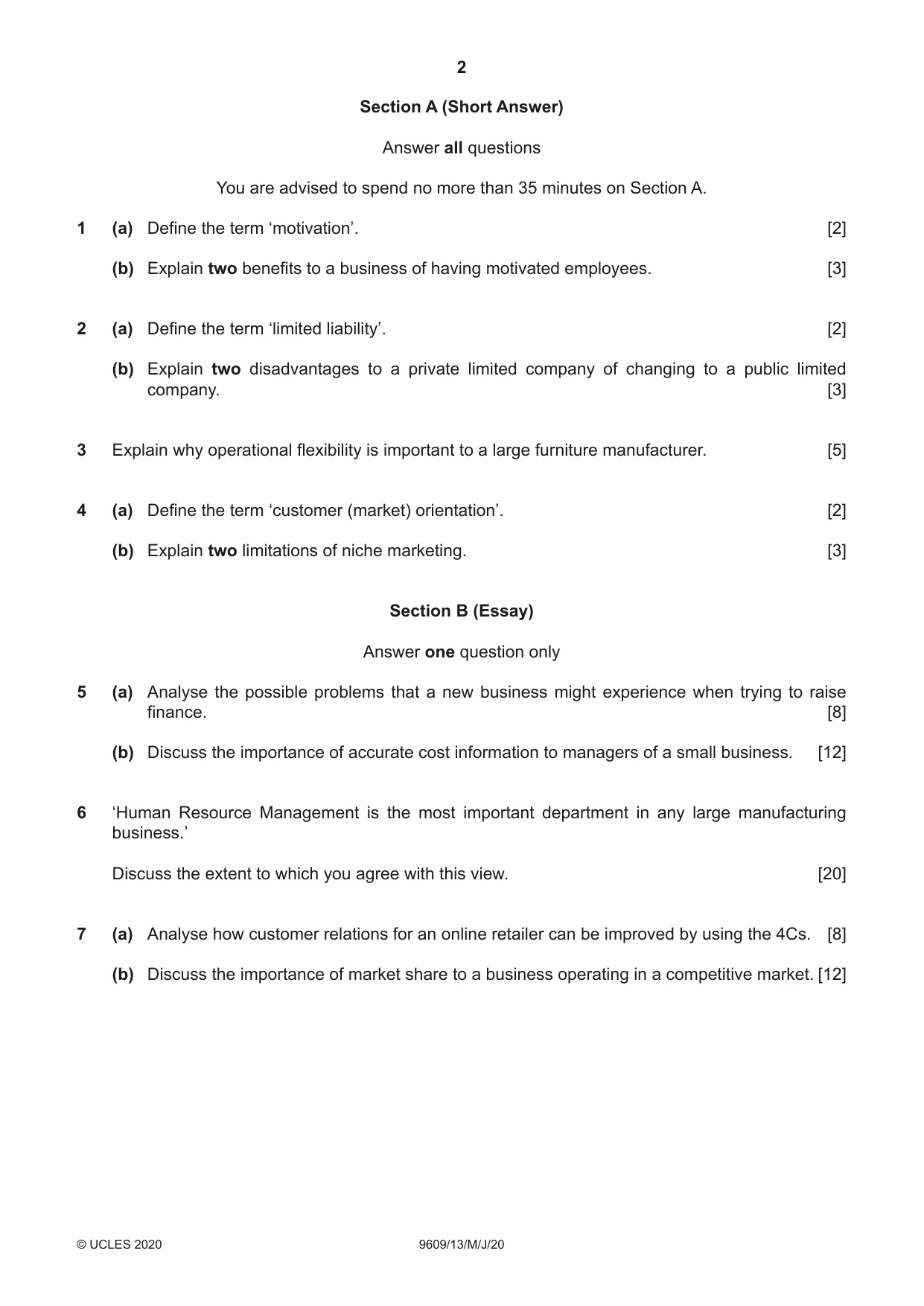
2 9609/13/M/J/20 © UCLES 2020 Section A (Short Answer) Answer all questions You are advised to spend no more than 35 minutes on Section A. 1 (a) Define the term ‘motivation’. [2] (b) Explain two benefits to a business of having motivated employees. [3] 2 (a) Define the term ‘limited liability’. [2] (b) Explain two disadvantages to a private limited company of changing to a public limited company. [3] 3 Explain why operational flexibility is important to a large furniture manufacturer. [5] 4 (a) Define the term ‘customer (market) orientation’. [2] (b) Explain two limitations of niche marketing. [3] Section B (Essay) Answer one question only 5 (a) Analyse the possible problems that a new business might experience when trying to raise finance. [8] (b) Discuss the importance of accurate cost information to managers of a small business. [12] 6 ‘Human Resource Management is the most important department in any large manufacturing business.’ Discuss the extent to which you agree with this view. [20] 7 (a) Analyse how customer relations for an online retailer can be improved by using the 4Cs. [8] (b) Discuss the importance of market share to a business operating in a competitive market. [12]
Question paper, page 3
3 9609/13/M/J/20 © UCLES 2020 BLANK PAGE
Question paper, page 4
4 9609/13/M/J/20 © UCLES 2020 Permission to reproduce items where third-party owned material protected by copyright is included has been sought and cleared where possible. Every reasonable effort has been made by the publisher (UCLES) to trace copyright holders, but if any items requiring clearance have unwittingly been included, the publisher will be pleased to make amends at the earliest possible opportunity. To avoid the issue of disclosure of answer-related information to candidates, all copyright acknowledgements are reproduced online in the Cambridge Assessment International Education Copyright Acknowledgements Booklet. This is produced for each series of examinations and is freely available to download at www.cambridgeinternational.org after the live examination series. Cambridge Assessment International Education is part of the Cambridge Assessment Group. Cambridge Assessment is the brand name of the University of Cambridge Local Examinations Syndicate (UCLES), which itself is a department of the University of Cambridge. BLANK PAGE
Mark scheme, page 1
This document consists of 12 printed pages. © UCLES 2020 [Turn over Cambridge International AS & A Level BUSINESS 9609/13 Paper 1 Short Answer and Essay May/June 2020 MARK SCHEME Maximum Mark: 40 Published Students did not sit exam papers in the June 2020 series due to the Covid-19 global pandemic. This mark scheme is published to support teachers and students and should be read together with the question paper. It shows the requirements of the exam. The answer column of the mark scheme shows the proposed basis on which Examiners would award marks for this exam. Where appropriate, this column also provides the most likely acceptable alternative responses expected from students. Examiners usually review the mark scheme after they have seen student responses and update the mark scheme if appropriate. In the June series, Examiners were unable to consider the acceptability of alternative responses, as there were no student responses to consider. Mark schemes should usually be read together with the Principal Examiner Report for Teachers. However, because students did not sit exam papers, there is no Principal Examiner Report for Teachers for the June 2020 series. Cambridge International will not enter into discussions about these mark schemes. Cambridge International is publishing the mark schemes for the June 2020 series for most Cambridge IGCSE™ and Cambridge International A & AS Level components, and some Cambridge O Level components.
Mark scheme, page 2
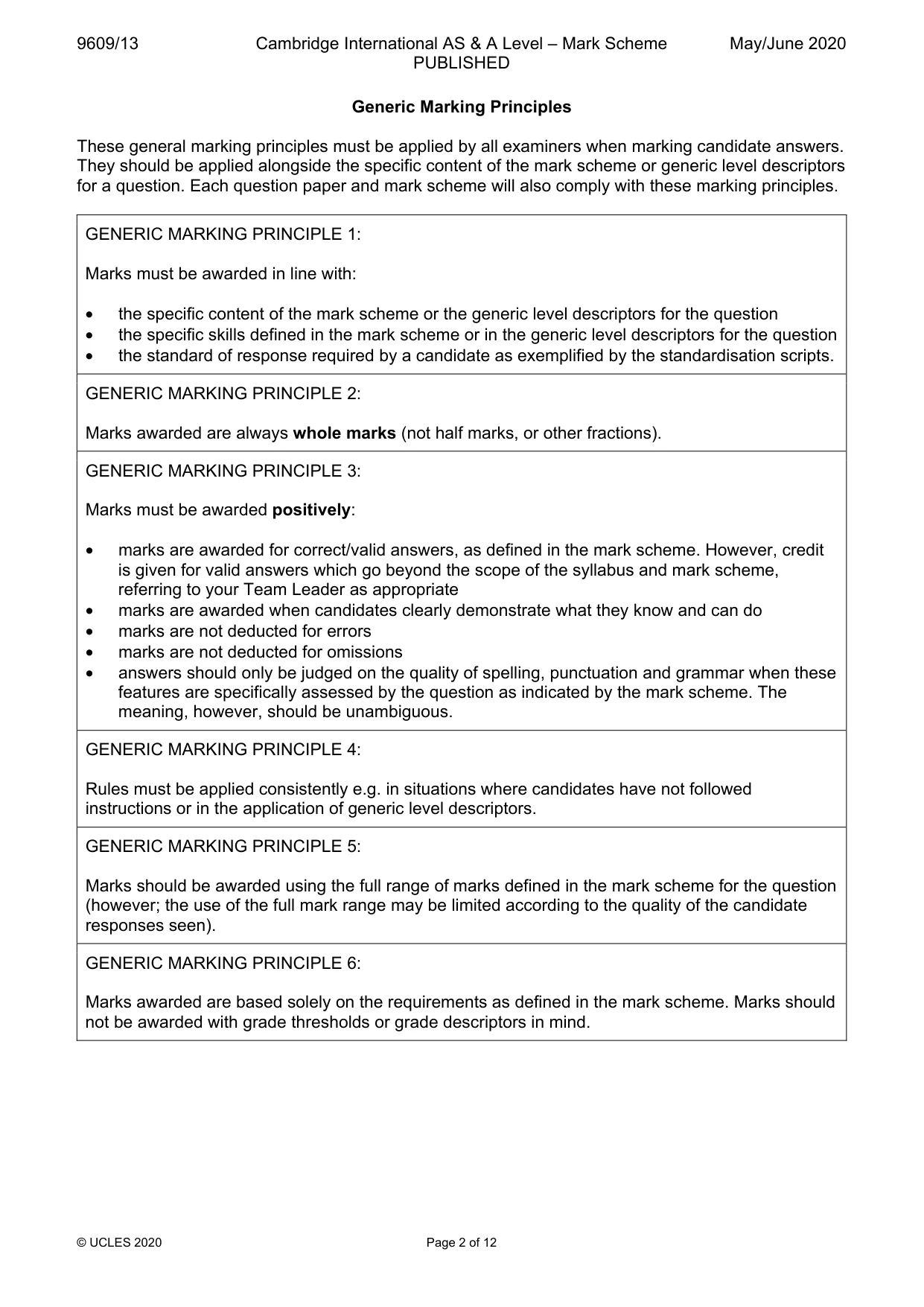
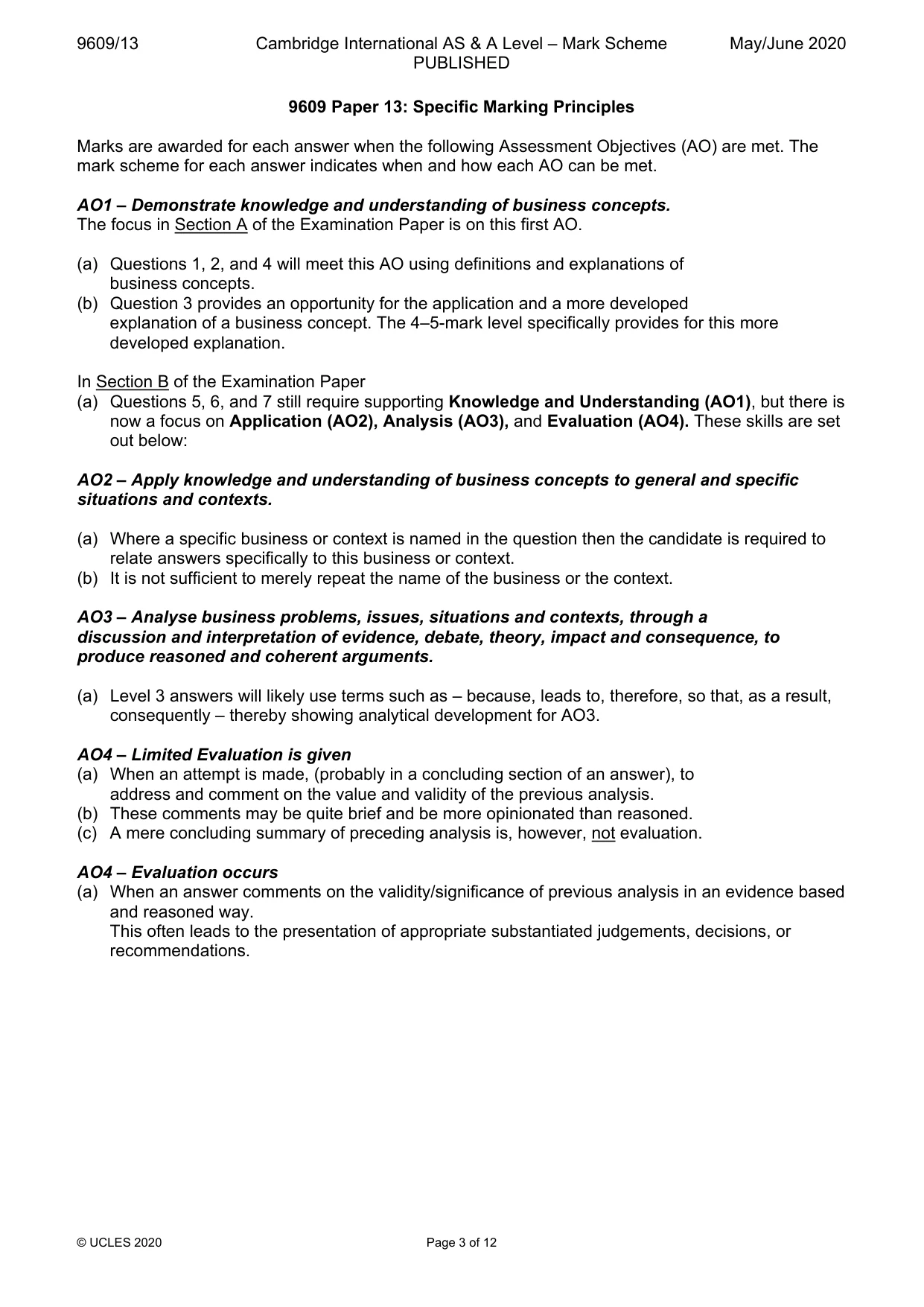
9609/13 Cambridge International AS & A Level – Mark Scheme PUBLISHED May/June 2020 © UCLES 2020 Page 2 of 12 Generic Marking Principles These general marking principles must be applied by all examiners when marking candidate answers. They should be applied alongside the specific content of the mark scheme or generic level descriptors for a question. Each question paper and mark scheme will also comply with these marking principles. GENERIC MARKING PRINCIPLE 1: Marks must be awarded in line with: • the specific content of the mark scheme or the generic level descriptors for the question • the specific skills defined in the mark scheme or in the generic level descriptors for the question • the standard of response required by a candidate as exemplified by the standardisation scripts. GENERIC MARKING PRINCIPLE 2: Marks awarded are always whole marks (not half marks, or other fractions). GENERIC MARKING PRINCIPLE 3: Marks must be awarded positively: • marks are awarded for correct/valid answers, as defined in the mark scheme. However, credit is given for valid answers which go beyond the scope of the syllabus and mark scheme, referring to your Team Leader as appropriate • marks are awarded when candidates clearly demonstrate what they know and can do • marks are not deducted for errors • marks are not deducted for omissions • answers should only be judged on the quality of spelling, punctuation and grammar when these features are specifically assessed by the question as indicated by the mark scheme. The meaning, however, should be unambiguous. GENERIC MARKING PRINCIPLE 4: Rules must be applied consistently e.g. in situations where candidates have not followed instructions or in the application of generic level descriptors. GENERIC MARKING PRINCIPLE 5: Marks should be awarded using the full range of marks defined in the mark scheme for the question (however; the use of the full mark range may be limited according to the quality of the candidate responses seen). GENERIC MARKING PRINCIPLE 6: Marks awarded are based solely on the requirements as defined in the mark scheme. Marks should not be awarded with grade thresholds or grade descriptors in mind.
Mark scheme, page 3
9609/13 Cambridge International AS & A Level – Mark Scheme PUBLISHED May/June 2020 © UCLES 2020 Page 3 of 12 9609 Paper 13: Specific Marking Principles Marks are awarded for each answer when the following Assessment Objectives (AO) are met. The mark scheme for each answer indicates when and how each AO can be met. AO1 – Demonstrate knowledge and understanding of business concepts. The focus in Section A of the Examination Paper is on this first AO. (a) Questions 1, 2, and 4 will meet this AO using definitions and explanations of business concepts. (b) Question 3 provides an opportunity for the application and a more developed explanation of a business concept. The 4–5-mark level specifically provides for this more developed explanation. In Section B of the Examination Paper (a) Questions 5, 6, and 7 still require supporting Knowledge and Understanding (AO1), but there is now a focus on Application (AO2), Analysis (AO3), and Evaluation (AO4). These skills are set out below: AO2 – Apply knowledge and understanding of business concepts to general and specific situations and contexts. (a) Where a specific business or context is named in the question then the candidate is required to relate answers specifically to this business or context. (b) It is not sufficient to merely repeat the name of the business or the context. AO3 – Analyse business problems, issues, situations and contexts, through a discussion and interpretation of evidence, debate, theory, impact and consequence, to produce reasoned and coherent arguments. (a) Level 3 answers will likely use terms such as – because, leads to, therefore, so that, as a result, consequently – thereby showing analytical development for AO3. AO4 – Limited Evaluation is given (a) When an attempt is made, (probably in a concluding section of an answer), to address and comment on the value and validity of the previous analysis. (b) These comments may be quite brief and be more opinionated than reasoned. (c) A mere concluding summary of preceding analysis is, however, not evaluation. AO4 – Evaluation occurs (a) When an answer comments on the validity/significance of previous analysis in an evidence based and reasoned way. This often leads to the presentation of appropriate substantiated judgements, decisions, or recommendations.
Mark scheme, page 4
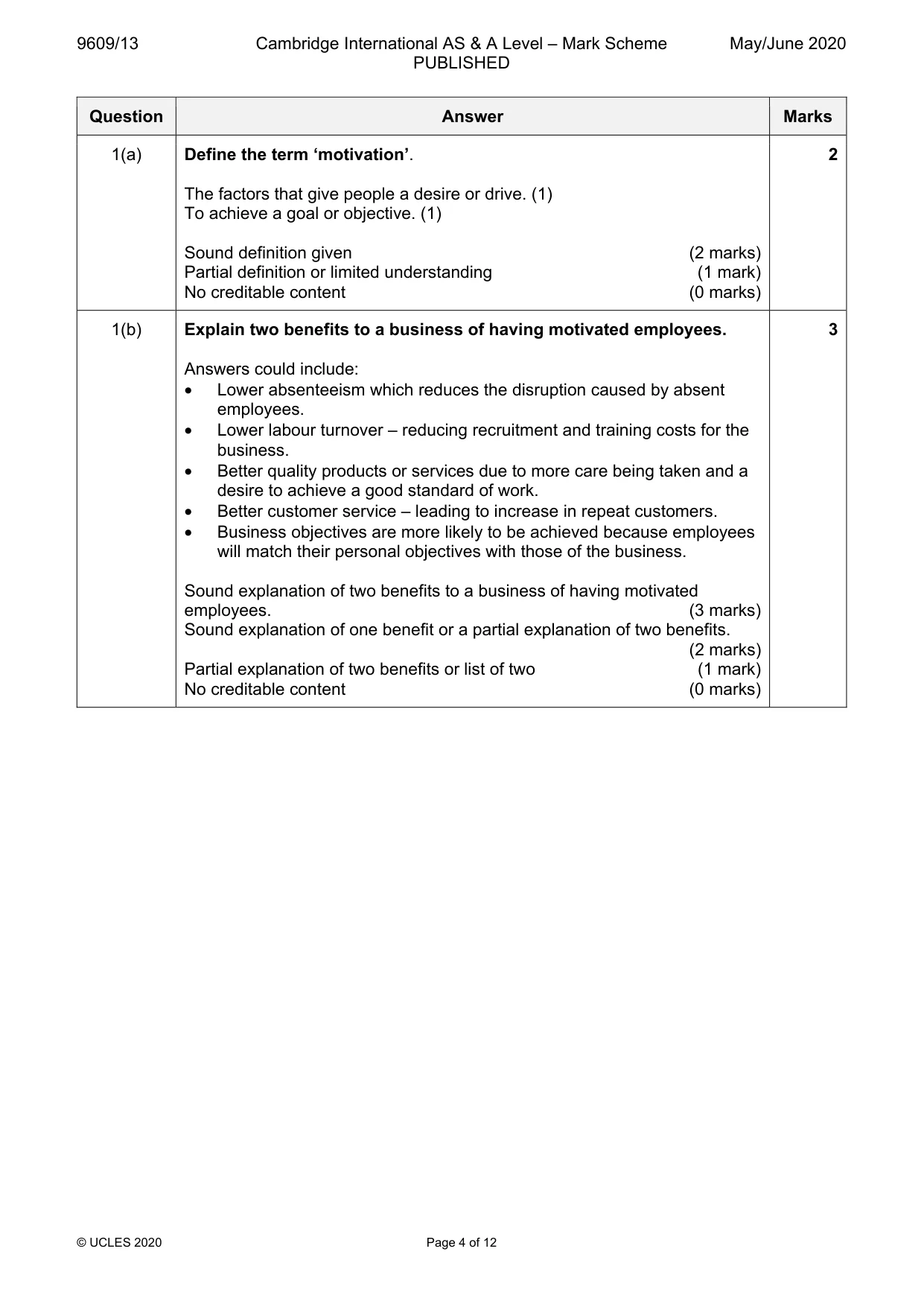
9609/13 Cambridge International AS & A Level – Mark Scheme PUBLISHED May/June 2020 © UCLES 2020 Page 4 of 12 Question Answer Marks 1(a) Define the term ‘motivation’. The factors that give people a desire or drive. (1) To achieve a goal or objective. (1) Sound definition given (2 marks) Partial definition or limited understanding (1 mark) No creditable content (0 marks) 2 1(b) Explain two benefits to a business of having motivated employees. Answers could include: • Lower absenteeism which reduces the disruption caused by absent employees. • Lower labour turnover – reducing recruitment and training costs for the business. • Better quality products or services due to more care being taken and a desire to achieve a good standard of work. • Better customer service – leading to increase in repeat customers. • Business objectives are more likely to be achieved because employees will match their personal objectives with those of the business. Sound explanation of two benefits to a business of having motivated employees. (3 marks) Sound explanation of one benefit or a partial explanation of two benefits. (2 marks) Partial explanation of two benefits or list of two (1 mark) No creditable content (0 marks) 3
Mark scheme, page 5
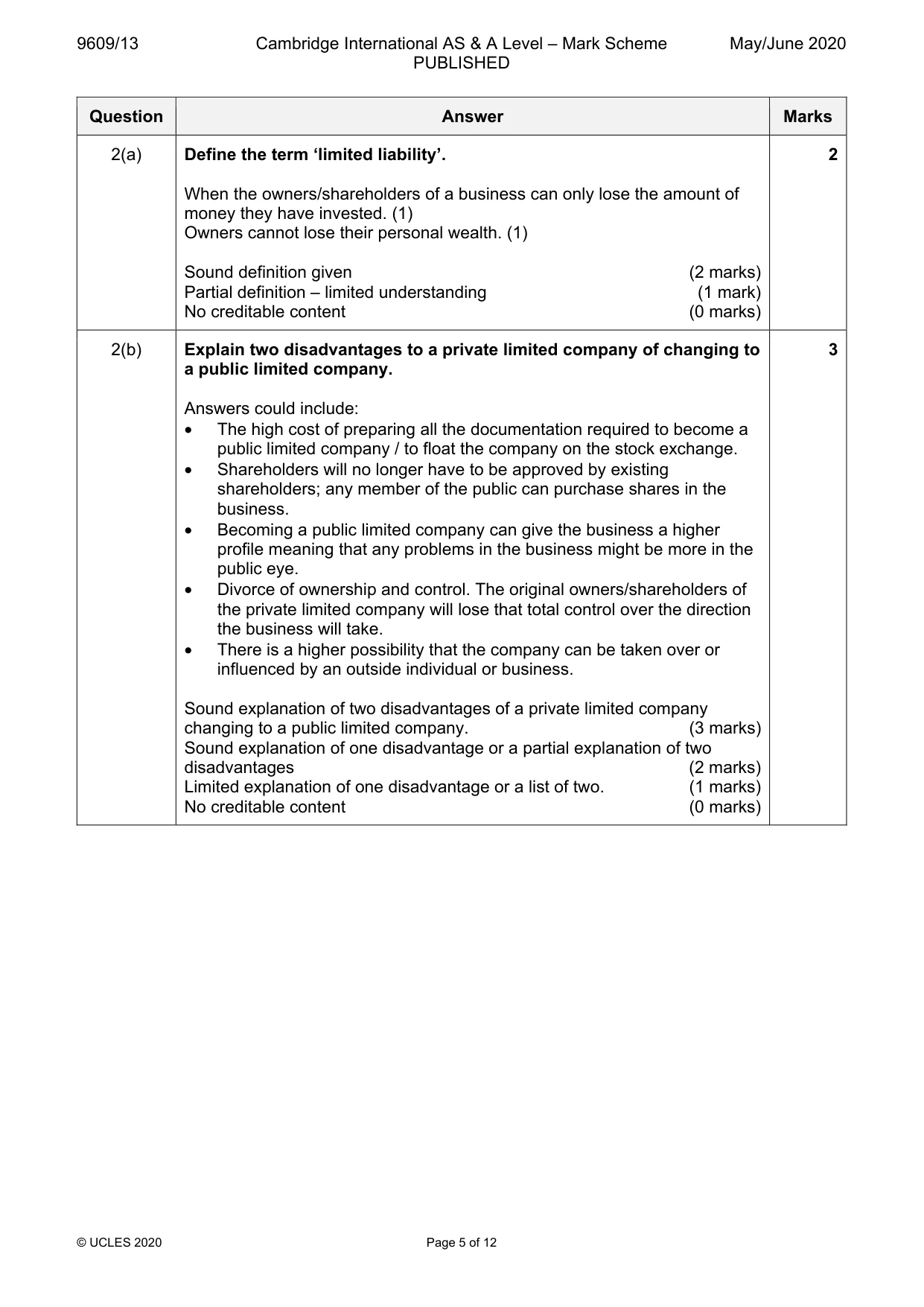
9609/13 Cambridge International AS & A Level – Mark Scheme PUBLISHED May/June 2020 © UCLES 2020 Page 5 of 12 Question Answer Marks 2(a) Define the term ‘limited liability’. When the owners/shareholders of a business can only lose the amount of money they have invested. (1) Owners cannot lose their personal wealth. (1) Sound definition given (2 marks) Partial definition – limited understanding (1 mark) No creditable content (0 marks) 2 2(b) Explain two disadvantages to a private limited company of changing to a public limited company. Answers could include: • The high cost of preparing all the documentation required to become a public limited company / to float the company on the stock exchange. • Shareholders will no longer have to be approved by existing shareholders; any member of the public can purchase shares in the business. • Becoming a public limited company can give the business a higher profile meaning that any problems in the business might be more in the public eye. • Divorce of ownership and control. The original owners/shareholders of the private limited company will lose that total control over the direction the business will take. • There is a higher possibility that the company can be taken over or influenced by an outside individual or business. Sound explanation of two disadvantages of a private limited company changing to a public limited company. (3 marks) Sound explanation of one disadvantage or a partial explanation of two disadvantages (2 marks) Limited explanation of one disadvantage or a list of two. (1 marks) No creditable content (0 marks) 3
Mark scheme, page 6
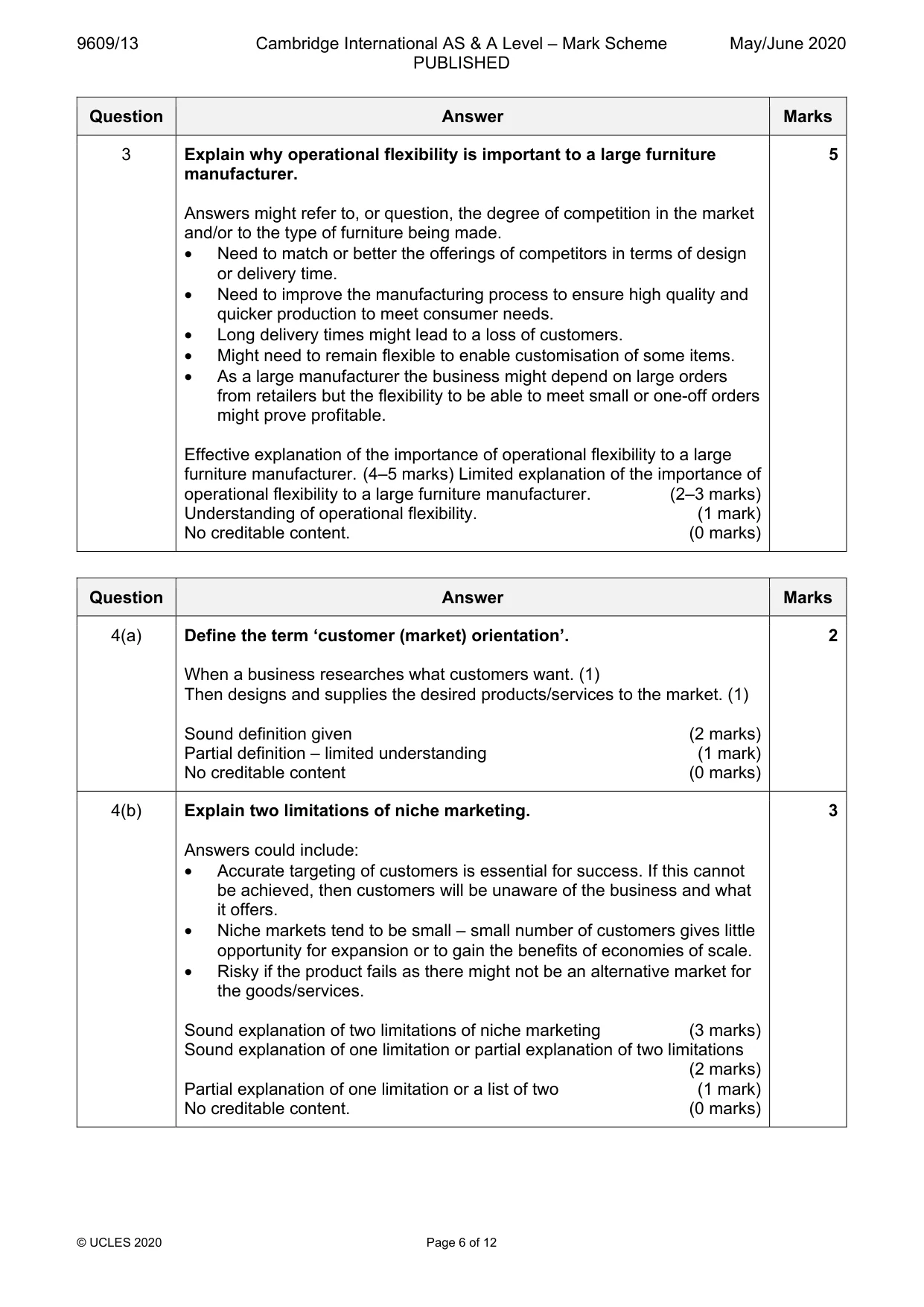
9609/13 Cambridge International AS & A Level – Mark Scheme PUBLISHED May/June 2020 © UCLES 2020 Page 6 of 12 Question Answer Marks 3 Explain why operational flexibility is important to a large furniture manufacturer. Answers might refer to, or question, the degree of competition in the market and/or to the type of furniture being made. • Need to match or better the offerings of competitors in terms of design or delivery time. • Need to improve the manufacturing process to ensure high quality and quicker production to meet consumer needs. • Long delivery times might lead to a loss of customers. • Might need to remain flexible to enable customisation of some items. • As a large manufacturer the business might depend on large orders from retailers but the flexibility to be able to meet small or one-off orders might prove profitable. Effective explanation of the importance of operational flexibility to a large furniture manufacturer. (4–5 marks) Limited explanation of the importance of operational flexibility to a large furniture manufacturer. (2–3 marks) Understanding of operational flexibility. (1 mark) No creditable content. (0 marks) 5 Question Answer Marks 4(a) Define the term ‘customer (market) orientation’. When a business researches what customers want. (1) Then designs and supplies the desired products/services to the market. (1) Sound definition given (2 marks) Partial definition – limited understanding (1 mark) No creditable content (0 marks) 2 4(b) Explain two limitations of niche marketing. Answers could include: • Accurate targeting of customers is essential for success. If this cannot be achieved, then customers will be unaware of the business and what it offers. • Niche markets tend to be small – small number of customers gives little opportunity for expansion or to gain the benefits of economies of scale. • Risky if the product fails as there might not be an alternative market for the goods/services. Sound explanation of two limitations of niche marketing (3 marks) Sound explanation of one limitation or partial explanation of two limitations (2 marks) Partial explanation of one limitation or a list of two (1 mark) No creditable content. (0 marks) 3
Mark scheme, page 7
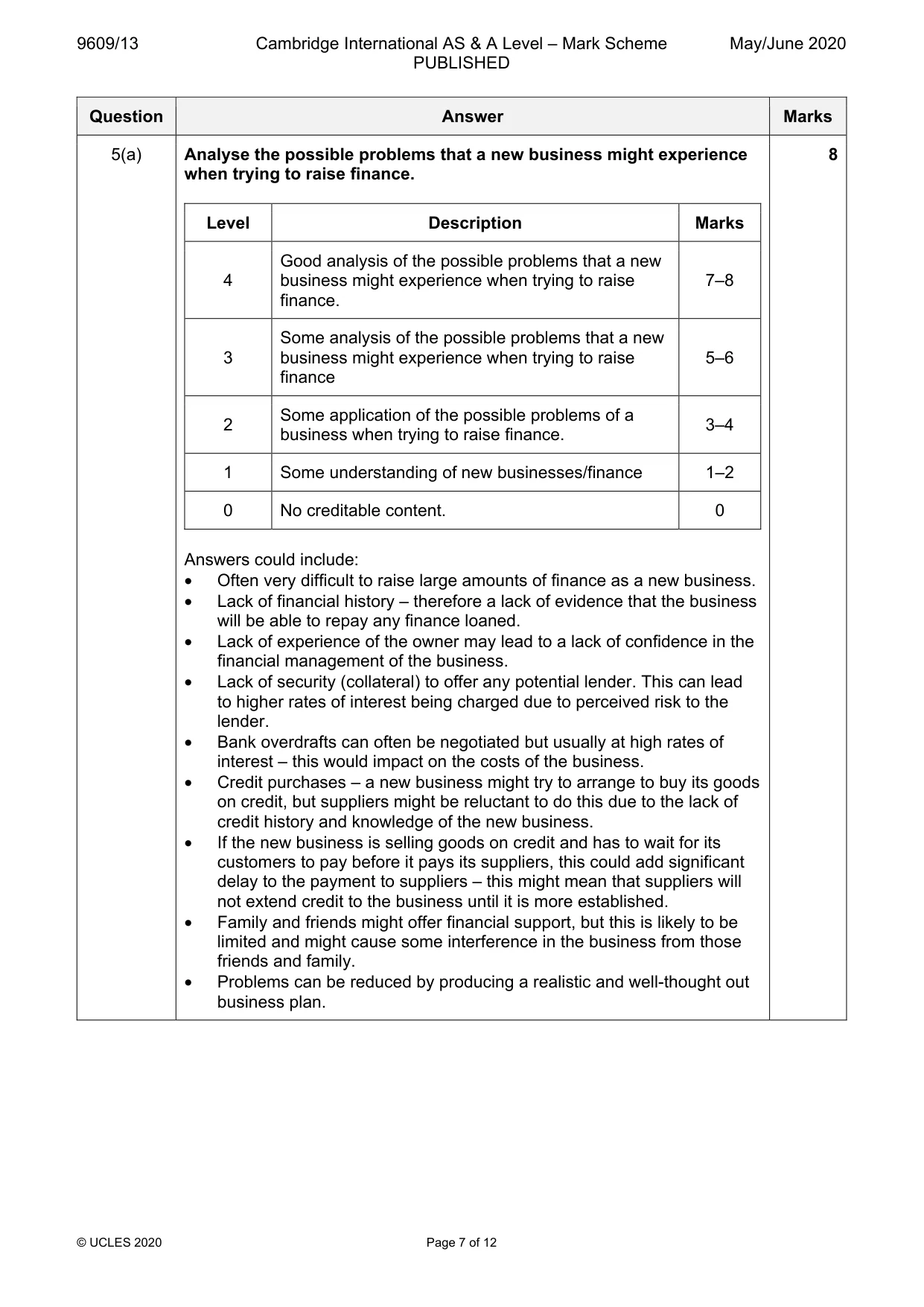
9609/13 Cambridge International AS & A Level – Mark Scheme PUBLISHED May/June 2020 © UCLES 2020 Page 7 of 12 Question Answer Marks 5(a) Analyse the possible problems that a new business might experience when trying to raise finance. Level Description Marks 4 Good analysis of the possible problems that a new business might experience when trying to raise finance. 7–8 3 Some analysis of the possible problems that a new business might experience when trying to raise finance 5–6 2 Some application of the possible problems of a business when trying to raise finance. 3–4 1 Some understanding of new businesses/finance 1–2 0 No creditable content. 0 Answers could include: • Often very difficult to raise large amounts of finance as a new business. • Lack of financial history – therefore a lack of evidence that the business will be able to repay any finance loaned. • Lack of experience of the owner may lead to a lack of confidence in the financial management of the business. • Lack of security (collateral) to offer any potential lender. This can lead to higher rates of interest being charged due to perceived risk to the lender. • Bank overdrafts can often be negotiated but usually at high rates of interest – this would impact on the costs of the business. • Credit purchases – a new business might try to arrange to buy its goods on credit, but suppliers might be reluctant to do this due to the lack of credit history and knowledge of the new business. • If the new business is selling goods on credit and has to wait for its customers to pay before it pays its suppliers, this could add significant delay to the payment to suppliers – this might mean that suppliers will not extend credit to the business until it is more established. • Family and friends might offer financial support, but this is likely to be limited and might cause some interference in the business from those friends and family. • Problems can be reduced by producing a realistic and well-thought out business plan. 8
Mark scheme, page 8
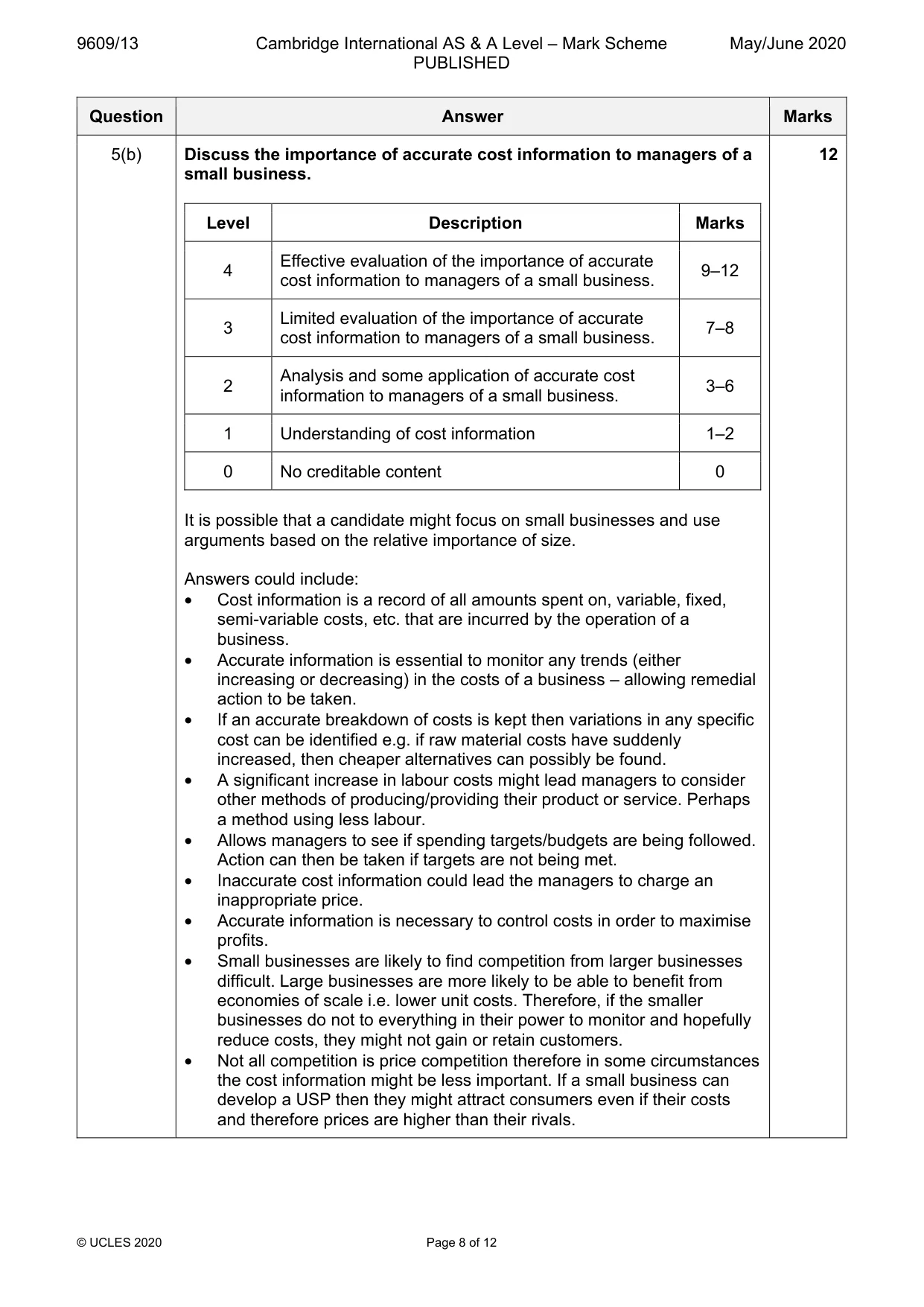
9609/13 Cambridge International AS & A Level – Mark Scheme PUBLISHED May/June 2020 © UCLES 2020 Page 8 of 12 Question Answer Marks 5(b) Discuss the importance of accurate cost information to managers of a small business. Level Description Marks 4 Effective evaluation of the importance of accurate cost information to managers of a small business. 9–12 3 Limited evaluation of the importance of accurate cost information to managers of a small business. 7–8 2 Analysis and some application of accurate cost information to managers of a small business. 3–6 1 Understanding of cost information 1–2 0 No creditable content 0 It is possible that a candidate might focus on small businesses and use arguments based on the relative importance of size. Answers could include: • Cost information is a record of all amounts spent on, variable, fixed, semi-variable costs, etc. that are incurred by the operation of a business. • Accurate information is essential to monitor any trends (either increasing or decreasing) in the costs of a business – allowing remedial action to be taken. • If an accurate breakdown of costs is kept then variations in any specific cost can be identified e.g. if raw material costs have suddenly increased, then cheaper alternatives can possibly be found. • A significant increase in labour costs might lead managers to consider other methods of producing/providing their product or service. Perhaps a method using less labour. • Allows managers to see if spending targets/budgets are being followed. Action can then be taken if targets are not being met. • Inaccurate cost information could lead the managers to charge an inappropriate price. • Accurate information is necessary to control costs in order to maximise profits. • Small businesses are likely to find competition from larger businesses difficult. Large businesses are more likely to be able to benefit from economies of scale i.e. lower unit costs. Therefore, if the smaller businesses do not to everything in their power to monitor and hopefully reduce costs, they might not gain or retain customers. • Not all competition is price competition therefore in some circumstances the cost information might be less important. If a small business can develop a USP then they might attract consumers even if their costs and therefore prices are higher than their rivals. 12
Mark scheme, page 9
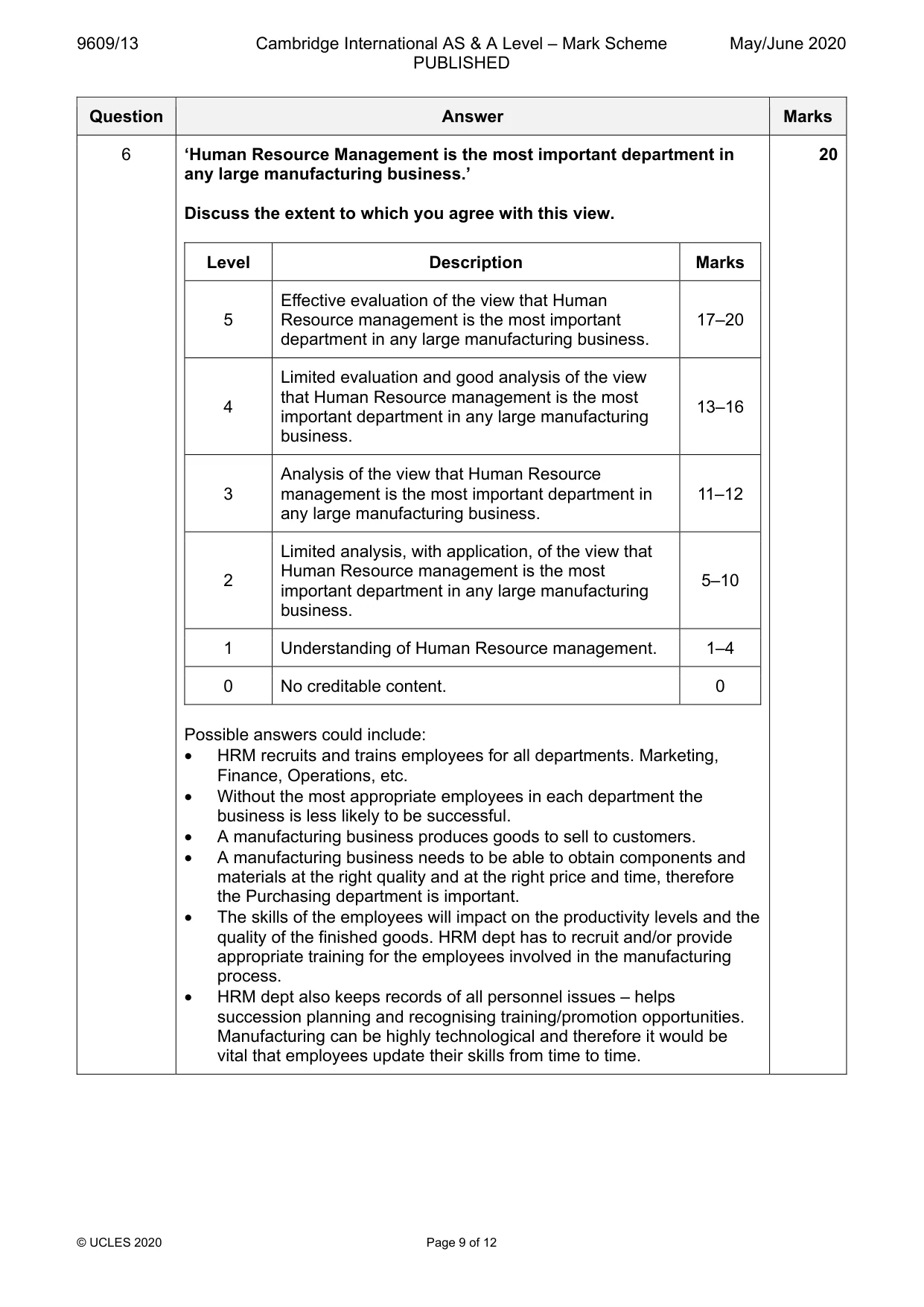
9609/13 Cambridge International AS & A Level – Mark Scheme PUBLISHED May/June 2020 © UCLES 2020 Page 9 of 12 Question Answer Marks 6 ‘Human Resource Management is the most important department in any large manufacturing business.’ Discuss the extent to which you agree with this view. Level Description Marks 5 Effective evaluation of the view that Human Resource management is the most important department in any large manufacturing business. 17–20 4 Limited evaluation and good analysis of the view that Human Resource management is the most important department in any large manufacturing business. 13–16 3 Analysis of the view that Human Resource management is the most important department in any large manufacturing business. 11–12 2 Limited analysis, with application, of the view that Human Resource management is the most important department in any large manufacturing business. 5–10 1 Understanding of Human Resource management. 1–4 0 No creditable content. 0 Possible answers could include: • HRM recruits and trains employees for all departments. Marketing, Finance, Operations, etc. • Without the most appropriate employees in each department the business is less likely to be successful. • A manufacturing business produces goods to sell to customers. • A manufacturing business needs to be able to obtain components and materials at the right quality and at the right price and time, therefore the Purchasing department is important. • The skills of the employees will impact on the productivity levels and the quality of the finished goods. HRM dept has to recruit and/or provide appropriate training for the employees involved in the manufacturing process. • HRM dept also keeps records of all personnel issues – helps succession planning and recognising training/promotion opportunities. Manufacturing can be highly technological and therefore it would be vital that employees update their skills from time to time. 20
Mark scheme, page 10
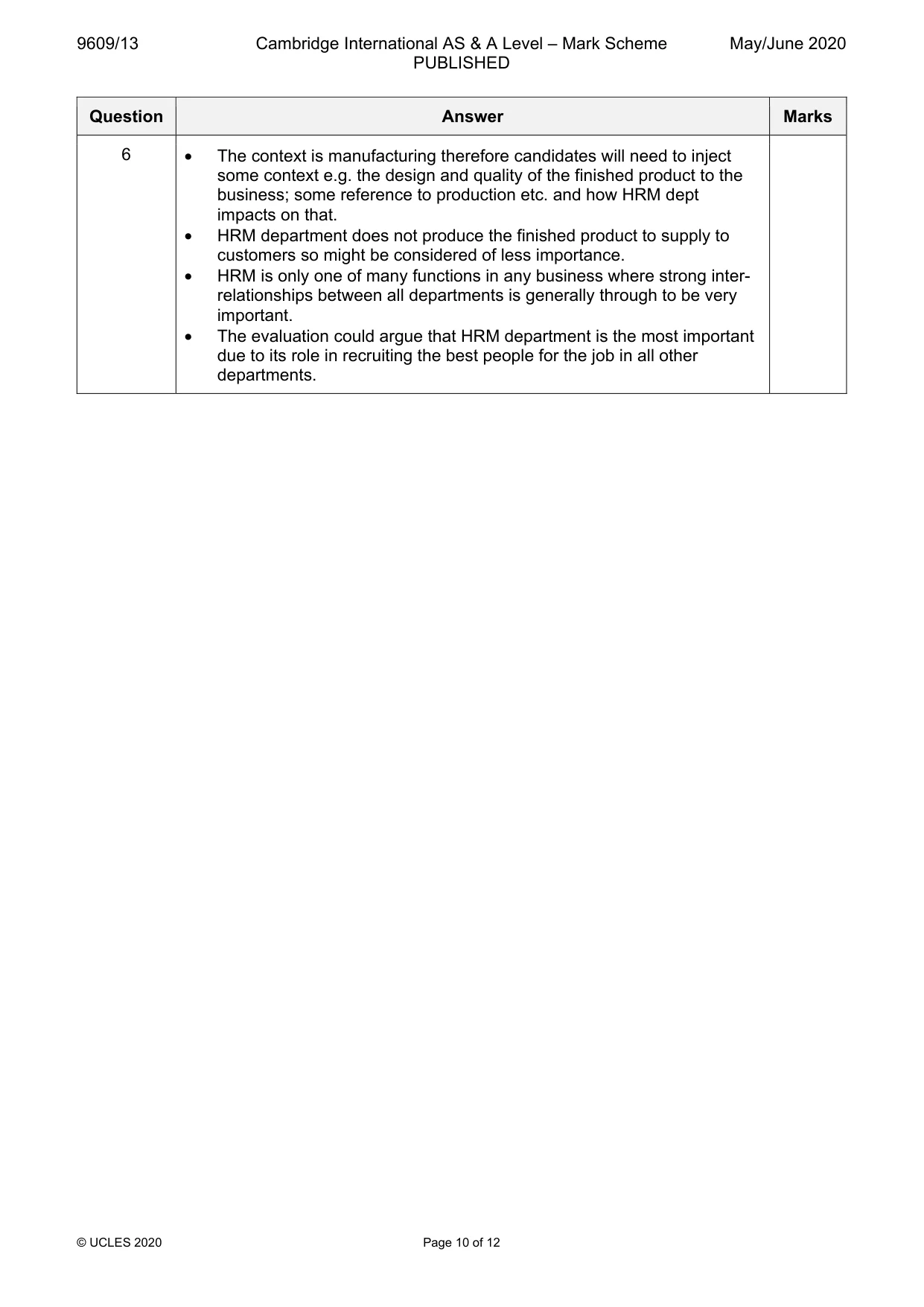
9609/13 Cambridge International AS & A Level – Mark Scheme PUBLISHED May/June 2020 © UCLES 2020 Page 10 of 12 Question Answer Marks 6 • The context is manufacturing therefore candidates will need to inject some context e.g. the design and quality of the finished product to the business; some reference to production etc. and how HRM dept impacts on that. • HRM department does not produce the finished product to supply to customers so might be considered of less importance. • HRM is only one of many functions in any business where strong inter- relationships between all departments is generally through to be very important. • The evaluation could argue that HRM department is the most important due to its role in recruiting the best people for the job in all other departments.
Mark scheme, page 11
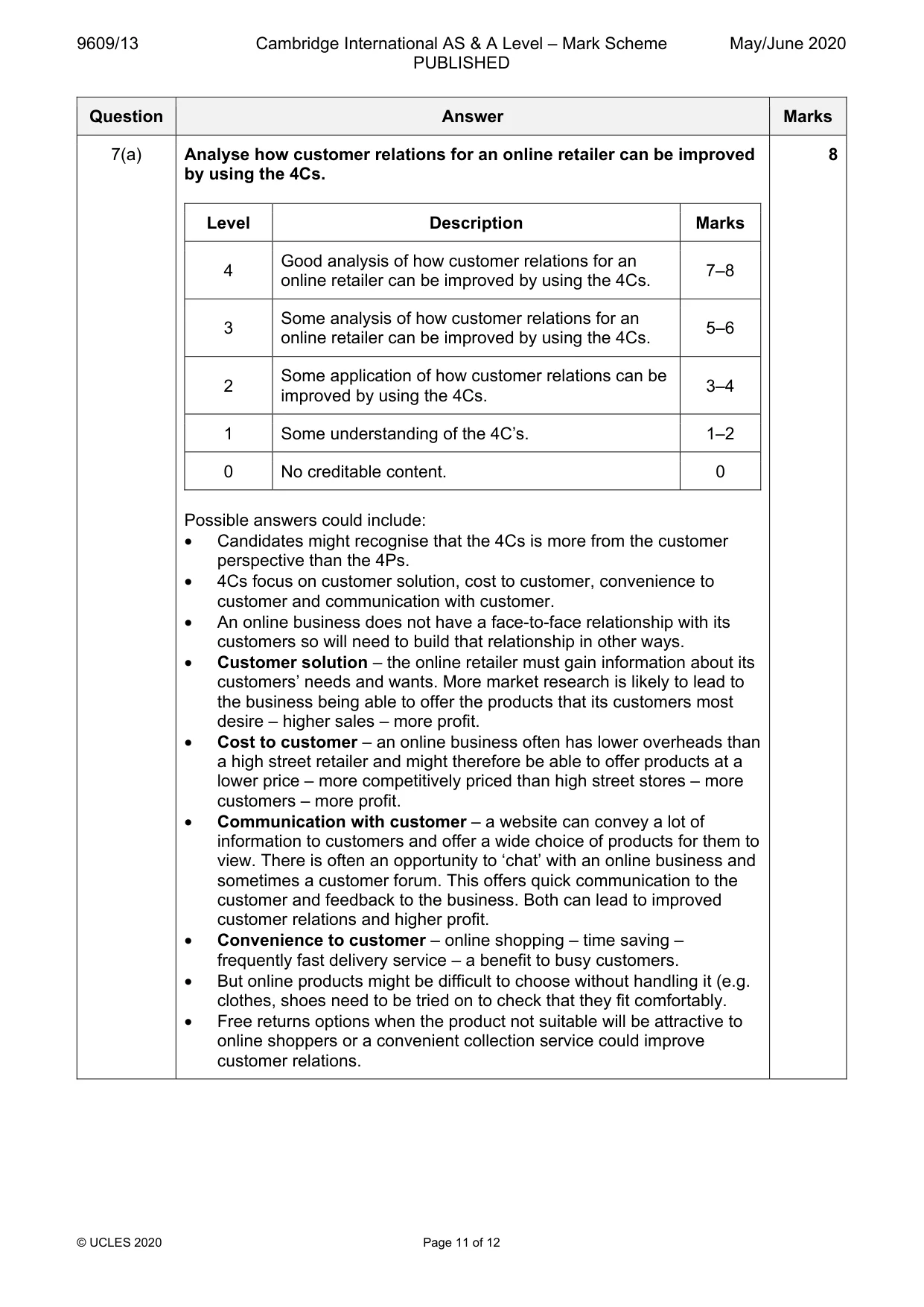
9609/13 Cambridge International AS & A Level – Mark Scheme PUBLISHED May/June 2020 © UCLES 2020 Page 11 of 12 Question Answer Marks 7(a) Analyse how customer relations for an online retailer can be improved by using the 4Cs. Level Description Marks 4 Good analysis of how customer relations for an online retailer can be improved by using the 4Cs. 7–8 3 Some analysis of how customer relations for an online retailer can be improved by using the 4Cs. 5–6 2 Some application of how customer relations can be improved by using the 4Cs. 3–4 1 Some understanding of the 4C’s. 1–2 0 No creditable content. 0 Possible answers could include: • Candidates might recognise that the 4Cs is more from the customer perspective than the 4Ps. • 4Cs focus on customer solution, cost to customer, convenience to customer and communication with customer. • An online business does not have a face-to-face relationship with its customers so will need to build that relationship in other ways. • Customer solution – the online retailer must gain information about its customers’ needs and wants. More market research is likely to lead to the business being able to offer the products that its customers most desire – higher sales – more profit. • Cost to customer – an online business often has lower overheads than a high street retailer and might therefore be able to offer products at a lower price – more competitively priced than high street stores – more customers – more profit. • Communication with customer – a website can convey a lot of information to customers and offer a wide choice of products for them to view. There is often an opportunity to ‘chat’ with an online business and sometimes a customer forum. This offers quick communication to the customer and feedback to the business. Both can lead to improved customer relations and higher profit. • Convenience to customer – online shopping – time saving – frequently fast delivery service – a benefit to busy customers. • But online products might be difficult to choose without handling it (e.g. clothes, shoes need to be tried on to check that they fit comfortably. • Free returns options when the product not suitable will be attractive to online shoppers or a convenient collection service could improve customer relations. 8
Mark scheme, page 12
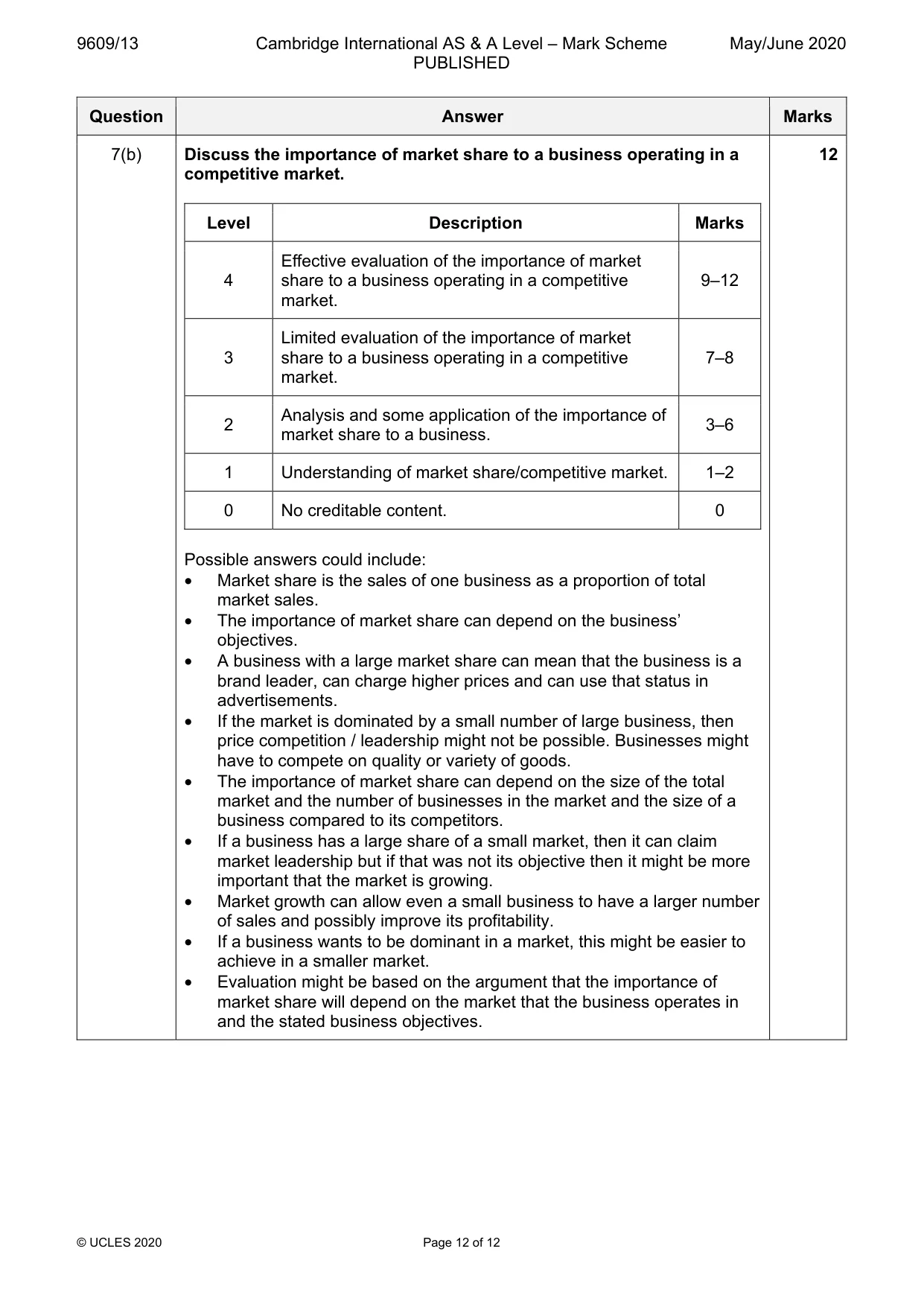
9609/13 Cambridge International AS & A Level – Mark Scheme PUBLISHED May/June 2020 © UCLES 2020 Page 12 of 12 Question Answer Marks 7(b) Discuss the importance of market share to a business operating in a competitive market. Level Description Marks 4 Effective evaluation of the importance of market share to a business operating in a competitive market. 9–12 3 Limited evaluation of the importance of market share to a business operating in a competitive market. 7–8 2 Analysis and some application of the importance of market share to a business. 3–6 1 Understanding of market share/competitive market. 1–2 0 No creditable content. 0 Possible answers could include: • Market share is the sales of one business as a proportion of total market sales. • The importance of market share can depend on the business’ objectives. • A business with a large market share can mean that the business is a brand leader, can charge higher prices and can use that status in advertisements. • If the market is dominated by a small number of large business, then price competition / leadership might not be possible. Businesses might have to compete on quality or variety of goods. • The importance of market share can depend on the size of the total market and the number of businesses in the market and the size of a business compared to its competitors. • If a business has a large share of a small market, then it can claim market leadership but if that was not its objective then it might be more important that the market is growing. • Market growth can allow even a small business to have a larger number of sales and possibly improve its profitability. • If a business wants to be dominant in a market, this might be easier to achieve in a smaller market. • Evaluation might be based on the argument that the importance of market share will depend on the market that the business operates in and the stated business objectives. 12