Cambridge A Level Business (for first examination in 2016) 9609 — 2020 Feb/March Paper 2 · Variant 2
9609/22/F/M/20 · 2 questions · 60 marks · ≈68 min
The question paper and its mark scheme, free to read here and free to download. This is Cambridge’s own paper, exactly as it was sat.
Question paper4 pages

Mark scheme15 pages
Answers below. Sit the paper first if you are practising.
Questions as text
Q1 · Bob’s Furniture (BF) Bob is a carpenter who uses job production to make furniture using…
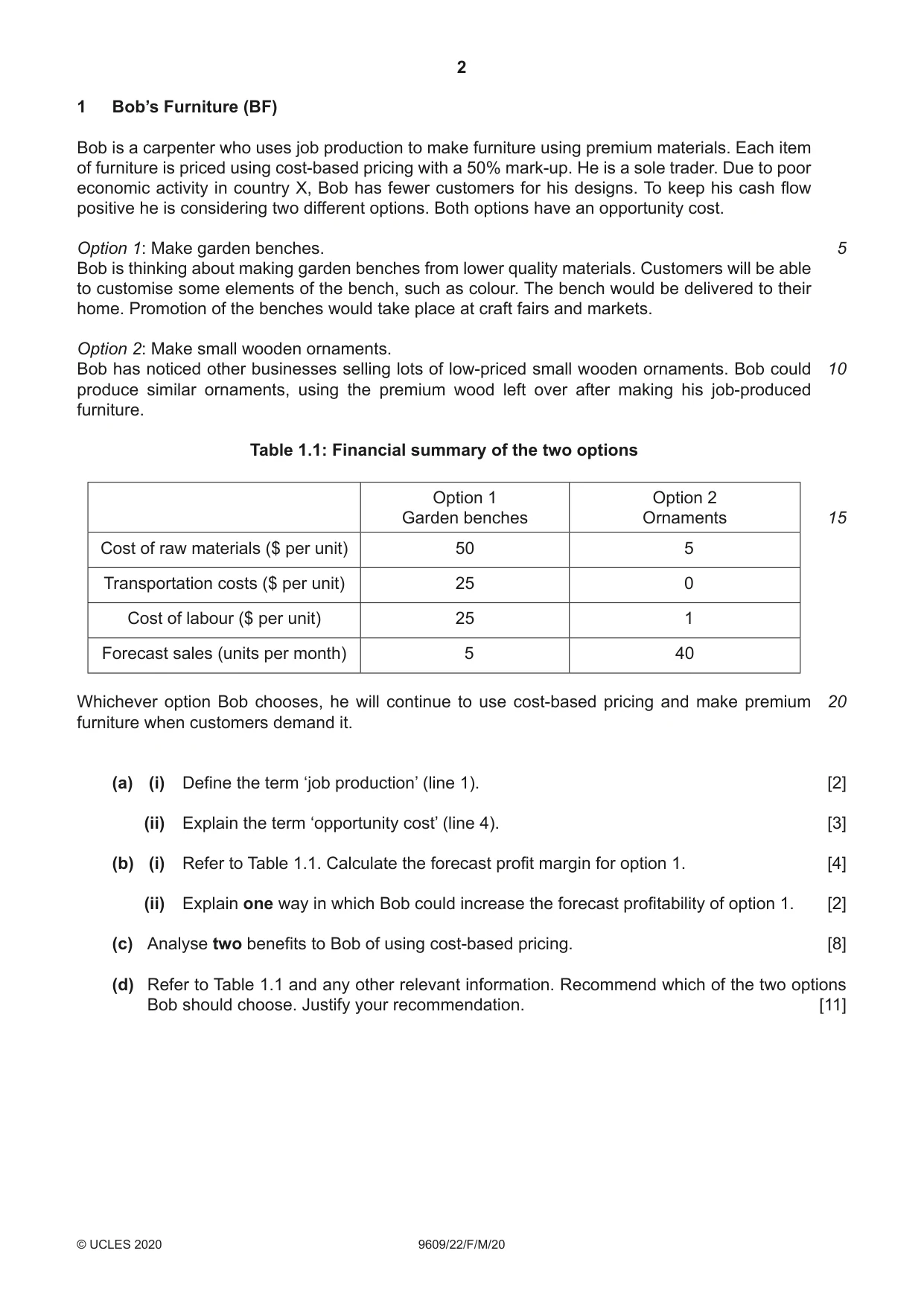
1 Bob’s Furniture (BF) Bob is a carpenter who uses job production to make furniture using premium materials. Each item of furniture is priced using cost-based pricing with a 50% mark-up. He is a sole trader. Due to poor economic activity in country X, Bob has fewer customers for his designs. To keep his cash flow positive he is considering two different options. Both options have an opportunity cost. Option 1: Make garden benches. 5 Bob is thinking about making garden benches from lower quality materials. Customers will be able to customise some elements of the bench, such as colour. The bench would be delivered to their home. Promotion of the benches would take place at craft fairs and markets. Option 2: Make small wooden ornaments. Bob has noticed other businesses selling lots of low-priced small wooden ornaments. Bob could 10 produce similar ornaments, using the premium wood left over after making his job-produced furniture. Table 1.1: Financial summary of the two options Option 1 Option 2 Garden benches Ornaments 15 Cost of raw materials ($ per unit) 50 5 Transportation costs ($ per unit) 25 0 Cost of labour ($ per unit) 25 1 Forecast sales (units per month) 5 40 Whichever option Bob chooses, he will continue to use cost-based pricing and make premium 20 furniture when customers demand it. (a) (i) Define the term ‘job production’ (line 1). [2] (ii) Explain the term ‘opportunity cost’ (line 4). [3] (b) (i) Refer to Table 1.1. Calculate the forecast profit margin for option 1. [4] (ii) Explain one way in which Bob could increase the forecast profitability of option 1. [2] (c) Analyse two benefits to Bob of using cost-based pricing. [8] (d) Refer to Table 1.1 and any other relevant information. Recommend which of the two options Bob should choose. Justify your recommendation. [11]
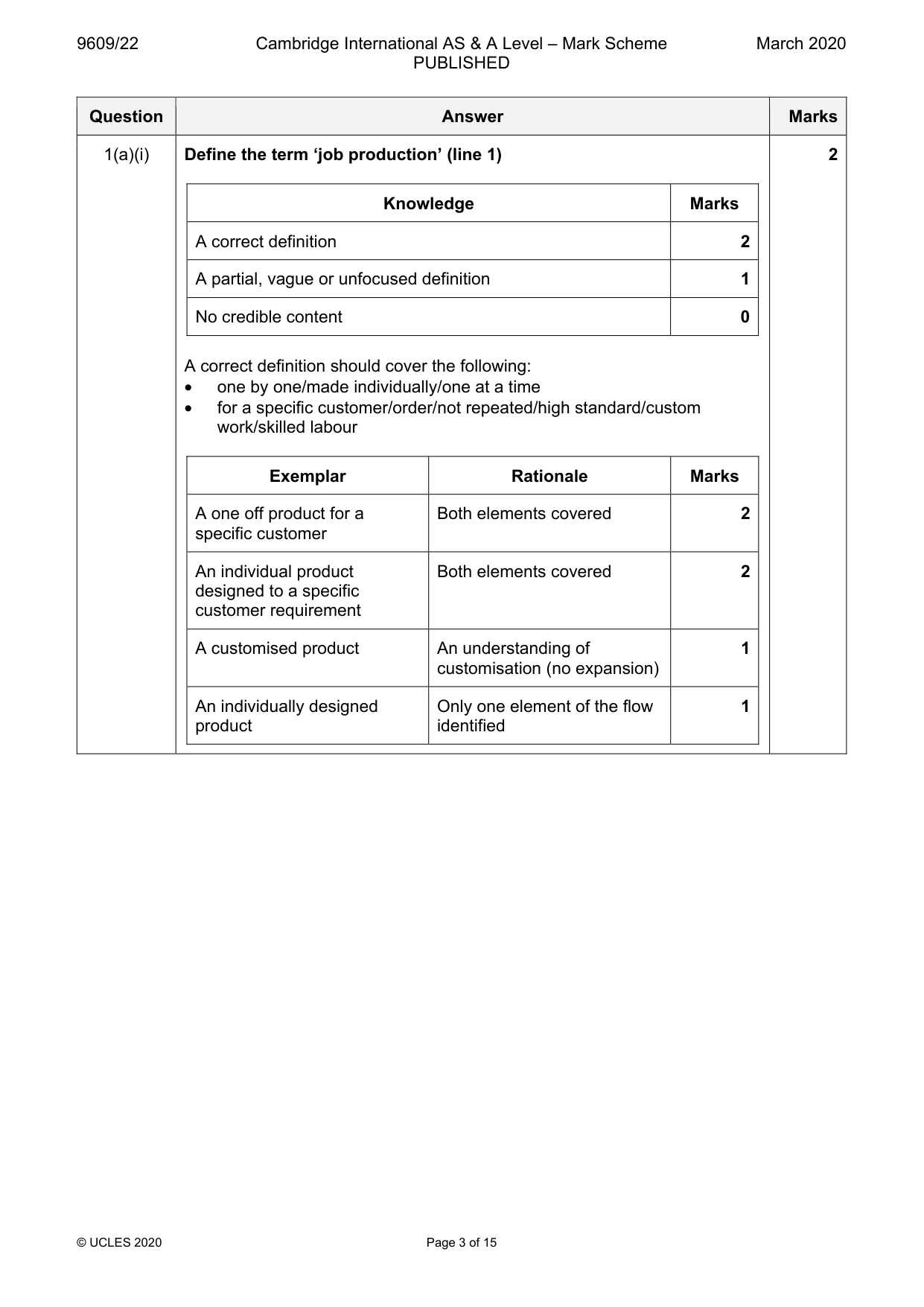
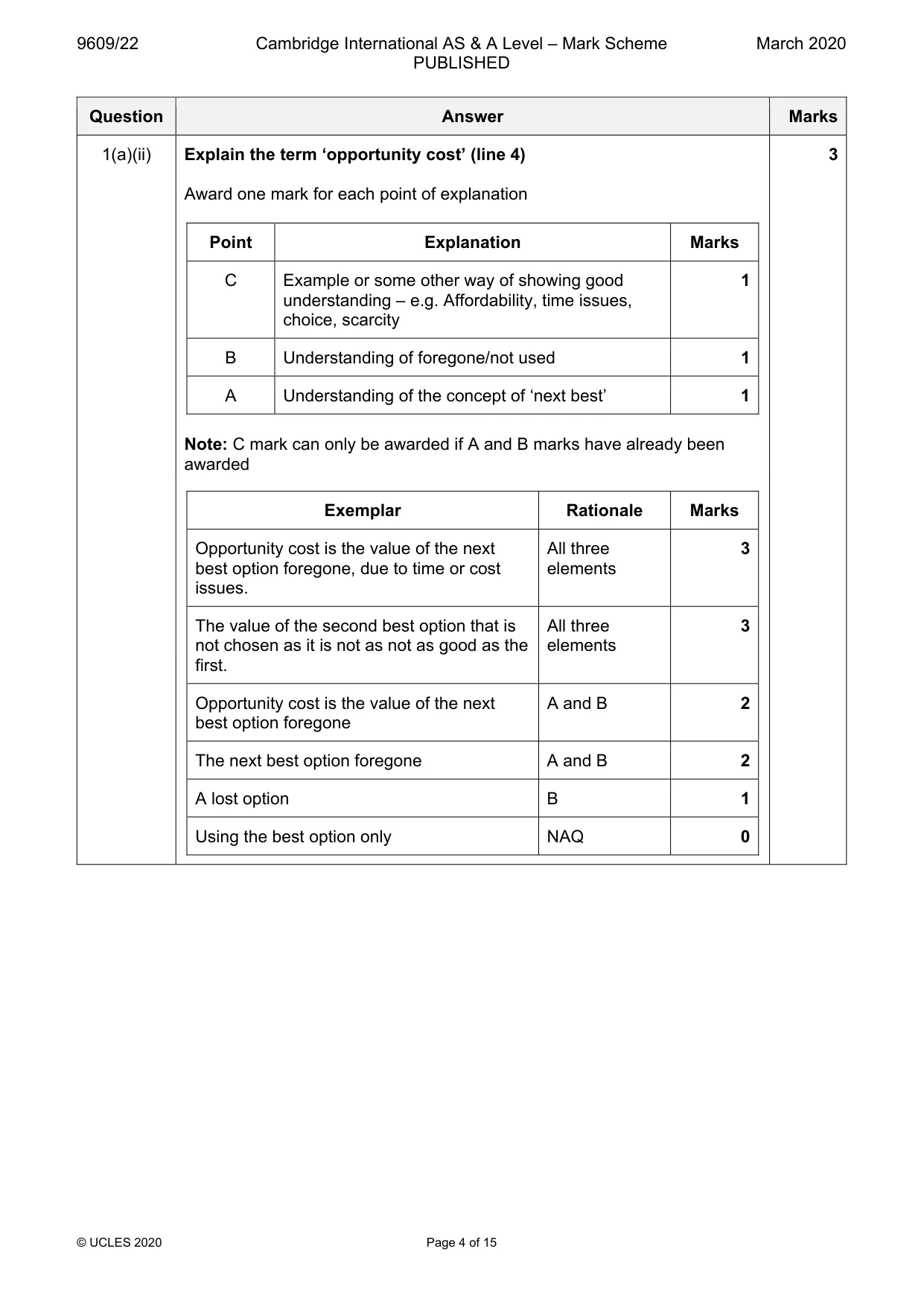
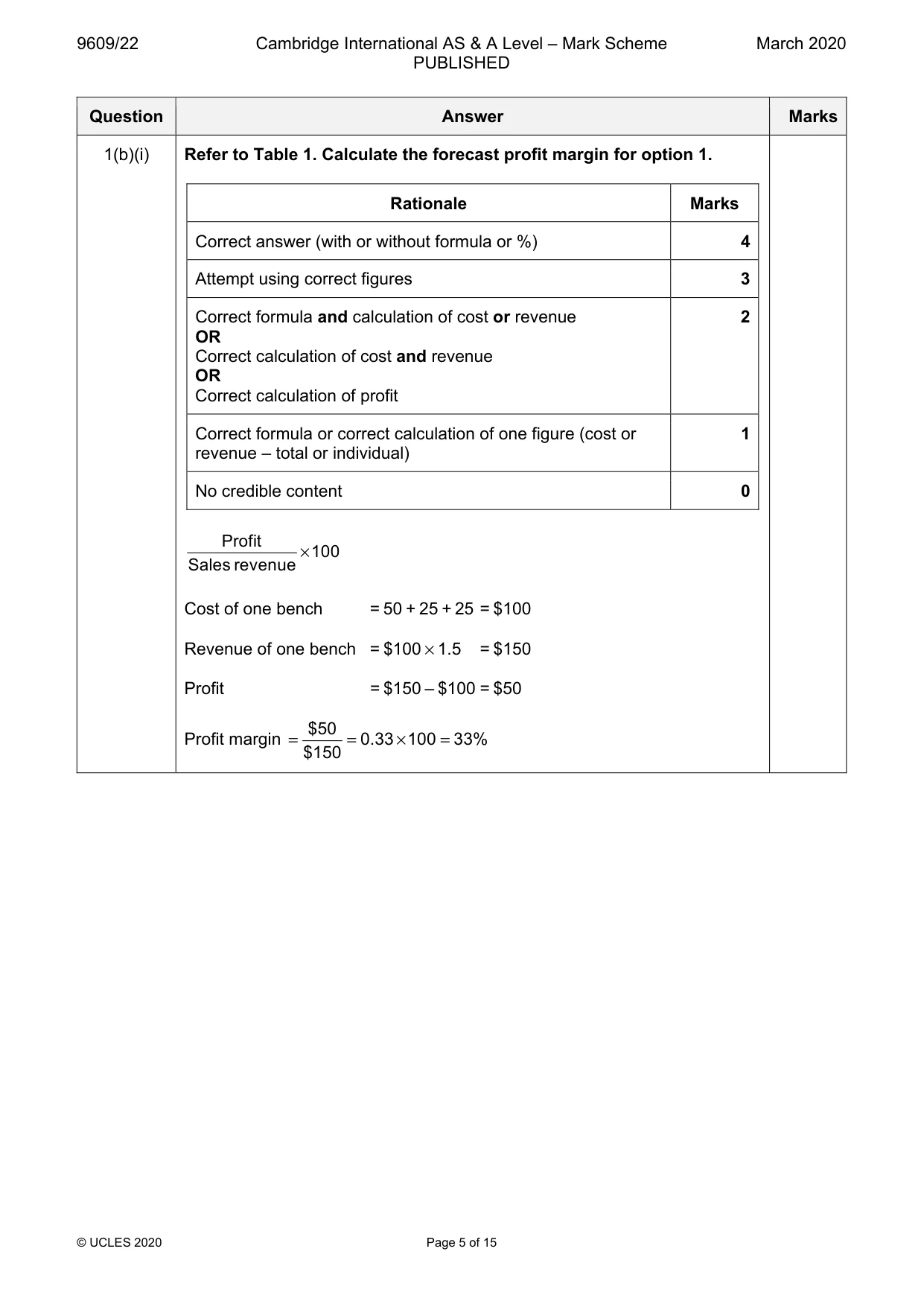
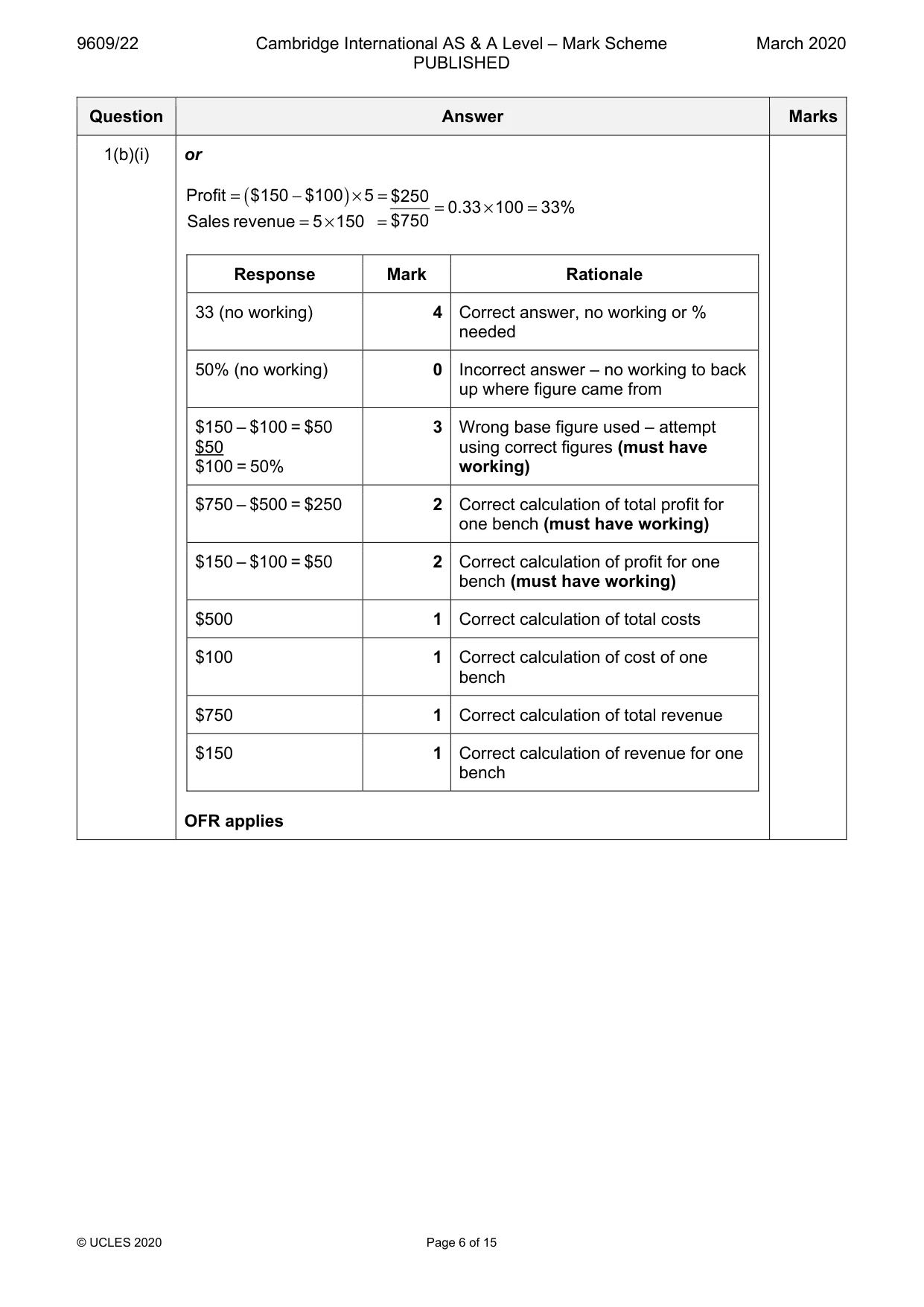
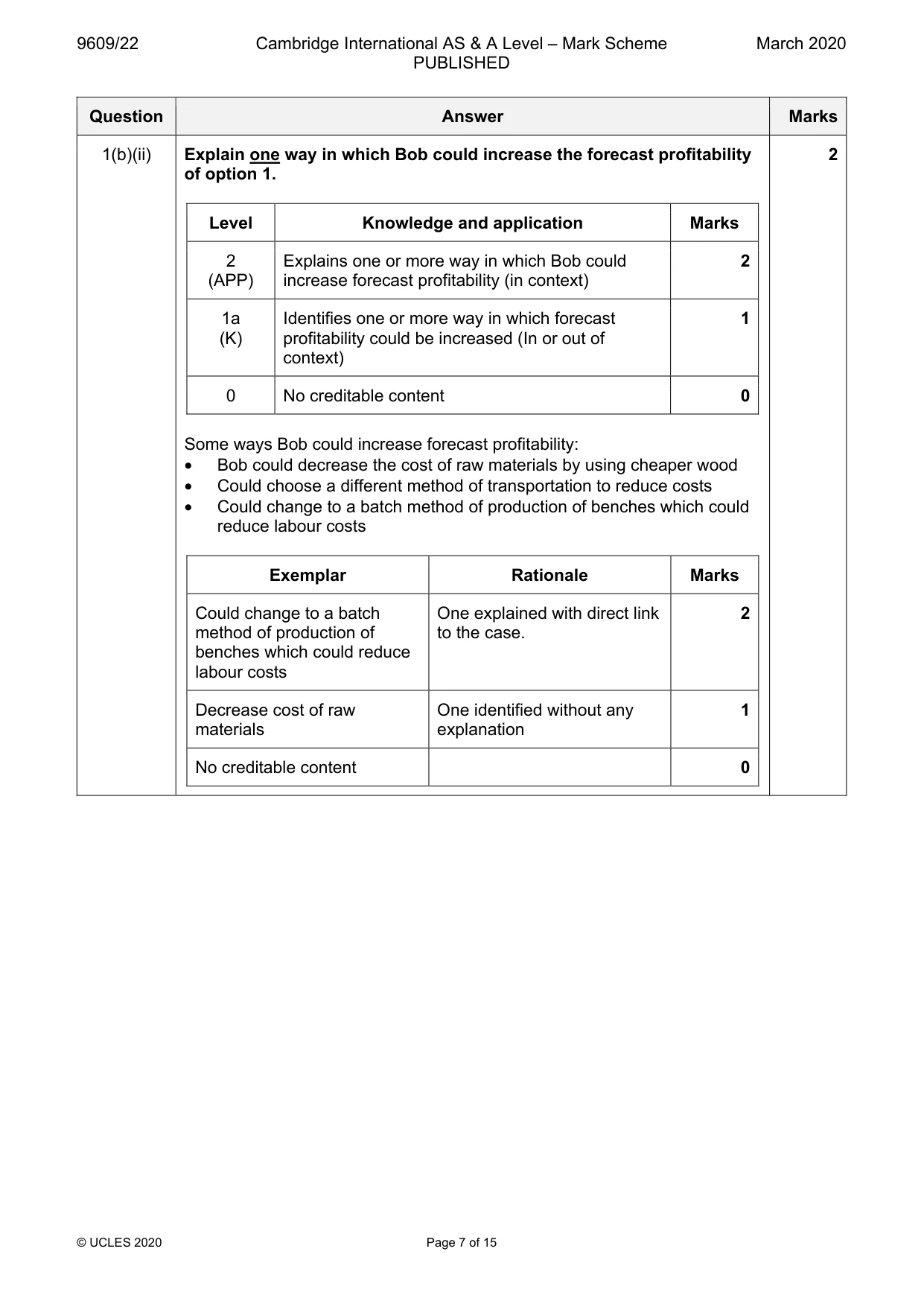
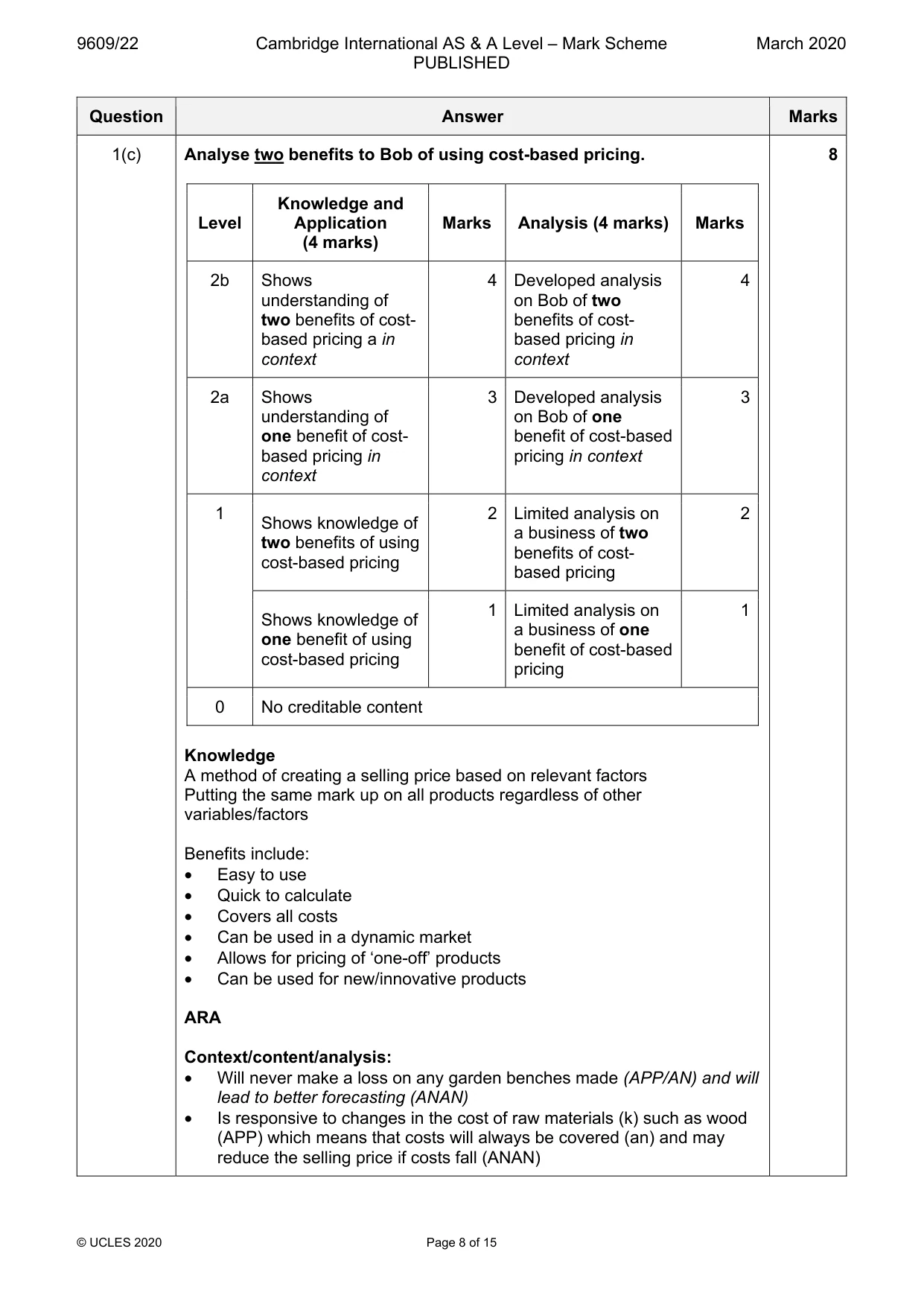
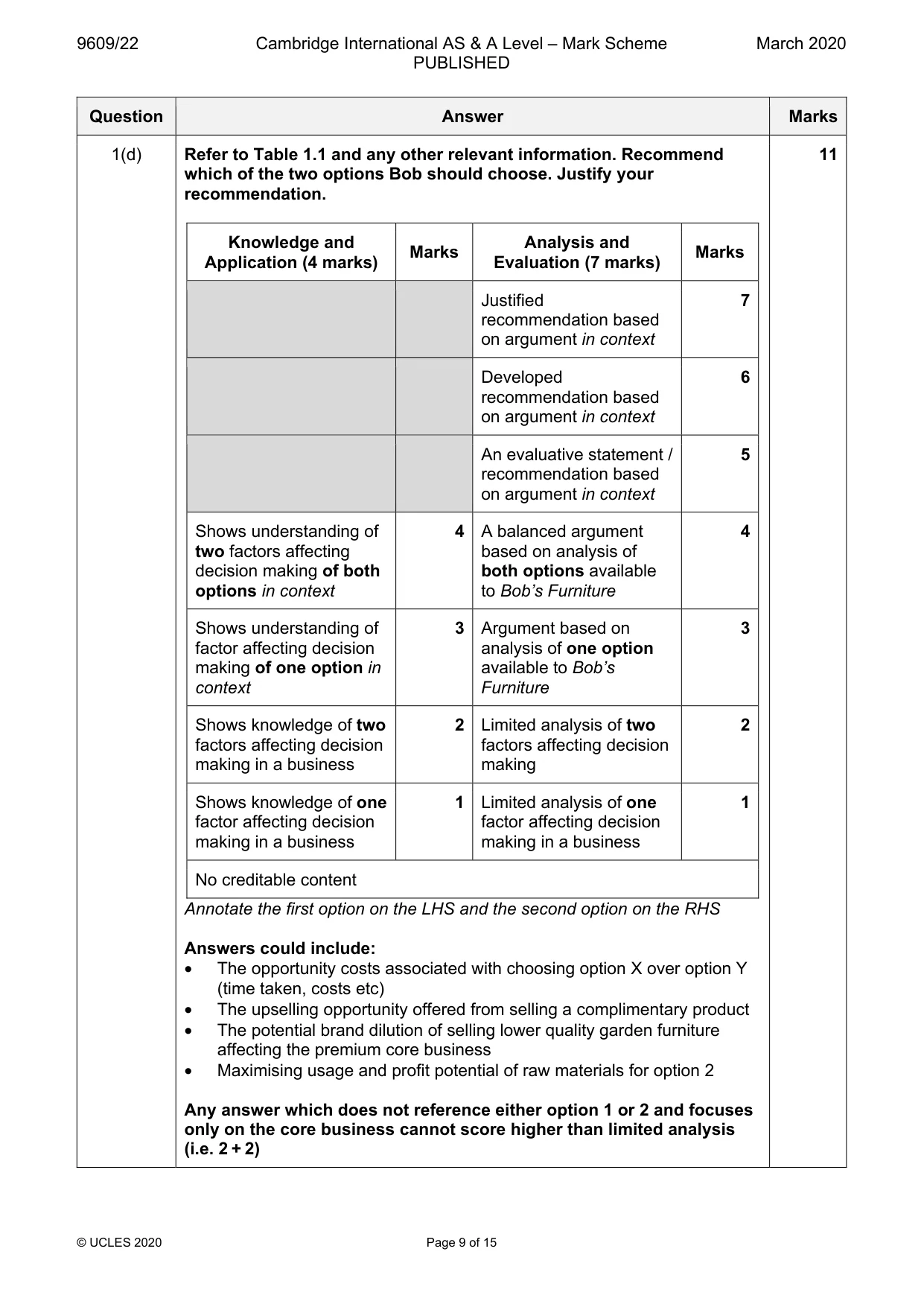
Mark scheme: Question Answer Marks 1(a)(i) Define the term ‘job production’ (line 1) 2 Knowledge Marks A correct definition 2 A partial, vague or unfocused definition 1 No credible content 0 A correct definition should cover the following: • one by one/made individually/one at a time • for a specific customer/order/not repeated/high standard/custom work/skilled labour Exemplar Rationale Marks A one off product for a Both elements covered 2 specific customer An individual product Both elements covered 2 designed to a specific customer requirement A customised product An understanding of 1 customisation (no expansion) An individually designed Only one element of the flow 1 product identified 1(a)(ii) Explain the term ‘opportunity cost’ (line 4) 3 Award one mark for each point of explanation Point Explanation Marks C Example or some other way of showing good 1 understanding – e.g. Affordability, time issues, choice, scarcity B Understanding of foregone/not used 1 A Understanding of the concept of ‘next best’ 1 Note: C mark can only be awarded if A and B marks have already been awarded Exemplar Rationale Marks Opportunity cost is the value of the next All three 3 best option foregone, due to time or cost elements issues. The value of the second best option that is All three 3 not chosen as it is not as not as good as the elements first. Opportunity cost is the value of the next A and B 2 best option foregone The next best option foregone A and B 2 A lost option B 1 Using the best option only NAQ 0 1(b)(i) Refer to Table 1. Calculate the forecast profit margin for option 1. Rationale Marks Correct answer (with or without formula or %) 4 Attempt using correct figures 3 Correct formula and calculation of cost or revenue 2 OR Correct calculation of cost and revenue OR Correct calculation of profit Correct formula or correct calculation of one figure (cost or 1 revenue – total or individual) No credible content 0 Profit × 100 Sales revenue Cost of one bench = 50 + 25 + 25 = $100 Revenue of one bench = $100 × 1.5 = $150 Profit = $150 – $100 = $50 $50 Profit margin = = 0.33 × 100 = 33% $150 1(b)(i) or Profit = ( $150 − $100 ) × 5 = $250 = 0.33 × 100 = 33% Sales revenue = 5 × 150 = $750 Response Mark Rationale 33 (no working) 4 Correct answer, no working or % needed 50% (no working) 0 Incorrect answer – no working to back up where figure came from $150 – $100 = $50 3 Wrong base figure used – attempt $50 using correct figures (must have $100 = 50% working) $750 – $500 = $250 2 Correct calculation of total profit for one bench (must have working) $150 – $100 = $50 2 Correct calculation of profit for one bench (must have working) $500 1 Correct calculation of total costs $100 1 Correct calculation of cost of one bench $750 1 Correct calculation of total revenue $150 1 Correct calculation of revenue for one bench OFR applies 1(b)(ii) Explain one way in which Bob could increase the forecast profitability 2 of option 1. Level Knowledge and application Marks 2 Explains one or more way in which Bob could 2 (APP) increase forecast profitability (in context) 1a Identifies one or more way in which forecast 1 (K) profitability could be increased (In or out of context) 0 No creditable content 0 Some ways Bob could increase forecast profitability: • Bob could decrease the cost of raw materials by using cheaper wood • Could choose a different method of transportation to reduce costs • Could change to a batch method of production of benches which could reduce labour costs Exemplar Rationale Marks Could change to a batch One explained with direct link 2 method of production of to the case. benches which could reduce labour costs Decrease cost of raw One identified without any 1 materials explanation No creditable content 0 1(c) Analyse two benefits to Bob of using cost-based pricing. 8 Knowledge and Level Application Marks Analysis (4 marks) Marks (4 marks) 2b Shows 4 Developed analysis 4 understanding of on Bob of two two benefits of cost- benefits of cost- based pricing a in based pricing in context context 2a Shows 3 Developed analysis 3 understanding of on Bob of one one benefit of cost- benefit of cost-based based pricing in pricing in context context 1 2 Limited analysis on 2 Shows knowledge of a business of two two benefits of using benefits of cost- cost-based pricing based pricing 1 Limited analysis on 1 Shows knowledge of a business of one one benefit of using benefit of cost-based cost-based pricing pricing 0 No creditable content Knowledge A method of creating a selling price based on relevant factors Putting the same mark up on all products regardless of other variables/factors Benefits include: • Easy to use • Quick to calculate • Covers all costs • Can be used in a dynamic market • Allows for pricing of ‘one-off’ products • Can be used for new/innovative products ARA Context/content/analysis: • Will never make a loss on any garden benches made (APP/AN) and will lead to better forecasting (ANAN) • Is responsive to changes in the cost of raw materials (k) such as wood (APP) which means that costs will always be covered (an) and may reduce the selling price if costs fall (ANAN) 1(d) Refer to Table 1.1 and any other relevant information. Recommend 11 which of the two options Bob should choose. Justify your recommendation. Knowledge and Analysis and Marks Marks Application (4 marks) Evaluation (7 marks) Justified 7 recommendation based on argument in context Developed 6 recommendation based on argument in context An evaluative statement / 5 recommendation based on argument in context Shows understanding of 4 A balanced argument 4 two factors affecting based on analysis of decision making of both both options available options in context to Bob’s Furniture Shows understanding of 3 Argument based on 3 factor affecting decision analysis of one option making of one option in available to Bob’s context Furniture Shows knowledge of two 2 Limited analysis of two 2 factors affecting decision factors affecting decision making in a business making Shows knowledge of one 1 Limited analysis of one 1 factor affecting decision factor affecting decision making in a business making in a business No creditable content Annotate the first option on the LHS and the second option on the RHS Answers could include: • The opportunity costs associated with choosing option X over option Y (time taken, costs etc) • The upselling opportunity offered from selling a complimentary product • The potential brand dilution of selling lower quality garden furniture affecting the premium core business • Maximising usage and profit potential of raw materials for option 2 Any answer which does not reference either option 1 or 2 and focuses only on the core business cannot score higher than limited analysis (i.e. 2 + 2)
Q2 · Joe’s Smoothies (JS) Joe graduated with a Business degree
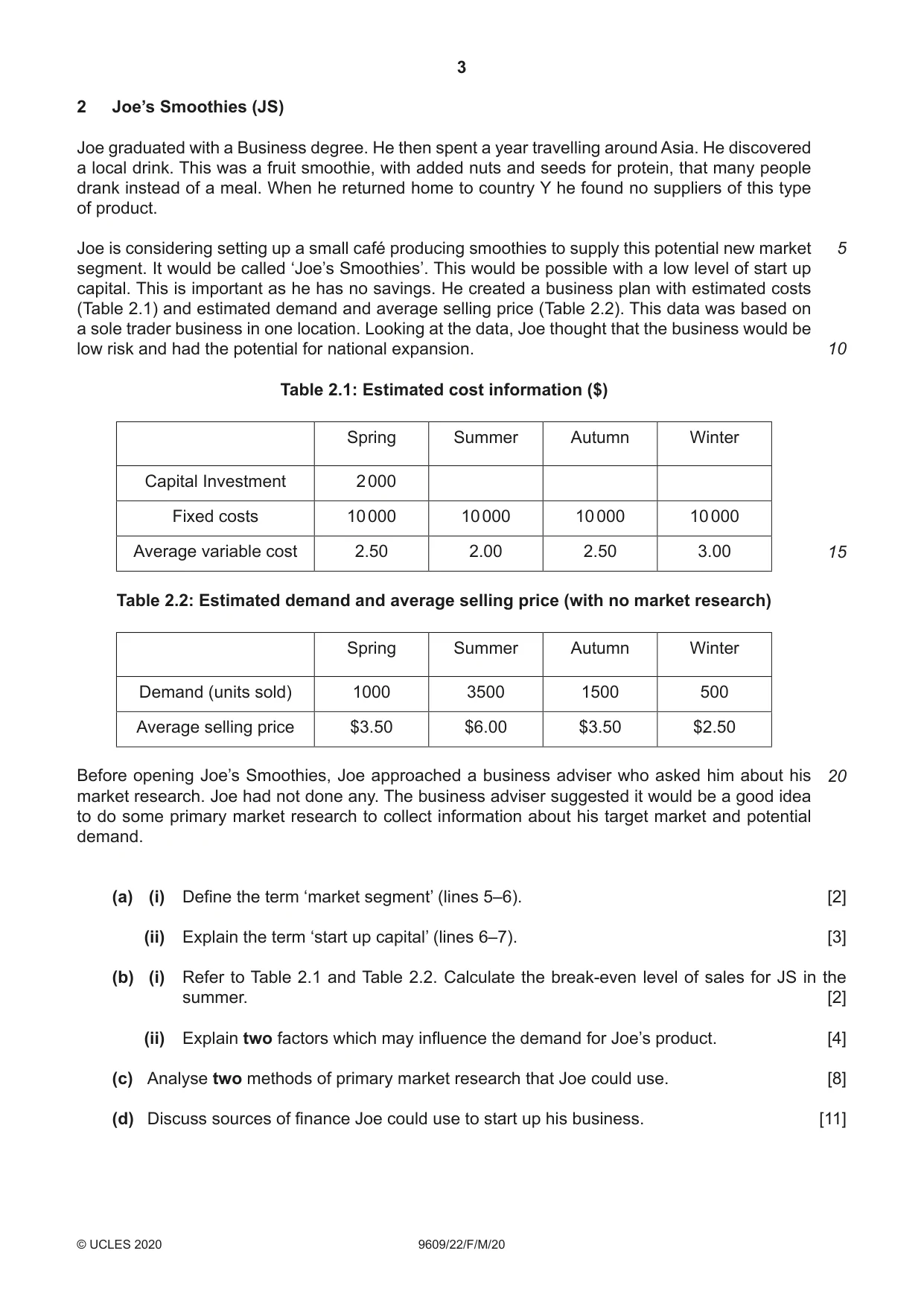
2 Joe’s Smoothies (JS) Joe graduated with a Business degree. He then spent a year travelling around Asia. He discovered a local drink. This was a fruit smoothie, with added nuts and seeds for protein, that many people drank instead of a meal. When he returned home to country Y he found no suppliers of this type of product. Joe is considering setting up a small café producing smoothies to supply this potential new market 5 segment. It would be called ‘Joe’s Smoothies’. This would be possible with a low level of start up capital. This is important as he has no savings. He created a business plan with estimated costs (Table 2.1) and estimated demand and average selling price (Table 2.2). This data was based on a sole trader business in one location. Looking at the data, Joe thought that the business would be low risk and had the potential for national expansion. 10 Table 2.1: Estimated cost information ($) Spring Summer Autumn Winter Capital Investment 2 000 Fixed costs 10 000 10 000 10 000 10 000 Average variable cost 2.50 2.00 2.50 3.00 15 Table 2.2: Estimated demand and average selling price (with no market research) Spring Summer Autumn Winter Demand (units sold) 1000 3500 1500 500 Average selling price $3.50 $6.00 $3.50 $2.50 Before opening Joe’s Smoothies, Joe approached a business adviser who asked him about his 20 market research. Joe had not done any. The business adviser suggested it would be a good idea to do some primary market research to collect information about his target market and potential demand. (a) (i) Define the term ‘market segment’ (lines 5–6). [2] (ii) Explain the term ‘start up capital’ (lines 6–7). [3] (b) (i) Refer to Table 2.1 and Table 2.2. Calculate the break-even level of sales for JS in the summer. [2] (ii) Explain two factors which may influence the demand for Joe’s product. [4] (c) Analyse two methods of primary market research that Joe could use. [8] (d) Discuss sources of finance Joe could use to start up his business. [11]
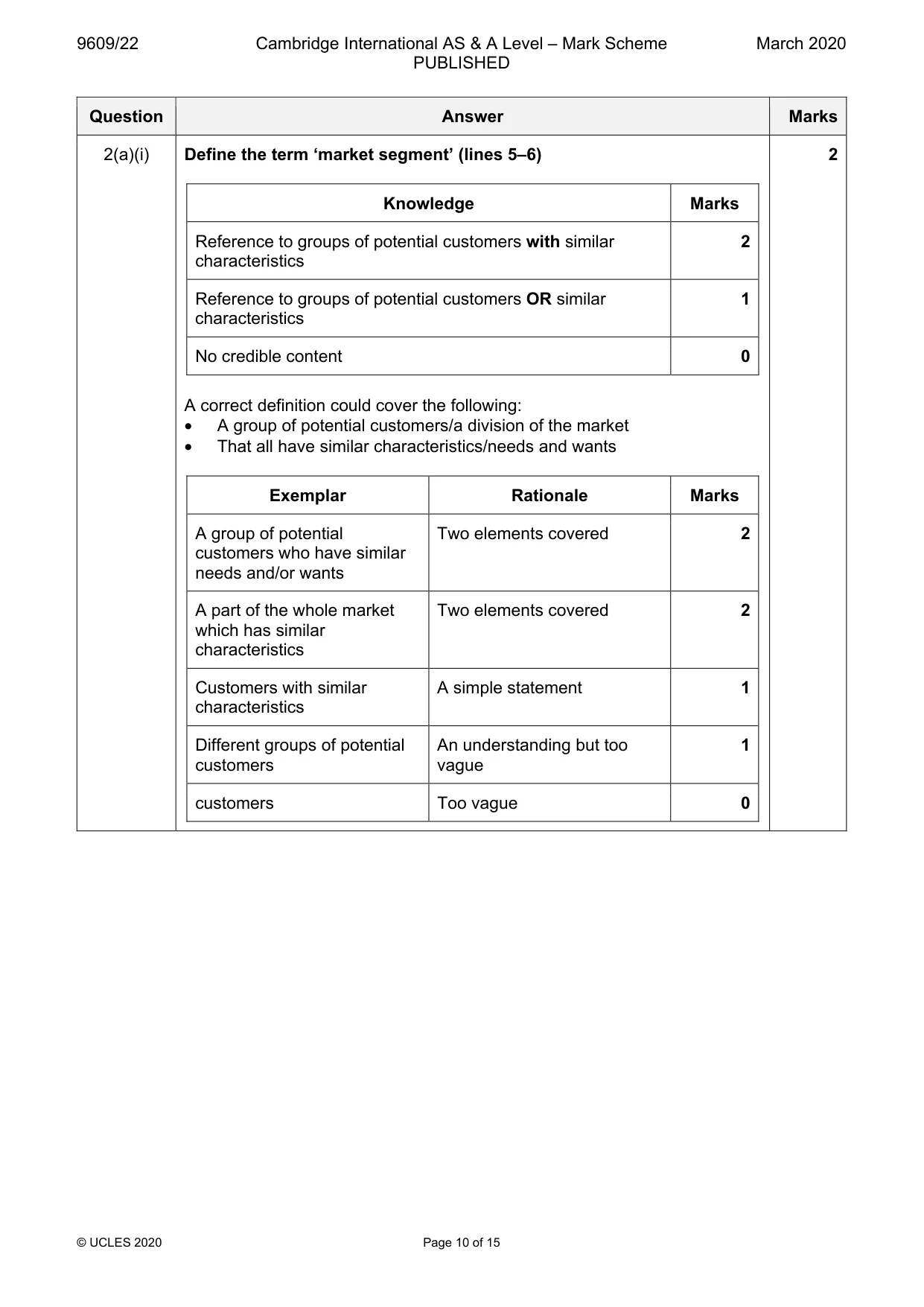
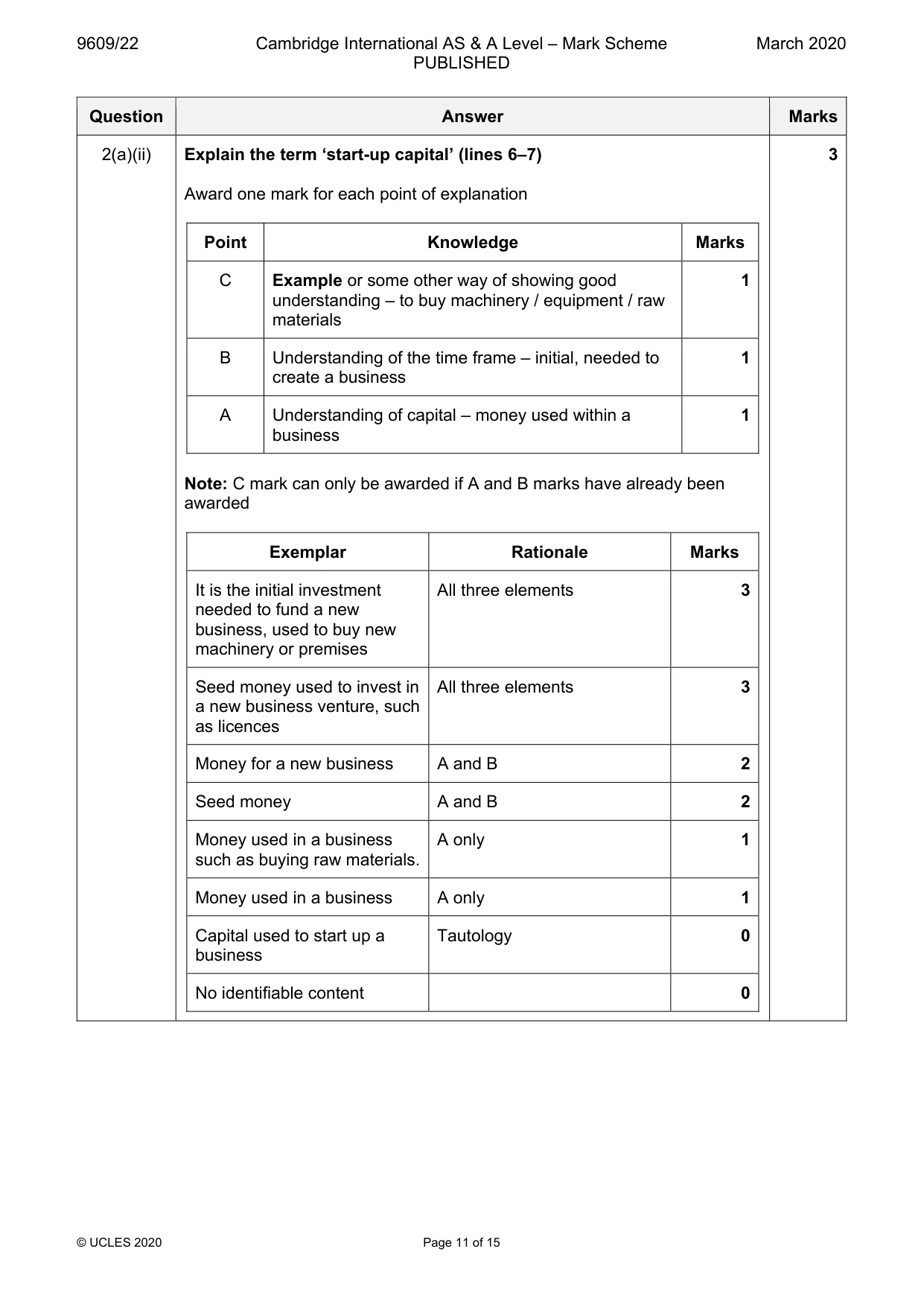
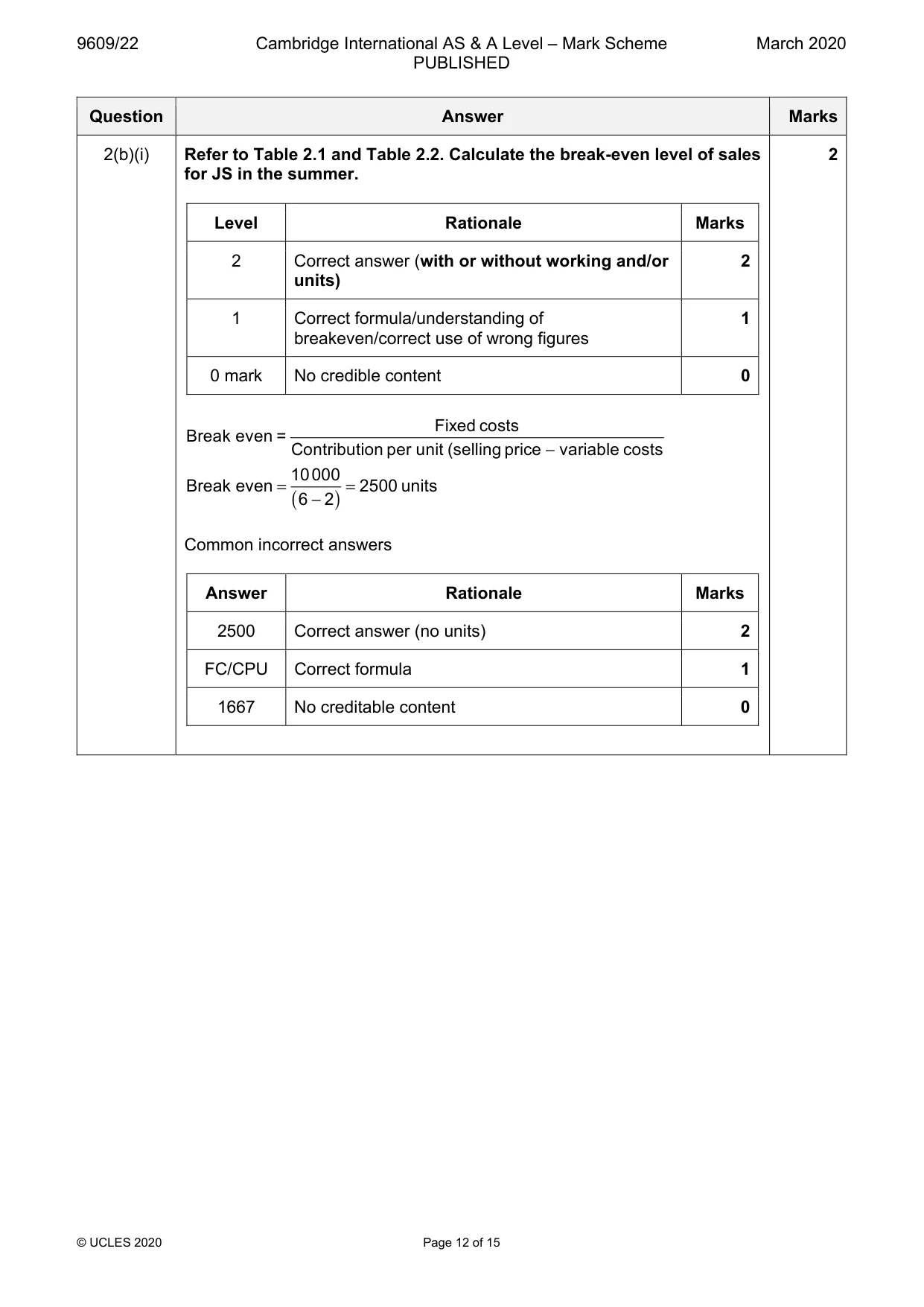
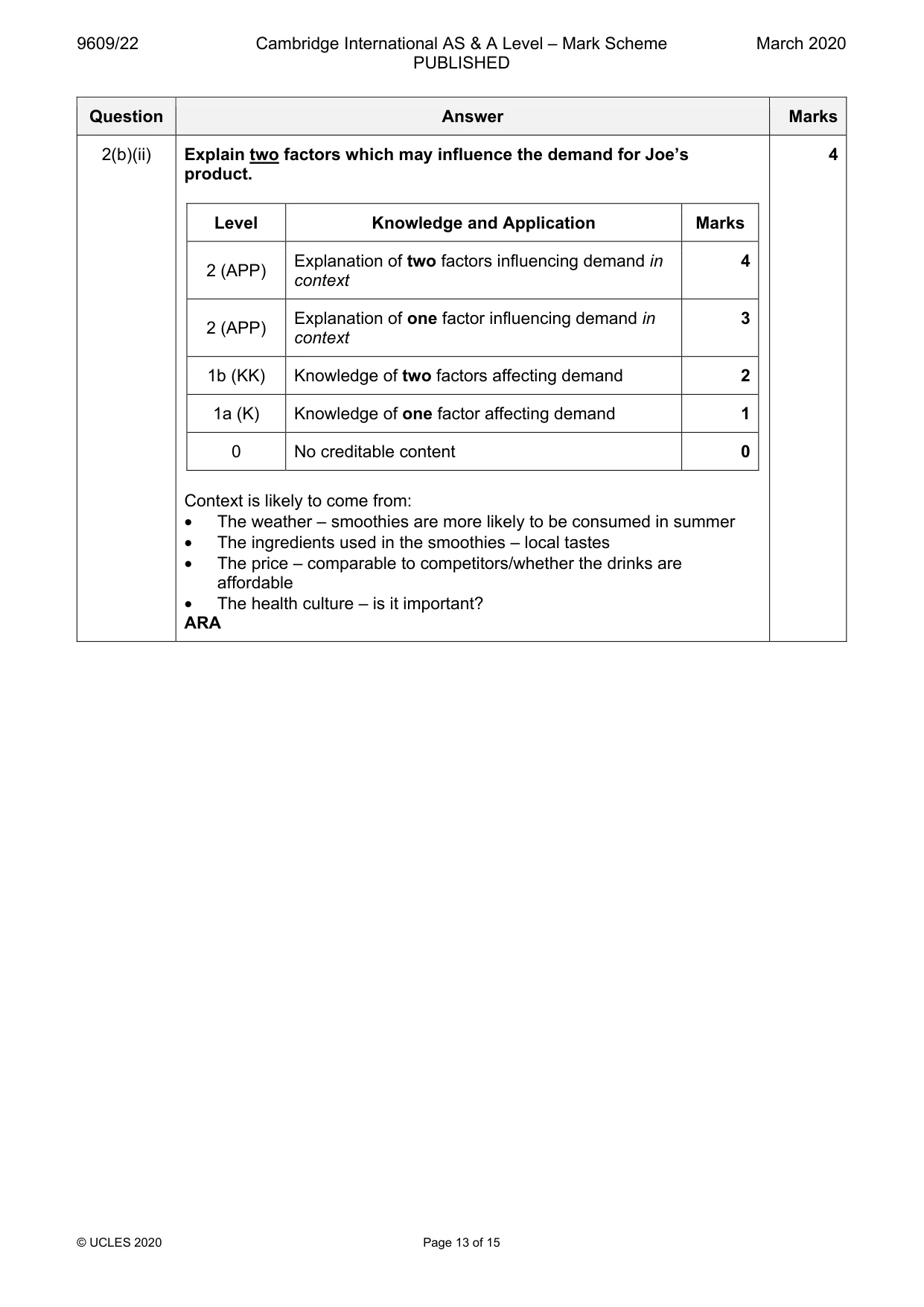
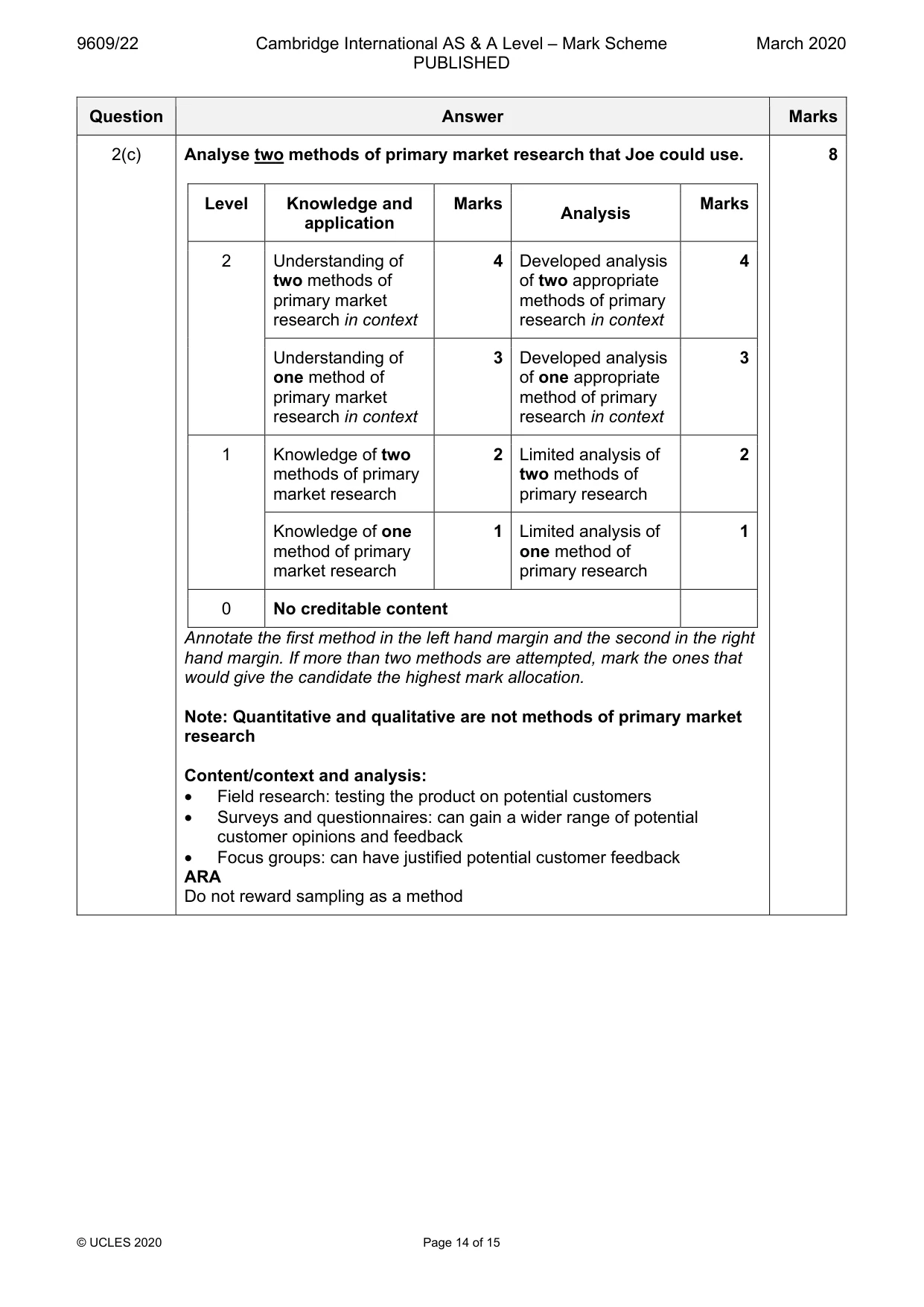
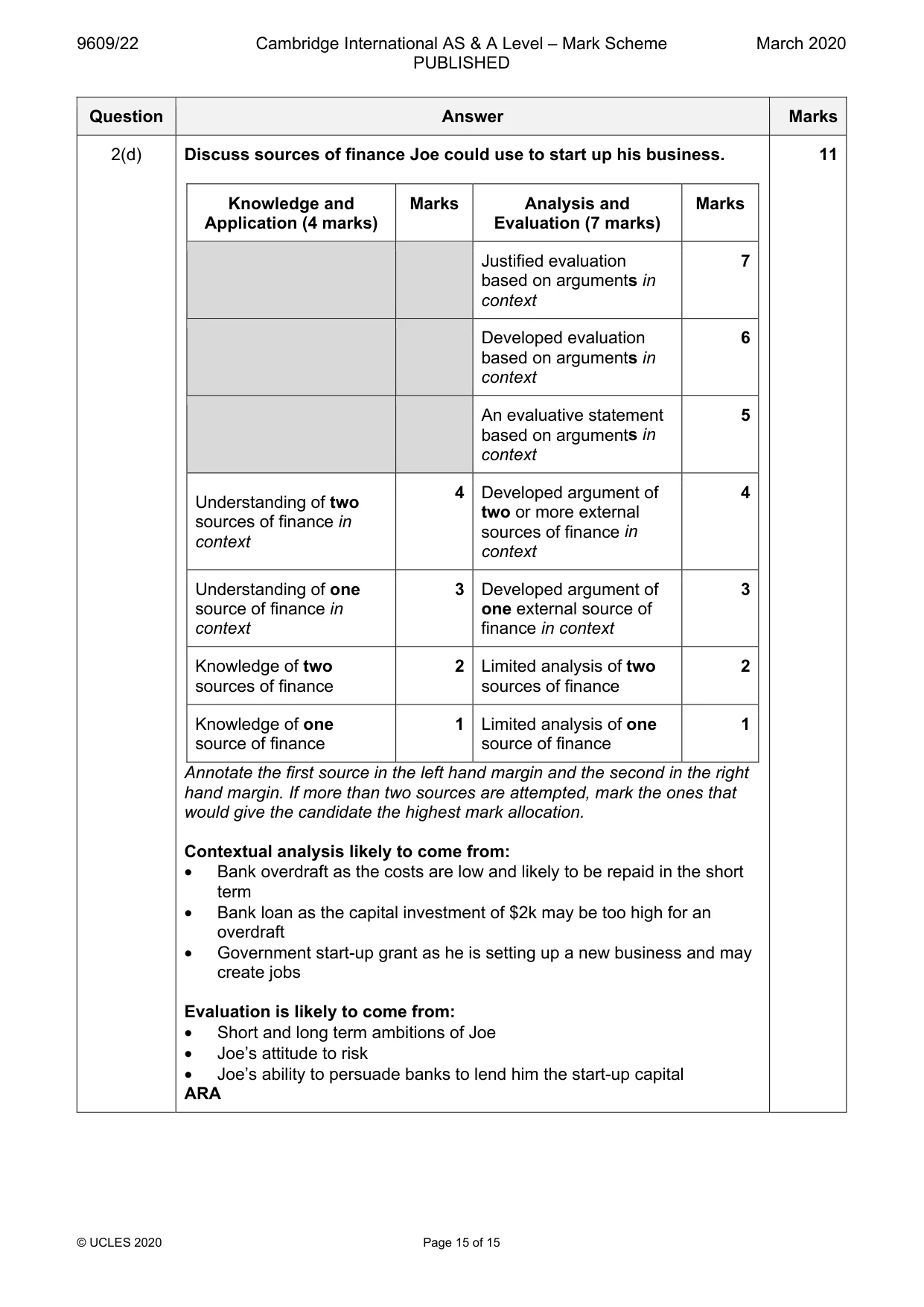
Mark scheme: 2(a)(i) Define the term ‘market segment’ (lines 5–6) 2 Knowledge Marks Reference to groups of potential customers with similar 2 characteristics Reference to groups of potential customers OR similar 1 characteristics No credible content 0 A correct definition could cover the following: • A group of potential customers/a division of the market • That all have similar characteristics/needs and wants Exemplar Rationale Marks A group of potential Two elements covered 2 customers who have similar needs and/or wants A part of the whole market Two elements covered 2 which has similar characteristics Customers with similar A simple statement 1 characteristics Different groups of potential An understanding but too 1 customers vague customers Too vague 0 2(a)(ii) Explain the term ‘start-up capital’ (lines 6–7) 3 Award one mark for each point of explanation Point Knowledge Marks C Example or some other way of showing good 1 understanding – to buy machinery / equipment / raw materials B Understanding of the time frame – initial, needed to 1 create a business A Understanding of capital – money used within a 1 business Note: C mark can only be awarded if A and B marks have already been awarded Exemplar Rationale Marks It is the initial investment All three elements 3 needed to fund a new business, used to buy new machinery or premises Seed money used to invest in All three elements 3 a new business venture, such as licences Money for a new business A and B 2 Seed money A and B 2 Money used in a business A only 1 such as buying raw materials. Money used in a business A only 1 Capital used to start up a Tautology 0 business No identifiable content 0 2(b)(i) Refer to Table 2.1 and Table 2.2. Calculate the break-even level of sales 2 for JS in the summer. Level Rationale Marks 2 Correct answer (with or without working and/or 2 units) 1 Correct formula/understanding of 1 breakeven/correct use of wrong figures 0 mark No credible content 0 Fixed costs Break even = Contribution per unit (selling price − variable costs 10000 Break even = = 2500 units ( 6 − 2 ) Common incorrect answers Answer Rationale Marks 2500 Correct answer (no units) 2 FC/CPU Correct formula 1 1667 No creditable content 0 2(b)(ii) Explain two factors which may influence the demand for Joe’s 4 product. Level Knowledge and Application Marks Explanation of two factors influencing demand in 4 2 (APP) context Explanation of one factor influencing demand in 3 2 (APP) context 1b (KK) Knowledge of two factors affecting demand 2 1a (K) Knowledge of one factor affecting demand 1 0 No creditable content 0 Context is likely to come from: • The weather – smoothies are more likely to be consumed in summer • The ingredients used in the smoothies – local tastes • The price – comparable to competitors/whether the drinks are affordable • The health culture – is it important? ARA 2(c) Analyse two methods of primary market research that Joe could use. 8 Level Knowledge and Marks Marks Analysis application 2 Understanding of 4 Developed analysis 4 two methods of of two appropriate primary market methods of primary research in context research in context Understanding of 3 Developed analysis 3 one method of of one appropriate primary market method of primary research in context research in context 1 Knowledge of two 2 Limited analysis of 2 methods of primary two methods of market research primary research Knowledge of one 1 Limited analysis of 1 method of primary one method of market research primary research 0 No creditable content Annotate the first method in the left hand margin and the second in the right hand margin. If more than two methods are attempted, mark the ones that would give the candidate the highest mark allocation. Note: Quantitative and qualitative are not methods of primary market research Content/context and analysis: • Field research: testing the product on potential customers • Surveys and questionnaires: can gain a wider range of potential customer opinions and feedback • Focus groups: can have justified potential customer feedback ARA Do not reward sampling as a method 2(d) Discuss sources of finance Joe could use to start up his business. 11 Knowledge and Marks Analysis and Marks Application (4 marks) Evaluation (7 marks) Justified evaluation 7 based on arguments in context Developed evaluation 6 based on arguments in context An evaluative statement 5 based on arguments in context 4 Developed argument of 4 Understanding of two two or more external sources of finance in sources of finance in context context Understanding of one 3 Developed argument of 3 source of finance in one external source of context finance in context Knowledge of two 2 Limited analysis of two 2 sources of finance sources of finance Knowledge of one 1 Limited analysis of one 1 source of finance source of finance Annotate the first source in the left hand margin and the second in the right hand margin. If more than two sources are attempted, mark the ones that would give the candidate the highest mark allocation. Contextual analysis likely to come from: • Bank overdraft as the costs are low and likely to be repaid in the short term • Bank loan as the capital investment of $2k may be too high for an overdraft • Government start-up grant as he is setting up a new business and may create jobs Evaluation is likely to come from: • Short and long term ambitions of Joe • Joe’s attitude to risk • Joe’s ability to persuade banks to lend him the start-up capital ARA
What was in this paper
The subtopics covered by these 2 questions, and how many questions each got. Open one in a new tab to see every Cambridge question on it.
What you needed in this session
Cambridge’s own grade thresholds for 2020 Feb/March, Paper 2 · Variant 2. A higher threshold means an easier paper — the bar moves with how the cohort did.