Cambridge A Level Business (for first examination in 2016) 9609 — 2019 Oct/Nov Paper 1 · Variant 2
9609/12/O/N/19 · 40 marks · ≈45 min
The question paper and its mark scheme, free to read here and free to download. This is Cambridge’s own paper, exactly as it was sat.
Question paper4 pages


Mark scheme15 pages
Answers below. Sit the paper first if you are practising.

Paper as text
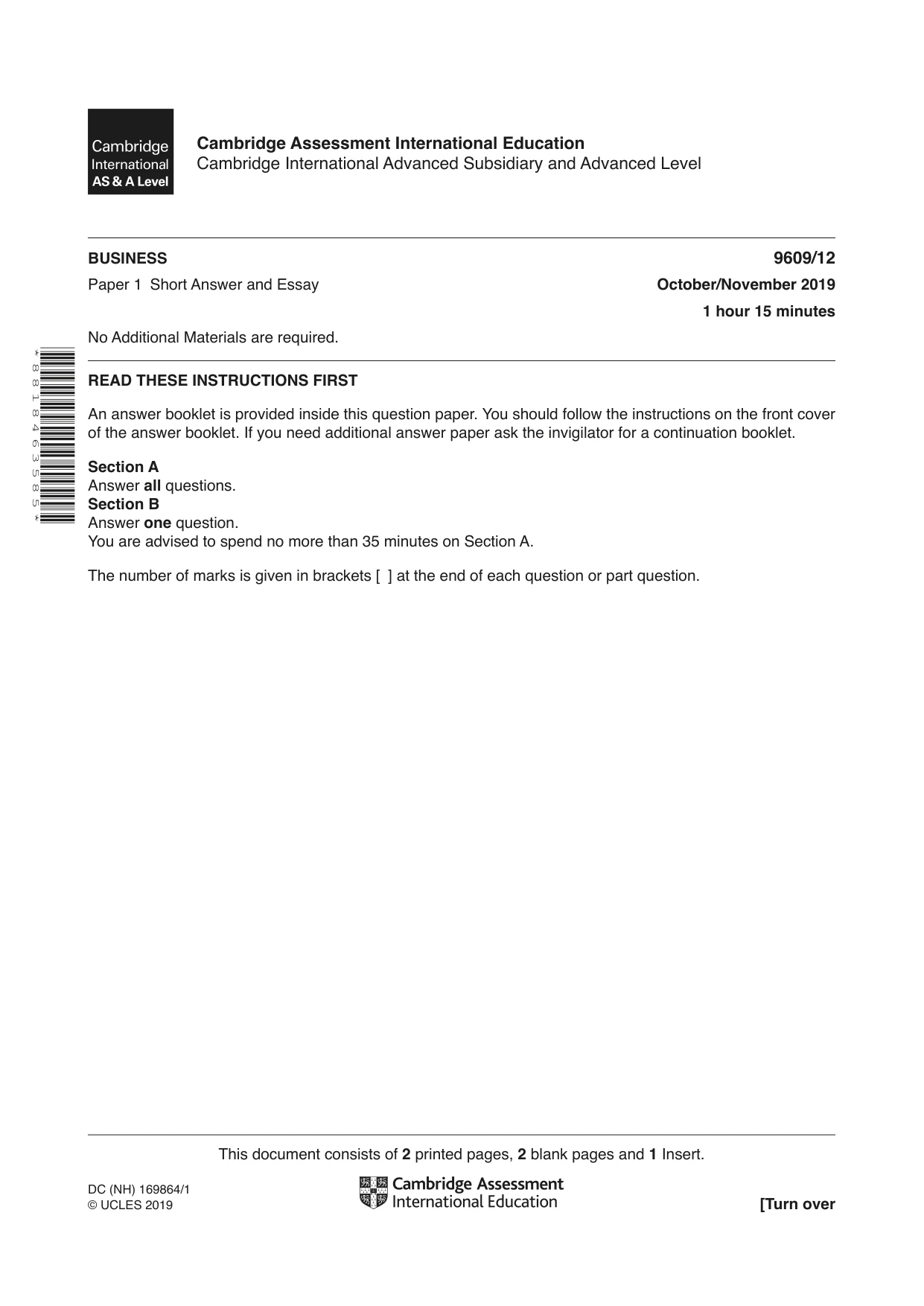
Question paper, page 1
This document consists of 2 printed pages, 2 blank pages and 1 Insert. DC (NH) 169864/1 © UCLES 2019 [Turn over Cambridge Assessment International Education Cambridge International Advanced Subsidiary and Advanced Level * 8 8 1 8 4 6 3 5 8 5 * BUSINESS 9609/12 Paper 1 Short Answer and Essay October/November 2019 1 hour 15 minutes No Additional Materials are required. READ THESE INSTRUCTIONS FIRST An answer booklet is provided inside this question paper. You should follow the instructions on the front cover of the answer booklet. If you need additional answer paper ask the invigilator for a continuation booklet. Section A Answer all questions. Section B Answer one question. You are advised to spend no more than 35 minutes on Section A. The number of marks is given in brackets [ ] at the end of each question or part question.
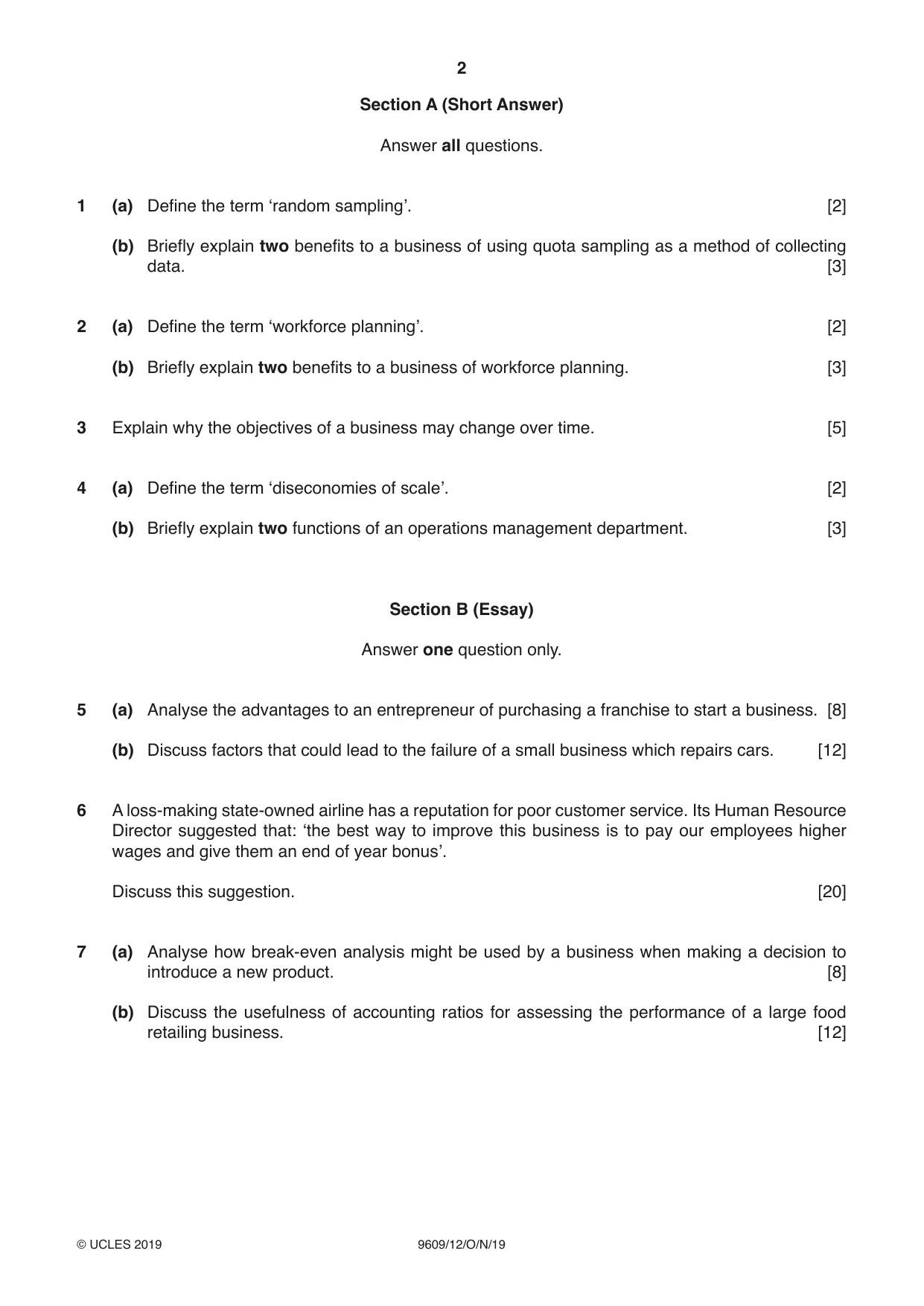
Question paper, page 2
2 9609/12/O/N/19 © UCLES 2019 Section A (Short Answer) Answer all questions. 1 (a) Define the term ‘random sampling’. [2] (b) Briefly explain two benefits to a business of using quota sampling as a method of collecting data. [3] 2 (a) Define the term ‘workforce planning’. [2] (b) Briefly explain two benefits to a business of workforce planning. [3] 3 Explain why the objectives of a business may change over time. [5] 4 (a) Define the term ‘diseconomies of scale’. [2] (b) Briefly explain two functions of an operations management department. [3] Section B (Essay) Answer one question only. 5 (a) Analyse the advantages to an entrepreneur of purchasing a franchise to start a business. [8] (b) Discuss factors that could lead to the failure of a small business which repairs cars. [12] 6 A loss-making state-owned airline has a reputation for poor customer service. Its Human Resource Director suggested that: ‘the best way to improve this business is to pay our employees higher wages and give them an end of year bonus’. Discuss this suggestion. [20] 7 (a) Analyse how break-even analysis might be used by a business when making a decision to introduce a new product. [8] (b) Discuss the usefulness of accounting ratios for assessing the performance of a large food retailing business. [12]
Question paper, page 3
3 9609/12/O/N/19 © UCLES 2019 BLANK PAGE
Question paper, page 4
4 9609/12/O/N/19 © UCLES 2019 BLANK PAGE Permission to reproduce items where third-party owned material protected by copyright is included has been sought and cleared where possible. Every reasonable effort has been made by the publisher (UCLES) to trace copyright holders, but if any items requiring clearance have unwittingly been included, the publisher will be pleased to make amends at the earliest possible opportunity. To avoid the issue of disclosure of answer-related information to candidates, all copyright acknowledgements are reproduced online in the Cambridge Assessment International Education Copyright Acknowledgements Booklet. This is produced for each series of examinations and is freely available to download at www.cambridgeinternational.org after the live examination series. Cambridge Assessment International Education is part of the Cambridge Assessment Group. Cambridge Assessment is the brand name of the University of Cambridge Local Examinations Syndicate (UCLES), which itself is a department of the University of Cambridge.
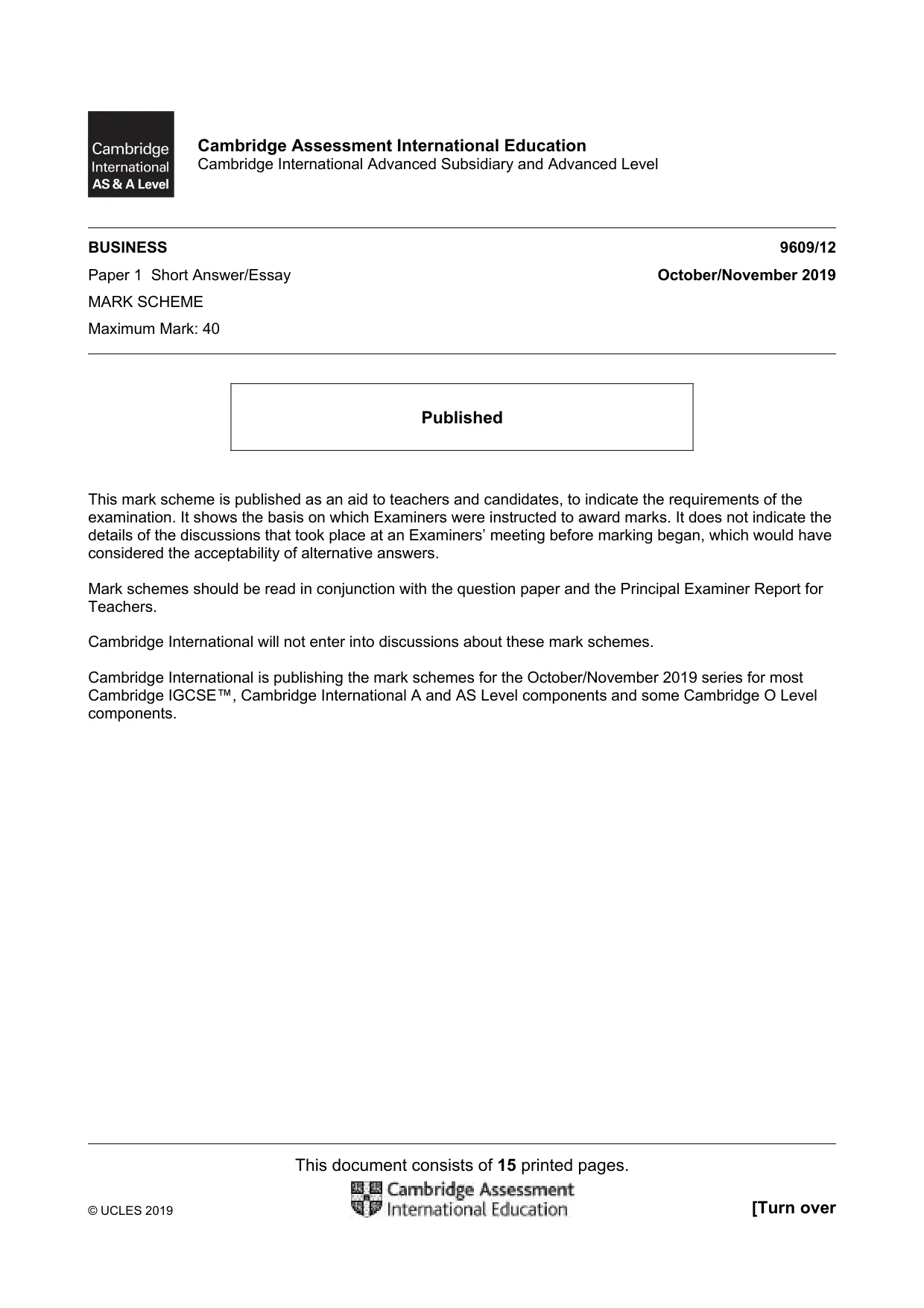
Mark scheme, page 1
This document consists of 15 printed pages. © UCLES 2019 [Turn over Cambridge Assessment International Education Cambridge International Advanced Subsidiary and Advanced Level BUSINESS 9609/12 Paper 1 Short Answer/Essay October/November 2019 MARK SCHEME Maximum Mark: 40 Published This mark scheme is published as an aid to teachers and candidates, to indicate the requirements of the examination. It shows the basis on which Examiners were instructed to award marks. It does not indicate the details of the discussions that took place at an Examiners’ meeting before marking began, which would have considered the acceptability of alternative answers. Mark schemes should be read in conjunction with the question paper and the Principal Examiner Report for Teachers. Cambridge International will not enter into discussions about these mark schemes. Cambridge International is publishing the mark schemes for the October/November 2019 series for most Cambridge IGCSE™, Cambridge International A and AS Level components and some Cambridge O Level components.
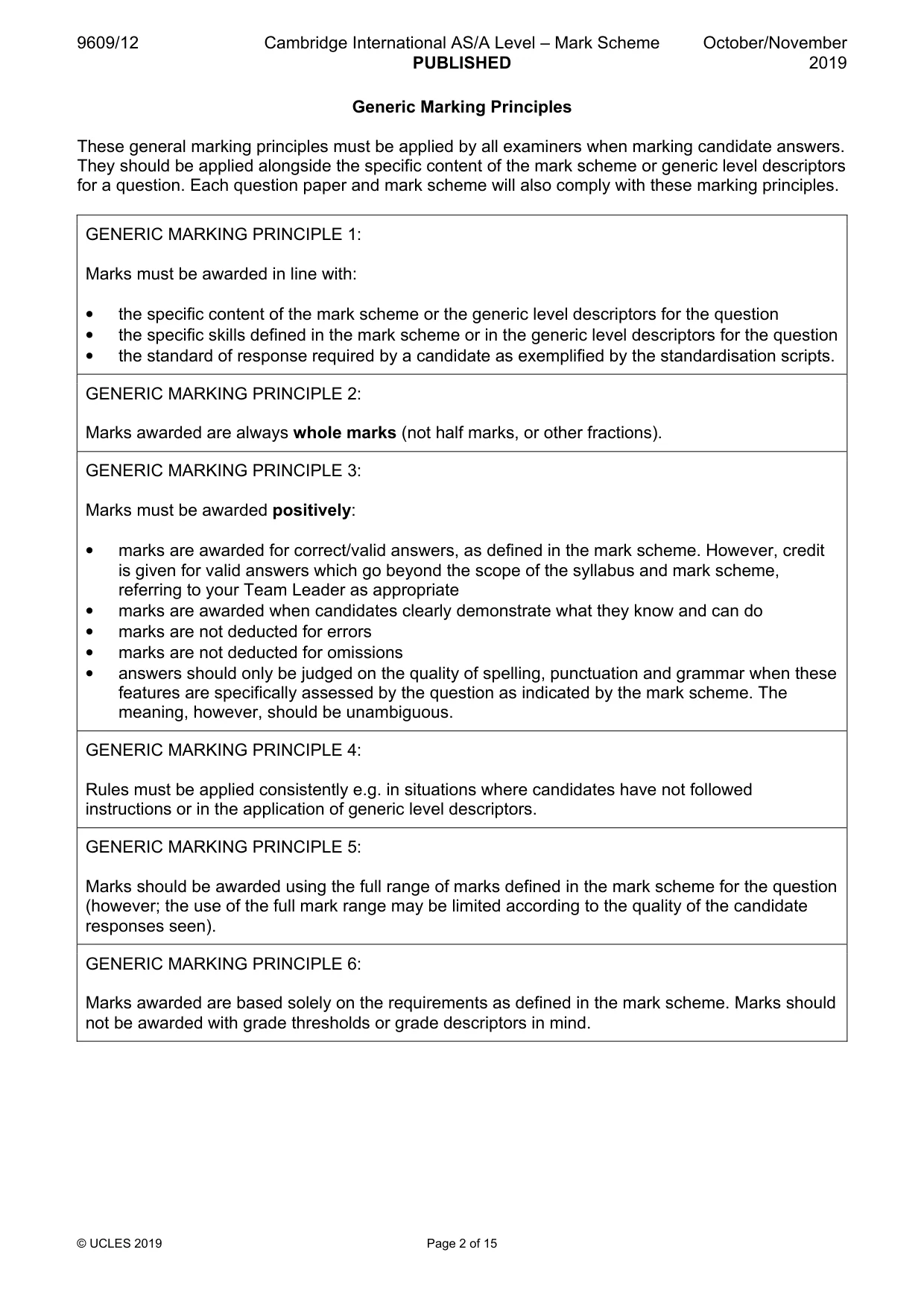
Mark scheme, page 2
9609/12 Cambridge International AS/A Level – Mark Scheme PUBLISHED October/November 2019 © UCLES 2019 Page 2 of 15 Generic Marking Principles These general marking principles must be applied by all examiners when marking candidate answers. They should be applied alongside the specific content of the mark scheme or generic level descriptors for a question. Each question paper and mark scheme will also comply with these marking principles. GENERIC MARKING PRINCIPLE 1: Marks must be awarded in line with: • the specific content of the mark scheme or the generic level descriptors for the question • the specific skills defined in the mark scheme or in the generic level descriptors for the question • the standard of response required by a candidate as exemplified by the standardisation scripts. GENERIC MARKING PRINCIPLE 2: Marks awarded are always whole marks (not half marks, or other fractions). GENERIC MARKING PRINCIPLE 3: Marks must be awarded positively: • marks are awarded for correct/valid answers, as defined in the mark scheme. However, credit is given for valid answers which go beyond the scope of the syllabus and mark scheme, referring to your Team Leader as appropriate • marks are awarded when candidates clearly demonstrate what they know and can do • marks are not deducted for errors • marks are not deducted for omissions • answers should only be judged on the quality of spelling, punctuation and grammar when these features are specifically assessed by the question as indicated by the mark scheme. The meaning, however, should be unambiguous. GENERIC MARKING PRINCIPLE 4: Rules must be applied consistently e.g. in situations where candidates have not followed instructions or in the application of generic level descriptors. GENERIC MARKING PRINCIPLE 5: Marks should be awarded using the full range of marks defined in the mark scheme for the question (however; the use of the full mark range may be limited according to the quality of the candidate responses seen). GENERIC MARKING PRINCIPLE 6: Marks awarded are based solely on the requirements as defined in the mark scheme. Marks should not be awarded with grade thresholds or grade descriptors in mind.
Mark scheme, page 3
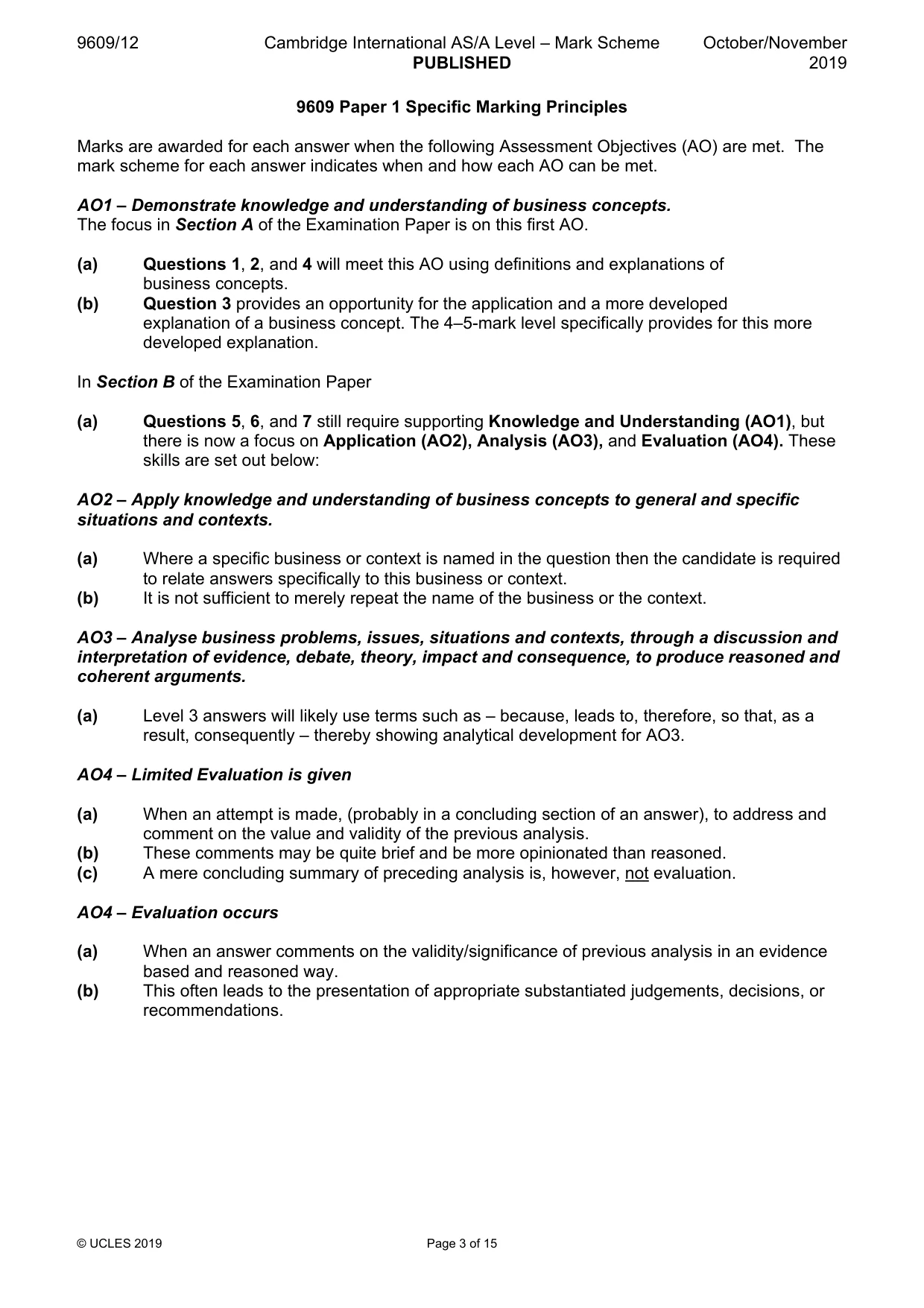
9609/12 Cambridge International AS/A Level – Mark Scheme PUBLISHED October/November 2019 © UCLES 2019 Page 3 of 15 9609 Paper 1 Specific Marking Principles Marks are awarded for each answer when the following Assessment Objectives (AO) are met. The mark scheme for each answer indicates when and how each AO can be met. AO1 – Demonstrate knowledge and understanding of business concepts. The focus in Section A of the Examination Paper is on this first AO. (a) Questions 1, 2, and 4 will meet this AO using definitions and explanations of business concepts. (b) Question 3 provides an opportunity for the application and a more developed explanation of a business concept. The 4–5-mark level specifically provides for this more developed explanation. In Section B of the Examination Paper (a) Questions 5, 6, and 7 still require supporting Knowledge and Understanding (AO1), but there is now a focus on Application (AO2), Analysis (AO3), and Evaluation (AO4). These skills are set out below: AO2 – Apply knowledge and understanding of business concepts to general and specific situations and contexts. (a) Where a specific business or context is named in the question then the candidate is required to relate answers specifically to this business or context. (b) It is not sufficient to merely repeat the name of the business or the context. AO3 – Analyse business problems, issues, situations and contexts, through a discussion and interpretation of evidence, debate, theory, impact and consequence, to produce reasoned and coherent arguments. (a) Level 3 answers will likely use terms such as – because, leads to, therefore, so that, as a result, consequently – thereby showing analytical development for AO3. AO4 – Limited Evaluation is given (a) When an attempt is made, (probably in a concluding section of an answer), to address and comment on the value and validity of the previous analysis. (b) These comments may be quite brief and be more opinionated than reasoned. (c) A mere concluding summary of preceding analysis is, however, not evaluation. AO4 – Evaluation occurs (a) When an answer comments on the validity/significance of previous analysis in an evidence based and reasoned way. (b) This often leads to the presentation of appropriate substantiated judgements, decisions, or recommendations.
Mark scheme, page 4
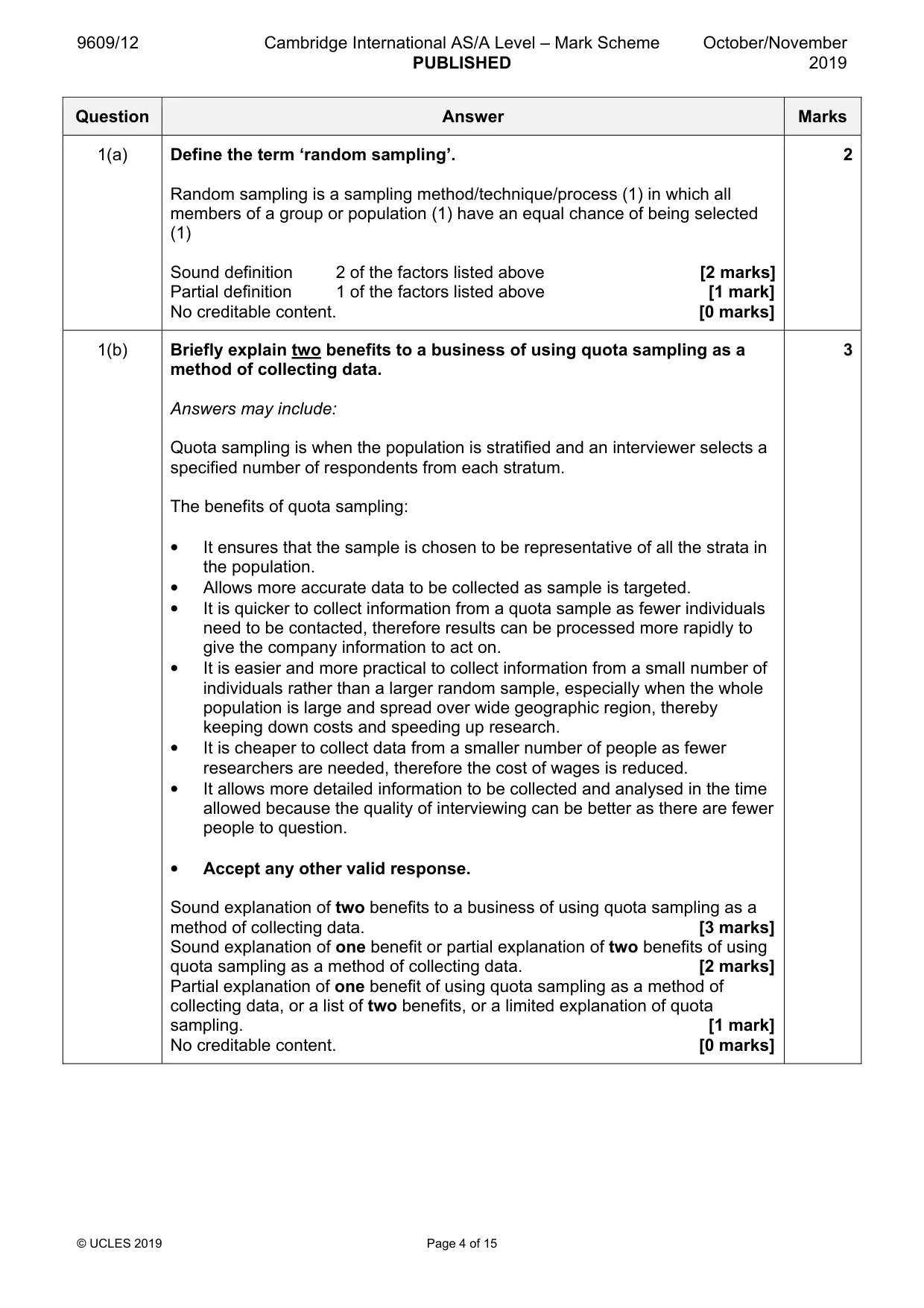
9609/12 Cambridge International AS/A Level – Mark Scheme PUBLISHED October/November 2019 © UCLES 2019 Page 4 of 15 Question Answer Marks 1(a) Define the term ‘random sampling’. Random sampling is a sampling method/technique/process (1) in which all members of a group or population (1) have an equal chance of being selected (1) Sound definition 2 of the factors listed above [2 marks] Partial definition 1 of the factors listed above [1 mark] No creditable content. [0 marks] 2 1(b) Briefly explain two benefits to a business of using quota sampling as a method of collecting data. Answers may include: Quota sampling is when the population is stratified and an interviewer selects a specified number of respondents from each stratum. The benefits of quota sampling: • It ensures that the sample is chosen to be representative of all the strata in the population. • Allows more accurate data to be collected as sample is targeted. • It is quicker to collect information from a quota sample as fewer individuals need to be contacted, therefore results can be processed more rapidly to give the company information to act on. • It is easier and more practical to collect information from a small number of individuals rather than a larger random sample, especially when the whole population is large and spread over wide geographic region, thereby keeping down costs and speeding up research. • It is cheaper to collect data from a smaller number of people as fewer researchers are needed, therefore the cost of wages is reduced. • It allows more detailed information to be collected and analysed in the time allowed because the quality of interviewing can be better as there are fewer people to question. • Accept any other valid response. Sound explanation of two benefits to a business of using quota sampling as a method of collecting data. [3 marks] Sound explanation of one benefit or partial explanation of two benefits of using quota sampling as a method of collecting data. [2 marks] Partial explanation of one benefit of using quota sampling as a method of collecting data, or a list of two benefits, or a limited explanation of quota sampling. [1 mark] No creditable content. [0 marks] 3
Mark scheme, page 5
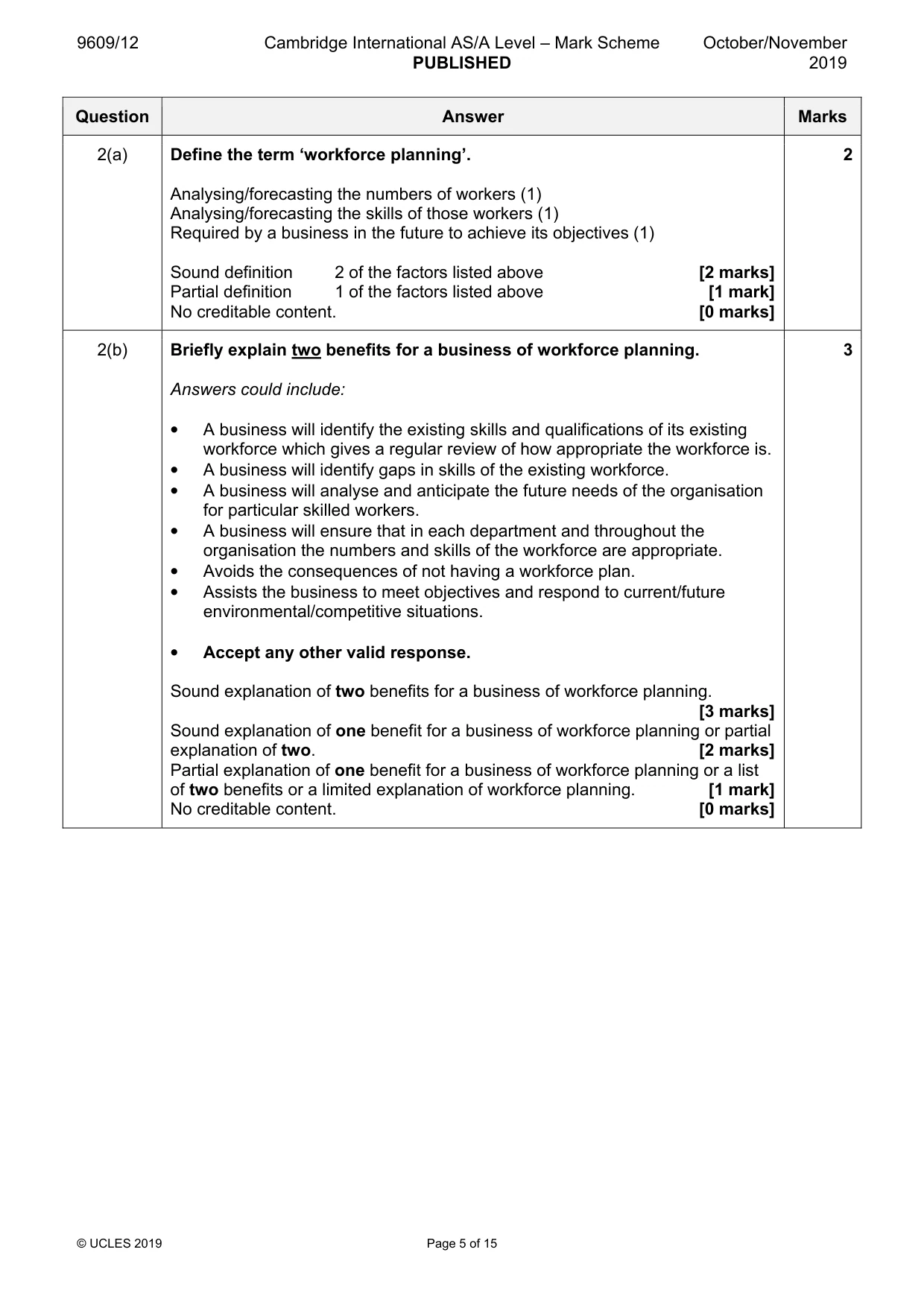
9609/12 Cambridge International AS/A Level – Mark Scheme PUBLISHED October/November 2019 © UCLES 2019 Page 5 of 15 Question Answer Marks 2(a) Define the term ‘workforce planning’. Analysing/forecasting the numbers of workers (1) Analysing/forecasting the skills of those workers (1) Required by a business in the future to achieve its objectives (1) Sound definition 2 of the factors listed above [2 marks] Partial definition 1 of the factors listed above [1 mark] No creditable content. [0 marks] 2 2(b) Briefly explain two benefits for a business of workforce planning. Answers could include: • A business will identify the existing skills and qualifications of its existing workforce which gives a regular review of how appropriate the workforce is. • A business will identify gaps in skills of the existing workforce. • A business will analyse and anticipate the future needs of the organisation for particular skilled workers. • A business will ensure that in each department and throughout the organisation the numbers and skills of the workforce are appropriate. • Avoids the consequences of not having a workforce plan. • Assists the business to meet objectives and respond to current/future environmental/competitive situations. • Accept any other valid response. Sound explanation of two benefits for a business of workforce planning. [3 marks] Sound explanation of one benefit for a business of workforce planning or partial explanation of two. [2 marks] Partial explanation of one benefit for a business of workforce planning or a list of two benefits or a limited explanation of workforce planning. [1 mark] No creditable content. [0 marks] 3
Mark scheme, page 6
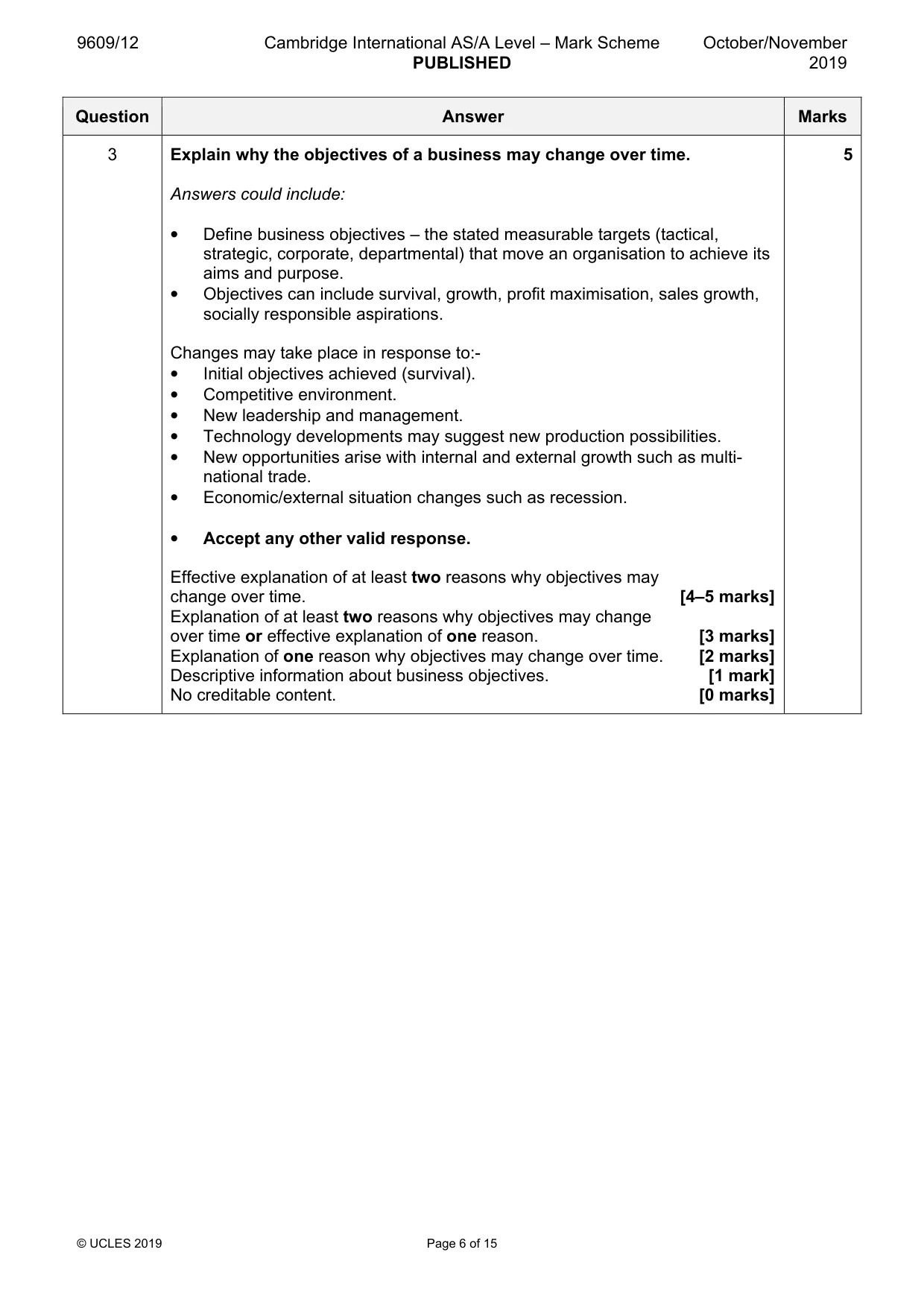
9609/12 Cambridge International AS/A Level – Mark Scheme PUBLISHED October/November 2019 © UCLES 2019 Page 6 of 15 Question Answer Marks 3 Explain why the objectives of a business may change over time. Answers could include: • Define business objectives – the stated measurable targets (tactical, strategic, corporate, departmental) that move an organisation to achieve its aims and purpose. • Objectives can include survival, growth, profit maximisation, sales growth, socially responsible aspirations. Changes may take place in response to:- • Initial objectives achieved (survival). • Competitive environment. • New leadership and management. • Technology developments may suggest new production possibilities. • New opportunities arise with internal and external growth such as multi- national trade. • Economic/external situation changes such as recession. • Accept any other valid response. Effective explanation of at least two reasons why objectives may change over time. [4–5 marks] Explanation of at least two reasons why objectives may change over time or effective explanation of one reason. [3 marks] Explanation of one reason why objectives may change over time. [2 marks] Descriptive information about business objectives. [1 mark] No creditable content. [0 marks] 5
Mark scheme, page 7
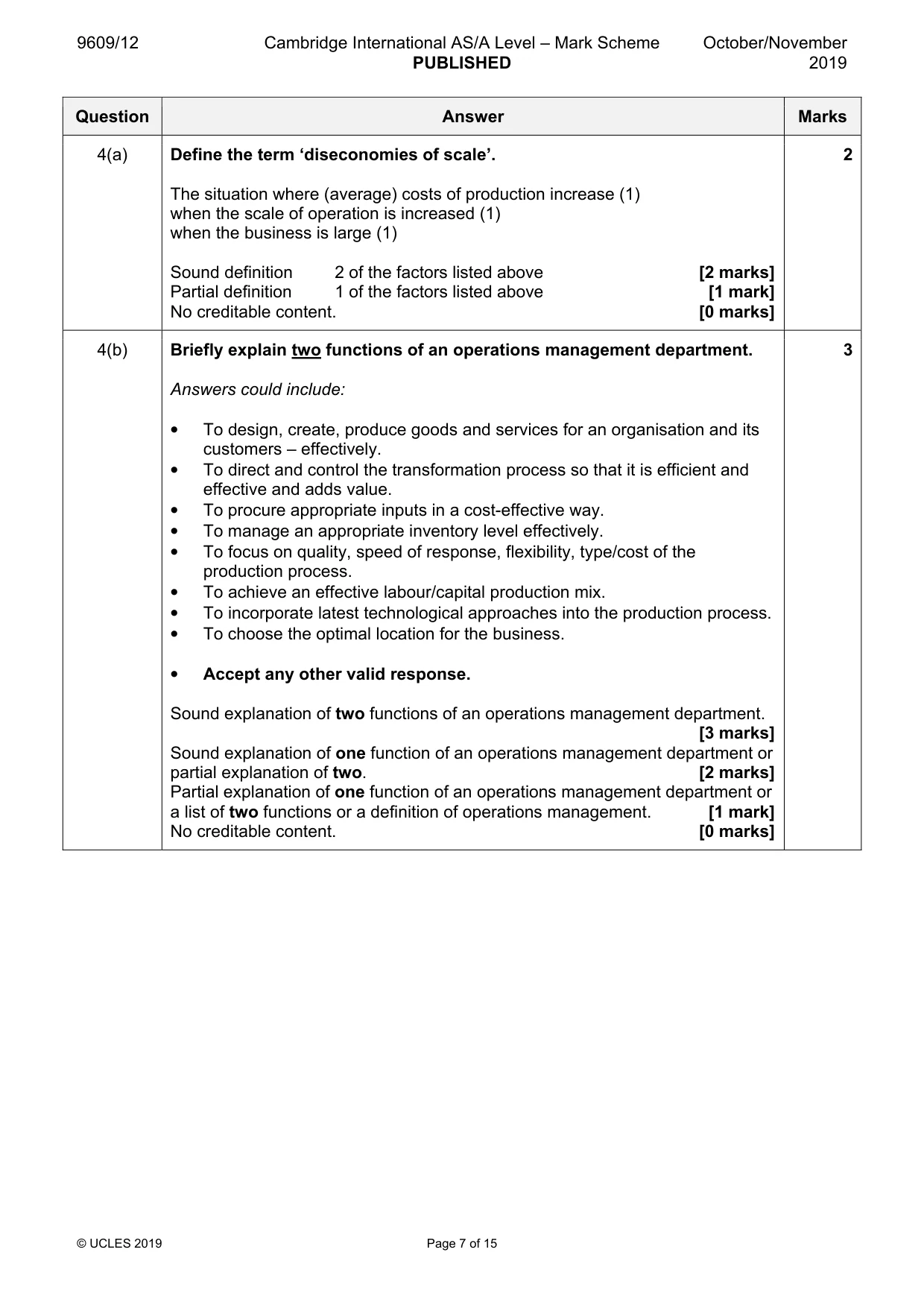
9609/12 Cambridge International AS/A Level – Mark Scheme PUBLISHED October/November 2019 © UCLES 2019 Page 7 of 15 Question Answer Marks 4(a) Define the term ‘diseconomies of scale’. The situation where (average) costs of production increase (1) when the scale of operation is increased (1) when the business is large (1) Sound definition 2 of the factors listed above [2 marks] Partial definition 1 of the factors listed above [1 mark] No creditable content. [0 marks] 2 4(b) Briefly explain two functions of an operations management department. Answers could include: • To design, create, produce goods and services for an organisation and its customers – effectively. • To direct and control the transformation process so that it is efficient and effective and adds value. • To procure appropriate inputs in a cost-effective way. • To manage an appropriate inventory level effectively. • To focus on quality, speed of response, flexibility, type/cost of the production process. • To achieve an effective labour/capital production mix. • To incorporate latest technological approaches into the production process. • To choose the optimal location for the business. • Accept any other valid response. Sound explanation of two functions of an operations management department. [3 marks] Sound explanation of one function of an operations management department or partial explanation of two. [2 marks] Partial explanation of one function of an operations management department or a list of two functions or a definition of operations management. [1 mark] No creditable content. [0 marks] 3
Mark scheme, page 8
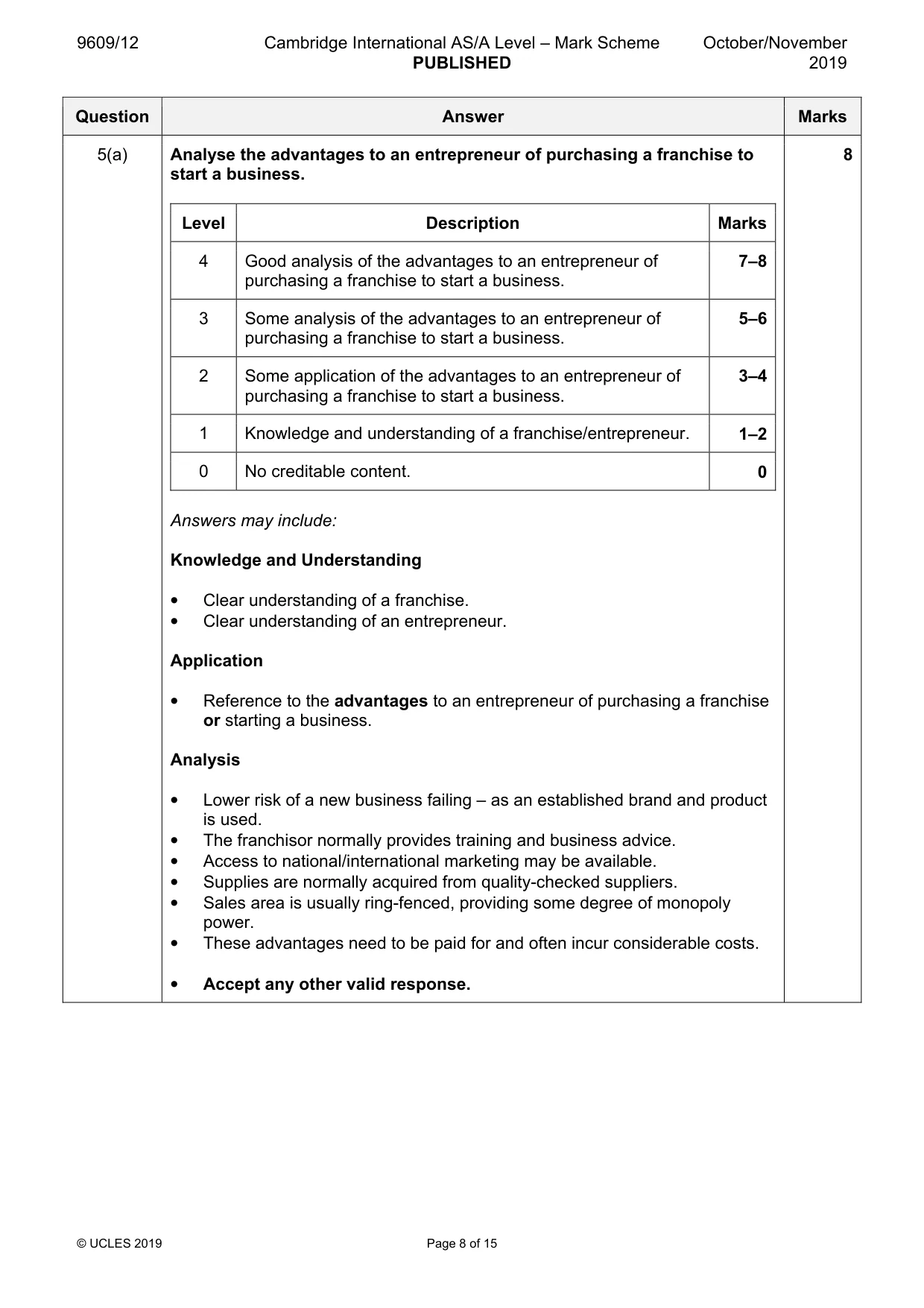
9609/12 Cambridge International AS/A Level – Mark Scheme PUBLISHED October/November 2019 © UCLES 2019 Page 8 of 15 Question Answer Marks 5(a) Analyse the advantages to an entrepreneur of purchasing a franchise to start a business. Level Description Marks 4 Good analysis of the advantages to an entrepreneur of purchasing a franchise to start a business. 7–8 3 Some analysis of the advantages to an entrepreneur of purchasing a franchise to start a business. 5–6 2 Some application of the advantages to an entrepreneur of purchasing a franchise to start a business. 3–4 1 Knowledge and understanding of a franchise/entrepreneur. 1–2 0 No creditable content. 0 Answers may include: Knowledge and Understanding • Clear understanding of a franchise. • Clear understanding of an entrepreneur. Application • Reference to the advantages to an entrepreneur of purchasing a franchise or starting a business. Analysis • Lower risk of a new business failing – as an established brand and product is used. • The franchisor normally provides training and business advice. • Access to national/international marketing may be available. • Supplies are normally acquired from quality-checked suppliers. • Sales area is usually ring-fenced, providing some degree of monopoly power. • These advantages need to be paid for and often incur considerable costs. • Accept any other valid response. 8
Mark scheme, page 9
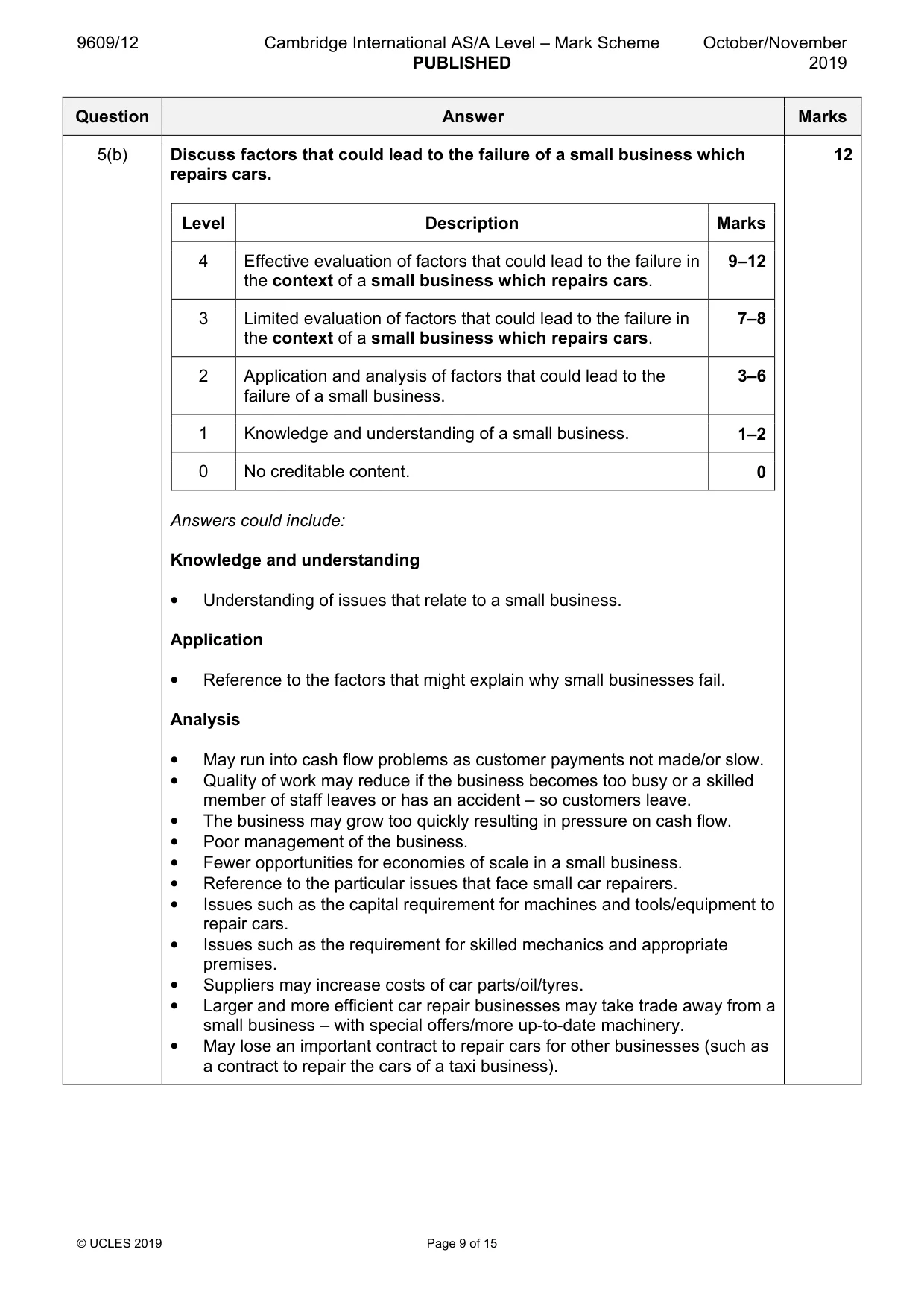
9609/12 Cambridge International AS/A Level – Mark Scheme PUBLISHED October/November 2019 © UCLES 2019 Page 9 of 15 Question Answer Marks 5(b) Discuss factors that could lead to the failure of a small business which repairs cars. Level Description Marks 4 Effective evaluation of factors that could lead to the failure in the context of a small business which repairs cars. 9–12 3 Limited evaluation of factors that could lead to the failure in the context of a small business which repairs cars. 7–8 2 Application and analysis of factors that could lead to the failure of a small business. 3–6 1 Knowledge and understanding of a small business. 1–2 0 No creditable content. 0 Answers could include: Knowledge and understanding • Understanding of issues that relate to a small business. Application • Reference to the factors that might explain why small businesses fail. Analysis • May run into cash flow problems as customer payments not made/or slow. • Quality of work may reduce if the business becomes too busy or a skilled member of staff leaves or has an accident – so customers leave. • The business may grow too quickly resulting in pressure on cash flow. • Poor management of the business. • Fewer opportunities for economies of scale in a small business. • Reference to the particular issues that face small car repairers. • Issues such as the capital requirement for machines and tools/equipment to repair cars. • Issues such as the requirement for skilled mechanics and appropriate premises. • Suppliers may increase costs of car parts/oil/tyres. • Larger and more efficient car repair businesses may take trade away from a small business – with special offers/more up-to-date machinery. • May lose an important contract to repair cars for other businesses (such as a contract to repair the cars of a taxi business). 12
Mark scheme, page 10
9609/12 Cambridge International AS/A Level – Mark Scheme PUBLISHED October/November 2019 © UCLES 2019 Page 10 of 15 Question Answer Marks 5(b) Evaluation • The context is a small business which repairs cars. • Evaluation might discuss the factors that could lead to failure and make a judgement as to which are the most significant. • A distinction might be made to internal and external factors that could lead to failure. Accept any other valid response.
Mark scheme, page 11
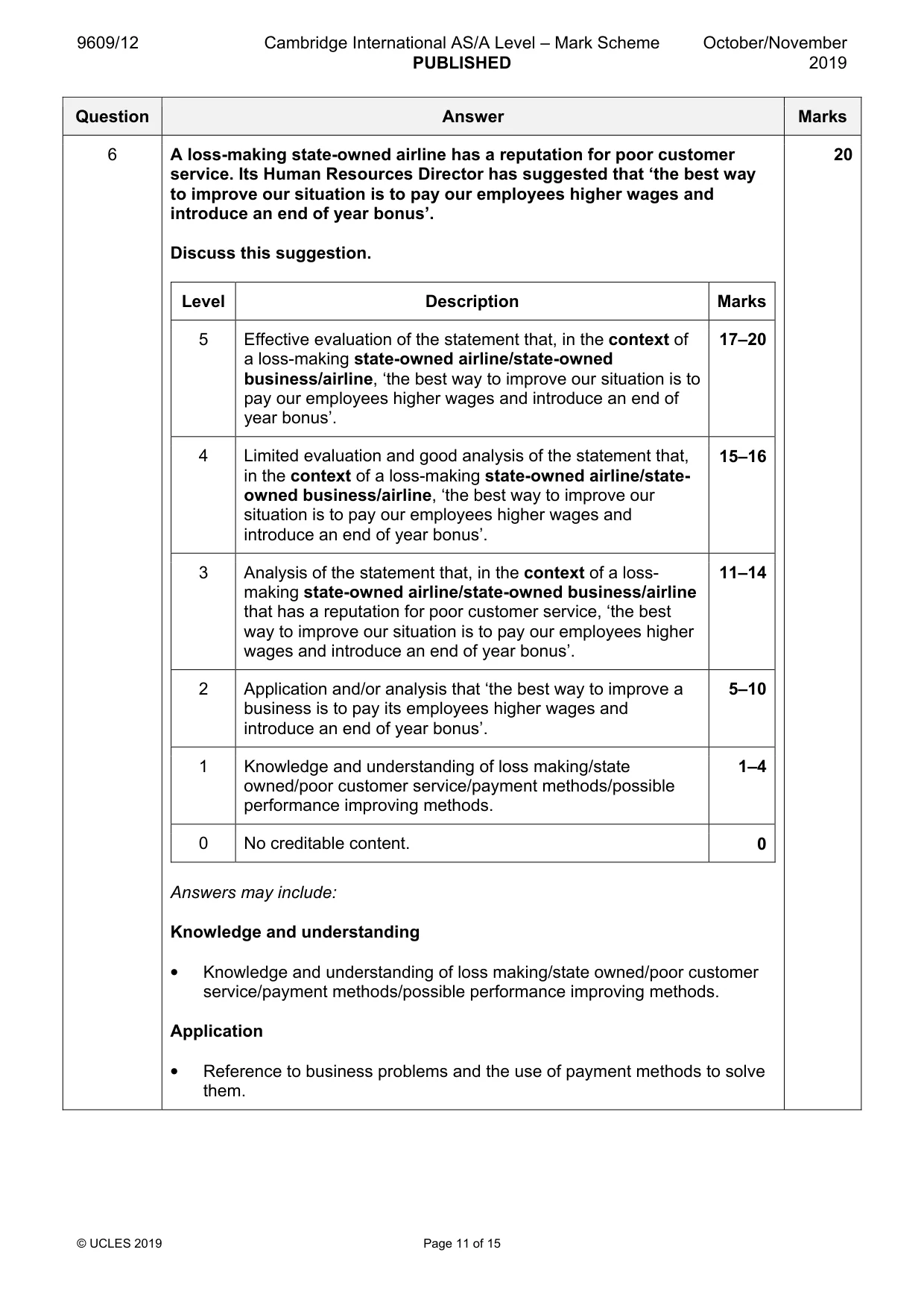
9609/12 Cambridge International AS/A Level – Mark Scheme PUBLISHED October/November 2019 © UCLES 2019 Page 11 of 15 Question Answer Marks 6 A loss-making state-owned airline has a reputation for poor customer service. Its Human Resources Director has suggested that ‘the best way to improve our situation is to pay our employees higher wages and introduce an end of year bonus’. Discuss this suggestion. Level Description Marks 5 Effective evaluation of the statement that, in the context of a loss-making state-owned airline/state-owned business/airline, ‘the best way to improve our situation is to pay our employees higher wages and introduce an end of year bonus’. 17–20 4 Limited evaluation and good analysis of the statement that, in the context of a loss-making state-owned airline/state- owned business/airline, ‘the best way to improve our situation is to pay our employees higher wages and introduce an end of year bonus’. 15–16 3 Analysis of the statement that, in the context of a loss- making state-owned airline/state-owned business/airline that has a reputation for poor customer service, ‘the best way to improve our situation is to pay our employees higher wages and introduce an end of year bonus’. 11–14 2 Application and/or analysis that ‘the best way to improve a business is to pay its employees higher wages and introduce an end of year bonus’. 5–10 1 Knowledge and understanding of loss making/state owned/poor customer service/payment methods/possible performance improving methods. 1–4 0 No creditable content. 0 Answers may include: Knowledge and understanding • Knowledge and understanding of loss making/state owned/poor customer service/payment methods/possible performance improving methods. Application • Reference to business problems and the use of payment methods to solve them. 20
Mark scheme, page 12
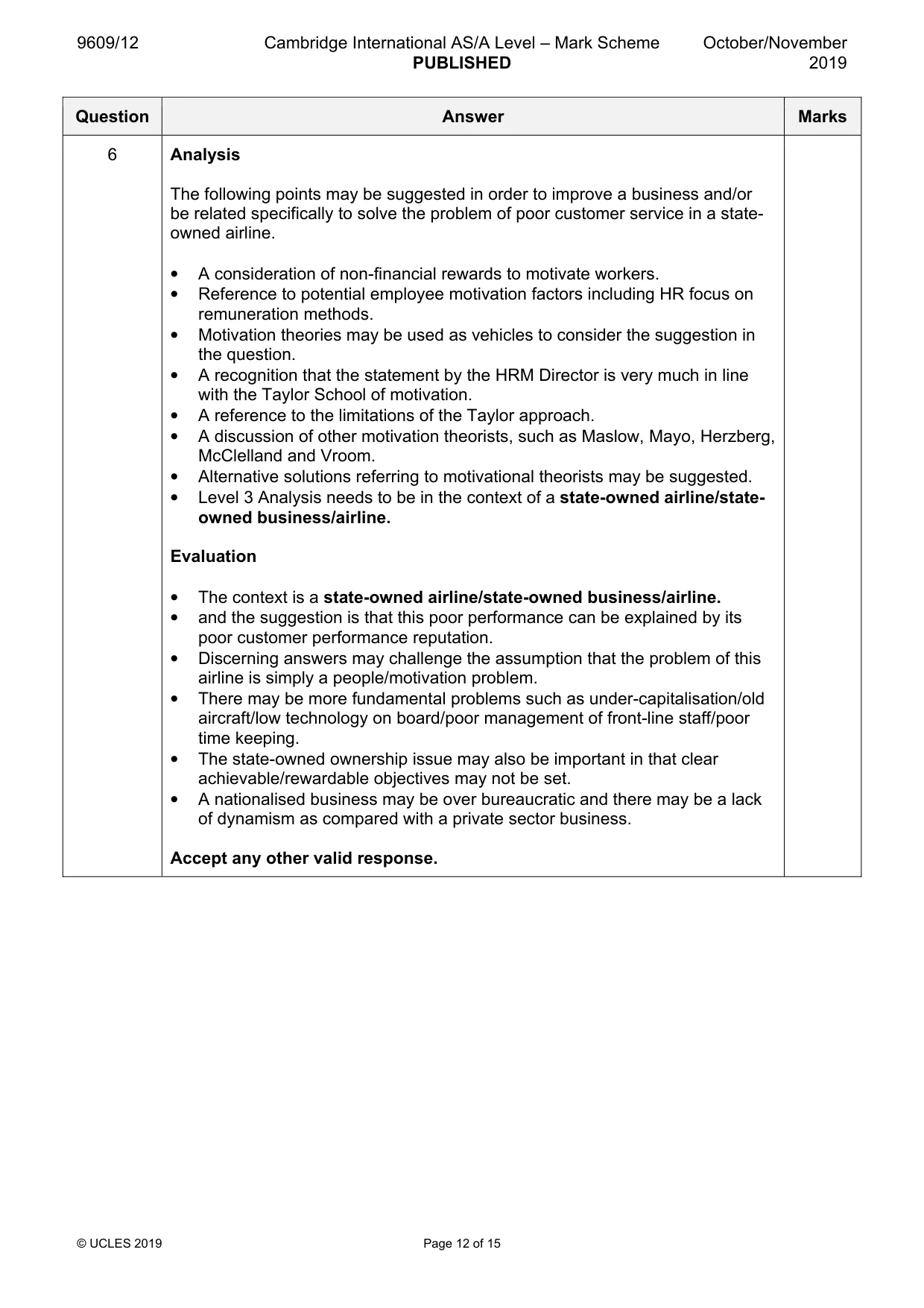
9609/12 Cambridge International AS/A Level – Mark Scheme PUBLISHED October/November 2019 © UCLES 2019 Page 12 of 15 Question Answer Marks 6 Analysis The following points may be suggested in order to improve a business and/or be related specifically to solve the problem of poor customer service in a state- owned airline. • A consideration of non-financial rewards to motivate workers. • Reference to potential employee motivation factors including HR focus on remuneration methods. • Motivation theories may be used as vehicles to consider the suggestion in the question. • A recognition that the statement by the HRM Director is very much in line with the Taylor School of motivation. • A reference to the limitations of the Taylor approach. • A discussion of other motivation theorists, such as Maslow, Mayo, Herzberg, McClelland and Vroom. • Alternative solutions referring to motivational theorists may be suggested. • Level 3 Analysis needs to be in the context of a state-owned airline/state- owned business/airline. Evaluation • The context is a state-owned airline/state-owned business/airline. • and the suggestion is that this poor performance can be explained by its poor customer performance reputation. • Discerning answers may challenge the assumption that the problem of this airline is simply a people/motivation problem. • There may be more fundamental problems such as under-capitalisation/old aircraft/low technology on board/poor management of front-line staff/poor time keeping. • The state-owned ownership issue may also be important in that clear achievable/rewardable objectives may not be set. • A nationalised business may be over bureaucratic and there may be a lack of dynamism as compared with a private sector business. Accept any other valid response.
Mark scheme, page 13
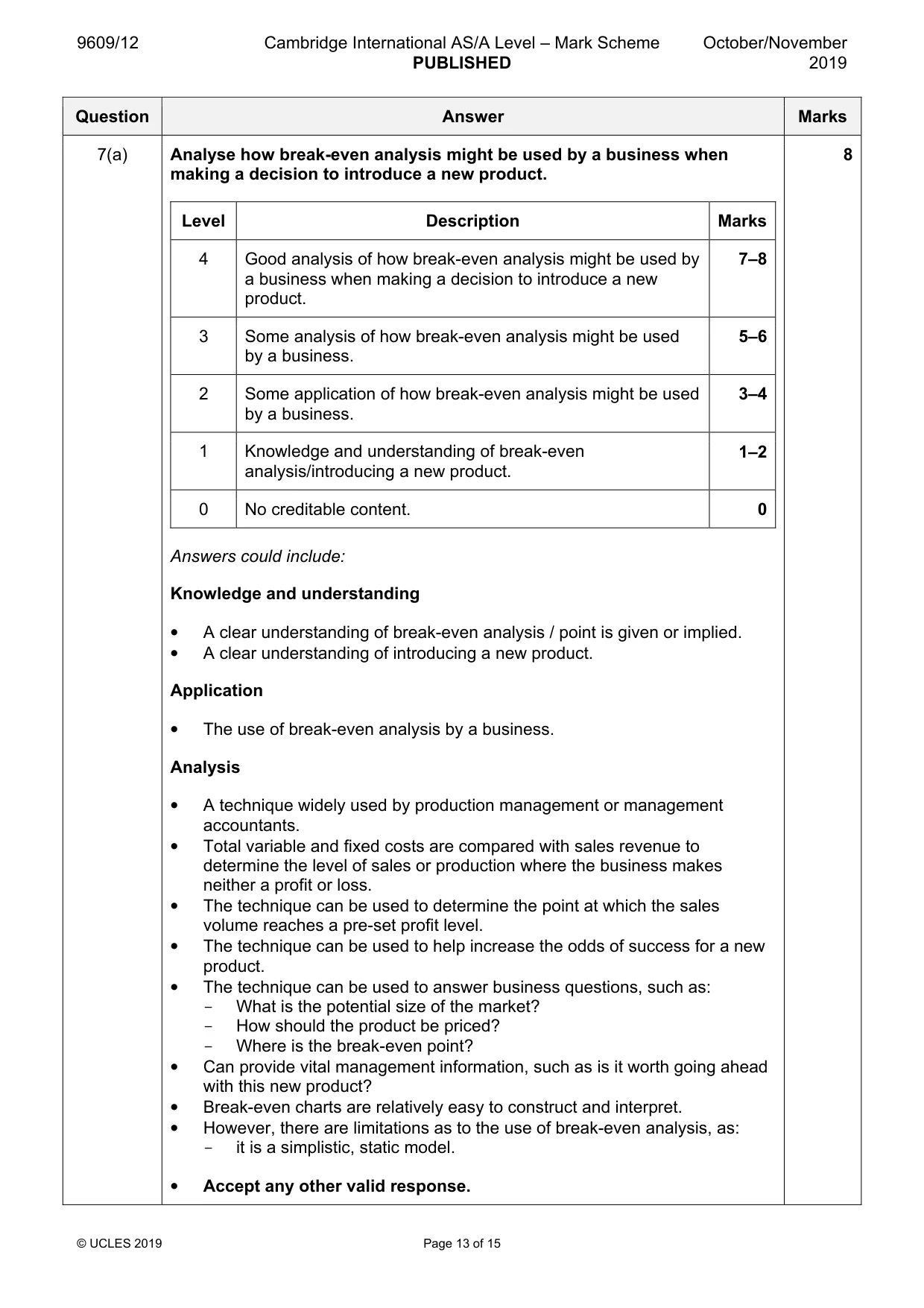
9609/12 Cambridge International AS/A Level – Mark Scheme PUBLISHED October/November 2019 © UCLES 2019 Page 13 of 15 Question Answer Marks 7(a) Analyse how break-even analysis might be used by a business when making a decision to introduce a new product. Level Description Marks 4 Good analysis of how break-even analysis might be used by a business when making a decision to introduce a new product. 7–8 3 Some analysis of how break-even analysis might be used by a business. 5–6 2 Some application of how break-even analysis might be used by a business. 3–4 1 Knowledge and understanding of break-even analysis/introducing a new product. 1–2 0 No creditable content. 0 Answers could include: Knowledge and understanding • A clear understanding of break-even analysis / point is given or implied. • A clear understanding of introducing a new product. Application • The use of break-even analysis by a business. Analysis • A technique widely used by production management or management accountants. • Total variable and fixed costs are compared with sales revenue to determine the level of sales or production where the business makes neither a profit or loss. • The technique can be used to determine the point at which the sales volume reaches a pre-set profit level. • The technique can be used to help increase the odds of success for a new product. • The technique can be used to answer business questions, such as: - What is the potential size of the market? - How should the product be priced? - Where is the break-even point? • Can provide vital management information, such as is it worth going ahead with this new product? • Break-even charts are relatively easy to construct and interpret. • However, there are limitations as to the use of break-even analysis, as: - it is a simplistic, static model. • Accept any other valid response. 8
Mark scheme, page 14
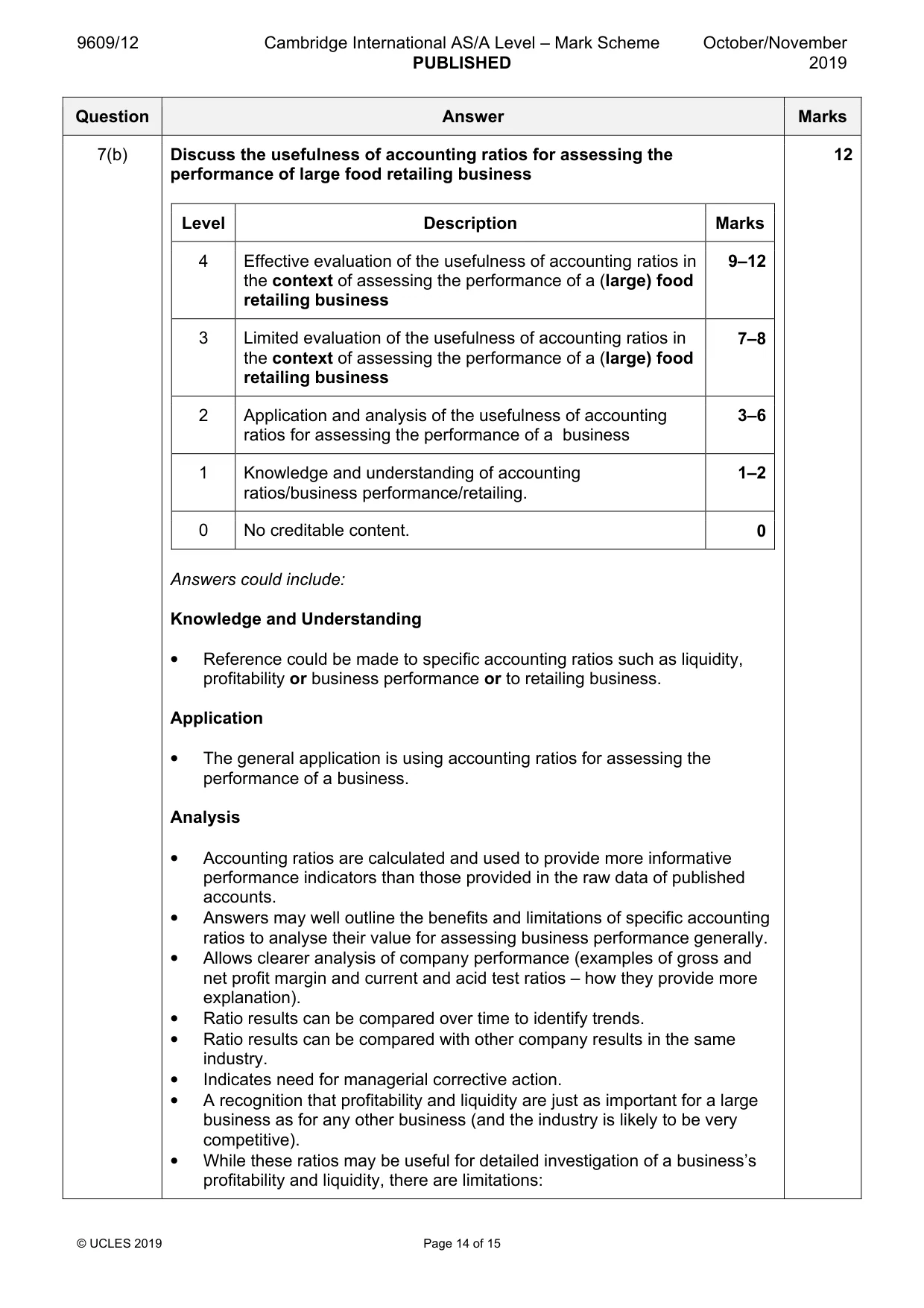
9609/12 Cambridge International AS/A Level – Mark Scheme PUBLISHED October/November 2019 © UCLES 2019 Page 14 of 15 Question Answer Marks 7(b) Discuss the usefulness of accounting ratios for assessing the performance of large food retailing business Level Description Marks 4 Effective evaluation of the usefulness of accounting ratios in the context of assessing the performance of a (large) food retailing business 9–12 3 Limited evaluation of the usefulness of accounting ratios in the context of assessing the performance of a (large) food retailing business 7–8 2 Application and analysis of the usefulness of accounting ratios for assessing the performance of a business 3–6 1 Knowledge and understanding of accounting ratios/business performance/retailing. 1–2 0 No creditable content. 0 Answers could include: Knowledge and Understanding • Reference could be made to specific accounting ratios such as liquidity, profitability or business performance or to retailing business. Application • The general application is using accounting ratios for assessing the performance of a business. Analysis • Accounting ratios are calculated and used to provide more informative performance indicators than those provided in the raw data of published accounts. • Answers may well outline the benefits and limitations of specific accounting ratios to analyse their value for assessing business performance generally. • Allows clearer analysis of company performance (examples of gross and net profit margin and current and acid test ratios – how they provide more explanation). • Ratio results can be compared over time to identify trends. • Ratio results can be compared with other company results in the same industry. • Indicates need for managerial corrective action. • A recognition that profitability and liquidity are just as important for a large business as for any other business (and the industry is likely to be very competitive). • While these ratios may be useful for detailed investigation of a business’s profitability and liquidity, there are limitations: 12
Mark scheme, page 15
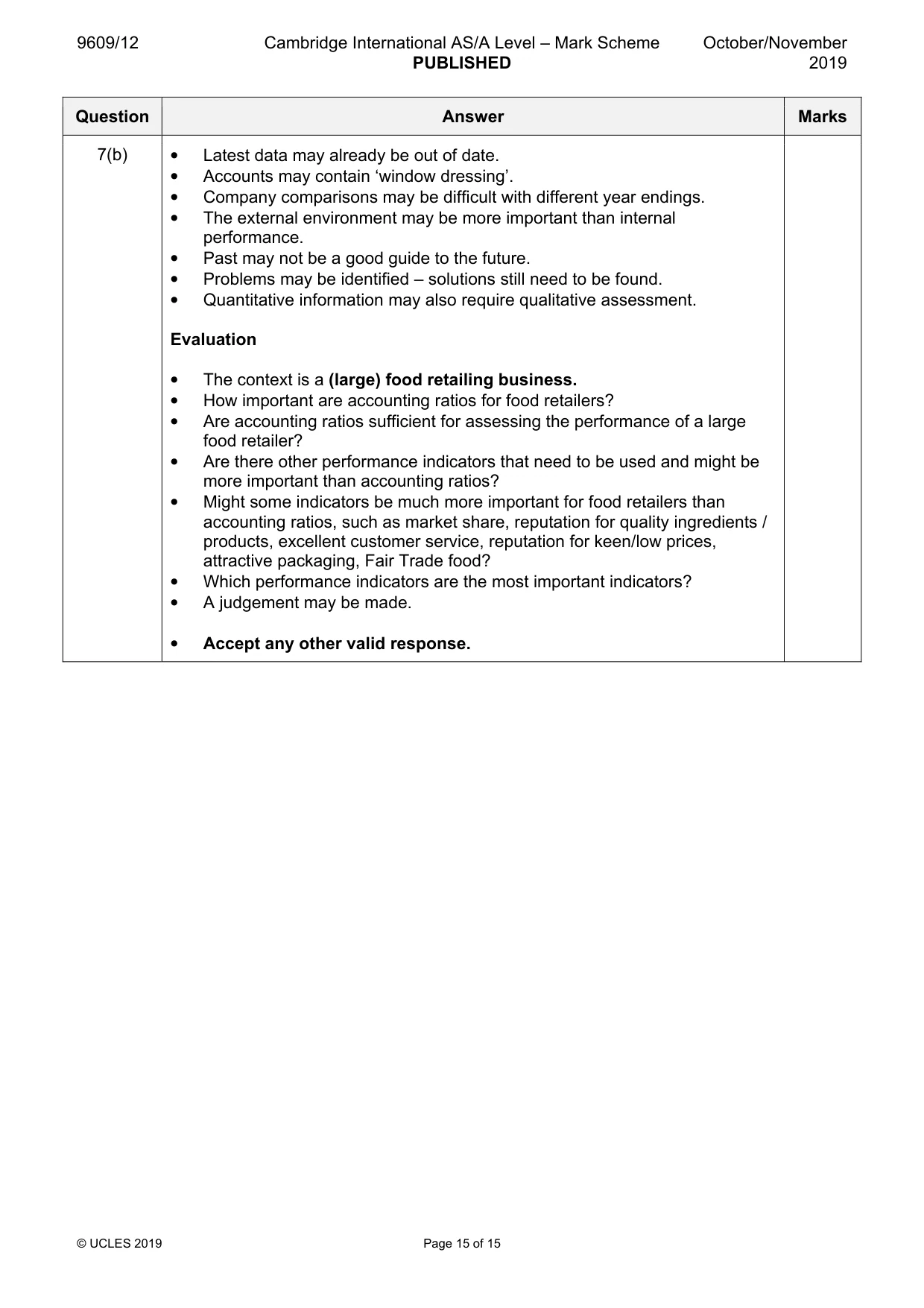
9609/12 Cambridge International AS/A Level – Mark Scheme PUBLISHED October/November 2019 © UCLES 2019 Page 15 of 15 Question Answer Marks 7(b) • Latest data may already be out of date. • Accounts may contain ‘window dressing’. • Company comparisons may be difficult with different year endings. • The external environment may be more important than internal performance. • Past may not be a good guide to the future. • Problems may be identified – solutions still need to be found. • Quantitative information may also require qualitative assessment. Evaluation • The context is a (large) food retailing business. • How important are accounting ratios for food retailers? • Are accounting ratios sufficient for assessing the performance of a large food retailer? • Are there other performance indicators that need to be used and might be more important than accounting ratios? • Might some indicators be much more important for food retailers than accounting ratios, such as market share, reputation for quality ingredients / products, excellent customer service, reputation for keen/low prices, attractive packaging, Fair Trade food? • Which performance indicators are the most important indicators? • A judgement may be made. • Accept any other valid response.
What you needed in this session
Cambridge’s own grade thresholds for 2019 Oct/Nov, Paper 1 · Variant 2. A higher threshold means an easier paper — the bar moves with how the cohort did.