Cambridge A Level Business (for first examination in 2016) 9609 — 2019 Oct/Nov Paper 1 · Variant 1
9609/11/O/N/19 · 40 marks · ≈45 min
The question paper and its mark scheme, free to read here and free to download. This is Cambridge’s own paper, exactly as it was sat.
Question paper4 pages



Mark scheme15 pages
Answers below. Sit the paper first if you are practising.

Paper as text
Question paper, page 1
This document consists of 2 printed pages, 2 blank pages and 1 Insert. DC (JM) 169865/1 © UCLES 2019 [Turn over Cambridge Assessment International Education Cambridge International Advanced Subsidiary and Advanced Level * 8 3 8 0 7 9 2 7 5 3 * BUSINESS 9609/11 Paper 1 Short Answer and Essay October/November 2019 1 hour 15 minutes No Additional Materials are required. READ THESE INSTRUCTIONS FIRST An answer booklet is provided inside this question paper. You should follow the instructions on the front cover of the answer booklet. If you need additional answer paper ask the invigilator for a continuation booklet. Section A Answer all questions. Section B Answer one question. You are advised to spend no more than 35 minutes on Section A. The number of marks is given in brackets [ ] at the end of each question or part question.
Question paper, page 2
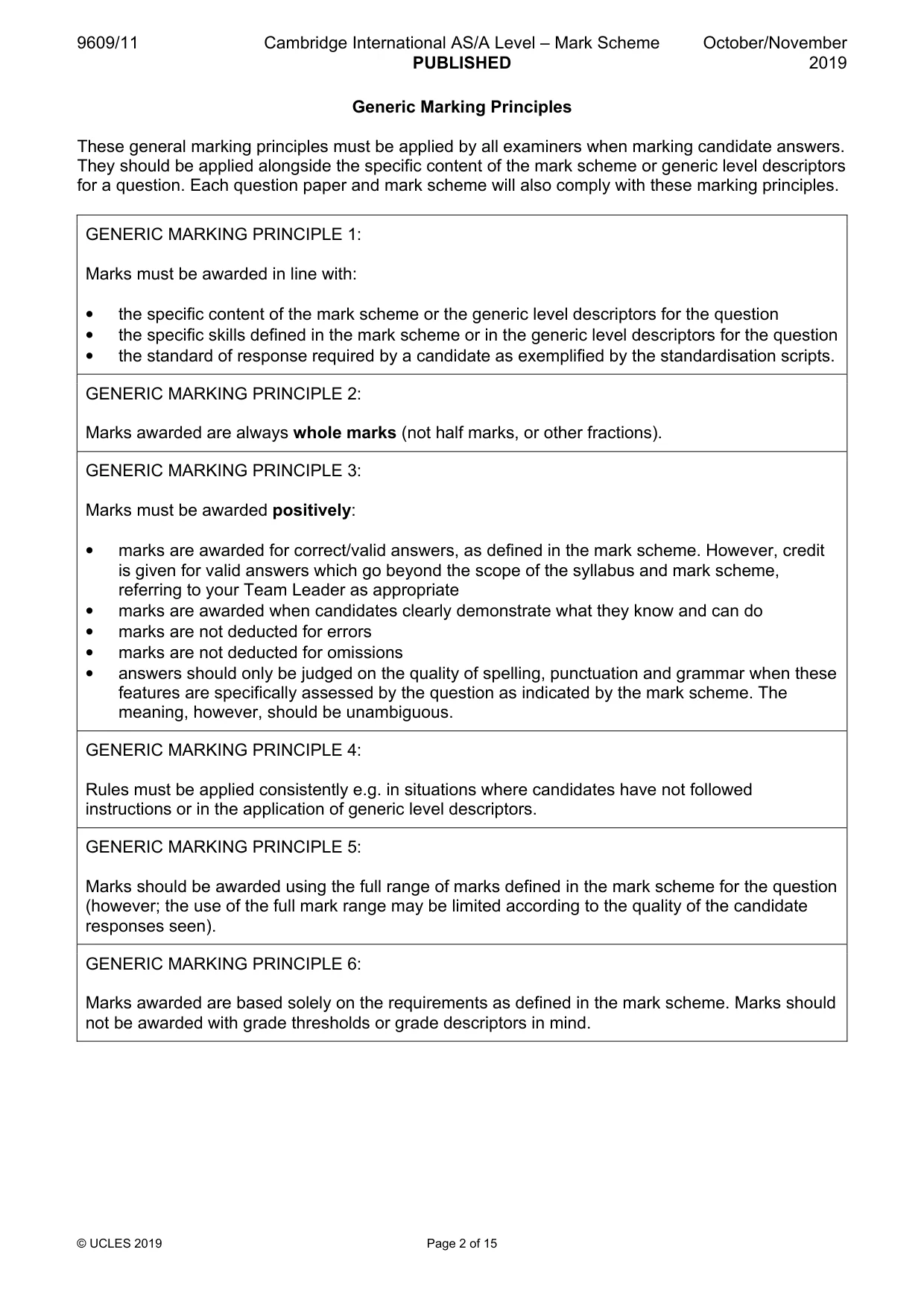
2 9609/11/O/N/19 © UCLES 2019 Section A (Short Answer) Answer all questions. 1 (a) Define the term ‘price elasticity of demand’. [2] (b) Briefly explain two reasons why price elasticity of demand might be useful to a business when making pricing decisions. [3] 2 (a) Define the term ‘cash flow forecast’. [2] (b) Briefly explain two limitations for a business of using a cash flow forecast. [3] 3 Explain how human resource management (HRM) helps to achieve business success. [5] 4 (a) Define the term ‘ethics’. [2] (b) Briefly explain two ways ethics might influence the activities of a business. [3] Section B (Essay) Answer one question only. 5 (a) Analyse why making a profit is not the main objective of all private sector businesses. [8] (b) Discuss why national water supply businesses in many countries operate in the public sector. [12] 6 Discuss why a manufacturer of a successful brand of luxury perfume might continue to spend a lot of money on promoting that brand. [20] 7 (a) Analyse the benefits of a labour intensive production process for a business. [8] (b) Discuss how process innovation could improve the operational efficiency of an international parcel delivery business. [12]
Question paper, page 3
3 9609/11/O/N/19 © UCLES 2019 BLANK PAGE
Question paper, page 4
4 9609/11/O/N/19 © UCLES 2019 BLANK PAGE Permission to reproduce items where third-party owned material protected by copyright is included has been sought and cleared where possible. Every reasonable effort has been made by the publisher (UCLES) to trace copyright holders, but if any items requiring clearance have unwittingly been included, the publisher will be pleased to make amends at the earliest possible opportunity. To avoid the issue of disclosure of answer-related information to candidates, all copyright acknowledgements are reproduced online in the Cambridge Assessment International Education Copyright Acknowledgements Booklet. This is produced for each series of examinations and is freely available to download at www.cambridgeinternational.org after the live examination series. Cambridge Assessment International Education is part of the Cambridge Assessment Group. Cambridge Assessment is the brand name of the University of Cambridge Local Examinations Syndicate (UCLES), which itself is a department of the University of Cambridge.
Mark scheme, page 1
This document consists of 15 printed pages. © UCLES 2019 [Turn over Cambridge Assessment International Education Cambridge International Advanced Subsidiary and Advanced Level BUSINESS 9609/11 Paper 1 Short Answer and Essay October/November 2019 MARK SCHEME Maximum Mark: 40 Published This mark scheme is published as an aid to teachers and candidates, to indicate the requirements of the examination. It shows the basis on which Examiners were instructed to award marks. It does not indicate the details of the discussions that took place at an Examiners’ meeting before marking began, which would have considered the acceptability of alternative answers. Mark schemes should be read in conjunction with the question paper and the Principal Examiner Report for Teachers. Cambridge International will not enter into discussions about these mark schemes. Cambridge International is publishing the mark schemes for the October/November 2019 series for most Cambridge IGCSE™, Cambridge International A and AS Level components and some Cambridge O Level components.
Mark scheme, page 2
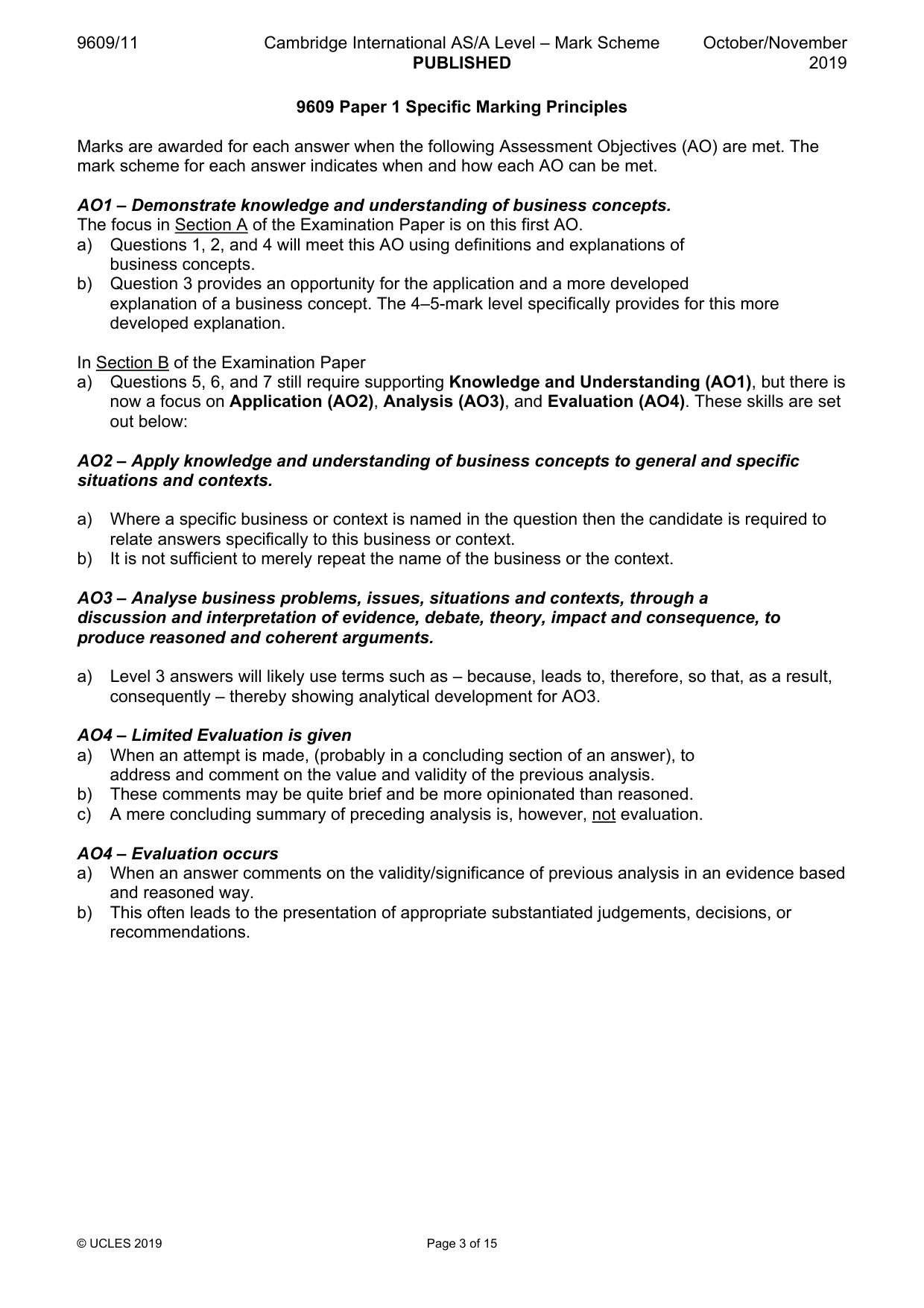
9609/11 Cambridge International AS/A Level – Mark Scheme PUBLISHED October/November 2019 © UCLES 2019 Page 2 of 15 Generic Marking Principles These general marking principles must be applied by all examiners when marking candidate answers. They should be applied alongside the specific content of the mark scheme or generic level descriptors for a question. Each question paper and mark scheme will also comply with these marking principles. GENERIC MARKING PRINCIPLE 1: Marks must be awarded in line with: • the specific content of the mark scheme or the generic level descriptors for the question • the specific skills defined in the mark scheme or in the generic level descriptors for the question • the standard of response required by a candidate as exemplified by the standardisation scripts. GENERIC MARKING PRINCIPLE 2: Marks awarded are always whole marks (not half marks, or other fractions). GENERIC MARKING PRINCIPLE 3: Marks must be awarded positively: • marks are awarded for correct/valid answers, as defined in the mark scheme. However, credit is given for valid answers which go beyond the scope of the syllabus and mark scheme, referring to your Team Leader as appropriate • marks are awarded when candidates clearly demonstrate what they know and can do • marks are not deducted for errors • marks are not deducted for omissions • answers should only be judged on the quality of spelling, punctuation and grammar when these features are specifically assessed by the question as indicated by the mark scheme. The meaning, however, should be unambiguous. GENERIC MARKING PRINCIPLE 4: Rules must be applied consistently e.g. in situations where candidates have not followed instructions or in the application of generic level descriptors. GENERIC MARKING PRINCIPLE 5: Marks should be awarded using the full range of marks defined in the mark scheme for the question (however; the use of the full mark range may be limited according to the quality of the candidate responses seen). GENERIC MARKING PRINCIPLE 6: Marks awarded are based solely on the requirements as defined in the mark scheme. Marks should not be awarded with grade thresholds or grade descriptors in mind.
Mark scheme, page 3
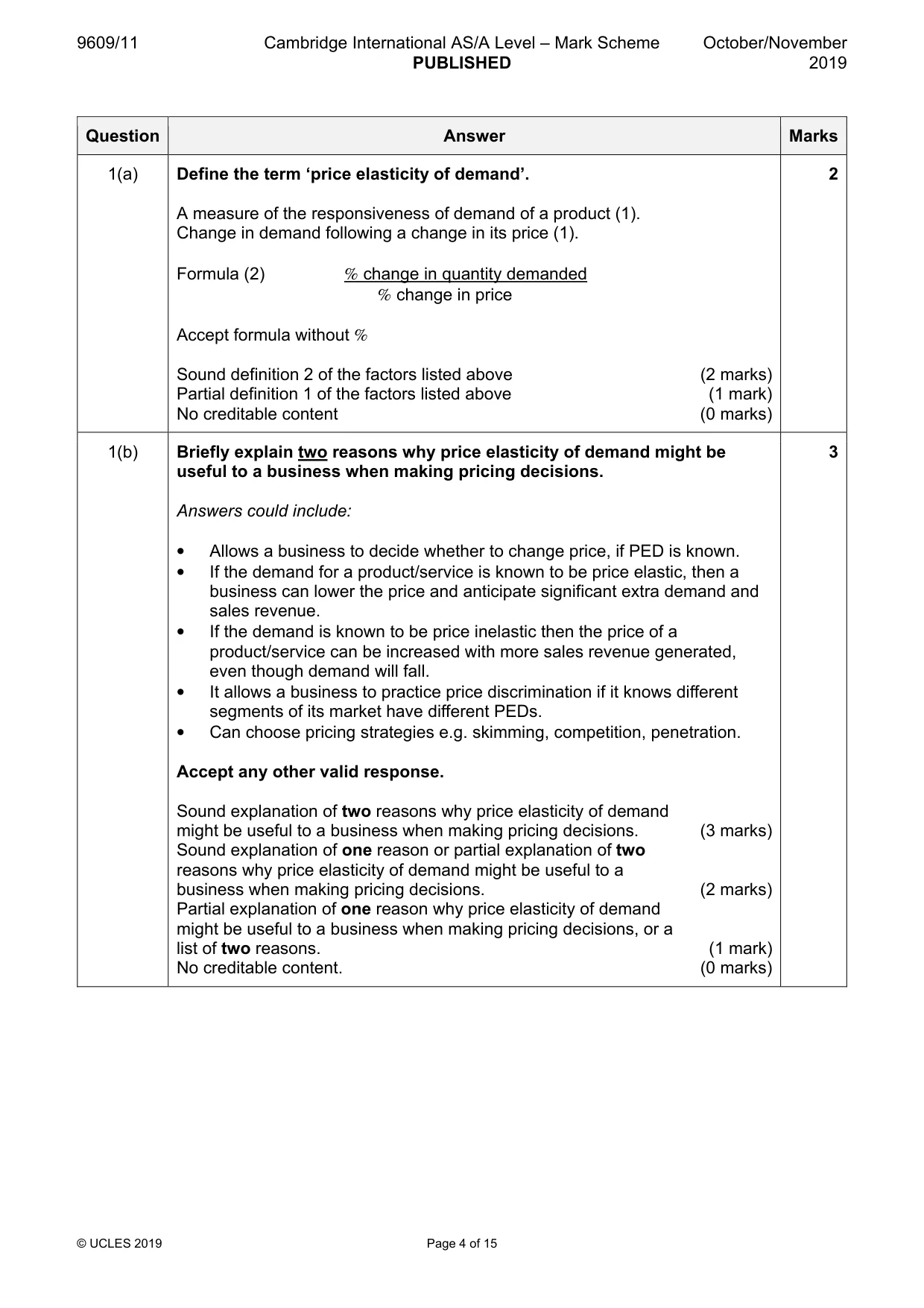
9609/11 Cambridge International AS/A Level – Mark Scheme PUBLISHED October/November 2019 © UCLES 2019 Page 3 of 15 9609 Paper 1 Specific Marking Principles Marks are awarded for each answer when the following Assessment Objectives (AO) are met. The mark scheme for each answer indicates when and how each AO can be met. AO1 – Demonstrate knowledge and understanding of business concepts. The focus in Section A of the Examination Paper is on this first AO. a) Questions 1, 2, and 4 will meet this AO using definitions and explanations of business concepts. b) Question 3 provides an opportunity for the application and a more developed explanation of a business concept. The 4–5-mark level specifically provides for this more developed explanation. In Section B of the Examination Paper a) Questions 5, 6, and 7 still require supporting Knowledge and Understanding (AO1), but there is now a focus on Application (AO2), Analysis (AO3), and Evaluation (AO4). These skills are set out below: AO2 – Apply knowledge and understanding of business concepts to general and specific situations and contexts. a) Where a specific business or context is named in the question then the candidate is required to relate answers specifically to this business or context. b) It is not sufficient to merely repeat the name of the business or the context. AO3 – Analyse business problems, issues, situations and contexts, through a discussion and interpretation of evidence, debate, theory, impact and consequence, to produce reasoned and coherent arguments. a) Level 3 answers will likely use terms such as – because, leads to, therefore, so that, as a result, consequently – thereby showing analytical development for AO3. AO4 – Limited Evaluation is given a) When an attempt is made, (probably in a concluding section of an answer), to address and comment on the value and validity of the previous analysis. b) These comments may be quite brief and be more opinionated than reasoned. c) A mere concluding summary of preceding analysis is, however, not evaluation. AO4 – Evaluation occurs a) When an answer comments on the validity/significance of previous analysis in an evidence based and reasoned way. b) This often leads to the presentation of appropriate substantiated judgements, decisions, or recommendations.
Mark scheme, page 4
9609/11 Cambridge International AS/A Level – Mark Scheme PUBLISHED October/November 2019 © UCLES 2019 Page 4 of 15 Question Answer Marks 1(a) Define the term ‘price elasticity of demand’. A measure of the responsiveness of demand of a product (1). Change in demand following a change in its price (1). Formula (2) % change in quantity demanded % change in price Accept formula without % Sound definition 2 of the factors listed above (2 marks) Partial definition 1 of the factors listed above (1 mark) No creditable content (0 marks) 2 1(b) Briefly explain two reasons why price elasticity of demand might be useful to a business when making pricing decisions. Answers could include: • Allows a business to decide whether to change price, if PED is known. • If the demand for a product/service is known to be price elastic, then a business can lower the price and anticipate significant extra demand and sales revenue. • If the demand is known to be price inelastic then the price of a product/service can be increased with more sales revenue generated, even though demand will fall. • It allows a business to practice price discrimination if it knows different segments of its market have different PEDs. • Can choose pricing strategies e.g. skimming, competition, penetration. Accept any other valid response. Sound explanation of two reasons why price elasticity of demand might be useful to a business when making pricing decisions. (3 marks) Sound explanation of one reason or partial explanation of two reasons why price elasticity of demand might be useful to a business when making pricing decisions. (2 marks) Partial explanation of one reason why price elasticity of demand might be useful to a business when making pricing decisions, or a list of two reasons. (1 mark) No creditable content. (0 marks) 3
Mark scheme, page 5
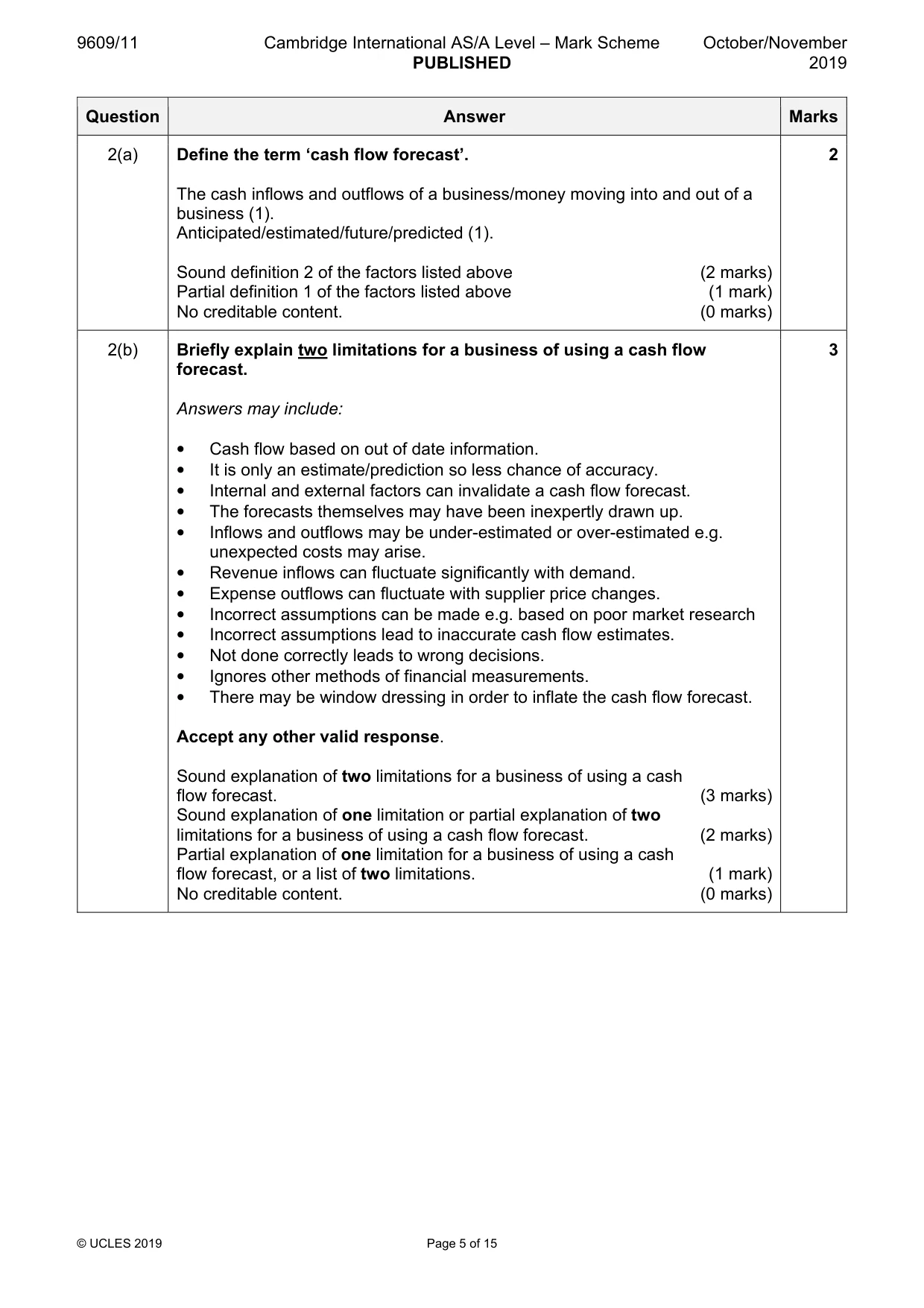
9609/11 Cambridge International AS/A Level – Mark Scheme PUBLISHED October/November 2019 © UCLES 2019 Page 5 of 15 Question Answer Marks 2(a) Define the term ‘cash flow forecast’. The cash inflows and outflows of a business/money moving into and out of a business (1). Anticipated/estimated/future/predicted (1). Sound definition 2 of the factors listed above (2 marks) Partial definition 1 of the factors listed above (1 mark) No creditable content. (0 marks) 2 2(b) Briefly explain two limitations for a business of using a cash flow forecast. Answers may include: • Cash flow based on out of date information. • It is only an estimate/prediction so less chance of accuracy. • Internal and external factors can invalidate a cash flow forecast. • The forecasts themselves may have been inexpertly drawn up. • Inflows and outflows may be under-estimated or over-estimated e.g. unexpected costs may arise. • Revenue inflows can fluctuate significantly with demand. • Expense outflows can fluctuate with supplier price changes. • Incorrect assumptions can be made e.g. based on poor market research • Incorrect assumptions lead to inaccurate cash flow estimates. • Not done correctly leads to wrong decisions. • Ignores other methods of financial measurements. • There may be window dressing in order to inflate the cash flow forecast. Accept any other valid response. Sound explanation of two limitations for a business of using a cash flow forecast. (3 marks) Sound explanation of one limitation or partial explanation of two limitations for a business of using a cash flow forecast. (2 marks) Partial explanation of one limitation for a business of using a cash flow forecast, or a list of two limitations. (1 mark) No creditable content. (0 marks) 3
Mark scheme, page 6
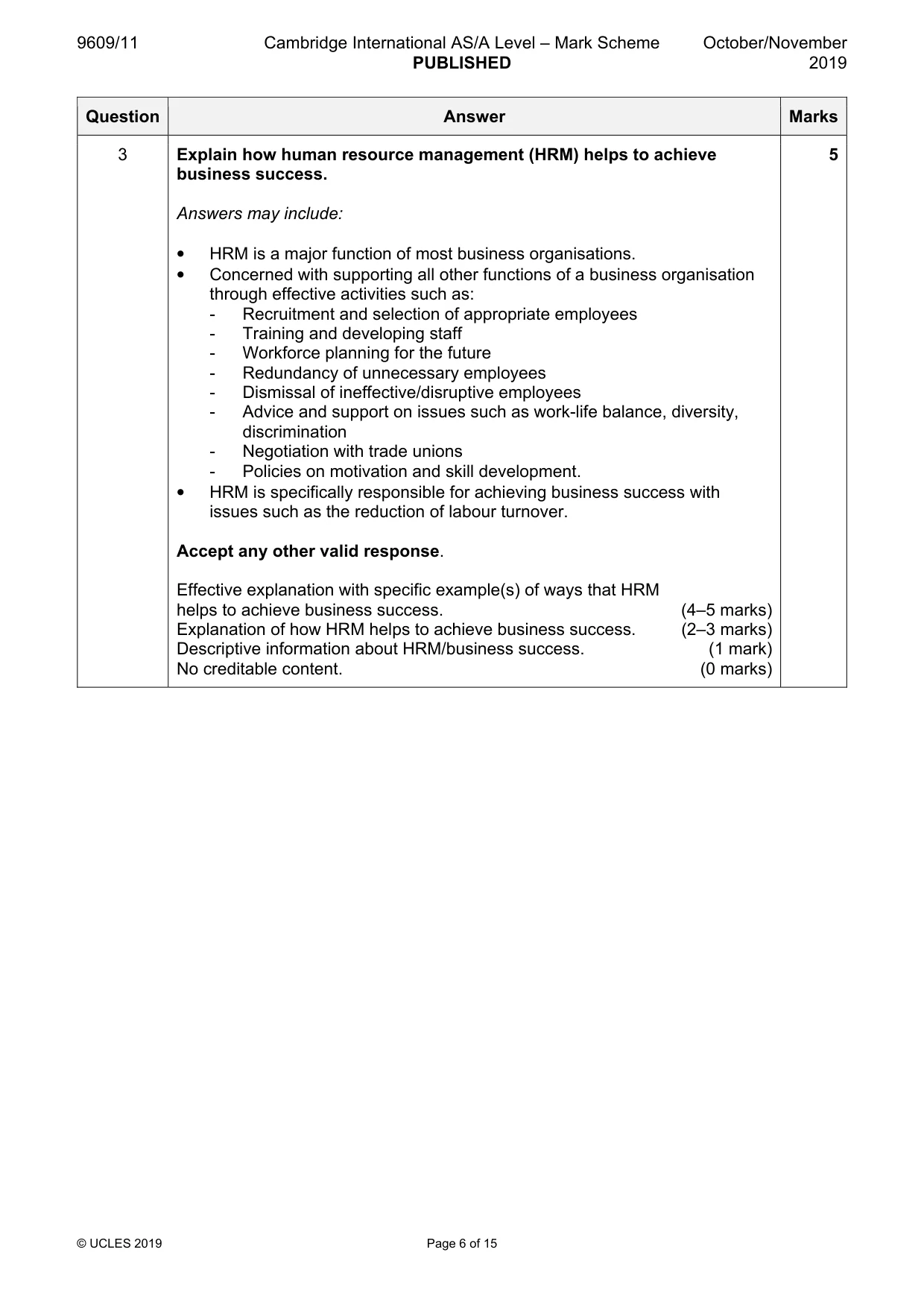
9609/11 Cambridge International AS/A Level – Mark Scheme PUBLISHED October/November 2019 © UCLES 2019 Page 6 of 15 Question Answer Marks 3 Explain how human resource management (HRM) helps to achieve business success. Answers may include: • HRM is a major function of most business organisations. • Concerned with supporting all other functions of a business organisation through effective activities such as: - Recruitment and selection of appropriate employees - Training and developing staff - Workforce planning for the future - Redundancy of unnecessary employees - Dismissal of ineffective/disruptive employees - Advice and support on issues such as work-life balance, diversity, discrimination - Negotiation with trade unions - Policies on motivation and skill development. • HRM is specifically responsible for achieving business success with issues such as the reduction of labour turnover. Accept any other valid response. Effective explanation with specific example(s) of ways that HRM helps to achieve business success. (4–5 marks) Explanation of how HRM helps to achieve business success. (2–3 marks) Descriptive information about HRM/business success. (1 mark) No creditable content. (0 marks) 5
Mark scheme, page 7
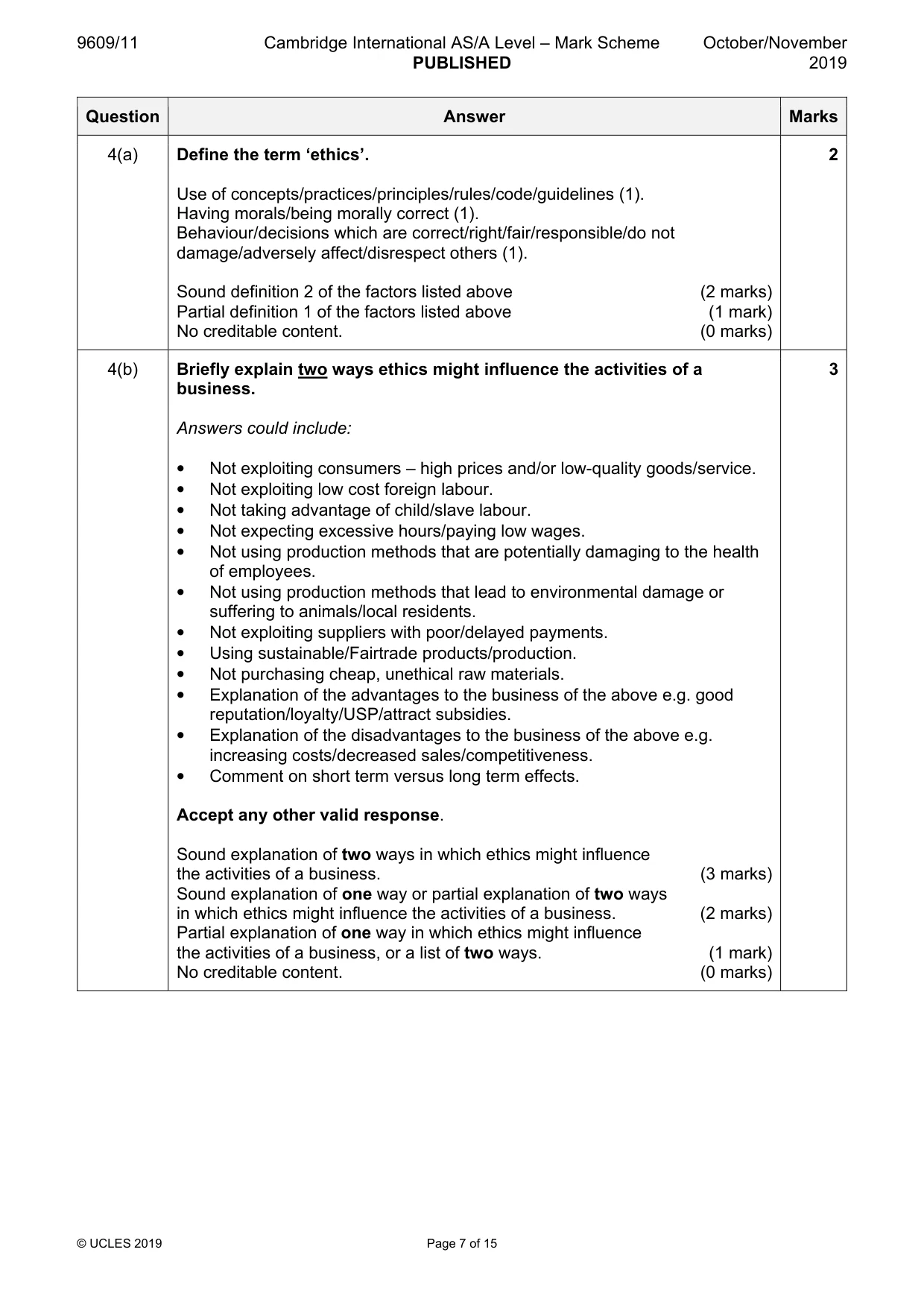
9609/11 Cambridge International AS/A Level – Mark Scheme PUBLISHED October/November 2019 © UCLES 2019 Page 7 of 15 Question Answer Marks 4(a) Define the term ‘ethics’. Use of concepts/practices/principles/rules/code/guidelines (1). Having morals/being morally correct (1). Behaviour/decisions which are correct/right/fair/responsible/do not damage/adversely affect/disrespect others (1). Sound definition 2 of the factors listed above (2 marks) Partial definition 1 of the factors listed above (1 mark) No creditable content. (0 marks) 2 4(b) Briefly explain two ways ethics might influence the activities of a business. Answers could include: • Not exploiting consumers – high prices and/or low-quality goods/service. • Not exploiting low cost foreign labour. • Not taking advantage of child/slave labour. • Not expecting excessive hours/paying low wages. • Not using production methods that are potentially damaging to the health of employees. • Not using production methods that lead to environmental damage or suffering to animals/local residents. • Not exploiting suppliers with poor/delayed payments. • Using sustainable/Fairtrade products/production. • Not purchasing cheap, unethical raw materials. • Explanation of the advantages to the business of the above e.g. good reputation/loyalty/USP/attract subsidies. • Explanation of the disadvantages to the business of the above e.g. increasing costs/decreased sales/competitiveness. • Comment on short term versus long term effects. Accept any other valid response. Sound explanation of two ways in which ethics might influence the activities of a business. (3 marks) Sound explanation of one way or partial explanation of two ways in which ethics might influence the activities of a business. (2 marks) Partial explanation of one way in which ethics might influence the activities of a business, or a list of two ways. (1 mark) No creditable content. (0 marks) 3
Mark scheme, page 8
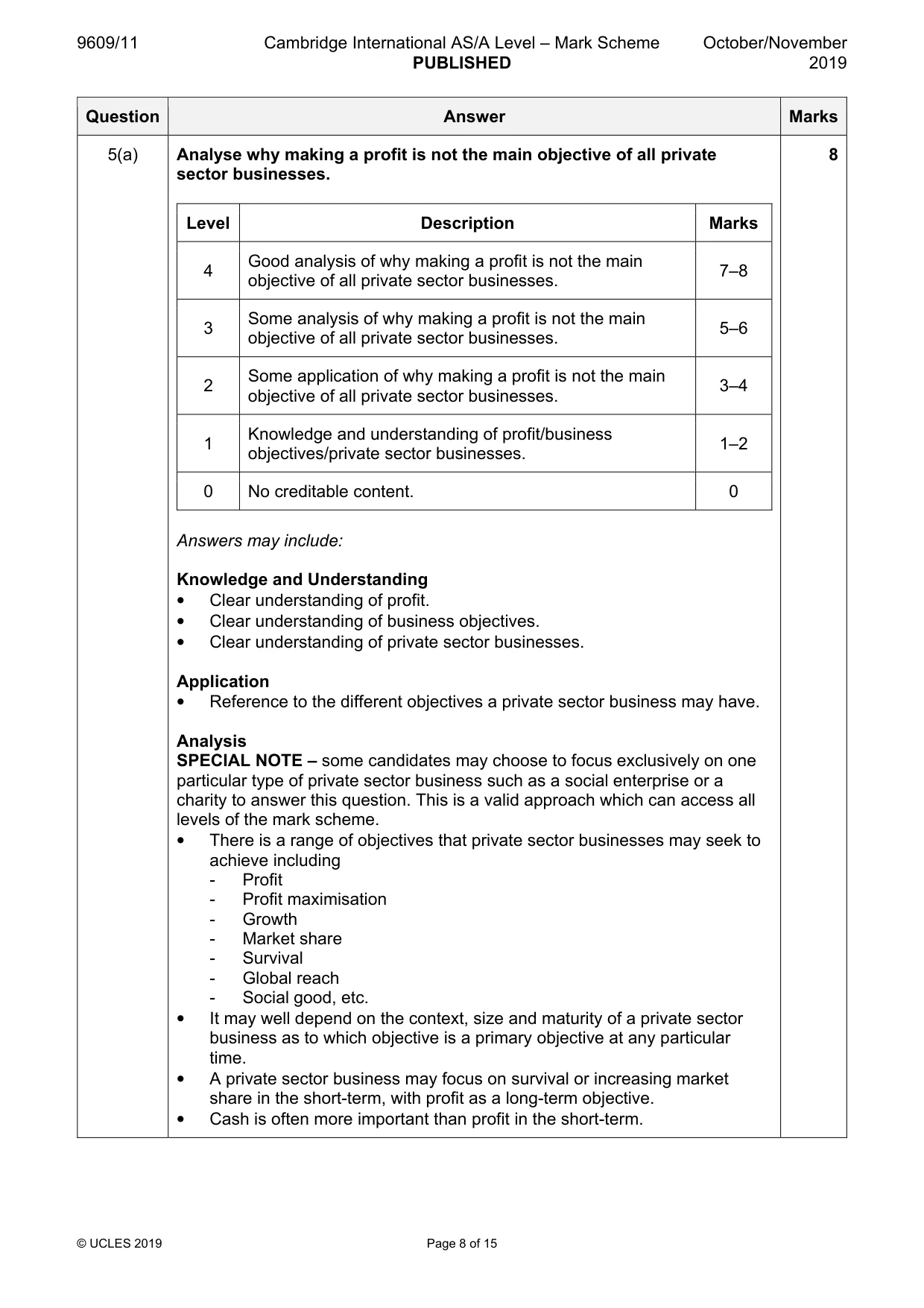
9609/11 Cambridge International AS/A Level – Mark Scheme PUBLISHED October/November 2019 © UCLES 2019 Page 8 of 15 Question Answer Marks 5(a) Analyse why making a profit is not the main objective of all private sector businesses. Level Description Marks 4 Good analysis of why making a profit is not the main objective of all private sector businesses. 7–8 3 Some analysis of why making a profit is not the main objective of all private sector businesses. 5–6 2 Some application of why making a profit is not the main objective of all private sector businesses. 3–4 1 Knowledge and understanding of profit/business objectives/private sector businesses. 1–2 0 No creditable content. 0 Answers may include: Knowledge and Understanding • Clear understanding of profit. • Clear understanding of business objectives. • Clear understanding of private sector businesses. Application • Reference to the different objectives a private sector business may have. Analysis SPECIAL NOTE – some candidates may choose to focus exclusively on one particular type of private sector business such as a social enterprise or a charity to answer this question. This is a valid approach which can access all levels of the mark scheme. • There is a range of objectives that private sector businesses may seek to achieve including - Profit - Profit maximisation - Growth - Market share - Survival - Global reach - Social good, etc. • It may well depend on the context, size and maturity of a private sector business as to which objective is a primary objective at any particular time. • A private sector business may focus on survival or increasing market share in the short-term, with profit as a long-term objective. • Cash is often more important than profit in the short-term. 8
Mark scheme, page 9
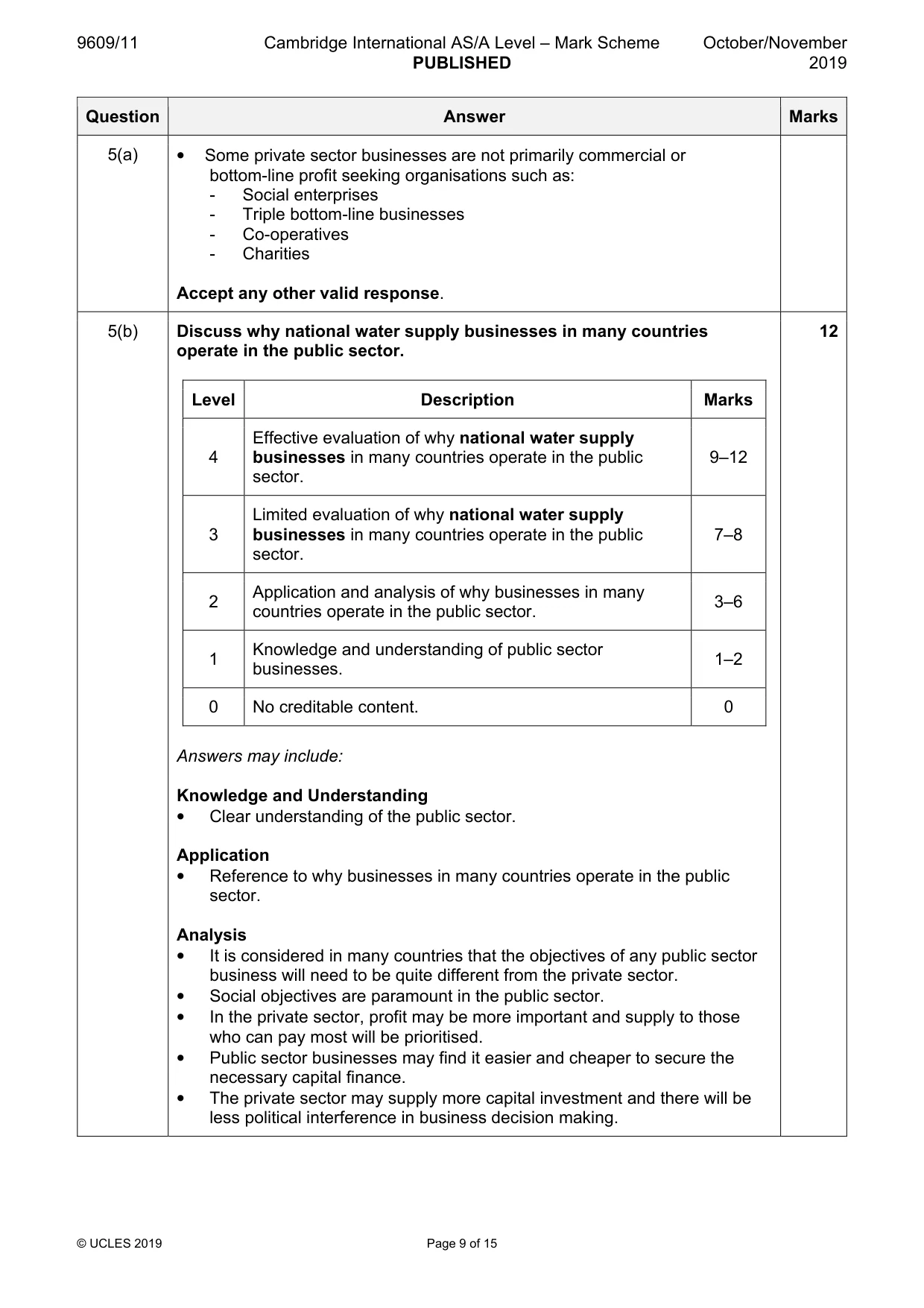
9609/11 Cambridge International AS/A Level – Mark Scheme PUBLISHED October/November 2019 © UCLES 2019 Page 9 of 15 Question Answer Marks 5(a) • Some private sector businesses are not primarily commercial or bottom-line profit seeking organisations such as: - Social enterprises - Triple bottom-line businesses - Co-operatives - Charities Accept any other valid response. 5(b) Discuss why national water supply businesses in many countries operate in the public sector. Level Description Marks 4 Effective evaluation of why national water supply businesses in many countries operate in the public sector. 9–12 3 Limited evaluation of why national water supply businesses in many countries operate in the public sector. 7–8 2 Application and analysis of why businesses in many countries operate in the public sector. 3–6 1 Knowledge and understanding of public sector businesses. 1–2 0 No creditable content. 0 Answers may include: Knowledge and Understanding • Clear understanding of the public sector. Application • Reference to why businesses in many countries operate in the public sector. Analysis • It is considered in many countries that the objectives of any public sector business will need to be quite different from the private sector. • Social objectives are paramount in the public sector. • In the private sector, profit may be more important and supply to those who can pay most will be prioritised. • Public sector businesses may find it easier and cheaper to secure the necessary capital finance. • The private sector may supply more capital investment and there will be less political interference in business decision making. 12
Mark scheme, page 10
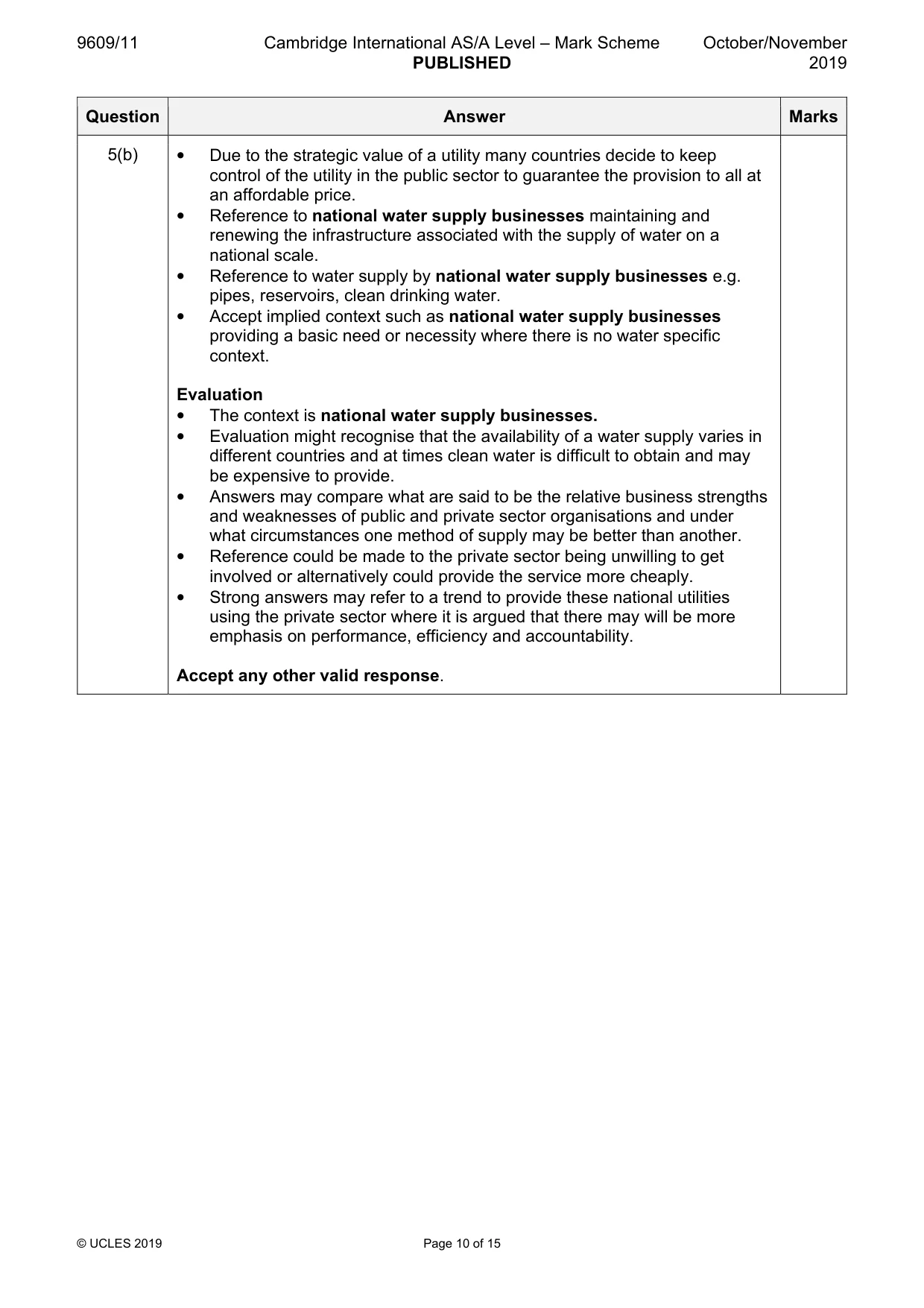
9609/11 Cambridge International AS/A Level – Mark Scheme PUBLISHED October/November 2019 © UCLES 2019 Page 10 of 15 Question Answer Marks 5(b) • Due to the strategic value of a utility many countries decide to keep control of the utility in the public sector to guarantee the provision to all at an affordable price. • Reference to national water supply businesses maintaining and renewing the infrastructure associated with the supply of water on a national scale. • Reference to water supply by national water supply businesses e.g. pipes, reservoirs, clean drinking water. • Accept implied context such as national water supply businesses providing a basic need or necessity where there is no water specific context. Evaluation • The context is national water supply businesses. • Evaluation might recognise that the availability of a water supply varies in different countries and at times clean water is difficult to obtain and may be expensive to provide. • Answers may compare what are said to be the relative business strengths and weaknesses of public and private sector organisations and under what circumstances one method of supply may be better than another. • Reference could be made to the private sector being unwilling to get involved or alternatively could provide the service more cheaply. • Strong answers may refer to a trend to provide these national utilities using the private sector where it is argued that there may will be more emphasis on performance, efficiency and accountability. Accept any other valid response.
Mark scheme, page 11
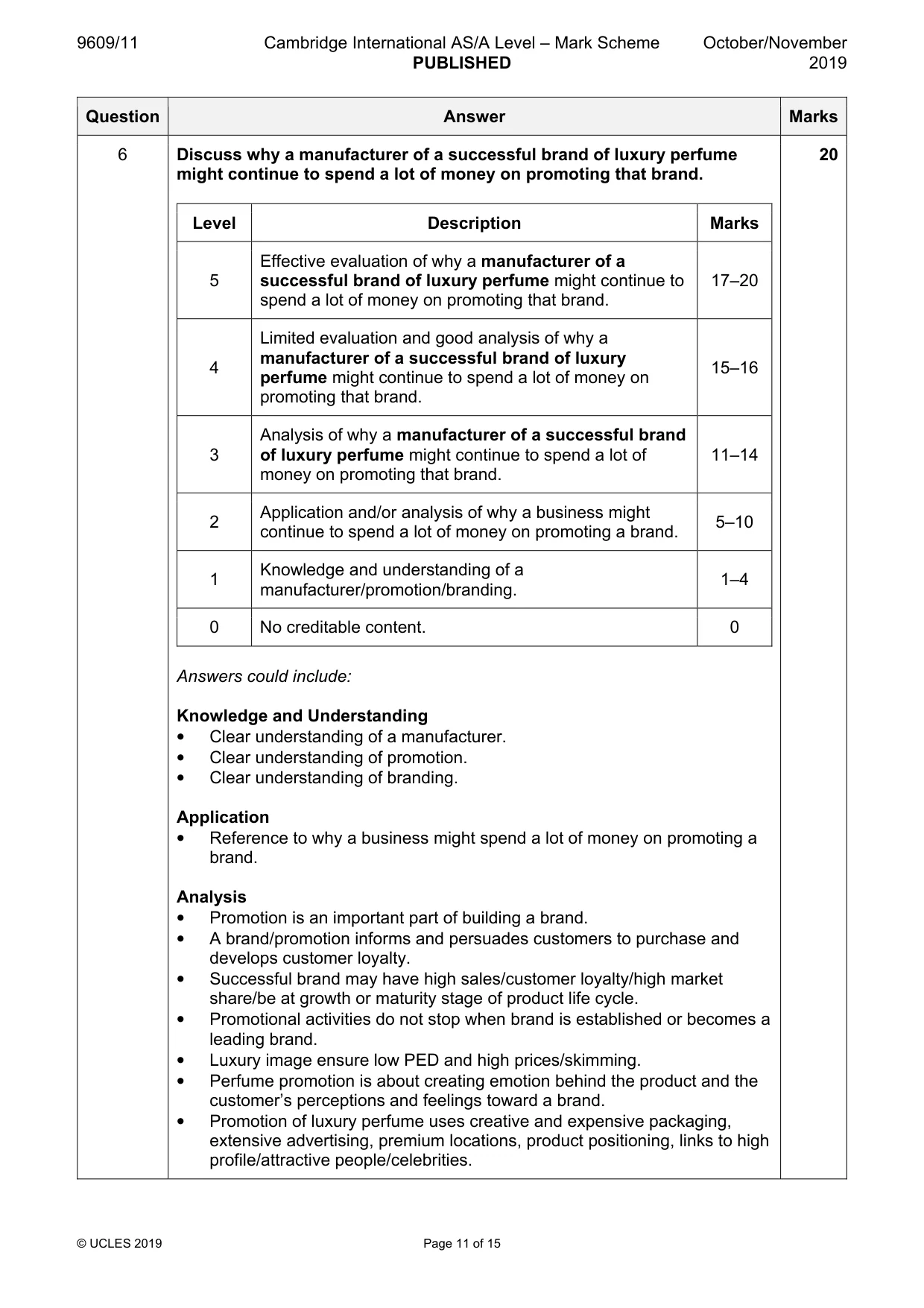
9609/11 Cambridge International AS/A Level – Mark Scheme PUBLISHED October/November 2019 © UCLES 2019 Page 11 of 15 Question Answer Marks 6 Discuss why a manufacturer of a successful brand of luxury perfume might continue to spend a lot of money on promoting that brand. Level Description Marks 5 Effective evaluation of why a manufacturer of a successful brand of luxury perfume might continue to spend a lot of money on promoting that brand. 17–20 4 Limited evaluation and good analysis of why a manufacturer of a successful brand of luxury perfume might continue to spend a lot of money on promoting that brand. 15–16 3 Analysis of why a manufacturer of a successful brand of luxury perfume might continue to spend a lot of money on promoting that brand. 11–14 2 Application and/or analysis of why a business might continue to spend a lot of money on promoting a brand. 5–10 1 Knowledge and understanding of a manufacturer/promotion/branding. 1–4 0 No creditable content. 0 Answers could include: Knowledge and Understanding • Clear understanding of a manufacturer. • Clear understanding of promotion. • Clear understanding of branding. Application • Reference to why a business might spend a lot of money on promoting a brand. Analysis • Promotion is an important part of building a brand. • A brand/promotion informs and persuades customers to purchase and develops customer loyalty. • Successful brand may have high sales/customer loyalty/high market share/be at growth or maturity stage of product life cycle. • Promotional activities do not stop when brand is established or becomes a leading brand. • Luxury image ensure low PED and high prices/skimming. • Perfume promotion is about creating emotion behind the product and the customer’s perceptions and feelings toward a brand. • Promotion of luxury perfume uses creative and expensive packaging, extensive advertising, premium locations, product positioning, links to high profile/attractive people/celebrities. 20
Mark scheme, page 12
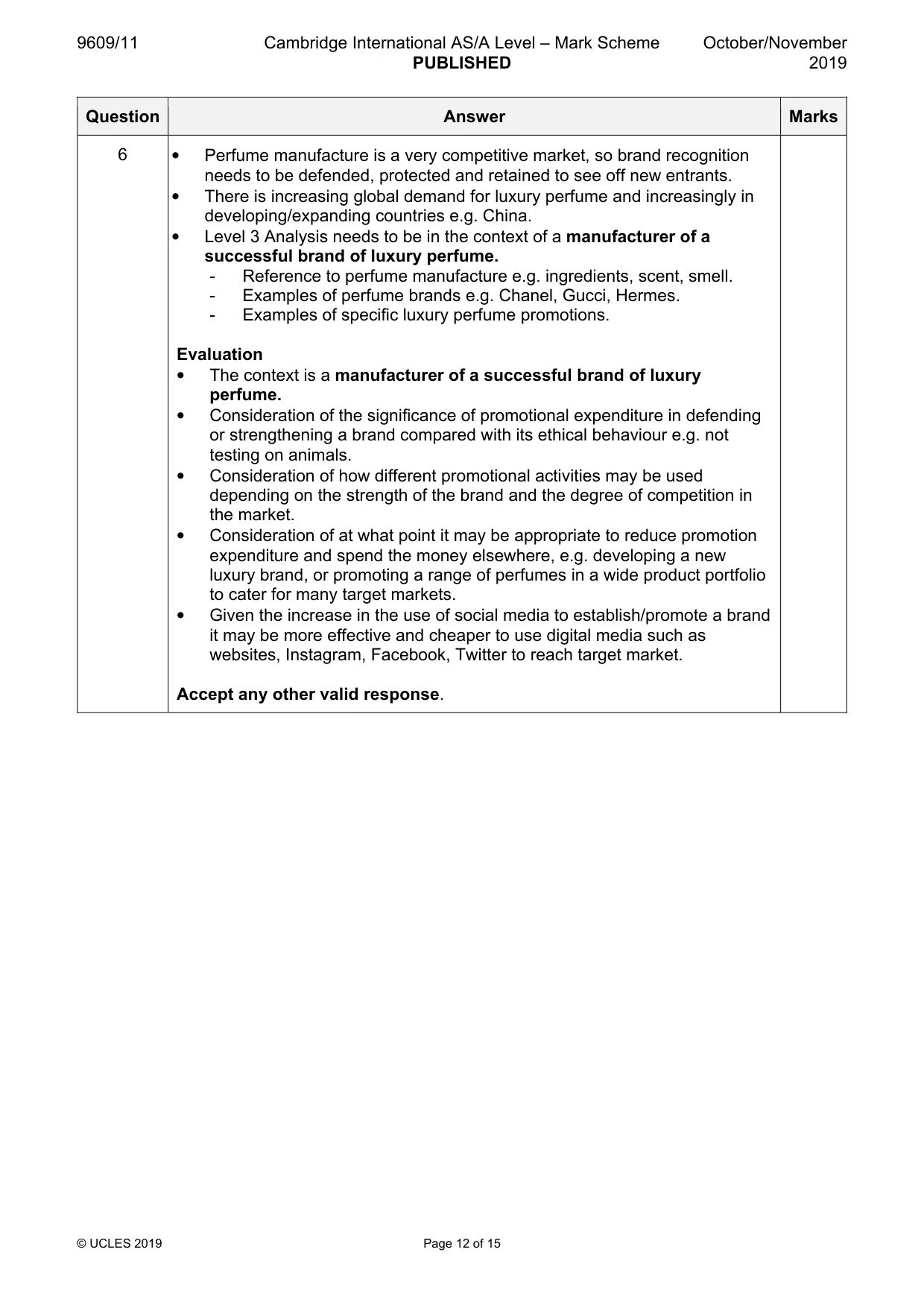
9609/11 Cambridge International AS/A Level – Mark Scheme PUBLISHED October/November 2019 © UCLES 2019 Page 12 of 15 Question Answer Marks 6 • Perfume manufacture is a very competitive market, so brand recognition needs to be defended, protected and retained to see off new entrants. • There is increasing global demand for luxury perfume and increasingly in developing/expanding countries e.g. China. • Level 3 Analysis needs to be in the context of a manufacturer of a successful brand of luxury perfume. - Reference to perfume manufacture e.g. ingredients, scent, smell. - Examples of perfume brands e.g. Chanel, Gucci, Hermes. - Examples of specific luxury perfume promotions. Evaluation • The context is a manufacturer of a successful brand of luxury perfume. • Consideration of the significance of promotional expenditure in defending or strengthening a brand compared with its ethical behaviour e.g. not testing on animals. • Consideration of how different promotional activities may be used depending on the strength of the brand and the degree of competition in the market. • Consideration of at what point it may be appropriate to reduce promotion expenditure and spend the money elsewhere, e.g. developing a new luxury brand, or promoting a range of perfumes in a wide product portfolio to cater for many target markets. • Given the increase in the use of social media to establish/promote a brand it may be more effective and cheaper to use digital media such as websites, Instagram, Facebook, Twitter to reach target market. Accept any other valid response.
Mark scheme, page 13
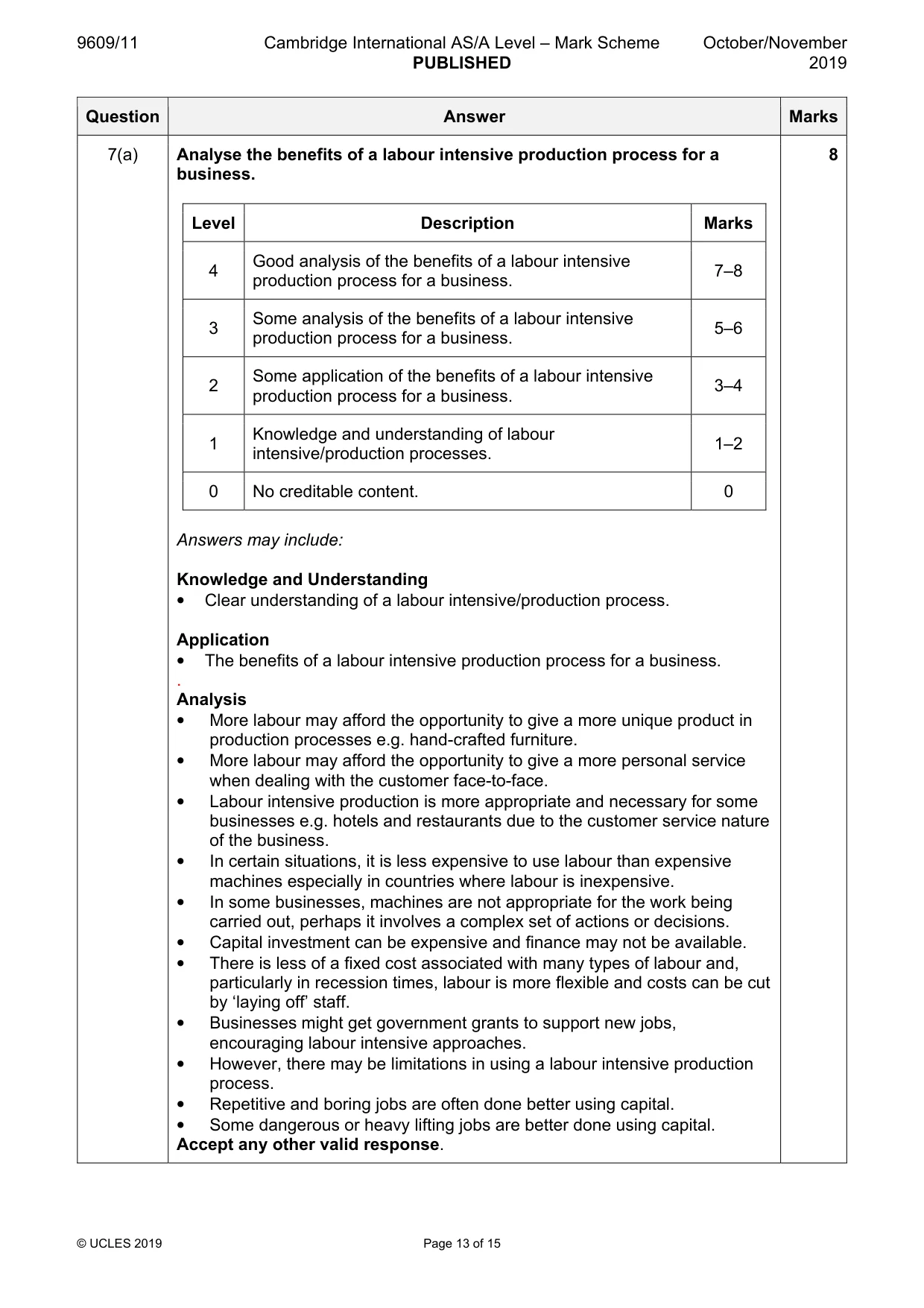
9609/11 Cambridge International AS/A Level – Mark Scheme PUBLISHED October/November 2019 © UCLES 2019 Page 13 of 15 Question Answer Marks 7(a) Analyse the benefits of a labour intensive production process for a business. Level Description Marks 4 Good analysis of the benefits of a labour intensive production process for a business. 7–8 3 Some analysis of the benefits of a labour intensive production process for a business. 5–6 2 Some application of the benefits of a labour intensive production process for a business. 3–4 1 Knowledge and understanding of labour intensive/production processes. 1–2 0 No creditable content. 0 Answers may include: Knowledge and Understanding • Clear understanding of a labour intensive/production process. Application • The benefits of a labour intensive production process for a business. . Analysis • More labour may afford the opportunity to give a more unique product in production processes e.g. hand-crafted furniture. • More labour may afford the opportunity to give a more personal service when dealing with the customer face-to-face. • Labour intensive production is more appropriate and necessary for some businesses e.g. hotels and restaurants due to the customer service nature of the business. • In certain situations, it is less expensive to use labour than expensive machines especially in countries where labour is inexpensive. • In some businesses, machines are not appropriate for the work being carried out, perhaps it involves a complex set of actions or decisions. • Capital investment can be expensive and finance may not be available. • There is less of a fixed cost associated with many types of labour and, particularly in recession times, labour is more flexible and costs can be cut by ‘laying off’ staff. • Businesses might get government grants to support new jobs, encouraging labour intensive approaches. • However, there may be limitations in using a labour intensive production process. • Repetitive and boring jobs are often done better using capital. • Some dangerous or heavy lifting jobs are better done using capital. Accept any other valid response. 8
Mark scheme, page 14
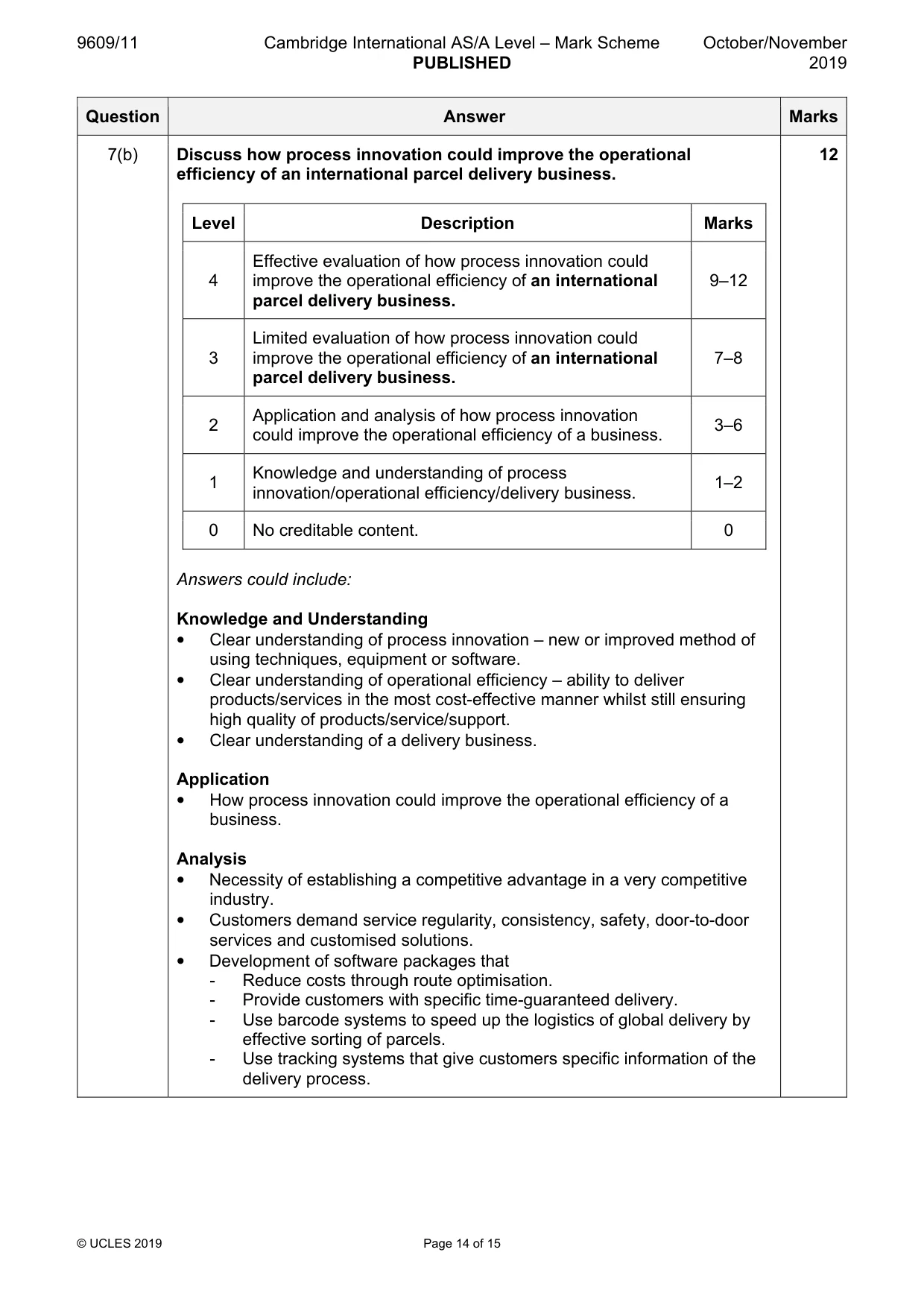
9609/11 Cambridge International AS/A Level – Mark Scheme PUBLISHED October/November 2019 © UCLES 2019 Page 14 of 15 Question Answer Marks 7(b) Discuss how process innovation could improve the operational efficiency of an international parcel delivery business. Level Description Marks 4 Effective evaluation of how process innovation could improve the operational efficiency of an international parcel delivery business. 9–12 3 Limited evaluation of how process innovation could improve the operational efficiency of an international parcel delivery business. 7–8 2 Application and analysis of how process innovation could improve the operational efficiency of a business. 3–6 1 Knowledge and understanding of process innovation/operational efficiency/delivery business. 1–2 0 No creditable content. 0 Answers could include: Knowledge and Understanding • Clear understanding of process innovation – new or improved method of using techniques, equipment or software. • Clear understanding of operational efficiency – ability to deliver products/services in the most cost-effective manner whilst still ensuring high quality of products/service/support. • Clear understanding of a delivery business. Application • How process innovation could improve the operational efficiency of a business. Analysis • Necessity of establishing a competitive advantage in a very competitive industry. • Customers demand service regularity, consistency, safety, door-to-door services and customised solutions. • Development of software packages that - Reduce costs through route optimisation. - Provide customers with specific time-guaranteed delivery. - Use barcode systems to speed up the logistics of global delivery by effective sorting of parcels. - Use tracking systems that give customers specific information of the delivery process. 12
Mark scheme, page 15
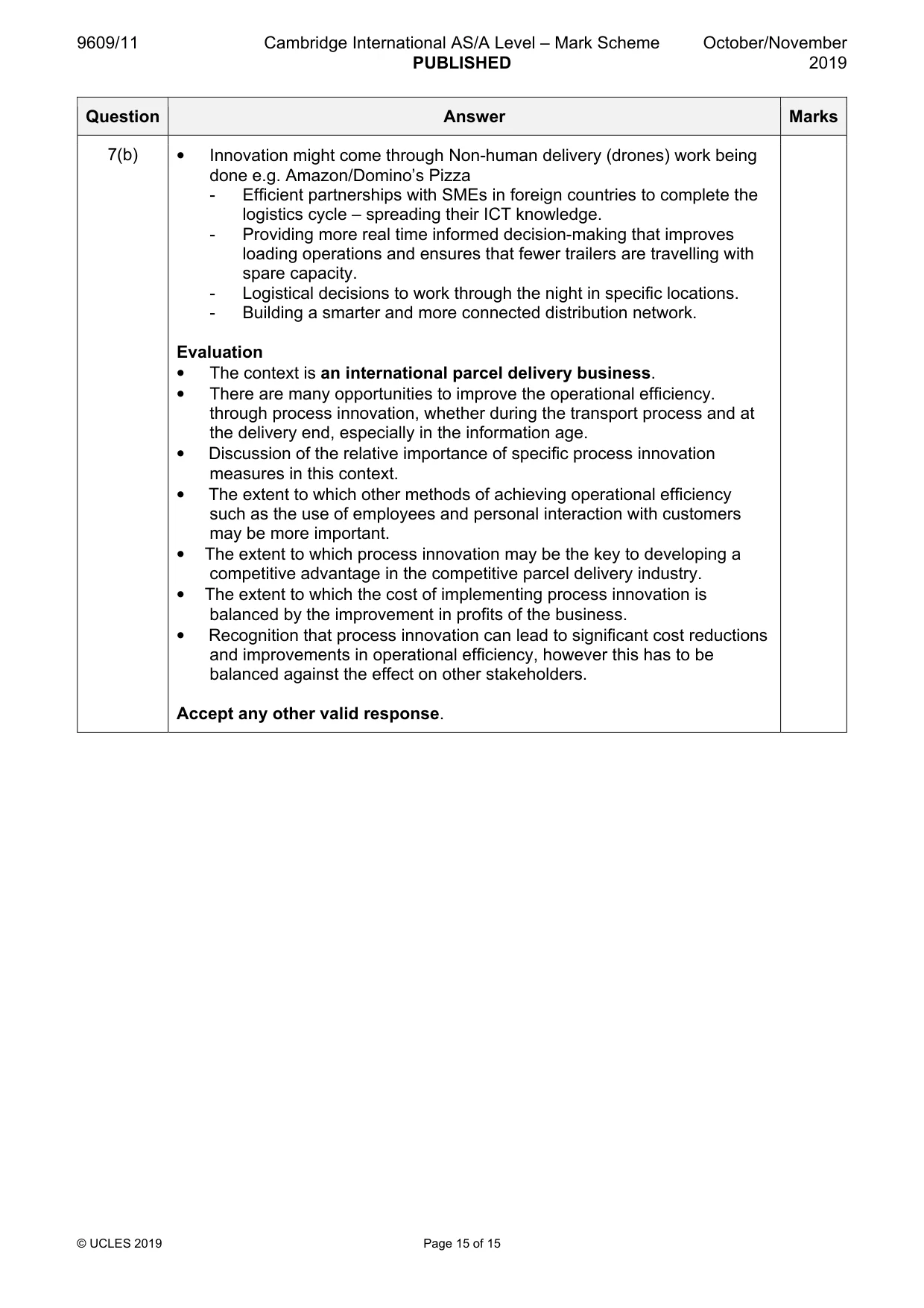
9609/11 Cambridge International AS/A Level – Mark Scheme PUBLISHED October/November 2019 © UCLES 2019 Page 15 of 15 Question Answer Marks 7(b) • Innovation might come through Non-human delivery (drones) work being done e.g. Amazon/Domino’s Pizza - Efficient partnerships with SMEs in foreign countries to complete the logistics cycle – spreading their ICT knowledge. - Providing more real time informed decision-making that improves loading operations and ensures that fewer trailers are travelling with spare capacity. - Logistical decisions to work through the night in specific locations. - Building a smarter and more connected distribution network. Evaluation • The context is an international parcel delivery business. • There are many opportunities to improve the operational efficiency. through process innovation, whether during the transport process and at the delivery end, especially in the information age. • Discussion of the relative importance of specific process innovation measures in this context. • The extent to which other methods of achieving operational efficiency such as the use of employees and personal interaction with customers may be more important. • The extent to which process innovation may be the key to developing a competitive advantage in the competitive parcel delivery industry. • The extent to which the cost of implementing process innovation is balanced by the improvement in profits of the business. • Recognition that process innovation can lead to significant cost reductions and improvements in operational efficiency, however this has to be balanced against the effect on other stakeholders. Accept any other valid response.
What you needed in this session
Cambridge’s own grade thresholds for 2019 Oct/Nov, Paper 1 · Variant 1. A higher threshold means an easier paper — the bar moves with how the cohort did.