Cambridge A Level Business (for first examination in 2016) 9609 — 2019 Oct/Nov Paper 1 · Variant 3
9609/13/O/N/19 · 40 marks · ≈45 min
The question paper and its mark scheme, free to read here and free to download. This is Cambridge’s own paper, exactly as it was sat.
Question paper4 pages


Mark scheme16 pages
Answers below. Sit the paper first if you are practising.

Paper as text
Question paper, page 1
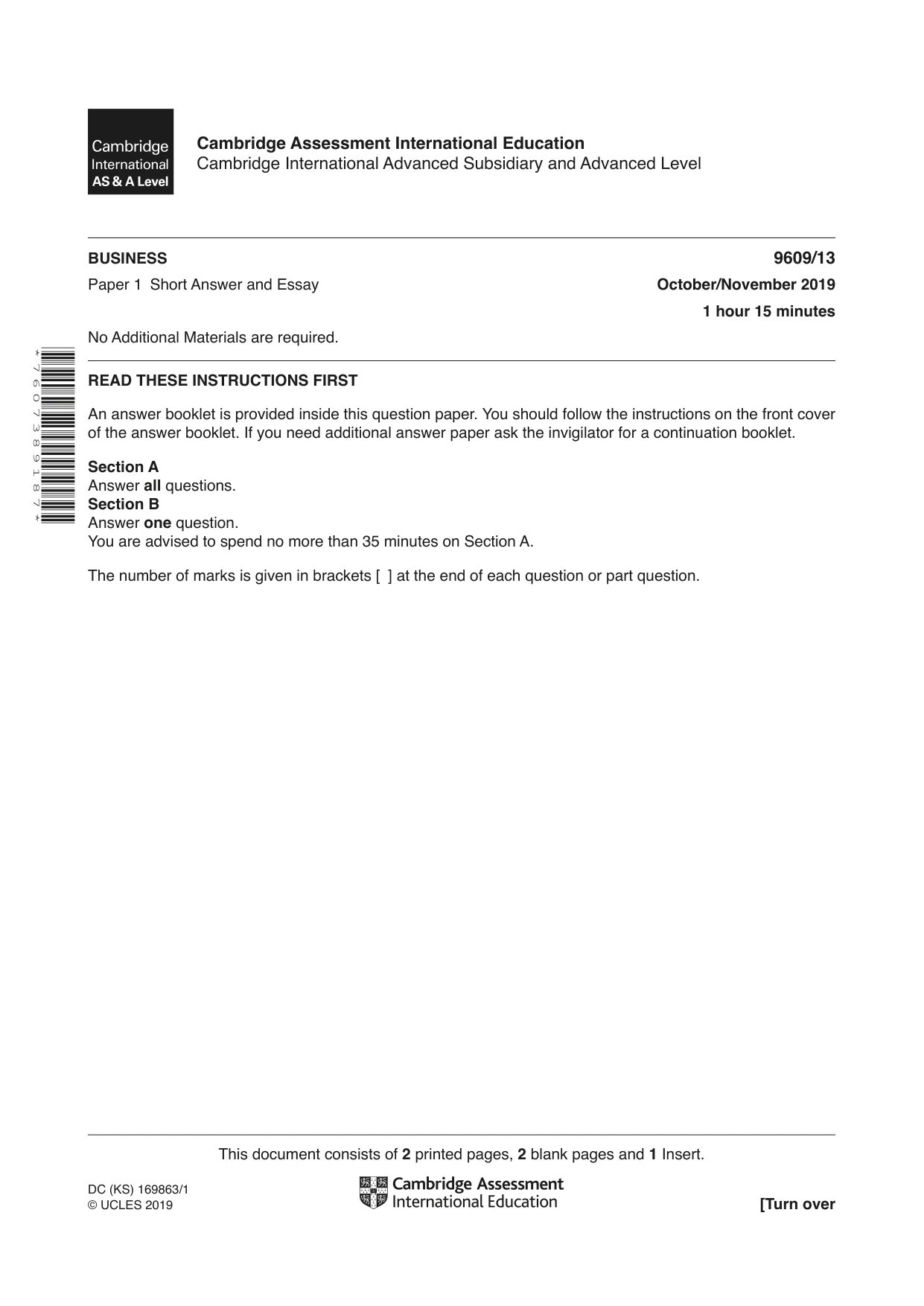
This document consists of 2 printed pages, 2 blank pages and 1 Insert. DC (KS) 169863/1 © UCLES 2019 [Turn over Cambridge Assessment International Education Cambridge International Advanced Subsidiary and Advanced Level * 7 6 0 7 3 8 9 1 8 7 * BUSINESS 9609/13 Paper 1 Short Answer and Essay October/November 2019 1 hour 15 minutes No Additional Materials are required. READ THESE INSTRUCTIONS FIRST An answer booklet is provided inside this question paper. You should follow the instructions on the front cover of the answer booklet. If you need additional answer paper ask the invigilator for a continuation booklet. Section A Answer all questions. Section B Answer one question. You are advised to spend no more than 35 minutes on Section A. The number of marks is given in brackets [ ] at the end of each question or part question.
Question paper, page 2
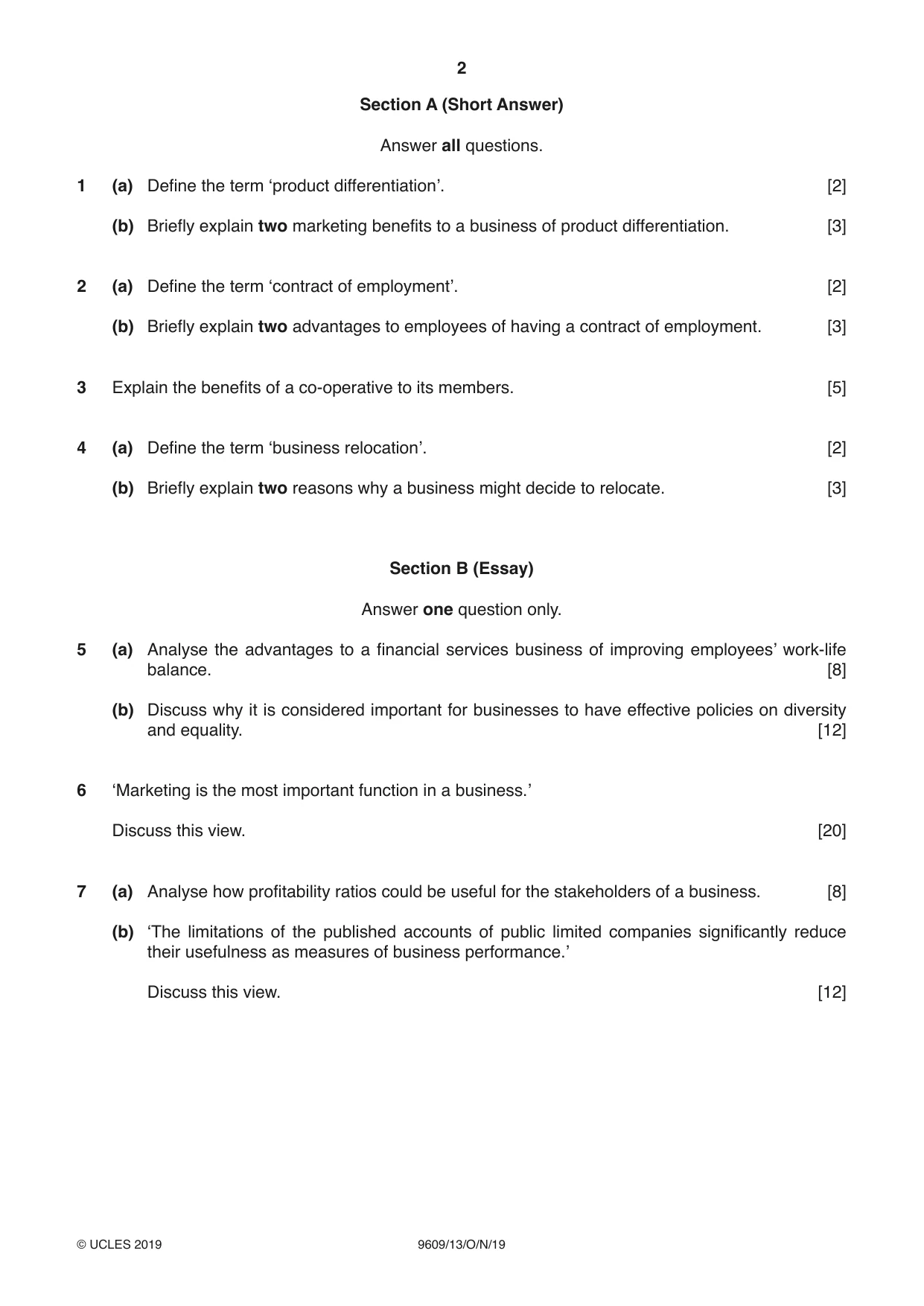
2 9609/13/O/N/19 © UCLES 2019 Section A (Short Answer) Answer all questions. 1 (a) Define the term ‘product differentiation’. [2] (b) Briefly explain two marketing benefits to a business of product differentiation. [3] 2 (a) Define the term ‘contract of employment’. [2] (b) Briefly explain two advantages to employees of having a contract of employment. [3] 3 Explain the benefits of a co-operative to its members. [5] 4 (a) Define the term ‘business relocation’. [2] (b) Briefly explain two reasons why a business might decide to relocate. [3] Section B (Essay) Answer one question only. 5 (a) Analyse the advantages to a financial services business of improving employees’ work-life balance. [8] (b) Discuss why it is considered important for businesses to have effective policies on diversity and equality. [12] 6 ‘Marketing is the most important function in a business.’ Discuss this view. [20] 7 (a) Analyse how profitability ratios could be useful for the stakeholders of a business. [8] (b) ‘The limitations of the published accounts of public limited companies significantly reduce their usefulness as measures of business performance.’ Discuss this view. [12]
Question paper, page 3
3 9609/13/O/N/19 © UCLES 2019 BLANK PAGE
Question paper, page 4
4 9609/13/O/N/19 © UCLES 2019 BLANK PAGE Permission to reproduce items where third-party owned material protected by copyright is included has been sought and cleared where possible. Every reasonable effort has been made by the publisher (UCLES) to trace copyright holders, but if any items requiring clearance have unwittingly been included, the publisher will be pleased to make amends at the earliest possible opportunity. To avoid the issue of disclosure of answer-related information to candidates, all copyright acknowledgements are reproduced online in the Cambridge Assessment International Education Copyright Acknowledgements Booklet. This is produced for each series of examinations and is freely available to download at www.cambridgeinternational.org after the live examination series. Cambridge Assessment International Education is part of the Cambridge Assessment Group. Cambridge Assessment is the brand name of the University of Cambridge Local Examinations Syndicate (UCLES), which itself is a department of the University of Cambridge.
Mark scheme, page 1
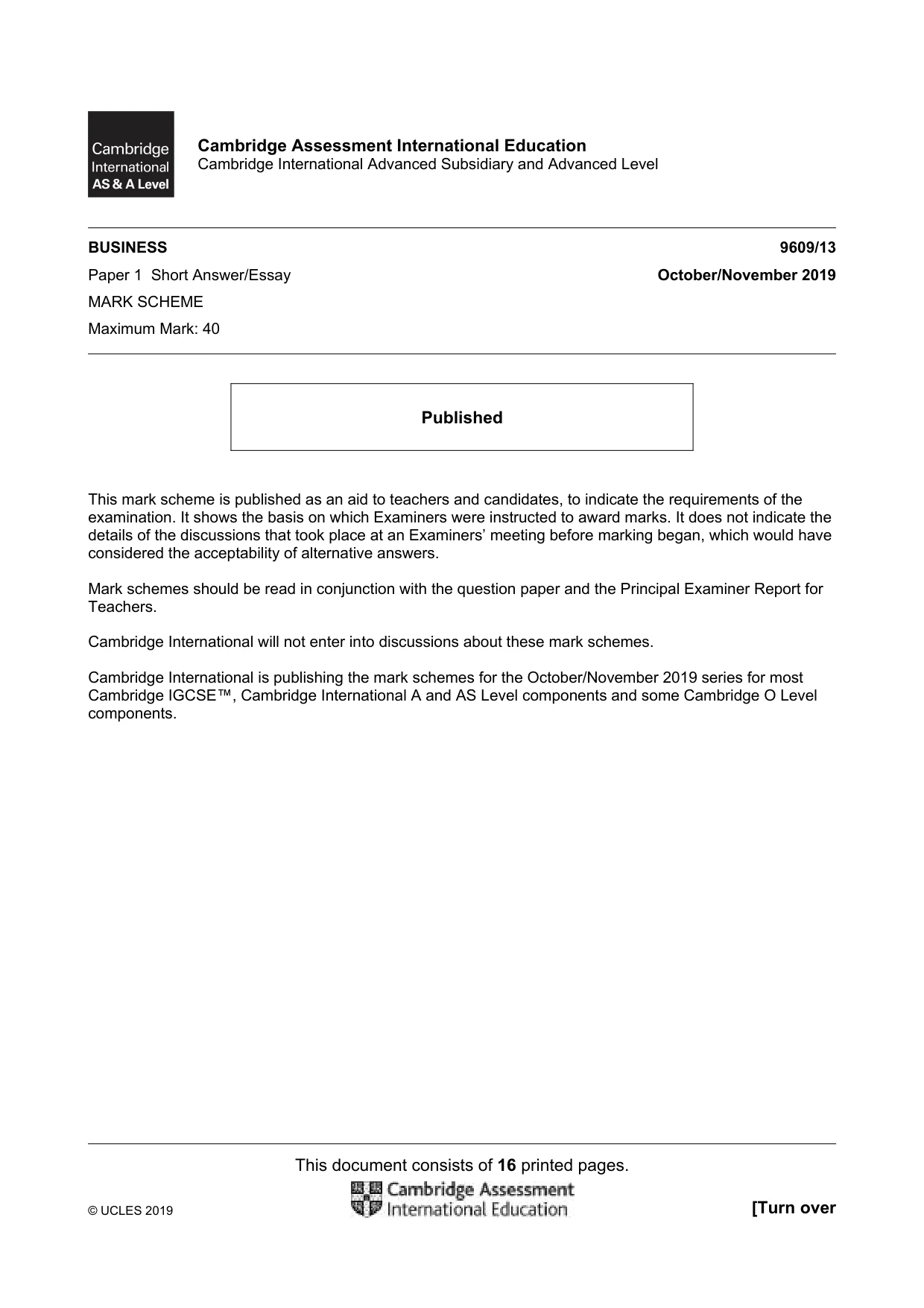
This document consists of 16 printed pages. © UCLES 2019 [Turn over Cambridge Assessment International Education Cambridge International Advanced Subsidiary and Advanced Level BUSINESS 9609/13 Paper 1 Short Answer/Essay October/November 2019 MARK SCHEME Maximum Mark: 40 Published This mark scheme is published as an aid to teachers and candidates, to indicate the requirements of the examination. It shows the basis on which Examiners were instructed to award marks. It does not indicate the details of the discussions that took place at an Examiners’ meeting before marking began, which would have considered the acceptability of alternative answers. Mark schemes should be read in conjunction with the question paper and the Principal Examiner Report for Teachers. Cambridge International will not enter into discussions about these mark schemes. Cambridge International is publishing the mark schemes for the October/November 2019 series for most Cambridge IGCSE™, Cambridge International A and AS Level components and some Cambridge O Level components.
Mark scheme, page 2
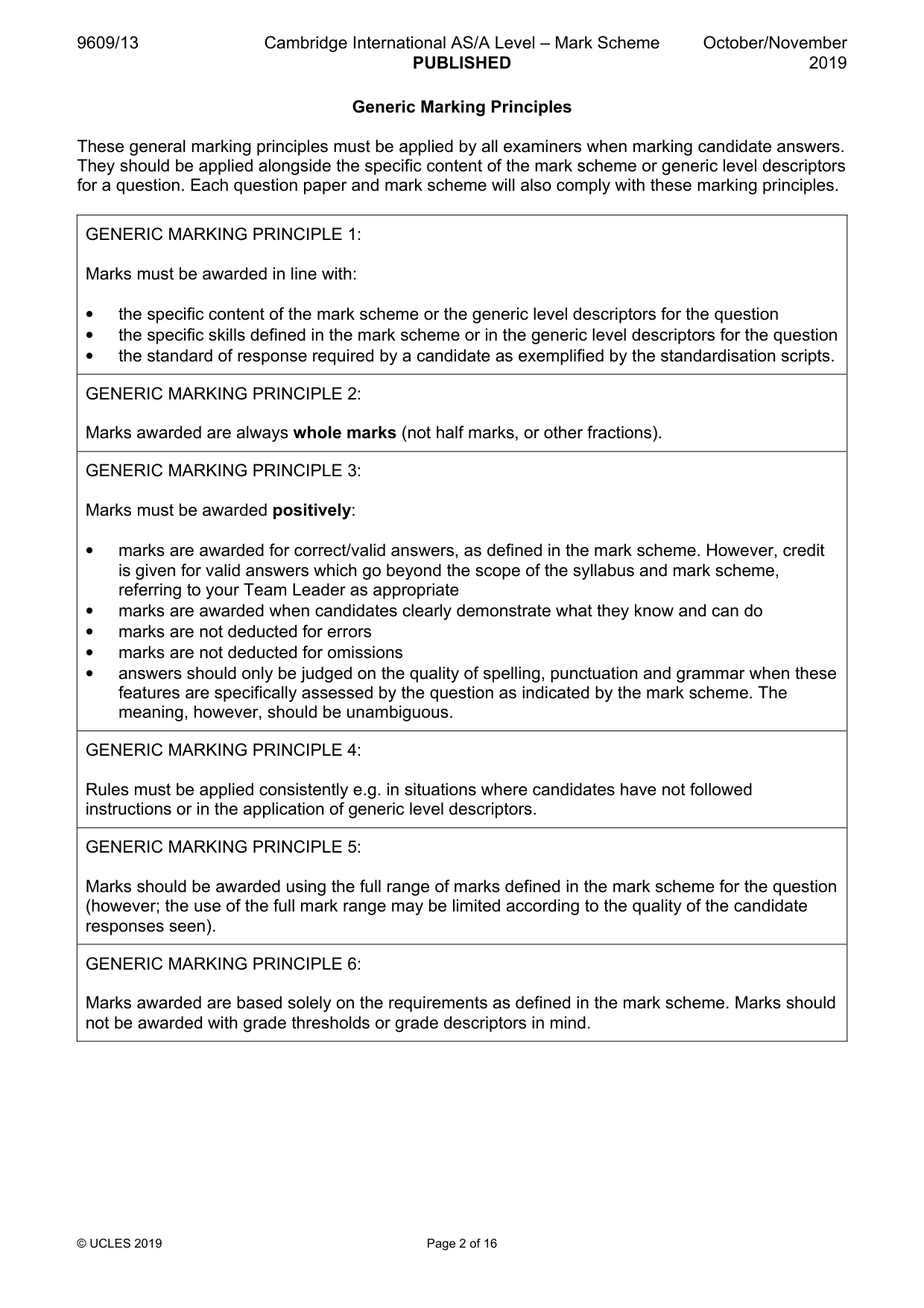
9609/13 Cambridge International AS/A Level – Mark Scheme PUBLISHED October/November 2019 © UCLES 2019 Page 2 of 16 Generic Marking Principles These general marking principles must be applied by all examiners when marking candidate answers. They should be applied alongside the specific content of the mark scheme or generic level descriptors for a question. Each question paper and mark scheme will also comply with these marking principles. GENERIC MARKING PRINCIPLE 1: Marks must be awarded in line with: • the specific content of the mark scheme or the generic level descriptors for the question • the specific skills defined in the mark scheme or in the generic level descriptors for the question • the standard of response required by a candidate as exemplified by the standardisation scripts. GENERIC MARKING PRINCIPLE 2: Marks awarded are always whole marks (not half marks, or other fractions). GENERIC MARKING PRINCIPLE 3: Marks must be awarded positively: • marks are awarded for correct/valid answers, as defined in the mark scheme. However, credit is given for valid answers which go beyond the scope of the syllabus and mark scheme, referring to your Team Leader as appropriate • marks are awarded when candidates clearly demonstrate what they know and can do • marks are not deducted for errors • marks are not deducted for omissions • answers should only be judged on the quality of spelling, punctuation and grammar when these features are specifically assessed by the question as indicated by the mark scheme. The meaning, however, should be unambiguous. GENERIC MARKING PRINCIPLE 4: Rules must be applied consistently e.g. in situations where candidates have not followed instructions or in the application of generic level descriptors. GENERIC MARKING PRINCIPLE 5: Marks should be awarded using the full range of marks defined in the mark scheme for the question (however; the use of the full mark range may be limited according to the quality of the candidate responses seen). GENERIC MARKING PRINCIPLE 6: Marks awarded are based solely on the requirements as defined in the mark scheme. Marks should not be awarded with grade thresholds or grade descriptors in mind.
Mark scheme, page 3
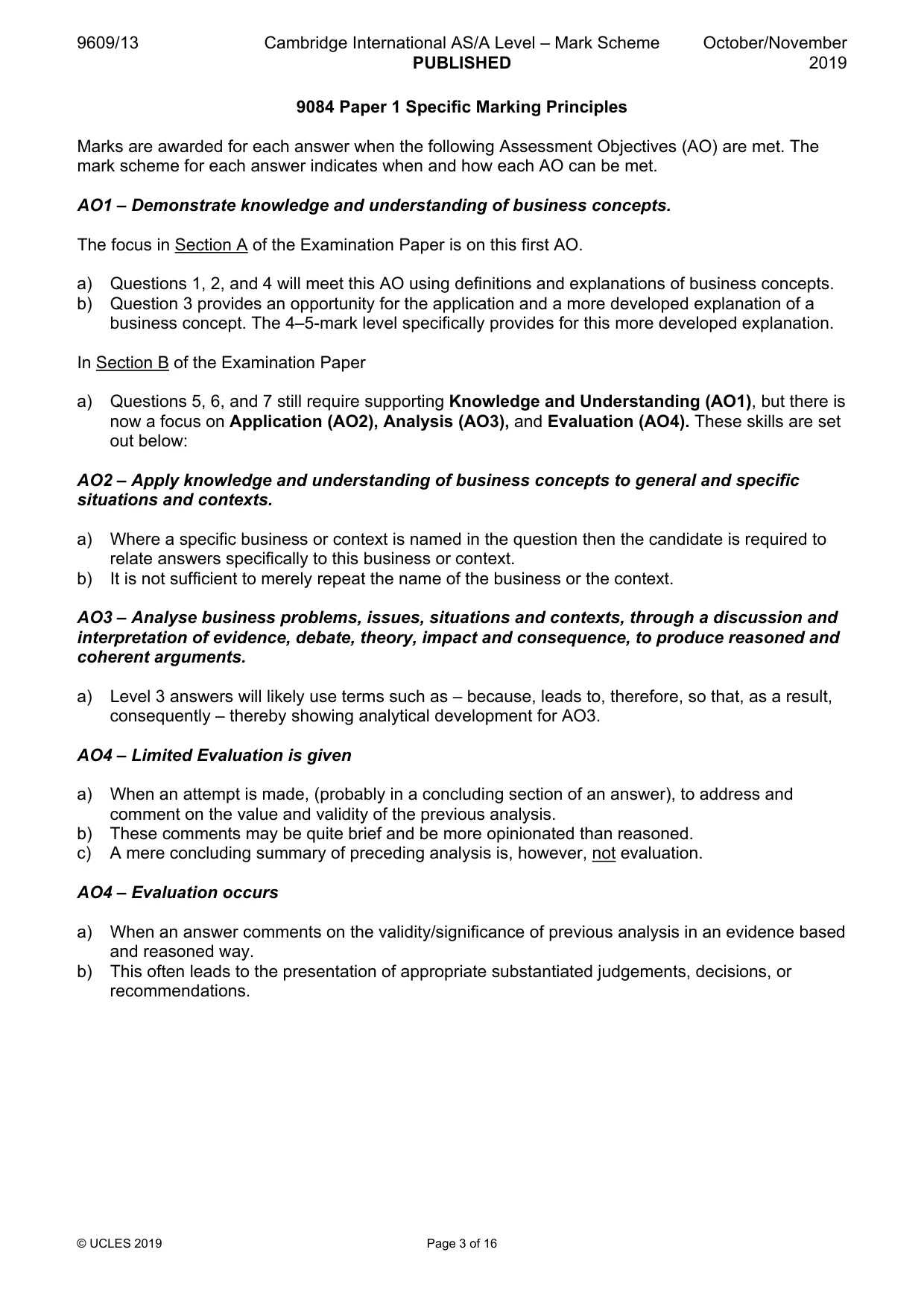
9609/13 Cambridge International AS/A Level – Mark Scheme PUBLISHED October/November 2019 © UCLES 2019 Page 3 of 16 9084 Paper 1 Specific Marking Principles Marks are awarded for each answer when the following Assessment Objectives (AO) are met. The mark scheme for each answer indicates when and how each AO can be met. AO1 – Demonstrate knowledge and understanding of business concepts. The focus in Section A of the Examination Paper is on this first AO. a) Questions 1, 2, and 4 will meet this AO using definitions and explanations of business concepts. b) Question 3 provides an opportunity for the application and a more developed explanation of a business concept. The 4–5-mark level specifically provides for this more developed explanation. In Section B of the Examination Paper a) Questions 5, 6, and 7 still require supporting Knowledge and Understanding (AO1), but there is now a focus on Application (AO2), Analysis (AO3), and Evaluation (AO4). These skills are set out below: AO2 – Apply knowledge and understanding of business concepts to general and specific situations and contexts. a) Where a specific business or context is named in the question then the candidate is required to relate answers specifically to this business or context. b) It is not sufficient to merely repeat the name of the business or the context. AO3 – Analyse business problems, issues, situations and contexts, through a discussion and interpretation of evidence, debate, theory, impact and consequence, to produce reasoned and coherent arguments. a) Level 3 answers will likely use terms such as – because, leads to, therefore, so that, as a result, consequently – thereby showing analytical development for AO3. AO4 – Limited Evaluation is given a) When an attempt is made, (probably in a concluding section of an answer), to address and comment on the value and validity of the previous analysis. b) These comments may be quite brief and be more opinionated than reasoned. c) A mere concluding summary of preceding analysis is, however, not evaluation. AO4 – Evaluation occurs a) When an answer comments on the validity/significance of previous analysis in an evidence based and reasoned way. b) This often leads to the presentation of appropriate substantiated judgements, decisions, or recommendations.
Mark scheme, page 4
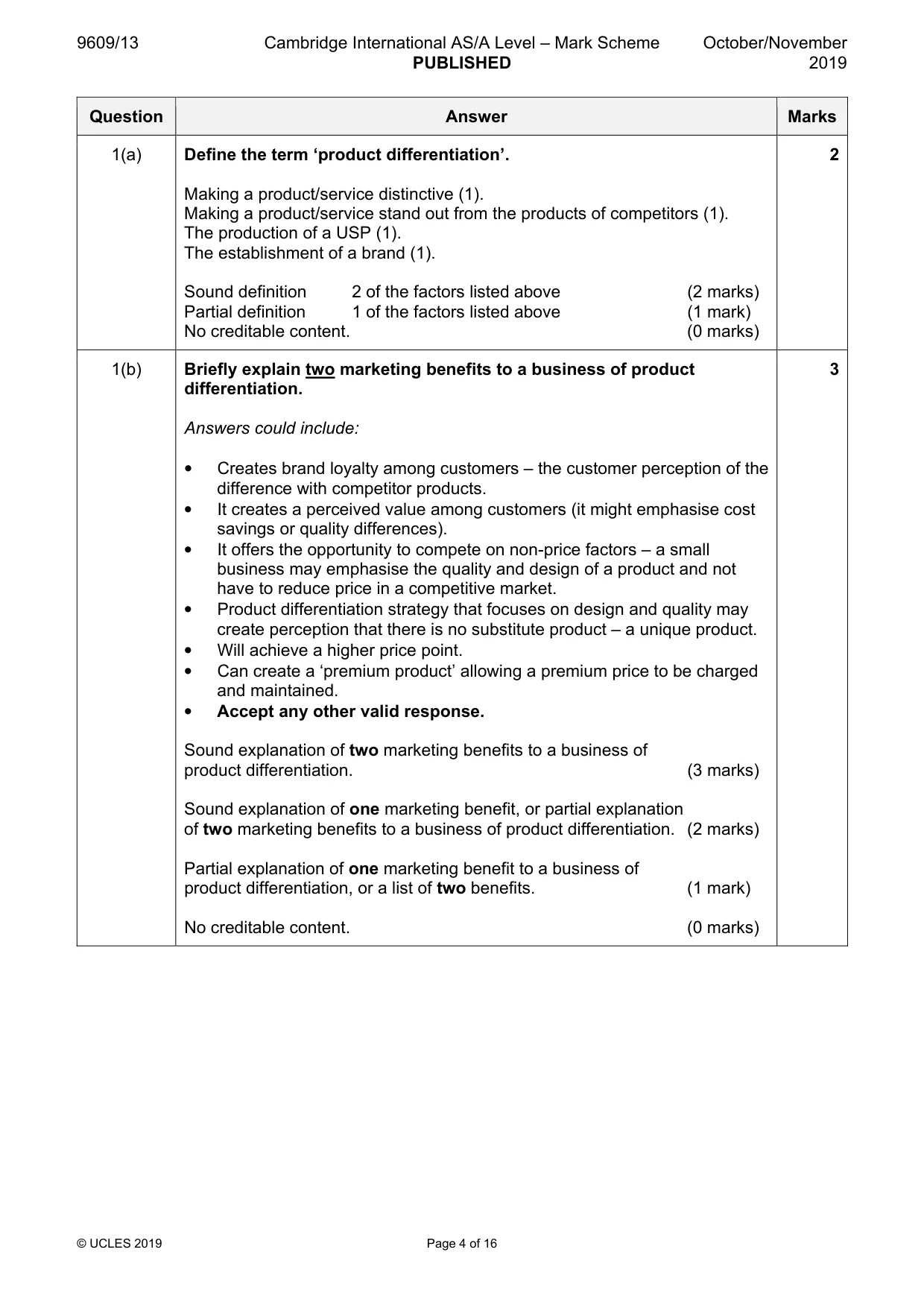
9609/13 Cambridge International AS/A Level – Mark Scheme PUBLISHED October/November 2019 © UCLES 2019 Page 4 of 16 Question Answer Marks 1(a) Define the term ‘product differentiation’. Making a product/service distinctive (1). Making a product/service stand out from the products of competitors (1). The production of a USP (1). The establishment of a brand (1). Sound definition 2 of the factors listed above (2 marks) Partial definition 1 of the factors listed above (1 mark) No creditable content. (0 marks) 2 1(b) Briefly explain two marketing benefits to a business of product differentiation. Answers could include: • Creates brand loyalty among customers – the customer perception of the difference with competitor products. • It creates a perceived value among customers (it might emphasise cost savings or quality differences). • It offers the opportunity to compete on non-price factors – a small business may emphasise the quality and design of a product and not have to reduce price in a competitive market. • Product differentiation strategy that focuses on design and quality may create perception that there is no substitute product – a unique product. • Will achieve a higher price point. • Can create a ‘premium product’ allowing a premium price to be charged and maintained. • Accept any other valid response. Sound explanation of two marketing benefits to a business of product differentiation. (3 marks) Sound explanation of one marketing benefit, or partial explanation of two marketing benefits to a business of product differentiation. (2 marks) Partial explanation of one marketing benefit to a business of product differentiation, or a list of two benefits. (1 mark) No creditable content. (0 marks) 3
Mark scheme, page 5
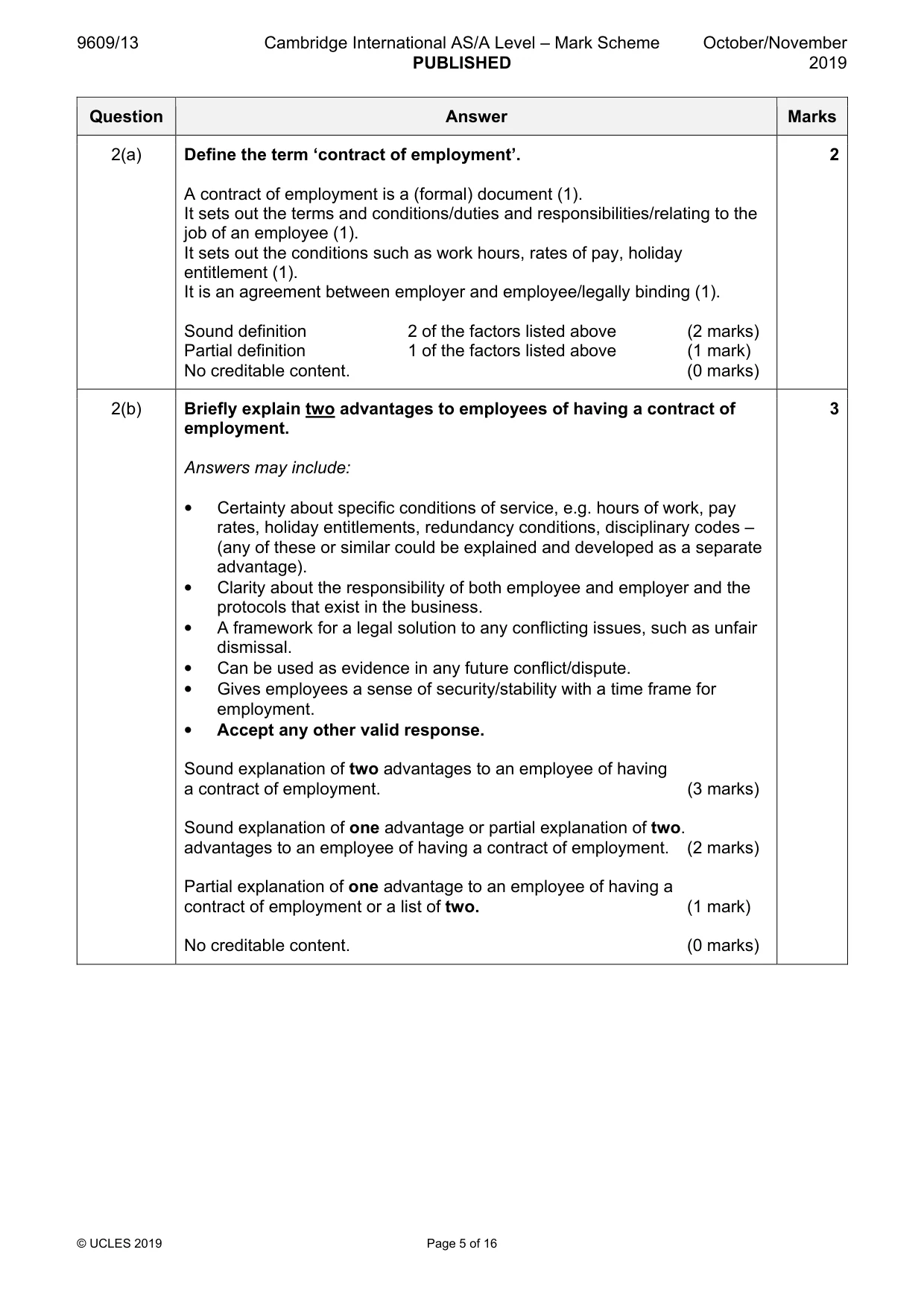
9609/13 Cambridge International AS/A Level – Mark Scheme PUBLISHED October/November 2019 © UCLES 2019 Page 5 of 16 Question Answer Marks 2(a) Define the term ‘contract of employment’. A contract of employment is a (formal) document (1). It sets out the terms and conditions/duties and responsibilities/relating to the job of an employee (1). It sets out the conditions such as work hours, rates of pay, holiday entitlement (1). It is an agreement between employer and employee/legally binding (1). Sound definition 2 of the factors listed above (2 marks) Partial definition 1 of the factors listed above (1 mark) No creditable content. (0 marks) 2 2(b) Briefly explain two advantages to employees of having a contract of employment. Answers may include: • Certainty about specific conditions of service, e.g. hours of work, pay rates, holiday entitlements, redundancy conditions, disciplinary codes – (any of these or similar could be explained and developed as a separate advantage). • Clarity about the responsibility of both employee and employer and the protocols that exist in the business. • A framework for a legal solution to any conflicting issues, such as unfair dismissal. • Can be used as evidence in any future conflict/dispute. • Gives employees a sense of security/stability with a time frame for employment. • Accept any other valid response. Sound explanation of two advantages to an employee of having a contract of employment. (3 marks) Sound explanation of one advantage or partial explanation of two. advantages to an employee of having a contract of employment. (2 marks) Partial explanation of one advantage to an employee of having a contract of employment or a list of two. (1 mark) No creditable content. (0 marks) 3
Mark scheme, page 6
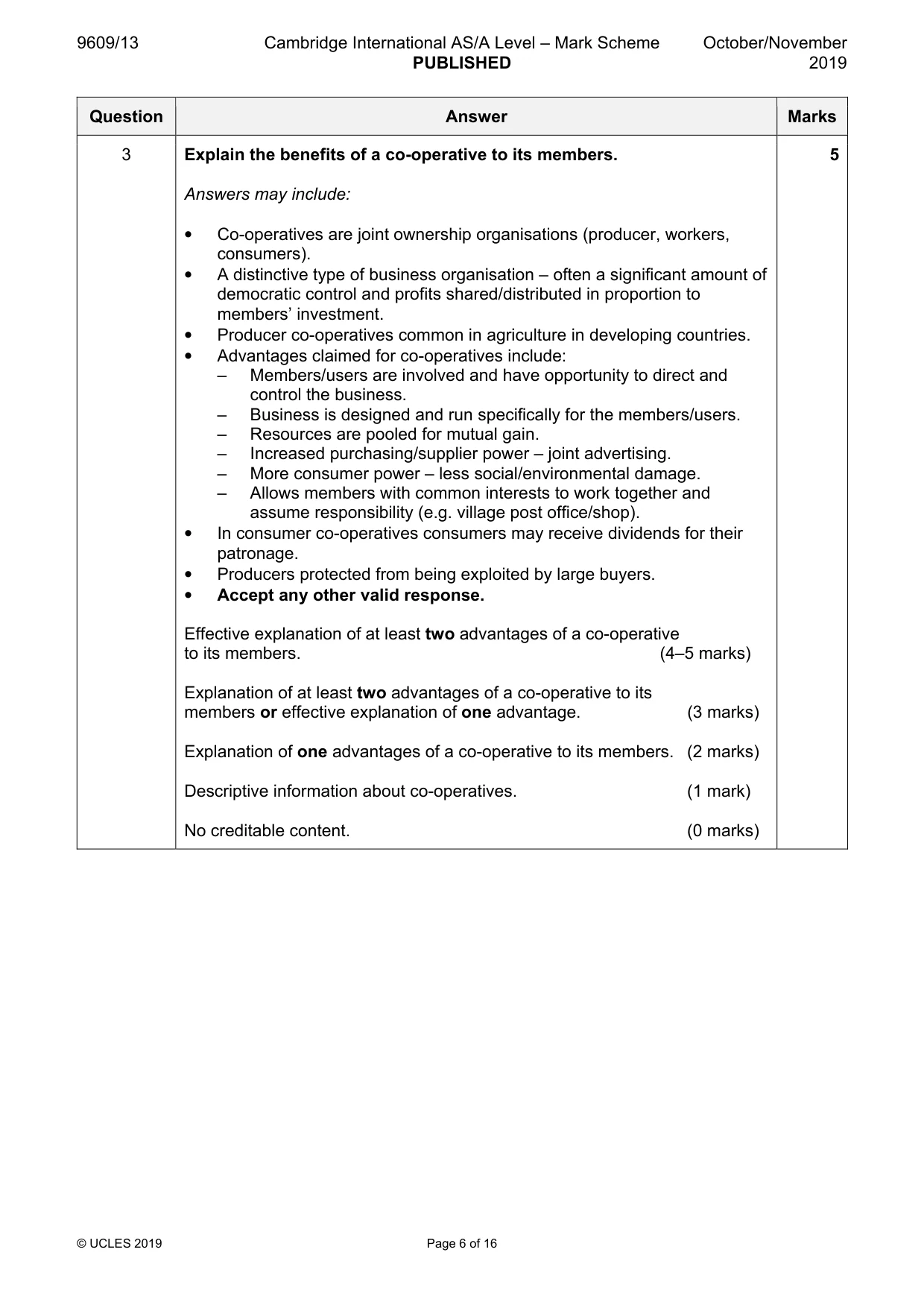
9609/13 Cambridge International AS/A Level – Mark Scheme PUBLISHED October/November 2019 © UCLES 2019 Page 6 of 16 Question Answer Marks 3 Explain the benefits of a co-operative to its members. Answers may include: • Co-operatives are joint ownership organisations (producer, workers, consumers). • A distinctive type of business organisation – often a significant amount of democratic control and profits shared/distributed in proportion to members’ investment. • Producer co-operatives common in agriculture in developing countries. • Advantages claimed for co-operatives include: – Members/users are involved and have opportunity to direct and control the business. – Business is designed and run specifically for the members/users. – Resources are pooled for mutual gain. – Increased purchasing/supplier power – joint advertising. – More consumer power – less social/environmental damage. – Allows members with common interests to work together and assume responsibility (e.g. village post office/shop). • In consumer co-operatives consumers may receive dividends for their patronage. • Producers protected from being exploited by large buyers. • Accept any other valid response. Effective explanation of at least two advantages of a co-operative to its members. (4–5 marks) Explanation of at least two advantages of a co-operative to its members or effective explanation of one advantage. (3 marks) Explanation of one advantages of a co-operative to its members. (2 marks) Descriptive information about co-operatives. (1 mark) No creditable content. (0 marks) 5
Mark scheme, page 7
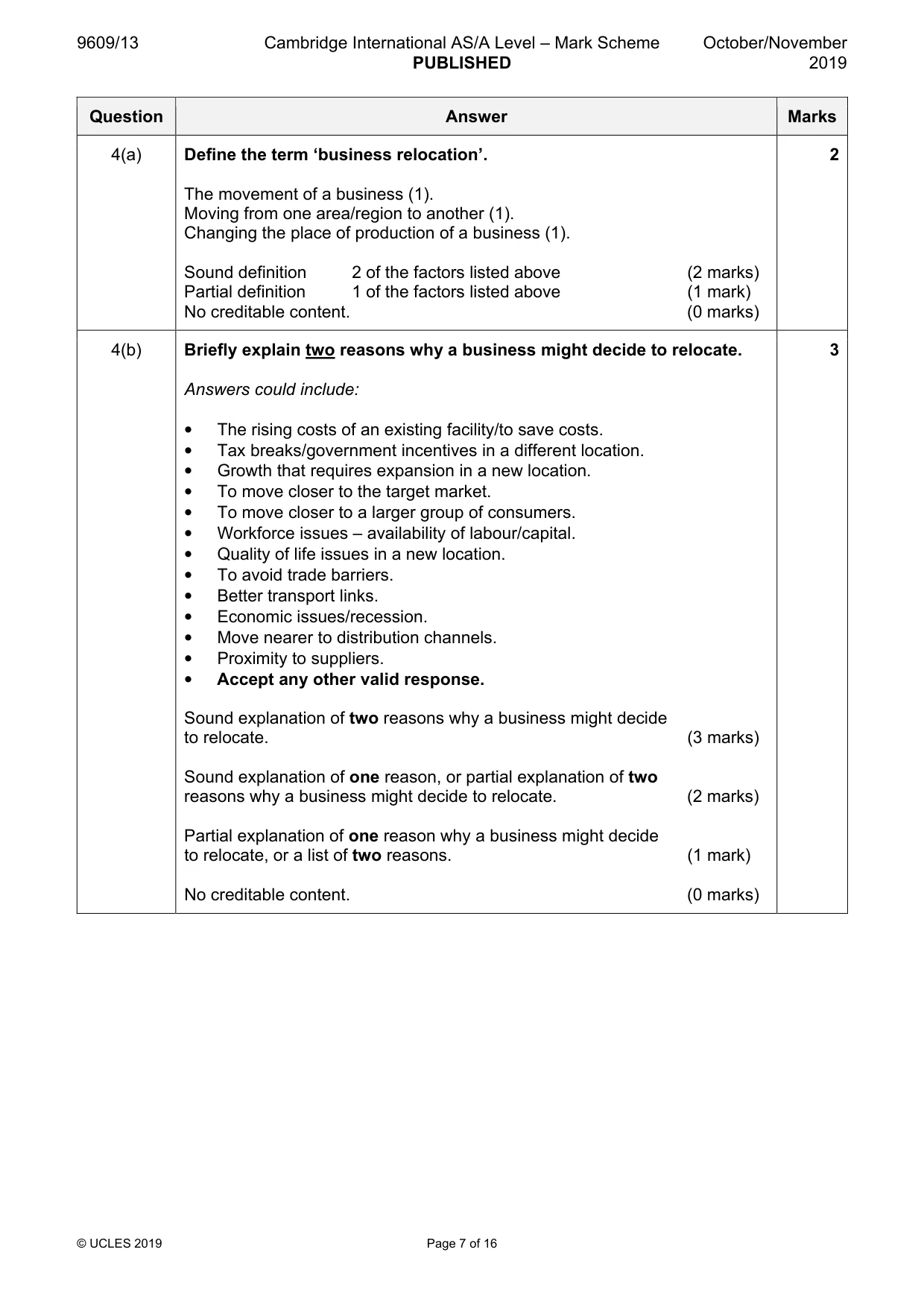
9609/13 Cambridge International AS/A Level – Mark Scheme PUBLISHED October/November 2019 © UCLES 2019 Page 7 of 16 Question Answer Marks 4(a) Define the term ‘business relocation’. The movement of a business (1). Moving from one area/region to another (1). Changing the place of production of a business (1). Sound definition 2 of the factors listed above (2 marks) Partial definition 1 of the factors listed above (1 mark) No creditable content. (0 marks) 2 4(b) Briefly explain two reasons why a business might decide to relocate. Answers could include: • The rising costs of an existing facility/to save costs. • Tax breaks/government incentives in a different location. • Growth that requires expansion in a new location. • To move closer to the target market. • To move closer to a larger group of consumers. • Workforce issues – availability of labour/capital. • Quality of life issues in a new location. • To avoid trade barriers. • Better transport links. • Economic issues/recession. • Move nearer to distribution channels. • Proximity to suppliers. • Accept any other valid response. Sound explanation of two reasons why a business might decide to relocate. (3 marks) Sound explanation of one reason, or partial explanation of two reasons why a business might decide to relocate. (2 marks) Partial explanation of one reason why a business might decide to relocate, or a list of two reasons. (1 mark) No creditable content. (0 marks) 3
Mark scheme, page 8
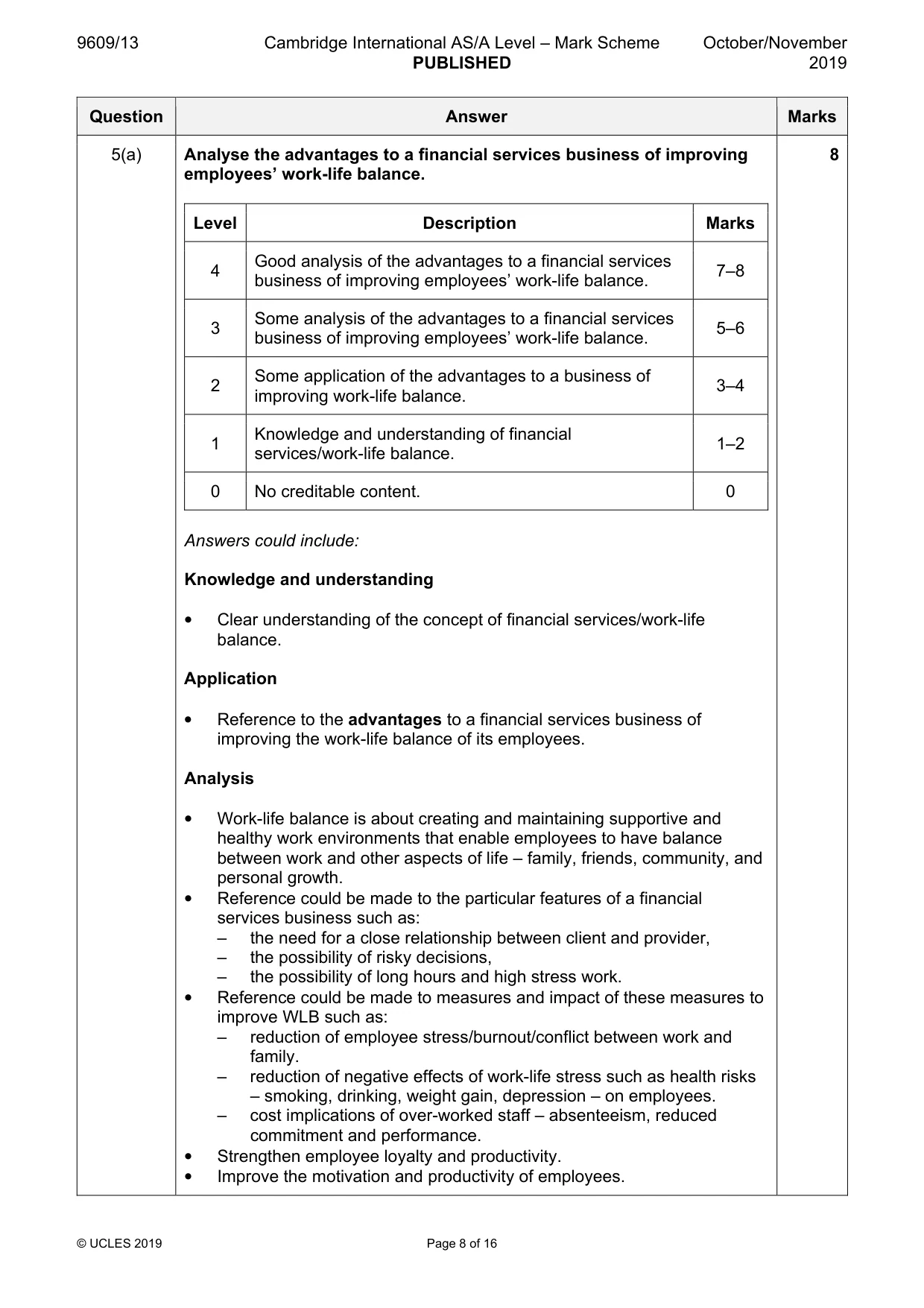
9609/13 Cambridge International AS/A Level – Mark Scheme PUBLISHED October/November 2019 © UCLES 2019 Page 8 of 16 Question Answer Marks 5(a) Analyse the advantages to a financial services business of improving employees’ work-life balance. Level Description Marks 4 Good analysis of the advantages to a financial services business of improving employees’ work-life balance. 7–8 3 Some analysis of the advantages to a financial services business of improving employees’ work-life balance. 5–6 2 Some application of the advantages to a business of improving work-life balance. 3–4 1 Knowledge and understanding of financial services/work-life balance. 1–2 0 No creditable content. 0 Answers could include: Knowledge and understanding • Clear understanding of the concept of financial services/work-life balance. Application • Reference to the advantages to a financial services business of improving the work-life balance of its employees. Analysis • Work-life balance is about creating and maintaining supportive and healthy work environments that enable employees to have balance between work and other aspects of life – family, friends, community, and personal growth. • Reference could be made to the particular features of a financial services business such as: – the need for a close relationship between client and provider, – the possibility of risky decisions, – the possibility of long hours and high stress work. • Reference could be made to measures and impact of these measures to improve WLB such as: – reduction of employee stress/burnout/conflict between work and family. – reduction of negative effects of work-life stress such as health risks – smoking, drinking, weight gain, depression – on employees. – cost implications of over-worked staff – absenteeism, reduced commitment and performance. • Strengthen employee loyalty and productivity. • Improve the motivation and productivity of employees. 8
Mark scheme, page 9
9609/13 Cambridge International AS/A Level – Mark Scheme PUBLISHED October/November 2019 © UCLES 2019 Page 9 of 16 Question Answer Marks 5(a) • Active programmes of support in many organisations – HRM plays a pivotal role – flexi-working, increased paid leave, advice on health, counselling etc. • WLB programmes seen as an investment by businesses – can become a USP in terms of recruitment and retention of staff. • It can affect the bottom line. • Accept any other valid response.
Mark scheme, page 10
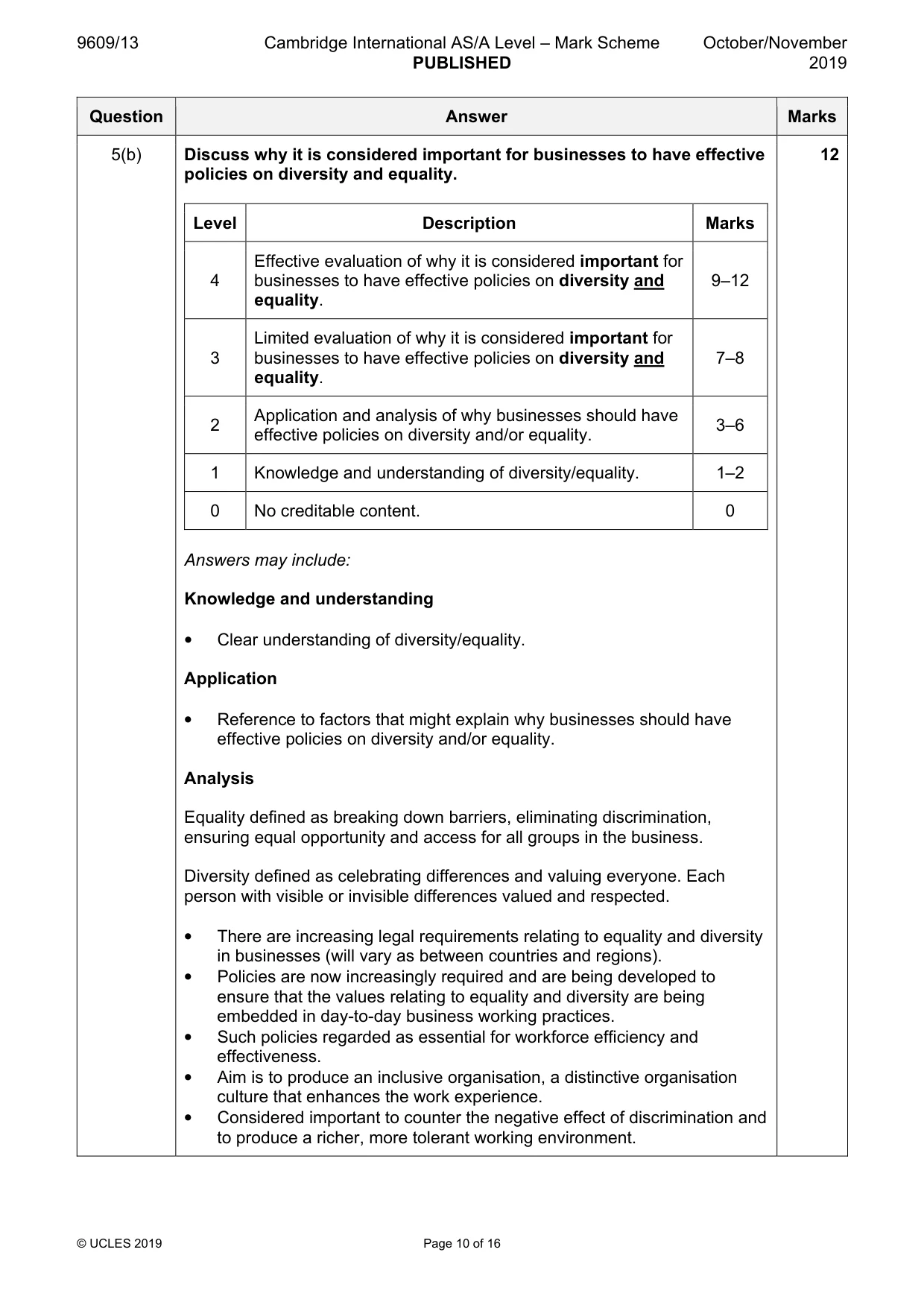
9609/13 Cambridge International AS/A Level – Mark Scheme PUBLISHED October/November 2019 © UCLES 2019 Page 10 of 16 Question Answer Marks 5(b) Discuss why it is considered important for businesses to have effective policies on diversity and equality. Level Description Marks 4 Effective evaluation of why it is considered important for businesses to have effective policies on diversity and equality. 9–12 3 Limited evaluation of why it is considered important for businesses to have effective policies on diversity and equality. 7–8 2 Application and analysis of why businesses should have effective policies on diversity and/or equality. 3–6 1 Knowledge and understanding of diversity/equality. 1–2 0 No creditable content. 0 Answers may include: Knowledge and understanding • Clear understanding of diversity/equality. Application • Reference to factors that might explain why businesses should have effective policies on diversity and/or equality. Analysis Equality defined as breaking down barriers, eliminating discrimination, ensuring equal opportunity and access for all groups in the business. Diversity defined as celebrating differences and valuing everyone. Each person with visible or invisible differences valued and respected. • There are increasing legal requirements relating to equality and diversity in businesses (will vary as between countries and regions). • Policies are now increasingly required and are being developed to ensure that the values relating to equality and diversity are being embedded in day-to-day business working practices. • Such policies regarded as essential for workforce efficiency and effectiveness. • Aim is to produce an inclusive organisation, a distinctive organisation culture that enhances the work experience. • Considered important to counter the negative effect of discrimination and to produce a richer, more tolerant working environment. 12
Mark scheme, page 11
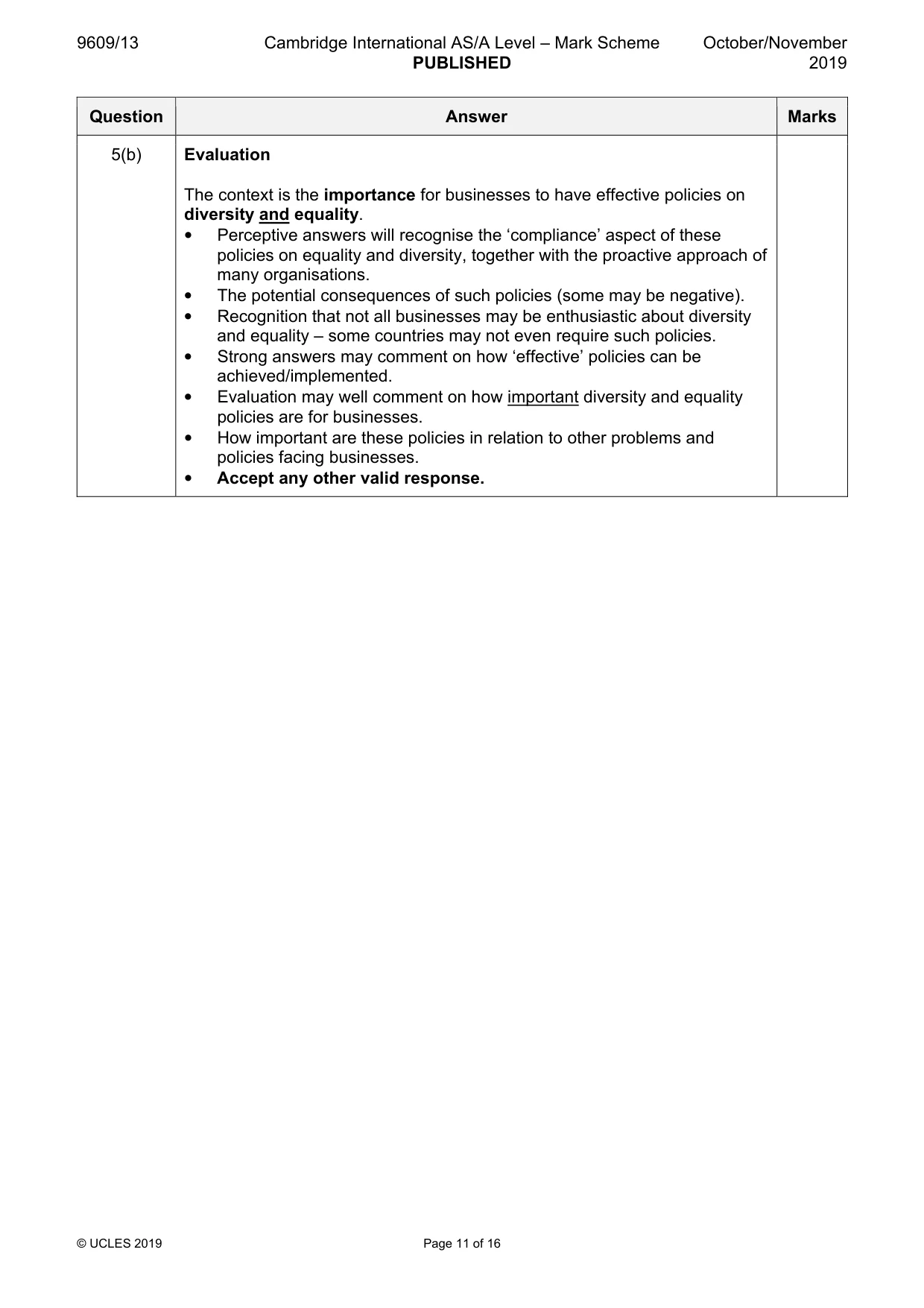
9609/13 Cambridge International AS/A Level – Mark Scheme PUBLISHED October/November 2019 © UCLES 2019 Page 11 of 16 Question Answer Marks 5(b) Evaluation The context is the importance for businesses to have effective policies on diversity and equality. • Perceptive answers will recognise the ‘compliance’ aspect of these policies on equality and diversity, together with the proactive approach of many organisations. • The potential consequences of such policies (some may be negative). • Recognition that not all businesses may be enthusiastic about diversity and equality – some countries may not even require such policies. • Strong answers may comment on how ‘effective’ policies can be achieved/implemented. • Evaluation may well comment on how important diversity and equality policies are for businesses. • How important are these policies in relation to other problems and policies facing businesses. • Accept any other valid response.
Mark scheme, page 12
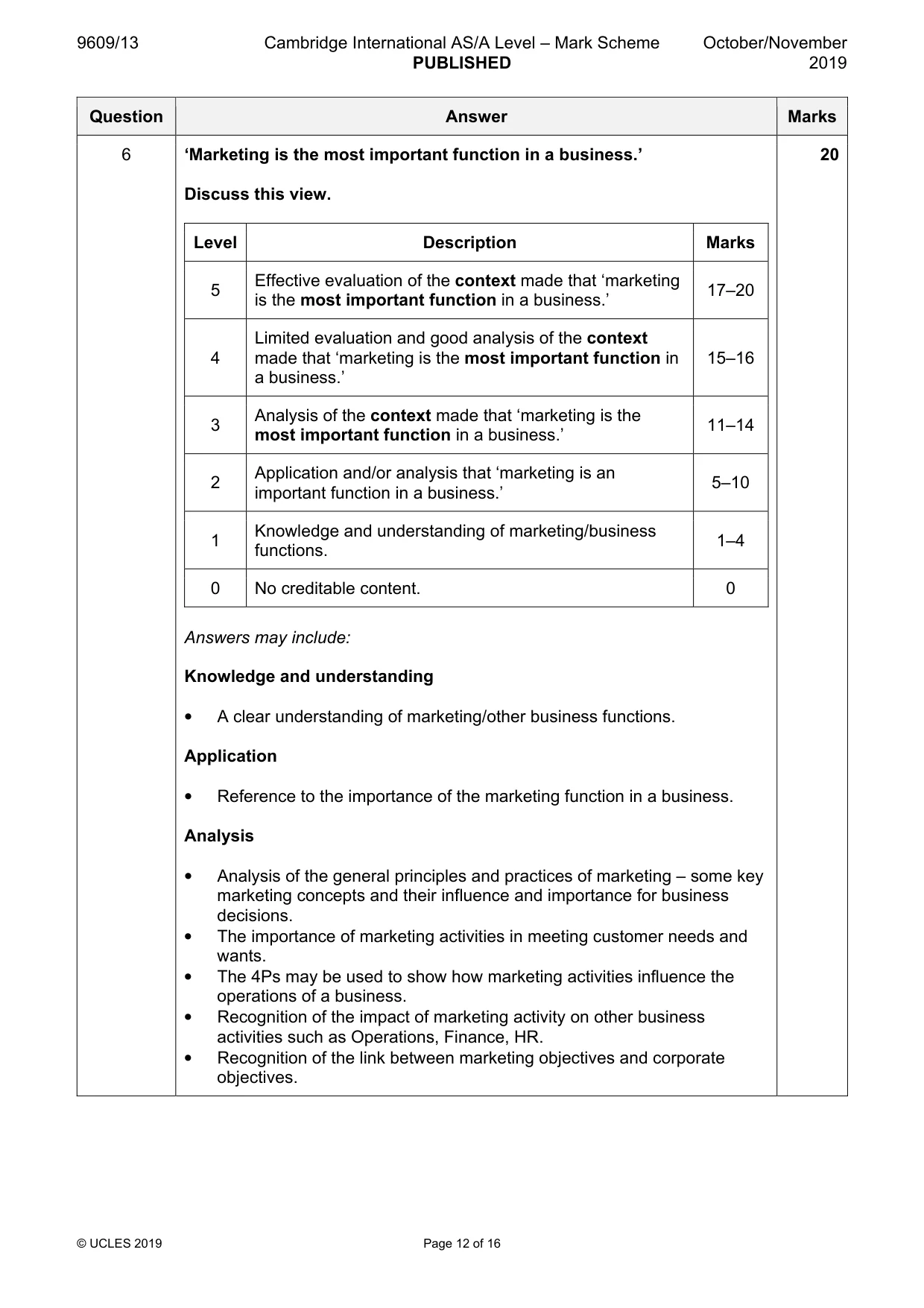
9609/13 Cambridge International AS/A Level – Mark Scheme PUBLISHED October/November 2019 © UCLES 2019 Page 12 of 16 Question Answer Marks 6 ‘Marketing is the most important function in a business.’ Discuss this view. Level Description Marks 5 Effective evaluation of the context made that ‘marketing is the most important function in a business.’ 17–20 4 Limited evaluation and good analysis of the context made that ‘marketing is the most important function in a business.’ 15–16 3 Analysis of the context made that ‘marketing is the most important function in a business.’ 11–14 2 Application and/or analysis that ‘marketing is an important function in a business.’ 5–10 1 Knowledge and understanding of marketing/business functions. 1–4 0 No creditable content. 0 Answers may include: Knowledge and understanding • A clear understanding of marketing/other business functions. Application • Reference to the importance of the marketing function in a business. Analysis • Analysis of the general principles and practices of marketing – some key marketing concepts and their influence and importance for business decisions. • The importance of marketing activities in meeting customer needs and wants. • The 4Ps may be used to show how marketing activities influence the operations of a business. • Recognition of the impact of marketing activity on other business activities such as Operations, Finance, HR. • Recognition of the link between marketing objectives and corporate objectives. 20
Mark scheme, page 13
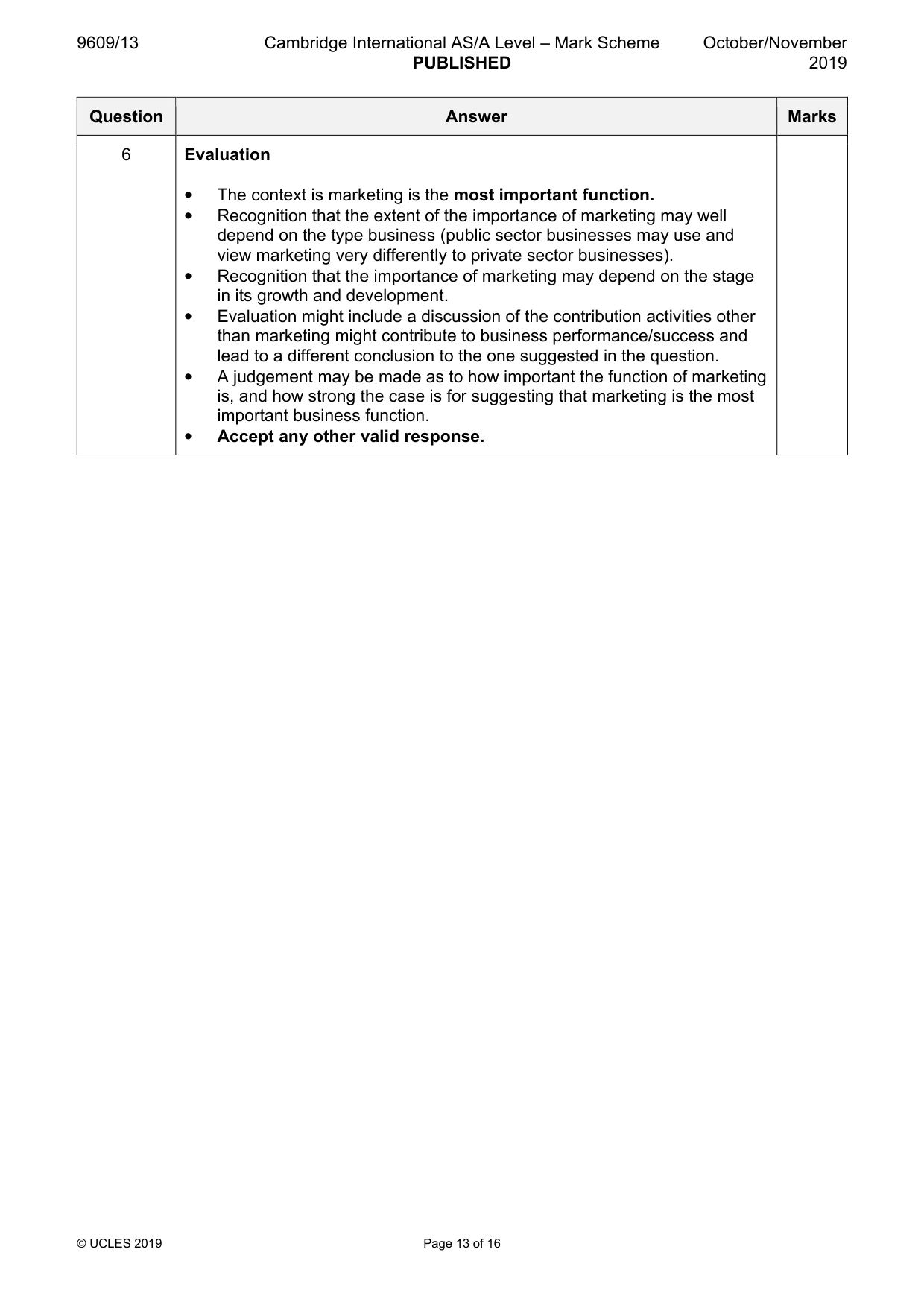
9609/13 Cambridge International AS/A Level – Mark Scheme PUBLISHED October/November 2019 © UCLES 2019 Page 13 of 16 Question Answer Marks 6 Evaluation • The context is marketing is the most important function. • Recognition that the extent of the importance of marketing may well depend on the type business (public sector businesses may use and view marketing very differently to private sector businesses). • Recognition that the importance of marketing may depend on the stage in its growth and development. • Evaluation might include a discussion of the contribution activities other than marketing might contribute to business performance/success and lead to a different conclusion to the one suggested in the question. • A judgement may be made as to how important the function of marketing is, and how strong the case is for suggesting that marketing is the most important business function. • Accept any other valid response.
Mark scheme, page 14
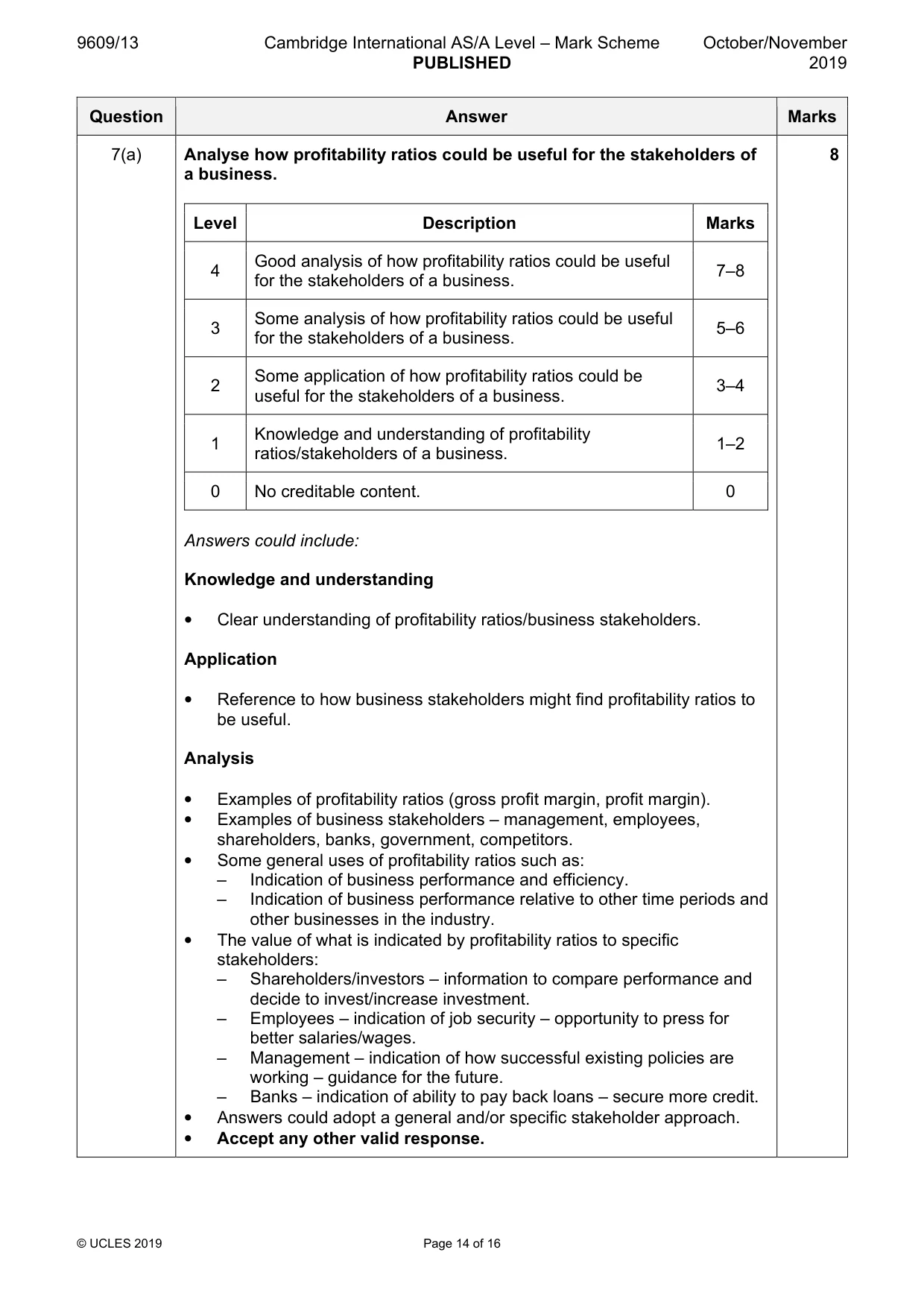
9609/13 Cambridge International AS/A Level – Mark Scheme PUBLISHED October/November 2019 © UCLES 2019 Page 14 of 16 Question Answer Marks 7(a) Analyse how profitability ratios could be useful for the stakeholders of a business. Level Description Marks 4 Good analysis of how profitability ratios could be useful for the stakeholders of a business. 7–8 3 Some analysis of how profitability ratios could be useful for the stakeholders of a business. 5–6 2 Some application of how profitability ratios could be useful for the stakeholders of a business. 3–4 1 Knowledge and understanding of profitability ratios/stakeholders of a business. 1–2 0 No creditable content. 0 Answers could include: Knowledge and understanding • Clear understanding of profitability ratios/business stakeholders. Application • Reference to how business stakeholders might find profitability ratios to be useful. Analysis • Examples of profitability ratios (gross profit margin, profit margin). • Examples of business stakeholders – management, employees, shareholders, banks, government, competitors. • Some general uses of profitability ratios such as: – Indication of business performance and efficiency. – Indication of business performance relative to other time periods and other businesses in the industry. • The value of what is indicated by profitability ratios to specific stakeholders: – Shareholders/investors – information to compare performance and decide to invest/increase investment. – Employees – indication of job security – opportunity to press for better salaries/wages. – Management – indication of how successful existing policies are working – guidance for the future. – Banks – indication of ability to pay back loans – secure more credit. • Answers could adopt a general and/or specific stakeholder approach. • Accept any other valid response. 8
Mark scheme, page 15
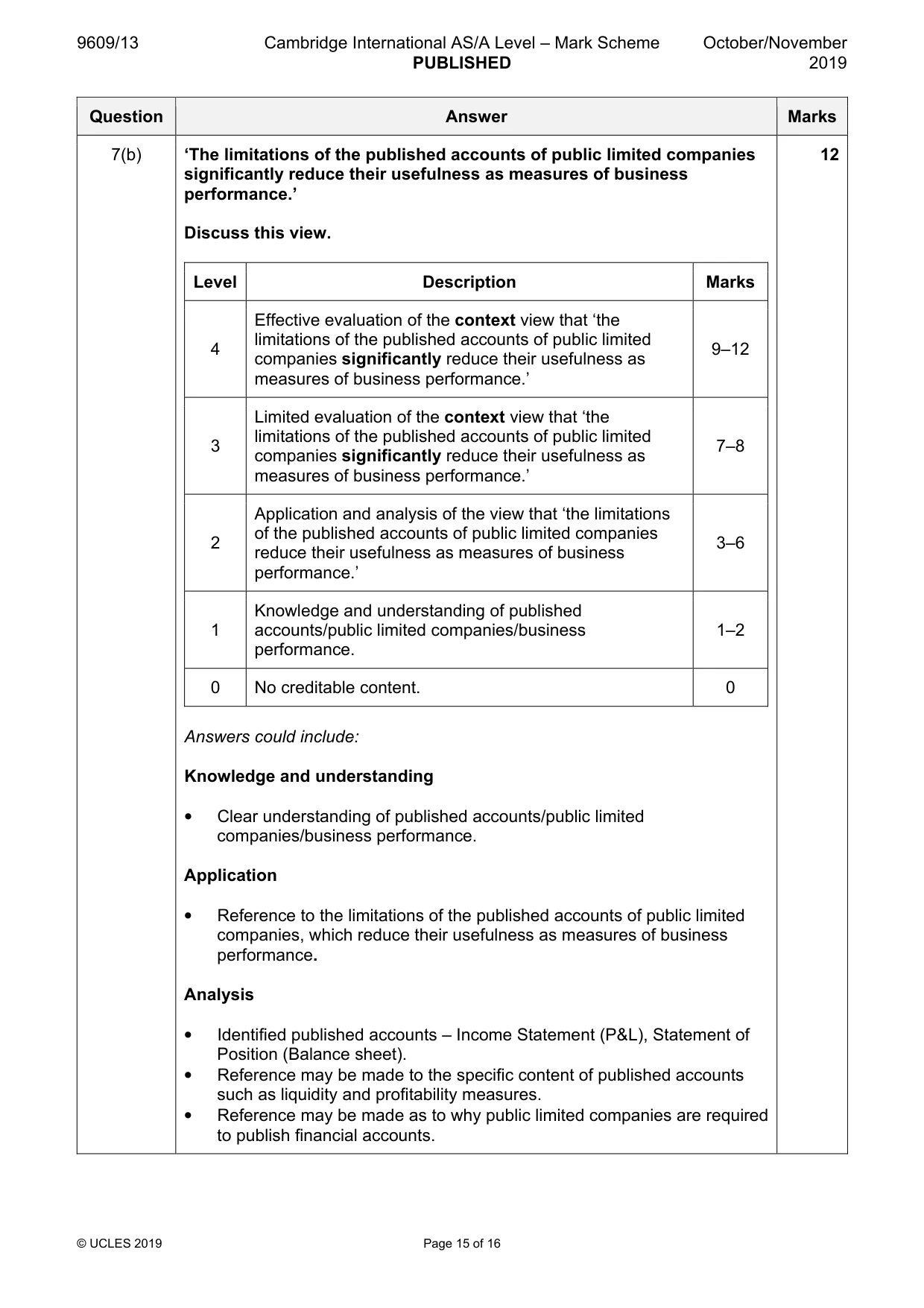
9609/13 Cambridge International AS/A Level – Mark Scheme PUBLISHED October/November 2019 © UCLES 2019 Page 15 of 16 Question Answer Marks 7(b) ‘The limitations of the published accounts of public limited companies significantly reduce their usefulness as measures of business performance.’ Discuss this view. Level Description Marks 4 Effective evaluation of the context view that ‘the limitations of the published accounts of public limited companies significantly reduce their usefulness as measures of business performance.’ 9–12 3 Limited evaluation of the context view that ‘the limitations of the published accounts of public limited companies significantly reduce their usefulness as measures of business performance.’ 7–8 2 Application and analysis of the view that ‘the limitations of the published accounts of public limited companies reduce their usefulness as measures of business performance.’ 3–6 1 Knowledge and understanding of published accounts/public limited companies/business performance. 1–2 0 No creditable content. 0 Answers could include: Knowledge and understanding • Clear understanding of published accounts/public limited companies/business performance. Application • Reference to the limitations of the published accounts of public limited companies, which reduce their usefulness as measures of business performance. Analysis • Identified published accounts – Income Statement (P&L), Statement of Position (Balance sheet). • Reference may be made to the specific content of published accounts such as liquidity and profitability measures. • Reference may be made as to why public limited companies are required to publish financial accounts. 12
Mark scheme, page 16
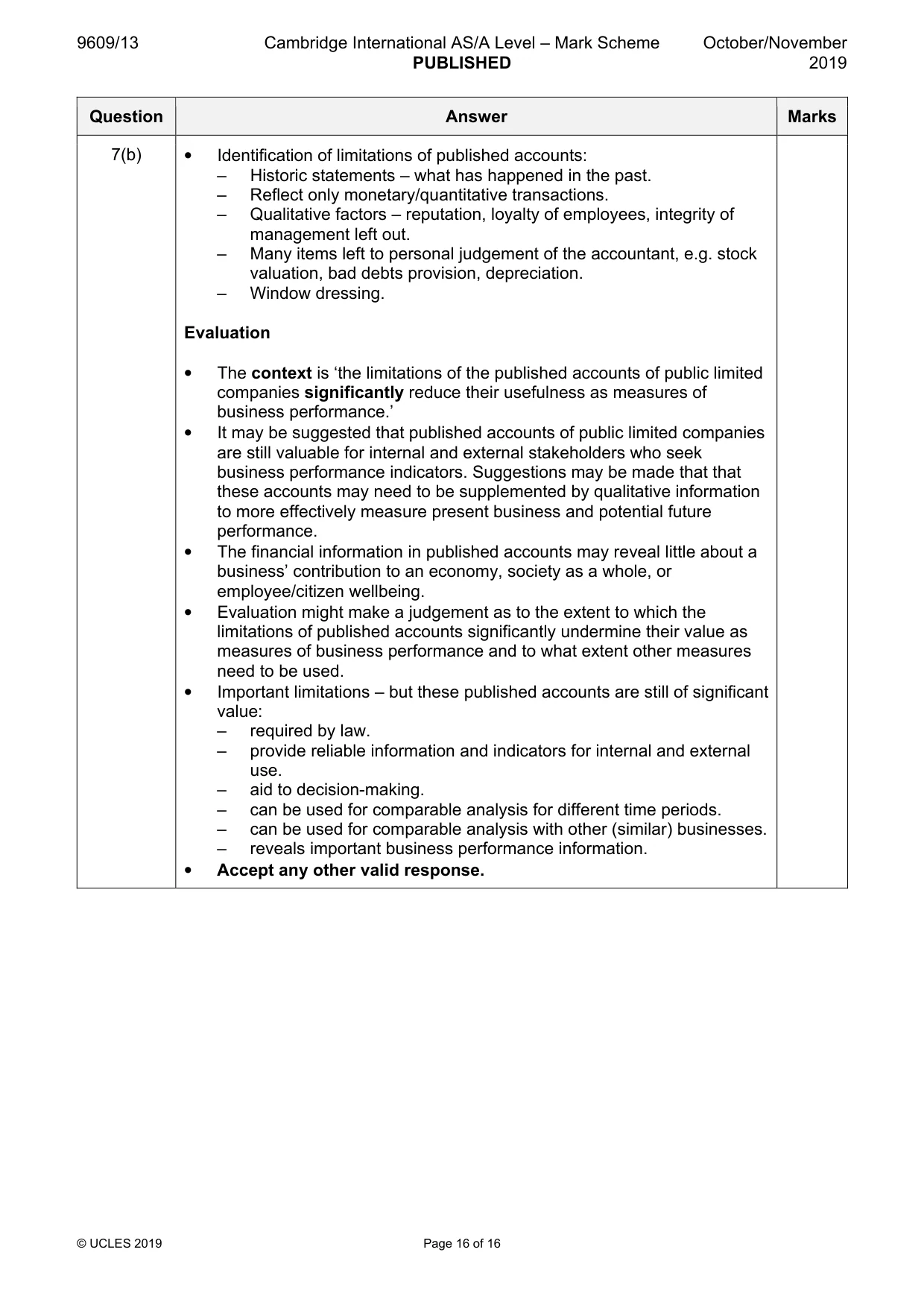
9609/13 Cambridge International AS/A Level – Mark Scheme PUBLISHED October/November 2019 © UCLES 2019 Page 16 of 16 Question Answer Marks 7(b) • Identification of limitations of published accounts: – Historic statements – what has happened in the past. – Reflect only monetary/quantitative transactions. – Qualitative factors – reputation, loyalty of employees, integrity of management left out. – Many items left to personal judgement of the accountant, e.g. stock valuation, bad debts provision, depreciation. – Window dressing. Evaluation • The context is ‘the limitations of the published accounts of public limited companies significantly reduce their usefulness as measures of business performance.’ • It may be suggested that published accounts of public limited companies are still valuable for internal and external stakeholders who seek business performance indicators. Suggestions may be made that that these accounts may need to be supplemented by qualitative information to more effectively measure present business and potential future performance. • The financial information in published accounts may reveal little about a business’ contribution to an economy, society as a whole, or employee/citizen wellbeing. • Evaluation might make a judgement as to the extent to which the limitations of published accounts significantly undermine their value as measures of business performance and to what extent other measures need to be used. • Important limitations – but these published accounts are still of significant value: – required by law. – provide reliable information and indicators for internal and external use. – aid to decision-making. – can be used for comparable analysis for different time periods. – can be used for comparable analysis with other (similar) businesses. – reveals important business performance information. • Accept any other valid response.
What you needed in this session
Cambridge’s own grade thresholds for 2019 Oct/Nov, Paper 1 · Variant 3. A higher threshold means an easier paper — the bar moves with how the cohort did.