Cambridge A Level Business (for first examination in 2016) 9609 — 2019 May/June Paper 1 · Variant 2
9609/12/M/J/19 · 40 marks · ≈45 min
The question paper and its mark scheme, free to read here and free to download. This is Cambridge’s own paper, exactly as it was sat.
Question paper4 pages


Mark scheme12 pages
Answers below. Sit the paper first if you are practising.
Paper as text
Question paper, page 1
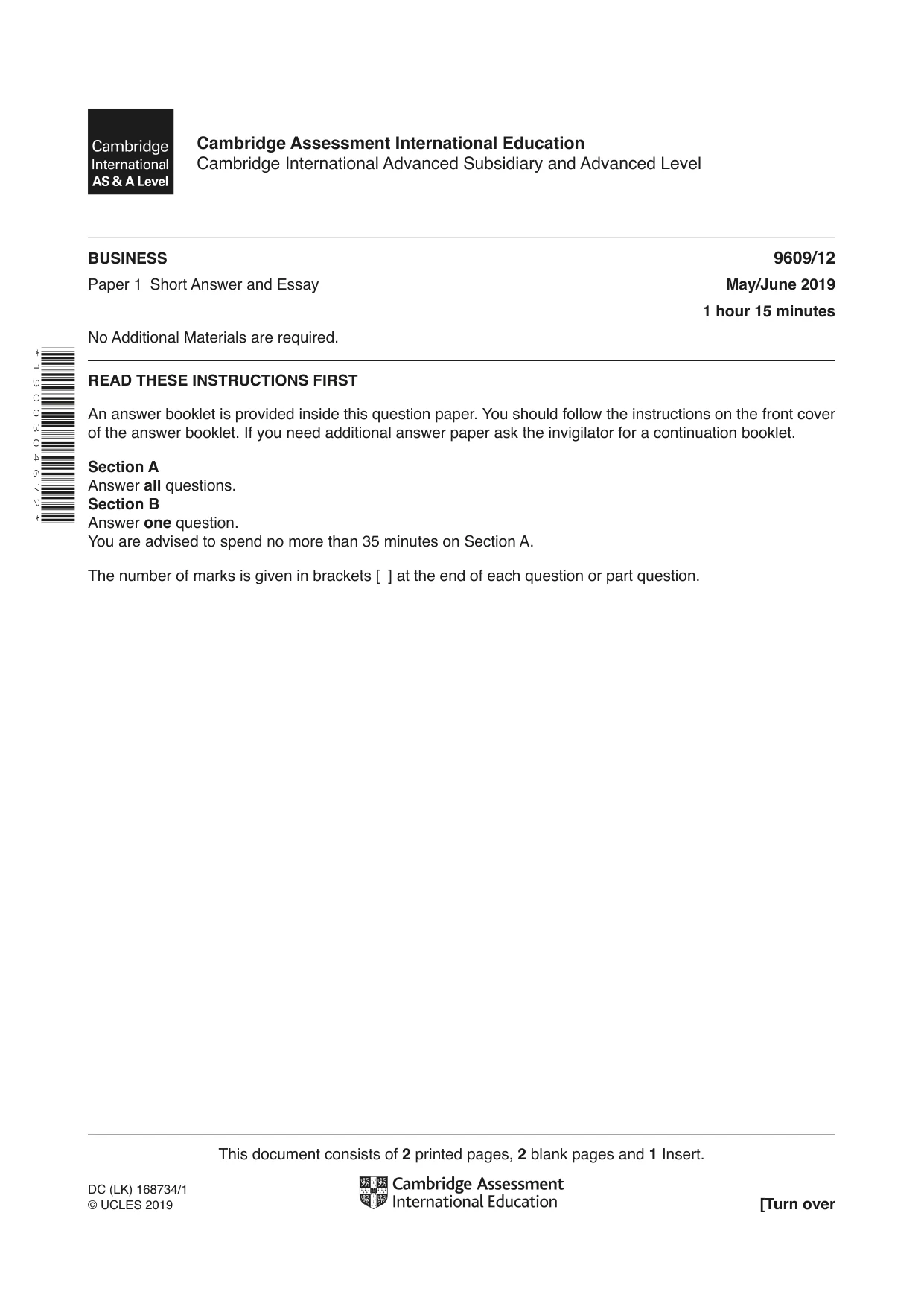
This document consists of 2 printed pages, 2 blank pages and 1 Insert. DC (LK) 168734/1 © UCLES 2019 [Turn over Cambridge Assessment International Education Cambridge International Advanced Subsidiary and Advanced Level * 1 9 0 0 3 0 4 6 7 2 * BUSINESS 9609/12 Paper 1 Short Answer and Essay May/June 2019 1 hour 15 minutes No Additional Materials are required. READ THESE INSTRUCTIONS FIRST An answer booklet is provided inside this question paper. You should follow the instructions on the front cover of the answer booklet. If you need additional answer paper ask the invigilator for a continuation booklet. Section A Answer all questions. Section B Answer one question. You are advised to spend no more than 35 minutes on Section A. The number of marks is given in brackets [ ] at the end of each question or part question.
Question paper, page 2
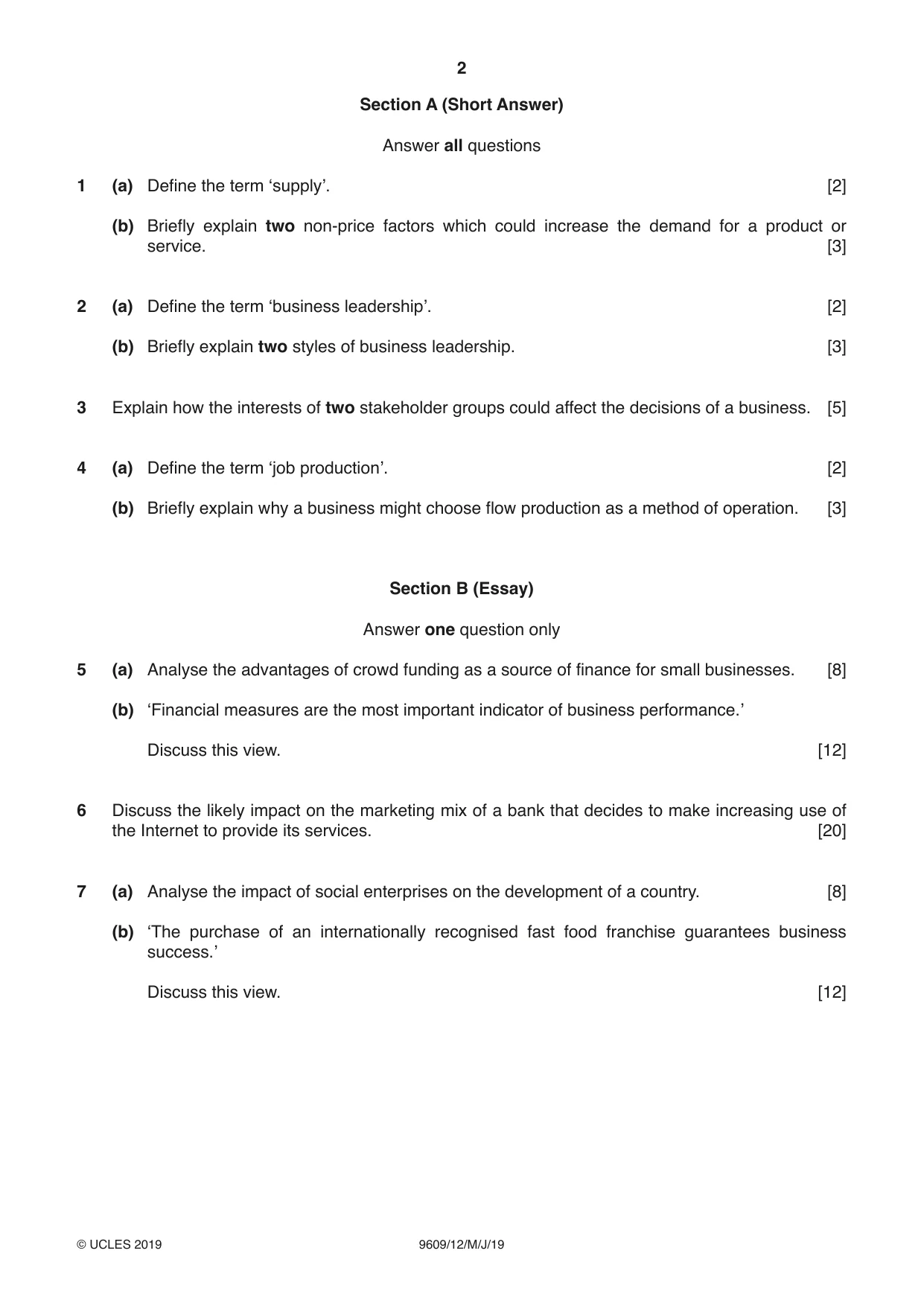
2 9609/12/M/J/19 © UCLES 2019 Section A (Short Answer) Answer all questions 1 (a) Define the term ‘supply’. [2] (b) Briefly explain two non-price factors which could increase the demand for a product or service. [3] 2 (a) Define the term ‘business leadership’. [2] (b) Briefly explain two styles of business leadership. [3] 3 Explain how the interests of two stakeholder groups could affect the decisions of a business. [5] 4 (a) Define the term ‘job production’. [2] (b) Briefly explain why a business might choose flow production as a method of operation. [3] Section B (Essay) Answer one question only 5 (a) Analyse the advantages of crowd funding as a source of finance for small businesses. [8] (b) ‘Financial measures are the most important indicator of business performance.’ Discuss this view. [12] 6 Discuss the likely impact on the marketing mix of a bank that decides to make increasing use of the Internet to provide its services. [20] 7 (a) Analyse the impact of social enterprises on the development of a country. [8] (b) ‘The purchase of an internationally recognised fast food franchise guarantees business success.’ Discuss this view. [12]
Question paper, page 3
3 9609/12/M/J/19 © UCLES 2019 BLANK PAGE
Question paper, page 4
4 9609/12/M/J/19 © UCLES 2019 Permission to reproduce items where third-party owned material protected by copyright is included has been sought and cleared where possible. Every reasonable effort has been made by the publisher (UCLES) to trace copyright holders, but if any items requiring clearance have unwittingly been included, the publisher will be pleased to make amends at the earliest possible opportunity. To avoid the issue of disclosure of answer-related information to candidates, all copyright acknowledgements are reproduced online in the Cambridge Assessment International Education Copyright Acknowledgements Booklet. This is produced for each series of examinations and is freely available to download at www.cambridgeinternational.org after the live examination series. Cambridge Assessment International Education is part of the Cambridge Assessment Group. Cambridge Assessment is the brand name of the University of Cambridge Local Examinations Syndicate (UCLES), which itself is a department of the University of Cambridge. BLANK PAGE
Mark scheme, page 1
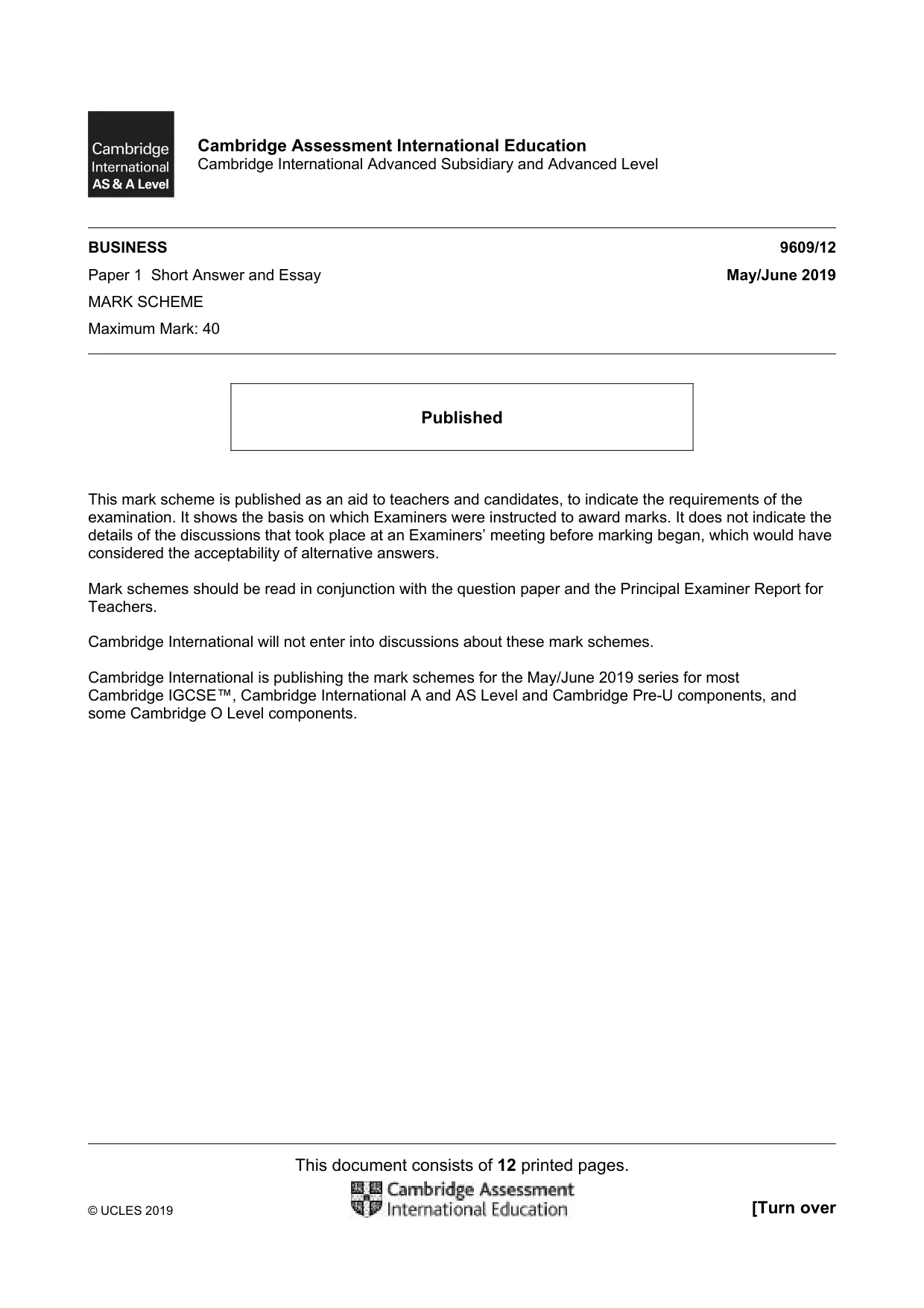
This document consists of 12 printed pages. © UCLES 2019 [Turn over Cambridge Assessment International Education Cambridge International Advanced Subsidiary and Advanced Level BUSINESS 9609/12 Paper 1 Short Answer and Essay May/June 2019 MARK SCHEME Maximum Mark: 40 Published This mark scheme is published as an aid to teachers and candidates, to indicate the requirements of the examination. It shows the basis on which Examiners were instructed to award marks. It does not indicate the details of the discussions that took place at an Examiners’ meeting before marking began, which would have considered the acceptability of alternative answers. Mark schemes should be read in conjunction with the question paper and the Principal Examiner Report for Teachers. Cambridge International will not enter into discussions about these mark schemes. Cambridge International is publishing the mark schemes for the May/June 2019 series for most Cambridge IGCSE™, Cambridge International A and AS Level and Cambridge Pre-U components, and some Cambridge O Level components.
Mark scheme, page 2
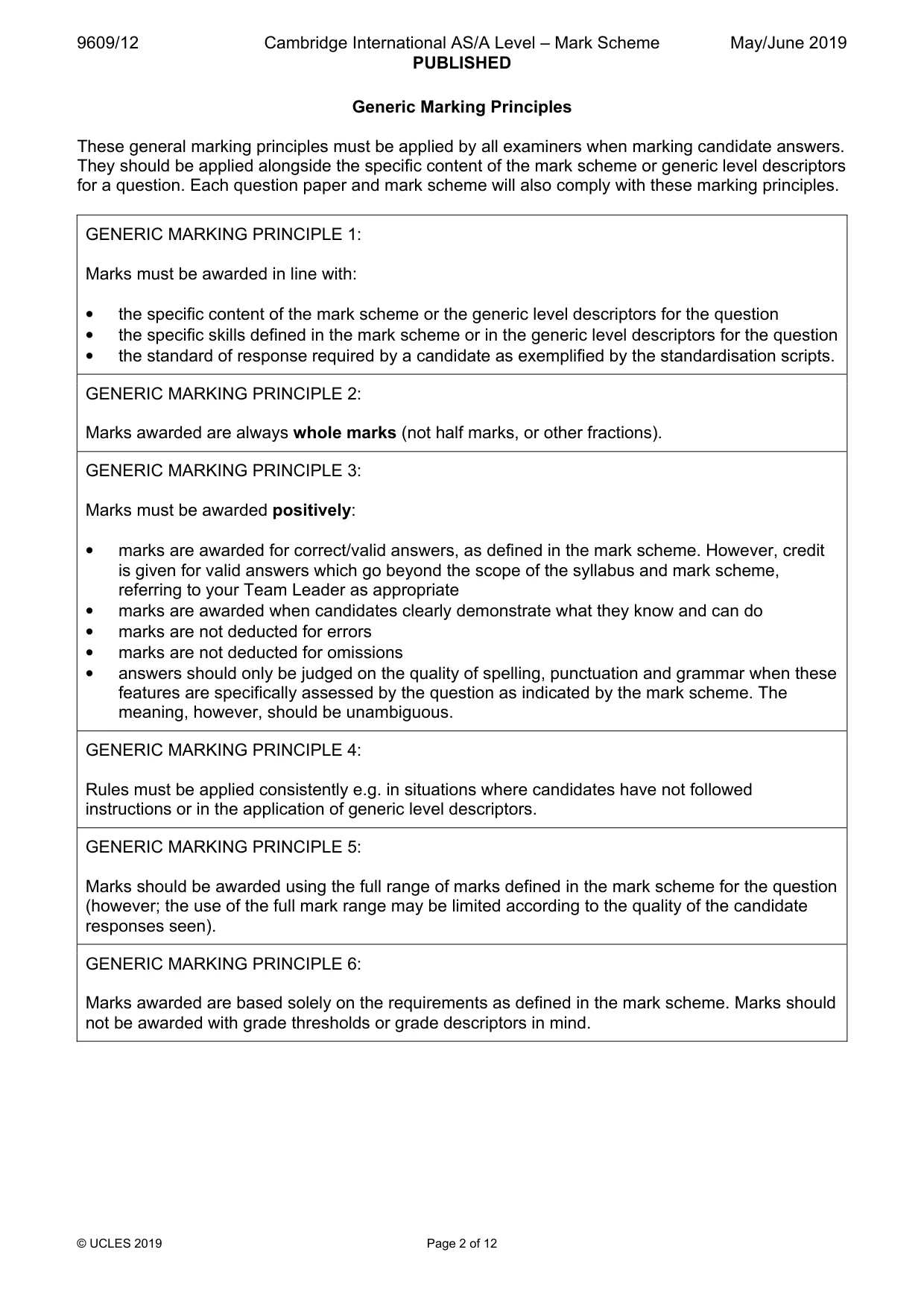
9609/12 Cambridge International AS/A Level – Mark Scheme PUBLISHED May/June 2019 © UCLES 2019 Page 2 of 12 Generic Marking Principles These general marking principles must be applied by all examiners when marking candidate answers. They should be applied alongside the specific content of the mark scheme or generic level descriptors for a question. Each question paper and mark scheme will also comply with these marking principles. GENERIC MARKING PRINCIPLE 1: Marks must be awarded in line with: • the specific content of the mark scheme or the generic level descriptors for the question • the specific skills defined in the mark scheme or in the generic level descriptors for the question • the standard of response required by a candidate as exemplified by the standardisation scripts. GENERIC MARKING PRINCIPLE 2: Marks awarded are always whole marks (not half marks, or other fractions). GENERIC MARKING PRINCIPLE 3: Marks must be awarded positively: • marks are awarded for correct/valid answers, as defined in the mark scheme. However, credit is given for valid answers which go beyond the scope of the syllabus and mark scheme, referring to your Team Leader as appropriate • marks are awarded when candidates clearly demonstrate what they know and can do • marks are not deducted for errors • marks are not deducted for omissions • answers should only be judged on the quality of spelling, punctuation and grammar when these features are specifically assessed by the question as indicated by the mark scheme. The meaning, however, should be unambiguous. GENERIC MARKING PRINCIPLE 4: Rules must be applied consistently e.g. in situations where candidates have not followed instructions or in the application of generic level descriptors. GENERIC MARKING PRINCIPLE 5: Marks should be awarded using the full range of marks defined in the mark scheme for the question (however; the use of the full mark range may be limited according to the quality of the candidate responses seen). GENERIC MARKING PRINCIPLE 6: Marks awarded are based solely on the requirements as defined in the mark scheme. Marks should not be awarded with grade thresholds or grade descriptors in mind.
Mark scheme, page 3
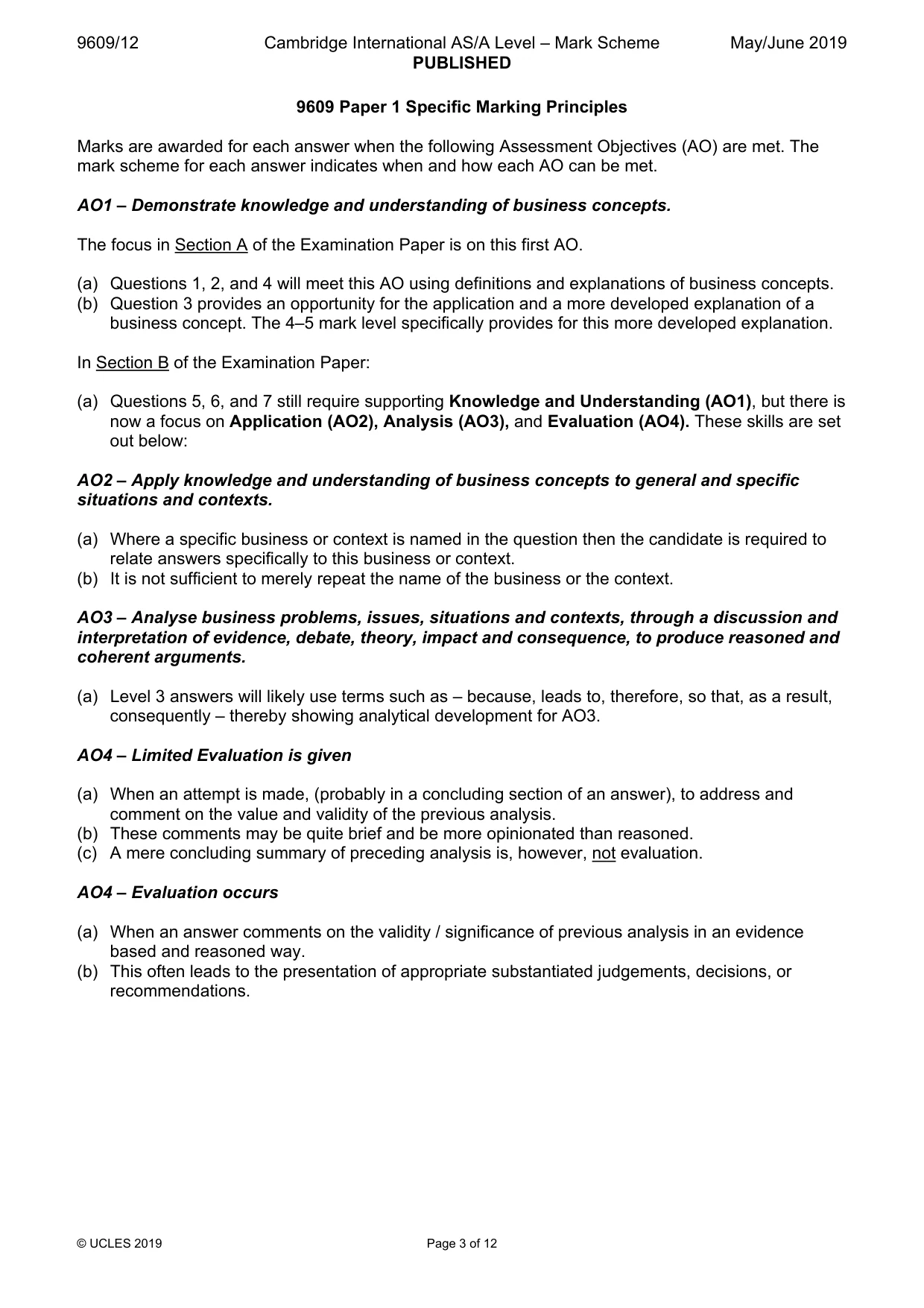
9609/12 Cambridge International AS/A Level – Mark Scheme PUBLISHED May/June 2019 © UCLES 2019 Page 3 of 12 9609 Paper 1 Specific Marking Principles Marks are awarded for each answer when the following Assessment Objectives (AO) are met. The mark scheme for each answer indicates when and how each AO can be met. AO1 – Demonstrate knowledge and understanding of business concepts. The focus in Section A of the Examination Paper is on this first AO. (a) Questions 1, 2, and 4 will meet this AO using definitions and explanations of business concepts. (b) Question 3 provides an opportunity for the application and a more developed explanation of a business concept. The 4–5 mark level specifically provides for this more developed explanation. In Section B of the Examination Paper: (a) Questions 5, 6, and 7 still require supporting Knowledge and Understanding (AO1), but there is now a focus on Application (AO2), Analysis (AO3), and Evaluation (AO4). These skills are set out below: AO2 – Apply knowledge and understanding of business concepts to general and specific situations and contexts. (a) Where a specific business or context is named in the question then the candidate is required to relate answers specifically to this business or context. (b) It is not sufficient to merely repeat the name of the business or the context. AO3 – Analyse business problems, issues, situations and contexts, through a discussion and interpretation of evidence, debate, theory, impact and consequence, to produce reasoned and coherent arguments. (a) Level 3 answers will likely use terms such as – because, leads to, therefore, so that, as a result, consequently – thereby showing analytical development for AO3. AO4 – Limited Evaluation is given (a) When an attempt is made, (probably in a concluding section of an answer), to address and comment on the value and validity of the previous analysis. (b) These comments may be quite brief and be more opinionated than reasoned. (c) A mere concluding summary of preceding analysis is, however, not evaluation. AO4 – Evaluation occurs (a) When an answer comments on the validity / significance of previous analysis in an evidence based and reasoned way. (b) This often leads to the presentation of appropriate substantiated judgements, decisions, or recommendations.
Mark scheme, page 4
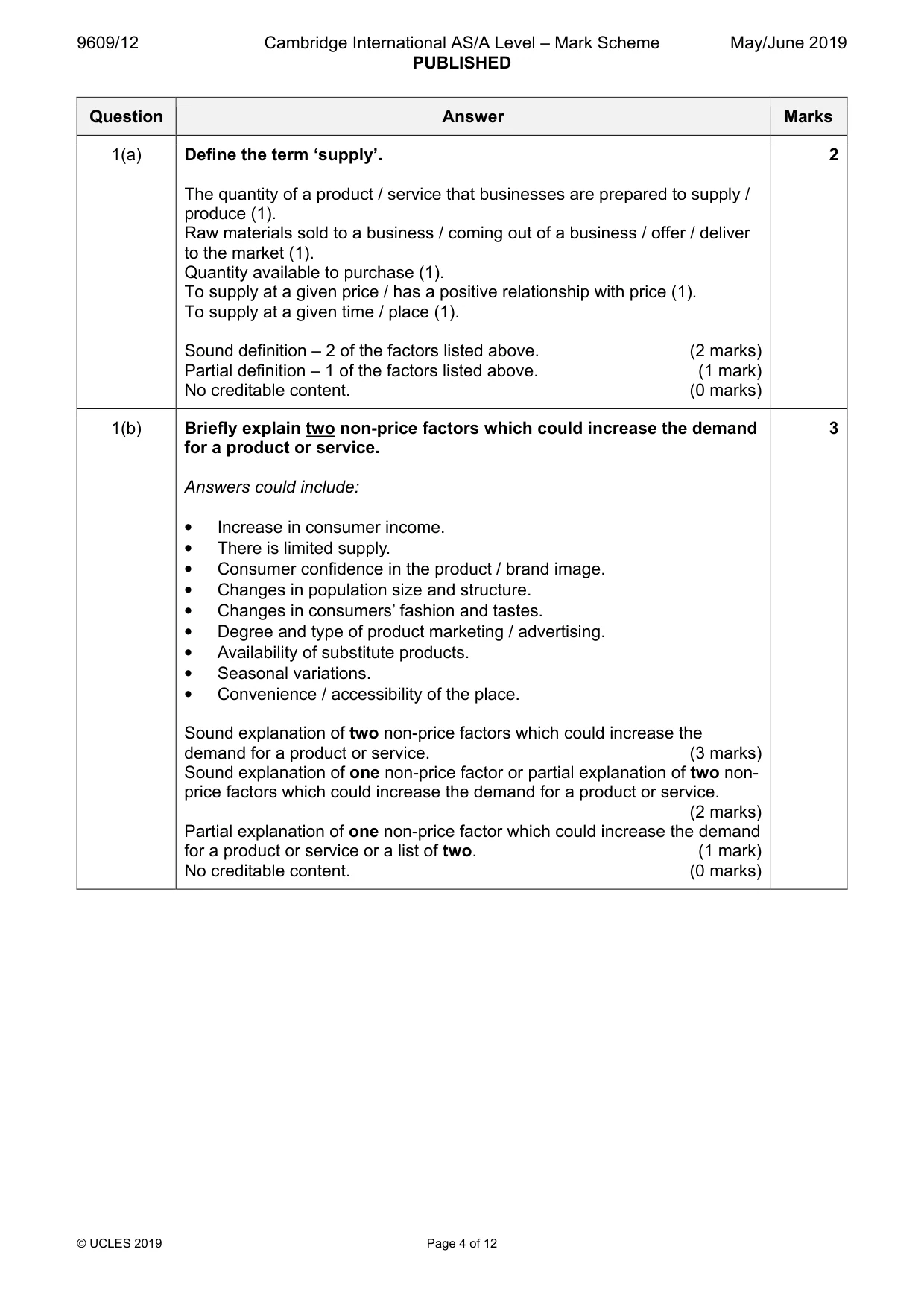
9609/12 Cambridge International AS/A Level – Mark Scheme PUBLISHED May/June 2019 © UCLES 2019 Page 4 of 12 Question Answer Marks 1(a) Define the term ‘supply’. The quantity of a product / service that businesses are prepared to supply / produce (1). Raw materials sold to a business / coming out of a business / offer / deliver to the market (1). Quantity available to purchase (1). To supply at a given price / has a positive relationship with price (1). To supply at a given time / place (1). Sound definition – 2 of the factors listed above. (2 marks) Partial definition – 1 of the factors listed above. (1 mark) No creditable content. (0 marks) 2 1(b) Briefly explain two non-price factors which could increase the demand for a product or service. Answers could include: • Increase in consumer income. • There is limited supply. • Consumer confidence in the product / brand image. • Changes in population size and structure. • Changes in consumers’ fashion and tastes. • Degree and type of product marketing / advertising. • Availability of substitute products. • Seasonal variations. • Convenience / accessibility of the place. Sound explanation of two non-price factors which could increase the demand for a product or service. (3 marks) Sound explanation of one non-price factor or partial explanation of two non- price factors which could increase the demand for a product or service. (2 marks) Partial explanation of one non-price factor which could increase the demand for a product or service or a list of two. (1 mark) No creditable content. (0 marks) 3
Mark scheme, page 5
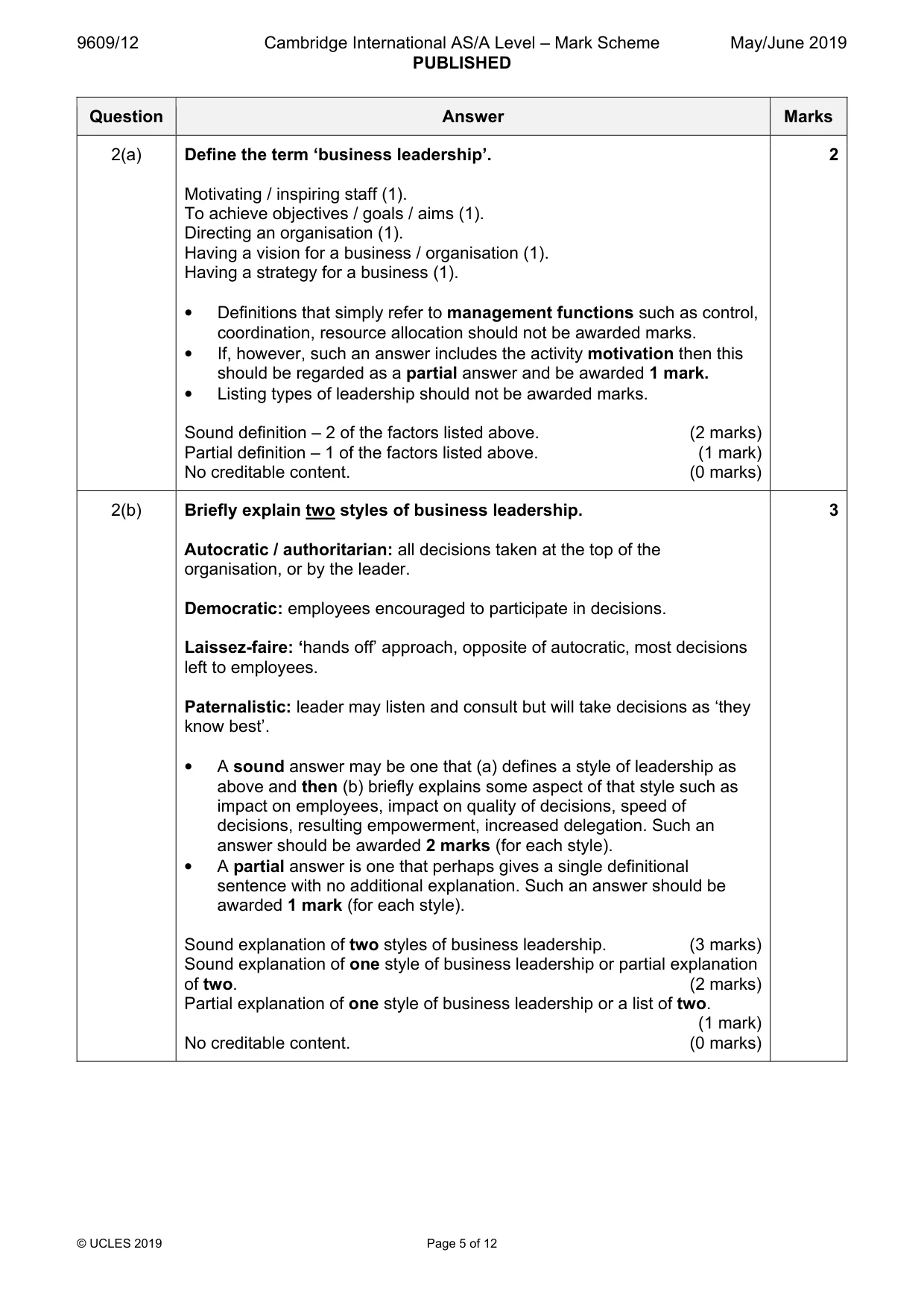
9609/12 Cambridge International AS/A Level – Mark Scheme PUBLISHED May/June 2019 © UCLES 2019 Page 5 of 12 Question Answer Marks 2(a) Define the term ‘business leadership’. Motivating / inspiring staff (1). To achieve objectives / goals / aims (1). Directing an organisation (1). Having a vision for a business / organisation (1). Having a strategy for a business (1). • Definitions that simply refer to management functions such as control, coordination, resource allocation should not be awarded marks. • If, however, such an answer includes the activity motivation then this should be regarded as a partial answer and be awarded 1 mark. • Listing types of leadership should not be awarded marks. Sound definition – 2 of the factors listed above. (2 marks) Partial definition – 1 of the factors listed above. (1 mark) No creditable content. (0 marks) 2 2(b) Briefly explain two styles of business leadership. Autocratic / authoritarian: all decisions taken at the top of the organisation, or by the leader. Democratic: employees encouraged to participate in decisions. Laissez-faire: ‘hands off’ approach, opposite of autocratic, most decisions left to employees. Paternalistic: leader may listen and consult but will take decisions as ‘they know best’. • A sound answer may be one that (a) defines a style of leadership as above and then (b) briefly explains some aspect of that style such as impact on employees, impact on quality of decisions, speed of decisions, resulting empowerment, increased delegation. Such an answer should be awarded 2 marks (for each style). • A partial answer is one that perhaps gives a single definitional sentence with no additional explanation. Such an answer should be awarded 1 mark (for each style). Sound explanation of two styles of business leadership. (3 marks) Sound explanation of one style of business leadership or partial explanation of two. (2 marks) Partial explanation of one style of business leadership or a list of two. (1 mark) No creditable content. (0 marks) 3
Mark scheme, page 6
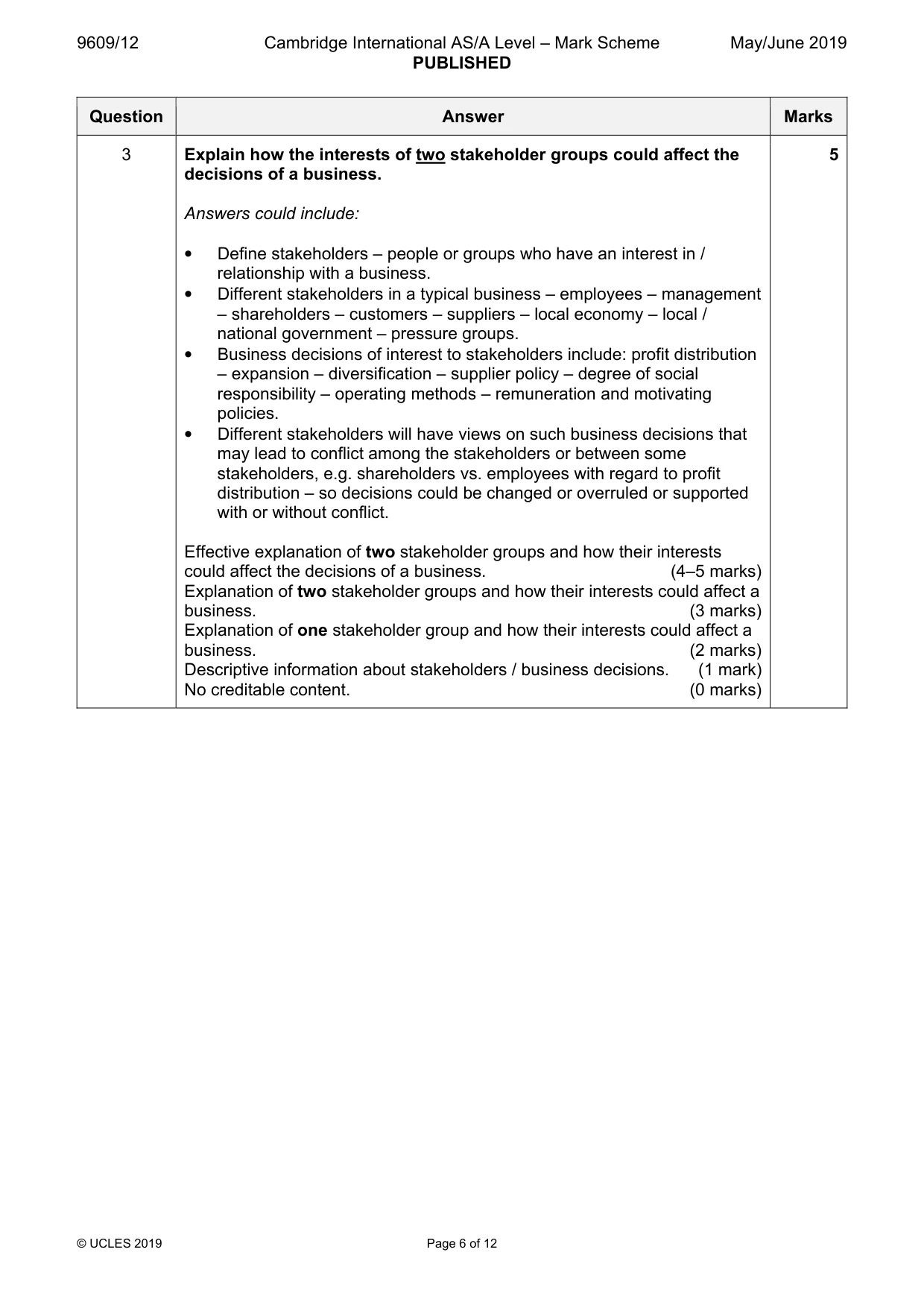
9609/12 Cambridge International AS/A Level – Mark Scheme PUBLISHED May/June 2019 © UCLES 2019 Page 6 of 12 Question Answer Marks 3 Explain how the interests of two stakeholder groups could affect the decisions of a business. Answers could include: • Define stakeholders – people or groups who have an interest in / relationship with a business. • Different stakeholders in a typical business – employees – management – shareholders – customers – suppliers – local economy – local / national government – pressure groups. • Business decisions of interest to stakeholders include: profit distribution – expansion – diversification – supplier policy – degree of social responsibility – operating methods – remuneration and motivating policies. • Different stakeholders will have views on such business decisions that may lead to conflict among the stakeholders or between some stakeholders, e.g. shareholders vs. employees with regard to profit distribution – so decisions could be changed or overruled or supported with or without conflict. Effective explanation of two stakeholder groups and how their interests could affect the decisions of a business. (4–5 marks) Explanation of two stakeholder groups and how their interests could affect a business. (3 marks) Explanation of one stakeholder group and how their interests could affect a business. (2 marks) Descriptive information about stakeholders / business decisions. (1 mark) No creditable content. (0 marks) 5
Mark scheme, page 7
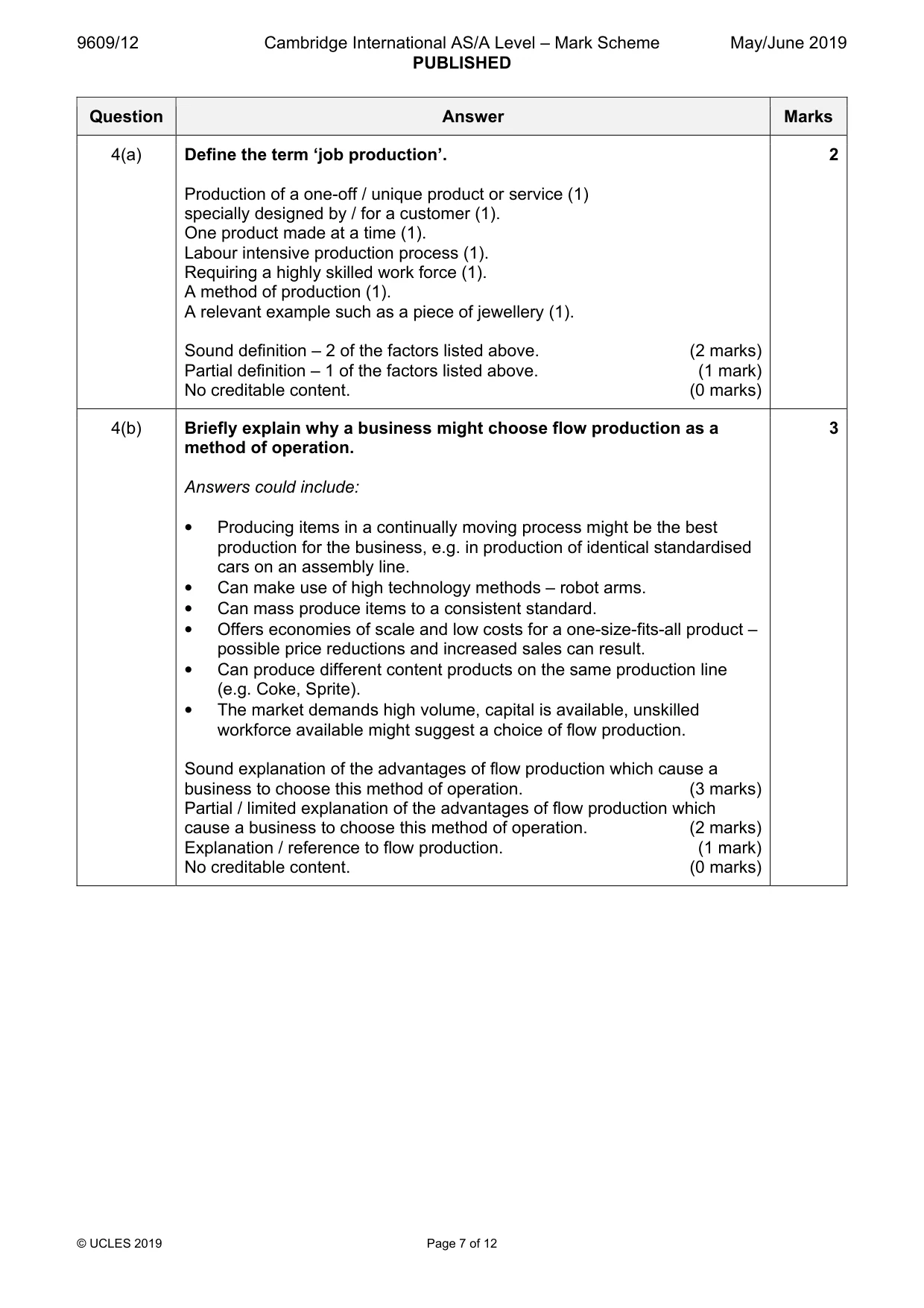
9609/12 Cambridge International AS/A Level – Mark Scheme PUBLISHED May/June 2019 © UCLES 2019 Page 7 of 12 Question Answer Marks 4(a) Define the term ‘job production’. Production of a one-off / unique product or service (1) specially designed by / for a customer (1). One product made at a time (1). Labour intensive production process (1). Requiring a highly skilled work force (1). A method of production (1). A relevant example such as a piece of jewellery (1). Sound definition – 2 of the factors listed above. (2 marks) Partial definition – 1 of the factors listed above. (1 mark) No creditable content. (0 marks) 2 4(b) Briefly explain why a business might choose flow production as a method of operation. Answers could include: • Producing items in a continually moving process might be the best production for the business, e.g. in production of identical standardised cars on an assembly line. • Can make use of high technology methods – robot arms. • Can mass produce items to a consistent standard. • Offers economies of scale and low costs for a one-size-fits-all product – possible price reductions and increased sales can result. • Can produce different content products on the same production line (e.g. Coke, Sprite). • The market demands high volume, capital is available, unskilled workforce available might suggest a choice of flow production. Sound explanation of the advantages of flow production which cause a business to choose this method of operation. (3 marks) Partial / limited explanation of the advantages of flow production which cause a business to choose this method of operation. (2 marks) Explanation / reference to flow production. (1 mark) No creditable content. (0 marks) 3
Mark scheme, page 8
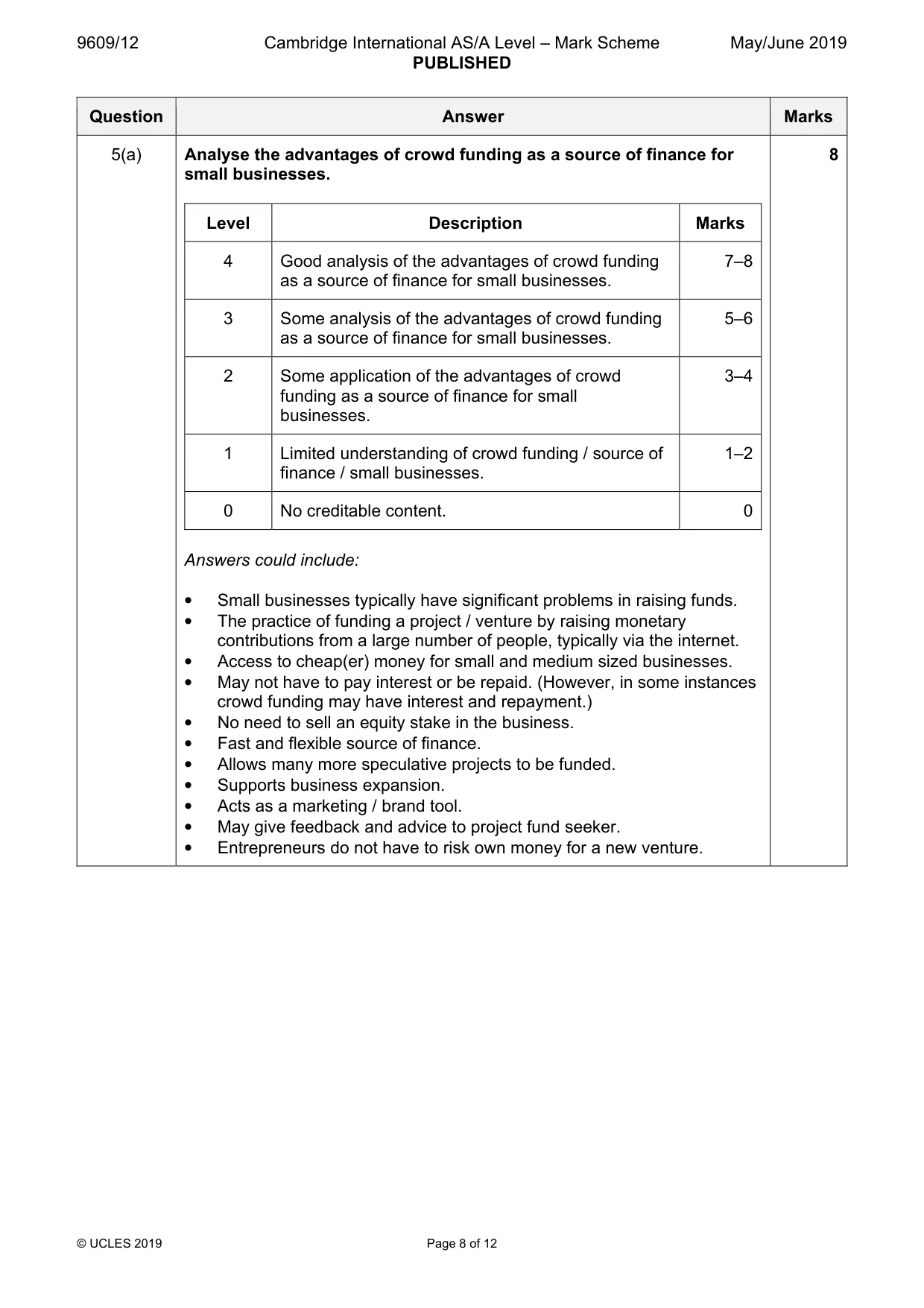
9609/12 Cambridge International AS/A Level – Mark Scheme PUBLISHED May/June 2019 © UCLES 2019 Page 8 of 12 Question Answer Marks 5(a) Analyse the advantages of crowd funding as a source of finance for small businesses. Level Description Marks 4 Good analysis of the advantages of crowd funding as a source of finance for small businesses. 7–8 3 Some analysis of the advantages of crowd funding as a source of finance for small businesses. 5–6 2 Some application of the advantages of crowd funding as a source of finance for small businesses. 3–4 1 Limited understanding of crowd funding / source of finance / small businesses. 1–2 0 No creditable content. 0 Answers could include: • Small businesses typically have significant problems in raising funds. • The practice of funding a project / venture by raising monetary contributions from a large number of people, typically via the internet. • Access to cheap(er) money for small and medium sized businesses. • May not have to pay interest or be repaid. (However, in some instances crowd funding may have interest and repayment.) • No need to sell an equity stake in the business. • Fast and flexible source of finance. • Allows many more speculative projects to be funded. • Supports business expansion. • Acts as a marketing / brand tool. • May give feedback and advice to project fund seeker. • Entrepreneurs do not have to risk own money for a new venture. 8
Mark scheme, page 9
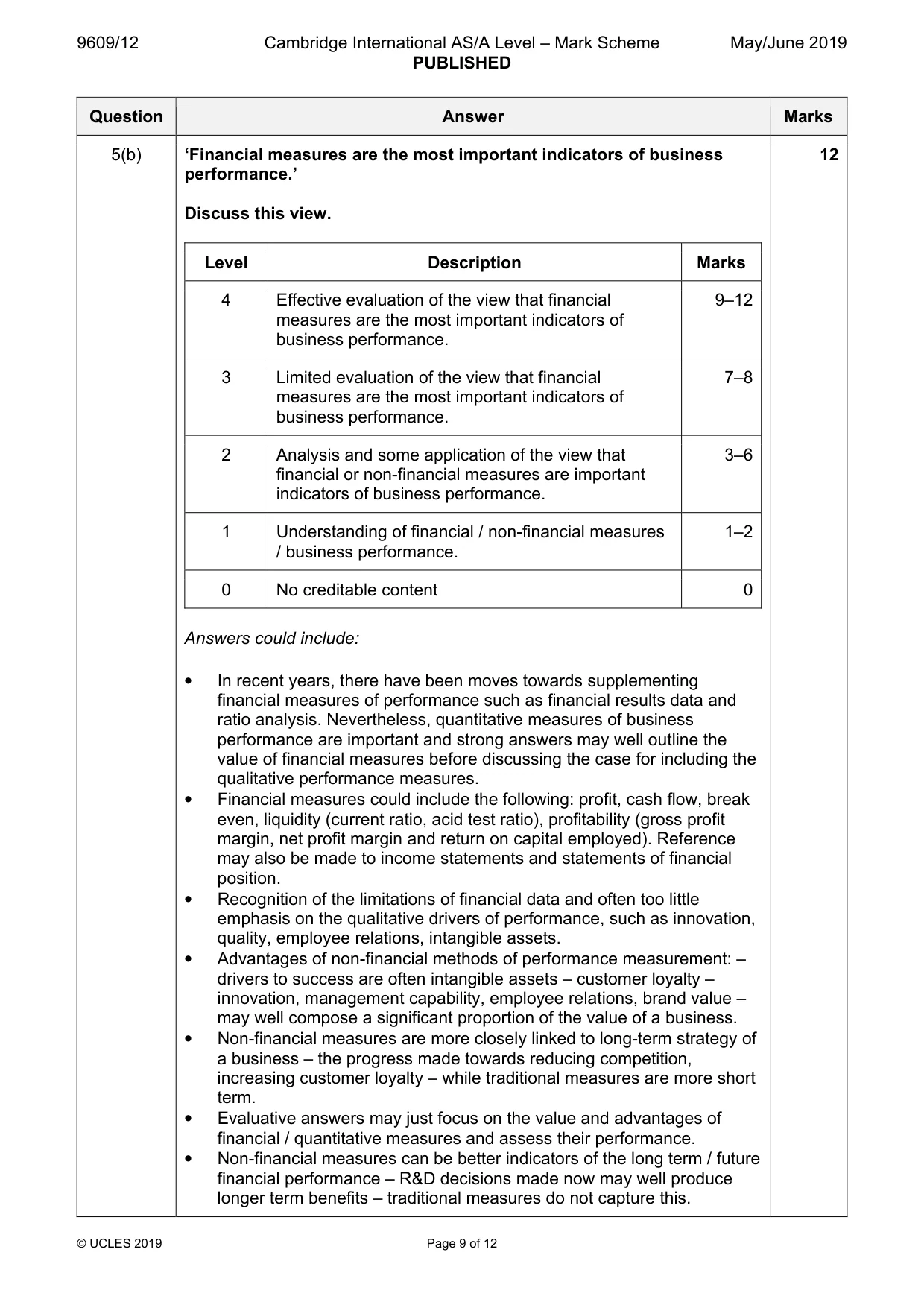
9609/12 Cambridge International AS/A Level – Mark Scheme PUBLISHED May/June 2019 © UCLES 2019 Page 9 of 12 Question Answer Marks 5(b) ‘Financial measures are the most important indicators of business performance.’ Discuss this view. Level Description Marks 4 Effective evaluation of the view that financial measures are the most important indicators of business performance. 9–12 3 Limited evaluation of the view that financial measures are the most important indicators of business performance. 7–8 2 Analysis and some application of the view that financial or non-financial measures are important indicators of business performance. 3–6 1 Understanding of financial / non-financial measures / business performance. 1–2 0 No creditable content 0 Answers could include: • In recent years, there have been moves towards supplementing financial measures of performance such as financial results data and ratio analysis. Nevertheless, quantitative measures of business performance are important and strong answers may well outline the value of financial measures before discussing the case for including the qualitative performance measures. • Financial measures could include the following: profit, cash flow, break even, liquidity (current ratio, acid test ratio), profitability (gross profit margin, net profit margin and return on capital employed). Reference may also be made to income statements and statements of financial position. • Recognition of the limitations of financial data and often too little emphasis on the qualitative drivers of performance, such as innovation, quality, employee relations, intangible assets. • Advantages of non-financial methods of performance measurement: – drivers to success are often intangible assets – customer loyalty – innovation, management capability, employee relations, brand value – may well compose a significant proportion of the value of a business. • Non-financial measures are more closely linked to long-term strategy of a business – the progress made towards reducing competition, increasing customer loyalty – while traditional measures are more short term. • Evaluative answers may just focus on the value and advantages of financial / quantitative measures and assess their performance. • Non-financial measures can be better indicators of the long term / future financial performance – R&D decisions made now may well produce longer term benefits – traditional measures do not capture this. 12
Mark scheme, page 10
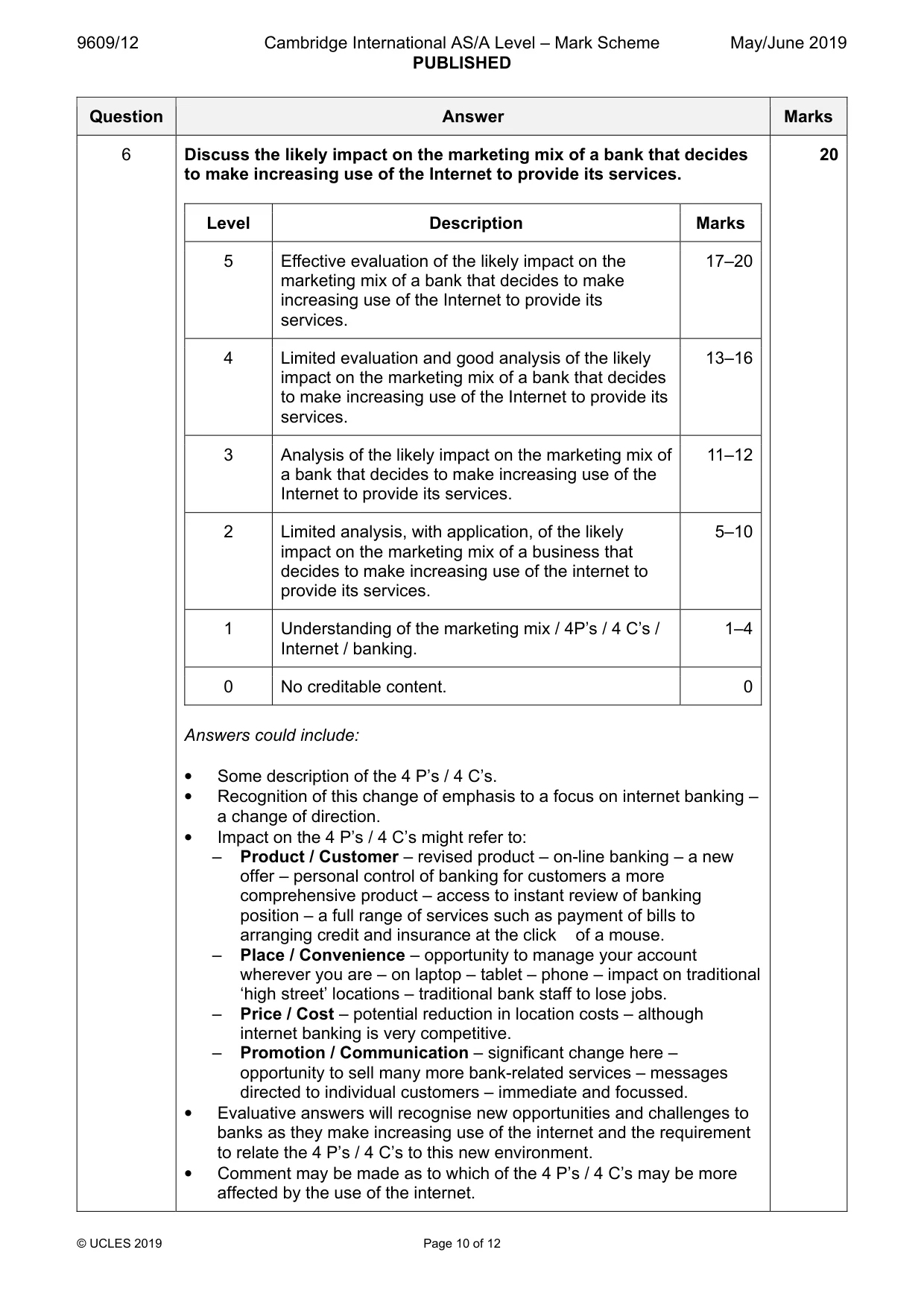
9609/12 Cambridge International AS/A Level – Mark Scheme PUBLISHED May/June 2019 © UCLES 2019 Page 10 of 12 Question Answer Marks 6 Discuss the likely impact on the marketing mix of a bank that decides to make increasing use of the Internet to provide its services. Level Description Marks 5 Effective evaluation of the likely impact on the marketing mix of a bank that decides to make increasing use of the Internet to provide its services. 17–20 4 Limited evaluation and good analysis of the likely impact on the marketing mix of a bank that decides to make increasing use of the Internet to provide its services. 13–16 3 Analysis of the likely impact on the marketing mix of a bank that decides to make increasing use of the Internet to provide its services. 11–12 2 Limited analysis, with application, of the likely impact on the marketing mix of a business that decides to make increasing use of the internet to provide its services. 5–10 1 Understanding of the marketing mix / 4P’s / 4 C’s / Internet / banking. 1–4 0 No creditable content. 0 Answers could include: • Some description of the 4 P’s / 4 C’s. • Recognition of this change of emphasis to a focus on internet banking – a change of direction. • Impact on the 4 P’s / 4 C’s might refer to: – Product / Customer – revised product – on-line banking – a new offer – personal control of banking for customers a more comprehensive product – access to instant review of banking position – a full range of services such as payment of bills to arranging credit and insurance at the click of a mouse. – Place / Convenience – opportunity to manage your account wherever you are – on laptop – tablet – phone – impact on traditional ‘high street’ locations – traditional bank staff to lose jobs. – Price / Cost – potential reduction in location costs – although internet banking is very competitive. – Promotion / Communication – significant change here – opportunity to sell many more bank-related services – messages directed to individual customers – immediate and focussed. • Evaluative answers will recognise new opportunities and challenges to banks as they make increasing use of the internet and the requirement to relate the 4 P’s / 4 C’s to this new environment. • Comment may be made as to which of the 4 P’s / 4 C’s may be more affected by the use of the internet. 20
Mark scheme, page 11
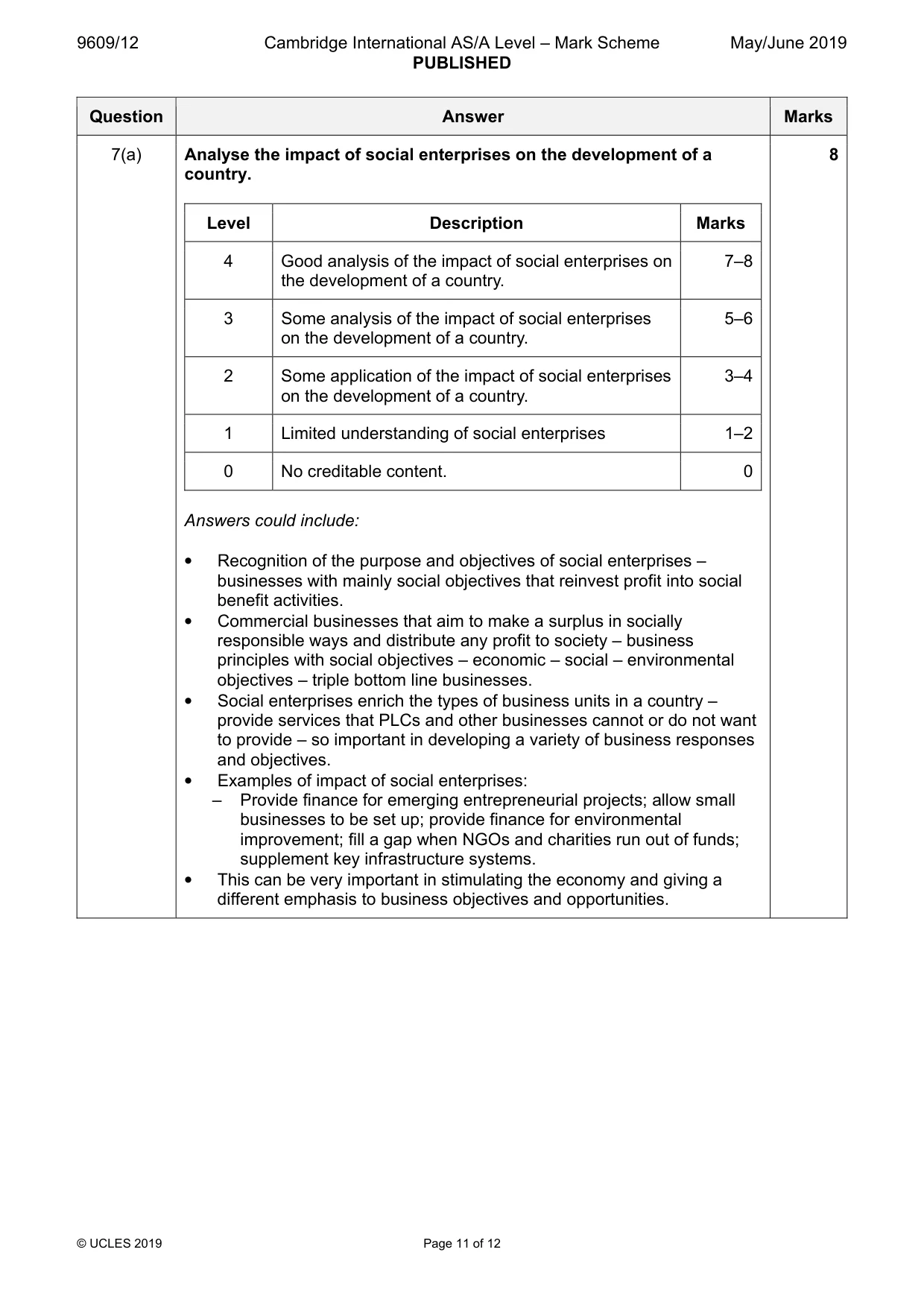
9609/12 Cambridge International AS/A Level – Mark Scheme PUBLISHED May/June 2019 © UCLES 2019 Page 11 of 12 Question Answer Marks 7(a) Analyse the impact of social enterprises on the development of a country. Level Description Marks 4 Good analysis of the impact of social enterprises on the development of a country. 7–8 3 Some analysis of the impact of social enterprises on the development of a country. 5–6 2 Some application of the impact of social enterprises on the development of a country. 3–4 1 Limited understanding of social enterprises 1–2 0 No creditable content. 0 Answers could include: • Recognition of the purpose and objectives of social enterprises – businesses with mainly social objectives that reinvest profit into social benefit activities. • Commercial businesses that aim to make a surplus in socially responsible ways and distribute any profit to society – business principles with social objectives – economic – social – environmental objectives – triple bottom line businesses. • Social enterprises enrich the types of business units in a country – provide services that PLCs and other businesses cannot or do not want to provide – so important in developing a variety of business responses and objectives. • Examples of impact of social enterprises: – Provide finance for emerging entrepreneurial projects; allow small businesses to be set up; provide finance for environmental improvement; fill a gap when NGOs and charities run out of funds; supplement key infrastructure systems. • This can be very important in stimulating the economy and giving a different emphasis to business objectives and opportunities. 8
Mark scheme, page 12
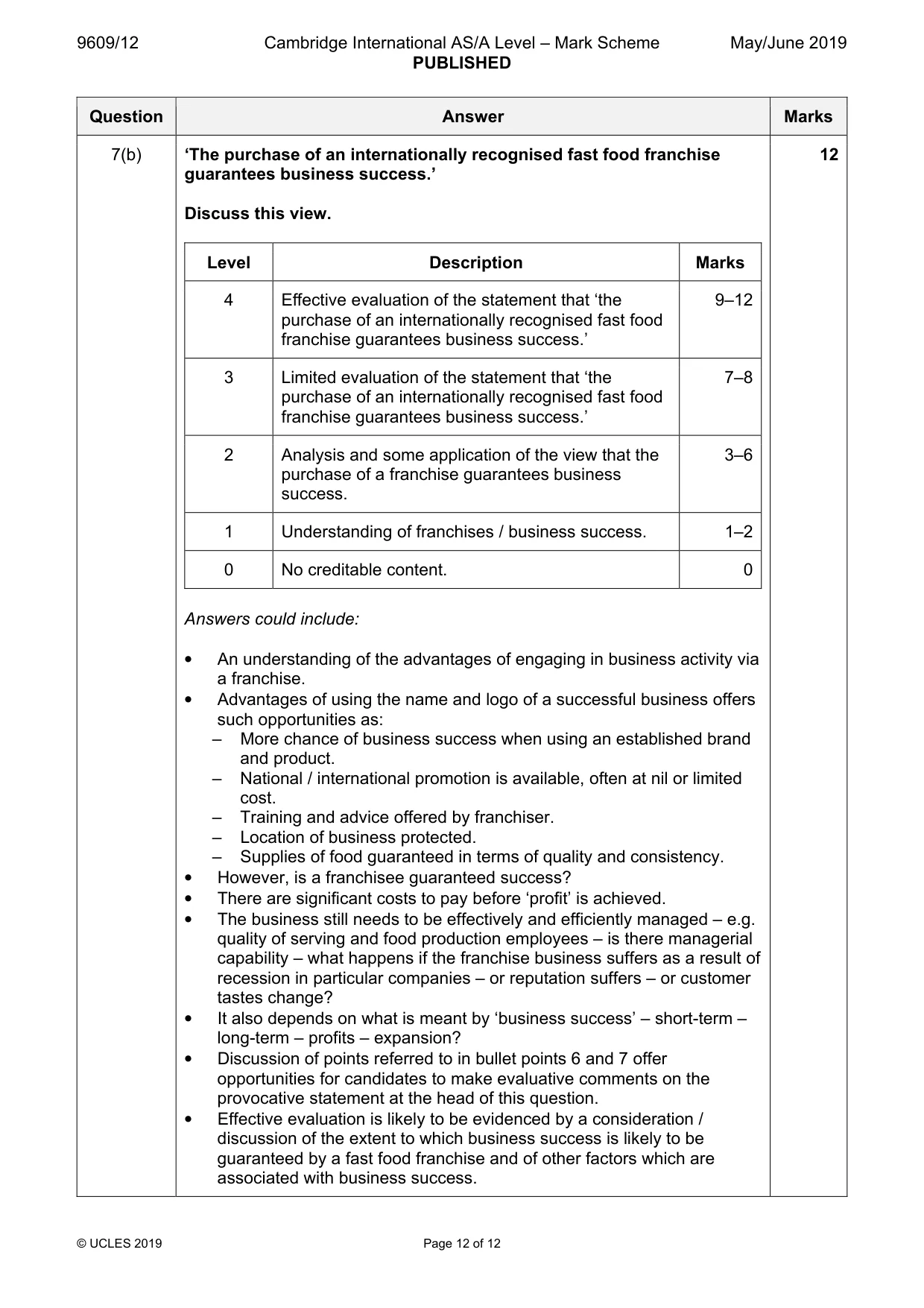
9609/12 Cambridge International AS/A Level – Mark Scheme PUBLISHED May/June 2019 © UCLES 2019 Page 12 of 12 Question Answer Marks 7(b) ‘The purchase of an internationally recognised fast food franchise guarantees business success.’ Discuss this view. Level Description Marks 4 Effective evaluation of the statement that ‘the purchase of an internationally recognised fast food franchise guarantees business success.’ 9–12 3 Limited evaluation of the statement that ‘the purchase of an internationally recognised fast food franchise guarantees business success.’ 7–8 2 Analysis and some application of the view that the purchase of a franchise guarantees business success. 3–6 1 Understanding of franchises / business success. 1–2 0 No creditable content. 0 Answers could include: • An understanding of the advantages of engaging in business activity via a franchise. • Advantages of using the name and logo of a successful business offers such opportunities as: – More chance of business success when using an established brand and product. – National / international promotion is available, often at nil or limited cost. – Training and advice offered by franchiser. – Location of business protected. – Supplies of food guaranteed in terms of quality and consistency. • However, is a franchisee guaranteed success? • There are significant costs to pay before ‘profit’ is achieved. • The business still needs to be effectively and efficiently managed – e.g. quality of serving and food production employees – is there managerial capability – what happens if the franchise business suffers as a result of recession in particular companies – or reputation suffers – or customer tastes change? • It also depends on what is meant by ‘business success’ – short-term – long-term – profits – expansion? • Discussion of points referred to in bullet points 6 and 7 offer opportunities for candidates to make evaluative comments on the provocative statement at the head of this question. • Effective evaluation is likely to be evidenced by a consideration / discussion of the extent to which business success is likely to be guaranteed by a fast food franchise and of other factors which are associated with business success. 12
What you needed in this session
Cambridge’s own grade thresholds for 2019 May/June, Paper 1 · Variant 2. A higher threshold means an easier paper — the bar moves with how the cohort did.