Cambridge A Level Business (for first examination in 2016) 9609 — 2019 May/June Paper 1 · Variant 1
9609/11/M/J/19 · 40 marks · ≈45 min
The question paper and its mark scheme, free to read here and free to download. This is Cambridge’s own paper, exactly as it was sat.
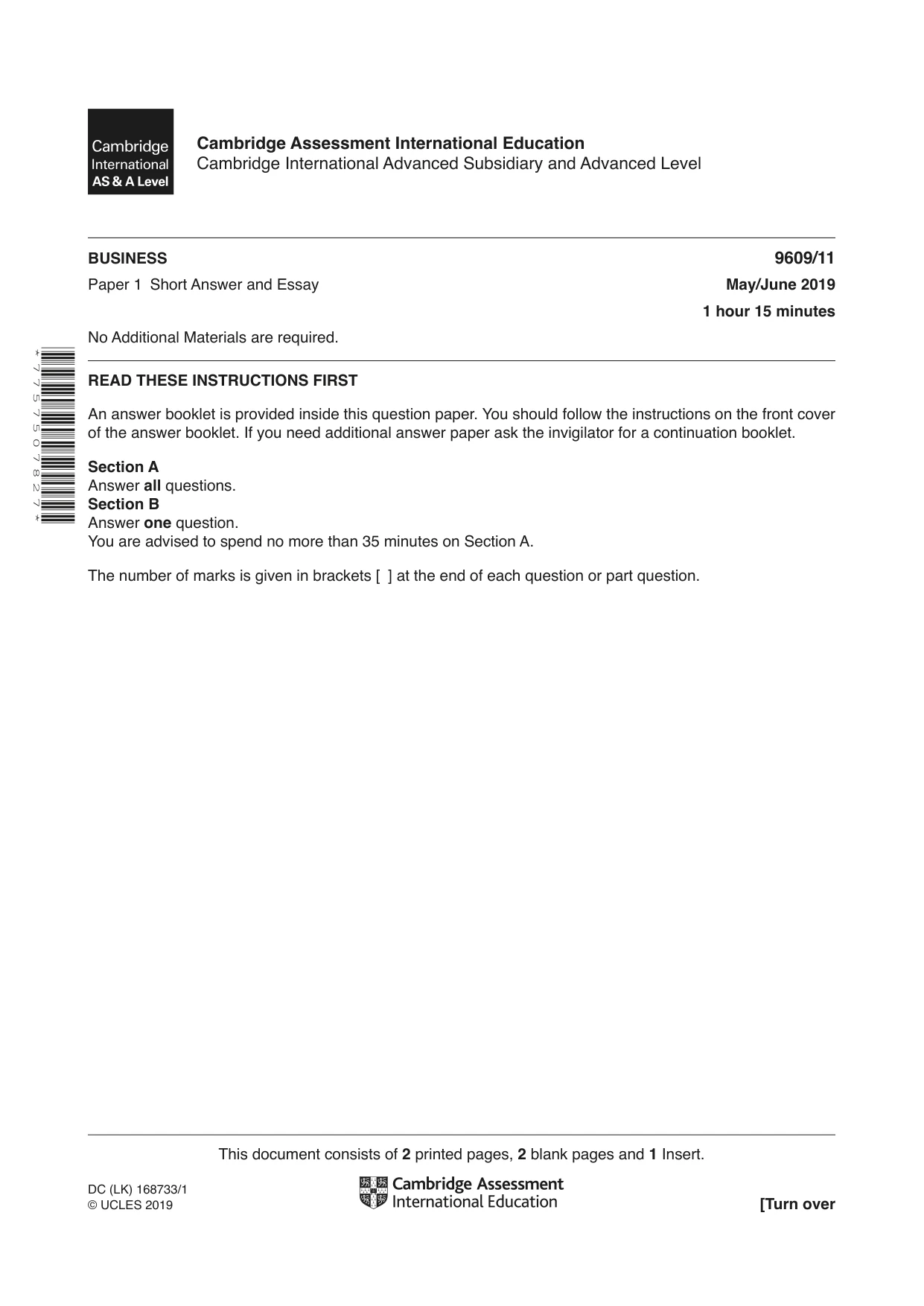
Question paper4 pages
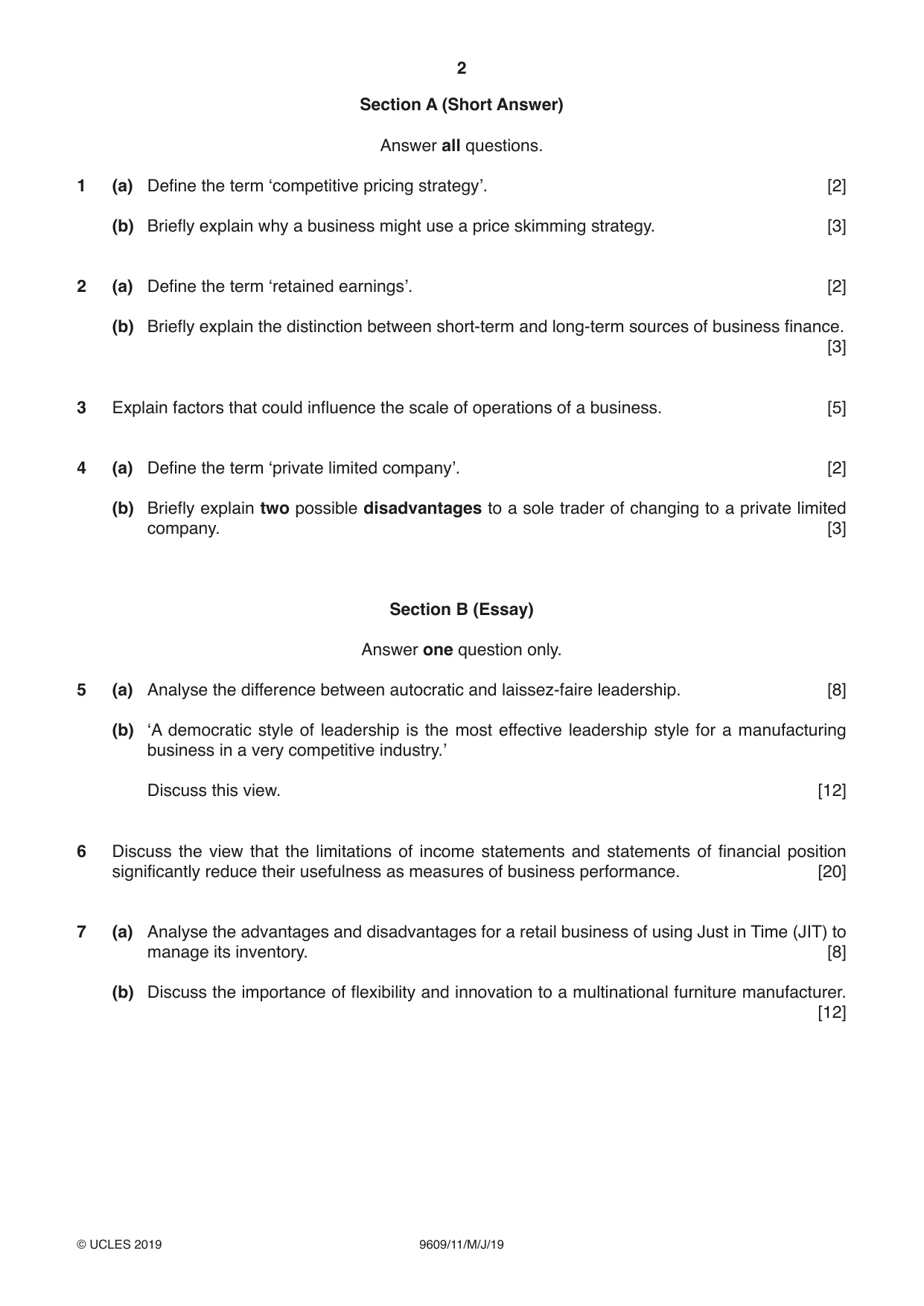


Mark scheme14 pages
Answers below. Sit the paper first if you are practising.


Paper as text
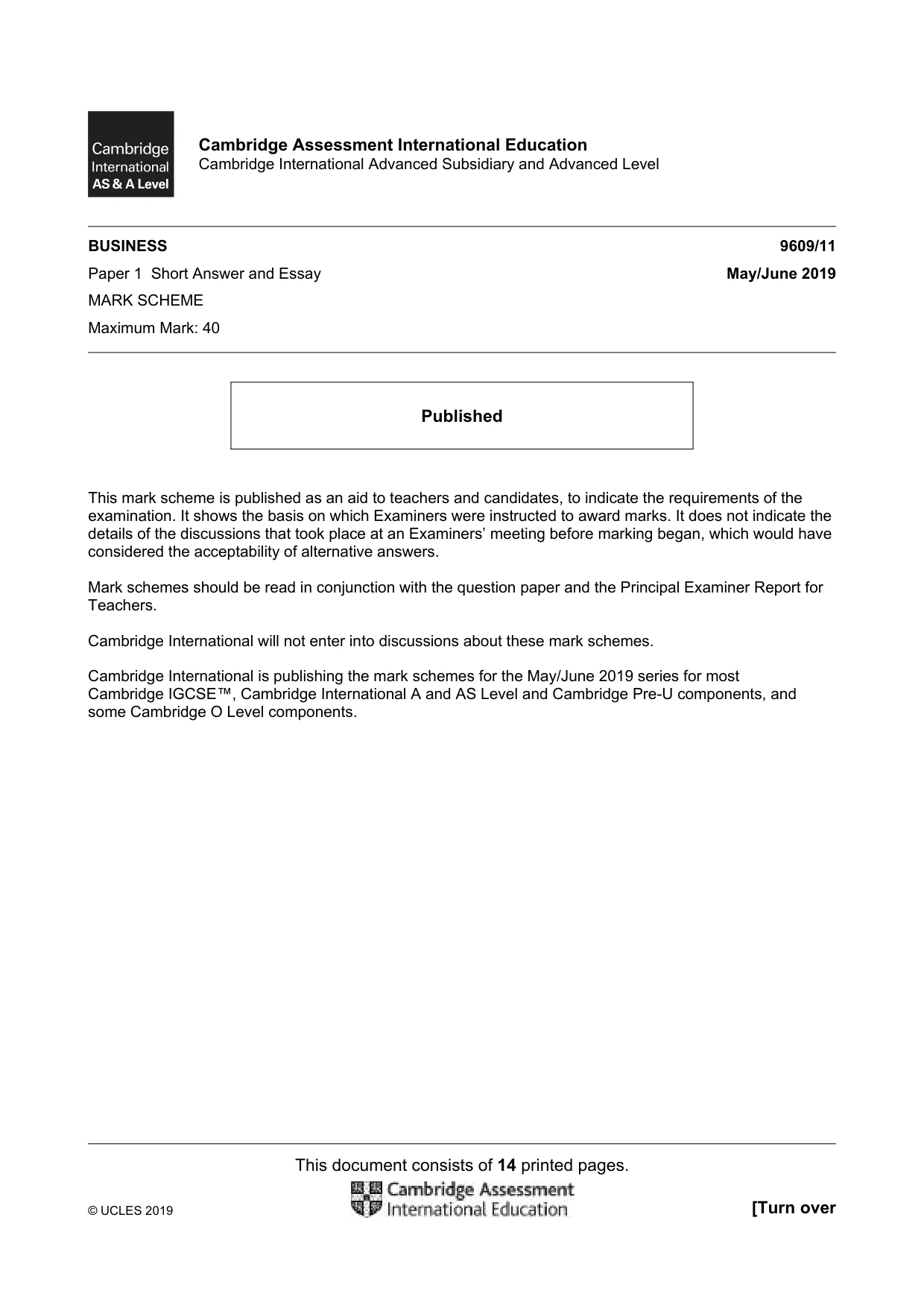
Question paper, page 1
This document consists of 2 printed pages, 2 blank pages and 1 Insert. DC (LK) 168733/1 © UCLES 2019 [Turn over Cambridge Assessment International Education Cambridge International Advanced Subsidiary and Advanced Level * 7 7 5 7 5 0 7 8 2 7 * BUSINESS 9609/11 Paper 1 Short Answer and Essay May/June 2019 1 hour 15 minutes No Additional Materials are required. READ THESE INSTRUCTIONS FIRST An answer booklet is provided inside this question paper. You should follow the instructions on the front cover of the answer booklet. If you need additional answer paper ask the invigilator for a continuation booklet. Section A Answer all questions. Section B Answer one question. You are advised to spend no more than 35 minutes on Section A. The number of marks is given in brackets [ ] at the end of each question or part question.
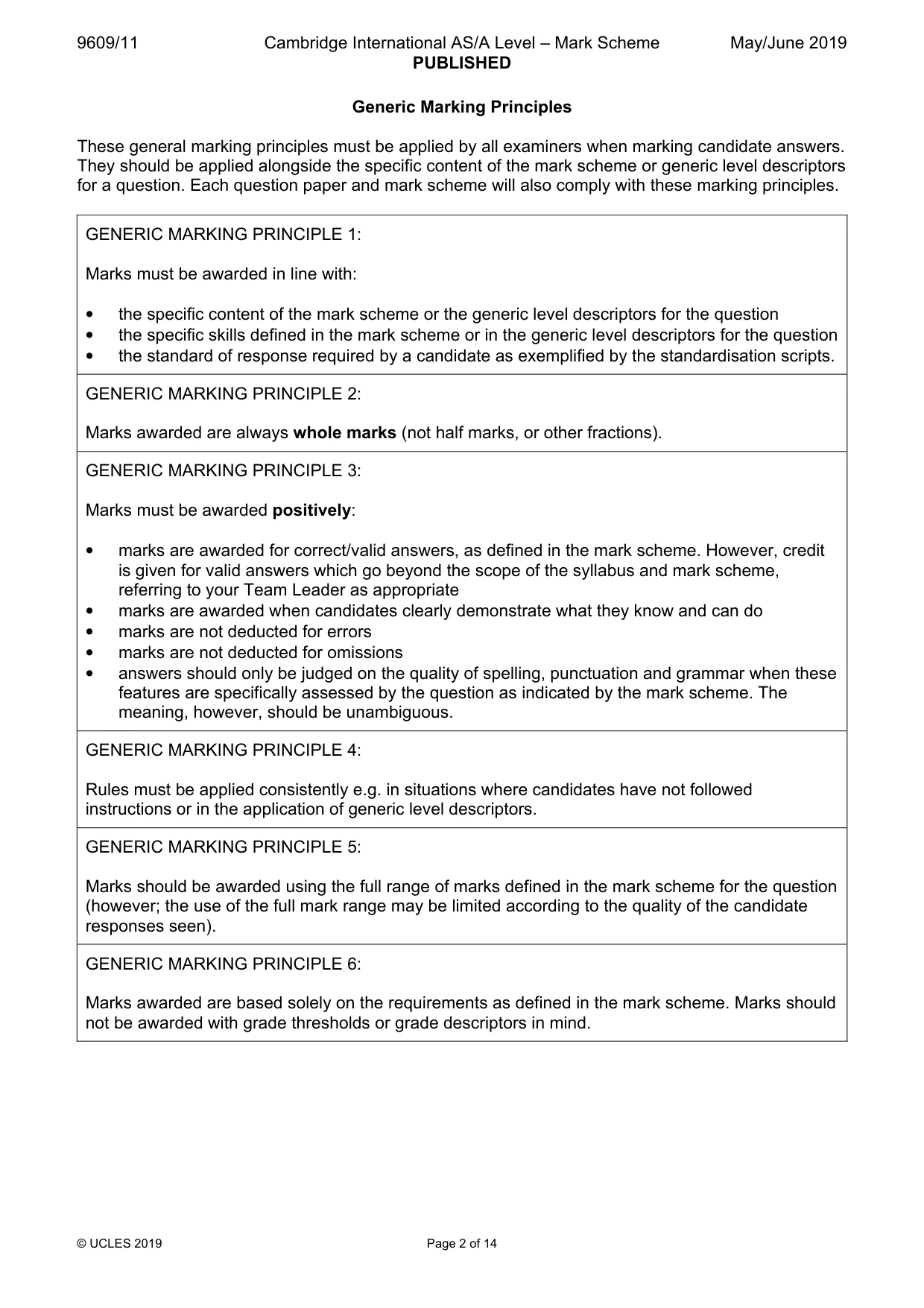
Question paper, page 2
2 9609/11/M/J/19 © UCLES 2019 Section A (Short Answer) Answer all questions. 1 (a) Define the term ‘competitive pricing strategy’. [2] (b) Briefly explain why a business might use a price skimming strategy. [3] 2 (a) Define the term ‘retained earnings’. [2] (b) Briefly explain the distinction between short-term and long-term sources of business finance. [3] 3 Explain factors that could influence the scale of operations of a business. [5] 4 (a) Define the term ‘private limited company’. [2] (b) Briefly explain two possible disadvantages to a sole trader of changing to a private limited company. [3] Section B (Essay) Answer one question only. 5 (a) Analyse the difference between autocratic and laissez-faire leadership. [8] (b) ‘A democratic style of leadership is the most effective leadership style for a manufacturing business in a very competitive industry.’ Discuss this view. [12] 6 Discuss the view that the limitations of income statements and statements of financial position significantly reduce their usefulness as measures of business performance. [20] 7 (a) Analyse the advantages and disadvantages for a retail business of using Just in Time (JIT) to manage its inventory. [8] (b) Discuss the importance of flexibility and innovation to a multinational furniture manufacturer. [12]
Question paper, page 3
3 9609/11/M/J/19 © UCLES 2019 BLANK PAGE
Question paper, page 4
4 9609/11/M/J/19 © UCLES 2019 Permission to reproduce items where third-party owned material protected by copyright is included has been sought and cleared where possible. Every reasonable effort has been made by the publisher (UCLES) to trace copyright holders, but if any items requiring clearance have unwittingly been included, the publisher will be pleased to make amends at the earliest possible opportunity. To avoid the issue of disclosure of answer-related information to candidates, all copyright acknowledgements are reproduced online in the Cambridge Assessment International Education Copyright Acknowledgements Booklet. This is produced for each series of examinations and is freely available to download at www.cambridgeinternational.org after the live examination series. Cambridge Assessment International Education is part of the Cambridge Assessment Group. Cambridge Assessment is the brand name of the University of Cambridge Local Examinations Syndicate (UCLES), which itself is a department of the University of Cambridge. BLANK PAGE
Mark scheme, page 1
This document consists of 14 printed pages. © UCLES 2019 [Turn over Cambridge Assessment International Education Cambridge International Advanced Subsidiary and Advanced Level BUSINESS 9609/11 Paper 1 Short Answer and Essay May/June 2019 MARK SCHEME Maximum Mark: 40 Published This mark scheme is published as an aid to teachers and candidates, to indicate the requirements of the examination. It shows the basis on which Examiners were instructed to award marks. It does not indicate the details of the discussions that took place at an Examiners’ meeting before marking began, which would have considered the acceptability of alternative answers. Mark schemes should be read in conjunction with the question paper and the Principal Examiner Report for Teachers. Cambridge International will not enter into discussions about these mark schemes. Cambridge International is publishing the mark schemes for the May/June 2019 series for most Cambridge IGCSE™, Cambridge International A and AS Level and Cambridge Pre-U components, and some Cambridge O Level components.
Mark scheme, page 2
9609/11 Cambridge International AS/A Level – Mark Scheme PUBLISHED May/June 2019 © UCLES 2019 Page 2 of 14 Generic Marking Principles These general marking principles must be applied by all examiners when marking candidate answers. They should be applied alongside the specific content of the mark scheme or generic level descriptors for a question. Each question paper and mark scheme will also comply with these marking principles. GENERIC MARKING PRINCIPLE 1: Marks must be awarded in line with: • the specific content of the mark scheme or the generic level descriptors for the question • the specific skills defined in the mark scheme or in the generic level descriptors for the question • the standard of response required by a candidate as exemplified by the standardisation scripts. GENERIC MARKING PRINCIPLE 2: Marks awarded are always whole marks (not half marks, or other fractions). GENERIC MARKING PRINCIPLE 3: Marks must be awarded positively: • marks are awarded for correct/valid answers, as defined in the mark scheme. However, credit is given for valid answers which go beyond the scope of the syllabus and mark scheme, referring to your Team Leader as appropriate • marks are awarded when candidates clearly demonstrate what they know and can do • marks are not deducted for errors • marks are not deducted for omissions • answers should only be judged on the quality of spelling, punctuation and grammar when these features are specifically assessed by the question as indicated by the mark scheme. The meaning, however, should be unambiguous. GENERIC MARKING PRINCIPLE 4: Rules must be applied consistently e.g. in situations where candidates have not followed instructions or in the application of generic level descriptors. GENERIC MARKING PRINCIPLE 5: Marks should be awarded using the full range of marks defined in the mark scheme for the question (however; the use of the full mark range may be limited according to the quality of the candidate responses seen). GENERIC MARKING PRINCIPLE 6: Marks awarded are based solely on the requirements as defined in the mark scheme. Marks should not be awarded with grade thresholds or grade descriptors in mind.
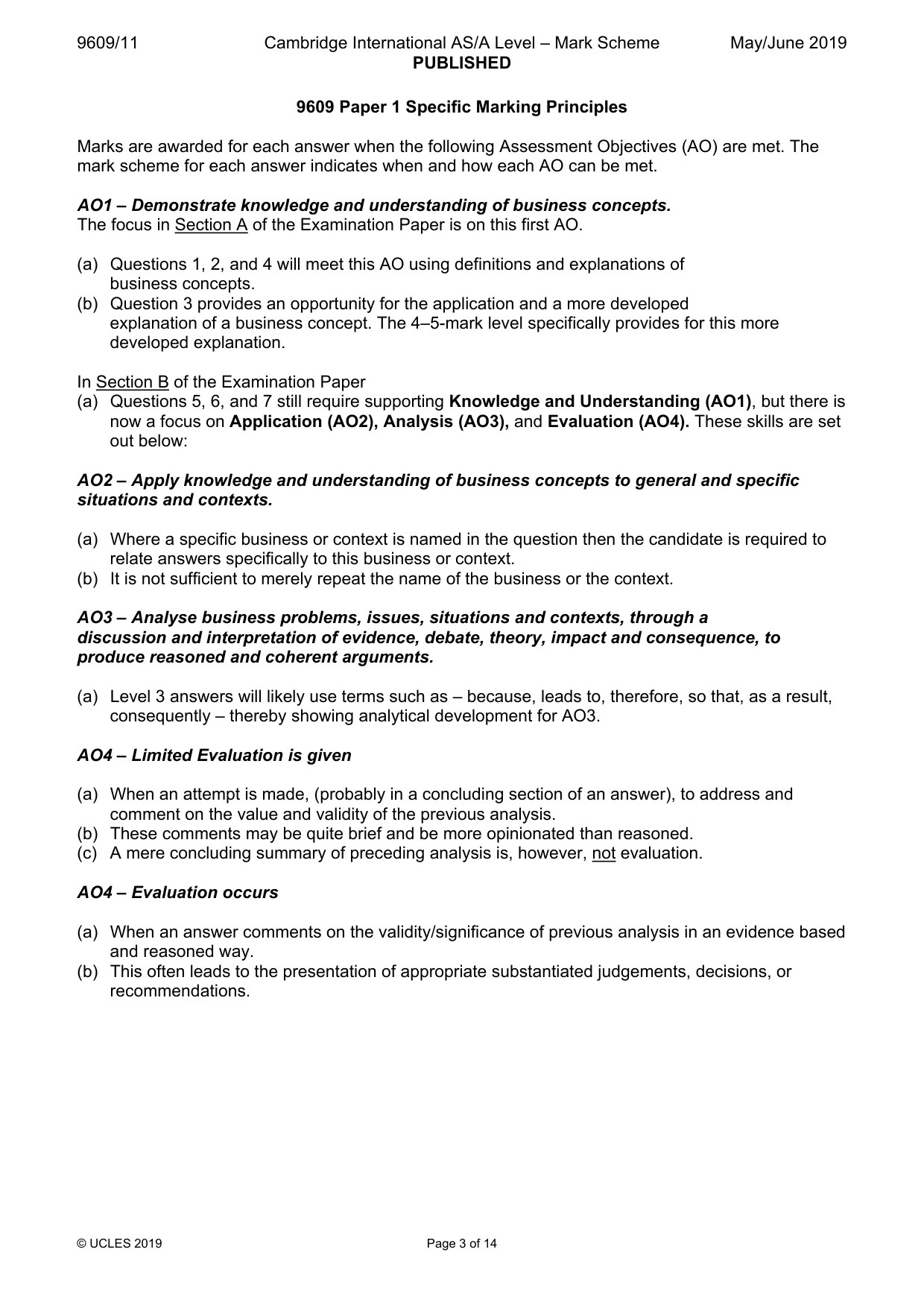
Mark scheme, page 3
9609/11 Cambridge International AS/A Level – Mark Scheme PUBLISHED May/June 2019 © UCLES 2019 Page 3 of 14 9609 Paper 1 Specific Marking Principles Marks are awarded for each answer when the following Assessment Objectives (AO) are met. The mark scheme for each answer indicates when and how each AO can be met. AO1 – Demonstrate knowledge and understanding of business concepts. The focus in Section A of the Examination Paper is on this first AO. (a) Questions 1, 2, and 4 will meet this AO using definitions and explanations of business concepts. (b) Question 3 provides an opportunity for the application and a more developed explanation of a business concept. The 4–5-mark level specifically provides for this more developed explanation. In Section B of the Examination Paper (a) Questions 5, 6, and 7 still require supporting Knowledge and Understanding (AO1), but there is now a focus on Application (AO2), Analysis (AO3), and Evaluation (AO4). These skills are set out below: AO2 – Apply knowledge and understanding of business concepts to general and specific situations and contexts. (a) Where a specific business or context is named in the question then the candidate is required to relate answers specifically to this business or context. (b) It is not sufficient to merely repeat the name of the business or the context. AO3 – Analyse business problems, issues, situations and contexts, through a discussion and interpretation of evidence, debate, theory, impact and consequence, to produce reasoned and coherent arguments. (a) Level 3 answers will likely use terms such as – because, leads to, therefore, so that, as a result, consequently – thereby showing analytical development for AO3. AO4 – Limited Evaluation is given (a) When an attempt is made, (probably in a concluding section of an answer), to address and comment on the value and validity of the previous analysis. (b) These comments may be quite brief and be more opinionated than reasoned. (c) A mere concluding summary of preceding analysis is, however, not evaluation. AO4 – Evaluation occurs (a) When an answer comments on the validity/significance of previous analysis in an evidence based and reasoned way. (b) This often leads to the presentation of appropriate substantiated judgements, decisions, or recommendations.
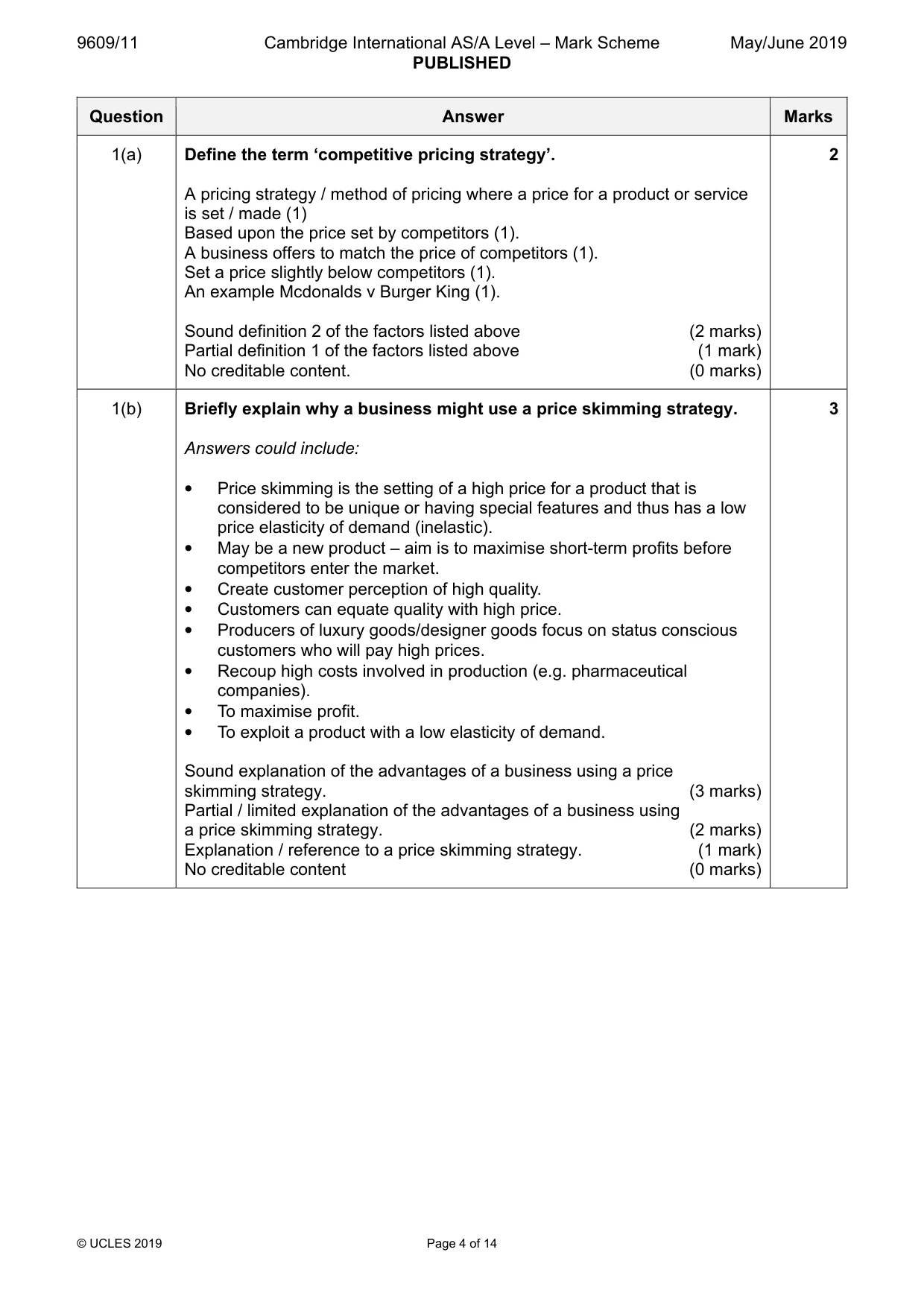
Mark scheme, page 4
9609/11 Cambridge International AS/A Level – Mark Scheme PUBLISHED May/June 2019 © UCLES 2019 Page 4 of 14 Question Answer Marks 1(a) Define the term ‘competitive pricing strategy’. A pricing strategy / method of pricing where a price for a product or service is set / made (1) Based upon the price set by competitors (1). A business offers to match the price of competitors (1). Set a price slightly below competitors (1). An example Mcdonalds v Burger King (1). Sound definition 2 of the factors listed above (2 marks) Partial definition 1 of the factors listed above (1 mark) No creditable content. (0 marks) 2 1(b) Briefly explain why a business might use a price skimming strategy. Answers could include: • Price skimming is the setting of a high price for a product that is considered to be unique or having special features and thus has a low price elasticity of demand (inelastic). • May be a new product – aim is to maximise short-term profits before competitors enter the market. • Create customer perception of high quality. • Customers can equate quality with high price. • Producers of luxury goods/designer goods focus on status conscious customers who will pay high prices. • Recoup high costs involved in production (e.g. pharmaceutical companies). • To maximise profit. • To exploit a product with a low elasticity of demand. Sound explanation of the advantages of a business using a price skimming strategy. (3 marks) Partial / limited explanation of the advantages of a business using a price skimming strategy. (2 marks) Explanation / reference to a price skimming strategy. (1 mark) No creditable content (0 marks) 3
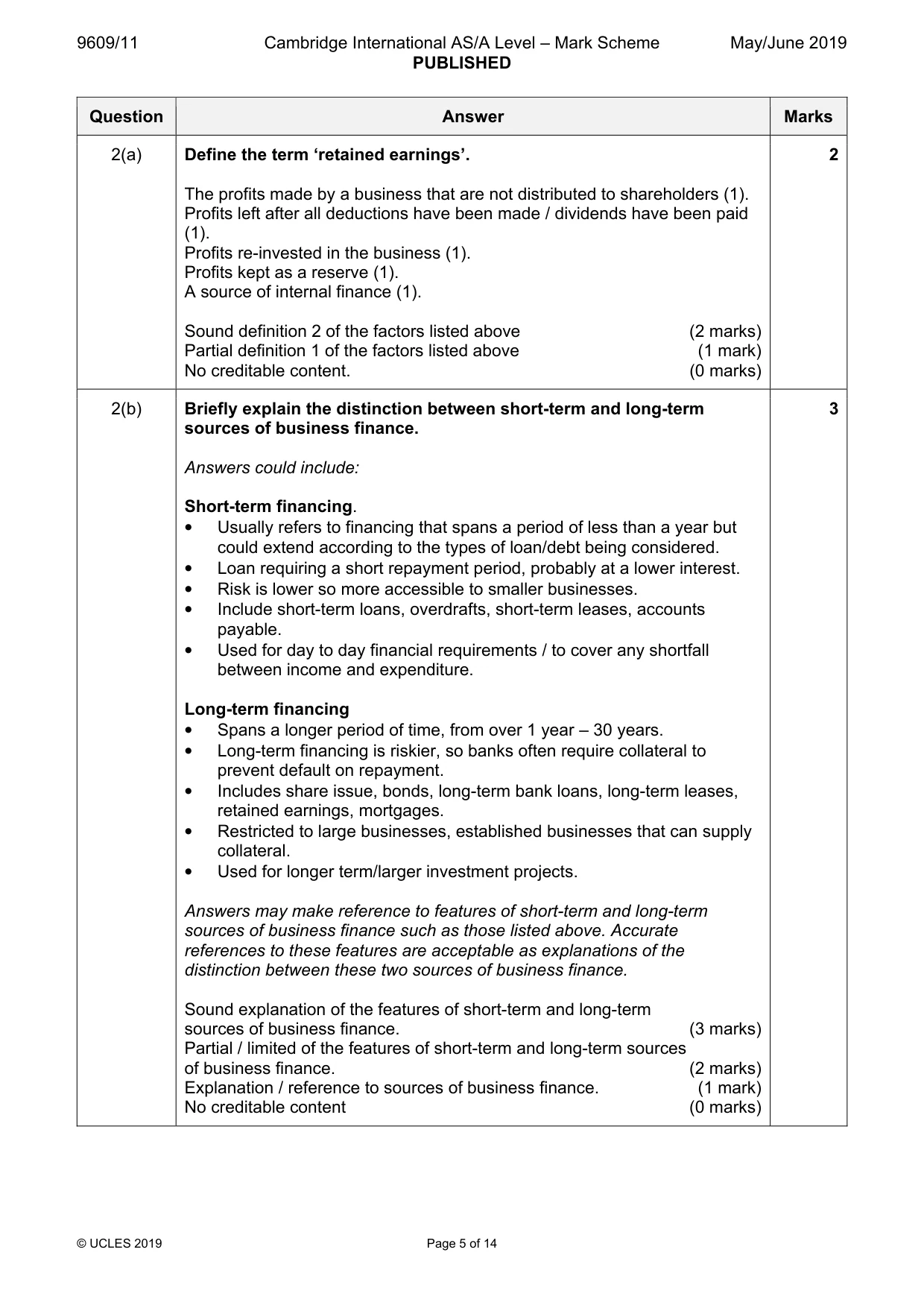
Mark scheme, page 5
9609/11 Cambridge International AS/A Level – Mark Scheme PUBLISHED May/June 2019 © UCLES 2019 Page 5 of 14 Question Answer Marks 2(a) Define the term ‘retained earnings’. The profits made by a business that are not distributed to shareholders (1). Profits left after all deductions have been made / dividends have been paid (1). Profits re-invested in the business (1). Profits kept as a reserve (1). A source of internal finance (1). Sound definition 2 of the factors listed above (2 marks) Partial definition 1 of the factors listed above (1 mark) No creditable content. (0 marks) 2 2(b) Briefly explain the distinction between short-term and long-term sources of business finance. Answers could include: Short-term financing. • Usually refers to financing that spans a period of less than a year but could extend according to the types of loan/debt being considered. • Loan requiring a short repayment period, probably at a lower interest. • Risk is lower so more accessible to smaller businesses. • Include short-term loans, overdrafts, short-term leases, accounts payable. • Used for day to day financial requirements / to cover any shortfall between income and expenditure. Long-term financing • Spans a longer period of time, from over 1 year – 30 years. • Long-term financing is riskier, so banks often require collateral to prevent default on repayment. • Includes share issue, bonds, long-term bank loans, long-term leases, retained earnings, mortgages. • Restricted to large businesses, established businesses that can supply collateral. • Used for longer term/larger investment projects. Answers may make reference to features of short-term and long-term sources of business finance such as those listed above. Accurate references to these features are acceptable as explanations of the distinction between these two sources of business finance. Sound explanation of the features of short-term and long-term sources of business finance. (3 marks) Partial / limited of the features of short-term and long-term sources of business finance. (2 marks) Explanation / reference to sources of business finance. (1 mark) No creditable content (0 marks) 3
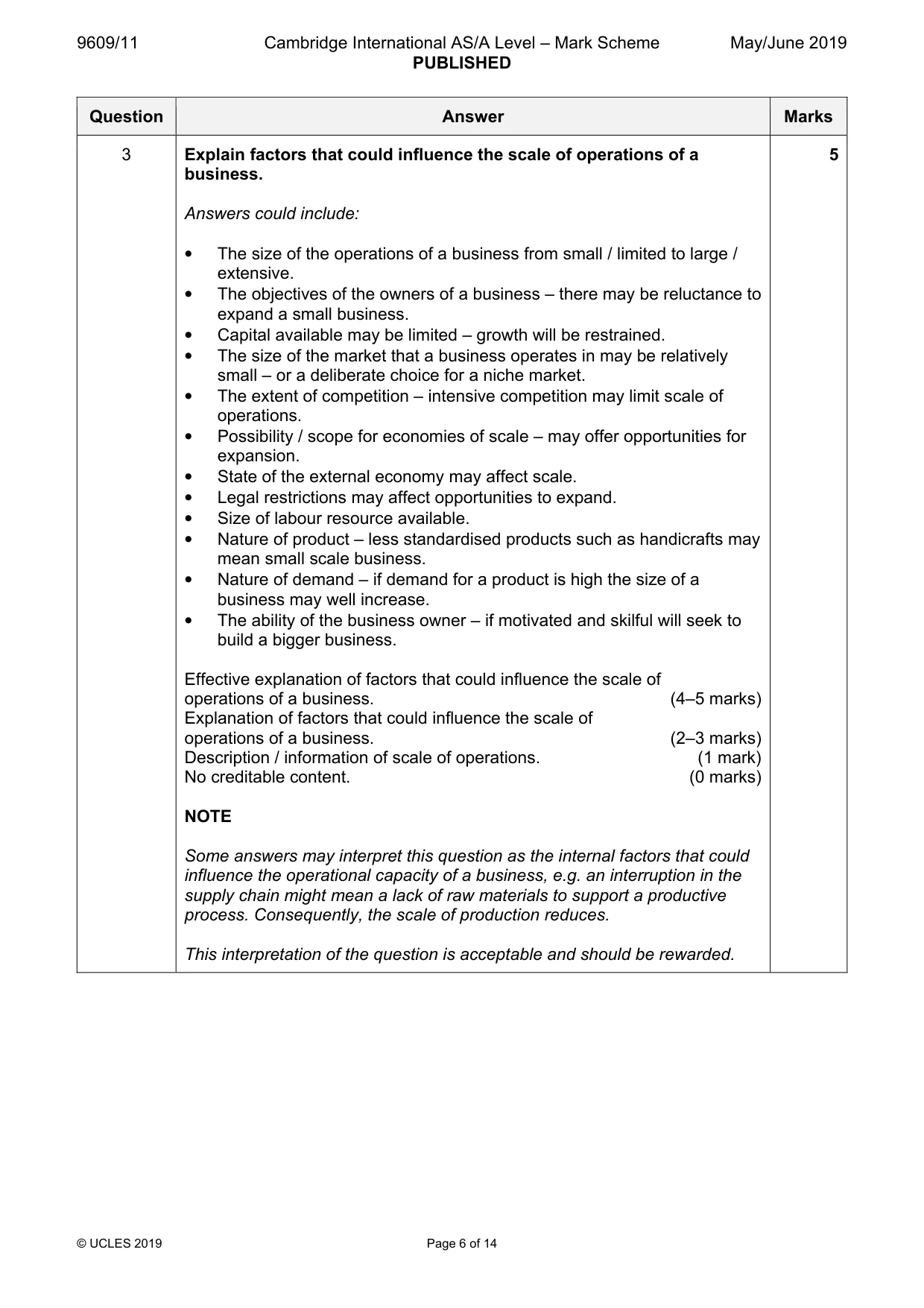
Mark scheme, page 6
9609/11 Cambridge International AS/A Level – Mark Scheme PUBLISHED May/June 2019 © UCLES 2019 Page 6 of 14 Question Answer Marks 3 Explain factors that could influence the scale of operations of a business. Answers could include: • The size of the operations of a business from small / limited to large / extensive. • The objectives of the owners of a business – there may be reluctance to expand a small business. • Capital available may be limited – growth will be restrained. • The size of the market that a business operates in may be relatively small – or a deliberate choice for a niche market. • The extent of competition – intensive competition may limit scale of operations. • Possibility / scope for economies of scale – may offer opportunities for expansion. • State of the external economy may affect scale. • Legal restrictions may affect opportunities to expand. • Size of labour resource available. • Nature of product – less standardised products such as handicrafts may mean small scale business. • Nature of demand – if demand for a product is high the size of a business may well increase. • The ability of the business owner – if motivated and skilful will seek to build a bigger business. Effective explanation of factors that could influence the scale of operations of a business. (4–5 marks) Explanation of factors that could influence the scale of operations of a business. (2–3 marks) Description / information of scale of operations. (1 mark) No creditable content. (0 marks) NOTE Some answers may interpret this question as the internal factors that could influence the operational capacity of a business, e.g. an interruption in the supply chain might mean a lack of raw materials to support a productive process. Consequently, the scale of production reduces. This interpretation of the question is acceptable and should be rewarded. 5
Mark scheme, page 7
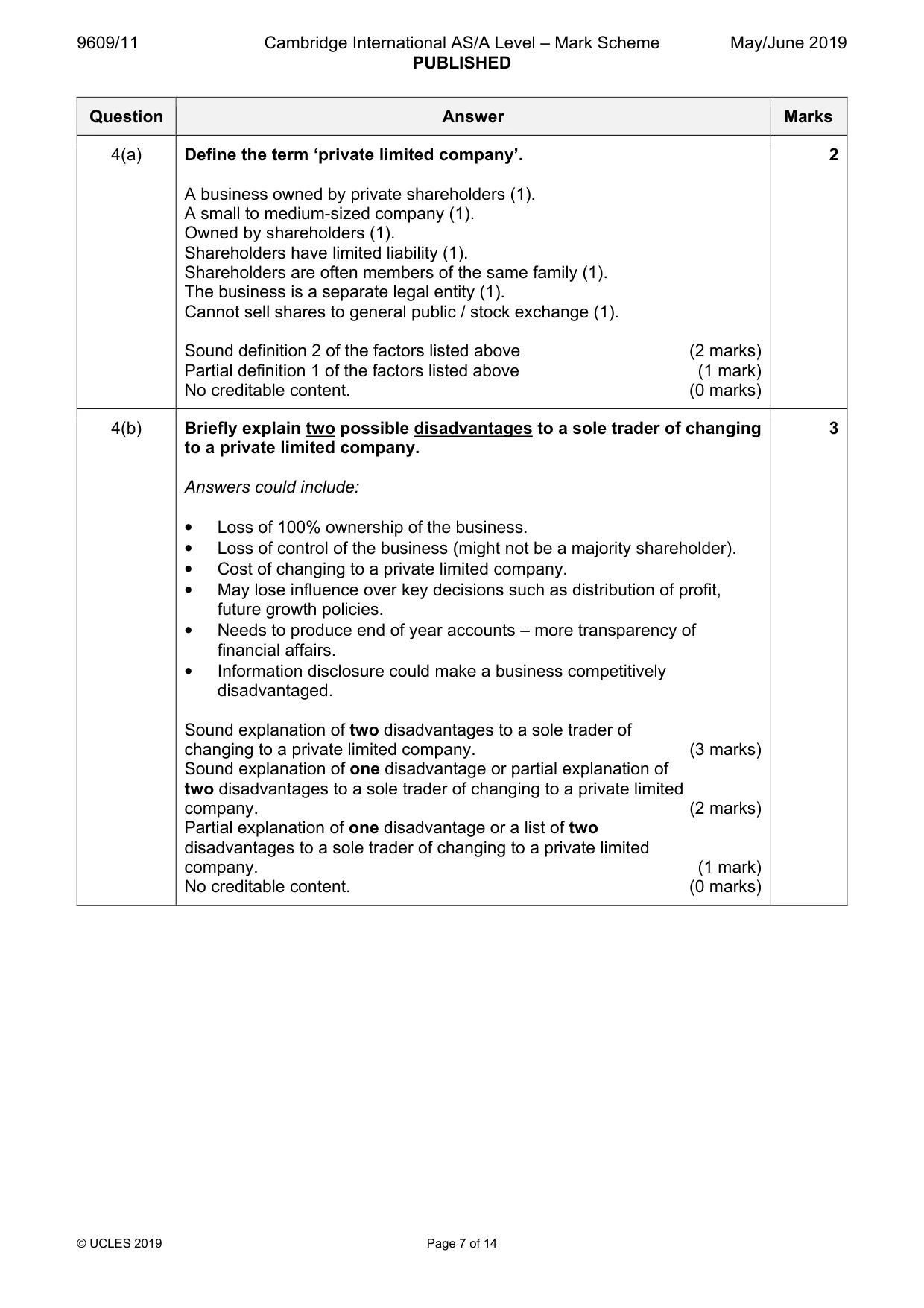
9609/11 Cambridge International AS/A Level – Mark Scheme PUBLISHED May/June 2019 © UCLES 2019 Page 7 of 14 Question Answer Marks 4(a) Define the term ‘private limited company’. A business owned by private shareholders (1). A small to medium-sized company (1). Owned by shareholders (1). Shareholders have limited liability (1). Shareholders are often members of the same family (1). The business is a separate legal entity (1). Cannot sell shares to general public / stock exchange (1). Sound definition 2 of the factors listed above (2 marks) Partial definition 1 of the factors listed above (1 mark) No creditable content. (0 marks) 2 4(b) Briefly explain two possible disadvantages to a sole trader of changing to a private limited company. Answers could include: • Loss of 100% ownership of the business. • Loss of control of the business (might not be a majority shareholder). • Cost of changing to a private limited company. • May lose influence over key decisions such as distribution of profit, future growth policies. • Needs to produce end of year accounts – more transparency of financial affairs. • Information disclosure could make a business competitively disadvantaged. Sound explanation of two disadvantages to a sole trader of changing to a private limited company. (3 marks) Sound explanation of one disadvantage or partial explanation of two disadvantages to a sole trader of changing to a private limited company. (2 marks) Partial explanation of one disadvantage or a list of two disadvantages to a sole trader of changing to a private limited company. (1 mark) No creditable content. (0 marks) 3
Mark scheme, page 8
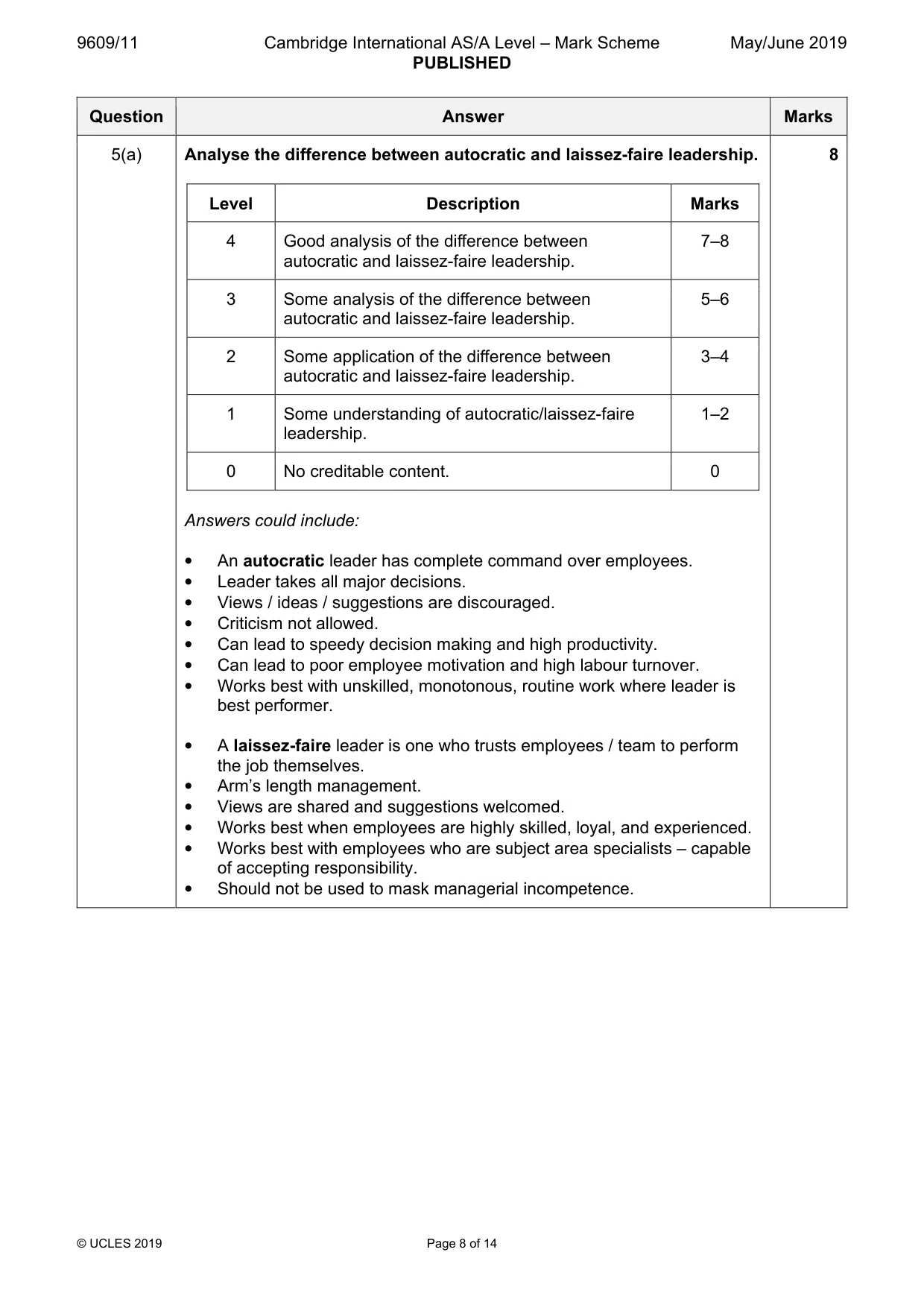
9609/11 Cambridge International AS/A Level – Mark Scheme PUBLISHED May/June 2019 © UCLES 2019 Page 8 of 14 Question Answer Marks 5(a) Analyse the difference between autocratic and laissez-faire leadership. Level Description Marks 4 Good analysis of the difference between autocratic and laissez-faire leadership. 7–8 3 Some analysis of the difference between autocratic and laissez-faire leadership. 5–6 2 Some application of the difference between autocratic and laissez-faire leadership. 3–4 1 Some understanding of autocratic/laissez-faire leadership. 1–2 0 No creditable content. 0 Answers could include: • An autocratic leader has complete command over employees. • Leader takes all major decisions. • Views / ideas / suggestions are discouraged. • Criticism not allowed. • Can lead to speedy decision making and high productivity. • Can lead to poor employee motivation and high labour turnover. • Works best with unskilled, monotonous, routine work where leader is best performer. • A laissez-faire leader is one who trusts employees / team to perform the job themselves. • Arm’s length management. • Views are shared and suggestions welcomed. • Works best when employees are highly skilled, loyal, and experienced. • Works best with employees who are subject area specialists – capable of accepting responsibility. • Should not be used to mask managerial incompetence. 8
Mark scheme, page 9
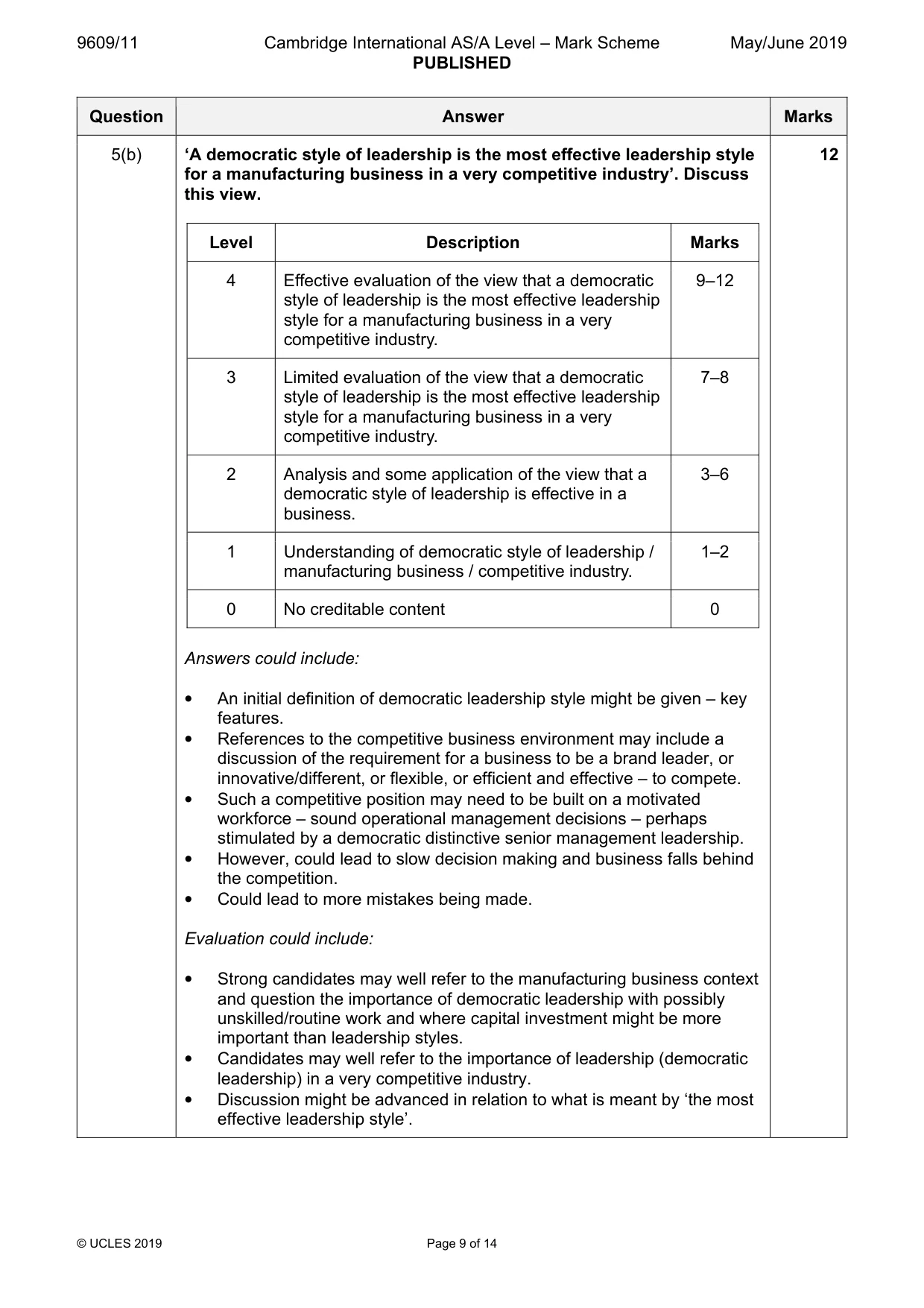
9609/11 Cambridge International AS/A Level – Mark Scheme PUBLISHED May/June 2019 © UCLES 2019 Page 9 of 14 Question Answer Marks 5(b) ‘A democratic style of leadership is the most effective leadership style for a manufacturing business in a very competitive industry’. Discuss this view. Level Description Marks 4 Effective evaluation of the view that a democratic style of leadership is the most effective leadership style for a manufacturing business in a very competitive industry. 9–12 3 Limited evaluation of the view that a democratic style of leadership is the most effective leadership style for a manufacturing business in a very competitive industry. 7–8 2 Analysis and some application of the view that a democratic style of leadership is effective in a business. 3–6 1 Understanding of democratic style of leadership / manufacturing business / competitive industry. 1–2 0 No creditable content 0 Answers could include: • An initial definition of democratic leadership style might be given – key features. • References to the competitive business environment may include a discussion of the requirement for a business to be a brand leader, or innovative/different, or flexible, or efficient and effective – to compete. • Such a competitive position may need to be built on a motivated workforce – sound operational management decisions – perhaps stimulated by a democratic distinctive senior management leadership. • However, could lead to slow decision making and business falls behind the competition. • Could lead to more mistakes being made. Evaluation could include: • Strong candidates may well refer to the manufacturing business context and question the importance of democratic leadership with possibly unskilled/routine work and where capital investment might be more important than leadership styles. • Candidates may well refer to the importance of leadership (democratic leadership) in a very competitive industry. • Discussion might be advanced in relation to what is meant by ‘the most effective leadership style’. 12
Mark scheme, page 10
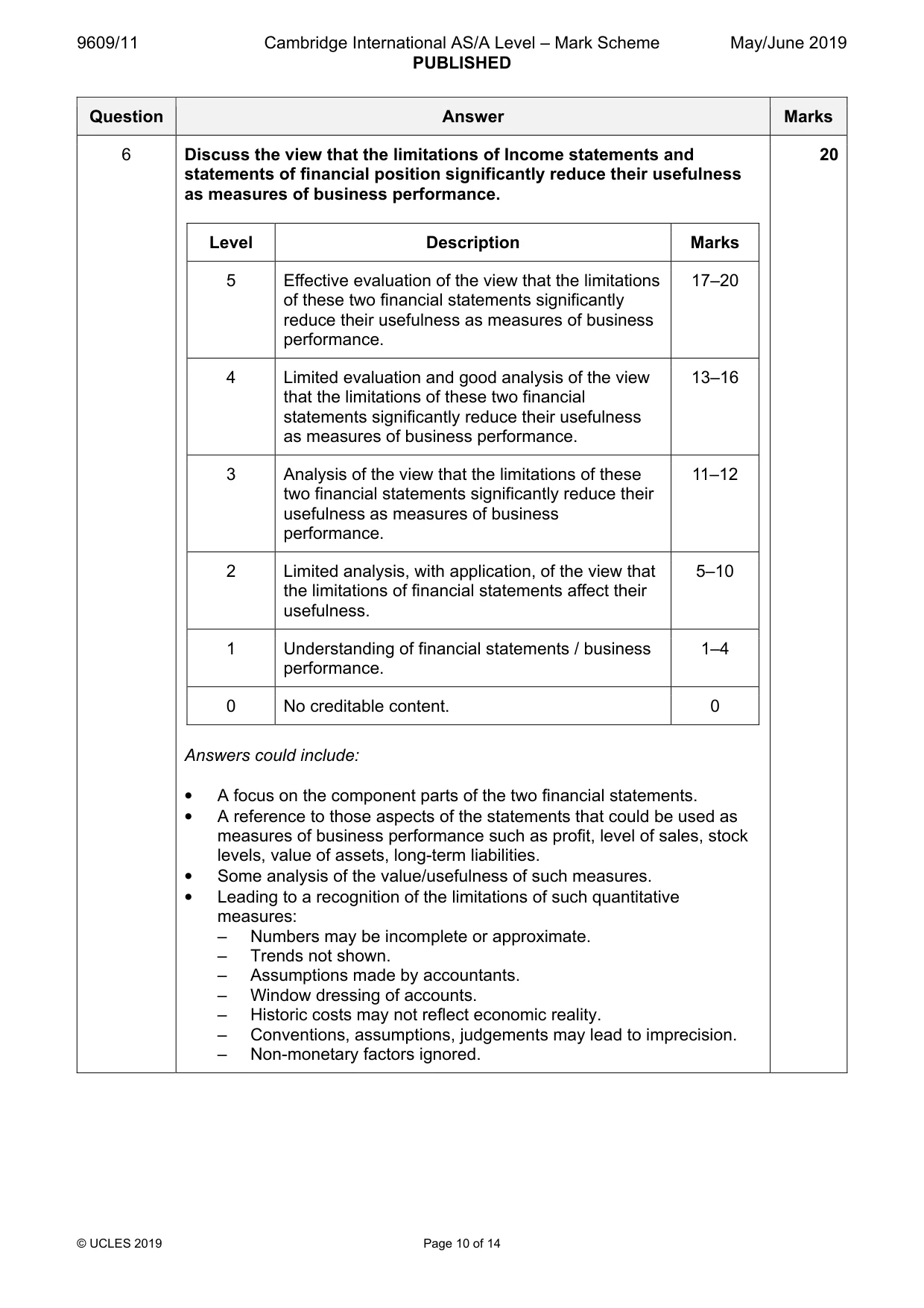
9609/11 Cambridge International AS/A Level – Mark Scheme PUBLISHED May/June 2019 © UCLES 2019 Page 10 of 14 Question Answer Marks 6 Discuss the view that the limitations of Income statements and statements of financial position significantly reduce their usefulness as measures of business performance. Level Description Marks 5 Effective evaluation of the view that the limitations of these two financial statements significantly reduce their usefulness as measures of business performance. 17–20 4 Limited evaluation and good analysis of the view that the limitations of these two financial statements significantly reduce their usefulness as measures of business performance. 13–16 3 Analysis of the view that the limitations of these two financial statements significantly reduce their usefulness as measures of business performance. 11–12 2 Limited analysis, with application, of the view that the limitations of financial statements affect their usefulness. 5–10 1 Understanding of financial statements / business performance. 1–4 0 No creditable content. 0 Answers could include: • A focus on the component parts of the two financial statements. • A reference to those aspects of the statements that could be used as measures of business performance such as profit, level of sales, stock levels, value of assets, long-term liabilities. • Some analysis of the value/usefulness of such measures. • Leading to a recognition of the limitations of such quantitative measures: – Numbers may be incomplete or approximate. – Trends not shown. – Assumptions made by accountants. – Window dressing of accounts. – Historic costs may not reflect economic reality. – Conventions, assumptions, judgements may lead to imprecision. – Non-monetary factors ignored. 20
Mark scheme, page 11
9609/11 Cambridge International AS/A Level – Mark Scheme PUBLISHED May/June 2019 © UCLES 2019 Page 11 of 14 Question Answer Marks 6 Evaluation could include: • Reference to the limitations of financial accounts and consideration of what might be missing, such as qualitative factors – reputation, morale of staff, nature of organisation culture, capability of senior management etc. • Opportunity to address/evaluate the relative usefulness of quantitative and qualitative measures of business performance. How significant are the limitations? Do we need both to get a full understanding of health / strength of a business? The case for a balanced scorecard approach?
Mark scheme, page 12
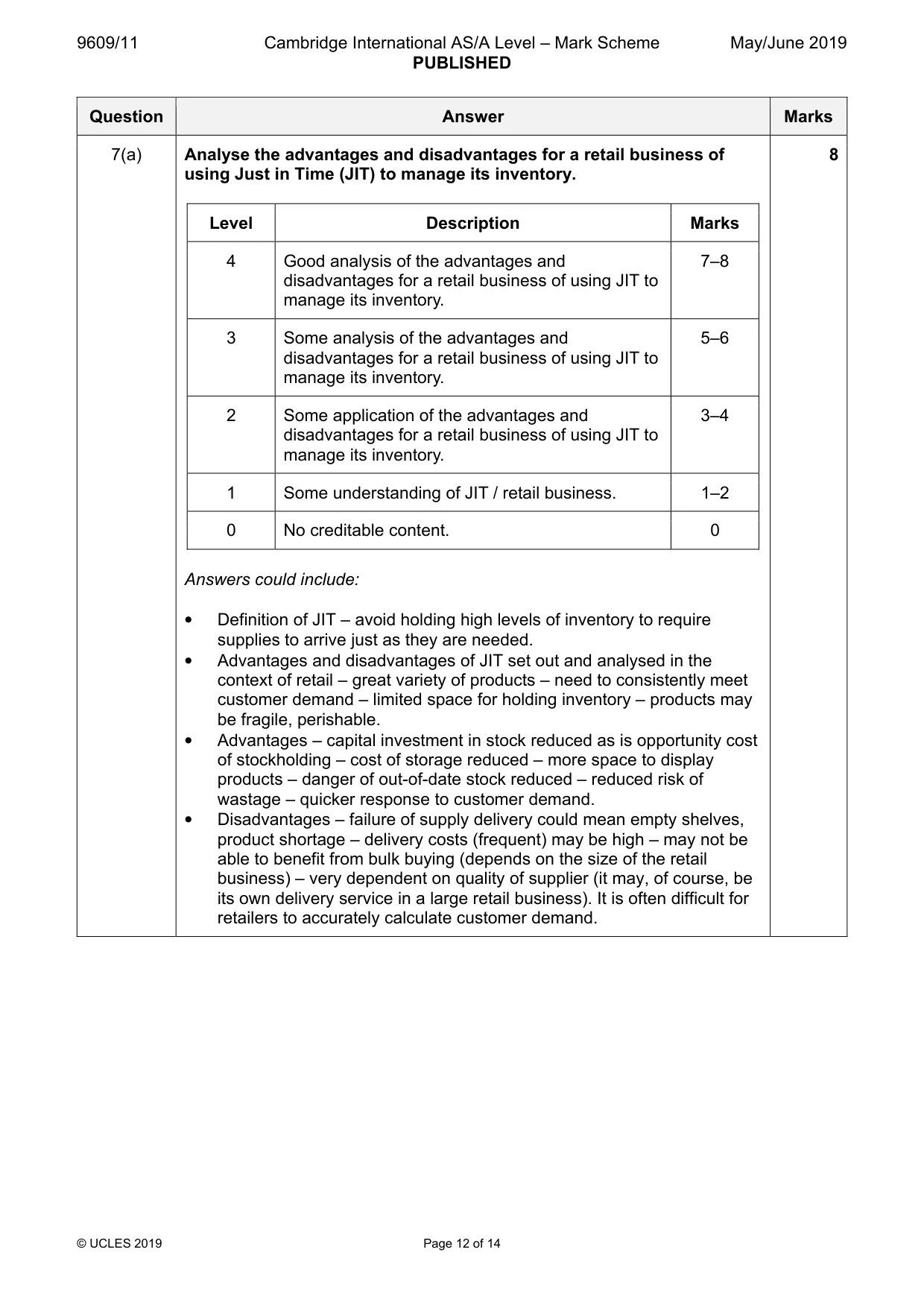
9609/11 Cambridge International AS/A Level – Mark Scheme PUBLISHED May/June 2019 © UCLES 2019 Page 12 of 14 Question Answer Marks 7(a) Analyse the advantages and disadvantages for a retail business of using Just in Time (JIT) to manage its inventory. Level Description Marks 4 Good analysis of the advantages and disadvantages for a retail business of using JIT to manage its inventory. 7–8 3 Some analysis of the advantages and disadvantages for a retail business of using JIT to manage its inventory. 5–6 2 Some application of the advantages and disadvantages for a retail business of using JIT to manage its inventory. 3–4 1 Some understanding of JIT / retail business. 1–2 0 No creditable content. 0 Answers could include: • Definition of JIT – avoid holding high levels of inventory to require supplies to arrive just as they are needed. • Advantages and disadvantages of JIT set out and analysed in the context of retail – great variety of products – need to consistently meet customer demand – limited space for holding inventory – products may be fragile, perishable. • Advantages – capital investment in stock reduced as is opportunity cost of stockholding – cost of storage reduced – more space to display products – danger of out-of-date stock reduced – reduced risk of wastage – quicker response to customer demand. • Disadvantages – failure of supply delivery could mean empty shelves, product shortage – delivery costs (frequent) may be high – may not be able to benefit from bulk buying (depends on the size of the retail business) – very dependent on quality of supplier (it may, of course, be its own delivery service in a large retail business). It is often difficult for retailers to accurately calculate customer demand. 8
Mark scheme, page 13
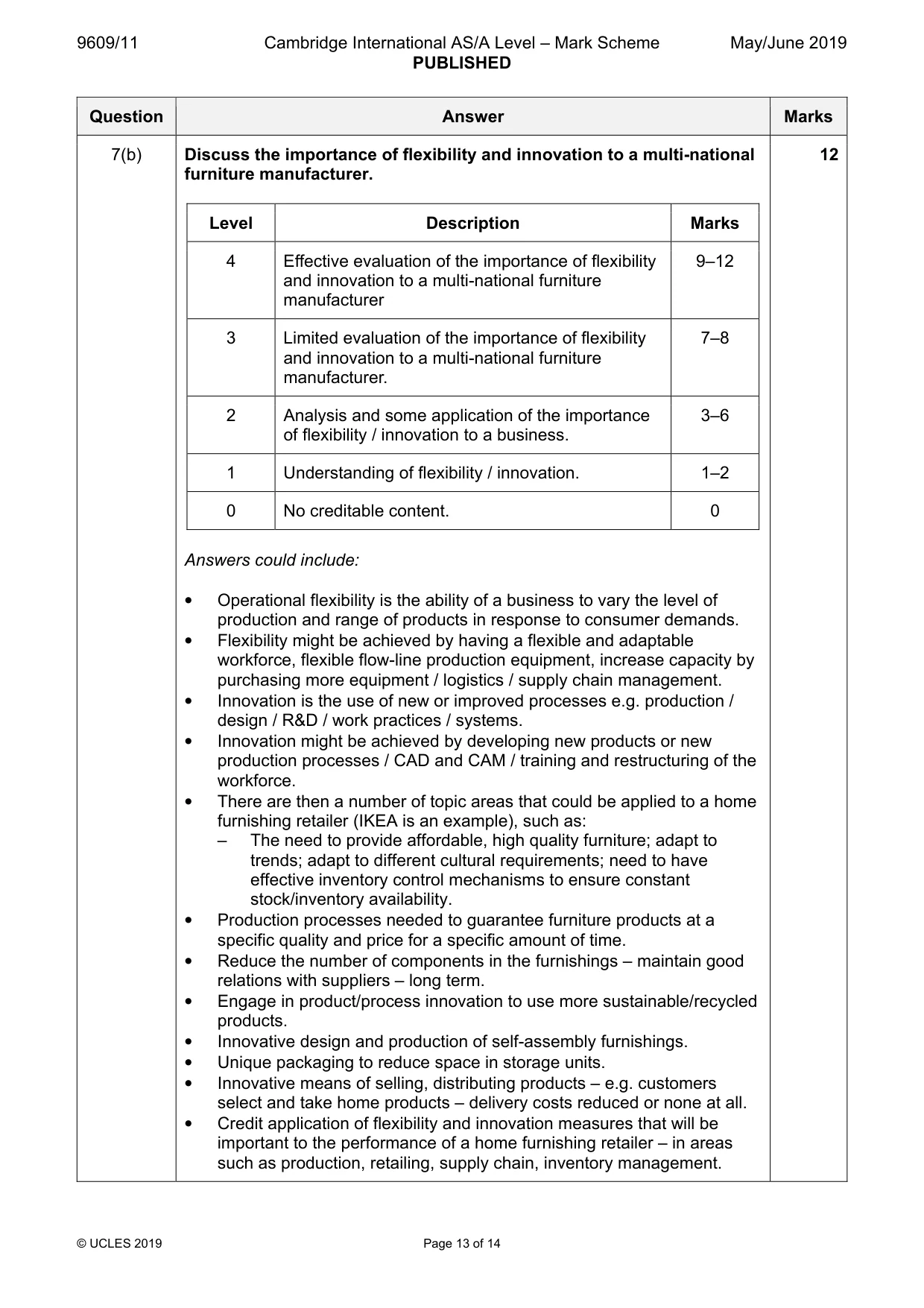
9609/11 Cambridge International AS/A Level – Mark Scheme PUBLISHED May/June 2019 © UCLES 2019 Page 13 of 14 Question Answer Marks 7(b) Discuss the importance of flexibility and innovation to a multi-national furniture manufacturer. Level Description Marks 4 Effective evaluation of the importance of flexibility and innovation to a multi-national furniture manufacturer 9–12 3 Limited evaluation of the importance of flexibility and innovation to a multi-national furniture manufacturer. 7–8 2 Analysis and some application of the importance of flexibility / innovation to a business. 3–6 1 Understanding of flexibility / innovation. 1–2 0 No creditable content. 0 Answers could include: • Operational flexibility is the ability of a business to vary the level of production and range of products in response to consumer demands. • Flexibility might be achieved by having a flexible and adaptable workforce, flexible flow-line production equipment, increase capacity by purchasing more equipment / logistics / supply chain management. • Innovation is the use of new or improved processes e.g. production / design / R&D / work practices / systems. • Innovation might be achieved by developing new products or new production processes / CAD and CAM / training and restructuring of the workforce. • There are then a number of topic areas that could be applied to a home furnishing retailer (IKEA is an example), such as: – The need to provide affordable, high quality furniture; adapt to trends; adapt to different cultural requirements; need to have effective inventory control mechanisms to ensure constant stock/inventory availability. • Production processes needed to guarantee furniture products at a specific quality and price for a specific amount of time. • Reduce the number of components in the furnishings – maintain good relations with suppliers – long term. • Engage in product/process innovation to use more sustainable/recycled products. • Innovative design and production of self-assembly furnishings. • Unique packaging to reduce space in storage units. • Innovative means of selling, distributing products – e.g. customers select and take home products – delivery costs reduced or none at all. • Credit application of flexibility and innovation measures that will be important to the performance of a home furnishing retailer – in areas such as production, retailing, supply chain, inventory management. 12
Mark scheme, page 14
9609/11 Cambridge International AS/A Level – Mark Scheme PUBLISHED May/June 2019 © UCLES 2019 Page 14 of 14 Question Answer Marks 7(b) Evaluation could include reference to how important flexibility and innovation could be in relation to other factors such as marketing and investment and to factors such as the state of development of a particular furniture business.
What you needed in this session
Cambridge’s own grade thresholds for 2019 May/June, Paper 1 · Variant 1. A higher threshold means an easier paper — the bar moves with how the cohort did.