Cambridge A Level Business (for first examination in 2016) 9609 — 2019 May/June Paper 1 · Variant 3
9609/13/M/J/19 · 40 marks · ≈45 min
The question paper and its mark scheme, free to read here and free to download. This is Cambridge’s own paper, exactly as it was sat.
Question paper4 pages


Mark scheme12 pages
Answers below. Sit the paper first if you are practising.
Paper as text
Question paper, page 1
This document consists of 2 printed pages, 2 blank pages and 1 Insert. DC (KN) 168735/1 © UCLES 2019 [Turn over Cambridge Assessment International Education Cambridge International Advanced Subsidiary and Advanced Level * 5 9 9 0 2 6 0 2 7 4 * BUSINESS 9609/13 Paper 1 Short Answer and Essay May/June 2019 1 hour 15 minutes No Additional Materials are required. READ THESE INSTRUCTIONS FIRST An answer booklet is provided inside this question paper. You should follow the instructions on the front cover of the answer booklet. If you need additional answer paper ask the invigilator for a continuation booklet. Section A Answer all questions. Section B Answer one question. You are advised to spend no more than 35 minutes on Section A. The number of marks is given in brackets [ ] at the end of each question or part question.
Question paper, page 2
2 9609/13/M/J/19 © UCLES 2019 Section A (Short Answer) Answer all questions 1 (a) Define the term ‘market segmentation’. [2] (b) Briefly explain two reasons why a business might segment its market. [3] 2 (a) Define the term ‘transformation process’. [2] (b) Briefly explain two ways a manufacturing business might improve the efficiency of its operations. [3] 3 Explain why cost information is important for business decision-making. [5] 4 (a) Define the term ‘emotional intelligence’. [2] (b) Briefly explain two of Goleman’s emotional intelligence competencies. [3] Section B (Essay) Answer one question only 5 (a) Analyse the impact of small businesses on the development of a country. [8] (b) Discuss the view that a public limited company should prioritise the aims of its shareholders rather than those of other stakeholder groups. [12] 6 The human resources manager of a hotel has said: ‘If we empower our employees, work performance will definitely improve.’ Discuss this view. [20] 7 (a) Analyse the external sources of finance a multinational car manufacturer may use to finance the production of a new electric car. [8] (b) An ability to understand income statements and statements of financial position is the most important quality required of a senior manager in a business. Discuss this view. [12]
Question paper, page 3
3 9609/13/M/J/19 © UCLES 2019 BLANK PAGE
Question paper, page 4
4 9609/13/M/J/19 © UCLES 2019 BLANK PAGE Permission to reproduce items where third-party owned material protected by copyright is included has been sought and cleared where possible. Every reasonable effort has been made by the publisher (UCLES) to trace copyright holders, but if any items requiring clearance have unwittingly been included, the publisher will be pleased to make amends at the earliest possible opportunity. To avoid the issue of disclosure of answer-related information to candidates, all copyright acknowledgements are reproduced online in the Cambridge Assessment International Education Copyright Acknowledgements Booklet. This is produced for each series of examinations and is freely available to download at www.cambridgeinternational.org after the live examination series. Cambridge Assessment International Education is part of the Cambridge Assessment Group. Cambridge Assessment is the brand name of the University of Cambridge Local Examinations Syndicate (UCLES), which itself is a department of the University of Cambridge.
Mark scheme, page 1
This document consists of 12 printed pages. © UCLES 2019 [Turn over Cambridge Assessment International Education Cambridge International Advanced Subsidiary and Advanced Level BUSINESS 9609/13 Paper 1 Short Answer and Essay May/June 2019 MARK SCHEME Maximum Mark: 40 Published This mark scheme is published as an aid to teachers and candidates, to indicate the requirements of the examination. It shows the basis on which Examiners were instructed to award marks. It does not indicate the details of the discussions that took place at an Examiners’ meeting before marking began, which would have considered the acceptability of alternative answers. Mark schemes should be read in conjunction with the question paper and the Principal Examiner Report for Teachers. Cambridge International will not enter into discussions about these mark schemes. Cambridge International is publishing the mark schemes for the May/June 2019 series for most Cambridge IGCSE™, Cambridge International A and AS Level and Cambridge Pre-U components, and some Cambridge O Level components.
Mark scheme, page 2
9609/13 Cambridge International AS/A Level – Mark Scheme PUBLISHED May/June 2019 © UCLES 2019 Page 2 of 12 Generic Marking Principles These general marking principles must be applied by all examiners when marking candidate answers. They should be applied alongside the specific content of the mark scheme or generic level descriptors for a question. Each question paper and mark scheme will also comply with these marking principles. GENERIC MARKING PRINCIPLE 1: Marks must be awarded in line with: • the specific content of the mark scheme or the generic level descriptors for the question • the specific skills defined in the mark scheme or in the generic level descriptors for the question • the standard of response required by a candidate as exemplified by the standardisation scripts. GENERIC MARKING PRINCIPLE 2: Marks awarded are always whole marks (not half marks, or other fractions). GENERIC MARKING PRINCIPLE 3: Marks must be awarded positively: • marks are awarded for correct/valid answers, as defined in the mark scheme. However, credit is given for valid answers which go beyond the scope of the syllabus and mark scheme, referring to your Team Leader as appropriate • marks are awarded when candidates clearly demonstrate what they know and can do • marks are not deducted for errors • marks are not deducted for omissions • answers should only be judged on the quality of spelling, punctuation and grammar when these features are specifically assessed by the question as indicated by the mark scheme. The meaning, however, should be unambiguous. GENERIC MARKING PRINCIPLE 4: Rules must be applied consistently e.g. in situations where candidates have not followed instructions or in the application of generic level descriptors. GENERIC MARKING PRINCIPLE 5: Marks should be awarded using the full range of marks defined in the mark scheme for the question (however; the use of the full mark range may be limited according to the quality of the candidate responses seen). GENERIC MARKING PRINCIPLE 6: Marks awarded are based solely on the requirements as defined in the mark scheme. Marks should not be awarded with grade thresholds or grade descriptors in mind.
Mark scheme, page 3
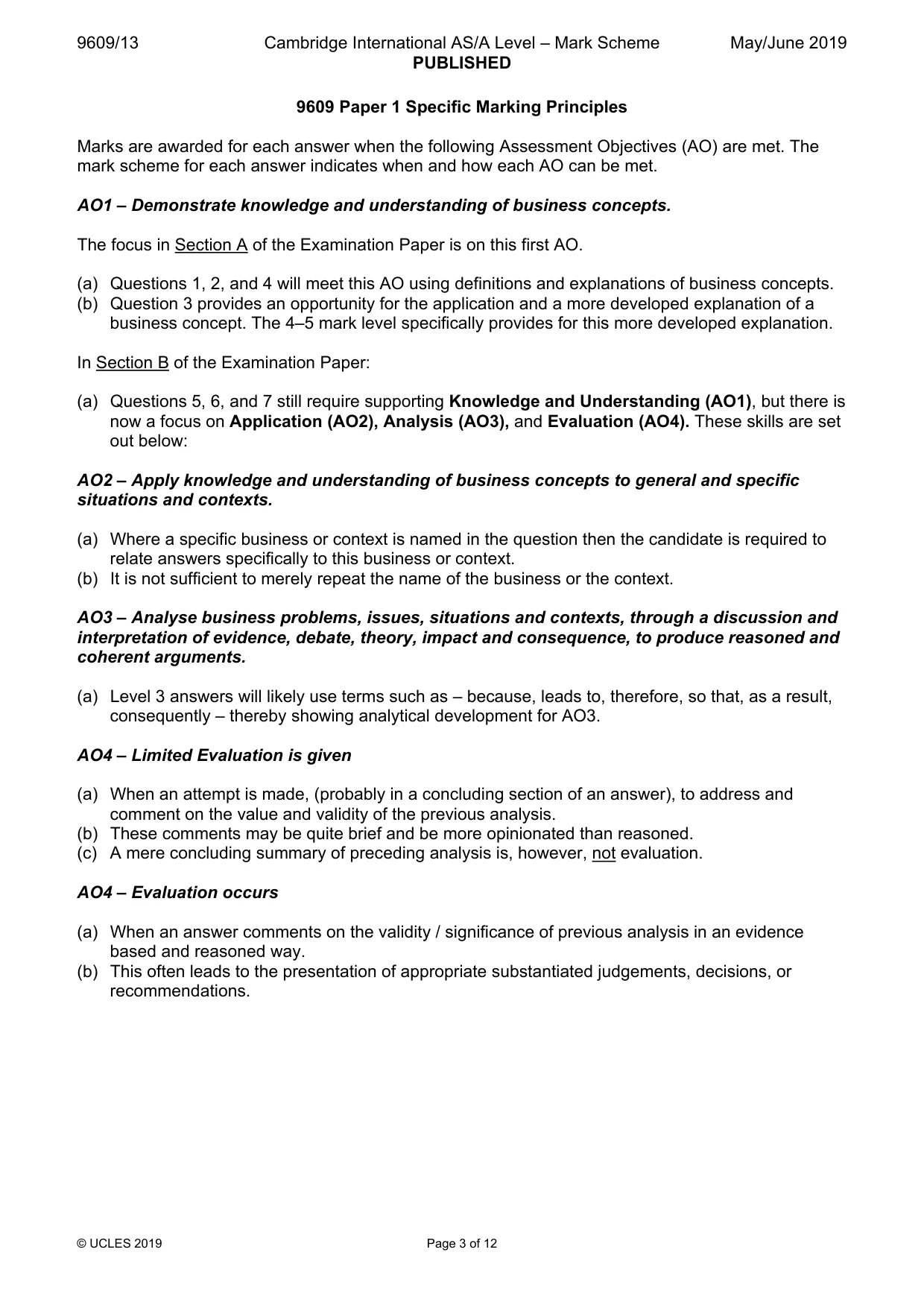
9609/13 Cambridge International AS/A Level – Mark Scheme PUBLISHED May/June 2019 © UCLES 2019 Page 3 of 12 9609 Paper 1 Specific Marking Principles Marks are awarded for each answer when the following Assessment Objectives (AO) are met. The mark scheme for each answer indicates when and how each AO can be met. AO1 – Demonstrate knowledge and understanding of business concepts. The focus in Section A of the Examination Paper is on this first AO. (a) Questions 1, 2, and 4 will meet this AO using definitions and explanations of business concepts. (b) Question 3 provides an opportunity for the application and a more developed explanation of a business concept. The 4–5 mark level specifically provides for this more developed explanation. In Section B of the Examination Paper: (a) Questions 5, 6, and 7 still require supporting Knowledge and Understanding (AO1), but there is now a focus on Application (AO2), Analysis (AO3), and Evaluation (AO4). These skills are set out below: AO2 – Apply knowledge and understanding of business concepts to general and specific situations and contexts. (a) Where a specific business or context is named in the question then the candidate is required to relate answers specifically to this business or context. (b) It is not sufficient to merely repeat the name of the business or the context. AO3 – Analyse business problems, issues, situations and contexts, through a discussion and interpretation of evidence, debate, theory, impact and consequence, to produce reasoned and coherent arguments. (a) Level 3 answers will likely use terms such as – because, leads to, therefore, so that, as a result, consequently – thereby showing analytical development for AO3. AO4 – Limited Evaluation is given (a) When an attempt is made, (probably in a concluding section of an answer), to address and comment on the value and validity of the previous analysis. (b) These comments may be quite brief and be more opinionated than reasoned. (c) A mere concluding summary of preceding analysis is, however, not evaluation. AO4 – Evaluation occurs (a) When an answer comments on the validity / significance of previous analysis in an evidence based and reasoned way. (b) This often leads to the presentation of appropriate substantiated judgements, decisions, or recommendations.
Mark scheme, page 4
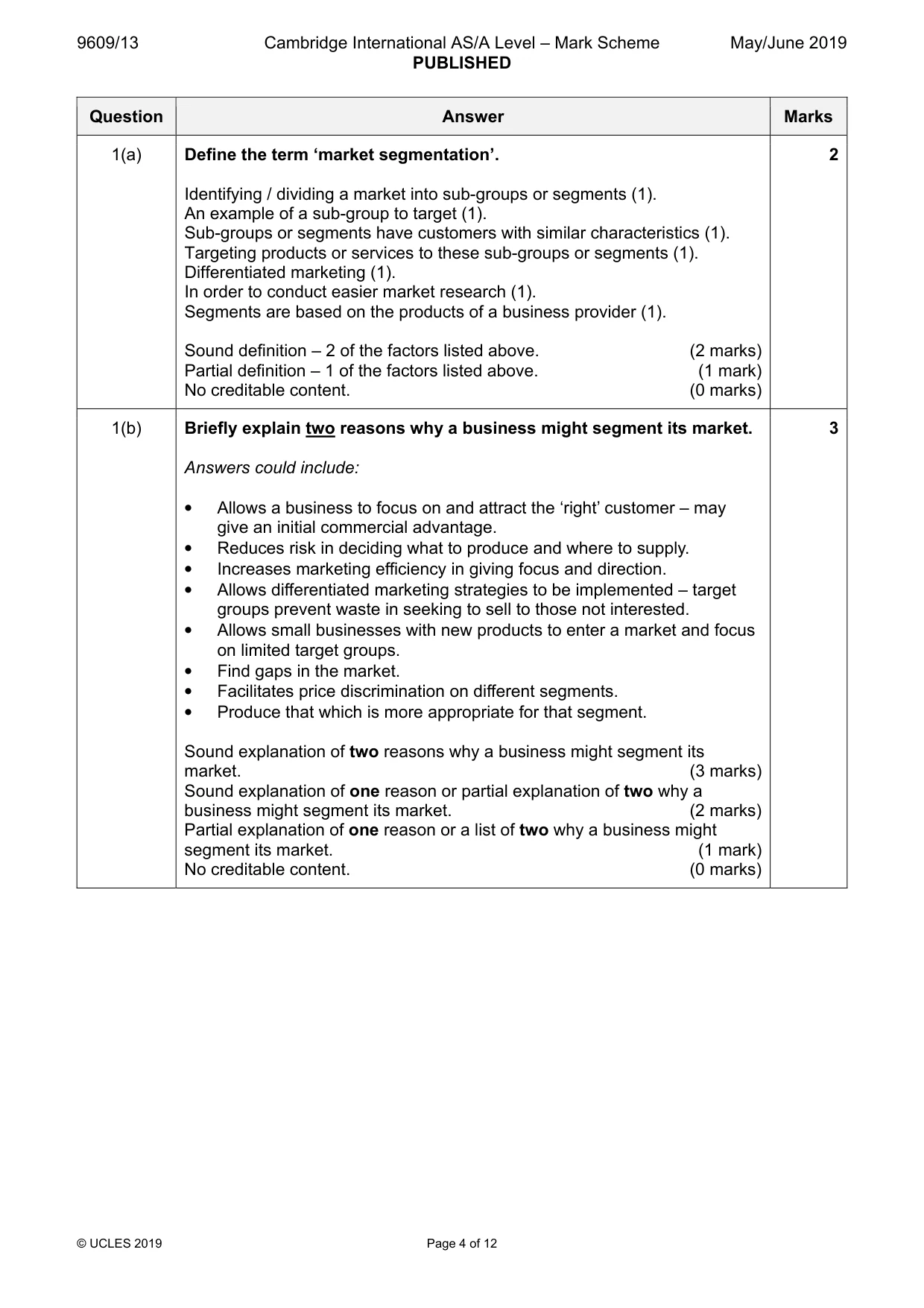
9609/13 Cambridge International AS/A Level – Mark Scheme PUBLISHED May/June 2019 © UCLES 2019 Page 4 of 12 Question Answer Marks 1(a) Define the term ‘market segmentation’. Identifying / dividing a market into sub-groups or segments (1). An example of a sub-group to target (1). Sub-groups or segments have customers with similar characteristics (1). Targeting products or services to these sub-groups or segments (1). Differentiated marketing (1). In order to conduct easier market research (1). Segments are based on the products of a business provider (1). Sound definition – 2 of the factors listed above. (2 marks) Partial definition – 1 of the factors listed above. (1 mark) No creditable content. (0 marks) 2 1(b) Briefly explain two reasons why a business might segment its market. Answers could include: • Allows a business to focus on and attract the ‘right’ customer – may give an initial commercial advantage. • Reduces risk in deciding what to produce and where to supply. • Increases marketing efficiency in giving focus and direction. • Allows differentiated marketing strategies to be implemented – target groups prevent waste in seeking to sell to those not interested. • Allows small businesses with new products to enter a market and focus on limited target groups. • Find gaps in the market. • Facilitates price discrimination on different segments. • Produce that which is more appropriate for that segment. Sound explanation of two reasons why a business might segment its market. (3 marks) Sound explanation of one reason or partial explanation of two why a business might segment its market. (2 marks) Partial explanation of one reason or a list of two why a business might segment its market. (1 mark) No creditable content. (0 marks) 3
Mark scheme, page 5
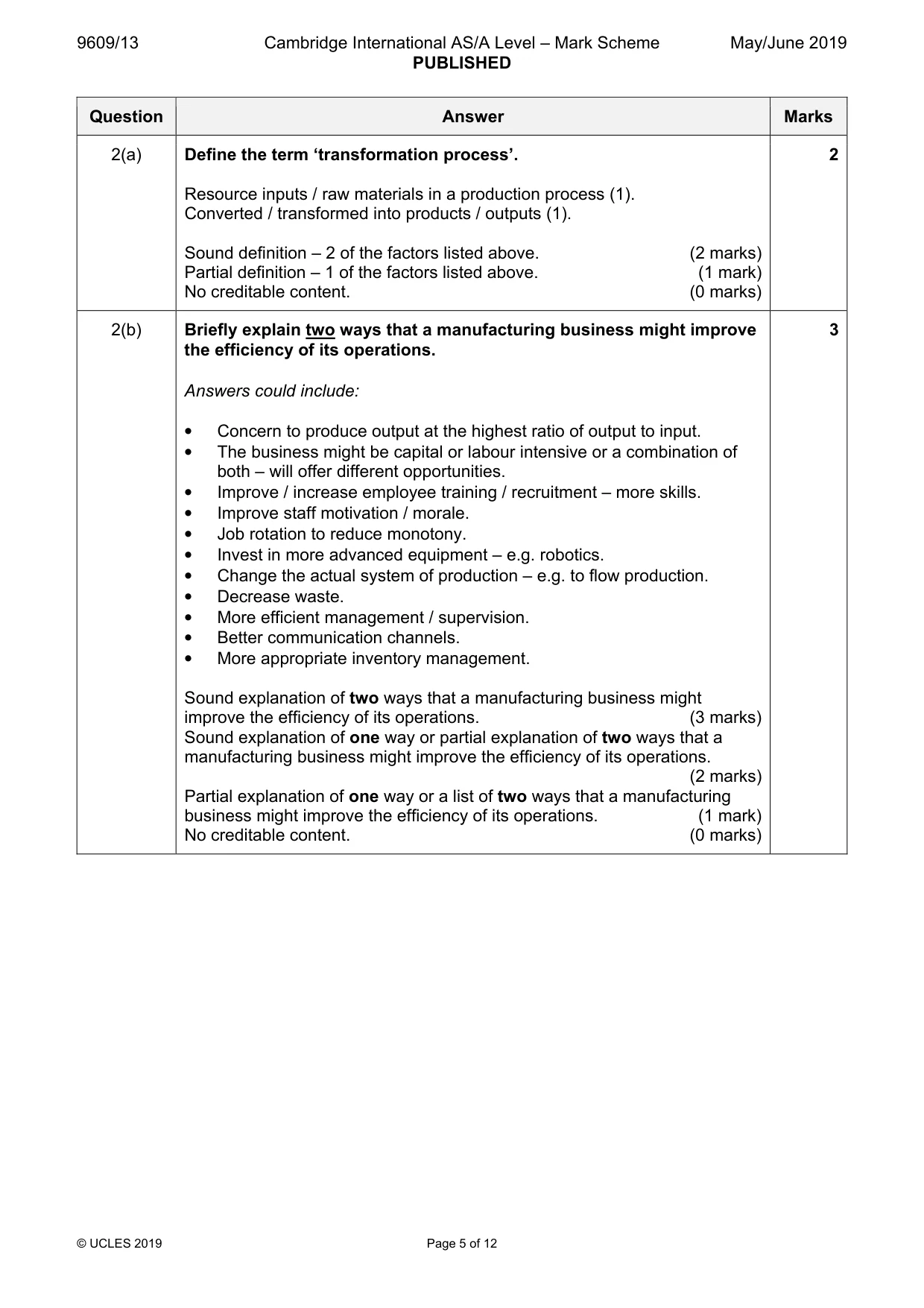
9609/13 Cambridge International AS/A Level – Mark Scheme PUBLISHED May/June 2019 © UCLES 2019 Page 5 of 12 Question Answer Marks 2(a) Define the term ‘transformation process’. Resource inputs / raw materials in a production process (1). Converted / transformed into products / outputs (1). Sound definition – 2 of the factors listed above. (2 marks) Partial definition – 1 of the factors listed above. (1 mark) No creditable content. (0 marks) 2 2(b) Briefly explain two ways that a manufacturing business might improve the efficiency of its operations. Answers could include: • Concern to produce output at the highest ratio of output to input. • The business might be capital or labour intensive or a combination of both – will offer different opportunities. • Improve / increase employee training / recruitment – more skills. • Improve staff motivation / morale. • Job rotation to reduce monotony. • Invest in more advanced equipment – e.g. robotics. • Change the actual system of production – e.g. to flow production. • Decrease waste. • More efficient management / supervision. • Better communication channels. • More appropriate inventory management. Sound explanation of two ways that a manufacturing business might improve the efficiency of its operations. (3 marks) Sound explanation of one way or partial explanation of two ways that a manufacturing business might improve the efficiency of its operations. (2 marks) Partial explanation of one way or a list of two ways that a manufacturing business might improve the efficiency of its operations. (1 mark) No creditable content. (0 marks) 3
Mark scheme, page 6
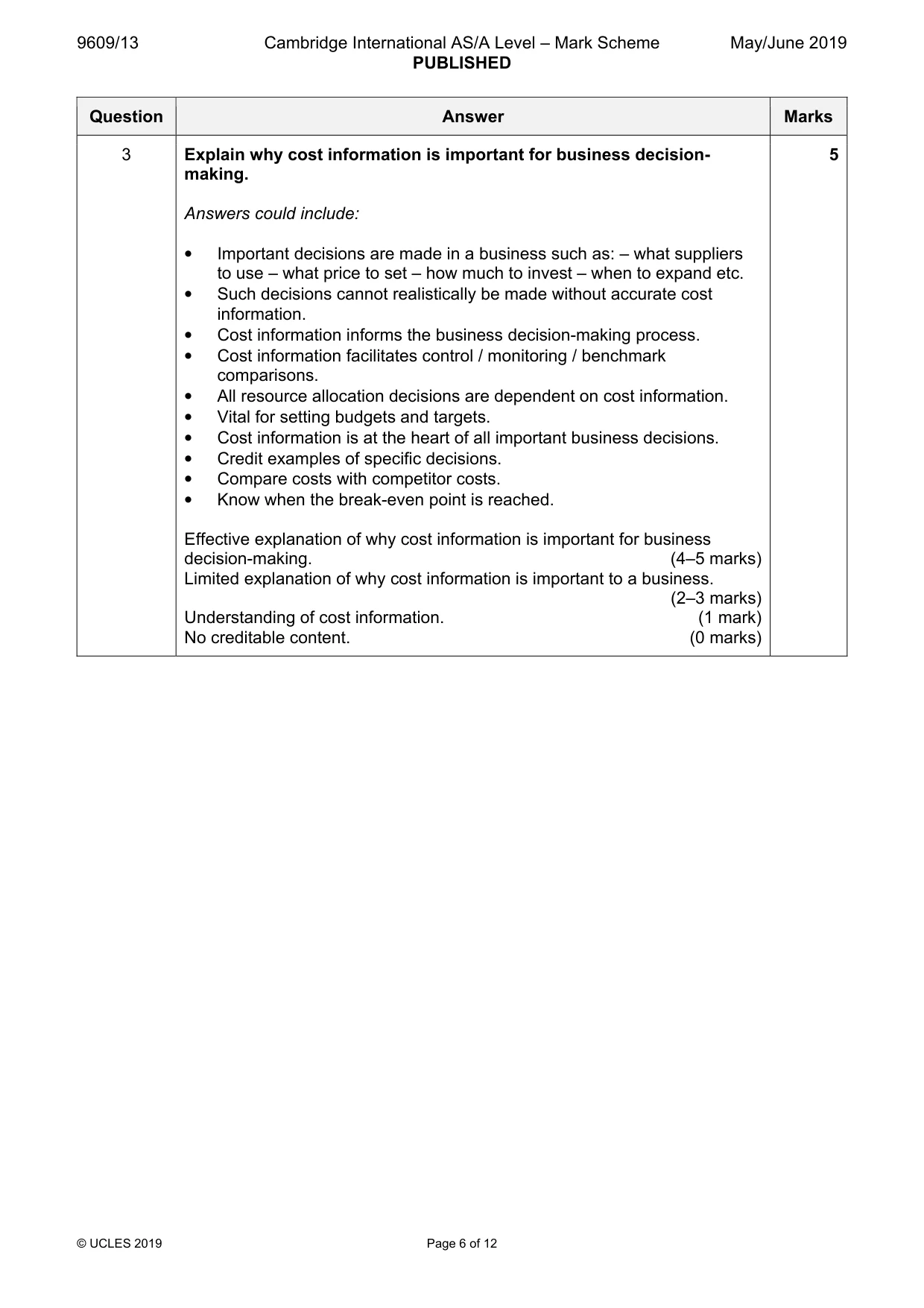
9609/13 Cambridge International AS/A Level – Mark Scheme PUBLISHED May/June 2019 © UCLES 2019 Page 6 of 12 Question Answer Marks 3 Explain why cost information is important for business decision- making. Answers could include: • Important decisions are made in a business such as: – what suppliers to use – what price to set – how much to invest – when to expand etc. • Such decisions cannot realistically be made without accurate cost information. • Cost information informs the business decision-making process. • Cost information facilitates control / monitoring / benchmark comparisons. • All resource allocation decisions are dependent on cost information. • Vital for setting budgets and targets. • Cost information is at the heart of all important business decisions. • Credit examples of specific decisions. • Compare costs with competitor costs. • Know when the break-even point is reached. Effective explanation of why cost information is important for business decision-making. (4–5 marks) Limited explanation of why cost information is important to a business. (2–3 marks) Understanding of cost information. (1 mark) No creditable content. (0 marks) 5
Mark scheme, page 7
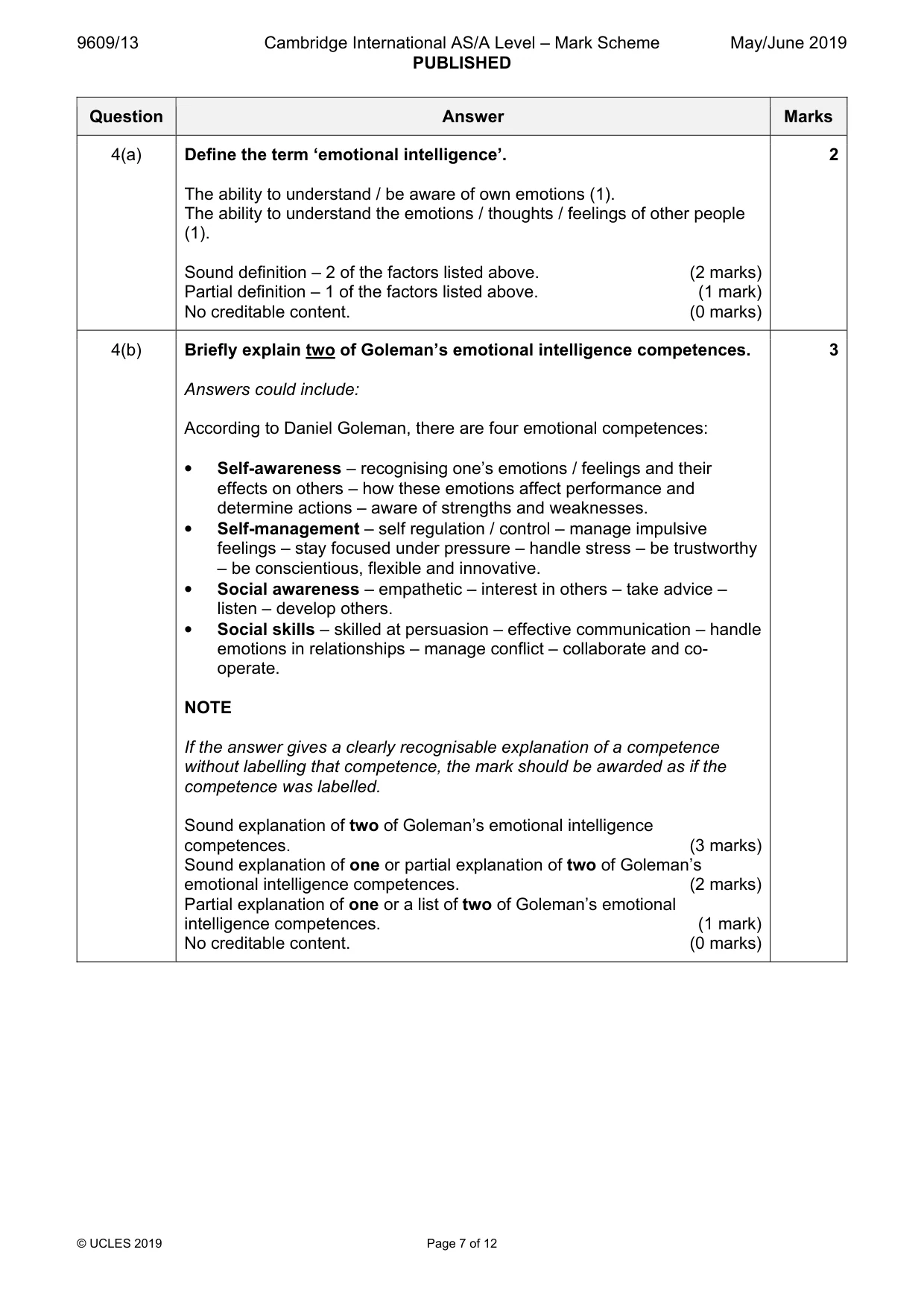
9609/13 Cambridge International AS/A Level – Mark Scheme PUBLISHED May/June 2019 © UCLES 2019 Page 7 of 12 Question Answer Marks 4(a) Define the term ‘emotional intelligence’. The ability to understand / be aware of own emotions (1). The ability to understand the emotions / thoughts / feelings of other people (1). Sound definition – 2 of the factors listed above. (2 marks) Partial definition – 1 of the factors listed above. (1 mark) No creditable content. (0 marks) 2 4(b) Briefly explain two of Goleman’s emotional intelligence competences. Answers could include: According to Daniel Goleman, there are four emotional competences: • Self-awareness – recognising one’s emotions / feelings and their effects on others – how these emotions affect performance and determine actions – aware of strengths and weaknesses. • Self-management – self regulation / control – manage impulsive feelings – stay focused under pressure – handle stress – be trustworthy – be conscientious, flexible and innovative. • Social awareness – empathetic – interest in others – take advice – listen – develop others. • Social skills – skilled at persuasion – effective communication – handle emotions in relationships – manage conflict – collaborate and co- operate. NOTE If the answer gives a clearly recognisable explanation of a competence without labelling that competence, the mark should be awarded as if the competence was labelled. Sound explanation of two of Goleman’s emotional intelligence competences. (3 marks) Sound explanation of one or partial explanation of two of Goleman’s emotional intelligence competences. (2 marks) Partial explanation of one or a list of two of Goleman’s emotional intelligence competences. (1 mark) No creditable content. (0 marks) 3
Mark scheme, page 8
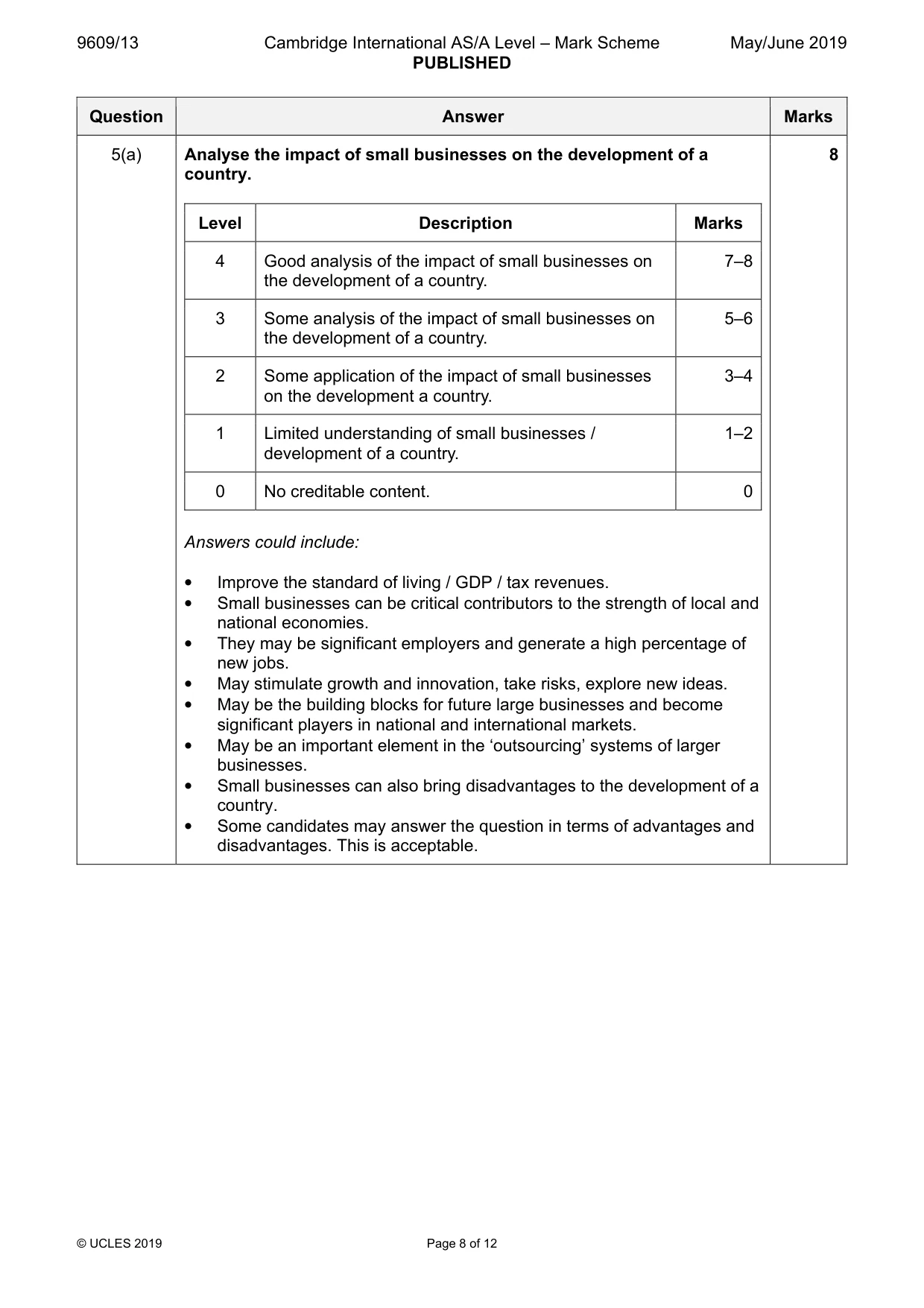
9609/13 Cambridge International AS/A Level – Mark Scheme PUBLISHED May/June 2019 © UCLES 2019 Page 8 of 12 Question Answer Marks 5(a) Analyse the impact of small businesses on the development of a country. Level Description Marks 4 Good analysis of the impact of small businesses on the development of a country. 7–8 3 Some analysis of the impact of small businesses on the development of a country. 5–6 2 Some application of the impact of small businesses on the development a country. 3–4 1 Limited understanding of small businesses / development of a country. 1–2 0 No creditable content. 0 Answers could include: • Improve the standard of living / GDP / tax revenues. • Small businesses can be critical contributors to the strength of local and national economies. • They may be significant employers and generate a high percentage of new jobs. • May stimulate growth and innovation, take risks, explore new ideas. • May be the building blocks for future large businesses and become significant players in national and international markets. • May be an important element in the ‘outsourcing’ systems of larger businesses. • Small businesses can also bring disadvantages to the development of a country. • Some candidates may answer the question in terms of advantages and disadvantages. This is acceptable. 8
Mark scheme, page 9
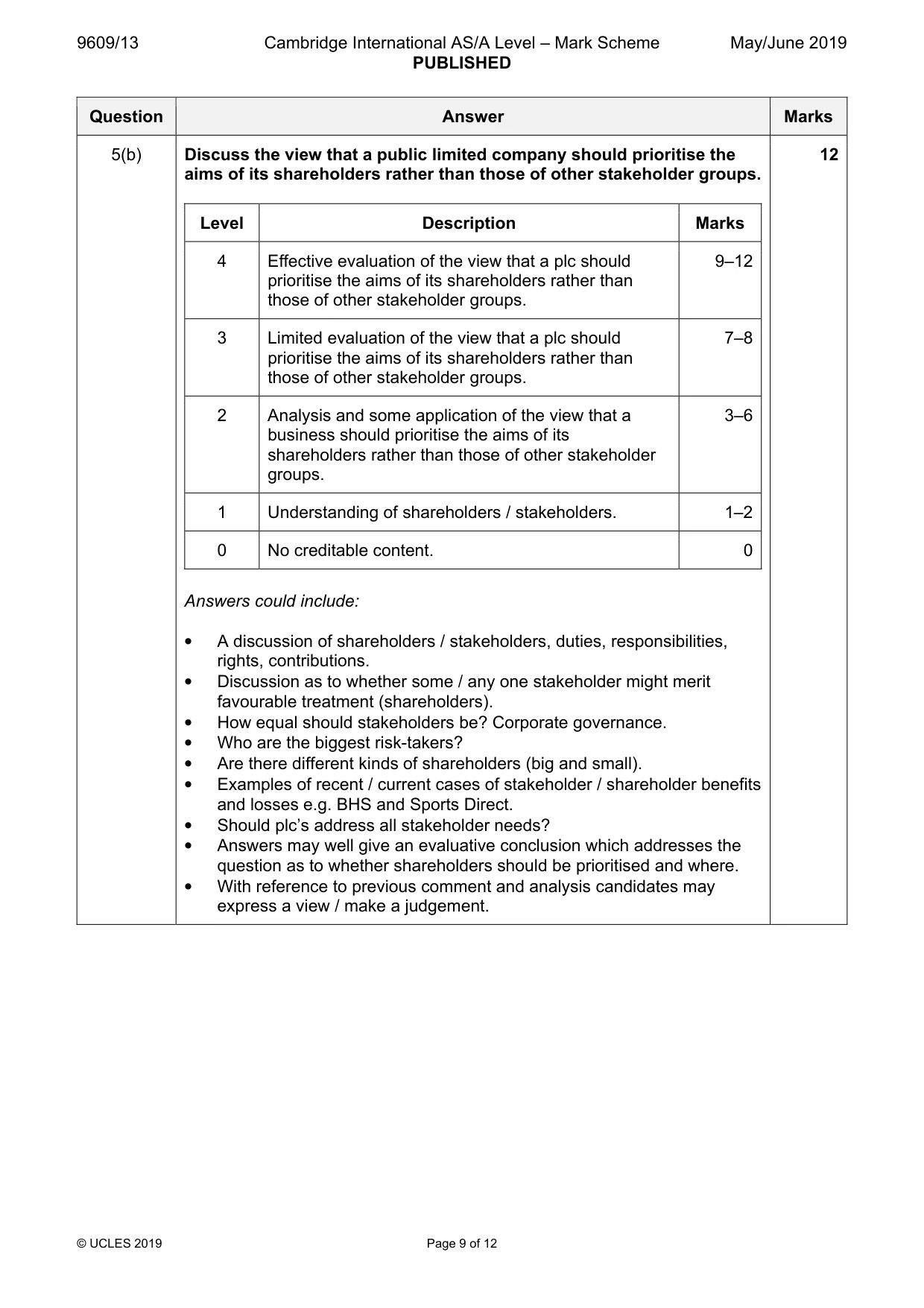
9609/13 Cambridge International AS/A Level – Mark Scheme PUBLISHED May/June 2019 © UCLES 2019 Page 9 of 12 Question Answer Marks 5(b) Discuss the view that a public limited company should prioritise the aims of its shareholders rather than those of other stakeholder groups. Level Description Marks 4 Effective evaluation of the view that a plc should prioritise the aims of its shareholders rather than those of other stakeholder groups. 9–12 3 Limited evaluation of the view that a plc should prioritise the aims of its shareholders rather than those of other stakeholder groups. 7–8 2 Analysis and some application of the view that a business should prioritise the aims of its shareholders rather than those of other stakeholder groups. 3–6 1 Understanding of shareholders / stakeholders. 1–2 0 No creditable content. 0 Answers could include: • A discussion of shareholders / stakeholders, duties, responsibilities, rights, contributions. • Discussion as to whether some / any one stakeholder might merit favourable treatment (shareholders). • How equal should stakeholders be? Corporate governance. • Who are the biggest risk-takers? • Are there different kinds of shareholders (big and small). • Examples of recent / current cases of stakeholder / shareholder benefits and losses e.g. BHS and Sports Direct. • Should plc’s address all stakeholder needs? • Answers may well give an evaluative conclusion which addresses the question as to whether shareholders should be prioritised and where. • With reference to previous comment and analysis candidates may express a view / make a judgement. 12
Mark scheme, page 10
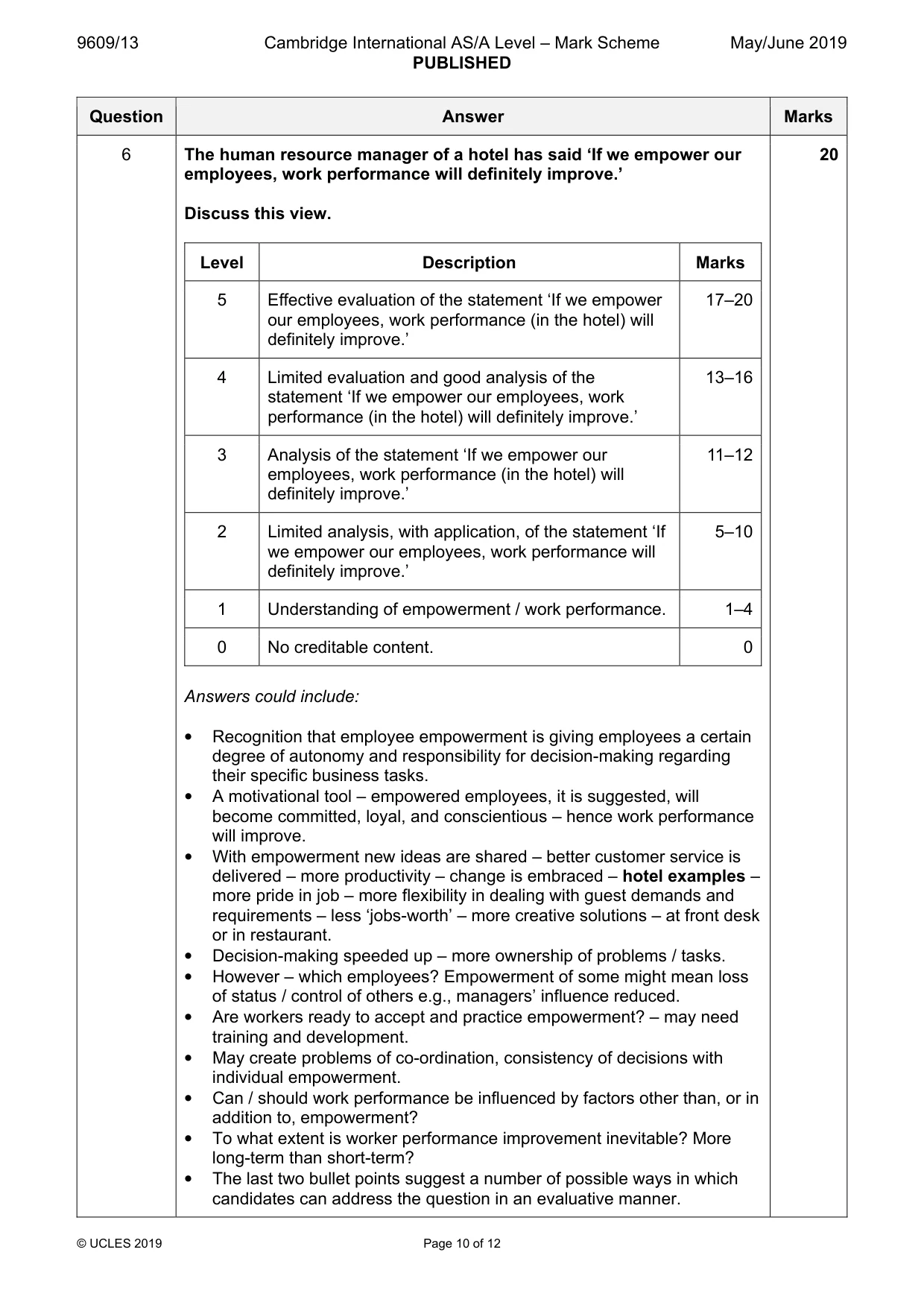
9609/13 Cambridge International AS/A Level – Mark Scheme PUBLISHED May/June 2019 © UCLES 2019 Page 10 of 12 Question Answer Marks 6 The human resource manager of a hotel has said ‘If we empower our employees, work performance will definitely improve.’ Discuss this view. Level Description Marks 5 Effective evaluation of the statement ‘If we empower our employees, work performance (in the hotel) will definitely improve.’ 17–20 4 Limited evaluation and good analysis of the statement ‘If we empower our employees, work performance (in the hotel) will definitely improve.’ 13–16 3 Analysis of the statement ‘If we empower our employees, work performance (in the hotel) will definitely improve.’ 11–12 2 Limited analysis, with application, of the statement ‘If we empower our employees, work performance will definitely improve.’ 5–10 1 Understanding of empowerment / work performance. 1–4 0 No creditable content. 0 Answers could include: • Recognition that employee empowerment is giving employees a certain degree of autonomy and responsibility for decision-making regarding their specific business tasks. • A motivational tool – empowered employees, it is suggested, will become committed, loyal, and conscientious – hence work performance will improve. • With empowerment new ideas are shared – better customer service is delivered – more productivity – change is embraced – hotel examples – more pride in job – more flexibility in dealing with guest demands and requirements – less ‘jobs-worth’ – more creative solutions – at front desk or in restaurant. • Decision-making speeded up – more ownership of problems / tasks. • However – which employees? Empowerment of some might mean loss of status / control of others e.g., managers’ influence reduced. • Are workers ready to accept and practice empowerment? – may need training and development. • May create problems of co-ordination, consistency of decisions with individual empowerment. • Can / should work performance be influenced by factors other than, or in addition to, empowerment? • To what extent is worker performance improvement inevitable? More long-term than short-term? • The last two bullet points suggest a number of possible ways in which candidates can address the question in an evaluative manner. 20
Mark scheme, page 11
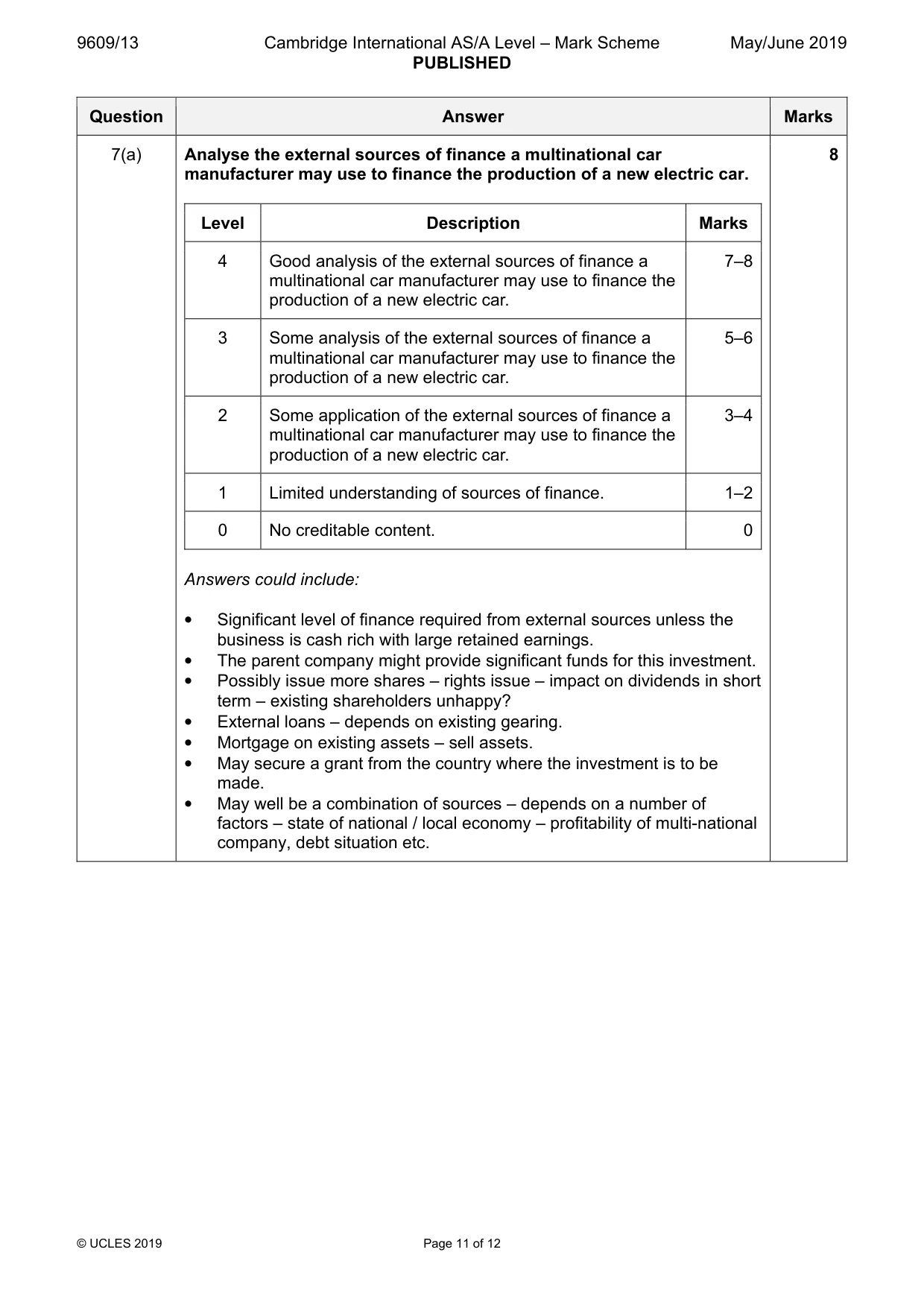
9609/13 Cambridge International AS/A Level – Mark Scheme PUBLISHED May/June 2019 © UCLES 2019 Page 11 of 12 Question Answer Marks 7(a) Analyse the external sources of finance a multinational car manufacturer may use to finance the production of a new electric car. Level Description Marks 4 Good analysis of the external sources of finance a multinational car manufacturer may use to finance the production of a new electric car. 7–8 3 Some analysis of the external sources of finance a multinational car manufacturer may use to finance the production of a new electric car. 5–6 2 Some application of the external sources of finance a multinational car manufacturer may use to finance the production of a new electric car. 3–4 1 Limited understanding of sources of finance. 1–2 0 No creditable content. 0 Answers could include: • Significant level of finance required from external sources unless the business is cash rich with large retained earnings. • The parent company might provide significant funds for this investment. • Possibly issue more shares – rights issue – impact on dividends in short term – existing shareholders unhappy? • External loans – depends on existing gearing. • Mortgage on existing assets – sell assets. • May secure a grant from the country where the investment is to be made. • May well be a combination of sources – depends on a number of factors – state of national / local economy – profitability of multi-national company, debt situation etc. 8
Mark scheme, page 12
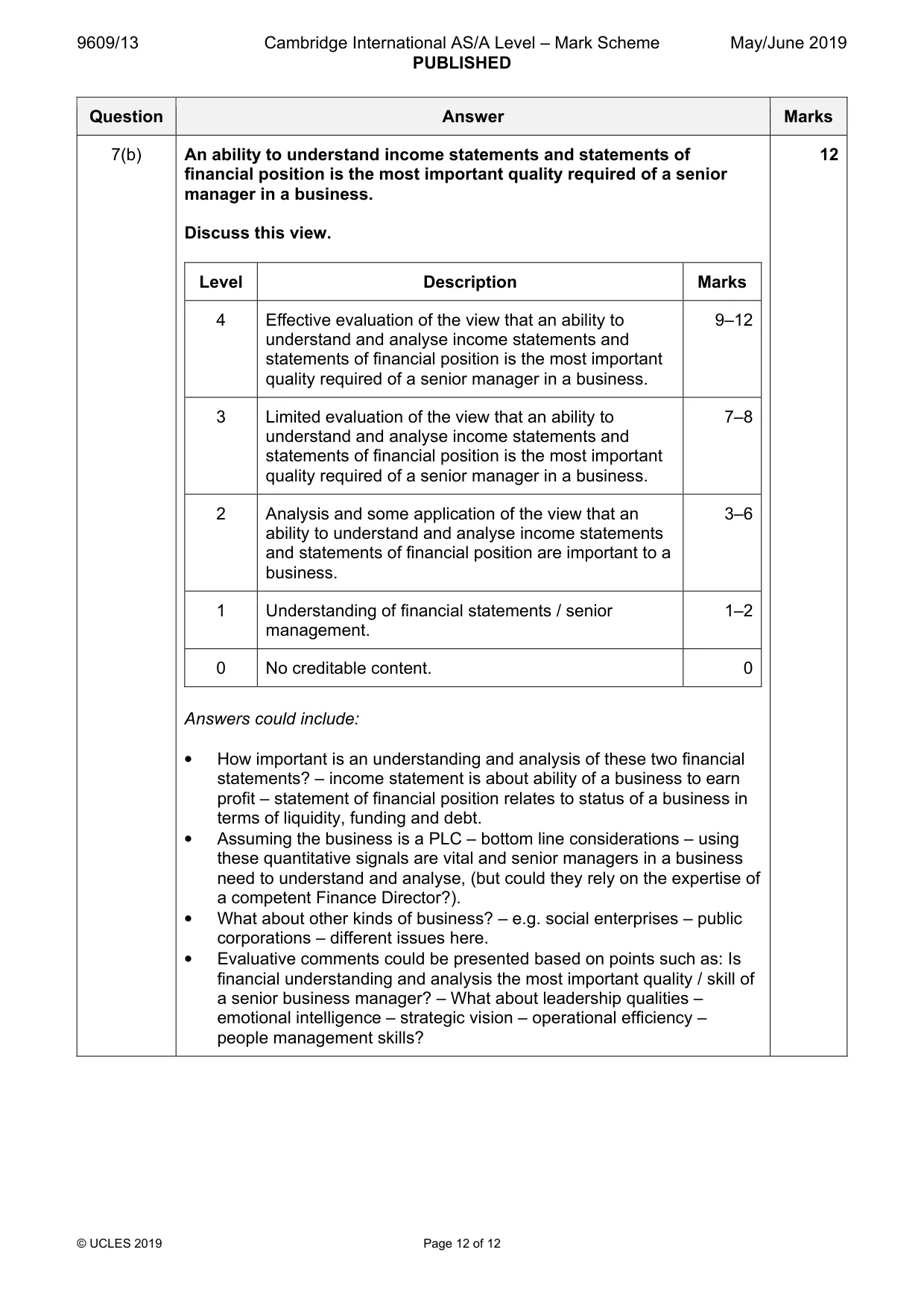
9609/13 Cambridge International AS/A Level – Mark Scheme PUBLISHED May/June 2019 © UCLES 2019 Page 12 of 12 Question Answer Marks 7(b) An ability to understand income statements and statements of financial position is the most important quality required of a senior manager in a business. Discuss this view. Level Description Marks 4 Effective evaluation of the view that an ability to understand and analyse income statements and statements of financial position is the most important quality required of a senior manager in a business. 9–12 3 Limited evaluation of the view that an ability to understand and analyse income statements and statements of financial position is the most important quality required of a senior manager in a business. 7–8 2 Analysis and some application of the view that an ability to understand and analyse income statements and statements of financial position are important to a business. 3–6 1 Understanding of financial statements / senior management. 1–2 0 No creditable content. 0 Answers could include: • How important is an understanding and analysis of these two financial statements? – income statement is about ability of a business to earn profit – statement of financial position relates to status of a business in terms of liquidity, funding and debt. • Assuming the business is a PLC – bottom line considerations – using these quantitative signals are vital and senior managers in a business need to understand and analyse, (but could they rely on the expertise of a competent Finance Director?). • What about other kinds of business? – e.g. social enterprises – public corporations – different issues here. • Evaluative comments could be presented based on points such as: Is financial understanding and analysis the most important quality / skill of a senior business manager? – What about leadership qualities – emotional intelligence – strategic vision – operational efficiency – people management skills? 12
What you needed in this session
Cambridge’s own grade thresholds for 2019 May/June, Paper 1 · Variant 3. A higher threshold means an easier paper — the bar moves with how the cohort did.