Cambridge A Level Business (for first examination in 2016) 9609 — 2019 Feb/March Paper 2 · Variant 2
9609/22/F/M/19 · 2 questions · 60 marks · ≈68 min
The question paper and its mark scheme, free to read here and free to download. This is Cambridge’s own paper, exactly as it was sat.
Question paper8 pages



Mark scheme17 pages
Answers below. Sit the paper first if you are practising.
Questions as text
Q1 · Jim’s Farm (JF) JF is a private limited company which owns a farm
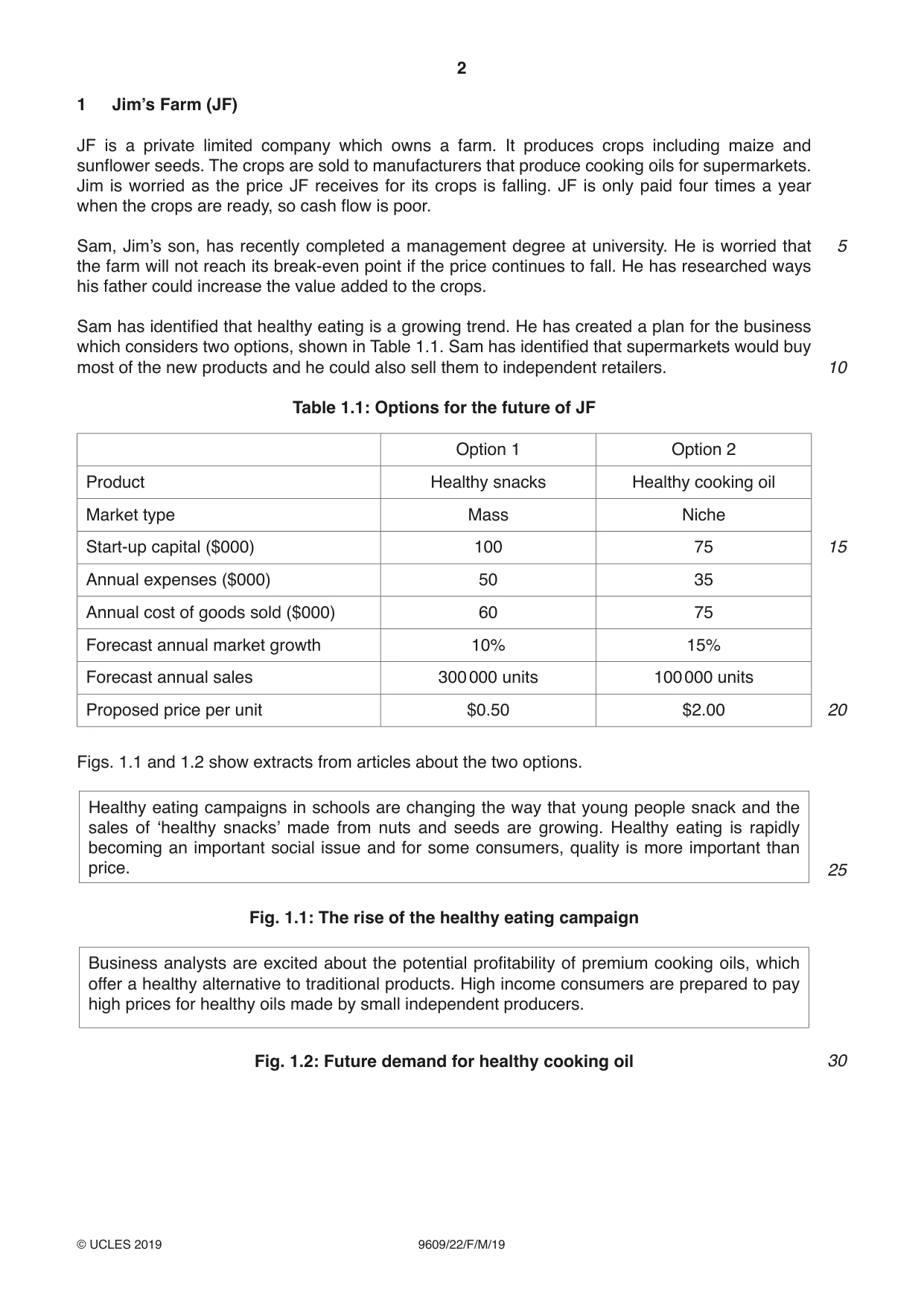
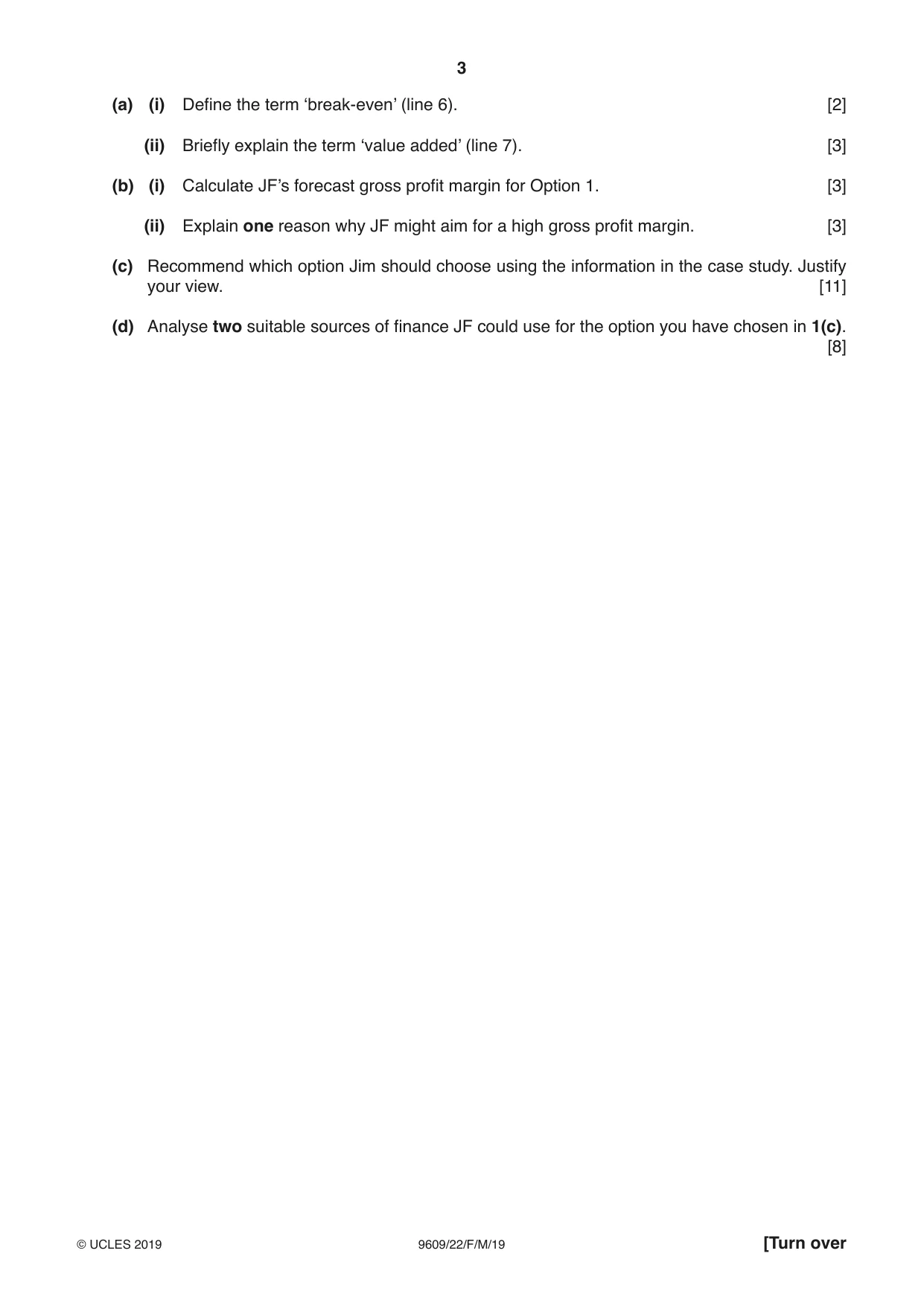
1 Jim’s Farm (JF) JF is a private limited company which owns a farm. It produces crops including maize and sunflower seeds. The crops are sold to manufacturers that produce cooking oils for supermarkets. Jim is worried as the price JF receives for its crops is falling. JF is only paid four times a year when the crops are ready, so cash flow is poor. Sam, Jim’s son, has recently completed a management degree at university. He is worried that 5 the farm will not reach its break-even point if the price continues to fall. He has researched ways his father could increase the value added to the crops. Sam has identified that healthy eating is a growing trend. He has created a plan for the business which considers two options, shown in Table 1.1. Sam has identified that supermarkets would buy most of the new products and he could also sell them to independent retailers. 10 Table 1.1: Options for the future of JF Option 1 Option 2 Product Healthy snacks Healthy cooking oil Market type Mass Niche Start-up capital ($000) 100 75 15 Annual expenses ($000) 50 35 Annual cost of goods sold ($000) 60 75 Forecast annual market growth 10% 15% Forecast annual sales 300 000 units 100 000 units Proposed price per unit $0.50 $2.00 20 Figs. 1.1 and 1.2 show extracts from articles about the two options. Healthy eating campaigns in schools are changing the way that young people snack and the sales of ‘healthy snacks’ made from nuts and seeds are growing. Healthy eating is rapidly becoming an important social issue and for some consumers, quality is more important than price. 25 Fig. 1.1: The rise of the healthy eating campaign Business analysts are excited about the potential profitability of premium cooking oils, which offer a healthy alternative to traditional products. High income consumers are prepared to pay high prices for healthy oils made by small independent producers. Fig. 1.2: Future demand for healthy cooking oil 30 (a) (i) Define the term ‘break-even’ (line 6). [2] (ii) Briefly explain the term ‘value added’ (line 7). [3] (b) (i) Calculate JF’s forecast gross profit margin for Option 1. [3] (ii) Explain one reason why JF might aim for a high gross profit margin. [3] (c) Recommend which option Jim should choose using the information in the case study. Justify your view. [11] (d) Analyse two suitable sources of finance JF could use for the option you have chosen in 1(c). [8]
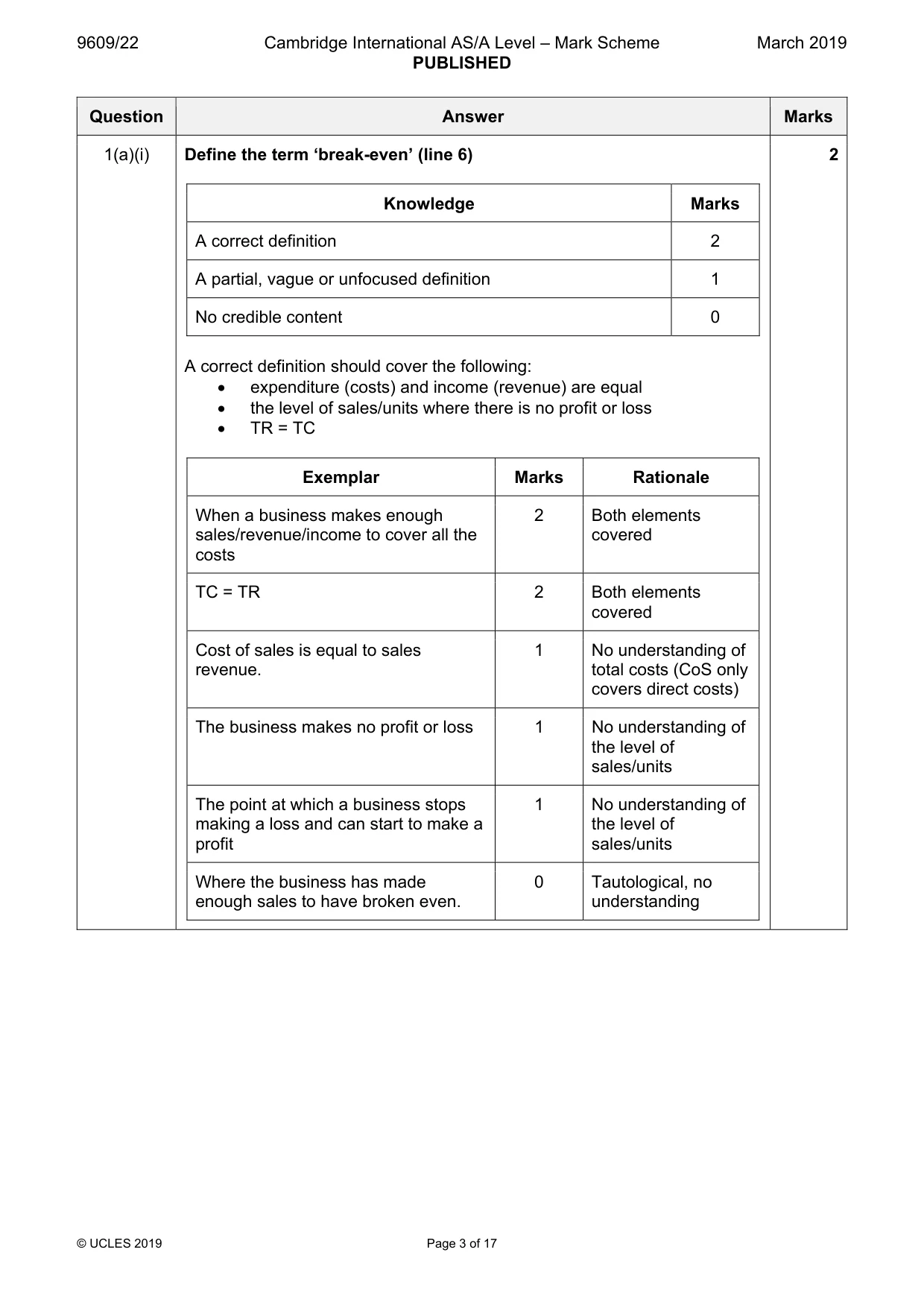
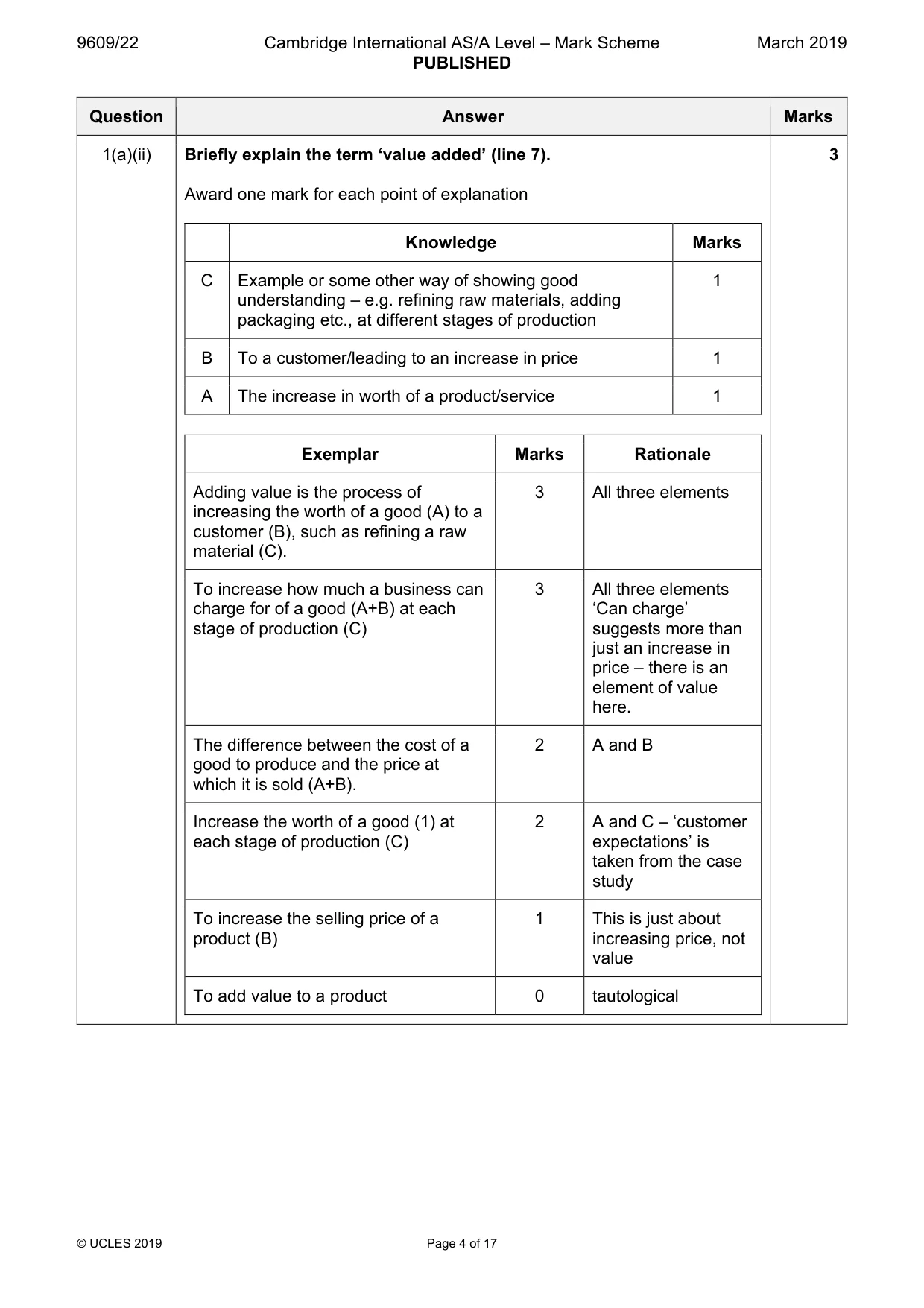
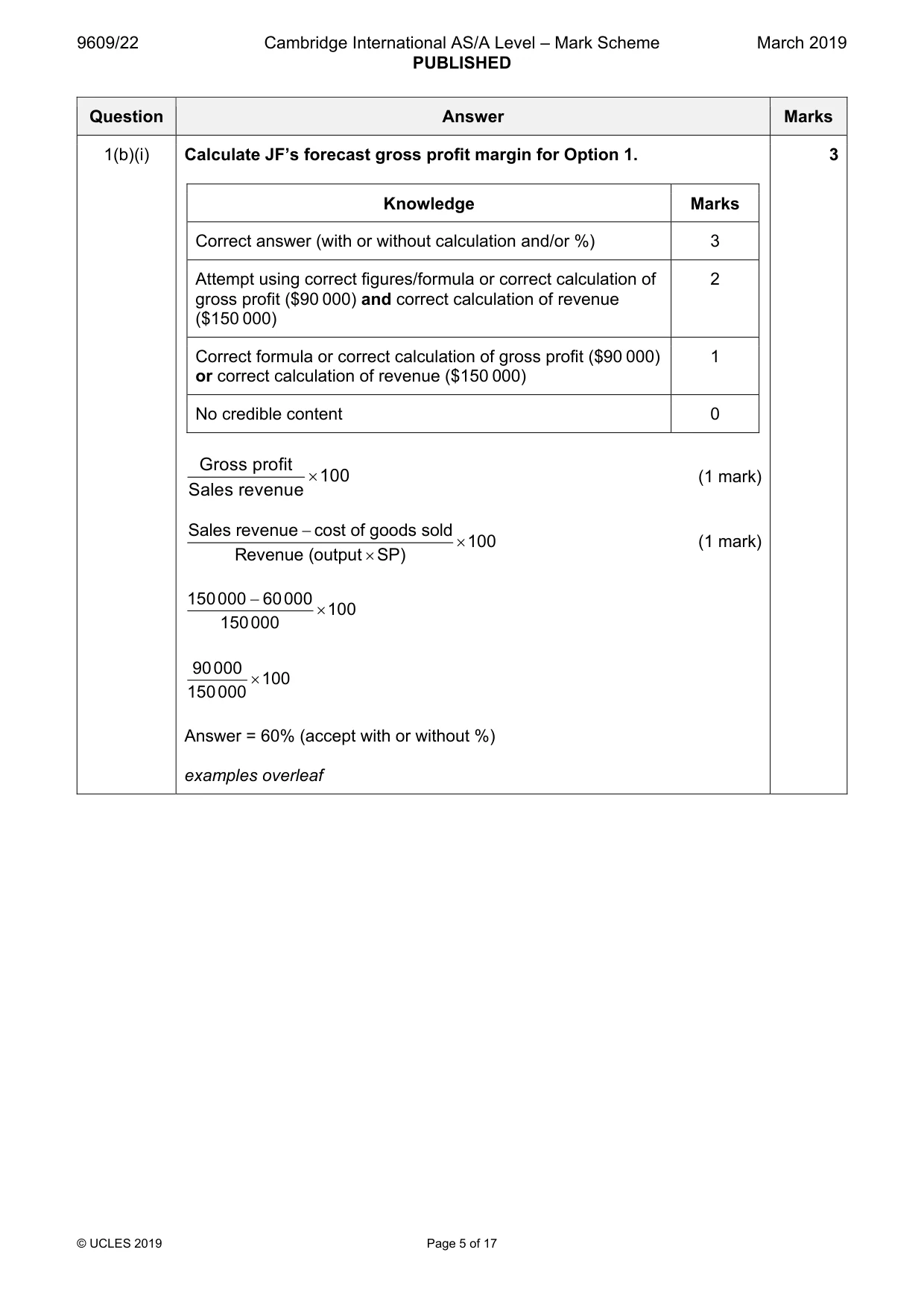
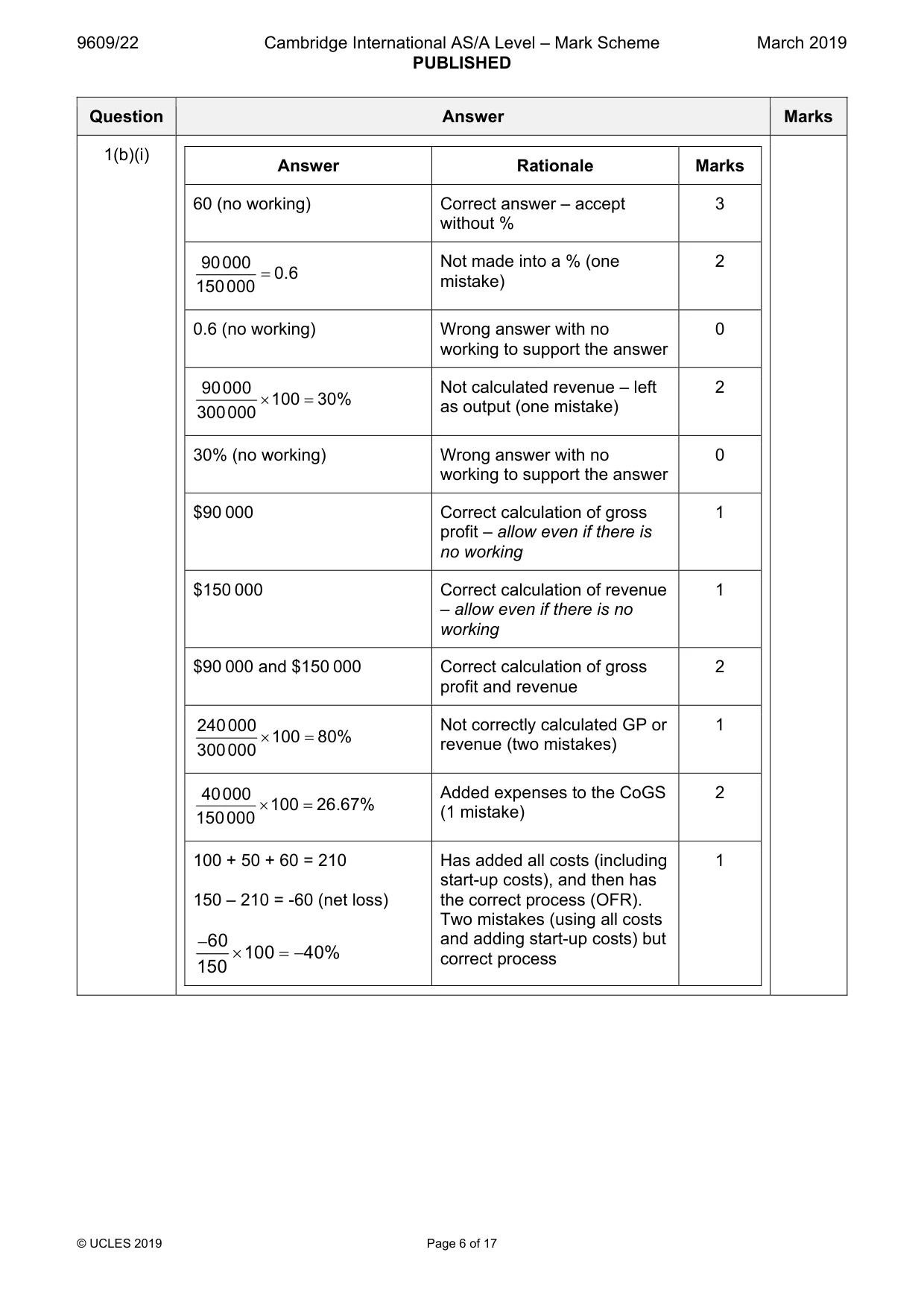
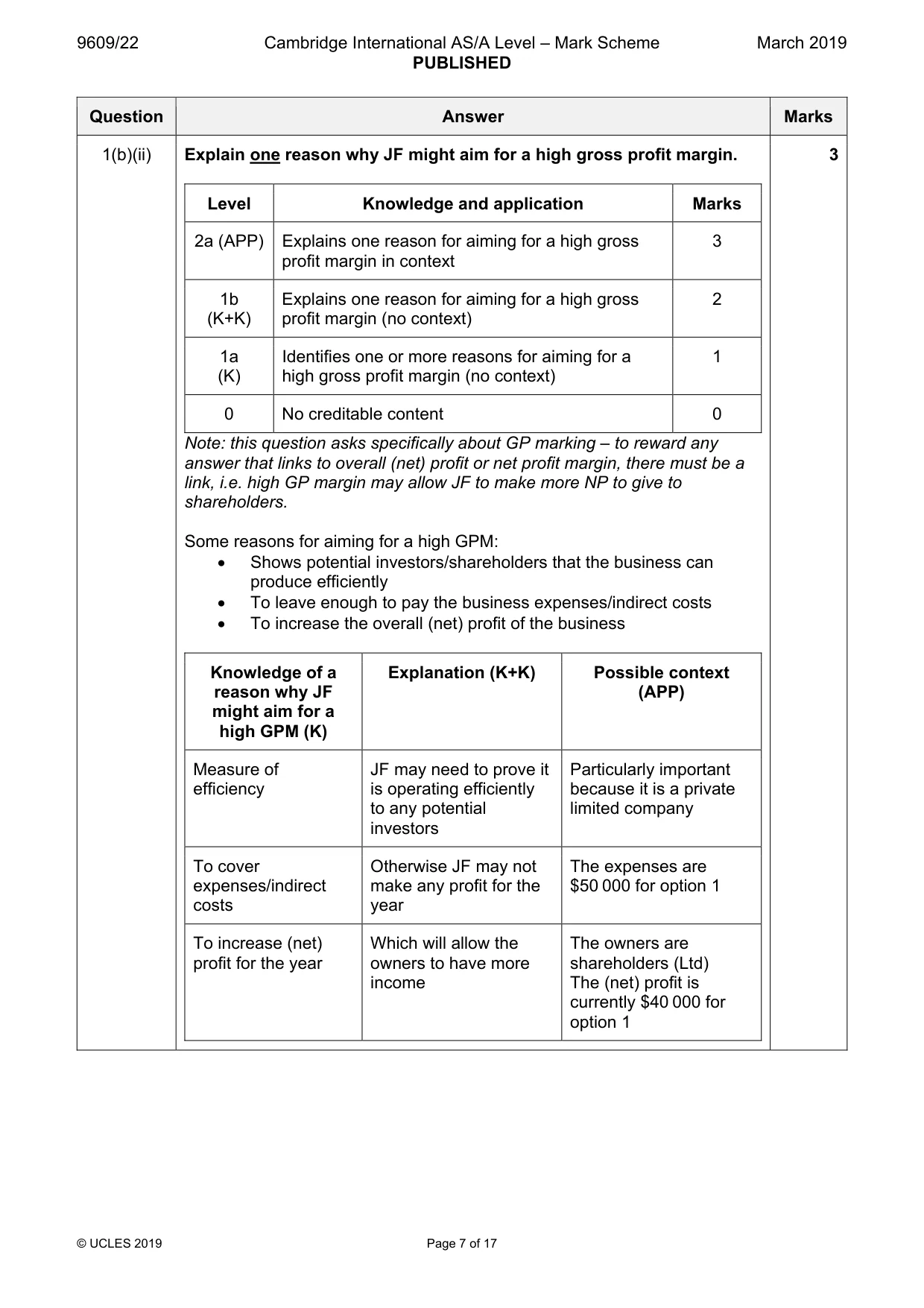
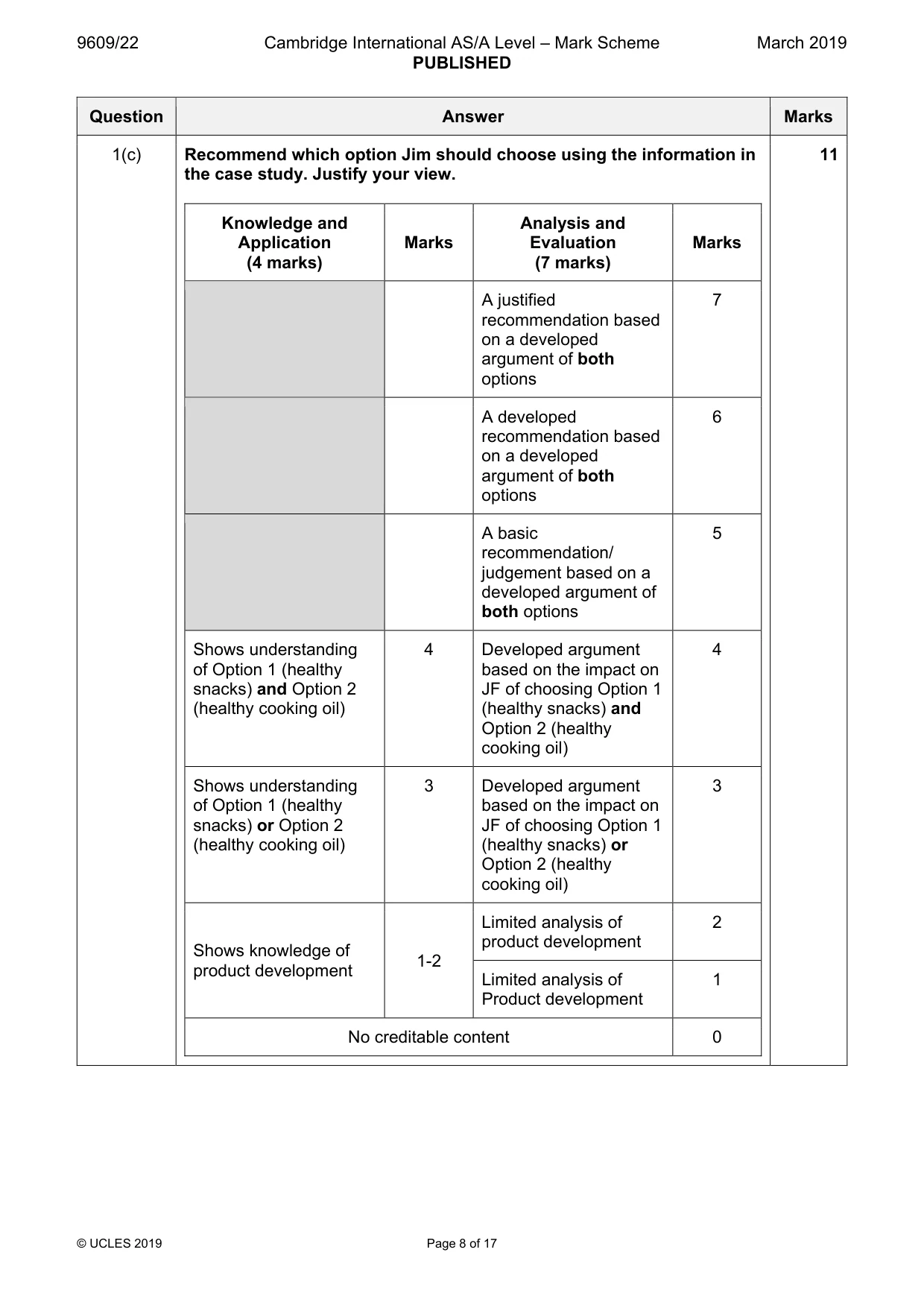
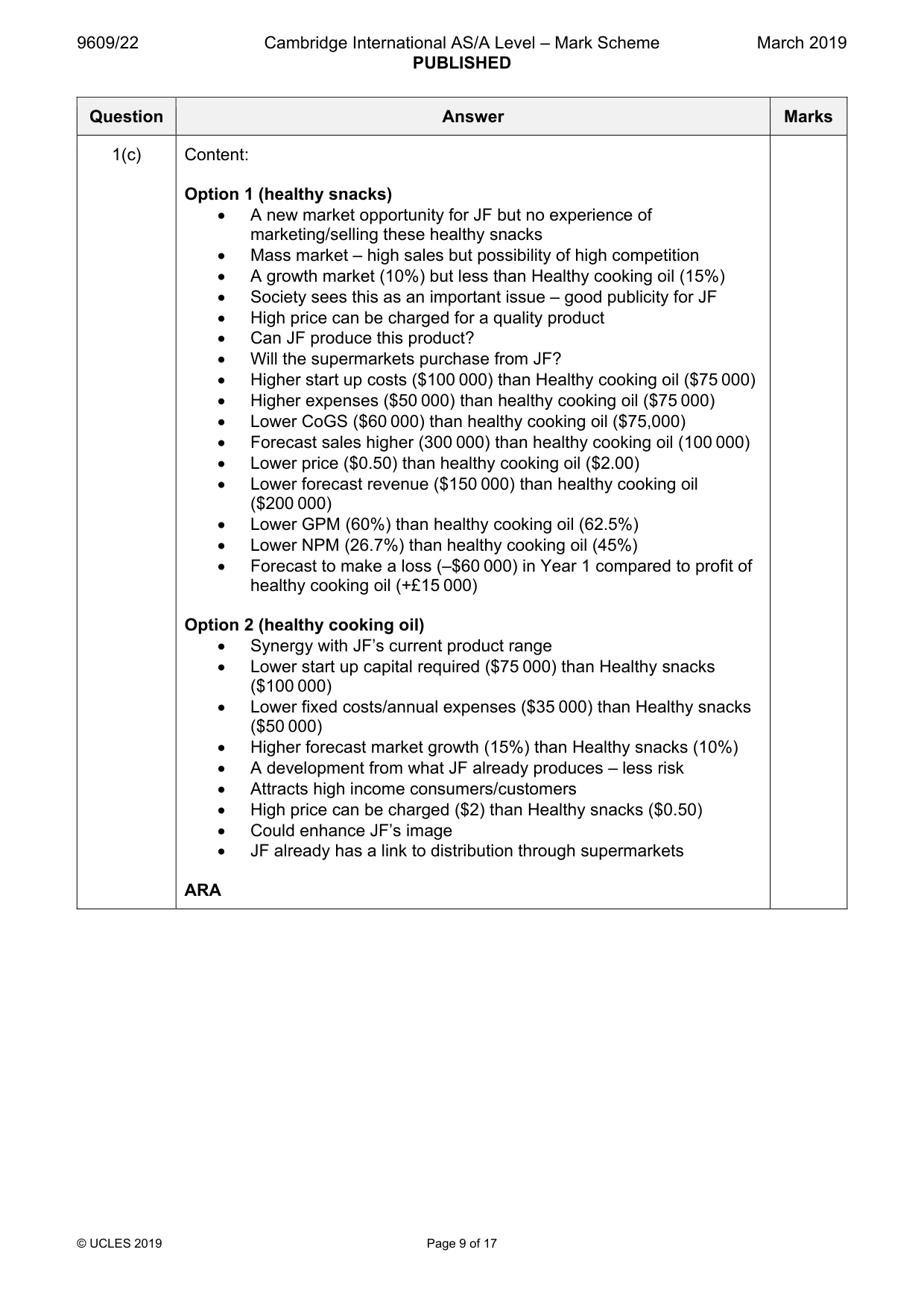
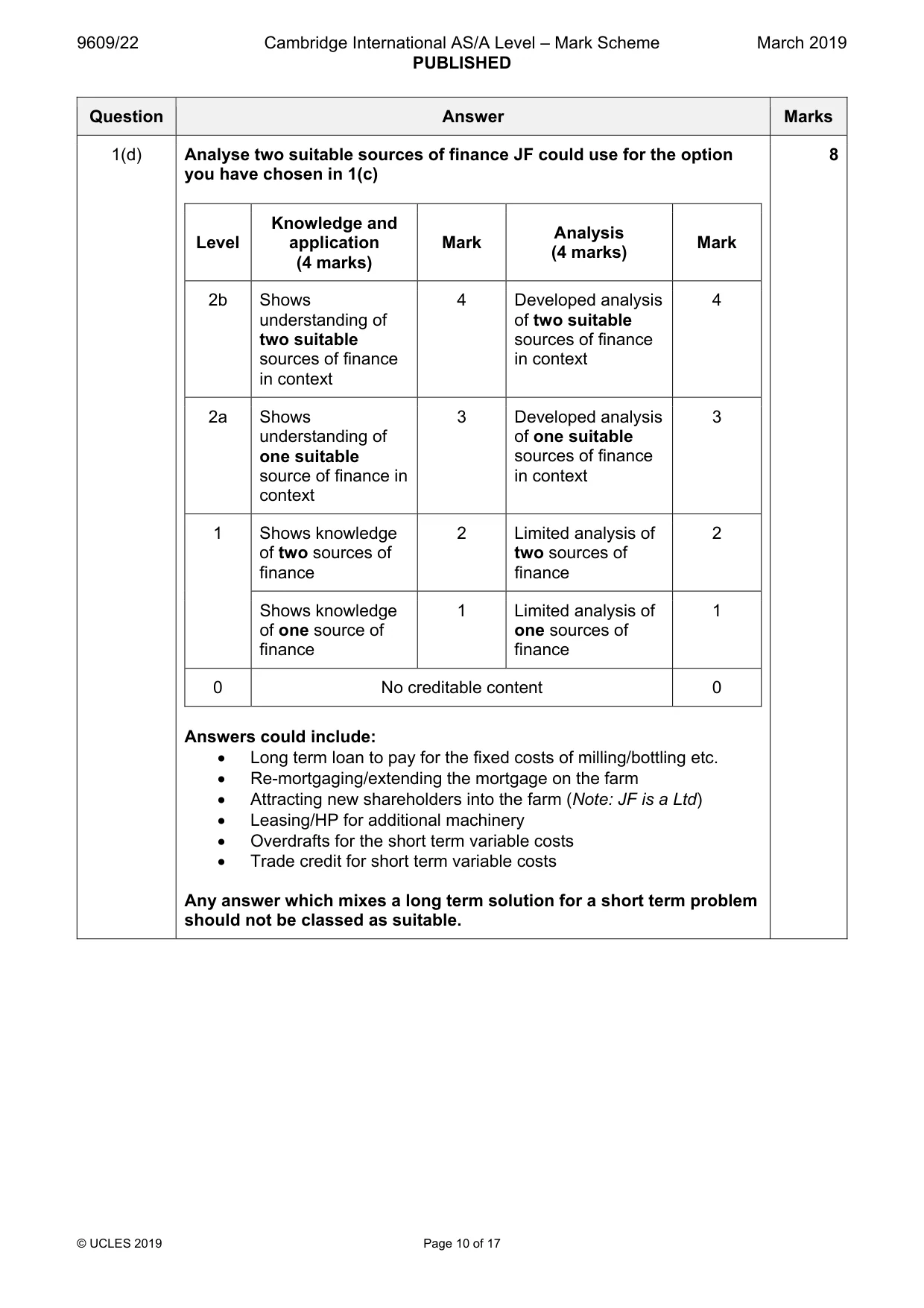
Mark scheme: Question Answer Marks 1(a)(i) Define the term ‘break-even’ (line 6) 2 Knowledge Marks A correct definition 2 A partial, vague or unfocused definition 1 No credible content 0 A correct definition should cover the following: • expenditure (costs) and income (revenue) are equal • the level of sales/units where there is no profit or loss • TR = TC Exemplar Marks Rationale When a business makes enough 2 Both elements sales/revenue/income to cover all the covered costs TC = TR 2 Both elements covered Cost of sales is equal to sales 1 No understanding of revenue. total costs (CoS only covers direct costs) The business makes no profit or loss 1 No understanding of the level of sales/units The point at which a business stops 1 No understanding of making a loss and can start to make a the level of profit sales/units Where the business has made 0 Tautological, no enough sales to have broken even. understanding 1(a)(ii) Briefly explain the term ‘value added’ (line 7). 3 Award one mark for each point of explanation Knowledge Marks C Example or some other way of showing good 1 understanding – e.g. refining raw materials, adding packaging etc., at different stages of production B To a customer/leading to an increase in price 1 A The increase in worth of a product/service 1 Exemplar Marks Rationale Adding value is the process of 3 All three elements increasing the worth of a good (A) to a customer (B), such as refining a raw material (C). To increase how much a business can 3 All three elements charge for of a good (A+B) at each ‘Can charge’ stage of production (C) suggests more than just an increase in price – there is an element of value here. The difference between the cost of a 2 A and B good to produce and the price at which it is sold (A+B). Increase the worth of a good (1) at 2 A and C – ‘customer each stage of production (C) expectations’ is taken from the case study To increase the selling price of a 1 This is just about product (B) increasing price, not value To add value to a product 0 tautological 1(b)(i) Calculate JF’s forecast gross profit margin for Option 1. 3 Knowledge Marks Correct answer (with or without calculation and/or %) 3 Attempt using correct figures/formula or correct calculation of 2 gross profit ($90 000) and correct calculation of revenue ($150 000) Correct formula or correct calculation of gross profit ($90 000) 1 or correct calculation of revenue ($150 000) No credible content 0 Gross profit × 100 (1 mark) Sales revenue Sales revenue − cost of goods sold × 100 (1 mark) Revenue (output × SP) 150000 − 60000 × 100 150000 90000 × 100 150000 Answer = 60% (accept with or without %) examples overleaf 1(b)(i) Answer Rationale Marks 60 (no working) Correct answer – accept 3 without % 90000 Not made into a % (one 2 = 0.6 mistake) 150000 0.6 (no working) Wrong answer with no 0 working to support the answer 90000 Not calculated revenue – left 2 × 100 = 30% as output (one mistake) 300000 30% (no working) Wrong answer with no 0 working to support the answer $90 000 Correct calculation of gross 1 profit – allow even if there is no working $150 000 Correct calculation of revenue 1 – allow even if there is no working $90 000 and $150 000 Correct calculation of gross 2 profit and revenue 240000 Not correctly calculated GP or 1 × 100 = 80% revenue (two mistakes) 300000 40000 Added expenses to the CoGS 2 × 100 = 26.67% (1 mistake) 150000 100 + 50 + 60 = 210 Has added all costs (including 1 start-up costs), and then has 150 – 210 = -60 (net loss) the correct process (OFR). Two mistakes (using all costs − 60 and adding start-up costs) but × 100 = − 40% correct process 150 1(b)(ii) Explain one reason why JF might aim for a high gross profit margin. 3 Level Knowledge and application Marks 2a (APP) Explains one reason for aiming for a high gross 3 profit margin in context 1b Explains one reason for aiming for a high gross 2 (K+K) profit margin (no context) 1a Identifies one or more reasons for aiming for a 1 (K) high gross profit margin (no context) 0 No creditable content 0 Note: this question asks specifically about GP marking – to reward any answer that links to overall (net) profit or net profit margin, there must be a link, i.e. high GP margin may allow JF to make more NP to give to shareholders. Some reasons for aiming for a high GPM: • Shows potential investors/shareholders that the business can produce efficiently • To leave enough to pay the business expenses/indirect costs • To increase the overall (net) profit of the business Knowledge of a Explanation (K+K) Possible context reason why JF (APP) might aim for a high GPM (K) Measure of JF may need to prove it Particularly important efficiency is operating efficiently because it is a private to any potential limited company investors To cover Otherwise JF may not The expenses are expenses/indirect make any profit for the $50 000 for option 1 costs year To increase (net) Which will allow the The owners are profit for the year owners to have more shareholders (Ltd) income The (net) profit is currently $40 000 for option 1 1(c) Recommend which option Jim should choose using the information in 11 the case study. Justify your view. Knowledge and Analysis and Application Marks Evaluation Marks (4 marks) (7 marks) A justified 7 recommendation based on a developed argument of both options A developed 6 recommendation based on a developed argument of both options A basic 5 recommendation/ judgement based on a developed argument of both options Shows understanding 4 Developed argument 4 of Option 1 (healthy based on the impact on snacks) and Option 2 JF of choosing Option 1 (healthy cooking oil) (healthy snacks) and Option 2 (healthy cooking oil) Shows understanding 3 Developed argument 3 of Option 1 (healthy based on the impact on snacks) or Option 2 JF of choosing Option 1 (healthy cooking oil) (healthy snacks) or Option 2 (healthy cooking oil) Limited analysis of 2 product development Shows knowledge of 1-2 product development Limited analysis of 1 Product development No creditable content 0 1(c) Content: Option 1 (healthy snacks) • A new market opportunity for JF but no experience of marketing/selling these healthy snacks • Mass market – high sales but possibility of high competition • A growth market (10%) but less than Healthy cooking oil (15%) • Society sees this as an important issue – good publicity for JF • High price can be charged for a quality product • Can JF produce this product? • Will the supermarkets purchase from JF? • Higher start up costs ($100 000) than Healthy cooking oil ($75 000) • Higher expenses ($50 000) than healthy cooking oil ($75 000) • Lower CoGS ($60 000) than healthy cooking oil ($75,000) • Forecast sales higher (300 000) than healthy cooking oil (100 000) • Lower price ($0.50) than healthy cooking oil ($2.00) • Lower forecast revenue ($150 000) than healthy cooking oil ($200 000) • Lower GPM (60%) than healthy cooking oil (62.5%) • Lower NPM (26.7%) than healthy cooking oil (45%) • Forecast to make a loss (–$60 000) in Year 1 compared to profit of healthy cooking oil (+£15 000) Option 2 (healthy cooking oil) • Synergy with JF’s current product range • Lower start up capital required ($75 000) than Healthy snacks ($100 000) • Lower fixed costs/annual expenses ($35 000) than Healthy snacks ($50 000) • Higher forecast market growth (15%) than Healthy snacks (10%) • A development from what JF already produces – less risk • Attracts high income consumers/customers • High price can be charged ($2) than Healthy snacks ($0.50) • Could enhance JF’s image • JF already has a link to distribution through supermarkets ARA 1(d) Analyse two suitable sources of finance JF could use for the option 8 you have chosen in 1(c) Knowledge and Analysis Level application Mark Mark (4 marks) (4 marks) 2b Shows 4 Developed analysis 4 understanding of of two suitable two suitable sources of finance sources of finance in context in context 2a Shows 3 Developed analysis 3 understanding of of one suitable one suitable sources of finance source of finance in in context context 1 Shows knowledge 2 Limited analysis of 2 of two sources of two sources of finance finance Shows knowledge 1 Limited analysis of 1 of one source of one sources of finance finance 0 No creditable content 0 Answers could include: • Long term loan to pay for the fixed costs of milling/bottling etc. • Re-mortgaging/extending the mortgage on the farm • Attracting new shareholders into the farm (Note: JF is a Ltd) • Leasing/HP for additional machinery • Overdrafts for the short term variable costs • Trade credit for short term variable costs Any answer which mixes a long term solution for a short term problem should not be classed as suitable.
Q2 · Sadiq’s Social Restaurant (SSR) SSR is a small social enterprise located in a low-income…
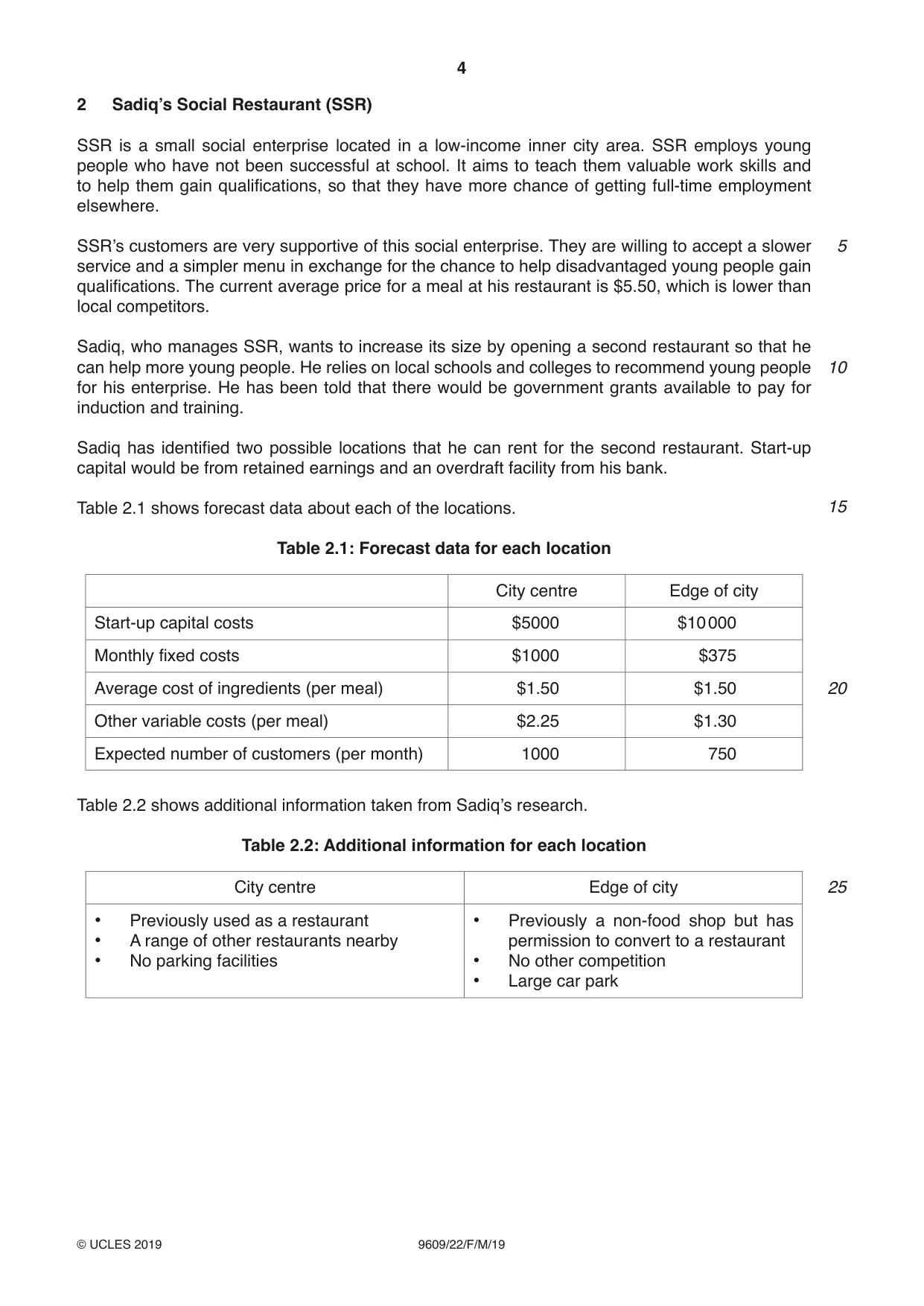
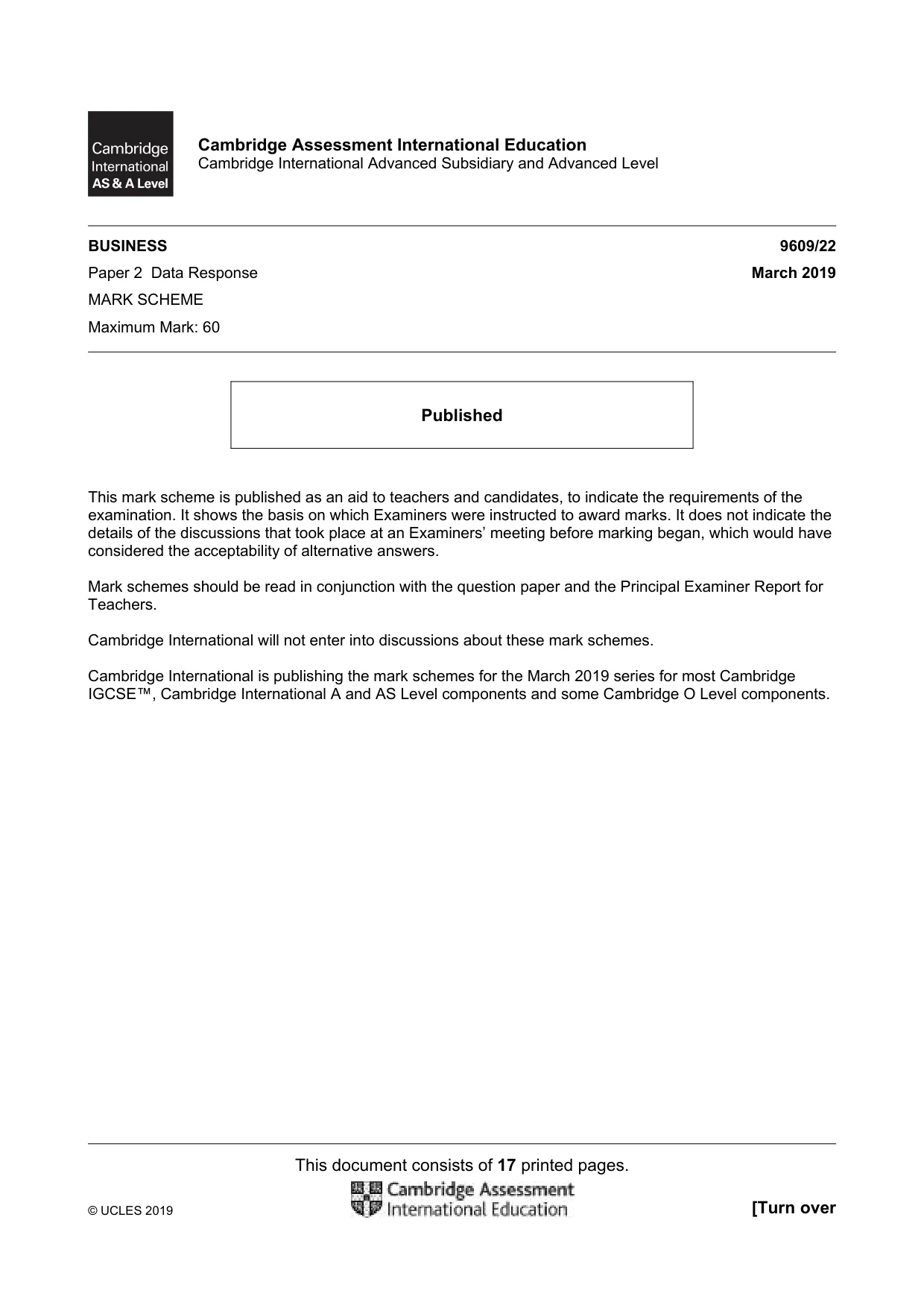
2 Sadiq’s Social Restaurant (SSR) SSR is a small social enterprise located in a low-income inner city area. SSR employs young people who have not been successful at school. It aims to teach them valuable work skills and to help them gain qualifications, so that they have more chance of getting full-time employment elsewhere. SSR’s customers are very supportive of this social enterprise. They are willing to accept a slower 5 service and a simpler menu in exchange for the chance to help disadvantaged young people gain qualifications. The current average price for a meal at his restaurant is $5.50, which is lower than local competitors. Sadiq, who manages SSR, wants to increase its size by opening a second restaurant so that he can help more young people. He relies on local schools and colleges to recommend young people 10 for his enterprise. He has been told that there would be government grants available to pay for induction and training. Sadiq has identified two possible locations that he can rent for the second restaurant. Start-up capital would be from retained earnings and an overdraft facility from his bank. Table 2.1 shows forecast data about each of the locations. 15 Table 2.1: Forecast data for each location City centre Edge of city Start-up capital costs $5000 $10 000 Monthly fixed costs $1000 $375 Average cost of ingredients (per meal) $1.50 $1.50 20 Other variable costs (per meal) $2.25 $1.30 Expected number of customers (per month) 1000 750 Table 2.2 shows additional information taken from Sadiq’s research. Table 2.2: Additional information for each location City centre Edge of city 25 • Previously used as a restaurant • Previously a non-food shop but has • A range of other restaurants nearby permission to convert to a restaurant • No parking facilities • No other competition • Large car park (a) (i) Define the term ‘induction’ (line 12). [2] (ii) Briefly explain the term ‘social enterprise’ (line 5). [3] (b) SSR uses cost-based pricing to add 60% to variable costs when pricing each meal. (i) Refer to Table 2.1. Calculate the average price of each meal in the proposed city centre restaurant. [3] (ii) Briefly explain one advantage to SSR of using cost-based pricing. [3] (c) Analyse two possible impacts on stakeholders of SSR if the second restaurant is successful. [8] (d) Recommend which location SSR should choose for its second restaurant. Justify your recommendation. [11]
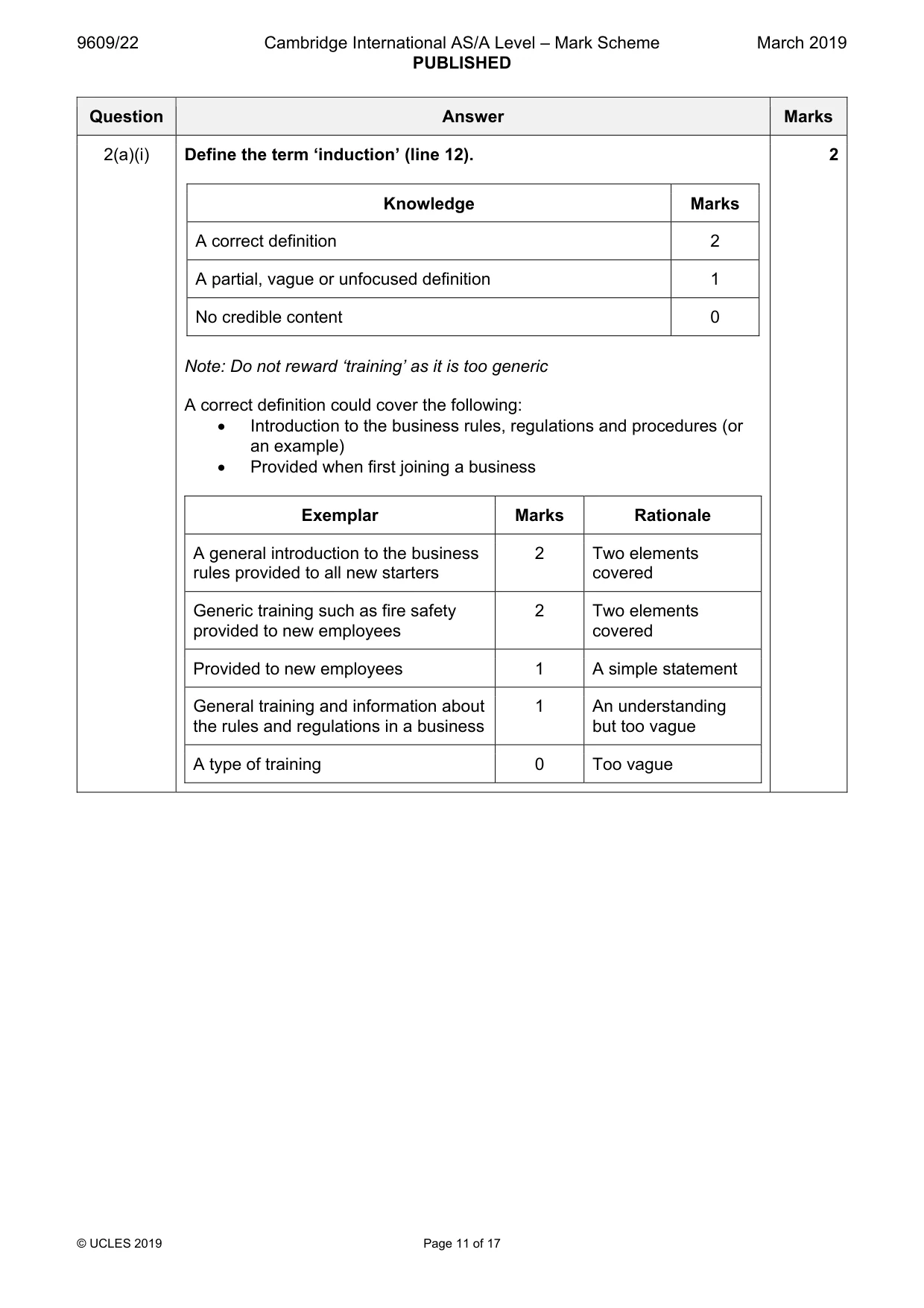
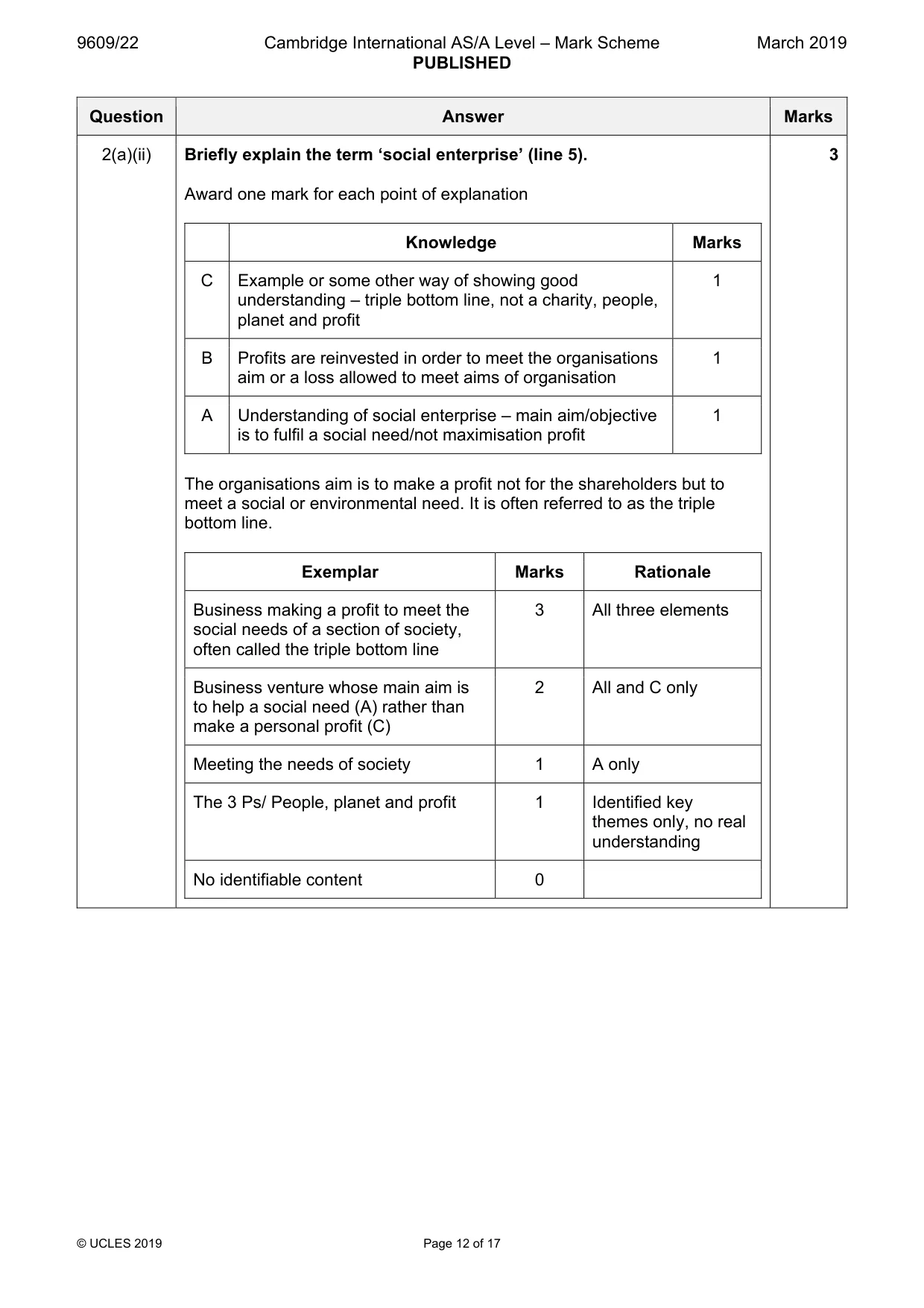
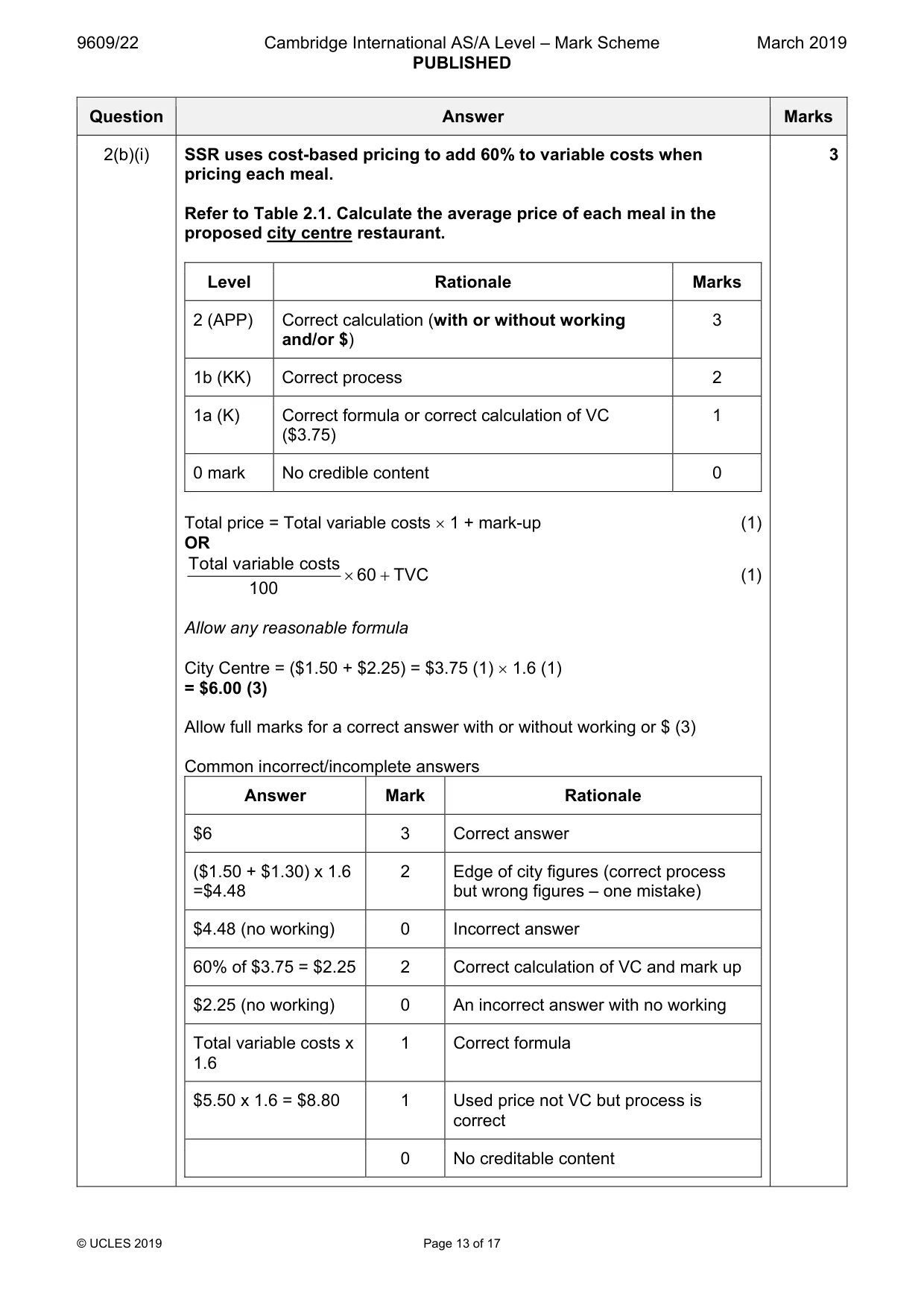
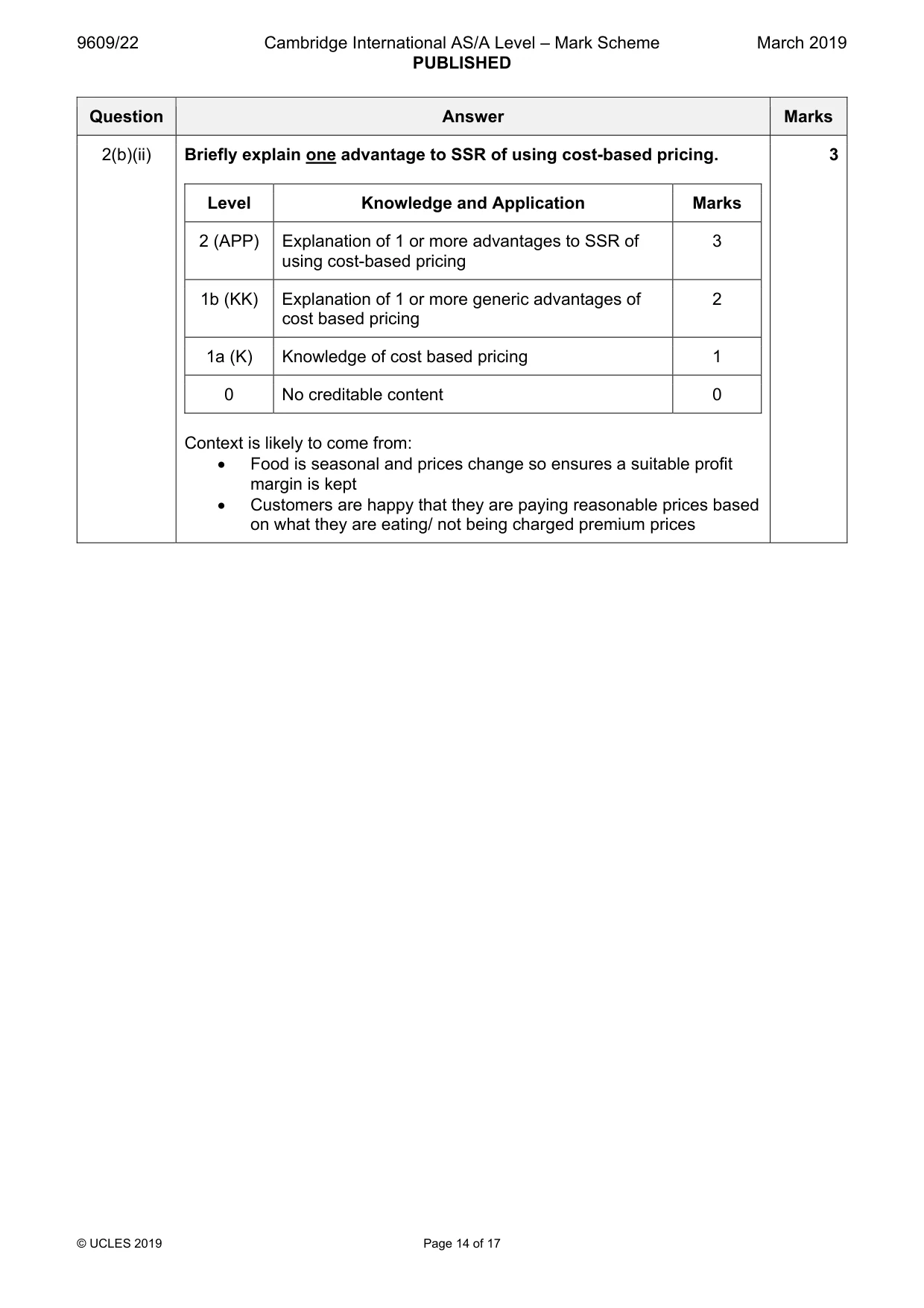
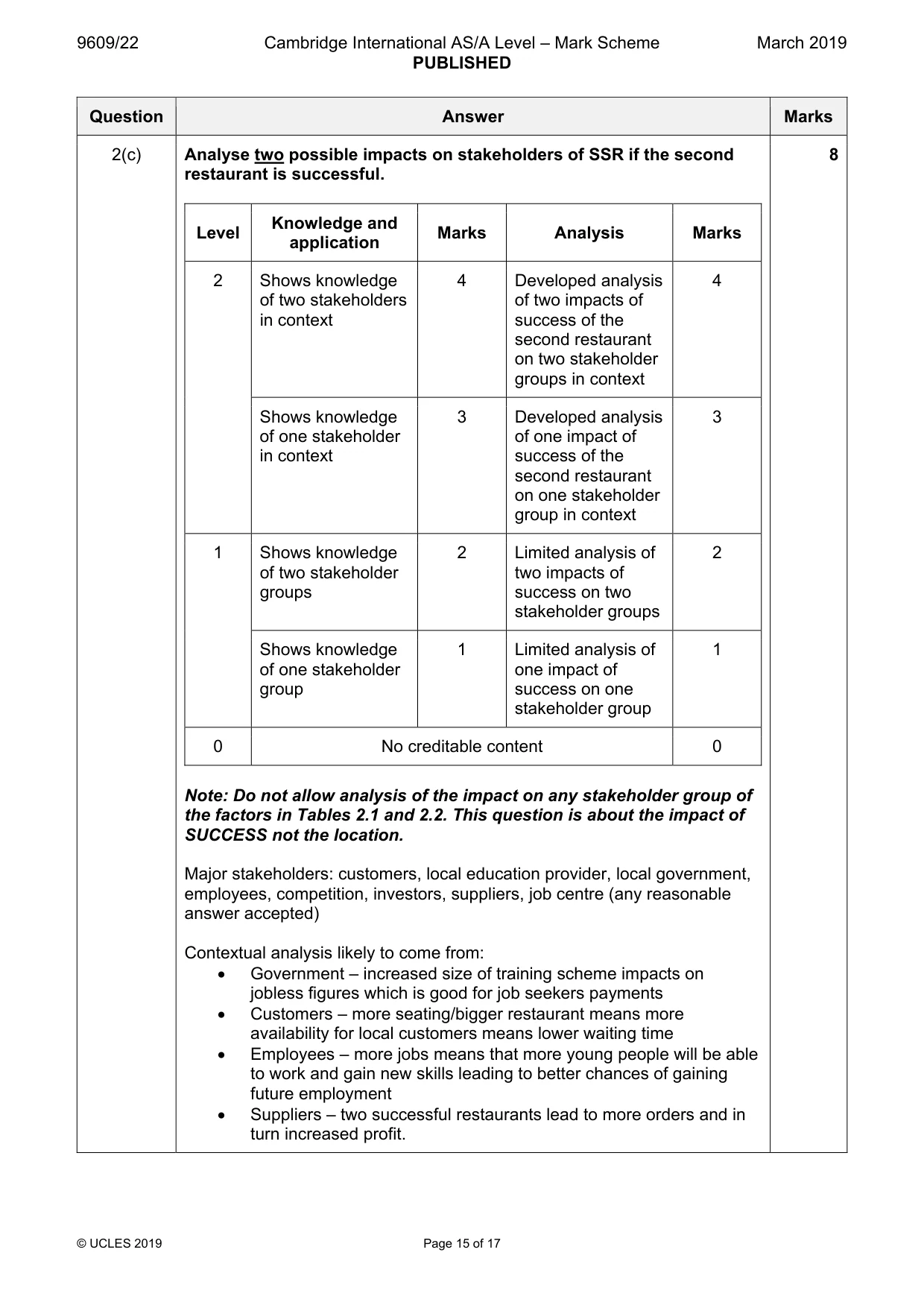
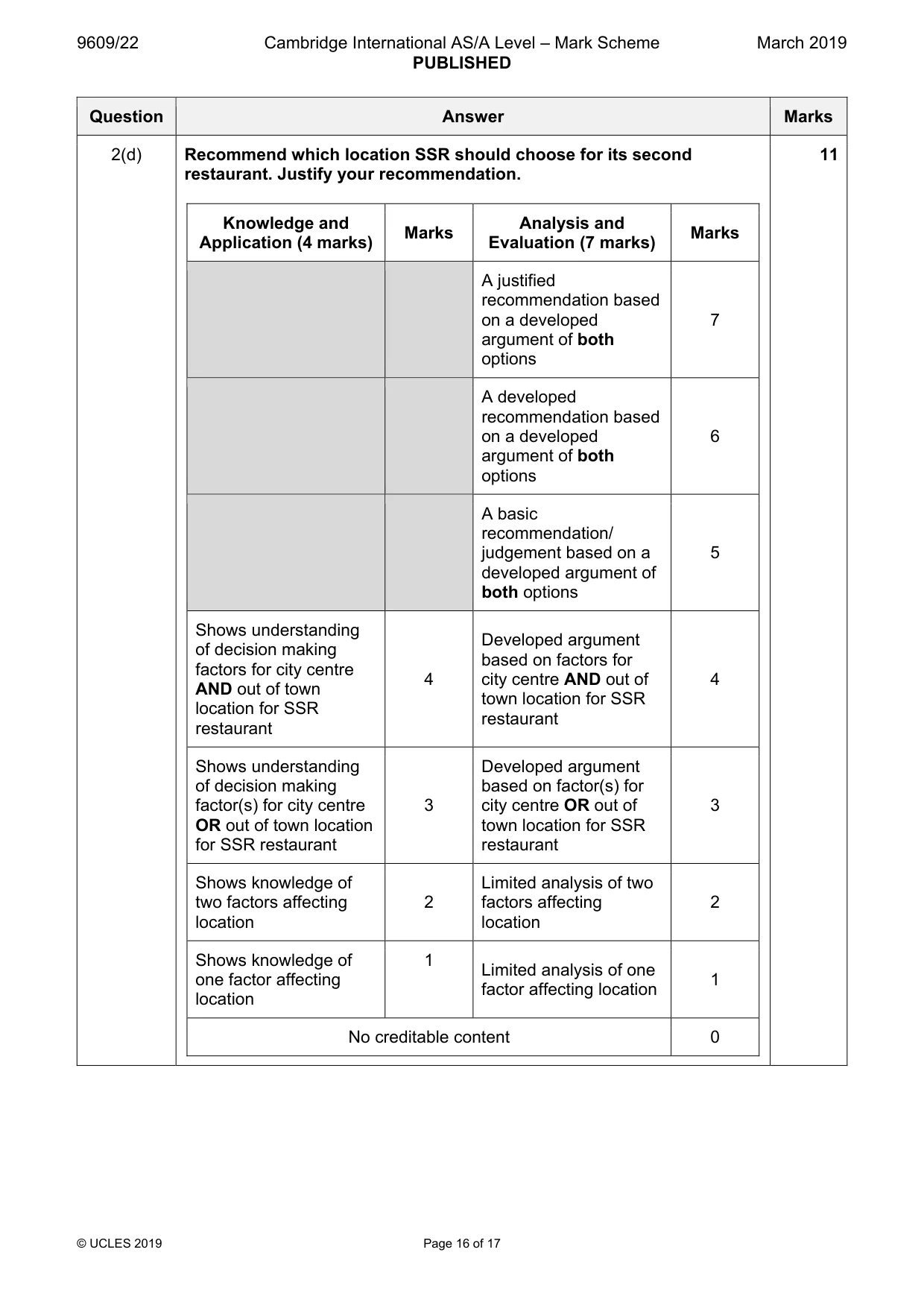
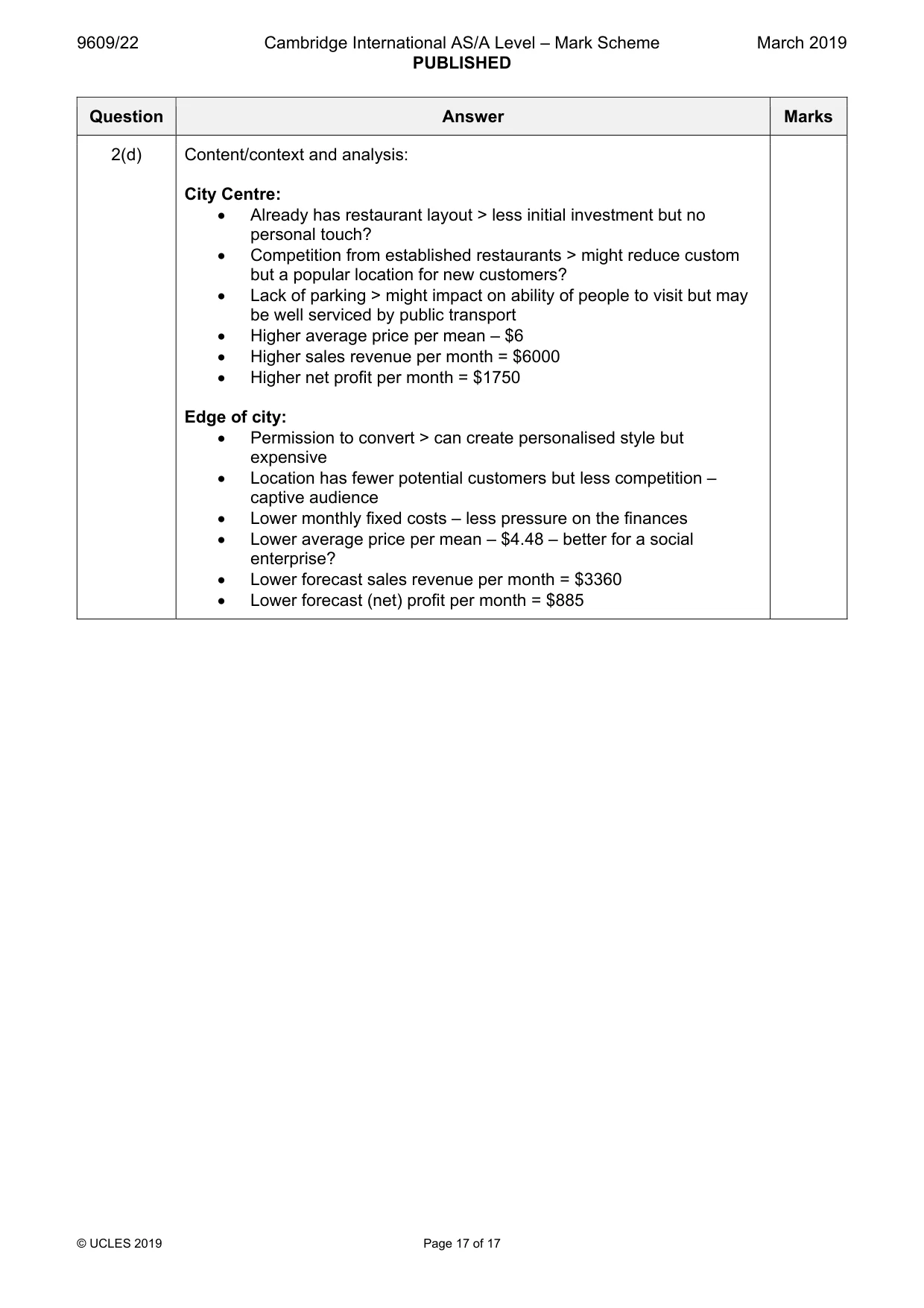
Mark scheme: 2(a)(i) Define the term ‘induction’ (line 12). 2 Knowledge Marks A correct definition 2 A partial, vague or unfocused definition 1 No credible content 0 Note: Do not reward ‘training’ as it is too generic A correct definition could cover the following: • Introduction to the business rules, regulations and procedures (or an example) • Provided when first joining a business Exemplar Marks Rationale A general introduction to the business 2 Two elements rules provided to all new starters covered Generic training such as fire safety 2 Two elements provided to new employees covered Provided to new employees 1 A simple statement General training and information about 1 An understanding the rules and regulations in a business but too vague A type of training 0 Too vague 2(a)(ii) Briefly explain the term ‘social enterprise’ (line 5). 3 Award one mark for each point of explanation Knowledge Marks C Example or some other way of showing good 1 understanding – triple bottom line, not a charity, people, planet and profit B Profits are reinvested in order to meet the organisations 1 aim or a loss allowed to meet aims of organisation A Understanding of social enterprise – main aim/objective 1 is to fulfil a social need/not maximisation profit The organisations aim is to make a profit not for the shareholders but to meet a social or environmental need. It is often referred to as the triple bottom line. Exemplar Marks Rationale Business making a profit to meet the 3 All three elements social needs of a section of society, often called the triple bottom line Business venture whose main aim is 2 All and C only to help a social need (A) rather than make a personal profit (C) Meeting the needs of society 1 A only The 3 Ps/ People, planet and profit 1 Identified key themes only, no real understanding No identifiable content 0 2(b)(i) SSR uses cost-based pricing to add 60% to variable costs when 3 pricing each meal. Refer to Table 2.1. Calculate the average price of each meal in the proposed city centre restaurant. Level Rationale Marks 2 (APP) Correct calculation (with or without working 3 and/or $) 1b (KK) Correct process 2 1a (K) Correct formula or correct calculation of VC 1 ($3.75) 0 mark No credible content 0 Total price = Total variable costs × 1 + mark-up (1) OR Total variable costs × 60 + TVC (1) 100 Allow any reasonable formula City Centre = ($1.50 + $2.25) = $3.75 (1) × 1.6 (1) = $6.00 (3) Allow full marks for a correct answer with or without working or $ (3) Common incorrect/incomplete answers Answer Mark Rationale $6 3 Correct answer ($1.50 + $1.30) x 1.6 2 Edge of city figures (correct process =$4.48 but wrong figures – one mistake) $4.48 (no working) 0 Incorrect answer 60% of $3.75 = $2.25 2 Correct calculation of VC and mark up $2.25 (no working) 0 An incorrect answer with no working Total variable costs x 1 Correct formula 1.6 $5.50 x 1.6 = $8.80 1 Used price not VC but process is correct 0 No creditable content 2(b)(ii) Briefly explain one advantage to SSR of using cost-based pricing. 3 Level Knowledge and Application Marks 2 (APP) Explanation of 1 or more advantages to SSR of 3 using cost-based pricing 1b (KK) Explanation of 1 or more generic advantages of 2 cost based pricing 1a (K) Knowledge of cost based pricing 1 0 No creditable content 0 Context is likely to come from: • Food is seasonal and prices change so ensures a suitable profit margin is kept • Customers are happy that they are paying reasonable prices based on what they are eating/ not being charged premium prices 2(c) Analyse two possible impacts on stakeholders of SSR if the second 8 restaurant is successful. Knowledge and Level Marks Analysis Marks application 2 Shows knowledge 4 Developed analysis 4 of two stakeholders of two impacts of in context success of the second restaurant on two stakeholder groups in context Shows knowledge 3 Developed analysis 3 of one stakeholder of one impact of in context success of the second restaurant on one stakeholder group in context 1 Shows knowledge 2 Limited analysis of 2 of two stakeholder two impacts of groups success on two stakeholder groups Shows knowledge 1 Limited analysis of 1 of one stakeholder one impact of group success on one stakeholder group 0 No creditable content 0 Note: Do not allow analysis of the impact on any stakeholder group of the factors in Tables 2.1 and 2.2. This question is about the impact of SUCCESS not the location. Major stakeholders: customers, local education provider, local government, employees, competition, investors, suppliers, job centre (any reasonable answer accepted) Contextual analysis likely to come from: • Government – increased size of training scheme impacts on jobless figures which is good for job seekers payments • Customers – more seating/bigger restaurant means more availability for local customers means lower waiting time • Employees – more jobs means that more young people will be able to work and gain new skills leading to better chances of gaining future employment • Suppliers – two successful restaurants lead to more orders and in turn increased profit. 2(d) Recommend which location SSR should choose for its second 11 restaurant. Justify your recommendation. Knowledge and Analysis and Marks Marks Application (4 marks) Evaluation (7 marks) A justified recommendation based on a developed 7 argument of both options A developed recommendation based on a developed 6 argument of both options A basic recommendation/ judgement based on a 5 developed argument of both options Shows understanding Developed argument of decision making based on factors for factors for city centre 4 city centre AND out of 4 AND out of town town location for SSR location for SSR restaurant restaurant Shows understanding Developed argument of decision making based on factor(s) for factor(s) for city centre 3 city centre OR out of 3 OR out of town location town location for SSR for SSR restaurant restaurant Shows knowledge of Limited analysis of two two factors affecting 2 factors affecting 2 location location Shows knowledge of 1 Limited analysis of one one factor affecting 1 factor affecting location location No creditable content 0 2(d) Content/context and analysis: City Centre: • Already has restaurant layout > less initial investment but no personal touch? • Competition from established restaurants > might reduce custom but a popular location for new customers? • Lack of parking > might impact on ability of people to visit but may be well serviced by public transport • Higher average price per mean – $6 • Higher sales revenue per month = $6000 • Higher net profit per month = $1750 Edge of city: • Permission to convert > can create personalised style but expensive • Location has fewer potential customers but less competition – captive audience • Lower monthly fixed costs – less pressure on the finances • Lower average price per mean – $4.48 – better for a social enterprise? • Lower forecast sales revenue per month = $3360 • Lower forecast (net) profit per month = $885
What was in this paper
The subtopics covered by these 2 questions, and how many questions each got. Open one in a new tab to see every Cambridge question on it.
What you needed in this session
Cambridge’s own grade thresholds for 2019 Feb/March, Paper 2 · Variant 2. A higher threshold means an easier paper — the bar moves with how the cohort did.